Article

Performance Analysis of a Solar–Air Source Absorption Heat Pump with Different Working Fluids

by
Yiqun Li
School of Electrical Engineering, Anhui Polytechnic University, Wuhu 241000, China
Energies 2026, 19(6), 1508; https://doi.org/10.3390/en19061508
Submission received: 8 February 2026 / Revised: 14 March 2026 / Accepted: 16 March 2026 / Published: 18 March 2026

Abstract

A solar–air source absorption heat pump (SAAHP), which mainly consists of a solar collector, a fan coil, and an absorption heat pump equipped with a gas-fired combustor, was proposed for water heating. This system runs in either SD (solar-energy-driving) or GD (gas-combustion-heat-driving) mode and is designed to utilize renewable energies whenever possible. The models for each component were built, and the corresponding heat and mass balance equations were established. The SAAHP’s performance with the LiBr/H2O and LiNO3/H2O working fluids was simulated and compared with an air source absorption heat pump (AAHP) using LiBr/H2O. The results indicated that the LiNO3/H2O-based SAAHP has a higher solar energy utilization rate than the LiBr/H2O-based pump due to its lower solar collector inlet temperature in SD mode. Similarly, it achieved a higher primary energy COP throughout the year than both the LiBr/H2O- and LiNO3/H2O-based SAAHPs. Compared to a gas-fired hot water boiler, the SAAHPs based on LiNO3/H2O and LiBr/H2O achieved yearly primary energy-saving rates of 46.2% and 40.0%, respectively, whereas the AAHP only achieved a rate of 12.2%. Thus, the LiNO3/H2O-based SAAHP shows significant energy-saving potential in building energy use.

1. Introduction

With rapid urbanization in China, building energy consumption and its proportion to the overall energy consumption have grown substantially. By the end of 2023, the total building energy consumption in China reached 1.91 billion tce, accounting for approximately 36.3% of the national total energy consumption [1]. Additionally, domestic hot water heating accounted for 23.4% of the building energy consumption in northern urban areas [2]. Boilers that burn various fuels are commonly used for supplying hot water; however, such conventional water heating systems are not desirable due to their environmental impact and lack of energy efficiency.
Driven by the need to produce heat, an absorption heat pump (AHP) can be applied to utilize renewable energy or waste heat as both the low-temperature heat source and the driving heat source for supplying domestic hot water. At present, solar and air energy have been widely used in building energy conservation. However, a majority of research has been focused on solar source absorption systems solely for cooling purposes [3,4,5]. Some researchers have investigated air source absorption heat pumps (AAHPs) that use air energy as the low-temperature heat source and fuel combustion heat as the driving heat source for heating water [6,7,8]. However, the AAHP has some shortcomings in its application. During the cold season, similarly to an air source electrical heat pump (ASEHP) [9], its performance drops—or fails to even operate—when the ambient temperature is too low [10,11]. Moreover, solar energy cannot be utilized with the AAHP, which is also undesirable in terms of renewable energy utilization.
To improve the AAHP and promote the utilization of renewable energy, a solar–air source absorption heat pump (SAAHP) for water heating was proposed in this paper, and its performance with the LiBr/H2O and LiNO3/H2O working fluids was simulated and compared with that of an AAHP and gas-fired boiler throughout a typical meteorological year in Beijing.

2. System Descriptions

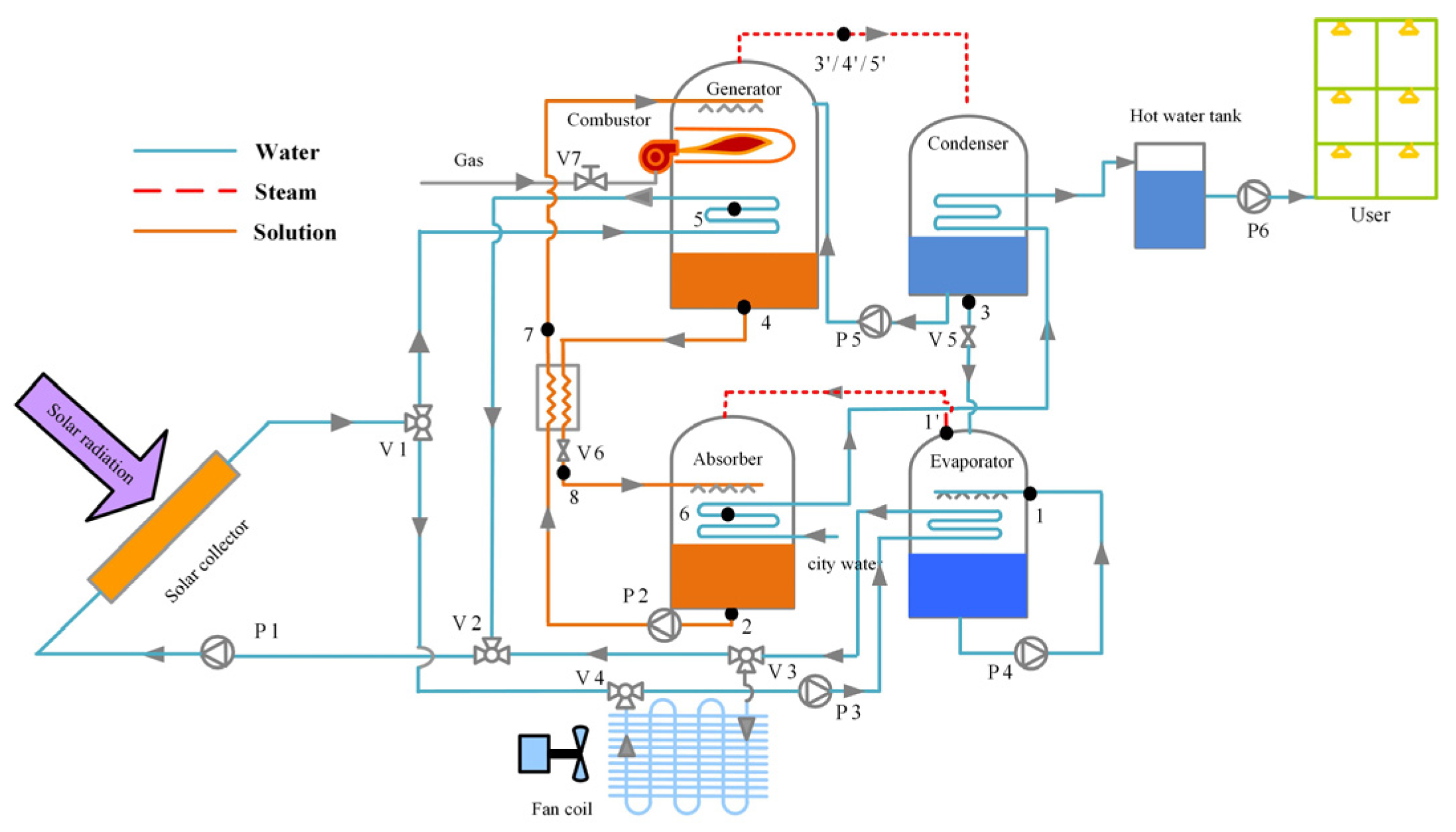
The SAAHP mainly consists of an absorption heat pump equipped with a gas-fired combustor, a solar collector, a fan coil, and a hot water storage tank. The schematic of the SAAHP, which is operated in either SD (solar-energy-driving) or GD (gas-combustion-heat-driving) mode, is shown in Figure 1.

2.1. SD (Solar-Energy-Driving) Mode

In SD mode, three-way valves 1 and 2 are switched to the generator, and solar energy is used as the driving heat source. Additionally, three-way valves 3 and 4 are switched to the fan coil, and air energy is used as the low-temperature heat source. The city water is heated successively in the absorber and condenser and stored in the hot water tank for use.

2.2. GD (Gas-Combustion-Heat-Driving) Mode

In GD mode, three-way valves 1 and 2 are switched to the evaporator, while three-way valves 3 and 4 are switched to the solar collector. Here, the gas-fired combustor provides the driving heat source, and solar energy is used as the low-temperature heat source.
On precipitation days, if the hot water supply is insufficient, the gas-fired combustor will operate in either SD or GD mode to supplement heating. In this case, pump 5 will run.

2.3. Weather Data and the Building

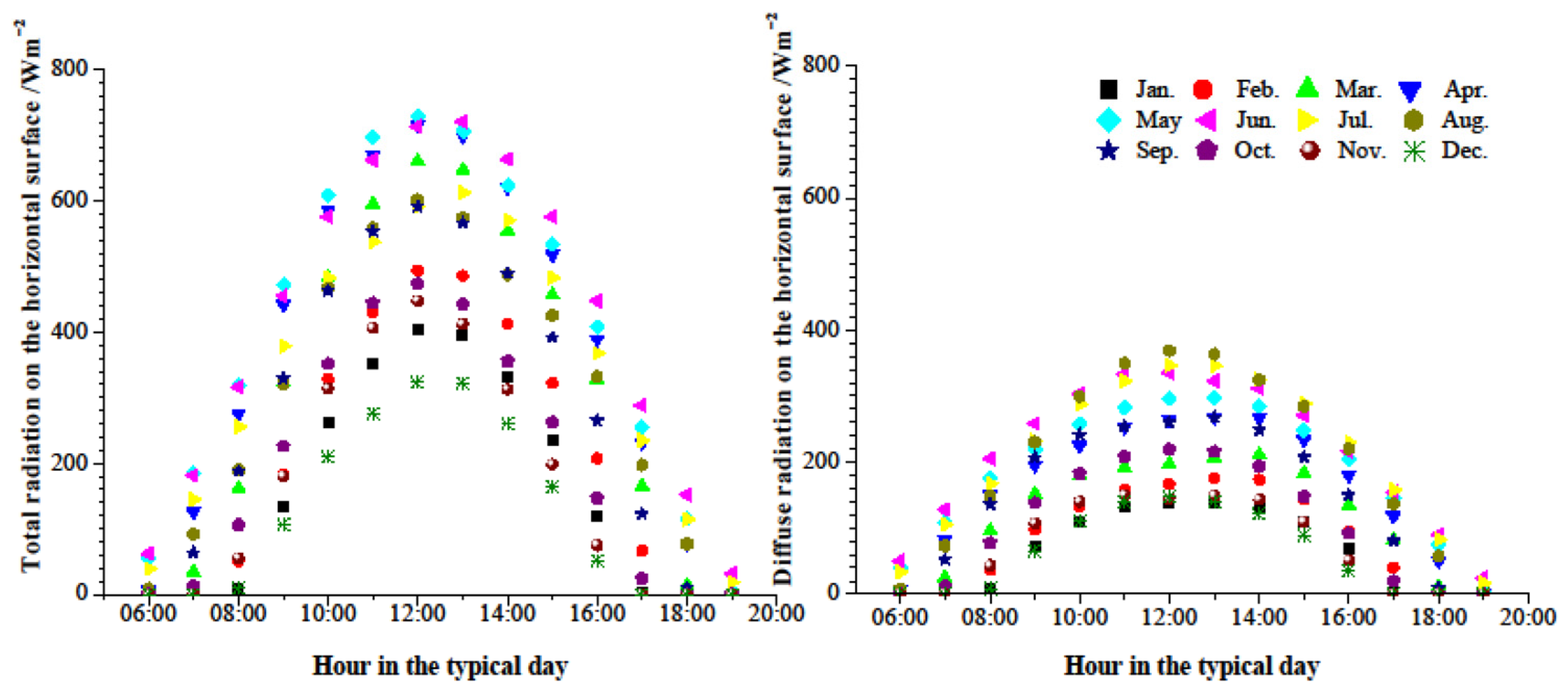
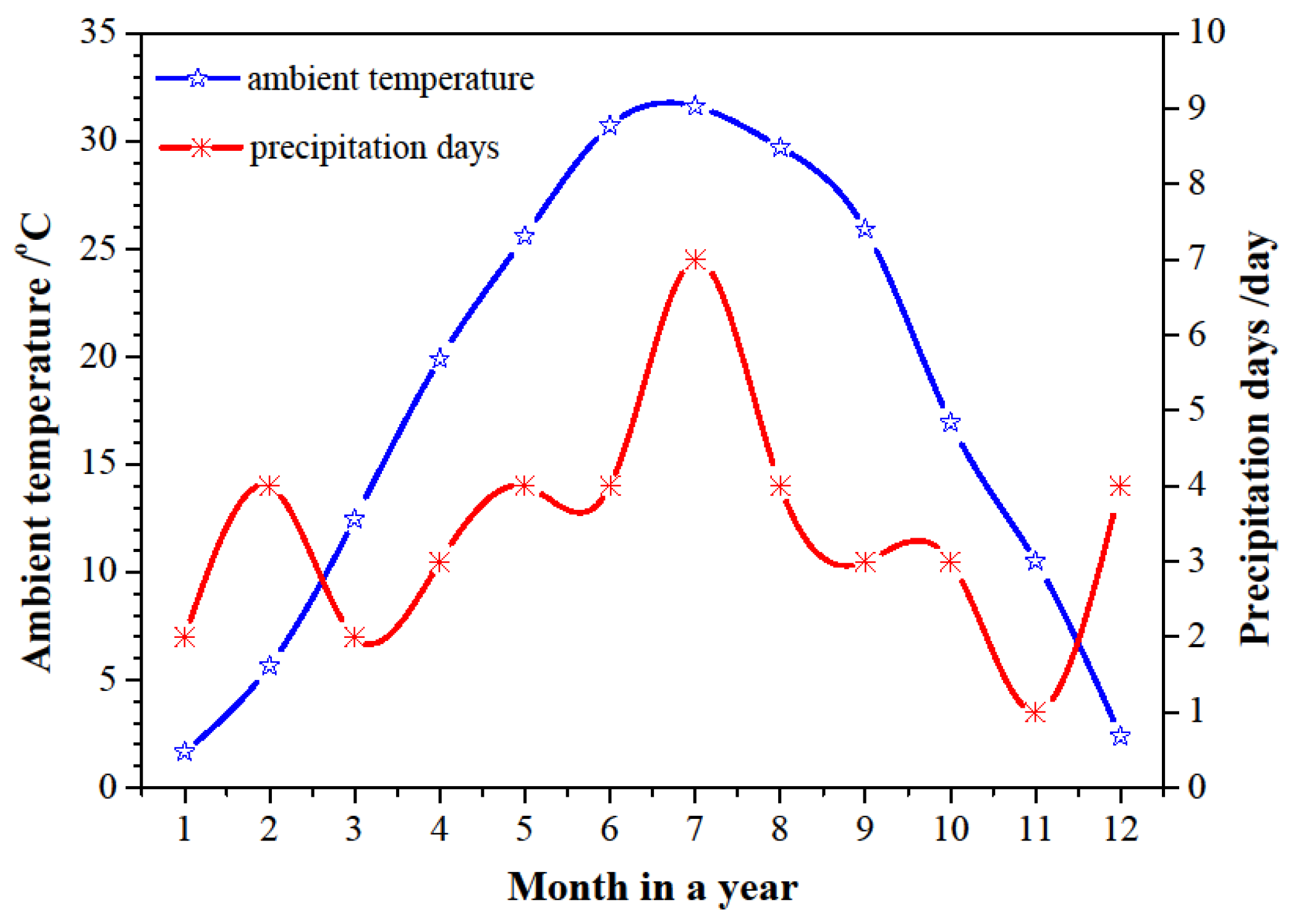
The typical yearly meteorological weather data of Beijing (Meteorological Station: No. 545110, latitude: 116°28′, longitude: 39°48′) can be found in the China Meteorological Data Service Centre. The hourly data on a typical day throughout a month is defined as the average value of the hourly meteorological data in the corresponding month, and the hourly solar radiation on the horizontal surface during a typical day is shown in Figure 2. The highest ambient temperatures during a typical day and monthly precipitation days are given in Figure 3.
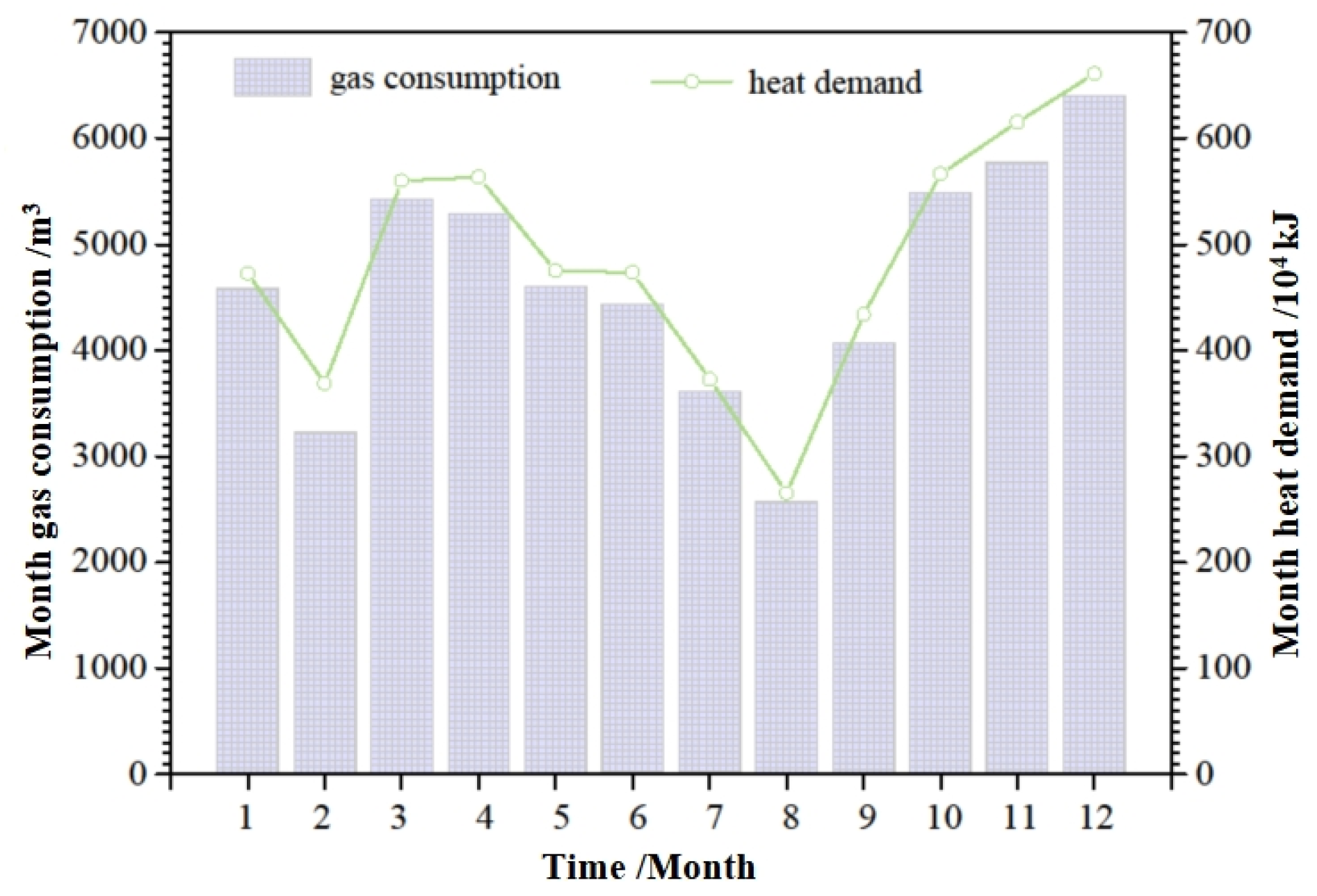
It is assumed that the SAAHP is used to supply domestic hot water to a nine-storey student dormitory in the campus of the University of Science and Technology, Beijing. The hot water is used for bathing from 2:00 PM to 11:00 PM, and a roof area of 600 m2 is available for installing flat-plate solar collectors. Based on the statistic gas consumption data from the boiler room and a gas boiler efficiency of 90%, the heat demand for hot water in this building was obtained, and the monthly gas consumption rate and heat demand are shown in Figure 4.

3. Simulation of the SAAHP

To simulate the SAAHP’s performance using MATLAB 2023b software, the material property equations are given below, and the models for the absorption heat pump, solar collector, fan coil, and storage water tank were built. To ensure convenient simulation, the following assumptions are made:
(a)
System is in a steady state: The system operates under steady-state conditions such that all thermodynamic properties (temperature, pressure, mass flow rate, enthalpy, concentration, etc.) at any location within the system are constant. There is no accumulation of mass or energy inside the system;
(b)
Pressure drops and heat losses are ignored: There will be no pressure reduction due to friction or turbulence when fluids flow through pipes and valves, nor will there be any energy loss because of pressure drop or friction;
(c)
The throttling in the expansion valve is isenthalpic;
(d)
The liquid solution leaves each unit in a saturated state, and there is no subcooling or overheating in the liquid phase at the outlet;
(e)
Ignoring the influence of dynamic fluctuations on the steam state, the steam in the generator is in a saturated state, and the enthalpy value is only related to temperature and pressure. Ignoring heat dissipation losses and the influence of gas flow on the steam state, all heat carried by the steam from the generator enters the subsequent cycle.
Under these assumptions, the thermal performance of the system can be analyzed under ideal conditions. As an ideal analysis result, the COP can be regarded as the maximum value. However, if these factors are taken into account, the COP will decrease. Because the pressure drops, the friction and resistance of the pipeline will cause local energy loss. If the outlet solution in the system is not saturated, it indicates that the absorption/evaporation process is insufficient, and the insufficient refrigerant flow in the cycle will cause a decrease in cooling capacity, as well as a reduction in COP.

3.1. Thermodynamic Property Equations

3.1.1. LiNO3/H2O Working Fluid

The vapor pressure of the LiNO3/H2O working fluid was measured at a temperature range from 297.65 to 473.15 K and an absorbent mass fraction range from 50 to 70% [12]. The experimental data on vapor pressure are fitted to the Antoine equation (Equation (1)) [13].
log P L i N O 3 = i = 0 4 ( A i + B i / ( T C i ) ) ( 100 w ) i
where w is the mass concentration of LiNO3 and Ai, Bi, and Ci are the regression parameters, with their values listed in Table 1.
The specific enthalpies of the LiNO3/H2O working fluid were measured at a temperature range from 303.15 to 373.15 K and an absorbent mass fraction range from 45 to 60% [14]. The experimental data are fitted to polynomial Equation (2) [15].
h L i N O 3 = i = 0 4 A i ( 100 w ) i + T i = 0 4 B i ( 100 w ) i + T 2 i = 0 4 C i ( 100 w ) i
where Ai, Bi, and Ci are the regression parameters, with their values listed in Table 2.

3.1.2. LiBr/H2O Working Fluid

The vapor pressure of the LiBr/H2O working fluid is obtained from Ref. [16].
log P L i B r = k 0 + k 1 / ( T D + 273.15 ) + k 2 / ( T D + 273.15 ) 2
where TD is the dew point and is fitted to the following equation:
T D = i = 0 2 j = 0 3 A i j ( w 40 ) j t i
The values of k0, k1, k2, and Aij are given in Table 3.
The specific enthalpy of the LiBr/H2O working fluid reported in Ref. [17] is fitted to polynomial Equation (5) using a least squares method:
h L i B r = i = 0 4 A i ( 100 w ) i + T i = 0 4 B i ( 100 w ) i + T 2 i = 0 4 C i ( 100 w ) i
where Ai, Bi, and Ci are the regression parameters, with their values listed in Table 4.

3.1.3. Saturated Water, Saturated Water Vapor, and Superheated Steam

The saturation pressures of water vapor used in this paper are derived from data in the Ref. [18]. The regression equation is given below:
P w = i = 0 6 A i T i       ( 273.15 T 373.15 K )
where Ai is the regression parameters, with their values listed in Table 5.
The specific enthalpies of saturated water and saturated vapor are obtained according to the fitting equations reported in the literature [15]:
h v = 0.00125397 t 2 + 1.88060937 t + 2500.559
h l a t e n t = 0.00132635 t 2 2.29983657 t + 2500.43063
where hv is the enthalpy of saturated water vapor and hlatent is the latent heat of condensation. The enthalpy of saturated water is obtained according to Equation (9):
h w = h v h l a t e n t  
The specific enthalpy of superheated steam is obtained from Ref. [19]:
h s h = B 0 + B 1 T + B 2 T 2 + B 3 ( P / 1000 ) / T B 4 + B 5 ( P / 1000 ) 2 / T B 6
The coefficient values are listed in Table 6.

3.1.4. Specific Enthalpy of Air

According to the data reported in the Ref. [18], the following equation for the specific enthalpy of air is obtained using a least squares fitting:
h a = A 0 + A 1 T + A 2 T 2 + A 3 T 3 + A 4 / T       ( 250 T 390 K )
The values of the regression parameters are given in Table 7.

3.2. Modeling the Absorption Heat Pump

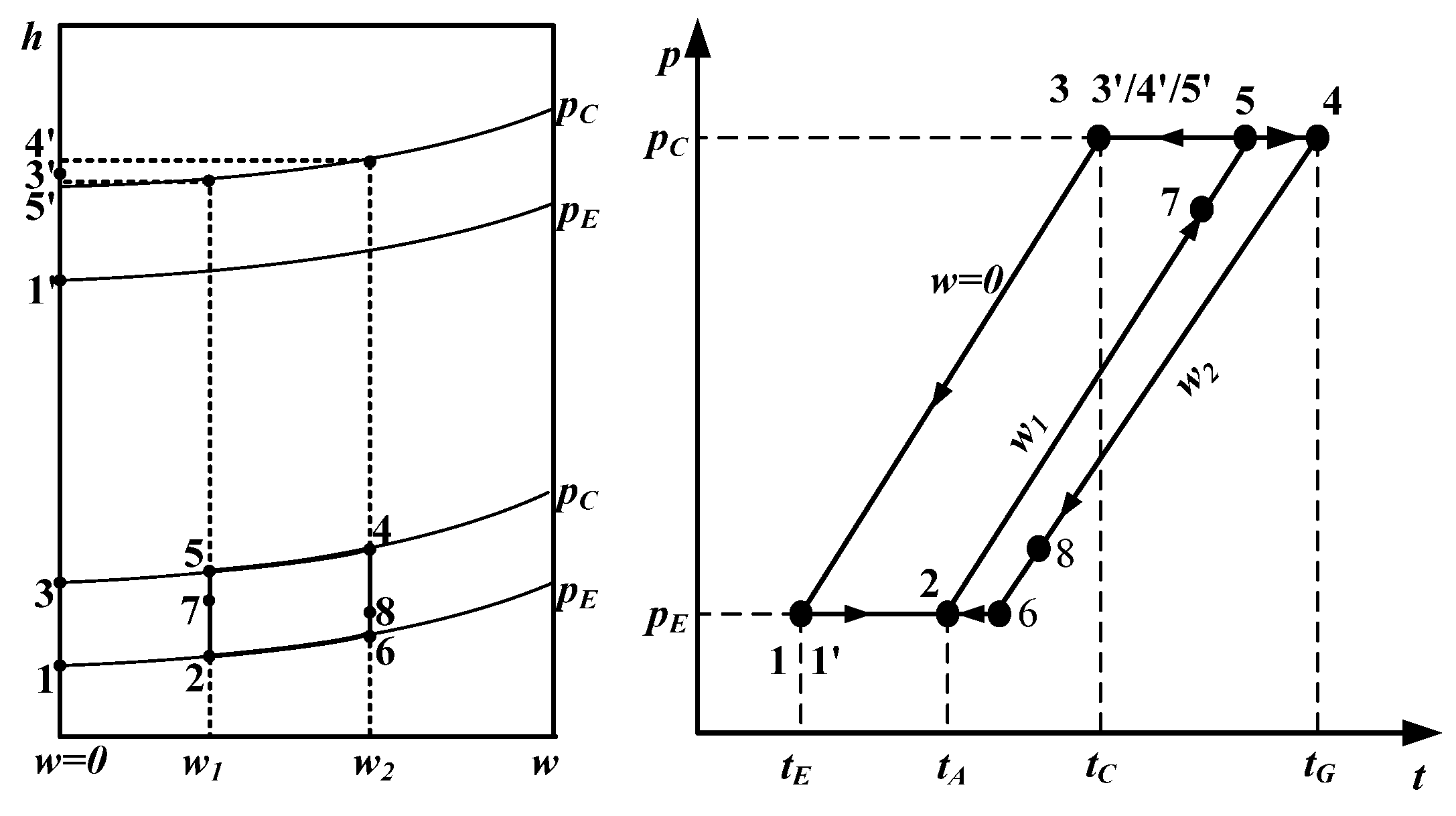
The h-w and p-t diagrams are given in Figure 5, and the typical points in Figure 5 are in one-to-one correspondence with the points in Figure 1. According to the laws of mass and energy conservation, the following formulas are obtained. Here, the refrigerant flow rate D is assumed as 1 kg/s.
  • Flow ratio α:
The flow ratio α is the ratio of the dilute solution’s circulation flow rate to the refrigerant’s flow rate.
α = w 2 w 2 w 1
where w1 and w2 are the concentrations of the dilute and concentrated solutions.
2.
Solution heat exchange:
The heat recovery efficiency and heat load of the solution heat exchanger are defined as the following equations [20]:
η S H X = t 4 t 8 t 4 t 2
Q S H X = D α ( h 7 h 2 ) = D ( α 1 ) ( h 4 h 8 )
3.
Heat load of the evaporator:
D h 3 + Q E = D h 1
q E = h 1 h 3
4.
Heat load of the generator:
Q G + α D h 7 = ( α 1 ) D h 4 + D h 3
q G = ( α 1 ) h 4 + h 3 α h 7 = h 3 h 4 + α ( h 4 h 7 )
5.
Heat load of the condenser:
D h 3 = Q C + D h 3
q C = h 3 h 3
6.
Heat load of the absorber:
D h 1 + D ( α 1 ) h 8 = Q A + D α h 2
q A = h 1 + ( α 1 ) h 8 α h 2
7.
Coefficient of performance (COP) and Primary energy COP:
C O P = Q C + Q A Q G
C O P p r i = Q C + Q A Q p r i
where Qpri is the primary energy consumption converted from the system’s total energy consumption, including the amounts of electrical power and natural gas consumed.

3.3. Solar Collector

The flat-plate solar collector (P-G/0.6-T/L-1.83-4, Beijing Solar Energy Research institute Co., Ltd., Beijing, China) with a maxim solar collector efficiency of 0.788 is adopted, and its thermal performance has been tested by the National Center for Quality Supervision and Testing of Solar Heating Systems (Beijing). The solar collector arrays are installed at a tilt of 39.8° toward the south, and their azimuth angle γ is zero. The efficiency of the flat-plate solar collector is given by Duffie and Beckmann’s equation [21]:
η s = F R ( τ α ) F R U L ( t s , i n t a m ) / I T
where IT is the incident solar radiation on a tilted surface, which can be calculated using the following equation:
I T = I b R b + I d ( 1 + cos β 2 ) + ( I b + I d ) μ ( 1 cos β 2 )
where Ib and Id is the beam and diffuse radiation on the horizontal surface, β is the slope of the collector, μ is the surface albedo, and Rb is the geometric factor, that is, the ratio of beam radiation on the tilted surface to that on a horizontal surface.
When the surface azimuth angle is 0°, the ratio Rb can be calculated as follows:
R b = cos θ cos θ z = cos ( φ β ) cos δ cos ω + sin ( φ β ) sin δ cos φ cos δ cos ω + sin φ sin δ
where θ is the angle of incidence, θz is the zenith angle, φ is the latitude, ω is the hour angle, and δ is the declination. The declination δ can be calculated from the following equation:
δ = 23.45 sin ( 360 ° × 284 + n 365 )
where n is the day of the year, and the recommended average days for months and the n values by month are listed in Ref. [21].
The useful heat gain from the solar collector arrays is calculated as follows:
Q s = η s A s I T
The thermal medium’s temperature (water used in this work) at the solar collector’s outlet is expressed as
t s , o u t = t s , i n + η s I T G C p
where Cp is the specific heat capacity of the medium and G is the mass flow rate in unit area of the solar collector.
The pressure loss in the solar collector and control parameters (flow rate, geometry/configuration, and fluid properties) also have a profound impact on its efficiency and optimal operating point. The pressure loss represents irreversible mechanical energy loss, which reduces the heat output of the collector. In solar-driven absorption heat pump systems, the working fluid flow rate must be dynamically balanced between enhanced heat transfer efficiency and pressure drop/thermal loss control: an insufficient flow rate leads to a significant increase in the temperature gradient between the working fluid and the environment, exacerbating irreversible heat dissipation from the system to the surroundings, while an excessive flow rate causes the shaft power of the pump unit to rise exponentially, resulting in additional energy loss [22,23].

3.4. Fan Coil and Solution Pump

Air energy is used as the low-temperature heat source through the fan coil in SD mode. The heat load of the fan coil is determined using Equations (31) and (32).
Q a = Q s q G q E
Q a = ρ a v a ( h a , i n h a , o u t )
By combining Equation (31) with (32), the air volume flow rate νa can be calculated:
v a = q E Q s ρ a ( h a , i n h a , o u t ) q G
where the density of air ρa is considered a constant at ambient temperature.
The power consumption of the fan is expressed as the following equation [24]:
P F = v a Δ p a η F = q E Q s q G ρ a ( h a , i n h a , o u t ) ( Δ p coil + Δ p out ) η F
where ∆pa is the evaporator resistance, ηF is the fan efficiency, ∆pcoil is the coil’s resistance, and ∆pout is the excess pressure of the fan outlet. As ∆pa is proportional to the square of air velocity, PF is proportional to the cube of the air volume flow rate, and it can be expressed as follows:
P F 1 = v a 1 3 v a 2 3 P F 2
The power consumption of the solution pump is calculated using the following equation [25]:
P p = v p Δ p p η p = v p ( p out p in ) η p
where νp is the volume flow rate; ∆pp is the pressure head of the solution pump; pout and pin are the outlet and inlet pressures of the pump, respectively, and ηp is the pump efficiency.

3.5. Hot Water Storage Tank

The energy balance of the hot water storage tank during its storage period in sunshine time is expressed as follows:
Q s t = Q i n Q o u t Q s t l
where Qst is the heat load of the storage tank, Qin is the heat flowing into the storage tank, Qout is the heat flowing out of the storage tank, and Qstl is the heat lost to the surrounding. Because hot water consumption in the university campus is always concentrated in the evening after 8:00 PM, to simplify the model, the small amounts of hot water consumed before peak time and the corresponding Qout are ignored.
The heat qin supplied by the SAAHP can be calculated as follows:
Q i n = m w h i n
where mw and hin are the mass flow rate and specific enthalpy of the hot water flowing into the storage tank, respectively. mw is determined by the following equation:
m w = Q A c p , w Δ t A = Q C c p , w Δ t C
The heat loss of the storage tank is expressed as
Q s t l = U s t A s t ( t s t t a m )
By combining Equations (37), (38), and (40), the energy balance equation of the hot water storage tank at a short time step, ∆τ, can be derived:
m w h i n Δ τ + M 0 h 0 U s t A s t ( t s t t a m ) Δ τ = ( m w Δ τ + m 0 ) h 1
where h0 and M0 are the specific enthalpy and mass of the hot water stored at the present time and h1 is the specific enthalpy of the hot water stored at a short time step, ∆τ. Ust is the heat loss coefficient of the storage tank and is taken as 6 W·m−2·°C−1, while Ast is the surface area of the storage tank and is 25 m2.
As specific enthalpy is a function of temperature, after the specific enthalpy of the hot water stored is determined, the corresponding temperature can also be determined.
The storage tank’s volume is calculated as follows:
V tan k = 0 t ( m w / ρ w ) d t
where ρw is the density of the hot water stored and t’ is the storage time.

3.6. Primary Energy Coefficient of Performance (COP)

In this study, daily, monthly, and yearly primary energy COPs (COPpri,d, COPpri,m, and COPpri,y) are defined as follows:
C O P p r i , d = Q i , d Q p r i , d = Q i , d W p , d + W F , d η g + Q G , d η c o m
C O P p r i , m = Q i , m ( n m n r ) × Q i , d C O P p r i , d + n r × Q G , d η c o m
C O P p r i , y = i = 1 i = 12 Q i , m i = 1 i = 12 Q i , m C O P p r i , m
where Qi,d and Qi,m are the daily and monthly heat demand of the building, respectively; ηcom is the efficiency of the combustor; nm represents the days of a month, and nr represents the precipitation days. Since the share of thermal power in the national total power capacity is over 70%, ηg at the user’s end is set to 35% [26].

3.7. Validation of the AHP Model

The absorption heat pump is the key component in the SAAHP, so validating the AHP model is important. To ensure that the model and the MATLAB program are sufficiently accurate, an absorption chiller using the LiBr/H2O working fluid with a refrigeration capacity of 211.1 kW was calculated using the model expressed in this work, and the results are compared with those reported in Refs. [27,28] at the same chilled water inlet temperature (8 °C) and outlet temperature (12 °C). As shown in Table 8, the comparisons indicate that the model can provide adequate accuracy with small deviations. Since the AHP has the same cycle and principle as the absorption chiller, the model and program can also be used to simulate the AHP’s performance.

4. Results and Discussion

Based on the above models, the performance of the SAAHPs with LiBr/H2O and LiNO3/H2O was simulated under the operating conditions shown in Table 9. Considering the influence of the flow ratio on the power consumption of the solution pump and the COP of the absorption heat pump, the SAAHP’s performance with LiBr/H2O and LiNO3/H2O was compared under the same flow ratio.
The main parameters, heat load, and COP of the AHP with LiBr/H2O and LiNO3/H2O at a refrigeration flow rate of D = 1 kg/s are listed in Table 10. The required generator temperature of the AHP using LiNO3/H2O was lower than that using the LiBr/H2O working fluid, and the former reached a higher COP throughout a year. This is mainly because of the differences in the absorption property between the two working fluids.
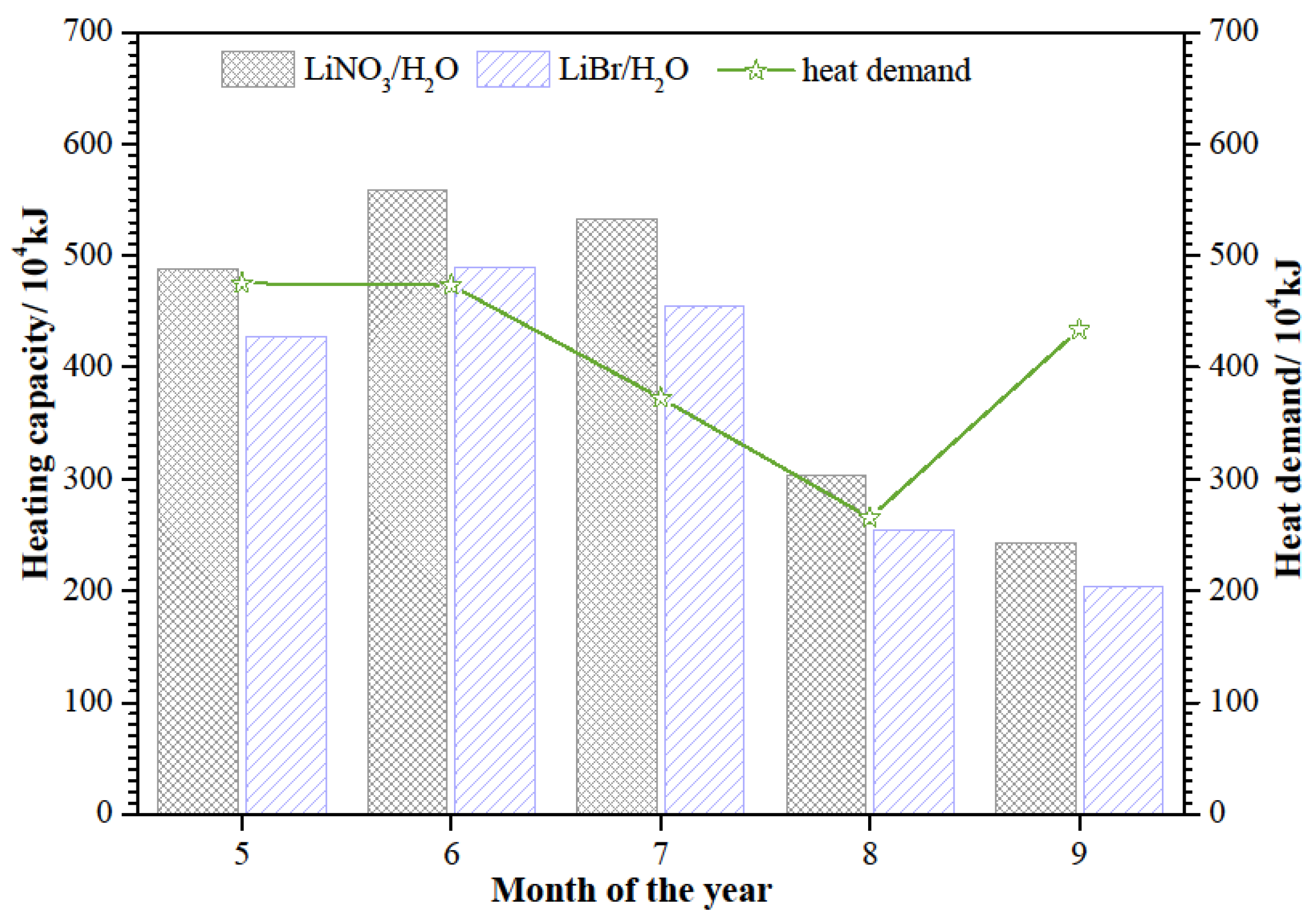
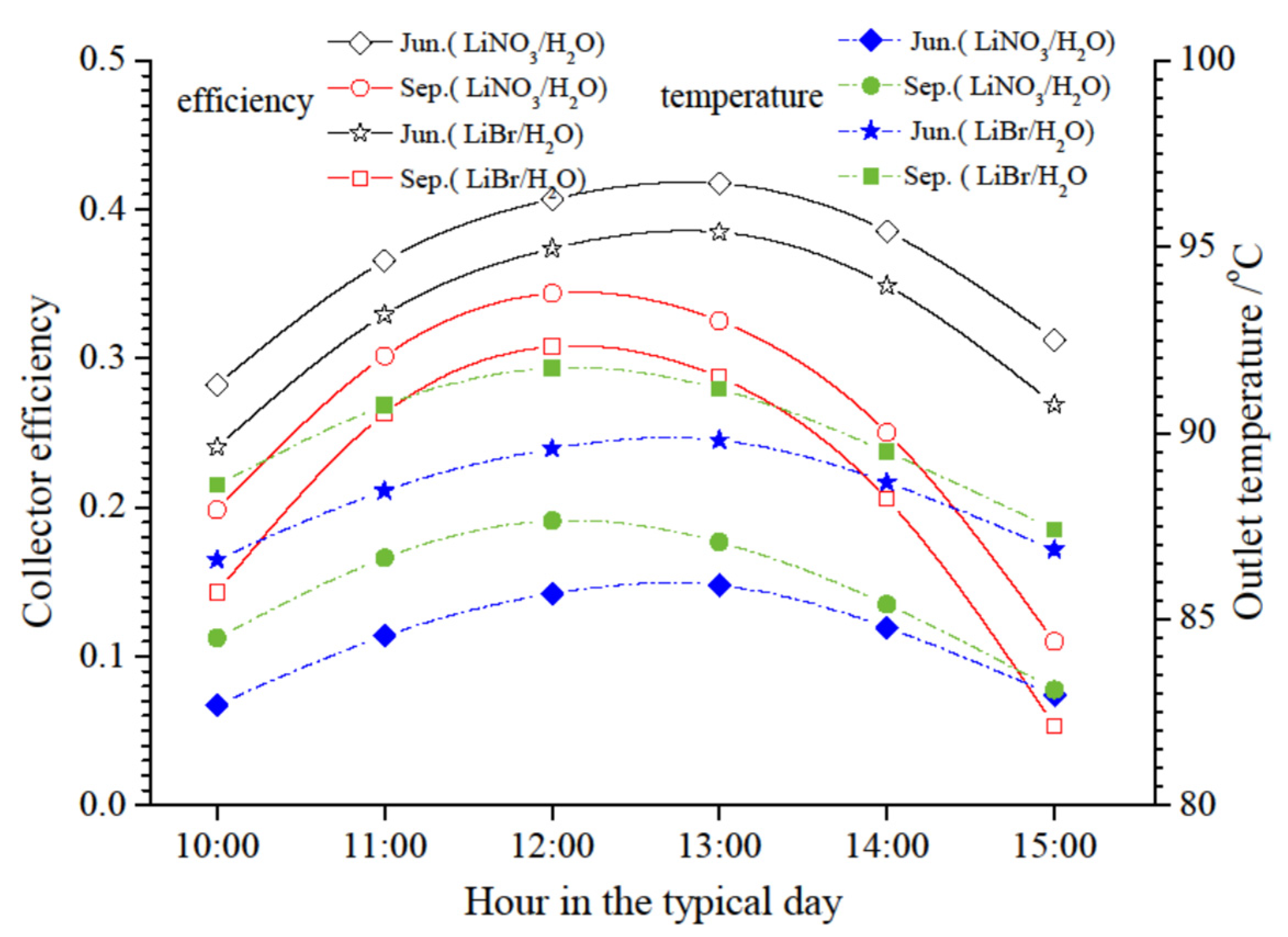
The switching time of the operating mode is determined using the ambient temperature and the heating capacity of the SAAHP system. When the SAAHP system runs in SD mode with the LiNO3/H2O working fluid, the required ambient temperatures in cold, moderate, and hot seasons should be above 21.2 °C, 24.2 °C, and 26.2 °C, respectively, under the given operating conditions. Based on the highest ambient temperature in a typical day, as shown in Figure 3, it is clear that the requirements can be met from May to September. Beyond that, the heating capacity of the SAAHP driven by solar energy should meet the heat demand of the building. The SAAHP’s heating capacity from May to September is presented in Figure 6. Its heating capacity with LiNO3/H2O can meet the heat demand from May to August, so it shall be operated in SD mode during this period. However, its heating capacity with LiBr/H2O barely meets the heat demand in June and July, so it shall be operated in SD mode in those two months. It is indicated that LiNO3/H2O is more suitable for operation in SD mode as the NO3/H2O-based SAAHP running in SD mode is able to utilize more solar energy. As seen in Figure 7, when solar energy is used as the driving heat source in SD mode, the outlet temperature of the LiNO3/H2O-based solar collector is below 88 °C, which is about 4 °C lower than that based on LiBr/H2O. Thus, the reduction in the outlet temperature can improve the collector’s efficiency.
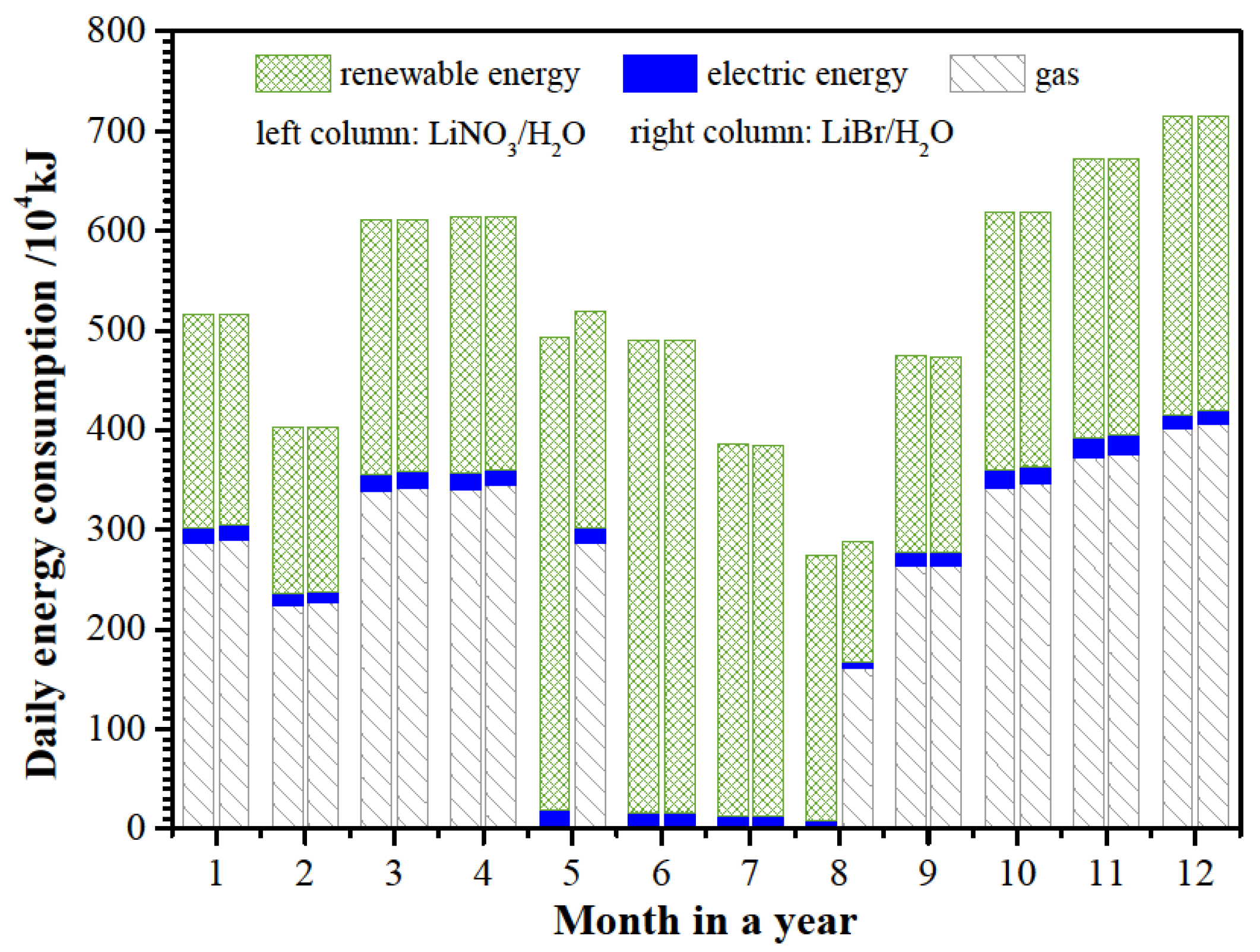
Figure 8 shows the daily energy consumption of the SAAHPs with the LiBr/H2O and LiNO3/H2O working fluids. Results indicated that the daily energy consumption of the SAAHP running in GD mode with different working fluids has no significant difference. However, the LiNO3/H2O-based SAAHP is able to utilize more renewable energy than that based on LiBr/H2O since the former can be operated in SD mode for a longer period. Compared with operations using renewable energy and natural gas, the electrical energy consumed by the solution pump and fan is very small throughout a year.
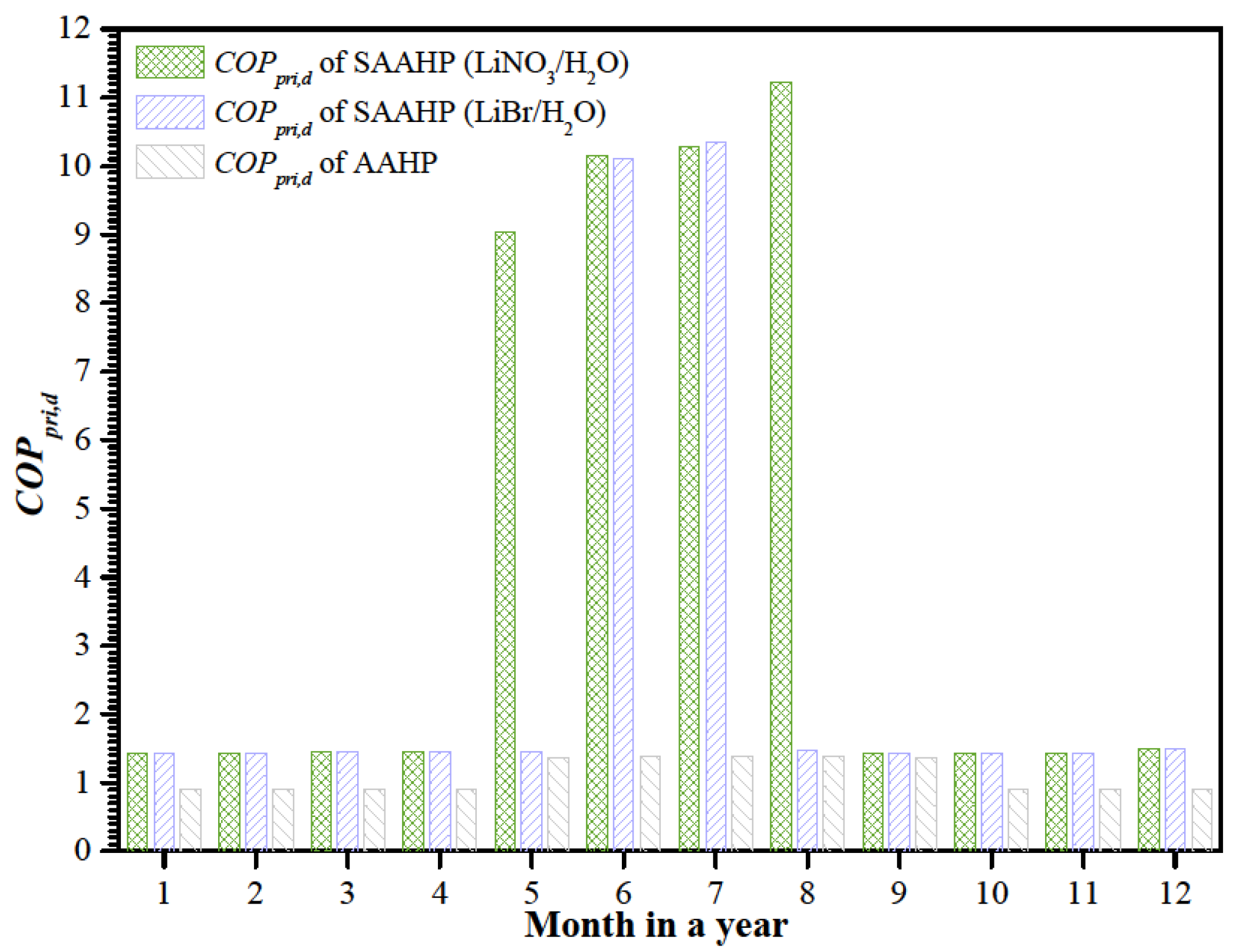
The daily primary energy COPs (COPpri,d) of the SAAHPs based on LiBr/H2O and LiNO3/H2O are presented in Figure 9 and compared with that of a LiBr/H2O AAHP with 300 kW heating capacity under the same operating conditions. Results indicated that the SAAHP running in SD mode achieves the highest COPpri,d of 11.2 due to its simultaneous use of solar and air energy, but the AAHP barely achieves the highest COPpri,d of 1.40 since it does not utilize high-grade solar energy in the hot season. The AAHP’s COPpri,d decreases with decreasing ambient temperature. When the ambient temperature is too low to be utilized as the low-temperature heat source, the COPpri,d of the AAHP drops to the efficiency (90%) of the gas-fired combustor installed in the AAHP. In contrast, the SAAHP can utilize solar energy instead of air energy at a low ambient temperature and still achieves a higher COPpri,d above 1.43 in cold regions.
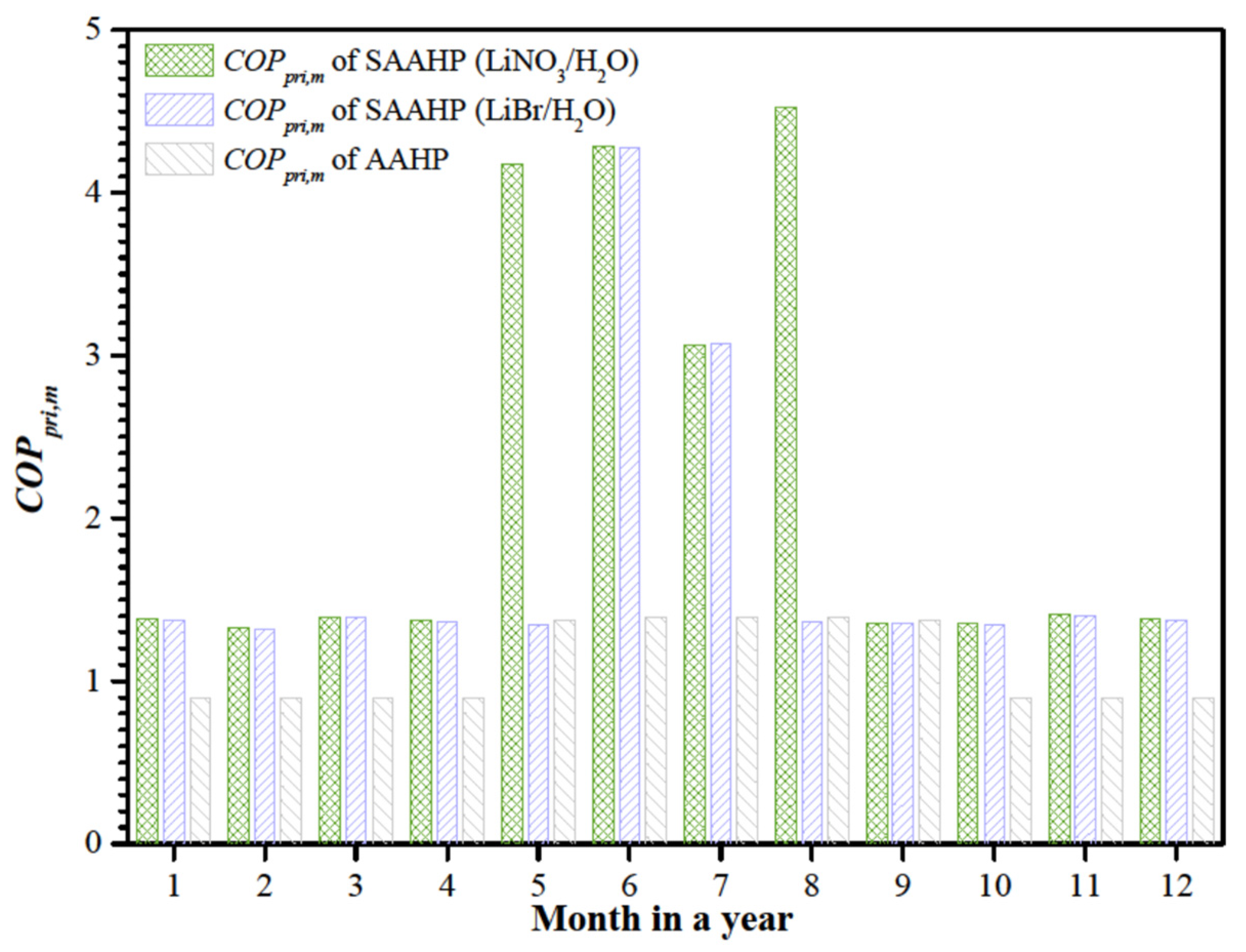
Figure 10 shows the monthly primary energy COP (COPpri,m) of the SAAHP and AAHP. Considering the monthly precipitation days, the COPpri,m of the SAAHP running in GD mode has no obvious change, but that in SD mode is reduced relative to the COPpri,d, especially in the rainy season of July. While a precipitation day has a great influence on the primary energy consumption in SD mode, the COPpri,m of the SAAHP using the LiNO3/H2O working fluid is still above 3.07. By comparing the SAAHP’s COPpri,m with that of the AAHP, it is seen that the former has a significant advantage throughout a year.
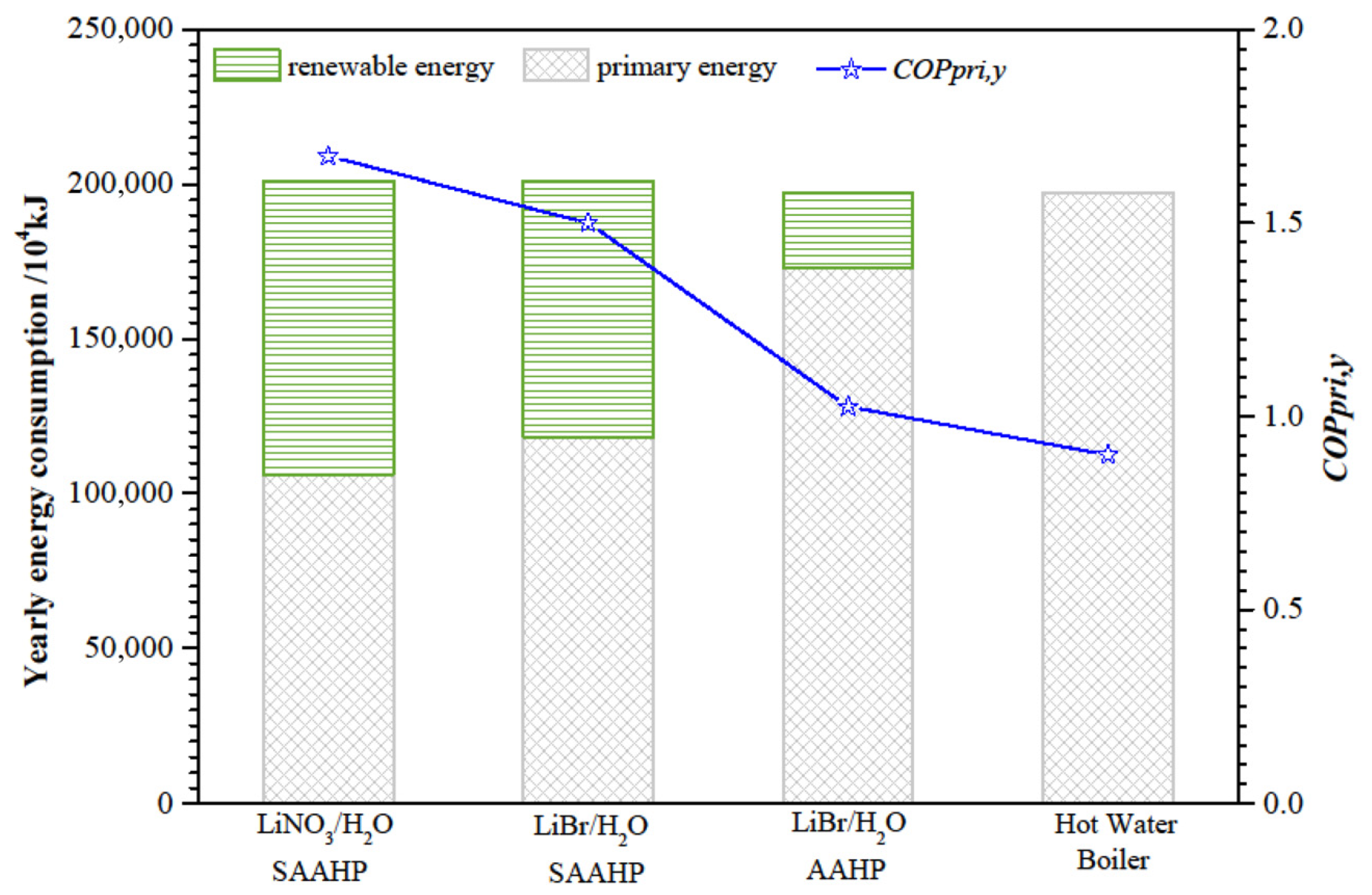
The yearly energy consumption and yearly primary energy COPs (COPpri,y) of the SAAHP and AAHP are shown in Figure 11. The COPpri,y values of the LiNO3/H2O- and LiBr/H2O-based SAAHPs are 1.67 and 1.50, respectively, which are obviously larger than that of the AAHP. Compared to a common gas-fired hot water boiler, the SAAHPs based on LiNO3/H2O and LiBr/H2O save 25,631 Nm3 and 22,213 Nm3 in natural gas per year, whereas the AAHP only saves 6766 Nm3 in natural gas per year. Thus, it is clear that the SAAHP has an obvious advantage in primary energy-saving over the gas-fired hot water boiler and AAHP.
To further investigate the primary energy-saving effect of the SAAHP and AAHP, the yearly primary energy-saving rate (YPESR) is defined as follows:
Y P E S R = E b o i l e r , y E p r i , y E b o i l e r , y
where Eboiler is the yearly primary energy consumption of the gas-fired hot water boiler, Epri,y is the yearly primary energy consumption of the SAAHP or AAHP. Compared to the gas-fired boiler, the LiNO3/H2O- and LiBr/H2O-based SAAHPs achieve yearly primary energy-saving rates of 46.2% and 40.0%, respectively, while the AAHP only achieves a yearly primary energy-saving rate of 12.2%. Obviously, compared to the AAHP, the SAAHP shows a great advantage in building energy-saving, and its primary energy-saving effect can be further improved by using LiNO3/H2O instead of LiBr/H2O.
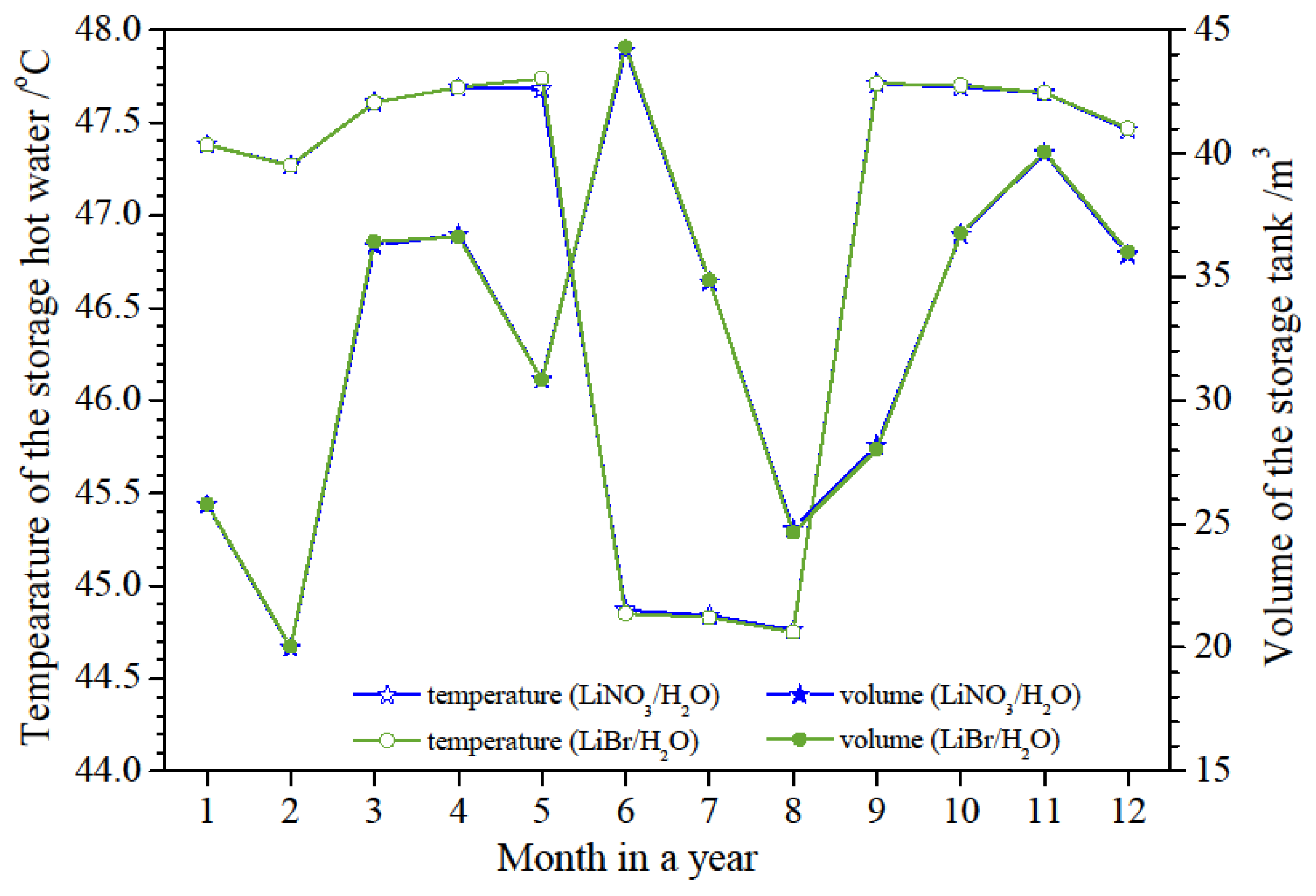
The temperature and volume of the hot water stored before peak bathing times in different months are shown in Figure 12. It can be seen that the hot water temperatures and storage volumes based on the LiBr/H2O and LiNO3/H2O working fluids have no significant differences throughout a year. The temperatures of the hot water stored are above 44.8 °C in the hot season and 47.3 °C in other seasons. The storage volume in the tank varies from 20 m3 to 44 m3 throughout a year due to the influences of the building’s heat demand and the temperature of the city water. Thus, the storage tank used in this system should be more than 44 m3 to meet the storage requirement through all the months.

5. Conclusions

This paper presents a novel SAAHP combining a solar collector and a fan coil with an absorption heat pump equipped with a gas-fired combustor, in which renewable solar and air energy can be utilized simultaneously. The models for each component were set up, and the corresponding heat and mass balance equations were established. The performances of the LiBr/H2O- and LiNO3/H2O-based SAAHPs were simulated throughout a year and compared with that of the AAHP based on LiBr/H2O and a gas-fired hot water boiler. The main conclusions are as follows:
(1)
Compared with the SAAHP based on LiBr/H2O, the LiNO3/H2O-based pump has a significant advantage due to it requiring a 4 °C lower solar collector inlet temperature in SD mode.
(2)
The SAAHP running in SD mode achieved the highest COPpri,d of 11.2 by simultaneously utilizing solar and air energy, while the AAHP barely achieved the highest COPpri,d of 1.40 due to the lack of high-grade solar energy utilization in the hot season. The SAAHP running in GD mode achieved a higher COPpri,d (above 1.43) utilizing solar energy instead of air energy compared to the AAHP, whose COPpri,d decreased dramatically due to the low ambient temperature in the cold season. Taking the precipitation days into consideration, the SAAHP still achieved a higher monthly primary energy COP throughout a year.
(3)
Compared to the gas-fired hot water boiler, the LiNO3/H2O- and LiBr/H2O-based SAAHPs achieved yearly primary energy-saving rates of 46.2% and 40.0%, respectively, whereas the AAHP only achieved a rate of 12.2%. Thus, the SAAHP based on LiNO3/H2O has significant energy-saving potential in building energy use.
Analyzing the performance of SAAHPs serves as a fundamental basis for application requirements, such as building heating, providing robust data support for the formulation of architectural design and energy layout. Moreover, the analysis results demonstrate that SAAHPs can enhance the utilization efficiency of renewable energy and reduce carbon emissions, thereby having significance across industrial advancement and social sustainable development.

Funding

This research was funded by the Foundation for talented young people of Anhui Polytechnic University, China (NO.: S022020033).

Data Availability Statement

The original contributions presented in this study are included in the article. Further inquiries can be directed to the corresponding author.

Conflicts of Interest

The author declare no conflicts of interest.

Abbreviations

The following abbreviations are used in this manuscript:
Nomenclature
Aarea, m2
SAAHPSolar–air source absorption heat pump
AAHPair source absorption heat pump
SDsolar-energy-driving
GDgas-combustion-heat-driving
SHXsolution heat exchanger
COPcoefficient of performance
Cpspecific heat capacity, kJ kg−1 °C−1
Dvapor flow, kg s−1
FRheat transfer factor
Gmass flow rate in the unit area of the collector, kg s−1 m−2
hspecific enthalpy, kJ kg−1
Isolar radiation, W m−2
mmass flow rate, kg s−1
Mmass, kg
Ppower, W
qspecific heat load, kJ kg−1
Qheat load, kJ s−1
ttemperature, °C
Tabsolute temperature, K
Uheat loss coefficient, W m−2 °C−1
vvolume flow rate, m3 s−1
wmass concentration, %
Wpower consumptions, kJ
Greek symbols
∆ppressure drop, Pa
∆ttemperature difference
∆τtime step, second
αflow ratio, no unit
βslope angle, °
γazimuth angle, °
δdeclination, °
ηefficiency, %
θincidence angle, °
μsurface albedo, no unit
ρdensity, kg m−3
ταcollector transmissivity and absorptivity product, no unit
φlatitude, °
ωhourly angle, °
Subscripts
aair
Aabsorber
amambient
comcombustor
Ccondenser
d,m,ydaily, monthly, and yearly
Eevaporator
Ffan
gpower generation
Ggenerator
ininlet
outoutlet
ppump
priprimary energy
rrainy
ssolar collector
ststorage tank
wwater

References

  1. CABEE. Research Report on Building Energy Consumption and Carbon Emissions in China (2023). Architecture 2024, 2, 46–59. [Google Scholar]
  2. Wu, W.; Shi, W.; Wang, B.; Li, X. A new heating system based on coupled air source absorption heat pump for cold regions: Energy saving analysis. Energy Convers. Manag. 2013, 76, 811–817. [Google Scholar] [CrossRef]
  3. Ibrahim, N.I.; Yahiaoui, A.; Garkuwa, J.A.; Ben Mansour, R.; Rehman, S. Solar cooling with absorption chillers, thermal energy storage, and control strategies: A review. J. Energy Storage 2024, 97, 112762. [Google Scholar] [CrossRef]
  4. Song, M.; Li, N.; Shi, F.; A, Y.; Liu, Q. Performance analysis of a solar single-effect absorption/compression hybrid refrigeration system with integrated absorption energy storage. Energy Convers. Manag. 2024, 312, 118524. [Google Scholar] [CrossRef]
  5. Altiokka, A.; Arslan, O. Design and optimization of absorption cooling system operating under low solar radiation for residential use. J. Build. Eng. 2023, 73, 106697. [Google Scholar] [CrossRef]
  6. Long, J.; Xia, K.; Zhong, H.; Lu, H.; A, Y. Study on energy-saving operation of a combined heating system of solar hot water and air source heat pump. Energy Convers. Manag. 2021, 229, 113624. [Google Scholar] [CrossRef]
  7. Wang, C.; Gao, Y.; Dai, Z.; Wu, D.; Huang, Z.; Zhang, X.; Jiang, L. Experimental investigation and performance evaluation on a direct expansion solar-air source heat pump system. Int. J. Refrig. 2023, 145, 168–176. [Google Scholar] [CrossRef]
  8. Wu, W.; Wang, B.; Shi, W.; Li, X. Techno-economic analysis of air source absorption heat pump: Improving economy from a design perspective. Energy Build. 2014, 81, 200–210. [Google Scholar] [CrossRef]
  9. Shao, S.; Shi, W.; Li, X.; Ma, J. A new inverter heat pump operated all year round with domestic hot water. Energy Convers. Manag. 2004, 45, 2255–2268. [Google Scholar] [CrossRef]
  10. Wu, W.; Zhang, X.; Li, X.; Shi, W.; Wang, B. Comparisons of different working pairs and cycles on the performance of absorption heat pump for heating and domestic hot water in cold regions. Appl. Therm. Eng. 2012, 48, 349–358. [Google Scholar] [CrossRef]
  11. Byun, J.S.; Lee, J.; Jeon, C.D. Frost retardation of an air-source heat pump by the hot gas bypass method. Int. J. Refrig. 2008, 31, 328–334. [Google Scholar] [CrossRef]
  12. Luo, C.; Su, Q.; Mi, W. Solubilities, vapor pressures, densities, viscosities, and specific heat capacities of the LiNO3/H2O binary system. J. Chem. Eng. Data 2013, 58, 625–633. [Google Scholar] [CrossRef]
  13. Park, Y.; Kim, J.-S.; Lee, H.; Yu, S.I. Density, vapor pressure, solubility, and viscosity for water + lithium bromide + lithium nitrate + 1, 3-propanediol. J. Chem. Eng. Data 1997, 42, 145–148. [Google Scholar] [CrossRef]
  14. Luo, C.; Su, Q.; Mi, W. Thermophysical properties and application of LiNO3–H2O working fluid. Int. J. Refrig. 2013, 36, 1689–1700. [Google Scholar] [CrossRef]
  15. Florides, G.; Kalogirou, S.; Tassou, S.; Wrobel, L. Design and construction of a LiBr–water absorption machine. Energy Convers. Manag. 2003, 44, 2483–2508. [Google Scholar] [CrossRef]
  16. Kaita, Y. Thermodynamic properties of lithium bromide–water solutions at high temperatures. Int. J. Refrig. 2001, 24, 374–390. [Google Scholar] [CrossRef]
  17. Chen, D.; Xie, J.H. Heat Pump Water Heater, 1st ed.; Chemical Industry Press: Beijing, China, 2009. [Google Scholar]
  18. Liu, G.Q.; Ma, L.X.; Liu, J. Handbook of Chemical and Engineering Property Data: Inorganic Volume, 1st ed.; Chemical Industry Press: Beijing, China, 2006. [Google Scholar]
  19. Jiang, X.; Cao, Z. A group of simple precise formulations for properties of water and steam. Power Eng. 2003, 23, 2777–2780. [Google Scholar]
  20. Bakhtiari, B.; Fradette, L.; Legros, R.; Paris, J. A model for analysis and design of H2O–LiBr absorption heat pumps. Energy Convers. Manag. 2011, 52, 1439–1448. [Google Scholar] [CrossRef]
  21. Duffie, J.A.; Beckman, W.A.; Blair, N. Solar Engineering of Thermal Processes, Photovoltaics and Wind; John Wiley & Sons: Hoboken, NJ, USA, 2020. [Google Scholar]
  22. Yousaf, S.; Shafi, I.; Din, S.; Paul, A.; Ahmad, J. A big data analytical framework for analyzing solar energy receptors using evolutionary computing approach. J. Ambient. Intell. Humaniz. Comput. 2019, 10, 4071–4083. [Google Scholar] [CrossRef]
  23. Liang, C.; Zhang, X.; Zhu, X.; Li, X. Performance analysis of heat pump based on a new solar air-source heat pump heating system. J. Southeast Univ. 2010, 26, 227–231. [Google Scholar]
  24. Li, X.; Wu, W.; Zhang, X.; Shi, W.; Wang, B. Energy saving potential of low temperature hot water system based on air source absorption heat pump. Appl. Therm. Eng. 2012, 48, 317–324. [Google Scholar] [CrossRef]
  25. Sun, D.W. Comparison of the performances of NH3-H2O, NH3-LiNO3 and NH3-NaSCN absorption refrigeration systems. Energy Convers. Manag. 1998, 39, 357–368. [Google Scholar] [CrossRef]
  26. Yang, Y.; Guo, X.; Wang, N. Power generation from pulverized coal in China. Energy 2010, 35, 4336–4348. [Google Scholar] [CrossRef]
  27. Sun, J.; Fu, L.; Zhang, S.; Hou, W. A mathematical model with experiments of single effect absorption heat pump using LiBr–H2O. Appl. Therm. Eng. 2010, 30, 2753–2762. [Google Scholar] [CrossRef]
  28. Joudi Khalid, A.; Ali, H.L. Simulation of a simple absorption refrigeration system. Energy conversion and Management 2001, 42, 1575–1605. [Google Scholar] [CrossRef]
Figure 1. The schematic of the solar–air source absorption heat pump.
Energies 19 01508 g001
Figure 2. The hourly total and diffuse radiation on the horizontal surface during a typical day.
Energies 19 01508 g002
Figure 3. The highest ambient temperatures in a typical day and monthly precipitation days.
Energies 19 01508 g003
Figure 4. The monthly gas consumption rate with a gas-fired boiler and the heat demand of the building.
Energies 19 01508 g004
Figure 5. The h-w and p-t diagrams for the absorption heat pump.
Energies 19 01508 g005
Figure 6. The heating capacity of the SAAHP driven by solar energy with different working fluids.
Energies 19 01508 g006
Figure 7. The efficiency and outlet temperature of the solar collector during a typical day in June and September.
Energies 19 01508 g007
Figure 8. Daily energy consumption of the LiBr/H2O- and LiNO3/H2O-based SAAHPs.
Energies 19 01508 g008
Figure 9. Daily primary energy COP of SAAHP and AAHP in the typical day of different months.
Energies 19 01508 g009
Figure 10. Monthly primary energy COPs of the SAAHP and AAHP.
Energies 19 01508 g010
Figure 11. Comparison of the yearly energy consumption and yearly primary energy COP.
Energies 19 01508 g011
Figure 12. The temperature and volume of the hot water stored in the storage tank in different months.
Energies 19 01508 g012
Table 1. Values of Ai, Bi, and Ci for Equation (1).
iAiBiCi
06.148192−1.229085 × 1031.252132 × 102
1−0.3131042.959166 × 102−3.511392 × 10²
20.173883−1.650989 × 10³−8.934301 × 10³
37.119462 × 10−42.194534−2.515973 × 10³
45.104596 × 10−74.193150 × 10−4−1.854562 × 10²
Table 2. Values of Ai, Bi, and Ci for Equation (2).
iAiBiCi
0−3.564122 × 10322.790770−0.02888562
11.933768 × 10²−1.2965452.004876 × 10−3
2−4.3272600.03055025−4.923745 × 10⁻⁵
34.353722 × 10⁻²−3.151721 × 10−45.233923 × 10−7
4−1.572100 × 10−41.163146 × 10−6−2.017912 × 10⁻⁹
Table 3. Values of Aij and ki for Equation (4).
Aij0123ki
0−9.133128−4.759724 × 10⁻¹−5.638171 × 10−21.108418 × 10−37.05
19.439697 × 10⁻¹−2.882015 × 10⁻³−1.345453 × 10−45.852133 × 10−7−1603.54
2−7.324352 × 10⁻⁵−1.556533 × 10−51.992657 × 10−6−3.924205 × 10⁻⁸−104,095.5
Table 4. Values of Ai, Bi, and Ci for Equation (5).
iAiBiCi
0−948.6549960.2957060.00482458
131.3986470.243767−0.000372743
2−0.732539−0.008211271.085509 × 10−5
30.008238710.000103320−1.345934 × 10⁻⁷
4−2.842605 × 10⁻⁵−4.583410 × 10−75.989197 × 10−10
Table 5. Values of Ai for Equation (6).
A0A1A2A3A4A5A6
527.77−10.460.10−0.00062.22 × 10−6−4.53 × 10−93.87 × 10−12
Table 6. Values of Bi for Equation (10).
B0B1B2B3B4B5B6
2026.381.6583.144 × 10−4−2.19 × 1042.534−4.14 × 10259.216
Table 7. Values of Ai for Equation (11).
A0A1A2A3A4
107.58110.49878291.013251 × 10−3−7.330917 × 10⁷−8524.637
Table 8. Result comparison for model validation.
ParametersThis WorkRef. [27]DeviationRef. [28]Deviation
Weak solution concentration54.48%54.60%0.22%54.23%0.46%
Strong solution concentration55.83%56.00%0.30%55.63%0.36%
Heat load of the generator298.45 kW293.26 kW1.77%296.3 kW0.73%
Heat load of the condenser224.37 kW221.61 kW1.25%221.7 kW1.20%
Heat load of the absorber270.61 kW261.92 kW3.32%285.0 kW5.04%
COP0.7160.7170.14%0.710.84%
Table 9. The given operating conditions for the SAAHP.
Operating Condition
Output temperature of hot waterJun., Jul., and Aug.45 °C
Other months.48 °C
Temperature of city waterJan., Feb., and Dec.5 °C
Mar., Apr., May, Sep., Oct., and Nov.12 °C
Jun., Jul., and Aug.20 °C
Temperature of the evaporatorJan., Feb., and Dec.10 °C
Mar., Apr., May, Sep., Oct., and Nov.13 °C
Jun., Jul., and Aug.15 °C
Heat transfer temperature differenceOutlet of the evaporator.2 °C
Outlet of the generator, condenser, absorber.3 °C
Temperature drop in the airFan coil.4 °C
Logarithmic mean temperature differenceFan coil.7 °C
Concentration difference in the LiNO3 absorbent5 wt %
Recovery efficiency of the solution heat exchanger85%
Fan efficiency60%
Solution pump efficiency90%
Combustor efficiency90%
Solar collector area450 m2
Table 10. The parameters, heat load, and COP of AHP in different seasons at D = 1 kg/s.
SeasonWorking
Fluid
tG°CtA°CQAkWQCkWQGkWQEkWQSHXkWαCOP
ColdLiBr/H2O84.030.12693.682441.682829.642305.721068.7812.31.81
LiNO3/H2O78.729.92642.882431.822768.982305.721233.2512.31.83
ModerateLiBr/H2O83.933.42676.642441.512806.872311.281010.8112.41.82
LiNO3/H2O79.233.32618.962432.762740.442311.281167.3012.41.84
HotLiBr/H2O80.535.72654.012447.822774.292327.53902.7912.41.84
LiNO3/H2O76.135.62586.622439.532698.622327.531032.3412.41.86
Disclaimer/Publisher’s Note: The statements, opinions and data contained in all publications are solely those of the individual author(s) and contributor(s) and not of MDPI and/or the editor(s). MDPI and/or the editor(s) disclaim responsibility for any injury to people or property resulting from any ideas, methods, instructions or products referred to in the content.