1. Introduction
In recent years, the large-scale integration of renewable energy sources such as wind and photovoltaic power has not only optimized the energy mix and improved supply cleanliness but also effectively reduced carbon emissions and environmental pollution [
1]. However, the continued increase in wind power penetration has significantly heightened the security risks faced by power system operation. At present, the security situation of power systems is becoming increasingly severe due to multiple factors, including structural contradictions brought about by the energy transition, frequent extreme weather events, growing cybersecurity threats, and equipment aging coupled with maintenance pressures, all of which pose serious challenges to the stable operation of systems [
2,
3,
4]. When severe disturbances occur in local grids and conventional control measures prove ineffective, failure to implement emergency control in a timely manner can easily lead to fault propagation and even large-scale blackouts, severely impacting social production and daily life [
5,
6,
7]. In this context, controlled islanding is regarded as a critical defense measure to prevent local faults from spreading across the entire network, serving as the “last line of defense” to ensure secure and stable power system operation while minimizing socio-economic losses [
8].
Research on controlled islanding can generally be categorized into three core stages corresponding to different phases of the splitting process: first, the determination of the splitting sections, which determines where the system should be separated; second, the identification of the splitting timing, which identifies when the islanding operation should be executed; and third, post-splitting island stabilization control, which focuses on how to maintain stable operation within each island through remedial actions, thereby creating conditions for subsequent re-synchronization. This paper focuses on the first stage, with an emphasis on the optimal splitting sections searching method.
Identifying coherent generator groups that swing together after disturbances is fundamental to controlled islanding. Reference [
9] applies slow coherency theory to partition generators into slow coherent groups and implements islanding at weak connections to ensure the transient stability of the resulting islands. Reference [
10] adopts K-medoids clustering to partition system nodes into subregions, aggregating nodes within the same region to simplify the grid topology and enable rapid generation of islanding solutions. In [
11], a data-driven method using phasor measurement unit (PMU) measurements and electrical distances between centers of inertia was proposed for detecting coherent areas. A synchrophasor-based approach utilizing first and second derivatives of bus voltage phase angles with hierarchical clustering achieves accurate coherency detection with only three consecutive PMU measurements [
12]. In [
13], a graph theory-based method utilizing the network admittance matrix and a clustering quality index has been introduced for identifying coherent generators. Reference [
14] presents a modularity clustering approach for generator coherency detection based on the correlation coefficient and synchronizing torque coefficient of rotor angles.
Based on identified generator coherent groups, various strategies have been proposed for searching optimal splitting sections. In [
15], fault tree analysis (FTA) is employed to quantify node vulnerability and identify splitting points, yet the approach does not fully account for post-fault generator coherency characteristics. In [
16], generator coherency is treated as a constraint, and the optimal splitting sections are sought by minimizing the system’s net unbalanced power. In [
17], the physical process of network partitioning is formulated as a graph-theoretic optimization problem, which is identified as NP-complete, making it difficult to obtain the optimal solution within a limited time. Reference [
18] aims to minimize power flow disruption while also incorporating voltage and frequency stability constraints into the optimization model. Recent studies have further developed advanced algorithms for optimal splitting section searching. Reference [
19] proposed a two-step algorithm combining spectral clustering with mixed-integer quadratic programming, using a greedy heuristic to generate the starting solution. Reference [
20] developed a multi-layer constrained spectral clustering approach that considers bus coherency and minimizes real and reactive power disruptions. Reference [
21] introduced a motif-based spectral clustering algorithm that accounts for directed and weighted edges to better satisfy generator coherency constraints.
The aforementioned studies have laid a solid foundation for searching splitting sections. However, with the continuous integration of renewable energy, the dynamic characteristics of power systems have changed, rendering traditional splitting sections searching methods, which are suitable for synchronous generator systems, unable to guarantee the optimality and effectiveness of splitting strategies. The UK “8·9” blackout in 2019 was triggered by a lightning strike on a transmission line near London, which led to the near-simultaneous loss of the Hornsea offshore wind farm (737 MW) and the Little Barford gas-fired power plant (641 MW), resulting in a total generation loss of 1378 MW—well beyond the system’s 1 GW reserve capacity. The consequent frequency drop to 48.8 Hz triggered automatic load shedding that affected over one million customers [
22,
23]. This incident highlights the challenges posed by the increasing integration of renewable energy, underscoring the urgent need to develop splitting section searching methods adapted to the dynamic characteristics of modern power systems.
Considering the impact of grid integration of renewable energy is key to studying splitting sections searching methods for new types of power systems. The integration of renewable energy significantly reduces the equivalent inertia level of the system, which becomes even more pronounced after islanding, when multiple low-inertia islands are formed. Consequently, the appropriate grouping of renewable energy units becomes a critical factor in ensuring the stable operation of each island following splitting. Traditional controlled islanding theory is centered on synchronous generators as the core modeling objects, where coherent generator grouping is based on the geometric similarity of rotor angle trajectories. However, the integration of GFM wind power disrupts the applicability of this theoretical framework. Firstly, GFM wind turbines lack physical rotors; their power angle is a virtual quantity generated by the control algorithm and cannot be directly used for coherency identification based on rotor angle trajectories. Secondly, most traditional objective functions for islanding aim to minimize power flow disruption or unbalanced power, neglecting the accumulation and propagation paths of transient potential energy on branches following disturbances. Yet the control characteristics of GFM wind turbines alter the spatial distribution of transient potential energy, thereby reducing the stability of islands formed after splitting at the optimal splitting sections determined by traditional methods [
24,
25]. Therefore, incorporating the distribution characteristics of system transient potential energy into the splitting sections searching provides a new approach for controlled islanding in power systems with renewable energy.
In response to the aforementioned issues, this paper proposes an optimal splitting sections searching method based on branch transient potential energy from the perspective of transient energy. First, by calculating the improved generator internal node potential energy and combining it with K-means clustering, coherent generator grouping is achieved for systems incorporating GFM wind turbines. Second, an optimization objective function for the splitting sections is constructed with the BSI as the core, which quantifies the degree of transient energy accumulation on branches during fault processes. Meanwhile, to address the inertia reduction issue caused by renewable energy integration, the island inertia constraint considering both GFL and GFM wind turbines is introduced and incorporated into the objective function in the form of penalty terms. Furthermore, an improved BBO algorithm integrated with a TS mechanism is employed for global optimization. Finally, simulations are conducted on a modified New England 39-bus system to analyze the advantages of the proposed method in terms of island frequency stability and voltage stability.
2. A Clustering and Grouping Method Based on Generator Internal Node Potential Energy
The generator internal node potential energy characterizes the energy accumulated by the work done by the generator power deviation against the system frequency deviation following a disturbance. Based on the rotor motion equation, the mathematical expression of the internal node potential energy is derived. The rotor motion equation for the generator node
is given as follows:
where
is the equivalent inertia time constant of generator node
;
is the relative rotor angle of generator node
;
is the mechanical input power of generator node
;
is the electromagnetic output power of generator node
.
The angular velocity of generator node
is given as follows:
where
is the angular velocity of generator node
.
Substituting Equation (2) into Equation (1) and integrating along the disturbance trajectory yields the classical expression for generator internal node potential energy. This expression characterizes the accumulation of work done by the unbalanced power against the frequency deviation during the disturbance, as follows:
where
is the generator internal node potential energy of generator node
.
In coherent generator group identification, the focus is on the relative dynamic trends among generators rather than their absolute frequency values. To highlight these relative behaviors and eliminate the common trend component caused by system-wide frequency variations, this paper replaces the instantaneous angular velocity with the angular velocity deviation in the potential energy calculation. This approach is analogous to using relative rotor angles instead of absolute angles in transient stability analysis, as it better captures the inter-generator energy exchange.
Specifically, the angular velocity deviation for generator
at time
is defined as follows:
where
is the angular speed of generator node
at time
;
is the average angular speed of all generators in the system at the initial time;
is the total number of generators in the system.
The selection of system average angular velocity as the reference is motivated by both theoretical and practical considerations. When generators oscillate coherently around a common mean, the average frequency captures the system’s aggregate behavior. Deviations from this mean isolate inter-generator swing modes from the overall frequency drift. Furthermore, the proposed potential energy expression in Equation (3) exhibits relatively low sensitivity to small perturbations in the reference frequency, as the time integration tends to smooth out high-frequency fluctuations, and the subsequent clustering analysis focuses on the shape and trend of the potential energy curves rather than their absolute values. It should be acknowledged that during severe transients where the system splits into asynchronous islands, the average frequency loses its physical meaning; however, for the purpose of pre-splitting coherency identification, the analysis window is confined to the period immediately following fault clearance when the system remains largely coherent, ensuring that the average frequency remains a valid reference within this context.
The improved generator internal node potential energy is given as follows:
where
is the improved generator internal node potential energy of generator node
;
is the electromagnetic output power of generator node
at time
.
Although GFM wind turbines lack physical rotors, their control strategy makes them equivalent, in terms of port electrical characteristics, to voltage sources with virtual inertia. The following demonstrates the compatibility of the improved generator internal node potential energy proposed in this paper with GFM wind turbines, proceeding from the physical essence of energy interaction.
First, the core control objective of GFM wind turbines is to provide active inertia support during system frequency variations. Taking a typical virtual synchronous generator (VSG) control as an example, its active power–frequency control loop can be given as follows:
where
is the virtual inertia coefficient;
is the active power reference value;
is the electromagnetic output power;
is the damping coefficient;
is the virtual angular frequency;
is the reference angular frequency.
This equation corresponds exactly in mathematical form to the swing equation of a synchronous generator, indicating that the GFM wind turbine exhibits frequency response characteristics at its port similar to those of a synchronous generator.
To establish the energy equivalence, we examine the system from an energy perspective. Multiplying both sides of Equation (6) by the virtual angular frequency
yields the power balance relationship:
The left-hand side represents the rate of change in virtual kinetic energy stored in the GFM control loop. Integrating this equation over time along the post-disturbance trajectory from
to
gives the following:
The left-hand side integrates to the change in virtual kinetic energy. The first term on the right-hand side represents the work done by the unbalanced power against the virtual frequency deviation. This term has an identical mathematical structure to the potential energy term in synchronous generators, where the mechanical power
Pm replaces
Pref, and the actual rotor speed
replaces
. Thus, the generalized potential energy is given as follows:
It can be seen that, although the physical carriers through which GFM wind turbines store and release energy differ from those of synchronous generators, the two share an identical mathematical structure in terms of the energy exchange characterization form—specifically, the work done by the net power injected from the node into the system against the frequency deviation.
Based on the aforementioned energy equivalence, the improved generator internal node potential energy proposed in this paper can be uniformly applied to both synchronous generators and GFM wind turbines. The essence of this index is to quantify, with reference to the system average frequency, the transient energy accumulated at each generator node during a disturbance due to the mismatch between the injected power and the system frequency dynamics. When a GFM wind turbine exhibits a frequency response trajectory similar to that of a certain group of synchronous generators, its potential energy curve calculated by Equation (5) will show a similar evolution trend, thereby laying the foundation for clustering-based coherent generator grouping.
The equivalence established above between GFM wind turbines and synchronous generators relies on several key assumptions. First, the GFM wind turbine is assumed to employ a virtual synchronous generator control strategy with active power–frequency droop characteristics, which is the most prevalent control paradigm for grid-forming converters. Second, the virtual inertia coefficient should be of comparable magnitude to the inertia constants of synchronous generators in the system, ensuring meaningful energy exchange between the two generation types. Third, the fault duration must not be too long that the GFM control loop remains stable and its virtual angular frequency does not deviate excessively from the nominal value. Under these assumptions, the improved generator internal node potential energy can uniformly characterize both generation types. However, for GFM turbines employing alternative control strategies—such as dispatchable virtual oscillator control or matching control—the energy exchange characteristics may differ, and the proposed equivalence would require re-evaluation. It should be emphasized that for GFL wind turbines, which employ phase-locked loops to track system frequency and do not actively provide inertia support, their energy exchange characteristics following a disturbance are fundamentally different from those of synchronous generators; they do not exhibit the same potential energy accumulation pattern described by Equation (5). Therefore, in the subsequent analysis, these units are specifically constrained through the island inertia constraint rather than being incorporated into the coherent generator grouping based on potential energy curves.
Furthermore, since the dataset required for calculating the improved generator internal node potential energy is identical to that needed for computing the BSI in the subsequent objective function, adopting this criterion for coherent generator grouping can avoid duplicate data preparation processes and enhance computational efficiency.
To identify the dynamic response coherence of generator nodes after disturbances, this paper performs cluster analysis on the improved generator internal node potential energy curves. K-means clustering based on Euclidean distance can effectively identify generator groups with similar dynamic response characteristics. It should be noted that K-means clustering can be sensitive to initial centroid selection. To ensure the reliability of the coherency identification while maintaining computational efficiency for online implementation, the following approach is adopted. Extensive preliminary testing under various fault scenarios revealed that the improved generator internal node potential energy curves exhibit distinct grouping patterns: the inter-group differences are sufficiently pronounced that the clustering results are highly consistent across different initializations. Based on this observation, in the actual online calculations presented in this paper, K-means is executed three times with different random initializations. For all scenarios reported in
Section 5, the three runs yielded identical results, confirming the robustness of the coherency identification. Given that Euclidean distance accurately measures the overall similarity of time-series data with equal time intervals, this method can effectively reveal the generator grouping structure while ensuring computational efficiency [
26].
The reason for choosing the improved generator internal node potential energy over traditional rotor angle curves for coherent generator grouping in this paper lies in pursuing theoretical self-consistency within the overall islanding analysis framework. The improved generator internal node potential energy directly characterizes the accumulation of disturbance energy and shares the same physical origin with the BSI subsequently used for splitting sections searching. Together, they form a complete analytical chain from “energy source coherency identification” to “energy path vulnerability assessment.” This design not only ensures intrinsic logical unity at the methodological level but, more critically, enables GFM wind turbines, which are a power source type without physical rotors, to be uniformly incorporated into the coherent generator grouping framework from the physical essence of transient energy accumulation and exchange, thereby resolving the issue where traditional rotor angle trajectory-based methods fail when applied to them.
5. Case Study
For the modified New England 39-bus system, the solution of the proposed optimization model is performed on the MATLAB platform (version 9.13) and validated through simulation using PSASP software (version 7.41).
5.1. System Description and Fault Setting
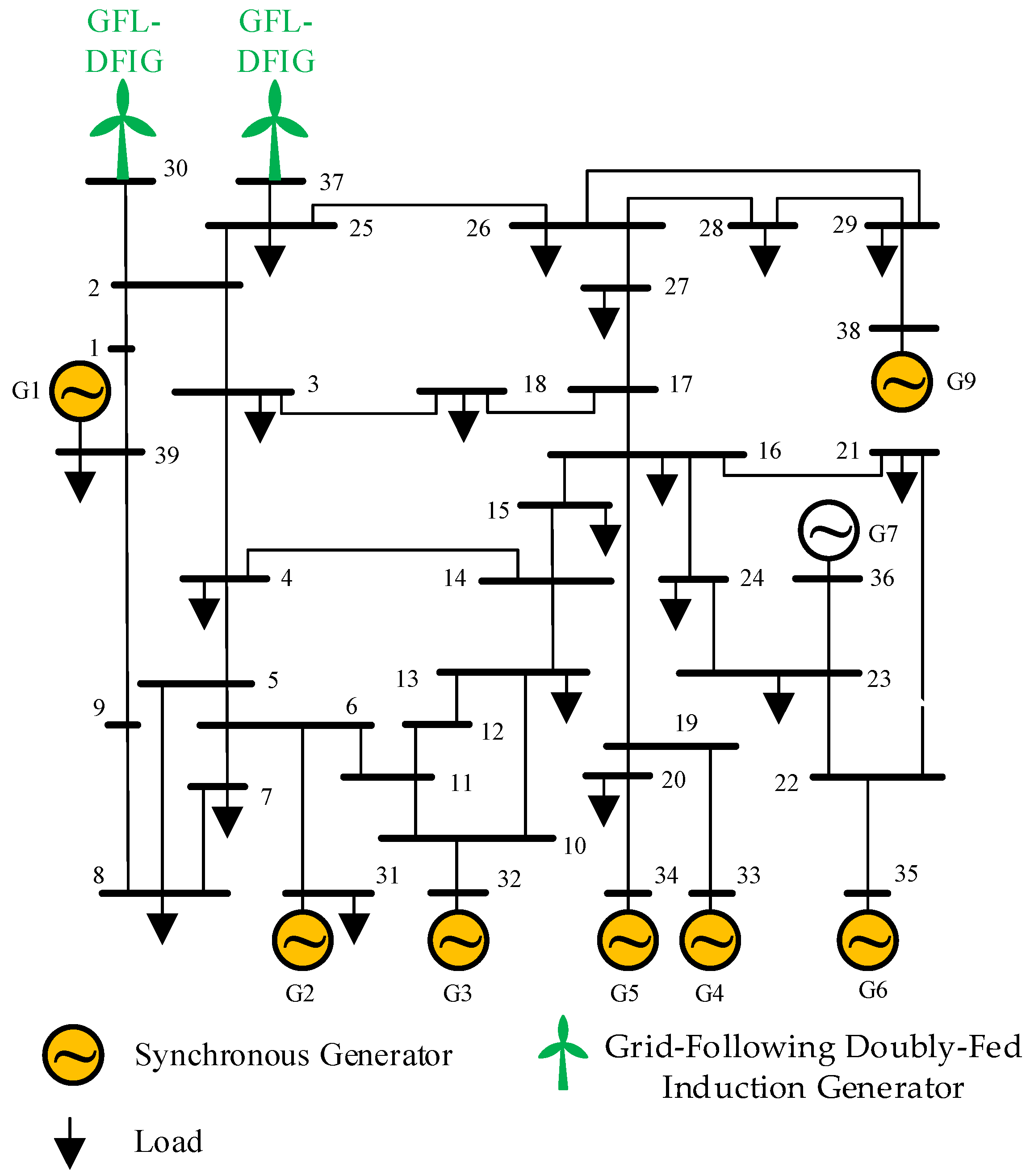
The modified New England 39-bus system serves as the test platform for this study. While a single topological structure is employed, the validation framework encompasses multiple system variations: different wind turbine types (GFL and GFM), distinct fault locations and clearing times, various wind farm allocations and different constraint configurations. This multi-scenario design enables a comprehensive evaluation of the proposed method’s adaptability to different system characteristics, partially mitigating the limitation of using a single topological benchmark. The topology of the original New England 39-bus system is documented in [
33], and the modified system configuration is illustrated in
Figure 2. The original generators, G8 and G10, are replaced with equivalent wind farms, which retain the same capacity and power output as the original units. The equivalent wind farm model employed is based on a doubly fed induction generator (DFIG). This model possesses low voltage ride-through capability, and its control system adopts a typical vector control-based GFL strategy. A three-phase short-circuit fault is set at line 16–21 near bus 21 at t = 0 s, and the fault is cleared 0.5 s later.
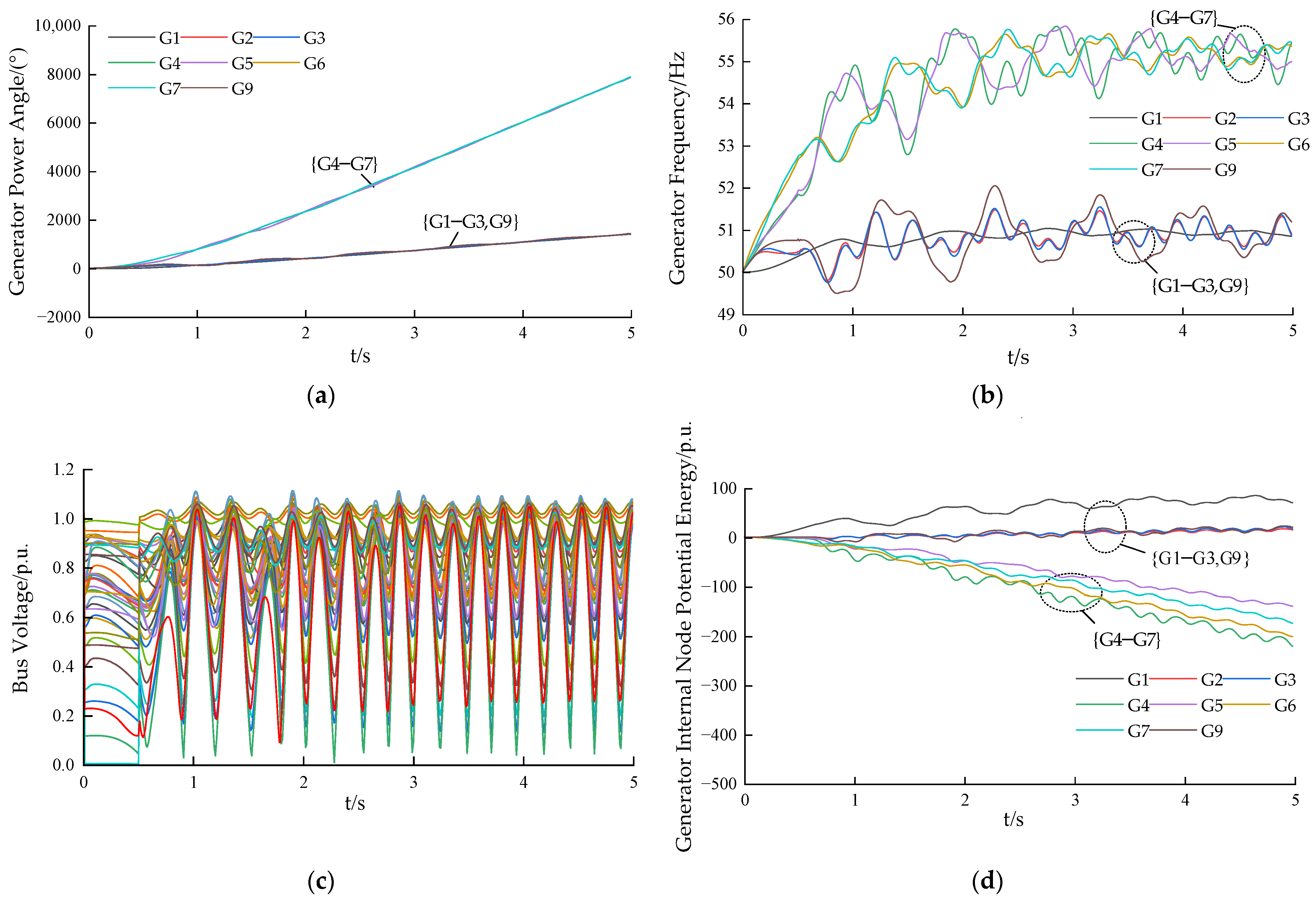
The curves of generator rotor angles, frequencies, bus voltages, and generator internal node potential energies when no islanding operation is performed are shown in
Figure 3. Using generator rotor angles and generator internal node potential energies as clustering indicators, respectively, K-means clustering based on Euclidean distance is applied to the time-series data over the 0–5 s interval. The grouping results are presented in
Table 1.
As shown in
Table 1, both clustering indicators divide the generators into two groups: {G1–G3, G9} and {G4–G7}. The grouping results based on the rotor angle trajectories and those based on the improved generator internal node potential energy curves are ultimately consistent. This consistency verifies that the method based on improved generator internal node potential energy can effectively identify generator coherency following a fault.
It can be observed from
Figure 3 that without implementing an islanding control, the system becomes unstable and may lead to a widespread blackout. Therefore, it is necessary to perform controlled islanding on this system to prevent such an outcome. It is assumed that all loads in the system can be shed, and the maximum allowable active and reactive power output adjustments of synchronous generators in Equation (21) are both set to 40% of their respective maximum active and reactive power outputs. In Equation (22), the maximum adjustable range of wind farm active power is set to 40% of its maximum power output.
5.2. Analysis and Comparison of Splitting Models
After determining the coherent generator groups, three islanding models with different objective functions were employed to search for the splitting sections. All three models share the same set of constraints and incorporate the island inertia constraint as a penalty term in the objective function. These models are denoted as Islanding Model 1, Islanding Model 2, and Islanding Model 3, with the following configurations:
Islanding Model 1: Uses minimizing the island unbalanced power as its objective function.
Islanding Model 2: Uses minimizing the power flow disruption as its objective function.
Islanding Model 3: Uses minimizing the BSI as its objective function.
The objective functions adopted in Models 1 and 2 correspond to widely used criteria in the controlled islanding literature. Specifically, minimizing the island unbalanced power (Model 1) has been employed in distributed consensus-based islanding strategies [
34], while minimizing power flow disruption (Model 2) is a common objective in MILP-based approaches [
35]. The comparison among these models thus provides a meaningful evaluation against representative methods from the literature.
5.2.1. Splitting Model 1
The splitting sections and corresponding results obtained with Islanding Model 1 are shown in
Table 2. The island containing the slack generator G2 is designated as Island 1, and the other island as Island 2.
As shown in
Table 2, Island 1 has a power deficit and therefore requires load shedding, while Island 2 has a power surplus that is eliminated by adjusting the output of its generators. It should be noted that, under ideal conditions, the sum of the unbalanced power of all islands should be zero. However, due to the consideration of transmission line losses in this study, the total unbalanced power of Island 1 and Island 2 does not exactly sum to zero.
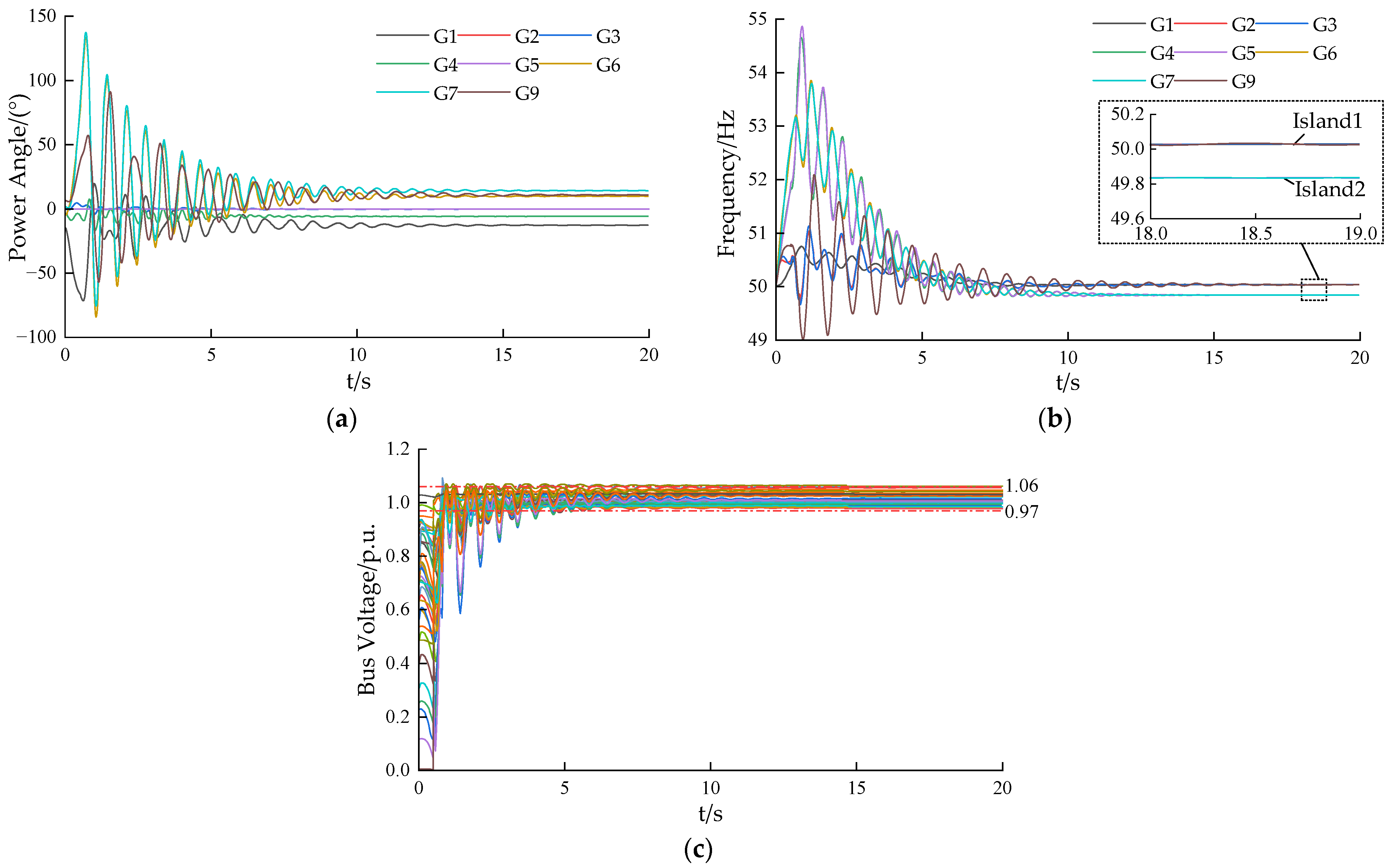
The dynamic response trajectories of generator rotor angles, frequencies, and bus voltages during the splitting process are shown in
Figure 4. Simulation results indicate that within Island 1 and Island 2, the rotor angles, frequencies, and bus voltages of the generators all converge to stable operating ranges within 20 s. Regarding voltage, each bus voltage stabilizes between 0.97 p.u. and 1.06 p.u., with voltage deviations at some nodes in Islands 1 and 2 exceeding the ±0.05 p.u. safety threshold, indicating relatively poor voltage stability. Regarding frequency, the system frequency in Island 1 ultimately stabilizes at approximately 50.03 Hz, while that in Island 2 stabilizes around 49.83 Hz. Although both island frequencies remain within the ±0.5 Hz stability margin, the frequency deviation of 0.17 Hz from the rated value in Island 2 is unfavorable for subsequent system restoration. The reason for this phenomenon lies in the fact that Model 1 aims only at steady-state power matching and fails to account for the accumulation paths of transient energy on branches during faults. Because the splitting sections do not effectively block the energy surge, the post-disturbance transient energy continues to oscillate and redistribute within the islands, ultimately forcing the system to stabilize at an equilibrium state significantly deviated from the rated operating point. For power systems, if the islanding decision pursues only power balance while neglecting the guidance of transient energy, it may lead to islands operating for extended periods with significant frequency and voltage deviations after splitting. This not only affects the normal operation of equipment within the islands but also increases the difficulty of subsequent island resynchronization.
5.2.2. Splitting Model 2
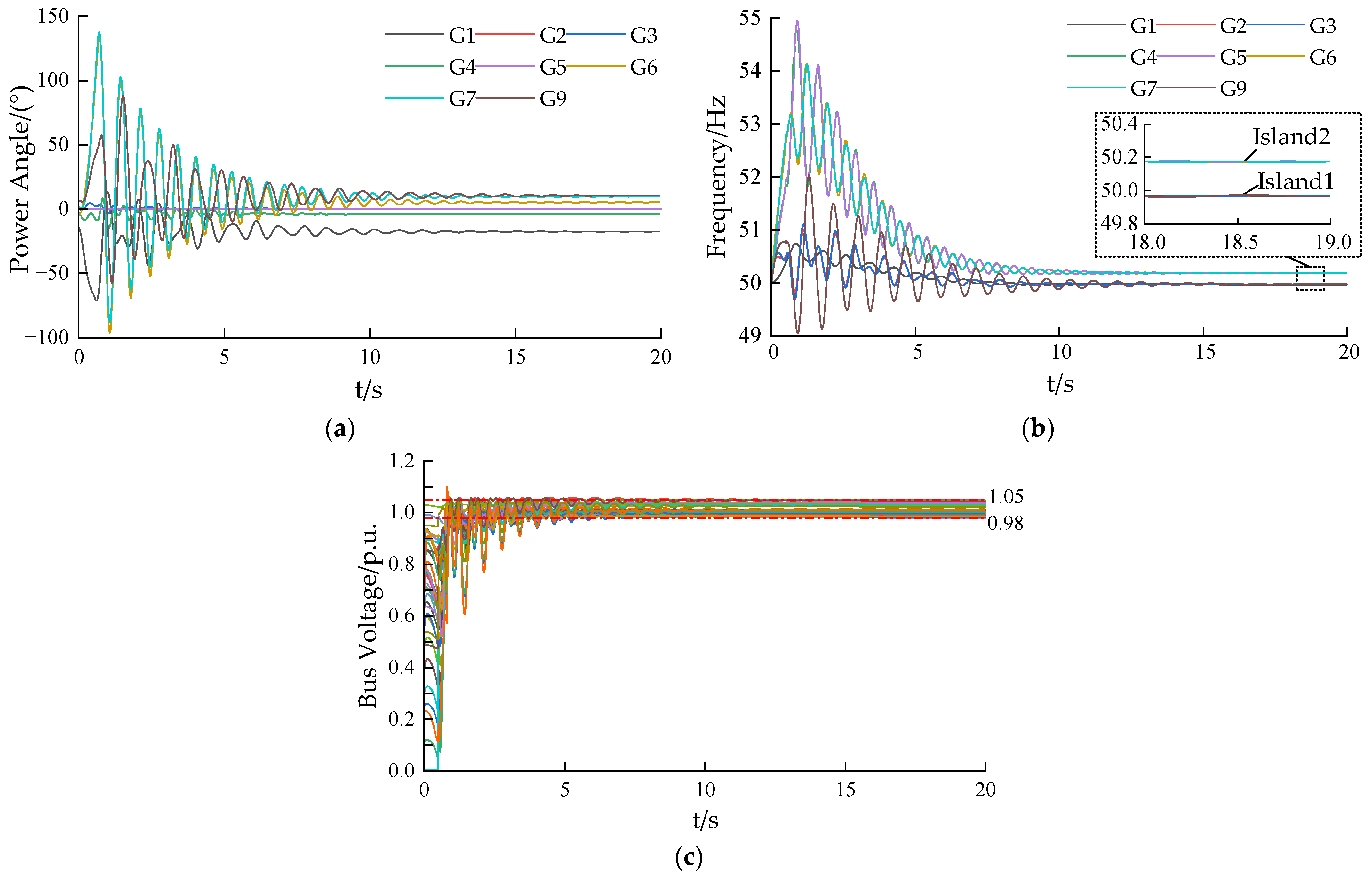
The splitting sections and corresponding results obtained with Islanding Model 2 are shown in
Table 3 and
Table 4.
Figure 5 presents the dynamic response trajectories of generator rotor angles, frequencies, and bus voltages before and after splitting based on Splitting Model 2. The bus voltages across the system generally stabilize within the range of 0.98–1.05 p.u., which falls within the ±0.05 p.u. safety threshold. In terms of frequency, the steady-state frequency of Island 1 is 49.96 Hz, while that of Island 2 is 50.17 Hz, resulting in a frequency deviation of 0.17 Hz from the rated value. Compared with Model 1, the voltage fluctuation range is narrowed, and no voltage violation nodes are observed. However, Island 2 still exhibits a frequency deviation of 0.17 Hz, indicating that the improvement in the island operating environment is not significant. Model 2 sacrifices a certain amount of power balance in exchange for minimal power flow disruption. Although it reduces the power flow disruption at the moment of splitting, it only focuses on the instantaneous impact at the splitting instant and fails to account for the accumulation state of transient energy on branches during the fault period. Consequently, the steady-state frequency characteristics of the islands have not been fundamentally improved.
5.2.3. Splitting Model 3
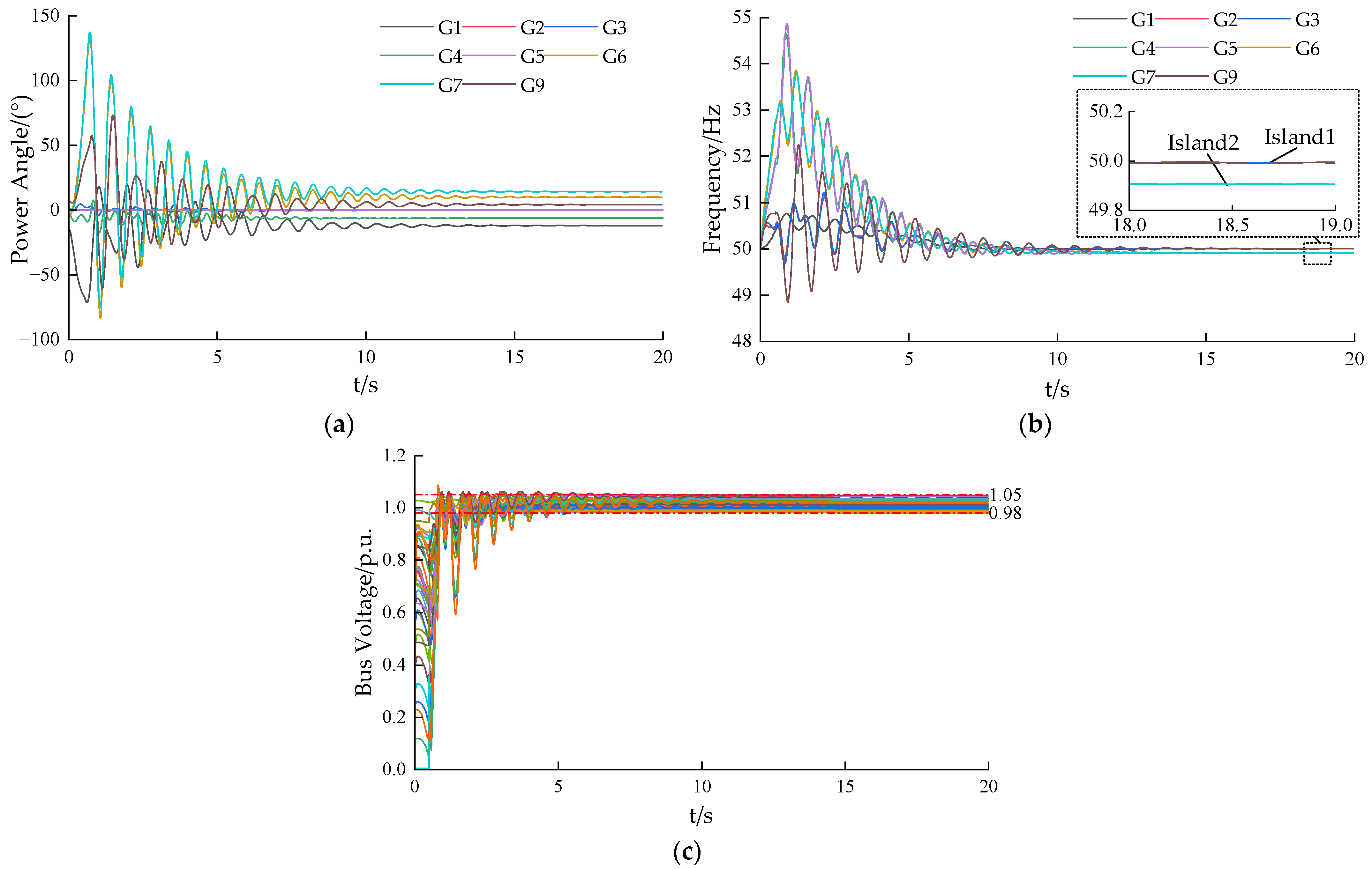
The splitting sections and corresponding results obtained with Islanding Model 3 are shown in
Table 5 and
Table 6.
Figure 6 presents the dynamic response trajectories of generator rotor angles, frequencies, and bus voltages before and after splitting based on Splitting Model 3. The relevant parameters of both islands return to stable operation, with all bus voltages maintained within the 0.98–1.05 p.u. range, falling within the ±0.05 p.u. safety threshold. The final frequencies of Island 1 and Island 2 stabilize at approximately 49.99 Hz and 49.91 Hz, respectively. Compared with Splitting Model 1 and Model 2, Splitting Model 3 exhibits superior performance in terms of voltage and frequency stability. The island bus voltages formed by this model are all within the permissible range, generator frequencies are closer to the rated values, and the overall operating state is more stable. Quantitatively, the frequency deviation of Island 2 after splitting with Model 3 is 0.09 Hz, representing a reduction of approximately 47% compared to the 0.17 Hz deviation observed in Model 1 and Model 2. With the BSI as its objective, Model 3 prioritizes disconnecting those “vulnerable” branches that have accumulated significant transient energy during the fault process, thereby cutting off the propagation path of disturbance energy into the islands at its source. Consequently, the islands experience smaller subsequent impacts, and both frequency and voltage recovery are smoother.
The comparative analysis reveals that, compared to models minimizing unbalanced power or power flow disruption, the splitting sections search model proposed in this paper forms islands with frequencies closer to the rated value and more stable bus voltage levels after splitting. This effectively improves the transient stability of the islands and creates more favorable conditions for system restoration.
However, these stability improvements come at a cost. As summarized in
Table 6, Model 3 achieves the best frequency and voltage performance but requires shedding 178.9 MW of load—substantially more than Model 1 (98 MW) and Model 2 (114.5 MW). This trade-off is inherent to the proposed approach: prioritizing the disconnection of branches with severe transient energy accumulation enhances post-splitting stability, but may increase the amount of load shedding required.
Controlled islanding serves as the “last line of defense” against widespread blackouts when conventional emergency controls fail. In such extreme conditions, the primary objective is to prevent cascading failures and preserve system integrity. From this perspective, accepting higher load shedding in exchange for significantly improved frequency and voltage stability represents a trade-off that prioritizes system security—a choice that may be justified in emergency situations, though it remains a limitation to be acknowledged.
Due to the computational expense of the optimization process, performing 30 independent runs for all test cases would be prohibitively time-consuming. Therefore, we select Model 3 to perform 30 independent runs and evaluate the statistical performance of the algorithm. The results are summarized in
Table 7. For the remaining six models, we report only the best solutions found over 3 runs, as the algorithm’s stability has been validated on the representative case and the problem structure is similar across all models.
As shown in
Table 7, the global optimum (objective value 5.66) was obtained in 24 out of 30 independent runs, representing an 80% success rate. The standard deviation of 7.29 reflects the occasional convergence to local optima, but the high success rate demonstrates that the algorithm reliably finds the global optimum in the majority of cases. Moreover, in the six runs where the global optimum was not achieved, the obtained solutions still satisfy all constraints. Given the similar problem structure across all test cases, the algorithm is expected to exhibit comparable stability for the other models.
5.3. Comparison of Results Considering Island Inertia Constraints
In the test cases used for Islanding Models 1–3, the wind farms are spatially concentrated, and their group assignments are largely fixed, which does not sufficiently validate the proposed island inertia constraint mechanism. To verify the effectiveness of this constraint, the original wind farm replacements are substituted with G3 and G9, while the fault scenario remains unchanged. The coherent generator grouping result obtained with the improved generator internal node potential energy method is shown in
Table 8. The island containing the slack generator G2 is again designated as Island 1, and the other as Island 2.
Two additional islanding models are constructed for this new test case, identical in all aspects except for the handling of the island inertia constraint. They are denoted as Islanding Model 4 and Islanding Model 5:
Splitting Model 4: Uses minimizing the sum of the BSI as its objective function, without considering the island inertia constraint.
Splitting Model 5: Based on Model 4, considers the island inertia constraint, representing the complete model proposed in this paper.
5.3.1. Splitting Model 4
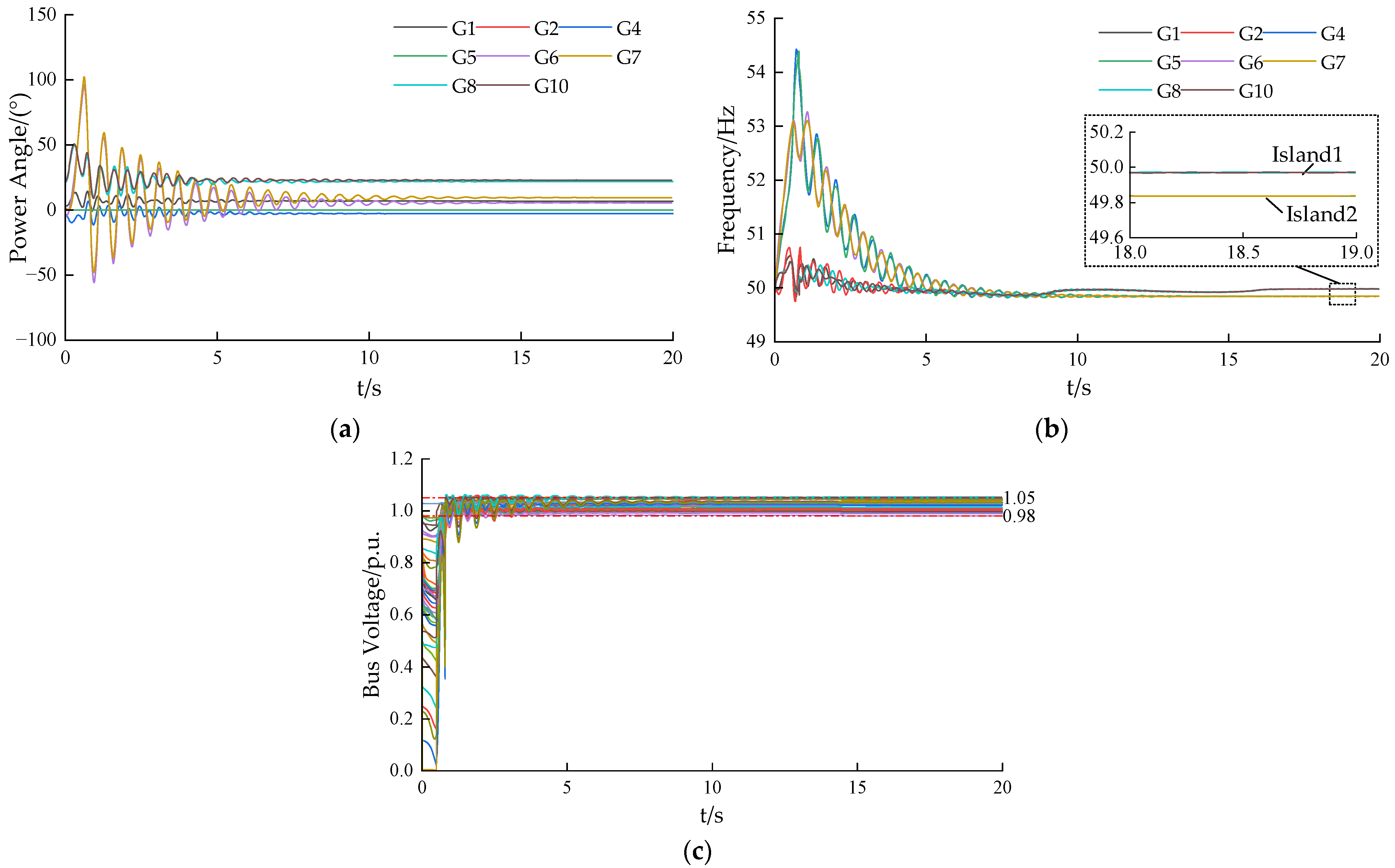
The splitting sections and corresponding results obtained with Islanding Model 4 are shown in
Table 9 and
Table 10.
Figure 7 presents the dynamic response trajectories of generator rotor angles, frequencies, and bus voltages before and after splitting based on Splitting Model 4. The relevant parameters of both islands return to stable operation, with system bus voltages maintained within the 0.98–1.05 p.u. range, falling within the ±0.05 p.u. safety threshold. The frequency of Island 1 stabilizes at approximately 49.96 Hz, while that of Island 2 converges to around 49.84 Hz. Although both island frequencies remain within the ±0.5 Hz stability margin, the frequency deviation of 0.16 Hz from the rated value in Island 2 indicates relatively poor frequency stability.
With the objective of minimizing the BSI, Model 4 confines island voltages and frequencies within the stability margins. However, the frequency deviation in Island 2 still reaches 0.16 Hz. The root cause lies in the failure to reasonably allocate the GFL wind turbines among islands, resulting in two large-capacity GFL wind turbines being allocated to Island 1. Consequently, the magnitude of the equivalent inertia decrease in Island 1 becomes larger, weakening its frequency support capability and ultimately causing the steady-state frequency to deviate considerably from the rated value. Therefore, in the splitting process, considering only the vulnerability of transient energy paths is insufficient; the configuration of inertia resources in each island and the rational allocation of renewable energy units must also be taken into account.
5.3.2. Splitting Model 5
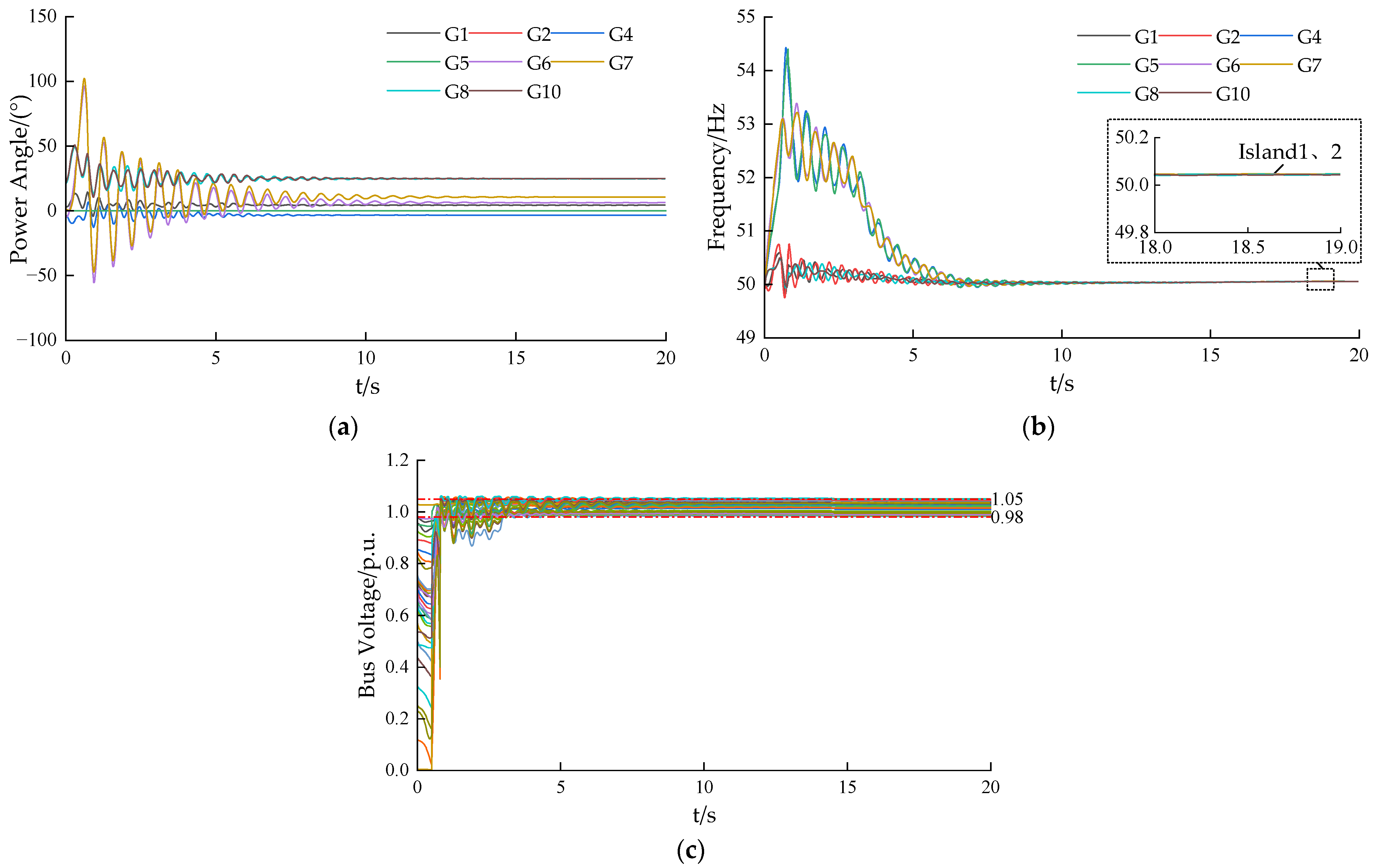
The splitting sections and corresponding results for Islanding Model 5 are shown in
Table 11 and
Table 12.
Figure 8 presents the dynamic response trajectories of generator rotor angles, frequencies, and bus voltages before and after splitting based on Splitting Model 5. The relevant parameters of both islands return to stable operation. All bus voltages across the system are essentially stabilized within 0.98–1.05 p.u., falling within the ±0.05 p.u. safety threshold. The final frequencies of both Island 1 and Island 2 stabilize at approximately 50.05 Hz, with a deviation of 0.05 Hz from the rated frequency.
Based on the minimization of the BSI, Model 5 introduces the island inertia constraint, prioritizing the allocation of large-capacity GFL wind turbines to high-inertia islands. This ensures that the inertia level of each island matches its renewable energy capacity. Consequently, the frequencies of both islands stabilize around 50.05 Hz, reducing the frequency deviation by approximately 0.11 Hz compared to Model 4. By accepting a moderate increase in the BSI as a trade-off, the island inertia constraint enables a more rational allocation of renewable energy units, thereby enhancing the frequency stability of each island.
To further validate the effectiveness of the proposed inertia constraint, a quantitative comparison of frequency stability metrics between Model 4 (without inertia constraint) and Model 5 (with inertia constraint) is conducted. Two indicators are evaluated for each island: the steady-state frequency deviation and the maximum RoCoF. The results are summarized in
Table 13.
As shown in
Table 13, the inclusion of the inertia constraint significantly improves both metrics. In Island 1, the maximum RoCoF is reduced from 1.89 Hz/s to 0.92 Hz/s, a decrease of 51%, and the steady-state deviation remains similarly low. In Island 2, the maximum RoCoF is reduced from 0.81 Hz/s to 0.65 Hz/s, and the steady-state deviation is dramatically reduced from 0.16 Hz to 0.05 Hz. These improvements directly demonstrate that the ranking-based matching strategy enhances frequency stability, providing empirical validation for the assumed correlation between ranking and stability. Moreover, the results confirm that the inertia constraint is effective in practice.
A comparison between Islanding Model 4 and Model 5 reveals that the islands formed under Model 5 exhibit a more reliable operating environment. This confirms that the proposed inertia constraint effectively brings the frequencies of generators within each island closer to the system nominal frequency, significantly enhancing frequency stability and facilitating subsequent system restoration. The validity of the inertia constraint is therefore demonstrated.
5.3.3. Impact of Penalty Coefficient λ on Optimization Results
To justify the selection of
λ = 20 and investigate the impact of the penalty coefficient, a sensitivity analysis is conducted on the representative scenario in
Section 5.3. Four values of
λ are tested:
λ = {0.1, 1, 5, 20}. The results are summarized in
Table 14.
As shown in
Table 14, when
λ is 0.1 or 1, the inertia constraint is effectively ignored, resulting in poor inertia matching (
) and large load shedding. When
λ increases to 5, the inertia constraint becomes active and is fully satisfied (
), leading to a different splitting section with improved load shedding and frequency stability. Further increasing
λ to 20 does not change the results, as the constraint is already satisfied at
λ = 5.
This analysis reveals a threshold behavior: for λ below a certain value (between 0.1 and 1 in this case), the inertia constraint is ineffective; for λ above this threshold, the constraint is enforced and the optimization results remain stable. The selected value λ = 20 lies well above this threshold, ensuring that the inertia constraint is adequately satisfied without requiring fine-tuning. Therefore, λ = 20 is a reasonable and conservative choice.
5.4. Comparison of Results Under Grid-Forming Wind Power Integration
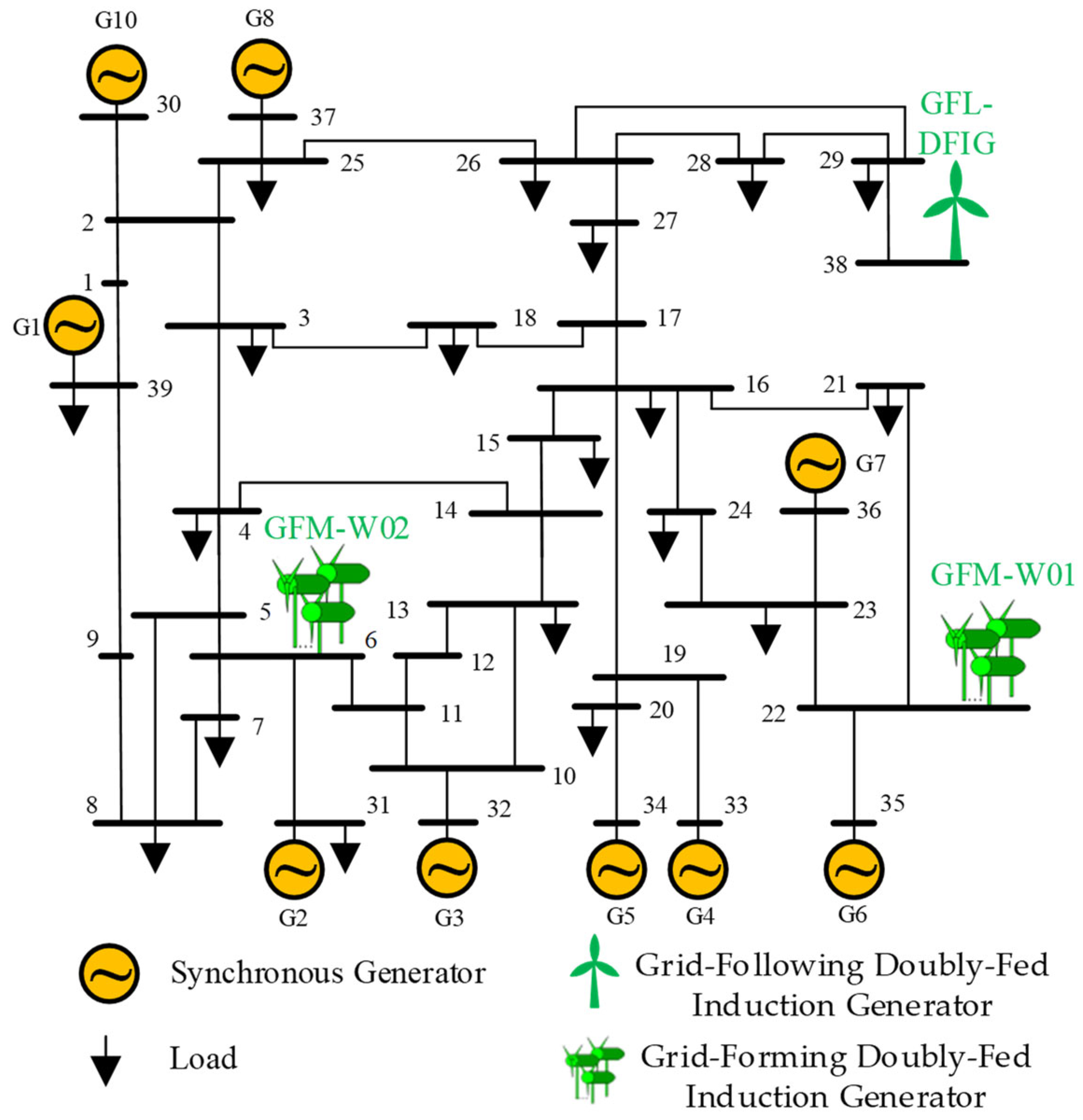
To validate the effectiveness of the proposed splitting model in systems incorporating grid-forming wind turbines and comprehensively evaluate the proposed method under different disturbance characteristics, modifications are made to the test system in DigSILENT (version 15.2). Specifically, two grid-forming wind farms with capacities of 400 MW and 360 MW are connected at buses 6 and 22, respectively. Correspondingly, the power outputs of G3 and G9 are reduced, and G9 is replaced by an equivalent grid-following wind farm with its output set to the reduced value of the original G9. The topology of the modified New England 39-bus system is shown in
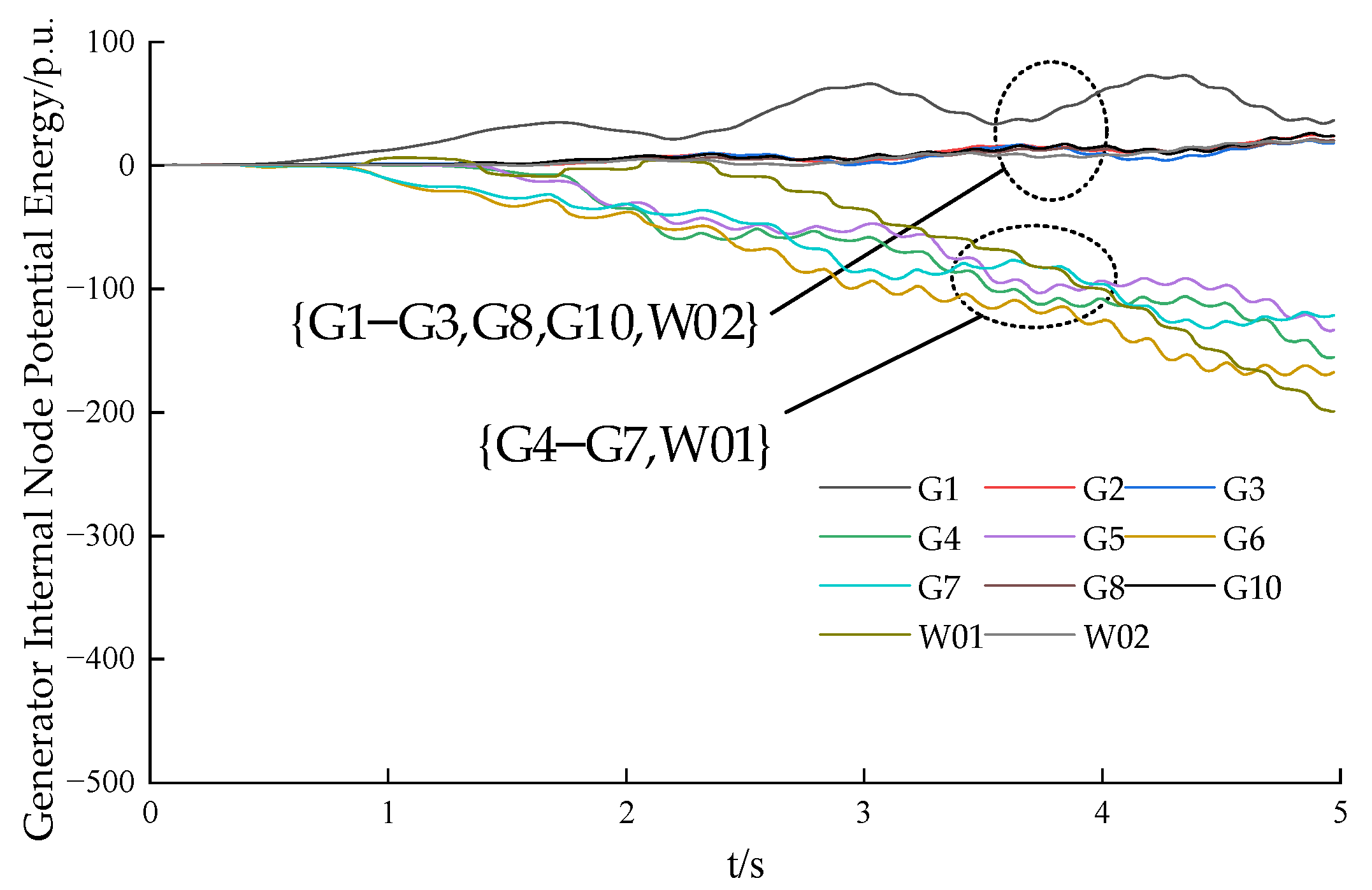
Figure 9. A three-phase short-circuit fault is applied at line 21–22 near bus 22 at t = 0 s and cleared 0.37 s later. The improved generator internal node potential energy curves of all generators are presented in
Figure 10, and the coherent generator grouping result based on these curves is given in
Table 7. The island containing the slack generator G2 is designated as Island 1, and the other island as Island 2.
As shown in
Table 15, under the given fault condition, the generators are partitioned into two groups: {G1–G3, G8, G10, W02} and {G4–G7, W01}. Based on this coherent generator grouping result, two islanding models are applied to search for the splitting sections in this new test case, denoted as Islanding Model 6 and Islanding Model 7. Model 6 follows the same objective as Model 2—minimizing power flow disruption—which has been extensively studied [
35]:
5.4.1. Splitting Model 6
The splitting sections and corresponding results obtained with Islanding Model 6 are shown in
Table 16 and
Table 17.
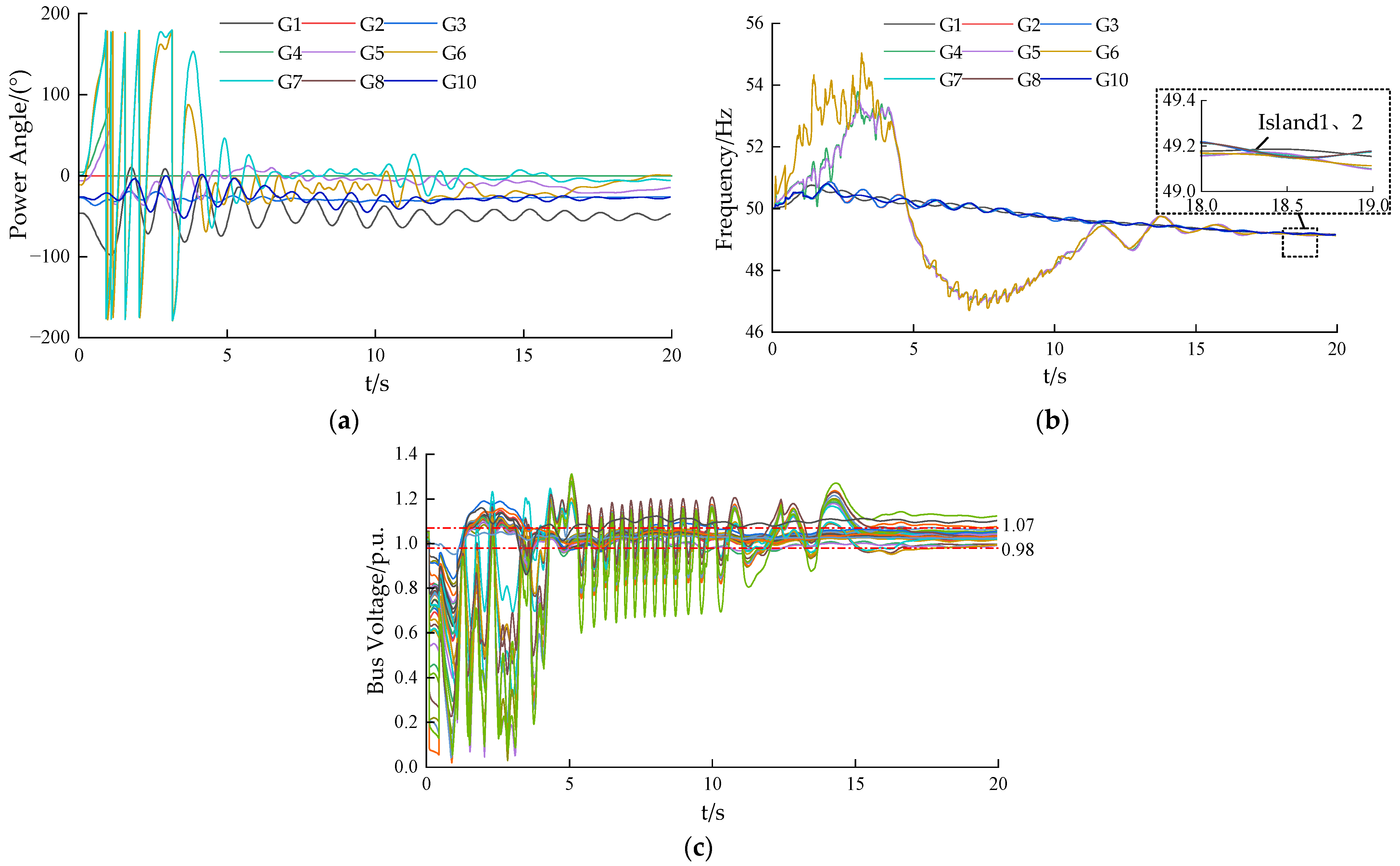
Figure 11 presents the dynamic response trajectories of generator rotor angles, frequencies, and bus voltages before and after splitting based on Splitting Model 6. The frequencies of both Island 1 and Island 2 stabilize at approximately 49.12 Hz at 20 s, which is significantly below the 49.5 Hz stability reference value, indicating poor frequency stability. The system bus voltages remain within the range of 0.98–1.07 p.u., with some buses exceeding the ±0.05 p.u. safety threshold. The magnitude of these violations ranges from 0 to 0.02 p.u., with individual buses exceeding the threshold by up to 0.05 p.u., and both the duration of voltage oscillations and the time required to restore stability are relatively long.
Model 6 aims to minimize power flow disruption but performs poorly in scenarios containing GFM wind power. GFM wind turbines possess virtual inertia and can autonomously establish voltage; their transient energy exchange characteristics are similar to those of synchronous generators, and they continue to engage in sustained energy exchange with the system after disturbances. Similarly to Model 2, the objective function of Model 6 only focuses on the instantaneous power fluctuation at the splitting moment and fails to consider the accumulation state of transient energy on branches during the fault period, thereby potentially exacerbating island instability. This demonstrates that as GFM wind turbines are integrated into the power system, traditional splitting strategies targeting power flow disruption will struggle to meet the requirements of new types of power systems.
5.4.2. Splitting Model 7
The splitting sections and corresponding results for Islanding Model 7 are shown in
Table 18 and
Table 19.
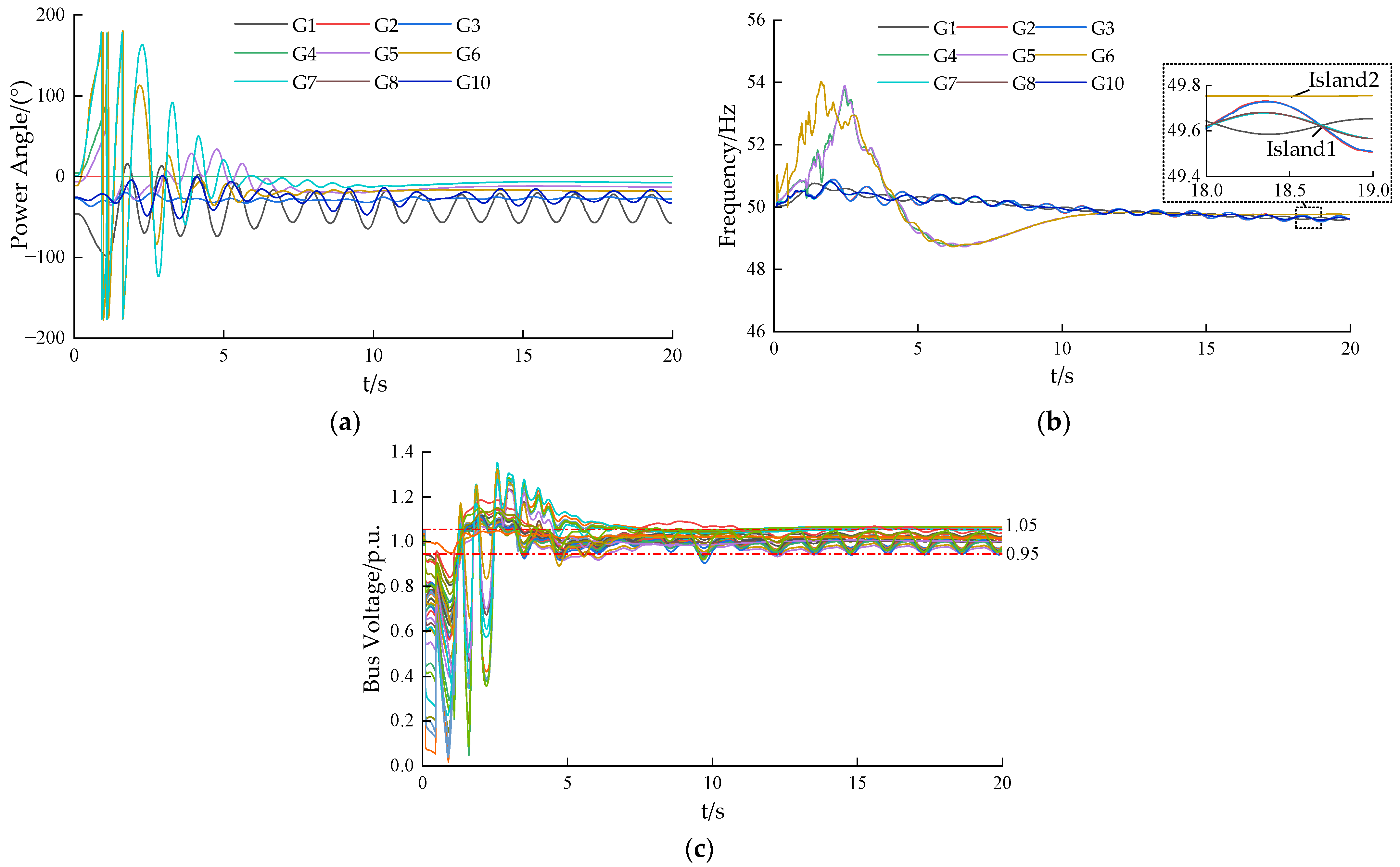
Figure 12 presents the dynamic response trajectories of generator rotor angles, frequencies, and bus voltages before and after splitting based on Splitting Model 7. After islanding, the frequencies of both Island 1 and Island 2 stabilize above 49.5 Hz at 20 s, which facilitates subsequent synchronous restoration of the system and indicates relatively good frequency stability. The system bus voltages remain within the range of 0.95–1.05 p.u., with only individual buses exceeding the ±0.05 p.u. safety limits during oscillations, and the magnitude of these violations does not exceed 0.01 p.u.
Model 7 comprehensively employs the BSI and the inertia constraint. On one hand, it prioritizes disconnecting vulnerable branches with severe transient energy accumulation, effectively cutting off the propagation path of disturbance energy into the islands. On the other hand, based on the improved generator internal node potential energy, it rationally allocates GFM wind turbines to each island to provide virtual inertia support. Furthermore, through inertia constraints, GFL wind turbines are assigned to islands with larger equivalent inertia. Therefore, although the amount of load shedding in Model 7 is increased compared to Model 6, the island frequencies recover from 49.12 Hz to above 49.5 Hz, and the maximum voltage deviation is reduced from 0.118 p.u. to 0.059 p.u., creating more favorable conditions for subsequent system restoration.
A comparison between Islanding Model 6 and Model 7 reveals that the splitting sections obtained by using the proposed method enable both islands to restore stable operation. The comparison between Model 6 and Model 7 further confirms this trade-off: Model 7 achieves significantly better frequency and voltage stability, but at the cost of increased load shedding and higher power flow disruption. Consequently, the overall operational reliability of the islands and their capability for subsequent system restoration are substantially improved.
5.5. Comprehensive Quantitative Comparison of All Islanding Models
To systematically evaluate the proposed method under different system configurations, the seven islanding models are grouped into three representative scenarios that differ in generation mix, fault characteristics, and constraint configurations.
Scenario 1 (Models 1–3) represents a GFL-dominated system with a severe fault on line 16–21 (0.5 s). Models 1 and 2 are traditional benchmarks (minimizing power imbalance and power flow disruption, respectively), while Model 3 implements the proposed BSI-based approach without inertia constraints. Scenario 2 (Models 4–5) retains the same GFL-dominated configuration and fault conditions but relocates the wind farms to alter inertia allocation. Model 4 minimizes the BSI alone, whereas Model 5 combines BSI minimization with the island inertia constraint. Scenario 3 (Models 6–7) introduces a mixed GFL/GFM system with a different fault (line 21–22, 0.37 s). Model 6 follows traditional power flow disruption minimization, and Model 7 implements the complete proposed method.
Table 20 summarizes the optimal splitting sections obtained for each model under the three scenarios. These variations in partitioning directly influence the post-splitting stability and operational adjustments analyzed below.
From the simulation results, we extract key quantitative metrics covering frequency stability, voltage stability, rotor angle stability, and operational adjustment. These metrics are consolidated in
Table 21. For frequency stability, we report the steady-state deviation and maximum RoCoF. Voltage stability is assessed through the maximum voltage deviation and the number of buses exceeding the ±0.05 p.u. safety threshold. Rotor angle stability is characterized by the maximum angular separation within each island and the settling time. operational adjustment is represented by total load shedding and generator active power adjustment.
The settling time for each island is determined by first computing its steady-state frequency as the mean over the final 2 s of the simulation. The island settling time is defined as the moment after islanding when the frequency last enters a ±0.05 Hz band around this steady-state value and remains within that band thereafter. The overall system settling time is taken as the maximum of the two island values.
Several important observations can be drawn from
Table 21. In Scenario 1, Model 3 achieves the smallest steady-state deviation (0.09 Hz) and lowest RoCoF (4.28 Hz/s) among the three models. Maximum voltage deviation is reduced to 0.046 p.u., and no voltage violations occur. These improvements, however, come at the cost of increased load shedding, confirming the trade-off discussed in
Section 5.2.3. The settling time of Model 3 (9.67 s) is slightly shorter than that of Models 1 and 2, indicating faster stabilization.
Scenario 2 directly assesses the island inertia constraint by comparing Model 4 and Model 5 under identical conditions. Model 5 reduces the maximum steady-state deviation from 0.16 Hz to 0.05 Hz, and cuts the maximum RoCoF by more than half, from 1.89 Hz/s to 0.92 Hz/s. Remarkably, this improvement is accompanied by a dramatic reduction in load shedding, from 182.8 MW to 45.3 MW. Settling time also decreases significantly, from 15.41 s to 9.57 s, indicating that the inertia constraint enhances both stability and post-islanding efficiency.
In Scenario 3, Model 7 outperforms Model 6 across most metrics. The maximum steady-state deviation is reduced from 0.88 Hz to 0.47 Hz, and the maximum RoCoF decreases from 5.79 Hz/s to 4.76 Hz/s. Maximum voltage deviation drops from 0.118 p.u. to 0.059 p.u., although the number of voltage violation buses increases slightly from four to five. Settling time is shortened by more than one second. These stability improvements are achieved at the expense of a substantial increase in load shedding (from 18.1 MW to 224.0 MW), again reflecting the trade-off discussed earlier.
Across all three scenarios, several consistent trends emerge. First, the proposed BSI-based approach (Model 3) and its combination with the inertia constraint (Models 5 and 7) consistently achieve better frequency and voltage stability than traditional benchmarks. Second, these improvements are generally accompanied by increased load shedding, particularly when the inertia constraint is not applied. Third, the settling times of the proposed models are consistently shorter, indicating faster recovery after islanding. Fourth, the maximum angle swing values remain within safe limits for all models, confirming that no loss of synchronism occurs within the islands.
In summary, the quantitative analysis across three fundamentally different scenarios demonstrates that the proposed method robustly improves frequency and voltage stability. The results validate the effectiveness of the BSI-based objective function and the island inertia constraint, with the associated increase in load shedding representing a deliberate trade-off in favor of system security. These findings provide strong evidence that the proposed splitting strategy is well suited for modern power systems with high renewable penetration.