Article

An Integrated Assessment of Carbon-Neutral Transition Pathways for the Chinese Power Sector: Feasibility and Implications in a Coal-Dominant and Renewable-Rich Context


1
College of Electrical Engineering, Hunan Mechanical and Electrical Polytechnic, Changsha 410151, China
2
Faculty of Engineering, Mahasarakham University, Maha Sarakham 44150, Thailand
*
Author to whom correspondence should be addressed.
Energies 2026, 19(6), 1457; https://doi.org/10.3390/en19061457
Submission received: 18 January 2026 / Revised: 3 March 2026 / Accepted: 11 March 2026 / Published: 13 March 2026

Abstract

China’s power sector is undergoing a complicated transformation characterized by intricate dependence on the dominant coal infrastructure and abundant renewable energy resources. This study assesses China’s carbon-neutral transition pathways for the period of 2024–2060 by using the “Establish Before Breaking” principle within a policy-informed, high-resolution energy system modeling framework. To examine the technological, economic, and environmental trade-offs of various carbon-neutral strategies, four scenarios (Reference (REF), Carbon Capture and Storage (CCS), Renewable-Based (REB), and Integrated (ING)) were developed, and their impacts were assessed through the application of the Low Emission Analysis Platform and the Next Energy Modeling (LEAP–NEMO) model. The results reveal that the ING scenario represents the most feasible and policy-consistent pathway, achieving an 88% renewable electricity share and a total installed capacity of approximately 8000 gigawatts (GW) by 2060. This pathway relies on a dual-track strategy that combines accelerated renewable deployment—supported by geographical complementarity and multi-regional Power-to-X (PtX) systems—with the strategic stabilization of conventional generation assets. The findings further demonstrate that retaining a small but critical share of flexible coal-CCS (0.2–0.5%) and nuclear capacity is necessary to address sub-daily variability, mitigate duck-curve effects, and ensure power system reliability under high renewable penetration. This integrated approach offers a systematic pathway for deep decarbonization within China’s unique energy context, ensuring a just, equitable, and sustainable transition.

1. Introduction

1.1. Policy and Sectoral Context of China’s Power Transition

In recognition of intensified global climate change, countries around the world have committed to achieving carbon neutrality. The Paris Agreement establishes a global framework to limit the temperature increase to well below 2 °C above pre-industrial levels, while actively pursuing efforts to constrain the rise to 1.5 °C [1]. The Thirtieth Conference of the Parties (COP30) to the United Nations Framework Convention on Climate Change (UNFCCC) was held in Belém, Brazil, in November 2025. This summit marked a collective imperative for signatories to considerably enhance their Nationally Determined Contributions (NDCs) and implement the financial mechanisms supporting climate resilience [2]. In response to the requests for strengthened commitments proposed at COP30, China’s 2035 NDCs submitted to the UNFCCC signify a major policy shift. This submission introduces, for the first time, an absolute emissions reduction target, committing to a 7–10% decrease in net greenhouse gas (GHG) emissions below peak levels by 2035 [3]. China, the world’s largest energy consumer and carbon emitter, has committed to reaching its emissions peak by 2030 and achieving carbon neutrality by 2060 [4]. In 2024, China accounted for 27% of global primary energy consumption and was responsible for 33% of global energy-related carbon dioxide (CO2) emissions [5]. In 2024, China’s Total Primary Energy Supply (TPES) reached 159 exajoules (EJ), with the power sector accounting for roughly one-third of the total [6]. As an energy-intensive sector, electricity has played a crucial role in driving the country’s economic growth and supporting its long-term development. Over the past decade, electricity production increased substantially from 5795 TWh in 2014 to 10,087 TWh in 2024—an average annual growth of 6% [5]. This rapid growth reflects the importance of China’s electricity sector in shaping global efforts to address climate change. Due to its abundant domestic reserves, coal continues to be the dominant source of electricity generation in China. In 2024, coal-fired power plants were responsible for 63% of the country’s electricity production, even though they accounted for only 36% of the total installed capacity [7]. Therefore, the ongoing increase in CO2 emissions is largely due to the extensive use of fossil fuels, especially coal. In 2024, CO2 emissions from China’s power industry increased to 6.5 billion tonnes, representing a rise of approximately 52% relative to the 2014 level [8].
Being the world’s largest annual emitter of CO2, China has initiated a number of national policies and investments with the aim of mitigating carbon emissions and addressing the consequences of climate change. In 2020, China set the targets of reaching its CO2 emissions peak prior to 2030 and achieving carbon neutrality by 2060. In order to meet these targets, China has implemented a comprehensive policy framework known as “1 + N”, which focuses on the scaling of renewable energy, the commercialization of Carbon Capture and Storage (CCS), and the increase in energy storage capacity. In 2021, the National People’s Congress (NPC) approved the 14th Five-Year Plan for 2021–2025 [9]. The plan provides a shift toward environmentally friendly development with a target of decreasing carbon intensity by 18% and energy intensity by 13.5%. The transition is driven by a strategic expansion of renewable energy—targeting 33% of electricity being derived from renewables by 2025. This is supported by the widespread adoption of auxiliary technologies, such as energy storage and new energy vehicles. To further advance its energy transition, the Chinese government issued the Guiding Opinions on Vigorously Implementing the Renewable Energy Substitution Initiative—later called the “new renewable energy plan”—on 30 October 2024 [10]. This new plan marks an important policy shift from just expanding renewable capacity additions to also addressing more complex challenges related to how to effectively integrate and utilize large-scale renewable energy in the energy system. Under this plan, the utilization of variable solar and wind power is enhanced by extensively implementing storage technologies, such as battery storage and pumped hydro. These systems enhance grid stability and reduce reliance on conventional coal, which is maintained only as a flexible backup. The continuing use of coal is applicable when CCS is equipped. This technique is increasingly being utilized in challenging-to-decarbonize sectors, such as steel, ammonia, and methanol manufacturing. Combining renewable energy sources, energy storage, and coal with CCS provides a systematic approach to establishing a low-carbon and secure power system.
Following the new renewable energy plan, the National Energy Administration (NEA) released the “Guiding Opinions on Energy Work” on 27 February 2025 [11]. This plan outlines a comprehensive strategy to expand renewable power generation and strengthen energy security by 2025. Aligned with national directives and Xi Jinping’s energy philosophy, the plan focuses on stability, low-carbon development, and technological innovation together with maintaining fossil fuels as a transitional foundation. Following the Guiding Opinion on Energy Work, the National Development and Reform Commission (NDRC) and the NEA released the Special Action Plan for Large-Scale Construction of New Energy Storage (2025–2027) in September 2025. This action plan serves as a blueprint for the rapid expansion of energy storage capacity, thus enhancing the growing renewable energy sector in China [12]. In addition, on 23 October 2025, the National Natural Science Foundation (NNSF) released the China Carbon Capture, Utilization, and Storage (CCUS) Technology Development Roadmap. This represents the third edition of China’s CCUS plan, following the initial versions released in 2011 and 2019 [13]. The roadmap outlines the shift from preliminary pilot initiatives to extensive commercial deployment. This shift highlights efficiency improvements, cost-reduction potential, and CCUS’s vital role in achieving carbon neutrality by 2060.

1.2. Literature Review

In recognition of intensifying climate-related disasters and their associated risks, a number of studies have been conducted on potential electricity pathways so as to provide guidance for China’s transition to carbon neutrality. These studies have examined various dimensions of energy transition including technical, economic, energy, environmental and social aspects. For example, numerous studies have investigated the technical aspects of transitioning to carbon neutrality, particularly focusing on decarbonizing electricity systems, integrating renewable energy, and optimizing electricity infrastructure [14,15,16,17,18,19]. Several research works have assessed the economic implications in terms of carbon pricing, changes in electricity prices and overall macroeconomic costs [20,21,22,23,24]. The social dimensions have also been thoroughly studied, e.g., employment shifts, regional economic disparities, and the socio-economic impacts of phasing out coal-fired power generation [25,26]. Furthermore, several studies have examined the environmental impacts of energy transition policies, e.g., change mitigation, and air quality improvement [27,28,29,30,31,32].
While previous studies have provided significant insights into China’s electricity transition pathways aimed at achieving carbon neutrality, research that specifically focuses on a just and equitable transition is still limited. Given China’s coal-dominant energy structure, a rapid shift from fossil fuels to a fully renewable energy system could inevitably lead to significant social and economic challenges, particularly in coal-dependent regions. Against this background, this paper assesses carbon-neutral electricity pathways using a high-resolution LEAP–NEMO framework. By integrating the latest 2024–2025 policy constraints and employing a 96-segment temporal resolution, this study analyzes the technological and economic trade-offs required to maintain grid reliability and enable an orderly, phased transition while achieving ambitious decarbonization targets. This assessment can guide policy development by highlighting the trade-offs of carbon-neutral electricity strategies and providing recommendations to address emerging transition challenges in a manner consistent with a just and regionally balanced transition in China.

2. Research Methodology

2.1. Methodological Framework and Research Scope

To assess the possible electricity transition pathways, the literature has provided a wide range of methodological approaches, including scenario-based simulation tools (e.g., EnergyPLAN, MAED, WASP, and LEAP), comprehensive optimization frameworks (e.g., MARKAL, TIMES, MESSAGE, and LEAP–NEMO), and impact assessment tools focused on health and the environment, such as SIMPACTS. For scenario-based simulation, a number of studies (for example, Hu et al. [14]; Wang et al. [24]; Xie et al. [32]; Manirambona et al. [33]; Xu et al. [34]; Golfam et al. [35]; Karunanithi et al. [36]; Li et al. [37]; and Ugwoke et al. [38]) have employed a Low Emission Analysis Platform (LEAP) model to analyze the energy-related and environmental impacts of electricity policies on achieving carbon neutrality. The EnergyPLAN has been adopted in some studies to assess how renewable energy can be integrated into the electricity system in various countries including China, Japan, Germany, India and Slovak Republic [39,40,41]. Battulga et al. [42] and Nourianfar et al. [43] employed the Model for Analysis of Energy Demand (MAED) to evaluate the technical potential and impact of a low-carbon energy system transformation. Wien Automatic System Planning (WASP) was used by Vincent et al. [44] and Kamdar et al. [45] to analyze the technical performance effects of integrating renewable energy into existing electricity systems in the case of South Korea and Thailand. For impact assessment, the studies by Abdel-Hameed et al. [46] and Kim et al. [47] utilized the Simplified Approach for Estimating Impacts of Electricity Generation (SIMPACTS) tool to investigate the effects of long-term electricity generation planning intended to reduce CO2 emissions in Egypt and Nigeria.
In terms of comprehensive optimization, Victor et al. [48] and Murugesan et al. [49] applied Market Allocation (MARKAL) and The Integrated MARKAL-EFOM System (TIMES) to identify the least-cost and low-carbon technologies available for power system development. The Model for Energy Supply Strategy Alternatives and their General Environmental impacts (MESSAGE) was adopted by Kanté et al. [50] and Nyasapoh et al. [51] to investigate optimal electricity supply options for Mali and Ghana. In addition, the specialized (LEAP–NEMO) model has been widely applied to assess the optimal electricity transition pathway across several countries, including China, Indonesia, Malaysia, Finland, Sweden, and Norway [23,52,53,54,55,56,57].
Based on the foregoing methodological review, the optimization tool employed in this study to assess carbon-neutral electricity pathways is the LEAP–NEMO model (version 2024.6.0.2; Stockholm Environment Institute, Somerville, MA, USA). LEAP is a comprehensive energy-environment modeling system developed for long-term scenario analysis. It covers energy demand, supply, environmental emissions, and costs [58]. LEAP offers high flexibility in modeling and supports a wide range of methodologies. It allows for both bottom-up accounting and top-down modeling approaches on the demand side. On the supply side, LEAP offers a range of accounting, simulation, and optimization methods, which are used for modeling electricity sector generation and capacity expansion planning. In addition, LEAP is user-friendly, has low initial data requirements, is adaptable to different scales, and provides reporting that is useful for policy-making. This tool is widely used by several organizations in over 190 countries for integrated resource planning, assessing greenhouse gas emissions reductions, and creating low-emission development strategies (LEDS), especially in developing countries [58]. NEMO is the optimization model used by LEAP for least-cost energy system planning. NEMO is designed to analyze key issues in contemporary energy policy, including the grid integration of variable renewable energy, the role of energy storage, and robust planning responses to climate change [59]. Since 2020, LEAP has incorporated NEMO to formulate and solve linear and mixed-integer optimization problems for power production, capacity expansion, storage, and transmission planning. LEAP provides the scenario data and the model’s structure. The optimization model is created and solved by NEMO, which is built using Julia, JuMP, and SQLite. The results are then returned to LEAP for visualization and analysis.
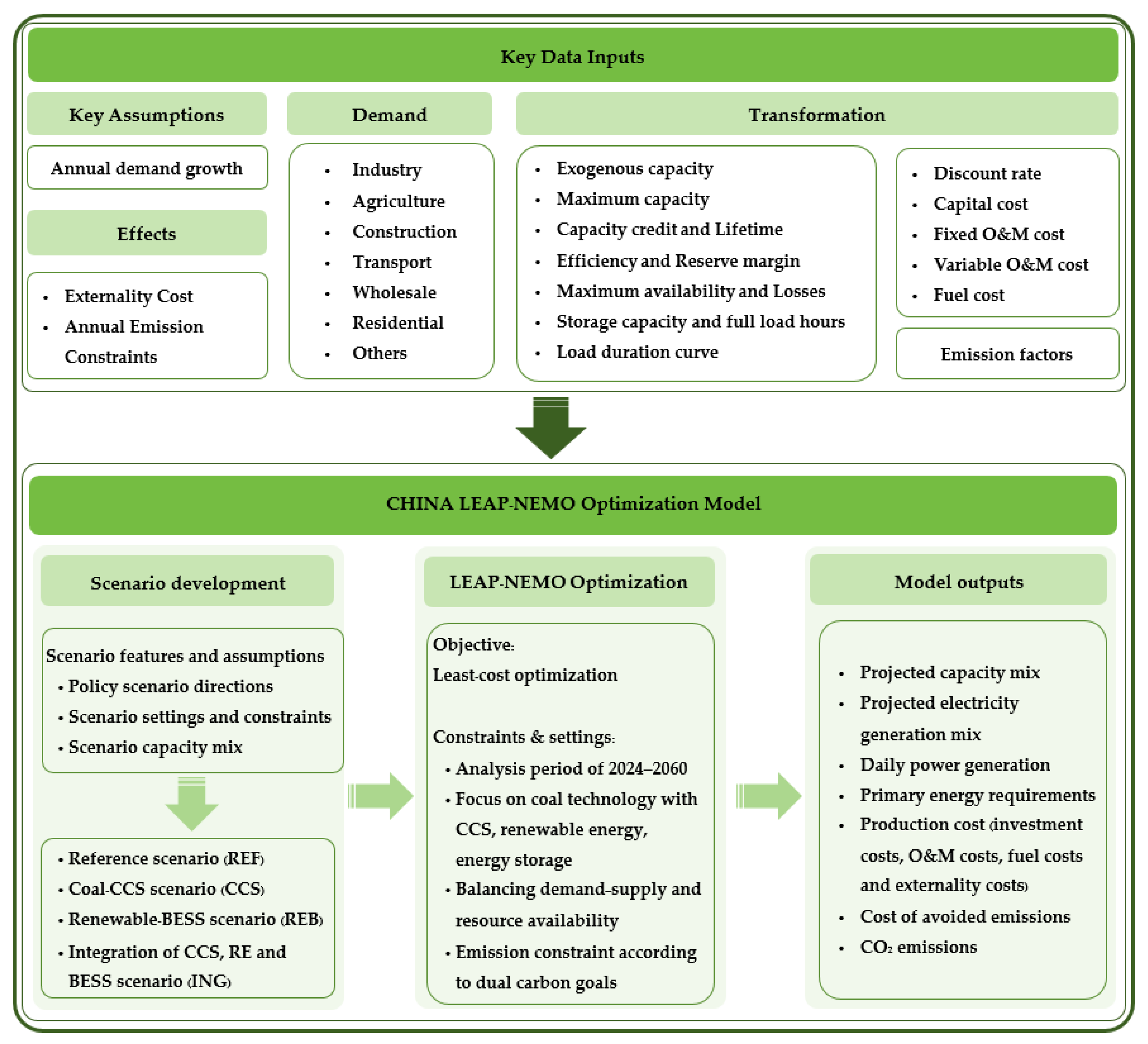
To assess the optimal carbon-neutral electricity pathway, the LEAP–NEMO model is employed in this study to develop various scenarios representing different electricity technology mixes. Figure 1 presents the LEAP–NEMO framework for this study. This framework provides an integrated platform for energy planning by combining demand forecasting, optimal supply expansion, and environmental assessment. The LEAP–NEMO workflow starts with LEAP and then feeds into NEMO. LEAP initiates a projection of electricity demand at the sectoral level by using historical demand and projected demand growth. These demand projections are then fed into NEMO to evaluate the optimal dispatch and capacity expansion under technical and reliability constraints. LEAP then processes NEMO’s optimal solution to calculate the resulting primary energy consumption and CO2 emissions.
In terms of the research scope, this paper examines the carbon-neutral pathways available for China with a particular focus on the electricity sector. In addition, the main objective of this paper is to assess the impacts of integrating new and environmentally friendly electricity technologies in the context of achieving a just and equitable transition. Taking into consideration these issues, the impacts are analyzed in terms of energy, economic, and environmental dimensions, with particular attention to how system-level outcomes—such as capacity expansion patterns, fuel displacement, and energy diversity—relate to social and regional transition dynamics. While the LEAP–NEMO framework enables high-resolution techno-economic and environmental assessment, it does not explicitly model labor markets, household income, or distributional welfare impacts. Consequently, employment and income impacts are not quantified directly. Instead, the social and regional dimensions of a just transition are assessed using system-level proxy indicators, interpreted within China’s regional and institutional context—an approach consistent with previous national-scale energy transition studies. Regarding the energy impacts, four attributes (including estimated capacity mix, projected electricity generation, daily power generation and primary energy requirements) are assessed. For the economic implications, two attributes (including production costs and the cost of avoided emissions) are analyzed, while the assessment of environmental impacts focuses on emissions of CO2. The projection period for this analysis extends from 2024 to 2060. This time frame accords with the full timeline of China’s Dual-Carbon Goals (peaking emissions before 2030 and achieving carbon neutrality before 2060).

2.2. The Algorithm of the LEAP–NEMO Model

LEAP–NEMO combines LEAP’s scenario-oriented energy accounting system with the NEMO optimization tool. LEAP is a comprehensive energy system modeling platform employed to assess long-term energy demand, transformation processes, and associated emissions across various policies and technological scenarios. LEAP is a flexible scenario-based framework that supports several methods, from bottom-up approaches to more detailed simulation assessments with low initial data requirements. NEMO determines the optimal capacity expansion and system operation subject to technical, resource, and policy constraints, and the resulting optimized system configuration is subsequently integrated back into LEAP for energy balance, emissions, and cost analysis. Detailed descriptions of the LEAP–NEMO model have been provided in several studies [52,60,61].

2.2.1. Energy Demand Projection

This study calculates electricity demand based on the demand growth projections provided in existing research studies [62,63]. The electricity demand for a specific year is derived from the previous year’s demand combined with the expected growth, as shown in Equation (1). The total electricity demand in the power system for a specific year is calculated by summing the electricity demanded and the electricity losses incurred during the transmission and distribution processes within that year, as shown in Equation (2).
E D t   =   E D t 1 × E G t + E D t 1
where E D t   is the electricity demand in year t, and E G t is the percentage growth in the electricity demand in year t.
T E t   =   E D t + E D t × TDLoss t
where T E t   is the total electricity demand in year t, and TDLoss t is the percentage of transmission and distribution losses in year t.

2.2.2. Energy Transformation and Resources

Following the projection of electricity demand, LEAP assesses energy supply resources and transformation technologies. This phase examines how primary energy sources are converted into electricity, considering both existing and planned facilities during the study period. Each technology is characterized by the technical and operational features of power plants, including installed capacity, availability, conversion efficiency, historical generation data, capacity credit, dispatch limitations, and fuel type. The net energy consumption required for transformation, which represents the additional energy input needed due to conversion inefficiencies, is calculated via the approach shown in Equation (3).
ET s   =   m t E T P t , m × 1 f t , m , s 1
where ET refers to net energy consumption required for transformation, ETP refers to energy consumption transformation products and can be electricity in the case of power plant products, f refers to energy transformation efficiency, s refers to the type of primary energy, m refers to equipment, and t refers to the type of secondary energy.
The fuel requirements for each specific process are determined by the following relationship between energy output and conversion efficiency, as presented in Equations (4) and (5).
Input p   =     Output p Efficiency p
Efficiency p   =   1 Losses p
Here, Input refers to fuel or feedstock, Output refers to electricity production, Efficiency refers to the conversion efficiency of the power plants, Losses refers to energy losses during the conversion, and p refers to each process in the electricity system.

2.2.3. Carbon Emissions

Carbon emissions from energy transformation are calculated by considering the efficiency of the equipment and the type of fuel consumed. The calculation is shown in Equation (6).
C E T   =   s m t ETP t , m × 1 f t , m , s × EF t , m , s
Here, CET refers to carbon emission, ETP refers to energy transformation products, EF refers to emission factors from one unit of primary fuel types consumed, f refers to energy transformation efficiency, t refers to the type of secondary fuel or energy output, m refers to the equipment used in energy transformation, and s refers to the type of primary fuel consumed.

2.2.4. Production Costs

The production cost module is a key part of the LEAP–NEMO framework, representing the economic performance of energy supply and transformation technologies. This module calculates the costs related to electricity generation and energy conversion, which includes capital investments, both fixed and variable operation and maintenance costs, fuel expenses, and policy-related cost components, such as emission penalties or taxes.
Within the optimization framework, NEMO formulates an objective function to minimize total discounted costs, subject to specific resource and policy constraints. This optimization ensures that electricity demand is met through the most cost-effective integration of new capacity and existing technology operation. Upon completion of the simulation, the cost results are returned to LEAP. This allows for an annual assessment of the generation mix and emissions under various policy scenarios. The discounted total system cost can be calculated as shown in Equations (7) and (8).
T C t   =   p C p , t c a p + C p , t f i x + C p , t var + C p , t f u e l + C p , t e x t
Discounted     T C   =   min   t T C t 1 + d t t 0
where TC is the total cost, p denotes power generation technology, d is the discount rate, C c a p is the capital cost, C f i x is the fixed operation and maintenance costs, C var is the variable operation and maintenance costs, C f u e l is the fuel cost, and C e x t is the externality cost.

2.3. The Scenario Development

To assess the impact of integrating new, environmentally friendly electricity technologies, this study employs a scenario-based methodology integrated with an energy optimization model. This paper develops scenarios by specifying key scenario assumptions that accord with the Chinese government’s policies and national plans for achieving a carbon-neutral transition. With a view to meeting its ambitious target of achieving carbon neutrality by 2060, the Chinese government has implemented a broad range of new strategic initiatives. This pledge was further accelerated in October 2025 with the publication of the Central Committee of the Communist Party of China’s Recommendations for formulating the 15th Five-Year Plan for National Economic and Social Development [64]. China’s 15th Five-Year Plan (2026–2030) explicitly aims to position the country as a “Strong Energy Power.” This indicates a shift in recognizing that energy security is essential to both national development and security, thus establishing “Strong Energy Power” as a key national strategic goal. The strategy is based on the philosophy of “Establish Before Breaking,” which means that a dependable and diverse energy mix, including wind, solar, hydro, and nuclear power, must be fully developed before a planned reduction in fossil fuel consumption begins.
In accordance with the aforementioned policies, this study develops four scenarios, namely, Reference (REF), Coal-CCS (CCS), Renewable-Base (REB), and Integrated (ING). These scenarios are proposed to examine the relationships between fossil fuel dependence, technological advancement, and carbon emission constraints. The Reference (REF) scenario sets a “business-as-usual” baseline, predicting that the total installed capacity will reach 6000 GW by 2060. This scenario maintains the energy mix proportions from the base year and assumes a 2024 carbon price of CNY 97 (CNY)/tonnes CO2, without any long-term carbon emission limits. Conversely, the three alternative scenarios employ stringent decarbonization strategies, based on the assumption that carbon emissions will reach their peak in 2030 and subsequently decrease to zero by 2060. To achieve this, the study employs the NEMO optimization model, which is designed to automatically determine the most economically viable capacity mix and generation dispatch under specified carbon emissions constraints. The Coal-CCS Scenario (CCS) focuses on the integration of CCS technologies. This scenario assumes a gradual reduction in unabated coal-fired generation, ultimately reaching 0 GW by 2060. The reduction is substituted by coal power plants utilizing CCS technology, which achieves 90% capture efficiency. The Renewable-Base Scenario (REB) proposes a shift toward renewable energy. Under this scenario, both coal and natural gas capacities are reduced to zero by 2060. The grid becomes dominated by solar and wind infrastructure, with a Battery Energy Storage System (BESS) deployed at scale to address intermittency and ensure supply stability. The Integrated Scenario (ING) adopts a hybrid decarbonization strategy by phasing out all conventional coal and natural gas capacity by 2060. In this scenario, the future energy system would be supplied by a substantial expansion of renewable capacity supported by BESS, with coal-fired generation equipped with CCS providing firm and dispatchable power. More details on these scenarios are provided in Table 1.

2.4. The Data Consideration

With a view to identifying the optimal carbon-neutral electricity pathways for China, this paper requires extensive data related to energy, environmental and economic systems. The model requires fundamental data covering three core data domains: the electricity demand module, the transformation module, and the resource module. In terms of the demand module, this study requires the demand growth to estimate electricity demand. The demand growth rates and sectoral consumption patterns are derived from China’s Energy and Power Development Plan and the China Energy Outlook (2025–2060), providing a robust empirical basis for long-term demand projections through 2060 [62,63].
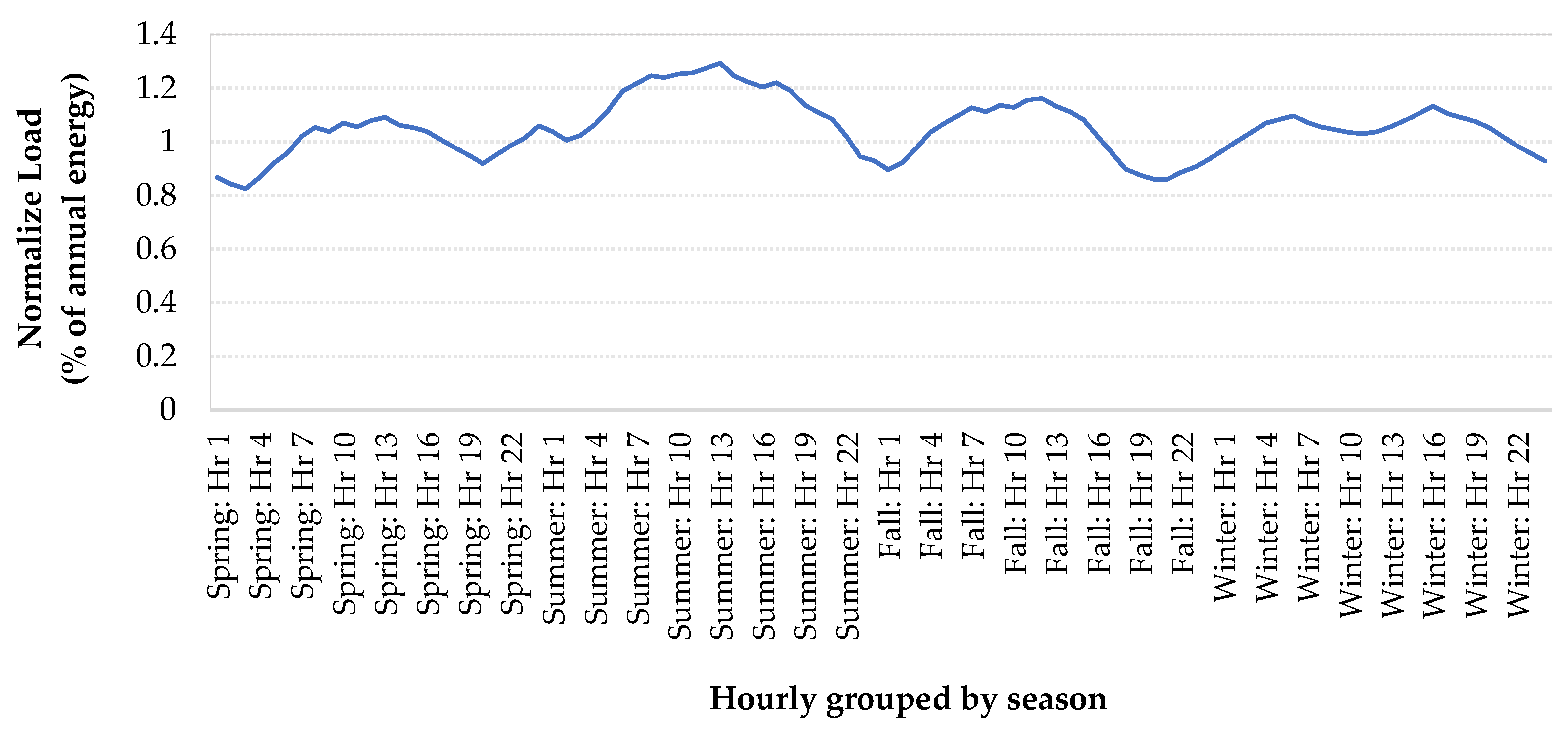
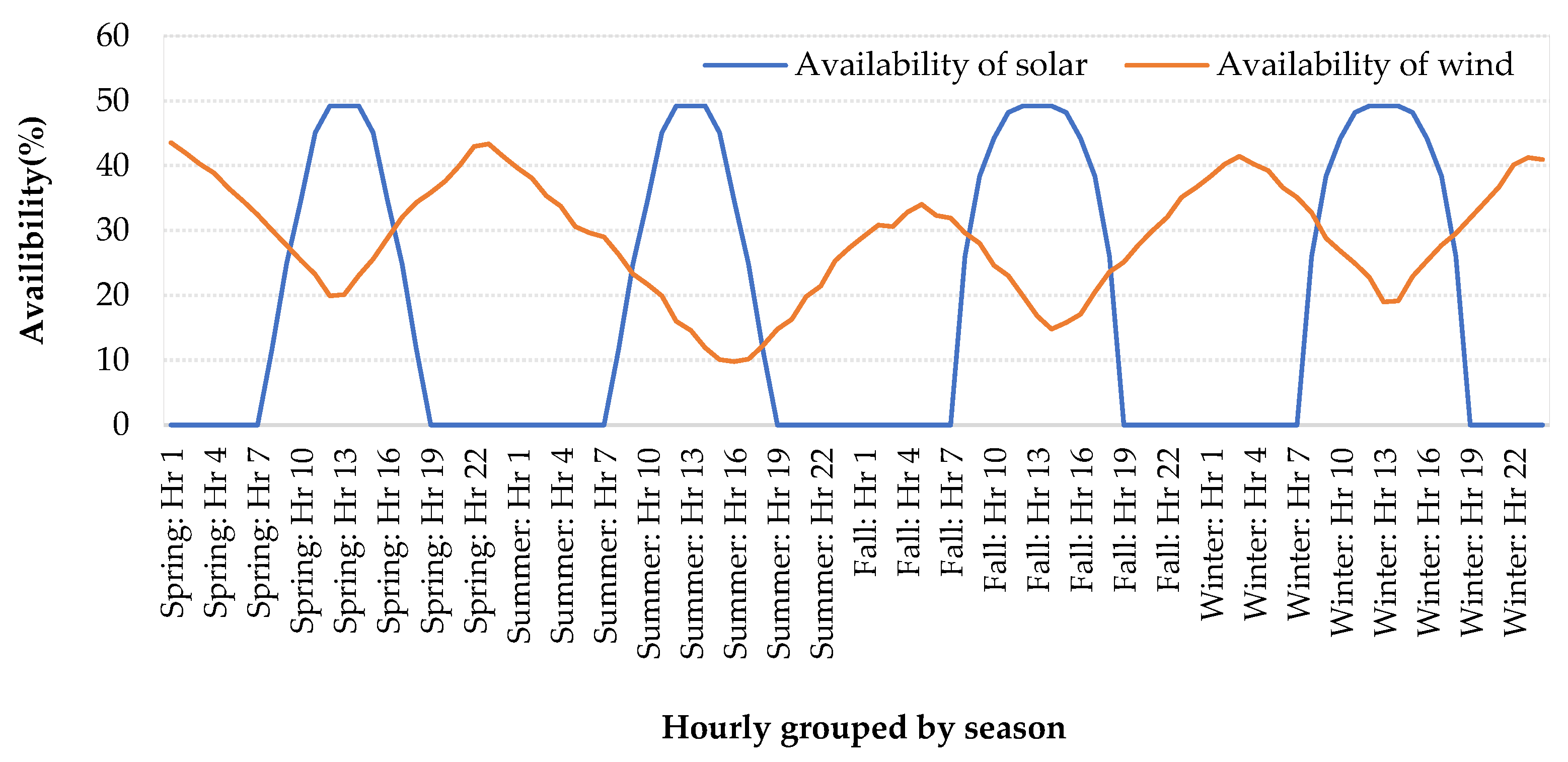
The transformation module requires detailed techno-economic data to represent energy conversion processes. The technical data include operational lifetimes, maximum availability factors, capacity credits, and generation efficiencies, supplemented by system-level data such as the electricity seasonal daily load profile, reserve margins, and transmission and distribution (T&D) losses. Fan et al. [68], Wang et al. [24] and Ma [69] provided insightful information relating to specific technical data. The system-level data were taken from the NEA and previous studies [24,67,68]. Figure 2 presents the electricity load profile employed in this study. For the electricity load profile, this paper adopts a temporal structure comprising 96 distinct time slices. The annual load of 8760 h is divided into four representative seasons, which are further subdivided into 24 hourly intervals for each day. Under this model, each time slice represents the average hourly load for all days within a specific season, assuming uniform intraday demand patterns. The 96-segment representation allows the optimization framework to effectively capture the essential temporal dynamics of the power system, such as midday solar generation peaks and evening demand surges across various climatic periods. The availability of solar and wind is outlined in Figure 3. In addition to technical data, this study requires various economic data including discount rate, capital investment costs, fixed and variable operation and maintenance costs, and fuel prices associated with each technology. These data were collected from the World Bank and other relevant literature [15,24,66,70]. More details on the techno-economic data are presented in Table 2. The information relating to historical electricity consumption was collected from the National Bureau of Statistics [71].
For the resource, the module provides a broad range of primary energy inputs, classified into conventional thermal, nuclear, and renewable sources. This comprises fossil fuels (bituminous coal and natural gas), carbon-neutral biomass, and several zero-emission technologies, including nuclear, hydropower, and variable renewable energy (VRE) such as solar and wind. The data on primary energy prices were taken from relevant studies [15,70]. The emission factors used for calculating CO2 emissions are made available by the Intergovernmental Panel on Climate Change (IPCC) [72,73].

2.5. Methodological Contribution

This study advances energy system modeling by developing an integrated LEAP–NEMO framework that explicitly bridges long-term national climate objectives with short-term operational constraints. Unlike traditional frameworks that rely on annual or seasonal averages, this framework adopts a 96-segment temporal structure by subdividing four seasons into 24-h intervals. This temporal granularity enables the model to capture critical intra-day dynamics—such as midday solar generation peaks, evening demand surges, and the corresponding flexibility requirements imposed on BESS and coal-CCS units—thereby overcoming a key limitation of coarse-resolution planning models.
From a methodological perspective, the framework integrates recent policy inflection points (2024–2025) directly into the model structure, including the introduction of 2035 absolute emissions constraints and the operationalization of China’s “Establish Before Breaking” transition principle. As a result, the modeled pathways reflect not only long-term decarbonization ambitions but also the evolving regulatory and institutional conditions that shape near-term investment and dispatch decisions.
In addition, this study introduces the Integrated (ING) scenario, an approach that balances strategic stabilization of conventional energy with high renewable penetration. This allows for a more detailed assessment of the trade-offs associated with a just and equitable transition, specifically identifying how the recalibration of coal assets can support rather than hinder renewable deployment.
To sum up, this integrated methodology facilitates an in-depth assessment of the technical, economic, and environmental trade-offs associated with carbon-neutral electricity pathways, providing a modeling framework that is suited to analyzing just and equitable transitions within China’s coal-dominant yet renewable-rich energy system.

3. Empirical Results and Discussions

This section assesses the feasibility and implications of various carbon-neutral electricity scenarios across three key dimensions: energy, the economy, and the environment. Seven attributes can be employed in order to assess the scenarios’ impacts. These attributes include estimated capacity mix, projected electricity generation, daily power generation, primary energy requirements, production costs, the cost of avoided emissions, and emissions of CO2. The following sub-sections present the empirical results for each attribute across the scenarios and discuss their implications for advancing a sustainable energy transition.

3.1. Capacity Mix

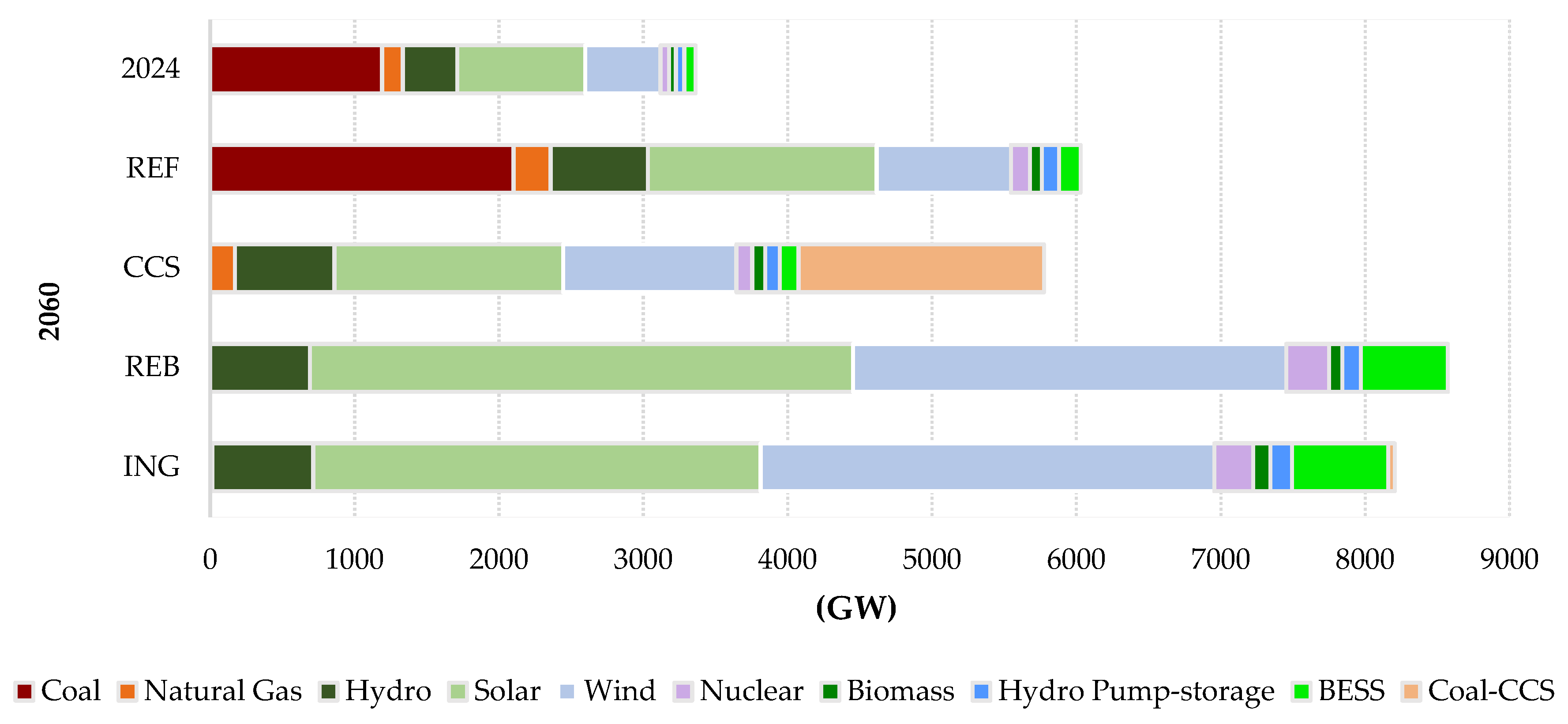
To supply sufficient electricity demand by 2060, the total generating capacity would have to increase substantially across all scenarios (as shown in Figure 4). Under the REF scenario, the total capacity is expected to increase by approximately 1.8 times, rising from 3360 GW in 2024 to 6029 GW by 2060. Similarly, the CCS scenario would generate a total capacity of approximately 5800 GW. The REF and CCS scenarios demonstrate comparable capacity requirements, largely due to their reliance on existing power generation technologies. However, the CCS scenario emphasizes a shift towards coal-fired power integrated with CCS systems. Moreover, the CCS scenario involves a reduced need for substantial capacity expansion, which is common in scenarios with a high penetration of renewable energy, while still meeting stringent emission reduction targets. In the CCS scenario, the traditional coal-fired power production capacity would be eliminated. This capacity would then be replaced by coal-CCS—representing approximately 29% of the total installed capacity. The retrofitting of existing coal-fired power plants with CCS technology would maintain a considerable level of dispatchable power within the electricity system and also result in a substantial reduction in carbon intensity. This strategy would improve energy security and power system stability as well as reduce the pressure for emission mitigation. However, it is important to note that retrofitting for CCS requires a trade-off, specifically a significant increase in capital costs.
Interestingly, the REB and ING scenarios would result in significant increases in total capacity compared to the REF scenario. As shown in Figure 4, the REB and ING scenarios involve the greatest increases in total power capacity by 2060, reaching 8574 GW and 8205 GW, respectively. These expansions are mainly attributed to the lower capacity factor, which reflects the availability of variable renewable energy sources. In the REB scenario, solar (44%) and wind (35%) technologies are the most prevalent, with a strategic expansion of BESS capacity to 7.0% to mitigate intermittency and ensure grid stability. Similarly, the ING scenario designates wind and solar as the system’s primary components, representing over 76% of total capacity and eliminating conventional coal. Within this integrated scenario, coal with CCS would be assigned a marginal, supplementary role (0.2–0.5%). This illustrates a clear shift in which fossil-based technologies serve exclusively as transitory backups rather than primary energy sources. In addition to technical implications, the scale and pace of capacity expansion also have important social and regional consequences. Scenarios with rapid and large-scale capacity additions—such as the REB pathway—imply intensified infrastructure deployment, land-use pressure, and grid investment concentrated in renewable-rich western regions. In contrast, the ING scenario alleviates expansion requirements by retaining a limited share of firm low-carbon capacity, and hence help reducing regional investment concentration and easing transition pressures on resource-dependent provinces.

3.2. Electricity Generation Mix

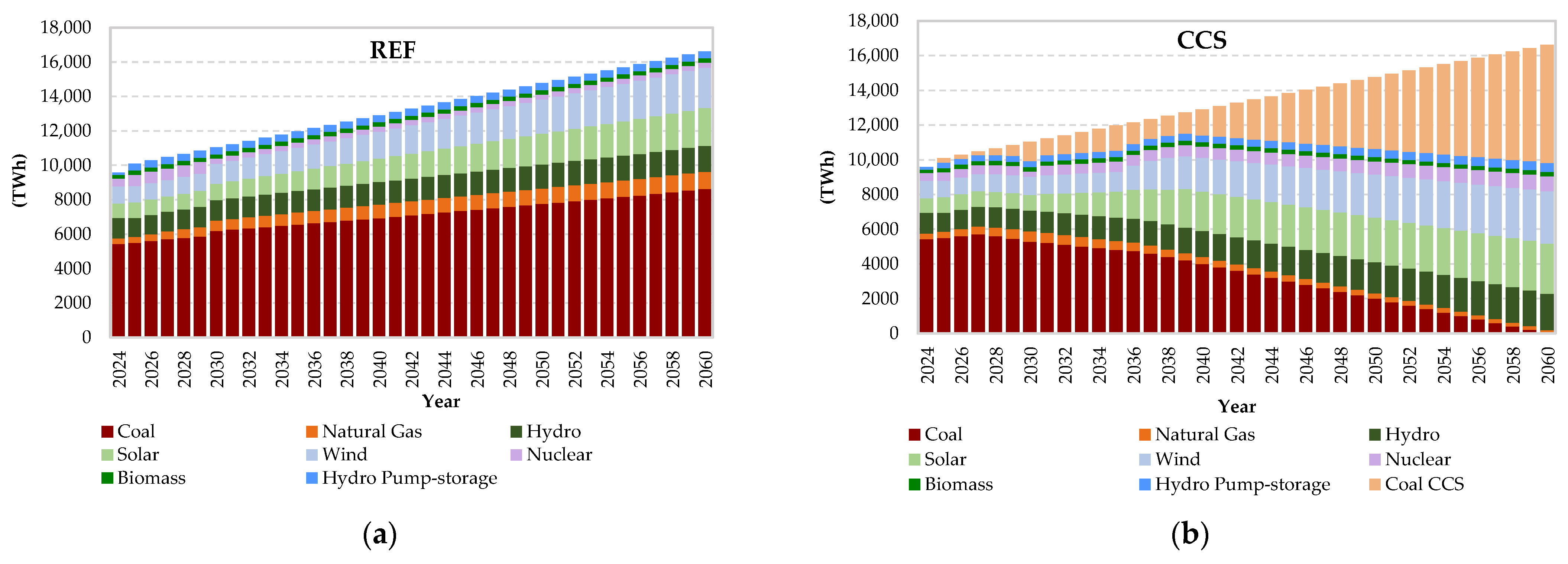
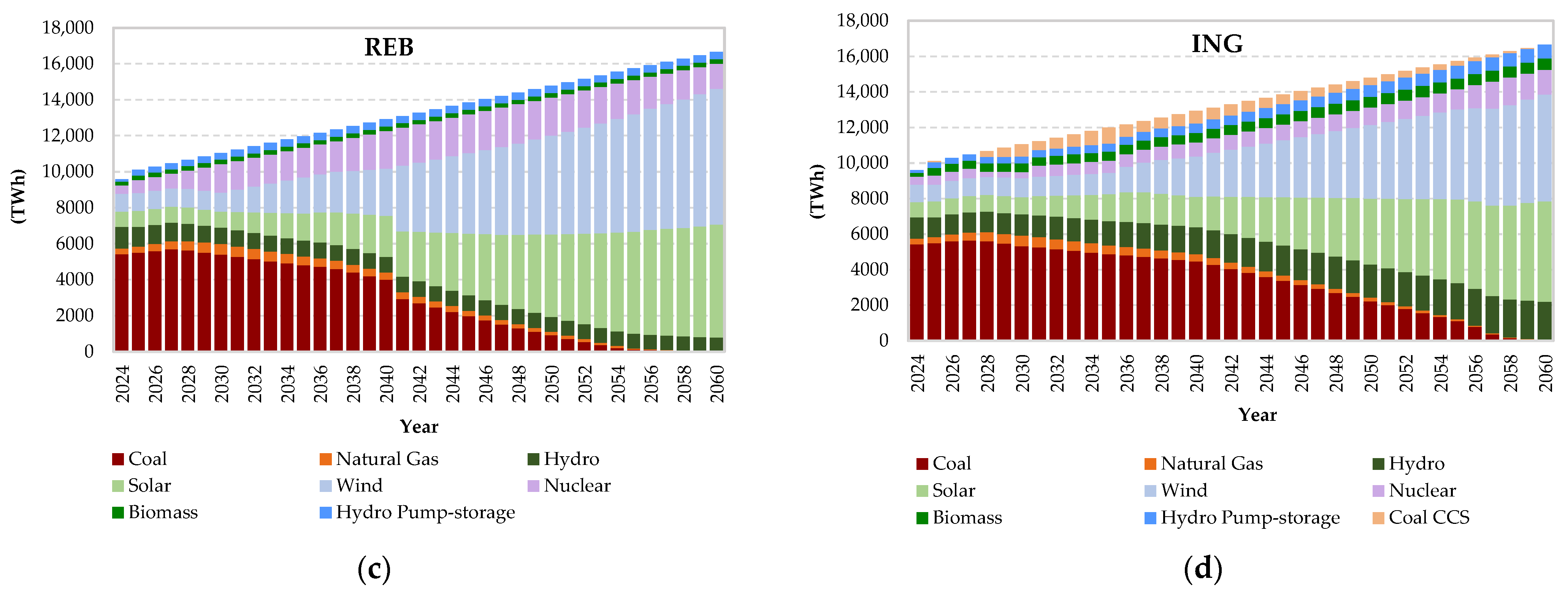
Figure 5 illustrates a significant expansion in China’s electricity generation, with total output projected to nearly double from 9585 TWh in 2024 to approximately 16,620 TWh by 2060. Although the total demand growth is consistent across all scenarios, the technological pathways to meeting this demand vary significantly depending on policy constraints. The REF scenario represents a “business-as-usual” pathway, in which the evolution of the power system is primarily influenced by cost efficiency and supply dependability, rather than stringent carbon constraints. Under this scenario, the power sector would gradually decarbonize, maintaining its reliance on the current fossil fuel infrastructure. Figure 5a indicates that coal would remain the dominant source of electricity, with an estimated 52% of total electricity production by 2060. This dominance is due mainly to coal’s technological maturity and its critical role in providing “peak-shaving” capabilities to maintain grid stability. In contrast, renewable energy sources, including wind, solar, and hydro, demonstrate moderate expansion, accounting for 14%, 13%, and 10% of total power generation, respectively, by 2060. Despite more widespread adoption, their contribution remains supplementary rather than revolutionary. This scenario, therefore, likely reflects a continued reliance on existing fossil fuel infrastructure with incremental renewable adoption, which will likely hinder the pace of power sector decarbonization.
The CCS scenario represents a capital-intensive, technologically driven transformation, emphasizing the retrofitting of existing fossil fuel infrastructure with CCS rather than pursuing a full phase-out. In this scenario, conventional coal generation would be systematically replaced by coal plants equipped with CCS, which is expected to grow to 41% of total generation by 2060, as shown in Figure 5b. Renewable energy deployment remains relatively moderate and generally consistent with the REF case. By 2060, wind, solar, and hydro would constitute the principal foundations of clean energy. Despite the intensive deployment of abatement technology, the CCS scenario would face a major challenge in reaching climate goals. This is because the CCS technology could not entirely eliminate carbon emissions. Despite a 90% capture rate, a minimum of 10% of the CO2 produced is still released. As a result, achieving carbon neutrality by 2060 would be impossible, positioning CCS as a transitional, rather than final, climate solution.
In view of the REB and ING scenarios, both scenarios present the most ambitious decarbonization strategies. However, a significant disparity emerges in their respective strategies with regard to fossil fuel infrastructure and grid stability. The REB scenario promotes a rapid transition, which results in entirely phasing out fossil fuels by 2060. This scenario prioritizes wind and solar as the primary components of the power system, collectively contributing over 90% of total generation as presented in Figure 5c. Conversely, the ING scenario adopts a more practical and integrated strategy, which incorporates a modest proportion of coal-CCS generation as a flexible transitional measure together with a substantial renewable energy contribution of about 88% (see Figure 5d). While the REB scenario highlights rapid and substantial emissions mitigation through the exclusive use of renewables, the ING scenario emphasizes system diversity and reliability by preserving a strategically constrained, abated fossil fuel portion and hence balancing long-term decarbonization targets with mid-term grid stability.

3.3. Daily Power Generation

To assess operational feasibility and system flexibility under high penetrations of variable renewable energy, this study analyzes daily power generation profiles. The assessment focuses on daily and seasonal mismatches between electricity supply and demand, as well as the associated ramping requirements. In addition, it examines the need for energy storage and the role of dispatchable backup generation in ensuring grid stability and reliability in renewable-dominated power systems.
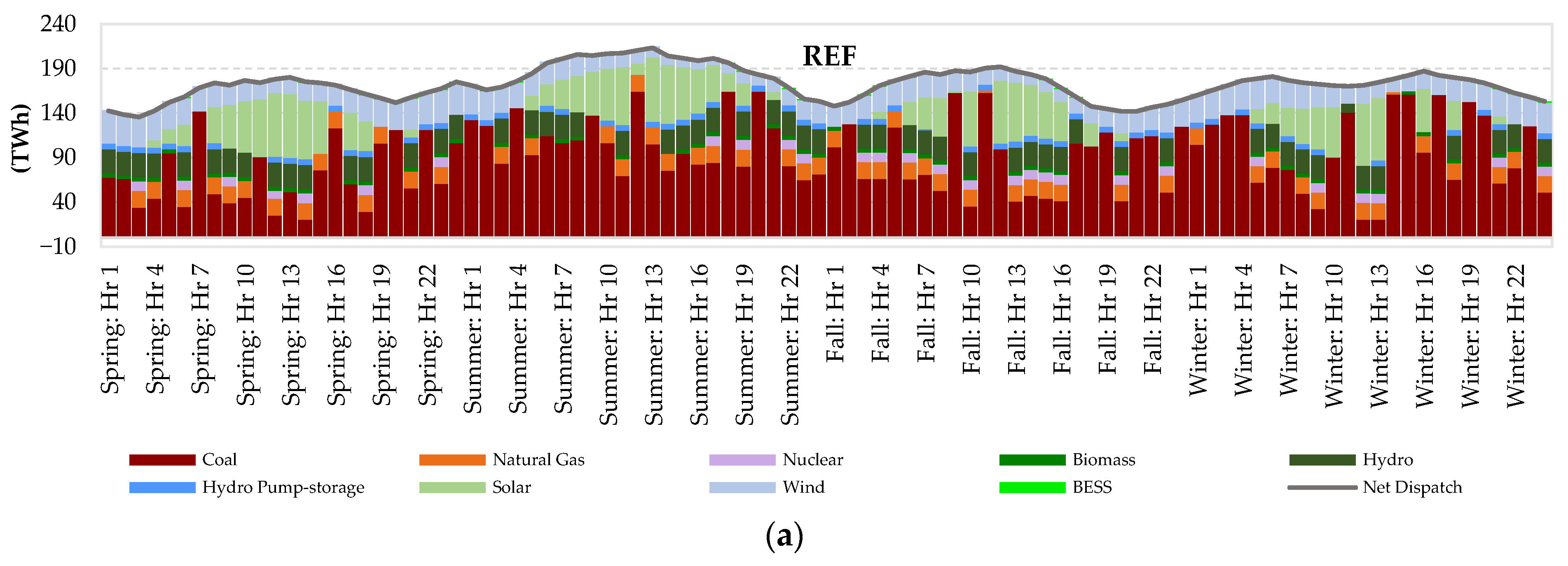
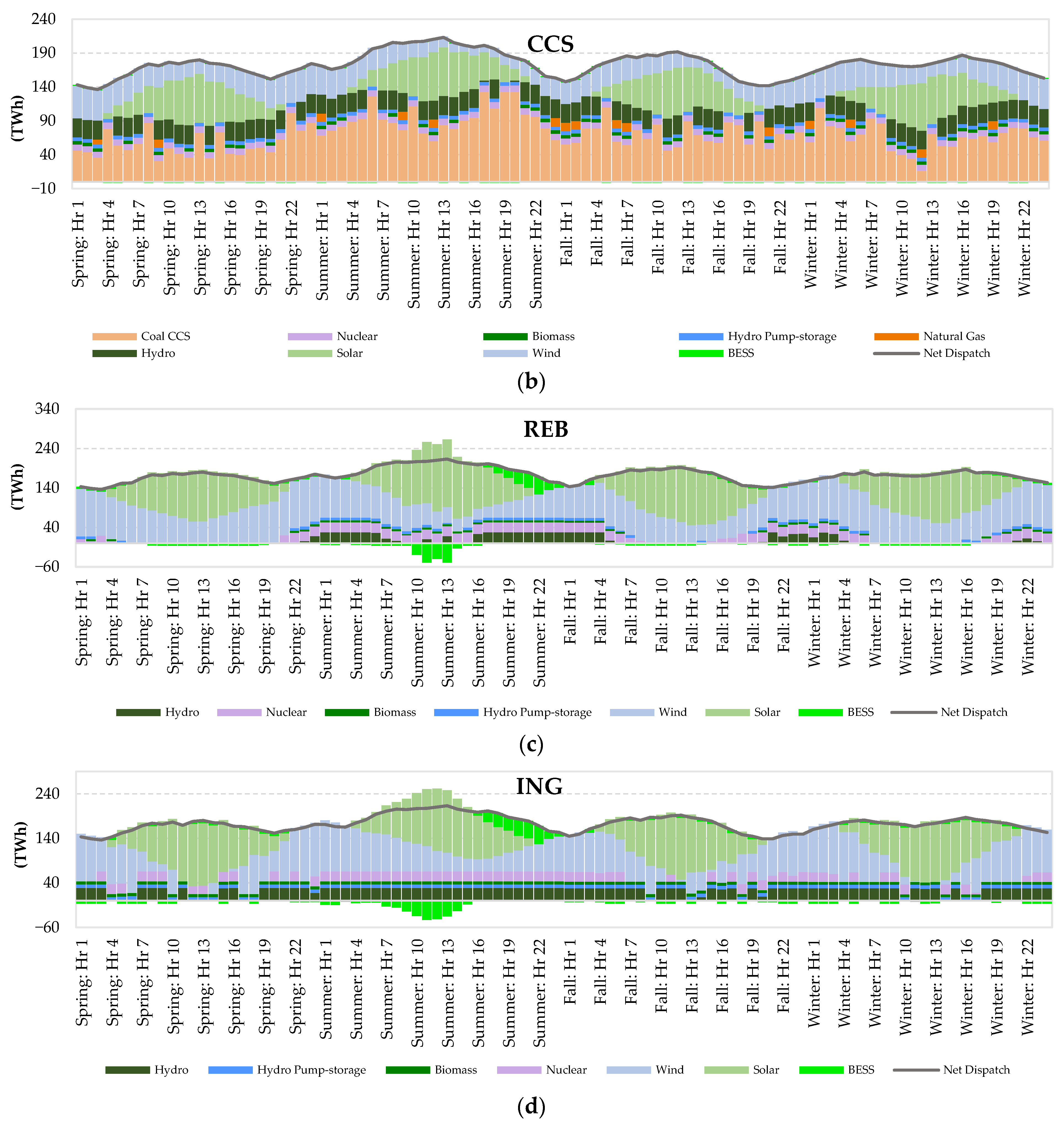
Figure 6 shows the daily power generation profiles for the REF, CCS, REB, and ING scenarios in 2060, across all four seasons. From Figure 6a,b, the REF and CCS scenarios represent the traditional pathways for power system evolution through 2060. These scenarios prioritize system stability and the use of dispatchable base-load power, rather than highly variable renewable integration. The REF scenario represents a typical system that relies heavily on fossil fuels, using a baseload-plus-peaking structure. In this scenario, coal is the main source of electricity. This scenario shows the most stable generation pattern throughout the year, with limited use of variable renewable energy. Renewable energy—especially solar—leads to higher generation during the summer season due to increased solar irradiance. The CCS scenario largely follows the demand and dispatch patterns as shown in the REF scenario, but it replaces traditional coal with coal equipped with CCS. This scenario focuses on using cleaner fossil fuels instead of fully shifting to renewable energy sources. As a result, relying on CCS reduce the need for flexibility and storage solutions, while wind and solar contribute a limited proportion. Although this scenario helps ensure grid stability, it depends largely on the advancement of CCS technology, a continued fuel supply, and a well-developed carbon transport and storage system.
On the other hand, the REB and ING scenarios show a transition from fuel-based stability to a weather-dependent structure facilitated by flexible storage, as shown in Figure 6c,d. It can be seen from Figure 6c that the REB scenario is characterized by significant daily and seasonal volatility due to high VRE penetration. In the summer and spring seasons, large midday solar surpluses drive intensive BESS charging, which is essential for meeting evening demand spikes. Seasonally, the system shifts from solar dominance in summer to wind reliance in winter, with storage transitioning from shifting solar energy to smoothing variable wind output. In the absence of flexible thermal generation, system balance is entirely dependent on BESS and pumped hydro in resolving supply–demand mismatches. The ING scenario follows the renewable-driven patterns observed in the REB scenario but incorporates a more robust and reliant generation base. A dependable contribution from nuclear and hydro would provide a firm baseline across seasons, reducing reliance on deep storage discharge. Despite the existence of summer duck-curve dynamics, the integration of dispatchable renewables, including biomass and hydro, enhances operational flexibility. Consequently, the ING scenario provides a hybrid approach that balances high VRE penetration with system stability, bridging the gap between storage-intensive renewable systems and centralized thermal-based pathways.

3.4. Primary Energy Requirements and Energy Diversity

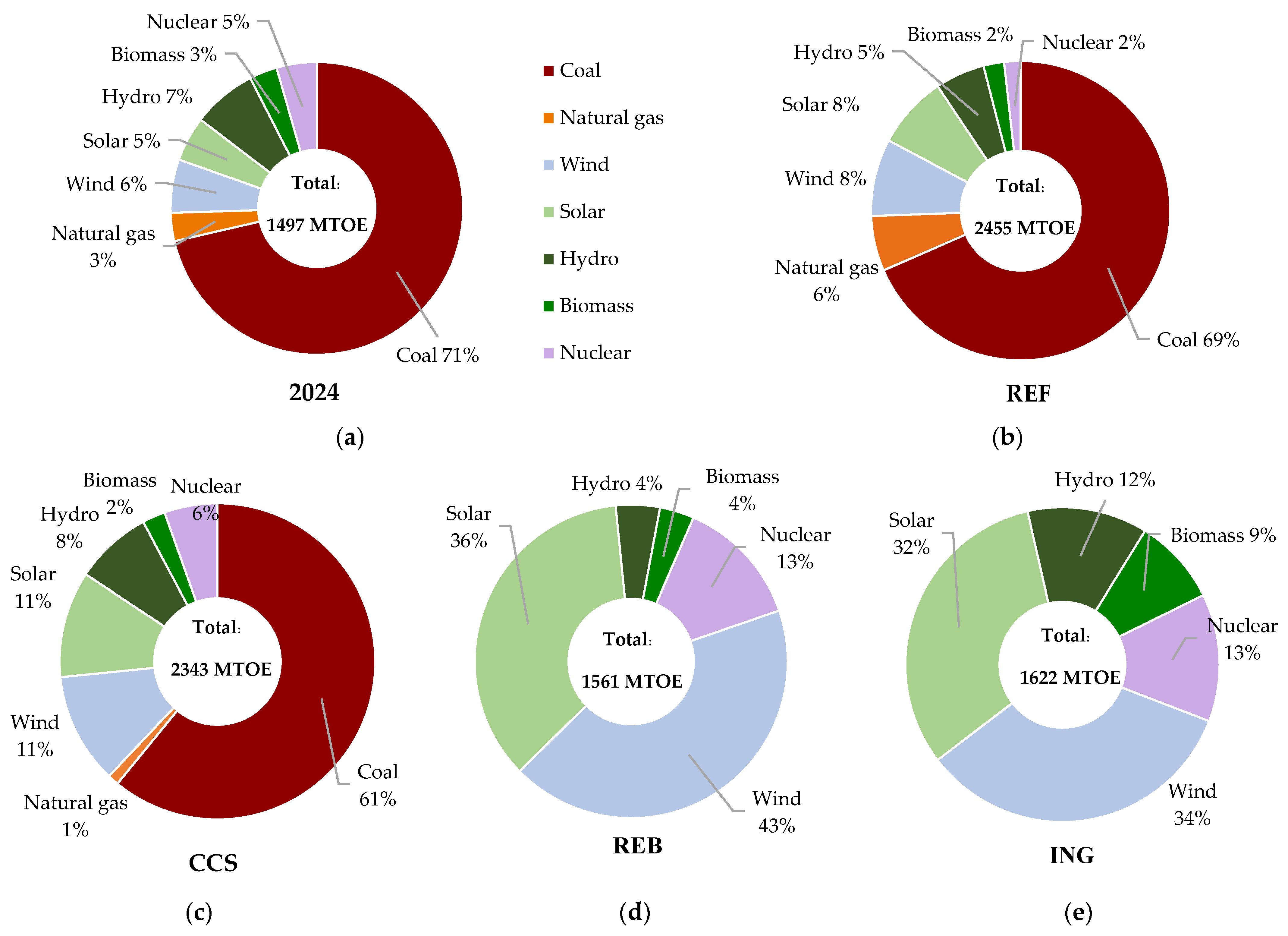
Figure 7 shows that the primary energy demand is expected to increase in all four scenarios by 2060. Under the REF scenario, the primary energy requirements would increase significantly, from 1497 MTOE in 2024 to 2455 MTOE by 2060, representing an increase of about 64% compared to primary energy consumption in 2024. This indicates a continued reliance on traditional energy sources. Similar to the REF scenario, the CCS scenario also involves an increase, with a total of about 846 MTOE. While equipping conventional coal-fired power plants with CCS technology in this scenario effectively reduces carbon emissions, it still requires substantial coal consumption, making it difficult to change the power system’s structural dependence on fossil fuels. In contrast, the REB and ING scenarios show modest growth, with increases of 64 and 125 MTOE, respectively. Compared to the REF scenario, the REB and ING scenarios would lower total primary energy demand by about 33.9% and 36.4%, respectively, by 2060. This suggests that shifting the electricity generation mix towards renewables significantly reduces the total primary energy requirements due to the fact that wind and solar have better conversion efficiencies than thermal combustion.
In addition to the primary energy requirements, energy diversity is employed in this paper to examine how different decarbonization strategies could contribute to a greater diversification of the energy sources. The energy diversity is represented in this paper in terms of a simple yet widely used diversification index, namely, the Herfindahl–Hirschman Index (HHI). The HHI evaluates energy diversity by calculating the sum of the squares of the shares of each energy source within a country’s energy mix [74]. A lower HHI indicates a more diverse energy portfolio, which generally correlates with higher energy security and a lower risk of supply disruption. In contrast, a higher HHI value denotes a greater dependence on a limited number of energy sources. Table 3 shows that the HHI for the 2024 base year is approximately 0.52, indicating a high concentration of a single energy resource. This could be due to the substantial share of coal in the primary energy mix in 2024. According to Figure 7a, the 2024 primary energy mix was dominated by coal (71%), with significantly lower contributions from natural gas (3%), hydro (7%), wind (6%), solar (5%), nuclear (5%), and biomass (3%). The REF scenario represents a slight improvement in the diversification index (0.49) compared to 2024; however, it continues to exhibit a high level of concentration and carbon intensity. Under the CCS scenario, the energy diversification index improves from a highly concentrated 0.52 in 2024 to 0.41 by 2060. While this scenario represents progress, the continued dominance of coal at 61% of the primary energy mix indicates a continuing structural dependency that limits the overall diversity and resilience of the energy portfolio (as shown in Figure 7c).
Interestingly, the REB and ING scenarios represent transformative decarbonization pathways, projecting a fully decarbonized primary energy supply by 2060. Although both scenarios indicate a significant shift from the 2024 baseline, their strategies are fundamentally different. The REB scenario emphasizes a substantial dependence on renewables, with wind, solar, hydro, and biomass accounting for 43%, 36%, 4%, and 4% of the energy supply, respectively (as shown in Figure 7c). All this results in a more diversified energy mix compared to the baseline, as indicated by an HHI of 0.33. Conversely, the ING scenario emphasizes technological diversity, incorporating significant proportions of firm low-carbon energy sources. Figure 7d shows that the increases in the contributions of hydro, to 12%, and biomass, to 9%, combined with wind (34%) and solar (34%), lead to the most balanced portfolio of all scenarios, with an HHI of 0.26. In the context of a just and equitable transition, higher energy diversity (lower HHI) also enhances social resilience. A more diversified energy portfolio reduces systemic vulnerability to weather-related variability and supply shocks, which disproportionately affect vulnerable regions and consumers. The lower HHI value observed in the ING scenario therefore implies not only improved energy security, but also a more socially robust transition pathway.

3.5. Cost of Electricity Production

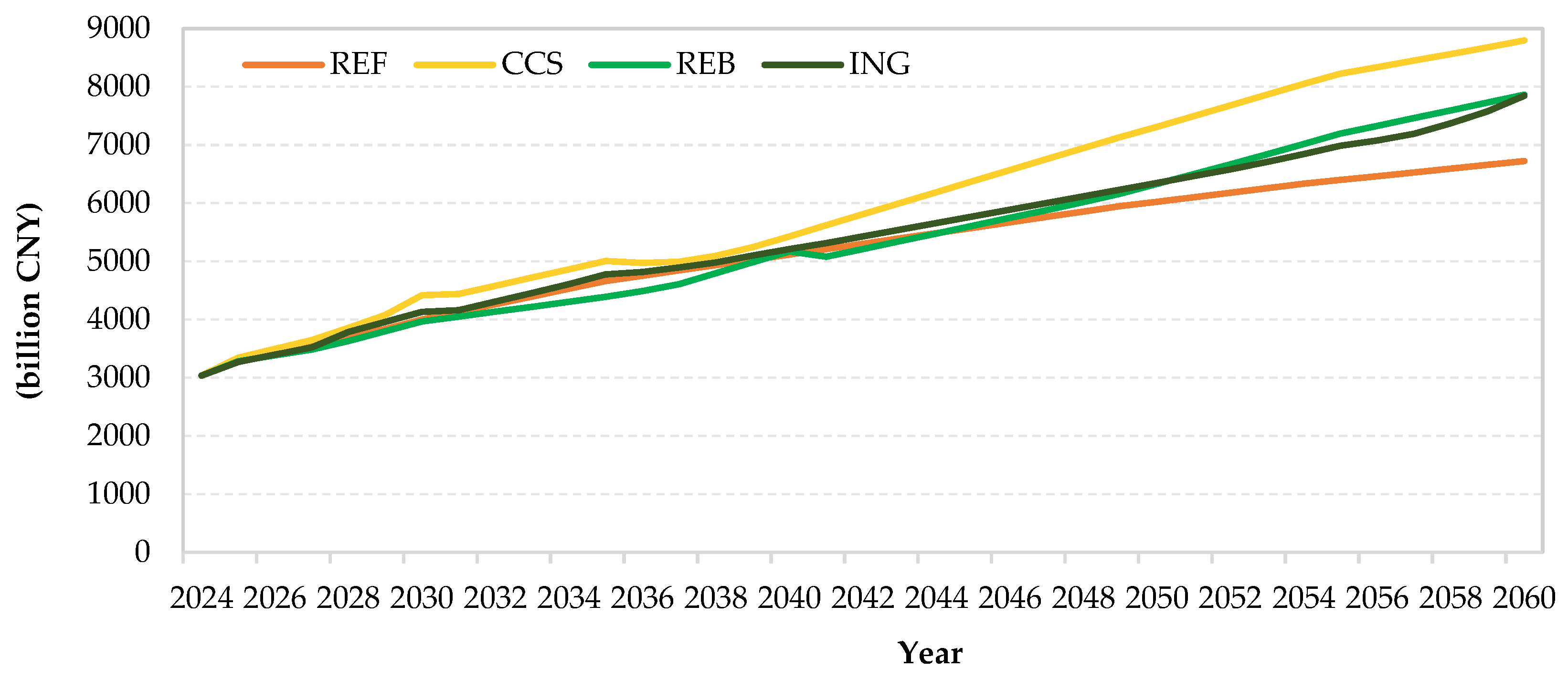
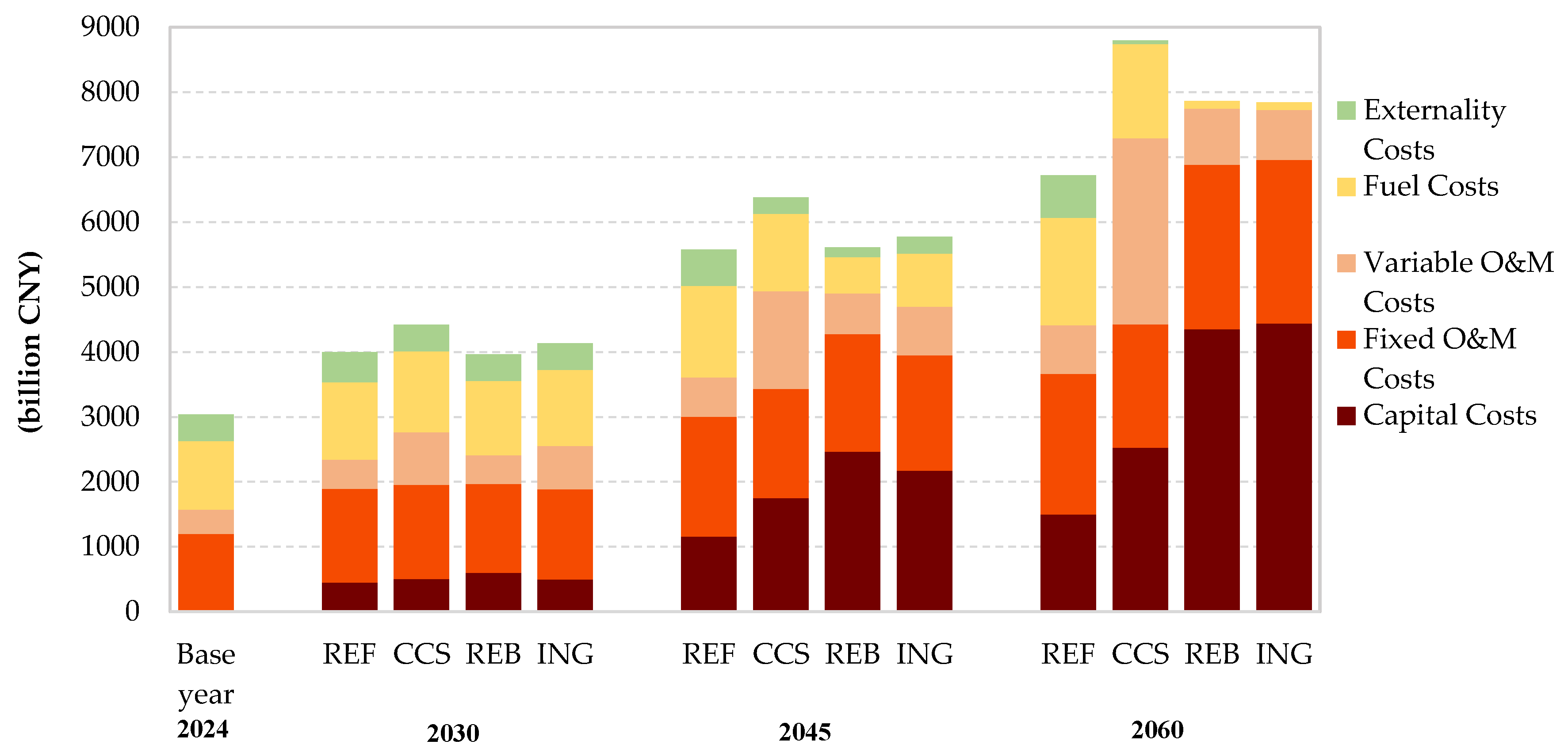
Driven by rising electricity demand and the necessary expansion of the energy system’s infrastructure, the total electricity production costs for all scenarios exhibit a continuous increase throughout the study period (as presented in Figure 8). Nevertheless, the degree and rate of cost increases vary significantly depending on the adopted decarbonization pathway. The REF scenario illustrates the most modest cost increase, ultimately reaching approximately CNY 6800 billion by 2060, and remains the least costly option in terms of direct financial expenditure. Conversely, the CCS scenario emerges as the most capital-intensive pathway, with costs accelerating sharply after 2040 to reach a peak of nearly CNY 8800 billion by 2060; this is indicative of the considerable capital and operational demands associated with carbon capture technologies. The REB and ING scenarios have higher upfront costs than the REF scenario due to investments in new infrastructure. The costs then stabilize and converge around CNY 7800–7900 billion as these two scenarios benefit from the long-term displacement of fuel expenses.
Figure 9 reveals noticeable variations in the main cost components for various scenarios. In the base year, 2024, fuel and fixed O&M expenditures represent the largest portions of total production costs. However, by 2030, and specifically in 2045 and 2060, capital costs emerge as the main cost drivers in the decarbonization scenarios, especially the REB and ING scenarios. These reflect the considerable capital investments required for low-carbon generation technologies and their associated infrastructure. In the REB and ING scenarios, the fuel and externality costs are nearly eliminated by 2060, indicating a decreased reliance on fossil fuels. On the other hand, these costs continue to represent major components of total costs in the REF and CCS scenarios. The fixed and variable O&M costs show moderate increases across all scenarios, reflecting the scale of the system and the complexity of the technologies employed. The externality costs, although relatively minor, are lower in the REB and ING scenarios, suggesting the environmental advantages linked to cleaner generation portfolios.
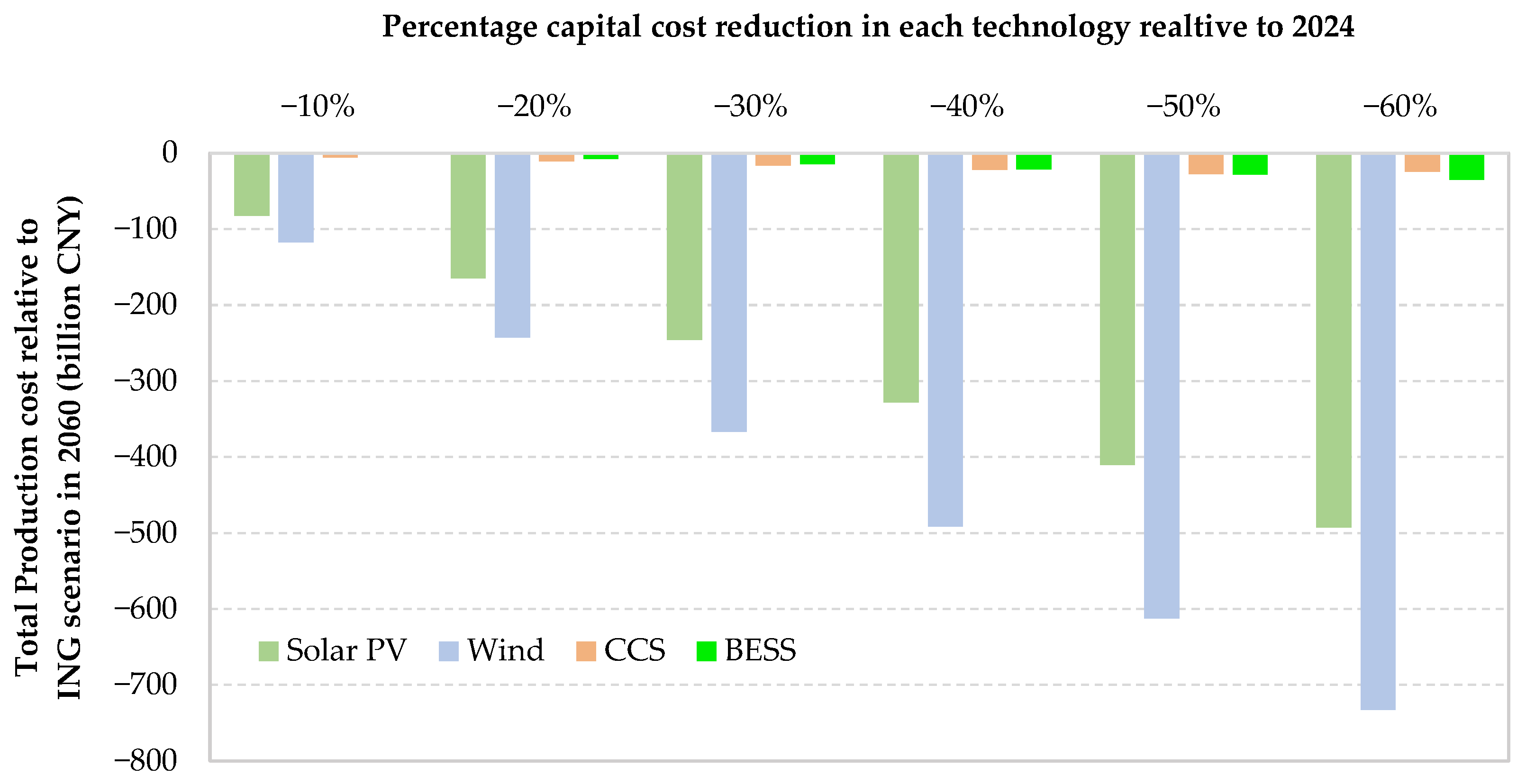
To assess how changes in capital costs affect total system production costs, a sensitivity analysis was conducted (Figure 10). As shown in Figure 10, the capital costs of wind, solar PV, coal-CCS, and BESS technologies were reduced in 10% increments, up to 60% relative to the 2024 baseline. The results indicate that, although declining capital costs lead to predictable reductions in total production costs, the fundamental system dynamics and strategic conclusions of the ING scenario remain unchanged. Due to its dominant share in installed capacity, wind power exhibits the highest cost sensitivity, followed by solar PV. In contrast, even substantial cost reductions in coal-CCS and BESS result in relatively limited system-wide impacts. This reflects their constrained roles within the overall generation mix. Importantly, the relative sensitivity ranking of technologies and the structural composition of the power system remain consistent across all analyzed cost assumptions. This indicates that the key findings of this study—particularly the strategic priority of large-scale renewable deployment supported by a limited share of firm capacity—are robust and driven by systemic characteristics rather than precise capital cost forecasts.
The foregoing results highlight a clear trade-off between short-term cost minimization and long-term structural transformation. While the REF scenario would result in a reduction in total production costs, it fixes the system for fuel- and externality-intensive operation. The CCS scenario would provide emissions reductions at the highest production cost. In the REB and ING scenarios, financial resources would be reallocated toward capital investment, hence substantially decreasing fuel reliance and externality costs and providing a more equitable and potentially enduring cost structure in the long term.

3.6. CO2 Emissions

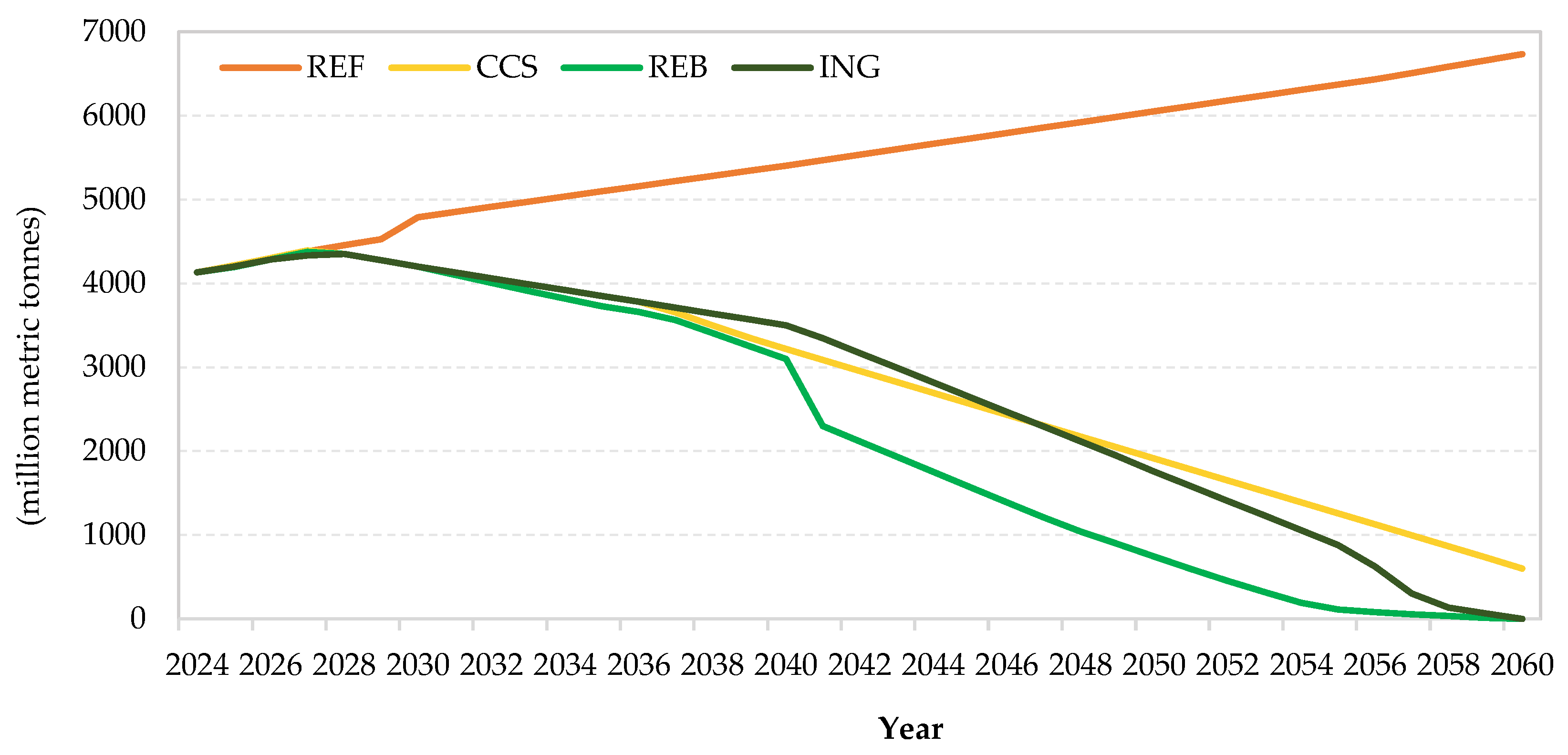
To accelerate the reduction in CO2 emissions in the power sector, the Chinese government is actively adopting zero-carbon energy sources, a key component of its “Dual Carbon” strategy. Figure 11 presents the projected CO2 emissions in the power sector across all four scenarios from 2024 to 2060. This figure highlights a critical crossroads between business-as-usual development and deep decarbonization pathways. In the REF scenario, assuming no carbon-emission constraints, emissions are expected to rise from 4131 million tonnes in 2024 to 6732 million tonnes by 2060—approximately 1.6 times the 2024 level.
On the contrary, the three mitigation scenarios—REB, ING, and CCS—are developed to meet China’s international commitments, specifically to achieve peak carbon emissions before 2030 and to attain carbon neutrality by 2060. All three scenarios represent an Inverted-U shape, wherein emissions initially rise before eventually declining. The projected emissions peak is expected to reach between 2027 and 2029, several years in advance of the 2030 target. This earlier peak is a result of the rapid expansion of wind and solar power during the mid-2020s. This successfully establishes a transitional period that supports a more gradual and less economically disruptive transition before the significant reductions needed in the latter half of the 21st century. In this decade, solar energy capacity rose significantly from 43.5 GW in 2015 to 889 GW by 2024 [75]. During the same period, wind power also grew from 131 GW to 521 GW. As of November 2025, the total installed capacity for solar and wind power had reached 1140 GW and 590 GW, respectively [76].
From 2030 to 2060, the disparity between the mitigation scenarios becomes more apparent. This highlights the different technological and structural changes essentially needed to achieve carbon neutrality. Although emissions decrease after 2030 in all three scenarios, only the REB and ING scenarios reach net-zero emissions by 2060. The REB scenario involves the most ambitious reduction strategy, with emissions dropping significantly around 2040. This reduction is likely due to a major decrease in coal power generation as well as a notable increase in renewable electricity production, as shown in Figure 5c. Emissions would continue to decrease, reaching almost zero by 2054, and then reaching complete net-zero by 2060. In the ING scenario, CO2 emissions would initially follow the trend of the REB scenario until 2040, subsequently experiencing a more rapid decline after the mid-2050s, and ultimately reaching the net zero target. This trend suggests a strategy that initially emphasizes technological solutions, including efficiency enhancements and carbon capture, before shifting towards more rigorous policy measures and extensive energy transitions to finalize the decarbonization process, as presented in Figure 5d. In contrast to the REB and ING scenarios, the CCS scenario fails to deliver the deep decarbonization necessary for the 2060 carbon neutrality goal, although it helps achieve the short-term goal of peaking emissions by 2030.

3.7. Cost of Avoided CO2 Emissions

To assess the economic viability of various decarbonization strategies for the period 2024–2060, this section analyzes the cost of avoided CO2 emissions across three mitigation scenarios—CCS, REB, and ING—in comparison to the REF scenario. The cost of avoided CO2 emissions is calculated as the ratio of the disparity in total discounted system costs to the corresponding reduction in cumulative CO2 emissions when compared to the REF scenario. Consequently, this metric serves as the average cost per tonne of CO2 abated throughout the entire study period. This offers a comprehensive assessment of cost-effectiveness across varying technologies and temporal dimensions. In this analysis, all system costs are discounted at a rate of 5%. This price reflects the present value of long-term investments, operating costs, and savings from fuel. Table 4 presents the cost of avoided CO2 emissions for the period 2024–2060.
Table 4 reveals that the REF scenario’s cumulative CO2 emissions would reach 203,761.5 million tonnes, with a total discounted system cost of CNY 79,451.8 billion, serving as the baseline for comparison. Although all mitigation scenarios significantly reduce cumulative emissions, they differ considerably in terms of cost and abatement efficiency. The REB scenario would be the most cost-effective, achieving an abatement rate of 59.2% and reducing cumulative emissions to 83,160.7 million tonnes. Importantly, the reduction in emissions coincides with a decrease in the total discounted system costs, which presently amount to CNY 77,251.0 billion. This represents a net saving of about CNY 2201 billion compared to the REF scenario. As a result, the cost of avoided CO2 emissions is negative (CNY −18.2 per tonne of CO2). The REB scenario is, therefore, a clear win–win solution, achieving both emissions reductions and economic benefits.
The ING scenario also offers a cost-effective mitigation strategy. This scenario would reduce cumulative emissions to 100,758.8 million tonnes and achieve a 50.6% abatement rate. The total discounted system cost, at CNY 79,148.8 billion, is slightly lower than that of the REF scenario, resulting in a modest net saving of approximately CNY 303 billion. Consequently, the cost of avoided CO2 emissions is marginally negative (−2.9 CNY per tonne of CO2). This signifies that the ING scenario could facilitate significant emissions reductions with a marginal cost benefit. In contrast, the CCS scenario achieves a reduction in emissions to 104,236.4 million tonnes, corresponding to an abatement rate of 48.8%. However, this decrease is coupled with a greater total discounted cost of CNY 85,864.5 billion. This indicates that the system would cost about CNY 6413 billion more than the REF scenario. Therefore, the CCS scenario would result in a positive avoidance cost of 64.4 CNY per tonne of CO2. Although this scenario achieves a significant abatement rate of 48.8%, it represents the costliest mitigation strategy.

3.8. Synthesis and Comparative Benchmarking

To validate and contextualize the findings, the Integrated (ING) scenario is compared to existing projections in the literature. This comparison demonstrates the robustness of the main findings while highlighting the added value of the high-resolution, policy-aware LEAP–NEMO framework. The key results of the ING scenario exhibit strong consistency with authoritative outlooks for China’s power sector. In particular, the projected renewable electricity shares of approximately 88% in 2060 is aligned with the 80–100% range reported in the International Energy Agency (IEA)’s China Roadmap [77]. Furthermore, the estimated total installed capacity of approximately 8000 GW by 2060 is also consistent with the projections from the IEA [77] and Sinopec Economics & Development Research Institute (SEDRI) [78], as well as the range identified by Tsinghua University [79], which estimates a three- to fourfold capacity expansion to compensate for the lower capacity factors of wind and solar generation. This alignment supports the validity of the modeling approach and the underlying data assumptions.
In addition to consistency, the analysis contributes to the literature by providing a differentiated treatment of coal phase-out pathways. Unlike scenarios that assume a rapid and complete withdrawal from coal, the ING scenario considers China’s “Establish Before Breaking” philosophy. The results indicate a transition characterized by strategic asset recalibration rather than rapid decommissioning. A small but strategically significant infrastructure of coal plants equipped with CCS would be retained to provide essential system stability services. These coal-CCS units account for approximately 0.2–0.5% of total electricity generation by 2060. This represents a stabilization-oriented alternative to rapid decommissioning pathways commonly assumed in integrated assessment models.
Additionally, the high temporal resolution of the LEAP–NEMO framework, implemented through 96 time slices, enables an explicit examination of operational dynamics in a high-renewables power system. The examination of intraday generation profiles shows the development of the duck curve and illustrates that system adequacy cannot be guaranteed only by the use of energy storage. The results highlight the essential complementary function of a flexible, low-carbon baseload—like nuclear power, hydropower, and coal with CCS—that is crucial for reliably meeting high energy demand in the evenings. By explicitly linking system reliability and operational feasibility with transition pacing, these findings establish the concept of a just and equitable transition in the practical requirements of power system operation.

4. Policy Implications

To identify optimal carbon-neutral electricity pathways for China, this paper provides an integrated assessment of the feasibility and implications of various mitigation transition scenarios for the period 2024–2060. By comprehensively evaluating technological, economic, and environmental trade-offs, the study seeks to develop a strategy that prioritizes a just and equitable transition. To address this comprehensive evaluation, this paper assesses the impact of each scenario in terms of projected capacity mix, electricity generation mix, daily power generation, primary energy requirements, production costs, cost of avoided emissions, and CO2 emissions. In this study, a just and equitable transition is defined as an orderly and regionally differentiated transformation that minimizes abrupt employment losses, avoids premature asset stranding in coal-dependent regions, and redistributes system value through infrastructure reuse, workforce retention, and inclusive participation in clean energy deployment. These implementation-related grid, institutional, and governance constraints are not endogenously represented within the LEAP–NEMO optimization framework but are addressed qualitatively through policy analysis, consistent with national-scale energy system studies. A summary of the key findings is provided in Table 5.
In this paper, the policy implications for China’s long-term energy planning toward 2060 focus on optimizing the complex trade-offs between deep decarbonization, economic competitiveness, and national energy security. While the modeled scenarios assume timely deployment of renewable generation, storage, and transmission infrastructure, their real-world feasibility is contingent on overcoming substantial grid, institutional, and governance constraints. Based on the summary in Table 5, both the REB and ING scenarios could achieve the decarbonization target. These scenarios would result in the largest reductions in CO2 emissions (6732 million tonnes), a substantial decrease in coal consumption, and lower fuel costs. The REB scenario, in particular, would provide the most favorable economic benefits, as indicated by the cost of avoided emissions—CNY 18.2/tonne. However, this scenario requires a rapid shift to high renewable energy penetration. This could lead to the most significant increase in capacity—over a 45% increase compared to the REF scenario. Such rapid expansion fundamentally alters the system structure, increasing reliance on variable renewable energy (VRE) sources. This high dependency reduces system diversity and reliability, consequently representing a significant security challenge. These findings demonstrate that the economic viability of high-renewable pathways is critically dependent on the effective management of system integration costs, which are not fully reflected by conventional indicators such as direct emissions abatement costs. This has important implications for electricity market design, suggesting that policy reforms should move beyond energy-only market structures toward mechanisms that explicitly value and remunerate system reliability, operational flexibility, and ancillary services, thereby better aligning short-term market incentives with long-term system requirements.
Interestingly, the ING scenario is well aligned with China’s 15th Five-Year Plan (2026–2030) and the guiding principle of “establishing the new before breaking the old”. While delivering the same level of deep decarbonization as the REB scenario, the ING pathway exhibits a greater diversification of energy supply (0.26) relative to the REB scenario (0.33). This enhanced diversity, within the context of constructing a “Strong Energy Power,” serves as a crucial technical safeguard against the volatility inherent in substantial renewable generation. As a result, it enhances energy security, which is viewed as the “lifeline of national security” throughout the peak carbon transition period. Moreover, the ING scenario provides notable structural advantages by maintaining coal-fired generation with CCS as a backup, which reduces the total capacity expansion by about 370 GW compared to the REB scenario. To realize this enhanced stability, policymakers should implement Capacity Remuneration Mechanisms (CRMs) and targeted subsidies for CCS retrofits. These policies will economically incentivize generation companies to maintain existing coal infrastructure as low-carbon strategic reserves, providing a crucial technical safeguard against VRE volatility.
Despite these structural advantages, the feasibility of the ING scenarios is, however, contingent on several technological and deployment uncertainties. These include variability in CCS capture efficiency under flexible operation, long-term CO2 storage integrity and monitoring requirements, and the availability of transport and storage infrastructure. In addition, the realization of the ING pathway depends on the effective integration of high shares of VRE and large-scale energy storage, both of which face uncertainties related to cost trajectories, technology maturity, supply-chain constraints, and system-level integration challenges. These uncertainties are not endogenously represented within the LEAP–NEMO optimization framework and are therefore addressed qualitatively through policy analysis. Accordingly, the ING pathway should be interpreted as risk-managed transition options, whose feasibility depends on phased deployment, adaptive learning, and sustained policy and regulatory support rather than as deterministic or risk-free solutions.
By providing firm low-carbon backup capacity, the ING pathway enables an orderly and phased transition toward carbon neutrality. Importantly, this phased approach has direct implications for regional equity. Coal-dependent provinces such as Shanxi, Shaanxi, and Inner Mongolia face heightened risks of abrupt employment losses and asset stranding under rapid coal phase-out pathways. In contrast, the ING scenario allows for gradual workforce reallocation, infrastructure repurposing, and industrial upgrading, and hence reducing the likelihood of concentrated socio-economic disruption in these regions. According to Yan and Wang, China’s “Energy Golden Triangle”, a region including these provinces, contains the country’s largest coal reserves and accounts for more than 70% of national coal production [80]. Consequently, this pathway supports a more just and equitable transition, harmonizing China’s long-term climate goals with the 15th Five-Year Plan’s focus on secure, balanced, and high-quality development. To support an orderly transition, national and provincial governments should establish dedicated “Just Transition Funds” tailored to coal-dependent regions. Energy planning policies should mandate phased decommissioning schedules coupled with long-term workforce retraining programs, harmonizing China’s climate goals with secure, balanced, and high-quality socio-economic development.
The foregoing analysis suggests that the strategic incorporation of both renewable and traditional energy sources, as demonstrated by the ING scenario, provides a suitable approach to China’s transition to carbon neutrality. This approach successfully balances the country’s ambitious climate targets with the critical imperatives of energy security and socio-economic stability. However, the effective implementation of the ING pathway largely depends on the government’s capacity to enact coordinated and systematic strategies. Considering that the scenario’s viability is based on the dual primers of robust renewable energy growth and the retention of conventional energy sources as a transitional stabilizer, the following recommendations are provided to optimize these two aspects that are essential to ensuring a just and equitable transition.
The first primer focuses on strengthening the physical, digital, and institutional foundations required to support high-renewable penetration in a reliable and economically efficient manner. In terms of the first primer, the expansion of renewable energy should emphasize systematic integration and the development of supporting infrastructure, rather than just extending capacity additions. Technically, achieving high-renewable penetration is hindered by the significant West–East geographic mismatch, which necessitates an extensive expansion of Ultra-High Voltage (UHV) transmission corridors. Furthermore, replacing traditional synchronous generators with power-electronics-based VRE inverters introduces stability risks, specifically challenging the grid’s frequency regulation and peak-shaving capacity. The strategies to establish a more resilient and integrated electricity system are as follows:
  • Geographical synergy could represent one key supporting strategy for bridging the disparity between renewable resource-rich western regions and the energy-intensive eastern coastal areas through the establishment of a balanced, multi-directional power flow. To establish a balanced power flow, the expansion of the UHV grid is essential in order to transmit electricity from the large-scale wind and solar mega-power plants in the northern and western highlands directly to eastern high-demand areas, thus decreasing curtailment and optimizing land use. Since 2009, China has invested over CNY 600 billion to develop an advanced UHV network. In 2023, this network covered more than 60,000 km (kms), reached a trans-regional capacity of 200 GW, and had delivered more than 3000 TWh [81]. Recently, in December 2025, China began construction on a CNY 17.2 billion UHVDC project designed to transmit 8 GW of renewable energy from Inner Mongolia to the Beijing–Tianjin–Hebei industrial hub [82]. This 700 km transmission network, scheduled for 2027, will integrate 12 GW of wind and solar capacity to bridge the geographic gap between western resource abundance and eastern energy demand. In addition, the development of offshore wind power plants along the eastern seaboard could help place generation closer to coastal load centers to reduce the grid’s long-distance transmission reliance. As of March 2025, China has become the world’s leading offshore wind market, representing roughly half of all worldwide installations. This rapid growth, escalating from less than 5 GW in 2018 to 42.7 GW by early 2025, has been largely driven by coastal provinces [80]. Jiangsu (12.6 GW) and Guangdong (11.4 GW) are currently the top two provinces, together constituting over half of the nation’s offshore capacity. Despite significant investments in China’s UHV network and offshore wind infrastructure, ongoing financial funding is essential to support the surging expansion of renewable capacity, as projected in the ING and REB scenarios (more detailed in Section 3.1). Given that solar and wind capacities are estimated to reach 6000 GW by 2060, the existing infrastructure needs to be transformed into a more flexible transmission system to efficiently manage the escalating demand.
  • The advancement of decentralized energy systems for rural development could be an effective strategy that successfully integrates national social and climate goals. This strategy aims to facilitate the energy transition by converting rural regions into resilient hubs of clean energy generation through initiatives like the national “Whole-County” rooftop solar model, Agri-Photovoltaics (Agri-PV) and Aqua-Photovoltaics (Aqua-PV). The national “Whole-County” roof-top solar model has actually been implemented as a pilot program since 2021 [83]. Expanding and accelerating this initiative could strengthen local energy self-sufficiency while reducing technical losses related to long-distance electricity transmission. In addition to the solar rooftop initiative, promoting the adoption of integrated Agri-PV and Aqua-PV models offers a solution to optimize the land–energy nexus, especially in China’s eastern provinces where land is limited. By implementing these multi-functional land-use strategies, the government could improve spatial efficiency and simultaneously generate essential extra income for rural households. This strategy directly addresses the social equity aspect of the transition, thus aligning energy infrastructure development with the national objectives of Rural Revitalization and Common Prosperity [84].
  • The digitalization strategy provides the fundamental framework for a smart new power system. This strategy facilitates the real-time coordination and intelligence necessary for the integration of VRE, the management of distributed resources such as virtual power plants (VPPs), and the optimization of transitional resources including coal-CCS. In line with the goals outlined in the 15th Five-Year Plan, this strategy emphasizes the implementation of AI-driven forecasting and satellite-based meteorological data to provide highly precise predictions of wind and solar energy production [64]. This approach will help mitigate the risks related to intermittency issues. Furthermore, the development of VPPs facilitates the formation of a flexible resource pool through the aggregation of decentralized resources, including storage systems, electric vehicles (EVs), and industrial loads. This aggregation directly contributes to enhanced grid resilience and helps defer the need for new fossil fuel peaking infrastructure. By transforming the traditional grid into a data-driven, interactive network, China could operationalize the “establish before breaking” principle. Consequently, this transformation would strengthen national energy security while simultaneously supporting comprehensive decarbonization initiatives, contributing to achieving carbon neutrality by the year 2060. However, technological modernization and infrastructure expansion alone are insufficient to ensure efficient renewable integration. Market institutions and governance structures could play an equally decisive role.
  • From an institutional perspective, fragmented regional power markets and the persistent “provincial wall” phenomenon remain major barriers to large-scale renewable integration. This often makes it more difficult for renewable use due to limited inter-provincial trading. To overcome these challenges, market reforms need to be prioritized—specifically the establishment of a unified national electricity spot market and robust ancillary service compensation to incentivize flexible resources like energy storage and demand-side response. Without these institutional reforms, high-renewable pathways such as the REB scenario would face elevated curtailment risks, underutilized storage assets, and reduced system reliability, undermining their apparent techno-economic optimality. This highlights that technical feasibility does not automatically imply institutional feasibility.
  • Complementing the strategy for geographical synergy, the integration of multi-regional PtX systems and surplus optimization would help enhance the west-to-east energy flow. The process involves transforming excess renewable energy from the west into storable green hydrogen. Subsequently, this hydrogen is employed directly to decarbonize energy-intensive industrial sectors located in the east. The implementation of this strategy is supported by a novel graphical framework, which is specifically designed to optimize the deployment of PtX technologies across various regions within China [85]. This approach improves the west-to-east energy transfer by using hydrogen as an additional transmission medium. This strategy reduces pressure on the power grid and helps decarbonize difficult-to-decarbonize coastal industries through green ammonia or liquid hydrogen. Simultaneously, producing hydrogen near western heavy industries supports a regional circular economy, which aligns with Rural Revitalization goals. This approach transforms geographic constraints into a multidimensional energy network that promotes both national climate goals and local economic development.
For the second primer, the strategic retention of conventional energy necessitates a fundamental shift in its operational role, evolving from a primary baseload provider to a flexible, decarbonized stabilizer. This transition is critical for maintaining grid frequency and voltage stability as VRE penetration increases. To achieve this, the following strategies are proposed:
  • A managed recalibration of conventional energy sources is vital to maintaining grid stability throughout the shift toward a renewable energy-dominated system. This approach employs a dual-horizon strategy, fundamentally altering conventional power plants from constant baseload generators to flexible, on-demand producers and long-term decarbonized stabilizers. Initially, in the short term, the strategy introduces an integrated tri-functional realignment framework. This framework prioritizes energy conservation, heating efficiency, and, most importantly, flexible retrofitting to convert coal-fired power plants into regulating resources. To facilitate this transformation, the NEA should operationalize it by enforcing stringent technical standards. This modification allows the power generation plant to dynamically mitigate the intermittency of VRE. In the medium to long term, the strategy aims to achieve net-zero emissions through a gradual deployment of technological innovations. The first step will focus on using CCS to rapidly reduce emissions. This approach will be followed by a more complete Carbon Capture, Utilization, and Storage (CCUS) framework. This step-by-step strategy enables early emissions stabilization together with the advancement of industrial carbon utilization processes. Therefore, this strategy ensures that the remaining coal capacity by 2060 can be used to provide reliable, low-carbon support. This arrangement offers the necessary peaking and emergency backup services to maintain stability in a highly decarbonized electricity system.
  • Building on the strategy of managed energy recalibration, the Carbon-to-Value (C2V) hydrogen transformation offers a viable implementation strategy. This approach emphasizes the repurposing of existing coal infrastructure to establish the foundation for China’s developing hydrogen economy. This strategy not only aligns with a phased transition but also promotes a circular energy system. Through the integration of coal combustion and CCUS, high-efficiency assets are transformed into blue hydrogen hubs, providing a cost-effective method for decarbonizing challenging sectors such as steel production and heavy transportation. This circularity is further enhanced through carbon-to-fuel utilization, wherein captured CO2 is transformed into synthetic fuels to enhance national energy security. Furthermore, by facilitating the transition of coal-dependent provinces toward hydrogen and advanced chemical manufacturing, the strategy supports a regionally just transition, consistent with the Common Prosperity Initiative’s objective of safeguarding regional industrial centers and employment during the decarbonization process.
  • The strategy for developing nuclear energy offers a practical pathway to achieve a secure energy transition. While the total generation share of nuclear power in the scenarios remains numerically smaller than variable renewables, its strategic value is paramount as a firm, zero-carbon stabilizer. Nuclear energy provides the reliable, low-carbon baseload capacity and grid inertia required to facilitate large-scale renewable integration, effectively filling the traditional stabilizing role of coal. The feasibility of upscaling China’s nuclear fleet—projected to reach approximately 400 GW by 2060—is supported by a robust supply strategy that combines increasing domestic uranium reserves (estimated at 2.8 million tonnes) with strategic overseas equity [86]. Initially, this strategy should involve the widespread use of Generation III+ thermal reactors, followed by a shift to fast reactors to improve fuel utilization, and ultimately the commercialization of nuclear fusion. Furthermore, the implementation of Small Modular Reactors (SMRs) under the Coal-to-Nuclear (C2N) framework offers a viable approach to a regionally equitable transition in provinces reliant on coal. This strategy facilitates the rehabilitation of retired coal infrastructure by repowering existing sites. Such a strategy maximizes the potential of repurposing existing assets—capitalizing on established grid connections, cooling mechanisms, and a skilled workforce—to further the Common Prosperity initiative. The modular nature of SMRs enables the localized provision of firm, high-reliability power, sustaining regional industrial hubs as conventional plants transition to peaking roles, and hence preserving employment and manufacturing capacity.

5. Conclusions

This study conducts an integrated assessment of China’s electricity-sector pathways toward carbon neutrality over the 2024–2060 period using a high-resolution LEAP–NEMO modeling framework. By adopting a 96-segment temporal structure, the study bridges long-term climate goals with short-term operational constraints. This captures the interactions between renewable energy peaks and flexible coal-CCS response. Methodologically, the analysis integrates 2024–2025 policy shifts—notably 2035 absolute emission targets and the “Establish Before Breaking” principle—to reflect the latest regulatory landscape. The assessment focuses on the feasibility and implications of technological, economic, and environmental trade-offs, analyzing energy dynamics (capacity and generation mixes, daily generation, and primary energy requirements), economic implications (production and emission avoidance costs), and environmental outcomes (CO2 emissions). The findings reveal that the strategic integration of renewable and conventional energy resources represents the optimal pathway in reaching China’s carbon-neutral transition. Successful integration, however, depends largely on the government’s coordinated execution of systematic strategies that balance aggressive renewable expansion with managed conventional energy recalibration. To accelerate renewable energy deployment, effective strategies include utilizing geographical synergies, promoting decentralized rural systems, advancing digitalization, and integrating multi-regional (PtX) systems to optimize energy surpluses. Simultaneously, the strategic stabilization of conventional energy is achieved through managed asset recalibration, C2V hydrogen pathways, and the advancement of nuclear power including Coal-to-Nuclear (C2N) pathways. Although this study does not explicitly quantify employment or income distribution effects, it advances the just transition literature by embedding social and regional considerations directly into power system design choices. The comparison of rapid phase-out and integrated transition pathways demonstrates that system architecture—particularly asset retention strategies, capacity expansion intensity, and energy diversity—plays a decisive role in shaping social outcomes. Future research could extend this framework by coupling LEAP–NEMO with computable general equilibrium or labor market models to quantify employment and distributional impacts. Together, these coordinated strategies provide a systematic framework for achieving deep decarbonization while ensuring a just, equitable, and sustainable energy transition.

Author Contributions

Conceptualization, J.L. and S.W.; methodology, J.L. and S.W.; software, S.U. and L.H.; validation, J.L., L.H., C.L. and B.W.; formal analysis, J.L., S.W., B.W. and S.U.; investigation, J.L., S.W., B.W. and S.U.; resources, J.L. and S.W.; data curation, J.L., S.W. and C.L.; writing—original draft preparation, J.L. and S.W.; writing—review and editing, J.L., S.W. and B.W.; visualization and supervision, J.L., S.W. and B.W.; project administration, S.W. All authors have read and agreed to the published version of the manuscript.

Funding

This research project was financially supported by Mahasarakham University (Grant Number: 6920001).

Data Availability Statement

All data used in this study are publicly available and mentioned in the paper.

Acknowledgments

The authors wish to extend appreciation to the Faculty of Engineering, Mahasarakham University, for providing research facilities.

Conflicts of Interest

The authors declare no conflicts of interest.

References

  1. McCollum, D.L.; Zhou, W.; Bertram, C.; de Boer, H.-S.; Bosetti, V.; Busch, S.; Després, J.; Drouet, L.; Emmerling, J.; Fay, M.; et al. Energy Investment Needs for Fulfilling the Paris Agreement and Achieving the Sustainable Development Goals. Nat. Energy 2018, 3, 589–599, Correction in Nat. Energy 2018, 3, 699. https://doi.org/10.1038/s41560-018-0215-z. [Google Scholar] [CrossRef]
  2. UNFCC. UN Climate Change Conference (COP30)—Belém, United Nations Framework Convention on Climate Change, Bonn, Germany. 2025. Available online: https://unfccc.int/cop30 (accessed on 2 December 2025).
  3. IGSD. A First Look at China’s 2035 NDC: Headline Targets and Non-CO2 Action; Institute for Governance & Sustainable Devel-opment: Washington, DC, USA, 2025; Available online: https://www.igsd.org/a-first-look-at-chinas-2035-ndc-headline-targets-and-non-co2-action/ (accessed on 2 December 2025).
  4. Luo, J.; Wattana, S. A Scenario Assessment of Sustainable Electricity Strategies toward China’s 2060 Carbon Neutrality Target. Eng. Technol. Appl. Sci. Res. 2025, 15, 24991–25001. [Google Scholar] [CrossRef]
  5. EI. Statistical Review of World Energy 2025; Energy Insitute: London, UK, 2025. Available online: https://www.energyinst.org/statistical-review (accessed on 5 November 2025).
  6. EMBER. China Energy Transition Review 2025; EMBER: London, UK, 2025; Available online: https://ember-energy.org/latest-insights/china-energy-transition-review-2025/ (accessed on 10 November 2025).
  7. CEC. Annual Development Report of China’s Power Industry 2025; China Electricity Council: Beijing, China, 2025; Available online: www.cec.org.cn (accessed on 30 October 2025).
  8. IEA. CO2 Emissions by Sector in China; International Energy Agency: Paris, France, 2024; Available online: https://www.iea.org/countries/china/emissions (accessed on 31 October 2025).
  9. Hepburn, C.; Qi, Y.; Stern, N.; Ward, B.; Xie, C.; Zenghelis, D. Towards Carbon Neutrality and China’s 14th Five-Year Plan: Clean Energy Transition, Sustainable Urban Development, and Investment Priorities. Environ. Sci. Ecotechnology 2021, 8, 100130. [Google Scholar] [CrossRef] [PubMed]
  10. NDRC. Guiding Opinions on Vigorously Implementing Renewable Energy Substitution Action (NDRC Energy [2024] No. 1537); Na-tional Development and Reform Commission: Beijing, China, 2025. Available online: https://www.ndrc.gov.cn/xxgk/zcfb/tz/202410/t20241030_1394119.html (accessed on 10 November 2025).
  11. NEA. Guiding Opinions on Energy Work in 2025; National Energy Administration: Beijing, China, 2025. Available online: https://www.gov.cn/zhengce/zhengceku/202502/content_7007276.html (accessed on 31 October 2025).
  12. NDRC. The Special Action Plan for the Large-Scale Construction of New Energy Storage (2025–2027); National Development and Reform Commission: Beijing, China, 2025. Available online: https://www.ndrc.gov.cn/xxgk/zcfb/tz/202509/t20250912_1400425.html (accessed on 31 October 2025).
  13. NSFC. The Roadmap for the Development of CCUS Technology in China (2025), National Natural Science Foundation of China, Beijing, China. 2025. Available online: https://www.nsfc.gov.cn/p1/3381/2823/97167.html (accessed on 31 October 2025).
  14. Hu, G.; Ma, X.; Ji, J. Scenarios and Policies for Sustainable Urban Energy Development Based on LEAP Model—A Case Study of a Postindustrial City: Shenzhen China. Appl. Energy 2019, 238, 876–886. [Google Scholar] [CrossRef]
  15. Ren, Z.; Zhang, S.; Liu, H.; Huang, R.; Wang, H.; Pu, L. The Feasibility and Policy Engagements in Achieving Net Zero Emission in China’s Power Sector by 2050: A LEAP-REP Model Analysis. Energy Convers. Manag. 2024, 304, 118230. [Google Scholar] [CrossRef]
  16. Deng, X.; Xu, W.; Xu, Y.; Shao, Y.; Wu, X.; Yuan, W.; Qin, Z. Offshore Wind Power in China: A Potential Solution to Electricity Transformation and Carbon Neutrality. Fundam. Res. 2024, 4, 1206–1215. [Google Scholar] [CrossRef]
  17. Ren, J.; Zhang, Q.; Chen, W. China’s Provincial Power Decarbonization Transition in a Carbon Neutral Vision. Energy 2024, 310, 133211. [Google Scholar] [CrossRef]
  18. Li, S.; Kong, W.; Wang, Y.; Yuan, L. Medium and Long-Term Energy Demand Forecasts by Sectors in China under the Goal of “Carbon Peaking & Carbon Neutrality”: Based on the LEAP-China Model. Energy 2024, 310, 133017. [Google Scholar] [CrossRef]
  19. Zhao, X.; Rao, Z.; Lin, J.; Zhang, X. Scenario Forecasting of Carbon Neutrality by Combining the LEAP Model and Future Land-Use Simulation: An Empirical Study of Shenzhen, China. Sustain. Cities Soc. 2025, 125, 106367. [Google Scholar] [CrossRef]
  20. Wang, S.; Mo, J.; Yang, J.; Liu, M.; Pan, J.; Shi, X.; Huang, Y. Scenario-Based Projections of Electricity Prices in China’s Car-bon-Neutral Transition. iScience 2025, 28, 112958. [Google Scholar] [CrossRef]
  21. Li, Y.; Wang, X.; Qin, Q. Comparative Analysis of Carbon Tax and Carbon Market Strategies for Facilitating Carbon Neutrality in China’s Coal-Fired Electricity Sector. Sustainability 2025, 17, 1961. [Google Scholar]
  22. Zhao, J.; Zhang, Q.; Zhou, D. Can Marketed On-Grid Price Drive the Realization of Energy Transition in China’s Power Industry under the Background of Carbon Neutrality? Energy 2023, 276, 127556. [Google Scholar] [CrossRef]
  23. Xiao, Y.; Yang, C.; Chen, T.; Lei, M.; Wattana, S.; Wattana, B. Strategies of a Wind–Solar–Storage System in Jiangxi Province Using the LEAP–NEMO Framework for Achieving Carbon Peaking Goals. Energies 2025, 18, 1135. [Google Scholar] [CrossRef]
  24. Wang, X.; Lu, Z.; Li, T.; Zhang, P. Carbon-Neutral Power System Transition Pathways for Coal-Dominant and Renewable Re-source-Abundant Regions: Inner Mongolia as a Case Study. Energy Convers. Manag. 2023, 285, 117013. [Google Scholar] [CrossRef]
  25. Liu, J.; Zhao, S.H.; Li, Y.P.; Sun, Z.M. Development of an Interval Double-Stochastic Carbon-Neutral Electric Power System Planning Model: A Case Study of Fujian Province, China. J. Clean. Prod. 2023, 425, 138877. [Google Scholar] [CrossRef]
  26. Zhang, L.; Liu, Z.; Zhang, L.; Liu, Y.; Shan, Y.; Wang, X.; Liu, Y.; Zhang, L.; Li, X.; Li, X.; et al. Modelling the Socio-Economic Impacts of Coal-Fired Electricity Phaseout under Carbon Neutrality Target: A Dynamic CGE-Based Study of China. Resour. Conserv. Recycl. 2024, 205, 107563. [Google Scholar] [CrossRef]
  27. Huang, Y.; Wang, Y.; Peng, J.; Li, F.; Zhu, L.; Zhao, H.; Shi, R. Can China Achieve Its 2030 and 2060 CO2 Commitments? Scenario Analysis Based on the Integration of LEAP Model with LMDI Decomposition. Sci. Total Environ. 2023, 888, 164151. [Google Scholar] [CrossRef]
  28. Zhang, L.; Li, M.; Zhang, Z.; Li, L.; Yuan, J.; Zhu, S.; Wang, H.; Jia, M.; Ruan, J.; Pang, L.; et al. Aligning Regional Carbon Neutrality Pathways with National Climate Goals: An Integrated Analytical Framework. Environ. Sci. Ecotechnology 2025, 25, 100571. [Google Scholar] [CrossRef]
  29. Wang, T.; Su, X.; Mei, Y.; Xiong, W. Climate Change Intensifies Low-Carbon Transition Pressure in China’s Power System. Environ. Impact Assess. Rev. 2025, 114, 107949. [Google Scholar] [CrossRef]
  30. Li, X.; Li, W.; Dong, Y. Importance of Reducing GHG Emissions in Power Transmission and Distribution Systems. Energy Rep. 2024, 11, 3149–3162. [Google Scholar] [CrossRef]
  31. Li, Q.; Zhang, P. Prediction of Carbon Emission Trend of Regional Energy Consumption by Integrating System Dynamics Model and Inventory Algorithm: A Case Study of Sichuan Province. Results Eng. 2025, 27, 106901. [Google Scholar] [CrossRef]
  32. Xie, X.; Li, Y.; Zhang, H.; Chang, Z.; Zhan, Y. Pathway Simulation and Evaluation of Carbon Neutrality in the Si-chuan-Chongqing Region Based on the LEAP Model. Sustainability 2025, 17, 3233. [Google Scholar] [CrossRef]
  33. Manirambona, E.; Talai, S.M.; Kimutai, S.K. Appraising Kenyan Energy Demand Policies for Energy Efficiency Improvement and GHG Emissions Mitigation. Energy Strateg. Rev. 2024, 51, 101291. [Google Scholar] [CrossRef]
  34. Xu, M.; Liao, C.; Huang, Y.; Gao, X.; Dong, G.; Liu, Z. LEAP Model-Based Analysis to Low-Carbon Transformation Path in the Power Sector: A Case Study of Guangdong–Hong Kong–Macao Greater Bay Area. Sci. Rep. 2024, 14, 7405. [Google Scholar] [CrossRef] [PubMed]
  35. Golfam, P.; Ashofteh, P.-S.; Loáiciga, H.A. Forecasting Long-Term Energy Demand and Reductions in GHG Emissions. Energy Effic. 2024, 17, 19. [Google Scholar] [CrossRef]
  36. Karunanithi, K.; Ramesh, S.; Raja, S.P.; Rowlo, P.K. Generation Expansion Planning Considering Environmental Impact and Sustainable Development for an Indian State Using the LEAP Platform. Util. Policy 2024, 86, 101702. [Google Scholar] [CrossRef]
  37. Li, B.; Zhou, W.; Xian, Y.; Guan, X. Forecasting the Energy Demand and CO2 Emissions of Industrial Sectors in China’s Beijing-Tianjin-Hebei Region under Energy Transition. Environ. Sci. Pollut. Res. 2024, 31, 7283–7297. [Google Scholar] [CrossRef]
  38. Ugwoke, B.; Corgnati, S.P.; Leone, P.; Borchiellini, R.; Pearce, J.M. Low Emissions Analysis Platform Model for Renewable Energy: Community-Scale Case Studies in Nigeria. Sustain. Cities Soc. 2021, 67, 102750. [Google Scholar] [CrossRef]
  39. Li, Y.; Yang, L.; Luo, T. Energy System Low-Carbon Transition under Dual-Carbon Goals: The Case of Guangxi, China Using the EnergyPLAN Tool. Energies 2023, 16, 3416. [Google Scholar] [CrossRef]
  40. Karatayev, M.; Gaduš, J.; Lisiakiewicz, R. Creating Pathways toward Secure and Climate Neutral Energy System through En-ergyPLAN Scenario Model: The Case of Slovak Republic. Energy Rep. 2023, 10, 2525–2536. [Google Scholar] [CrossRef]
  41. Obiora, S.C.; Bamisile, O.; Hu, Y.; Ozsahin, D.U.; Adun, H. Assessing the Decarbonization of Electricity Generation in Major Emitting Countries by 2030 and 2050: Transition to a High Share Renewable Energy Mix. Heliyon 2024, 10, e28770. [Google Scholar] [CrossRef]
  42. Battulga, S.; Dhakal, S. Energy Demand Modeling for the Transition of a Coal-Dependent City to a Low-Carbon City: The Case of Ulaanbaatar City. Energies 2023, 16, 6291. [Google Scholar] [CrossRef]
  43. Nourianfar, H.; Abdi, H. Solving Power Systems Optimization Problems in the Presence of Renewable Energy Sources Using Modified Exchange Market Algorithm. Sustain. Energy Grids Netw. 2021, 26, 100449. [Google Scholar] [CrossRef]
  44. Vincent, I.; Lee, E.C.; Cha, K.H.; Kim, H.M. The WASP Model on the Symbiotic Strategy of Renewable and Nuclear Power for the Future of ‘Renewable Energy 3020’ Policy in South Korea. Renew. Energy 2021, 172, 929–940. [Google Scholar] [CrossRef]
  45. Kamdar, I.; Ali, S.; Taweekun, J.; Ali, H.M. Wind Farm Site Selection Using WAsP Tool for Application in the Tropical Region. Sustainability 2021, 13, 13718. [Google Scholar] [CrossRef]
  46. Abdel-Hameed, A.; Kim, J.; Hyun, J.-H.; Ramadhan, H.H.; Joseph, S.R.; Nandutu, M. Optimization of Electricity Generation Technologies to Reduce Carbon Dioxide Emissions in Egypt. Appl. Sci. 2021, 11, 8788. [Google Scholar] [CrossRef]
  47. Kim, J.; Abdel-Hameed, A.; Joseph, S.R.; Ramadhan, H.H.; Nandutu, M.; Hyun, J.-H. Modeling Long-Term Electricity Generation Planning to Reduce Carbon Dioxide Emissions in Nigeria. Energies 2021, 14, 6258. [Google Scholar] [CrossRef]
  48. Victor, N.; Nichols, C. Future of Hydrogen in the U.S. Energy Sector: MARKAL Modeling Results. Appl. Energy Combust. Sci. 2024, 18, 100259. [Google Scholar] [CrossRef]
  49. Murugesan, M.; Reedman, L.; Brinsmead, T.S.; Rifkin, W.; Gordon, J.; Megharaj, M. Modelling Least-Cost Technology Pathways to Decarbonise the New South Wales Energy System by 2050. Renew. Sustain. Energy Transit. 2023, 3, 100041. [Google Scholar] [CrossRef]
  50. Kanté, M.; Deng, S.; Li, Y.; Kanté, M.; Coulibaly, S. Long-Term Optimization of Hydro & Solar Power Electricity Generation in the Taoussa Area of Mali Using the MESSAGE Model. Energy Rep. 2023, 9, 252–265. [Google Scholar] [CrossRef]
  51. Nyasapoh, M.A.; Debrah, S.K.; Anku, N.E.L.; Yamoah, S. Estimation of CO2 Emissions of Fossil-Fueled Power Plants in Ghana: Message Analytical Model. J. Energy 2022, 2022, 5312895. [Google Scholar] [CrossRef]
  52. Rahmanta, M.A.; Hasibi, R.A.; Tambunan, H.B.; Ruly; Syamsuddin, A.; Aditya, I.A.; Susanto, B. Towards a Net Zero-Emission Electricity Generation System by Optimizing Renewable Energy Sources and Nuclear Power Plant. Energies 2024, 17, 1958. [Google Scholar] [CrossRef]
  53. Farouk, I.; Go, Y.I.; Fernandez, M. Evaluation of Energy Scenarios for Malaysia for Energy Transition in Meeting Net-Zero Target 2050. Next Energy 2025, 7, 100295. [Google Scholar] [CrossRef]
  54. Kanugrahan, S.P.; Hakam, D.F.; Nugraha, H. Techno-Economic Analysis of Indonesia Power Generation Expansion to Achieve Economic Sustainability and Net Zero Carbon 2050. Sustainability 2022, 14, 9038. [Google Scholar] [CrossRef]
  55. Anindhita; Santosa, J.; Tokimatsu, K. Carbon Capture in Indonesia’s Energy Sector: A Least-Cost Optimization Approach. Sustainability 2025, 17, 7916. [Google Scholar] [CrossRef]
  56. Ren, Z.; Zhang, S.; Su, Y.; Yao, Z.; Huang, R.; Wang, P. Low-Carbon Policy Simulation for Offshore Wind Power Development in China’s Net-Zero Power Sector. Energy Policy 2025, 205, 114700. [Google Scholar] [CrossRef]
  57. Tarvainen, S. Linear Optimisation Model for Analysing Electricity and Hydrogen Production Pathways for Finland, Sweden, and Norway until 2060. Master’s Thesis, Aalto University, Espoo, Finland, 2025. [Google Scholar]
  58. Heaps, C. LEAP: The Low Emissions Analysis Platform, version 2024; Stockholm Environment Institute: Somerville, MA, USA, 2024. Available online: https://leap.sei.org (accessed on 7 December 2025).
  59. SEI. Next Energy Modeling System for Optimization; Stockholm Environment Institute: Somerville, MA, USA, 2025; Available online: https://www.sei.org/tools/nemo-the-next-energy-modeling-system-for-optimization/ (accessed on 7 December 2025).
  60. Handayani, K.; Anugrah, P.; Goembira, F.; Overland, I.; Suryadi, B.; Swandaru, A. Moving beyond the NDCs: ASEAN Pathways to a Net-Zero Emissions Power Sector in 2050. Appl. Energy 2022, 311, 118580. [Google Scholar] [CrossRef]
  61. Ukumphan, S.; Xiao, Y.; Yang, C.; Wattana, B.; Wattana, S. Assessing the Impacts of Solar Power and Battery Storage System Integration in Thailand Using the LEAP-NEMO Framework. Eng. Technol. Appl. Sci. Res. 2025, 15, 30331–30339. [Google Scholar] [CrossRef]
  62. CEIC. China Energy Outlook (2025–2060); China Energy Investment Corporation: Beijing, China, 2025. Available online: https://epaper.ceic.com/pc/attachment/202509/12/bf4d1c5e-2db3-4b64-a3a5-cad471d928dd.pdf (accessed on 15 September 2025).
  63. CPNN. Analysis and Forecast Report on National Power Supply and Demand in the First Half of 2023; China Power News Network: Beijing, China, 2020; Available online: https://www.cpnn.com.cn/news/baogao2023/202307/W020230728369487720126.pdf (accessed on 5 July 2025).
  64. SCPRC. Key Recommendations Document Outlines Priorities in China’s Next Five-Year Blueprint; The State Council of the People’s Republic of China: Beijing, China, 2025. Available online: https://english.www.gov.cn/news/202510/28/content_WS6900adb9c6d00ca5f9a07216.html (accessed on 11 December 2025).
  65. IIGF. 2024 China Carbon Market Annual Report; International Institute of Green Finance: Beijing, China, 2025. Available online: https://iigf.cufe.edu.cn/info/1013/9570.htm (accessed on 11 June 2025).
  66. WB. World Development Indicators: Real Interest Rate; World Bank: Washington, DC, USA, 2024. Available online: https://data.worldbank.org/indicator/FR.INR.RINR (accessed on 10 September 2025).
  67. NEA. 2024 National Power Industry Statistics; National Energy Agency: Beijing, China, 2025. Available online: https://www.nea.gov.cn/20250121/097bfd7c1cd3498897639857d86d5dac/c.html (accessed on 5 June 2025).
  68. Fan, S.; Xu, G.; Zhao, Q.; Wu, J. Power System Optimization with Energy Storage and Carbon Neutrality Scenario Analysis of China. China Environ. Sci. 2024, 44, 2833–2846. Available online: http://www.zghjkx.com.cn/CN/Y2024/V44/I5/2833 (accessed on 6 September 2025).
  69. Ma, Q. Optimisation of China’s Power Supply Structure and Selection of Emission Reduction Paths Based on LEAP Model. Master’s Thesis, North China Electric Power University, Beijing, China, May 2024. Available online: https://kns.cnki.net/KCMS/detail/detail.aspx?dbname=CMFD202501&filename=1024078390.nh (accessed on 6 September 2025).
  70. Hatton, L.; Johnson, N.; Dixon, L.; Mosongo, B.; De Kock, S.; Marquard, A.; Howells, M.; Staffell, I. The Global and National Energy Systems Techno-Economic (GNESTE) Database: Cost and Performance Data for Electricity Generation and Storage Technologies. Data Br. 2024, 55, 110669. [Google Scholar] [CrossRef]
  71. NBS. Historical Electricity Consumption; National Bureau of Statistics: Beijing, China, 2025. Available online: https://www.stats.gov.cn/sj/ndsj/2024/indexeh.htm (accessed on 18 July 2025).
  72. IPCC. 2006 IPCC Guidelines for National Greenhouse Gas Inventories; Intergovernmental Panel on Climate Change: Geneva, Switzerland, 2006; Available online: https://www.ipcc-nggip.iges.or.jp/public/2006gl/ (accessed on 16 February 2025).
  73. IPCC. 2019 Refinement to the 2006 IPCC Guidelines for National Greenhouse Gas Inventories; Intergovernmental Panel on Climate Change: Geneva, Switzerland, 2019; Available online: https://www.ipcc-nggip.iges.or.jp/public/2019rf/index.html (accessed on 8 April 2025).
  74. Triguero-Ruiz, F.; Avila-Cano, A.; Trujillo Aranda, F. Measuring the Diversification of Energy Sources: The Energy Mix. Renew. Energy 2023, 216, 119096. [Google Scholar] [CrossRef]
  75. EIA. Electricity Capacity: China; Energy Information Administration: Washington, DC, USA, 2025. Available online: https://www.eia.gov/international/data/country/CHN/electricity/electricity-capacity (accessed on 2 December 2025).
  76. NEA. National Energy Situation; National Energy Administration: Beijing, China, 2025. Available online: https://www.nea.gov.cn/20251031/7b6f39feb2d24ecb91783e282ed64f75/c.html (accessed on 1 December 2025).
  77. IEA. An Energy Sector Roadmap to Carbon Neutrality in China; International Energy Agency: Paris, France, 2021; Available online: https://www.iea.org/reports/an-energy-sector-roadmap-to-carbon-neutrality-in-china (accessed on 24 February 2025).
  78. SEDRI. China Energy Outlook 2060 (2024 Edition); Sinopec Economics & Development Research Institute: Beijing, China, 2024; Available online: https://www.cpnn.com.cn/news/baogao2023/202401/W020240105322424121296.pdf (accessed on 20 January 2025). (In Chinese)
  79. ICCSD. China‘s Long-Term Low-Carbon Development Strategies and Pathways; Institute of Climate Change and Sustainable De-velopment (ICCSD) of Tsinghua University: Beijing, China, 2022; ISBN 9789811625237. [Google Scholar]
  80. Yan, X.; Wang, X. Evaluation and Analysis of Synergy between Energy and Environmental Policies in Coal Resource-Rich Areas. Sustainability 2024, 16, 2623. [Google Scholar] [CrossRef]
  81. Li, P.; Shu, Y.; Gu, C.; Liu, T.; Zhao, L. Development and Prospect of UHV Transmission Technology. Renew. Energy Syst. Equip. 2025, 1, 8–19. [Google Scholar] [CrossRef]
  82. Zheng, X.; Yuan, H. Construction of Major UHV Project Gets Underway. China Daily, 31 December 2025. Available online: https://www.chinadaily.com.cn/a/202512/31/WS695486e2a310d6866eb315ea.html (accessed on 1 January 2026).
  83. Hove, A. Synergies between China’s Whole County Photovoltaic Program and Rural Heat Pump Adoption. WIREs Energy Environ. 2023, 12, e488. [Google Scholar] [CrossRef]
  84. Zheng, S.; Ling, W.; Zhou, R.; Zheng, J. Rural Industrial Revitalization and the Common Prosperity of Rural Inhabitants in China: Exploring Synergies Between Efficient Governance and Effective Markets. Sustainability 2025, 17, 3298. [Google Scholar] [CrossRef]
  85. Kong, K.G.H.; Wang, N.; Foo, D.C.Y.; Hong, X.; Wang, J.; Yang, Y.; Liao, Z. Novel Graphical Framework for Optimal Deployment of Renewable Power-to-X Technology across Multiple Regions. Energy 2025, 322, 135453. [Google Scholar] [CrossRef]
  86. Zhou, S.; Li, Z.; Guo, J.; Cai, Y.; Nie, J. The Security of Uranium Resource Demand under the New Development Situation of Nuclear Energy in China. World Nucl. Geosci. 2024, 41, 703–731. [Google Scholar] [CrossRef]
Figure 1. LEAP–NEMO framework employed in this study.
Energies 19 01457 g001
Figure 2. Seasonal hourly electricity load profiles for China.
Energies 19 01457 g002
Figure 3. Availability of solar and wind.
Energies 19 01457 g003
Figure 4. Projected electricity-generating capacity mix across scenarios in 2060.
Energies 19 01457 g004
Figure 5. Electricity generation mix by technology for 2024–2060: (a) REF scenario; (b) CCS scenario; (c) REB scenario; (d) ING scenario.
Energies 19 01457 g005aEnergies 19 01457 g005b
Figure 6. Daily electricity generation profiles across four seasons in 2060: (a) REF scenario; (b) CCS scenario; (c) REB scenario; (d) ING scenario.
Energies 19 01457 g006aEnergies 19 01457 g006b
Figure 7. Primary energy shares by sources in 2024 and 2060: (a) 2024; (b) REF scenario; (c) CCS scenario; (d) REB scenario; (e) ING scenario.
Energies 19 01457 g007
Figure 8. Cost of electricity production for various scenarios.
Energies 19 01457 g008
Figure 9. Cost of electricity production by cost category.
Energies 19 01457 g009
Figure 10. Sensitivity analysis of total production costs in 2060 under the ING scenario to capital cost reductions relative to 2024.
Energies 19 01457 g010
Figure 11. CO2 emissions over the period 2024–2060.
Energies 19 01457 g011
Table 1. Scenario features and assumptions.
Scenario Features and AssumptionsREFCCSREBING
Strategy FocusContinuation of existing energy and technology mix Retrofitting coal-fired generation with CCSSubstantial expansion of renewables and BESSHybrid strategy combining renewables, BESS, and coal-CCS
Carbon GoalNo long-term constraints Peak in 2030;
Zero emissions by 2060.
Peak in 2030;
Zero emissions by 2060.
Peak in 2030;
Zero emissions by 2060.
Carbon Price aAssumes 2024 price of CNY 97/tonnes CO2 for entire study period Refer to REFRefer to REFRefer to REF
Key Assumptions
  • Discount rate b: 5%
  • Annual demand growth c: 2.3% (2023–2035) and 1.3% (2036–2060)
  • Trans and dist losses d: continuous drop from 4.7% (2024) to 3.5% (2060).
  • Planning reserve margin e: continuous decline from 30% (2024) to 25% (2060)
  • Standard 90% CO2 capture efficiency
Refer to REFRefer to REFRefer to REF
a China implemented a national Emissions Trading Scheme (ETS) in 2021. In 2024, the prices of carbon allowances in China’s ETS were around CNY 90–100 per tonne [65]. b China’s discount rate in 2024, as reported by the World Bank, was approximately 5.0% [66]. c Electricity demand projections are derived from the assumptions established in China’s Energy and Power Development Plan and the China Energy Outlook (2025–2060) [62,63]. d According to the national power industry statistics, the 2024 transmission and distribution loss rate of 4.7% is projected to decline steadily to 3.5% by 2060 [67]. e The assumption for the planning reserve margin is based on relevant studies [24,68].
Table 2. Techno-economic characteristics of electricity-generating technologies.
TechnologyCapacity Credit a
(%)
Maximum Availability a (%)Life Time a
(year)
Efficiency a
(%)
Capital Cost b
(CNY/kW)
Fixed O&M Cost b
(CNY/kW)
Variable O&M Cost b (CNY/MWh)Fuel Cost c
(CNY)
Coal90854045770038538690/metric tonne
Coal-CCS9085404212,400306360690/metric tonne
Natural Gas908030607500122122.2.96/cubic meter
Hydro90445010013,9008203-
Solar36Figure 3251007000157100-
Wind36Figure 32510011,30023426-
Nuclear9090406052,9009462249.7/MWh
Biomass9060304015,50034421-
Hydro Pump-storage9060407532,3007480-
BESS9080159029004374.3-
a Technical data on generation technologies were taken from the relevant literature [24,68,69]. b Information on the economic data for generation technologies was derived from previous studies [24,70]. c Fuel costs data were collected from Hatton et al. [70].
Table 3. Energy diversity index.
20242060
REFCCSREBING
Energy diversification index a0.520.490.410.330.26
a This study employs the Herfindahl–Hirschman Index (HHI) to evaluate the degree of energy supply diversification. More details on this index are provided by Triguero-Ruiz et al. [74].
Table 4. Cost of avoided CO2 emissions for the period 2024–2060.
REFCCSREBING
Total discount system costs a
(Discounted 2024 billion CNY)
79,451.8085,864.5077,251.0079,148.80
Cumulative CO2 emissions
(million tonnes)
203,761.50104,236.483,160.70100,758.80
Abatement rate (%)-48.859.250.6
Cost of avoided CO2 emissions
(CNY/tonne)
-64.4−18.2−2.9
a This study employs a 5% discount rate for calculating total discounted system costs.
Table 5. Summary of the scenarios’ impacts on energy, socio-economic and environmental aspects for the year 2060.
REFCCS REB ING
Energy Impact
   Projected generating capacity (GW)60295800(−3.8)8574(42.2)8205(36.1)
  Primary energy requirements (MTOE)24552343(−4.6)1561(−36.4)1622(−33.9)
  Coal savings a (MTOE)-196 1694 1694
  Energy diversity index0.490.41 0.33 0.26
Environmental Impact
  CO2 savings b (million tonnes)-6132 6732 6732
Economic Impact
  Production costs (billion CNY)67228796(30.9)7863(16.9)7844(16.7)
  Cost of avoided CO2 emissions (CNY/tonne)-64.4 −18.2 −2.9
Notes: 1. The number in brackets shows the percentage change resulting from the REF scenario. 2. a Coal savings represent a reduction in coal requirements in comparison with the REF scenario. b CO2 savings exhibit a decrease in CO2 emissions compared to the REF scenario.
Disclaimer/Publisher’s Note: The statements, opinions and data contained in all publications are solely those of the individual author(s) and contributor(s) and not of MDPI and/or the editor(s). MDPI and/or the editor(s) disclaim responsibility for any injury to people or property resulting from any ideas, methods, instructions or products referred to in the content.