Perspective

Perovskite Solar Cells for Space Applications: Progress, Perspectives, and Remaining Challenges

LEPABE—Laboratory for Process Engineering, Environment, Biotechnology and Energy, ALiCE—Associate Laboratory in Chemical Engineering, Faculty of Engineering, University of Porto, Rua Dr. Roberto Frias, 4200-465 Porto, Portugal
*
Author to whom correspondence should be addressed.
Energies 2026, 19(6), 1432; https://doi.org/10.3390/en19061432
Submission received: 10 February 2026 / Revised: 5 March 2026 / Accepted: 9 March 2026 / Published: 12 March 2026
(This article belongs to the Section A2: Solar Energy and Photovoltaic Systems)

Abstract

Perovskite solar cells (PSCs) have rapidly evolved into one of the most promising photovoltaic technologies, achieving power conversion efficiencies comparable to established silicon devices while offering unique advantages such as low weight, mechanical flexibility, and low-temperature, solution-based manufacturing. These attributes, combined with recently demonstrated tolerance to high-energy particle irradiation, position PSCs as compelling candidates for next-generation space power systems. This perspective work summarizes recent advances in PSC development for space environments, focusing on their behaviour under key stressors such as radiation (e.g., electrons, protons, gamma rays, and neutrons), ultraviolet exposure, extreme thermal cycling, and ultra-high vacuum. Progress in material design, device architecture, self-healing mechanisms, and encapsulation strategies is discussed, along with early in-orbit and suborbital demonstrations. Remaining challenges, including long-term stability, encapsulation reliability, large-area scalability, and the need for standardized space-qualification protocols, are also outlined. Indeed, PSCs represent a compelling opportunity for next-generation space photovoltaics, provided that targeted materials and engineering solutions address critical issues of encapsulation and durability under combined stressors to ensure reliable operation in harsh extraterrestrial conditions.

1. Introduction

Perovskite solar cells (PSCs) have emerged as one of the most rapidly advancing photovoltaic (PV) technologies, achieving power conversion efficiencies (PCEs) comparable to those of well-established silicon solar cells in just over a decade [1]. Their exceptional material properties, including band gap tunability, long carrier lifetimes, high charge mobility, strong light absorption, and compatibility with low-temperature solution-based processing [2], enable high-performance devices with unprecedented design flexibility. Furthermore, PSCs are inherently lightweight (device thickness < 1 µm) and can deliver gravimetric power densities up to 44 W g−1 [3], particularly when integrated on flexible substrates. These characteristics expand their potential beyond conventional terrestrial applications, enabling integration into applications where low mass, mechanical flexibility, and form adaptability are essential. Despite their significant advancements in efficiency, PSCs still face inherent challenges, including environmental instability and thermal degradation, which limit their long-term durability. Addressing these issues is essential for both terrestrial and space applications. Notably, recent studies have shown that PSCs demonstrate unexpected resilience to high-energy particle irradiation [4,5,6,7,8,9,10,11,12], setting them apart from many conventional semiconductors and positioning them as promising candidates for next-generation space photovoltaic systems.
Despite these advantages, multiple challenges must be addressed to enable reliable PSC deployment in space. Traditional space-grade technologies, such as III–V multi-junction gallium indium phosphide (GaInP)/gallium arsenide (GaAs) tandem architectures and III-V nanowire-based photovoltaics, offer excellent efficiencies and demonstrate strong stability under vacuum and radiation conditions [13,14,15]. However, their high material and fabrication costs, limited scalability, and substantial mass remain major constraints. These limitations are increasingly incompatible with emerging space missions that rely on new spacecraft platforms and architectures. As commercial and scientific interest in space exploration grows, cost-effectiveness, manufacturability, and adaptability are becoming essential design criteria. In particular, the power-to-weight ratio has emerged as a critical performance metric. PSCs have drawn substantial attention in this regard due to their exceptional specific power, reaching up to 44 W g−1 on flexible substrates, which is currently the highest reported among all photovoltaic technologies [3], offering a compelling advantage for launch-mass-limited missions. The convergence of high radiation tolerance, exceptional specific power, mechanical flexibility, and compatibility with scalable, low-cost manufacturing uniquely positions PSCs to revolutionize space power systems. They are particularly attractive for low Earth orbit (LEO) satellite constellations, small satellite platforms, and deep-space missions that demand high-efficiency, low-mass photovoltaic solutions. Nevertheless, reliable deployment in space requires PSCs to withstand the extreme environmental conditions beyond Earth’s atmosphere, including intense ionizing radiation, strong UV exposure, extreme thermal cycling, and ultra-high vacuum. These combined factors can induce significant degradation and necessitate a detailed understanding of the underlying mechanisms, together with the development of robust materials, device architectures, and encapsulation strategies tailored for extraterrestrial environments.
This perspective aims to outline the key challenges that PSCs must overcome to become viable for space applications and provide a concise overview of recent advances addressing these limitations. Critical factors influencing their performance, including radiation tolerance, thermal and environmental stability, and compatibility with scalable fabrication, while highlighting technological gaps that still impede their space qualifications. Based on this assessment, the authors aim to offer forward-looking recommendations for future research priorities and engineering approaches aimed at improving PSC durability, manufacturability, and system-level integration. These insights aim to support the progression of PSCs into reliable, high-specific-power photovoltaic solutions for next-generation spacecraft and satellite systems.
The paper is structured as follows: Section 2 presents the development of PSCs for space applications, highlighting key technological advancements and the critical challenges that must be addressed to enable their reliable operation in space environments. Section 3 outlines the future research priorities and engineering considerations, based on the authors’ perspectives, required to fully realize the potential of PSCs in next-generation space power systems. Finally, Section 4 provides the concluding remarks.

2. Challenges

The first attempt to demonstrate PSCs in space occurred during the OSCAR mission in 2018, which aimed to evaluate organic and perovskite solar cells under real extraterrestrial conditions [16]. Although the mission ultimately failed due to encapsulation breakdown, it provided important insights into the critical role of environmental barriers for device survival. A more successful follow-up came with the OHSCIS suborbital experiment (2019) conducted by the Technical University of Munich and the German Aerospace Center. During this mission, PSCs were tested at ~240 km altitude and delivered power densities above 14 mW cm−2 [17]. Remarkably, the devices generated electricity even from diffuse Earth-reflected light, demonstrating the potential of PSCs for near-Earth applications.
More recently, NASA deployed PSCs on the exterior of the International Space Station through the MISSE platform [18]. After 10 months of continuous exposure to the space environment, the devices showed no visible degradation. Post-flight analyses revealed beneficial structural modifications in the perovskite crystal structure, and upon re-illumination on Earth, the devices recovered their original light-absorbing properties. These results not only confirm the operational viability of PSCs in space but also highlight their ability for self-healing after prolonged extraterrestrial exposure.
While these demonstrations represent major steps toward space-ready PSC technologies, in-orbit experiments remain costly, logistically complex, and inherently limited in duration. As a result, accelerated ground-based testing and predictive modelling are essential for evaluating long-term reliability across diverse conditions encountered in different orbital environments.
Despite the progress achieved so far, several fundamental challenges still constrain the widespread adoption of PSCs in space systems. The extraterrestrial environment imposes stressors far more severe than those encountered terrestrially: high vacuum, intense radiation, extreme temperature fluctuations, and mechanical vibrations during launch. These factors can trigger degradation pathways associated with ion migration, interface instability, phase segregation, material delamination, and encapsulation failure. Overcoming such vulnerabilities will require coordinated advances in perovskite composition, structural engineering, environmental barrier development, and encapsulation strategies capable of ensuring long-term device integrity.
This section therefore examines the key scientific and technological challenges that must be addressed to enable the reliable, long-term operation of PSCs in space environments.

2.1. Radiation Tolerance

High-energy radiation in space can displace atoms and create defects in semiconductor materials. Proton and electron irradiation introduce trap states and non-radiative recombination centers, progressively degrading performance by reducing the photocurrent and fill factor [19]. Conventional space solar cells typically incorporate radiation-shielding layers to mitigate such effects, which increases both system weight and cost.
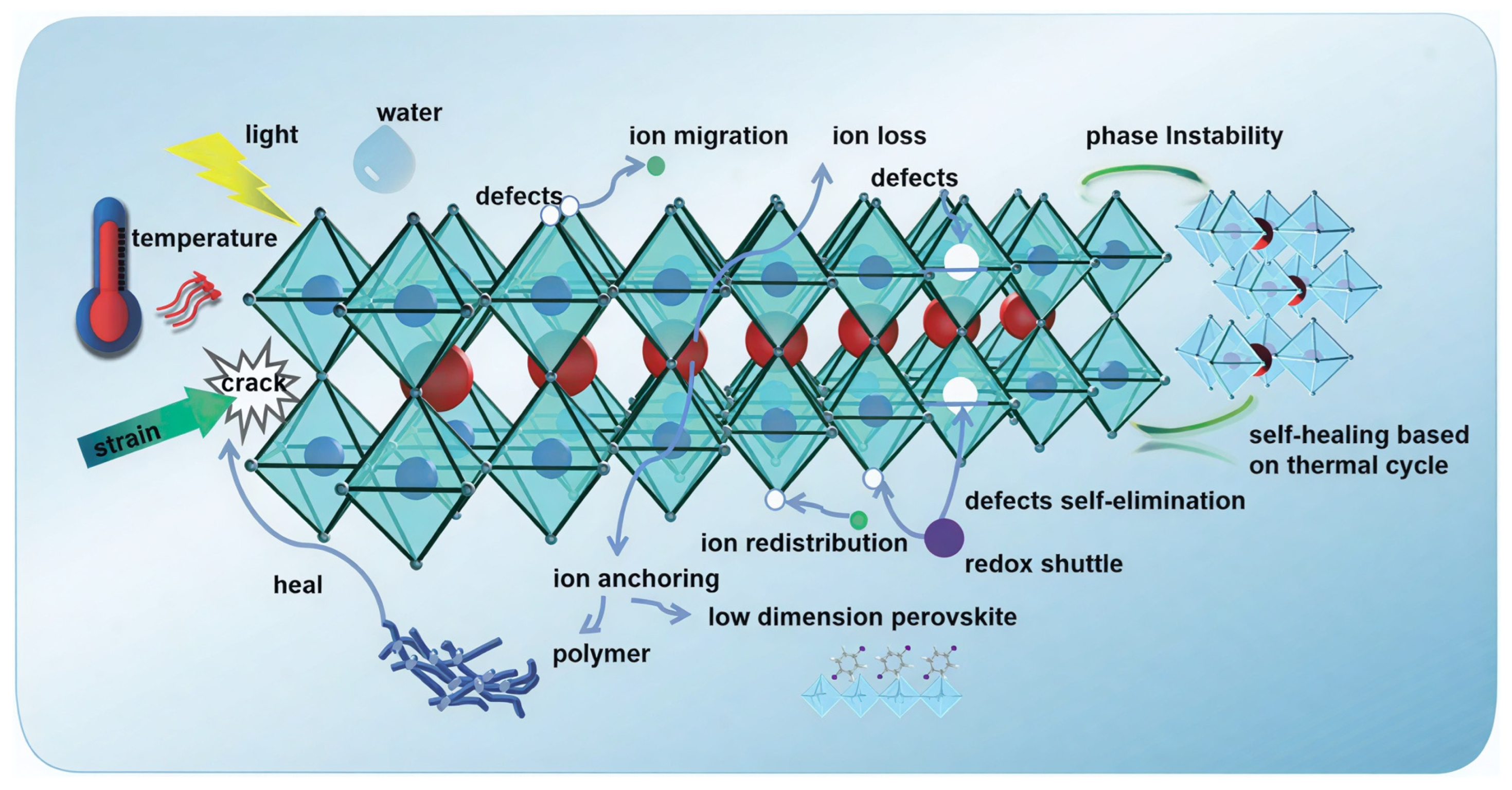
In contrast, PSCs have demonstrated exceptional radiation tolerance against a wide range of particles, including electrons, protons, gamma rays, and neutrons [4,5,7,8,9,11,12,20]. In many cases, their resilience exceeds that of traditional silicon and III-V compound solar cells by several orders of magnitude. This robustness arises from the intrinsic self-healing capability of perovskites following radiation-induced degradation (Figure 1). Under continuous irradiation, atomic displacement and ionic migration can occur within the perovskite lattice. These processes are largely reversible in PSCs: mobile ions dissociate from their lattice sites and migrate toward interfaces, where they temporarily accumulate. Once the stressor is removed, the resulting ionic concentration gradient drives their diffusion back to the original vacancies, an energetically favourable process. However, if accumulated ions undergo irreversible interfacial reactions, such as the reaction of I with metal electrodes, the extent of self-healing becomes limited [21].
The recovery of optoelectronic properties is further facilitated by the defect-tolerant nature of the perovskite lattice, which can be further optimized through compositional engineering. Under mild stimuli, such as light illumination or thermal annealing, radiation-induced lattice defects can reorganize, restoring the structural and electronic quality of the perovskite absorber. Additionally, volatile additives (e.g., methylammonium chloride (MACl)) and dynamic chemical bonds (e.g., phenylethylammonium (PEA)) within the perovskite formulation support this reversible behaviour by enabling mobile ions or molecules to migrate toward defect sites, facilitating lattice reorganization and passivation of radiation-induced defects [19,23,24,25,26]. Beyond additives, the choice of a more robust perovskite composition plays a significant role: mixed-cation and mixed-halide perovskites generally exhibit superior radiation stability compared to MAPbI3 [27,28,29,30,31]. Despite its advantages, self-healing is not limitless; extremely high or continuous irradiation can induce permanent decomposition due to healing saturation or irreversible bond breaking [32]. Therefore, balancing intrinsic self-healing properties with overall radiation robustness is essential for long-term PSC stability.
Kirmani and co-workers provided the first direct experimental evidence of this self-healing mechanism in PSCs using a dual-dose proton irradiation protocol [33]. In their study, devices were initially exposed to low-energy protons (0.06 MeV), which caused performance degradation due to atomic displacements via elastic non-ionizing energy loss. When the same devices were subsequently irradiated with high-energy protons (1.0 MeV), a recovery in PCE was observed, confirming the repair of radiation-induced defects within the perovskite lattice.
Although PSCs exhibit strong intrinsic radiation tolerance, ongoing research aims to evaluate their durability under worst-case radiation scenarios, such as solar particle events and extended deep-space missions, where radiation fluxes are difficult to replicate experimentally. Under extremely high doses, radiation can induce nanovoids and enhance ion migration within perovskite films, ultimately leading to performance loss [34]. One effective mitigation strategy involves replacing organic charge transport layers with inorganic or polymeric materials, which generally exhibit superior radiation stability [35].
Encapsulation also plays a crucial role in enhancing the radiation resistance of PSCs. Certain encapsulant materials incorporate radical scavengers or hydrogen-rich polymers capable of absorbing radiation and mitigating radiation-induced damage. Although the intrinsic self-healing capability of PSCs reduces the need for heavy radiation shielding, a well-designed encapsulation strategy can further attenuate the radiation dose reaching the active layers, thereby extending device lifetime. Several approaches have been reported in the literature, including the use of transparent polymers containing aromatic or conjugated units that absorb high-energy photons, often referred to as polymeric radiation shielding (e.g., P3HT), as well as ultrathin inorganic coatings deposited on top of the device (e.g., Al2O3, SiO2) [36,37,38,39,40]. For example, Kirmani et al. demonstrated that a 1-μm-thick silicon oxide layer evaporated atop the device contact effectively blocked 0.05 MeV protons at fluences of 1015 cm−2 without causing any measurable loss in PCE, highlighting encapsulation as a promising passive shielding approach [39].
Despite these advances, long-term stability under severe radiation exposure remains a critical challenge. The A-site organic cations are particularly vulnerable to proton bombardment, compromising both structural stability and self-healing capability. For example, Shim et al. reported that Cs/formamidinium (FA) wide-bandgap PSCs treated with propane-1,3-diammonium iodide (PDAI2) exhibited improved resistance to proton-induced degradation [41]. Similarly, Zhang and co-workers reported performance losses beginning at fluences around 1 × 10¹³ p/cm2, with complete device failure at 3 × 10¹⁴ p/cm2 due to the breakdown of π-conjugation and structural order of poly(3-hexylthiophene-2,5-diyl (P3HT) hole transport material, which drastically reduced its conductivity [35].
Taken together, these findings highlight that while PSCs outperformed many established PV technologies in radiation resilience, further innovation is required for their deployment in space. Key areas of development include the design of radiation-hardened perovskite compositions, stabilization of charge transport layers, and reinforcement of interfaces and electrodes to withstand the cumulative dose expected in space environments.

2.2. Extreme Thermal Cycling

Thermal stability remains a major challenge for PSCs, especially in space environments, where devices experience extreme temperatures ranging from −185 °C to +150 °C, as defined by the AIAA S-111A-2014 standard [42]. These conditions far exceed conventional terrestrial testing conditions (−40 °C to +85 °C) and can induce phase transitions, decomposition, mechanical stress, and interfacial delamination. At elevated temperatures, perovskite materials may decompose into PbI2, leading to rapid performance degradation, while temperature-driven structural transitions can cause irreversible efficiency losses. Thermal decomposition typically begins with the sublimation of organic halide species, followed by further breakdown of the perovskite lattice. For MAPbI3, the process can be described by the following decomposition reactions:
CH3NH3PbI3 (s) ⇌ PbI2 (s) + [CH3NH3+ + I]
→ PbI2 (s) + CH3NH2 (g) + HI (g)
It should be noted that Reaction (1) is reversible, whereas Reaction (2) is irreversible, leading to permanent material degradation and associated performance losses.
In addition to intrinsic thermal decomposition, thermal expansion mismatch between adjacent layers can result in cracking or delamination, particularly at interfaces involving metal oxide charge transport layers and metal electrodes. These interfaces are especially prone to delamination due to differential expansion with adjacent perovskite and polymer layers [43,44].
To mitigate these effects, various materials and interface-engineering strategies have been developed to provide thermal stress relief. Gradient buffer-layer architectures incorporating intermediate layers with compatible thermal expansion coefficients have proven particularly effective. Metal oxides [19], polymers [45], and self-assembled monolayers (SAMs) [46] have each demonstrated the ability to enhance adhesion, reduce interfacial strain, and improve thermal endurance. Notably, Chen et al. showed that incorporating a ytterbium oxide (YbOx) buffer layer between the electron transport layer and the metal electrode in a p-i-n PSC suppressed thermally induced diffusion of reactive species, resulting in markedly improved stability under prolonged exposure to elevated temperatures [47].
Spacecraft experience rapid and repeated thermal fluctuations during launch and orbital operation, subjecting PV modules to mechanical stress and fatigue that can compromise both stability and performance [48,49]. To evaluate PSC resilience under such conditions, Guixiang et al. performed thermal cycling tests between −60° and +80 °C using triple-cation perovskites with polymer dipoles incorporated into the composition Cs0.05(FA0.98MA0.02)0.95Pb(I0.98Br0.02)3 [50]. These dipoles reduced the formation energy of the black photoactive phase, promoting the growth of low-defect crystalline films. Simultaneously, they accumulated at the perovskite surface, suppressing ion migration, improving interfacial charge extraction, and increasing hydrophobicity. As a result, devices achieved a certified efficiency of 24.2% over a 9.6 mm2 active area and maintained stable operation after 120 thermal cycles.
While these advances are encouraging, they reflect only a subset of the extreme conditions encountered in realistic mission scenarios. Broader temperature ranges must be considered to replicate the extremes encountered across different altitudes, orbital regimes, and mission durations. Furthermore, the combined effects of thermal cycling and continuous illumination can exacerbate material fatigue, posing a significant challenge to the long-term operational stability of PSCs in space environments. Addressing these coupled stressors will require continued progress in thermally robust perovskite compositions, mechanically compliant interlayers, and encapsulation strategies designed specifically for harsh and dynamic extraterrestrial thermal environments.

2.3. Ultra-High Vacuum

The vacuum environment of space presents both benefits and challenges for PSCs’ operation. While the absence of oxygen and moisture suppresses common terrestrial degradation pathways, ultra-high vacuum can promote the evaporation or sublimation of volatile organic components (e.g., methylammonium cation, spiro-OMeTAD), which compromises structural integrity and accelerates long-term degradation [51,52]. In addition, the lack of atmospheric convection restricts heat dissipation, causing localized temperature build-up that enhances thermal stress and accelerates defect formation.
Beyond these external factors, intrinsic material stability under ultra-high vacuum is a crucial limiting factor. Xianchao et al. used an in situ characterization system to study FAPbI3-based PSCs under extreme vacuum (10−8 Pa) and thermal cycling, demonstrating substantial decomposition of the perovskite layer, including PbI2 formation and depletion of organic cations, even in robust p-i-n configurations (ITO/NiOx/SAMs/perovskite/C60-PCBM/bathocuproine (BCP)/Ag) [53]. These observations confirm that vacuum conditions alone, even without illumination, can destabilize organic-inorganic perovskite compositions.
The relevance of device architecture under vacuum conditions was further demonstrated by Costa and co-workers, who compared regular and inverted PSCs under vacuum conditions [54]. The inverted structure (ITO/(2-(9H-carbazol-9-yl)ethyl)phosphonic acid (2PACz)/perovskite/C60+BCP/Ag) showed strong stability even without encapsulation, whereas the encapsulated regular configuration (ITO/SnO2/perovskite/PTAA/Au) exhibited pronounced degradation. Ion migration through the PTAA layer was identified as a likely mechanism responsible for the vacuum-accelerated performance losses. These results emphasize that architecture-dependent ion migration pathways and the selection of vacuum-resilient transport layers are critical design considerations.
To mitigate vacuum-induced degradation, several strategies have been explored, ranging from molecular traps designed to retain volatile species to advanced encapsulation techniques aimed at preventing outgassing. Jiang et al. investigated these effects by comparing regular and inverted PSC architectures under illumination in vacuum [55]. In the regular configuration (indium tin oxide (ITO)/SnO2/perovskite/spiro-OMeTAD/Au+Ni+Al), a low gas permeability top layer was used to suppress volatilization. The inverted structure (ITO/poly[bis(4-phenyl)(2,4,6-trimethylphenyl)amine] (PTAA)/perovskite/phenyl-C61-butyric acid methyl ester (PCBM)/ZnO/aluminium doped zinc oxide (AZO)/Ni+Al) replaced vacuum-sensitive layers altogether. The inverted architecture exhibited a remarkable T80 lifetime of 4750 h, demonstrating the effectiveness of reducing or eliminating components susceptible to vacuum-driven degradation.
Advanced encapsulation strategies are essential to further extend the PSC operational lifetime under ultra-high vacuum. While encapsulation efforts for terrestrial devices focus primarily on oxygen and moisture ingress, space environments require barrier systems that also withstand extreme thermal cycling, ionizing radiation, and stringent outgassing constraints [56]. Such encapsulants must exhibit: (i) high mechanical robustness to withstand repeated thermal cycling, (ii) radiation resistance to prevent photodegradation, and (iii) low outgassing properties to preserve chemical and structural integrity under ultra-high vacuum.
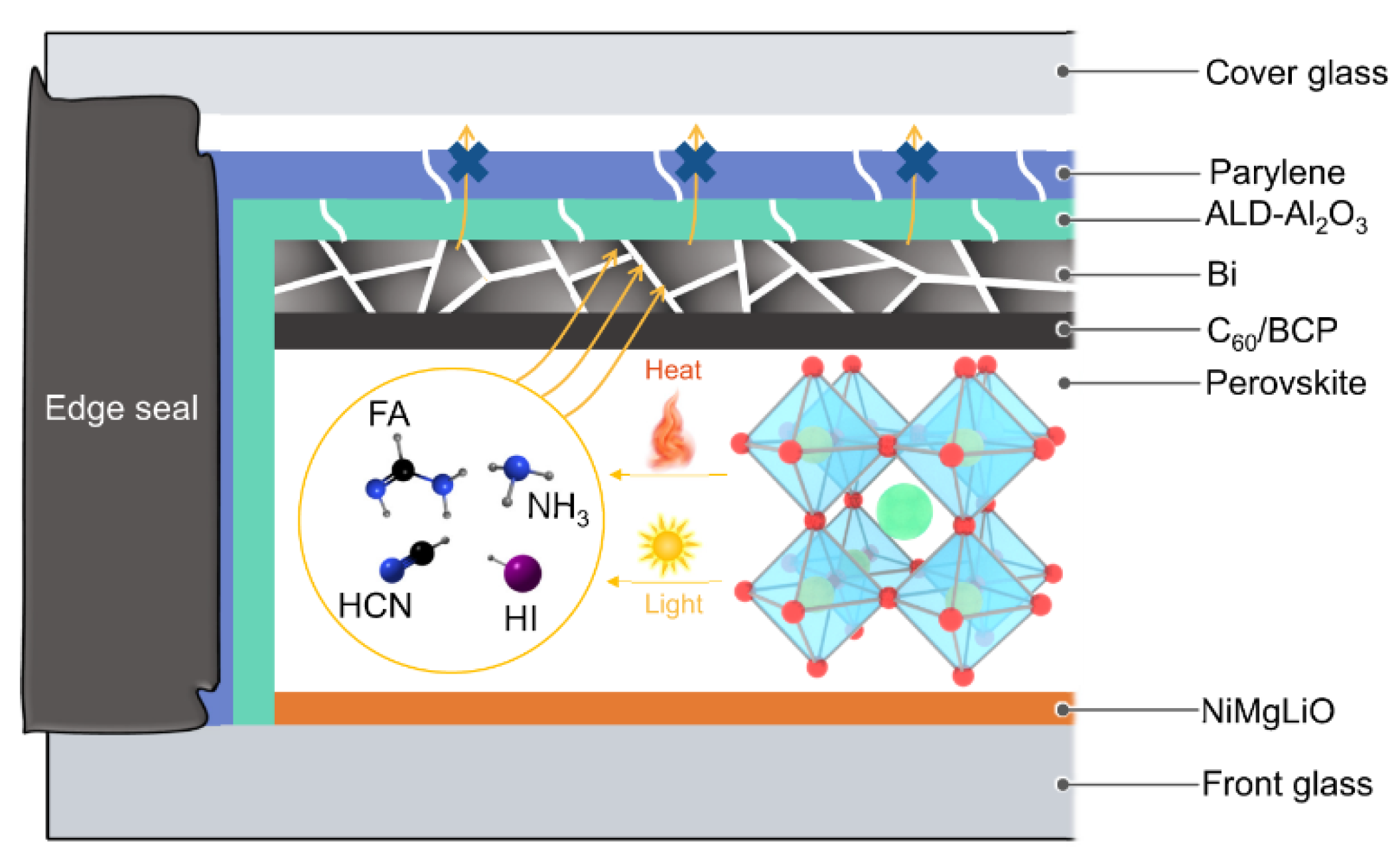
Hybrid encapsulation architectures that combine ultrathin inorganic layers (e.g., Al2O3, SiOx) with polymeric coatings have emerged as strong candidates. For instance, an Al2O3/parylene bilayer offers excellent barrier performance due to its extremely low water vapor transmission rate (10−5 g m−2 day−1) and effective suppression of volatile perovskite decomposition products (Figure 2) [57]. Similarly, VanSant and co-workers showed that incorporating a SiOx barrier within an encapsulation system composed of silicone and cover glass enabled a p-i-n PSC to retain >90% of its initial efficiency with gold contacts and nearly 100% with ITO contacts, after 3600 h of thermal vacuum stress at 75 °C and 2.3 × 10⁻⁶ Torr [58]. These results underscore the role of SiOx in relieving mechanical stress at the contact interfaces and enhancing encapsulation durability.
Collectively, these studies demonstrate that ensuring PSC stability in ultra-high vacuum requires an integrated strategy combining vacuum-stable perovskite formulations, optimized device architectures that minimize volatile or vacuum-sensitive components, and advanced encapsulation systems capable of suppressing outgassing while maintaining mechanical and chemical stability. Such combined approaches will be essential for achieving long-term operational reliability of PSCs in the vacuum environment of space.

2.4. UV Resistance

In terrestrial PV systems, UV-induced degradation is typically mitigated using UV filters that modify the AM 1.5 solar spectrum. However, this strategy becomes impractical for space-grade photovoltaics, where added weight and cost must be minimized. In PSCs, UV instability primarily arises from the photocatalytic activity of metal oxides, such as TiO2, which can trigger decomposition of the perovskite absorber even in oxygen-free environments [59].
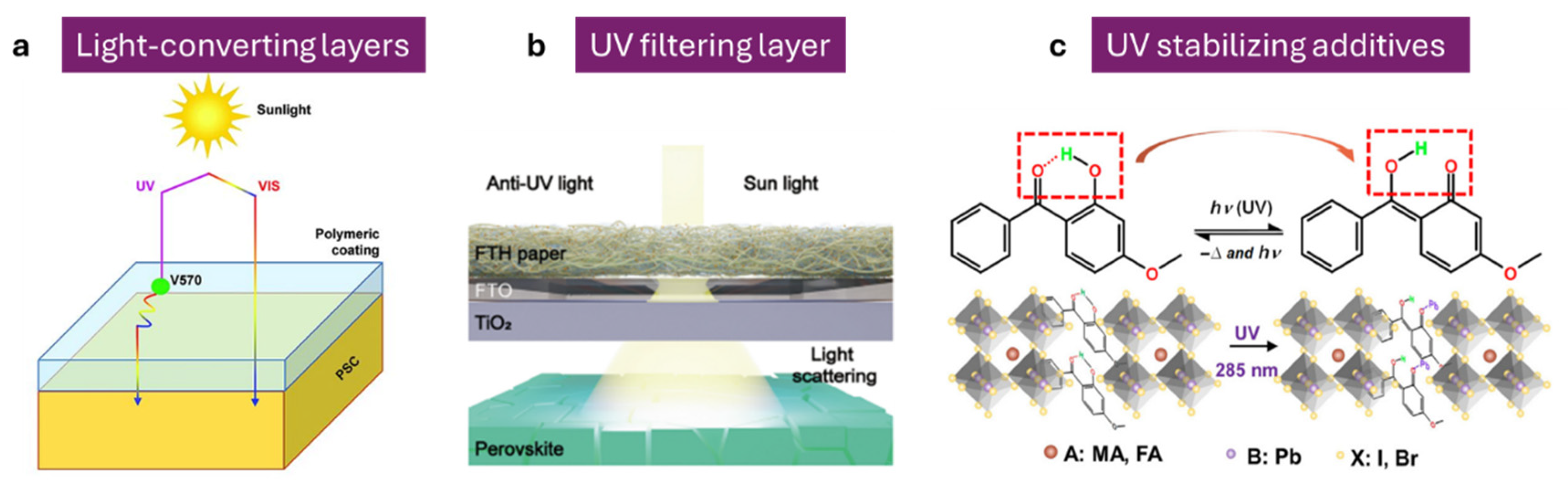
To enhance UV resistance, several approaches have been developed: (1) replacing photoactive metal oxides in the electron transport layer with less reactive semiconductors [60]; (2) integrating light-converting layers into the device structure or glass substrate to shift harmful UV radiation into less damaging wavelengths [61,62,63,64,65]; (3) applying UV-blocking coatings on the glass side to physically filter high-energy photons [66]; (4) employing intrinsically UV-stable perovskite compositions, such as CsPbBr3 [67]; (5) introducing stabilizing additives to enhance intrinsic perovskite UV stability [68]; and (6) using UV-resistant encapsulants to shield the device from radiation exposure [69].
Figure 3 illustrates representative strategies designed to suppress UV-driven degradation pathways in PSCs. Collectively, these methods target vulnerabilities across material, interfaces, and device levels, limiting ion migration, UV-induced oxidation, and defect formation that compromise long-term stability.
Unfiltered solar UV radiation in space poses a major threat to PSCs’ longevity. Prolonged UV exposure accelerates degradation of both the perovskite absorber and the charge transport layers, reducing efficiency and operational lifetimes. For space technologies, the most promising route involves combining UV-stable materials with advanced spectral conversion layers, passivating additives, and high-performance encapsulation schemes capable of withstanding harsh radiation environments.
A notable example was demonstrated by Zhao and co-workers, who incorporated CsPbCl3 nanocrystals between the electron transport layer (SnO2) and the perovskite absorber [70], Their unencapsulated p-i-n devices (fluorine-doped tin oxide (FTO)/SnO2/perovskite/spiro-OMeTAD/Ag) were subjected to continuous 365 nm UV irradiation. After 800 h, devices containing CsPbCl3 nanocrystals retained 80% of their initial PCE, whereas reference devices degraded to 41%. This improved stability arose from synergetic effects, including: (i) suppression of ion migration, (ii) reduced defect density in the perovskite layer and at the SnO2 interface, (iii) passivation of UV-sensitive degradation sites, and (iv) down-conversion of UV photons into less harmful blue emission.
Although progress has been substantial, further research is required to fully address UV-induced degradation under space-relevant conditions. A holistic design framework combining robust perovskite materials, interface engineering, spectral control, and space-qualified encapsulation is essential to ensure that PSCs can withstand long-duration exposure to high-energy UV radiation in orbital environments.

2.5. Encapsulation Limitations

Advanced encapsulation systems of PSCs for space applications represent the technological foundation enabling long-term perovskite stability in space, which must balance multiple, often competing, requirements: effective radiation shielding, resistance to thermal stress, compatibility with ultra-high vacuum, and minimal added mass.
Unlike terrestrial environments, moisture is not a concern in space. However, the ultra-high vacuum can induce outgassing of volatile components, leading to chemical degradation and performance loss if the device is not properly sealed. Therefore, encapsulants must be specifically engineered to: (i) prevent outgassing of volatile species from the perovskite and adjacent layers, (ii) provide UV protection (e.g., through the incorporation of UV-absorbing particles or spectral conversion materials), (iii) withstand repeated thermal cycling without mechanical failure such as crack or delamination, and (iv) remain lightweight to comply with the strict mass constraints of spacecraft systems.
Achieving this balance requires the development of multifunctional encapsulation architectures that combine mechanical robustness, chemical inertness, and optical functionality. Promising approaches include hybrid barrier layers composed of ultrathin metal oxides (e.g., Al2O3, SiOx) paired with polymer coatings, which offer low water vapor transmission rates and strong resistance to vacuum-induced degradation [57].
Continued research into encapsulation materials and integration techniques is essential to ensure long-term resilience and reliability of PSCs in the demanding conditions of space.

2.6. Mechanical and Structural Stability

Space solar panels are typically integrated into the spacecraft’s power system and mounted on the fuselage to ensure direct exposure to sunlight. This positioning subjects PSCs to intense mechanical stress, including vibrations during launch, and potential impact from micrometeoroids and space debris. These conditions can compromise both the structural integrity and photovoltaic performance of the devices.
To ensure reliable operation in such harsh environments, it is essential to develop robust encapsulation strategies capable of preserving device functionality under mechanical strain and shock. Encapsulation materials and designs must be capable of (i) absorbing and dissipating mechanical stress, (ii) maintaining strong adhesion between layers, (iii) preventing delamination or cracking of sensitive layers, and (iv) protecting against shock and abrasion from debris impacts. Achieving this requires the use of mechanically robust, lightweight, and flexible encapsulants that do not compromise the device performance or add excessive mass.

2.7. Standardization and Qualification

Current testing methodologies and standards for photovoltaic technologies are predominantly tailored to terrestrial environments and fall short in addressing the distinct challenges posed by space. PSCs with their unique material properties and degradation mechanisms require a dedicated stability assessment framework that reflects the extreme and multifaceted stressors encountered in space missions.
A comprehensive protocol should encompass thermal cycling across the broad temperature ranges typical of orbital environments, detailed radiation tolerance metrics for various particle types, long-term stability under AM0 and UV irradiation, and the evaluation of self-healing behaviors under space-relevant conditions.
Zheng and co-workers have proposed a preliminary checklist for assessing PSC stability in space, which includes critical factors such as thermal shock, proton radiation resistance, vibration endurance, atomic oxygen erosion, moisture resistance, specific power, and outgassing behaviour [71]. While this framework represents an important step forward, it does not yet fully capture the complexity of the space environment. Key stressors such as UV radiation, ultra-high vacuum exposure, and other forms of ionizing radiation remain insufficiently addressed.

2.8. Scalability and Manufacturing Reliability

PSC modules offer several key advantages for space applications, including compatibility with scalable solution-processing techniques and reliance on low-cost, earth-abundant materials. These features contrast sharply with III-V multi-junction solar cells, whose outstanding performance is offset by fabrication processes that remain prohibitively expensive, limiting their broader deployment. Nevertheless, translating the high efficiencies achieved in small-area PSCs into large-area, space-qualified modules involves significant materials, engineering, and system-integration challenges.
Although PSCs routinely achieved excellent power conversion efficiencies on laboratory-scale devices (<1 cm2), practical implementation in space requires large-area modules capable of delivering the substantial power needed for spacecraft operations. Scaling from small-area devices to full modules introduces several critical barriers, including maintaining uniform film morphology, suppressing defect formation over large areas, and preserving high PCEs across extended surfaces. Additionally, minor variations in coating conditions can lead to inconsistencies in the quality of the perovskite films, which is a significant reliability issue in manufacturing that becomes more pronounced at a larger scale.
Conventional spin-coating, widely used in high-efficiency laboratory devices, is inherently unsuitable for large-area fabrication due to its poor material utilization and limited coating uniformity. Instead, scalable solution-processing methods such as blade coating and slot-die coating have emerged as promising routes, offering improved control over layer thickness and crystallinity while enabling reproducible deposition over larger substrates [72]. Their compatibility with roll-to-roll fabrication further positions them as leading candidates for industrial-scale manufacturing. Notably, blade-coated all-perovskite tandem modules have recently achieved a certified PCE of 23% on a flexible 20.26 cm2 device [73], demonstrating encouraging progress toward scalable and reproducible processing.
From a manufacturing standpoint, the level of process control achievable is strongly dependent on the chosen preparation route [74]. One-step solution deposition provides a simple and scalable approach, but it demands tight regulation of solvent evaporation and intermediate phase formation to achieve reproducible perovskite crystallization. In contrast, two-step deposition methods offer enhanced control over film thickness and composition by decoupling the precursor delivery steps, thereby improving bath-to-batch uniformity. Vapor-assisted and fully vacuum-based techniques further strengthen reproducibility by enabling precise control over deposition rates, stoichiometry, and film uniformity, albeit with increased process complexity, equipment requirements, and cost. Across all these approaches, reproducibility is generally evaluated through statistical variations in device performance, an essential metric for transferring laboratory fabrication methods into robust, manufacturable processes, particularly when aiming for space-qualified technologies.
Despite these advances, space applications impose exceptionally stringent requirements. Even minor defects, such as voids, pinholes, or grain boundary irregularities, can act as nucleation sites for failure when exposed to mechanical vibrations, rapid thermal cycling, or radiative stress in orbit. Therefore, ensuring reproducibility in large-area coatings is crucial, requiring strict control over precursor chemistry, solvent engineering, ambient conditions, drying dynamics, and post-annealing processes [75]. The sensitivity of perovskite crystallization to environmental fluctuations is of utmost importance for achieving robust manufacturing.
The transition from single-cell devices to fully interconnected modules adds another layer of complexity. Space modules are typically engineered to deliver high voltage outputs, necessitating series connections between individual cells. In such configurations, local defects or inhomogeneities can disproportionately affect overall performance, reducing output or, in severe cases, causing module-level failure. Consequently, precise control over the deposition and crystallization processes, combined with rigorous quality assurance protocols, is essential to ensure the operational reliability and long-term resilience of PSC modules in demanding space environments.

2.9. Long-Term Stability

The long-term stability of PSCs remains a major hurdle to their commercial deployment on Earth, and this challenge is further amplified in the harsh environment of space. Unlike terrestrial conditions, space exposes materials to extreme UV radiation, wide and rapid temperature fluctuations, ultra-high vacuum, and high-energy particle fluxes. These factors can significantly accelerate degradation processes, posing serious risks to device performance and durability. A comparative overview of representative stability results obtained under relevant stress conditions is summarized in Table 1, highlighting the magnitude of this challenge.
Intrinsic instabilities in PSCs, such as ion migration, phase transitions, and chemical decomposition within the perovskite and adjacent charge transport layers, are exacerbated under these conditions. While moisture and oxygen, the primary degradation agents on Earth, are largely absent in space, other stressors, such as outgassing of volatile components and repeated thermal cycling, can still compromise device integrity and performance.
Ensuring the long-term stability of PSCs is not merely a technical aspiration but a mission-critical requirement. Space missions often span months to years, and any performance degradation can directly impact power availability and mission success. As such, developing materials and device architectures that can withstand prolonged exposure to the space environment is essential for the reliable integration of PSCs into future space applications.

3. Perspectives

PSCs are rapidly emerging as a transformative photovoltaic technology for space-based power generation. Their exceptional combination of high specific power, defect tolerance, and solution-processable fabrication offers unprecedented opportunities for lightweight, high-efficiency energy systems in orbit. Notably, the vacuum and absence of moisture and oxygen in space mitigate two major degradation pathways common in terrestrial environments. However, the space environment also introduces a distinct set of challenges—extreme temperature gradients, high vacuum, and intense ionizing radiation—that impose severe stress on materials and interfaces, pushing PSCs beyond their current design limits. Addressing these challenges is critical to enabling the reliable deployment of PSCs in space.
Future advancements will depend on the strategic selection of materials and holistic device engineering. Every layer, from perovskite absorber and charge transport materials to encapsulants, barrier coatings, and substrates, must be tailored to withstand the unique conditions of space. Two overarching objectives should guide this optimization:
(i) Maximization of specific power (W g−1), achieved through ultralight and flexible device architectures compatible with high-throughput manufacturing processes and deployable spacecraft structures;
(ii) Enhanced operational stability under combined stressors, including radiation exposure, vacuum-induced outgassing, and extreme thermal cycling.
In this context, flexible PSCs with inverted p-i-n architectures are particularly promising. These devices combine mechanical flexibility with improved resilience to vacuum conditions, even when unencapsulated [55]. Polymer-based hole transport layers such as P3HT, PEDOT, and PTAA demonstrate superior thermal stability compared to conventional materials like spiro-OMeTAD, which are prone to decomposition at elevated temperatures [52]. Continued exploration of thermally and chemically stable materials will be pivotal for achieving operational longevity in space.
Realizing the full potential of PSCs for space applications requires a coordinated and interdisciplinary research framework encompassing material science, device physics, radiation chemistry, and aerospace systems engineering. Several key research directions stand out as particularly critical:

3.1. Perovskite Composition Optimization for Intrinsic Stability and Self-Healing

Future formulations should minimize volatile components and incorporate structural motifs that enable dynamic defect passivation. Approaches such as cation and halide alloying, incorporation of low-dimensional phases, and defect-tolerant crystal engineering offer promising pathways toward radiation-resistant and thermally stable perovskites.

3.2. Innovative Device Architectures for Resilience Under Combined Stressors

Multilayer designs with graded interfaces, inorganic charge transport materials, and flexible substrates can mitigate interfacial delamination and thermal expansion mismatch. Multifunctional interlayers that facilitate both charge extraction and defect passivation will be essential.

3.3. Additives and Protective Barrier Layers

Additives that stabilize the perovskite lattice, suppress ion migration, and facilitate self-healing should be explored alongside ultrathin barrier coatings capable of blocking radiation-induced species and minimizing outgassing in vacuum.

3.4. Advanced Encapsulation Technologies

Encapsulation remains a critical bottleneck for space qualification. Future encapsulants must combine low gas permeability, high radiation hardness, mechanical flexibility, and minimal mass. Hybrid polymer-oxide coatings are promising candidates.

3.5. Standardized Testing Protocols for Space Qualification

Current laboratory assessments are fragmented and often fail to replicate the combined effects of radiation, vacuum, and thermal cycling. There is an urgent need for unified and internationally recognized testing standards, analogous to those used for silicon and III-V solar cells, to enable meaningful cross-study comparisons and accelerate technology readiness.
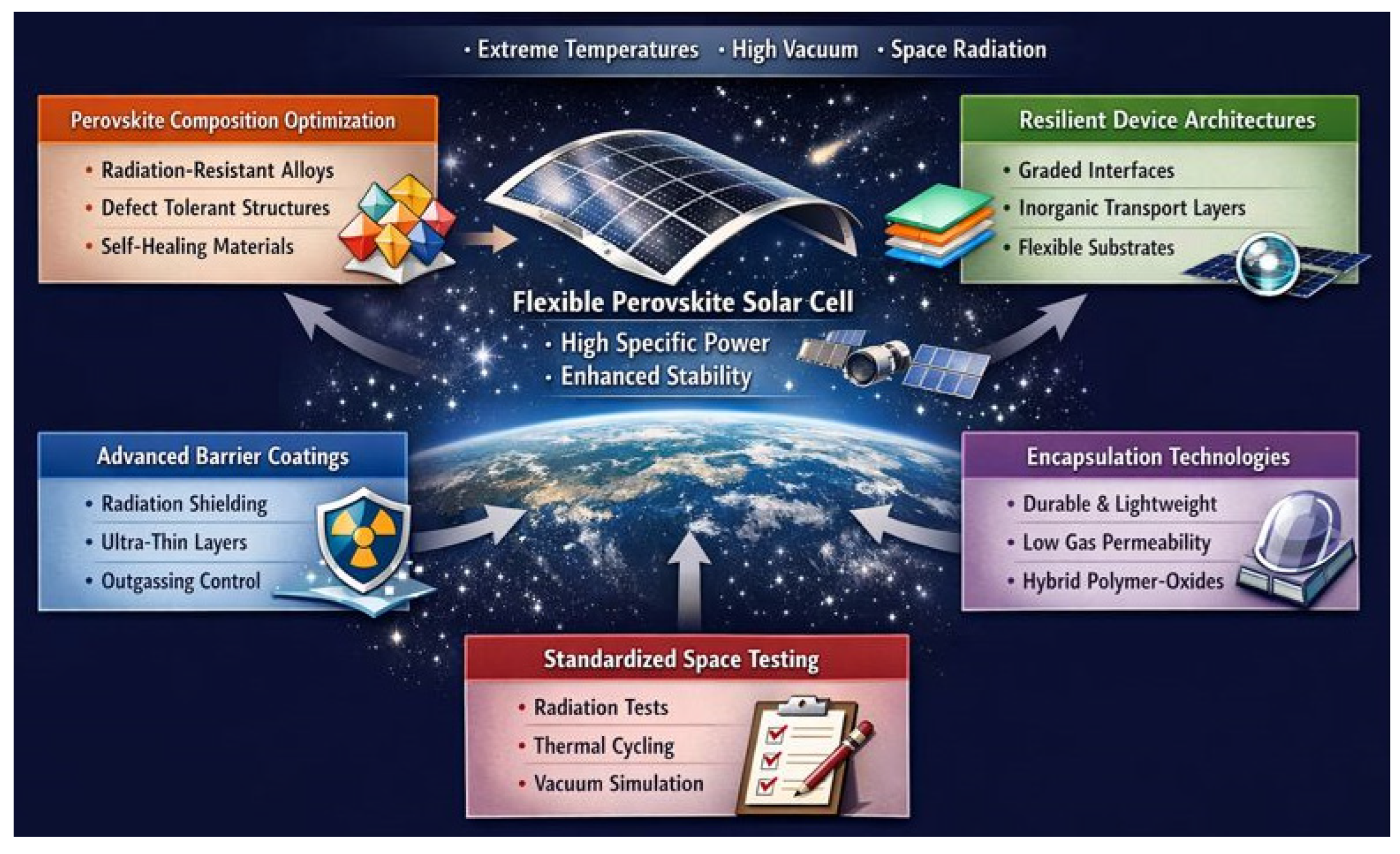
From the authors’ perspective, progress across these five technological fronts must proceed in a coordinated manner to enable PSCs to transition from promising laboratory concepts to reliable, space-qualified power sources. As illustrated in Figure 4, PSCs inherently offer high specific power and exceptional mechanical flexibility; however, their long-term stability under extreme space conditions remains a critical bottleneck. Priority should therefore be placed on the development of radiation-resistant perovskite compositions that incorporate defect-tolerant structures and self-healing mechanisms. Mixed-cation and mixed-halide perovskite systems (e.g., Cs–FA–MA lead halides) are particularly promising, as they combine enhanced thermal robustness with intrinsic self-repair capabilities.
At the device level, resilient architectures incorporating robust charge-transport materials, engineered graded interfaces, and flexible substrates will be essential for preserving structural and functional integrity during thermal cycling and prolonged vacuum exposure. Materials such as spiro-OMeTAD and TiO2, which are prone to thermal instability and UV-induced degradation, respectively, should be replaced with thermally and chemically stable alternatives. Moreover, ultrathin inorganic radiation-shielding layers and polymeric coatings optimized for low outgassing will play a central role in mitigating environmental degradation. Electron transport layer (ETL)-free device layouts represent another promising path forward, as they reduce fabrication complexity while eliminating critical interfacial degradation pathways. For example, Sajid and colleagues demonstrated a highly efficient and stable ETL-free PSC by removing the conventional TiO2 layer and modifying the ITO with diethanolamine (DEA), highlighting the potential of simplified and interface-engineered architectures [76].
Encapsulation strategies must likewise be re-envisioned for space deployment. Encapsulants must be lightweight, durable, and highly impermeable to gases. Hybrid polymer-oxide systems show strong potential but require further optimization to satisfy stringent durability requirements. The integration of lead-scavenging components into encapsulation layers will additionally be important to mitigate environmental risk and ensure safe device handling during ground operations.
Finally, advances in material and device engineering must be underpinned by rigorous and standardized space-relevant testing. Comprehensive radiation exposure studies, thermal cycling protocols, and vacuum simulations are indispensable for accurately predicting operational lifetimes and advancing PSC technologies toward full space qualification.

4. Conclusions

PSCs have emerged as a leading candidate for next-generation space photovoltaics, offering an exceptional combination of high specific power, mechanical flexibility, and tunable optoelectronic properties. Recent progress in material design, device architecture, and encapsulation has significantly enhanced their resilience to space-specific stressors such as vacuum-induced degradation, extreme thermal cycling, and ionizing radiation. Notably, inverted p-i-n architectures, polymer-based transport layers, and hybrid barrier coatings have demonstrated promising performance under simulated orbital conditions, underscoring the accelerating momentum of the field.
However, our analysis highlights several critical challenges that must be overcome to enable the reliable and long-term operation of PSCs in space environments. The intrinsic volatility of organic components, the limited thermal stability of key functional layers, and the persistent difficulty in achieving high-performance, radiation-resistant encapsulation remain key obstacles. Equally important is the absence of unified and space-relevant testing standards, which limits meaningful comparison across studies and constrains progress toward higher technology readiness levels. These issues represent the core technological and methodological gaps that the space PV community must address.
Drawing on the insights of this perspective, we identify three strategic directions to guide the advancement of PSCs for space use: (i) material engineering aimed at stabilizing the perovskite absorber and charge transport interfaces under extreme environmental stress; (ii) scalable and reproducible manufacturing, including vacuum-compatible or solvent-controlled pathways suitable for large-area module fabrication; and (iii) rigorous qualification standards that realistically simulate orbital radiation spectra, thermal cycling profiles, and vacuum-induced degradation. Strengthening these areas will substantially accelerate the translation of PSCs from laboratory studies to fully space-qualified technologies.
Overall, the authors believe that the future of PSCs in space will depend on coordinated innovation across materials chemistry, device engineering, encapsulation science, and standardized testing frameworks. By addressing the key challenges outlined in this perspective, PSCs hold the potential not only to complement but eventually to surpass existing photovoltaic technologies in mass and cost-constrained space missions. Continued interdisciplinary collaboration will be essential to realizing PSCs as a lightweight, radiation-tolerant, and highly efficient power source for the next generation of satellites and interplanetary exploration platforms.

Author Contributions

V.C.M.D.—Writing—original draft and Writing—review & editing; Conceptualization and Methodology; L.F.S.—Writing—review & editing; Visualization; L.A.—Writing—original draft and Writing—review & editing; Conceptualization and Methodology. All authors have read and agreed to the published version of the manuscript.

Funding

This work is financially supported by national funds through FCT/MECI, under the project 2023.17945.ICDT with DOI 10.54499/2023.17945.ICDT (https://doi.org/10.54499/2023.17945.ICDT), as well as through FCT/MCTES (PIDDAC): LEPABE, UIDB/00511/2020 (DOI: 10.54499/UIDB/00511/2020) and UIDP/00511/2020 (DOI: 10.54499/UIDP/00511/2020) and ALiCE, LA/P/0045/2020 (DOI: 10.54499/LA/P/0045/2020).

Data Availability Statement

The original contributions presented in this study are included in the article. Further inquiries can be directed to the corresponding author.

Conflicts of Interest

The authors declare no conflicts of interest.

References

  1. NREL. Best Research-Cell Efficiencies. 2026. Available online: https://www.nlr.gov/pv/cell-efficiency (accessed on 10 February 2026).
  2. Jeon, N.J.; Na, H.; Jung, E.H.; Yang, T.-Y.; Lee, Y.G.; Kim, G.; Shin, H.-W.; Seok, S.I.; Lee, J.; Seo, J. A fluorene-terminated hole-transporting material for highly efficient and stable perovskite solar cells. Nat. Energy 2018, 3, 682–689. [Google Scholar] [CrossRef]
  3. Vanitha, L.; Thandaiah Prabu, R.; Subha, T.D.; Kumar, A. Computational analysis of perovskite solar cells for space applications. J. Comput. Electron. 2025, 24, 91. [Google Scholar] [CrossRef]
  4. Boldyreva, A.G.; Akbulatov, A.F.; Tsarev, S.A.; Luchkin, S.Y.; Zhidkov, I.S.; Kurmaev, E.Z.; Stevenson, K.J.; Petrov, V.G.; Troshin, P.A. γ-Ray-Induced Degradation in the Triple-Cation Perovskite Solar Cells. J. Phys. Chem. Lett. 2019, 10, 813–818. [Google Scholar] [CrossRef]
  5. Durant, B.K.; Afshari, H.; Singh, S.; Rout, B.; Eperon, G.E.; Sellers, I.R. Tolerance of Perovskite Solar Cells to Targeted Proton Irradiation and Electronic Ionization Induced Healing. ACS Energy Lett. 2021, 6, 2362–2368. [Google Scholar] [CrossRef]
  6. Huang, J.S.; Kelzenberg, M.D.; Espinet-González, P.; Mann, C.; Walker, D.; Naqavi, A.; Vaidya, N.; Warmann, E.; Atwater, H.A. Effects of Electron and Proton Radiation on Perovskite Solar Cells for Space Solar Power Application. In Proceedings of the 2017 IEEE 44th Photovoltaic Specialist Conference (PVSC), Washington, DC, USA, 25–30 June 2017; IEEE: New York, NY, USA, 2017; pp. 1248–1252. [Google Scholar]
  7. Lang, F.; Jošt, M.; Bundesmann, J.; Denker, A.; Albrecht, S.; Landi, G.; Neitzert, H.-C.; Rappich, J.; Nickel, N.H. Efficient minority carrier detrapping mediating the radiation hardness of triple-cation perovskite solar cells under proton irradiation. Energy Environ. Sci. 2019, 12, 1634–1647. [Google Scholar] [CrossRef]
  8. Lang, F.; Jošt, M.; Frohna, K.; Köhnen, E.; Al-Ashouri, A.; Bowman, A.R.; Bertram, T.; Morales-Vilches, A.B.; Koushik, D.; Tennyson, E.M.; et al. Proton Radiation Hardness of Perovskite Tandem Photovoltaics. Joule 2020, 4, 1054–1069. [Google Scholar] [CrossRef]
  9. Miyazawa, Y.; Ikegami, M.; Chen, H.-W.; Ohshima, T.; Imaizumi, M.; Hirose, K.; Miyasaka, T. Tolerance of Perovskite Solar Cell to High-Energy Particle Irradiations in Space Environment. iScience 2018, 2, 148–155. [Google Scholar] [CrossRef]
  10. Miyazawa, Y.; Ikegami, M.; Miyasaka, T.; Ohshima, T.; Imaizumi, M.; Hirose, K. Evaluation of radiation tolerance of perovskite solar cell for use in space. In Proceedings of the 2015 IEEE 42nd Photovoltaic Specialist Conference (PVSC), New Orleans, LA, USA, 14–19 June 2015; IEEE: New York, NY, USA, 2017; pp. 1–4. [Google Scholar]
  11. Paternò, G.M.; Robbiano, V.; Santarelli, L.; Zampetti, A.; Cazzaniga, C.; Garcìa Sakai, V.; Cacialli, F. Perovskite solar cell resilience to fast neutrons. Sustain. Energy Fuels 2019, 3, 2561–2566. [Google Scholar] [CrossRef]
  12. Yang, S.; Xu, Z.; Xue, S.; Kandlakunta, P.; Cao, L.; Huang, J. Organohalide Lead Perovskites: More Stable than Glass under Gamma-Ray Radiation. Adv. Mater. 2019, 31, 1805547. [Google Scholar] [CrossRef]
  13. Li, J.; Aierken, A.; Liu, Y.; Zhuang, Y.; Yang, X.; Mo, J.H.; Fan, R.K.; Chen, Q.Y.; Zhang, S.Y.; Huang, Y.M.; et al. A Brief Review of High Efficiency III-V Solar Cells for Space Application. Front. Phys. 2021, 8, 2020. [Google Scholar] [CrossRef]
  14. Cretì, A.; Prete, P.; Lovergine, N.; Lomascolo, M. Enhanced Optical Absorption of GaAs Near-Band-Edge Transitions in GaAs/AlGaAs Core–Shell Nanowires: Implications for Nanowire Solar Cells. ACS Appl. Nano Mater. 2022, 5, 18149–18158. [Google Scholar] [CrossRef]
  15. Prete, P.; Lovergine, N. High efficiency III–V nanowire solar cells: The road ahead. Nano Futures 2025, 9, 042502. [Google Scholar] [CrossRef]
  16. Yang, J.; Bao, Q.; Shen, L.; Ding, L. Potential applications for perovskite solar cells in space. Nano Energy 2020, 76, 105019. [Google Scholar] [CrossRef]
  17. Reb, L.K.; Böhmer, M.; Predeschly, B.; Grott, S.; Weindl, C.L.; Ivandekic, G.I.; Guo, R.; Dreißigacker, C.; Gernhäuser, R.; Meyer, A.; et al. Perovskite and Organic Solar Cells on a Rocket Flight. Joule 2020, 4, 1880–1892. [Google Scholar] [CrossRef]
  18. NASA. 10-Month Voyage Proves Solar Cell Material Survives, Thrives in Space. 2023. Available online: https://www.nasa.gov/general/10-month-voyage-proves-solar-cell-material-survives-thrives-in-space/ (accessed on 24 September 2025).
  19. Yun, D.; Cho, Y.; Shin, H.; Kim, G.-H. Development of High-Efficiency and High-Stability Perovskite Solar Cells with Space Environmental Resistance. Energies 2025, 18, 3378. [Google Scholar] [CrossRef]
  20. Malinkiewicz, O.; Imaizumi, M.; Sapkota, S.B.; Ohshima, T.; Öz, S. Radiation effects on the performance of flexible perovskite solar cells for space applications. Emergent Mater. 2020, 3, 9–14. [Google Scholar] [CrossRef]
  21. Cheng, Y.; Liu, X.; Guan, Z.; Li, M.; Zeng, Z.; Li, H.-W.; Tsang, S.-W.; Aberle, A.G.; Lin, F. Revealing the Degradation and Self-Healing Mechanisms in Perovskite Solar Cells by Sub-Bandgap External Quantum Efficiency Spectroscopy. Adv. Mater. 2021, 33, 2006170. [Google Scholar] [CrossRef] [PubMed]
  22. Wang, C.; Qu, D.; Zhou, B.; Shang, C.; Zhang, X.; Tu, Y.; Huang, W. Self-Healing Behavior of the Metal Halide Perovskites and Photovoltaics. Small 2024, 20, 2307645. [Google Scholar] [CrossRef]
  23. Finkenauer, B.P.; Akriti; Ma, K.; Dou, L. Degradation and Self-Healing in Perovskite Solar Cells. ACS Appl. Mater. Interfaces 2022, 14, 24073–24088. [Google Scholar] [CrossRef]
  24. Afshari, H.; Chacon, S.A.; Sourabh, S.; Byers, T.A.; Whiteside, V.R.; Crawford, R.; Rout, B.; Eperon, G.E.; Sellers, I.R. Radiation tolerance and self-healing in triple halide perovskite solar cells. APL Energy 2023, 1, 026101. [Google Scholar] [CrossRef]
  25. Lan, Y.; Wang, Y.; Lai, Y.; Cai, Z.; Tao, M.; Wang, Y.; Li, M.; Dong, X.; Song, Y. Thermally driven self-healing efficient flexible perovskite solar cells. Nano Energy 2022, 100, 107523. [Google Scholar] [CrossRef]
  26. Yang, J.; Sheng, W.; Li, X.; Zhong, Y.; Su, Y.; Tan, L.; Chen, Y. Synergistic Toughening and Self-Healing Strategy for Highly Efficient and Stable Flexible Perovskite Solar Cells. Adv. Funct. Mater. 2023, 33, 2214984. [Google Scholar] [CrossRef]
  27. Ruggeri, E.; Anaya, M.; Gałkowski, K.; Abfalterer, A.; Chiang, Y.-H.; Ji, K.; Andaji-Garmaroudi, Z.; Stranks, S.D. Halide Remixing under Device Operation Imparts Stability on Mixed-Cation Mixed-Halide Perovskite Solar Cells. Adv. Mater. 2022, 34, 2202163. [Google Scholar] [CrossRef]
  28. Subedi, B.; Li, C.; Chen, C.; Liu, D.; Junda, M.M.; Song, Z.; Yan, Y.; Podraza, N.J. Urbach Energy and Open-Circuit Voltage Deficit for Mixed Anion–Cation Perovskite Solar Cells. ACS Appl. Mater. Interfaces 2022, 14, 7796–7804. [Google Scholar] [CrossRef]
  29. dos Santos, R.M.; Ornelas-Cruz, I.; Dias, A.C.; Lima, M.P.; Da Silva, J.L.F. Theoretical Investigation of the Role of Mixed A+ Cations in the Structure, Stability, and Electronic Properties of Perovskite Alloys. ACS Appl. Energy Mater. 2023, 6, 5259–5273. [Google Scholar] [CrossRef]
  30. Singh, P.; Soffer, Y.; Ceratti, D.R.; Elbaum, M.; Oron, D.; Hodes, G.; Cahen, D. A-Site Cation Dependence of Self-Healing in Polycrystalline APbI3 Perovskite Films. ACS Energy Lett. 2023, 8, 2447–2455. [Google Scholar] [CrossRef]
  31. Wu, C.; Wang, R.; Lin, Z.; Yang, N.; Wu, Y.; Ouyang, X. Simultaneous dual-interface modification based on mixed cations for efficient inverted perovskite solar cells with excellent stability. Chem. Eng. J. 2024, 493, 152899. [Google Scholar] [CrossRef]
  32. Kirmani, A.R.; Sellers, I.R. Are metal-halide perovskite solar cells really radiation tolerant? Joule 2025, 9, 101852. [Google Scholar] [CrossRef]
  33. Kirmani, A.R.; Byers, T.A.; Ni, Z.; VanSant, K.; Saini, D.K.; Scheidt, R.; Zheng, X.; Kum, T.B.; Sellers, I.R.; McMillon-Brown, L.; et al. Unraveling radiation damage and healing mechanisms in halide perovskites using energy-tuned dual irradiation dosing. Nat. Commun. 2024, 15, 696. [Google Scholar] [CrossRef] [PubMed]
  34. Herrera Martínez, W.O.; Correa Guerrero, N.B.; Gómez Andrade, V.A.; Alurralde, M.; Perez, M.D. Evaluation of the resistance of halide perovskite solar cells to high energy proton irradiation for space applications. Sol. Energy Mater. Sol. Cells 2022, 238, 111644. [Google Scholar] [CrossRef]
  35. Zhang, T.; Zhang, L.; Liu, N.; Xue, B.; Liang, Y. Performance degradation in P3HT-based perovskite solar cells induced by proton irradiation at room temperature and 150 °C. Sol. Energy Mater. Sol. Cells 2026, 294, 113919. [Google Scholar] [CrossRef]
  36. Wang, Y.; Ahmad, I.; Leung, T.; Lin, J.; Chen, W.; Liu, F.; Ng, A.M.C.; Zhang, Y.; Djurišić, A.B. Encapsulation and Stability Testing of Perovskite Solar Cells for Real Life Applications. ACS Mater. Au 2022, 2, 215–236. [Google Scholar] [CrossRef] [PubMed]
  37. Ma, S.; Yuan, G.; Zhang, Y.; Yang, N.; Li, Y.; Chen, Q. Development of encapsulation strategies towards the commercialization of perovskite solar cells. Energy Environ. Sci. 2022, 15, 13–55. [Google Scholar] [CrossRef]
  38. Asgarimoghaddam, H.; Chen, Q.; Ye, F.; Shahin, A.; Song, B.; Musselman, K.P. Effect of different oxygen precursors on alumina deposited using a spatial atomic layer deposition system for thin-film encapsulation of perovskite solar cells. Nanotechnology 2023, 35, 095401. [Google Scholar] [CrossRef]
  39. Kirmani, A.R.; Ostrowski, D.P.; VanSant, K.T.; Byers, T.A.; Bramante, R.C.; Heinselman, K.N.; Tong, J.; Stevens, B.; Nemeth, W.; Zhu, K.; et al. Metal oxide barrier layers for terrestrial and space perovskite photovoltaics. Nat. Energy 2023, 8, 191–202. [Google Scholar] [CrossRef]
  40. Yang, D.; Gibson, K.; Johlin, E. Encapsulation of Perovskite Solar Cells with Thin Barrier Films. In Thin Films—Deposition Methods and Applications; Yang, D., Gibson, K., Eds.; IntechOpen: London, UK, 2022. [Google Scholar]
  41. Shim, H.; Seo, S.; Chandler, C.; Sharpe, M.K.; McAleese, C.D.; Lim, J.; Kim, B.-S.; Roy, S.; Jayawardena, I.; Silva, S.R.P.; et al. Enhancing radiation resilience of wide-band-gap perovskite solar cells for space applications via A-site cation stabilization with PDAI2. Joule 2025, 9, 102043. [Google Scholar] [CrossRef]
  42. American Institute of Aeronautics and Astronautics. Standard: Qualification and Quality Requirements for Space Solar Cells (AIAA S-111A-2014); American Institute of Aeronautics and Astronautics: Reston, VA, USA, 2014. [Google Scholar]
  43. Rolston, N.; Bush, K.A.; Printz, A.D.; Gold-Parker, A.; Ding, Y.; Toney, M.F.; McGehee, M.D.; Dauskardt, R.H. Engineering Stress in Perovskite Solar Cells to Improve Stability. Adv. Energy Mater. 2018, 8, 1802139. [Google Scholar] [CrossRef]
  44. Xie, L.; Du, S.; Li, J.; Liu, C.; Pu, Z.; Tong, X.; Liu, J.; Wang, Y.; Meng, Y.; Yang, M.; et al. Molecular dipole engineering-assisted strain release for mechanically robust flexible perovskite solar cells. Energy Environ. Sci. 2023, 16, 5423–5433. [Google Scholar] [CrossRef]
  45. Heo, J.H.; Zhang, F.; Park, J.K.; Lee, H.J.; Lee, D.S.; Heo, S.J.; Luther, J.M.; Berry, J.J.; Zhu, K.; Im, S.H. Surface engineering with oxidized Ti3C2Tx MXene enables efficient and stable p-i-n-structured CsPbI3 perovskite solar cells. Joule 2022, 6, 1672–1688. [Google Scholar] [CrossRef]
  46. Wang, J.; Jiao, B.; Tian, R.; Sun, K.; Meng, Y.; Bai, Y.; Lu, X.; Han, B.; Yang, M.; Wang, Y.; et al. Less-acidic boric acid-functionalized self-assembled monolayer for mitigating NiOx corrosion for efficient all-perovskite tandem solar cells. Nat. Commun. 2025, 16, 4148. [Google Scholar] [CrossRef]
  47. Chen, P.; Xiao, Y.; Hu, J.; Li, S.; Luo, D.; Su, R.; Caprioglio, P.; Kaienburg, P.; Jia, X.; Chen, N.; et al. Multifunctional ytterbium oxide buffer for perovskite solar cells. Nature 2024, 625, 516–522. [Google Scholar] [CrossRef]
  48. Seid, B.A.; Sarisozen, S.; Peña-Camargo, F.; Ozen, S.; Gutierrez-Partida, E.; Solano, E.; Steele, J.A.; Stolterfoht, M.; Neher, D.; Lang, F. Understanding and Mitigating Atomic Oxygen-Induced Degradation of Perovskite Solar Cells for Near-Earth Space Applications. Small 2024, 20, 2311097. [Google Scholar] [CrossRef]
  49. Sun, M.; Zheng, Y.; Shi, Y.; Zhang, G.; Shao, Y. Low-intensity–low-temperature stability assessment of perovskite solar cells operating on simulated Martian surface conditions. Phys. Chem. Chem. Phys. 2022, 24, 17716–17722. [Google Scholar] [CrossRef]
  50. Li, G.; Su, Z.; Canil, L.; Hughes, D.; Aldamasy, M.H.; Dagar, J.; Trofimov, S.; Wang, L.; Zuo, W.; Jerónimo-Rendon, J.J.; et al. Highly efficient p-i-n perovskite solar cells that endure temperature variations. Science 2023, 379, 399–403. [Google Scholar] [CrossRef]
  51. Yang, J.; Hong, Q.; Yuan, Z.; Xu, R.; Guo, X.; Xiong, S.; Liu, X.; Braun, S.; Li, Y.; Tang, J.; et al. Unraveling Photostability of Mixed Cation Perovskite Films in Extreme Environment. Adv. Opt. Mater. 2018, 6, 1800262. [Google Scholar] [CrossRef]
  52. Jena, A.K.; Numata, Y.; Ikegami, M.; Miyasaka, T. Role of spiro-OMeTAD in performance deterioration of perovskite solar cells at high temperature and reuse of the perovskite films to avoid Pb-waste. J. Mater. Chem. A 2018, 6, 2219–2230. [Google Scholar] [CrossRef]
  53. Lu, Z.W.X.o.; Lin, Q.; Sheng, J.; Akbulatov, A.F.; Aldoshin, S.M.; Troshin, P.; Shi, Y.; Li, L. In-Situ Investigation of Perovskite Solar Cells Under Coupled Vacuum-Thermal Cycling in Extreme Space Environments. Authorea 2025. [Google Scholar] [CrossRef]
  54. Costa, C.; Manceau, M.; Duzellier, S.; Nuns, T.; Cariou, R. Investigation of perovskite solar cells stability under vacuum and AM0 exposure with in situ measurements. APL Energy 2025, 3, 026102. [Google Scholar] [CrossRef]
  55. Jiang, Y.; Yang, S.-C.; Jeangros, Q.; Pisoni, S.; Moser, T.; Buecheler, S.; Tiwari, A.N.; Fu, F. Mitigation of Vacuum and Illumination-Induced Degradation in Perovskite Solar Cells by Structure Engineering. Joule 2020, 4, 1087–1103. [Google Scholar] [CrossRef]
  56. Shi, Y.; Zhang, F. Advances in Encapsulations for Perovskite Solar Cells: From Materials to Applications. Sol. RRL 2023, 7, 2201123. [Google Scholar] [CrossRef]
  57. Zhou, J.; Liu, Z.; Yu, P.; Tong, G.; Chen, R.; Ono, L.K.; Chen, R.; Wang, H.; Ren, F.; Liu, S.; et al. Modulation of perovskite degradation with multiple-barrier for light-heat stable perovskite solar cells. Nat. Commun. 2023, 14, 6120. [Google Scholar] [CrossRef]
  58. VanSant, K.T.; Kirmani, A.R.; Patel, J.B.; Crowe, L.E.; Ostrowski, D.P.; Wieliczka, B.M.; McGehee, M.D.; Schelhas, L.T.; Luther, J.M.; Peshek, T.J.; et al. Combined Stress Testing of Perovskite Solar Cells for Stable Operation in Space. ACS Appl. Energy Mater. 2023, 6, 10319–10326. [Google Scholar] [CrossRef]
  59. Ji, J.; Liu, X.; Jiang, H.; Duan, M.; Liu, B.; Huang, H.; Wei, D.; Li, Y.; Li, M. Two-Stage Ultraviolet Degradation of Perovskite Solar Cells Induced by the Oxygen Vacancy-Ti4+ States. iScience 2020, 23, 101013. [Google Scholar] [CrossRef]
  60. Leijtens, T.; Eperon, G.E.; Pathak, S.; Abate, A.; Lee, M.M.; Snaith, H.J. Overcoming ultraviolet light instability of sensitized TiO2 with meso-superstructured organometal tri-halide perovskite solar cells. Nat. Commun. 2013, 4, 2885. [Google Scholar] [CrossRef] [PubMed]
  61. Bella, F.; Griffini, G.; Correa-Baena, J.P.; Saracco, G.; Grätzel, M.; Hagfeldt, A.; Turri, S.; Gerbaldi, C. Improving efficiency and stability of perovskite solar cells with photocurable fluoropolymers. Science 2016, 354, 203–206. [Google Scholar] [CrossRef] [PubMed]
  62. Cui, J.; Li, P.; Chen, Z.; Cao, K.; Li, D.; Han, J.; Shen, Y.; Peng, M.; Fu, Y.Q.; Wang, M. Phosphor coated NiO-based planar inverted organometallic halide perovskite solar cells with enhanced efficiency and stability. Appl. Phys. Lett. 2016, 109, 171103. [Google Scholar] [CrossRef]
  63. Chen, C.; Li, H.; Jin, J.; Chen, X.; Cheng, Y.; Zheng, Y.; Liu, D.; Xu, L.; Song, H.; Dai, Q. Long-Lasting Nanophosphors Applied to UV-Resistant and Energy Storage Perovskite Solar Cells. Adv. Energy Mater. 2017, 7, 1700758. [Google Scholar] [CrossRef]
  64. Zhang, D.; Hu, Z.; Vlaic, S.; Xin, C.; Pons, S.; Billot, L.; Aigouy, L.; Chen, Z. Synergetic Exterior and Interfacial Approaches by Colloidal Carbon Quantum Dots for More Stable Perovskite Solar Cells Against UV. Small 2024, 20, 2401505. [Google Scholar] [CrossRef]
  65. Deng, K.; Chen, Q.; Shen, Y.; Li, L. Improving UV stability of perovskite solar cells without sacrificing efficiency through light trapping regulated spectral modification. Sci. Bull. 2021, 66, 2362–2368. [Google Scholar] [CrossRef]
  66. Guan, Y.; He, H.; Tang, D.; Guo, P.; Han, X.; Zhang, H.; Xu, J.; Dai, L.; Huang, Z.; Si, C. Functional cellulose paper with high transparency, high haze, and UV-blocking for perovskite solar cells. Adv. Compos. Hybrid Mater. 2024, 7, 12. [Google Scholar] [CrossRef]
  67. Chen, W.; Zhang, J.; Xu, G.; Xue, R.; Li, Y.; Zhou, Y.; Hou, J.; Li, Y. A Semitransparent Inorganic Perovskite Film for Overcoming Ultraviolet Light Instability of Organic Solar Cells and Achieving 14.03% Efficiency. Adv. Mater. 2018, 30, 1800855. [Google Scholar] [CrossRef]
  68. Wang, Y.; Zhang, Z.; Lan, Y.; Song, Q.; Li, M.; Song, Y. Tautomeric Molecule Acts as a “Sunscreen” for Metal Halide Perovskite Solar Cells. Angew. Chem. Int. Ed. 2021, 60, 8673–8677. [Google Scholar] [CrossRef] [PubMed]
  69. Zhang, G.; Zheng, Y.; Wang, H.; Ding, G.; Yang, F.; Xu, Y.; Yu, J.; Shao, Y. Shellac protects perovskite solar cell modules under real-world conditions. Joule 2024, 8, 496–508. [Google Scholar] [CrossRef]
  70. Zhao, T.; Zhang, Y.; Qu, J.; Gao, B.; Sun, L.; Wang, X.; Chen, G. Cesium Lead Chloride Nanocrystals Interface Blocking Layer Enables Stable and Efficient Perovskite Solar Cells. Adv. Funct. Mater. 2025, 35, 2421104. [Google Scholar] [CrossRef]
  71. Zheng, Y.; Zhang, G.; Shen, Z.; Bin, J.; Luo, D.; Zhu, R.; Shao, Y. Advancing perovskite photovoltaics for space: Critical stability testing guidelines. Adv. Photonics 2025, 7, 030502. [Google Scholar] [CrossRef]
  72. Rong, Y.; Ming, Y.; Ji, W.; Li, D.; Mei, A.; Hu, Y.; Han, H. Toward Industrial-Scale Production of Perovskite Solar Cells: Screen Printing, Slot-Die Coating, and Emerging Techniques. J. Phys. Chem. Lett. 2018, 9, 2707–2713. [Google Scholar] [CrossRef]
  73. Li, M.; Gao, H.; Li, L.; Wang, E.; Liu, Z.; Cheong, I.T.; Wu, P.; Zhang, Y.; Wang, Y.; Zheng, X.; et al. In situ coating strategy for flexible all-perovskite tandem modules. Nat. Photonics 2025, 19, 1255–1263. [Google Scholar] [CrossRef]
  74. Wali, Q.; Rabbani, N.A.; Afrin, S.; Lee, I.E.; Khan, M.Y.; Aamir, M. Advances in thin layer deposition techniques in perovskite solar cells. RSC Adv. 2025, 15, 40286–40298. [Google Scholar] [CrossRef]
  75. Agresti, A.; Di Giacomo, F.; Pescetelli, S.; Di Carlo, A. Scalable deposition techniques for large-area perovskite photovoltaic technology: A multi-perspective review. Nano Energy 2024, 122, 109317. [Google Scholar] [CrossRef]
  76. Sajid, S.; Alzahmi, S.; Wei, D.; Salem, I.B.; Park, J.; Obaidat, I.M. Diethanolamine Modified Perovskite-Substrate Interface for Realizing Efficient ESL-Free PSCs. Nanomaterials 2023, 13, 250. [Google Scholar] [CrossRef]
Figure 1. Illustration of the structural degradation mechanisms affecting PSCs and their intrinsic self-healing behaviour. Reproduced with permission from [22], Wiley-VCH GmbH, 2023.
Energies 19 01432 g001
Figure 2. Schematic of the Al2O3/parylene thin-film encapsulation. Reproduced with permission from [57]. The Author(s), 2023.
Energies 19 01432 g002
Figure 3. Schematic representation of strategies commonly employed to enhance the UV stability of PSCs. (a) Spectral modification approach integrated into PSC architecture. Reproduced with permission from [61], The American Association for the Advancement of Science, 2016. (b) Mechanism of light scattering induced by functional cellulose paper (FTH paper) in PSCs. Reproduced with permission from [66], Springer Nature, 2024. (c) Dual function of 2-hydroxy-4-methoxybenzophenone acting as both a UV sunscreen and passivation agent. Reproduced with permission from [68], Wiley-VCH GmbH, 2021.
Energies 19 01432 g003
Figure 4. Future research directions for PSCs aimed at space application development.
Energies 19 01432 g004
Table 1. Summary of recent advances in the long-term stability of PSCs under space-relevant stress conditions.
FeatureTest ConditionsStability ResultYear/Reference
BBOT dispersed in PDMS as a downshifting and light trapping layerUV irradiation (365 nm)>99% PCE retention after 720 h2021/[65]
SiOx as a radiation barrierProton radiation (0.05 MeV, 1015 p+ cm−2)>90% PCE retention after irradiation2023/[39]
SiOx as an encapsulant barrierThermal ageing at 75 °C under vacuum (2.3 × 10⁻⁶ Torr)>90% PCE retention after 3600 h2023/[58]
Al2O3/parylene thin-film encapsulantWhite-light LED illumination at 75 °C93% PCE retention after 1000 h of continuous illumination2023/[57]
YbOx buffer layerThermal ageing at 85 °C (dark, N2)98% PCE retention after 500 h at 85 °C2024/[47]
Thermal ageing at 85 °C (ambient air, relative humidity 50%)85% PCE retention after 500 h at 85 °C in ambient air
White-light LED continuous illumination97% PCE after 1000 h of continuous illumination
Shellac encapsulantUV irradiation (253 nm)91% PCE after 280 h of irradiation2024/[69]
CsPbCl3 passivation of SnO2/perovskite interfaceUV irradiation (365 nm)80% PCE retention after 800 h of irradiation2025/[70]
BBOT: 2,5-bis(5-tert-butyl-benzoxazol-2-yl)thiophene; PDMS: polydimethylsiloxane.
Disclaimer/Publisher’s Note: The statements, opinions and data contained in all publications are solely those of the individual author(s) and contributor(s) and not of MDPI and/or the editor(s). MDPI and/or the editor(s) disclaim responsibility for any injury to people or property resulting from any ideas, methods, instructions or products referred to in the content.