1. Introduction
With the increasingly prominent global energy crisis and environmental issues, the installed capacity of renewable energy sources continues to expand, and the new-type power system dominated by renewable energy sources has become the core direction of the global power industry transformation [
1]. The International Energy Agency’s long-term technology roadmap predicts that renewable energy sources will account for at least 85% of worldwide electricity generation by 2050 [
2]. However, the inherent strong randomness, intermittency and anti-peak regulation characteristics of renewable energy sources output not only pose severe challenges to the safe operation indicators of power systems such as real-time power balance and frequency stability, but also greatly increase the complexity of power grid dispatching and the difficulty of renewable energy sources accommodation. The problems of wind and solar curtailment remain prominent in some regions, which restricts the overall benefits of the energy transition [
3,
4,
5].
To address the challenge of insufficient system flexibility caused by the grid integration of renewable energy sources, a multi-dimensional collaborative solution featuring source-grid-load-storage has gradually taken shape in the field of power system optimal dispatch, among which the in-depth exploration and efficient utilization of flexible resources have become the core approach [
6,
7]. On the power source side, thermal power units (TPUs) have long been the core providers of system flexibility, as they continuously expand their output regulation range and improve response speed through technical measures such as deep peak regulation transformation and thermal-electric decoupling [
8,
9,
10]. However, with the continuous expansion of renewable energy sources installed capacity, relying solely on flexible resources on the power source side can hardly meet the regulation demands arising from renewable energy sources output fluctuations. This not only leads to frequent start-up-shutdown cycles of TPU, reduced operational efficiency and impaired economic benefits, but also makes it difficult to effectively control the wind and solar curtailment rates in some regions with high renewable energy sources penetration [
11]. Against this backdrop, flexible resources on the demand side, boasting the advantages of wide distribution and enormous regulation potential, have emerged as a key incremental space for improving system flexibility and attracted extensive attention from both academia and industry [
12,
13].
It is worth noting that the distribution and potential of flexible resources on the demand side exhibit significant geographical heterogeneity, which are greatly affected by factors such as economic development level, industrial structure and natural endowments [
14,
15,
16]. Due to the geographical location of coastal (island) areas, from the perspective of energy consumption in the power system, the power grids of coastal cities worldwide are mostly “receiving-end” grids, such as Dalian, Qingdao, Shanghai and other coastal cities in China. Due to the increasing uncertainty on the source side of the power system and the constraints on the ability to utilize flexible resources, how to effectively utilize the flexible resources on the demand side of coastal (island) cities has emerged as an effective approach to alleviate the contradiction between electricity supply and demand. This can be achieved by utilizing incremental flexible resources on the demand side on the basis of utilizing flexible resources on the source side [
17]. Furthermore, although coastal (island) cities are adjacent to the sea, the water supply for residents’ daily lives is not always abundant. Therefore, sustainable seawater desalination has become an important way to address the issue of residents’ daily water supply in some areas. According to statistics, the global total capacity of seawater desalination amounts to approximately 100 million cubic meters per day, with currently 16,000 to 20,000 operational plants distributed across more than 120 countries [
18,
19]. Among various desalination technologies, reverse osmosis (RO) technology has become the dominant technology in the seawater desalination field, thanks to its advantages including low energy consumption, short construction cycle and small floor space; its specific energy consumption has dropped from 20 kilowatt-hours per cubic meter in the early stage to the current range of 2.5–4 kilowatt-hours per cubic meter [
20,
21,
22]. With the continuous growth of water demand in coastal (island) cities, the installed capacity and energy consumption level of seawater desalination plants (SWDPs) have increased synchronously, making them important high energy-consuming loads in regional power systems. However, the flexible regulation potential of their internal components such as water intake equipment, high-pressure pumps and water storage facilities has not been fully explored, resulting in a prominent contradiction of “coexistence of high energy consumption and high regulation potential” [
23]. Therefore, as one of the typical water sources for coastal (island) cities, how to fully tap the regulation flexibility of SWDP while meeting the water demand, so as to realize grid interaction, reduce energy consumption costs and achieve green substitution, has become an important development direction for the water–energy nexus system (WENS) in coastal (island) cities.
As core nodes in the WENS of coastal (island) cities, SWDP boast both the attributes of controllable electrical loads and controllable water sources. While satisfying water supply demands, they can achieve coordinated dispatch with power systems by adjusting water intake volume, desalination output, and the operational states of water storage facilities [
24,
25,
26]. For instance, Li et al. [
27] constructed an integrated WENS combining near-isothermal compressed air energy storage with RO seawater desalination, which improved the electrical efficiency and energy storage cycle efficiency of the system, while also enhancing the recovery rate and energy consumption performance of seawater desalination, thus realizing stable electricity-water coordinated supply driven by intermittent renewable energy; Janowitz et al. [
28] studied photovoltaic-powered variable SWRO desalination and water conveyance in Jordan, finding constant concentrate flow mode optimal for large-scale use to enhance PV utilization; Pagliero et al. [
29] proposed a participatory modeling framework for water-scarce regions, which integrates seawater desalination and regional water supply networks, promotes the sustainable operation of the integrated system, and balances economic, environmental, and social benefits; Moazeni et al. [
30] integrated electrodialysis-RO desalination units into isolated water-energy networks, and combined them with renewable energy and energy storage systems to effectively alleviate peak load pressure; Babaei et al. [
31] established an integrated electricity-water–heat supply system combining distributed renewable energy with RO seawater desalination, and reduced the system’s net present value cost and levelized cost of energy by optimizing component configuration, waste heat recovery, and energy storage dispatch strategies. Kaoud et al. [
32] based their research on RES-driven RO desalination, incorporated dual schemes of battery and hydrogen energy storage, and optimized them in conjunction with the artificial rabbit optimization algorithm, achieving dual reductions in unit water cost and carbon emissions; Valencia-Díaz et al. [
33] proposed an integrated system for remote areas, which couples RES, energy storage, RO desalination, and AC/DC microgrids, adopts a two-stage stochastic MILP approach for optimal configuration and scheduling, reduces costs, lowers carbon emissions, and improves the stability and energy efficiency of the microgrid. In summary, incorporating seawater desalination into the optimal dispatch scope of WENS offers multiple benefits, such as improving power system flexibility, reducing the comprehensive cost of seawater desalination, optimizing water resource management, promoting water–energy coordinated optimization, and supporting sustainable development and environmental protection.
The above studies on seawater desalination participating in the optimization of WENS mostly adopt simplified control methods, merely implementing overall start-stop control or simple load increase/decrease regulation for SWDP, and have not thoroughly explored the coordinated regulation potential of core equipment within the plants. Specifically, these studies lack refined modeling of key components such as water intake devices, high-pressure pumps, clean water tanks, and product water tanks, and have not fully considered the coupling relationship between equipment operation constraints and water balance. This results in the decoupled regulation of electricity consumption demand and water supply demand remaining superficial, making it difficult to truly unleash the core value of SWDP as flexible loads. It can also be seen from
Table 1 that existing scheduling strategies fail to fully utilize fast-response equipment such as energy storage to smooth out the power fluctuations of wind power. Instead, they only adopt a global optimization approach for optimal dispatch. This ultimately not only reduces the consumption efficiency of renewable energy, but also restricts the improvement of system operation stability.
To address the ever-growing demand for flexible resources in coastal areas against the backdrop of high-proportion renewable energy integration, this paper proposes a coordinated dispatch framework that incorporates the operational flexibility of SWDP into the regional WENS. First, a RO seawater desalination load model encompassing key equipment such as water intake devices, high-pressure pumps, clear water tanks and product water tanks is established. Meanwhile, the rapid regulation capability of the system is further enhanced by configuring a supercapacitor system, so as to achieve fast response to wind power output fluctuations. Based on the aforementioned characteristics, a bi-level optimal dispatch model is designed: the upper-level optimization model determines the wind power output and the charging/discharging strategy of supercapacitors, while the lower-level optimization model optimizes the total system operation cost under the constraints of the upper-level decisions. The results of simulation verification show that the proposed method achieves remarkable effectiveness in improving renewable energy accommodation capacity and promoting the efficient utilization of flexible loads of SWDP.
Compared with existing studies, the key novelties and differences of this work are summarized as follows:
Refined SWDP Modeling: Unlike simplified models, this study explicitly models the coordinated regulation potential of core equipment (intake pumps, high-pressure pumps) and water storage buffers (clean water tank, product water tank), enabling in-depth decoupling of power consumption and water supply.
Hybrid Flexibility Enhancement: This study innovatively combines the slow flexibility of water tanks with the fast response of supercapacitors to smooth wind power fluctuations, which is rarely considered in previous SWDP-integrated WENS studies.
Practical Bi-level Decision Mechanism: The proposed bi-level structure accurately simulates the actual “grid dispatching—plant execution” decision hierarchy, addressing the multi-objective conflict between system-level stability and participant-level economy.
The structure of this paper is arranged as follows:
Section 2 introduces the operational characteristics and modeling methods of seawater desalination loads;
Section 3 establishes the bi-level optimal dispatch model and overall framework of the regional WENS;
Section 4 conducts case settings and comparative analysis;
Section 5 summarizes the research conclusions of the whole paper and discusses the prospects of future research directions.
2. Model Establishment of Seawater Desalination Load
The operating characteristics of the seawater desalination load are analyzed in detail in
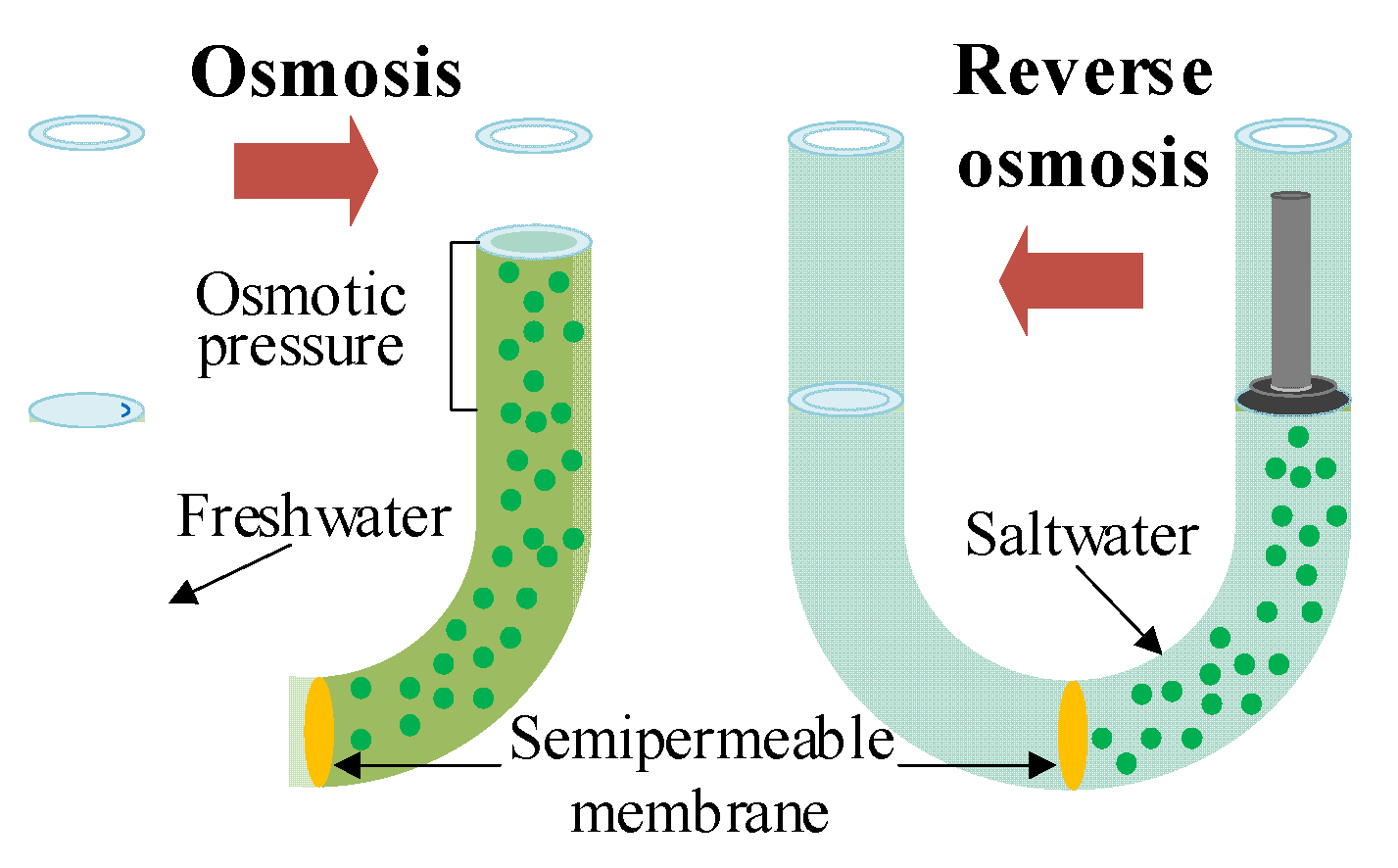
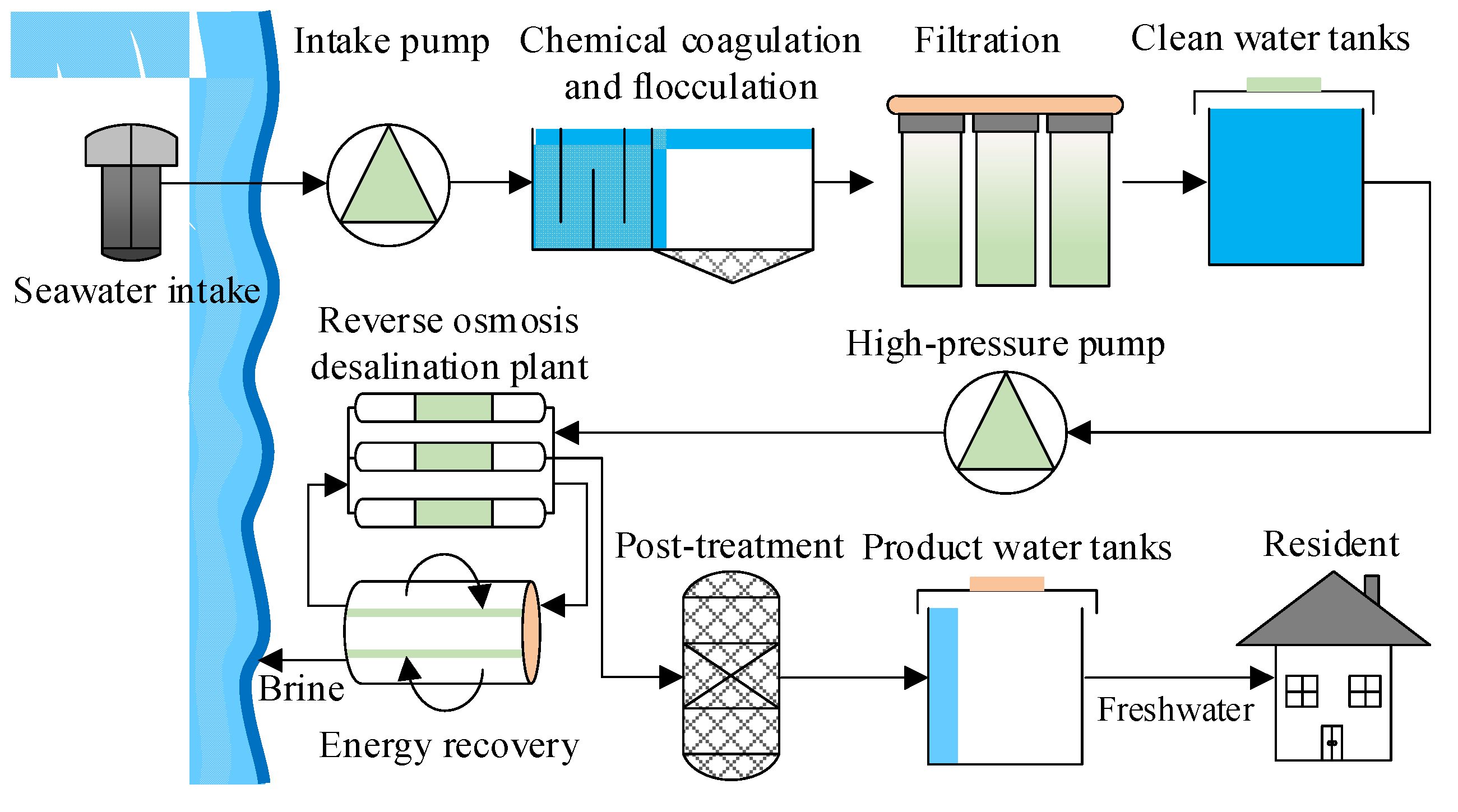
Appendix A. Based on the above analysis of the operating characteristics of SWDP, it can be concluded that the core production processes and key equipment in the plant include water intake equipment, high-pressure pumps, and desalination units, along with operational constraints between the clear water tank and the product water tank. Considering the start-stop control of intake pumps/high-pressure pumps and water volume regulation, a seawater desalination load model is established.
Intake pumps and high-pressure pumps are the primary energy-consuming equipment in RO desalination plants. Assuming that the head of intake pumps is fixed, the operational constraints are as follows:
In Equation (1), , and are the power, flow rate, and head of the water intake device for the t-th time period, respectively; is the efficiency of the water intake device; ρs and g are the density and gravitational acceleration of seawater, respectively; is a binary variable that characterizes the working status of the water intake device; and respectively represent the upper and lower limits of the water intake flow rate .
The power of the high-pressure pump in the SWDP is related to the working pressure, feed seawater concentration, RO recovery rate, and various parameters of the osmotic membrane, that is:
In Equation (2), , , and are the working pressure, inlet flow rate, outlet flow rate, and high-pressure pump power of RO unit d, respectively; Kd and Ad are the permeability coefficient and membrane area of the RO unit d permeable membrane, respectively; is the transmembrane osmotic pressure difference; ad and bd are the power coefficients of the high-pressure pump; Csw is the concentration of feed seawater; R is the RO recovery rate.
To ensure that water molecules can smoothly pass through the semi-permeable membrane, the operating pressure of the RO unit must be higher than the transmembrane osmotic pressure. However, excessively high operating pressure will adversely affect the service life of the semi-permeable membrane. Furthermore, sudden changes in the operating pressure or power of the RO desalination unit will shorten the service life of the osmotic membrane. Meanwhile, considering that frequent start-stop of the RO unit not only damages the service life of the osmotic membrane, but also increases power loss; therefore, the constraints on the operating pressure, ramp up, and start-stop of the RO desalination unit are as follows:
In Equations (3) through to (5), and are the upper and lower limits of the transmembrane net pressure of RO unit d, respectively; Id,t is a binary variable that characterizes the operating status of RO unit d; and are the upper and lower limits of the climbing power of RO unit d, respectively; and are the upper and lower limits of the working pressure increase and decrease per unit time of RO unit d; C and are the single start-stop cost and the maximum start-stop cost during the scheduling period of seawater desalination unit d.
The clear water tank in the SWDP is used to store pretreated seawater, while the product water tank is used to store post-treated desalinated water. The two follow similar operational constraints. Meanwhile, to ensure the continuity of scheduling, the remaining water volume in the clear water tank and product water tank at the end of each scheduling cycle should be consistent with the initial water volume, that is:
In Equations (6) and (7), and are the water levels of the clean water tank and the product water tank, respectively; rpre is the ratio of pretreated seawater to feed water flow rate; represents the water demand of residents; D is the total number of RO units; ACWR and APWR are the bottom areas of the clean water tank and the product water tank, respectively; and respectively represent the upper and lower limits of ; and respectively represent the upper and lower limits of ; and are the water levels of the clean water tank and product water tank during the initial scheduling stage; and are the water levels of the clean water tank and product water tank at the end of the scheduling period; δ and ζ are the upper limits of the water level difference between the clean water tank and the product water tank during the scheduling period, respectively.
3. Method for Optimal Dispatch of Regional WENS
3.1. Dispatch Framework of Regional WENS Incorporating SWDP
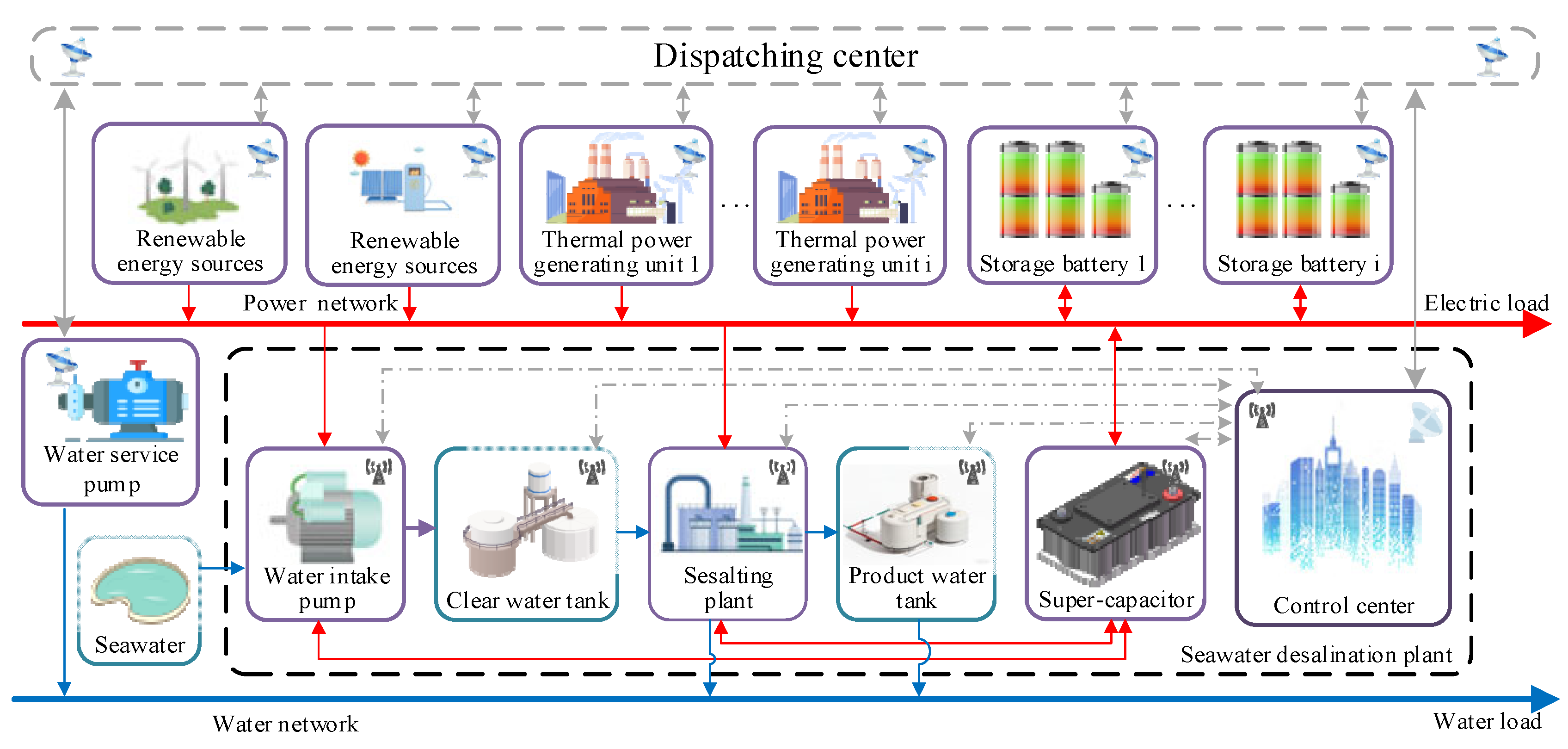
The framework of the regional WENS incorporating SWDP is shown in
Figure 1. The system consists of two parts: the power supply system and the water supply system. The power supply system includes renewable energy sources power stations, thermal power plants, energy storage stations, power grids, and power loads. The water supply system includes water sources, SWDP, water grids, and water loads. Among them, the SWDP mainly consists of a water intake device, a desalination device, a clean water tank, a product water tank, and equipped supercapacitors. The allocation between different devices in the plant is completed by the control system. The water intake device in the factory realizes seawater extraction, and its operating power and water intake directly affect the production and energy consumption of the SWDP. The desalination device is the core part of a SWDP, which uses desalination technology to remove salt from seawater and convert it into usable fresh water. The clear water tank and the product water tank are used to store seawater and fresh water respectively, which can provide the possibility of off peak operation for the flexible operation of the water intake device and desalination device. Supercapacitors are energy storage devices in SWDP, mainly used for energy exchange and buffering between the SWDP and the power supply system, which can to some extent improve the flexibility of energy consumption at the ports of the SWDP.
On the other hand, from the framework structure of the regional WENS containing SWDP, it can be seen that the water supply system interacts with energy coupling through water distribution pumps, as well as power equipment and power supply systems such as water intake devices, desalination devices, and supercapacitors in the SWDP. Given that the SWDP is equipped with “storage” devices such as clean water tanks, product water tanks, and supercapacitors, which enable it to have regulating capabilities during operation, from the perspective of power supply in the WENS, the SWDP has demand response capabilities, providing potential support for the development of optimized scheduling plans for the power system. On this basis, this article further explores the role of SWDP in regional WENS, and analyzes their specific application strategies in power demand response and energy optimization scheduling. Considering the differences in the operating characteristics of the “storage” devices in SWDP, this article combines the practical application needs of the power system and water supply system to explore the role of different “storage” devices in the WENS of SWDP, especially the diversified application of supercapacitors as a new energy storage technology in SWDP. By optimizing the charging and discharging strategies of supercapacitors, the overall energy efficiency of the system is improved and operating costs are reduced. At the same time, by combining the regulating functions of the clean water tank and the product water tank, the dynamic balance of water energy resources is achieved, providing strong support for the stable operation of the regional WENS.
Studies have shown that the rapid response characteristic of supercapacitors holds significant value in mitigating the instantaneous fluctuations of wind power output; it can offset such fluctuations and significantly enhance the stability and reliability of wind power grid integration. Furthermore, the coordinated operation of supercapacitors with clear water tanks and product water tanks enables efficient recycling of energy and optimizes resource allocation.
Given the prominent issue of wind power accommodation congestion in coastal areas and the serious impact of large fluctuations in wind power output on the operational stability of power systems, if a single-level optimization model is adopted to incorporate wind power accommodation, fluctuation suppression, and economic cost optimization into the same decision-making framework, the core objectives of wind power accommodation and fluctuation suppression are highly likely to be compromised by local economic benefits due to the trade-off among multi-objective weights, making it difficult to balance system security and renewable energy accommodation requirements. Against this background, this paper proposes a bi-level optimal scheduling method for a regional water–energy coupling system containing SWDP: the upper-level optimization model aims at maximizing wind power accommodation and minimizing wind power fluctuation to determine the grid-connected scheme of wind power and the charging/discharging strategy of supercapacitors, while the lower-level optimization model takes the minimum comprehensive system operation cost as the objective, and the collaborative interaction and hierarchical optimization between the upper and lower levels systematically solve the multiple problems in coastal areas, such as blocked wind power accommodation, excessive output fluctuation, and high system operation cost.
3.2. Upper-Level Optimization Model
3.2.1. Objective Function
The upper-level optimization model takes maximizing wind power accommodation and minimizing the sum of absolute differences of wind power output fluctuations mitigated by supercapacitors as its dual objectives. On the basis of satisfying various constraint conditions of TPU, wind power, energy storage systems, and SWDP, the model optimizes the regulated power of these components. The objective function of the upper-level optimization model is given as follows:
In Equations (8) and (9),
F1 represents the total wind power accommodation, i.e., the cumulative sum of the grid-connected wind power in each time period within the dispatch horizon;
F2 represents the sum of absolute differences of wind power fluctuations after supercapacitor smoothing, i.e., the sum of the absolute values of the changes in the smoothed wind power output between adjacent time periods;
denotes the predicted wind power at time
t. The wind power output after fluctuation mitigation by supercapacitors is expressed as follows:
In Equation (10), and denote the charging power and discharging power of the supercapacitor at time t, respectively.
3.2.2. Constraints
- (1)
Power balance constraint. Within the dispatch cycle, the source-load power balance of the system shall be ensured.
In Equation (11), PGj,t denotes the output power of thermal power unit j in time period t; and denote the charging power and discharging power of the battery at time t, respectively; denotes the predicted load power at time t; denotes the wind power output after fluctuation mitigation by supercapacitors at time t.
- (2)
Wind power output constraint.
- (3)
Battery constraints. Herein, its charging and discharging constraints as well as capacity constraints are mainly considered, which are specified as follows:
In Equations (13) and (14), PB,C,max and PB,D,max are the charging and discharging limits of the storage battery, respectively; is a binary variable, representing the charging and discharging state parameters of the storage battery in time period t, = 1 indicates a charging state, while = 0 indicates a discharging state; is the stored electricity of the storage battery at time t; and are the charging and discharging efficiencies of the storage battery, respectively; is the maximum capacity of the storage battery; and are the upper and lower limits of the storage battery’s stored electricity, respectively.
- (4)
Thermal power unit constraints. Herein, its ramp rate constraints as well as upper and lower power limit constraints are mainly considered, which are specified as follows:
In Equations (15) and (16), and are the upward ramp output limit and downward ramp output limit of TPU j, respectively; and are the upper and lower limits of the output power of TPU j, respectively.
3.3. Lower-Level Optimization Model
3.3.1. Objective Function
Based on the wind power grid-connected power and supercapacitor charging/discharging power output by the upper-level optimization model, the lower-level establishes an economic optimization model of the system. On the basis of the optimal dispatch scheme of the upper-level, this model comprehensively considers the thermal power unit operation cost, thermal power unit start-up and shutdown cost, wind curtailment penalty cost, energy storage system operation cost, and seawater desalination plant regulation cost, and takes the minimization of the sum of the aforementioned costs as its core optimization objective. Its objective function is given as follows:
In Equations (17) through (25), F2 denotes the total system operation cost, including the TPU operation cost FG, TPU start-up and shutdown cost FG,qt, wind curtailment penalty cost FW, battery operation cost FB, seawater desalination load start-up and shutdown cost FRO,qt, seawater desalination load power purchase cost FRO,epc, and seawater desalination load regulation cost FRO,a; FSC denotes the supercapacitor dispatch cost; is the start-stop state of the TPU j at time t; NG is the number of TPU; aj, bj, cj are the coal consumption cost coefficients of TPU j respectively; pstart and pstop are the costs incurred in a single start-up and shutdown process of the TPU respectively; q is the single start-stop cost of the seawater desalination unit; is the purchase price of electricity for the seawater desalination plant at time t; is the seawater desalination unit D, which does not participate in power regulation at time t; and denote the charging power and discharging power of the supercapacitor at time t, respectively; m denotes the unit power regulation cost of the seawater desalination unit; denotes the unit wind curtailment cost; p denotes the unit charging and discharging cost of the battery; denotes the unit charging and discharging cost of the supercapacitor.
3.3.2. Constraints
- (1)
Power balance constraint. Within the dispatch cycle, the source-load power balance of the system shall be ensured.
In Equation (26), denotes the wind power grid-connected power of the lower-level at time t.
- (2)
Power balance constraint. It shall be ensured that the wind power output after fluctuation mitigation by supercapacitors is balanced.
- (3)
Supercapacitor operation constraints. Similar to the operation constraints of energy storage systems, the operation constraints of supercapacitors mainly take into account their charging and discharging constraints as well as capacity constraints:
In Equations (26) and (27), PSC,C,max and PSC,D,max are the charging and discharging limits of the supercapacitor, respectively; is a binary variable, representing the charging and discharging state parameters of the supercapacitor in time period t, = 1 indicates a charging state, while = 0 indicates a discharging state; is the stored electricity of the supercapacitor at time t; and are the charging and discharging efficiencies of the supercapacitor, respectively; is the maximum capacity of the supercapacitor; and are the upper and lower limits of the supercapacitor’s stored electricity, respectively.
4. Model Solution Procedure
The day-ahead optimal scheduling model established in this paper for seawater desalination loads and wind power fluctuation suppression is a bi-level mixed-integer linear programming problem. This type of programming features a two-level hierarchical structure, where the objective functions and constraint conditions of the two levels are distinct yet mutually constrained.
The scheduling time horizon of this study is 24 h ahead, with a time resolution of 15 min. This selection fully considers both wind power variability and the operational feasibility of the RO seawater desalination system: Wind power output exhibits significant short-term fluctuation characteristics, and a 15-min time resolution can accurately capture the dynamic changes in wind power, meeting the requirement for supercapacitors to quickly mitigate wind power fluctuations while avoiding distorted characterization of wind power variability caused by an excessively coarse resolution. Meanwhile, the core equipment of the RO seawater desalination system, such as water intake devices and high-pressure pumps, all possess 15-min-level response capabilities for power regulation and start-stop operations. This time resolution not only aligns with the actual operational characteristics of the equipment, but also balances the solution efficiency of the scheduling model, preventing a surge in computational complexity due to an overly fine resolution.
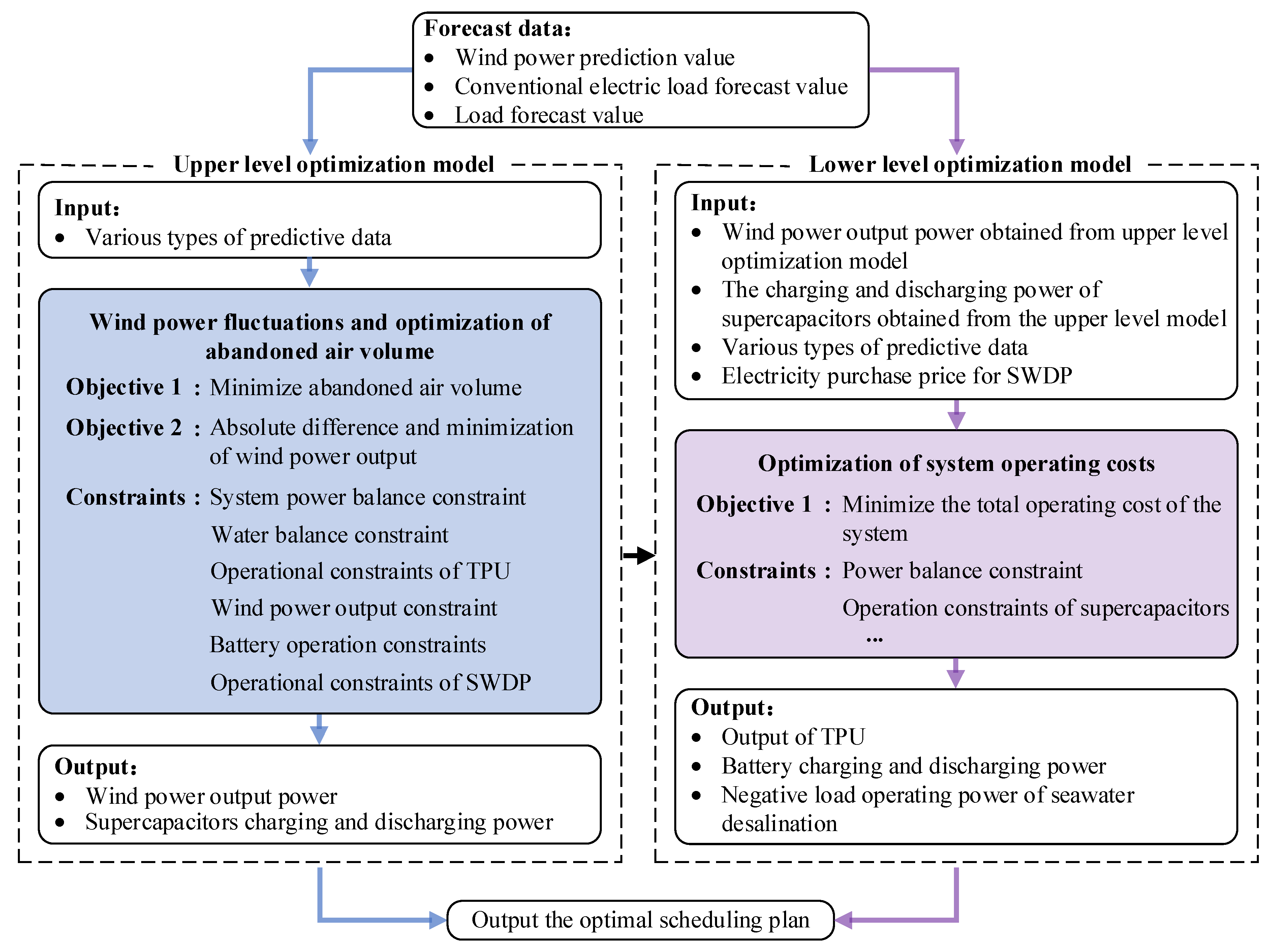
The mathematical formulation of the bi-level optimization is shown in Equation (30). The model is constructed using YALMIP in the MATLAB R2022b environment and solved with the CPLEX 12.10 commercial optimization solver. Benefiting from CPLEX’s excellent performance in mixed-integer programming problems, this study achieves fast and stable optimization calculations while satisfying complex constraint conditions. All case tests are conducted on a computer equipped with an Intel Core i5-8250U CPU and 8GB RAM. The calculation process of the scheduling model is illustrated in
Figure 2, and its standard form is as follows:
In Equation (30), F(x,y) denotes the objective function of the upper-level optimization problem; L(x,t) denotes the objective function of the lower-level optimization problem. The to-be-optimized variable x includes the thermal power unit output, scheduled wind power output, battery charging/discharging power, seawater desalination load demand power, and supercapacitor charging/discharging power, among others. Meanwhile, y—which represents the start-up and shutdown states of TPU and seawater desalination loads, as well as the charging/discharging states of batteries and supercapacitors—is also a crucial decision variable. The solution process is subject to a series of equality constraints, including the system power balance constraint, the wind power output balance constraint after fluctuation mitigation by supercapacitors, and the water flow balance constraint. In addition, the inequality constraints mainly cover the wind power output constraint, thermal power unit operation constraint, battery operation constraint, seawater desalination load operation constraint, and supercapacitor operation constraint, among others.
A hierarchical variable transfer coupling approach is adopted for the bi-level optimization problem, where the upper-level model acts as the dominant layer, optimizing the core decision variables and then passing down the constraint boundaries—specifically the supercapacitor-smoothed wind power grid-connection power and the supercapacitor charging/discharging power strategy—to the lower-level model; the latter treats these two sets of variables as fixed constraints and optimizes the output and start-stop states of TPU, the charging/discharging power and states of batteries, as well as the operating power, start-stop states, and regulation strategies of all equipment within the SWDP under these boundaries, with the objective of minimizing the comprehensive operating cost of the system. This architecture ensures the compatibility of power and water balance constraints and the existence of feasible solutions by imposing strictly physical bounds on all variables. The strictly monotonic cost-minimization design of the lower-level objective function, combined with the rigid boundaries passed down from the upper level, guarantees the uniqueness of the global optimal solution. To address objective conflicts and non-convexity introduced by on/off variables, the model decouples technical and economic objectives through hierarchical decomposition and leverages the branch-and-bound algorithm of the CPLEX solver to achieve global optimization for the mixed-integer program, thus ensuring the well-posedness and solution stability of the bi-level model.
5. Example Analysis
5.1. Overview of Examples
To verify the effectiveness and rationality of the model proposed in this article, simulation analysis is conducted here. The specific calculation conditions and parameters are as follows: four TPUs with a total capacity of 1200 MW, the maximum output
Pmax and minimum output
Pmin of each unit, and the operating cost parameters (a, b, c) are shown in
Table 2 [
34,
35]. Here, the unit “CNY” refers to Chinese Yuan Renminbi, which is the official currency of the People’s Republic of China. The operating parameters of the seawater desalination equipment are shown in
Table 3, with a maximum total water production of 6620 m
3 per hour, and the RO recovery rate is 45% [
36,
37]. The single start-stop cost of the high-pressure pump unit is 50 CNY, and it can operate continuously for 24 h. The electricity purchase price for seawater desalination load is shown in
Table 4 [
38]. The operating parameters of the energy storage equipment are shown in
Table 5. The operating cost of the storage battery is 50 CNY/(MW·h), and the operating cost of the supercapacitor is 40 CNY/(MW·h) [
39,
40,
41]. The total installed capacity of the wind farm is 300 MW, and the unit penalty cost for wind abandonment is 200 CNY/(MW·h) [
42,
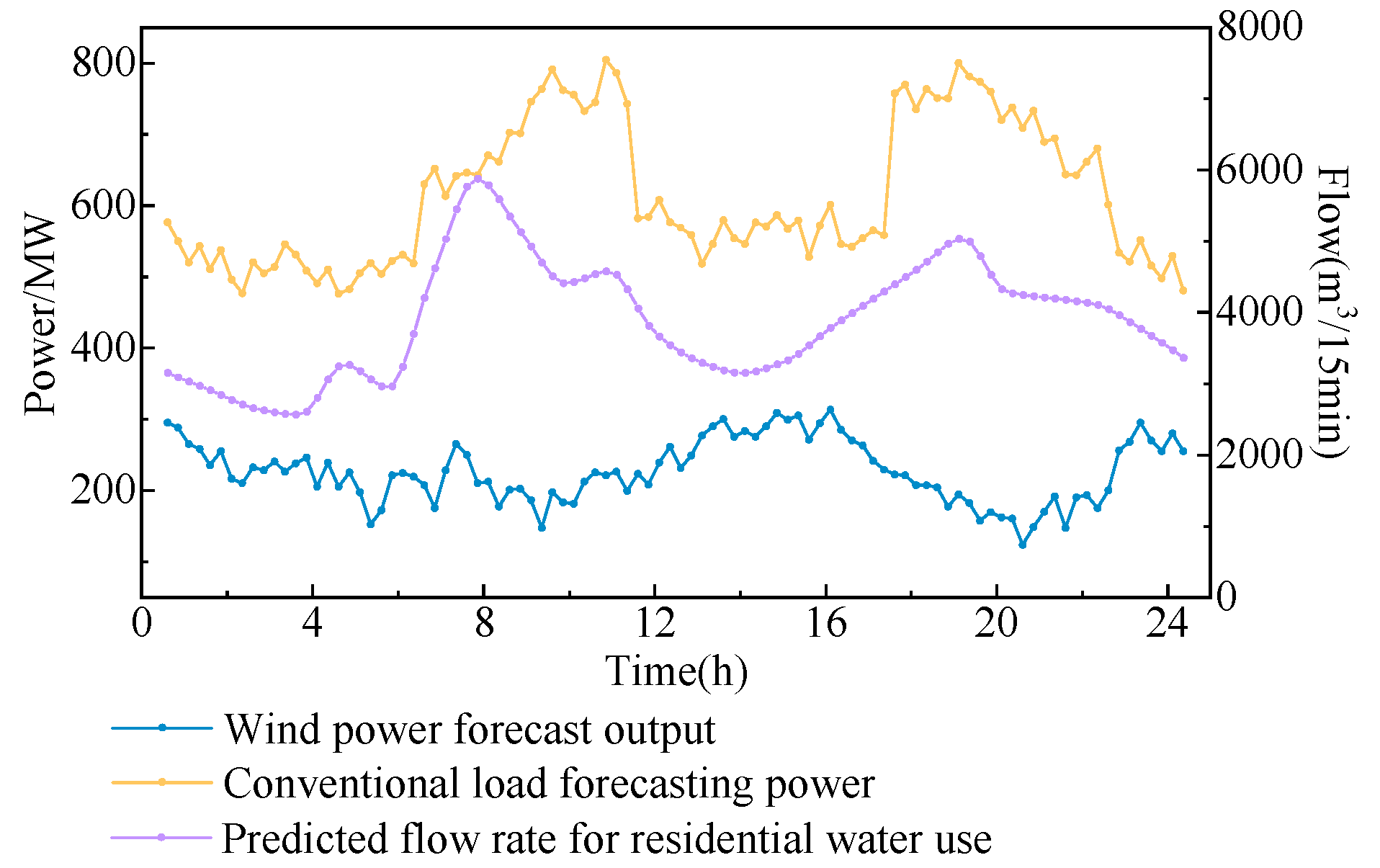
43]. The predicted values of conventional load, wind power output, and residential water flow rate are shown in
Figure 3.
As can be seen from
Figure 3, the predicted values of the conventional electrical load range from 476.6 to 805.3 MW, reaching their peak values during the periods of 07:00–11:00 and 18:00–22:00; the predicted values of wind power output are in the range of 123–313 MW, with the peak periods occurring at 01:00–04:00, 13:00–17:00 and 22:00–24:00; the predicted values of residential water flow rate vary between 2650 m
3/h and 5800 m
3/h, and the residential water demand is relatively high during 07:00–09:00 and 18:00–21:00, which is consistent with residents’ daily behavioral habits. It can be observed from the case settings that wind power exhibits anti-peak regulation characteristics. This characteristic increases the peak regulation pressure of TPU and reduces the wind energy utilization rate, which is consistent with the actual operation of power system engineering. On the other hand, to verify the effectiveness and advantages of the method proposed in this paper, two scenarios are set up for comparative verification as follows:
Scenario I: A bi-level optimization model where the regulation power limit of seawater desalination load is set to 0, and the residential water demand is satisfied only by adjusting the product water tank.
Scenario II: A bi-level optimization model where the seawater desalination load can be effectively regulated upward and downward, and the residential water demand is satisfied in coordination with the operation of the product water tank.
5.2. Results Analysis
As can be seen from the data comparison in
Table 6, Scenario II exhibits superior performance in terms of overall operational economy. Specifically, the total operation cost, thermal power unit operation cost, wind curtailment penalty cost, seawater desalination energy consumption cost, and energy storage regulation cost have all decreased, falling by 11,3472 CNY, 1777 CNY, 21,550 CNY, 78,215 CNY, and 2043 CNY, respectively. This reduction in costs is mainly attributed to the improved system flexibility, particularly the peak-shaving and valley-filling effect brought by the participation of seawater desalination load in demand response, as well as the coordinated optimization of energy storage and TPU. On the other hand, since the regulation resources within the seawater desalination plant are fully dispatched in Scenario II, its start-up and shutdown cost, regulation cost, and supercapacitor dispatch cost have increased by 1850 CNY, 8624 CNY, and 5900 CNY, respectively. Overall, although the in-depth utilization of flexible resources leads to an increase in certain costs, the system has achieved remarkable comprehensive benefits in promoting wind power accommodation and reducing the total cost by optimizing the overall operation mode. In addition, to conduct a detailed comparison of the differences between the different scenarios, the calculation result diagrams under the two scenarios are plotted and shown in
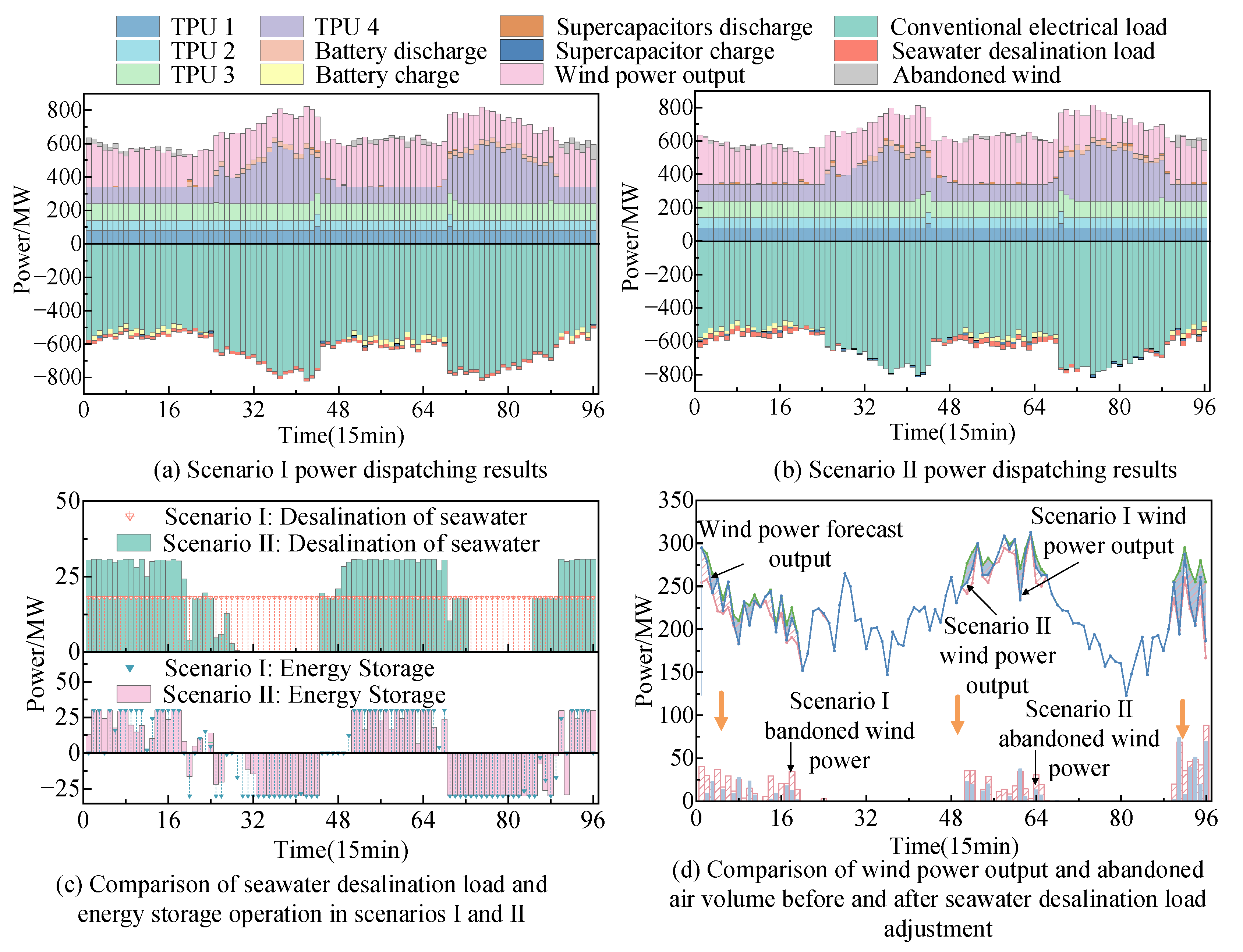
Figure 4.
Figure 4a,b show the power dispatch results of Scenario I and Scenario II, respectively. It can be observed from the two figures that the four TPUs exhibit basically consistent output modes under the two scenarios. To enhance the wind power accommodation capacity, the outputs of Units G1, G2 and G4 are all reduced to their minimum technical outputs (80 MW, 60 MW and 100 MW for G1, G2 and G4, respectively). In contrast, Unit G3 undertakes a higher load during the peak load periods ([06:15–12:15] and [17:00–22:15]) due to its relatively low regulation cost, while its output is reduced to the minimum technical level in other periods, consistent with that of the other three units. Furthermore, it can be seen from the figures that wind power output remains relatively low during the peak load periods of [06:15–12:15] and [17:00–22:15], and wind power exhibits anti-peak regulation characteristics, which enables it to achieve favorable accommodation during these periods. Meanwhile, in Scenario II, owing to the expanded flexible resources of the system, the wind curtailment volume in different periods is reduced compared with Scenario I, and the number of periods with significant wind curtailment is decreased from 38 to 27. On the other hand, from the demand-side perspective, compared with Scenario I, the seawater desalination load in Scenario II can reduce its energy consumption (or even operate in a shutdown state) during the peak power load periods, and conversely increase energy consumption during the off-peak periods, thereby realizing peak-shaving and valley-filling of the load to a certain extent. In this regulation process, the water load demand of the water supply system is guaranteed by the water storage in the clear water tank and product water tank of the seawater desalination plant. This mechanism effectively weakens the constraint of water load on the energy demand of the seawater desalination plant in the power system; that is to say, the seawater desalination load achieves the decoupled operation of power consumption and water supply demand within a certain range.
Meanwhile, to conduct a clearer comparative analysis of the differences in the seawater desalination load and energy storage system between the two scenarios, as well as to analyze the wind power accommodation performance under different scenarios, the relevant diagrams are shown in
Figure 4c,d. It can be seen from
Figure 4c that in Scenario I, the seawater desalination load does not participate in the load regulation of the power system, and its energy consumption remains constant at all times, resulting in higher energy consumption compared with Scenario II. In contrast, the regulation flexibility of the seawater desalination load is fully released in Scenario II, leading to significant variations in its energy consumption across different time periods. It can be clearly observed from the figure that the load reduces energy consumption during peak load periods and increases energy consumption during off-peak load periods, thereby decreasing the peak-valley difference of the system load. From the operation states of the energy storage system under the two scenarios, it can be noted that compared with Scenario I, the total regulation power of the energy storage system in Scenario II is reduced, which consequently lowers the operation cost of the energy storage system. Furthermore, the wind curtailment situations under the two scenarios also indicate that wind curtailment mainly occurs during off-peak load periods, namely the three time intervals of [00:00–04:45], [12:45–16:30] and [22:30–24:00]. In Scenario I, the maximum wind curtailment power is 88.34 MW, the wind curtailment rate is 4.65%, and the total curtailed electricity volume reaches 246.38 MW·h. In Scenario II, the maximum wind curtailment power drops to 73.71 MW, the wind curtailment rate decreases to 2.62%, and the total curtailed electricity volume is reduced to 138.75 MW·h. In summary, Scenario II achieves better wind power accommodation performance than Scenario I due to its more abundant flexible resources.
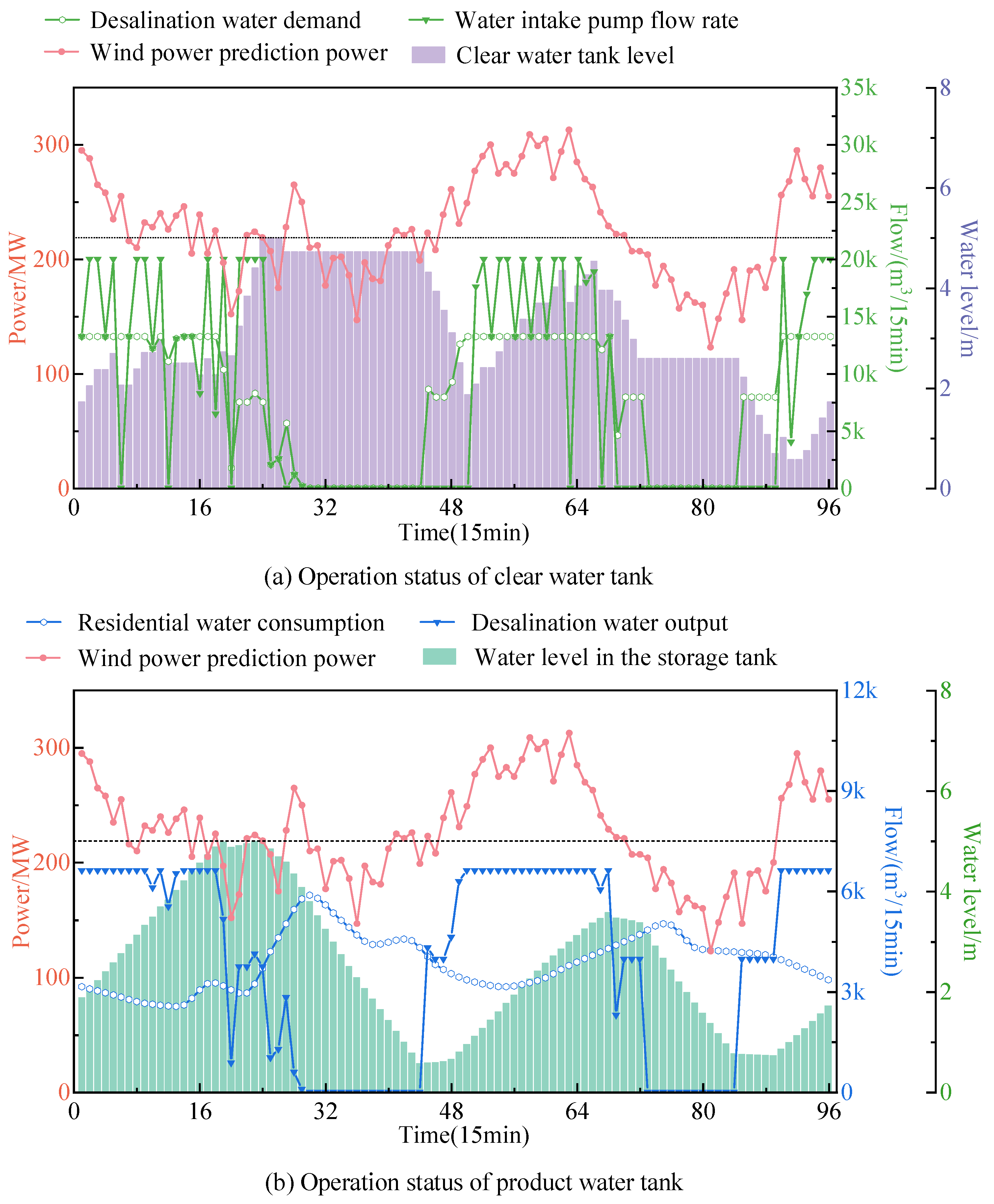
Furthermore, to understand the operation states of the clear water tank and product water tank inside the seawater desalination plant during the process of energy consumption regulation, the operation state diagram of the two tanks in Scenario II is plotted herein, as shown in
Figure 5.
Figure 5a,b shows the operation state curves of the clear water tank and product water tank during the energy consumption regulation process, respectively. It can be observed from
Figure 5a that during the periods of high wind power output and low power load ([00:00–06:00], [12:45–16:30] and [22:00–24:00]), the water demand flow rate of the seawater desalination system remains at a high level, the energy consumption of the water intake device increases synchronously, and water is continuously supplied to the clear water tank. In contrast, during the periods of low wind power output and high power load ([07:00–11:00] and [18:00–21:00]), the water demand flow rate decreases significantly or even drops to zero, and the water intake device stops operating. From the perspective of water level changes in the clear water tank, the water storage tank steadily reaches the rated water level of 5 m before the water intake device shuts down; after shutdown, the subsequent water demand of the desalination process is continuously met by the stored pretreated seawater, which effectively achieves peak-shifting matching between water intake and water consumption, and provides a key buffer for the flexible regulation of the water intake device. From another perspective, it can be seen that the water intake flow rate curve of the seawater desalination system is correlated with the fluctuation trend of the wind power output curve. Through calculation, the Pearson correlation coefficient between them is determined to be 0.62. It can thus be concluded that the water intake device in the seawater desalination load can be optimized to a certain extent in accordance with the wind power output trend, which further verifies the feasibility of the seawater desalination load realizing green energy utilization relying on wind power.
It can be seen from
Figure 5b that the desalinated water output curve of the desalination device is similar to the operation curve of the water intake device: during the periods of high wind power output and low power load, the desalinated water output remains at a high level, the energy consumption of the device stays in a high range, and water is continuously supplied to the product water tank; during the periods of low wind power output and high power load, the desalinated water output decreases significantly, and the device even stops operating in some periods, thereby reducing the power consumption pressure of the system. Furthermore, it can be observed from the water level histogram of the product water tank that during [00:00–06:00], with the continuous water supply from the desalination device, the water level gradually rises to the rated value of 5 m; during [06:15–11:00], due to the reduction in desalinated water output and the peak of residential water demand, the water level drops continuously, and the water demand of the water load during this period is mainly guaranteed by the water stored in the product water tank; during [11:15–17:00], the power load returns to the flat period, the desalinated water output increases, and the water level of the product water tank rises steadily again; during [17:15–21:45], affected by the dual peaks of power consumption and water use in the evening, the desalinated water output decreases while the water demand increases, and the water level drops once more; during [22:00–24:00], the power load enters the off-peak period, and the recovery of wind power output drives the increase in desalinated water output, initiating the water level rising process again. Similarly, it can be seen that the desalinated water output curve is correlated with the fluctuation trend of the wind power output curve, and the Pearson correlation coefficient between them is calculated to be 0.72, which indicates that the desalination device in the seawater desalination plant can also be optimally regulated in accordance with the wind power output trend.
In summary, compared with Scenario I, Scenario II not only achieves a reduction in the total operation cost of the system but also improves the wind power accommodation capacity to a certain extent by fully unleashing the regulation flexibility of the seawater desalination load. Further analysis of the operation characteristics of the clear water tank and product water tank in the seawater desalination plant reveals that the water intake device and desalination device within the plant operate in a consistent mode, both of which exhibit a strong correlation with wind power output. Through calculation, the Pearson correlation coefficient between the two devices is determined to be 0.71, indicating that both the water intake device and desalination device of the seawater desalination plant have considerable potential for green power substitution.
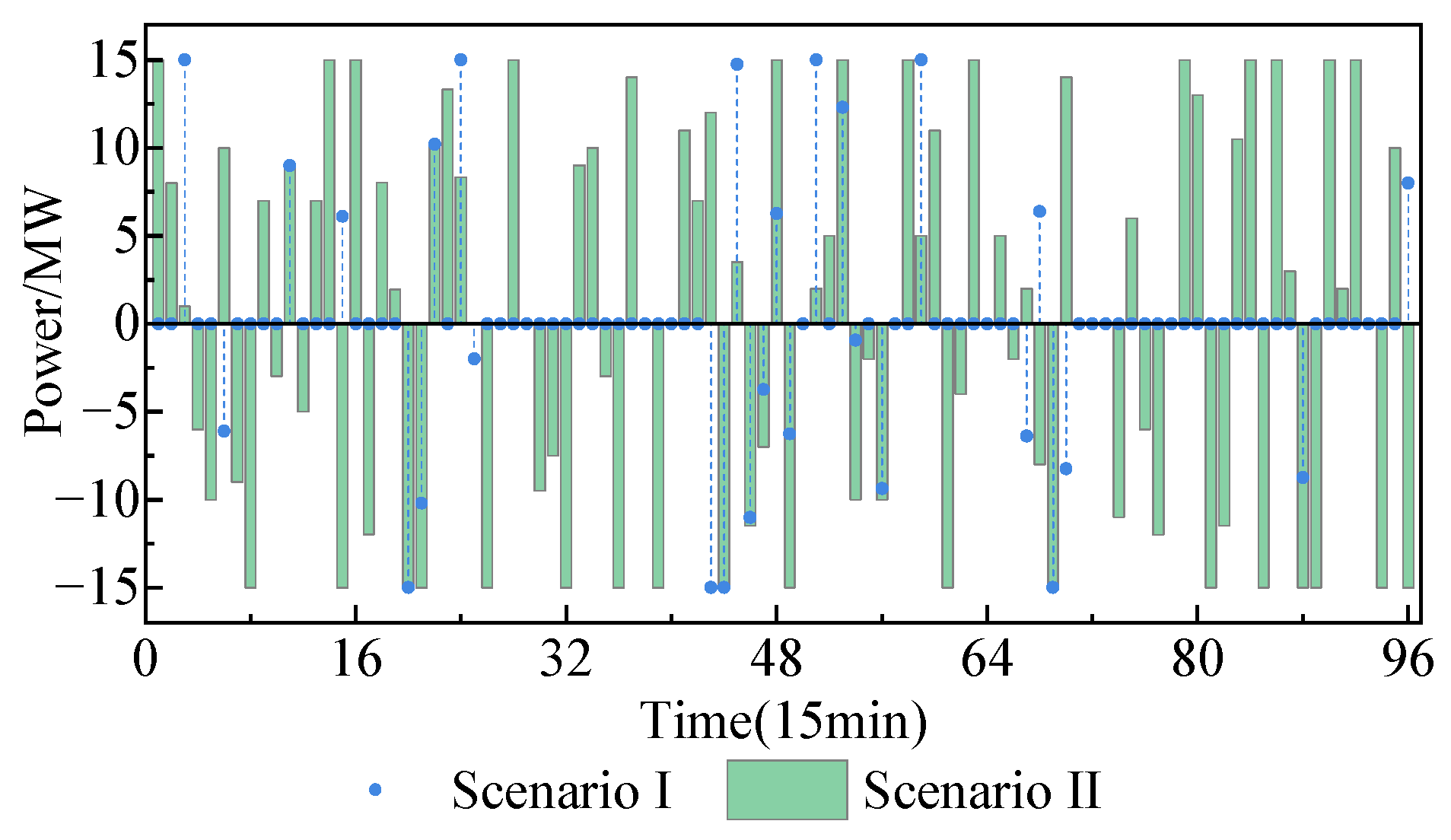
Furthermore, to conduct an intuitive comparison of the differences in the regulation and operation characteristics of the supercapacitors inside the seawater desalination plant under different scenarios, the operation state curves of the supercapacitors under the two scenarios are plotted in this paper, as shown in
Figure 6.
As can be seen from
Figure 6, compared with Scenario I, the operation state of the supercapacitors in Scenario II is significantly more active. The number of charging and discharging cycles reaches 83 within 96 intraday periods, indicating a substantial improvement in utilization rate. Supercapacitors themselves boast technical advantages such as fast response speed, long cycle life, high charging and discharging efficiency, good safety performance, and maintenance-free operation. By scheduling this flexible resource more fully, the method proposed in this paper not only optimizes the resource utilization mode inside the seawater desalination plant but also effectively reduces its overall energy consumption cost. To conduct a more specific analysis of the role of supercapacitors in smoothing power fluctuations,
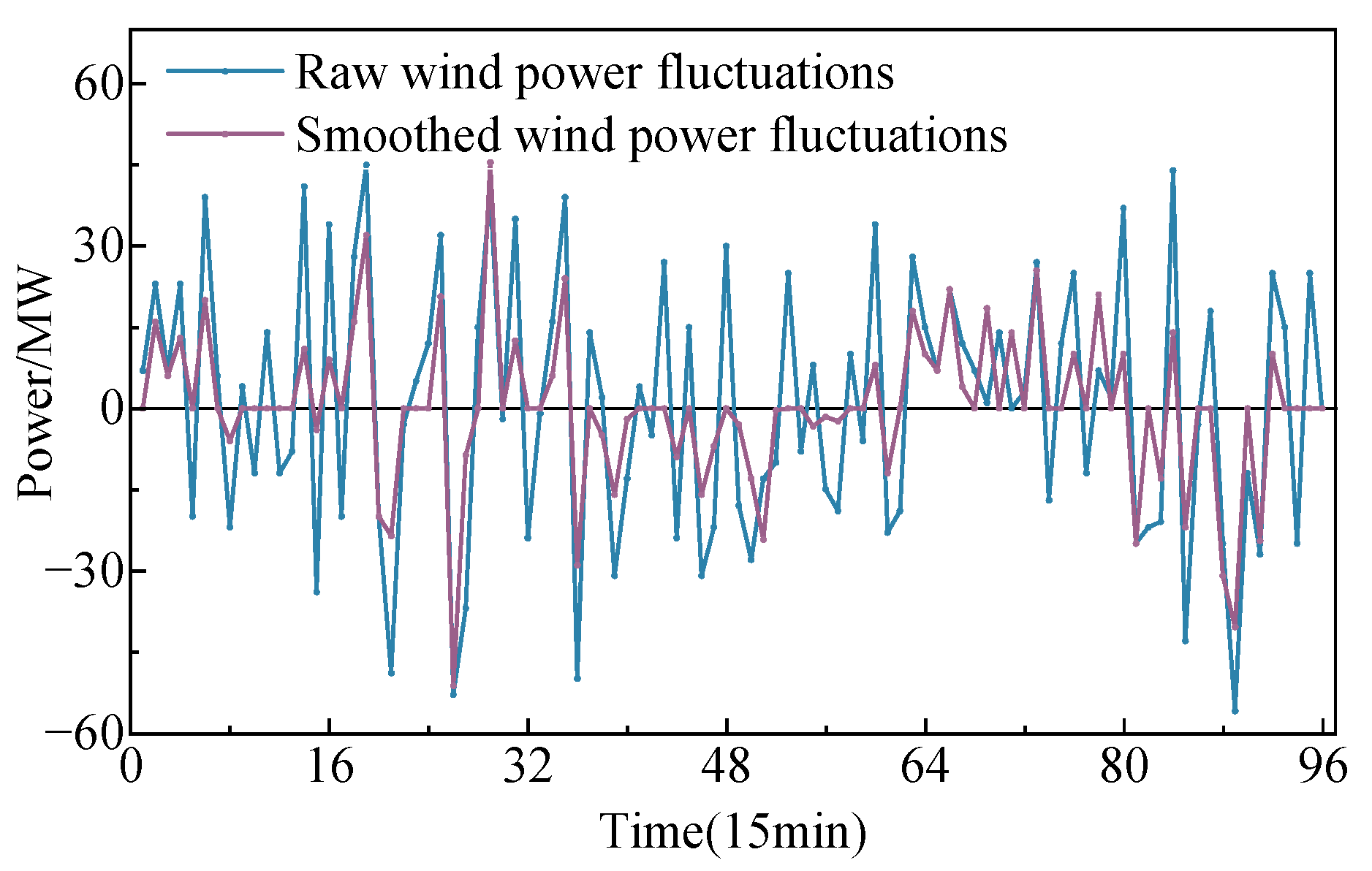
Figure 7 further compares the wind power fluctuation between adjacent periods.
As can be seen from
Figure 7, the amplitude of the original wind power fluctuation is significant, with the peak value close to ±60 MW, indicating drastic power changes; the range of power fluctuation is then significantly narrowed after smoothing. It can be concluded from the combination of
Figure 6 and
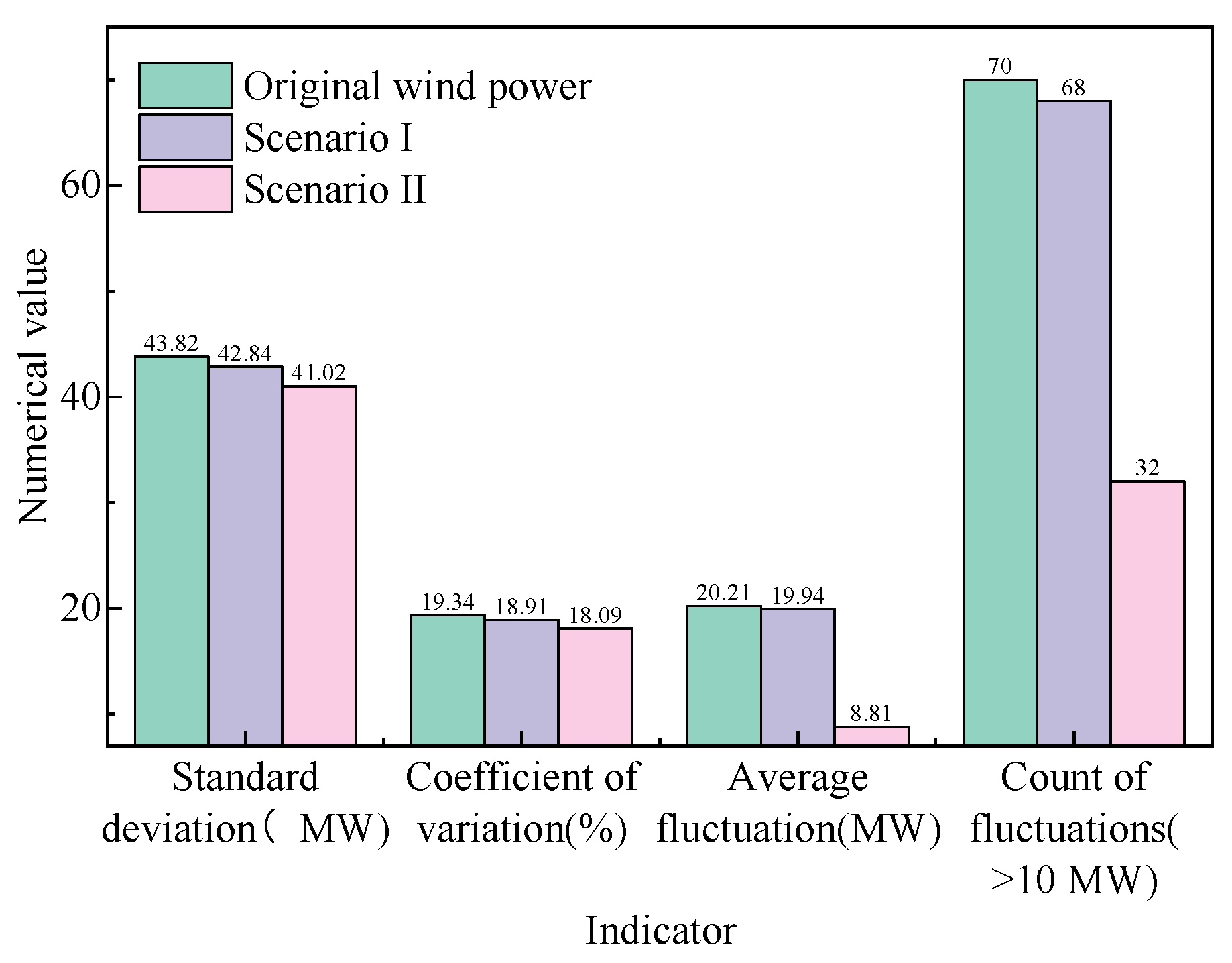
Figure 7 that when the wind power fluctuates upward, the supercapacitors start charging, and when the wind power fluctuates downward, the supercapacitors start discharging, thereby achieving smooth regulation of the wind power output curve. To compare the magnitudes of their fluctuation trends—that is, to evaluate the impact of supercapacitors on wind power output fluctuations before and after response—four indicators including standard deviation, coefficient of variation, average power fluctuation, and number of fluctuations exceeding 10 MW are introduced for analysis herein. The values of the four indicators under the two scenarios are calculated and presented in
Figure 8.
As can be seen from
Figure 8, the supercapacitors exert a certain smoothing effect on the fluctuations of the wind power output curve, and the volatility of the wind power output curves shows a decreasing trend under both scenarios. In Scenario I, the standard deviation, coefficient of variation, average fluctuation, and number of fluctuations exceeding 10 MW decrease from 43.82 MW, 19.34%, 20.21 MW and 70 to 42.84 MW, 18.91%, 19.94 MW and 68, with respective reductions of 2.24%, 2.22%, 1.34% and 2.86%. In Scenario II, the four indicators decrease from 43.82 MW, 19.34%, 20.21 MW and 70 to 41.02 MW, 18.09%, 8.81 MW and 32, with respective reductions of 6.34%, 6.46%, 56.41% and 54.29%. It is evident that Scenario II achieves a better performance, which further verifies the advantages of the method proposed in this paper.
6. Conclusions
This study proposes a bi-level optimal dispatch method for regional WENS that takes into account the flexible regulation potential of SWDP, aiming to advance the sustainable development of coastal areas. The results show that integrating SWDP into the regional WENS can reduce the total system operating cost and improve the renewable energy sources utilization rate. This is particularly crucial for coastal and island regions worldwide, as most of their power grids are “receiving-end power grids” with insufficient system flexibility resources and impaired renewable energy sources accommodation.
Aiming at the operating characteristics of RO seawater desalination loads, a multi-level physical model covering water intake devices, high-pressure pumps, clean water tanks, product water tanks, and supercapacitors is established, fully incorporating complex operating conditions such as start-stop logic, operating power constraints, pressure regulation constraints, and water balance. By virtue of the water storage and buffering potential of clean water tanks and product water tanks, this model successfully breaks the rigid temporal coupling between power consumption and water supply demand, enabling seawater desalination loads to achieve “peak clipping and valley filling” regulation of the power system load curve through peak-shifting power consumption, and opening up a new pathway for the demand side to participate in renewable energy sources accommodation.
From the perspective of green energy substitution, the key energy-consuming equipment in SWDP can operate optimally by following the renewable energy sources generation curve. This is crucial for reducing the electricity costs of SWDP: traditional fossil energy-powered supply not only pushes up costs but also exacerbates environmental pressure. In contrast, green electricity substitution can not only break through this development constraint but also significantly reduce carbon emissions, aligning with the “dual carbon goals” and providing core support for coastal regions to build a low-carbon, economical, and sustainable water supply guarantee system.
The fast response capability of supercapacitors is coupled with wind power output to achieve effective suppression of wind power fluctuations. In Scenario II, the standard deviation, coefficient of variation, average fluctuation, and number of fluctuations exceeding 10 MW decrease by 6.34%, 6.46%, 56.41%, and 54.29%, respectively. This demonstrates that supercapacitors play an important role in improving the stability of wind power output.
This method boasts extensive geographical adaptability. By adjusting core parameters such as seawater desalination capacity, renewable energy sources installation ratio, and peak-valley electricity prices, it can flexibly adapt to the resource endowments and development needs of different water-scarce coastal regions worldwide, providing technical support for the coordinated and sustainable development of water–energy in coastal areas. In terms of load type expansion, its core decoupling logic of “production-storage-electricity consumption” can be directly extended to high-energy-consuming loads such as sewage treatment and salt chemical industry. By utilizing into the buffering potential of raw material warehouses and intermediate product storage tanks, a generalized flexible scheduling model is constructed, offering a unified framework for multiple types of loads to collaboratively participate in RES accommodation.
Future research can deepen this work through multiple pathways: (i) Expand the multi-energy coupling dimension, integrate resources such as natural gas, waste heat, and hydrogen energy, and construct an “electricity-water-gas-heat” multi-energy complementary system to improve supply reliability and anti-interference capability under extreme scenarios; (ii) Optimize the demand response price incentive mechanism, design dynamic reward and punishment strategies based on real-time operating status, and stimulate the long-term enthusiasm of SWDP and similar flexible loads in participating in system regulation; (iii) Explore the coupling paths between seawater desalination and industries such as seawater hydrogen production and salt chemical industry, form a circular economy model with “water-energy-salt” multi-industry synergy, and expand the industrial value and application boundaries of the research.
In summary, this study verifies the flexible regulation value of SWDP as dual roles of “controllable electrical loads” and “controllable water sources” in regional WENS. It not only provides practical and feasible technical solutions for coastal regions to address the dual challenges of energy transition and water scarcity but also facilitates the win-win synergy between improved energy utilization efficiency and ecological environmental protection. Meanwhile, its core ideas and technical pathways offer an important reference for the optimal scheduling research of similar coupled systems, injecting new momentum into the establishment of resilient and sustainable water–energy security systems in coastal regions worldwide.