Article

Markov Transition Fields-Based Dual-Modal Fusion Method on Transient Stability Assessment for Power Systems

1
State Grid Huzhou Power Supply Company, Huzhou 313000, China
2
Jiangning Campus, College of Electrical and Power Engineering, Hohai University, Nanjing 210098, China
*
Author to whom correspondence should be addressed.
Energies 2026, 19(6), 1417; https://doi.org/10.3390/en19061417
Submission received: 19 January 2026 / Revised: 2 March 2026 / Accepted: 4 March 2026 / Published: 11 March 2026
(This article belongs to the Special Issue Advanced in Modeling, Analysis and Control of Microgrids)

Abstract

There is an extremely urgent need to develop a transient stability assessment method for new power systems with greater rapidity and higher accuracy due to the increased complexity and difficulty caused by massive nonlinear power electronics-dominated generation and loads. In recent years, computing power has increased significantly, meaning that artificial intelligence (AI) algorithms have develop rapidly, and large-scale AI models have become available. Among them, deep learning (DL) algorithms have received more attention due to their inherent advantages, on which assessment strategy and methods are based, but these algorithms are still not sufficiently applicable. Therefore, a Markov Transition Field (MTF)-based dual-modal fusion method for transient stability assessment of power systems is proposed in this paper. First, the influence and effect on transient stability assessment by the fusion of both image modality and time series modality are studied. Then, for enhancing key features, the strategy to convert the time series modality into image modality by MTF is established, which allows the features to be described at multiple time scales and the feature correlation between different time points to be strengthened. Thus, features from image modality and time series modality are extracted, respectively, by Convolutional Neural Networks (CNNs), and gated recurrent units are adopted; the extracted features are further fused by a concatenation fusion method. It is demonstrated by the simulation results that the accuracy of the transient stability assessment is improved effectively by the aforementioned fusion method.

1. Introduction

It is essential to make the transient stability assessment of power systems rapid and accurate to avoid severe security issues after a large disturbance occurs. The complexity and difficulty of the assessment have significantly increased in recent years, especially in power electronics-dominated generation and loads. Now, the assessment primarily relies on classical methods including TDS (time domain simulation) and TEFM (Transient Energy Function Method), but there are disadvantages such as high computational load, oversimplified models, poor adaptability, conservative conclusions, etc. [1]. Therefore, accurate and faster stability assessment methods for future power systems are an urgent need in research and engineering [2].
As one of the frontier areas, artificial intelligence (AI) methods for the analysis of new power systems have become more feasible and practical in recent years, especially in massive data acquisition and under high-speed computational conditions. Due to the strict requirements for the quality and quantity of training data and the requirement of computing power, although AI methods were studied in 1989 [3], the subsided in the following several years [4]. Recently, both data acquisition and computation technologies have improved significantly, and a variety of AI methods with high performance have developed, meaning that AI is a new trend in power systems, both in research and in engineering. For example, machine learning, which is generally categorized into three types—namely, supervised learning, unsupervised learning, and reinforcement learning, respectively—is an important branch of AI and widely trialed.
Supervised learning represents one of the most widely applied approaches, which aims to fit the relationship between inputs and outputs, in other words, enabling the model to map input data to corresponding output results. In supervised learning, an “input–output” paired dataset is constructed first, and the model is trained to minimize the errors between the predicted results and actual labels, so as to minimize the loss function, until the weight coefficients of the model are continuously adjusted through optimization algorithms to achieve the desired objective.
As for unsupervised learning, it does not rely on labeled datasets, but draws clustering or partitioning rules directly from the inherent features of input data instead, thereby reducing the manual cost of data labeling. Commonly used unsupervised learning methods include K-means clustering and principal component analysis (PCA).
When supervised and unsupervised learning are combined, resulting in semi-supervised learning methods, which can leverage both labeled and unlabeled data, using the former to guide training while getting feature distribution information from the latter.
Reinforcement learning differs from neither supervised learning nor unsupervised learning, in that it relies on trial-and-error interactions with the environment. The key focus on designing an appropriate reward function and establishing a complete operation environment essentially aims to determine the optimal action policy to maximize the cumulative reward over time. Typical reinforcement learning algorithms include Q-learning, DQN, DDPG, etc.
In field of power system transient stability, supervised learning methods from machine learning have been extensively investigated by scholars [5]. A variety of classical algorithms for transient stability assessment, such as Extreme Learning Machine (ELM), Support Vector Machines (SVMs), and Decision Trees, are adopted in early studies.
For example, research has provided an integrated online sequential ELM-based method for transient stability assessment, which can achieve an online updating model with better applicability [6]; an online transient stability assessment method with high accuracy based on ELM [7]; a method where selected features would be subsequently verified by a two-stage feature selection process in SVM, with good feasibility and generalization capability [8]; an improved SVM method with incremental learning, significantly reducing training time and enabling online updating [9]; and a linear decision tree extraction method using only sample data from critically stability to instability states, thereby not only simplifying the dataset but effectively deriving safety rules [10]. Although the methods presented above can handle datasets with fewer features and smaller sizes, most of them use machine learning models with shallow layers, and will thus struggle when facing challenges in drawing key information from complex feature spaces, and their effectiveness will decrease in more intricate scenarios in a transient process.
Compared to shallow machine learning methods, deep learning (DL) methods are provided with multi-layer architectures, which enable stronger feature extraction and better generalization capabilities. Therefore, they generally exhibit superior performance in transient stability assessment tasks. Common DL models include Long Short-Term Memory (LSTM) networks, Graph Neural Networks (GNNs), Convolutional Neural Networks (CNNs), Deep Belief Networks (DBNs), etc. Many studies have focused their performance in transient stability assessment tasks. For example, various studies have presented a bidirectional LSTM-based transient stability assessment method, which can fully extract time series features from data, thus achieving higher accuracy than shallow or partially models [11]; a hybrid SVM–LSTM scheme in which system stability is first classified by SVM and then power angle trajectories of unstable samples are predicted by LSTM, thereby reducing the false positive rate [12]; an LSTM-based method with a time-adaptive mechanism that balances accuracy and response time [13]; an improved AlexNet-based CNN that predicts power angle trajectories and emergency control sensitivities, with simulations showing high prediction accuracy and effective reconstruction of system fault trajectories [14]; and a CNN-based method for transient stability assessment and instability-pattern recognition that can be used in stability judgment and online identification of instability modes, demonstrating high practical applicability [15].
As for the performance of DBNs in transient stability assessment, they can achieve high-precision prediction and exhibit strong robustness [16]; as for Graph Convolutional Neural Networks (GCNNs), they can extract topological features and recursive Graph Convolutional Networks (GCN) with LSTM [17]. Superior spatiotemporal GCNs can extract prior knowledge of both time series and spatial features simultaneously [18], and accuracy can be promoted by extracting topological change features through message-passing GNNs [19].
In general, the various DL methods mentioned above are all beneficial in transient stability assessment tasks, with excellent performance and high research and application value. But research into DL-based feature fusion methods is still insufficient; some features have to be ignored or cannot be utilized in practice, so it is of great value to find a DL-based fusion method on transient stability assessment discussed in further detail. Firstly, the deep learning and Markov transition field model is described in Section 2.1; secondly, the construction of power system transient stability features is analyzed in Section 2.2; then, the transient stability evaluation model based on MTF dual-modal fusion is studied; finally, the performance is verified by cases in Section 3.2.

2. Materials and Methods

2.1. Deep Learning and Markov Transition Field Model

2.1.1. Deep Learning

DL methods are a major branch of machine learning and are applied in the field of AI in particular. Owing to its powerful capability in feature extraction, DL can effectively identify important features from high-dimensional data and ignore unimportant features to capture complex nonlinear relationships between inputs and targets with great generalization ability. In the assessment of power system transient stability, DL methods have been studied extensively and have performed outstandingly. The typical DL models include Multi-Layer Perceptron (MLP), Recurrent Neural Networks (RNN), CNN, and GNN. MLP is typically used to extract static features in power systems; RNN is effective in capturing dynamic time series features in transient stability analysis; CNN is often used for the extraction and recognition of power image data; and GNN is utilized to extract topological features from grid structures.

2.1.2. Markov Transition Field Model

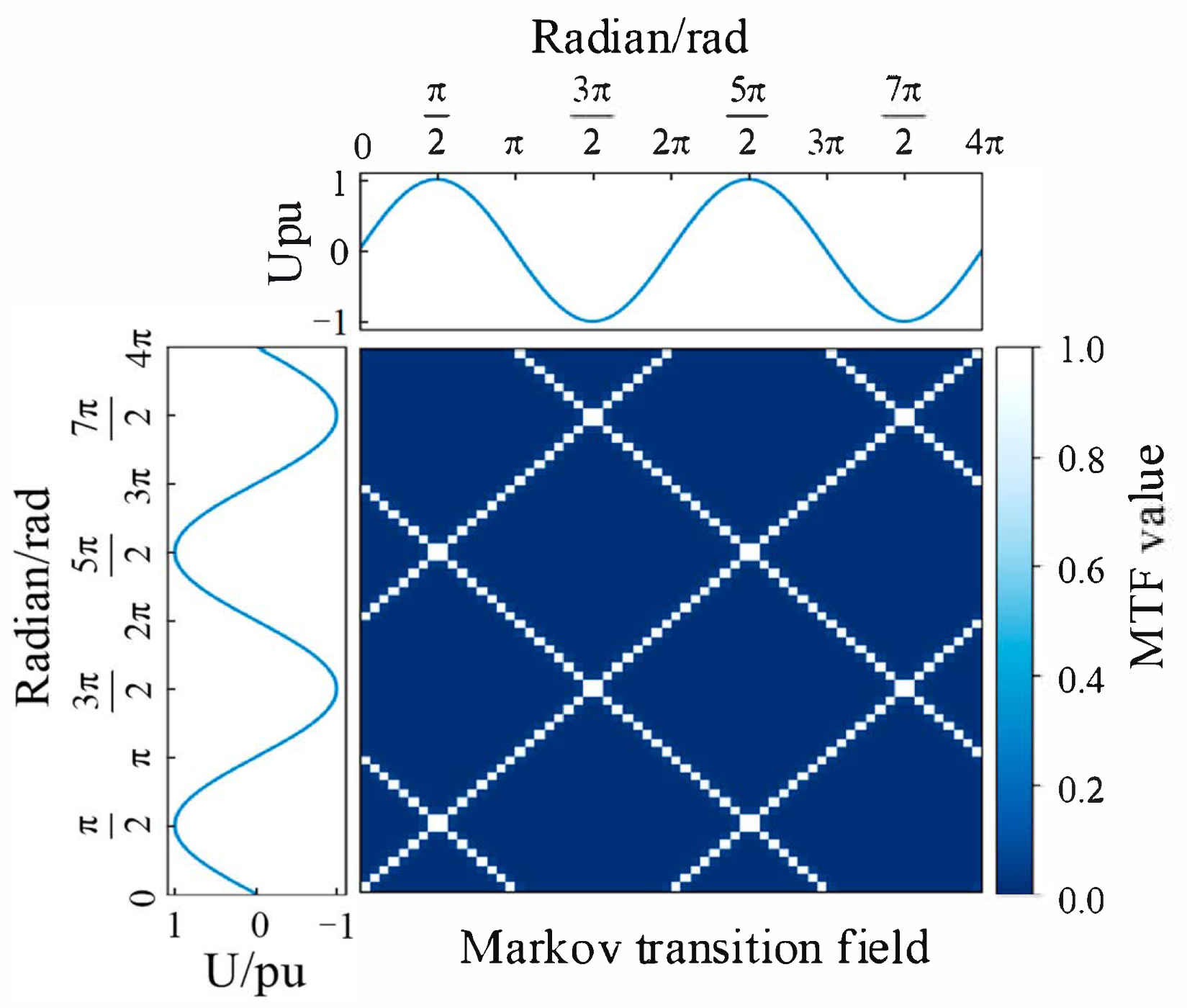
MTF is a method of transforming time series data into spatial image data [20,21]. It extends the Markov state transition matrix, describes the state transition matrix in order, retains the discrete time domain dynamic information, and finally uses the fuzzy core to generate a two-dimensional image. Let us take a voltage sinusoidal signal from a power system node as an example; the diagram of the MTF is shown in Figure 1.
The given sequence signal X = {x1, x2, …, xn} is composed of a sampling signal xi with n timestamps. The MTF method first divides the timing signal into Z regions according to the amplitude. The regions on one timestamp can be described as a vector bin, and each bin can be represented as qi (i = 1, 2, …, Z). Each sampling signal xi is mapped to the region qi. The partition strategy includes: uniform partition, quantile partition and normal distribution partition. Uniform partition indicated that each vector bin of each sample partition has the same amplitude width in each sample, quantile partition means that each vector bin of each sample partition contains the same number of sampling points, and normal distribution partition indicated that the sampling points contained in each vector bin conform to normal distribution.
Then, the transition probabilities of the sampling signals xi−1 and xi moving from the region qi to the region qj between consecutive time steps are computed. These transition probabilities serve as elements wij to construct the Markov state transition matrix, denoted by WT with Z × Z dimension. This matrix is formally presented in Equation (1), while the detailed specific expression for each element is given in Equation (2).
Equation (2) shows that the Markov state transition matrix is limited to calculating the probability of transition between consecutive time steps without the probability of the dynamics transition in time series data. To improve this problem, the MTF enhances the standard Markov matrix using a generated dynamic probability transition matrix MT, which can encapsulate transition dynamics across multiple time scales, as formulated in both Equations (3) and (4).
W T = w 11 w 12 w 1 Z w 21 w 22 w 2 Z w Z 1 w Z 2 w Z Z
W T = P ( x i q 1   |   x i 1 q 1 ) P ( x i q 1   |   x i 1 q 2 ) P ( x i q 1   |   x i 1 q n ) P ( x i q 2   |   x i 1 q 1 ) P ( x i q 2   |   x i 1 q 2 ) P ( x i q 2   |   x i 1 q n ) P ( x i q n   |   x i 1 q 1 ) P ( x i q n   |   x i 1 q 2 ) P ( x i q n   |   x i 1 q n )
M T = M 11 M 12 M 1 n M 21 M 22 M 2 n M n 1 M n 2 M n n
M T = w i j x 1 q i , x 1 q j w i j x 1 q i , x 2 q j w i j x 1 q i , x n q j w i j x 2 q i , x 1 q j w i j x 2 q i , x 2 q j w i j x 2 q i , x n q j w i j x n q i , x 1 q j w i j x n q i , x 2 q j w i j x n q i , x n q j
The MTF can be calculated using the following steps. First, the transition probabilities sequentially among {x1, …, xn} can be obtained by referring to the Markov transition probability matrix WT in Equation (2). For example, M12 represents the transition probability from x1 to x2, that is, the probability mapping from the quantile bin containing x1 to the quantile bin containing x2. And the corresponding transition probability wij can be identified from WT, then mapped to element 2 in row 1 in matrix MT; therefore, the n × n dimensions MTF can be constructed. Each element wij in MTF represents the transition probability of the time interval between |ij|; wij|ij|=1 indicates that there is only one interval in the transition process along the time axis; wii is a special case with a time interval of zero, which gives the probability of each quantile transitioning to itself, namely the self-transition probability [22].
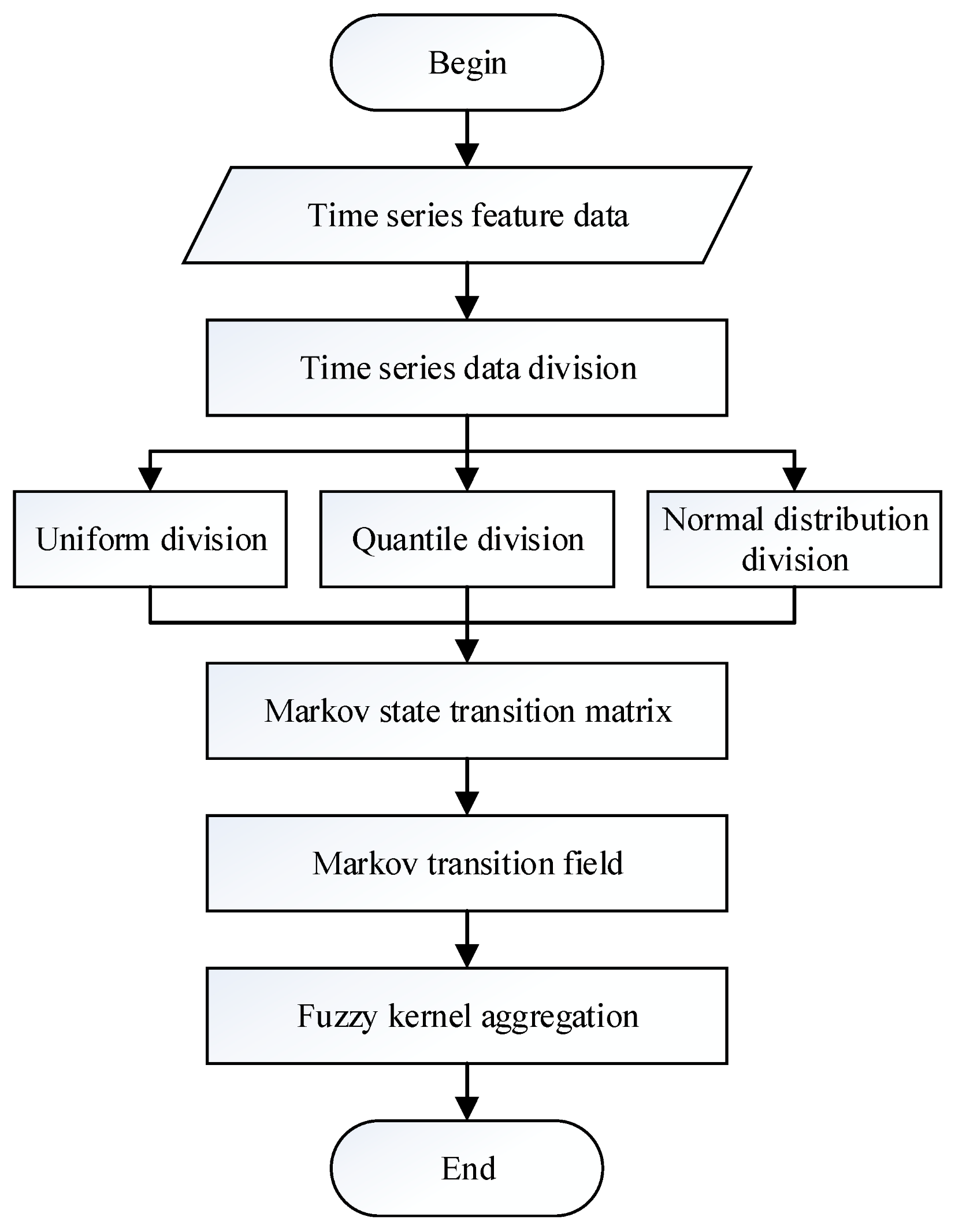
If n is rather large, to directly generate images from the original MTF would lead to excessively large images, which would result in constraints of large storage, high speed, and weak application in real-time analysis and control of power system. Therefore, a fuzzy kernel of size {1/m2}mm is applied to average each non-overlapping pixel block, thereby obtaining an aggregated two-dimensional image of the MTF with dimensions mm. This aggregated image of dynamic transition probabilities is then used as the input image model for transient stability assessment. The detail process of MTF conversion is illustrated in Figure 2.

2.2. Construction of Power System Transient Stability Features

2.2.1. Construction of Power System Transient Simulation Model

The primary objective of transient stability assessment is to determine whether all generators maintain synchronism following a large disturbance. According to the National Energy Administration’s security and stability guidelines, transient stability is the capability of a synchronous generator to remain in synchronism and transfer to a new steady state or return to the original state after a large disturbance. In practice, this is determined by whether the power angle of generators exhibits decaying oscillations in both the first and the second swing.
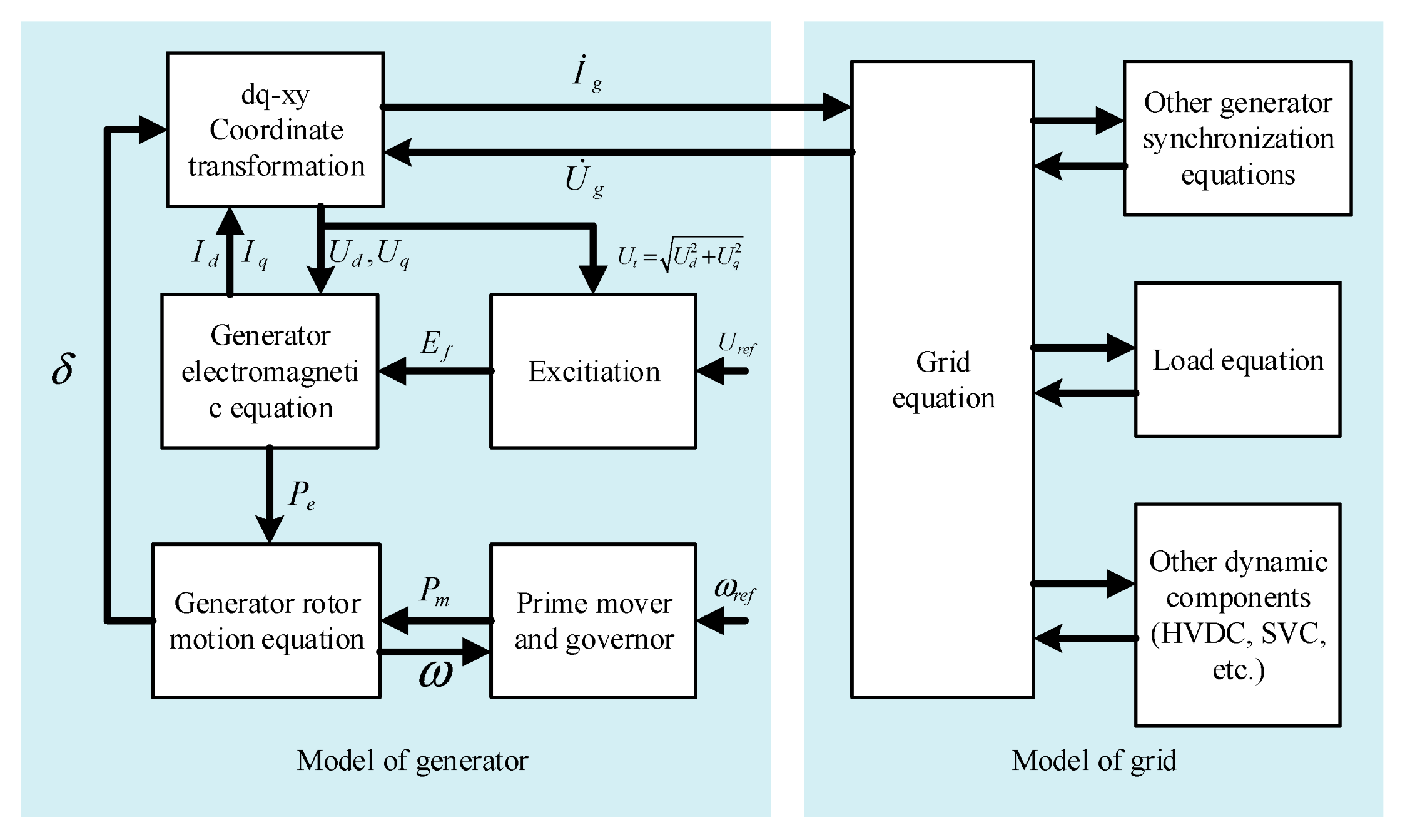
Transient stability analysis is usually performed using the electro-mechanical transient model. The overall mathematical framework is illustrated in Figure 3. This stability mechanism is typically described by differential-algebraic equations, as shown in Equation (5).
x ˙ = f ( x , y ) 0 = g ( x , y )
where x is the state variable of the system; y indicates the algebraic variables of the system; f represents the differential equations of the dynamic components; and g represents the algebraic equations of the static grid.
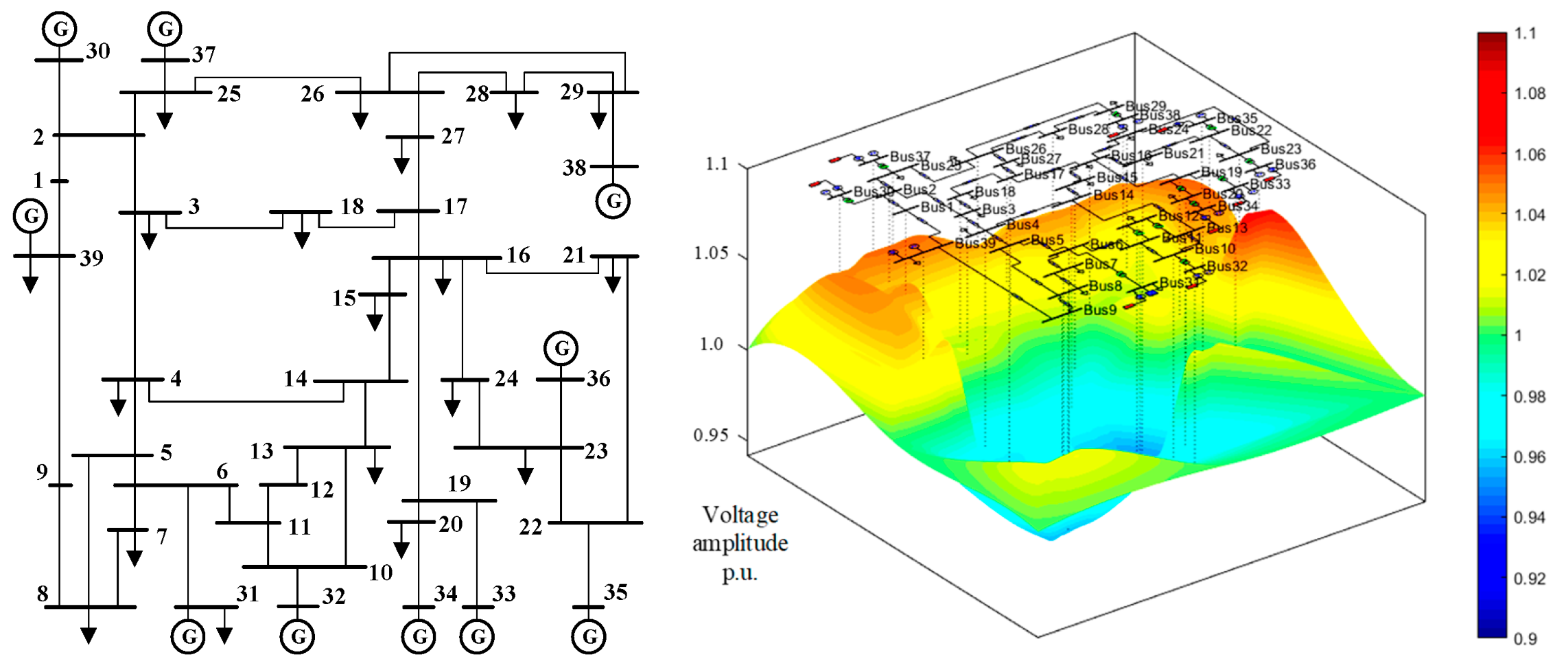
The influence and analysis of various feature sets was researched using the IEEE 10-generator 39-node benchmark system as an example. The diagram of the IEEE 10-generator 39-node benchmark system and node voltages at the steady state is shown in Figure 4.

2.2.2. Construction of Power System Features

When a power system experiences a serious disturbance, an imbalance arises between the mechanical power output of the prime mover and the electromagnetic power of the generator. This imbalance applies either positive or negative acceleration to the rotor, leading to significant changes in the rotor angle. When these changes are reflected in the system, the power angles (the angle difference between internal potential to terminal voltage) of the generators are undergoing relative swings, the grid is undergoing oscillation, and a generator may even lose synchronism.
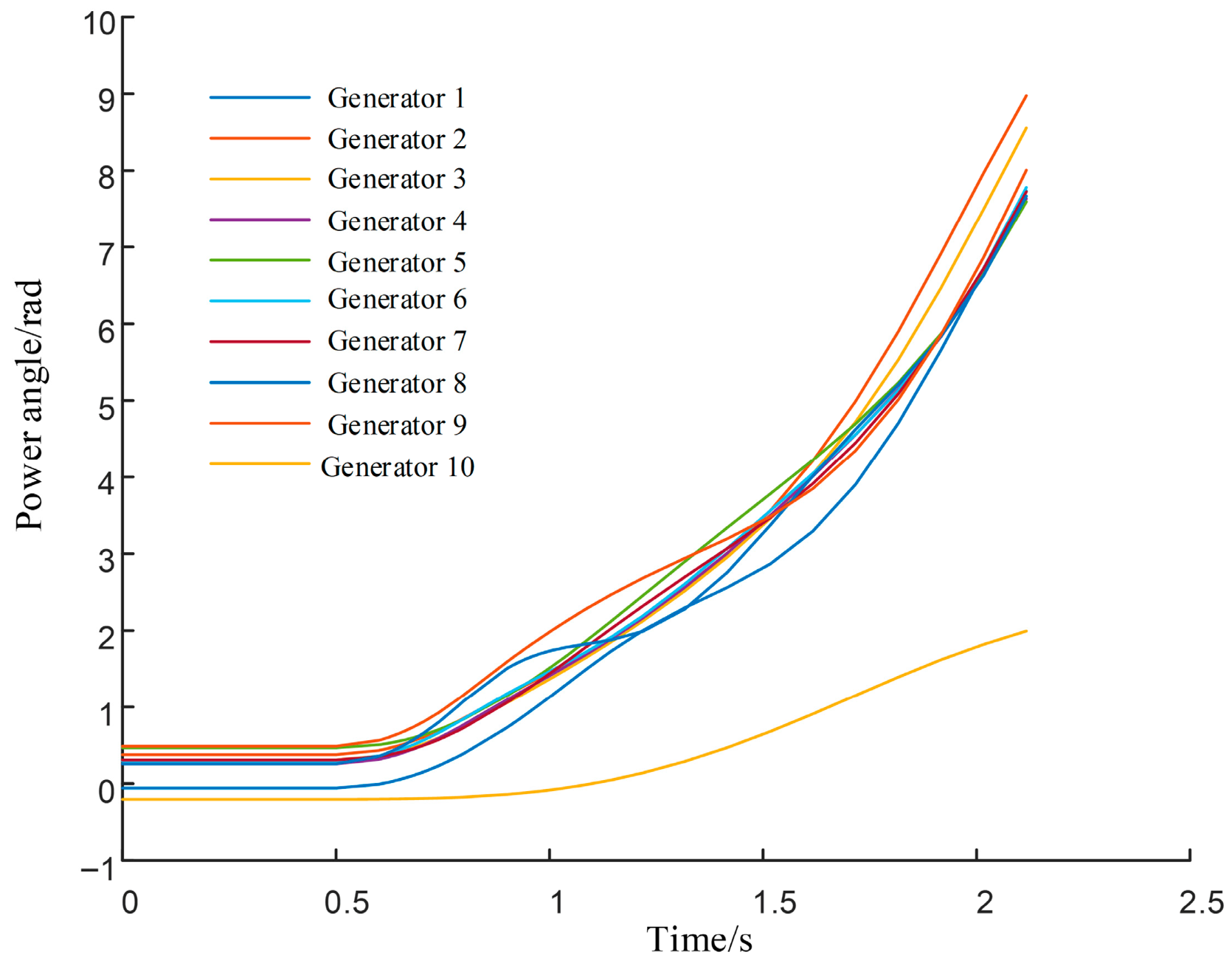
For example, if a three-phase short circuit occurs at the terminal of node 2 in the IEEE 10-generator 39-node system, and the fault is not cleared in time, there is a change in the power angle, as shown in Figure 5. It is shown that the maximum power angle difference of the generators continues to increase, preventing the generators from maintaining synchronism and ultimately leading to system instability.
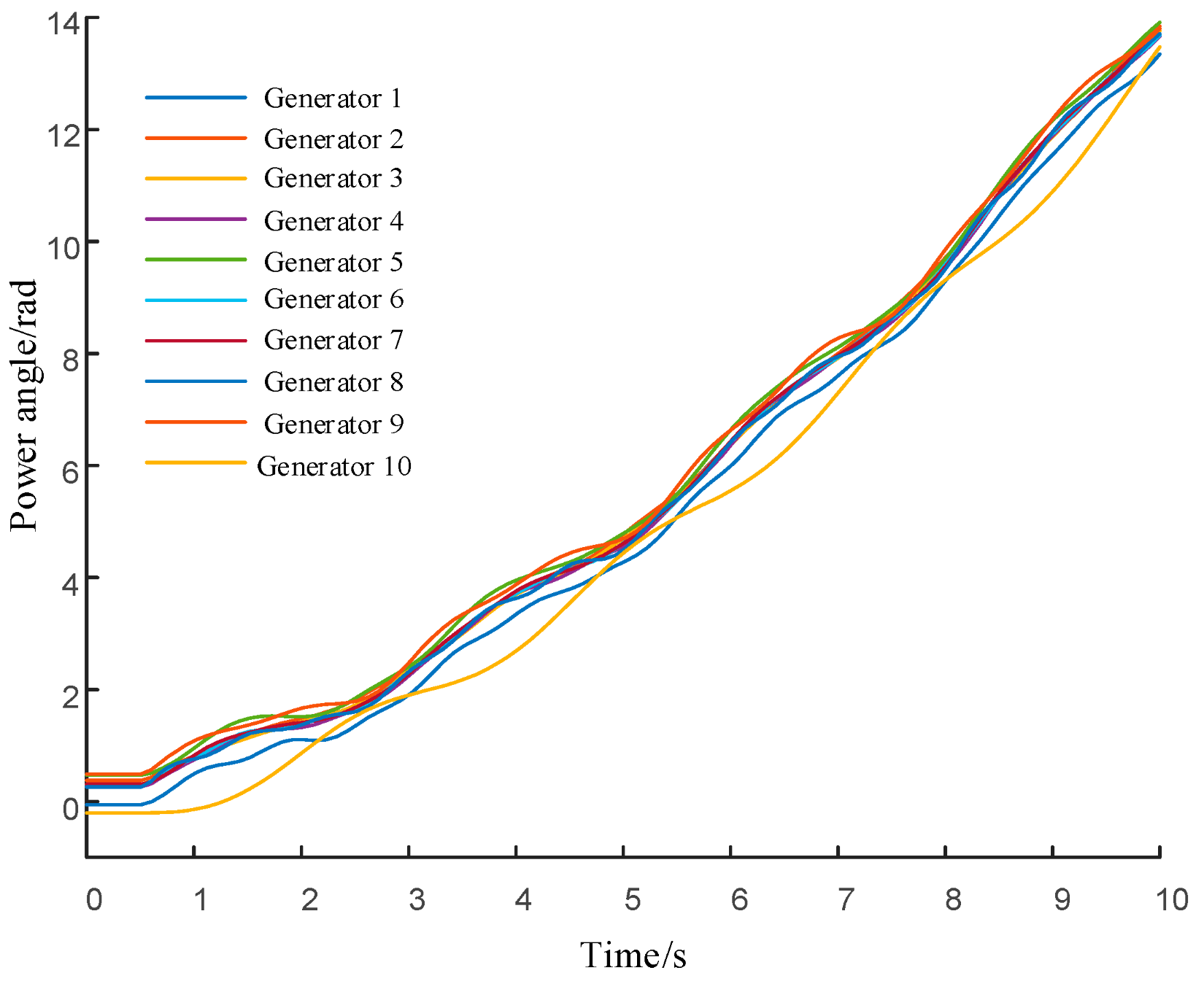
If three-phase short circuit fault is cleared in time, a change in power angle occurs as shown in Figure 6. As shown, once the fault is removed promptly, the power angles of the generator can still maintain synchronous variation. The variation in the generator rotor state is an important reference indicator for evaluating the transient stability of the power system; therefore, changes in both the power angle and angular velocity are key factors concerned in transient stability assessment. In addition, both the active and reactive power output of synchronous generators is also related to the transient stability of the system.
The basic feature set of a synchronous generator should include:
Feature quantity G1: the power angle δi,t of generator i at time t during a fault, which refers to the phase angle difference between the excitation electromotive force and the terminal voltage of the generator.
Feature quantity G2: the rotor angular velocity ωi,t of generator i at time t during a fault.
Feature quantity G3: the active power output pi,t of generator i at time t.
Feature quantity G4: the reactive power output qi,t of generator i at time t.
Feature quantity G5: the active power output pi,st of each generator in the steady state before the fault occurs.
Feature quantity G6: the reactive power output qi,st of each generator in the steady state before the fault occurs.
The derived feature set of a synchronous generator includes:
Feature quantity G7: maximum power angle difference in generator set when the fault is cleared:
G 7 = δ max δ min | t c l
Feature quantity G8: maximum difference in rotor angular velocity of generator set when the fault is cleared:
G 8 = ω max ω min | t c l
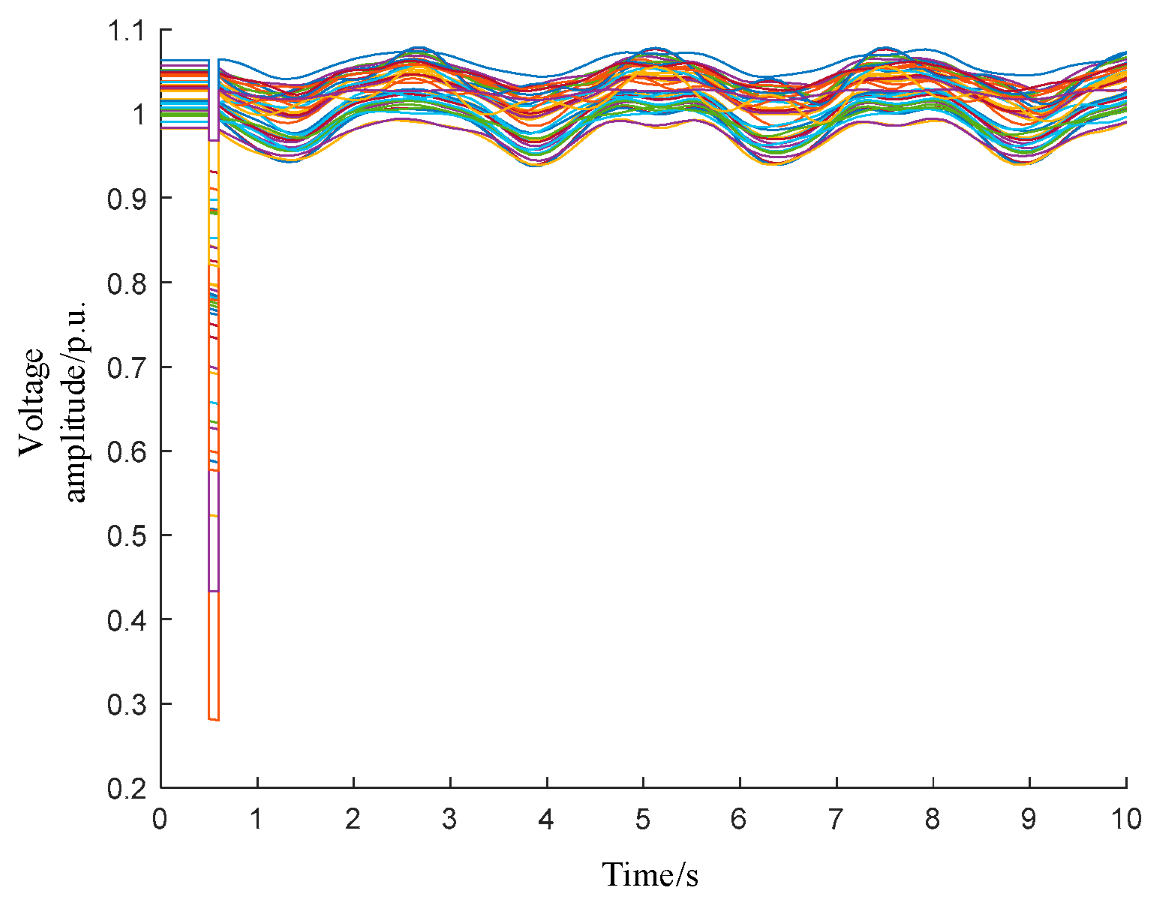
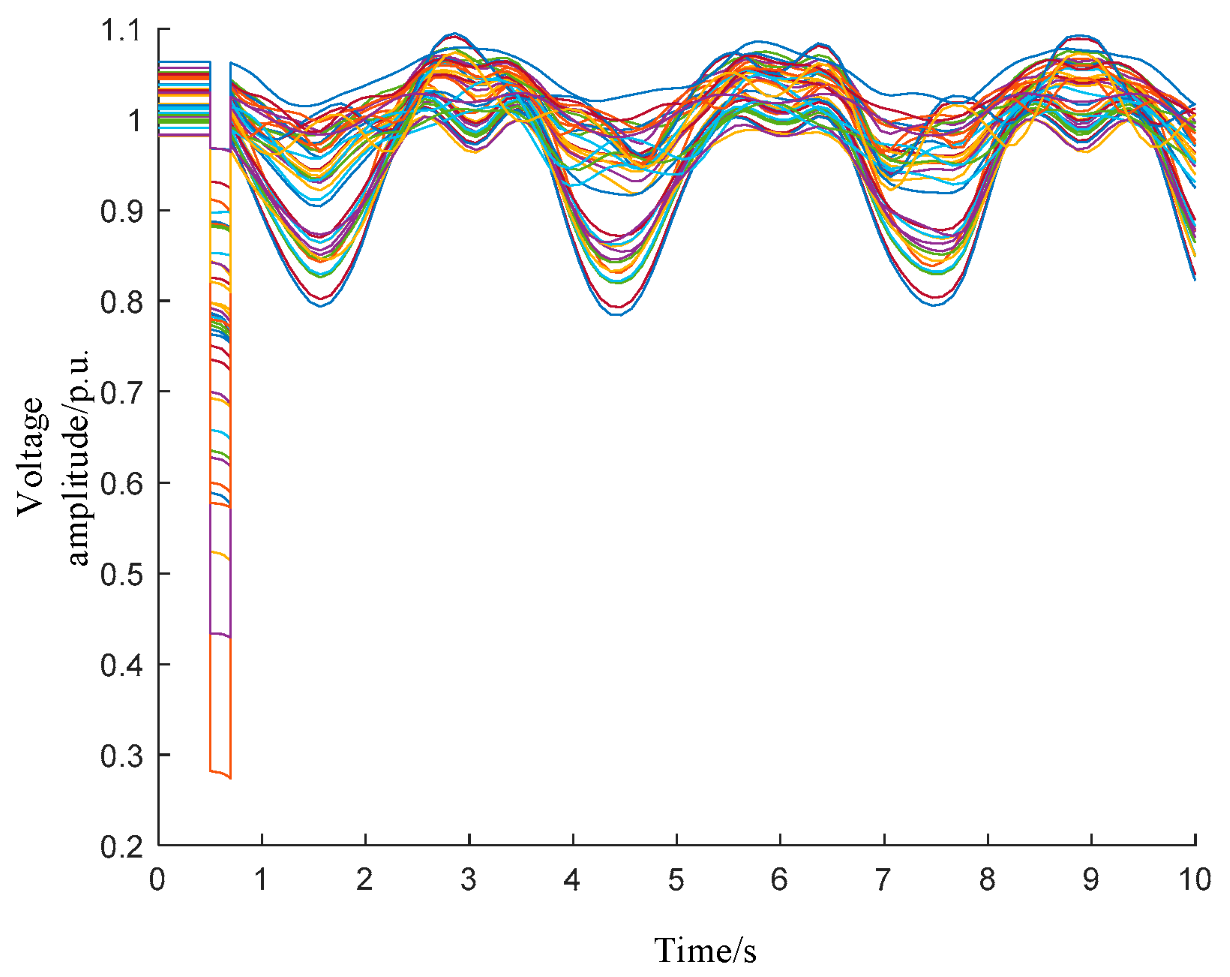
As an important component of the power system, the feature quantities of nodes and the topology of the grid can certainly influence transient stability. For example, in terms of the node voltage in the same system above, when a three-phase short circuit occurs at the outlet of node 2, Figure 7 illustrates the change in node voltage after fault clearance at 0.1 s, and Figure 8 illustrates the change after fault clearance at 0.2 s. This shows that the later the fault is cleared, the greater the impact on the power system and the more unstable the voltage becomes. If the fault is cleared too late, it may even lead to voltage collapse.
Therefore, the node voltage after fault clearance can also reflect the overall state of the system to a certain extent, reflecting a certain correlation with the transient stability condition.
The basic feature set of a grid includes topological structure features and power flow features. However, if all branch data are included in the feature set, the number of feature quantities becomes excessively large. This is especially true in large-scale grids, which increase significantly, leading to issues such as difficulties in model training, which requires a substantial increase in the number of training samples. Therefore, this paper converts branch power into node injection power to construct the feature set.
The feature set of grid power flow includes the following:
Feature quantity K1: the voltage amplitude uK|(j,t) of node j at time t.
Feature quantity K2: the voltage phase angle QK|(j,t) of node j at time t.
Feature quantity K3: the active injection power pK|(j,st) of node j in steady state.
Feature quantity K4: the reactive injection power qK|(j,st) of node j in steady state.
The power grid topological structure feature set includes the following:
Feature quantity K5: the connection status of each branch, either 0 or 1, which only reflects the initial line connection state.
The derived feature set of the power grid includes the following:
Feature quantity K6: the change in voltage amplitude between the fault occurrence time and the fault clearance time, as expressed in Equation (8).
K 6 = u K ( j , t c l ) u K ( j , t 0 )
Feature quantity K7: the change in voltage phase angle between the fault occurrence time and the fault clearance time, as expressed in Equation (9).
K 7 = θ K j , t c l θ K j , t 0

3. Results and Discussion

3.1. Transient Stability Evaluation Model Based on MTF Dual-Modal Fusion

3.1.1. Multi-Modal Fusion Theory

Multi-modal DL is a sub-field of machine learning that focuses on modeling the relationships among different types of data (modalities). By jointly learning from multiple modalities, these models can form a more comprehensive understanding of the target task, as each modality provides distinct and complementary feature representations. Extracting task features from multiple perspectives can therefore significantly improve overall model performance [23].
The main task of multi-modal fusion is to reduce heterogeneity across modalities, improve model performance by integrating different types of features, and preserve the distinctive features of each modality. The power grid exhibits diversified features; however, heterogeneous sources such as images are often not exploited simultaneously, which underscores the research significance of multi-modal fusion.
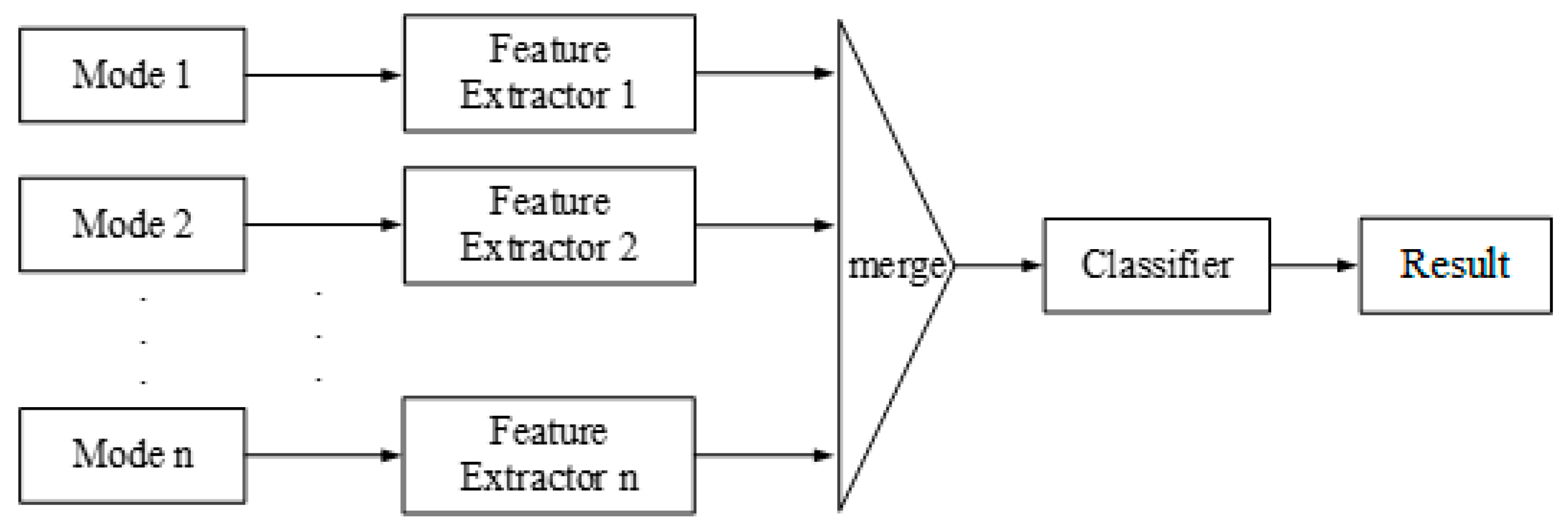
Joint architectures are widely used in multi-modal fusion, and are close to the modeling requirement in this paper. Their basic principle is to map the spatial features of multiple different modalities to the same subspace, where they can be further fused. As shown in Figure 9, feature extractors first encode the corresponding inputs, and the resulting representations are then mapped into a common fusion space. This architecture is already well-suited to multi-modal classification and regression tasks, including fault detection, state analysis, and waveform recognition, and its strong performance has also been demonstrated.
Therefore, a joint architecture as shown in Figure 9 is adopted in the study of the fusion of time series features and image features in this paper.

3.1.2. Model Architecture Design

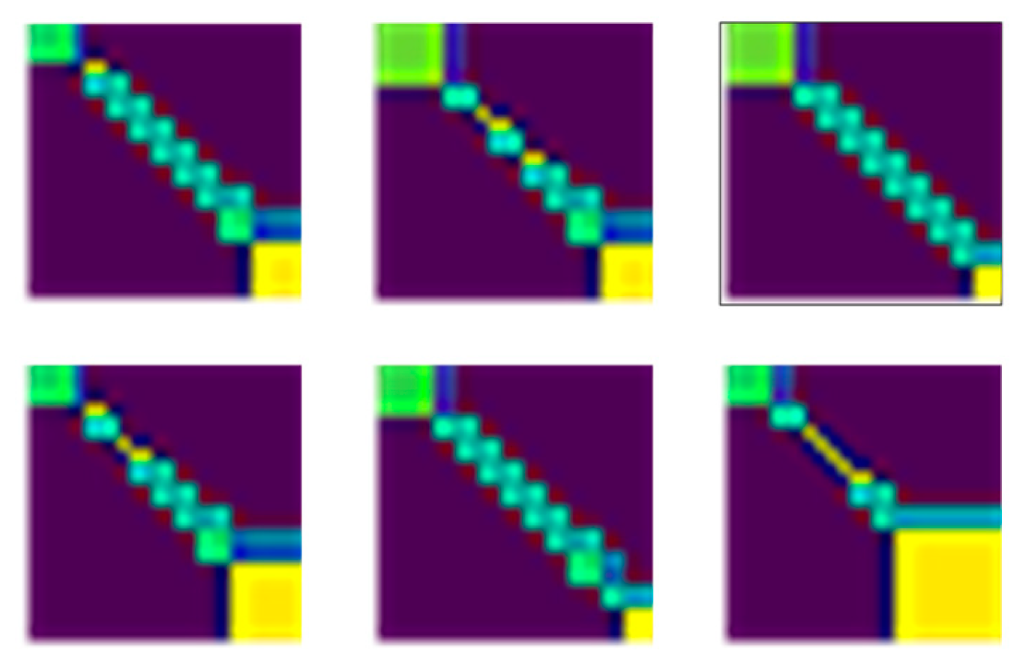
Using the MTF method, the maximum power angle difference during the transient evolution of the grid is transformed into an image representation. The time series correlation captured in the image not only represents simple sequential ordering, but also characterizes transitional relationships between any given time instant and all others. In this paper, the time series data span 0.5 s and are sampled at 50 Hz, so the MTF has dimensions of 25 × 25, as shown in Figure 10.
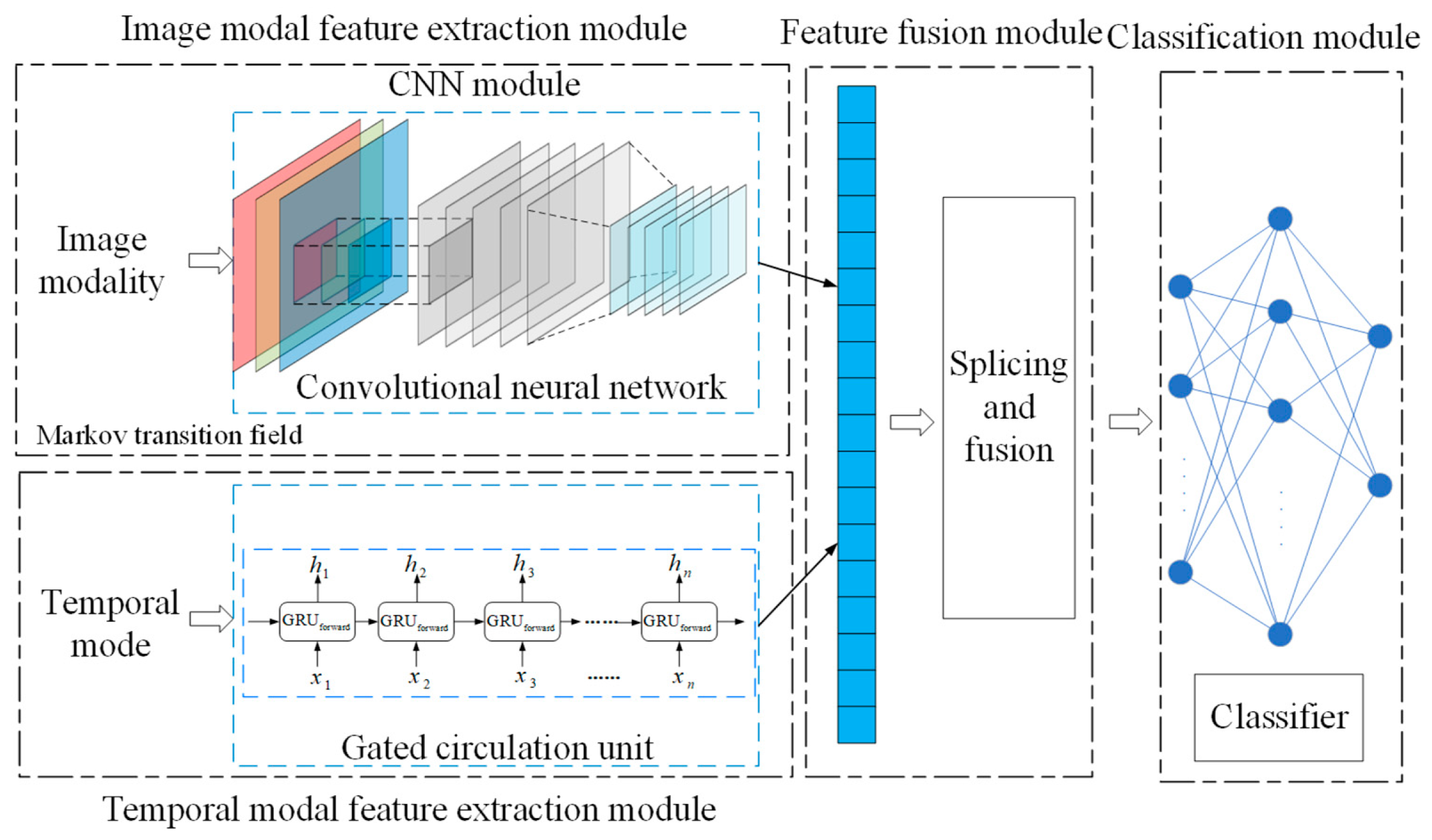
The dynamic trajectory of the maximum power angle difference, which is directly related to the transient stability criterion, is first converted into an MTF-based image modality following the procedure described above. The time series modality is then constructed from the time series features listed in Table 1, and the obtained MTF-based dual-modal fusion model is shown in Figure 11. That is, the extracted features of image modality are obtained by using a CNN-based method for image features extraction and the extracted features of the time series are obtained by using a GRU-based method for model time series feature extraction. These feature vectors are then fused using concatenation fusion, and the output of the fusion layer is directly used as input into a classifier to determine the transient stability status of the power system.
The CNN model includes two convolution pooling layers. Each convolutional layer adopts 64 filters, a 2 × 2 kernel, and a ReLU activation function. Each pooling layer adopts a 2 × 2 pooling kernel. The GRU model has a three-layer architecture, with 100 neurons in each layer. Concatenation fusion is implemented using the Concatenate function in Python 3.10. The final classifier uses the Softmax activation function, and the overall model is trained with the cross-entropy loss function. The parameters of the MTF fusion model are shown in Table 1.

3.2. Case Study Analysis

3.2.1. Sample Set and Model Parameters

The sample dataset in this study is generated by time domain simulations using MATLAB/PSAT 2.1.8. The deep learning models are implemented and trained in Python/Tensor Flow 2. All experiments are conducted on a workstation equipped with an RTX 4060 GPU, an Intel Core i5-13500HX CPU, and 32 GB of RAM.
The fault configuration mainly includes the fault location and the fault duration. The fault location of a three-phase short circuit is applied at either the sending end or the receiving end of the line at 0.5 s, and the fault duration is set within the range of 0.1–0.3 s. The total simulation time is 10 s, with a simulation time step of 0.02 s. The data within 0.5 s after fault inception are recorded with a step of 0.02 s and are used as the collected time series data. The fault will be cleared by tripping the faulted line. Meanwhile, different load levels can also have a significant impact on the results. Therefore, the initial load at each node is randomly varied within 75–125% of the base load with a step of 1%, and the generator outputs are adjusted accordingly. All samples satisfy power-flow convergence and static security constraints.

3.2.2. Model Training and Test Results

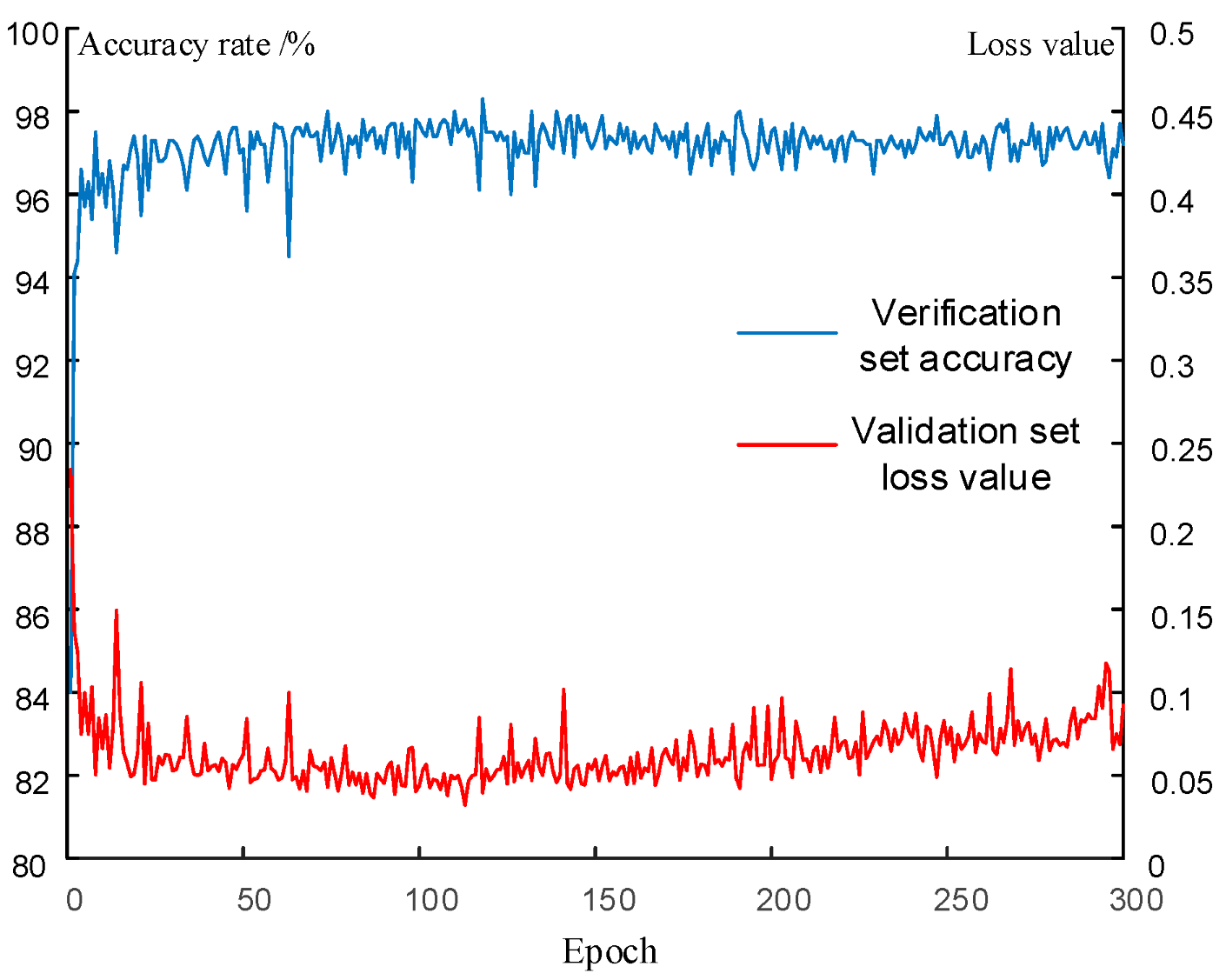
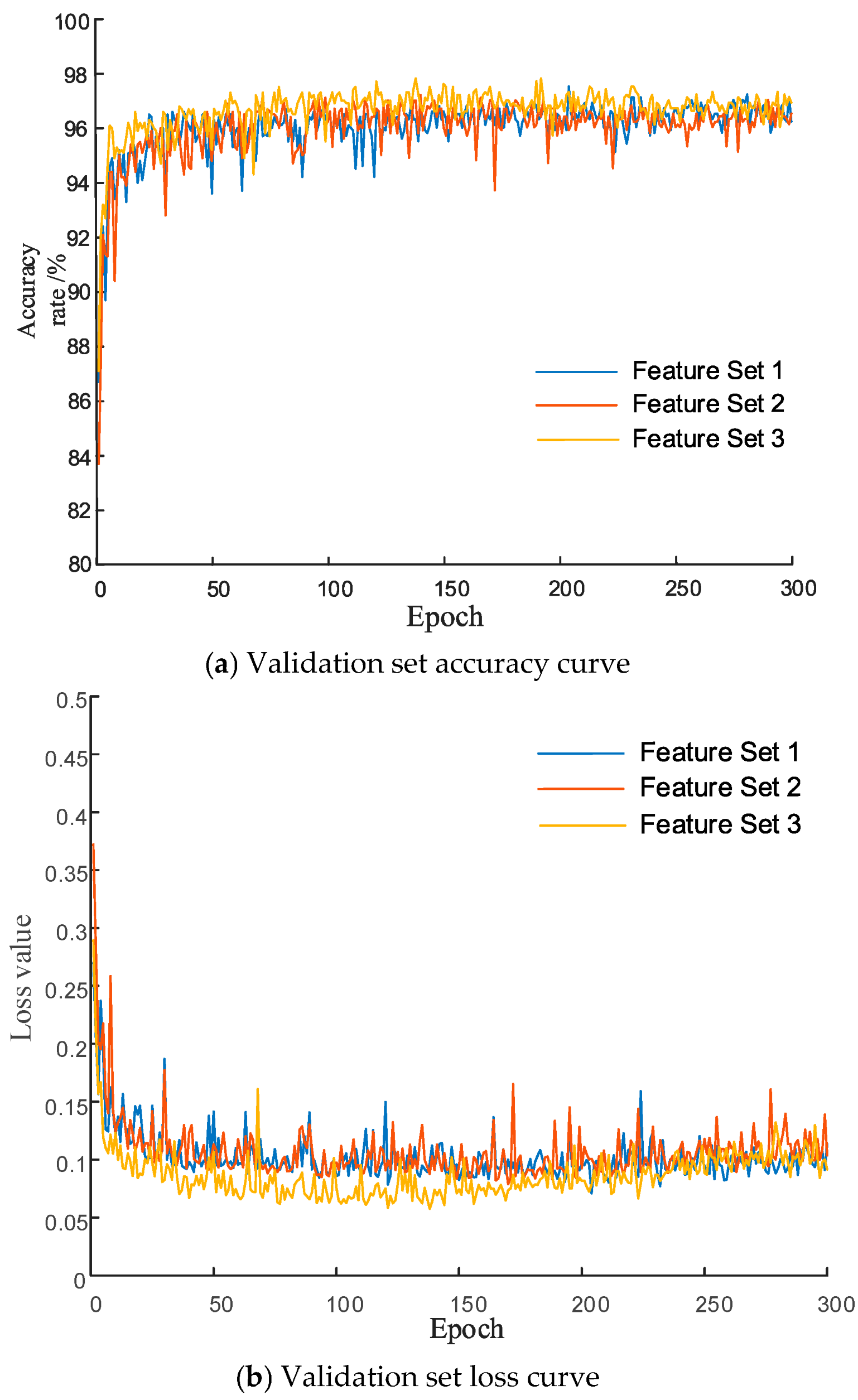
The MTF fusion model is validated using the sample set generated from the constructed IEEE 10-machine 39-node system. The model developed in Section 3.1.2 is trained for 300 epochs on a training set containing 8000 samples, and the validation set accuracy and loss are shown in Figure 12.
As shown in Figure 12, the model already performs almost at its best at about around 120 training epochs. However, after 120 epochs, the loss begins to increase slightly. Therefore, it is reasonable to set 150 as the optimal number of training epochs for this model.
Then, a total of 1000 samples are fed into the trained MTF fusion model for evaluation, and the evaluation procedure takes 0.297 s in total. It is reasonable to assume that the average time taken is 0.297 ms, which is the transient stability assessment time for a single sample and satisfies the requirements for online assessment. The detailed evaluation parameters and results are as follows:
G m e a n = 1 M A 1 C A
Feature Set: MTF and time series feature set; Evaluation Model: MTF fusion model; Acc/%: 97.80 (Accuracy, reflects the overall transient stability prediction situation of the model); MA/%: 3.15 (Misjudgment rate, the ability of the model to identify unstable samples); CA/%: 1.76 (Error judgment rate, the ability of the model to identify stable samples); Gmean: 0.9754 (Gmean is defined in Equation (10)).
As shown in Table 2, the MTF fusion model achieves an accuracy of 97.80% and a Gmean of 0.9754. In addition, the misjudgment rate and error judgment rate of the MTF fusion model are both low, so it can reliably recognize transient stability. The performance of the MTF fusion model is slightly better than that of the additive fusion model, but slightly worse than those of the concatenation fusion and tensor fusion models. However, it is still better than that of the single model, showing that the fusion of MTF image modality data and time series modality data offers a clear advantage.
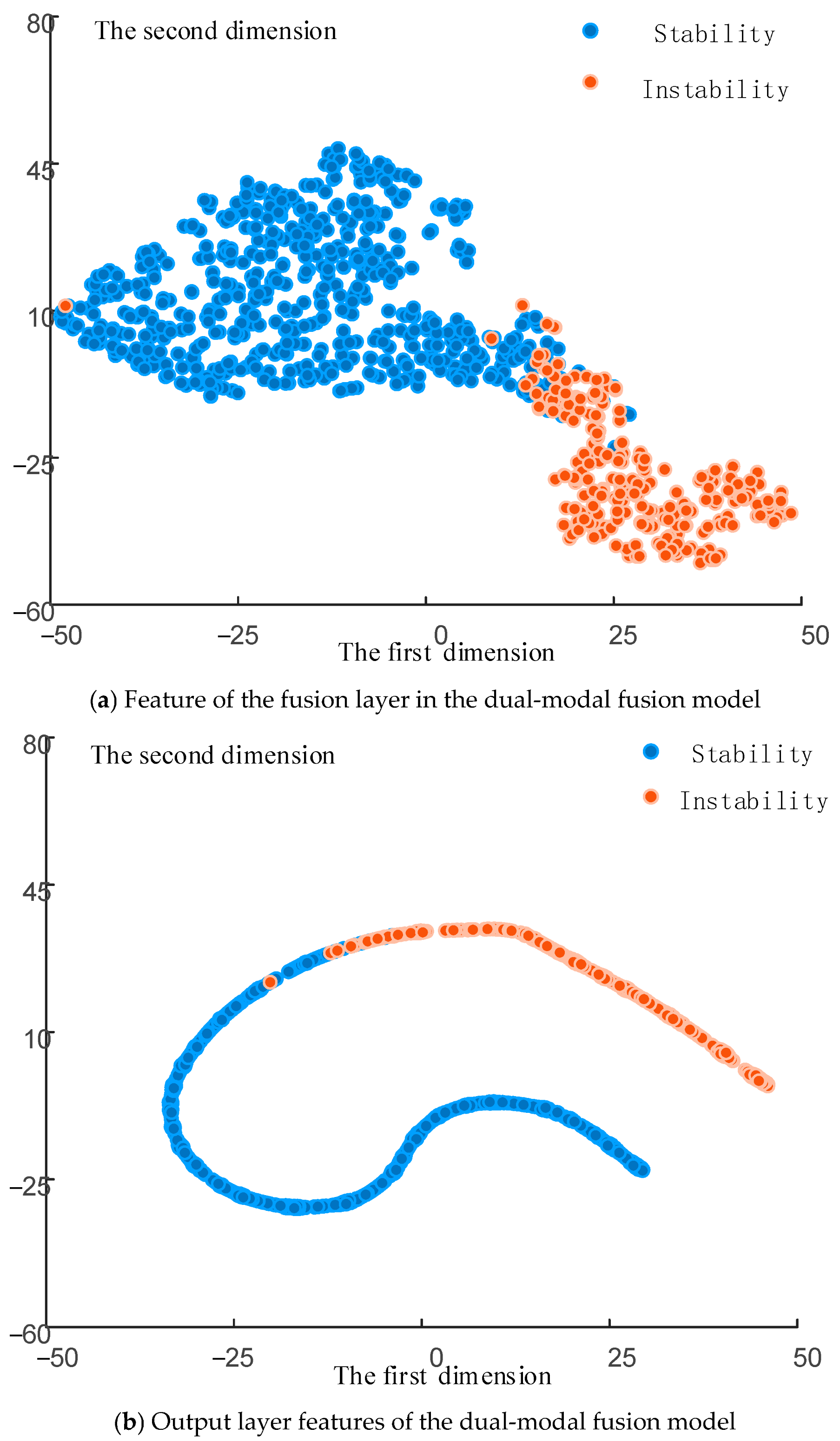
The relationship between the transient stability features extracted by the MTF fusion model and the transient stability can be visualized through t-SNE (t-Distributed Stochastic Neighbor Embedding, a nonlinear dimensionality reduction algorithm) in Figure 13. It can be seen that the MTF fusion model has good feature extraction and fusion capability, and that stable and unstable samples can be relatively clearly separated at the fusion layer. However, a portion of the samples still cannot be distinguished. On the one hand, these samples are in a critical state, which means that the system operating condition lies near the boundary between stability and instability; on the other hand, the MTF fusion model is unable to describe such critical states in sufficient detail.
In addition, Figure 13b showing the output layer features of the dual-modal fusion model reveals a few samples with pronounced deviations, which can be attributed to model fitting issues; in regions where the decision boundaries overlap, the difficulty in classification is mainly caused by samples in critical states that the model cannot accurately distinguish.

3.2.3. Analysis of the Impact of Different Feature Sets

To compare the impact of different feature sets on DL models, different feature sets are constructed as described in Section 3.1.1, as shown in Table 3.
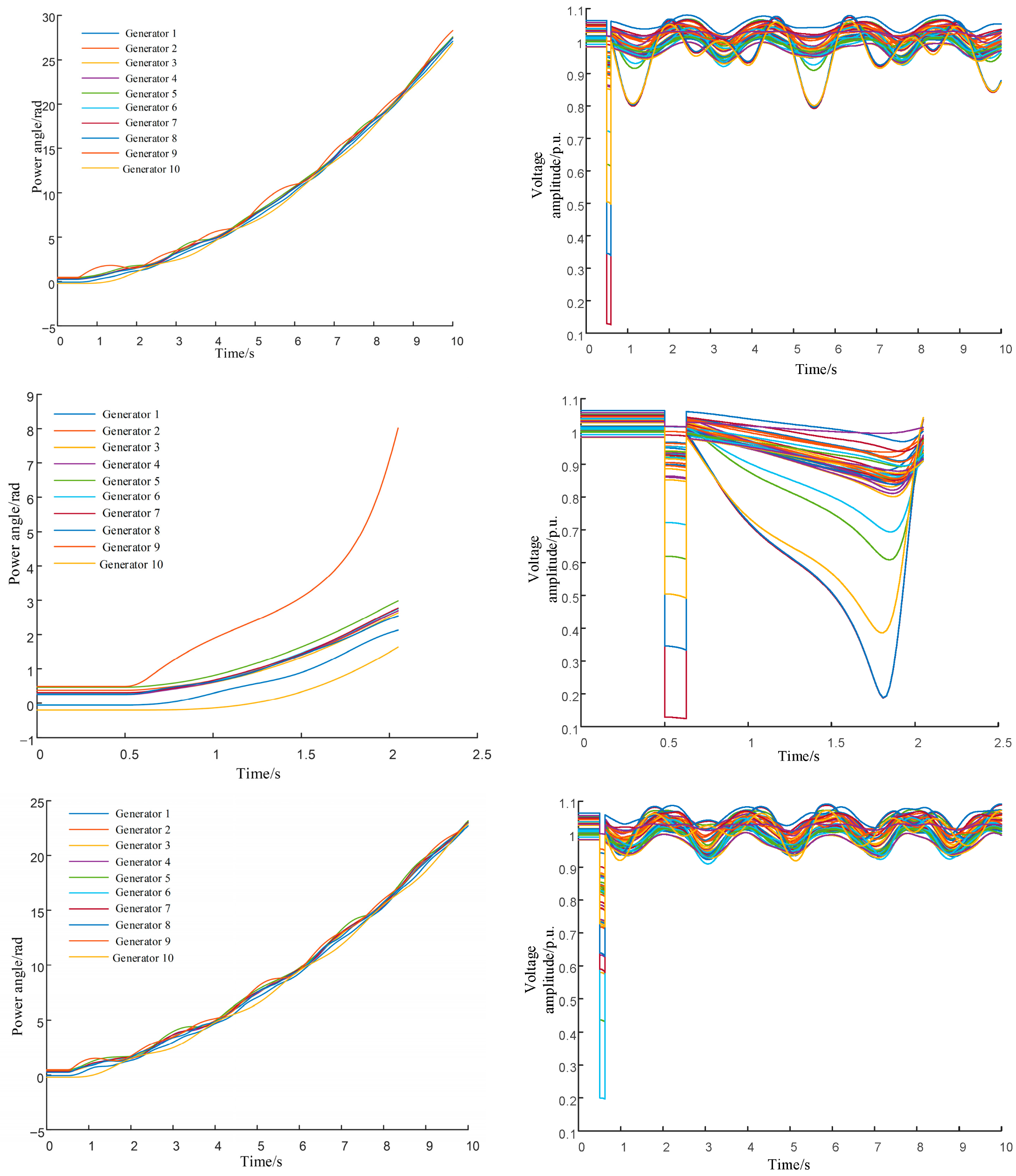
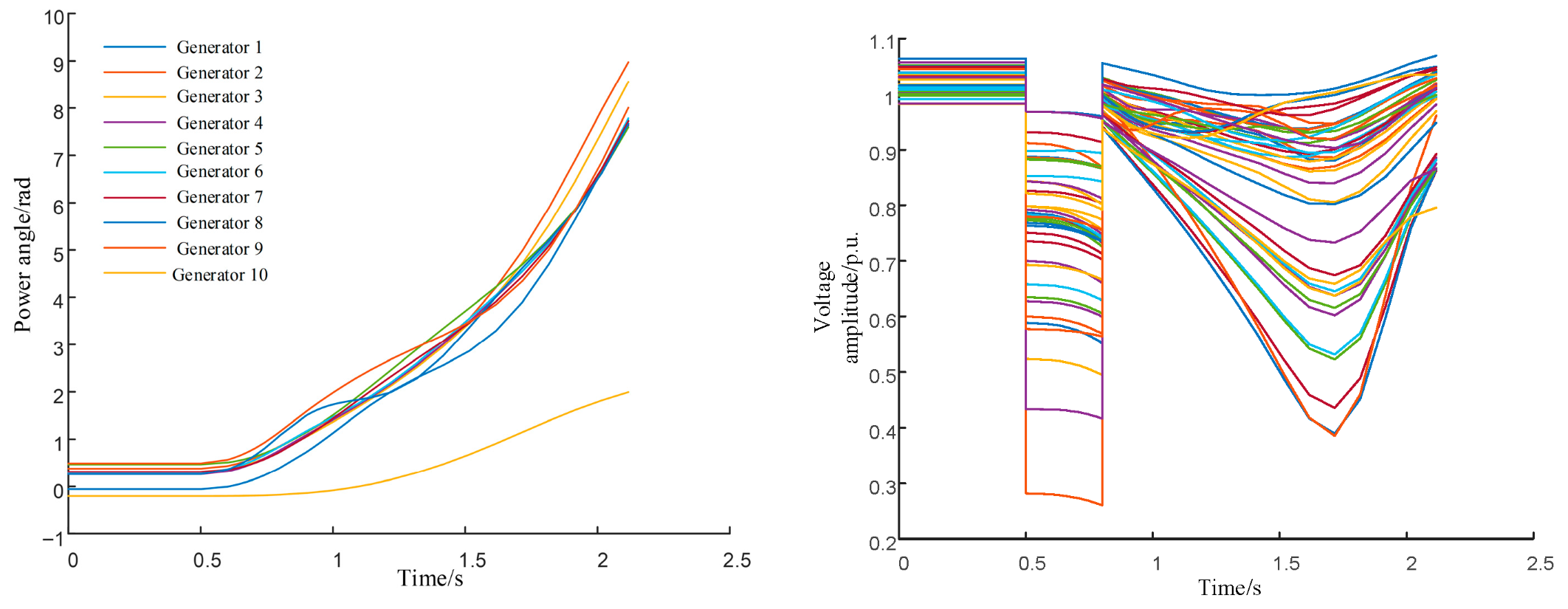
Through time domain simulation, 10,000 sets of sample data of the IEEE 39-node system that met the conditions were obtained. The two sets of sample data were shuffled and divided into training, validation, and test sets in an 8:1:1 ratio. Typical cases are shown in Figure 14.
To compare the effect of each individual feature set on DL-based transient stability assessment, appropriate DL models are applied to each feature set separately for validation and analysis. The GRU model is trained, validated and tested using feature sets 1 and 2 in Table 1, which reflects the influence of dynamic features on transient stability assessment. The MLP model is trained, validated and tested using feature set 3, which reflects the relationship between static features and transient stability assessment.
The GRU model adopts a two-layer structure with 100 neurons in each layer, and the Dropout rate is set to 0.2; the corresponding model parameters are listed in Table 4. The MLP model employs a four-hidden-layer architecture with 256–256–128–64 neurons, and uses the ReLU activation function; its parameters are listed in Table 5. For both models, the output classifier uses the Softmax activation function and cross-entropy loss function. The training batch size is set to 256, and the number of training epochs is set to 300.
After the constructed feature sets are inputted into the built DL model and the model is trained, the accuracy rate of the validation set and the model loss value curves are determined, as shown in Figure 15.
As shown in Figure 15, the accuracy curves for the three feature sets increase steadily and remain essentially stable, with no overfitting observed. This indicates that the input features are effective, the model parameters are appropriate, and the constructed feature sets are strongly correlated with the transient stability status. When feature sets 1 and 2 are used, the loss decreases and then stays at a low level, and the model is stable and converges smoothly. For feature set 3, the loss reaches its minimum after about 150 training epochs, also indicating a strong correlation with the target. Although the loss curve increases slightly in subsequent epochs, it remains at a relatively low level, suggesting that the number of training epochs for the model using feature set 3 should be set to around 150 to achieve a more appropriate training result. After hyper parameter tuning, the best-performing model is selected and evaluated on the test set, and the final results of the DL model are listed in Table 6.
From Table 6 it can be seen that, although the overall differences are small, the transient stability assessment accuracy obtained, using the feature set constructed only from synchronous generator features, reaches 96.80%, and the other evaluation metrics are slightly better than those of the feature set constructed only from power grid features. This indicates that the time series dynamic feature sets of both synchronous generators and the power grid are strongly related to the system transient stability assessment and can effectively reflect whether the system is transiently stable or not. The static feature set includes features from both synchronous generators and the power grid. Although its overall assessment accuracy reaches 96.60%, its misjudgment rate (MA) is 8.58%, indicating a relatively high level of misjudgment. The Gmean under the static feature set is 0.9506, which is slightly lower than the Gmean obtained from the other feature sets. This is because the static feature set ignores the time series features of the system and cannot accurately and comprehensively represent the dynamic process of the system, resulting in abnormal evaluation metrics. As shown in the results above, the MTF fusion model achieves an accuracy of 97.80% and a Gmean of 0.9754, which is a significant improvement compared to the single model.
In summary, each individual feature set can accomplish the transient stability assessment with an accuracy of approximately 96.5%. This confirms that the synchronous generator time series feature set, the power grid time series feature set and the static feature set constructed in Section 3.1.2 are all strongly correlated with the system’s transient stability status, and verifies the feasibility and effectiveness of these feature sets.

3.3. Discussion

As for the requirements for the information collection and processing system, as well as communication channels, their bandwidth, allowable delays, and other information, the engineering scenarios will be discussed briefly. Obtaining data is relatively easy in model training, but will be difficult in online applications. It is possible that misjudgment will occur in online evaluation if the data deviation is a little larger. However, the loss of a small amount data will not affect the overall judgment, which is an advantage of artificial intelligence compared to traditional methods. Further information on the types of various disturbances and the maximum duration, as well as their impact on the transient stability of power systems, can be found in Ref. [24]. Furthermore, the hardware requirements are relatively lower in the proposed method. The economic efficiency is ensured because the data is commonly used and additional investment is avoided. Of course, a significant amount of data is required, and the method should be combined with existing methods in future engineering. Finally, the evaluation results of the current method are always conservative as a result of computing power and unknown factors, and economic benefits would be affected; therefore, the conservative conclusions will be improved upon when using the proposed method.

4. Conclusions

This paper analyzes the features of transient stability assessment applicable to deep learning. Firstly, three feature sets, namely time series, static, and topological domain, are constructed based on synchronous generator features or power grid features. Secondly, the time series and static feature sets are analyzed using GRU and MLP models respectively, and the effectiveness of the feature sets above is proved. Then, the performance of transient stability assessment using individual feature sets is compared, and it is demonstrated that each individual feature set exhibits strong relevance to the transient stability assessment. Finally, a novel transient stability assessment method based on MTF feature fusion is proposed. The MTF method transforms key time series features into multi-scale correlation image modal data, accounting for interdependencies among time series data at different instants and refining time series feature relationships. CNN and GRU models are employed to extract features from the image modality and time series modality respectively, and the resulting features are concatenated for fusion. It is indicated by model training, validation, and testing that the MTF fusion method adopting the two modalities achieves superior performance in transient stability assessment.

Author Contributions

Conceptualization, M.Y. and Q.C.; methodology, B.Q., Z.H. and Z.S.; software, B.Q., Z.H. and Y.D.; writing—original draft preparation, Z.S. and L.Z.; writing—review and editing, Q.C. and M.Y.; visualization, Y.D. and L.Z. All authors have read and agreed to the published version of the manuscript.

Funding

This article is supported by the Key Project of National Natural Science Foundation of China (51837004) and the Scientific and Technological Project of the Former Collective-owned Enterprises of State Grid Zhejiang Electric Power Co., Ltd. (521148250001).

Data Availability Statement

The original contributions presented in this study are included in the article.

Conflicts of Interest

Authors Min Yan, Zhihua Huang, Lei Zhang and Yifan Ding are employed by the State Grid Huzhou Power Supply Company. The remaining authors declare that the research was conducted in the absence of any commercial or financial relationships that could be construed as a potential conflict of interest.

Abbreviations

The following abbreviations are used in this manuscript.
AIArtificial Intelligence
DLDeep Learning
MTFMarkov Transition Fields
CNNConvolutional Neural Networks
TDSTime Domain Simulation
TEFMTransient Energy Function Methods
PCAPrincipal Component Analysis
ELMExtreme Learning Machine
SVMSupport Vector Machine
LSTMLong Short-Term Memory
GNNGraph Neural Network
DBNDeep Belief Network
GCNNGraph Convolutional Neural Network
GCNGraph Convolutional Network
MLPMulti-Layer Perceptron
RNNRecurrent Neural Network
t-SNEt-Distributed Stochastic Neighbor Embedding

References

  1. Veerashekar, K.; Schuehlein, P.; Luther, M. Quantitative transient stability assessment in microgrids combining both time-domain simulations and energy function analysis. Int. J. Electr. Power Energy Syst. 2020, 115, 105506. [Google Scholar] [CrossRef]
  2. Guo, W.Y.; Qureshi, N.M.F.; Jarwar, M.A.; Kim, J.; Shin, D.R. AI-oriented Smart Power System Transient Stability: The Rationality, Applications, Challenges and Future Opportunities. Sustain. Energy Technol. Assess. 2023, 56, 102990. [Google Scholar] [CrossRef]
  3. Akimoto, Y.; Tanaka, H.; Yoshizawa, J.; Klapper, D.B.; Price, W.W.; Wirgau, K.A. Transient stability expert system. IEEE Trans. Power Syst. 1989, 4, 312–320. [Google Scholar] [CrossRef]
  4. Lecun, Y.; Bengio, Y.; Hinton, G. Deep learning. Nature 2015, 521, 436–444. [Google Scholar] [CrossRef]
  5. Pan, Y. Heading toward Artificial Intelligence 2.0. Engineering 2016, 2, 51–61. [Google Scholar] [CrossRef]
  6. Gomez, F.R.; Rajapakse, A.D.; Annakkage, U.D.; Fernando, I.T. Support vector machine-based algorithm for post-fault transient stability status prediction using synchronized measurements. IEEE Trans. Power Syst. 2011, 26, 1474–1483. [Google Scholar] [CrossRef]
  7. Singh, M.; Chauhan, S. A hybrid-extreme learning machine based ensemble method for online dynamic security assessment of power systems. Electr. Power Syst. Res. 2023, 214, 0378–7796. [Google Scholar] [CrossRef]
  8. Shi, H.; Chen, M.X. A two-stage transformer fault diagnosis method based multi-filter interactive feature selection integrated adaptive sparrow algorithm optimized support vector machine. IET Electr. Power Appl. 2023, 17, 341–357. [Google Scholar] [CrossRef]
  9. Yang, J.S.; Chen, W.J.; Xiao, X.; Zhang, Z.H. Explainable deep learning method for power system stability evaluation with incomplete voltage data based on transfer learning. Measurement 2025, 247, 116781. [Google Scholar] [CrossRef]
  10. Rahmatian, M.; Chen, Y.C.; Palizban, A.; Moshref, A.; Dunford, W.G. Transient stability assessment via decision trees and multivariate adaptive regression splines. Electr. Power Syst. Res. 2017, 142, 320–328. [Google Scholar] [CrossRef]
  11. Li, B.Q.; Wu, J.Y.; Hao, L.L.; Shao, M.; Zhang, R.; Zhao, W. Anti-Jitter and Refined Power System Transient Stability Assessment Based on Long-Short Term Memory Network. IEEE Access 2020, 8, 35231–35244. [Google Scholar] [CrossRef]
  12. An, J.; Zhang, L.; Zhou, Y.B.; Yu, J.C. Transient Stability Margin Prediction Under the Concept of Security Region of Power Systems Based on the Long Short-Term Memory Network and Attention Mechanism. Front. Energy Res. 2022, 10, 838791. [Google Scholar] [CrossRef]
  13. Yu, J.J.Q.; Hill, D.J.; Lam, A.Y.S.; Gu, J.; Li, V.O.K. Intelligent time-adaptive transient stability assessment system. IEEE Trans. Power Syst. 2018, 33, 1049–1058. [Google Scholar] [CrossRef]
  14. Shen, Y.; Shuai, Z.K.; Shen, C.; Shen, X.; Ge, J. Transient Angle Stability Prediction of Virtual Synchronous Generator Using LSTM Neural Network. In Proceedings of the 13th IEEE Energy Conversion Congress and Exposition (IEEE ECCE); IEEE: Piscataway, NJ, USA, 2021; pp. 3383–3387. [Google Scholar]
  15. Shi, Z.; Yao, W.; Zeng, L.; Wen, J.; Fang, J.; Ai, X.; Wen, J. Convolutional neural network-based power system transient stability assessment and instability mode prediction. Appl. Energy 2020, 263, 114586. [Google Scholar] [CrossRef]
  16. Li, B.; Wu, J. Adaptive Assessment of Power System Transient Stability Based on Active Transfer Learning with Deep Belief Network. IEEE Trans. Autom. Sci. Eng. 2023, 20, 1047–1058. [Google Scholar] [CrossRef]
  17. Huang, J.Y.; Guan, L.; Su, Y.S.; Yao, H.; Guo, M.; Zhong, Z. Recurrent graph convolutional network-based multi-task transient stability assessment framework in power system. IEEE Access 2020, 8, 93283–93296. [Google Scholar] [CrossRef]
  18. Zhao, H.; Ni, R. Power System Transient Stability Assessment Based on Spatiotemporal Broad Learning System. IEEE Trans. Autom. Sci. Eng. 2025, 22, 10343–10353. [Google Scholar] [CrossRef]
  19. Chen, K.J.; Hu, J.; Zhang, Y.; Yu, Z.; He, J. Fault location in power distribution systems via deep graph convolutional networks. IEEE J. Sel. Areas Commun. 2020, 38, 119–131. [Google Scholar] [CrossRef]
  20. Wang, Z.; Oates, T. Imaging time series to improve classification and imputation. In Proceedings of the 24th International Conference on Artificial Intelligence; AAAI Press: Washington, DC, USA, 2015; pp. 3939–3945. [Google Scholar]
  21. Wang, Z.; Oates, T. Encoding time series as images for visual inspection and classification using tiled convolutional neural networks. In Workshops at the Twenty-Ninth AAAI Conference on Artificial Intelligence; AAAI Workshop—Technical Report; AAAI Press: Washington, DC, USA, 2015; pp. 40–46. [Google Scholar]
  22. Wang, S.X.; Chen, H.W. A novel deep learning method for the classification of power quality disturbances using deep convolutional neural network. Appl. Energy 2019, 235, 1126–1140. [Google Scholar] [CrossRef]
  23. Zhu, L.P.; Hill, D.J.; Lu, C. Hierarchical deep learning machine for power system online transient stability prediction. IEEE Trans. Power Syst. 2020, 35, 2399–2411. [Google Scholar] [CrossRef]
  24. Fang, D.Z.; Chung, T.S.; David, A.K. Evaluation of transient stability limit using a transient time margin sensitivity approach. Electr. Power Syst. Res. 1999, 52, 19–27. [Google Scholar] [CrossRef]
Figure 1. Diagram of MTF.
Energies 19 01417 g001
Figure 2. Conversion flowchart of MTF.
Energies 19 01417 g002
Figure 3. Overall mathematical framework of transient stability analysis.
Energies 19 01417 g003
Figure 4. Diagram of IEEE 10-generator 39-node benchmark system.
Energies 19 01417 g004
Figure 5. Curves of the power angle when a three-phase short-circuit fault is not removed in time.
Energies 19 01417 g005
Figure 6. Curves of the power angle when a three-phase short-circuit fault is removed in time.
Energies 19 01417 g006
Figure 7. Curves of voltage on each node after the 0.1 s removal of the fault.
Energies 19 01417 g007
Figure 8. Curves of voltage on each node after the 0.2 s removal of the fault.
Energies 19 01417 g008
Figure 9. Structure of joint fusion.
Energies 19 01417 g009
Figure 10. Image of MTF conversion.
Energies 19 01417 g010
Figure 11. Structure of MTF two-mode fusion.
Energies 19 01417 g011
Figure 12. Curves of MTF two-mode fusion training.
Energies 19 01417 g012
Figure 13. Results of MTF two-mode fusion feature distribution.
Energies 19 01417 g013
Figure 14. Curves of typical sample cases.
Energies 19 01417 g014aEnergies 19 01417 g014b
Figure 15. Curves of DL training under different feature sets.
Energies 19 01417 g015
Table 1. Parameters of MTF two-mode fusion.
Hidden Layer NameParameterInput DimensionOutput Dimension
Conv2D_Layer164, (2, 2)(Batch size, 25, 25, 1)(Batch size, 24, 24, 64)
Max-Pool-ing2D_Layer1(2, 2)(Batch size, 24, 24, 64)(Batch size, 12, 12, 64)
Conv2D_Layer232, (2, 2)(Batch size, 12, 12, 64)(Batch size, 11, 11, 32)
Max-Pool-ing2D_Layer2(2, 2)(Batch size, 11, 11, 32)(Batch size, 5, 5, 32)
GRU_Layer1100(Batch size, 25, 118)(Batch size, 25, 100)
GRU_Layer2100(Batch size, 25, 100)(Batch size, 25, 100)
GRU_Layer3100(Batch size, 25, 100)(Batch size, 100)
Flatten/(Batch size, 5, 5, 32)(Batch size, 800)
Concatenate/[(Batch, 800), (Batch, 100)](Batch size, 900)
Out2(Batch size, 900)(Batch size, 2)
Table 2. Transient stability assessment results of MTF two-mode fusion model.
Feature SetEvaluation ModelAcc/%MA/%CA/%Gmean
MTF and time seriesMTF fusion model97.803.151.760.9754
Table 3. Construction of different feature sets.
Feature Set NumberSystem Feature Set DescriptionDimension of the Feature Set
1Timing features of synchronous units G1~G440 × 25
2Timing features of power grids K1~K278 × 25
3Static features K3~K4, K6~K7, G5~G8196
Table 4. Parameters of GRU model.
Hidden Layer NameThe Number of NeuronsInput DimensionOutput Dimension
GRU_Layer1100(Batch size, 100)(Batch size, 25, 100)
GRU_Layer2100(Batch size, 25, 100)(Batch size, 100)
Table 5. Parameters of MLP model.
Hidden Layer NameThe Number of NeuronsInput DimensionOutput Dimension
MLP_Layer1256(Batch size, 256)(Batch size, 256)
MLP_Layer2256(Batch size, 256)(Batch size, 256)
MLP_Layer3128(Batch size, 256)(Batch size, 128)
MLP_Layer464(Batch size, 128)(Batch size, 64)
Table 6. Transient stability assessment of different feature sets.
Feature Set NumberEvaluation ModelAcc/%MA/%CA/%Gmean
1GRU96.804.832.460.9634
2GRU96.405.002.970.9601
3MLP96.608.581.150.9506
Disclaimer/Publisher’s Note: The statements, opinions and data contained in all publications are solely those of the individual author(s) and contributor(s) and not of MDPI and/or the editor(s). MDPI and/or the editor(s) disclaim responsibility for any injury to people or property resulting from any ideas, methods, instructions or products referred to in the content.