Markov Transition Fields-Based Dual-Modal Fusion Method on Transient Stability Assessment for Power Systems

Abstract
1. Introduction
2. Materials and Methods
2.1. Deep Learning and Markov Transition Field Model
2.1.1. Deep Learning
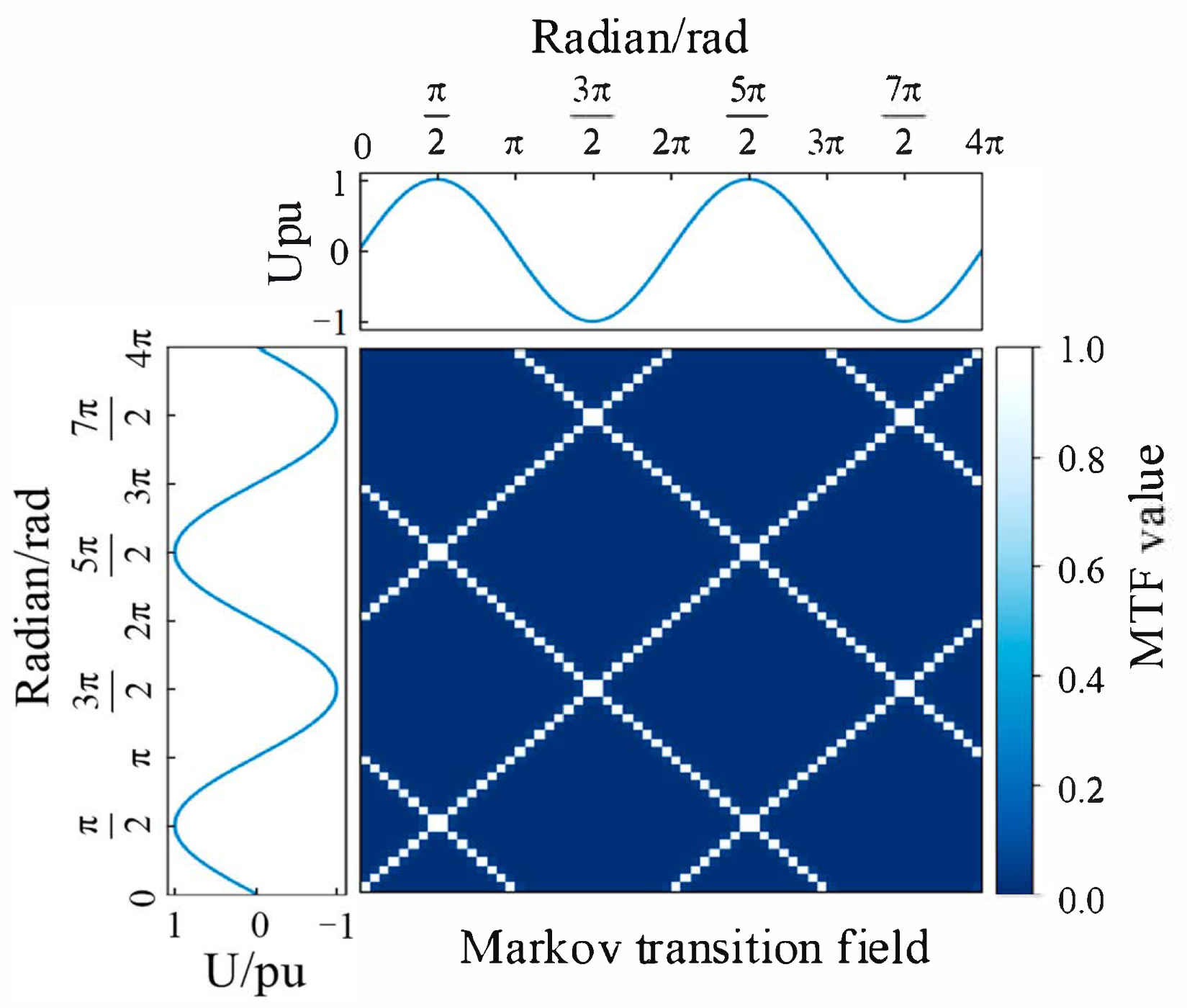
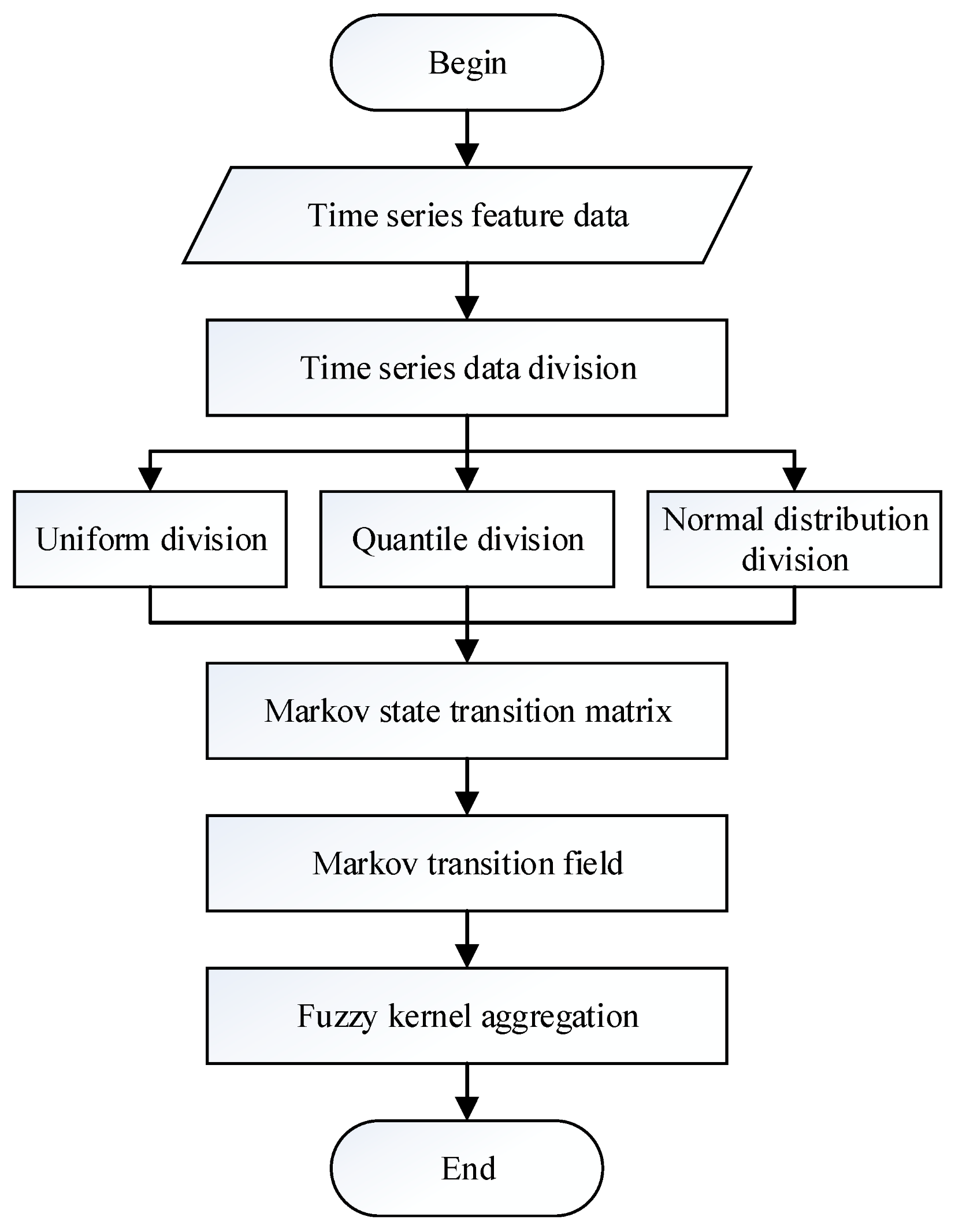
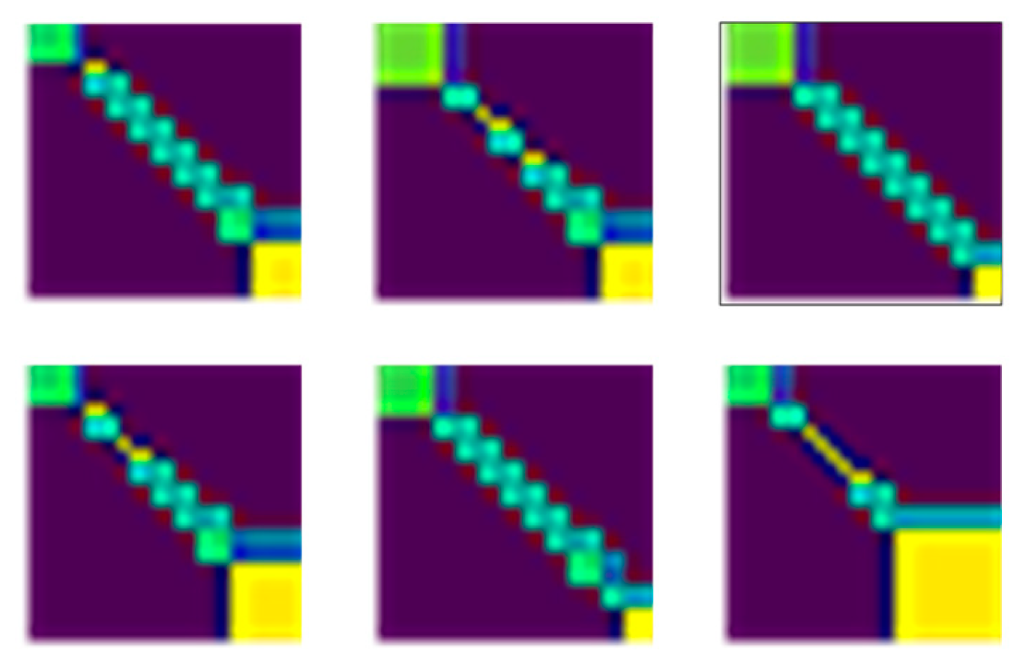
2.1.2. Markov Transition Field Model
2.2. Construction of Power System Transient Stability Features
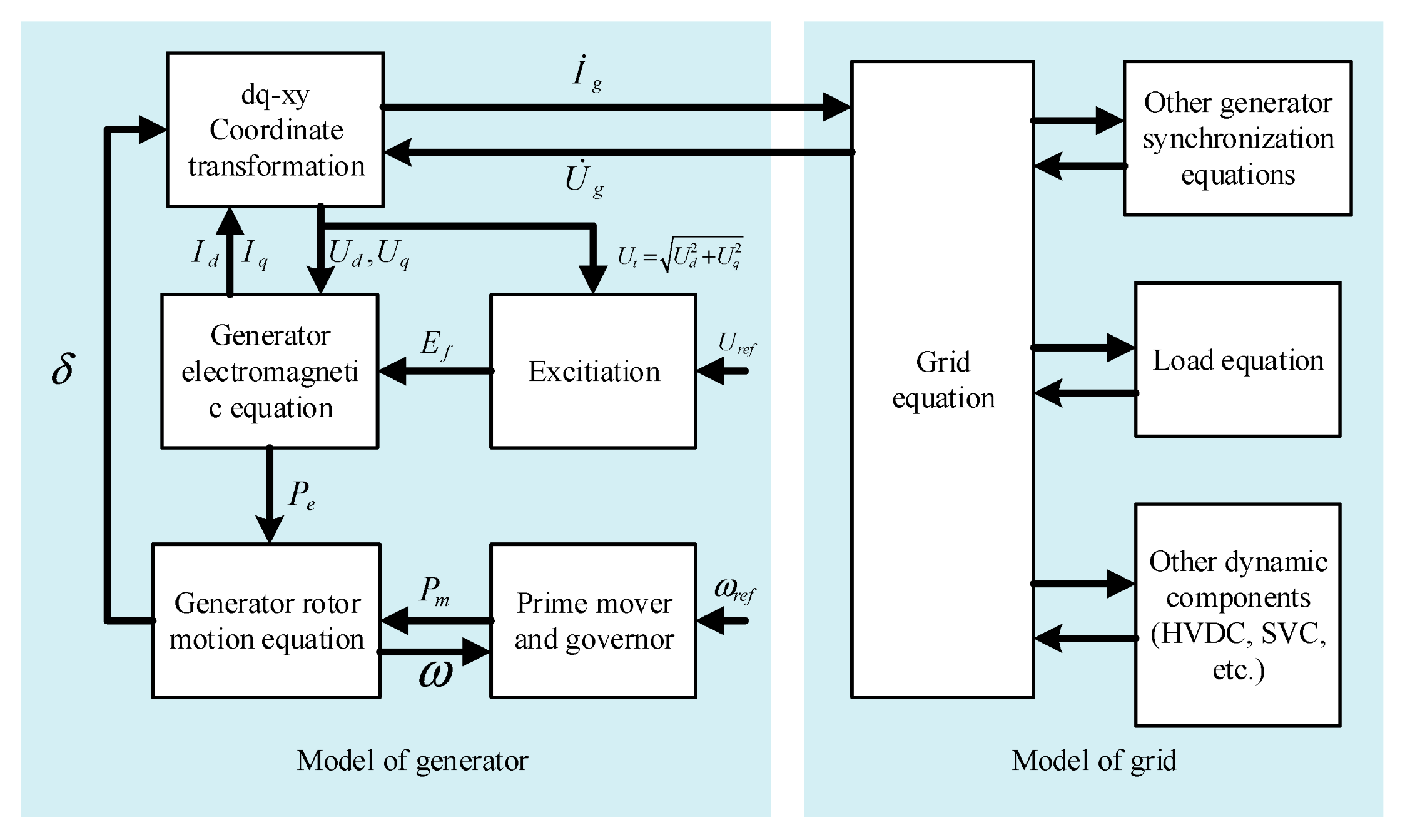
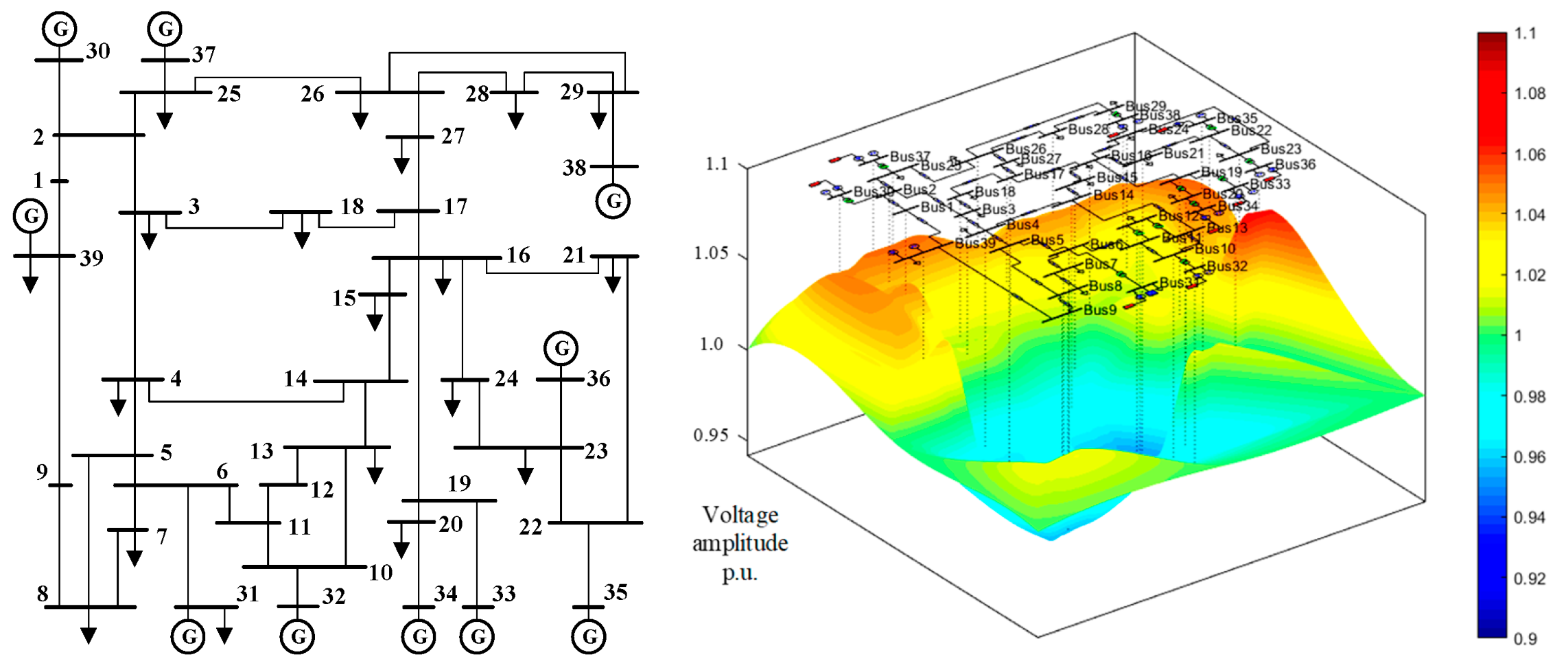
2.2.1. Construction of Power System Transient Simulation Model
2.2.2. Construction of Power System Features
3. Results and Discussion
3.1. Transient Stability Evaluation Model Based on MTF Dual-Modal Fusion
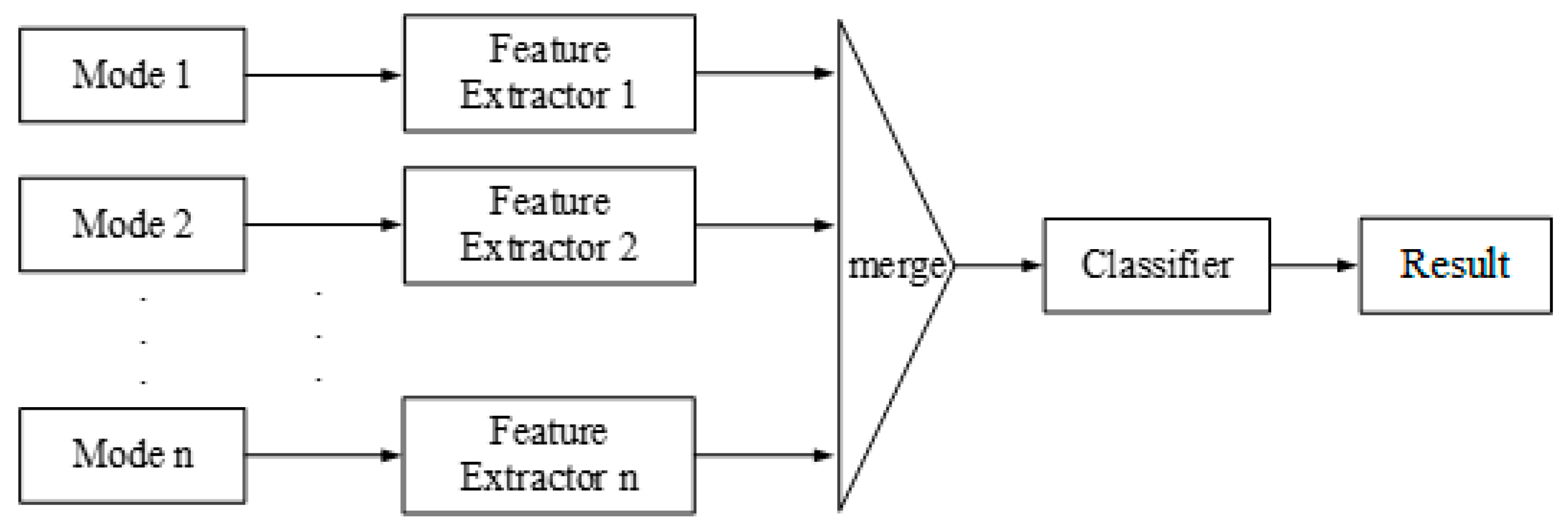
3.1.1. Multi-Modal Fusion Theory
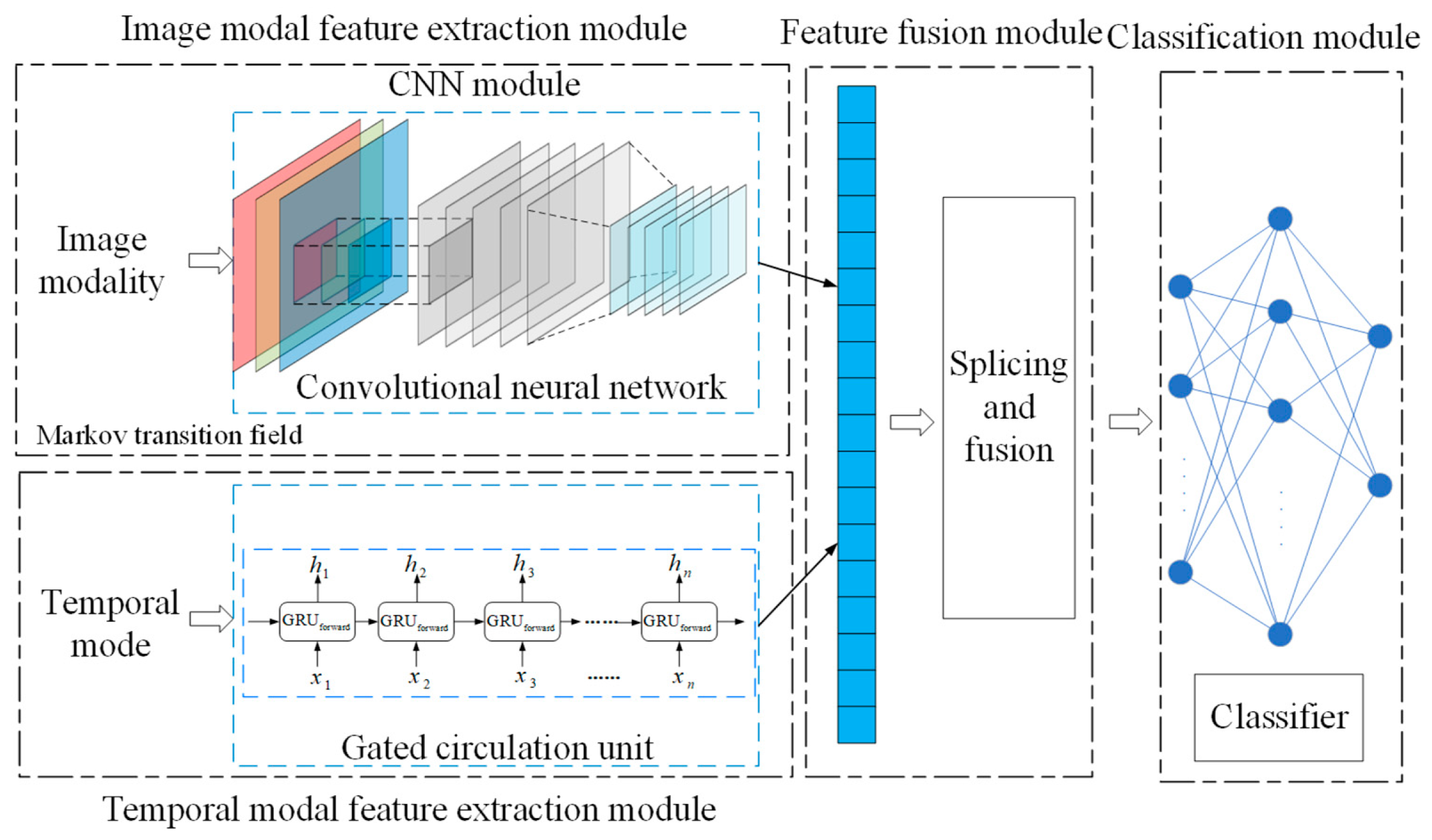
3.1.2. Model Architecture Design
3.2. Case Study Analysis
3.2.1. Sample Set and Model Parameters
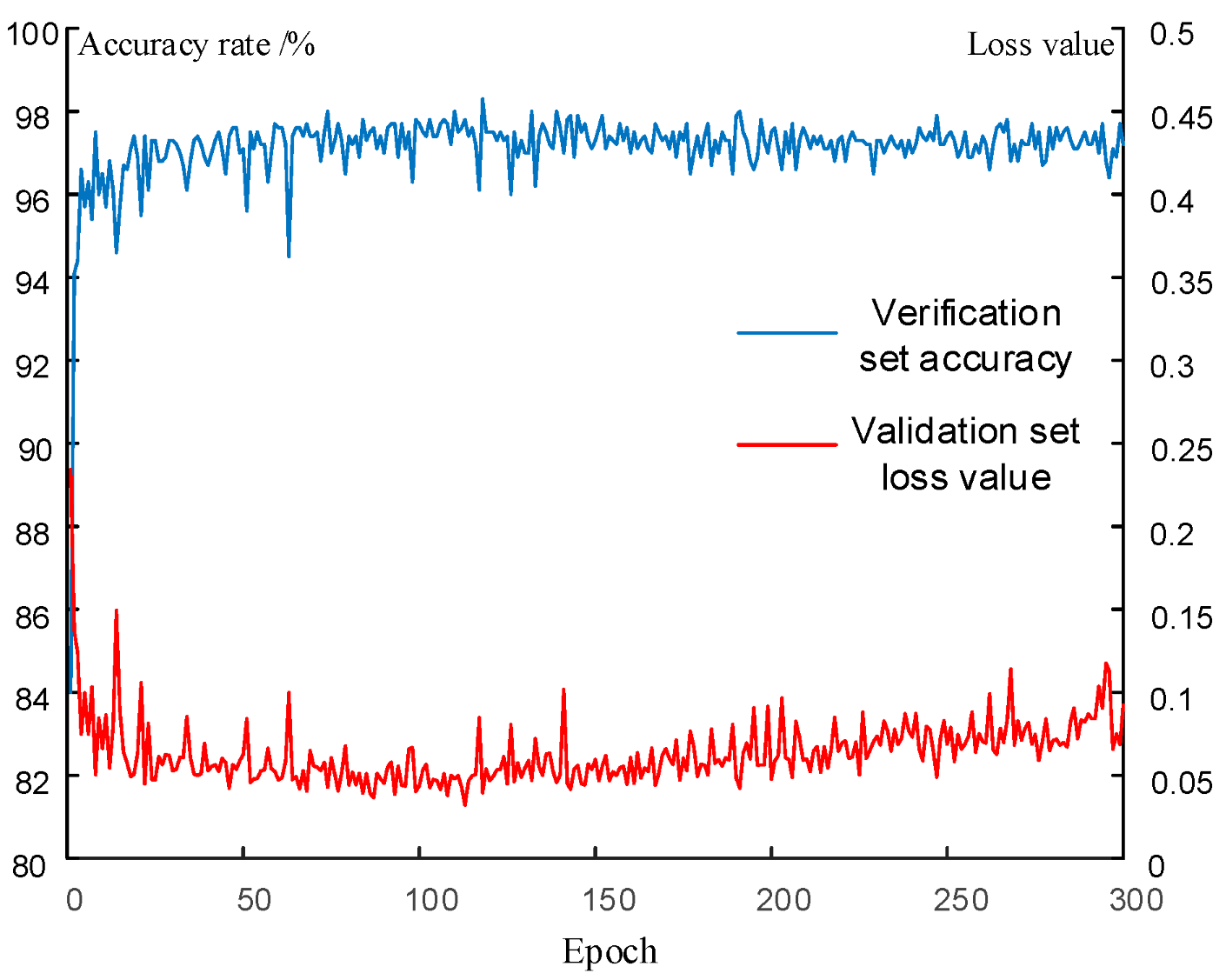
3.2.2. Model Training and Test Results
3.2.3. Analysis of the Impact of Different Feature Sets
3.3. Discussion
4. Conclusions
Author Contributions
Funding
Data Availability Statement
Conflicts of Interest
Abbreviations
| AI | Artificial Intelligence |
| DL | Deep Learning |
| MTF | Markov Transition Fields |
| CNN | Convolutional Neural Networks |
| TDS | Time Domain Simulation |
| TEFM | Transient Energy Function Methods |
| PCA | Principal Component Analysis |
| ELM | Extreme Learning Machine |
| SVM | Support Vector Machine |
| LSTM | Long Short-Term Memory |
| GNN | Graph Neural Network |
| DBN | Deep Belief Network |
| GCNN | Graph Convolutional Neural Network |
| GCN | Graph Convolutional Network |
| MLP | Multi-Layer Perceptron |
| RNN | Recurrent Neural Network |
| t-SNE | t-Distributed Stochastic Neighbor Embedding |
References
- Veerashekar, K.; Schuehlein, P.; Luther, M. Quantitative transient stability assessment in microgrids combining both time-domain simulations and energy function analysis. Int. J. Electr. Power Energy Syst. 2020, 115, 105506. [Google Scholar] [CrossRef]
- Guo, W.Y.; Qureshi, N.M.F.; Jarwar, M.A.; Kim, J.; Shin, D.R. AI-oriented Smart Power System Transient Stability: The Rationality, Applications, Challenges and Future Opportunities. Sustain. Energy Technol. Assess. 2023, 56, 102990. [Google Scholar] [CrossRef]
- Akimoto, Y.; Tanaka, H.; Yoshizawa, J.; Klapper, D.B.; Price, W.W.; Wirgau, K.A. Transient stability expert system. IEEE Trans. Power Syst. 1989, 4, 312–320. [Google Scholar] [CrossRef]
- Lecun, Y.; Bengio, Y.; Hinton, G. Deep learning. Nature 2015, 521, 436–444. [Google Scholar] [CrossRef]
- Pan, Y. Heading toward Artificial Intelligence 2.0. Engineering 2016, 2, 51–61. [Google Scholar] [CrossRef]
- Gomez, F.R.; Rajapakse, A.D.; Annakkage, U.D.; Fernando, I.T. Support vector machine-based algorithm for post-fault transient stability status prediction using synchronized measurements. IEEE Trans. Power Syst. 2011, 26, 1474–1483. [Google Scholar] [CrossRef]
- Singh, M.; Chauhan, S. A hybrid-extreme learning machine based ensemble method for online dynamic security assessment of power systems. Electr. Power Syst. Res. 2023, 214, 0378–7796. [Google Scholar] [CrossRef]
- Shi, H.; Chen, M.X. A two-stage transformer fault diagnosis method based multi-filter interactive feature selection integrated adaptive sparrow algorithm optimized support vector machine. IET Electr. Power Appl. 2023, 17, 341–357. [Google Scholar] [CrossRef]
- Yang, J.S.; Chen, W.J.; Xiao, X.; Zhang, Z.H. Explainable deep learning method for power system stability evaluation with incomplete voltage data based on transfer learning. Measurement 2025, 247, 116781. [Google Scholar] [CrossRef]
- Rahmatian, M.; Chen, Y.C.; Palizban, A.; Moshref, A.; Dunford, W.G. Transient stability assessment via decision trees and multivariate adaptive regression splines. Electr. Power Syst. Res. 2017, 142, 320–328. [Google Scholar] [CrossRef]
- Li, B.Q.; Wu, J.Y.; Hao, L.L.; Shao, M.; Zhang, R.; Zhao, W. Anti-Jitter and Refined Power System Transient Stability Assessment Based on Long-Short Term Memory Network. IEEE Access 2020, 8, 35231–35244. [Google Scholar] [CrossRef]
- An, J.; Zhang, L.; Zhou, Y.B.; Yu, J.C. Transient Stability Margin Prediction Under the Concept of Security Region of Power Systems Based on the Long Short-Term Memory Network and Attention Mechanism. Front. Energy Res. 2022, 10, 838791. [Google Scholar] [CrossRef]
- Yu, J.J.Q.; Hill, D.J.; Lam, A.Y.S.; Gu, J.; Li, V.O.K. Intelligent time-adaptive transient stability assessment system. IEEE Trans. Power Syst. 2018, 33, 1049–1058. [Google Scholar] [CrossRef]
- Shen, Y.; Shuai, Z.K.; Shen, C.; Shen, X.; Ge, J. Transient Angle Stability Prediction of Virtual Synchronous Generator Using LSTM Neural Network. In Proceedings of the 13th IEEE Energy Conversion Congress and Exposition (IEEE ECCE); IEEE: Piscataway, NJ, USA, 2021; pp. 3383–3387. [Google Scholar]
- Shi, Z.; Yao, W.; Zeng, L.; Wen, J.; Fang, J.; Ai, X.; Wen, J. Convolutional neural network-based power system transient stability assessment and instability mode prediction. Appl. Energy 2020, 263, 114586. [Google Scholar] [CrossRef]
- Li, B.; Wu, J. Adaptive Assessment of Power System Transient Stability Based on Active Transfer Learning with Deep Belief Network. IEEE Trans. Autom. Sci. Eng. 2023, 20, 1047–1058. [Google Scholar] [CrossRef]
- Huang, J.Y.; Guan, L.; Su, Y.S.; Yao, H.; Guo, M.; Zhong, Z. Recurrent graph convolutional network-based multi-task transient stability assessment framework in power system. IEEE Access 2020, 8, 93283–93296. [Google Scholar] [CrossRef]
- Zhao, H.; Ni, R. Power System Transient Stability Assessment Based on Spatiotemporal Broad Learning System. IEEE Trans. Autom. Sci. Eng. 2025, 22, 10343–10353. [Google Scholar] [CrossRef]
- Chen, K.J.; Hu, J.; Zhang, Y.; Yu, Z.; He, J. Fault location in power distribution systems via deep graph convolutional networks. IEEE J. Sel. Areas Commun. 2020, 38, 119–131. [Google Scholar] [CrossRef]
- Wang, Z.; Oates, T. Imaging time series to improve classification and imputation. In Proceedings of the 24th International Conference on Artificial Intelligence; AAAI Press: Washington, DC, USA, 2015; pp. 3939–3945. [Google Scholar]
- Wang, Z.; Oates, T. Encoding time series as images for visual inspection and classification using tiled convolutional neural networks. In Workshops at the Twenty-Ninth AAAI Conference on Artificial Intelligence; AAAI Workshop—Technical Report; AAAI Press: Washington, DC, USA, 2015; pp. 40–46. [Google Scholar]
- Wang, S.X.; Chen, H.W. A novel deep learning method for the classification of power quality disturbances using deep convolutional neural network. Appl. Energy 2019, 235, 1126–1140. [Google Scholar] [CrossRef]
- Zhu, L.P.; Hill, D.J.; Lu, C. Hierarchical deep learning machine for power system online transient stability prediction. IEEE Trans. Power Syst. 2020, 35, 2399–2411. [Google Scholar] [CrossRef]
- Fang, D.Z.; Chung, T.S.; David, A.K. Evaluation of transient stability limit using a transient time margin sensitivity approach. Electr. Power Syst. Res. 1999, 52, 19–27. [Google Scholar] [CrossRef]



| Hidden Layer Name | Parameter | Input Dimension | Output Dimension |
|---|---|---|---|
| Conv2D_Layer1 | 64, (2, 2) | (Batch size, 25, 25, 1) | (Batch size, 24, 24, 64) |
| Max-Pool-ing2D_Layer1 | (2, 2) | (Batch size, 24, 24, 64) | (Batch size, 12, 12, 64) |
| Conv2D_Layer2 | 32, (2, 2) | (Batch size, 12, 12, 64) | (Batch size, 11, 11, 32) |
| Max-Pool-ing2D_Layer2 | (2, 2) | (Batch size, 11, 11, 32) | (Batch size, 5, 5, 32) |
| GRU_Layer1 | 100 | (Batch size, 25, 118) | (Batch size, 25, 100) |
| GRU_Layer2 | 100 | (Batch size, 25, 100) | (Batch size, 25, 100) |
| GRU_Layer3 | 100 | (Batch size, 25, 100) | (Batch size, 100) |
| Flatten | / | (Batch size, 5, 5, 32) | (Batch size, 800) |
| Concatenate | / | [(Batch, 800), (Batch, 100)] | (Batch size, 900) |
| Out | 2 | (Batch size, 900) | (Batch size, 2) |
| Feature Set | Evaluation Model | Acc/% | MA/% | CA/% | Gmean |
|---|---|---|---|---|---|
| MTF and time series | MTF fusion model | 97.80 | 3.15 | 1.76 | 0.9754 |
| Feature Set Number | System Feature Set Description | Dimension of the Feature Set |
|---|---|---|
| 1 | Timing features of synchronous units G1~G4 | 40 × 25 |
| 2 | Timing features of power grids K1~K2 | 78 × 25 |
| 3 | Static features K3~K4, K6~K7, G5~G8 | 196 |
| Hidden Layer Name | The Number of Neurons | Input Dimension | Output Dimension |
|---|---|---|---|
| GRU_Layer1 | 100 | (Batch size, 100) | (Batch size, 25, 100) |
| GRU_Layer2 | 100 | (Batch size, 25, 100) | (Batch size, 100) |
| Hidden Layer Name | The Number of Neurons | Input Dimension | Output Dimension |
|---|---|---|---|
| MLP_Layer1 | 256 | (Batch size, 256) | (Batch size, 256) |
| MLP_Layer2 | 256 | (Batch size, 256) | (Batch size, 256) |
| MLP_Layer3 | 128 | (Batch size, 256) | (Batch size, 128) |
| MLP_Layer4 | 64 | (Batch size, 128) | (Batch size, 64) |
| Feature Set Number | Evaluation Model | Acc/% | MA/% | CA/% | Gmean |
|---|---|---|---|---|---|
| 1 | GRU | 96.80 | 4.83 | 2.46 | 0.9634 |
| 2 | GRU | 96.40 | 5.00 | 2.97 | 0.9601 |
| 3 | MLP | 96.60 | 8.58 | 1.15 | 0.9506 |
Disclaimer/Publisher’s Note: The statements, opinions and data contained in all publications are solely those of the individual author(s) and contributor(s) and not of MDPI and/or the editor(s). MDPI and/or the editor(s) disclaim responsibility for any injury to people or property resulting from any ideas, methods, instructions or products referred to in the content. |
© 2026 by the authors. Licensee MDPI, Basel, Switzerland. This article is an open access article distributed under the terms and conditions of the Creative Commons Attribution (CC BY) license.
Share and Cite
Yan, M.; Chen, Q.; Huang, Z.; Qian, B.; Zhang, L.; Ding, Y.; Su, Z. Markov Transition Fields-Based Dual-Modal Fusion Method on Transient Stability Assessment for Power Systems. Energies 2026, 19, 1417. https://doi.org/10.3390/en19061417
Yan M, Chen Q, Huang Z, Qian B, Zhang L, Ding Y, Su Z. Markov Transition Fields-Based Dual-Modal Fusion Method on Transient Stability Assessment for Power Systems. Energies. 2026; 19(6):1417. https://doi.org/10.3390/en19061417
Chicago/Turabian StyleYan, Min, Qian Chen, Zhihua Huang, Beiqi Qian, Lei Zhang, Yifan Ding, and Zehua Su. 2026. "Markov Transition Fields-Based Dual-Modal Fusion Method on Transient Stability Assessment for Power Systems" Energies 19, no. 6: 1417. https://doi.org/10.3390/en19061417
APA StyleYan, M., Chen, Q., Huang, Z., Qian, B., Zhang, L., Ding, Y., & Su, Z. (2026). Markov Transition Fields-Based Dual-Modal Fusion Method on Transient Stability Assessment for Power Systems. Energies, 19(6), 1417. https://doi.org/10.3390/en19061417