Article

Optimizing the Configuration of MOGWO’s Distributed Energy Storage for Low-Carbon Enhancements

1
School of Electrical Engineering and Automation, Henan Polytechnic University, Jiaozuo 454003, China
2
School of Electrical Automation and Information Engineering, Tianjin University, Tianjin 300072, China
3
School of Electrical and Information Engineering, Zhengzhou University, Zhengzhou 450001, China
*
Authors to whom correspondence should be addressed.
Energies 2026, 19(6), 1393; https://doi.org/10.3390/en19061393
Submission received: 11 January 2026 / Revised: 26 January 2026 / Accepted: 2 February 2026 / Published: 10 March 2026
(This article belongs to the Special Issue Advancements in the Integrated Energy System and Its Policy)

Abstract

With the deepening implementation of the dual-carbon strategy, the penetration rates of distributed power sources and flexible loads in new distribution grids continue to rise, posing significant challenges to system security and stability due to output fluctuations and randomness. To enhance voltage quality and achieve low-carbon economic operation in distribution grids, this paper proposes a multi-objective optimization model for Distributed Energy Storage System allocation. The model integrates power quality, economic benefits, and net carbon emissions. To efficiently solve this high-dimensional nonlinear problem, an improved Multi-Objective Gray Wolf Optimization algorithm is proposed. It employs a chaotic map to initialize the population, enhancing global distribution uniformity. A nonlinear convergence factor is introduced to dynamically balance global exploration and local exploitation. A dynamic grouping collaboration strategy is designed, combining Lévy flight and the elite crossover strategy to enhance search capability and convergence accuracy. Simulations on an IEEE 33-node system show that the improved MOGWO-optimized energy storage scheme reduces average voltage deviation by 37.0%, total operating costs by 7.0%, and net carbon emissions by 4.1%, compared to a no-storage scenario. Compared to the standard MOGWO algorithm, the proposed method achieves further optimization across all objectives, validating its effectiveness and superiority in realizing coordinated energy storage planning that balances safety, economy, and low-carbon goals.

1. Introduction

Against the backdrop of the deepening implementation of the dual-carbon strategy [1,2,3], the proportion of distributed power sources and flexible loads connected to new distribution grids continues to rise, driving a significant increase in the penetration rate of renewable energy within the system [4,5,6,7,8].
The randomness and volatility of distributed energy output challenge grid stability, often leading to power quality degradation. This includes bidirectional power flow reversal, three-phase imbalance, harmonic distortion, and excessive voltage deviation. These issues have become critical constraints limiting the reliable operation of distribution networks. Distributed Energy Storage Systems (DESSs) leverage their technical advantages of rapid response and flexible power regulation to effectively smooth fluctuations in distributed power generation output, improve node voltage quality, and reduce peak-to-valley load differences in power grids [9,10,11]. Therefore, the rational selection of DESS grid connection points, installed power configuration, and capacity selection has become a core critical factor in ensuring the economical and efficient operation of distribution networks [12,13,14,15,16].
Currently, numerous scholars have conducted research on the optimal configuration of DESSs, primarily focusing on two core dimensions: power quality and economic efficiency in distribution networks. Lu et al. [17] introduced a dual-layer planning theory to construct an optimization model that balances power system stability with economic objectives represented by typical daily network losses. The model was solved using a multi-objective optimization algorithm, but it did not account for the economic benefits arising from the coupling between energy storage systems and electricity prices. Qi et al. [18] employs an enhanced beluga whale optimization algorithm to solve the model with the objective of achieving comprehensive optimization of system reliability and economic efficiency but does not consider the environmental impacts resulting from the integration of energy storage into the power system. Li et al. [19] focuses on the sensitivity relationship between energy storage revenue costs and rated capacity, employing a two-layer planning model for solution implementation. However, it does not adequately analyze power system stability and environmental impacts. Zhao et al. [20] proposes a coordinated charging-discharging operation strategy for hybrid electricity-hydrogen energy storage systems that incorporates dynamic carbon emission factors. It employs an improved NSGA-III to solve the multi-objective model, but does not conduct quantitative calculations regarding the economic viability of energy storage deployment. Liu et al. [21] summarizes methods such as advantage set theory applied in generic MOGWO improvements to achieve more uniform initial population distribution within the objective space. However, it primarily focuses on generic diversity enhancement and lacks mechanisms to guide the population into feasible regions under specific engineering constraints. Ma et al. [22] employs Latin hypercube sampling combined with K-means clustering for scenario generation and uncertainty reduction in distributed grid planning. However, this approach addresses external uncertainty modeling rather than directly initializing algorithmic decision variables in the core optimization process. The time-of-use electricity rates for a certain location are shown in Table 1.
This paper addresses the key challenges of integrating high-penetration renewable energy into distribution grids. These challenges include voltage fluctuations, reduced operational efficiency, and increased carbon emissions. The paper also focuses on enhancing overall power quality. It evaluates the economic and environmental benefits of DESS. To effectively solve the constructed high-dimensional, nonlinear multi-objective optimization model, an improved Multi-Objective Gray Wolf Optimization (MOGWO) algorithm is proposed. This algorithm employs a chaotic map for population initialization to enhance the global uniformity of the initial solution distribution. It introduces a nonlinear convergence factor to achieve a dynamic equilibrium between global exploration and local exploitation during the search process. Furthermore, it designs a dynamic grouping and cooperative strategy, integrating the Lévy flight and elite crossover strategy to further enhance the algorithm’s search capability and convergence accuracy. Consequently, it provides an efficient and reliable solution method for achieving the coordinated optimization of energy storage configurations that balances safety, economy, and low-carbon objectives.

2. Indicator Construction

2.1. Average Voltage Deviation in Distribution Networks

To quantify the improvement in power quality achieved by integrating energy storage into distribution grids, analyzing the deviation of voltages at each node from standard values enables assessment of the grid’s resilience and power quality. A lower voltage deviation indicates stronger grid resilience.
The voltage deviation v(t,i) at any node in the network at time t is expressed as
v ( t , i ) = U t , i U i , 0 1
where the node voltage Ut,i is the root-mean-square (RMS) value at time t for node i, obtained from power flow calculations under quasi-steady-state operating conditions. Ui,0 is the rated voltage for node i.
Normalizing it at the time t cross-section to V(t,i) gives
V ( t , i ) = v ( t , i ) v ( t , i m i n ) v ( t , i m i n m a x )
where v(t,imax) and v(t,imin) represent the maximum and minimum voltages at node i at time t, respectively.
The average deviation BV(t) of the power grid at time t is
B V ( t ) = 1 N i = 1 N V ( t , i )
where N represents the total number of nodes in the system. V(t,i) denotes the normalized value of vulnerability at each node at time t.
Subsequently, the average grid deviation VA for the entire 24 h cycle is calculated by combining the average deviations over the entire cycle.
V A = 1 T t = 1 T B V ( t )

2.2. Economic Indicator Construction

In power system design, economic efficiency is typically a core consideration. This study selects two key economic indicators, loss costs and net electricity purchase costs, to jointly form an economic objective function that seeks minimization. The goal is to achieve overall operational cost optimization while satisfying system safety constraints.
The total network loss cost reflects the expenses incurred from active power losses during grid transmission. The total active network loss cost is related to the system’s total network loss power Ploss(t) and the conversion tariff λloss. Its expression is
R l o s s = t = 1 T λ l o s s P l o s s ( t ) Δ t
where λloss represents the grid electricity price for that time period.
The formula for calculating active network losses is as follows:
P l o s s = t = 1 T j M L [ G i j , t ( U i , t 2 + U j , t 2 2 U i , t U j , t cos δ i j , t ) ]
where ML denotes all branches of the network; Gij represents the set of conductances for nodes i and j; Ui,t and Uj,t denote the voltages at nodes i and j at time t; and δij,t indicates the phase angle difference between the starting and ending nodes i and j of the branch at time t.
The net electricity purchase cost measures the system’s net expenditure on electricity purchased from the external main grid, minus the revenue generated from distributed power sources (photovoltaic and wind power generation). The calculation formula is as follows:
C p u r = t = 1 T [ λ p u r ( t ) P b u y ( t ) λ f e e d ( t ) P f e e d ( t ) ]
where λpur(t) represents the real-time electricity purchase price during time period t (CNY/kWh); λfeed(t) denotes the feed-in tariff for photovoltaic and wind power generation during time period t, fixed at 0.4 CNY/kWh, whose rate references representative pricing policies and subsidy standards within China’s electricity market [23]; Pbuy(t) indicates the power purchased by the system from the upstream grid during time period t (kW); and Pfeed(t) represents the power generation output from distributed power sources during time period t.
The time-of-use electricity rates for a certain location are shown in Table 2:
The overall economic objective function aims to minimize the sum of the aforementioned costs:
C = R l o s s + C p u r

2.3. Environmental Indicator Development

To minimize the environmental impact of DESS integration into distribution grids, this paper defines “grid carbon intensity” and establishes a “storage carbon account.” This approach converts the charging and discharging behavior of energy storage into quantifiable carbon substitution units, ultimately calculating the system’s net carbon emissions. Lower net carbon emissions indicate better environmental performance.
To construct a dynamic carbon flow model capable of precisely quantifying the carbon substitution benefits of energy storage, this paper employs carbon intensity factors based on life cycle assessment as the carbon attribute parameters for various power sources. This parameter reflects the total greenhouse gas emissions associated with obtaining a unit of electrical energy. Specifically, coal-fired power generation uses direct operational emission factors, while wind and photovoltaic power generation utilize their average embedded carbon intensity across the entire life cycle (encompassing equipment manufacturing, construction, operation and maintenance, and decommissioning).
The total carbon emissions from the generation side at time t, Cgen(t), are calculated based on the power output of each unit and its corresponding carbon emission factor:
C g e n ( t ) = k Ω G P G , k ( t ) ρ k
where PG,K(t) denotes the active power output (MWh) of generator set k at time t; ρk represents the carbon emission factor (kg CO2/MWh) of generator set k, where thermal power generation is 800 kg CO2/MWh, wind power generation is 20 kg CO2/MWh, and photovoltaic power generation is 50 kg CO2/MWh; and ΩG is the set of all conventional power generation units (thermal, wind, and photovoltaic). These values are based on authoritative carbon emissions accounting guidelines and research reports on the life cycle emissions of power generation technologies [24].
To assess the instantaneous carbon impact of electricity consumption, the real-time average carbon intensity of the grid πgrid(t) is defined. This metric characterizes the carbon emissions embodied in a unit of electricity generated at the current moment:
π g r i d ( t ) = C g e n ( t ) k Ω G P G , K ( t ) ,   P G , K ( t ) > 0 ρ g r i d   ,   e l s e
where πgrid(t) represents the average carbon intensity of the power grid at time t (kg CO2/MWh), and ρgrid denotes the preset baseline carbon emission factor for the power grid, set at 400 kg CO2/MWh.
Energy storage systems play the role of “carbon carriers” during operation. An internal carbon account is established for each storage unit m, with core state variables including cumulative carbon liability Dm(t) (kg CO2) and cumulative charge Ec,m(t) (MWh). Account states are recursively updated according to the following equation:
D m ( t ) = D m ( t 1 ) + Δ D m ( t ) E c , m ( t ) = E c , m ( t 1 ) + Δ E c , m ( t )
where ΔDm(t) and ΔEc,m(t) are determined by the operating mode of the energy storage system during time period t.
When the energy storage system is charging (PESS,m(t) < 0): It absorbs electrical energy from the grid and accordingly assumes responsibility for the carbon emissions associated with that portion of electricity. The state increment is calculated as follows:
Δ D m ( t ) = P E S S , m ( t ) π g r i d ( t ) Δ t Δ E c , m ( t ) = P E S S , m ( t ) Δ t
where PESS,m(t) represents the charging and discharging power of energy storage unit m during time period t (MW), and Δt denotes the dispatch period length (h).
When the energy storage discharges (PESS,m(t) > 0): It releases stored electrical energy, partially replacing high-carbon power generation and thereby generating carbon substitution benefits. First, calculate its historical discharge carbon intensity πd,m(t), the average carbon liability associated with each unit of discharge:
π d , m ( t ) = D m ( t 1 ) E c , m ( t 1 ) , E c , m ( t 1 ) > 0 0 , e l s e
Subsequently, the carbon offset generated by this discharge, Coffset,m(t), is calculated and its carbon liability and cumulative charge are reduced by this proportion:
C o f f s e t ( t ) = P E S S , m ( t ) π d , m ( t ) Δ t Δ D m ( t ) = C o f f s e t ( t ) Δ E c , m ( t ) = P E S S , m ( t ) Δ t
Subsequently, considering both direct emissions from power generation and the carbon substitution effect of energy storage, the net carbon emissions Cnet(t) of the system during time period t are defined as
C n e t ( t ) = C g e n ( t ) k Ω ESS C o f f s e t , m ( t )
where ΩESS denotes the set of all energy storage systems.
Finally, the cumulative net carbon emissions FCO2 are calculated over the entire cycle of T hours:
F C O 2 = t = 1 T C n e t ( t )

3. Mathematical Model for Multi-Objective Energy Storage Planning

3.1. Objective Function

Reasonable energy storage planning for distribution grids can mitigate voltage fluctuations caused by large-scale integration of distributed energy resources into the grid. It can also leverage time-of-use electricity price differentials to enhance the economic viability of energy storage configurations. Furthermore, by utilizing varying carbon emission factors across different time periods, it enables carbon emission reductions within the distribution grid. The rationality of energy storage planning is assessed based on these three metrics.
Integrating energy storage must ensure the secure and stable operation of the distribution network while maximizing power quality. Therefore, the average voltage deviation of the distribution network, as proposed in Section 2.1, is adopted as one of the objective functions.
f 1 = V A
This paper’s DESS configuration prioritizes minimizing operational costs by considering both network loss costs and net electricity purchase costs to ensure economic efficiency during operation and maintenance. Therefore, the economic performance indicator proposed in Section 2.2 is adopted as one of the objective functions.
f 2 = C
To better achieve the dual carbon goals, DESS’s carbon emissions must be minimized and incorporated as one of the objective functions.
f 3 = F C O 2
Considering power quality indicators, economic indicators, and carbon emission indicators comprehensively, the multi-objective function for optimizing energy storage allocation is
min F = min f 1 , f 2 , f 3

3.2. Energy Storage Constraints

P D E S S , i m i n P D E S S , i ( t ) P D E S S , i m a x i f       P D E S S , i ( t ) 0 E D E S S , i t = E D E S S , i t 1 E D E S S , i ( t ) η C t i f       P D E S S , i ( t ) > 0 E D E S S , i t = E D E S S , i t 1 E D E S S , i ( t ) t / η d .
where P D E S S , i m i n and P D E S S , i m a x denote the minimum and maximum values of the charging and discharging power for the i-th DESS; ηc and ηd represent the charging and discharging efficiency for the i-th energy storage system, respectively; and Δt is the duration of the charging and discharging process.

4. Improved Multi-Objective Optimization Gray Wolf Algorithm

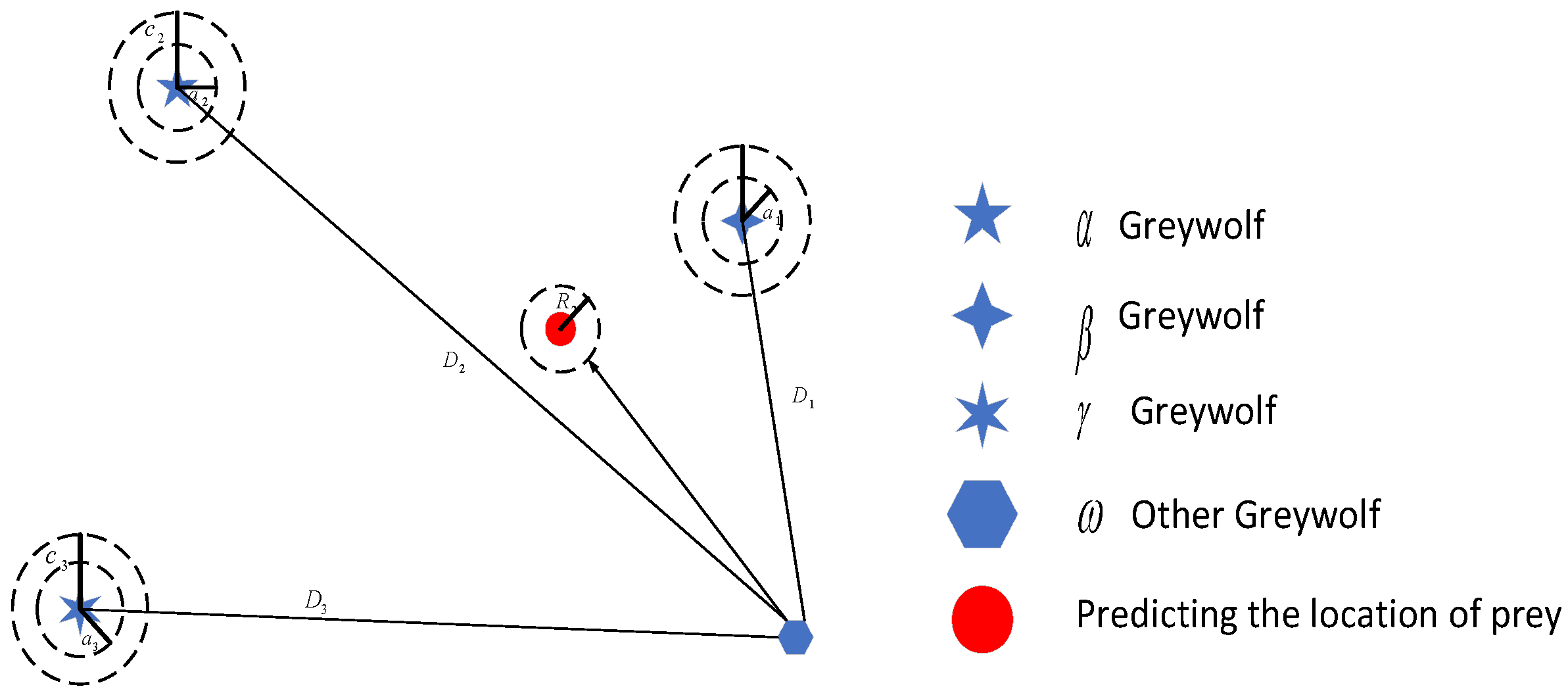
The Multi-objective Gray Wolf Optimization (MOGWO) algorithm is a swarm intelligence optimization technique inspired by wolf pack hunting strategies. Mirjalili et al. developed the MOGWO algorithm based on the Gray Wolf Optimization algorithm [25], introducing an external population archive to store non-dominated optimal individuals and employing a roulette wheel mechanism to select the alpha wolf. Compared to other swarm intelligence algorithms, MOGWO features fewer parameters, ease of implementation, strong convergence, and fast computation speed. The position update process of the gray wolves is illustrated in Figure 1.
However, when addressing the multi-objective optimization configuration problem in DESS, the MOGWO algorithm still suffers from issues such as high initialization randomness, susceptibility to solution loss during the solving process, and a limited number of Pareto frontier solutions. To achieve more effective solutions, this paper establishes a model that aims to minimize power quality indicators, economic indicators, and carbon emission indicators. The decision variables include the location, capacity, and charge/discharge power of energy storage systems, which are constrained by the energy storage power/capacity, charge/discharge efficiency, and state of charge (SOC). Consequently, algorithmic refinement is necessary.
(1)
Initializing the Population for the Chaotic Map
MOGWO’s random generation of initial populations may lead to excessive concentration in certain regions, resulting in prolonged convergence times or even failure to find optimal solutions. Therefore, achieving a more globally uniform distribution of the initial population can enhance the algorithm’s search speed and optimization accuracy. Traditional algorithms employ random initialization, which cannot guarantee uniform distribution of the initial population. Therefore, this paper proposes an improved logistic chaotic initialization method (Elite-Distance Guided Logistic Initialization, EDGLI) that integrates elite strategies with distance information. By leveraging the spatial distribution characteristics of elite individuals to guide the perturbation direction and magnitude of chaotic sequences, EDGLI ensures both population diversity and solution feasibility, thereby laying a solid foundation for subsequent optimization processes.
The decision variables x for the energy storage configuration population include storage location, capacity, and charging/discharging power for each time period. Thus, the decision variables form a 52-dimensional vector. To facilitate the application of chaotic sequences and unified processing, each decision variable is first normalized to the interval [0, 1]. The normalization formula varies depending on the variable type:
x j = x j 1 N 1 j = 1,2 x j E m i n E m a x j = 3,4 x j + α · E r a t e d 2 α · E r a t e d j = 5 , , 52
where xj represents the decision variable of the j-th individual in the population; E m i n and E m a x are the minimum and maximum allowable capacities of an energy storage unit, respectively; α is the maximum charge/discharge rate coefficient, set to 0.2 based on typical lithium-ion storage characteristics; and Erated indicates the rated capacity of the corresponding energy storage system.
(1) Generate an elite population. Serving as the reference benchmark for the initialization process, its quality directly impacts the quality of the final initial population. Set the population size to 100 and the elite ratio to 0.1, generating individuals according to heuristic rules.
(2) Distance Matrix Construction and Distribution Feature Quantification. Construct the distance matrix Di,j for the elite population, where its elements represent the weighted Euclidean distance between individuals:
D i , j = k = 1 52 ω k e ^ i , k e ^ i , k 2 1 / 2
where ωk is the weighting coefficient, reflecting the differential contributions of different physical quantities to the similarity metric.
Based on the distance matrix, the local density indicator ρi for each elite individual is defined as
ρ i = 1 N e 1 j i exp D i , j 2 2 σ 2
This metric reflects the clustering degree of other individuals within a neighborhood centered at individual Di,j with radius σ. The global distribution evaluation metric is defined as the average value Γ of all individuals’ local densities:
Γ = 1 N e i = 1 N e ρ i
If ρi < Γ, the individual is in a sparse region; otherwise, it is in a dense region.
(3) Improved Logistic Chaos Map. The classical logistic map is defined as
z n + 1 = μ z n ( 1 z n ) , z n ( 0,1 )
The control parameter μ in the equation is set to [3.57, 4] to ensure the system remains in a chaotic state. To incorporate elite distribution information, an improved chaotic update formula is proposed:
z n + 1 ( i ) = μ z n ( i ) ( 1 z n ( i ) ) 1 + α 1 ρ i Γ
where α ∈ (0, 0.3) is the adjustment coefficient. This modification enhances chaotic perturbations for individuals in sparse regions, promoting exploration, while reducing perturbations for individuals in dense regions to prevent over-concentration.
(4) Elite-guided population generation mechanism. For each new individual xnew to be generated, an elite individual ρr is first selected as a reference based on a roulette wheel selection mechanism. Its selection probability pr is negatively correlated with local density:
p r = 1 / ρ r i = 1 N e 1 / ρ i
Generate normalized candidate solutions:
x ^ n e w , j = e ^ r , j + β 1 ρ r Γ z n ( r ) ζ j
where β is the disturbance intensity coefficient. Normalizing the solution maps it back to the original solution space:
x n e w , j = 2 + 31 x ^ n e w , j j = 1,2 0.5 + 1.5 x ^ n e w , j j = 3,4 α E r a t e d + 2 α E r a t e d x ^ n e w , j j = 5 , , 52
(2)
Dynamic Parameter Adjustment
When solving the DESS optimization configuration problem, the algorithm requires extensive exploration of different combinations of energy storage siting, capacity setting, and operational strategies in the early stages. In the later stages, it necessitates fine-tuning parameters within promising solutions to approximate the optimal outcome. Balancing global and local search is crucial. Optimizing this equilibrium reduces the risk of getting stuck in local optima while accelerating convergence. Therefore, a nonlinear convergence factor a is introduced, which gradually decreases with each iteration to facilitate the transition from initial broad-area exploration to later-stage fine-tuning. The formula for calculating the nonlinear decreasing convergence factor at the t-th iteration is
a t = a m i n + ( a m a x a m i n ) × t 1 t m a x 1 k 1 k 2
where k1 and k2 are respectively constants that can be adjusted to regulate the capabilities of global search and local search; a m a x and a m i n respectively represent the maximum and minimum values of the nonlinear convergence factor.
(3)
Dynamic Grouping Collaboration Strategy Design
When addressing high-dimensional, nonlinear, and multi-constrained configuration problems in DESS, the traditional MOGWO algorithm relies solely on three wolves α, β, and σ as leader wolves. This approach leads to excessive randomness in Pareto frontier solutions during optimization, compromising the quality of the final solution set. Therefore, a dynamic grouping collaboration strategy is introduced to structurally balance global exploration and local exploitation capabilities. The core of this strategy involves dynamically dividing the population into three functional groups based on fitness rankings: the exploration group (bottom 30% responsible for global exploration), the development group (middle 50% executing standard hunting), and the patrol group (top 20% conducting deep search). Differentiated update rules are designed for each group.
Levi flight is a heavy-tailed distributed random flight capable of generating large random strides. This aids optimization algorithms in escaping local optima and enhances global exploration capabilities. The exploration group incorporates the Levi flight mechanism to strengthen global exploration. The position xi(t + 1) of individual i in the exploration group at generation t + 1 is updated according to the following equation:
x i ( t + 1 ) = x r ( t ) + α ( t ) s
where xr(t) represents the position of a randomly selected individual in the current generation, introducing randomness to the search direction; α(t) is the step size scaling factor that decreases with iteration count, stabilizing the search in later iterations; is the dot product calculation; and s is the Lévy flight step size vector, controlling the sharpness of the step size distribution, calculated as follows:
s = u v ^ 1 β
where u and v are two independent positive normal distributed random variables, with parameter β set to 1.5.
The patrol team enhances its deep search capability near the Pareto frontier and population diversity by introducing an elite crossover strategy. The core of this strategy combines the mutation operator from differential evolution with binomial crossover. Building upon the globally optimal individual (α wolf), it incorporates historical high-quality information from the external elite archive to generate search guidance directions. Specifically, an elite solution xelite is first randomly selected from the non-dominated elite archive. This solution undergoes a differential operation with the current α wolf’s position xα, producing a directional trial vector Vtrial:
V t r i a l = X α + F ( X α X e l i t e )
where F is the differential weighting factor, set to 0.5 to control the mutation intensity. Subsequently, the trial vector Vtrial is combined with the position of the current patrol group individual Xi through binary crossover to generate the next generation’s positions:
X i n e w = C m a s k V t r i a l + ( 1 C m a s k ) X i
where Cmask is a randomly generated 0/1 mask matrix, where each bit determines whether to inherit the corresponding dimension component from the trial vector or the original individual based on the crossover probability CR = 0.5.
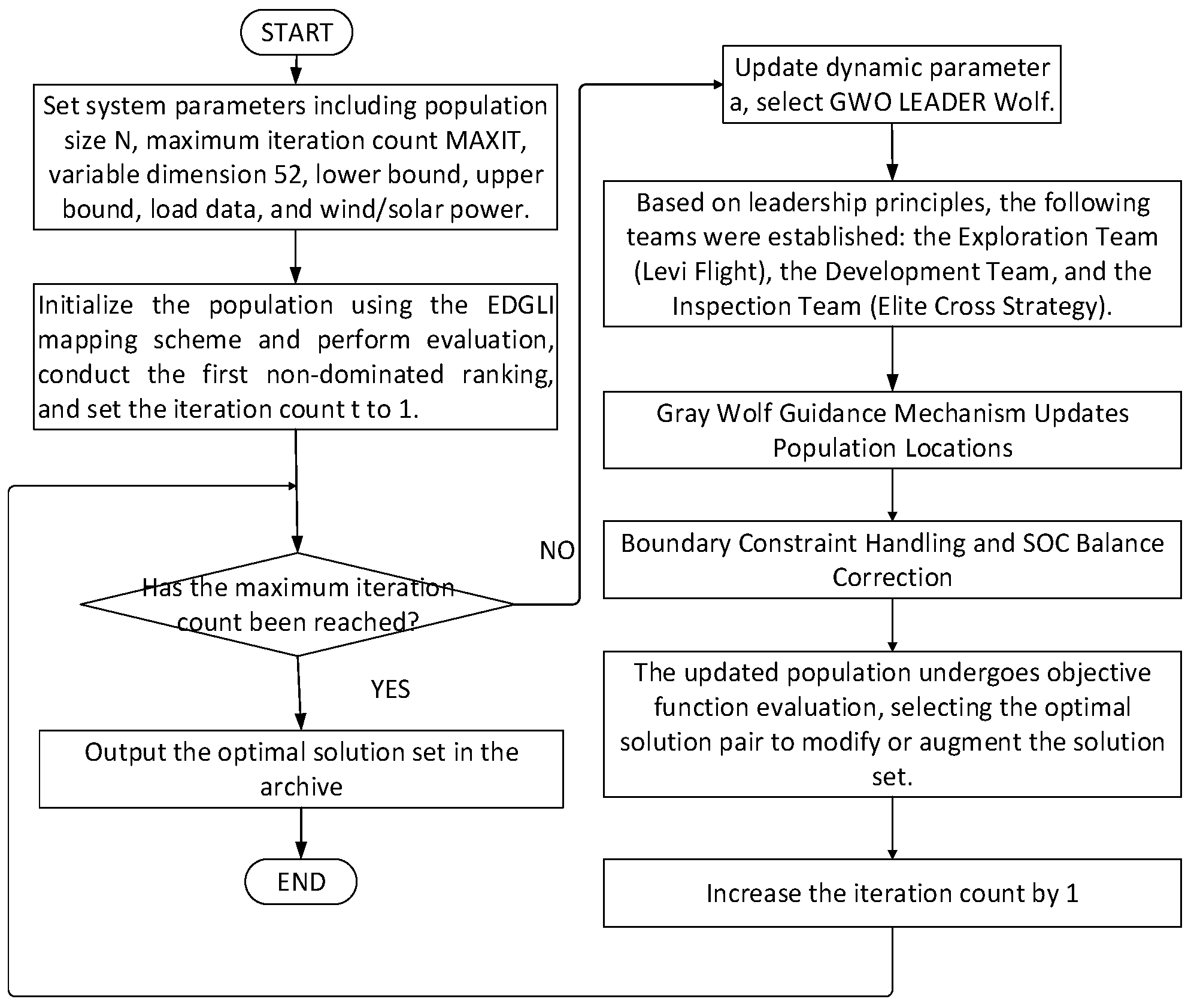
Simulation verification was conducted using an improved MOGWO algorithm implemented in MATLAB r2022a. Decision variables included the locations of two energy storage units, their rated capacities, and their 24 h charge/discharge power. First, distribution network parameters, load data, and wind/solar power data were input. The EDGLI mapping was employed to initialize storage locations, capacities, and charge/discharge powers, forming the initial population. The three objective function values (grid vulnerability index, economic index, and carbon emission index) were computed for each individual. An external archive set was established based on non-dominated sorting, and frontier solutions were selected as leader wolves α, β, and δ. During iteration, the convergence factor was dynamically updated. Differentiated search mechanisms were designed for the exploration group (Leviathan flight), development group, and patrol group (elite crossover strategy) using a grouped cooperative strategy. Population positions were updated via the gray wolf guidance mechanism while applying boundary constraints and SOC balance correction. Power flow calculations and constraint verification were performed for each new solution to ensure compliance with power balance, voltage limits, and energy storage operation constraints. Finally, the external archive is updated and non-dominated solutions are screened until the maximum iteration count is reached. The algorithm outputs a set of Pareto optimal solutions from the archive, where each solution corresponds to an energy storage planning scheme achieving equilibrium among power quality, economic cost, and low-carbon benefits. The flowchart of the improved MOGWO algorithm for solving multi-objective energy storage site selection and capacity optimization is shown in Figure 2.

5. Case Study Analysis

5.1. Simulation Model Configuration

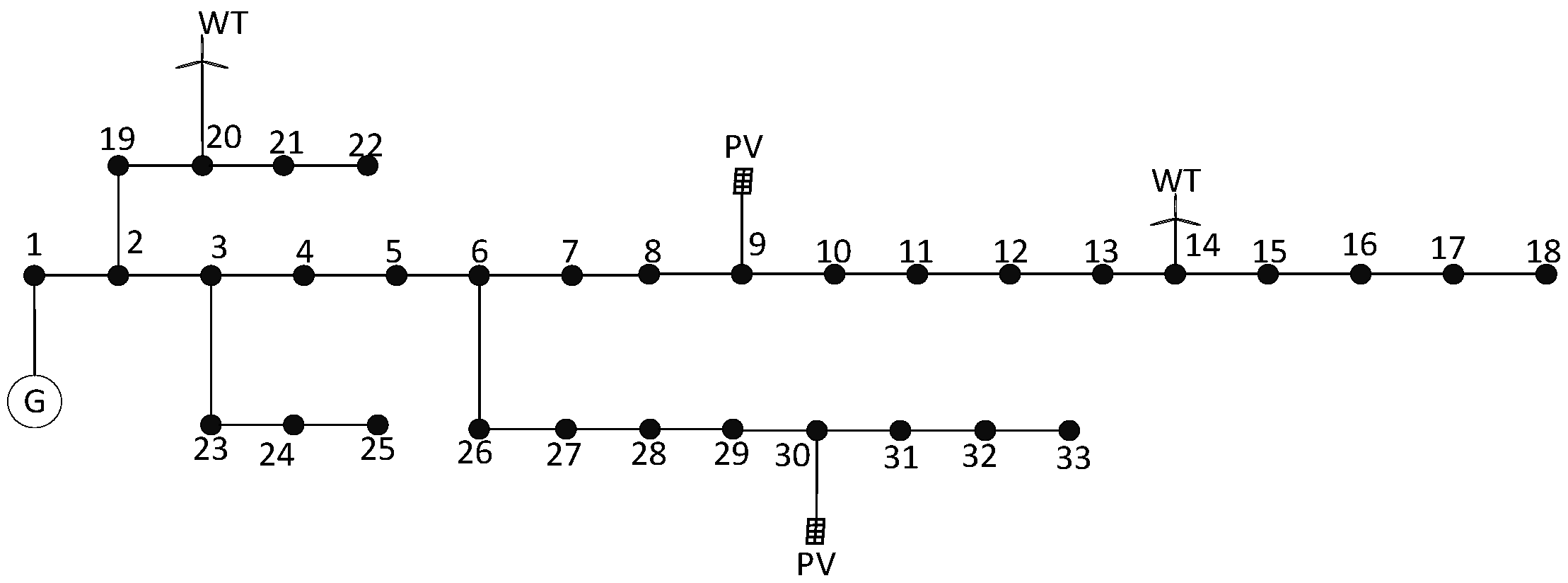
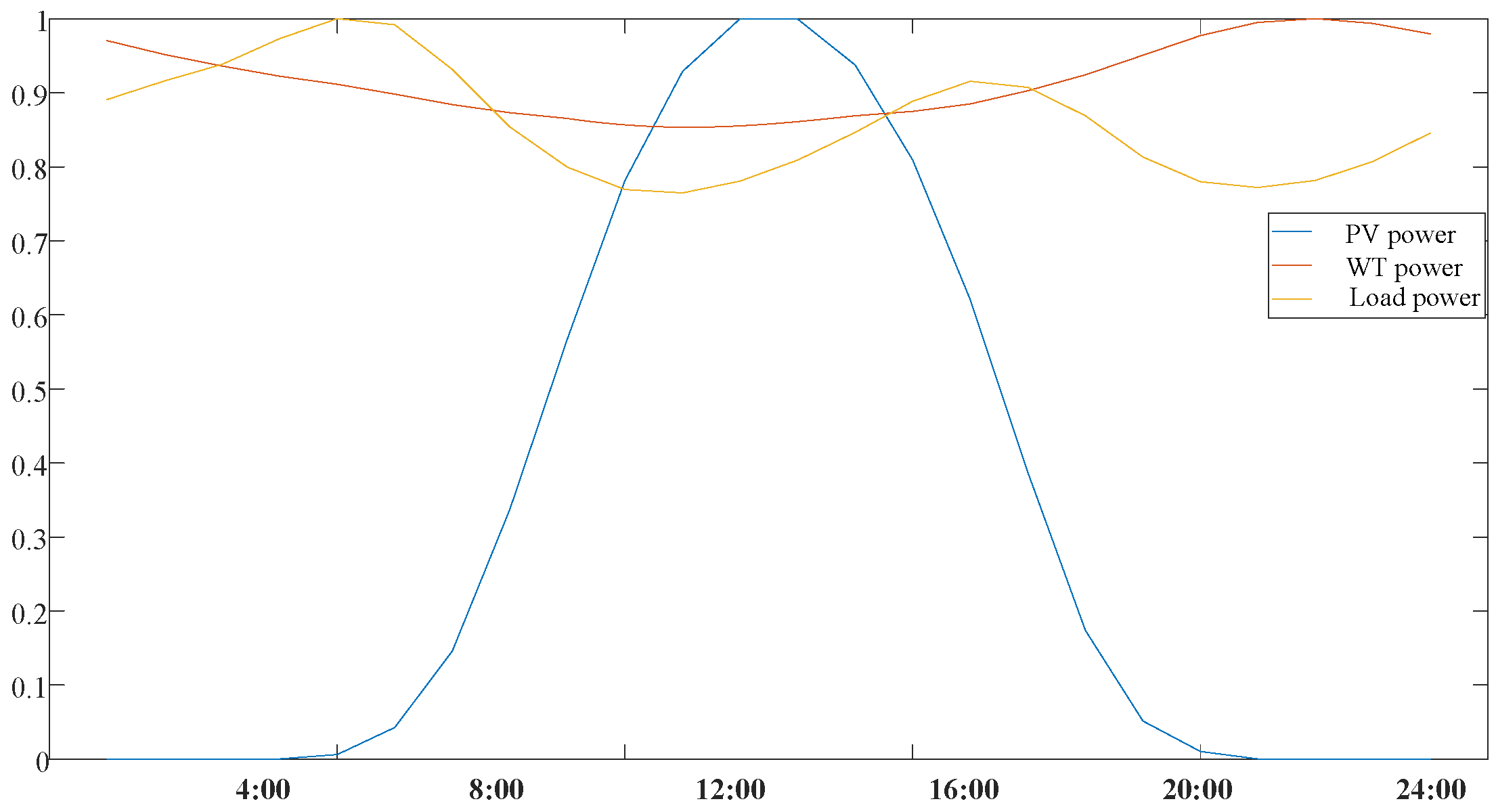
This paper analyzes the case study using a modified IEEE-33 node distribution network system, whose topology is shown in Figure 3. The reference voltage is 12.66 kV, and the reference capacity is 10 MVA. The integration of renewable energy sources is considered, with wind power connected at nodes 20 and 14, and photovoltaic power connected at nodes 9 and 30. Figure 4 presents the typical daily load curve along with the output curves of photovoltaic and wind power generation. System load and wind/solar output curves are sourced from the publicly available dataset of Elia, the Belgian transmission system operator [26], and are scaled to serve as standard test profiles.

5.2. Analysis of Simulation Results

To validate the proposed model and algorithm, comparisons were conducted across three distinct scenarios. Scenario 1: No energy storage integration. Scenario 2: Energy storage integration with optimization using the standard MOGWO algorithm. Scenario 3: Energy storage integration with optimization using the improved MOGWO algorithm. Given the large scale of the optimal solution set, we selected the top five Pareto solutions for analysis based on their grid vulnerability index rankings.
Based on the data in Table 3, Scenario 2 (MOGWO) achieved average values of 0.6617 for voltage deviation f1, 40,987 yuan for economic indicator f2, and 829.99 t CO2 for environmental indicator f3 in the distribution network. Compared to Scenario 1, these metrics were reduced by an average of 35.5%, 5.6%, and 3.4%, respectively. For Scenario 3 (improved MOGWO), the average values of f1, f2, and f3 were 0.6470, 40,389 yuan, and 823.92 t CO2, respectively, representing reductions of 37.0%, 7.0%, and 4.1% compared to the preoptimization stage. Comparing the optimization results of Scenario 3 and Scenario 2 reveals that the improved MOGWO algorithm outperforms the MOGWO algorithm in all objective values for the energy storage site selection and capacity determination problem, making it more likely to achieve the global optimum solution.
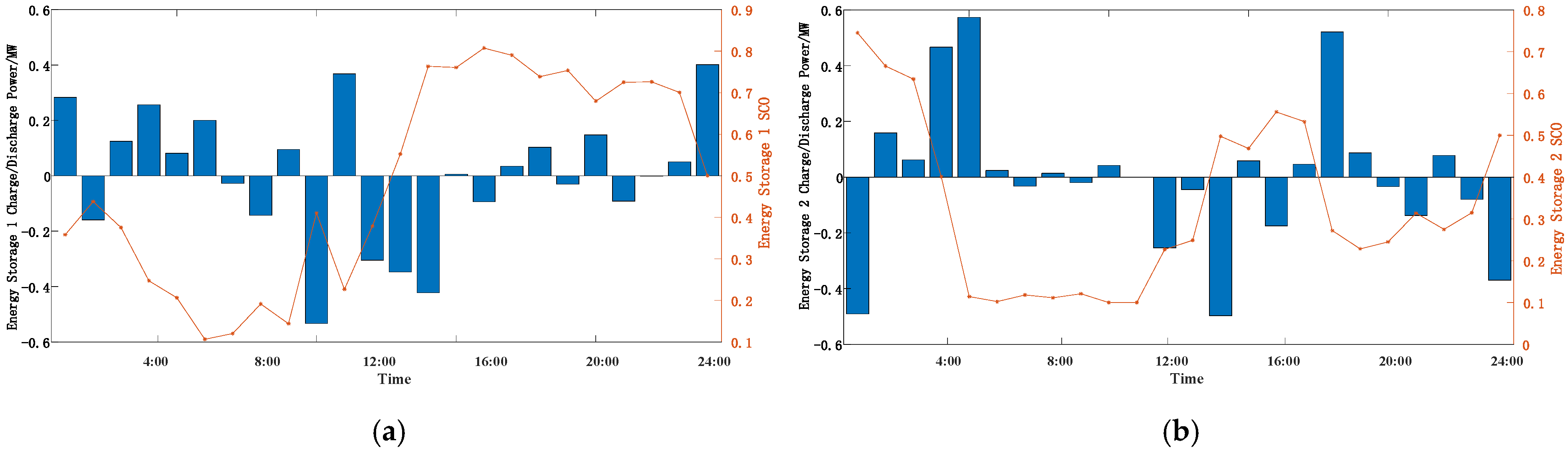
The optimal solution representative of Scenario 3 was selected, with energy storage installation locations and capacities of 12 (2.00) and 29 (1.98). The optimized energy storage operation strategy and SOC curve are shown in Figure 5.
Under the coupled effects of typical daily load profiles, photovoltaic and wind power generation curves, and time-of-use pricing policies, the operational strategy of energy storage systems centers on economic optimization and carbon reduction objectives. Specifically, during the low-price period from 11:00 to 13:00, when solar and wind generation peaks, the energy storage system primarily charges to absorb surplus renewable energy, reducing electricity procurement costs. Conversely, during the high-price evening peak period from 17:00 to 23:00, the system discharges to participate in peak shaving and valley filling, enabling electricity arbitrage. By strategically charging and discharging to smooth fluctuations in wind and solar output, maintain system power balance, and ensure the state of charge remains within safe operating limits, energy storage collaboratively enhances operational efficiency, voltage quality, and carbon reduction benefits.

6. Conclusions

This paper addresses the co-optimization of low carbonization, economic efficiency, and power quality for DESS in new distribution grids. A multi-objective optimization model is constructed with distribution grid average voltage deviation, economic cost, and net carbon emissions as objectives. To efficiently solve this high-dimensional nonlinear programming problem, an improved MOGWO algorithm is proposed. By incorporating the chaotic map for population initialization, a dynamic parameter adjustment mechanism, and a dynamic grouping coordination strategy, the algorithm significantly enhances its global exploration capability, convergence accuracy, and the distribution of the Pareto solution set. Simulation results demonstrate that in the IEEE 33-node system, the energy storage configuration optimized by the improved MOGWO algorithm effectively coordinates power quality, economic operation, and low-carbon benefits: compared to scenarios without energy storage, average voltage deviation decreases by approximately 37.0%, total operating costs reduce by 7.0%, and net carbon emissions decrease by 4.1%. Compared to the standard MOGWO algorithm, all metrics were further optimized, validating the superiority and engineering applicability of the proposed algorithm in solving complex multi-objective energy storage configuration problems. This study provides a decision-making method that balances safety, economy, and low-carbon considerations for energy storage planning in distribution grids with high renewable energy penetration, offering reference value for promoting the sustainable development of new power systems.
Although the improved MOGWO algorithm demonstrated excellent performance in the studied cases, certain limitations warrant consideration for broader applications. When applied to distribution networks with significantly varying topologies or scales, the algorithm’s performance may be influenced by parameter settings. Its computational efficiency in large-scale systems or real-time scheduling also requires further evaluation. Future research will focus on: enhancing algorithm flexibility through adaptive mechanisms; extending the model to incorporate practical factors such as energy storage device degradation and market details; and validating its robustness under uncertainty using stochastic optimization frameworks.

Author Contributions

Conceptualization, H.Y. and Q.M.; methodology, Q.M. and P.Z.; software, P.Z. and L.W.; validation, Z.L., Z.C. and L.W.; formal analysis, Z.L. and Z.C.; investigation, P.Z.; resources, H.Y.; writing—original draft preparation, Q.M. and P.Z.; writing—review and editing, H.Y., Q.M. and P.Z.; visualization, Z.C.; supervision, Q.M. and P.Z.; project administration, Q.M.; funding acquisition, Q.M. All authors have read and agreed to the published version of the manuscript.

Funding

This research was funded by the National Natural Science Foundation of China, grant number 62273312.

Data Availability Statement

The data presented in this study are available on request from the corresponding author due to privacy restrictions.

Conflicts of Interest

The authors declare no conflicts of interest.

Abbreviations

The following abbreviations are used in this manuscript:
DESSsDistributed Energy Storage Systems
MOGWOMulti-Objective Gray Wolf Optimization

References

  1. Yang, H.; Liu, S.; Zhang, P.; Bai, Y. Planning for Grid Connection of Distributed Photovoltaic Power Generation Based on Improved Slime Mold Algorithm. South. Power Syst. Technol. 2024, 18, 119–128. [Google Scholar]
  2. Jiang, H.; Lu, S.; Li, B.; Wang, R. The Power Regulation Characteristics, Key Challenges, and Solution Pathways of Typical Flexible Resources in Regional Energy Systems. Energies 2025, 18, 3830. [Google Scholar] [CrossRef]
  3. Wang, Y.; Wang, C.; Song, Z.; Li, J.; Huang, Y.; Yao, L. Multi-energy Park Optimal Scheduling Strategy Considering Carbon Trading and Flexible Loads. Electr. Meas. Instrum. 2025, 62, 54–64. [Google Scholar]
  4. He, R.; Hao, J.; Zhou, H.; Chen, F. Multi-Objective Collaborative Optimization of Distribution Networks with Energy Storage and Electric Vehicles Using an Improved NSGA-II Algorithm. Energies 2025, 18, 5232. [Google Scholar] [CrossRef]
  5. Tan, K.; Wang, Z.; Liu, Z.; Xiao, H.; Zhang, Y.; Quan, H.; Dai, F.; Li, Y. Active Distribution Network Demand Side Management Mechanism and Reliable Optimization Method Considering Distributed Energy Storage. Guangdong Electr. Power 2024, 37, 129–137. [Google Scholar]
  6. Yang, H.; Bai, Y.; Li, Z.; Cheng, Z.; Liu, S.; Cui, S. Low-carbon optimal scheduling of electric-thermal-gas coupled integrated energy systems based on improved MVO algorithm. Electr. Power Constr. 2024, 45, 112–123. [Google Scholar]
  7. Gao, R.; Wang, D.; Mao, C.; Liu, B.; Zhu, B.; Huang, J.; Wu, S. Optimal Configuration for Photovoltaic and Energy Storage in Distribution Network Using Comprehensive Evaluation Model. Energies 2025, 18, 4431. [Google Scholar] [CrossRef]
  8. Lin, N.; Xu, M.; Zheng, M.; Xiao, Y.; Lin, Y.; Dong, M. Optimization Method for Power Transactions in New Energy Grids Based on the Dual-Carbon Goal. Electr. Meas. Instrum. 2025, 62, 149–156. [Google Scholar]
  9. Dai, Z.; Xu, Y.; Zhang, D.; He, M.; Zhang, H.; Zhang, J.; Wang, C. A New Type of Hybrid Modular Energy Storage System and Its Efficient Flexible Power Routing Strategy. Electr. Power Constr. 2024, 45, 34–49. [Google Scholar] [CrossRef]
  10. Xing, H.; Xie, B.; Qin, J.; Luo, Y.; Lou, W. Optimization operation method of active distribution networks considering CVR. China Electric. Power 2021, 54, 76–81. [Google Scholar]
  11. Tang, C.; Li, S.; Chen, Y.; Zhang, J.; Ma, G. State estimation of active distribution systems considering distributed generation. Guangdong Electric. Power 2021, 34, 60–67. [Google Scholar]
  12. Tang, J.; Lv, L.; Ye, Y.; Xu, L.; He, X.; Wang, L. Coordinated Economic Dispatch of Source-Storage-Load in Active Distribution Networks under Multiple Time Scales. Prot. Control. Mod. Power Syst. 2021, 49, 53–64. [Google Scholar]
  13. Zhang, Y.; Yuan, B.; Huang, S.; Shi, J.; An, Y. Research on Economic Dispatch Strategy of Active Distribution Network Considering High Proportion of Renewable Energy Integration. Electr. Meas. Instrum. 2025, 62, 158–166. [Google Scholar]
  14. Liu, D.; Lin, H. Optimization operation of thermal power systems considering generalized energy storage and carbon capture power plants. Electr. Meas. Instrum. 2025, 62, 11–20. [Google Scholar]
  15. Duan, X.; Wang, Y.; Wei, Y.; Li, Y.; Cui, X. Joint Optimal Configuration of Distributed Photovoltaics and Energy Storage in Distribution Networks Considering New Energy Consumption. Modern Power 2026, 43, 181–192. [Google Scholar]
  16. Yang, B.; Wang, J.T.; Chen, Y.X.; Li, D.; Zeng, C.; Chen, Y.; Guo, Z.; Shu, H.; Zhang, X.; Yu, T. Optimal sizing and placement of energy storage system in power grids: A state-of-the-art one-stop handbook. J. Energy Storage 2020, 32, 101814. [Google Scholar] [CrossRef]
  17. Lu, L.; Chu, G.; Zhang, T.; Yang, Z. Optimal Configuration of Energy Storage in Microgrid Based on Improved Multi-objective Particle Swarm Algorithm. Prot. Control. Mod. Power Syst. 2020, 48, 116–124. [Google Scholar]
  18. Qi, H.; Zhao, C.; Yan, X.; Zhang, W.; Guo, F.; Zhang, L.; Yang, B.; Lu, H. Vulnerability-Driven Multi-Objective Energy Storage Planning Using Enhanced Beluga Whale Optimization for Resilient Distribution Networks. Energies 2026, 19, 210. [Google Scholar] [CrossRef]
  19. Li, Y.; Zheng, S.; Chen, Y.; Wang, J.; Wang, Z. Research on the Optimization of Energy Storage Configuration in Distribution Networks Considering System Reliability Constraints. Energy Storage Sci. Technol. 2025, 14, 193–202. [Google Scholar]
  20. Zhao, J.; Fan, H.; Wang, H.; Song, Y.; Zhou, X. Optimization of the configuration of electric-hydrogen hybrid energy storage systems in distribution networks considering carbon reduction. Electr. Power Autom. Equip. 2025, 45, 153–160. [Google Scholar]
  21. Liu, J.; Liu, Z.; Wu, Y.; Li, K. MBB-MOGWO: Modified Boltzmann-Based Multi-Objective Grey Wolf Optimizer. Sensors 2024, 24, 1502. [Google Scholar] [CrossRef]
  22. Ma, X.; Li, Y.; Dong, X.; Xu, R.; Wei, K. Multi-Objective Optimization Configuration of Distributed Power Sources in Uncertain Scenarios Based on Improved Grey Wolf Optimization Algorithm. In Proceedings of the 11th Frontier Academic Forum of Electrical Engineering (FAFEE2024); Yang, Q., Li, J., Eds.; Lecture Notes in Electrical Engineering; Springer: Singapore, 2025; Volume 1289. [Google Scholar] [CrossRef]
  23. Jiangsu Development and Reform Commission. Notice on the Issue of Time-of-Use Electricity Prices for the Power Grid in 2023; Jiangsu Development and Reform Commission: Nanjing, China, 2022. [Google Scholar]
  24. Ministry of Ecology and Environment of China. Guidelines for Greenhouse Gas Emission Accounting and Reporting for Power Generation Facilities; Ministry of Ecology and Environment of China: Beijing, China, 2022.
  25. Mirjalili, S.; Mirjalili, S.M.; Lewis, A. Grey wolf optimizer. Adv. Eng. Softw. 2014, 69, 46–61. [Google Scholar] [CrossRef]
  26. Mirjalili, S.; Mirjalili, S.M.; Saremi, S.; Coelho, L.D. Multi-objective grey wolf optimizer: A novel algorithm for multi-criterion optimization. Expert Syst. Appl. 2015, 47, 106–119. [Google Scholar] [CrossRef]
Figure 1. Schematic diagram of the gray wolf’s location update.
Energies 19 01393 g001
Figure 2. Algorithm flowchart.
Energies 19 01393 g002
Figure 3. Diagram of IEEE-33 node distribution network system.
Energies 19 01393 g003
Figure 4. Typical daily profiles for load, PV, and wind power.
Energies 19 01393 g004
Figure 5. (a) 12-node energy storage operation mode and SOC curve. (b) 30-node energy storage operation mode and SOC curve.
Energies 19 01393 g005
Table 1. Comparison of initialization strategies in related works.
ClassificationRef.Core ContributionsMain Limitations
DESS Configuration Optimization[17]Dual-layer design balances stability and cost-effectivenessIgnoring the benefits of coupling energy storage with electricity pricing
[18]Enhancing the Reliability and Cost-Effectiveness of the Beluga Algorithm OptimizationEnvironmental impacts were not considered.
[19]Analyzing Energy Storage Revenue-Capacity Sensitivity: Solving with a Two-Layer ModelInsufficient analysis of stability and environmental impact
[20]Electricity-Hydrogen Hybrid Energy Storage Strategy Integrating Dynamic Carbon FactorsThe economic viability of energy storage remains unquantified.
Algorithm Improvement[21]Optimal Superpoint Sampling Method Enhances Uniformity of Initial Population DistributionLack of a viable domain guidance mechanism
[22]LHS and K-means for Scene Generation and Uncertainty ReductionNon-direct initialization of decision variables
Table 2. Time-of-use electricity price table.
Time PeriodElectricity Price (CNY/kWh)
00:00–11:000.40
11:00–14:000.16
14:00–17:000.40
17:00–24:000.74
Table 3. Optimization results in different scenarios.
ScenarioEnergy Storage Connection Point and Capacity
(/MWh)
f1f2 (CNY)f3 (tCO2)
1 1.026443,405858.98
212 (1.49), 13 (1.43)0.661540,892834.73
10 (1.38), 15 (1.37)0.660440,935833.90
17 (1.02), 30 (1.81)0.665741,453825.10
17 (1.36), 18 (1.14)0.657240,106832.50
2 (0.92), 7 (1.86)0.663841,547823.71
average 0.661740,987829.99
312 (2.00), 29 (1.98)0.645940,464822.97
12 (1.97), 20 (1.95)0.647940,507820.87
13 (1.98), 29 (1.97)0.648340,360822.83
14 (1.97), 29 (1.97)0.649040,263823.90
15 (1.96), 18 (1.93)0.644140,352829.01
average 0.647040,389823.92
Disclaimer/Publisher’s Note: The statements, opinions and data contained in all publications are solely those of the individual author(s) and contributor(s) and not of MDPI and/or the editor(s). MDPI and/or the editor(s) disclaim responsibility for any injury to people or property resulting from any ideas, methods, instructions or products referred to in the content.