1. Introduction
In recent years, with the continuous development of China’s economy and society and the continuous advancement of infrastructure construction, the problems of energy shortage and environmental pollution have become increasingly prominent. In 2021, the total commodity energy consumption of China’s building operation reached 1.11 billion tons of standard coal, accounting for about 21% of the total national energy consumption. This proportion of building energy consumption is expected to increase year by year. Public buildings consume 43% of the energy (386 million tons of standard coal) while taking up only 21% of the area (about 14.7 billion m
2), and they contribute 42% of carbon emissions (720 million tons of CO
2) [
1]. As a special type of public building, expressway service areas have the characteristics of complex functions, large personnel flow and high energy consumption intensity. Research on energy saving in these buildings is of great significance for achieving wider societal energy-saving and emission-reduction targets. By 2023, the total mileage of expressways in China reached 183,600 km [
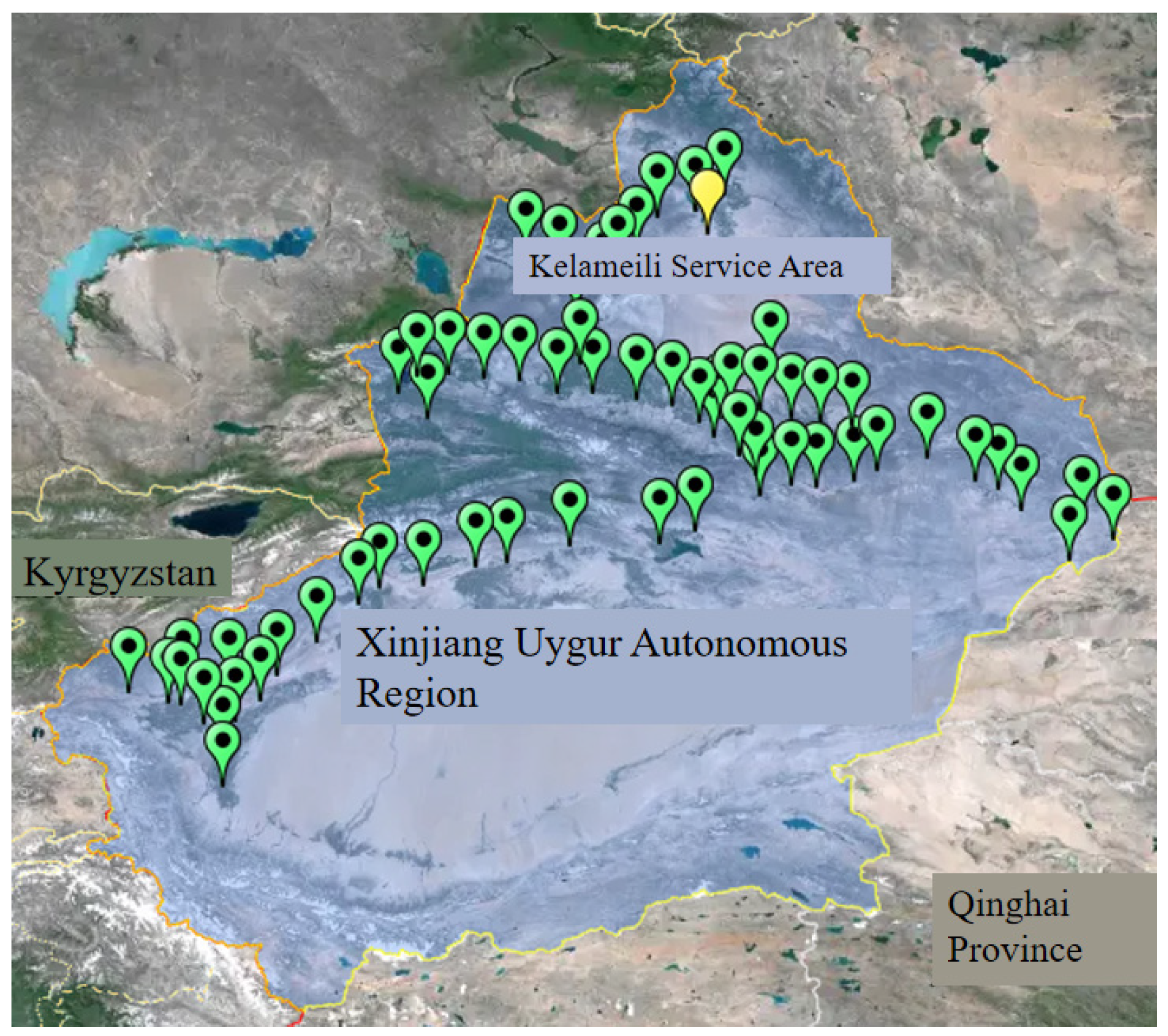
2], and the number of supporting service areas was about 7500. The energy consumption and low-carbon transformation of these areas have become the focus of attention. According to the data of the Department of Transportation of Xinjiang Uygur Autonomous Region, the current mileage of highways in Xinjiang exceeds 7700 km, and the number of service areas exceeds 73 pairs. The distribution of some expressway service areas in Xinjiang is shown in
Figure 1. In response to the large-scale construction of service areas and their high energy consumption, China is actively promoting the transformation of expressway service areas to green, low-carbon and low-energy consumption. The Xinjiang region has also responded positively by exploring green and low-energy construction strategies and practical approaches for expressway service areas that are suitable for local conditions. Importantly, the unique geographical environment of Xinjiang exposes its service areas to extreme environments. Therefore, research on energy-saving technology in such extreme environments is more specialized and challenging and holds theoretical and application value.
Under extreme environmental conditions such as severe cold and desertification, highway service areas generally suffer from unstable energy supply, high energy consumption losses, and inconvenient energy replenishment. Therefore, improving the energy self-sufficiency capacity of service areas in such extreme environments has become a key research direction in the green development of expressways. The area of desertified land in China covers 2.5737 million square kilometers, and the five provinces of Xinjiang, Inner Mongolia, Xizang, Gansu, and Qinghai account for 95.99% of the national total desertified land area. Among these, the desert area of Xinjiang alone is 1.0716 million square kilometers, accounting for 41.52% of China’s desert area [
3]. Additionally, Xinjiang is rich in solar energy resources. In 2024, the average total horizontal solar irradiance was 1563.4 kWh/m
2 [
4].
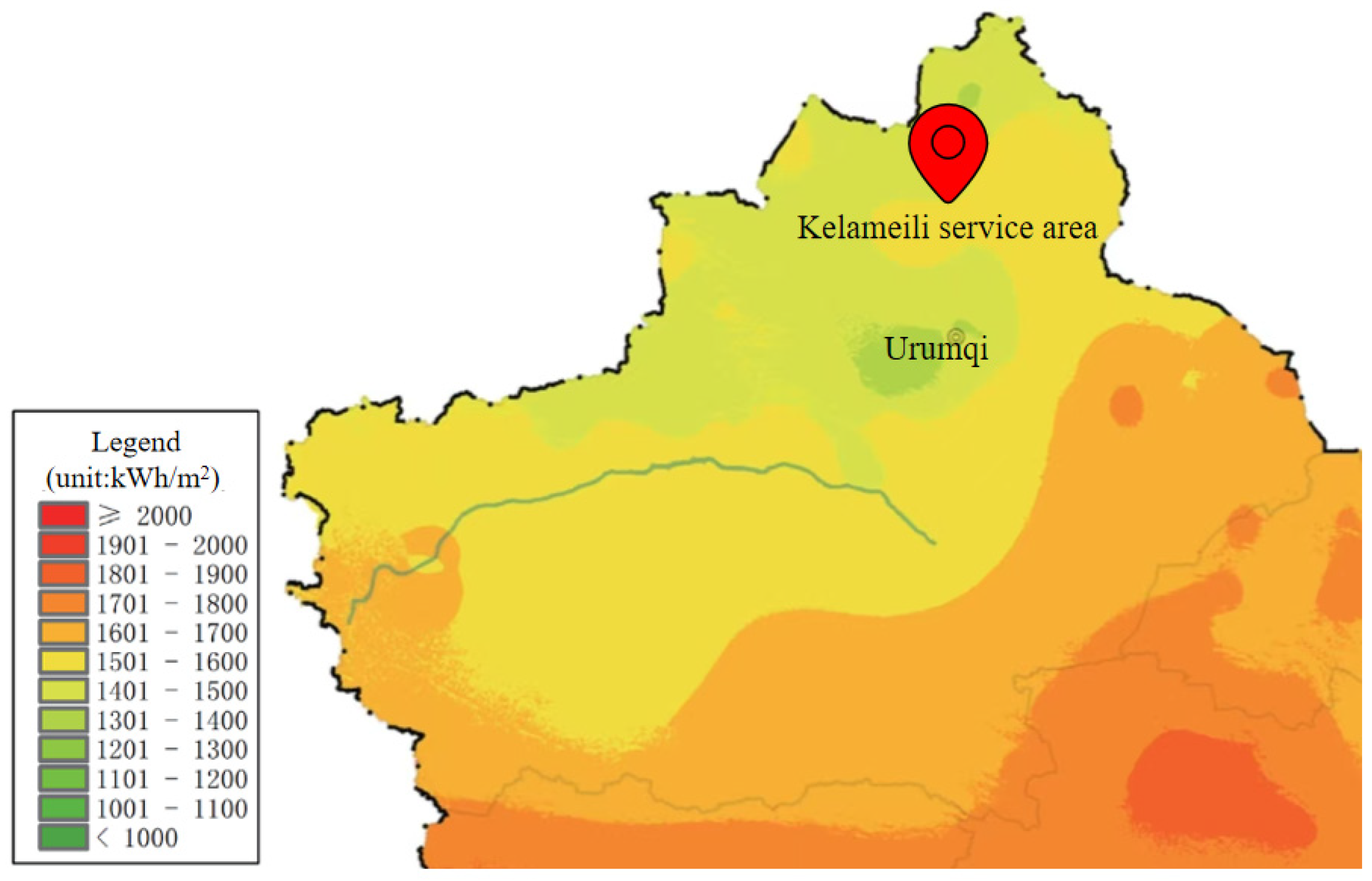
Figure 2 shows the distribution map of annual total horizontal solar irradiance in Xinjiang in 2024. This distribution map clearly demonstrates the regional endowment characteristics of solar energy resources in Xinjiang, providing an intuitive spatial reference for the zonal development of solar energy resources, site selection of photovoltaic projects, and regional energy planning in Xinjiang. Based on the above, this paper selects the Kelameili Service Area, located in the middle section of the S21 Expressway—the first desert highway in Xinjiang—as the research object. The region where the service area is located is characterized by long and severe cold winters, hot and dry summers, sufficient sunshine duration, and strong solar radiation intensity. The solar energy guarantee rate ranges from 50% to 60%, and the region is classified as a Class II solar-rich area [
5], with favorable conditions for solar energy development and utilization and high photovoltaic power generation potential. Therefore, taking this service area as the research object, this paper investigates its green energy utilization mode and energy-saving optimization.
At present, many experts and scholars at home and abroad have carried out relevant research on building photovoltaic utilization in desert areas. Mirza et al. [
6] analyzed the application potential of solar energy in Pakistan and concluded that photovoltaic power generation systems are suitable for desert areas far from the power grid in Pakistan due to their high cost, while solar thermal technologies such as solar water heaters and solar cookers are suitable for people’s daily use, which can greatly reduce the consumption of fossil fuels. Hadwan et al. [
7] studied the feasibility of off-grid photovoltaic systems in rural and desert communities in Yemen, taking the Bedouin desert community in Yemen as an example. Through simulation analysis, it is found that the power generation cost of the photovoltaic system is only
$0.394/kWh, which is 50% lower than the cost of the original LCE system. Ma Yanyan [
8] analyzed the power generation of two different photovoltaic power stations in the desert area. The results showed that the monthly power generation, monthly average utilization hours and monthly cumulative irradiance showed a positive correlation in one year. Using MATLAB software to analyze the solar light intensity and the power of photovoltaic modules, it is found that the higher the light intensity, the greater the power generation, and the two are also positively correlated. Wang Qi et al. [
9] studied the solar energy utilization rate of five cities in Hexi Corridor. The average annual solar energy utilization rate of the photovoltaic industry was 5.536%, which was 158.17 times than that of desert plants (0.035%), indicating that the photovoltaic system had significant efficiency and stability in solar energy utilization. In addition, it is found that the utilization rate of photovoltaic solar energy is mainly affected by solar radiation.
There are many in-depth studies of the highway service area building photovoltaic system. Vollo [
10] studied the solar energy utilization in the service area near Calhoun, Georgia, and found that the power consumption savings were significant compared to two 12-month cycles. The contribution rate of solar energy in the first cycle was 33%, and then increased to 70%, showing the efficient use of solar energy. Zhou et al. [
11] introduced the application practice of distributed solar photovoltaic power generation in an expressway service area by taking the reconstruction and expansion project of Beijing–Shijiazhuang Expressway as an example. The research points out that the photovoltaic power generation system adopts the grid-connected mode, without the need for storage batteries, which not only satisfies the service area’s own electricity consumption but also can connect the remaining electricity to the Internet. The average annual power generation in a single service area can reach 441,500 degrees, and the carbon dioxide emission is reduced by 423 tons, which has significant benefits in energy saving, emission reduction and land saving. Wang Mingxu et al. [
12] take the new expressway service area in Beijing as the research object and make a comprehensive analysis and benefit calculation of its distributed photovoltaic power generation project. The results show that the service area layout photovoltaic system has significant natural advantages and alleviates the imbalance of power production and sales. The static payback period of the project is about 7 to 8 years. Xin Mingxi et al. [
13] conducted an in-depth discussion on the application prospect of a photovoltaic power generation system in a new expressway service area in Guangxi. Considering the investment and power allocation, it is calculated that the payback period of investment is 8 years, and it is expected that the net income of 9.7983 million yuan can be realized within 25 years of service life. As the first large-scale application project of photovoltaics in the road area in China, the demonstration project of traffic energy integration of Zaohe Expressway in Shandong Province deploys photovoltaics on slopes, service areas and other scenarios, integrates the integrated intelligent platform of “source–grid-load–storage”, and develops wind energy and light energy along the line. The annual power generation of the project is 1.2 GW·h, which can reduce carbon emissions by 570 t per year [
14]. The Panzhihua–Dalian Expressway in Sichuan covers areas such as slopes and spoil grounds through a full-scene optical storage system. The installed capacity is 2.68 MW, and the average daily power generation is 13,100 kW h. With the advantages of “no new land use and fast construction”, the annual power generation output value is 2.8 million yuan, and the payback period is shortened to 8 years [
15]. Taking the Kelameili Service Area of S21 desert expressway in Xinjiang as an example, Xu Xiaoyong et al. [
16] studied the planning and design of the green energy self-consistent system in the expressway service area of an arid desert area. Based on the energy consumption data of the service area (annual electricity consumption of 2.2182 million kW·h) and the abundant local solar energy resources (annual radiation of 5343.12 MJ/m
2), an energy self-consistent scheme of “distributed photovoltaic + energy storage + microgrid mutual aid” is proposed. The designed installed capacity of the system is 600.6 kWp, which can achieve the operation target of a 30% energy self-consistency rate, 100% guarantee of key facilities and 6 h of emergency service.
The existing research has carried out useful explorations on the photovoltaic potential, technical economy and solar energy application cases in some service areas in desert areas. However, a research gap is reflected in the lack of research on photovoltaic system parameter optimization and full life cycle benefits for the specific scenario of the cold and arid desert highway service area, and the simulation and optimization are not carried out in combination with extreme environmental factors such as measured fault data and snow cover, and the degree of integration with engineering practice is insufficient.
In view of the above problems, this paper takes Kelameili Service Area as the research object, integrates the measured operation data and PVsyst simulation, and clarifies the causes of the deviation between simulation and actual power generation. Under the spatial constraint of road slope, the multi-parameter optimization of photovoltaic dip angle and azimuth angle is carried out to determine the optimal configuration. The energy saving, carbon emission reduction and economic benefits of the system are calculated by the whole life cycle analysis method. The research results can provide a landing technical solution for clean energy self-sufficiency in expressway service areas in severe cold and arid desert areas.
3. Results
3.1. Photovoltaic Simulation Results
According to the PVsyst simulation results of the photovoltaic power generation system shown in
Table 4, the theoretical annual power output of the array is 608,000 kWh, while the simulated available power supply of the PV system at Kelameili Service Area is 575,000 kWh. Compared with the annual electricity demand of 3.661 million kWh in the service area, it can be seen that there is a significant gap between the power generation capacity of the photovoltaic system and the actual electricity consumption. The system still needs to supplement about 3.009 million kWh from the power grid throughout the year. From the monthly power generation distribution, the photovoltaic system has the highest power generation in July, reaching 80,000 kWh; the power generation in January is the lowest, less than 19,000 kWh, showing obvious seasonal fluctuation characteristics.
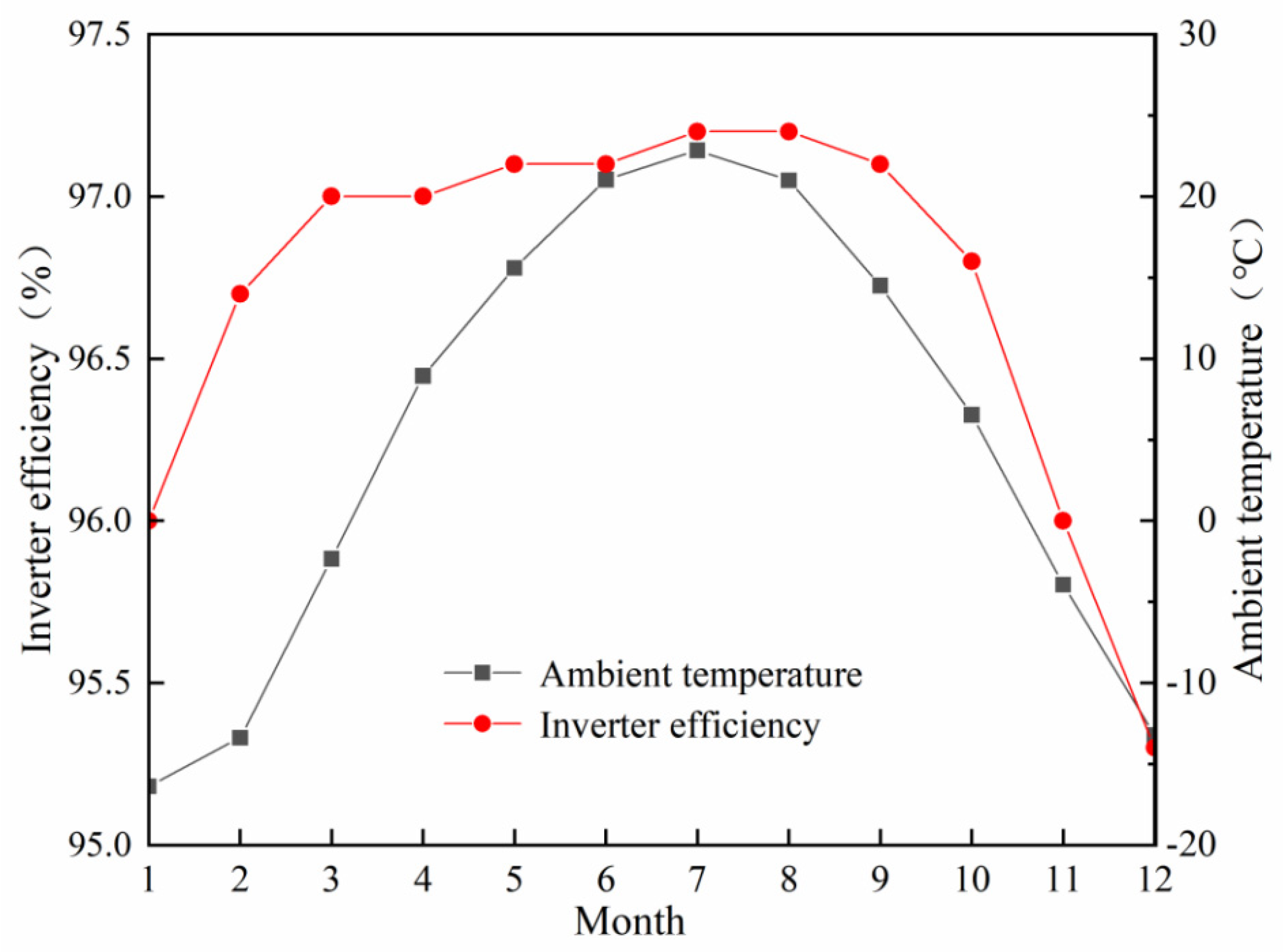
During the period of January, November and December, the power generation of the photovoltaic system is at a low level, and the power supply of the power grid is significantly higher than that of other months. The main reasons include: the solar radiation intensity is weak in winter, and the power generation efficiency of photovoltaic system decreases as a whole; at the same time, the snow on the surface of the photovoltaic panels in the Kelameili Service Area failed to be cleared in time in winter, which further reduced the power generation efficiency. In addition, the low-temperature environment will also lead to a slight decrease in the operating efficiency of the inverter (as shown in
Figure 15). Although the power generation of the photovoltaic system peaked in July, the inverter efficiency in this month was slightly lower than that in August, mainly due to the higher temperature in July than in August, and the high-temperature environment had a certain negative impact on the inverter efficiency. The annual simulation data show that the efficiency of the inverter is always maintained at more than 95%.
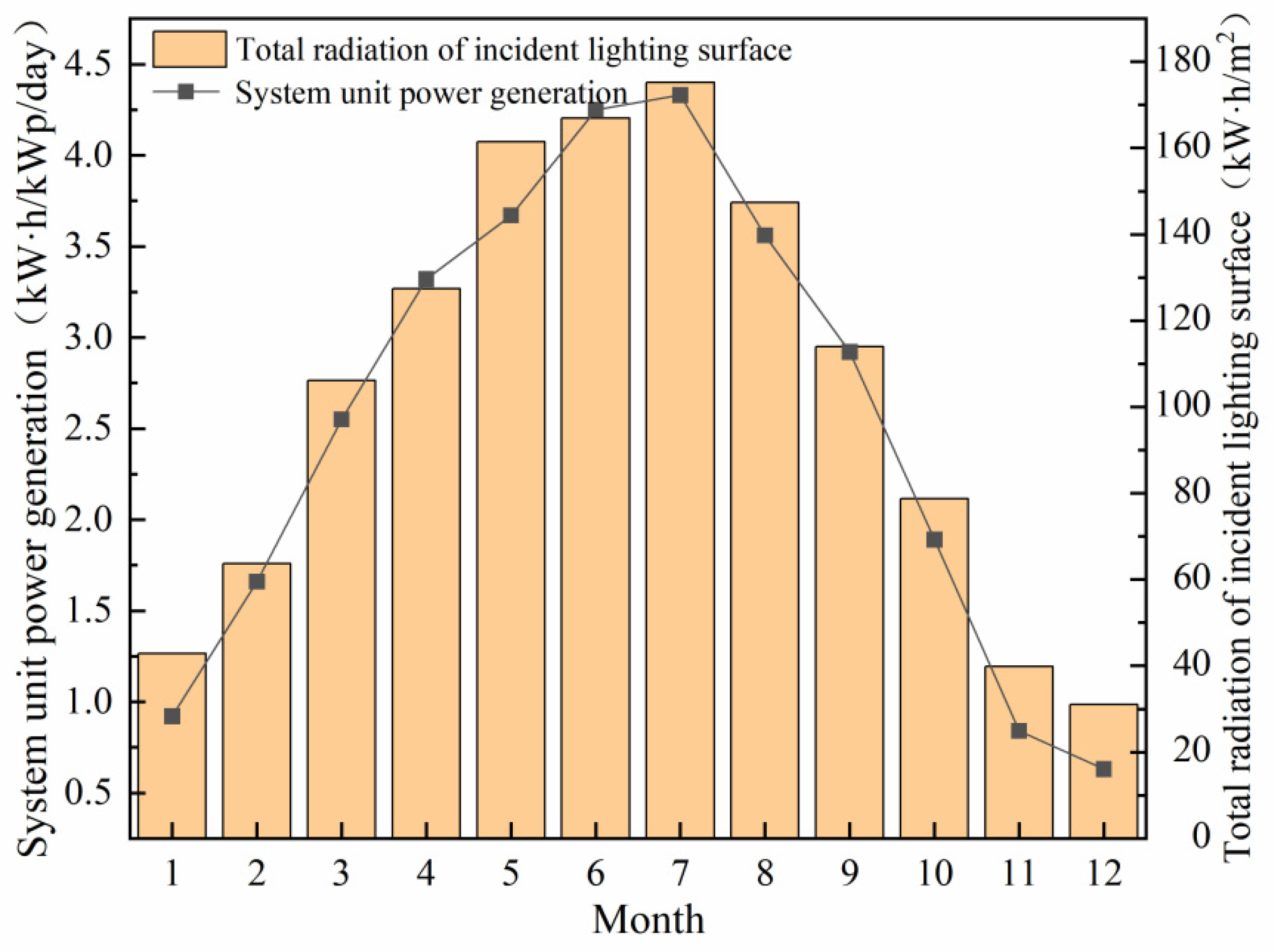
Figure 16 shows the corresponding relationship between the total radiation of the lighting surface of the photovoltaic power generation system and the unit power generation of the system. It can be seen that the unit power generation of the system is significantly positively correlated with the total radiation received by the lighting surface. In July, the total radiation reached the highest value, and the corresponding system unit power generation also reached the peak. In December, the total radiation is the lowest, and the unit power generation of the system is correspondingly reduced to the lowest level.
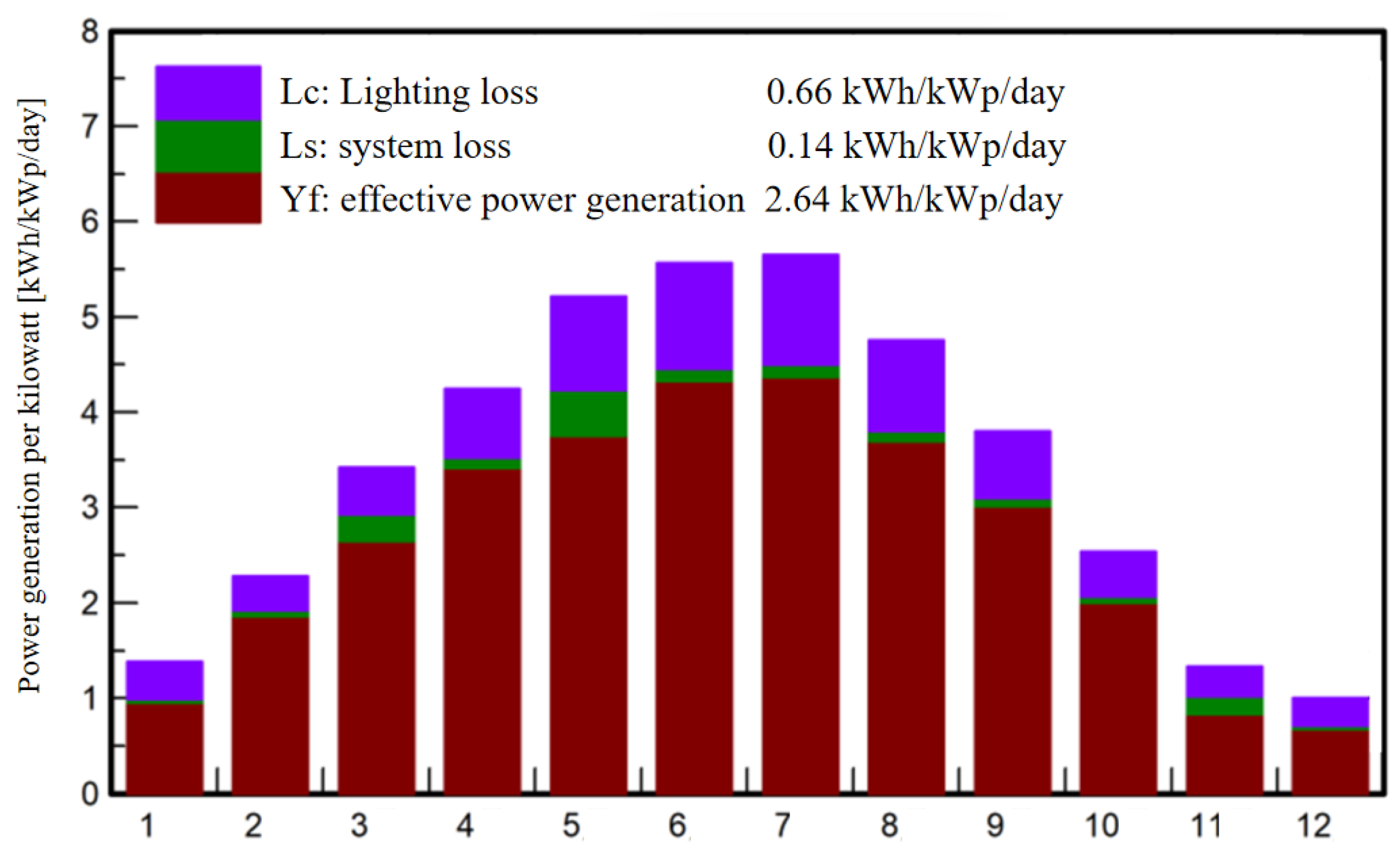
According to the simulation results, the power generation performance and lighting and system loss of the photovoltaic system in the service area are shown in
Figure 17. The figure shows that the power generation of the system is generally stable from April to September, and the effective power generation is the highest in July, and the corresponding lighting loss is also the largest. The effective power generation is the lowest in December, and the system loss is also at the minimum.
Table 5 further shows that the system’s unit power generation loss peaked in May at 0.57 kWh/kWp/day; the losses were the smallest in January and December, 0.07 kWh/kWp/day and 0.08 kWh/kWp/day, respectively.
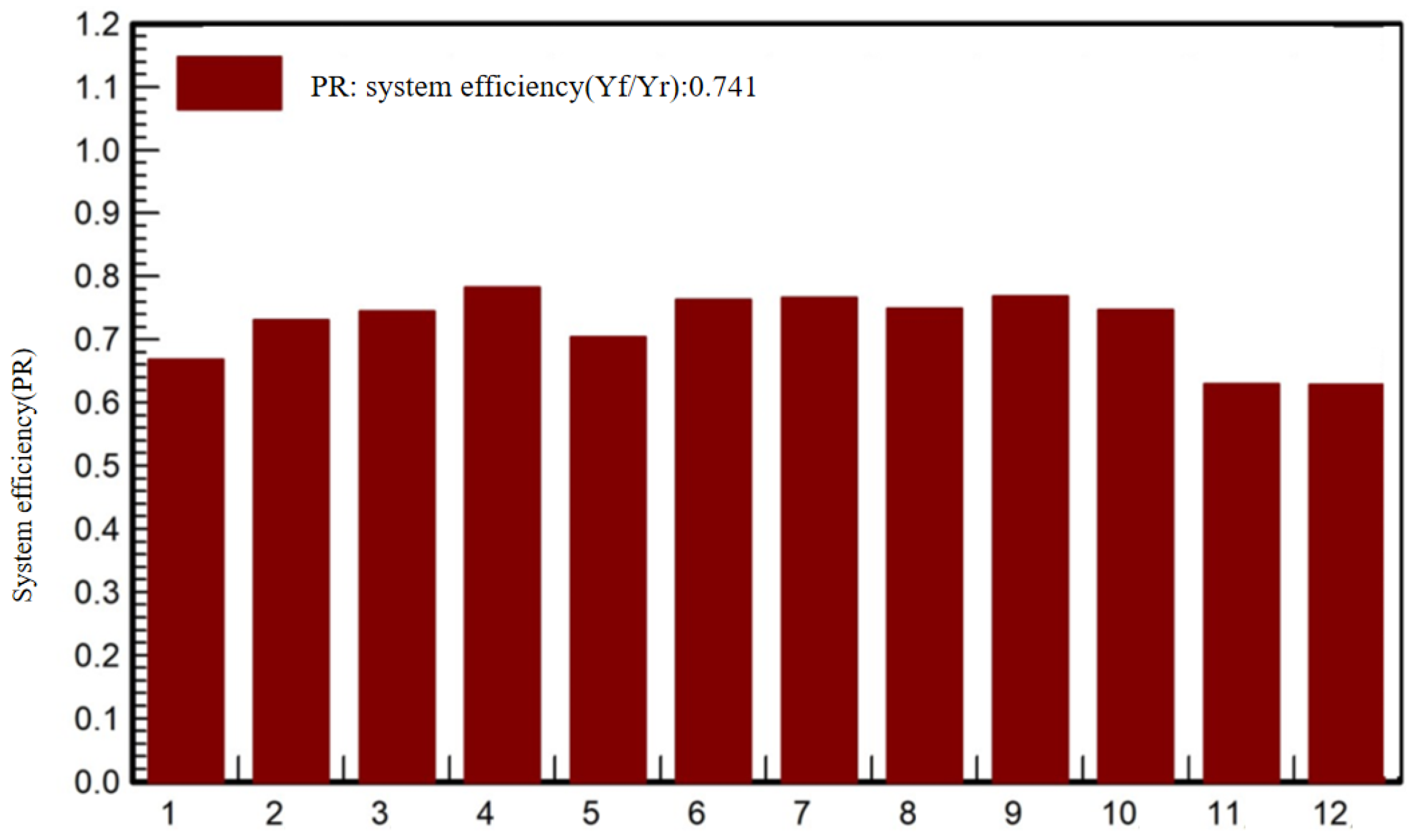
Photovoltaic system efficiency (PR) is a key index to evaluate the actual power generation performance of the system, which is defined as the ratio of the actual output power to the theoretical output power under standard test conditions. This index comprehensively reflects the ratio of actual grid-connected power to theoretical power generation after eliminating various influencing factors such as line loss, radiation loss, dust shielding, heat loss and so on. The simulation results show that the PR value of the photovoltaic system is 0.741. According to the results shown in
Figure 18, the system efficiency reached the highest in April, while the efficiency did not reach the peak in July when the irradiation was the strongest. The main reason is that the high temperature in summer leads to a decrease in output power and power generation efficiency of photovoltaic cells, which in turn has a negative impact on the overall efficiency of the system.
3.2. Deviation Analysis Between Simulation and Measured Data
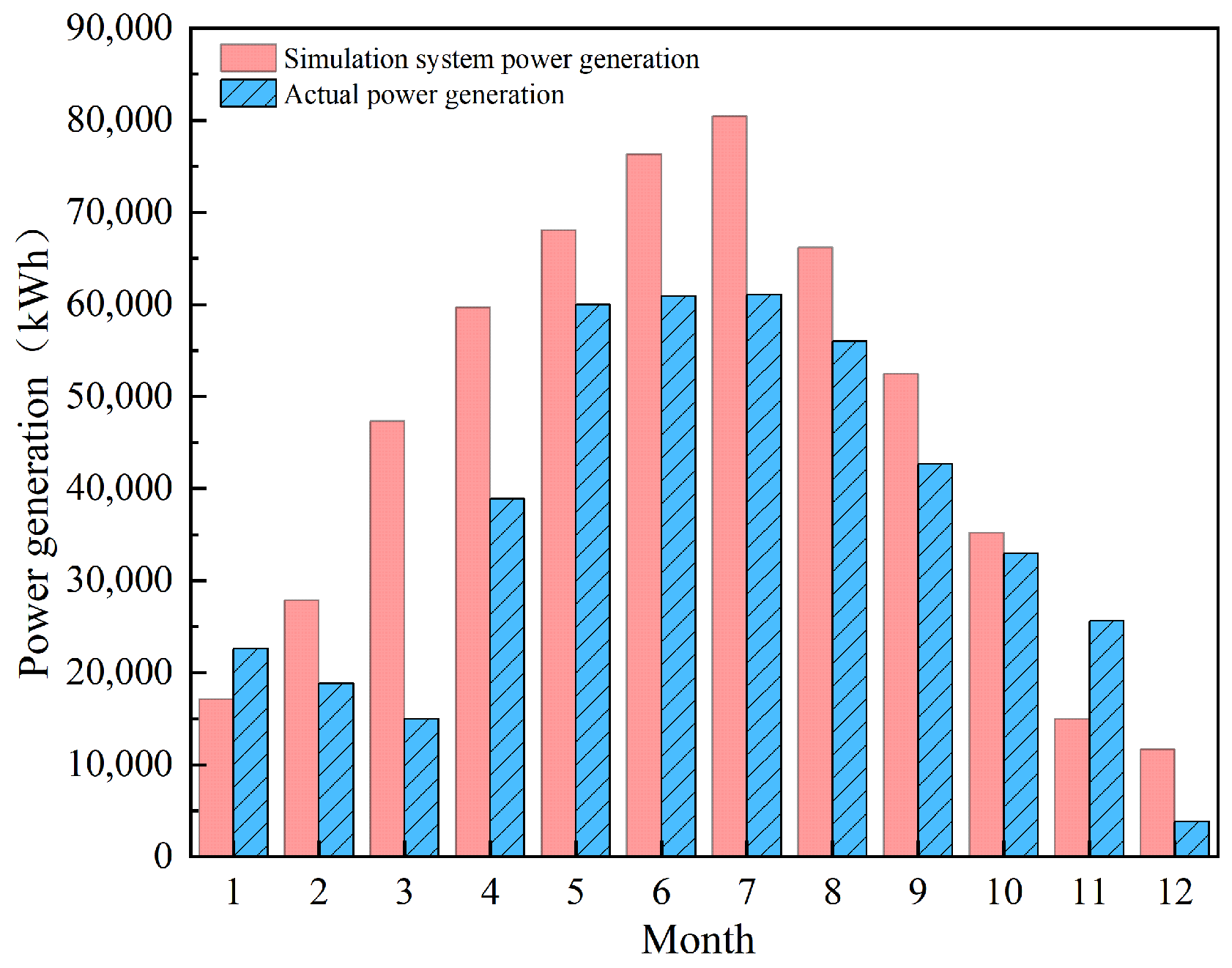
PVsyst simulation shows that the annual power generation of photovoltaic system is 575,000 kWh, while the actual annual power generation is 438,000 kWh.
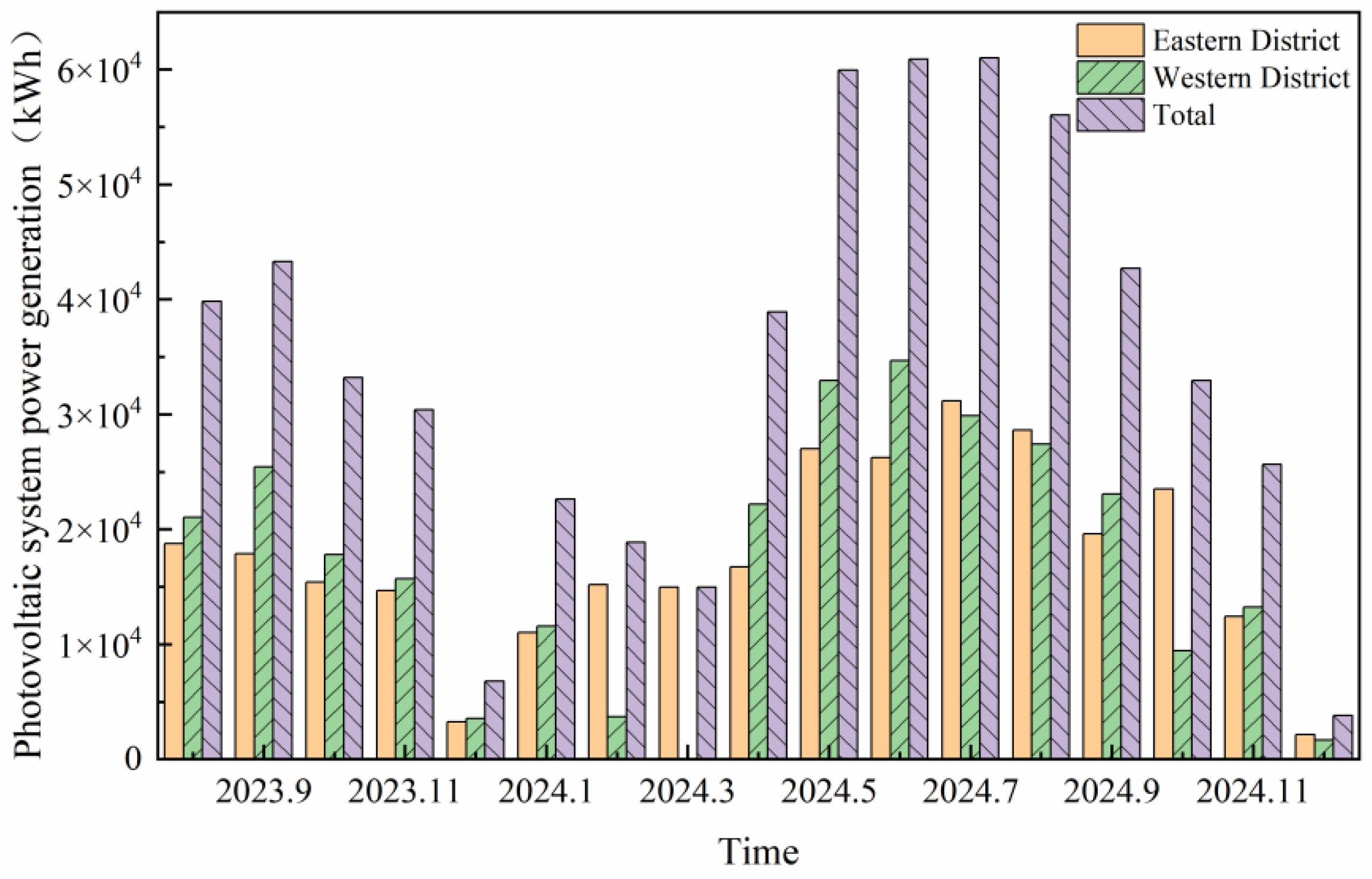
Figure 19 shows that the simulated power generation is higher than the actual value in most months. The main reasons are as follows: there are differences between idealized modeling and the actual environment. In the simulation, the snow cover and dust accumulation loss are the statistical average values, while in the actual winter of 2024, the snowfall in the Kelameili Service Area is more, and the actual occlusion loss is higher than the modeling value due to the untimely removal of snow. At the same time, spring sandstorm weather occurs frequently, the actual cleaning frequency does not reach once a week, and the dust accumulation loss is higher than the modeling value. Equipment failures and abnormal operation also contribute to the deviation. In the simulation, it is assumed that the inverter is shut down for 72 h a year, but in practice, the photovoltaic system in the western region is shut down for more than 30 days due to equipment failure in February and March 2024, which directly leads to the reduction of actual power generation, which is the largest source of deviation. Sudden extreme weather such as strong wind, sand and dust storms in the desert area will lead to instantaneous occlusion of photovoltaic panels and temporary protection shutdown of equipment. Such random factors are not included in the simulation, resulting in further reduction of actual power generation.
In November and January, the simulated power generation is lower than the actual measured value because the historical or predicted irradiation conditions used in the simulation are more conservative, and the actual illumination in these two months is better than expected, resulting in the actual power generation being higher than the simulated value.
Through the above analysis, it can be seen that the deviation between the simulation and the measured data is not the systematic error of the modeling method, but the extreme nature of the actual environment, the suddenness of the equipment failure and other non-modeling controllable factors. The key loss factor values and assumptions set in this study are in line with the actual operation characteristics of the Kelameili Service Area, and the modeling results are reliable and suitable for reference.
3.3. Benefit Analysis of Photovoltaic System
A comprehensive benefit evaluation of the photovoltaic system is conducted within a life cycle analysis framework. Firstly, through static cost–benefit accounting, the basic economic benefits and carbon emission reduction benefits of the photovoltaic system are clarified. On this basis, in view of the shortcomings of static analysis, the discounted cash flow analysis and sensitivity analysis of key parameters are further carried out. At the same time, the uncertainty assessment of emission factors, carbon prices and policy changes in the process of carbon accounting is carried out. Through the combination of static calculation and dynamic analysis, the economic benefits and low-carbon benefits of photovoltaic systems are comprehensively evaluated.
3.3.1. Accounting Basic Parameters and Static Benefit Analysis
The design service life of the photovoltaic module is 25 years. As the time boundary of the whole life cycle analysis of the system, the manufacturer provides a 25-year power guarantee rate of 80% to 85%. The system is simulated by PVsyst to obtain a 25-year power guarantee rate of 80.6%. Combined with the operation characteristics of desert expressway service areas, the technical characteristics of the photovoltaic system and the local market and policy environment in Xinjiang, the core parameters of life cycle benefit accounting are determined. The specific parameters are shown in
Table 6. The core calculation formulas of carbon emissions and carbon gains are shown in Equations (1) and (2). The simulation results of 25-year power generation and basic benefits of the photovoltaic system are shown in
Table 7.
where C represents the annual CO
2 emissions of Kelameili Service Area, kg. E represents the annual electricity consumption in Kelameili Service Area, kWh. F represents the carbon emission factor, kgCO
2/(kWh).
where R represents the photovoltaic power generation carbon gains, yuan. P represents the unit carbon yield price, yuan/MWh.
Based on the 25-year annual power generation of the photovoltaic system simulated by PVsyst software and the basic accounting parameters shown in
Table 6, the static cost–benefit method is used to measure the system benefits. The calculation process does not consider the time value of funds and operation and maintenance costs and only takes the initial construction investment, the full life cycle electricity saving income and the carbon trading income as the accounting boundary. According to the calculation, the photovoltaic system has saved 7.5555 million yuan of electricity bills in 25 years, accumulated 52.38 million yuan of carbon income, and the total comprehensive income is 8.0793 million yuan. The initial total investment of the project is 7 million yuan, and the static investment recovery period is about 22 years. At the same time, through the calculation of Equation (1), the whole life cycle of the system has saved 1688.2 tons of standard coal and reduced 10,288.94 tons of CO
2 emissions.
3.3.2. Dynamic Analysis and Single Factor Sensitivity Analysis
The static analysis does not consider the time value of capital, the actual operating cost and the slight fluctuation of market price, and there is a deviation from the actual operation of the project. Therefore, the net present value (NPV) and the dynamic payback period are introduced as the core evaluation indexes. Based on factors such as the benchmark discount rate of 6%, the annual operation and maintenance cost of 84,000 yuan, the annual increase in electricity price of 1.5% and the attenuation of component power in
Table 6, the dynamic accounting is carried out. The calculation formula of annual net cash flow and net present value is shown in (3) and (4) [
21].
where
represents the net cash flow in year t, ten thousand yuan.
represents the photovoltaic power generation in year t, kWh.
represents the grid electricity sales price in year t, yuan/kWh.
represents the CO
2 emission reduction in year t, t.
represents the regional carbon trading price in year t, yuan/tCO
2.
represents the annual fixed operation and maintenance cost, 10,000 yuan.
where
represents the net present value.
represents the cash flow in year t.
represents the discount rate.
represents the initial investment.
According to the calculation, the cumulative electricity cost saving income of the photovoltaic system in 25 years is about 7.5722 million yuan, and the cumulative carbon income is about 524,800 yuan. According to the annual operation and maintenance cost of 84,000 yuan, the cumulative operation and maintenance cost in 25 years is 2.1 million yuan, the cumulative net cash flow in 25 years is 6.007 million yuan, and the net present value (NPV) of the project is 1.285 million yuan. It shows that the project still has clear economic feasibility after considering the time value of capital, operation and maintenance cost and market price. The dynamic investment recovery period is about 24 years, which is 2 years more than the static investment recovery period. It is mainly affected by the discounted cost of the previous funds and the continuous expenditure of the average annual operation and maintenance cost. Moreover, the net present value of the project in the 25th year is still positive, and the payback period will be further shortened if additional benefits such as photovoltaic price subsidies and green power transactions are added.
In order to identify the key parameters affecting the economic benefits of photovoltaic projects and quantify the impact of the fluctuation of each parameter on the profitability of the project, four core indicators of electricity price, benchmark discount rate, annual operation and maintenance cost and component attenuation rate are selected. The control variable method is used to carry out ±20% single factor sensitivity analysis, and the benchmark net present value (1.285 million yuan) is used as a reference to clarify the benefit sensitive points. The results are shown in
Table 8. Through sensitivity analysis, it can be seen that electricity price is the core factor affecting the economic benefits of the project, and its fluctuation has an impact on NPV by ±67.6%, followed by the benchmark discount rate and operation and maintenance cost, and the component decay rate has the least impact. The sensitivity analysis clarifies the core influencing factors of project benefits and provides a quantitative basis for subsequent operation optimization and risk control.
3.3.3. Carbon Emission Reduction Benefit and Uncertainty Assessment
Taking photovoltaic power generation instead of grid power supply as the emission reduction benchmark, combined with the simulation data of component power attenuation and system optimization, according to Formula (5), the cumulative CO
2 emission reduction of the whole life cycle of the photovoltaic system is 10,311.98 tons, with an average annual emission reduction of about 412.48 tons, an increase of 23.04 tons compared with the static accounting value; a total of 1692 tons of standard coal was saved, which was 3.8 tons higher than the static value. The emission reduction decreases slightly with the component attenuation year by year, and the overall scale is stable.
where
represents the 25-year cumulative CO
2 emission reduction, t.
In the calculation of carbon benefits, this study uses fixed grid carbon emission factors and fixed carbon trading prices to calculate, without considering the uncertainty caused by the attenuation of emission factors, carbon market price fluctuations and related policy changes in the whole life cycle. From the perspective of technological evolution, with the increasing proportion of clean power supply in the regional power grid, the carbon emission factor of the power grid will gradually decrease. From the perspective of the market mechanism, the adjustment of the national carbon market pricing mechanism, CCER certification rules and carbon control policies in the transportation sector may have a certain impact on the actual carbon returns. Therefore, the calculation results in this section are the theoretical values under ideal conditions, and there may be some deviations in the actual income. Subsequent research can further introduce dynamic factor scenario analysis to improve the realistic fit and robustness of carbon benefit assessment.
3.4. Photovoltaic System Optimization
The site where large-scale photovoltaic arrays in the Kelameili Service Area is limited, so the system is finally arranged in the slope area next to the highway. This location limits the installation range and orientation of the photovoltaic system, which makes it face certain constraints in the design optimization of azimuth and inclination.
Firstly, the inclination angle and azimuth angle of the photovoltaic panel are fixed, and the PVsyst software is used to adjust the spacing of the photovoltaic panels for simulation. The results show that changing the spacing of photovoltaic panels within the current available site has no significant effect on the power generation of the system. Then, the spacing and azimuth of the photovoltaic panels are fixed, and the inclination angle of the photovoltaic panels is simulated and optimized. When the inclination angle is adjusted between 12° and 20°, it is found that, when the inclination angle is 14°, the annual power generation of the system is the highest, reaching 578 MWh. When the dip angle is lower or higher, the power generation shows a downward trend. Further, based on the three-dimensional shadow analysis, the inclination angle of the field area is adjusted, and the power generation corresponding to different inclination angles is shown in
Table 9. Finally, the inclination angle and spacing are fixed, and the azimuth angle of the photovoltaic panel of the photovoltaic system is adjusted. By changing the azimuth angle, it is found that the annual power generation of the photovoltaic system is up to 579 MWh when the azimuth angles of the photovoltaic panels in the western and eastern regions are 89°/−89°, respectively. When lower than 89° or higher than 89°, the power generation of the photovoltaic system becomes lower and lower, and the power generation below 89° decreases faster. The power generation is shown in
Table 10.
In summary, the optimal inclination angle of the photovoltaic panel in the Kelameili Service Area is 14°, and the optimal azimuth angles are 89°/−89°, respectively. Under this configuration, the maximum annual power generation of the photovoltaic system can reach 579 MWh. After optimization, it can save 17.3 tons of standard coal and reduce CO2 emissions by about 433.6 tons.
After adopting the above optimization scheme, the 25-year power generation simulation of the photovoltaic system is carried out, and the results are shown in
Table 11. The 25-year power guarantee rate of the system is 80.3%. It is estimated that the cumulative energy saving is 1692 tons of standard coal, and the CO
2 emission reduction is 10,311.98 tons. According to the current carbon trading price, the carbon income is about 524,800 yuan, and the comprehensive income is about 8,097,000 yuan.
In this study, the values of the theoretical array power generation, simulated available power supply, actual power generation affected by faults, and power generation under optimized scenarios of the photovoltaic system are clearly distinguished to avoid conceptual confusion. The connotation, calculation basis, and interrelationships of each value are presented in
Table 12.
4. Discussion
In this study, the photovoltaic system research was carried out in the case of Kelameili Service Area as a desert expressway service area. Although the targeted research results have been achieved, there are still some limitations:
In terms of carbon income measurement, fixed carbon emission factors and fixed carbon trading prices are used for accounting, and uncertainties such as dynamic attenuation of grid emission factors, carbon market price fluctuations and carbon policy changes in the 25-year life cycle are not considered, which may lead to a certain deviation between the carbon income assessment results and the actual situation.
In addition, although the Kelameili Service Area is equipped with an energy storage system, due to the relatively small scale of photovoltaic power generation relative to the load, energy storage has not been able to play an effective role in actual operation. This suggests that, in similar scenarios with high energy consumption and high grid dependence, the value of the energy storage system needs to be comprehensively evaluated in combination with photovoltaic ratio, load characteristics and grid reliability. Subsequent research can explore the optimal configuration and operation strategy of energy storage in photovoltaic expansion or independent microgrid mode.
5. Conclusions
In this study, Xinjiang Kelameili Service Area is taken as a case study. Through field energy consumption analysis, photovoltaic system modeling and simulation optimization, the performance and efficiency of the photovoltaic power generation system in an expressway service area in a desert area are systematically studied. The main conclusions are as follows:
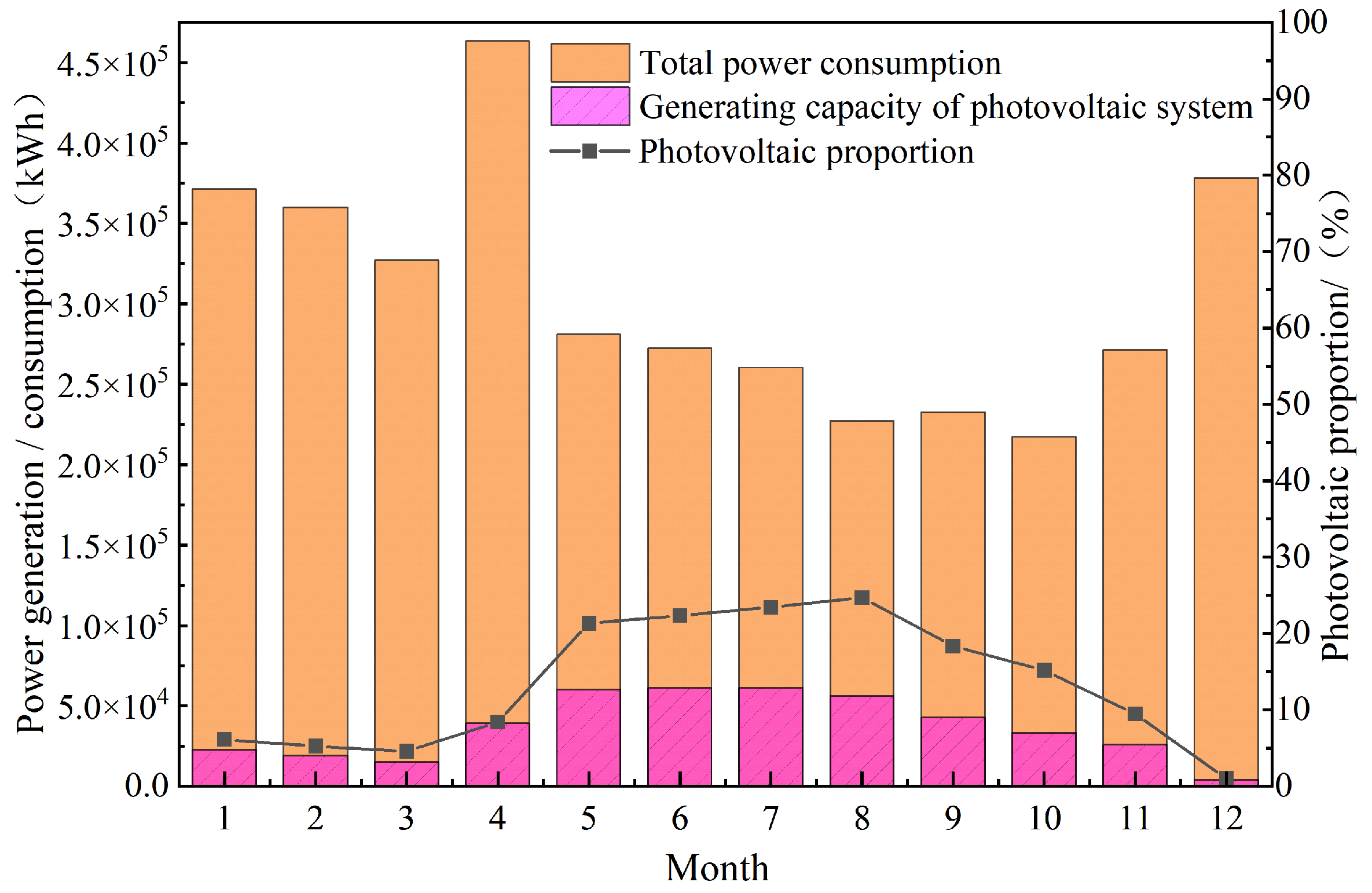
There is a significant gap between energy consumption and photovoltaic supply. The total electricity consumption of the Kelameili Service Area in 2024 is 3.661 million kWh, while the actual annual photovoltaic power generation is only 438,000 kWh, accounting for only 12% of the annual electricity consumption, indicating that the existing photovoltaic system has not yet met the electricity demand of the service area, and there is still much room for improvement in photovoltaic power generation potential.
Under the limited engineering conditions of the site, the dip angle and azimuth angle of the photovoltaic panel are optimized in turn by the control variable method, and the optimal dip angle is determined to be 14° and the optimal azimuth angle is 89°/−89°. Under this parameter combination, the annual power generation of the system reaches 579 MWh, which is 32.2% higher than the measured value. The optimization scheme does not need to add new sites and equipment and has the engineering advantages of low cost and easy implementation.
The whole life cycle economic benefits and carbon emission reduction benefits are significant. Based on the 25-year simulation prediction of the optimization scheme, the system can save 1692 tons of standard coal and reduce CO2 emissions by 10,311.98 tons, carbon revenue by about 524,800 yuan, and comprehensive income by about 8,097,000 yuan. The static investment payback period is about 22 years, which verifies the economic feasibility and low-carbon value of photovoltaic applications in desert expressway service areas.
The research results fill the gap of systematic research on photovoltaic systems in expressway service areas in severe cold and arid deserts, provide specific technical reference for the planning, design and optimization of photovoltaic systems in expressway service areas in similar desert areas, and have important practical significance for promoting the construction of low-carbon transportation infrastructure.