1. Introduction
An important factor shaping energy strategies in EU countries is the long-term vision of achieving climate neutrality by 2050, together with regulatory mechanisms that stimulate progress toward this goal in the coming decades (the document: A European Green Deal: Striving to Be the First Climate-Neutral Continent. COM (2019) 640 Final, 2020) [
1]. By 2030, as part of the low-emission energy transition (RED III), the EU intends to reach 42.5% (ultimately 45%) of energy supply (gross final energy consumption) from renewable energy sources [
2]. Over the last decade, the European Union has exhibited a clearly visible upward trend in the share of RES in the electricity generation mix. As reported by Eurostat, the level of 60,000 GWh of electricity production from RES was exceeded in 2010, and the current level is already twice as high. In 2024, 25.2% of gross final energy consumption in the EU came from RES [
3].
The EU’s climate policy is consistent with the Paris Agreement—COP21 [
4] (December 2015, the 21st Conference of the United Nations on Climate Change). It implies the necessity of limiting the increase in the global average temperature to well below 2 °C compared to pre-industrial levels, while efforts should be made to keep it to no more than 1.5 °C.
The EU’s climate policy strongly affects the functioning of energy markets in Member States, including Poland. For several years, the energy sector has been undergoing transformation in line with the long-term vision of reducing greenhouse gas emissions in the EU by 2050. In 2020, the European Commission published the European Green Deal document [
1], i.e., a strategy whose ambitious objective is for the EU to achieve climate neutrality by 2050—as a global leader in this area. Poland supported this goal by developing its own strategy, PEP2040 [
5], which takes into account the specificity of its economy with a high reliance on coal-based fuels. The Polish power sector is heavily dependent on coal fuels, and this dependence is substantially higher than in other EU Member States; for comparison, the share of coal (including lignite) in the energy mix amounted to 57.1%, while the EU average was around 12% in 2023 [
6,
7]. However, dependence on fossil fuels and decarbonisation processes is not uniform, but varies from region to region. Nordic and Western European countries generally have more experience and willingness to implement decarbonisation agendas, while Central and Southern European countries have traditionally lagged in deploying new decarbonisation-related technologies. The Nordic countries, in particular, are leaders in the adoption of zero- or low-emission technologies. This affects their decarbonisation challenges and policy priorities [
5,
6]. A combination of regional frameworks and national adjustments shapes decarbonization strategies in the EU. For example, Germany is dependent on gas, coal, and renewable energy sources, France is dominated by nuclear energy [
8], Central and Eastern Europe shows scepticism regarding climate change and high energy poverty [
9], and the Nordic region is characterized by a positive political outlook for carbon neutrality, is recognized for its ambitious and progressive decarbonisation policies, and significant use of renewable energy sources, especially hydropower, wind power, and bioenergy [
10,
11]. Poland’s economy is among the most emission-intensive in Europe, as the average CO
2 emission intensity in Poland reached approximately 700 gCO
2eq/kWh, whereas in the EU it was approximately 230 gCO
2eq/kWh in 2021 [
6]. Higher emissions imply high costs of CO
2 emission allowances under the EU ETS. In 2024, emission allowance prices averaged between €68 and €73 per tonne, which translates directly into higher energy costs. Currently, the average energy price for small- and medium-sized enterprises in Poland is approximately 693 PLN/MWh (€147/MWh) under the price cap system, which is above the EU average. Bearing the burden of relocation means that Polish companies are bearing some of the costs of damage in Europe [
6].
In recent years, Poland has nevertheless made progress in diversifying its energy sources. The renewable energy market in Poland is developing, and the share of RES in the energy mix reached 29.6% in 2025 [
12]. The PV market has been growing strongly. As of October 2024, Poland’s installed power generation capacity reached approximately 72 GW, with renewables accounting for 32.7 GW. This places Poland fourth in Europe in terms of annual growth in photovoltaic capacity and eighth globally in terms of total installed photovoltaic capacity. The largest growth in 2024 was recorded in large solar farms, driven by programmes such as “Mój Prąd” and regulatory changes facilitating installations up to 150 kW, which favoured both industrial-scale projects and small prosumer systems [
6].
Despite the extensive literature on energy transition and decarbonisation in Poland, existing studies predominantly focus either on aggregate emissions and energy consumption levels or on the expansion of renewable energy capacity as the primary explanatory factor. Much less attention has been paid to intensity-based approaches that separate structural efficiency effects from scale effects of economic growth, particularly in short and medium-term transition phases. Moreover, while generation capacity availability is frequently discussed in the context of energy security and system adequacy, it is rarely operationalised as a quantitative explanatory variable in econometric models of emissions intensity.
Therefore, the literature lacks empirical analyses that jointly integrate demand-side efficiency (economic energy intensity) and supply-side operational constraints (capacity availability of the total system and renewable sources) within a unified intensity-based framework. This gap limits the ability to distinguish between efficiency-driven decarbonisation and changes driven by short-term system operation. The present study addresses this gap by proposing and empirically validating an OLS model that links CO2 emissions intensity to economic energy intensity and power generation availability indicators, using Poland as a case study for the period 1990–2024.
The analysis covers the period 1990–2024, but the authors will examine whether the effect analyzed was constant throughout the research period or whether it has changed since 2015 compared to the period pre-2015. The choice of the period 1990–2024 and the year 2015 as the structural breakpoint is deliberate and methodologically grounded rather than a matter of presentation convenience. The year 2015 constitutes a natural structural breakpoint associated with the adoption of the Paris Agreement, which marked a fundamental shift in climate policy objectives, regulatory expectations, and reporting frameworks at both the EU and national levels. Starting the analysis in 1990 ensures that the entire sample operates under a relatively coherent policy regime, thereby reducing heterogeneity of the analysis, and additionally allows us to examine the impact of institutional conditions resulting from the adoption of the Paris Agreement.
Taking into account the specificity of the Polish energy economy, the authors undertook data modelling describing the energy transition over the period 1990–2024. The authors would like to emphasize that the article is exploratory in nature, not confirmatory. The aim of the empirical analysis was to deepen the identification of mechanisms shaping greenhouse gas emission (GHGE) intensity by incorporating into the model indicators of generation capacity availability and measures of the economy’s energy intensity. This approach makes it possible to move away from the analysis of absolute volumes toward a structural perspective that better reflects the real generation capabilities of the power system as well as the efficiency of energy use in the economy.
In line with the adopted research objective, the following research questions (RQs) were formulated:
RQ1: To what extent does economic energy intensity determine Poland’s greenhouse gas emission intensity in 1990–2024?
RQ2: Has the impact of energy intensity on emissions intensity in Poland changed since 2015 compared to the previous period?
RQ3. Do power generation capacity availability indicators (total availability and RES availability) significantly affect CO2 emissions intensity when controlling for economic energy intensity?
RQ4. What mechanisms shaping GHGE intensity can be inferred from an intensity-based OLS model that integrates demand-side efficiency (Energy_int) and supply-side operational constraints (Avail_total, Avail_OZE), and what policy implications follow for Poland’s energy transition?
We have formulated the following hypothesis:
H1. A reduction in economic energy intensity leads to a statistically significant decrease in greenhouse gas emission intensity, whereas changes in power generation capacity availability—both total system availability and renewable energy source availability—do not exert a direct statistically significant effect on emissions intensity when controlling for energy intensity.
The structure of the work was subordinated to the aim of the work and the research questions and hypotheses thus formulated. After presenting the research problem, research gap, justification of the work, its aim, and research questions in the Introduction section, the authors moved on to describe the background of the analysis in
Section 2. This section constitutes the theoretical part of the work, in the form of an analysis and review of the literature on the Polish energy transition (a segmented literature review was conducted here). The main part of the article is empirical research (econometric modelling with results). The research part comprises
Section 3: Materials and Methods, with subsections corresponding to the stages (steps) of the research analysis, and
Section 4: Results, which presents the rationale for conducting econometric modelling in a scenario-based framework and its applicability to the energy sector in Poland. Findings from the research part of this monograph formed the basis for the scientific discussion in
Section 5. This discussion was conducted in relation to the formulated research questions (RQs). The article ends with
Section 6, which is a set of conclusions, showing the added value of this work and the research limitations.
2. Background of Analysis
2.1. Report Background
The generation capacities of power systems and the efficiency of energy use in economies undergoing transformation within the EU are diverse (energy markets are not homogeneous, as Nordic countries are leading in the implementation of RES; Norway generates 97% of its electricity from hydropower plants, while Sweden and Denmark lead in wind energy, and Iceland covers almost all of its energy demand from renewable sources) [
6]. Although the European Commission indicates a way to operationalise EU climate and energy goals for 2030 (the “Fit for 55” package) [
13], which is intended to support the implementation of the Energy Union and the development of a single EU energy market, countries with access to hard coal or lignite resources still introduce changes more slowly—Poland is among such countries.
The main, though not the only, strategic document for Polish energy policy is PEP2040 [
5]. This document describes the current state and conditions of the energy sector and, above all, identifies three strategic pillars along with the actions necessary for their implementation and related strategic projects. These three strategic pillars are as follows: just transition (Pillar 1); zero-emission energy system (Pillar 2); and good air quality (Pillar 3). Pillar 2 is crucial for changes in the energy market. The low-emission energy transition envisaged in PEP2040 will initiate broader modernization changes across the entire economy, ensuring energy security, supporting a fair distribution of costs, and protecting the most vulnerable social groups (mitigating the effects of energy poverty).
The low-emission transition constitutes a long-term direction for the Polish energy economy. Reducing the emission intensity of the energy sector will be possible through the implementation of nuclear power (by 2033) and offshore wind energy, increasing the role of distributed and citizen energy, while simultaneously ensuring energy security through the transitional use of energy technologies based, inter alia, on gaseous fuels [
5]. A key challenge for Poland is to reduce the role of coal in electricity generation by 2030 (no more than 56%)—a target stated in PEP2040 [
5]; to achieve at least 23% RES in gross final energy consumption by 2030; to implement nuclear energy by 2033 (currently there is no nuclear power plant in Poland); to reduce GHG emissions by 30% by 2030 (relative to 1990); and to reduce primary energy consumption by 23% by 2030 (relative to the consumption forecast from 2007) [
5].
The phase-out of coal in Poland concerns not only power plants (electricity generation) and district heating plants (heat production), but also industry (energy-intensive sectors, e.g., metallurgy) [
14,
15], as well as households in both urban and rural areas (meeting heating needs individually should rely on the lowest possible emission sources, such as heat pumps, electric heating, and natural gas), and coal should be phased out—by 2030 in cities and by 2040 in rural areas [
5].
2.2. Literature Background
2.2.1. Methodology of Segmented Literature Review
The problem of Poland’s coal phase-out is embedded in a broader research area known as the “Energy Transition.” For the purposes of this scientific publication, we conducted a review of scholarly works addressing this topic, limiting the spatial scope of the analysis to Poland (hence, the citations mainly include articles by Polish authors). Based on the literature retrieved from the Scopus database, a keyword co-occurrence analysis was conducted using VOSviewer (version 1.6.17), a bibliometric mapping tool that processes bibliographic metadata and visualizes relationships among keywords as network graphs. The literature review relied exclusively on the Scopus database due to its extensive multidisciplinary coverage, advanced indexing capabilities, and suitability for systematic and reproducible reviews. The availability of standardized and consistent metadata—including author affiliations, keywords, abstracts, and citation information—facilitates precise filtering, reliable network construction, and replicable analyses. Restricting the review to a single, well-documented database minimizes methodological heterogeneity, enhances transparency and reproducibility, and aligns with established best practices for systematic literature reviews when database coverage is demonstrably sufficient for the research domain.
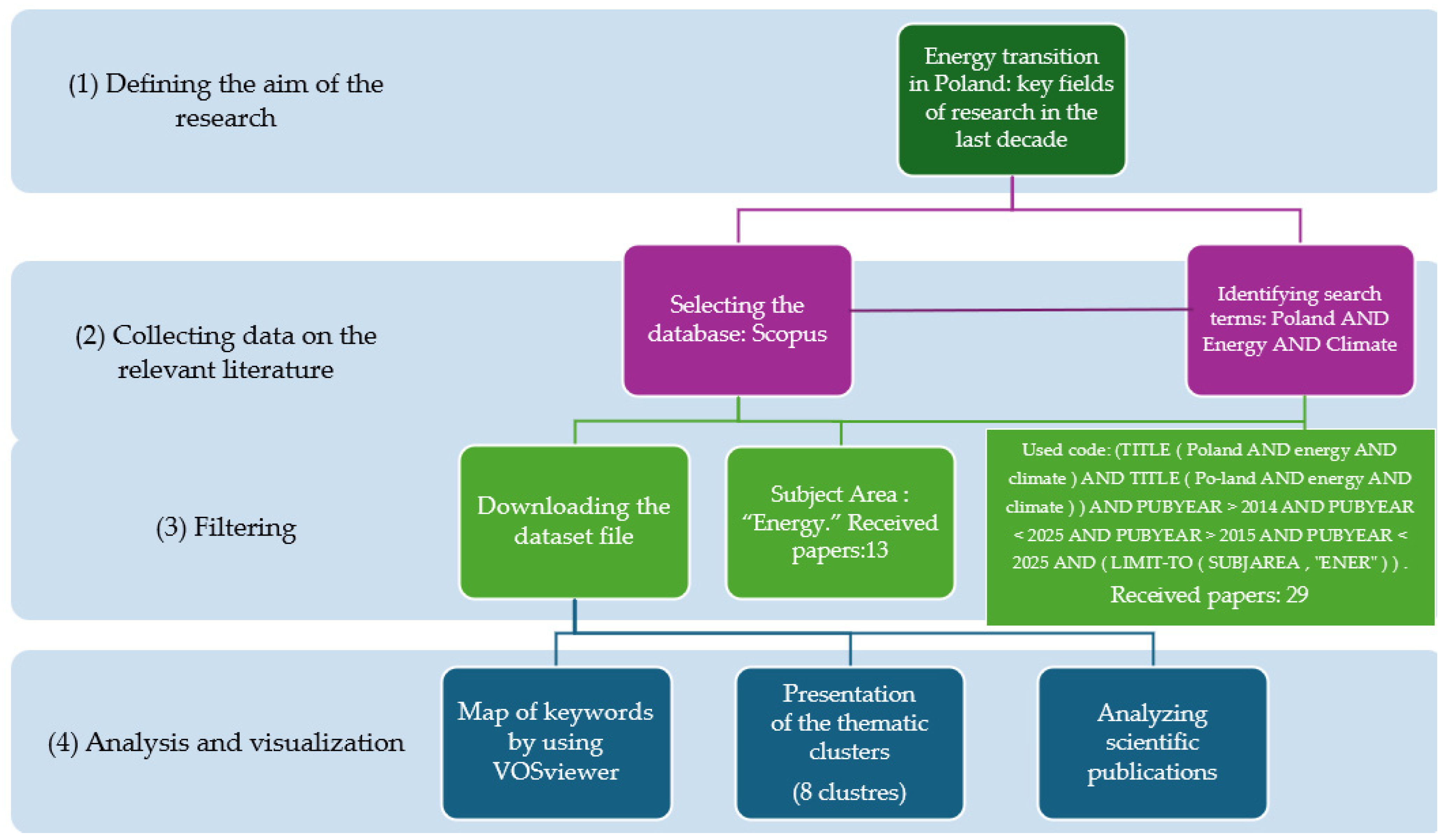
The review of scientific publications (available in the Scopus database) included the following steps (
Figure 1):
Establishing the time frame of the analysis: from 2015 to the present (i.e., from the Paris Agreement to the last fully completed year of publication reporting).
Selecting the search key for the review of scientific publications: Poland AND Energy AND Transition.
Narrowing the scope of the analysis within the category: Subject Area to “Energy.”
Approving the final access code: (TITLE (Poland AND energy AND climate) AND TITLE (Poland AND energy AND climate)) AND PUBYEAR > 2014 AND PUBYEAR < 2025 AND PUBYEAR > 2015 AND PUBYEAR < 2025 AND (LIMIT-TO (SUBJAREA, “ENER”)).
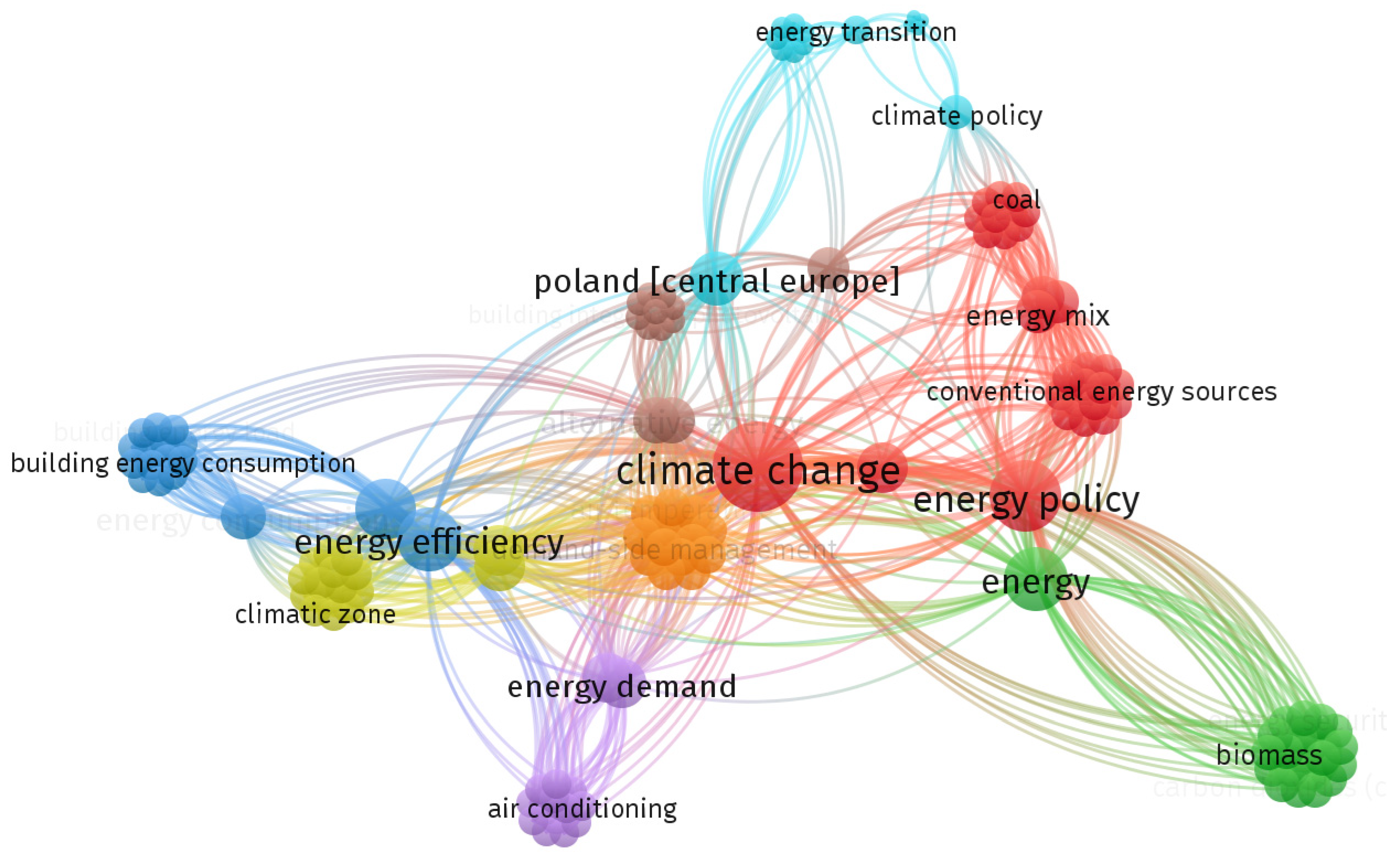
Presenting the results of the analysis in the form of a keyword co-occurrence map (
Figure 2), extracted from paper abstracts (VOSviewer software was used).
Compiling the thematic clusters obtained from the literature review (eight clusters and 130 items) in
Table 1 (VOSviewer software was used).
Analyzing scientific publications related to the research topic, representing the final output of the literature review according to the key provided in point 4.
Figure 1 shows a PRISMA flowchart illustrating the sorting and selection of peer-reviewed publications. This is an illustration of the literature review process, whose exclusion and inclusion criteria are described above. The choice of the Scopus database (Elsevier) instead of Web of Science (Clarivate) for bibliometric analyses is mainly due to its greater scope, modern analytical tools, and broader interdisciplinary coverage.
Figure 1.
Block diagram of PRISMA for sorting and selecting peer-reviewed publications as part of the review of scientific publications.
Figure 1.
Block diagram of PRISMA for sorting and selecting peer-reviewed publications as part of the review of scientific publications.
Figure 2.
Visualization of energy transition keywords in Poland: A VOSviewer network analysis. Note: In VOSviewer network analysis, the lines (links) between items (keywords) represent relationships based on how often those items are connected in the underlying data.
Figure 2.
Visualization of energy transition keywords in Poland: A VOSviewer network analysis. Note: In VOSviewer network analysis, the lines (links) between items (keywords) represent relationships based on how often those items are connected in the underlying data.
Table 1.
Key clusters of Polish energy transformation.
Table 1.
Key clusters of Polish energy transformation.
| No. | Cluster | Contents |
|---|
| 1 | climate change | Climate change, coal, conventional energy sources, economics, electricity sector, energy and climate policies, energy conservation, energy mix, energy policy, energy sector, energy transition management, energy transitions, EU countries, EU energy policy, national economy, natural resources, public opinion (s), renewable energies, renewable energy source(s), social aspects, solar photovoltaics, solar power generation, wind power, transition management/transformation. |
| 2 | Biomass | Biomass, carbon capture, carbon dioxide (s) (CO), carbon footprint, carbon sink, ecosystems, climate change mitigation, energy, energy security, forest biomass, forest ecosystem, forestry, fossil fuels, global scale, harvested wood products, wood products, land use change and forests, land use, timber. |
| 3 | Building energy consumption | Building energy consumption, building energy load, building prototypes, buildings, energy consumption, energy efficiency, energy utilization, future weather, global energy demand, heating and cooling, tide(s), thermal load. |
| 4 | Climate zone | Climate zone, costs, electrical energy costs, electricity-consumption, Poland, energy cost(s), energy use, energy-consumption, thermal energy, hospital, healthcare buildings. |
| 5 | Air conditioning | Air conditioning, air treatment process, building energy use, energy demand(s), conditioning systems, energy management, global warming, air. |
| 6 | Climate policy | Climate policy, climate scepticism, development, ecology, energy transition, law, law and justice, Poland [Central Europe], politics, gender, public attitude, sustainability, sustainable development. |
| 7 | Air temperature | Air temperature, demand-side management, electric utilities, energy drought, energy production, power generation, wind, wind conditions, wind energy, wind farm(s), energy systems, heat wave(s). |
| 8 | Alternative energy | Alternative energy, building integrated photovoltaics, climate conditions, energy yield, integrated approach, long-term change, photovoltaic system, renewable energy (RES), renewable energy (RE), wind velocity. |
2.2.2. Results of Segmented Literature Review
According to step 5 (point 5 of the methodology), the final results were presented in
Figure 2. The central point of the map is climate policy. The key themes that are closely connected with the implemented climate policy relate to the energy transition (energy policy, energy efficiency, and energy demand). These research subthemes (energy policy, energy efficiency, and energy demand) are presented taking into account the specificity of the energy market conditions in Poland (the dominance of coal in energy production as well as in the energy mix) and related markets (the condition of the residential construction sector). A detailed description of the clusters (through a compilation of keywords) is provided in
Table 1.
The papers were grouped, this time, by topic, starting the analysis from general themes concerning Poland’s strategic policy in the context of EU membership. The analysis of progress in the implementation of the Europe 2020 strategy with respect to climate change and sustainable energy use in Poland was carried out by Rybak and Wlodarczyk [
16]. The authors covered five areas in their analysis, namely research and development, education and higher education, reduction in poverty and social exclusion, employment, and energy and climate. These areas fit within Poland’s climate policy; however, at present, the energy and climate area is crucial for the ongoing transition, as stated in the government document PEP2040 [
5], with the inclusion of “just transition” assumptions in order to prevent further deepening of energy poverty. The issue of energy poverty is not only a problem in Poland (13–16% of households) but also in many EU countries [
17]. The EU introduced an energy poverty indicator for the first time in 2021, measuring the share of Europeans unable to adequately heat their homes. At that time, the indicator amounted to 6.9%. By 2024, it reached 9.2%, although it was still lower than the 10.6% recorded in 2023 [
18]. This decline resulted from the combined effects of implementing energy efficiency measures in EU countries and increasing awareness of energy poverty and the social groups affected by it. It is expected that the implementation of further regulations—including the Energy Performance of Buildings Directive, the Energy Efficiency Directive, and the Renewable Energy Directive—will confirm and strengthen this downward trend.
The problems (delays) of the energy transition in Poland are conditioned, inter alia, by the strong position of coal as a strategic resource in electricity production (the structure of primary energy consumption in Poland remains strongly dependent on fossil fuels, which account for as much as 85% of energy—41% from coal, 27% from oil, and 17% from natural gas) [
12], but not only. As emphasized by the authors of the publication [
19], this is also a consequence of the overall EU climate policy, which insufficiently supports the idea of countries using their own resources together with innovative coal technologies [
19]. The ongoing energy transition can also be approached from the perspective of its importance for the state and how imaginaries of the productivity of different infrastructures play a key role in state policy [
16]. According to Miciuła and Stępień [
19], the benefits of using renewable energy sources (RES) can be classified into two main categories.
The first category comprises environmental benefits, including reductions in CO2 emissions and other air pollutants such as SO2, NOx, organic compounds, and heavy metals. Additional benefits include limiting environmental degradation associated with fossil fuel extraction, reducing the environmental impacts of biomass waste disposal, and mitigating uncontrolled biodegradation of deposited biomass.
The second category includes social and economic benefits, such as the conservation of non-renewable fossil fuel resources, the more effective utilization of renewable energy potential, and the fulfilment of international commitments related to emissions reductions. Furthermore, RES deployment enables participation in financial mechanisms, including emissions trading and renewable energy markets (e.g., biomass), stimulates growth across various sectors of the economy—particularly in advanced technology industries—supports local labour markets, enhances quality of life, and strengthens national energy security.
The energy transition must take into account the specificity of economies; in Poland, the most important fuel for the national economy is still coal. Financial aspects constitute an important factor of the transition at both the EU level [
19] and the local level [
20], including the approach of commercial banks in Poland to financing and supporting enterprises pursuing climate neutrality. Within the “coal” area, a certain scepticism toward the energy transition emerges, especially with respect to social issues, including the already mentioned energy poverty, as well as the involvement of the largest coal suppliers in defining policies [
21]. Poland’s departure from coal is a long-term strategy (until 2049) [
5]. Hard coal mining, similarly to metallurgy, is still undergoing restructuring in Poland. Metallurgy and mining were important for the economic development of the industrial sector in Poland. Gajdzik [
22] showed the path of transformation of steelworks in Poland starting from the 1990s, when the Polish government implemented a package of reforms initiating the creation of a market economy. Zientara [
23], in turn, showed the restructuring of mines in Poland, which faced many economic problems after their privatization. In the years 1990–2020, mines adapted to the conditions of functioning in a market economy, as well as on the EU market (Poland has been an EU member since 2004). The scope of these changes is presented in detail in publication [
24]. Production of hard coal in Poland in 1988 was 193 million tonnes [
19]. For many years, mines in Poland have been an important supplier of coal and coke to power plants and heating plants. The transformation of the energy and heating market in the EU [
25] influences changes in the coal industry (mines are being closed, some due to depleted coal seams, others for economic and market reasons). With Poland moving away from coal as an energy source in line with European policy, mines must again optimize their business models, including in the area of methane management [
26], as well as through other areas of activity (gravity energy storage) [
27].
The biggest challenge for countries whose energy sector relies on coal is the high costs associated with reducing CO
2 emissions, which will reduce the competitiveness of their economies. Therefore, support from government and banking institutions is crucial [
21]. The author of the paper [
21] confirmed, in line with empirical research, that investment projects using more sustainable technologies are more likely to obtain capital from commercial banks in Poland. This view is confirmed by 61.24% of respondents. This indicates that Polish banking institutions support the ongoing energy transformation aimed at achieving climate neutrality.
Although the share of renewable energy sources in the Polish electricity mix is increasing, this growth is chaotic and unevenly distributed across technologies. In 2024, RES accounted for 29.4% of electricity production [
12]. Most of the newly installed capacity comes from photovoltaics—mainly due to prosumer activity and larger PV power plants. The authors of [
28] showed that the total production of about 30 MWh over three years (2020–2022) of operating a photovoltaic installation in Poland led to a reduction of CO
2 emissions by 21 tonnes, which translates into about 140 tonnes over a 20-year horizon. Taking into account the number of prosumer installations in Poland exceeding 1.3 million, it can be stated that they make a significant contribution to environmental protection. The RES market in Poland will continue to develop because, as confirmed by studies [
29,
30], prosumerism is already a trend in the Polish energy market. Prosumers display advanced pro-environmental behaviours (a study of 326 households) [
29]. Being a prosumer is associated with energy independence, which leads to economic stability and reduced dependence on traditional energy sources. Gulkowski and Krawczak [
28] conducted a research analysis of a 9.6 kW photovoltaic installation located on a prosumer roof in Eastern Poland. The authors stated in their report (paper) that more than 1.3 million photovoltaic (PV) installations in Poland have reached a total capacity of 10.5 GW (as of 2023). The authors [
28] conducted tests and observed no significant problems with the operation of the photovoltaic installation (the authors took into account weather factors in Poland, rain, snow, cloud cover, etc., affecting PV capacity). Therefore, it can be concluded that this is an installation that achieves good technical parameters in Poland.
In recent years, energy cooperatives have also become a new trend [
30]; there are currently more than 130 such cooperatives in Poland [
31], whereas only a few years ago [
30], there were only a few (in 2021, the number of energy cooperatives in Poland was very low, often reported as only one or a few). Thus, the energy transition in Poland is no longer exclusively the domain of large entities.
In the field of energy transition, beyond PV, other areas are also indicated, including the use of forest biomass [
32], wind as an energy source [
33], and others. Particular emphasis is placed on the potential for wind farms. The authors of publication [
33] estimated the onshore wind energy potential at 239.5 GW for the most liberal distance of 200 m, 105.1 GW for the currently discussed distance of 500 m, 56.4 GW for a distance of 700 m, and 1.3 GW for the most conservative distance of 10 h. However, as the authors themselves emphasize, achieving this potential will require solving the problem of spatial mismatch between supply and demand and overcoming regulatory, environmental, and infrastructural constraints.
The perception of renewable energy in Poland is positive, and society sees the possibility of solving energy (climate) problems through increased use of renewable energy sources [
34], including nuclear energy [
34]. The authors of publication [
34] examined the attitudes of young people aged 18 to 40, i.e., individuals who are or will be fully involved participants in the ongoing energy transition. The positive trend of building ecological (energy) awareness in Polish society is also highlighted by Żurek and Pacześniak [
35] in their research (sample of 1001) concerning support for pro-environmental actions and the energy transition, as well as the broader progressive political vision. In the analyzed group (by gender), women became the main driving force and an opportunity for change. Over the decade, the approach of consumers in the Polish energy market has changed with regard to energy use and saving energy in households, including through purchasing products (household appliances) with low energy consumption. As Nagaj et al. [
36] pointed out, energy consumers today not only pay attention to economic factors, especially energy costs, but also demonstrate the attitude of conscious and sustainable energy consumers. Currently, economic, social, and environmental factors are all important to them when making energy decisions. As demonstrated by Zuhaib et al. [
37], consumers are very interested in having access to a variety of information that facilitates informed decisions about energy consumption and energy-related costs.
It is also necessary to highlight the research area (
Figure 1) concerning the condition of buildings in relation to air quality. The state of buildings in Poland—being the main consumers of energy (40%)—constitutes a challenge, with millions of uninsulated houses; however, new EU regulations are forcing transformation: from 2026 mandatory RES installations (photovoltaics) on new public and commercial buildings, and from 2029/2030 on new residential buildings, aiming at zero emissions and improving energy efficiency, which will affect thermo-modernisation [
38]. Researchers refer to the condition of the building sector, emphasizing issues related to both heating and cooling of public buildings, such as hospitals.
Bazazzadeh et al. [
39] examined the effects of climate change on building heating and cooling energy demand as key drivers of overall building energy consumption in Poland, using the City of Poznań as a case study. A statistical downscaling approach was employed, with the most recent Typical Meteorological Year (TMY, 2004–2018) adopted as the baseline. Based on this reference period, future weather datasets for the years 2050 and 2080 were generated and subsequently used to simulate the energy demand of 16 prototype buildings compliant with the ASHRAE 90.1 standard-Energy Standard for Buildings Except Low-Rise Residential Buildings [
40]. The results indicate that by 2080, average cooling demand is projected to increase by approximately 135%, while heating demand is expected to decrease by about 40%. Owing to the predominance of heating energy demand, the total thermal load of the buildings decreased over the analyzed period. Nevertheless, despite the current downward trend in total thermal load, proactive measures are required to prevent its potential increase in the future.
Taking into account the condition of the Polish building stock—including historic buildings as well as residential buildings constructed from the 1960s onward [
38]—the authors in [
41] conducted a statistical analysis of hard coal, electricity, and natural gas consumption in Polish households over the period 2006–2021. The results revealed an increasing trend in electricity and natural gas use, accompanied by a decline in hard coal consumption. Future energy demand was estimated using trend-based models, and the factors driving changes in the household energy consumption structure were examined, with projections extending to 2027.
To support decarbonization and the achievement of climate targets, the study highlights the need to increase the share of renewable energy sources and improve energy efficiency. Particular emphasis is placed on reducing household energy consumption through enhanced building insulation, intelligent energy management systems, and the adoption of low-emission alternatives. In addition, the analysis discusses Poland’s future energy strategies as a proactive step toward decarbonizing the national economy. Overall, the study provides valuable insights into energy consumption trends and their key determinants within the Polish residential sector.
As highlighted by Ferdyn-Grygierek [
42] and her research team, energy demand for cooling will be higher than for heating in Poland. The authors also point to the importance of applying passive cooling in residential buildings. The author emphasized that although the total thermal load is currently decreasing, in order to avoid its future increase, serious measures should be undertaken to control the growing cooling demand and, consequently, thermal load and greenhouse gas emissions (building prototyping according to standards) [
42]. Cygańska et al. [
43] determined the determinants of electricity costs (EEC) and thermal energy costs (TEC) in Polish hospitals with respect to factors related to their size, work intensity, and climate zones. The analysis was conducted using financial and resource data from all Polish hospitals for the years 2010–2019. The study employed multivariate backward stepwise regression analysis. The results of the analysis show that both electricity and thermal energy consumption in hospitals are positively correlated with the number of physicians, beds, and the number of medical procedures performed. As expected, larger hospitals appear to consume more energy.
Kostka and Zając [
44] conducted an analysis for the City of Warsaw, where, according to a climate analysis for the period 1961–2020, an increase in outdoor temperature of 0.4 °C per decade and an increase in air humidity of 0.2 g/kg per decade were observed. This analysis confirmed the general trend of increasing cooling energy demand and decreasing heating energy demand, also observed in many other regions of the world.
The following key conclusion was drawn from the literature review: the ongoing transformation in Poland must be a coordinated set of actions in building a new energy mix (moving away from coal and in favour of renewable energy sources) for both private users (households) and public users (hospitals), as well as industrial and other sectors of the economy.
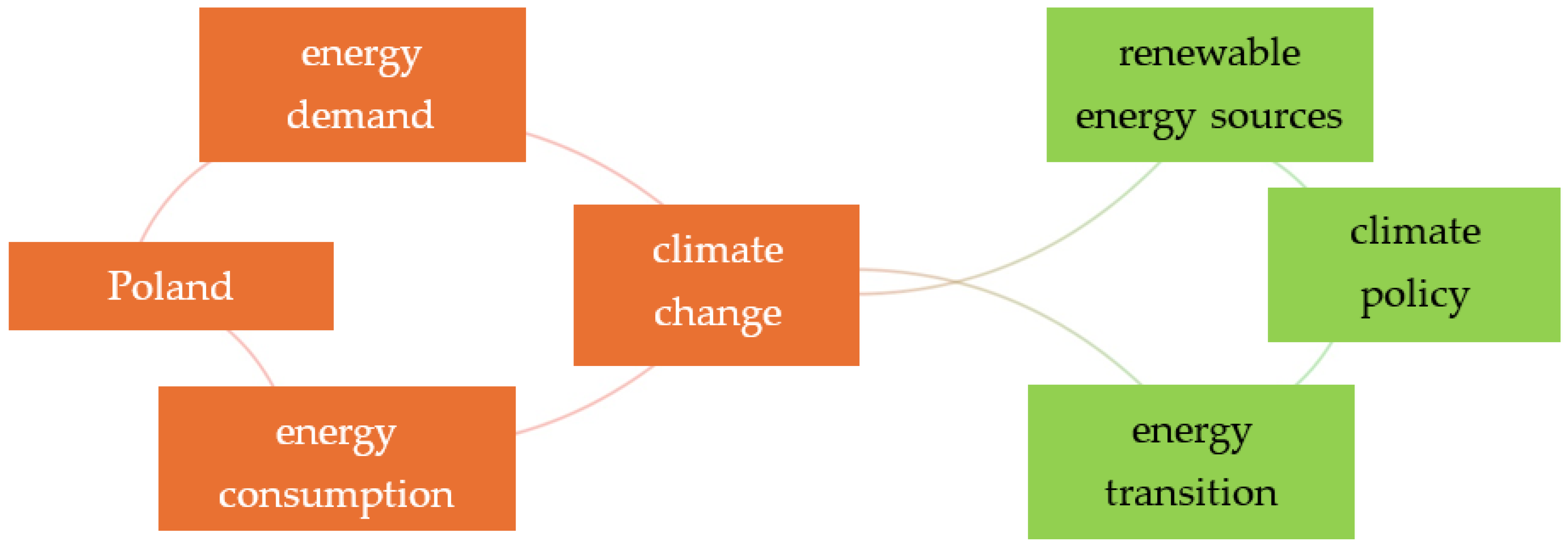
Beyond the topics discussed above, derived from the keyword map obtained from the conducted literature review, there are also other themes that were not presented, regarding reducing energy consumption and greenhouse gas emissions. The conducted segmented literature review focused on the main threads of the Polish energy transition, which were presented in
Figure 3, forming two key segments of current changes, namely the confrontation of the existing state (energy market: demand and consumption) with the state undergoing transformation, i.e., energy transition and climate policy with RES.
To summarize the conducted segmented literature review, it was found that the Polish energy market and related markets currently face an urgent need to reduce energy consumption and greenhouse gas emissions. The analysis carried out by us (
Section 3 and
Section 4 of this paper) fits within the strategic challenges of the ongoing transformation.
3. Materials and Methods
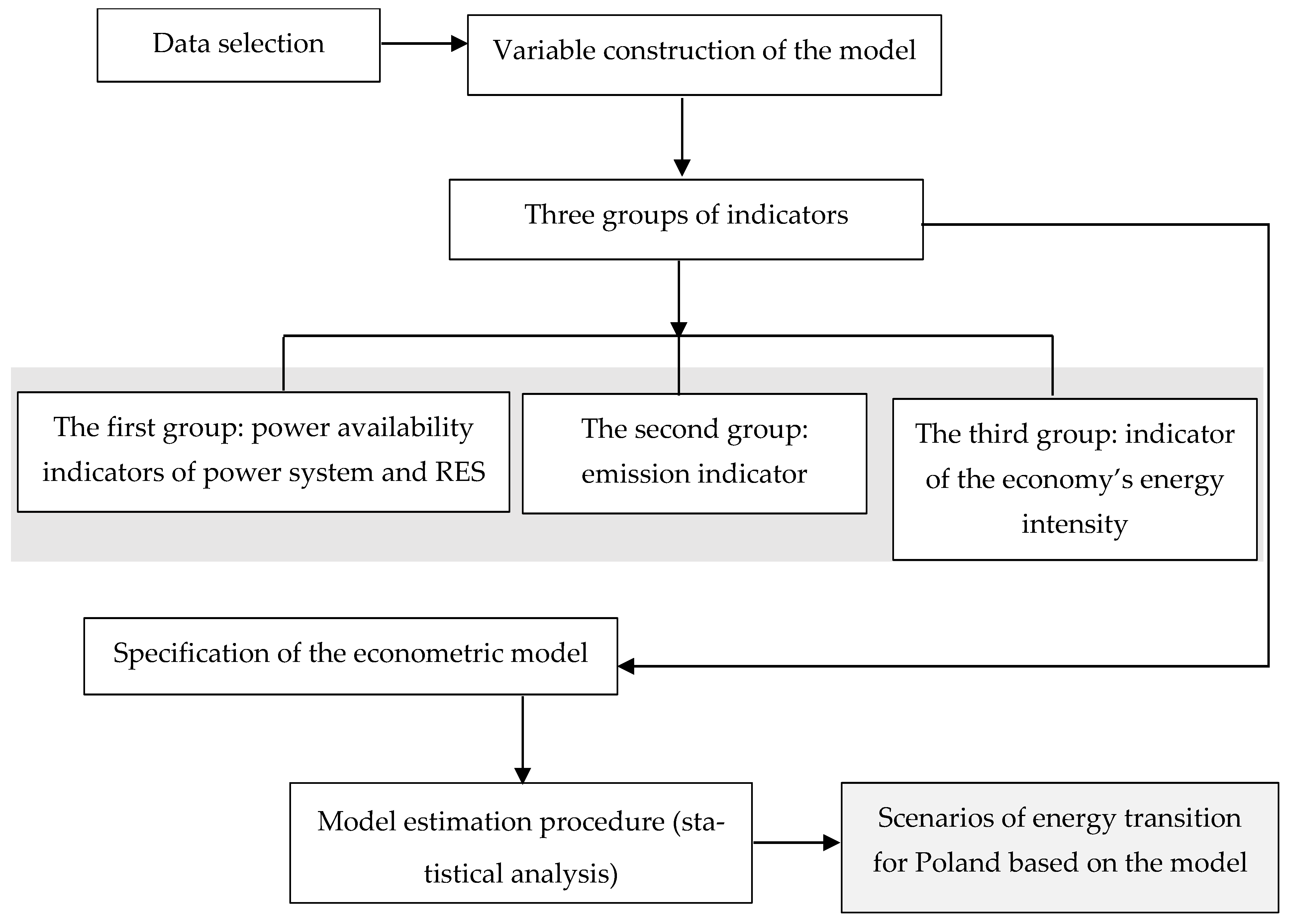
The aim of the empirical analysis was to deepen the identification of mechanisms shaping greenhouse gas emission intensity by incorporating generation capacity availability indicators and measures of the economy’s energy intensity into the model. This approach allows for a shift from absolute volume analysis to a structural approach that better reflects the actual generation capacity of the power system and the efficiency of energy use in the economy. The analysis was performed according to the stages (steps) presented in
Figure 4.
The indicators used in the model were estimated based on annual data for Poland for the period 1990–2024 (n = 35). Data used in the analysis are presented in
Appendix A (
Table A1).
The authors used several official data sources from national and international institutions, i.e., the National Power System (PSE), the Local Data Bank of the Central Statistical Office (GUS), the Energy Market Agency (ARE), the International Monetary Fund (IMF), and the Our World in Data database.
Table 2 presents the data sources for specific variables.
In the model, three groups of derived variables were used, constructed directly on the basis of available statistical data.
The first group consists of capacity availability indicators, defined as the ratio of available capacity to installed capacity. This indicator is interpreted as a measure of the system’s actual generation capability, accounting for technical, operational, and weather-related constraints [
51].
The availability of the overall power system was defined as (Formula (1)):
Analogously, an availability indicator for renewable energy sources was constructed (Formula (2)):
In the analyzed period, both indicators take values close to unity; however, RES availability is characterized by greater temporal variability, which reflects the unstable nature of weather-dependent sources.
The second group of variables consists of intensity indicators, enabling the elimination of the pure scale effect of the economy. With regard to greenhouse gas emissions (GHGE), the authors referred to their main source, which is the subject of interest to the European Commission, namely, and this was given as the CO
2 equivalent. So, GHGE intensity of the economy was defined as the ratio of total greenhouse gas emissions (measured in CO
2 equivalent) to real GDP (Formula (3)):
This variable was assigned the role of the dependent variable, which allows the results to be interpreted in terms of the emission efficiency of economic growth rather than the absolute level of emissions.
Additionally (the third group), an indicator of the economy’s energy intensity was constructed, defined as primary energy consumption per unit of GDP (Formula (4)):
Energy intensity serves as an intermediate variable linking the economic structure, technological level, and energy efficiency with emission intensity.
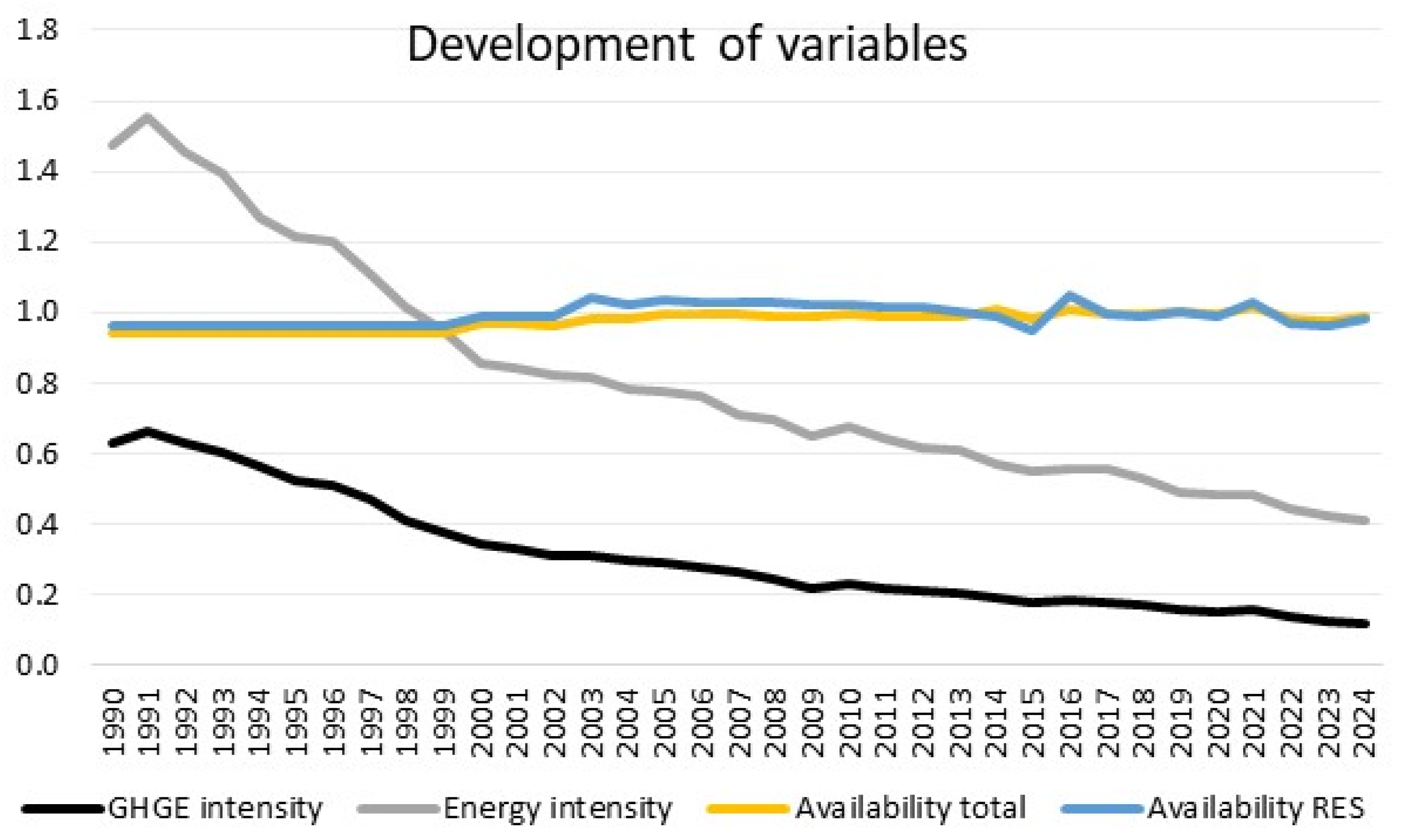
Figure 5 presents the input data used in the OLS model with generation capacity availability and intensity variables, covering annual observations for the years 1990–2024. The dataset includes the constructed indicators of greenhouse gas emission intensity and economic energy intensity, which enable the analysis of the emissions intensity of growth independently of the scale of the economy, as well as two indicators of capacity availability—one for the overall power system and one for renewable energy sources.
The data indicate a systematic decline over time in both emissions intensity and energy intensity, reflecting improvements in the economy’s energy efficiency, alongside the relative stability of capacity availability indicators, especially for the overall system. The greater variability of renewable energy availability, in turn, confirms its weather-dependent nature and justifies including this indicator in the model as a potential factor indirectly affecting emissions intensity.
The authors used the Ordinary Least Squares (OLS) method for modelling and estimating parameters. According to the Gauss–Markov theorem, under the classical linear regression model (CLRM) assumptions, the OLS estimator is the best linear unbiased estimator [
52,
53]. The diagnostic tests carried out later in the work (see
Table 3 and
Table 4) confirm that the key assumptions are met. The use of the OLS method in this study is justified by the specific objective, data structure, and analytical scope of the research. Applying this method provides unbiased, consistent, and efficient estimates of relationships between dependent and independent variables, including small sample sizes [
54,
55]. Only certain assumptions must be met [
56]. The most important of these are linearity, independence of residuals, heteroscedasticity, and normality of their distribution, and these assumptions were met for the data the authors used in this study. Standard diagnostic checks, complemented by HAC (Newey–West) robust standard errors, are applied to address potential heteroskedasticity and autocorrelation, ensuring that inference remains conservative. In this context, in this study, OLS (and complemented by HAC robust standard errors OLS-HAC model) is employed not as a forecasting or causal identification tool, but as an exploratory, theory-consistent estimation method suitable for short-sample, intensity-based analysis of structural mechanisms during a coherent post-Paris policy regime [
57,
58,
59,
60,
61].
Based on the constructed variables, a multiple linear regression model was estimated using the Ordinary Least Squares (OLS) method, in which the dependent variable is GHGE intensity (GHGE_int). The authors estimate the impact for the entire research period, i.e., 1990–2024, but due to the Paris Agreement in 2015, they assume that the impact may change this year. For this reason, in order to enable an additional assessment of the impact of the structural breakpoint on GHGE_int by comparing the pre-2015 period (1990–2014) with the post-2015 period (2015–2024), the authors introduce a structural dummy break (D2015) into the model. The empirical model takes the following form (Formula (5)):
and we define the structural break dummy (Formula (6)):
denotes the GHGE efficiency of gross domestic product (million tonnes CO2eq per billion PLN of GDP or kg CO2eq per 1 PLN of GDP).
is economic energy intensity (TWh energy per billion PLN of GDP),
is the capacity availability of the total power system.
is a capacity availability indicator for renewable energy sources.
denotes structural dummy break, is the intercept, marginal effects before 2015.
are elasticity parameters.
δ denotes “level shift” since 2015, i.e., a structural shift in the level of the dependent variable since 2015. δ measures the difference in the average level of the dependent variable between the period 2015–2024 and the period before 2015, for the same values of the independent variables and the same trend. If δ > 0, then the average level of the dependent variable (emission efficiency of economic growth) is higher by δ since 2015. If δ < 0, then since 2015, the emission efficiency of economic growth has been lower.
denotes a change in the effect of on the dependent variable since 2015. For 1990–2014 impact of energy intensity on the emission efficiency of economic growth is β1, and in 2015–2024, this impact is β1 + θ.
denotes deterministic time trend.
is the error term.
Such a specification makes it possible to capture simultaneously both the demand-side effect (economic energy intensity) and the supply-side effect (capacity availability) on the level of emissions per unit of GDP, without mixing level variables with intensity variables simultaneously.
Model estimation (Formula (5)) was performed using the OLS method, and the statistical significance of the parameters was assessed using Student’s t-tests and the F-test for the overall model. The coefficient of determination, R-squared, and the adjusted R-squared were used as measures of goodness of fit.
In addition, to examine the robustness of the results to potential autocorrelation and heteroskedasticity, HAC (Newey–West, lag = 1) standard error correction was applied, although diagnostic tests did not reveal any significant violations of classical assumptions (see
Table 3). This correction did not change the qualitative conclusions derived from the estimation.
Table 4 presents the model fit measures, indicating a very high explanatory power of the applied specification, while also confirming the overall strong joint statistical significance of the model in the F-test. Taken together, both tables confirm that during the analyzed period emissions intensity was primarily determined by the economy’s energy efficiency, whereas supply-side factors related to capacity availability played a secondary and indirect role.
The high values of the coefficient of determination and the adjusted R-squared indicate that the model describes the variability of emissions intensity in the analyzed period very well. However, it should be emphasized that a high level of fit should not be interpreted as evidence of full identification of all emissions mechanisms, but rather as confirmation that economic energy intensity is the dominant explanatory factor behind the observed changes. The remaining variables play a complementary role and may reveal their influence only in more complex specifications, such as dynamic, sectoral, or logarithmic models.
4. Results
Table 5 presents the results of the OLS model estimation. This table includes the estimated regression parameters together with standard errors, t-statistics, and significance levels, enabling a direct assessment of the strength and direction of the impact of individual variables on greenhouse gas emission intensity. The model was estimated using OLS, and inference is based on Newey–West heteroskedasticity and autocorrelation consistent standard errors.
The results in
Table 5 show that the only variable with a clear and statistically significant effect is economic energy intensity (answer to RQ1), whereas both capacity availability indicators, both for the overall system and for renewable energy sources, do not exhibit a significant direct impact on the emissions intensity of economic growth (answer to RQ3). Regardless of whether we rely on classical OLS or the HAC-corrected version, the effect of X1 remains positive and highly statistically significant (answer to RQ4). The results also show the occurrence of a structural change after 2015. Its significance, particularly strong in the OLS model with HAC correction, indicates that the emission intensity level systematically changed after that year (answer to RQ2). Furthermore, the
Energy_int ×
D2015 interaction was found to be statistically significant in the OLS-HAC model, indicating that the impact of energy intensity on emissions weakened after 2015. The time trend is also statistically significant, indicating a long-term downward trend in emission intensity, after taking other factors into account.
The results of the model estimation provide important insights into the mechanisms shaping greenhouse gas emission intensity in the analyzed period. The applied specification, in which the dependent variable is greenhouse gas emission intensity and the explanatory variables include economic energy intensity as well as indicators of generation capacity availability, makes it possible to move beyond a purely volume-based analysis toward a structural and efficiency-oriented interpretation. Such an approach enables a more precise assessment of the extent to which emissions are the result of the technological and organizational efficiency of the energy–economy system, and the extent to which they arise from short-term operational conditions.
The model estimated in levels indicates significant variation in the impact of explanatory variables on the dependent variable in the period 1990–2024. The most important outcome of the model is the unambiguous and statistically significant role of economic energy intensity as a determinant of GHGE intensity. It was found that 2015, the year the Paris Agreement was implemented, was a breakthrough. Furthermore, the statistical significance of the Energy_int × D2015 interaction in the OLS-HAC model indicates that the impact of energy intensity on emissions weakened after 2015. In other words, the same change in energy intensity generated a relatively smaller increase in emission intensity after 2015 than before, which may reflect technological progress or the decarbonization process. Since 2015, this impact has significantly weakened; however, this has not changed the direction of the impact. More specifically, the findings showed that in the years 1990–2014, there was a strong positive and highly significant impact of economic energy intensity (Energy_int) on the emission efficiency of GDP (GHGE_int). During this period, a one-unit increase in Energy_int (TWh/bln PLN) causes an average increase in GHGE_int by 0.455 units (million tonnes CO2eq per bln PLN of GDP) over the period 1990–2014, assuming constant other factors. In 2015, the strength of the impact of Energy_int on GHGE_int weakened significantly by 0.130 units (this effect in the years 2015–2024 is 0.325 units, i.e., 0.4551 − 0.1300 = 0.3251). Moreover, since 2015, there has been a structural effect, a structural shift in the level of the dependent variable (δ = 0.084), i.e., a statistically significant increase in the GHGE_int level by approximately 0.084 units (regardless of changes in independent variables and the time trend). This suggests a gradual, structural improvement in the economy’s environmental performance. The positive regression coefficient for this variable indicates that an increase in primary energy consumption per unit of GDP leads to an increase in greenhouse gas emissions relative to value added. This result has strong theoretical justification and is consistent with classical approaches to the energy–emissions nexus, in which energy intensity is treated as the key transmission channel between the structure of the economy and environmental pressure. Empirically, this implies that improvements in energy efficiency remain the most effective mechanism for reducing the emissions intensity of economic growth, regardless of changes in the generation mix.
The significance of energy intensity is also maintained after applying HAC-robust standard errors, which indicates the stability of this result despite potential heteroskedasticity or autocorrelation issues. In practice, this means that the observed relationship is not an artefact of individual years or short-term disturbances but rather reflects a persistent structural dependence. From the perspective of energy and climate policy, this result highlights the importance of measures aimed at reducing energy intensity through technological modernization, improvements in production process efficiency, and structural shifts toward less energy-intensive sectors of the economy.
In contrast to energy intensity, both capacity availability indicators (both for the overall power system and for renewable energy sources) do not reach statistical significance. The parameters for these variables are positive but associated with high standard errors. The lack of significance should be interpreted cautiously and in the context of the nature of the indicators themselves. Capacity availability describes the actual accessibility of generation potential; however, it does not directly determine the fuel structure or the intensity of utilization of individual technologies. Its impact on emissions is therefore indirect, manifested through decisions regarding the dispatch of reserve sources or the utilization level of conventional capacities.
Particularly noteworthy is the lack of significance for the renewable energy availability indicator. Intuitively, one might expect that higher availability of renewable energy sources would reduce emissions intensity by limiting the need for fossil-based generation. However, in the analyzed period, this effect is not directly observable. This result can be explained by several factors. First, the variability of the renewable availability indicator is relatively limited, which restricts the ability of a linear model to identify its impact. Second, an increase in renewable availability does not eliminate the need to maintain conventional capacity as system backup, which weakens the direct emissions effect. Third, the effect of renewables on emissions strongly depends on the overall structure of the energy mix and on balancing mechanisms within the power system, which a simple linear model is not able to fully capture.
The statistical insignificance of the overall system availability indicator leads to similar conclusions. High availability of generation capacity improves energy security and supply stability, yet by itself, it does not determine the level of emissions per unit of GDP. In practice, this means that even a system characterized by high availability may remain highly carbon-intensive if it relies on fossil fuels and exhibits high energy intensity. This result reinforces the interpretation according to which capacity availability is a condition for system operation, rather than a direct tool for decarbonization.
The analysis results lead to important applied conclusions. First, an effective reduction in emissions intensity requires primarily measures aimed at improving the energy efficiency of the entire economy, rather than focusing exclusively on expanding renewable generation capacity. Second, the development of renewable energy sources, although necessary from the perspective of long-term transformation, does not guarantee an automatic reduction in emissions intensity if it is not accompanied by structural changes on the demand side of energy consumption. Third, capacity availability should be analyzed as an indirect factor whose impact on emissions is revealed through interactions with fuel mixes and system balancing mechanisms.
The results of the econometric model, in which the dependent variable is GHGE intensity (GHGE_int) and the explanatory variables include economic energy intensity (Energy_int) and indicators of generation capacity availability (Avail_total and Avail_RES), are important both cognitively and in applied terms. This model makes it possible to move from a volume-based analysis to an assessment of the emissions efficiency of economic growth, which makes it particularly useful in the context of designing and evaluating climate and energy policies.
Above all, the results of the model clearly indicate that economic energy intensity is the key transmission channel affecting GHGE intensity. From a practical point of view, this means that actions aimed at improving energy efficiency have a direct and measurable impact on reducing the economy’s emissions intensity, regardless of short-term fluctuations in generation capacity availability. The model can therefore be used as a tool for prioritizing public interventions, indicating that investments in energy efficiency, modernization of production processes, and structural changes in the economy deliver the greatest reduction effect relative to their cost.
At the same time, the lack of statistical significance of capacity availability indicators—both for the overall power system and for renewable energy sources—has important interpretative implications. This result suggests that improving capacity availability, although crucial from the perspective of energy security and system stability, does not automatically lead to lower emissions intensity. In practice, this means that policies focused solely on increasing the availability of generation capacity, without simultaneously reducing energy intensity and the carbon intensity of fuels, may fail to deliver the expected climate benefits.
The model can also be used in comparative and monitoring analyses, as a tool for assessing progress in decarbonization over time. Changes in economic energy intensity values can be directly interpreted as changes in emissions intensity, which enables continuous tracking of the effectiveness of implemented energy and climate strategies. In this sense, the model serves as a diagnostic indicator, making it possible to separate effects resulting from economic growth from genuine changes in energy efficiency.
From an analytical perspective, the model results also justify further development of structural and dynamic models. They show that supply-side factors related to capacity availability affect emissions indirectly, which suggests the need to model their influence through intermediate variables such as the structure of the energy mix, the use of fossil fuels, or the demand for reserve capacity. Thus, the model may be treated as a starting point for more complex analyses rather than as a forecasting tool sensu stricto.
Finally, the model results have communicative and strategic relevance. They allow for a clear message that reducing the economy’s emissions intensity is not solely a function of expanding renewable capacity, but depends to a large extent on the efficiency of energy use. Such an interpretation supports a more balanced approach to the energy transition, in which investments in renewables are complemented by demand-side and efficiency measures, and energy security is treated as a complementary goal rather than as a substitute for decarbonization.
Table 6 contains the results of the percentage sensitivity analysis of the OLS-HAC model, illustrating point elasticities of
GHGE_int with respect to key explanatory variables (X
i), calculated at the sample mean values. The point elasticity for the independent variable at point (
) is calculated by the formula:
The results in
Table 6 show that economic energy intensity (
Energy_int) exhibits by far the highest sensitivity, although it changes over the research period, i.e., 1990–2024. In the pre-2015 period, a 1% increase in
Energy_int leads on average to an approximately 1.18% increase in
GHG_int. In the post-2015 period, elasticity falls to 0.845, meaning that after 2015, the response of
GHGE_int to changes in
Energy_int is significantly weaker, although still positive and statistically significant. All this confirms the dominant role of this regressor as the direct mechanism shaping the emissions intensity of GDP. Sensitivities related to capacity availability, both for the overall power system and for renewable energy sources, are clearly lower and indicate a much weaker influence of these factors on GHGE intensity: a 1% increase in overall availability is associated with a decrease in
GHGE_int of about 0.10%, while an analogous increase in renewable availability corresponds to a decrease of approximately 0.20%. These results suggest that capacity availabilities can be treated more as control variables than determinants. It can be concluded that capacity availability affects emissions intensity in an indirect and secondary manner, whereas reducing energy intensity remains the key lever for a sustained decrease in
GHGE_int.
Table 7 presents the results of a scenario analysis based on the point elasticities of the OLS-HAC model, showing how an increase in the examined variables by 5% and 10% translates into relative changes in CO
2 emissions intensity.
Therefore,
Table 7 shows that operational changes on the power supply side are not sufficient to ensure effective decarbonization of the economy. Even if power availability were to increase by 10%, GHGE intensity would only decrease by 1.03%. This impact is much weaker than in the case of a reduction in
Energy_int. This means that increasing power availability would not be effective compared to reducing energy intensity. These results confirm that effective decarbonization primarily requires a sustained reduction in energy intensity.
Sensitivity analysis of the econometric model constitutes a key complement to the standard interpretation of regression parameters, enabling a shift from static coefficients to a dynamic assessment of how GHGE intensity responds to percentage changes in its determinants. The use of point elasticities makes it possible to compare the strength of effects of variables that differ in scale and economic meaning, while also giving the results a direct decision-making relevance. Unlike a levels model, the sensitivity analysis focuses on the question of which factors most strongly affect the emissions intensity of economic growth, rather than the absolute level of emissions.
The results indicate that economic energy intensity (Energy_int) is the factor with by far the greatest percentage sensitivity. A point elasticity greater than unity means that a percentage deterioration in energy intensity leads to a more-than-proportional increase in GHGE intensity and CO2 emissions. In other words, the economy reacts very strongly to changes in the efficiency of energy use: even small deviations in energy intensity result in a clearly observable change in emissions intensity relative to GDP. This finding has high interpretative significance, as it confirms that in the analyzed period, it was energy efficiency—rather than only the structure of generation capacity—that constituted the primary mechanism determining progress or regression in decarbonization.
Scenario-based sensitivity calculations show that a 5% increase in energy intensity before 2015 led to a 5.91% increase in emissions per unit of GDP, and since 2015, this has resulted in a slightly smaller, but still significant, increase in GHGE_int of 4.23%. Meanwhile, under a 10% increase, the effect reaches almost 8.5% for post-2015 (and 11.8% for pre-2015). Such a strong reaction implies that public policies that do not control energy intensity may quickly offset the effects of supply-side measures in the energy sector. In this sense, sensitivity analysis plays a warning function, showing that insufficient progress in energy efficiency leads to a rapid deterioration in the economy’s emissions intensity.
Much lower sensitivity is observed for the capacity availability indicators, both for the overall power system and for renewable energy sources. A 1% increase in total capacity availability is associated only with a marginal decrease in emissions intensity, and even at changes of 10%, the effect remains clearly weaker than in the case of energy intensity (it is in the range of 1%). Similarly, renewable energy availability shows moderate sensitivity, i.e., higher than that of the overall system. However, it is still several times lower than the energy intensity effect. These results confirm that capacity availability primarily plays an operational and stabilizing role, while its impact on emissions intensity is indirect and limited.
An important element of interpretation is the fact that the availability indicators were not statistically significant in the OLS model itself. Sensitivity analysis does not change this conclusion, but it allows for a better understanding of the magnitude of potential effects if availability were to change substantially. In practice, this means that improving capacity availability, including renewables, does not guarantee an automatic reduction in emissions intensity if it is not accompanied by a parallel decrease in energy intensity and by reduced reliance on fossil fuels within the reserve system. Therefore, the sensitivity analysis highlights the limits of policies focused exclusively on the supply side of capacity.
From the perspective of practical use of results, the sensitivity analysis of the model has several key applications. First, it enables prioritization of climate policy instruments. The results clearly indicate that the greatest reduction effect can be achieved through measures that lower the economy’s energy intensity, such as modernization of industrial technologies, improvements in the energy efficiency of buildings, structural shifts toward less energy-intensive sectors, or the development of a knowledge-based economy. Second, sensitivity analysis provides a simple tool for rapid scenario simulations, allowing the estimation of hypothetical changes without the need to build complex forecasting models.
The sensitivity analysis results also have methodological relevance. They show that in intensity-based models, demand-side factors related to energy-use efficiency dominate over supply-side factors of an operational nature. This justifies further development of the analysis toward dynamic models, in which capacity availability affects emissions through intermediate variables such as the structure of the fuel mix, the utilization intensity of conventional units, or the demand for reserve capacity. Sensitivity analysis plays the role of a filter here, indicating which channels require deeper modelling and which have secondary importance.
The OLS-HAC model sensitivity analysis delivers coherent and strong conclusions: economic energy intensity is the main lever shaping GHGE intensity, whereas capacity availability affects emissions intensity in a limited and indirect way. These results strengthen the argument that effective decarbonization requires simultaneous technological, structural, and demand-side measures, rather than merely expanding generation capacity. In this sense, sensitivity analysis not only deepens the interpretation of the model results but also provides practical guidance for designing long-term energy transition strategies.
5. Discussion
The estimated model indicates a strong overall explanatory power (R2 = 0.9981; adjusted R2 = 0.9977, n = 35), while the joint significance of regressors is confirmed by the F-statistic (F = 1933.91; p = 8.54 × 10−37). At the same time, the results reveal a highly asymmetric role of predictors: economic energy intensity (Energy_int) is statistically significant, whereas the generation capacity availability indicators (Avail_total and Avail_RES) are not. This empirical pattern provides important insights for the interpretation of Poland’s decarbonisation pathway in 1990–2024, and in periods before and after2015.
The indicator (Energy_int) shows a positive and statistically significant coefficient for the whole studied period. However, the magnitude of this impact was not constant throughout the study period. Between 1990 and 2014, Energy_int had a very strong positive impact on GHGE_int (β = 0.455), while between 2015 and 2024 this effect declined (β = 0.325), but remained at a statistically significant positive level. This is the strongest empirical signal in the model and the answer to RQ1. This finding indicates that increases in energy intensity are associated with systematic increases in greenhouse gas emission intensity. In other words, within the analyzed period, economy-wide efficiency and structural energy demand played a central role in shaping carbon outcomes. Thus, the response to RQ1 can be summarized as positive, and the level of emissions intensity has decreased in Poland during the latter half of the 2010s because of efficiency improvements rather than the contemporary situation in the electric power generation sector. In response to RQ2, the Energy_int × D2015 interaction in the OLS-HAC model was found to be statistically significant. This indicated that 2015, the year of implementation of the Paris Agreement, was a turning point. The impact of energy intensity on emissions weakened after 2015. This may reflect progress in the decarbonisation process.
This result aligns well with classic decomposition frameworks such as the Kaya identity [
62,
63,
64,
65,
66], where CO
2 emissions depend on economic activity, energy intensity (energy per unit of GDP), and carbon intensity of energy supply. In a reduced-form regression such as the present OLS model,
Energy_int effectively absorbs the combined influence of technological efficiency, sectoral composition of GDP (e.g., industrial share), and demand-side dynamics. Therefore, the strong statistical significance of
Energy_int is consistent with the transition literature emphasizing energy efficiency as the “first fuel” of decarbonisation: efficiency improvements reduce emissions intensity even without immediate structural reconfiguration of the power sector [
67,
68,
69].
From a broader analytical perspective, a growing body of literature indicates that during the early and intermediate phases of energy transition, observed changes in carbon intensity are predominantly explained by demand-side efficiency improvements and macroeconomic structural adjustment, rather than by short-term operational characteristics of the electricity supply system [
70,
71,
72]. In this stage, reductions in energy intensity reflect cumulative effects of technological upgrading, process optimization, changes in sectoral composition of value added, and improvements in end-use efficiency, which together exert a direct and measurable influence on emissions per unit of GDP [
73,
74,
75].
At the same time, several studies emphasize that supply-side indicators, such as installed capacity, availability factors, or short-run fluctuations in renewable output, tend to influence emissions outcomes only indirectly, particularly when the energy system remains structurally anchored in fossil-based dispatch and reserve logic [
76,
77,
78]. In such systems, increases in renewable availability do not automatically result in proportional displacement of carbon-intensive generation, as conventional units often continue to operate for reasons related to system stability, adequacy requirements, and institutionalized dispatch priorities [
79,
80,
81]. In answering RQ3, the same answer was provided by the results of our analysis in this study. The tested parameters do not significantly affect the emissions intensity
The broader interpretative challenge posed by RQ4 is that of understanding the mechanisms behind these findings and their implications for energy system transition policies. The overall intensity model helps to explain the presence of an asymmetry between the demand and supplier effects. Emissions intensity is shown to be largely driven by structural and efficiency-related mechanisms that operate at the level of the economy as a whole, whereas operational conditions in the system do not play a crucial role in the determination of the system’s overall emission intensity. In response to RQ4, the empirical part concluded that operational constraints on the supply side (
Avail_total,
Avail_RES) alone do not result in a reduction in GHG intensity in Poland. This requires measures based on demand-side efficiency (
Energy_int). The literature suggests that before a critical threshold of renewable penetration and system flexibility is reached, improvements in capacity availability primarily enhance operational resilience and security of supply rather than inducing a qualitative shift in the carbon regime itself [
82,
83,
84]. Under these conditions, carbon-intensity dynamics remain largely governed by economy-wide efficiency mechanisms, while supply-side operational signals are filtered through existing infrastructural constraints and path-dependent system configurations. This interpretation implies that, in mid-transition economies, demand-side efficiency functions as the dominant transmission channel of decarbonization effects, whereas supply-side availability indicators capture necessary—but not sufficient—conditions for longer-term structural regime transformation.
The process of energy transition is realized in parallel with the decarbonization of industries, especially energy-intensive ones, e.g., the steel industry in Poland [
85,
86].
In respect of the theory of socio-technical transition, and with particular regard to the Multi-Level Perspective Approach [
87], it may be seen that the above outcome corresponds with the expected characteristics of a transition scenario in which the prevailing socio-technical regime continues to strongly influence system performance. In the particular circumstances of Poland, this means the prevailing techno-economic regime remains organized on the basis of coal-infrastructure, dispatch logic, and institutional frameworks that consolidate conventional generation and its subsequent chain of supply. Under such circumstances, while there could be expansion in the scope of niche innovations (expansion of RES, prosumers in PV, and new flexibility options), the underlying parameters of the regime’s long-term or “underlying” infrastructure would remain influential in defining overall trends. In other words, the prevailing relationship between economic intensity of energy and intensity of pollution could well be seen as reflecting a regime-level regularity in which efficiency gains and structural changes in the economics would influence in a more direct manner established industrial and organizational practices than would the influence of availability signals from the supply sector, which would be filtered in terms of Grid infrastructural limits and security of supply priorities.
The absence of a clear direct effect of capacity availability indicators can also be interpreted through the lens of path dependency and carbon lock-in [
88,
89,
90,
91,
92,
93,
94,
95,
96,
97]. The transformation to date has seen positive effects. Trend analysis conducted by researchers [
94,
96] revealed a positive trajectory of industrial production across all EU countries, with Central and Eastern European countries experiencing particularly rapid growth. Furthermore, a negative trend in energy intensity in industrial production was common across all countries, indicating an increase in energy efficiency.
Transition research emphasizes that systems characterized by large, long-lived assets and complementary institutions develop strong inertia: investment cycles, labour arrangements, regulatory frameworks, and technical norms co-evolve to favour continuity. Even when renewable sources become more available, coal-based units may remain necessary for balancing, adequacy, and system reliability, which means that changes at the niche level do not automatically translate into immediate, measurable changes in economy-wide emissions intensity. In other words, availability improves “technical potential”, but the realized decarbonisation effect is mediated by lock-in mechanisms—dispatch rules, reserve margins, grid congestion, and the persistent role of fossil backup. This supports the theoretical argument that, in mid-transition systems, regime constraints weaken or delay the observable decarbonisation impact of niche growth when the dependent variable reflects structural, economy-wide performance rather than short-run power-sector conditions.
Transition theory suggests that such results should be read as evidence of a still-incomplete shift from regime optimization to regime transformation. Energy-intensity improvements can be achieved by modernization within the existing regime (incremental process efficiency, demand-side management, building retrofits, and sectoral shifts), hence they appear strongly in structural emissions metrics. However, supply-side availability metrics belong to the operational layer and are not equivalent to a transformation of the regime’s carbon logic; they may improve resilience without materially changing the underlying dependence on carbon-intensive capacity. In MLP terms, the landscape pressures (EU climate policy, ETS costs, technology learning curves) are pushing the system, and niches are expanding, but the regime still absorbs these pressures by adapting rather than being replaced. This interpretation implies that stronger decarbonisation effects would become visible only when niche innovations reconfigure the regime itself—through flexibility, storage, interconnections, coal phase-out decisions, and policy frameworks that turn technical availability into reliable fossil displacement at scale.
The empirical verification of Hypothesis H1 confirms that economic energy intensity is the primary mechanism that affects GHGE intensity in Poland between 1990 and 2024. The significant coefficient of energy intensity verifies that changes in the efficiency of using energy per unit of real GDP in Poland will have a direct impact on changes in intensity, irrespective of short-run operating conditions in the electrical system. The results thus confirm the hypothesis that efficiency effects on demand will drive intensity outcomes in an intensity-based model, particularly in countries that experience a gradual transition in their energy structure, where the level of dependence on fossil fuels remains substantial. The fact that effects on total generation capacity availability and availability of renewable energy sources are not significant verifies the second part of this hypothesis. The above results also receive support from the results of comparative analyses based on the findings of intensity-based or decomposition-type analyses, which further validate the hypothesis tested in this paper. Theoretical analyses based on the Kaya identity, structural decarbonisation theory, and energy-economy nexus models consistently point to the energy intensity variable as the most robust and stable predictor of emissions intensity, whereas supply-side factors are found to exert only indirect and/or delayed effects [
51,
98,
99].
The above results also receive support from the results of comparative analyses based on the findings of intensity-based or decomposition-type analyses, which further validate the hypothesis tested in this paper. Theoretical analyses based on the Kaya identity, structural decarbonisation theory, and energy-economy nexus models consistently point to the energy intensity variable as the most robust and stable predictor of emissions intensity, whereas supply-side factors are found to exert only indirect and/or delayed effects [
51,
98,
99]. The results of this study thus confirm, in accordance with previous analyses [
100,
101,
102,
103,
104], that improvements in economy-wide energy efficiency represent a necessary condition for reducing emissions intensity, and by empirically testing this relationship within a single framework that encompasses the inclusion of operational availability variables, further validate Hypothesis H1 and extend previous evidence to the specific case of Poland’s energy transition.
6. Conclusions
This research aimed at explaining the factors that influence the intensity of CO2 emissions in Poland in 1990–2024, and the period 2015–2024 compared to 1990–2014, combining the efficiency factors of the demand side with those of the supply side, which include the operational availability of power generation capacity. The empirical findings from the intensity model of Ordinary Least Squares allow answering the research questions in a clear and nuanced manner, and thus drawing a coherent conclusion from the status of energy transition in which Poland at present finds itself.
The empirical outcomes clearly showed that economic energy intensity has been the driving force behind the changes in the intensity of greenhouse gas emissions in Poland during the analysis period. A positive and significant coefficient on the Energy_int variable makes it very clear that the intensity of primary energy consumption, proportional to the GDP, affects the level of emissions intensity in the same direct proportion. This clearly supports the interpretation that the most effective way to mitigate the level of emissions in terms of GDP is to bring about greater efficiency in the use of energy and to induce economic activity with lower energy intensity.
The analysis also confirmed the occurrence of a structural change after 2015 (the response to RQ2), consisting not only in a shift in the level of the dependent variable, but also in a modification of the strength of the impact of the main explanatory variable. This structural change coincided with the provisions of the 2015 Paris Agreement—COP21.
The indicators of total and RES generation capacity availability do not significantly influence CO2 emissions intensity when controlled for economic energy intensity. In addition, although the Avail_total and Avail_RES coefficients are positive, they are characterized by large standard errors and high p-values, and therefore their impact cannot be stated to significantly differ from random fluctuations over a short time series. Instead, it can be assumed that in the Polish situation, there were no differences related to the availability of generation capacity used for emitting more or less during the examined period.
Emissions intensity is shown to be largely driven by structural and efficiency-related mechanisms that operate at the level of the economy as a whole, whereas operational conditions in the system do not play a crucial role in the determination of the system’s overall emission intensity. Although a crucial factor for system adequacy and energy security, capacity availability is shown to have an indirect effect only on the system’s overall emissions intensity levels—that is, through the use of reserves and the presence of fossil fuels for backup capacity in a system that is still dominated by coal and path dependence effects. While the system is largely still dominated by coal and its path dependence effects, increased availability of renewables does not necessarily trigger sufficient displacement effects in carbon-intensive generation to have an overall effect on economy-wide emissions intensity levels.
Taken together, the answers to RQ1–RQ4 confirm that Poland’s emissions intensity dynamics in 1990–2024 were predominantly shaped by structural demand-side efficiency mechanisms rather than by operational supply-side availability conditions.
From a policy perspective, the main finding is that a successful decarbonization strategy in Poland, as well as in countries where fossil fuels still dominate, should not be based exclusively on augmenting renewable capacity and boosting its availability factors. These factors would be necessary but, again, insufficient on their own. Unless offset by a decrease in energy intensity through modernization, efficiencies in buildings, advances in technology, and broader economic transformation, the greenhouse gas reductions from augmenting renewable capacity would be limited.
The key contribution of the paper from the scientific perspective is the proposal and empirical validation of an in-tensity-based econometric model framework, which typically blends two conceptually differentiated approaches commonly adopted in energy transition analysis: (i) whole economy demand-side efficiency, measured using economic energy intensity, and (ii) supply-side operational limitations, which are typically captured using generation capacity availability measures, differentiated between the whole and the renewable sector. By focusing the analysis no longer exclusively on the absolute level of emissions and production but rather through the structural analysis of emissions intensity per unit of GDP, the paper provides a model specification more aptly targeted. Thus, this approach contributes to the basic conceptual goal of decarbonization policy, which is, of course, the decrease in emissions relative to economic growth (per unit of GDP).
Other scientific contribution comes with the mechanism-oriented explanation of the OLS estimation result, in which there is an evident asymmetry between the channels of explanation. These findings prove that in Poland, the economic energy intensity is the dominant transmission mechanism of GHGE intensity, although it was slightly stronger in the pre-2015 period and slightly weaker in the post-2015 period. However, there is no statistically significant direct influence of capacity availability indicators on the abovementioned GHGE intensity after excluding energy intensity. Scientifically speaking, these findings are of importance because they confirm in an empirical manner that in coal-based transition economies, mere improvements in system operation capacities or in the availability of renewables cannot be automatically associated with a measurable reduction in the economy-wide GHGE, including CO2 intensity, unless additional structural improvements in demand-side efficiency are achieved.
There are some limitations associated with the present study, which include the fact that the model is based on a case study approach, where the model has a particular focus on a single country, i.e., Poland. We also want to clearly state that the study is exploratory rather than confirmatory. Another limitation of the study is that the OLS model, which is based on a theoretical approach supported by the results of the diagnostic tests, only considers linear relationships and does not take into consideration the dynamic feedback effects, the heterogeneity of the sectors, and the non-linear relationships between the energy intensity, the availability of capacity, and the emissions intensity. Furthermore, the indicators of availability do not consider the fuel composition, the dispatch order, the storage, and the cross-border flows of electricity, which might be relevant in determining the effect of the deployment of renewable energy on the decarbonization process.