Review

Thermal Energy Storage in Renewable Energy Communities: A State-of-the-Art Review

by
Tiago J. C. Santos
1,*,
José M. Torres Farinha
2,3,
Mateus Mendes
2,3 and
Jânio Monteiro
4
1
Faculdade de Ciências e Tecnologia, Universidade do Algarve, 8005-139 Faro, Portugal
2
RCM2+—Research Centre for Asset Management and Systems Engineering, 3030-199 Coimbra, Portugal
3
Coimbra Institute of Engineering, Polytechnic University of Coimbra, 3030-199 Coimbra, Portugal
4
Instituto Superior de Engenharia, Universidade do Algarve, 8005-139 Faro, Portugal
*
Author to whom correspondence should be addressed.
Energies 2026, 19(5), 1363; https://doi.org/10.3390/en19051363
Submission received: 30 December 2025 / Revised: 23 February 2026 / Accepted: 1 March 2026 / Published: 7 March 2026

Abstract

Renewable Energy Communities (RECs) are recognized as effective collective models to accelerate decarbonization through shared renewable generation, consumption, and local flexibility provision. However, their large-scale deployment remains constrained by the temporal mismatch between variable renewable generation and strongly time-dependent demand, particularly in buildings where heating and cooling dominate final energy use. This state-of-the-art review provides an integrated and comparative assessment of Thermal Energy Storage (TES) and Battery Energy Storage Systems (BESS) within RECs, with explicit focus on power-to-heat (PtH) pathways and phase change material (PCM)-based cooling storage. Based on a structured analysis of the peer-reviewed literature published between 2015 and 2025, the review shows that TES represents a cost-effective and durable complement to electrochemical storage in heating- and cooling-dominated communities. Reported results indicate that TES integration can reduce peak electrical demand by 20–35%, increase local renewable self-consumption by 15–40%, and significantly lower required battery capacity in hybrid configurations. While BESS remains indispensable for short-term electrical balancing and fast-response grid services, TES offers lower costs per kWh stored, longer operational lifetimes (often exceeding 25–40 years), and lower lifecycle greenhouse gas emissions, typically 70–85% lower than those of BESS when thermal energy is used directly. Among TES technologies, PCM-based systems demonstrate particular effectiveness in cooling-dominated RECs, enabling peak cooling power reductions of up to 30% through diurnal load shifting. Across climatic contexts, the literature converges on hybrid TES–BESS architectures as the most robust storage solution, with reported reductions in grid imports and renewable curtailment of up to 35–40%. In addition, TES uniquely enables seasonal energy shifting, for which no cost-competitive electrochemical alternative currently exists. Despite these advantages, the review identifies persistent gaps related to the limited availability of long-term operational data and the need for empirical validation of hybrid control strategies. Future research should prioritize multi-year field demonstrations, advanced data-driven energy management, and policy frameworks that explicitly recognize thermal flexibility and sector coupling within Renewable Energy Communities.

1. Introduction

RECs and Local Energy Communities (LECs) are increasingly recognized as practical instruments to accelerate decarbonization through collective renewable deployment, shared consumption, and local flexibility provision [1,2]. In parallel, the rapid electrification of end-uses and the growing share of variable renewables have intensified the temporal mismatch between generation and demand, increasing the need for flexible resources that can absorb surplus production and reduce curtailment while maintaining reliability [2,3,4]. Energy storage is therefore a central enabling technology for high-renewable community systems. To date, much of the REC literature emphasizes electrical storage, mainly BESS, yet community energy demand is strongly shaped by heating and cooling loads, and thermal pathways remain comparatively underexplored in integrated REC analyses [5,6].
TES and PtH strategies (e.g., heat pumps and resistive heating coupled to water tanks or phase change materials) provide cost-effective routes to shift demand, increase self-consumption, and reduce grid dependency by storing renewable electricity as heat or cold [2,7]. Recent multi-vector energy community studies further show that jointly optimizing electricity and thermal vectors under uncertainty can reduce external grid reliance and fossil thermal supply while improving overall costs [8]. Despite their proven effectiveness, TES systems have yet to be broadly deployed. This situation highlights the importance of stronger collaboration across stakeholders, along with improved awareness and education regarding the advantages and practical applications of TES [9]. At the same time, recent comprehensive syntheses indicate that, despite abundant TES research, the absence of harmonized performance data and systematic decision-support frameworks remains a major challenge for technology selection and practical deployment across diverse temperature ranges and applications [9]. Recent studies have demonstrated that PCM-based thermal storage systems can achieve substantial performance gains when optimized from both thermal and economic perspectives, particularly in applications involving cooling-dominated loads and compact systems [10]. Accordingly, there is a clear need for an integrated review that consolidates technical and operational evidence on how TES complements (or competes with) BESS in REC contexts, with explicit attention to PtH pathways and to underrepresented TES technologies such as PCM-based storage for cooling.
This review addresses that need by providing an integrated and comparative assessment of TES and BESS within RECs, focusing on (i) the roles of TES in community operation (self-consumption, flexibility, peak shaving, sector coupling), (ii) comparative technical–economic–environmental dimensions of TES versus BESS, (iii) PtH architectures and storage sizing/operation evidence, and (iv) PCM-based cooling storage applications and barriers. The remainder of this introduction is structured as follows: Section 1.1 outlines the building energy demand, climate commitments, and the role of flexibility; Section 1.2 describes the renewable energy community’s governance, regulation, and market design; Section 1.3 discusses energy storage and flexibility requirements in RECs; and Section 1.4 details PtH pathways and the relevance of TES, particularly PCM-based storage, for future sustainable community energy systems.

1.1. Building Energy Demand, Climate Commitments, and the Role of Flexibility

Global energy demand has increased markedly over recent decades due to population growth, economic expansion, and rising electrification of end-uses [11,12]. Buildings are a dominant end-use sector, and a substantial share of building energy consumption is associated with heating, ventilation, and air-conditioning (HVAC) [13]. Beyond electricity, heat demand constitutes a major decarbonization lever: recent syntheses highlight that heat accounts for almost half of global final energy consumption and is responsible for a large fraction of energy-related greenhouse gas emissions [5,9]. This reinforces the need to explicitly address heating and cooling flexibility as part of low-carbon local energy system design. Historically, fossil fuels have supplied most final energy, contributing significantly to greenhouse gas emissions and environmental impacts [4,14]. Against this backdrop, climate targets and policy commitments require accelerated renewable deployment and energy efficiency improvements, but high shares of solar and wind introduce intermittency and uncertainty that can drive curtailment and reliability challenges if flexibility is insufficient [2,15]. These challenges are particularly acute in local systems aiming for high self-sufficiency, where renewable output peaks (e.g., midday PV) may not coincide with demand peaks (e.g., evening loads or winter heating). In this context, storage and sector coupling become critical, PtH can convert surplus renewable electricity into thermal energy and store it in TES, improving temporal alignment between renewable generation and end-use demand [3,16].

1.2. Renewable Energy Communities: Governance, Regulation, and Market Design

Citizen engagement and collective action are increasingly considered essential for a fair and effective energy transition [5,17]. RECs, formalized in EU policy frameworks such as RED II, enable groups of citizens, businesses, and public entities to jointly produce, share, and manage renewable energy with the primary objective of delivering economic, social, and environmental benefits rather than maximizing financial returns [1,2]. RECs have been shown to improve local acceptance of renewables, reduce energy bills, create local jobs, and enhance resilience through decentralized generation and coordinated demand management [18,19]. Empirical and modelling studies further suggest that community-level coordination can reduce blackout risk and improve local adequacy by pooling distributed resources [19,20]. However, REC deployment is highly sensitive to regulatory transposition, market access, and remuneration schemes for shared self-consumption and flexibility services. Recent regulatory reviews emphasize that, although EU directives define and promote community energy models, national rules on governance, metering, grid fees, and benefit allocation can strongly shape feasibility and scaling [1,17,21]. Likewise, recent contributions highlight that market design and coordination mechanisms influence whether community storage resources are deployed and dispatched efficiently [17,22]. While many community initiatives focus on PV-based electricity sharing, thermal energy pathways remain less represented in applied community deployments and integrated studies, despite heating and cooling being dominant building end-uses [5,6].

1.3. Energy Storage and Flexibility Requirements in RECs

Energy storage increases renewable self-consumption by shifting energy from periods of surplus generation to periods of higher demand, improving autonomy and reducing grid imports [2,23]. BESS are widely used for short-term electricity balancing due to their fast response and high round-trip efficiency, making them particularly suitable for frequency regulation and other ancillary services [24,25]. Nevertheless, batteries face limitations related to capital costs, degradation, lifetime, and material and resource constraints, which can significantly affect long-term economic performance and motivate the adoption of complementary flexibility solutions [2,26]. Thermal storage offers a particularly relevant alternative in community contexts because much of the final energy demand in buildings is thermal, and storing energy as heat or cold can be more cost-effective per kWh than storing it electrochemically [2,3,24]. Evidence from microgrid-based and building-scale studies indicates that integrating TES with BESS can significantly reduce required battery capacity while improving energy efficiency and comfort outcomes; for example, coordinated TES–BESS integration has been reported, in specific demand-response scenarios, to significantly reduce BESS capacity requirements [27]. At the building and community scales, flexibility-aware optimization has been used to determine optimal storage capacity under different tariff structures and flexibility targets, showing that storage requirements depend strongly on operational objectives and economic signals [3,28]. Similarly, PV–heat pump systems integrating both TES and BESS have been optimized under multi-objective frameworks, demonstrating that hybrid storage configurations can outperform single-storage solutions on techno-economic grounds [29,30]. Beyond buildings, thermal energy storage can also enable longer-duration flexibility through technologies such as pumped thermal energy storage (PTES) and Carnot batteries. Recent studies on industrial-park distributed energy systems indicate that electro-thermal integration via Carnot battery concepts can support coordinated electricity and heat scheduling, improving economic and carbon performance while providing grid support [31,32]. Complementarily, large-scale PTES analyses highlight scale-dependent economics and climate sensitivity, reporting competitive levelized costs of storage under optimized configurations and emphasizing long lifetime and independence from critical raw materials [33,34]. These findings collectively suggest that, within RECs, optimal storage portfolios may benefit from combining short-duration electrochemical storage with thermal storage solutions that address heating and cooling loads and, in some cases, longer-duration flexibility.

1.4. PtH Pathways and the Role of Thermal Energy Storage in REC

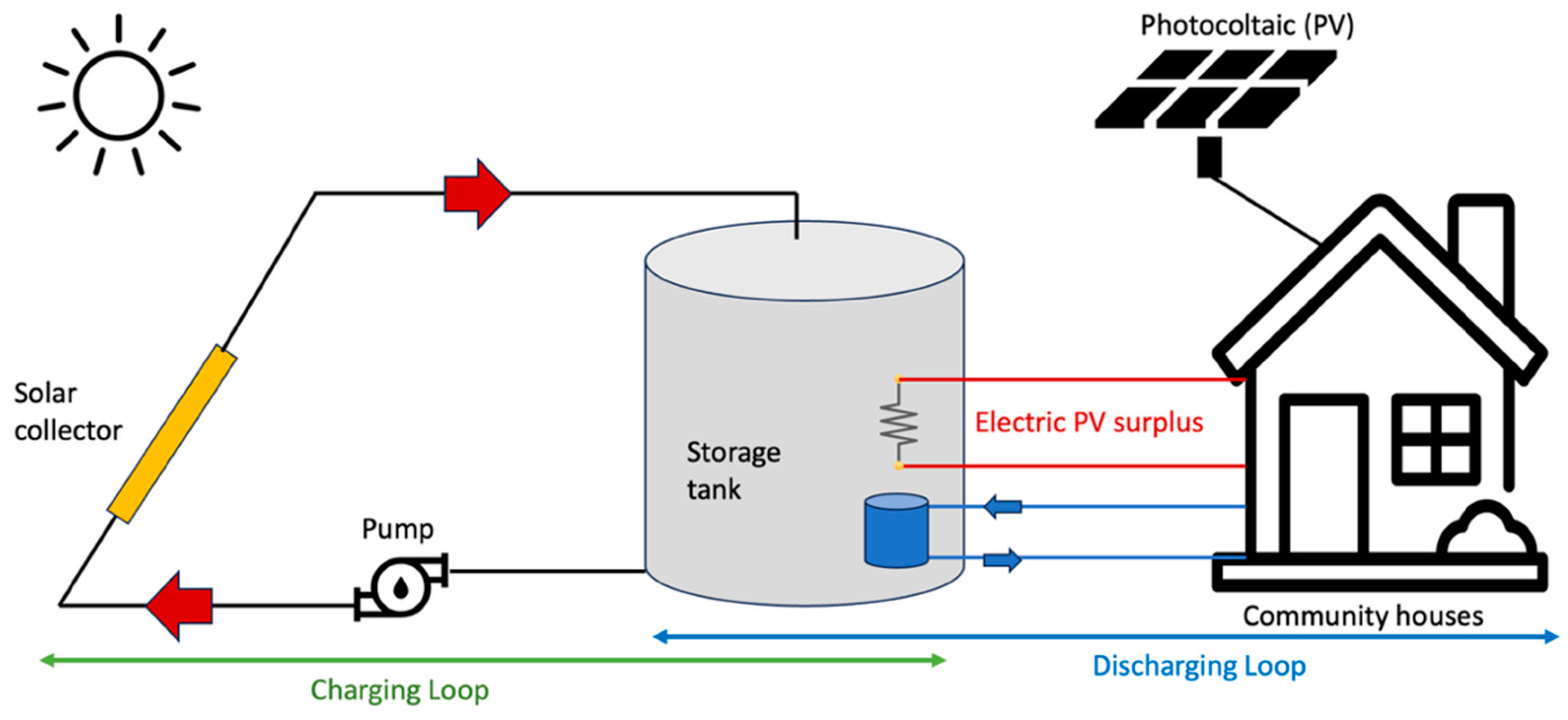
Thermal demand (space heating, domestic hot water, and cooling) represents a substantial fraction of building energy use, making PtH and TES central to community decarbonization strategies [5,15]. In PtH architectures, surplus renewable electricity can be converted into heat using heat pumps or resistive heaters and stored in thermal reservoirs (e.g., water tanks, building thermal mass, or PCM storage) for later use. This approach can reduce curtailment, increase renewable self-consumption, and lower grid dependence by supplying thermal loads when renewable generation is low [2,16]. To illustrate this concept, Figure 1 schematically illustrates a representative PtH configuration in which surplus PV electricity, complemented by solar thermal collectors, is converted into heat and stored in a hot-water tank. This approach is consistent with recent hybrid PtH and solar thermal applications at the building and community scales [35,36,37].

1.5. Paper Organization and Review Scope

Although several reviews have addressed thermal energy storage technologies or community energy concepts, the literature often examines these topics in isolation or focuses predominantly on electrical storage solutions. As highlighted in recent syntheses, this fragmentation limits cross-vector understanding and hinders informed technology selection in RECs [5,9]. In contrast, this review provides a comparative assessment of TES and BESS within RECs, with explicit emphasis on PtH pathways and on underrepresented TES options, particularly PCM-based storage for cooling applications.
Specifically, this review: (i) maps the roles of TES in REC operation and flexibility provision; (ii) compares TES and BESS across technical, economic, and environmental dimensions; (iii) synthesizes PtH architectures and operational evidence from building- and community-scale studies; and (iv) consolidates recent findings on PCM-based cooling storage, including performance benefits, integration barriers, and implications for system design, optimization, and policy. By bridging technological, operational, and system-level perspectives, this review aims to support more informed planning and deployment of integrated storage solutions in future communities.
The remainder of this paper is structured as follows. Section 2 describes the review methodology adopted in this study. Section 3 synthesizes and analyzes the literature on the role of thermal energy storage in RECs, including a comparative assessment of TES and BESS, with particular attention to PtH pathways and PCM-based solutions. Section 4 presents the main conclusions, and Section 5 outlines future research directions and perspectives.

2. Methodology

2.1. Review Scope and Research Questions

This review follows a structured and transparent literature review methodology inspired by PRISMA guidelines. The objective is to systematically identify, screen, and analyze the relevant literature addressing energy storage solutions in RECs.
The review addresses the following research questions:
  • How does TES contribute to flexibility, renewable self-consumption, and sector coupling in RECs?
  • How do different TES technologies, particularly sensible heat storage (SHS) and PCM-based latent heat storage, compare with BESS across technical, economic, environmental, and operational dimensions?
  • Under which climatic, operational, and regulatory conditions does TES provide advantages over, or complement, BESS in RECs?

2.2. Search Strategy and Data Sources

The literature search was conducted using major scientific databases, including Scopus, Web of Science, and Google Scholar, complemented by targeted searches in leading energy journals and publishers (e.g., MDPI, Elsevier). The search period covered publications mainly from 2015 to 2025, corresponding to the emergence and consolidation of RECs and sector-coupling frameworks.
Search queries combined keywords related to TES technologies and community-scale energy systems, including:
“thermal energy storage”, “phase change material”, “latent heat storage”, “power-to-heat”, “renewable energy communities”, “local energy communities”, “district heating”, and “cooling storage”.
To contextualize the scale of the literature, broad searches such as “thermal energy storage” and “phase change material” and “thermal energy storage” return several hundred thousand publications in Google Scholar. However, when the scope is progressively refined to explicitly include Renewable Energy Communities, the volume of relevant literature decreases sharply. For instance, combining “thermal energy storage” with “renewable energy communities” yields on the order of a few hundred results, while the intersection of “phase change material”, “thermal energy storage”, and “renewable energy communities” yields fewer than one hundred publications. This marked reduction highlights both the emerging nature of TES research in REC contexts and the fragmented treatment of PCM-based TES within community-scale applications.
Because this review includes a comparative assessment between TES and BESS, a complementary targeted search was conducted to capture the key literature on electrochemical storage in RECs and related systems. This search included keywords such as “battery energy storage system”, “BESS”, “electrochemical storage”, “lithium-ion battery”, and “hybrid TES–BESS”, combined with terms related to RECs, microgrids, and district energy systems.

2.3. Final Corpus and Data Extraction

Peer-reviewed journal articles and conference papers written in English were considered eligible if they:
  • explicitly addressed TES technologies in the context of RECs, local energy communities, district heating/cooling systems, or closely related community-scale applications;
  • included quantitative, modeling, experimental, or system-level analyses relevant to energy storage integration, operation, or assessment.
The grey literature (e.g., technical reports, policy documents, and standards) was selectively included only for contextual, regulatory, or definitional purposes and was not used to support quantitative comparisons or core analytical conclusions.
Studies focusing exclusively on component-level TES design without system-level relevance, or on large-scale national energy systems detached from community or district contexts, were excluded.

2.4. Screening and Selection Process

The initial keyword-based searches identified several hundred potentially relevant publications after topic refinement. Titles and abstracts were first screened to remove duplicates and clearly irrelevant studies. Full-text screening was then conducted to assess thematic relevance, methodological soundness, and alignment with the review scope.
Rather than aiming for exhaustive coverage of all TES-related publications, this review adopts a targeted and relevance-driven selection strategy, reflecting the still-limited body of literature explicitly addressing TES integration in RECs. From the screened pool, a final subset of approximately 120 peer-reviewed studies was selected for in-depth qualitative synthesis based on relevance, representativeness, and explicit focus on TES roles within community-scale energy systems.
Although the primary search period covered publications from 2015 to 2025, a small number of earlier studies (approximately four articles published prior to 2015) were retained to provide historical and conceptual background on TES technologies and their evolution toward community-scale applications. The literature corpus shows a gradual increase in research activity, with a limited number of studies between 2015 and 2020 (approximately ten articles), followed by a substantial expansion of publications from 2022 onward, with the highest concentration in the period 2024–2026. In addition, a very small number of recent preprints and early-access publications were considered to capture emerging research trends and technological developments not yet fully represented in the peer-reviewed literature. These sources were used for contextual insight into current directions and were not relied upon for core quantitative comparisons or definitive conclusions.

2.5. Classification and Analysis Framework

The selected studies were classified according to:
  • storage technology (sensible heat storage, PCM-based latent heat storage, thermochemical storage);
  • application domain (space heating, space cooling, domestic hot water, district heating/cooling);
  • system scale (building, community, district);
  • evaluation dimension (technical performance, economic feasibility, environmental impact, and operational integration).
This classification framework enabled a comparative assessment of TES and BESS within RECs, highlighting complementarities, trade-offs, and context-dependent performance across different climatic and operational conditions.

2.6. Methodological Limitations

This review is subject to several limitations. First, the literature explicitly addressing TES in RECs remains relatively limited, particularly with respect to long-term operational data and real-world deployments. Second, heterogeneity in modeling assumptions, temporal resolution, boundary conditions, and performance indicators limits direct quantitative comparability across studies. Third, publication bias toward optimized or successful case studies may lead to overestimation of achievable performance in practice.

3. Literature Review and Analysis

Building on the analytical framework defined in Section 2, this chapter synthesizes and critically discusses the literature on TES in RECs, following the thematic structure outlined in the methodology.

3.1. Role of TES in RECs

TES is a crucial, yet often underappreciated, component in Energy Communities, as it fundamentally enhances system flexibility and local self-reliance by addressing the large share of energy demand associated with heating and cooling. While the deployment of photovoltaic systems has historically benefited from cost reductions and strong policy support, the integration of renewable heating solutions has received comparatively less attention, despite their relevance for community-scale decarbonization [2,38].
Early studies already highlighted the potential of TES to reduce thermal energy demand and increase renewable utilization in buildings. For example, PCM-based applications for cooling load reduction have been shown to improve thermal performance under different climatic conditions [39], while building-scale analyses indicate that the inclusion of thermal storage can significantly increase the share of renewable electricity used to meet cooling demand compared with configurations without storage [40]. Building on this evidence, a wide range of TES solutions, from domestic hot water tanks and building thermal inertia to more advanced latent heat storage systems, can enhance renewable self-consumption by absorbing surplus renewable generation and reallocating it to future thermal needs. In doing so, TES directly targets end-uses that battery-based electrical storage alone cannot efficiently serve, contributing to reduced grid dependence, improved self-sufficiency, and shorter investment payback periods at the community level [19].
Recent community-scale optimization studies further confirm the value of TES integration. In a near-zero energy community case jointly considering electrical and thermal storage, integrated configurations achieved substantial reductions in carbon emissions and grid interaction while lowering the levelized cost of energy compared with similar systems without TES [41]. More broadly, TES has been shown to effectively mitigate daily demand fluctuations and, in some applications, seasonal mismatches in a cost-effective manner, particularly when combined with sector-coupling strategies [5,24,42].
At both building and community scales, TES contributes to peak load reduction and resilience enhancement by smoothing heating and cooling demand profiles. Thermal storage systems can be charged during periods of high renewable availability or low demand and discharged during peak periods, thereby reducing stress on local grids and lowering the need for backup capacity. In cooling applications, chilled water tanks, ice storage, and latent heat storage systems have demonstrated their ability to shift cooling loads and reduce peak electricity demand, while in heating-dominated contexts, shared or building-integrated thermal storage can effectively shave morning and evening heating peaks [15,43].
Beyond demand reduction, TES strengthens energy resilience by maintaining thermal comfort during periods of low renewable generation or grid disruptions. While batteries typically ensure the operation of electrical appliances, TES supports essential heating and cooling services, which are critical for occupant safety, particularly in cold climates. Large-scale water-based TES installations in district heating and industrial-scale RECs already illustrate this buffering capability against supply variability and outages [2].

3.2. Comparative Analysis: Thermal vs. Battery Energy Storage in RECs

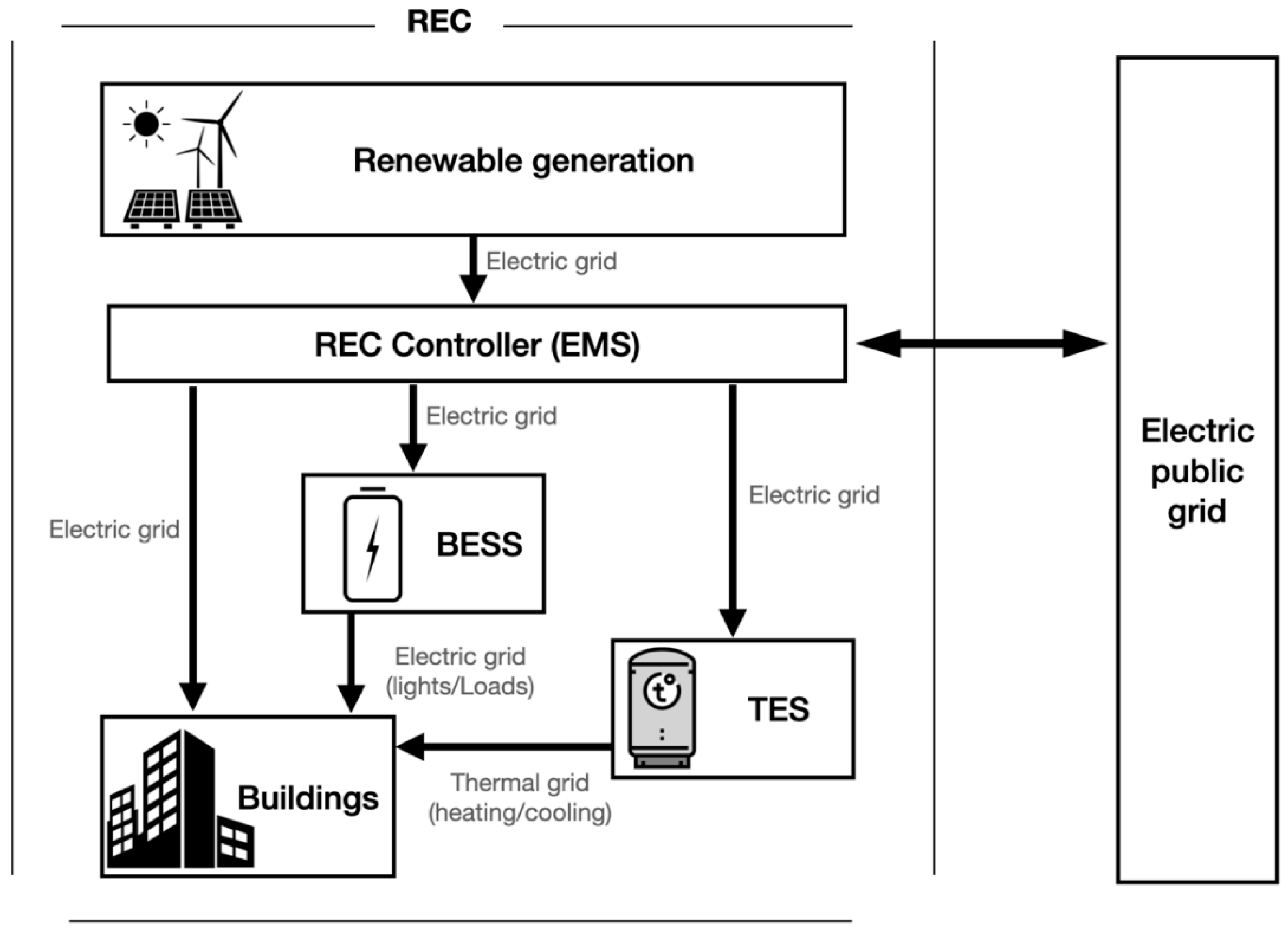
Building on the functional role of TES discussed in Section 3.1, this section focuses on comparative analysis between TES and BESS within the context of RECs. It is structured into several subsections to systematically address the main performance, economic, and operational factors distinguishing these storage technologies. In hybrid REC configurations that include PtH pathways, BESS primarily provide short-term electrical balancing, while TES addresses heating and cooling demand, enabling complementary flexibility across different temporal scales [2,27,37].
Section 3.2.1 examines the fundamental performance characteristics of TES and BESS, including energy density, efficiency, and losses. Section 3.2.2 explores the discharge duration and temporal applications of each technology, highlighting their suitability for different storage timescales. Economic aspects, such as capital and lifecycle costs, are discussed in Section 3.2.3. The environmental impacts of both storage solutions, with attention to materials, manufacturing, and end-of-life considerations, are assessed in Section 3.2.4. Section 3.2.5 considers operational constraints, including control, dispatchability, and integration with community energy systems. Finally, Section 3.2.6 discusses the complementarities between TES and BESS when both are deployed in RECs, emphasizing the benefits of hybrid storage strategies. A comparative summary table is provided at the end of this section to synthesize key findings across these dimensions.

3.2.1. TES vs. BESS Performance Characteristics

BESS, particularly lithium-ion technologies such as lithium iron phosphate (LFP), are characterized by high electrical energy density and high round-trip efficiency. Gravimetric energy densities typically range between 75 and 250 Wh/kg, while stationary systems commonly achieve round-trip efficiencies between 85% and 95%, depending on technology and operating conditions [44,45,46]. These characteristics make BESS especially suitable for short-term electricity storage, fast response applications, frequency regulation, and grid-support services in renewable-based power systems. Recent techno-economic analysis further confirms the competitiveness of BESS in providing short-duration flexibility in grid-connected and community-scale applications.
In contrast, TES stores energy in the form of heat or cold and is therefore assessed using different performance metrics. Depending on the storage mechanism, sensible, latent (e.g., phase change materials), or thermochemical, volumetric energy densities typically range from approximately 80 to 500 Wh/L [47,48]. When thermal energy is reconverted into electricity, overall efficiencies are relatively low (typically 20–60%), reflecting conversion losses. However, when TES is used directly for heating or cooling applications, effective efficiencies can approach near-lossless operation, with low standing losses and long storage lifetimes. This makes TES particularly attractive for space heating, domestic hot water, cooling, and low- to medium-temperature industrial heat demand [5,24,48].
Within RECs, these contrasting characteristics lead to complementary functional roles. BESS provides fast electrical flexibility, precise power control, and short-term balancing, while TES enables efficient temporal shifting of thermal demand and facilitates sector coupling through PtH pathways. Recent optimization studies demonstrate that hybrid TES–BESS configurations significantly enhance overall system performance by allocating short-term electrical balancing to batteries and longer-duration energy shifting to TES. Such configurations reduce system costs, increase renewable self-consumption, and improve operational flexibility compared to single-storage solutions [49,50].
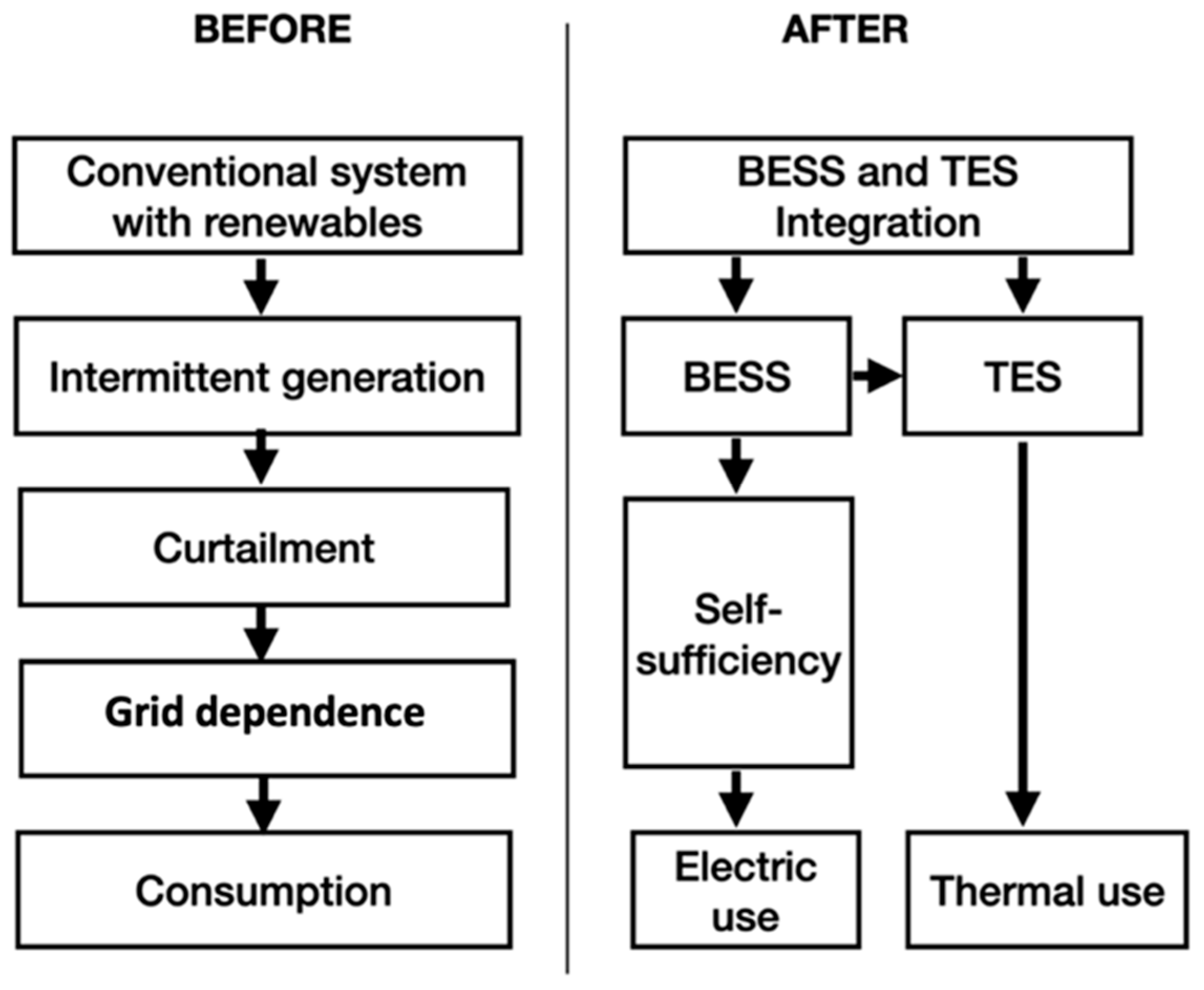
Figure 2 conceptually contrasts a conventional renewable-based configuration, characterized by intermittent generation and limited flexibility, with an advanced REC configuration integrating both BESS and TES. In conventional systems, mismatches between renewable generation and demand may lead to excess generation, which can be partially mitigated through demand response strategies but may ultimately result in curtailment and continued reliance on grid imports. In contrast, the integrated BESS–TES configuration enhances system flexibility by enabling demand response and load shifting across both electrical and thermal domains. BESS primarily increases renewable self-consumption by storing surplus electricity for later electrical use, while TES enables the conversion and storage of surplus electricity as heat or cooling through PtH pathways. Together, these storage technologies can reduce grid dependence, improve local utilization of renewable energy, and contribute to higher levels of community self-sufficiency.

3.2.2. Discharge Duration, Performance Characteristics, and Temporal Applications

Lithium-ion batteries remain the dominant technology for short- to medium-duration stationary storage, with typical discharge durations ranging from minutes to a few hours and, in some cases, extending to day-scale operation [51]. Their high round-trip efficiency (90–95%), sub-second response times, and high power density make lithium-ion BESS particularly suitable for applications such as daily peak shaving, demand response, and grid regulation in power systems with high penetration of variable renewable energy sources [52,53]. Nevertheless, their economic and technical suitability decreases for extended discharge durations due to cost and degradation constraints [46,54]. By contrast, TES can be designed to operate over a wide range of temporal scales, from intra-day to seasonal. Small-scale systems such as hot-water tanks, ice banks, and latent heat storage units routinely provide hourly or daily buffering, while large-scale solutions, including tank, pit, borehole, or aquifer-based systems, enable storage over weeks or entire seasons [55]. Seasonal Thermal Energy Storage (STES) is particularly promising for shifting surplus renewable heat from summer to winter, a capability that currently has no cost-competitive electrochemical alternative [56]. The use of inexpensive and abundant materials further supports the economic viability of large thermal stores in long-duration applications [57].
Although TES typically exhibits lower round-trip efficiency than lithium-ion batteries, often reported in the range of approximately 75–85%, its performance is highly dependent on system design, heat transfer fluid selection, and thermal stratification effects [48,58]. Recent advances, including nanoparticle-enhanced phase change materials, have significantly reduced charging and discharging times by improving effective thermal conductivity and heat transfer characteristics [59]. Additional improvements through advanced fin geometries have been shown to accelerate melting and solidification processes in latent heat storage systems [60]. Importantly, these technologies exhibit exceptional cycle stability, with sensible heat systems offering effectively unlimited cycling and PCM-based systems demonstrating minimal degradation over repeated operation [61]. These characteristics make this kind of energy storage particularly suitable for long-duration and high-capacity energy shifting in renewable energy communities, where temporal flexibility often outweighs the need for fast response. Techno-economic studies confirm also its cost-effectiveness in applications requiring extended discharge durations and high operating temperatures. For example, Chen et al. [62] demonstrated that increasing storage temperature in molten-salt TES integrated into a solar tower power plant (200–650 °C) improves annual electricity output, overall efficiency, and levelized cost of electricity. At the community scale, optimization studies show that integrating STES with heat pumps and solar thermal systems can enable renewable penetration levels of up to 70% in heating-dominated RECs, outperforming battery-only configurations in terms of cost-effectiveness [63], while also significantly reducing renewable curtailment by storing excess summer heat for winter use [64].
Beyond seasonal shifting, TES plays a key enabling role in district heating and cooling networks associated with RECs by decoupling heat generation from demand. In such systems, TES may be deployed as dedicated short-term or seasonal storage units, or implicitly through “network storage” by exploiting the thermal inertia of distribution pipelines [65,66]. Control strategies typically combine priority-based dispatch rules with high-resolution scheduling to minimize emissions and losses, while more advanced approaches apply model predictive control to integrated electricity–heating networks, particularly when pipeline thermal inertia is used as a distributed storage resource [65,66]. At a broader system level, the integration of large-scale TES with PtH pathways has been shown to reduce renewable curtailment and enhance overall system efficiency in high-renewable scenarios [42].

3.2.3. Economic Aspects

The economic performance of both energy storage technologies differs markedly when assessed in terms of capital expenditure, lifetime, efficiency utilization, and scalability. Recent techno-economic studies show that lithium-ion BESS currently achieve the lowest levelized cost of storage (LCOS) for short-duration applications (2–4 h), typically in the range of 120–180 EUR/MWh, driven by high round-trip efficiency and fast response times [54]. However, installed costs remain capital-intensive and scale almost linearly with storage duration, limiting the economic viability of BESS for long-duration storage [44,46]. In contrast, TES systems rely on low-cost and widely available materials such as water, concrete, molten salts, or PCMs, resulting in competitive LCOS values for medium- and long-duration storage, typically around 120–150 EUR/MWh in optimized applications [67]. Lifecycle analyses further highlight that TES technologies can operate reliably for several decades with minimal degradation, leading to lower annualized costs compared to lithium-ion batteries, whose lifetime is commonly limited to 5–15 years and may require replacement over the project horizon [48,68].
For solar-powered cold storage systems, cold thermal energy storage has proven more economically competitive over a 15-year period despite higher initial investment, as battery-based solutions require frequent replacement [69]. In Renewable Energy Communities, TES is particularly advantageous when thermal energy is used directly for heating or cooling, where effective efficiencies are significantly higher than electricity-to-electricity storage, and operational costs can be reduced by up to 25% through improved renewable utilization and reduced grid dependency [6,70].

3.2.4. Environmental Impact

Life Cycle Assessment (LCA) is widely used to evaluate the environmental sustainability of energy storage systems across manufacturing, operation, and end-of-life stages. BESS, particularly lithium-ion technologies, present relatively high environmental burdens during manufacturing due to energy-intensive processes and the extraction of critical materials such as lithium, cobalt, and nickel. Cradle-to-gate emissions typically range between 30 and 200 kg CO2-eq per kWh of installed capacity, depending on battery chemistry, supply chain configuration, and electricity mix [71,72]. In addition to greenhouse gas emissions, lithium and cobalt mining are associated with significant water use, ecosystem degradation, and social risks. Recent studies highlight that supply chain optimization can partially mitigate these impacts. Batuecas et al. [73] shows that solid sodium-ion batteries (SIBs) can significantly reduce toxicity-related impacts compared to lithium-ion batteries, particularly in marine ecotoxicity, although lithium-ion batteries still present the lowest global warming potential under lab-scale conditions. Nevertheless, even under optimized scenarios, BESS retains a relatively high embodied carbon footprint, making recycling and end-of-life management essential for sustainability. SIBs are considered a potentially lower-impact alternative to lithium-ion technologies from a life-cycle perspective, primarily due to the abundance and geographic distribution of sodium resources, which reduces reliance on critical materials such as lithium, cobalt, and nickel. Review studies indicate that the use of widely available elements and the possibility of cobalt-free chemistries can significantly mitigate resource depletion, toxicity, and supply-chain vulnerabilities associated with conventional lithium-ion batteries [74,75]. In addition, SIB manufacturing may benefit from the use of aluminum current collectors on both electrodes and reduced dependence on scarce transition metals, contributing to lower environmental burdens in extraction and processing stages [76]. Although SIBs currently exhibit lower energy density, potentially increasing material requirements per unit of stored energy, their improved safety profile and reduced reliance on critical raw materials position them as a promising option for enhancing the environmental sustainability of stationary storage systems, particularly in community-scale applications where volumetric constraints are less critical [74,76].
TES systems generally exhibit a more favorable environmental profile. By relying on abundant and low-toxicity materials such as water, concrete, molten salts, or phase change materials, TES achieves lower embodied emissions per unit of stored energy. LCA studies report that large-scale TES systems can generate up to 60–70% fewer greenhouse gas emissions per stored kWh compared to BESS, particularly when thermal energy is used directly [57,77]. The long operational lifetime of TES, often several decades with minimal degradation, further reduces its life-cycle environmental impact. End-of-life considerations also favor TES. Thermal storage media are generally non-toxic, reusable, or inert at disposal, whereas battery systems require complex recycling processes to recover valuable metals. While lead-acid batteries achieve recyclability rates above 95%, lithium-ion batteries typically reach 70–80%, with environmental benefits strongly dependent on local recycling infrastructure [69]. Beyond emissions, Social LCA studies emphasize challenges related to battery supply chains, including labor conditions, human rights risks, and community health impacts in mining regions [78].
While emerging battery chemistries such as sodium-ion may reduce the environmental burdens associated with lithium-based systems, TES technologies generally maintain a superior life-cycle environmental performance due to their reliance on abundant materials, long service life, and lower manufacturing intensity, particularly in applications where thermal energy can be utilized directly.

3.2.5. Operational Constraints and Temporal Applicability

Both energy technologies exhibit distinct operational constraints that determine their suitability for different applications within energy communities. BESS are characterized by rapid electrical response and high controllability, enabling services such as frequency regulation, peak shaving, and short-term energy arbitrage. However, their operational lifetime is strongly influenced by depth of discharge (DoD), temperature, and cycling intensity. Lithium-ion batteries are typically operated within 80–95% DoD ranges to limit degradation, while inadequate thermal management or excessive cycling accelerates capacity loss [25,26,79]. Operational constraints related to temperature and self-discharge further affect battery systems. Lead-acid batteries exhibit self-discharge rates of 1–5% per month, while lithium-ion technologies perform optimally within moderate temperature ranges, often requiring active thermal management in extreme climates [80,81]. Lithium-ion batteries typically show comparatively low self-discharge, generally below ~2–5% per month under standard storage conditions, although this rate depends on chemistry, state of charge, and SEI stability, and increases with temperature due to accelerated parasitic reactions [82,83]. These factors increase system complexity and reduce suitability for long-duration or low-utilization storage in RECs. For sodium-ion batteries, self-discharge may be more pronounced than in Li-ion under comparable rest conditions, largely due to differences in SEI formation/stability and higher solubility of SEI components in some electrolytes (e.g., propylene carbonate) [82].
TES systems, in contrast, are governed by thermal and hydraulic constraints rather than electrochemical limits. Their performance depends on pump capacity, heat exchanger effectiveness, and thermal stratification stability. Convective mixing in stratified tanks can significantly reduce exergy retention if not properly controlled [81,84]. Nevertheless, these systems can typically operate at 100% depth of discharge without material degradation and exhibit low self-discharge rates in well-insulated configurations [24,79].
Temperature operating ranges further differentiate the two technologies. While BESS performance degrades outside narrow temperature bands, TES systems, such as molten salt and high-temperature sensible heat storage, can operate over wide temperature ranges (200–550 °C), facilitating integration with PtH strategies and district energy systems [81]. From a spatial perspective, lithium-ion BESS generally require 30–50 m3 per MWh, whereas TES can achieve favorable space efficiency through modular designs or integration with existing infrastructure [85].
Discharge duration defines the temporal applicability of storage technologies. Lithium-ion BESS are most effective for 2–4 h discharge durations, matching short-term flexibility needs in RECs [86]. TES and vanadium redox flow batteries (VRFBs) can be scaled to provide 4–12 h storage with limited efficiency penalties, while hydrogen-based systems extend applicability to multi-day or seasonal storage, albeit with higher complexity and lower round-trip efficiency [27]. Notably, Évora hosts a VRFB demonstrator (5 kW/60 kWh), highlighting the technology’s suitability for high-cycling operation [87]. VRFBs are frequently reported to achieve very long cycle life (often >20,000 cycles) with low-capacity fade, but their relatively low volumetric energy density (commonly ~25–35 Wh·L−1 for commercial systems) implies a larger system footprint to reach high energy capacities, often becoming a practical constraint [88,89].

3.2.6. Complementarity in Energy Communities

Both technologies provide complementary functions in communities, addressing different temporal dynamics and end-use demands. Several studies show that their coordinated operation under unified energy management systems (EMS) significantly increases renewable self-consumption, reduces peak loads (up to 35%), and enhances system resilience while enabling ancillary grid services [5,90]. TES systems, ranging from simple hot water tanks and building thermal inertia to advanced PCM-based storage units, can substantially enhance the self-consumption of locally generated renewable energy by absorbing surplus electricity in the form of heat or cold for later use. In doing so, TES directly addresses the large share of residential energy demand associated with heating and cooling, which battery-based electrical storage alone cannot efficiently serve. By capturing excess solar or wind generation that would otherwise be curtailed and reallocating it to future thermal needs, shared or individual thermal storage units can increase renewable self-consumption at the community level, reduce grid dependence, and shorten investment payback periods by improving overall self-sufficiency [19].
As discussed in Section 3.2.1 and Section 3.2.2, BESS primarily deliver short-term electrical flexibility within RECs, effectively compensating for intra-day PV and wind variability and supporting grid-oriented services such as frequency regulation and peak management [91,92]. However, their cost-effectiveness decreases significantly as storage duration extends beyond daily cycles, limiting their suitability for seasonal applications.
TES complements BESS by enabling low-cost, long-duration energy shifting and by directly addressing thermal demand. Surplus renewable electricity can be converted via PtH pathways and stored in sensible heat systems or seasonal thermal energy storage (STES), allowing energy generated in periods of high renewable availability to be used weeks or months later, an application where standalone electrical storage would require prohibitively large battery capacities [9,24,65]. Across the reviewed building- and microgrid-scale studies, the coordinated integration of TES with BESS consistently emerges as a sizing lever for electrochemical storage, indicating that hybrid control strategies can significantly reduce required BESS capacity while simultaneously improving energy-efficiency and comfort-related outcomes [27].
This principle has been demonstrated at the household scale in [37] who show that excess solar PV electricity can be stored in domestic hot water tanks through PtH systems, effectively shifting solar energy availability from daytime to nighttime. Beyond meeting thermal demand, such PtH-based TES solutions also support electrical system balance by reducing evening electricity consumption, as heat is drawn from the storage tank rather than supplied by electric heaters. Consequently, by enabling efficient PtH conversion, particularly when heat pumps with coefficients of performance above unity are employed, TES provides a low-loss buffering option for excess renewable electricity, supporting thermal load shifting, peak shaving, and overall system balance within RECs [2,7,93].
Beyond single-energy applications, recent system-level studies show that thermal energy storage enables multi-energy operation under renewable variability. At this level a solar-driven trigeneration system, which allows the simultaneous production of electricity, heat and hydrogen, have shown to preserve system efficiency under fluctuating solar input and reduce environmental impacts compared to single-output configurations [94]. These findings highlight TES as a key flexibility enabler in integrated electricity–heat–fuel pathways relevant to advanced RECs and district-scale energy systems.
The relative contribution of TES and BESS in energy communities is strongly climate-dependent, as climatic conditions determine the magnitude and seasonality of heating and cooling demands [16]. In heating-dominated climates, TES, particularly sensible heat storage and STES, offers clear advantages, improving renewable self-consumption and reducing winter grid exchanges through coordinated PtH operation [29,95,96]. In cooling-dominated or mixed climates, short-term TES solutions, especially PCM-based systems, support diurnal load shifting by storing midday solar surplus for evening cooling demand, thereby reducing peak electricity consumption and reliance on batteries [97,98,99,100].
Recent evidence supports the value of TES in community-scale optimization: in a near-zero energy community case that jointly considers electrical and thermal storage, an integrated storage configuration reduced total carbon emissions by 59.9% and reduced grid interaction by 38.6%, while adding thermal storage contributed to a 17.0% reduction in levelized cost of energy compared with an otherwise similar configuration without TES [41]. These results align with broader observations that TES can effectively address daily demand fluctuations and, in some applications, seasonal mismatches in a cost-effective manner, particularly when combined with sector-coupling strategies [5,24,42]. By smoothing demand profiles, thermal energy storage enhances community self-sufficiency and energy resilience by reducing reliance on grid imports and backup generation. During periods of low renewable availability, charged TES systems can continue supplying heating and cooling services, thereby mitigating the risk of unmet critical loads and improving system reliability, particularly in cold climates where heating is essential for occupant safety [2].
Across all climatic contexts, hybrid TES–BESS configurations consistently outperform single-technology solutions. Optimization and case studies show that combining electrical and thermal storage minimizes system costs, emissions, and grid dependence, while reducing renewable curtailment by up to 40% and lowering required battery capacity by more than one-third in fully renewable and industrial RECs [63,101,102,103]. The literature consistently identifies hybrid TES–BESS configurations as the most robust storage strategy for RECs, combining fast electrical flexibility from BESS with thermal load buffering from TES to enhance renewable self-consumption, system flexibility, and resilience across climates [16,22,30].
At the review level, recent database-driven syntheses argue that structured and harmonized performance repositories, organized by TES technology, temperature range, efficiency, and lifetime, are essential to accelerate technology selection and adoption across applications, underscoring the persistent need for systematic consolidation and comparability in the TES field [9].
To synthesize the comparative insights presented across Section 3.2.1, Section 3.2.2, Section 3.2.3, Section 3.2.4, Section 3.2.5 and Section 3.2.6, Table 1 provides a structured overview of the key performance characteristics of BESS and TES.

3.3. Thermal Storage Using PCM

While photovoltaic deployment has benefited from sustained cost reductions and policy incentives, renewable heating solutions have historically received less attention, even though they address a substantial share of final energy demand [38]. Within renewable-based energy systems, and particularly in RECs, TES has been widely recognized as a key enabler to reduce energy waste and mitigate the temporal mismatch between variable renewable generation and end-use demand, especially under PtH and sector-coupling strategies [2,104]. Recent reviews further note that both TES and RECs are relatively young research fields which, despite rapid growth, remain characterized by a limited number of dedicated, application-oriented studies [2]. One specialized and relevant area is the use of PCMs. Among TES technologies, PCM-based storage is particularly relevant for compact thermal buffering and cooling applications, although it presents recurring design and integration challenges. Recent reviews emphasize that system performance and scalability depend strongly on appropriate containment strategies (e.g., encapsulation and form stability) and on heat transfer enhancement techniques, since the intrinsically low thermal conductivity of many of these materials can slow charging and discharging processes and reduce effective power capacity [105,106]. Quantitative studies further report meaningful operational benefits at the system level; for instance, PCM-based thermal buffering has been shown to increase stored thermal energy by approximately 27.7–27.8% while improving thermal stability and reducing specific energy consumption in coupled energy–water systems, supporting PCM’s role as a practical solution for diurnal thermal load shifting, particularly when appropriately engineered and integrated into the overall system design [107]. Design-oriented studies from adjacent applications also provide useful quantitative evidence on the performance–cost trade-offs inherent to conductivity-enhanced PCM systems. For example, Afaynou et al. [10] demonstrates that optimized conductivity-enhanced PCM configurations can reduce peak operating temperatures by up to 33.8%, increase effective thermal energy storage by approximately 57.5%, and achieve around 33% reductions in cost and system weight, highlighting the importance of material selection and engineering trade-offs in realizing the full potential of PCM-based thermal energy storage.
PCMs belong to the class of Latent Heat Thermal Energy Storage (LHTES) materials, as they store and release thermal energy through a first-order phase transition, typically solid–liquid or, less commonly, solid–solid, occurring at a nearly constant temperature [105]. During this transition, a large amount of latent heat can be absorbed or released within a narrow temperature range, enabling high energy storage density with relatively small material volumes. This characteristic makes these materials especially suitable for building-related applications, where maintaining indoor temperatures within a defined comfort range is a primary objective [97].
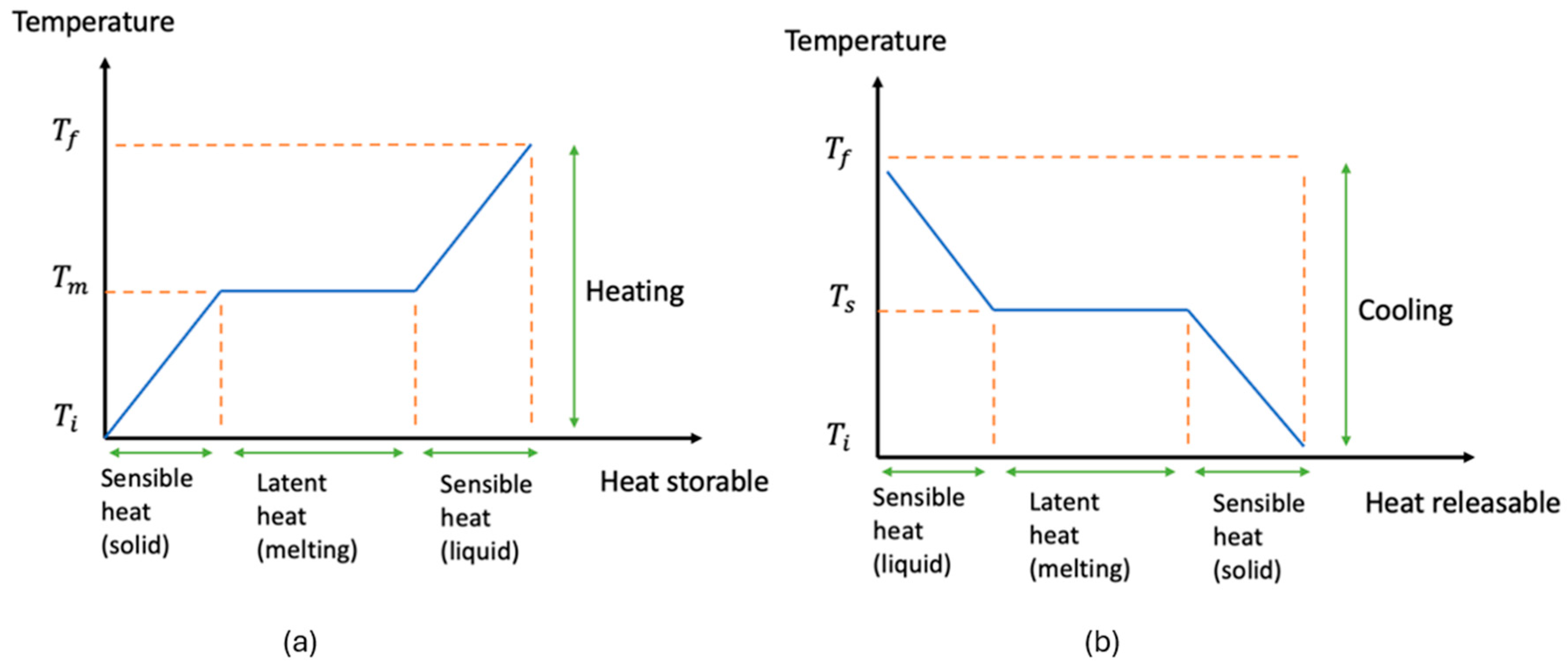
From a thermodynamic perspective, the thermal cycling of a PCM comprises three contributions: sensible heat storage in the solid phase, latent heat storage during melting and solidification, and sensible heat storage in the liquid phase, a decomposition that underpins the high storage density and quasi-isothermal behavior of latent heat thermal energy storage systems [108]. The effective use of latent heat depends on the alignment between the PCM phase-change temperature and the operational temperature window of the application, as only this range contributes meaningfully to load shifting and peak reduction [104]. In practice, non-ideal effects such as supercooling, where solidification occurs below the melting temperature, can reduce usable storage capacity and must be considered during material selection and system design, particularly for inorganic PCMs [105].
Figure 3 schematically illustrates the PCM charging (heating) and discharging (cooling) processes, explicitly separating sensible heat storage in the solid and liquid phases from latent heat storage during phase change.
PCM-based TES is particularly attractive for cooling applications in hot climates or during summer periods. By storing thermal energy at temperatures close to indoor comfort levels, or slightly below, it is possible to accumulate “cooling energy” during periods of low ambient temperature or surplus renewable electricity and release it during peak cooling demand [13,48]. In buildings and community-scale cooling systems, PCMs are typically implemented through two main approaches [13]:
(i)
Passive integration, where PCMs are embedded in building components such as walls, ceilings, or floor elements, allowing the building envelope itself to absorb heat during the day and release it during cooler nighttime periods [13];
(ii)
Active PCM storage systems, consisting of dedicated storage tanks or heat exchangers in which the PCM is charged and discharged via a heat transfer fluid. In such systems, chillers or heat pumps can operate during off-peak hours or periods of excess renewable generation to freeze or melt the PCM, thereby reducing cooling power demand during peak hours [15].
Several experimental and simulation studies demonstrate that PCM integration in buildings can significantly enhance thermal performance. Reported results include reductions in heat transfer of up to 47.6%, stabilization of indoor temperatures by up to 46%, and decreases in heating and cooling energy demand of up to 31%, with optimal PCM melting temperatures for moderate climates typically ranging between 22 °C and 28 °C [13,97]. Moreover, PCM integration within air-conditioning systems has been shown to reduce peak electrical power demand by approximately 20%, contributing to load shifting and peak shaving at both building and community scales [15]. When deployed across multiple buildings within an REC, these effects can aggregate into substantial reductions in peak demand and a flatter community load profile [13].

3.3.1. Cooling Demand Growth and Importance

With global warming and urbanization, cooling demand is expected to triple in the next decades in some regions [15]. In RECs located in warm climates or seasons, meeting cooling demand with renewable energy is challenging because peak cooling demand often coincides with early evening hours when solar input declines, although in some climates peak demand may occur in the late afternoon, partially overlapping with solar availability. The precise timing of cooling demand peaks depends on weather conditions and is strongly influenced by the thermal inertia of buildings, which can delay and smooth peak cooling loads, particularly in warm climates [15,109]. Heating and cooling demands often present pronounced daily peaks that stress local energy systems. In cooling applications, storage technologies such as chilled water tanks, ice storage, or PCM-based systems enable off-peak production of cooling energy for later use, thereby reducing community-level peak electricity demand [43]. At the building and community scales, thermal energy storage contributes to demand reduction and resilience by increasing effective thermal mass and lowering peak HVAC power requirements. TES integration in building envelopes and cooling systems has been shown to reduce heating and cooling demand and achieve cooling energy savings on the order of 20–30%, while aggregated deployment in energy communities can significantly mitigate evening cooling peaks caused by simultaneous air-conditioning use [15].
PCM storage offers a way to extend the usefulness of solar energy into the evening, for example by using midday solar power to produce ice or charge PCM and subsequently supplying cooling during evening hours. This reduces reliance on grid electricity or large battery systems for air conditioning. In addition, it can improve cooling system efficiency, as chillers and heat pumps typically operate more efficiently under lower ambient temperatures, making nighttime charging particularly advantageous [15]. It also enables cooling demand to be shifted to off-peak periods by storing “coolth” during hours of surplus renewable generation, increasing the effective penetration of local solar energy in RECs [5]. Moreover, hybrid TES systems combining PCMs with chilled-water storage or active heat pumps have been shown to improve energy efficiency by up to 25% in cooling-dominated RECs [6].
Early building-scale studies have already highlighted the potential to support cooling demand in decentralized systems. PCM-based applications were shown to reduce cooling loads under different climatic conditions [39], while PV-driven cooling systems without storage typically supplied only a limited share of demand. By contrast, the inclusion of latent thermal storage significantly increased the share of cooling demand covered by on-site renewables, underscoring the still underexploited role of TES in cooling-dominated contexts [40]. Recent studies further extend this concept by introducing “virtual energy storage” based on building thermal inertia. Within RECs, building thermal mass can be strategically exploited through model predictive control to shift heating and cooling demand within predefined comfort limits, effectively storing thermal energy during periods of high renewable generation and releasing it during low-generation periods. This approach increases local self-consumption, reduces reliance on electrical storage, and enhances overall system flexibility and resilience without requiring additional physical storage capacity [110].

3.3.2. PCMs and Systems

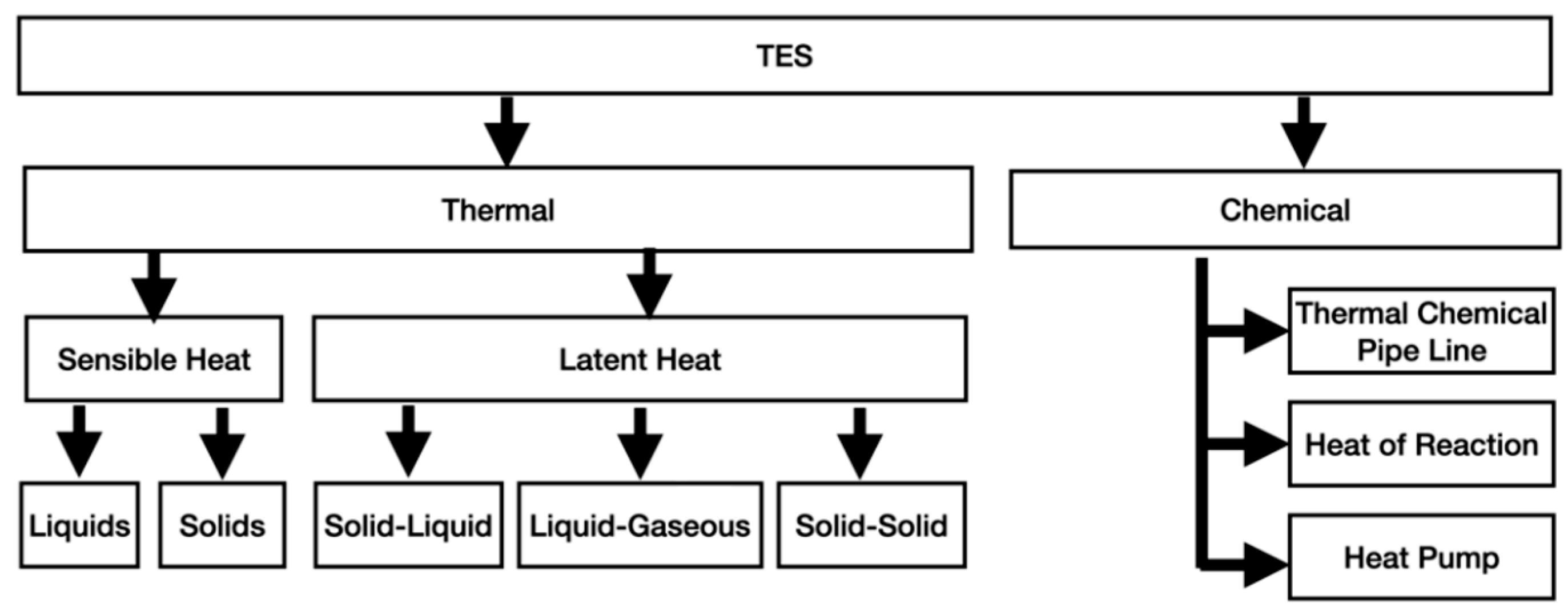
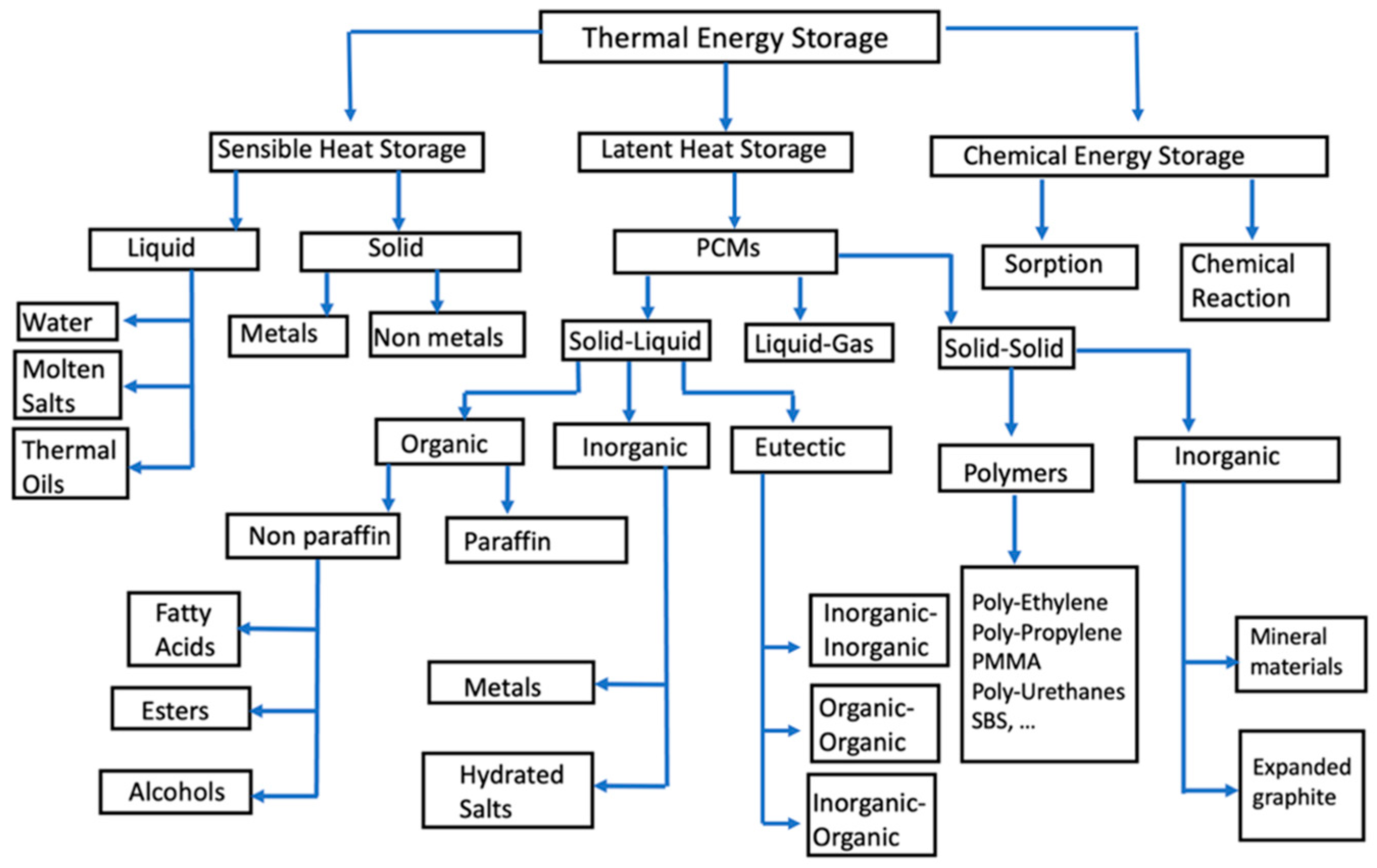
To contextualize PCMs within the broader landscape of TES technologies, Sharma et al. [111] classifies TES systems into thermal and chemical storage. Thermal storage comprises sensible heat storage (SHS), where energy is stored through temperature changes in solids or liquids, and latent heat storage (LHS), which exploits phase change phenomena (solid–liquid, solid–solid, or liquid–gas) to achieve higher energy densities. Chemical storage, by contrast, relies on reversible thermochemical reactions, heat pumps, or chemical pipelines, enabling high storage capacities at the expense of increased system complexity. This widely adopted classification highlights the diversity of TES technologies and their suitability for different temperature levels and applications, as illustrated in Figure 4 [111].
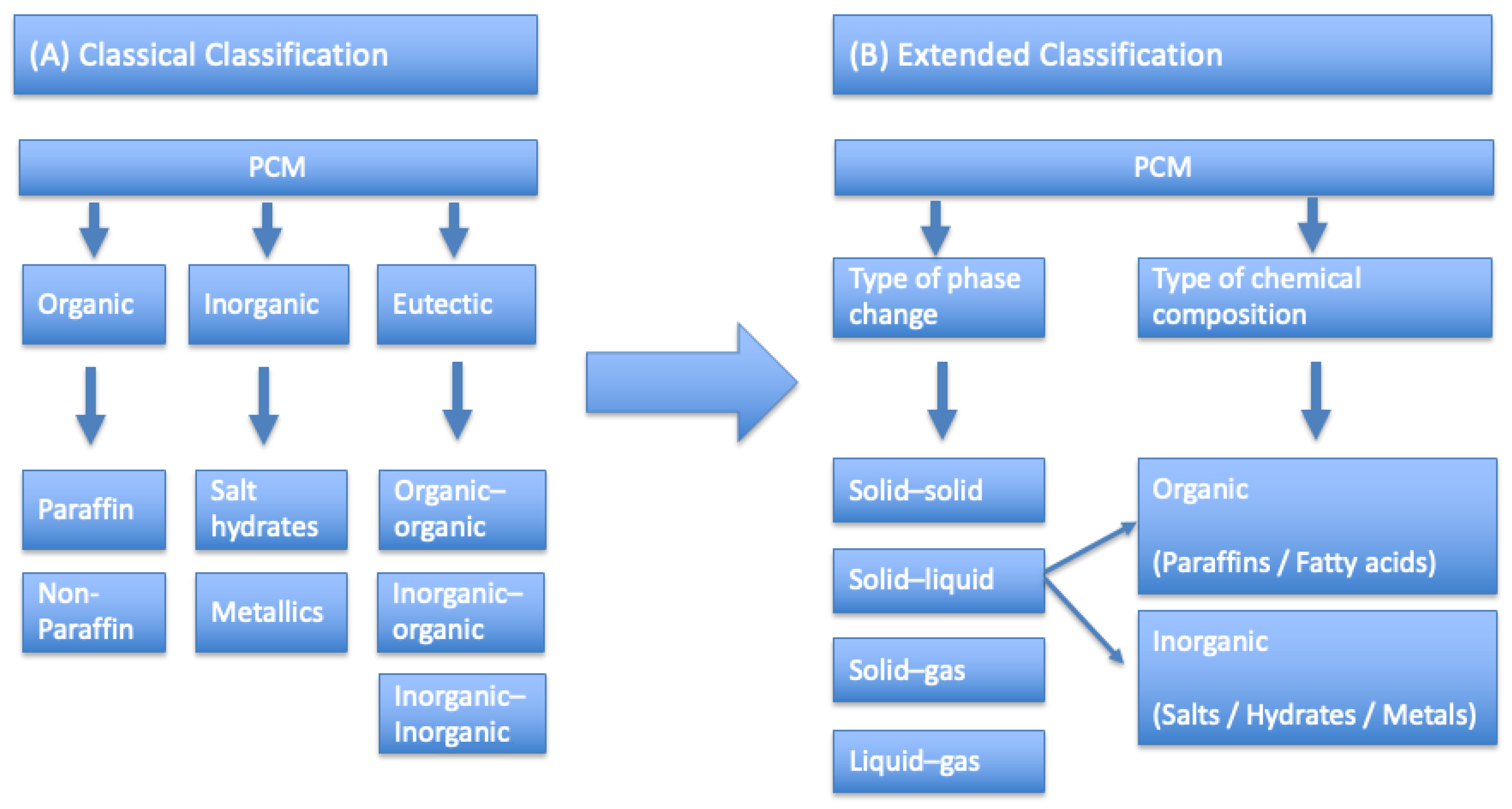
Podara et al. [112] further emphasized that PCMs, which form the core of LHS systems, can be initially classified by phase transition mechanism, with solid–liquid PCMs being particularly relevant for building-related TES due to their high latent heat storage capacity within narrow temperature ranges. Within this category, PCMs are commonly grouped according to chemical composition into organic, inorganic, and eutectic materials, each associated with specific trade-offs in thermal conductivity, cycling stability, corrosion behavior, and supercooling tendencies. Complementing this classical taxonomy [113] highlighted that recent PCM developments increasingly rely on engineered formulations, such as composite, encapsulated, and conductivity-enhanced PCMs, as well as tailored mixtures designed to achieve specific melting temperatures and improved operational reliability. The integrated PCM classification presented in Figure 5 synthesizes these perspectives by organizing PCMs according to phase transition mechanism and material family/sub-family, thereby providing a clearer framework for selecting PCM technologies.
PCMs offer tremendous potential to store thermal energy during reversible phase transitions for state-of-the-art applications [114]. Sharma et al. [111] categorized the classification of PCMs into organic, inorganic, and eutectic groups, as illustrated in Figure 4. This classification remains widely accepted and valuable framework in the literature. Organic PCMs (e.g., paraffins, fatty acids) offer chemical stability and non-corrosive behavior but have low thermal conductivity. Inorganic PCMs (e.g., salt hydrates, metallic alloys) provide high latent heat and greater energy density but face challenges like supercooling and phase segregation. Eutectic PCMs, combining two or more components, are engineered to optimize melting points and maximize energy storage density [111]. However, recent reviews highlight that, while the traditional classification of PCMs into organic, inorganic, and eutectic groups remains widely adopted, it lacks sufficient granularity for modern applications. In a shift from material-based to application-orientated classification, Mehling, H. [115] emphasizes that the term eutectic is often misapplied, as it refers specifically to certain mixtures with fixed melting points rather than representing an independent class of materials. The author also notes that hybrid formulations increasingly blur the boundaries between organic and inorganic PCMs, suggesting that alternative or complementary classification schemes are needed. Such schemes may focus on factors such as the type of phase transition (e.g., solid–solid vs. solid–liquid), crystallographic behavior, or application-specific performance metrics [115] illustrated in Figure 5. Despite these developments, other recent reviews confirm that the organic/inorganic/eutectic taxonomy continues to be the dominant framework in the literature due to its simplicity and widespread acceptance. For example, Mika et al. [116] proposes a broader classification approach incorporating transition type, material composition, and application domains, yet acknowledges that most studies still rely on the traditional model. Similarly, Anand et al. [117] highlights that emerging PCM formulations, including bio-based and nanocomposite-enhanced PCMs, are typically grouped within this conventional structure for comparability across studies.
Figure 6 illustrates the evolution of PCM classification frameworks, highlighting the transition from traditional material-based taxonomies [111] toward extended classifications that incorporate phase transition mechanisms and application-oriented criteria [115].
Common PCMs for cooling include water/ice (melting at 0 °C, used in ice storage systems), salt hydrates or proprietary compounds with melting points in the 8–20 °C range for cool storage, and certain paraffin waxes or fatty acids that melt around comfort temperature (~22–25 °C) for passive building applications. Each has its advantages and disadvantages: ice has high latent heat but at 0 °C may be too cold to directly use without mixing (it is often used in large HVAC systems); salt hydrates have high energy density but can suffer from subcooling and degradation over many cycles; organic PCMs (paraffin, fatty acids) are more stable but have lower thermal conductivity [24]. Current research involves improving the PCM thermal conductivity (through metal fins, graphite additives, etc.) to enhance charging/discharging rates [24]. Containment and encapsulation techniques (encapsulating PCMs in pellets, pouches, etc.) have been developed to integrate them into water tanks or air ducts without leakage. These technical details are beyond the scope of this review, but it can be concluded that PCM technology has matured to a point where commercial products (like PCM-enhanced wall panels, or ice storage systems) are available and have been deployed in buildings and microgrids. Bio-based PCMs derived from renewable resources, such as plant oils and animal fats, are gaining prominence due to their reduced environmental impact while maintaining comparable thermal storage capacities to conventional paraffins [118]. Additionally, advancements in micro and macro-encapsulation techniques have improved PCM charging and discharging rates by up to 40% in controlled and application-specific configurations, enabling more compact and efficient TES integration in urban community settings [77].

3.3.3. REC Applications of PCM

In RECs, PCM-based thermal energy storage offers a flexible means to address the temporal mismatch between cooling demand and renewable energy generation, as discussed in Section 3.3.1 and Section 3.3.2. PCM systems can be implemented at both the building level and the community level, enabling cooling load shifting, peak demand reduction, and increased utilization of locally generated renewable electricity. At the building scale, PCMs are commonly integrated into building envelopes, HVAC systems, or dedicated thermal storage units to store coolth during periods of surplus renewable generation and release it during peak cooling hours. This approach reduces electricity imports from the community network or external grid, particularly during early evening peak periods. As highlighted in recent reviews, the majority of PCM-related studies focus on single-building applications, reflecting their higher technological maturity compared to community-scale implementations [13]. At the community scale, PCM-based thermal energy storage can be incorporated into centralized cooling infrastructures, such as shared chilled-water storage or small-scale district cooling networks serving multiple buildings. Aggregating cooling demand and storage capacity enables coordinated charging and discharging strategies that enhance operational flexibility and improve the penetration of renewable energy in cooling-dominated RECs [5]. An explicit community-level application of PCM storage is presented in [2], where PCM-based thermal energy storage was integrated into an LEC EMS using Information-Gap Decision Theory (IGDT). Their results show that PCM integration improves system robustness under uncertainty, reduces peak electricity imports from the grid, and mitigates exposure to energy price volatility, underscoring the strategic value of PCM-based TES in community energy planning.
Beyond space cooling, emerging of these materials applications include community-scale refrigeration and cold-chain services. Shared cold storage facilities equipped with PCM modules can be charged during periods of high photovoltaic output and maintain low temperatures for extended durations without continuous electricity input, contributing to reduced evening electricity demand and increased community energy autonomy [13]. When deployed across multiple buildings, PCM systems can yield aggregate community-level benefits. Several studies report peak cooling load reductions in the range of 20–35% at the building or cluster scale, depending on climate conditions and system configuration [13]. When aggregated across an REC, such reductions can alleviate local grid congestion and enhance operational stability. Moreover, PCM-enhanced district cooling networks provide a scalable solution for dense or urban RECs by combining centralized thermal storage with distributed cooling delivery and coordinated community-level control strategies [5].

3.3.4. Economic and Practical Considerations

PCM-based cooling systems typically require additional upfront investment, including PCMs, containment solutions, and potential retrofitting of building or community energy systems. While these materials used for cooling applications can deliver energy savings, payback periods vary widely depending on climatic conditions, system configuration, and local electricity prices, in some regions, payback times remain relatively long, partly due to low electricity prices and the still-elevated cost of the materials [13,15].
For RECs pursuing self-sufficiency, resilience, or reduced peak demand, the value of PCM-based thermal energy storage extends beyond direct energy cost savings. Several studies highlight that thermal energy storage solutions, including PCM-based systems, can be more cost-effective than battery energy storage when addressing cooling-related load shifting in RECs. From an environmental perspective, conventional PCM systems often rely on salt hydrates and paraffins, which are generally safe but may be petroleum derived. Recent developments increasingly focus on bio-based PCMs derived from sustainable plant oils and animal fats, offering thermal performance comparable to conventional paraffins while reducing environmental impacts and potential greenhouse gas emissions [118].
Economic assessments further indicate that PCM-based TES systems can achieve payback periods below seven years when combined with smart energy management strategies in RECs characterized by high cooling demand and favorable operating conditions [6]. Financial viability improves further when PCM deployment is aligned with dynamic electricity pricing, enabling communities to exploit periods of low-cost or surplus renewable electricity for off-peak cooling [5].

3.3.5. Role of PCM Properties in Cooling Applications

The suitability of these materials for cooling applications in communities is strongly determined by key material properties, particularly melting temperature, latent heat capacity, and cycling stability [119,120]. The melting temperature must be selected to match cooling demand profiles and system setpoints so that the PCM can reliably charge during periods of renewable surplus and discharge during peak cooling hours; for building-oriented applications, recent evidence indicates that optimal melting temperatures often fall within the comfort-relevant range, with reported optimum values for moderate climates typically around 22–28 °C depending on configuration and placement [97]. The latent heat capacity directly affects achievable storage density and is therefore critical in space-constrained community and building-level deployments where compact storage is required. Higher latent heat enables meaningful peak-load reduction and load shifting with smaller volumes, which is particularly advantageous in dense urban RECs where storage space is limited [117,119].
Cycling stability is equally important because cooling-oriented PCM systems commonly operate on frequent (often daily) charge–discharge cycles. Degradation mechanisms such as supercooling and phase segregation, together with material aging and containment-related issues, can reduce effective storage capacity and long-term performance, increasing operational uncertainty and maintenance needs [117,120,121]. Consequently, recent studies emphasize the role of encapsulation/containment strategies, thermal conductivity enhancement, and material stabilization measures to ensure repeatable cycling and adequate charge/discharge power rates over long service periods [119,120].

3.4. Economic, Environmental, and Operational Considerations

From the above discussions, several cross-cutting considerations emerge regarding the deployment of TES in RECs. These include lifecycle economics, environmental impacts, and implementation aspects such as operational integration, scalability/space, and non-technical barriers. Detailed study comparisons are provided in Table 2 and Table 3.

3.4.1. Economic Feasibility

TES is often a cost-effective option for shifting thermal loads in heating- or cooling-dominated RECs, particularly compared to BESS, due to lower specific investment costs and the ability to leverage existing infrastructures (e.g., hot-water tanks, building thermal mass, district heating/cooling networks) [2,122,123]. Applied studies report reduced operating costs from TES-enabled load shifting (e.g., peak demand charge mitigation and market participation) and improved PV self-consumption when surplus electricity is stored as heat under favorable tariffs [37,124].
From a lifecycle cost assessment (LCCA) perspective, the key differences relate to installation drivers, operation and maintenance (O&M), degradation/replacement, and end-of-life (EoL) and salvage value. BESS LCCA typically requires explicit accounting of fixed O&M, electrochemical aging (calendar plus cycling), and replacement within project lifetimes; lithium-ion lifetimes are often assumed around 8–15 years depending on duty and conditions [44,45]. In contrast, TES costs are commonly dominated by civil works and balance-of-plant (tanks, insulation, heat exchangers), O&M is generally lower, and performance degradation is often modest for sensible storage and treated via conservative efficiency/loss assumptions rather than detailed aging models [24,65]. EoL also differs: TES components are largely inert and recyclable and may retain residual value, whereas BESS requires specialized recycling and material recovery pathways, adding cost and uncertainty [5,57]. These structural differences help explain why hybrid TES-BESS solutions are frequently identified as cost-effective at community scale: BESS provides fast electrical flexibility, while TES provides low-cost bulk energy shifting for thermal demand [30,90].

3.4.2. Environmental Implications of TES Integration in RECs

Environmental impact assessments of TES and BESS are most frequently conducted using LCA approaches in accordance with ISO 14040/14044 [125,126], typically under cradle-to-gate or cradle-to-grave system boundaries. At REC system level, TES, particularly water-based sensible heat storage, can contribute to greenhouse-gas mitigation by enabling PtH storage of surplus renewable electricity and later displacement of fossil-based heating or fossil-dominated grid electricity for thermal demand [65,127]. In LCA studies, TES impacts are primarily associated with construction materials and auxiliaries (e.g., steel, concrete, insulation, pumps, and heat exchangers) and are commonly amortized over long lifetimes and low replacement rates, resulting in comparatively low embodied impacts per unit of useful thermal storage, especially for long-duration applications [9,24]. In contrast, LCAs of BESS emphasize upstream burdens from raw material extraction and cell manufacturing and the relevance of end-of-life handling and recycling pathways for critical materials such as lithium, cobalt, and nickel (as previously discussed in Section 3.2.4). While BESS can enable emissions reductions through improved renewable integration and short-term flexibility, several studies report that manufacturing can dominate life-cycle indicators (e.g., global warming potential and resource depletion), and end-of-life logistics add additional uncertainty and environmental risk if recycling chains are not adequately implemented [44,45,128].
Despite methodological variability across functional units, boundary choices, and local operating conditions, comparative studies tend to reach consistent systems-level conclusions: TES generally exhibits lower life-cycle environmental impacts for thermal load shifting and sector coupling, whereas BESS remains essential for short-term electrical flexibility and fast response. Consequently, hybrid TES–BESS configurations are frequently identified as environmentally robust solutions, combining low-impact long-duration thermal storage with targeted battery capacity where it delivers the highest marginal value [5,9,16].

3.4.3. Operational Complexity

Integrating TES into an REC requires smart controls but is conceptually straightforward because it extends functions that many communities already implement through an EMS to dispatch PV generation, schedule flexible loads, and manage battery charging. Adding TES typically introduces additional controllable components, most commonly heat pumps or electric heaters and, depending on the heating configuration, circulation pumps and motorized valves, which must be coordinated with electrical storage and demand-response actions. In practice, this coordination can be implemented across a spectrum ranging from simple rule-based operation to predictive or learning-based strategies, with recent work demonstrating advanced control approaches for community- and district-scale flexibility services [30,66].
SHS and PCM-based latent heat storage (PCM-LHS) differ in operational and engineering complexity when integrated into RECs. SHS solutions (e.g., domestic hot-water tanks, pit TES, borehole TES) rely on mature components and established balance-of-plant practices, generally reducing integration risk and easing implementation at community scale, especially when coupled with heat pumps and district heating/cooling infrastructures [65,96]. By contrast, PCM-LHS can increase complexity because it often requires addressing containment/encapsulation (leakage prevention), thermal conductivity enhancement to achieve adequate power rates, and long-term cycling stability. Additionally, supercooling and phase segregation can reduce effective capacity and may introduce monitoring and maintenance requirements, increasing design effort relative to SHS even when PCM solutions are attractive for compact retrofits and distributed deployment [119,120,121].
A key operational consideration is heat loss. Thermal stores dissipate heat over time depending on insulation, temperature gradients, and at larger scales, site-specific boundary conditions, so losses should be explicitly represented in dispatch and sizing models for community and district applications [65,95]. For seasonal configurations, losses can be substantial; for example, a seasonal borehole storage system is reported to exhibit a yearly heat loss of approximately 50% of the solar energy charged into the store [24]. Consistently, recent techno-economic analyses of large-scale buried tanks show that insulation strategy and boundary conditions strongly affect recoverable energy, with reported energy-capacity efficiency values such as energy capacity efficiency (ηII) ≈ 69–82% depending on configuration, highlighting that seasonal TES performance is strongly loss-dependent and must be captured by the model [95].
The perceived benefits of thermal energy storage, particularly for long-duration and seasonal applications, are also strongly influenced by the temporal resolution adopted in energy system modeling. Studies relying on coarse temporal resolutions (e.g., daily or monthly averages) tend to underestimate the value of TES by smoothing short-term surplus events, charging constraints, and inter-temporal mismatches between renewable generation and thermal demand. In contrast, high-resolution simulations (hourly or sub-hourly) capture diurnal variability, peak conditions, and storage dynamics more accurately, thereby revealing the full contribution of TES to renewable self-consumption and load shifting in communities. This effect is especially relevant for seasonal TES, whose benefits emerge only when long-term accumulation, losses, and discharge patterns are explicitly represented, underscoring the importance of appropriate temporal resolution when assessing performance and sizing at community scale [9,16,65,95].
Beyond storage losses and modeling considerations, operational performance in RECs is also strongly shaped by the efficiency with which electrical energy is converted into usable thermal energy through PtH pathways. When PtH is implemented through direct electric resistance heating, the conversion is approximately one-to-one (≈1 kWh_e to ≈1 kWh_th), whereas heat pumps can effectively amplify renewable electricity into useful heat by operating with coefficients of performance (COP) greater than one. This “multiplication effect” increases the amount of thermal demand that can be met using locally generated PV or wind electricity, thereby reducing grid imports and enhancing community self-consumption when the stored heat displaces later electric or fuel-based heating demand [16,37]. At community and district scale, this effect is reinforced when PtH devices and TES are jointly scheduled under an EMS to absorb renewable surplus and avoid curtailment. System-level analyses of smart energy systems report substantial reductions in renewable curtailment when large-scale TES is integrated with PtH pathways, indicating that PtH efficiency plays a key role in retaining renewable electricity locally [42]. However, the net benefit for self-consumption depends on the overall “effective PtH–TES chain efficiency”, which is shaped not only by PtH conversion performance but also by TES standing losses and the storage time horizon. Short-horizon (daily) thermal shifting typically preserves most of the converted energy and is therefore well suited to maximizing renewable self-consumption at REC level, whereas seasonal operation is far more sensitive to accumulated losses and requires explicit modeling and careful sizing to ensure that stored heat remains recoverable at useful temperatures [65,95].
REC-oriented evidence also indicates that coordinated PtH operation with TES, often combined with BESS, can deliver measurable operational benefits under realistic tariffs and comfort constraints. For instance, coordinated REC management combining TES and BESS reported reductions of about 12.6% in energy demand and 20.8% in costs, while reducing exports by roughly 18.2% under time-of-use operation [30]. At prosumer level, PtH-to-domestic hot water solutions are operationally simple (a controllable DHW tank plus a control policy), and recent assessment across realistic sizing ranges (PV ≈ 2.4–8 kWp; tank ≈ 50–300 L) reported economic outcomes from €13 to €3055 depending on boundary conditions, illustrating how distributed TES can be practically managed and scaled through replication across households [37].
Beyond conversion efficiency and loss-related considerations, flexibility provision in RECs also depends on how electrical and thermal storage are jointly sized and controlled. In hybrid TES–BESS configurations, storage systems are typically sized and operated in a complementary manner to provide flexibility across different temporal scales. Battery energy storage systems are generally dimensioned for short-term electrical flexibility, such as intra-day balancing, peak shaving, and fast response to renewable variability, whereas TES capacity is sized according to predictable thermal demand and the intended storage horizon (daily to seasonal). Techno-economic optimization studies consistently show that allocating bulk energy shifting to TES while limiting BESS capacity to fast-response functions reduces battery cycling, lowers system costs, and improves overall renewable self-consumption [16,30,45,90]. Coordinated control strategies under an EMS, ranging from rule-based approaches to model predictive control, are commonly used to prioritize PtH charging of TES during renewable surplus while reserving BESS for electrical stability, thereby maximizing system flexibility without over dimensioning electrical storage assets [9,66].

3.4.4. Scalability and Space

Scalability and space requirements are major differentiators between TES options and BESS in RECs. Thermal storage typically requires dedicated volumes (e.g., tanks, pits, boreholes, or building-integrated modules), which can be difficult to allocate in dense urban environments, whereas batteries are comparatively compact and can often be installed in technical rooms or basements with lower spatial disruption [66]. Accordingly, suburban and rural communities are generally more suitable for centralized or district-scale SHS and seasonal STES, while urban RECs tend to adopt distributed building-scale solutions and/or hybrid configurations combining limited TES with BESS and flexible electrification measures [64,95]. For SHS versus PCM-LHS, the scalability–space trade-off is central. SHS is typically easier to scale to large community capacities using mature, standardized components and supply chains (e.g., water tanks, pits, boreholes), supporting district and seasonal deployment when land and permitting allow [65,95]. In contrast, PCM-LHS is frequently proposed for space-constrained applications because it can provide compact buffering and improved temperature stabilization at the application setpoint, which is attractive for retrofits and building-integrated deployment in dense urban RECs [119,120]. However, PCM-LHS scalability can be constrained by encapsulation/containment requirements, long-term cycling stability, and the need for thermal conductivity enhancement to achieve adequate charge/discharge power, potentially increasing design effort and maintenance needs [120,121].
At district and network scale, spatial feasibility and infrastructure compatibility largely determine whether large SHS/STES is practical. A district heating network study explicitly comparing short-term water-based storage, PCM-based storage, and STES reported that TES integration can reduce environmental and economic impacts relative to a no-TES baseline, illustrating that where space and network integration are feasible, scaling TES can deliver measurable system-level benefits [65]. At prosumer scale, distributed SHS, especially domestic hot-water tanks, offers a practical “horizontal scaling” route by replication across households. A PtH-to-domestic hot-water assessment considering PV capacities of ~2.4–8 kWp and tank volumes of ~50–300 L reported economic outcomes from €13 to €3055 (2024–2032 simulation horizon) depending on boundary conditions and sizing, highlighting the scalability of distributed SHS under space constraints when coordinated by an EMS [37].
For building-integrated TES, PCM solutions are often discussed precisely because of space limitations and the need to buffer indoor temperature swings; evidence from the built environment reports heating and cooling demand reductions of up to ~31% depending on placement and climate [97]. Hybridization is also a robust scalability strategy: allocating services across storage types can reduce space pressure and increase overall value (e.g., BESS for fast electrical balancing and grid interactions; TES for daily thermal shifting and PtH flexibility). In an REC case study with advanced control strategies, coordinated management including TES and BESS reported reductions of 12.6% in energy demand and 20.8% in costs, alongside an 18.2% reduction in exports, indicating that “hybrid + smart control” can unlock benefits even when individual storage capacities are space-limited [30].

3.4.5. Technical and Regulatory Barriers

Despite the recognized techno-economic and environmental benefits, several technical and regulatory barriers still limit large-scale deployment. Technically, a major challenge is integration with existing buildings and infrastructures, which are often not designed to host shared or centralized thermal storage. In the absence of district heating/cooling networks, scaling TES can require retrofitting, space allocation, and hydraulic modifications, increasing complexity and upfront costs compared with modular battery-based solutions [9,65]. Additional barriers stem from the multi-energy nature of TES-based systems. Effective deployment requires coordinated operation of PtH devices, thermal storage, and electrical assets under an EMS that can handle different time constants and loss mechanisms. While feasible, integrated control is less standardized than for BESS, particularly for large-scale or seasonal TES where performance is sensitive to boundary conditions, insulation quality, and long-term thermal losses [16,95]. PCM-based latent heat storage can add further challenges related to encapsulation durability, cycling stability, and supercooling, increasing design and monitoring requirements at community scale [119,120,121].
Regulatory and market frameworks remain another key constraint, as they are often designed around electrical assets. In many jurisdictions, storage rules, grid tariffs, and incentives explicitly target BESS, while PtH-coupled thermal storage is not consistently recognized as a flexibility resource. As a result, electricity converted to heat may still face network charges or levies, weakening the business case despite potential contributions to peak reduction and renewable integration [16,30]. Uncertainty also persists regarding ownership, operation, and remuneration of shared thermal assets, including provisions for collective thermal infrastructure and the valuation of avoided grid costs and reduced curtailment enabled by TES [9,96].
Beyond these barriers, the evidence base is constrained by data availability: recent studies highlight the scarcity of publicly available real-world operational datasets from RECs including TES, limiting robust validation of control strategies and long-term benchmarking [9,30]. Multi-year evidence on maintenance needs and reliability is also limited, particularly for PCM-based systems where cycling stability and encapsulation durability can affect effective capacity over time [120,121].

3.4.6. Behavioral, Demand, and Participation Assumptions

REC-based TES studies commonly rely on simplifying assumptions about user behavior, thermal demand, and participation to keep optimization and control problems tractable. First, thermal demand is often represented through deterministic or “typical” profiles (historical time series or standardized archetypes) with exogenous weather and price inputs; district-scale simulations explicitly construct multi-period heat-demand profiles and account for TES losses at the chosen time step, showing that demand representation and temporal resolution are core modeling choices [65]. At building/prosumer level, studies frequently assume representative domestic hot water (DHW) usage patterns and fixed sizing boundaries; for example, PtH-to-DHW assessments explore predefined ranges for PV and tank size (PV ≈ 2.4–8 kWp; tank ≈ 50–300 L), treating demand and routines through predefined profiles rather than endogenous behavioral adaptation [37]. Second, user comfort is typically enforced via constraints on indoor temperature and/or DHW service levels, often assuming limited manual override. REC control studies coordinating BESS and TES commonly maintain comfort constraints while optimizing energy flows under tariffs and operational limits [30,66]. Third, participation is frequently treated as fixed (full or predefined subsets), rather than dynamically evolving with acceptance, perceived fairness, or social context. Reviews and sector-coupling syntheses emphasize that these factors can shape real-world uptake and the effective “available flexibility” assumed in techno-economic optimization [16,18,64]. Consequently, behavioral adaptation and participation dynamics are often simplified, which may overestimate achievable flexibility when social and behavioral constraints are binding [16,64].

3.4.7. Policy and Incentives

The role of policy cannot be ignored. Some regions offer incentives for battery installation (for peak shaving or emergency backup), which can tilt communities toward batteries. There are fewer incentives specifically for TES, but policies that encourage sector coupling or flexibility could indirectly support TES. For example, some European countries have dynamic pricing that makes electricity cheap when renewables are plentiful. This naturally incentivizes PtH conversions at those times. Regulations around energy communities (like in the EU) are still evolving; ensuring that thermal energy sharing is considered (not just electricity sharing) will be important to fully realize TES potential in RECs [2]. Dynamic electricity pricing, time-of-use tariffs, and flexibility markets are creating significant opportunities for TES to provide grid services and optimize renewable utilization [5]. Furthermore, recent European policy proposals advocate explicit support for TES integration within community energy schemes, aiming to accelerate decarbonization targets while reducing system-level curtailment [63]. Multi-node lumped-parameter optimization frameworks for seasonal TES design demonstrate the feasibility of low-complexity, cost-effective community energy systems under dynamic control [129].

3.5. Schematic and Comparative Overview

Section 3 reviewed the state of the art on the role of TES in RECs, emphasizing its contribution to flexibility, renewable self-consumption and sector coupling, and contrasting TES with BESS across technical, economic, environmental and operational dimensions. The discussion also highlighted the relevance of PCM-based TES, particularly for cooling-oriented applications where compact thermal buffering can support peak-shaving and improve renewable integration. Overall, the literature supports the complementarity of TES and BESS in community systems, where BESS is typically associated with fast electrical flexibility and TES with cost-effective bulk thermal shifting [111,130].
To wrap up the analysis, two summary tables are presented: Table 2 compares technical and economic aspects of Battery vs. Thermal storage in RECs, and Table 3 highlights a few representative findings from the literature on TES in RECs.
Table 2. Comparison of battery and thermal energy storage characteristics for use in renewable energy communities. TES is generally cheaper per kWh and well-suited for thermal loads, while batteries are essential for electrical loads. They work best in complement.
AspectBESSTESReferences
Energy form storedElectrical (chemical potential in batteries).Thermal (sensible heat in water/rocks, latent heat in PCM, etc.).[131]
Typical uses in RECsPower supply for appliances, lighting, electronics; grid balancing.Heating (space and water) and cooling demand management; PtH.[2,18]
Round-trip Efficiency~90% (Li-ion battery charge/discharge)~95% for daily sensible heat storage (water tank); effectively >100% if using heat pumps (due to COP)[2,24]
Energy DensityHigh—~100–200 Wh/kg (Li-ion) (e.g., ~300–600 kWh/m3).Low—e.g., water: ~10–50 Wh/kg (10–50 kWh/ton); PCM: somewhat higher (~50–80 kWh/ton).[24]
Discharge durationHours to a day (practical sizing in communities).Hours to days (water/PCM tanks); months for seasonal TES (with losses).[132,133]
Lifetime (cycles or years)5000–7000 cycles typical (~10–15 years lifespan for Li-ion).20+ years common (minimal degradation; tank integrity is key).[24,110]
Capital cost (2023)~$100–200 per kWh (and falling) for Li-ion Varies widely: as low as $5–50 per kWh for large water TES; PCM systems ~$100+/kWh (smaller scale).[24,134]
Operation & Maint.Requires battery management system; degradation management (depth of discharge limits). Some O&M for inverter, cooling.Minimal maintenance (check insulation, pumps). No chemical management; easier to operate (if integrated with existing heating systems).[2]
Environmental aspectsMaterials: lithium, cobalt, etc.—mining impacts; recycling needed at end of life. Some fire risk if not managed.Materials: water, salts, etc.—abundant and non-toxic. Low environmental risk; mostly inert materials and steel tanks.[135]
Impact on REC self-sufficiencyHigh impact for electrical self-sufficiency (addresses non-thermal loads). Enables > 80% renewable utilization in some cases when well-sized.High impact for thermal self-sufficiency; crucial for heating/cooling heavy communities. When combined with PtH, allows very high overall renewable usage.[7,110]
Notable limitationsHigh upfront cost; limited energy duration; performance drops in cold climates (for batteries); resource availability for large deployments.Requires dedicated thermal use (cannot directly power electronics); space requirements for storage volume; heat losses over time; must manage integration with heating/cooling systems.[2,24]
Table 3. Summary of selected studies on thermal energy storage in renewable energy communities and related contexts. The findings consistently show the benefits of TES in improving renewable energy usage cost-effectively, especially for meeting heating/cooling needs.
ReferencesContext & TechnologyKey Findings
[110]Simulation of an REC with two storage scenarios: (1) Li-ion battery; (2) heat pump + building thermal inertia (virtual TES).Both storage types increase renewable self-consumption significantly. Battery yields slightly higher energy savings, but the TES solution is more cost-effective, with lower investment for similar benefit. Economic analysis showed battery not justified by savings, whereas TES had positive economic return.
[136]Case study of 10-household REC using heat pumps and a centralized hot water TES tank, optimized via control.Coordinated control of heat pumps charging a central TES reduced peak grid imports and improved collective self-consumption. The community met a large portion of its heating demand from locally stored heat. Demonstrated practical viability of shared TES in a small REC.
[2]Bibliometric review of TES in energy communities (Sustainability journal).Identifies a research gap: very few papers explicitly on TES + REC, indicating untapped potential. Highlights that TES is an “efficient strategy” for RECs due to lower investment cost compared to batteriesresearchgate.net. Encourages more research and pilot projects on TES in RECs.
[37]Analysis of using household electric boilers to store excess PV as hot water (Netherlands context).Storing solar PV in water heaters (i.e., PtH) could yield net savings for households under certain tariffs. Over 2024–2032, annual benefits ranged widely (€−13 to €3055) depending on conditions, but generally, with proper sizing, households can profit from self-consumed PV via hot water storage. Suggests economic viability in some cases.
[15]Comprehensive review of PCM-based cooling storage in buildings (UAE context, high cooling demand).PCM thermal storage can lower building cooling energy use by ~30% and shift peak loads. Emphasizes material innovation and heat transfer enhancement as keys to wider adoption. Relevant to RECs as cooling-heavy communities could greatly benefit from PCM TES to reduce peak grid dependency.
[137]Energy management optimization for a local energy community including PCM TES (phase-change thermal storage) and using IGDT for uncertainty.Demonstrated that integrating PCM TES in community-level optimization can reduce costs under uncertainty (e.g., variability in energy prices). The robust control approach managed when to charge/discharge the PCM store to protect against worst-case scenarios, improving reliability of meeting community demand with renewables.
[101]Study on an industrial energy community with various storage: batteries, thermal, hydrogen.Found that an optimal mix of storage technologies minimized costs and grid impact. Thermal storage was used to handle heat demand and had a significant effect on reducing peak grid exchange. While hydrogen storage provided seasonal backup, it was far less efficient; batteries covered short-term needs. Thermal storage had the lowest cost per kWh among the options considered.
[19]Simulation of an energy community with PV comparing a shared central TES versus individual TES units at each household.A community with a common (shared) thermal storage significantly decreased net energy exchange with the grid (higher self-sufficiency) and shortened the payback time of investments compared to each house having its own TES. The shared TES strategy improved overall economic returns for the community by boosting renewable utilization.
[90]Urban REC model with distributed battery storages and TES, optimized for energy sharing and ancillaryShort-term battery storage (Li-ion BESS/StESS) improved intra-day balancing and enabled ancillary services, whereas adding long-term thermal storage (TES/LtESS) provided complementary value by lowering imports/exports and increasing overall cost savings.
[138]System-level analysis of large-scale TES integration in a national energy system (high-renewable scenario).Incorporating substantial TES capacity at scale was shown to reduce renewable energy curtailment by over 50%, significantly increasing the effective use of generated renewable power. This highlights TES’s role in enhancing sustainability by minimizing wasted energy and supporting deeper renewable penetration in the energy mix.
[132]Review of TES potential in Spain/Europe (policy and climate perspective).Reported that widespread adoption of TES (in buildings and industry) could lead to notable energy savings and help in climate change mitigation. Cites that sensible heat storage is cheap and commercially available for integration (since 2011), implying the barrier is not technology availability but awareness and policy.
[135]Environmental life-cycle assessment comparing storage options for surplus renewable energy (“Power-to-What?”).PtH with TES was identified as one of the most environmentally friendly storage pathways for surplus renewable electricity, especially when displacing natural gas for heating. Chemical storage (power-to-gas) had higher losses and impacts; battery storage had moderate impacts mainly from production. This underscores TES’s role in sustainable energy systems.
[27]Techno-economic modeling of a solar-tower plant integrating high-temperature molten-salt TES (200–650 °C) with a supercritical Rankine cycle, comparing against a conventional solar-salt baselineDemonstrates that high-temperature molten-salt TES (up to 650 °C) significantly improves dispatchability, annual electricity output, and system efficiency in solar tower power plants. The integration of high-temperature TES reduced LCOE by over 20% compared to conventional molten-salt systems, confirming the strong cost-effectiveness and scalability of TES for long-duration and large-capacity energy storage applications.
[94]Solar-tower trigeneration system with TES enabling dual-mode operation (direct solar vs. stored heat) to co-produce electricity, heat and hydrogen, including ultrasound/sonic H2 productionShows that integrating TES within a trigeneration system enables effective sector coupling between electricity, heat, and hydrogen production. TES acts as an exergy buffer, allowing flexible operation under variable solar input while achieving high energy (≈58%) and exergy (≈77%) efficiencies. The results highlight TES as a key enabler of multi-vector energy systems with enhanced flexibility and reduced emissions.
[30]Large residential REC simulation (RECsim) with households equipped with PV + BESS + TES, comparing rule-based control vs. Deep Reinforcement Learning (DRL) under different pricing schemes and TES penetration.Demonstrates that the value of TES in RECs is strongly dependent on the adopted energy management and control strategies. Advanced controllers (e.g., deep reinforcement learning) significantly enhance self-consumption, reduce energy costs, and improve flexibility, whereas poorly aligned pricing schemes and control logics can limit the benefits of TES. Highlights control strategy design as a critical determinant of TES performance in RECs.
[5]Critical review on thermal/cooling energy LECs, covering enabling technologies (DHC/DH, HPs, solar thermal, CTES/TES) and community-level frameworks.Concludes that TES/CTES is a key enabler for thermal community schemes (peak reduction and operational flexibility), but highlights persistent techno-economic and regulatory gaps, especially for cooling-oriented storage and community-scale implementation.
[42]System-level analysis of thermal energy storage in future smart energy systems, focusing on the role of large-scale TES under high-renewable scenarios.Shows that TES value shifts from fossil fuel reduction in early transition stages to electricity-excess/curtailment mitigation at high VRE shares; reports up to ~3 TWh/year lower fossil fuel use and up to ~1 TWh/year lower electricity excess, with variable-cost reductions on the order of ~€17–67 M/year (noting that results depend on investment timing and CAPEX feasibility).
[16]Comprehensive review of sector coupling and flexibility measures in distributed renewable systems (including RECs), with emphasis on PtH + TES, batteries, and hydrogen options.Highlights that TES contribution is climate and load structure dependent (heating- vs. cooling-dominated contexts) and that PtH + TES is a robust flexibility route to reduce imports/curtailment and improve renewable utilization; avoids framing as an REC-only quantitative proof.
[7]Study on PtH and PtG synergies in renewable energy communities, integrating electricity–heat–gas vectors and operational strategies.Demonstrates that coordinated multi-vector operation can increase self-consumption and reduce costs/emissions, with PtH + TES providing efficient short–medium shifting and PtG providing longer-duration flexibility depending on prices and sizing.
[65]Quantitative assessment of including thermal energy stores in district heating networks (central tanks/network storage), relevant to district-scale REC configurations.Finds that TES integration smooths heat demand peaks, improves generator/HP operation, and can reduce operational costs and emissions, supporting higher renewable integration and flexibility at district/community scale.
[98]Technology roadmap/review for TES to decarbonise medium-temperature heat processes, covering sensible/latent/thermochemical options, maturity, and barriers.Provides an updated roadmap of TES options and gaps (deployment, integration, cost), supporting technology selection for community or industrial-REC contexts with collective thermal loads.
[67]Techno-economic analysis of Pumped TES (PTES) using reversible turbomachinery, as a long-duration storage concept.Shows PTES competitiveness is strongly design-dependent (ΔT, component performance, integration), indicating conditions under which PTES can provide cost-effective long-duration flexibility compared with alternatives.
[50]Optimization/design study for a PV–heat pump system integrating TES and BESS, focusing on joint sizing and operation strategies.Demonstrates that coordinated TES–BESS integration with HPs improves renewable utilization and overall performance; identifies design/control trade-offs that reduce costs and enhance operational flexibility compared with single-storage configurations.
Figure 7 synthesizes the reviewed concepts by depicting a generic REC architecture coordinated by a central EMS. Renewable generation is dispatched by the REC controller to supply electrical loads, charge BESS for short-term electrical services, and route electricity through power-to-heat devices to TES for heating/cooling demand via a thermal distribution layer. The REC can exchange surplus/deficit electricity with the public grid, enabling system balancing while maximizing local renewable utilization.
To provide a concise comparison between the main storage solutions discussed throughout this review, Table 2 and Table 3 summarize key technical, economic, and operational characteristics of BESS and TES in RECs. Table 2 compares core attributes, highlighting advantages, limitations, and preferred use cases, while Table 3 compiles selected findings from recent studies to illustrate implementation outcomes in real or simulated REC scenarios. During charging, PCMs store energy quasi-isothermally as latent heat at the melting temperature [111]. Heat transfer is typically conduction-dominated at early melting stages, with natural convection becoming increasingly important as the liquid layer develops. During discharging, solidification tends to suppress fluid motion and conduction becomes dominant, while supercooling may delay crystallization and latent heat [139,140].
More broadly, TES performance and cost depend on the storage approach. Sharma et al. [130] provides an overview of sensible, latent, and thermochemical TES technologies, applications, and challenges; ref. [141] presents a comparative review of TES system types; and [142] reviews the role of nanofluids in enhancing heat transfer for TES applications. Table 4 summarizes the three main TES approaches: sensible heat storage (commercially mature but volume-intensive), latent heat storage (higher energy density but requiring phase-change materials and appropriate design), and thermochemical storage (highest theoretical density but lower maturity).

4. Conclusions and Discussion

4.1. Key Findings and Implications for Renewable Energy Communities

RECs are increasingly recognized as pivotal actors in the transition toward decentralized, low-carbon, and resilient energy systems. However, their large-scale deployment remains constrained by the structural mismatch between variable renewable generation and strongly time-dependent local demand, particularly in buildings where heating and cooling dominate final energy use. This state-of-the-art review demonstrates that TES represents a critical, yet still underutilized, flexibility option capable of addressing this mismatch and significantly enhancing REC performance when deployed alongside with BESS. Across the reviewed literature, TES consistently emerges as a cost-effective and durable complement to electrochemical storage, especially in applications dominated by thermal loads [2,5,24]. Through PtH pathways, TES enables surplus renewable electricity to be converted into heat or cold and stored with minimal degradation, thereby increasing renewable self-consumption, reducing grid dependency, and supporting medium to long-duration energy shifting. While BESS remains indispensable for short-term electrical balancing, fast response, and grid services, TES provides superior performance in terms of cost per kWh stored, operational lifetime, and environmental footprint when thermal energy is used directly.
Quantitative evidence from building-scale and community-scale studies shows that TES integration can reduce peak electrical demand by 20–35% and increase local renewable self-consumption by 15–40%, while also significantly lowering the required battery capacity in hybrid configurations [2,6,41]. In cooling-dominated contexts, PCM-based TES systems demonstrate particular effectiveness, with several studies reporting reductions in peak cooling power of up to 30% by shifting cooling loads from evening peak hours to periods of surplus solar generation [6,13,15]. In heating-dominated or mixed climates, sensible and seasonal TES solutions enable daily and seasonal load shifting that cannot be economically achieved through batteries alone [5,9].
From a techno-economic perspective, the reviewed studies consistently indicate that TES exhibits lower lifecycle costs and longer operational lifetimes, often exceeding 25–40 years, compared to lithium-ion batteries, whose performance is constrained by degradation, cycling limits, and replacement needs [44,48]. From an environmental standpoint, TES technologies rely predominantly on abundant and low-toxicity materials such as water, concrete, salts, and increasingly bio-based phase change materials, resulting in lifecycle greenhouse gas emissions per kWh stored that are typically 70–85% lower than those associated with BESS under comparable system boundaries [9,57,77]. These findings directly address concerns raised in the literature regarding critical material dependency and long-term sustainability of electrochemical storage.
A central conclusion of this review is that hybrid TES–BESS architectures represent the most robust storage solution for Renewable Energy Communities. By combining the high-exergy, fast-response capabilities of batteries with the long-duration and climate-driven flexibility of thermal storage, hybrid systems consistently outperform single-technology configurations in terms of cost, emissions, resilience, and renewable energy utilization. Several studies report reductions in grid imports and renewable curtailment of up to 35–40% under coordinated electrical–thermal storage operation [5,41,101].
A distinctive advantage of TES highlighted in this review is its ability to provide seasonal energy shifting, particularly through large-scale sensible and seasonal thermal energy storage solutions. Seasonal TES remains a unique flexibility option for RECs, as no cost-competitive electrochemical alternative currently exists for multi-month energy shifting of comparable capacity [9,24]. By directly addressing climate-driven thermal loads and reducing exposure to volatile electricity imports, TES contributes not only to decarbonization but also to the long-term operational resilience of RECs.

4.2. Policy and System-Level Implications

Despite these advantages, the deployment of TES in RECs remains limited by several non-technical and systemic barriers. These include space requirements for large or seasonal storage systems, the need for advanced control and energy management strategies to coordinate hybrid TES–BESS operation, and regulatory and market frameworks that continue to prioritize electrical storage while undervaluing thermal flexibility [5,17]. From a system perspective, these findings highlight the importance of explicitly recognizing thermal flexibility and sector coupling within REC market design, grid tariff structures, and incentive schemes. Policies that account for the multi-vector value of TES, beyond purely electrical metrics, can significantly enhance the economic viability of integrated storage solutions and accelerate their adoption at the community scale. In this sense, TES should be regarded not as a competing technology to batteries, but as a complementary infrastructure component essential for cost-effective, resilient, and climate-aligned communities.

5. Future Research Directions

Although the literature on TES in RECs has expanded significantly in recent years, this review identifies several critical gaps that require focused research efforts.
First, there is a persistent lack of long-term, real-world operational data from RECs integrating TES, particularly PCM-based systems. Most reported performance indicators, such as self-consumption gains, peak-load reductions, and cost savings, are still derived from simulations or short-term demonstrations. Multi-year field studies with standardized monitoring of thermal losses, control actions, comfort constraints, degradation mechanisms, and maintenance requirements are urgently needed to improve model calibration and enhance the transferability of reported results.
Second, future research could prioritize the experimental validation of hybrid TES–BESS control strategies under realistic operating conditions. While optimization-based and predictive control approaches show strong potential, their robustness under uncertain user behavior, variable participation levels, and heterogeneous building stocks remains insufficiently explored. Adaptive and data-driven EMS capable of coordinating electrical and thermal storage across multiple temporal scales therefore represent a key research priority.
Third, further advances in PCMs and system integration are required to overcome remaining technical limitations. Research efforts should focus on improving thermal conductivity, cycling stability, and encapsulation durability, as well as on the development of bio-based and low-impact PCMs that enhance environmental sustainability without compromising performance.
Comparative studies addressing material production pathways, costs, earth abundance, and end-of-life options, particularly in contrast with battery materials, would substantially strengthen sustainability assessments in future REC studies.
Beyond conventional TES technologies, emerging concepts based on functional and solid-state materials, including electrocaloric, pyroelectric, and dielectric-based thermal–electrical storage and energy harvesting systems, represent promising complementary research directions. While not intended to replace community-scale TES, such technologies may support localized thermal management, fast-response storage layers, and niche energy recovery applications within future hybrid and multi-energy architectures.
Finally, future work must also address the policy and regulatory dimension of TES deployment. Supportive frameworks that explicitly recognize thermal flexibility, promote sector coupling, and incentivize integrated storage solutions will be decisive for large-scale adoption. Aligning market mechanisms, grid tariffs, and community remuneration schemes with the multi-vector value provided by TES can significantly enhance the contribution of RECs to decarbonization, energy autonomy, and long-term system resilience.

Funding

This research was financially supported by the European Union, under the FEDER (Fundo Europeu de Desenvolvimento Regional) and INTERREG programs, in the scope of the AGERAR+ (0091_AGERAR_PLUS_6_E) and CEL_RURAL (0081_CEL_RURAL_6_E_V3) projects.

Data Availability Statement

The original contributions presented in this study are included in the article. Further inquiries can be directed to the corresponding author.

Conflicts of Interest

The authors declare no conflict of interest.

Abbreviations

BESSBattery Energy Storage System
CTESCold Thermal Energy Storage
COPCoefficient of Performance
DESDistributed Energy System
DHWDomestic Hot Water
DoDDepth of Discharge
DRLDeep Reinforcement Learning
EMSEnergy Management System
EoLEnd of Life
GHGGreenhouse Gas
HPHeat Pump
HVACHeating, Ventilation and Air-Conditioning
IEAInternational Energy Agency
IGDTInformation-Gap Decision Theory
ISOInternational Organization for Standardization
LCALife Cycle Assessment
LCCALife Cycle Cost Assessment
LECLocal Energy Community
LFPLithium Iron Phosphate
LHSLatent Heat Storage
LHTESLatent Heat Thermal Energy Storage
LCOELevelized Cost of Energy
LCOSLevelized Cost of Storage
MPCModel Predictive Control
O&MOperation and Maintenance
PCMPhase Change Material
PTESPumped Thermal Energy Storage
PtHPower-to-Heat
PVPhotovoltaic
RECRenewable Energy Community
RESRenewable Energy Source
SHSSensible Heat Storage
STESSeasonal Thermal Energy Storage
TESThermal Energy Storage
UAEUnited Arab Emirates
VRFBVanadium Redox Flow Battery

References

  1. Hoicka, C.E.; Lowitzsch, J.; Brisbois, M.C.; Kumar, A.; Ramirez Camargo, L. Implementing a Just Renewable Energy Transition: Policy Advice for Transposing the New European Rules for Renewable Energy Communities. Energy Policy 2021, 156, 112435. [Google Scholar] [CrossRef]
  2. Brunelli, L.; Borri, E.; Pisello, A.L.; Nicolini, A.; Mateu, C.; Cabeza, L.F. Thermal Energy Storage in Energy Communities: A Perspective Overview through a Bibliometric Analysis. Sustainability 2024, 16, 5895. [Google Scholar] [CrossRef]
  3. Elkhatat, A.; Al-Muhtaseb, S.A. Combined “Renewable Energy–Thermal Energy Storage (RE–TES)” Systems: A Review. Energies 2023, 16, 4471. [Google Scholar] [CrossRef]
  4. Wu, Y.; Wu, Y.; Cimen, H.; Vasquez, J.C.; Guerrero, J.M. Towards Collective Energy Community: Potential Roles of Microgrid and Blockchain to Go beyond P2P Energy Trading. Appl. Energy 2022, 314, 119003. [Google Scholar] [CrossRef]
  5. Papatsounis, A.G.; Botsaris, P.N.; Katsavounis, S. Thermal/Cooling Energy on Local Energy Communities: A Critical Review. Energies 2022, 15, 1117. [Google Scholar] [CrossRef]
  6. González, A.; Arranz-Piera, P.; Olives, B.; Ivancic, A.; Pagà, C.; Cortina, M. Thermal Energy Community-Based Multi-Dimensional Business Model Framework and Critical Success Factors Investigation in the Mediterranean Region of the EU. Technol. Soc. 2023, 75, 102328. [Google Scholar] [CrossRef]
  7. Pastore, L.M.; Lo Basso, G.; Ricciardi, G.; de Santoli, L. Synergies between Power-to-Heat and Power-to-Gas in Renewable Energy Communities. Renew. Energy 2022, 198, 1383–1397. [Google Scholar] [CrossRef]
  8. Selim, A.; Mo, H.; Pota, H. Optimization Framework for Multi-Vector Energy Communities with Uncertainty-Aware Energy Management. Appl. Energy 2025, 395, 126145. [Google Scholar] [CrossRef]
  9. Vallese, L.; Javadi, H.; Badenes, B.; Urchueguia, J.F.; Lombardo, G.; Menegazzo, D.; Ure, Z.; Cesari, S.; Bottarelli, M.; Baccega, E.; et al. A Comprehensive Review of Thermal Energy Storage Technologies and Their Applications: Creation of a Database. Renew. Sustain. Energy Rev. 2026, 225, 116133. [Google Scholar] [CrossRef]
  10. Afaynou, I.; Faraji, H.; Choukairy, K.; Djebali, R.; Rezk, H. Comprehensive Analysis and Thermo-Economic Optimization of a Hybrid Phase Change Material-Based Heat Sink for Electronics Cooling. Heat Transfer 2025, 54, 3754–3774. [Google Scholar] [CrossRef]
  11. Emami Javanmard, M.; Ghaderi, S.F. Energy Demand Forecasting in Seven Sectors by an Optimization Model Based on Machine Learning Algorithms. Sustain. Cities Soc. 2023, 95, 104623. [Google Scholar] [CrossRef]
  12. Pushpavalli, M.; Dhanya, D.; Kulkarni, M.; Rajitha Jasmine, R.; Umarani, B.; RamprasadReddy, M.; Garapati, D.P.; Yadav, A.S.; Rajaram, A. Enhancing Electrical Power Demand Prediction Using LSTM-Based Deep Learning Models for Local Energy Communities. Electr. Power Compon. Syst. 2024, 2024, 2316246. [Google Scholar] [CrossRef]
  13. Faraj, K.; Khaled, M.; Faraj, J.; Hachem, F.; Castelain, C. Phase Change Material Thermal Energy Storage Systems for Cooling Applications in Buildings: A Review. Renew. Sustain. Energy Rev. 2020, 119, 109579. [Google Scholar] [CrossRef]
  14. Halkos, G.E.; Gkampoura, E.C. Reviewing Usage, Potentials, and Limitations of Renewable Energy Sources. Energies 2020, 13, 2906. [Google Scholar] [CrossRef]
  15. Masood, U.; Haggag, M.; Hassan, A.; Laghari, M. A Review of Phase Change Materials as a Heat Storage Medium for Cooling Applications in the Built Environment. Buildings 2023, 13, 1595. [Google Scholar] [CrossRef]
  16. Pastore, L.M. Sector Coupling and Flexibility Measures in Distributed Renewable Energy Systems: A Comprehensive Review. Sustainability 2026, 18, 437. [Google Scholar] [CrossRef]
  17. Lowitzsch, J.; Heldeweg, M.; Epp, J.; Bucha, M. Developing Energy Citizenship—Empowerment Through Engagement and (Co-)Ownership, Individually and in Energy Communities. Soc. Sci. 2026, 15, 56. [Google Scholar] [CrossRef]
  18. Ahmed, S.; Ali, A.; D’Angola, A. A Review of Renewable Energy Communities: Concepts, Scope, Progress, Challenges, and Recommendations. Sustainability 2024, 16, 1749. [Google Scholar] [CrossRef]
  19. Doroudchi, E.; Khajeh, H.; Laaksonen, H. Increasing Self-Sufficiency of Energy Community by Common Thermal Energy Storage. IEEE Access 2022, 10, 85106–85113. [Google Scholar] [CrossRef]
  20. Mutani, G.; Santantonio, S.; Brunetta, G.; Caldarice, O.; Demichela, M. An Energy Community for Territorial Resilience: Measurement of the Risk of an Energy Supply Blackout. Energy Build. 2021, 240, 110906. [Google Scholar] [CrossRef]
  21. Lazaroiu, A.C.; Roscia, M.; Lazaroiu, G.C.; Siano, P. Review of Energy Communities: Definitions, Regulations, Topologies, and Technologies. Smart Cities 2025, 8, 8. [Google Scholar] [CrossRef]
  22. Han, Z.; Sheng, H.; Liu, Y.; Liu, S.; Wang, S.; Wang, K. The Biddings of Energy Storage in Multi-Microgrid Market Based on Stackelberg Game Theory. Energies 2026, 19, 433. [Google Scholar] [CrossRef]
  23. Durán, F.; Pavón, W.; Minchala, L.I. Forecast-Based Energy Management for Optimal Energy Dispatch in a Microgrid. Energies 2024, 17, 486. [Google Scholar] [CrossRef]
  24. Sarbu, I.; Sebarchievici, C. A Comprehensive Review of Thermal Energy Storage. Sustainability 2018, 10, 191. [Google Scholar] [CrossRef]
  25. Prakash, K.; Ali, M.; Siddique, M.N.I.; Chand, A.A.; Kumar, N.M.; Dong, D.; Pota, H.R. A Review of Battery Energy Storage Systems for Ancillary Services in Distribution Grids: Current Status, Challenges and Future Directions. Front. Energy Res. 2022, 10, 971704. [Google Scholar] [CrossRef]
  26. Shamarova, N.; Suslov, K.; Ilyushin, P.; Shushpanov, I. Review of Battery Energy Storage Systems Modeling in Microgrids with Renewables Considering Battery Degradation. Energies 2022, 15, 6967. [Google Scholar] [CrossRef]
  27. Chen, X.; Wang, L.; Li, X.; Ji, J.; Lin, X.; Zhang, H.; Liu, F.; Chen, H. Techno-Economic Performance of the Solar Tower Power Plants Integrating with 650 °C High-Temperature Molten Salt Thermal Energy Storage. Energy 2025, 324, 136073. [Google Scholar] [CrossRef]
  28. Reynders, G.; Diriken, J.; Saelens, D. Generic Characterization Method for Energy Flexibility: Applied to Structural Thermal Storage in Residential Buildings. Appl. Energy 2017, 198, 192–202. [Google Scholar] [CrossRef]
  29. Gambini, M.; Magnolia, G.; Romagnoli, G.; Vellini, M. Smart Cities in the Roadmap Towards Decarbonization: An Example of a Solar Energy Community at Low CO2 Emissions. Energies 2026, 19, 594. [Google Scholar] [CrossRef]
  30. Gallo, A.; Capozzoli, A. The Role of Advanced Energy Management Strategies to Operate Flexibility Sources in Renewable Energy Communities. Energy Build. 2024, 325, 115043. [Google Scholar] [CrossRef]
  31. Wang, J.; Zhang, B.; Zhu, C.; Li, Z.; Gao, T.; Zhang, W.; Xu, C.; Ju, X. Optimal Scheduling of Distributed Energy System in the Industrial Park Based on Pumped Thermal Energy Storage (Carnot Battery). J. Energy Storage 2025, 110, 115278. [Google Scholar] [CrossRef]
  32. Desrues, T.; Ruer, J.; Marty, P.; Fourmigué, J.F. A Thermal Energy Storage Process for Large Scale Electric Applications. Appl. Therm. Eng. 2010, 30, 425–432. [Google Scholar] [CrossRef]
  33. Ebrahimi, A.; Houshfar, E. Large-Scale Pumped Thermal Energy Storage Systems: Climate Sensitivity and Scale-Dependent Economics. Energy Convers. Manag. 2026, 348, 120694. [Google Scholar] [CrossRef]
  34. Steinmann, W.D.; Bauer, D.; Jockenhöfer, H.; Johnson, M. Pumped Thermal Energy Storage (PTES) as Smart Sector-Coupling Technology for Heat and Electricity. Energy 2019, 183, 185–190. [Google Scholar] [CrossRef]
  35. Sornek, K.; Homa, M.; Frigura-Iliasa, F.M.; Frigura-Iliasa, M.; Jankowski, M.; Papis-Frączek, K.; Katerla, J.; Janus, J. Power-to-Heat and Seasonal Thermal Energy Storage: Pathways Toward a Low-Carbon Future for District Heating. Energies 2025, 18, 5577. [Google Scholar] [CrossRef]
  36. Kazem, H.A.; Chaichan, M.T.; Al-Waeli, A.H.A.; Sopian, K.; Alnaser, N.W.; Alnaser, W.E. Energy Enhancement of Building-Integrated Photovoltaic/Thermal Systems: A Systematic Review. Solar Compass 2024, 12, 100093. [Google Scholar] [CrossRef]
  37. Kotte, I.; Snaak, E.; van Sark, W. Storing Excess Solar Power in Hot Water on Household Level as Power-to-Heat System. Energies 2024, 17, 5154. [Google Scholar] [CrossRef]
  38. Schmidt, M.; Linder, M. A Novel Thermochemical Long Term Storage Concept: Balance of Renewable Electricity and Heat Demand in Buildings. Front. Energy Res. 2020, 8, 137. [Google Scholar] [CrossRef]
  39. Souayfane, F.; Fardoun, F.; Biwole, P.H. Phase Change Materials (PCM) for Cooling Applications in Buildings: A Review. Energy Build. 2016, 129, 396–431. [Google Scholar] [CrossRef]
  40. Laine, H.S.; Salpakari, J.; Looney, E.E.; Savin, H.; Peters, I.M.; Buonassisi, T. Meeting Global Cooling Demand with Photovoltaics during the 21st Century. Energy Environ. Sci. 2019, 12, 2706–2716. [Google Scholar] [CrossRef]
  41. Xie, C.; Wang, Y.; Gu, X. Synergistic Integration of Solid-State Hydrogen Storage with Thermal and Electrical Energy Storage: Multi-Energy Collaborative Optimization. Energy Convers. Manag. 2025, 343, 120228. [Google Scholar] [CrossRef]
  42. Christensen, T.B.K.; Lund, H.; Sorknæs, P. The Role of Thermal Energy Storages in Future Smart Energy Systems. Energy 2024, 313, 133948. [Google Scholar] [CrossRef]
  43. Huylo, M.; Sina Taheri, P.; Novoselac, A. Evaluation of Peak Shaving Using Thermal Energy Storage in a Validated CHP and District Energy Model. arXiv 2024, arXiv:2410.19830. [Google Scholar]
  44. Cole, W.; Karmakar, A. Cost Projections for Utility-Scale Battery Storage: 2023 Update; National Renewable Energy Laboratory: Golden, CO, USA, 2023. [Google Scholar]
  45. Sambhi, S.; Sharma, H.; Bhadoria, V.; Kumar, P.; Chaurasia, R.; Fotis, G.; Vita, V. Technical and Economic Analysis of Solar PV/Diesel Generator Smart Hybrid Power Plant Using Different Battery Storage Technologies for SRM IST, Delhi-NCR Campus. Sustainability 2023, 15, 3666. [Google Scholar] [CrossRef]
  46. Borerwe, C.; Longe, O.M. Techno-Economic Analysis of Large-Scale Battery Energy Storage System for Stationary Applications in South Africa. Eng. Res. Express 2025, 7, 012301. [Google Scholar] [CrossRef]
  47. Hossain, E.; Faruque, H.M.R.; Sunny, M.S.H.; Mohammad, N.; Nawar, N. A Comprehensive Review on Energy Storage Systems: Types, Comparison, Current Scenario, Applications, Barriers, and Potential Solutions, Policies, and Future Prospects. Energies 2020, 13, 3651. [Google Scholar] [CrossRef]
  48. Zhang, S.; Ocłoń, P.; Klemeš, J.J.; Michorczyk, P.; Pielichowska, K.; Pielichowski, K. Renewable Energy Systems for Building Heating, Cooling and Electricity Production with Thermal Energy Storage. Renew. Sustain. Energy Rev. 2022, 165, 112560. [Google Scholar] [CrossRef]
  49. Koholé, Y.W.; Wankouo Ngouleu, C.A.; Fohagui, F.C.V.; Tchuen, G. A Comprehensive Comparison of Battery, Hydrogen, Pumped-Hydro and Thermal Energy Storage Technologies for Hybrid Renewable Energy Systems Integration. J. Energy Storage 2024, 93, 112299. [Google Scholar] [CrossRef]
  50. Zhang, L.; Feng, G.; Huang, K.; Bi, Y.; Chang, S.; Li, A. Design and Optimization for Photovoltaic Heat Pump System Integrating Thermal Energy Storage and Battery Energy Storage. Energy Build. 2025, 329, 115277. [Google Scholar] [CrossRef]
  51. Hesse, H.C.; Schimpe, M.; Kucevic, D.; Jossen, A. Lithium-Ion Battery Storage for the Grid—A Review of Stationary Battery Storage System Design Tailored for Applications in Modern Power Grids. Energies 2017, 10, 2107. [Google Scholar] [CrossRef]
  52. Garttan, G.; Alahakoon, S.; Emami, K.; Jayasinghe, S.G. Battery Energy Storage Systems: Energy Market Review, Challenges, and Opportunities in Frequency Control Ancillary Services. Energies 2025, 18, 4174. [Google Scholar] [CrossRef]
  53. Coccato, S.; Barhmi, K.; Lampropoulos, I.; Golroodbari, S.; van Sark, W. A Review of Battery Energy Storage Optimization in the Built Environment. Batteries 2025, 11, 179. [Google Scholar] [CrossRef]
  54. Stanchev, P.; Hinov, N. Comparative Techno-Economic and Life Cycle Assessment of Stationary Energy Storage Systems: Lithium-Ion, Lead-Acid, and Hydrogen. Batteries 2025, 11, 382. [Google Scholar] [CrossRef]
  55. Ann Cruickshank, C.; Baldwin, C. Sensible Thermal Energy Storage: Diurnal and Seasonal. In Storing Energy: With Special Reference to Renewable Energy Sources; Elsevier: Amsterdam, The Netherlands, 2016; pp. 291–311. [Google Scholar] [CrossRef]
  56. Yang, T.; Liu, W.; Kramer, G.J.; Sun, Q. Seasonal Thermal Energy Storage: A Techno-Economic Literature Review. Renew. Sustain. Energy Rev. 2021, 139, 110732. [Google Scholar] [CrossRef]
  57. Eames, P. Thermal Energy Storage in the UK Energy System. In Low Temperature Heat Recovery & Distribution Network Technologies (LoT-NET); Loughborough University: Loughborough, UK, 2020. [Google Scholar]
  58. Scapino, L.; Zondag, H.A.; Van Bael, J.; Diriken, J.; Rindt, C.C.M. Energy Density and Storage Capacity Cost Comparison of Conceptual Solid and Liquid Sorption Seasonal Heat Storage Systems for Low-Temperature Space Heating. Renew. Sustain. Energy Rev. 2017, 76, 1314–1331. [Google Scholar] [CrossRef]
  59. Hussain, E.S.; Hussain, I.Y. Numerical Study of Performance Enhancement of Phase Change Material (PCM) Thermal Energy Storage (TES) System by Using Nanoparticles. Al-Nahrain J. Eng. Sci. 2025, 28, 1–7. [Google Scholar] [CrossRef]
  60. Semane, A.M.; Baheta, A.T.; Desta, M.; Korada, V.S. Heat Transfer Enhancement Techniques in Latent Heat-Based Cold Thermal Energy Storage for Long-Term Cold Storage Applications: A Review. Energy Storage 2026, 8, 70345. [Google Scholar] [CrossRef]
  61. Morphew, D.; Nwoye, E.; Park, H.; Ahmed, S.; Felts, J.R.; Yu, C.; Shamberger, P.J. Rate of Thermal Energy Storage in Composite Phase Change Material Slabs. In 2025 24th IEEE Intersociety Conference on Thermal and Thermomechanical Phenomena in Electronic Systems (ITherm); IEEE: New York, NY, USA, 2025; pp. 1–6. [Google Scholar] [CrossRef]
  62. Chen, Y.; Liu, C.; Bian, G. Research on the Economics of Multi-Energy Complementary Systems and Renewable Energy Integration in Medium and Long-Term and Peak Shaving Markets. Strateg. Plan. Energy Environ. 2025, 44, 349–388. [Google Scholar] [CrossRef]
  63. Lygouras, E.; Papatsounis, A.G.; Botsaris, P.N.; Pechtelidis, A. Optimization & Techno-Economic Analysis of a Hybrid System with Thermal Energy Storage within a LEC. Renew. Energy 2023, 215, 118920. [Google Scholar] [CrossRef]
  64. Sträter, R.; Lüchinger, R.; Zumofen, G. Exploring the Market and Community Acceptance of Seasonal Thermal Energy Storage Technologies: Insights from a Population Survey in Switzerland. Energy Res. Soc. Sci. 2025, 121, 103954. [Google Scholar] [CrossRef]
  65. Pans, M.A.; Eames, P.C. A Study of the Benefits of Including Thermal Energy Stores in District Heating Networks. Renew. Energy 2024, 231, 120887. [Google Scholar] [CrossRef]
  66. Hoshino, H.; Koo, T.J.; Chu, Y.C.; Susuki, Y. Model Predictive Control of Smart Districts Participating in Frequency Regulation Market: A Case Study of Using Heating Network Storage. SICE J. Control. Meas. Syst. Integr. 2024, 17, 365–377. [Google Scholar] [CrossRef]
  67. Parisi, S.; Desai, N.B.; Haglind, F. Techno-Economic Analysis of Using Reversible Turbomachinery for Pumped Thermal Energy Storage Systems. J. Sol. Energy Eng. Trans. ASME 2024, 146, 4065041. [Google Scholar] [CrossRef]
  68. Saurabh, S.; Kumar, A.; Kumar, R. Techno Economic Analysis of Grid Connected Photovoltaic Systems With Battery Energy Storage: A Comprehensive Review. Energy Storage 2025, 7, e70119. [Google Scholar] [CrossRef]
  69. Okenwa, D.C.; McMann, C.C.; Haapala, K.R. Comparative Sustainability Assessment of Battery and Cold Thermal Energy Storage for Solar-Powered Cold Storage in Sub-Saharan Africa. Proc. ASME Des. Eng. Tech. Conf. 2025, 4, 169026. [Google Scholar] [CrossRef]
  70. Kennedy, K.M.; Ruggles, T.H.; Rinaldi, K.; Dowling, J.A.; Duan, L.; Caldeira, K.; Lewis, N.S. The Role of Concentrated Solar Power with Thermal Energy Storage in Least-Cost Highly Reliable Electricity Systems Fully Powered by Variable Renewable Energy. Adv. Appl. Energy 2022, 6, 100091. [Google Scholar] [CrossRef]
  71. Crawford, I.; Shao-Horn, Y.; Keith, D. How Much CO2 Is Emitted by Manufacturing Batteries? MIT Climate Portal: Cambridge, MA, USA, 2014. [Google Scholar]
  72. Das, J.; Kleiman, A.; Rehman, A.U.; Verma, R.; Young, M.H. The Cobalt Supply Chain and Environmental Life Cycle Impacts of Lithium-Ion Battery Energy Storage Systems. Sustainability 2024, 16, 1910. [Google Scholar] [CrossRef]
  73. Batuecas, E.; Martínez-Cisneros, C.S.; Serrano, D.; Várez, A. Life Cycle Assessment of Lab-Scale Solid Sodium-Ion Batteries: A Sustainable Alternative to Liquid Lithium-Ion Batteries. J. Energy Storage 2024, 80, 110355. [Google Scholar] [CrossRef]
  74. Joy, A.; Kumari, K.; Parween, F.; Sultana, M.S.; Nayak, G.C. A Comprehensive Review on Strategies for Enhancing the Performance of Polyanionic-Based Sodium-Ion Battery Cathodes. ACS Omega 2024, 9, 22509–22531. [Google Scholar] [CrossRef] [PubMed]
  75. Wathoni, A.Z.; Madurani, K.A.; Lai, C.W.; Kurniawan, F. Comprehensive Review of Sodium-Ion Battery Materials: Advances and Performance Challenges. ChemPhysMater 2025, 4, 344–359. [Google Scholar] [CrossRef]
  76. Tedla, T.S.; Hlongwa, N.W.; Nkambule, T.T.I.; Kebede, M.A. Advancements in Sodium-Ion Batteries Technology: A Comprehensive Review of Recent Development on Materials, Mechanisms, Applications, and Prospects for Energy Storage. Energy Reports 2025, 14, 3175–3203. [Google Scholar] [CrossRef]
  77. Osterman, E.; Del Pero, C.; Zavrl, E.; Leonforte, F.; Aste, N.; Stritih, U. Phase-Change Material Thermal Energy Storage for the Smart Retrofitting of Existing Buildings. Energies 2023, 16, 6127. [Google Scholar] [CrossRef]
  78. Sanjuan, L.F.R.; Peton, H.; Arkhangelski, J.; Tankari, M.A.; Lefebvre, G. Social Life Cycle Assessment of Stationary Battery Storage Systems: A Focus on Local Communities and Workers. In 2025 14th International Conference on Renewable Energy Research and Applications (ICRERA); IEEE: New York, NY, USA, 2025; pp. 128–133. [Google Scholar] [CrossRef]
  79. Tian, G.; Liu, P.; Yang, Y.; Che, B.; Chi, Y.; Wang, J. Empirical Study on Cost–Benefit Evaluation of New Energy Storage in Typical Grid-Side Business Models: A Case Study of Hebei Province. Energies 2025, 18, 2082. [Google Scholar] [CrossRef]
  80. Massaquoi, I. Comparative Assessment of Techno-Economic Performance of Battery Energy Storage for Solar Photovoltaic Systems; Sealed Lead-Acid and Nickel-Cadmium Batteries in Sierra Leone, Kenema Municipality. Am. J. Sci. Eng. Technol. 2025, 10, 67–79. [Google Scholar] [CrossRef]
  81. Lahoud, C.; Harake, R.; Fatfat, M.; Bazi, S. Enhancing Energy Efficiency in Mediterranean Large-Scale Buildings: A Study on Mobilized Thermal-Energy-Storage Systems. Buildings 2025, 15, 464. [Google Scholar] [CrossRef]
  82. Babu, B. Self-Discharge in Rechargeable Electrochemical Energy Storage Devices. Energy Storage Mater. 2024, 67, 103261. [Google Scholar] [CrossRef]
  83. Holze, R. Self-Discharge of Batteries: Causes, Mechanisms and Remedies. Adv. Mater. Sci. Technol. 2022, 4, 32–47. [Google Scholar] [CrossRef]
  84. Otto, H.; Naumann, C.; Odenthal, C.; Cierpka, C. Unsteady Inherent Convective Mixing in Thermal-Energy-Storage Systems during Standby Periods. PRX Energy 2023, 2, 43001. [Google Scholar] [CrossRef]
  85. Lopez, J.B.; Cuevas, S.M.P.T.; Justice, A.J.D.; Menz, N.S.; Duffy, S.C.; Engel, T.; Lakeh, R.B. Computational Investigation of an Electro-Thermal Energy Storage System Utilizing Desalination Salt as Heat Storage Medium. In Proceedings of the ASME 2025 19th International Conference on Energy Sustainability, ES 2025, Westminster, CO, USA, 8–10 July 2025. [Google Scholar] [CrossRef]
  86. Keskinis, S.; Elmasides, C.; Kosmadakis, I.E.; Raptis, I.; Tsikalakis, A. Techno-Economic Photovoltaic-Battery Energy Storage System Microgrids with Diesel Backup Generator: A Case Study in Industrial Loads in Germany Comparing Load-Following and Cycle-Charging Control. Energies 2025, 18, 6463. [Google Scholar] [CrossRef]
  87. Fialho, L.; Fartaria, T.; Narvarte, L.; Pereira, M.C. Implementation and Validation of a Self-Consumption Maximization Energy Management Strategy in a Vanadium Redox Flow BIPV Demonstrator. Energies 2016, 9, 496. [Google Scholar] [CrossRef]
  88. Poli, N.; Trovò, A.; Fischer, P.; Noack, J.; Guarnieri, M. Electrochemical Rebalancing Process for Vanadium Flow Batteries: Sizing and Economic Assessment. J. Energy Storage 2023, 58, 106404. [Google Scholar] [CrossRef]
  89. Reber, D.; Jarvis, S.R.; Marshak, M.P. Beyond Energy Density: Flow Battery Design Driven by Safety and Location. Energy Adv. 2023, 2, 1357–1365. [Google Scholar] [CrossRef]
  90. Brusco, G.; Menniti, D.; Pinnarelli, A.; Sorrentino, N. Renewable Energy Community with Distributed Storage Optimization to Provide Energy Sharing and Additional Ancillary Services. Sustain. Energy Grids Netw. 2023, 36, 101173. [Google Scholar] [CrossRef]
  91. Ferrucci, T.; Fioriti, D.; Poli, D.; Barberis, S.; Roncallo, F.; Gambino, V. Battery Energy Storage Systems for Ancillary Services in Renewable Energy Communities. Appl. Therm. Eng. 2025, 260, 124988. [Google Scholar] [CrossRef]
  92. Winkler, S.; Estévez, M.A.P.; Renzi, M.; Montali, M.; Alberizzi, J.C. Energy Optimization and Techno-Economic Assessment of Renewable Energy Communities: An Italian Case Study. In Proceedings of the 2025 IEEE PES Innovative Smart Grid Technologies Conference Europe (ISGT Europe), Valletta, Malta, 20–23 October 2025. [Google Scholar] [CrossRef]
  93. Franco, A.; Mutani, G.; Nardini, S.; Lorenzini, E. Special Issue: Renewable Energy Communities and Thermal Energy Storage for Sustainable Energy Transition. J. Sustain. Energy 2024, 3, 222–223. [Google Scholar] [CrossRef]
  94. Sharifishourabi, M.; Dincer, I.; Mohany, A. A Novel Trigeneration Energy System with Two Modes of Operation for Thermal Energy Storage and Hydrogen Production. Energy 2024, 304, 132121. [Google Scholar] [CrossRef]
  95. Dahash, A.; Bott, C.; Giordano, F.; Serageldin, A. Simulation-Based Planning for Cost-Effective and Energy-Efficient Large-Scale Seasonal Thermal Energy Storage Systems. Renew. Energy 2026, 258, 124813. [Google Scholar] [CrossRef]
  96. Fan, G.; Gong, D.; Guo, J.; Liu, Z.; Wu, D. Optimization Design and Performance Analysis of the Energy System Combining Electricity, Hydrogen and Heat Storage for near-Zero Energy Communities in China. J. Energy Storage 2026, 152, 120536. [Google Scholar] [CrossRef]
  97. Alassaad, K.; Minto, J.; de Wilde, P. Enhancing Building Thermal Performance: A Review of Phase Change Material Integration. Energies 2025, 18, 3200. [Google Scholar] [CrossRef]
  98. Palacios, A.; Krabben, Y.; Linder, E.; Thamm, A.K.; Arpagaus, C.; Paranjape, S.; Bless, F.; Carbonell, D.; Schuetz, P.; Worlitschek, J.; et al. Thermal Energy Storage Technology Roadmap for Decarbonising Medium-Temperature Heat Processes—A Review. Sustainability 2025, 17, 9693. [Google Scholar] [CrossRef]
  99. Pereira, J.; Souza, R.; Oliveira, J.; Moita, A. Phase Change Materials in Residential Buildings: Challenges, Opportunities, and Performance. Materials 2025, 18, 2063. [Google Scholar] [CrossRef]
  100. Rashid, F.L.; Al-Obaidi, M.A.; Hatem, W.A.; Al Maimuri, N.M.L.; Ameen, A.; Ahmad, S.; Agyekum, E.B.; Kadhim, S.A.; Hammoodi, K.A. Optimising Phase Change Materials for Ventilated Building Components in Sustainable Building Design: A Comprehensive Review. Energy Build. 2025, 343, 115947. [Google Scholar] [CrossRef]
  101. Berg, K.; Foslie, S.S.; Farahmand, H. Industrial Energy Communities: Energy Storage Investment, Grid Impact and Cost Distribution. Appl. Energy 2024, 373, 123908. [Google Scholar] [CrossRef]
  102. Buehner, C.; Magableh, S.K.; Dawaghreh, O.; Wang, C. Impact Analysis of Utility-Scale Energy Storage on the ERCOT Grid in Reducing Renewable Generation Curtailments and Emissions. In Proceedings of the 2025 IEEE Power & Energy Society General Meeting, Austin, TX, USA, 31 July 2025; IEEE: New York, NY, USA, 2025. [Google Scholar]
  103. Schmidt, F.; Roth, A.; Schill, W.-P.; Berlin, T.U. A Mix of Long-Duration Hydrogen and Thermal Storage Enables Large-Scale Electrified Heating in a Renewable European Energy System. arXiv 2025, arXiv:2505.21516. [Google Scholar]
  104. Rana, S.; Pearce, J.M. A Review of Phase-Change Material-Based Thermal Batteries for Sustainable Energy Storage of Solar Photovoltaic Systems Coupled to Heat Pumps in the Building Sector. Energies 2025, 18, 3265. [Google Scholar] [CrossRef]
  105. Molteni, M.; Gariboldi, E. Review on the Role of Metals in the Field of Phase Change Materials: From Their Use for Thermal Energy Storage to Multifunctional Applications. Int. J. Heat Mass Transf. 2026, 256, 128078. [Google Scholar] [CrossRef]
  106. De Gracia, A.; Cabeza, L.F. Phase Change Materials and Thermal Energy Storage for Buildings. Energy Build. 2015, 103, 414–419. [Google Scholar] [CrossRef]
  107. Alqatamin, A.; Su, J. Hybrid PVT-PVSFs Powered Desalination System with Phase Change Material Thermal Energy Storage: Dynamic Simulation in an Actual Weather Condition for Sustainable off-Grid Freshwater Production. J. Clean. Prod. 2026, 541, 147467. [Google Scholar] [CrossRef]
  108. Mehling, H.; Cabeza, L.F. Heat and Cold Storage with PCM; Heat and Mass Transfer; Springer: Berlin/Heidelberg, Germany, 2008; ISBN 978-3-540-68556-2. [Google Scholar]
  109. Mastouri, H.; Benhamou, B.; Hamdi, H.; Mouyal, E. Thermal Performance Assessment of Passive Techniques Integrated into a Residential Building in Semi-Arid Climate. Energy Build. 2017, 143, 1–16. [Google Scholar] [CrossRef]
  110. Fambri, G.; Marocco, P.; Badami, M.; Tsagkrasoulis, D. The Flexibility of Virtual Energy Storage Based on the Thermal Inertia of Buildings in Renewable Energy Communities: A Techno-Economic Analysis and Comparison with the Electric Battery Solution. J. Energy Storage 2023, 73, 109083. [Google Scholar] [CrossRef]
  111. Sharma, A.; Tyagi, V.V.; Chen, C.R.; Buddhi, D. Review on Thermal Energy Storage with Phase Change Materials and Applications. Renew. Sustain. Energy Rev. 2009, 13, 318–345. [Google Scholar] [CrossRef]
  112. Podara, C.V.; Kartsonakis, I.A.; Charitidis, C.A. Towards Phase Change Materials for Thermal Energy Storage: Classification, Improvements and Applications in the Building Sector. Appl. Sci. 2021, 11, 1490. [Google Scholar] [CrossRef]
  113. Kwasi-Effaha, C.C.; Okpako, O. Comprehensive Review of Emerging Trends in Thermal Energy Storage Mechanisms, Materials and Applications. Front. Energy Res. 2025, 13, 1651471. [Google Scholar] [CrossRef]
  114. Usman, A.; Xiong, F.; Aftab, W.; Qin, M.; Zou, R. Emerging Solid-to-Solid Phase-Change Materials for Thermal-Energy Harvesting, Storage, and Utilization. Adv. Mater. 2022, 34, 2202457. [Google Scholar] [CrossRef]
  115. Mehling, H. Review of Classification of PCMs, with a Focus on the Search for New, Suitable PCM Candidates. Energies 2024, 17, 4455. [Google Scholar] [CrossRef]
  116. Mika, Ł.; Radomska, E.; Sztekler, K.; Gołdasz, A.; Zima, W. Review of Selected PCMs and Their Applications in the Industry and Energy Sector. Energies 2025, 18, 1233. [Google Scholar] [CrossRef]
  117. Anand, A.; Mansor, M.; Sharma, K.; Shukla, A.; Sharma, A.; Siddiqui, M.I.H.; Sadasivuni, K.K.; Priyadarshi, N.; Twala, B. A Comprehensive Review on Eutectic Phase Change Materials: Development, Thermophysical Properties, Thermal Stability, Reliability, and Applications. Alex. Eng. J. 2025, 112, 254–280. [Google Scholar] [CrossRef]
  118. Zadshir, M.; Kim, B.W.; Yin, H. Bio-Based Phase Change Materials for Sustainable Development. Materials 2024, 17, 4816. [Google Scholar] [CrossRef] [PubMed]
  119. Yang, Z.L.; Walvekar, R.; Wong, W.P.; Sharma, R.K.; Dharaskar, S.; Khalid, M. Advances in Phase Change Materials, Heat Transfer Enhancement Techniques, and Their Applications in Thermal Energy Storage: A Comprehensive Review. J. Energy Storage 2024, 87, 111329. [Google Scholar] [CrossRef]
  120. Ghufran, M.; Huitink, D. Advances in Encapsulated Phase Change Materials for Integration in Thermal Management Applications. Emergent Mater. 2025, 8, 5355–5386. [Google Scholar] [CrossRef]
  121. Wijanarko, N.P.; Daniarta, S.; Kolasiński, P. A Systematic Review of Biopolymer Phase Change Materials for Thermal Energy Storage: Challenges, Opportunities, and Future Direction. Energies 2025, 18, 4262. [Google Scholar] [CrossRef]
  122. Lund, P.D.; Lindgren, J.; Mikkola, J.; Salpakari, J. Review of Energy System Flexibility Measures to Enable High Levels of Variable Renewable Electricity. Renew. Sustain. Energy Rev. 2015, 45, 785–807. [Google Scholar] [CrossRef]
  123. Kelsall, C.C.; Buznitsky, K.; Kelsall, C.C.; Henry, A. Technoeconomic Analysis of Thermal Energy Grid Storage Using Graphite and Tin. arXiv 2021, arXiv:2106.07624. [Google Scholar] [CrossRef]
  124. Fu, Y.; Han, X.; Stershic, J.; Zuo, W.; Baker, K.; Lian, J. Multi-Stage Power Scheduling Framework for Data Center with Chilled Water Storage in Energy and Regulation Markets. arXiv 2020, arXiv:2007.09770. [Google Scholar] [CrossRef]
  125. ISO 14040; Environmental Management—Life Cycle Assessment—Principles and Framework. International Organization for Standardization: Geneva, Switzerland, 2006.
  126. ISO 14044; Environmental Management—Life Cycle Assessment—Requirements and Guidelines. International Organization for Standardization: Geneva, Switzerland, 2006.
  127. Hauer, A. Thermal Energy Storage—Insights for Policy Makers (Technology Policy Brief E17); International Renewable Energy Agency: Abu Dhabi, United Arab Emirates, 2013. [Google Scholar]
  128. Mrozik, W.; Rajaeifar, M.A.; Heidrich, O.; Christensen, P. Environmental Impacts, Pollution Sources and Pathways of Spent Lithium-Ion Batteries. Energy Environ. Sci. 2021, 14, 6099–6121. [Google Scholar] [CrossRef]
  129. Song, W.; Harzer, J.; Jung, C.; Sander, L.; Diehl, M. Novel Numerical Method for Simultaneous Design and Control Optimization of Seasonal Thermal Energy Storage Systems. Energy 2025, 337, 138580. [Google Scholar] [CrossRef]
  130. Ho, C.K.; Ambrosini, A. Chapter 12: Thermal Energy Storage Technologies. In U.S. DOE Energy Storage Handbook; Sandia National Laboratories: Livermore, CA, USA, 2020. [Google Scholar]
  131. Areola, R.I.; Adebiyi, A.A.; Moloi, K. Integrated Energy Storage Systems for Enhanced Grid Efficiency: A Comprehensive Review of Technologies and Applications. Energies 2025, 18, 1848. [Google Scholar] [CrossRef]
  132. Arce, P.; Medrano, M.; Gil, A.; Oró, E.; Cabeza, L.F. Overview of Thermal Energy Storage (TES) Potential Energy Savings and Climate Change Mitigation in Spain and Europe. Appl. Energy 2011, 88, 2764–2774. [Google Scholar] [CrossRef]
  133. Dahash, A.; Ochs, F.; Janetti, M.B.; Streicher, W. Advances in Seasonal Thermal Energy Storage for Solar District Heating Applications: A Critical Review on Large-Scale Hot-Water Tank and Pit Thermal Energy Storage Systems. Appl. Energy 2019, 239, 296–315. [Google Scholar] [CrossRef]
  134. BloombergNEF. Energy Transition Investment Trends 2023; BloombergNEF: New York, NY, USA, 2023. [Google Scholar]
  135. Sternberg, A.; Bardow, A. Power-to-What?—Environmental Assessment of Energy Storage Systems. Energy Environ. Sci. 2015, 8, 389–400. [Google Scholar] [CrossRef]
  136. Pasqui, M.; Vaccaro, G.; Lubello, P.; Milazzo, A.; Carcasci, C. Heat Pumps and Thermal Energy Storages Centralised Management in a Renewable Energy Community. Int. J. Sustain. Energy Plan. Manag. 2023, 38, 65–82. [Google Scholar] [CrossRef]
  137. Mohiti, M.; Mazidi, M.; Steen, D.; Tuan, L.A. A Risk-Averse Energy Management System for Optimal Heat and Power Scheduling in Local Energy Communities. In Proceedings of the 2022 IEEE International Conference on Environment and Electrical Engineering and 2022 IEEE Industrial and Commercial Power Systems Europe, EEEIC/I and CPS Europe 2022; Institute of Electrical and Electronics Engineers Inc.: New York, NY, USA, 2022. [Google Scholar]
  138. Sifnaios, I.; Sneum, D.M.; Jensen, A.R.; Fan, J.; Bramstoft, R. The Impact of Large-Scale Thermal Energy Storage in the Energy System. Appl. Energy 2023, 349, 121663. [Google Scholar] [CrossRef]
  139. Safari, A.; Saidur, R.; Sulaiman, F.A.; Xu, Y.; Dong, J. A Review on Supercooling of Phase Change Materials in Thermal Energy Storage Systems. Renew. Sustain. Energy Rev. 2017, 70, 905–919. [Google Scholar] [CrossRef]
  140. Zalba, B.; Mar ı ın, J.M.; Cabeza, L.F.; Mehling, H. Review on Thermal Energy Storage with Phase Change: Materials, Heat Transfer Analysis and Applications. Appl. Therm. Eng. 2003, 23, 251–283. [Google Scholar] [CrossRef]
  141. Diaz, P.M. Analysis and Comparison of Different Types of Thermal Energy Storage Systems: A Review. J. Adv. Mech. Eng. Sci. 2016, 2, 33–46. [Google Scholar] [CrossRef]
  142. Mirahmad, A.; Shankar Kumar, R.; Pato Doldán, B.; Prieto Rios, C.; Díez-Sierra, J. Beyond Thermal Conductivity: A Review of Nanofluids for Enhanced Energy Storage and Heat Transfer. Nanomaterials 2025, 15, 302. [Google Scholar] [CrossRef]
Figure 1. Schematic representation of a power-to-heat configuration in which surplus photovoltaic electricity, complemented by solar thermal collectors, is converted into heat and stored in a hot-water tank to supply community thermal demand.
Energies 19 01363 g001
Figure 2. Conceptual illustration of how integrated BESS–TES configurations enhance self-sufficiency and reduce curtailment compared with conventional renewable systems.
Energies 19 01363 g002
Figure 3. Schematic description of PCM thermal energy storage (a) and thermal energy release (b) processes during heating and cooling, highlighting sensible heat contributions in the solid/liquid phases and latent heat during phase transition (adapted from [105]).
Energies 19 01363 g003
Figure 4. Classification of Thermal Energy Storage technologies according to storage mechanism (adapted from [111]).
Energies 19 01363 g004
Figure 5. Integrated classification of Phase Change Materials (PCMs) for latent heat storage, structured by phase transition mechanism and chemical composition (adapted form [112,113]).
Energies 19 01363 g005
Figure 6. Evolution of Phase Change Material classification frameworks, from classical material-based taxonomy (A) to extended classifications incorporating phase transition mechanisms and chemical composition for application-oriented PCM selection (B).
Energies 19 01363 g006
Figure 7. Block diagram showing the main energy flows and system architecture of an REC, with integration of BESS and TES, under the management of a central REC Controller (EMS).
Energies 19 01363 g007
Table 1. Comparative overview of TES and BESS performance characteristics. The comparison highlights key technical, economic, and environmental aspects relevant to community-scale applications, mentioned in Section 3.2.1, Section 3.2.2, Section 3.2.3, Section 3.2.4, Section 3.2.5 and Section 3.2.6.
BESSTES
Energy FormElectricalThermal
EfficiencyHigh round-trip efficiency (85–95%)Moderate for TES-to-electricity (20–60%); very high for direct thermal use (≈90–100%)
Discharge DurationTypically short-duration: minutes to 4 h (up to ~6–10 h with higher costs and degradation)Highly flexible: hours to days; weeks to months with Seasonal Thermal Energy Storage (STES)
Temporal ApplicationsShort-term balancing, peak shaving, frequency regulation, demand responseMedium- to long-term heat/cooling delivery, daily shifting, seasonal balancing
Capital CostHigh and scales almost linearly with storage durationLow to moderate; benefits strongly from economies of scale
LifespanModerate: typically 8–15 years depending on chemistry and cyclingLong: 20–50+ years with minimal degradation
Economic AspectsCompetitive LCOS for short-duration (2–4 h); uneconomic for long-duration storageLower LCOS for medium- and long-duration storage; highly cost-effective for thermal demand
Environmental ImpactHigher embodied emissions due to mining and manufacturing of critical materials; recycling requiredLower life-cycle emissions; relies on abundant, low-toxicity materials; simpler end-of-life
Space RequirementsCompact, high energy density (≈30–50 m3/MWh)Larger spatial footprint, especially for water tanks or STES; can integrate with existing infrastructure
Operational ConstraintsSensitive to temperature, depth-of-discharge, cycling rate; requires thermal managementGoverned by thermal stratification, insulation, and hydraulics; tolerant to full depth-of-discharge
Ideal Use CasesFast electrical flexibility, grid services, backup power, renewable firmingSpace heating, cooling, domestic hot water, district energy, industrial heat
Complementarity in RECsProvides fast-response electrical buffering and grid-oriented servicesCovers climate-driven thermal loads, reduces electric peaks, enables seasonal storage
Integration ComplexityHigh: requires power electronics, grid synchronization, advanced controlLow–moderate for thermal uses; higher if coupled with power-to-heat or electricity reconversion
Table 4. Comparison of different TES media.
Sensible Heat StorageLatent Heat StorageThermochemicalReferences
Work principleEnergy stored as temperature change (ΔT) in solid or liquid mediaEnergy stored as latent heat during phase transition (predominantly solid–liquid for practical TES systems)Energy stored in reversible chemical reactions or sorption processes (chemical bonds)[112,113,130]
Typical energy density (kJ/kg)100–300 (e.g., molten nitrate salts, water-based SHS)200–600 (depends on PCM class, melting temperature, and encapsulation)500–3000 (reaction-dependent; highest theoretical density)[113]
Round-trip efficiency (%)~70–98 (system-dependent; high for well-insulated tanks)~75–90 (improves with encapsulation and conductivity enhancement)~40–70 (laboratory scale; higher values projected for optimized systems)[113]
Operating temperature range (°C)Broad; medium-dependent (water low-T, molten salts high-T)Material-specific; solid–liquid PCMs dominate building and TES applicationsBroad; reaction-specific, typically medium to high temperatures[105,112,113]
Cost (indicative, $/kWh)18–32 (molten salt SHS, large-scale systems)35–60 (PCM systems, depending on material and encapsulation)80–120 (projected; currently high due to system complexity)[113]
Technology maturityCommercially maturePilot to pre-commercialLaboratory/pilot phase[113]
Common media/materialsWater; molten salts (NaNO3/KNO3); concrete, rocks, packed bedsOrganic PCMs (paraffins, fatty acids); Inorganic PCMs (salt hydrates, metallic PCMs); Eutectics; Composite/form-stable PCMs using porous minerals or expanded graphiteCarbonates, oxides, hydroxides, hydrides, hydration/dehydration salts, redox systems[105,112,113]
Key limitationsLower energy density → larger volume; thermal losses depend on insulation qualityLow thermal conductivity (especially organics); supercooling/segregation (salt hydrates); need for encapsulation or enhancersReaction kinetics, material stability, system integration complexity[105,112,113]
Disclaimer/Publisher’s Note: The statements, opinions and data contained in all publications are solely those of the individual author(s) and contributor(s) and not of MDPI and/or the editor(s). MDPI and/or the editor(s) disclaim responsibility for any injury to people or property resulting from any ideas, methods, instructions or products referred to in the content.