Article

Forecasting the Development of Renewable Energy Sources in Poland in the Context of Energy Policy of the European Union


by
Piotr Bórawski
1,*,
Rafał Wyszomierski
2,
Aneta Bełdycka-Bórawska
1,
Mariola Grzybowska-Brzezińska
3 and
Rafał Warżała
1
1
Department of Theory of Economy, Faculty of Economic Sciences, University of Warmia and Mazury in Olsztyn, 10-719 Olsztyn, Poland
2
Department of Economics and Management, International Academy of Applied Sciences in Łomża, Studencka 19, 18-402 Łomża, Poland
3
Department of Market and Consumption, Faculty of Economic Sciences, University of Warmia and Mazury in Olsztyn, 10-719 Olsztyn, Poland
*
Author to whom correspondence should be addressed.
Energies 2026, 19(5), 1340; https://doi.org/10.3390/en19051340
Submission received: 28 January 2026 / Revised: 3 March 2026 / Accepted: 4 March 2026 / Published: 6 March 2026
(This article belongs to the Special Issue Energy Policies and Sustainable Development)

Abstract

Renewable energy sources (RES) will be the main source of energy in the future. The main goal of this study was to analyze and elaborate a prognosis for the development of renewable energy sources in Poland. Specific objectives included: evaluation of the prognosis developed as part of Poland’s energy policy (PEP), development of our own forecast of the share of renewable energy sources, and comparison of the forecast developed for Poland’s energy policy with our own forecast. We have also elaborated a hypothesis that the prognosis for the development of renewable energy sources for Poland prepared by PEP, and our own prognosis based on Autoregressive Moving Average (ARIMA) models, are both promising and confirm the development of the renewable energy sector in the future. We used the Augmented Dickey–Fuller (ADF) test as well as ARIMA models. Moreover, we compared own RES prognosis with prognoses proposed by the European Union. Cumulative capital expenditures from 2021 to 2040, including financing costs, will amount to PLN 300 billion, of which PLN 195 billion go towards renewable energy sources alone. Photovoltaics (PV) will account for the largest share of energy production, reaching 16 GW of achievable capacity, followed by onshore wind farms with 9.7 GW. Solid biomass accounts for the largest share of renewable energy consumption in heating and cooling, although its share is gradually decreasing from 98.6% in 2005 to a projected 75% in 2040. Heat pumps, which had no share in 2005, are expected to increase their share to a projected 11.8% in 2040. Solar technology has also increased from 0% in 2005 to a projected 5.6% in 2040. The share of renewable energy in this energy sector is increasing from 22.1% in 2020 to 31.8% in 2030 and 39.7% in 2040. The prognosis elaborated by PEP for 2025–2040 are very optimistic and the prognosis elaborated based on ARIMA models is also promising. Both prognoses predict the development of RES in the future and the transformation of the energy sector in Poland.
Keywords:
prognosis; policy; energy

1. Introduction

In Poland, renewable energy sources face challenges stemming from an outdated energy structure and legal, technical, financial, and social challenges. These factors hinder the development of renewable energy technologies in the country [1].
In recent years, energy policy has become an area actively managed by the state, reflecting new developments in the international economic environment and the European Union’s energy policy [2]. The impact of both of these factors makes energy issues increasingly important.
Upon joining the EU, accession treaties imposed obligations on Poland and other countries regarding the share of energy from renewable sources. Countries must achieve specific levels of production growth, taking into account the availability of sources and experience. These obligations will increase the competitiveness and sustainable development of the energy sector [3]. To achieve EU goals, Poland requires a conscious economic and energy policy that highlights the opportunities associated with these goals. The country should adopt and consistently implement an individual approach, taking into account the specific characteristics of the Polish energy sector, such as the need to modernize and rebuild infrastructure. In this way, Poland can effectively achieve its energy goals [4].
Forecasting costs in the energy sector is crucial. The most appropriate approach to comparing the economic efficiency of various renewable energy technologies is to rely on data contained in a document developed by the European Commission regarding energy sources, production costs, and the operating costs of electricity generation, heat production, and transport technologies [5].
The stringent restrictions introduced in 2016 on wind farms include minimum distances from homes and protected areas. These regulations have caused problems in the development of onshore wind energy [6]. Consequently, foreign investors are filing claims, the financial impact of which is difficult to estimate. This situation affects the development of renewable energy sources in Poland [7].
Regional policy is a strategic government initiative undertaken in collaboration with regional governments, aimed at improving the economic competitiveness of regions, equalizing development opportunities, and achieving economic and social cohesion nationwide. If state policy does not include support for renewable energy, the regions should assume responsibility for this development [8].
It is estimated that the costs associated with this process will reach approximately PLN 83.5 billion by 2030. This sum includes investment costs in the electricity and heat production sector and the creation of a capacity market but is reduced by the value of reduced external costs resulting from replacing coal energy with energy from renewable sources [8].
Creating the right conditions for implementing the designated energy policy is crucial to ensuring the country’s energy security. These conditions are shaped by relevant entities and institutions but achieving consensus within the political arena and understanding and support from the public are also crucial [9]. Energy policy is closely linked to socio-economic life and is based on numerous documents and laws that regulate the functioning of various economic sectors. Therefore, shaping energy policy must be consistent with overall socio-economic development [9].
The literature describing prognosis and prognostic tools using RES is wide. The main aim of RES prognoses is to offer valuable insights for making proper decisions, including investments. Consequently, the initial group of metrics that enables assessment of the risks of investment in RES systems has been measured. This metric relates to predictive measures of RES [10,11,12,13,14]. Maintenance models applied to wind turbines were also under prognosis. This measurement relates to predictive metrics, with the key one being the remaining time before failure [15,16]. Artificial Neural Network (ANN) models for energy and reliability prediction were used by Ferrero Bermejo et al. [17]. They found that recent advancements in AI-based prediction tools could be utilized or integrated with ANN models, which improve as the volume and quality of data variables rise. For instance, the subsequent machine learning methods are the most highly recommended to be utilized in RES [18,19]. Forecasting the development of offshore wind energy in Poland was measured by Rybak et al. [20]. The authors found that Poland can achieve the goals set by the United Nations, the European Union, and the Polish Energy Policy 2040. The production of offshore wind farms should be approximately 5.3 GW, while the value projected by PEP 2040 should be 5.9 GW of energy installed in offshore wind farms in the Baltic Sea by 2030.
The authors of this paper found that there is an existing gap in the literature concerning prognosis. First, the study provides new insights into existing policy documents and the prior literature. Second, the problem of prognosis verification has not been deeply analyzed in the existing literature. Many documents are accessible worldwide but their viability in practice has not yet been verified. The authors of the paper wanted to check if the existing prognosis elaborated within PEP 2040 are consistent with our prognosis prepared based on ARIMA models. Third, the existing literature and prognosis elaborated within PEP 2040 do not present the errors of prognosis. It is necessary to evaluate whether the prognosis elaborated within PEP 2040 is possible for realization. To analyze the data more deeply, we have analyzed the rest of the models for each RES in Poland. Fourth, we prepared coleograms in which we analyzed ACF and PACF functions. Fifth, by comparing the prognosis elaborated by PEP and own elaborated by ARIMA models, we found and described the differences. Both methods used in the prognosis show the increase of RES in Poland in 2025–2040. However, the increase of RES in PEP prognosis is much bigger compared to the prognosis based on ARIMA models. To better analyze and understand the prognosis, we elaborated Mean Absolute Error (MAE) and Mean Absolute Percentage Error (MAPE) and Root Mean Square Error (RMSE) indicators. These indicators helped us to evaluate our own prognosis elaborated by ARIMA models.

Poland’s Energy Policy

The goal of Poland’s energy policy, pursuant to Article 13 of the Energy Law, is to ensure the country’s energy security and to increase economic competitiveness, energy efficiency, and environmental protection. Energy policy, defined by Article 14 of the Energy Law, encompasses, among other things, fuel and energy balance, fuel and energy generation capacity (including cross-border connections), energy efficiency, environmental protection, the development of renewable energy sources, and international cooperation [21,22].
Building on previous experiences with energy policy in Poland, the government has created a new energy development program, with a focus on renewable energy sources. The decision to utilize renewable energy stems from environmental degradation and economic and political considerations related to the EU accession treaty [3].
Fuels and energy impact energy security globally and regionally, driven by dynamic economic development. Poland’s energy policy is linked to energy security, meeting current and future needs. Implementing this policy requires reform of energy law to create stable conditions for entities in the energy sector [23].
Municipal government administration is responsible for local energy security, including meeting energy needs for electricity, heat, and gaseous fuels. All this is achieved through the rational use of local renewable energy resources and energy from waste [24].
As flexible energy producers, commercial and industrial heating plants and combined heat and power plants have a total capacity of approximately 15 GW in Poland. According to experts, the theoretical potential of renewable energy exceeds the national energy demand. However, the market potential is smaller, and achieving a 12–15% share of renewable energy in primary fuel consumption seems realistic, although this goal faces barriers [25].
The main aim of the research was to elaborate a prognosis for the development of renewable energy sources in Poland.
Specific objectives included:
  • Evaluation of the prognosis developed as part of Poland’s energy policy,
  • Development of our own forecast of the share of renewable energy sources,
  • Comparison of the prognosis developed for Poland’s energy policy with our own forecast.
Hypothesis 1 (H1).
The prognosis for the development of renewable energy sources for Poland prepared by PEP, and our own prognosis prepared based on ARIMA models, are both promising and confirm the development of the renewable energy sector in the future.
The paper is organized as follows: the first chapter of the article describes the introductory issues and the forecast for Poland; the second chapter describes the material and methods; the third chapter discusses the results of the forecast developed as part of Poland’s energy policy; the fourth chapter is a discussion; and conclusions are presented in the fifth chapter.

2. Materials and Methods

2.1. Data Sources

The conducted analysis was based on information from Statistics Poland data [26], which included yearly data concerning the share of particular RES. The time range was 2005, after Poland’s accession to the EU, to 2022. We have analyzed 18 years of observations, which helped us to find changes over time. Additionally, we provided a prognosis from 2023 to 2040. The considerable length of the period of time helped us to compare our own prognosis with the Poland Energy Policy (PEP) prognosis.

2.2. Methods

The analysis utilized a variety of research methods. Information was gathered through a critical literature review, deductive reasoning, and the assessment of change and stationarity using the ADF test and the ARIMA model. The final result of our analysis was a forecast developed for the years 2023–2040.
The first step of our analysis was to prepare descriptive statistics. The coefficient of variation informs us about changes that took place in the analysis of the variables in 2005–2022 and standard deviation helped to analyze the random variable and the square root of its variance [27,28].
In the last part of analysis, we have elaborated the ARIMA model, which helped us to analyze stationarity and prepare a prognosis.
The ARIMA model was used to analyze the Statistical Poland GUS [15]. However, the model cannot be used to check extreme weather or sudden policy changes. Auto-Regressive Conditional Heteroskedasticity (ARCH) and Generalized Autoregressive Conditional Heteroskedasticity (GARCH) models are gaining popularity and are viewed as crucial instruments in analyzing time series data, particularly in financial contexts. However, their focus is on analyzing and predicting volatility, which is not the goal of this article [29]. The ARIMA model can cope with extreme weather or sudden policy changes, but the analysis should be and is based on reliable statistical data. The ARIMA models can be used in forecasting tasks because of their effectiveness; however, not all data are good for such models. Weak autocorrelation in wind power data is an obstacle to the use of these models [30].
The authors of this paper used criteria such as AIC or BIC for model selection. These criteria provide appropriate forecast validation and accuracy measures. AIC stands for Akaike Information Criterion, while BIC refers to the Bayesian Information Criterion. Within the domain of machine learning, the intricacy of the model frequently rises; although the model’s accuracy increases, intricate models often lead to overfitting issues [31].
Many authors have used the ARIMA model for different analyses. Rahkmawati et al. [32] used BIC model selection criteria for inflation prediction and concluded that the BIC emerged as the top model in the simulation due to its highest average accuracy in identifying ARIMA models. The AIC is also considered as a criterion for selecting the best model [33]. The AIC and BIC criteria methods give the best forecast and are widely used for comparison and prediction [34]. The AIC and BIC criteria are applicable for hierarchical structures. Quinn and Deriso [35] assert that the AIC is often a conservative measure whereas the BIC is more prone to yield a concise model [36]. The equation for the AIC is as follows [37]:
AIC = −2 log (σ e 2 ) + 2k
While the formula for the BIC is:
BIC = −2 log σ e 2 + k log(n) …
where:
n is the number of observations,
k is the number of parameters,
σ e 2 is the maximum likelihood estimator for the variance of the error [38].
The ARIMA models use the following components [27]:
-
Autoregression (AR), which analyses the regression of variables compared to previous values,
-
Integration (I) between values and previous meanings,
-
The Moving Average (MA) model, which analyzes the correlation between observations and residual errors of analyzed variables.
-
In the above model, two hypotheses are verified. The first is that the time series was stationary and r = 1. The second hypothesis states that the time series is not stationary, and the unit root does not exist and is accepted if we reject H0 [39]. The ARIMA model is based on autocorrelation [40]. In the ARIMA model, the AR represents the autoregressive process, the difference order, and MA the order of the moving average [41]. The ARIMA model is based on previous data, which is why it is important to find a long period of time for the data [42]. The formula for the ARIMA model is as follows:
Yt = B1Yt−1 + B2Yt−2 + … + BpYt−p + Et + θ1Et−1 + θ2Et−2 + … + θqEt−q
where:
B—the delay operator,
Y—the analyzed variable,
E—the random component,
θ—autoregression parameters,
q—the amount of delay [43].
In this model, the Auto-Correlation Function (ACF) and Partial Auto-Correlation (PACF) are analyzed [44]; this procedure was suggested by Box and Jenkins [45]. The examined characteristics, which represent a linear combination of the present and future values of the process, are forecasted using time series models. An autoregressive model is defined as a random process that has uncorrelated components and finite variance [46,47,48]. The application of forecasting techniques is essential for assessing forthcoming market shifts and implementing business strategies. This model is widely acknowledged and is suitable for analyzing research findings [49,50].
Finally, we have evaluated the prognosis using Mean Absolute Error (MAE). We calculated the MAE as follows [51,52]:
M A E = i = 1 n [ y i y ^ i ]   ,
where:
n—number of all observations/predictions,
y i —actual value,
y ^ i —predicted value,
[ y i y ^ i ] —absolute value of the difference (error) between the actual and predicted value.
Another indicator used to evaluate our prognosis was Mean Absolute Percentage Error (MAPE). The formula for this indicator is as follows:
M A P E = i = 1 n [ y i y ^ i ]   [ y i ] × 100 %
where:
n—number of all observations/predictions,
y i —actual value,
y ^ i —predicted value,
[ y i y ^ i ] —absolute value value of the difference (error) between the actual and the predicted value.
Our last indicator to evaluate prognosis was the Root Mean Square Error (RMSE) indicator:
R M S E =   y i   y ^ i 2   N P  
where:
y i —actual value,
y ^ i —predicted value,
N—the number of observations,
P—the number of the parameter estimated, including the constant.

3. Research Results

3.1. Capital Expenditures

Table 1 below presents the necessary capital expenditure for the expansion of the National Power System, illustrating the investments needed to achieve an optimal energy mix. Model analysis indicates that some of the largest annual capital expenditures will occur in the years 2026–2030, primarily due to investments in offshore wind energy (74.3 PLN billion), nuclear power plants (16 PN billion), fossil fuel power plants (4.6 PLN billion), and biomass and biogas power plants (3.4 PLN billion).
In the subsequent period, 2031–2040, the predominant expenditures will be the introduction of nuclear energy (88.9 PLN billion), fossil fuel power plants (29.1 PLN million), and offshore wind power plants (31.4 PLN billion). Cumulative capital expenditures from 2021 to 2040, including financing costs, will amount to PLN 300 billion, of which PLN 195 billion go towards renewable energy sources alone. Including investments in other non-renewable energy sources, the total capital expenditure could reach PLN 342 billion. Total investment outlays in 2021–2040 will be the highest in offshore wind power plants (125.8 PLN billion) and nuclear power plants (104.8 PLN billion).
PEP 2040 promotes energy sector development by improving energy efficiency in energy production and reducing specific heat consumption by businesses thanks to thermal modernization and stringent efficiency standards in new buildings [54,55].

3.2. Energy Production and Consumption Forecasts

It should be noted that the structure of energy production by individual sources differs from the structure of installed capacity. For comparison, the maximum capacity utilization factor for commercial power generation is approximately 70% [56], and, for onshore and offshore wind farms, it is approximately 24% and 40%, respectively. For hydropower plants, it is 26%, for biomass plants, 49%, for biogas plants, 51%, and, for photovoltaics, 9%. Therefore, the share of energy produced from wind farms, photovoltaic farms, and hydropower plants is several times lower than the installed capacity of the facilities indicated.
Another important factor in assessing the competitiveness of renewable energy installations is the performance of specific energy carriers and the atmospheric factors that influence them. In the case of devices using solar or wind energy, atmospheric factors play a significant role in their power utilization factor (average installation efficiency), while biogas plants and biomass provide a stable source of electricity and heat [57,58].
In addition to factors such as installed capacity, electricity production volume, maximum capacity utilization factor, energy storage system, and weather conditions, the economic life of operating renewable energy plants also plays a significant role, as shown in Table 2 below.
The operating life of renewable energy power plants, such as wind farms, photovoltaic plants, and biogas plants, is 25 years, while, for plants burning biomass in dedicated boilers, it is 35 years, and the longest operating life for hydroelectric power plants is as much as 80 years.
The irregular operation of renewable energy plants causes significant discrepancies between average and maximum output, which are not noticeable in the operation of system power plants powered by fuels such as biomass, coal, gas, or nuclear. These differences arise particularly at night, when electricity generation from photovoltaic (PV) plants ceases, and during periods of wind decline [59].
Table 3 below presents a forecast of renewable energy generation capacity by 2040. As can be seen, photovoltaics will account for the largest share of energy production, reaching 16 GW of achievable capacity, followed by onshore wind farms with 9.7 GW and offshore wind farms with 7.9 MW. Furthermore, the first offshore wind turbines in Poland are scheduled to begin operating in 2025. The forecast for biofuel capacity in 2040 will total approximately 2.4 GW. Meanwhile, energy storage facilities will have a capacity of approximately 5 GW in 2040, and these will not be available until 2020. The table below also presents forecasts for net achievable capacity for various electricity generation technologies over the period 2005–2040.
Importantly, this table highlights the trend of increasing renewable energy (RES) use in the energy system. We can observe a significant increase in the achievable capacity of these technologies, suggesting that they will play an increasingly important role in total electricity production.
Table 4 presents forecasts for gross electricity production by fuel type and generation technology from 2005 to 2040. Analysis of this table provides valuable information on the evolution of the energy mix during this period. We observe a decline in the share of fossil fuels (coal and gas) in favor of renewable energy technologies, which is consistent with the global trend of increasing renewable energy use. Of particular importance is the expected increase in electricity production from nuclear energy, solar energy, wind (both onshore and offshore), and biogas. A decline in biomass production is also noticeable, which may be due to a shift in focus towards other, more efficient renewable energy technologies.
This table is crucial because it provides detailed information on expected changes in energy production, which can aid in investment planning and development strategies.
The most important conclusion from analyzing this table is that the energy sector is undergoing significant changes, with an increasing emphasis on sustainable, renewable energy production.
Table 5 shows projected gross final energy production from renewable energy sources (RES) in the electricity sector, broken down by technology, as well as the share of each RES technology in total electricity consumption. The share of technologies in renewable energy consumption will be the highest in wind power plants (61.5%), photovoltaic power plants (16.5%), and biomass power plants (11.5%) in 2040.
Meanwhile, the share of hydropower and biomass power plants is declining. This may be due to difficulties in expanding these technologies or the relatively greater benefits of investing in wind and photovoltaic technologies.
These data are important for the renewable energy sector because they reveal which technologies have the greatest growth potential in the future. Policymakers, investors, and companies can use this information to shape their investment and development strategies, focusing on technologies with the greatest growth potential.
Table 6 below presents forecasted data on gross final energy consumption from renewable sources (RES) in the heating and cooling sector, divided into different sources, and the share of individual RES sources in the total energy consumption in heating and cooling. Gross final energy consumption from renewable sources in heating and cooling will be the highest in 2040 in solid biomass (7950 ktoe), heat pumps (1247 ktoe), and solar energy (591 ktoe).
Heat pumps, which had no share in 2005, are expected to increase their share to a projected 11.8% in 2040. Solar technology has also increased from 0% in 2005 to a projected 5.6% in 2040.
The largest percentage of energy consumption in heating and cooling will be for solid biomass, with a projected share of 75% by 2040, and biogas, with 4.8%. Heat pumps come second, accounting for 11.8% of energy consumption. Solar energy will provide 5.6% of total energy, while renewable municipal waste and geothermal energy account for only 1.9% and 1% of the energy produced, respectively.
Wind farms (onshore and offshore) will account for the largest percentage of energy consumption in the power sector, producing as much as 61.5%. Photovoltaic plants are in second place, accounting for 16.5% of total energy, while biomass and biogas plants will provide 11.5% and 6.5%, respectively. Hydropower plants will account for the smallest share (3.5%), then renewable municipal waste (0.5%). Wind farms are not included in the heating and cooling generation process, as they are technologically unsuitable for generating this type of energy.
Table 7 presents the electricity generation efficiency for various energy carriers from 2020 to 2040. The data show that:
-
Offshore wind farms have the highest average annual electricity generation efficiency, increasing from 44.5% in 2020 to 49.5% in 2040. This indicates that this technology is becoming increasingly efficient.
-
Onshore wind farms are also improving their efficiency, although not as rapidly as OWFs. The increase is from 35.4% in 2020 to 38.4% in 2040.
-
Photovoltaics (PV) start from a relatively low efficiency level of 10.6% in 2020 but improve to 14.1% in 2040.
Biomass has a constant average annual efficiency of 25.3% throughout the entire period, indicating that this technology is not developing at the same rate as wind and solar technologies.
Although the data show improvements in energy production efficiency for onshore, offshore, and PV, this does not always mean that they are the most economically or ecologically efficient. Other factors, such as installation, maintenance, and operating costs, and environmental impact, also play an important role when selecting energy production technologies.
Local energy generation through cogeneration reduces the risk of supply shortages and reduces dependence on fuel imports, which impacts energy security [64]. The local resources of biomass and photovoltaics and wind farms will play a key role in delivering both heat and electricity to Polish houses and enterprises.
Energy yields from plant biomass are estimated at 15 MJ/kg net, which corresponds to a gross yield of approximately 180–190 GJ/ha, which is a good result [65]. According to the Remap 2030 report on the perspectives of renewable energy development in Poland, the total demand for electricity and heat in 2030 may amount to nearly 390 PJ/year, of which agricultural residues and forest products will account for approximately 57%, and the rest will be accounted for by energy cereals and biogas [66].
In Faber’s (2008a) study of potential agricultural development scenarios in Poland, the author indicated that, by 2020, 500,000 ha of land would be needed for electricity production from biomass and 800,000 ha for biomass for heating. The total area designated for biomass production would amount to 1.3 million ha. Faber noted that, to maintain Poland’s food self-sufficiency, a maximum of 830,000 ha could be allocated to biomass. Exceeding this limit could negatively impact food production and the environmental values of agriculture [67,68].
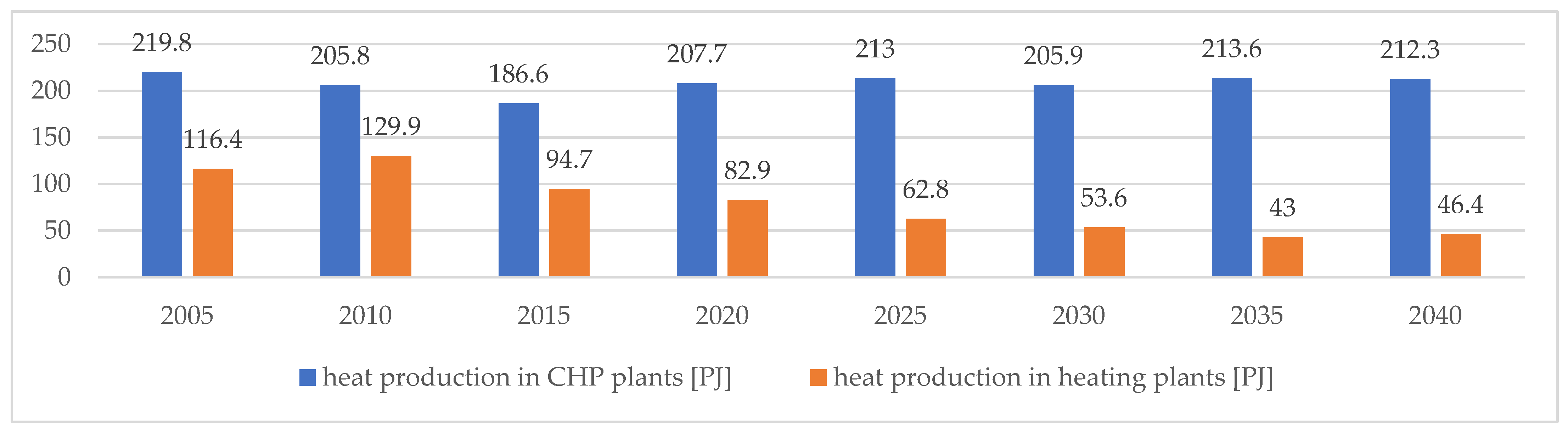
Figure 1 below shows the decline in energy production in heating plants, but, at the same time, indicates an increase in heat production in Combined Heat and Power (CHP) plants, which is a highly sought-after trend for improving energy efficiency. Only the combination of RES sources can provide stable deliveries of heat and electricity.
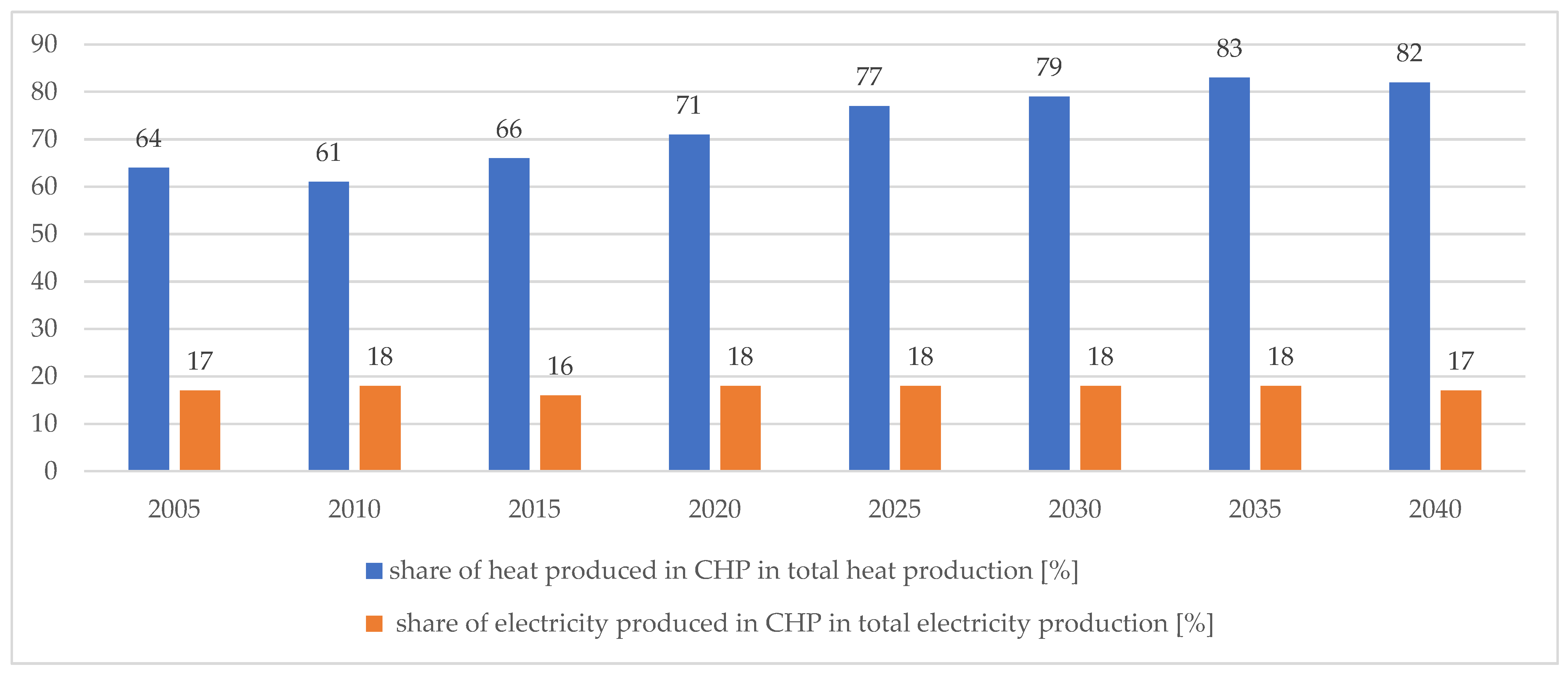
Figure 2 below shows the planned increase in the share of heat produced in Combined Heat and Power (CHP) in total heat production [%]. The share of electricity produced in CHP in total electricity production [%] will slightly decrease. The demand for heat will be greater because many local stoves will be replaced in the future.
With rising CO2 emission allowance prices, biomass use will become profitable in the electricity and heating sectors. In the household and service sectors, increased biomass use will be associated with replacing old coal-fired furnaces with modern, pellet-fired ones [68].

3.3. Forecasts of the Share of Renewable Energy Sources in Poland

The share of renewable energy sources in domestic energy consumption is systematically increasing. Table 8 presents the structure of renewable energy sources in Poland in 2005–2022. Based on the data, we can conclude that solid biomass has been playing a key role in RES structure. Second place has been taken by wind energy and third by liquid biofuels.
The structure of renewable energy sources in Poland shows that the share of solid biomass decreased by 27.1% and hydro energy by 2.9% in 2005–2022. Such results can be due to the effect of the smaller utilization of solid biomass in electricity production. Solid biomass is replaced by wind and photovoltaics as cleaner sources of energy. Hydro energy is getting less interest because new power stations have not been opened recently in Poland.
Other kinds of RES increased their share. Particular increases have been observed in wind energy (12.3%), solar energy (6%), and liquid biofuels (5.4%) in 2005–2022. The share of geothermal energy has not changed in 2005–2022.
The descriptive statistics are presented in Table 9. The highest coefficient of variation was found in solar energy and heat pumps. This means that these sources of RES had the biggest changes in 2005–2022.
Kurtosis is the measure of the asymmetry of time series. Only solar energy, geothermal energy, and heat pumps had positive kurtosis, which shows that excess kurtosis is positive and the intensity of extreme values is higher than for the normal distribution (the “tails” of the distribution are “fatter”).
Skewedness was negative for solid biofuels, wind energy, biogas, and liquid biofuels. This means that it is a left-skewed distribution and that the left arm of the distribution is elongated, and most observations in the sample have values above the mean.
The stationarity of RES is presented in Table 10. The nature of changes in RES can be used to prepare prognosis for the future [69]. The most commonly used tool is the Augmented Dickey–Fuller (ADF) test in which two hypotheses are checked. In the first, we verify if the unit root exists and, in the second hypothesis, the unit root does not exist. The ADF is a popular statistical test that checks whether a time series is stationary by examining the presence of a unit root [70]. The analysis is important because, when we discover that the unit root exists, the ARIMA model can be prepared [71].
The models for each RES were chosen separately. Our aim was to find optimal parameters p, d, and q that stationarize the best fit to the time series of RES. To achieve this, we applied the ADF test with mean and variance constant over time. To analyze this, we calculated the p value of the ADF test. The p values in all RES series have high values, which mean that there is no basis for rejecting the hypothesis of non-stationarity, which suggests that the time series of RES are not stationary. We chose the free expression test.
For solid biofuels, we chose delay row 1 and we achieved p = 0.871, which suggests the non-stationarity of the model. For solar energy, we chose delay row 1 and the p value was 1, which suggests non-stationarity. Hydro energy was described by delay row 1 and p value 0.4403, which proves non-stationarity. For wind energy, we achieved the following results, stating non-stationarity: p value = 0.806 and estimated value −0.065. In the biogas ADF test, we achieved p value 0.5502, which also proves non-stationarity. Liquid biofuels also show non-stationarity, with a p value reaching 0.259. Geothermal energy shows the best rank with a p value reaching p = 0.003, suggesting stationarity. The municipal waste also achieved a big p value, p = 0.637, which points to non-stationarity. Finally, the heat pumps presented non-stationarity, achieving p value 0.999. The non-stationary process should be differentiated, and the first differences should be calculated.
Based on the results, we can conclude that the time series of RES are not stationary. Our next step was to evaluate the first differences to reduce the time series to stationary. We achieved non-stationarity only for solar energy when calculating the first differences test. The process is stationary and there is no reason to reject the hypothesis of stationarity.
Based on the ADF test results, we can conclude that the analyzed variables are stationary. This is the information that helped us to prepare the ARIMA model, which is our next step of analysis.
Table 11 and Table 12 presents the ARIMA model for RES in Poland. The data are stationary and the changes are not stable. These changes were the effects of RES share in Poland, which depends on many factors. The pressure on RES development changes its share because of positive impacts such as decreasing environmental pollution and increasing ecological balance [72].
The presented ARIMA model for RES share in Poland shows that low p values enable us to use it for prediction. The deeper development of the ARIMA model is its evaluation based on the moving operator q and the autoregressive operator p, which apply to ACF (Autocorrelation Function) and PACF (Partial Autocorrelation Function). The Autocorrelation Function (ACF) assesses the linear connection between observations of a time series across various lags. When the PACF graph exhibits a significant decline (cut off) after lag \(p\), while the ACF decreases slowly, it suggests an AR(\(p\)) model [73].
The observed outcome falls outside the rejection area, and there is not enough evidence to determine a significant difference or effect. A value below the critical threshold (considering a right-tailed test or absolute value) indicates that the outcome lacks sufficient evidence to endorse the alternative hypothesis. This approach helps to control the errors of the model [74].
The procedure of choosing all RES ARIMA models was as follows: analysis of Autocorrelation Function (ACF) and Partial Autocorrelation Function (PACF). Then, we selected models with the lowest Akaike Information Criterion (AIC) and Bayesian Information Criterion (BIC). The models were chosen automatically with selected best parameters.
For stable biofuels, we chose the model in which the first autoregressive coefficient is 0.647. This shows that past values of stable biofuels significantly influence current values, confirming a strong correlation. The moving average coefficient for stable biofuels is 0.070. This means that the influence of this part of the model is less statistically significant, suggesting a smaller role compared to other elements. The coefficient of determination R2 is 0.857, suggesting that the model explains the variability in the data well. In other words, the model can predict approximately 86% of the variability. A log-likelihood result of −48.901 can be useful when comparing the model with other models for stable biofuels. The lowest Critical Bayesian/Schwarz Criterion was 109.364 and the Critical Information Akaike Criterion was 105.803, which helped to choose the model. In summary, the ARMA model for stable biofuels is stable and has a high level of explaining variability.
For solar energy, we chose the model that shows different parameters. For solar energy, the first autoregressive coefficient is 0.752. This confirms a substantial correlation by demonstrating how historical solar energy values have a big impact on current values. The moving average coefficient is 0.854. This indicates that the component of the model has a statistically significant impact, suggesting a major role in comparison to other components. The model appears to adequately describe the variability in the data, as indicated by the coefficient of determination R2 of 0.974. Stated differently, around 97% of the variability can be predicted by the model. When contrasting the model with other solar energy models, the log-likelihood value of −17.765 can be helpful. We chose the model with the lowest Critical Bayesian/Schwarz Criterion, which was 46.912, and the Critical Information Akaike Criterion was 43.350. In conclusion, the ARIMA model for solar energy is highly capable of explaining variability and is stable.
We selected the model that displays several parameters for hydro energy. The first autoregressive coefficient for hydro energy is 0.944. This shows how previous hydro energy values have a significant influence on current value, confirming a significant link. The moving average coefficient is −0.171, which suggests that the model’s component plays a smaller role when compared to the other components because it has a statistically low influence. The coefficient of determination R2 of 0.774 indicates that the model seems to accurately reflect the variability in the data. The model can anticipate around 77% of the variability. The log-likelihood of −12.159 can be useful when comparing the model to other hydro energy models. The lowest Critical Bayesian/Schwarz Criterion, which was 38.879, and the Critical Information Akaike Criterion, which was 32.318, were considered while choosing the model. In summary, the ARIMA model for hydro energy is steady and very good at explaining variability.
We chose the model that shows multiple parameters for wind energy. The initial autoregressive coefficient is 0.945, which confirms a significant relationship by demonstrating how past wind energy levels have a big impact on current values. The model’s component has a statistically low influence, as indicated by the moving average coefficient of −0.133, which implies that it has less impact than other components. The model appears to accurately reflect the variability in the data, as indicated by the coefficient of determination R2 of 0.888, which suggests that about 88% of the variability can be predicted by the model. When comparing the model to other wind energy models, the log-likelihood of −31.147 can be helpful. While choosing the best model, we considered the lowest Critical Bayesian/Schwarz Criterion, which was 73.627, and the Critical Information Akaike Criterion, which was 70.295. In conclusion, the wind energy ARIMA model is reliable and good at explaining variability.
The biogas model was chosen based on different parameters. The AR parameter was 0.885, which proves the impact of past values on present biogas data. The MA parameter −0.260 proves low impact. The R-Squared Determination Coefficient is 0.841, pointing out that 84% of variability was predicted by the model. The log-likelihood 2.585 can also increase the model. The lowest Critical Bayesian/Schwarz Criterion, which was 6.161, and the Critical Information Akaike Criterion, which was 2.828, helped us to choose the model. In sum, the model was well elaborated.
Another variable was liquid biofuels. While choosing the model, we considered the lowest Critical Bayesian/Schwarz Criterion, which was 61.265, and the Critical Information Akaike Criterion, which was 57.952. The AR parameter was 0.804, which proves the impact of previous data on present values. The R-Squared Determination Coefficient is 0.739, which proves that the model is well elaborated. The log-likelihood, −24.966, helped to choose the model. All variables used in the model were well elaborated.
The parameters describing geothermal energy are as follows: AR coefficient, which is 0.573, pointing to the medium impact of previous values; the lowest Critical Bayesian/Schwarz Criterion, which was −64.690; and the Critical Information Akaike Criterion, which was −68.252. The log-likelihood was 38.126; this was also considered when choosing the model. The R-Squared Determination Coefficient was 0.271, which proves a medium adjusted model.
The municipal waste for the ARIMA model was well elaborated and chosen. The AR is 0.803, which proves the strong impact of past data on present values. The R-Squared Determination Coefficient is 0.828, which proves the adjustment of the model and parameters. The lowest Critical Bayesian/Schwarz Criterion was −4.197 and the Critical Information Akaike Criterion was −7.530. The log-likelihood, 7.765, was sufficient. In sum, the model was good.
The last model analyzed was heat pumps. The model was characterized by the following variables: AR 0.958, showing the impact of previous values, and R-Squared Determination Coefficient 0.881, showing good elaboration. The lowest Critical Bayesian/Schwarz Criterion, 36.838, and the Critical Information Akaike Criterion, 33.277, helped to choose the model. In conclusion, the model was well elaborated and chosen.
Table 12 presents the ARIMA model for RES share in Poland. Based on the results, we can confirm what was also found in other authors’ research [75]. These approaches exclude the seasonal element in RES data [76]. Even though the proportion of RES remained unchanged, the model was executed meticulously. The prediction from the ARIMA model is essential for the incorporation of RES. It is important as it provides insight into the potential utility of an RES scenario that may arise. The results of this study assisted us in identifying patterns of RES that enhance the prediction of outcomes [77].
We evaluated the models using the R2 coefficient of determination in an ARIMA, which indicates the extent to which the variability of the time series is clarified by the model. It is understood that the nearer to 1, the superior the fit. R2 is valuable for evaluating forecast accuracy, but it seldom serves as the primary basis for model selection, which typically relies on information criteria like AIC (Akaike Information Criterion) or BIC (Bayesian Information Criterion). AIC (Akaike Information Criterion) concentrates on identifying the most suitable model for the data, striving to forecast future values with the least deviation from the actual distribution. It is more appropriate for smaller datasets. BIC (Bayesian Information Criterion) aims to determine the “correct” model from the options, typically resulting in more straightforward models. For both cases, the model with the smallest value is typically viewed as the best fit. The smallest AIC and BIC criteria in the ARIMA models were achieved by municipal waste, biogas, and heat pumps, suggesting the best models.
In most cases, the R2 determination coefficient was high, which suggests the good fit of the model. Ony geothermal energy achieved a low level for the R2 determination coefficient. The prognosis is a very necessary tool to measure the future changes in the phenomenon being studied. The research show that the models of RES demonstrate high corrected R-Square.
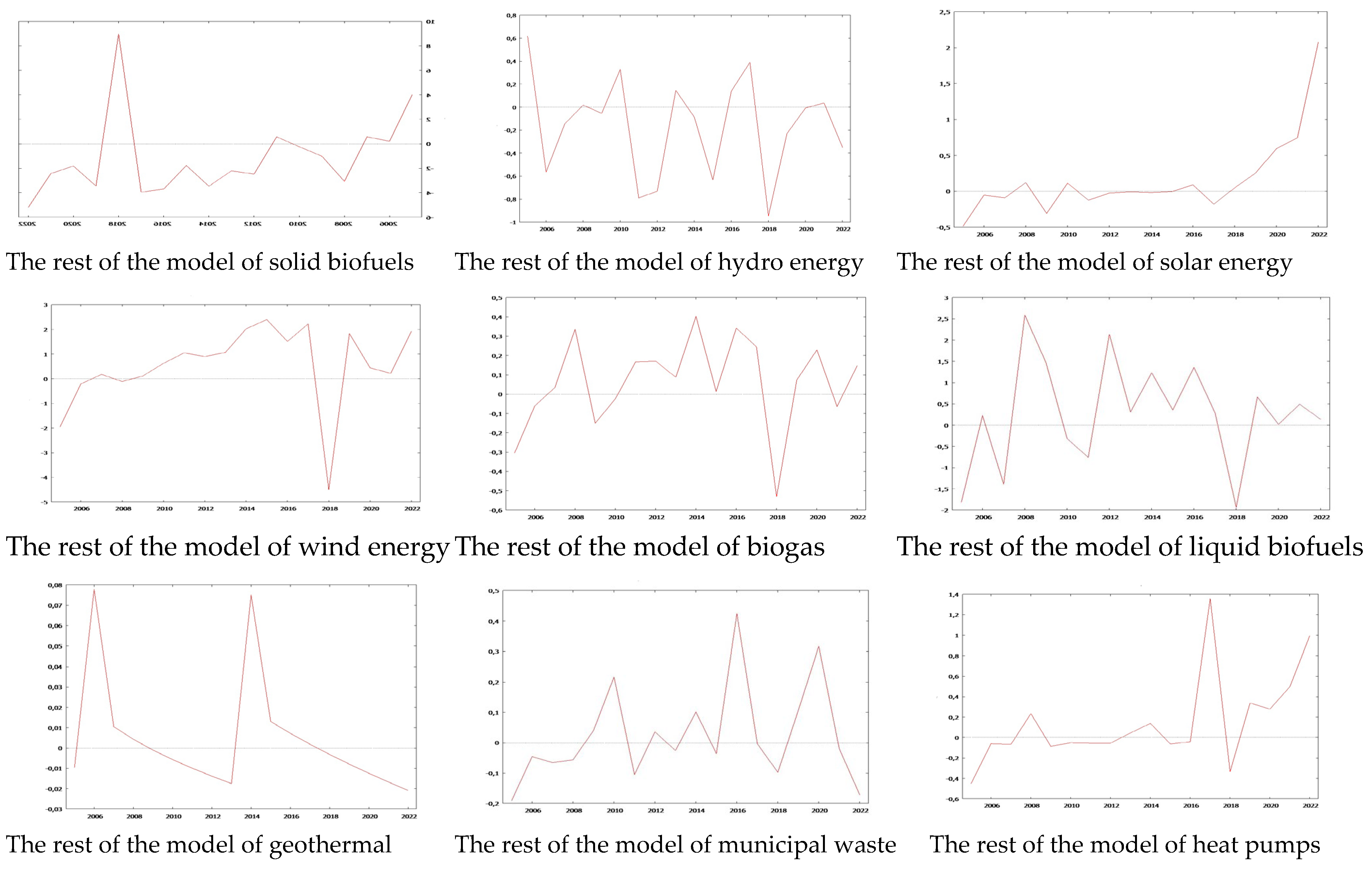
In the next step of the analysis, we prepared the rest of the models for each RES (Figure 3). The rest of the model, residuals, are the differences between the actual values of the dependent variable and the theoretical values calculated from the estimated model. They are used to verify the correctness of the model. Good rests (residuals) of the model are random noise and have constant variance and zero autocorrelation [78]. As we can see, each RES has a different rest of the model of regression. The biggest changes have been observed in hydro energy, biogas, liquid biofuels, and municipal waste.
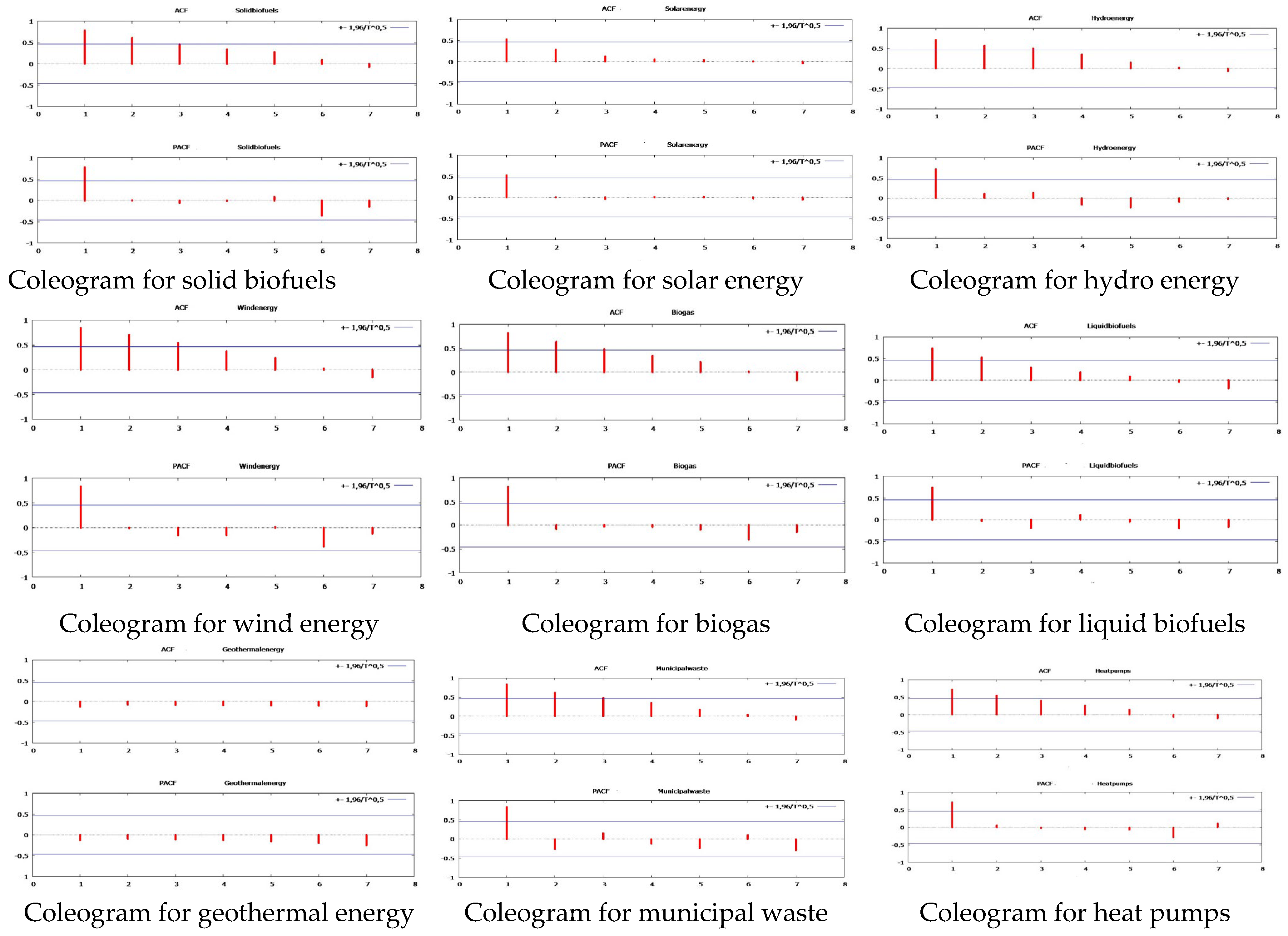
In the next step of our analysis, we provided the ACF and PACF for particular RES. We presented the coleograms for each RES. The ACF and PACF inform us which previous data have impact on present data; in other words, which delays impact present value.
The present value of solid biofuels is particularly impacted by 1,2,3 delays. The present value of solar energy is particularly impacted by 1 delay. Hydro energy is impacted by 1,2 and 3 delays. Wind energy is impacted by 1,2 and 3 delays. Biogas is impacted by 1 and 2 delays. The same situation has been observed with liquid biofuels, which are impacted by 1 and 2 delays. Geothermal energy is an example where previous data had not impacted present value. Municipal waste is impacted by 1,2 and 3 delays. Heat pumps’ present value is impacted by 1 and 2 delays (Figure 4).
In our last step, we elaborated the RES prognosis based on Statistics Poland GUS data [26]. This procedure helped us to compare the prognosis based on the Polish Energy Policy (PEP) [22]. Based on our prognosis, we can observe that most of the RES will increase in 2023–2040. Solar energy will increase its share in RES from 7.6% in 2023 to 10.6% in 2040. Geothermal energy is one example that will not change its share in RES in 2023–2040.
Solid biomass fuels are still the most important in RES share. Based on our prognosis, their share in RES will increase from 64.9% in 2023 to 72.9% in 2040 (by 8% in 2023–2040). This increase will help to achieve 30% CO2 emission reduction by 2030 (compared to 1990) [79].
Biogas will increase its share from 2.6% in 2023 to 2.8% in 2040 (an increase of 0.2%) (Table 13). Biogas production in Poland is obligatory to increase the utilization of animal manure and other biomass and to reduce the natural gas imports [80].
Wind energy will play a key role in CO2 reduction, and it will increase its share in RES from 12.8% in 2023 to 16.9% in 2040 (an increase of 4.1%). Both onshore and offshore wind farms will operate in the future. Locations and regulatory schemes are expected to be the most important [81].
The transport system will be changed by liquid biofuels, which increase their share from 8.3% in 2023 to 8.7% in 2040 (increase by 0.4%). This project coincides with an EU regulation stipulating that the transport sector should be zero-emission because new cars should be carbon neutral by 2023 [82].
Heat pumps will increase their share in RES from 3.9% in 2023 to 4.8% in 2024 (an increase of 0.9%). The sector will be dominated by high temperature heat pumps (HTHP). A crucial role will be played by the governments of the EU countries by providing support in making heat pumps financially attractive, not only for individual consumers but also for industrial plants [83].
Hydro energy will increase its share from 1.46% in 2023 to 2.2% in 2040 (an increase of 0.74%) (Table 13). However, the usage of hydro energy may be difficult because of climate change that will negatively affect hydropower potential in EU member states [84].
Municipal waste will also increase its share in RES from 0.7% in 2023 to 0.9% in 2040 (an increase of 0.2%) (Table 13). The waste will be used more in biogas production [85].
In 2023–2040, we could observe the increasing uncertainty of prognosis. The longer the prognosis, the bigger the uncertainty. In 2023–2040, the prognosis may be changed because of different macroeconomic conditions such as wars, energy policy, climate changes, technical progress, artificial intelligence (AI), and others.
We can evaluate the uncertainty using errors analysis. The errors of solid biofuels increased from 3.42 in 2023 to 10.54 in 2040 (208%). For solar energy, errors increased from 0.56 to 3.06 in 2023–2040 (446%). For hydro energy, errors increased from 0.45 to 1.08 (140%). Wind energy has also had big errors, changing from 1.51 to 3.78 in 2023–2040 (150%). Biogas errors also increased from 0.21 to 0.35 in 2023–2040 (67%). Liquid biofuel errors increased from 1.05 to 1.25 in 2023–2040 (19%). Geothermal energy was the only variable; the errors did not change. Errors for municipal waste increased from 0.15 to 0.35 in 2023–2040 (133%). Heat pump errors increased from 0.45 to 1.52 in 2023–2040 (237%).

3.4. Comparison of Prognosis Based on ARIMA Models and PEP in 2025–2040

Based on the ARIMA models and PEP, we compared prognoses to verify the hypothesis stating that the prognosis for the development of renewable energy sources for Poland prepared by PEP, and our own prognosis prepared based on ARIMA models, are both promising and confirm the development of the renewable energy sector in the future (Table 14).
The proposed increases in RES, based on own prognosis for 2025–2040, are as follows: solar energy (47.2%), hydro energy (37.5%), municipal waste (28.6%), wind energy (25.2%), solid biofuels (10.1%), biogas (3.7%), and liquid biofuels (3.6%). Based on our prognosis, the use of geothermal energy will not increase.
Based on the PEP prognosis, gross final energy production (kto) will also increase in 2025–2040. The biggest increases will be observed in solar energy (226.7%), biogas (116.5%), wind energy (108.3%), municipal waste (60%), hydro energy (9.8%), and solid biofuels (6.2%).
Gross final energy consumption in heating and cooling (kto) based on PEP in 2025–2040 will also increase. According to this prognosis, the following increases will occur: heat pumps (189.3%), geothermal energy (142.2%), solar energy (118.15), biogas (109.1%), and solid biofuels (22.8%).
Based on the data, we can confirm our hypothesis. In 15 years, the solar energy gross final energy consumption should increase by 118.1%, gross energy production by 228.9%, gross final energy production by 226.7%, and net achievable capacity generation by 225.5%. Such big increases are achievable but difficult.
The same conclusion can be drowned from cross final energy consumption, which will increase in biogas by 109%, geothermal energy by 142%, and heat pumps by 189.3% in 2025–2040.
Poland has not been using offshore farms, but it is building them. That is why the increases, including gross energy production by 1033 % in 2025–2040 and net achievable capacity generation by 1001%, are possible but will be difficult to achieve. Poland is experiencing delays in offshore wind farms.
In order to analyze the prognosis, we have calculated the Mean Absolute Error (MAE). This coefficient is very important because it helps to analyze the quality of the prognosis. The ideal MAE is 0, which means that there is no difference between the actual and predicted value. The analysis shows that the MAE coefficient for geothermal energy is 0.01 and, for municipal waste, it is 0.11; these are the best prognoses (Table 15).
We chose the 2005–2022 period for evaluation because we had the y i —actual value and y ^ i —predicted value of all RES. We could not evaluate the prognosis for 2023–2040 because we did not have the y i —actual value. This will be possible after a few years, when the y i —actual value will be known. The data used for evaluation prognosis using MAE, MAPE, and RMSE were used in models and future prognoses.
The second indicator used for prognosis evaluation was Mean Absolute Percentage Error (MAPE). We evaluated the value of MAPE based on [40,41]:
MAPE ≤ 10%—High,
10% < MAPE ≤ 20%—Good,
20% < MAPE ≤ 50%—Reasonable,
MAPE > 50%—Low.
Based on the results, we can conclude that the best prognosis was for geothermal energy, solid biofuels, and biogas. Good prognosis was achieved in hydro energy, liquid biofuels, and municipal waste. Reasonable prognosis was achieved in solar energy and heat pumps. The highest percentage of MAPE was achieved in solar energy and wind energy, which shows a worse prognosis.
The final indicator to evaluate our prognosis was Root Mean Square Error (RMSE). We interpreted the indicators that a lower value closely predicts the actual data, while a higher value suggests larger discrepancies between predictions and real values. The lower value of RMSE was achieved by the prognosis for geothermal energy, biogas, hydro energy, and heat pumps, which suggests the best prognosis. The highest was achieved in the examples of solid biofuels, wind energy, and liquid biofuels, which suggests discrepancies between their predictions and actual values.

4. Discussion

This study offers interesting insights into the prognosis for RES in Poland. Both prognoses for RES elaborated by PEP and own prognosis elaborated by ARIMA models confirm global trends in the transition of the energy sector in Poland. However, Poland should increase investment in RES to meet the required levels in energy mixing.
Based on the verification of prognosis for PEP, we can conclude the increase presented in the official strategy and the increase of RES achieved in the ARIMA models are achievable. However, the biggest concern is with offshore wind farms, which have not been completed yet. The same problem appears with solar energy in which the market is rather saturated in Poland.
The prognosis elaborated by ARIMA models are quite promising. The errors in prognosis for RES are quite small. However, the quality of prognosis depends on different factors, such as length of time series and macroeconomic factors including wars, inflation, and energy costs [20].
Finally, we used MAE, MAPE, and RMSE coefficients to check the elaborated prognosis for particular RES. The analysis indicates that the MAE coefficient for geothermal energy is 0.01, while, for municipal waste, it is 0.11, demonstrating the most accurate prediction. The results indicate that geothermal energy, solid biofuels, and biogas had the most favorable prognoses. A positive outlook was attained in hydro energy, liquid biofuels, and municipal waste. A sensible forecast was attained in instances of solar energy and heat pumps. The greatest percentage of MAPE was recorded in solar energy and wind energy, indicating poor forecasts.
The last metric for assessing our forecast was Root Mean Square Error (RMSE). We understood the indicators that its lower value closely forecasts the actual data, whereas higher values imply greater differences between predictions and actual figures. The prognosis for geothermal energy, biogas, hydro energy, and heat pumps yielded the lowest RMSE value, indicating the most accurate forecast.
Our analysis proved that solid biomass will continue to dominate as a renewable energy source in heating and cooling; other technologies, such as heat pumps and solar energy, will have an increasingly significant share in the future.
Poland must adapt its energy policy to EU requirements [9]. Polish energy policy should take into account the implementation of EU goals while simultaneously ensuring the country’s energy security. The increase of RES in Poland is the effect of policy implementation and adjustment to the requirements of the EU. The current EU energy policy, like its predecessor, prioritizes reducing greenhouse gas emissions to achieve the global goal of keeping the average global temperature increase to 2 °C. Determined directions for energy development are aligned with these aspirations [4].
Poland, committed to reducing air pollution, must gradually replace coal with other fuels. Implementation of energy policy will rely on the actions of commercial energy companies. State intervention in the energy sector should be limited and focused on ensuring the country’s energy security and fulfilling international obligations, particularly in environmental protection and nuclear safety [23].
Integrated support for the development of “green” energy generation is crucial to ensuring that the power sector, while fulfilling its social role of providing energy, can fulfill its obligations economically and effectively in the long term, and also develop its own know-how, which can become an asset in the sector’s licensing policy.
The impact of renewable energy also leads to the achievement of other important goals, such as:
-
creating new jobs,
-
supporting rural development,
-
utilizing uncultivated agricultural land for biomass cultivation,
-
utilizing low-value wood from forestry,
-
managing municipal waste,
-
developing economic innovation and promoting domestic technological solutions and consumer services [25].
Agriculture requires the conversion of biomass to generate energy. Biomass, biogas, and liquid biofuels made of rapeseed are the main sources of RES. The use of agricultural production space for energy can lead to disruptions in food markets, resulting in price increases. Biomass supplies 14% of global energy, 33% in developing countries, and only 2–3% in developed countries [37].
Agricultural production for energy purposes should be optimized for energy efficiency. Technologies for using biomass to generate heat and electricity are among the cheapest and most environmentally friendly solutions. Limitations result from the available raw material base (primarily wood) and the need to consider transportation in terms of fuel, emissions, and costs. Biomass combustion has historically been the basis for the use of this energy source [37].

5. Conclusions

The main goal of this research was to elaborate a prognosis for the development of renewable energy sources in Poland. Based on the prognosis, the share of RES in gross final energy consumption will increase. The key role will be played by solid biomass and wind energy, which will deliver the vast majority of energy in the future. These predictions are both similar in PEP prognosis and our prognosis. Poland, a country with 31% of its area covered in forests, will be based on biomass.
Based on the prognosis for PEP, the gross energy with solar production will increase by 228.9% and gross final energy production by 226.7%. This prognosis is optimistic because the Polish market is being saturated.
Based on the PEP prognosis, geothermal will have a 1% share in 2040. Based on our prognosis, the geothermal energy share in RES will not change in 2023–2040. The possibility of geothermal energy utilization in Poland depends on various factors, but the most important is the individual investments of households.
The conducted research helped us to verify the hypothesis that the prognosis for the development of renewable energy sources for Poland prepared by PEP, and our own forecast prepared based on ARIMA models, are both promising and confirm the development of the renewable energy sector in the future. Both prognoses are optimistic, but the PEP prognosis is much more optimistic than our prognosis, which is based on ARIMA models.
Future research will focus on the circular economy and renewable resource utilization. The hard coal industry, which remains significant for global economies, will lose significance and RES will be utilized more. The ecological issues and the European Union (EU) will put stronger pressure on energy policy [86].
Our prognosis based on ARIMA models and the prognosis based on PEP suggest that biomass will play a key role towards 2040. Estimates suggest a varied growth of the solid biomass sector in Poland, with minor variations in output. This indicates that some stabilization of output can be anticipated [87]. It is impossible to do energy transformation in Poland without stable biomass, biogas, and liquid biofuels; agriculture and forestry are the main sources of delivery substrates for these energies.
The energy policy of the EU has been strengthened after Russia’s attack on Ukraine in February 2022. Renewable resources like solar and wind energy are reliant on atmospheric conditions and thus cannot function as the only foundations of the system without a properly established energy storage framework. That is why biomass will help in the transition of the energy sector and is quarantined as a stable source of energy in difficult times [88,89].
Poland joined the EU in 2004, and it was supported by 80% of the social referendum mandate. The transition of energy sectors, as well as agricultural and economic sectors, would not be effective without public support from the EU. The RES sector still needs high investment to be more competitive compared to hard coal [90].
Our research results can be used by policy makers and other participants in public life to help to understand future changes in RES. Similar conclusions were found by Antonini et al. [91], who discovered that the prediction findings can help to understand the contribution of wind power to future energy systems. This energy will be used in particular in electricity production and heating
Renewable energy sources, including agricultural biogas, will play a key role in the process of keeping the rising global temperature below 2 °C compared to pre-industrial levels by 2100. Particular attention should be paid to agriculture, where the amount of greenhouse gases (GHG) emitted must be reduced to between 0.92 and 1.37 GtCO2eq per year by 2030. The production of biogas from agricultural manure can help to solve this problem [92]. An important role in energy transformation will be played by onshore and offshore wind farms as wind resources are not currently utilized [93]. Big wind farms will play a key role in delivering electricity in the future, and the potential contribution of wind power has not been discovered yet [91].
The development of RES in Poland has had a positive impact not only for agriculture but also for the whole economy. It contributes to the multifunctional development of rural areas and increases the incomes of farmers. The utilization of biomass, manure, and waste from farms helps to achieve not only economic goals but also environmental goals [94,95].

Limitations

This research has some limitations. The ARIMA model is good for forecasting future data and trends; however, access to reliable market data is necessary to make the prognosis. Moreover, the longer the time series, the better. Our analysis included yearly observations based on Statistics Poland GUS. An ARIMA model first used in 1970 for modeling time series, referred to as the Box–Jenkins method, indicated that financial time series exhibit non-stationarity due to variations in averages over a time period; thus, data were differentiated to achieve stationary distribution [96]. ARIMA models, because of weak autocorrelation in time series and short ranks, have limitations that worsen their predictive capability [97].
Time series for renewable energy sources were used but influencing factors were not examined. Future research could analyze them in more detail. Models and forecasts should adapt to various renewable energy operating conditions and scenarios. Wind turbine models could be supplemented with data on atmospheric conditions [98].
The development of RES and the transformation of the energy sector in Poland depends on many factors. It will take years for Poland to increase the share of RES. Regulations governing the energy market must also be modified. The energy law must be modified in order to fully implement the flexibility market (demand-side response). Moreover, the Polish coal sector still employs about 70 thousand people. The problem of finding jobs for people in the energy sector should be solved [99]. The future of energy transformation in Poland will depend on solar and wind energy development. The production of wind and solar energy depends on weather conditions and fluctuations. The important thing is the balance between energy supply and demand, which is essential for the power system’s steady operation [100].
Poland, alongside other EU nations, needs to focus on enhancing renewable energy using established tools like Feed-in Tariffs (FiTs), Green Certificate programs, and extended Power Purchase Agreements (PPAs) to ensure revenue assurance for investors. The favorable long-term and causal effect of renewable energy on eco-friendly growth, even with noted temporary adjustment costs, indicates that interim barriers may be alleviated by specific subsidies, enhancements to the grid, and combined financing to draw in private investment [101].
Future research should include a comparative analysis involving SARIMA or alternative models in RES. In addition to that, this research and its results may contribute to enhancing understanding of the capabilities of ARIMA modeling for prediction [102].
Our research proved that ARIMA demonstrates effectiveness on training and testing datasets, highlighting its ability to capture complex and evolving RES development trends. The findings indicate that conventional econometric models such as ARIMA are useful in preparing prognoses [103]. However, the ARIMA models are poorly suited for issues involving intricate bifurcation dynamics. Consequently, forecasts derived from ARIMA should be considered the minimal benchmark for the efficacy of non-mechanistic models [104].

Author Contributions

Conceptualization, R.W. (Rafał Wyszomierski), P.B. and A.B.-B.; methodology, R.W. (Rafał Wyszomierski), P.B. and A.B.-B.; software, R.W. (Rafał Wyszomierski) and P.B.; validation, R.W. (Rafał Wyszomierski) and P.B.; formal analysis, R.W. (Rafał Wyszomierski) and P.B.; investigation, R.W. (Rafał Wyszomierski) and P.B.; resources, R.W. (Rafał Wyszomierski), A.B.-B. and P.B.; data curation, R.W. (Rafał Wyszomierski), A.B.-B., P.B., M.G.-B. and R.W. (Rafał Warżała); writing—original draft preparation, R.W. (Rafał Wyszomierski), A.B.-B., P.B., M.G.-B. and R.W. (Rafał Warżała); writing—review and editing, R.W. (Rafał Wyszomierski), A.B.-B., P.B., M.G.-B. and R.W. (Rafał Warżała); visualization, R.W. (Rafał Wyszomierski), A.B.-B., P.B., M.G.-B. and R.W. (Rafał Warżała); supervision, R.W. (Rafał Wyszomierski), A.B.-B., P.B., M.G.-B. and R.W. (Rafał Warżała); project administration, A.B.-B. and P.B.; funding acquisition, A.B.-B. and P.B. All authors have read and agreed to the published version of the manuscript.

Funding

This research received no external funding.

Data Availability Statement

Data are contained within the article.

Conflicts of Interest

The authors declare no conflicts of interest.

Nomenclature

ACFAutocorrelation function
ADF testAugmented Dickey Fuller test
AICAkaike Information Criterion
ARIMA modelAutoregressive Moving Average model
BICBayesian Information Criterion
CHPCombined Heat and Power
CO2carbon dioxide
EROEnergy Regulatory Office
EUEuropean Union
GWhGigawatt hour
HTHPhigh temperature heat pumps
IRENAInternational Renewable Energy Agency
MAEMean Absolute Error
MAPEMean Absolute Percentage Error
MWhMegawatt-hour
PACFPartial Autocorrelation Function
PEPPoland Energy Policy
PJPetta Joule
PSEPolish Power System
PVPhotovoltaics
PLNPolish zloty
PSEPolish Energy System
RESRenewable energy sources
TWhTerawatt hour
UREEnergy Regulatory Office

References

  1. Kruczek, M.; Markowska, M.; Servou, A.; Roumpos, C.; Mertiri, E.; Ernst, P.; Darmosz, J.; Kempka, T. Navigating Socio-Technical Challenges in Energy Efficiency: Case Studies on Hybrid Pumped-Hydropower Storage in Poland and Greece. Energies 2025, 18, 599. [Google Scholar] [CrossRef]
  2. Brown, D.; Hall, S.; Davis, M.E. Prosumers in the post subsidy era: An exploration of new prosumer business models in the UK. Energy Policy 2019, 135, 110984. [Google Scholar] [CrossRef]
  3. Sawin, J.L. National Policy Instruments: Policy Lessons for the Advancement and Diffusion of Renewable Energy Technologies Around the World; Routledge: London, UK, 2016. [Google Scholar]
  4. Barwińska-Małajowicz, A.; Pyrek, R.; Szczotka, K.; Szymiczek, J.; Piecuch, T. Improving the Energy Efficiency of Public Utility Buildings in Poland through Thermomodernization and Renewable Energy Sources—A Case Study. Energies 2023, 16, 4021. [Google Scholar] [CrossRef]
  5. Balaras, C.A.; Dascalaki, E.G.; Psarra, I.; Cholewa, T. Primary Energy Factors for Electricity Production in Europe. Energies 2023, 16, 93. [Google Scholar] [CrossRef]
  6. Act 2016 on Investments in Wind Farms of 20 May 2016, Journal of Laws of 2019, Item 654, Consolidated Text. Available online: https://climate-laws.org/document/act-of-20-may-2016-on-investments-in-wind-farms-last-amended-by-act-of-9-march-2023_be7e (accessed on 2 March 2026).
  7. International Renewable Energy Agency (IRENA). REMAP 2030 Perspektywy Rozwoju Energii Odnawialnej w Polsce; Report; IRENA: Abu Dhabi, United Arab Emirates, 2015; p. S.1. [Google Scholar]
  8. Serowaniec, M. Sustainable Development Policy and Renewable Energy in Poland. Energies 2021, 14, 2244. [Google Scholar] [CrossRef]
  9. Grzeszczyk, T.A.; Izdebski, W.; Waściński, T.; Izdebski, M. Socio-Economic Factors Influencing the Development of Renewable Energy Production Sector in Poland. E M Econ. Manag. 2021, 24, 38–54. [Google Scholar] [CrossRef]
  10. Saidi, L.; Benbouzid, M. Prognostics and Health Management of Renewable Energy Systems: State of the Art Review, Challenges, and Trends. Electronics 2021, 10, 2732. [Google Scholar] [CrossRef]
  11. Coble, J.B. Merging Data Sources to Predict Remaining Useful Life—An Automated Method to Identify Prognostic Parameters. Ph.D. Thesis, The University of Tennessee Knoxville, Knoxville, TN, USA, May 2010. [Google Scholar]
  12. Saxena, A.; Celaya, J.; Saha, B.; Saha, S.; Goebel, K. Metrics for offline evaluation of prognostic performance. Int. J. Progn. Health Manag. 2010, 1, 4–23. [Google Scholar] [CrossRef]
  13. IEEE PHM 2012 Prognostic Challenge. 2012. Available online: https://phm-europe.org/data-challenge (accessed on 8 November 2021).
  14. Kim, N.-H.; Dawn, A.; Joo-Ho, C. PHM of Engineering Systems; Springer International Publishing: Cham, Switzerland, 2017. [Google Scholar]
  15. Yuri, M.; Luis, H.-C.; Oscar, D.-P.; Víctor, A.-G. Maintenance models applied to wind turbines. A comprehensive overview. Energies 2019, 12, 225. [Google Scholar] [CrossRef]
  16. Afridi, Y.S.; Kashif, A.; Laiq, H. Artificial intelligence based prognostic maintenance of renewable energy systems: A review of techniques, challenges, and future research directions. Int. J. Energy Res. 2022, 46, 21619–21642. [Google Scholar] [CrossRef]
  17. Bermejo, J.F.; Fernandez, J.F.G.; Polo, F.O.; Marquez, A.C. A review of the use of artificial neural network models for energy and reliability prediction. A study of the solar PV, hydraulic and wind energy sources. Appl. Sci. 2019, 9, 1844. [Google Scholar] [CrossRef]
  18. Kusiak, A.; Verma, A. A data-mining approach to monitoring wind turbines. IEEE Trans. Sustain. Energy 2012, 3, 150–157. [Google Scholar] [CrossRef]
  19. Voyant, C.; Notton, G.; Kalogirou, S.; Nivet, M.L.; Paoli, C.; Motte, F.; Fouilloy, A. Machine learning methods for solar radiation forecasting: A review. Renew. Energy 2017, 105, 569–582. [Google Scholar] [CrossRef]
  20. Rybak, A.; Rybak, A.; Kolev, S.D. Forecasting the Development of Offshore Wind Energy in Poland in the Context of the Energy Transformation and Sustainable Development Goals. Energies 2025, 18, 5380. [Google Scholar] [CrossRef]
  21. Brodny, J.; Tutak, M.; Grebski, W. Empirical Assessment of the Efficiency of Poland’s Energy Transition Process in the Context of Implementing the European Union’s Energy Policy. Energies 2024, 17, 2689. [Google Scholar] [CrossRef]
  22. PEP 2030. Polityka Energetyczna Polski do 2030 roku, Dokument Przyjęty Przez Radę Ministrów w dniu 10 Listopada 2009 roku, Stanowiący Załącznik do Obwieszczenia Ministra Gospodarki z Dnia 21 Grudnia 2009 r. w Sprawie Polityki Energetycznej Państwa do 2030 r. (M.P. z 2010 r. nr 2, poz. 11); Ministry of Economy: Warsaw, Poland, 2009.
  23. Łaźniewska, E.; Plac, K.; Górecki, T.; Rykowski, J. Time to Rethink Energy: An Initiative towards Renewable and Smart Energy. A Comparative Analysis of Poland and Germany and Conclusions for Cross-Border Cooperation and Improving Resilience. Barom. Reg. 2023, 19, 37–73. [Google Scholar]
  24. Janikowska, O.J. Challenges of the energy transition in Poland–deliberative democracy as a tool for activating the civil society. Polityka Energetyczna-Energy Policy J. 2023, 26, 45–62. [Google Scholar] [CrossRef]
  25. Hennicke, P.; Rasch, J.; Schröder, J.; Lorberg, D. The Energy Transition in Europe: A Vision of Progress (No. 54); Wuppertal Spezial: Wuppertal, Germany, 2019. [Google Scholar]
  26. Statistics Poland GUS. Available online: https://stat.gov.pl/obszary-tematyczne/srodowisko-energia/energia/energia-ze-zrodel-odnawialnych-w-2024-r-,3,19.html?contrast=black-white (accessed on 1 March 2026).
  27. European Parliament; Council of the European Union. Directive 2008/98/EC of the European Parliament and of the Council of 19 November 2008 on Waste Brussels, 2008. Available online: https://eur-lex.europa.eu/legal-content/EN/TXT/?uri=celex%3A32008L0098 (accessed on 1 March 2023).
  28. European Parliament; Council of the European Union. Directive 91/156/EEC of 18 March 1991 Amending Directive 75/442/EEC on Waste Brussels, 1991. Available online: https://eur-lex.europa.eu/legal-content/EN/ALL/?uri=celex%3A31991L0156 (accessed on 2 January 2024).
  29. Fattah, J.; Ezzine, L.; Aman, Z.; Houssami, H.E.; Lachhab, A. Forecasting of demand using ARIMA model. Int. J. Eng. Bus. Manag. 2018, 10, 1–9. [Google Scholar] [CrossRef]
  30. Qu, K.; Xue, S.; Zheng, X.; Yan, D.; Cao, H. Learning dynamic inter-farm dependencies for wind power forecasting via adaptive sparse graph attention network. Renew. Energy 2026, 258, 124969. [Google Scholar] [CrossRef]
  31. Zhang, Y.; Meng, G. Simulation of an Adaptive Model Based on AIC and BIC ARIMA Predictions. J. Phys. Conf. Ser. 2023, 2449, 012027. [Google Scholar] [CrossRef]
  32. Rahkmawati, Y.; Sumertajaya, I.M.; Aidi, M.N. Evaluation of Accuracy in Identification of ARIMA Models Based on Model Selection Criteria for Inflation Forecasting with the TSClust Approach. Int. J. Sci. Res. Publ. 2019, 9, 439. [Google Scholar] [CrossRef]
  33. Tihi, N.; Popov, S. Selection of the best ARIMA models for urban drought prediction. Fresenius Environ. Bull. 2023, 32, 2564–2572. [Google Scholar]
  34. Garima, J.; Bhawna, M. A Study of Time Series Models ARIMA and ETS. SSRN Electron. J. 2017, 4, 57–63. [Google Scholar] [CrossRef]
  35. Quinn, T.J., II; Deriso, R.B. Quantitative Fish Dynamics; Oxford University Press: New York, NY, USA, 1999. [Google Scholar]
  36. Wang, Y.; Liu, Q. Comparison of Akaike information criterion (AIC) and Bayesian information criterion (BIC) in selection of stock–recruitment relationships. Fish. Res. 2006, 77, 220–225. [Google Scholar] [CrossRef]
  37. Hendrawati, T.; Wigena, A.H.; Sumertajaya, I.M.; Sartono, B. Performance evaluation of AIC and BIC in time series clustering with Piccolo method. In Proceedings of the 1st International Conference on Statistics and Analytics, Bogor, Indonesia, 2–3 August 2019. [Google Scholar]
  38. Cryer, J.D.; Chan, K. Time Series Analysis with Application in R Second Edition; Springer: New York, NY, USA, 2008. [Google Scholar]
  39. Commission of the European Communities—EU. Regulation Amending Annexes VI and VIII to Regulation (EC) No 1774/2002 of the EU Parliament and of the Council as Regards Processing Standards for Biogas and Composting Plants and Requirements for Manure EU Commission Regulation 208/2006; Brussels, Belgium, 2006. Available online: https://eur-lex.europa.eu/legal-content/EN/TXT/PDF/?uri=CELEX:32006R0208&from=SK (accessed on 27 January 2024).
  40. Eurostat. Available online: https://ec.europa.eu/eurostat/databrowser/view/NRG_BAL_PEH__custom_4565358/default/table?lang=e (accessed on 27 January 2024).
  41. Brownlee, J. How to Create an ARIMA Model for Time Series Forecasting in Python, Machine Learning Mastery. Available online: https://machinelearningmastery.com/arima-for-time-series-forecasting-with-python/ (accessed on 19 January 2025).
  42. Dittmann, I.; Dittmann, P.; Szabela-Pasierbińska, E.; Szpulak, A. Prognozowanie w Zarządzaniu Sprzedażą i Finansami Przedsiębiorstwa; Wolters Kluwer: Alphen aan den Rijn, The Netherlands, 2011. [Google Scholar]
  43. Shumway, R.H.; Stoffer, D.S. ARIMA Models. In Time Series Analysis and Its Applications. Springer Texts in Statistics; Springer: Cham, Switzerland, 2017. [Google Scholar] [CrossRef]
  44. Ghosh, S. Forecasting of demand using ARIMA model. Am. J. Appl. Math. Comput. 2020, 1, 11–18. [Google Scholar] [CrossRef]
  45. Dickey, D.A.; Fuller, W.A. Distribution of the Estimators for Autoregressive Time Series with a Unit Root. J. Am. Stat. Assoc. 1979, 74, 427–431. [Google Scholar] [PubMed]
  46. Ozturk, S.; Ozturk, F. Forecasting energy consumption of Turkey by ARIMA model. J. Asian Sci. Res. 2018, 8, 82. [Google Scholar] [CrossRef]
  47. Khan, F.M.; Gupta, R. ARIMA and NAR based prediction model for time series analysis of COVID-19 cases in India. J. Saf. Sci. 2020, 1, 12–18. [Google Scholar] [CrossRef] [PubMed]
  48. Bórawski, P.; Guth, M.; Truszkowski, W.; Zuzek, D.; Bełdycka-Bórawska, A.; Mickiewicz, B.; Szymańska, E.J.; Harper, J.K.; Dunn, J.W. Milk price changes in Poland in the context of the Common Agricultural Policy. Agric. Econ. Czech 2020, 66, 19–26. [Google Scholar] [CrossRef]
  49. Box, G.E.P.; Jenkins, G. Time Series Analysis, Forecasting and Control; Holden-Day: San Francisco, CA, USA, 1970. [Google Scholar]
  50. Kashpruk, N. Identyfikacja i prognozowanie szeregów czasowych na przykładzie modeli Boxa–Jenkinsa. In Nauka–Technika–Technologia, Tom 1; Wydawnictwa AGH: Krakow, Poland, 2021; pp. 91–100. Available online: https://winntbg.bg.agh.edu.pl/skrypty4/0591/NTT_tom1_091.pdf (accessed on 27 January 2024).
  51. Anggrainingsih, R.; Aprianto Romadhon, G.; Sihwi, S.W. Time Series Forecasting Using Exponential Smoothing To Predict The Number of Website Visitor of Sebelas Maret University. In Proceedings of the 2nd International Conference on Information Technology, Computer and Electrical Engineering (ICITACEE), Semarang, Indonesia, 16–18 October 2015; pp. 1–6. [Google Scholar]
  52. Gustriansyah, R.; Sensuse, D.; Ramadhan, A. A Sales Prediction Model Adopted the Recency-Frequency-Monetary Concept. Indones. J. Electr. Eng. Comput. Sci. 2017, 6, 711–720. [Google Scholar] [CrossRef]
  53. Ministry of Climate and Environment, in Cooperation with the Office of the Government Plenipotentiary for Strategic Energy Infrastructure and the Transmission System Operator PSE S.A. Available online: https://raport.pse.pl/en/pse-and-the-environment/pse-as-transmission-system-operator (accessed on 28 January 2026).
  54. Trębska, P.; Wysokiński, M.; Trocewicz, A.; Żurakowska-Sawa, J.; Tsybulska, J.; Płonka, A.; Bórawsk; i, P.; Bełdycka-Bórawska, A. The Use of Renewable Energy Sources in Households in Poland—Current Status and Prospects for the Development of Energy Prosumption. Energies 2024, 17, 5935. [Google Scholar] [CrossRef]
  55. Narodowe Centrum Badań Jądrowych (NCBJ). Analiza i Ocena Kosztów Energii Elektrycznej z Różnych Źródeł Energii w Polsce. 2015, 60. Available online: https://www.ncbj.gov.pl/sites/default/files/prasa/ocena_kosztow_wytwarzania_e.e._final.pdf (accessed on 2 March 2026).
  56. Wantuch, A.; Janowski, M. Czy OZE Są Konkurencyjne Dla Źródeł Konwencjonalnych. Inform. Autom. Pomiary W Gospod. I Ochr. Sr. 2014, 4, 105–108. [Google Scholar] [CrossRef]
  57. Kasztelan, A.; Jarosz-Angowska, A.; Nowak, A.; Krukowski, A. Konkurencyjna Biogospodarka Szansą dla Zrównoważonego Rozwoju krajów Unii Europejskiej; Instytutu Naukowo-Wydawniczego: Radom, Poland, 2021; pp. 25–43. [Google Scholar]
  58. PIE 2020. Polski Instytut Ekonomiczny. Rozwój i Potencjał Energetyki Odnawialnej w Polsce; Polski Instytut Ekonomiczny: Warsaw, Poland, 2020; pp. 21–35.
  59. Strupczewski, A. Raport: Analiza i Ocena Kosztów Energii Elektrycznej z Różnych Źródeł Energii w Polsce; Raport NCBJ SJ Nr: B–27; Narodowe Centrum Badań Jądrowych: Otwock, Poland, 2015. [Google Scholar]
  60. Gulkowski, S.; Krawczak, E. Long-Term Energy Yield Analysis of the Rooftop PV System in Climate Conditions of Poland. Sustainability 2024, 16, 3348. [Google Scholar] [CrossRef]
  61. PEP 2040. Polityka Energetyczna Polski do 2040 r. Projekt Ministerstwa Energii; Ministry of Energy: Warsaw, Poland, 2021.
  62. ARE 2022. Agencja Rynku Energii. Informacja Statystyczna o Energii Elektrycznej Biuletyn Miesięczny Ministerstwo Klimatu i Środowiska ISSN 1232-5457. Nr 11 (347) Listopad; Ministry of Energy: Warsaw, Poland, 2021.
  63. POLSKA NET-ZERO 2050. Podręcznik Transformacji Energetycznej dla Samorządów. Centrum Analiz Klimatyczno-Energetycznych. 2021 Instytut Ochrony Środowiska– Państwowy Instytut Badawczy (IOŚ-PIB), 2021. Available online: https://climatecake.ios.edu.pl/wp-content/uploads/2022/01/Polska-net-zero.-Podrecznik-transformacji-energetycznej-dla-samorzadow.pdf (accessed on 2 March 2026).
  64. Roszkowski, A. Biomasa kontra rolnictwo. Instytut Budownictwa, Mechanizacji i Elektryfikacji Rolnictwa w Warszawie. Inżynieria Rolnicza 10(108)/2008. 201–202. Available online: https://ir.ptir.org/artykuly/pl/108/IR(108)_2359_pl.pdf (accessed on 2 March 2026).
  65. Ratomski, P.; Hawrot-Paw, M.; Koniuszy, A. Utilisation of CO2 from Sodium Bicarbonate to Produce Chlorella vulgaris Biomass in Tubular Photobioreactors for Biofuel Purposes. Sustainability 2021, 13, 9118. [Google Scholar] [CrossRef]
  66. Małuszyńska, I.; Wodziński, M.; Małuszyński, M.J. Wykorzystanie biomasy do celów energetycznych. Możliwości i ograniczenia. Przegląd Nauk.–Inżynieria I Kształtowanie Sr. 2013, 62, 487–497. [Google Scholar]
  67. Faber, A. Możliwe Scenariusze Rozwoju Rolnictwa w Polsce Oraz ich Skutki dla Produkcji Biomasy Stałej na Cele Energetyczne. 2008. Available online: https://docplayer.pl/38576788-Mosliwe-scenariusze-rozwoju-rolnictwa-w-polsce-oraz-ich-skutki-dla-produkcji-biomasy-stalej-na-cele-energetyczne.html (accessed on 24 April 2023).
  68. Moiseyev, A.; Solberg, B.; Kallio, A.M.I. Wood biomass use for energy in Europe under different assumptions of coal, gas and CO2 emission prices and market conditions. J. For. Econ. 2013, 19, 432–449. [Google Scholar] [CrossRef]
  69. Tang, L.; Yu, I.; Liu, F.; Xu, W.X. An integrated data characteristics testing scheme for complex time series data exploration. Int. J. Inf. Technol. Decis. Mak. 2013, 12, 491–521. [Google Scholar] [CrossRef]
  70. Kwakwa, P.A. Disaggregated energy consumption and economic growth in Ghana. Int. J. Energy Econ. Policy 2012, 2, 34–40. [Google Scholar]
  71. Siriwardana, S.; Nishshanka, T.; Peiris, A.; Boralessa, M.A.K.S.; Hemapala, K.T.M.U.; Saravanan, V. Solar Photovoltaic Energy Forecasting Using Improved Ensemble Method For Micro-grid Energy Management. In Proceedings of the 2022 IEEE 2nd International Symposium on Sustainable Energy, Signal Processing and Cyber Security (iSSSC), Gunupur, Odisha, India, 15–17 December 2022; pp. 1–6. [Google Scholar] [CrossRef]
  72. Yücenur, G.N.; Çaylak, S.; Gönül, G.; Postalcioğlu, M. An integrated solution with SWARA&COPRAS methods in renewable energy production: City selection for biogas facility. Renew. Energy 2020, 145, 2587–2597. [Google Scholar] [CrossRef]
  73. Pieri, E.; Kyprianou, A.; Phinikarides, A.; Makrides, G.; Georghiou, G.E. Forecasting degradation rates of different photovoltaic systems using robust principal component analysis and ARIMA. IET Renew. Power Gener. 2017, 11, 1245–1252. [Google Scholar] [CrossRef]
  74. Phinikarides, A.; Makrides, G.; Kindyni, N.; Kyprianou, A.; Georghiou, G.E. ARIMA modeling of the performance of different photovoltaic technologies. In Proceedings of the Conference Record of the IEEE Photovoltaic Specialists Conference, Tampa, FL, USA, 16–21 June 2013; pp. 797–801. [Google Scholar] [CrossRef]
  75. Phinikarides, A.; Makrides, G.; Zinsser, B.; Schubert, M.; Georghiou, G.E. Analysis of photovoltaic system performance time series: Seasonality and performance loss. Renew. Energy 2015, 77, 51–63. [Google Scholar] [CrossRef]
  76. Lindig, S.; Kaaya, I.; Weiβ, K.-A.; Moser, D.; Topic, M. Review of statistical and analytical degradation models for photovoltaic modules and systems as well as related improvements. IEEE J. Photovolt. 2018, 8, 1773–1786. [Google Scholar] [CrossRef]
  77. Sharagda, H.; Hajimirza, S.; Balog, R.S. Time series forecasting of solar power generation for large-scale photovoltaic plants. Renew. Energy 2020, 150, 797–807. [Google Scholar] [CrossRef]
  78. Nazarko, J.; Chodkowska, E. Prognozowanie w Zarządzaniu Przedsiębiorstwem. Cz. V Prognozowanie na Podstawie Modeli ARIMA. Oficyna Wydawnicza Politechniki Białostockiej, Białystok 2022. Available online: https://pb.edu.pl/oficyna-wydawnicza/wp-content/uploads/sites/4/2022/07/Chodakowska-Nazarko-Prognozowanie-na-podstawie-modeli-ARIMA.pdf (accessed on 10 February 2026).
  79. Hasterok, D.; Castro, R.; Landrat, M.; Piko´n, K.; Doepfert, M.; Morais, H. Polish Energy Transition 2040: Energy Mix Optimization Using Grey Wolf Optimizer. Energies 2021, 14, 501. [Google Scholar] [CrossRef]
  80. Ślusarz, G.; Twaróg, D.; Gołębiewska, B.; Cierpiał-Wolan, M.; Gołębiewski, J.; Plutecki, P. The Role of Biogas Potential in Building the Energy Independence of the Three Seas Initiative Countries. Energies 2023, 16, 1366. [Google Scholar] [CrossRef]
  81. González, J.S.; Lacal-Arántegui, R. A review of regulatory framework for wind energy in European Union countries: Current state and expected developments. Renew. Sustain. Energy Rev. 2016, 56, 588–602. [Google Scholar] [CrossRef]
  82. Mizik, T. Chapter 13—European Union guidelines for the production of different generations of biofuels. In Biofuels and Sustainability; Life Cycle Assessments, System Biology, Policies, and Emerging Technologies, Woodhead Series in Bioenergy; Woodhead Publishing: Cambridge, UK, 2025; pp. 205–219. [Google Scholar] [CrossRef]
  83. Adamo, A.; Martín, H.; Hoz, J.D.l.; Rubio, J. A Review of Worldwide Strategies for Promoting High-Temperature Heat Pumps. Appl. Sci. 2025, 15, 839. [Google Scholar] [CrossRef]
  84. Teotónio, C.; Fortes, P.; Roebeling, P.; Rodriguez, M.; Robaina-Alves, M. Assessing the impacts of climate change on hydropower generation and the power sector in Portugal: A partial equilibrium approach. Renew. Sustain. Energy Rev. 2017, 74, 788–799. [Google Scholar] [CrossRef]
  85. Bórawski, P.; Bełdycka-Bórawska, A.; Kapsdorferová, Z.; Rokicki, T.; Parzonko, A.; Holden, L. Perspectives of Electricity Production from Biogas in the European Union. Energies 2024, 17, 1169. [Google Scholar] [CrossRef]
  86. Bórawski, P.; Bełdycka-Bórawska, A.; Holden, L. Changes in the Polish Coal Sector Economic Situation with the Background of the European Union Energy Security and Eco-Efficiency Policy. Energies 2023, 16, 726. [Google Scholar] [CrossRef]
  87. Wyszomierski, R.; Bórawski, P.; Holden, L.; Bełdycka-Bórawska, A.; Rokicki, T.; Parzonko, A. Competitive Potential of Stable Biomass in Poland Compared to the European Union in the Aspect of Sustainability. Resources 2025, 14, 19. [Google Scholar] [CrossRef]
  88. Alpino, M.; Ciapanna, E.; Rovigatti, G. Navigating the electric storm: Assessing policy responses to Europe’s energy shock. Electr. J. 2025, 38, 107474. [Google Scholar] [CrossRef]
  89. Warżała, R.; Bórawski, P. The Effects and Scale of the Collapse of Regional Economies in Poland During the 2007–2009 Crisis and the COVID-19 Pandemic in the Aspect of Recent Energy Crisis Caused by the War in Ukraine. Sustainability 2026, 18, 640. [Google Scholar] [CrossRef]
  90. Zalewski, K.; Bórawski, P.; Żuchowski, I.; Parzonko, A.; Holden, L.; Rokicki, T. The Efficiency of Public Financial Support Investments into Dairy Farms in Poland by the European Union. Agriculture 2022, 12, 186. [Google Scholar] [CrossRef]
  91. Antonini, E.G.A.; Caldeira, K. Atmospheric pressure gradients and Coriolis forces provide geophysical limits to power density of large wind farms. Appl. Energy 2021, 281, 116048. [Google Scholar] [CrossRef]
  92. Czyżewski, B.; Matuszczak, A.; Prandecki, K.; Wrzaszcz, W. Food trade-offs in targeting environmental efficiency: Comparative analysis of different agricultural systems under natural constraints. Agric. Syst. 2006, 234, 104680. [Google Scholar] [CrossRef]
  93. Chanprasert, W.; Sharma, R.N.; Cater, J.E.; Norris, S.E. Large eddy simulation of wind turbine wake interaction in directionally shearded inflows. Renew. Energy 2022, 201, 1096–1110. [Google Scholar] [CrossRef]
  94. Bórawski, P. Position and meaning of Polish agriculture within economic theory and common market of European Union. In Proceedings of the International Scientific Conference on Hradec Economic Days 2013—Economic Development and Management Region, Hradec Kralove, Czech Republic, 19–20 February 2013; pp. 53–58. [Google Scholar]
  95. Bórawski, P. Multifunctional Development of Rural Areas. International Experience; High Economic Social School Publishing House: Ostrołęka, Poland, 2012; pp. 1–167. [Google Scholar]
  96. Box, G.E.P.; Jenkins, G.M.; Reinsel, G.C.; Ljung, G.M. Time Series Analysis: Forecasting and Control, 5th ed.; John Wiley & Sons. Inc.: Hoboken, NJ, USA, 2015. [Google Scholar]
  97. Sakar, H.S.; Omo-Ikerodah, E.; Jamil, M. Short-Term Wind Power Forecasting Using LSTM for Microgrid Operation in Bonavista, NL. Energies 2026, 19, 446. [Google Scholar] [CrossRef]
  98. Liu, S.; Li, Q.; Lu, B.; He, J. Prediction of offshore wind turbine wake and output power using large eddy simulation and convolutional neural network. Energy Convers. Manag. 2025, 324, 119326. [Google Scholar] [CrossRef]
  99. Marciniuk-Kluska, A.; Kluska, M. Transformation of the Energy Market in Poland in the Context of the European Union over the Last 20 Years. Energies 2025, 18, 3410. [Google Scholar] [CrossRef]
  100. Bachanek, K.H.; Drozdz, W.; Kolon, M. Development of Renewable Energy Sources in Poland and Stability of Power Grids—Challenges, Technologies, and Adaptation Strategies. Energies 2025, 18, 2036. [Google Scholar] [CrossRef]
  101. Tansuchat, R.; Yosthongngam, S. Promoting green economic growth: The role of renewable energy, energy efficiency, environmental regulation, and governance in the G7 countries. Energy Rep. 2026, 15, 108, 918. [Google Scholar] [CrossRef]
  102. Khan, M.M.H.; Mustafa, M.R.U.; Hossain, M.S.; Shams Julius, A.D. Short-Term and Long-Term Rainfall Forecasting Using ARIMA Model. Int. J. Environ. Sci. Dev. 2023, 14, 292–298. [Google Scholar] [CrossRef]
  103. Alomani, G.; Kayid, M.; Abd El-Aal, M.F. Global inflation forecasting and Uncertainty Assessment: Comparing ARIMA with advanced machine learning. J. Radiat. Res. Appl. Sci. 2025, 18, 101402. [Google Scholar] [CrossRef]
  104. Lapeyrolerie, M.; Boettiger, C. Limits to ecological forecasting: Estimating uncertainty for critical transitions with deep learning. Methods Ecol. Evol. 2023, 14, 785–798. [Google Scholar] [CrossRef]
Figure 1. Forecast of heat production (PJ). Source: own elaborations based on [63].
Energies 19 01340 g001
Figure 2. Forecast of the share of electricity and heat generated in cogeneration (%). Source: own elaborations based on [63].
Energies 19 01340 g002
Figure 3. The rest of the models of particular RES.
Energies 19 01340 g003
Figure 4. The coleograms of particular RES in Poland.
Energies 19 01340 g004
Table 1. Investment outlays for the expansion of renewable energy and nuclear power plant capacity (PLN billion).
Power Plant Type2021–20252026–20302031–20352036–2040Total
Biomass and biogas power plants0.73.43.01.38.3
Hydroelectric power plants0.00.00.00.00.0
Onshore wind power plants18.50.00.016.034.4
Offshore wind power plants20.074.331.40.0125.8
Solar power plants (PV)14.20.00.013.427.6
Nuclear power plants0.016.063.025.9104.8
Fossil fuel power plants11.14.617.18.441.3
Total:64.598.3114.565342.2
Source: own elaborations based on [53].
Table 2. Operational period of a renewable energy power plant.
Source TypeEconomical Operation Period [Years]
Photovoltaic power plant25
Onshore wind farm25
Offshore wind farm25
Biogas power plant25
Hydropower plant80
A power plant burning biomass in dedicated boilers35
Source: own elaboration based on [59,60].
Table 3. Forecast of net achievable capacity in electricity generation by technology (MW).
Generation Technology20052010201520202025203020352040
Photovoltaics0010822854935727011,67016,062
Onshore wind farms1211108488694979574960196799761
Offshore wind farms0000725381556507985
Biomass power plants and CHP plants1021405536581143153115361272
Biogas power plants2163055177419451094
Hydroelectric power plants10649359649951110115011901230
Pumped storage plants12561405140514151415141514151415
Gas turbines000000350350
DSR/energy storage0005501160215036604950
Total:25433588813215,70520,57927,67336,09544,119
Source: own study based on [61].
Table 4. Forecast of gross electricity production by fuel in Poland (TWh).
Generation Technology20052010201520202025203020352040
Nuclear energy00000020.430.6
Solar energy000.124.56.810.814.8
Onshore wind energy0.11.710.923.523.723.824.224.6
Offshore wind energy00002.714.521.730.6
Biomass1.45.999.69.711.611.410.3
Biogas0.10.40.91.52.73.955.8
Hydropower2.22.91.82.42.9333.1
from pumped water1.60.60.60.60.80.91.21.3
Other *0.71.110.70.91.11.21.3
Fossil fuels (coal + gas)148.2142.7138.6134.4138133.7112101.4
* Inorganic industrial and municipal waste. Source: own study based on [61].
Table 5. Forecast of gross final energy production from renewable sources in the electricity sector by technology (ktoe) and the share of electricity consumption from renewable sources from individual technologies (%).
Renewable Energy Production by Technology [ktoe]20052010201520202025203020352040
Gross final electricity consumption (RES-E denominator)12,396.713,390.814,102.115,25816,15617,29718,28919,412
Hydroelectric power plants *184.3202.0202.4206246254262270
Wind power plants *17.5146.2833.020202278329039404746
Photovoltaic power plants0.00.04.91733905849291274
Biomass power plants120.4507.8776.28228351001984887
Biogas power plants9.634.377.9132230334431498
Renewable municipal waste0.00.00.01725303540
Share of technologies in renewable energy consumption in the power sector [%]20052010201520202025203020352040
Hydroelectric power plants55.6%22.7%10.7%6.1%6.1%4.6%4.0%3.5%
Wind power plants5.3%16.4%44.0%59.9%56.9%59.9%59.9%61.5%
Photovoltaic power plants0.0%0.0%0.3%5.1%9.7%10.6%14.1%16.5%
Biomass power plants36.3%57.0%41.0%24.4%20.8%18.2%15.0%11.5%
Biogas power plants2.9%3.9%4.1%3.9%5.7%6.1%6.5%6.5%
Renewable municipal waste0.0%0.0%0.0%0.5%0.6%0.5%0.5%0.5%
* Normalized values. Source: own elaborations based on [62].
Table 6. Forecast of gross final energy consumption from renewable sources in heating and cooling by source (ktoe) and the share of individual types of sources in the consumption of energy from renewable sources in heating and cooling (%).
Gross Final Energy Consumption from Renewable Sources in Heating and Cooling by Source [ktoe]20052010201520202025203020352040
Gross final energy consumption in heating and cooling (RES-H&C denominator)38,064.039,558.335,202.335,48933,47231,79431,14130,822
Geothermal energy11.413.421.731455975109
Solar energy0.110.045.0108271455570591
Solid biomass3814.54554.64896.055976473728875557950
Biogas40.950.888.4135243341436508
Heat pumps0.09.925.617743172810011247
Renewable municipal waste0.72.939.9115140157176197
Technology share in renewable energy consumption in heating and cooling [%]20052010201520202025203020352040
Geothermal energy0.3%0.3%0.4%0.5%0.6%0.7%0.8%1.0%
Solar energy0.0%0.2%0.9%1.7%3.6%5.0%5.8%5.6%
Solid biomass98.6%98.1%95.7%90.8%85.1%80.7%77.0%75.0%
Biogas1.1%1.1%1.7%2.2%3.2%3.8%4.4%4.8%
Heat pumps0.0%0.2%0.5%2.9%5.7%8.1%10.2%11.8%
Renewable municipal waste0.0%0.1%0.8%1.9%1.8%1.7%1.8%1.9%
Source: own elaborations based on [62].
Table 7. Average annual efficiency of electricity generation (%).
Types of Energy Sources20202025203020352040
Offshore wind farms 44.5%45.7%46.9%48.2%49.5%
Onshore wind farms35.4%36.2%36.9%37.6%38.4%
Photovoltaics (PV)10.6%11.5%12.4%13.2%14.1%
Biomass25.3%25.3%25.3%25.3%25.3%
Source: own elaborations based on [63].
Table 8. Renewable energy structure in Poland (%).
Energy Carriers200520062007200820092010201120122013201420152016201720182019202020212022
Solid biofuels 91.691.291.187.485.785.085.282.479.876.174.270.666.876.173.471.669.464.5
Solar energy0.00.00.00.20.10.10.20.20.30.40.50.70.70.71.12.03.36.0
Hydro energy4.23.53.43.43.33.62.72.12.42.31.72.02.41.41.41.51.61.3
Wind energy0.30.40.91.11.52.43.74.86.08.110.511.913.99.110.610.910,912.6
Biogas1.21.21.31.71.61.61.82.02.12.52.52.83.02.42.42.62.52.6
Liquid biofuels2.63.32.35.47.06.65.88.08.19.19.110.19.97.58.07.88.18.0
Geothermal energy0.20.30.20.20.20.20.20.20.20.30.20.20.20.20.20.20.20.2
Municipal waste0.00.00.00.00.10.40.40.40.40.50.50.91.00.80.81.11.10.8
Heat pumps0.00.00.00.30.30.30.30.30.40.60.60.62.01.82.12.42.93.9
Source: own elaborations based on Statistics Poland GUS [26].
Table 9. Descriptive statistics of RES in Poland.
RESAverageMedianMinimalMaximalStd dev.Coefficient of VariationSkewednessKurtosis
Solid biofuels79.00677.95064.50091.6008.7580.111−0.011−1.272
Solar energy0.9170.3500.0006.0001.5161.6542.4515.311
Hydro energy2.4562.3501.3004.2000.9120.3710.341−1.174
Wind energy6.6447.0500.300013.9004.7930.721−0.040−1.555
Biogas2.1002.2501.2003.0000.5680.270−0.246−1.205
Liquid biofuels7.0397.9002.30010.1002.3310.331−0.847−0.273
Geothermal energy0.2110.20000.20000.30000.0320.1532.4754.125
Municipal waste0.5110.45000.0001.1000.3910.7650.048−1.283
Heat pumps1.0440.50000.0003.9001.1651.1151.0950.024
Source: own elaborations based on [26].
Table 10. ADF test for RES in Poland.
CountriesFree Expression TestFirst Differences for Free Expression Test
Estimated Value (a-1)Test Stat: tau_ct(1)Asymptomatic p ValueAutocorrelation of First-Order ResidualsEstimated Value (a-1)Test Stat: tau_ct(1)Asymptomatic p ValueAutocorrelation of First-Order Residuals
Solid biofuels−0.048−0.4910.871−0.167−1.178−4.3280.004−0.047
Solar energy0.78912.9011.0000.2811.1413.7941.000−0.161
Hydro energy−0.192−1.6430.440−0.156−1.196−5.6540.007−0.078
Wind energy−0.065−0.7560.806−0.146−1.154−4.3390.0040.005
Biogas−0.139−1.4150.550−0.134−1.120−4.2380.005−0.031
Liquid biofuels−0.249−2.0640.260−0.135−1.129−4.2610.005−0.000
Geothermal energy−1.133−4.4290.0030.047−1.500−8.0640.006−0.018
Municipal waste−0.129−1.2270.6370.046−1.861−4.8280.005−0.140
Heat pumps0.2622.1510.999−0.143−1.140−3.7980.012−0.026
Source: own elaborations based on Eurostat [26].
Table 11. ARIMA model of RES in Poland.
RESARMA
CoefficientStd. ErrorZp ValueCoefficientStd. Errorzp Value
Solid biofuels0.6470.06913.590.0000.0700.2450.2870.774
Solar energy0.7520.06015.800.0000.8540.1784.3170.000
Hydro energy0.9440.08011.770.0000.1710.3210.5320.594
Wind energy0.9450.1356.9870.0000.1330.6730.1980.843
Biogas0.8850.0949.4400.0000.2600.3220.8060.420
Liquid biofuels0.8040.0988.2310.0000.4230.4171.0140.310
Geothermal energy0.5730.2442.2070.0271.0000.1646.1140.000
Municipal waste0.8030.1605.0190.0000.4180.3471.2060.228
Heat pumps0.9580.05617.1900.0030.1070.2300.4630.641
Source: our own elaboration based on [26].
Table 12. ARIMA model characteristic of RES in Poland.
RESArithmetic Mean of the Dependent VariableMean of
Random
Perturbations
R-Squared
Determination
Coefficient
Likelihood
Logarithm
Critical Bayesian/Schwarz
Criterion
Standard
Deviation of Dependent Variable
Standard
Deviation of Random
Disturbances
Corrected R-SquareCritical
Information Akaike
Criterion
Critical Hannan–Quinn Criterion
Solid biofuels79.006−1.1330.857−48.901109.3648.7573.4240.848105.803106.294
Solar energy0.9170.1520.974−17.67546.9121.5160.5640.97343.35043.841
Hydro energy2.455−0.1590.774−12.15938.8790.9120.4510.76032.31832.809
Wind energy7.018−0.0090.888−31.14773.6274.6631.5120.88170.29570.626
Biogas2.153−0.0030.8412.5856.1610.5730.2080.8312.8283.159
Liquid biofuels7.300−0.0310.739−24.96661.2652.1141.0510.72257.93258.263
Geothermal energy0.2110.0040.27138.126−64.6900.0320.0270.226−68.252−67.761
Municipal waste0.5410.0030.8287.765−4.1970.3810.1530.817−7.530−7.199
Heat pumps1.0440.1460.881−12.63936.8381.1650.4520.87333.27733.768
Source: our own elaborations based on [26].
Table 13. Prognosis for RES in Poland.
Year Prognosis/ErrorSolid BiofuelsSolar EnergyHydro EnergyWind EnergyBiogasLiquid BiofuelsGeothermal EnergyMunicipal WasteHeat Pumps
2023Prognosis64.97.61.4612.82.68.30.20.73.9
Error 3.420.560.451.510.211.050.030.150.45
2024Prognosis65.67.41.513.22.68.40.20.74.0
Error 4.891.170.571.950.251.120.030.240.66
2025Prognosis66.27.21.613.52.78.40.20.74.1
Error 5.901.520.662.270.271.170.030.280.81
2026Prognosis66.97.51.613.82.78.50.20.74.2
Error 6.671.780.732.520.291.200.030.310.92
2027Prognosis67.57.81.714.22.78.50.20.74.3
Error 7.301.980.832.720.301.220.030.321.01
2028Prognosis68.07.91.714.42.78.60.20.74.3
Error 7.822.150.872.890.311.230.030.331.09
2029Prognosis68.68.41.814.72.78.60.20.84.4
Error 8.262.300.913.030.321.230.030.341.16
2030Prognosis69.18.51.815.02.78.60.20.84.4
Error 8.632.420.943.160.331.240.030.341.22
2031Prognosis69.68.61.915.22.78.60.20.84.5
Error 8.962.520.963.260.331.240.030.351.27
2032Prognosis70.09.01.915.42.78.70.20.84.5
Error 9.242.620.993.350.341.240.030.351.31
2033Prognosis70.59.12.015.72.78.70.20.84.6
Error 9.482.701.003.430.341.250.030.351.35
2034Prognosis70.99.32.015.92.88.70.20.84.6
Error 9.692.771.023.500.341.250.030.351.39
2035Prognosis71.39.52.016.12.88.70.20.94.7
Error 9.882.831.033.560.341.250.030.351.42
2036Prognosis71.69.72.116.22.88.70.20.94.7
Error 10.052.891.053.620.341.250.030.351.45
2037Prognosis72.09.92.116.42.88.70.20.94.7
Error 10.192.941.063.660.341.250.030.351.48
2038Prognosis72.310.22.116.62.88.70.20.94.8
Error 10.322.981.063.710.351.250.030.351.50
2039Prognosis72.610.42.116.72.88.70.20.94.8
Error 10.443.021.073.740.351.250.030.351.50
2040Prognosis72.910.62.216.92.88.70.20.94.8
Error 10.543.061.083.780.351.250.030.351.52
Source: our own elaborations based on [26].
Table 14. Comparing changes in prognosis based on ARIMA model of RES in Poland in 2025–2040.
RESChanges in Prognosis Based on ARIMA Models (%) Based on Table 13Gross Final Energy Consumption in Heating and Cooling (kto) Based on Table 6Gross Energy Production (TWh) Based on Table 4Gross Final Energy Production (kto) Based on Table 5Net Achievable Capacity Generation (MW) Based on Table 3
Solid biofuels10.122.86.26.211.3
Solar energy47.2118.1228.9226.7225.5
Hydro energy37.5-6.99.8-
Wind energy25.2-3.8 (onshore)
1033 (offshore)
108.31.95 (onshore)
1001.4 (offshore)
Biogas3.7109.16.2116.5111.6
Liquid biofuels3.6----
Geothermal energy0.0142.2--10.8
Municipal waste28.640.7-60.0-
Heat pumps17.1189.3---
Source: our own elaborations based on [26].
Table 15. Evaluating prognosis based on ARIMA model of RES in Poland in 2005–2022.
RESMAE for ARIMA Prognosis for 2005–2022MAPE for ARIMA Prognosis for 2005–2022 (%)RMSE for ARIMA Prognosis for 2005–2022
Solid biofuels2.733.6311.75
Solar energy0.2936.460.32
Hydro energy0.3315.750.20
Wind energy1.3955.213.31
Biogas0.188.720.05
Liquid biofuels0.9718.331.53
Geothermal energy0.013.700.01
Municipal waste0.1112.040.02
Heat pumps0.2921.650.21
Source: our own elaborations based on [26].
Disclaimer/Publisher’s Note: The statements, opinions and data contained in all publications are solely those of the individual author(s) and contributor(s) and not of MDPI and/or the editor(s). MDPI and/or the editor(s) disclaim responsibility for any injury to people or property resulting from any ideas, methods, instructions or products referred to in the content.