Offshore Wind and the Spatial Squeeze: A Plausible Future Layout for the North Sea

 ,
,  and
and
Abstract
1. Introduction
A Note on Data Versions
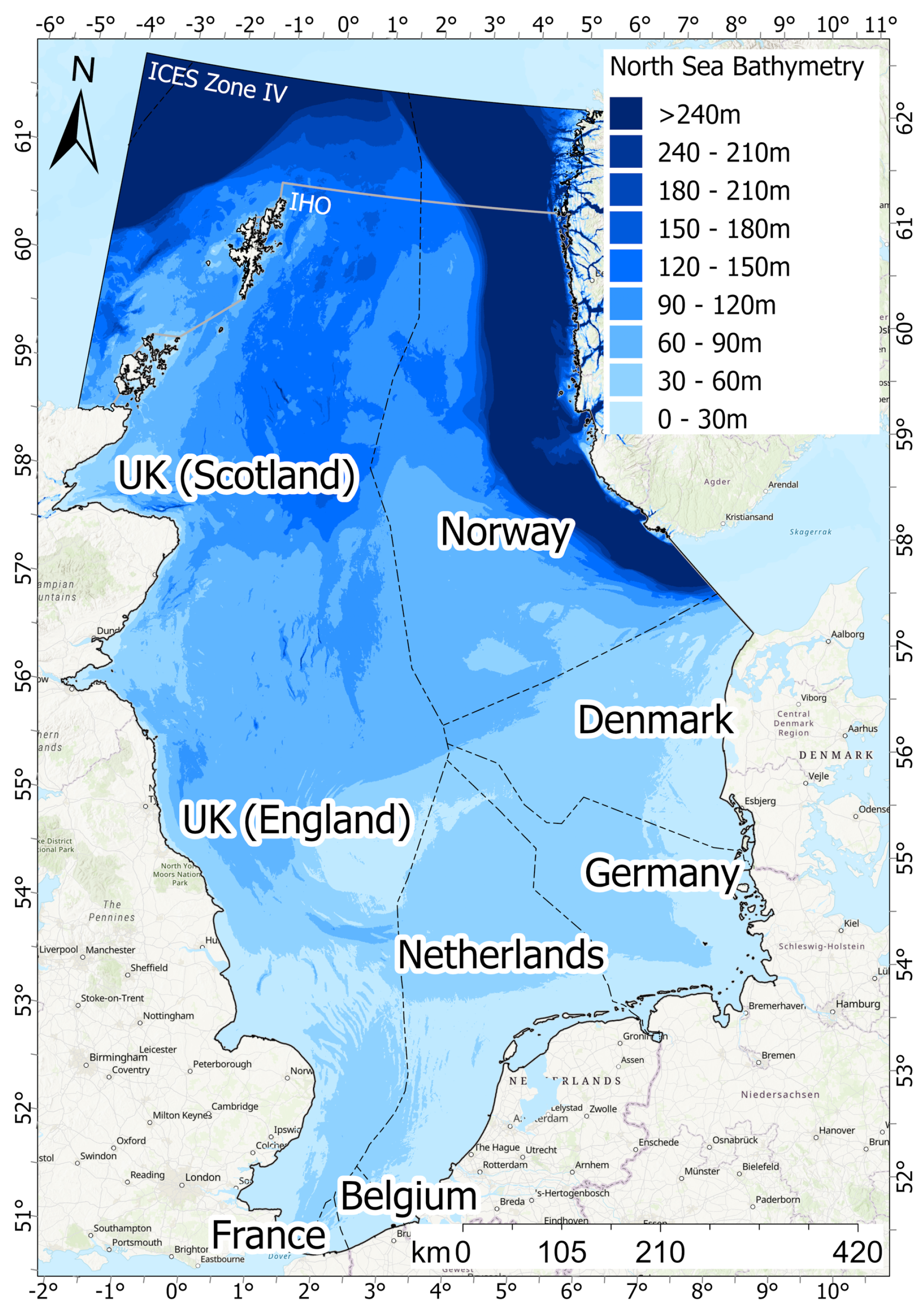
2. Description of the North Sea
Boundaries of the North Sea
3. National Ambitions
4. Wind Farm Power Densities
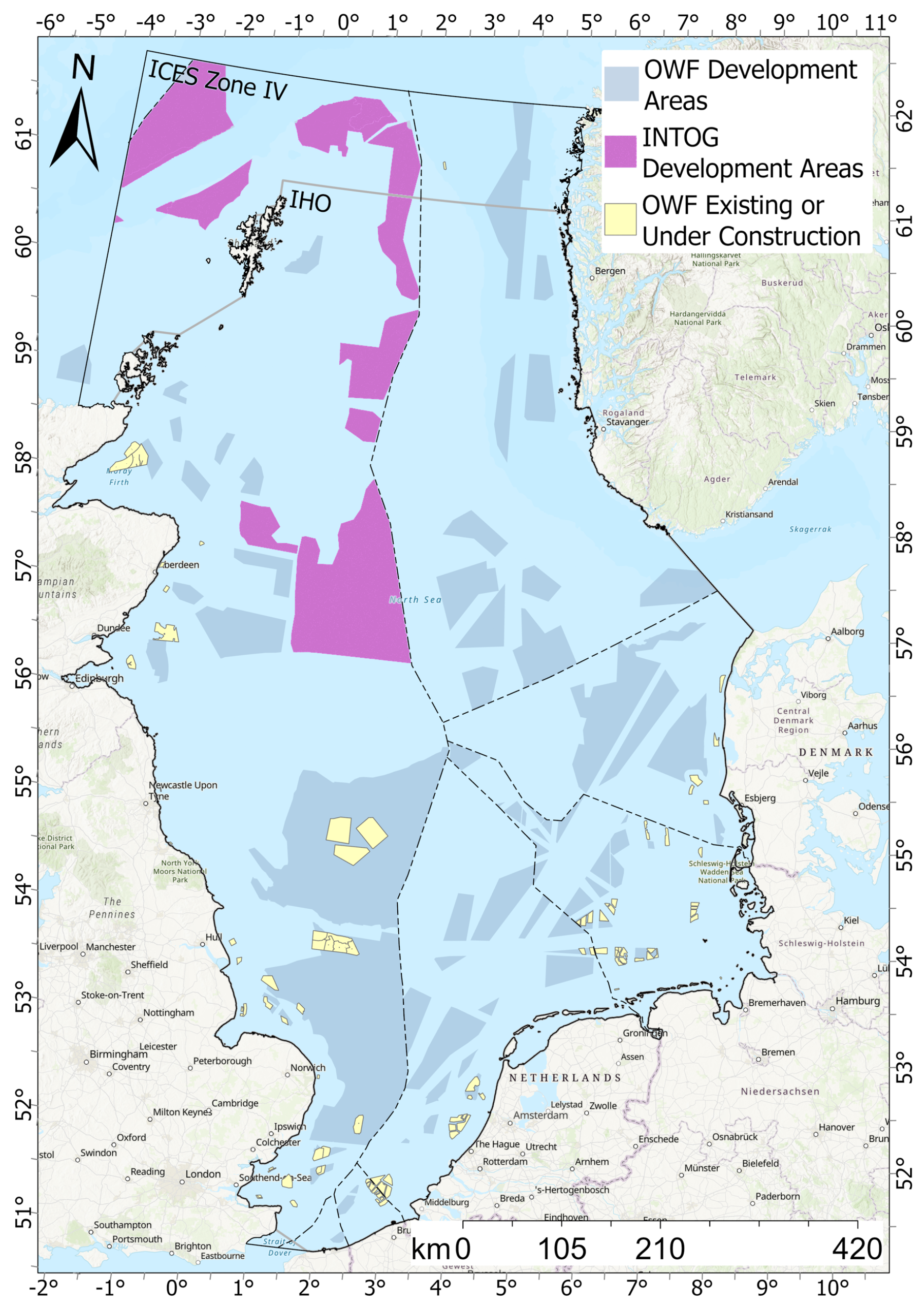
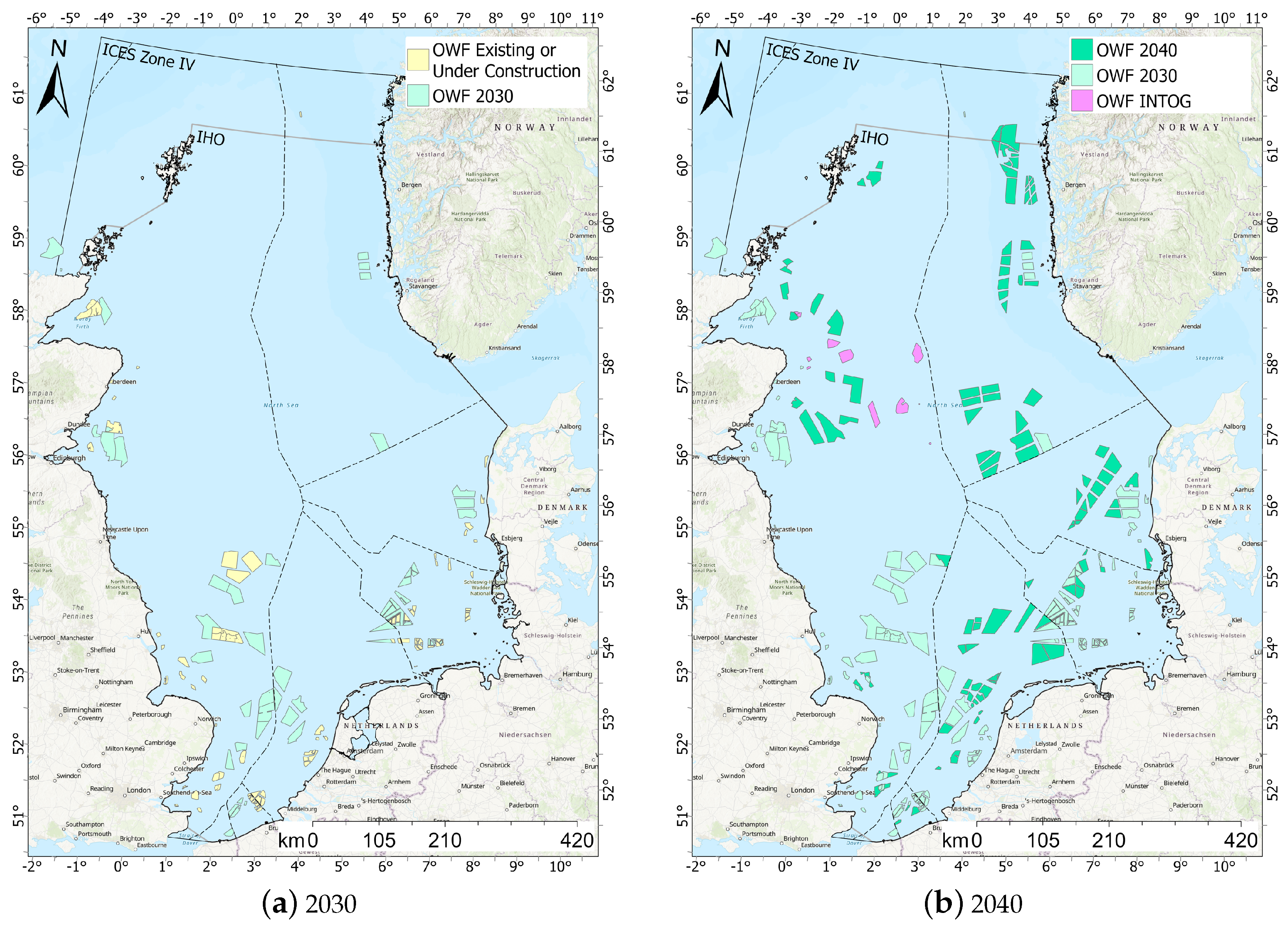
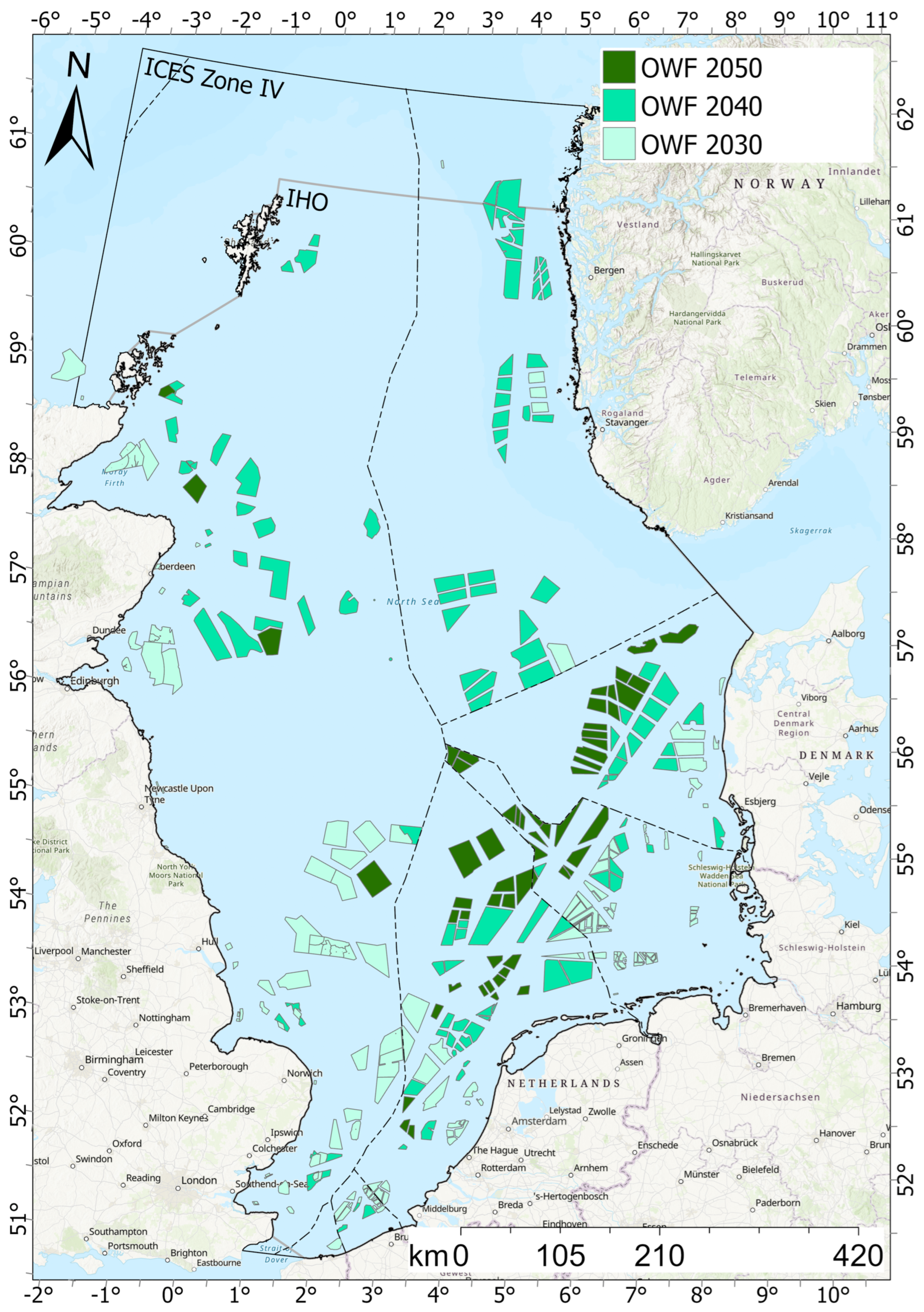
5. Zones for Offshore Wind
5.1. Method
- Designations for nature conservation.
- Customary but uncodified shipping routes, identified from AIS-sourced traffic density maps.
- 12 NM from shore.
- Nationally designated shipping lanes.
- IMO-designated shipping lanes and vessel separation schemes.
- Existing physical infrastructure including existing offshore wind, oil and gas facilities, pipelines, etc.
- Norway:
- The 2030 target is reached by projects that have been awarded and tendered projects that have not yet been awarded. After this, we used the designated areas scheduled to be opened next, followed by areas in the south of the EEZ where wind farms were historically planned but never built.
- Denmark:
- The 2030 target is satisfied by the Horns Rev 3 project. Zones for 2040 and 2050 were placed within the designated search area for wind farms, while leaving space for shipping and infrastructure exclusions.
- Germany:
- Germany has extensive plans for OSW development and has already zoned its EEZ accordingly. Only a small additional area was required to meet the 2050 targets at the high density that is planned.
- Netherlands:
- Dutch plans for wind farm locations to 2030 are clear, but after this the zones are speculative. The target for 2040 fits within the existing designated search areas, but the 2050 target would greatly exceed this. New zones have been placed to avoid infrastructure, especially IMO shipping lates, and minimise distance from shore. A choice was made to place some wind farms within an environmentally designated area, as alternative locations would be much further from land. It is possible that, if a similar choice is faced by the Dutch authorities in the future, a different decision may be reached.
- Belgium:
- Belgian plans may be optimistic within the space that they have available. The planned zones will provide around 6GW of capacity at the high density planned, but to achieve the full 8GW that is intended for 2040, it was necessary to add a zone within a marine protected area (MPA). We note that there are already designated zones for sand extraction and other “commercial and industrial activity” within the MPA [40], and our proposed wind farm overlaps with these.
- France:
- France has a single wind farm planned in the North Sea, and we assumed that there will be no others in the very limited space available.
- UK:
- The UK already has the largest installed capacity of the North Sea nations, and also a great deal in the “pipeline”. Developments that are already planned will exceed the 2030 targets and meet most of our assumed target for 2040. Small areas were added in both England and Scotland to meet our assumed target for 2050, using additional parts of the Round 4 and ScotWind search areas, respectively.
5.2. Results
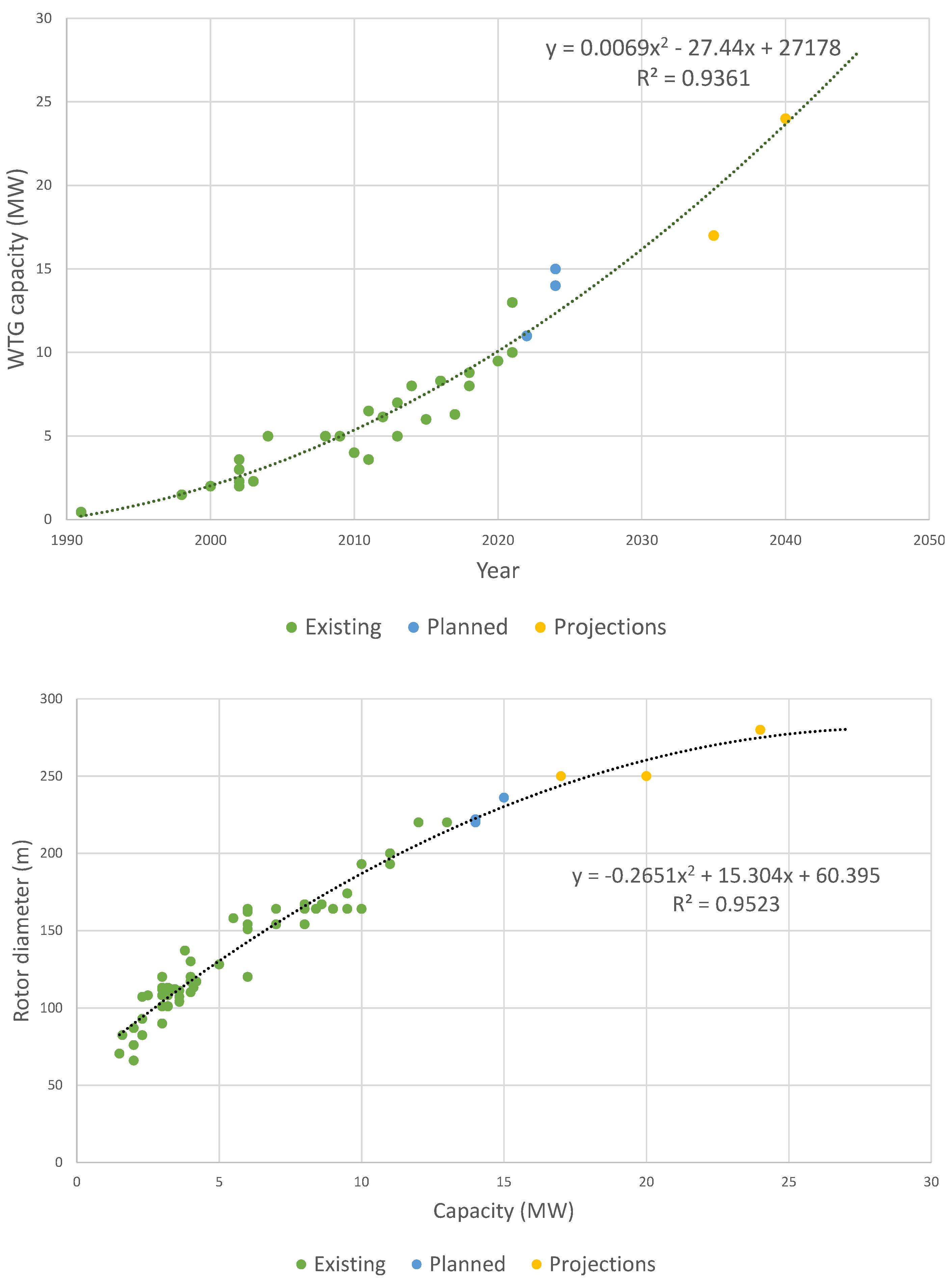
6. Future Wind Turbine Capabilities
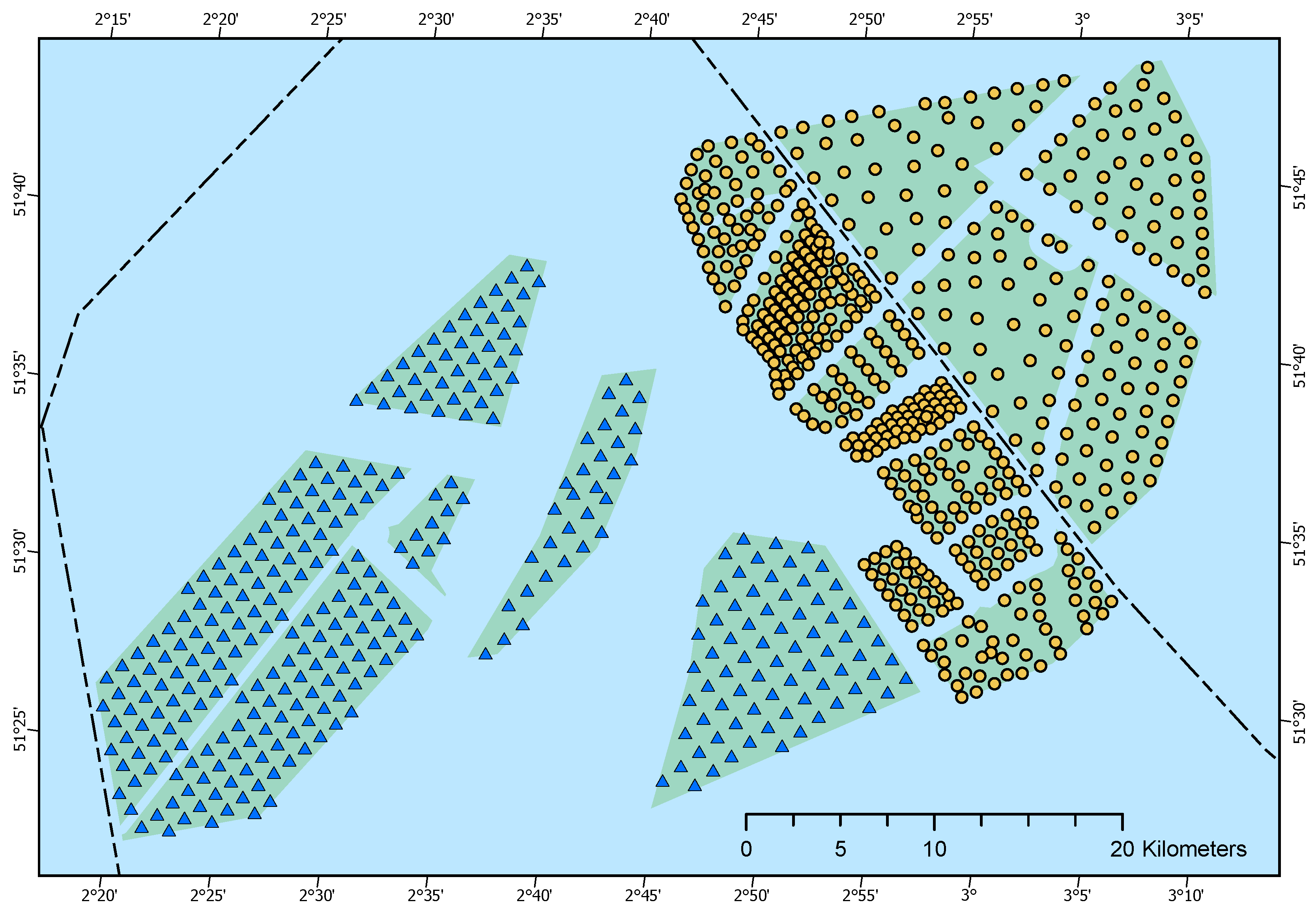
7. Possible Turbine Layouts
7.1. Method
7.2. Results
8. Discussion
8.1. Assumptions and Sensitivites
8.2. Density of Installed Power
8.3. Implications
9. Conclusions
Author Contributions
Funding
Data Availability Statement
Acknowledgments
Conflicts of Interest
Appendix A. Data Sources
- Base map:
- Esri, TomTom, Garmin, FAO, NOAA, USGS.© OpenStreetMap contributors and the GIS user community.
- North Sea & EEZ boundaries:
- VLIZ/marineregions.org, ICES
- Bathymetry:
- EMODnet bathymetry consortium (2020). DOI:10.12770/bb6a87dd-e579-4036-abe1-e649cea9881a
- Seabed substrates:
- EMODnet Geology project, http://www.emodnet-geology.eu (accessed on 1 January 2024), funded by the European Commission Directorate General for Maritime Affairs and Fisheries.
- Wind speeds:
- Global Wind Atlas 3.0“A free, web-based application developed, owned and operated by the Technical University of Denmark (DTU). The Global Wind Atlas 3.0 is released in partnership with the World Bank Group, utilizing data provided by Vortex, using funding provided by the Energy Sector Management Assistance Program (ESMAP). For additional information: https://globalwindatlas.info (accessed on 1 January 2024).”
- Waves:
- CEFAS Wavenet.“Information provided by Cefas and funded by Environment Agency. Contains public sector information licensed under the Open Government Licence v3.0”
- Fossil fuel infrastructure:
- OSPAR Inventory of Offshore Installations. https://odims.ospar.org (accessed on 1 January 2024)
- Pipelines and cables:
- EMODnet Human Activities.“Data/Information used in this report was made available by the EMODnet Human Activities project, www.emodnet-humanactivities.eu (accessed on 1 January 2024), funded by the European Commission Directorate General for Maritime Affairs and Fisheries.”
- Shipping routes:
- IMO routes and VSS from Bundesamt für Seeschiffahrt und Hydrographie“Datenlizenz Deutschland–Namensnennung–Version 2.0” (www.govdata.de/dl-de/by-2-0 (accessed on 1 January 2024)) genutzt werden. Datenlizenz Deutschland Namensnennung 2.0 https://www.govdata.de/dl-de/by-2-0 (accessed on 1 January 2024) Quelle: Bundesamt für Seeschifffahrt und Hydrographie”Danish sea lanes from Danish Government.Customary shipping lanes from EMODnet Human Activities shipping density layer.
- Nature designations:
- Natura 2000 areas: EU Environment Agency. © Directorate-General for Environment (DG ENV)English MPAs: Natural EnglandScottish MPAs: Marine ScotlandNorwegian environmentally designated areas: Norwegian Government
- Military exercise areas:
- EMODnet Human Activities
- Future offshore wind development areas:
- Belgium: Belgian government, marineatlas.beDenmark: Danish Government (Søfartsstyrelsen)England: The Crown EstateScotland: Marine ScotlandNetherlands: RijkswaterstaatNorway: Norwegian Water Resources and Energy Directoratehttps://veiledere.nve.no/havvind/identifisering-av-utredningsomrader-for-havvind/kart/interaktivt-kart/ (accessed on 1 January 2024)Germany: Bundesamt für Seeschiffahrt und Hydrographie“Nutzungsbestimmungen für die Bereitstellung von Geodaten des Bundes http://www.gesetze-im-internet.de/geonutzv/GeoNutzV.pdf (accessed on 1 January 2024)) genutzt werden. geoNutz/20130319 Nutzungsbestimmungen für die Bereitstellung von Geodaten des Bundes http://www.gesetze-im-internet.de/geonutzv/GeoNutzV.pdf (accessed on 1 January 2024) Quelle: © BSH 2020"”
- Existing and planned offshore wind farms:
- As above, plus:EMODnet Human ActivitiesOSPAR Renewable Energy DevelopmentsNorwegian GovernmentNetherlands Enterprise Agency, https://offshorewind.rvo.nl/page/view/367fe51f-cc7d-4bd1-81f0-4aad448078d8/general-information (accessed on 1 January 2024)Belgian government, https://www.geo.be/home?l=en (accessed on 1 January 2024)
References
- Moore, C. Offshore Wind to Become ’Backbone’ of UK Energy Mix. New Civil Engineer. 2020. Available online: https://www.newcivilengineer.com/latest/offshore-wind-to-become-backbone-of-uk-energy-mix-12-10-2020/ (accessed on 10 October 2023).
- The Crown Estate. The Crown Estate Seals Landmark Agreements for Offshore Wind Energy to Power 7 Million Homes. 2023. Available online: https://www.thecrownestate.co.uk/en-gb/media-and-insights/news/2023-the-crown-estate-seals-landmark-agreements-for-offshore-wind-energy-to-power-7-million-homes/ (accessed on 10 October 2023).
- UK Government. Offshore Wind: Sector Deal. Policy Paper. 2019. Available online: https://www.gov.uk/government/publications/offshore-wind-sector-deal (accessed on 10 October 2023).
- Department for Energy Security & Net Zero. Powering Our Net Zero Future. Energy White Paper, UK Government. 2020. Available online: https://www.gov.uk/government/publications/energy-white-paper-powering-our-net-zero-future (accessed on 10 October 2023).
- Department for Energy Security & Net Zero. British Energy Security Strategy. Policy Paper, UK Government. 2022. Available online: https://www.gov.uk/government/publications/british-energy-security-strategy (accessed on 10 October 2023).
- Committee on Climate Change. The Sixth Carbon Budget: The UK’s Path to Net Zero. 2020. Available online: https://www.theccc.org.uk/publication/sixth-carbon-budget/ (accessed on 10 October 2023).
- The Esbjerg Offshore Wind Declaration. 2022. Available online: https://windeurope.org/data/products/the-esbjerg-offshore-wind-declaration/ (accessed on 5 August 2024).
- Ostend Declaration of Energy Ministers on the North Seas as Europe’s Green Power Plant, 2023. Available online: https://www.regjeringen.no/contentassets/78bfc87bb04044c0933002ad7dd6e0f1/erklaring-energiministere.pdf (accessed on 5 August 2024).
- Clark, S.; Schroeder, F.; Baschek, B. The Influence of Large Offshore Wind Farms on the North Sea and Baltic Sea—A Comprehensive Literature Review; Technical Report HZG 2014-6; Helmholtz-Zentrum Geesthacht: Geesthacht, Germany, 2014. [Google Scholar]
- Floeter, J.; van Beusekom, J.E.E.; Auch, D.; Callies, U.; Carpenter, J.; Dudeck, T.; Eberle, S.; Eckhardt, A.; Gloe, D.; Hänselmann, K.; et al. Pelagic effects of offshore wind farm foundations in the stratified North Sea. Prog. Oceanogr. 2017, 156, 154–173. [Google Scholar] [CrossRef]
- Slavik, K.; Lemmen, C.; Zhang, W.; Kerimoglu, O.; Klingbeil, K.; Wirtz, K.W. The large-scale impact of offshore wind farm structures on pelagic primary productivity in the southern North Sea. Hydrobiologia 2019, 845, 35–53. [Google Scholar] [CrossRef]
- Gusatu, L.F.; Menegon, S.; Depellegrin, D.; Zuidema, C.; Faaij, A.; Yamu, C. Spatial and temporal analysis of cumulative environmental effects of offshore wind farms in the North Sea basin. Sci. Rep. 2021, 11, 10125. [Google Scholar] [CrossRef]
- Dorrell, R.M.; Lloyd, C.J.; Lincoln, B.J.; Rippeth, T.P.; Taylor, J.R.; Caulfield, C.c.P.; Sharples, J.; Polton, J.A.; Scannell, B.D.; Greaves, D.M.; et al. Anthropogenic Mixing in Seasonally Stratified Shelf Seas by Offshore Wind Farm Infrastructure. Front. Mar. Sci. 2022, 9, 830927. [Google Scholar] [CrossRef]
- Christiansen, N.; Daewel, U.; Djath, B.; Schrum, C. Emergence of Large-Scale Hydrodynamic Structures Due to Atmospheric Offshore Wind Farm Wakes. Front. Mar. Sci. 2022, 9, 818501. [Google Scholar] [CrossRef]
- Christiansen, N.; Carpenter, J.R.; Daewel, U.; Suzuki, N.; Schrum, C. The large-scale impact of anthropogenic mixing by offshore wind turbine foundations in the shallow North Sea. Front. Mar. Sci. 2023, 10, 1178330. [Google Scholar] [CrossRef]
- Buyse, J.; Hostens, K.; Degraer, S.; De Backer, A. Offshore wind farms affect the spatial distribution pattern of plaice Pleuronectes platessa at both the turbine and wind farm scale. ICES J. Mar. Sci. 2022, 79, 1777–1786. [Google Scholar] [CrossRef]
- Akhtar, N.; Geyer, B.; Schrum, C. Impacts of accelerating deployment of offshore windfarms on near-surface climate. Sci. Rep. 2022, 12, 18307. [Google Scholar] [CrossRef] [PubMed]
- Piggott, A.; Vulcano, A.; Mitchell, D. Impact of Offshore Wind Developmenton Seabirds in the North Sea and Baltic Sea: Identification of Data Sources and At-Risk Species; Technical Report; Birdlife International: Cambridge, UK, 2021. [Google Scholar]
- Haggett, C.; Ten Brink, T.; Russell, A.; Roach, M.; Firestone, J.; Dalton, T.; McCay, B. Offshore Wind Projects and Fisheries: Conflict and Engagement in the United Kingdom and the United States. Oceanography 2020, 33, 38–47. [Google Scholar] [CrossRef]
- Gao, H.; Xie, C.; Liu, K.; Chen, S.; Zhou, L.; Liu, Z.; Wang, R. Modeling of Safe Distance Between Ship Routes and Offshore Wind Farm Based on Tolerable Collision Probability. IEEE Access 2022, 10, 71777–71790. [Google Scholar] [CrossRef]
- Royal Yachting Association. The RYA’s Position on Offshore Renewable Energy Developments—Wind Energy. 2019. Available online: https://www.rya.org.uk/knowledge/environment/guidance-notes (accessed on 15 April 2025).
- Watson, S.C.L.; Somerfield, P.J.; Lemasson, A.J.; Knights, A.M.; Edwards-Jones, A.; Nunes, J.; Pascoe, C.; McNeill, C.L.; Schratzberger, M.; Thompson, M.S.A.; et al. The global impact of offshore wind farms on ecosystem services. Ocean Coast. Manag. 2024, 249, 107023. [Google Scholar] [CrossRef]
- Jongbloed, R.H.; van der Wal, J.T.; Lindeboom, H.J. Identifying space for offshore wind energy in the North Sea. Consequences of scenario calculations for interactions with other marine uses. Energy Policy 2014, 68, 320–333. [Google Scholar] [CrossRef]
- Gusatu, L.F.; Yamu, C.; Zuidema, C.; Faaij, A. A Spatial Analysis of the Potentials for Offshore Wind Farm Locations in the North Sea Region: Challenges and Opportunities. ISPRS Int. J. Geo-Inf. 2020, 9, 96. [Google Scholar] [CrossRef]
- Fitch-Roy, O.; Baldock, N.; Gibberd, G.; Phillips, J. Broad Horizons: Key Resource Areas for Offshore Wind; Technical Report; Everoze for The Crown Estate: London, UK, 2020. [Google Scholar]
- Arup. Future Offshore Wind Scenarios: An Assessment of Deployment Drivers; Technical Report. 2022. Available online: https://tethys.pnnl.gov/publications/future-offshore-wind-scenarios-assessment-deployment-drivers (accessed on 1 June 2022).
- EMODnet. Seabed Substrates Dataset; EMODnet: Oostende, Belgium, 2021. [Google Scholar]
- Global Wind Atlas. Global Wind Atlas Wind Speed Data. Available online: https://globalwindatlas.info (accessed on 1 June 2022).
- CEFAS. WaveNet. Available online: https://wavenet.cefas.co.uk/ (accessed on 29 May 2024).
- IHO. Limits of Oceans and Seas; Technical Report Special Publication No 23; International Hydrographic Organisation: Monte Carlo, Monaco, 1953. [Google Scholar]
- ICES. ICES Statistical Areas, 2005. Available online: https://gis.ices.dk/geonetwork/srv/eng/catalog.search#/metadata/c784a0a3-752f-4b50-b02f-f225f6c815eb (accessed on 18 February 2025).
- Danish Energy Agency. Denmark’s National Energy and Climate Plan; Technical Report; Danish Energy Agency: Copenhagen, Denmark, 2023. [Google Scholar]
- Noordzeeloket. Energy Transition in the North Sea. Last Modified: 2024-05-08. Available online: https://www.noordzeeloket.nl/ en/functions-and-use/offshore-wind-energy/energy-transition-north-sea/ (accessed on 6 August 2024).
- Parc éolien en mer de Dunkerque. Presentation of the Project. Available online: https://parc-eolien-en-mer-de-dunkerque.fr/project-en/ (accessed on 6 August 2024).
- NVE. Offshore Wind Power in Norway: Strategic Environmental Assessment, English Summary; Technical Report 47-12 (Summary of); Norwegian Water Resources & Energy Directorate: Oslo, Norway, 2013. [Google Scholar]
- Barthelmie, R.J.; Pryor, S.C.; Frandsen, S.T.; Hansen, K.S.; Schepers, J.G.; Rados, K.; Schlez, W.; Neubert, A.; Jensen, L.E.; Neckelmann, S. Quantifying the Impact of Wind Turbine Wakes on Power Output at Offshore Wind Farms. J. Atmos. Ocean. Technol. 2010, 27, 1302–1317. [Google Scholar] [CrossRef]
- Meyers, J.; Meneveau, C. Optimal turbine spacing in fully developed wind farm boundary layers. Wind Energy 2012, 15, 305–317. [Google Scholar] [CrossRef]
- Danish Energy Agency. Offshore Wind Potential in the North Sea: Long-Run Supply Curves and Cross-Country Competetiveness; Technical Report 2021-7012; Energistyrelsen; Danish Energy Agency: Copenhagen, Denmark, 2022. [Google Scholar]
- BSH. Flächenentwicklungsplan 2023 für die Deutsche Nordsee und Ostsee; Technical Report BSH-Nummer 7608; Bundesamt für Seeschifffahrt und Hydrographie: Hamburg, Germany, 2023. [Google Scholar]
- Verhalle, J.; van de Velde, M. Something is Moving at Sea: The Marine Spatial Plan for 2020–2026, 2020. Available online: www.marinespatialplan.be (accessed on 13 May 2025).
- Wiser, R.; Rand, J.; Seel, J.; Beiter, P.; Baker, E.; Lantz, E.; Gilman, P. Expert elicitation survey predicts 37% to 49% declines in wind energy costs by 2050. Nat. Energy 2021, 6, 555–565. [Google Scholar] [CrossRef]
- IRENA. Global Renewables Outlook: Energy Transformation 2050 (Edition: 2020); International Renewable Energy Agency: Abu Dhabi, United Arab Emirates, 2020. [Google Scholar]
- Martins, M.C.I.; Carter, M.; Rouse, S.; Russell, D.J. Offshore Energy Structures in the North Sea: Past, Present and Future-June 2024 Version (Dataset). 2024. Available online: https://research-portal.st-andrews.ac.uk/en/datasets/1639540b-600e-42aa-8920-ac1890b78b5a (accessed on 19 February 2025).
- Martins, M.C.I.; Carter, M.I.; Rouse, S.; Russell, D.J. Offshore energy structures in the North Sea: Past, present and future. Mar. Policy 2023, 152, 105629. [Google Scholar] [CrossRef]
- Equinor. Hywind Tampen. Available online: https://www.equinor.com/energy/hywind-tampen (accessed on 18 February 2025).
- Crown Estate Scotland. ScotWind Offshore Wind Leasing Delivers Major Boost to Scotland’s Net Zero Aspirations; Crown Estate Scotland: Edinburgh, UK, 2022; Available online: https://www.crownestatescotland.com/news/scotwind-offshore-wind-leasing-delivers-major-boost-to-scotlands-net-zero-aspirations (accessed on 15 April 2025).
- Jensen, P.H.; Chaviaropoulos, T.; Natarajan, A. LCOE Reduction for the Next Generation Offshore Wind Turbines: Outcomes from the Innwind.eu Project. Technical Report. 2017. Available online: https://www.innwind.eu/-/media/sites/innwind/news/36729101_innwind_v4.pdf (accessed on 15 April 2025).
- WCS. Wind Catching Systems. Available online: https://www.windcatching.com (accessed on 15 April 2025).
- Coolen, J.W.P.; Vanaverbeke, J.; Dannheim, J.; Garcia, C.; Birchenough, S.N.R.; Krone, R.; Beermann, J. Generalized changes of benthic communities after construction of wind farms in the southern North Sea. J. Environ. Manag. 2022, 315, 115173. [Google Scholar] [CrossRef] [PubMed]
- De Borger, E.; van Oevelen, D.; Mavraki, N.; De Backer, A.; Braeckman, U.; Soetaert, K.; Vanaverbeke, J. Offshore wind farms modify coastal food web dynamics by enhancing suspension feeder pathways. Commun. Earth Environ. 2025, 6, 330. [Google Scholar] [CrossRef]
- Whyte, K.F.; Russell, D.J.F.; Sparling, C.E.; Binnerts, B.; Hastie, G.D. Estimating the effects of pile driving sounds on seals: Pitfalls and possibilitiesa. J. Acoust. Soc. Am. 2020, 147, 3948–3958. [Google Scholar] [CrossRef] [PubMed]
- Farr, H.; Ruttenberg, B.; Walter, R.K.; Wang, Y.H.; White, C. Potential environmental effects of deepwater floating offshore wind energy facilities. Ocean Coast. Manag. 2021, 207, 105611. [Google Scholar] [CrossRef]
- Platis, A.; Siedersleben, S.K.; Bange, J.; Lampert, A.; Bärfuss, K.; Hankers, R.; Cañadillas, B.; Foreman, R.; Schulz-Stellenfleth, J.; Djath, B.; et al. First in situ evidence of wakes in the far field behind offshore wind farms. Sci. Rep. 2018, 8, 2163. [Google Scholar] [CrossRef] [PubMed]
- Lundquist, J.K.; DuVivier, K.K.; Kaffine, D.; Tomaszewski, J.M. Costs and consequences of wind turbine wake effects arising from uncoordinated wind energy development. Nat. Energy 2018, 4, 26–34. [Google Scholar] [CrossRef]
- Borgers, R.; van Lipzig, N.P.M.; Meyers, J. Energy production and inter-farm wake losses in future North Sea wind farms. Environ. Res. Lett. 2025, 20, 074036. [Google Scholar] [CrossRef]
- Millard, R.; Pitel, L. North Sea row highlights wind farms’ growing ‘wake effect’ problem. Financial Times, 11 April 2025. [Google Scholar]
- Finserås, E.; Herrera Anchustegui, I.; Cheynet, E.; Gebhardt, C.G.; Reuder, J. Gone with the wind? Wind farm-induced wakes and regulatory gaps. Mar. Policy 2024, 159, 105897. [Google Scholar] [CrossRef]
- Waldman, S.; Weir, S.; O’Hara Murray, R.B.; Woolf, D.K.; Kerr, S. Future policy implications of tidal energy array interactions. Mar. Policy 2019, 108, 103611. [Google Scholar] [CrossRef]
- Kusters, J.E.H.; van Kann, F.M.G.; Zuidema, C. Spatial conflict resolution in marine spatial plans and permitting procedures for offshore wind energy: An analysis of measures adopted in Denmark, England and the Netherlands. Front. Mar. Sci. 2025, 12, 1468734. [Google Scholar] [CrossRef]



| Country | Target Capacity (GW) | Source(s) | ||
|---|---|---|---|---|
| 2030 | 2040 | 2050 | ||
| UK | 43 1 | 74 2 | [5,6] | |
| Norway | 3 | 30 | [8] | |
| Denmark | 5.3 | 35 | [8,32] | |
| Germany | 26.4 | 66 3 | [8] | |
| Netherlands | 21 | 50 4 | 72 4 | [8,33] |
| Belgium | 6 | 8 | [8] | |
| France | 0.6 | [34] | ||
| Cumulative Total | 62.3 | 120.3 | 306.6 | |
| Country | Density (MW/km2) | Rationale |
|---|---|---|
| UK | 3.48 | Based on a sample of recent and near-future planned sites. Some older farms have higher densities. |
| Norway | 2.86 | Based on wind farm areas and capacities at recent auctions for sites (Sorlige Nordsjo II & Utsira). |
| Denmark | 4.50 | From an assumption stated in a 2022 report by the Danish Energy Agency [38]. |
| Germany | 12.71 | Average density of planned wind farms to 2040 [39]. |
| Netherlands | 5.76 | Average of densities of developments proposed for Dutch 2030 targets. |
| Belgium | 10.98 | From existing and planned farms in the Princess Elizabeth Zone. |
| France | 5.04 | Density of planned Dunkirk wind farm (only one in French North Sea sector). |
| EEZ | Wind Farm Area in IHO Zone | Wind Farm Area in ICES Zone | ||
|---|---|---|---|---|
| km2 | % of EEZ | km2 | % of EEZ | |
| UK | 22,104 | 8.9 | 22,172 | 7.2 |
| Norway | 9852 | 8.2 | 10,519 | 7.5 |
| Denmark | 7997 | 16.1 | 7997 | 15.4 |
| Germany | 5636 | 13.6 | 5636 | 13.6 |
| Netherlands | 12,139 | 18.9 | 12,139 | 18.9 |
| Belgium | 629 | 17.8 | 629 | 17.8 |
| France | 119 | 6.8 | 119 | 6.3 |
| Whole NS | 58,476 | 11.1 | 59,211 | 9.7 |
| Foundation | Year | Capacity (MW) | Diameter (m) |
|---|---|---|---|
| Fixed | 2030 | 15 | 236 |
| Fixed | 2040 | 17 | 250 |
| Fixed | 2050 | 27 | 300 |
| Floating | 2030 | 12 | 220 |
| Floating | 2040 | 17 | 250 |
| Floating | 2050 | 27 | 300 |
| EEZ | IHO Zone | ICES Zone | ||||
|---|---|---|---|---|---|---|
| 2030 | 2040 | 2050 | 2030 | 2040 | 2050 | |
| UK | 4272 | 6072 | 6306 | 4291 | 6091 | 6325 |
| Norway | 200 | 1694 | 1694 | 211 | 1847 | 1847 |
| Denmark | 538 | 1411 | 1975 | 538 | 1411 | 1975 |
| Germany | 2687 | 3240 | 4348 | 2687 | 3240 | 4348 |
| Netherlands | 1735 | 3459 | 4292 | 1735 | 3459 | 4292 |
| Belgium | 627 | 745 | 745 | 627 | 745 | 745 |
| France | 41 | 41 | 41 | 41 | 41 | 41 |
| Whole NS | 10,100 | 16,662 | 19,401 | 10,130 | 16,834 | 19,573 |
Disclaimer/Publisher’s Note: The statements, opinions and data contained in all publications are solely those of the individual author(s) and contributor(s) and not of MDPI and/or the editor(s). MDPI and/or the editor(s) disclaim responsibility for any injury to people or property resulting from any ideas, methods, instructions or products referred to in the content. |
© 2026 by the authors. Licensee MDPI, Basel, Switzerland. This article is an open access article distributed under the terms and conditions of the Creative Commons Attribution (CC BY) license.
Share and Cite
Waldman, S.; Munro, P.; Gilmour, C.; Forster, R.M.; Russsell, D.J.F. Offshore Wind and the Spatial Squeeze: A Plausible Future Layout for the North Sea. Energies 2026, 19, 1339. https://doi.org/10.3390/en19051339
Waldman S, Munro P, Gilmour C, Forster RM, Russsell DJF. Offshore Wind and the Spatial Squeeze: A Plausible Future Layout for the North Sea. Energies. 2026; 19(5):1339. https://doi.org/10.3390/en19051339
Chicago/Turabian StyleWaldman, Simon, Peter Munro, Conor Gilmour, Rodney M. Forster, and Debbie J. F. Russsell. 2026. "Offshore Wind and the Spatial Squeeze: A Plausible Future Layout for the North Sea" Energies 19, no. 5: 1339. https://doi.org/10.3390/en19051339
APA StyleWaldman, S., Munro, P., Gilmour, C., Forster, R. M., & Russsell, D. J. F. (2026). Offshore Wind and the Spatial Squeeze: A Plausible Future Layout for the North Sea. Energies, 19(5), 1339. https://doi.org/10.3390/en19051339