Article

Thermogravimetric Kinetic Studies of Acid and Base Treated Dairy Manure as Gasification Feedstock †

by
Kalidas Mainali
1,2,*,
Candice Ellison
1,*,
Brajendra K. Sharma
1,
Majher I. Sarker
1,
Charles A. Mullen
1 and
Manuel Garcia-Perez
2
1
Sustainable Biofuels and Co-Products Research Unit, Eastern Regional Research Center, US Department of Agriculture, Agricultural Research Service, 600 E. Mermaid Lane, Wyndmoor, PA 19038, USA
2
Biological Systems Engineering, Washington State University, Pullman, WA 99163, USA
*
Authors to whom correspondence should be addressed.
Mention of trade names or commercial products in this article is solely for the purpose of providing specific information and does not imply recommendation or endorsement by the U.S. Department of Agriculture (USDA). USDA is an equal-opportunity provider and employer.
Energies 2026, 19(5), 1293; https://doi.org/10.3390/en19051293
Submission received: 10 February 2026 / Revised: 25 February 2026 / Accepted: 27 February 2026 / Published: 4 March 2026

Abstract

The influence of phosphoric acid (H3PO4) and sodium hydroxide (NaOH) impregnation on the pyrolysis and CO2 gasification behavior of dairy manure was evaluated using thermogravimetric analysis (TGA), with kinetic parameters assessed through iso-conversional kinetic analysis (Frieman method). H3PO4 pretreatment altered early decomposition by partially removing hemicellulose and promoting the formation of thermally stable, condensed char structures. The resulting chars exhibited reduced CO2 reactivity, as evidenced by higher gasification temperatures, lower syngas yields, and elevated activation energies, indicating hindered CO2 diffusion and slower Boudouard reaction kinetics. In contrast, NaOH pretreatment caused only minor changes in both pyrolysis and gasification behavior. A slight reduction in pyrolysis activation energy suggested Na+ catalyzed bond-cleavage reactions; however, this effect did not enhance CO2 gasification reactivity. Chars produced from NaOH-treated manure exhibited slightly higher activation energies during CO2 gasification and syngas yields, which remained close to or slightly above those of raw manure, attributed to complex mineral interactions that diminish the catalytic influence of sodium. Overall, these findings clarify how acid and base chemical pretreatments govern char evolution and carbon-CO2 reactivity, providing a foundation for optimizing pretreatment strategies and reactor conditions for manure conversion in CO2-based pyrolysis and gasification systems.

1. Introduction

In the United States, the dairy industry produces significant amounts of solid waste each year through concentrated animal feeding operations (CAFOs) [1,2], producing about 100 times more manure mass than the total sewage sludge mass generated by municipal wastewater treatment plants [3]. Historically, animal manure, which is rich in nitrogen (N), phosphorus (P), and potassium (K), has been used on agricultural land because of its valuable nutrient content [4,5]. However, poor management practices—such as improper application and overuse—pose serious environmental and health risks, including pathogen transmission, emissions of harmful gases like ammonia, and water pollution [6,7]. Heavy rainfall can quickly spread these nutrients into ditches, lakes, and other water bodies, speeding up eutrophication of aquatic ecosystems [3,8]. These challenges underscore the urgent need for alternative animal waste management strategies that minimize environmental impacts while enhancing resource recovery and efficiency in the agricultural sector.
Various conversion technologies, including thermochemical, biochemical, and physiochemical processes, have been explored for manure valorization, each having its own benefits and limitations [9,10,11]. Thermochemical pathways such as combustion, pyrolysis, and gasification generally provide more rapid and efficient energy recovery from lignocellulosic feedstocks such as animal manure, whereas biochemical and physicochemical methods often require substantially longer processing times. Among these, gasification is particularly attractive because it primarily produces synthesis gas (syngas), a versatile, high-energy fuel, along with biochar as a co-product. Gasification involves partial oxidation under a limited oxygen supply, placing it between combustion (excess oxygen) and pyrolysis (no oxygen), and converts carbonaceous materials into synthesis gas (primarily CO, H2, and CO2) through controlled, incomplete oxidation [12]. Syngas can be further upgraded into liquid hydrocarbons via Fischer–Tropsch synthesis.
Gasification of lignocellulosic feedstocks proceeds through an initial devolatilization stage, during which pyrolysis generates volatiles and char, followed by heterogeneous reactions between the resulting char and the gasifying agent. Among possible gasifying agents, CO2 is particularly compelling due to its relevance in chemical looping and CO2 utilization. The Boudouard reaction (C + CO2 → 2CO) dominates this process, and its slow kinetics relative to steam or air gasification make CO2 more sensitive to catalytic and char structure effects that govern char reactivity [13]. While gasification of lignocellulosic biomass has been extensively researched, there is limited work on animal manure gasification, presenting a critical opportunity for innovation in sustainable waste-to-energy technologies [14,15,16]. Animal manure, primarily composed of cellulose, hemicellulose, and lignin, is similar in composition to other lignocellulosic biomass such as wood and herbaceous biomass. However, manure typically has greater mineral content, which can strongly influence thermochemical conversion behavior, primarily through the catalytic roles of alkali and alkaline earth metals (AAEM) [17].
Chemical pretreatments fundamentally alter the inorganic speciation and structural evolution during pyrolysis, producing chars with distinct catalytic sites, porosity, and carbon bonding configurations [18]. These modifications directly influence how readily CO2 can adsorb, activate, and react at the char surface during gasification. Acid treatments tend to facilitate bond-cleavage during thermal decomposition and promote crosslinking through cyclization and condensation reactions. Phosphoric acid impregnation of wheat straw, for instance, has been shown to improve carbon retention and char stability after pyrolysis [19], potentially increasing its reactivity during subsequent gasification. Zięzio et al. (2020) [20] reported that phosphoric-acid-impregnated spent coffee grounds promoted porous structure development, with stronger effects under CO2 activation relative to N2. In contrast, alkali impregnation introduces catalytically active sodium species that can alter thermal stability and gasification kinetics. Li et al. (2024) [21] reported that alkaline sodium salts reduce the thermal stability of pinewood more effectively than neutral Na salts, producing lower CO and higher CO2 during pyrolysis, evidence of increased retention of chemically bound sodium (e.g., sodium carboxylates) rather than physically adsorbed Na. NaOH-impregnated pinewood exhibited the highest syngas yield, demonstrating the strong catalytic effect of alkaline sodium on char reactivity. Similar catalytic enhancements were observed by Guo et al. (2012) [22] for NaOH- and Na2CO3-treated alkali lignin, whereas neutral NaCl showed minimal catalytic impact [23]. These findings provide a strong rationale for examining H3PO4- and NaOH-impregnated biomass when evaluating CO2 gasification kinetics.
Building on this foundation, this study investigates the thermal decomposition behavior and CO2 gasification kinetics of manure impregnated with phosphoric acid or sodium hydroxide. By integrating thermal decomposition characterization with kinetic analysis, this work aims to elucidate how acid and base chemical pretreatments govern char development and reactivity during CO2 gasification, providing insights critical for designing efficient manure-to-energy systems.

2. Materials and Methods

2.1. Feedstock Preparation

Dairy manure was collected from Knott Dairy Center, WSU, Pullman, WA, USA, and stored at 4 °C. The initial moisture content of fresh dairy manure was about 85 wt.%. The chemical composition and physical properties of manure vary widely because they are influenced by the digestibility, protein level, and fiber content of the forage, as well as the age and digestive efficiency of the animals. Environmental conditions within a CAFO system—such as housing, bedding, moisture, and handling practices—further influence manure characteristics. Together, these factors create significant variation in both the physical and chemical properties of dairy manure. The dairy manure samples were dried at 105 °C for 24 h, ground to powder using a kitchen grinder, and then stored in a sealed glass container until use. The acid-pretreated dry manure samples were prepared at varying concentrations of phosphoric acid (wt.%): 1%, 2%, 3%, 4%, 8%, and 10%. Initially, manure was saturated with deionized water with approximately 20 mL of water per 5 g of manure. Diluted phosphoric acid (~30%) was added to the wet manure in appropriate amounts to reach the final desired acid concentration. The samples were then covered with water (an additional ~50 mL per 5 g biomass) and stirred well. The biomass-acid slurries were covered and soaked for 24 h in a fume hood with periodic agitation. A glass rod was used to periodically agitate the mixture at 30-min intervals for a total duration of 8 h. The samples were then dried at ~105 °C for an additional 24 h before experimentation. The base-pretreated samples were prepared using sodium hydroxide at the same concentrations using the same procedure.

2.2. Thermogravimetric Analysis

Thermogravimetric analysis (TGA) was applied to investigate the thermal degradation behavior of dairy manure based on the established procedure in the literature [24,25]. For thermogravimetric analysis (SDTA851e, Mettler Toledo, Columbus, OH, USA), approximately 5–10 mg of pretreated dairy manure was heated under CO2 (50 mL/min) from 35 to 1000 °C at heating rates of 5, 10, and 20 °C/min. Char yields were reported at 1000 °C. The weight loss and temperature change rate were recorded in TGA and DTG formats. All acid- and base-pretreated samples were analyzed in triplicate to ensure repeatability. Also, to minimize differences in heat and mass transfer during analysis, the weights of all samples were approximately 6 mg.

2.3. Experimental Analysis and Kinetic Model

To estimate the kinetic parameters of dairy manure gasification, the Friedman method, a differential iso-conversional technique, was employed as previously reported [1,26,27]. This method is versatile as it applies to both linear and non-linear temperature programs. The Friedman method is expressed as follows:
ln ( d α d t ) = [ l n f ( α ) ] + [ l n A E R T ]
where dα/dt is the rate of reaction (min−1), α is the conversion, A is the pre-exponential factor (s−1), E is the activation energy (J/mol), R is the gas constant, T is the sample temperature (K), and f(α) is the function describing the reaction mechanism. The degree of conversion (α) of the dairy manure to pyrolysis/gasification products was estimated experimentally from TGA mass loss data by the following equation:
α = [ m 0 m T ] / [ m 0 M ]
where m0 is the initial sample mass, mT is the sample mass at a specific temperature (T), and m is the sample mass at the final temperature. By the general analogy of a straight line ( y = m x + b ) , through the Friedman method, kinetic parameters were obtained by graphing ln ( d α d t ) v s . 1 T for each conversion value (α) at a different heating rate. For each heating rate, the temperature changes of the samples, and the rate of heating are recorded. For a given conversion, the activation energy and pre-exponential factor were calculated from the slope and intercept of the resulting line.
Thermal degradation of manure is a complex, multiphase process involving a series of simultaneous chemical reactions. Due to its heterogeneous nature and diverse chemical composition, the evaluation of individual reaction pathways and estimation of kinetic parameters is challenging. Overlapping mass loss peaks during thermal decomposition further complicate the development of accurate reaction models, yet many mathematical models have been proposed to describe the thermal kinetics of lignocellulosic biomass [1,28,29,30]. Due to the limitations of model-dependent approaches, isoconversional methods offer a model-free alternative that can provide reliable estimation of kinetics parameters such as activation energy (E) and pre-exponential factor (A) for complex non-isothermal processes without requiring prior knowledge of the reaction mechanism. Isoconversional methods are commonly used to determine kinetic parameters for both pyrolysis and gasification [31,32,33]. Activation energy represents the minimum energy barrier that reactant molecules must overcome to initiate a chemical reaction. It governs the rate at which reactions proceed, with higher activation energies typically resulting in slower reaction rates. The pre-exponential factor, often denoted as A in the Arrhenius equation, reflects the frequency and orientation of molecular collisions that are energetically favorable for reaction. Together, these parameters provide critical insight into the kinetics of chemical transformations, particularly in thermochemical processes such as pyrolysis and gasification [1,30].

2.4. Proximate and Ultimate Analysis

For each acid- and base-treated sample, moisture (MC), volatiles (VM), fixed carbon (FC), and ash content were determined using a thermo-gravimetric analyzer as described in the literature [1,24]. Briefly, 5–10 mg of sample mixtures were loaded into a small alumina crucible, and the sample was weighed under nitrogen flow (50 mL/min) at room temperature in the instrument. The following heating program was used for proximate analysis: 25 to 120 °C, 50 °C/min (N2 50 mL/min); hold for 3 min at 120 °C (N2 50 mL/min) to determine moisture content; heat from 120 to 950 °C under a nitrogen environment, hold for 5 min and later cooled down to 450 °C to determine volatile content. Ash was determined after heating from 450 °C to 600 °C; hold 5 min at 600 °C (O2 50 mL/min). Fixed carbon was determined by difference (FC = 100-VM-Ash) on a dry basis. Elemental analysis was carried out using a TRUSPEC-CHN (LECO, US) elemental analyzer. Briefly, 0.15 g of the prepared sample was used to determine total carbon (C), nitrogen (N), and hydrogen (H). The oxygen (O) mass fraction was determined by difference as reported in the literature [24,28]. All the analyses were done in triplicate for each of the samples.
To improve the estimation of kinetic parameters, the TGA data from the pyrolysis and gasification stages were analyzed separately. Treating these stages independently avoids the high uncertainty associated with the transition region between the devolatilization and char-CO2 reactions, where overlapping processes can distort kinetic fits. The approach enables more precise identification of the temperature and mass at the onset of gasification, which varied slightly among samples and with heating rate, and allows this point to be used consistently as the end of devolatilization and the start of the gasification stage.

2.5. Statistical Analysis

All measurements were made at least three times. The standard deviation and mean were computed in an Excel spreadsheet. The values in parentheses indicate the standard error of the mean value.

3. Results and Discussion

3.1. Physical and Chemical Properties of Acid–Base-Treated Manure

The physical and chemical properties of fresh manure and each acid- and base-treated manure sample are presented in Table 1, Table 2 and Table 3 on a weight percentage dry basis. The carbon content in the manure is approximately 41.3 wt.%. The nitrogen content in the manure is 2.5 wt.% with 0.2 wt.% sulfur (S) content. After acid pretreatment, the carbon content decreased slightly with acid concentration. Also, the oxygen content (wt.%) decreased slightly with increasing acid concentration, likely due to the addition of phosphate from the acid treatment. The nitrogen content of acid-pretreated manure did not change a lot compared to raw dairy manure. Unlike acid-pretreated manure, the base-pretreated manure showed constant carbon content with increased base concentration.
Proximate analysis of each acid- and base-treated sample of dairy manure is presented in Table 4 and Table 5. The moisture content, volatile organic matter, fixed carbon, and ash are considered important parameters of the biomass in the thermal process [9,34]. The proximate analysis shows that manure still contains 5 wt.% moisture despite being pre-dried in the oven. Probably, it is due to the moisture remaining in the cellulose and the complex matrix structure of manure. Similarly, volatile organic matter in the manure is around 71 wt.% while the fixed carbon is about 11.71 wt.%. The high percentage of volatile organic matter designates that manure tends to produce reactive agents during the thermal degradation process. Dairy manure has a relatively higher ash content and lower energy content as compared to other lignocellulosic biomass [35]. The high percentage of ash content (17.34 wt.%) in dairy manure is responsible for lower energy content (11.6 MJkg−1) as compared to lignocellulosic biomass corn stalk (ash content: 8.18 wt.%), which has an energy value of 18.45 MJkg−1 [36]. Additionally, the high ash content of manure indicated that it has greater residue potential [37].
After acid impregnation, the volatiles progressively decreased while ash content increased with increasing acid concentration. The presence of a high concentration of K and Na as trace elements in manure further reacts with acid and forms corresponding salts [38]. On the other hand, there is no increase in ash content after the impregnation of the base. This observation confirms that the corresponding trace elements present in manure are less reactive with sodium hydroxide. Since the energy amount stored in carbon–carbon bonds is mainly indicated by the fixed carbon, the lowest fixed carbon (11.71 wt.%) showed the unsuitability during the combustion process [37]. As compared to acid-pretreated manure, there is a slight increase in fixed carbon with base-pretreated manure. It is to be noted that in the case of base pretreated manure, the fixed carbon ratio showed no generalizable trend. Probably, it is because of the heterogeneous mixtures of dairy manure.

3.2. Thermal Degradation of Fresh Manure Under a CO2 Atmosphere

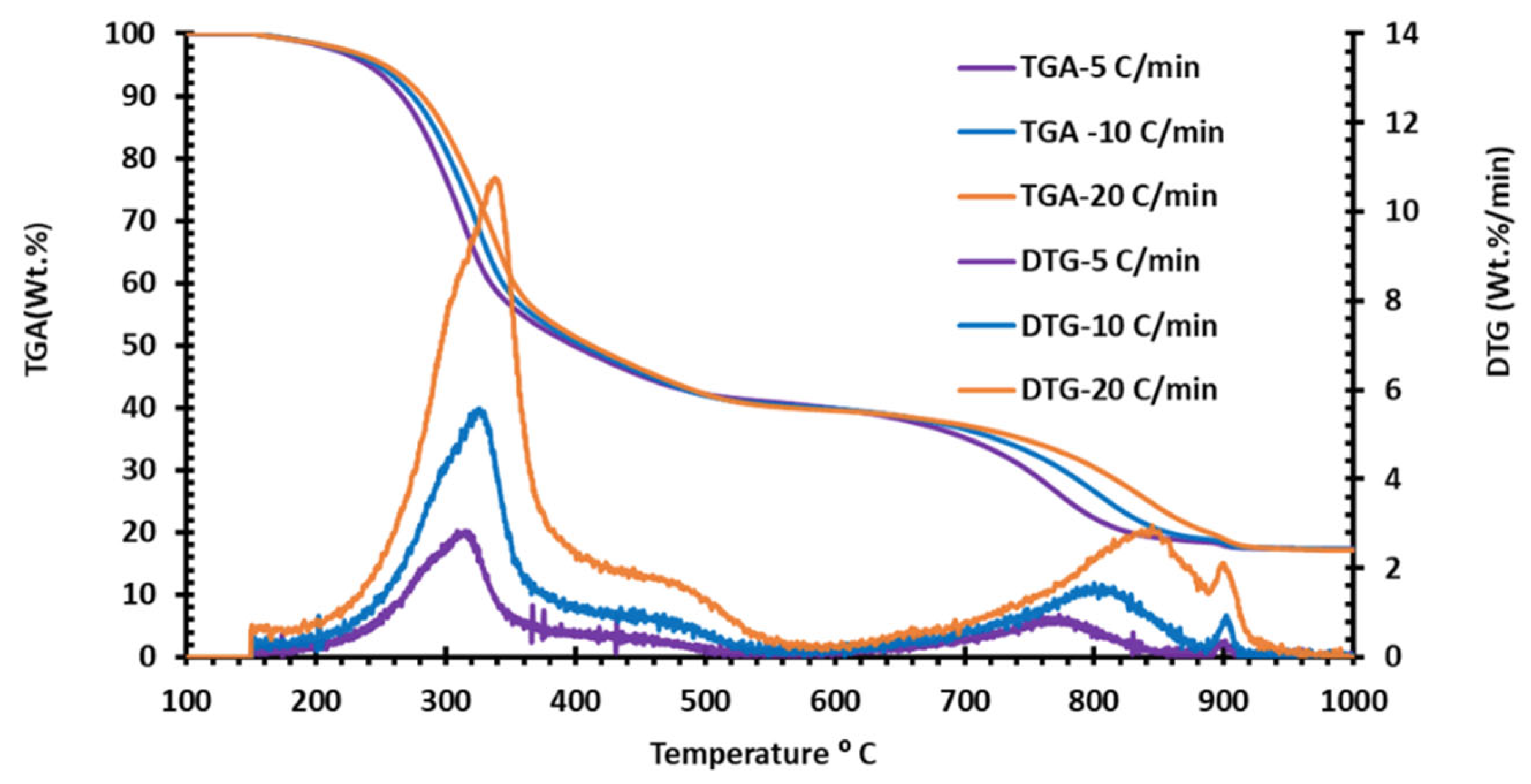
Figure 1 presents the weight loss and differential thermogravimetric (DTG) plots of fresh manure at three different heating rates (5, 10, and 20 °C/min) under a CO2 environment. Overall, the biomass CO2 gasification process typically consists of three distinct reaction phases: drying, pyrolysis, and partial oxidation of the char (gasification) with CO2 to produce CO via the Boudouard reaction, leaving behind residual ash and unreacted char [39]. The mass loss curve of dried dairy manure similarly exhibited three distinct mass loss regions with dehydration from 35 to 160 °C in which weight loss was primarily due to moisture evaporation (initial mass was normalized to dry weight in the figure), pyrolysis from 160 to 700 °C during which most of the organic matter was volatilized, and gasification from 700 to 900 °C in which partial devolatilization of the char occurred. Studies have shown that organic solid wastes exhibit similar mass loss behavior during pyrolysis in N2 and CO2 atmospheres, whereas at gasification temperatures the mass loss is significantly greater in CO2 than N2 [40]. The gasification stage involves the reaction of char with CO2 to produce CO via the Boudouard reaction, leaving residual ash and any unreacted char at the end of the heating cycle.
The untreated dairy manure exhibited a broad DTG peak with a maximum at 300 °C (with a heating rate of 20 °C/min), corresponding to simultaneous hemicellulose and cellulose decomposition, whereas the slower mass loss rate from 400 to 600 °C may be attributed to lignin decomposition. It is possible that the trace elements present in manure, mostly K and Na, catalyzed the degradation of cellulose, while Ca promotes the decomposition of hemicellulose [41]. Dairy manure contains cellulose, hemicellulose, lignin, proteins, starch, and microbial cell walls [16]. Normally, the pyrolytic decomposition of lignin occurs between 300 °C and 500 °C, whereas hemicellulose and cellulose decompose at 250–300 °C and 300–350 °C, respectively [42,43]. However, a wide range of data is available in the literature about lignin degradation up to 900 °C [44,45]. The mass loss event around 900 °C could be attributed to decomposition of inorganic material, such as the conversion of calcium carbonate to calcium oxide [30,46], a reaction that is catalyzed by CO2 [47]. As the reaction temperature reached 1000 °C, the weight loss rate became stable, and the residual mass of 10–20% was close to the manure ash content (17.34%).

3.3. Thermal Degradation of Acid-Treated Manure Under a CO2 Atmosphere

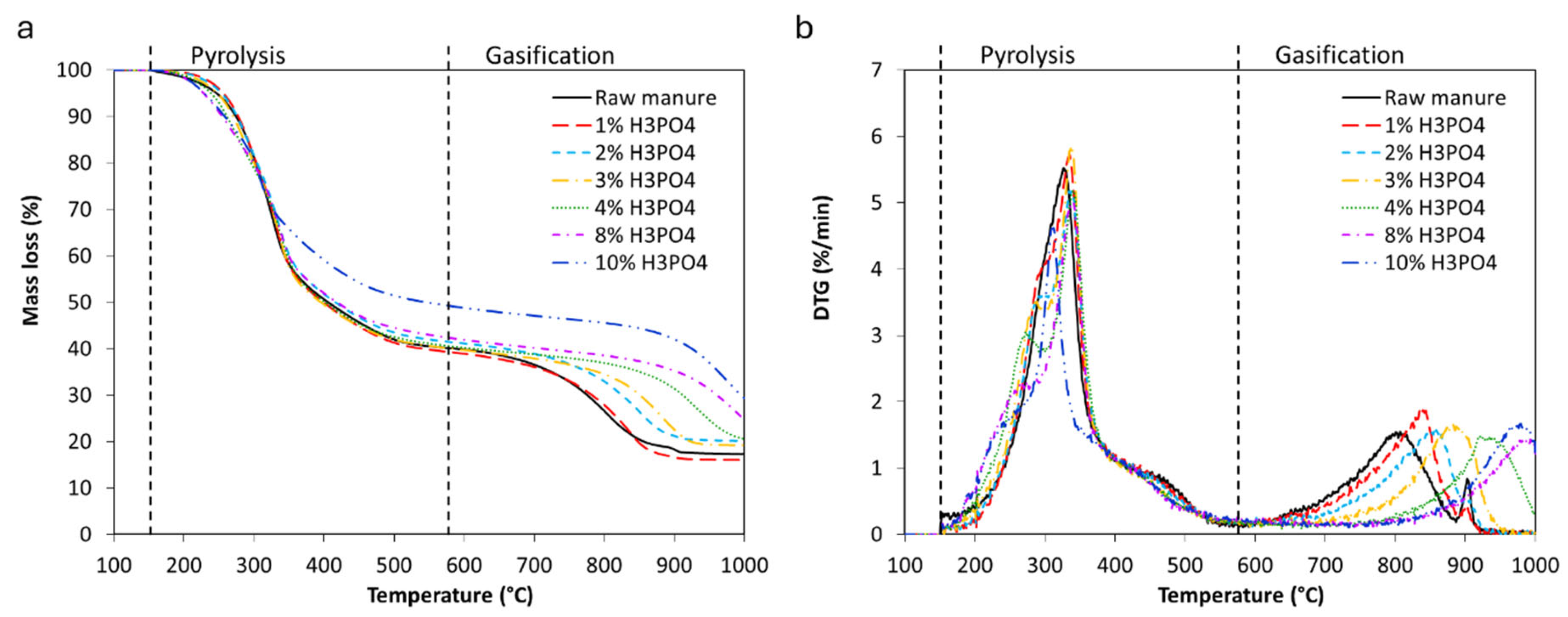
The thermal decomposition behavior of acid-treated manure under CO2 (Figure 2) differed from that of the fresh manure. For clarity, the data shown correspond to a single heating rate (10 °C/min), with data at additional heating rates provided in the Supplementary Information (Figure S1). An exponential smoothing algorithm was applied to each DTG curve to mitigate experimental measurement noise. With increasing acid concentration, both the peak temperature and the intensity of the DTG peak corresponding to hemicellulose decomposition (around 200–300 °C) decreased for the acid-pretreated manure. This trend indicates that acid pretreatment partially degrades hemicellulose. At higher acid concentrations (10 wt.%), the noticeable decrease in the hemicellulose decomposition peak confirmed its partial removal. Additionally, the peak decomposition temperature during the gasification stage increased from approximately 800 °C for the raw manure sample to 995 °C as the acid-pretreatment concentration increased. This upward shift indicates that higher acid loadings enhance the thermal stability of the produced char, thereby reducing its reactivity with CO2 during the Boudouard reaction. One explanation is that the acid pretreatment induces structural modification of the char; for example, cross-linking reactions on the char surface may stiffen the carbon matrix, limiting deformation of the carbonaceous structure and slowing gasification reactions due to increased mass transfer resistance [48]. Such structural alteration may inhibit CO2 diffusion to the char surfaces, reducing gasification reactivity. Further, as acid is a leaching agent for alkali and alkaline earth metals (AAEM), the pretreatment may redistribute to the AAEM species, thereby reducing their catalytic effects on gasification reactivity of the acid-pretreated manure [49]. Phosphoric acid also undergoes a series of thermal transformations during heating, contributing to the observed mass loss behavior [50]. Between 100 and 400 °C, it releases adsorbed water and undergoes dehydration reactions. From 400 to 700 °C, phosphates and polyphosphates such as P4O10 and P4O6 form, accompanied by the evolution of H2O and CO2. At higher temperatures (700–800 °C), these phosphate species act as strong oxidants and react with carbon, generating new pores and widening existing ones. This reaction produces PH3 along with CO2 and CO. At higher temperatures, phosphates volatilize.

3.4. Thermal Degradation of Base-Treated Manure Under CO2 Atmosphere

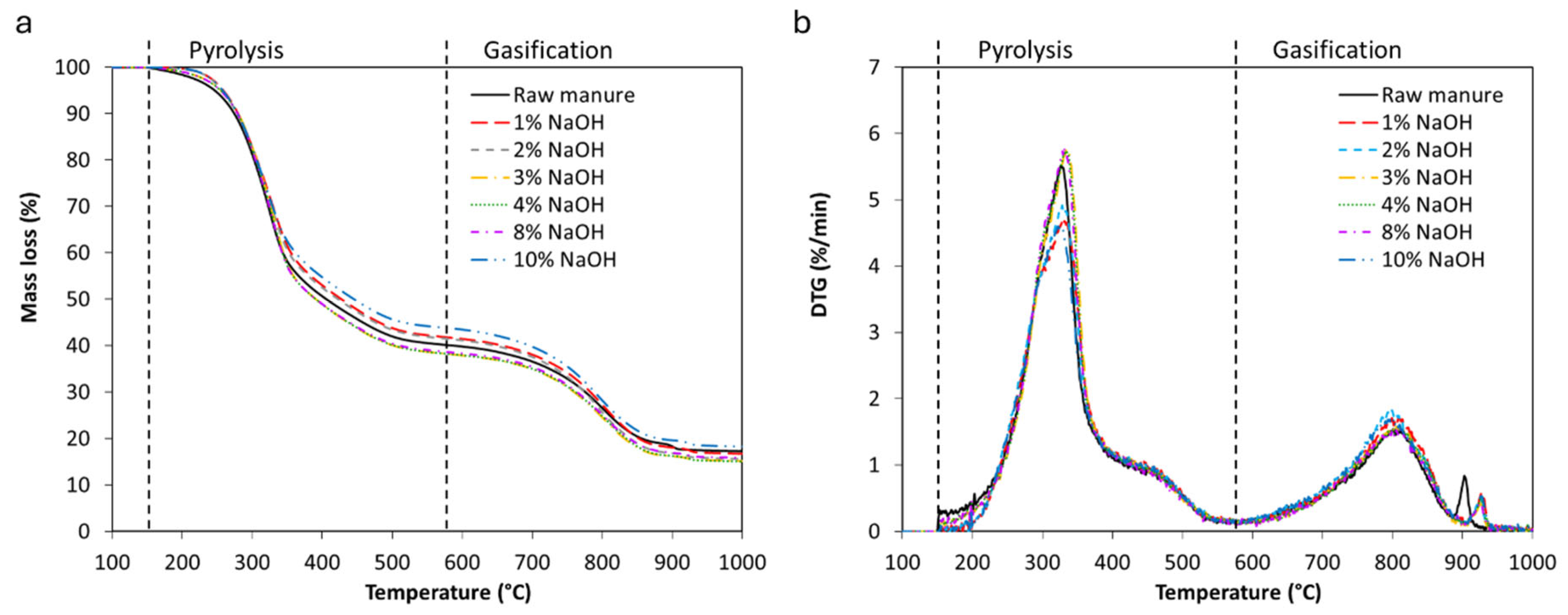
Figure 3 shows the weight loss profiles and DTG curves of base-treated manure at 10 °C/min, with data from additional heating rates (5, 10, 20 °C/min) provided in Supplementary Information Figure S2. Similar to the acid-treated manure, the base-treated manure demonstrated three decomposition stages under CO2: moisture evolution, oxidative degradation, and char gasification. The data are normalized to eliminate the moisture evolution stage before approximately 150 °C. The pyrolysis decomposition zone corresponding to hemicellulose and cellulose ranged from 165 °C to 360 °C, with the highest DTG peak observed around 330 °C. Unlike the acid-impregnated samples in which hemicellulose removal was observed with incremental increase in acid concentration, the base pretreatment had no noticeable effect on hemicellulose. Cellulose decomposition only slightly decreased at certain NaOH loadings, while remaining largely comparable to that of raw manure across other concentrations. Similarly, lignin pyrolysis observed between 400 and 500 °C was unaffected by base treatment. The gasification behavior between approximately 600 and 1000 °C was nearly identical for raw and base-treated samples, indicating that NaOH impregnation did not induce significant structural modification in the char, in contrast to the changes observed with acid pretreatment.

3.5. Solid Residue Yield of Acid- and Base-Treated Manure

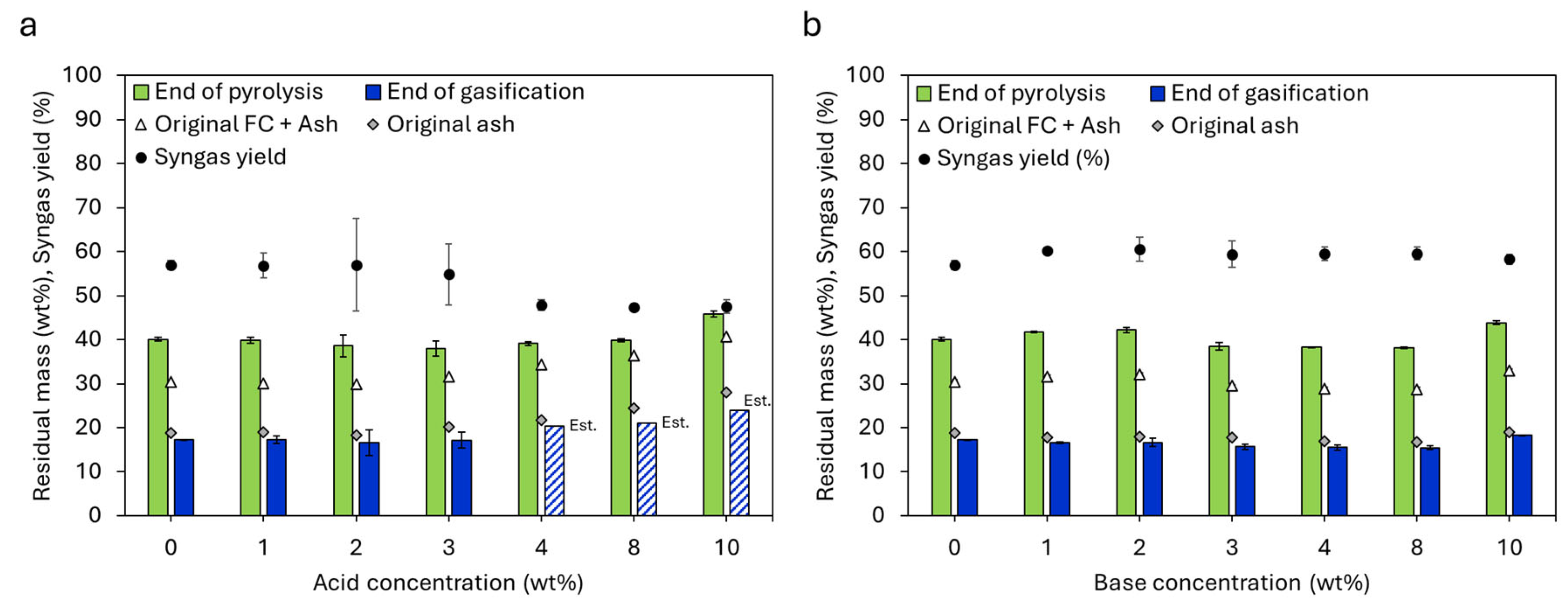
Figure 4 shows the residual mass yields of acid- and base-impregnated manures after pyrolysis and gasification, with final masses recorded at 1000 °C. For samples treated with 4, 8, and 10% acid, complete decomposition was not achieved within the heating cycle. In these cases, the final mass was estimated from the trajectory of the 5 °C/min mass loss profile, which extended further than the profiles obtained at 10 or 20 °C/min. The reported values are the means of residue yields obtained under different heating rates and reflect both organic and inorganic contributions. As the mass-loss contribution of the H3PO4 and NaOH added during pretreatment is unknown, the organic fraction of the final residue could not be estimated by subtracting the original ash content. For context, the initial ash content of each manure sample is also shown. The difference between the pyrolysis residue and the final gasification residue corresponds to the mass consumed during CO2 char gasification. When normalized by the pyrolysis residue (char yield), this value provides a proxy for syngas production during CO2 char gasification and is also reported in Figure 4.
Residue yields of acid-treated samples after pyrolysis were relatively consistent with those of the raw manure, ranging from 37 to 40 wt.%, except for the 10% acid-treated sample, which retained approximately 46 wt.%. For raw and low-acid-concentration samples (1–3%), pyrolysis residues were roughly 10% higher than the original fixed carbon + ash content, whereas at higher acid loadings this difference narrowed to about 5%, suggesting that stronger acid treatment promoted more complete decomposition, likely through enhanced hemicellulose removal. After gasification, raw manure and samples treated with low acid concentrations (1–3%) produced residue yields of about 17%, with slightly higher values at elevated acid loadings. All final residue yields were about 1–4% lower than the original ash content. As the original ash content was measured by combusting the samples under O2 at 600 °C, the lower final values may be attributed to additional mass loss occurring during CO2 gasification up to 1000 °C, possibly associated with mineral reactions at higher temperatures.
For the base-treated samples, pyrolysis residue yields ranged from about 38 to 44 wt.%, consistently about 10% higher than the original fixed carbon + ash content. After gasification, residue yields decreased to about 17–18 wt.% after gasification, and no systematic trend was observed with increasing NaOH loading. Similar to the acid-treated samples, the final residue yields were 1–2% lower than the original ash content, suggesting that CO2 gasification up to 1000 °C caused additional mineral-associated mass loss beyond what occurs during O2 combustion at 600 °C.
For acid-treated samples, the syngas yield was 56.9% for raw manure and remained nearly constant at low acid concentrations (1–3%), then decreased to 47.3–47.9% for samples treated with 4–10% acid. This trend aligns with the reduced char reactivity observed at higher acid loadings, especially at high acid loadings. Base-treated samples exhibited smaller variations, with syngas yields of ~58.3–60.6%, consistently higher than the raw manure value of 56.9%. Overall, base-treated samples produced higher syngas yields than acid-treated samples.

3.6. Pyrolysis/Gasification Kinetics

For the kinetic analysis, the TGA data was segregated into pyrolysis and gasification zones with approximate temperature boundaries for each region indicated by the vertical dashed lines in Figure 2 and Figure 3. For each sample and each heating rate, the precise transition temperature, marking the end of pyrolysis and the onset of gasification, was adjusted individually and defined as the temperature at which the mass loss rate reached a minimum.
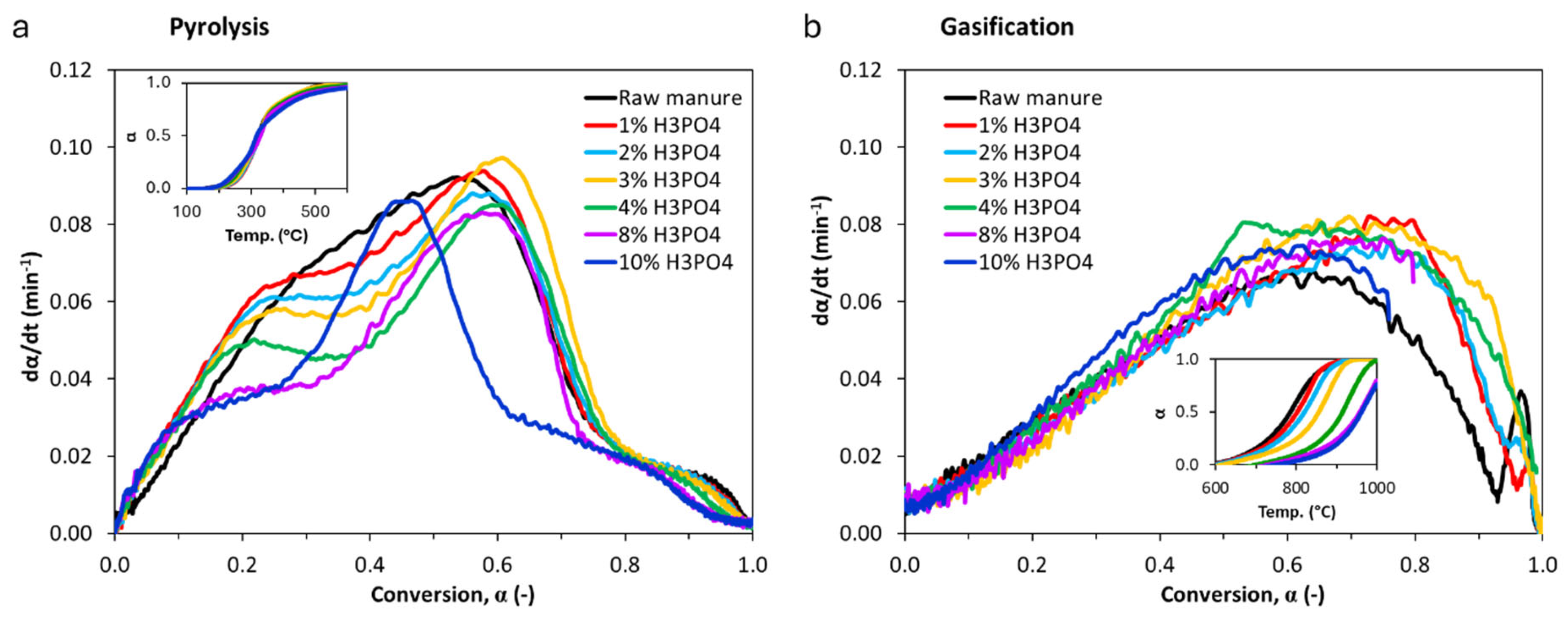
Treating pyrolysis and gasification separately, the corresponding conversion rates (dα/dt) as a function of conversion (α) are presented in Figure 5 for H3PO4-impregnated manure. Within the pyrolysis zone of acid-treated manure (Figure 5a), the hemicellulose peak conversion rate decreases progressively with increasing acid concentration, with the peak shifting to an earlier conversion from about 0.27 for raw manure to about 0.12 for acid-treated manure. At the same time, the cellulose decomposition peak shifts to a later conversion after acid impregnation (0.60 compared to 0.52 for raw manure). These shifts are consistent with the DTG trends, indicating simultaneous removal of hemicellulose and increased cellulose recalcitrance resulting from acid impregnation. The sample treated with 10 wt.% H3PO4 exhibits distinct behavior, with cellulose decomposition occurring at an earlier conversion (~0.45), suggesting that high acid loadings may alter cellulose structure or promote phosphorus-related reactions that modify its thermal response. As previously discussed, acid pretreatment may induce structural modifications in the evolving char, influencing both its decomposition pathway and reactivity. The char development of H3PO4-impregnated lignocellulosic biomass during pyrolysis is well studied, as H3PO4 is a common activating agent for producing activated carbons. The phosphate groups during thermal treatment reduce devolatilization and promote cross-linking of lignocellulosic biomass polymers. This enhances the carbon yield and surface area.
During char CO2 gasification (Figure 5b), the raw manure reached its peak conversion rate of approximately 0.065 min−1 at a conversion of approximately 0.6. Most acid-impregnated samples (except for the 10% H3PO4 treatment) exhibited higher peak rates (0.070–0.080 min−1) that occur later in the reaction, at conversions of 0.7–0.8. This shift toward higher conversions suggests that acid pretreatment alters the distribution and accessibility of reactive carbon sites, delaying the point at which char reaches its maximum gasification rate. The 10 wt.% H3PO4-treated sample exhibited a gasification conversion rate comparable to that of the raw manure, indicating that high acid loadings may introduce competing structural or chemical effects. Moderate acid concentrations promote dehydration, cross-linking, and condensation reactions, producing a more thermally stable and less reactive carbon matrix. This increases activation energy and shifts the gasification peak to higher conversions, compared to raw manure char. The acid-treated char is less reactive, but still capable of achieving elevated reaction rates once sufficient surface development occurs. At the highest acid concentration, increased phosphate formation and potential phosphorus–carbon interactions may stabilize the char to a degree that counteracts these effects, resulting in gasification behavior that more closely resembles the untreated material.
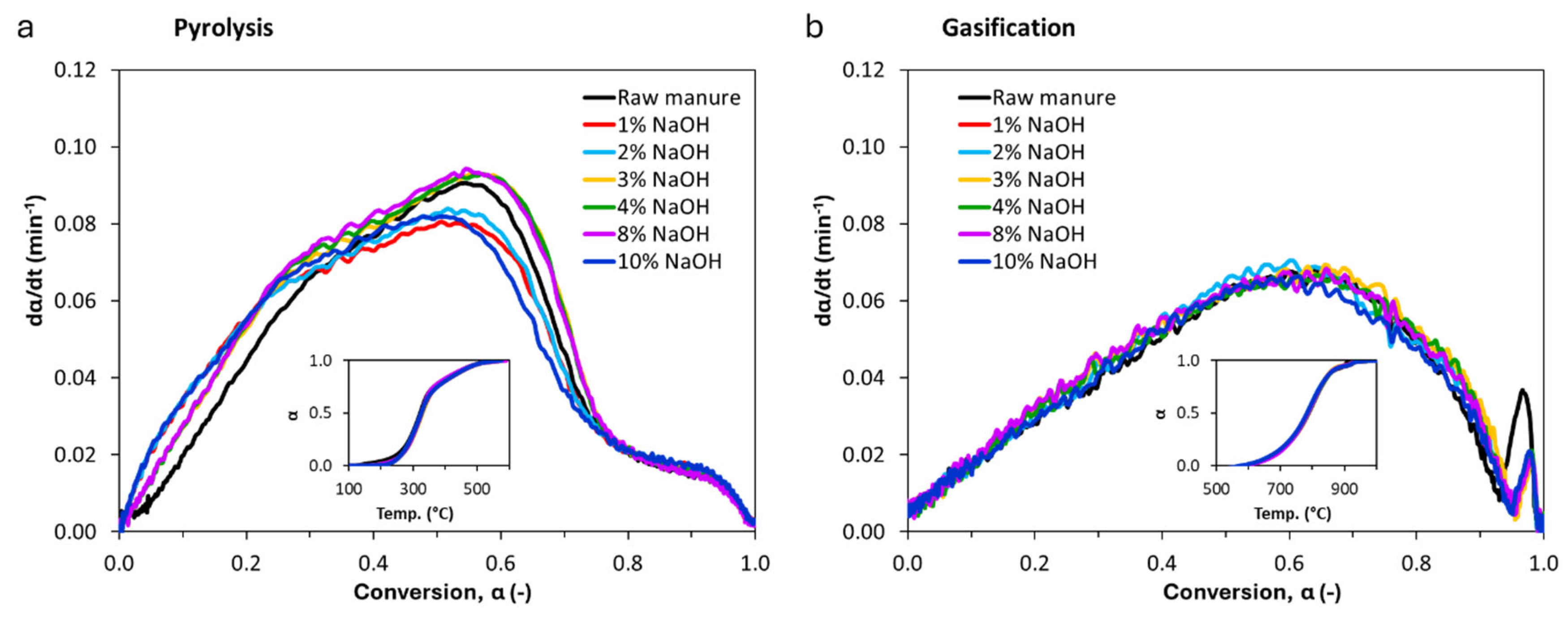
Figure 6 presents the corresponding conversion rates (dα/dt) for pyrolysis and gasification of NaOH-impregnated manure. During pyrolysis (Figure 6a), all base-treated samples exhibited higher initial conversion rates than the raw manure up to approximately 0.3 conversion. Beyond this point, the rates decreased, becoming similar to those of the raw manure for most samples, with some falling below the raw-manure baseline. During gasification (Figure 6b), the conversion rate profiles were relatively similar across all treatments, indicating little effect of the base-treatment on gasification reactivity. These observations align with findings reported by Li et al. (2024) [21], who noted that sodium enhances biomass thermal degradation at lower temperatures but inhibits thermal degradation at higher temperatures during pyrolysis.
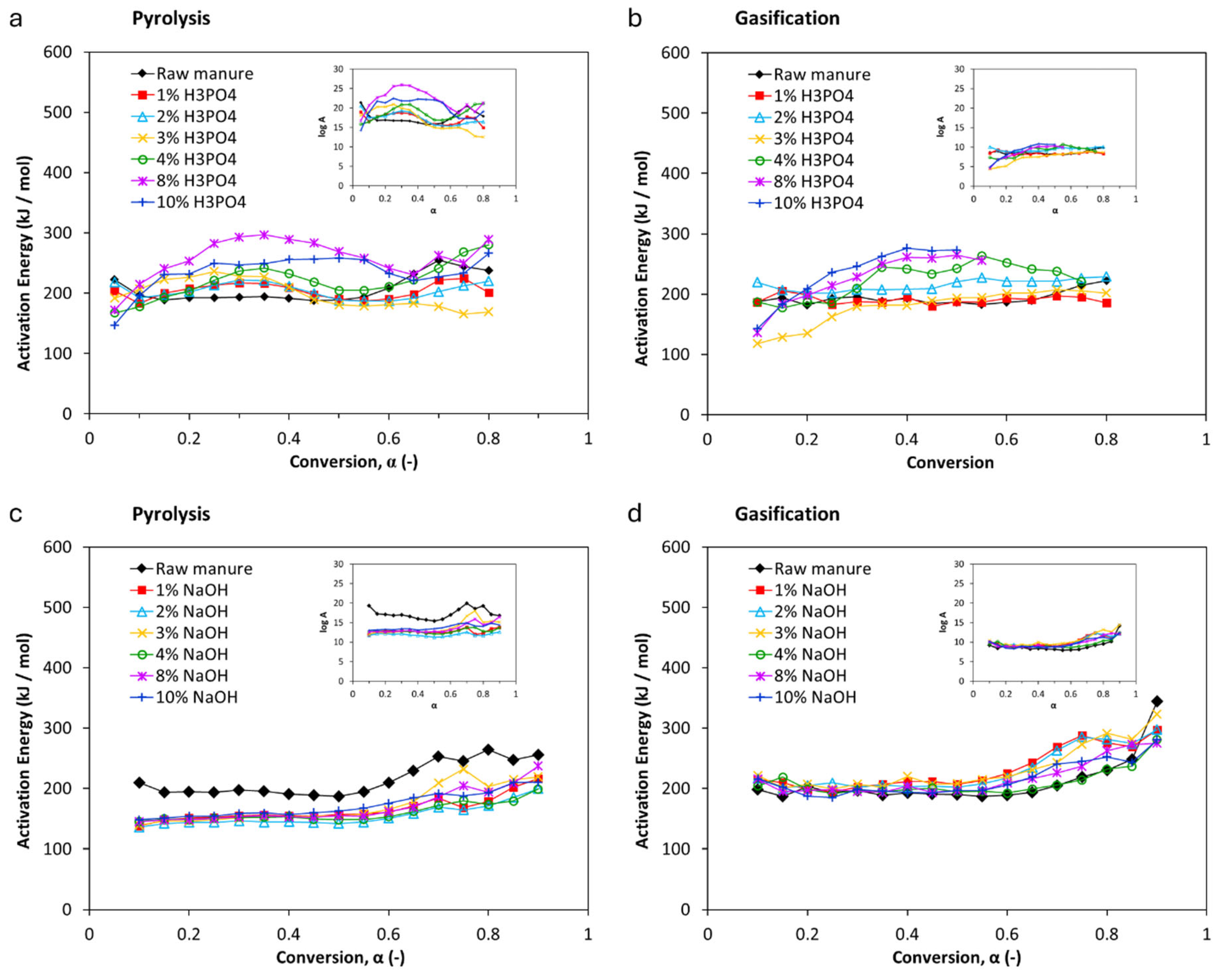
Figure 7 presents the variation in activation energy and the logarithm of the pre-exponential factor (log A) as a function of conversion for acid- and base-treated manures during pyrolysis and gasification. For dried cattle manure pyrolysis, activation energies were approximately 192 kJ/mol at low conversions (α ≈ 0.10–0.55) and increased to about 240–250 kJ/mol at higher conversions (α ≈ 0.7–0.8). These trends align with previously reported values for dried cattle manure, which ranged from 119 to 348 kJ/mol and generally rise with increasing conversion [48]. The mean activation energy calculated over α ≈ 0.1–0.8 for raw manure was 206.6 ± 22.5 kJ/mol, closely matching the value of 212.5 kJ/mol reported by [46]. Activation energies of raw manure during CO2 gasification were lower and showed less dependence on the degree of conversion compared to pyrolysis, with an average value of 193.6 ± 11.2 over α ≈ 0.1–0.8. This low and more uniform energy requirement indicates that gasification was the more energetically favorable process.
For the acid-impregnated samples (Figure 7a,b), both activation energy and log A generally increase during pyrolysis and gasification compared to their values for raw manure, consistent with reduced catalytic activity and increased structural rigidity. This trend indicates that acid-treated samples exhibit a more intricate reaction pathway and slower conversion kinetics. It is hypothesized that the mineral constituents within manure—particularly inorganic compounds such as silicates, phosphates, and metal oxides—impede the diffusion of heat and the release of volatile degradation products during pyrolysis and char gasification. These minerals may form thermally stable matrices or localized barriers within the char structure, thereby limiting mass and heat transfer and reducing conversion efficiency [30,50]. Such behavior reflects acid-induced structural changes in the feedstock, which can influence reactivity, devolatilization rates, and gas yield during thermal processing. For base-treated samples (Figure 7c,d), both activation energy and the pre-exponential factor are lower during pyrolysis, with a difference of about 50 kJ/mol and 5 units of log A, respectively, indicating that NaOH enhanced pyrolysis reactivity. However, during gasification, these parameters are slightly higher than those of the raw manure, especially at higher conversions (α ≈ 0.6–0.9), suggesting a modest reduction in gasification reactivity. This discrepancy may result from several factors: (i) structural changes in char during pyrolysis, such as increased aromaticity or condensed carbon networks that resist CO2 attack; (ii) pore blockage or reduced surface area caused by mineral migration and deposition; (iii) formation of stable mineral phases (e.g., carbonates or phosphates) that encapsulate reactive sites. Detailed characterization of the pyrolysis char is needed to clarify the underlying cause of this behavior.
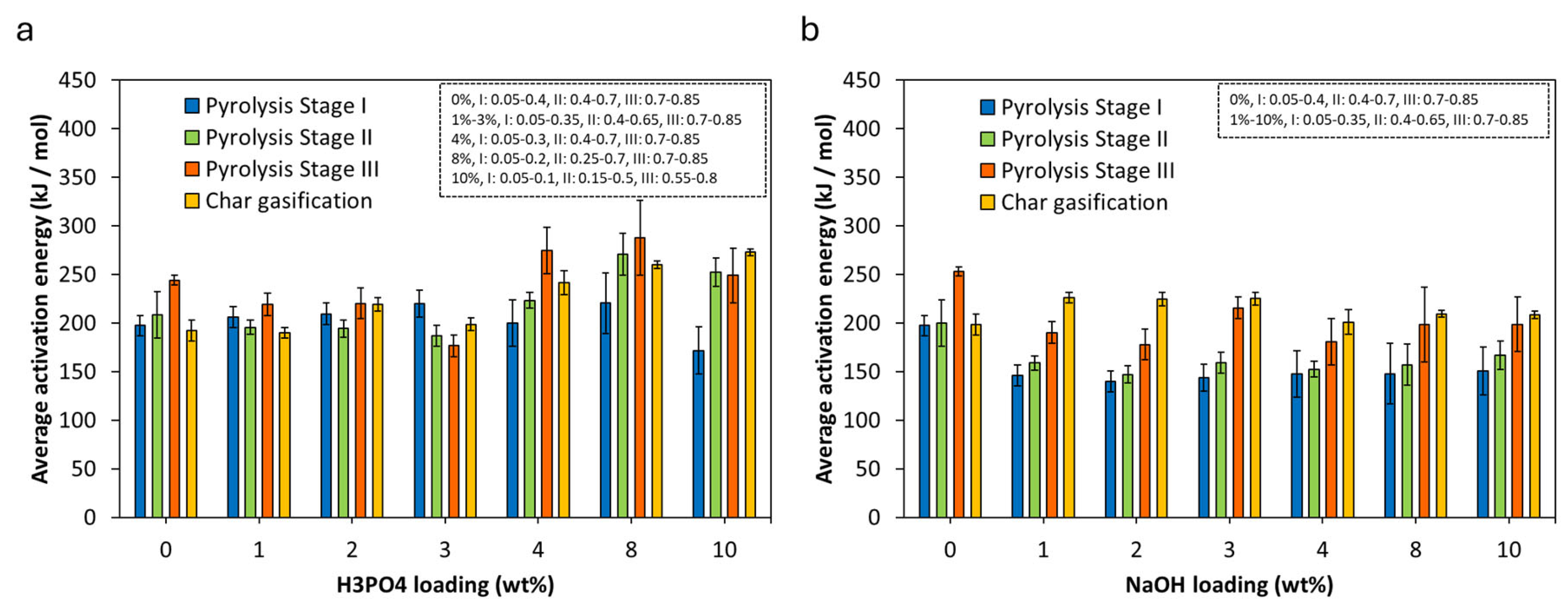
To summarize the pretreatment effects on reaction kinetics, the average activation energy during pyrolysis and gasification is presented in Figure 8. The pyrolysis decomposition zone of each sample can be roughly divided into three stages. Stage I is associated primarily with the decomposition of hemicellulose and extractives (α ≈ 0.05–0.3), Stage II corresponds to cellulose decomposition (α ≈ 0.35–0.65), and Stage III corresponds to the decomposition of lignin and mineral components (α ≈ 0.7–0.9). Although these decomposition processes overlap and do not exhibit sharp boundaries, evaluating the average activation energy within each stage provides valuable insight into how acid and base treatments alter thermal decomposition behavior. The precise conversion intervals used to define each stage varied slightly among samples and are noted in the figure. For gasification, the reported average activation energies correspond to the mean values over the conversion interval α = 0.2–0.8 for all samples.
For the acid-impregnated manures, samples treated with low acid concentrations exhibited average activation energies comparable to those of the raw manure. At higher acid loadings, substantial increases in activation energy were observed in pyrolysis Stages II and III as well as during gasification. These trends align with the expected structural modifications induced by acid treatment, which can promote the formation of a more rigid carbon matrix. Such stiffening increases the resistance of cellulose (Stage II) and lignin (Stage III) to thermal decomposition. The elevated gasification activation energies may also reflect hindered CO2 diffusion into the char structure, potentially caused by the accumulation of phosphate/polyphosphate species within the pores and/or the migration of inherent mineral species to the char surface.
In contrast, base-impregnated manures had lower average activation energies than raw manure across all three pyrolysis stages, indicating enhanced thermal reactivity of the devolatilization components. Despite this, their gasification activation energies were higher, suggesting that while base treatment facilitates pyrolysis, it may simultaneously produce char structures that are less accessible or less reactive toward CO2 during gasification. This decreased char reactivity stems from the complex mineral matrix of manure, where interactions among Ca, Mg, K, and P can mask or counteract the catalytic influence of sodium.

4. Conclusions

The thermal behavior of raw and acid- or base-pretreated dairy manure was systematically evaluated under CO2 pyrolysis and gasification conditions. The TGA and DTG profiles demonstrated that acid and alkali treatments modify manure reactivity in distinct ways. Acid impregnation suppressed hemicellulose decomposition and shifted the CO2-gasification peak to much higher temperatures, showing that increasing acid loading produces a more thermally stable, less CO2-reactive char. This reduced reactivity reflects acid-induced crosslinking, AAEM redistribution, and phosphate-driven transformations that collectively limit CO2 access and slow the Boudouard reaction. Base pretreatment exerted only minor effects on decomposition behavior, with slight shifts in cellulose degradation and no clear trend in CO2 gasification reactivity. Residual mass results showed only modest effects of chemical pretreatment: acid-treated samples produced slightly higher residues at elevated loadings, while base-treated samples showed no clear trend.
Kinetic parameters obtained via the Friedman method further clarified these effects. Raw dairy manure exhibited activation energies of 206.6 kJ/mol during pyrolysis and 193.6 kJ/mol during CO2 gasification. Acid pretreatment increased activation energies during both the pyrolysis and gasification stages, consistent with the formation of more stable char structures that resist CO2 diffusion, thereby reducing gasification reactivity. In contrast, base pretreatment lowered activation energies during pyrolysis, indicating Na-assisted thermal decomposition, but raised activation energies slightly during gasification, suggesting the resulting chars were less reactive toward CO2.
By examining thermal decomposition behavior and deriving kinetic parameters for chemically pretreated manure, the study provides valuable insight into how chemical pretreatment governs char development and subsequent carbon-CO2 kinetics. These findings are particularly relevant to manure-derived feedstocks, where high ash content can hinder handling, conversion efficiency, and reactor performance. Additional characterization of char properties, such as surface area, porosity, and morphology, is recommended to provide a deeper understanding of how mineral–carbon interactions evolve during carbonization and how these structural changes govern CO2 gasification reactivity. Overall, the results demonstrate that chemical pretreatment offers a viable means of tuning manure conversion behavior, establishing a foundation for optimizing pretreatment strategies and reactor conditions in CO2-based pyrolysis and gasification systems.

Supplementary Materials

The following supporting information can be downloaded at: https://www.mdpi.com/article/10.3390/en19051293/s1, Figure S1: Thermal degradation profiles of acid-pretreated manure under CO2 at different heating rates: (a) 1 wt.% acid; (b) 2 wt.% acid; (c) 3 wt.% acid; (d) 4 wt.% acid; (e) 8 wt.% acid; (f) 10 wt.% acid; Figure S2: Thermal degradation profiles of base-pretreated manure under CO2 at different heating rates: (a) 1 wt.% NaOH; (b) 2 wt.% NaOH; (c) 3 wt.% NaOH; (d) 4 wt.% NaOH; (e) 8 wt.% NaOH; (f) 10 wt.% NaOH.

Author Contributions

Conceptualization, K.M., C.E., B.K.S., C.A.M. and M.G.-P.; methodology, K.M. and C.E.; software, K.M. and C.E.; validation, K.M. and C.E.; formal analysis, K.M. and C.E.; investigation, C.E.; writing—original draft, K.M. and C.E.; writing—review and editing, B.K.S., M.I.S., C.A.M. and M.G.-P.; supervision, B.K.S., M.I.S., C.A.M. and M.G.-P.; funding acquisition, B.K.S., M.I.S. and C.A.M. All authors have read and agreed to the published version of the manuscript.

Funding

This research received no external funding.

Data Availability Statement

The original contributions presented in this study are included in the article; further inquiries can be directed to the corresponding author.

Acknowledgments

This research work is funded by the United States Department of Agriculture-Agriculture Research Service (USDA-ARS). This research was supported in part by an appointment to the Agricultural Research Service (ARS) Research Participation Program administered by the Oak Ridge Institute for Science and Education (ORISE) through an interagency agreement between the U.S. Department of Energy (DOE) and the U.S. Department of Agriculture (USDA). ORISE is managed by ORAU under DOE contract number DE-AC05-06OR23100. All opinions expressed in this paper are the authors’ and do not necessarily reflect the policies and views of USDA, ARS, DOE, or ORAU/ORISE.

Conflicts of Interest

The authors declare that they have no known competing financial interests or personal relationships that could have appeared to influence the work reported in this paper.

References

  1. Mainali, K.; Sarker, M.I.; Mullen, C.A.; Sharma, B.K.; Yadav, M.P.; Ngo, H.; Garcia-Perez, M. Thermal decomposition kinetics of dairy manure hydrochars. J. Energy Inst. 2025, 120, 102088. [Google Scholar] [CrossRef] [Scilit]
  2. Posmanik, R.; Martinez, C.M.; Cantero-Tubilla, B.; Cantero, D.; Sills, D.; Cocero, M.J.; Tester, J.W. Acid and alkali catalyzed hydrothermal liquefaction of dairy manure digestate and food waste. ACS Sustain. Chem. Eng. 2018, 6, 2724–2732. [Google Scholar] [CrossRef] [Scilit]
  3. Gerba, C.P.; Smith, J.E. Sources of pathogenic microorganisms and their fate during land application of wastes. J. Environ. Qual. 2005, 34, 42–48. [Google Scholar] [CrossRef] [Scilit] [PubMed]
  4. Kucharska, K.; Rybarczyk, P.; Hołowacz, I.; Łukajtis, R.; Glinka, M.; Kamiński, M. Pretreatment of lignocellulosic materials as substrates for fermentation processes. Molecules 2018, 23, 2937. [Google Scholar] [CrossRef] [Scilit]
  5. Mainali, K.; Mood, S.H.; Pelaez-Samaniego, M.R.; Sierra-Jimenez, V.; Garcia-Perez, M. Production and Applications of N-Doped Carbons from Bioresources: A Review. Catal. Today 2023, 423, 114248. [Google Scholar] [CrossRef] [Scilit]
  6. Cantrell, K.; Ro, K.; Mahajan, D.; Anjom, M.; Hunt, P.G. Role of thermochemical conversion in livestock waste-to-energy treatments: Obstacles and opportunities. Ind. Eng. Chem. Res. 2007, 46, 8918–8927. [Google Scholar] [CrossRef] [Scilit]
  7. Szogi, A.A.; Vanotti, M.B.; Ro, K.S. Methods for treatment of animal manures to reduce nutrient pollution prior to soil application. Curr. Pollut. Rep. 2015, 1, 47–56. [Google Scholar] [CrossRef] [Scilit]
  8. Mainali, K.; Mullen, C.A.; Sarker, M.I.; Mood, S.H.; Garcia-Perez, M. Production of N–Mg doped biochars for phosphate adsorption from renewable sources. Biomass Bioenergy 2024, 185, 107221. [Google Scholar] [CrossRef] [Scilit]
  9. Font-Palma, C. Methods for the treatment of cattle manure—A review. C J. Carbon Res. 2019, 5, 27. [Google Scholar] [CrossRef] [Scilit]
  10. Nasir, I.M.; Ghazi, T.I.M. Pretreatment of lignocellulosic biomass from animal manure as a means of enhancing biogas production. Eng. Life Sci. 2015, 15, 733–742. [Google Scholar] [CrossRef] [Scilit]
  11. Patinvoh, R.J.; Osadolor, O.A.; Chandolias, K.; Horváth, I.S.; Taherzadeh, M.J. Innovative pretreatment strategies for biogas production. Bioresour. Technol. 2017, 224, 13–24. [Google Scholar] [CrossRef] [Scilit] [PubMed]
  12. Kumar, A.; Jones, D.D.; Hanna, M.A. Thermochemical biomass gasification: A review of the current status of the technology. Energies 2009, 2, 556–581. [Google Scholar] [CrossRef] [Scilit]
  13. Lahijani, P.; Zainal, Z.A.; Mohammadi, M.; Mohamed, A.R. Conversion of the greenhouse gas CO2 to the fuel gas CO via the Boudouard reaction: A review. Renew. Sustain. Energy Rev. 2015, 41, 615–632. [Google Scholar] [CrossRef] [Scilit]
  14. Fernandez-Lopez, M.; López-González, D.; Puig-Gamero, M.; Valverde, J.; Sanchez-Silva, L. CO2 gasification of dairy and swine manure: A life cycle assessment approach. Renew. Energy 2016, 95, 552–560. [Google Scholar] [CrossRef] [Scilit]
  15. Thanapal, S.S.; Annamalai, K.; Sweeten, J.M.; Gordillo, G. Fixed bed gasification of dairy biomass with enriched air mixture. Appl. Energy 2012, 97, 525–531. [Google Scholar] [CrossRef] [Scilit]
  16. Wu, H.; Milford, A.H.; Jones, D.D. Fluidized-bed gasification of dairy manure by Box–Behnken design. Waste Manag. Res. 2012, 30, 506–511. [Google Scholar] [CrossRef] [Scilit]
  17. Garcìa-Pèrez, M.; Chaala, A.; Yang, J.; Roy, C. Co-pyrolysis of sugarcane bagasse with petroleum residue. Part I: Thermogravimetric analysis. Fuel 2001, 80, 1245–1258. [Google Scholar] [CrossRef] [Scilit]
  18. Qian, Q.; Machida, M.; Tatsumoto, H. Preparation of activated carbons from cattle-manure compost by zinc chloride activation. Bioresour. Technol. 2007, 98, 353–360. [Google Scholar] [CrossRef] [Scilit]
  19. Zhao, L.; Cao, X.; Zheng, W.; Kan, Y. Phosphorus-assisted biomass thermal conversion: Reducing carbon loss and improving biochar stability. PLoS ONE 2014, 9, e115373. [Google Scholar] [CrossRef] [Scilit]
  20. Zięzio, M.; Charmas, B.; Jedynak, K.; Hawryluk, M.; Kucio, K. Preparation and characterization of activated carbons obtained from the waste materials impregnated with phosphoric acid(V). Appl. Nanosci. 2020, 10, 4703–4716. [Google Scholar] [CrossRef] [Scilit]
  21. Li, J.; Ye, X.; Burra, K.G.; Wang, Z.; Liu, X.; Gupta, A.K. Effects of Na-salt solutions on the biomass pyrolysis and CO2-assisted gasification behavior. J. Energy Inst. 2024, 116, 101734. [Google Scholar] [CrossRef] [Scilit]
  22. Guo, D.-L.; Wu, S.-B.; Liu, B.; Yin, X.-L.; Yang, Q. Catalytic effects of NaOH and Na2CO3 additives on alkali lignin pyrolysis and gasification. Appl. Energy 2012, 95, 22–30. [Google Scholar] [CrossRef] [Scilit]
  23. Santana, J.A.; Sousa, N.G.; Cardoso, C.R.; Carvalho, W.S.; Ataíde, C.H. Sodium, zinc and magnesium chlorides as additives for soybean hulls pyrolysis. J. Therm. Anal. Calorim. 2016, 125, 471–481. [Google Scholar] [CrossRef] [Scilit]
  24. Mainali, K.; Garcia-Perez, M. Effect of H3PO4 and NaOH additives on the Co-carbonization of cellulose and N-containing compounds to produce N-doped chars. J. Anal. Appl. Pyrolysis 2023, 169, 105837. [Google Scholar] [CrossRef] [Scilit]
  25. Mainali, K.; Sarker, M.I.; Sharma, B.K.; Hoque, M.M.U.; Han, Y.; Mullen, C.A.; Garcia-Perez, M. Thermal treatment and densification of manure and biomass blends to produce stabilized soil amendments. J. Environ. Manag. 2025, 373, 123594. [Google Scholar] [CrossRef] [Scilit] [PubMed]
  26. Ellison, C.; Garcia-Perez, M.; Mullen, C.A.; Yadav, M.P. Thermochemical behavior of alkali pretreated biomass–a thermogravimetric and Py-GC/FID study. Sustain. Energy Fuels 2023, 7, 3306–3315. [Google Scholar] [CrossRef] [Scilit]
  27. Friedman, H.L. Kinetics of thermal degradation of char-forming plastics from thermogravimetry. Application to a phenolic plastic. J. Polym. Sci. Part C Polym. Symp. 1964, 6, 183–195. [Google Scholar] [CrossRef] [Scilit]
  28. Dhyani, V.; Awasthi, M.K.; Wang, Q.; Kumar, J.; Ren, X.; Zhao, J.; Chen, H.; Wang, M.; Bhaskar, T.; Zhang, Z. Effect of composting on the thermal decomposition behavior and kinetic parameters of pig manure-derived solid waste. Bioresour. Technol. 2018, 252, 59–65. [Google Scholar] [CrossRef] [Scilit]
  29. El-Sayed, S.A.; Mostafa, M.E. Thermal pyrolysis and kinetic parameter determination of mango leaves using common and new proposed parallel kinetic models. RSC Adv. 2020, 10, 18160–18179. [Google Scholar] [CrossRef] [Scilit]
  30. Yuan, X.; He, T.; Cao, H.; Yuan, Q. Cattle manure pyrolysis process: Kinetic and thermodynamic analysis with isoconversional methods. Renew. Energy 2017, 107, 489–496. [Google Scholar] [CrossRef] [Scilit]
  31. Aprianti, N.; Faizal, M.; Said, M.; Nasir, S.; Fudholi, A. Gasification kinetic and thermodynamic parameters of fine coal using thermogravimetric analysis. Energy 2023, 268, 126666. [Google Scholar] [CrossRef] [Scilit]
  32. Cai, J.; Xu, D.; Dong, Z.; Yu, X.; Yang, Y.; Banks, S.W.; Bridgwater, A.V. Processing thermogravimetric analysis data for isoconversional kinetic analysis of lignocellulosic biomass pyrolysis: Case study of corn stalk. Renew. Sustain. Energy Rev. 2018, 82, 2705–2715. [Google Scholar] [CrossRef] [Scilit]
  33. Yan, J.; Jiao, H.; Li, Z.; Lei, Z.; Wang, Z.; Ren, S.; Shui, H.; Kang, S.; Yan, H.; Pan, C. Kinetic analysis and modeling of coal pyrolysis with model-free methods. Fuel 2019, 241, 382–391. [Google Scholar] [CrossRef] [Scilit]
  34. Font-Palma, C. Characterisation, kinetics and modelling of gasification of poultry manure and litter: An overview. Energy Convers. Manag. 2012, 53, 92–98. [Google Scholar] [CrossRef] [Scilit]
  35. Fajobi, M.O.; Lasode, O.A.; Adeleke, A.A.; Ikubanni, P.P.; Balogun, A.O. Investigation of physicochemical characteristics of selected lignocellulose biomass. Sci. Rep. 2022, 12, 2918. [Google Scholar] [CrossRef] [Scilit]
  36. Kumar, A.; Wang, L.; Dzenis, Y.A.; Jones, D.D.; Hanna, M.A. Thermogravimetric characterization of corn stover as gasification and pyrolysis feedstock. Biomass Bioenergy 2008, 32, 460–467. [Google Scholar] [CrossRef] [Scilit]
  37. Legarra, M.; Morgan, T.J.; Turn, S.Q.; Wang, L.; Skreiberg, Ø.; Antal, M.J., Jr. Effect of processing conditions on the constant-volume carbonization of biomass. Energy Fuels 2019, 33, 2219–2235. [Google Scholar] [CrossRef] [Scilit]
  38. Larney, F.J.; Olson, A.F.; DeMaere, P.R.; Handerek, B.P.; Tovell, B.C. Nutrient and trace element changes during manure composting at four southern Alberta feedlots. Can. J. Soil Sci. 2008, 88, 45–59. [Google Scholar] [CrossRef] [Scilit]
  39. Chen, S.; Meng, A.; Long, Y.; Zhou, H.; Li, Q.; Zhang, Y. TGA pyrolysis and gasification of combustible municipal solid waste. J. Energy Inst. 2015, 88, 332–343. [Google Scholar] [CrossRef] [Scilit]
  40. Yang, Y.; Zhou, T.; Cheng, M.; Xie, M.; Shi, N.; Liu, T.; Huang, Z.; Zhao, Y.; Huang, Q.; Liu, Z.; et al. Recent advances in organic waste pyrolysis and gasification in a CO2 environment to value-added products. J. Environ. Manag. 2024, 356, 120666. [Google Scholar] [CrossRef] [Scilit]
  41. Das, K.C.; Garcia-Perez, M.; Bibens, B.; Melear, N. Slow pyrolysis of poultry litter and pine woody biomass: Impact of chars and bio-oils on microbial growth. J. Environ. Sci. Health Part A 2008, 43, 714–724. [Google Scholar] [CrossRef] [Scilit] [PubMed]
  42. Flores, J.J.A.; Quiñones, J.G.R.; Rodríguez, M.L.Á.; Vera, J.V.A.; Valencia, J.E.; Martínez, S.J.G.; Montesino, F.M.; Rosas, A.A. Thermal degradation kinetics and FT-IR analysis on the pyrolysis of pinus pseudostrobus, pinus leiophylla and pinus montezumae as forest waste in western Mexico. Energies 2020, 13, 969. [Google Scholar] [CrossRef] [Scilit]
  43. Carrier, M.; Loppinet-Serani, A.; Denux, D.; Lasnier, J.-M.; Ham-Pichavant, F.; Cansell, F.; Aymonier, C. Thermogravimetric analysis as a new method to determine the lignocellulosic composition of biomass. Biomass Bioenergy 2011, 35, 298–307. [Google Scholar] [CrossRef] [Scilit]
  44. El Moustaqim, M.; El Kaihal, A.; El Marouani, M.; Men-La-Yakhaf, S.; Taibi, M.; Sebbahi, S.; El Hajjaji, S.; Kifani-Sahban, F. Thermal and thermomechanical analyses of lignin. Sustain. Chem. Pharm. 2018, 9, 63–68. [Google Scholar] [CrossRef] [Scilit]
  45. Waters, C.L.; Janupala, R.R.; Mallinson, R.G.; Lobban, L.L. Staged thermal fractionation for segregation of lignin and cellulose pyrolysis products: An experimental study of residence time and temperature effects. J. Anal. Appl. Pyrolysis 2017, 126, 380–389. [Google Scholar] [CrossRef] [Scilit]
  46. Otero, M.; Lobato, A.; Cuetos, M.; Sánchez, M.; Gómez, X. Digestion of cattle manure: Thermogravimetric kinetic analysis for the evaluation of organic matter conversion. Bioresour. Technol. 2011, 102, 3404–3410. [Google Scholar] [CrossRef] [Scilit]
  47. Karunadasa, K.S.; Manoratne, C.; Pitawala, H.; Rajapakse, R. Thermal decomposition of calcium carbonate (calcite polymorph) as examined by in-situ high-temperature X-ray powder diffraction. J. Phys. Chem. Solids 2019, 134, 21–28. [Google Scholar] [CrossRef] [Scilit]
  48. Asadullah, M.; Zhang, S.; Min, Z.; Yimsiri, P.; Li, C.-Z. Effects of biomass char structure on its gasification reactivity. Bioresour. Technol. 2010, 101, 7935–7943. [Google Scholar] [CrossRef] [Scilit]
  49. Li, J.; Burra, K.G.; Wang, Z.; Liu, X.; Gupta, A.K. Acid and alkali pretreatment effects on CO2-assisted gasification of pinewood. J. Energy Resour. Technol. 2022, 144, 022306. [Google Scholar] [CrossRef] [Scilit]
  50. Qi, H.; Li, F.; Wang, S.; Sui, M.; Lu, F. Pyrolysis and co-pyrolysis of cattle manure, rape straw, and their blend: Physicochemical characterization, kinetic triplets, reaction mechanism, and thermodynamic analysis. Energy 2024, 292, 130520. [Google Scholar] [CrossRef] [Scilit]
Figure 1. Thermal degradation profiles of fresh dairy manure under CO2 at different heating rates.
Energies 19 01293 g001
Figure 2. (a) Mass loss and (b) mass loss rate (DTG) as a function of temperature for acid-impregnated manure samples under CO2 at 10 °C/min.
Energies 19 01293 g002
Figure 3. (a) Mass loss and (b) mass loss rate (DTG) as a function of temperature for base impregnated manure samples under CO2 at 10 °C/min.
Energies 19 01293 g003
Figure 4. Mean solid residue yield after pyrolysis and CO2 gasification, along with syngas yields, for (a) acid-treated and (b) base-treated manure. Gasification residue values for 4, 8, and 10 wt.% acid-impregnated samples are estimated. Original fixed carbon and ash (FC + ash) and original ash are indicated for reference.
Energies 19 01293 g004
Figure 5. Conversion rate (dα/dt) as a function of conversion (α) for dry manure and acid-impregnated manure during (a) pyrolysis and (b) gasification. Insets show the corresponding conversion vs. temperature profiles.
Energies 19 01293 g005
Figure 6. Conversion rate (dα/dt) as a function of conversion (α) for dry manure and base-impregnated manure during (a) pyrolysis and (b) gasification. Insets show the corresponding conversion vs. temperature profiles.
Energies 19 01293 g006
Figure 7. Activation energy and log A (inset) vs. conversion of (a,b) acid-treated and (c,d) base-treated samples during pyrolysis and gasification, respectively.
Energies 19 01293 g007
Figure 8. Average activation energy of pyrolysis stages I, II, and III and gasification of (a) acid-treated and (b) base-treated manure. The conversion ranges defining each stage are indicated.
Energies 19 01293 g008
Table 1. Ultimate analysis of dairy manure (wt.%, dry basis).
CHNSOAsh
Dairy manure41.3 ± 0.26.0 ± 0.12.5 ± 0.30.2 ± 0.131.4 ± 1.218.8 ± 0.4
Table 2. Ultimate analysis of acid-impregnated manure (wt.%, dry basis).
PretreatmentCHNOAsh
1% acid41.3 ± 0.35.9 ± 022.7 ± 0.231.1 ± 0.319.0 ± 0.3
2% acid41.1 ± 0.25.9 ± 0.12.7 ± 0.132.1 ± 0.418.3 ± 0.2
3% acid40.5 ± 0.15.8 ± 0.12.6 ± 0.131.0 ± 1.220.1 ± 0.1
4% acid40.5 ± 0.25.7 ± 0.22.7 ± 0.329.5 ± 1.021.7 ± 0.2
8% acid39.0 ± 0.15.6 ± 0.32.6 ± 0.128.4 ± 0.624.4 ± 0.3
10% acid38.0 ± 0.25.3 ± 0.22.6 ± 0.126.2 ± 0.728.0 ± 0.2
Table 3. Ultimate analysis of base-impregnated manure (wt.%, dry basis).
PretreatmentCHNOAsh
1% base41.8 ± 0.25.7 ± 0.12.5 ± 0.332.3 ± 0.417.7 ± 0.3
2% base41.4 ± 0.15.6 ± 0.22.5 ± 0.232.5 ± 0.518.0 ± 0.2
3% base41.7 ± 0.36.0 ± 0.22.5 ± 0.132.0 ± 0.617.8 ± 0.1
4% base42.0 ± 0.26.1 ± 0.32.4 ± 0.232.5 ± 0.417.0 ± 0.2
8% base41.8 ± 0.36.0 ± 0.22.6 ± 0.132.8 ± 0.316.8 ± 0.3
10% base41.4 ± 0.35.6 ± 0.12.5 ± 0.331.5 ± 0.619.0 ± 0.1
Table 4. Proximate analysis of acid-pretreated manure in wt.% dry basis (MC: moisture content, VM: volatile matter, FC: fixed carbon).
NameMCVMFCAsh
Dairy Manure5.1 ± 0.171.0 ± 0.211.7 ± 0.318.8 ± 0.4
1% Acid4.7 ± 0.069.9 ± 0.111.1 ± 0.219.0 ± 0.2
2% Acid5.0 ± 0.270.0 ± 0.211.7 ± 0.118.3 ± 0.3
3% Acid3.9 ± 0.168.3 ± 0.111.6 ± 0.220.1 ± 0.2
4% Acid3.5 ± 0.165.7 ± 0.212.7 ± 0.321.7 ± 0.1
8% Acid2.5 ± 0.063.5 ± 0.112.1 ± 0.224.4 ± 0.2
10% Acid2.1 ± 0.159.4 ± 0.212.7 ± 0.128.0 ± 0.3
Table 5. Proximate analysis of base-pretreated manure in wt.% dry basis (MC: moisture content, VM: volatile matter, FC: fixed carbon).
NameMCVMFCAsh
1% NaOH1.6 ± 0.368.4 ± 0.214.0 ± 0.117.7 ± 0.2
2% NaOH2.4 ± 0.168.0 ± 0.214.1 ± 0.118.0 ± 0.3
3% NaOH3.3 ± 0.470.6 ± 0.311.7 ± 0.217.8 ± 0.2
4% NaOH3.8 ± 0.271.1 ± 0.211.9 ± 0.217.0 ± 0.3
8% NaOH3.4 ± 0.371.2 ± 0.312.0 ± 0.316.8 ± 0.2
10% NaOH1.7 ± 0.467.0 ± 0.414.0 ± 0.219.0 ± 0.3
Disclaimer/Publisher’s Note: The statements, opinions and data contained in all publications are solely those of the individual author(s) and contributor(s) and not of MDPI and/or the editor(s). MDPI and/or the editor(s) disclaim responsibility for any injury to people or property resulting from any ideas, methods, instructions or products referred to in the content.