Review

Applications of Methods of Solving Inverse Heat Conduction Problems for Energy-Intensive Industrial Processes and Energy Conversion—Current State of the Art and Recent Challenges


by
Magda Joachimiak
* and
Damian Joachimiak
Faculty of Environmental Engineering and Energy, Institute of Thermal Energy, Poznan University of Technology, 60-965 Poznań, Poland
*
Author to whom correspondence should be addressed.
Energies 2026, 19(5), 1291; https://doi.org/10.3390/en19051291
Submission received: 26 January 2026 / Revised: 23 February 2026 / Accepted: 25 February 2026 / Published: 4 March 2026

Abstract

This paper presents methods and applications of inverse heat conduction problems (IHCPs) that are ill-posed in the Hadamard sense. The IHCP solution allows for the determination of boundary conditions in the form of heat flux or temperature in places where measurement is impossible or difficult to perform. The applications of IHCP solutions to energy-intensive industrial processes, such as heat treatment and thermochemical treatment, are described. Examples are given of determining boundary conditions on the inner surface of the wall of a power boiler and piston machine, as well as on the surface of a gas turbine blade. It is noted that the application of IHCP solutions to the above-mentioned issues often requires simplification of the computational model, in particular, the method of stabilising the inverse problem (IP). For this purpose, quasi-regularisation of IP and machine learning are currently used. Methods with stabilising properties and neural networks were identified as a challenging and interesting direction for the development of IHCP solutions.

1. Introduction

The concept of a well-posed problem was introduced by Jacques Hadamard [1]. According to him, a problem is well-posed when its solution exists, is unique and stable. In such a case, we say that a so-called direct problem (DP) is being solved. This type of analysis involves determining the differential or integral equations that describe the problem, the shape, type, and size of the area, the initial and boundary conditions, the properties of the substances contained in the area, as well as the internal energy sources and external forces acting on the system. If all information regarding the mathematical model is known, then the problem is well-posed [2]. The state of knowledge necessary to pose and solve a direct problem is often impossible to obtain in real-world engineering problems. If any of the above information from the mathematical model is unknown, for example, about the boundary conditions or the shape of the area, then the inverse problem is considered. Inverse problems are ill-posed in the Hadamard sense [1]. The solution to the inverse heat conduction problem (IHCP) involves determining the initial conditions, the boundary conditions, or the properties of the material, such as the thermal conductivity coefficient or the specific heat, based on the observed temperature values within the area [3,4]. The most common inverse problem during the exploitation of industrial machinery and equipment is to determine the boundary condition in the form of temperature or heat flux for a part of the area based on the temperature measurement inside it. This problem is termed the boundary inverse problem [3,4,5,6]. The second type of inverse problem used in solving engineering problems is the Cauchy problem. In this case, the boundary condition for part of the area is unknown, while for another part of the area, two boundary conditions are known, most often temperature and heat flux [3,4,5,6].
The solution of the IHCP comes down to solving a differential equation of heat conduction of the form [7]
x ( λ T x ) + y ( λ T y ) + z ( λ T z ) + q V = c ρ T t
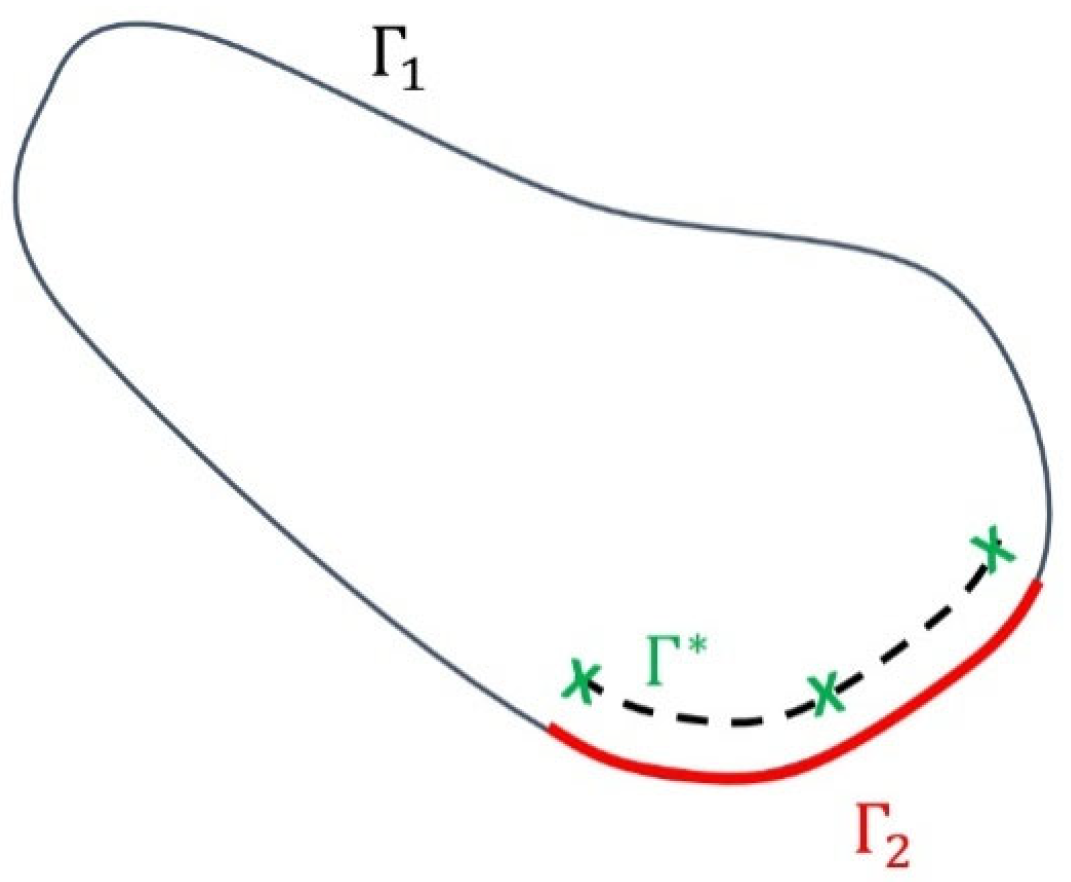
where x, y, z—coordinates in the Cartesian system [m], T—temperature [K], t—time [s], λ—thermal conductivity [W/mK], c—specific heat [J/kgK], ρ—density [kg/m3], and qV—power of internal heat sources related to the unit volume [W/m3]. The differential Equation (1) is solved with the known boundary condition on the part of the boundary Γ1 and the sought boundary condition on the part of the boundary Γ2, taking into account the measurement of the temperature on the curve Γ*, as shown in Figure 1. Depending on the problem under consideration, Equation (1) can be simplified in practice. The absence of heat sources will mean q V = 0 . When solving IHCPs, it is important to determine the direction of heat transfer in the case under consideration. Knowledge of physical phenomena is the basis for determining whether calculations can be performed for a one-dimensional ( T x 0 , T y = 0 , T z = 0 ) or two-dimensional ( T x 0 , T y 0 , T z = 0 ) problem. For a boiler wall or gas turbine blade, the problem often comes down to a two-dimensional equation. The question must be asked whether a non-stationary ( T t 0 ) or stationary ( T t = 0 ) problem should be considered. When temperature changes over time can be omitted, the steady-state problem is analysed. Many studies consider the optimal cooling of gas turbine blades as a steady-state problem. On the other hand, heat treatment and thermochemical treatment problems analysed using the IHCP solution are non-stationary problems. Significant changes in the thermal conductivity coefficient λ, specific heat c, and density ρ also affect the differential equation considered when solving IHCPs. In heat treatment (e.g., hardening) and thermochemical (e.g., nitriding) processes, taking into account the temperature ranges of these processes and the properties of the steels being treated, the dependence of the thermal conductivity coefficient λ and specific heat c on temperature must be taken into account when solving IHCPs.
To calculate the temperature or heat flux at the boundary Γ2, the minimum of the functional of the form should be determined.
I 1 = i = 1 M ( T i c T i * ) 2
Functional (2) describes the sum of squares of distances between the calculated temperature T i c and the measured temperature T i * at the i-th measurement point for i = 1, 2, …, M. Using various numerical techniques, the differential Equation (1) is algebraised. Taking into account the information contained in the boundary condition at the boundary Γ1 and the temperature measured at the measurement points on the curve Γ*, together with the functional (2), the IHCP can be reduced to solving a system of equations
A { x } = { b }
where the elements of the vector {x} are the requested boundary condition or parameters that allow the aforementioned boundary condition to be determined at the boundary Γ2. The elements of matrix A and vector {b} usually result from the form of the direct problem.
During the operation of machines and equipment, it is sometimes impossible to measure the temperature of walls with high thermal loads, or the measurement is subject to a very large error [7,8]. Examples of surfaces where measurement is difficult or impossible include: the inner wall of a power boiler, the surface of a gas turbine blade, the body of a gas or steam turbine, the surface of a charge being processed in a furnace for thermochemical treatment, and many others. Determining the temperature or heat flux on such surfaces is based on solving the inverse heat conduction problem. Inverse problems have very widespread technical applications in the analysis of heat flow in machines and devices [6,9].
Inverse problems are often numerically unstable. This is because inverse problems are numerically ill-posed in the Hadamard sense. This means that a small disturbance in the input data can cause a very large disturbance in the result. In such cases, the IHCP solution may be ineffective. In industrial applications, the input data are measurement data. The measured variables are temperature and heat flux. Measurement errors result from the type and accuracy of measuring instruments such as thermocouples and heat flux sensors. When measuring temperature and heat flux, contact resistance occurs at the point of contact between the measured surface and the measuring sensor. This is particularly important for highly dynamic heat transfer processes. In addition, there are thermocouple positioning errors of ±0.2 mm, which also affect the accuracy of the result. In most cases, the result is a boundary condition in the form of temperature or heat flux on a surface where measurement is impossible or very difficult to perform. In addition, the possibility of placing a limited number of thermocouples and the inability to place thermocouples at points that are advantageous for calculations must be taken into account.
Currently, multiple numerical studies are being conducted on computational methods that allow stable solutions to be obtained for IHCPs [3,4,5,6,10]. Computational techniques that stabilise the solution to an inverse problem (IP) are referred to as regularisation.
One of the IHCP regularisation techniques is Tikhonov regularisation [10], which boils down to correcting the functional (2)
J = I 1 + γ I 2
where the functional I 1 is described in Formula (2), γ is the regularisation parameter, and I 2 is the regularisation functional. The application of regularisation also modifies matrix A in matrix Equation (3). The difficulty lies in selecting the regularisation parameter γ in such a way that it stabilises the IP. The Morozov criterion [11,12,13,14,15,16,17,18,19], the L-curve method [14,20,21,22], and the energy integral [14] are used for this purpose. In [23], a method for automatic selection of the regularisation parameter is presented. Modifications of the classical Tikhonov regularisation method [24,25] and the iterative Tikhonov regularisation method [26] were investigated. Regularisation of the IHCP was also performed using the SVD algorithm [27,28], discrete Fourier transform [29], and optimal selection of the integral parameter [30].
This paper presents numerous applications of IHCP solutions for energy-intensive industrial processes and energy conversion. It indicates areas of possible application of quasi-regularisation and machine learning for solving IHCPs in terms of the aforementioned industrial applications.

2. Methods of Solving IHCPs and Their Quasi-Regularisation for Industrial Applications

To date, many methods have been developed to solve IHCPs. These methods vary greatly depending on the geometry of the area and whether a steady-state or unsteady problem is being considered. For simple geometries such as a rectangle, circle, or ring, numerical studies were conducted to develop analytical–numerical solutions [3,4,5,6,31,32,33,34,35,36,37,38]. The solution to the unsteady inverse problem for a circle and a ring is presented in [31,34], respectively. An analytical–numerical calculation method for the stationary inverse problem of heat conduction using Chebyshev polynomials for rectangular geometry was also analysed [36]. In turn, in [37,38], the method of fundamental solutions was also applied to a rectangle. The heat conduction equation was also solved using the Treffetz function [32,33,39]. Numerous research works on methods for solving inverse problems for simple geometries and analysing their stability formed the basis for the development of numerical methods for complex geometries and industrial applications.
In order to be used in industry, the IHCP solution must be numerically stable. The solution is stabilised by IHCP regularisation. Currently, a quasi-regularisation approach is also used to solve IHCPs. In this case, the Tikhonov regularisation with the selection of the regularisation parameter according to Formula (4) is not used. The solution is stabilised by selecting, for example, the time step or the integration method in such a way as to average the input data or values in the calculation process. A properly selected quasi-regularisation method allows for the stabilisation of the IHCP solution while preserving information about the heat transfer process, enabling its analysis. The quasi-regularisation method should be selected individually for each calculation model and industrial application. Quasi-regularisation approaches are often characterised by a simpler mathematical model than models using classical regularisation, which creates great potential for the application of these solutions in industrial applications. Despite its many advantages, quasi-regularisation is a compromise between accuracy and stability of the solution.

2.1. Boilers and Heating Devices

The studies in [40,41] present a solution to the geometric IP in determining the thickness of the stone in a steam boiler pipe. Inverse methods were also used to determine the thermal boundary conditions of the boiler membrane water-wall [42]. Simulations of changing thermal loads on the wall of a heating device using Chebyshev polynomials to solve IHCPs are presented in [43]. The inverse heat transfer method was used to identify the sediment profile in a heat exchanger pipe with two-phase and turbulent flow [44]. Sediments that exist in industrial heat exchangers reduce the thermal efficiency of the exchanger and consequently cause energy losses. To solve the problem, the conjugate gradient method and the volume of fluid method in Open FOAM were used. The inverse problem solution method used is stable and inexpensive, making it suitable for real-world industrial problems. In turn, the estimation of the heat flux and convective heat transfer coefficient in the water membrane of a steam boiler by solving the IHCP using an iterative algorithm is described in [45].
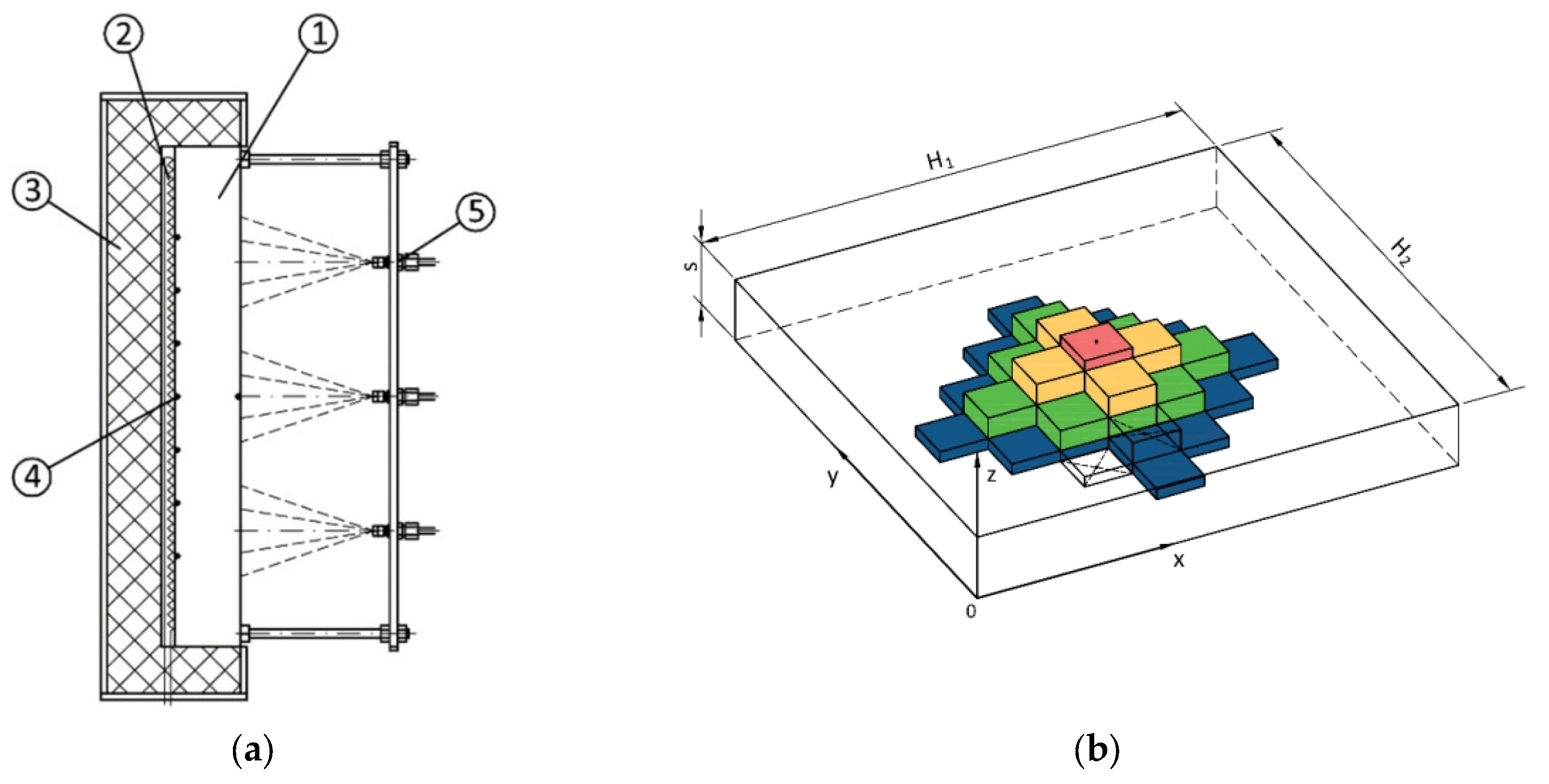
It is possible to determine thermal stresses in the boiler pressure components if the fluid temperature and heat transfer coefficient on the inner surface are known. Determining these values under industrial conditions is difficult. However, it is possible to calculate the boundary conditions by solving the IHCP, as described in [46]. The inverse space marching method (ISMM) is presented to determine the heat transfer coefficient on the surface of a thick-walled plate that is sprayed with water (Figure 2a). The experimental stand consists of a steel plate (Figure 2a-1) heated by electric heaters (Figure 2a-2) and insulated on the heater side (Figure 2a-3). The thermocouples are placed on the plate on the side of the heaters (Figure 2a-4). The other surface of the plate is sprayed with water (Figure 2a-5). The plate was divided into control volumes (Figure 2b). Each of the control volume layers is marked with a different colour in Figure 2b. The temperature values measured in the blue layer are used to determine the temperatures in the control volumes of the green layer. In the next step, the temperatures in the yellow layer are calculated, and finally, at the edge of the plate in the red layer.
For each control volume, the finite volume method was used to write the energy balance equation. Through step-by-step calculations in the control volumes, the boundary condition is determined. The ISMM method is easy to use and demonstrates numerical stability. The short calculation time for this computational method allows it to be used for online monitoring of thermal stresses in power plant components. The appropriate selection of the number of control volumes allows a stable solution to be obtained without a significant loss of information on the temperature distribution in the wall [46], which gives the regularisation properties of the method. The ISMM method includes a quasi-regularisation approach and has been applied to analyse heat transfer in power boilers.
In the next step, ISMM was used to develop a new technique to measure the temperature of superheated steam in conventional power plants [47] and to calculate the transient thermal stresses on the internal surface of a thick-walled pipe weakened by a hole [48]. The subject of controlling the temperature and thermal stress in the components of the power boiler during start-up, shutdown, and load change to reduce the unit’s connection time to the power grid using ISMM, which is a method that uses quasi-regularisation, is presented in [49].

2.2. Heat Treatment and Thermochemical Treatment

Another area of research worth mentioning where IHCP solutions are applied is heat treatment [50,51,52,53,54,55,56,57,58] and thermochemical treatment [24,59,60,61,62]. In [51], a solution to the one-dimensional IHCP was proposed for heat-treated surfaces. Analyses were performed to determine the temperature of the laser-heated surface and the spray-cooled surface. A mathematical model of the solution was developed using the shifting function method, the least-squares method, and measured temperatures. Quenching of moving metal plates using water jets was analysed using a two-dimensional inverse heat conduction solution [52]. Analyses of the quenching process using IHCPs are also described in [53,54,55,56,58].
Machine components such as crankshafts and gears are gas-nitrided. Controlling the surface temperature of thermochemically treated components is difficult to achieve in a closed furnace, where the gas surrounding the load is in constant motion, forced by a fan, and the gas temperature rises to 550 °C. Heat transfer in the furnace occurs through forced convection and, to a large extent, through radiation from the furnace and gas [59,62]. Knowledge of the edge temperature of treated components allows the process to be carried out in such a way that surfaces with the required properties are produced [63]. Controlling this temperature also allows the process time to be reduced without exceeding the thermal stresses [61]. The boundary conditions on elements subjected to thermochemical treatment can be determined by solving the IHCP. This issue has been considered in [24,59,60,61,62,64]. The study in [62] presents an analytical and numerical model to solve the IHCP for a cylinder. In industrial applications, it is very important that the method used to solve the IP is stable and does not require regularisation, or that the regularisation method is reliable and automatic. The study presented in [62] describes a quasi-regularisation method consisting of selecting the time step Δt in such a way as to eliminate oscillations in the solution. The time step Δt was introduced by writing the partial derivative on the right-hand side of the heat conduction differential Equation (1).
T t = T ( x , y , t k ) T ( x , y , t k 1 ) Δ t
The stabilisation method obtained by selecting Δt was used to determine the boundary conditions (T—temperature, q—heat flux, and h—heat transfer coefficient) for a cylinder subjected to thermochemical treatment at different heating rates and fan speeds [62]. In numerical tests, the relative error of the boundary condition δBC was calculated according to the formula
δ B C = | B C a s B C i p | B C a s
where BC is the boundary condition (T, q, or h), as is the analytical solution, and ip is the inverse problem. The ratio of the average relative error for the time step Δt = i to the average relative error for the time step Δt = 1 is described by the formula
f ( Δ t ) = a v [ δ B C ( Δ t = i ) ] a v [ δ B C ( Δ t = 1 ) ]
The ratio of the maximum relative error for the time step Δt = i to the maximum relative error for the time step Δt = 1 is described by the formula
g ( Δ t ) = m a x [ δ B C ( Δ t = i ) ] m a x [ δ B C ( Δ t = 1 ) ]
Based on the research presented in [62], it can be concluded that changing the time step from Δt = 1 to Δt = 10 resulted in a decrease in the ratio of the average relative errors f (Formula (7)) from 1 to 0.5145 for temperature, 0.1441 for heat flux, and 0.1503 for the heat transfer coefficient (Table 1). In turn, for the ratio of maximum relative errors g (Formula (8)), the change in the time step resulted in a decrease in the value of the g function to 0.3486 for temperature, 0.0947 for heat flux, and 0.0945 for heat transfer coefficient (Table 1). The data in Table 1 clearly indicate the significant impact of the time step Δt on the stability of the solution to the IHCP.
The time step was also a method of stabilising the IHCP solution, where the obtained temperature distribution was used to determine thermal stresses in cylindrical pressure components [65].
In [24], the analysis of heat transfer during the gas nitriding process was extended to include a detailed analysis of the cooling stage. The computational model was supplemented with a modified Tikhonov regularisation method. In turn, in [59], an analysis of experimental studies obtained under industrial conditions was presented and a method using the Broyden–Fletcher–Goldfarb–Shanno algorithm (BFGS) was applied to solve the IHCP. The studies presented in [60,62] were used to analyse heat transfer in an aluminium extrusion die subjected to gas nitriding [64].
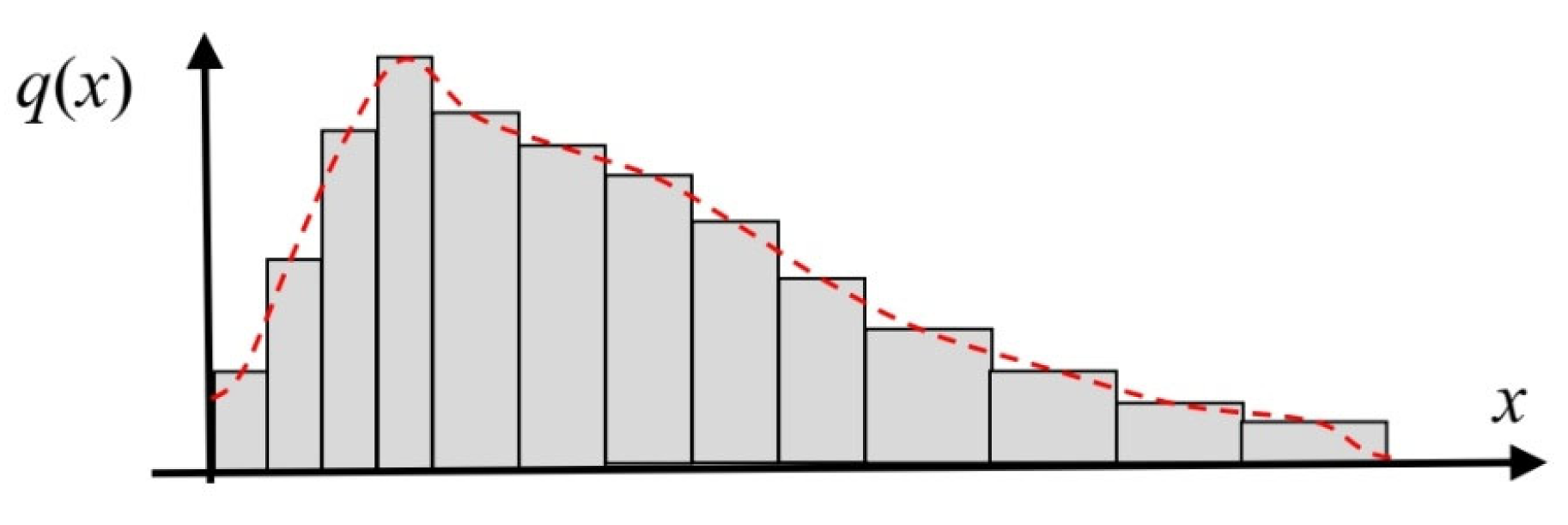
A new method for solving the inverse heat conduction problem for the Helmholtz equation using the Trefftz function is presented in [61]. The heat flux sought at the edge Γ2 of the thermochemically treated roller is approximated using a step function (Figure 3) and is written using a linear combination
q ( x ) = i = 0 N q i ( x ) = i = 0 N φ i ( x ) c i
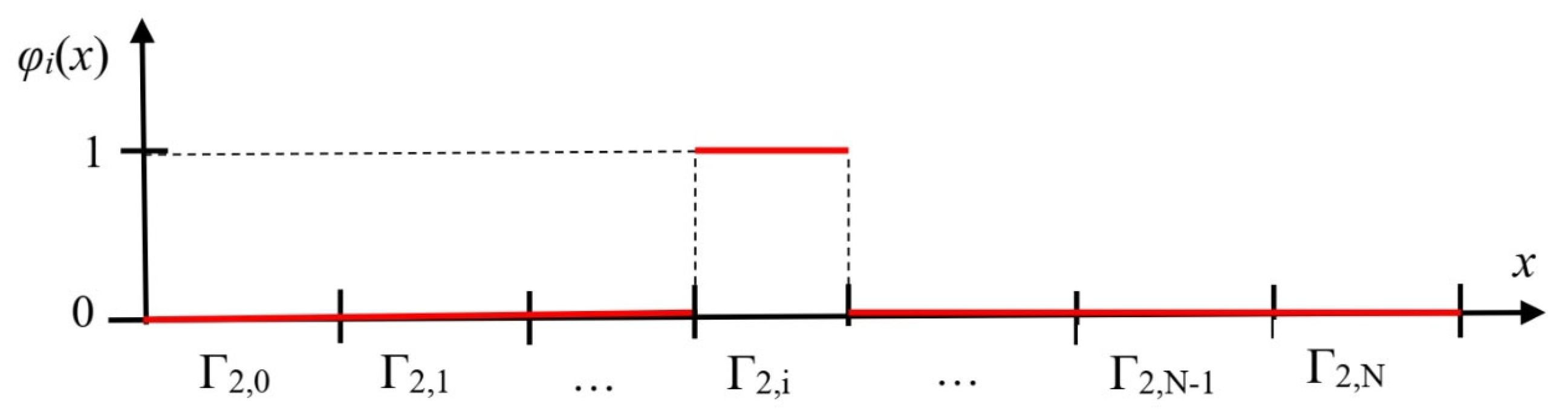
of the sought coefficients ci and the functions φi for i = 0 , 1 , 2 , , N . The function φi was defined by the formula
φ i ( x ) = { 1   f o r   x Γ 2 , i 0   f o r   Γ 2 , i
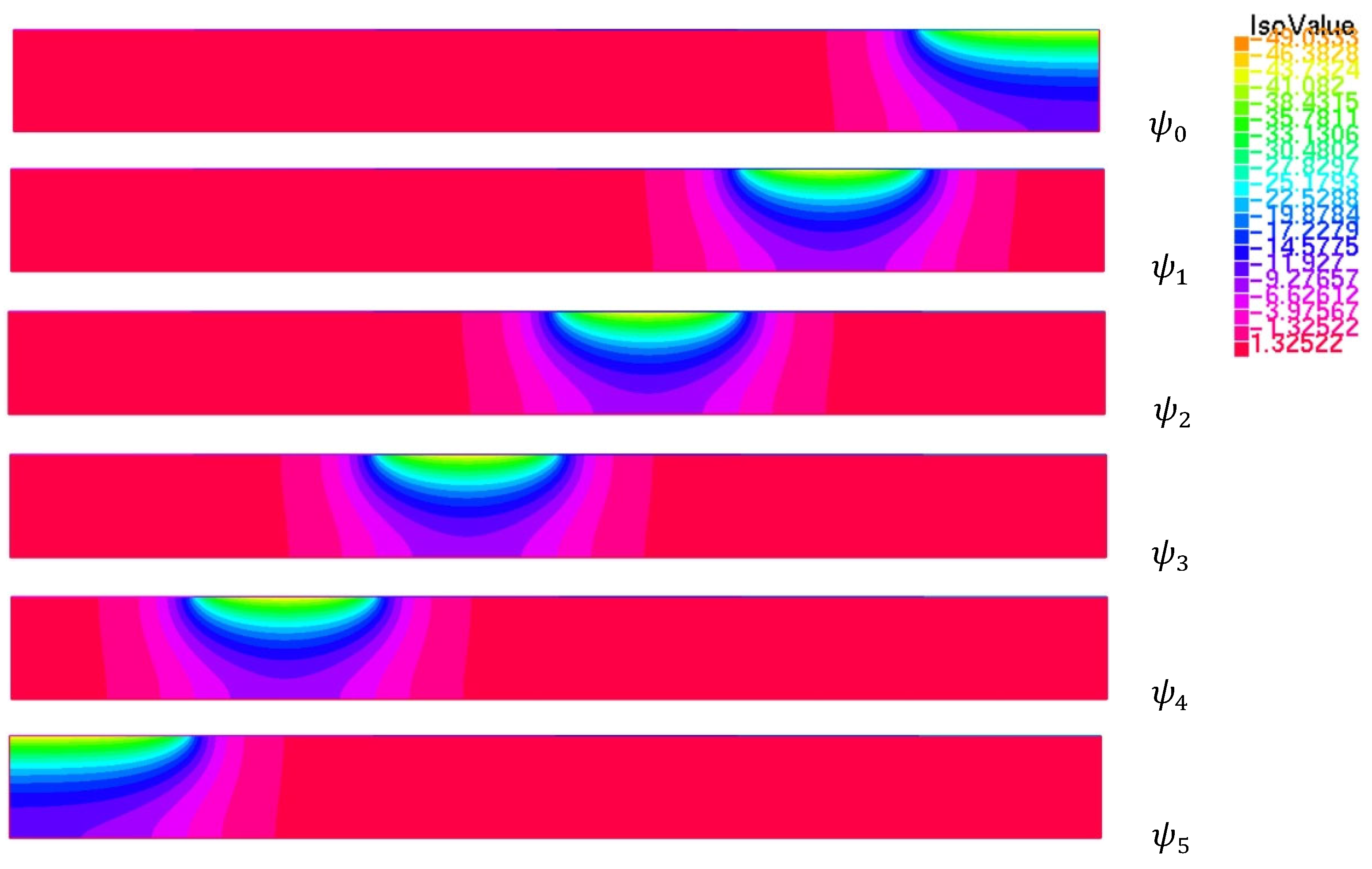
and shown in Figure 4. For the method under consideration, the functions φi(x) can be interpreted as an impulse with a value of 1 on the i-th fragment of the boundary Γ2, which is marked Γ2,i (Figure 4). The heat flux q(x) on the boundary Γ2 is sought, which is a composite of heat fluxes with a constant value qi(x) for successive fragments of the boundary. The coefficients ci are obtained from the IHCP solution. As a result, the flux q(x) is a step function (Figure 3) that is the average of the heat flux on the boundary. The temperature in the analysed area can be written as a combination of the Trefftz functions ψ i ( x , y ) added to the value of the function T 1 ( x , y ) obtained from the solution of the direct problem of the form.
T ( x , y ) = T 1 ( x , y ) + i = 0 N ψ i ( x , y ) c i
Examples of distributions of the functions ψ i ( x , y ) for i = 0 , 1 , 2 , , 5 are shown in Figure 5.
This method is described in more detail for steady-state IHCPs in [66,67], and for the unsteady-state problem in [61].
It has been shown that the appropriate selection of the number of functions φi and the division of the boundary Γ2 into segments Γ 2 , 0 , Γ 2 , 1 , , Γ 2 , N 1 , Γ 2 , N has a significant impact on the stability of the IP solution. The appropriate selection of step functions allowed for the stabilisation of the inverse problem solution without the need to apply classical Tikhonov regularisation. The appropriate selection of the number of segments and their length on the boundary Γ2 constitutes a quasi-regularisation of the IHCP solution method described in [61,66,67]. A dense division of the boundary Γ2 allows for a more accurate approximation of the boundary condition. On the other hand, a smaller number of segments on the boundary Γ2 results in greater averaging properties and thus stabilises the method. Increasing the density of the division for a fragment of the boundary with greater temperature and heat flux variability allows us to approach a division that is a compromise between the accuracy and stability of the IHCP solution through quasi-regularisation. The method can be successfully applied to the analysis of heat transfer in elements with complex geometry. The calculations are based on variational calculus and are performed in the freeFEM solver [68]. In the initial part of the algorithm, a complex geometry is assumed, which is described parametrically. The known boundary conditions, the division of the boundary where the boundary condition is sought, the coordinates of the temperature measurement points, and the measured values should also be adjusted to the problem under consideration. For geometries such as a gas turbine blade or a cross-section of a real heating device wall, the calculation scheme is analogous. In this case, the functions φ i ( x ) should be replaced with functions dependent on, for example, two variables φ i ( x , y ) (Formula (10)).
The presented method was also used to determine the heat flux on the surface of the T-shaped stator cavities of steam turbines [66] and the cross-section of a piston machine body with a cooling channel [69]. The calculation time indicates the possibility of using this method for online temperature control during thermochemical treatment processes. For gas nitriding, the calculation time was approximately 2 s for the assumed time step Δt = 30 s.

2.3. Gas Turbines

A very important challenge in the energy sector is to increase the efficiency of gas turbines. Efficiency increases with the temperature of the gas flowing around the blades. The gas temperature is limited by the properties of the material from which the blades are made. Too high a gas temperature can cause the blades to lose their strength properties and, as a result, damage the turbine. In order for the turbine to operate at a higher gas temperature without risking damage to the blades, cooling systems and protective coatings are used. Optimisation of the gas turbine blade cooling process based on IHCP solutions is discussed in [70,71,72,73,74]. The research area where IHCP solutions were applied to the analysis of thermal loads on gas turbine blades with a protective layer is described in [75,76,77,78]. The study in [72] presents an iterative algorithm that allows solving the IHCP for Laplace’s equation in a multiply-connected domain. A Cauchy-type problem was solved, where two boundary conditions were known on the outer boundary, while the sought condition was on the inner boundary of an elliptical ring with a shifted inner boundary. The IP solution is based on the DP, where the heat flux on the inner boundary of the domain was assumed and iteratively changed in such a way as to minimise the functional. The aforementioned functional determines the distance between the calculated and specified temperature at the outer boundary and includes a regularisation term. This method, which also uses variational calculus, was developed by the authors and applied to the analysis of the cooling of gas turbine blades [70]. In [70], two iterative algorithms were compared to determine the temperature at the inner limit of the blade. The first one is based on variational calculus, while the second one boils down to solving the least squares approximation problem. The temperature on the outer surface of the blade was assumed to be T0 = 600 K. The IP solution was stabilised using a discrete Fourier transform. The calculation results showed that there was a local loss of stability of the IHCP solution near the leading and trailing boundaries. In these areas, the temperature exceeded the assumed value of T0. This means that the cooling channel is not able to absorb the amount of heat that is transferred from the gas surrounding the blade. In the next step of the investigation, the authors developed an iterative algorithm that allowed the analysis of the cooling of the gas turbine blades using the IHCP solution, where porous material was present in the cooling channels [73]. The temperature of the blade boundary and the porosity distributions in the cooling channel were determined.
Another way to increase the temperature of the working medium in a gas turbine is to use ceramic coatings on the surface of the blades. This creates thermal resistance on the surface of the blade. The studies presented in [75,76,77,78] describe calculations for an area of metal covered with a layer of ceramic with low thermal conductivity. The issue under consideration is a Cauchy problem. In [77], the influence of thermal conductivity and the thickness of the ceramic layer on the temperature at the metal–ceramic interface was investigated, as exceeding this temperature may cause the blade to lose its mechanical properties. This issue was continued in [75,76], where the stability of the IHCP solution was investigated. This IP was stabilised by means of an energy balance equation for the ceramic layer, which constitutes its quasi-regularisation.

3. Applications of Neural Networks for Solving IHCPs

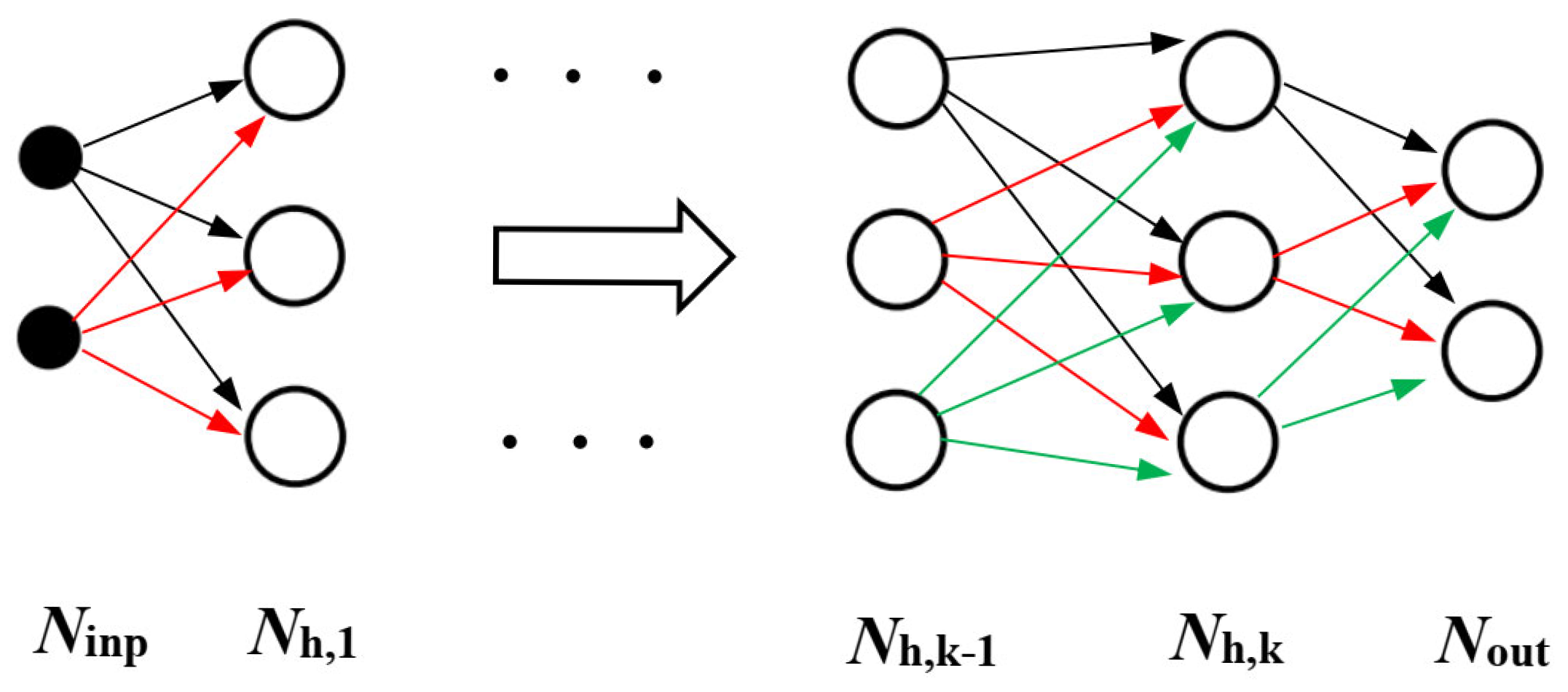
In recent years, a new approach to solving IHCPs has also been proposed. Genetic algorithms [79,80,81] and machine learning [82,83,84,85,86,87,88,89,90,91,92] are used. Research on the application of machine learning to solve IHCPs is carried out using Artificial Neural Networks (ANNs) [82,83,84,85,86,87,88,89,90,91,92]. ANNs are algorithms whose structure resembles that of the brain [93]. They consist of an input layer Ninp, hidden layers Nh, and an output layer Nout (Figure 6). The transition between neurons causes the output value of the previous layer to be multiplied by the weight and the assigned bias to be added, and the activation function [82]. The optimisation problem consists of determining the appropriate weights at the network learning stage so that in the next step, the network can be used for data where the expected result is unknown. A special example of a neural network (NN) used to solve IHCPs is Physics-Informed Neural Networks (PINNs) [82,86,87,89,91,92,94,95,96,97,98,99,100]. A PINN is a NN that uses fundamental laws of physics, making it a good tool to solve heat transfer problems.
In the analysis of boiler and other heating device operation based on the measurement of the temperature inside the wall, the boundary condition in the form of temperature or heat flux on an unavailable surface is calculated. In [91], a PINN model was proposed, which simultaneously identifies the boundary heat flux and thermal conductivity based on temperature values. The mathematical description of the method was prepared for a non-stationary, one-dimensional IHCP. However, it allows the analysis to be extended to two- and three-dimensional problems. The one-dimensional case concerns heat conduction through a flat wall with a thickness of 20 mm, in which the measurement points are located 10 mm and 20 mm from the wall surface where the heat flux is sought. The NN used to predict the solution consists of three blocks: a fully connected NN, a PINN, and a feedback mechanism. The loss function is the sum of functions representing penalty terms for the residuals of the governing equations, boundary conditions, and initial conditions. In the one-dimensional model, transient heat flux qin(t) was assumed at the left end, while the right end exchanges heat through natural convection. Radiation was taken into account at both ends. The normalised mean squared error (NMSE) was used to evaluate the accuracy of the heat flux sought. In the hidden layers, the activation function was the hyperbolic tangent. The output layer uses a linear activation function. The thermal conductivity of the material was assumed to be k = 5 W/mK. Numerical tests were performed for five different NN architectures (Net-i for i = 1, 2, …, 5). The analysed networks have 2, 3, 3, 3, and 4 hidden layers, respectively. The Net-1 has 80 and 60 neurons in its hidden layers, respectively. Accordingly, the Net-2 consists of 80, 60, and 40 neurons; the Net-3 consists of 130, 100, and 70 neurons; the Net-4 consists of 200, 150, and 100 neurons; and the Net-5 consists of 200, 150, 100, and 50 neurons.
For the Net-3 neural network, the NMSE value of heat flux was 0.028, the relative thermal conductivity error was 0.13%, and the training time was approximately 840 s. The authors considered the Net-3 NN to be the best compromise between accuracy of results and training time. The values for the other networks were referenced to Net-3 and are shown in Table 2. During training, the loss function reaches a value below 10−3 after 20,000 epochs. Training was conducted for up to 50,000 epochs. Numerical tests for Net-3 and Net-4 were also performed for temperature-dependent thermal conductivity described by a linear function using two coefficients. The determination of the heat flux reaches a relatively stable and accurate level after approximately 25,000 epochs (loss function for Net-3 of the order of 10−4, and for Net-4 of the order of 10−5). Meanwhile, the identification of two thermal conductivity coefficients converges much more slowly and requires a significantly higher number of iterations.
Numerical tests in [91] were performed for measurement data disturbances of 1%, 2%, 4%, and 8%. For the Net-3 test, Table 3 shows the NMSE values for heat flux and the relative error for thermal conductivity, taking into account disturbances in the input data for calculations in relation to values without disturbances. The method described in [91] allows for satisfactory accuracy in heat flux reconstruction despite noise, which is even greater than that encountered in industry. Slightly worse results were obtained for the thermal conductivity coefficient k. However, in many applications, the values of k are known. A two-dimensional heat conduction model was also considered for a rectangular area with dimensions L = 0.05 m and W = 0.02 m at a constant thermal conductivity k = 3 W/mK. The aim of the analysis was to investigate the effect of sensor placement on the result. The number of neurons in the hidden layers was 180, 100, and 150. Simply increasing the number of temperature sensors or improving the sampling resolution in the time–space domain did not lead to a significant improvement in identification results. In the case of the two-dimensional test, taking into account a specific parametric form of heat flow significantly improved accuracy. The PINN method achieved an NMSE value of 0.003 for heat flux and a relative error of 0.3% in identifying thermal conductivity. For this two-dimensional problem, it was found that using four or more sensors yielded satisfactory identification results for both parameters. It is worth noting that the numerical tests were performed for low thermal conductivity values and small areas with simple geometry. In such cases, the wall experiences significantly higher temperature gradients than for thermal conductivity values of 30–50 W/mK, which are typical for steel. In such cases, obtaining an IHCP solution may prove more difficult.
The boundary condition in the form of heat flux for a one-dimensional problem was also determined using a PINN [89]. The NN was trained taking into account physical constraints such as the equation, boundary conditions, initial conditions, and temperature values. The results indicate that the PINN has satisfactory effectiveness, is efficient, and represents a promising direction for the development of methods to solve IP. The studies in [89,91] present the application of PINNs to model the problem of heat transfer through a flat wall. This issue can be developed for future application to the analysis of heat transfer in the walls of thermal devices. However, the cases analysed are theoretical examples at this stage, far from industrial applications.
A comparison of two machine learning-based approaches to solving a nonlinear IHCP in a one-dimensional domain with constant and moving boundary conditions (Case 3 with constant material properties and Case 4 with temperature-dependent material properties) is described in [82]. The issue under consideration corresponds to the analysis of heat transfer through spacecraft panels without and with consideration of the thermal expansion of the plate material. The surface heat flux was determined using ANNs and temperature measurements inside the area. The length of the area was L = 2 cm, and the temperature measurement was taken on one of the surfaces (x = 0) and in the middle of the area, 1 cm from the edge, where the heat flux was determined (x = 1 cm). An Autoregressive-Exogenous Recurrent Neural Network (NARX) and a Feed-Forward Neural Network (FFNN) were used to analyse the four calculation examples. The network consisted of four hidden layers composed of 3, 5, 11, and 21 neurons for the FFNN and one hidden layer composed of 10 neurons for the NARX. Numerical tests were performed for three training cases and three validation cases (parabolic, triangular, and step functions). The training examples were simpler, while the validation examples were more complex.
The training algorithm used was the Levenberg–Marquardt algorithm. Temperature-dependent material (carbon phenolic) properties were taken into account. Thermal conductivity ranged from 0.62 W/mK to 2.77 W/mK. Specific heat ranged from 795.5 J/kgK to 2386.48 J/kgK. In order to compare the FFNN and NARX networks, r2 values (coefficient of determination) and training time were used. The r2 values for Case 3 are higher for the FFNN (from 0.9279 to 0.9891), while for Case 4, they are higher for the NARX (from 0.9458 to 0.9939). For cases with a moving boundary, the FFNN is trained faster. Training times for the FFNN range from 1.8 to 6.75 s, while for the NARX they range from 0.66 to 2.18 s. The analysed networks were shown to show promising properties in solving IHCPs.
Despite favourable r2 values and short learning times, the graphs show significant discrepancies in the heat flow for the stepwise validation function. The paper uses Tikhonov regularisation in the digital filter method. The authors of [82] did not specify the value of the regularisation parameter or the method of its selection.
Research on IHCPs through multilayer materials with an insulating layer using neural networks is described in [86,101]. A PINN was used to analyse the heat flow in a multilayer material used as thermal protection for reusable launch vehicles [101]. An improved PINN framework was developed to solve transient nonlinear and inhomogeneous heat conduction problems [86]. These networks were used to optimise the design of thermal protection structures for hypersonic vehicles. Existing numerical methods required the use of a large number of meshes. The use of a NN is a non-mesh method, which has a positive impact on the efficiency of calculations.
In [97], a nonlinear IHCP solution using PINNs was presented to determine the temperature fields, heat flux, and effective thermal conductivity in porous material. The average relative error was 4.5%, 14.4%, and 2.73%, respectively. Compared to numerical calculations using the finite volume method (FVM), a five-order-of-magnitude acceleration of calculations was achieved. The study presented in [102] analysed heat conduction processes in porous materials using machine learning and Fourier transforms. The results presented in [97,102] indicate that PINNs are promising tools for researching heat conduction issues in porous materials.
In [101], the heating of a sample made of carbon fibre–epoxy composite with thermal conductivity k = 0.47 W/mK, density ρ = 1573 kg/m3, and specific heat c = 967 J/kg K was analysed in an oven under convective conditions. The calculations were performed for heat transfer coefficients ranging from 10 W/m2K to 100 W/m2K. The calculations were performed using finite element methods (FEMs) and NNs, including a PINN. Numerical tests for NNs were performed for various activation functions that are exponential functions (ELU, adaptive-ELU) and for the hyperbolic tangent (adaptive-tanh). The activation function for the PINN was selected based on governing heat transfer equations. The network was trained during the first 15 min of heating, which lasted 45 min. The temperature consistency in the central part of the sample was taken into account in the network training process. In the second part of the heating process, the temperature curve was predicted using a NN, and the results were compared with the FEM solution. The curves for ELU, adaptive-ELU, and adaptive-tanh deviated significantly from the assumed function. For adaptive-ELU and adaptive-tanh, the temperature in subsequent heating time units decreased, even reaching zero for adaptive-ELU, which is contrary to the physical phenomena occurring in the oven. The temperature curve obtained for the PINN was almost identical to the curve obtained from the FEM and the assumed function. Calculations using the PINN network were faster than the FEM. The example presented in [101] clearly indicates the usefulness of using PINNs for the analysis of heat transfer processes.

4. Conclusions

The difficulties with industrial applications of solutions for IHCPs stem from the fact that these problems are ill-posed in the Hadamard sense. Solving them requires extensive mathematical knowledge, in particular numerical methods, knowledge of computational tools, measurement techniques, and an understanding of the physical phenomena occurring during the operation of machines and equipment. Practical knowledge of the realities of operating these machines and devices in industrial conditions is also important. Therefore, the application of IHCPs in industry is an interdisciplinary issue that is very difficult to implement. There are many scientific papers presenting computational models for stationary and non-stationary one-dimensional simple geometries. They often describe complex IHCP regularisation methods, the application of which in industry could be impractical. Many works also present IHCP solutions for stationary two-dimensional problems for simple and complex geometries, such as gas turbine blades. The difficulty remains in solving unsteady, two-dimensional, and three-dimensional IHCPs for complex geometries. New computational tools such as the freeFEM solver, Python, and COMSOL are creating ever greater opportunities in this field. When controlling the operation of machines and devices using IHCP solutions, we want the calculations to be performed correctly and quickly, and the solution to be numerically stable so that we can obtain results without the need for intervention by a person highly specialised in solving IP. Currently, efforts are being made to automate and simplify methods for solving IHCPs that may have industrial applications. In connection with the above, methods are being sought that allow for online control during the heating or cooling process of walls that are inaccessible for measurement and are most heavily loaded thermally. In order for online control to be possible without human intervention in industrial conditions, the IHCP solution must first undergo a series of numerical tests. These tests cover the impact of temperature and heat flux measurement errors, location, and measurement sensor installation errors on the result, taking into account the heat flow intensity in a given device. It is also very important that the calculation time allows information to be obtained on, for example, the surface temperature, where measurement cannot be performed in real time. Elements with significant thermal loads include the inner wall of a boiler, the casing of a steam and gas turbine, the blades of the gas turbine, and the surfaces of elements subjected to heat or thermochemical treatment. Numerous studies were conducted on IHCP solutions dedicated to these issues and their regularisation for the above-mentioned components, machines, and devices. According to the authors, automation of the control of thermally stressed surfaces may occur when methods for solving inverse heat conduction problems that do not require classical Tikhonov regularisation with the selection of a regularisation parameter are developed and tested. In this case, the IHCP solution can be stabilised using a quasi-regularisation approach, e.g., by selecting the time step, control volume size, or additional energy balance equations. When selecting a large time step, some data may be lost due to high averaging, e.g., of temperature curves, but on the other hand, this is very beneficial in terms of stability. On the other hand, a small time step may mean that the solution obtained will oscillate significantly. The possibility of large oscillations mainly concerns the heat flux and heat transfer coefficient. The quasi-regularisation approach involves finding a compromise between the stability and accuracy of the IHCP solution. Quasi-regularisation methods should be selected individually depending on the technical problem, heat transfer dynamics, and IHCP solution method. A well-chosen quasi-regularisation method does not require human intervention in the IHCP solution during the industrial process. Quasi-regularisation has been applied to control and analyse heat transfer for boilers, gas turbines, and thermochemical treatment. It is also worth mentioning that online control of heat transfer processes using IHCPs and quasi-regularisation was applied to power boiler components and components subjected to gas nitriding. Recently, many papers have been published that describe new approaches to solving IHCPs using neural networks. The use of machine learning makes it possible to simplify the mathematical model and omit the regularisation of the IHCP. Often, the model is trained on the basis of the solution of the DP, which is numerically stable. The trained model then solves the IP, which is no longer an ill-posed problem. Despite many potential benefits, based on the literature presented, there are doubts regarding the effectiveness and applicability of NNs. Calculations using NNs were most often performed for one-dimensional cases. The two-dimensional examples given in the literature concern simple geometries with small dimensions. Numerical tests for heat flow using NNs were performed for materials with a relatively low thermal conductivity coefficient. The maximum value in the analysed papers was 4.4 W/mK. A low thermal conductivity coefficient causes large temperature gradients and facilitates the analysis of the issue. Materials commonly used in industry (e.g., steels) generally have thermal conductivity and specific heat that vary significantly within their applicable temperature range. The analysed studies noted significant difficulties in training networks due to the variability in k with temperature. This is not a major problem for solving IHCPs using classical numerical methods.
In heat treatment and thermochemical treatment, to be able to use neural networks, it would be necessary to perform a large number of experiments to determine the boundary conditions and combine the results with furnace operating parameters such as gas temperature, load weight, load surface properties, etc. Then, surface control could be performed online during the process, without having to solve the ill-posed problem. The possibility of online control springs from shorter computation times for NNs than for classical numerical methods. Therefore, it is very important to train models effectively, acquire training data, and calculate learning time and costs. However, the use of neural networks at their current stage of development for the analysis of very expensive equipment, such as processing furnaces, gas turbines, or power boilers, in industry raises doubts. Currently, there are no methods for certifying these machine learning devices that guarantee their effectiveness. However, quasi-regularisation methods can be successfully applied to them. The application of neural networks to solve IHCPs makes it possible to simplify computational models used to control energy-intensive industrial processes and energy conversion. In numerical tests, the best results were obtained for the PINN. Obtaining a stable solution to the IP allows its industrial application. Nevertheless, in the authors’ opinion, at the current stage of research into IHCP solutions using NNs, their effective application to real industrial problems seems unlikely. Currently, the use of neural networks to solve IHCPs is an interesting research direction. Research on solving IHCPs using NNs would need to include larger elements with more complex geometries made from materials commonly used in manufacturing processes.

Author Contributions

Conceptualisation, M.J.; methodology, M.J. and D.J.; software, M.J. and D.J.; investigation, M.J. and D.J.; writing—original draft preparation, M.J.; writing—review and editing, M.J. and D.J.; visualisation, M.J. and D.J. All authors have read and agreed to the published version of the manuscript.

Funding

This research received no external funding.

Data Availability Statement

No new data were created.

Conflicts of Interest

The authors declare no conflicts of interest.

Abbreviations

The following abbreviations are used in this manuscript:
ANNsArtificial neural networks
BFGSBroyden–Fletcher–Goldfarb–Shanno algorithm
DPDirect problem
IHCPInverse heat conduction problem
IPInverse problem
ISMMInverse space marching method
NNsNeural networks
PINNsPhysics-informed neural networks

References

  1. Hadamard, J. Sur les problèmes aux dérivées partielles et leur signification physique. Princet. Univ. Bull. 1902, 13, 49–52. [Google Scholar]
  2. Grysa, K. Trefftz Functions and Their Applications in Solving Inverse Problems; Publishing House of the Kielce University of Technology: Kielce, Polish, 2010; ISSN 1897-2691. (In Polish) [Google Scholar]
  3. Ciałkowski, M. Selected Methods and Algorithms for Solving Inverse Problems of Heat Conduction Equation; Poznań University of Technology Publishing House: Poznań, Polish, 1996; ISBN 8371431619. (In Polish) [Google Scholar]
  4. Taler, J.; Duda, P. Solving Direct and Inverse Heat Conduction Problems, 1st ed.; Springer: Berlin/Heidelberg, Germany, 2006; ISBN 978-3-540-33470-X. [Google Scholar]
  5. Alifanov, O.M. Inverse Heat Transfer Problems; Springer: Berlin/Heidelberg, Germany, 1994; ISBN 13:978-3-642-76438-7. [Google Scholar]
  6. Woodbury, K.A.; Najafi, H.; de Monte, F.; Beck, J.V. Inverse Heat Conduction: Ill-Posed Problems; John Wiley & Sons: Hoboken, NJ, USA, 2023; ISBN 9781119840190. [Google Scholar]
  7. Taler, J. Theory and Practice of Identifying Heat Transfer Processes; Zakład Narodowy imienia Ossolińskich: Wrocław Warszawa Kraków, Polish, 1995; ISBN 83-04-04276-2. (In Polish) [Google Scholar]
  8. Incropera, F.P.; de Witt, D.P. Fundamentals of Heat and Mass Transfer; Wiley: New York, NY, USA, 1996. [Google Scholar]
  9. Orlande, H.R.B. Inverse Heat Transfer: Fundamentals and Applications, 2nd ed.; CRC Press: Boca Raton, FL, USA, 2021. [Google Scholar] [CrossRef]
  10. Tikhonov, A.N.; Arsenin, V.Y. Solution of Ill-Posed Problems; Wiley: New York, NY, USA, 1977. [Google Scholar]
  11. Bedin, L.; Bazán, F.S.V.; Quiroz, J.R. Method for recovering boundary data in a two-dimensional Poisson equation on annular domain. J. Comput. Appl. Math. 2018, 342, 83–95. [Google Scholar] [CrossRef]
  12. Chen, B.; Sun, Y.; Zhuang, Z. Method of fundamental solutions for a Cauchy problem of the Laplace equation in a half-plane. Bound. Value Probl. 2019, 2019, 34. [Google Scholar] [CrossRef]
  13. Han, H.; Ling, L.; Takeuchi, T. An energy regularization for Cauchy problems of Laplace equation in annulus domain. Commun. Comput. Phys. 2011, 9, 878–896. [Google Scholar] [CrossRef]
  14. Joachimiak, M. Choice of the regularization parameter for the Cauchy problem for the Laplace equation. Int. J. Numer. Methods Heat Fluid Flow 2020, 30, 4475–4492. [Google Scholar] [CrossRef]
  15. Marin, L. An invariant method of fundamental solutions for two-dimensional steady-state anisotropic heat conduction problems. Int. J. Heat Mass Transf. 2016, 94, 449–464. [Google Scholar] [CrossRef]
  16. Morozov, V.A. Methods for Solving Incorrectly Posed Problems; Springer: New York, NY, USA, 1984. [Google Scholar]
  17. Sun, Y. A meshless method based on the method of fundamental solution for solving the steady-state heat conduction problems. Int. J. Heat Mass Transf. 2016, 97, 891–907. [Google Scholar] [CrossRef]
  18. Sun, Y.; He, S. A meshless method based on the method of fundamental solution for three-dimensional inverse heat conduction problems. Int. J. Heat Mass Transf. 2017, 108, 945–960. [Google Scholar] [CrossRef]
  19. Wei, T.; Wang, J. A modified quasi-boundary value method for an inverse source problem of the time-fractional diffusion equation. Appl. Numer. Math. 2014, 78, 95–111. [Google Scholar] [CrossRef]
  20. Jin, B.; Zheng, Y. A meshless method for some inverse problems associated with the Helmholtz equation. Comput. Methods Appl. Mech. Eng. 2006, 195, 2270–2288. [Google Scholar] [CrossRef]
  21. Marin, L. Numerical solution of the Cauchy problem for steady-state heat transfer in two-dimensional functionally graded materials. Int. J. Solids Struct. 2005, 42, 4338–4351. [Google Scholar] [CrossRef]
  22. Marin, L.; Munteanu, L. Boundary reconstruction in two-dimensional steady state anisotropic heat conduction using a regularized meshless method. Int. J. Heat Mass Transf. 2010, 53, 5815–5826. [Google Scholar] [CrossRef]
  23. Pacheco, C.C.; Lacerda, C.R.; Colaço, M.J. Automatic selection of regularization parameter in inverse heat conduction problems. Int. Commun. Heat Mass Transf. 2022, 139, 106403. [Google Scholar] [CrossRef]
  24. Joachimiak, M.; Joachimiak, D. Stabilization of boundary conditions obtained from the solution of the inverse problem during the cooling process in a furnace for thermochemical treatment. Int. J. Heat Mass Transf. 2024, 224, 125274. [Google Scholar] [CrossRef]
  25. Yang, F.; Fu, C.; Li, X. A modified Tikhonov regularization method for the Cauchy problem of Laplace equation. Acta Math. Sci. 2015, 35, 1339–1348. [Google Scholar] [CrossRef]
  26. Ngendahayo, J.P.; Minani, F.; Thim, J.; Berntsson, F. Convergence Analysis of Iterative Tikhonov Regularization Applied to an Inverse Heat Conduction Problem. Int. J. Appl. Comput. Math. 2025, 11, 149. [Google Scholar] [CrossRef]
  27. Hasanov, A.; Mukanova, B. Relationship between representation formulas for unique regularized solutions of inverse source problems with final overdetermination and singular value decomposition of input-output operators. J. Appl. Math. 2015, 80, 676–696. [Google Scholar] [CrossRef]
  28. Marin, L.; Karageorghis, A.; Lesnic, D. Regularized MFS solution of inverse boundary value problems in three-dimensional steady-state linear thermoelasticity. Int. J. Solids Struct. 2016, 91, 127–142. [Google Scholar] [CrossRef]
  29. Frąckowiak, A.; Ciałkowski, M. Application of discrete Fourier transform to inverse heat conduction problem regularization. Int. J. Numer. Methods Heat Fluid Flow 2018, 28, 239–253. [Google Scholar] [CrossRef]
  30. Joachimiak, M.; Ciałkowski, M. Optimal choice of integral parameter in a process of solving the inverse problem for heat equation. Arch. Thermodyn. 2014, 35, 265–280. [Google Scholar]
  31. Ciałkowski, M.; Grysa, K. A sequential and global method of solving an inverse problem of heat conduction equation. J. Theor. Appl. Mech. 2010, 48, 111–134. [Google Scholar]
  32. Grysa, K.; Maciąg, A. Trefftz Method in Solving Inverse Heat Conduction Problems. In Encyclopedia of Thermal Stresses; Hetnarski, R.B., Ed.; Springer: Dordrecht, The Netherlands, 2014. [Google Scholar] [CrossRef]
  33. Grysa, K.; Maciag, A.; Pawinska, A. Solving nonlinear direct and inverse problems of stationary heat transfer by using Trefftz functions. Int. J. Heat Mass Transf. 2012, 55, 7336–7340. [Google Scholar] [CrossRef]
  34. Joachimiak, M.; Ciałkowski, M. Non-linear unsteady inverse boundary problem for heat conduction equation. Arch. Thermodyn. 2017, 38, 81–100. [Google Scholar] [CrossRef]
  35. Joachimiak, M.; Ciałkowski, M. Stable solution to non-stationary inverse heat conduction equation. Arch. Thermodyn. 2018, 39, 25–37. [Google Scholar]
  36. Joachimiak, M.; Ciałkowski, M.; Frąckowiak, A. Stable method for solving the Cauchy problem with the use of Chebyshev polynomials. Int. J. Numer. Methods Heat Fluid Flow 2020, 30, 1441–1456. [Google Scholar] [CrossRef]
  37. Mierzwiczak, M.; Kołodziej, J.A. The determination of heat sources in two dimensional inverse steady heat problems by means of the method of fundamental solutions. Inverse Probl. Sci. Eng. 2011, 19, 777–792. [Google Scholar] [CrossRef]
  38. Mierzwiczak, M.; Kołodziej, J.A. The determination temperature-dependent thermal conductivity as inverse steady heat conduction problem. Int. J. Heat Mass Transf. 2011, 54, 790–796. [Google Scholar] [CrossRef]
  39. Hożejowska, S.; Piasecka, M. Numerical Solution of Axisymmetric Inverse Heat Conduction Problem by the Trefftz Method. Energies 2020, 13, 705. [Google Scholar] [CrossRef]
  40. Joachimiak, M.; Ciałkowski, M.; Bartoszewicz, J. Analysis of temperature distribution in a pipe with inner mineral deposit. Arch. Thermodyn. 2014, 35, 37–49. [Google Scholar] [CrossRef]
  41. Soloviev, A.N.; Shevchenko, M.A.; Germanchuk, M.S. The Inverse Geometric Problem of Thermal Conductivity for Determining the Thickness of Scale in Steam Boiler Pipes. J. Math. Sci. 2025, 287, 664–672. [Google Scholar] [CrossRef]
  42. Lv, C.; Wang, G.; Chen, H. Estimation of time-dependent thermal boundary conditions and online reconstruction of transient temperature field for boiler membrane water wall. Int. J. Heat Mass Transf. 2020, 147, 118955. [Google Scholar] [CrossRef]
  43. Joachimiak, M.; Joachimiak, D.; Ciałkowski, M. Investigation on thermal loads in steady-state conditions with the use of the solution to the inverse problem. Heat Transf. Eng. 2023, 44, 963–969. [Google Scholar] [CrossRef]
  44. Jamail Arand, H.; Sefid, M.; Goudarzi, K. Identification of Fouling Profiles in a Heat Exchanger Pipe with Presence of Two-Phase Flow Using Inverse Heat Transfer Method, a Numerical Study. Int. J. Eng. Trans. B Appl. 2026, 39, 694–704. [Google Scholar] [CrossRef]
  45. Duda, P.; Konieczny, M. An Iterative Algorithm for the Estimation of Thermal Boundary Conditions Varying in Both Time and Space. Energies 2022, 15, 2686. [Google Scholar] [CrossRef]
  46. Jaremkiewicz, M.; Taler, J. Online Determining Heat Transfer Coefficient for Monitoring Transient Thermal Stresses. Energies 2020, 13, 704. [Google Scholar] [CrossRef]
  47. Jaremkiewicz, M.; Taler, D.; Dzierwa, P.; Taler, J. Determination of Transient Fluid Temperature and Thermal Stresses in Pressure Thick-Walled Elements Using a New Design Thermometer. Energies 2019, 12, 222. [Google Scholar] [CrossRef]
  48. Jaremkiewicz, M. Analysis of the Accuracy of the Inverse Marching Method Used to Determine Thermal Stresses in Cylindrical Pressure Components with Holes. Energies 2025, 18, 4546. [Google Scholar] [CrossRef]
  49. Taler, D.; Taler, J.; Kaczmarski, K.; Jaremkiewicz, M.; Dzierwa, P.; Trojan, M. Monitoring of thick-walled pressure elements to determine transient temperature and stress distributions using the measured fluid’s pressure and wall’s temperature. Energy 2024, 309, 133121. [Google Scholar] [CrossRef]
  50. Duarte Benther, J.; Chalhub, D.J.N.M.; Franklin, E.; Lappas, P.; Rosengarten, G. Semi-analytical solution of transient heat conduction for spray cooling. Int. J. Therm. Sci. 2025, 218, 110148. [Google Scholar] [CrossRef]
  51. Lee, S.-Y.; Yan, Q.-Z. Inverse analysis of heat conduction problems with relatively long heat treatment. Int. J. Heat Mass Transf. 2017, 105, 401–410. [Google Scholar] [CrossRef]
  52. Gopalkrishna, S.B.; Kulkarni, G.A.; Ryll, S.; Specht, E. Heat transfer analysis during quenching of moving metal plates using water jets from a mold. Therm. Sci. Eng. Prog. 2025, 64, 103792. [Google Scholar] [CrossRef]
  53. Barrena-Rodríguez, M.d.J.; Acosta-González, F.A.; Téllez-Rosas, M.M. A Review of the Boiling Curve with Reference to Steel Quenching. Metals 2021, 11, 974. [Google Scholar] [CrossRef]
  54. Gomez, C.F.; Nieuwenhuizen, R.; van der Geld, C.W.M.; Kuerten, H.G.M.; Bsibsi, M.; van Esch, B.P.M. Inaccuracies in the inverse heat conduction problem solution and their effect on the estimation of heat fluxes during quenching. Int. J. Heat Mass Transf. 2022, 194, 122953. [Google Scholar] [CrossRef]
  55. Jahedi, M.; Berntsson, F.; Wren, J.; Moshfegh, B. Transient inverse heat conduction problem of quenching a hollow cylinder by one row of water jets. Int. J. Heat Mass Transf. 2018, 117, 748–756. [Google Scholar] [CrossRef]
  56. Nieuwenhuizen, R. The Inverse Heat Conduction Problem in Quenching of a Hot Steel Plate. MSc. Thesis, Eindhoven University of Technology, Eindhoven, The Netherlands, 2019. [Google Scholar]
  57. Sun, Y.; Jian, H.; Xiong, P.; Zhou, L. An Experimental Study of Boiling Heat Transfer and Quench Front Propagation Velocity During Quenching of a Cylinder Rod in Subcooled Water. Energies 2024, 17, 5236. [Google Scholar] [CrossRef]
  58. Szénási, S.; Felde, I. Database for Research Projects to Solve the Inverse Heat Conduction Problem. Data 2019, 4, 90. [Google Scholar] [CrossRef]
  59. Joachimiak, D.; Joachimiak, M.; Frąckowiak, A. Determination of boundary conditions from the solution of the inverse heat conduction problem in the gas nitriding process. Energy 2024, 300, 131497. [Google Scholar] [CrossRef]
  60. Joachimiak, M. Analysis of Thermodynamic Parameter Variability in a Chamber of a Furnace for Thermo-Chemical Treatment. Energies 2021, 14, 2903. [Google Scholar] [CrossRef]
  61. Joachimiak, M.; Frąckowiak, A. Analysis of heat transfer in a cylinder being treated in a gas nitriding furnace using a new inverse problem solving method. Energy 2025, 333, 137318. [Google Scholar] [CrossRef]
  62. Joachimiak, M.; Joachimiak, D.; Ciałkowski, M.; Małdziński, L.; Okoniewicz, P.; Ostrowska, K. Analysis of the heat transfer for processes of the cylinder heating in the heat-treating furnace on the basis of solving the inverse problem. Int. J. Therm. Sci. 2019, 145, 105985. [Google Scholar] [CrossRef]
  63. Małdziński, L. Thermodynamic, Kinetic and Technological Aspects of Nitrided Layer Production on Iron and Steel in Gas Nitriding Processes; Poznań University of Technology Publishing House: Poznań, Polish, 2002. (In Polish) [Google Scholar]
  64. Joachimiak, D.; Judt, W.; Joachimiak, M. Numerical analysis of the heating of a die for the extrusion of aluminium alloy profiles in terms of thermochemical treatment. Arch. Thermodyn. 2023, 44, 159–175. [Google Scholar] [CrossRef]
  65. Jaremkiewicz, M. Analysis of the accuracy of the inverse marching method used to determine thermal stresses in cylindrical pressure components. Arch. Thermodyn. 2024, 45, 95–105. [Google Scholar] [CrossRef]
  66. Frąckowiak, A.; Spura, D.; Gampe, U.; Ciałkowski, M. Determination of heat transfer coefficient in a T-shaped cavity by means of solving the inverse heat conduction problem. Int. J. Numer. Methods Heat Fluid Flow 2020, 30, 1725–1742. [Google Scholar] [CrossRef]
  67. Frąckowiak, A.; Wróblewska, A.; Ciałkowski, M. Trefftz numerical functions for solving inverse heat conduction problems. Int. J. Therm. Sci. 2022, 177, 107566. [Google Scholar] [CrossRef]
  68. Hecht, F. FreeFEM Documentation Release 4.13, 2026. Available online: https://doc.freefem.org/introduction/index.html (accessed on 24 February 2026).
  69. Joachimiak, M.; Frąckowiak, A.; Joachimiak, D. Determination of the Temperature on the Inner Wall of the Piston Machine Body by Solving the Inverse Problem. Heat Transf. Eng. 2025, 46, 1982–1991. [Google Scholar] [CrossRef]
  70. Frąckowiak, A.; Ciałkowski, M.; Wróblewska, A. Application of iterative algorithms for gas-turbine blades cooling optimization. Int. J. Therm. Sci. 2017, 118, 198–206. [Google Scholar] [CrossRef]
  71. Frąckowiak, A.; Ciałkowski, M.; Wróblewska, A. Iterative algorithms for solving inverse problems of heat conduction in multiply connected domains. Int. J. Heat Mass Transf. 2012, 55, 744–751. [Google Scholar] [CrossRef]
  72. Frąckowiak, A.; von Wolfersdorf, J.; Ciałkowski, M. An iterative algorithm for the stable solution of inverse heat conduction problems in multiply-connected domains. Int. J. Therm. Sci. 2015, 96, 268–276. [Google Scholar] [CrossRef]
  73. Frąckowiak, A.; von Wolfersdorf, J.; Ciałkowski, M. Optimization of cooling of gas turbine blades with channels filled with porous material. Int. J. Therm. Sci. 2019, 136, 370–378. [Google Scholar] [CrossRef]
  74. Frąckowiak, A.; von Wolfersdorf, J.; Ciałkowski, M. Solution of the inverse heat conduction problem described by the Poisson equation for a cooled gas turbine blade. Int. J. Heat Mass Transf. 2011, 54, 1236–1243. [Google Scholar] [CrossRef]
  75. Ciałkowski, M.; Joachimiak, M.; Mierzwiczak, M.; Frąckowiak, A.; Olejnik, A.; Kozakiewicz, A. Cauchy Type Nonlinear Inverse Problem in a Two-Layer Cylindrical Area. Heat Transf. Eng. 2025, 46, 2005–2017. [Google Scholar] [CrossRef]
  76. Ciałkowski, M.; Joachimiak, M.; Mierzwiczak, M.; Frąckowiak, A.; Olejnik, A.; Kozakiewicz, A. The analysis of the stability of the Cauchy problem in the cylindrical double-layer area. Arch. Thermodyn. 2023, 44, 563–579. [Google Scholar] [CrossRef]
  77. Ciałkowski, M.; Olejnik, A.; Frąckowiak, A.; Lewandowska, N.; Mosiężny, J. Cauchy type inverse problem in a two-layer area in the blades of gas turbine. Energy 2020, 212, 118751. [Google Scholar] [CrossRef]
  78. Ciałkowski, M.; Olejnik, A.; Joachimiak, M.; Grysa, K.; Frąckowiak, A. Cauchy type nonlinear inverse problem in a two-layer area. Int. J. Numer. Methods Heat Fluid Flow 2022, 32, 313–331. [Google Scholar] [CrossRef]
  79. Allard, D.; Najafi, H. Genetic Algorithm as the Solution of Non-Linear Inverse Heat Conduction Problems: A Novel Sequential Approach. J. Heat Mass Transf. 2024, 146, 091404. [Google Scholar] [CrossRef]
  80. Liu, W.; Guo, S.; Zhang, S. Temperature field modeling of the plate during hot rolling based on inverse heat conduction problem. J. Phys. Conf. Ser. 2019, 1300, 1. [Google Scholar] [CrossRef]
  81. Xie, J.; Zhang, H.; Zhu, Z. Analysis of temperature field for rotary friction welding based on genetic-conjugate gradient hybrid inverse algorithm. Appl. Therm. Eng. 2025, 279, 127508. [Google Scholar] [CrossRef]
  82. Allard, D.; Najafi, H. A systematic study of two machine learning-based approaches for solving non-linear inverse heat conduction problems in one-dimensional domains. Int. Commun. Heat Mass Transf. 2024, 155, 107494. [Google Scholar] [CrossRef]
  83. Deng, S.; Hwang, Y. Applying neural networks to the solution of forward and inverse heat conduction problems. Int. J. Heat Mass Transf. 2006, 49, 4732–4750. [Google Scholar] [CrossRef]
  84. Kowsary, F.; Mohammadzaheri, M.; Irano, S. Training based, moving digital filter method for real time heat flux function estimation. Int. Commun. Heat Mass Transf. 2006, 33, 1291–1298. [Google Scholar] [CrossRef]
  85. Krejsa, J.; Woodbury, K.A.; Ratliff, J.D.; Raudensky, M. Assessment of strategies and potential for neural networks in the inverse heat conduction problem. Inverse Probl. Eng. 1999, 7, 197–213. [Google Scholar] [CrossRef]
  86. Li, Y.; Liu, W.; Ren, J.; Cui, M.; Zhang, Z.; Nikolaitchik, M.A. An improved physics-informed neural network framework for solving transient nonlinear and inhomogeneous heat conduction problems. Int. J. Heat Mass Transf. 2025, 252, 127515. [Google Scholar] [CrossRef]
  87. Ma, X.; Qiu, L.; Zhang, B.; Wu, G.; Wang, F. Adaptive fractional physics-informed neural networks for solving forward and inverse problems of anomalous heat conduction in functionally graded materials. Int. J. Heat Mass Transf. 2025, 236, 126393. [Google Scholar] [CrossRef]
  88. Madir, B.-E.; Luddens, F.; Lothodé, C.; Danaila, I. Physics Informed Neural Networks for heat conduction with phase change. Int. J. Heat Mass Transf. 2025, 252, 127430. [Google Scholar] [CrossRef]
  89. Qian, W.; Hui, X.; Wang, B.; Zhang, Z.; Lin, Y.; Yang, S. Physics-informed neural network for inverse heat conduction problem. Heat Transf. Res. 2023, 54, 65–76. [Google Scholar] [CrossRef]
  90. Sablani, S.S.; Kacimov, A.; Perret, J.; Mujumdar, A.S.; Campo, A. Non-iterative estimation of heat transfer coefficients using artificial neural network models. Int. J. Heat Mass Transf. 2005, 48, 665–679. [Google Scholar] [CrossRef]
  91. Shang, Y.; Ban, H.; Liu, D. Simultaneous identification of boundary heat flux and thermal conductivity in inverse heat conduction problems using physics-informed neural networks. Therm. Sci. Eng. Prog. 2025, 65, 103905. [Google Scholar] [CrossRef]
  92. Sivalingam, S.M.; Govindaraj, V.; Dubey, S. An improved physics informed neural network with theory of functional connections for fractional differential equations. Eng. Anal. Bound. Elem. 2025, 178, 106281. [Google Scholar] [CrossRef]
  93. Aggarwal, C.C. Neural Networks and Deep Learning; Springer Nature Switzerland: Cham, Switzerland, 2023. [Google Scholar]
  94. Ding, S.; Tian, Y.; Qin, L.; Ma, H.; Yang, R. Physics-informed hierarchical neural operator for solving inverse problem of unsteady heat conduction. Int. J. Heat Mass Transf. 2026, 258, 128335. [Google Scholar] [CrossRef]
  95. Islam, M.S.; Dutta, P. Machine learning assisted inverse heat transfer problem to find heat flux in ablative materials. Mater. Today Commun. 2025, 45, 112337. [Google Scholar] [CrossRef]
  96. Molchanov, A.M.; Yanyshev, D.S.; Ezhov, A.D.; Bykov, L.V. Solution of the inverse problem of heat conduction using neural networks. Heat Transf. Res. 2025, 56, 1–12. [Google Scholar] [CrossRef]
  97. Puttock-Brown, M.R.; Mahesh Bindhu, G.K.; Ashby, C.E. A Physics Informed Neural Network for Solving the Inverse Heat Transfer Problem in Gas Turbine Rotating Cavities. J. Turbomach. 2025, 147, 071010. [Google Scholar] [CrossRef]
  98. Shang, Y.; Tan, C.; Tan, C.; Yu, X.; Hu, X.; Jiang, H.; Ma, W.; Liu, D. Using neural networks: A guidance with application in inverse heat conduction problem. Eur. J. Phys. 2025, 46, 2. [Google Scholar] [CrossRef]
  99. Xu, J.; Wei, H.; Bao, H. Physics-informed neural networks for studying heat transfer in porous media. Int. J. Heat Mass Transf. 2023, 217, 124671. [Google Scholar] [CrossRef]
  100. Zobeiry, N.; Humfeld, K.D. A physics-informed machine learning approach for solving heat transfer equation in advanced manufacturing and engineering applications. Eng. Appl. Artif. Intell. 2021, 101, 104232. [Google Scholar] [CrossRef]
  101. Chen, Y.; Chen, Q.; Ma, H.; Chen, S.; Fei, Q. Transfer machine learning framework for efficient full-field temperature response reconstruction of thermal protection structures with limited measurement data. Int. J. Heat Mass Transf. 2025, 242, 126785. [Google Scholar] [CrossRef]
  102. Yahya, M.; Saghir, M.Z. Machine Learning and Physics-Informed Neural Networks for Thermal Behavior Prediction in Porous TPMS Metals. Fluids 2026, 11, 29. [Google Scholar] [CrossRef]
Figure 1. Boundaries Γ1, Γ2 and measurement points on the curve Γ*.
Energies 19 01291 g001
Figure 2. (a) Cross-section of the spray cooling stand for thick-walled plate; (b) dividing the plate into control volumes [46].
Energies 19 01291 g002
Figure 3. Approximation of the heat flux using a step function.
Energies 19 01291 g003
Figure 4. Distribution of the step function φi(x) (red line) at the boundary Γ2.
Energies 19 01291 g004
Figure 5. Trefftz functions ψ 0 , ψ 1 ,   ψ 2 ,   ψ 3 ,   ψ 4   a n d   ψ 5 .
Energies 19 01291 g005
Figure 6. Neural network.
Energies 19 01291 g006
Table 1. Values of functions ft) and gt) for different types of boundary conditions BC (temperature T, heat flux q, and heat transfer coefficient h) for time steps Δt = 1, Δt = 2, Δt = 5, Δt = 10 s.
Type of BCi = 1 [s]i = 2 [s]i = 5 [s]i = 10 [s]
f ( Δ t ) T10.75260.59210.5145
q10.55080.22980.1441
h10.55320.23620.1503
g ( Δ t ) T10.67320.44310.3486
q10.66030.22560.0947
h10.63000.22090.0945
Table 2. NMSE values of heat flux (qNMSE), relative error of thermal conductivity (δk), and training time (t) for Net-i referred to Net-3.
iqNMSE(Net-i)/qNMSE(Net-3)δk(Net-i)/δk(Net-3)t(Net-i)/t(Net-3)
13.142925.07690.6212
21.17862.53850.7657
3111
40.92860.69231.3457
50.64290.61541.5295
Table 3. The qNMSE and δk values with noise level (NL) of input temperature relative to corresponding values without disturbance.
NL [%]qNMSE(NL)/qNMSE(0)δk(NL)/δk(0)
011
11.142910.46
21.392926.62
42.107155.86
83.5714110.46
Disclaimer/Publisher’s Note: The statements, opinions and data contained in all publications are solely those of the individual author(s) and contributor(s) and not of MDPI and/or the editor(s). MDPI and/or the editor(s) disclaim responsibility for any injury to people or property resulting from any ideas, methods, instructions or products referred to in the content.