Article

Mechanism of Suppressing DFIG Shafting–Grid-Connected Oscillations Through Coordinated Optimization of Dual Damping Terms Under Frequency Coupling


School of Electrical Engineering, Guangxi University, Nanning 530004, China
*
Author to whom correspondence should be addressed.
Energies 2026, 19(5), 1224; https://doi.org/10.3390/en19051224
Submission received: 27 January 2026 / Revised: 19 February 2026 / Accepted: 26 February 2026 / Published: 28 February 2026

Abstract

Sub-synchronous oscillations (SSOs) induced by the interaction between doubly fed induction generators (DFIGs) and weak grids pose a critical threat to the grid-connected stability of DFIG-based wind power systems. In this paper, a dual-damping-term compensation filter based on the concept of motion-induced amplification (MIA), together with an optimized design method using a linear quadratic regulator (LQR), is applied to the DFIG system. The effectiveness of the proposed approach in suppressing DFIG shafting oscillations and mitigating grid-connected frequency coupling is verified, and the underlying mechanisms are thoroughly investigated. By establishing a shafting dynamics model for the DFIG and a frequency-coupled oscillation impedance model, this study focuses on revealing the differentiated impacts of the dual damping parameters ( Z p and Z q ) on system stability under two operating modes: maximum power point tracking (MPPT) and constant power operation. Stability analysis based on the generalized Nyquist criterion (GNC), together with time-domain simulations, demonstrates that coordinated optimization of the dual damping terms can effectively suppress shafting oscillations and frequency coupling, thereby significantly enhancing the grid-connected stability of DFIG systems.

1. Introduction

With the accelerated global transition toward clean and renewable energy, wind power has become an increasingly important component of modern power systems owing to its environmental benefits and sustainability. Among various wind turbine technologies, the doubly fed induction generator (DFIG) accounts for a large proportion of installed wind power capacity. However, the complexity of the DFIG system and its interaction with the power grid pose significant challenges to secure and stable operation [1,2], among which shafting oscillations and grid-connected oscillation frequency coupling are particularly prominent. These phenomena not only threaten the mechanical safety of wind turbines themselves [3] but also jeopardize the secure operation of a power system [4]. Therefore, suppressing shafting oscillations and grid-connected oscillations of DFIG-based wind turbines is of great significance.
Considerable progress has been made in understanding and modeling the mechanisms of shafting oscillations. References [5,6] conducted in-depth analyses of shafting oscillations in DFIG systems and revealed that variations in shaft parameters, sudden wind speed changes, and grid disturbances can all affect the electromechanical dynamics of DFIGs, thereby inducing shafting oscillations. References [7,8] proposed small-signal models of DFIGs and established positive- and negative-sequence impedance models based on harmonic linearization to analyze oscillation phenomena arising from DFIG–grid interactions. Reference [9] observed that both voltage and current exhibit pronounced sub- and super-synchronous components during grid-connected oscillations, reflecting the instability caused by frequency coupling. Such oscillatory frequency coupling is mainly attributed to the interaction between power electronic converters and weak grids. Since the stator of a DFIG is directly connected to the grid while the rotor is connected through a back-to-back converter, similar frequency-coupling phenomena also exist in DFIG systems. Therefore, frequency-coupling terms must be incorporated into small-signal positive- and negative-sequence models [10,11]. Reference [12] established a DFIG model considering frequency-coupling terms and analyzed the influencing factors of oscillation frequency coupling. The strong interactions among the mechanical system, electrical system, and power grid in DFIG-based wind turbines significantly complicate dynamic analysis and pose substantial challenges to suppressing shafting oscillations and grid-connected oscillations.
To address these challenges, existing control and optimization strategies for enhancing the stability of grid-connected DFIG systems are broadly categorized into the following three types:
1.
Hardware-based improvements.
Various hardware damping devices are installed to directly stabilize the power system [13,14]. For instance, Reference [15] actively controlled the output impedance of a STATCOM in renewable energy integration systems to increase system damping and suppress oscillations. While effective, these solutions inevitably increase system costs and power losses, limiting their large-scale deployment.
2.
Control parameter optimization.
In high-penetration renewable energy systems, adjustments to control parameters significantly influence system impedance characteristics [16]. Studies [17,18] have shown that under weak grid conditions, increasing the bandwidth of the phase-locked loop (PLL) intensifies frequency coupling and alters the phase margin, thereby affecting grid-connected stability. Optimizing PLL parameters is therefore an attractive solution, as it suppresses sub- and super-synchronous oscillations without requiring additional hardware or fundamental changes to the control architecture.
3.
Advanced control strategies.
These strategies aim to mitigate PLL-induced frequency coupling through structural modifications [12,19,20]:
(1)
Reference [21] proposed an improved control scheme based on a symmetrical PLL, simplifying the DFIG system and facilitating impedance shaping.
(2)
Reference [22] introduced a rotor current dynamic compensation strategy to weaken frequency coupling and reshape system impedance.
(3)
References [23,24,25] employed virtual impedance controllers, though system stability remained sensitive to parameter settings.
(4)
Reference [26] adopted an adaptive control strategy to handle oscillations under varying operating conditions, but this approach featured a complex structure and imposed high computational demands on processors.
This paper qualitatively compares the method used in this study with three key existing DFIG oscillation suppression schemes from three dimensions: effectiveness, implementation complexity, and cost. The details are as follows:
  • Hardware Damping Devices [13,14,15].
    Core Representatives: STATCOM, passive dampers, etc.
    Effectiveness: Significant suppression effect on SSO/frequency coupling with strong robustness.
    Implementation Complexity: High. Additional hardware equipment involving power grid transformation and on-site commissioning is required.
    Cost: High, including hardware procurement, installation and operation/maintenance costs, as well as increased system power loss.
  • Conventional Control Parameter Optimization [17,18].
    Core Representatives: PLL parameter optimization and PI parameter tuning.
    Effectiveness: Effective for a single oscillation problem but has a limited effect on shafting-frequency coupling oscillation.
    Implementation Complexity: Medium. Only controller parameters need to be modified, and repeated tuning is required for different operating conditions.
    Cost: Low. Modifications are implemented at the software level with no additional costs.
  • Advanced Control Strategies [21,22,23,24,25,26].
    Core Representatives: Virtual impedance, adaptive control, and rotor current compensation.
    Effectiveness: Has a suppression effect on coupled oscillations, and some methods are only applicable to specific operating conditions.
    Implementation Complexity: High. The control structure is complex, requiring high computing capability of the processor, and the parameter tuning is difficult.
    Cost: Medium. Implemented at the software level, but the controller hardware needs to be upgraded to meet the computing requirements.
  • Proposed Method in This Paper (MIA + LQR Dual Damping Term Coordinated Optimization).
    Core Representatives: Dual damping term compensation filter + LQR multi-objective optimization.
    Effectiveness: Significant synergistic suppression effect on shafting oscillation + frequency coupling, adapting to two core operating modes: MPPT/constant power.
    Implementation Complexity: Low. Purely software-implemented, based on the existing DFIG rotor-side controller, and only requires the addition of a compensation filter module and one-time optimization of LQR parameters.
    Cost: Extremely low. No additional hardware costs, no power loss, and easy integration into existing systems.
Building upon existing research, this paper focuses on addressing shafting oscillations and frequency-coupling issues in grid-connected DFIG systems operating under weak grid conditions. In references [27,28], a dual-damping-term compensation filter based on the concept of motion-induced amplification (MIA), combined with a linear quadratic regulator (LQR)-based optimization of PI controller parameters, was proposed as an effective solution for suppressing sub-synchronous oscillations (SSOs). In this paper, this control strategy is extended to DFIG systems operating under weak grid conditions to suppress shafting oscillations and mitigate frequency coupling, with particular emphasis on elucidating the underlying mechanisms in this new application scenario. First, the shafting model and the oscillation frequency-coupled impedance model of the DFIG under the proposed composite control strategy are established. The effects of the dual damping parameters ( Z p and Z q ) on the grid-connected DFIG system are analyzed, revealing their intrinsic mechanisms in suppressing oscillations and frequency coupling. On this basis, a parameter selection and stability assessment method is developed using the generalized Nyquist criterion (GNC). Finally, time-domain simulation case studies are conducted to verify the effectiveness of the proposed control strategy in suppressing shafting oscillations and alleviating frequency-coupling phenomena.
The remainder of this paper is organized as follows. Section 2 establishes the DFIG shafting model under the dual-damping-term control strategy. Section 3 develops the frequency-coupled impedance model of the DFIG with the proposed control strategy. Section 4 provides a detailed analysis of the mechanisms and laws through which the damping parameters influence shafting oscillation damping and grid-connected frequency-coupling characteristics. Section 5 presents case studies to validate the effectiveness of the proposed method. Section 6 concludes the paper.

2. Shafting Modeling of the DFIG Under the Dual-Damping-Term Control Strategy

DFIG shafting oscillations and grid-connected stability are closely related to wind speed and control strategies [12,29]. It is difficult to effectively suppress oscillations using conventional control methods. By applying a dual-damping-term control strategy and optimizing the control parameters, dual damping terms Z p and Z q can be introduced on the rotor side of the DFIG to improve control performance [27,28,30], thereby enhancing shafting oscillation damping and grid-connected stability.
v r s v r * s = H d q s = s + Z p s + Z q
where v r s denotes the rotor voltage and v r * s represents the compensated rotor voltage. By decomposing (1) into the dq axes, the following expressions can be obtained:
v rd v rq = D rc s D rd s D rd s D rc s v rd * v rq *
where D rc s and D rd s denote the corresponding shaft damping components along the respective axes, which are given by the following:
D rc s D rd s = s + Z p * s + Z q * + ω s ω s ω r s + Z q * 2 + ω s 2 s + Z q * ω s ω r ω s s + Z p * s + Z q * 2 + ω s 2 Z p * = Z p j ω s ω r Z q * = Z q j ω s
where ω denotes the angular speed, and the subscripts s and r represent the stator-side and rotor-side variables, respectively. Z p * and Z q * are the modified forms considering the angular frequency difference between the stator and rotor with double-damping terms.
According to (A1) and (A2), the rotor current can be expressed as follows:
di r s dt = A i r s + Bv r * s + C
where A = R r L r j ω s , B = 1 L r , and C is the disturbance term given by C = L m ( v s + R s i s ) L r L s . Using the LQR method to design the controller, (4) can be rewritten as follows:
di r s dt d x r dt = A 0 1 0 i r s x r s + B 0 v r * s + 0 1 i ref
where d x r dt = i ref i r s ; x r s is the integral form of i ref i r s ; and i ref denotes the reference value of the rotor-side current. According to Equation (5), the state feedback control law can be expressed as
v r * s = K di r dt d i ref i r dt T
where
K = K r p K r i + jK r c
In this equation, K r p is the proportional coefficient of the rotor-side inner control loop; K r i is the integral coefficient of the rotor-side inner control loop; and K r c is the decoupling coefficient. In the following context, K rdp and K rqp represent the d-axis and q-axis proportional coefficients in the dq reference frame, and the others are similar.
Therefore, the control law is given by the following:
v r * s = K rp i ref i r K ri + jK rc d i ref i r dt
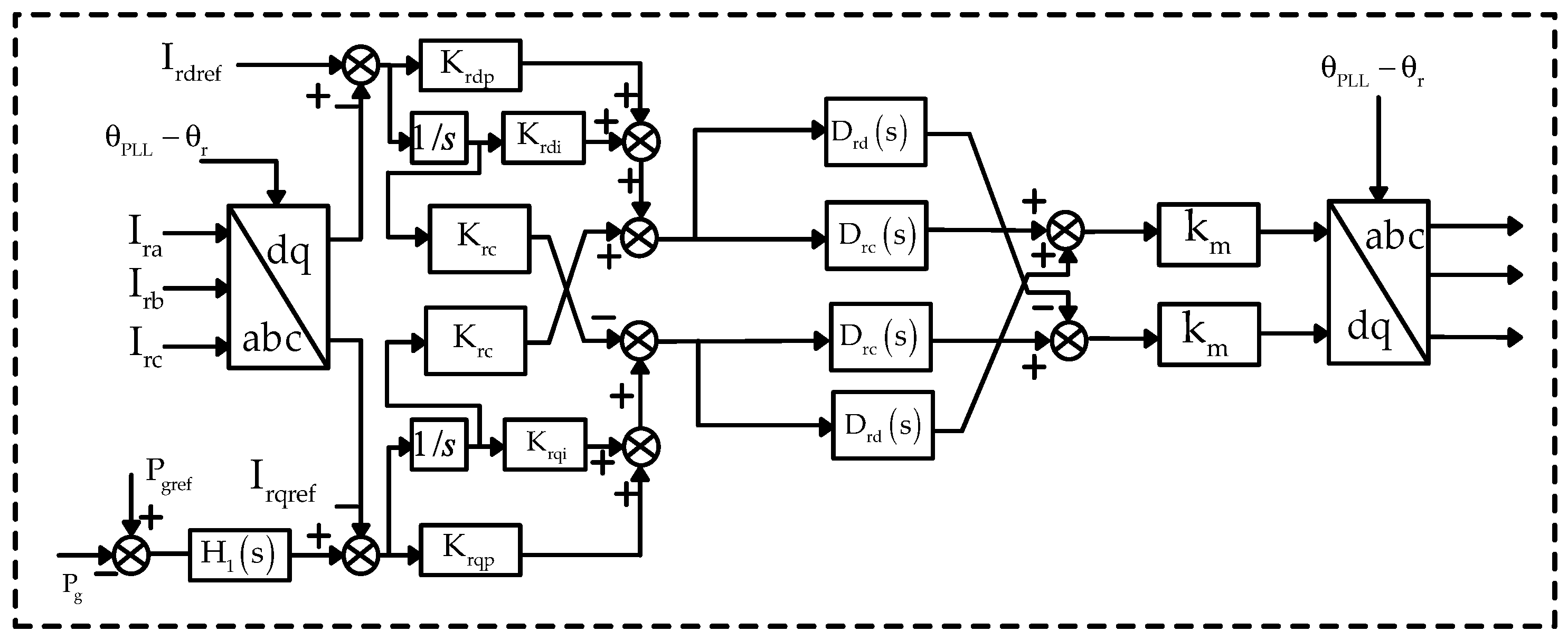
The specific control structure is shown in Figure 1.
The mechanical and electrical subsystems of the DFIG interact with each other: the electrical subsystem acts on the mechanical subsystem through the electromagnetic torque, while the mechanical subsystem affects the electrical subsystem via the rotor angular speed ω r . Based on the two-mass shaft model, the ratio of the angular speed increments Δ ω t and Δ ω r can be expressed as follows:
Δ ω t Δ ω r = K m Δ θ D m Δ ω t Δ ω r K m Δ θ + D m Δ ω t Δ ω r H r H t = H r H t
where H t and H r are the inertia time constants of the wind turbine and the DFIG rotor, respectively; ω t is the wind turbine angular speed; θ is the angular displacement of the wind turbine relative to the DFIG rotor; D m is the shaft damping coefficient; and K m is the shaft stiffness coefficient. Let the speed difference be ω Δ = ω t ω r ; then, we have the following:
Δ ω Δ = H r + H t H t Δ ω r
Based on (A1) and (A2), the rotor voltage equation of the DFIG can be obtained (where active and reactive power are effectively controlled using a d-axis-oriented stator flux reference frame):
v rd = R r i rd σ di rd dt + ω slip σ i rq v rq = R r i rq σ di rq dt ω slip σ i rd + ω slip L m L s ψ s
where σ = L r L m 2 / L s , σ = L r L m 2 / L s / ω s ; the subscripts d and q denote the d-axis and q-axis components of the corresponding variables, respectively; ψ is the flux magnitude; L m is the mutual inductance; and ωslip is the slip angular speed.
Using the control system shown in Figure 1, the increment of active power P g is given by the following:
Δ P g = Δ T e ω r = L m L s ψ s ω r Δ i rq
where T e is the electromagnetic torque of the DFIG.
When the DFIG operates under the MPPT control mode, the reference value of the DFIG active power is given by the following:
P gref = k opt ω r 3
where k opt is the proportional coefficient. From (10)–(13), the expression of T e / ω for the DFIG under the MPPT control mode is given by the following [29]:
Δ T e Δ ω Δ = 2 k opt ω r 2 H t L m ψ s H t + H r a 4 s 4 + a 3 s 3 + a 2 s 2 + a 1 s + a 0 f 5 s 5 + f 4 s 4 + f 3 s 3 + f 2 s 2 + f 1 s + f 0
The expression under the constant power operation mode is given by the following:
Δ T e Δ ω Δ = P g H t L m ψ s D rc ω r H t + H r · a 4 s 4 + a 3 s 3 + a 2 s 2 + a 1 s + a 0 f 5 s 5 + f 4 s 4 + f 3 s 3 + f 2 s 2 + f 1 s + f 0
The parameters a and f are given in (A3) and (A4) of Appendix A.
When the phase of Δ T e leads Δ ω Δ within π / 2 , 3 π / 2 , the electromagnetic torque provides positive damping to the shaft, reducing shaft oscillations and stabilizing the shaft system. Conversely, when the phase of Δ T e leads Δ ω Δ within π / 2 , π / 2 , the electromagnetic torque introduces negative damping to the shaft, amplifying shaft oscillations.

3. Modeling of Rotor-Side Frequency-Coupled Impedance of the DFIG Under the Dual-Damping-Term Control Strategy

The rotor-side frequency-coupled impedance model adopts a small-signal modeling approach based on harmonic linearization. Built on the dq-axis rotating reference frame and considering the frequency-coupling effect introduced by the PLL, this method decomposes the stator and rotor voltages and currents into components of different frequencies and finally derives the impedance relationship between the stator disturbance voltage and current.
Based on the rotor-side controller structure shown in Figure 1, the input to the current control loop consists of the dq axis current references and the dq axis current components, ultimately producing the dq axis modulation signals. According to (A5)–(A7) in Appendix B, the frequency-domain expression of the modulation signals can be obtained as follows:
m rd f = H rd s I rp 1 f + I rp 2 f + I r 1 s i n φ ir 1 jG s V sp 1 f + jG s V sp 2 f K r c 1 s K r 1 H 1 s + 1 jI rp 1 f + jI rp 2 f + I r 1 c o s φ ir 1 jG s V sp 1 f jG s V sp 2 f D r c +
K r 1 H 1 s + 1 H rq s jI rp 1 f + jI rp 2 f + I r 1 c o s φ ir 1 jG s V sp 1 f jG s V sp 2 f + K rc 1 s I rp 1 f + I rp 2 f + I r 1 s i n φ ir 1 jG s V sp 1 f + jG s V sp 2 f f = f p f 1
m rq f = K r 1 H 1 ( s ) + 1 H rq ( s ) jI rp 1 f + jI rp 2 f + I r 1 c o s φ ir 1 jG ( s ) V sp 1 f jG ( s ) V sp 2 f + K rc 1 / s I rp 1 f + I rp 2 f + I r 1 s i n φ ir 1 jG ( s ) V sp 1 f + jG ( s ) V sp 2 f D rc
H rd s I rp 1 f + I rp 2 f + I r 1 s i n φ ir 1 jG s V sp 1 f + jG s V sp 2 f K rc 1 s K r 1 H 1 s + 1 jI rp 1 f + jI rp 2 f + I r 1 c o s φ ir 1 jG s V sp 1 f jG s V sp 2 f f = f p f 1
where H rd ( s ) = + K rdi / s , H rq ( s ) = + K rqi / s , K r 1 = L m / L s ψ s ω r , and H 1 = + K i 1 s .
Based on (A1) and (A2), by performing a frequency-domain transformation and substituting into the frequency-domain expression of the modulation signals, the rotor current expressions at frequencies f p f r and f p 2 + can be obtained as follows:
A 11 ( s ) A 12 ( s ) A 21 ( s ) A 22 ( s ) I rp 1 f I rp 2 f = B 11 ( s ) B 12 ( s ) B 21 ( s ) B 22 ( s ) V sp 1 f V sp 2 f sL m 0 0 ( s j 2 ω 1 ) L m I sp 1 f I sp 2 f
The specific expressions of the matrices A(s) and B(s) are given in (A9) and (A10).
The rotor-side converter of the doubly fed wind turbine is connected to the grid through the stator of the DFIG. Therefore, the relationship between the stator disturbance voltage and the stator current response can effectively reflect the frequency-coupling characteristics of the DFIG rotor side. The rotor-side frequency-coupling characteristic impedance model of the DFIG wind turbine is defined as follows:
V sp 1 f V sp 2 f = Z dfig ( s ) I sp 1 f I sp 2 f
Z dfig ( s ) = Z 11 ( s ) Z 12 ( s ) Z 21 ( s ) Z 22 ( s )
The corresponding admittance model can be expressed as follows:
Y dfig ( s ) = Y 11 ( s ) Y 12 ( s ) Y 21 ( s ) Y 22 ( s )
Based on the relationship between the stator disturbance voltage and stator current in (19) and (20), the analytical model of the DFIG rotor-side impedance under oscillation frequency coupling can be obtained, as shown in (A11).
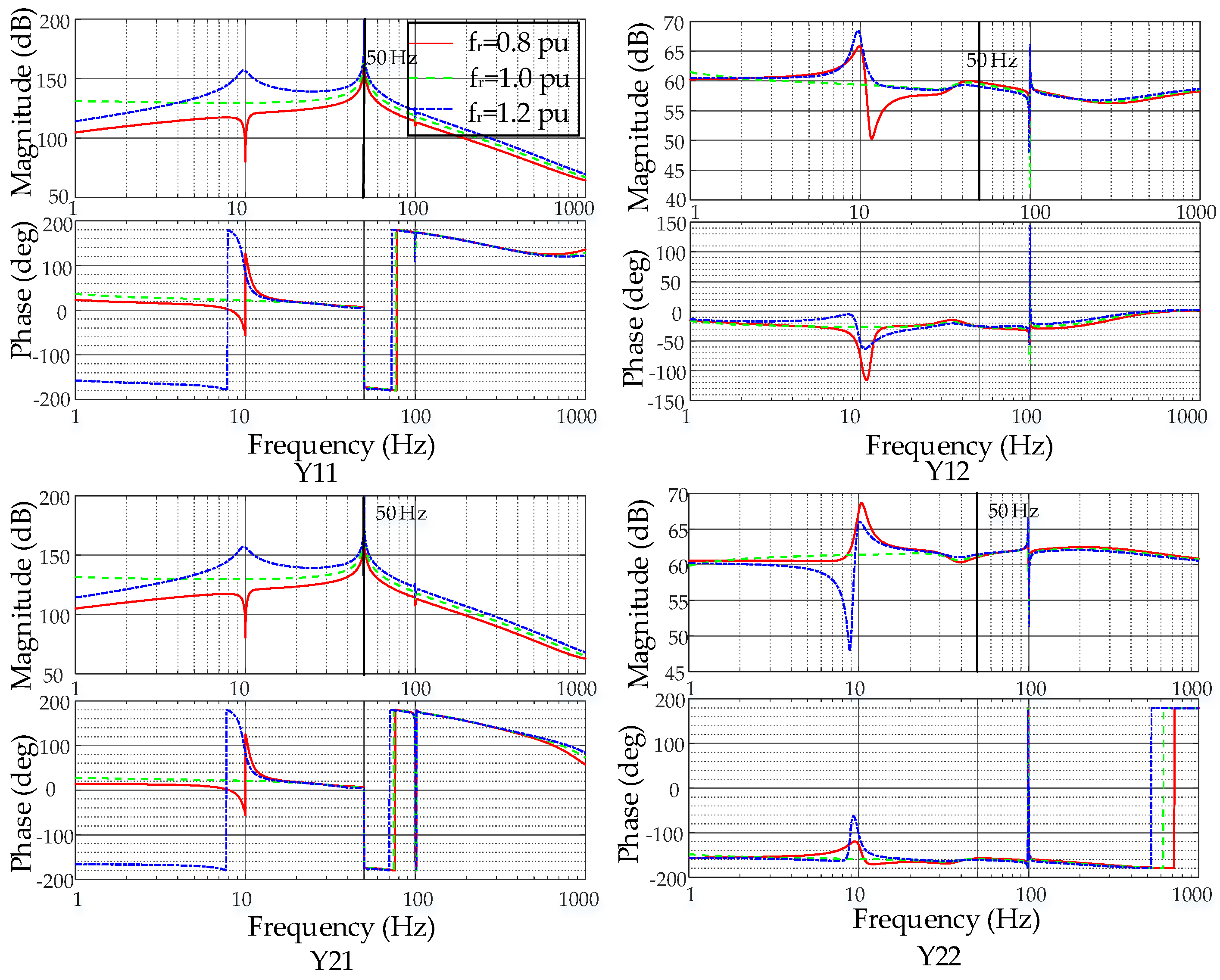
The rotor-side parameters of the DFIG are listed in Table 1; the grid inductance is 2 mH. When the DFIG rotor steady-state speeds f r are 0.8 pu, 1.0 pu, and 1.2 pu, with Z p = 0 pu and Z q = 0 pu, the analytical model of the rotor-side frequency-coupling characteristic impedance is shown in Figure 2. Figure 2 illustrates the significant frequency-coupling characteristics within the DFIG rotor-side control system across different rotor frequencies. This coupling not only affects the system’s dynamic response but may also degrade control accuracy and stability. Consequently, these frequency characteristics must be fully considered in the design of the DFIG control system, and appropriate mitigation measures should be implemented to achieve efficient and stable operation.
When the doubly fed wind turbine is connected to the grid, the grid-connected system also exhibits corresponding frequency-coupling characteristics. The grid impedance matrix at frequencies f p and f p 2 f 1 can be expressed as follows:
Z g ( s ) = Z gp 1 ( s ) 0 0 Z gp 2 ( s )
When the grid is regarded as a feedback loop, the impedance model of the rotor side and the grid-connected system can be expressed as follows:
V p 1 f I p 1 f = 1 + Z gp 2 ( s ) Y 22 ( s ) Y 11 ( s ) 1 + Z gp 2 ( s ) Y 22 ( s ) Y 12 ( s ) Z gp 2 ( s ) Y 21 ( s )
V p 2 f I p 2 f = 1 + Z gp 1 ( s ) Y 11 ( s ) Y 22 ( s ) 1 + Z gp 1 ( s ) Y 11 ( s ) Y 21 ( s ) Z gp 1 ( s ) Y 12 ( s )
Equations (23) and (24) represent the relationship between the disturbance voltage and the resulting current at the grid connection point at frequencies f p and f p 2 f 1 , respectively.

4. Effects of Damping Parameters on Shafting Oscillations and Impedance

In order to verify the influence of the improved control strategy on the grid-connected system of wind turbines, the coupling dynamics of the shaft system and grid-connected oscillation frequency of DFIG are analyzed according to the parameters in Table 1.
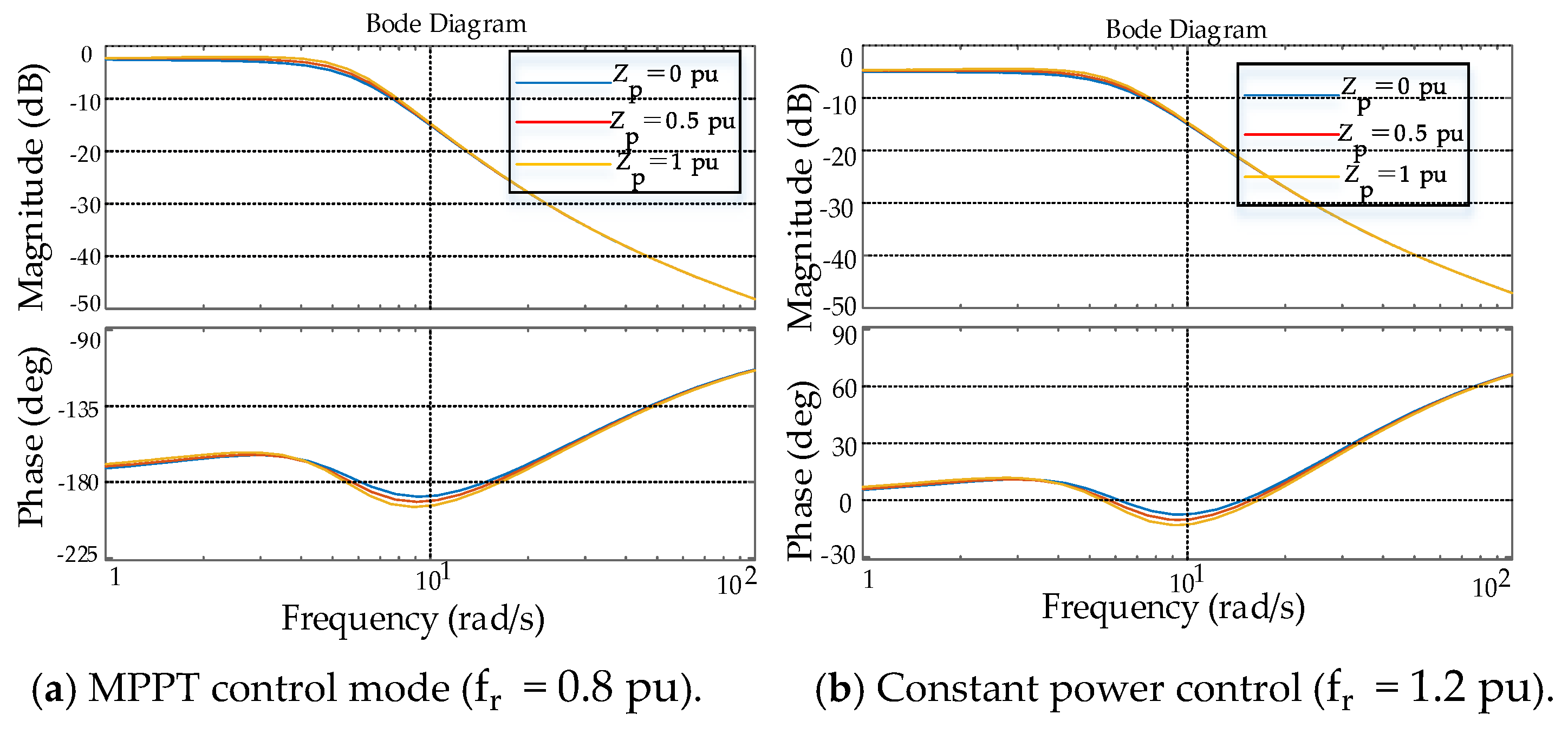
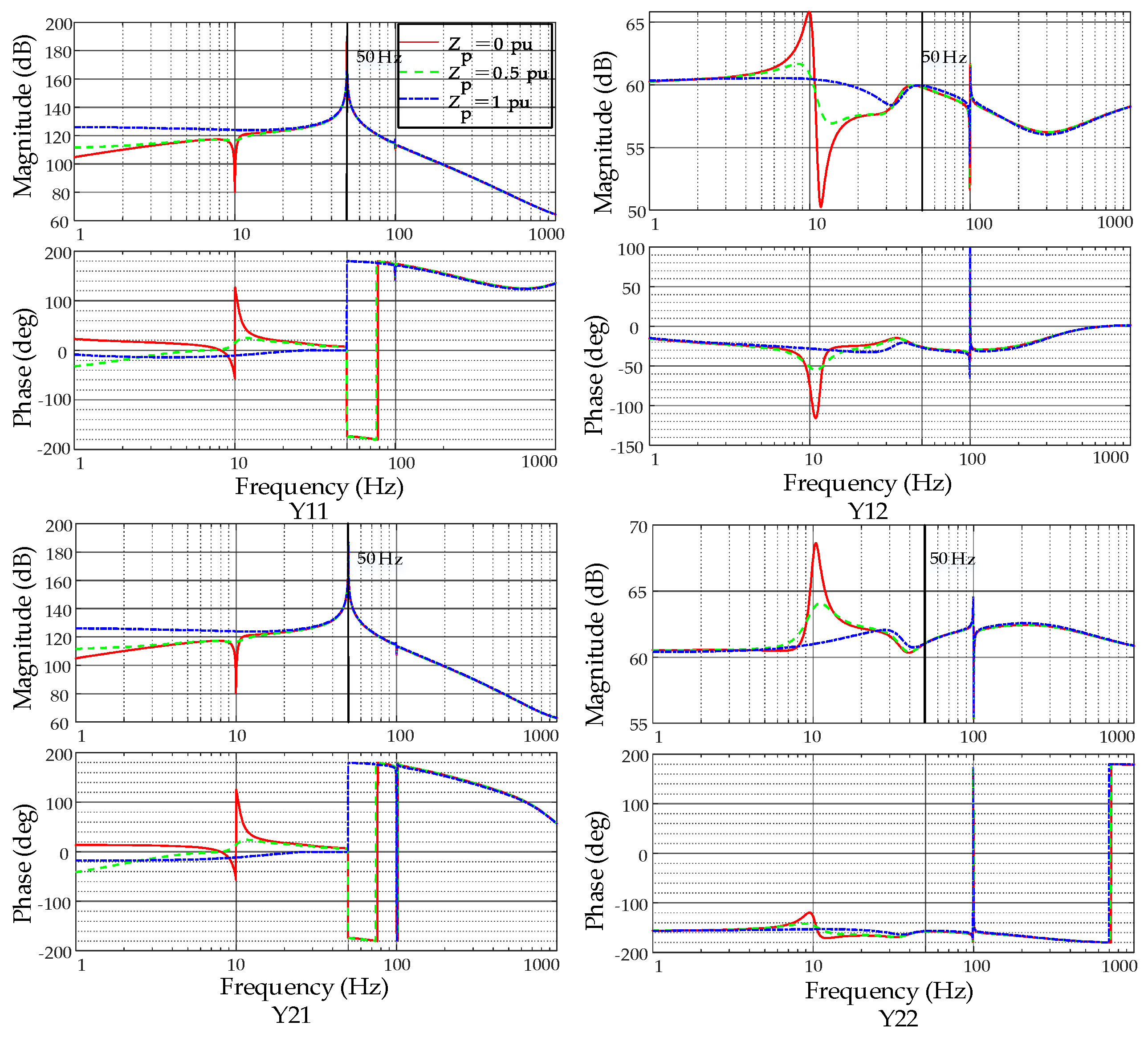
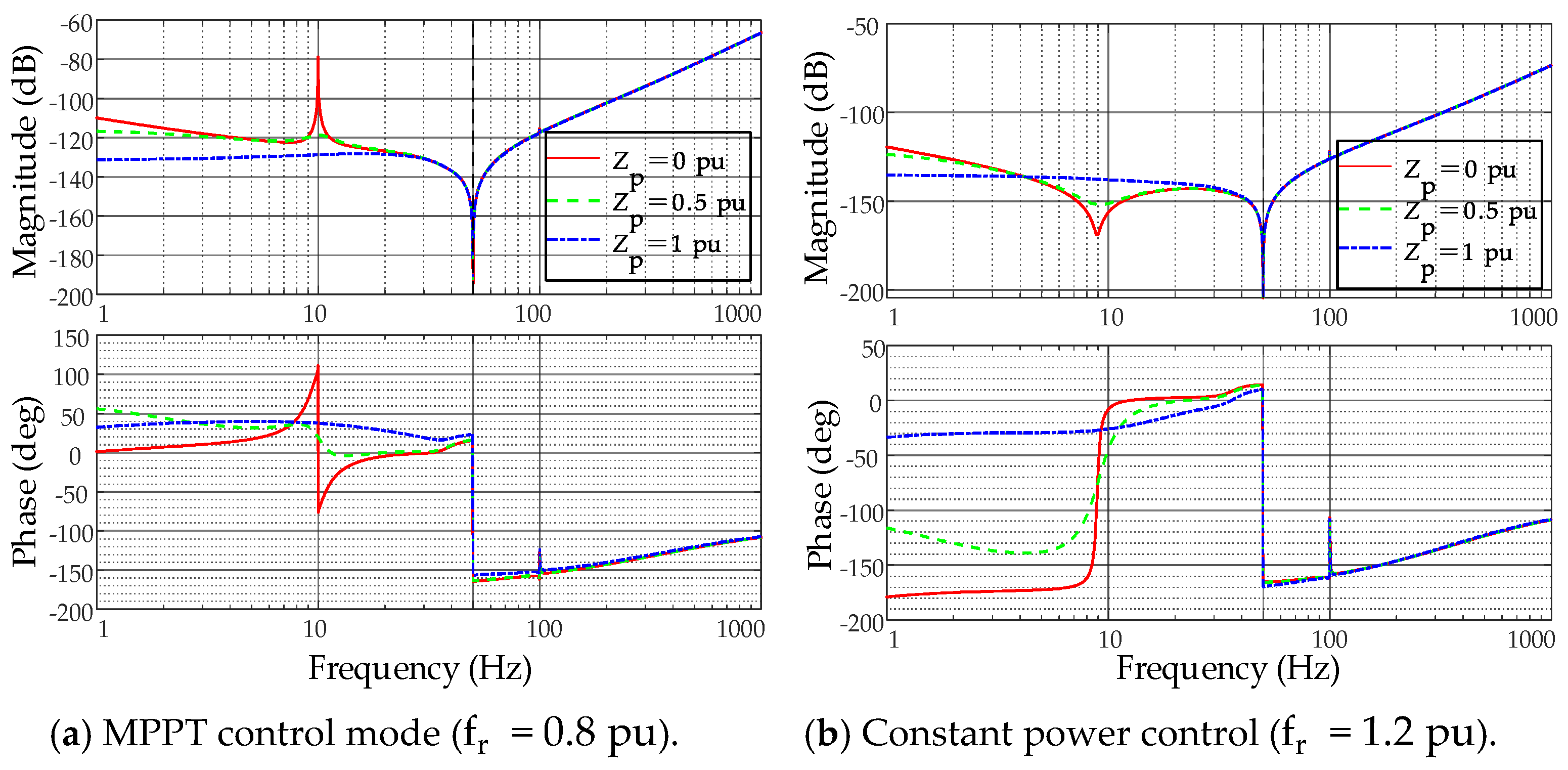
Using these parameters, when the inductance on the grid side is 2 mH, Zp = 0 pu, 0.5 pu, or Zp = 1 pu, Z q = 0 pu, and the DFIG rotor frequency is 0.8 pu and 1.2 pu, the Bode diagram of Δ T e / Δ ω Δ can be obtained according to Equations (14) and (15) (Figure 3), and the frequency-coupling impedance characteristics of the DFIG rotor side (Figure 4 and Figure 5) and the grid-connected impedance characteristics (Figure 6) can be obtained according to Equations (23) and (A11).
When the DFIG rotor speed is 0.8 pu under MPPT control, as shown in Figure 3a, the following conditions apply:
(1)
The phase angle of T e / ω ranges from approximately −200° to 113°, all lying in the second quadrant. The electrical damping coefficient is negative, meaning that the electrical system provides positive damping to the shaft, which helps suppress shaft oscillations.
(2)
When Z q = 0 pu and Z p increases, the electrical damping coefficient decreases, which is beneficial for shaft stability.
When the DFIG rotor speed is 1.2 pu under constant power control, as shown in Figure 3b, the following conditions apply: (1) The phase angle of T e / ω ranges from approximately −20° to 65°, lying in the first or fourth quadrant of the phasor diagram in Figure 3b. The electrical damping coefficient is positive, meaning that the DFIG electrical system provides negative damping to the shaft, which promotes shaft oscillations. (2) When Z q = 0 pu and Z p increases, the electrical damping coefficient increases, which is unfavorable for shaft stability under external disturbances.
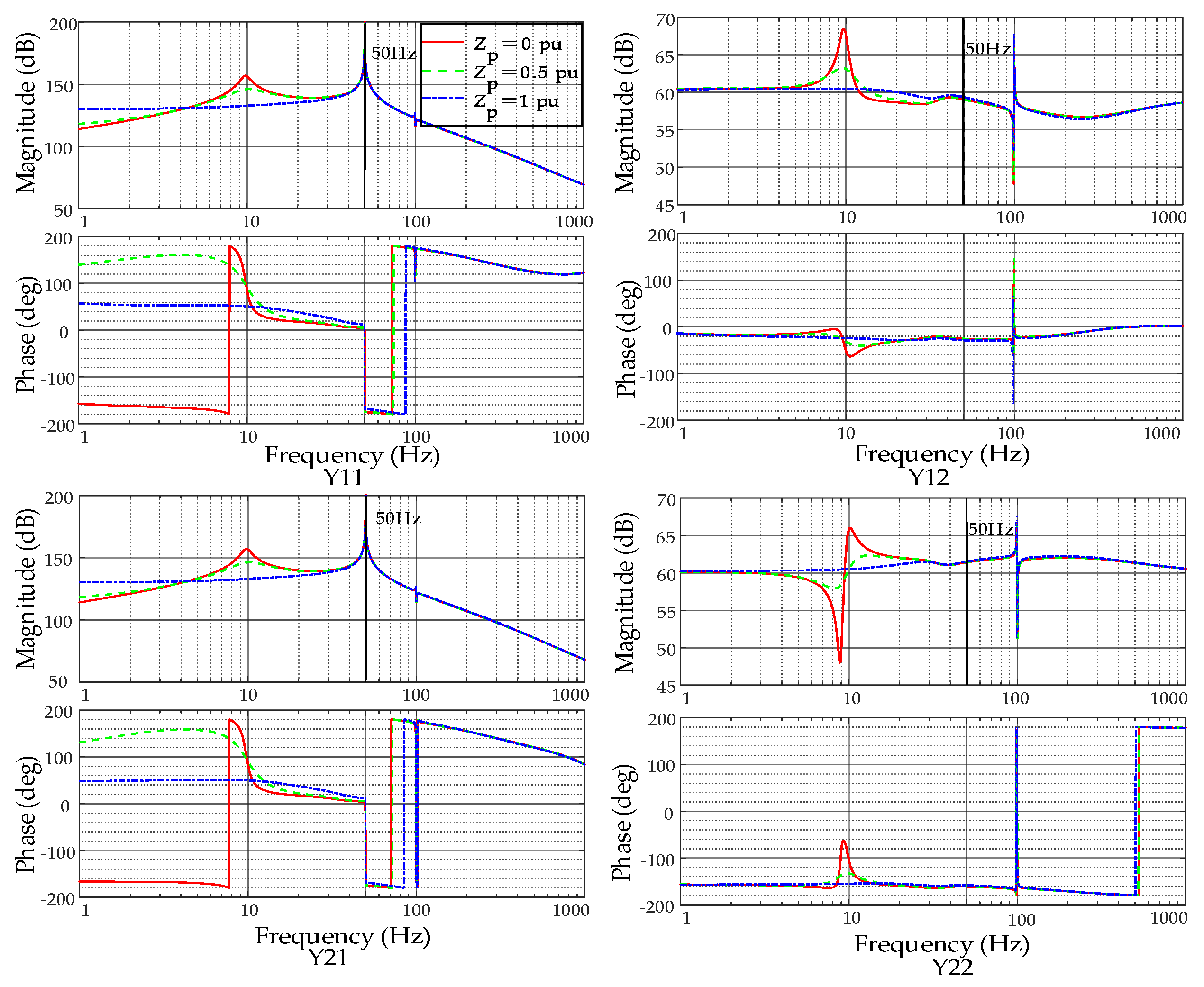
According to Figure 4 and Figure 5, when Z q = 0 pu and Z p increases, the magnitude of the off-diagonal elements decreases. This indicates a weakening of the oscillation frequency coupling on the rotor side of the DFIG. Meanwhile, the phase jump tends to smooth out, suggesting that the resonance is mitigated to a certain extent.
As illustrated in Figure 6, under MPPT control with Z q = 0 pu and Z p increasing, the phase jump magnitude of the grid-connected impedance is reduced at low frequencies, resulting in a smoother transition while maintaining positive damping characteristics near 50 Hz. In contrast, under constant power control, the negative damping of the DFIG grid-connected impedance increases with rising Z p .
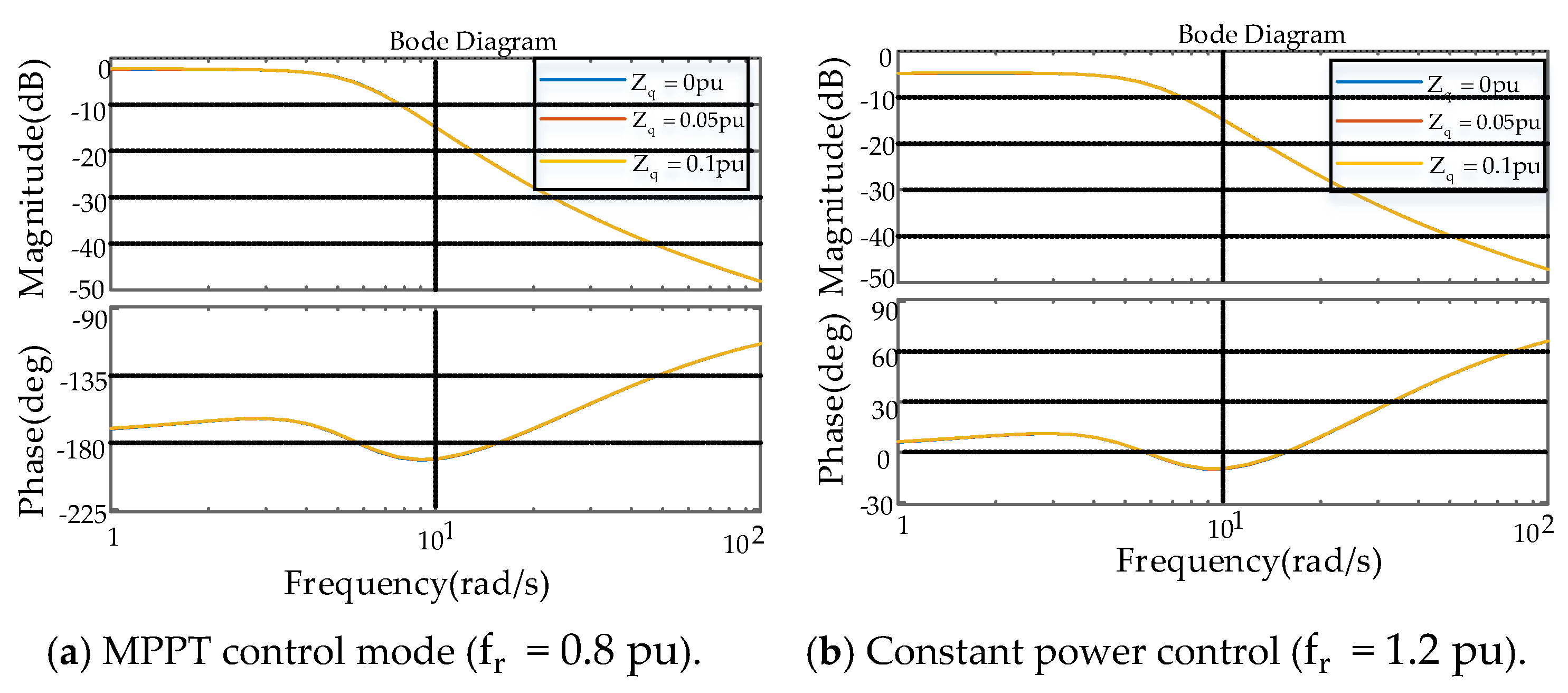
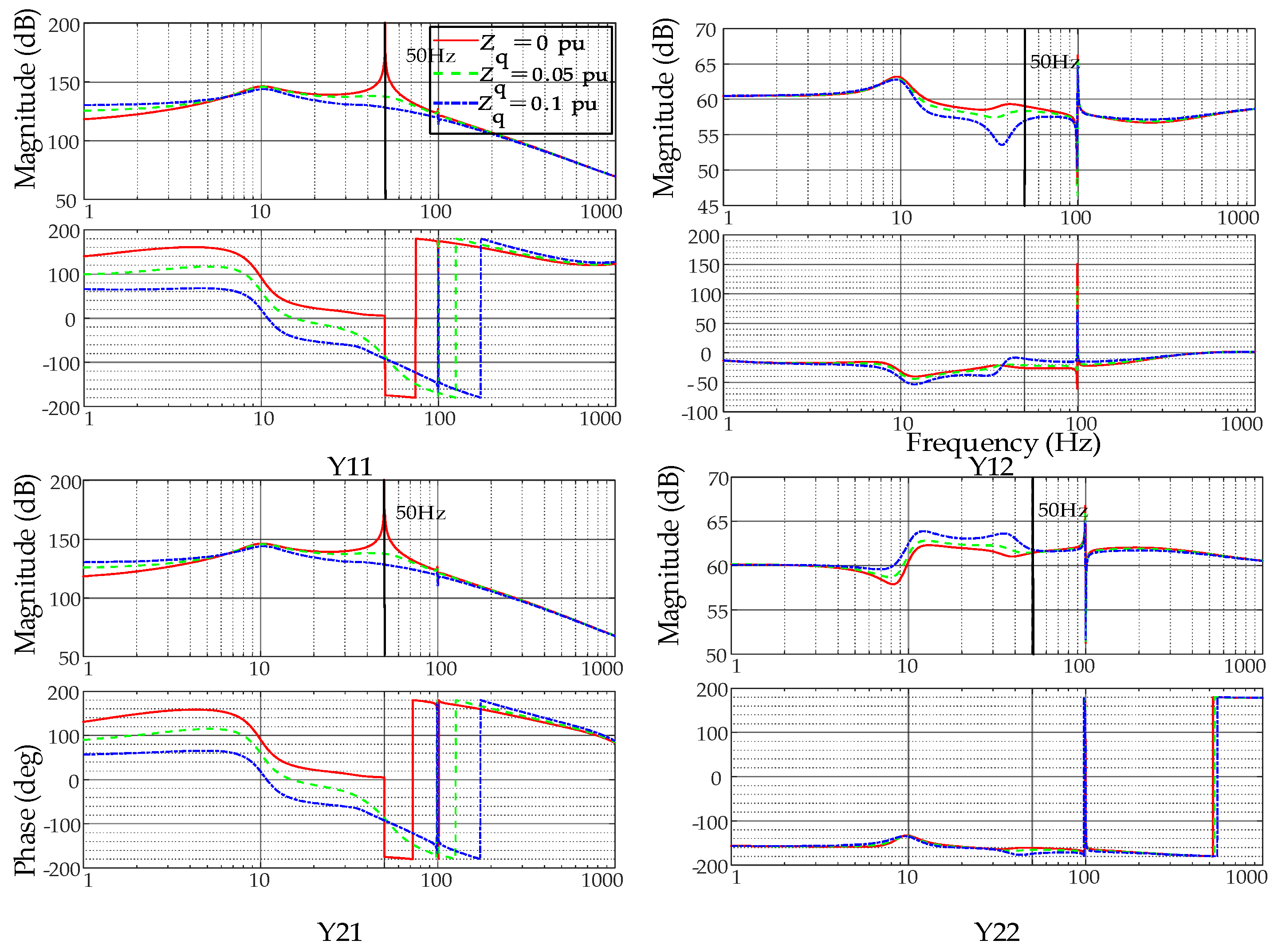
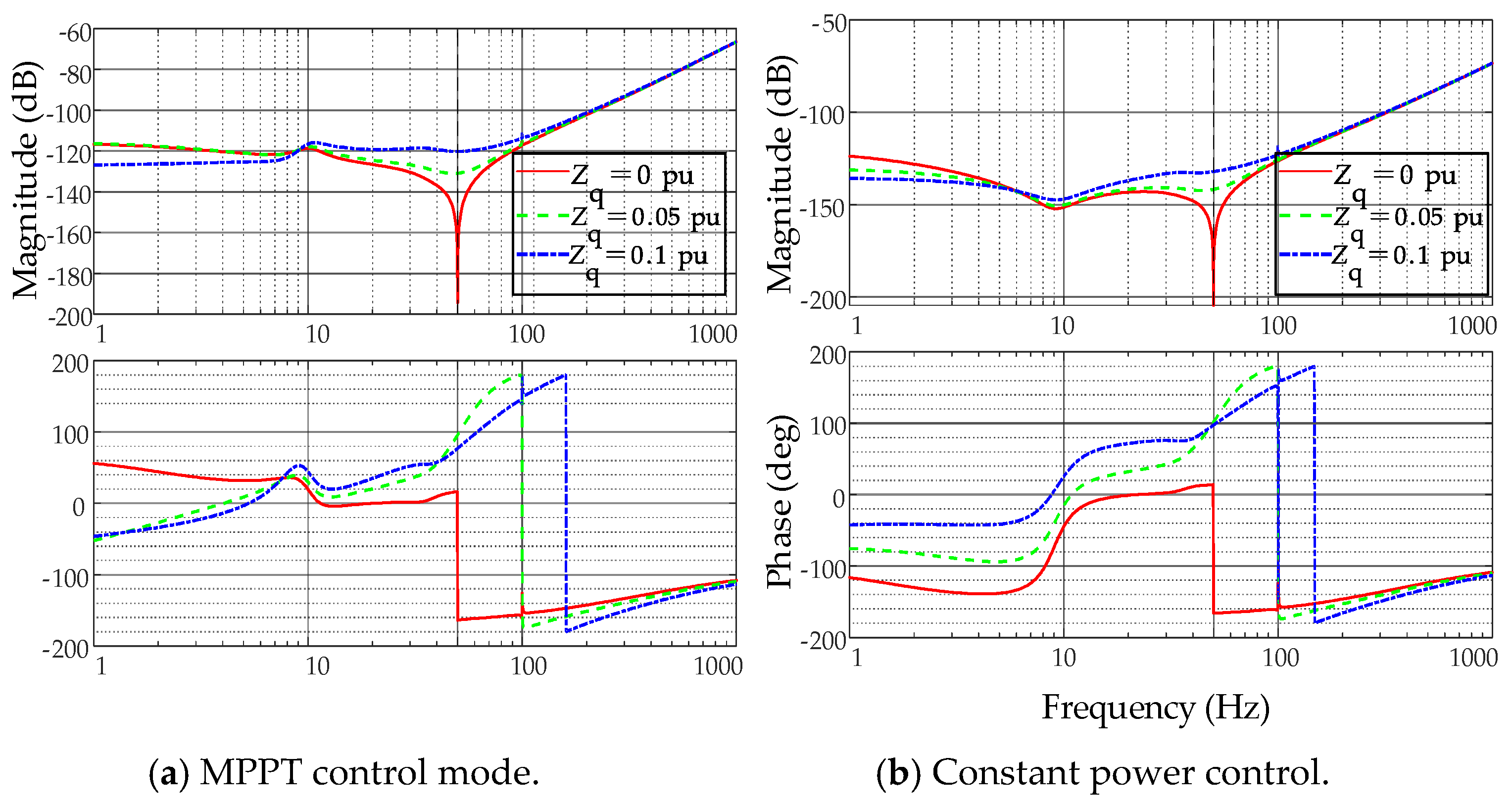
Keeping other parameters unchanged, when Z p = 0.5 pu and Z q = 0 pu, 0.05 pu, or 0.1 pu, the Bode plots of T e / ω (Figure 7), the rotor-side frequency-coupling impedance characteristics of the DFIG (Figure 8 and Figure 9), and the grid-connected impedance characteristics (Figure 10) can be obtained.
When the DFIG rotor speed is 0.8 pu under MPPT control, as shown in Figure 7a, the phase angle of T e / ω ranges approximately from −192° to −112°, all lying in the second quadrant. The electrical damping coefficient is negative, meaning that the electrical system provides positive damping to the shaft oscillations.
When the DFIG rotor speed is 1.2 pu under constant power control, as shown in Figure 7b, the phase angle of T e / ω ranges approximately from −10° to 67°, lying in the first or fourth quadrant of the phasor diagram in Figure 7b. When the electrical damping coefficient is positive, the DFIG electrical system provides negative damping to the shaft oscillations. When Z p = 0.5 pu and Z q increases, the electromagnetic damping shows little variation.
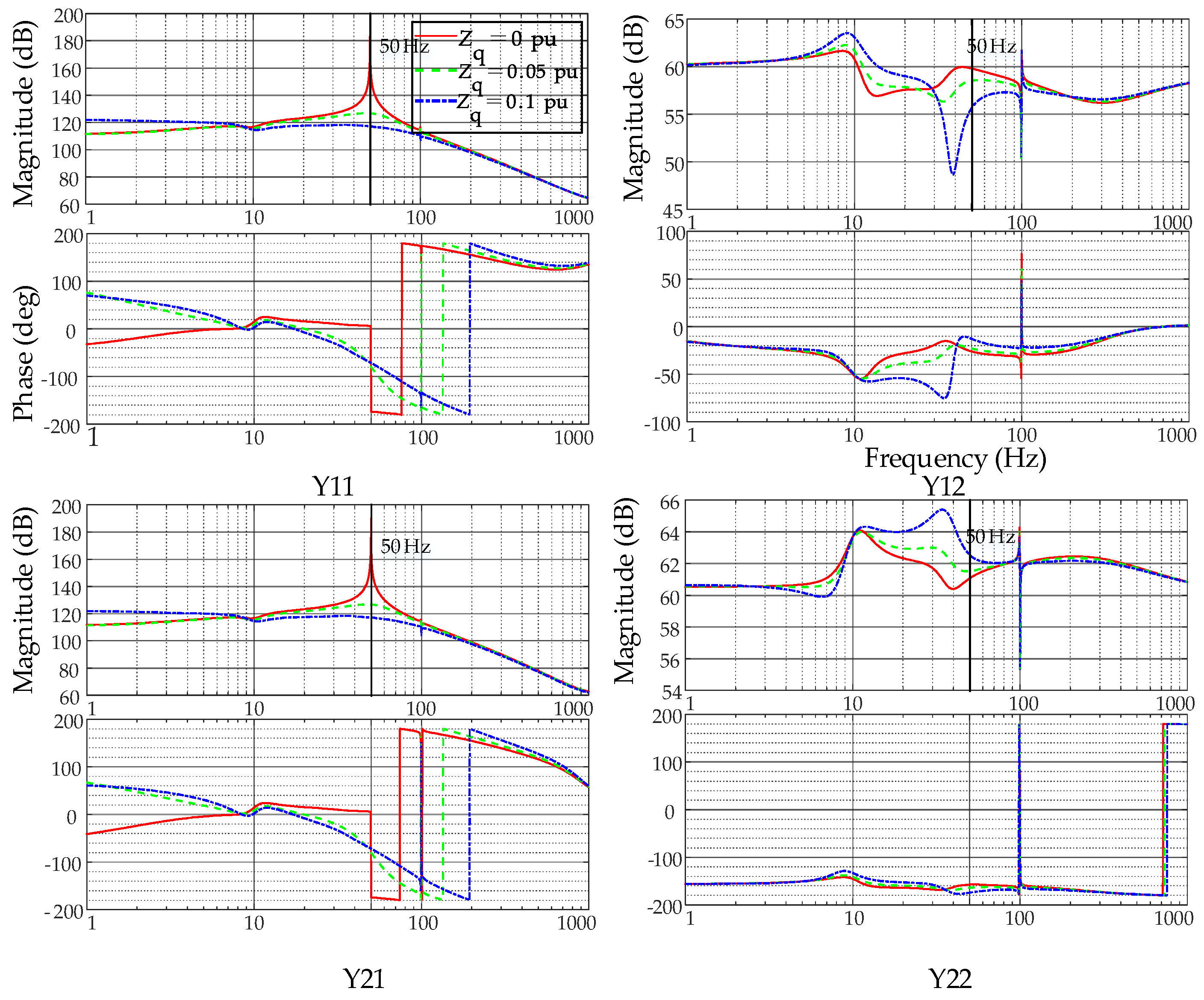
As shown in Figure 8 and Figure 9, as Z q increases, the magnitude of the off-diagonal elements (Y12/Y21) significantly rises around 50 Hz. This indicates an enhanced coupling strength of the DFIG rotor-side frequency, which is prone to triggering oscillation risks. Meanwhile, the phase jump tends to smooth out, and the resonance peak is notably suppressed. Under constant power mode, the magnitude variation of Y12/Y21 is more drastic, leading to a higher frequency-coupling risk compared to the MPPT mode. This is attributed to the faster dynamic response of the power closed loop in constant power control, rendering it more sensitive to coupling disturbances caused by Z q .
As shown in Figure 10, under MPPT mode, the grid-connected system remains relatively stable despite the increase in Z q . In contrast, under constant power control, the negative damping of the DFIG grid-connected impedance increases with rising Z q . Therefore, Z q should not be excessively large; it is recommended to limit Z q within 0.05 pu to strike a balance between resonance suppression and coupling risk.

5. Case Study Verification

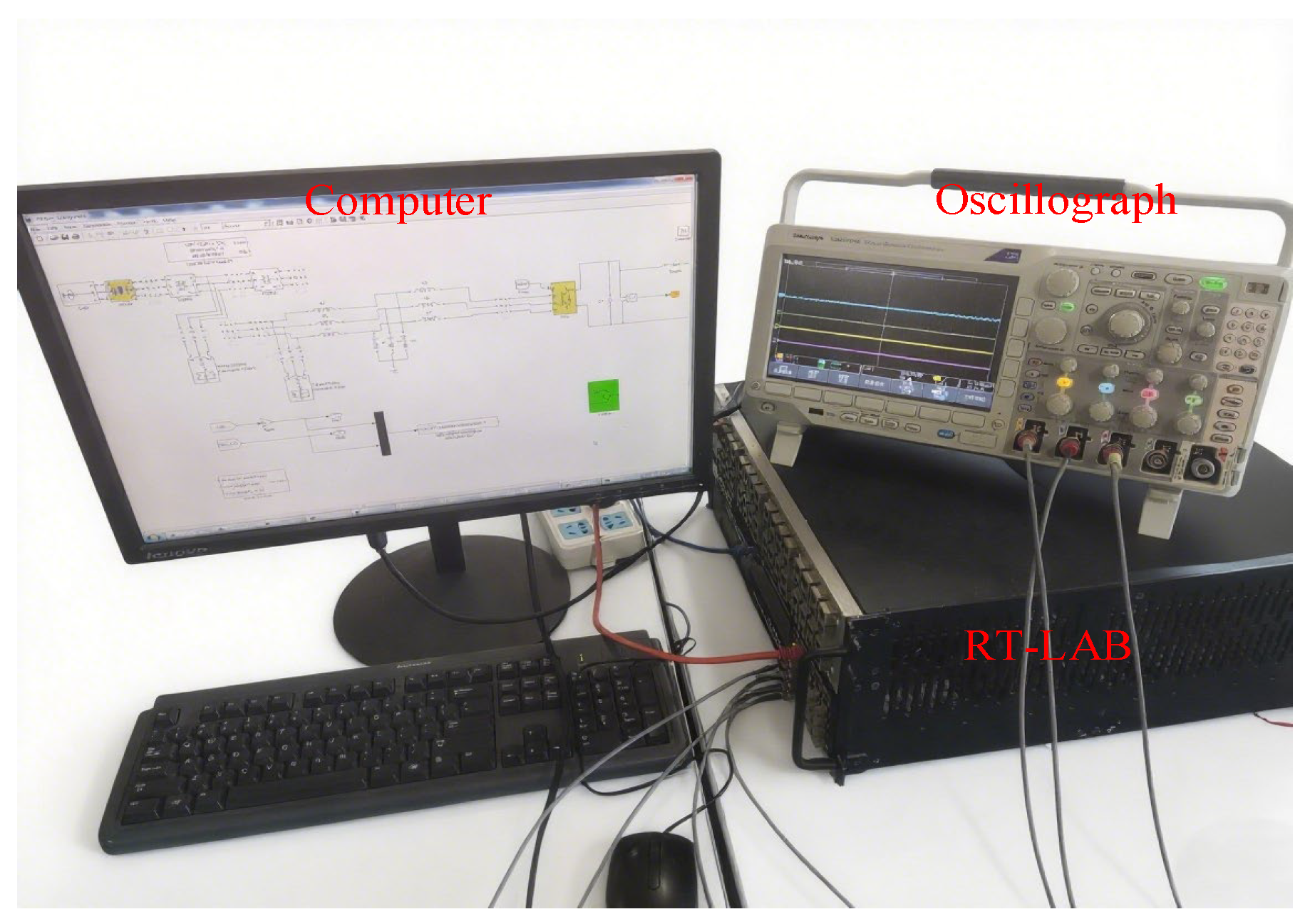
In this study, the experimental platform is shown in Figure 11. The experimental platform is a real-time digital simulation system that is mainly composed of a host computer, an RT-LAB real-time simulator (manufactured by Opal-RT Technologies Inc., this high-performance real-time simulation platform is based on a multi-core CPU with a maximum real-time computing capability of a 1-μs time step, supporting the real-time simulation of power electronic and power system models, and capable of real-time output of analog/digital signals and acquisition of external signals), a digital oscilloscope (manufactured by Tektronix Inc. with a bandwidth of 200 MHz and a sampling rate of 2 GS/s, used to collect and display the real-time simulation waveforms output by the RT-LAB simulator), and a signal conversion module (a digital-to-analog converter and an isolation amplifier are built into the RT-LAB). This system is used to carry out hardware-in-the-loop simulation experiments on the 2 MW DFIG grid-connected system with a time step of 1 μs.
Based on the DFIG wind power system parameters listed in Table 1 and a grid inductance of 2 mH, time-domain simulation models of the DFIG were constructed for rotor speeds of 0.8 pu with Z p = 0 pu/ Z q = 0 pu and Z p = 0.5 pu/ Z q = 0.05 pu. These models were then used to validate the established mathematical model.
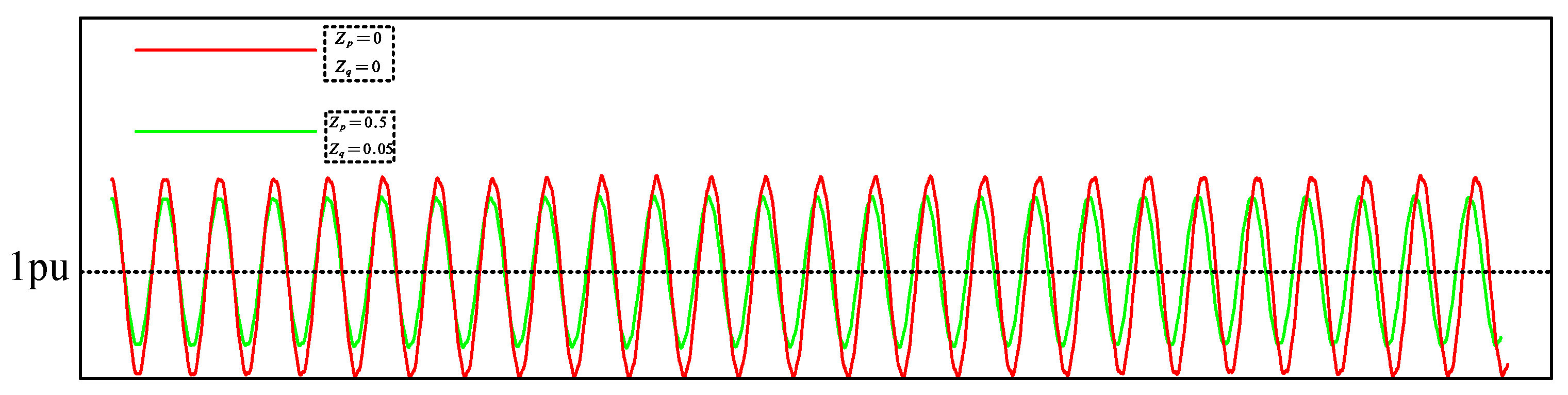
The rotor speed of the DFIG under different damping parameter settings, obtained from the time-domain simulations, is shown in Figure 12. It can be seen that when Z p = 0.5 pu and Z q = 0.05 pu, the rotor speed fluctuations are reduced and the shaft oscillations are suppressed, which is beneficial for the stability of the shaft system.
To assess the grid-connected stability of the DFIG under oscillation frequency coupling, the corresponding stability criterion based on the generalized Nyquist criterion is given as follows:
L = I + Y dfig Z g = 0
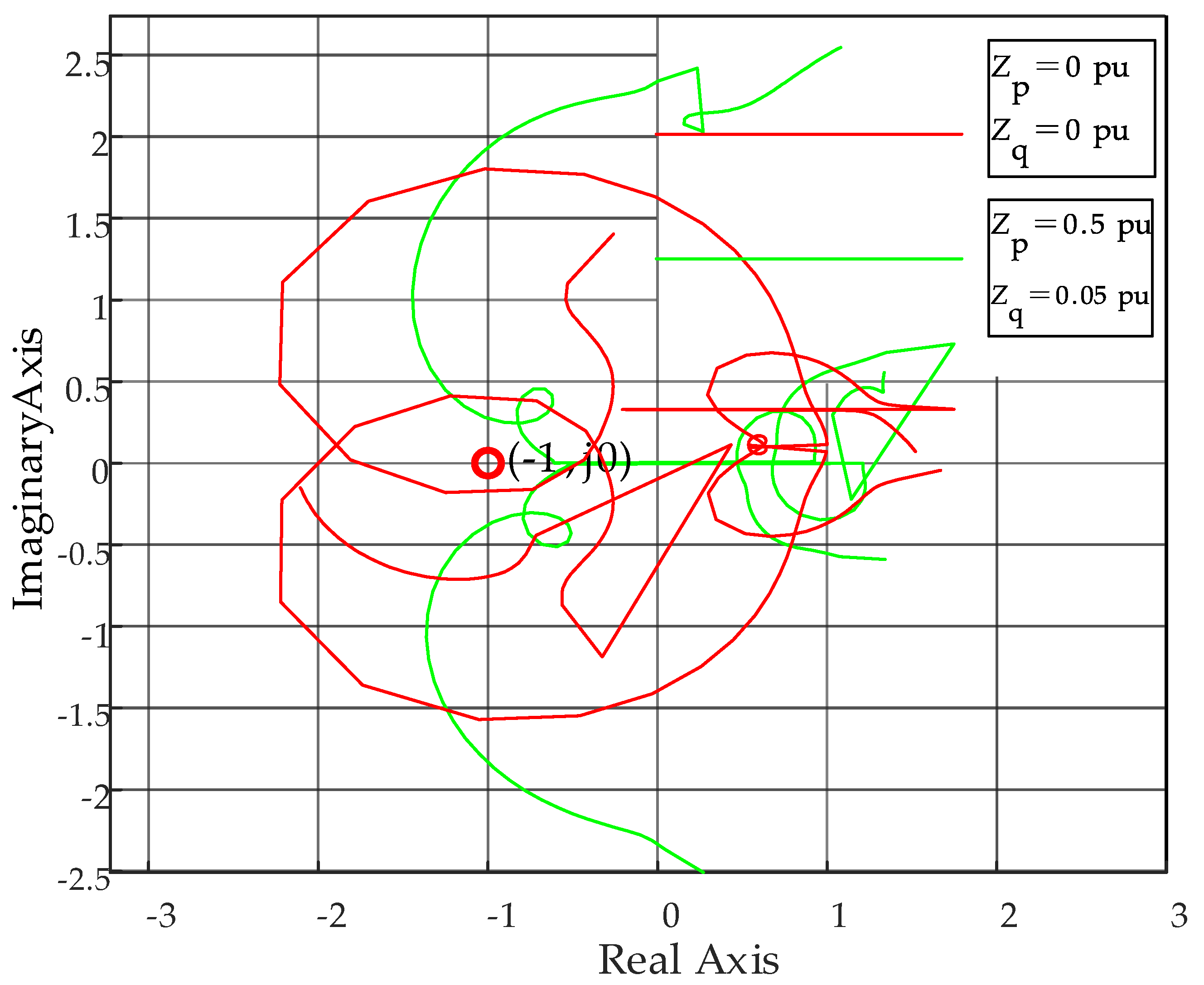
Substituting the analytical admittance expression (21) of the DFIG rotor-side frequency-coupling model into Equation (25) yields the Nyquist plot of the DFIG system, as shown in Figure 13.
When Z p = 0 pu and Z q = 0 pu, the Nyquist plots of the interconnected system encircle the point (−1, j0), with the corresponding crossover frequency of the unit circle being 99 Hz. However, when Z p = 0.5 pu and Z q = 0.05 pu, the Nyquist plots no longer encircle (−1, j0), indicating that the interconnected system satisfies small-signal stability.
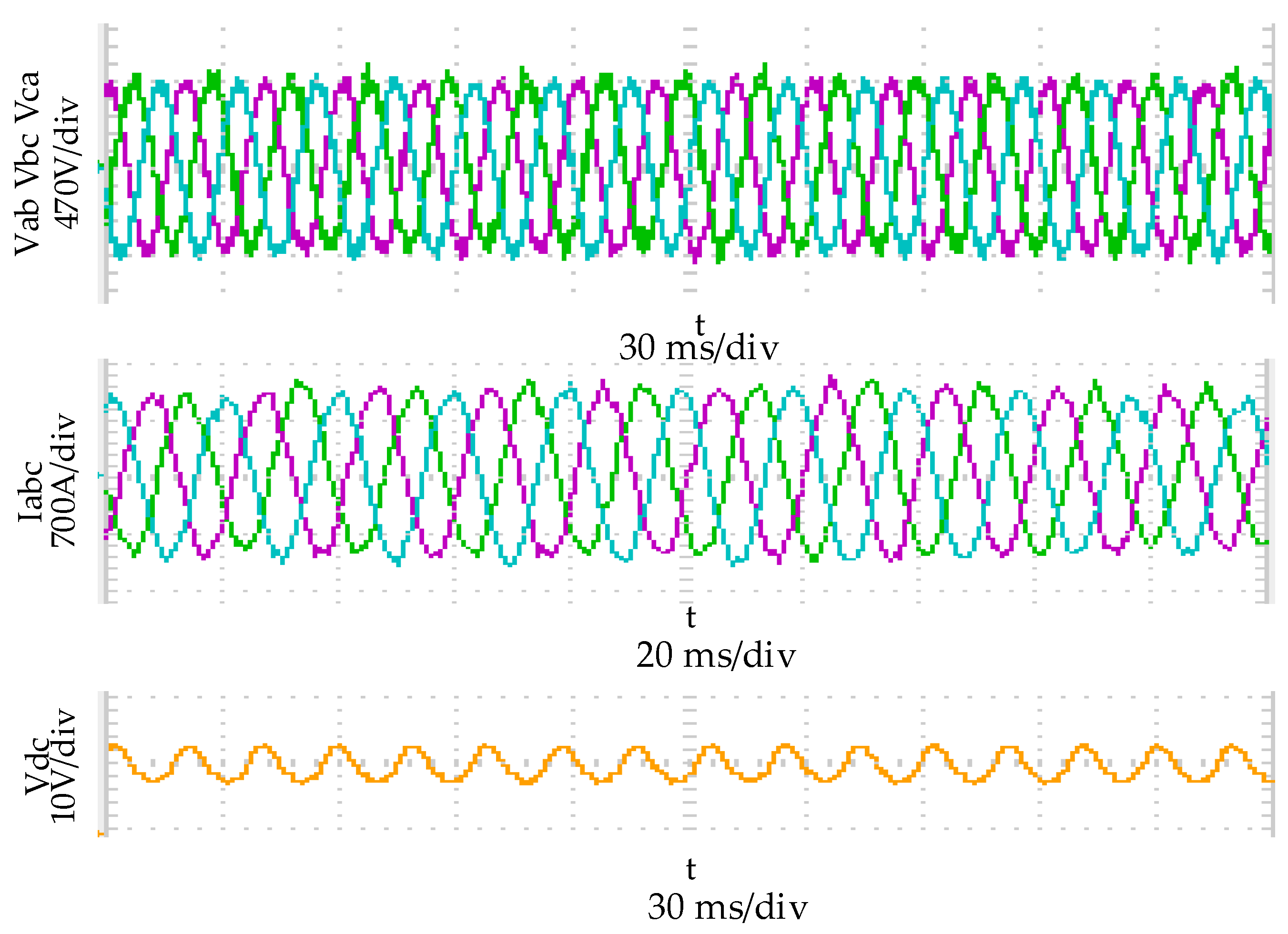
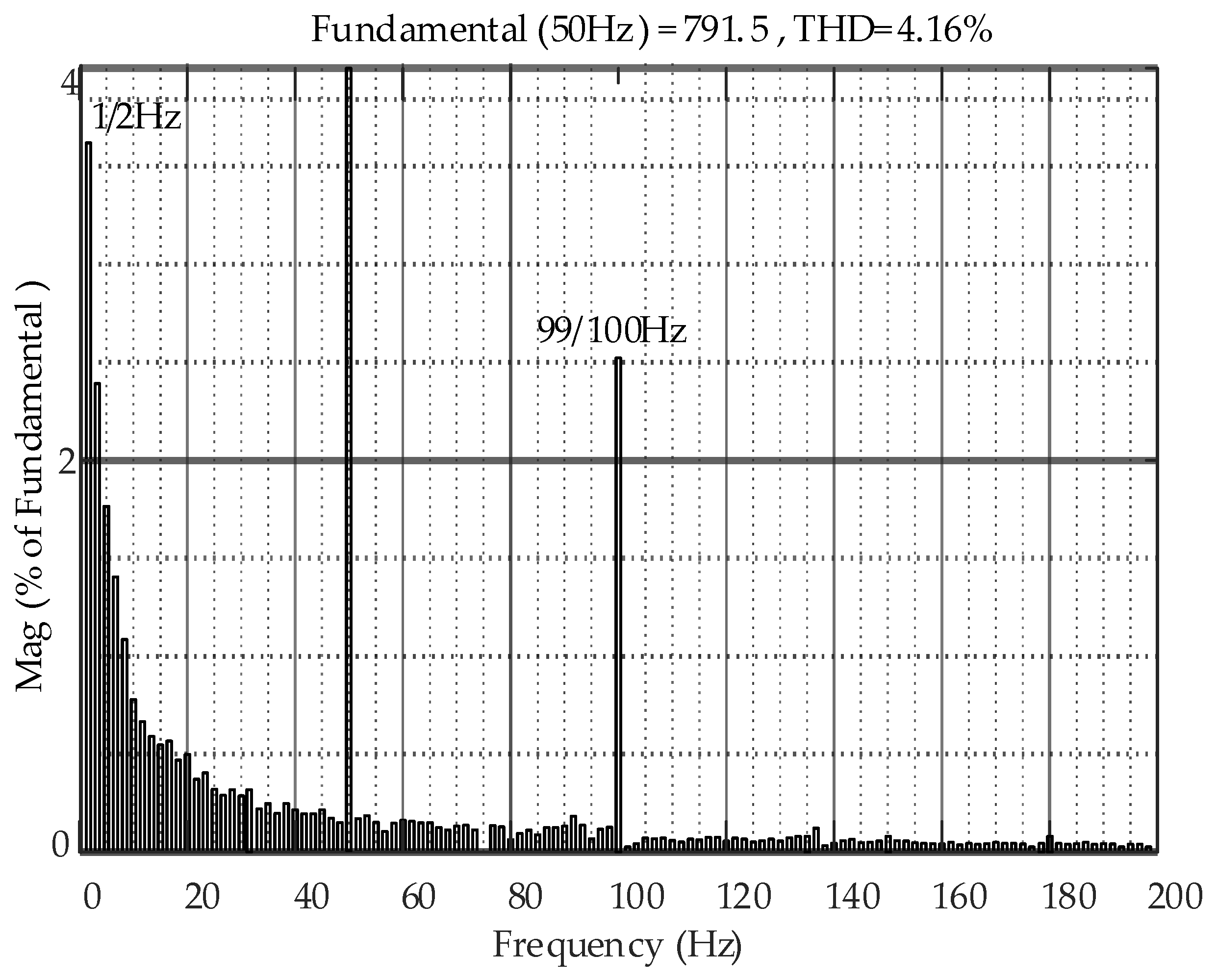
The three-phase voltages at the grid connection point (Vab, bc, ca), the three-phase currents (Iabc), and the DC bus voltage (Vdc) are shown in Figure 14 for Z p = 0 pu and Z q = 0 pu after the DFIG reaches steady-state operation. The corresponding FFT analysis results are shown in Figure 15. From Figure 15, it can be observed that the grid-connected currents contain oscillatory components at both 1/2 Hz and 99/100 Hz.
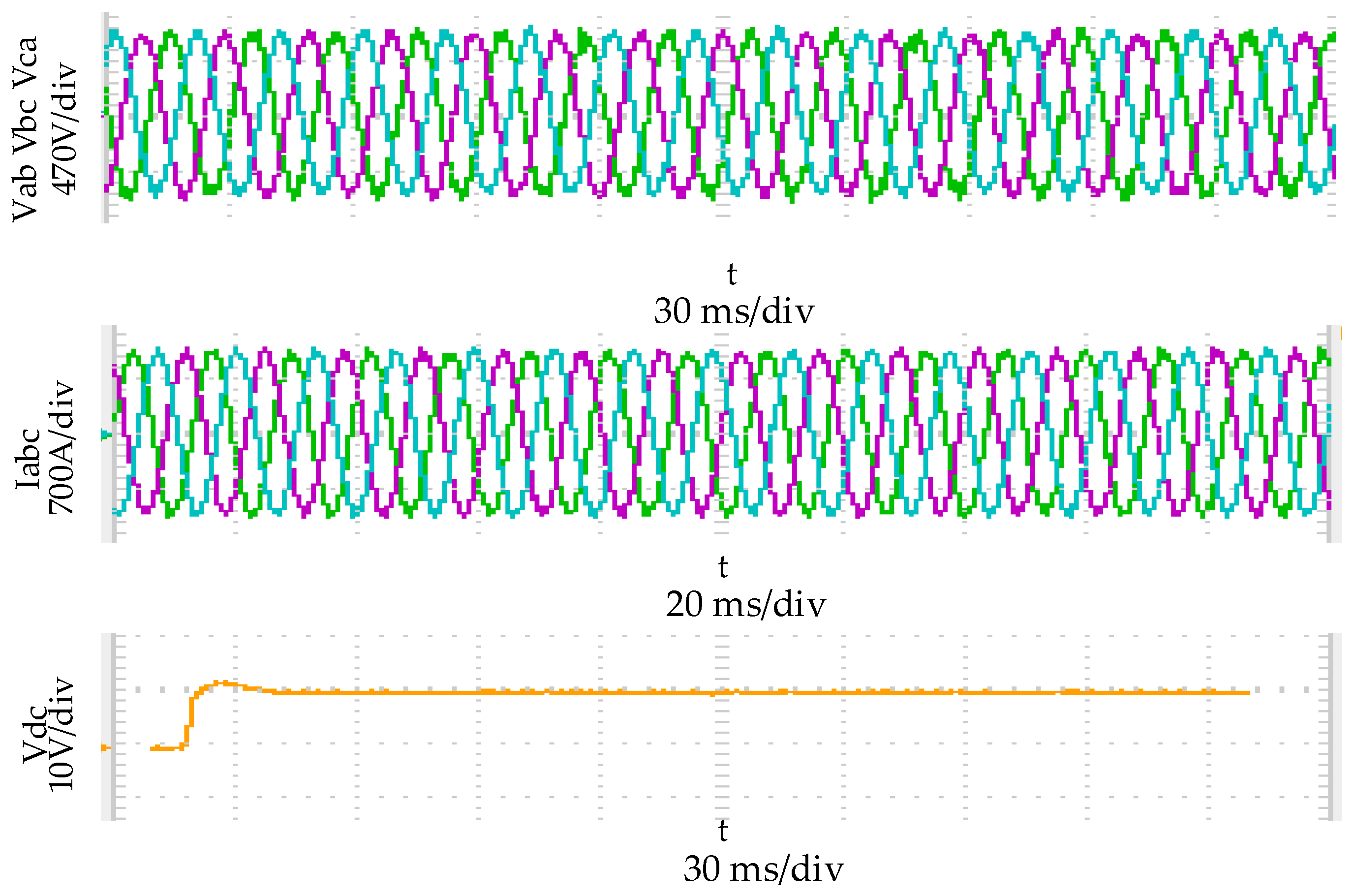
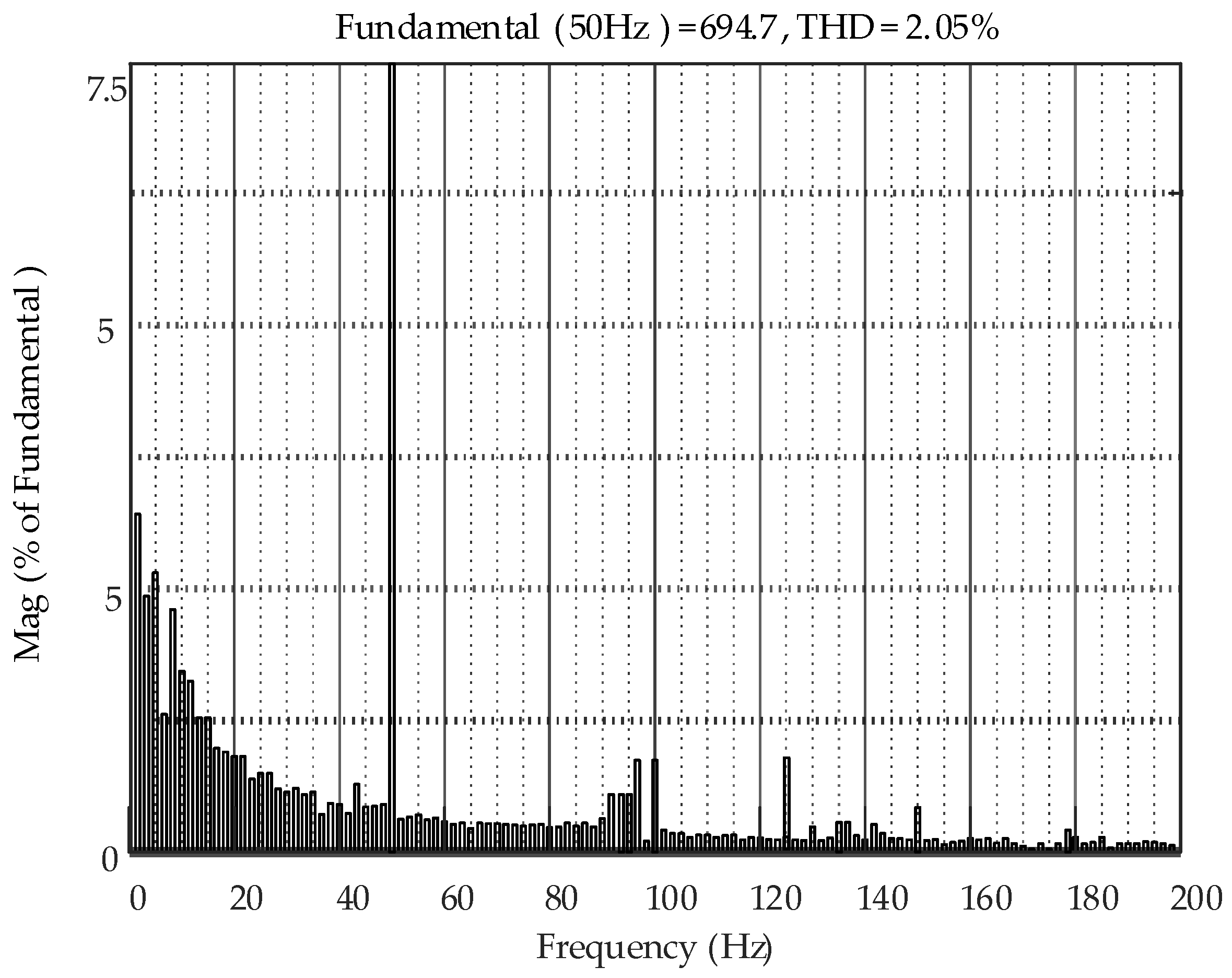
The three-phase voltages at the grid connection point (Vab, bc, ca), the three-phase currents (Iabc), and the DC bus voltage (Vdc) are shown in Figure 16 for Z p = 0.5 pu and Z q = 0.05 pu after the DFIG reaches steady-state operation The corresponding FFT analysis results are shown in Figure 17. It can be observed from Figure 17 that the harmonic components of the current at the Point of Common Coupling are minimal, verifying the stability of the grid-connected system.
In summary, for DFIG systems connected to inductive weak grids, which face the risk of shafting and grid-connected oscillation instability, the system’s stability can be optimized by appropriately adjusting the damping parameters, thereby avoiding oscillation-induced instability in the grid-connected system.

6. Conclusions

Based on the MIC-based dual-damping-term compensation filter and LQR optimization design method, this paper established a shafting model of the DFIG and a rotor-side grid-connected model under frequency coupling, revealing the mechanism of the control strategy in this new scenario. Simulation analysis led to the following conclusions:
(1)
By appropriately adjusting the damping parameters, shafting oscillations can be significantly reduced, improving system stability. Under MPPT mode, when Z q remains constant, increasing Z p reduces the electrical damping coefficient, which is beneficial for shaft stability; conversely, under constant power mode, increasing Z p increases the electrical damping coefficient, which is detrimental to shaft stability.
(2)
The damping parameters can influence the oscillation frequency-coupling characteristics of the DFIG. Specifically, an increase in Z p reduces the ratio of diagonal to off-diagonal elements, thereby weakening frequency coupling on the rotor side. Conversely, increasing Z q intensifies the frequency coupling.
(3)
Under MPPT mode, the grid-connected system remains relatively stable despite increases in Z p and Z q . In contrast, under constant power mode, increasing either Z p or Z q exacerbates the degree of negative damping in the grid-connected impedance.
In conclusion, the MIA-based dual-damping-term compensation filter combined with LQR optimization can effectively suppress DFIG shafting oscillations and grid-connected frequency-coupling oscillations. This method simplifies the control strategy, reduces hardware costs, and provides a valuable reference for the stable operation of DFIG systems.

Author Contributions

Methodology, Y.L.; Validation, Z.W. and Y.L.; Investigation, Z.W.; Data curation, Z.W.; Writing—original draft, Z.W.; Writing—review & editing, Z.W. All authors have read and agreed to the published version of the manuscript.

Funding

This research received no external funding.

Data Availability Statement

The original contributions presented in this study are included in the article. Further inquiries can be directed to the corresponding author.

Conflicts of Interest

The authors declare no conflict of interest.

Appendix A

In the dq reference frame, the voltage and flux linkage equations of the DFIG are given by the following (A1) and (A2):
ψ sd = L s i sd L m i rd ψ sq = L s i sq L m i rq ψ rd = L m i sd L r i rd ψ rq = L m i sq L r i rq
v sd = R s i sd + d ψ sd dt ω s ψ sq v sq = R s i sq + d ψ sq dt + ω s ψ sd v rd = R r i rd + d ψ rd dt ω slip ψ rq v rq = R r i rq + d ψ rq dt + ω slip ψ rd ω slip = ω s ω r
The parameters in Equations (14) and (15) are defined as follows [29] (parameter definition of the shaft system transfer function):
a 4 = K p 1 K rp a 3 = K p 1 K ri + K rp K i 1 + K p 1 K rp Z p * + Z q * a 2 = K i 1 K ri + K p 1 K ri + K rp K i 1 Z p * + Z q * + Z p * Z q * + ω s ω s ω r K p 1 K rp a 1 = Z p * + Z q * K i 1 K ri + Z p * Z q * + ω s ω s ω r K p 1 K ri + K rp K i 1 a 0 = Z p * Z q * + ω s ω s ω r K i 1 K ri
f 5 = L s σ f 4 = 2 L s σ Z q + L s R r + L s K r p L m ψ s ω r K p 1 K r p f 3 = L s σ Z q 2 + ω s 2 + 2 L s R r Z q + L s K r i L m ψ s ω r K p 1 K r i L m ψ s ω r K r p K i 1 + Z p + Z q L s K r p L m ψ s ω r K p 1 K r p f 2 = L s R r Z q 2 + ω s 2 L m ψ s ω r K i 1 K r i + Z p + Z q L s K r i L m ψ s ω r K p 1 K r i L m ψ s ω r K r p K i 1 + Z p Z q + ω s ω s ω r L s K r p L m ψ s ω r K p 1 K r p f 1 = Z p + Z q L m ψ s ω r K i 1 K r i + Z p Z q + ω s ω s ω r L s K r i L m ψ s ω r K p 1 K r i L m ψ s ω r K r p K i 1 f 0 = L m ψ s ω r K i 1 K r i Z p Z q + ω s ω s ω r

Appendix B

Considering the grid-side inverter as an ideal voltage source and incorporating the influence of the PLL, the rotor-side impedance is modeled using the small-signal modeling method [7,8]. The frequency-domain expression of cos θ f can thus be obtained (Appendix B presents the detailed derivation procedures and matrix parameter descriptions of the frequency-coupled impedance model):
c o s Δ θ f = 1 ,   f = f 1 f r ± 1 / 2 G ( s ) V sp 1 f G ( s ) V sp 2 f ,   f = f p f r 1 / 2 G ( s ) V sp 1 f G ( s ) V sp 2 f ,   f = f p 2 f 1 + f r
where ∆θ represents the phase angle of the rotor current, s = s j 2 ω 1 .
G ( s ) = H PLL ( s ) 1 + V 1 H PLL ( s )
H PLL ( s ) = k pPLL + k iPLL / s s
where G ( s ) represents the expression of the PLL, which can be derived using the small-signal modeling method.
Based on Equation (A5), the frequency-domain transformation is performed on the rotor-side current, and the frequency-domain expression of the rotor-side current after passing through the PLL can be derived as follows:
I rd [ f ] = I r 1 c o s φ ir 1 ,   f = dc I rp 1 f + I rp 2 f + I r 1 s i n φ ir 1 jG ( s ) V sp 1 f + jT PLL ( s ) V sp 2 f ,   f = f p f 1 I rq [ f ] = I r 1 s i n φ ir 1 ,   f = dc jI rp 1 f + jI rp 1 f + I r 1 c o s φ ir 1 jG ( s ) V sp 1 f jT PLL ( s ) V sp 2 f ,   f = f p f 1
Taking the Fourier transform of (A1) and (A2) and substituting Equations (16) and (17) into them yields Equation (18). The analytical model of the grid-connected frequency-coupling characteristics for the DFIG rotor side is expressed as follows:
A 11 A 12 A 21 A 22 = R r σ p ( s ) K e + sL r K e + k m V dc K e 2 σ p s H rd ( s ) D r c + K r c 1 / s K r 1 H 1 ( s ) + 1 j D r c + K r 1 H 1 ( s ) + 1 H rq ( s ) D rd j + K rc 1 / s D rd K r 1 H 1 ( s ) + 1 H rq ( s ) D rc + K rc 1 / s D rc j + H rd ( s ) D rd j + K r c 1 / s K r 1 H 1 ( s ) + 1 D rd k m V dc K e 2 σ p s H rd ( s ) D r c K r c 1 / s K r 1 H 1 ( s ) + 1 j D r c K r 1 H 1 ( s ) + 1 H rq ( s ) D rd j + K rc 1 / s D rd + K r 1 H 1 ( s ) + 1 H rq ( s ) D rc + K rc 1 / s D rc j + H rd ( s ) D rd j K r c 1 / s K r 1 H 1 ( s ) + 1 D rd k m V dc K e 2 σ p 2 s H rd ( s ) D r c + K r c 1 / s K r 1 H 1 ( s ) + 1 j D r c + K r 1 H 1 ( s ) + 1 H rq ( s ) D rd j + K rc 1 / s D rd + K r 1 H 1 ( s ) + 1 H rq ( s ) D rc K rc 1 / s D rc j H rd ( s ) D rd j K r c 1 / s K r 1 H 1 ( s ) + 1 D rd R r σ p 2 ( s ) K e + ( s j 2 ω 1 ) L r K e + k m V dc K e 2 σ p 2 s H rd ( s ) D r c K r c 1 / s K r 1 H 1 ( s ) + 1 j D r c K r 1 H 1 ( s ) + 1 H rq ( s ) D rd j + K rc 1 / s D rd K r 1 H 1 ( s ) + 1 H rq ( s ) D rc K rc 1 / s D rc j H rd ( s ) D rd j + K r c 1 / s K r 1 H 1 ( s ) + 1 D rd
where k m denotes the modulation coefficient.
B 11 B 12 B 21 B 22 = k m V dc K e 2 σ p s G ( s ) H rd ( s ) I r 1 s i n φ ir 1 D r c j K rc 1 / s K r 1 H 1 ( s ) + 1 I r 1 c o s φ ir 1 j D rc K r 1 H 1 ( s ) + 1 H rq ( s ) I r 1 c o s φ ir 1 D rd j K rc 1 / s I r 1 s i n φ ir 1 D rd j + K r 1 H 1 ( s ) + 1 H rq ( s ) I r 1 c o s φ ir 1 D rc + K rc 1 / s I r 1 s i n φ ir 1 D rc + H rd ( s ) I r 1 s i n φ ir 1 D rd K rc 1 / s K r 1 H 1 ( s ) + 1 I r 1 c o s φ ir 1 D rd + M r 1 k m V dc K e 2 σ p s G ( s ) H rd ( s ) I r 1 s i n φ ir 1 D r c j + K r c 1 / s K r 1 H 1 ( s ) + 1 I r 1 c o s φ ir 1 j D r c + K r 1 H 1 ( s ) + 1 H rq ( s ) I r 1 c o s φ ir 1 D rd j + K rc 1 / s I r 1 s i n φ ir 1 D rd j K r 1 H 1 ( s ) + 1 H rq ( s ) I r 1 c o s φ ir 1 D rc K rc 1 / s I r 1 s i n φ ir 1 D rc H rd ( s ) I r 1 s i n φ ir 1 D rd + K rc 1 / s K r 1 H 1 ( s ) + 1 I r 1 c o s φ ir 1 D rd + M r 1 k m V dc K e 2 σ p 2 s G ( s ) H rd ( s ) I r 1 s i n φ ir 1 D rc j K r c 1 / s K r 1 H 1 ( s ) + 1 I r 1 c o s φ ir 1 j D rc K r 1 H 1 ( s ) + 1 H rq ( s ) I r 1 c o s φ ir 1 D rd j K rc 1 / s I r 1 s i n φ ir 1 D rd j K r 1 H 1 ( s ) + 1 H rq ( s ) I r 1 c o s φ ir 1 D rc K rc 1 / s I r 1 s i n φ ir 1 D rc H rd ( s ) I r 1 s i n φ ir 1 D rd + K r c 1 / s K r 1 H 1 ( s ) + 1 I r 1 c o s φ ir 1 D rd + M r 1 k m V dc K e 2 σ p 2 s G ( s ) H rd ( s ) I r 1 s i n φ ir 1 D rc j + K rc 1 / s K r 1 H 1 ( s ) + 1 I r 1 c o s φ ir 1 j D rc + K r 1 H 1 ( s ) + 1 H rq ( s ) I r 1 c o s φ ir 1 D rd j + K rc 1 / s I r 1 s i n φ ir 1 D rd j + K r 1 H 1 ( s ) + 1 H rq ( s ) I r 1 c o s φ ir 1 D rc + K rc 1 / s I r 1 s i n φ ir 1 D rc + H rd ( s ) I r 1 s i n φ ir 1 D rd K rc 1 / s K r 1 H 1 ( s ) + 1 I r 1 c o s φ ir 1 D rd + M r 1
According to Equations (18) and (19), the rotor-side frequency-coupled impedance model can be obtained.
Z d f i g ( s ) = I + L m s 0 0 s j 2 ω s [ A ( s ) ] 1 [ B ( s ) ] 1 R s + s L m 0 0 R s + s j 2 ω s L s L m s 0 0 s j 2 ω s [ A ( s ) ] 1 s L m 0 0 ( s j 2 ω s ) L m

References

  1. Liu, J.; Wang, C.; Zhao, J.; Tan, B.; Bi, T. Simplified Transient Model of DFIG Wind Turbine for COI Frequency Dynamics and Frequency Spatial Variation Analysis. IEEE Trans. Power Syst. 2024, 39, 3752–3768. [Google Scholar] [CrossRef]
  2. Dai, W.; Xu, J.; Goh, H.H.; Shi, T.; Zeng, Z. Small Signal Equivalent Modeling for Large ES-Embedded DFIG Wind Farm with Dynamic Frequency Response. IEEE Trans. Power Syst. 2024, 40, 2324–2335. [Google Scholar] [CrossRef]
  3. Penne, M.; Jia, C.; Qiao, W.; Qu, L.; Wang, S.; Chen, Y.; Qu, L.; Huang, R.; Huang, Q. Robust Disturbance Rejection Rotor Current Control of Doubly-Fed Induction Generators. IEEE Trans. Ind. Appl. 2024, 60, 4302–4312. [Google Scholar] [CrossRef]
  4. Liu, H.; Xie, X.; He, J.; Xu, T.; Yu, Z.; Wang, C.; Zhang, C. Subsynchronous Interaction between Direct-Drive PMSG Based Wind Farms and Weak AC Networks. IEEE Trans. Power Syst. 2017, 32, 4708–4720. [Google Scholar] [CrossRef]
  5. Leon, A.E.; Solsona, J.A. Sub-Synchronous Interaction Damping Control for DFIG Wind Turbines. IEEE Trans. Power Syst. 2015, 30, 419–428. [Google Scholar] [CrossRef]
  6. Mei, F.; Pal, B. Modal Analysis of Grid-Connected Doubly Fed Induction Generators. IEEE Trans. Energy Convers. 2007, 22, 728–736. [Google Scholar] [CrossRef]
  7. Sun, J. Small-Signal Methods for AC Distributed Power Systems—A Review. IEEE Trans. Power Electron. 2009, 24, 2545–2554. [Google Scholar]
  8. Sun, J. Impedance-Based Stability Criterion for Grid-Connected Inverters. IEEE Trans. Power Electron. 2011, 26, 3075–3078. [Google Scholar] [CrossRef]
  9. Vieto, I.; Sun, J. Small-Signal Impedance Modeling of Type-III Wind Turbine. In Proceedings of the IEEE Power & Energy Society General Meeting, Denver, CO, USA, 26–30 July 2015; pp. 1–5. [Google Scholar]
  10. Wen, B.; Boroyevich, D.; Burgos, R.; Mattavelli, P.; Shen, Z. Analysis of D-Q Small-Signal Impedance of Grid-Tied Inverters. IEEE Trans. Power Electron. 2016, 31, 675–687. [Google Scholar] [CrossRef]
  11. Mauricio, C.; Sun, J. Impedance Modeling and Analysis of Grid-Connected Voltage Source Converters. IEEE Trans. Power Electron. 2014, 29, 1254–1261. [Google Scholar]
  12. Xu, Y.; Nian, H.; Wang, T.; Chen, L.; Zheng, T. Frequency Coupling Characteristic Modeling and Stability Analysis of Doubly Fed Induction Generator. IEEE Trans. Energy Convers. 2018, 33, 1475–1486. [Google Scholar] [CrossRef]
  13. Céspedes, M.; Xing, L.; Sun, J. Constant-Power Load System Stabilization by Passive Damping. IEEE Trans. Power Electron. 2011, 26, 1832–1836. [Google Scholar] [CrossRef]
  14. Sebastià-Rullo, M.; Cid-Pastor, A.; Valderrama-Blavi, H.; Aroudi, A.E.; Salamero, L.M. Passive Damping Stabilization for Constant-Power Loaded Boost Converter. In Proceedings of the 2023 IEEE 32nd International Symposium on Industrial Electronics (ISIE), Helsinki, Finland, 19–22 June 2023; pp. 1–6. [Google Scholar]
  15. Zhang, Y.; Chen, X.; Sun, J. Impedance Modeling and Control of STATCOM for Damping Renewable Energy System Resonance. In Proceedings of the 2017 IEEE Energy Conversion Congress and Exposition (ECCE), Cincinnati, OH, USA, 1–5 October 2017; pp. 3295–3302. [Google Scholar]
  16. Wen, B.; Dong, D.; Boroyevich, D.; Burgos, R.; Mattavelli, P.; Shen, Z. Impedance-Based Analysis of Grid-Synchronization Stability for Three-Phase Paralleled Converters. IEEE Trans. Power Electron. 2016, 31, 26–38. [Google Scholar] [CrossRef]
  17. Song, Y.; Blaabjerg, F. Analysis of Middle Frequency Resonance in DFIG System Considering Phase Locked Loop. IEEE Trans. Power Electron. 2018, 33, 343–356. [Google Scholar] [CrossRef]
  18. Xi, X.; Geng, H.; Geng, Y. Enhanced Model of the Doubly Fed Induction Generator-Based Wind Farm for Small-Signal Stability Studies of Weak Power System. IET Renew. Power Gener. 2014, 8, 765–774. [Google Scholar] [CrossRef]
  19. Zhang, C.; Cai, X.; Molinas, M.; Rygg, A. Frequency-Domain Modelling and Stability Analysis of a DFIG-Based Wind Energy Conversion System under Non-Compensated AC Grids: Impedance Modelling Effects and Consequences on Stability. IET Power Electron. 2019, 12, 907–914. [Google Scholar] [CrossRef]
  20. Sun, K.; Yao, W.; Fang, J.; Ai, X.; Wen, J.; Cheng, S. Impedance Modeling and Stability Analysis of Grid-Connected DFIG-Based Wind Farm with a VSC-HVDC. IEEE J. Emerg. Sel. Top. Power Electron. 2020, 8, 4088–4100. [Google Scholar] [CrossRef]
  21. Nian, H.; Hu, B.; Wu, C.; Chen, L.; Blaabjerg, F. Analysis and Reshaping on Impedance Characteristic of DFIG System Based on Symmetrical PLL. IEEE Trans. Power Electron. 2020, 35, 11760–11772. [Google Scholar] [CrossRef]
  22. Xiong, X.; Luo, B.; Li, L.; Sun, Z.; Blaabjerg, F. Impedance Reshaping Method of DFIG System Based on Compensating Rotor Current Dynamic to Eliminate PLL Influence. IEEE Trans. Power Electron. 2024, 39, 4006–4016. [Google Scholar] [CrossRef]
  23. Vieto, I.; Sun, J. Refined Small-Signal Sequence Impedance Models of Type-III Wind Turbines. In Proceedings of the 2018 IEEE Energy Conversion Congress and Exposition (ECCE), Portland, OR, USA, 23–27 September 2018; pp. 2242–2249. [Google Scholar]
  24. Wang, X.; Li, Y.W.; Blaabjerg, F.; Loh, P.C. Virtual-Impedance-Based Control for Voltage-Source and Current-Source Converters. IEEE Trans. Power Electron. 2015, 30, 7019–7037. [Google Scholar] [CrossRef]
  25. Su, T.; Du, W.; Wang, H. Sub/Super-Synchronous Mixed Oscillation Phenomenon and a Damping Control Scheme of the DFIG-Based Wind Farm Connected to a Power Grid. Proc. Chin. Soc. Electr. Eng. 2018, 10, 5919–5928. [Google Scholar]
  26. Xu, S.; Wu, X.; Gu, W.; Fan, L.; Lu, Y.; Zou, Z. Mitigating Sub-Synchronous Oscillation Using Adaptive Virtual Impedance Controller in DFIG Wind Farms. In Proceedings of the 2021 IEEE Sustainable Power and Energy Conference (iSPEC), Shanghai, China, 23–26 November 2021; pp. 1801–1807. [Google Scholar]
  27. Gu, Y.; Liu, J.; Green, T.C.; Li, W.; He, X. Motion-Induction Compensation to Mitigate Sub-Synchronous Oscillation in Wind Farms. IEEE Trans. Sustain. Energy 2020, 11, 1247–1256. [Google Scholar] [CrossRef]
  28. Leon, A.E.; Amodeo, S.; Mauricio, J.M. Enhanced Compensation Filter to Mitigate Subsynchronous Oscillations in Series-Compensated DFIG-Based Wind Farms. IEEE Trans. Power Deliv. 2021, 36, 2483–2492. [Google Scholar] [CrossRef]
  29. Yao, J.; Zhang, T.; Wang, X.; Zeng, D.; Sun, P. Control Strategy for Suppressing the Shafting Oscillation of the Grid-Connected DFIG-Based Wind Power Generation System. Int. Trans. Electr. Energy Syst. 2019, 29, e12053. [Google Scholar] [CrossRef]
  30. Ilyushin, Y.V.; Novozhilov, I.M. Analyzing of Distributed Control System with Pulse Control. In Proceedings of the 2017 IEEE International Conference on Soft Computing and Measurements (SCM), St. Petersburg, Russia, 24–26 May 2017; pp. 296–298. [Google Scholar] [CrossRef]
Figure 1. Rotor-side control diagram.
Energies 19 01224 g001
Figure 2. Rotor-side frequency-coupling characteristics of the DFIG.
Energies 19 01224 g002
Figure 3. Bode plot of T e / ω at Z p = 0 pu, 0.5 pu, or 1 pu and Z q = 0 pu.
Energies 19 01224 g003
Figure 4. Rotor-side frequency-coupling characteristics of the DFIG at Z p = 0 pu, 0.5 pu, or 1 pu and Z q = 0 pu (MPPT control mode f r = 0.8 pu).
Energies 19 01224 g004
Figure 5. Rotor-side frequency-coupling characteristics of the DFIG at Z p = 0 pu, 0.5 pu, or 1 pu and Z q = 0 pu (constant power control mode f r = 1.2 pu).
Energies 19 01224 g005
Figure 6. Grid-connected impedance characteristics of the DFIG under rotor-side frequency coupling at Z p = 0 pu, 0.5 pu, and 1 pu and Z q = 0 pu.
Energies 19 01224 g006
Figure 7. Bode plot of T e / ω at Z p = 0.5 pu and Z q = 0 pu, 0.05 pu, or 0.1 pu.
Energies 19 01224 g007
Figure 8. Rotor-side frequency-coupling characteristics of the DFIG at Z p = 0.5 pu and Z q = 0 pu, 0.05 pu, or 0.1 pu (MPPT control mode f r = 0.8 pu).
Energies 19 01224 g008
Figure 9. Rotor-side frequency-coupling characteristics of the DFIG at Z p = 0.5 pu and Z q = 0 pu, 0.05 pu, or 0.1 pu (constant power control mode f r = 1.2 pu).
Energies 19 01224 g009
Figure 10. Grid-connected impedance characteristics of the DFIG under rotor-side frequency coupling at Z p = 0.5 pu and Z q = 0 pu, 0.05 pu, or 0.1 pu.
Energies 19 01224 g010
Figure 11. Experimental setup.
Energies 19 01224 g011
Figure 12. Rotor speed of the DFIG under different damping coefficient parameters (The red line represents Z p = 0 pu/ Z q = 0 pu, and the green line represents Z p = 0.5 pu/ Z q = 0.05 pu).
Energies 19 01224 g012
Figure 13. Generalized Nyquist plots for different damping terms.
Energies 19 01224 g013
Figure 14. Experimental waveforms of the grid-connected DFIG at Z p = 0 pu and Z q = 0 pu (The red line represents Phase A, the green line represents Phase B, and the blue line represents Phase C).
Energies 19 01224 g014
Figure 15. FFT analysis of the three-phase current at the Point of Common Coupling (PCC) at Z p = 0 pu and Z q = 0 pu.
Energies 19 01224 g015
Figure 16. Experimental waveforms of the grid-connected DFIG at Z p = 0.5 pu and Z q = 0.05 pu (The red line represents Phase A, the green line represents Phase B, and the blue line represents Phase C).
Energies 19 01224 g016
Figure 17. FFT analysis of the three-phase current at the PCC at Z p = 0.5 pu, Z q = 0.05 pu.
Energies 19 01224 g017
Table 1. Parameters of a 2 MW DFIG.
ParameterValueParameterValue
Ht4.2 puKm1.2 pu
Hr1 pu ω 1 100 π rad/s
Rated Voltage690 VDC-Link Voltage1200 V
Rated Power2 MWPole Pair2
f150 Hz K p 1 0.16
Turns Ratio K e 0.33 K i 1 19.5
R s 0.0072 pu L s 2.26 pu
R r 0.0081 pu L r 2.26 pu
L m 2.17 pukm8.5 × 10−4
Krdp0.66Krdi9.5
Krqp0.56Krqi9.3
k pPLL 1 k iPLL 10
Disclaimer/Publisher’s Note: The statements, opinions and data contained in all publications are solely those of the individual author(s) and contributor(s) and not of MDPI and/or the editor(s). MDPI and/or the editor(s) disclaim responsibility for any injury to people or property resulting from any ideas, methods, instructions or products referred to in the content.