1. Introduction
To avoid catastrophic climate impacts (e.g., sea level rise, extreme weather), it is imperative to limit the global average temperature rise to well below 1.5 °C. This goal requires a 43% reduction in global carbon dioxide emissions by 2030 compared to 2019 and net-zero GHG emissions by the mid-21st century [
1]. The Clean Energy Transition (CET) refers to the transformation of energy systems from fossil fuel dominance to low-carbon or zero-carbon emission alternatives, and this transition has emerged as a core mechanism for achieving this goal. By 2050, renewable energy must account for over 90% of global electricity generation, requiring an annual addition of 710 gigawatts (GW) of new solar and wind power capacity, which is more than three times the installed capacity in 2022 [
2].
Nevertheless, the large-scale transition of clean energy technologies is beset by a multitude of challenges. On the one hand, clean energy technologies are inherently reliant on mineral resources. For instance, the magnet of a single 4-megawatt (MW) offshore wind turbine requires approximately 200 tonnes of rare earth elements, while a 1 GW lithium-ion battery energy storage system consumes 600–800 tonnes of lithium [
3]. On the other hand, operational inefficiencies, from premature decommissioning to inadequate grid integration, undermine resource efficiency and competitiveness [
4]. Additionally, misalignments between policy frameworks and market mechanisms, as exemplified by fragmented waste governance regulations, impede the achievement of large-scale CET. Addressing such multifaceted challenges is pivotal to facilitating the accelerated shift toward clean energy and underpinning its long-term sustainable development.
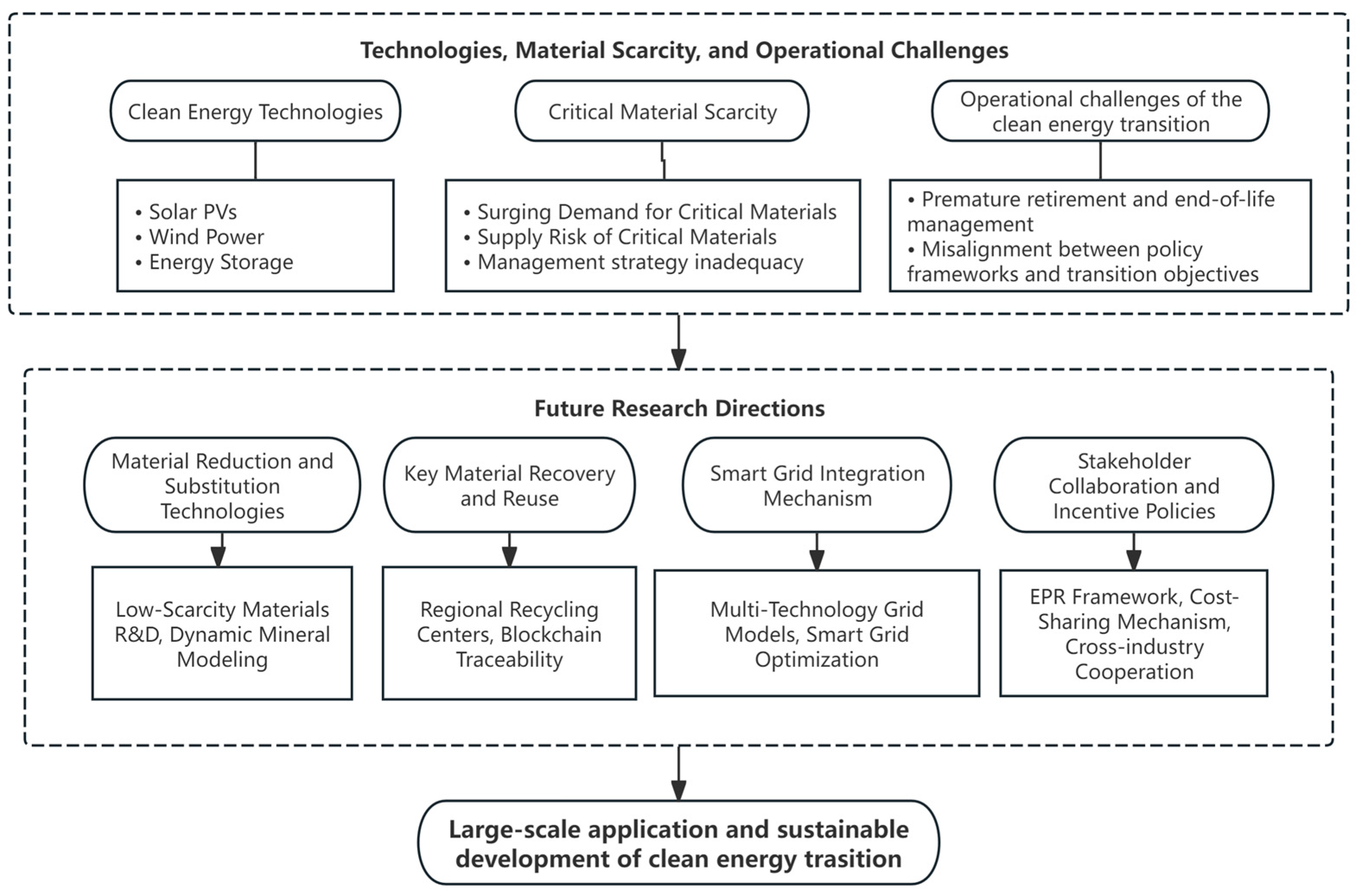
To address the aforementioned issues and challenges, this review focuses on three core and urgent issues in the CET: clean energy technologies, critical material scarcity, and operational challenges. It aims to provide a systematic overview of these challenges, explore potential solutions, and outline future research directions. First, this paper presents a critical review of clean energy technologies. Specifically, the performance, cost trends, and scalability potential of key technologies are analyzed, while distinguishing between mature technologies (e.g., crystalline silicon solar panels) and emerging technologies (e.g., green hydrogen electrolyzes). Second, an in-depth analysis of the scarcity of critical materials is conducted. This entails examining the supply–demand dynamics and geopolitical risks associated with minerals indispensable for the CET, while also evaluating the limitations of established material management strategies, such as material reduction, recycling, reuse, and substitution. Third, the operational challenges of the CET are explored. This section addresses how lifecycle-related issues, such as premature decommissioning and end-of-life recycling, as well as systemic barriers including grid integration and policy fragmentation, hinder the effective implementation of the transition.
A comprehensive literature search was conducted across the Web of Science, Scopus, and ScienceDirect databases, employing keywords including “clean energy transition,” “renewable energy technologies,” “critical mineral scarcity,” “solar panel recycling,” “grid integration,” and “net-zero emissions.” Inclusion criteria encompassed (1) peer-reviewed academic articles and research reports published between 2010 and 2025; (2) intergovernmental reports from organizations such as the International Energy Agency (IEA), the Intergovernmental Panel on Climate Change (IPCC), the United Nations Environment Program me (UNEP), and the World Bank; and (3) industry benchmark data released by entities including the U.S. National Renewable Energy Laboratory (NREL), the International Renewable Energy Agency (IRENA) and Bloomberg NEF. Exclusion criteria consisted of (1) research not published in English; (2) case studies focusing on niche technologies or with only regional relevance; and (3) conference abstracts with incomplete data. Ultimately, 128 peer-reviewed studies, 18 intergovernmental reports, and 7 industry benchmark datasets were included in the analysis.
These documents and reports provide a broad evidence base for the study and offer in-depth analysis of key issues in the clean energy transition. First, peer-reviewed studies offer a wide range of academic perspectives on the clean energy transition, covering various aspects from technological innovation to policy implementation. By analyzing these papers, this study ensures that the data and viewpoints used are scientifically rigorous and academically grounded, thereby providing reliable theoretical support. Secondly, intergovernmental reports offer a policy-level perspective, helping to identify the current state of global and regional policies, key barriers, and driving factors. These reports often include numerous case studies and are highly valuable for policy guidance. Finally, industry benchmark datasets provide specific technical analyses to understand industry dynamics, technological advancements, and practical applications. This is especially crucial for identifying the technical challenges and development trends in the clean energy transition. The advantage of this analytical approach lies in its comprehensiveness and multi-dimensional perspective. By integrating academic research, policy frameworks, and industry practices, this study is able to provide a thorough examination of the various challenges and opportunities in the clean energy transition. However, this approach also has certain limitations. Peer-reviewed studies and intergovernmental reports typically have high academic credibility and authority, but they tend to focus on theoretical and macro-level analyses, potentially overlooking region-specific or industry-specific issues. On the other hand, industry benchmark datasets may be influenced by industry interests, leading to potential biases. This review provides a comprehensive perspective and data support for the clean energy transition based on a synthesis of peer-reviewed studies, intergovernmental reports, and industry benchmark datasets.
The structure of this paper is as follows.
Section 2 provides an analysis of the maturity, scalability, and limitations of clean energy technologies.
Section 3 explores the supply–demand imbalances and associated management strategies in the context of critical material scarcity.
Section 4 examines the operational challenges inherent in the clean energy transition. Finally,
Section 5 proposes four interrelated research directions aimed at addressing these challenges.
2. Clean Energy Technologies: Maturity, Scalability, and Limitations
In 2022, renewable energy sources, including solar photovoltaics (PVs), wind power, hydropower, and biomass, accounted for 29% of global electricity generation, with solar and wind power contributing 80% of this growth [
2]. This section focuses on solar PVs and wind power technologies, which possess the greatest potential for large-scale clean energy deployment, as well as short- and long-duration energy storage technologies.
2.1. Solar PVs
Solar PVs have been the primary driver of global renewable energy capacity expansion, with new installations reaching 230 GW in 2022 and accounting for 60% of the world’s newly added power generation capacity. Regarding the technological maturity of the solar PV industry, crystalline silicon solar cells have achieved dominant market penetration, representing 95% of global installations in 2023. This predominance is attributable to their high conversion efficiency, with monocrystalline cells reaching laboratory efficiencies of 22 to 24 percent and commercial modules delivering efficiencies of 20 to 22 percent, coupled with their extended operational durability, typically guaranteed by performance warranties of up to 30 years [
5]. Thin-film PV technologies, exemplified by cadmium telluride (CdTe) solar cells, currently account for approximately 5% of the global PV market. Despite comparatively lower power conversion efficiencies—typically below 20%—these technologies offer notable advantages in terms of reduced manufacturing costs and material utilization. By contrast, perovskite–silicon tandem solar cells have achieved laboratory-scale efficiencies exceeding 33%, underscoring their significant potential for next-generation PVs. Nevertheless, their widespread commercialization remains hindered by unresolved stability and durability challenges, including operational lifetimes generally limited to less than a decade, as well as scalability concerns stemming from the intrinsic moisture sensitivity and degradation of perovskite absorber layers [
6].
The cost of solar PV technologies has exhibited a sustained downward trend. Over the past decade, the levelized cost of crystalline silicon-based PV systems have declined by approximately 85%, driven primarily by economies of scale, improvements in manufacturing efficiency, and reductions in material intensity [
7]. In regions with high solar irradiance, such as Saudi Arabia and Australia, the levelized cost of electricity (LCOE) for utility-scale PV power plants has declined to as low as 0.02 USD/kWh, enabling unsubsidized competitiveness with fossil fuel-based electricity generation [
8]. Nevertheless, balance-of-system components—including inverters, mounting structures, and installation—remain a critical cost bottleneck, accounting for approximately 40–50% of total system expenditure [
5].
However, the continued large-scale expansion of solar PV deployment is subject to significant constraints. From a land use perspective, the installation of 1 GW of utility-scale solar capacity typically requires approximately 2500–5000 hectares of land, thereby intensifying competition with agricultural production and ecological conservation areas [
3]. The efficiency of contemporary solar PV technologies is approaching its theoretical upper bound, with single-junction crystalline silicon solar cells nearing the Shockley–Queisser limit of 33.7% [
9]. In the absence of tandem or multijunction designs, further efficiency gains are expected to be incremental. In addition, economic incentives arising from declining module costs and modest efficiency improvements have contributed to the premature retirement of PV panels. In the United States, despite a nominal design lifetime of approximately 30 years, residential solar panels exhibit an average replacement interval of around 12 years, a trend that has triggered concerns over a potential “recycling tsunami” and associated challenges for waste management and policy planning [
10].
2.2. Wind Power
Wind power is the second largest renewable energy source, with 75 GW of new capacity installed globally in 2022 alone [
2]. At present, wind power is primarily categorized into onshore and offshore installations, which differ significantly in terms of technological maturity, cost trajectories, and potential for large-scale deployment.
Onshore wind power represents one of the most technologically mature renewable energy technologies, having reached Technology Readiness Level 9 (TRL 9). Commercial onshore wind turbines typically have rated capacities in the range of 2–5 MW. Their capacity factors are strongly influenced by site-specific wind conditions and generally fall between 25% and 40% [
11]. Contemporary wind turbines predominantly adopt a horizontal-axis, three-bladed configuration, which enables efficient operation and deployment in regions characterized by low wind speeds. The cost of onshore wind power has declined substantially over the past decade, with the LCOE decreasing by approximately 68%. For newly commissioned projects, generation costs have fallen to as low as USD 0.03 per kWh [
10]. Current onshore wind power systems increasingly employ larger rotor diameters to mitigate variability in capacity factors, while advanced turbine control systems are utilized to reduce downtime. Collectively, these technological improvements have contributed to substantial reductions in the key cost components of onshore wind power. The further large-scale expansion of onshore wind power is subject to two principal constraints. On the one hand, onshore wind power relies heavily on rare earth elements, as permanent magnets used in wind turbines require neodymium and dysprosium to achieve high magnetic strength. Approximately 90% of global rare earth processing is geographically concentrated, giving rise to potential supply chain vulnerabilities [
3]. Disruptions to rare earth supply chains could therefore lead to cost increases and delays in project deployment. On the other hand, onshore wind projects often face community opposition due to concerns over noise pollution, visual impacts, and potential threats to wildlife. The so-called “Not-In-My-Backyard” (NIMBY) effect has resulted in delays to approximately 30% of onshore wind projects in Europe [
12].
Offshore wind power exhibits a relatively low technology readiness level (TRL 8), while boasting a faster growth rate with wind turbine capacities reaching up to 15 megawatts (MW). Owing to the stability of wind speeds, the capacity factor of offshore wind turbines typically reaches 40% to 60%, while their installation and maintenance costs are 2 to 3 times those of onshore wind turbines [
13]. The cost of offshore wind power has exhibited a pronounced downward trend, with the LCOE declining by approximately 60% since 2010. For new offshore wind projects exemplified by the Dogger Bank Wind Farm in the United Kingdom, the LCOE has fallen to as low as about 0.06 USD/kWh. Nevertheless, offshore wind LCOE remains higher than that of onshore wind and solar PV technologies [
14]. Infrastructure gaps and end-of-life management challenges constitute major constraints on the further large-scale deployment of offshore wind power. Specifically, the offshore wind power sector faces significant infrastructure shortages: it requires specialized installation vessels and subsea cables, both of which entail substantial capital costs. The cost of installation vessels typically ranges from USD 50 million to USD 100 million, while subsea cables generally account for approximately 20–30% of total project costs. In addition, global installation capacity remains limited, with only around 20 dedicated vessels worldwide capable of handling turbines in the 15 MW class [
15]. End-of-life challenges further constrain offshore wind expansion, particularly with respect to the disposal of fiberglass-reinforced turbine blades, which are difficult to recycle. At present, the global recycling rate for decommissioned blades remains below 1%, with the majority being landfilled or incinerated. By 2030, annual blade waste generation is projected to reach approximately 200,000 tonnes, posing growing environmental and regulatory challenges [
16].
2.3. Energy Storage Technologies
Energy storage technologies play a critical role in mitigating the intermittency of solar and wind power and enabling the grid integration of high shares of variable renewable energy. Based on storage duration, these technologies can be broadly classified into short-duration energy storage and long-duration energy storage. Short-duration energy storage typically refers to systems with discharge durations of up to 4 h and is primarily deployed for load shifting and frequency regulation. In contrast, long-duration energy storage generally encompasses systems with discharge durations ranging from 6 to 150 h and is mainly applied to seasonal balancing and long-term peak shaving.
The current short-duration energy storage market is dominated by lithium-ion batteries, which accounted for approximately 90% of grid-scale and residential energy storage installations in 2022 [
17]. Lithium-ion battery technologies have reached a high level of technological readiness (TRL 8). In grid-scale applications, they exhibit energy densities in the range of approximately 150–250 Wh/kg and long cycle lifetimes, typically allowing for 3000–5000 cycles [
18]. The most widely deployed lithium-ion chemistries at present are nickel–cobalt–manganese (NCM) and lithium iron phosphate (LFP). Among these, LFP batteries are gaining an increasing share of the market due to their lower costs and cobalt-free composition. The cost of lithium-ion batteries has declined steadily over time. Since 2010, the cost of LIBs has fallen by approximately 97%, decreasing from around 1200 USD/kWh to 151 USD/kWh in 2023 [
19]. This cost reduction can be attributed, on the one hand, to economies of scale, with global lithium-ion battery manufacturing capacity now exceeding 1 TWh per year, and, on the other hand, to ongoing improvements in cathode and anode materials.
The large-scale deployment of lithium-ion batteries is confronted with a range of challenges related to mineral demand, end-of-life management, and safety risks. Scaling up lithium-ion battery technologies requires substantial quantities of critical minerals [
20]. Under net-zero transition scenarios, demand for lithium is projected to increase by approximately fortyfold by 2030, while demand for cobalt is expected to rise by around twentyfold. At the same time, most end-of-life lithium-ion batteries are not managed adequately: the global recycling rate for batteries from electric vehicles (EVs) and grid-scale storage remains below 5%. Existing hydrometallurgical recycling processes typically achieve lithium recovery rates of less than 80% and cobalt recovery rates below 90% [
18]. As a result, many retired batteries are stored rather than recycled or repurposed, largely due to insufficient recycling infrastructure. Safety considerations further constrain large-scale deployment. Thermal runaway triggered by overcharging or physical damage has led to fire incidents in some grid-scale battery energy storage installations, necessitating significant additional investments in safety systems incorporating fire suppression equipment [
21,
22].
Long-duration energy storage is critical for addressing seasonal intermittency in power systems with high shares of variable renewable energy. However, the development and deployment of long-duration energy storage technologies remain relatively limited, accounting for less than 5% of global energy storage capacity in 2022 [
23]. Pumped hydro storage (PHS) is the most technologically mature long-duration energy storage technology with the highest technical maturity (TRL 9). Global installed PHS capacity stands at approximately 160 GW, accounting for around 80% of total long-duration energy storage capacity. PHS systems exhibit high round-trip efficiencies, typically in the range of 75–90%, and long operational lifetimes exceeding 50 years. However, their deployment is strongly constrained by geographical conditions, as PHS facilities require locations with significant elevation differences, such as mountainous regions or coastal basins [
24]. For new PHS projects, the LCOE generally falls within USD 0.05–0.10 USD/kWh, while capital costs remain high, ranging from approximately 1 million to 2 million USD/MW. These elevated upfront costs are primarily attributable to dam construction works [
25,
26]. Moreover, only about 10% of global PHS potential has been developed to date, with much of the remaining potential located in remote regions—such as the Himalayan range—where substantial investments in transmission infrastructure would be required.
Vanadium redox flow batteries (VRFBs) represent one of the most scalable flow battery technologies, with power and energy capacities independently scalable by adjusting electrolyte volume. Compared to other energy storage technologies, this battery exhibits a relatively low energy density of approximately 20–30 Wh/L, making it suitable for long-duration grid-scale applications [
27]. Under current cost assumptions, the LCOE for flow batteries stands at
$0.5/kWh, with key components such as vanadium electrolyte constituting a significant portion of the system cost [
28]. However, vanadium supply is highly concentrated geographically, with South Africa contributing around 40% of global production, while the electrolyte recycling technology is still in the pilot scale stage. Thermal energy storage (TES) technologies exhibit a relatively high level of technological maturity (TRL 8). Molten salt TES deployed in concentrated solar power (CSP) projects extends dispatch capabilities and addresses solar intermittency. Numerous European and American R&D projects have validated that CSP-TES configurations possess high-temperature operation and long-life characteristics [
29]. The LCOE for thermal storage systems generally ranges from USD 0.10 to 0.15 per kWh, with molten salt and tank construction accounting for approximately 30–40% of total costs [
30]. Furthermore, thermal storage must be coupled with CSP plants, and the limited global deployment of CSP constrains independent applications and the potential for large-scale expansion of TES.
3. Critical Material Scarcity: Supply–Demand Imbalances and Management Strategies
3.1. Analysis of Surging Demand for Critical Materials
The large-scale deployment of clean energy technologies has led to unprecedented growth in the demand for critical minerals. As defined by the United Nations, critical minerals are those that are essential for the clean energy transition and are associated with high supply risks. This section focuses on the demand for seven key critical minerals and examines the factors driving such demand growth.
According to the IEA’s
Net Zero by 2050: A Roadmap for the Global Energy Sector, the global demand for critical minerals is projected to grow exponentially by 2030 relative to 2020 levels. Global lithium demand is projected to surge significantly due to the accelerated deployment of EVs and battery energy storage. Material demand models indicate that under a high EV penetration scenario, lithium demand could increase by nearly an order of magnitude, primarily driven by the production of EV batteries [
31]. Demand for cobalt is projected to increase by approximately twentyfold, driven primarily by its use in NCM lithium-ion batteries. The Democratic Republic of the Congo accounts for around 70% of global cobalt production, of which approximately 20% is sourced from artisanal and small-scale mining operations associated with labor rights concerns [
32]. Demand for rare earth elements is expected to increase by roughly sevenfold, largely due to growing requirements for wind turbine permanent magnets and EV motors. Among these, neodymium and dysprosium are particularly critical, with offshore wind applications exhibiting a high degree of demand concentration [
3]. Demand for silver is projected to increase by approximately fivefold, reflecting its extensive use in the conductive layers of crystalline silicon solar cells. On average, the deployment of 1 GW of solar PV capacity requires approximately 20–30 tonnes of silver [
33]. The demand for indium is projected to increase by factors ranging from 2.2 to 4.2, 2.6 to 7.0, or even as much as 6.8 to 38.3, depending on the specific scenario and the installed capacity of PV systems, with particular emphasis on its application in thin-film solar cells, such as indium tin oxide (ITO). Although the demand for indium remains lower than that of lithium and rare earth elements, its supply is highly concentrated [
34]. If the clean energy transition accelerates, particularly through the rapid adoption of EVs, demand for indium could rise significantly [
31].
The solar PV industry relies primarily on silver and indium as critical scarce materials. Crystalline silicon solar cells require approximately 10–15 mg of silver per watt of capacity, and annual silver demand from the PV sector is projected to reach around 3000 tonnes by 2030 [
33]. Thin-film PV technologies, including CdTe and copper indium gallium selenide (CIGS) cells, are critically dependent on indium. Demand for indium in these applications is projected to range from approximately 485 to 15,724 tonnes per year over the period from 2020 to 2030 [
35]. In the wind power sector, neodymium and dysprosium constitute the most critical scarce materials, particularly for permanent magnet generators. A single 4 MW offshore wind turbine requires roughly 200 tons of rare earth elements, and total rare earth demand from the wind industry is projected to reach approximately 100,000 tonnes per year by 2030 [
3].
3.2. Research on Supply Risk of Critical Materials
Across the supply chains of critical mineral materials, three major risk factors are particularly salient: high geographical concentration, long development lead times, and pronounced price volatility.
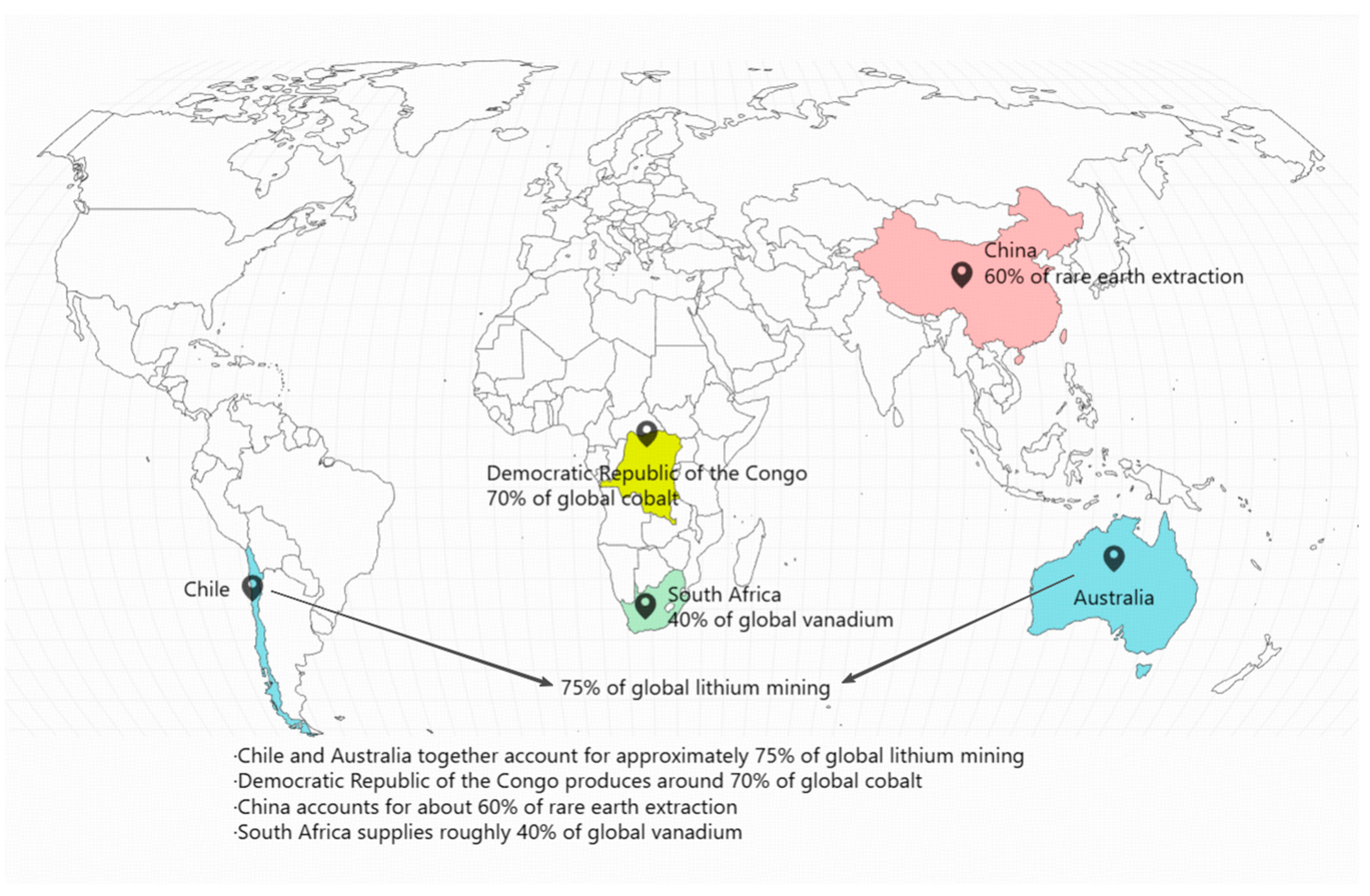
From extraction to processing, the supply of critical mineral materials is characterized by a high degree of geographical concentration, rendering supply chains vulnerable to international trade disruptions, cross-border policy changes, and geopolitical tensions. At the extraction stage, the production of critical materials is highly concentrated: Chile and Australia together account for approximately 75% of global lithium mining, the Democratic Republic of the Congo produces around 70% of global cobalt, China accounts for about 60% of rare earth extraction, and South Africa supplies roughly 40% of global vanadium [
3], as shown in
Figure 1. A similar pattern of concentration is observed in mineral processing, where a small number of countries dominate global refining capacity. China, in particular, plays a leading role across multiple value chains, accounting for approximately 90% of rare earth processing, 60% of lithium processing, and 80% of cobalt processing [
3].
From exploration to production, the development of new mines and processing facilities is characterized by long lead times, typically ranging from 10 to 16 years. The initial exploration phase alone requires approximately 3–5 years to identify viable mineral deposits, with success rates of less than 5% [
36]. Subsequent permitting and approval processes commonly take an additional 2–4 years to secure environmental and social authorizations, with around 30% of projects experiencing delays due to community opposition, a case in point being lithium mining development in Chile’s Atacama Desert [
32]. During the construction phase, large-scale mining projects—such as a lithium mine with an annual capacity of 100,000 tonnes—typically require 3–5 years to complete, with capital expenditures in the range of USD 1–2 billion [
15]. By contrast, the deployment cycle for clean energy technologies generally spans only 2–3 years, implying that mineral supply expansion lags far behind the demand generated by the large-scale expansion of clean energy. This temporal mismatch between supply and demand is expected to result in severe shortages of critical minerals under the net-zero emission target scenario by 2030 [
20].
Supply–demand imbalances, geopolitical events, and speculative behavior have contributed to pronounced volatility in critical mineral prices. In 2022, lithium prices surged from approximately USD 15,000 per ton to USD 60,000 per ton—an increase of nearly 300%—raising EV battery costs by around 10–15% [
37]. Although, prices declined by roughly 50% following the commissioning of new lithium mining capacity in 2023, prices rebounded again in 2025. Similar volatility has been observed in cobalt markets. In 2018, mining disruptions in the Democratic Republic of the Congo led cobalt prices to increase from around USD 30,000 per ton to USD 90,000 per ton, representing a 200% rise. Subsequently, during 2020–2021, increased adoption of LFP batteries reduced cobalt demand, contributing to a price decline of approximately 70% [
15]. Rare earth markets have also experienced sharp fluctuations. China’s export restrictions during 2010–2011 resulted in a fivefold increase in rare earth prices, followed by a price decline of approximately 60% in 2012–2013 as new mining capacity came online [
3]. Such price volatility heightens investment risks for clean energy manufacturers, leading to project delays and upward pressure on costs.
3.3. Management Strategies for Critical Scarce Materials
To mitigate the rapid growth in demand for critical scarce materials and the associated supply risks, existing research and industry practice have primarily focused on three categories of strategies: material intensity reduction, recycling and reuse of critical materials, and substitution with alternative materials. Each of these approaches exhibits distinct strengths as well as inherent limitations.
3.3.1. Critical Material Intensity Reduction
Within the context of the clean energy transition, critical material intensity reduction refers to the minimization of critical mineral use through technological design and innovation. Representative technological pathways include silver-free solar cells, low-cobalt lithium-ion batteries, and rare earth-free wind turbines.
Silver reduction technologies in solar PVs typically involve replacing silver busbars with copper plating, eliminating front-side silver paste main grids through a busbar-less design, and using fine-line grid interconnects. These measures can reduce silver consumption by 30–60%, while also decreasing shading losses and improving module efficiency. However, silver reduction strategies have certain limitations. The higher electrical resistivity of copper relative to silver can result in a reduction in cell efficiency by approximately 0.5–1% [
38]. Furthermore, the more complex copper plating process increases system balance-of-plant costs by 5–10% [
5]. Additionally, silver reduction measures may induce a rebound effect in global silver demand, as improved material efficiency lowers costs and accelerates the deployment of PV capacity worldwide [
39].
Low-cobalt batteries generally refer to cells containing no more than 10% cobalt, including near-zero or cobalt-free designs. The core technological approach focuses on “cobalt reduction while maintaining performance,” centering on cathode material modification and complemented by optimization of electrolytes, cell structures, and manufacturing processes. Currently, cobalt-free LFP batteries, lithium manganese iron phosphate (LMFP) batteries, and NCM 811 batteries with cobalt content reduced to 5% are increasingly deployed as substitutes for higher-cobalt NCM622 and NCM532 batteries, driven by considerations of cost, performance, and resource security. Despite these advantages, low-cobalt battery technologies have certain limitations. Although LFP batteries are approximately 10–15% cheaper than NCM batteries, their energy density is 20–30% lower, meaning that achieving the same driving range in long-range EVs requires larger battery packs, offsetting the cost benefit [
15]. From the perspective of material supply and technical characteristics, transitioning NCM batteries to high-nickel and low-cobalt NCM811 chemistry reduces dependence on scarce cobalt resources. However, compared with the thermally more stable NCM111 system, the adjusted material composition of NCM811 imposes stricter requirements on battery safety management [
40].
The core principle of rare earth-free wind turbines is to eliminate reliance on rare earth permanent magnets through three technological pathways: motor topology, excitation method, and magnetic material. Current mainstream approaches focus on rare earth-free permanent magnets combined with novel topologies, electrically excited or hybrid excited machines, and switched reluctance motors. By 2025, pilot-scale breakthroughs had been achieved in both low- to medium-power onshore and offshore wind applications. In terms of materials, ferrite magnets (iron oxide based) and superconducting magnets are gradually replacing rare earth magnets. However, the maximum energy product of ferrite magnets is only 3–10% that of Neodymium Iron Boron (NdFeB) magnets. To maintain comparable power output, the size of the magnet and the motor must be significantly increased, potentially resulting in rotor weights two to three times higher than those in rare earth magnet designs. This increases the structural load on towers and nacelles, as well as transportation and installation costs. Under high-load or high-temperature conditions, ferrite magnet efficiency is 3–8% lower than that of rare earth permanent magnets. Moreover, ferrite permanent magnets generally exhibit lower magnetic performance and coercivity compared to NdFeB magnets, and under elevated temperature and load conditions may experience more significant demagnetization, necessitating the use of cooling strategies and careful magnetic circuit design to maintain stability, especially in high-performance machines [
41]. In environments above 40 °C, annual energy production of ferrite permanent magnet wind turbines is 5–7% lower compared with equivalent rare earth magnet configurations [
42].
3.3.2. Recycling and Reuse of Critical Materials
Recycling and reuse refer to the recovery of critical minerals from end-of-life clean energy equipment, for the purpose of establishing a closed-loop recycling supply chain, an approach often described as “urban mining.” However, current recycling and reuse technologies for critical materials remain relatively immature, coupled with persistently high costs and relatively low recovery rates.
The dominant technological approach for solar PV recycling is mechanical shredding (TRL 8), which enables the recovery of approximately 80% of glass and 90% of aluminum. However, recovery rates for silver and silicon are only 10% and 5%, respectively, resulting in substantial material losses. An alternative and commonly studied approach is chemical recycling (TRL 6), which involves the use of acids to dissolve the ethylene–vinyl acetate (EVA) encapsulant. This method achieves a silver recovery rate of up to 95% and a silicon recovery rate of as high as 90%, yet the cost of chemical recycling is approximately three times higher than that of mechanical shredding [
43]. The recycling cost per solar panel is estimated at USD 20–30, compared with landfill disposal costs of only USD 1–2 [
44]. High recycling costs are largely attributable to the need for manual disassembly in chemical recycling processes and the low market value of recovered materials—particularly glass, which accounts for roughly 70% of total module weight. As a result, the global PV recycling rate remains below 10%, with the majority of end-of-life panels being landfilled or incinerated. Recycling rates are particularly low in the United States, at less than 5%, while the European Union achieves a rate of approximately 15% [
45].
Recycling technologies for wind turbine blades primarily include mechanical recycling (TRL 7) and chemical recycling (TRL 5). Mechanical recycling involves a series of energy-intensive processes, including diamond-coated wire sawing for blade segmentation, shredding with high-wear-resistant cutters, followed by vortex milling and sieving to separate powdered fillers. This approach enables the recovery of approximately 70% of glass fibers, which are typically used in construction materials, though the overall process is characterized by high energy consumption. Chemical recycling techniques mainly rely on solvent-based dissolution of the polymer resin, allowing depolymerization under relatively mild conditions to separate glass fibers from the resin matrix. The recovered resin can be re-synthesized into blade materials, while glass fiber recovery rates can reach up to 90%. At present, chemical recycling remains at the pilot stage and has not yet achieved commercial scale. The cost of mechanical recycling for wind turbine blades is estimated at USD 500–1000 per ton, whereas chemical recycling costs range from USD 1500 to 2000 per ton. In contrast, landfill disposal costs are significantly lower, at approximately USD 100–200 per ton. This substantial cost gap has constrained the large-scale deployment of blade recycling technologies [
16]. As a result, the global recycling rate for wind turbine blades remains below 1%, with the majority of end-of-life blades being landfilled or incinerated. The European Union has implemented landfill bans for wind turbine blades, leading to comparatively higher recycling rates of around 5% within the EU [
12].
The most widely deployed technologies for EV battery recycling are hydrometallurgical recycling (TRL 8) and pyrometallurgical recycling (TRL 7). Hydrometallurgical processes account for more than 70% of global EV battery recycling capacity, and typically involve acid leaching of battery materials, achieving recovery rates of 80–90% for lithium, cobalt, and nickel. The recovered products can reach battery-grade purity, making this route compatible with the dominant NCM and nickel–cobalt–aluminum (NCA) battery chemistries currently in use. Pyrometallurgical recycling (TRL 7) relies on high-temperature smelting to oxidize battery materials and form metal alloys, which are subsequently separated and refined. This process is particularly suitable for end-of-life batteries with complex compositions or high dismantling difficulty. Under ideal conditions, the recovery rates for cobalt (98.39%) and nickel (98.83%) have reached relatively high levels, while lithium exhibits a comparatively lower recovery rate due to its volatility at high temperatures and tendency to form slag [
46]. A key advantage of pyrometallurgical recycling is that it does not require prior sorting by battery chemistry, allowing for direct treatment of mixed battery streams and enabling large-scale, centralized recycling, with single facilities capable of processing over 100,000 tonnes per year. In addition, the process exhibits a high tolerance to impurities and feedstock variability, reducing the risk of operational disruptions. However, its main limitation remains the substantial loss of lithium during smelting. In terms of costs, hydrometallurgical recycling incurs USD 150–200 per ton, approximately twice the cost of primary mineral extraction, while pyrometallurgical recycling costs are higher, at USD 200–250 per ton, combined with comparatively low lithium recovery rates [
18]. Despite the availability of these technologies, global EV battery recycling rates remain below 3%. A large share of end-of-life batteries is currently stockpiled rather than recycled, due primarily to insufficient collection and recycling infrastructure [
47]. China exhibits the highest recycling rate and has seen a significant increase, largely attributable to the implementation of mandatory EPR regulations [
22].
3.3.3. Substitution of Critical Scarce Materials
The substitution of critical scarce materials refers to the replacement of scarce minerals with earth-abundant materials, a strategy that holds considerable promise yet is constrained by performance limitations. In the battery sector, sodium-ion batteries (SIBs) are the most prominent alternative to lithium-ion batteries. Sodium is significantly more abundant, with a crustal abundance of approximately 2.8%, compared to only 0.006% for lithium. SIBs exhibit comparable cycle lifetimes, typically achieving 3000–4000 cycles, similar to lithium-ion systems [
38]. However, the energy density of SIBs is around 30% lower than that of lithium-ion batteries, which substantially limits their applicability in long-range EVs. In addition, the deployment of SIBs requires new manufacturing facilities, resulting in 50–70% higher capital investment costs [
38]. By 2025, with the continued expansion of lithium-ion battery gigafactories, global annual production capacity has approached the 1TWh scale. In contrast, SIBs remain in the early stages of commercialization, with relatively small production volumes [
48]. For platinum substitution in electrolyzes, the core approach involves the adoption of iron–nitrogen–carbon (Fe-N-C) catalysts to replace platinum in proton exchange membrane electrolyzes (PEM electrolyzes), which can reduce platinum consumption by up to 90%. Nevertheless, Fe–N–C catalysts currently exhibit lower catalytic activity and reduced stability compared to platinum, leading to a 5–10% reduction in electrolyzes efficiency and a 30–40% decrease in operational lifetime [
49]. As a result, Fe–N–C catalyst-based electrolyzes remain at the pilot stage (TRL 5), with commercial deployment not expected before 2030 [
49].
4. The Operational Challenges of the Clean Energy Transition
The clean energy transition is accompanied by a wide range of operational challenges that extend beyond technology deployment. From a lifecycle perspective, clean energy industries face operational issues such as premature retirement of assets and inefficient end-of-life management systems. At the level of power system integration, the increasing penetration of variable renewable energy gives rise to challenges including the duck curve phenomenon, declining system inertia, and transmission constraints, which complicate grid operation and reliability. In addition, the clean energy transition is affected by institutional and market misalignments, including fragmented EPR frameworks, inequitable cost allocation, and insufficient investment incentives, all of which undermine the operational efficiency and long-term sustainability of clean energy systems.
4.1. Premature Retirement and End-of-Life Management
Premature retirement refers to the replacement of functionally viable clean energy technologies before the end of their designed operational lifetimes. This phenomenon undermines resource efficiency and generates substantial volumes of avoidable waste. The primary drivers of premature retirement include rapid declines in technology costs, continuous efficiency improvements, and policy and market incentives that favor the deployment of newer technologies. In the United States, the average replacement cycle of solar PV modules is approximately 12 years, significantly shorter than their designed lifetime of 30 years. This trend is mainly driven by a 30–40% decline in module prices and a 10–15% increase in conversion efficiency, which together result in a positive net present value for early replacement decisions [
10]. As a consequence, solar PV waste generation in the United States is projected to reach 300,000 tonnes by 2025, which is 50 times higher than the estimates released by the International Renewable Energy Agency in 2016. At the global level, IRENA (2016) estimates that cumulative solar PV waste will reach 78 million tonnes by 2050, with approximately 40% attributable to premature retirement [
50]. A similar pattern is observed in the onshore wind sector, where the average retirement age of wind turbines ranges from 15 to 20 years, compared with a designed lifetime of 25 years. The dominant driver is technology upgrading, as new-generation turbines offer 20–30% higher capacity than older models at the same sites [
16]. By 2050, global blade waste could reach tens of millions of tons (approximately 43 million tons), with blades accounting for 80% of this volume. Premature retirement shortens the capital cost amortization period, increasing the LCOE by 10–15% [
2,
30]. Premature retirement is also evident in the EV battery sector. EV batteries are typically retired when their remaining capacity declines to 70–80%, well above the technical end-of-life threshold of 50% capacity. This early retirement is largely driven by consumer demand for longer driving ranges, as the energy density of new EV batteries has increased by 30–40% relative to legacy products [
51]. As a result, global end-of-life EV battery volumes are projected to reach 140 GWh by 2030, with approximately 60% arising from premature retirement. Although retired EV batteries can be repurposed for stationary energy storage applications, extending their service life by an additional 5–10 years, only 10% of such batteries are currently utilized in a cascading manner. The key constraint to scaling up cascaded utilization lies in the absence of unified testing standards [
18].
Current end-of-life management systems for clean energy technologies remain highly fragmented and inefficient, resulting not only in substantial material losses but also in significant environmental risks and elevated system costs. For solar PV technologies, end-of-life modules contain toxic substances, including lead and cadmium. When directly landfilled, these materials may leach into soil and groundwater, posing long-term environmental hazards. Approximately 90% of PV recycling facilities rely on mechanical crushing, which enables the recovery of glass and aluminum but results in substantial losses of critical materials such as silver and silicon [
43]. In contrast, chemical recycling technologies, which can achieve silver recovery rates of up to 95%, account for less than 5% of existing facilities, with prohibitively high treatment costs ranging from
$20 to
$30 per panel, which is far higher than the landfilling cost of
$1 to
$2 per panel [
44]. For end-of-life wind turbine blades, their components reinforced with fiberglass are non-biodegradable and difficult to process, requiring specialized dismantling and recycling equipment. At present, approximately 70% of retired blades are landfilled, 25% are incinerated, and only 5% are recycled. Chemical recycling technologies capable of achieving up to 90% glass fiber recovery remain at the pilot stage. It is estimated that blade landfilling alone could occupy approximately 10,000 hectares of land by 2030, while incineration may release toxic pollutants such as dioxins, resulting in secondary environmental contamination [
16]. Wind turbine blade recycling holds significant potential market value. Through the promotion of recycling technology innovation and the improvement of policies, the recycling and reuse of turbine blades could become an integral part of the wind park industry’s circular economy. Recycled turbine blades can be repurposed as raw materials for construction materials, transportation components, or other industrial applications, thereby enhancing resource utilization [
52]. As wind parks gradually reach the end of their operational life, the issue of soil remediation after decommissioning is also becoming increasingly prominent. The primary challenge in soil remediation for wind parks lies in the abandonment of equipment, residual chemicals, and contamination of landfill sites. During the construction and operation of wind parks, certain equipment may pose risks of soil pollution, particularly corrosion and leakage of turbine components and electrical equipment, which could contaminate soil and groundwater. Therefore, ecological restoration measures for wind parks need to be more comprehensive, addressing not only turbine blade recycling but also enhancing soil pollution monitoring and remediation efforts. For EV batteries, improper handling of end-of-life lithium-ion batteries poses a substantial fire risk, with evidence indicating that around 30% of recycling facilities experience fire incidents annually. Currently, approximately 80% of battery recycling facilities employ hydrometallurgical processes with a lithium recovery rate below 80%, while pyrometallurgical processes result in lithium recovery rates as low as 50%. In addition, due to insufficient collection infrastructure, around 40% of retired EV batteries are placed in long-term storage rather than recycled [
18]. Globally, only 15 countries have implemented mandatory battery recycling regulations, while most countries rely primarily on voluntary industry-led schemes. As a result, cross-country disparities in recycling performance are pronounced. Currently, global recycling capacity is highly concentrated in China, which handles the majority of battery recycling, while recycling capacity in North America and Europe remains relatively limited [
53]. Furthermore, systemic transition obstacles extend beyond technology and waste management. Innovative business models and new investment approaches—such as blockchain-enabled energy systems—can both facilitate and expose the clean energy transition to financial, regulatory, and operational risks when not aligned with existing market structures and governance frameworks [
54].
4.2. Grid Integration of Variable Renewable Energy
Electric power systems were historically designed around centralized and dispatchable fossil fuel-based generation. The increasing penetration of variable renewable energy (VRE), particularly solar PV and wind power, introduces a range of operational challenges for grid operation and planning, including the duck curve phenomenon, inertia deficiency, and transmission constraints, all of which complicate the real-time balancing of supply and demand and place additional demands on power system flexibility.
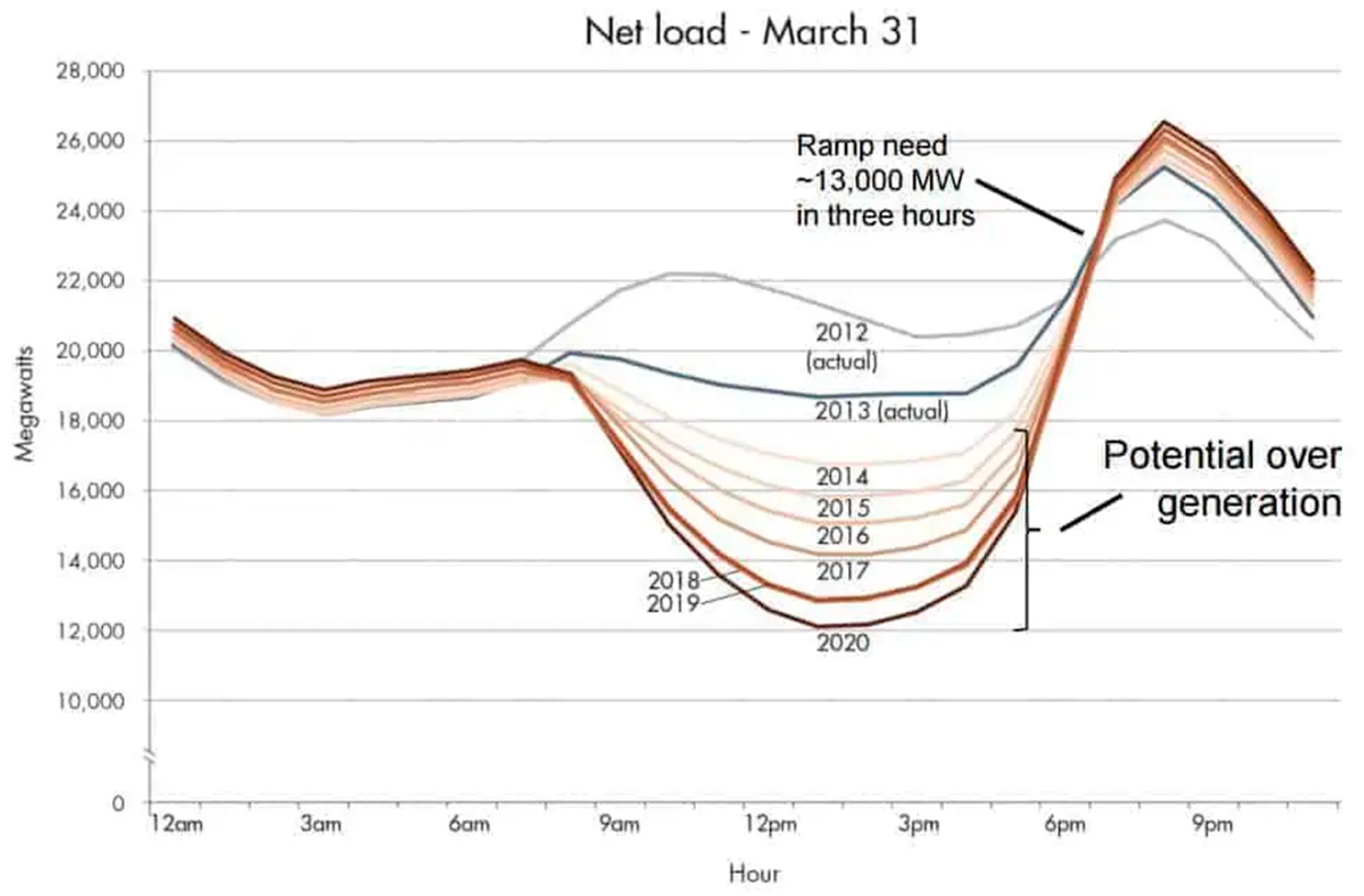
The “duck curve” refers to the variation curve of daily net load, defined as electricity demand minus generation from variable renewable energy sources, as shown in
Figure 2. It provides a clear illustration of the temporal and spatial mismatch between variable renewable electricity generation and load demand [
55]. This phenomenon is driven by two primary mechanisms. The first is midday oversupply. During midday hours, peak solar PV output coincides with relatively low electricity demand, resulting in a 50–60% reduction in net load, as observed in regions such as California and Australia [
55,
56]. The second mechanism is the evening ramping challenge. Around sunset, solar generation declines rapidly, with a reduction rate of 2–3 GW per hour in California, while electricity demand simultaneously increases by 1–2 GW per hour [
57]. This steep net load ramp necessitates the rapid dispatch of fossil fuel-based generation to maintain system balance. The duck curve generates several adverse operational impacts. First, it leads to renewable energy curtailment. To preserve grid stability, system operators frequently curtail 10–15% of solar generation during midday hours. In 2022 alone, curtailment in California reached approximately 150 GWh, equivalent to the annual electricity consumption of around 200,000 households [
56]. Second, the reliance on fast-ramping gas-fired generation increases fossil fuel-related emissions, as rapid ramping causes incomplete combustion and raises emissions by 10–15%, thereby substantially eroding the climate benefits of variable renewable energy deployment [
58]. Third, the rapid fluctuations in net load exacerbate grid frequency instability, requiring additional inertia and flexibility services—such as flywheels and battery energy storage—at costs of USD 10–20 per MW to maintain system reliability [
2]. Moreover, studies have shown that operating reserve rules and ancillary service requirements under high renewable penetration can inflate electricity prices and operational risks, as additional reserves must be procured to balance the variability introduced by the duck curve, further undermining the economic competitiveness of renewable generation [
59].
Unlike fossil fuel and nuclear power plants, VRE technologies such as solar PV and wind power suffer from inertia deficiency, which directly increases the risk of power system instability and large-scale outages. This is because VRE technologies inherently lack rotational inertia, a critical physical property that stabilizes system frequency following disturbances. The inertia shortfall arises from two main factors. First, there are differences in grid connection mechanisms. Solar PV and wind power plants are connected to the grid via power electronic converters, which decouple generation from grid frequency and therefore do not provide rotational inertia. In contrast, conventional coal- and gas-fired power plants rely on synchronous rotating turbines to supply inertia [
60]. Second, the challenge is amplified by high penetration levels of VRE. The high penetration of variable renewable energy sources reduces the mechanical inertia of power systems. This occurs because inverter-based resources replace synchronous generators, leading to decreased inertia and increased frequency fluctuations—a challenge already confirmed in regions with high renewable energy penetration [
61]. The absence of sufficient inertia substantially increases the likelihood of cascading failures. A prominent example is the 2025 power outage in Spain. On 28 April 2025, around noon, the grid experienced a significant disturbance, losing approximately 15 GW of generation capacity within a span of about 5 s, which accounted for roughly 60% of the demand at that time. This abrupt imbalance led to a disconnection from the continental European grid, initiating a cascading failure. Consequently, numerous transmission lines and generators were automatically disconnected to protect the system. The outage affected Spain, Portugal, Andorra, and parts of southwestern France, impacting over 50 million people. The disruption persisted for approximately 10 h or more, resulting in widespread paralysis of transportation, communications, and healthcare services [
62]. In addition, inertia shortfalls drive up the cost of ancillary services, as utilities are forced to invest in flywheels, battery energy storage systems, and other synthetic inertia solutions, which directly results in a 5–10% rise in electricity prices [
2].
The current electricity market structure, particularly the target-based model driven by market mechanisms, presents significant operational risks and challenges during the clean energy transition. While this model aims to accelerate the growth of renewable energy, its design often fails to effectively balance supply, demand, and market prices, resulting in several detrimental consequences. First, this model tends to drive up electricity prices due to the volatility and intermittency of renewable energy, which necessitates additional backup generation capacity—such as fossil fuel plants or energy storage systems—that incurs higher operational costs. These costs are typically passed on to consumers, leading to higher electricity prices. Second, certain countries, particularly in Europe, have seen more pronounced impacts on their industrial sectors. Under this model, industries face higher electricity prices, especially in energy-intensive sectors, which significantly increase operational costs. This not only diminishes the international competitiveness of these industries but may also spur industrial relocation or underinvestment, ultimately hindering economic growth and employment. Moreover, the market structure exacerbates price volatility, with electricity prices becoming more susceptible to weather conditions and seasonal fluctuations as renewable energy share increases. This poses a particular challenge for industrial sectors reliant on stable energy costs. In sum, while the current electricity market structure supports the clean energy transition, it fails to sufficiently address its negative impacts on industrial competitiveness, highlighting the need for more flexible, stable, and comprehensive policy frameworks to mitigate these issues.
During the large-scale deployment of VRE, the expansion of transmission infrastructure, including high-voltage transmission lines and substations, has consistently lagged behind generation capacity. This mismatch has resulted in frequent renewable energy curtailment, delays in project commissioning, and rising system-wide development costs. One key driver is geographical mismatch. High-quality renewable resources are typically located in solar-rich regions and offshore wind corridors, which are often geographically distant from major electricity demand centers. This necessitates the construction of inter-regional transmission corridors to enable efficient energy absorption. In the United States, approximately 70% of wind energy potential is concentrated in the inland Great Plains, while around 70% of electricity demand is located in densely populated coastal regions, creating an urgent need for transmission network expansion [
63]. A second driver is the protracted approval cycle. Approval procedures for new transmission lines commonly require 3–5 years, and projects frequently encounter community opposition, which further delays implementation. For example, approximately 30% of transmission projects associated with the North Sea power grid have experienced construction delays due to community resistance [
12]. Delays in transmission infrastructure development generate several adverse operational consequences. First, transmission capacity constraints directly contribute to elevated curtailment rates. In the U.S. Great Plains wind power base, curtailment rates have already reached 15–20% [
2]. Second, postponed transmission projects force renewable energy developers to either deploy temporary energy storage facilities or accept higher levels of curtailment, leading to an estimated 10–15% increase in the LCOE for variable renewable energy projects. Finally, transmission congestion exacerbates regional imbalances between electricity supply and demand, further complicating power system operation and market efficiency [
56,
64].
4.3. Misalignment Between Policy Frameworks and Transition Objectives
EPR is a cornerstone policy instrument of the circular economy, requiring producers to assume responsibility for the end-of-life management of their products. However, EPR regulations in the global renewable energy sector remain highly fragmented, with substantial variations in regulatory coverage, mandatory requirements, and enforcement standards across solar PVs, wind power, and EV batteries. This fragmentation directly contributes to low material recovery rates, elevated compliance costs, and regulatory uncertainty. In the solar PV sector, regulatory coverage is particularly uneven. In the United States, only seven states have implemented mandatory EPR schemes requiring producers to fund PV module recycling. While the European Union’s Waste Electrical and Electronic Equipment (WEEE) Directive formally covers PV modules, it lacks mandatory recycling targets. In many developing countries, no dedicated regulations exist, leading to the informal disposal or abandonment of PV waste [
45]. In the wind power sector, mandatory EPR regulations are largely absent at the global level. Existing EU directives effectively exclude wind turbine components due to their large physical dimensions, while the United States relies primarily on voluntary, industry-led initiatives. Because producers are not required to bear the costs of blade landfilling or incineration, economic incentives for recycling investment remain weak. Even among leading manufacturers that have launched voluntary recycling projects, blade recycling rates remain as low as 5% [
16]. For EV batteries, both the EU and China have implemented mandatory EPR systems with clearly defined collection and recycling targets. The United States, however, lacks federal-level mandatory regulation, with only three states operating voluntary recycling schemes. These regulatory differences result in stark disparities in collection performance: battery collection rates in China reach approximately 80%, compared with less than 30% in the United States. Producers operating across multiple markets must therefore comply with divergent regulatory regimes, increasing compliance uncertainty and operational risk [
15].
The inequitable cost allocation of end-of-life management for clean energy products has emerged as a critical institutional barrier to the clean energy transition. Such cost misallocation not only imposes asymmetric penalties on technological innovators, but also distorts market resource allocation, ultimately undermining investment incentives and transition efficiency. A central manifestation of this problem is the “orphan waste” phenomenon, which arises when producers exit the market without fulfilling their end-of-life obligations, leaving behind decommissioned products with no identifiable responsible entity. The disposal costs of these orphan products are subsequently transferred to remaining producers or public authorities. In the U.S. solar PV market, a substantial share of decommissioned modules qualifies as orphan waste, as many original manufacturers have exited the industry. The recycling costs of these legacy panels are frequently shifted onto incumbent producers, significantly increasing their compliance burden [
10]. This cost transfer directly raises the LCOE for new technologies. For instance, California’s PV EPR program requires existing producers to share the recycling costs of orphan modules, resulting in an additional 5–10% increase in firm-level compliance costs and an overall 10–15% increase in the LCOE of newly deployed PV technologies [
45].
Moreover, market-share-based cost allocation mechanisms, exemplified by the EU’s Waste Electrical and Electronic Equipment (WEEE) Directive, further exacerbate market distortions and suppress innovation incentives. Under this framework, the total industry-wide cost of waste management is allocated to producers according to their current market shares, rather than their actual volume of waste generation. Consequently, new market entrants and high-efficiency innovators are required to subsidize the disposal of legacy waste generated by firms that have already exited the market. This institutional design significantly raises entry barriers and operational costs for innovative firms, creating a perverse disincentive for technological advancement [
65].
The current policy incentive framework for clean energy suffers from a structural imbalance. While policy design has largely concentrated on incentivizing technology adoption and capacity deployment, it has failed to effectively promote lifecycle circularity and end-of-life management. This imbalance has contributed to overconsumption of clean energy products and a continuous increase in waste generation, resulting in a growing market disequilibrium. From the perspective of policy resource allocation, approximately 80% of global clean energy subsidies are directed toward new capacity additions, including investment tax credits for solar PV and purchase subsidies for EVs, whereas less than 5% are allocated to waste recovery, material recycling, and end-of-life management [
20]. Such an uneven subsidy structure generates strong market signals that lower the economic threshold for replacing existing products, thereby directly encouraging premature retirement behaviors. In the U.S. solar PV market, the implementation of tax credit policies has increased premature replacement rates by approximately 20%, significantly intensifying the growth pressure of PV waste streams [
10]. In addition, the limited scope of existing carbon pricing mechanisms further reinforces these distortions. Most carbon pricing schemes exclude emissions associated with mineral extraction, raw material processing, and end-of-life treatment, preventing the full internalization of lifecycle carbon costs within clean energy value chains. Current global mainstream carbon prices range from approximately
$1 per ton to
$50 per ton of carbon dioxide, with the median price within this distribution standing at around
$16 per ton of CO
2 [
66]. This pricing framework does not cover the carbon emission costs associated with critical mineral extraction processes. Lithium production, for example, exhibits substantial variation in GHG emission intensity. As production in countries such as Argentina and Chile increasingly shifts toward hard-rock mining, the associated emissions are typically higher, yet these emissions remain outside the scope of carbon pricing mechanisms [
67]. The absence of lifecycle carbon cost internalization weakens producers’ economic incentives to simultaneously consider low-carbon attributes and circular efficiency in material selection and production decisions, giving rise to adverse selection. For instance, battery manufacturers may preferentially adopt NCM chemistries, which are associated with higher upstream carbon emissions, rather than lower-carbon LFP alternatives. This preference is largely driven by the fact that the carbon emissions from cobalt mining are not reflected through carbon pricing, allowing firms to avoid bearing the corresponding environmental externalities. As a result, the current incentive framework constrains the decarbonization and circularization of clean energy value chains, ultimately undermining the long-term effectiveness of the clean energy transition.
5. Future Research Directions for Clean Energy Transition
5.1. Technological Innovation of Material Substitution
5.1.1. Technological Innovation of Critical Scarce Material Substitution
In the global clean energy transition, critical scarce mineral resources have emerged as a core bottleneck constraining the large-scale development of the sector. The uneven reserve distribution, surging extraction costs, and supply chain risks associated with minerals such as lithium, cobalt, nickel, and rare earths pose severe challenges to the technological deployment of core domains including solar PVs, wind power, and power batteries [
42]. Low-scarce material technologies achieve performance surpassing that of conventional high-scarce material technologies and realize resource decoupling through material system optimization, structural design innovation, and functional substitution.
In the solar PV sector, modular technology research emphasizes component-level repair, replacement, and performance optimization. For instance, the SunPower Maxeon 7 module (TRL 8) enables the individual replacement of faulty components through modular design, extending its service life to 40 years. Its large-scale deployment by 2035 could reduce the premature replacement rate by 50% and waste generation by 40% [
10]. Future research should prioritize the mechanical stability, electrical compatibility and cost control of modular structures, reduce interconnection losses of modules via topology optimization design, develop efficient and non-destructive disassembly technologies to enhance maintenance convenience, and establish an integrated R&D system of “structural design–performance testing–cost accounting”. Meanwhile, it is necessary to quantify the resource-saving effects of modular technologies across different application scenarios, and in combination with the development trend of PV cell efficiency improvement, predict the reduction potential of technological iteration on the demand for critical materials such as silicon and silver during the period 2030–2040, so as to provide a scientific basis for the selection of industrial technology pathways.
Research on rare earth-free technologies in the wind power sector focuses on the magnetic circuit design and engineering application of high-temperature superconducting (HTS) wind turbines. Rare earth-free HTS wind turbines (TRL 6) leverage the strong magnetic field characteristics of superconducting materials to replace conventional rare earth permanent magnets, their large-scale deployment by 2040 is expected to reduce the rare earth demand of the wind power industry by 90% [
68]. Research priorities include overcoming low-temperature cooling limitations of superconducting materials, developing efficient low-cost refrigeration systems, optimizing coil encapsulation and magnetic circuit design to enhance field strength and stability, reducing turbine size and weight, and establishing full lifecycle cost models to quantify the effects of superconducting material cost reductions and optimized cooling on LCOE, identifying commercialization thresholds for 2030 [
69]. Grid compatibility studies are also needed to evaluate startup behavior and operational stability impacts on frequency and voltage regulation [
70].
In the battery sector, cobalt-free solid-state batteries represent a promising low-scarcity alternative. Research should focus on material system innovation and scalable manufacturing breakthroughs. Key challenges include enhancing the ionic conductivity of solid electrolytes, suppressing interfacial impedance, and optimizing mechanical stability. It is essential to optimize the interface modification technology of lithium metal anodes to inhibit lithium dendrite growth and enhance battery safety and cycle life, as well as to explore low-cost, scalable solid-state battery fabrication processes. Meanwhile, a performance degradation mechanism model for solid-state batteries should be established to quantify the life evolution laws under different service scenarios, providing theoretical support for the design of battery cascade utilization and recycling systems.
5.1.2. Multi-Dimensional Assessment Throughout the Entire Lifecycle
Lifecycle assessments (LCAs) of existing clean energy technologies predominantly focus on two key indicators: energy consumption and carbon dioxide emissions. They lack systematic quantitative analysis of the multi-dimensional environmental impacts—such as water scarcity, biodiversity loss, and toxic waste emissions—generated throughout the entire lifecycle of low-scarcity material technologies, from production and use to disposal. This results in biased technology selection decisions [
71]. Establishing a scientific and comprehensive multi-dimensional LCA framework is crucial for ensuring the green and sustainable development of low-scarcity material technologies, holding significant academic innovation value and practical guidance.
The framework’s construction must adhere to the United Nations Environment Programme’s “Life Cycle Initiative” guidelines, clearly defining assessment boundaries, functional units, and system boundaries. The evaluation indicator system should encompass three dimensions: resource consumption, environmental impact, and economic viability. The resource consumption dimension must quantify indicators such as material scarcity (using a scarcity index) and resource recovery potential. The environmental impact dimension should encompass multiple impact types including global warming, water depletion, land occupation, biodiversity loss, and toxic substance emissions; the economic feasibility dimension must incorporate R&D costs, production costs, operation and maintenance costs, recycling and processing costs, and calculate the technology’s lifecycle cost (LCC) and LCOE [
72]. For different technological characteristics, calculation methods for indicators should be refined. Examples include quantifying water consumption in solid-state battery production, accounting for carbon emissions in preparing rare earth-free superconducting materials for wind turbines, and assessing the resource value of recycling modular PV panels.
Validation and optimization of the assessment framework require empirical data support. Future research should strengthen collaboration with enterprises and research institutions to establish a comprehensive LCA database for low-scarcity-material technologies, covering material compositions, production process parameters, energy consumption data, environmental emission data, and recycling/disposal data. Sensitivity analyses using this database should identify key factors influencing a technology’s environmental performance, guiding optimization efforts. Concurrently, efforts should advance the standardization and normalization of the assessment framework. Developing lifecycle assessment guidelines for different technology sectors will enhance the comparability and applicability of evaluation outcomes, establishing a unified benchmark for policy formulation, industrial investment, and technological R&D.
5.1.3. Dynamic Modeling of Mineral Supply and Demand
The mainstream mineral demand models currently in use are predominantly static, which assume fixed technology adoption rates and material intensities. These models fail to fully account for various feedback loop mechanisms in the process of the clean energy transition, such as the inhibitory effect of surging mineral prices on the deployment scale of variable renewable energy and the mitigating effect of advancing recycling technologies on the demand for primary materials. Meanwhile, they overlook the significant regional disparities in mineral supply capacity and technological development levels, which restricts the fitting degree and prediction accuracy of such models for actual market dynamics [
42]. The development of dynamic mineral supply and demand models to quantify the evolutionary trends of mineral supply and demand under the interaction of multiple factors constitutes an important academic underpinning for ensuring resource security during the clean energy transition.
The construction of a dynamic mineral supply and demand model shall adopt an integrated approach combining system dynamics and agent-based modeling, with clear definition of the model’s core variables, feedback loops and boundary conditions. Core variables should include mineral resource reserves, mining capacity, price levels, technology adoption rates, material intensity, recycling efficiency, and policy intervention measures. The model must account for regional heterogeneity by setting differentiated parameters for mineral endowments, technological development levels and policy environments across various regions, thereby enhancing its real-world fitting capability. The application of the model shall focus on scenario simulation and policy effect evaluation. Diverse clean energy transition scenarios should be designed to predict the evolution trends of supply and demand for critical minerals from 2030 to 2050 and identify potential risk points of resource shortages. The implementation effects of different policy interventions shall be simulated, such as EPR, mineral export restrictions, recycling subsidies and R&D funding for technological innovation, to quantify the impacts of such policies on mineral price stability, supply security, environmental performance and other dimensions.
5.2. Optimization of Critical Materials Recycling and Reuse System
As a core pathway to reduce reliance on critical scarce minerals, the recycling and reuse system for critical scarce materials encompasses three key segments—collection, recycling and reuse—across the entire lifecycle of clean energy products, and its efficient operation relies on the collaborative linkage and institutional innovation of each segment [
18]. The current recycling and reuse system is confronted with such challenges as an underdeveloped recycling network, inadequate efficiency of recycling technologies and poor cross-segment collaboration, which result in a low resource recycling rate and fail to meet the resource guarantee demands of the clean energy transition. Conducting research on the efficient operation mechanism of the circular material system and optimizing the technical pathways and management models of each segment holds significant academic value and practical significance.
5.2.1. Optimized Layout of Regional Recycling Hubs
Research on the optimal layout of regional recycling hubs represents a core element of circular system development. As pivotal nodes for the centralized treatment of waste streams, the siting, capacity allocation and technological integration of regional recycling hubs exert a direct impact on recycling efficiency and operational costs [
12]. Future research should adopt an integrated methodology combining the location entropy model with cost–benefit analysis to determine the optimal siting and service radius of regional recycling hubs through a comprehensive evaluation of factors including the generation volume of clean energy product waste, transportation costs, land costs and energy supply availability. In response to the processing requirements of distinct waste categories—solar PV panels, wind turbine blades and EV batteries—the technological configuration of recycling hubs should be optimized to enable the synergistic treatment of multi-category waste streams, with unit processing costs reduced by economies of scale. Further research is needed to explore the operational models of recycling hubs, develop diversified management mechanisms underpinned by cross-sector collaboration among governmental bodies, enterprises and social organizations, and clarify the allocation of responsibilities and benefits among all stakeholders to underpin the sustainable operation of the hubs.
5.2.2. Application of Blockchain Traceability Technology
Research on the integrated application of blockchain-based full lifecycle traceability technology is crucial for enhancing the refined management of recycling and reuse system. Leveraging an immutable distributed ledger, blockchain technology can fully record the entire lifecycle information of clean energy products from production, installation, operation to discard, enabling the traceability of resource flows and the identification of responsible stakeholders. Future research should focus on the deep integration pathways of blockchain technology with the recycling and reuse system, and design standardized information entry modules covering critical information such as the material composition, production batches, installation locations, service life, maintenance records, and decommissioning applications of clean energy products. Traceability systems adapted to different types of clean energy products should be developed, with differentiated traceability processes designed in response to the modular structure of solar PV panels and the cascade utilization requirements of EV batteries. Research should be conducted on the application of blockchain technology in the waste collection link, realizing the accurate identification and traceability of waste through digital labels to reduce the risk of “orphaned waste” generation. Furthermore, Efforts should be made to promote the cross-platform interconnection and interoperation of blockchain traceability systems, establish a traceability network, and achieve information sharing and collaborative management among different stakeholders.
5.2.3. Cross-Industry Material Reuse Mechanisms
Research on cross-industry material reuse mechanisms represents an important direction for enhancing resource value. By breaking down industry barriers and applying materials from clean energy waste streams to other sectors, the dual goals of waste reduction and resource value recreation can be achieved [
43]. Future research should focus on analyzing the compatibility and feasibility of cross-industry material reuse, establishing a material property evaluation system, and identifying potential application scenarios in industries such as construction, chemical engineering, and energy storage for different waste categories, including solar PV panel glass, wind turbine blade glass fiber, and decommissioned power batteries. Furthermore, it is essential to develop a market transaction mechanism for cross-industry material reuse, including building a secondary material trading platform and formulating material quality standards and transaction norms to reduce transaction costs. Research should be conducted on government incentive policies to encourage enterprises to participate in cross-industry material reuse through tax reductions and exemptions, and subsidies for reutilized materials to enhance the participation enthusiasm of market entities.
5.3. Smart Grid Integration Mechanisms for Emerging Technologies
5.3.1. Development of Multi-Technology-Integrated Grid Models
The grid integration and consumption of high proportions of variable renewable energy is one of the core goals of the clean energy transition. However, the output volatility and uncertainty of traditional renewable energy sources such as solar energy and wind energy are prone to triggering grid supply–demand imbalances and increasing curtailment rates [
73]. With the rapid development of emerging technologies such as green hydrogen electrolyzes and direct air capture, while promoting the deep decarbonization of the energy structure, these technologies will also significantly increase the total electricity demand and exacerbate the volatility of the power system due to their own operational characteristics, imposing higher requirements on the stability and flexibility of the power grid. Existing grid models are mostly limited to the integration analysis of traditional renewable energy and lack effective coverage of emerging technologies. The development of a multi-technology-integrated grid model is pivotal to enhancing the grid’s capacity to accommodate both high proportions of renewable energy and emerging technologies.
The construction of a multi-technology-integrated grid model requires the adoption of a hybrid simulation approach, integrating various theoretical tools such as power system load flow calculation, stochastic optimization, and game theory to clarify the core elements and coupling mechanisms of the model. The model should cover multi-dimensional elements including the power supply side, load side, grid side, and energy storage side. The power supply side comprises traditional power sources such as solar PV, wind power, hydropower, thermal power, and nuclear power, as well as power sources related to emerging technologies such as green hydrogen electrolyzes and direct air capture. The load side includes traditional loads such as industrial loads, residential loads, and commercial loads, as well as flexible loads such as EV charging and distributed energy storage. The grid side covers infrastructure including transmission lines, substations, and distribution networks. The energy storage side includes various energy storage technologies such as lithium-ion batteries, pumped storage, and long-duration iron-air batteries [
74]. The core coupling mechanisms should reflect the coordination and constraint relationships between different technologies, such as the smoothing effect of the “flexible demand” of green hydrogen electrolyzes on the output volatility of renewable energy, the joint dispatching mechanism of energy storage technologies and renewable energy, and the complementary operation modes of emerging technologies and traditional power sources.
5.3.2. Optimization of Key Smart Grid Technologies
The continuous optimization of key smart grid technologies underpins the improvement in multi-technology integration efficiency, covering multiple directions including renewable energy output prediction, demand response, cross-regional power transmission, and virtual power plants (VPPs). Although notable progress has been achieved in various technologies, there are still challenges such as insufficient prediction accuracy, underutilized response potential, limited transmission efficiency, and imperfect operational mechanisms, which restrict the grid’s capacity to integrate high proportions of renewable energy and emerging technologies. Therefore, deepening research on key smart grid technologies and improving their technical performance and application effects constitute an important academic content of smart grid integration research.
Research on artificial intelligence-driven renewable energy output prediction technologies should focus on multi-source data fusion and model optimization. Existing prediction models mostly rely on a single type of data, and their prediction accuracy is significantly affected by factors such as meteorological conditions and data quality. Future research needs to integrate multi-source data including meteorological data (satellite cloud images, ground meteorological observation data, numerical weather prediction data), historical power generation data, grid operation data, and geographic information data. Through technical means such as data cleaning, feature extraction, and data fusion, data quality and information richness should be improved. The prediction model should be optimized by combining various methods such as deep learning, machine learning, and statistical learning to develop hybrid prediction models. Differentiated prediction models and feature engineering methods need to be designed according to the output characteristics of different renewable energy types.
Research on demand response technologies should focus on incentive mechanism design and load flexibility exploitation. Current demand response projects face issues such as low user participation and insufficient release of response potential, with the core reasons being unreasonable incentive mechanisms and inadequate load aggregation capacity [
12]. Future research should design diversified demand response incentive mechanisms, combining price incentives (e.g., real-time electricity prices, peak electricity prices, capacity prices) and non-price incentives (e.g., point rewards, service priority) to meet the needs of diverse user groups. Additionally, research should be conducted on the operational mechanisms of load aggregators, forming large-scale response resources by aggregating distributed loads to participate in grid services such as frequency regulation and peak shaving, thereby enhancing the commercial value of demand response.
Research on cross-regional power transmission technologies should focus on network planning and efficiency improvement. Cross-regional power transmission networks are pivotal to realizing the optimal allocation of renewable energy resources, currently facing issues such as unreasonable planning, low transmission efficiency, and poor economic performance [
75]. Future research should adopt an integrated approach combining spatial load forecasting and renewable energy resource assessment to optimize the planning and layout of cross-regional power transmission networks, clarify key parameters such as the route, capacity, and voltage level of transmission lines, and achieve efficient connections between renewable energy-rich areas and load centers. Research should be conducted on the application of advanced transmission technologies such as high-voltage direct-current (HVDC) and flexible alternating-current transmission systems (FACTSs) to improve the transmission capacity, stability, and efficiency of transmission lines, and reduce transmission losses [
76]. Economic analyses of cross-regional transmission are necessary to establish cost-sharing mechanisms that ensure investment returns for transmission projects and promote the sustainable development of transmission networks. Research should also be conducted on cross-regional power market mechanisms to promote the free trade of power resources in a wider range and improve the utilization efficiency of transmission networks.
Research on VPP technologies should focus on resource aggregation and operational mechanism optimization. By aggregating distributed energy sources into a single controllable virtual power source, VPPs provide flexible regulation capabilities for the power grid, currently facing issues such as limited types of aggregated resources, imperfect operational mechanisms, and difficulties in market access [
77]. Future research should expand the scope of resource aggregation for VPPs, integrating various distributed resources such as residential solar energy, distributed energy storage, EVs, industrial and commercial loads, and green hydrogen electrolyzes to enrich the regulation capabilities of VPPs. Additionally, the aggregation control strategies of VPPs need to be optimized, and AI-based coordinated dispatching algorithms should be developed to realize the coordinated operation of various resources and improve the response speed and regulation accuracy of VPPs. Research should be conducted on the market participation mechanism of VPPs, clarifying their access conditions, transaction rules, and compensation standards in grid service markets such as frequency regulation, peak shaving, and reserve capacity, to ensure the commercial benefits of VPPs.
5.4. Research on Policy Systems for Stakeholder Collaboration
5.4.1. Unified EPR Frameworks
EPR is a foundational institutional arrangement for regulating the lifecycle management of clean energy products. By extending the responsibility for the recycling and disposal of end-of-life products to producers, EPR effectively incentivizes producers to design more recyclable products, improve waste recycling rates, and reduce environmental risks [
65]. Currently, the global EPR framework faces issues such as regional fragmentation, ambiguous responsibility delineation, and inconsistent implementation standards, which restrict its implementation effectiveness on a global scale. Establishing a unified EPR framework and clarifying core provisions and implementation standards constitute an important academic and policy issue for promoting the circular utilization of clean energy products.
The design of core provisions for a globally unified EPR framework should balance scientific rigor with practical feasibility, covering key contents such as responsible entities, recycling targets, cost allocation, information disclosure, and supervision and assessment [
78]. In terms of responsible entities, producers should be clearly defined as the primary responsible entities under EPR, bearing environmental responsibilities throughout the entire product lifecycle, including product design, production, sales, recycling, and disposal. Producers are encouraged to fulfill their responsibilities through entrusted recycling, joint recycling, and other methods, while supporting third-party recycling enterprises to participate in waste recycling and disposal. Regarding recycling targets, differentiated quantitative recycling benchmarks should be established. For specific products such as solar PV panels, EV batteries, and wind turbine blades, phased recycling efficiency targets for 2030–2050 should be set based on technical feasibility and environmental needs. For instance, targets could include achieving an 80% recycling rate for solar panels, 70% for EV batteries, and 60% for wind turbine blades by 2035, with all three categories reaching rates exceeding 90% by 2050 [
45]. With respect to information disclosure, producers shall be required to annually disclose core information such as product material composition, recycling rate, contribution to unowned waste, and the use of recycling funds, subject to government supervision and social oversight. In terms of supervision and assessment, a unified EPR implementation assessment mechanism should be established. Government regulatory authorities shall regularly evaluate producers’ performance of responsibilities, and impose penalties for behaviors such as failing to meet recycling targets, failing to pay recycling funds in accordance with regulations, and providing untrue information disclosure, including fines, production suspension for rectification, and market exit.
5.4.2. Equity-Oriented Cost Allocation Mechanisms
Equity-oriented cost allocation mechanisms are increasingly recognized as a critical institutional component for sustaining market participation and technological innovation within clean energy industries. Existing studies demonstrate that the unequal allocation of orphan waste management costs, coupled with ambiguous delineation of responsibilities for legacy waste, has imposed asymmetric financial burdens across firms—discouraging market entry and undermining incentives for technological innovation in the sector.
A key research direction focuses on designing cost allocation mechanisms for orphan waste, which is defined as end-of-life clean energy products lacking an identifiable responsible producer due to market exit or inadequate traceability. In many jurisdictions, orphan waste management costs are implicitly shifted to incumbent producers or public budgets, a practice that raises concerns regarding competitive neutrality and inter-firm equity. While the academic literature increasingly highlights dedicated orphan waste funds as a promising institutional solution, further research is required to establish robust levy-setting principles that integrate orphan waste generation volumes, treatment costs, and historical product sales data.
Another emerging research frontier involves evaluating the equity of cost allocation mechanisms. Future studies should develop multi-dimensional evaluation frameworks that encompass firm-level, regional, and intergenerational equity dimensions. At the firm level, research should assess how alternative allocation rules impact enterprises differing in size, ownership structure, and market entry timeline. At the regional level, systematic analysis is warranted to address spatial mismatches between cost burdens and the distribution of environmental or economic benefits. From an intergenerational perspective, limited attention has been devoted to whether current cost allocation arrangements transfer financial and environmental liabilities to future generations.
From a methodological standpoint, existing research relies predominantly on qualitative policy analysis, leaving substantial scope for empirical and quantitative approaches—including stakeholder surveys, comparative case studies, and model-based simulations. Such approaches can effectively evaluate both the distributive outcomes and perceived fairness of alternative cost allocation mechanisms, thereby providing an evidence base for iterative policy refinement and enhanced alignment between equity, efficiency, and long-term sustainability objectives in clean energy transitions.
5.4.3. Circular Economy-Oriented Incentive Policy Design
Circular economy-oriented incentive policies serve as critical institutional instruments for steering the clean energy sector toward higher resource efficiency and reduced environmental impacts. By integrating targeted positive incentives with market-based regulation, such policies can internalize circularity objectives throughout product design, production, and end-of-life management. However, existing incentive frameworks are often characterized by limited targeting, insufficient incentive strength, and weak policy coordination, which constrain their overall effectiveness [
71].
Future research should first focus on the differentiated and targeted design of positive incentives. Market actors occupy heterogeneous positions within circular energy value chains, implying that uniform policy instruments are unlikely to achieve optimal efficiency. For producers, incentive schemes linked to design for recyclability and the utilization of secondary materials—such as tax credits, subsidies, and green public procurement—deserve systematic evaluation. For recycling firms, performance-based instruments, including subsidies tied to recycling efficiency, tax relief, and rating-based rewards, may facilitate technological upgrading and enhance operational efficiency. For consumers, behavioral incentives such as take-back subsidies and reward schemes warrant further assessment regarding their effectiveness in boosting collection and return rates.
A second key research direction involves the systemic role of market-based regulatory instruments, particularly carbon pricing. By internalizing the environmental externalities associated with mineral extraction and waste treatment, carbon pricing has the potential to improve the relative competitiveness of secondary materials and recycled minerals [
79]. Further research is needed to assess the appropriate coverage, price levels, and transmission mechanisms of carbon pricing along clean energy supply chains, as well as its impacts on firms’ material selection and recycling decisions.
Finally, greater attention should be devoted to policy interaction and coordination effects. Existing studies largely examine individual policy instruments in isolation, while the combined effects of taxes, subsidies, carbon pricing, and material standards remain underexplored. Future research could employ scenario analysis and integrated modeling approaches to evaluate policy mixes, identify complementarities and trade-offs, and avoid incentive overlap or regulatory conflict. Such an integrated perspective is essential for designing coherent policy frameworks that effectively support the circular transformation of clean energy systems.
5.4.4. International Coordination and Governance of Critical Mineral Supply Chains
The globalization of clean energy industries has rendered international coordination in critical mineral supply chains increasingly indispensable. Highly uneven resource endowments have led to a strong geographic concentration of extraction and processing activities, creating structural dependencies on a small number of countries and amplifying supply risks [
80]. These risks are further exacerbated by geopolitical tensions, trade protectionism, supply disruptions, and divergent environmental and social standards—factors that collectively constrain the pace and stability of the global clean energy transition.
One key research direction involves supply chain diversification strategies, with a focus on optimizing the spatial distribution of resource development and processing capacities. International collaboration in mineral exploration and mining development can expand global supply capacity and mitigate concentration risks. Initiatives such as the Minerals Security Partnership (MSP)—which aims to develop multiple sustainable mining projects by 2030, with an emphasis on lithium, cobalt, and rare earth elements—illustrate emerging efforts toward diversification. In parallel, redistributing processing capacity to both resource-rich and consuming regions, through joint ventures and co-investment models, may reduce overreliance on single processing hubs and enhance supply chain resilience [
80]. Future research should systematically assess the trade-offs associated with diversification strategies by quantifying their impacts on supply security, production costs, and environmental performance.
A second research priority centers on international cooperative governance mechanisms for critical minerals. Multilateral platforms that facilitate information sharing, policy alignment, and technology exchange among governments, firms, and international organizations can improve supply chain transparency and mitigate coordination failures. Enhanced cooperation in exploration, mining, processing, recycling, and substitution technologies is likely to accelerate the diffusion of best practices and improve overall resource utilization efficiency. Additionally, the development of joint early-warning and response mechanisms for supply disruptions and extreme price volatility could strengthen collective risk management capacities and stabilize global critical mineral markets.
Finally, greater attention should be devoted to benefit-sharing arrangements between resource-producing and consuming countries. Ensuring that resource-rich countries capture fair economic returns from mineral development is pivotal to sustaining long-term supply cooperation, improving local socioeconomic outcomes, and enhancing the political legitimacy of mining projects. Integrating equity considerations into international supply chain governance frameworks represents a critical research frontier for supporting a stable, inclusive, and sustainable global clean energy transition.
6. Conclusions
The global clean energy transition represents an urgent, multi-dimensional challenge that is critical to limiting global warming to 1.5 °C and achieving the net-zero GHG emissions targets outlined in the Paris Agreement by 2050. This review systematically synthesizes 128 peer-reviewed studies, 18 intergovernmental policy reports, and 7 industry benchmarks to examine the clean energy transition across three interlinked dimensions: transformative technology deployment, critical material scarcity, and lifecycle operational challenges. The analysis highlights key synergies, structural bottlenecks, and actionable pathways for sustainable scaleup, while identifying targeted directions for future research, as shown in
Figure 3. Figure First, regarding technological maturity and scalability, established clean energy technologies—such as crystalline silicon PVs and onshore wind—have achieved cost parity with fossil-based power generation. Nonetheless, these technologies face non-negligible constraints, including land use conflicts, reliance on rare earth elements for wind turbine magnets, and inherent efficiency ceilings. Emerging technologies, such as green hydrogen electrolyzes and solid-state batteries, exhibit transformative potential for hard-to-abate sectors but remain constrained by high capital intensity and critical infrastructure gaps.
Second, critical material scarcity has emerged as a structural bottleneck to accelerated deployment. Under the IEA’s 2050 Net-Zero scenario, the demand for lithium, cobalt, and rare earth elements is projected to increase 40-, 20-, and 7-fold by 2030 relative to 2020, driven by lithium-ion battery storage, EV expansion, offshore wind, and solar PV deployment. Such demand growth far outpaces the capacity expansion of existing mineral supply chains. Current material management strategies only partially alleviate these constraints, with low recycling rates and high processing costs exacerbating supply vulnerabilities.
Third, lifecycle operational challenges impede the pace and sustainability of the transition. Premature technology retirement, driven by economic incentives, has shortened the effective lifespan of residential PV systems to approximately 12 years, resulting in projected 2025 solar PV waste volumes fifty times higher than earlier estimates [
50]. Variable renewable energy integration introduces grid stability issues, exemplified by the “duck curve,” while fragmented policy frameworks perpetuate orphan waste and uneven cost allocation—factors that increase levelized costs of electricity by 10–15%.
To address these interconnected challenges and accelerate a sustainable clean energy transition, this review identifies four interrelated future research directions:
- (1)
Material-efficient technology innovation—advancing low-scarcity material technologies, multi-dimensional assessment frameworks and dynamic mineral supply–demand modeling;
- (2)
Critical material recycling and reuse system optimization—focusing on regional recycling hub layout, blockchain-enabled traceability, and cross-sectoral reuse mechanisms;
- (3)
Integration of emerging technologies into intelligent grids—developing multi-technology-integrated grid models and optimizing key smart grid capabilities;
- (4)
Stakeholder-coordinated policy and governance frameworks—establishing harmonized EPR schemes, fair cost allocation mechanisms, circular economy-oriented incentives, and international mineral supply chain governance.
This review contributes to both theory and practice. Theoretically, it integrates three core dimensions—technology maturity, material scarcity, and lifecycle operational challenges—revealing their interdependencies and inherent tensions. It systematically assesses technical strategies for critical minerals—substitution, reduction, and recycling—and quantifies supply gaps and geopolitical risks, providing an analytical foundation for resource-constrained innovation. It also extends lifecycle assessment frameworks to encompass water scarcity, biodiversity loss, and toxic emissions, addressing limitations of traditional energy- and carbon-focused evaluations.
Practically, the findings inform technology selection and deployment strategies, highlighting bottlenecks in mature technologies and commercialization pathways for emerging solutions, such as perovskite tandem PV, rare earth-free wind turbines, and solid-state batteries. Optimized recycling systems and international cooperation mechanisms, including regional recycling hubs, blockchain traceability, and cross-sectoral reuse, provide pathways to mitigate lithium, cobalt, and rare earth shortages while reducing supply chain geopolitical risks. Grid integration strategies—including AI-driven forecasting, demand response, interregional transmission expansion, and virtual power plants—offer solutions for variable renewable integration challenges. Finally, harmonized EPR frameworks, orphan waste funds, and carbon pricing mechanisms provide policy guidance to ensure equitable cost allocation, promote circularity, and strengthen market incentives.
In sum, this review offers a comprehensive, multi-dimensional perspective on the global clean energy transition, providing robust theoretical grounding, actionable technological pathways, and evidence-based policy guidance. Its insights support the acceleration of global efforts toward achieving net-zero emissions by 2050, fostering a more efficient, resilient, and sustainable global energy system.