Insulation Performance of Vacuum-MLI Cavity Under Varying Residual Gas Pressure: Analytical Study and Application to Liquid Hydrogen System


Abstract
1. Introduction
2. Calculation Methods
2.1. Thermal Resistance Circuit
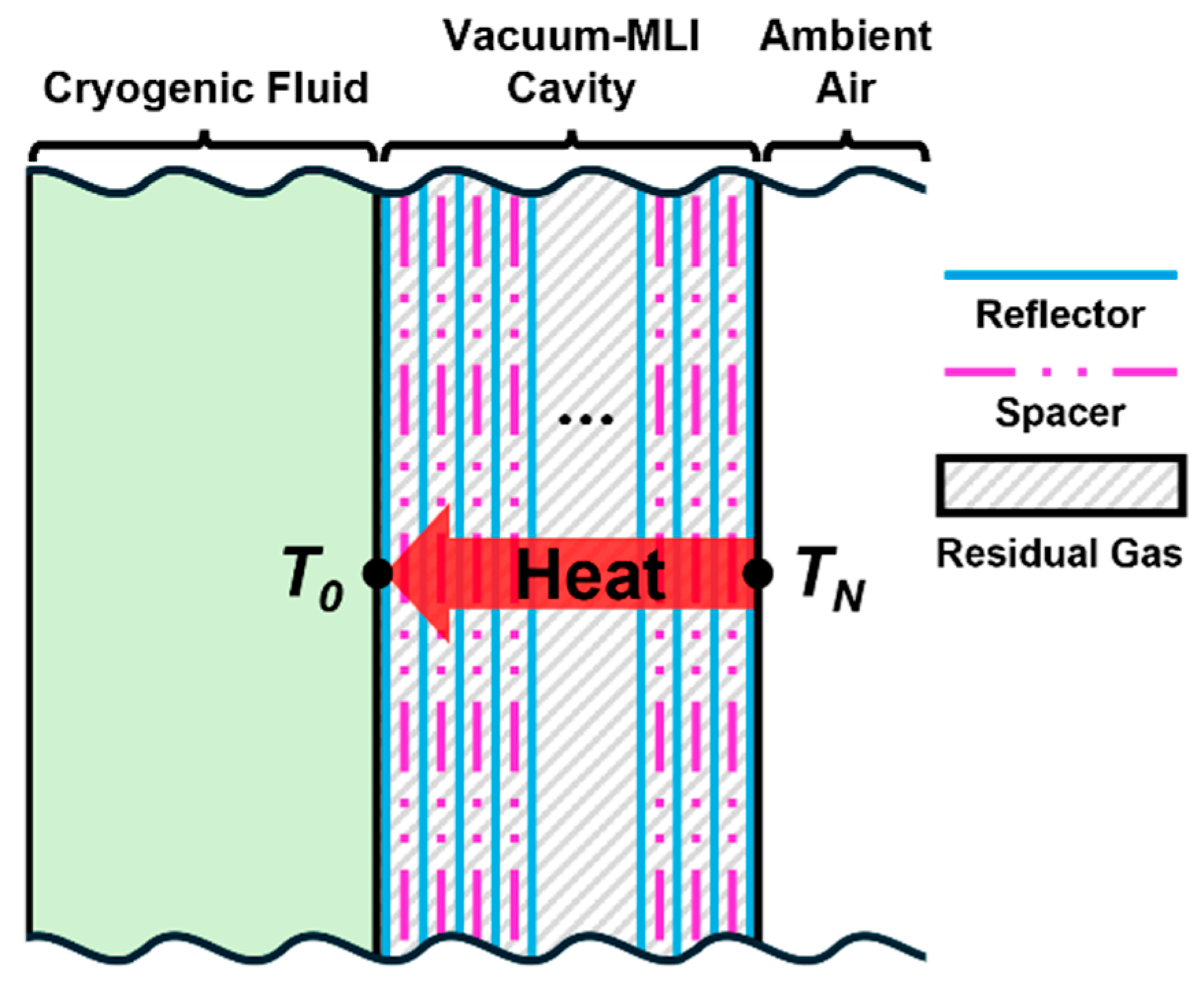
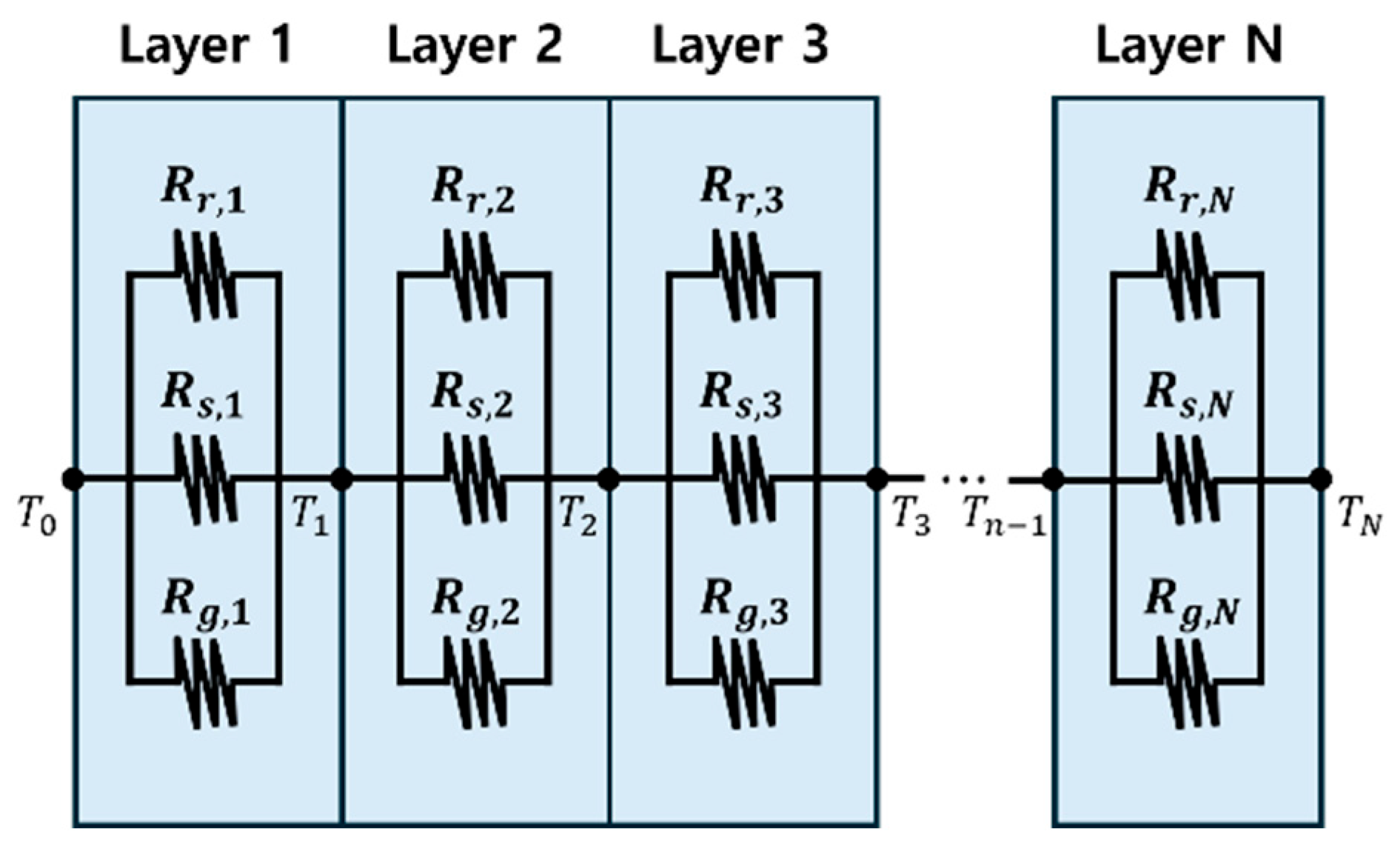
- Considering the actual operating environment, nitrogen, a radiatively non-participating medium, was chosen as the residual gas. Therefore, thermal radiation of the gas was neglected.
- The spacing between reflectors was sufficiently narrow to approximate them as parallel plates. Consequently, the view factor was fixed at 1.
2.2. Calculation Conditions and Variables
2.3. Calculation Procedure
3. Results and Discussion
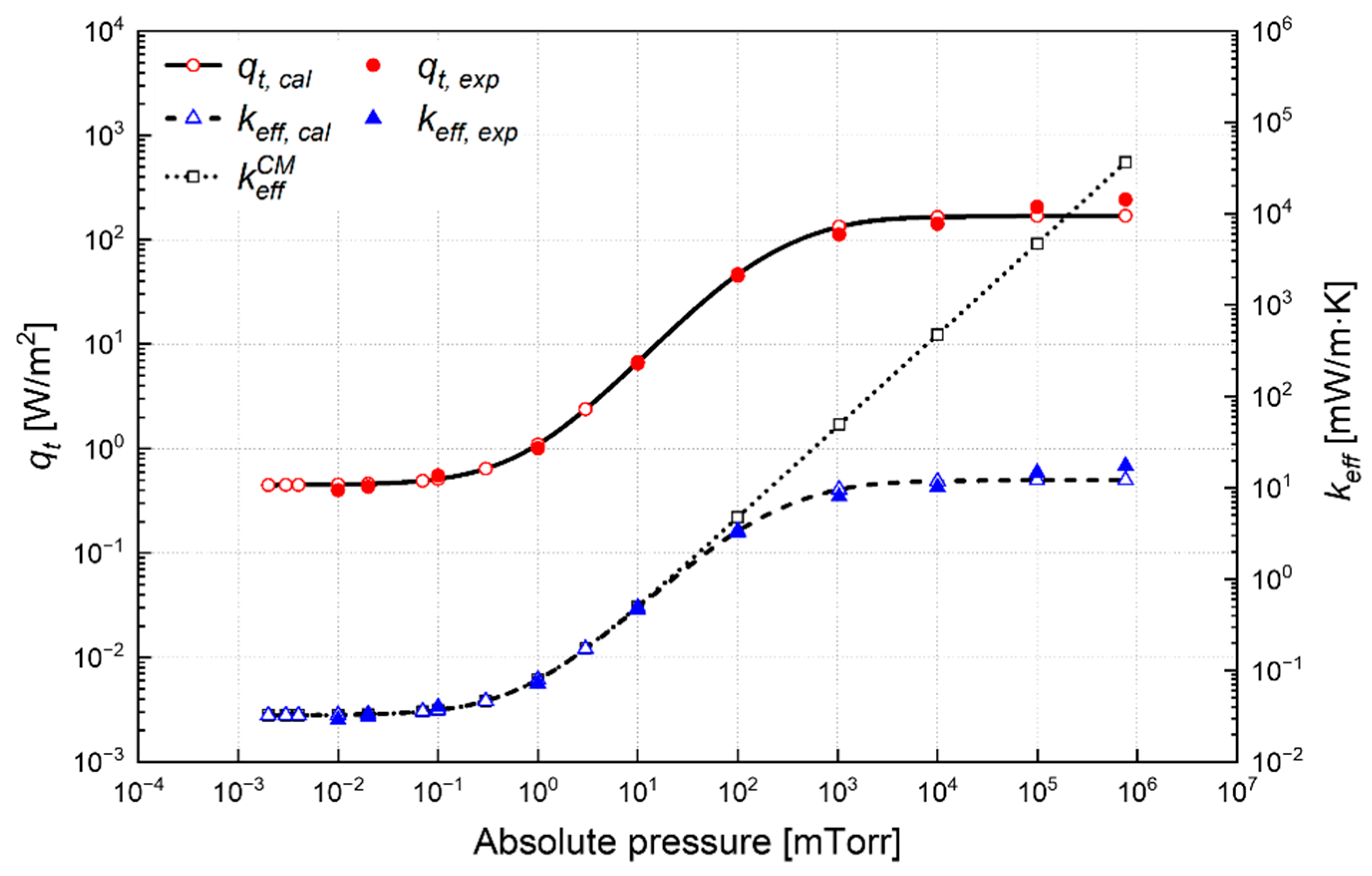
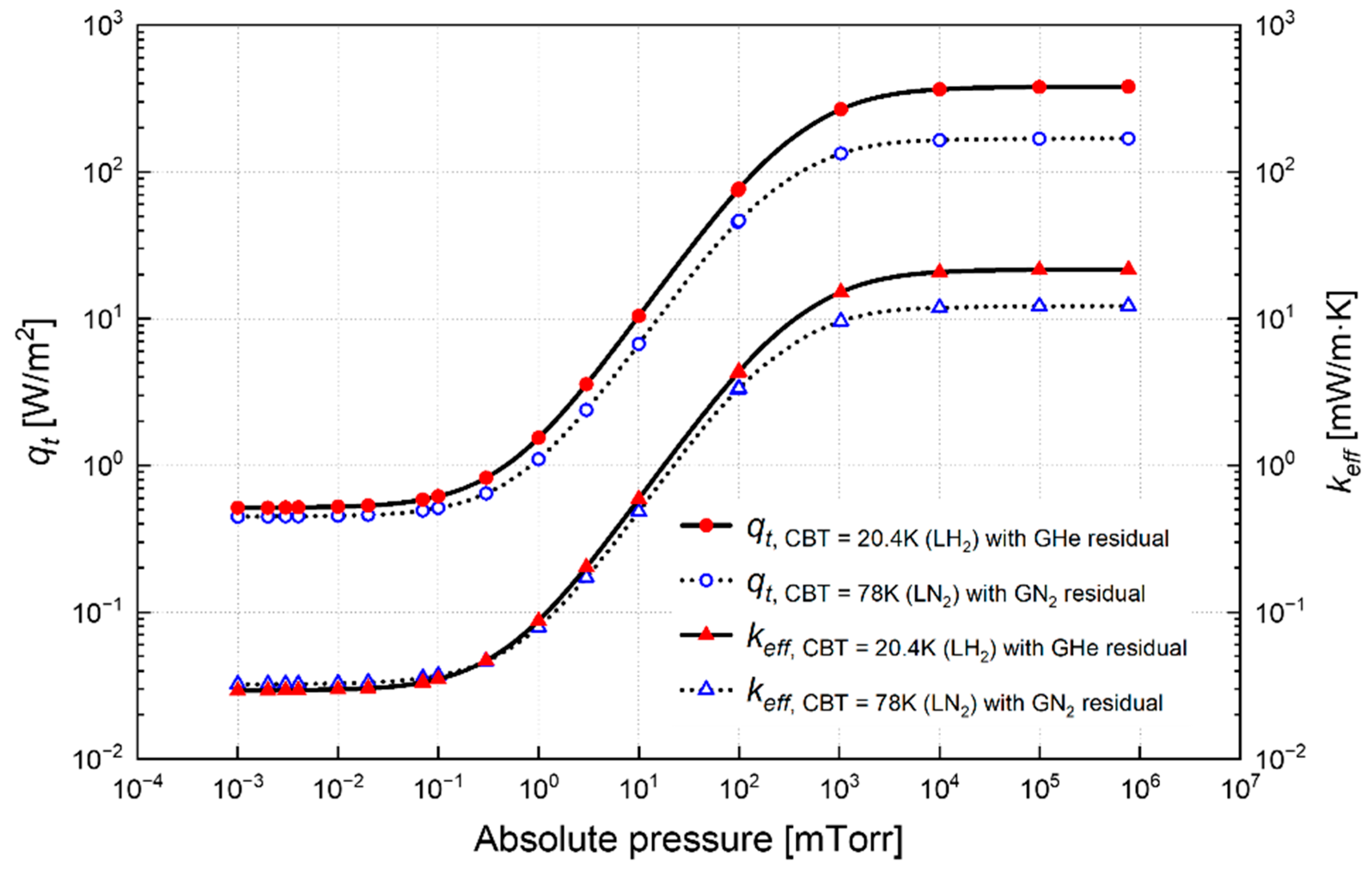
3.1. Total Heat Flux and Effective Thermal Conductivity
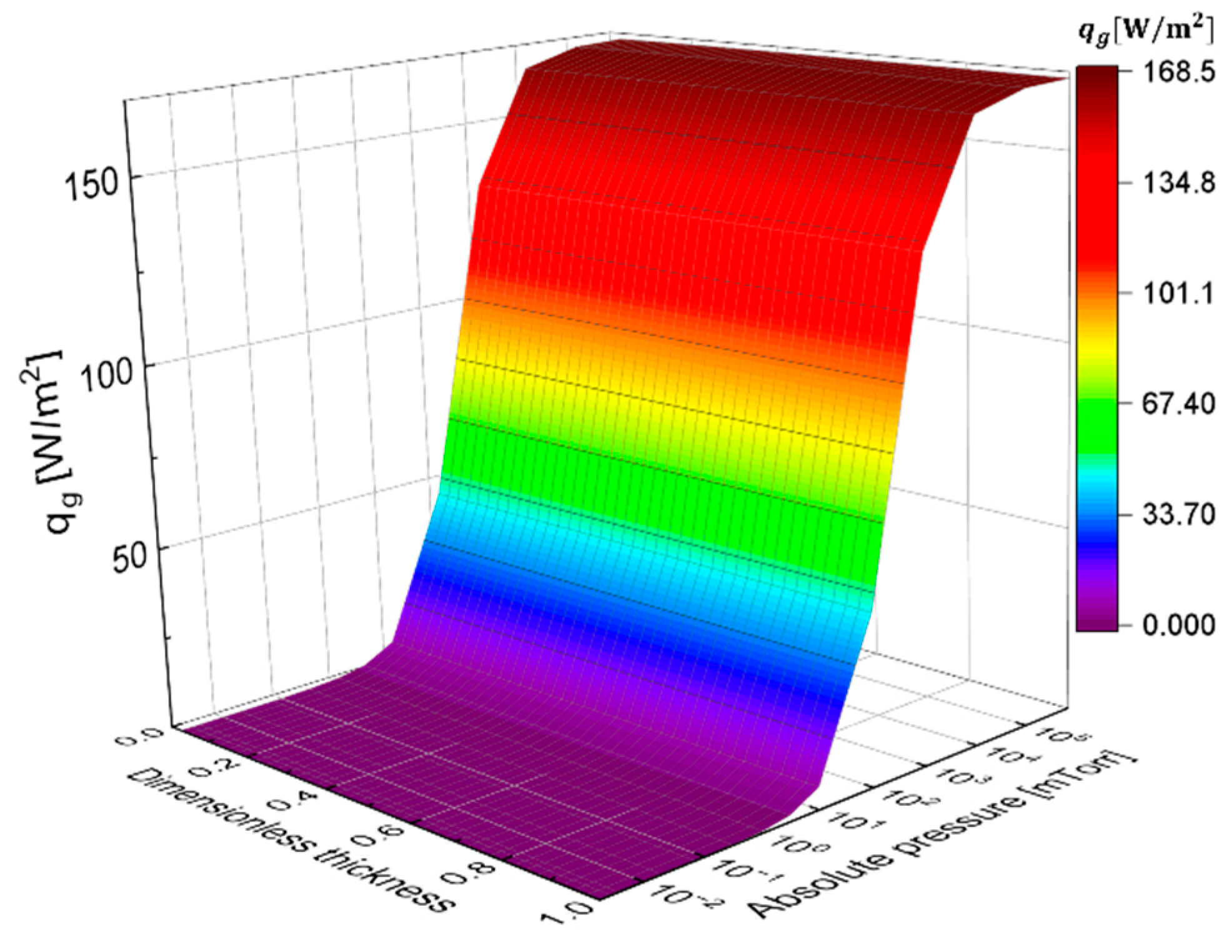
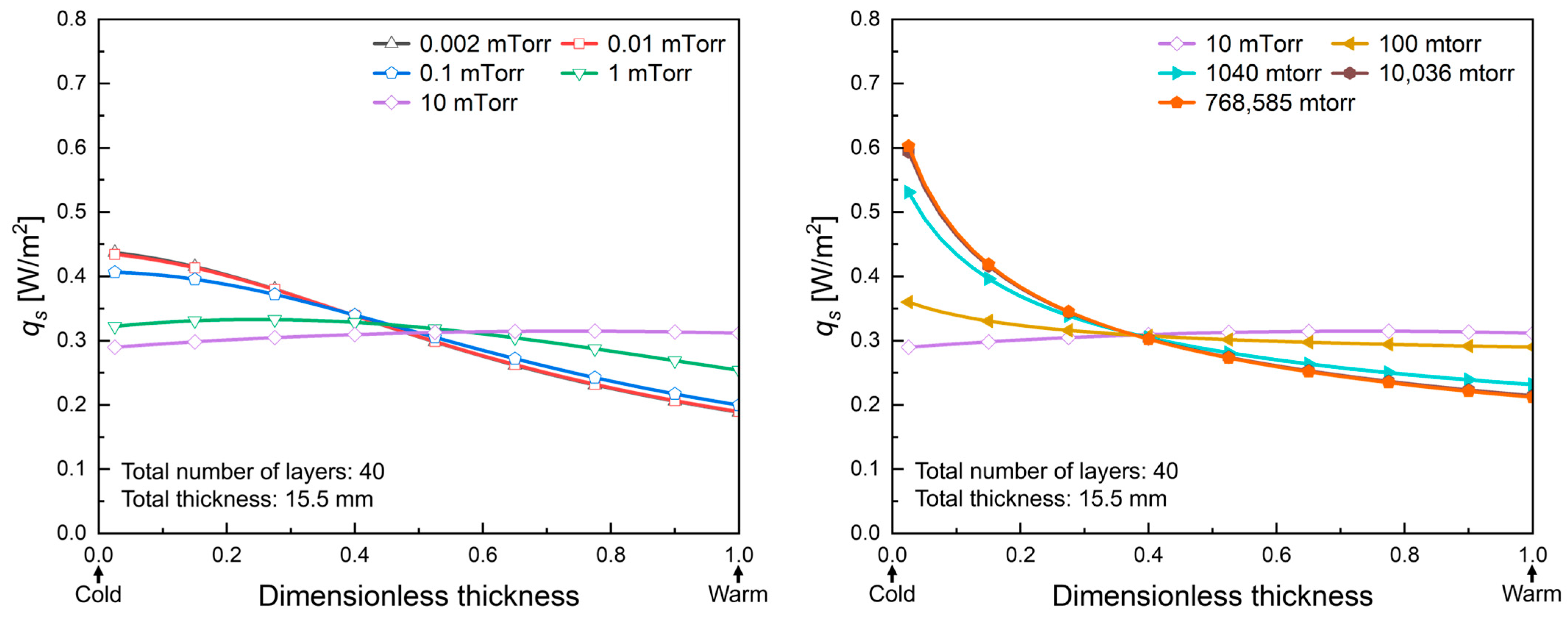
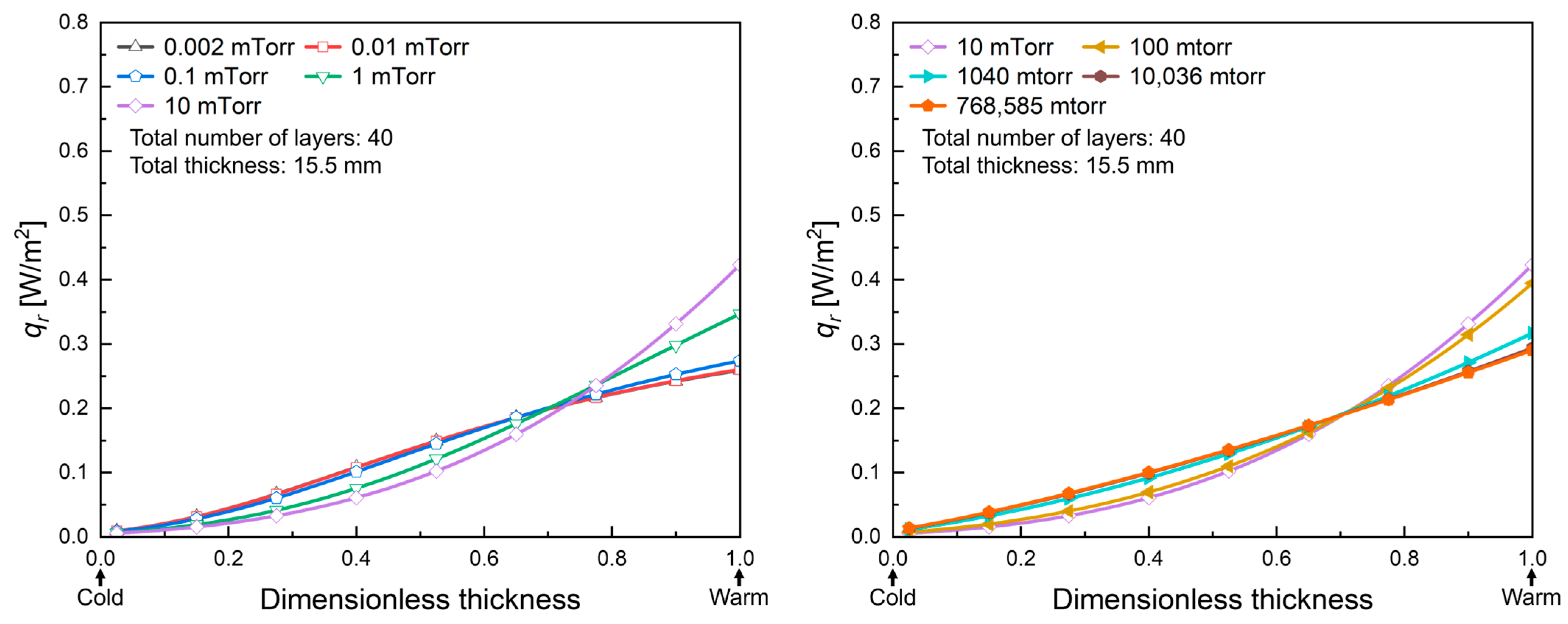
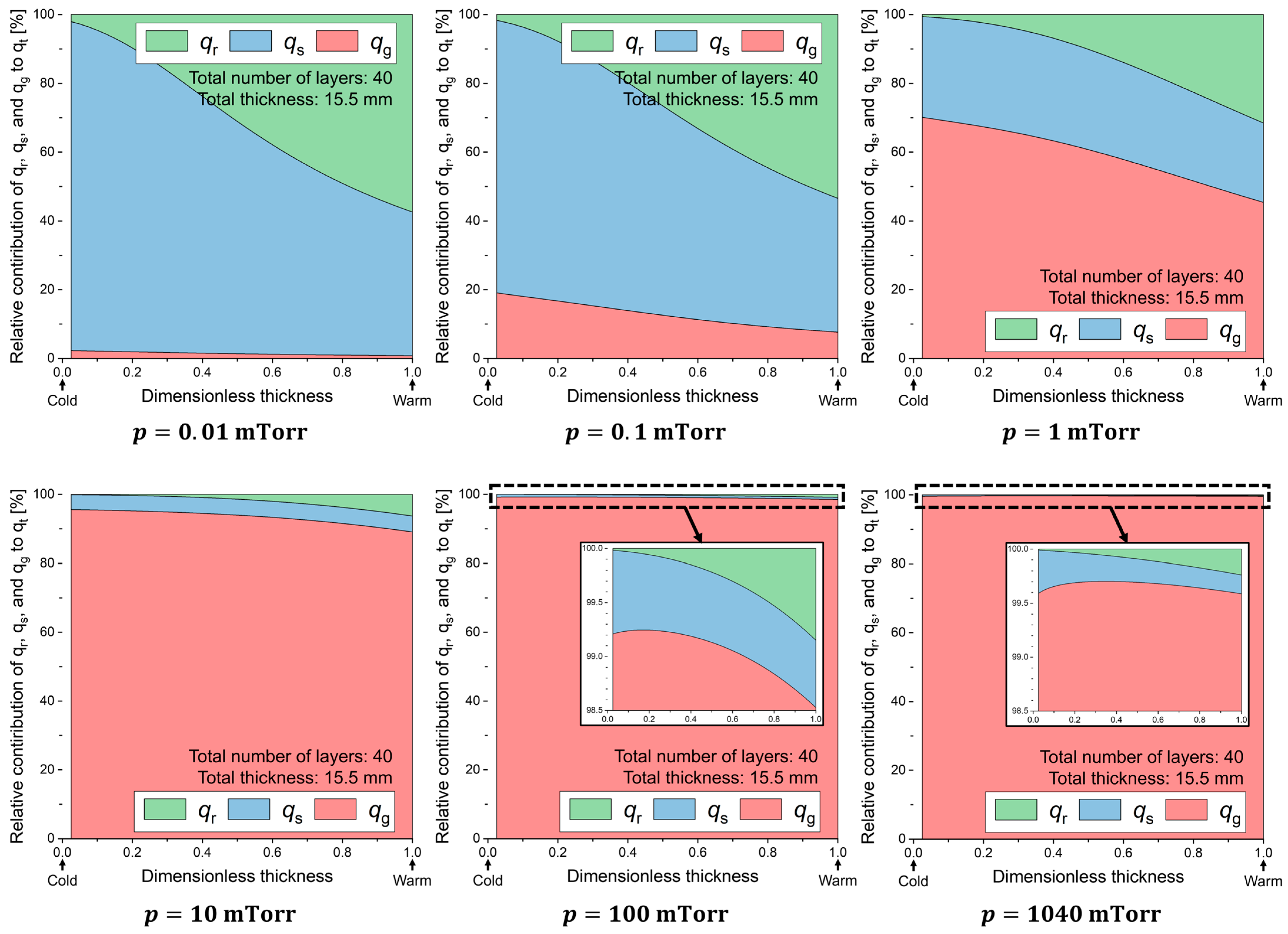
3.2. Internal Heat-Flux Distribution
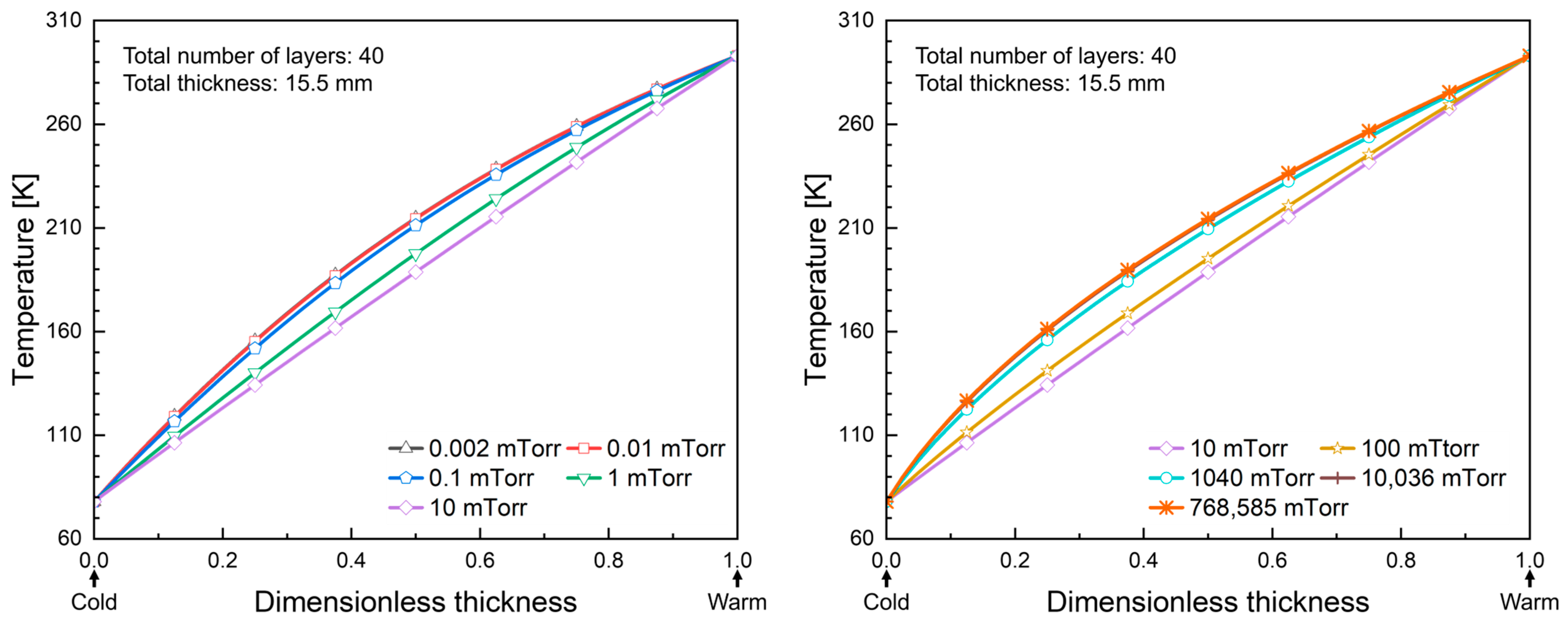
3.3. Temperature Distribution
4. Application
5. Conclusions
Author Contributions
Funding
Data Availability Statement
Conflicts of Interest
Nomenclature
| Roman | |
| empirical constant | |
| molecular diameter | |
| relative density | |
| thermal conductance | |
| iteration number | |
| thermal conductivity | |
| Boltzmann constant, | |
| effective thermal conductivity | |
| Knudsen number | |
| molecular weight | |
| absolute pressure | |
| heat flux | |
| thermal resistance | |
| universal gas constant, | |
| absolute temperature | |
| total thickness | |
| layer thickness | |
| Greek | |
| accommodation coefficient | |
| specific heat ratio | |
| emissivity | |
| Stefan–Boltzmann constant, | |
| fitting parameter | |
| Superscript | |
| conventional method | |
| regime of the free-molecule flow | |
| Subscript | |
| cold boundary | |
| calculation | |
| experiment | |
| gas conduction | |
| mean | |
| node number | |
| total number of layers | |
| radiation | |
| solid conduction | |
| total | |
| warm boundary | |
References
- Smith, J.R.; Gkantonas, S.; Mastorakos, E. Modelling of boil-off and sloshing relevant to future liquid hydrogen carriers. Energies 2022, 15, 2046. [Google Scholar] [CrossRef]
- Kalikatzarakis, M.; Theotokatos, G.; Coraddu, A.; Sayan, P.; Wong, S.Y. Model based analysis of the boil-off gas management and control for LNG fuelled vessels. Energy 2022, 251, 123872. [Google Scholar] [CrossRef]
- Dobrota, Đ.; Lalić, B.; Komar, I. Problem of boil-off in LNG supply chain. Trans. Marit. Sci. 2013, 2, 91–100. [Google Scholar] [CrossRef]
- Wang, J.; Webley, P.A.; Hughes, T.J. Thermodynamic modelling of low fill levels in cryogenic storage tanks for application to liquid hydrogen maritime transport. Appl. Therm. Eng. 2024, 256, 124054. [Google Scholar] [CrossRef]
- Sutheesh, P.M.; Chollackal, A. Thermal performance of multilayer insulation: A review. IOP Conf. Ser. Mater. Sci. Eng. 2018, 396, 012061. [Google Scholar] [CrossRef]
- Johnson, W.L. Thermal Performance of Cryogenic Multilayer Insulation at Various Layer Spacings; NASA Report No. KSC-2010-181; NASA Kennedy Space Center: Merritt Island, FL, USA, 2010.
- Fesmire, J.E. Standardization in cryogenic insulation systems testing and performance data. Phys. Procedia 2015, 67, 1089–1097. [Google Scholar] [CrossRef]
- Jacob, S.; Kasthurirengan, S.; Karunanithi, R. Investigations into the thermal performance of multilayer insulation (300–77 K) Part 1: Calorimetric studies. Cryogenics 1992, 32, 1137–1146. [Google Scholar] [CrossRef]
- Wang, B.; Wang, H.; Gao, Y.; Yu, J.; He, Y.; Xiong, Z.; Lu, H.; Pan, Q.; Gan, Z. Theoretical analysis of entropy generation in multilayer insulations: A case study of performance optimization of variable density multilayer insulations for liquid hydrogen storage system. Int. J. Hydrogen Energy 2024, 85, 175–190. [Google Scholar] [CrossRef]
- Zheng, J.; Chen, L.; Wang, J.; Xi, X.; Zhu, H.; Zhou, Y.; Wang, J. Thermodynamic analysis and comparison of four insulation schemes for liquid hydrogen storage tank. Energy Convers. Manag. 2019, 186, 526–534. [Google Scholar] [CrossRef]
- Huang, Y.; Wang, B.; Zhou, S.; Wu, J.; Lei, G.; Li, P.; Sun, P. Modeling and experimental study on combination of foam and variable density multilayer insulation for cryogen storage. Energy 2017, 123, 487–498. [Google Scholar] [CrossRef]
- Yu, Y.; Xie, F.; Zhu, M.; Yu, S.; Li, Y. Design and optimization of the insulation performance of a 4000 m3 liquid hydrogen spherical tank. Processes 2023, 11, 1778. [Google Scholar] [CrossRef]
- Hastings, L.J.; Hedayat, A.; Brown, T.M. Analytical Modeling and Test Correlation of Variable Density Multilayer Insulation for Cryogenic Storage; NASA Technical Memorandum M-1109; NASA Marshall Space Flight Center: Huntsville, AL, USA, 2004.
- Zhu, X.Y.; Lee, J.H.; Kim, K.H.; Lim, C.H.; Lee, S.H. Coupled CFD modeling and thermal analysis of multi-layered insulation structures in liquid hydrogen storage tanks for various vapor-cooled shields. Case Stud. Therm. Eng. 2024, 54, 105317. [Google Scholar] [CrossRef]
- Chorowski, M.; Grzegory, P.; Parente, C.; Riddone, G. Experimental and Mathematical Analysis of Multilayer Insulation Below 80 K; LHC-Project-Report-385; ICEC: Mumbai, India, 2000. [Google Scholar]
- Chorowski, M.; Grzegory, P.; Parente, C.; Riddone, G. Optimisation of Multilayer Insulation: An Engineering Approach; LHC-Project-Report-464; ICARIS Ltd.: Praha, Czech Republic, 2001. [Google Scholar]
- Bapat, S.L.; Narayankhedkar, K.G.; Lukose, T.P. Experimental investigations of multilayer insulation. Cryogenics 1990, 30, 711–719. [Google Scholar] [CrossRef]
- Sofer, G.A.; Weingartner, H.C. High Vacuum Technology. In Advances in Chemical Engineering; Academic Press: New York, NY, USA, 1958; Volume 2, pp. 117–145. [Google Scholar]
- Fesmire, J.E.; Johnson, W.L. Cylindrical cryogenic calorimeter testing of six types of multilayer insulation systems. Cryogenics 2018, 89, 58–75. [Google Scholar] [CrossRef]
- McIntosh, G.E. Layer by layer MLI calculation using a separated mode equation. In Advances in Cryogenic Engineering; Plenum Press: New York, NY, USA, 1994; Volume 39, pp. 1683–1690. [Google Scholar]
- Wang, B.; Huang, Y.H.; Li, P.; Sun, P.J.; Chen, Z.C.; Wu, J.Y. Optimization of variable density multilayer insulation for cryogenic application and experimental validation. Cryogenics 2016, 80, 154–163. [Google Scholar] [CrossRef]
- Verschoor, J.D.; Greebler, P. Heat transfer by gas conduction and radiation in fibrous insulations. Trans. ASME 1952, 74, 961–967. [Google Scholar] [CrossRef]
- Green, M.A. Heat transfer through a multilayer insulation system as a function of pressure in the cryostat vacuum space. In Advances in Cryogenic Engineering; Plenum Press: New York, NY, USA, 1998; Volume 43, pp. 1313–1318. [Google Scholar]
- Kennard, E.H. Kinetic Theory of Gases; McGraw-Hill: New York, NY, USA, 1938. [Google Scholar]
- Corruccini, R.J. Gaseous heat conduction at low pressures and temperatures. Vacuum 1959, 7, 19–29. [Google Scholar] [CrossRef]
- Gu, L. Generalized equation for thermal conductivity of MLI at temperatures from 20 K to 300 K. In Proceedings of the ASME International Mechanical Engineering Congress and Exposition, Washington, DC, USA, 15 November 2003. [Google Scholar]
- Lees, L. Kinetic theory description of rarefied gas flow. J. Soc. Ind. Appl. Math. 1965, 13, 278–311. [Google Scholar] [CrossRef]
- Teagan, W.P. Heat Transfers and Density Distribution Measurements Between Parallel Plates in the Transition Regime. Ph.D. Thesis, Massachusetts Institute of Technology, Cambridge, MA, USA, 1967. [Google Scholar]
- Green, M.A. Radiation and gas conduction heat transport across a helium dewar multilayer insulation system. In The Art and Science of Magnet Design; Cryogenic Materials, Inc.: Boulder, CO, USA, 1995; pp. 586–592. [Google Scholar]
- Selden, N.; Gimelshein, N.; Gimelshein, S.; Ketsdever, A. Analysis of accommodation coefficients of noble gases on aluminum surface with an experimental/computational method. Phys. Fluids 2009, 21, 073101. [Google Scholar] [CrossRef]



| MLI composition and properties | Reflector | Type | Double-aluminized Mylar |
| Emissivity, | Equation (6) | ||
| Spacer | Type | Dacron net | |
| Conductivity, | Equation (7) | ||
| Total number of layers, | 40 | ||
| Total thickness, | 15.5 mm | ||
| Boundary conditions | T0 (cold) | 78 K | |
| TN (warm) | 293 K | ||
| Residual pressures of vacuum-MLI system | ] | 0.002, 0.003, 0.004, 0.01, 0.02, 0.07, 0.1, 0.3, 1, 3, 10, 100, 1040, 10,036, 99,102, 768,585 | |
| Variable | Value | |
|---|---|---|
| Residual Gas | Type | GN2 |
| Molecular diameter, | 3.15 × 10⁻¹⁰ m | |
| Molecular weight, | 28.0 kg/kmol | |
| Specific heat ratio, | 1.4 | |
| Accommodation coefficient, | 0.76 [28] | |
| Empirical constant, | 0.008 [20] | |
| Relative density, | 0.02 | |
| Fitting parameter, | 1.4 | |
| MLI composition and properties | Reflector | Type | Double-aluminized Mylar |
| Emissivity, | Equation (6) | ||
| Spacer | Type | Dacron net | |
| Conductivity, | Equation (7) | ||
| Total number of layers, | 40 | ||
| Total thickness, | 15.5 mm | ||
| Boundary conditions | T0 (cold) | 20.4 K | |
| TN (warm) | 293 K | ||
| Residual pressures of vacuum-MLI system | ] | 0.002, 0.003, 0.004, 0.01, 0.02, 0.07, 0.1, 0.3, 1, 3, 10, 100, 1040, 10,036, 99,102, 768,585 | |
| Variable | Value | |
|---|---|---|
| Residual Gas | Type | GHe |
| Molecular diameter, | 2.67 × 10⁻¹⁰ m | |
| Molecular weight, | 4.0 kg/kmol | |
| Specific heat ratio, | 1.66 | |
| Accommodation coefficient, | 0.53 | |
| Empirical constant, | 0.008 [20] | |
| Relative density, | 0.02 | |
| Fitting parameter, | 1.4 | |
Disclaimer/Publisher’s Note: The statements, opinions and data contained in all publications are solely those of the individual author(s) and contributor(s) and not of MDPI and/or the editor(s). MDPI and/or the editor(s) disclaim responsibility for any injury to people or property resulting from any ideas, methods, instructions or products referred to in the content. |
© 2026 by the authors. Licensee MDPI, Basel, Switzerland. This article is an open access article distributed under the terms and conditions of the Creative Commons Attribution (CC BY) license.
Share and Cite
Lee, T.Y.; Kim, J.S. Insulation Performance of Vacuum-MLI Cavity Under Varying Residual Gas Pressure: Analytical Study and Application to Liquid Hydrogen System. Energies 2026, 19, 1184. https://doi.org/10.3390/en19051184
Lee TY, Kim JS. Insulation Performance of Vacuum-MLI Cavity Under Varying Residual Gas Pressure: Analytical Study and Application to Liquid Hydrogen System. Energies. 2026; 19(5):1184. https://doi.org/10.3390/en19051184
Chicago/Turabian StyleLee, Tae Yun, and Jeong Soo Kim. 2026. "Insulation Performance of Vacuum-MLI Cavity Under Varying Residual Gas Pressure: Analytical Study and Application to Liquid Hydrogen System" Energies 19, no. 5: 1184. https://doi.org/10.3390/en19051184
APA StyleLee, T. Y., & Kim, J. S. (2026). Insulation Performance of Vacuum-MLI Cavity Under Varying Residual Gas Pressure: Analytical Study and Application to Liquid Hydrogen System. Energies, 19(5), 1184. https://doi.org/10.3390/en19051184