Article

Multi-Channel SCADA-Based Image-Driven Power Prediction for Wind Turbines Using Optimized LeNet-5-LSTM Hybrid Neural Architecture

by
Muhammad Ahsan
and
Phong Ba Dao
*
AGH University of Krakow, Faculty of Mechanical Engineering and Robotics, Department of Robotics and Mechatronics, al. Mickiewicza 30, 30-059 Krakow, Poland
*
Author to whom correspondence should be addressed.
Energies 2026, 19(5), 1169; https://doi.org/10.3390/en19051169
Submission received: 6 January 2026 / Revised: 16 February 2026 / Accepted: 21 February 2026 / Published: 26 February 2026
(This article belongs to the Special Issue Machine Learning in Renewable Energy Resource Assessment)

Abstract

Accurate power prediction is essential for assessing wind turbine performance under real-world operating conditions and for supporting condition monitoring and maintenance planning using SCADA data. Most existing approaches rely directly on raw SCADA signals, which may limit their ability to capture complex spatiotemporal dependencies among operational variables. To address this limitation, this paper proposes a novel SCADA-driven power prediction framework that transforms selected SCADA variables into multi-channel grayscale images and leverages an optimized LeNet-5–LSTM hybrid neural network for active and reactive power prediction. First, the SCADA dataset is analyzed to identify the most influential variables affecting power output. Six key variables are then selected, segmented, and encoded as 2D grayscale images, enabling the model to learn richer feature representations compared to conventional raw SCADA data-based methods. The proposed network combines convolutional layers for spatial feature extraction from SCADA data-based grayscale images with LSTM layers to capture temporal dependencies. Model training incorporates a customized loss function that integrates both data-driven supervision and physics-based constraints. The model is trained using 70% of the image-based dataset, with five independent runs to ensure robustness and reproducibility, while the remaining 30% is used for testing. The proposed approach is validated using SCADA data from three real-world cases: (i) a 2 MW Siemens wind turbine in Poland, (ii) a Vestas V52 wind turbine in Ireland, and (iii) the La Haute Borne wind farm in France, consisting of four wind turbines. The results demonstrate that the SCADA-based image representation enables the proposed LeNet-5–LSTM model to effectively learn discriminative feature patterns and achieve accurate active and reactive power predictions across different turbine types and operating conditions.

1. Introduction

The accelerating integration of wind turbines into modern power systems is driven by the global imperative for clean and renewable energy [1,2]. As one of the most mature and widely deployed renewable technologies, wind energy plays crucial role in reducing greenhouse gas emissions and supporting sustainable power generation. At the same time, increasing penetration introduces practical challenges arising from variability, intermittency, and the need to safeguard system stability [3,4,5]. Accurate estimation of key performance metrics—particularly active and reactive power—therefore becomes essential for efficient energy management, fault diagnostics, and overall grid reliability [6]. Reliable power modeling also facilitates assessment of turbine health, enabling predictive maintenance and fault prevention strategies that reduce downtime and operational costs [7].
Accurate power modeling serves three operational purposes. First, discrepancies between predicted and measured power can be used to detect deviations early by comparing data-based predictions with actual generation [8,9]. Such deviations may arise from aerodynamic losses, pitch or yaw misalignment, generator inefficiencies, or incipient mechanical and electrical faults in wind turbines [10,11]. Second, active and reactive power predictions provide insight into turbine health [12,13]: active power reflects aerodynamic and mechanical efficiency, whereas reactive power captures the behavior of the converter, generator excitation, and voltage support capability. Third, precise power models support operational decision-making in grid operations, wind farm control, and maintenance scheduling, enabling anomaly detection well before alarms are triggered [14,15,16,17].
Wind turbine behavior is governed by nonlinear interactions between environmental conditions and turbine dynamics. Traditional physical and statistical modeling approaches often rely on simplifying assumptions that do not fully capture the complexity observed under real-world operating conditions, limiting their effectiveness in practical applications [18]. As a result, modeling nonlinear wind turbine dynamics remains challenging [19,20]. In response, data-driven methods based on deep learning (DL) have gained traction as they offer improved representation capability for complex, nonlinear processes. Consequently, DL models are increasingly employed for the modeling and prediction of active and reactive power in wind turbines [21].
A critical prerequisite for effective DL modeling is access to rich, high-quality data [22,23]. Supervisory Control and Data Acquisition (SCADA) systems provide continuous and rich measurements of turbine operation by recording multi-sensor signals at fixed intervals [24]. These systems deliver comprehensive coverage of operational conditions, making SCADA data particularly valuable for characterizing turbine behavior and supporting power predicting in harsh environmental conditions. However, SCADA datasets typically contain noise, outliers, and missing values, which can hinder the performance of traditional regression methods and shallow learning techniques, reducing the reliability of their predictions [25,26]. In addition, SCADA measurements are high-dimensional, heterogeneous, and originate from multiple physical subsystems with different units, dynamics, and noise characteristics. Varying environmental and operational conditions further introduce nonstationarity and outliers. Conventional data-driven approaches typically operate directly on raw SCADA time series, but often struggle to capture complex cross-feature interactions, generalize across turbines or wind farms, and cope with the scarcity of fault-labelled data.
Among DL techniques, convolutional neural networks (CNNs) have demonstrated strong capability for feature extraction and for capturing nonlinear relationships in data-driven applications [27,28,29]. While CNNs were originally developed for image recognition, recent research indicates that time-domain signals, including SCADA measurements, can be effectively processed using adapted CNN architectures to exploit spatial and temporal dependencies inherent in multi-channel turbine data [30,31]. In particular, several studies transform SCADA time-series variables into image-like matrices, which allows CNNs to learn structured patterns across variables and over time [21,26,32]. Despite these advances, many approaches rely on highly complex or heavily customized CNN variants, which may limit generalizability and complicate real-world deployment.
To address the limitations discussed above, this paper proposes a generalized LeNet-5-LSTM hybrid neural architecture. The novelty of the proposed architecture lies in the combination of multi-channel LeNet-5 model with a long short-term memory (LSTM) network to capture both spatial and temporal structures in SCADA data. The time-domain SCADA data is first normalized and segmented and then each segment is transformed into a 2D grayscale image. This representation preserves inter-variable relationships while allowing effective spatial feature extraction. The LSTM component subsequently learns the temporal dependencies inherent in the time-domain nature of SCADA records, thereby addressing the shortcomings of traditional feature-level or 1D-CNN-based SCADA-based approaches in the existing literature [33,34,35]. The resulting LeNet-5–LSTM hybrid architecture is designed to be lightweight, requiring minimal preprocessing and feature engineering, while remaining scalable across turbines with different variable sets or channel configurations. Although SCADA systems record a large number of operational variables, this study focuses on the six most influential signals to construct an efficient and informative input representation.
To evaluate generalization, we test the proposed model on three independent datasets with diverse environmental conditions and sensor configurations: (i) 2 MW Siemens turbines in Poland, (ii) a Vestas V52 turbine in Ireland, and (iii) the La Haute Borne wind farm in France. For each dataset, five independent training and testing runs are conducted to assess prediction stability and robustness under repeated learning trials. The results demonstrate that high accuracy can be achieved across datasets with equivalent model configurations, supporting the model’s applicability in heterogeneous operational contexts.
The main contributions of this work are as follows:
  • A novel SCADA-to-image conversion paradigm, in which selected multi-channel SCADA data are segmented and transformed into 2D grayscale images for power prediction, instead of directly using raw SCADA signals.
  • A unified hybrid deep-learning architecture that combines a 2D LeNet-5 convolutional network for spatial feature extraction from SCADA-derived grayscale images with an LSTM network for temporal sequence learning.
  • Multi-channel power prediction, integrating multiple SCADA variables simultaneously to estimate both active and reactive power, rather than relying on single-sensor or single-output models.
  • Extensive validation across heterogeneous datasets, demonstrated on three independent SCADA datasets covering different wind turbine types, geographical locations, and operating conditions.
  • Architectural robustness and generalizability, showing that a consistent model configuration achieves high predictive accuracy across distinct datasets without extensive tuning or feature engineering.
  • Practical relevance for condition monitoring, where persistent deviations between predicted and measured power can serve as indicators of performance degradation, aerodynamic losses, or emerging mechanical and electrical faults, supporting early anomaly detection and maintenance planning.
The rest of the paper is arranged as follows: Section 2 describes materials and methods, with a detailed description given for acquiring three SCADA datasets from different wind turbines. The section also describes the proposed LeNet-5 and LSTM hybrid model and its loss function designed for optimal power predictions. Section 3 contains an elaborate discussion on an analysis of experiments conducted on the proposed model. The SCADA datasets are processed and converted into two-dimensional images with grayscale resolution, and then these images are fed into the hybrid model for active and reactive power prediction outputs. An examination of loss curves per wind turbine confirms that there is high stability with convergence. It shows that there are very accurate predictions resulted by the model with optimal predicted powers, which closely match measured outputs. Finally, a short conclusion is provided to summarize the key findings and highlight the contribution of this study.

2. Materials and Methods

This section provides detailed description of SCADA datasets from three different wind turbines. The SCADA datasets are explored to understand the influence of variables to the generated powers and six most influenced variables are selected for each wind turbine for further processing. In addition to the selected variables from SCADA data, this section also illustrates the proposed hybrid architecture consists of LeNet-5-LSTM model along with the loss function construction on both data-driven supervision and physics-based constraints.

2.1. Datasets and Preprocessing

In this study, three distinct SCADA wind turbine datasets were utilized to evaluate the prediction performance for both active and reactive power. To demonstrate the generalization capability of the proposed model, its parameters were kept consistent across all datasets, while the input features were adapted according to the specific characteristics of each dataset.

2.1.1. SIEMENS, Poland

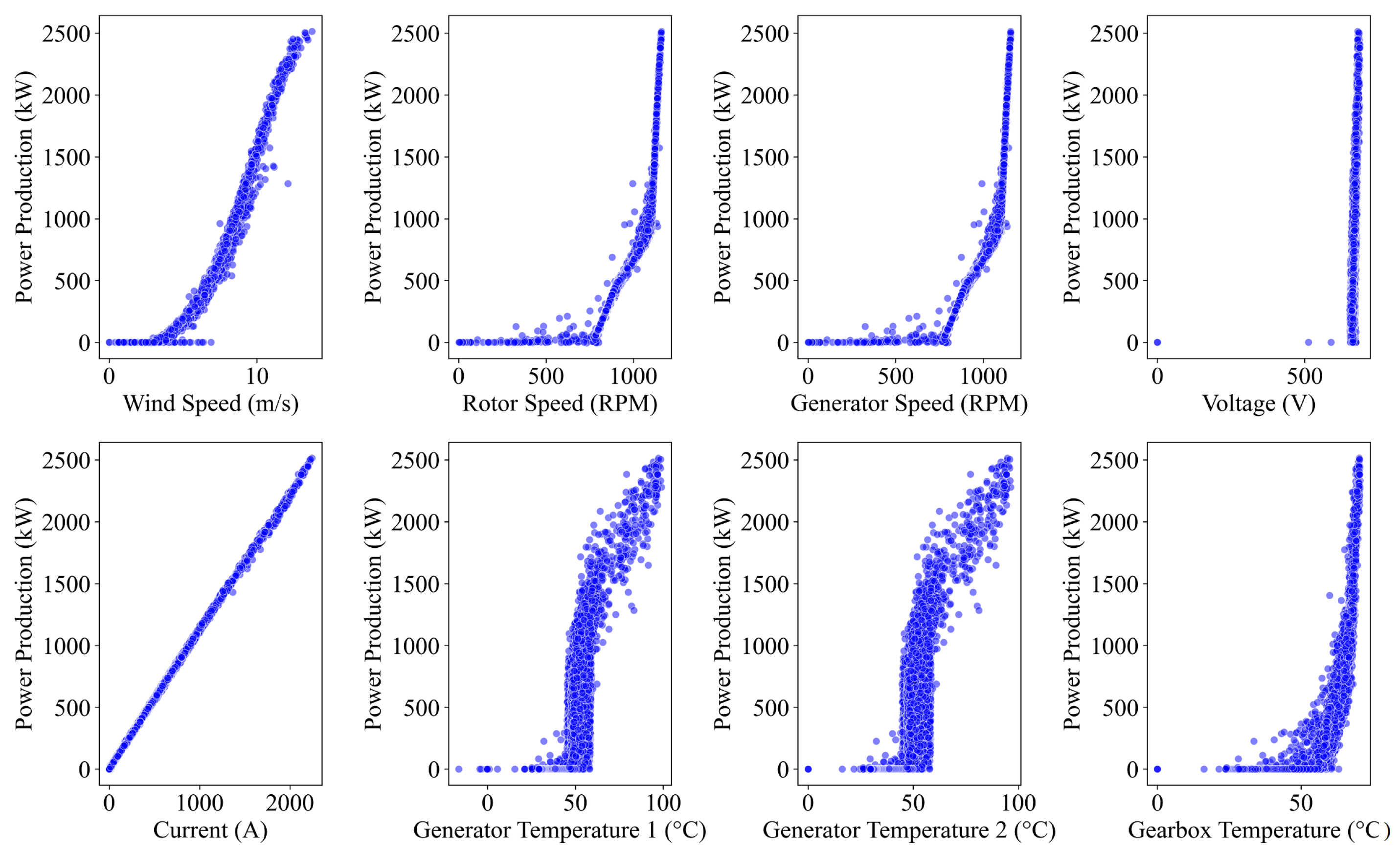
The first SCADA dataset employed in this study was obtained from a 2 MW SIEMENS wind turbine operating at a wind farm located along the Baltic Sea coast in northern Poland [36]. This dataset comprises active power, reactive power, active power delivered, reactive power delivered along with 8 other variables. Each variable has 4320 number of samples recorded at 10-minute intervals throughout the year 2012. Figure 1 illustrates the influence of there variables on active power.
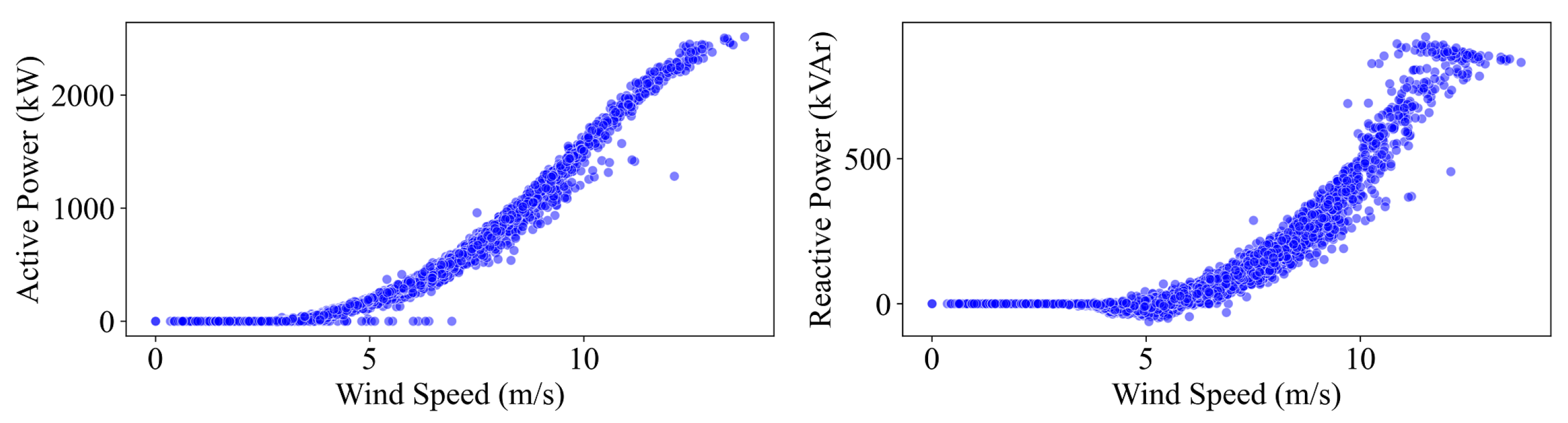
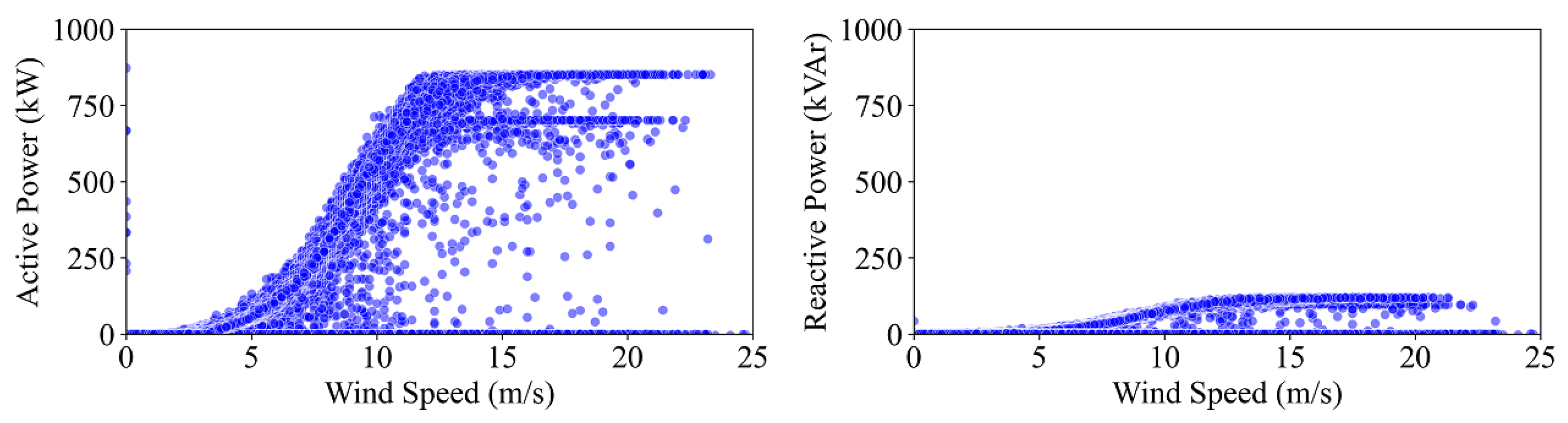
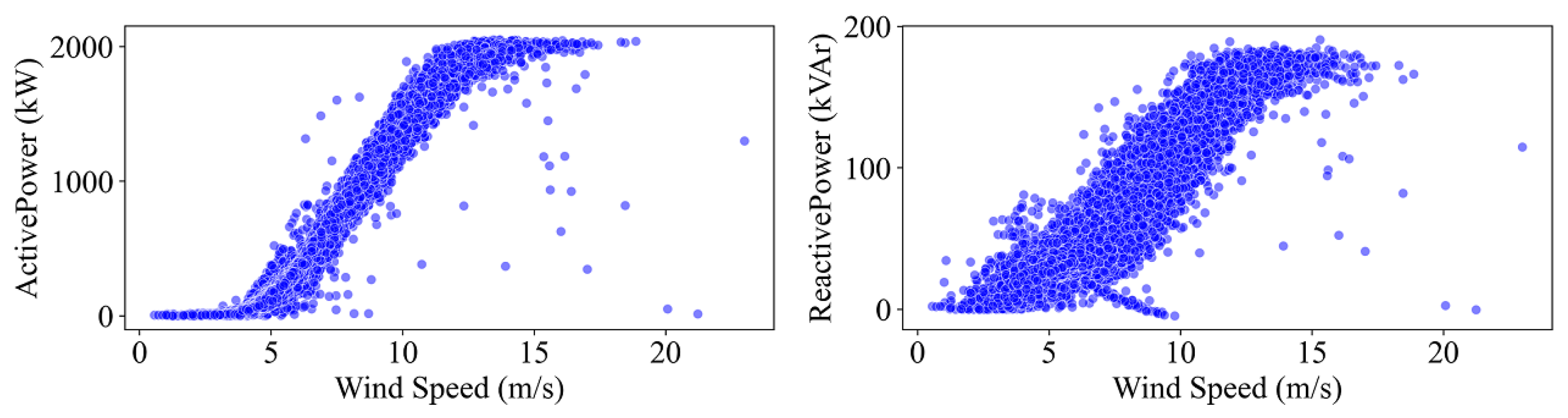
After viewing the effect of these variables and further investigation, it was concluded that the Rotor Speed and Generator Speed exhibited 100% correlation coefficient, while Generator Temperature 1 and Generator Temperature 2 show 99.02% correlation. To reduce redundancy and mitigate multicollinearity, these highly correlated variable pairs were averaged to form two composite features: Shaft Speed (RPM) and Generator Temperature (°C). The remaining variables were renamed as presented in Table 1. Furthermore, Figure 2 illustrates the relationships of active power and reactive power with wind speed.
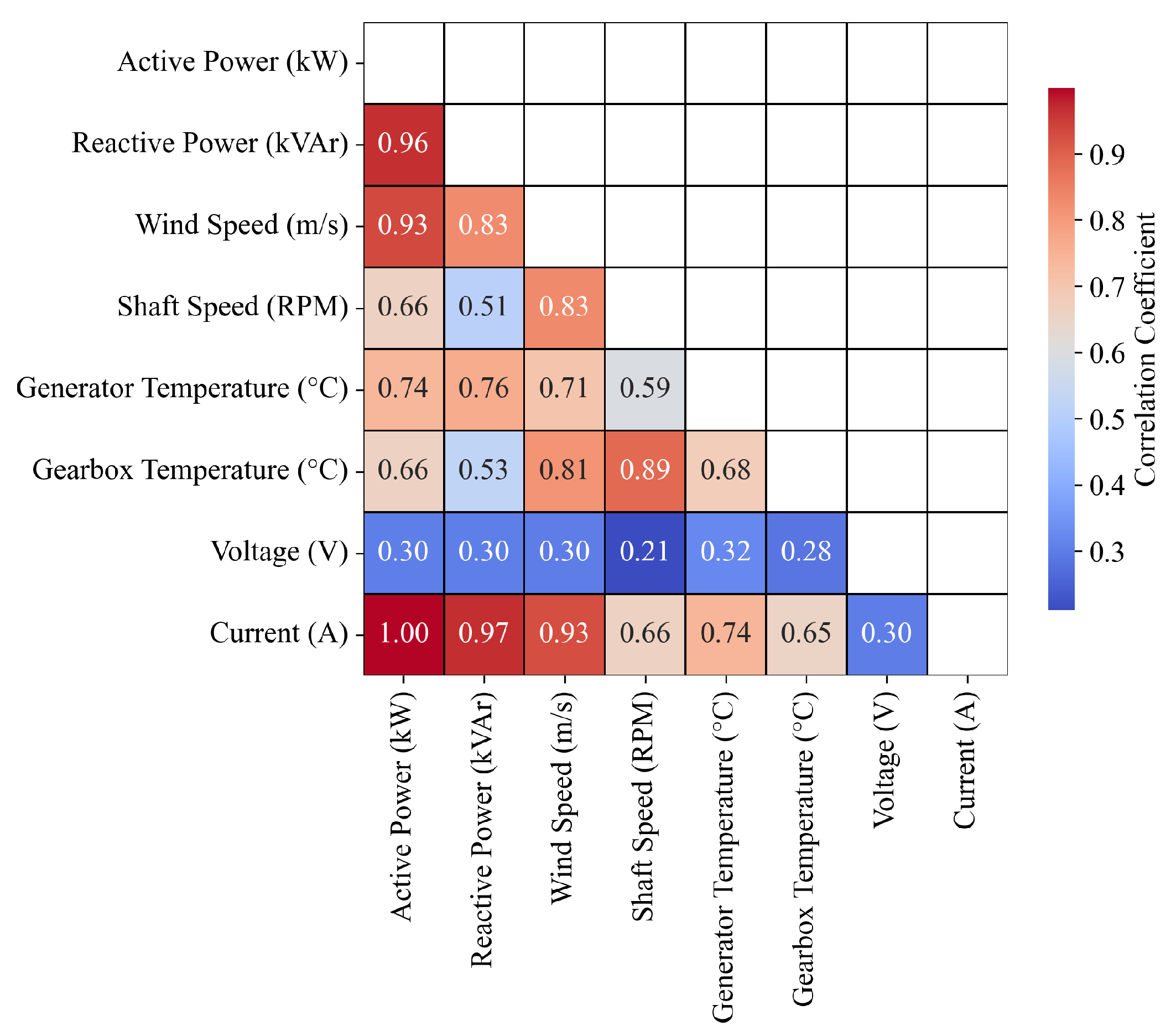
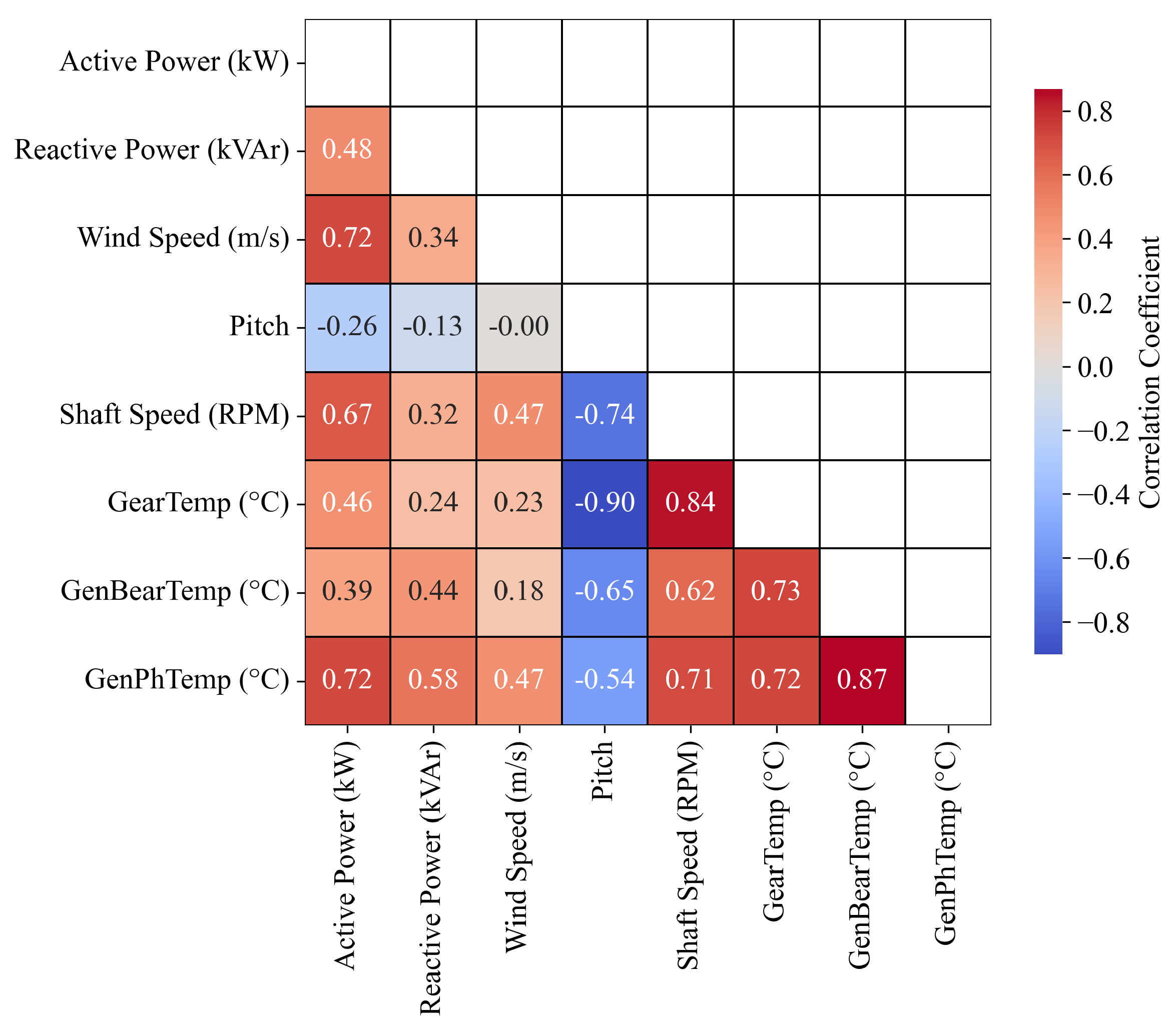
A correlation analysis was performed on these SCADA variables in an attempt to develop an understanding about the relationships among these variables. A correlation matrix among various variables has been shown in Figure 3.
Initial inspection of the dataset revealed several instances of zero and negative power measurements, although no missing entries or duplicated records were identified. Despite the completeness of this dataset, it is worth noting that managing missing values in real-time SCADA systems remains a known challenge [37,38,39]. In addition to that, Table 2 illustrates the statistics summary for the variables that included mean, standard deviation (Std), minimum (Min), maximum (Max), 25%, 50% and 75% values of the SCADA data.

2.1.2. Vestas V52, Ireland

The second SCADA dataset utilized in this research was taken from Vestas V52 wind turbine at Dundalk Institute of Technology, Ireland [40,41]. The wind turbine is located in a peri-urban environment and operates as a behind-the-meter system. The wind turbine has a hub height of 60 m and a rotor diameter of 52 m. The dataset comprises the following SCADA variables: WindSpeed, StdDevWindSpeed, WindDirAbs, WindDirRel, Power, MaxPower, MinPower, StdDevPower, AvgRPow, Pitch, GenRPM, RotorRPM, EnvirTemp, NacelTemp, GearOilTemp, GearBearTemp, GenTemp, GenPh1Temp, GenPh2Temp, GenPh3Temp, and GenBearTemp. Each parameter contains 653,103 samples recorded at 10-min intervals between 30 January 2006 and 12 March 2020. To facilitate efficient processing of this large dataset, negative active and reactive values were removed. The remaining positive sample for each variables were then 164,771 samples and selected variables were renamed as listed in Table 1.
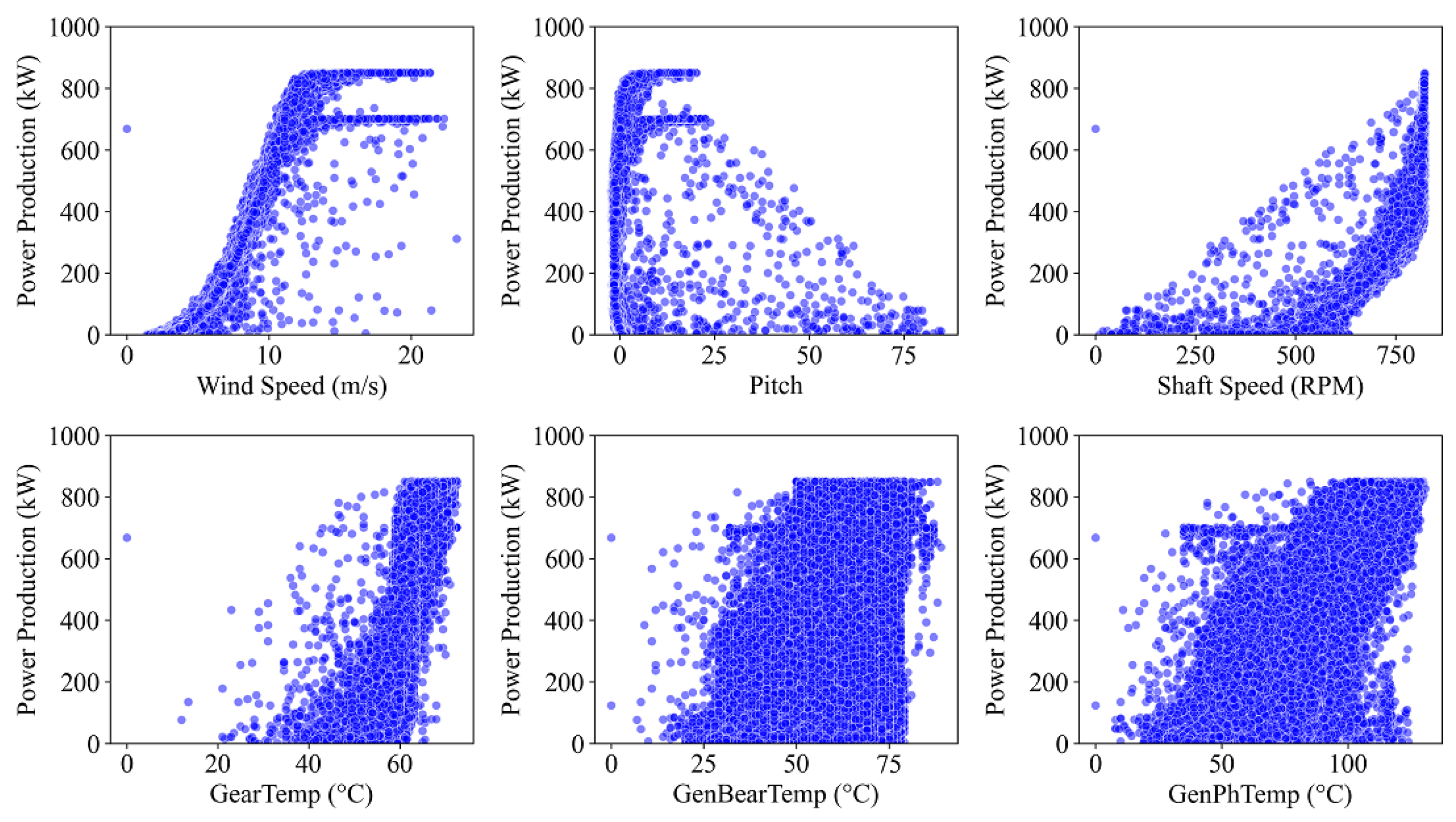
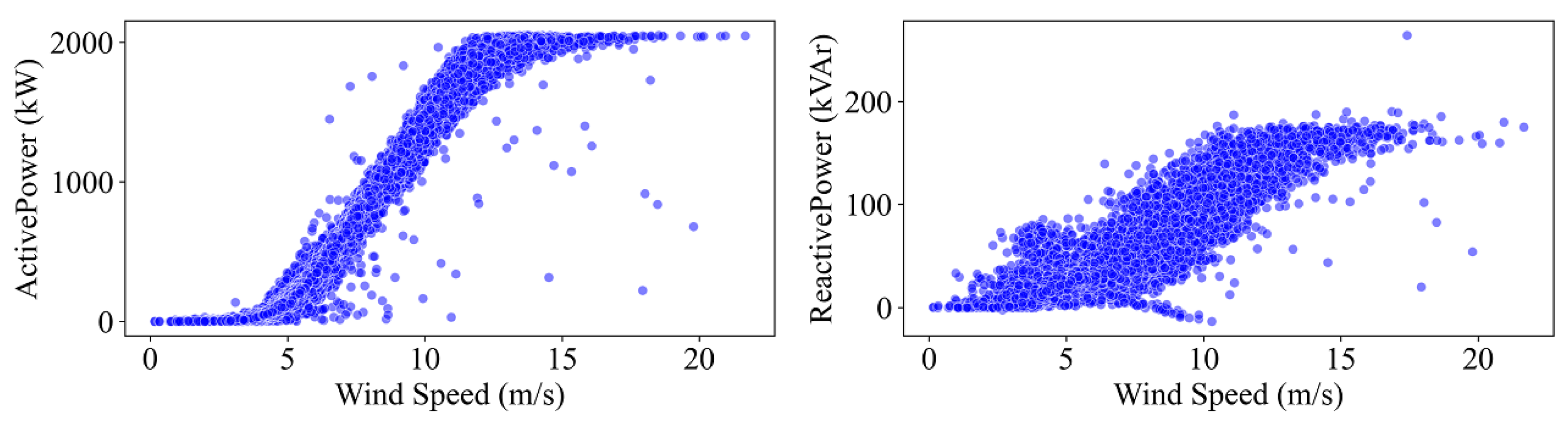
Figure 4 represents the influence of these variables on active power. Notably, GenRPM and RotorRPM exhibit a correlation of 100%, GearOilTemp and GearBearTemp show a correlation of 98.58%, while GenPh1Temp, GenPh2Temp, and GenPh3Temp exceed 95% correlation. To reduce redundancy, these highly correlated variables were averaged to form the composite features Shaft Speed (RPM), GearTemp (°C), and GenPhTemp (°C), respectively. Furthermore, Figure 5 shows the relationships of active power and reactive power with wind speed.
Furthermore, similar to the first dataset, the correlation matrix for Vestas V52, Ireland wind turbine SCADA dataset is presented in Figure 6, that shows the correlation of selected variables. A detailed statistical summary of all variables is presented in Table 3.

2.1.3. La Haute Borne, France

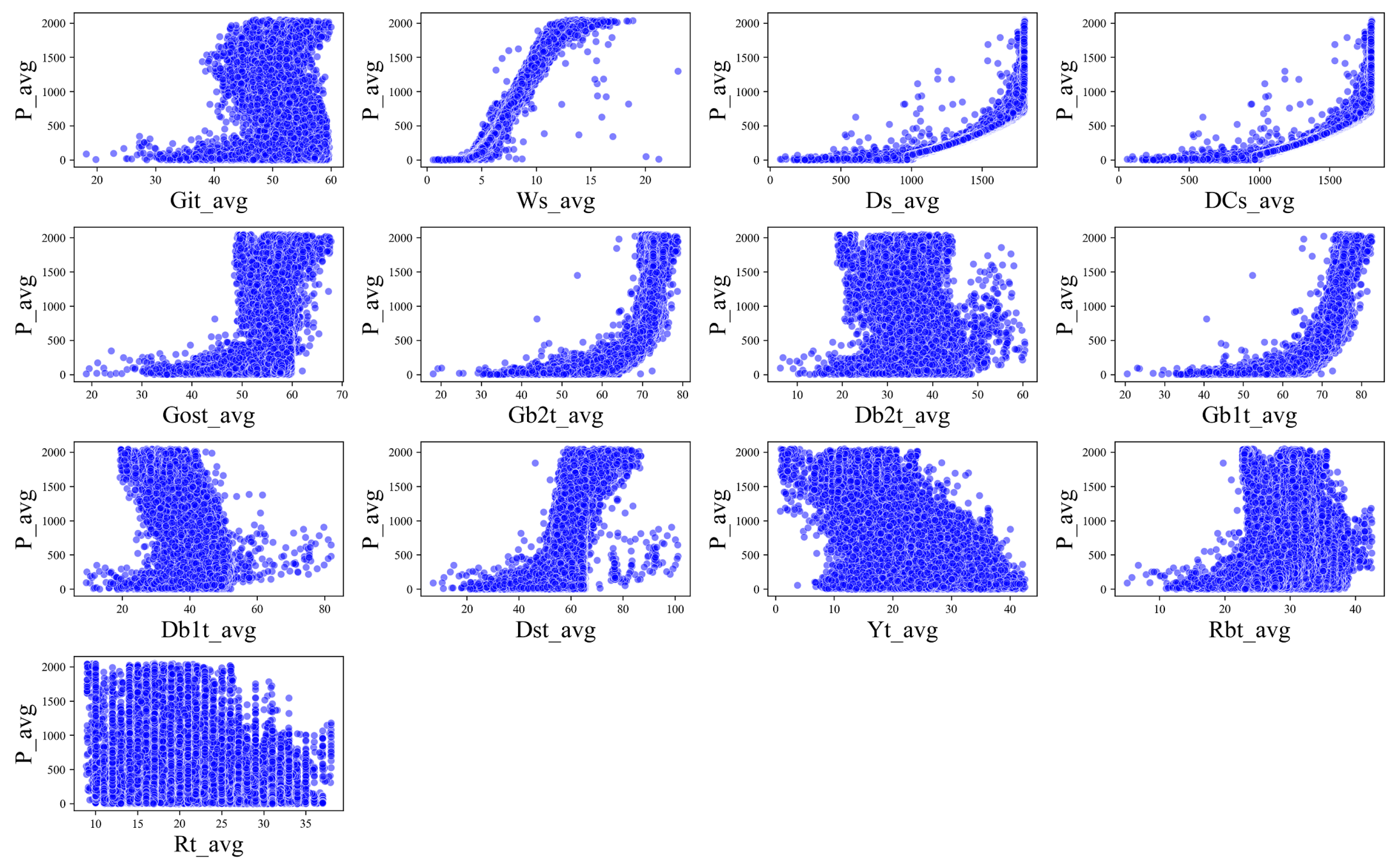
The third SCADA system records data from four wind turbines: R80711, R80721, R80736, and R80790. These turbines belong to La Haute Borne and are based in France [42,43,44]. For each turbine, SCADA data were collected in 2017, including the following parameters: Q_avg, S_avg, P_avg, Git_avg, Ws_avg, Ds_avg, DCs_avg, Gost_avg, Gb2t_avg, Db2t_avg, Gb1t_avg, Db1t_avg, Dst_avg, Yt_avg, Rbt_avg and Rt_avg. Each variable contains 43,378 samples recorded at 10-minute intervals. Figure 7 illustrates the influence of these parameters on active power (P_avg) for wind turbine R80721. Similar relationships were prepared for wind turbines R80711, R80736, and R80790.
For all four wind turbines, it can was concluded that the temperatures associated with the generator bearings (Db1t_avg and Db2t_avg), the temperatures associated with the gear bearings (Gb1t_avg and Gb2t_avg), as well as generator and generator converter speeds (Ds_avg and DCs_avg) have the greatest levels of correlations, as shown below in Table 4. The average value for each pair of variables with large correlations was therefore determined.
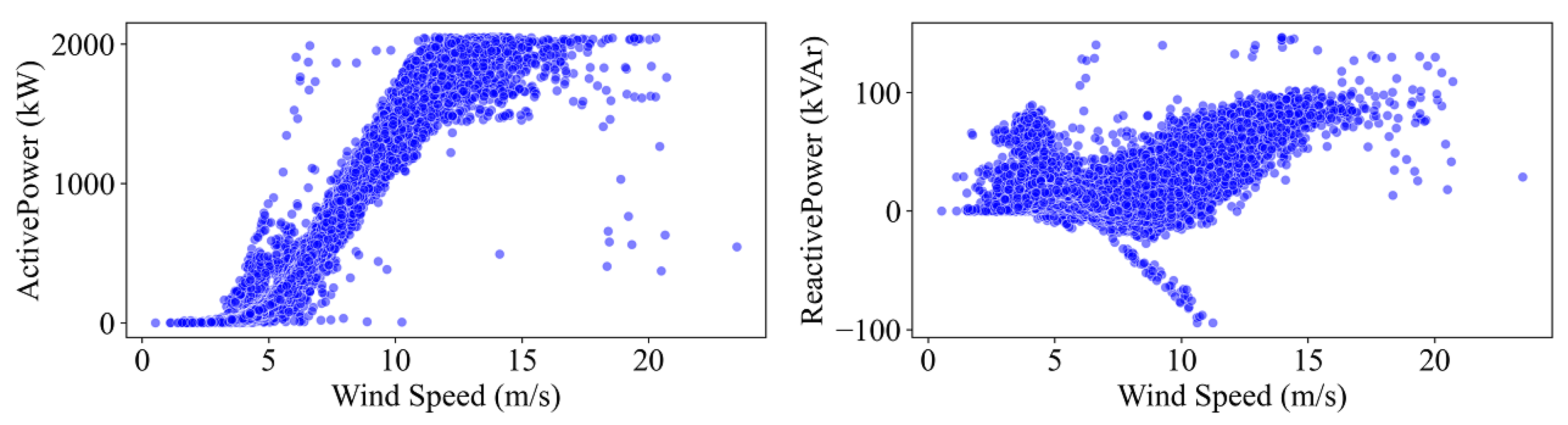
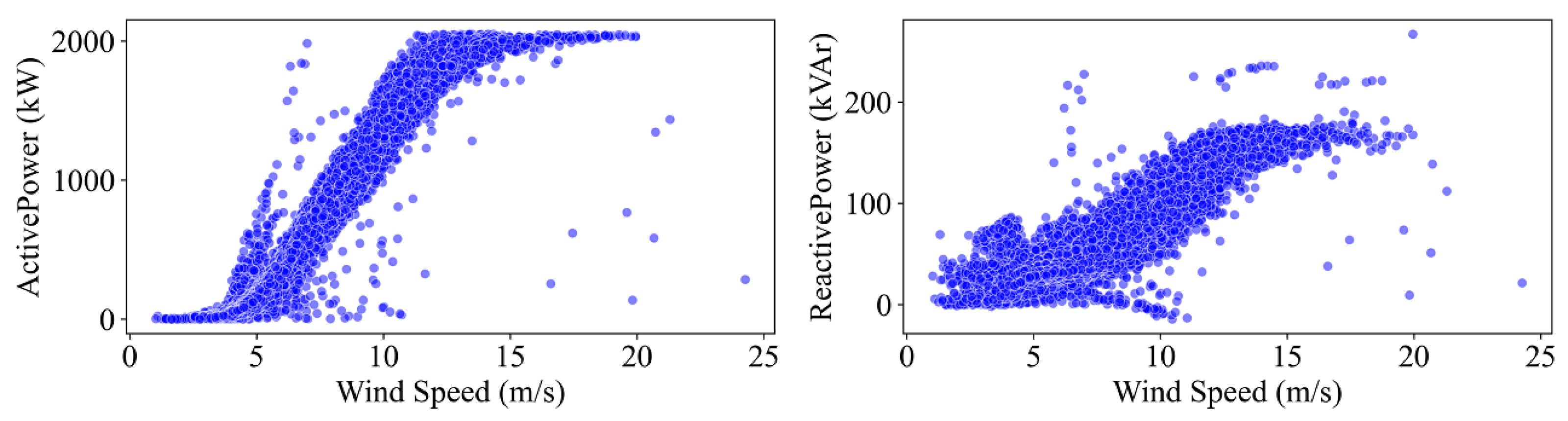
In addition, the variables selected for further analysis include active power (P_avg), reactive power (Q_avg), wind speed (Ws_avg), gearbox oil sump temperature (Gost_avg), and generator starter temperature (Dst_avg). The renamed and selected variables are listed in Table 1. It is also noteworthy that the final set of variables is identical across all four wind turbines. The nonlinear power curves are shown in Figure 8, Figure 9, Figure 10 and Figure 11 for wind turbine R80711, R80721, R80736, and R80790, respectively.
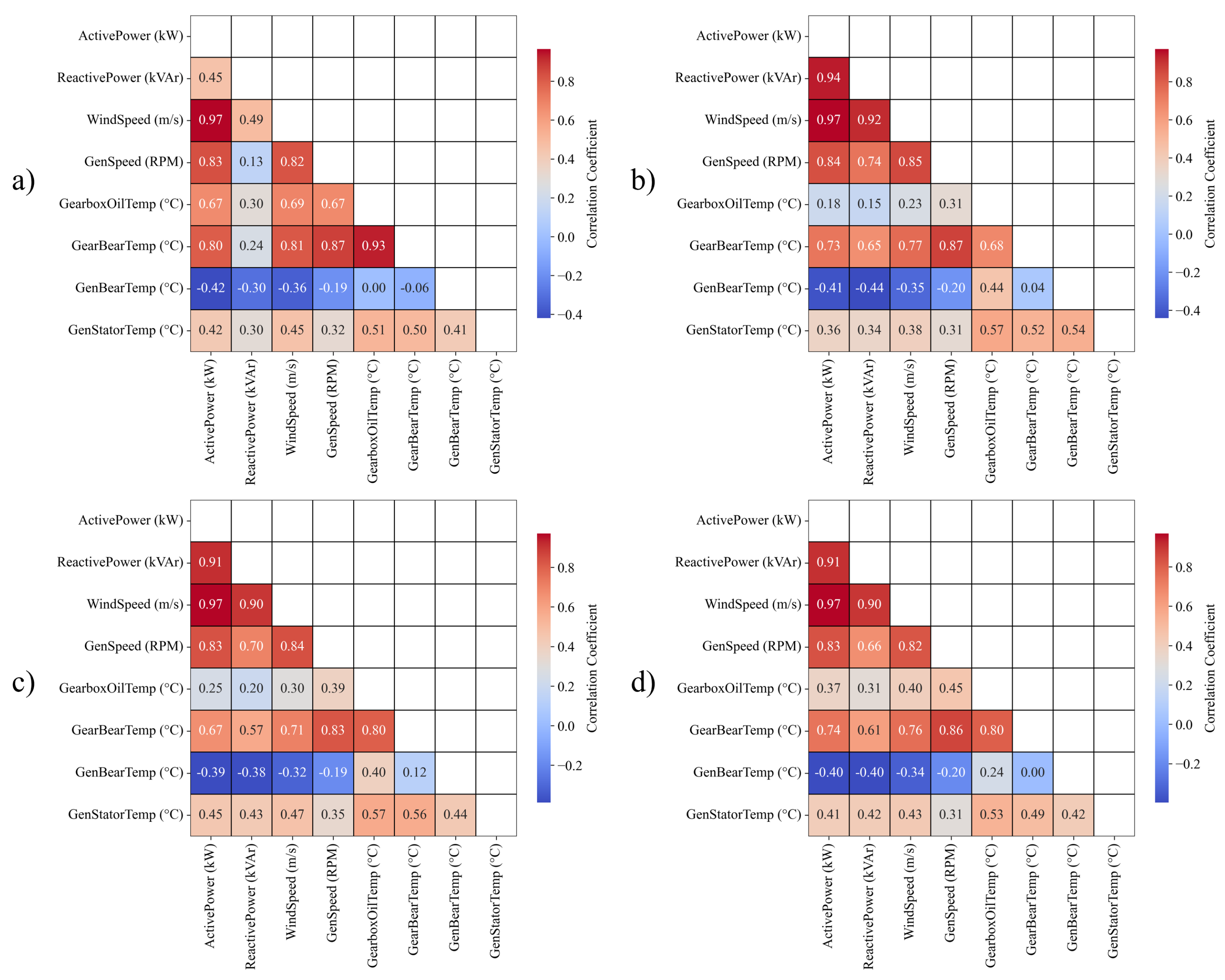
Furthermore, similar to the first and second SCADA datasets, the correlation matrices for La Haute Borne, France wind turbines are presented in Figure 12, that shows the correlation of selected variables.
In addition to that, Table 5 illustrates the statistical summary of the dataset variables for all four wind turbines within the La Haute Borne wind farm in France.

2.2. Standard LeNet-5 Architecture

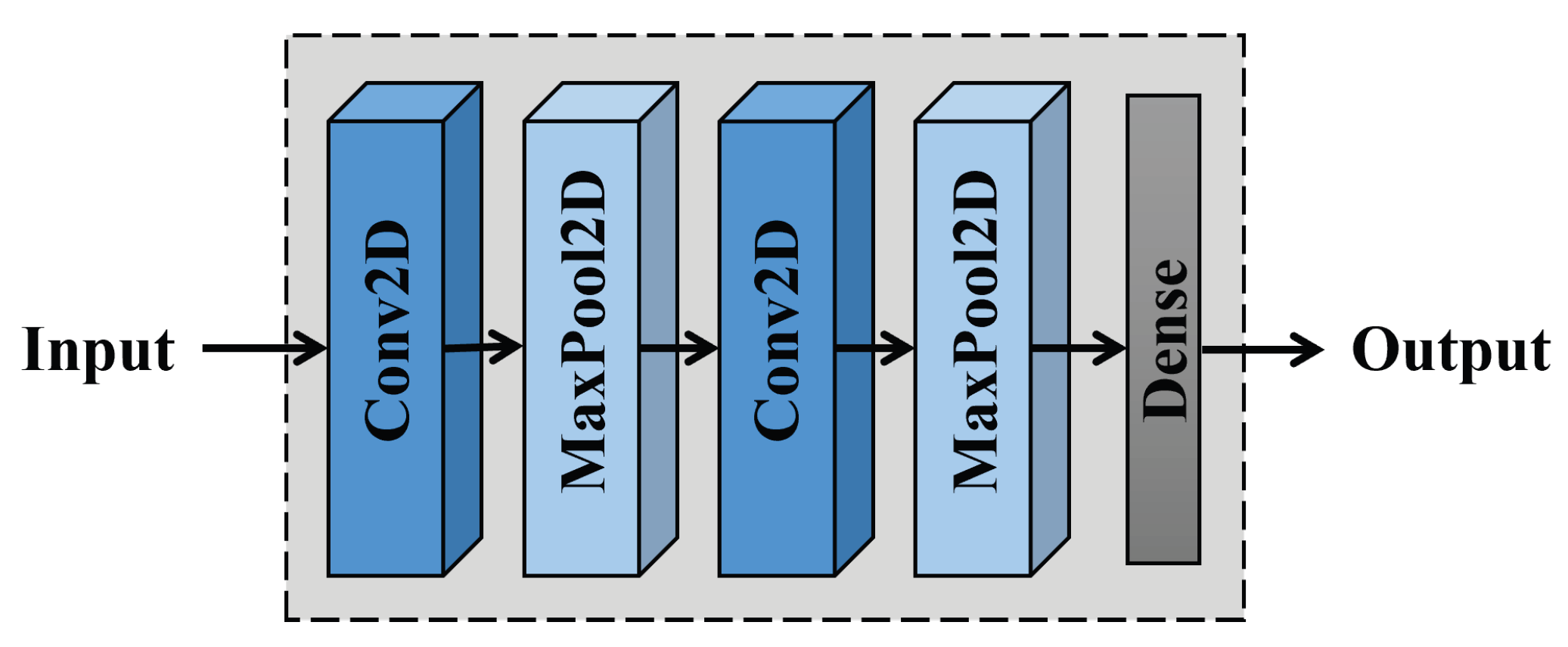
LeNet is a convolutional neural network, also known as LeNet-5 because of its five-layer architecture as shown in Figure 13. Depending on the geometry of the input data, the layers can be 1D or 2D. The standard architecture of the LeNet-5 comprises of two convolutional layers, each followed by a pooling layer, and a fully connected layer that generates the final output [30].
A two-stage convolution–pooling structure for standard LeNet-5 architecture can be expressed as follows:
C 1 = tanh ( W 1 X + b 1 )
M 1 = MaxPool ( C 1 , w × w , s )
C 2 = tanh ( W 2 M 1 + b 2 )
M 2 = MaxPool ( C 2 , w × w , s )
z = tanh ( W d M 2 + b d )
Each convolutional layer is made up of three major components: convolution, pooling, and nonlinear activation functions. Convolution, also known as receptive fields, extracts spatial information from input data, whereas pooling layers perform subsampling to reduce spatial dimensions. The hyperbolic tangent (tanh) function is used as the activation function in the network. At the final stage, fully connected layers act as the classifier.

2.3. Standard LSTM Architecture

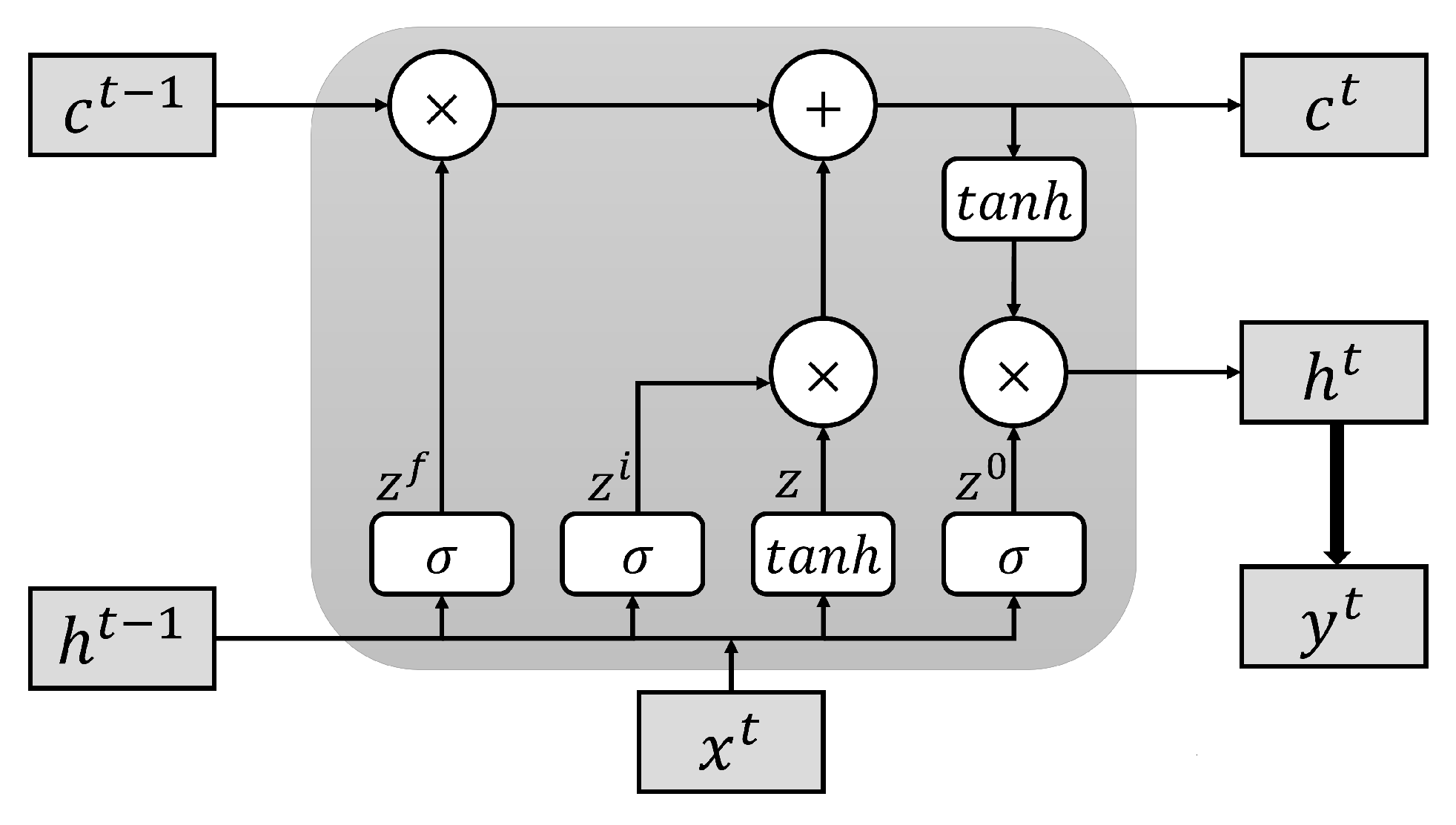
Long Short-Term Memory (LSTM) networks are a sort of recurrent neural network (RNN) that is specifically built to model and handle sequential input. Figure 14 illustrates a typical LSTM cell. The vanishing gradient problem makes it difficult for conventional RNNs to capture long-term dependencies. By using a special memory cell and gating mechanisms, LSTMs get over this restriction and enable the network to store and make use of long-term patterns in time-series data [27,31].
An LSTM cell comprises several key components that regulate the flow of information effectively. The cell state ( s t ) acts as the network’s memory, enabling the retention and transfer of information across multiple time steps to capture long-term dependencies. The input gate ( z i ) determines which new information should be incorporated into the cell state, ensuring that only relevant data is stored. The forget gate ( z f ) identifies what information needs to be erased from the cell state. Consequently, unnecessary information is forgotten. The next stage involves controlling information passed from the cell state to the next layer or from the cell to the output, and it is facilitated by the output gate ( z o ) , which focuses on the most relevant information for that particular moment. All these processes are conducted based on specific mathematical functions [27,31].
z = tanh w x t h t 1 + b
z i = σ w i x t h t 1 + b i
z f = σ w f x t h t 1 + b f
z o = σ w o x t h t 1 + b o
The cell state c t is updated using the following equation:
c t = z f c t 1 + z i z
The new hidden state h t is then computed as
h t = z o tanh ( c t )
Finally, the current output y t is given by
y t = σ ( w h t )
In the above equations, the symbol ⊙ represents the Hadamard product (element-wise multiplication) and signifies the element-wise multiplication of two vectors or matrices. The information is stored and forget in LSTM network using these equations and relevant data sequences are learn. We used LSTM layers to extract temporal dependencies from SCADA variables to predict the powers. Therefore, LSTM layers are important to predict power under variable conditions such as wind, temperature, and other parameters.

2.4. Loss Function and Optimizer

To train the proposed hybrid LeNet-5-LSTM model for predicting active and reactive power, we designed a loss function that incorporates both data-driven supervision and physics-based constraints. This ensures that the network not only fits the SCADA measurements but also respects the fundamental electromechanical power relationships of the wind turbine generator.
The model outputs estimates of the active and reactive power, P ^ a c t ( t ) and P ^ r e a c t ( t ) , which are directly compared with the corresponding SCADA measurements P a c t ( t ) and P r e a c t ( t ) . The data-informed loss is defined as
L d a t a = P ^ a c t ( t ) P a c t ( t ) 2 + P ^ r e a c t ( t ) P r e a c t ( t ) 2 ,
This term presents traditional guidance on supervised learning with a prediction error minimized on both variables.
Applied to three-phase wind turbine systems, the active power P a c t ( t ) , reactive power P r e a c t ( t ) , and apparent power P a p p ( t ) are linked by the relationship:
P a c t 2 ( t ) + P r e a c t 2 ( t ) = P a p p 2 ( t ) = V ( t ) I ( t ) 2 ,
V ( t ) and I ( t ) refer to the Root Mean Square phase voltage and current, respectively. With access to SCADA measurements of voltage and current, the physics-based loss enforces that constraint on the solution:
L p h y = P ^ a c t 2 ( t ) + P ^ r e a c t 2 ( t ) ( V ( t ) I ( t ) ) 2 2 ,
This constraint imposes a penalty on mismatches between predicted values of the power components and actual operating conditions. It should be noted that SCADA data sets typically do not have reliable and available voltage and current readings. To ensure physical feasibility even without V ( t ) and I ( t ) , this constraint can be rewritten based on available active and reactive power. Since P a c t 2 ( t ) + P r e a c t 2 ( t ) = P a p p 2 ( t ) , physically feasible constraints can be imposed based on P a c t ( t ) and P r e a c t ( t ) . The loss due to physical feasibility without V ( t ) and I ( t ) would then be written as
L p h y = P ^ a c t 2 ( t ) + P ^ r e a c t 2 ( t ) ( P a c t 2 ( t ) + P r e a c t 2 ( t ) ) 2 ,
Also, this formulation assures that active and reactive predicted powers have consistency with energy balances for the generator, even if there are no electrical measurements. The total learning objective can be expressed as
L t o t a l = L d a t a + λ L p h y ,
The value of λ represents a weighting factor that adjusts levels of substrate contribution influenced by the physics-informed penalty term. By incorporating this loss function, it becomes feasible for the model to identify data-driven patterns with substantive meaning while still being constrained within theoretical bounds pertaining to electromechanical generation.
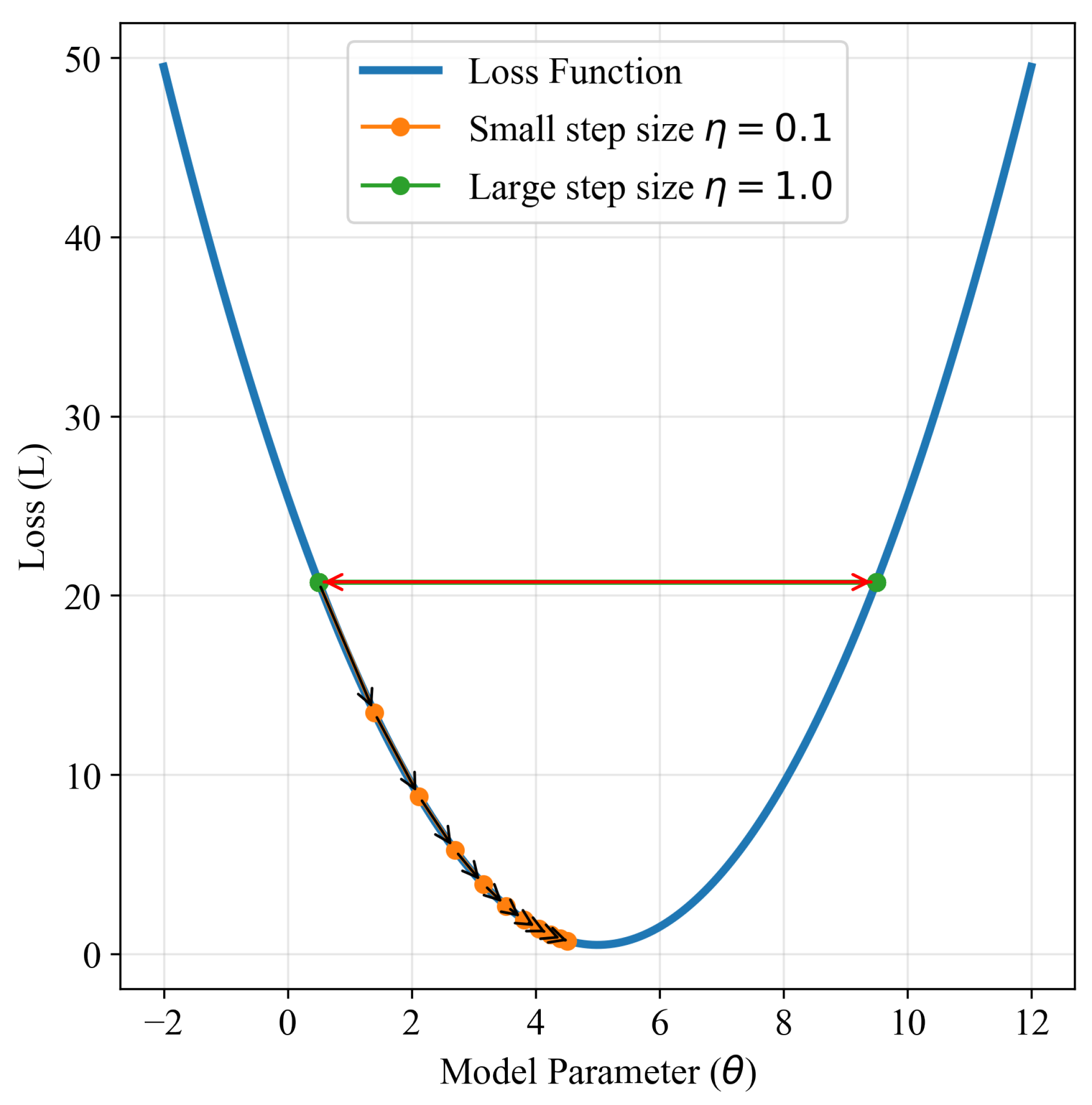
Within this research, the variable η stands for learning rate. It represents the optimizer’s step size. The optimization and training of models were done using the Adam optimizer with gradient clipping ( clipnorm = 1.0 ) and an initial learning rate given as η = 5 × 10 4 .
θ t + 1 = θ t η L t o t a l
The choice of η plays a decisive role in shaping the optimization trajectory. If the learning rate is set too high, the parameter updates become overly aggressive, causing the loss function to oscillate rather than decrease steadily. Conversely, a very small learning rate yields smooth and stable updates that guide the model gradually toward the minimum, but at the cost of significantly slower convergence. This behaviour is illustrated in Figure 15, where the impact of different step sizes on the loss curve can be clearly observed. A ReduceLROnPlateau scheduler automatically reduces the learning rate by a factor of 0.5 if the validation loss does not improve for four consecutive epochs, with a minimum limit of  10 6 .

2.5. Proposed Model

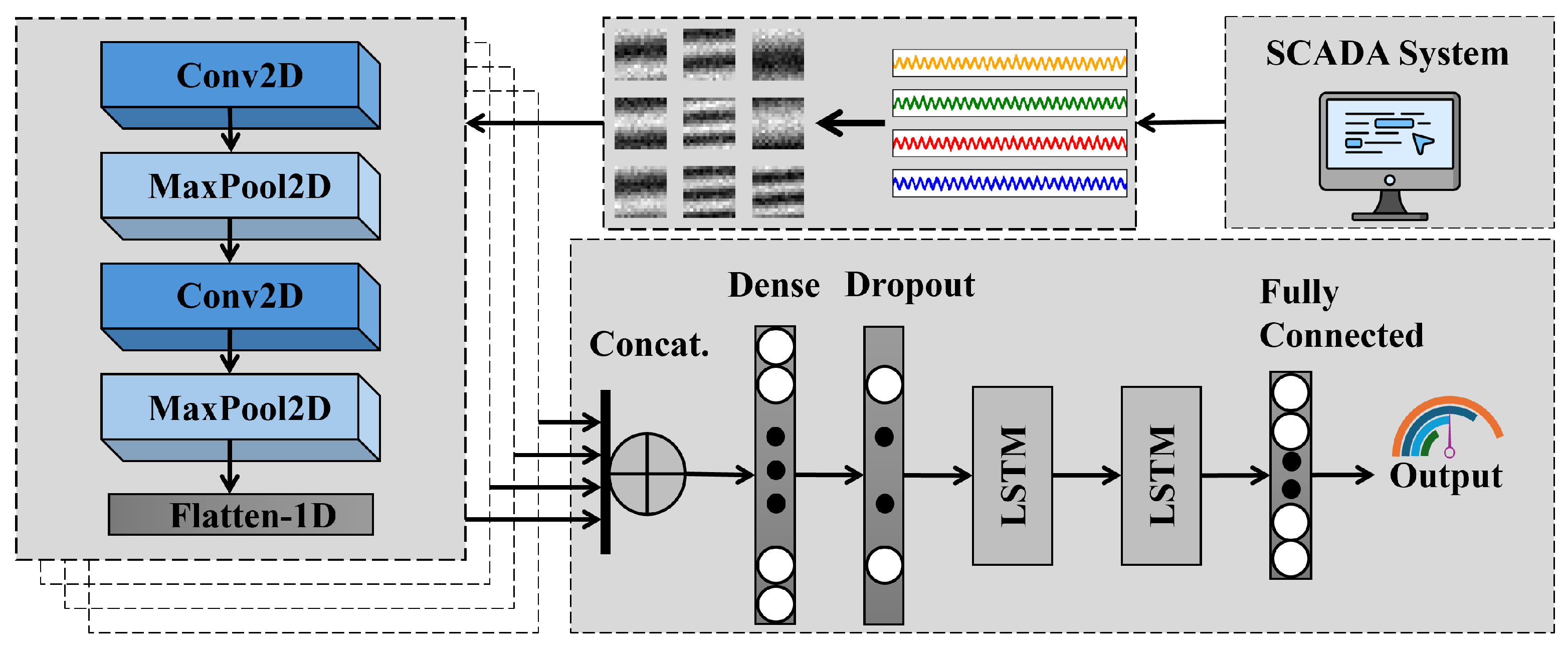
The block diagram of the proposed model is given in Figure 16. In this figure, first, the time-domain data with multiple variables or channels is acquired from the wind turbine SCADA systems. Depending on different settings of the SCADA systems around the world, the data is recorded after specific time intervals but in most of the cases it can be seen that these datasets are recorded after 10 min time intervals as a standard.
Second, the acquired raw data is visualized in time-domain and different visualization etc are applied to understand the dataset and its trends. Based on that, the most relevant variables are selected for further processing. The best suited variables and then transformed into 2D grayscale images to feed inputs to the proposed LeNet-5-LSTM hybrid neural architecture. It is also noted that for each wind turbine, the data was divided into 70% training and 30% test data groups.
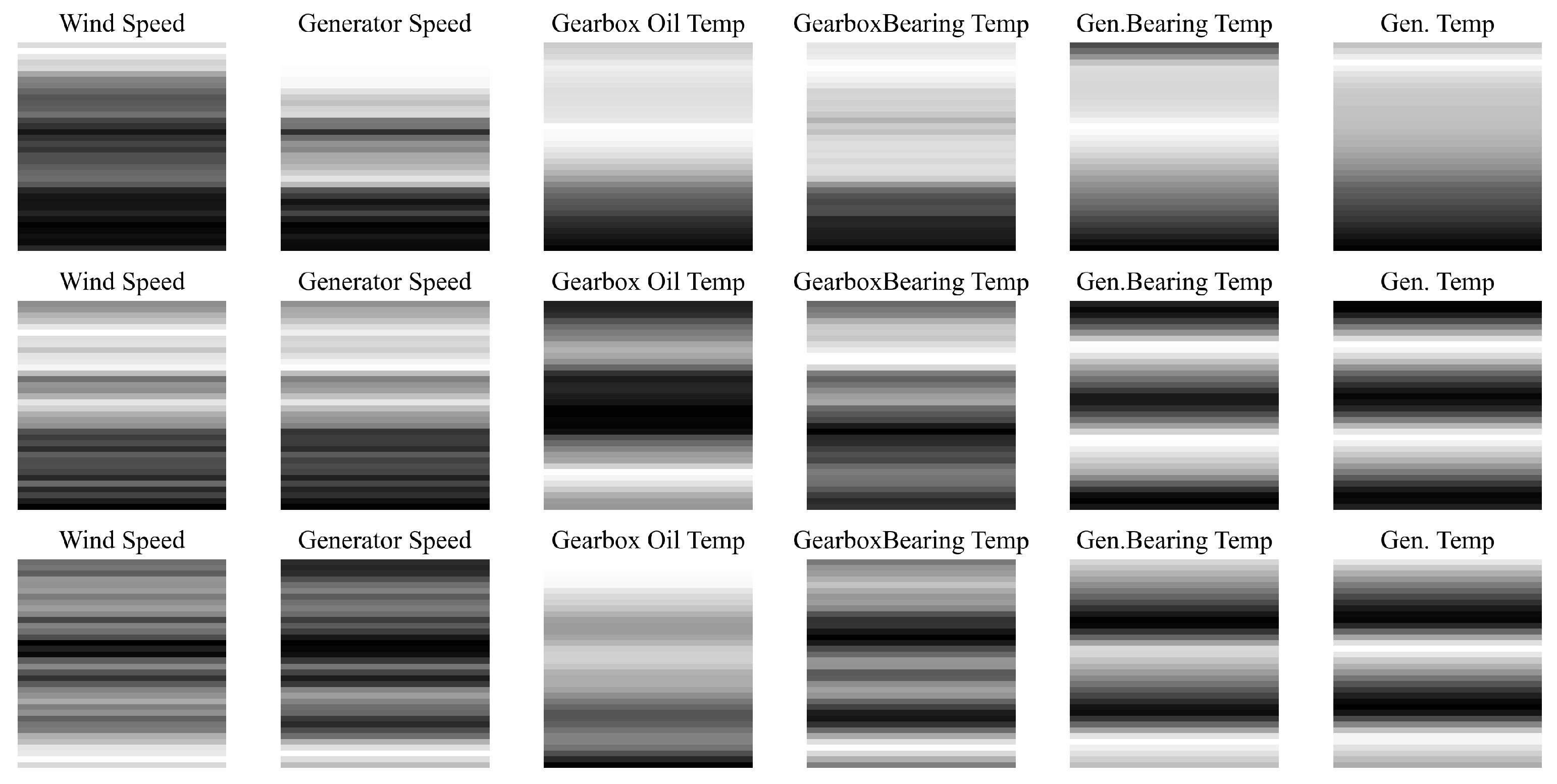
The spatio-temporal textures in 2D grayscale images are associated to the physical regions of operation of the wind turbine. The efficacy of this transformation is based on the ability of the proposed LeNet-5-LSTM hybrid architecture to recognize 2D images. Each of these images corresponds to one of the six variables that were identified as most relevant to wind turbine operation. By arranging these images in a tile format to form a 36 × 36 matrix, Momentum Signature is created. Physically, these local image patterns represent specific mechanical states:
  • High Contrast Striations: These represent rapid changes in aerodynamic torque, where the 2D kernel is able to recognize the sharpness of a transition to make predictions on power ramps.
  • Uniform Pixel Intensity: This state represents a steady-state condition, where the turbine is operating at or near rated power or within a zone of stable state.
  • Vertical Gradients: These represent the relationship between input and output.
By virtue of evaluating these patterns across a 6-hour window (36 data points), the proposed LeNet-5-LSTM hybrid architecture is able to recognize the thermal and kinetic inertia of the drivetrain, providing a more accurate prediction than models that treat SCADA data as a disjoint, 1D time-domain data.
Third, the LeNet-5 neural architecture consists of two 2D convolution layers follows by the 2D maxpooling layer. Depending on the selected variables, multi-channels of the LeNet-5 architecture are built in parallel and then the flatten outputs are concatenated into 1D vector to feed next part of the model as shown in Figure 16.
The last part of the proposed model is composed of fully connected dense layer followed by the dropout layer before entering the two LSTM layers. Finally, at the end, a fully connected dense layer with softmax predict the output. The detailed parameters of the proposed model is given in Table 6. The proposed hybrid architecture has 480,698 trainable parameters.

3. Results and Discussions

The proposed LeNet-5-LSTM model consists of six-channels because of the six input variables x i ( t ) where i = 1 , 2 , , 6 and two outputs consists of active power P a c t ( t ) and reactive power P r e a c t ( t ) . The output vector can be written as: y ( t ) = { P a c t ( t ) , P r e a c t ( t ) } and the goal of the proposed model is to learn:
f : { x 1 ( t ) , x 2 ( t ) , , x 6 ( t ) } { P act ( t ) , P react ( t ) } ,
But before proceeding further, the SCADA data of the selected variables was normalized independently using min-max approach as follows:
x s c a l e d ( t ) = 2 x ( t ) x m i n x m a x x m i n 1 ,
After normalization, the data was segmented using a window of length 36 and stride 3. Table 7 illustrates the total data segments for each variable and their corresponding testing and training size for each variable. For a generic input variable x i ( t ) , window k is given by
w i , k = x i ( t k ) x i ( t k + 1 ) x i ( t k + L 1 ) R 36 ,
where t k = k S , k = 0 , 1 , 2 , . Each segmented signal of length 36 was then converted into grayscale image using reshaped. For that, first, the 1D segment w ( k ) R 36 was reshaped into a column vector as follows:
c ( k ) = w ( k ) . reshape ( 36 , 1 ) R 36 × 1 ,
Then, the column vector for each variable was horizontally tiled to produce a 2D grayscale image as follows:
I ( k ) = c ( k ) c ( k ) c ( k ) 36 columns R 36 × 36 ,
Figure 17 shows the random 2D grayscale images produced from SCADA data. In this representation, the temporal evolution of the original 1D signal is represented as a vertical gradient, while the horizontal dimension contains identical repetitions of the same sequence. Although each column simply a copy of the reshaped window, the resulting 2D texture creates an organized spatial pattern from which the proposed multi-channels LeNet-5-LSTM model can extract useful characteristics. This modification enables the model to learn discriminative qualities from the local changes in the input signal, despite the lack of inherent spatial content in the original 1D data set.
The resultant 2D dataset for each wind turbine experiment was divided into training and testing data with 70% and 30% portions, respectively. The same model was trained for each wind turbine for five independent runs to verify the robustness and reliability of the proposed model. Each run has 50 epochs with batch size of 32 for all wind turbines. The simulations were performed on a system with an Intel(R) Core(TM) i5-14500 CPU 2.60 GHz specifications (Intel Corporation, Santa Clara, CA, USA). The computational time for each step depends on the data size as illustrated in Table 7. For 2MW SIEMENS data, it was ≈1 s 24 ms per step, for Vestas V52 wind turbine, computational time per step was ≈41 s 21 ms, and for each wind turbine in La Haute Borne wind farm, computational time was almost same with value of ≈10 s 21 ms. The results for each wind turbine are given below.

3.1. SIEMENS, Poland

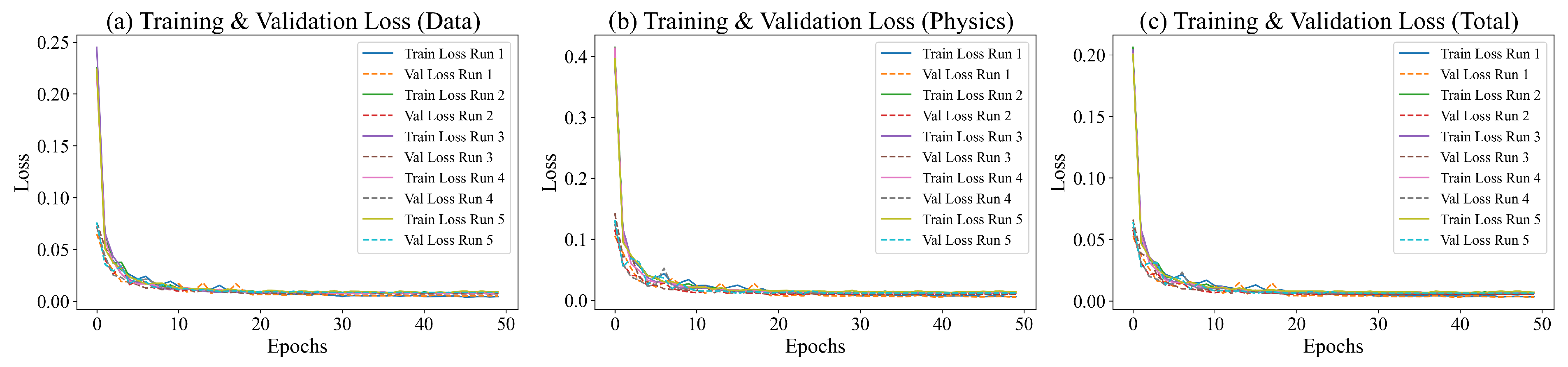
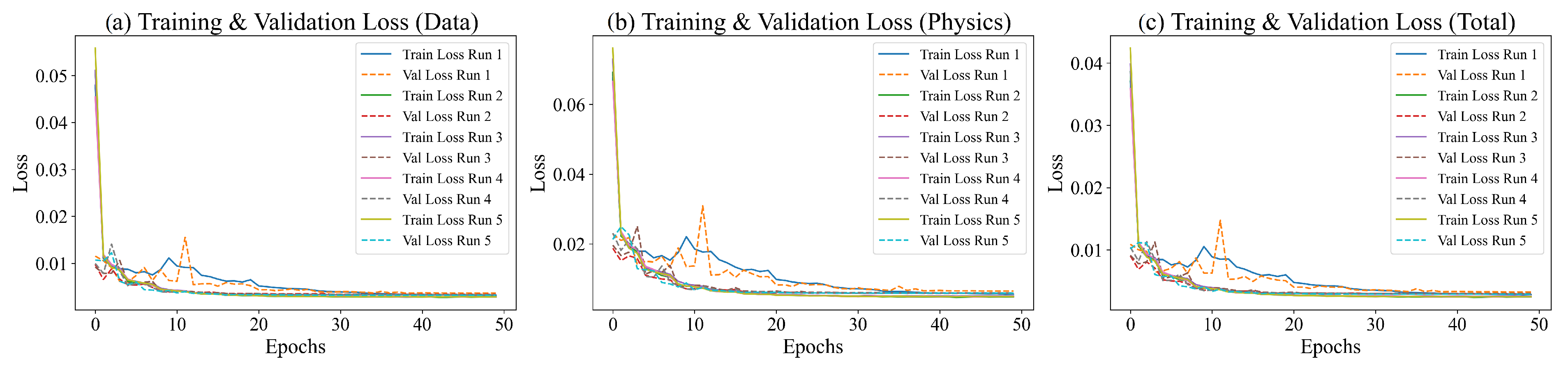
The proposed LeNet-5-LSTM model was first evaluated on SCADA data from a 2 MW SIEMENS wind turbine operating at a wind farm in northern Poland. Figure 18 shows the training and validation loss for each run.
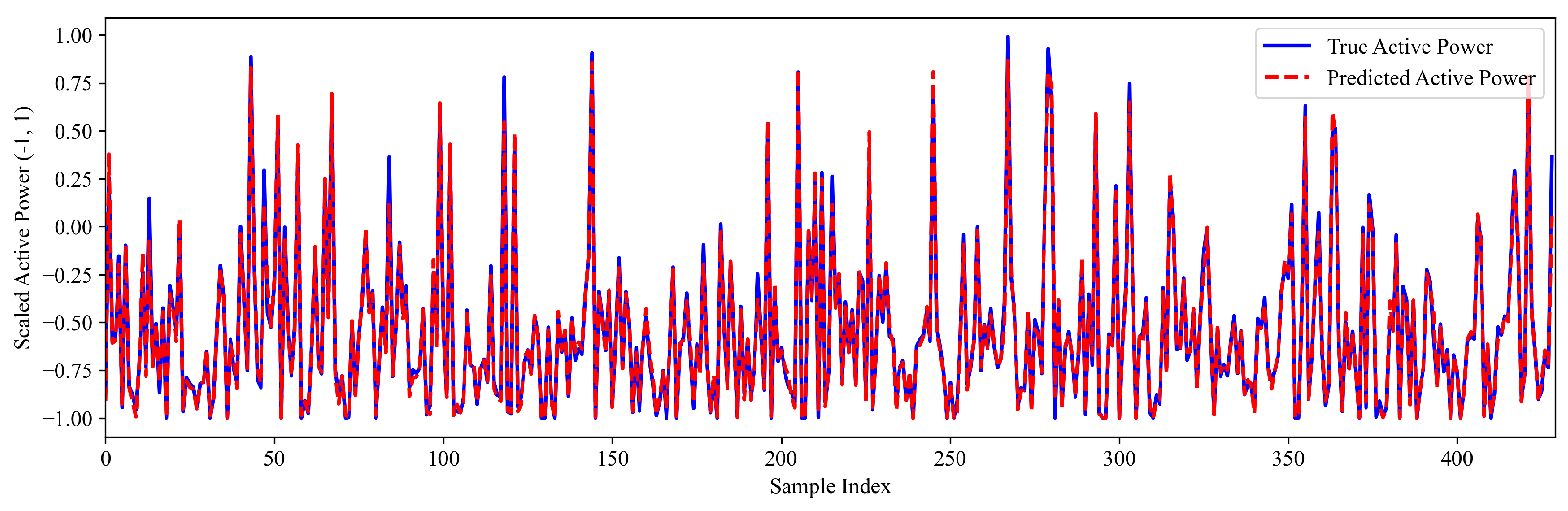
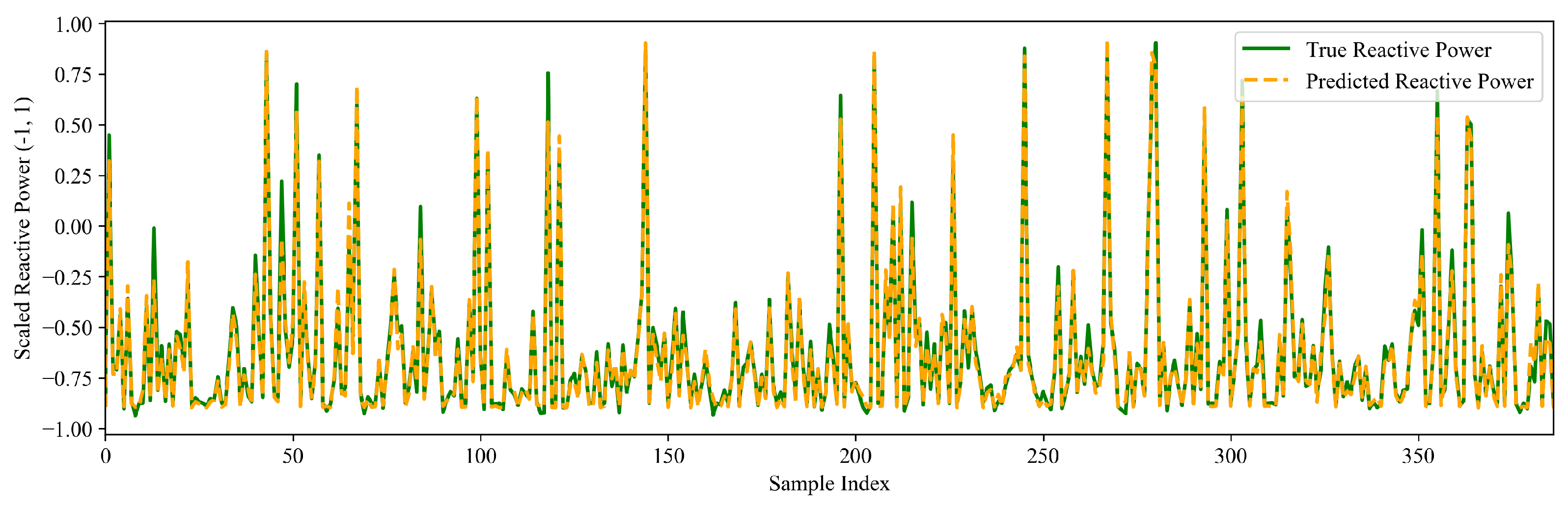
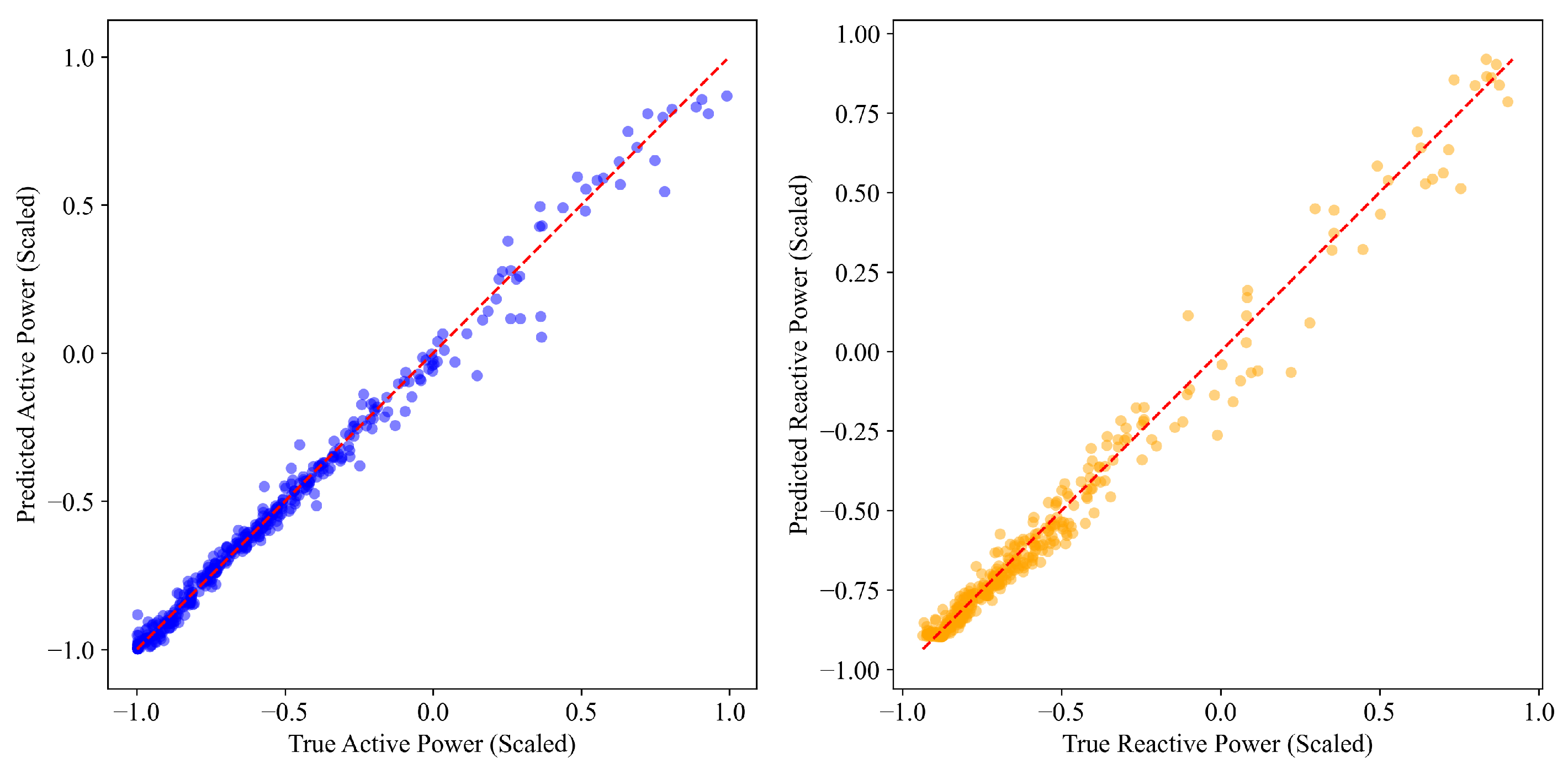
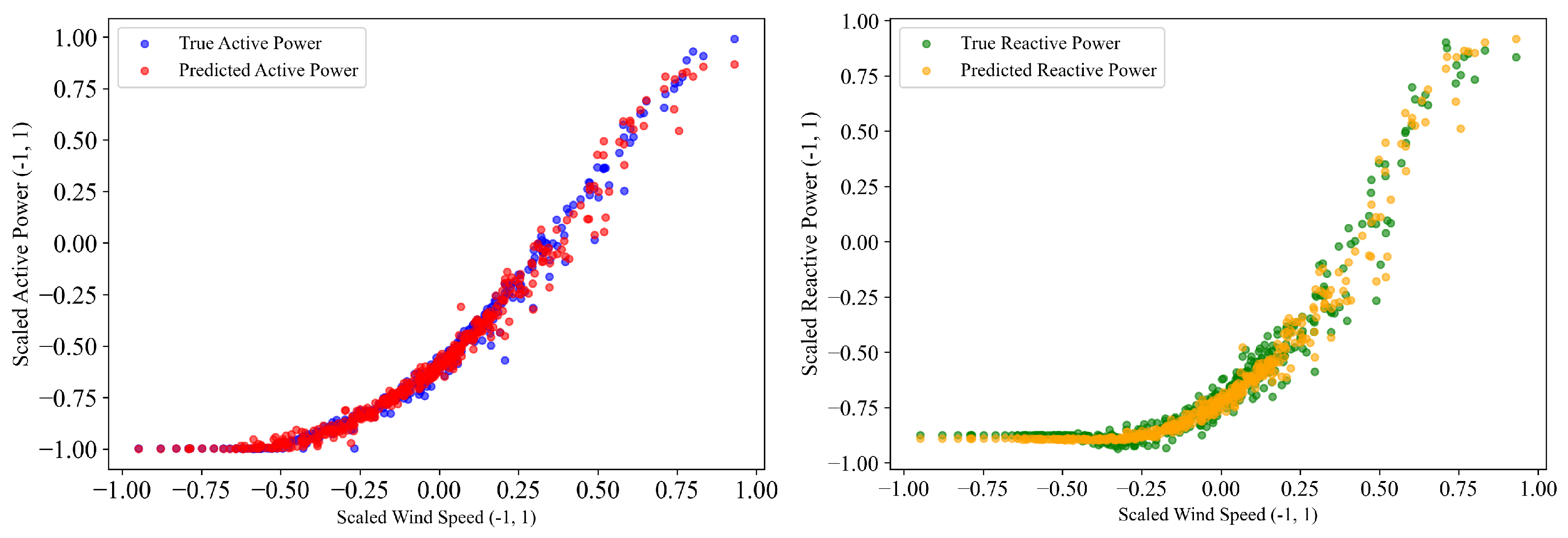
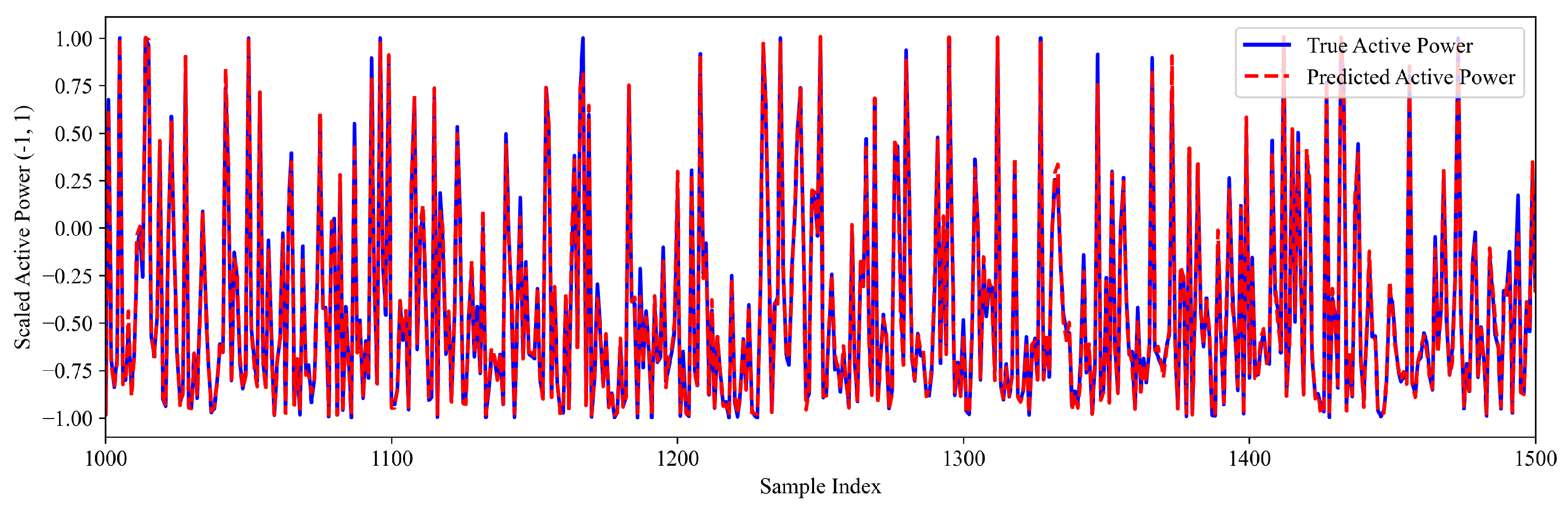
In addition to that, Figure 19 and Figure 20 show the comparison between the measured and predicted active and reactive power, respectively. As the data were normalized to the interval [ 1 , 1 ] , the figures present normalized power profiles. It can be observed that the predicted values closely follow the true measurements, indicating that the model captures both the temporal trends and variations in power output. The prediction errors for active and reactive power are presented in Figure 21, providing a quantitative comparison of deviations. Figure 22 illustrates more clearly the effects of wind speed on the actual and predicted active and reactive powers, hence demonstrating that the model is capable of addressing effects caused by wind. Overall, it can be seen that the model is capable of accurately predicting active and reactive powers for the wind turbine operating in Poland.
To evaluate the stability and robustness of the proposed LeNet-5–LSTM architecture, the model was trained and tested five times with separate random initializations. By doing so, the effects of a particular initialization were eliminated, and it was possible to have a better indication of the generalization performance of the model. The performance metrics, including mean absolute error (MAE), root mean square error (RMSE), and coefficient of determination ( R 2 ), for active and reactive powers are given in Table 8.
The obtained values show consistent performance for all runs. The average MAE values for active and reactive powers were 0.0390 ± 0.0062 and 0.0387 ± 0.0023, respectively, and the average RMSE values were 0.0585 ± 0.0076 and 0.0569 ± 0.0031. Also, average R 2 values reached 0.9800 ± 0.0047 for active and 0.9773 ± 0.0024 for reactive powers. All these values clearly show that the model continues to have high accuracy and low sensitivity to initialization variability, meaning it has high robustness and stability.

3.2. Vestas V52, Ireland

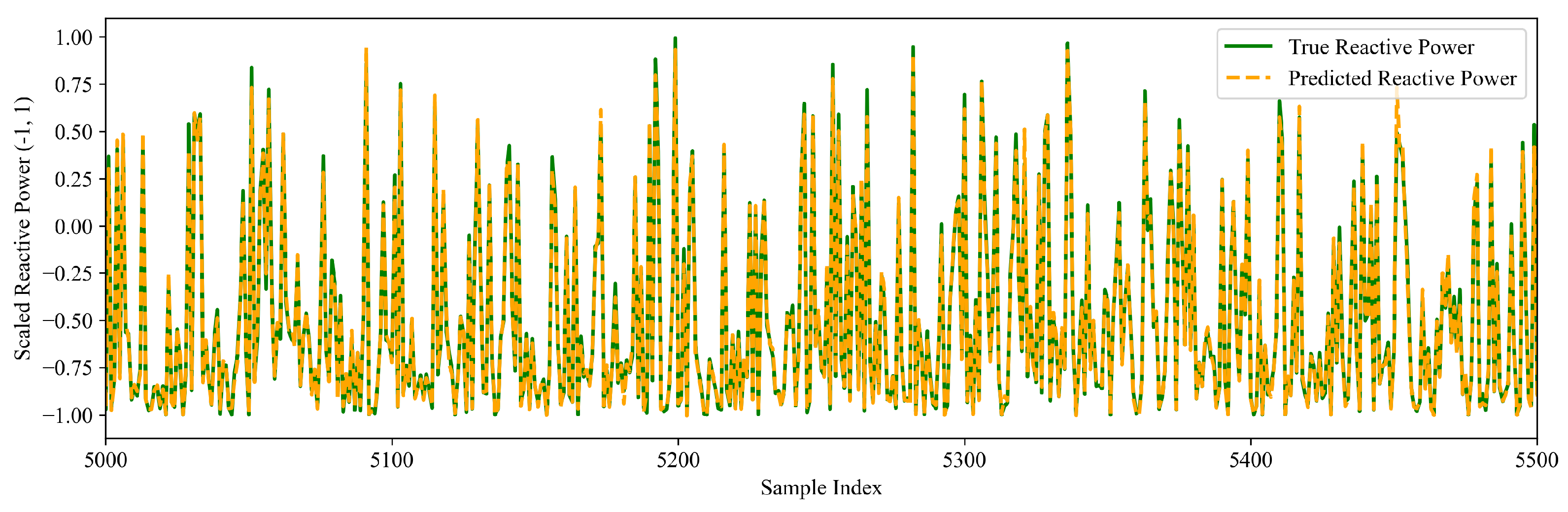
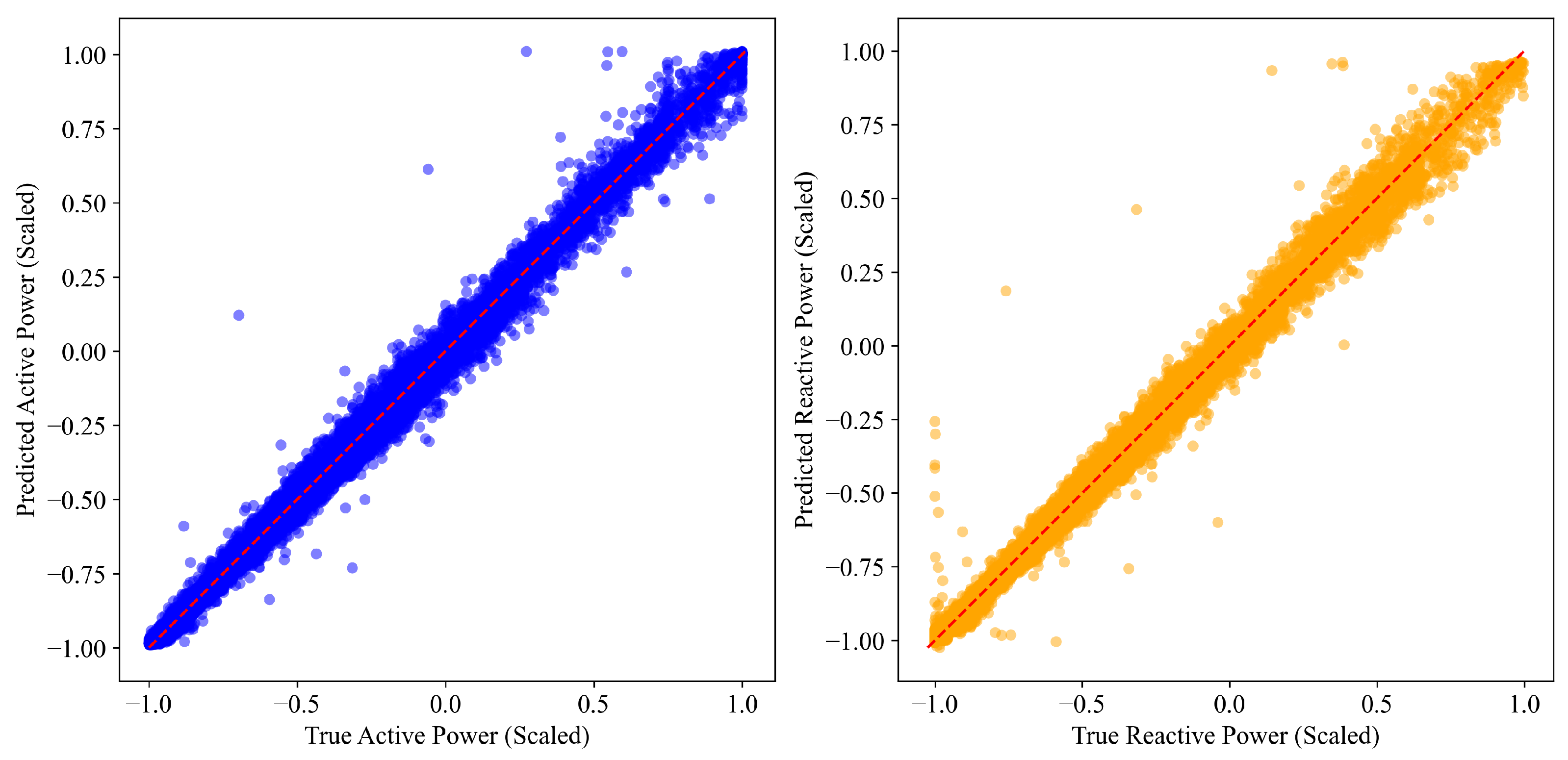
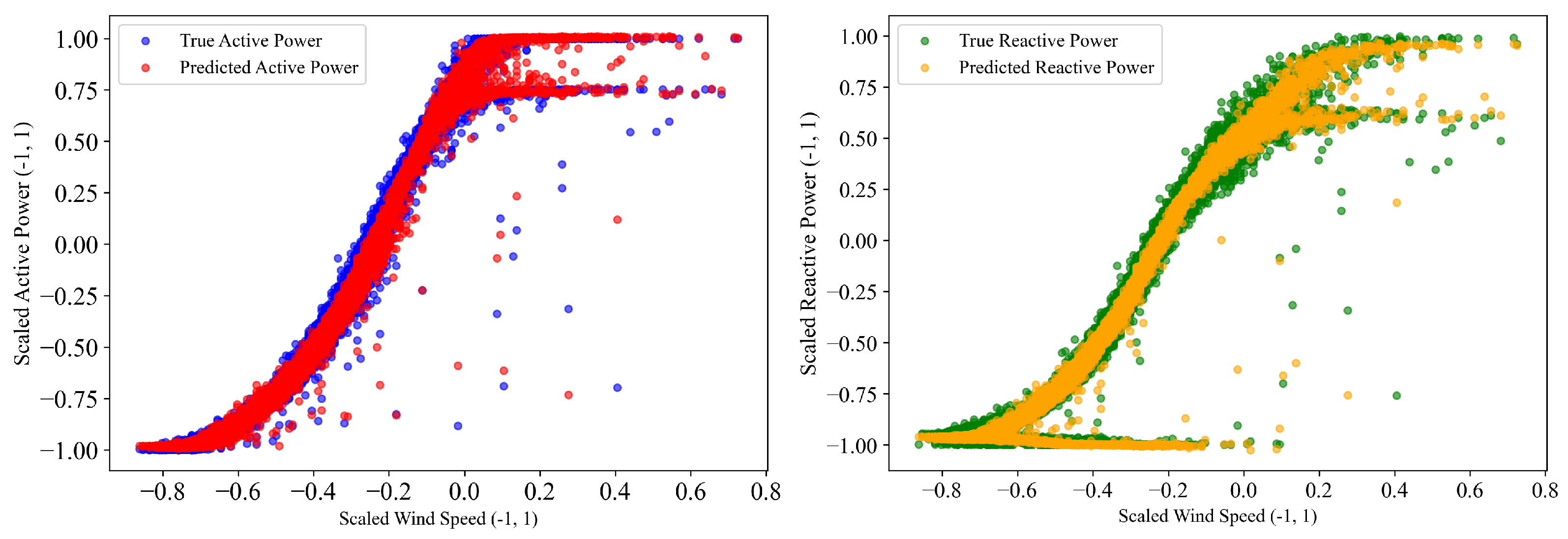
The generalization capability of the proposed model was further assessed using SCADA data from a Vestas V52 wind turbine operating in Ireland [40]. Figure 23 presents the loss curves for both the training and validation datasets, illustrating the model’s convergence behavior. Figure 24 and Figure 25 display the normalized measured and predicted traces of active and reactive power, scaled between –1 and 1. The close alignment between the predicted and actual values indicates that the model is able to reproduce real power behavior with high fidelity using SCADA data. The error distribution is shown in Figure 26, while Figure 27 depicts the relationship between wind speed and power outputs. Collectively, these results confirm that the proposed architecture maintains strong predictive performance when applied to SCADA data from an independent wind turbine.
To better analyze stability on the Irish data set, five different independent simulations with varying random initializations were done. The performance metrics MAE, RMSE, and R 2 on these five simulations are shown in Table 9. For active power, the model achieved a mean MAE of 0.0271 ± 0.0008, RMSE of 0.0407 ± 0.0011, and R 2 of 0.9943 ± 0.0003. For reactive power, the corresponding values were 0.0256 ± 0.0005 for MAE, 0.0417 ± 0.0008 for RMSE, and 0.9927 ± 0.0003 for R 2 . These values clearly indicate very stable and accurate predictions made by the model, thus substantiating its robustness and aligning with its performance on the Vestas V52 turbine data set.

3.3. La Haute Borne, France

Finally, the model was evaluated on a larger wind farm comprising four wind turbines, to examine scalability and predictive consistency across multiple units within the same site. Table 10 illustrates the training and validation losses. These losses show the consistency of the proposed model for all the turbines in wind farm.
Table 11 reports the performance of the proposed multi-variables LeNet-5–LSTM model over five independent runs for each turbine in the La Haute Borne wind farm. To complement the table, the averaged indicators offer a clearer view of the predictive consistency of the model across machines. For turbine R80711, the model performs well at active power estimation with MAE 0.0222 ± 0.0007, RMSE 0.0395 ± 0.0011, and R 2 0.9928 ± 0.0004. The reactive power varies with equal stability and less accuracy with MAE 0.0563 ± 0.0005, RMSE 0.0858 ± 0.0007, and R 2 of 0.6084 ± 0.0060.
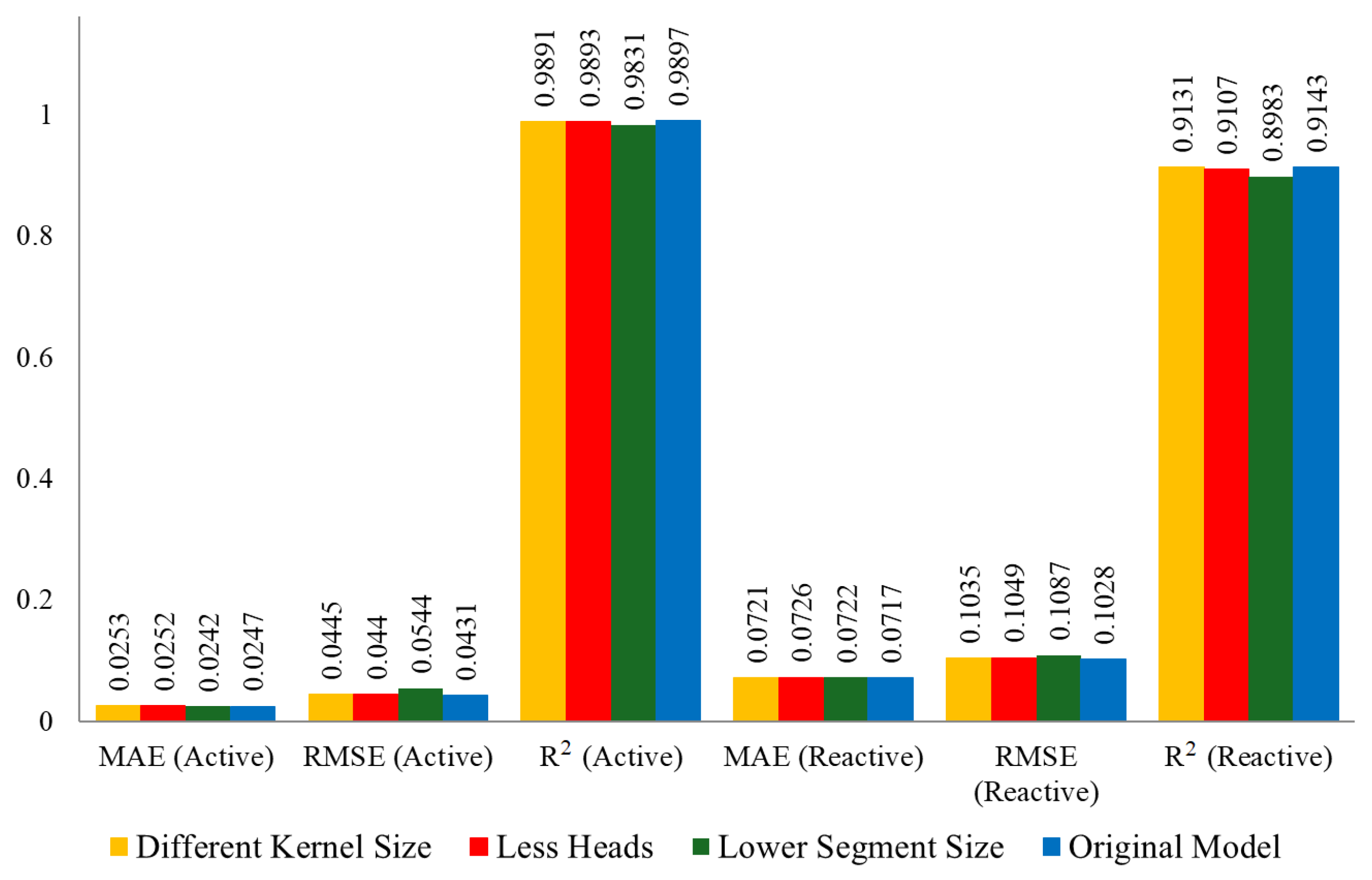
And as for turbine R80721, active-power performance will remain equivalent, with MAE 0.0247 ± 0.0007, RMSE 0.0431 ± 0.0018, and R 2 0.9897 ± 0.0009. Also, reactive-power forecasts will remain comparable with respect to error values, with MAE 0.0717 ± 0.0001, RMSE 0.1028 ± 0.0004, and R 2 0.9143 ± 0.0006.
Turbine R80736 presents similarly stable performance across runs. The model achieves a mean MAE of 0.0244 ± 0.0004, RMSE of 0.0493 ± 0.0014, and R 2 of 0.9887 ± 0.0006 for active power. For reactive power, the corresponding values are 0.0568 ± 0.0003, 0.0838 ± 0.0003, and 0.8750 ± 0.0010, respectively.
As for turbine R80790, it maintains strong active power forecasts, with MAE, RMSE, and R 2 values at 0.0255 ± 0.0003, 0.0421 ± 0.0005, and 0.9916 ± 0.0002, respectively. The reactive-power forecasts remain stable as well, with MAE 0.0498 ± 0.0003, RMSE 0.0730 ± 0.0003, and R 2 0.8895 ± 0.0009.
Looking at the cumulative outcome from all four turbines, it can be seen that the proposed model performs well on generalization. The accuracy on active and reactive power prediction stands at an extremely high level with perfect explanatory power. Although reactive-power prediction are better suited towards understanding specific turbine electrical properties, they still demonstrate a stable error margin and acceptable variance. The above findings validate the applicability and usefulness of the approach towards SCADA-based modeling.
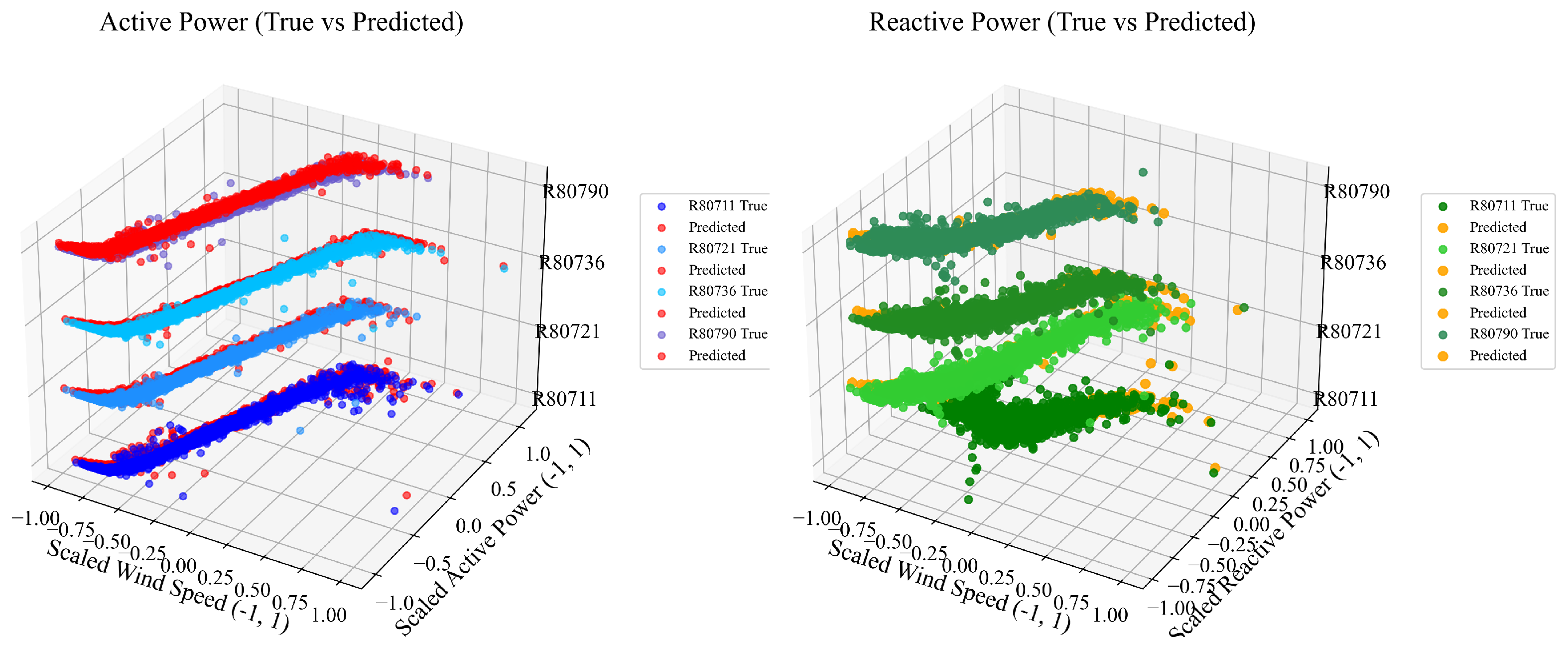
For each turbine, the measured and predicted active and reactive power and the influence of wind speed are illustrated in Figure 28. As before, all power values were normalized to [ 1 , 1 ] . The predicted values closely follow the true measurements for all four turbines, demonstrating that the model can handle multiple turbines simultaneously and accurately capture both inter-turbine and temporal variations in power output.
To assess robustness across the four turbines, five independent training runs were performed for each turbine. Table 11 gives MAE, RMSE, and R 2 metrics for five independent runs, along with the mean and standard deviation across runs for each turbine in the wind farm. The findings indicate that the proposed LeNet-5-LSTM model consistently provides accurate and stable predictions across multiple turbines, confirming its scalability and generalization capability in larger wind farms.
In a nutshell, results from all above evaluation indicate that the LeNet-5–LSTM model has great accuracy, robustness, and generalization for the active and reactive power of different turbines, across wind farms, and over various wind conditions.

3.4. Ablation Study

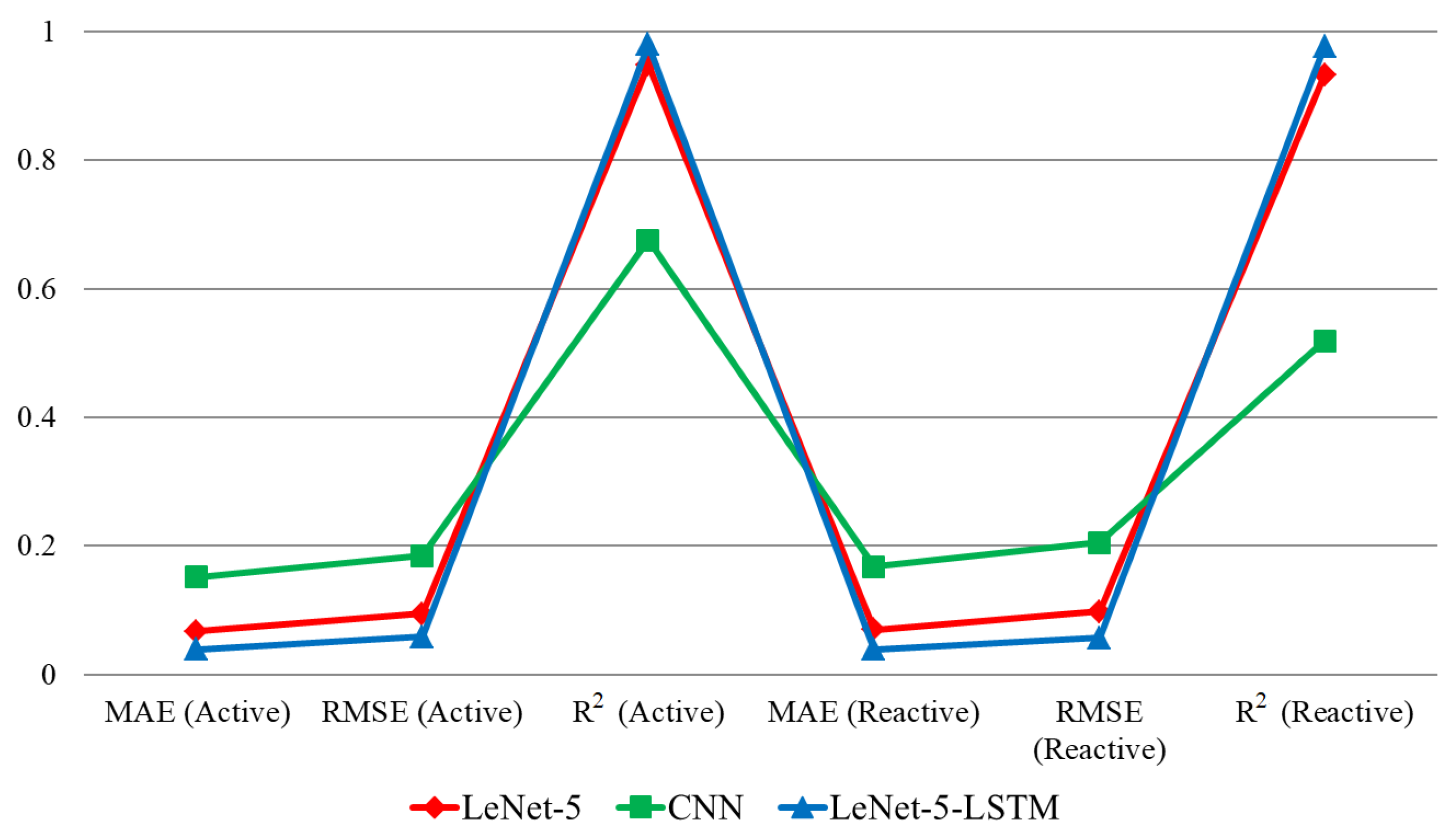
To evaluate the effectiveness of the proposed LeNet-5-LSTM hybrid neural architecture, its performance was benchmarked against the conventional LeNet-5 model without LSTM layers. For this comparison, the LeNet-5 network was trained and tested five times independently using the 2 MW SIEMENS wind turbine dataset. As described earlier, the dataset was first normalized, segmented, and subsequently converted into 2D grayscale images for model input. Using the same dataset preprocessing pipeline, the performance metrics; MAE, RMSE, and R 2 ; were computed for each run for both active and reactive power predictions. The average results across the five runs were then compared with those obtained from the proposed LeNet-5-LSTM hybrid architecture. For the standard LeNet-5 model, the performance metrics (MAE, RMSE, and R 2 ) for active power prediction were 0.0675 ± 0.0089, 0.0941 ± 0.0108, and 0.9483 ± 0.0122, respectively. For reactive power prediction, the metrics were 0.0693 ± 0.0080, 0.0975 ± 0.0104, and 0.9329 ± 0.0136, respectively.
In addition, the performance of the proposed hybrid model was further compared with a conventional CNN architecture. Using the same preprocessed dataset, the CNN model was trained and evaluated five times to obtain the performance metrics MAE, RMSE, and R 2 for both active and reactive power prediction. The average results across the five runs showed that the CNN achieved MAE = 0.1515 ± 0.1475, RMSE = 0.1847 ± 0.1490, and R 2 = 0.6757 ± 0.5033 for active power prediction, whereas for reactive power prediction the values were MAE = 0.1679 ± 0.1688, RMSE = 0.2053 ± 0.1639, and R 2 = 0.5189 ± 0.7334. A comprehensive comparison of the performance achieved by the LeNet-5, CNN, and the proposed LeNet-5–LSTM hybrid architectures is provided in Table 12.
The comparative analysis clearly demonstrates the superiority of the proposed LeNet-5–LSTM hybrid model over both the standard LeNet-5 and the conventional CNN architectures. The graphical comparison presented in Figure 29 further highlights these performance differences. The results indicate that the inclusion of LSTM layers significantly enhances the predictive capability of the proposed hybrid model, effectively capturing temporal dependencies that the baseline architectures fail to utilize. Additionally, the standard CNN model exhibits noticeably lower accuracy and higher prediction error, confirming that it lacks the efficiency and robustness achieved by the proposed architecture.
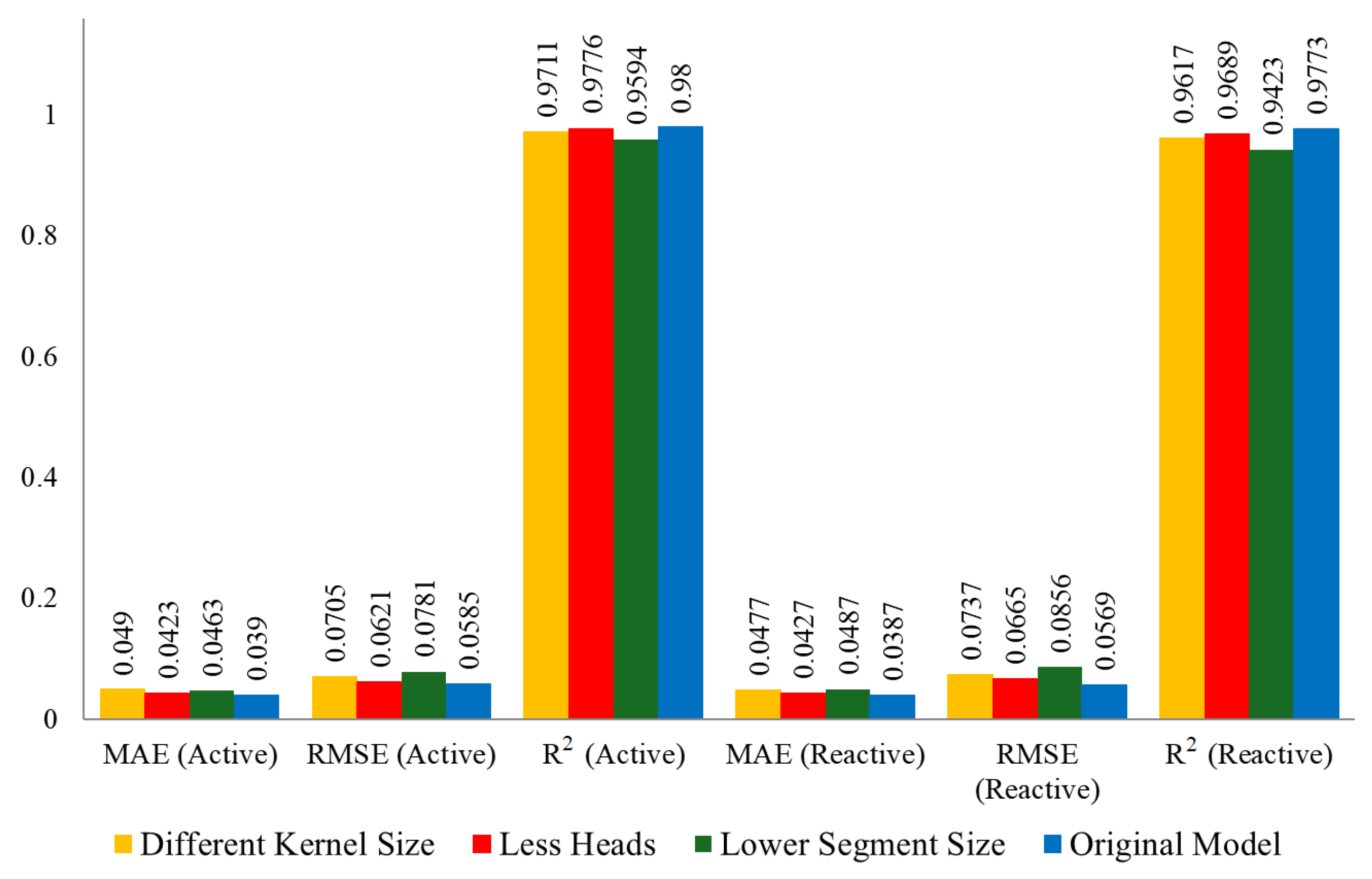
In addition to the performance comparison, a parameter sensitivity analysis was conducted to further assess the robustness of the proposed LeNet-5–LSTM hybrid architecture. Specifically, the convolutional kernel sizes were increased from ( 8 × 8 ) to ( 12 × 12 ) in the first convolutional layer and from ( 6 × 6 ) to ( 8 × 8 ) in the second convolutional layer, as summarized in Table 6. Under this modified configuration, the average coefficient of determination R 2 for active power prediction decreased from 0.9800 ± 0.0047 to 0.9711 ± 0.0056. Similarly, for reactive power prediction, the R 2 value declined from 0.9773 ± 0.0024 to 0.9617 ± 0.0086. These results indicate that enlarging the convolutional kernels reduces the predictive accuracy of the proposed model, suggesting that the original kernel sizes were more effective in capturing the relevant spatial features within the input images.
Furthermore, the influence of input variable selection on the performance of the proposed LeNet-5–LSTM architecture was also investigated. For this analysis, only three SCADA variables including Wind Speed (m/s), Shaft Speed (RPM), and Generator Temperature (°C) were selected from the SIEMENS dataset. The same preprocessing and evaluation procedure was applied, and the resulting performance was compared with the model trained using all six input variables. The results show that reducing the number of input variables leads to a decline in predictive accuracy. Specifically, the average R 2 for active power prediction decreased from 0.9800 ± 0.0047 to 0.9776 ± 0.0039, while for reactive power prediction the R 2 value dropped from 0.9773 ± 0.0024 to 0.9689 ± 0.0049. These findings indicate that incorporating a broader set of relevant variables enhances the model ability to capture the underlying system dynamics, thereby improving its predictive performance.
Moreover, the segment length used in the preprocessing step directly determines the dimensions of the resulting 2D grayscale images, which in turn influences the accuracy of both active and reactive power predictions. To examine this effect, the segment length was reduced from 36 to 24 with stride length fixed at 4. This modification produced grayscale images with dimensions of 24 × 24 . Using this dataset and the same LeNet-5–LSTM model, a noticeable decline in predictive performance was observed. Specifically, the average R 2 for active power prediction dropped from 0.9800 ± 0.0047 to 0.9594 ± 0.0206, while the R 2 for reactive power decreased from 0.9773 ± 0.0024 to 0.9423 ± 0.0292. Additionally, both MSE and RMSE values for active and reactive power predictions increased compared to the original configuration using 36 × 36 images. Figure 30 illustrates a comparative summary of the performance metrics corresponding to different kernel sizes, reduced input variable sets, and smaller segment lengths.
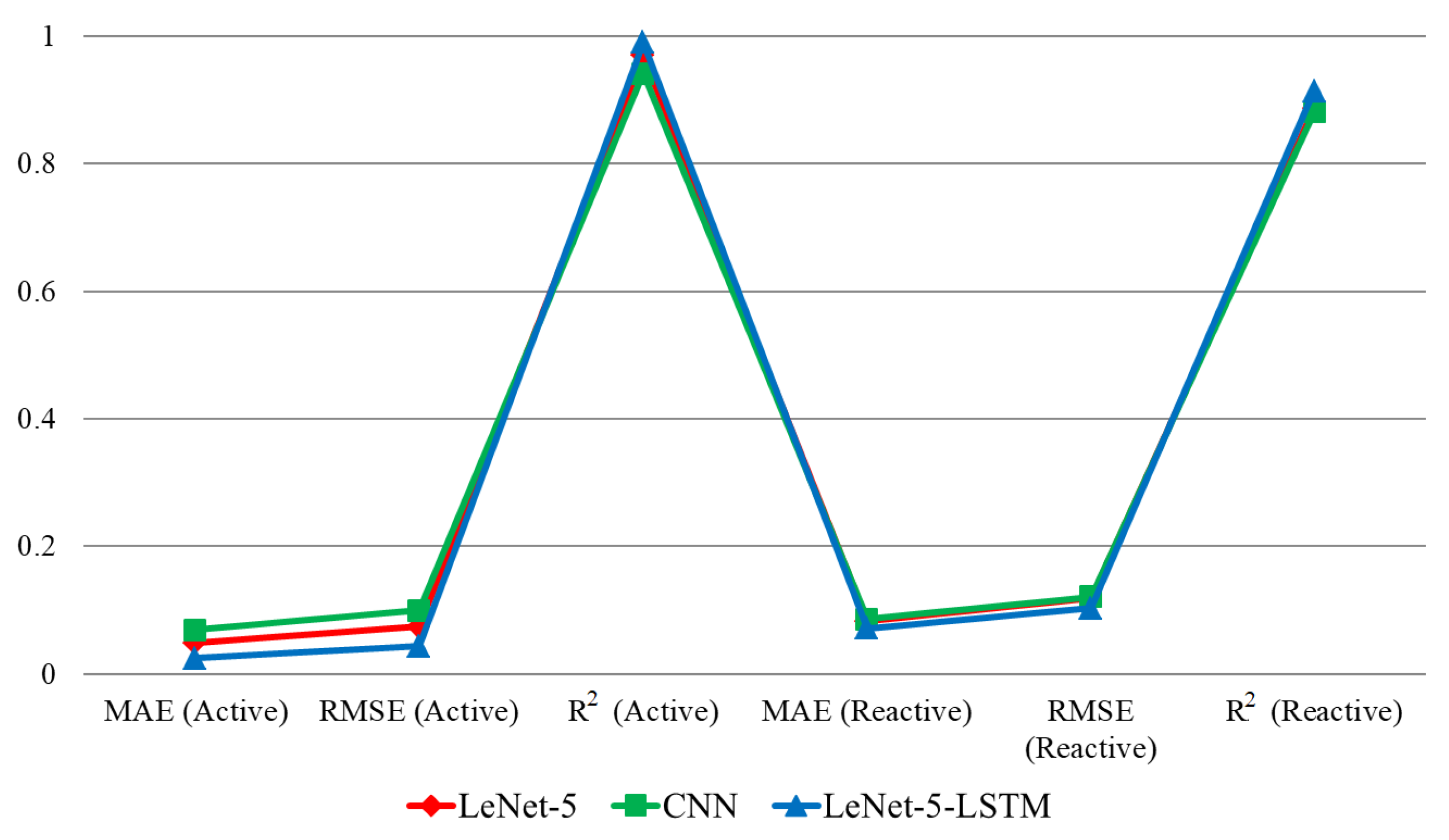
In addition to that another wind turbine from La Haute Borne wind farm in France was taken to verify the results. For that wind turbine R80721 was evaluated using CNN and LeNet-5 models and results were compared with proposed LeNet-5-LSTM hybrid architecture. Figure 31 illustrates this comparison with MAE and RMSE errors and coefficient of determination R 2 . It is noted that the CNN and LeNet-5 models were run five times and average of the results were taken to compare them.
Moreover, the sensitivity was performed for different kernel size, less number of input variables from SCADA data, and a smaller image size with low segment window. The MAE and RMSE for both active and reactive power were compared. Overall, the results illustrated in Figure 32 show that the proposed LeNet-5-LSTM hybrid model with optimized parameters outperform compared to the other values.

4. Conclusions

This study introduced a novel multi-channel power prediction framework for large-scale wind turbines that departs from conventional approaches relying directly on SCADA data. Instead, the proposed method transforms selected SCADA variables into structured 2D grayscale images, enabling the use of convolutional neural networks for spatial feature learning. These SCADA-based image representations are processed using a hybrid LeNet-5–LSTM architecture, which effectively integrates spatial feature extraction with temporal dependency modeling to capture the nonlinear and time-varying behavior of wind turbine power generation. To enhance physical consistency, the training process incorporates a physics-informed loss function that constrains predictions to remain compatible with fundamental electrical relationships between active and reactive power. This design improves robustness, particularly in the presence of noisy or irregular SCADA measurements, and increases the interpretability of the predicted outputs from an operational perspective.
The proposed framework was validated using three independent SCADA datasets covering diverse turbine types and operating conditions: a 2 MW Siemens wind turbine in Poland, a Vestas V52 turbine in Ireland, and the La Haute Borne wind farm in France. Across all case studies, the SCADA-based image representation combined with the LeNet-5–LSTM model delivered strong predictive performance with minimal preprocessing and without extensive manual feature engineering. These results demonstrate that meaningful operational patterns can be effectively learned from SCADA-derived grayscale images, offering a compact and information-rich alternative to traditional SCADA data-based modeling.
Beyond power prediction accuracy, the framework shows promise for condition monitoring and predictive maintenance applications. Discrepancies between predicted and measured active and reactive power may serve as indicators of aerodynamic inefficiencies, yaw or pitch misalignment, or emerging mechanical and electrical faults. Simultaneous modeling of both power components further provides a unified view of turbine behavior across aerodynamic, mechanical, and electrical subsystems.
In conclusion, this work highlights the potential of SCADA-based image representations combined with lightweight deep spatiotemporal models for advancing data-driven monitoring and diagnostics in wind energy systems. Future research will focus on scaling the approach to larger turbine fleets, incorporating additional SCADA channels into the image construction process, and exploring transfer learning strategies to improve generalization across sites and turbine technologies.

Author Contributions

Conceptualization, M.A. and P.B.D.; Methodology, M.A. and P.B.D.; Software, M.A.; Validation, M.A.; Formal analysis, M.A.; Investigation, M.A. and P.B.D.; Data curation, M.A.; Writing—original draft, M.A.; Writing—review & editing, P.B.D.; Visualization, M.A.; Supervision, P.B.D.; Funding acquisition, P.B.D. All authors have read and agreed to the published version of the manuscript.

Funding

The work presented in this paper was performed within the scope of the research grant No. UMO-2023/51/B/ST8/01253 financed by the National Science Centre, Poland. Muhammad Ahsan acknowledges support from the AGH University of Krakow through the research grant under the IDUB Programme (action D11, application number 13961).

Data Availability Statement

The Vestas V52 wind turbine data presented in the study are openly available in mendeley data at doi: 10.17632/tm988rs48k.2.

Conflicts of Interest

The authors declare no conflict of interest.

Abbreviations

The following abbreviations are used in this manuscript:
SCADASupervisory Control and Data Acquisition
CNNConvolutional Neural Network
RNNRecurrent Neural Network
LSTMLong Short-Term Memory
RPMRevolution Per Minute
STDStandard Deviation
MAEMean Absolute Error
RMSERoot Mean Square Error
R2Coefficient of Determination

References

  1. Al Hassan, A.; Dao, P.B. Bridging Data and Diagnostics: A Systematic Review and Case Study on Integrating Trend Monitoring and Change Point Detection for Wind Turbines. Energies 2025, 18, 5166. [Google Scholar] [CrossRef]
  2. Wang, S.; Vidal, Y.; Pozo, F. Recent advances in wind turbine condition monitoring using SCADA data: A state-of-the-art review. Reliab. Eng. Syst. Saf. 2026, 267, 111838. [Google Scholar] [CrossRef]
  3. Jin, X.; Chen, Y.; Wang, L.; Han, H.; Chen, P. Failure prediction, monitoring and diagnosis methods for slewing bearings of large-scale wind turbine: A review. Measurement 2021, 172, 108855. [Google Scholar] [CrossRef]
  4. Chang, C.; Huo, J.; Xie, T.; Meng, Y. A Novel Wind Turbine Pitch Bearing Fault Diagnosis Using Signal Encoding and Attention Mechanism Dual-Channel Parallel Fusion Network. IEEE Trans. Instrum. Meas. 2025, 74, 2527415. [Google Scholar] [CrossRef]
  5. Qin, S.; Tao, J.; Zhao, Z. Fault diagnosis of wind turbine pitch system based on LSTM with multi-channel attention mechanism. Energy Rep. 2023, 10, 4087–4096. [Google Scholar] [CrossRef]
  6. Lin, Z.; Liu, X.; Collu, M. Wind power prediction based on high-frequency SCADA data along with isolation forest and deep learning neural networks. Int. J. Electr. Power Energy Syst. 2020, 118, 105835. [Google Scholar] [CrossRef]
  7. Zhang, F.; Wen, Z.; Liu, D.; Jiao, J.; Wan, H.; Zeng, B. Calculation and Analysis of Wind Turbine Health Monitoring Indicators Based on the Relationships with SCADA Data. Appl. Sci. 2020, 10, 410. [Google Scholar] [CrossRef]
  8. Yang, W.; Court, R.; Jiang, J. Wind turbine condition monitoring by the approach of SCADA data analysis. Renew. Energy 2013, 53, 365–376. [Google Scholar] [CrossRef]
  9. Wang, L.; Jia, S.; Yan, X.; Ma, L.; Fang, J. A SCADA-Data-Driven Condition Monitoring Method of Wind Turbine Generators. IEEE Access 2022, 10, 67532–67540. [Google Scholar] [CrossRef]
  10. Liu, X.; Du, J.; Ye, Z.S. A Condition Monitoring and Fault Isolation System for Wind Turbine Based on SCADA Data. IEEE Trans. Ind. Inform. 2022, 18, 986–995. [Google Scholar] [CrossRef]
  11. Jiang, G.; Jia, C.; Nie, S.; Wu, X.; He, Q.; Xie, P. Multiview enhanced fault diagnosis for wind turbine gearbox bearings with fusion of vibration and current signals. Measurement 2022, 196, 111159. [Google Scholar] [CrossRef]
  12. Neshat, M.; Nezhad, M.M.; Abbasnejad, E.; Mirjalili, S.; Groppi, D.; Heydari, A.; Tjernberg, L.B.; Astiaso Garcia, D.; Alexander, B.; Shi, Q.; et al. Wind turbine power output prediction using a new hybrid neuro-evolutionary method. Energy 2021, 229, 120617. [Google Scholar] [CrossRef]
  13. Pandit, R.; Kolios, A. SCADA Data-Based Support Vector Machine Wind Turbine Power Curve Uncertainty Estimation and Its Comparative Studies. Appl. Sci. 2020, 10, 8685. [Google Scholar] [CrossRef]
  14. Maldonado-Correa, J.; Martín-Martínez, S.; Artigao, E.; Gómez-Lázaro, E. Using SCADA Data for Wind Turbine Condition Monitoring: A Systematic Literature Review. Energies 2020, 13, 3132. [Google Scholar] [CrossRef]
  15. Oliveira-Filho, A.; Comeau, M.; Cave, J.; Nasr, C.; Côté, P.; Tahan, A. Wind Turbine SCADA Data Imbalance: A Review of Its Impact on Health Condition Analyses and Mitigation Strategies. Energies 2025, 18, 59. [Google Scholar] [CrossRef]
  16. Jin, X.; Xu, Z.; Qiao, W. Condition Monitoring of Wind Turbine Generators Using SCADA Data Analysis. IEEE Trans. Sustain. Energy 2021, 12, 202–210. [Google Scholar] [CrossRef]
  17. He, L.; Hao, L.; Qiao, W. Remote Monitoring and Diagnostics of Pitch-Bearing Defects in an MW-Scale Wind Turbine Using Pitch Symmetrical-Component Analysis. IEEE Trans. Ind. Appl. 2021, 57, 3252–3261. [Google Scholar] [CrossRef]
  18. Badihi, H.; Zhang, Y.; Jiang, B.; Pillay, P.; Rakheja, S. A Comprehensive Review on Signal-Based and Model-Based Condition Monitoring of Wind Turbines: Fault Diagnosis and Lifetime Prognosis. Proc. IEEE 2022, 110, 754–806. [Google Scholar] [CrossRef]
  19. Liu, J.; Cai, C.; Song, D.; Zhong, X.; Shi, K.; Chen, Y.; Cheng, S.; Huang, Y.; Jiang, X.; Li, Q. Nonlinear model predictive control for maximum wind energy extraction of semi-submersible floating offshore wind turbine based on simplified dynamics model. Energy 2024, 311, 133356. [Google Scholar] [CrossRef]
  20. Czyżewski, A. Remote Health Monitoring of Wind Turbines Employing Vibroacoustic Transducers and Autoencoders. Front. Energy Res. 2022, 10, 858958. [Google Scholar] [CrossRef]
  21. Long, H.; Xu, S.; Cai, H.; Gu, W. Wind Turbine Condition Monitoring Based on SCADA Data–Image Conversion. IEEE Trans. Instrum. Meas. 2024, 73, 3538411. [Google Scholar] [CrossRef]
  22. Liu, Z.; Guo, H.; Zhang, Y.; Zuo, Z. A Comprehensive Review of Wind Power Prediction Based on Machine Learning: Models, Applications, and Challenges. Energies 2025, 18, 350. [Google Scholar] [CrossRef]
  23. Lin, Z.; Liu, X. Wind power forecasting of an offshore wind turbine based on high-frequency SCADA data and deep learning neural network. Energy 2020, 201, 117693. [Google Scholar] [CrossRef]
  24. Zhang, S.; Lang, Z.Q. SCADA-data-based wind turbine fault detection: A dynamic model sensor method. Control Eng. Pract. 2020, 102, 104546. [Google Scholar] [CrossRef]
  25. Kijanowski, K.; Barszcz, T.; Dao, P.B. A Cluster-Based Filtering Approach to SCADA Data Preprocessing for Wind Turbine Condition Monitoring and Fault Detection. Energies 2025, 18, 5954. [Google Scholar] [CrossRef]
  26. Long, H.; Xu, S.; Gu, W. An abnormal wind turbine data cleaning algorithm based on color space conversion and image feature detection. Appl. Energy 2022, 311, 118594. [Google Scholar] [CrossRef]
  27. Ahsan, M.; Salah, M.M. Efficient DCNN-LSTM Model for Fault Diagnosis of Raw Vibration Signals: Applications to Variable Speed Rotating Machines and Diverse Fault Depths Datasets. Symmetry 2023, 15, 1413. [Google Scholar] [CrossRef]
  28. Xiang, L.; Wang, P.; Yang, X.; Hu, A.; Su, H. Fault detection of wind turbine based on SCADA data analysis using CNN and LSTM with attention mechanism. Measurement 2021, 175, 109094. [Google Scholar] [CrossRef]
  29. Bindingsbø, O.T.; Singh, M.; Øvsthus, K.; Keprate, A. Fault detection of a wind turbine generator bearing using interpretable machine learning. Front. Energy Res. 2023, 11, 1284676. [Google Scholar] [CrossRef]
  30. Ahsan, M.; Waqar Hassan, M.; Rodriguez, J.; Abdelrahem, M. Enhanced Fault Diagnosis in Rotating Machinery Using a Hybrid CWT-LeNet-5-LSTM Model: Performance Across Various Load Conditions. IEEE Access 2025, 13, 1026–1045. [Google Scholar] [CrossRef]
  31. Ahsan, M.; Rodriguez, J.; Abdelrahem, M. Bearing Fault Diagnosis in Induction Motors Using Low-Cost Triaxial ADXL355 Accelerometer and a Hybrid CWT-DCNN-LSTM Model. IEEE Access 2025, 13, 101037–101050. [Google Scholar] [CrossRef]
  32. Jin, X.; Wang, H.; Kong, Z.; Xu, Z.; Qiao, W. Condition Monitoring of Wind Turbine Generators Based on SCADA Data and Feature Transfer Learning. IEEE Access 2023, 11, 9441–9450. [Google Scholar] [CrossRef]
  33. Soomro, S.A.; Mirjat, N.H.; Uqaili, M.A.; Arshad, N.; Khatri, S.A. Wind Speed prediction using sparse SCADA data of an offshore wind farm of Pakistan using different machine learning techniques. Results Eng. 2026, 29, 109144. [Google Scholar] [CrossRef]
  34. Demolli, H.; Dokuz, A.S.; Ecemis, A.; Gokcek, M. Wind power forecasting based on daily wind speed data using machine learning algorithms. Energy Convers. Manag. 2019, 198, 111823. [Google Scholar] [CrossRef]
  35. Liu, Z.H.; Wang, C.T.; Wei, H.L.; Zeng, B.; Li, M.; Song, X.P. A wavelet-LSTM model for short-term wind power forecasting using wind farm SCADA data. Expert Syst. Appl. 2024, 247, 123237. [Google Scholar] [CrossRef]
  36. Dao, P.B.; Barszcz, T.; Staszewski, W.J. Anomaly detection of wind turbines based on stationarity analysis of SCADA data. Renew. Energy 2024, 232, 121076. [Google Scholar] [CrossRef]
  37. Tawn, R.; Browell, J.; Dinwoodie, I. Missing data in wind farm time series: Properties and effect on forecasts. Electr. Power Syst. Res. 2020, 189, 106640. [Google Scholar] [CrossRef]
  38. Sun, C.; Chen, Y.; Cheng, C. Imputation of missing data from offshore wind farms using spatio-temporal correlation and feature correlation. Energy 2021, 229, 120777. [Google Scholar] [CrossRef]
  39. Yang, L.; Huang, Z.; Mo, X.; Luo, T. Enhanced GAIN-Based Missing Data Imputation for a Wind Energy Farm SCADA System. Electronics 2025, 14, 1590. [Google Scholar] [CrossRef]
  40. Byrne, R.; MacArtain, P. Vestas V52 Wind Turbine, 10-minute SCADA Data, 2006–2020—Dundalk Institute of Technology, Ireland. Mendeley Data 2022, V2. [Google Scholar] [CrossRef]
  41. Byrne, R.; MacArtain, P. Multi-annual time series operational data for a Vestas V52 wind turbine located in a coastal peri-urban environment in Ireland. Data Brief 2023, 48, 109227. [Google Scholar] [CrossRef]
  42. Al-qaness, M.A.; Ewees, A.A.; Fan, H.; Abualigah, L.; Elsheikh, A.H.; Abd Elaziz, M. Wind power prediction using random vector functional link network with capuchin search algorithm. Ain Shams Eng. J. 2023, 14, 102095. [Google Scholar] [CrossRef]
  43. Li, L.L.; Liu, Z.F.; Tseng, M.L.; Jantarakolica, K.; Lim, M.K. Using enhanced crow search algorithm optimization-extreme learning machine model to forecast short-term wind power. Expert Syst. Appl. 2021, 184, 115579. [Google Scholar] [CrossRef]
  44. Knes, P.; Dao, P.B. Machine Learning and Cointegration for Wind Turbine Monitoring and Fault Detection: From a Comparative Study to a Combined Approach. Energies 2024, 17, 5055. [Google Scholar] [CrossRef]
Figure 1. Active power vs. other variables from 2 MW SIEMENS, Poland wind turbine SCADA dataset.
Energies 19 01169 g001
Figure 2. Active power and reactive power vs. wind speed from 2 MW SIEMENS, Poland wind turbine SCADA dataset.
Energies 19 01169 g002
Figure 3. Correlation matrix for 2 MW SIEMENS, Poland wind turbine SCADA dataset.
Energies 19 01169 g003
Figure 4. Active power vs. other selected variables from Vestas V52, Ireland wind turbine SCADA dataset.
Energies 19 01169 g004
Figure 5. Active power and reactive power vs. wind speed from Vestas V52, Ireland wind turbine SCADA dataset.
Energies 19 01169 g005
Figure 6. Correlation matrix for Vestas V52, Ireland wind turbine SCADA dataset.
Energies 19 01169 g006
Figure 7. Active power vs. other variables from La Haute Borne, France wind turbine (R80721) SCADA dataset.
Energies 19 01169 g007
Figure 8. Active power and reactive power vs. wind speed from La Haute Borne, France wind turbine (R80711) SCADA dataset.
Energies 19 01169 g008
Figure 9. Active power and reactive power vs. wind speed from La Haute Borne, France wind turbine (R80721) SCADA dataset.
Energies 19 01169 g009
Figure 10. Active power and reactive power vs. wind speed from La Haute Borne, France wind turbine (R80736) SCADA dataset.
Energies 19 01169 g010
Figure 11. Active power and reactive power vs. wind speed from La Haute Borne, France wind turbine (R80790) SCADA dataset.
Energies 19 01169 g011
Figure 12. Correlation matrix for La Haute Borne, France wind turbine SCADA dataset: (a) R80711, (b) R80721, (c) R80736, and (d) R80790.
Energies 19 01169 g012
Figure 13. Block diagram of the LeNet-5 architecture.
Energies 19 01169 g013
Figure 14. Block diagram of the LSTM architecture [27].
Energies 19 01169 g014
Figure 15. Influence of step size ( η ) on optimization behaviour.
Energies 19 01169 g015
Figure 16. Block diagram of the proposed LeNet-5-LSTM hybrid neural architecture for multi-channel SCADA system.
Energies 19 01169 g016
Figure 17. 2D grayscale images produced from SCADA data.
Energies 19 01169 g017
Figure 18. Training and validation losses for a 2 MW SIEMENS wind turbine, Poland using the proposed LeNet-5-LSTM hybrid neural architecture for multi-channel SCADA system.
Energies 19 01169 g018
Figure 19. Comparison between true and predicted active powers for a 2 MW SIEMENS wind turbine, Poland.
Energies 19 01169 g019
Figure 20. Comparison between true and predicted reactive powers for a 2 MW SIEMENS wind turbine, Poland.
Energies 19 01169 g020
Figure 21. Error between training and testing powers for a 2 MW SIEMENS wind turbine, Poland.
Energies 19 01169 g021
Figure 22. Comparison between training and testing powers vs. wind speed for a 2 MW SIEMENS wind turbine, Poland.
Energies 19 01169 g022
Figure 23. Training and validation losses for a Vestas V52 wind turbine, Ireland, using the proposed LeNet-5-LSTM hybrid neural architecture for multi-channel SCADA system.
Energies 19 01169 g023
Figure 24. Comparison between true and predicted active powers for a Vestas V52 wind turbine, Ireland.
Energies 19 01169 g024
Figure 25. Comparison between true and predicted reactive powers for a Vestas V52 wind turbine, Ireland.
Energies 19 01169 g025
Figure 26. Error between true and predicted powers for a Vestas V52 wind turbine, Ireland.
Energies 19 01169 g026
Figure 27. Comparison between true and predicted powers vs. wind speed for a Vestas V52 wind turbine, Ireland.
Energies 19 01169 g027
Figure 28. Comparison between true and predicted powers vs. wind speeds for the four wind turbine in La Haute Borne, France.
Energies 19 01169 g028
Figure 29. MAE, RMSE, and R 2 comparison among LeNet-5, DCNN, and proposed LeNet-5-LSTM hybrid model for 2 MW SIEMENS wind turbine, Poland.
Energies 19 01169 g029
Figure 30. MAE, RMSE, and R 2 comparison for different kernel size, less number of heads, lower segment size, and original proposed algorithm for 2 MW SIEMENS wind turbine, Poland.
Energies 19 01169 g030
Figure 31. MAE, RMSE, and R 2 comparison among LeNet-5, DCNN, and proposed LeNet-5-LSTM hybrid model for R80721 wind turbine from La Haute Borne wind farm, France.
Energies 19 01169 g031
Figure 32. MAE, RMSE, and R 2 comparison for different kernel size, less number of heads, lower segment size, and original proposed algorithm for R80721 wind turbine from La Haute Borne wind farm, France.
Energies 19 01169 g032
Table 1. Renamed variables from SCADA datasets.
SIEMENS, PolandVestas V52, IrelandLa Haute Borne, France
Active Power (kW)Active Power (kW)ActivePower (kW)
Reactive Power (kVAr)Reactive Power (kVAr)ReactivePower (kVAr)
Wind Speed (m/s)Wind Speed (m/s)WindSpeed (m/s)
Shaft Speed (RPM)PitchGenSpeed (RPM)
Generator Temperature (°C)Shaft Speed (RPM)GearboxOilTemp (°C)
Gearbox Temperature (°C)GearTemp (°C)GearBearTemp (°C)
Voltage (V)GenBearTemp (°C)GenBearTemp (°C)
Current (A)GenPhTemp (°C)GenStatorTemp (°C)
Table 2. Statistical summary of the selected SCADA dataset from 2 MW SIEMENS, Poland wind turbine.
StatisticMeanStdMin25%50%75%Max
Active Power (kW)564.31508.76−3.56190.96444.29788.822516.13
Reactive Power (kVAr)120.95178.68−61.490.0058.64159.84918.95
Wind Speed (m/s)6.522.280.005.116.607.9113.75
Shaft Speed (RPM)855.15293.970.00823.76898.111044.731158.92
Generator Temp (°C)52.269.510.0048.4851.3755.0897.71
Gearbox Temp (°C)59.858.530.0058.3961.3465.1470.55
Voltage (V)664.7315.630.00661.17664.32667.93688.04
Current (A)498.23456.350.00163.08387.34697.582243.89
Table 3. Statistical summary of the selected SCADA dataset from Vestas V52, Ireland wind turbine.
StatisticMeanStdMin25%50%75%Max
Active Power (kW)165.55214.78−3274.9−0.777.5242.23149.1
Reactive Power (kVAr)7.2719.64−8.40.00.00.5121.1
Wind Speed (m/s)5.893.640.03.55.87.8368.4
Pitch8.1225.18−5.2−1.7−1.00.886.6
Shaft Speed (RPM)534.91250.990.0508.05575.65725.0824.1
GearTemp (°C)53.1713.390.053.557.560.0205.0
GenBearTemp (°C)44.1715.52−50.036.044.055.0205.0
GenPhTemp (°C)56.1721.490.042.6753.6771.0130.67
Table 4. Correlation in variables for La Haute Borne, France wind turbines SCADA dataset.
Wind Turbine LabelFirst VariableSecond VariableCorrelationRenamed Variable
R80711Db1t_avgDb2t_avg70.43%GenBearTemp (°C)
Gb1t_avgGb2t_avg98.47%GearBearTemp (°C)
Ds_avgDCs_avg100%GenSpeed (RPM)
R80721Db1t_avgDb2t_avg70.43%GenBearTemp (°C)
Gb1t_avgGb2t_avg98.47%GearBearTemp (°C)
Ds_avgDCs_avg100%GenSpeed (RPM)
R80736Db1t_avgDb2t_avg70.43%GenBearTemp (°C)
Gb1t_avgGb2t_avg98.47%GearBearTemp (°C)
Ds_avgDCs_avg100%GenSpeed (RPM)
R80790Db1t_avgDb2t_avg70.43%GenBearTemp (°C)
Gb1t_avgGb2t_avg98.47%GearBearTemp (°C)
Ds_avgDCs_avg100%GenSpeed (RPM)
Table 5. Statistical summary of the selected SCADA dataset from La Haute Borne, France wind turbines.
Wind Turbine:R80711
StatisticMeanStdMin25%50%75%Max
ActivePower (kW)504.55487.010.01132.74334.19721.142050.67
ReactivePower (kVAr)14.3916.29−94.235.8510.9816.85146.53
WindSpeed (m/s)6.582.210.525.086.127.4823.48
GenSpeed (RPM)1401.74322.0877.991114.631417.641734.091803.745
GearboxOilTemp (°C)59.625.9818.9256.5858.6862.2677.95
GearBearTemp (°C)67.427.4620.0762.4667.0372.3786.44
GenBearTemp (°C)39.024.757.8936.1839.4542.3758.06
GenStatorTemp (°C)59.625.167.9456.359.6263.0284.42
Wind Turbine:R80721
StatisticMeanStdMin25%50%75%Max
ActivePower (kW)426.33438.850.02114.92267.86575.862049.93
ReactivePower (kVAr)42.0734.38−4.5921.6730.5447.44190.44
WindSpeed (m/s)6.231.990.564.915.836.9923.0
GenSpeed (RPM)1348.47313.2464.971077.771328.791643.781801.97
GearboxOilTemp (°C)56.353.5718.9255.6857.1158.3667.78
GearBearTemp (°C)66.395.7619.2863.2566.8970.8880.74
GenBearTemp (°C)39.674.877.8237.0740.2843.0871.13
GenStatorTemp (°C)59.145.597.0256.0859.562.67101.15
Wind Turbine:R80736
StatisticMeanStdMin25%50%75%Max
ActivePower (kW)453.67475.600.02113.65276.89610.682050.5
ReactivePower (kVAr)39.4432.96−13.5319.8628.7744.97264.06
WindSpeed (m/s)6.322.150.154.885.877.1121.67
GenSpeed (RPM)1361.50317.7776.071078.161343.061673.491805.39
GearboxOilTemp (°C)55.974.0219.8255.4456.8958.2368.39
GearBearTemp (°C)65.475.8616.9662.5566.669.5380.29
GenBearTemp (°C)39.084.967.1736.2639.6842.5659.3
GenStatorTemp (°C)59.475.814.1156.2859.7562.9392.59
Wind Turbine:R80790
StatisticMeanStdMin25%50%75%Max
ActivePower (kW)468.48475.630.02117.56297.54651.982050.78
ReactivePower (kVAr)41.3631.29−14.3323.7131.6744.85266.7
WindSpeed (m/s)6.332.211.024.835.837.1524.27
GenSpeed (RPM)1371.02320.9768.531080.931366.891696.521799.54
GearboxOilTemp (°C)56.553.6418.4355.8457.2258.570.55
GearBearTemp (°C)63.995.7619.5560.864.5868.3579.27
GenBearTemp (°C)39.094.7810.6136.4039.542.3861.07
GenStatorTemp (°C)59.515.227.7656.2159.5362.989.98
Note: R80711, R80721, R80736, and R80790 are the wind turbine identification numbers in the La Haute Borne wind farm in France.
Table 6. Parameters of the proposed LeNet-5-LSTM hybrid neural architecture.
Layer (Type)Activation FunctionNo. of FiltersKernel Size
Convolution (Conv2D)tanh12 ( 8 × 8 )
Max Pool (MaxPooling2D) ( 3 × 3 )
Convolution (Conv2D)tanh8 ( 6 × 6 )
Max Pool (MaxPooling2D) ( 3 × 3 )
Flatten (Flatten)
Merged (Concatenate)
Fully Connected (Dense)tanh
Dropout (Dropout)
Reshape (Reshape)
LSTM (LSTM)Sigmoid
LSTM (LSTM)Sigmoid
Fully Connected (Dense)Linear
Table 7. Segmentation, training, and test data.
Wind TurbineTurbine TagTotal DataTraining DataTesting Data
2MW SIEMENS, Poland1429 × 36 × 361000 × 36 × 36429 × 36 × 36
Vestas V52, Ireland54,912 × 36 × 3638,438 × 36 × 3616,474 × 36 × 36
La Haute Borne, FranceR8071114,448 × 36 × 3610,113 × 36 × 364335 × 36 × 36
La Haute Borne, FranceR8072113,729 × 36 × 369610 × 36 × 364119 × 36 × 36
La Haute Borne, FranceR8073613,634 × 36 × 369543 × 36 × 364091 × 36 × 36
La Haute Borne, FranceR8079014,095 × 36 × 369866 × 36 × 364229 × 36 × 36
Table 8. Performance evaluation of the proposed model for 2 MW SIEMENS wind turbine, Poland.
RunMAEMAERMSRMS R 2 R 2
(Active)(Reactive)(Active)(Reactive)(Active)(Reactive)
10.02670.03440.04380.05140.98900.9816
20.04180.03950.06170.05690.97810.9774
30.04080.03860.05920.05640.97980.9778
40.04200.04070.06340.06060.97690.9744
50.04370.04030.06450.05930.97600.9755
Table 9. Performance evaluation of the proposed model for Vestas V52 wind turbine, Ireland.
RunMAEMAERMSRMS R 2 R 2
(Active)(Reactive)(Active)(Reactive)(Active)(Reactive)
10.02860.02660.04290.04300.99370.9922
20.02660.02540.04060.04190.99430.9926
30.02690.02550.04030.04150.99440.9928
40.02650.02530.04000.04120.99450.9928
50.02680.02530.03980.04070.99450.9930
Table 10. Training and validation loss for each wind turbine in La Haute Borne wind farm in France.
Wind TurbineLossRun-1Run-2Run-3Run-4Run-5
R80711Training Loss0.00330.00400.00390.00400.0041
Validation Loss0.00370.00390.00390.00400.0040
R80721Training Loss0.00630.00710.00730.00720.0072
Validation Loss0.00790.00790.00820.00790.0080
R80736Training Loss0.00450.00520.00540.00540.0056
Validation Loss0.00630.00600.00600.00590.0061
R80790Training Loss0.00350.00460.00490.00480.0048
Validation Loss0.00480.00470.00480.00480.0047
Table 11. Performance evaluation of the proposed model for La Haute Borne wind farm, France.
WindRunMAEMAERMSRMS R 2 R 2
Turbine(Active)(Reactive)(Active)(Reactive)(Active)(Reactive)
R8071110.02100.05540.03760.08460.99350.6199
20.02220.05650.03920.08610.99290.6058
30.02250.05620.03980.08590.99280.6081
40.02190.05650.04020.08620.99260.6053
50.02320.05690.04090.08650.99230.6026
R8072110.02500.07170.04130.10220.99060.9153
20.02380.07170.04120.10300.99060.9139
30.02560.07180.04620.10330.98820.9133
40.02520.07160.04330.10260.98960.9146
50.02410.07170.04340.10270.98960.9144
R8073610.02480.05690.05200.08420.98750.8738
20.02390.05660.04870.08350.98900.8759
30.02390.05650.04840.08340.98920.8763
40.02450.05680.04830.08410.98920.8743
50.02470.05720.04920.08390.98890.8745
R8079010.02560.04970.04280.07290.99130.8898
20.02500.04940.04220.07250.99150.8910
30.02550.05010.04140.07340.99180.8884
40.02590.04990.04190.07300.99160.8895
50.02550.04990.04190.07320.99160.8889
Table 12. Performance comparison among LeNet-5, DCNN, and proposed LeNet-5-LSTM hybrid model for 2 MW SIEMENS wind turbine, Poland.
ModelMAEMAERMSRMS R 2 R 2
(Active)(Reactive)(Active)(Reactive)(Active)(Reactive)
LeNet-50.06750.06930.09410.09750.94830.9329
±0.0089±0.0080±0.0108±0.0104±0.0122±0.0136
CNN0.15150.16790.18470.20530.67570.5189
±0.1475±0.1688±0.1490±0.1639±0.5033±0.7334
LeNet-5-LSTM0.03900.03870.05850.05690.98000.9773
±0.0062±0.0023±0.0076±0.0031±0.0047±0.0024
Disclaimer/Publisher’s Note: The statements, opinions and data contained in all publications are solely those of the individual author(s) and contributor(s) and not of MDPI and/or the editor(s). MDPI and/or the editor(s) disclaim responsibility for any injury to people or property resulting from any ideas, methods, instructions or products referred to in the content.