Interpolation-Free Hybrid Bergeron–π Line Model with Accurate Zero-Sequence Impedance


Abstract
1. Introduction
- We introduce an interpolation-free boundary-line architecture for the short-delay regime that preserves a strictly step-synchronous, history-based terminal interface suitable for fixed-step parallel and real-time EMT simulation.
- We develop a sequence-parameter restoration method that matches both positive- and zero-sequence series impedances and shunt admittances of a lumped-π reference at the fundamental frequency, thereby addressing the zero-sequence sensitivity of asymmetrical-fault studies.
- We validate the proposed model in representative fault scenarios and in a partitioned multi-core execution context, demonstrating close agreement with a high-resolution time-domain reference and improved robustness of asymmetrical-fault results compared to a representative unified-delay hybrid.
2. Problem Formulation and Design Targets
2.1. Fixed-Step EMT Requirement for HV Distribution and Subtransmission Studies
2.2. Reference Model and Equivalence Definition
- (1)
- Calibration reference for equivalence definition. The proposed HB-π-ZIM is frequency-calibrated at the system fundamental frequency. For protection-oriented HV feeder and subtransmission studies, the engineering data most commonly available are the line length l and the positive-/zero-sequence parameters at . Although equivalent 50/60 Hz sequence parameters can, in principle, also be derived from geometry-based or traveling-wave (e.g., Bergeron/ULM) representations via frequency-domain reduction, the sequence form remains the standard interface used for utility data exchange and model validation in this application domain. Therefore, the conventional lumped-parameter π equivalent (denoted as “Lumped-π”) is adopted as the calibration reference to define the required terminal sequence networks at . Specifically, HB-π-ZIM is designed to match the Lumped-π positive- and zero-sequence series impedances and shunt admittances at .
- (2)
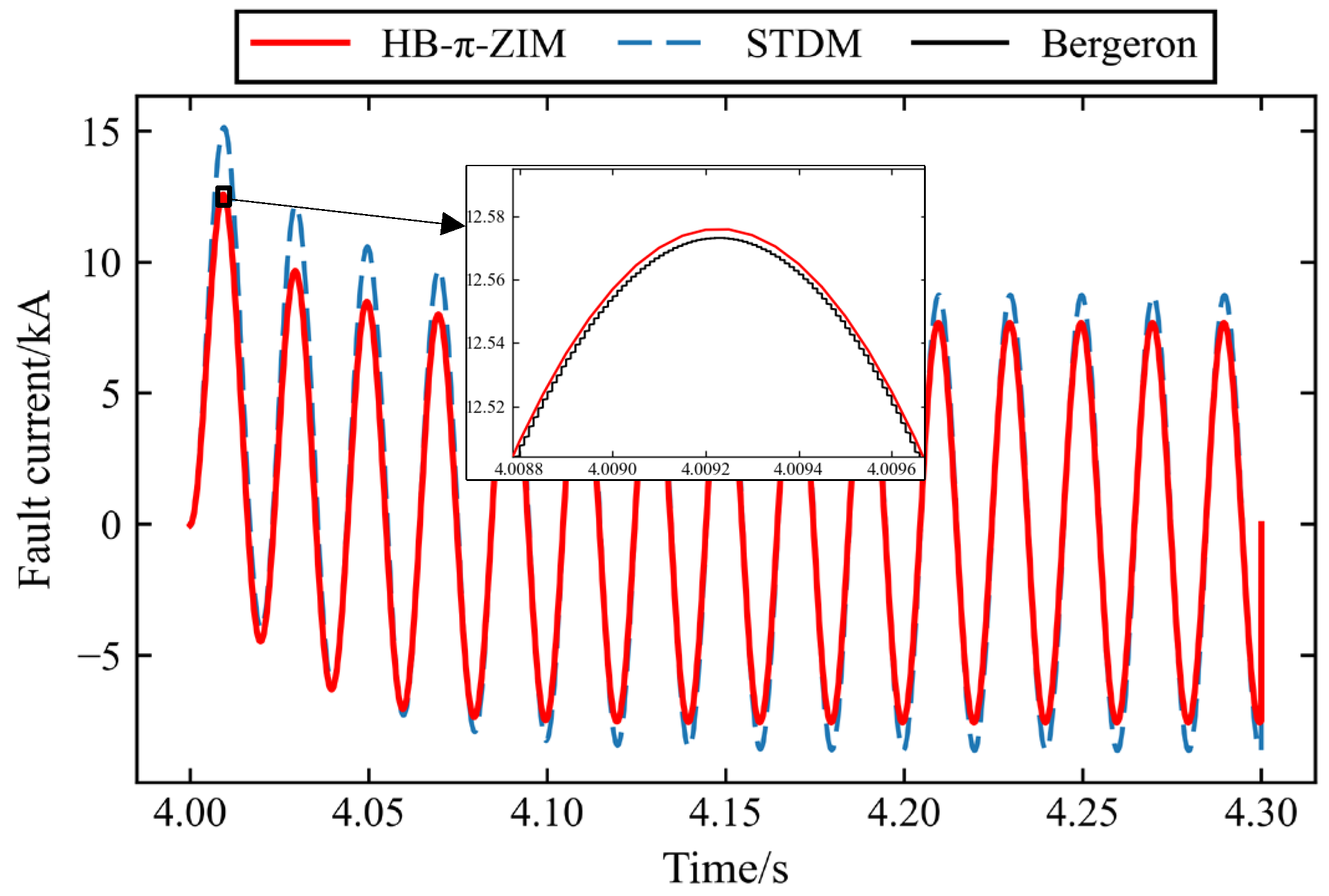
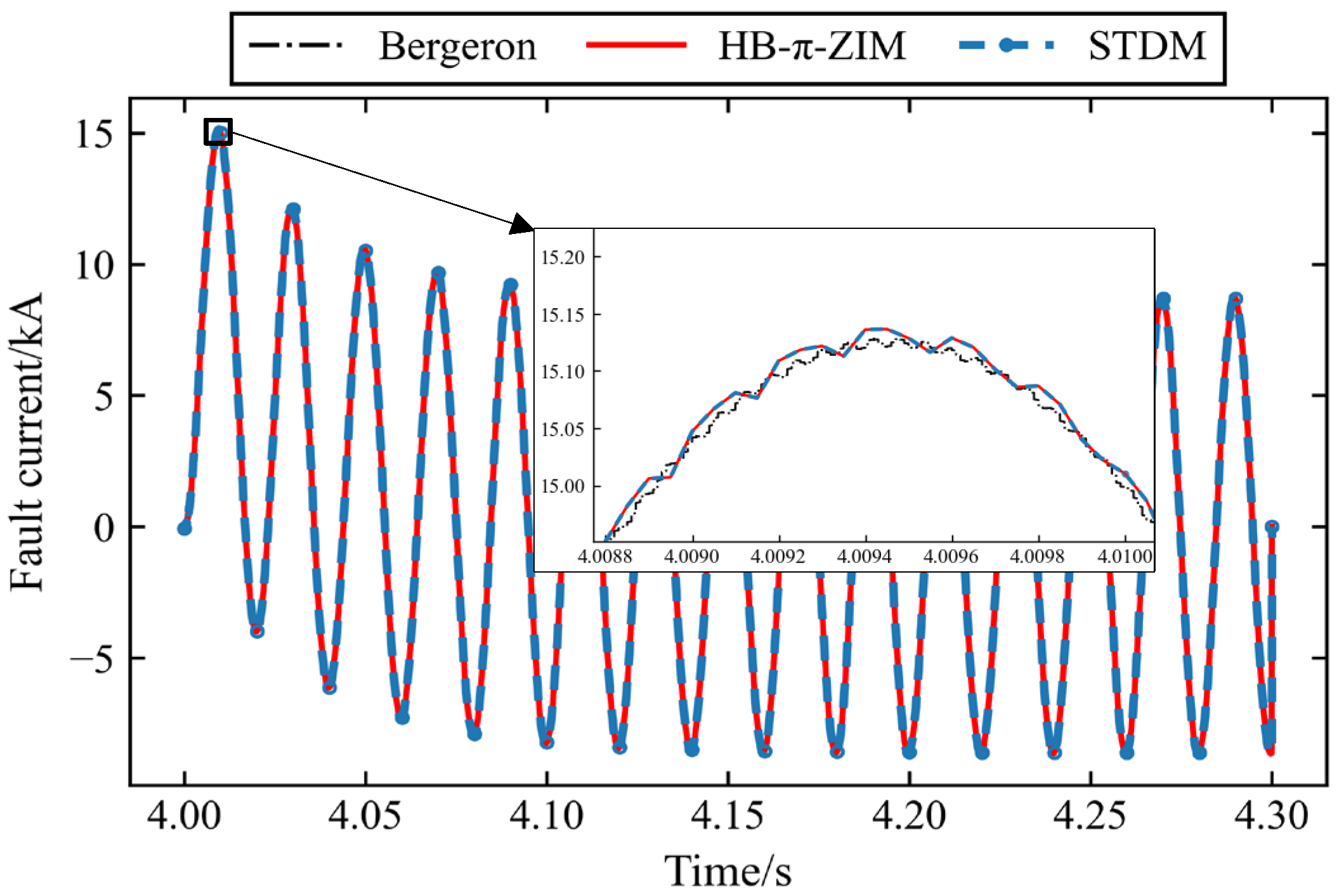
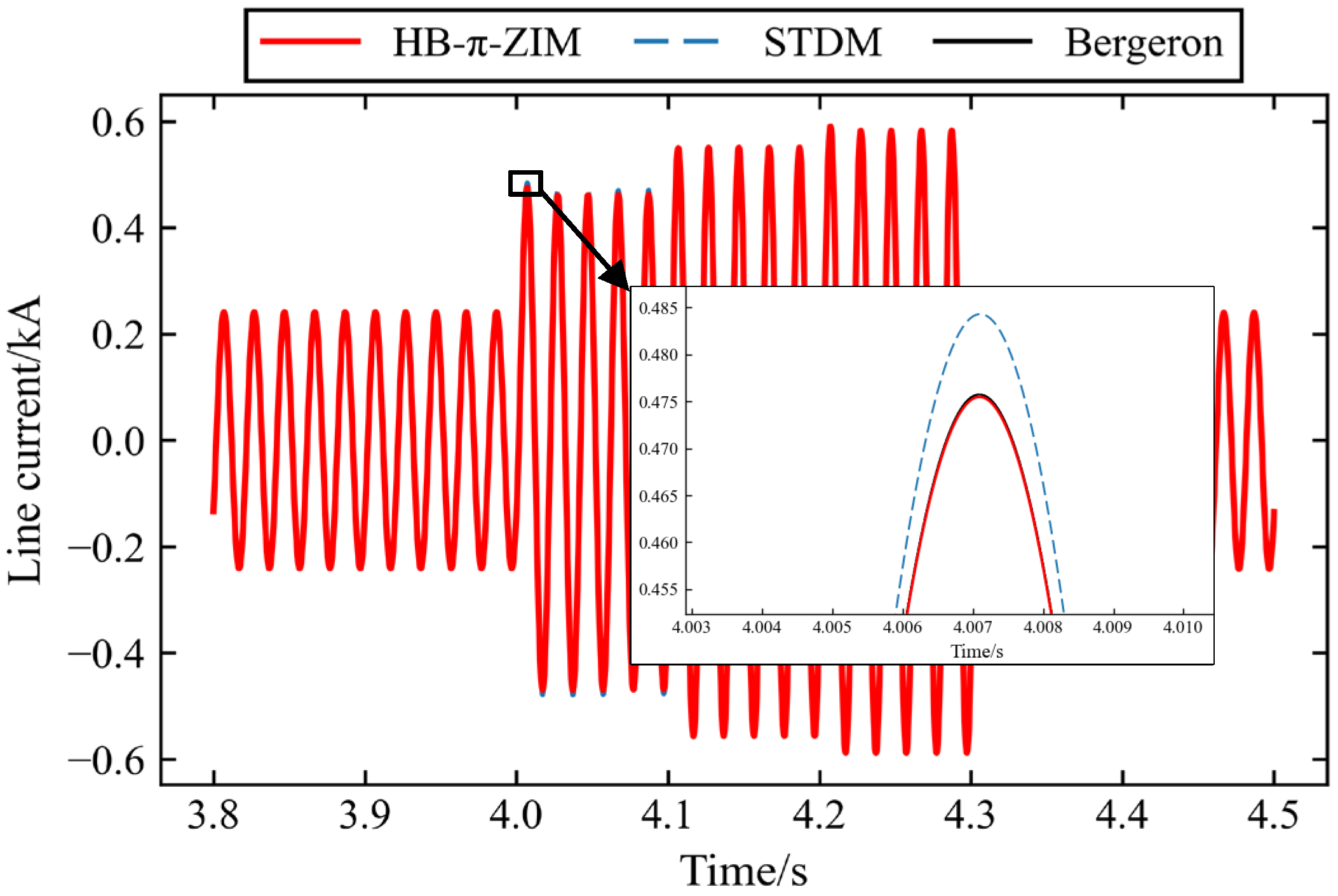
- Time-domain reference for waveform verification. To provide an accuracy-oriented time-domain baseline beyond the fundamental-frequency calibration, a small-step Bergeron traveling-wave simulation (e.g., ) is additionally used in Section 5 to compare transient waveforms under representative fault scenarios.
2.3. Design Targets
- Interpolation-free fixed-step operation for . The model shall not require interpolation or sub-stepping to be evaluated under a fixed .
- Terminal decoupling suitable for partition boundaries. The model shall preserve a terminal-decoupled structure so that each terminal can be solved within its local subsystem using historical information received from the remote terminal.
- Fundamental-frequency sequence fidelity, including zero sequence. The model shall preserve the 50/60 Hz positive- and zero-sequence networks of the Lumped-π equivalent. Zero-sequence fidelity is emphasized because single-line-to-ground faults are prevalent in HV distribution/subtransmission, and protection behavior is sensitive to .
- Passive realizability and robust EMT stamping. The internal realization shall admit standard EMTP companion-form discretization (e.g., trapezoidal rule) and avoid numerical pathologies under practical and line parameters.
3. HB-π-ZIM Model
3.1. Architecture Overview
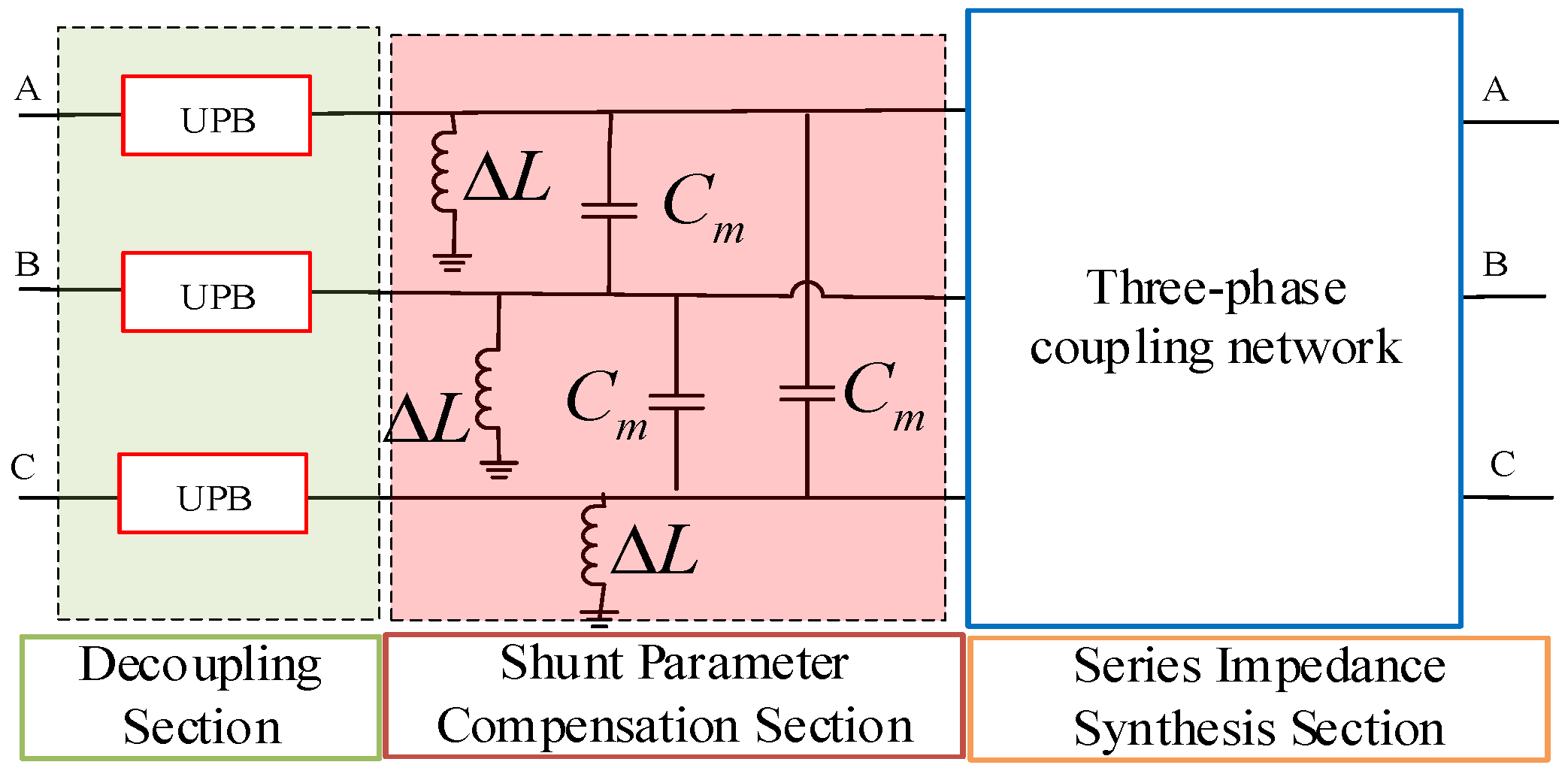
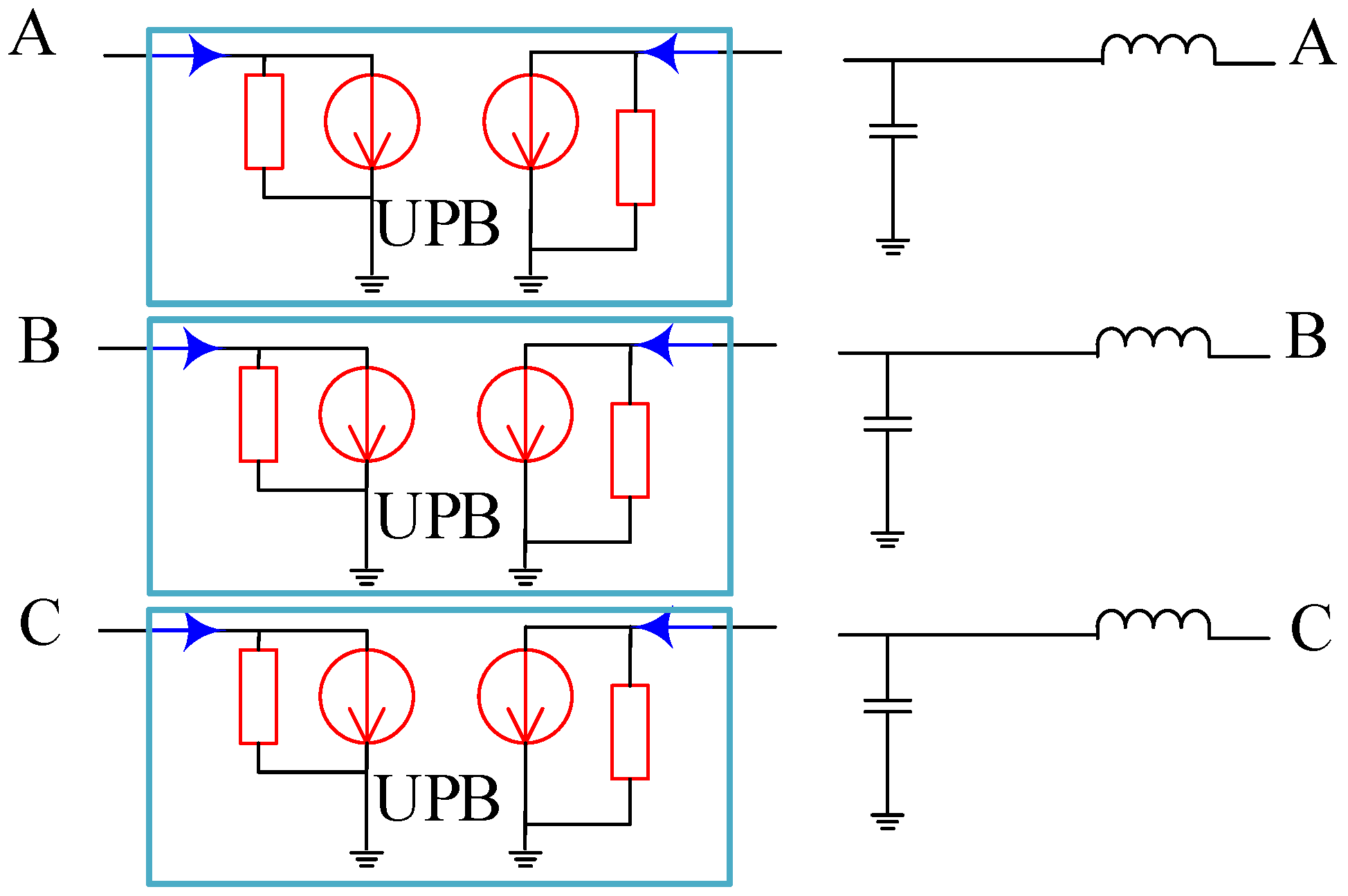
- Decoupling section (one-step UPB cell): An uncoupled per-phase Bergeron (UPB) structure whose parameters are modified so that its travel time equals exactly one simulation step, . This provides interpolation-free terminal decoupling.
- Shunt compensation section: A lumped network that cancels the artificial shunt susceptance introduced by enforcing and inserts the physical phase-to-phase capacitance consistent with .
- Series-impedance synthesis section: A passive RL two-port equivalent that reconstructs the remaining series impedance so that the total 50/60 Hz sequence impedances match the Lumped-π reference in both and .
3.2. One-Step UPB Decoupling Section
3.3. Shunt Compensation and Capacitance Decomposition
3.4. Series-Impedance Synthesis Targets at 50/60 Hz
3.5. RL Lattice Realization and EMT Discretization
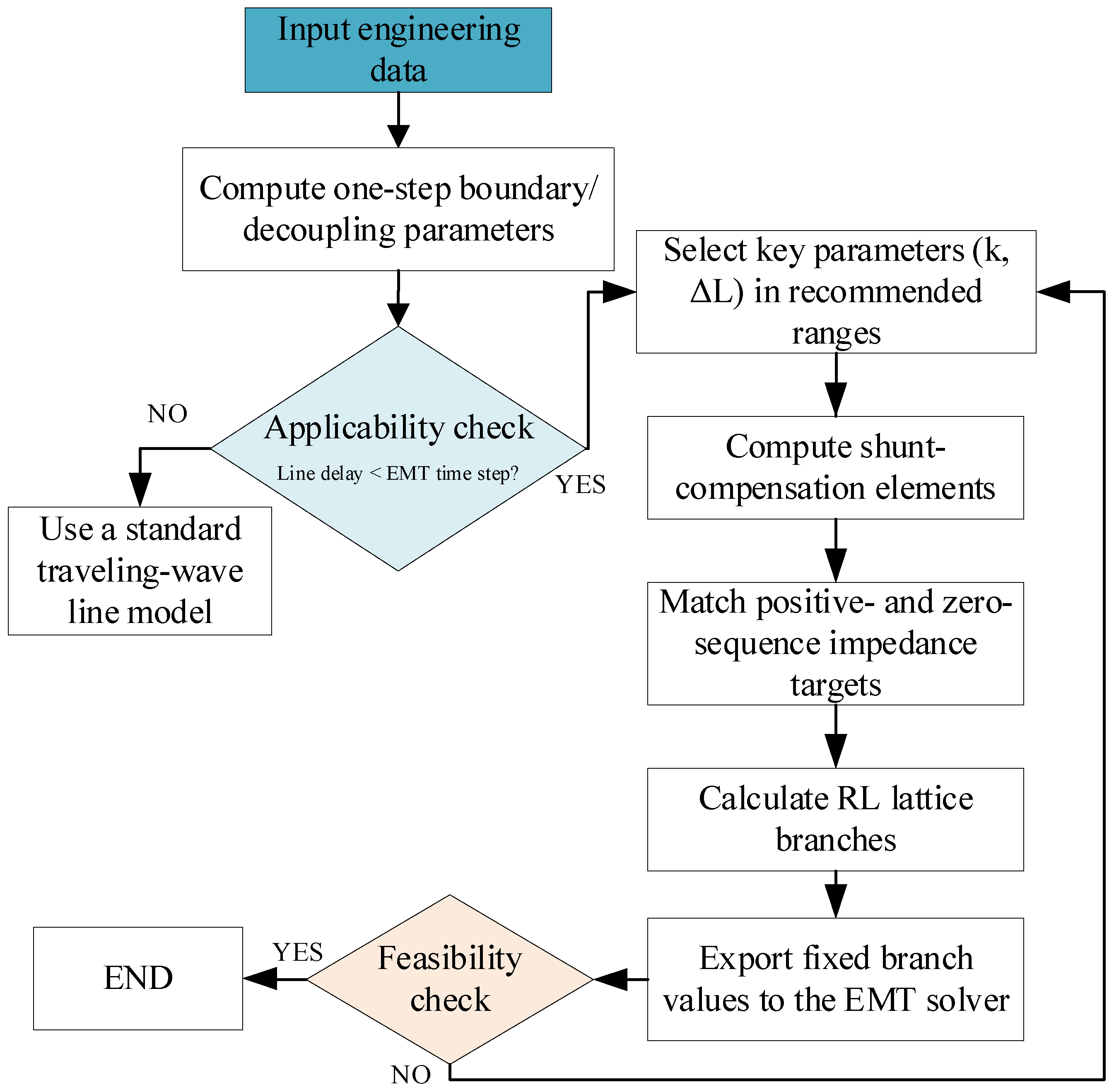
3.6. Workflow Summary and Parameter-Selection Procedure
4. Real-Time Parallel Implementation
4.1. Role of the Implementation in This Paper
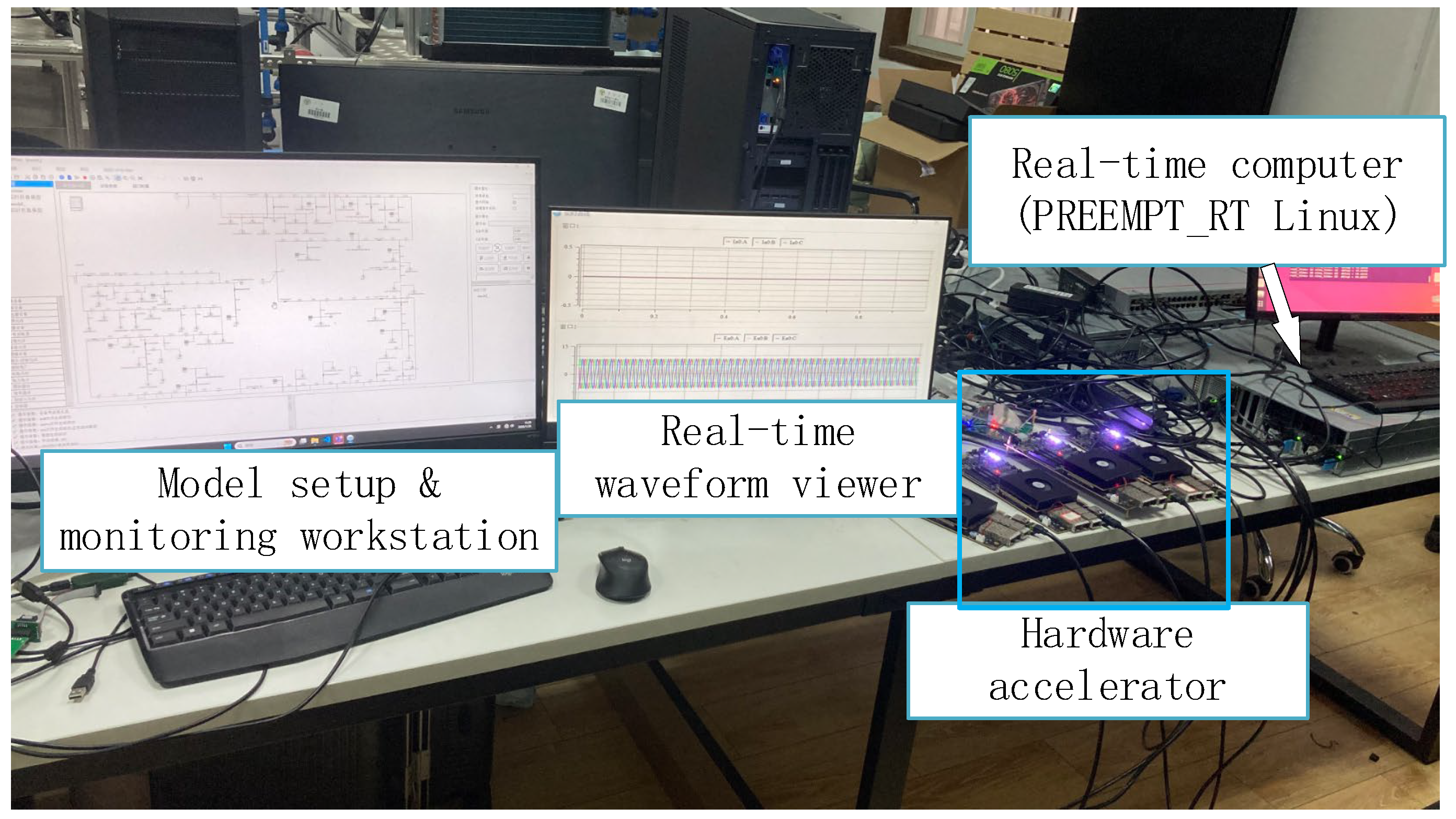
4.2. RT-Linux Platform and DPDK-Based Low-Jitter Execution Substrate
- Dedicated solver cores and OS isolation. Solver threads are affinitized to dedicated logical cores. Interrupt handling is isolated away from these solver cores via IRQ affinity configuration; housekeeping activities are confined to separate cores to prevent asynchronous interrupt servicing from perturbing the fixed-step loop. Where applicable, simultaneous multithreading (SMT) is avoided on solver cores (i.e., one solver thread per physical core) to reduce shared-resource contention and tail-latency outliers.
- Pinned CPU frequency and restricted power management. CPU frequency is pinned to avoid DVFS-induced variability in step execution time. Power-management features that introduce latency variability (e.g., aggressive idle states or dynamic boosting) are restricted as appropriate for the target real-time platform.
- NUMA-aware memory placement with hugepages. Subsystem-local data structures (state histories, stamping buffers, branch states, and boundary payloads) are allocated on the NUMA node local to the worker core whenever possible. Hugepage-backed memory is used to reduce TLB pressure and stabilize access latency.
- Preallocation of runtime objects. All boundary payload objects are preallocated at initialization from fixed-size object pools (DPDK mempools). This eliminates dynamic allocation inside the time-step loop and avoids allocator-induced jitter.
- Polling-based step loop with bounded synchronization. Each subsystem executes a polling-based fixed-step loop. The design avoids blocking synchronization primitives (e.g., mutexes/condition variables) in the step path; inter-core exchange is performed through bounded, non-blocking data structures described in Section 4.3.
4.3. Lock-Free Boundary Exchange Matched to HB-π-ZIM
5. Case Study Verification
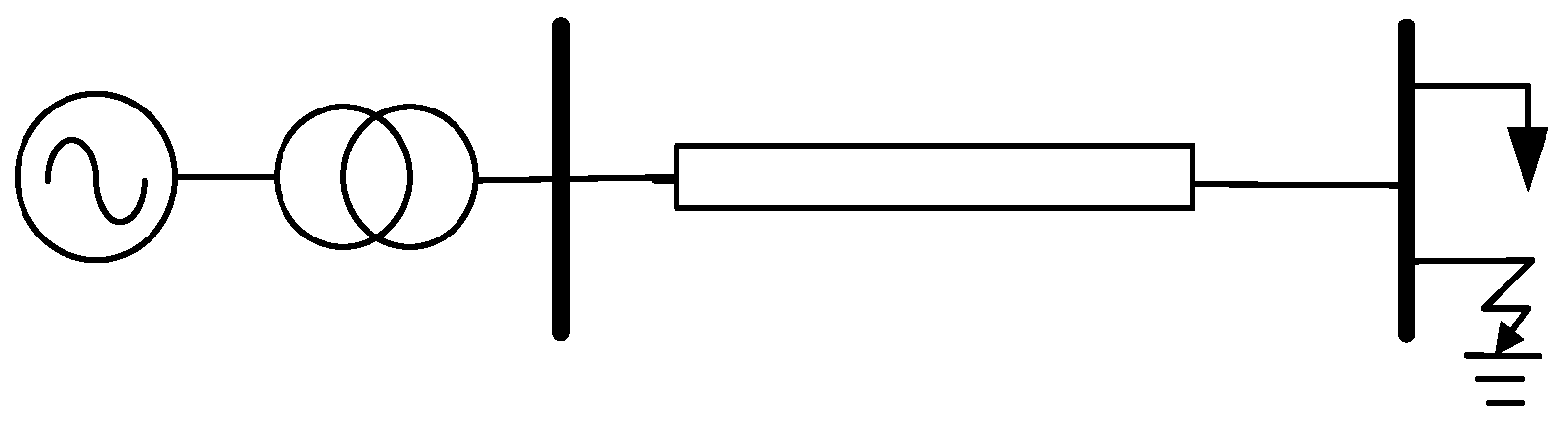
5.1. Simple Case Study
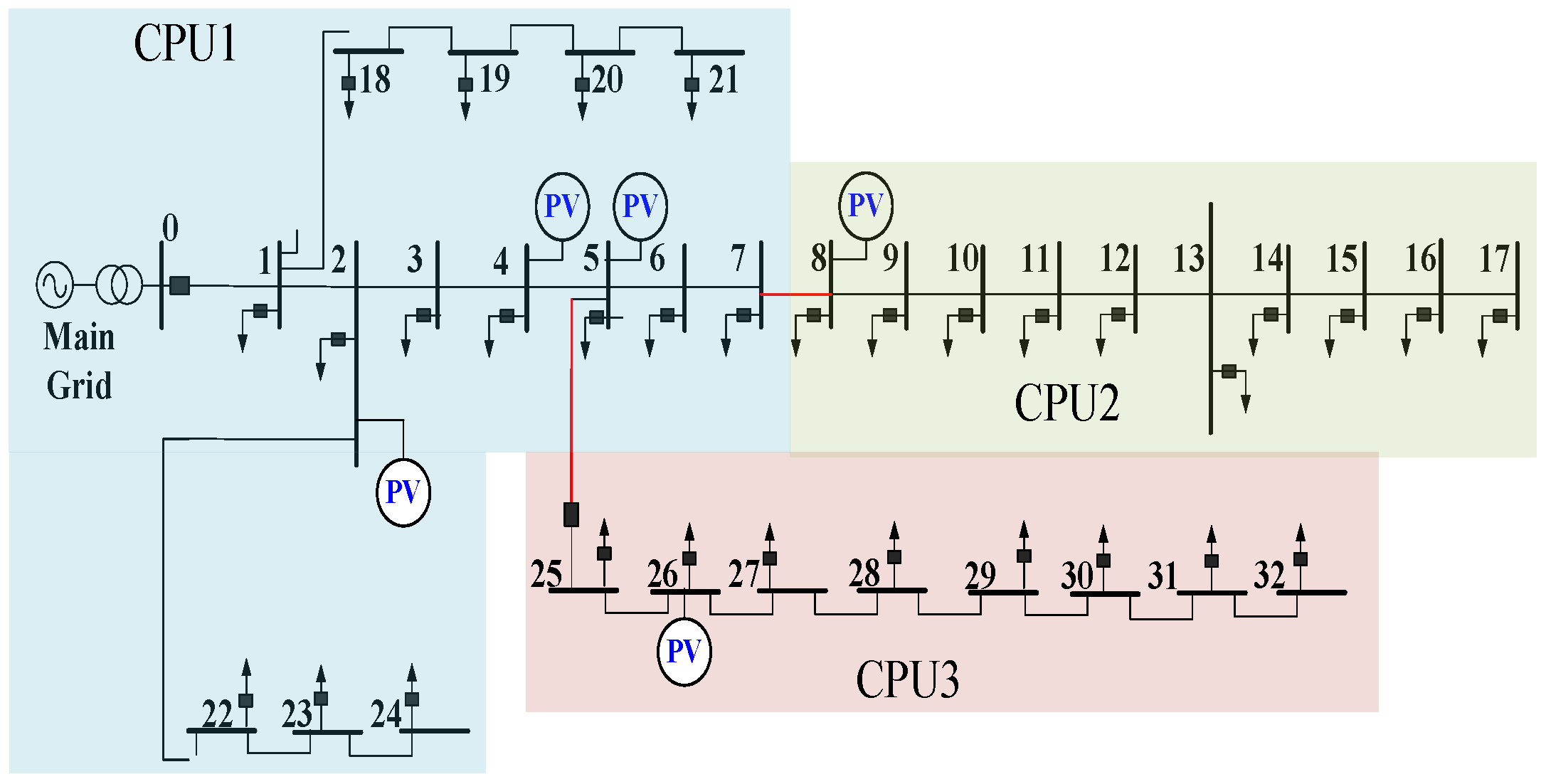
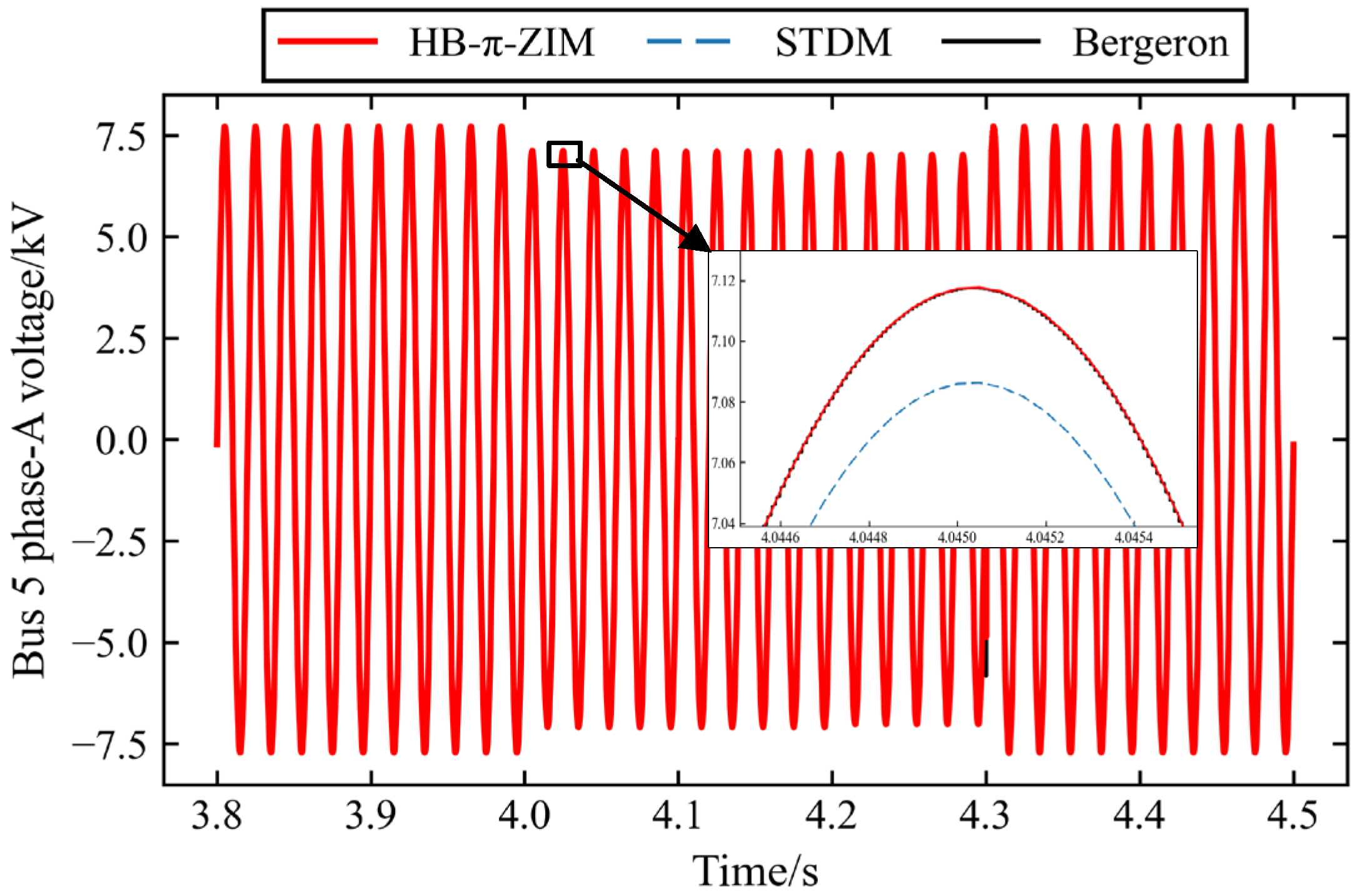
5.2. Typical Distribution System Case Study
5.3. Parallel Case
6. Conclusions and Future Work
Supplementary Materials
Author Contributions
Funding
Data Availability Statement
Conflicts of Interest
Nomenclature
| Line length (m or km) | |
| Positive-/zero-sequence resistance (Ω) | |
| Positive-/zero-sequence inductance (H) | |
| Positive-/zero-sequence capacitance (F) | |
| Per-unit-length inductance/capacitance (H/m, F/m) | |
| Per-unit-length parameters of the Bergeron decoupling section (H/m, F/m) | |
| Computational characteristic impedance of the decoupling section (Ω) | |
| Wave speed (m/s) | |
| Target series impedances for the synthesis section (Ω) | |
| Real/reactive parts of (Ω) | |
| Parallel-branch coefficients used in the 15-branch lattice; (Ω), (H) | |
| Phase-domain series-impedance matrix and its inverse admittance (Ω, S) | |
| Two-port nodal admittance matrix (S) | |
| Symmetrical-component transformation matrix | |
| Angular frequency (rad/s) | |
| Propagation delay (s) | |
| Simulation time step (s) | |
| Phase-rotation, | |
| Phase-to-ground (self) capacitance (F) | |
| Phase-to-phase (mutual) capacitance (F) | |
| Zero-, positive-, and negative-sequence quantities | |
| Decoupling coefficient in the Bergeron section (dimensionless) |
Appendix A. Derivation of the Series-Impedance Synthesis Coefficients
Appendix A.1. Target Two-Port Nodal-Admittance Matrix
Appendix A.2. RL Lattice Used for Realization
Appendix A.3. Closed-Form Coefficients
Appendix A.4. Degenerate and Numerical Edge Cases
- Symmetric-sequence limit . In this limit, and thus . The twelve coupling branches can be omitted, and the synthesis reduces to the three self branches only , consistent with (A3).
- Singularities . Exact or requires exact equalities between the real (or imaginary) parts of and as per (A12). In practical implementations, numerical safeguards must handle cases where or falls below a specified tolerance by (i) transitioning to a decoupled model when is negligible, or (ii) applying a tolerance-based regularization on (or transitioning to the decoupled limit when is negligible) to avoid ill-conditioned coefficients and ensure numerically robust stamping.
- Trapezoidal discretization non-singularity. Each branch discretized by the trapezoidal rule yields an equivalent conductance with
Appendix B. Selection Criteria for Key Model Parameters
Appendix B.1. Physical Realizability of the Shunt Compensation Inductor (ΔL)
Appendix B.2. Selection Principles for the Decoupling Coefficient (k)
- Positive-sequence constraint.
- 2.
- Zero-sequence constraint.
References
- Dommel, H.W. Digital computer solution of electromagnetic transients in single-and multiphase networks. IEEE Trans. Power Appar. Syst. 1969, PAS-88, 388–399. [Google Scholar] [CrossRef]
- Li, F.; Wang, Y.; Wu, F.; Huang, Y.; Liu, Y.; Zhang, X.; Ma, M. Review of Real-time Simulation of Power Electronics. J. Mod. Power Syst. Clean Energy 2020, 8, 796–808. [Google Scholar] [CrossRef]
- North American Electric Reliability Corporation (NERC). Reliability Guideline: Electromagnetic Transient Modeling for BPS-Connected Inverter-Based Resources—Recommended Model Requirements and Verification Practices; North American Electric Reliability Corporation: Atlanta, GA, USA, 2023. [Google Scholar]
- Subedi, S.; Rauniyar, M.; Ishaq, S.; Hansen, T.M.; Tonkoski, R.; Shirazi, M.; Wies, R.; Cicilio, P. Review of methods to accelerate electromagnetic transient simulation of power systems. IEEE Access 2021, 9, 89714–89731. [Google Scholar] [CrossRef]
- Watson, N.R.; Arrillaga, J. Power Systems Electromagnetic Transients Simulation, 2nd ed.; The Institution of Engineering and Technology: London, UK, 2018. [Google Scholar]
- Wei, S.; Yang, Z.; Lou, G.; Li, K.; Yang, F.; Shen, Y. Transmission line decoupling based parallel simulation method of an active distribution network. In Proceedings of the 2021 IEEE Sustainable Power and Energy Conference (iSPEC), Nanjing, China, 23–25 December 2021; pp. 226–230. [Google Scholar]
- Martinez-Velasco, J.A.; Jatskevich, J.; Filizadeh, S.; Popov, M.; Rioual, M.; Naredo, J.L. Modeling of power system components for electromagnetic transient analysis. In Encyclopedia of Life Support Systems (EOLSS): Electrical Engineering; Martinez-Velasco, J.A., Ed.; EOLSS Publishers: Oxford, UK, 2009; Available online: https://www.eolss.net/sample-chapters/C05/E6-39-59-02.pdf (accessed on 10 May 2025).
- Zanon, F.O.S.; Leal, O.E.S.; De Conti, A. Implementation of the universal line model in the alternative transients program. In Proceedings of the 2021 International Conference on Power Systems Transients (IPST), Belo Horizonte, Brazil, 6–10 June 2021; pp. 1–6. [Google Scholar]
- Gustavsen, B.; Semlyen, A. Admittance-based modeling of transmission lines by a folded line equivalent. IEEE Trans. Power Deliv. 2009, 24, 231–239. [Google Scholar] [CrossRef]
- Noda, T. Frequency-dependent modeling of transmission lines using bergeron cells. IEEJ Trans. Electr. Electron. Eng. 2017, 12, S23–S30. [Google Scholar] [CrossRef]
- Colqui, J.S.L.; De Araújo, A.R.J.; Kurokawa, S. Improving the performance of a lumped transmission line model used in electromagnetic transient analysis. IET Gener. Transm. Distrib. 2019, 13, 4942–4951. [Google Scholar] [CrossRef]
- Bruned, B.; Dennetière, S.; Michel, J.; Schudel, M.; Mahseredjian, J.; Bracikowski, N. Compensation method for parallel real-time EMT studies. Electr. Power Syst. Res. 2021, 198, 107341. [Google Scholar] [CrossRef]
- Wei, S.; Gu, W.; Liu, W.; Zou, D. Segmented transmission delay based decoupling for parallel simulation of a distribution network. IET Renew. Power Gener. 2023, 17, 124–136. [Google Scholar] [CrossRef]
- Dobakhshari, A.S.; Azizi, S. On estimation of zero-sequence impedances of parallel transmission lines from fault data. IEEE Trans. Power Deliv. 2025, 40, 831–842. [Google Scholar] [CrossRef]
- Schweitzer Engineering Laboratories. Validating Transmission Line Impedances Using Known Event Data; Application Guide AG2016-11; Schweitzer Engineering Laboratories: Pullman, WA, USA, 2016. [Google Scholar]
- Hernández-Santafé, J.D.; Sorrentino, E. Problems and solutions concerning the distance protection of transmission lines connected to inverter-based resources. Energies 2025, 18, 1375. [Google Scholar] [CrossRef]
- Colqui, J.S.L.; Eraso, L.C.T.; Caballero, P.T.; Pissolato Filho, J.; Kurokawa, S. Implementation of modal domain transmission line models in the ATP software. IEEE Access 2022, 10, 15924–15934. [Google Scholar] [CrossRef]
- Caballero, P.T.; Costa, E.C.M.; Kurokawa, S. Modal decoupling of overhead transmission lines using real and constant matrices: Influence of the line length. Int. J. Electr. Power Energy Syst. 2017, 92, 202–211. [Google Scholar] [CrossRef]
- DPDK Project. DPDK—The Open Source Data Plane Development Kit Accelerating Network Performance. Available online: https://www.dpdk.org/ (accessed on 10 May 2025).



| Approach | No Interpolation/Sub-Stepping Needed for τ < Δt ? | Step-Synchronous Decoupling Usable as Boundary? | Asym-Fault/Z0 Fidelity | Key Remark |
|---|---|---|---|---|
| Bergeron TW (classical) [5] | ✗ | △ | ✓ | Needs fractional delay fix |
| Bergeron + interpolation [5] | ✗ | △ | ✓ | Breaks “pure one-step” |
| Bergeron + sub-stepping [5] | ✗ | △ | ✓ | Sub-step overhead |
| Folded Line Equivalent (FLE) [9] | ✓ | ✗ | △ | Fit-dependent |
| Frequency-aware cascaded Bergeron cells [10] | △ | △ | △ | Multi-cell overhead |
| Lumped-π [11] | ✓ | ✗ | △ | 50/60 Hz target |
| STDM/unified-delay [13] | ✓ | ✓ | ✗ (Z0 may distort) | Z0 distortion risk |
| Compensated decoupling [12] | ✓ | ✓ | ✗ (Z0 may distort) | Artificial interface tuning |
| Proposed HB-π-ZIM (this work) | ✓ | ✓ | ✓ | Z0-restored boundary |
| Branch Set Type | Count | |||
|---|---|---|---|---|
| Longitudinal Self | Terminal —Terminal | 3 | ||
| Longitudinal Mutual | Terminal —Terminal | 6 | ||
| Transverse Mutual | Terminal —Terminal Terminal —Terminal | 6 |
| -π-ZIM Instances) | ||
|---|---|---|
| 1 | 1.00 | 0 |
| 2 | 1.99 | 4 |
| 3 | 2.96 | 6 |
| 4 | 3.94 | 7 |
| 5 | 4.88 | 10 |
| 6 | 5.86 | 11 |
| 7 | 6.78 | 11 |
| 8 | 7.61 | 13 |
| 9 | 8.50 | 15 |
| 10 | 9.31 | 16 |
Disclaimer/Publisher’s Note: The statements, opinions and data contained in all publications are solely those of the individual author(s) and contributor(s) and not of MDPI and/or the editor(s). MDPI and/or the editor(s) disclaim responsibility for any injury to people or property resulting from any ideas, methods, instructions or products referred to in the content. |
© 2026 by the authors. Licensee MDPI, Basel, Switzerland. This article is an open access article distributed under the terms and conditions of the Creative Commons Attribution (CC BY) license.
Share and Cite
Zou, D.; Gu, W.; Liu, W. Interpolation-Free Hybrid Bergeron–π Line Model with Accurate Zero-Sequence Impedance. Energies 2026, 19, 1164. https://doi.org/10.3390/en19051164
Zou D, Gu W, Liu W. Interpolation-Free Hybrid Bergeron–π Line Model with Accurate Zero-Sequence Impedance. Energies. 2026; 19(5):1164. https://doi.org/10.3390/en19051164
Chicago/Turabian StyleZou, Dehu, Wei Gu, and Wei Liu. 2026. "Interpolation-Free Hybrid Bergeron–π Line Model with Accurate Zero-Sequence Impedance" Energies 19, no. 5: 1164. https://doi.org/10.3390/en19051164
APA StyleZou, D., Gu, W., & Liu, W. (2026). Interpolation-Free Hybrid Bergeron–π Line Model with Accurate Zero-Sequence Impedance. Energies, 19(5), 1164. https://doi.org/10.3390/en19051164