


Abstract
This paper proposes a hybrid quantum–classical framework for distribution network reconfiguration (DNR) under high distributed generation (DG) penetration, integrating nonlinear AC power-flow validation with the Quantum Approximate Optimization Algorithm (QAOA). Unlike prior quantum-assisted studies that rely on simplified DC or surrogate models, the proposed approach embeds AC-feasible loss evaluation directly within the combinatorial optimization loop. The methodology first evaluates all admissible switching configurations of the IEEE 33-bus system under DG integration using full AC power flow. The resulting loss landscape is compressed into a Quadratic Unconstrained Binary Optimization (QUBO) representation and mapped to an Ising Hamiltonian, enabling variational optimization via QAOA. The dominant configuration suggested by the quantum layer is subsequently validated through AC feasibility analysis. Simulation results show that the coordinated DG + QAOA strategy reduces active power losses from 282.938 kW (baseline) to 95.773 kW, corresponding to a 66.15% reduction relative to the original topology and an additional 20.62% improvement beyond DG-only operation. The minimum bus voltage increases from 0.8828 p.u. to 0.9531 p.u., satisfying IEEE 1547 limits, while requiring only two switching operations. These results demonstrate that embedding AC-consistent validation within a hybrid QAOA framework enhances physical realism, scalability, and solution quality for combinatorial optimization in active distribution networks.
1. Introduction
Over the past decade, the global energy system has undergone a profound transformation driven by the transition toward renewable energy sources. As a consequence of international decarbonization commitments, photovoltaic and wind generation have steadily increased their penetration in electrical networks, reshaping the traditional structure of distribution systems. This transition has also accelerated the electrification of transportation and industry, thereby increasing the demand for flexible and clean energy solutions [1].
The large-scale integration of distributed energy resources (DERs) has demonstrated significant environmental and economic benefits; however, it has also introduced new operational challenges in modern power systems [2]. The expansion of renewable generation requires adaptive control strategies capable of maintaining system stability and supply reliability under increasingly dynamic operating conditions [3]. In particular, high penetration of non-dispatchable renewable generation increases uncertainty in power flows and voltage variability in distribution systems [4]. Networks originally designed under static load assumptions face considerable difficulty in responding to rapid fluctuations associated with solar and wind intermittency [5]. Despite advances in energy storage and control technologies, substantial technical losses persist due to reverse power flows and overloads in low-voltage feeders [6]. The volatility of renewable generation, combined with the growth of electric mobility, necessitates predictive models and optimal operational strategies capable of mitigating these inefficiencies [7].
In this context, distribution network reconfiguration (DNR) has emerged as an effective strategy to reduce power losses and improve operational stability [8]. By modifying the network topology through the opening and closing of sectionalizing and tie-switches, reconfiguration adapts the system to dynamic operating conditions while preserving radial structure [9]. Consequently, the optimization of switching actions is essential to minimize losses, enhance reliability, and enable higher renewable penetration in modern smart grids [10]. Recent literature confirms that hybrid approaches integrating stochastic modeling and advanced metaheuristics provide robust performance under nonlinear and variable scenarios [11].
Since DNR modifies system topology via sectionalizing and tie-switch operations, it is naturally formulated as a discrete optimization problem. Decision variables represent the operational status of switches and lines, while feasibility constraints ensure that each configuration maintains radial connectivity and supplies all buses from the main source without forming closed loops [12]. Radiality constitutes a fundamental constraint that preserves protection coordination and operational stability. The problem formulation also incorporates voltage magnitude limits, thermal current constraints, and supply continuity requirements, ensuring technical feasibility of each candidate configuration [13]. As a result, DNR involves binary variables associated with topological decisions and continuous variables representing AC power flows, yielding a mixed and computationally demanding nonlinear optimization model [14].
Because the number of switches in practical networks can be large, the search space grows exponentially with each additional decision variable. Therefore, DNR is a combinatorial NP-hard problem, making the attainment of global optimal solutions computationally challenging within reasonable time frames [15]. The enforcement of radiality and nonlinear AC power flow constraints further increases complexity. Classical deterministic methods become inefficient for large-scale systems where exhaustive search is infeasible. Consequently, metaheuristic techniques and hybrid quantum–classical approaches, such as the QAOA, have emerged as promising alternatives for efficiently exploring large discrete search spaces [16]. These approaches preserve radiality and technical feasibility while simultaneously optimizing system losses and reliability [17].
Early reconfiguration studies relied on mixed-integer programming and branch-and-bound techniques. Although these methods guaranteed optimal solutions for small-scale systems, their computational complexity increased exponentially with the number of switching devices [18]. Nonlinear constraints and multiple discrete variables limited their practical applicability in networks with high DER penetration [19]. Subsequently, metaheuristic algorithms such as Genetic Algorithms (GAs), Particle Swarm Optimization (PSO), and Ant Colony Optimization (ACO) were introduced to enhance scalability [20]. While these techniques provided flexibility and computational efficiency without requiring convexity assumptions, they exhibited susceptibility to premature convergence and sensitivity to parameter settings [21]. Despite these limitations, they became widely adopted in IEEE benchmark systems due to their favorable trade-off between accuracy and computational cost [22]. However, their global exploration capability deteriorates as the search space expands and network topologies become more dynamic [23,24]. These limitations highlight the inefficiency of conventional techniques for large-scale combinatorial problems in modern distribution networks [25].
Hybrid quantum–classical algorithms leverage quantum superposition and entanglement to explore multiple candidate solutions simultaneously [26]. Quantum paradigms such as QAOA and related variational schemes have demonstrated reduced convergence times and improved global solution quality compared to conventional approaches [17]. With increasing penetration of distributed renewable sources, such as solar and wind, distribution networks experience unpredictable variations in power injections and voltage profiles [27]. Such intermittency introduces operational uncertainty, increases technical losses, and reduces system stability, particularly in low-inertia grids [28]. Deterministic, stochastic, and robust optimization models have been proposed to manage renewable uncertainty [29]. Robust and distributionally robust approaches demonstrate improved resilience under extreme operating conditions while reducing excessive conservatism [30,31].
Within advanced optimization paradigms, quantum computing exploits superposition and quantum parallelism to process multiple states simultaneously [32]. Unlike classical bits, qubits encode linear combinations of logical states, expanding the exploration capacity of combinatorial solution spaces [26]. Among quantum algorithms, QAOA has gained prominence for solving binary optimization problems formulated as QUBO models [17]. QAOA maps discrete decision variables into qubit interactions governed by a cost Hamiltonian whose parameters are optimized via a classical outer loop [33]. In power systems applications, QAOA has been applied to network reconfiguration and loss minimization problems [34]. Nevertheless, practical limitations remain, including restricted qubit availability and noise sensitivity in Noisy Intermediate-Scale Quantum (NISQ) devices [35]. Hybrid quantum–classical frameworks therefore combine classical AC power-flow simulation with quantum optimization, ensuring physical feasibility while exploring combinatorial configurations [36].
The integration of QAOA with AC optimal power flow (OPF) balances physical realism and computational efficiency. Hybrid methods reduce computational time while improving global search capability [37]. Moreover, quantum parallelism enhances the treatment of highly nonconvex problems with improved exploration diversity [38]. These characteristics position hybrid schemes as promising solutions for distribution networks with high renewable penetration [39].
A critical review of the literature reveals that most quantum optimization studies in power systems rely on simplified DC approximations or surrogate electrical models [36]. Comprehensive integration of nonlinear AC power flow constraints within network reconfiguration remains limited, and validation is frequently restricted to small-scale systems without realistic renewable penetration levels [17]. This methodological gap constrains the engineering interpretability and operational applicability of hybrid quantum models [40].
Accordingly, this study proposes a hybrid QAOA–AC OPF framework that combines the physical rigor of nonlinear AC power flow with the computational efficiency of quantum optimization. The proposed approach addresses the lack of realism in prior studies by embedding AC-feasible validation within the combinatorial optimization loop, thereby integrating electrical feasibility verification with quantum-assisted topology exploration.
Positioning with Respect to Prior Work and Novelty
Table 1 positions the present study with respect to representative streams of research on distribution network reconfiguration (DNR) under distributed generation (DG) and highlights the specific methodological gaps addressed herein. In particular, recent hybrid quantum–classical contributions have largely relied on simplified or surrogate power-flow models, whereas a comprehensive integration of nonlinear AC feasibility within the reconfiguration loop remains limited, especially under operating scenarios with significant renewable penetration.
Table 1.
Comparison with representative related works: limitations and how the present manuscript addresses them.
The novelty of the proposed hybrid QAOA–AC OPF framework can be stated rigorously as follows. Let the DNR decision be the binary switching vector and let collect continuous electrical states (bus voltage magnitudes/angles and branch flows) governed by the nonlinear AC power-flow equations. The physically feasible reconfiguration problem can be expressed as
where represents the nonlinear AC power-flow balance and enforces operational constraints (voltage bounds, thermal limits, and radiality-related admissibility). The proposed contribution is the construction of a hybrid loop that: (i) evaluates candidate topologies through an AC-feasible layer to obtain physically consistent loss values, (ii) compresses the resulting mapping into a quadratic binary representation suitable for QAOA, and (iii) returns the dominant quantum-suggested configuration for final AC validation. This closes the methodological gap identified in the literature by embedding AC feasibility into the optimization loop rather than treating it as a posterior or surrogate check.
The remainder of this paper is organized as follows. Section 2 presents the theoretical foundations of quantum optimization and its relationship with electrical systems. Section 3 details the proposed hybrid QAOA–AC OPF methodology, including its mathematical formulation and simulation environment. Section 4 presents the obtained results and comparative analysis with conventional methods. Finally, Section 5 summarizes the main conclusions and outlines future research directions.
2. Theoretical Framework
To address the optimal reconfiguration of distribution networks with renewable generation using the hybrid quantum–classical QAOA algorithm, this section establishes the technical foundations supporting the proposed methodology. First, the nonlinear AC power-flow model solved via the Newton–Raphson method is presented to evaluate system behavior under alternative topologies. Next, the optimization problem is cast as a QUBO model and mapped onto a quantum Hamiltonian. Finally, the QAOA algorithm and its variational optimization procedure are introduced to identify the switching configuration that minimizes network losses while satisfying operational constraints.
2.1. AC Power-Flow Equations
Power-flow analysis in distribution systems is based on enforcing active and reactive power balance at each bus. Using the phasor representation of bus voltages and the complex nodal admittance matrix, the net injected power at bus i is expressed as a nonlinear function of voltage magnitudes and phase angles. The bus voltage and branch/bus admittance are written as
Accordingly, the active and reactive power injections at bus i are given by
where n denotes the total number of buses.
The Newton–Raphson method enforces convergence by driving the active and reactive power mismatches to zero. Defining the specified net injections as generation minus demand (load), the mismatch equations at bus i are
where and are computed from (4) and (5) using the current estimates of .
- is the voltage phasor at bus i (V), with magnitude (p.u. or V) and phase angle (rad).
- is the complex admittance between buses i and j (S), with conductance (S), susceptance (S), magnitude (S), and angle (rad).
- and are, respectively, the active and reactive power injections at bus i (W/VAR or p.u.).
- and are the generated active and reactive powers (W/VAR).
- and are the demanded active and reactive powers (W/VAR).
- and are the active and reactive power mismatches at bus i.
2.2. Newton–Raphson Method for AC Power Flow
The Newton–Raphson (NR) algorithm solves the nonlinear system defined by the mismatch equations by linearizing them at each iteration. Let the state vector be composed of voltage angles and magnitudes; the NR update at iteration k is obtained by solving
where and are the vectors of power mismatches for the selected buses, and the Jacobian submatrices are defined by the partial derivatives
Consistent with (4) and (5), the commonly used analytical expressions for the off-diagonal entries () are
After solving (8), the state variables are updated as
and iterations proceed until the mismatch norms satisfy the prescribed tolerance (e.g., and below a threshold).
- and are the active and reactive mismatch vectors.
- and are Jacobian blocks w.r.t. voltage angles .
- and are Jacobian blocks w.r.t. voltage magnitudes .
- and are the NR correction vectors.
- k is the iteration index; denotes the current estimate.
2.3. Power Loss Modeling
Power losses in distribution lines are determined from branch currents and line impedances. For a branch , the magnitude of the current flowing from bus i to bus j can be obtained from the apparent power flow as
where and denote the active and reactive power flows from bus i to bus j, respectively.
The active and reactive power losses in branch are computed as
where and are the resistance and reactance of the line, respectively.
The total system losses are obtained by summing over all energized (active) branches:
where denotes the set of active lines in the considered network configuration.
- : magnitude of the current flowing through line (A),
- : active and reactive power flows from bus i to bus j (W, VAR),
- : resistance and reactance of line (),
- : active and reactive losses in branch ,
- : total system active and reactive losses.
2.4. Node-Based Loss Aggregation
To identify critical buses where losses are concentrated, branch losses can be evenly allocated to their terminal buses. The accumulated loss at bus i is defined as
where the adjacency set of bus i is
- : accumulated active loss assigned to bus i (W),
- : set of buses adjacent to bus i,
- : active loss in branch .
2.5. Voltage Drop Approximation
For distribution feeders with relatively small voltage deviations, the branch voltage drop can be approximated using the linearized expression
which is valid when voltage magnitude variations are small relative to the nominal value.
The receiving-end voltage magnitude is then approximated as
- : voltage drop across line (V or p.u.),
- : voltage magnitudes at buses i and j,
- : active and reactive power flows,
- : line resistance and reactance.
2.6. Operational Constraints
The distribution system must operate within technical limits imposed by quality-of-service and safety standards. Voltage magnitude limits at each bus are expressed as
where is the set of all buses.
According to IEEE Std 1547-2018 [41] standards, typical limits are
while relaxed limits are sometimes adopted for benchmark systems such as the IEEE 33-bus network [42]:
Thermal constraints for branch loading are imposed as
where is the apparent power rating of line .
Finally, radiality must be preserved in distribution systems. For a connected radial network,
which ensures a tree structure without closed loops and guarantees proper protection coordination.
- : minimum and maximum allowable voltage magnitudes (p.u.),
- : set of buses,
- : thermal capacity of line (VA),
- : set of energized branches.
2.7. Voltage Deviation Index
Voltage magnitude deviation with respect to the nominal value constitutes a fundamental power quality indicator in distribution systems. Excessive deviations may compromise equipment performance, reduce efficiency, and violate regulatory standards. The percentage voltage deviation at bus i is defined as
where the nominal reference voltage is
Voltage deviations exceeding are generally considered indicative of operational deficiencies in medium- and low-voltage networks.
- : percentage voltage deviation at bus i,
- : voltage magnitude at bus i (p.u.),
- : nominal reference voltage (p.u.).
2.8. Modeling of Distributed Renewable Generation
Distributed generation (DG) is modeled as an active and/or reactive power injection at selected buses. The net power injections at bus i are defined as
For photovoltaic (PV) systems operating at unity power factor, the active power injection satisfies
while the reactive power exchange is typically assumed to be
The integration of DG reduces the net power supplied by the substation and consequently decreases upstream branch currents, which may significantly reduce system losses depending on the electrical location and penetration level.
- : net active and reactive power injections at bus i,
- : load demand at bus i,
- : distributed generation injection at bus i,
- DG: Distributed Generation,
- PV: Photovoltaic.
2.9. Impact of Distributed Generation on Line Losses
The reduction of upstream branch currents due to local active power injection constitutes the principal mechanism by which DG mitigates technical losses. Neglecting reactive power exchange for unity power factor operation, the branch current supplying a load without DG is approximated as
whereas with DG integration, it becomes
Since copper losses are proportional to the square of the current, the corresponding loss reduction in a branch with resistance R is
which can be explicitly written as
This quadratic relationship demonstrates that the effectiveness of DG in reducing losses is strongly dependent on both its penetration level and its electrical proximity to load centers.
- : branch current without DG (A),
- : branch current with DG (A),
- : load demand (W),
- : DG active power injection (W),
- R: branch resistance (),
- : active power loss reduction (W).
2.10. Percentage Improvement Index
The effectiveness of optimization strategies is quantified through a percentage improvement index relative to a reference (base) case. The general improvement metric is defined as
where denotes total active losses in the base configuration and corresponds to the optimized scenario.
The improvement achieved solely by DG installation is
while the additional improvement provided by QAOA-based reconfiguration after DG integration is
and the total combined improvement is expressed as
- : total active losses in the base case (W),
- : total active losses after optimization (W),
- : total active losses with DG only (W),
- : total active losses with DG and QAOA reconfiguration (W).
2.11. Formulation of the Optimal Network Reconfiguration Problem
The optimal distribution network reconfiguration (DNR) problem aims to minimize total active power losses through the optimal selection of switch states while satisfying electrical and topological constraints. The decision variables are binary and represent the open/closed status of tie-switches.
The problem can be formulated as
where:
- x is the binary decision vector representing the switching configuration,
- indicates that tie-switch i is closed; indicates it is open,
- denotes total system active losses under configuration x,
- enforces nonlinear AC power-flow feasibility,
- ensures compliance with voltage magnitude limits,
- enforces thermal loading limits,
- guarantees a radial (tree) topology without closed loops.
This formulation constitutes a nonlinear mixed discrete optimization problem, since the binary switching variables are coupled with nonlinear AC power-flow equations. The combinatorial nature of x and the nonconvexity of the constraints make the problem NP-hard.
2.12. QUBO Reformulation
To enable quantum optimization, the DNR problem is reformulated as a QUBO model. In its standard form, the QUBO objective function is expressed as
where is the QUBO matrix and in the present case.
The diagonal elements capture the individual contribution of each binary variable:
while the off-diagonal elements model pairwise interactions:
where is a weighting factor that regulates interaction strength.
To improve numerical stability and ensure bounded energy values, losses are normalized as
where c denotes a specific switching configuration.
- : classical QUBO objective function,
- Q: QUBO coefficient matrix,
- : diagonal element representing the individual effect of switch i,
- : interaction coefficient between switches i and j,
- : empirical expectation operator over evaluated configurations,
- : minimum and maximum observed losses,
- : interaction weighting parameter.
In this work, radiality is enforced through configuration mapping rather than large penalty terms, thereby avoiding ill-conditioned QUBO matrices.
2.13. Ising Hamiltonian Representation
The QUBO formulation can be mapped onto the Ising spin model through the binary-to-spin transformation
Substituting (54) into (50) yields the Ising Hamiltonian:
where the local fields and coupling coefficients are given by
- : spin variable associated with qubit i,
- : Ising energy function,
- : local magnetic field term,
- : spin–spin coupling coefficient,
- : QUBO matrix elements.
This representation establishes the direct correspondence between the classical combinatorial optimization problem and a quantum Hamiltonian that can be implemented within variational quantum algorithms such as QAOA.
2.14. QAOA Cost Hamiltonian
Within the QAOA framework, the classical QUBO objective function is encoded into a quantum cost Hamiltonian acting on a register of n qubits. Each binary variable is associated with a qubit, and the QUBO coefficients are mapped onto Pauli operators.
Starting from the binary-to-spin transformation and the QUBO matrix Q, the cost Hamiltonian can be written as
where is the Pauli-Z operator acting on qubit i, and I is the identity operator.
By expanding and regrouping terms, the Hamiltonian can be expressed in standard Ising form:
where and are derived from the QUBO coefficients (cf. Equations (56) and (57)), and C is a constant energy offset that does not affect the optimization process.
The Pauli-Z operator is defined as
acting nontrivially only on qubit i and as identity on all other qubits.
The minimum eigenvalue of corresponds to the optimal switching configuration encoded in the computational basis.
- : quantum cost Hamiltonian (Hermitian operator),
- : QUBO matrix elements,
- : Pauli-Z operator acting on qubit i,
- : local field coefficient,
- : coupling coefficient between qubits i and j,
- C: additive constant term.
2.15. Phase Separator Operator
The phase-separator operator applies the cost Hamiltonian to a quantum state through unitary time evolution. For a variational parameter , the operator is defined as
where the factorization follows from the mutual commutation of and operators.
When applied to a generic quantum state , the action of the phase separator in the computational basis is
where denotes the classical energy associated with configuration x.
The parameter controls the magnitude of phase accumulation, amplifying interference patterns that favor low-energy (low-loss) configurations.
- : unitary cost (phase-separator) operator,
- : phase angle parameter (rad),
- : input quantum state,
- : computational basis state,
- : classical objective value for configuration x.
2.16. Mixer Operator
The mixer Hamiltonian promotes exploration of the solution space by inducing transitions between computational basis states. In standard QAOA, it is defined as
where is the Pauli-X operator acting on qubit i:
The corresponding unitary mixer operator is
where is a variational parameter controlling mixing intensity.
Each single-qubit rotation can be explicitly expressed as
which corresponds to a rotation around the X-axis in the Bloch sphere representation.
The mixer parameter balances exploration and exploitation: larger values enhance state transitions across configurations, whereas smaller values preserve the structure imposed by the cost Hamiltonian.
- : mixer Hamiltonian,
- : unitary mixer operator,
- : Pauli-X operator (bit-flip operator),
- : mixing angle parameter (rad),
- I: identity operator.
2.17. QAOA Circuit with p Layers
The complete QAOA ansatz with depth p is constructed by alternately applying cost and mixer unitary operators, parameterized by vectors and , respectively. The variational quantum state is defined as
where p denotes the number of QAOA layers (circuit depth), and the parameter vectors are and .
The initial state is prepared as a uniform superposition over all computational basis states. For a single qubit, the state is defined as
where the Hadamard gate is
Applying Hadamard gates to all n qubits yields the initial n-qubit superposition state
which assigns equal probability amplitude to every binary configuration.
- : final variational quantum state,
- : cost operator at layer k,
- : mixer operator at layer k,
- p: number of QAOA layers,
- n: number of qubits (binary decision variables),
- ⊗: tensor product,
- : computational basis state associated with bitstring x.
2.18. Expectation Value of the Cost Hamiltonian
The objective of QAOA is to minimize the expectation value of the cost Hamiltonian with respect to the variational state. This expectation value is defined as
Expanding the state in the computational basis,
the expectation value becomes
which corresponds to a probability-weighted average of the classical cost function over all configurations.
Minimizing this expectation value increases the probability of sampling low-energy (low-loss) configurations upon measurement.
- : expectation value of the cost Hamiltonian,
- : complex probability amplitude of configuration x,
- : probability of measuring configuration x,
- : classical energy (loss value) associated with configuration x.
2.19. Classical Optimization of Variational Parameters
The variational parameters and are optimized using a classical nonlinear optimization algorithm. The optimization problem is formulated as
where the parameter vectors are
The classical optimizer iteratively evaluates the expectation value using the quantum circuit as a subroutine. Gradient-free algorithms such as COBYLA are particularly suitable due to their robustness to sampling noise and their ability to operate without explicit gradient information.
- : optimal variational parameters,
- : operator returning the minimizers of the objective,
- p: number of QAOA layers,
- : p-dimensional real parameter space.
2.20. Measurement Probability
After preparing the optimized variational state , a projective measurement is performed in the computational basis. The probability of obtaining a specific bitstring is given by Born’s rule:
where is the complex probability amplitude associated with configuration x.
Probability normalization is guaranteed by the unitarity of the QAOA circuit:
The most probable configuration after optimization is therefore
In practical implementations, the quantum circuit is executed multiple times (shots) to empirically estimate the probability distribution. The selected solution corresponds either to the most frequently observed bitstring or to the configuration yielding the lowest evaluated energy among the sampled outcomes.
- : probability of measuring configuration x,
- : complex probability amplitude,
- : measurement probability of x,
- n: number of qubits,
- : configuration selected after measurement,
- : operator returning the maximizing argument.
2.21. Approximation Ratio
The quality of the solution obtained by QAOA is quantified through the approximation ratio, which compares the achieved objective value with the global optimum. For a minimization problem, the approximation ratio is defined as
where is the cost associated with the configuration returned by QAOA and denotes the global optimal cost.
Equivalently, in terms of the cost Hamiltonian,
where the global minimum energy is
A value of r close to unity indicates that the QAOA solution is near-optimal. In general, the approximation ratio improves as the circuit depth p increases, although the improvement typically exhibits diminishing returns due to hardware noise and variational landscape complexity.
- r: approximation ratio,
- : configuration obtained from QAOA,
- : globally optimal configuration,
- : optimized expectation value,
- : minimum achievable Hamiltonian value.
3. Problem Formulation
The large-scale integration of renewable distributed generation (DG) fundamentally reshapes power flow patterns in distribution networks. Topologies that were previously efficient under unidirectional operation can become suboptimal once local injections induce bidirectional flows, increasing technical losses and stressing line thermal limits. In this context, distribution network reconfiguration is a key operational mechanism: by strategically opening and closing tie-switches, the operator modifies the radial topology to redistribute currents, better exploit local generation, and reduce Joule losses.
Consider a distribution network with n buses and candidate tie-switches. Let the binary decision vector be , where indicates that tie-switch i is closed. The optimal reconfiguration problem is formulated as a mixed-integer nonlinear program (MINLP) as follows:
The objective in (83) represents the total active power losses over the set of energized branches , where the topology is determined by the switching decision vector . Constraints (84) and (85) impose the AC nodal power balance, ensuring that each candidate topology is physically feasible under Kirchhoff’s laws (cf. the AC power-flow relations introduced in Section 2.1 and Section 2.2). Constraint (86) enforces voltage magnitude limits at all buses. Constraint (87) prevents thermal overloads by limiting branch apparent power flow relative to the rating . Finally, (88) enforces radial operation by requiring the number of energized lines to equal , i.e., a tree topology with no cycles.
The main computational difficulty stems from the fact that the loss function in (83) is implicit: currents , voltages , and phase angles cannot be expressed in closed form as functions of and must be obtained by solving the nonlinear AC power flow for each candidate configuration. Together with the exponential search space of switching states, the problem becomes a large-scale combinatorial MINLP (NP-hard in general), rendering exhaustive enumeration impractical as grows.
To address this challenge, this work employs the QAOA within a quantum–classical hybrid framework. QAOA is well suited to discrete optimization because it encodes the binary decision variables into a quantum state and uses quantum superposition and interference to bias measurement outcomes toward low-cost configurations.
3.1. Hybrid Quantum–Classical Solution Framework
The optimal reconfiguration problem defined in (83)–(88) is solved through a unified quantum–classical computational framework. The classical layer guarantees physical feasibility by solving the nonlinear AC power flow and computing actual technical losses for each topology, whereas the quantum layer (QAOA) performs variational optimization over the discrete switching space derived from the QUBO/Ising representation.
The complete workflow is summarized in Algorithm 1. The procedure integrates exhaustive AC evaluation (for QUBO construction), quantum variational optimization, and final AC validation of the selected configuration, avoiding redundant intermediate formulations.
| Algorithm 1: Hybrid QAOA–AC Reconfiguration Procedure |
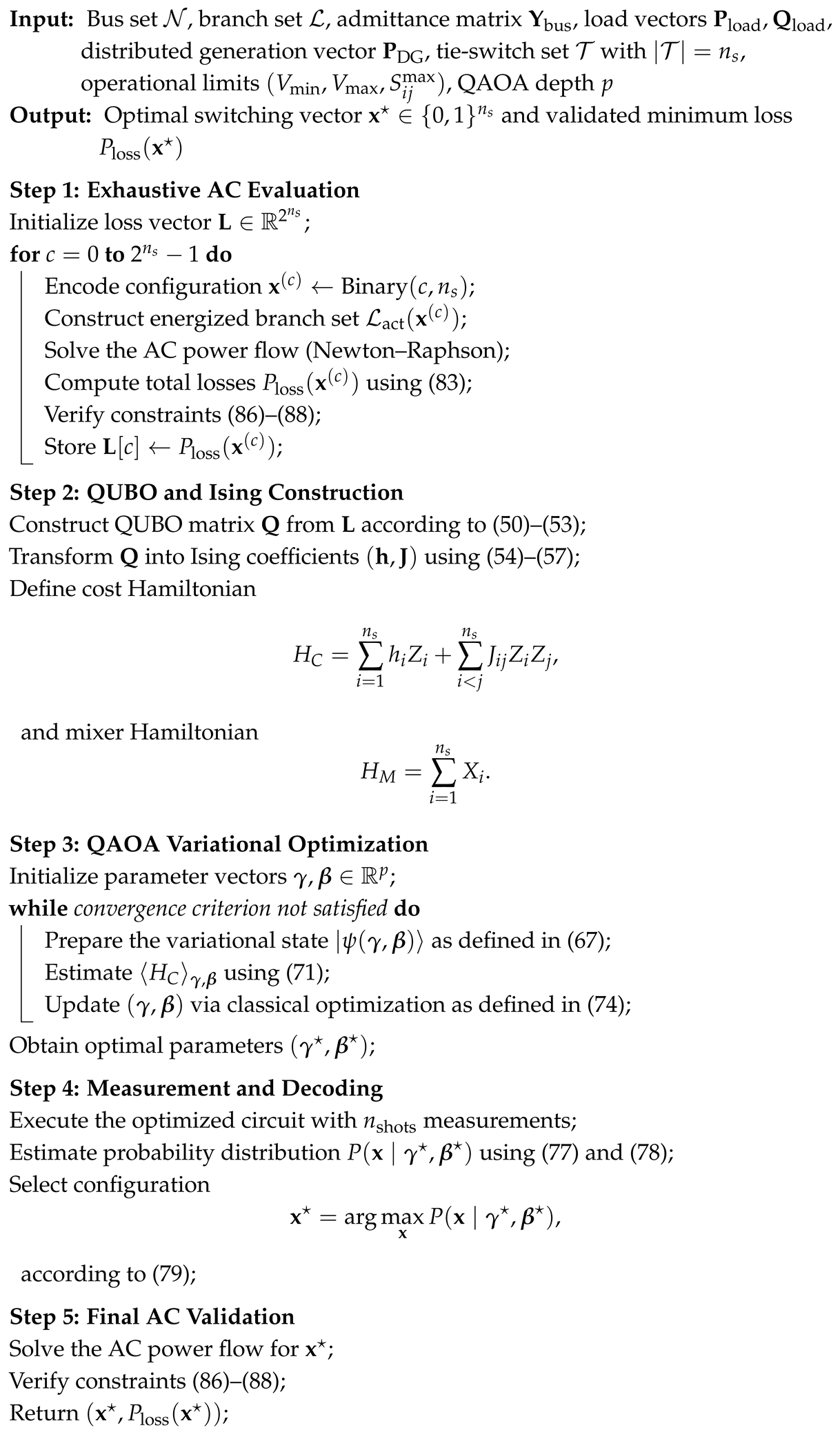 |
The hybrid framework described in Algorithm 1 can be interpreted through five mathematically structured phases that progressively transform the nonlinear mixed-integer problem (83)–(88) into a variational quantum optimization task.
Phase 1: Exhaustive AC Evaluation. All switching configurations are evaluated through nonlinear AC power flow, producing the loss vector , whose components are computed from (83). This phase is fundamental because it captures the complete discrete search space using physically consistent solutions of (84) and (85). Due to the nonlinearity of the AC equations, no analytical mapping between and exists; therefore, this evaluation provides the only reliable representation of the true loss landscape.
Phase 2: QUBO Compression. The discrete evaluations are condensed into a quadratic surrogate model according to (50)–(53). If the loss surface varies smoothly with respect to binary switching decisions, it can be well approximated by a quadratic form involving only independent parameters. This dramatically reduces the dimensionality of the optimization problem while preserving the essential structure of the combinatorial landscape.
Phase 3: Ising Mapping. The QUBO formulation is mapped to the Ising Hamiltonian using the transformation (54)–(57). This change of variables from binary variables to spin variables is required because quantum hardware naturally operates in a two-level spin representation.
Phase 4: Variational QAOA Optimization. The QAOA circuit defined in (67) is constructed from the cost Hamiltonian and mixer Hamiltonian . The variational parameters are optimized by minimizing the expectation value (71). Through quantum superposition, the circuit explores all configurations simultaneously, while interference effects amplify the probability of low-loss states.
3.2. Phase 1: AC Power Flow Evaluation
In this phase, total active losses are computed for each configuration by solving the nonlinear AC power flow. Radiality is enforced through a topology mapping , which specifies which sectionalizing branch must be opened when a given tie-switch is closed.
The set of energized branches is defined as
which guarantees and therefore preserves radial topology in accordance with (88).
For each configuration :
- The admittance matrix is updated according to .
- The AC power flow Equations (84) and (85) are solved via Newton–Raphson (see Section 2.2) until convergence.
- Branch currents are computed using (16).
This process yields a physically consistent evaluation of for every candidate topology and forms the empirical basis for the QUBO construction in the subsequent phase.
3.2.1. AC Power Flow Solution via Newton–Raphson
For each switching configuration , the nonlinear AC power flow defined by (84) and (85) is solved using the Newton–Raphson method described in Section 2.2. The procedure is summarized below in compact mathematical form, consistent with the Jacobian formulation in (8)–(15).
- Initialization: (flat start), .
- Slack bus condition: p.u., rad.
- Iterative update: For iteration k:
- Compute active and reactive power mismatcheswhere and are given by (84) and (85).
- Construct the Jacobian matrix as defined in (8).
- Solve the linear system
- Update state variables:
- Convergence criterion: Stop when
3.2.2. Computation of Active Power Losses
3.2.3. Operational Constraint Verification
For each evaluated configuration, the following constraints are verified:
- Voltage limits (86),
- Thermal limits (87),
- Radiality condition (88).
Only physically feasible configurations are retained in the loss vector construction.
Executing the above procedure for all configurations produces the discrete loss vector
where each entry corresponds to the active power loss (in kW) of a specific binary switching configuration.
3.3. QUBO Matrix Construction
The vector obtained from (90) contains the physically evaluated losses for all discrete configurations. These scalar values are then condensed into a quadratic surrogate model of the form
where represents the switching state vector and is a symmetric real matrix.
The quadratic representation (91) corresponds to the QUBO formulation introduced in Section 2.12 and provides a compact parametric approximation of the discrete loss landscape. This matrix serves as the direct input to the Ising transformation and subsequent QAOA-based optimization.
3.3.1. Statistical Construction of the QUBO Matrix
The construction of each element of in (91) is performed directly from the physically evaluated loss vector defined in (90). Since the entries of are expressed in kW and may differ in magnitude across operating scenarios, a normalization step is first applied to improve numerical conditioning of the quadratic approximation.
Loss Normalization
Each configuration index is mapped to a normalized loss value according to
which is consistent with the normalization introduced in Section 2.12. This transformation rescales all losses to the interval , where 0 corresponds to the minimum-loss configuration and 1 to the maximum-loss configuration.
The resulting normalized vector
preserves the relative ordering of configurations while eliminating dimensional scaling effects.
Diagonal Elements: Individual Switching Effects
The diagonal entries quantify the marginal impact of activating tie-switch i. Let
where denotes the i-th binary component of configuration c. The conditional expectations are defined as
The diagonal coefficient is then computed as
which is consistent with the QUBO definition given in Section 2.12. A negative value of indicates that closing switch i reduces expected normalized losses.
Off-Diagonal Elements: Pairwise Interactions
The interaction term captures the joint influence of switches i and j. Define
The associated conditional expectation is
The off-diagonal coefficient is defined as
where is a weighting factor that regulates the strength of pairwise interactions. This structure is consistent with the quadratic expansion in (91).
3.3.2. Algorithmic Construction of
The complete statistical extraction procedure is summarized in Algorithm 2.
| Algorithm 2: Statistical Construction of the QUBO Matrix |
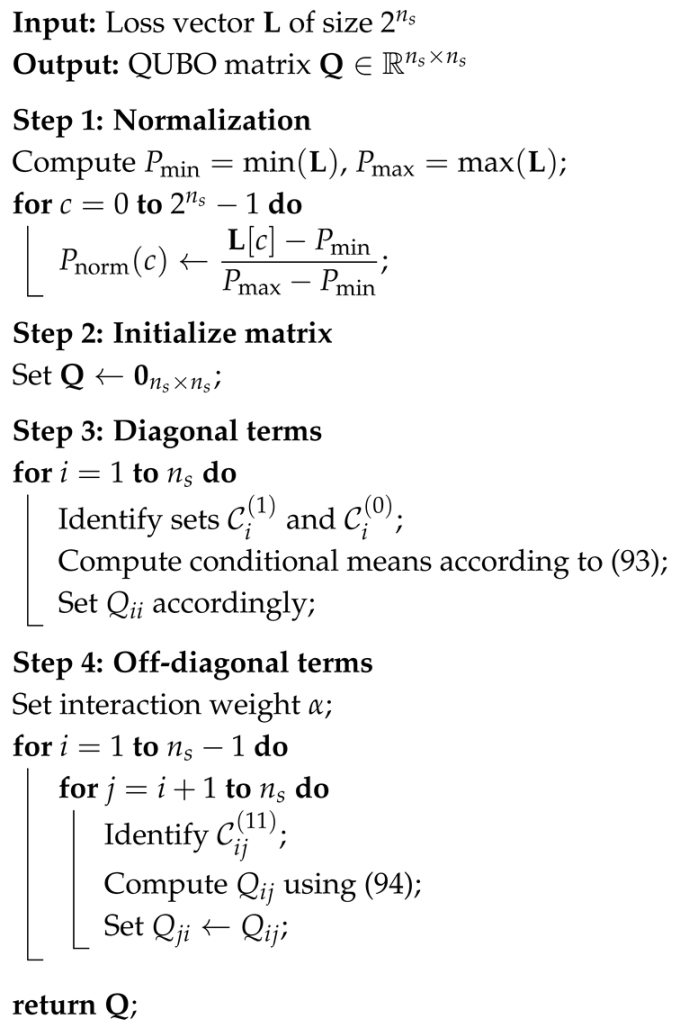 |
After completing this process for all coefficients, a fully populated symmetric matrix is obtained (here, ). This matrix provides a compact quadratic surrogate of the discrete loss landscape derived from the AC evaluations in Phase 1, and it becomes the input for the quantum mapping stage.
3.4. Phase 3: Mapping the QUBO Model to an Ising Hamiltonian
The QUBO matrix obtained in Phase 2 contains the numerical coefficients required to build the corresponding Ising model used by the quantum layer. For clarity, Table 2 reports an example of the resulting for the IEEE 33-bus case study (), where diagonal entries represent individual switching contributions and off-diagonal entries represent pairwise interactions.
Table 2.
Example of the QUBO matrix constructed from the loss evaluations ().
The matrix in Table 2 can be equivalently described by listing its unique coefficients (upper-triangular form):
3.4.1. Binary-to-Spin Transformation
To map the QUBO model into an Ising form, binary variables are converted to spin variables using the transformation introduced in Section 2.13,
Under this mapping, the Ising Hamiltonian can be written as
where the local fields and couplings are computed from following the relations summarized in Section 2.13:
3.4.2. Illustrative Computation of Coefficients
As an illustrative example, is obtained from (98) using and the off-diagonal entries in the first row:
Likewise, the coupling between switches 1 and 2 is computed from (99) as
Repeating the same procedure for all unique coefficients yields the numerical Ising parameters. For the example in Table 2, the corresponding local-field vector is
and the set of pairwise couplings is
The coefficients in (102) and (103) fully define the Ising cost landscape used to construct the quantum cost Hamiltonian.
The arithmetic transformation from the QUBO representation to the Ising model is summarized in Algorithm 3. This procedure computes the local fields and pairwise couplings directly from the entries of the QUBO matrix and yields the coefficients required to construct the Ising Hamiltonian.
| Algorithm 3: QUBO-to-Ising Transformation |
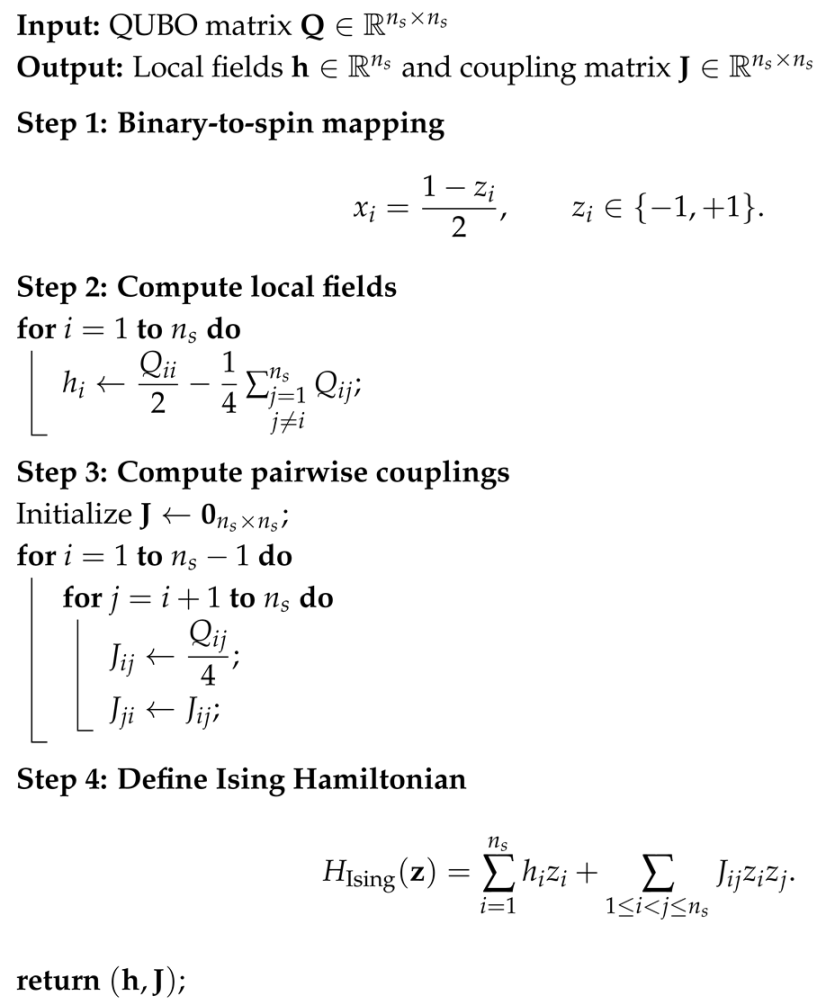 |
The numerical coefficients obtained in Phase 3 define the classical Ising Hamiltonian and are directly embedded into the quantum cost Hamiltonian of the QAOA circuit.
3.5. Phase 4: Quantum Optimization via QAOA
Replacing each spin variable with the Pauli-Z operator yields the quantum cost Hamiltonian
which follows directly from the Ising representation.
For , substituting the numerical coefficients produces
The corresponding phase-separation unitary operator is
where is the variational phase parameter.
The mixer Hamiltonian is defined as
with associated unitary operator
where denotes the Pauli-X operator acting on qubit i and is the mixing parameter.
The operators and define the variational layers of the depth-p QAOA circuit described previously. The classical optimization of aims to minimize the expectation value of , thereby concentrating measurement probability on switching configurations associated with reduced network losses.
The QAOA procedure starts from the uniform superposition state
which is prepared by applying Hadamard gates to all qubits.
For circuit depth , the sequential application of the phase-separation and mixing operators defined in (106) and (108) produces the parametrized quantum state
The optimal variational parameters are obtained by solving
where the objective function is defined as
At each iteration of the classical optimizer, the circuit in (110) is executed with fixed Hamiltonian coefficients (cf. (105)), the resulting bitstrings are measured, and the weighted average defined in (112) is evaluated. The COBYLA algorithm updates until convergence.
The complete variational procedure is summarized in Algorithm 4.
| Algorithm 4: Variational QAOA Optimization |
Input: Cost Hamiltonian , mixer Hamiltonian , QAOA depth p Output: Optimal parameters Step 1: Parameter initialization Sample initial vectors Set Step 2: Define objective function Given : 1. Prepare . 2. For apply 3. Execute the circuit with measurements. 4. Estimate Step 3: Classical optimization Use COBYLA to compute subject to , . Extract return |
After convergence (typically within 50–100 iterations), numerical optimal parameters such as rad and rad are obtained. Combined with the fixed coefficients of (105), these parameters define the optimized quantum state used in the final measurement stage.
3.6. Phase 5: Measurement and Solution Extraction
Using the optimal parameters rad and rad obtained from (111), the final quantum state is prepared according to (110).
where denotes the probability amplitude associated with configuration and .
The circuit is executed with measurements in the computational basis, yielding a frequency histogram over the bitstrings. For illustration, representative outcomes may include
with remaining counts distributed among other configurations.
The empirical probability of each configuration is estimated as
where denotes the number of times configuration is observed.
Applying (114) to the previous counts yields, for example,
The candidate optimal configuration is extracted according to
In this case, the most probable configuration is
with probability .
To ensure physical feasibility, this configuration is validated through the AC power-flow procedure described in Phase 1 (cf. (89) and (90)). The corresponding optimal power-flow solution yields
which coincides with the minimum value identified in the complete loss vector constructed in Phase 1.
Accordingly, the data flow of the hybrid framework can be summarized as follows: the AC evaluation produces loss values as defined in (90); these values are statistically condensed into the quadratic QUBO representation given in (91); the QUBO model is mapped into Ising coefficients using Algorithm 3; the corresponding quantum cost Hamiltonian is constructed as in (104) and embedded into the phase-separation unitary defined in (106); variational optimization determines by minimizing the expectation value defined in (112), according to (111); repeated measurements generate the empirical probability distribution in (114), and the dominant configuration is extracted via (116), after which AC validation closes the optimization loop.
3.7. Computational Environment and Software Implementation
All simulations and optimization procedures were implemented using a hybrid computational environment integrating classical numerical analysis with quantum circuit emulation. The IEEE 33-bus distribution system model, including distributed generation integration and AC Newton–Raphson power-flow calculations, was implemented in MATLAB R2023b using the MATPOWER 7.1 toolbox for nonlinear AC power-flow validation.
The exhaustive evaluation of switching configurations and construction of the loss vector were performed in MATLAB, where each admissible topology was verified for radiality and compliance with voltage (0.95–1.05 p.u.) and thermal current constraints.
The QUBO matrix was generated programmatically in MATLAB and exported to Python 3.11 for quantum processing. The Ising mapping and QAOA implementation were executed using Qiskit 0.45.0 under IBM Quantum Aer statevector simulation backend. Variational parameter optimization was performed using the COBYLA classical optimizer available within the Qiskit optimization module.
All quantum circuits were simulated under noiseless conditions to evaluate algorithmic convergence behavior independent of hardware noise effects. The total computational time reported corresponds to classical preprocessing, QUBO construction, variational optimization, and AC validation.
The complete workflow integrates deterministic AC feasibility analysis with quantum variational optimization, ensuring reproducibility of the hybrid framework under standard scientific computing environments.
3.8. Hybrid QAOA–AC OPF Algorithmic Flow
The complete computational workflow of the proposed hybrid framework is summarized in Figure 1. The algorithm integrates classical AC feasibility evaluation with quantum variational optimization in an iterative hybrid structure.
Figure 1.
Algorithmic flow of the proposed hybrid QAOA–AC OPF framework integrating AC feasibility validation with quantum-assisted combinatorial optimization.
3.9. Validation Case
The proposed methodology is validated on the IEEE 33-bus distribution system (Figure 2), considering five tie-switches (, possible configurations) and distributed generation totaling 1.9 MW, allocated as follows: 500 kW at bus 14, 800 kW at bus 25, and 600 kW at bus 30. This distributed generation represents 51.1% of the total system demand.
Figure 2.
IEEE 33-bus test system with distributed generation.
3.10. Communication Architecture and DER Coordination Assumptions
Although the primary focus of this work is topological optimization through hybrid quantum–classical computation, coordinated operation of DERs requires an underlying supervisory communication structure. The adopted framework assumes a centralized Distribution Management System (DMS) architecture in which real-time measurements are transmitted from field devices to a supervisory controller.
Each DER unit is assumed to be interfaced through a smart inverter compliant with IEEE 1547 operational requirements, capable of providing active and reactive power measurements as well as voltage magnitude information at its point of common coupling. Measurements are acquired via intelligent electronic devices (IEDs) and transmitted through a supervisory control and data acquisition (SCADA) layer to the DMS.
Let denote the set of buses and the subset containing DER-connected nodes. At each sampling interval t, the measurement vector received by the DMS is defined as
where and represent active and reactive injections, and denotes the bus voltage magnitude.
These measurements are used to update the system state prior to executing the reconfiguration algorithm. The hybrid QAOA–AC OPF framework is therefore executed at the supervisory level, assuming reliable low-latency communication between DER inverters and the DMS. The communication layer is not modeled as a dynamic network but is treated as an enabling infrastructure ensuring that all state variables required for AC feasibility validation are available before each optimization cycle.
Switching commands determined by the optimization process are transmitted back through the same communication infrastructure to remotely controlled sectionalizing and tie switches. The overall architecture corresponds to a centralized optimization paradigm commonly adopted in active distribution networks with moderate DER penetration levels.
This assumption ensures consistency between DER operation, AC feasibility evaluation, and topological reconfiguration while maintaining tractable computational complexity for the hybrid quantum–classical workflow.
4. Results Analysis
Three operating scenarios were defined to evaluate the proposed methodology. The first scenario corresponds to the Baseline case, which represents the original radial network without distributed generation (DG). The second scenario, denoted as With DG, considers the integration of 1900 kW of renewable generation at buses 14, 25, and 30 while preserving the original topology. Finally, the DG + QAOA case represents the optimal reconfiguration obtained through the proposed hybrid quantum–classical algorithm.
The performance indicators analyzed include: (i) total active power losses (kW); (ii) nodal voltage magnitude (p.u.); (iii) percentage voltage deviation (%); (iv) accumulated losses per bus (kW); (v) losses per line (kW); and (vi) line loading (%). Each configuration was validated through an AC Newton–Raphson power flow, verifying radial operation as well as compliance with voltage limits (0.95–1.05 p.u.) and thermal capacity constraints of all lines.
4.1. Results of the QAOA Optimization Process
The algorithm exhaustively evaluated the 32 possible tie-switch configurations (five binary decisions: SW33–SW37), identifying 16 feasible configurations that preserve radiality. Table 3 reports the complete set of evaluated combinations along with their corresponding active power losses.
Table 3.
Complete evaluation of switching configurations using QAOA. A configuration is classified as infeasible if the AC power-flow solution does not converge or if any operational constraint is violated, namely voltage magnitude limits for any bus i, branch thermal limits, or the radiality requirement imposed for distribution operation.
According to Table 3, losses among feasible configurations range from 87.083 kW (configuration 14, global optimum) to 182.301 kW (configuration 19, worst feasible case), resulting in a total span of 95.218 kW. In particular, QAOA converged to configuration 10 with losses of 95.773 kW, i.e., closing tie-switches SW34 and SW37 while keeping SW33, SW35, and SW36 open. This solution exhibits a 9.98% optimality gap relative to the global optimum; however, it requires only two switching operations (closure of SW34 and SW37) compared to three operations in the global optimum (closure of SW34, SW35, and SW37), which simplifies practical field operation. The total computational time was 1.36 s.
Next, Table 4 summarizes the five best configurations identified during the optimization process, ranked by active power losses.
Table 4.
Top five optimal switching configurations.
As shown in Table 3, the Rank 1 configuration (global optimum) achieves the lowest losses (87.083 kW) with a 0.00% gap. The QAOA solution (Rank 2) yields 95.773 kW with a 9.98% gap, corresponding to an increase of 8.690 kW relative to the optimum. Rank 3 requires only the closure of SW37 and results in 96.987 kW, with an 11.37% gap. Notably, the difference between Rank 2 and Rank 3 is only 1.214 kW (approximately 1.25%), highlighting the sensitivity of the system to switching actions involving SW34. In contrast, Rank 4 and Rank 5 present gaps above 22.80% and 37.10%, respectively, indicating inferior technical performance.
Finally, as shown in Table 5, radiality is directly confirmed by the presence of OFF branches that remove redundant paths. In particular, opening lines 9 (9–10) and 28 (28–29) guarantees that, even with the tie-links in service, no loops are formed in the resulting topology. In addition, branches 33 (8–20), 35 (12–22), and 36 (18–33) remain OFF, which is consistent with their association to tie-switches that are not operated in this configuration.
Table 5.
Line status, losses, and loading for the optimal configuration (DG + QAOA).
From a performance perspective, losses are mainly concentrated in upstream branches with higher power transfer. The dominant contributors are line 2 (2–3) with 27.10 kW, line 23 (23–24) with 13.40 kW, and line 24 (24–25) with 9.73 kW, confirming that the primary loss component is located in heavily loaded feeder segments. Moreover, the existence of OFF branches with zero losses and 0% loading confirms consistency between the topological switching state and the AC power-flow results, thereby supporting the operational validity of the optimized configuration.
4.2. Electrical Variable Analysis
The impact of distributed generation and network reconfiguration on voltage performance is illustrated in Figure 3, which compares the voltage magnitude profiles along the 33 buses for the three evaluated scenarios.
Figure 3.
Comparison of voltage magnitude profiles for the IEEE 33-bus test system under Baseline, With DG, and DG + QAOA scenarios.
In the Baseline case, a progressive voltage drop is observed along the feeder, reaching a minimum value of 0.8828 p.u. at bus 18 (). This violates the admissible operational range due to the high cumulative impedance of the radial feeder and the absence of local power support.
In the With DG scenario, the integration of 1.9 MW of distributed generation increases the minimum voltage to 0.9305 p.u. at bus 33. This improvement results from the reduction of upstream current magnitudes caused by local power injection, thereby mitigating ohmic voltage drops.
Finally, the DG + QAOA configuration further improves the minimum voltage to 0.9531 p.u. at bus 10. This enhancement is achieved by closing SW34 (interconnecting buses 9–15) and SW37 (interconnecting buses 25–29), which create lower-impedance alternative paths. As a result, power flows are redistributed and the most critical voltage point shifts from terminal buses toward intermediate nodes with lower accumulated impedance.
The percentage voltage deviations relative to the nominal value are depicted in Figure 4. This representation allows a direct verification of compliance with the operational limits.
Figure 4.
Percentage voltage deviation per bus for the IEEE 33-bus system under the three evaluated scenarios.
In the Baseline scenario, buses 12–18 exhibit deviations between and , reflecting the cumulative effect of resistive voltage drops along high-impedance sections of the feeder.
With distributed generation, deviations are reduced to approximately to in areas close to buses 14, 25, and 30 due to the decrease in net current supplied from the substation.
Under the DG + QAOA configuration, all buses remain within the admissible range as specified by IEEE Std 1547-2018 [41]. The maximum deviation is at bus 10, demonstrating that reconfiguration not only redistributes flows but also spatially balances voltage drops throughout the network.
The accumulated active power losses per bus are shown in Figure 5. High-loss nodes correspond to convergence points of major feeder currents.
Figure 5.
Accumulated active power losses per bus for the IEEE 33-bus test system under the three scenarios.
Buses 2, 3, 23, and 24 concentrate the highest accumulated losses in all scenarios. In particular, bus 3 accumulates 51.90 kW in the Baseline case due to elevated currents in line 2–3 and its downstream branches.
After integrating distributed generation, the losses at bus 3 decrease to 23.64 kW, representing a 54.5% reduction. This improvement is attributed to local injection reducing upstream current magnitudes.
Under the DG + QAOA configuration, losses at bus 3 further decrease to 19.64 kW, corresponding to a 62.2% reduction relative to the Baseline. The additional improvement arises from flow redistribution enabled by SW37, which diverts part of the current through the alternative path 25–29–30, relieving lines 2–3 and 23–24–25.
The distribution of active power losses across the 37 lines is presented in Figure 6.
Figure 6.
Active power losses per line for the IEEE 33-bus test system under the three evaluated scenarios.
Line 2 (buses 2–3) exhibits the highest losses in all scenarios, as it carries the main feeder current. In the Baseline case, this line reaches 72.56 kW, associated with an approximate current of 246 A. With distributed generation, losses decrease to 27.10 kW, representing a 62.7% reduction due to current reduction to approximately 141 A.
In the DG + QAOA case, losses in line 2 remain at 27.10 kW, since the trunk feeder flow is not significantly altered by reconfiguration.
Additionally, lines 22–24 (secondary feeder 3–23–24–25) reduce their combined losses from 72.48 kW in the Baseline case to 30.45 kW in the DG + QAOA configuration due to the bidirectional support enabled by SW37.
Finally, Figure 7 illustrates the active loading percentage of each line.
Figure 7.
Active line loading comparison for the IEEE 33-bus test system under Baseline, With DG, and DG + QAOA scenarios.
In the Baseline scenario, line 1 operates at 62.34% of its thermal capacity, indicating limited operational margin.
With distributed generation, the loading of line 1 decreases to 39.80% due to reduced substation supply.
In the DG + QAOA configuration, line 1 remains at 39.80%, while line 34 (buses 9–15) operates at 4.30% and line 37 (buses 25–29) at 12.16%. Previously inactive tie-lines thus become active parallel paths, improving redundancy and spatially redistributing power flows.
Consequently, the maximum line loading remains below 40%, ensuring adequate operational security margins under demand or generation variability.
The overall impact of distributed generation and quantum-assisted reconfiguration on system-wide losses is illustrated in Figure 8, which presents the progressive reduction in total active power losses across the three evaluated scenarios.
Figure 8.
Total active power loss reduction for the IEEE 33-bus test system under Baseline, With DG, and DG + QAOA scenarios.
In the Baseline configuration, total active losses amount to 282.938 kW. The integration of 1900 kW of distributed generation reduces total losses to 120.649 kW, corresponding to a 57.4% decrease. This first-stage reduction is primarily explained by the quadratic dependence of resistive losses on current magnitude (): local power injection significantly decreases upstream current flow from the substation, thereby reducing feeder losses.
Subsequently, the DG + QAOA reconfiguration further reduces total losses to 95.773 kW, achieving an overall reduction of 66.15% relative to the Baseline. This second-stage improvement arises from topological reconfiguration, specifically through the closure of SW34 and SW37, which effectively reduces the electrical distance between generation and load centers. By shortening high-impedance paths and redistributing power flows, the network operates with lower equivalent impedance.
The absolute reduction of 187.165 kW translates into an annual energy saving of approximately 1638 MWh, assuming continuous operation over 8760 h/year. Notably, the additional reduction of 24.876 kW (20.62%) between the With DG and DG + QAOA scenarios highlights the synergistic potential of combining distributed generation with optimal network reconfiguration.
To further quantify the individual contribution of each strategy, Figure 9 presents a normalized waterfall diagram of loss reductions.
Figure 9.
Normalized loss reduction and individual contribution of distributed generation and QAOA-based reconfiguration. The downward arrows denote the progressive decrease in normalized losses relative to the baseline case.
The integration of distributed generation alone provides a 57.4% reduction, equivalent to kW relative to the normalized 100% loss level of the Baseline case. The QAOA-based reconfiguration contributes an additional 20.6% reduction, corresponding to kW relative to the With DG scenario.
In absolute terms, the contribution of distributed generation is larger because it directly modifies feeder current magnitudes. In contrast, QAOA optimizes the spatial redistribution of existing flows by altering network topology. Nevertheless, their combined action yields a total loss reduction efficiency of 78.0%, meaning that final losses represent only 22.0% of the Baseline value.
This result confirms that reconfiguration without distributed generation would be insufficient to meet ambitious loss-reduction targets, while distributed generation without optimal reconfiguration leaves a 20.6% optimization potential unexploited.
Finally, Table 6 summarizes the technical performance comparison across the three scenarios, quantifying improvements in the principal electrical variables.
Table 6.
Technical performance comparison among Baseline, With DG, and DG + QAOA scenarios.
As shown in Table 6, the DG + QAOA configuration fully satisfies the admissible voltage limits (0.95–1.05 p.u.), achieving an average voltage of 0.970 p.u. compared to 0.9378 p.u. in the Baseline scenario, representing a 3.44% improvement.
Moreover, reconfiguration shifts the critical voltage point from terminal buses (bus 18 in the Baseline, bus 33 in With DG) toward bus 10 in the DG + QAOA case. This displacement indicates a more balanced impedance distribution and improved voltage support across the network.
Overall, the results demonstrate that the combined integration of distributed generation and quantum-assisted optimal reconfiguration significantly enhances technical performance in terms of loss minimization, voltage regulation, and operational security margins.
5. Discussion
This study investigated the combined impact of distributed generation (DG) integration and quantum-assisted network reconfiguration on the technical performance of a benchmark radial distribution feeder. The results demonstrate that DG and topology reconfiguration act through complementary physical mechanisms and, when jointly optimized, provide a synergistic improvement in loss reduction and voltage regulation beyond what either strategy achieves independently.
5.1. Interpretation of the Main Findings
From a power-flow standpoint, the substantial loss reduction obtained after DG integration is primarily explained by the reduction of upstream current magnitudes. Since resistive losses scale with the square of current, local active power injection reduces the current drawn from the substation and therefore mitigates losses in the most heavily loaded upstream branches. This behavior is consistent with classical distribution-planning theory: placing generation near load centers decreases the electrical distance between sources and loads and diminishes the power transferred through high-impedance segments.
However, DG alone does not guarantee that the network operates close to its globally optimal electrical configuration. Even with significant upstream current relief, the remaining losses are strongly influenced by how power flows are spatially distributed across laterals, particularly in feeders that exhibit multiple high-impedance paths and localized load concentrations. This explains why the additional reconfiguration stage (DG + QAOA) yields a non-trivial incremental improvement. In this work, the QAOA-driven switching action reduces the effective impedance of critical delivery paths by enabling alternative routes with lower cumulative resistance and reactance. The observed additional loss reduction after reconfiguration indicates that, under DG operation, the network still contains latent degrees of freedom that can be exploited through topology to reduce losses and improve voltage support.
A key qualitative outcome is the migration of the critical voltage location. Under the baseline radial topology, the minimum voltage occurs at a downstream bus where cumulative series impedance and high power transfer jointly produce large voltage drops. After DG integration, the minimum-voltage point shifts as injections modify net downstream currents and change where the largest voltage drops accumulate. With DG+QAOA, the critical point shifts again toward an intermediate bus, reflecting a more balanced impedance distribution and a reduction of voltage-drop concentration in terminal segments. This behavior highlights a central implication: reconfiguration does not merely reduce losses but also redistributes voltage sensitivity along the feeder, thereby enhancing operational robustness.
5.2. Comparison with Prior Studies and Methodological Implications
Prior work on distribution reconfiguration has long established that feeder losses and voltage violations can be mitigated by selecting an appropriate set of switching actions while maintaining radiality and operational constraints. Similarly, the benefits of DG for loss reduction and voltage profile improvement are well documented in the literature, with performance strongly dependent on DG size, placement, and dispatch strategy. The present results reinforce these established conclusions while adding an important systems-level insight: the effectiveness of topology reconfiguration increases when DG is present because generation modifies the flow patterns that determine which loops (and therefore which switching actions) produce the largest electrical benefit.
From an optimization perspective, this also explains why hybrid quantum–classical approaches are attractive for constrained, combinatorial decision spaces such as switch selection. Even for moderate-size networks, the number of candidate topologies grows exponentially with the number of controllable switches. In this context, QAOA offers a principled framework to explore discrete configurations and, critically, to prioritize feasible candidates under radiality and operational constraints. The results show that QAOA can converge to near-optimal configurations with a limited number of switching maneuvers, which is operationally relevant because excessive switching increases wear, coordination complexity, and service risk.
The practical interpretation is that system operators may not always prefer the absolute global minimum-loss topology if it requires a larger number of switching operations. Instead, a slightly suboptimal topology can be preferable if it achieves most of the technical benefit while minimizing operational interventions. This trade-off is fundamental in real-world distribution operation and supports the relevance of reporting not only the best solution but also the best solutions under restricted switching budgets.
5.3. Operational Relevance and Engineering Significance
The improvements reported here are not merely numerical. Reducing losses translates into tangible energy savings and lower operational expenditure, while improving voltage profiles reduces the likelihood of customer undervoltage events and helps maintain compliance with regulatory limits. Moreover, distributing flows through alternative paths can reduce loading concentration on specific lines and increase the margin to thermal limits, thereby improving resilience to demand variability and DG intermittency.
The fact that the maximum line loading remains well below critical thresholds across improved scenarios suggests that the proposed approach can increase the feeder security margin. Importantly, the activation of tie-lines in a controlled manner creates additional supply paths that can also be beneficial for restoration strategies under contingencies, provided that protection coordination and switching policies are properly addressed.
5.4. Limitations
Despite these promising outcomes, several limitations should be recognized. First, the analysis assumes steady-state operation under a single operating condition per scenario. In practice, distribution systems experience time-varying load profiles and DG intermittency, which can change the optimal switching configuration over time. Second, this study focuses on active power losses and voltage constraints; protection coordination, fault current levels, and reliability indices were not explicitly integrated into the optimization objective. Third, while AC Newton–Raphson validation confirms feasibility for each candidate configuration, the computational burden can increase when extending the approach to larger networks and multiple time steps.
In addition, the DG modeling was treated primarily as active power injection at selected buses. Reactive power capability, inverter control modes (e.g., Volt/VAR), and dispatch constraints may alter voltage regulation and loss patterns, potentially changing the preferred topologies. Therefore, the presented results should be interpreted as a rigorous demonstration of the underlying physical synergy rather than an exhaustive operational policy.
5.5. Future Research Directions
Several research directions naturally follow from this work. A first extension is the incorporation of multi-period optimization with time-varying load and generation profiles, enabling the derivation of switching schedules rather than a single static configuration. A second direction is the integration of inverter-based reactive power control and voltage regulation policies into the objective, allowing coordinated optimization of topology and DG control setpoints. A third direction is to embed reliability and protection constraints—such as fault current limits, relay coordination, and sectionalizing/restoration performance—to ensure that the optimized configurations are deployable under standard utility practices.
From the quantum optimization perspective, future studies should evaluate scalability under larger switch sets and explore parameter-setting strategies (depth selection, warm-starting, and hybrid heuristics) that improve convergence robustness. Benchmarking against established classical metaheuristics and mixed-integer nonlinear programming approaches under identical constraints would further clarify where QAOA provides the greatest computational advantage. Finally, investigating uncertainty-aware formulations (stochastic or robust optimization) would strengthen the applicability of quantum-assisted reconfiguration under DG variability and measurement uncertainty.
5.6. On Real-Time and Hardware-in-the-Loop Validation
The present study focuses on the methodological integration of AC-feasible power-flow validation with hybrid quantum optimization under a controlled simulation environment. Hardware-in-the-loop (HIL) implementation was not considered in this stage for three principal technical reasons.
First, the primary objective of this work is to establish a physically consistent hybrid formulation that embeds nonlinear AC feasibility within a quantum-assisted combinatorial search. Validation at this level requires deterministic repeatability of switching configurations and loss evaluation, which is best achieved through numerical simulation prior to hardware deployment.
Second, current Noisy Intermediate-Scale Quantum (NISQ) devices impose limitations in terms of qubit count, coherence time, and circuit depth. Consequently, the QAOA implementation in this work was executed using statevector simulation to evaluate algorithmic convergence properties independently of hardware noise. Direct integration of quantum hardware into a real-time HIL environment would introduce stochastic noise effects that could obscure methodological performance assessment.
Third, distribution network reconfiguration operates at supervisory timescales (minutes rather than milliseconds), unlike fast inverter-level control loops. Therefore, the proposed hybrid optimization framework is conceptually aligned with centralized operational planning rather than sub-cycle real-time control, making immediate HIL validation non-essential for proof-of-concept demonstration.
Nevertheless, the proposed formulation is fully compatible with real-time digital simulators and supervisory HIL platforms. Future research will investigate integration with real-time digital simulators (RTDSs) and inverter-level controllers to evaluate communication latency, switching transients, and robustness under hardware constraints. Such extensions would provide additional validation under realistic operating conditions while preserving the hybrid optimization structure established in this work.
6. Conclusions
This work proposed, formulated, and experimentally validated a hybrid quantum–classical framework for distribution network reconfiguration under distributed generation (DG) integration, combining AC-feasible power-flow validation, QUBO-based problem compression, Ising transformation, and QAOA-based combinatorial optimization. The principal conclusions, aligned with the objectives stated in this study, are summarized as follows:
- Achievement of the primary objective: loss minimization under AC feasibility. The proposed methodology successfully identified a practically optimal reconfiguration by closing tie-switches SW34 and SW37, establishing alternative electrical paths between buses 9–15 and 25–29. This topology reduces total active power losses to kW, corresponding to a 66.15% reduction relative to the baseline radial configuration ( kW) and an additional 20.62% reduction beyond the DG-only scenario ( kW). The solution exhibits a gap of 9.98% with respect to the global minimum ( kW), requires only two switching operations (versus three for the absolute optimum), and converges in s. These results confirm that the hybrid QAOA approach meets the central objective of minimizing technical losses while preserving operational feasibility and limiting switching complexity.
- Successful compression of the combinatorial search space via QUBO formulation. The exhaustive AC evaluation of the configurations was compactly encoded into a QUBO matrix containing 15 independent parameters. The diagonal elements quantify individual switching effects (e.g., , ), whereas off-diagonal terms capture pairwise interactions (e.g., ), thereby embedding nonlinear AC power-flow behavior into a quadratic binary representation. The subsequent transformation to Ising coefficients yielded physically interpretable local fields and couplings (e.g., , ). This structured compression demonstrates that the nonlinear, nonconvex AC reconfiguration problem can be rigorously mapped to a Hamiltonian suitable for quantum variational processing without violating electrical constraints.
- Effective variational optimization using shallow-depth QAOA. A depth- QAOA circuit converged to optimal parameters and , producing configuration with probability . Despite the shallow circuit depth, the algorithm concentrated probability mass around high-quality feasible solutions, confirming that low-depth variational quantum circuits can effectively explore structured combinatorial spaces when guided by physically informed Hamiltonians. This validates the secondary objective of assessing the applicability of NISQ-era quantum optimization to distribution system operation problems.
- Voltage regulation and compliance with operational standards. Beyond loss minimization, the DG + QAOA configuration significantly improves voltage performance. The minimum bus voltage increases from 0.8828 p.u. (Bus 18, baseline) to 0.9531 p.u. (Bus 10), reducing the maximum deviation from to and thereby satisfying IEEE 1547 voltage limits of . This demonstrates that the optimized topology not only minimizes resistive losses but also redistributes impedance in a manner that mitigates cumulative voltage drops, confirming fulfillment of the objective of enhancing voltage stability.
- Synergistic interaction between DG and topology reconfiguration. The results quantitatively demonstrate a two-stage reduction mechanism. DG integration alone contributes 57.4% of the total loss reduction by decreasing upstream currents (quadratic effect). The QAOA-driven reconfiguration contributes an additional 20.6% relative improvement by shortening effective electrical distances and enabling alternative low-impedance pathways. The combined strategy achieves an overall efficiency of 78.0% relative to baseline losses. This confirms that DG and topology optimization are not redundant measures but complementary control dimensions whose joint application maximizes technical performance.
- Physical interpretation of current and loss redistribution. The trunk line 2–3 current decreases from approximately 246 A in the baseline scenario to 141 A after DG integration, substantially reducing its associated losses. Furthermore, reconfiguration redistributes feeder currents, lowering accumulated losses at Bus 3 from kW to kW, a 62.2% reduction. These results confirm that the optimized topology effectively unloads high-resistance branches and spatially balances power flows, reinforcing the physical validity of the obtained solution.
- Computational and methodological implications. This study demonstrates that hybrid quantum–classical optimization can address AC-feasible distribution reconfiguration problems within practical computational time, even when full AC validation is preserved. Although classical enumeration was tractable for , the QUBO–Ising–QAOA pipeline establishes a scalable methodological pathway for larger switch sets, where exhaustive enumeration becomes intractable.
- Limitations and future research directions. The validation was performed on a medium-scale benchmark system with enumerably finite configurations, static DG injection, and shallow circuit depth (). Future research should extend the framework to larger feeders via hierarchical or decomposed QUBO mappings, incorporate stochastic renewable variability and time-series optimization, integrate reactive power and inverter control strategies, and evaluate performance on real NISQ hardware to quantify noise sensitivity. Additionally, embedding reliability, protection coordination, and mixed-integer continuous decision variables (e.g., storage dispatch) would further generalize the framework toward real-world deployment.
In conclusion, the objectives of this work have been fully achieved: (i) rigorous AC-feasible loss minimization, (ii) structured QUBO compression of nonlinear electrical behavior, (iii) successful Ising mapping and QAOA optimization, and (iv) demonstrable improvements in voltage regulation and operational margins. The findings substantiate the technical feasibility and practical promise of hybrid quantum-assisted reconfiguration for next-generation active distribution networks.
Author Contributions
Conceptualization, J.L.B., A.A.T. and R.A.O.M.; methodology, J.L.B., A.A.T. and R.A.O.M.; software, J.L.B., A.A.T. and R.A.O.M.; validation, J.L.B., A.A.T. and R.A.O.M.; formal analysis, J.L.B., A.A.T. and R.A.O.M.; investigation, J.L.B., A.A.T. and R.A.O.M.; resources, J.L.B., A.A.T. and R.A.O.M.; data curation, J.L.B., A.A.T. and R.A.O.M.; writing—original draft preparation, J.L.B., A.A.T. and R.A.O.M.; writing—review and editing, J.L.B., A.A.T. and R.A.O.M.; visualization, J.L.B., A.A.T. and R.A.O.M.; supervision, J.L.B., A.A.T. and R.A.O.M.; project administration, J.L.B., A.A.T. and R.A.O.M. All authors have read and agreed to the published version of the manuscript.
Funding
This research received no external funding. The article processing charge (APC) was funded by Universidad Politécnica Salesiana (UPS), Quito, Ecuador.
Data Availability Statement
The data supporting the findings of this study are available from the corresponding author upon reasonable request. The simulation models and numerical results were generated using deterministic AC power flow and quantum-circuit simulations, as described in the Section 2.
Acknowledgments
The author acknowledges the use of numerical simulation tools for AC power flow analysis and quantum circuit emulation. The author is solely responsible for the scientific content and interpretation presented in this manuscript.
Conflicts of Interest
The author declares no conflicts of interest.
Abbreviations
| AC | Alternating Current |
| DG | Distributed Generation |
| IEEE | Institute of Electrical and Electronics Engineers |
| Ising | Ising Spin Model |
| NISQ | Noisy Intermediate-Scale Quantum |
| OPF | Optimal Power Flow |
| QAOA | Quantum Approximate Optimization Algorithm |
| QUBO | Quadratic Unconstrained Binary Optimization |
| SW | Switch |
References
- Ali, M.H.; Mehanna, M.; Othman, E. Optimal planning of RDGs in electrical distribution networks using hybrid SAPSO algorithm. Int. J. Electr. Comput. Eng. 2020, 10, 6153–6163. [Google Scholar] [CrossRef] [Scilit]
- Beza, T.M.; Huang, Y.-C.; Kuo, C.-C. A Hybrid Optimization Approach for Power Loss Reduction and DG Penetration Level Increment in Electrical Distribution Network. Energies 2020, 13, 6008. [Google Scholar] [CrossRef] [Scilit]
- Bouhouras, A.S.; Gkaidatzis, P.A.; Labridis, D.P. Network Reconfiguration in Modern Power Distribution Networks. In Modern Power Distribution Systems; Springer: Cham, Switzerland, 2020; pp. 219–255. [Google Scholar] [CrossRef] [Scilit]
- Quan, H.; Li, Z.; Zhou, T.; Yin, J. Two-stage optimization strategy of multi-objective Volt/Var coordination in electric distribution network considering renewable uncertainties. Energy Rep. 2023, 9, 155–166. [Google Scholar] [CrossRef] [Scilit]
- Alshareef, S.; Fathy, A. Efficient Red Kite Optimization Algorithm for Integrating the Renewable Sources and Electric Vehicle Fast Charging Stations in Radial Distribution Networks. Mathematics 2023, 11, 3305. [Google Scholar] [CrossRef] [Scilit]
- Esmaeilnezhad, B.; Amini, H.; Noroozian, R.; Jalilzadeh, S. Flexible Reconfiguration for Optimal Operation of Distribution Network Under Renewable Generation and Load Uncertainty. Energies 2025, 18, 266. [Google Scholar] [CrossRef] [Scilit]
- Ghofrani, M.; Tran, C.; Cauilan, J. Distribution System Reconfiguration Optimization for EV and Renewable DG Integration. In Proceedings of the 2024 IEEE/PES Transmission and Distribution Conference and Exposition (T&D), Dallas, TX, USA, 20–23 May 2024; IEEE: Piscataway, NJ, USA, 2024; pp. 1–5. [Google Scholar] [CrossRef] [Scilit]
- Amin, F.; Sarjiya, S.; Isnaeni, M.; Atmaja, W.Y. Network Reconfiguration Strategies for Reducing Network Losses Under High PV Penetration. In Proceedings of the 2024 16th International Conference on Information Technology and Electrical Engineering (ICITEE), Yogyakarta, Indonesia, 9–10 October 2024; IEEE: Piscataway, NJ, USA, 2024; pp. 352–357. [Google Scholar] [CrossRef] [Scilit]
- Hachemi, A.T.; Sadaoui, F.; Saim, A.; Ebeed, M.; Arif, S. Dynamic operation of distribution grids with the integration of photovoltaic systems and distribution static compensators considering network reconfiguration. Energy Rep. 2024, 12, 1623–1637. [Google Scholar] [CrossRef] [Scilit]
- Nguyen, T.L.; Nguyen, Q.A. A Multi-Objective PSO-GWO Approach for Smart Grid Reconfiguration with Renewable Energy and Electric Vehicles. Energies 2025, 18, 2020. [Google Scholar] [CrossRef] [Scilit]
- Takano, H.; Murata, J.; Asano, H.; Tuyen, N.D. Reconfiguration of Electric Power Distribution Networks: A Typical Application of Metaheuristics in Electrical Power Field. In Metaheuristics in Electrical Power Engineering; Springer: Singapore, 2022; pp. 111–139. [Google Scholar] [CrossRef] [Scilit]
- Ram, A.R.; Ceh, J. Introduction to Power Distribution Network Reconfiguration Techniques. 2021. Available online: https://www.irjet.net/archives/V8/i1/IRJET-V8I1346.pdf (accessed on 10 February 2026).
- Sou, K.C.; Giron, K. Joint Renewable Generation Maximization and Radial Distribution Network Reconfiguration. In Proceedings of the 2022 IEEE PES Innovative Smart Grid Technologies—Asia (ISGT Asia), Singapore, 1–4 November 2022; IEEE: Piscataway, NJ, USA, 2022; pp. 16–20. [Google Scholar] [CrossRef] [Scilit]
- Paul, S.K.; Mohapatra, A.; Das, D.C. A new continuous variables and convex relaxation based formulation for reconfiguration of unbalanced mutually coupled active distribution networks. Electr. Power Syst. Res. 2024, 228, 110009. [Google Scholar] [CrossRef] [Scilit]
- Helmi, A.M.; Carli, R.; Dotoli, M.; Ramadan, H.S. Efficient and Sustainable Reconfiguration of Distribution Networks via Metaheuristic Optimization. IEEE Trans. Autom. Sci. Eng. 2022, 19, 82–98. [Google Scholar] [CrossRef] [Scilit]
- Iqbal, M.A.; Zafar, R. A Novel Radiality Maintenance Algorithm for the Metaheuristic Based Co-Optimization of Network Reconfiguration with Battery Storage. IEEE Access 2023, 11, 25689–25701. [Google Scholar] [CrossRef] [Scilit]
- Ngo, A.P.; Nguyen, H.T. Quantum Combinatorial Optimization Algorithms for Network Reconfiguration: QRAO vs. QAOA. In Proceedings of the 2024 56th North American Power Symposium (NAPS), Arlington, VA, USA, 13–15 October 2024; IEEE: Piscataway, NJ, USA, 2024; pp. 1–6. [Google Scholar] [CrossRef] [Scilit]
- Kozdrowski, S.; Żotkiewicz, M.; Wnuk, K.; Sikorski, A.; Sujecki, S. A Comparative Evaluation of Nature Inspired Algorithms for Telecommunication Network Design. Appl. Sci. 2020, 10, 6840. [Google Scholar] [CrossRef] [Scilit]
- Ngo, A.P.; Thomas, C.; Nguyen, H.; Eroglu, A.; Oikonomou, K. Evaluate Quantum Combinatorial Optimization for Distribution Network Reconfiguration. In Proceedings of the 2022 North American Power Symposium (NAPS), Salt Lake City, UT, USA, 9–11 October 2022; IEEE: Piscataway, NJ, USA, 2022; pp. 1–6. [Google Scholar] [CrossRef] [Scilit]
- Gerez, C.; Costa, E.C.M.; Filho, A.J.S. Behavior analysis of new bio-inspired metaheuristics to solve distribution network reconfiguration problem under different radiality constraints representation. Int. J. Numer. Model. Electron. Netw. Devices Fields 2021, 34, e2922. [Google Scholar] [CrossRef] [Scilit]
- Dua, A.; Krömer, P.; Czech, Z.J.; Jastrząb, T. Genetic Algorithm with Heuristic Mutation for Wireless Sensor Network Optimization. In Computational Science—ICCS 2023; Springer: Cham, Switzerland, 2023; pp. 177–189. [Google Scholar] [CrossRef] [Scilit]
- Jia, H.; Zhu, X.; Cao, W. Distribution Network Reconfiguration Based on an Improved Arithmetic Optimization Algorithm. Energies 2024, 17, 1969. [Google Scholar] [CrossRef] [Scilit]
- Kumar, G.; Sharma, K.; Sharma, K.; Dwivedi, S.P.; Shrivastava, A.; Bisht, Y.S. Optimizing Power Distribution Grids Using Particle Swarm Optimization Algorithm. In Proceedings of the 2024 4th International Conference on Innovative Practices in Technology and Management (ICIPTM), Noida, India, 22–24 February 2024; IEEE: Piscataway, NJ, USA, 2024; pp. 1–6. [Google Scholar] [CrossRef] [Scilit]
- Swaminathan, D.; Rajagopalan, A.; Montoya, O.D.; Arul, S.; Grisales-Noreña, L.F. Distribution Network Reconfiguration Based on Hybrid Golden Flower Algorithm for Smart Cities Evolution. Energies 2023, 16, 2454. [Google Scholar] [CrossRef] [Scilit]
- Silveira, C.L.B.; Tabares, A.; Faria, L.T.; Franco, J.F. Mathematical optimization versus Metaheuristic techniques: A performance comparison for reconfiguration of distribution systems. Electr. Power Syst. Res. 2021, 196, 107272. [Google Scholar] [CrossRef] [Scilit]
- Mahroo, R.; Kargarian, A. Learning Infused Quantum-Classical Distributed Optimization Technique for Power Generation Scheduling. IEEE Trans. Quantum Eng. 2023, 4, 3102314. [Google Scholar] [CrossRef] [Scilit]
- Bahrami, S.; Chen, Y.C.; Wong, V.W.S. Dynamic Distribution Network Reconfiguration With Generation and Load Uncertainty. IEEE Trans. Smart Grid 2024, 15, 5472–5484. [Google Scholar] [CrossRef] [Scilit]
- Li, H.; Lekić, A.; Li, S.; Jiang, D.; Guo, Q.; Zhou, L. Distribution Network Reconfiguration Considering the Impacts of Local Renewable Generation and External Power Grid. IEEE Trans. Ind. Appl. 2023, 59, 7771–7788. [Google Scholar] [CrossRef] [Scilit]
- Zhou, A.; Zhai, H.; Yang, M.; Lin, Y. Three-Phase Unbalanced Distribution Network Dynamic Reconfiguration: A Distributionally Robust Approach. IEEE Trans. Smart Grid 2022, 13, 2063–2074. [Google Scholar] [CrossRef] [Scilit]
- Jin, W.; Zhang, S.; Li, J. Robust Planning of Distributed Generators in Active Distribution Network Considering Network Reconfiguration. Appl. Sci. 2023, 13, 7747. [Google Scholar] [CrossRef] [Scilit]
- Wang, Z.; Cao, R.; Tang, D.; Wang, C.; Liu, X.; Hu, W. Distributionally Robust Energy Optimization with Renewable Resource Uncertainty. Mathematics 2025, 13, 992. [Google Scholar] [CrossRef] [Scilit]
- Dulundu, A. Revolutionizing Optimization: The Game-Changing Power of Quantum Algorithms and Next-Generation Computational Technologies. Next Front. Life Sci. AI 2024, 8, 51. [Google Scholar] [CrossRef] [Scilit]
- Minato, Y. Two-Step QAOA: Enhancing Quantum Optimization by Decomposing K-Hot Constraints in QUBO Formulations. arXiv 2025. [Google Scholar] [CrossRef] [Scilit]
- Çıkan, N.N. Distribution Network Reconfiguration for Voltage Profile Enhancement and Power Loss Reduction Under Hourly Energy Consumption Using Quantum Approximate Optimization Algorithm. Çukurova Üniversitesi Mühendislik Fakültesi Dergisi 2025, 40, 79–87. [Google Scholar] [CrossRef] [Scilit]
- Jing, H.; Wang, Y.; Li, Y. Data-driven quantum approximate optimization algorithm for power systems. Commun. Eng. 2023, 2, 12. [Google Scholar] [CrossRef] [Scilit]
- Hu, Z.; Zhu, Z. Advancing Hybrid Quantum Neural Network for Alternative Current Optimal Power Flow. arXiv 2024. [Google Scholar] [CrossRef] [Scilit]
- Amani, F.; Kargarian, A. Quantum-Inspired Optimal Power Flow. In Proceedings of the 2024 IEEE Texas Power and Energy Conference (TPEC), College Station, TX, USA, 12–13 February 2024; IEEE: Piscataway, NJ, USA, 2024; pp. 1–6. [Google Scholar] [CrossRef] [Scilit]
- Ellinas, P.; Chevalier, S.; Chatzivasileiadis, S. A hybrid quantum–classical algorithm for mixed-integer optimization in power systems. Electr. Power Syst. Res. 2024, 235, 110835. [Google Scholar] [CrossRef] [Scilit]
- Morstyn, T. Annealing-Based Quantum Computing for Combinatorial Optimal Power Flow. IEEE Trans. Smart Grid 2023, 14, 1093–1102. [Google Scholar] [CrossRef] [Scilit]
- Salgado, B.; Sequeira, A.; Santos, L.P. A Hybrid Classical-Quantum Approach to Highly Constrained Unit Commitment Problems. arXiv 2024, arXiv:2412.11312. [Google Scholar] [CrossRef] [Scilit]
- IEEE Std 1547-2018; IEEE Standard for Interconnection and Interoperability of Distributed Energy Resources with Associated Electric Power Systems Interfaces. IEEE: New York, NY, USA, 2018.
- Jansen, L.A.; Botha, M.G.; van Schoor, G.; Uren, K.R. Increasing Renewable Energy Penetration on Low-Voltage Networks: An Expert Knowledge Approach. Electricity 2024, 5, 804–825. [Google Scholar] [CrossRef] [Scilit]
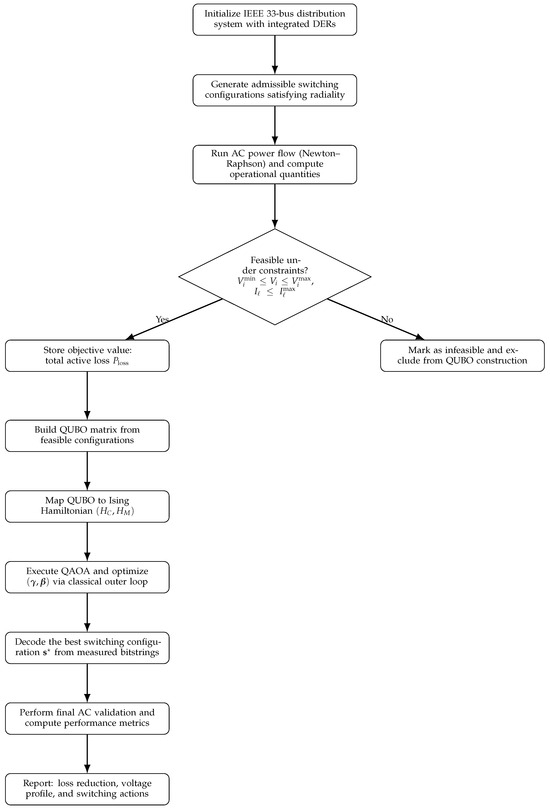
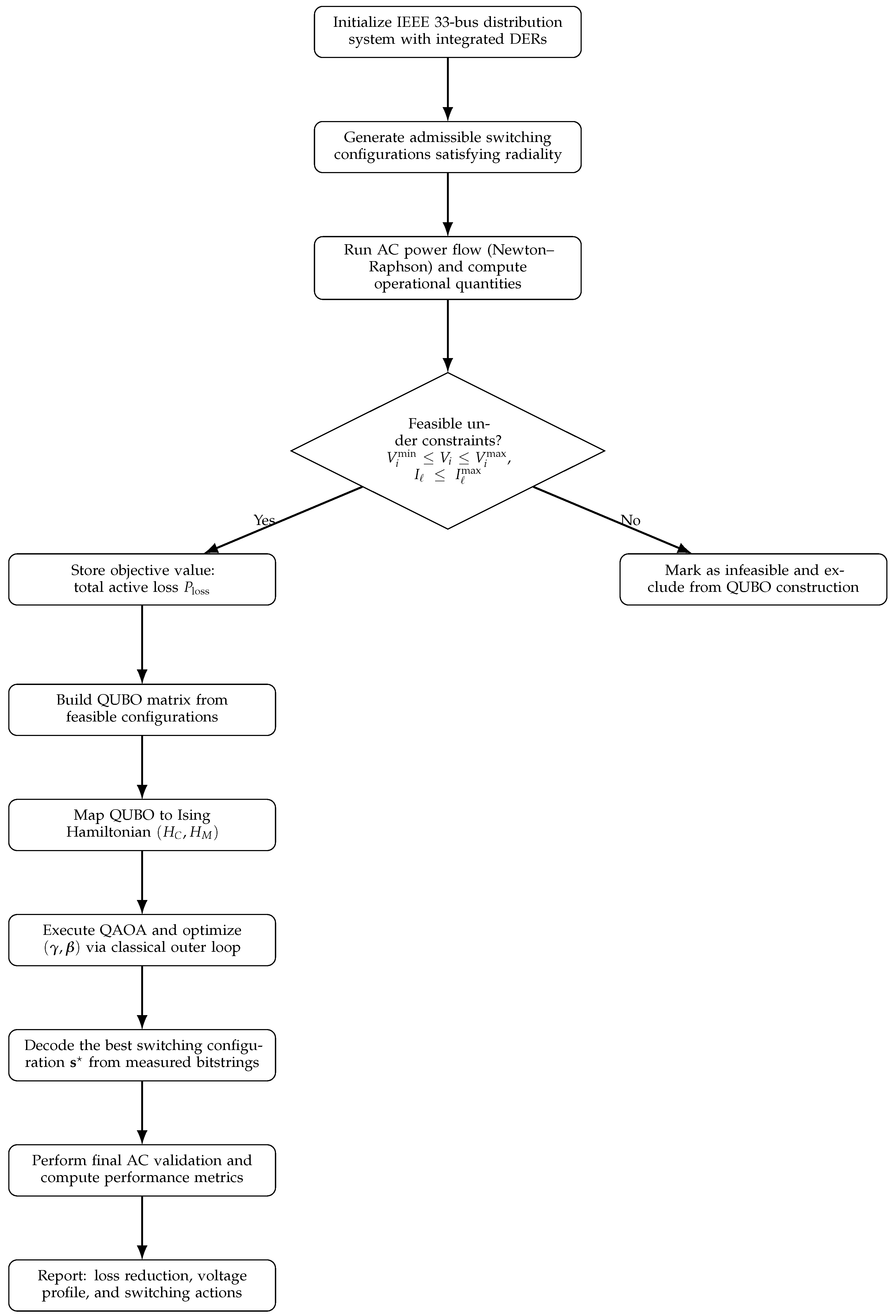
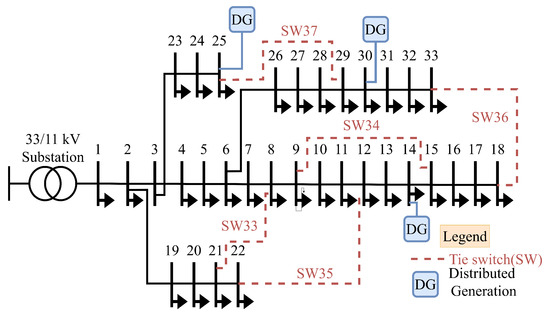
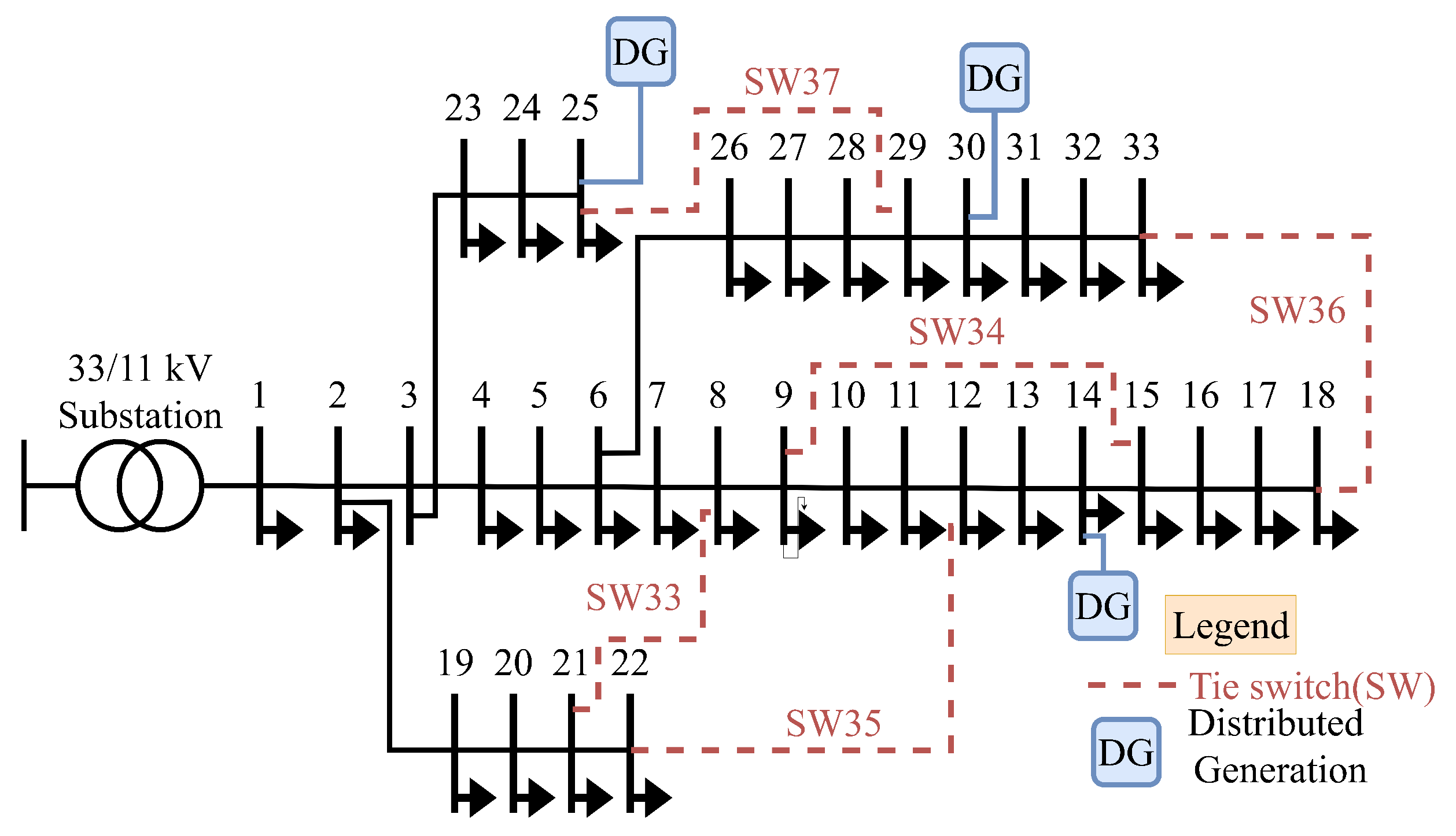
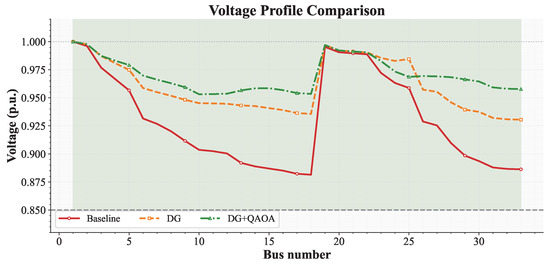
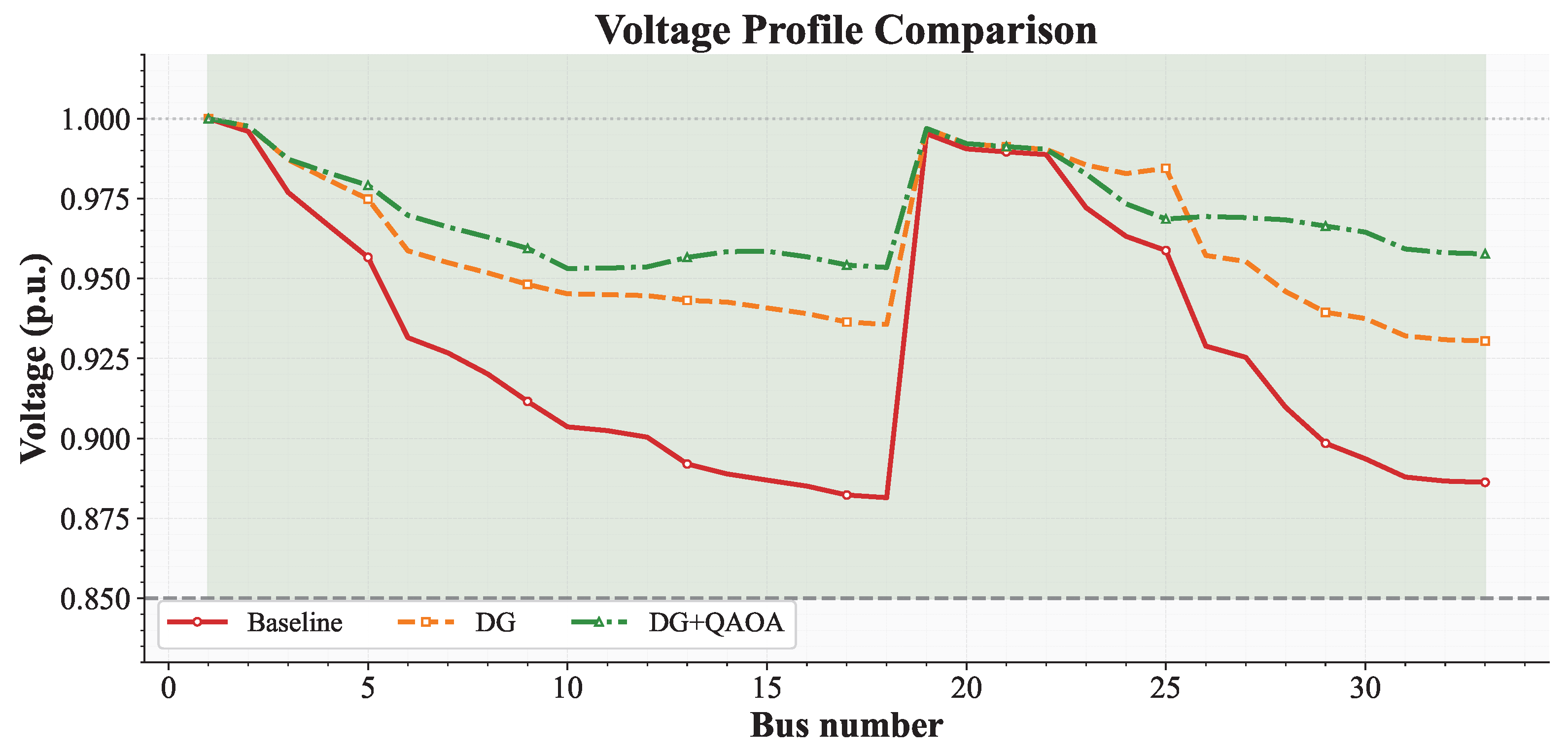
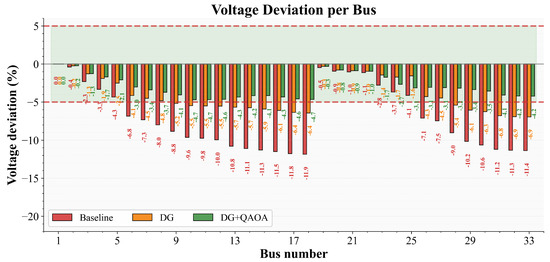
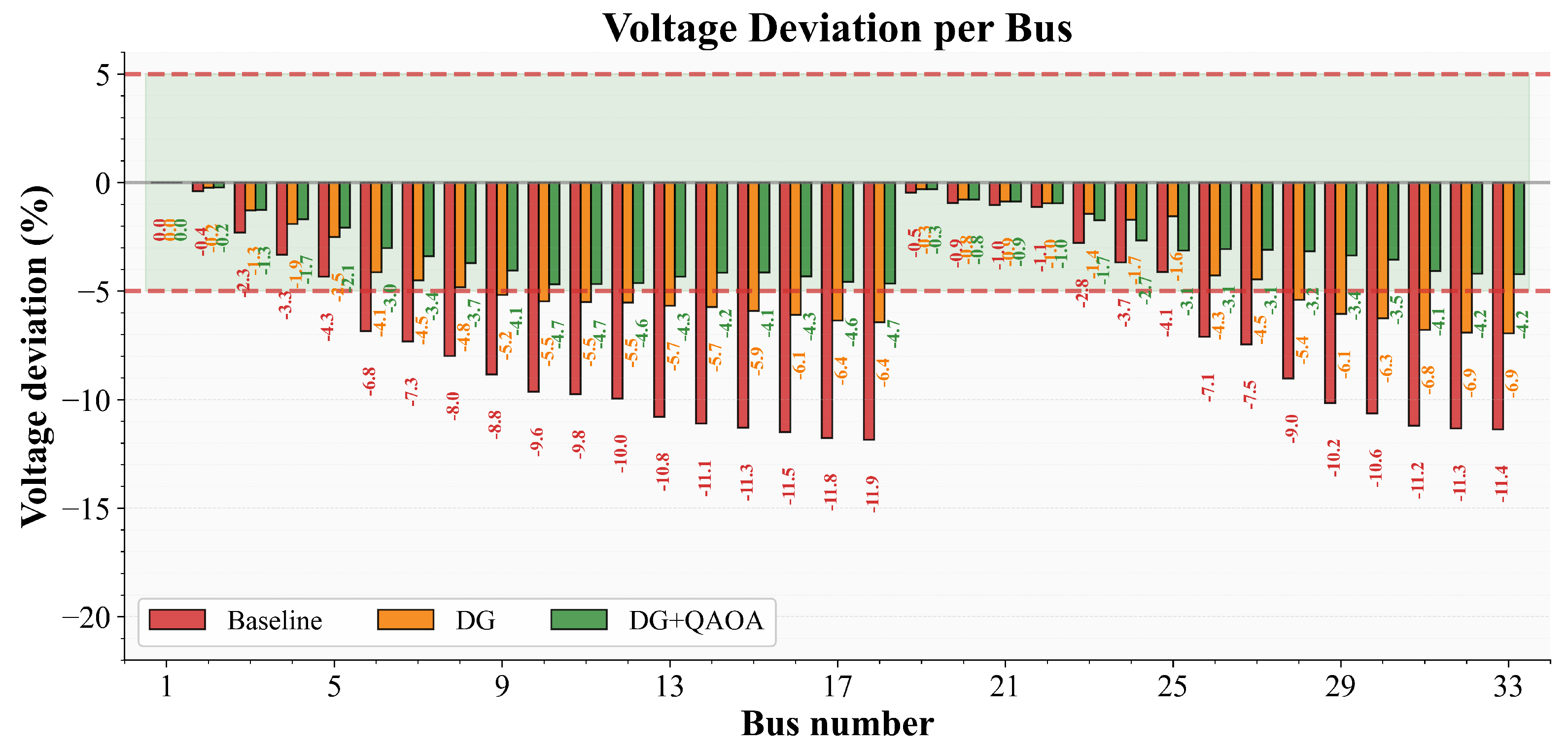
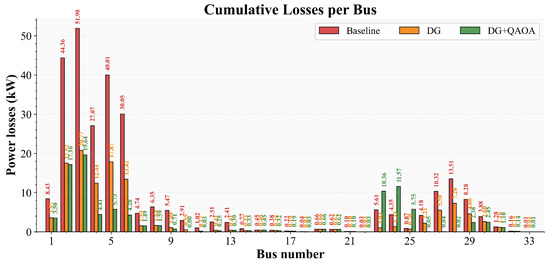
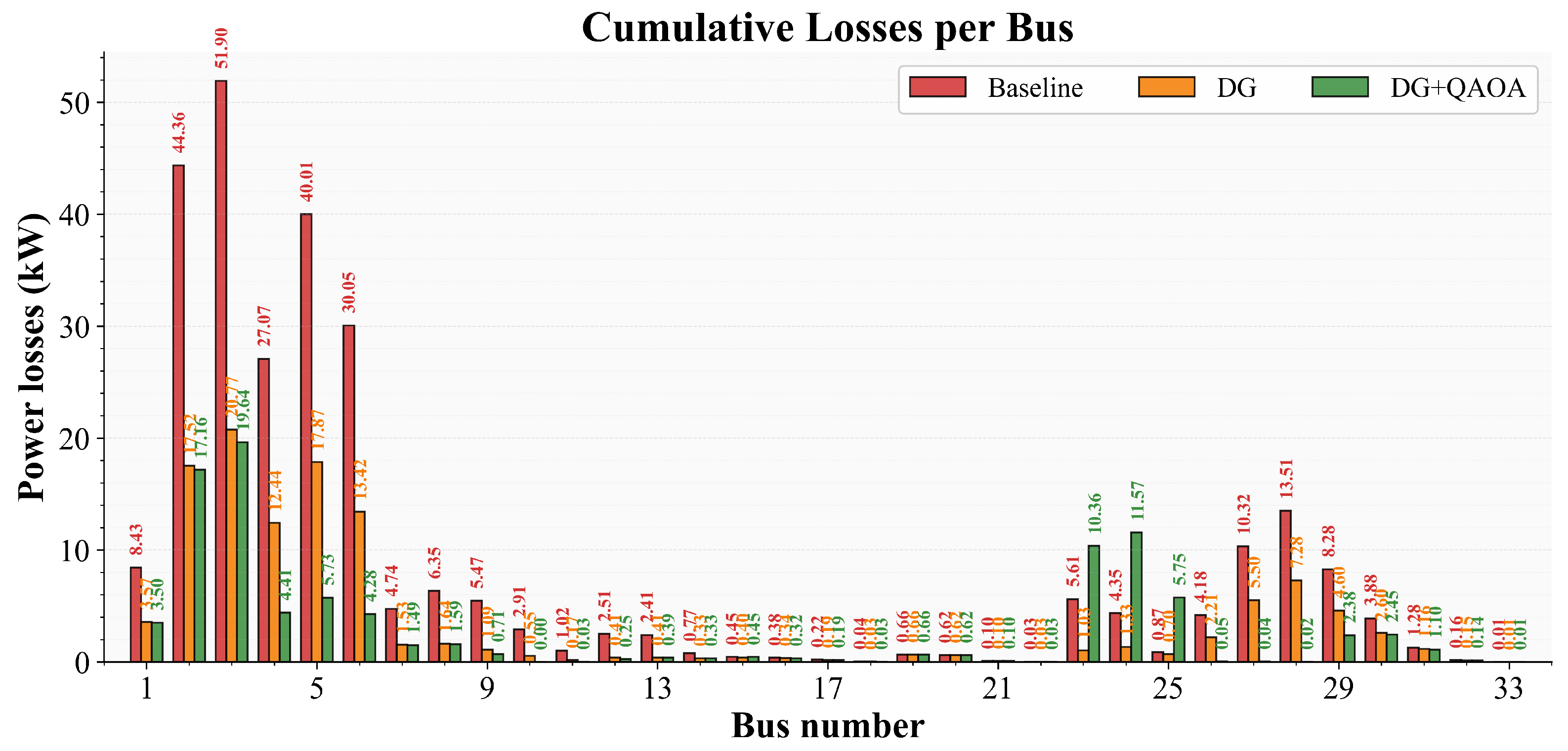
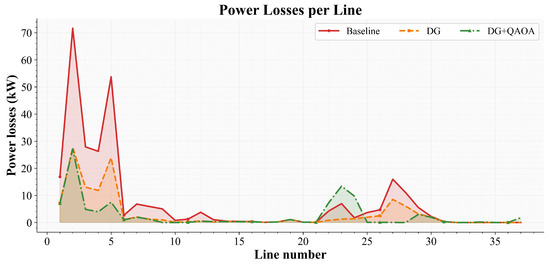
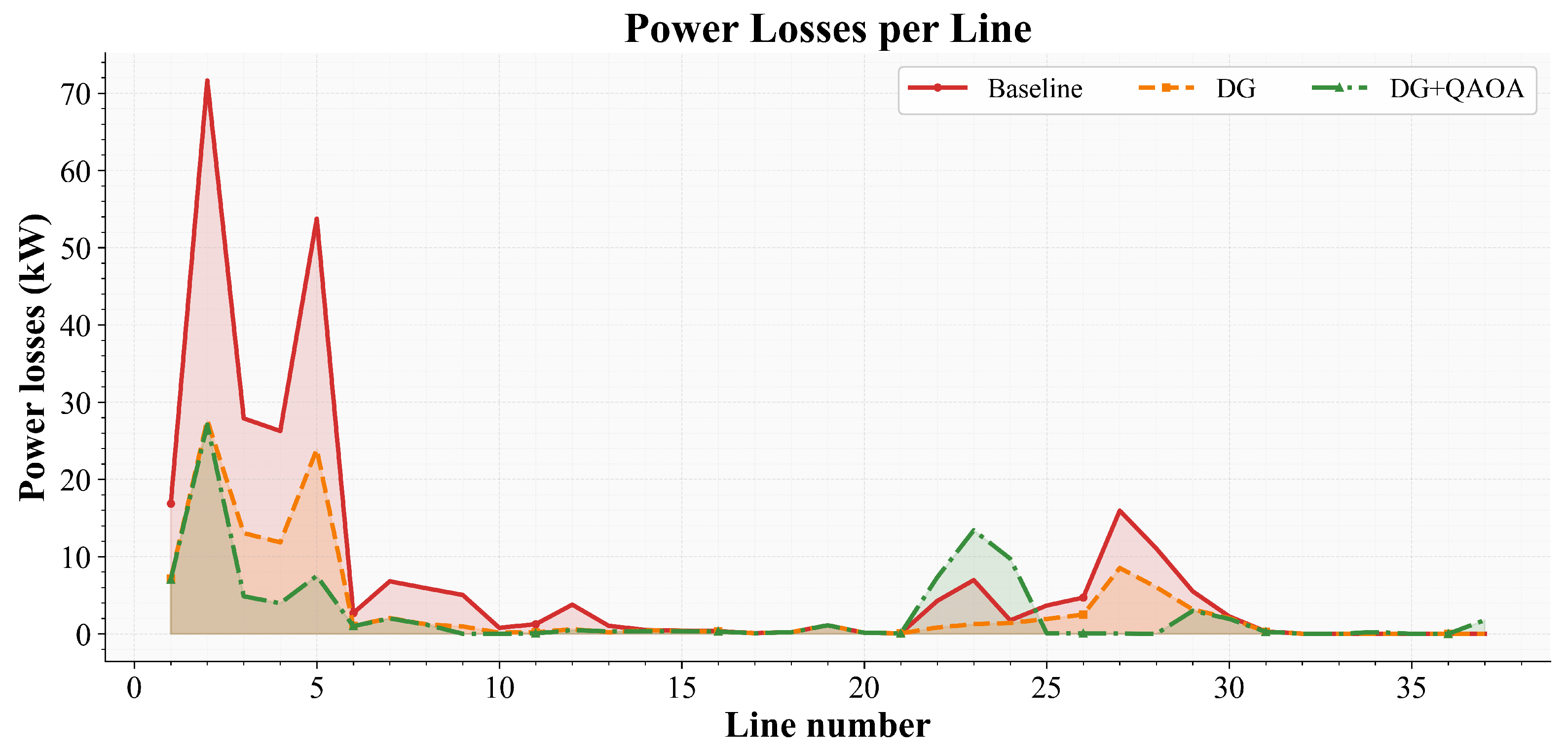
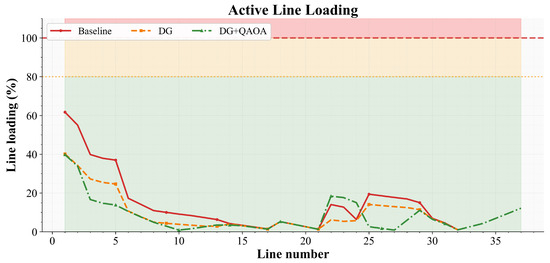
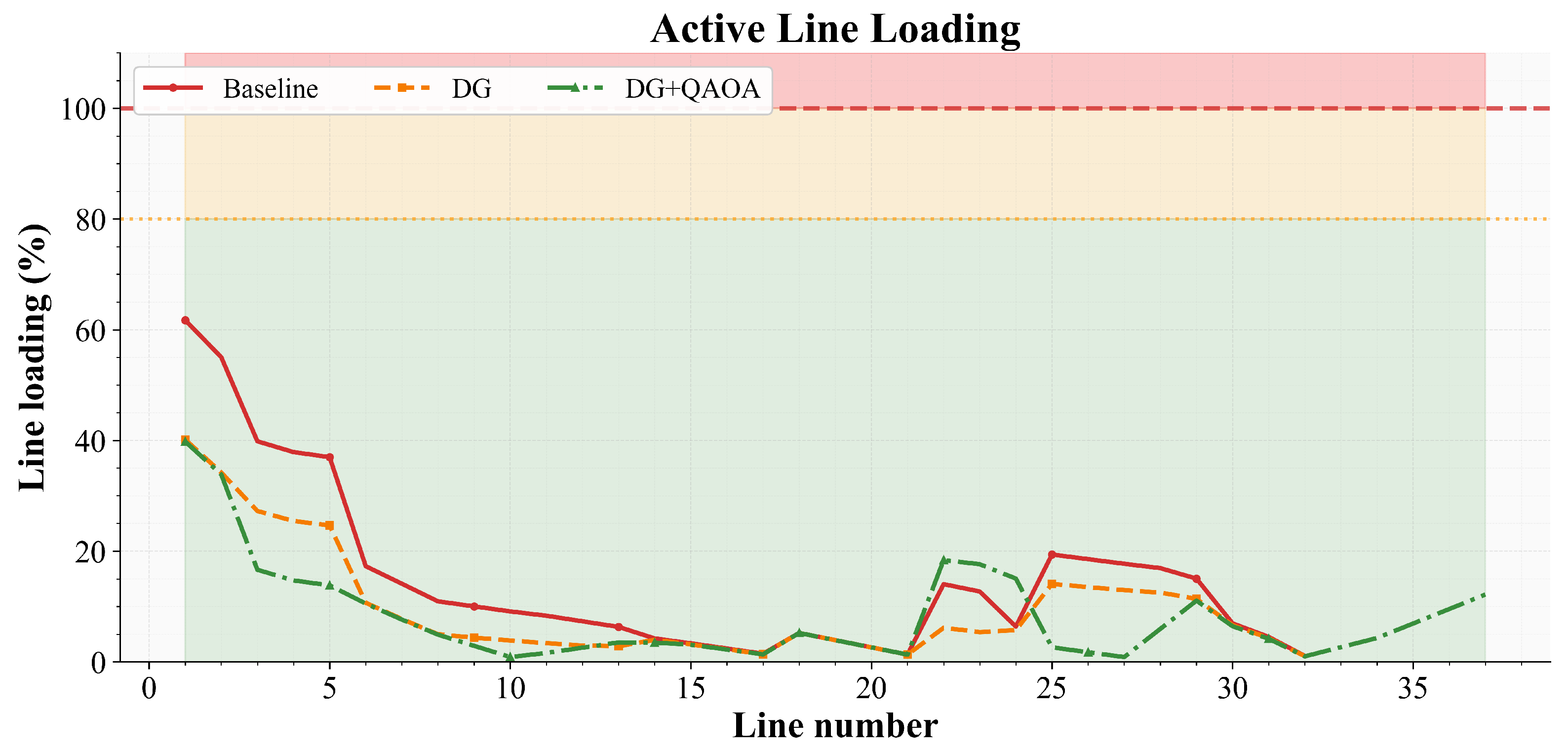
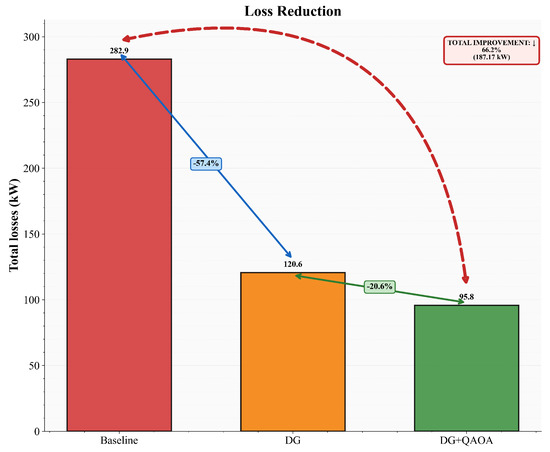
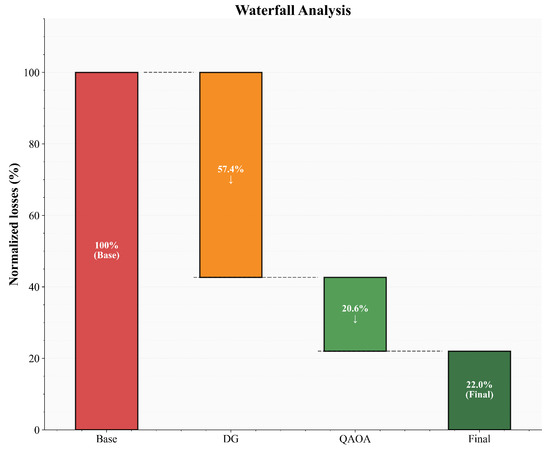
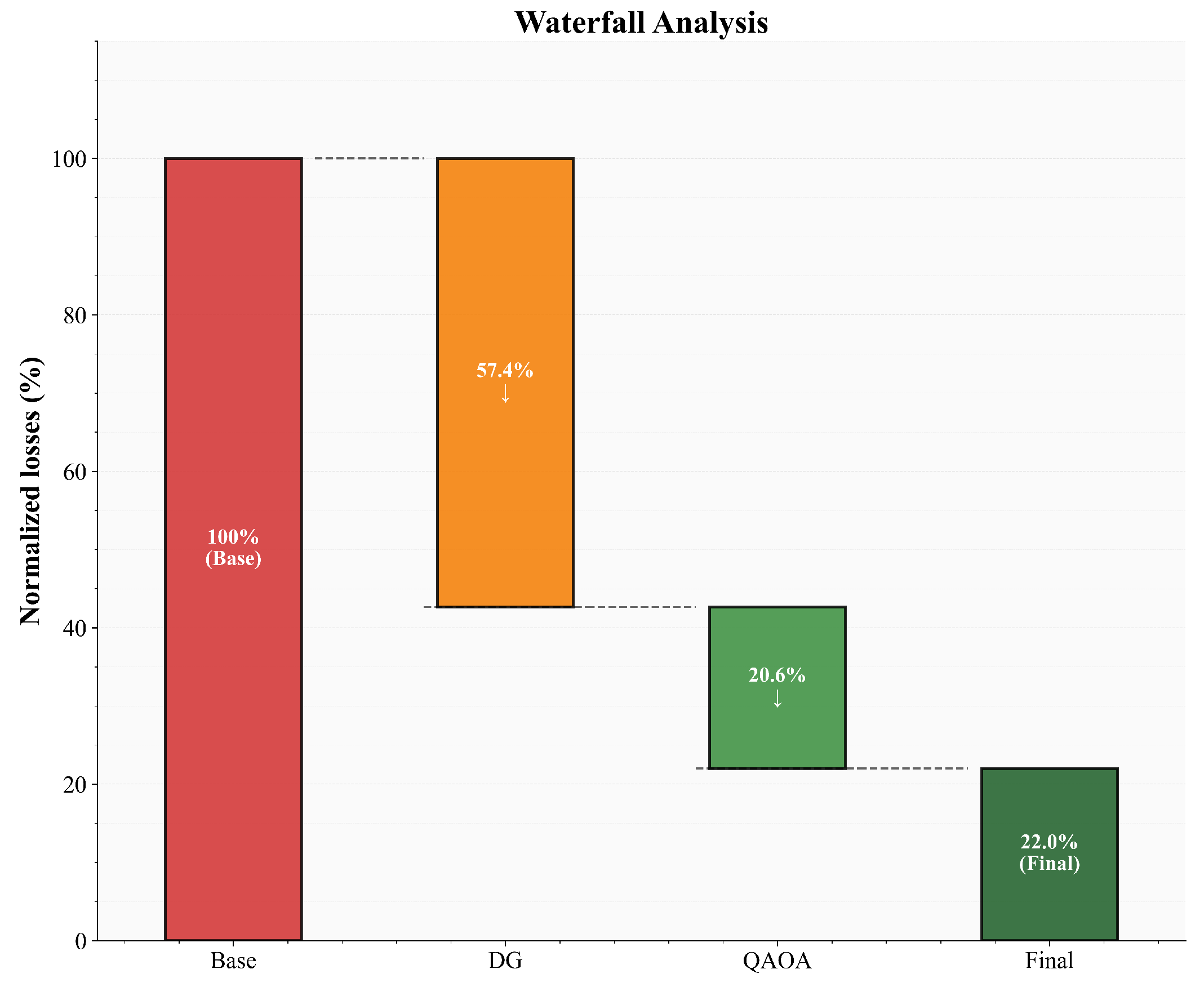

Disclaimer/Publisher’s Note: The statements, opinions and data contained in all publications are solely those of the individual author(s) and contributor(s) and not of MDPI and/or the editor(s). MDPI and/or the editor(s) disclaim responsibility for any injury to people or property resulting from any ideas, methods, instructions or products referred to in the content. |
© 2026 by the authors. Licensee MDPI, Basel, Switzerland. This article is an open access article distributed under the terms and conditions of the Creative Commons Attribution (CC BY) license.