Article

Collaborative Optimal Scheduling of Hybrid Energy System for Data Center and Electric Vehicles Based on Computing Tasks Transferring Under Carbon Trading Mechanism


School of Financial Technology, Shanghai Lixin University of Accounting and Finance, Shanghai 201209, China
*
Author to whom correspondence should be addressed.
Energies 2026, 19(5), 1138; https://doi.org/10.3390/en19051138
Submission received: 16 January 2026 / Revised: 11 February 2026 / Accepted: 20 February 2026 / Published: 25 February 2026
(This article belongs to the Section A: Sustainable Energy)

Abstract

The exponential growth in demand for data storage and computing has led to a rapid expansion in the energy consumption and carbon emissions of data centers (DCs). Hybrid energy systems that integrate renewable energy sources are regarded as a sustainable and low-carbon solution for powering the DCs. This study proposes an optimal cooperation scheduling strategy for the hybrid energy system powering the DC and electric vehicles (EVs). The strategy is based on load transferring and operates within a carbon trading mechanism, explicitly addressing the coupling between computational loads and power consumption. An optimization model is constructed that considers economic objectives, including operational cost and a stepped carbon trading cost, to obtain optimal energy dispatch and computational task allocation strategies. This framework ensures the economic interests of EVs’ owners while satisfying the energy demands of both the DC and the EVs. The results of a case study based in Shanghai demonstrate that the proposed hybrid energy system with multiple sources has significant economic and environmental advantages in spite of operational complexity. Furthermore, the collaborative strategy further enhances the cost reduction and carbon emission reduction. Specifically, the cooperative strategy achieves a 5.21% reduction in total cost compared to Case 1 (without V2G) and a 22.80% reduction compared to Case 2 (without computing task transferring). By adopting the optimal scheduling solution, carbon emissions can be reduced by 16.74% relative to Case 1 while remaining at a level comparable to Case 2. Furthermore, the impact of the carbon trading mechanism on the system’s cost and carbon emissions is analyzed. The results indicate that while a stricter carbon trading mechanism leads to an increase in the total cost, it also results in a reduction in carbon emission from the DC’s hybrid energy system.

1. Introduction

Against the backdrop of the dual-carbon goal, increasing energy efficiency and reducing carbon emissions to achieve sustainable energy development have recently drawn much attention. Data centers (DCs) consume up to 40 times more energy than typical office buildings. Consequently, they are projected to represent 3% of global electricity consumption and contribute to 8% of carbon emissions by 2030 [1], constituting a critical entity to implement energy management. Driven by an unprecedented surge in global data volume, DCs growing rapidly at 15–20% annually lead to a substantial increase in energy consumption and carbon emissions [2,3]. Therefore, effectively reducing the energy costs and carbon emissions of DCs through appropriate energy sourcing and optimized operational strategies has become a pressing issue.
Electric vehicles (EVs) represent a key enabler for decarbonization in the transport sector and have experienced rapid global growth in recent years [4]. In China, the ownership of new energy vehicles reached 20.41 million by 2023, with pure EVs accounting for 76.04% of the total [5]. Concurrently, many countries have announced a series of regulatory policies, setting definitive timelines for phasing out new conventional gasoline vehicles. For instance, the UK Department for Transport’s “Road to Zero” strategy sets a goal for ultra-low emission vehicles to achieve a 50–70% sale by 2030 [6], and the Franch Department announces a ban on the sale of new diesel and petrol cars by 2040. The expanding EV population and the ongoing advancement in EV technology thus poise EVs to be regraded as a flexible and adjustable energy resource for adjacent buildings (e.g., DCs).
Recent studies on hybrid energy systems in DCs are summarized in Table 1, in which they are generally classified into system configurations and operation schedules. The configurations and operational strategies of hybrid energy systems for DCs are primarily driven by energy demands and specific design objectives, such as minimizing economic cost and carbon emissions. The energy management of hybrid energy systems for DCs and EVs becomes more complicated with energy demand load changes. Focusing on a joint energy management problem for the DC and employee EVs, Li et al. [7] and Yu et al. [8] propose a method to minimize the long-term total cost of DCs and EVs by jointly scheduling DC workloads and EV charging demands. Building upon this, Aujla et al. [9] proposes a charging-discharging scheme for penetration of EVs to mitigate renewable energy intermittency and support DC sustainability development. Wang et al. [10] leverage both the spatial workload migration capacity across interconnected DCs and the temporal flexibility of EV charging station demand, effectively reducing the energy cost and carbon emissions of the grid-renewable hybrid system by tapping into EV dispatch potential. The authors of Yuan et al. [11] verify that increasing the profit of a virtual energy hub plant by up to 7.14% and reducing carbon emissions by up to 1.02% under meeting the demands of the DC and plug-in EVs through multi-objective optimization. Reference [12] proposes a multi-energy microgrid for DCs incorporating power-to-hydrogen technology and EVs. The associated energy management strategy achieves operational cost and emission reductions of up to 8.2% and 3.9%, respectively.
Rather than traditional diesel generators, which are dirty and expensive to run, renewable energy sources (RESs) (e.g., solar and wind) have emerged as a viable alternative due to the scalability and declining costs of DC [13,14,15]. For instance, KI et al. [15] propose a sustainable combined cooling, heating, and power (CCHP) system to provide continuous electricity and cooling for a DC, demonstrating benefits in local energy generation, cost reduction, and emission abatement. Similarly, Wang et al. [16] design an integrated energy system for DCs utilizing natural gas, solar, and geothermal energy, with optimization objectives encompassing investment cost, operational cost, carbon tax, and penalty for solar energy discarding. However, the intermittent nature of RESs necessitates robust energy storage solutions to guarantee an uninterrupted power supply for DCs [17]. Research has explored various configurations to address this challenge. He et al. [18] investigates hybrid systems combining diesel generators, photovoltaics, wind turbines, and battery storage to power DCs, thereby validating the effectiveness of integrated storage. From a systemic perspective, Han et al. [19] propose a shared energy storage business model for data center clusters (DCC) to enhance economic returns and promote renewable energy accommodation. In addition, hydrogen produced by renewable-powered electrolyzers is recognized as a promising long-term storage, capable of balancing energy supply and demand over extended periods. Illustrating this concept, reference [20] presents a design for a green DC powered entirely by renewables, incorporating both battery storage and green hydrogen. Collectively, these studies underscore that advanced storage technologies are pivotal for enhancing cost-effectiveness and environmental sustainability in hybrid renewable energy systems for DCs.
Beyond design energy system configuration, the energy savings and carbon emission reductions of DCs can be achieved by adopting effective operational energy management to align fluctuating loads with the inherent uncertainty of RESs [21]. Smoothing the load curve can enhance the power system’s operation and mitigate power quality issues [22]. For instance, paper [23] proposes a joint optimization scheduling approach for internet data centers (IDCs) and power systems, focusing on computing task response strategies. Li et al. [24] present an integrated planning model that combines EV charging stations, power distribution systems, and IDCs to investigate their coupling effects. Dauarte et al. [25] develop a mathematical model to optimize job migration, assignment, and scheduling across a network of interconnected green DCs, incorporating greenhouse gas emissions under a cap-and-trade policy. Reference [26] develops a coordinated optimization model to schedule an integrated energy system with computing task transfer, aiming to minimize DC operating costs while maximizing the user satisfaction level of the computing task. Han et al. [27] propose a novel multi-featured collaborative optimization framework for low-carbon DC integrated energy systems, which incorporates task scheduling mechanisms, renewable energy uncertainty, and hybrid cooling. Xu et al. [28] introduce an integrated energy system for a DC that incorporates computing task transfer and meets its power and cooling demands through a combination of wind, solar, and natural gas. By integrating hybrid energy storage systems, Han et al. [29] and Fan et al. [30] propose combined energy and computation scheduling methods for hybrid energy systems and DCs. The results demonstrate that optimal strategies can reduce operational costs, annual carbon emissions, and carbon trade costs. Collectively, these studies highlight significant progress in co-optimizing energy and computing resources within DCs. However, the collaborative optimal scheduling of both energy and computing tasks specifically between DCs and EVs remains an area that has not been fully explored.
Table 1. Recent studies on hybrid energy systems in the DCs.
Ref.StorageIntegrated EVsBased on Computing Tasks TransferringConsidering Carbon Policy
ElectricityHeatHydrogenCarbon TaxCarbon Trading
[7]××××××
[8]××××××
[9]×××××
[10]××××××
[11]××××
[12]××××
[16]××××××
[18]××××××
[19]×××××
[20]×××××
[24]××××××
[25]××××
[26]××××××
[27]××××
[28]××××
[29]××××
[30]××
This study××
To address the identified research gap concerning the integrated scheduling of energy and computing tasks between DCs and EVs, this paper proposes a collaborative optimization model for a hybrid energy system designed to meet the coupled demand of both entities. The main novelties and contributions of this study are summarized as follows:
(1)
A novel hybrid energy system architecture incorporating power-to-hydrogen technology and multi-energy storage devices is proposed to reliably meet the multi-energy demand of the DC and the EVs.
(2)
A collaborative optimal scheduling framework for joint energy and computing task management between the DC and EVs is developed under a carbon trading mechanism. This framework is designed to optimize overall system performance while safeguarding the economic interests of EV owners.
(3)
A comprehensive analysis is conducted to evaluate the influence of key carbon trading policy parameters (e.g., carbon prices) on the economic and environmental performance of the proposed collaborative system.
The remainder of this paper is organized as follows. Section 2 outlines the overall framework of the hybrid energy system for the DC and EVs. Section 3 formulates the coordinated scheduling optimization model for energy and computing tasks. Section 4 presents and discusses the simulation results under various case studies and carbon trading mechanism parameters. Finally, Section 5 concludes the main conclusion and future work.

2. Problem Description

The DC typically consists of the IT area responsible for core functions (e.g., data computing, storage, and transmission) and the office area. The electrical load of the DC is mainly from IT infrastructure, which includes servers, power distribution units, and network equipment. This IT electrical load can be estimated based on user computing tasks using a real-time energy consumption model [31]. The cooling load is mainly determined by the consumed electricity of servers because the electricity consumption of equipment leads to heat release [32]. Furthermore, the DC incorporates a dedicated parking area equipped with V2G capability, and the parked EVs can be used as distributed energy storage units.
The proposed operational framework ensures that the battery electricity level of each EV meets the owner’s desired level upon departure from the parking area.
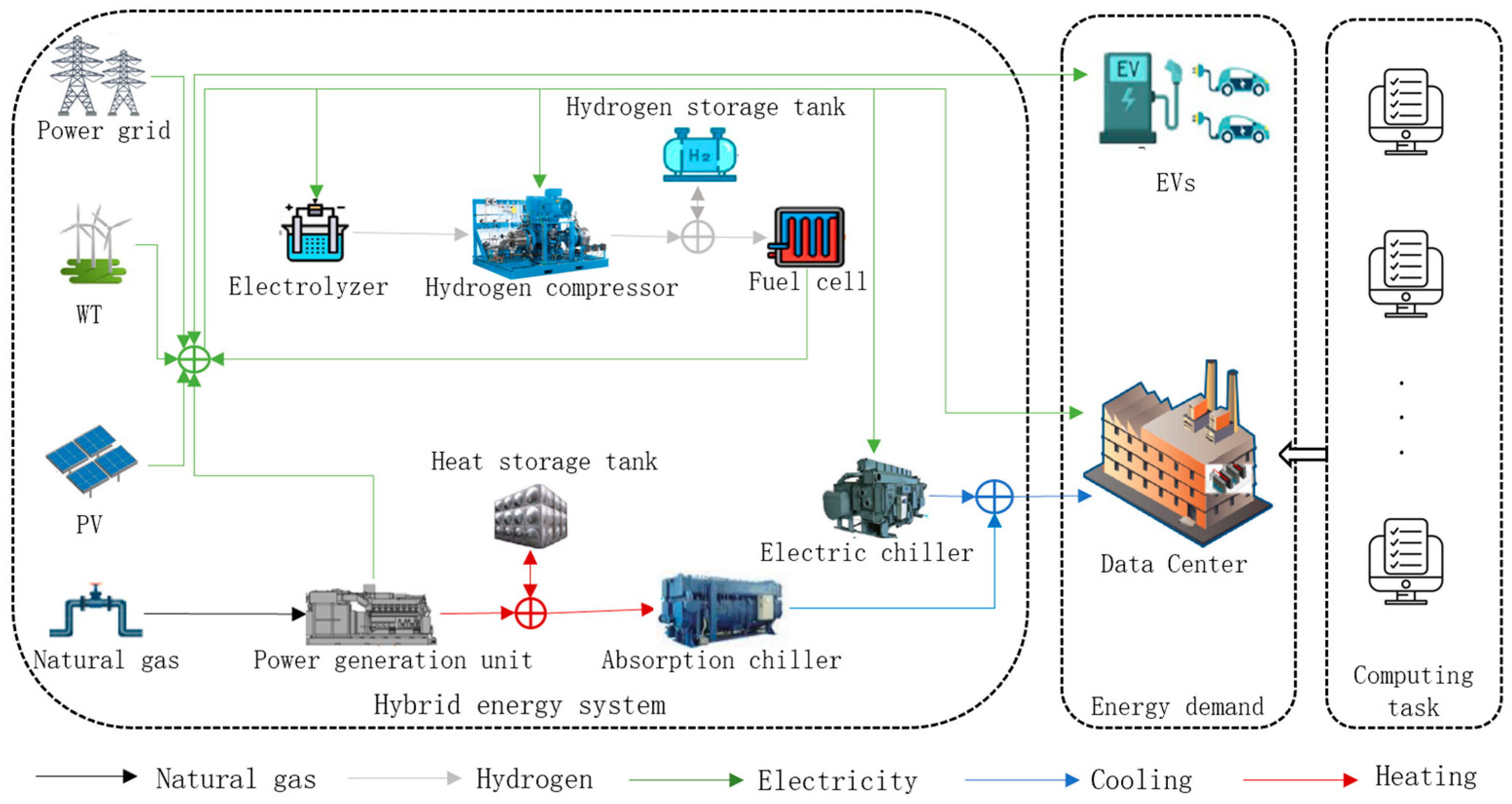
The architecture of the proposed hybrid energy system for the DC and EVs is illustrated in Figure 1. This system employs a collaborative optimization strategy for joint energy and computing task scheduling, aiming to enhance economic and environmental performance under the carbon trading mechanism. In the diagram, the lines represent the flows of various energy carriers: natural gas, hydrogen, electricity, heating, and cooling. The system’s electricity supply is diversified, drawing from the power grid, a power generation unit (PGU), wind turbines (WT), photovoltaic (PV) panels, fuel cells (FC), and the EVs (via V2G). Conversely, electricity consumers within the system include the electrolyzer, hydrogen compressor, electric chiller (EC), the EVs (for charging), and the DC’s own load. The electrical energy is converted to hydrogen via the electrolyzer, with the hydrogen compressor preparing it for storage. The hydrogen storage tank (HYS) stores this excess hydrogen produced during periods of high renewable generation. Subsequently, the stored hydrogen can be utilized by the FC to generate electricity when renewable output is insufficient. For thermal management, waste heat recovered from the PGU drives an absorption chiller (AC) to provide cooling. The cooling demand of the DC is met by both the AC and the EC. A heat storage tank (HES) is integrated to mitigate fluctuations by balancing the supply and demand of thermal energy.

3. Energy and Computation Task Coordinated Scheduling

3.1. Objective Function

The notations of parameters, variables, and indexes used in the model are shown in Appendix A. The optimization objective is to minimize the total operating cost of the hybrid energy system of the DC and EVs as formulated in Equation (1). The total operating cost C comprises the energy procurement cost C e n e r g y and the carbon emission cost C c a r b o n . C e n e r g y accounts for the purchased electricity and natural gas. E t g r i d and N t n g denote the amounts of electricity purchased from the grid and natural gas consumed at time interval t , respectively. Their associated costs are determined by the time-varying electricity price p t e , b u y and the natural gas price p n g . Within the carbon market framework, carbon allowances are typically allocated based on the baseline method. The initial carbon allowance C D E b a s e of the hybrid system is expressed as Equation (3). This baseline is calculated using carbon allowance coefficients for electricity δ e and natural gas δ g a s , applied to their respective consumption levels. The system’s carbon emission C D E , which stems from purchased electricity and natural gas consumption, is quantified by Equation (4). The emission factors are defined as α 1 , α 2 , and α 3 for E t g r i d , and β g a s for natural gas. The carbon emission cost C c a r b o n is calculated using Equation (5), where p c a r b o n represents the unit carbon price. The C c a r b o n > 0 means the carbon emission cost, while C c a r b o n < 0 means the revenue.
M i n   C = C e n e r g y + C c a r b o n
C e n e r g y = t = 1 T p t e , b u y × E t g r i d + p n g × N t n g
C D E b a s e = t = 1 T δ e × E t g r i d + δ g a s × N t n g
C D E = t = 1 T α 1 + α 2 × E t g r i d + α 3 × E t g r i d 2 + β g a s × N t n g
C c a r b o n = p c a r b o n × C D E C D E b a s e

3.2. Constraints

3.2.1. Computing Tasks and Load-Shifting Constraints

The electricity and cooling demands of the DC are determined by its computational loads, which originate from computing tasks characterized by significant randomness. The i -th computation task C T i of type t y is expressed with its arriving time a t i t y , processing time o t i t y , deadline time d t i t y , and the number of tasks n i t y . According to the processing time o t i t y , the computing tasks are categorized into long-term ( L T ), medium-term ( M T ), and short-term ( S T ) tasks. The typical processing durations o t i L T , o t i M T , and o t i S T , representing the time a task occupies a server, are defined in Equation (6). The scheduling interval t is typically set to 1 h. Furthermore, computation tasks are classified into four distinct levels (i.e., l = 0,1 , 2,3 ) based on their allowable delay, as formulated in Equation (7). Level-0 tasks are non-deferrable and require immediate execution. Level-1, Level-2, and Level-3 tasks permit maximum delays of 1, 2, and 3 h, respectively.
o t i t y = 2 t t y = L T t t y = M T 0.5 t t y = S T     i
d t i t y a t i t y = l t             l = 0,1 , 2,3
The transfer coefficient x t 1 , t 2 , i t y , l is introduced to characterize the specific transfer of the computing tasks and denotes the proportion of tasks transferred from time t 1 to t 2 relative to the initial task count in t 1 . The maximum allowable transfer percentage from t 1 to t 2 is 100% (i.e., 0 x t 1 , t 2 , i t y , l 1 ). x t 1 , t 2 , i t y , l is limited by the maximum permissible transfer duration for different computing task levels, and t 2 is set from t 1 to t 1 + l . Furthermore, the total number of tasks within the scheduling period remains constant before and after the shift, satisfying Equation (8).
t 2 = t 1 T x t 1 , t 2 , i t y , l = 1          i , t y , t 2 t 1 , t 1 + l
The electricity and cooling demands of the DC primarily originate from the servers processing actual computation tasks. Based on the execution time required for different types of tasks, the CPU utilization of the servers u t s e r at time t can be calculated using Equation (9). N s e r denotes the total number of servers, and F represents the maximum capacity of each server. Furthermore, the power consumption of the DC E t d c can be estimated by Equation (10). E s e r , m a x and E s e r , b a s e are the maximum and basic power consumption of all servers, respectively. The corresponding cooling demand of the DC Q t d c is calculated by considering the influence of the electric load on the cooling load, as expressed in Equation (11) with coefficient η e , c .
u t s e r = i , l x a t i L T , t 1 , i L T , l × n i L T × 1 2 o t i L T + x a t i L T , t , i L T , l × n i L T × 1 2 o t i L T + x a t i M T , t , i M T × n t , i M T × o t i M T + x a t i S T , t , i S T × n i S T × o t i S T N s e r F       t
E t d c = u t s e r × E s e r , m a x E s e r , b a s e + E s e r , b a s e             t
Q t d c = η e , c × E t d c                           t

3.2.2. Hybrid Energy System Operation Constraints

The electric energy generated by the WT E t W T depends on the wind speed v t and rated wind power output C A P W T , as defined by Equation (12). The parameters v c i , v r , and v c o represent the cut-in, rated, and cut-out wind speeds of the turbine, respectively. Similarly, the power output of PV E t P V is determined by the hourly solar radiation G t , the surface area A P V , the efficiency of the PV panels η P V , and other losses η o t h e r , as shown in Equation (13).
E t W T = C A P W T v t 2 v c i 2 v r 2 v c i 2 v c i < v t < v r C A P W T v r < v t < v c o 0 o t h e r w i s e           t
E t P V = G t × A P V × η P V × η o t h e r                   t
The operation of the EL is governed by Equations (14) and (15). The hydrogen produced by the EL H t E L is calculated from its electricity consumption E t E L with the conversion coefficient η E L . E t E L is limited by the EL’s capacity C A P E L , while x t E L is a binary decision variable indicating the electricity-to-hydrogen operating state (1 if electricity-to-hydrogen conversion mode; 0 otherwise).
H t E L = η E L × E t E L                   t
E t E L C A P E L × x t E L                t
The operation of the HC is governed by Equations (16) and (17). The compressed hydrogen output from the HC H t H C is calculated from H t E L using compression efficiency coefficient η H C . The electricity consumption by HC E t H C is determined from H t E L based on the electrical conversion coefficient η H C , e .
H t H C = η H C × H t E L                 t
E t H C = η H C , e × H t E L                 t
Equation (18) describes that the electrical energy output of the FC E t F C is determined by the hydrogen consumption H t F C and electrical conversion efficiency, η F C , e . Furthermore, E t F C is constrained by the FC’s capacity H t F C , and its operating state is indicated by a binary decision variable x t F C (1 if hydrogen to electricity; 0 otherwise), as specified in Equation (19). The constraint expressed in Equation (20) ensures that electricity-to-hydrogen and hydrogen-to-electricity modes cannot be active simultaneously.
E t F C = η F C , e × H t F C                 t
E t F C C A P F C × x t F C                 t
x t E L + x t F C 1                   t
The hydrogen storage of the HYS H t H Y S , s t is governed by Equation (21). H t H Y S , s t can be determined by the storage of the previous interval H t 1 H Y S , s t , plus the hydrogen charged H t H Y S , c h minus the hydrogen discharged H t H Y S , d i s . H t H Y S , d i s and H t H Y S , c h are limited within the permissible limits defined by the HYS’s capacity C A P H Y S using Equations (22) and (23), respectively. Finally, the hydrogen balance for the hybrid system is expressed as Equation (24). The hydrogen consumed by the HYS H t H Y S , c h and the FC H t F C should equal the hydrogen supplied by the HC H t H C and discharged from the HYS H t H Y S , d i s .
H t H Y S , s t = H t 1 H Y S , s t + H t H Y S , c h H t H Y S , d i s           t
H t H Y S , d i s C A P H Y S × 1 x t H Y S            t
H t H Y S , c h C A P H Y S × x t H Y S                t
H t H C + H t H Y S , d i s H t H Y S , c h + H t F C            t
Equation (25) defines the electrical energy generated from the PGU E t P G U determined by the natural gas consumption N t n g , and its electrical conversion efficiency, η P G U . Constraint 26 is to guarantee that the thermal energy output from the PGU Q t P G U is calculated based on N t n g , utilizing both the thermal efficiency η P G U , h and the overall conversion efficiency η P G U . The constraint expressed in Equations (27) and (28) indicates that the cooling energy generated from the AC Q t A C , c and the EC Q t E C , c are, respectively, limited by their corresponding energy inputs (i.e., Q t A C and E t E C ) and conversion efficiencies (i.e., η A C and η E C ).
E t P G U = η P G U × N t n g                      t
Q t P G U = η P G U , h × 1 η P G U × N t n g               t
Q t A C , c = η A C × Q t A C                 t
Q t E C , c = η E C × E t E C                 t
Q t E C , c + Q t A C , c Q t d c               t
As shown in Equation (30), Q t H E S , s t and Q t 1 H E S , s t represent the stored thermal energy in the HES at time intervals t and t 1 , respectively, Q t H E S , s t can be calculated by Q t 1 H E S , s t plus the charged thermal energy Q t H E S , c h multiplied by the coefficient η H E S , c h , minus the discharged thermal energy Q t H E S , d i s multiplied by the coefficient η H E S , d i s . Meanwhile, the stored thermal energy shall not exceed HES’s capacity C A P H E S upper limit, as displayed in Equation (31). The maximum discharging and charging thermal energy of the HES are respectively limited by Equations (32) and (33). Finally, the thermal energy balance of the hybrid system is expressed as Equation (34).
Q t H E S , s t = Q t 1 H E S , s t + η H E S , c h × Q t H E S , c h Q t H E S , d i s / η H E S , d i s      t
Q t H E S , s t × t C A P H E S                     t
Q t H E S , d i s × t C A P H E S × 1 x t H E S                  t
Q t H E S , c h × t C A P H E S × x t H E S                   t
Q t P G U + Q t H E S , d i s = Q t A C + Q t H E S , c h               t

3.2.3. EVs Operation Constraints

In order to ensure the economic benefit for EV owners, Equation (35) guarantees that the revenue from discharging during the parking time is no less than the battery degradation cost incurred, thereby encouraging owners to participate in the electricity scheduling process via bidirectional power exchange. E v , t e v , d i s denotes the discharging electricity of the v -th EV from its arrival time T v a r r to departure time T v d e p . Equations (36) and (37) represent the energy balance of the EV battery. The stored energy E v , t e v , d i s is calculated based on the stored energy at the previous time E v , t 1 e v , s , plus the charged electricity E v , t e v , c h multiplied by the charging efficiency coefficient η e v , c h , minus the discharged electricity E v , t e v , d i s divided by the discharging efficiency coefficient η e v , d i s . The parameters C A P v e v and S O C v a r r represent the battery capacity and the initial battery level, respectively. The stored energy E v , t e v , s is restricted by the maximum allowable state of charge S O C v m a x , as formulated in Equation (38). Equations (39) and (40) constrain the charging and discharging of electricity within their respective maximal charging rate α v c m a x , discharging rate α v d m a x , and binary variables x v , t e v . Finally, constraint 41 states that the EV’s battery reaches the owners’ desired energy level when departing from the DC parking area.
t = T v a r r T v d e p p t e , s e l l × E v , t e v , d i s p e v × t = T v a r r T v d e p E v , t e v , d i s / 2 C A P v e v     v
E v , t e v , s = E v , t 1 e v , s + E v , t e v , c h × η e v , c h E v , t e v , d i s / η e v , d i s      v , t T v a r r + 1 , T v d e p
E v , t e v , s = C A P v e v × S O C v a r r + E v , t e v , c h × η e v , c h E v , t e v , d i s / η e v , d i s     v , t = T v a r r
E v , t e v , s C A P v e v × S O C v m a x           v , t T v a r r , T v d e p
E v , t e v , c h C A P v e v × α v c m a x × x v , t e v           v , t T v a r r , T v d e p
E v , t e v , d i s C A P v e v × α v d m a x × 1 x v , t e v         v , t T v a r r , T v d e p
E v , t e v , s C A P v e v × S O C v d e p                 v , t = T v d e p
The electricity balance of the system is displayed in Equation (42), ensuring that the total electricity supply meets or exceeds the total demand. The electricity supply side (i.e., the left-hand side of the equation) comprises electricity from the power grid, WT, PV, FC, PGU, and EVs discharging. The demand side (i.e., right-hand side) includes electricity consumed by the EL, HC, EC, EVs, and DC.
E t g r i d + E t W T + E t P V + E t P G U + E t F C + v = 1 V E v , t e v , d i s E t E L + E t H C + E t E C + v = 1 V E v , t e v , c h + E t d   t

4. Case Study

To evaluate the economic criterion of the proposed system via the formulated mathematic model, a case study of the DC located in Shanghai province, China, is investigated. The influences of different carbon trade policy parameters are compared and discussed in this section. The DC covers an area of 2000 m2 and has 3100 racks and 56,000 servers. To ensure the computation reliability, the maximum capacity of each server is set as 90%. The maximum and baseline power consumption of servers are set as 80% and 10% of the rated power, respectively. The rated power of each server is 500 W, and the electricity-to-cooling conversion coefficient is set as 80%.
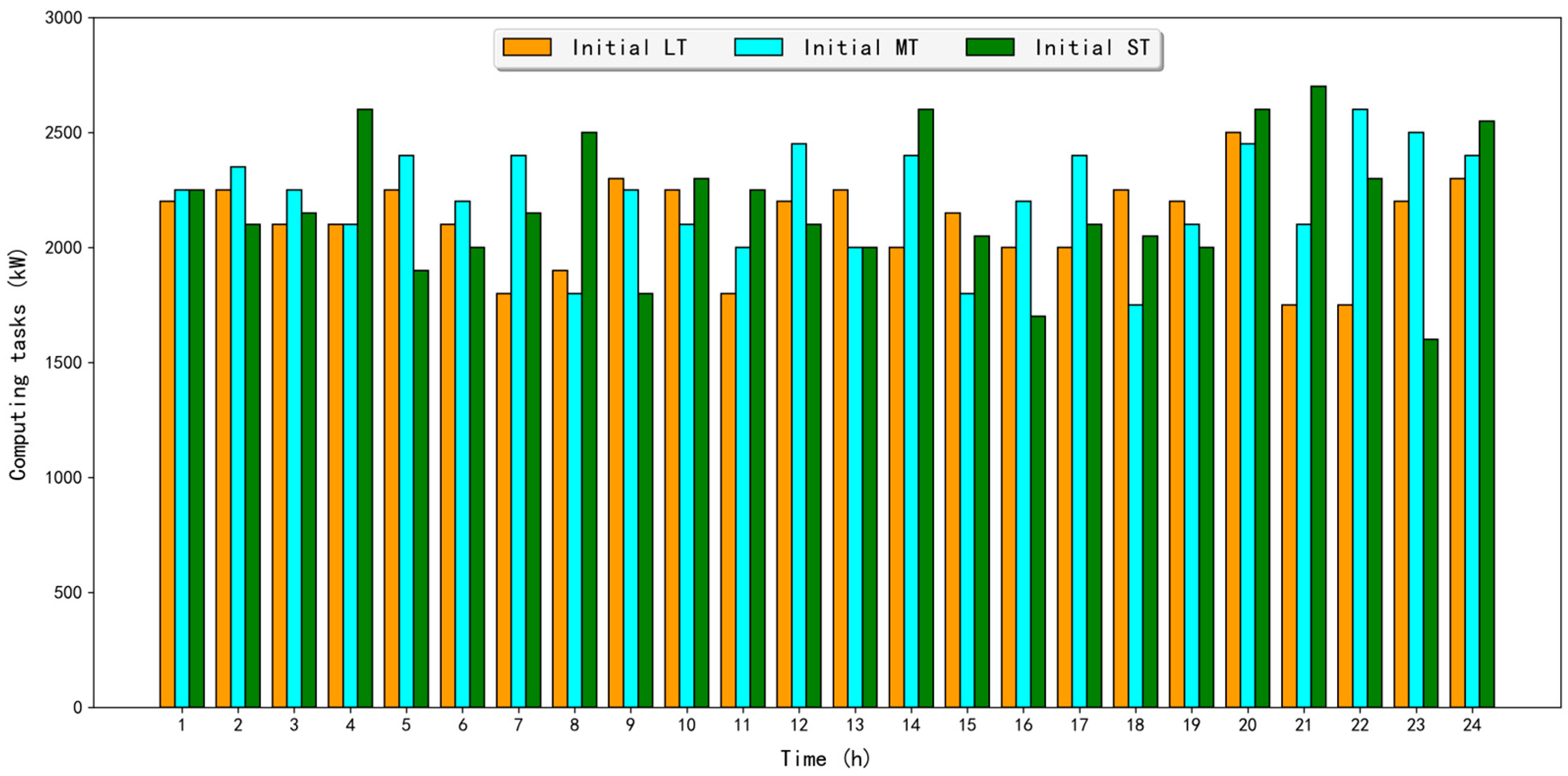
In order to consider the economic and environmental performance in reality, the time-of-use electricity tariff, natural gas price, carbon emission price, and relevant carbon coefficients for China are listed in Table 2, and these data are derived from Reference [30]. Figure 2 displays the computation task profiles of L T , M T , and S T categories. Other typical parameters related to the energy system, DC, and EVs are provided in Table 3, and according to the literature review [33,34]. The initial stored hydrogen and thermal energy levels in the respective storage units at the start of the scheduling period are set as 10%. For the DC, it is expected that the parking area accommodates 300 EVs with a battery capacity of 60 kWh. The EVs arrive at the parking lot with an initial state of charge of 10% and are expected to leave with 85%. A depreciation cost of 10 USD is assumed for each complete EV battery charging cycle, which involves charging from an empty state to full capacity and then discharging back to empty.
The formulated MILP model is solved using the Gurobi Optimizer 12.0.2, implemented in Python 3.13.5 under the Anaconda 3 distribution. The computations are executed on a Lenovo laptop sourced from Shanghai, China, featuring an Intel (R) Core (TM) i5-8265U processor (1.60 GHz base frequency) and 8 GB of RAM. The main operational module of this model has 2473 continuous and 120 binary variables.

4.1. Optimization Results of Different Cases

To verify the performance of the proposed collaborative framework, non-cooperative energy and computation task scheduling strategies are designed as contrast cases under the carbon trading mechanism based on the proposed model. The defined cases are as follows:
Case 0: The electricity demand of the DC and EVs is exclusively supplied by the power grid. Concurrently, the cooling demand of the DC is met solely by the EC. This configuration operates without V2G capability and does not involve the transfer of computing tasks.
Case 1: Collaborative optimal scheduling of the hybrid energy system for the DC and EVs without V2G. Specifically, the variable x v , t e v , d i s is set to be 0.
Case 2: Optimal scheduling of the hybrid energy system for the DC and EVs without computing tasks transferring. Specifically, the variable x t 1 , t 2 , i t y , l t 2 t 1 is set to be 0.
Case 3: Collaborative optimal scheduling of the hybrid energy system for the DC and EVs based on computing tasks transferring.

4.1.1. Cost Analysis and Carbon Emission Analysis

A comparison of the economic performance among Case 0, Case 1, Case 2, and Case 3 under the carbon trading mechanism is presented in Table 4. Table 4 illustrates that the proposed hybrid system reduces costs significantly in Cases 1–3 compared to Case 0, despite requiring more complex operations. The total cost obtained by adopting the proposed hybrid energy system of the DC and EVs based on computing tasks transferring is 5.21% lower than Case 1 without V2G and 22.80% lower than Case 2 without load transferring. The largest cost component in all three cases stems from carbon emissions, accounting for 73.14%, 49.08%, and 64.92% of the total cost, respectively. Therefore, both EV discharging behavior and computational task transferring can effectively meet the DC and EV demands while reducing overall cost. The joint energy and computing tasks scheduling strategy can achieve remarkable economic benefit. Furthermore, the implementation of a carbon trading mechanism increases operational costs, thereby incentivizing DC operators to voluntarily reduce carbon emissions in order to lower their expenses.
To investigate the environmental performance of the optimal scheduling strategy, the C D E results for the Cases 0–3 obtained from the corresponding optimal solutions are shown in Table 5. Compared to Case 0, the results for Cases 1–3 demonstrate that the proposed hybrid energy system achieves significant carbon emission reduction. Furthermore, the proposed system can achieve a 16.74% reduction in C D E compared with Case 1, and similarly with Case 2. Furthermore, the C D E from the power grid is reduced by 16.92%. Compared with non-collaborative operation modes under the carbon trading policy, the DC and EVs can achieve improved economic and environmental performance by adopting a collaborative scheduling approach.

4.1.2. Operational Scheduling in Different Cases

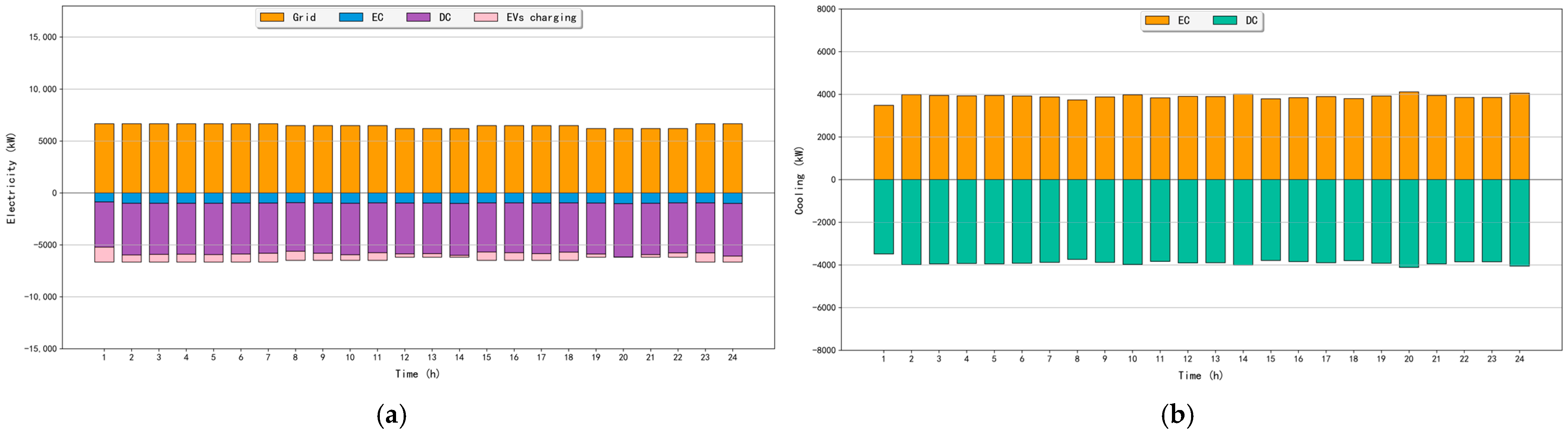
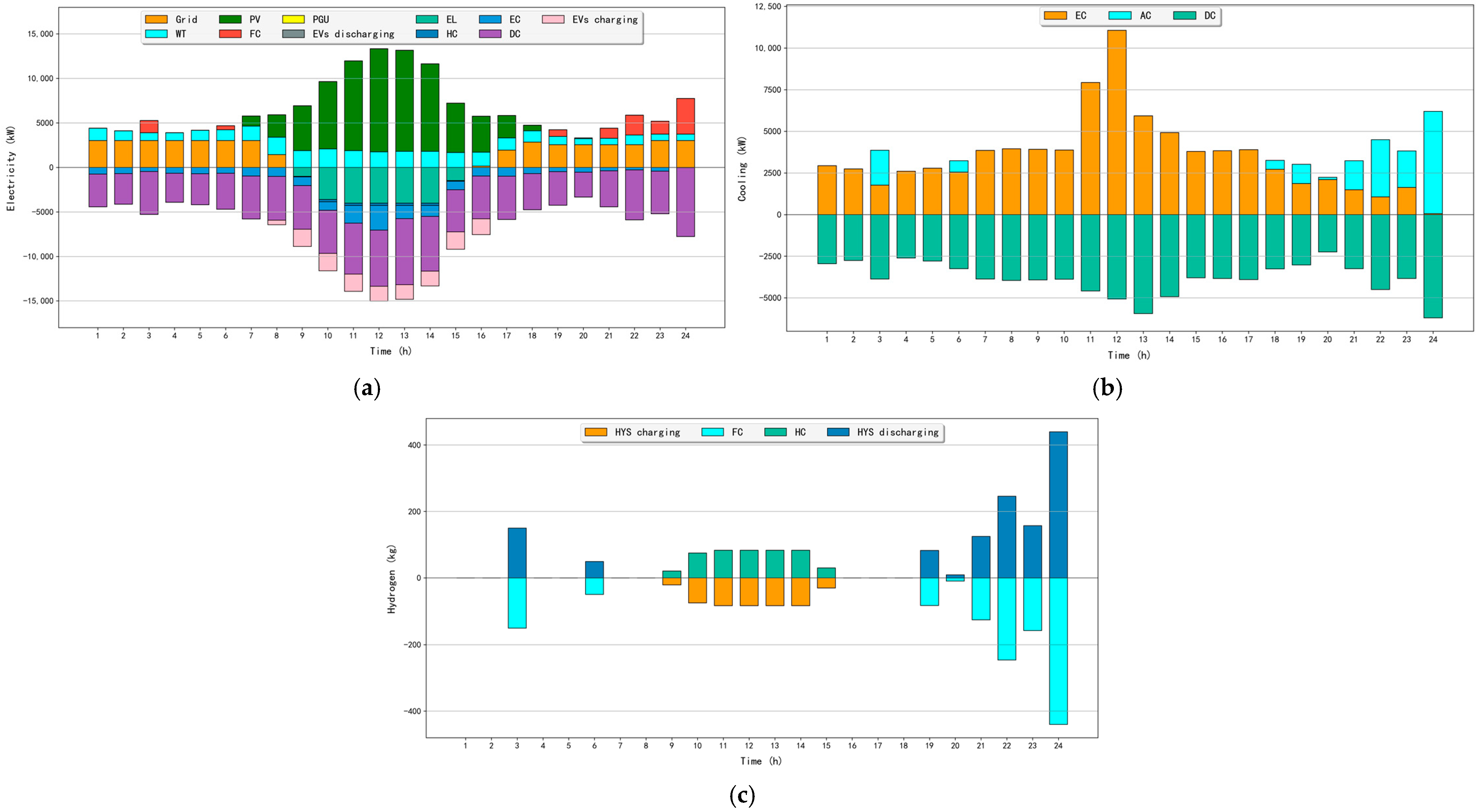
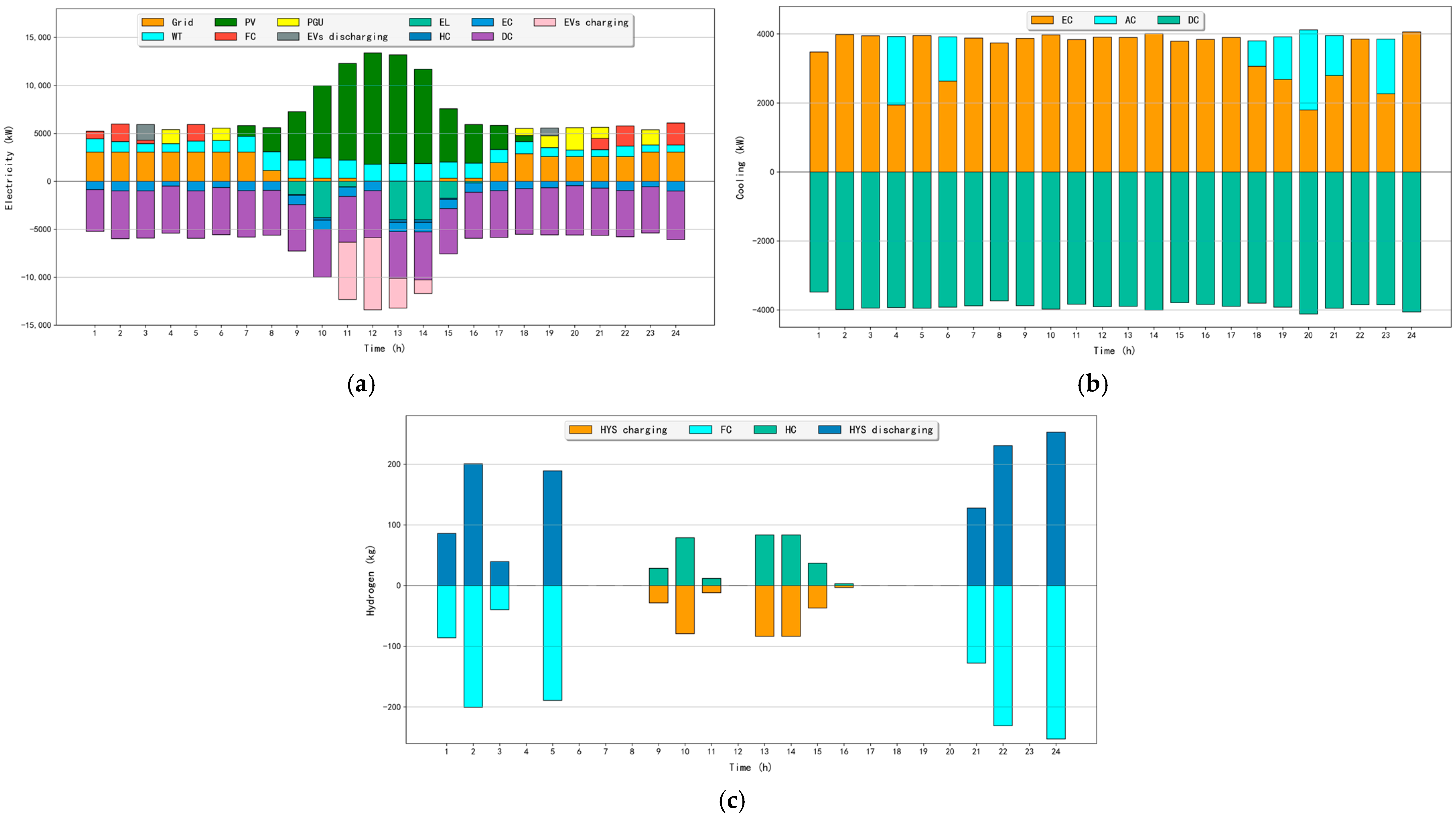
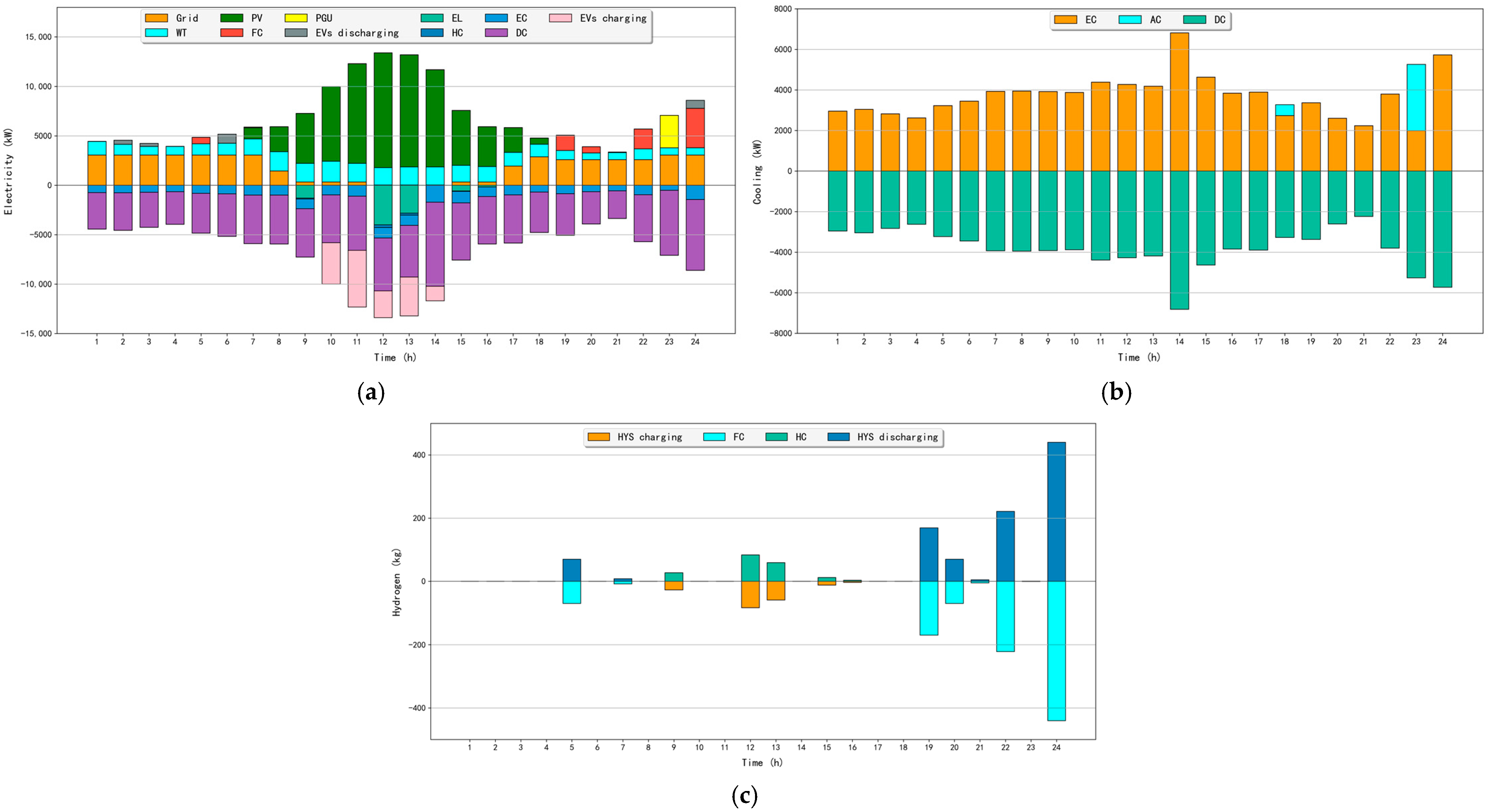
Figure 3, Figure 4, Figure 5 and Figure 6 respectively illustrate the electrical, cooling, and hydrogen balances under the operational scheduling of Cases 0–3. In these figures, the vertical axis represents energy, and the horizontal axis represents time. The negative values indicate the reverse flows of electricity, cooling, or hydrogen. Figure 3a shows that the electricity of EC, DC, and EVs is satisfied by the power grid. Figure 3b shows the cooling balance between EC and DC. Figure 4a, Figure 5a and Figure 6a show that the electricity consumed by the EL, HC, and EC and the demand from the DC and EVs is supplied by the power grid, WT, PV, FC, PGU, and EVs discharging. Figure 4b, Figure 5b and Figure 6b display that the cooling demand by the DC is satisfied by cooling generated from the EC and AC. Figure 4c, Figure 5c and Figure 6c show that hydrogen required for HYS charging and the FC is provided by hydrogen discharging from the HYS and supplied by the HC. Furthermore, when hydrogen conversion technology is excluded, the total cost and carbon emission of the optimal strategy in Case 3 amount to 27,993.24 USD and 412,543.91 kg, respectively. By comparison, the inclusion of the electrolyzer-compressor-fuel cell system reduces the total cost by 24.42% and carbon emissions by 2.80%.
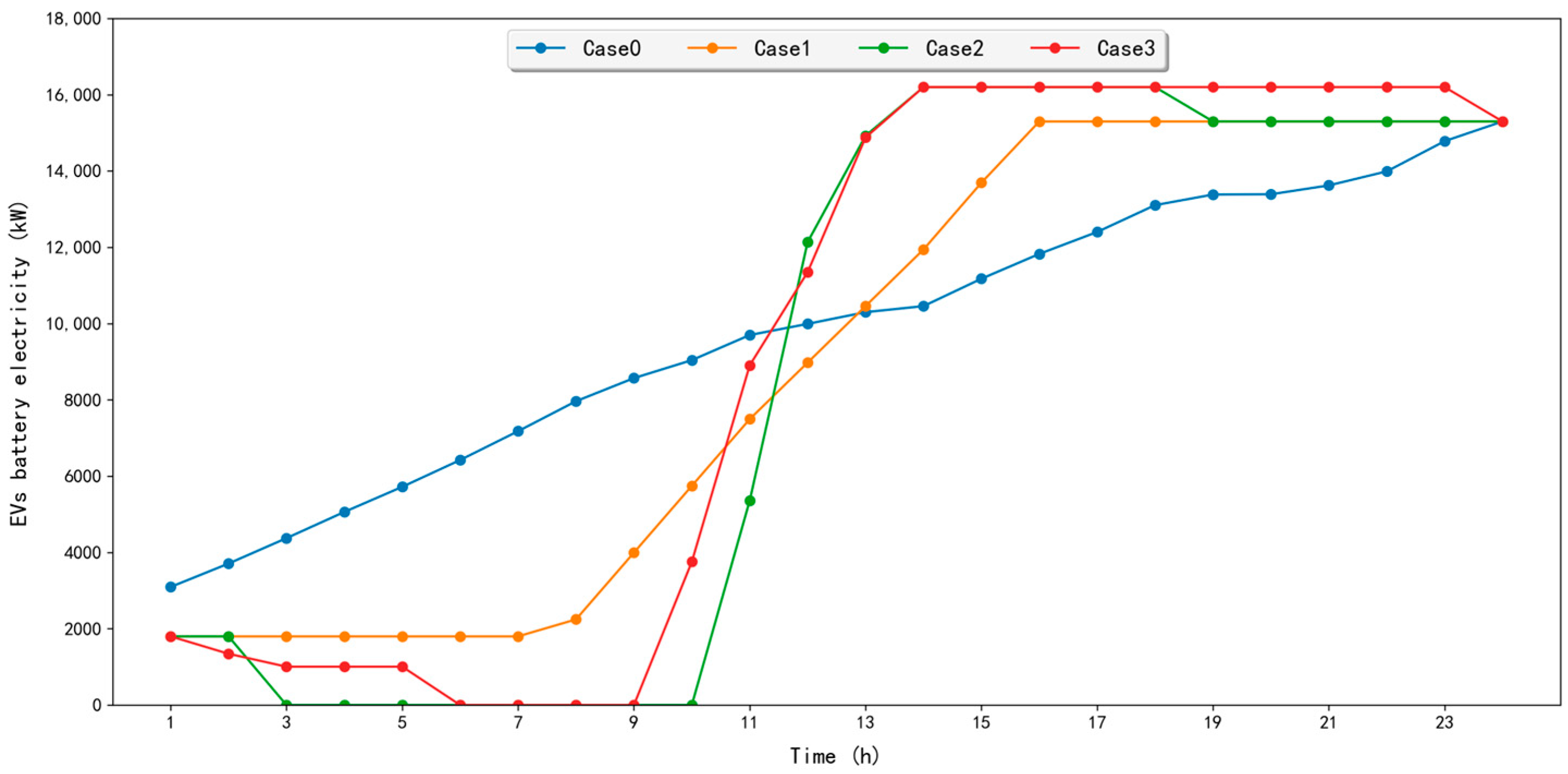
Figure 7 shows the electricity storage profiles of EVs in different cases. According to Table 3 and Figure 3, Figure 4, Figure 5, Figure 6 and Figure 7, the electricity demand of the DC and EVs is largely supplied from PV during high-price periods (i.e., 12:00–14:00) and by the PGU during the remaining hours. Furthermore, without V2G (Cases 0 and 1), the EVs’ battery electricity does not decrease over time. Conversely, when EVs participate in V2G discharging (Cases 2 and 3), EVs’ battery electricity varies dynamically. Consequently, EVs owners gain economic benefits by participating in the energy dispatch.
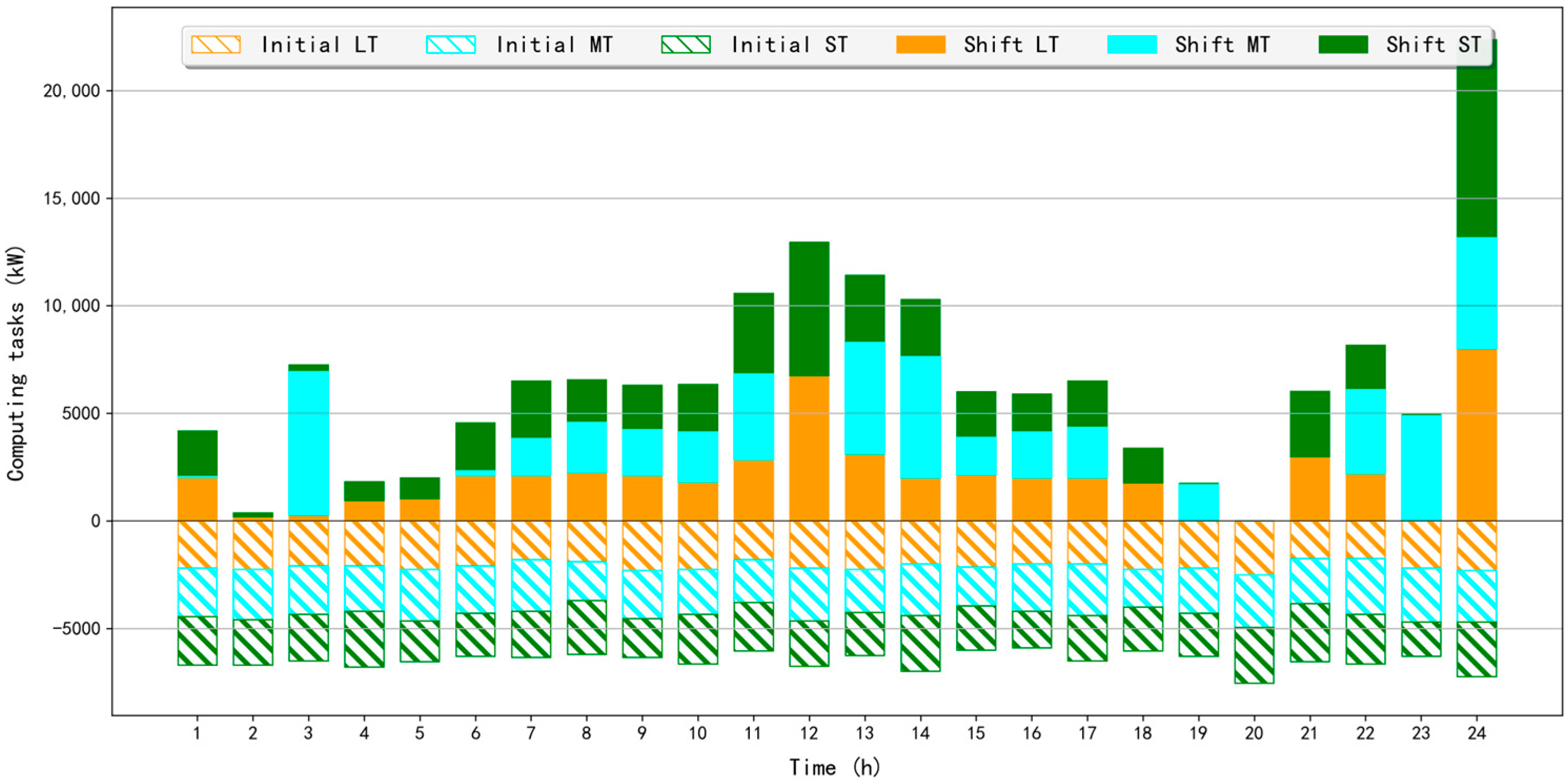
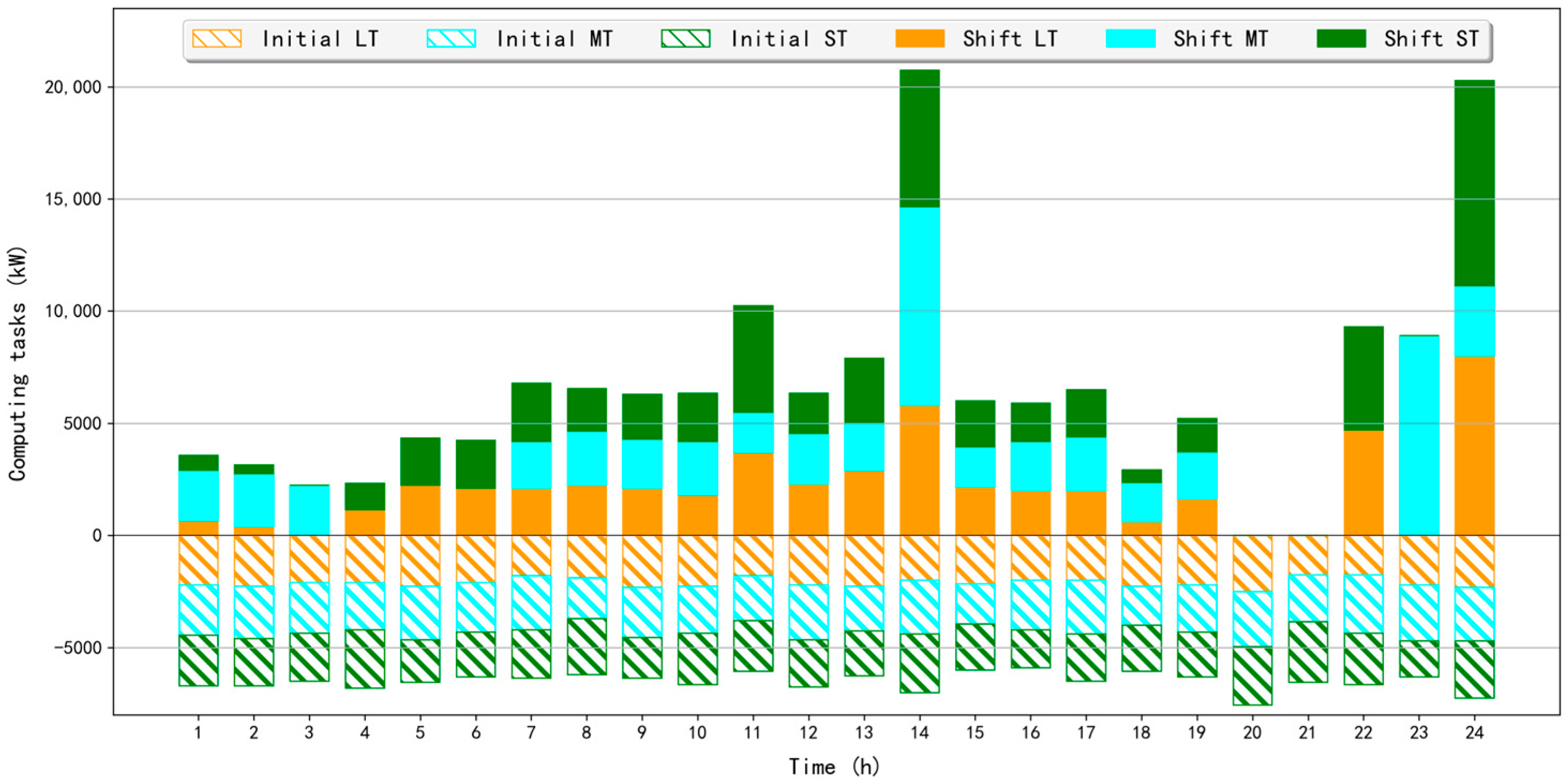
Load transfer characteristics in different cases are shown in Figure 8 and Figure 9, which display the initial computational loads (bottom part) and shifted loads (top part). The fluctuations of the shifted computational tasks closely follow the fluctuations of renewable power output (from WT and PV), as observed in Figure 4a and Figure 6a. Regarding the total initial computation tasks, the L T tasks account for 33.40% of the total, the M T tasks for 34.10%, and the ST tasks for approximately 33.51%. In Case1, the shifted load proportions of L T , M T , and S T are 26.73%, 32.03%, and 41.23%, respectively. In Case3, the total shifting load of L T , M T , and S T accounts for 28.41%, 28.76%, and 42.82%, respectively. The results indicate that the ST tasks possess greater flexibility for shifting. Based on the data in Table 3 and the trends shown in Figure 4, Figure 5, Figure 6, Figure 7 and Figure 8, the total electricity demand is reduced through better alignment with renewable energy availability via computing task transferring. In summary, the collaborative optimal scheduling of the hybrid energy system for the DC and EVs with computing tasks transferring (Case 3) can achieve improved economic and environmental performances under the carbon trading mechanism.

4.1.3. Operational Scheduling in Case 3 with Different EVs Behavior

To investigate the impact of EVs’ charging behavior on the performance of the proposed hybrid energy system, three scheduling scenarios with different EV participation durations (8, 16, and 24 h) are compared. Table 6 summarizes the influence of these participation durations on the performance of Case 3. The results reveal significant variations in the system’s economic performance across different time periods under the same scheduling duration. For instance, with an 8-h duration, the system cost and carbon emissions during the 8:00–16:00 interval are lower than those in other periods. Furthermore, extending the EVs’ participation duration consistently enhances the overall economic and environmental performance of the hybrid energy system. This improvement is primarily attributed to the EVs’ capability to provide adequate energy backup during periods of insufficient renewable energy supply.

4.2. Sensitivity Analysis

4.2.1. Carbon Price Analysis

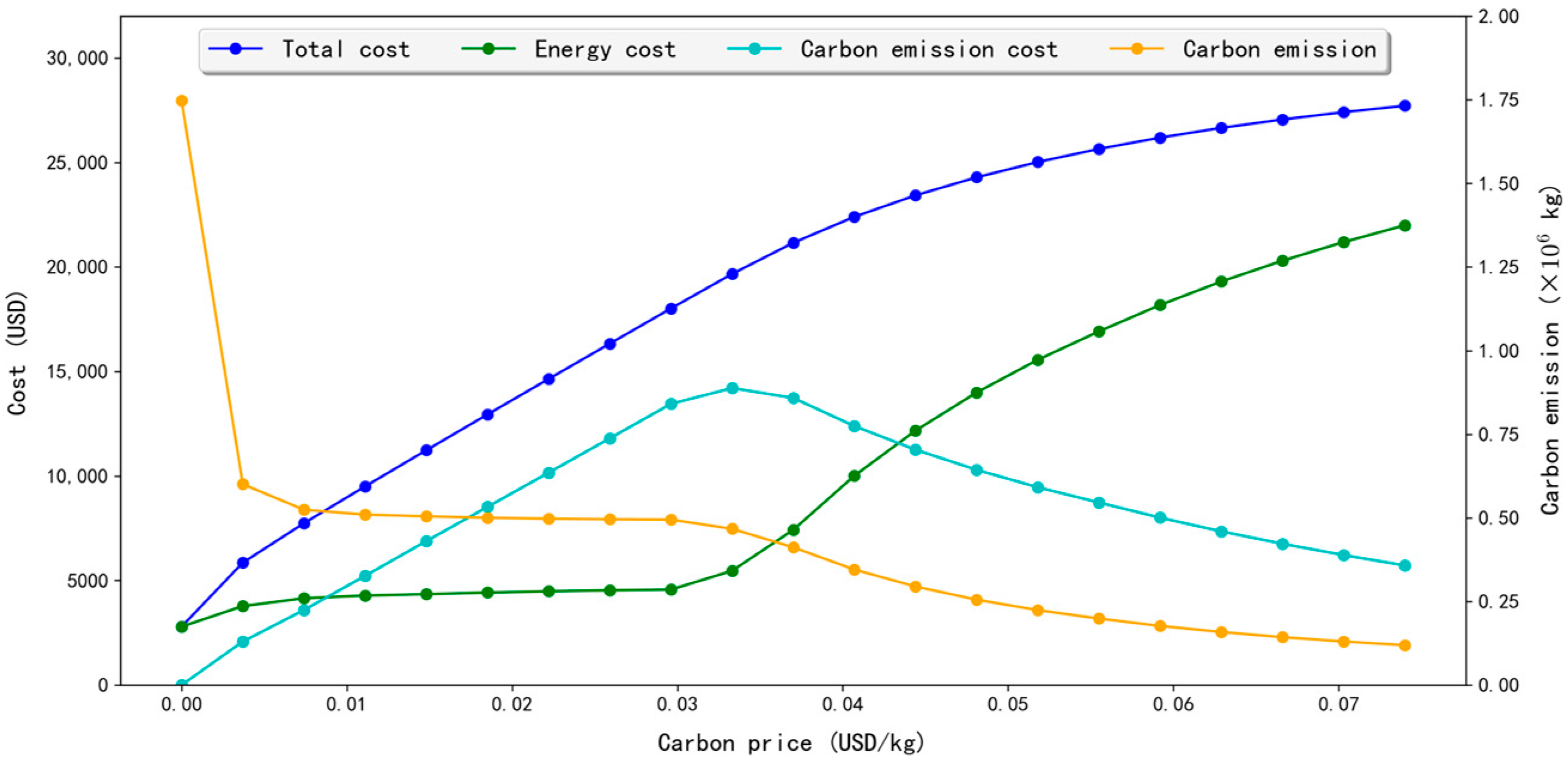
Given that China’s carbon market is still in its early development stage and exhibits substantial price volatility [35], this study examines the carbon price range from zero to twice the current level l (with a step size of 0.1 times) to help the DC enterprises evaluate the impact of market uncertainties on cost and carbon emissions. Figure 10 provides the variations in the total cost and carbon emissions under different carbon price scenarios. As the carbon price rises, the total cost shows an upward trend. When the carbon price increases from 0.037 USD/kg to 0.074 USD/kg, the total cost increases by approximately 31%. The energy cost also increases with the carbon price increasing, and its increase speed becomes faster from 0.037 USD/kg. The carbon emission cost initially rises but then declines after reaching a turning point at 0.037 USD/kg. Simultaneously, the carbon emission decreases as the carbon price increases. Notably, the implementation of a carbon price leads to a significant reduction in emissions. Therefore, while carbon price implementations are evidently effective in reducing carbon emissions, they also result in higher operational costs.

4.2.2. Carbon Emission Benchmark Analysis

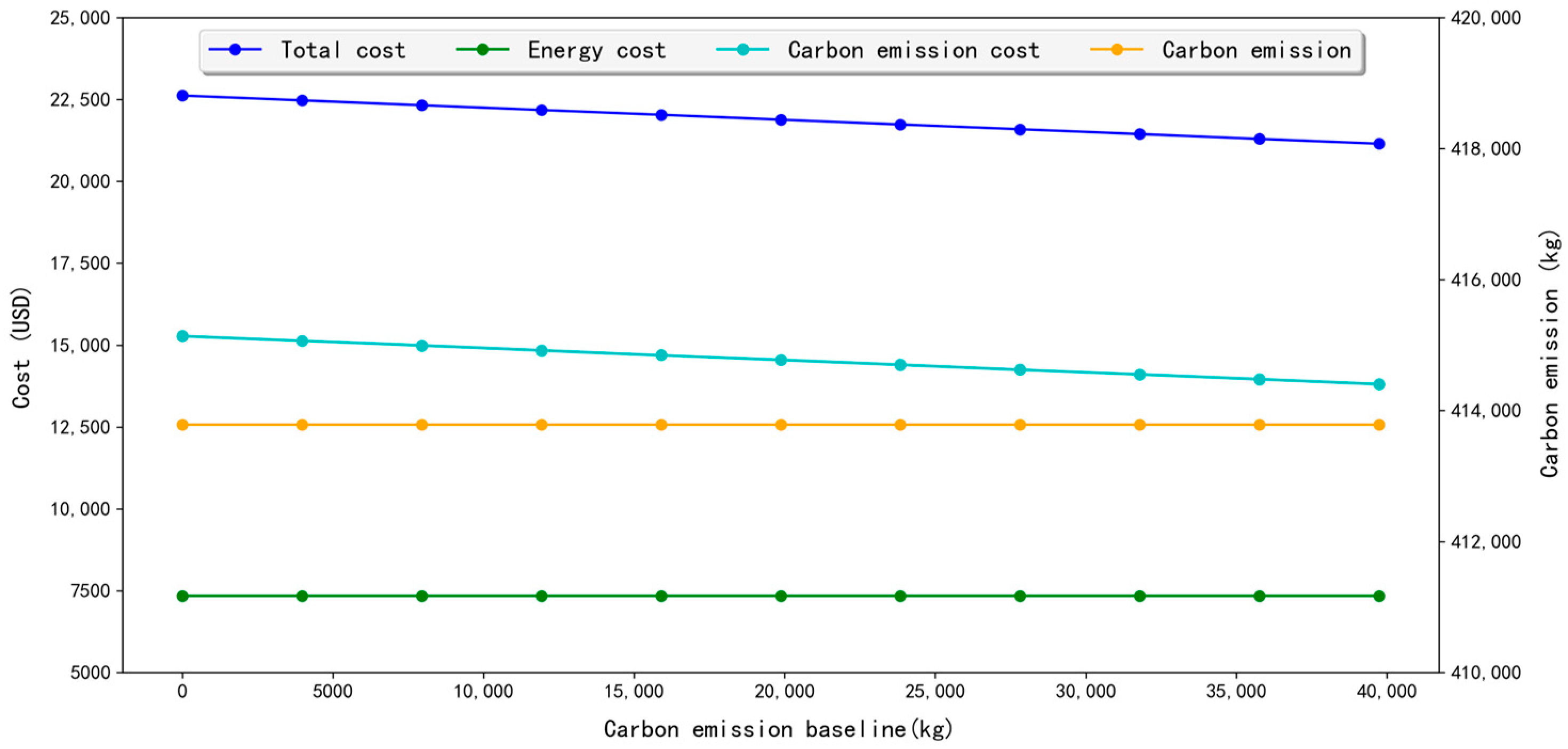
Considering that the future government might tighten the control over carbon emission reduction [35], this study examines carbon emission benchmarks ranging from zero to the current baseline value in order to analyze the cost and carbon emission trends of the proposed system under stringent carbon reduction requirements. Figure 11 details the variations in cost and carbon emissions under different carbon emission benchmark settings. The results show that carbon emissions remain unchanged as the benchmark varies. However, the total cost decreases because the carbon emission cost declines when the benchmark is raised. Therefore, implementing a carbon emission benchmark is beneficial for lowering carbon emission cost, thereby leading to an overall reduction in total system cost.

4.2.3. Carbon Emission Coefficient Analysis

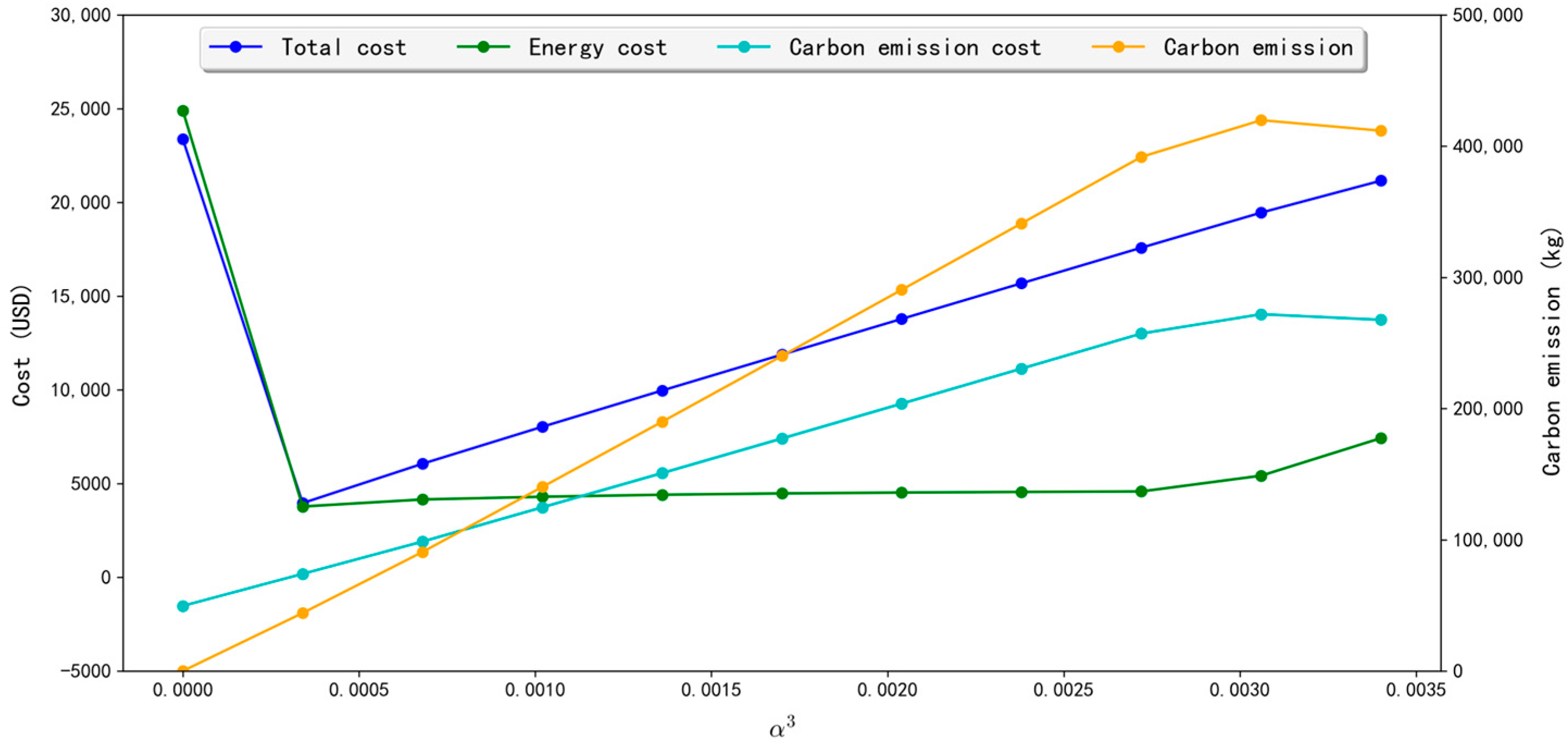
According to the data presented in Table 3 and Table 4, the cost and carbon emissions associated with power grid consumption are higher that those from natural gas. When the DC enterprise aims to reduce carbon emission, it can lower the carbon emission quadratic coefficient for grid power (i.e., α 3 ) by technological advance. Figure 12 details the variations in cost and carbon emissions under different α 3 settings from zero to the current level in steps of 0.1 times. The results, read from right to left, show that the total cost initially declines, reaching a minimum at a turning point ( α 3 = 0.00035), before rising again. Within the α 3 range from 0.00035 to 0.0035, the energy cost is remaining relatively stable. As the coefficient decreases, both the carbon emission cost and carbon emission exhibit an overall downward trend. Therefore, by advancing relevant technologies, the DC enterprise can effectively reduce the carbon emission coefficient of the power grid. This reduction not only lowers the system’s carbon emissions but can also optimize the total operational cost of the hybrid energy system.

4.2.4. Comprehensive Analysis

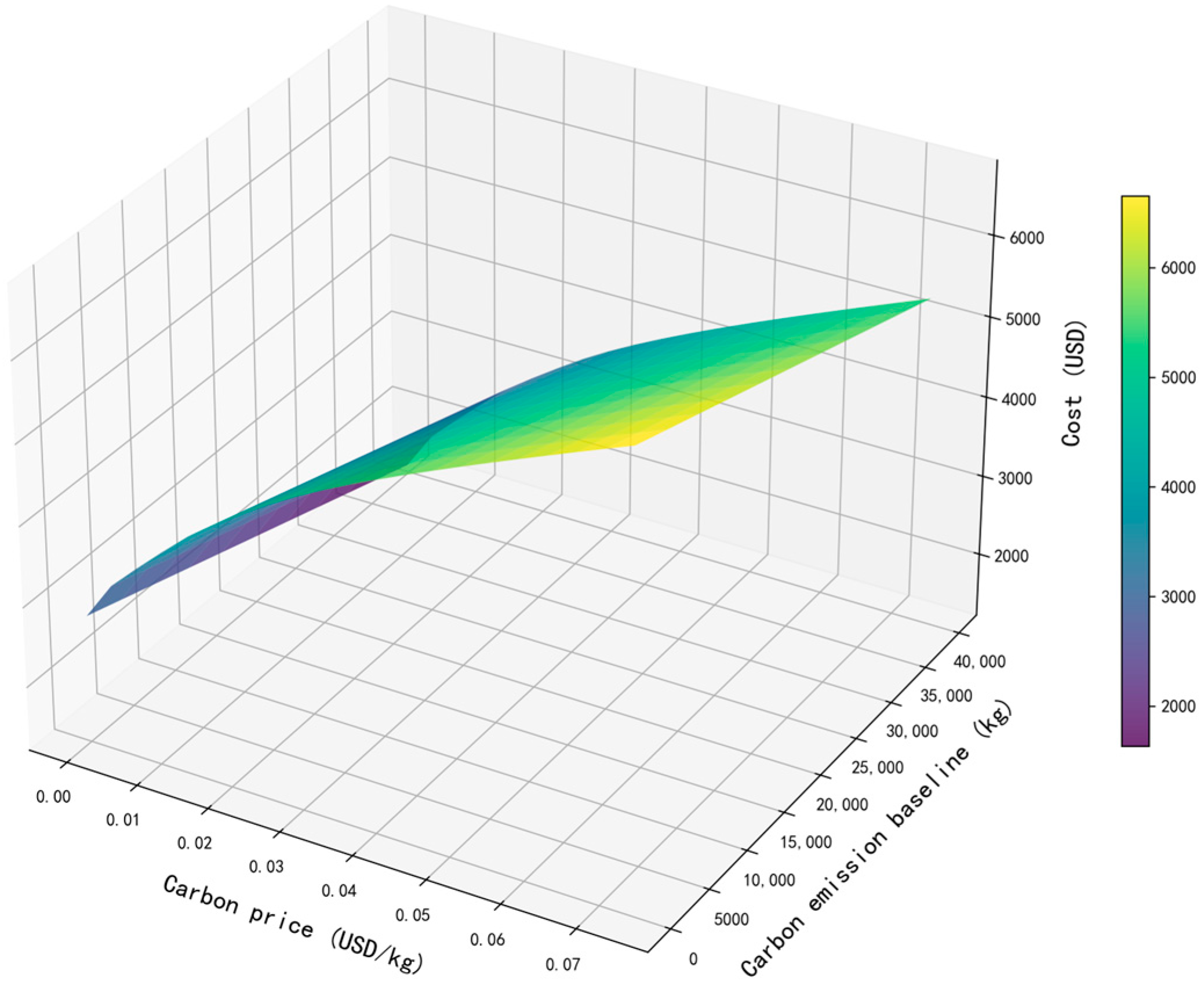
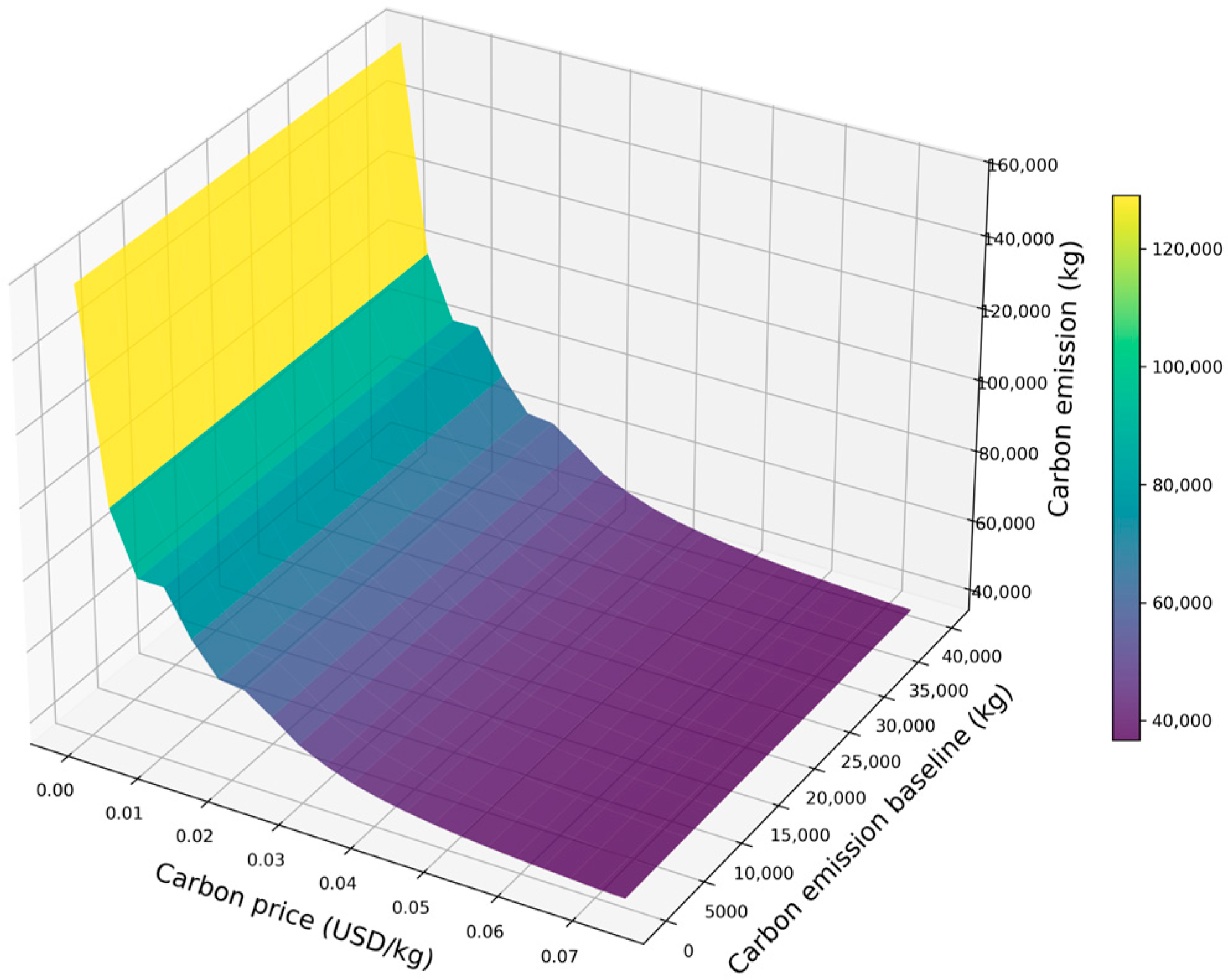
From the perspectives of carbon emission reduction of the enterprise, a comprehensive sensitivity analysis is conducted. Figure 13 shows the variation in total cost under different carbon prices and emission benchmarks in Case 3 based on carbon emission coefficient α 3 as 0.00035. The combined increase in carbon price and emission benchmark exerts a cumulative effect, resulting in a rise in overall cost. Figure 14 displays the corresponding carbon emission charges under different carbon prices and emission benchmarks in Case 3, and the carbon emissions reduce as both the carbon price and emission benchmark increase. This trend occurs mainly because the carbon emission decrease by carbon price increasing is greater than the increase by carbon emission benchmark increasing. In addition, the carbon price and emission benchmark were varied in 10% increments. The resulting response surface exhibits a concave shape. Notably, the surface is non-smooth, which indicates that the rate of carbon emission reduction is not constant. Based on the results shown in Figure 10, Figure 11, Figure 12, Figure 13 and Figure 14, the implementation of the carbon trading mechanism leads to an increase in system cost. Simultaneously, carbon trading policy has an additive effect on reducing the carbon emissions of the DC. The carbon emissions of the DC and EVs decrease with a higher carbon price, a lower emission benchmark, and a lower carbon emission coefficient.

5. Conclusions

This paper proposes a collaborative optimization model of a hybrid energy system for the DC and EVs under the carbon trading mechanism. The model formulated the energy and computing task scheduling problem with the objective of minimizing total cost while meeting the demands of both the DC and EVs and ensuring the economic interests of EVs’ owners. Case study results verify that the hybrid energy system with multiple sources has economic and environmental advantages in spite of operational complexity. Furthermore, the presented collaborative strategy can achieve 5.21% cost savings compared to the case without V2G and a 22.80% reduction compared to the case without load transferring. By applying the optimal scheduling strategy. The C D E of the collaborative system can be reduced by 16.74% relative to the scenario without EVs discharging while performing similarly to the scenario without load transferring. Overall, the optimal solution for the proposed cooperative system has superior economic and environmental performance relative to the ones achieved by the non-cooperative cases.
The effectiveness of carbon emission policy and a carbon emission coefficient reduction is further explored. Results show that introducing a carbon price yields significant carbon reduction. As the carbon prices rise, carbon emissions gradually decrease, but the carbon trading cost shows a trend of first increasing and then decreasing, and the total cost shows an upward trend. In contrast, the carbon emission benchmark increases, but it does not affect the carbon emissions, but it leads to a decrease in carbon trading costs and a decrease in the total cost. Reducing the carbon emission coefficient of power generation in the grid can lower the total cost and carbon emission of the energy system in the DC. In summary, the implementation of a carbon trading policy can effectively reduce the carbon emission in the proposed framework, though at the expense of increased operational costs.
This study represents one of the first pieces of research to explore the potential economic and environmental benefits of integrating EVs as energy storage units into a DC through collaborative optimal scheduling under a carbon trading mechanism. The synergies between the EVs and the DC are demonstrated to be viable and beneficial to improve economic viability, energy efficiency, and environmental sustainability. Given the proposed cooperative optimum, the framework can be further extended into a cost-effective decision-making tool to facilitate sustainable development under dual carbon goals. To further enhance the practical relevance of the proposed model, future work could focus on developing a robust optimization extension that systematically incorporates uncertainties related to renewable generation and individualized EV mobility patterns.

Author Contributions

Conceptualization, X.C.; methodology, X.C.; software, X.C. and L.Y.; validation, X.C. and L.Y.; formal analysis, X.C.; investigation, L.Y.; writing—original draft preparation, X.C.; writing—review and editing, X.C. and L.Y.; visualization, L.Y.; project administration, X.C.; funding acquisition, X.C. All authors have read and agreed to the published version of the manuscript.

Funding

This research was funded by the Shanghai Lixin University of Accounting and Finance young backbone teacher innovative team program of “high-level construction of local university”, grant number CXTD2024011; the Shanghai Lixin University of Accounting and Finance Fintech Re-search Project, grant number 2025-JK02.

Institutional Review Board Statement

Not applicable.

Informed Consent Statement

Not applicable.

Data Availability Statement

The original contributions presented in this study are included in the article. Further inquiries can be directed to the corresponding author.

Conflicts of Interest

The authors declare that they have no known competing financial interests or personal relationships that could have appeared to influence the work reported in this paper.

Abbreviations

The following abbreviations are used in this manuscript:
DCData center
EVsElectric vehicles
PGUPower generation unit
WTWind turbine
PVPhotovoltaic
HYSHydrogen storage tank
FCFuel cell
ACAbsorption chiller
ECElectric chiller
HESHeat storage tank

Appendix A

Table A1. Indices, parameters, and variables applied in the proposed model.
Nomenclature
Indices
t index of the slotted interval, t = 1,2 , , T t y type of the computation tasks, t y = L T , M T , S T
i index for the computation tasks, i = 1,2 , , I v index for the EVs, v = 1,2 , V
Parameters
C total cost (USD) v t wind speed (m/s)
C e n e r g y energy procurement cost (USD) v c i cut-in wind speed of the turbine (m/s)
C c a r b o n carbon emission cost (USD) v r Rated wind speed of the turbine (m/s)
C D E carbon emission (kg) v c o cut-out wind speed of the turbine (m/s)
C D E b a s e initial carbon allowance (kg) G t hourly solar radiation (kW/m2)
p t e , b u y electricity price from power grid at time t (USD/kWh) A P V surface area (m2)
p n g natural gas price (USD/Nm3) η P V efficiency of the PV panels
δ e carbon allowance coefficients for electricity η o t h e r other losses
δ g a s carbon allowance coefficient for natural gas (kg CO2/kWh) η H C compression efficiency coefficient
α 1 , α 2 , α 3 emission factors for electricity η H C , e hydrogen to electrical conversion coefficient of HC (kW/kg)
β g a s emission factor for natural gas (kg CO2/kWh) η E L electricity to hydrogen conversion coefficient of EL (kg/kW)
p c a r b o n unit carbon price (USD/kg) η F C , e electrical conversion efficiency (kW/kg)
t scheduling interval η P G U PGU electrical efficiency coefficient (kW/Nm3)
a t i t y arriving time of computing task i η P G U , h PGU thermal efficiency
o t i t y processing time of computing task
i
η A C AC component cooling efficiency
d t i t y deadline time of computing task
i
η E C EC component cooling efficiency
n i t y number of computing task i η H E S , c h HES charging efficient
l distinct level of computing task η H E S , d i s HES discharging coefficient
N s e r number of servers T v a r r arrive time of EV v
F maximum capacity of each server T v d e p departure time of EV v
E s e r , m a x maximum power consumption of all servers S O C v a r r initial battery level of EV v
E s e r , b a s e basic power consumption of all servers C A P v e v battery capacity of EV v
η e , c cooling demand related to electricity demand coefficient of DC S O C v m a x maximum electricity store rate of EV v
C A P W T rated wind power output (kWh) α v c m a x maximal charging limit of EV v
C A P E L EL’s capacity (kg) α v d m a x maximal discharging limit of EV v
C A P H Y S HYS’s capacity S O C v d e p demand electricity at departure time limit of EV v
C A P H E S HES’s capacity (kg) η e v , d i s discharging efficient of EV v
η e v , c h charging efficient of EV v
Continuous decision variables (in time period t)
E t g r i d electricity purchased from power grid (kWh) H t H Y S , s t stored hydrogen of HYS (kg)
N t n g natural gas consumption (Nm3) H t H Y S , c h hydrogen charged of HYS (kg)
x t 1 , t 2 , i t y , l transfer coefficient of computing task i H t H Y S , d i s hydrogen discharged of HYS (kg)
E t d c electricity demand of the DC (kWh) E t P G U PGU generate electricity (kWh)
Q t d c cooling demand of the DC (kWh) Q t E C , c cooling input of EC (kWh)
E t W T electricity generated by the WT (kWh) Q t A C , c cooling output of AC (kWh)
E t P V electricity output of PV (kWh) Q t H E S , s t stored thermal energy in HES (kWh)
H t E L hydrogen produced by the EL (kg) Q t P G U heating recovered form PGU (kWh)
E t E L electricity consumption of EL (kWh) E v , t e v , d i s electricity discharged from EV v (kWh)
H t H C hydrogen output from the HC (kg) E v , t e v , c h electricity charged to EV v (kWh)
  H t F C hydrogen consumption (kg) E v , t e v , s stored electricity of the EV v (kWh)
E t H C the electricity consumption by HC (kWh) Q t H E S , c h thermal charged of HES (kWh)
E t F C the electrical energy output of the FC (kWh) Q t H E S , d i s thermal discharged of HES (kWh)
u t s e r the CPU utilization of the servers Q t A C thermal consumption of AC (kWh)
Binary decision variables (in time period t)
x t E L 1 if electricity to hydrogen operating state of EL; 0 otherwise x t H E S 1 if HES in charging state; 0 otherwise
x t F C 1 if hydrogen to electricity operating state of FC; 0 otherwise x v , t e v 1 if EV v in charging state; 0 otherwise
x t H Y S 1 if HYS in charging state; 0 otherwise

References

  1. Wang, Z.; Wang, Y.; Ji, H.; Hasanien, H.M.; Zhao, J.; Yu, L.; He, J.; Yu, H.; Li, P. Distributionally robust planning for data center park considering operational economy and reliability. Energy 2024, 290, 130185. [Google Scholar] [CrossRef]
  2. Liu, Y.; Wei, X.; Xiao, J.; Liu, Z.; Xu, Y.; Tian, Y. Energy consumption and emission mitigation prediction based on data center traffic and PUE for global data centers. Glob. Energy Interconnect. 2020, 3, 272–282. [Google Scholar] [CrossRef]
  3. Liu, W.; Jin, B.; Wang, D.; Yu, Z. Performance modeling and advanced exergy analysis for low-energy consumption data center with waste heat recovery, flexible cooling and hydrogen energy. Energy Convers. Manag. 2023, 297, 117756. [Google Scholar] [CrossRef]
  4. Zhang, X.; Kong, X.; Yan, R.; Liu, Y.; Xia, P.; Sun, X.; Zeng, R.; Li, H. Data-driven cooling, heating and electrical load prediction for building integrated with electric vehicles considering occupant travel behavior. Energy 2023, 264, 126274. [Google Scholar] [CrossRef]
  5. Chart: Over 30 million! China’s Number of Electric Vehicles has Seen a Rapid Increase in Ownership. Available online: https://www.gov.cn/zhengce/jiedu/tujie/202501/content_6999527.htm (accessed on 5 December 2025).
  6. Miadreza, S.-K.; Ehsan, H.-F.; Osório, G.J.; Gil, F.A.S.; Aghaei, J.; Barani, M.; Catalão, J.P.S. Optimal behavior of electric vehicle parking lots as demand response aggregation agents. IEEE Trans. Smart Grid 2016, 7, 2654–2665. [Google Scholar] [CrossRef]
  7. Li, S.; Brocanelli, M.; Zhang, W.; Wang, X. Integrated Power Management of Data Centers and Electric Vehicles for Energy and Regulation Market Participation. IEEE Trans. Smart Grid 2014, 5, 2283–2294. [Google Scholar] [CrossRef]
  8. Yu, L.; Jiang, T.; Zou, Y. Distributed Online Energy Management for Data Centers and Electric Vehicles in Smart Grid. IEEE Internet Things J. 2016, 3, 1373–1384. [Google Scholar] [CrossRef]
  9. Aujla, G.S.; Kumar, N. SDN-based energy management scheme for sustainability of data centers: An analysis on renewable energy sources and electric vehicles participation. J. Parallel Distrib. Comput. 2018, 117, 228–245. [Google Scholar] [CrossRef]
  10. Wang, X.; Wang, X.; Liu, Y.; Xiao, C.; Zhao, R.; Yang, Y.; Liu, Z. A Sustainability Improvement Strategy of Interconnected Data Centers Based on Dispatching Potential of Electric Vehicle Charging Stations. Sustainability 2022, 14, 6814. [Google Scholar] [CrossRef]
  11. Yuan, H.; Feng, K.; Li, W.; Sun, X. Multi-objective optimization of virtual energy hub plant integrated with data center and plug-in electric vehicles under a mixed robust-stochastic model. J. Clean. Prod. 2022, 363, 132365. [Google Scholar] [CrossRef]
  12. Xu, Y.; Liu, R.; Tang, L.; Wu, H.; She, C. Risk-averse multi-objective optimization of multi-energy microgrids integrated with power-to-hydrogen technology, electric vehicles and data center under a hybrid robust-stochastic technique. Sustain. Cities Soc. 2022, 79, 103699. [Google Scholar] [CrossRef]
  13. Koholé, Y.W.; Ngouleu, C.A.W.; Fohagui, F.C.V.; Tchuen, G. Optimization of an off-grid hybrid photovoltaic/wind/diesel/fuel cell system for residential applications power generation employing evolutionary algorithms. Renew. Energy 2024, 224, 120131. [Google Scholar] [CrossRef]
  14. Liang, J.; Chen, D.; Xu, S. Energy-Constrained optimization of data center layouts: An integer linear programming approach. Energies 2025, 18, 5040. [Google Scholar] [CrossRef]
  15. Keskin, I.; Soykan, G. Reliability, availability, and life-cycle cost (LCC) analysis of combined cooling, heating and power (CCHP) integration to data centers considering electricity and cooling supplies. Energy Convers. Manag. 2023, 291, 117254. [Google Scholar] [CrossRef]
  16. Wang, J.; Deng, H.; Liu, Y.; Wang, Y. Integrated Optimization of Configurations and Operations of Integrated Energy System for Data Center. Sci. Technol. Eng. 2023, 23, 1968–1977. (In Chinese) [Google Scholar] [CrossRef]
  17. Chatzivasileiadi, A.; Ampatzi, E.; Knight, I. Characteristics of electrical energy storage technologies and their applications in buildings. Renew. Sustain. Energy Rev. 2013, 25, 814–830. [Google Scholar] [CrossRef]
  18. He, W.; Xu, Q.; Liu, S.; Wang, T.; Wang, F.; Wu, X.; Wang, Y.; Li, H. Analysis on data center power supply system based on multiple renewable power configurations and multi-objective optimization. Renew. Energy 2024, 222, 119865. [Google Scholar] [CrossRef]
  19. Han, O.; Ding, T.; Zhang, X.; Mu, C.; He, X.; Zhang, H.; Jia, W.; Ma, Z. A shared energy storage business model for data center clusters considering renewable energy uncertainties. Renew. Energy 2023, 202, 1273–1290. [Google Scholar] [CrossRef]
  20. Pabon, J.J.G.; Wang, J.; Chamanehpour, E.; Salami, D.; Khosravi, A. Dynamic integration of solar-powered hydrogen systems with fuel cells and district heating for green data centers. Int. J. Hydrog. Energy 2025, 196, 152557. [Google Scholar] [CrossRef]
  21. Zhang, L.; Deng, J.; Li, Q.; Yang, Y.; Lei, M. Research on data center computing resources and energy load Co-optimization considering spatial-temporal allocation. Comput. Electr. Eng. 2024, 116, 109206. [Google Scholar] [CrossRef]
  22. Fotopoulou, M.; Tsekouras, G.; Rakopoulos, D.; Kontargyri, V. Demand response optimization for the enhancement of the distribution system’s operation. Sustain. Energy Grids Netw. 2025, 44, 102051. [Google Scholar] [CrossRef]
  23. Hou, D.; Wang, L.; Ma, Y.; Lyu, L.; Liu, W.; Li, S. Joint Optimal Scheduling of Power Grid and Internet Data Centers Considering Time-of-Use Electricity Price and Adjustable Tasks for Renewable Power Integration. Sustainability 2025, 17, 3374. [Google Scholar] [CrossRef]
  24. Li, B.; Wang, S.; Chen, Y.; Han, Y.; Yang, W. Joint Network Expansion Planning with Internet Data Center and Charging Stations for EV Sharing System. IEEE Trans. Ind. Inform. 2024, 20, 13251–13261. [Google Scholar] [CrossRef]
  25. Duarte, J.L.R.; Fan, N. Operations of data centers with onsite renewables considering greenhouse gas emissions. Sustain. Comput. Inform. Syst. 2023, 40, 100903. [Google Scholar] [CrossRef]
  26. Wang, J.; Deng, H.; Liu, Y.; Guo, Z.; Wang, Y. Coordinated optimal scheduling of integrated energy system for data center based on computing load shifting. Energy 2023, 267, 126585. [Google Scholar] [CrossRef]
  27. Han, J.; Han, K.; Han, T.; Wang, Y.; Han, Y.; Lin, J. Data-driven distributionally robust optimization of low-carbon data center energy systems considering multi-task response and renewable energy uncertainty. J. Build. Eng. 2025, 102, 111937. [Google Scholar] [CrossRef]
  28. Xu, P.; Wang, J.; Duan, Z.; Wu, B.; Xu, C. A dual-layer optimization model of configuration and operation of the integrated energy system with a data center to improve both economic and reliability performances. J. Build. Eng. 2025, 111, 113252. [Google Scholar] [CrossRef]
  29. Han, J.; Yan, Y.; Wang, Y.; Han, K.; Han, Y.; Lin, J. Dual-time scale collaborative optimization of data center energy system: Considering multi-task response mechanism and hybrid hydrogen-battery energy storage. J. Energy Storage 2025, 119, 116244. [Google Scholar] [CrossRef]
  30. Fan, J.; Yan, R.; He, Y.; Zhang, J.; Zhao, W.; Liu, M.; An, S.; Ma, Q. Stochastic optimization of combined energy and computation task scheduling strategies of hybrid system with multi-energy storage system and data center. Renew. Energy 2025, 242, 122466. [Google Scholar] [CrossRef]
  31. Cheung, H.; Wang, S.; Zhuang, C.; Gu, J. A simplified power consumption model of information technology (IT) equipment in data centers for energy system real-time dynamic simulation. Appl. Energy 2018, 222, 329–342. [Google Scholar] [CrossRef]
  32. Li, J.; Li, Z.; Ren, K.; Liu, X. Towards optimal electric demand management for internet data centers. IEEE Trans. Smart Grid 2012, 3, 183–192. [Google Scholar] [CrossRef]
  33. Chu, X.; Ge, Y.; Zhou, X.; Li, L.; Yang, D. Modeling and Analysis of Electric Vehicle-Power Grid-Manufacturing Facility (EPM) Energy Sharing System under Time-of-Use Electricity Tariff. Sustainability 2020, 12, 4836. [Google Scholar] [CrossRef]
  34. Li, N.; Zhao, X.; Shi, X.; Pei, Z.; Mu, H.; Taghizadeh-Hesary, F. Integrated energy systems with CCHP and hydrogen supply: A new outlet for curtailed wind power. Appl. Energy 2021, 303, 117619. [Google Scholar] [CrossRef]
  35. Chen, H.; Hu, J.; Bai, S. Optimization of Waste-to-Energy Technology Portfolios Under the Carbon Trading Mechanism. Chin. J. Manag. Sci. 2025. Epub ahead of printing. (In Chinese) [Google Scholar] [CrossRef]
Figure 1. The hybrid energy system for the DC and EVs.
Energies 19 01138 g001
Figure 2. Initial L T , M T , and S T computation tasks.
Energies 19 01138 g002
Figure 3. Energy scheduling in Case 0: (a) Electric balance; (b) Cooling balance.
Energies 19 01138 g003
Figure 4. Energy scheduling in Case 1: (a) Electric balance; (b) Cooling balance; (c) Hydrogen balance.
Energies 19 01138 g004
Figure 5. Energy scheduling in Case 2: (a) Electric balance; (b) Cooling balance; (c) Hydrogen balance.
Energies 19 01138 g005
Figure 6. Energy scheduling in Case 3: (a) Electric balance; (b) Cooling balance; (c) Hydrogen balance.
Energies 19 01138 g006
Figure 7. Electricity storage of EVs in different cases.
Energies 19 01138 g007
Figure 8. Computing tasks transferring in Case 1.
Energies 19 01138 g008
Figure 9. Computing tasks transferring in Case 3.
Energies 19 01138 g009
Figure 10. Variations of cost and carbon emission under different carbon prices.
Energies 19 01138 g010
Figure 11. Variations of cost and carbon emission charging under different carbon emission benchmarks.
Energies 19 01138 g011
Figure 12. Variations of cost and carbon emission charges under different carbon emission coefficients of power grid.
Energies 19 01138 g012
Figure 13. Variations of cost under different carbon prices and emission benchmarks.
Energies 19 01138 g013
Figure 14. Variations of carbon emission under different carbon prices and emission benchmarks.
Energies 19 01138 g014
Table 2. Parameters of the economic and environmental performance in the proposed model.
ParametersValuesUnit
p t e , b u y 0.055 (1:00~7:00, 23:00~24:00)
0.099 (8:00~11:00, 15:00~18:00)
0.174 (12:00~14:00, 19:00~22:00)
USD/kWh
p n g 0.362USD/Nm3
p c a r b o n 0.037USD/kg
δ e 0.789kg CO2/kWh
δ g a s 0.385kg CO2/kWh
α 1 36-
α 2 −0.38-
α 3 0.0034-
β g a s 0.097kg CO2/kWh
Table 3. The proposed system-related conversion coefficient parameters.
ParametersValuesUnit
v c i 3.5m/s
v r 11m/s
v c o 25m/s
A P V 140m2
η P V 0.204-
η o t h e r 0.86-
η E L 0.02kg/kW
η H C 0.95-
η H C , e 3kW/kg
η F C , e 9.09kW/kg
η P G U 0.36kW/ Nm3
η P G U , h 0.80-
η A C 0.70-
η E C 4-
η H E S , c h 0.95-
η H E S , d i s 0.9-
η e v , c h 0.9-
E v , t e v , d i s 0.9-
α v c m a x 0.4-
α v d m a x 0.4-
Table 4. The cost (USD) comparison of different cases.
Total CostEnergy CostCarbon Emission Cost
Power GridNatural Gas
Case 0135,432.5115,963.650119,468.86
Case 122,322.525773.71016,548.81
Case 227,410.014086.319871.9613,451.74
Case 321,158.524117.743305.3013,735.48
Table 5. The carbon emission (kg) comparison of different cases.
TotalPower GridNatural Gas
Case 03,352,075.563,352,075.560
Case 1494,606.52494,606.520
Case 2410,864.45408,219.202645.25
Case 3411,800.26410,914.59885.67
Table 6. The cost (USD) and carbon emission (kg) comparison of different cases.
TimeTotal Cost (USD)Carbon Emission (kg)
8-h duration 1:00–8:0032,353.65435,037.97
9:00–16:0022,918.20412,286.08
17:00–24:0033,134.71456,452.10
16-h duration1:00–16:0021,652.23411,936.57
8:00–24:0022,424.48412,149.77
24-h duration1:00–24:0021,158.52411,800.26
Disclaimer/Publisher’s Note: The statements, opinions and data contained in all publications are solely those of the individual author(s) and contributor(s) and not of MDPI and/or the editor(s). MDPI and/or the editor(s) disclaim responsibility for any injury to people or property resulting from any ideas, methods, instructions or products referred to in the content.