Perspective

Enabling Rechargeability in Metal–Chlorine Batteries: The Critical Roles of Cathodes and Electrolytes


1
Science and Technology on Electromechanical Dynamic Control Laboratory, Xi’an 710065, China
2
Xi’an Institute of Electromechanical Information Technology, Xi’an 710065, China
*
Authors to whom correspondence should be addressed.
Energies 2026, 19(5), 1136; https://doi.org/10.3390/en19051136
Submission received: 19 December 2025 / Revised: 26 January 2026 / Accepted: 20 February 2026 / Published: 25 February 2026
(This article belongs to the Section D2: Electrochem: Batteries, Fuel Cells, Capacitors)

Abstract

Metal–chlorine batteries, including Li-Cl2, Na-Cl2 and Ca-Cl2 systems, have emerged as promising energy storage technologies in recent years, delivering impressive performance in terms of reversible capacity (up to 5000 mAh g−1), current density (up to 16,000 mA g−1), cycle life (up to 500 cycles) and low-temperature operation (down to −80 °C). The critical roles of cathodes and electrolytes, enabling the birth and performance enhancement of metal–chlorine batteries, are highlighted and discussed here, providing an overview of current research progress on metal–chlorine batteries at the same time. Finally, we demonstrate a forward-looking view of where metal–chlorine batteries are headed.

1. Introduction

Rechargeable batteries, with higher energy density, higher power density and longer cycle life, have become increasingly critical due to the rapid growth of emerging industries, such as wearable smart devices, electric vehicles, and clean energy storage [1,2]. As lithium-ion batteries, currently the dominant rechargeable battery technology, approach their theoretical performance limits, significant research efforts have shifted toward exploring alternative systems, including lithium–metal and post-lithium batteries [3,4]. For instance, lithium–metal batteries (e.g., lithium–oxygen [5] and lithium–sulfur [6] batteries) have attracted substantial attention owing to lithium’s ultrahigh theoretical specific capacity (3860 mAh g−1), which far exceeds that of graphite (372 mAh g−1), the anode material widely used in conventional lithium-ion batteries. Furthermore, to address the scarcity of lithium resources, researchers are actively investigating other metal-based batteries, such as sodium (Na)-based [7] and calcium (Ca)-based [8] systems.
Building on this line of thought, in 2021, Dai and colleagues [9] first demonstrated two novel promising rechargeable metal–chlorine batteries, Na-Cl2 and Li-Cl2 batteries, converted from the primary Na-SOCl2 and Li-SOCl2 batteries, respectively. The Na-Cl2 batteries, mainly reported in their work [9], delivered a discharge voltage of 3.5 V, a reversible capacity of up to 1200 mAh g−1 (based on carbon mass throughout this paper unless otherwise specified) and a cycle life up to 200 cycles. The energy density of Na-Cl2 batteries, 1827 Wh kg−1, is also significantly higher than that of other battery systems [10]. The Li-Cl2 batteries, thoroughly investigated and reported in 2022 [11], exhibited comparable performance as the Na-Cl2 batteries. By 2023, Chen and colleagues [12] extended the cycle life of Li-Cl2 batteries to 500 cycles, while Sun and colleagues [13] achieved a unprecedented maximum discharge current density of 16,000 mA g−1 for Na-Cl2 batteries, which was more than two orders of magnitude higher than previous reports [9]. In 2024, Dai and colleagues [14] demonstrated an ultralow-temperature Li-Cl2 battery delivering a 1200 to 5000 mAh g−1 reversible capacity between −40 °C and −80 °C. In the same year, Sun and colleagues [15] introduced the first Ca-Cl2 battery, expanding the family of rechargeable metal–chlorine batteries. Table 1 summarizes the performance of rechargeable metal–chlorine batteries from the literature.
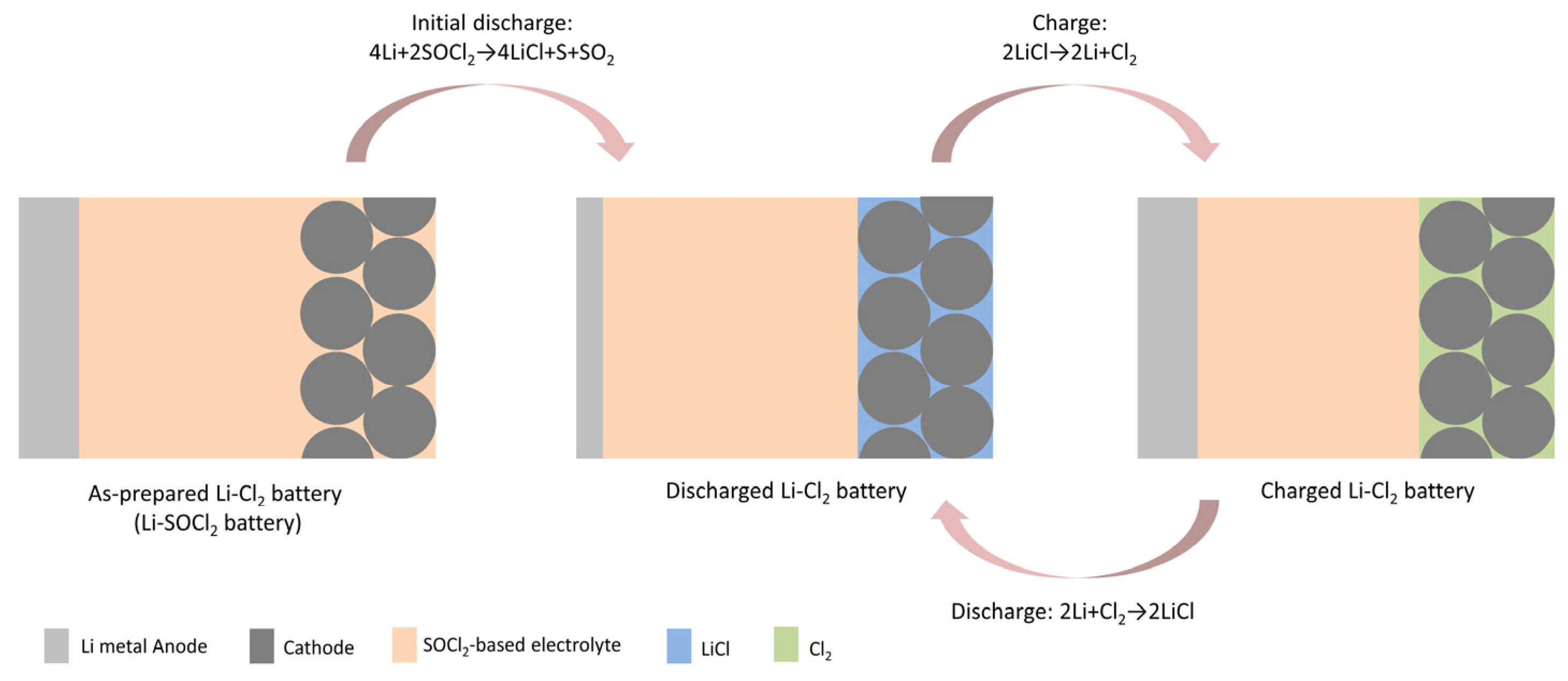
The basic chemical reaction of Li-Cl2 batteries, as an example, is presented as follows to briefly illustrate the working principles of metal–chlorine batteries. This working principle is also illustrated in Figure 1. The as-prepared Li-Cl2 battery, a Li-SOCl2 battery, initially discharges with an overall battery reaction of:
4Li + 2SOCl2 → 4LiCl + S + SO2
During this process, LiCl was in situ formed on the cathode. The formed LiCl on the cathode was then oxidized to Cl2 during the subsequent charging step and reduced back to LiCl during discharging as described in Equation (2). At the anode, simultaneously, the deposition and stripping process of Li is depicted in Equation (3). The combination of these half-reactions yields the overall reaction of Li-Cl2 batteries as shown in Equation (4). It should be noted that Equations (2)–(4) show only the main reaction of Li-Cl2 batteries, while the actual entire reaction process is much more complex, which will be further explained later, though the full electrochemical pathway remains incompletely elucidated to date.
Cathode: 2LiCl ↔ 2Li+ + Cl2 + 2e
Anode: Li ↔ Li+ + e
Overall: 2Li + Cl2 ↔ 2LiCl
In brief, by charging and discharging a fully discharged Li-SOCl2 battery, the rechargeable Li-Cl2 battery is born. It seems very easy. However, the Li-SOCl2 batteries had been remained strictly non-rechargeable for nearly five decades since it was truly born in the 1970s [17,18,19]. It was not until 2021 that this paradigm was overturned by the research of Dai and colleagues [9], whose breakthrough revealed that achieving reversibility hinges on two critical components: tailored cathode and optimized electrolyte. These findings, along with subsequent advances in metal–chlorine batteries, underscore the indispensable roles of cathode and electrolyte design. Both of these key roles, in the following, will be systematically analyzed, while the current research progress on metal–chlorine batteries will be given.

2. The Critical Roles of Cathode

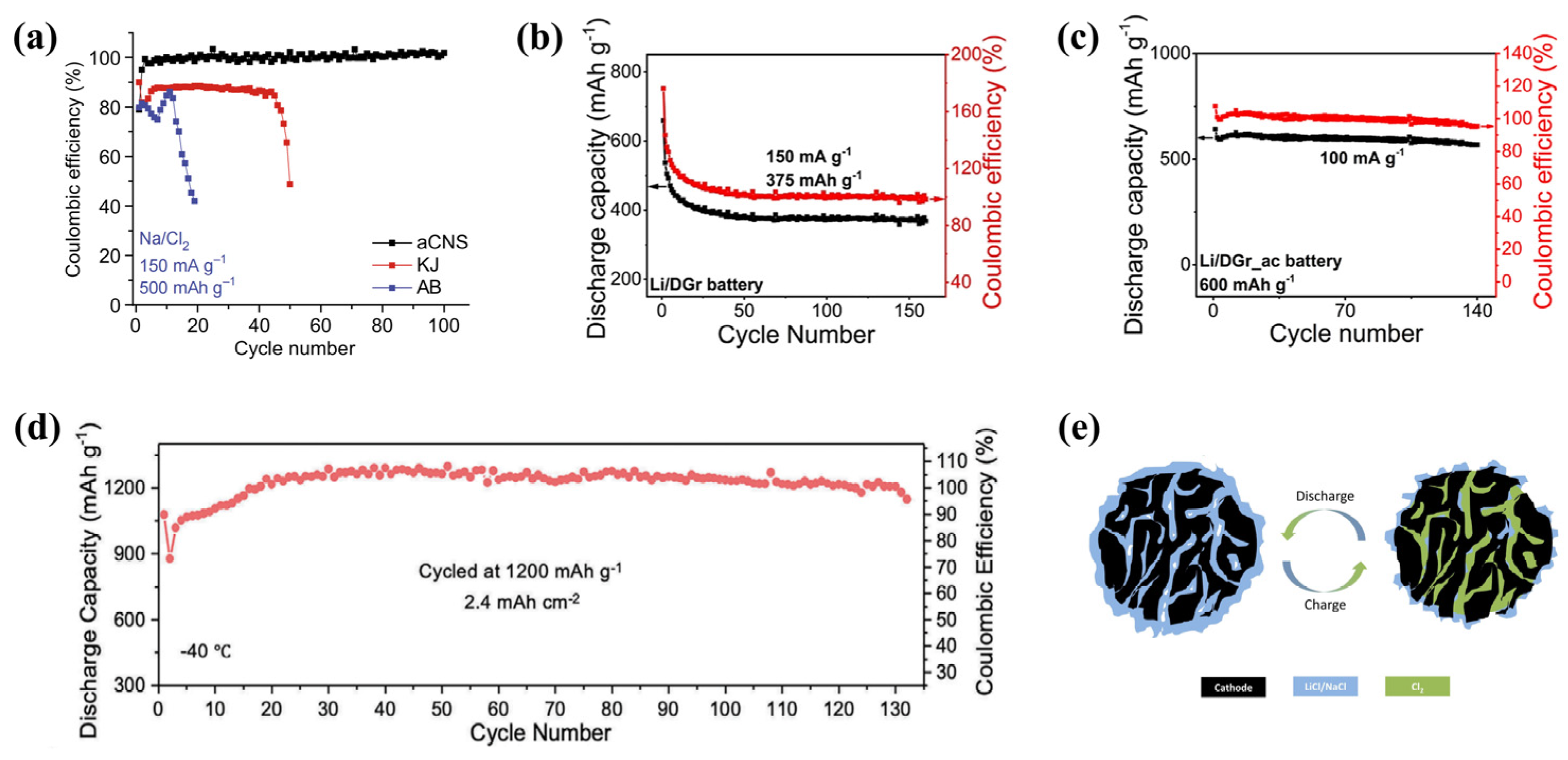
Extensive research has focused on cathode material innovation, aiming to facilitate the development of metal–chlorine batteries while advancing their performance optimization. The amorphous carbon nanospheres (aCNSs) were synthesized and used as the cathode of Na-Cl2 and Li-Cl2 batteries by Dai and colleagues [9], which was found to be critical to subsequent reversible battery cycling. It is clear from Figure 2a that the cycling performance of aCNS is better than those of acetylene black (AB) and Ketjenblack carbon black (KJ) that are wildly used in Li-SOCl2 batteries. In another paper [11], they employed CO2-activated defective graphite (DGr_ac) as the cathode of Li-Cl2 batteries achieving a higher reversible capacity than that using defective graphite without a CO2-activated (DGr) cathode, as shown in Figure 2b and Figure 2c, respectively. The CO2-activated KJ (KJCO2), similarly, was used as cathode to construct a Li-Cl2 battery by Dai and colleagues [14], delivering a longer charge–discharge cycling life (Figure 2d) than that of the KJ cathode (Figure 2a) in their previous research [9].
The cathode, as described earlier, assumes the role of holding the discharge products, LiCl (or NaCl, etc.), adsorbing the charge products, Cl2, and providing electrochemical reaction interfaces, as schematically drawn in Figure 2e. Obviously, cathode materials that provide a larger surface area or pore volume are preferred for use in metal–chlorine batteries. Therefore, aCNS, DGr_ac and KJCO2 with larger surface area and pore volume compared to the competition, as given in Table 2, were used accordingly and contributed to the remarkable performance in above studies. It should be noted that the relationship is not strictly linear. In other words, it is implied that not all pore space of cathode is valid. The cathode material, with larger effective pore volume, thus needs to be continuously found and investigated to further improve the performance of metal–chlorine batteries.
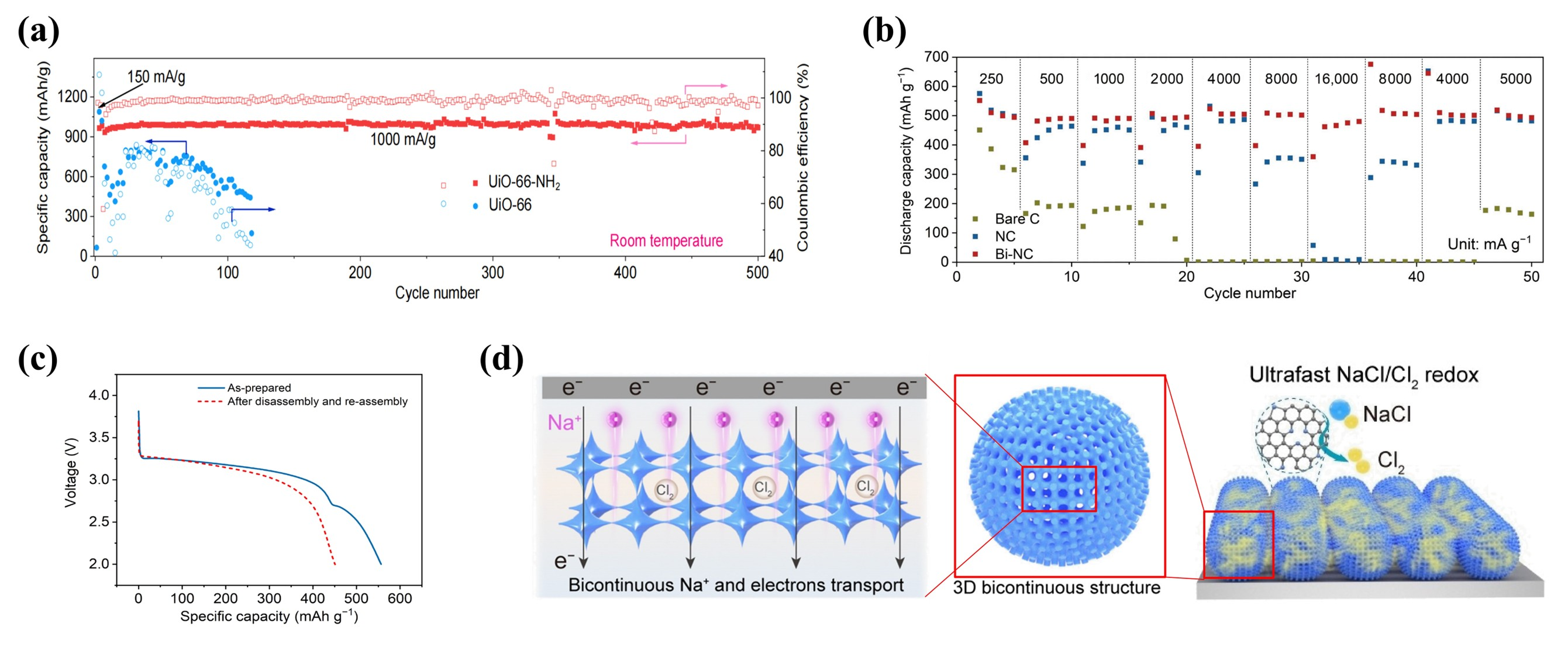
On the other hand, the cathode with functional groups that have strong chemisorption to the Cl atom have been employed to construct metal–chlorine batteries with higher performance. Chen and colleagues [12] reported a cathode of Li-Cl2 battery using metal–organic frameworks (MOFs) with functional group (-NH2) that has stronger adsorption preference to the Cl atom, UiO-66-NH2, increasing cycle life to 500 cycles, much higher than those of MOFs without functional groups (UiO-66), as shown in Figure 3a, and the previous studies mentioned above (Figure 2). Sun and colleagues [13], inspired by sponge bionics, developed a bicontinuous N-doped carbon (Bi-NC) cathode. The constructed Na-Cl2 batteries with the Bi-NC cathode demonstrated an incredible maximum discharge current density of 16,000 mA g−1 (Figure 3b), which was more than two orders of magnitude higher than other reported metal–chlorine batteries (Figure 2). This outstanding performance is attributed to the strong adsorption to Cl2 brought about by heteroatomic doping. Interestingly, it can also be demonstrated that the re-assembled Na-Cl2 battery using a disassembled cathode at fully charged state retained most of the discharge capacity (Figure 3c). Also, this sheds some light on the understanding of the state of Cl2 in the cathode in metal–chlorine batteries. In addition, the bicontinuous-structured carbon also makes an important contribution by facilitating the transport of ions and electrons (Figure 3d).

3. The Critical Roles of Electrolytes

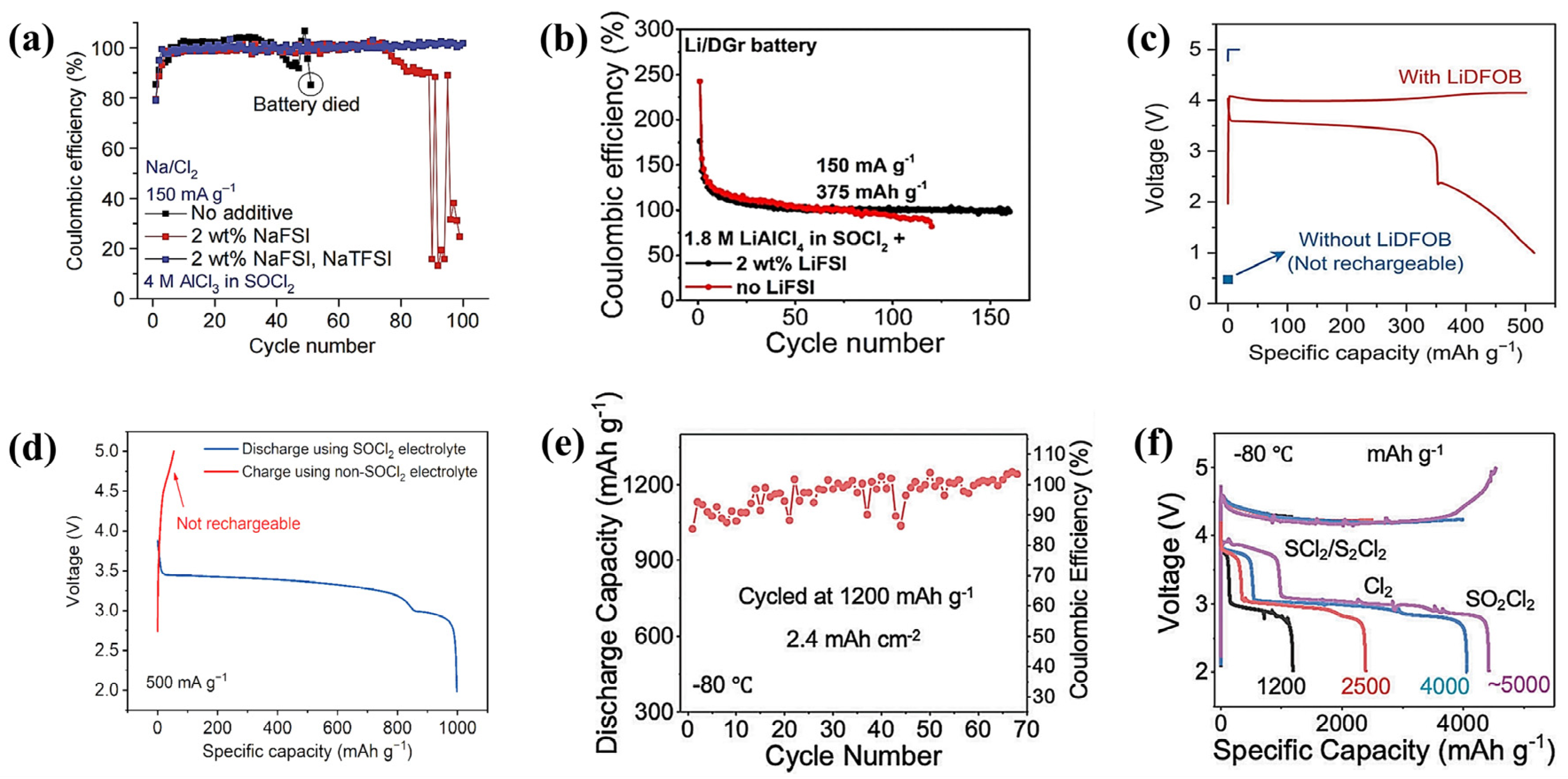
The electrolyte is the other key role in making the metal–chlorine batteries come into being. It needs to be noted beforehand that, unlike most batteries, SOCl2 is both the cathode’s active material, participating in the battery reaction as shown in Equation (1), and the electrolyte’s solvent in Li-SOCl2 batteries. The addition of NaFSI and NaTFSI in the solution of AlCl3 dissolved in SOCl2, the electrolyte commonly used in Li-SOCl2 batteries, gave the Na-Cl2 batteries a decent cycle life owing to the formation of uniform and robust solid electrolyte interface (SEI), as shown in Figure 4a [9]. Similarly, the importance of LiFSI was also reflected in the Li-Cl2 batteries (Figure 4b) [11]. LiDFOB, additive in SOCl2 electrolyte, played a key role in enabling the rechargeability of the Ca-Cl2 batteries by improving the electrochemical stability of the Ca metal anode and facilitating the dissociation and distribution of Cl-based species and Ca2+ (Figure 4c) [15].
Besides the additives, the importance of SOCl2 for metal–chlorine batteries cannot be ignored. Sun and colleagues [13] replaced the SOCl2 with a commonly used organic solvent (mixture of ethylene carbonate/diethyl carbonate/dimethyl carbonate, 1:1:1 in volume), finding that the Na-Cl2 battery could not be normally charged, as seen in Figure 4d. It implied that SOCl2 played an important role in enabling reversible NaCl/Cl2 redox reaction. On the other hand, thanks to the very low melting point of SOCl2 (−104.5 °C), the Li-Cl2 batteries with SOCl2-based electrolyte have excellent low-temperature performance down to −40 °C and −80 °C, as shown in Figure 2d and Figure 4e, respectively [14]. This offers significant natural advantages over existing lithium-ion batteries [20]. In addition, it is worth mentioning that charging to higher capacity also has to rely on the oxidation of SOCl2 to form SCl2/S2Cl2, while the SCl2/S2Cl2 contributes a higher voltage plateau at the beginning of discharging (Figure 4f), as shown in Equations (5) and (6), respectively [14]. The entire specific reaction process of the Li-Cl2 batteries has also been described in detail by Dai and colleagues [14], although it is still proposed that it could provide meaningful help in understanding the intrinsic reaction mechanism of metal–chlorine batteries.
2Li+ + SCl2 + 2e → S + 2LiCl
2Li+ + S2Cl2 + 2e → 2S + 2LiCl

4. Conclusions and Prospects

This perspective has summarized the state-of-the-art progress in metal–chlorine batteries, with a systematic analysis of the critical roles played by cathode and electrolyte in enabling the batteries birth and performance enhancement. The key insights emerging from recent studies are as follows:
(1)
The microstructure of the cathode is highly important for metal–chlorine batteries. It is preferred that the cathode have a larger surface area or pore volume to accommodate the discharge/charge products and provide redox sites. Additionally, the microstructure of the cathode should be favorable for the transport of ions and electrons.
(2)
The functional groups or heteroatomic doping attached to the cathode is also an important approach to improve performance of metal–chlorine batteries due to their strong adsorption to Cl2.
(3)
The SOCl2 electrolyte and specific additives in it are necessary to make metal–chlorine batteries possible.
(4)
The SOCl2 electrolyte can also enable metal–chlorine batteries with ultralow-temperature performance and higher reversible capacity.
Despite recent advancements, metal–chlorine batteries research remains in its nascent stage, with numerous fundamental questions unresolved. Here, we propose the following priority research directions:
(1)
The mechanisms involved in metal–chlorine batteries need to be further clarified. Firstly, except for the main reactions of metal–chlorine batteries, as shown in Equations (2)–(4), other reactions, such as the reactions of the first discharge and the reactions of charging and discharging to a higher capacity, are still proposed and need further clarification. Secondly, the mechanism of the effects of the microstructure of different cathodes on the accommodation of charge/discharge products needs to be further clarified. Thirdly, the working mechanism of the electrolyte, including SOCl2 and additives, on the construction of SEI and electrochemical reaction process of metal–chlorine batteries needs to be further clarified.
(2)
Based on new knowledge of the above mechanisms, accordingly, new cathode materials and electrolyte compositions, that have greater ability to accommodate more charge/discharge products and facilitate faster redox reactions, need to be explored further to improve the performance of the metal–chlorine batteries even more.
(3)
Currently, the assembled metal–chlorine batteries are all coin cells except for the pouch cells assembled by Chen and colleagues [12], which is still some way from the requirements of practical applications. In addition, other requirements for the practical use of metal–chlorine batteries, such as safety and economy, need to be investigated.
(4)
The severe challenges faced by metal–chlorine batteries cannot be ignored. Firstly, batteries utilizing lithium metal anodes still encounter the same safety concerns as other lithium metal batteries. Secondly, SOCl2, the core component of the electrolyte in metal–chlorine batteries, is highly corrosive, creating safety hazards during both battery manufacturing and operation. Finally, the highly reactive anode and electrolyte employed in metal–chlorine batteries also present significant challenges for battery recycling. To address these challenges, targeted research has been undertaken. For example, Sun and colleagues [16] used Li-Si alloy rather than the lithium metal that conventionally used as the anode for Li-Cl2 batteries, achieving advances in low cost and high safety. Additionally, non-corrosive organic electrolyte has been introduced into metal–chlorine batteries [10]. However, these measures have resulted in a decline in the performance of metal–chlorine batteries. Consequently, the challenges facing metal–chlorine batteries remain to be addressed through further research.
(5)
More innovative research on metal–chlorine batteries should be carried out. For example, an anode-free metal–chlorine batteries could be developed, where the chlorine-based salt is pre-added in the cathode and then the anode metal is generated in situ during the first charge, to improve safety and reduce costs. Also, solid metal–chlorine batteries could be developed by using a suitable solid electrolyte and possibly adding a very small amount of SOCl2 in the cathode to enable redox reactions on the cathode.

Author Contributions

Formal analysis, S.Z.; investigation, S.Z.; resources, L.Y.; writing—original draft preparation, S.Z.; writing—review and editing, D.Z., K.L. and Y.Z.; visualization, Y.M.; supervision, X.L.; project administration, X.L.; funding acquisition, D.Z. All authors have read and agreed to the published version of the manuscript.

Funding

This research received no external funding.

Data Availability Statement

No new data were created or analyzed in this study.

Conflicts of Interest

The authors declare no conflicts of interest.

References

  1. Hasan, M.; Haque, R.; Jahirul, M.; Rasul, M.; Fattah, I.; Hassan, N.; Mofijur, M. Advancing energy storage: The future trajectory of lithium-ion battery technologies. J. Energy Storage 2025, 120, 116511. [Google Scholar] [CrossRef]
  2. Pothaya, S.; Poochai, C.; Tammanoon, N.; Chuminjak, Y.; Kongthong, T.; Lomas, T.; Sriprachuabwong, C.; Tuantranont, A. Bamboo-derived hard carbon/carbon nanotube composites as anode material for long-life sodium-ion batteries with high charge/discharge capacities. Rare Met. 2024, 43, 124–137. [Google Scholar] [CrossRef]
  3. Banerjee, A.N.; Joo, S.W. ‘Beyond Li-ion technology’—A status review. Nanotechnology 2024, 35, 472001. [Google Scholar] [CrossRef] [PubMed]
  4. Zhang, W.; Song, Y.; Du, X.; Guo, J.; Lu, Y.; Mao, X. Probing Multiscale Dynamics of Energy-Dense Batteries by Operando Imaging. Chem Bio Eng. 2024, 1, 678–691. [Google Scholar] [CrossRef] [PubMed]
  5. Latif, U. Comprehensive Review of Li-Oxygen Batteries: Electrolytes, Electrodes, Redox Mediators, and Thermodynamics. ACS Appl. Energy Mater. 2025, 8, 4838–4883. [Google Scholar] [CrossRef]
  6. Baji, D.S.; Kannan, S.; Madambikattil, P.B.; Thirumurugan, A.; Sharma, M.K.; Pai, R.K.; Ramadoss, A.; Nair, S.; Santhanagopalan, D. Overarching advancements in building practical Li-S batteries: A holistic review. J. Energy Storage 2024, 100, 113412. [Google Scholar] [CrossRef]
  7. Eftekhari, A.; Kim, D.-W. Sodium-ion batteries: New opportunities beyond energy storage by lithium. J. Power Sources 2018, 395, 336–348. [Google Scholar] [CrossRef]
  8. Taghavi-Kahagh, A.; Roghani-Mamaqani, H.; Salami-Kalajahi, M. Powering the future: A comprehensive review on calcium-ion batteries. J. Energy Chem. 2024, 90, 77–97. [Google Scholar] [CrossRef]
  9. Zhu, G.; Tian, X.; Tai, H.-C.; Li, Y.-Y.; Li, J.; Sun, H.; Liang, P.; Angell, M.; Huang, C.-L.; Ku, C.-S.; et al. Rechargeable Na/Cl2 and Li/Cl2 batteries. Nature 2021, 596, 525–530. [Google Scholar] [CrossRef] [PubMed]
  10. Xu, Q.; Tang, S.; Li, N.; Wang, Y.; Zhao, X.; Zhang, X.; Geng, S.; Yuan, B.; Wang, S.; Ouyang, Z.; et al. Harnessing organic electrolyte for non-corrosive and wide-temperature Na-Cl(2) battery. Nat. Commun. 2025, 16, 1946. [Google Scholar] [CrossRef] [PubMed]
  11. Zhu, G.; Liang, P.; Huang, C.-L.; Huang, C.-C.; Li, Y.-Y.; Wu, S.-C.; Li, J.; Wang, F.; Tian, X.; Huang, W.-H.; et al. High-Capacity Rechargeable Li/Cl2 Batteries with Graphite Positive Electrodes. J. Am. Chem. Soc. 2022, 144, 22505–22513. [Google Scholar] [CrossRef] [PubMed]
  12. Xu, Y.; Jiao, L.; Ma, J.; Zhang, P.; Tang, Y.; Liu, L.; Liu, Y.; Ding, H.; Sun, J.; Wang, M.; et al. Metal-organic frameworks for nanoconfinement of chlorine in rechargeable lithium-chlorine batteries. Joule 2023, 7, 515–528. [Google Scholar] [CrossRef]
  13. Xiang, L.; Xu, Q.; Zhang, H.; Geng, S.; Cui, R.; Xiao, T.; Chen, P.; Wu, L.; Yu, W.; Peng, H.; et al. Ultrahigh-Rate Na/Cl2 Batteries Through Improved Electron and Ion Transport by Heteroatom-Doped Bicontinuous-Structured Carbon. Angew. Chem. 2023, 62, e202312001. [Google Scholar] [CrossRef] [PubMed]
  14. Liang, P.; Zhu, G.; Huang, C.; Li, Y.; Sun, H.; Yuan, B.; Wu, S.; Li, J.; Wang, F.; Hwang, B.; et al. Rechargeable Li/Cl2 Battery Down to −80 °C. Adv. Mater. 2024, 36, e2307192. [Google Scholar] [CrossRef] [PubMed]
  15. Geng, S.; Zhao, X.; Xu, Q.; Yuan, B.; Wang, Y.; Liao, M.; Ye, L.; Wang, S.; Ouyang, Z.; Wu, L.; et al. A rechargeable Ca/Cl2 battery. Nat. Commun. 2024, 15, 944. [Google Scholar] [CrossRef] [PubMed]
  16. Yuan, B.; Wu, L.; Geng, S.; Xu, Q.; Zhao, X.; Wang, Y.; Liao, M.; Ye, L.; Qu, Z.; Zhang, X.; et al. Unlocking Reversible Silicon Redox for High-Performing Chlorine Batteries. Angew. Chem. 2023, 62, e202306789. [Google Scholar] [CrossRef] [PubMed]
  17. Hills, A.; Hampson, N. The Li-SOCl2 cell—A review. J. Power Sources 1988, 24, 253–271. [Google Scholar] [CrossRef]
  18. Behl, W.K.; Christopulos, J.A.; Ramirez, M.; Gilman, S. Lithium Inorganic Electrolyte Cells Utilizing Solvent Reduction. J. Electrochem. Soc. 1973, 120, 1619. [Google Scholar] [CrossRef]
  19. Auborn, J.J.; French, K.W.; Lieberman, S.I.; Shah, V.K.; Heller, A. Lithium Anode Cells Operating at Room Temperature in Inorganic Electrolytic Solutions. J. Electrochem. Soc. 1973, 120, 1613. [Google Scholar] [CrossRef]
  20. Belgibayeva, A.; Rakhmetova, A.; Rakhatkyzy, M.; Kairova, M.; Mukushev, I.; Issatayev, N.; Kalimuldina, G.; Nurpeissova, A.; Sun, Y.-K.; Bakenov, Z. Lithium-ion batteries for low-temperature applications: Limiting factors and solutions. J. Power Sources 2023, 557, 232550. [Google Scholar] [CrossRef]
Figure 1. Schematic of Li-Cl2 battery working principle.
Energies 19 01136 g001
Figure 2. Critical roles of cathodes in metal–chlorine batteries. (a) Coulombic efficiencies of Na-Cl2 batteries using aCNS, KJ and AB as cathodes [9]. (b) Cycling performance of a Li-Cl2 battery using DGr as a cathode [11]. (c) Cycling performance of a Li-Cl2 battery using DGr_ac as a cathode [11]. (d) Cycling performance of a Li-Cl2 battery using KJCO2 as a cathode [14]. (e) Schematic illustration of the working principle of the cathode of metal–chlorine batteries.
Energies 19 01136 g002
Figure 3. Cathode-induced dramatic performance enhancement of metal–chlorine batteries. (a) Cycling performance of Li-Cl2 batteries using UiO-66-NH2 and UiO-66 as cathode [12]. (b) Cycling performance of Na-Cl2 batteries under different rate capability using bare C, N-doped carbon (NC) and Bi-NC as a cathode [13]. (c) Discharge curves of as-prepared and re-assembled Na-Cl2 batteries [13]. (d) Microstructure and working mechanism of the Bi-NC cathode [13].
Energies 19 01136 g003
Figure 4. Critical roles of electrolyte on metal–chlorine batteries. (a) Coulombic efficiencies of Na-Cl2 batteries using the electrolyte of 4 mol L−1 AlCl3 in SOCl2 with different additives [9]. (b) Cycling performance of Li-Cl2 batteries using 1.8 mol L−1 AlCl3 in SOCl2 with and without 2 wt.% LiFSI as the electrolyte [11]. (c) Charge–discharge curves of Ca-Cl2 batteries using 6 mol L−1 AlCl3 and 1.2 mol L−1 CaCl2 in SOCl2 with and without 1.3 mol L−1 LiDFOB as the electrolyte [15]. (d) Discharge and charge curves of Na-Cl2 batteries using SOCl2 and non-SOCl2 electrolyte, respectively [13]. (e) Cycling performance of a Li-Cl2 battery at −80 °C [14]. (f) Charge–discharge curves of Li-Cl2 batteries with 1200 to 5000 mAh g−1 cycling capacities [14].
Energies 19 01136 g004
Table 1. The performance of rechargeable metal–chlorine batteries.
AnodeCathodeElectrolyteInitial Discharge: Capacity (mAh g−1)/Current Density (mA g−1)Charge–Discharge Cycling: Cycles/Capacity (mAh g−1)/Current Density (mA g−1)Reference (Year)
NaAmorphous carbon nanospheres4 mol/L AlCl3 + 2 wt% NaFSI + 2 wt% NaTFSI in SOCl22800/50100/500/150[9] (2021)
LiCO2-activated defective graphite1.8 mol/L AlCl3 + 1.8 mol/L LiCl + 2 wt% LiFSI in SOCl21911/50140/600/100[11]
(2022)
LiMetal–organic frameworks4 mol/L AlCl3 + 2 wt% LiFSI + 2 wt% LiTFSI in SOCl27550/150500/1000/150[12]
(2023)
NaBicontinuous N-doped carbon4 mol/L AlCl3 + 2 wt% LiFSI + 2 wt% LiTFSI in SOCl22963/2000250/500/2000[13]
(2023)
Li-Si alloyKetjenblack carbon4 mol/L AlCl3 + 4 mol/L LiCl in SOCl2 + 90 vol% DCE2720/100 *250/500/500 *[16]
(2023)
LiCO2-activated Ketjenblack carbon1 mol/L AlCl3 + 0.95 mol/L LiCl + 0.05 mol/L LiFSI in SOCl229,100/50 (RT)
8521/50 (−20 °C)
5532/50 (−40 °C)
4503/50 (−80 °C)
130/1200/100 (−40 °C)
70/1200/100 (−80 °C)
[14]
(2024)
CaGraphite6 mol/L AlCl3 + 1.3 mol/L LiDFOB +1.2 mol/L CaCl2 in SOCl23264/100100/200/100[15]
(2024)
NaKetjenblack carbon4 mol/L AlCl3 + 1 mol/L NaFSI in MDCA and CDCl3 (1:1)-700/200/150 (−40 °C)[10]
(2025)
* Specific capacity and current density are based on the mass of Si.
Table 2. Surface area and pore volume of different cathode materials.
CathodeSurface Area
(m2 g−1)
Pore Volume
(cm3 g−1)
Reference
aCNS3167.822.49[9]
AB51.520.21[9]
KJ1307.443.09[9,14]
DGr_ac18.730.07[11]
DGr13.110.05[11]
KJCO22386.96.53[14]
Disclaimer/Publisher’s Note: The statements, opinions and data contained in all publications are solely those of the individual author(s) and contributor(s) and not of MDPI and/or the editor(s). MDPI and/or the editor(s) disclaim responsibility for any injury to people or property resulting from any ideas, methods, instructions or products referred to in the content.