Article

Gradient Metal Foam and Nanoparticle Coupling Enhancement on Phase Change Heat Storage for Improving Thermal Performance of a Heat Pump

1
School of Architectural Engineering, Chongqing Water Resources and Electric Engineering College, Chongqing 402160, China
2
Institute of the Building Environment & Sustainability Technology, School of Human Settlements and Civil Engineering, Xi’an Jiaotong University, Xi’an 710049, China
*
Author to whom correspondence should be addressed.
Energies 2026, 19(5), 1133; https://doi.org/10.3390/en19051133
Submission received: 30 December 2025 / Revised: 15 February 2026 / Accepted: 17 February 2026 / Published: 25 February 2026

Abstract

Enhancing heat transfer in latent heat thermal energy storage (LHTES) can help further alleviate the negative effects brought about by excessive consumption of fossil energy. This study proposes to couple and enhance LHTES through gradient pore foam and the addition of nanoparticles. Three types of storage tanks with positive gradient porosity, uniform porosity, and negative gradient porosity were designed, and three concentrations of nanoparticle addition ratios were equipped. The research on phase change heat storage was carried out through verified numerical models. The analysis indicates that complete melting time of a tank designed with a positive gradient is decreased by 984 s and reduced by 11.23% compared with a tank without a gradient design. Tanks designed with negative gradient porosity delayed the complete melting time by 2451.8 s, which was extended by 28.00%. Adding an appropriate number of nanoparticles can help enhance heat exchange rate and improve efficiency, while excessive addition of nanoparticles will inhibit heat storage rate, causing a counterproductive effect on heat storage. When the nanoparticle filling concentration was 10%, the storage rate of the tank with positive gradient was the highest, reaching 0.04445 kW, which was 0.00605 higher than the tank without nanoparticle addition, representing a 15.76% increase. Coupling the heat storage tank to the ideal heat pump system for heating can increase its COP from 1.82 to 1.97, which represents an improvement of 8.24%.

1. Introduction

Excessive consumption of global fossil fuel leads to excessive carbon dioxide emissions and energy shortages [1,2]. Vigorously developing renewable energy can help alleviate energy crisis and reduce CO2 emission, and contribute to achieving carbon neutrality sooner. However, the intermittence and randomness of renewable energy greatly limit its use, and affect the efficiency of the renewable energy system [3]. Phase change heat storage can help achieve peak shaving and valley filling, alleviate intermittence of renewable energy, and facilitate application of renewable energy [4]. Moreover, LHTES has characteristics of nearly isothermal and high storage density during use, which also makes it a reliable and effective heat storage method [5,6]. However, low thermal conductivity of phase change materials (PCM) limits heat transfer efficiency [7,8]. If thermal conductivity of PCM is improved, the phase change heat transfer rate is increased and conversion and utilization efficiency of renewable energy is improved.
Thermal conductivity of PCM can usually be improved by adding metal foam (MF) or nanoparticles, and then combining them to form a composite PCM with extremely high thermal conductivity to achieve heat transfer enhancement [9,10]. Among these, embedding metal foam is a well-known efficient method, which not only achieves thermal enhancement through the metal ligament but also can enhance by enlarging heat transfer area [11,12]. Based on this, enhancement of MF on heat transfer has been proven by many scholars [13,14]. Additionally, enhancement of MF has also been verified by many scholars through experiments, and they indicate that the heat transfer enhancement mainly relies on thermal conductivity enhancement [15,16]. Esapour et al. [17] studied heat storage process of RT35 in the MF heat storage tank. In the study, MF with porosities of 0.7 and 0.9 were used, and they were compared with the heat storage tanks filled with non-metallic foams. The data reveals that MF with porosities of 0.7 and 0.9 reduced complete melting time by 14% and 55% compared to no MF filling. Tao et al. [18] used the mesoscopic-scale numerical simulation LBM to research phase transition of the MF and paraffin mixture inside a square cavity. The data reveals that addition of MF inhibits internal natural convection, but improves heat conduction, thereby enhancing overall heat transfer efficiency. The optimal parameters for MF are a porosity of 0.94 and a pore density of 45. Moussa and Karkri [19] studied the solid–liquid phase change behavior of PCM embedded in MF, and compared the phase change characteristics under two heating methods: constant and sinusoidal flow. Results showed that complete melting time of PCM in MF increased with porosity increasing, but gradually decreased with pore density increasing. Comparison of the two heating methods revealed that the sinusoidal heating method could achieve complete melting more quickly. Enhancement of Ni MF on phase change is confirmed by researchers [20]. Li et al. [21] filled Nickel foam in the shell-and-tube heat storage tank, revealing the influence of different foam pore size parameters on heat storage, and optimized to obtain the optimal pore size parameters, ultimately achieving a heat storage rate of 0.0575 kW. Huang et al. [22] tested the conductivity of a combination of myristyl alcohol and nickel foam, and found that conductivity is enhanced 1.8 times. Ren et al. combined nickel foam and polyethylene glycol, and found conductivity is enhanced by 157.4% and super cooling degree is improved by 35.3%. Ali [23] incorporated nickel foam into phase-changed heat sink, and found foam with 0.8 porosity enhances operation time by 4 times. Yang et al. [24] revealed that thermal conductivity of polyethylene glycol incorporated with nickel foam and nanoparticles is improved by 344% compared with pure polyethylene glycol. Hussain et al. [25] designed and fabricated a paraffin–Ni foam composite material for thermal management, and compared the thermal management performance under natural air cooling and pure PCM conditions. Results showed that using paraffin–Ni foam composite material significantly reduced temperature by 31% and 24% compared to natural air cooling and pure PCM cooling, because the enhancement of heat transfer was achieved through enhanced heat conduction and increased contact area. Xiao et al. [26] added Ni foam and copper foam to paraffin to prepare composite PCM. They measured thermal conductivity and analyzed thermal properties using differential scanning calorimetry. The results showed that thermal conductivity was nearly 15 times pure paraffin. Recently, some scholars have achieved further improvement of heat storage by designing metal foams with a gradient pore structure [27,28]. This approach improves phase change heat transfer mainly through enhancing conduction and natural convection [29,30]. Li et al. [31] designed conical LHTES filled with Ni foam and investigated melting behavior within it. The data reveals that conical phase-change heat storage tank filled with MF enhances internal conduction and also achieves enhancement by improving internal natural convection. Optimal structure increases the storage rate by 11.68%. Liu et al. [32] used gradient MF structure for enhanced heat exchange of square tank. The designed MF gradient includes one-dimensional gradients and two-dimensional gradients along both flow direction and its perpendicular direction. The data reveals that the one-dimensional pore gradient reduces melting time by up to 6.18%. Two-dimensional gradient optimal structure can reduce melting time by 17.96% and significantly reduce melting non-uniformity. Ying et al. [33] fabricated tank partially filled with MF in an attempt to achieve simultaneous enhancement on conduction and natural convection. This design enables further enhancement on phase change heat storage within tank. In summary, adding metal foam can improve phase change heat transfer through enhancing thermal conduction, and gained further improvement by gradient design.
Furthermore, adding nanoparticles to improve thermal conductivity of PCM, and thereby improving heat transfer, is also a current popular approach [34,35]. Nanoparticles typically consist of metallic particles and metal oxide particles [36,37]. Liu et al. [38] added nano-aluminum, nano-copper and nano-copper oxide particles to the lauric acid phase change material to improve phase change. Simulation showed 3% nano-copper particles had the best effect, which could improve thermal conductivity of PCM by 16.55%. Said and Hassan [39] investigated the phase change behavior when alumina, copper and copper oxide nanoparticles were coupled into PCM. The concentration of the nanoparticles involved was between 1% and 5%. They also applied this phase change heat storage unit to air conditioning units to achieve energy-saving effects. The results showed that using a 5% concentration of nanoparticles could enhance the overall energy efficiency by up to 7.41%. Akhmetov et al. [40] achieved heat storage enhancement by adding alumina nanoparticles to PCM. Results showed that when concentration of alumina nanoparticles was 4 wt%, thermal diffusivity increased by approximately 40%. Moreover, 4 wt% of alumina nanoparticles reduced the heat storage time by 106 min. Babapoor and Karimi [41] studied the enhanced heat exchange achieved by phase change heat storage using various nanoparticles. They also tested thermal conductivity and thermal diffusivity of mixed PCM. Results showed that Al2O3 nanoparticles could achieve the best thermal performance. In addition, the thermal conductivity enhancement of carbon-based nanomaterials is even more superior than metal nanoparticles, and has been revealed by many scholars [42].
From the aforementioned literature review, it can be seen that metal foam and nanoparticles can achieve enhancement on phase change heat storage. To obtain better heat transfer performance, this paper proposed to enhance phase change heat transfer by combining metal foam and nanoparticles. The mechanism by combining two methods can achieve the rapid heat transfer from the hot fluid to the entire PCM region through metal foam ligaments, and then to enhance the heat transfer path to the phase change material through the nanoparticles. Furthermore, this metal foam adopts a radial gradient porosity, which facilitates the rapid heat transfer from the heat transfer fluid to the PCM in the form of conduction. The study is researched using a volume-averaged numerical model, and the phase change melting fraction, the melting front, and temperature distribution are revealed to explore the phase change under coupling effect of MF and nanoparticles. Finally, it explores heat storage performance under the coupling effect of both.

2. Model Display

2.1. Physical Model

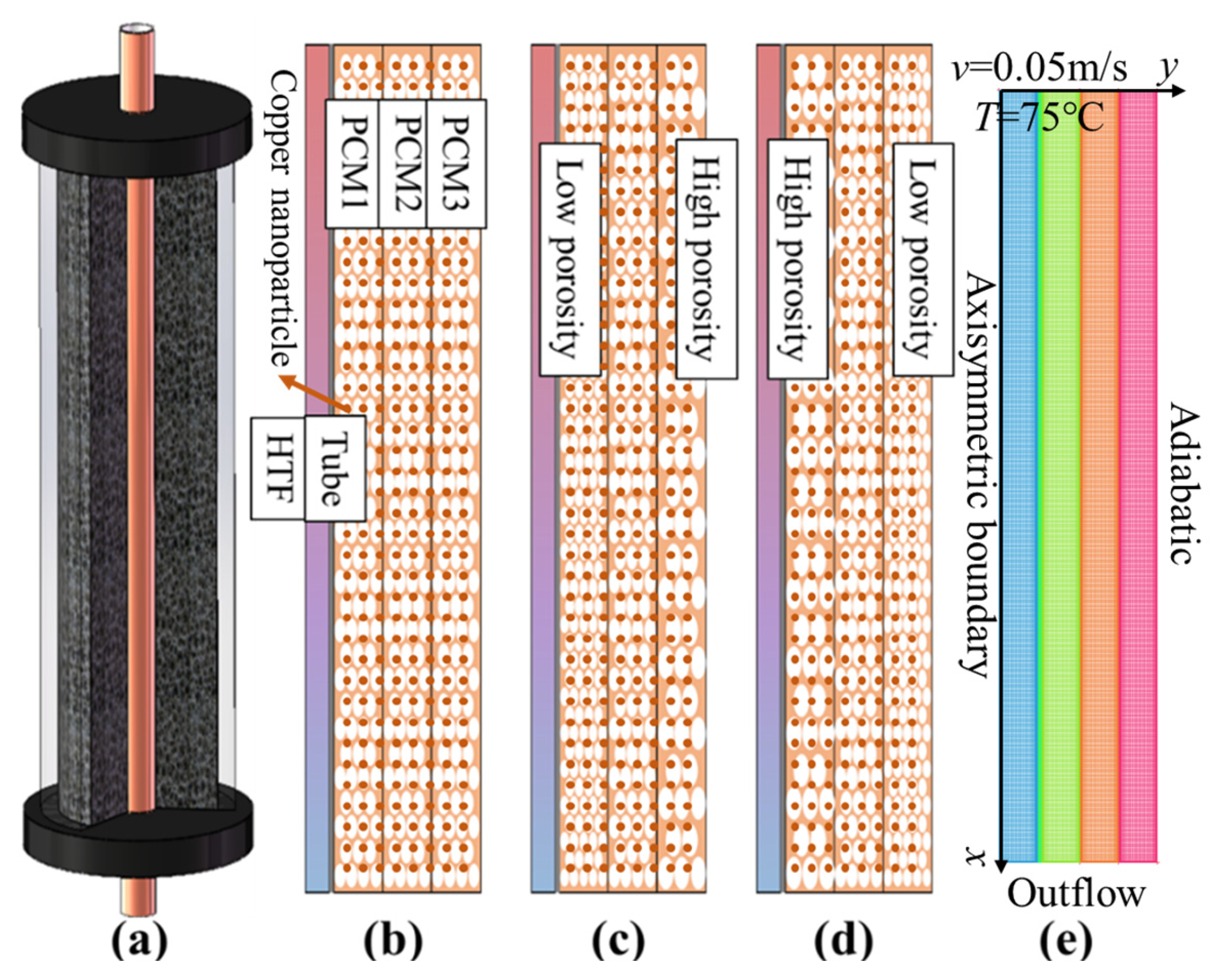
This article focuses on research of gradient metal foam and nanoparticle coupling to enhance phase change heat storage in LHTES. The research object is a shell-and-tube-type LHTES, which is composed of two concentric circular tubes. Inner tube is used for the flow of the heat transfer fluid (HTF). PCMs are filled between the inner and outer tubes. In this study, Ni foam was filled to achieve heat transfer enhancement. The Ni foam is designed with gradient pores, as shown in Figure 1a. The corresponding physical properties of nickel and paraffin are shown in Table 1. To facilitate heat transfer from HTF to PCM, an MF with low porosity is designed near HTF to facilitate rapid heat conduction, while an MF with high porosity is designed far from HTF to ensure that the overall pore content of LHTES remains unchanged. Therefore, the porosity gradually increases in the positive direction of the y-axis, which is named as the positive gradient. Main model diagrams are displayed in Figure 1b–d, where Figure 1b represents the uniform porosity, Figure 1c represents the positive gradient porosity, and Figure 1d represents the negative gradient porosity. The established models shown in Figure 1b–d indicate that the gradient metal foam is design by regional division, and the permeability and effective conductivity are updated according to local porosity and pore density. Figure 1e is the established numerical model. In this model, the HTF, Tube, PCM1, PCM2 and PCM3 areas were successively divided from left to right, and marked with different colors. Among them, the leftmost boundary of HTF is set as an axisymmetric boundary. The upper boundary of the HTF is set at a velocity of v = 0.05 m/s and a temperature of T = 75 °C. For the lower boundary of HTF, it is set as the outflow boundary. The remaining solid boundaries are set as adiabatic boundaries.

2.2. Mathematical Model Display

This research focuses on the heat storage process in the shell-and-tube-type phase change heat storage tank, which involves HTF flowing inside the inner tube and the phase change heat transfer of PCM. The process of HTF flowing inside the inner tube is mainly controlled by continuity equation, the momentum equation, and energy equation:
Continuity equation:
u x + v y = 0
Momentum equation:
ρ u t + ρ u u x + v u y = p + μ 2 u x 2 + 2 u y 2 + ρ f g β T f T ref
ρ v t + ρ u v x + v v y = p + μ 2 v x 2 + 2 v y 2
Energy equation:
ρ c p T t + ρ c p ( u T x + v T y ) = λ ( u 2 T x 2 + v 2 T y 2 )
For the process of phase change, the conservation equations for mass and momentum are solved by the volume average model:
u x + v y = 0
ρ f φ u t + ρ f φ 2 u u x + v u y = P x + μ f φ 2 u x 2 + 2 u y 2 μ f K + ρ f C E K U u ( 1 f m ) 2 f m 3 + χ ψ u + ρ f g β T f T m 1
ρ f φ v t + ρ f φ 2 u v x + v v y = P y + μ f φ 2 v x 2 + 2 v y 2 μ f K + ρ f C E K U v ( 1 f m ) 2 f m 3 + χ ψ v
Among them, fm is melting fraction of PCM, φ is the melting fraction in pores of porous metal. χ is set as 10−3 to avoid the denominator from going to zero, ψ is coefficient of mushy zone, which is taken as 105 [43]. To characterize the phenomenon that fluid density changes when heated, thereby generating natural convection, thermal expansion coefficient of the material is introduced in this study for characterization. In the above formula, K denotes permeability of porous metals and CE is inertia coefficient. The calculation formulas are as follows [44,45]:
K = ε [ 1 ( 1 ε ) 1 / 3 ] 108 ω 2 [ ( 1 ε ) 1 / 3 ( 1 ε ) ] 1 2 1 ε 3 π 2
C E = 0.095 c d 12 ε 1 ( 1 ε ) 1 / 3 3 ( 1 ε ) ( 1 ε ) 2 / 3 1 1.18 1 ε 3 π 1 1 1 / e 1 ε 0.04 1
Heat transfer behavior in this porous metal is controlled by a dual temperature energy equation, mainly including temperature changes of two components: liquid PCM and the solid framework.
Energy equation of the PCM:
ε ρ f c p f + L d f m d t T f t + ρ f c p f ( u T f x + v T f y ) = k fe + k td ( 2 T f x 2 + 2 T f y 2 ) h sf a sf T f T s
Energy equation of the MF:
1 ε ρ s c p s T s t = k se ( 2 T s x 2 + 2 T s y 2 ) h sf a sf T s T f
where subscripts f and s are fluid and solid phase, respectively; L is latent heat. Subscript ke means the effective conductivity, and can be calculated as [46]:
k e k lig = 1 ε 1 e + 3 e 2 α 3 1 e + 3 2 α e   +   k f k lig ε
Enhanced thermal conductivity due to thermal dispersion is estimated by [47]:
k td = 0.36 1 ε ρ f c p f d u 2 + v 2
The heat transfer coefficient hsf and specific surface area asf are [48]:
h s f = ( 0.35 + 0.5 Re 0.5 ) k f / d f , 0 Re 1 0.76   Re 0.4 Pr 0.37   k f / d f ,     1 < Re 40 0.52   Re 0.5 Pr 0.37   k f / d f ,     40 < Re 1000 0.26   Re 0.6 Pr 0.37   k f / d f ,     1000 < Re 20,000
a sf = 1.18 ω 0.0224 3 π ( 1 ε )
where ε and ω separately denote porosity and pore density.
This study also explored the influence of the addition of nanoparticles on melting enhancement. When nanoparticles are added to PCM, physical property parameters of composite PCM undergo certain changes. The density varies according to the following equation [34]:
ρ nf = ( 1 ξ ) ρ f + ξ ρ s
where ξ is the proportion of added nanoparticles. After the density is calculated, the heat capacity and thermal expansion coefficient of nanofluid changes according to the following relationship:
( ρ c p ) nf = ( 1 ξ ) ( ρ c p ) f + ξ ( ρ c p ) s
( ρ β ) nf = ( 1 ξ ) ( ρ β ) f + ξ ( ρ β ) s
The viscosity coefficient of nanofluids also varies according to different addition ratios:
μ nf = μ f ( 1 ξ ) 2.5
The thermal conductivity of nanofluid is calculated based on the thermal conductivity of original two phases and the proportional relationship:
( k ) n f 0 k f = k s + 2 k f 2 ξ ( k f k s ) k s + 2 k f + ξ ( k f k s )
The latent heat of nanoparticle enhanced PCM changed as
( ρ L ) nf = ( 1 ξ ) ( ρ L ) f
The increase in thermal conductivity caused by thermal dispersion is as follows:
k d = C ( ρ c p ) nf u 2 + v 2 ξ d p
The empirical coefficient C was determined by the literature [49]. The final effective thermal conductivity can be determined as k eff = k d + k e f f 0 , and the physical properties of additive copper nanoparticles are listed in Table 2.

3. Numerical Model Setup and Verification

3.1. Solution Settings

Fluid is assumed to be incompressible in calculations of this study. Without considering volume expansion effect of fluid heating, the process of fluid heating up and floating is controlled by the Boussinesq assumption. In addition, physical properties of the fluid are assumed to be independent with temperature. Calculation of the entire model is conducted by the pressure-based method. For pressure term in the control equation, PRESTO! Algorithms are used for calculation. The decoupling of speed and pressure in the iterative calculation process is carried out through SIMPLE algorithm. Spatial variables are solved by least squares cells, while solution of the time term is discretized using second-order upwind discretization process. During transient iteration process, when the calculation parameters of all equations reach the power of 10−6, it is considered that the iterative calculation has converged.

3.2. Independence Verification

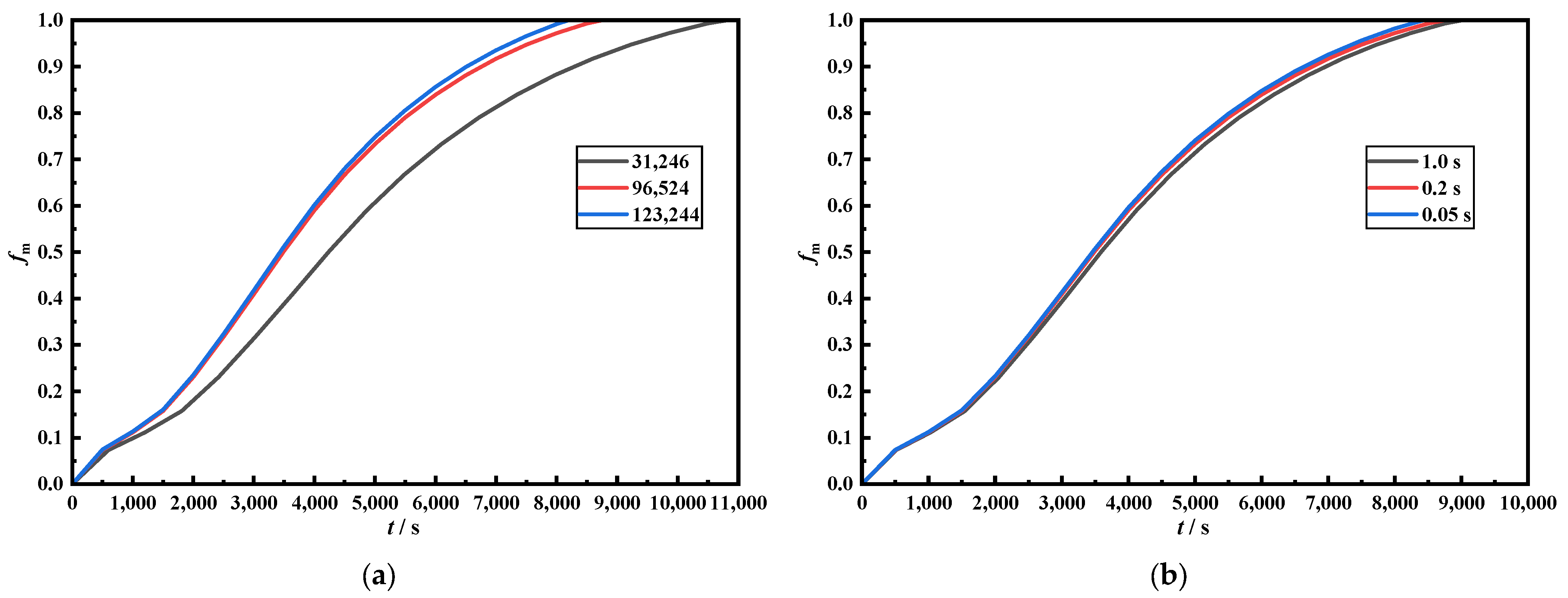
The grid number and time step are significant for solution results. Therefore, before calculation begins, independence verification of grid number and time step is carried out to obtain a compromise choice between calculation accuracy and computational effort. In this study, grid models with 31,246, 96,524, and 123,244 grids were respectively drawn, and the transient melting fractions were calculated and compared, as shown in Figure 2. Data in the table shows that the calculation results of the model with 96,524 grids are very close to those of the model with 123,244 grids at any time. However, a smaller number of grids needs less computational resources. Therefore, 96,524 grids were selected as the benchmark model for subsequent calculations. Subsequently, the time step independence verification was carried out, and the comparison of the transient melting fraction is shown in Figure 2. The calculation error is relatively large when the time step is 1.0 s. However, the calculation results with time step of 0.2 s have little deviation compared to those with time step of 0.05 s, and choosing a time step of 0.2 s can save a lot of computational resources.

3.3. Model Verification

3.3.1. Validation of Metal Foam

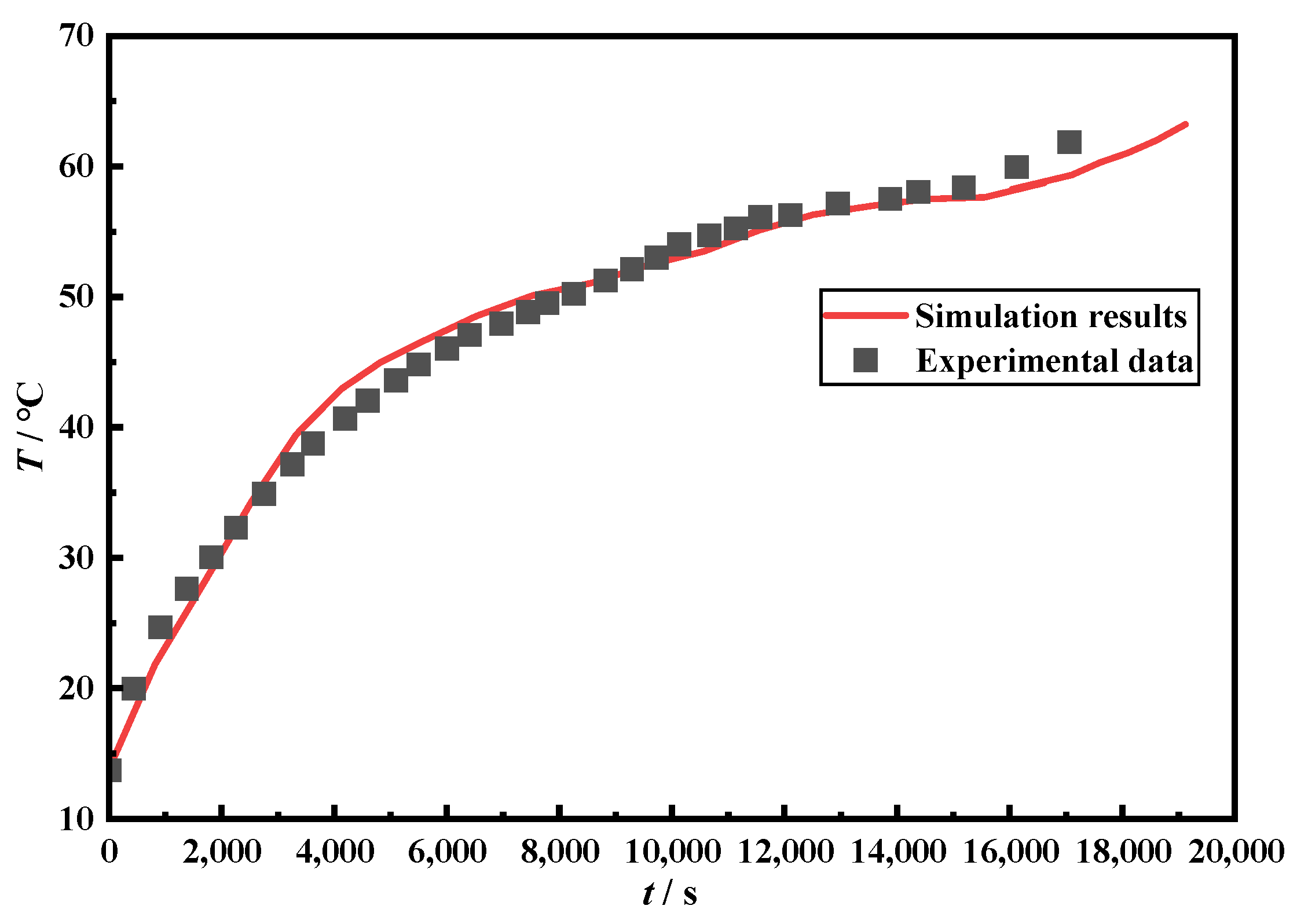
To verify the accuracy of the numerical model, the established numerical model was used to calculate melting process of PCM under side electric heating. Experimental results of PCM melting under this side heating are presented in the literature [50]. Thermocouples were set at 25 mm from the left side to detect the temperature changes. PCM was encapsulated in a 100 × 100 × 30 mm cavity and filled with copper foam. The overall weight of composite PCM was 409.5 g. Porosity of the filled copper foam was 0.95, and the pore density was 5 PPI. The melting point range of the filled paraffin was 48.4–63.6 °C, and latent heat was 148.8 kJ/kg. Figure 3 compares the temperature detection results at 25 mm from the heating boundary in the numerical model and experiment. The numerical calculation results have a high degree of coincidence with experimental results, which also proves the accuracy of the established numerical model.

3.3.2. Validation of Nanoparticle

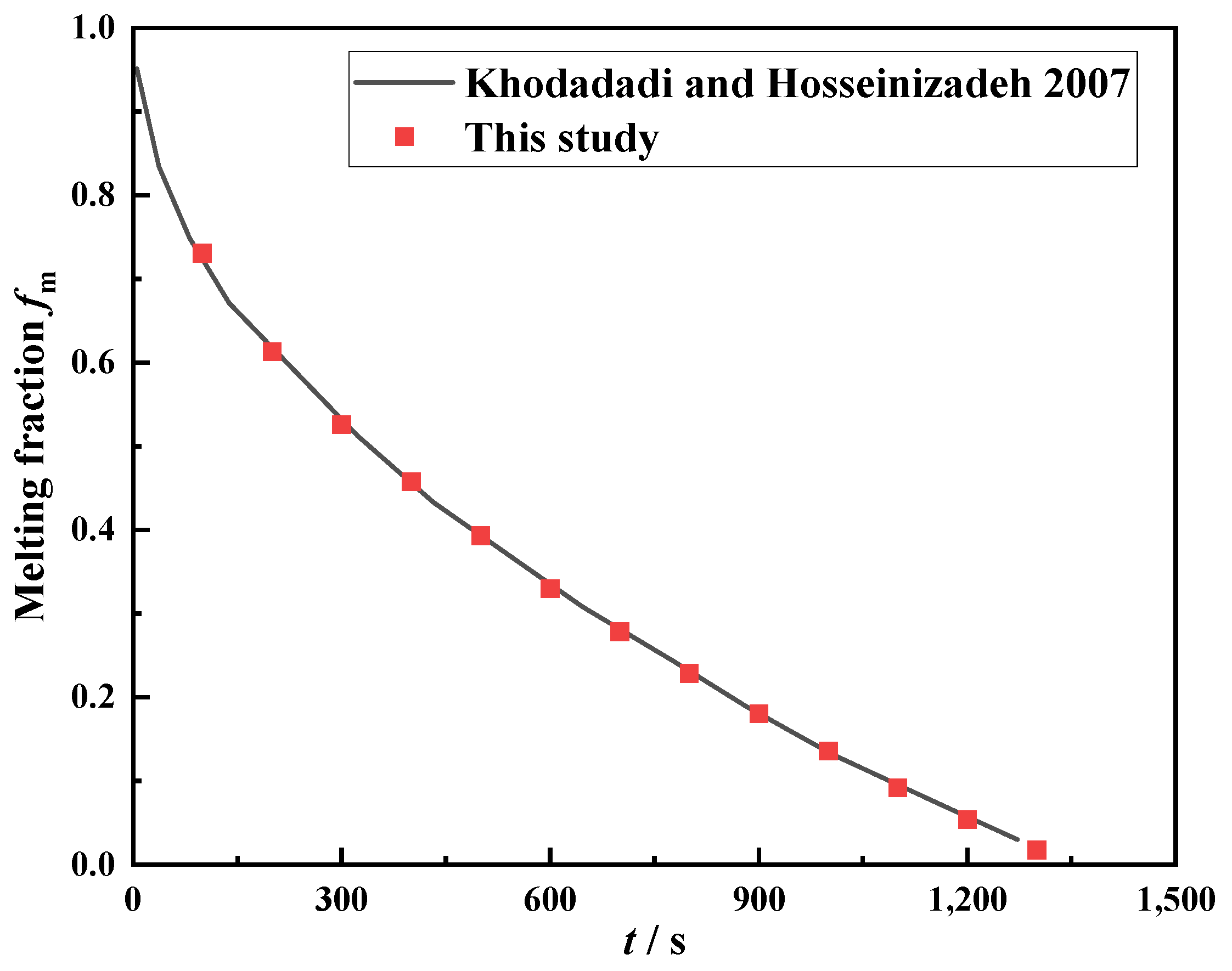
To validate the numerical model for the solid–liquid phase change enhanced by the addition of nanoparticles, we used the established model to calculate the transient melting fraction when the nanoparticle concentration was 20%, and compared the results with those obtained from the references. The results are presented in Figure 4. As can be seen from the figure, the calculation results of the established numerical model are highly consistent with those in the literature, which also proves the accuracy of the model we have established.

4. Results and Discussion

4.1. Analysis of Gradient Metal Foam

4.1.1. Transient Melting Fraction and Complete Melting Time

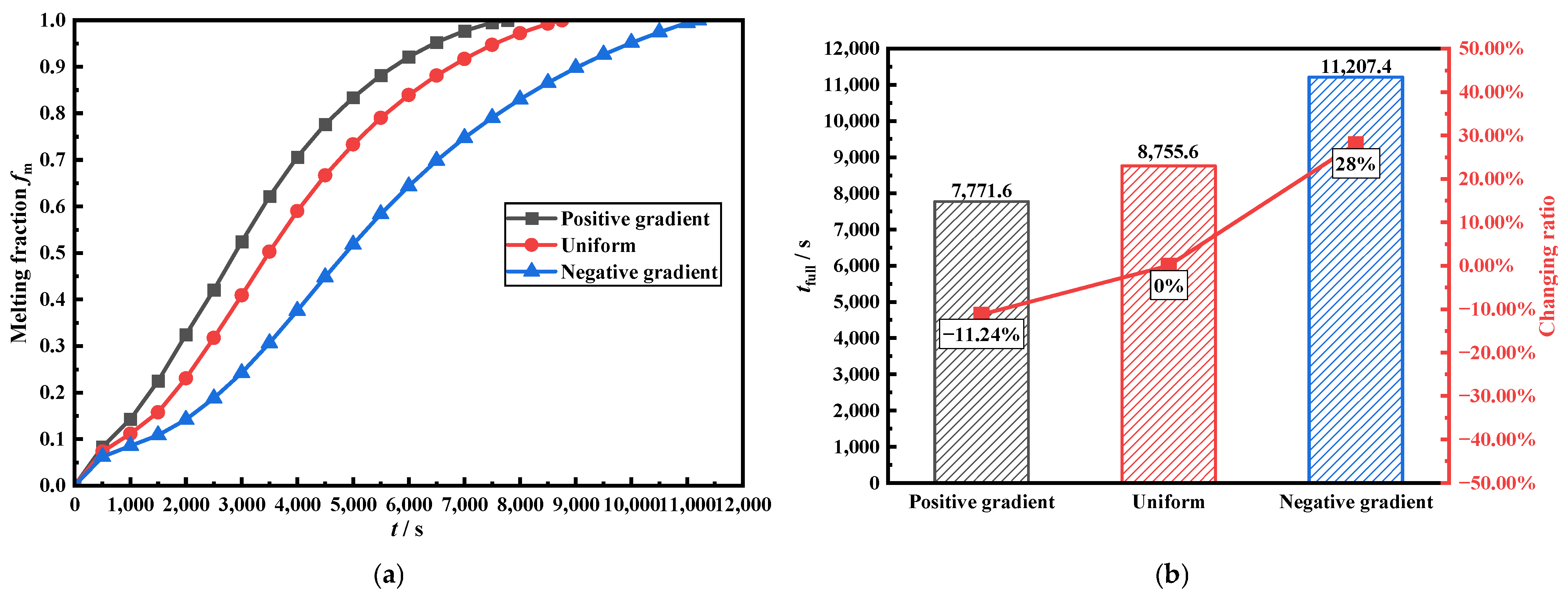
Figure 5a,b compare melting fraction and melting time of LHTES with different porosity gradients. Comparison conditions are when the addition concentration of nanoparticles is 0%. The metal foams used are those with positive gradient, no gradient, and negative gradient designs. From the figure, LHTES with positive gradient foam design has the fastest melting rate, while LHTES with negative gradient foam has the lowest melting time. The main mechanism for enhancing heat transfer is to improve the overall thermal conduction gradient to boost the rate of phase change. Using a foam with a positive gradient of porosity is to place the low porosity foam close to the heat transfer fluid, which facilitates the timely transfer of heat from the heat transfer fluid. This design is superior to the non-gradient design as it enables the phase change material near the heat transfer fluid to have a higher temperature, thereby increasing the heat transfer from the phase change material closer to the heat transfer fluid to the phase change material farther away. Meanwhile, metal foam with a negative gradient porosity design has a low thermal conductivity around the HTF pipeline. This makes it difficult for the heat of HTF to be transferred to PCM, thereby inhibiting heat transfer. Therefore, the melting fraction of PCM in a heat storage tank is always the highest for positive gradient design, followed by the no-gradient design, and the lowest for the negative gradient design. Figure 5b compares melting time of three LHTES designs. Figure shows that the melting time of LHTES with positive gradient porosity MF decreases by 984 s and reduces by 11.24% compared with the LHTES with no gradient design, while LHTES with negative gradient porosity metal foam delays melting time by 2451.8 s, extending by 28.00%.

4.1.2. Melting Front

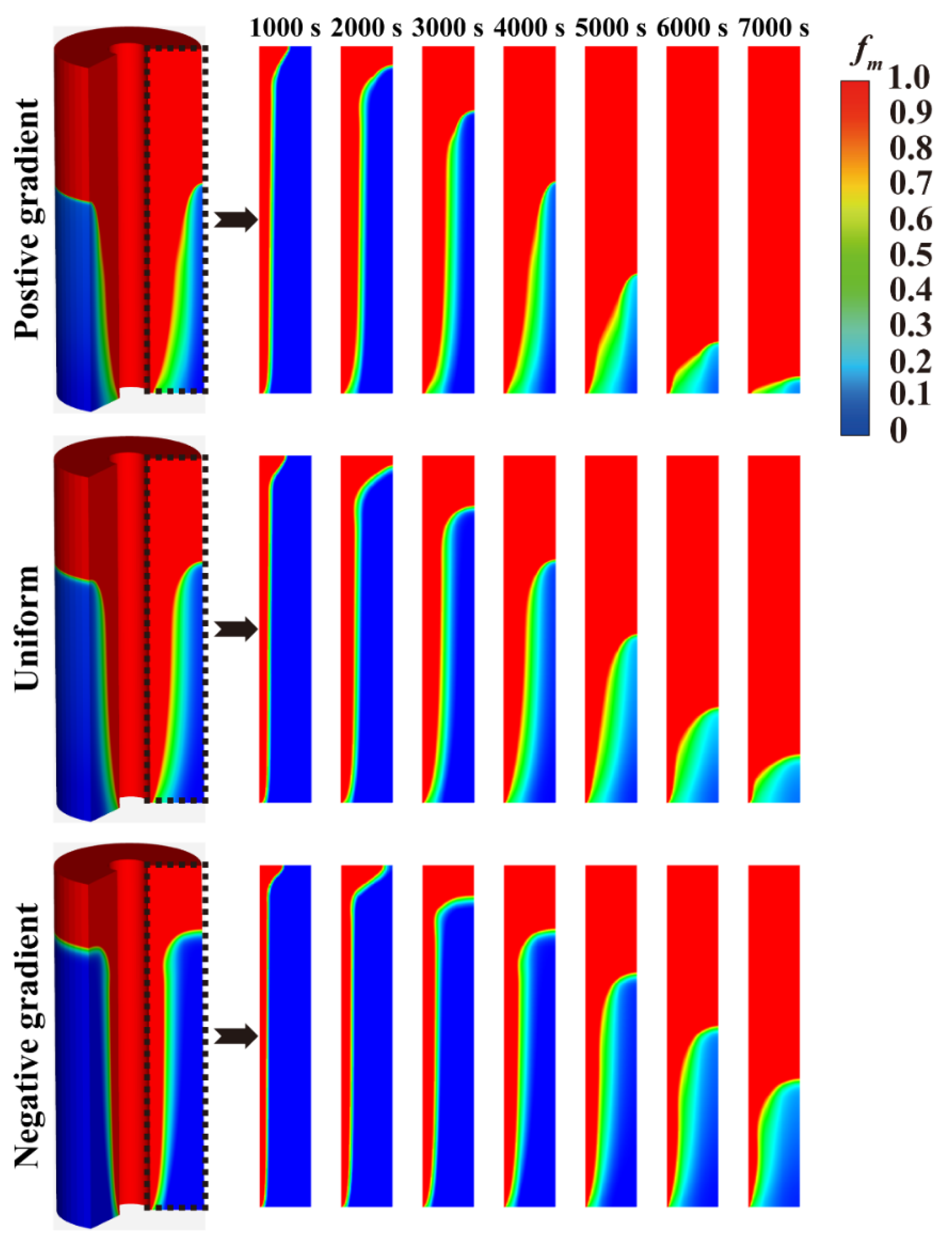
Figure 6 compares the transient melting fronts of tanks with positive gradient, zero gradient, and negative gradient porosity. From the figure, at 1000 s, a tank with a positive gradient porosity has a larger melting area compared to a tank with a uniform gradient porosity design. The LHTES with a negative gradient porosity has the smallest fully melted area. As melting time continues to 2000 s, 3000 s, and 4000 s, the comparison of the transient melting fronts in LHTES shows that un-melted PCM in a tank with positive gradient porosity design has a narrower and longer area compared with un-melted phase change material in the tanks with uniform gradient porosity design and negative gradient porosity design. This is because, in the early stage, the large conduction in the positive gradient porosity design causes the rapid melting of PCM, and enhanced natural convective heat transfer causes internal PCM to melt more rapidly at 2000 s and 3000 s. Positive gradient porosity design accelerates internal natural convection because of accumulation of liquid PCM in early melting, thereby causing un-melted PCM slenderer. This can also be observed from the comparison of the different melting times but similar melting heights of the phase interfaces in the three gradient designs. The melting front of LHTES with a positive gradient porosity at 4000 s is more inclined compared to LHTES with uniform gradient porosity, while melting the front of LHTES with negative gradient porosity is flattest. This is because LHTES with a positive gradient porosity has a larger porosity design on the outside, which helps with the external natural convective heat transfer, while negative gradient porosity has a smaller porosity on the outside and mainly relies on conduction. Higher thermal resistance near HTF pipe hinders timely heat transfer to PCM in LHTES. The overall comparison shows that at any time, the height of the front surface in the tank with a positive gradient porosity design is lower than the heat storage tanks with uniform gradient porosity design and negative gradient porosity design, which is consistent with the transient melting rate curve. The explanation for this phenomenon can be stated as that positive gradient porosity is more conducive to placing high thermal conductivity components in the area with a large thermal gradient, which helps to achieve rapid heat transfer from HTF pipeline to PCM throughout the heat storage tank.

4.1.3. Temperature Distribution

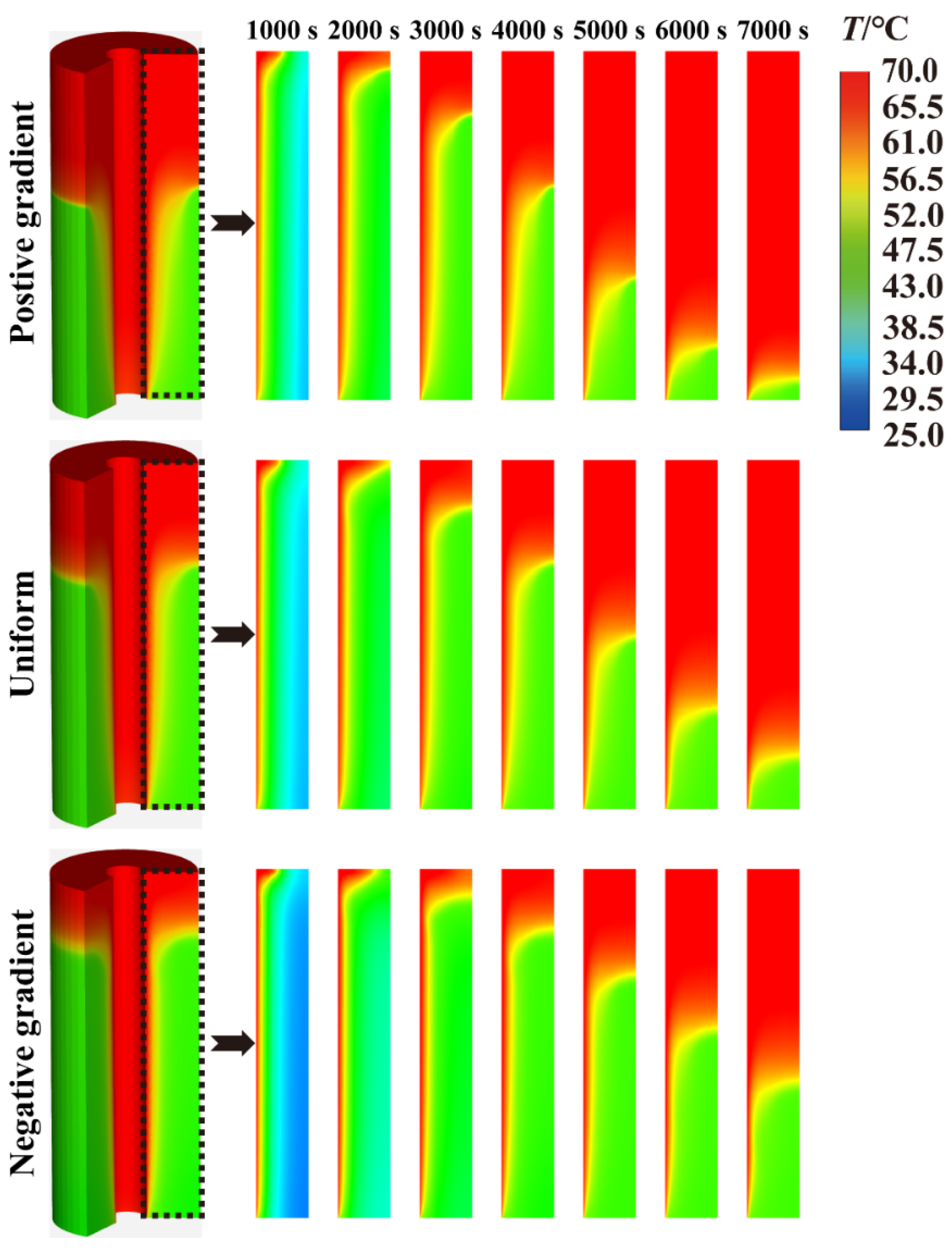
To reveal the characteristics of heat transfer driving force within tanks with different gradient designs, Figure 7 compares and plots the temperature cloud diagrams within the heat storage tanks with different gradient designs. At 1000 s, the area with low temperature within a tank with positive gradient porosity design is the smallest, while the area with low temperature within a tank with a negative gradient porosity is the largest. This is because the tank with the positive gradient porosity design helps heat to quickly transfer from HTF to all parts of PCM, resulting in a rapid temperature increase in PCM in the early stage dominated by conduction. By comparing temperature distributions of three heat storage tanks at 2000 s, there are no areas below 35 °C in tanks with positive gradient porosity design and uniform porosity design, while there are still areas below 35 °C in a tank with negative gradient porosity. Comparing temperature distributions of the three heat storage tanks at other times also reveals that high-temperature area within tanks with positive gradient porosity design is higher than that of heat storage tanks with uniform porosity and negative gradient porosity designs.

4.2. The Influence of Nanoparticles

4.2.1. Transient Melting Fraction and Complete Melting Time

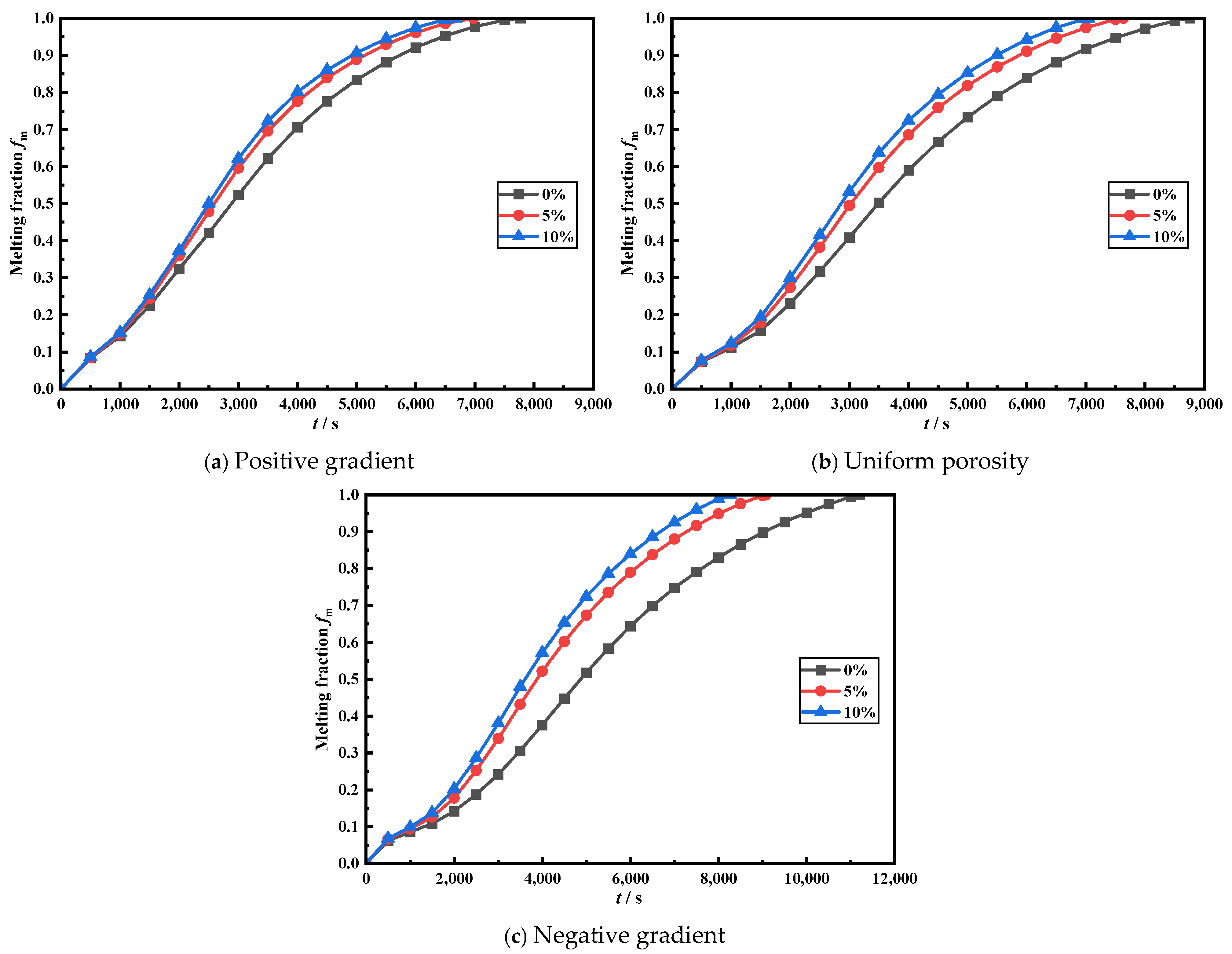
Figure 8 compares heat storage enhancement effects of three nanoparticle addition concentrations of 0%, 5% and 10% on the heat storage tanks with positive gradient, uniform gradient, and negative gradient porosity. Figure 8a compares transient melting fraction in LHTES with positive gradient porosity under three concentrations. The data reveals that when the nanoparticle addition concentration is 5%, the transient melting fraction of LHTES at each time point is significantly higher than the melting fraction of LHTES without nanoparticle addition. When the concentration of nanoparticles reaches 10%, the melting fraction within the heat storage tank increased again and became the highest among three concentrations. The explanation for this phenomenon is that adding nanoparticles to the metal foam heat storage tank helps to increase the thermal conductivity of the phase change material within the tank, thereby enhancing the phase change heat transfer rate of the heat storage tank. Figure 8b and Figure 8c respectively compare three nanoparticle addition concentrations on transient melting fraction of uniform and negative gradient porosity in phase change heat storage tanks. From the comparison results, the addition of nanoparticles to the phase change material also leads to a trend of an increase in the melting proportion. For the heat storage tanks with uniform pore volume and negative gradient pore volume, the optimal addition concentration of nanoparticles is still 10%. However, the difference is that the addition of nanoparticles has a stronger strengthening effect on the negative gradient metal foam heat storage tank compared to the positive gradient and non-gradient metal foam heat storage tanks. This is because the internal thermal conduction path designed with negative gradient pore volume is poor, while the addition of nanoparticles can bring about a very significant enhancement in thermal conduction.
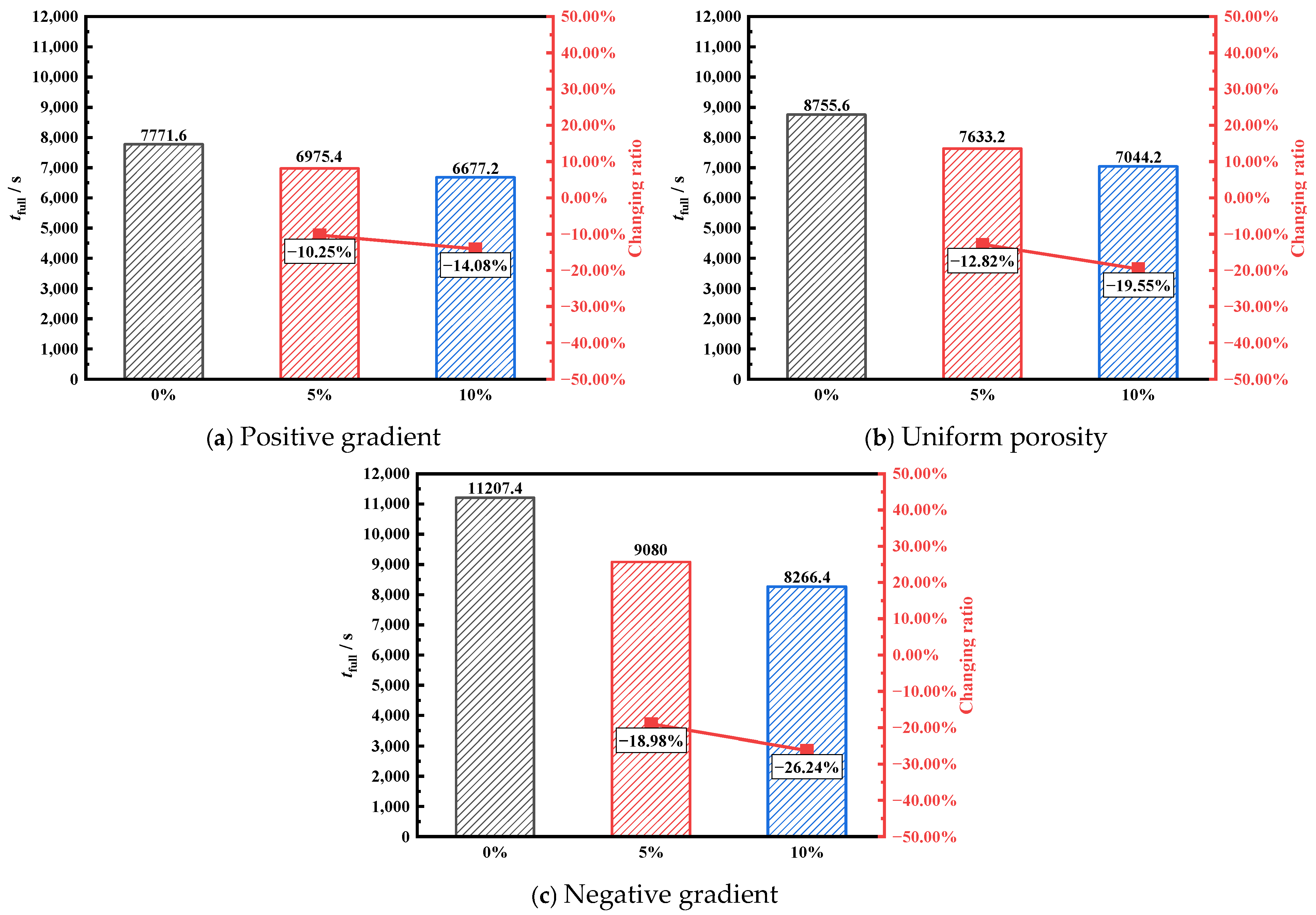
Figure 9 quantitatively compares the influence of filling concentrations of nanoparticles on complete melting time in heat storage tank. Figure 9a shows the comparison of the effects produced by adding different nanoparticle concentrations in the tank with a positive gradient pore design. The data indicate that when the nanoparticle concentration is 5%, the melting time is 6975.4 s, which is 796.2 s less than the case without nanoparticle filling, representing a saving rate of 10.25%. When the nanoparticle concentration is increased to 10%, the complete melting time is 6677.2 s, saving 14.08% compared to the heat storage tank without nanoparticle addition. Figure 9b compares the effect of different nanoparticle concentrations on the melting time of the tank with a uniform pore ratio. The data show that with a 5% concentration of nanoparticles added, the complete melting time is 1122.4 s less than the case without nanoparticle addition, representing a saving rate of 12.82%, while for a 10% concentration of nanoparticles added, the complete melting time is saved by 19.35%. In the negative gradient thermal storage tank design, adding 5% nanoparticles saves 2127.4 s in the complete melting time, representing a saving rate of 18.98%. When the nanoparticle concentration is increased to 10%, the complete melting time saving rate is even greater, saving 26.24% compared to the case without nanoparticle addition.

4.2.2. Melting Front

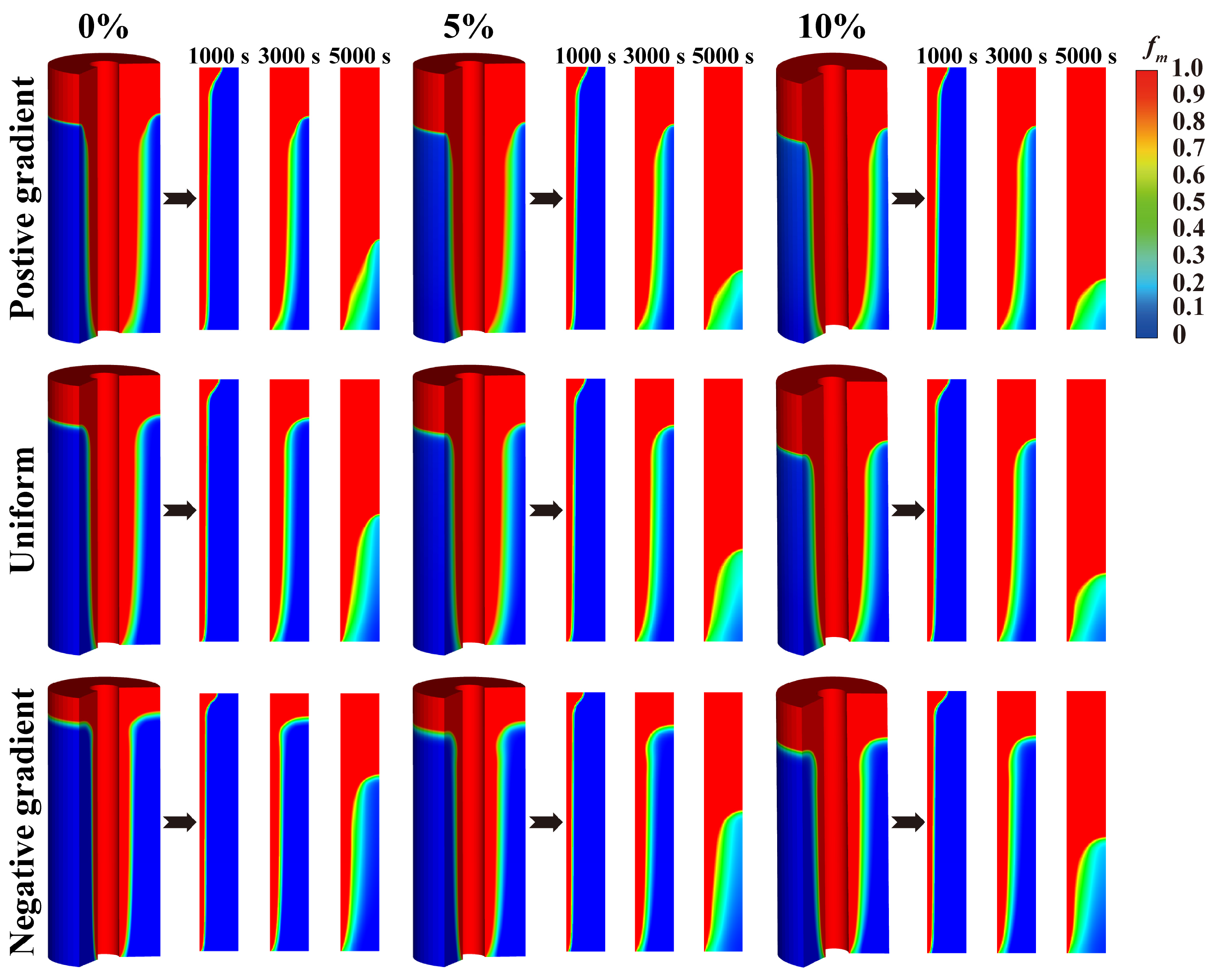
Figure 10 compares the effects of three concentrations on the melting phase interfaces of positive gradient pores, uniform pores, and negative gradient pores in the storage tank. The three storage tanks in the first row are the melting phase interfaces of positive gradient pore-type heat storage tanks with different nanoparticle concentrations. The comparison results at 1000 s show that the fully melted area with a 5% nanoparticle concentration is larger than that with a 0% nanoparticle concentration, which proves the improvement brought by nanoparticle-enhanced heat conduction during the initial melting stage. By comparing the melting fronts at 3000 s and 5000 s, the melting front in the tank with 5% nanoparticles is lower. This indicates an enhanced effect in heat storage. When the addition concentration of nanoparticles is increased to 10% or higher, the melting phase interface of the heat storage tank with enhanced nanoparticles has a significant improvement compared to the heat storage tank with a 5% nanoparticle concentration, and the improvement is smaller compared to the heat storage tank with a 5% nanoparticle concentration. For the heat storage tank with uniform gradient pores, adding 5% nanoparticles will increase the phase change melting rate. When the melting time reaches 3000 s and 5000 s, the melting phase interface of the tank containing 5% nanoparticles is significantly lower than the situation without nanoparticle addition. When the addition concentration of nanoparticles is increased to 10% or higher, the melting phase interface of the heat storage tank with enhanced nanoparticles also has a certain improvement compared to the heat storage tank with a 5% nanoparticle concentration. For the heat storage tank with negative gradient porosity, adding 5% nanoparticles has a significant improvement effect in all heat storage tanks. When the addition concentration is increased to 10% or higher, it also leads to a gradual decrease in the phase interface height.

4.2.3. Temperature Distribution

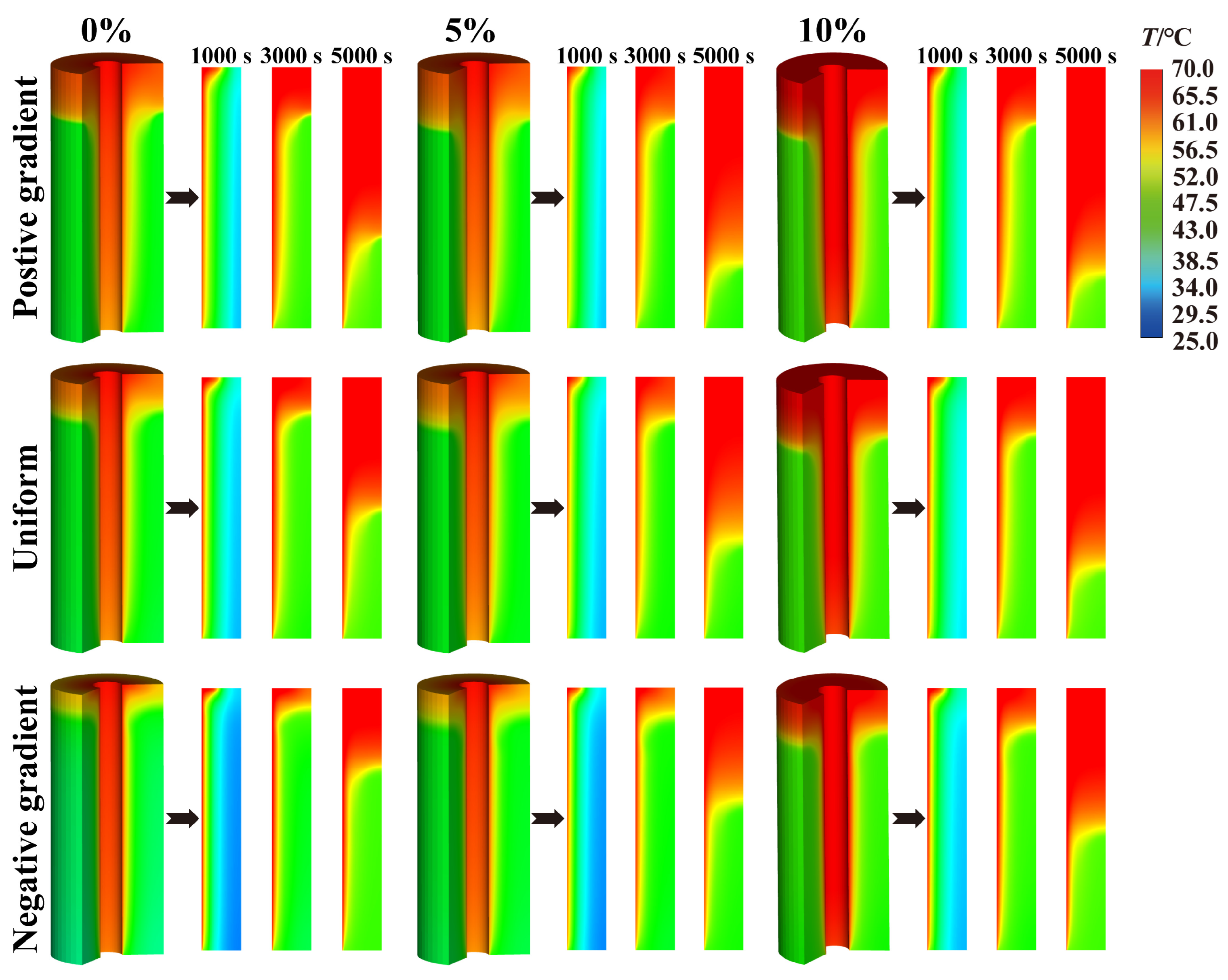
Figure 11 compares the effects of different nanoparticle concentrations on the internal temperature profiles of positive gradient, uniform gradient, and negative gradient storage tanks. Under different nanoparticle concentrations, the melting front of the storage tank with positive gradient porosity indicates that increasing the nanoparticle concentration helps accelerate the filling process within the tank and increases the content of high-temperature phase change materials within the tank. This is caused by the enhanced heat conduction resulting from the addition of nanoparticles and the increase in the heat storage tank problem. For uniform gradient and negative gradient heat storage tanks, at the same nanoparticle addition concentration, the low-temperature area within the heat storage tank is larger, which also proves the adverse effect of negative gradient metal foam on heat transfer.

4.2.4. Transient Heat Storage and Storage Rate

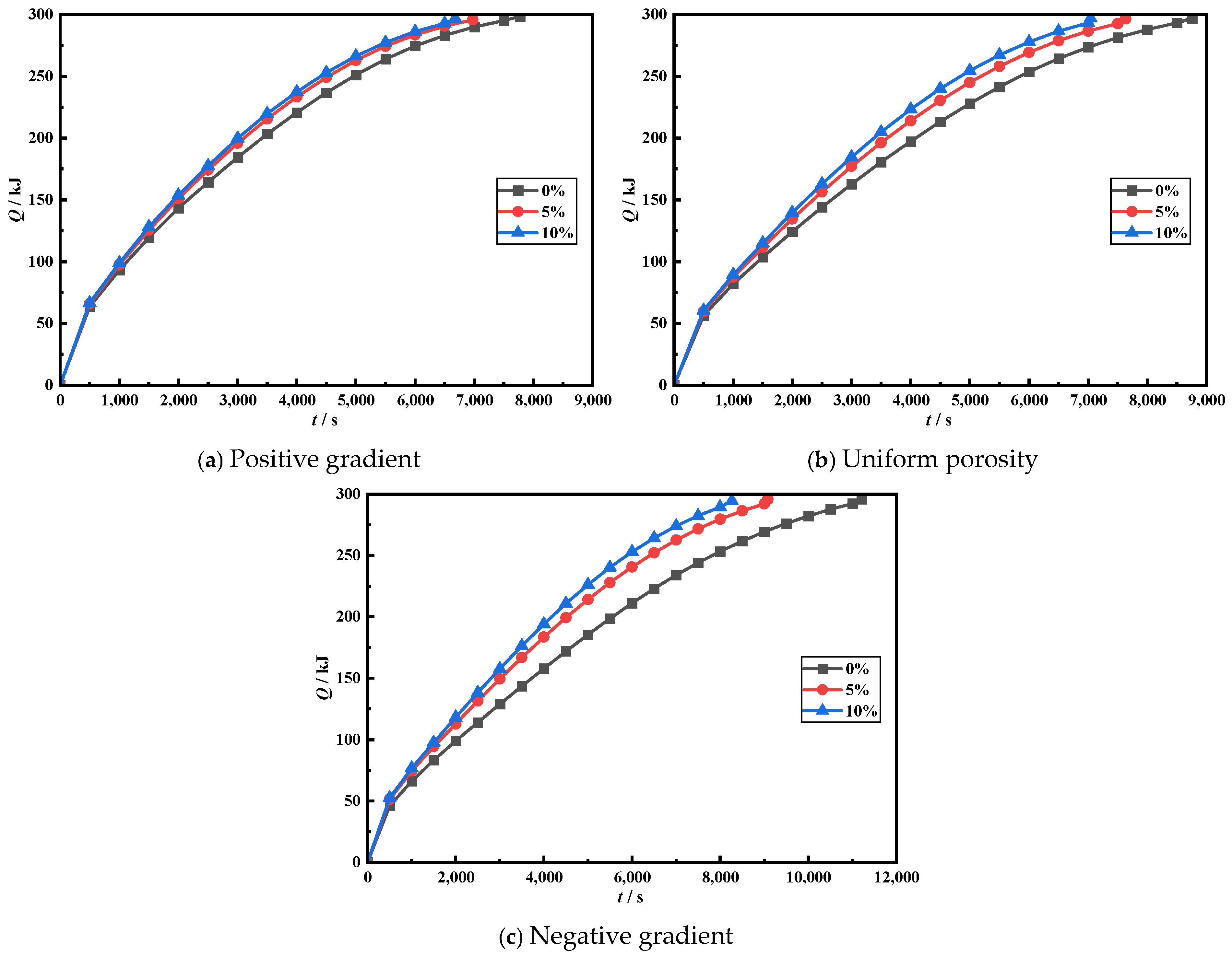
Figure 12 compares the influence of nanoparticle concentration on the transient heat storage capacity of the positive gradient pores, uniform pores, and negative gradient pores in the phase change heat storage tank. The results in Figure 12a show that when 5% of nanoparticle concentration is added, the transient heat storage capacity of LHTES is enhanced. When the nanoparticle concentration is increased to 10%, the transient heat storage capacity is further improved and is much higher than that of LHTES without nanoparticle addition. The same phenomenon is found for the heat storage tanks with uniform pores and negative gradient pores. When the nanoparticle addition concentration is 5% and 10%, the transient heat storage capacity is always higher than that of the heat storage without nanoparticle addition. Moreover, in the negative gradient pore heat storage tank, the addition of nanoparticles has the most significant effect on the improvement of the heat storage rate of the heat storage tank.
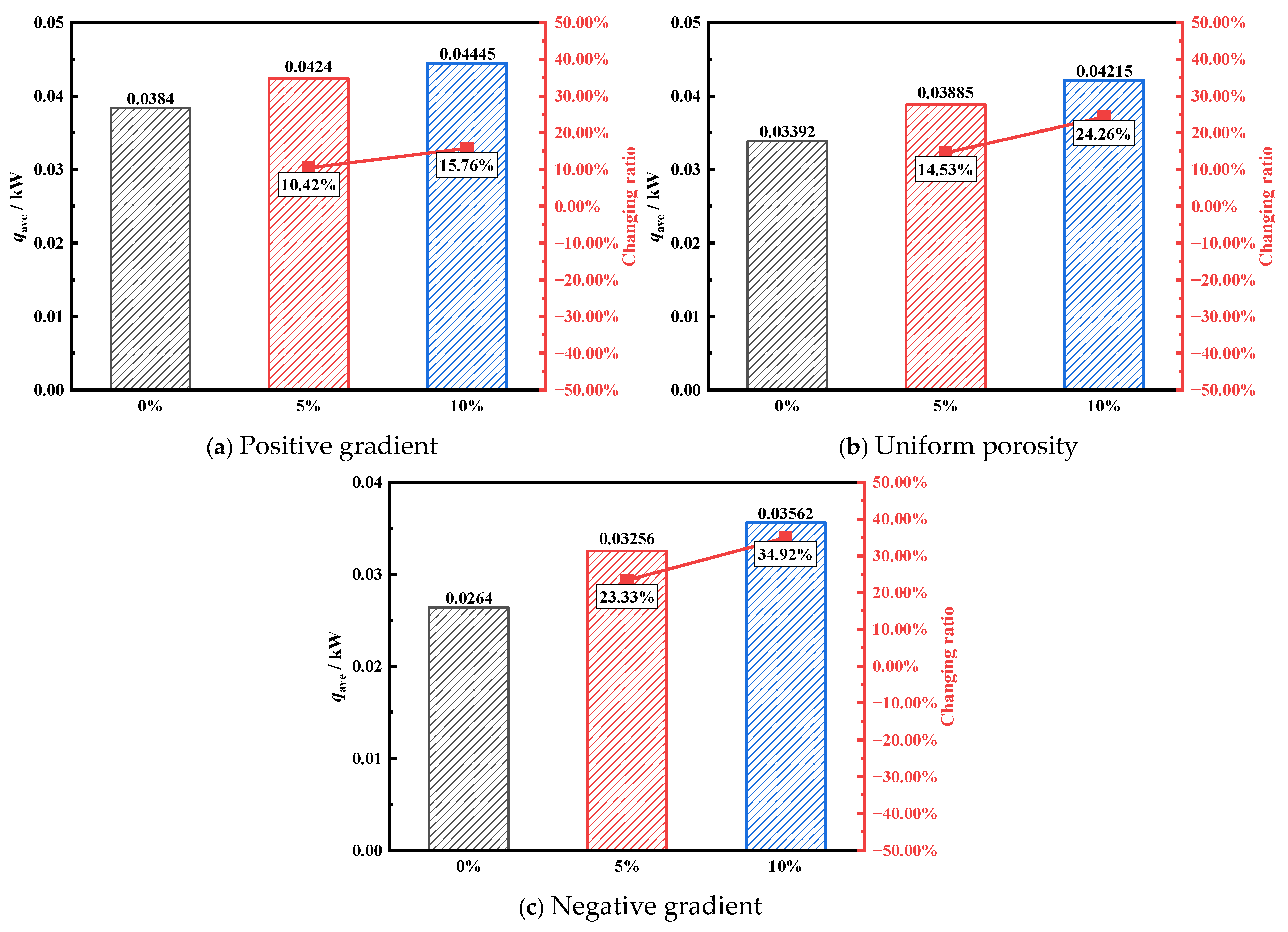
Figure 13 compares the average heat storage rate of the storage tanks under different concentrations of nanoparticles. Figure 13a shows that when the concentration of nanoparticles is 5%, the average heat storage rate of the positive gradient porosity storage tank is increased to 0.0424 kilowatts, which is 0.004 kilowatts higher than that of the storage tank without adding nanoparticles, representing an increase of 10.42%. When the concentration of nanoparticles is 10%, the heat storage rate of the storage tank is the highest, which is 15.76% higher than that of the storage tank without adding nanoparticles. Figure 13b shows that when the concentration of nanoparticles is 5%, the average heat storage rate of the uniform porosity storage tank is 0.03885 kilowatts, which is 14.53% higher than that of the storage tank without adding nanoparticles. When the concentration of nanoparticles is 10%, the average heat storage rate is 24.26% higher than that of the storage tank without adding nanoparticles. Figure 13c shows that when the concentration of nanoparticles is 5%, the average thermal storage rate of the uniform porosity storage tank is 0.03256 kilowatts, which is 23.33% higher than that of the storage tank without adding nanoparticles. When the concentration of nanoparticles is 10%, the average thermal storage rate of the storage tank is 34.92% higher than that of the storage tank without adding nanoparticles. This also quantitatively proves that the addition of nanoparticles has the most significant effect on the heat storage rate of the negative gradient porosity metal foam.

4.3. The Enhancement of COP of Ideal Carnot Cycle

In the aforementioned analysis, the average heat storage rate of the optimal heat storage tank was obtained. In this section, we couple this heat storage tank to the heat pump for domestic radiative heating, and heating supplying water of a heat pump is heated again by a heat storage tank to decrease its condensation temperature, thereby improving the COP of the heat pump. In this calculation, it is assumed that the heat stored at any time is used to increase the temperature of supplying water of the heat pump (however, in practical applications, this assumption is usually difficult to meet due to the mismatch between the peak heat storage load and the actual energy consumption load). To ensure this situation as much as possible, supplying water is distributed to heat storage tanks at a mass flow rate that is the same as used in the previous charging analysis. The ratio between the total amount of supplying water calculated based on different air conditioning loads and supplying water mass allowed by each heat storage tank are used to determine the number of required heat storage tanks. In this situation, the temperature of supplying water after heating changed to
T supply = T s u p p l y 0 q ave m c p
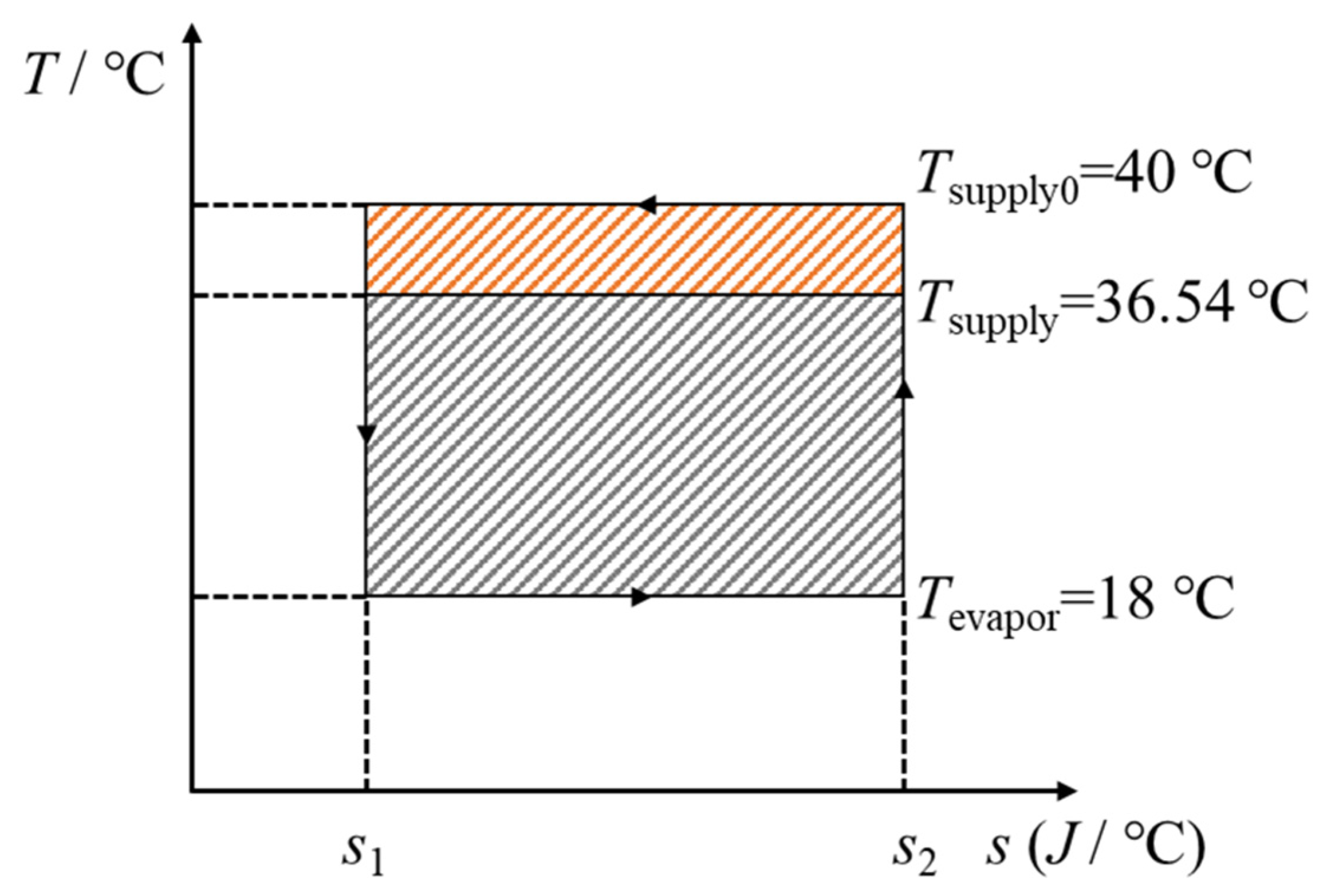
where Tsupply0 is presetting temperature of supplying water for heating radiator, which is selected as 40 °C, and m means mass flow rate, which is calculated as m = π R 2 ρ v = π × 0.005 2   ( m 2 ) × 1000   ( kg / m 3 ) × 0.04   ( m / s ) = 0.003   kg / s . Under heating effect with the optimal heat storage rate of 0.04445 kW, supplying water temperature can be increased 3.46 °C. So, the temperature of suppling water need heated by the heat pump changed to T supply = 40 3.46 = 36.54 °C, as shown in Figure 14. After obtaining a reduction value of the heat pump condensation temperature, to evaluate the improvement effect of heat storage tank embedding on COP, this study takes ideal reverse Carnot cycle as research target and explores its efficiency enhancement effect. The enhancement on COP is calculated as
COP = T condensation ( s 2 s 1 ) ( T condensation T evaporation ) ( s 2 s 1 )
The COP of ideal heat pump incorporated with heat storage tank and without heat storage tank is calculated as 1.97 and 1.82, respectively, and the incorporation of the heat storage tank enhances COP by 8.24%.

5. Conclusions

This study investigated coupling enhancement effects of gradient MF design and nanoparticles on heat storage. The research first compared heat storage characteristics of three types of heat storage tanks with positive gradient porosity, uniform porosity, and negative gradient porosity. Then, it compared the influence of different concentrations of nanoparticle fillings on phase change heat storage. Research conclusions are as follows:
  • Heat storage efficiency of a heat storage tank with a positive gradient porosity is the highest, followed by the uniform porosity design, and the tank with negative gradient porosity is the worst.
  • Melting time of a tank with a positive gradient porosity MF design decreases by 984 s and reduces 11.23% compared to a tank with no gradient design. However, a tank with a negative gradient porosity MF design delays complete melting time by 2451.8 s, extending it by 28.00%.
  • When the nanoparticle filling concentration is 10%, the average heat storage rate of a tank with a positive gradient porosity is the highest, at 0.04445 kW, which is 0.00605 higher than a tank without nanoparticle addition, an increase of 15.76%.
  • Coupling the heat storage tank to an ideal heat pump system for heating can increase its COP from 1.82 to 1.97, which represents an improvement of 8.24%.
The use of heat storage tanks to enhance the COP of heat pumps is based on the analysis of the ideal reverse Carnot cycle. This process represents only a theoretical upper limit. For specific heat pump application systems, detailed analyses should be conducted, including real-system losses, compressor inefficiencies, and auxiliary power consumption.

Author Contributions

Conceptualization, X.Y. (Xiangyu Yao), W.L. and R.Z.; methodology, X.Y. (Xiangyu Yao), W.L., R.Z., Y.L. and X.Y. (Xiaohu Yang); software, X.Y. (Xiangyu Yao), W.L. and R.Z.; validation, X.Y. (Xiangyu Yao), W.L. and R.Z.; formal analysis, Y.L.; investigation, X.Y. (Xiangyu Yao), W.L., R.Z., Y.L. and X.Y. (Xiaohu Yang); resources, X.Y. (Xiaohu Yang); data curation, W.L., R.Z. and Y.L.; writing—original draft preparation, X.Y. (Xiangyu Yao), W.L., R.Z. and Y.L.; writing—review and editing, X.Y. (Xiaohu Yang); visualization, W.L., R.Z. and Y.L.; supervision, X.Y. (Xiaohu Yang); project administration, X.Y. (Xiaohu Yang); funding acquisition, R.Z. All authors have read and agreed to the published version of the manuscript.

Funding

This research was supported by the Science and Technology Research Program of Chongqing Municipal Education Commission (Grant No.KJQN202503802, Grant No.KJQN202503812).

Data Availability Statement

Dataset available on request from the authors.

Conflicts of Interest

The authors declare no conflicts of interest.

References

  1. Zhang, P.; Meng, Z.N.; Zhu, H.; Wang, Y.L.; Peng, S.P. Melting heat transfer characteristics of a composite phase change material fabricated by paraffin and metal foam. Appl. Energy 2017, 185, 1971–1983. [Google Scholar] [CrossRef]
  2. Mirshekar, A.; Goodarzi, M.R.; Mohebbi-Kalhori, D.; Mayam, M.H.S. Experimental study of heat transfer enhancement using metal foam partially filled with phase change material in a heat sink. J. Energy Storage 2023, 60, 106496. [Google Scholar] [CrossRef]
  3. Notton, G.; Nivet, M.-L.; Voyant, C.; Paoli, C.; Darras, C.; Motte, F.; Fouilloy, A. Intermittent and stochastic character of renewable energy sources: Consequences, cost of intermittence and benefit of forecasting. Renew. Sustain. Energy Rev. 2018, 87, 96–105. [Google Scholar] [CrossRef]
  4. Aftab, W.; Usman, A.; Shi, J.; Yuan, K.; Qin, M.; Zou, R. Phase change material-integrated latent heat storage systems for sustainable energy solutions. Energy Environ. Sci. 2021, 14, 4268–4291. [Google Scholar] [CrossRef]
  5. Tao, Y.B.; He, Y.-L. A review of phase change material and performance enhancement method for latent heat storage system. Renew. Sustain. Energy Rev. 2018, 93, 245–259. [Google Scholar] [CrossRef]
  6. Xie, Y.; Liu, J.; Ma, W.; Sheng, J.; Zhang, P. Review of the heat transfer enhancement for phase change heat storage devices. J. Energy Storage 2024, 86, 111336. [Google Scholar] [CrossRef]
  7. Fan, L.; Khodadadi, J.M. Thermal conductivity enhancement of phase change materials for thermal energy storage: A review. Renew. Sustain. Energy Rev. 2011, 15, 24–46. [Google Scholar] [CrossRef]
  8. Liu, L.; Su, D.; Tang, Y.; Fang, G. Thermal conductivity enhancement of phase change materials for thermal energy storage: A review. Renew. Sustain. Energy Rev. 2016, 62, 305–317. [Google Scholar] [CrossRef]
  9. Cui, W.; Si, T.; Li, X.; Li, X.; Lu, L.; Ma, T.; Wang, Q. Heat transfer enhancement of phase change materials embedded with metal foam for thermal energy storage: A review. Renew. Sustain. Energy Rev. 2022, 169, 112912. [Google Scholar] [CrossRef]
  10. Li, J.; Mo, S.; Zhou, Z.; Du, Y.; Jia, L.; Chen, Y. Nanoparticle-enhanced phase change materials for thermal energy storage: A critical review. Renew. Sustain. Energy Rev. 2025, 223, 116040. [Google Scholar] [CrossRef]
  11. Yang, B.; Zhang, R.; Gao, Z.; Yu, X. Effect of nanoparticles and metal foams on heat transfer properties of PCMs. Int. J. Therm. Sci. 2022, 179, 107567. [Google Scholar] [CrossRef]
  12. Cui, W.; Li, X.; Li, X.; Lu, L.; Ma, T.; Wang, Q. Combined effects of nanoparticles and ultrasonic field on thermal energy storage performance of phase change materials with metal foam. Appl. Energy 2022, 309, 118465. [Google Scholar] [CrossRef]
  13. Yogi, K.; Krishnan, S.; Prabhu, S.V. Influence of metal foam thickness on the conduction and convective heat transfer for a flat plate with metal foam impinged by a rectangular slot jet. Int. J. Therm. Sci. 2022, 179, 107665. [Google Scholar] [CrossRef]
  14. Nazari, M.; Ashouri, M.; Kayhani, M.H.; Tamayol, A. Experimental study of convective heat transfer of a nanofluid through a pipe filled with metal foam. Int. J. Therm. Sci. 2015, 88, 33–39. [Google Scholar] [CrossRef]
  15. Duan, J.; Li, F. Transient heat transfer analysis of phase change material melting in metal foam by experimental study and artificial neural network. J. Energy Storage 2021, 33, 102160. [Google Scholar] [CrossRef]
  16. Chen, Z.; Gao, D.; Shi, J. Experimental and numerical study on melting of phase change materials in metal foams at pore scale. Int. J. Heat Mass Transf. 2014, 72, 646–655. [Google Scholar] [CrossRef]
  17. Esapour, M.; Hamzehnezhad, A.; Rabienataj Darzi, A.A.; Jourabian, M. Melting and solidification of PCM embedded in porous metal foam in horizontal multi-tube heat storage system. Energy Convers. Manag. 2018, 171, 398–410. [Google Scholar] [CrossRef]
  18. Tao, Y.B.; You, Y.; He, Y.L. Lattice Boltzmann simulation on phase change heat transfer in metal foams/paraffin composite phase change material. Appl. Therm. Eng. 2016, 93, 476–485. [Google Scholar] [CrossRef]
  19. Mohamed Moussa, E.I.; Karkri, M. A numerical investigation of the effects of metal foam characteristics and heating/cooling conditions on the phase change kinetic of phase change materials embedded in metal foam. J. Energy Storage 2019, 26, 100985. [Google Scholar] [CrossRef]
  20. Wang, M.; Wu, Z.; Liu, A.; Wang, Y.; Xie, H. Carbon nanotube/nickel foam-mannitol phase change composite material for medium-temperature solar energy storage and conversion. J. Energy Storage 2022, 55, 105407. [Google Scholar] [CrossRef]
  21. Li, Y.; Huang, X.; Lai, T.; Wu, Y.; Yang, X.; Sundén, B. Thermal characteristics of conical heat storage tank filled by metal foam: Optimization by response surface analysis. Int. J. Therm. Sci. 2025, 208, 109450. [Google Scholar] [CrossRef]
  22. Huang, X.; Lin, Y.; Alva, G.; Fang, G. Thermal properties and thermal conductivity enhancement of composite phase change materials using myristyl alcohol/metal foam for solar thermal storage. Sol. Energy Mater. Sol. Cells 2017, 170, 68–76. [Google Scholar] [CrossRef]
  23. Ali, H.M. Heat transfer augmentation of porous media (metallic foam) and phase change material based heat sink with variable heat generations: An experimental evaluation. Sustain. Energy Technol. Assess. 2022, 52, 102218. [Google Scholar] [CrossRef]
  24. Yang, R.; Huang, X.; Zhao, G.; Liu, Z.; Wang, G. Ni@rGO into nickel foam for composite polyethylene glycol and erythritol phase change materials. Chem. Eng. J. 2023, 451, 138900. [Google Scholar] [CrossRef]
  25. Hussain, A.; Tso, C.Y.; Chao, C.Y.H. Experimental investigation of a passive thermal management system for high-powered lithium ion batteries using nickel foam-paraffin composite. Energy 2016, 115, 209–218. [Google Scholar] [CrossRef]
  26. Xiao, X.; Zhang, P.; Li, M. Preparation and thermal characterization of paraffin/metal foam composite phase change material. Appl. Energy 2013, 112, 1357–1366. [Google Scholar] [CrossRef]
  27. Shen, S.; Zhou, H.; Du, Y.; Huo, Y.; Rao, Z. Investigation on latent heat energy storage using phase change material enhanced by gradient-porosity metal foam. Appl. Therm. Eng. 2024, 236, 121760. [Google Scholar] [CrossRef]
  28. Zhu, F.; Zhang, C.; Gong, X. Numerical analysis on the energy storage efficiency of phase change material embedded in finned metal foam with graded porosity. Appl. Therm. Eng. 2017, 123, 256–265. [Google Scholar] [CrossRef]
  29. Nie, C.; Liu, J.; Deng, S. Effect of geometry modification on the thermal response of composite metal foam/phase change material for thermal energy storage. Int. J. Heat Mass Transf. 2021, 165, 120652. [Google Scholar] [CrossRef]
  30. Wang, Z.; Zhang, H.; Dou, B.; Zhang, G.; Wu, W.; Zhou, X. Effect of copper metal foam proportion on heat transfer enhancement in the melting process of phase change materials. Appl. Therm. Eng. 2022, 201, 117778. [Google Scholar] [CrossRef]
  31. Li, Y.; Huang, X.; Li, Z.; Xie, Y.; Yang, X.; Li, M.-J. Structural optimization of latent heat storage tank filled with nickel foam. Appl. Therm. Eng. 2025, 267, 125780. [Google Scholar] [CrossRef]
  32. Liu, S.; Wang, H.; Ying, Q.; Guo, L. Numerical study on the combined application of multiple phase change materials and gradient metal foam in thermal energy storage device. Appl. Therm. Eng. 2024, 257, 124267. [Google Scholar] [CrossRef]
  33. Ying, Q.; Wang, H.; Lichtfouse, E. Numerical simulation on thermal behavior of partially filled metal foam composite phase change materials. Appl. Therm. Eng. 2023, 229, 120573. [Google Scholar] [CrossRef]
  34. Khodadadi, J.M.; Hosseinizadeh, S.F. Nanoparticle-enhanced phase change materials (NEPCM) with great potential for improved thermal energy storage. Int. Commun. Heat Mass Transf. 2007, 34, 534–543. [Google Scholar] [CrossRef]
  35. Rao, Z.; Wang, S.; Peng, F. Molecular dynamics simulations of nano-encapsulated and nanoparticle-enhanced thermal energy storage phase change materials. Int. J. Heat Mass Transf. 2013, 66, 575–584. [Google Scholar] [CrossRef]
  36. Kibria, M.A.; Anisur, M.R.; Mahfuz, M.H.; Saidur, R.; Metselaar, I.H.S.C. A review on thermophysical properties of nanoparticle dispersed phase change materials. Energy Convers. Manag. 2015, 95, 69–89. [Google Scholar] [CrossRef]
  37. Tariq, S.L.; Ali, H.M.; Akram, M.A.; Janjua, M.M.; Ahmadlouydarab, M. Nanoparticles enhanced phase change materials (NePCMs)-A recent review. Appl. Therm. Eng. 2020, 176, 115305. [Google Scholar] [CrossRef]
  38. Liu, Y.; Sun, L.; Zheng, J.N.; Yang, L.; Jiang, L.; Song, Y. Numerical simulation study of the phase transition heat transfer of nanoparticle-enhanced heat storage tubes. Appl. Therm. Eng. 2023, 231, 121010. [Google Scholar] [CrossRef]
  39. Said, M.A.; Hassan, H. Effect of using nanoparticles on the performance of thermal energy storage of phase change material coupled with air-conditioning unit. Energy Convers. Manag. 2018, 171, 903–916. [Google Scholar] [CrossRef]
  40. Akhmetov, B.; Navarro, M.E.; Seitov, A.; Kaltayev, A.; Bakenov, Z.; Ding, Y. Numerical study of integrated latent heat thermal energy storage devices using nanoparticle-enhanced phase change materials. Sol. Energy 2019, 194, 724–741. [Google Scholar] [CrossRef]
  41. Babapoor, A.; Karimi, G. Thermal properties measurement and heat storage analysis of paraffinnanoparticles composites phase change material: Comparison and optimization. Appl. Therm. Eng. 2015, 90, 945–951. [Google Scholar] [CrossRef]
  42. Jebasingh, B.E.; Arasu, A.V. A comprehensive review on latent heat and thermal conductivity of nanoparticle dispersed phase change material for low-temperature applications. Energy Storage Mater. 2020, 24, 52–74. [Google Scholar] [CrossRef]
  43. Fadl, M.; Eames, P.C. Numerical investigation of the influence of mushy zone parameter Amush on heat transfer characteristics in vertically and horizontally oriented thermal energy storage systems. Appl. Therm. Eng. 2019, 151, 90–99. [Google Scholar] [CrossRef]
  44. Yang, X.; Lu, T.J.; Kim, T. An analytical model for permeability of isotropic porous media. Phys. Lett. A 2014, 378, 2308–2311. [Google Scholar] [CrossRef]
  45. Bhattacharya, A.; Calmidi, V.V.; Mahajan, R.L. Thermophysical properties of high porosity metal foams. Int. J. Heat Mass Transf. 2002, 45, 1017–1031. [Google Scholar] [CrossRef]
  46. Yang, X.H.; Bai, J.X.; Yan, H.B.; Kuang, J.J.; Lu, T.J.; Kim, T. An Analytical Unit Cell Model for the Effective Thermal Conductivity of High Porosity Open-Cell Metal Foams. Transp. Porous Media 2014, 102, 403–426. [Google Scholar] [CrossRef]
  47. Georgiadis, J.G.; Catton, I. Dispersion in cellular thermal convection in porous layers. Int. J. Heat Mass Transf. 1988, 31, 1081–1091. [Google Scholar] [CrossRef]
  48. Žukauskas, A. Heat Transfer from Tubes in Crossflow. In Advances in Heat Transfer; Hartnett, J.P., Irvine, T.F., Eds.; Elsevier: Amsterdam, The Netherlands, 1972; pp. 93–160. [Google Scholar]
  49. Wakao, N.; Kaguei, S. Heat and mass transfer in packed beds. AIChE J. 1983, 1, 193–199. [Google Scholar]
  50. Zheng, H.; Wang, C.; Liu, Q.; Tian, Z.; Fan, X. Thermal performance of copper foam/paraffin composite phase change material. Energy Convers. Manag. 2018, 157, 372–381. [Google Scholar] [CrossRef]
Figure 1. Display of the heat storage, (a) physical model, (b) uniform porosity, (c) positive gradient, (d) negative gradient, (e) numerical model.
Energies 19 01133 g001
Figure 2. Comparison of melting fraction under different meshes (a) and different time steps (b).
Energies 19 01133 g002
Figure 3. Comparison of simulation results and experimental results [50].
Energies 19 01133 g003
Figure 4. Comparison of simulation results and experimental results [34].
Energies 19 01133 g004
Figure 5. Comparison of the (a) melting fraction and (b) melting time for different gradient designs.
Energies 19 01133 g005
Figure 6. Comparison of the melting front in LHTES with positive, uniform, and negative porosity gradient design.
Energies 19 01133 g006
Figure 7. Comparison of the temperature distribution inside tanks with positive, uniform, and negative gradient porosity.
Energies 19 01133 g007
Figure 8. Comparison of enhancement of nanoparticle on transient melting fraction in heat storage tanks with positive, uniform, and negative gradient design.
Energies 19 01133 g008
Figure 9. Comparison of complete melting time under different nanoparticle additions.
Energies 19 01133 g009
Figure 10. Comparison of melting fronts at different nanoparticle concentrations.
Energies 19 01133 g010
Figure 11. Comparison of temperature distribution at different nanoparticle concentrations.
Energies 19 01133 g011
Figure 12. Comparison of transient heat storages under different nanoparticle additions.
Energies 19 01133 g012
Figure 13. Comparison of the average heat storage rates under different nanoparticle additions.
Energies 19 01133 g013
Figure 14. The influence of embedding heat storage tanks on the efficiency of the ideal reverse Carnot cycle. (Red shadow means saved work, black shadow means real work consumed after using heat storage).
Energies 19 01133 g014
Table 1. The material thermophysical properties.
PropertyUnitParaffinNickel
Densitykg·m−37858907
Specific heat capacityJ·kg−1·K−12850460
Thermal conductivityW·m−1·K−10.2/0.191.7
Phase change temperature°C50–55
Latent heatJ·kg−1102,000
Kinematic viscositym2 + s13.65 × 10−3
Thermal expansion coefficientK−13.09 × 10⁻⁴
Table 2. Material thermophysical properties of copper nanoparticles.
PropertyUnitCopper Nanoparticles
Densitykg·m−38954
Special heat capacityJ·kg−1·K−1383
Thermal conductivityW·m−1·K−1400
Thermal expansion coefficientK−11.67 × 10⁻⁵
Disclaimer/Publisher’s Note: The statements, opinions and data contained in all publications are solely those of the individual author(s) and contributor(s) and not of MDPI and/or the editor(s). MDPI and/or the editor(s) disclaim responsibility for any injury to people or property resulting from any ideas, methods, instructions or products referred to in the content.