


Abstract
At present, the global shortage of water resources has led to serious challenges, and traditional water production technologies such as seawater desalination and atmospheric water harvesting have certain limitations due to inflexible operation and environmental conditions. This study proposes a novel water production system (called “NeWater” system in this paper), which combines saline water desalination with atmospheric water-harvesting technologies to simultaneously produce freshwater from brackish water or seawater and ambient air. To evaluate its performance, an integrated thermodynamic and mathematical model of the system was developed and validated. The NeWater system consists of a vapor compression refrigeration unit (VRU), a direct evaporation unit (DEU), up to four heat exchangers, some valves, and auxiliary components. The system can be applied to areas and scenarios where traditional desalination technologies, like reverse osmosis and thermal-based desalination, are not feasible. By switching between different operating modes, the system can adapt to varying environmental humidity and temperature conditions to maximize its freshwater productivity. Based on the principles of mass and energy conservation, a performance simulation model of the NeWater system was developed, with which the impacts of some key design and operation parameters on system performance were studied in this paper. The results show that the performances of the VRU and DEU had a significant influence on system performance in terms of freshwater production and specific energy consumption. Under optimal conditions, the total freshwater yield could be increased by up to 1.9 times, while the specific energy consumption was reduced by up to 48%. The proposed system provides a sustainable and scalable water production solution for water-scarce regions. Optimization of the NeWater system and the selection of VRUs are beyond the scope of this paper and will be the focus of future research.
1. Introduction
Water scarcity is one of the escalating global challenges today. According to data from the United Nations, more than 2 billion people are living in countries with high water stress [1,2]. At the same time, constantly changing climate patterns, rapid urbanization, and unsustainable water resource management practices have led to a reduction in available water resources, exacerbating freshwater shortages [3,4,5]. This issue puts pressure on social production and people’s lives in many regions, especially in arid and semi-arid areas, where relying solely on traditional water sources cannot meet current or future water supply demands [6]. This has created an urgent need for innovation in technologies for water production and recycling [7]. In order to solve this problem, many researchers have studied the development and evaluation of innovative technologies to address the global water crisis, and two main approaches have emerged: seawater desalination and atmospheric water harvesting [8,9].
Seawater desalination mainly uses reverse osmosis (RO) and thermal distillation such as membrane distillation (MD) [10,11]. RO is commercialized and widely applied because of its cost-effectiveness. RO also allows for different membrane designs and structures, and it can reach a salt retention rate of up to 90% [12,13,14]. However, the drawbacks of RO technology include the need for strict pretreatments, the inability to stop easily during operation without the risk of damaging membrane components, and its limited ability to remove genetic pollutants that may exist in raw water. The RO system needs to operate under high pressure to overcome osmotic pressure [15]. Also, Shin, Koo, and Lee [16] noted that membrane pollution and scaling reduce operational stability and increase maintenance requirements [16]. At the same time, RO requires a relatively complex pretreatment process before operation, and once the operation is started, it is difficult to stop it halfway, as this can easily cause damage to membrane components. In addition, RO membranes cannot effectively remove genetic pollutants that may exist in raw water. The above factors lead to complex system operations and high investment demands, making it difficult to promote RO technology in underdeveloped areas and remote rural areas [17]. Additionally, transporting seawater to inland areas would also introduce additional logistics and operational burdens [18].
As another efficient seawater desalination method, MD has attracted great academic interest due to its very good recovery rate and lower energy usage [19]. However, MD also has limitations, including its dependence on high-temperature heat sources or nearby waste heat, relatively low membrane flux, and sensitivity to operating conditions. Lu et al. [20] found that MD can effectively produce freshwater when a high-temperature heat source is available. However, MD generally requires substantial supplies of steam or waste heat and relies on specific operating conditions. Traditional MD membranes also have low water flux, which limits their efficiency. To address this issue, Gong et al. [21] made a new membrane that blocks almost all NaCl and microbes, which allows for very fast desalination. This method still depends on making high-temperature, high-flux membranes. This limits large-scale use; MD is mainly used for small-scale operations or to reduce concentrate production [22].
Apart from seawater desalination, atmospheric water harvesting has become an effective means of decentralized water production, overcoming the challenges of long-distance transport or delivery of drinking water in rural areas [23]. Atmospheric water harvesting technologies can be classified according to their working principles into condensation methods, sorption-based atmospheric water harvesting (SAWH), and other methods [24]. Condensation methods like passive radiative condensers reduce the air temperature below the dew point to condense water vapor in the air into liquid water [25]. This method does not require any additional energy input but is highly dependent on weather conditions such as RH, sky emissivity, and air velocity, and the water yield is low [26].
SAWH is one of the main methods of atmospheric water harvesting [27]. This method uses sorbents or absorbent materials to adsorb and capture water from the air and release the water [28]. It has the advantages of being able to collect and obtain water under low relative humidity values and can be integrated with other technologies [29]. Ying et al. [30] designed a continuous SAWH system using different characteristic sorbents and tested its energy efficiency, showing that their solar-powered continuous SAWH system could operate effectively year-round in nearly 40% of global areas. However, environmental temperature and operating humidity had significant impacts on the system’s performance, posing higher requirements for sorbent selection.
The above review shows that there are still multiple limitations in current water production research. Although seawater desalination is mature, its high energy demand and limited applicability restrict its use in water-scarce regions [31,32]. Atmospheric water harvesting has potential, but environmental sensitivity and low technological maturity limit its practical deployment [33]. These research deficiencies together indicate that current water production technologies struggle to simultaneously meet the requirements of strong adaptability, low energy consumption, flexible operation, and wide regional applicability [34].
To develop a freshwater desalination or production system for areas or scenarios where traditional RO and thermal-based technologies are not feasible, a NeWater system integrated based on a direct evaporation unit and a refrigeration cycle device is proposed in this paper. This study is motivated by the need for adaptable hybrid systems that can produce freshwater from both saline water and atmospheric humidity. The aim of this research is to reveal the relationships between the operating parameters of the NeWater system and its design parameters, and the overall system performance. This study focuses on modeling solutions for the heat and mass transfer processes in the NeWater system, especially for the direct evaporation unit, and establishes a calculation framework suitable for the NeWater system. This study not only promotes the development of direct evaporation unit modeling methods in theory but also provides a sustainable water production solution with engineering feasibility and scalability for water-scarce regions.
2. The NeWater System
2.1. System Description
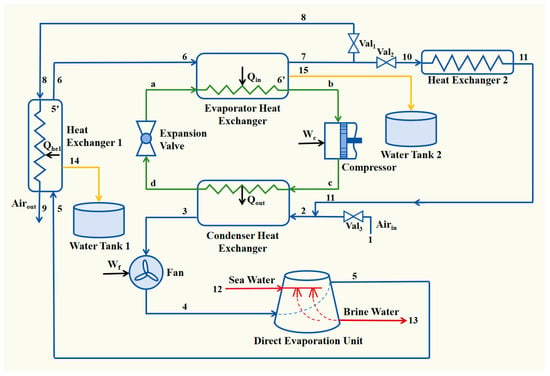
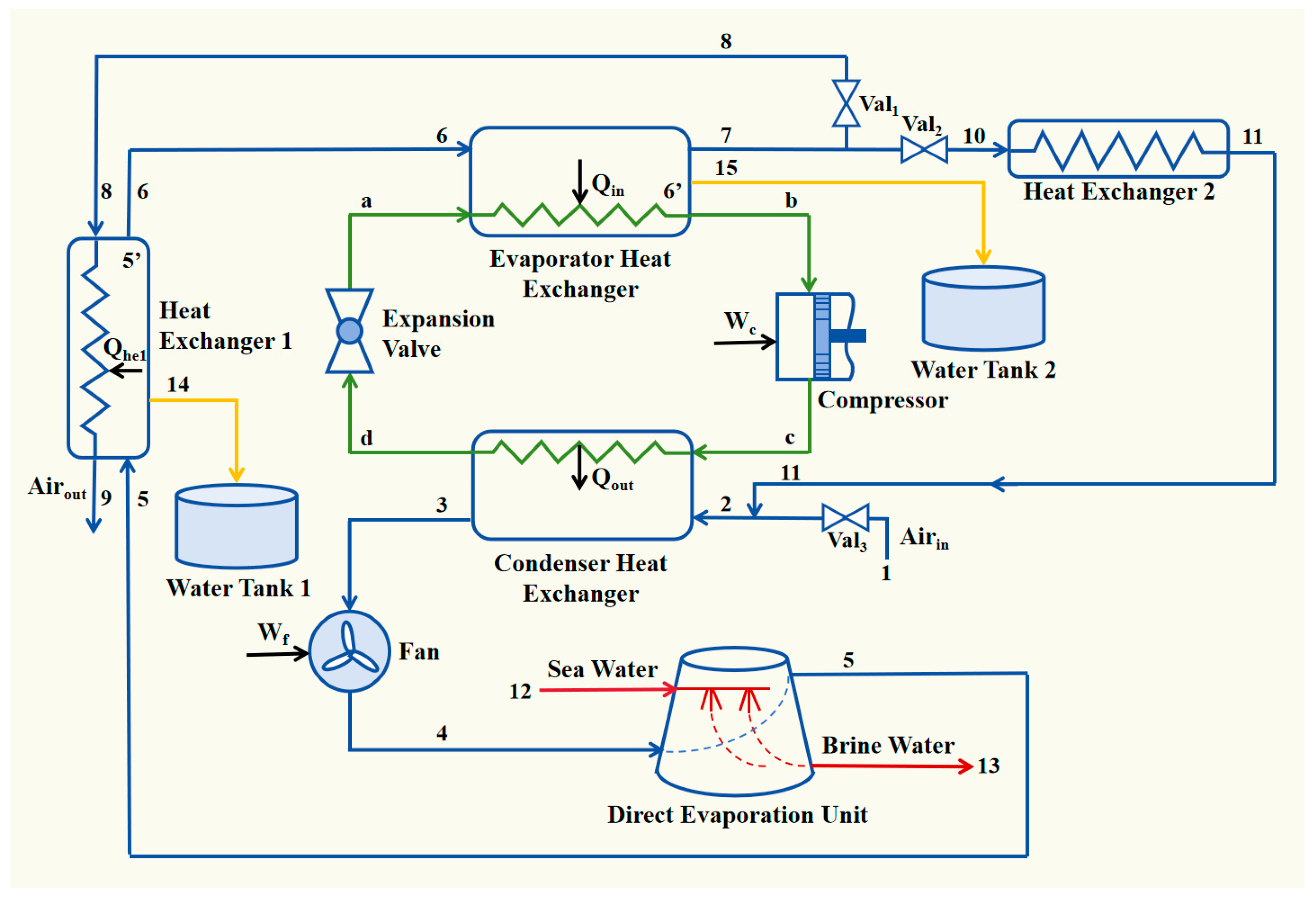
The proposed NeWater system uses green electrical power to drive its processes for desalinating saline water and harvesting water from ambient air. Unlike RO systems, the NeWater system can be operated intermittently. It can operate in three modes: opened loop (OL), closed loop (CL), and combined or hybrid loop (CHL). The detailed configuration and valve control logic for each mode are described in the following section. The schematic of the NeWater system is shown in Figure 1. The system is composed of valves, a vapor compression refrigeration unit (VRU), which includes a compressor, an expansion valve, an evaporator heat exchanger (EHE), a condenser heat exchanger (CHE), a cooling recovery heat exchanger (HE1), an ambient air heat exchanger (HE2), and a direct evaporation unit (DEU), i.e., cooling tower, water tanks, and a fan.
Figure 1.
Schematic diagram of NeWater system.
2.2. Structure and Operation Modes of the NeWater System
The system operation mode can be flexibly adjusted to the OL, CL, or CHL modes by controlling the three valves (Val1, Val2, and Val3).
When valves Val1 and Val3 are fully opened and valve Val2 is closed, the system operates in the OL mode, allowing 100% ambient air to circulate through the system. When valve Val2 is fully opened, while valves Val1 and Val3 are closed, the system operates in the CL mode, where the air is fully recirculated within the system, i.e., no ambient air intake. When all three valves (Val1, Val2, and Val3) are partially opened, the system operates in the CHL mode, allowing intake of some ambient air and recycling of part of the air.
In the CHL mode, ambient air with the properties (T1, ṁa1, RH1) enters the system through the semi-opened valve Val3 and meets recycled air from point 11 with properties (T11, ṁa11, RH11). The mixed stream at state 2 (T2, ṁa2, RH2) travels to the condenser heat exchanger (CHE), where it is heated by the condensing heat (Qout) of the refrigeration unit. After leaving the CHE at state 3 (T3, ṁa3, RH3), the air stream is further heated by the fan, its state turns to state 4 (T4, ṁa4, RH4), and it continues to the inlet of the DEU.
Inside the DEU, the air is in direct contact with saline water (Tw12, ṁw12) entering from water inlet 12. The water and the air flows leave the DEU as brine at state 13 (Tw13, ṁw13) and as humid air near saturation at state 5 (T5, ṁa5, RH5), respectively. The brine at state 13 is discharged from the system, and the associated sensible heat loss is accounted for in the overall energy balance of the DEU.
The humid air at state 5 then passes through HE1 to be precooled by exhaust air 8 from valve Val1, before entering the evaporator heat exchanger (EHE) at state 6 (T6, ṁa6, RH6). There may be some liquid water condensed in HE1. The condensed water generated in this process is collected in water tank 1 at state 14 (Tw14, ṁw14).
In the EHE, the air loses heat (Qin) to the evaporator and its temperature is reduced. During this process (6 → 7 and 15), freshwater can be produced and collected in the water tank 2 at state 15 (Tw15, ṁw15).
After losing moisture, the air leaves the EHE at a relatively low temperature, T7, and is divided into two streams: some air is released via valve Val1 after passing through HE1; the rest is recirculated, after HE2, to meet the ambient air intake 1. In HE2, the air is warmed up by the ambient environment from state 10 to state 11.
3. Mathematical Modeling of NeWater System
The mathematical simulation model of the NeWater system is established to quantitatively describe the heat and mass transfer processes among the air, water, and refrigerant within the system at a steady state.
3.1. Model Assumptions
To simplify the model and make it more suitable for engineering calculations, several reasonable assumptions made in the model are as follows:
- The system operates under steady-state conditions;
- The apparatus and the cooling water recirculation loop are thermally insulated from the surroundings;
- Heat transfer by radiation is neglected;
- Water loss caused by drift is considered negligible;
- Air and water are uniformly distributed at the inlets, and this uniform distribution is maintained throughout the process;
- The outlet air from the direct evaporation unit is assumed to have a constant relative humidity;
- When air passes through HE1 and HE2, its outlet temperature is predefined by the system conditions.
While these assumptions simplify the analysis, they are recognized as sources of uncertainty. In addition, this is a steady-state model, which is incapable of revealing and simulating the dynamic performance of the system when input parameters change.
3.2. Process-Based Mathematical Models
In the NeWater system, several fluids interact through heat and mass transfer in different modules. Each process between two or more thermodynamic states represents a distinct exchange of energy and mass, including mixing, cooling, condensation, and evaporation.
Modeling these processes is essential for predicting outlet conditions and evaporation and condensation rates, and evaluating the overall energy balance of the system. The following subsections describe the mathematical models for each fluid process in detail.
Process 1 and 11 → 2 (air mixing): The ambient air that enters through valve Val3 from point 1 mixes with the circulating air from point 11 and flows to point 2. The total mass of dry air and water vapor is conserved during mixing. The humidity ratio and enthalpy of the mixed air are determined by the mass flow rates and thermodynamic properties of the two inlet air streams. The mass and energy balances for this process are expressed by the following governing equations, which allow for the calculation of the outlet humidity ratio and enthalpy based on the inlet conditions and governing thermodynamic relationships; all mathematical symbols used are defined in the Nomenclature Section following the main text [35]:
Processes 2 → 3 and c → d (heat exchange in CHE): The air is heated by the condensing heat from the refrigeration unit in the CHE, and the outlet air reaches state 3. The total mass of dry air and water vapor is conserved during heat exchange. The mass and energy balances for this process are expressed by the following governing equations [36]:
Process 3 → 4 (passing fan): The heated air from the condenser exchanger is sucked into and driven by the fan, which provides power Wf. The air passes through the fan without any heat exchange with the surroundings. The total mass of dry air and water vapor is conserved during this process. The humidity ratio and enthalpy of the air remain determined by the inlet conditions and the fan operation. No condensation or evaporation occurs in this process:
Processes 4 → 5 and 12 → 13 (air–water meeting in DEU): The air at state 4 enters the DEU and meets the seawater entering at inlet 12. The air and water flow counter to each other and are in direct contact. The air becomes humid and approaches saturation at state 5, while the water becomes concentrated brine at state 13. The total mass of dry air and water vapor is conserved, while evaporation occurs from the water to the air. The humidity ratio and enthalpy of the air and water streams are determined by the mass flow rates and thermodynamic properties of the two inlet streams.
The energy and mass balances are expressed through the following equations, which account for both the heat transferred between air and water and the evaporation occurring in the DEU, in combination with the governing thermodynamic relationships [35]:
The Merkel number is used to quantify the effectiveness of heat and mass transfer. The evaporation rate is calculated based on the Merkel number and the difference in humidity ratio between the water surface and the air using the method described in [37,38]. The process:
where ω∗ (kg/kg) is the humidity ratio of saturated air at the water surface temperature, representing the equilibrium moisture content at the interface between the air and the cooling water.
Processes 5 → 6 and 14, and 8 → 9 (passing HE1): Humid air from state 5 passes through HE1, where it is precooled before entering the evaporator heat exchanger at state 6. This process aims to recover part of the cooling capacity from the exhaust air, thereby improving system efficiency.
The air may experience either sensible cooling only or a combination of sensible cooling and condensation, depending on whether the outlet state reaches saturation. The outlet temperature is preliminarily determined based on the valve control parameter, after which the vapor pressure and relative humidity are evaluated. In this process, we assume the following:
and check whether condensation occurs during the process by the following equations:
We calculate RH6 by assuming pv5 = pv6:
When the relative humidity at the outlet (RH6) remains below 100%, the process involves only sensible cooling. Otherwise, condensation occurs, and both latent and sensible heat transfer are considered in the energy balance. Accordingly, the mass and energy conservation equations governing this process can be expressed as follows:
If condensation takes place, the outlet humidity ratio and temperature are iteratively solved using the coupled heat and mass balance equations:
Processes 6 → 7 and 15, and a → b (heat exchange in EHE): Humid air from state 6 passes through the EHE, where it is further cooled, and (if saturation is reached) condensation may occur before the air exits at state 7; condensate is collected at state 15. Simultaneously, the working fluid (denoted by states a → b) absorbs heat in the EHE.
The air may undergo either sensible cooling only or sensible cooling with condensation, depending on whether the outlet state reaches saturation. The outlet temperature is preliminarily estimated from the COP, after which vapor pressure and relative humidity are evaluated. In this process [36]:
We check whether condensation occurs during the process by the following equations, calculating pv6 as follows:
We calculate the dew-point temperature T6′ with mass balance and heat balance:
and calculate RH6′ as follows:
When the relative humidity at the outlet (RH6′) remains below 100%, the process involves only sensible cooling. Otherwise, condensation occurs, and both latent and sensible heat transfer are considered in the energy balance. Accordingly, the mass and energy conservation equations governing this process can be expressed as follows:
If condensation takes place, the outlet humidity ratio and temperature are iteratively solved using the coupled heat and mass balance equations:
Processes 7 → 8 and 10 (air splits via valves Val1 and Val2): The air stream is split into two separate paths by valves Val1 and Val2. This split allows part of the airflow to be recirculated or bypassed, depending on the operational mode, while the remaining portion proceeds along the main circuit. During the splitting process, the total mass of dry air and water vapor is conserved, and no condensation occurs:
Process 10 → 11 (passing heat exchanger 2): The air from point 10 flows through the partially opened valve Val2 into HE2, where it exchanges heat with the surrounding air, resulting in an increase in the air temperature. After this ambient heating process, the air continues to the CHE after mixing with fresh ambient air, if any comes through valve Val3. To simplify the model, the air temperature exiting HE2 was assumed to fixed at 1 °C below the ambient temperature:
By solving Equations (1)–(33) in the mathematical model described above, the 33 variables, including ṁw14 and ṁw15, can be determined when key known parameters and information (e.g., T1, RH1, ṁa2, Tw12, OPval2, COP, and Wc) are input.
The mathematical model described above is based on the principles of mass and energy conservation. In addition, the thermodynamic properties of moist air calculated from the model, such as humidity ratio, enthalpy, and temperature, were examined to ensure consistency with actual psychrometric behavior under the specified operating conditions and to confirm that the computed values were physically reasonable across all conditions. Therefore, the model is considered to have been verified, although it has not been experimentally validated yet.
3.3. Performance Evaluation Criteria
To assess the performance of the proposed system, the key evaluation criteria used were as follows:
- Total water yield ṁcond (kg/s), which reflects the overall production capacity of the system, defined as follows:
- 2.
- The energy rate per unit mass of freshwater produced, ԑ, which is defined as follows:
If fan power is considered:
3.4. The Reference Case
To provide a comparison base in subsequent analyses, a reference case was established. The reference case represents the steady-state operation of the proposed system, with inlet air, water, and refrigerant parameters given. The values of the input parameters and the results of the reference case are summarized in Table 1.
Table 1.
Input and output parameters for the reference case.
Table 1 shows a reference case established under steady-state conditions to provide a baseline for subsequent analyses. The inlet air temperature (T1) and relative humidity (RH1) were 35 °C and 40%, the DEU inlet water temperature (Tw12) and flow rate (ṁw12) were 28 °C and 1 kg/s, the total air mass flow rate (ṁa2) was 3 kg/s, the valve opening (OPval2) was 40%, and the compressor and fan powers (Wc and Wf) were 3 kW and 1.5 kW, respectively. The DEU outlet relative humidity (RH5) was assumed to be 95%, and the refrigeration unit COP was 4. The auxiliary heat exchangers (HE1 and HE2) were modeled with predefined outlet air temperatures. Under these conditions, the system produced a DEU evaporation rate (ṁevap) of 25.62 kg/h and condensation water flows of 4.54 kg/h through HE1 (ṁw14) and 50.06 kg/h through the evaporator (ṁw15), yielding a total water output (ṁcond) of 54.60 kg/h. The energy consumption per unit mass of freshwater was 54.94 kWh/m3 for the compressor only (εc) and 82.41 kWh/m3 including the fan (εc+f). These results provide a reference point for evaluating system performance under varying conditions.
4. Results of Sensitivity Analysis
In order to evaluate the impacts of some key design and operating parameters on system performance, a sensitivity analysis was carried out. The parameters studied included temperature and humidity of fresh intake air, saline water flow rate, and valve opening ratio, i.e., recycled air ratio, etc.
4.1. Effect of Inlet Air Temperature
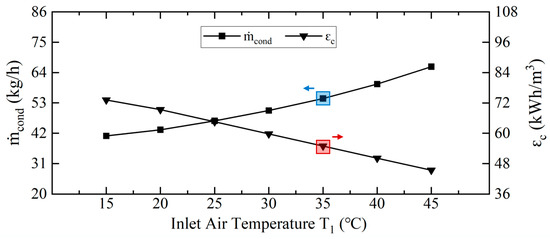
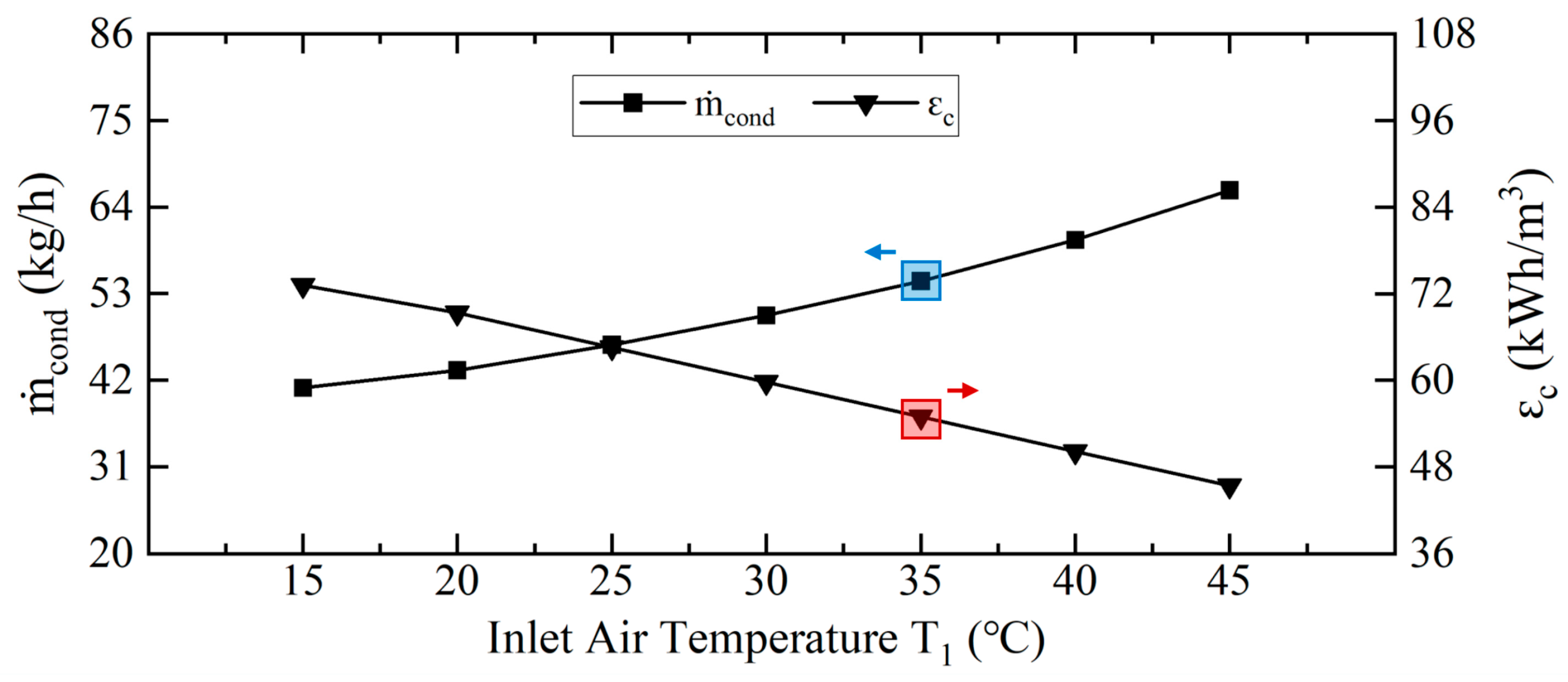
The inlet air temperature (T1) has a moderate influence on the condensation performance of the system, as shown in Figure 2; the highlights are the results of the reference case. When T1 increased from 15 °C to 45 °C, the total water yield (ṁcond) increased from 41.0 kg/h to 66.1 kg/h, while its energy rate per unit mass of freshwater produced (ԑc) decreased from 73.1 kWh/m3 to 45.4 kWh/m3. The reason this happened was thought to be that warmer ambient air with the same relative humidity resulted in a higher temperature at the inlet and outlet of the DEU and thus more moisture in the air stream available for condensation later in HE1 and the EHE.
Figure 2.
Effect of inlet air temperature on total water yield (ṁcond) and the energy rate per unit mass of freshwater produced (ԑc).
4.2. Effect of Inlet Air Relative Humidity
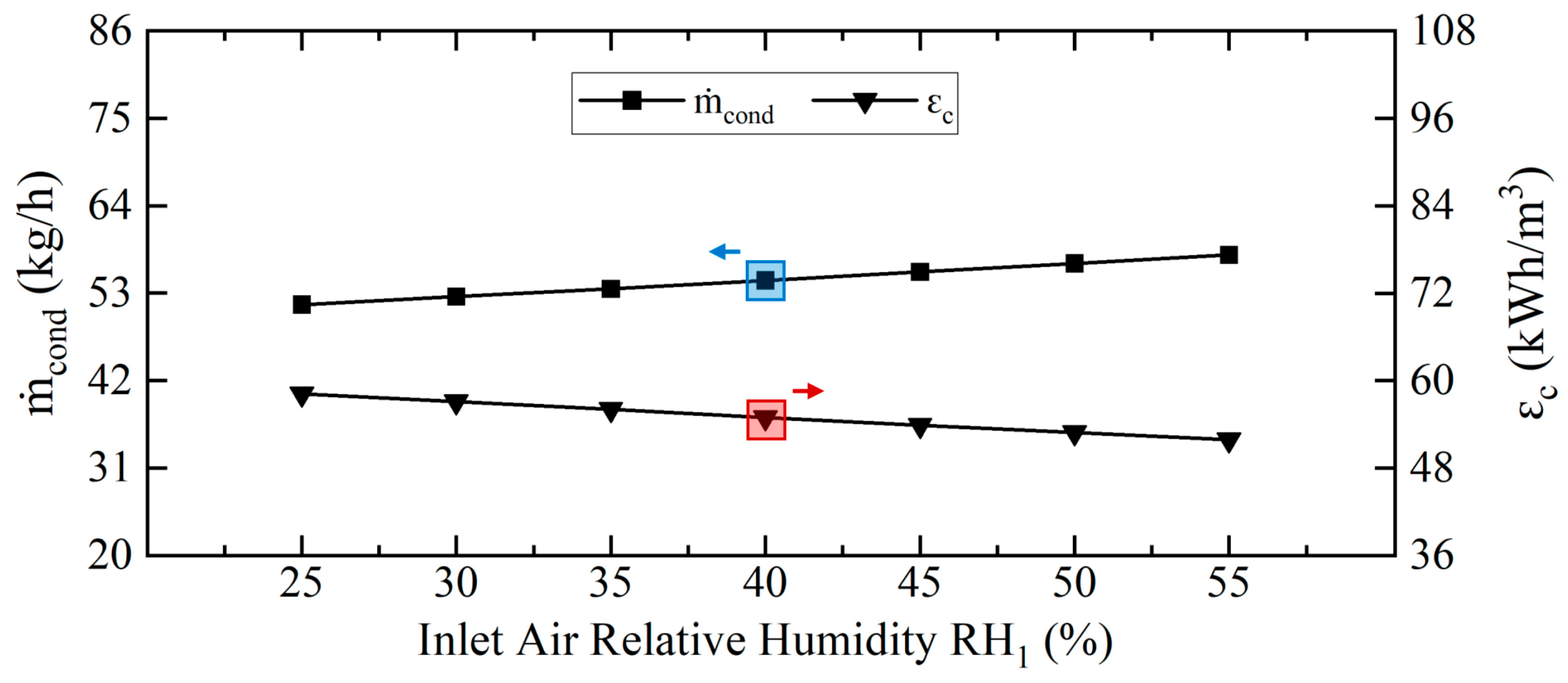
The effect of the relative humidity of the inlet air (RH1) on the condensation performance is negligible, as shown in Figure 3; the highlights are the results of the reference case. When RH1 increased from 25% to 55%, the ṁcond increased slightly from 51.5 kg/h to 57.8 kg/h, while ԑc decreased from 87.3 kWh/m3 to 77.8 kWh/m3. The result arose from the assumption of the fixed outlet relative humidity of the DEU. Under this assumption, variations in RH1 had little influence on the condensation process. To address this limitation or remove this assumption, a detailed DEU model would be required, which is beyond the scope of the present study.
Figure 3.
Effect of inlet air relative humidity on total water yield (ṁcond) and the energy rate per unit mass of freshwater produced (ԑc).
4.3. Effect of Total Air Mass Flow Rate
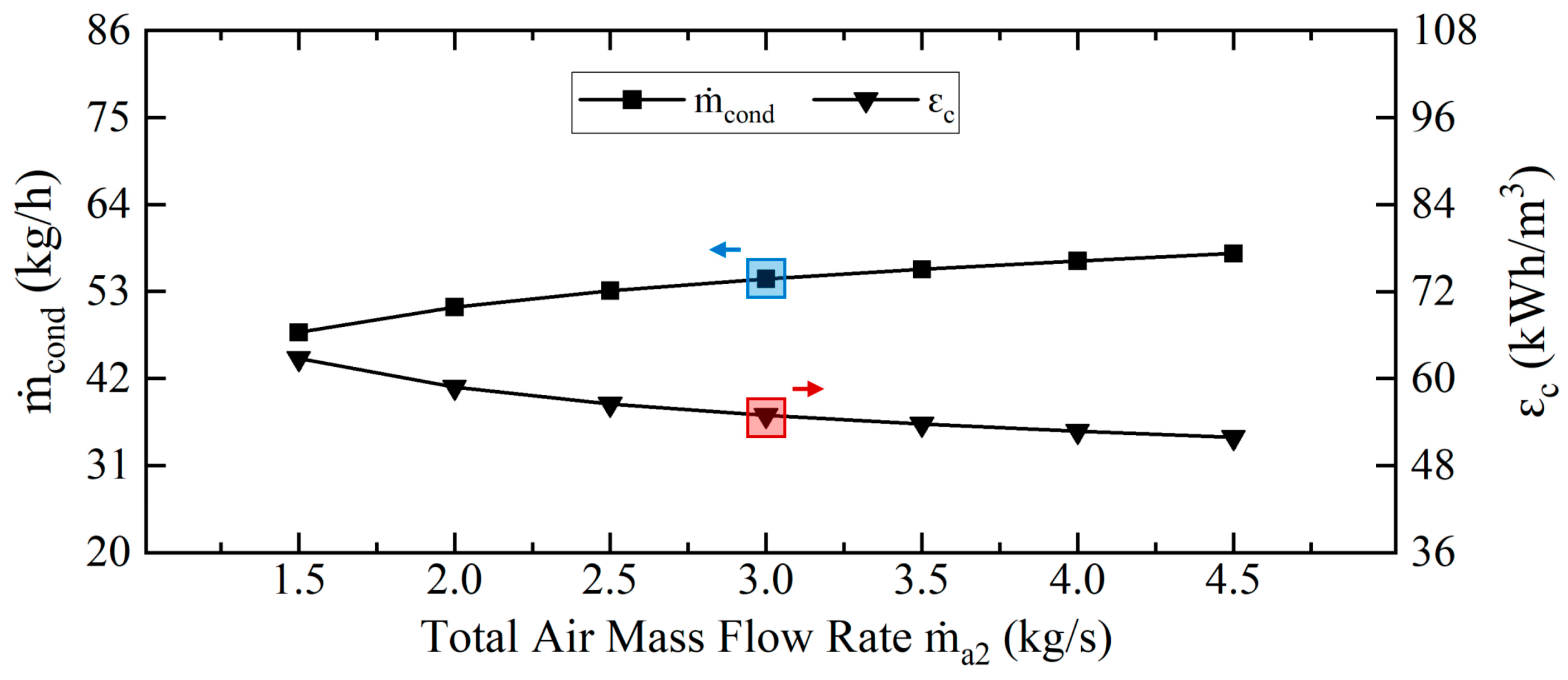
The performance of the system is affected by the total mass flow rate of the inlet air (ṁa2), as shown in Figure 4; the highlights are the results of the reference case. When the air mass flow rate increased from 1.5 kg/s to 4.5 kg/s, the ṁcond increased from 47.8 kg/h to 57.8 kg/h, while the ԑc continued to decline from 58.2 kWh/m3 to 51.9 kWh/m3, indicating that the efficiency of energy utilization had improved. This was because the increase in air flow reduced the temperature drop caused by direct contact with heat and mass transfer in the DEU, thus carrying more water vapor under the relative humidity conditions of the same outlet, increasing the potential amount of water for subsequent condensation. Based on the results, a favorable air flow rate range appeared to be between approximately 3.5 kg/s and 4.5 kg/s, where a relatively high condensation rate was maintained alongside a lower specific energy consumption.
Figure 4.
Effect of total air mass flow rate on total water yield (ṁcond) and the energy rate per unit mass of freshwater produced (ԑc).
4.4. Effect of Inlet Water Temperature
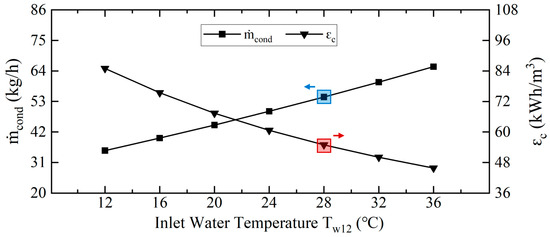
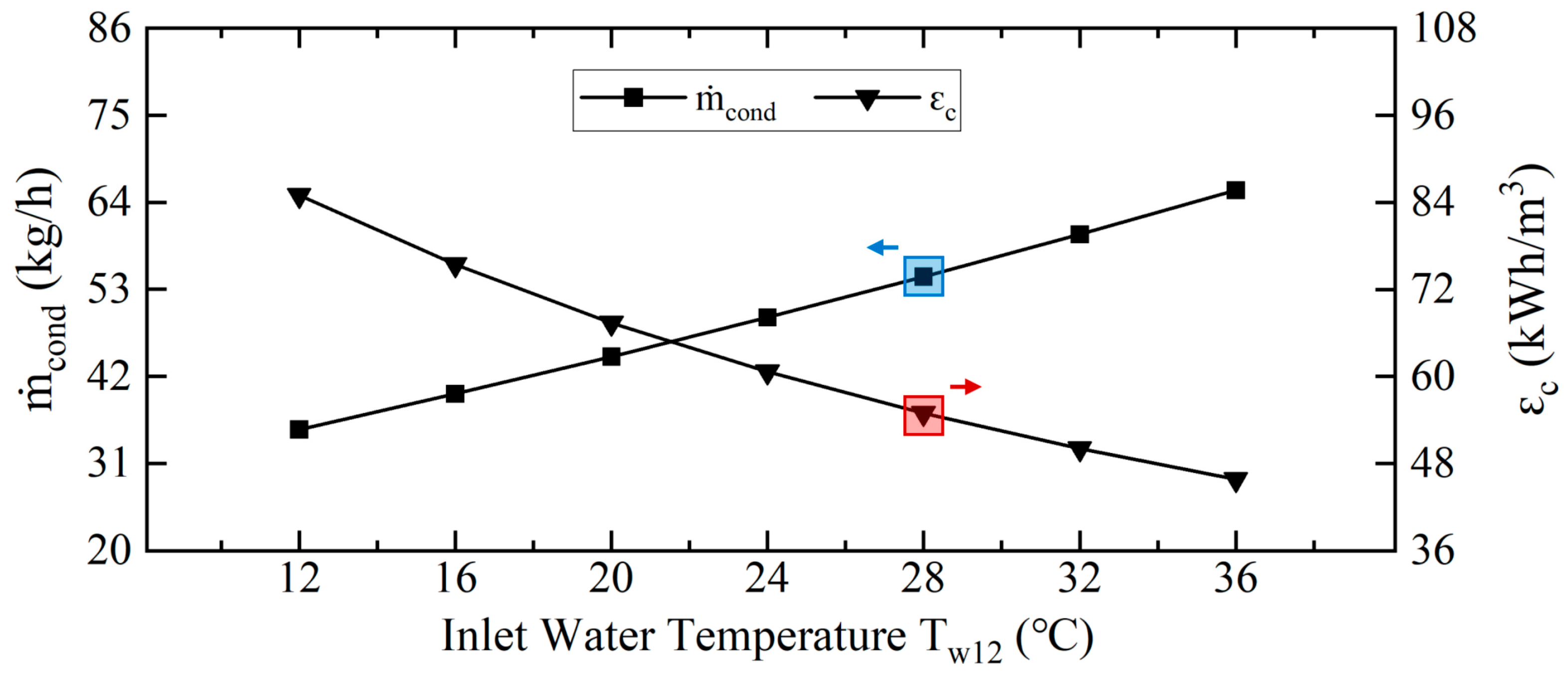
The effect of inlet water temperature (Tw12) on the condensation performance of the system is shown in Figure 5; the highlights are the results of the reference case. As Tw12 rose from 12 °C to 36 °C, the ṁcond increased significantly from 35.3 kg/h to 65.5 kg/h, while the ԑc decreased from 85.0 kWh/m3 to 45.8 kWh/m3. The higher inlet water temperature improved the temperature of the cooling surface, enhanced the heat and mass transfer process between air and water, and reduced the temperature drop in the air in the DEU, so that the air could carry more water vapor under the same relative humidity, making it more easily able to precipitate condensate in the subsequent condensation stage. The results show that under the condition of maintaining a moderately high inlet water temperature, the water production capacity and overall energy efficiency of the system can be significantly improved.
Figure 5.
Effect of inlet water temperature on total water yield (ṁcond) and the energy rate per unit mass of freshwater produced (ԑc).
4.5. Effect of Inlet Water Mass Flow Rate
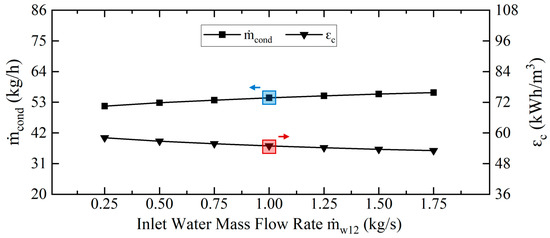
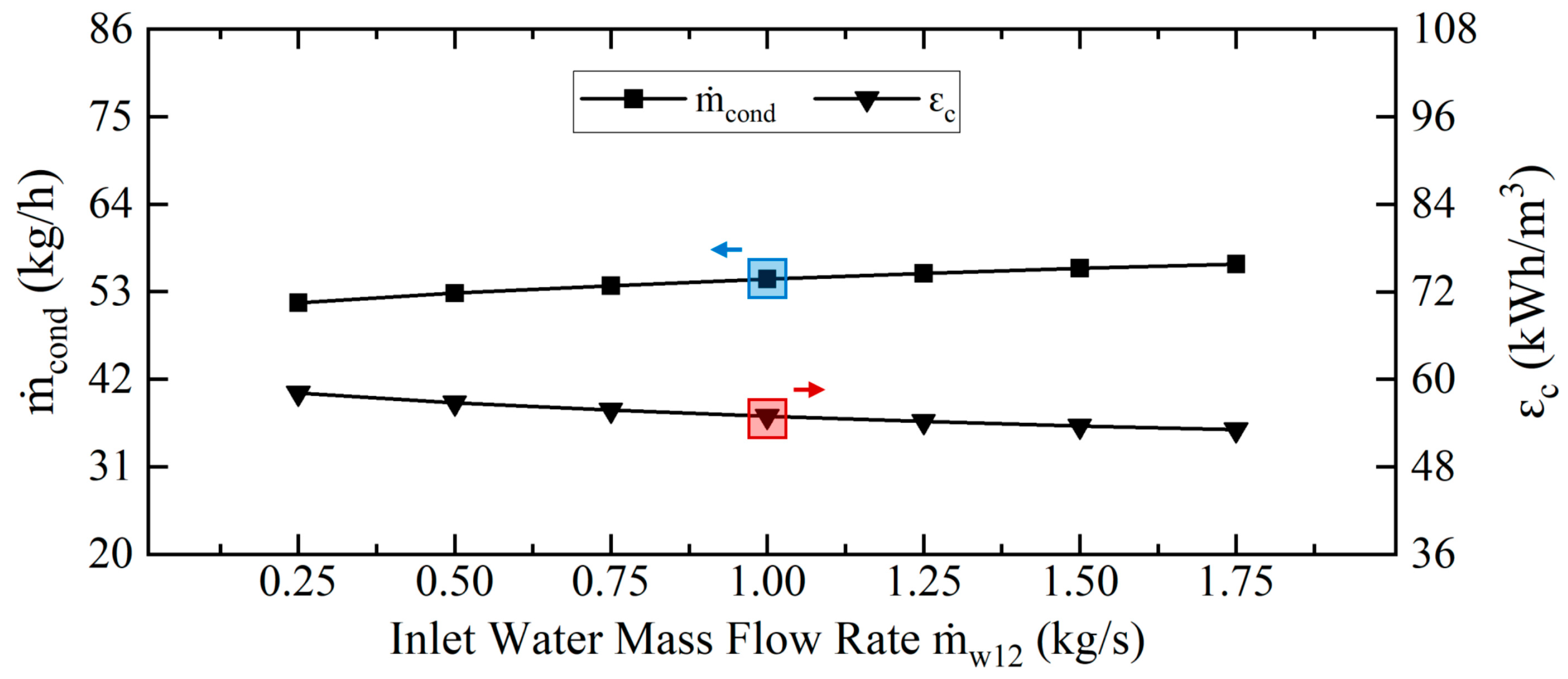
The effect of the inlet water mass flow rate (ṁw12) is shown in Figure 6; the highlights are the results of the reference case. As the water flow rate increased from 0.25 kg/s to 1.75 kg/s, the ṁcond and ԑc only changed slightly, indicating that the system performance is not sensitive to changes in water flow within this range. This slight increase in water production was mainly due to the fact that, with the increase in water flow, the temperature drop per unit mass of water caused by evaporation-related latent heat was partially offset, and the temperature drop on the water side was slightly reduced, so the surface temperature of the water was relatively higher, thus carrying more potentially condensable water vapor.
Figure 6.
Effect of inlet water mass flow rate on total water yield (ṁcond) and the energy rate per unit mass of freshwater produced (ԑc).
In addition, this phenomenon is also related to the model hypothesis that the relative humidity of the outlet air in the DEU remains constant. Under this hypothesis, the additional water flow rate will not significantly change the saturation state of the air or the thermal balance of the system as a whole. Therefore, when the water mass flow exceeds a certain level, its effect on improving the condensation water output or system energy efficiency should be limited.
4.6. Effect of Compressor Power Input
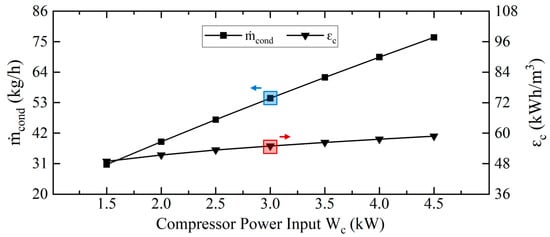
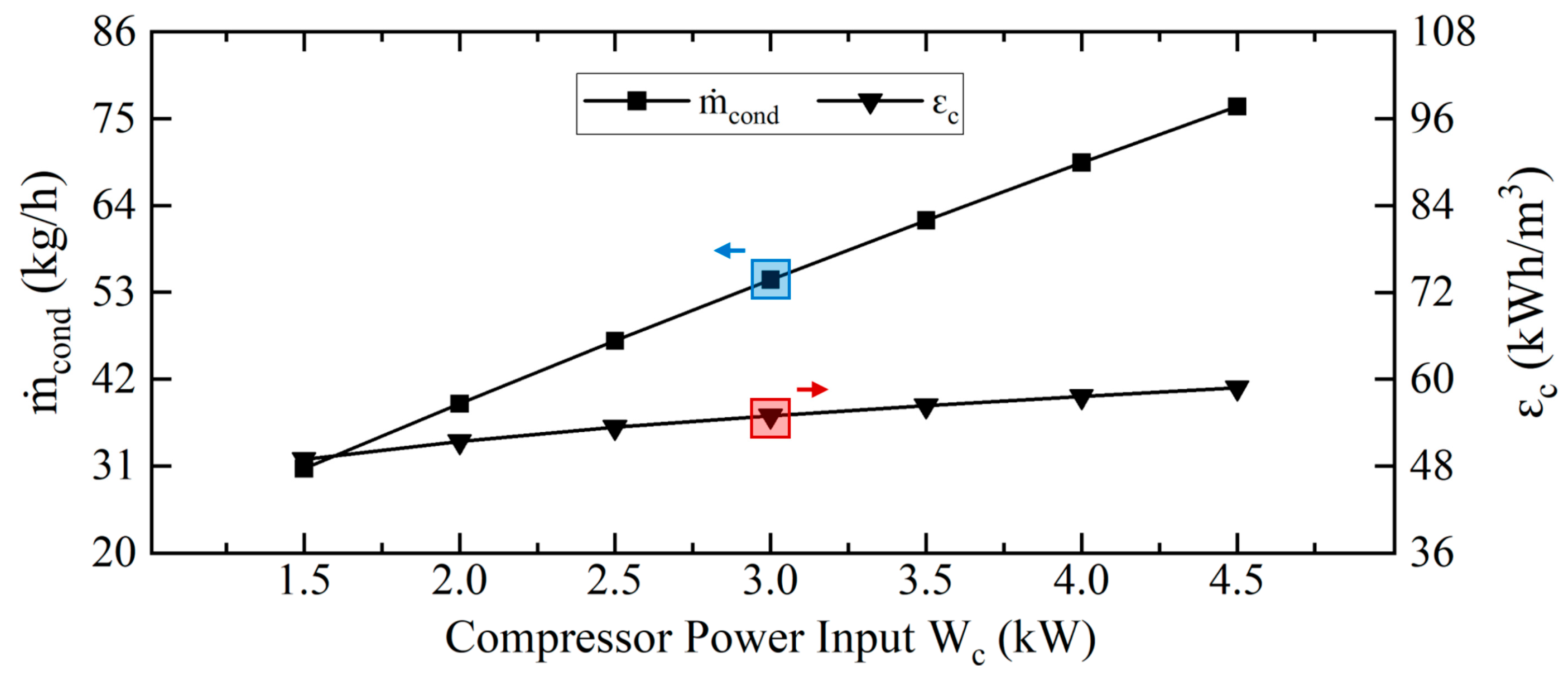
The compressor power input (Wc) directly determines the refrigeration capacity of the system, as shown in Figure 7; the highlights are the results of the reference case. With the increase in Wc from 1.5 kW to 4.5 kW, the ṁcond increased markedly from 30.7 kg/h to 76.5 kg/h. The reason for this significant increase is that in the NeWater system, the VRU contributes in two ways: by providing evaporation cooling (Qin) to condense the moisture in the air stream and by releasing condensing heat (Qout) to pre-heat air entering the DEU. When Wc increased with fixed COP, both Qin and Qout increased.
Figure 7.
Effect of compressor power input on total water yield (ṁcond) and the energy rate per unit mass of freshwater produced (ԑc).
However, the increase in condensation was accompanied by an increase in energy consumption. The ԑc continued to rise with the increase in Wc, increasing from 48.9 kWh/m3 to 58.8 kWh/m3, indicating that the marginal return of the unit of additional water output was decreasing as the electricity input increased. Under the high compressor power input, most of the extra energy was used for sensible cooling, not condensation through latent heat. Therefore, when the compressor power exceeded the moderate level, although the water output continued to increase, the energy efficiency of the system showed a decreasing trend.
4.7. Effect of Coefficient of Performance
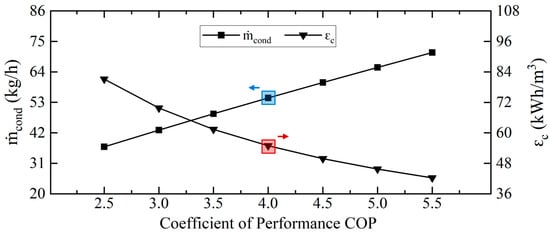
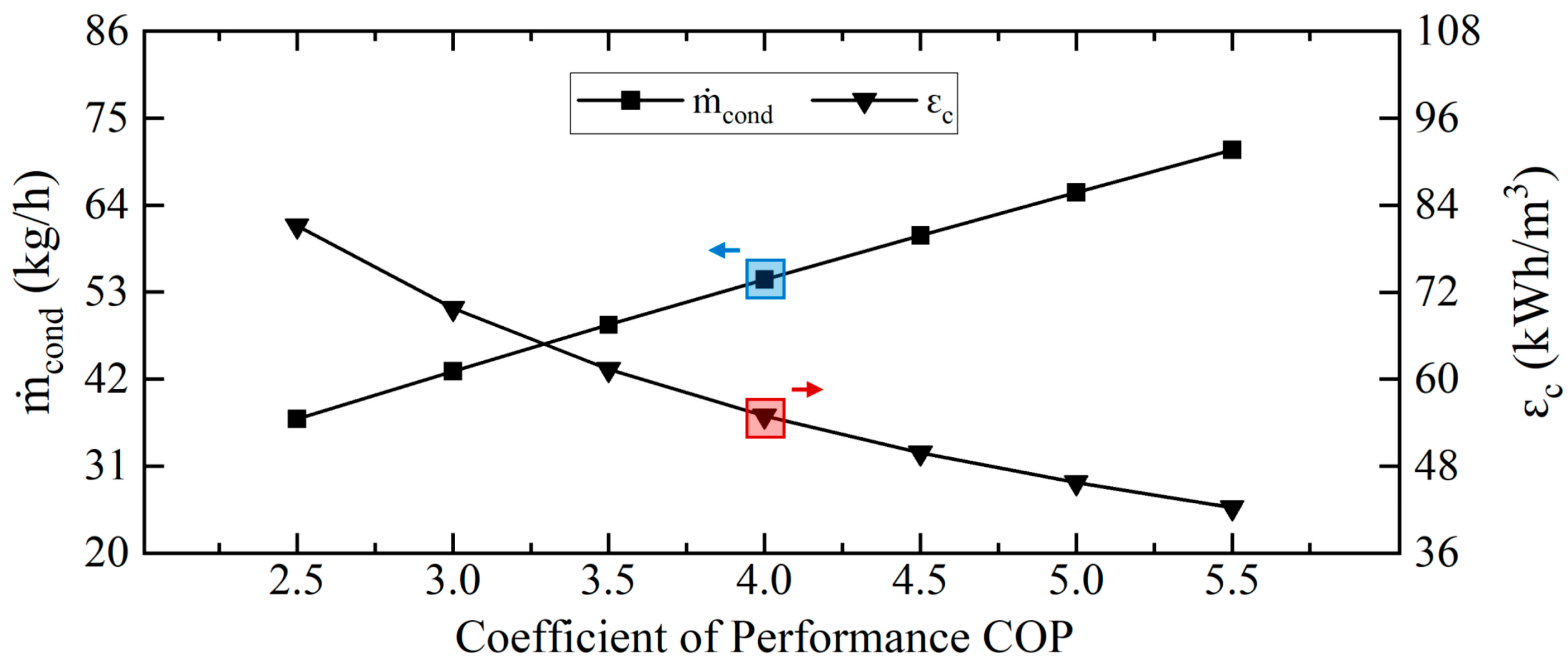
The coefficient of performance (COP) of the VRU represents its efficiency and significantly influences the behavior of the NeWater system, as shown in Figure 8; the highlights are the results of the reference case. As the COP increases from 2.5 to 5.5, the condensation rate (ṁcond) rises linearly from 37.0 to 71.0 kg/h. In contrast, the specific energy consumption (ԑc) exhibits a different trend: it first decreases sharply and then stabilizes, dropping from 81.1 to 42.3 kWh/m3. This is because, with a fixed Wc, an increase in COP leads to higher Qin and Qout, enhancing both the evaporation and condensation processes within the system. This indicates the importance of VRU design, especially its COP, in determining system performance.
Figure 8.
Effect of coefficient of performance on total water yield (ṁcond) and the energy rate per unit mass of freshwater produced (ԑc).
4.8. Effect of Percentage of Recirculated Air Loop
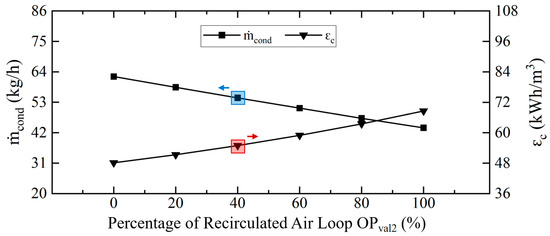
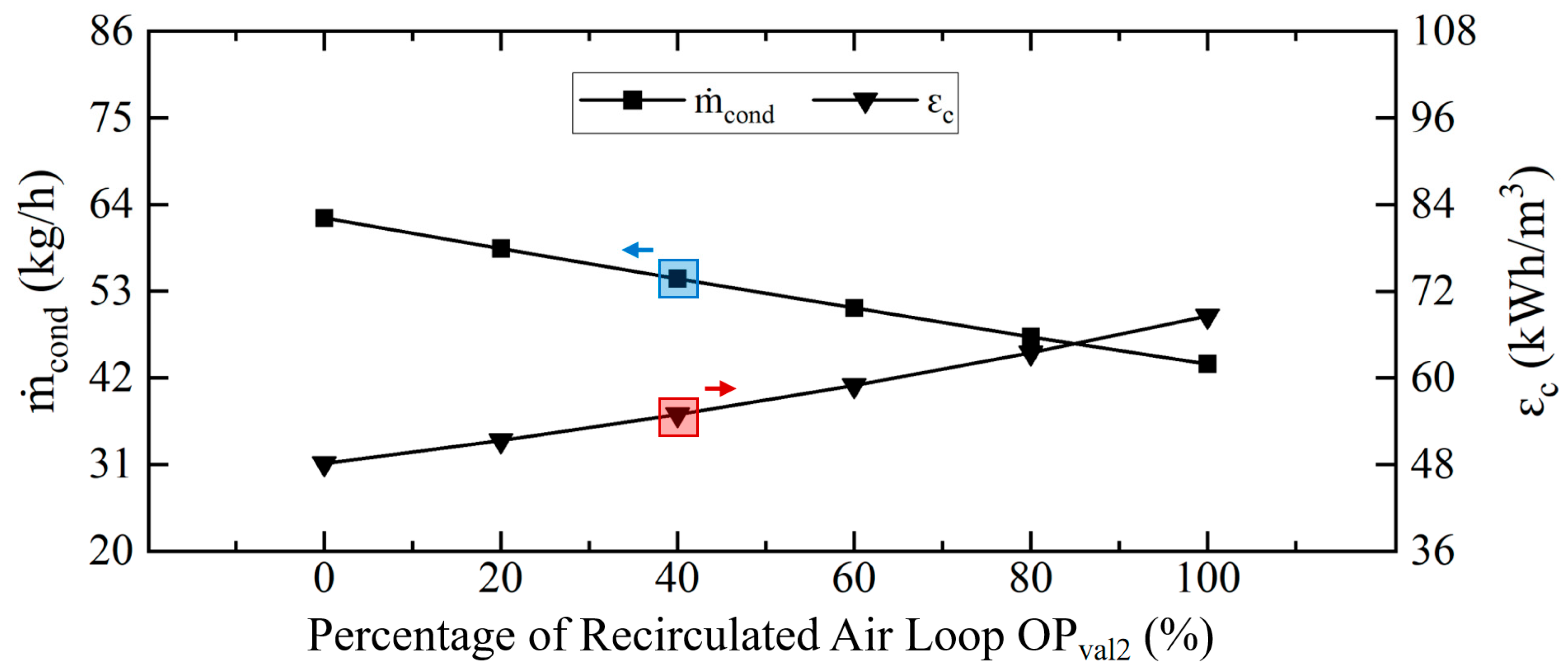
The opening of valve 2 (OPval2), which governs the air circulation ratio, affects the humidity and enthalpy of air in the system. As shown in Figure 9, the highlights are results of the reference case, with the circulation ratio increasing from 0% (fully open) to 100% (fully closed); the condensation rate (ṁcond) decreases from 62.3 to 43.8 kg/h. Conversely, the specific energy consumption (ԑc) shows an opposite trend, increasing from 48.2 to 68.5 kWh/m3. In the open system, the continuous inflow of fresh ambient air provides new moisture for condensation. In contrast, at a higher circulation ratio, the temperature of the reflux air is lower, and the amount of water vapor carried by the air coming out of the DEU is reduced, which reduces the condensation potential, thus limiting the water output. This effect is further influenced by the assumption of a fixed outlet relative humidity at the DEU, which constrains the variation in air moisture content.
Figure 9.
Effect of percentage of recirculated air loop on total water yield (ṁcond) and the energy rate per unit mass of freshwater produced (ԑc). OP values of 100% mean closed loop (CL) operation, while OP values of 0% mean fully open loop (OL) operation.
4.9. Effect of Air Relative Humidity at Outlet of DEU
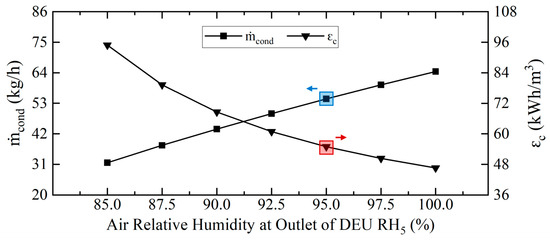
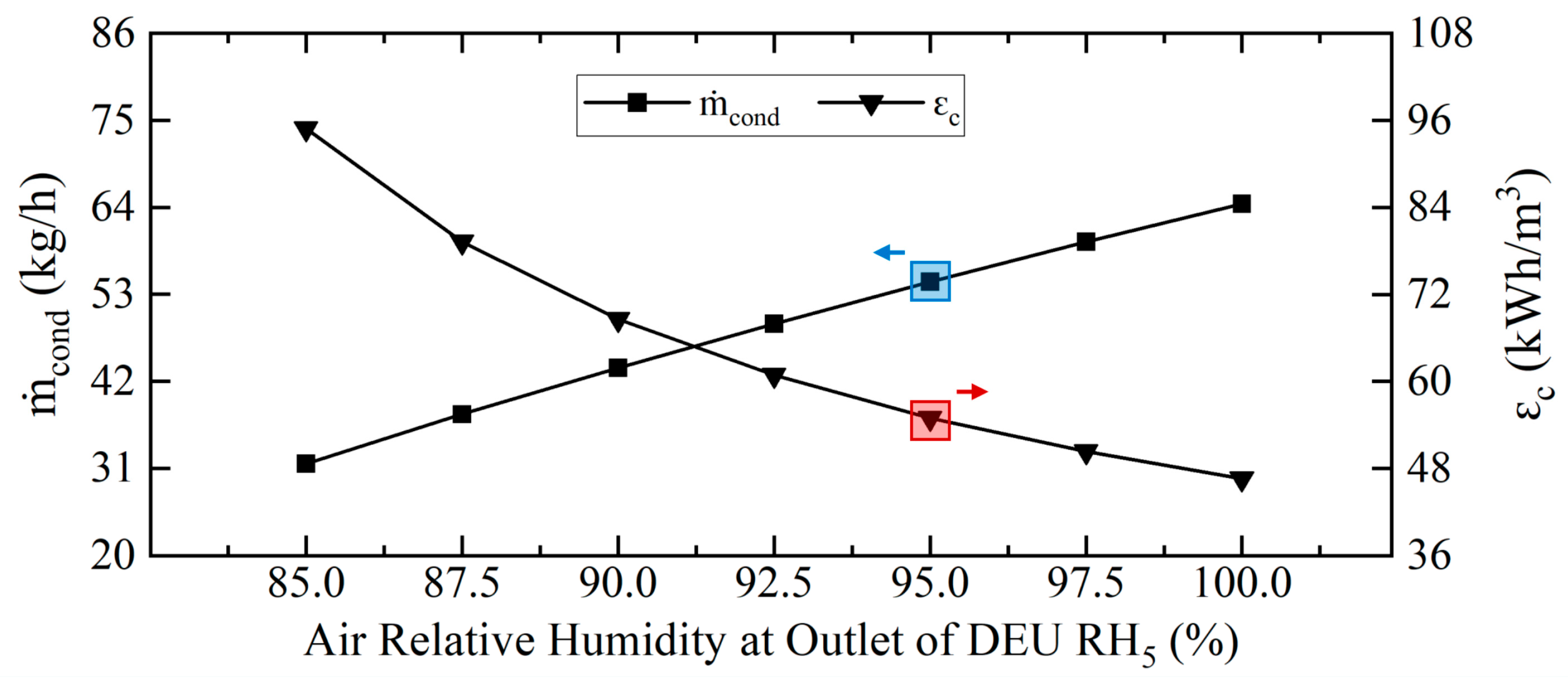
The relative humidity of the outlet air of the DEU (i.e., the cooling tower), RH5, indicates the humidity saturation level, which depends on the design, structure, and operation of the DEU. In this study, the DEU was treated as a black box, and its outlet relative humidity was assumed. As shown in Figure 10, the highlights are results of the reference case, in which RH5 increases from 85% to 100%, the ṁcond increases from 31.6 kg/h to 64.4 kg/h, and the ԑc decreases rapidly at first and then levels off from 94.9 kWh/m3 to 46.6 kWh/m3, indicating that the system is close to its maximum condensation potential.
Figure 10.
Effect of air relative humidity at outlet of the DEU on total water yield (ṁcond) and the energy rate per unit mass of freshwater produced (ԑc).
These results highlight the importance of DEU design: in order to maximize system efficiency, the air–water interface must provide a large contact area, optimal water droplet atomization, and sufficient residence time for full saturation. Appropriately enhancing these parameters can significantly improve water production and energy utilization in future system optimization.
5. Conclusions
This paper proposed a NeWater system to achieve freshwater production in an environment where it is difficult to apply traditional seawater desalination technologies. The system can flexibly switch the operation mode to adapt to different ambient temperature, humidity, and water source conditions. The system performance is simulated by a mathematical model developed based on thermodynamic principles. The impacts of several key design and operation parameters on the system performance were studied. When compared with the performance of standalone desalination [15] or atmospheric water harvesting systems [27], the integrated NeWater system proposed in this work demonstrates a competitive advantage in achieving simultaneous water production from different sources under a wider range of conditions, although its current unit water production energy consumption is higher than that of currently mature technologies. Based on the results of the sensitivity study, the following conclusions can be drawn:
- The increase in the ambient air temperature and the relative humidity of the inlet air can significantly improve the performance of the system (including increasing the total water yield and reducing the energy rate per unit mass of freshwater produced), with the effect of air temperature being the most significant, leading to an increase in the total water yield by up to 1.6 times and a reduction in the energy rate by up to 38%.
- Increasing the total air mass circulated through the system can improve the performance of the system, with water yield increasing by up to 21% and energy rate decreasing by up to 38%.
- The increase in the inlet water temperature can enhance heat transfer, reduce the air temperature drop, and increase the moisture content of the air inside the DEU, resulting in the water yield increasing by up to 1.8 times and the energy rate decreasing by up to 46%, while the increase in the inlet water flow rate has less of an impact on the performance of the system and can only slightly increase the water output.
- Increasing the compressor power or system COP can effectively increase the total water yield. An improvement in COP can enhance the efficiency of the VRU and enhance the condensation potential, with water yield increasing by up to 1.9 times and energy consumption per unit of freshwater reduced by up to 48%.
- An improvement in DEU performance, i.e., an increase in the relative humidity at the outlet of the DEU, would improve the system performance effectively. In other words, the design, the structure, and the operation of the DEU are key to system performance, with water yield increasing twofold and energy rate decreasing by up to 51%.
In summary, the results show that the operating parameters—such as the recycling ratio, the mass flow rates of air and water, and the ambient conditions (e.g., the temperatures of air and water)—and the design parameters (e.g., compressor power and COP) jointly affect the performance of the system.
Further improving the simulation model by eliminating the assumption about the RH5 will be the research focus of the next phase, so that optimization of the key design and operation parameters and the system structure can be carried out, which are beyond the scope of the present paper. A direct comparison with experimental data for a comprehensive validation is an essential next step and is planned as immediate future work. The proposed system demonstrates potential for practical applications in off-grid and water-scarce regions where conventional RO and thermal-based technologies are unavailable.
Author Contributions
Conceptualization, E.H. and J.W.; methodology, E.H. and Y.H.; software, Y.H.; formal analysis, Y.H.; investigation, Y.H.; writing—original draft preparation, Y.H.; writing—review and editing, E.H. and J.W.; supervision, E.H. and J.W. All authors have read and agreed to the published version of the manuscript.
Funding
This research received no external funding.
Data Availability Statement
The original contributions presented in this study are included in the article. Further inquiries can be directed to the corresponding author.
Acknowledgments
The authors would like to acknowledge the School of Mechanical Engineering at Adelaide University for their support. The computations in this work were performed using the Phoenix HPC service at Adelaide University.
Conflicts of Interest
The authors declare no conflicts of interest.
Abbreviations
| Nomenclature | |
| A | Drenching water area (m2) |
| CHE | Condenser heat exchanger |
| CL | Closed loop |
| COP | Coefficient of performance |
| DEU | Direct evaporation unit |
| EHE | Evaporator heat exchanger |
| h | Specific enthalpy (kJ/kg) |
| hm | Convective mass-transfer coefficient (kg/(m2·s)) |
| HE1 | Cooling recovery heat exchanger |
| HE2 | Ambient air heat exchanger |
| L | Latent heat of vaporization (kJ/kg) |
| ṁ | Mass flow rate of fluid (kg/s) |
| OL | Open loop |
| OP | Valve opening, (%) |
| P | Pressure (Pa) |
| Q | Heat (kW) |
| RH | Air relative humidity (%) |
| T | Temperature, (°C) |
| VRU | Vapor compression refrigeration unit |
| Val | Valve |
| W | Power input (kW) |
| Special characters | |
| ω | Absolute humidity of the air (kg/kg) |
| ε | Efficiency (kWh/m3) |
| Subscripts | |
| a | Air |
| c | Compressor |
| cond | Condensate water |
| evap | Evaporation |
| f | Fan |
| in | Inlet |
| out | Outlet |
| v | Vapor |
| w | Water |
References
- Martínez-Alvarez, V.; Martin-Gorriz, B.; Soto-García, M. Seawater desalination for crop irrigation—A review of current experiences and revealed key issues. Desalination 2016, 381, 58–70. [Google Scholar] [CrossRef] [Scilit]
- Zhang, G.; Wang, X. Seawater Desalination System Driven by Sustainable Energy: A Comprehensive Review. Energies 2024, 17, 5706. [Google Scholar] [CrossRef] [Scilit]
- Hu, J.; Sun, Y.; Liu, Z.; Zhu, B.; Zhang, L.; Xu, N.; Zhu, M.; Zhu, J.; Chen, Z. Photothermal fabrics for solar-driven seawater desalination. Prog. Mater. Sci. 2025, 150, 101407. [Google Scholar] [CrossRef] [Scilit]
- Simmons, J.W., II; Van de Ven, J.D. A Comparison of Power Take-Off Architectures for Wave-Powered Reverse Osmosis Desalination of Seawater with Co-Production of Electricity. Energies 2023, 16, 7381. [Google Scholar] [CrossRef] [Scilit]
- Adityawarman, D.; Lugito, G.; Kawi, S.; Wenten, I.G.; Khoiruddin, K. Advancements and future trends in nanostructured membrane technologies for seawater desalination. Desalination 2025, 597, 118390. [Google Scholar] [CrossRef] [Scilit]
- Bacha, H.B.; Abdullah, A.S.; Aljaghtham, M.; Salama, R.S.; Abdelgaied, M.; Kabeel, A.E. Thermo-Economic Assessment of Photovoltaic/Thermal Pan-Els-Powered Reverse Osmosis Desalination Unit Combined with Preheating Using Geothermal Energy. Energies 2023, 16, 3408. [Google Scholar] [CrossRef] [Scilit]
- Barron, O.; Ali, R.; Hodgson, G.; Smith, D.; Qureshi, E.; McFarlane, D.; Campos, E.; Zarzo, D. Feasibility assessment of desalination application in Australian traditional agriculture. Desalination 2015, 364, 33–45. [Google Scholar] [CrossRef] [Scilit]
- Al-Obaidi, M.; Alsarayreh, A.A.; Rashid, F.L.; Sowgath, M.T.; Alsadaie, S.; Ruiz-García, A.; Khayet, M.; Ghaffour, N.; Mujtaba, I.M. Hybrid membrane and thermal seawater desalination processes powered by fossil fuels: A comprehensive review, future challenges and prospects. Desalination 2024, 583, 117694. [Google Scholar] [CrossRef] [Scilit]
- Zhou, X.; Lu, H.; Zhao, F.; Yu, G. Atmospheric Water Harvesting: A Review of Material and Structural Designs. ACS Mater. Lett. 2020, 2, 671–684. [Google Scholar] [CrossRef] [Scilit]
- Tan, B.; Liu, Y.; Ren, H.; Gong, Z.; Li, X.; Li, W.; Guo, L.; Chen, R.; Wei, J.; Dai, Q.; et al. N, S-carbon quantum dots as inhibitor in pickling process of heat exchangers for enhanced performance in multi-stage flash seawater desalination. Desalination 2024, 589, 117969. [Google Scholar] [CrossRef] [Scilit]
- Su, Y.; Gu, R.; Li, Y.; Wu, W.; Yu, Z.; Cheng, S. Seawater interfacial evaporation in composite gel enables photovoltaic cooling, simultaneous seawater desalination, and enhanced uranium extraction. Adv. Funct. Mater. 2025, 2420651. [Google Scholar] [CrossRef] [Scilit]
- Shahzad, M.W.; Burhan, M.; Ybyraiymkul, D.; Ng, K.C. Desalination Processes’ Efficiency and Future Roadmap. Entropy 2019, 21, 84. [Google Scholar] [CrossRef] [Scilit] [PubMed]
- Shenvi, S.S.; Isloor, A.M.; Ismail, A.F. A review on RO membrane technology: Developments and challenges. Desalination 2015, 368, 10–26. [Google Scholar] [CrossRef] [Scilit]
- Chen, Z.; Su, C.; Zhan, H.; Chen, L.; Wang, W.; Zhang, H.; Chen, X.; Sun, C.; Kong, Y.; Yang, L.; et al. Thermodynamic and economic analyses of nuclear power plant integrating with seawater desalination and hydrogen production for peak shaving. Int. J. Hydrogen Energy 2025, 82, 1372–1388. [Google Scholar] [CrossRef] [Scilit]
- Ma, J.; Sun, X.; Wang, L.; An, M.; Kim, M.; Yamauchi, Y.; Khaorapapong, N.; Yuan, Z. Bio-inspired 3D architectured aerogel evaporator for highly efficient solar seawater desalination. Nano Energy 2025, 137, 110781. [Google Scholar] [CrossRef] [Scilit]
- Shin, Y.; Koo, J.; Lee, S. System Dynamics Modeling of Scale Formation in Membrane Distillation Systems for Seawater and RO Brine Treatment. Membranes 2024, 14, 252. [Google Scholar] [CrossRef] [Scilit]
- Zhou, Y.; Khan, B.; Gu, H.; Christofides, P.D.; Cohen, Y. Modeling UF fouling and backwash in seawater RO feedwater treatment using neural networks with evolutionary algorithm and Bayesian binary classification. Desalination 2021, 513, 115129. [Google Scholar] [CrossRef] [Scilit]
- Tashtoush, B.; Alshoubaki, A. Atmospheric water harvesting: A review of techniques, performance, renewable energy solutions, and feasibility. Energy 2023, 280, 128186. [Google Scholar] [CrossRef] [Scilit]
- Zhang, B.; Wong, P.W.; Guo, J.; Zhou, Y.; Wang, Y.; Sun, J.; Jiang, M.; Wang, Z.; An, A.K. Transforming Ti3C2Tx MXene’s intrinsic hydrophilicity into superhydrophobicity for efficient photothermal membrane desalination. Nat. Commun. 2022, 13, 3315. [Google Scholar] [CrossRef] [Scilit]
- Lu, D.; Zhou, Z.; Wang, Z.; Ho, D.T.; Sheng, G.; Chen, L.; Zhao, Y.; Li, X.; Cao, L.; Schwingenschlögl, U.; et al. An Ultrahigh-Flux Nanoporous Graphene Membrane for Sustainable Seawater Desalination using Low-Grade Heat. Adv. Mater. 2022, 34, 2109718. [Google Scholar] [CrossRef] [Scilit]
- Gong, D.; Wen, B.; Wang, L.; Zhang, H.; Chen, H.; Fan, J.; Li, Z.; Guo, L.; Zhu, Z.; Liu, X.; et al. Alkadiyne–Pyrene Conjugated Frameworks with Surface Exclusion Effect for Ultrafast Seawater Desalination. J. Am. Chem. Soc. 2024, 146, 3075–3085. [Google Scholar] [CrossRef] [Scilit] [PubMed]
- Su, Q.; Zhang, J.; Zhang, L.-Z. Fouling resistance improvement with a new superhydrophobic electrospun PVDF membrane for seawater desalination. Desalination 2020, 476, 114246. [Google Scholar] [CrossRef] [Scilit]
- Tu, R.; Hwang, Y. Reviews of atmospheric water harvesting technologies. Energy 2020, 201, 117630. [Google Scholar] [CrossRef] [Scilit]
- Wang, J.; Yang, Z.; Li, Z.; Fu, H.; Chen, J. Comprehensive review on atmospheric water harvesting technologies. J. Water Process Eng. 2025, 69, 106836. [Google Scholar] [CrossRef] [Scilit]
- Bai, S.; Chao, L.C.; Pan, A.; Ho, T.C.; Lin, K.; Tso, C.Y. Study of the relative humidity effects on the water condensation performance of adsorption-based atmospheric water harvesting using passive radiative condensers. Appl. Therm. Eng. 2024, 244, 122702. [Google Scholar] [CrossRef] [Scilit]
- Ozkan, O.; Wikramanayake, E.D.; Bahadur, V. Modeling humid air condensation in waste natural gas-powered atmospheric water harvesting systems. Appl. Therm. Eng. 2017, 118, 224–232. [Google Scholar] [CrossRef] [Scilit]
- Deng, F.; Chen, Z.; Wang, C.; Xiang, C.; Poredoš, P.; Wang, R. Hygroscopic Porous Polymer for Sorption-Based Atmospheric Water Harvesting. Adv. Sci. 2022, 9, 2204724. [Google Scholar] [CrossRef] [Scilit]
- Yang, K.; Pan, T.; Lei, Q.; Dong, X.; Cheng, Q.; Han, Y. A Roadmap to Sorption-Based Atmospheric Water Harvesting: From Molecular Sorption Mechanism to Sorbent Design and System Optimization. Environ. Sci. Technol. 2021, 55, 6542–6560. [Google Scholar] [CrossRef] [Scilit] [PubMed]
- Entezari, A.; Esan, O.C.; Yan, X.; Wang, R.; An, L. Sorption-Based Atmospheric Water Harvesting: Materials, Components, Systems, and Applications. Adv. Mater. 2023, 35, 2210957. [Google Scholar] [CrossRef] [Scilit]
- Ying, W.; Li, C.; Yang, L.; Hua, L.; Zhang, H.; Wang, R.; Wang, J. Global potential of continuous sorption-based atmospheric water harvesting Global potential of continuous sorption-based atmospheric water harvesting. iScience 2025, 28, 112160. [Google Scholar] [CrossRef] [Scilit]
- Wang, J.; Huo, E. Opportunities and challenges of seawater desalination technology. Front. Energy Res. 2022, 10, 960537. [Google Scholar] [CrossRef] [Scilit]
- Ayaz, M.; Namazi, M.A.; ud Din, M.A.; Ershath, M.M.; Mansour, A. Sustainable seawater desalination: Current status, environmental implications and future expectations. Desalination 2022, 540, 116022. [Google Scholar] [CrossRef] [Scilit]
- Lu, H.; Shi, W.; Guo, Y.; Guan, W.; Lei, C.; Yu, G. Materials engineering for atmospheric water harvesting: Progress and perspectives. Adv. Mater. 2022, 34, 2110079. [Google Scholar] [CrossRef] [Scilit]
- Wang, J.; Hua, L.; Li, C.; Wang, R. Atmospheric water harvesting: Critical metrics and challenges. Energy Environ. Sci. 2022, 15, 4867–4871. [Google Scholar] [CrossRef] [Scilit]
- Moran, M.J. Fundamentals of Engineering Thermodynamics, 8th ed.; Wiley: Hoboken, NJ, USA, 2014. [Google Scholar]
- Trott, A.R.; Welch, T.; Hundy, G.F. Refrigeration and Air-Conditioning, 4th ed.; Butterworth Heinemann: Oxford, UK, 2008. [Google Scholar]
- Katinas, C.; d’Entremont, B.; Ray, W.; Willis, M.; Reichardt, T. Assessing parallel path cooling tower performance via artificial neural networks. Ann. Nucl. Energy 2023, 192, 109993. [Google Scholar] [CrossRef] [Scilit]
- Navarro, P.; Serrano, J.M.; Roca, L.; Palenzuela, P.; Lucas, M.; Ruiz, J. A comparative study on predicting wet cooling tower performance in combined cooling systems for heat rejection in CSP plants. Appl. Therm. Eng. 2024, 253, 123718. [Google Scholar] [CrossRef] [Scilit]

Disclaimer/Publisher’s Note: The statements, opinions and data contained in all publications are solely those of the individual author(s) and contributor(s) and not of MDPI and/or the editor(s). MDPI and/or the editor(s) disclaim responsibility for any injury to people or property resulting from any ideas, methods, instructions or products referred to in the content. |
© 2026 by the authors. Licensee MDPI, Basel, Switzerland. This article is an open access article distributed under the terms and conditions of the Creative Commons Attribution (CC BY) license.