Review

AI-Driven Adaptive Urban Lighting for Reducing Light Pollution and Energy Consumption in a Multi-Level Perspective


1
Department of Applied Sustainability, Széchenyi István University, Egyetem tér 1, H-9026 Győr, Hungary
2
Doctoral School of Regional Sciences and Business Administration, Széchenyi István University, Egyetem tér 1, H-9026 Győr, Hungary
*
Author to whom correspondence should be addressed.
Energies 2026, 19(5), 1128; https://doi.org/10.3390/en19051128
Submission received: 15 January 2026 / Revised: 1 February 2026 / Accepted: 18 February 2026 / Published: 24 February 2026

Abstract

Urban lighting systems contribute significantly to energy consumption and light pollution, raising environmental and societal concerns. This paper explores the potential of Artificial Intelligence (abbreviation: AI)-driven adaptive urban lighting as a sustainable solution, framed within a multi-level perspective on socio-technical transitions. At the landscape level, increasing urbanization and global sustainability targets exert pressure for energy-efficient practices, while traditional street lighting regimes remain largely rigid and resource-intensive. At the niche level, we propose a novel adaptive lighting system integrating real-time Internet of Things (abbreviation: IoT) sensor data and machine learning algorithms to dynamically adjust illumination based on traffic, pedestrian activity, weather conditions, and ambient light. Studies demonstrate that the proposed approach can significantly reduce energy use while minimizing light pollution, without compromising safety or visibility. The results indicate that such niche innovations, supported by AI and renewable energy integration, have the potential to influence broader regime change and contribute to sustainable urban development. This research highlights the importance of combining technological innovation with socio-technical frameworks to address pressing urban environmental challenges, offering insights for policymakers, urban planners, and energy managers seeking to balance efficiency, safety, and ecological impact.

1. Introduction

Urban lighting is a fundamental component of modern cities, serving essential functions in public safety [1], mobility [2], and night-time urban life [3], yet it represents a significant share of municipal energy consumption and contributes to escalating levels of light pollution and environmental impact [4]. Public lighting alone can account for a substantial percent of a city’s electrical demand, with inefficiencies arising from static lighting schedules and non-contextual control regimes that do not adapt to real-time conditions such as pedestrian flow, vehicular traffic, or ambient illumination levels [5,6]. Moreover, excessive artificial light at night (abbreviation: ALAN) has been recognized as a rapidly growing environmental problem with documented negative effects on ecosystems, human circadian rhythms, and urban biodiversity, reinforcing the need for more sustainable illumination strategies [7,8].
Recent technological advances in artificial intelligence (abbreviation: AI), Internet of Things (abbreviation: IoT) sensor networks, and adaptive control systems offer promising avenues to address these challenges [9,10,11]. Smart and adaptive lighting systems, leveraging computer vision, AI-based pedestrian detection, and real-time dimming algorithms, have been shown in pilot studies and controlled deployments to enable meaningful improvements in energy efficiency and operational flexibility when compared to conventional fixed lighting infrastructures [5,12]. Rather than relying on pre-defined schedules, these systems dynamically modulate lamp intensity in response to contextual inputs such as traffic density and ambient light levels, thereby improving efficiency and environmental performance while maintaining functional lighting requirements related to safety and visibility [13,14].
At the theoretical level, understanding transitions from traditional lighting regimes to AI-enhanced adaptive systems requires a socio-technical framework capable of capturing multi-actor interactions, institutional lock-ins, and innovation pathways [15,16,17]. The Multi-Level Perspective (abbreviation: MLP) on socio-technical transitions provides an analytical lens by distinguishing landscape, regime, and niche levels and elucidating how niche innovations may emerge and potentially transform dominant socio-technical configurations over time [18,19]. Originally developed to explain large-scale shifts in energy and transport systems, the MLP framework has been increasingly applied to sustainability transitions across domains, offering insights into the co-evolution of technologies, governance structures, user practices, and infrastructural arrangements [20,21].
Despite these conceptual and technological advances, there remain significant gaps in applying AI-driven adaptive lighting to reduce light pollution and energy use within urban socio-technical systems. In particular, few studies explicitly situate adaptive lighting technologies within an MLP-based transition analysis, and empirical assessments often focus narrowly on energy consumption while overlooking broader environmental and systemic implications, such as light pollution dynamics or institutional adoption barriers. This paper aims to bridge this gap by conceptually and methodologically integrating an AI-driven adaptive urban lighting approach with the MLP framework. Rather than claiming large-scale quantified impacts, the paper explores the transition potential, system logic, and governance relevance of adaptive lighting as a niche innovation, highlighting its capacity to support more sustainable, efficient, and ecologically sensitive urban night-time environments.

2. Literature Review

Urban lighting has increasingly become the subject of interdisciplinary research spanning energy systems, environmental science, urban planning, public health, and socio-technical transition studies. Traditionally treated as a purely technical infrastructure component, public lighting is now recognized as a complex socio-technical system embedded within broader urban energy regimes and sustainability transitions. The growing body of literature reflects this shift, addressing not only energy efficiency and cost optimization [22], but also the ecological, health, and governance implications of artificial light at night (abbreviation: ALAN). At the same time, advances in AI, IoT technologies, and data-driven urban management have introduced new paradigms for adaptive and context-aware lighting systems.
Despite the expanding research landscape, existing studies often remain fragmented across disciplinary boundaries. Engineering-focused research tends to emphasize energy savings and control algorithms, while environmental and health studies focus on the impacts of light pollution as a negative environmental externality of ALAN without sufficiently integrating technological mitigation pathways. Furthermore, relatively few contributions explicitly situate adaptive lighting innovations within broader socio-technical transition frameworks, such as the MLP, that can explain how such innovations may move from experimental niches to mainstream urban regimes. This review responds to this fragmentation by explicitly connecting technological, environmental, and transition-oriented perspectives, thereby laying the conceptual groundwork for an integrated analytical framework.

2.1. Traditional Systems and Structural Challenges

Public lighting infrastructure represents one of the most energy-intensive components of municipal services, historically designed around centralized control, static illumination schedules, and uniform lighting levels [23,24]. Conventional systems, originally based on incandescent, mercury vapor, high-pressure sodium (abbreviation: HPS), and metal halide lamps, were optimized primarily for durability and visibility rather than efficiency or environmental sensitivity [25]. Even with the widespread transition to LED technology, many urban lighting networks continue to operate under rigid operational paradigms that fail to exploit the full potential of energy savings offered by modern lighting technologies [26,27,28].
Several studies highlight that while LED retrofitting alone can yield energy savings of 30–50%, substantially greater reductions (often exceeding 60%) are achievable only through intelligent control strategies such as adaptive dimming, demand-responsive operation, and integration with real-time urban data streams [29]. However, legacy infrastructure, institutional inertia, and procurement practices frequently limit the adoption of advanced control systems, reinforcing a regime characterized by technological lock-in and incremental change [30].
From an urban energy systems perspective, public lighting is increasingly viewed as an integral node within smart grids and distributed energy networks [14,31,32]. Research in this domain emphasizes the importance of aligning lighting control with renewable energy generation, storage, and load management strategies, particularly in cities pursuing net-zero or climate-neutral objectives [33]. These insights underscore the need to reconceptualize urban lighting not as an isolated service, but as a flexible, data-driven energy asset capable of contributing to broader system-level efficiency and resilience [34,35]. The literature highlights that technical efficiency gains alone are insufficient to drive systemic change, pointing instead to the importance of institutional structures and governance arrangements, issues that are central to a socio-technical transition perspective.

2.2. Light Pollution and Environmental Impact

Light pollution, commonly defined as excessive, misdirected, or intrusive artificial light at night, has been identified as one of the fastest-growing forms of environmental pollution worldwide [36,37,38]. Satellite observations reveal a persistent annual increase in illuminated urban areas and night sky brightness, driven by urban expansion and inefficient lighting practices [39,40,41]. This phenomenon has profound implications for ecosystems, biodiversity, and human well-being [42,43]. Ecological research demonstrates that ALAN disrupts circadian rhythms across a wide range of species, affecting reproductive cycles, foraging behavior, predator–prey interactions, and migration patterns [44,45,46].
Nocturnal insects, birds, amphibians, and mammals are particularly vulnerable, with cascading effects on ecosystem services such as pollination and pest control [47,48]. Plant phenology has also been shown to respond to artificial night lighting, altering growth cycles and interspecies interactions [49]. Human health studies further associate chronic exposure to artificial light at night with sleep disruption, circadian misalignment, and potential long-term risks including metabolic disorders, cardiovascular disease, and mood disturbances [50,51,52]. These effects are frequently linked to melatonin suppression and altered hormonal regulation, emphasizing the importance of nighttime darkness as a public health consideration [53]. While this literature clearly establishes light pollution as a multidimensional environmental and health problem, it largely treats ALAN as an external pressure rather than as a variable that can be dynamically governed through socio-technical system design. This gap motivates the need to link environmental impact studies with adaptive control and transition-oriented analyses.

2.3. Technological Evolution and Research Trends

The emergence of smart cities has accelerated the adoption of AI and IoT technologies to enhance the efficiency, adaptability, and sustainability of urban infrastructure systems [54,55]. Within this context, smart lighting is often identified as a foundational application due to its relatively low deployment barriers and immediate energy-saving potential [56,57]. IoT-enabled lighting systems typically incorporate sensors for motion detection, ambient light measurement, weather conditions, and sometimes computer vision, enabling context-aware illumination control [58,59].
Recent research explores machine learning approaches for predictive lighting control, anomaly detection, and optimization of illumination levels based on historical and real-time data. These systems demonstrate the capacity to dynamically balance energy efficiency, safety, and comfort, particularly in low-traffic periods or residential areas [60,61,62,63]. However, the literature also highlights persistent challenges, including interoperability between vendors, cybersecurity risks, data governance issues, and the scalability of AI solutions across heterogeneous urban contexts [64,65]. Importantly, most AI-driven lighting studies focus on technical performance indicators [66,67], while giving limited attention to broader environmental outcomes like light pollution reduction. As a result, environmental benefits are often assumed rather than analytically embedded within system design and evaluation frameworks. This observation underscores the need for analytical approaches that integrate AI-driven control logics with explicit environmental and governance considerations.

2.4. Multi-Level Perspective in Socio-Technical Transitions and Relevance to Urban Lighting

The MLP has become one of the most influential frameworks for analyzing sustainability transitions in complex socio-technical systems [19,68,69]. Developed primarily within transition studies, the MLP conceptualizes change as an interaction between niche innovations, dominant regimes, and exogenous landscape pressures [20,70,71]. It has been extensively applied to energy systems, transport, and industrial transitions, offering insights into how incremental and radical innovations co-evolve with institutional and cultural structures [18,72,73].
Applying MLP to urban lighting systems enables researchers to situate AI-driven adaptive lighting as a niche innovation emerging within experimental pilot projects, smart city initiatives, and sustainability-oriented municipalities [4,74]. At the regime level, established procurement practices, safety standards, and infrastructural investments shape the dominant lighting paradigm, often resisting disruptive change [75,76]. Landscape pressures, such as climate policy, energy price volatility, biodiversity loss, and public awareness of light pollution, create windows of opportunity for niche innovations to scale and influence regime transformation.
Recent theoretical contributions argue that MLP is particularly well-suited for analyzing smart city technologies, as it captures the co-evolution of digital innovation, governance structures, and societal values. Building on this literature, this paper conceptualizes AI-driven adaptive lighting as a governance-sensitive niche innovation whose diffusion depends not only on technical performance, but also on institutional alignment and landscape-level pressures.

3. Methodology

The reviewed literature reveals substantial progress in understanding energy efficiency, light pollution impacts, and smart lighting technologies, yet also exposes a critical gap at their intersection. Few studies holistically combine AI-based adaptive lighting solutions with environmental light pollution mitigation and socio-technical transition theory. This paper adopts a conceptual, theory-driven approach rather than conducting empirical analyses, aiming to clarify the interactions among AI-driven adaptive urban lighting, socio-technical transitions, and sustainability outcomes.

3.1. Research Questions and Analytical Framework

The transition to low-light-pollution and energy-efficient urban environments is a complex process influenced by regulatory policies, technological innovations, societal engagement, and urban infrastructure characteristics. This paper focuses on the interplay between AI-driven adaptive lighting systems (niche innovations), existing urban lighting regimes (regime), and macro-level pressures such as climate policies, energy targets, and public awareness of light pollution (landscape). Drawing on transition theory and the MLP, we propose the following research questions (abbreviation: RQs) and analytical propositions (abbreviation: Ps):
RQ1. How do path dependencies in existing urban lighting infrastructure and municipal practices influence the potential adoption and effectiveness of AI-driven adaptive lighting systems?
RQ2. How do local regulations and urban sustainability policies shape the relationship between adaptive lighting implementation and expected reductions in energy use and light pollution?
RQ3. How can technological advancements in AI, IoT, and sensor integration support policy initiatives and facilitate sustainable transitions toward low-impact urban lighting?
The MLP framework allows an integrated analysis of these factors, examining how niche innovations interact with entrenched regimes under landscape pressures to enable systemic change. This theoretical grounding informs both the research design and the interpretation of potential sustainability outcomes.

3.2. Conceptual Pathways of Sustainability Transitions in Urban Lighting

Analyses of sustainability transitions in urban lighting often examine interactions among multiple levels, capturing how social, technological, and regulatory dynamics shape transformation processes. Within the MLP, transition pathways describe the evolutionary trajectory from experimental niches (AI-driven adaptive lighting pilots) to regime-level adoption (mainstream municipal lighting practices), influenced by macro-level pressures such as climate targets, energy pricing, and ecological awareness.
Pathway descriptions allow identification of critical junctures where niche innovations can challenge or complement the dominant regime, highlighting where policy interventions, technological investments, or social engagement are most likely to accelerate sustainable urban lighting transformations. A successful transition integrates energy efficiency, light pollution mitigation, and societal acceptance, requiring aligned strategies across niche, regime, and landscape levels.

3.3. Multi-Level Perspective Framework

The research adopts the MLP as an analytical framework to examine AI-driven adaptive urban lighting as a conceptual niche innovation in urban energy systems. The MLP framework conceptualizes socio-technical change as the outcome of dynamic interactions across three analytical levels: landscape, regime, and niche [18,19,77]. These levels are not hierarchical in a deterministic sense but interact through feedback mechanisms and temporal alignments that enable or constrain transitions [20,78].
At the landscape level, the analysis considers macro-scale pressures that are largely exogenous to urban lighting systems but exert significant influence on their evolution. These include global climate and energy policy objectives [79,80], increasing urbanization, rising electricity prices, biodiversity loss, and growing societal awareness of light pollution and its ecological and health impacts. International climate agreements, national energy efficiency directives, and municipal sustainability strategies collectively create a conceptual selection environment favoring environmentally sensitive lighting solutions.
The regime level represents the dominant configuration of technologies, regulations, user practices, and institutional arrangements governing urban lighting. This includes standardized lighting norms, safety regulations, procurement procedures, legacy infrastructure investments, and operational routines characterized by static illumination schedules and uniform lighting levels. The regime is stabilized by sunk costs, regulatory compliance requirements, and risk-averse decision-making processes, which together create resistance to disruptive innovation despite recognized inefficiencies.
At the niche level, the paper focuses on AI-driven adaptive urban lighting as a theoretical innovation. These niche solutions are typically developed and tested within pilot projects, smart city initiatives, or experimental urban districts, where alternative technological configurations and governance arrangements can be explored with reduced regime pressure. Within the MLP framework, the proposed adaptive lighting system is conceptualized as a niche innovation that leverages AI, IoT, and data-driven control to challenge prevailing regime assumptions regarding illumination necessity, uniformity, and energy use.
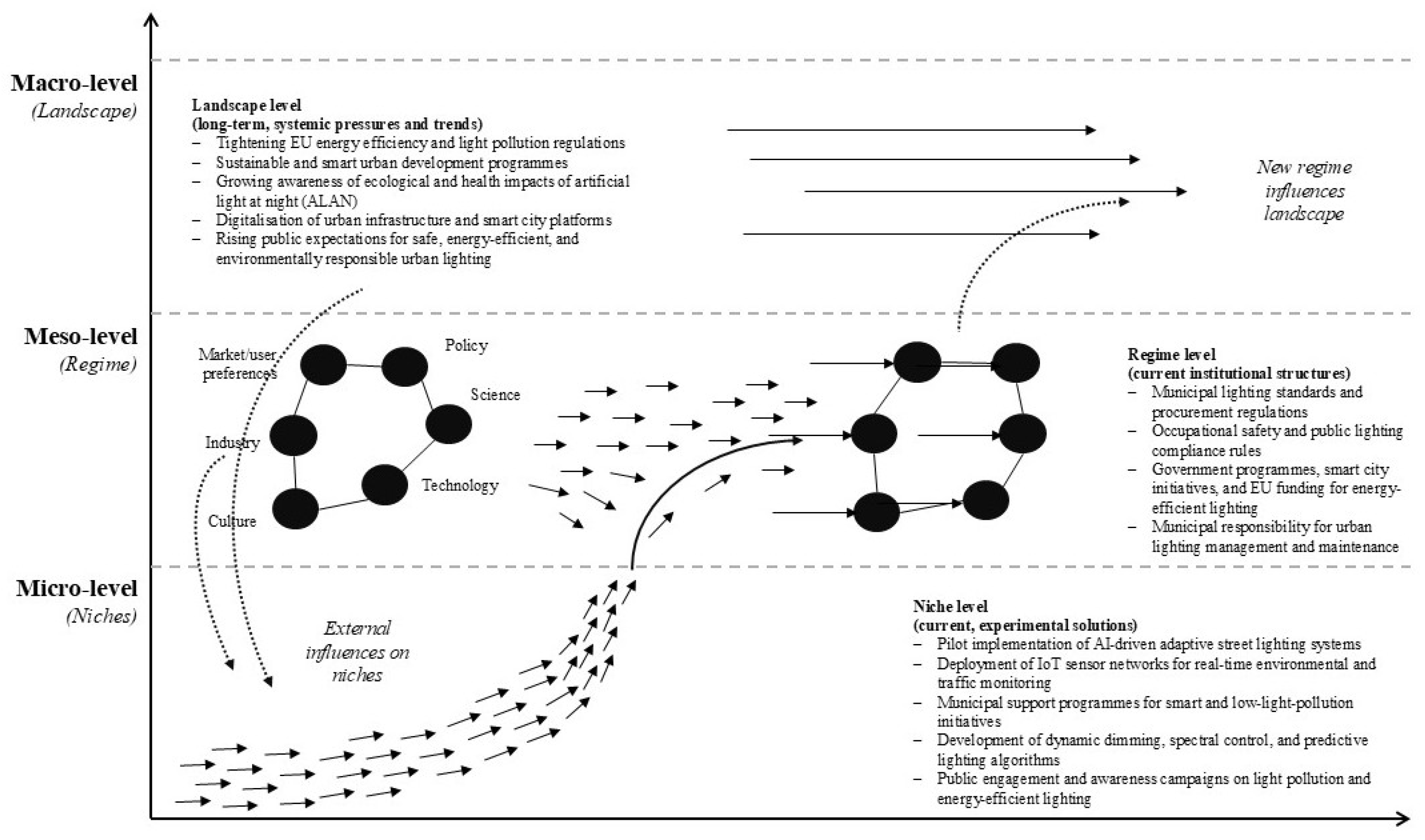
The interactions between these levels form the basis of the research design, guiding the identification of illustrative cases and evaluation criteria, rather than real-world data collection. Figure 1 illustrates this MLP-based framework, providing a structured methodology for examining how niche innovations in AI-driven lighting can catalyze transitions toward low-light-pollution and energy-efficient urban environments.

4. Conceptualization and Operationalization of MLP Elements

4.1. Niches

Niche innovations serve as key catalysts in sustainability transitions by fostering interdependent transformations across technology, organizational practices, stakeholder networks, societal values, and policy frameworks [81,82,83]. In the domain of urban lighting, niche innovations specifically refer to conceptual AI-driven adaptive lighting systems, IoT sensor networks, and predictive or reinforcement learning algorithms for dynamic, context-aware control, as well as illustrative pilot initiatives aimed at reducing energy use and mitigating ecological and human health impacts of ALAN [84,85]. These innovations are distinguished by their experimental, context-specific nature and capacity to challenge prevailing assumptions within existing urban lighting regimes.
The successful implementation of such niches depends on the maturity, resilience, and scalability of technological and organizational solutions. Key elements include sensor-enabled luminaires capable of continuous dimming, machine-learning algorithms capable of predicting pedestrian and traffic activity, and integrative control platforms that optimize energy efficiency while respecting ecological thresholds. Moreover, social and policy dimensions, such as participatory decision-making, municipal incentives, and community engagement, play a critical role in legitimizing and diffusing these innovations [86,87,88]. Niches are therefore not only technical but socio-technical constructs, emerging from the interplay between innovators, institutional actors, and societal networks, emphasizing this relationship rather than actual deployment [76,89].
From an evolutionary perspective, niches provide protected conceptual spaces for experimentation, learning, and iterative design without the full pressures of regime-level constraints. Examples include illustrative cases from the literature, community-driven dark-sky initiatives, and municipal programs integrating real-time mobility and environmental data for adaptive lighting control. Scaling these innovations is discussed in theoretical terms, considering technical, institutional, and economic challenges such as alignment with regulations and sustainable business models. The interactions between niche actors and the established urban lighting regime are central to enabling systemic transformation, highlighting the importance of strategic coordination, stakeholder engagement, and continuous evaluation.

4.2. Regimes

The urban lighting regime encompasses the established socio-technical system that governs municipal lighting infrastructure, including conventional lighting technologies, regulatory frameworks, institutional routines, and professional norms. Historically, this regime has been characterized by static illumination schedules, fixed-intensity luminaires, and centralized control systems, which conceptually constrain the uptake of niche innovations. Institutionalized routines, regulatory compliance requirements, and entrenched economic and contractual arrangements reinforce the stability of the regime, often favoring incremental improvements rather than transformative change.
Economic incentives, operational constraints, and risk-averse decision-making processes further consolidate regime persistence. Regulatory frameworks, while ensuring safety and visibility standards, often prioritize compliance over innovation and ecological considerations [90]. Key regime actors, including municipal authorities, utility providers, urban planners, and lighting manufacturer, shape the discourse and decision-making around urban illumination, influencing both the pace and scope of adaptive lighting adoption [4]. Cognitive and cultural dimensions, such as public perception of safety, risk tolerance, and awareness of light pollution, also shape regime stability and can slow the integration of niche innovations [91].
Interactions between niches and the regime occur through conceptualized pilot projects, demonstration programs, and collaborative governance mechanisms. The receptiveness of the regime depends on technological plausibility, alignment with policy, and potential for integration with existing systems. Successful transition requires not only technical compatibility but also the adaptation of business models and operational strategies at the regime level, ensuring that experimental lighting systems can scale and be maintained within the urban infrastructure.

4.3. Landscape

The landscape represents the macro-level context within which urban lighting transitions occur, encompassing broad societal, environmental, technological, and economic pressures that shape opportunities and constraints for innovation [92,93,94]. Key landscape factors influencing the transition to energy-efficient, low-light-pollution cities include international and national climate and energy policies, growing public awareness of ALAN’s ecological and health impacts, advances in AI and IoT technologies, and municipal and private investment capacity. These pressures conceptually destabilize existing regimes, creating windows of opportunity for niche innovations to emerge and influence systemic transformation.
Landscape dynamics also include global and regional trends in smart city development, environmental sustainability certifications, and emerging technological standards for lighting and sensor systems [95,96]. Disruptive events, such as urban redevelopment projects, extreme weather events, or energy crises, may serve as critical junctures, accelerating the adoption of niche innovations and reinforcing policy and financial incentives. Fiscal, regulatory, and policy interventions are highlighted as mechanisms that can conceptually shield and support adaptive lighting practices within entrenched regimes. The landscape provides pressures and opportunities, shaping the selection environment for niches while influencing regime adaptation. The interplay of niche experimentation, regime receptiveness, and landscape pressures is described as a conceptual multi-level process, illustrating pathways toward sustainable, energy-efficient, and ecologically sensitive urban lighting systems.

5. Discussion

Existing studies in sustainable urban lighting highlight how entrenched regimes resist the introduction of adaptive and AI-driven solutions, while niche innovations, despite their potential, face challenges in influencing broader regulatory, social, and market structures [76,97,98]. Our conceptual analysis suggests that the success of AI-driven adaptive lighting transitions depends on interactions between niche actors and regime structures, potentially catalyzing systemic shifts [99]. The timing, sequencing, and coordination of these interactions are considered critical, as phased adoption may conceptually enhance public acceptance, align energy and ecological objectives, and reduce potential disruptions [100].
Transition effectiveness is framed as contingent on niche–regime collaboration or the strategic reshaping of regime practices. While niche innovation is essential, conceptual evidence indicates it alone may not suffice to trigger systemic change [86]. Successful transitions require coordinated conceptual interventions across legislation, incentives, technology, public engagement, knowledge sharing, and policy advocacy [101]. These factors conceptually constrain adoption, highlighting the need for multi-domain strategies. Aligning networks of actors, fostering social cohesion, and strategically engaging with regime institutions are critical to enhancing legitimacy, securing institutional support, and ensuring the sustainability of adaptive lighting initiatives. Effective transition strategies balance challenging incumbent norms with aligning interventions to existing regulatory frameworks, yet outcomes are contingent on context-specific conditions, such as urban form, technological readiness, and policy environment.
Business model innovation is emphasized as a conceptual enabler for scaling AI-driven adaptive lighting. Public–private partnerships, energy performance contracting, and service-based lighting models are identified as potential mechanisms to enhance economic viability and support adoption across municipalities [102,103]. Despite widespread use of MLP in sustainability studies, critiques highlight its limited capacity to fully account for agency, power dynamics, and structural inertia. MLP is treated here as a conceptual lens, acknowledging that real-world transitions are complex, nonlinear, and contested. Power struggles and institutional resistance may affect the trajectory of urban lighting innovations. MLP often presumes relatively linear and orderly transitions, which may underestimate the complexity, unpredictability, and contestation inherent in real-world urban systems. Power struggles, vested interests, and institutional resistance are particularly salient in urban lighting transitions, where stakeholders such as utility providers or municipal contractors may resist innovation. These limitations suggest that while MLP provides a valuable conceptual lens, complementary analytical frameworks may enrich understanding of socio-political dynamics in urban lighting transitions.
Successfully transitioning to sustainable urban lighting requires alignment among diverse stakeholders, strategic alliances, and navigating institutional complexities. Bridging conceptual AI-driven initiatives and established regimes identifies potential opportunities for policy support, funding mechanisms, and knowledge transfer [104,105]. Research in sustainability transitions grapples with the tension between the inherent uncertainty of systemic change and the normative goal of long-term sustainability [106,107]. In urban lighting, this tension is conceptualized as balancing energy efficiency, ecological impact mitigation, social acceptance, and urban resilience. Key challenges in low-light-pollution transitions include entrenched infrastructural practices, high upfront costs of smart luminaires, integration complexity with existing networks, and inertia within municipal planning processes. Transition strategies should conceptually optimize illumination for safety and usability while minimizing light pollution and energy consumption, leveraging adaptive control, predictive algorithms, and participatory approaches.
These conceptual approaches aim to deliver sustainable value, balancing environmental protection and energy efficiency with financial feasibility and operational reliability. We propose conceptual performance indicators for urban lighting transitions, including potential reductions in energy use, decreases in skyglow, mitigation of ecological disruption, shifts in municipal procurement practices, and societal perception of lighting quality and environmental impact. Normative dimensions, such as equity in access to lighting and fair distribution of costs and benefits, are also highlighted for long-term sustainability and social legitimacy [108,109,110].
Focusing solely on technological substitution is insufficient to guarantee systemic sustainability. Critical evaluation of transition pathways should conceptually account for unintended consequences, including ecological impacts of LED spectra, maintenance requirements, or socioeconomic barriers to adoption. Ensuring resilient, healthy, and environmentally responsible urban lighting requires integrating social, economic, and ecological perspectives.
MLP’s emphasis on structural dynamics is complemented by frameworks addressing political contestation, stakeholder agency, and institutional power. Municipal authorities, technology providers, utility companies, and citizen groups often have diverging objectives, which can fragment or delay transitions. Complementary approaches, such as institutional analysis, political economy, and governance studies, are suggested to enrich understanding of multi-level urban lighting transitions.
Limitations of this paper include its largely conceptual synthesis, absence of detailed empirical analysis, and limited assessment of business model effectiveness. Future research should consider cross-city comparative studies, meta-analyses of policy and technology impacts, and illustrative organizational case studies for adaptive urban lighting. These efforts would strengthen the generalizability of conceptual insights and inform the design of more effective, multi-level strategies for sustainable low-light-pollution transitions.

6. Conclusions

This paper has examined the transition toward energy-efficient and low-light-pollution urban lighting systems through the lens of the MLP, with particular emphasis on AI-driven adaptive lighting as a conceptual niche innovation. By integrating insights from sustainability transition theory, smart city research, and urban lighting studies, the analysis provides a structured conceptual understanding of how technological, institutional, and societal dynamics may interact to shape urban lighting transitions.
The findings highlight that AI-driven adaptive lighting systems conceptually possess transformative potential at the niche level, offering possible benefits in terms of energy efficiency, reduced light pollution, and enhanced context-sensitive urban illumination. Conceptually, the influence of these innovations depends on interactions with existing regulatory frameworks, municipal procurement practices, and professional norms. Regime-level inertia, path dependency, and risk-averse decision-making are potential barriers to widespread adoption, emphasizing the need for coordinated governance strategies and adaptive regulatory instruments.
At the landscape level, broader pressures, such as climate and energy policies, growing awareness of ecological and health impacts of artificial light at night, and rapid advancements in AI and IoT technologies, are conceptualized as both destabilizing forces and enabling conditions for transition. These macro-level dynamics may create windows of opportunity for niche innovations to scale, particularly if aligned with urban sustainability agendas and smart city initiatives. The analysis reinforces that successful transitions are rarely driven by technology alone; rather, they emerge from the co-evolution of technical solutions, institutional adaptation, and societal acceptance.
From a theoretical perspective, this paper underscores the usefulness of the MLP framework for conceptually analyzing urban lighting transitions, while acknowledging its limitations. The framework provides a valuable heuristic for structuring complex socio-technical interactions but may underrepresent issues of agency, power, and political contestation. Consequently, future research could integrate MLP with complementary perspectives, such as institutional theory or political economy, to better capture the range of forces shaping urban lighting governance.
This paper remains primarily conceptual, and its conclusions should be interpreted accordingly. Future research should explore empirical validation through comparative case studies, longitudinal analyses, and quantitative assessment of environmental and social outcomes. Such work would strengthen the evidence base and inform the design of more context-sensitive transition strategies. This paper contributes to the growing literature on sustainable urban transitions by demonstrating how AI-driven adaptive lighting, when conceptually embedded within supportive institutional and societal frameworks, may play a meaningful role in reducing light pollution and promoting energy-conscious urban development.

Author Contributions

Conceptualization, D.B.; Methodology, D.B., Formal analysis, D.B. and A.Z.; Writing—original draft, D.B.; Writing—review and editing, A.Z. and D.S.; Visualization, D.B.; Supervision, A.Z. and D.S. All authors have read and agreed to the published version of the manuscript.

Funding

This research received no external funding. The APC was funded by Széchenyi István University, grant number: 073PTP2026.

Data Availability Statement

No new data were created or analyzed in this study. Data sharing is not applicable to this article.

Conflicts of Interest

The authors declare no conflicts of interest.

References

  1. Himschoot, E.A.; Crump, M.C.; Buckley, S.; Cai, C.; Lawson, S.; White, J.; Beeco, A.; Taff, B.D.; Newman, P. Feelings of Safety for Visitors Recreating Outdoors at Night in Different Artificial Lighting Conditions. J. Environ. Psychol. 2024, 97, 102374. [Google Scholar] [CrossRef]
  2. Markvica, K.; Richter, G.; Lenz, G. Impact of Urban Street Lighting on Road Users’ Perception of Public Space and Mobility Behavior. Build. Environ. 2019, 154, 32–43. [Google Scholar] [CrossRef]
  3. Salazar, J.I.M.; Zoller, H.; Lamphar, H.A.S.; Rodríguez, C.B.M. Sustainability Assessment of Urban Lighting Systems: The Case of Mexico City. Urban Transit. 2025, 4, 100017. [Google Scholar] [CrossRef]
  4. Fazia, C.; Catania, G.F.G.; Sortino, F. The Urban Light Plan: Toward Sustainable and Resilient Cities. Environ. Earth Sci. Proc. 2025, 36, 11. [Google Scholar] [CrossRef]
  5. Vanin, A.; Belan, P. Towards Sustainable Cities: Utilizing Computer Vision and AI for Efficient Public Lighting and Energy Management. Urban Sci. 2023, 7, 94. [Google Scholar] [CrossRef]
  6. Shavkatov, S. Adaptive Illumination: Designing a Smart Street Lighting System for Sustainable Urban Environments. MATRIX Acad. Int. Online J. Eng. Technol. 2023, 6, 18–32. [Google Scholar] [CrossRef]
  7. Candolin, U. Coping with Light Pollution in Urban Environments: Patterns and Challenges. iScience 2024, 27, 109244. [Google Scholar] [CrossRef]
  8. Friulla, L.; Varone, L. Artificial Light at Night (ALAN) as an Emerging Urban Stressor for Tree Phenology and Physiology: A Review. Urban Sci. 2025, 9, 14. [Google Scholar] [CrossRef]
  9. Hassan, Q. Advances in the Internet of Things; CRC Press: Boca Raton, FL, USA, 2025. [Google Scholar]
  10. Mustafa, A. Artificial Intelligence and the Internet of Things: Transforming Connectivity and Smart Systems. Available online: https://www.researchgate.net/publication/398284188_Artificial_Intelligence_and_the_Internet_of_Things_Transforming_Connectivity_and_Smart_Systems (accessed on 3 January 2026).
  11. Qian, Y.; Siau, K.L. Advances in IoT, AI, and Sensor-Based Technologies for Disease Treatment, Health Promotion, Successful Ageing, and Ageing Well. Sensors 2025, 25, 6207. [Google Scholar] [CrossRef]
  12. Ma, Z.; Liang, Y.; Zhu, Q.; Zheng, J.; Lian, Z.; Zeng, L.; Fu, C.; Peng, Y.; Ai, B. Hybrid-RIS-Assisted Cellular ISAC Networks for UAV-Enabled Low-Altitude Economy via Deep Reinforcement Learning With Mixture-of-Experts. IEEE Trans. Cogn. Commun. Netw. 2026, 12, 3875–3888. [Google Scholar] [CrossRef]
  13. Arun, M.; Gopan, G. Effects of Natural Light on Improving the Lighting and Energy Efficiency of Buildings: Toward Low Energy Consumption and CO2 Emission. Int. J. Low-Carbon Technol. 2025, 20, 1047–1056. [Google Scholar] [CrossRef]
  14. Chiradeja, P.; Yoomak, S. Development of Public Lighting System with Smart Lighting Control Systems and Internet of Thing (IoT) Technologies for Smart City. Energy Rep. 2023, 10, 3355–3372. [Google Scholar] [CrossRef]
  15. Geels, F.W.; Kern, F.; Fuchs, G.; Hinderer, N.; Kungl, G.; Mylan, J.; Neukirch, M.; Wassermann, S. The Enactment of Socio-Technical Transition Pathways: A Reformulated Typology and a Comparative Multi-Level Analysis of the German and UK Low-Carbon Electricity Transitions (1990–2014). Res. Policy 2016, 45, 896–913. [Google Scholar] [CrossRef]
  16. Savaget, P.; Geissdoerfer, M.; Kharrazi, A.; Evans, S. The Theoretical Foundations of Sociotechnical Systems Change for Sustainability: A Systematic Literature Review. J. Clean. Prod. 2019, 206, 878–892. [Google Scholar] [CrossRef]
  17. Jørgensen, B.N.; Ma, Z.G. Impact of EU Regulations on AI Adoption in Smart City Solutions: A Review of Regulatory Barriers, Technological Challenges, and Societal Benefits. Information 2025, 16, 568. [Google Scholar] [CrossRef]
  18. Geels, F.W. The Multi-Level Perspective on Sustainability Transitions: Responses to Seven Criticisms. Environ. Innov. Soc. Transit. 2011, 1, 24–40. [Google Scholar] [CrossRef]
  19. Geels, F. The Multi-Level Perspective on Sustainability Transitions: Background, Overview, and Current Research Topics 2024. Camb. Open Engag. 2024. preprint. [Google Scholar]
  20. El Bilali, H. The Multi-Level Perspective in Research on Sustainability Transitions in Agriculture and Food Systems: A Systematic Review. Agriculture 2019, 9, 74. [Google Scholar] [CrossRef]
  21. Weckowska, D.; Weiss, D.; Schwäbe, C.; Dreher, C. Technological Innovation System Analyses and Sustainability Transitions: A Literature Review. Environ. Innov. Soc. Transit. 2025, 54, 100935. [Google Scholar] [CrossRef]
  22. Rokicki, T.; Jadczak, R.; Kucharski, A.; Bórawski, P.; Bełdycka-Bórawska, A.; Szeberényi, A.; Perkowska, A. Changes in Energy Consumption and Energy Intensity in EU Countries as a Result of the COVID-19 Pandemic by Sector and Area Economy. Energies 2022, 15, 6243. [Google Scholar] [CrossRef]
  23. Beccali, M.; Lo Brano, V.; Bonomolo, M.; Cicero, P.; Corvisieri, G.; Caruso, M.; Gamberale, F. A Multifunctional Public Lighting Infrastructure, Design and Experimental Test. J. Sustain. Dev. Energy Water Environ. Syst. 2017, 5, 608–625. [Google Scholar] [CrossRef]
  24. Radulovic, D.; Skok, S.; Kirincic, V. Energy Efficiency Public Lighting Management in the Cities. Energy 2011, 36, 1908–1915. [Google Scholar] [CrossRef]
  25. Yoomak, S.; Jettanasen, C.; Ngaopitakkul, A.; Bunjongjit, S.; Leelajindakrairerk, M. Comparative Study of Lighting Quality and Power Quality for LED and HPS Luminaires in a Roadway Lighting System. Energy Build. 2018, 159, 542–557. [Google Scholar] [CrossRef]
  26. Valetti, L.; Piccablotto, G.; Taraglio, R.; Pellegrino, A. Long-Term Monitoring Campaign of LED Street Lighting Systems: Focus on Photometric Performances, Maintenance and Energy Savings. Sustainability 2023, 15, 16910. [Google Scholar] [CrossRef]
  27. Olajiga, O.K.; Ani, E.C.; Sikhakane, Z.Q.; Olatunde, T.M. A Comprehensive Review of Energy-Efficient Lighting Technologies and Trends. Eng. Sci. Technol. J. 2024, 5, 1097–1111. [Google Scholar] [CrossRef]
  28. Modrzyński, P.; Karaszewski, R. Urban Energy Management—A Systematic Literature Review. Energies 2022, 15, 7848. [Google Scholar] [CrossRef]
  29. Dubois, M.-C.; Blomsterberg, Å. Energy Saving Potential and Strategies for Electric Lighting in Future North European, Low Energy Office Buildings: A Literature Review. Energy Build. 2011, 43, 2572–2582. [Google Scholar] [CrossRef]
  30. Kaya, H.D.; Chan, P.W.; Schraven, D.; Leijten, M. Infrastructure in Transitions: A Systematic Review of How Infrastructure Influences and Is Influenced by Sustainability Transitions. Environ. Innov. Soc. Transit. 2025, 57, 101034. [Google Scholar] [CrossRef]
  31. Vadi, S. Design and Implementation of an Off-Grid Smart Street Lighting System Using LoRaWAN and Hybrid Renewable Energy for Energy-Efficient Urban Infrastructure. Sensors 2025, 25, 5579. [Google Scholar] [CrossRef]
  32. Jabbar, W.A.; Keat, T.K.; Dael, F.A.; Hong, L.C.; Yussof, Y.F.M.; Nasir, A. Optimising Urban Lighting Efficiency with IoT and LoRaWAN Integration in Smart Street Lighting Systems. Discov. Internet Things 2025, 5, 64. [Google Scholar] [CrossRef]
  33. Roumiani, A.; Mofidi, A. Predicting Ecological Footprint Based on Global Macro Indicators in G-20 Countries Using Machine Learning Approaches. Environ. Sci. Pollut. Res. 2022, 29, 11736–11755. [Google Scholar] [CrossRef]
  34. Sula, M.; Mahapatra, K.; Mainali, B. Unveiling the Perspectives of Swedish Homeowners on Embracing Space Sufficiency within the Context of Energy Renovation. Energy Build. 2025, 328, 114997. [Google Scholar] [CrossRef]
  35. Abujder Ochoa, W.A.; Iarozinski Neto, A.; Vitorio Junior, P.C.; Calabokis, O.P.; Ballesteros-Ballesteros, V. The Theory of Complexity and Sustainable Urban Development: A Systematic Literature Review. Sustainability 2024, 17, 3. [Google Scholar] [CrossRef]
  36. Lyytimäki, J.; Rinne, J. Voices for the Darkness: Online Survey on Public Perceptions on Light Pollution as an Environmental Problem. J. Integr. Environ. Sci. 2013, 10, 127–139. [Google Scholar] [CrossRef]
  37. Lyytimäki, J. Sustainable Development Goals Relighted: Light Pollution Management as a Novel Lens to SDG Achievement. Discov. Sustain. 2025, 6, 197. [Google Scholar] [CrossRef]
  38. Hassan, N.E. Light Pollution and Its Effects on Human Health and the Environment: A Review. Asian J. Environ. Ecol. 2024, 23, 96–108. [Google Scholar] [CrossRef]
  39. So, C.W.; Pun, C.S.J.; Liu, S.; Cheung, S.L.; Hui, H.K.K.; Blumenthal, K.; Walker, C.E. Natural Experiments from Earth Hour Reveal Urban Night Sky Being Drastically Lit up by Few Decorative Buildings. Sci. Rep. 2025, 15, 21414. [Google Scholar] [CrossRef]
  40. Li, X.; Chen, F.; Chen, X. Satellite-Observed Nighttime Light Variation as Evidence for Global Armed Conflicts. IEEE J. Sel. Top. Appl. Earth Obs. Remote Sens. 2013, 6, 2302–2315. [Google Scholar] [CrossRef]
  41. Bará, S.; Lima, R.C.; Zamorano, J. Monitoring Long-Term Trends in the Anthropogenic Night Sky Brightness. Sustainability 2019, 11, 3070. [Google Scholar] [CrossRef]
  42. Rodrigo-Comino, J.; Seeling, S.; Seeger, M.K.; Ries, J.B. Light Pollution: A Review of the Scientific Literature. Anthr. Rev. 2023, 10, 367–392. [Google Scholar] [CrossRef]
  43. Candolin, U.; Filippini, T. Light Pollution and Its Impact on Human Health and Wildlife. BMC Environ. Sci. 2025, 2, 1. [Google Scholar] [CrossRef]
  44. Galaz-Guajardo, V.A.; Quintanilla-Ahumada, D.; Quijón, P.A.; Navarrete-Meneses, J.; Jahnsen-Guzmán, N.; Miranda-Benabarre, C.; Zúñiga-Cueto, N.; Pulgar, J.; Manríquez, P.H.; Duarte, C. Artificial Light at Night (ALAN) Alters the Behavior and Physiology of a Sandy Beach Isopod. Are These Effects Reversible? Mar. Environ. Res. 2025, 208, 107130. [Google Scholar] [CrossRef] [PubMed]
  45. Marangoni, L.F.B.; Davies, T.; Smyth, T.; Rodríguez, A.; Hamann, M.; Duarte, C.; Pendoley, K.; Berge, J.; Maggi, E.; Levy, O. Impacts of Artificial Light at Night in Marine Ecosystems—A Review. Glob. Change Biol. 2022, 28, 5346–5367. [Google Scholar] [CrossRef] [PubMed]
  46. Manríquez, K.; Quijón, P.A.; Manríquez, P.H.; Miranda, C.; Pulgar, J.; Quintanilla-Ahumada, D.; Duarte, C. Artificial Light at Night (ALAN) Negatively Affects the Settlement Success of Two Prominent Intertidal Barnacles in the Southeast Pacific. Mar. Pollut. Bull. 2021, 168, 112416. [Google Scholar] [CrossRef] [PubMed]
  47. Mori, E.; Di Lorenzo, T.; Viviano, A.; Jakovljević, T.; Marra, E.; Moura, B.B.; Garosi, C.; Manzini, J.; Ancillotto, L.; Hoshika, Y.; et al. Under Pressure: Environmental Stressors in Urban Ecosystems and Their Ecological and Social Consequences on Biodiversity and Human Well-Being. Stresses 2025, 5, 66. [Google Scholar] [CrossRef]
  48. Magyar, V.; Macher, G.Z. Az Ökoszisztéma-Szolgáltatások Fenntarthatósági Adaptációjának Integrált Elemzési És Értékelési Lehetőségei (Integrated Analysis and Evaluation Options for sustainability Adaptation of Ecosystem Services). Acta Period. 2023, 28, 41–55. [Google Scholar] [CrossRef]
  49. Xiao, L.; Wang, S.; Oduor, A.M.O.; Wang, Z.; Zhang, H.; Liu, Y. Artificial Light at Night Alters Morphology, Phenology, and Reproductive Capacity in an Annual Herb. Biol. Conserv. 2025, 311, 111472. [Google Scholar] [CrossRef]
  50. Clemente-Suarez, V.J.; Navarro-Jiménez, E.; Benitez-Agudelo, J.C.; Beltrán-Velasco, A.I.; Belinchón-deMiguel, P.; Ramos-Campo, D.J.; Villanueva-Tobaldo, C.V.; Martín-Rodríguez, A.; Tornero-Aguilera, J.F. The Multifaceted Impact of Circadian Disruption on Cancer Risk: A Systematic Review of Insights and Economic Implications. J. Natl. Cancer Cent. 2025, 5, 524–536. [Google Scholar] [CrossRef]
  51. Cho, Y.; Ryu, S.-H.; Lee, B.R.; Kim, K.H.; Lee, E.; Choi, J. Effects of Artificial Light at Night on Human Health: A Literature Review of Observational and Experimental Studies Applied to Exposure Assessment. Chronobiol. Int. 2015, 32, 1294–1310. [Google Scholar] [CrossRef]
  52. Wojciechowska, W.; Hahad, O.; Daiber, A.; Rajzer, M. Night Light Pollution and Cardiovascular Disease. Pol. Heart J. 2025, 83, 801–807. [Google Scholar] [CrossRef]
  53. Deprato, A.; Haldar, P.; Navarro, J.F.; Harding, B.N.; Lacy, P.; Maidstone, R.; Moitra, S.; Palomar-Cros, A.; Durrington, H.; Kogevinas, M.; et al. Associations between Light at Night and Mental Health: A Systematic Review and Meta-Analysis. Sci. Total Environ. 2025, 974, 179188. [Google Scholar] [CrossRef]
  54. Sanchez-Gallegos, D.D.; Carrizales-Espinoza, D.E.; Torres-Charles, C.; Carretero, J. Smart Cities: A Systematic Review of Emerging Technologies. Smart Cities 2025, 8, 173. [Google Scholar] [CrossRef]
  55. Herath, H.M.K.K.M.B.; Mittal, M. Adoption of Artificial Intelligence in Smart Cities: A Comprehensive Review. Int. J. Inf. Manag. Data Insights 2022, 2, 100076. [Google Scholar] [CrossRef]
  56. Soheilian, M.; Fischl, G.; Aries, M. Smart Lighting Application for Energy Saving and User Well-Being in the Residential Environment. Sustainability 2021, 13, 6198. [Google Scholar] [CrossRef]
  57. Widartha, V.P.; Ra, I.; Lee, S.-Y.; Kim, C.-S. Advancing Smart Lighting: A Developmental Approach to Energy Efficiency through Brightness Adjustment Strategies. J. Low Power Electron. Appl. 2024, 14, 6. [Google Scholar] [CrossRef]
  58. Ornat, A.; Uliasz, M.; Bomba, G.; Burghardt, A.; Kurc, K.; Szybicki, D. Robotised Geometric Inspection of Thin-Walled Aerospace Casings. Sensors 2022, 22, 3457. [Google Scholar] [CrossRef]
  59. Khemakhem, S.; Krichen, L. A Comprehensive Survey on an IoT-Based Smart Public Street Lighting System Application for Smart Cities. Frankl. Open 2024, 8, 100142. [Google Scholar] [CrossRef]
  60. El Husseini, F.; Noura, H.N.; Salman, O.; Chahine, K. Machine Learning in Smart Buildings: A Review of Methods, Challenges, and Future Trends. Appl. Sci. 2025, 15, 7682. [Google Scholar] [CrossRef]
  61. Bibri, S.E.; Alexandre, A.; Sharifi, A.; Krogstie, J. Environmentally Sustainable Smart Cities and Their Converging AI, IoT, and Big Data Technologies and Solutions: An Integrated Approach to an Extensive Literature Review. Energy Inform. 2023, 6, 9. [Google Scholar] [CrossRef]
  62. Banad, Y.M.; Sharif, S.S.; Rezaei, Z. Artificial Intelligence and Machine Learning for Smart Grids: From Foundational Paradigms to Emerging Technologies with Digital Twin and Large Language Model-Driven Intelligence. Energy Convers. Manag. X 2025, 28, 101329. [Google Scholar] [CrossRef]
  63. Ma, Z.; Zhang, R.; Ai, B.; Lian, Z.; Zeng, L.; Niyato, D.; Peng, Y. Deep Reinforcement Learning for Energy Efficiency Maximization in RSMA-IRS-Assisted ISAC System. IEEE Trans. Veh. Technol. 2025, 74, 18273–18278. [Google Scholar] [CrossRef]
  64. Kaur, R.; Gabrijelčič, D.; Klobučar, T. Artificial Intelligence for Cybersecurity: Literature Review and Future Research Directions. Inf. Fusion 2023, 97, 101804. [Google Scholar] [CrossRef]
  65. Mehmood, A.; Arif, M.; Mehmood, F. Towards a Unified Digital Ecosystem: The Role of Platform Technology Convergence. Electronics 2025, 14, 4787. [Google Scholar] [CrossRef]
  66. Rizzo, S.A. To Be Artificial Intelligence for Sustainability or Not to Be Sustainable Artificial Intelligence. Renew. Sustain. Energy Rev. 2025, 223, 116063. [Google Scholar] [CrossRef]
  67. Uriarte-Gallastegi, N.; Arana-Landín, G.; Landeta-Manzano, B.; Laskurain-Iturbe, I. The Role of AI in Improving Environmental Sustainability: A Focus on Energy Management. Energies 2024, 17, 649. [Google Scholar] [CrossRef]
  68. Konefal, J. Governing Sustainability Transitions: Multi-Stakeholder Initiatives and Regime Change in United States Agriculture. Sustainability 2015, 7, 612–633. [Google Scholar] [CrossRef]
  69. Kern, F. Using the Multi-Level Perspective on Socio-Technical Transitions to Assess Innovation Policy. Technol. Forecast. Soc. Change 2012, 79, 298–310. [Google Scholar] [CrossRef]
  70. Petrovics, D.; Giezen, M.; Huitema, D. Towards a Deeper Understanding of Up-Scaling in Socio-Technical Transitions: The Case of Energy Communities. Energy Res. Soc. Sci. 2022, 94, 102860. [Google Scholar] [CrossRef]
  71. Geels, F.W.; Kern, F.; Clark, W.C. System Transitions Research and Sustainable Development: Challenges, Progress, and Prospects. Proc. Natl. Acad. Sci. USA 2023, 120, e2206230120. [Google Scholar] [CrossRef]
  72. Macher, G.Z.; Szigeti, C. Pathways to Asbestos-Free and Sustainable Cities Using Multi-Level Perspective Approach. Discov. Sustain. 2025, 6, 960. [Google Scholar] [CrossRef]
  73. Keller, M.; Sahakian, M.; Hirt, L.F. Connecting the Multi-Level-Perspective and Social Practice Approach for Sustainable Transitions. Environ. Innov. Soc. Transit. 2022, 44, 14–28. [Google Scholar] [CrossRef]
  74. Gagliardi, G.; Lupia, M.; Cario, G.; Tedesco, F.; Cicchello Gaccio, F.; Lo Scudo, F.; Casavola, A. Advanced Adaptive Street Lighting Systems for Smart Cities. Smart Cities 2020, 3, 1495–1512. [Google Scholar] [CrossRef]
  75. Herrfahrdt-Pähle, E.; Schlüter, M.; Olsson, P.; Folke, C.; Gelcich, S.; Pahl-Wostl, C. Sustainability Transformations: Socio-Political Shocks as Opportunities for Governance Transitions. Glob. Environ. Change 2020, 63, 102097. [Google Scholar] [CrossRef]
  76. Eitan, A.; Fischhendler, I. Shaping Niche Innovations in Energy Transitions: The Role of Pitching to Regulators. Energy Res. Soc. Sci. 2025, 126, 104170. [Google Scholar] [CrossRef]
  77. Bakhuis, J.; Kamp, L.M.; Barbour, N.; Chappin, É.J.L. Frameworks for Multi-System Innovation Analysis from a Sociotechnical Perspective: A Systematic Literature Review. Technol. Forecast. Soc. Change 2024, 201, 123266. [Google Scholar] [CrossRef]
  78. Figueira, M.; Brito, A.G.D.; Sousa, I. de Nesting the Multi-Level Perspective and Social-Ecological Systems Frameworks for Green Taxonomy Implementation: A Conceptual Development with a Case Study of Portuguese Rice Farmers. Environ. Sustain. Indic. 2025, 27, 100752. [Google Scholar] [CrossRef]
  79. Sipos, D.; Macher, G.Z.; Pécsinger, J. Examining the Integrity of Climate Protection Goals and Climate Change Policy Objectives in the Policies of the European Union. Chem. Eng. Trans. 2023, 107, 139–144. [Google Scholar] [CrossRef]
  80. Bozsik, N.; Szeberényi, A.; Bozsik, N. Impact of Climate Change on Electric Energy Production from Medium-Size Photovoltaic Module Systems Based on RCP Climate Scenarios. Energies 2024, 17, 4009. [Google Scholar] [CrossRef]
  81. Gottschamer, L.; Walters, J.P. The Dynamics of Sustainability Transitions: An Archetype for Transformation. Environ. Innov. Soc. Transit. 2023, 49, 100767. [Google Scholar] [CrossRef]
  82. Schot, J.; Geels, F.W. Strategic Niche Management and Sustainable Innovation Journeys: Theory, Findings, Research Agenda, and Policy. Technol. Anal. Strateg. Manag. 2008, 20, 537–554. [Google Scholar] [CrossRef]
  83. Lüdeke-Freund, F.; Wells, P.; Aagaard, A. The Catalytic Role of Sustainability Transitions for Business Models. In Business Model Innovation; Springer International Publishing: Cham, Switzerland, 2024; pp. 127–155. [Google Scholar]
  84. Shreya, S.; Shweta, G.; Koushik, P.; Anish, P. Smart Street Lighting: IoT-Driven Innovations for Enhanced Efficiency and Urban Infrastructure. Int. J. Multidiscip. Res. 2024, 6, 33663. [Google Scholar] [CrossRef]
  85. Ashkbous, M.; Ghorbani, E.; Keivanpour, S. Artificial Intelligence for Eco-Design: A Systematic Review. Adv. Eng. Inform. 2026, 69, 103989. [Google Scholar] [CrossRef]
  86. Radtke, J.; Renn, O. Participation in Energy Transitions: A Comparison of Policy Styles. Energy Res. Soc. Sci. 2024, 118, 103743. [Google Scholar] [CrossRef]
  87. Hofstad, H.; Vedeld, T.; Haarstad, H. Building Local Sustainability: Identifying Critical Transformative Capacities. Environ. Innov. Soc. Transit. 2026, 58, 101043. [Google Scholar] [CrossRef]
  88. Jäske, M. Participatory Innovations and Maxi-publics: The Influence of Participation Possibilities on Perceived Legitimacy at the Local Level in Finland. Eur. J. Polit. Res. 2019, 58, 603–630. [Google Scholar] [CrossRef]
  89. Hermans, F.; van Apeldoorn, D.; Stuiver, M.; Kok, K. Niches and Networks: Explaining Network Evolution through Niche Formation Processes. Res. Policy 2013, 42, 613–623. [Google Scholar] [CrossRef]
  90. Cordeiro, C.M.; Adomaitis, L.; Huang, L. The AI-Policy-Governance Nexus: How Regulation and AI Shift Corporate Governance toward Stakeholders. Technol. Soc. 2026, 84, 103117. [Google Scholar] [CrossRef]
  91. Balafoutis, T.; Skandali, C.; Niavis, S.; Doulos, L.T.; Zerefos, S.C. Light Pollution Beyond the Visible: Insights from People’s Perspectives. Urban Sci. 2025, 9, 251. [Google Scholar] [CrossRef]
  92. Ramli, H.; Azizi, Z.M.; Thurairajah, N. Catalysing Urban Sustainability Transitions Through Household Smart Technology Engagement. Sustainability 2025, 17, 1999. [Google Scholar] [CrossRef]
  93. Huxley, R.; Owen, A.; Chatterton, P. The Role of Regime-Level Processes in Closing the Gap between Sustainable City Visions and Action. Environ. Innov. Soc. Transit. 2019, 33, 115–126. [Google Scholar] [CrossRef]
  94. Langer, P. Navigating Urban Sustainability: The Role of Contextual Factors and Transformative Capacities. Energy Res. Soc. Sci. 2025, 130, 104424. [Google Scholar] [CrossRef]
  95. Das, D.K. Digital Technology and AI for Smart Sustainable Cities in the Global South: A Critical Review of Literature and Case Studies. Urban Sci. 2025, 9, 72. [Google Scholar] [CrossRef]
  96. Fabolude, G.; Knoble, C.; Vu, A.; Yu, D. Smart Cities, Smart Systems: A Comprehensive Review of System Dynamics Model Applications in Urban Studies in the Big Data Era. Geogr. Sustain. 2025, 6, 100246. [Google Scholar] [CrossRef]
  97. Hassan, O.M. Integrated Digital, Biological, and Human Capital Innovations for Circular and Sustainable Waste Management: A Critical Review. Discov. Appl. Sci. 2025, 7, 1289. [Google Scholar] [CrossRef]
  98. Meinhold, R.; Wagner, C.; Dhar, B.K. Digital Sustainability and Eco-environmental Sustainability: A Review of Emerging Technologies, Resource Challenges, and Policy Implications. Sustain. Dev. 2025, 33, 2323–2338. [Google Scholar] [CrossRef]
  99. Neij, L.; Heiskanen, E. Municipal Climate Mitigation Policy and Policy Learning—A Review. J. Clean. Prod. 2021, 317, 128348. [Google Scholar] [CrossRef]
  100. Pakizer, K.; Lieberherr, E.; Farrelly, M.; Bach, P.M.; Saurí, D.; March, H.; Hacker, M.; Binz, C. Policy Sequencing for Early-Stage Transition Dynamics—A Process Model and Comparative Case Study in the Water Sector. Environ. Innov. Soc. Transit. 2023, 48, 100730. [Google Scholar] [CrossRef]
  101. Pickering, J.; Hickmann, T.; Bäckstrand, K.; Kalfagianni, A.; Bloomfield, M.; Mert, A.; Ransan-Cooper, H.; Lo, A.Y. Democratising Sustainability Transformations: Assessing the Transformative Potential of Democratic Practices in Environmental Governance. Earth Syst. Gov. 2022, 11, 100131. [Google Scholar] [CrossRef]
  102. Zhang, Y.; Bilawal Khaskheli, M. The Role of Digital Technologies in Advancing Sustainable Economic Development into Intersections of Policy, Law, Environmental Economics, and a Comparative Study of China, the EU, and the USA. Sustainability 2025, 17, 8666. [Google Scholar] [CrossRef]
  103. Ciulli, F.; Kolk, A.; Bidmon, C.M.; Sprong, N.; Hekkert, M.P. Sustainable Business Model Innovation and Scaling through Collaboration. Environ. Innov. Soc. Transit. 2022, 45, 289–301. [Google Scholar] [CrossRef]
  104. Bibri, S.E.; Huang, J. Generative AI of Things for Sustainable Smart Cities: Synergizing Cognitive Augmentation, Resource Efficiency, Network Traffic, Cybersecurity, and Anomaly Detection for Environmental Performance. Sustain. Cities Soc. 2025, 133, 106826. [Google Scholar] [CrossRef]
  105. Yigitcanlar, T.; David, A.; Li, W.; Fookes, C.; Bibri, S.E.; Ye, X. Unlocking Artificial Intelligence Adoption in Local Governments: Best Practice Lessons from Real-World Implementations. Smart Cities 2024, 7, 1576–1625. [Google Scholar] [CrossRef]
  106. Herwix, A.; Bogner, K.; Schlaile, M.P. Core Design Principles for Just Sustainability Transitions: A Framework for Transformative Research. Sustain. Sci. 2025, 20, 1833–1862. [Google Scholar] [CrossRef]
  107. Scordato, L.; Gulbrandsen, M. Resilience Perspectives in Sustainability Transitions Research: A Systematic Literature Review. Environ. Innov. Soc. Transit. 2024, 52, 100887. [Google Scholar] [CrossRef]
  108. Elazab, R.; Daowd, M. A Novel Holistic Metric for Sustainability Assessment of Photovoltaic/Battery Systems. Sci. Rep. 2025, 15, 30018. [Google Scholar] [CrossRef]
  109. Alamandi, M. Sustainable Innovation Management: Balancing Economic Growth and Environmental Responsibility. Sustainability 2025, 17, 4362. [Google Scholar] [CrossRef]
  110. ur Rehman, A.; Sanjari, M.J.; Elavarasan, R.M.; Jamal, T. Sustainability-Aligned Pathways for Energy Transition: A Review of Low-Carbon Energy Network Solutions. Renew. Sustain. Energy Rev. 2026, 226, 116428. [Google Scholar] [CrossRef]
Figure 1. Multi-Level Perspective (MLP) framework illustrating the interactions among landscape, regime, and niche levels in the transition toward AI-driven adaptive urban lighting (edited by the authors based on [72]). Landscape-level pressures (energy regulations, smart city agendas, public awareness) create opportunities and constraints for regime structures (municipal lighting standards, governance frameworks, funding programs), which in turn interact with niche innovations (AI algorithms, IoT sensing, pilot adaptive lighting projects, and public engagement initiatives). This framework provides a structured methodology for analyzing how experimental niche solutions can catalyze systemic transitions toward low-light-pollution and energy-efficient urban environments.
Energies 19 01128 g001
Disclaimer/Publisher’s Note: The statements, opinions and data contained in all publications are solely those of the individual author(s) and contributor(s) and not of MDPI and/or the editor(s). MDPI and/or the editor(s) disclaim responsibility for any injury to people or property resulting from any ideas, methods, instructions or products referred to in the content.