Article

Oxygen-Enriched Combustion Characteristics of Premixed NH3/Air Flames in a Closed Tube

1
SPIC Northeast Energy Technology Co., Ltd., Shenyang 110179, China
2
School of Energy and Power Engineering, Northeast Electric Power University, Jilin 132012, China
*
Authors to whom correspondence should be addressed.
Energies 2026, 19(4), 949; https://doi.org/10.3390/en19040949
Submission received: 21 January 2026 / Revised: 5 February 2026 / Accepted: 7 February 2026 / Published: 11 February 2026
(This article belongs to the Section I2: Energy and Combustion Science)

Abstract

This study investigated premixed NH3 combustion in a closed circular duct using two-dimensional numerical simulations. By varying the equivalence ratio and the oxygen volume fraction from 21% to 30%, the evolution of flame morphology, flame propagation velocity, flame surface area, as well as the temporal variations in duct-averaged temperature and pressure were systematically examined. In addition, sensitivity analysis and reaction-pathway analysis based on a detailed chemical kinetic mechanism were performed to clarify the coupling between local chemical reactions and global flow dynamics. The results showed that the flame generally evolves through a sequence of hemispherical, finger-shaped, wall-attached skirt, and planar finger- and tulip-shaped structures. Well-developed tulip flames are mainly observed under conditions close to stoichiometric composition with moderate to elevated oxygen enrichment, corresponding to an intermediate overall reactivity. As the oxygen volume fraction increases from 21% to 30%, flame propagation becomes markedly faster. The tube-averaged temperature and the peak overpressure show an overall increasing trend. This increase in overpressure is most pronounced at equivalence ratios of 1.0–1.2. This study identifies hazardous parameter ranges in oxygen-enriched NH3 combustion that are prone to producing strong tulip flames and high overpressure, providing useful guidance for explosion risk assessment and safety-oriented design of NH3-fueled combustion systems.

1. Introduction

NH3 as a carbon-free hydrogen-containing fuel, has attracted increasing attention in the context of “carbon neutrality” and the emerging “hydrogen society” [1,2]. Compared with gaseous hydrogen, NH3 offers several practical advantages, including mature production, storage and transportation technologies, higher volumetric energy density, and compatibility with existing industrial infrastructure, and is therefore regarded as an important hydrogen carrier and a promising candidate for zero-carbon energy systems [3]. However, NH3 exhibits intrinsically low reactivity, poor ignitability, and a low laminar burning velocity, so stable combustion usually requires oxygen enrichment, hydrogen blending, or high turbulence intensity [4]. In confined or semi-confined spaces, once an NH3–air premixed mixture is ignited, it can generate high overpressure and complex flame–pressure-wave interactions, which may lead to deflagration and even transition toward detonation under certain conditions [5].
Consequently, a systematic understanding of NH3 premixed flame propagation in representative confined geometries was of direct engineering importance. In particular, identifying operating conditions prone to high overpressure and strong flame instabilities was critical for the intrinsic safety design of marine propulsion systems, gas turbines, industrial furnaces, and NH3 fuel storage and transportation facilities. This issue was also closely related to broader concerns of environmental protection and public safety [6,7].
A variety of strategies have been proposed to enhance the combustion performance of NH3, including blending NH3 with fuels exhibiting high burning velocities, such as hydrogen [8,9]. Chu et al. [10] compared the effects of hydrogen and NH3 addition on the laminar burning characteristics and pollutant emissions of hydrocarbon fuels, and reported that hydrogen significantly promotes the laminar burning velocity, whereas NH3 exhibits an inhibiting effect. At an equivalence ratio (Φ) of 1.1, a linear relationship was observed between the laminar burning velocity and the blending ratio in CH4/H2 (or NH3)/air flames. Zheng et al. [11] experimentally and numerically investigated explosions of NH3/hydrogen/air mixtures in a closed duct. As the NH3 blending ratio increased from 25% to 50%, the overall reactivity of the mixture decreased markedly, leading to a weakened flame acceleration process, as well as significant reductions in both the maximum flame propagation speed and the peak overpressure. Meanwhile, the tulip flame evolved from a pronounced and well-defined structure to a much weaker and less distinct form. Importantly, this behavior was attributed to NH3-induced modifications of the production and consumption fluxes of key intermediate species, which shifted the balance between chain-branching and chain-terminating reactions, thereby providing a mechanistic explanation for the observed decrease in explosion intensity with increasing NH3 content.
However, many additional factors still affect NH3 combustion in closed ducts [12]. Xiao et al. [13] found that the formation of distorted tulip flames strongly depends on the Rayleigh–Taylor instability triggered by pressure waves, and further demonstrated that the duct length-to-diameter ratio has a significant impact on flame-shape evolution; when this ratio becomes too large, tulip flames may not develop at all. Wang et al. [14] compared different ignition strategies for premixed methane combustion and found that the flame propagation speed under double-spark ignition is consistently lower than that under single-spark ignition. Nevertheless, the double-spark scheme exhibits a distinct rapid-combustion behavior, shortening the overall combustion duration and increasing the heat-release rate. Compared with single-spark ignition and asynchronous double-spark ignition, synchronous double-spark ignition provides more favorable combustion characteristics, improving thermal efficiency while maintaining flame stability.
Overall, existing studies have mainly focused on conventional fuels such as hydrocarbons and hydrogen, and have systematically examined the effects of geometric scale [15], ignition strategy [16], equivalence ratio [12], and obstacle arrangement [17] on the formation of tulip flames, thereby advancing the understanding of deflagration mechanisms and explosion-mitigation design for these fuels [18]. However, for NH3 as a “non-conventional” fuel, particularly under oxygen-enriched conditions, the flame propagation characteristics in closed ducts, the operating conditions under which tulip flames emerge, and their quantitative relationships with the mean temperature and overpressure are still not well understood and lack systematic investigation.
By establishing a multi-scale linkage from microscopic reaction mechanisms to macroscopic flame dynamics, this work conducted sensitivity and reaction-pathway analyses and systematically revealed the coupling between local chemical reactions and global flow dynamics during premixed ammonia combustion, thereby providing a scientific basis for the safety-oriented design and explosion risk assessment of oxygen-enriched ammonia combustion systems.

2. Numerical Simulations

2.1. The Governing Equations

The propagation of the premixed NH3–air flame in a closed tube was described by the fully compressible, reacting Navier–Stokes equations [19,20]. The unknown fields are the mixture density ρ , the stream-wise and transverse velocities u and v , the pressure p , the total specific energy E , and a scalar Y representing the reaction progress (or fuel mass fraction). The governing equations in conservative form read:
ρ t + ( ρ u ) x + ( ρ v ) y = 0
( ρ u ) t + ( ρ u 2 + p ) x + ( ρ u v ) y = σ x x x + σ y x y
( ρ v ) t + ( ρ v 2 + p ) y + ( ρ u v ) x = σ y y y + σ x y x
( ρ E ) t + [ u ( ρ E + p ) ] x + [ v ( ρ E + p ) ] y = ( u σ x x + v σ x y q x ) x + ( v σ y y + u σ y x q y ) y + q ω ˙
ρ Y t + ( ρ u Y ) x + ( ρ v Y ) y = x ( ρ D Y x ) + y ( ρ D Y y ) ω ˙
σ x x = 4 3 μ u x 2 3 μ v y , σ y y = 4 3 μ v y 2 3 μ u x
σ x y = σ y x = μ u y + μ v x
q x = K T x , q y = K T y
p = ρ R T M
E = p ( γ 1 ) ρ + 1 2 ( u 2 + v 2 )
where σ i j denote the components of the viscous stress tensor, modeled as a Newtonian fluid with Stokes’ hypothesis, μ is the dynamic viscosity, D is the mass diffusivity of the scalar Y , K is the thermal conductivity, and q x   and q y   are the heat flux. Equation (1) expresses conservation of mass. Equations (2) and (3) are the momentum balances in the axial and radial directions, where pressure gradients and viscous stresses accelerate or decelerate the flow. Equation (4) is the total energy equation, in which convection, work of pressure forces, viscous work and heat conduction are coupled with chemical heat release through the source term q ω ˙ , where q   is the specific heat of reaction. Equation (5) governs the evolution of the progress variable, including advection by the flow, molecular diffusion, and consumption by chemical reaction. The heat fluxes, Equation (9), follow Fourier’s law, and Equation (10) provides thermodynamic closure by relating pressure, density and temperature through the ideal gas equation of state and by defining the total specific energy as the sum of sensible internal energy and kinetic energy. The thermophysical properties μ , D and K are prescribed as temperature-dependent functions using power-law correlations adjusted so that a one-dimensional freely propagating stoichiometric NH3–air flame reproduces the target laminar burning velocity, adiabatic flame temperature and flame thickness.
The volumetric reaction rate ω ˙ in Equations (4) and (5) is represented by a global one-step Arrhenius law, written as
ω ˙ = A ρ Y n exp ( E a R T )
where A is the pre-exponential factor, E a is the apparent activation energy, n is the overall reaction order with respect to the progress variable Y , and R is the universal gas constant. The negative sign reflects the consumption of unburned mixture in the scalar transport equation, while the same term appears with the opposite sign in the energy equation as a source of heat release. The kinetic parameters A , E a and n are calibrated so that the simplified chemistry reproduces, as closely as possible, the burning characteristics obtained from detailed-mechanism calculations of a planar stoichiometric NH3–air laminar flame, thereby retaining the correct global burning rate and heat-release behavior at a computational cost that is acceptable for long-time multi-dimensional simulations [21,22].

2.2. Numerical Details

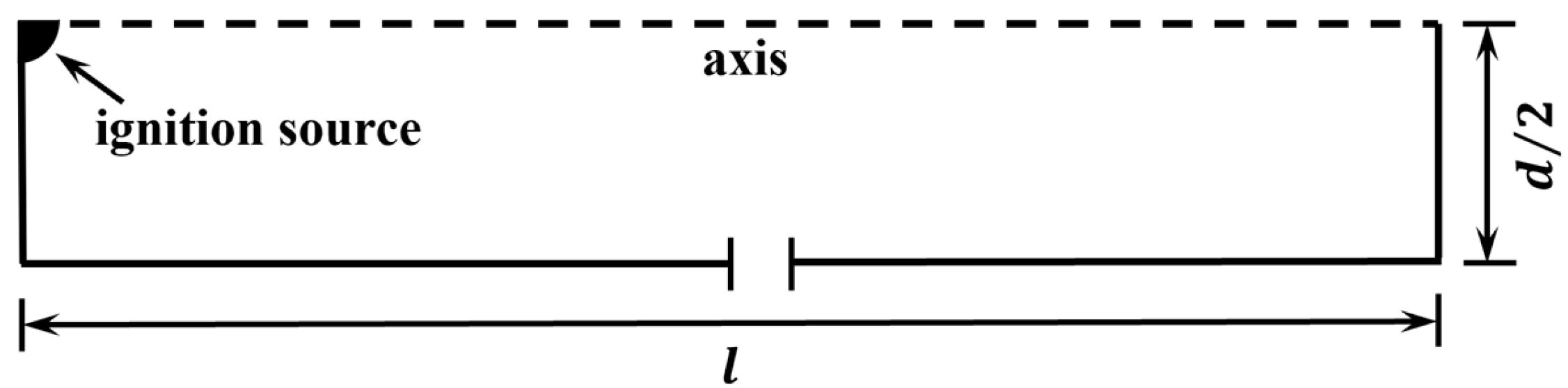
To account for the multi-step elementary reactions involved in the combustion process while keeping the computational cost affordable, a two-dimensional axisymmetric numerical model was employed. As shown in Figure 1, the computational domain corresponded to a closed cylindrical tube of 1000 mm length and 60 mm inner diameter in the x–y meridional plane. The governing equations were discretized using the finite-volume method. Spatial convection terms were approximated with a second-order scheme, and time advancement is performed with a second-order implicit algorithm, which enables accurate resolution of the steep gradients across the flame front and of the pressure waves generated during propagation. The tube is initially filled with a quiescent, spatially uniform NH3–air mixture at atmospheric pressure and room temperature. Ignition is initiated by imposing a hemispherical kernel of burnt gas with a radius of 5 mm attached to the left end wall and centered on the axis. All solid boundaries, including the sidewall and both end walls, are treated as adiabatic no-slip walls so that the development of viscous boundary layers and their interaction with the accelerating flame can be resolved, whereas the centerline is modeled as an axisymmetric boundary.
Considering that NH3 combustion is characterized by intrinsically low reactivity, a low laminar burning velocity, and relatively thick flame fronts, detailed kinetic mechanisms usually contain a large number of intermediate radical reactions associated with NOx formation, and therefore they require high accuracy in the description of chemical kinetics and heat and mass transfer. In a closed duct, it is further necessary to resolve strongly unsteady phenomena such as flame acceleration, tulip-flame inversion and coupling with pressure waves. As a result, directly coupling a full detailed mechanism in multi-dimensional transient simulations would result in a computational cost that is difficult to afford. To address this issue, and maintain adequate chemical accuracy while preserving engineering feasibility, the Flamelet Generated Manifold (FGM) model as implemented in Fluent is adopted in this study.

2.3. Reaction Mechanism and Model Validation

The laminar burning velocity is one of the key parameters used to characterize the combustion behavior of combustible gases. It not only reflects the propagation and stabilization characteristics of premixed flames, but is also widely employed as an important benchmark for validating and calibrating chemical kinetic mechanisms [23]. The laminar burning velocity is defined as the velocity of the unburned mixture crossing the reaction zone in the direction normal to the flame front, and its dependence on the state of the unburned mixture is commonly expressed by a power-law correlation of the following form [24]:
S u = S u 0 ( T u T 0 ) α ( p p 0 ) β
where S u is the laminar burning velocity (m/s), T u and T 0   are the unburned and initial temperatures, p is pressure (atm), p 0 is atmospheric pressure, S u 0 , α and β are constants.
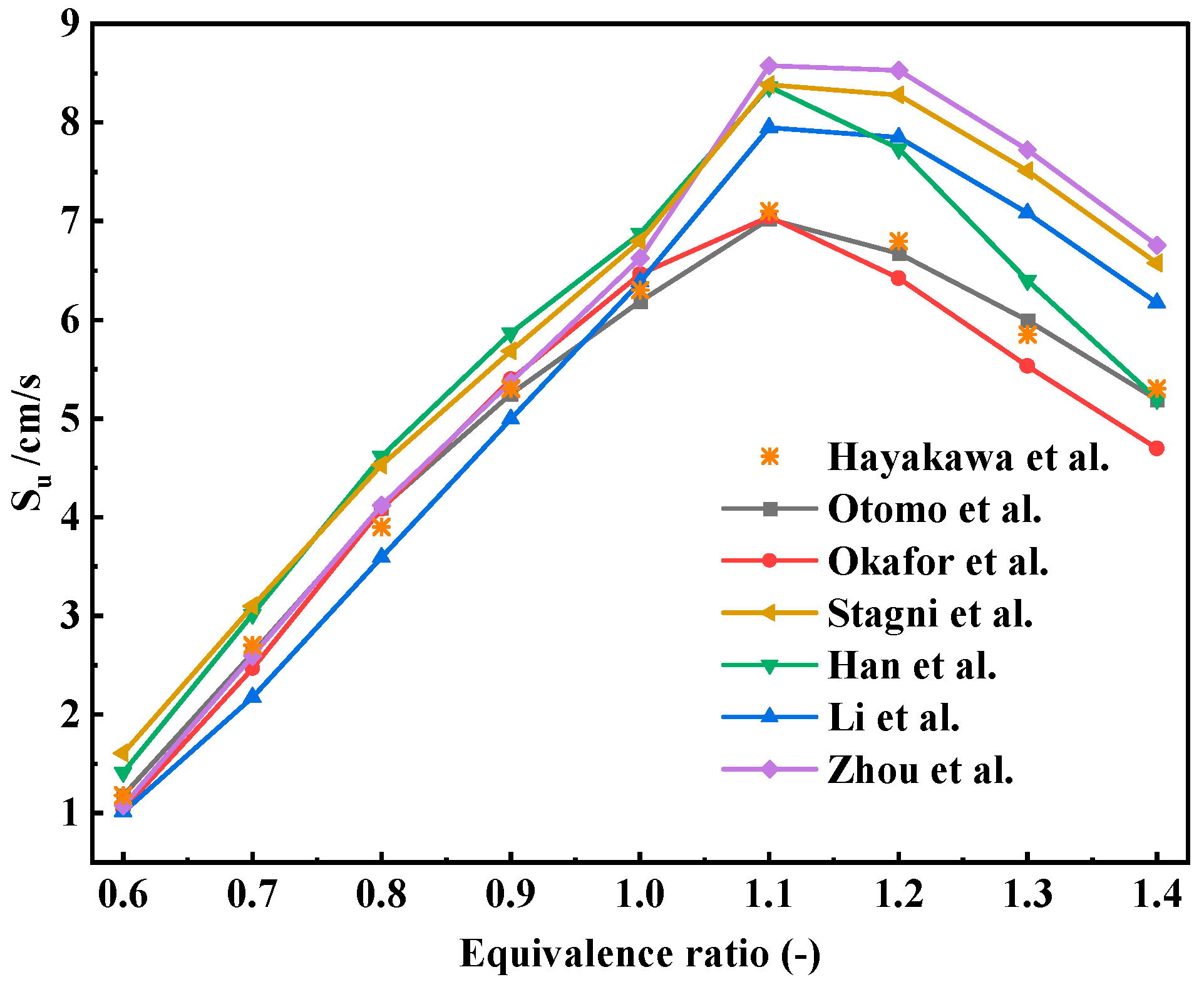
In this work, a comparative assessment of existing validated mechanisms was carried out against available experimental data. Specifically, the laminar burning velocity measurements of NH3–air flames reported by Hayakawa et al. [25] were compared with numerical predictions obtained using the mechanisms of Otomo et al. [26], Okafor et al. [27], Stagni et al. [28], Han et al. [29], Li et al. [30] and Zhou et al. [31], as shown in Figure 2. Figure 2 shows the relationship between the experimental and simulated laminar burning velocities, where the simulations include the effect of heat loss. It is observed that the mechanism of Otomo et al. [26] provides the best agreement with the data of Hayakawa et al. [25] over the entire equivalence ratio range, with the smallest deviation in both the peak value and its location. Based on this comparison, the NH3 combustion mechanism proposed by Otomo et al. [26] is adopted in all subsequent simulations in the present study.
To validate the reliability of the closed-tube numerical model in this study, the simulated evolution of the flame-tip position and the overpressure history were compared with the experimental results reported by Lei et al. [32] under similar geometrical configurations and initial conditions, showing consistent overall trends in flame propagation and pressure response. This comparison indicates that the proposed model can reasonably capture the key features of flame propagation and pressure-wave coupling in a closed tube.

3. Results and Discussion

3.1. Overall Flame Evolution

The evolution of the premixed flame in the tube can be divided into five stages: (1) a hemispherical flame; (2) a finger-shaped flame; (3) a flame whose skirt region reaches the sidewall; (4) a planar finger-shaped flame; and (5) a tulip flame [33].
(1)
Hemispherical flame stage: Immediately after ignition, a hemispherical flame kernel attached to the ignition end forms near the end wall. At this stage, the flame size is small and the front expands almost isotropically, with the gas motion driven mainly by local thermal expansion. The flame propagation speed is close to the laminar burning velocity, and only weak pressure perturbations are generated in the vicinity of the ignition end.
(2)
Finger-shaped flame stage: As the flame kernel grows in volume and propagates into the tube, the unburned mixture is strongly pushed ahead and the downstream flow is accelerated. The leading edge of the flame is stretched in the axial direction, forming a typical “finger-shaped” protruding flame tip.
(3)
Flame stage with the skirt reaching the sidewall: With further development of the finger-shaped flame, its skirt region gradually extends toward the tube wall and interacts with the viscous boundary layer. The radial expansion of the flame causes the lateral skirt to touch or nearly touch the wall, forming a slender flame layer that spreads along the sidewall.
(4)
Planar finger-shaped flame stage: As the flame tip continues to advance downstream and the skirt further spreads along the sidewall, the overall flame front gradually transitions from a strongly convex shape to a relatively flat “planar finger-shaped” structure. The axial pressure gradient and the associated flame acceleration weaken, and the flame-front velocity approaches a relatively stable quasi-steady level.
(5)
Tulip flame stage: When the pressure waves generated by the early flame expansion travel back and forth inside the tube and interact with the planar finger-shaped flame, the flow near the axis can momentarily reverse, while the gas close to the sidewall still moves downstream. As a result, the central part of the flame front is pulled back whereas the lateral regions continue to advance, and the front shape changes from convex to a tulip-like structure with a recessed center and protruding sides [34].

3.2. Flame Propagation Characteristics Under Different Oxygen Concentration–Equivalence Ratio Combinations

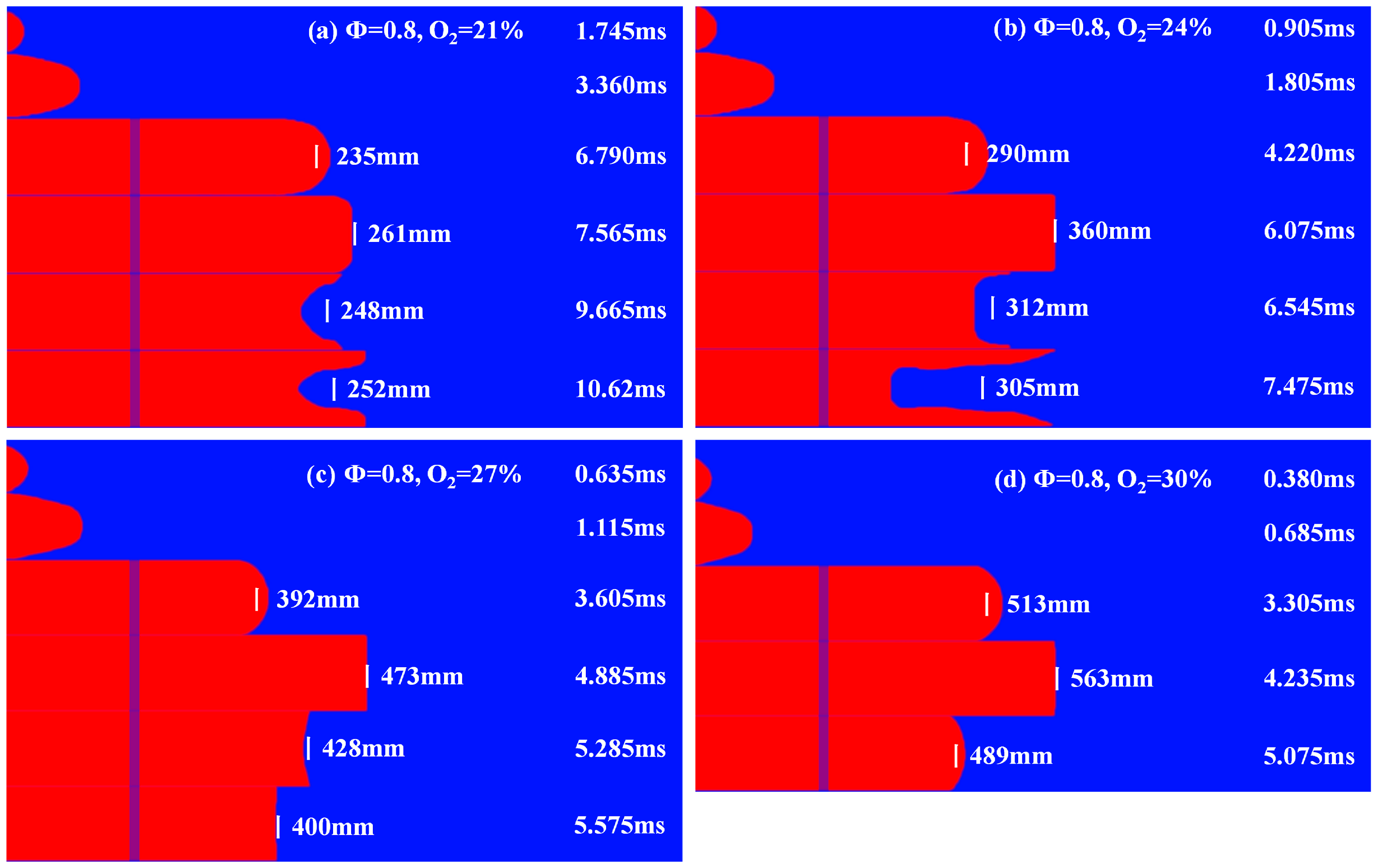
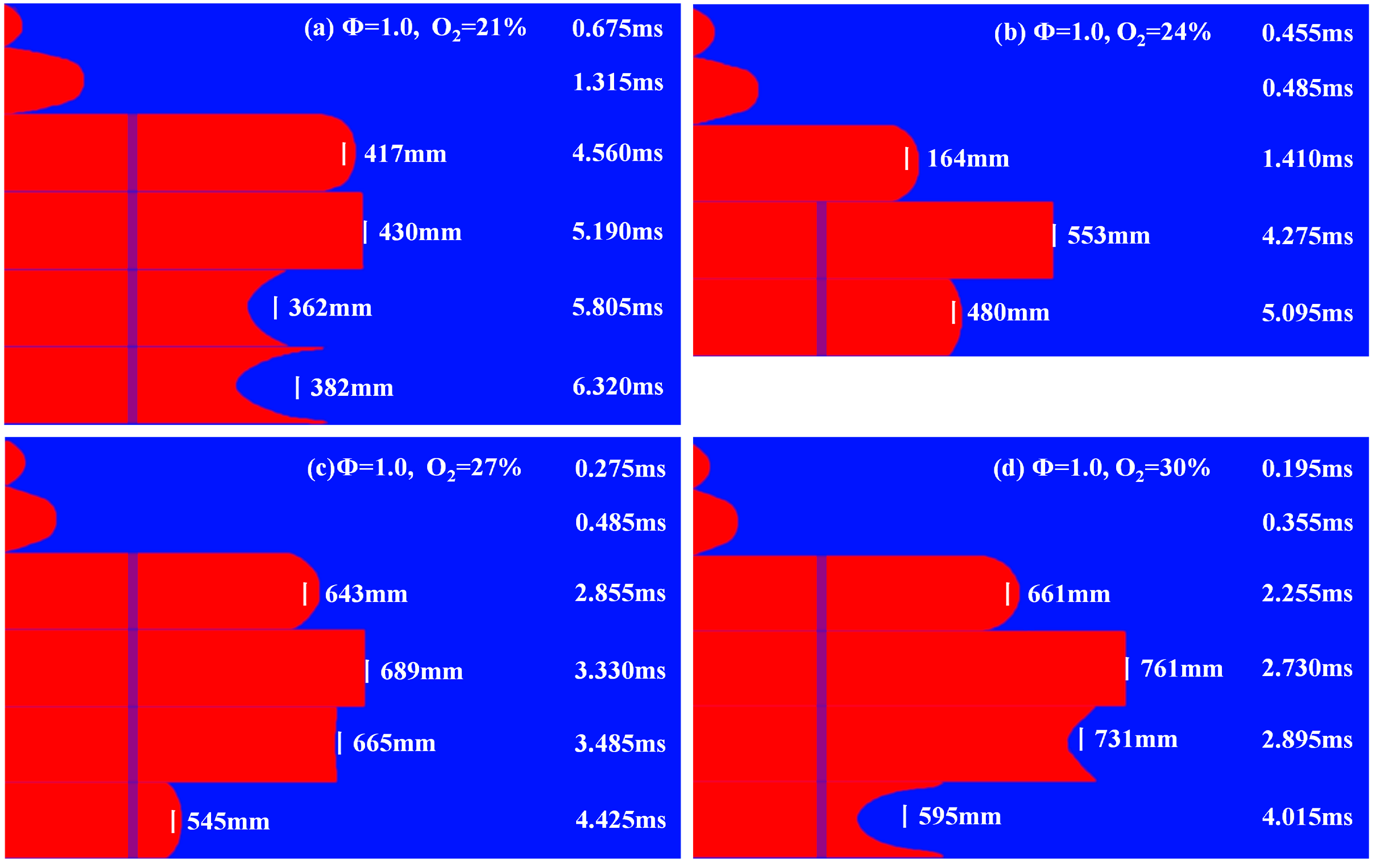
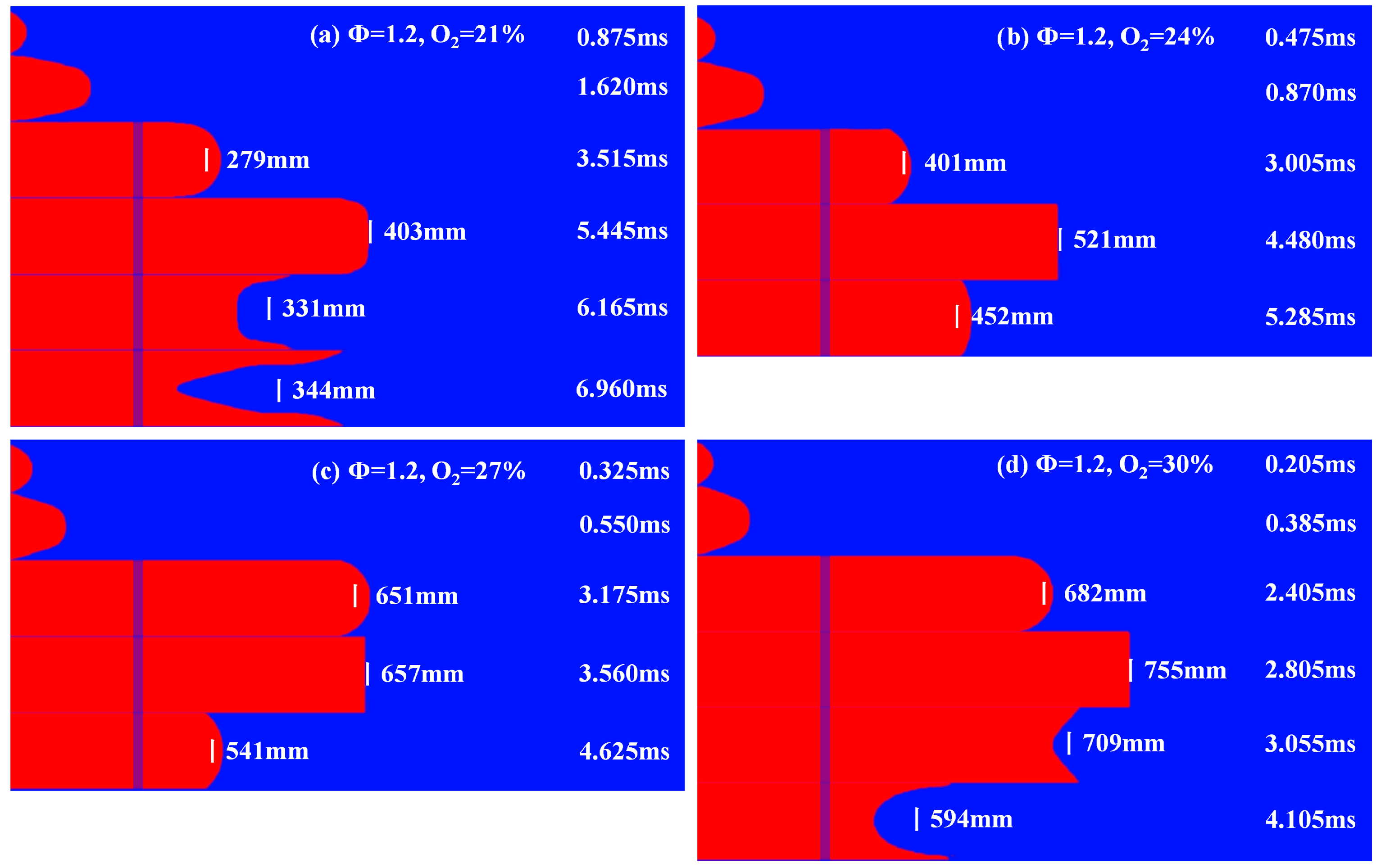
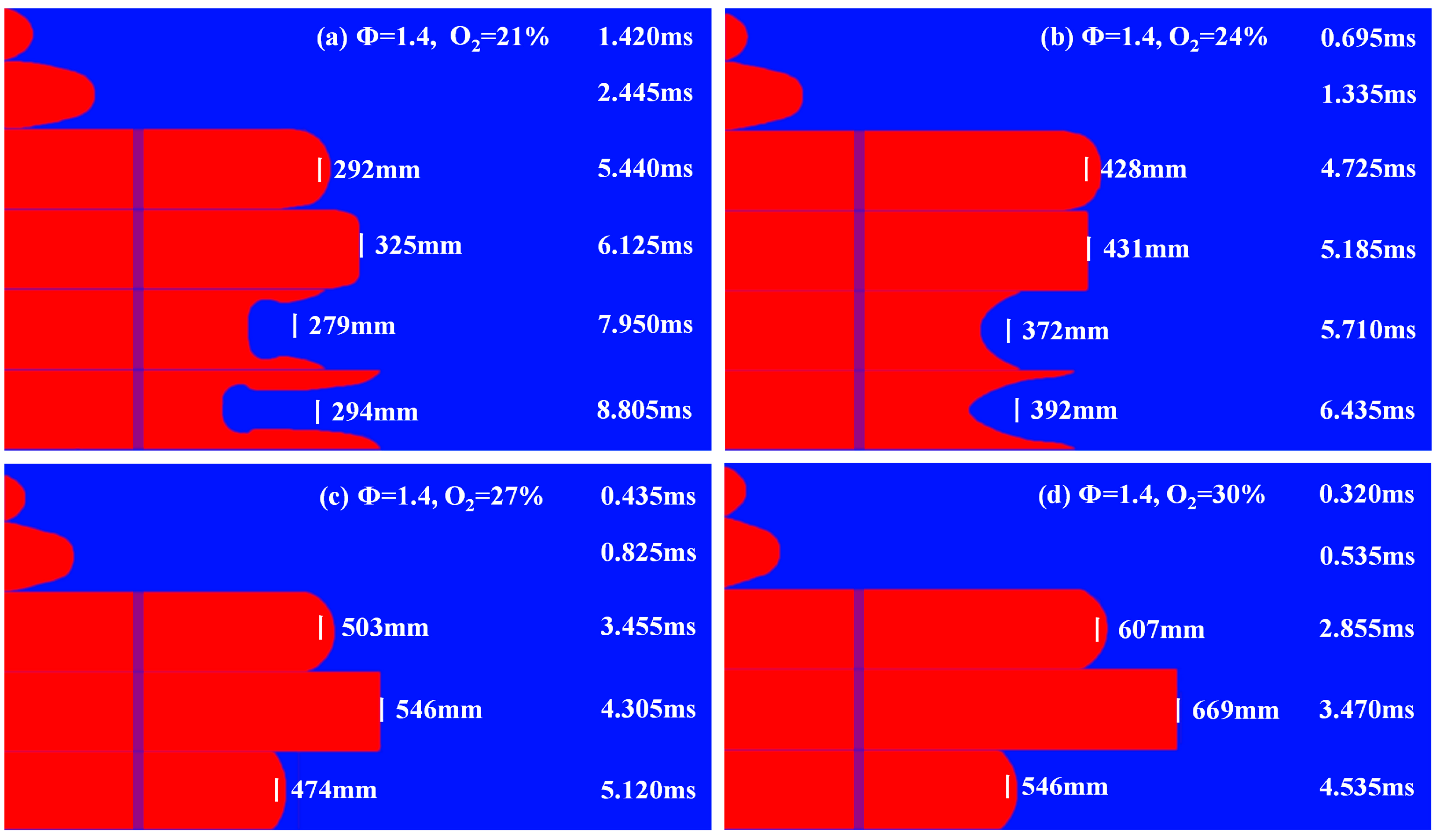
Figure 3, Figure 4, Figure 5 and Figure 6 showed the instantaneous evolution of NH3 flame structures in the closed tube for Φ = 0.8, 1.0, 1.2 and 1.4 under different oxygen volume fractions (O2 = 21%, 24%, 27% and 30%). Each subplot contains several cross-sections at representative times, where the red regions denote burnt gas and the blue regions indicate the unburned premixed mixture. The vertical black line marks the “cut-off position” of the tube used for plotting, and the part of the tube to the right of this line was not shown. The numerical labels next to the flame front give the instantaneous mean axial position of the front, which allows a quantitative comparison of the flame propagation distance and the occurrence of tulip-flame inversion among different cases. Overall, as the oxygen concentration increases, the total flame propagation time was significantly reduced and the arrival time of the flame front at a given axial location is noticeably advanced. However, tulip flames do not appear in all cases; they are only formed for a subset of “intermediate reactivity” combinations.
Figure 3 shows that under air conditions the flame propagates relatively slowly. In the early stage, the flame maintains a typical finger-like structure; subsequently, the skirt gradually spreads and reaches the sidewall, and in the middle and late stages the flame front develops a pronounced “indentation,” forming a well-developed tulip flame. As seen in Figure 3a, the axial propagation distance of the flame front is limited in this case, while the flame shape undergoes strong deformation, indicating that the expansion-driven flow and the associated pressure waves have sufficient time to travel back and forth in the tube and repeatedly interact with the flame front. When the oxygen concentration is increased to 24%, 27% and 30% (Figure 3b–d), the axial locations at which characteristic features appear are significantly shifted downstream, and the flame traverses most of the tube length within a few milliseconds. The finger-flame stage is largely compressed, the flame becomes thicker and more “bulky,” and the indentation characteristic of the tulip flame is markedly weakened or even completely suppressed. This indicates that, under fuel-lean conditions, a moderate oxygen level is conducive to forming a typical tulip flame, whereas strong oxygen enrichment shortens the flame propagation time scale relative to the round-trip time of pressure waves, thereby inhibiting the occurrence of flame-shape inversion.
Figure 4 corresponds to a regime with relatively high mixture reactivity. Under air conditions, the flame already reaches a large axial extent during the finger-shaped stage; the skirt then spreads along the sidewall, and a distinct shape inversion occurs, leading to the formation of a tulip flame. It is noteworthy that under moderately oxygen-enriched conditions with O2 = 24%, the flame propagation speed further increases, but once the flame front transitions from a finger-shaped to a planar finger-shaped structure, no typical tulip-like indentation is observed, and even at later times the front only showed a slight convex deformation. This behavior is likely related to the flame-front velocity [35] and will be discussed in more detail later. When the oxygen concentration is raised to 27%, the flame propagates even faster, and the flame front reaches the mid-length of the tube within 3–4.5 ms. A shallow and short-lived indentation appears near the tube center, with the axial position of the central front slightly lagging behind that of the wall-adjacent regions. Overall, this case exhibits only weak tulip-flame features and is more akin to a finger flame that is “flattened” by a high burning rate than to a fully developed tulip structure. In contrast, when the oxygen concentration is further increased to 30%, the situation changes markedly: the flame front still reaches the tube center within 3–4 ms, but the reflected compression waves exert a much stronger influence on the leading edge. The central part of the flame front is significantly pushed back upstream, while the lateral front along the walls continues to advance, resulting in a more pronounced and well-defined tulip flame under this condition.
Figure 5 illustrates the flame evolution at Φ = 1.2. Since the laminar burning velocity is near its maximum at this equivalence ratio, the flame propagates already quite rapidly under air conditions, with a strongly curved finger-shaped tip and a more pronounced pressure rise in the tube; a tulip flame can be clearly identified in the middle and late stages. In air, the flame rapidly evolves from a hemispherical kernel at the ignition end into an elongated finger-shaped front, exhibiting a high initial propagation speed. As the front advances, the flame skirt spreads along the sidewall, and the expansion-induced pressure waves reflect from the closed end and return to the vicinity of the flame. In the later stage, the flame front gradually transforms from a purely convex shape into one where the central region is slightly pulled back while the two sides continue to advance. When the oxygen concentration is increased to 24% and 27%, the laminar burning velocity rises further, and the axial distance covered by the flame front within the same time interval increases significantly. Throughout the propagation, however, the leading edge remains convex or nearly planar, without a persistent and pronounced indentation near the axis, and the skirt does not exhibit the characteristic “protruding wings with a recessed center” geometry. Although substantial acceleration and deceleration occur at these oxygen levels, no clear negative-velocity window or marked reversal of flame-front motion is observed, and a tulip flame in the strict sense does not form. Under O2 = 30%, the mixture reactivity reaches the highest level among these cases, and the flame-front transit time is further reduced. Unlike the 24% and 27% cases, the very high burning rate now produces much stronger compression waves and reflected pressure waves driven by flame expansion [36]. When the flame propagates to the vicinity of the tube mid-length, these waves generate an intensified local flow field ahead of the front: the axial advance of the central flame tip is temporarily slowed or slightly retarded by the combined action of reflected pressure waves and recirculation, while the front near the sidewalls continues to move forward rapidly. As a result, the flame front develops a clear tulip-like shape characterized by a recessed center and protruding lateral lobes.
Figure 6 showed that when the Φ is increased to 1.4, the flame propagation and morphology become more sensitive to the oxygen concentration. Under air conditions, the mixture is fuel-rich and the intrinsic burning velocity is lower than at stoichiometric, so the flame initially appears as an axially elongated finger-shaped structure and the front advances relatively slowly. As time elapses, the flame skirt further spreads along the sidewall, and the pressure waves generated by flame expansion begin to return and interact with the leading edge. In the snapshots taken at 5.4–8.8 ms, the central part of the flame front is clearly seen to recede slightly upstream, while the wall-adjacent regions continue to move forward, and the front contour changes from a purely convex shape to a tulip-like structure with a recessed center and protruding “wings”. When the oxygen concentration is increased to 24%, the laminar burning velocity rises, and the flame front travels farther within the same time interval, yet the formation of a tulip flame can still be observed, occurring earlier and persisting for a shorter duration. At approximately 4.7–6.4 ms, the flame tip exhibits a pronounced indentation at the center and forward extension near the walls, and the tulip features remain clearly identifiable. In contrast, at higher oxygen concentrations of 27% and 30%, the flame accelerates significantly, and the leading edge becomes thicker, blunter and nearly planar. No marked central recession or lateral protrusion appears during the evolution, and the flame behaves as a high-speed finger-like or almost planar front sweeping through the tube [37].
To further elucidate the influence of equivalence ratio on flame behavior from another perspective, two representative oxygen conditions (O2 = 21% and O2 = 30%) were selected for comparison based on the preceding analysis at fixed equivalence ratio with varying oxygen concentration. Under air conditions, as Φ increased from 0.8 to 1.4, the tulip-flame intensity exhibited a non-monotonic trend: it was most pronounced near the stoichiometric condition (Φ = 1.0) and weakened toward both the lean and rich limits. At Φ = 0.8, although flame propagation was slower, the finger-flame stage persisted longer and the skirt spread more fully along the sidewall, allowing pressure waves to travel back and forth and interact more effectively with the flame front; consequently, a clear tulip flame still developed in the middle-to-late stage. At Φ = 1.2, propagation was faster but the overall time scale was compressed, so the tulip feature remained discernible but became shallower and shorter-lived. At Φ = 1.4, the intrinsic burning rate decreased, the flame tip became thicker and blunter, and the pressure-wave-induced restructuring of the front weakened, resulting in only a weak indentation. Therefore, under air conditions, tulip flames mainly occurred in the range Φ = 0.8–1.2, with the most typical structure at Φ = 1.0.
Under oxygen-enriched conditions (O2 = 30%), the effect of equivalence ratio became more selective: at the lean (Φ = 0.8) and rich (Φ = 1.4) limits, although oxygen enrichment markedly accelerated combustion, the flame front propagated predominantly as a high-speed finger-like or quasi-planar flame and the axial core exhibited only slight curvature, so tulip flames were largely suppressed. In contrast, within the intermediate range of Φ = 1.0–1.2, the combined effects of higher reactivity and stronger thermal expansion enhanced flame–pressure-wave coupling, thereby producing a more typical tulip flame with a deeper indentation and a larger lateral extent [38]. Overall, tulip-flame formation in a closed tube was not governed by oxygen concentration or equivalence ratio alone, but rather by the intrinsic burning intensity, the strength of density-driven expansion, and the matching between the flame propagation time scale and the pressure-wave round-trip time scale, all of which were jointly controlled by these two parameters.
The above results indicate that the equivalence ratio and oxygen concentration jointly influence the intrinsic burning intensity and the coupling between the flame and pressure waves, thereby determining the sensitive regime for tulip-flame formation. Taking a locally confined pipe segment isolated by shut valves as an example, residual NH3 may form a premixed flammable mixture with air or oxygen-enriched gas during maintenance or insufficient purging; when O2 ≥ 24% and Φ ≈ 0.8–1.2, the flame is more likely to accelerate and generate stronger overpressure, leading to a markedly higher pressure hazard. Therefore, for oxygen-enriched or potentially oxygen-enriched NH3 environments, thorough inerting and purging should be implemented, the mixture should be prevented from approaching near-stoichiometric conditions, and isolation together with appropriate venting/suppression measures should be adopted to mitigate the risk.

3.3. Flame Dynamics

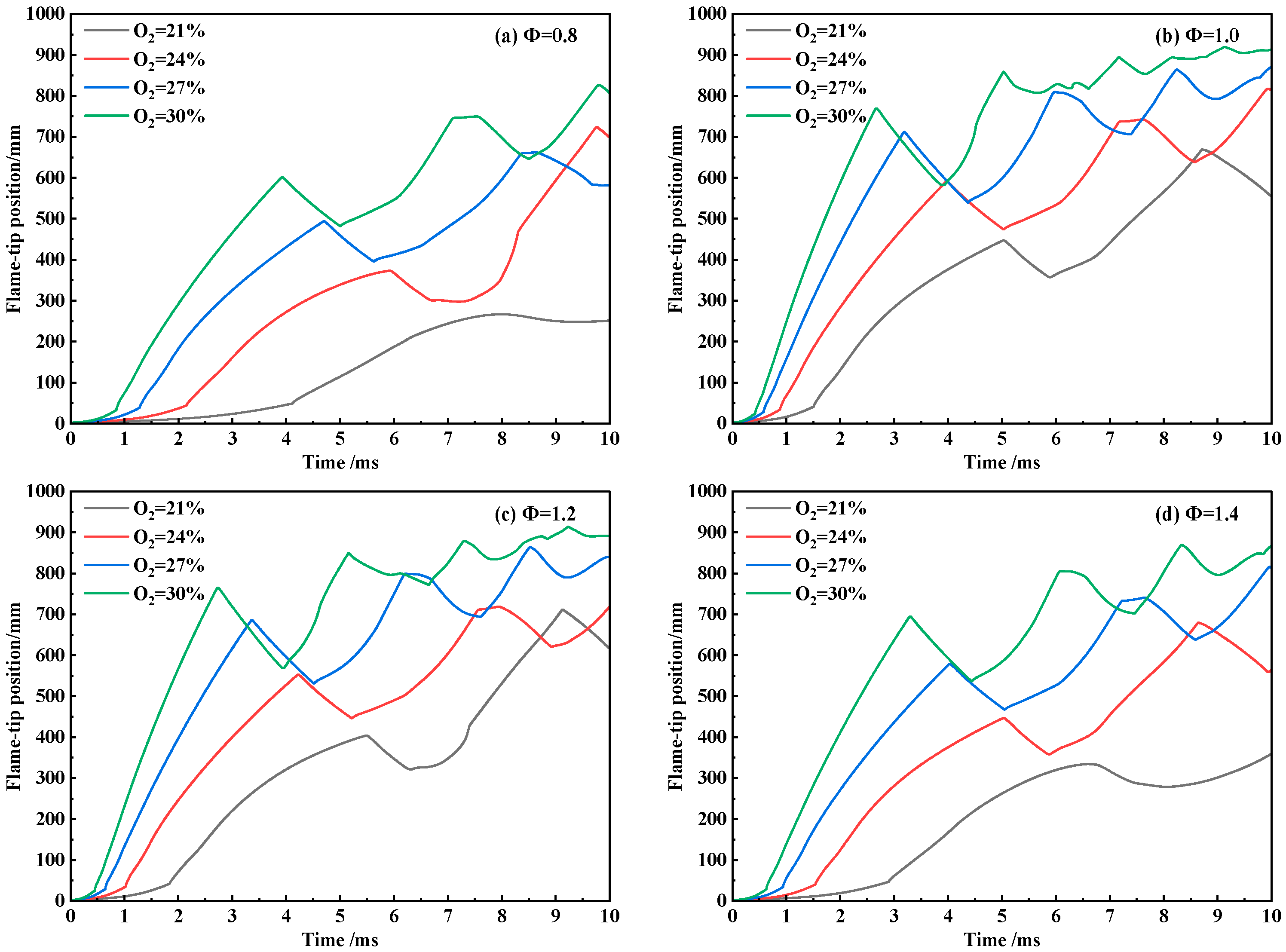
Figure 7 presents the temporal evolution of the flame-tip position, where the front is defined as the axial mean location of the c = 0.5 progress-variable isosurface. It can be seen that the axial propagation of the premixed NH3 flame in the closed tube generally undergoes a multi-stage evolution characterized by an initial acceleration, a local retreat, and a subsequent readvance [39]. Shortly after ignition, the front position increases in an approximately linear, or even slightly convex-up, manner, reflecting the rapid stretching of the hemispherical kernel into a finger-shaped flame. In the subsequent middle stage, all combinations of equivalence ratio and oxygen concentration exhibit, to varying degrees, a segment with decreasing position or a pronounced kink in the curves, indicating that the flame front undergoes a finite retreat or temporary stagnation within a certain time window.
Under a fixed equivalence ratio, as the oxygen volume fraction increased from 21% to 30%, the time at which the curve first exhibited a kink (turning point) advanced consistently; for example, at Φ = 1.0 it decreased from 5.05 ms to 2.76 ms. This indicated that under oxygen-enriched conditions the flame front reached the mid-section of the tube earlier and generated stronger expansion waves, causing the compression waves to interact with the flame front at earlier times and to exert a more pronounced “push-back” effect, thereby producing an earlier, steeper, and deeper retreat segment.
At a fixed oxygen level, the retreat intensity showed a clear ordering among different equivalence ratios. For instance, at Φ = 1.0 and O2 = 21%, the first turning point occurred at 5.1 ms and the retreat amplitude reached a maximum of 92 mm, followed (in descending order) by Φ = 1.2, 1.4, and 0.8. Near stoichiometric conditions, the mixture reactivity and density-induced expansion are strongest, leading to a higher flame-front propagation speed and larger amplitude of pressure waves in the tube. This facilitates a better matching between the flame propagation time scale and the round-trip time of pressure waves when the front approaches the tube mid-length, which manifests in the position-time curves as a steep and deep downturn in the middle segment [40].
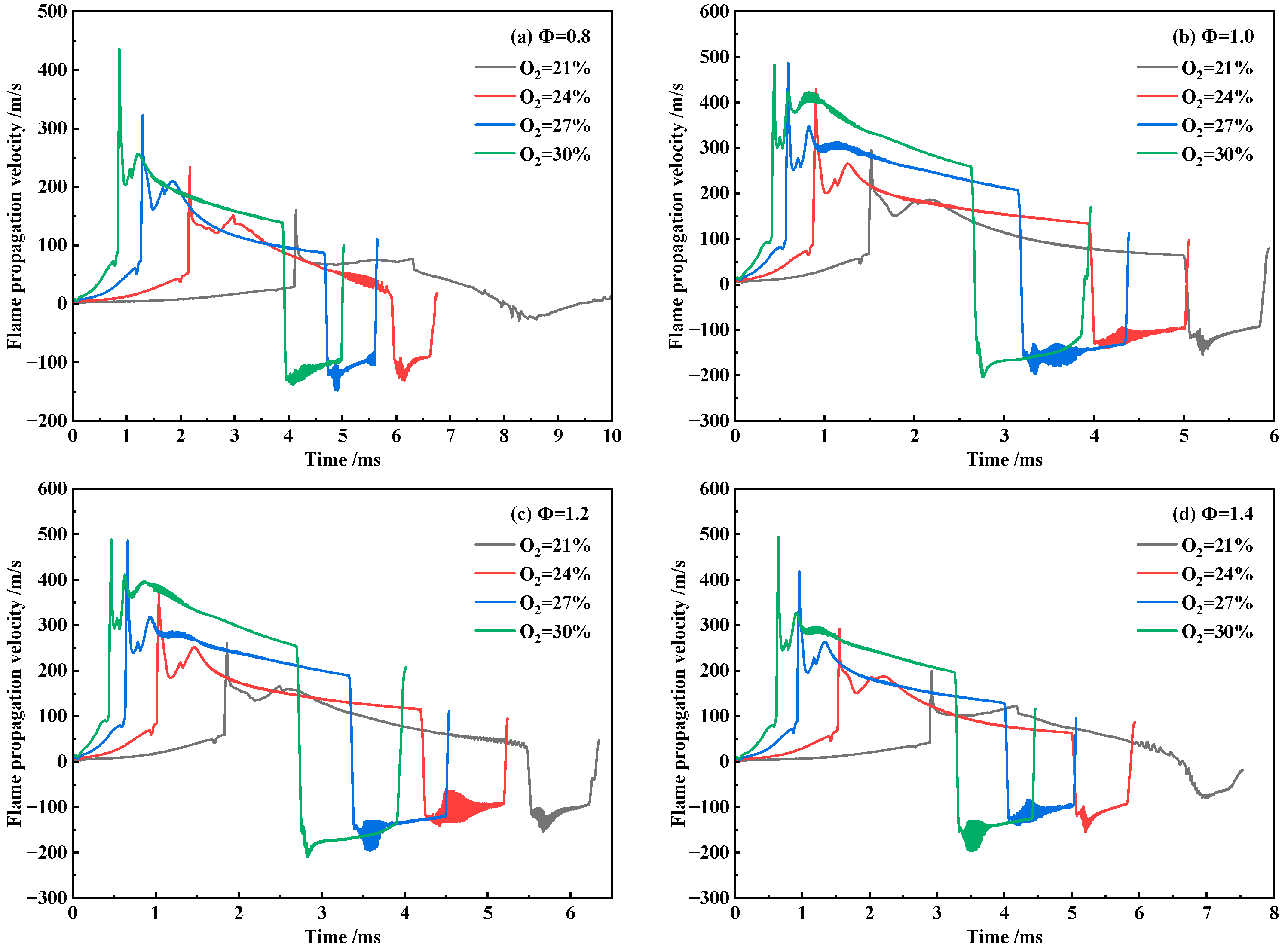
Figure 8 showed the temporal evolution of the flame propagation velocity, providing a dynamical complement to the “acceleration-retreat-readvance” behavior of the flame front described in Figure 7. For all cases, one or several sharp velocity peaks appear shortly after ignition, followed by a sustained deceleration phase during which the velocity approaches zero and can even become negative. This evolution reflects the competition between the initial acceleration driven by volumetric expansion and the subsequent action of compression and expansion waves traveling back and forth in the tube. The intervals with negative velocity correspond to brief retreats of the flame front and coincide with the time windows in which tulip-like indentations are observed in the instantaneous temperature fields, indicating that the tulip flame is essentially a velocity-reversal phenomenon triggered by the backward influence of pressure waves on the advancing front.
Under a fixed equivalence ratio, as the oxygen volume fraction increased from 21% to 30%, the initial peak flame speed increased markedly and occurred earlier; for example, at Φ = 1.0, the initial peak speed rose from 297 m/s to 485 m/s, while the corresponding time advanced from 1.55 ms to 0.42 ms. Oxygen enrichment enhances both the laminar burning velocity and the density expansion ratio, so that the flame front experiences stronger acceleration during the finger-shaped stage and, at the same time, generates compression and reflected pressure waves of higher amplitude. As a result, these waves exert a noticeable backward “push” on the leading edge even before the flame reaches the mid-length of the tube [41].
When comparing different equivalence ratios at a fixed oxygen level, the O2 = 30% cases showed that Φ = 1.0 and Φ = 1.2 both exhibited higher initial peak flame speeds of approximately 492 m/s, occurring at around 0.42 ms. These findings complement the earlier analysis based on front displacement and instantaneous flame shape from a kinematic perspective, and confirm that the occurrence of tulip flames is governed by the interplay between intrinsic burning intensity and pressure-wave time scales, rather than by a simple monotonic increase in propagation speed.
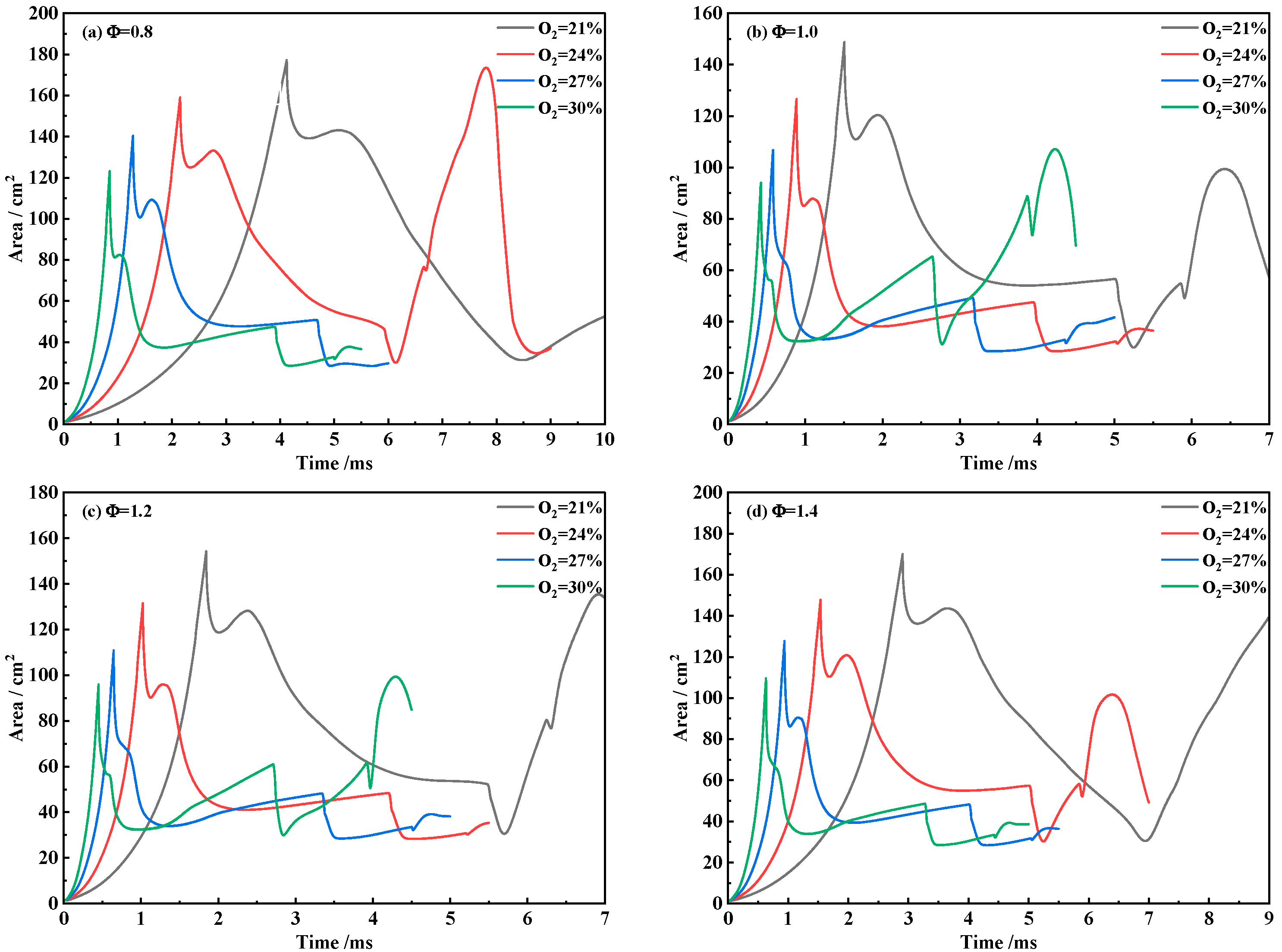
Figure 9 presented the temporal evolution of the flame surface area evaluated from the c = 0.5 progress-variable isosurface, thereby complementing the previous analysis of flame-front motion from a geometric perspective. It was observed that, for any given equivalence ratio, the peak surface area was the largest under air conditions; for example, at Φ = 1.0, as the oxygen volume fraction was increased stepwise to 30%, the peak area decreased from 148 cm2 to 97 cm2. This indicates that oxygen enrichment, while markedly accelerating flame propagation and reaction, simultaneously suppresses the full radial spread of the flame, leading to a thinner and more “compact” reaction zone, so that during the tulip stage the dominant effect is a squeezing or stretching of the front shape rather than a further increase in total area [42]. From the perspective of equivalence ratio, at the same oxygen level (O2 = 21%), the peak flame surface area at Φ = 1.0 was the lowest (148 cm2), whereas the peak areas at Φ = 0.8, 1.2, and 1.4 were slightly higher. This suggested that, under stoichiometric conditions, the system relied more on a higher intrinsic burning intensity rather than an increase in flame-front area to sustain the overall reaction strength. Overall, the flame surface area does not increase monotonically with reactivity; instead, it results from a balance between propagation speed and radial expansion jointly controlled by equivalence ratio and oxygen concentration, consistent with the earlier finding that intermediate-reactivity cases are most prone to strong geometric restructuring of the flame front.
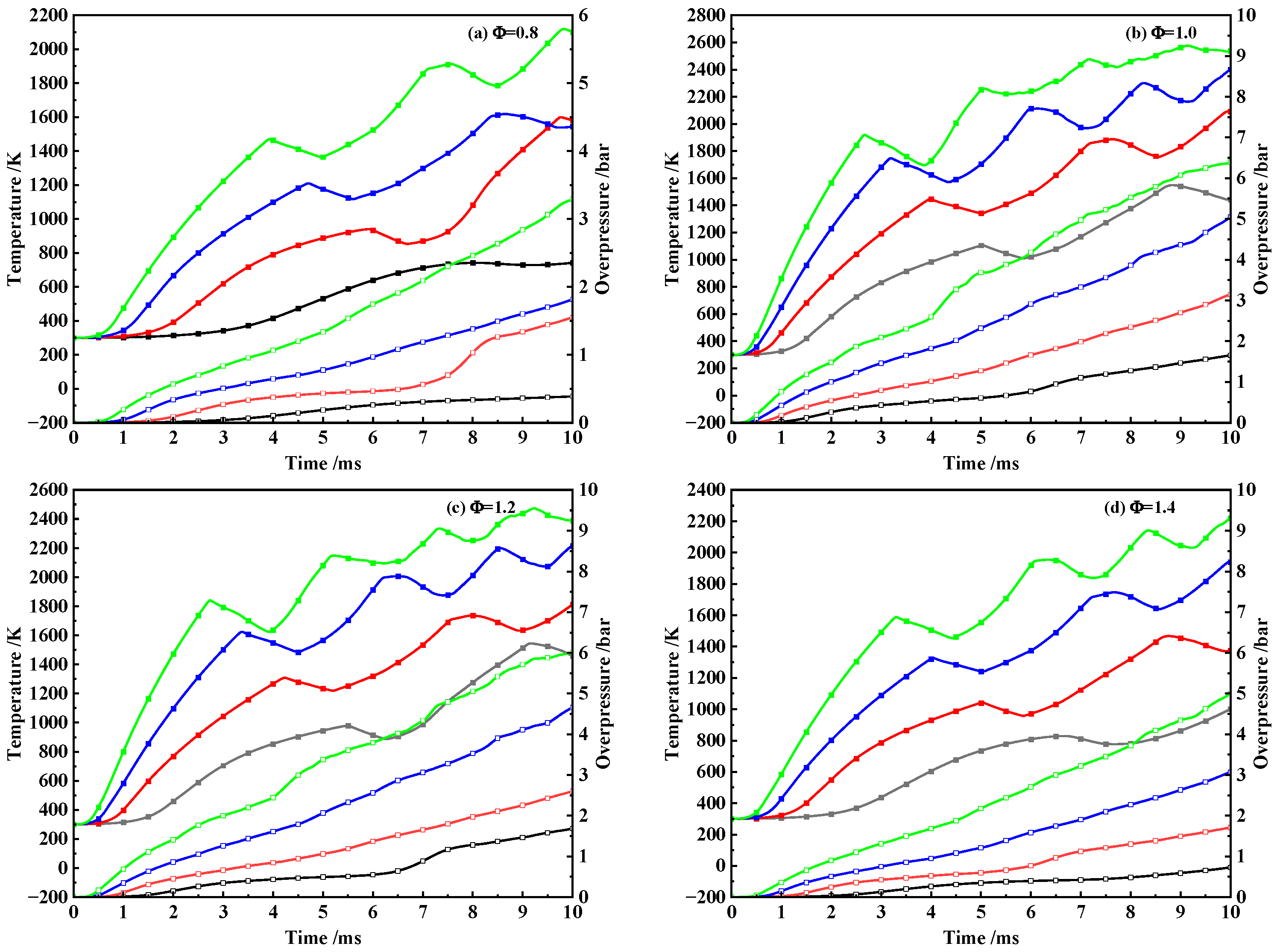
Figure 10 showed the temporal evolution of the mean temperature and overpressure in the tube, complementing the previous analysis of flame-front position and velocity from the viewpoint of global heat release and pressure response. The mean temperature increases monotonically with time, with several short plateaus where the rise temporarily slows down, indicating that combustion remains the dominant process throughout the propagation, while local changes in flame morphology only imprint transient plateaus on the overall heat-release rate [43]. At a fixed equivalence ratio, increasing the oxygen concentration markedly enhances both the heating rate and the final mean temperature, and this effect is most pronounced near stoichiometric and slightly fuel-rich conditions: for O2 = 27% and 30%, the temperature curves exhibit a steeper initial slope and maintain higher temperature levels in the middle and late stages. In contrast, at Φ = 0.8, dilution and heat-capacity effects keep the mean temperature significantly lower over the entire duration, while at Φ = 1.4 the mixture can still reach relatively high temperatures under oxygen-enriched conditions, but the temperature rise is slower, indicating that the excess fuel is not fully converted into effective heat release. This behavior is consistent with the tendency of the laminar burning velocity to decrease as the mixture moves away from stoichiometric.
The mean overpressure curves exhibited almost no relaxation, showing a nearly monotonic accumulation of pressure, which is consistent with the “irreversible heating” behavior revealed by the mean temperature evolution [44]. For any given equivalence ratio, increasing the oxygen concentration from 21% to 30% leads to an approximately linear increase in the slope of the overpressure growth, and the final overpressure rises from less than 1 bar to above 5–6 bar, indicating stronger volumetric expansion and higher energy-release density under oxygen-enriched conditions. A clear stratification is observed among different equivalence ratios: when O2 ≥ 24%, the overpressure–time curves for Φ = 1.0 and 1.2 reach the highest levels and exhibit the steepest slopes, whereas the overpressure growth for the lean case Φ = 0.8 and the over-rich case Φ = 1.4 is noticeably delayed; in particular, at Φ = 0.8 in air, the overpressure remains at a relatively low level throughout. These results showed that only within an intermediate equivalence ratio range, where both the chemical reaction rate and the energy density of the combustible mixture are sufficiently high, can strong compressive effects be generated in a confined volume.
By jointly examining the evolution of mean temperature and overpressure, it becomes clear that the hazard associated with NH3 combustion in a closed tube is not governed by the oxygen concentration or equivalence ratio alone, but by the global heat-release rate and the strength of thermal expansion jointly controlled by these two parameters. Near stoichiometric conditions, combined with moderate to strong oxygen enrichment, both the mean temperature and the overpressure reach their highest levels, whereas in distinctly lean or over-rich mixtures, the rise in temperature and overpressure is constrained by the limited intrinsic burning rate even if the oxygen concentration is increased. When the associated time scales are favorably matched, the system not only becomes more prone to intense velocity fluctuations and flame-shape inversion, but also develops higher mean temperature and overpressure levels, which is directly relevant for assessing the engineering risk of oxygen-enriched NH3 combustion in confined configurations.

3.4. Chemical Kinetics

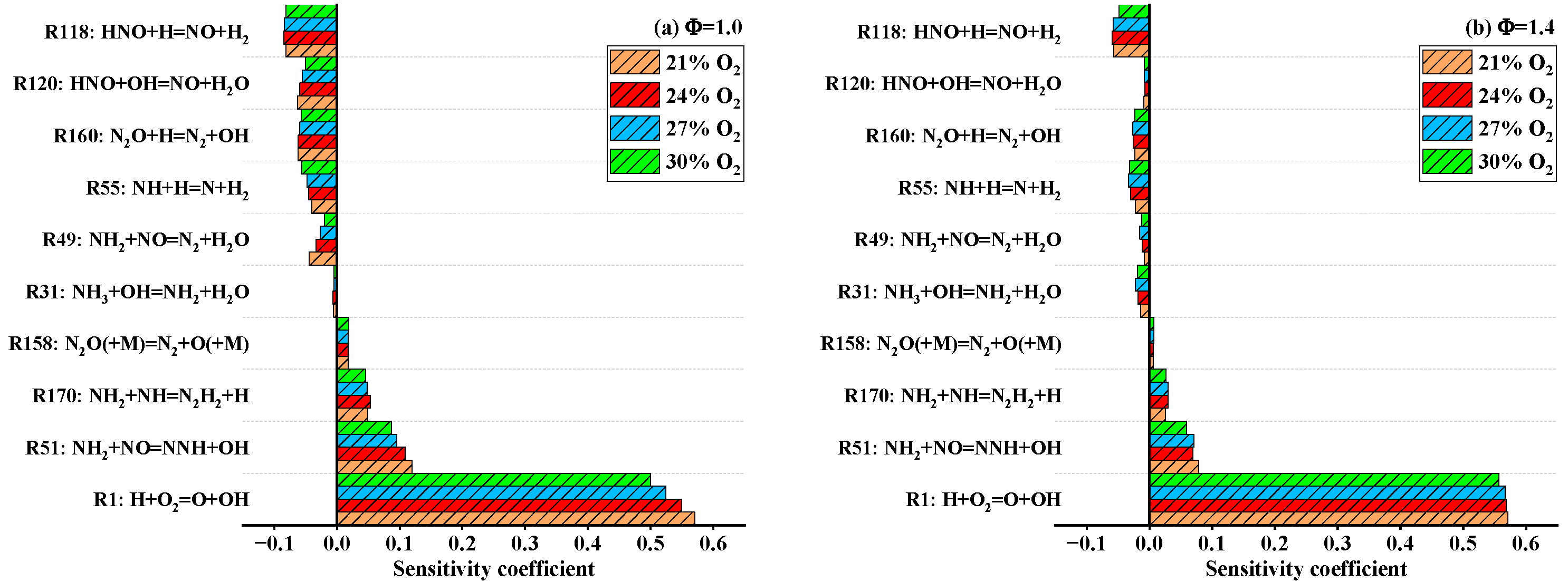
To rationalize the observed differences in tulip-flame behavior under various oxygen concentration–equivalence ratio combinations from a mechanistic standpoint, a sensitivity analysis of the unstretched laminar burning velocity was carried out based on the detailed kinetic mechanism, in order to identify the elementary reactions that control the overall burning intensity and radical evolution in NH3 flames. Figure 11 showed the sensitivity coefficients of the laminar burning velocity, including, for each Φ, the ten reactions with the largest absolute sensitivity. Across all conditions, the dominant reaction paths remain highly consistent with respect to both oxygen concentration and equivalence ratio. Reaction R1, H + O2 = O + OH, always exhibits the largest positive sensitivity coefficient and is the key step governing hydrogen-radical chain branching and the overall heat-release rate [45]. It is followed by R51, NH2 + NO = NNH + OH, and R170, NH2 + NH = N2H2 + H, which couple fuel-bound nitrogen to the NO pool and, at the same time, replenish H and OH radicals, thereby sustaining the radical pool and enhancing the burning rate. In contrast, reactions such as R31, R49, R55, R118, R120 and R160 have negative sensitivity coefficients; by converting active radicals like H and OH into relatively inert intermediates or final products (HNO, N2O, NH3, etc.), they act as radical-consumption and chain-termination channels that tend to slow down the overall reaction.
By comparing Φ = 1.0 and Φ = 1.4, it can be seen that under fuel-rich conditions the magnitudes of most sensitivity coefficients are slightly reduced, with a particularly noticeable decrease in the negative coefficients associated with several inhibiting pathways. This indicates that, when excess fuel is present, the production of radicals is intrinsically constrained by the overall equivalence ratio [46]. On the other hand, R51 and R170 retain relatively large positive sensitivity coefficients in the fuel-rich regime, showing that NH2-related chain-branching and NO-reduction pathways provide a robust promoting effect on NH3 combustion, consistent with the numerical results in which relatively high local temperatures and non-negligible flame speeds are still obtained under rich conditions. Within the oxygen concentration range of 21–30%, the variation in individual reaction sensitivities with O2 level is comparatively modest, with only a gradual change in the absolute values, implying that oxygen enrichment enhances laminar burning velocity mainly by strengthening the overall reaction rate and thermal expansion, rather than by fundamentally altering the dominant kinetic pathways.
Within the oxygen concentration range of 21–30%, the sensitivity coefficients of individual reactions vary only modestly with O2 level, showing mainly a gradual decrease in the absolute values of both positive and negative sensitivities. This indicates that oxygen enrichment enhances the laminar burning velocity primarily by strengthening the overall reaction rate and thermal expansion, rather than by fundamentally changing the dominant kinetic pathways. Combined with the earlier analysis of flame acceleration, velocity retreat and tulip-flame formation, it can be inferred that reactions such as R1, R51 and R170 govern the intrinsic burning intensity and radical supply capacity of the NH3/air system. Oxygen concentration and equivalence ratio act by modulating the effective contribution of these key reactions, thereby influencing pressure-wave strength and the time scale matching between the flame and pressure waves, which from a mechanistic perspective supports the macroscopic observation that “intermediate-reactivity” conditions are most conducive to the development of strong tulip flames.
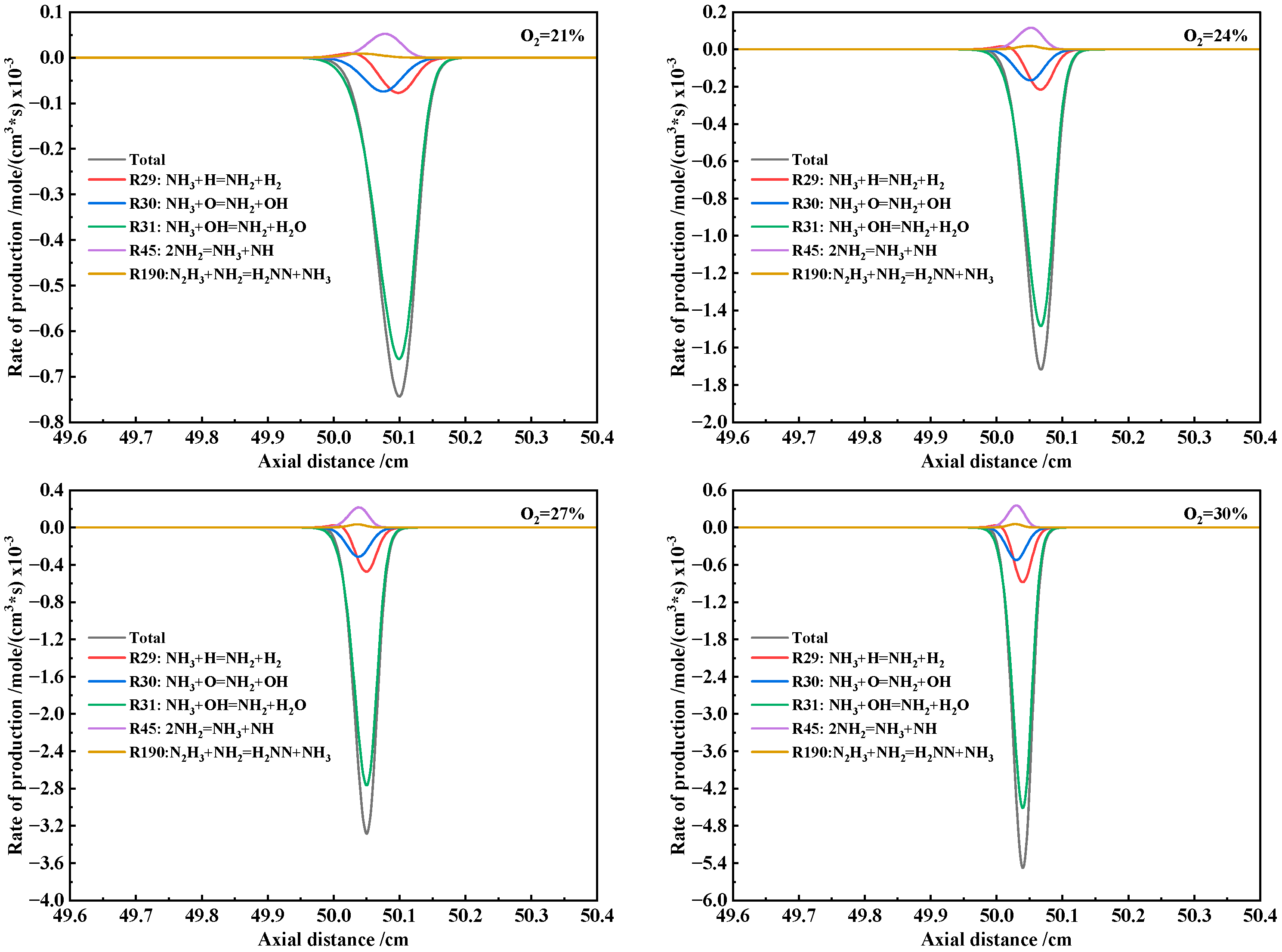
To further identify the elementary reactions that govern the reactivity of premixed NH3/air flames, a rate of production (ROP) analysis is conducted to quantitatively evaluate the net formation and consumption of NH3 and its nitrogen-containing intermediates contributed by each reaction step. Since the sensitivity analysis indicates that the dominant reaction pathways are highly consistent across different equivalence ratios, the ROP study focuses on the representative case of Φ = 1.0, in order to elucidate the roles of the main chain-branching and inhibiting routes in NH3 combustion.
As shown in Figure 12, for Φ = 1.0, the ROP distributions at different oxygen levels indicate that the main reactions of NH3 are confined to a very narrow layer immediately adjacent to the flame front. The total reaction-rate profile exhibits a sharp negative peak within this highly reactive zone, implying that NH3 is rapidly consumed there and directly controls local heat release and the laminar burning velocity. As the O2 volume fraction increases from 21% to 30%, the magnitude of this negative peak rises markedly, while its position along the flame-normal direction changes very little. This indicates that oxygen enrichment accelerates combustion primarily by strengthening the reaction intensity within the existing reaction layer, rather than by altering the flame thickness or the location of the reaction zone. At the same time, the main peak of the total reaction rate becomes slightly narrower, and the local ROP peaks of all NH3-related elementary steps (R29, R30, R31, R45, R190) increase almost synchronously, while the relative magnitudes and ranking of their positive and negative contributions remain essentially unchanged. This showed that oxygen-enriched conditions do not modify the dominant reaction pathways, but instead uniformly amplify the reaction fluxes along these paths [47]. Such behavior is consistent with the previously observed increase in laminar burning velocity, stronger flame acceleration and the greater propensity to trigger tulip flames at higher oxygen levels, and thus it provides a kinetic basis for the enhanced reactivity under oxygen-enriched conditions.
From the viewpoint of individual reaction channels, the three H abstraction reactions, R29: NH3 + H = NH2 + H2; R30: NH3 + O = NH2 + OH; and R31: NH3 + OH = NH2 + H2O, exhibit similar spatial distributions within the flame zone and together account for most of the local reaction rate, forming the dominant pathway for the conversion of NH3 to NH2 and the establishment of the NH2/H/OH radical pool. The contribution of R45, 2NH2 = NH3 + NH, is comparatively small, acting mainly as a buffering step that recovers part of the NH2 in the high-temperature region, while R190, N2H3 + NH2 = H2NN + NH3, makes a negligible net contribution to the target species and can be regarded as a minor branch under the present conditions. These abstraction reactions indicate that the NH3 → NH2 conversion pathway is a key determinant of the intrinsic burning intensity of the system, and thus plays a crucial role in setting the amplitude of pressure waves and the strength of flame–pressure-wave coupling.
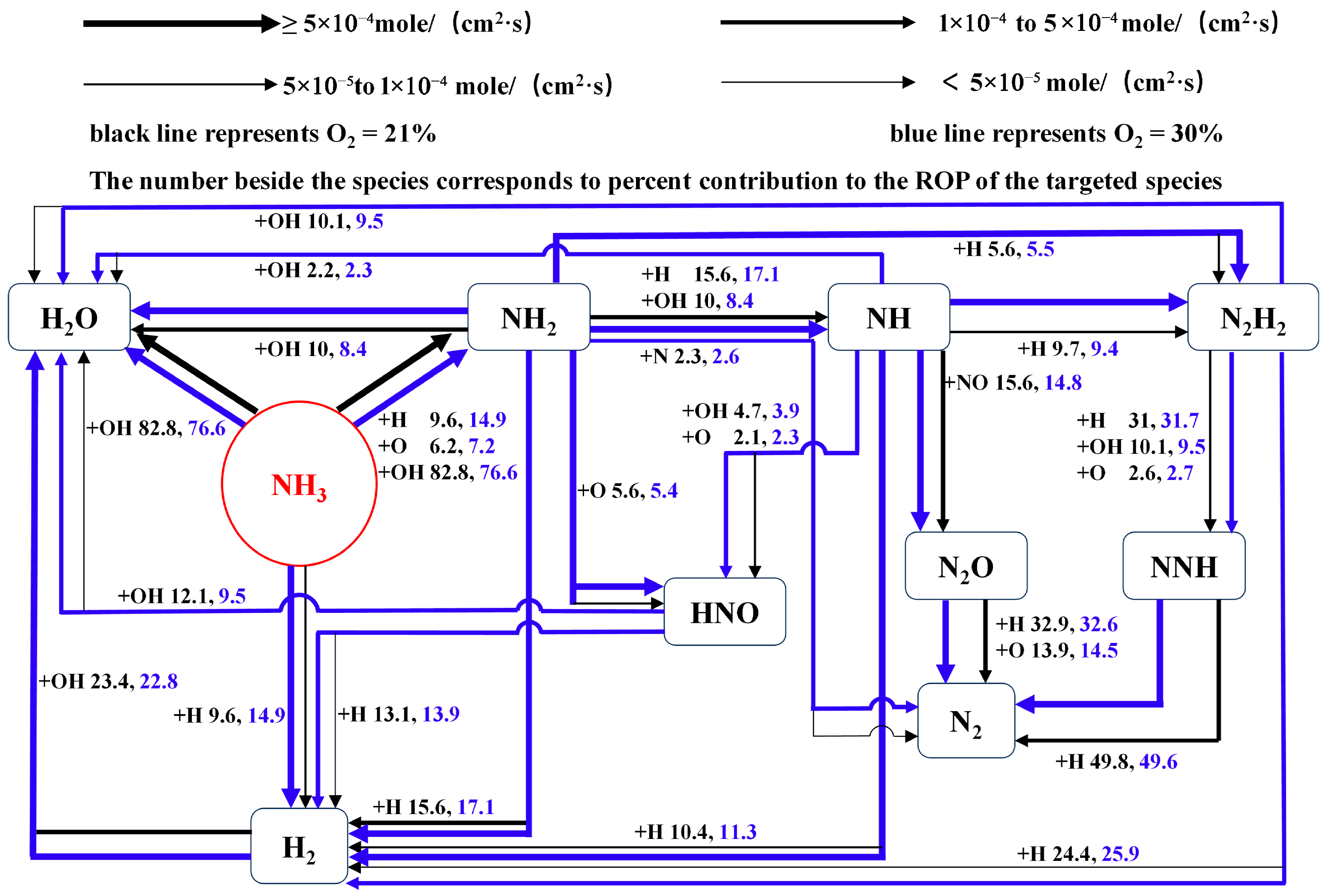
To further elucidate, from a global reaction-pathway perspective, how oxygen concentration affects the combustion intensity of NH3 and the development of tulip flames, reaction-path analyses were performed for two representative cases at Φ = 1.0 with O2 = 21% and 30%, as shown in Figure 13. The reaction paths are constructed from the integral of the species rate of production (ROP) over the entire computational domain (1 m). The colored arrows in black and blue correspond to O2 = 21% and O2 = 30%, respectively, and their thickness represents the magnitude of the molar flux. The species located at the tail and alongside the arrow are the reactants, while the species at the arrowhead are the products. The numbers marked next to the species indicate the percentage contribution of each reaction to the total ROP of the target species. In the diagrams, most of the displayed reactions have a fractional contribution of at least 3%; reactions below this threshold are only included when they are considered essential for completing the dominant pathways.
At O2 = 21%, the thick arrows in Figure 13 indicate that NH3 is first channeled rapidly into the NH2 pool mainly through H/OH abstraction reactions, and is then oxidized stepwise along the NH2 → NH → N route, with a minor branch via NH2 → N2H2. In this case, there is a pronounced “loop” within the NOx family: part of the NH2 is converted, through recombination or hydrogen-transfer reactions, into lower-valence nitrogen intermediates, so that fuel nitrogen remains in the reduced pool for a relatively long time. The overall fluxes of H, O and OH radicals are comparatively small; most H radicals circulate slowly in the H2/H2O loop, and OH acts mainly as an abstracting species in the successive dehydrogenation steps NH3 → NH2 and NH2 → NH. This compact network, dominated by NH3/NH2 abstraction and local radical regeneration, tends to sustain a moderate heat-release rate and a relatively thick reaction layer, with a clear hierarchy in which the main chain prevails and side branches remain weak [48]. This is consistent with the previously identified intermediate reactivity and relatively mild flame acceleration. The intrinsic burning intensity of the system is therefore controlled primarily by the NH3 → NH2 abstraction sequence, while the circulation of H, O and OH radicals and the associated heat release remain confined to a very narrow reaction zone; oxygen enrichment mainly strengthens the reaction intensity within this zone without significantly widening the reaction region [49].
When the oxygen concentration is increased to O2 = 30%, the types of nodes and their basic interconnections remain essentially the same as in air, indicating that oxygen enrichment does not introduce any new dominant kinetic pathways. However, the arrow thicknesses and associated flux values showed that almost all downstream routes originating from NH3 become markedly “thicker”, especially the sequences NH3 → NH2, NH2 → N2H2/NNH and the subsequent branches leading to N2 and NOx, whose molar fluxes increase by factors of order unity. At the same time, several recycle and loop routes that carry only weak fluxes under air conditions are significantly amplified, forming multiple closed cycles of comparable strength. As a result, key intermediates such as NH2, N2H2 and NNH circulate more rapidly within the network, and the overall radical pool expands substantially [50].Overall, the reaction-path diagrams under oxygen-enriched conditions exhibit two salient features. First, the NH3 abstraction steps and the subsequent oxidation channels are synchronously intensified, shortening the residence time of fuel and intermediates in the reaction zone and thereby increasing the local heat-release rate and laminar burning velocity. Second, the transport of nitrogen from NH3 toward N2 and NOₓ proceeds through multiple parallel loops, which strengthens the competition between conversion to inert N2 and to reactive nitrogen oxides. Thus, oxygen enrichment does not alter the fundamental pathways of NH3 oxidation; instead, it amplifies the molar fluxes along the NH3 → NH2 abstraction sequence and the associated nitrogen-radical cycles, significantly enhancing the intrinsic reactivity and expansion strength of the system. This, in turn, reinforces the coupling between pressure waves and the flame front, providing reaction-path-level support for the formation and intensification of tulip flames under intermediate-reactivity conditions.

4. Conclusions

This study focuses on premixed NH3/air flames propagating in a closed cylindrical tube under oxygen concentrations of 21–30% and equivalence ratios of 0.8–1.4. Using an FGM-based numerical framework, the flame propagation, tulip-flame formation, and the associated temperature and overpressure responses in the tube are systematically investigated. In parallel, sensitivity and reaction-path analyses based on a detailed kinetic mechanism are performed to bridge micro-scale reaction kinetics with macro-scale flame dynamics, thereby clarifying why tulip flames most readily emerge and intensify under “intermediate reactivity” conditions. It further clarifies the hazardous parameter window, providing a basis for mechanistic studies and risk identification in ammonia combustion safety. Future work will extend the analysis to three-dimensional configurations and more realistic boundary conditions (e.g., heat loss, venting/pressure relief, and obstacles), and will conduct comparative validation against experiments to improve engineering applicability and quantitative reliability. The main conclusions are as follows:
(1)
In the closed cylindrical tube, the NH3 flame generally evolves through five stages (hemispherical, finger-shaped, wall-attached skirt, flat-finger and tulip), and pronounced tulip structures predominantly appear in “intermediate-reactivity” regimes that are near-stoichiometric and moderately oxygen-enriched, whereas clearly lean, over-rich, or strongly oxygen-enriched conditions are dominated by high-speed finger-like or quasi-planar fronts that sweep through the tube without developing a typical tulip morphology.
(2)
The overall hazard level is jointly governed by the flame propagation speed, radial expansion and global heat release. For equivalence ratios in the range Φ ≈ 1.0–1.2 and oxygen concentrations O2 ≥ 24%, both the mean temperature and the overpressure reach high levels, making this regime the most critical window for overpressure risk during oxygen-enriched NH3 combustion in closed ducts. Accordingly, when the oxygen volume fraction increases from 21% to 30%, the initial peak propagation velocity in a representative case rises from about 297 to 485 m/s. The characteristic turning-point time advances from approximately 5.05 to 2.76 ms. The final overpressure level also increases from below 1 bar to about 5–6 bar. Therefore, the key feature of this hazardous window is a higher overpressure hazard occurring earlier, rather than a simple monotonic enhancement.
(3)
For different combinations of oxygen concentration and equivalence ratio, the structure of the dominant reaction pathways remains essentially unchanged, with reaction R1 and NH2-related chain-branching steps determining the intrinsic burning intensity. Oxygen enrichment mainly enhances the overall reaction rate and expansion strength rather than modifying the mechanism itself, so that under “intermediate-reactivity” conditions the coupling between the flame and pressure waves is strongest and pronounced tulip flames are most likely to form.
(4)
The NH3 → NH2 H abstraction sequence constitutes the main backbone linking micro-scale chemistry, laminar burning velocity, and the macroscopic behavior of tulip flames. Under oxygen-enriched conditions, this backbone is preserved, but the fluxes along its key channels are amplified and the characteristic time scale of the reaction zone is reduced, providing a mechanistic basis for improving the safety and emission performance of NH3 combustion by tuning abstraction pathways and radical cycling.

Author Contributions

Methodology, investigation, and writing—original draft, G.Z.; data curation and visualization, C.Z.; writing—original draft, M.X.; writing—review and editing and software, C.L.; conceptualization and funding acquisition, Q.W.; writing—review and editing, Y.W. All authors have read and agreed to the published version of the manuscript.

Funding

The authors appreciate the financial support from the Research and demonstration of key technologies for co-firing green ammonia in large utility pulverized-coal boilers (2025-005-KJ-DBGS).

Data Availability Statement

The original contributions presented in the study are included in the article; further inquiries can be directed to the corresponding author.

Acknowledgments

During the preparation of this manuscript, the authors used ChatGPT (OpenAI, GPT-5.2) for language polishing, restructuring of sentences, and assistance in improving the clarity and coherence of the text. The authors have reviewed, verified, and edited all AI-generated content and take full responsibility for the scientific accuracy and originality of this work.

Conflicts of Interest

Authors Guang Zeng, Chuang Zhou, Mobei Xu were employed by the company SPIC Northeast Energy Technology Co., Ltd. The remaining authors declare that the research was conducted in the absence of any commercial or financial relationships that could be construed as a potential conflict of interest.

Nomenclature

Φequivalence ratio [-]
FGMFlamelet Generated Manifold
ROPrate of production
ρ density [kg/m3]
u stream-wise velocity [m/s]
v transverse velocity [m/s]
p pressure [Pa]
E total energy [J/kg]
Y reaction progress [-]
σ i j components of the viscous stress tensor [Pa]
μ dynamic viscosity [Pa·s]
D mass diffusivity [m2/s]
K thermal conductivity [W/m·K]
q x , q y heat flux [W/m2]
A pre-exponential factor [-]
E a apparent activation energy [J/mol]
n reaction order [-]
R universal gas constant [J/mol/K]
T temperature [K]
S u laminar burning velocity [m/s]
T u unburned temperature [K]
T 0 initial temperature [K]
NH3ammonia
CH4methane
H2Owater
H2hydrogen
O2oxygen
N2nitrogen
NOnitrogen monoxide
N2Onitrous oxide
HNOnitroxyl
N2H2diazene
NH2amidogen radical
NNHimidogen-nitrogen radical
OHhydroxyl radical
N2H3diazanyl radical
H2NNdiazene radical
NHimidogen radical
Ooxygen radical
Hhydrogen radical

References

  1. Tan, H.; Sang, Z.; Tian, Y.; Peng, W.; Liu, X.; Liang, J. Ammonia as a Green Carbon-Free Fuel: A Pathway to the Sustainable Energy Economy. ACS Energy Lett. 2024, 9, 5120–5136. [Google Scholar] [CrossRef]
  2. Zhang, Z.; Zhang, H.; Jiang, H.; Li, L. Green ammonia: Revolutionizing sustainable energy for a carbon-free future. J. Mater. Chem. A 2024, 12, 33334–33361. [Google Scholar] [CrossRef]
  3. Cui, D.; Zhou, X.; Wu, S.; Luk, H.M.; Lu, Q.; Bai, J.; Liu, B.; Xu, X.; Pan, S.; Wang, Q.; et al. Synergistic mechanism and radicals interaction of the Co-SCWG of cellulose and polystyrene based on ReaxFF-MD and DFT. J. Energy Inst. 2026, 125, 102441. [Google Scholar] [CrossRef]
  4. Liang, W.; Law, C.K. Enhancing ammonia combustion using reactivity stratification with hydrogen addition. Proc. Combust. Inst. 2023, 39, 4419–4426. [Google Scholar] [CrossRef]
  5. Holden, S.R.; Zhang, Z.; Wu, J.; Zhang, D. Ammonia combustion in fixed-bed and fluidised-bed reactors: The concept, knowledge base, and challenges. Prog. Energy Combust. Sci. 2025, 109, 101230. [Google Scholar] [CrossRef]
  6. Wu, Z.; Zhang, G.; Wang, C.; Jin, S.; Ji, M.; Hu, C.; Shang, Q. Numerical investigation on the flame propagation process of ammonia/hydrogen blends under engine-related conditions. Int. J. Hydrogen Energy 2024, 60, 1041–1053. [Google Scholar] [CrossRef]
  7. Caetano, N.R.; da Silva, B.P.; Ruoso, A.C.; Avila, A.G.; Rocha, L.A.O.; Lorenzini, G. Energy Recovery Based on Exhaust Gas Recirculation and Heat Regeneration Processes Applied in a Firewood Boiler. J. Eng. Thermophys. 2023, 32, 482–501. [Google Scholar] [CrossRef]
  8. Makaryan, I.A.; Sedov, I.V.; Munoz-Herrera, C.; Toledo, M.; Salgansky, E.A. Combustion of ammonia-blended fuels in porous media burners, with storage and distribution implications: A review. Renew. Sustain. Energy Rev. 2025, 220, 115884. [Google Scholar] [CrossRef]
  9. Park, Y.; Park, S.Y.; Lee, H. Consumers’ acceptance of the explosion, toxicity, and odor potential of ammonia: A survey on consumers’ choice of an ammonia-based hydrogen refueling station. Sustain. Energy Technol. Assess. 2023, 58, 103374. [Google Scholar] [CrossRef]
  10. Chu, H.; Yao, J.; Dong, W.; Yang, Y.; Wang, D. Comparative effects of H2 and NH3 on hydrocarbon fuels laminar combustion characteristics and pollutant emissions: Status and challenges. Int. J. Hydrogen Energy 2025, 109, 129–149. [Google Scholar] [CrossRef]
  11. Zheng, K.; Song, Z.; Song, C.; Jia, Q.; Ren, J.; Chen, X. Investigation on the explosion of ammonia/hydrogen/air in a closed duct by experiments and numerical simulations. Int. J. Hydrogen Energy 2024, 79, 1267–1277. [Google Scholar] [CrossRef]
  12. Liang, H.; Yan, X.; Shi, E.; Wang, X.; Qi, C.; Ding, J.; Zhang, L.; Lv, X.; Yu, J. Flame evolution and pressure dynamics of premixed stoichiometric ammonia/hydrogen/air in a closed duct. Fuel 2024, 363, 130983. [Google Scholar] [CrossRef]
  13. Xiao, H.; Houim, R.W.; Oran, E.S. Formation and evolution of distorted tulip flames. Combust. Flame 2015, 162, 4084–4101. [Google Scholar] [CrossRef]
  14. Wang, Y.; Zhang, X.; Fan, X.; Li, Y. Simulation and Research of Methane Premixed Combustion Characteristics Based on Constant Volume Combustion Chamber with Different Ignition Modes. Energies 2023, 16, 7016. [Google Scholar] [CrossRef]
  15. Yang, X.; Yu, M.; Han, S.; Luo, Z. Experimental study on the premixed syngas-air explosion in duct with both ends open. Int. J. Hydrogen Energy 2021, 46, 11004–11014. [Google Scholar] [CrossRef]
  16. Masoumi, S.; Ashjaee, M.; Houshfar, E. Laminar flame stability analysis of ammonia-methane and ammonia-hydrogen dual-fuel combustion. Fuel 2024, 363, 131041. [Google Scholar] [CrossRef]
  17. Zheng, K.; Jia, Q.; Xing, Z.; Bi, H.; Mu, N. An experimental study on the flame behaviors of H2/CO/Air mixtures in closed tube with varying number of obstacles. Energy 2024, 308, 133044. [Google Scholar] [CrossRef]
  18. Xiao, H.; Duan, Q.; Sun, J. Premixed flame propagation in hydrogen explosions. Renew. Sustain. Energy Rev. 2018, 81, 1988–2001. [Google Scholar] [CrossRef]
  19. Houim, R.W.; Kuo, K.K. A low-dissipation and time-accurate method for compressible multi-component flow with variable specific heat ratios. J. Comput. Phys. 2011, 230, 8527–8553. [Google Scholar] [CrossRef]
  20. Kessler, D.A.; Gamezo, V.N.; Oran, E.S. Simulations of flame acceleration and deflagration-to-detonation transitions in methane–air systems. Combust. Flame 2010, 157, 2063–2077. [Google Scholar] [CrossRef]
  21. Rao, A.; Li, W.; Abbasi, M.S.; Shahid, M.I.; Farhan, M.; Zulfiqar, S.; Chen, T.; Ma, F.; Li, X. Machine learning-enhanced combustion modeling for predicting laminar burning velocity of ammonia-hydrogen mixtures using improved reaction mechanisms. Energy 2025, 320, 135259. [Google Scholar] [CrossRef]
  22. Shah, Z.A.; Cinieri, G.; Zhu, M.; Chandio, M.B.; De Giorgi, M.G. Refined kinetic mechanism for modeling ammonia combustion in air assisted by nanosecond discharged plasma. Appl. Therm. Eng. 2025, 280, 128121. [Google Scholar] [CrossRef]
  23. Okafor, E.C.; Naito, Y.; Colson, S.; Ichikawa, A.; Kudo, T.; Hayakawa, A.; Kobayashi, H. Experimental and numerical study of the laminar burning velocity of CH4–NH3–air premixed flames. Combust. Flame 2018, 187, 185–198. [Google Scholar] [CrossRef]
  24. Li, Y.; Xu, W.; Jiang, Y.; Liew, K.M.; Qiu, R. Laminar burning velocities of 2-methyltetrahydrofuran at elevated pressures. Proc. Combust. Inst. 2021, 38, 2175–2183. [Google Scholar] [CrossRef]
  25. Hayakawa, A.; Goto, T.; Mimoto, R.; Arakawa, Y.; Kudo, T.; Kobayashi, H. Laminar burning velocity and Markstein length of ammonia/air premixed flames at various pressures. Fuel 2015, 159, 98–106. [Google Scholar] [CrossRef]
  26. Otomo, J.; Koshi, M.; Mitsumori, T.; Iwasaki, H.; Yamada, K. Chemical kinetic modeling of ammonia oxidation with improved reaction mechanism for ammonia/air and ammonia/hydrogen/air combustion. Int. J. Hydrogen Energy 2018, 43, 3004–3014. [Google Scholar] [CrossRef]
  27. Okafor, E.C.; Naito, Y.; Colson, S.; Ichikawa, A.; Kudo, T.; Hayakawa, A.; Kobayashi, H. Measurement and modelling of the laminar burning velocity of methane-ammonia-air flames at high pressures using a reduced reaction mechanism. Combust. Flame 2019, 204, 162–175. [Google Scholar] [CrossRef]
  28. Stagni, A.; Cavallotti, C.; Arunthanayothin, S.; Song, Y.; Herbinet, O.; Battin-Leclerc, F.; Faravelli, T. An experimental, theoretical and kinetic-modeling study of the gas-phase oxidation of ammonia. React. Chem. Eng. 2020, 5, 696–711. [Google Scholar] [CrossRef]
  29. Han, X.; Wang, Z.; He, Y.; Zhu, Y.; Cen, K. Experimental and kinetic modeling study of laminar burning velocities of NH3/syngas/air premixed flames. Combust. Flame 2020, 213, 1–13. [Google Scholar] [CrossRef]
  30. Mei, B.; Zhang, X.; Ma, S.; Cui, M.; Guo, H.; Cao, Z.; Li, Y. Experimental and kinetic modeling investigation on the laminar flame propagation of ammonia under oxygen enrichment and elevated pressure conditions. Combust. Flame 2019, 210, 236–246. [Google Scholar] [CrossRef]
  31. Zhu, Y.; Curran, H.J.; Girhe, S.; Murakami, Y.; Pitsch, H.; Senecal, K.; Yang, L.; Zhou, C.-W. The combustion chemistry of ammonia and ammonia/hydrogen mixtures: A comprehensive chemical kinetic modeling study. Combust. Flame 2024, 260, 113239. [Google Scholar] [CrossRef]
  32. Lei, B.; Wu, Z.; Li, X.; Guo, C. Study of the formation and evolution of distorted tulip flames during deflagration of premixed stoichiometric hydrogen/air in closed pipelines. Int. J. Therm. Sci. 2025, 211, 109706. [Google Scholar] [CrossRef]
  33. Xiao, H.; Makarov, D.; Sun, J.; Molkov, V. Experimental and numerical investigation of premixed flame propagation with distorted tulip shape in a closed duct. Combust. Flame 2012, 159, 1523–1538. [Google Scholar] [CrossRef]
  34. Mendiburu, A.Z.; Serra, A.M.; Andrade, J.C.; Silva, L.M.; Santos, J.C.; de Carvalho, J.A. Characterization of the flame front inversion of Ethanol–Air deflagrations inside A closed tube. Energy 2019, 187, 115932. [Google Scholar] [CrossRef]
  35. Wang, X.; Zheng, L.; Wang, J.; Pan, R.; Yang, W.; Jin, H.; Fu, Y. Effect of Propane Addition and Oxygen Enrichment on the Flame Characteristics of Biogas. Energy Fuels 2021, 35, 5015–5025. [Google Scholar] [CrossRef]
  36. Xu, C.; Wu, S.; Li, Y.; Chu, S.; Wang, C. Explosion characteristics of hydrous bio-ethanol in oxygen-enriched air. Fuel 2020, 271, 117604. [Google Scholar] [CrossRef]
  37. Qian, C.; Liberman, M.A. On the tulip flame formation: The effect of pressure waves. arXiv 2023, arXiv:2312.02681. [Google Scholar] [CrossRef]
  38. Qian, C.; Liberman, M.A. Influence of flame collisions with pressure waves on tulip flame formation and its evolution in tubes with non-slip walls. Acta Astronaut. 2025, 232, 154–163. [Google Scholar] [CrossRef]
  39. Liang, H.; Yan, X.; Shi, E.; Wang, X.; Qi, C.; Ding, J.; Zhang, L.; Liu, X.; Lv, X.; Yu, J. Evolution of ammonia/air premixed flame and explosion pressure in a square closed duct: Effects of equivalence ratio and initial pressure. Int. J. Hydrogen Energy 2024, 59, 419–429. [Google Scholar] [CrossRef]
  40. Zhang, Z.; Huang, Z.; Wang, X.; Xiang, J.; Wang, X.; Miao, H. Measurements of laminar burning velocities and Markstein lengths for methanol–air–nitrogen mixtures at elevated pressures and temperatures. Combust. Flame 2008, 155, 358–368. [Google Scholar] [CrossRef]
  41. Shen, X.; He, X.; Sun, J. A comparative study on premixed hydrogen–air and propane–air flame propagations with tulip distortion in a closed duct. Fuel 2015, 161, 248–253. [Google Scholar] [CrossRef]
  42. Yang, K.; Liu, G.; Ji, H.; Xing, Z.; Jiang, J.; Yin, Y. The effects of different equivalence ratios and initial pressures on the explosion of methane/air premixed gas in closed space. Energy 2024, 297, 131213. [Google Scholar] [CrossRef]
  43. Yin, Y.; Gong, X.; Zhou, H.; Ren, Z. The correlation of species concentration with heat release rate in an auto-igniting turbulent n-heptane spray flame. Fuel 2020, 262, 116510. [Google Scholar] [CrossRef]
  44. Gao, Y.L.; Ren, M.X.; Zhou, Y.X.; Wang, Y.D.; Duan, Z.H.; Li, B.W.; Guo, H.; Duan, J.J.; Dong, Y.J. First-principle study on the relationship between elasticity and thermodynamic properties of CuInX2 (X = S, Se, and Te) under high temperature and high pressure. Solid State Commun. 2024, 388, 115555. [Google Scholar] [CrossRef]
  45. Jin, T.; Shi, J.-c.; Dong, W.-l.; Hu, J.-l.; Chu, H.-q. Numerical investigation on the laminar combustion characteristics of primary reference fuel: The effects of elevated temperatures and pressures. Int. J. Chem. React. Eng. 2022, 21, 225–236. [Google Scholar] [CrossRef]
  46. Weis, C.; Martin Sentko, M.; Stelzner, B.; Habisreuther, P.; Zarzalis, N.; Trimis, D. Experimental and numerical investigations of the laminar burning velocities of premixed fuel-rich methane oxy-fuel and oxygen-enhanced flames. Fuel 2024, 368, 131601. [Google Scholar] [CrossRef]
  47. Zhang, K.; Hu, G.; Liao, S.; Zuo, Z.; Li, H.; Cheng, Q.; Xiang, C. Numerical study on the effects of oxygen enrichment on methane/air flames. Fuel 2016, 176, 93–101. [Google Scholar] [CrossRef]
  48. Chai, W.S.; Bao, Y.; Jin, P.; Tang, G.; Zhou, L. A review on ammonia, ammonia-hydrogen and ammonia-methane fuels. Renew. Sustain. Energy Rev. 2021, 147, 111254. [Google Scholar] [CrossRef]
  49. Lee, S.R.; Kim, J.S. The Asymptotic Structure of Strained Chain-Branching Premixed Flames. Combust. Sci. Technol. 2022, 195, 3638–3662. [Google Scholar] [CrossRef]
  50. Zhou, S.; Cui, B.; Yang, W.; Tan, H.; Wang, J.; Dai, H.; Li, L.; Rahman, Z.U.; Wang, X.; Deng, S.; et al. An experimental and kinetic modeling study on NH3/air, NH3/H2/air, NH3/CO/air, and NH3/CH4/air premixed laminar flames at elevated temperature. Combust. Flame 2023, 248, 112536. [Google Scholar] [CrossRef]
Figure 1. 2D planar geometry model.
Energies 19 00949 g001
Figure 2. Experimental and numerical results of the relationship between unstretched laminar burning velocity, Su, and equivalence ratio, Փ.
Energies 19 00949 g002
Figure 3. Evolution of flame morphology of NH3 in a closed pipe under different oxygen contents (Փ = 0.8).
Energies 19 00949 g003
Figure 4. Evolution of flame morphology of NH3 in a closed pipe under different oxygen contents (Փ = 1.0).
Energies 19 00949 g004
Figure 5. Evolution of flame morphology of NH3 in a closed pipe under different oxygen contents (Փ = 1.2).
Energies 19 00949 g005
Figure 6. Evolution of flame morphology of NH3 in a closed pipe under different oxygen contents (Փ = 1.4).
Energies 19 00949 g006
Figure 7. Temporal evolution of flame-tip position at different oxygen concentrations: (a) Φ = 0.8, (b) Φ = 1.0, (c) Φ = 1.2, and (d) Φ = 1.4.
Energies 19 00949 g007
Figure 8. Temporal evolution of flame propagation velocity at different oxygen concentrations: (a) Φ = 0.8, (b) Φ = 1.0, (c) Φ = 1.2, and (d) Φ = 1.4.
Energies 19 00949 g008
Figure 9. Temporal evolution of flame surface area at different oxygen concentrations: (a) Φ = 0.8, (b) Φ = 1.0, (c) Φ = 1.2, and (d) Φ = 1.4.
Energies 19 00949 g009
Figure 10. Temporal evolution of the mean temperature and overpressure in the tube: (a) Φ = 0.8, (b) Φ = 1.0, (c) Φ = 1.2, and (d) Φ = 1.4.
Energies 19 00949 g010
Figure 11. Sensitivity analysis of the unstretched laminar burning velocity at various O2 content in the combustion air: (a) Փ = 1.0 and (b) Փ = 1.4.
Energies 19 00949 g011
Figure 12. Rate of production in NH3/air premixed flames at different oxygen concentrations.
Energies 19 00949 g012
Figure 13. Reaction pathways and fluxes for NH3 combustion at O2 = 21% and O2 = 30%.
Energies 19 00949 g013
Disclaimer/Publisher’s Note: The statements, opinions and data contained in all publications are solely those of the individual author(s) and contributor(s) and not of MDPI and/or the editor(s). MDPI and/or the editor(s) disclaim responsibility for any injury to people or property resulting from any ideas, methods, instructions or products referred to in the content.