1. Introduction
In alignment with green mining policies and the imperative to minimize coal resource losses, the coal industry has introduced a novel non-pillar mining technology employing roof-cutting and roadway formation (NPRRF) [
1,
2]. This method enhances coal recovery rates, reduces tunnel development requirements, and mitigates stress concentrations typically induced by coal pillar retention [
3,
4]. As NPRRF is deployed across varied geological settings, extensive research has focused on optimizing its design parameters, analyzing mining-induced stress redistribution, and developing effective ground control strategies [
5,
6,
7,
8].
The implementation of NPRRF in inclined coal seams, however, presents distinct challenges due to their unique geological characteristics, leading to complex mechanisms of overburden movement and stress evolution. During strata stabilization, stress shell develops within the overlying rock mass [
9,
10,
11]. The rock enclosed within these arches acts as a primary load-bearing structure. The instability of key components within this arch can trigger catastrophic failures, such as roof collapse or dynamic pressure events at the working face [
12,
13]. Consequently, elucidating the dynamic evolution of the stress arch under these specific conditions is critical for the safe application of NPRRF in inclined coal seams [
14], providing a scientific basis for safe production practices.
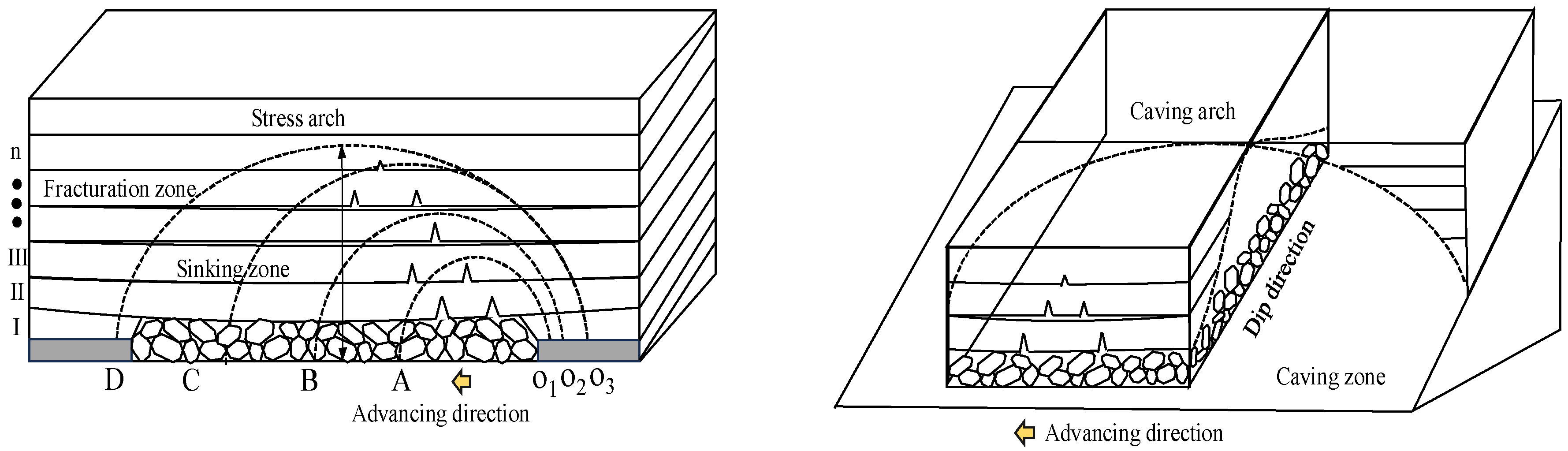
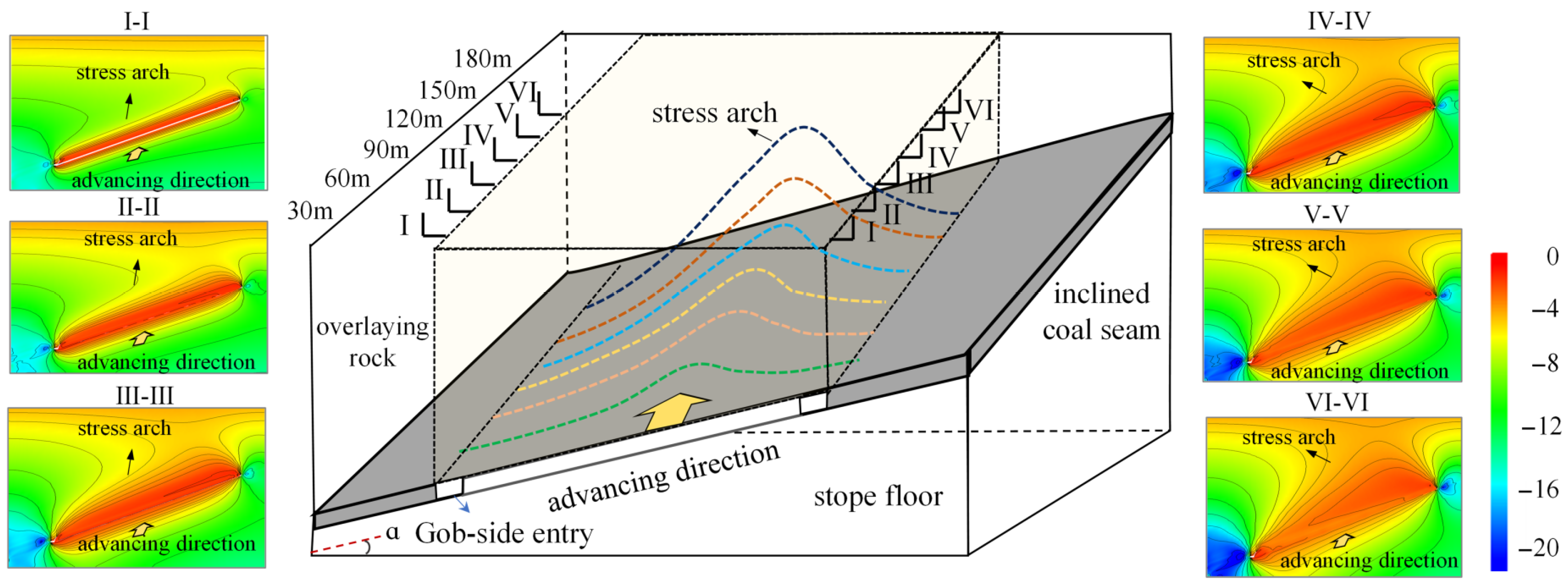
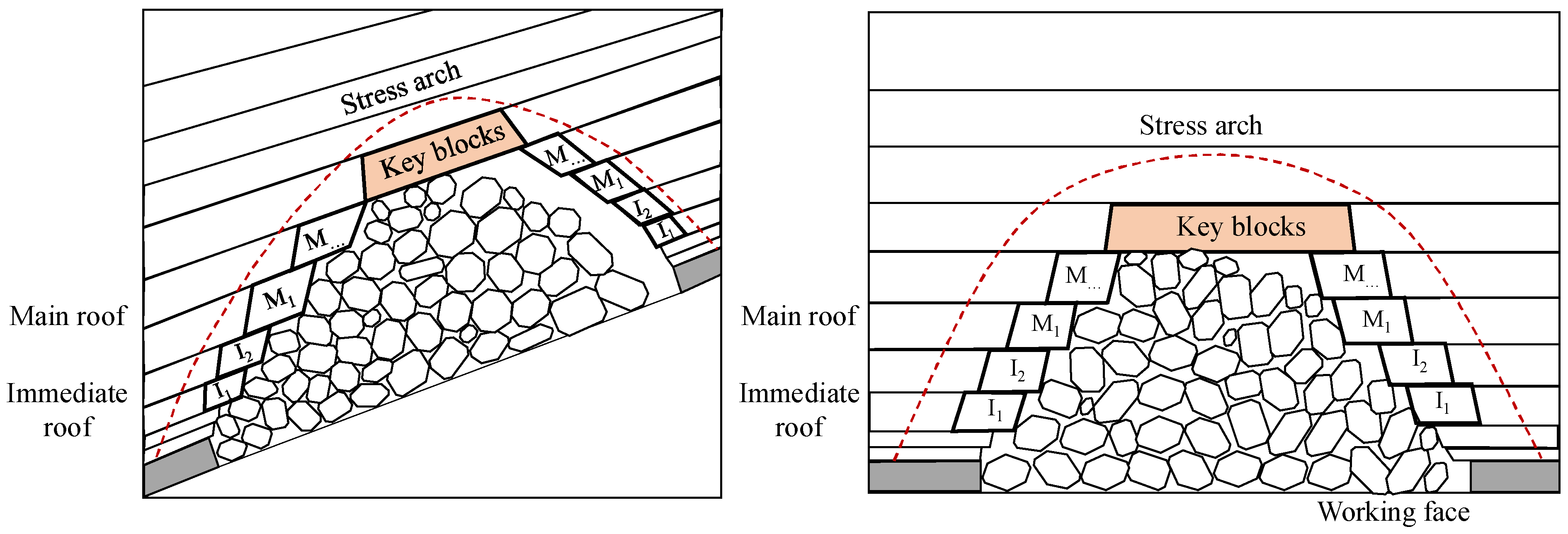
Figure 1 schematically illustrates the evolutionary process and morphology of the stress arch structure within the overburden during longwall mining in inclined coal seams.
Current research on overlying strata structure and stress evolution in inclined coal seams predominantly focuses on traditional coal pillar retention mining methods [
15,
16,
17,
18]. To elucidate the stress evolution characteristics and structural stability of overlying strata in NMRRF stopes within inclined coal seams, and to enrich the NMRRF research framework, this study employs numerical simulation and theoretical analysis to systematically examine stress evolution laws and structural stability in such stopes.
This study represents a deepening and theoretical refinement of the authors’ previous work. Earlier research inferred the characteristics of overlying strata movement in inclined coal seams from observations of support pressure. In contrast, this paper directly and systematically reveals the evolution of internal stress within the overlying strata through numerical simulation and theoretical analysis. The innovatively proposed concept of the “asymmetric three-dimensional stress shell” breaks through the cross-sectional limitations of the classical “two-dimensional stress arch.” For the first time, it quantitatively characterizes the dual asymmetry—both in geometric morphology and mechanical properties—of the stress shell in three-dimensional space. It clarifies the core mechanism by which the coal seam dip angle governs the spatial redistribution of stress, thereby establishing a novel three-dimensional theoretical framework for ground control in inclined coal seams.
2. Formation and Evolution Characteristics of the Stress Field in the Overlying Stope
Longwall mining, as a primary coal extraction method, leads to the fracturing and collapse of the overburden structure post-mining [
19]. This process forms a fractured zone in the middle and a bending subsidence zone in the upper section, ultimately creating three distinct vertical regions: the caved zone, fractured zone, and bending subsidence zone [
20,
21]. The formation of these zones significantly influences the final stability of the overburden structure in the mining area [
22]. Throughout coal extraction, the overburden structure undergoes continuous evolution until a new stable configuration is established [
23]. Within the caved zone, a fracture arch develops, while above this arch, a stress arch forms within a specific range conforming to a particular strength envelope curve [
24,
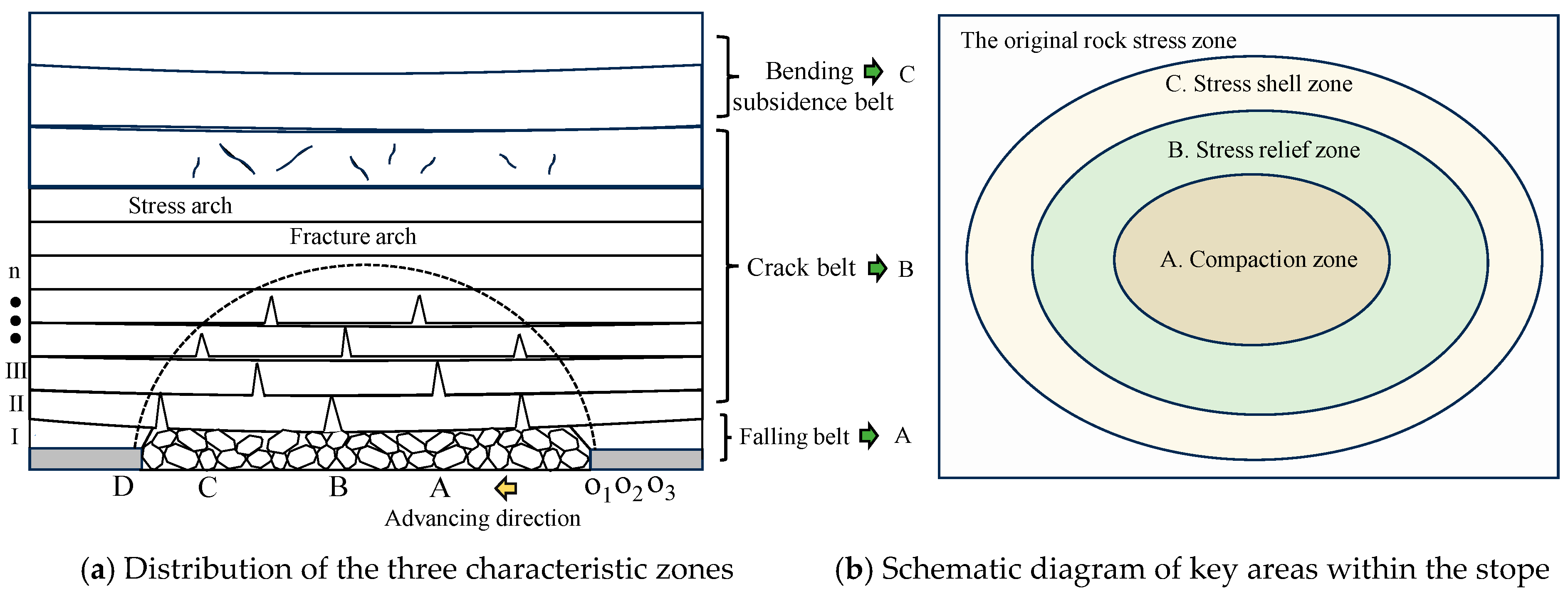
25]. The stabilization of the overburden structure is consistently accompanied by a dual-arch configuration, ultimately leading to a stable structure under this mechanism, as illustrated in
Figure 2a. The dual-arch ceases to expand or evolve, and areas within the stope develop into a compaction zone, stress-relief zone, and stress arch, radiating outward from the center, as depicted in
Figure 2b.
NMRRF technology in inclined coal seams involves artificial pre-splitting on one side of the target roadway [
26], complemented by reinforcement of the roadway roof using constant-resistance anchor cables [
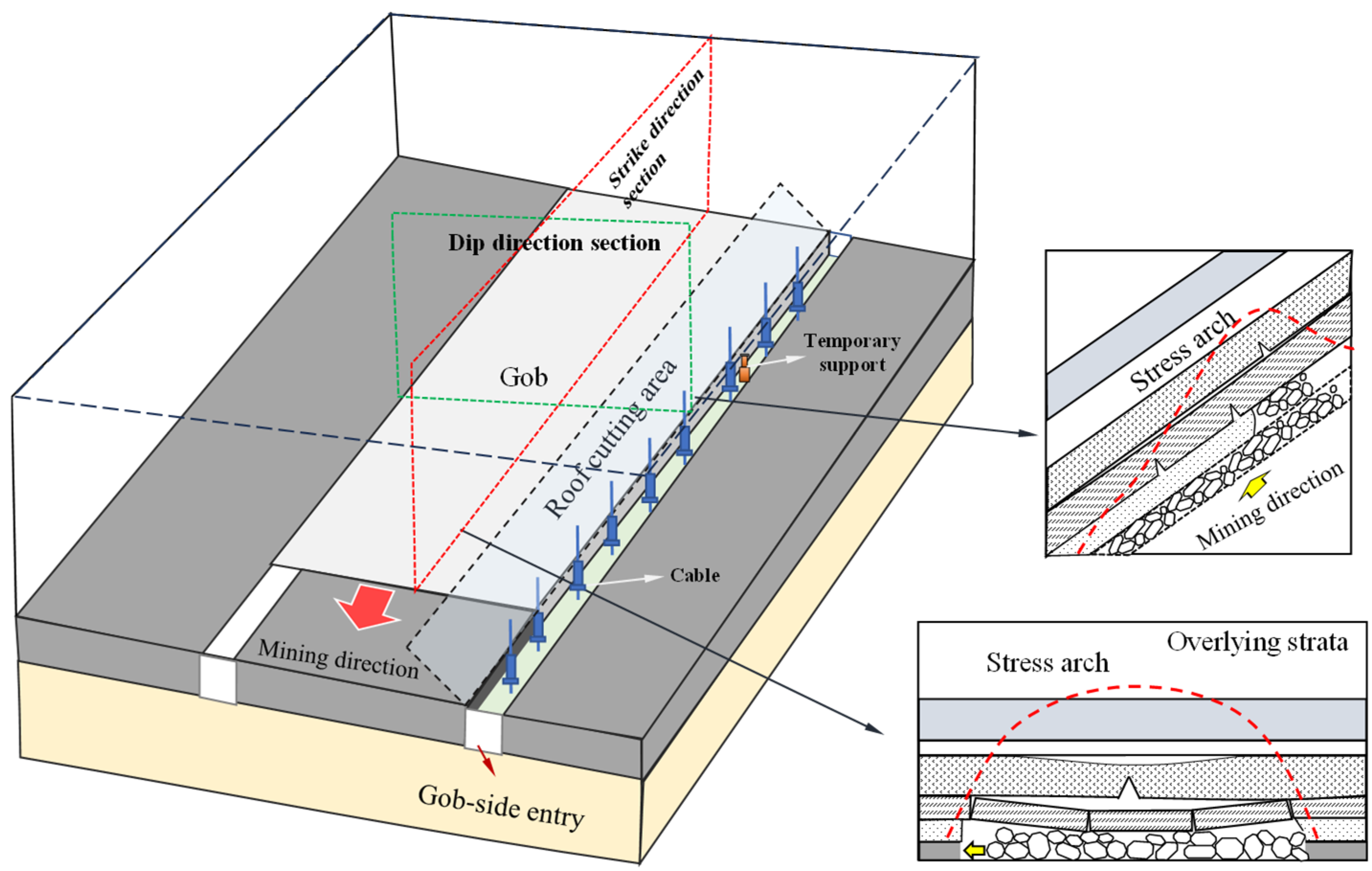
27]. The collapsed gangue automatically forms one side of the retained roadway during coal extraction, achieving self-retention of the original roadway, eliminating coal pillars, optimizing the stress environment of the retained roadway, and enhancing surrounding rock stability. An internal stress arch develops within the strata during the stabilization phase of overlying strata in NMRRF mining faces. As the working face advances, the stress arch progressively morphs upward. However, influenced by the coal seam dip angle and mining method, the evolutionary patterns of the stress arch exhibit significant complexity [
18,
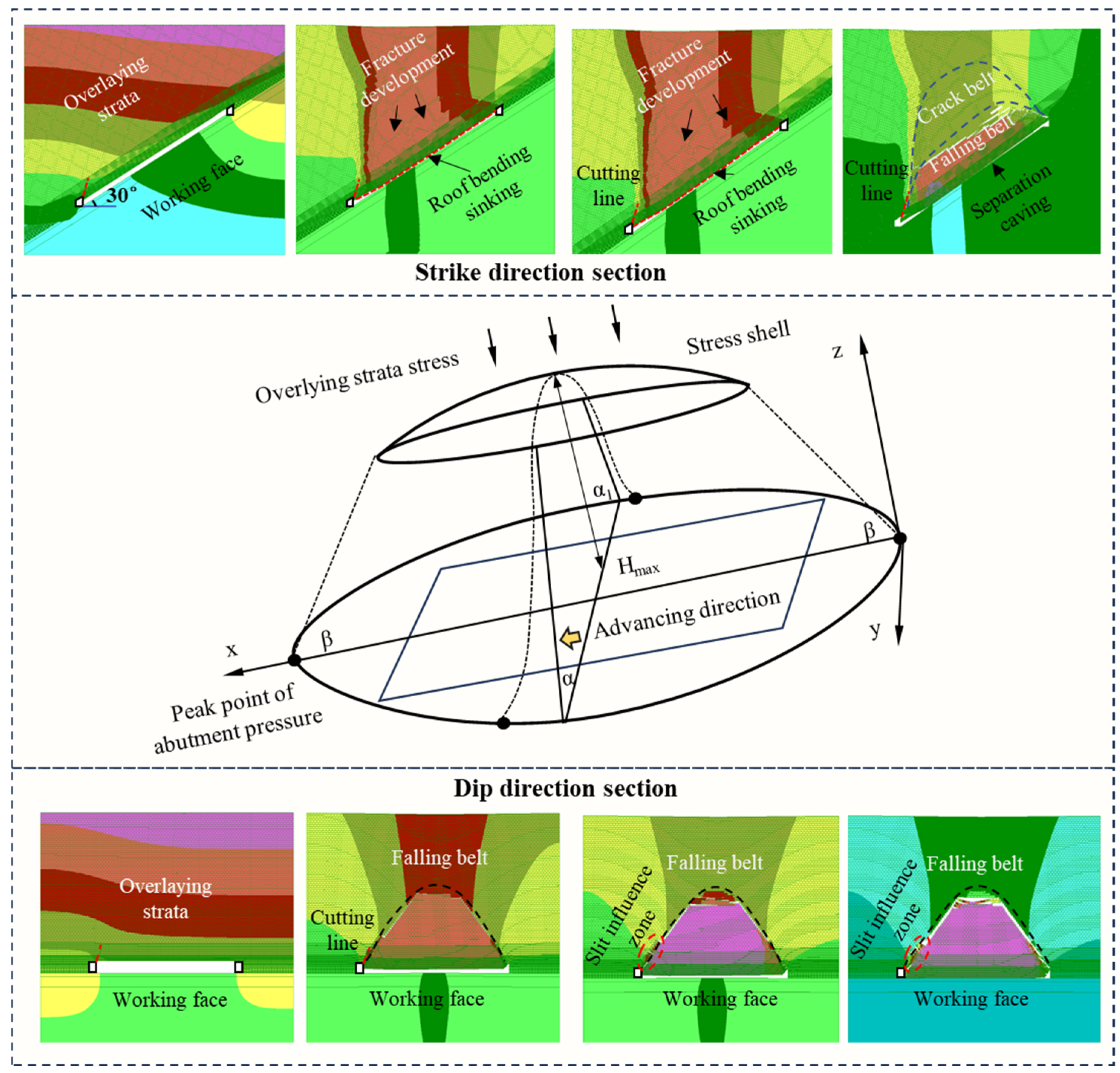
28]. Furthermore, the stabilized strata structure manifests distinctive dip-oriented characteristics under given geological conditions. A schematic representation of stress arch evolution in the NMRRF mining faces of inclined coal seams is illustrated in
Figure 3.
2.1. Mechanical Parameter Testing and Model Establishment for Surrounding Rock
To investigate stress arch evolution in overlying strata of goaf-side entry retaining (GER) mining faces within inclined coal seams, this study conducted rock mechanical parameter testing on representative overburden samples from a typical mining site. Stress evolution patterns in mining-induced strata were systematically analyzed through numerical simulations and theoretical modeling.
2.1.1. Rock Mechanics Parameter Testing
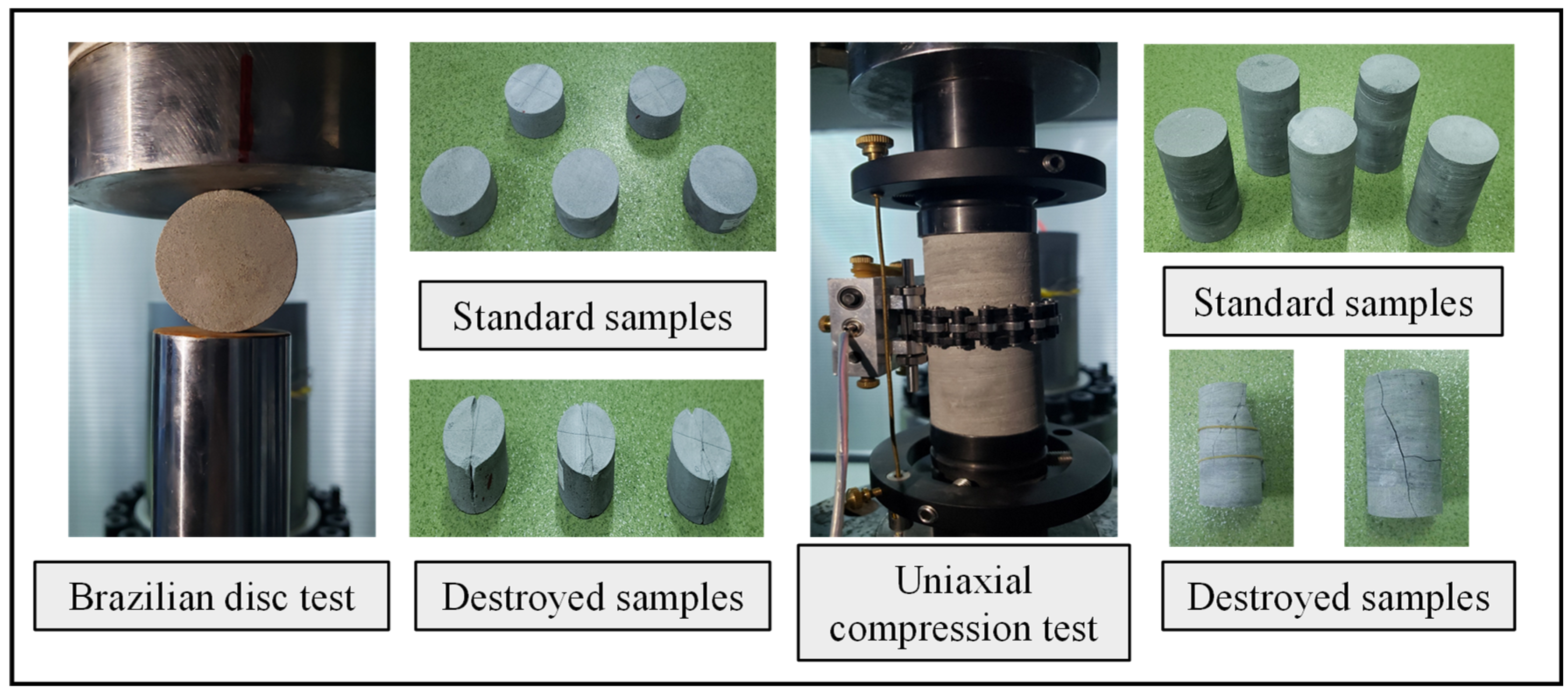
The studied coal mine has a burial depth of 300 m, a coal seam dip angle of 30°, and a mining height of 3.8 m, employing the full-caving method for roof control. Field-drilled rock samples were hermetically sealed, transported to the laboratory, and machined into standard specimens. Laboratory analyses included: tensile parameter testing via the Brazilian disk splitting method, uniaxial compression testing for compressive strength measurement, and triaxial compression testing for comprehensive rock mechanical characterization. Experimental setups and failed specimens are documented in
Figure 4.
- (1)
Rock Tensile Strength Test
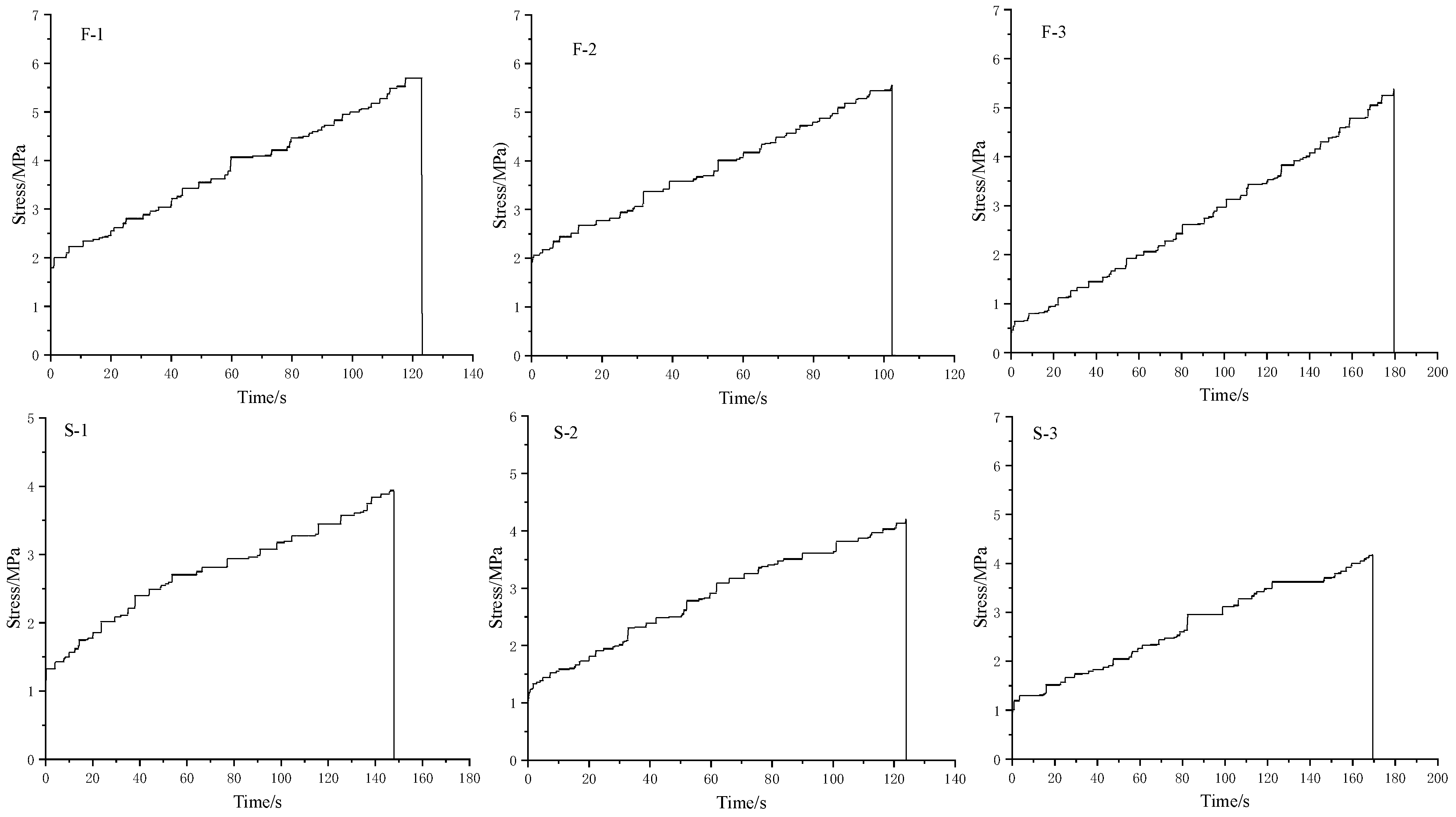
During the initial phase of the experiment, we prepared 10 standard specimens for testing. To obtain high-confidence characteristic parameters for model calibration, we excluded data points that exhibited significant scatter due to factors such as micro-cracks or end-effect artifacts. For each test sample type, three sets of data with the most stable and representative mechanical responses were ultimately selected as the basis for the computational results, thereby ensuring the reliability of the input parameters. The tensile test data curve for rock specimens is presented in
Figure 5, with experimental statistical results summarized in
Table 1. Results revealed average tensile strengths of 5.54 MPa for fine sandstone and 4.1 MPa for siltstone.
- (2)
Rock Compressive Strength Test
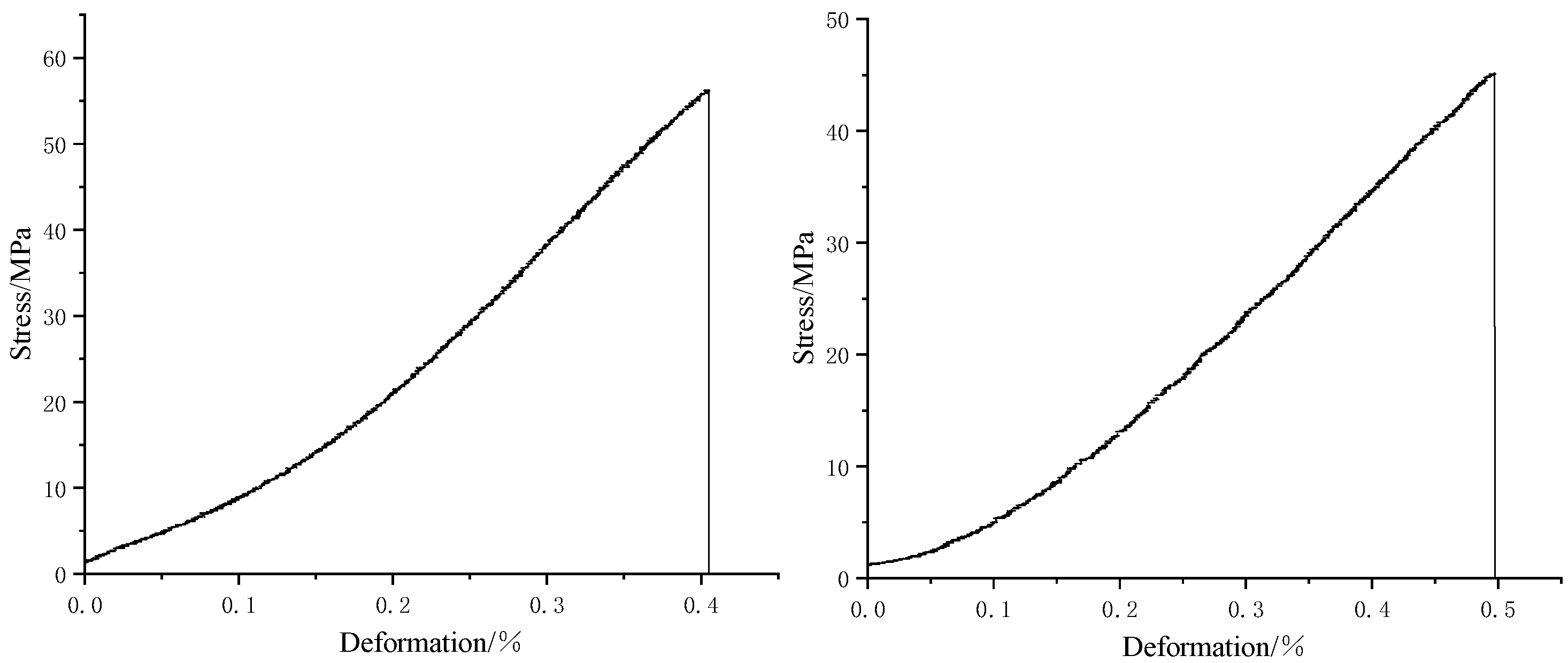
Uniaxial compression tests were conducted on rock specimens. The compressive strength of fine sandstone was measured as 56.2 MPa, and siltstone exhibited a strength of 45.1 MPa. Test curves are displayed in
Figure 6, with statistical outcomes summarized in
Table 2.
- (3)
Triaxial Compression Test
Conventional triaxial compression tests were conducted to investigate rock mechanical properties under confining pressure. Based on measured parameters, the internal friction angle and cohesion of rock specimens were calculated. Tests were performed under confining pressures of 3, 4, and 5 MPa, with statistical results summarized in
Table 3. Using σ
1–σ
3 linear regression analysis on triaxial test data, the following mechanical parameters were derived: fine sandstone—cohesion: 3.42 MPa, internal friction angle: 36.4°; siltstone—cohesion: 2.83 MPa, internal friction angle: 31.7°.
2.1.2. Numerical Simulation Model Establishment
A numerical model was developed to investigate evolution characteristics of overlying strata stress fields during pillarless mining with roof cutting and roadway formation in inclined coal seams, based on the geological conditions of a typical mining project. Mechanical parameters of coal and rock strata are provided in
Table 4.
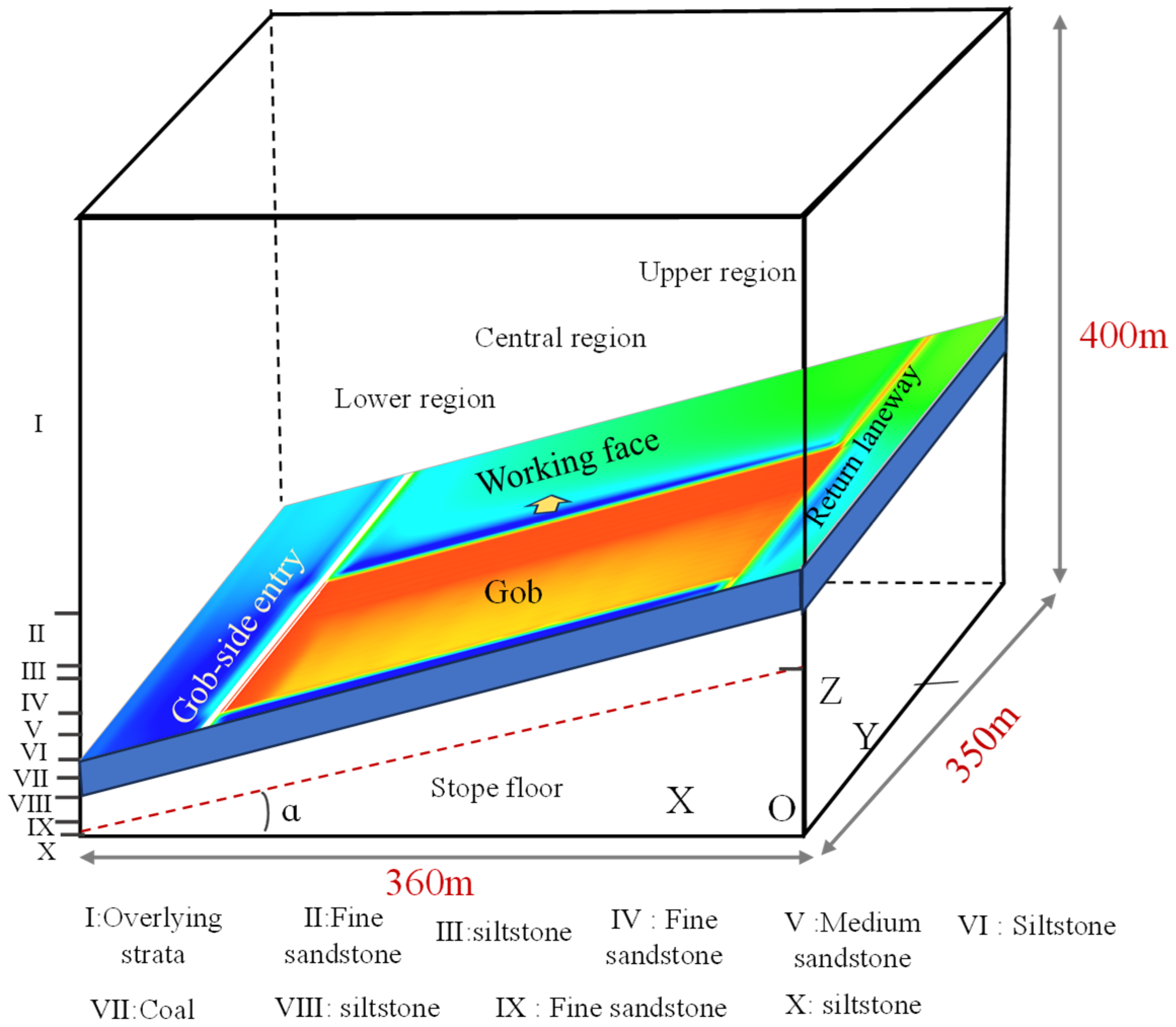
Model Configuration: length: 360 m, width: 350 m, height: 400 m. Mesh: comprising 1,304,940 elements and 1,341,192 nodes (
Figure 7). Working face parameters: length: 260 m, coal seam dip angle: 30°, coal seam thickness: 4 m. Boundary conditions: horizontal displacements constrained at left and right boundaries; vertical displacement fixed at the bottom boundary. The models represent the rock mass at its natural, in situ moisture condition, and that saturation effects or long-term weakening are beyond the scope of this analysis.
Model calculations employ the Mohr–Coulomb yield criterion [
29]:
where
σ1 is the maximum principal stress of the unit body (MPa);
σ3 is the minimum principal stress of the unit body (MPa);
c is the cohesion of the rock mass (MPa);
φ is the internal friction angle of the rock mass (°).
The collapsed rock in the gob area is initially loose and fragmented. As distance from the working face increases, gangue undergoes gradual compaction under its self-weight and the rotational subsidence of the main roof, ultimately stabilizing into a consolidated rock mass with sufficient strength that provides upward support resistance to overlying strata. Gangue strength increases progressively with working face advancement. Based on gob compaction theory, the mechanical behavior of collapsed gangue is modeled using the Double-Yield (DY) constitutive framework [
30]:
where
is vertical stress in the goaf (MPa);
is uniaxial compressive strength of collapsed gangue (MPa);
is strain of collapsed gangue in the goaf; and
is fragmentation coefficient of collapsed gangue in the goaf.
In this study, the Double-Yield model was selected to simulate the mechanical behavior of the caved materials in the goaf. The values of cohesion (c) and internal friction angle (φ) in the model were determined based on a combination of laboratory triaxial test results and back-analysis of surface subsidence induced by mining. The volumetric plastic modulus () was calibrated from laboratory compaction curves to accurately capture the nonlinear deformation behavior of fragmented rock masses during compaction. The uniaxial compressive strength line () was set with reference to empirical values recommended in industry standards for the strength of caved rock masses. These parameters collectively ensure that the model can appropriately represent the core mechanism of gradual compaction and progressive strength recovery of goaf materials under the load of overlying strata.
2.2. Stress Migration Characteristics of Overlying Strata in the Stope
2.2.1. Evolution and Distribution of Abutment Pressure Along the Workface Strike Direction
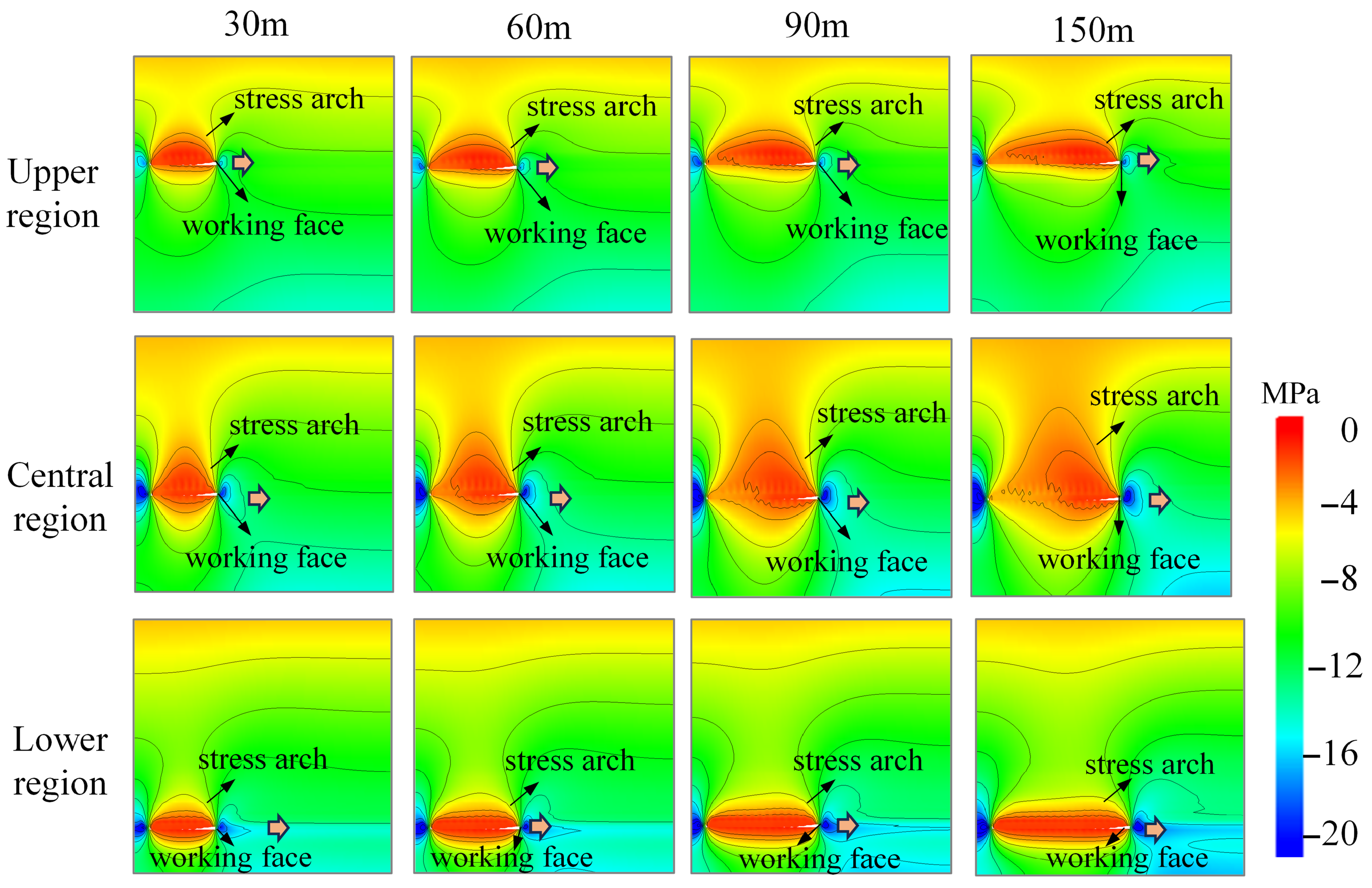
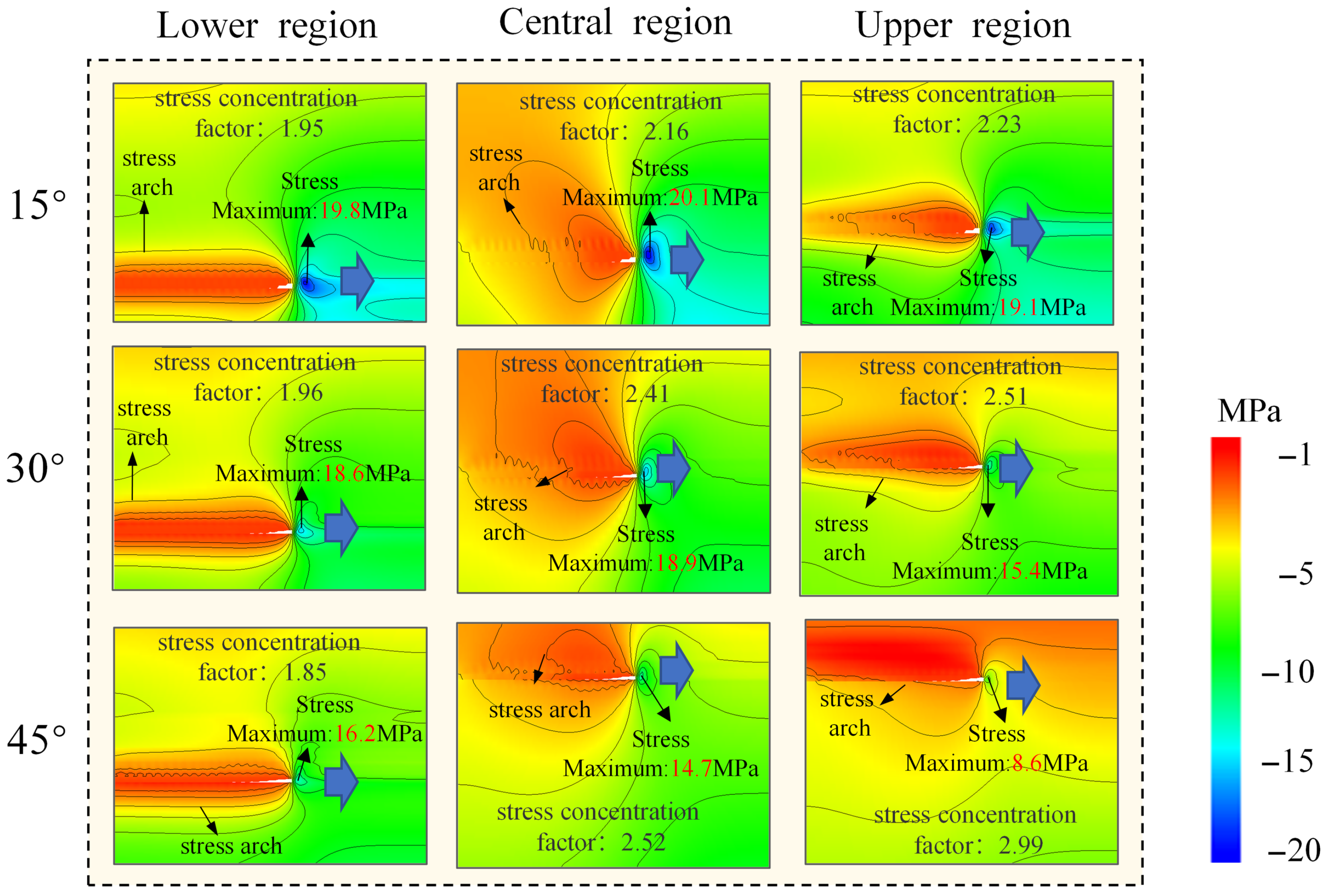
To analyze abutment pressure distribution, cross-sectional profiles at 30, 60, 90, and 150 m of workface advancement were extracted along the strike direction. Three representative positions were selected:
Upper Section: 10 m from the return airway.
Central Section: 180 m from the initial cut (mid-length of the workface).
Lower Section: 10 m from the retained roadway (near the cut-to-fill zone).
Abutment pressure distribution characteristics are shown in
Figure 8, with peak values at different advancement stages summarized in
Table 5.
As shown in
Figure 8 and
Table 5, peak abutment pressure increases with face advance across all sections, though its growth rate decelerates beyond 60 m. A consistent spatial gradient (Lower > Central > Upper), governed by seam dip, is maintained. The stress peak location progressively shifts forward, most notably in the lower section, indicating the evolution of overlying stress arches. Constrained stress relief in the lower section, due to the roof-cutting affected zone, contrasts with the persistently higher stress concentration factor in the upper section. Furthermore, stress relief expansion exhibits stratification-dependent behavior, with less vertical development observed in the lower goaf region.
2.2.2. Evolution and Distribution of Abutment Pressure Along the Workface Dip Direction
Vertical stress distribution programs illustrating the evolutionary process were obtained by extracting central gob-area profiles along the dip direction at advancement distances of 30, 60, 90, 120, 150, and 180 m, as depicted in
Figure 9.
As shown in
Figure 9, when the working face advances 30 m, a stress relief zone forms in the roof and floor strata, while stress concentration zones develop in coal seams on both sides. Surrounding rock in the stress relief zone exhibits tensile stress states. Maximum stress in the stress concentration zone near the roof-cutting roadway reaches 13.8 MPa, with stress contour lines in the relief zone demonstrating approximately symmetrical distribution along the inclined direction. Upon advancing 60 m and 90 m, the stress relief zone in the roof strata begins to display asymmetric characteristics. The middle-upper section exhibits a larger stress relief area than the lower section. Concurrently, stress concentration peaks near the self-formed roadway increase significantly to 16.3 and 18.1 MPa, respectively.
When the face advances 120 m, stress nephogram analysis reveals continuous roof stress relief zone expansion, and stress concentration coefficient growth rates in lateral areas decelerate, with peak stress (19.5 MPa) shifting to roof strata farther from the roadway. Vertical stress recovery occurs in the lower goaf area, indicating enhanced support capacity from compacted gangue.
At 150 m and 180 m advancement stages, the roof stress relief zone develops a distinct asymmetric “inverted J-shaped” stress arch configuration. The maximum relief area in the middle-upper section suggests extensive plastic deformation, while stress relief expansion in the lower section diminishes due to the combined effects of roof-cutting seams and coal seam dip angle. Bilateral stress concentration peaks stabilize at 20.5 and 21.3 MPa, showing minimal increase compared to the 120 m stage.
2.2.3. Spatial Evolution and Distribution Characteristics of Stress in Overlying Strata of the Stope
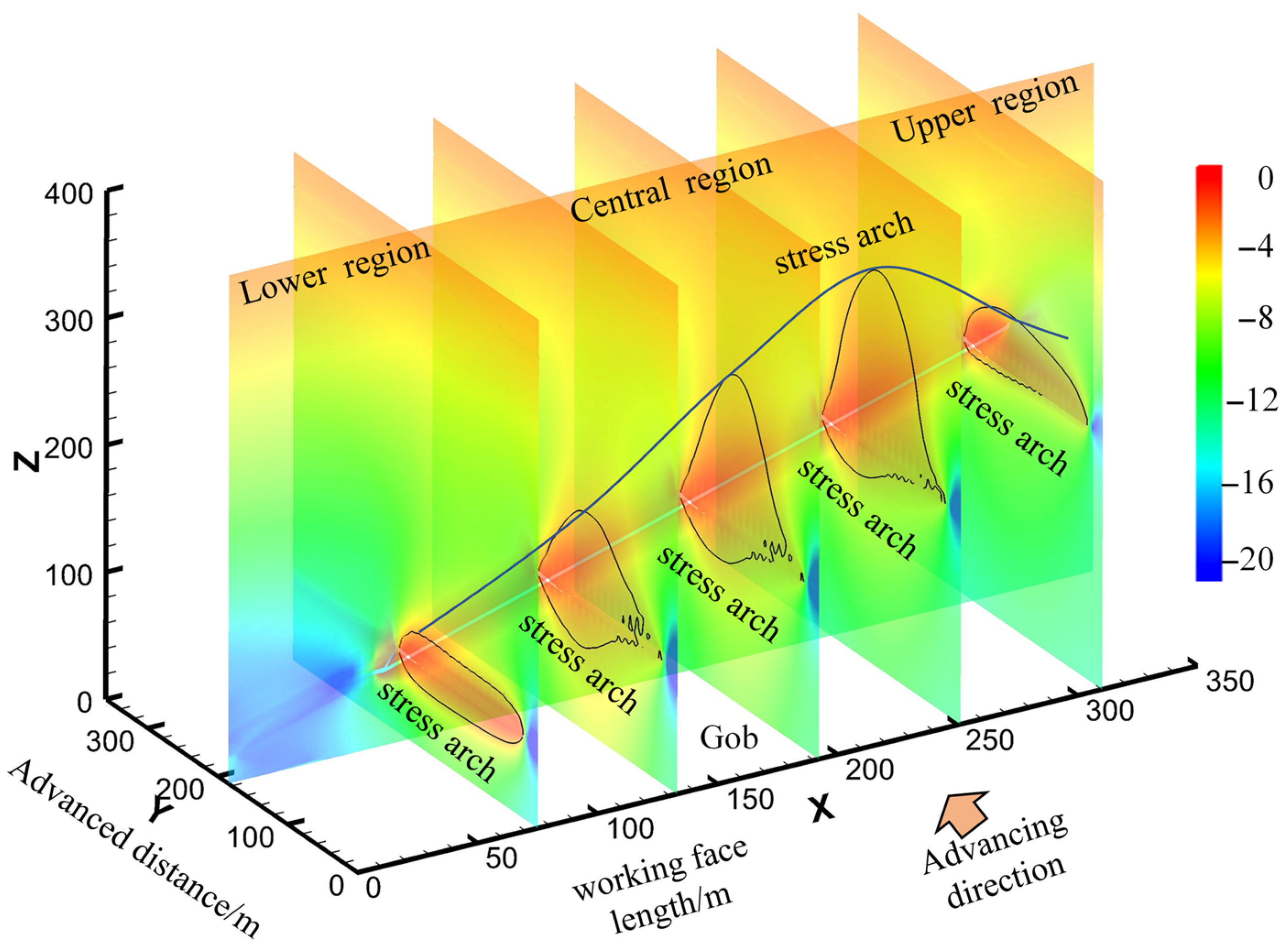
Stress distribution profiles along both dip and strike directions of a 150 m-advanced NMRRF stope in an inclined coal seam were extracted and combined to reconstruct the fundamental contour of stress arch distribution, as illustrated by the stress arch in
Figure 10. The composite stress arch in the overburden of the inclined coal seam stope exhibits an asymmetric stress arch structure, with the apex located in the upper-central region of the gob area. Additionally, the height of the stress arch in the upper section of the workface surpasses that in the lower section, a phenomenon attributed to differential stress redistribution caused by coal seam dip angle and asymmetric compaction of collapsed strata.
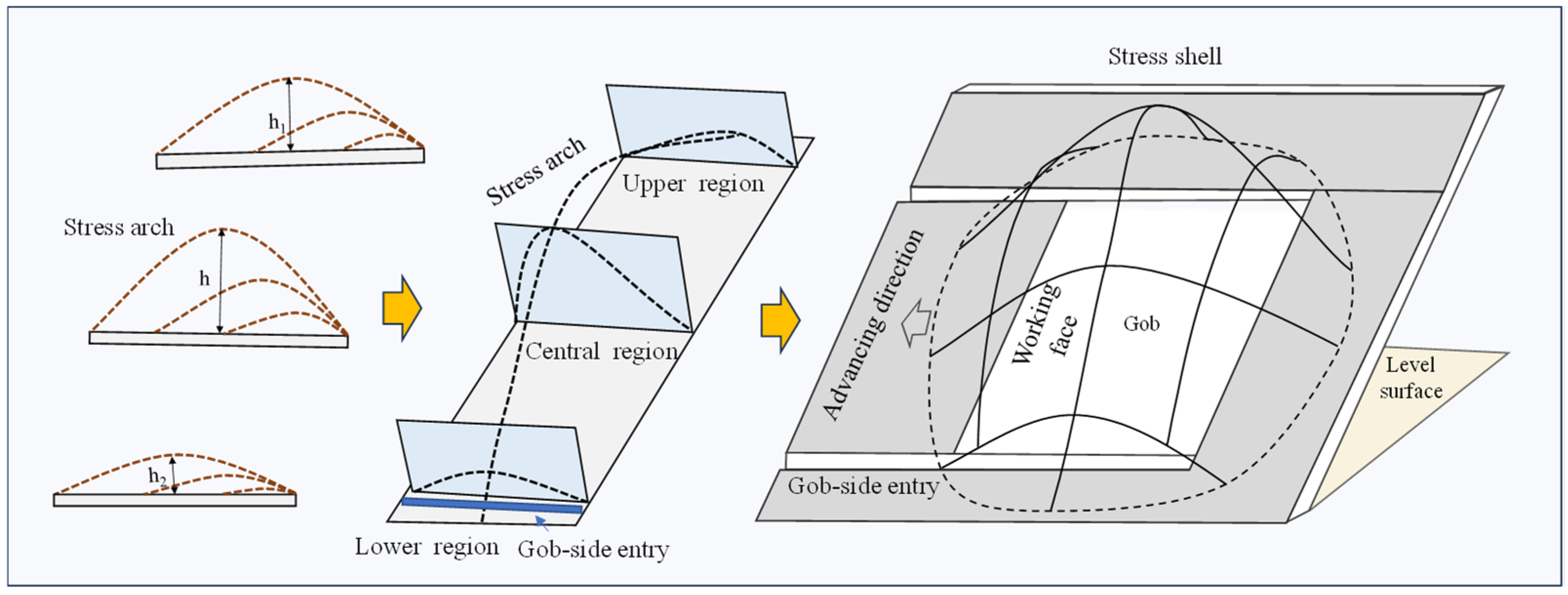
As illustrated above, stress arch evolution during workface advancement exhibits dual-directional dynamics: along the strike direction, a stress arch forms with its abutments anchored at front and rear coal walls and its apex at the midpoint of the advancement span, where the frontal abutment and arch apex progressively migrate forward and upward with ongoing advancement until stabilization; concurrently, along the dip direction, the initially symmetric stress arch (centered at the workface midpoint) transitions into an asymmetric stress shell as the apex shifts toward the upper-central workface region, ultimately establishing a structure with abutments at upper and lower coal walls and a top near the mid-upper workface zone, governed by differential stress redistribution and strata compaction asymmetry in inclined seams. The evolution process of the stress shell is shown in
Figure 11.
2.2.4. Influence of Coal Seam Dip Angle on Stress Distribution in NMRRF
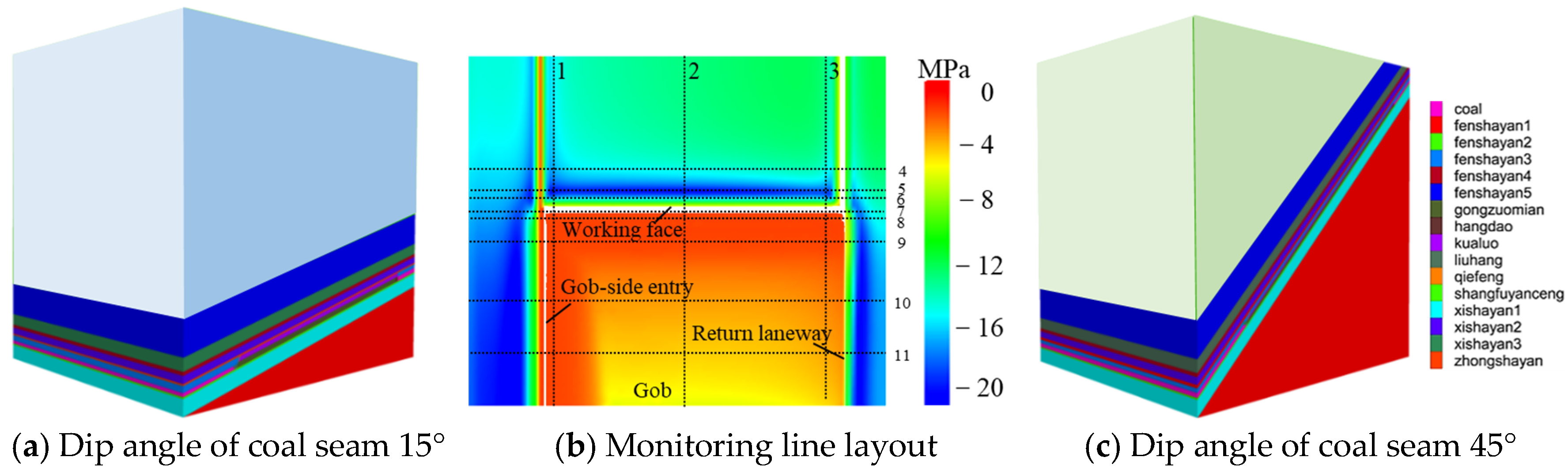
Numerical calculation models with coal seam dip angles of 15° and 45° were established, respectively, and subjected to simulated excavation. Other parameters, including model boundary conditions, working face length, and roadway cross-sectional dimensions, remained consistent with the 30° model described in
Section 2.1.2. The model configurations and the layout positions of monitoring lines are shown in
Figure 12.
To analyze the influence of coal seam dip angle on stress distribution, vertical stress contour maps and corresponding stress data at monitoring lines 1, 2, and 3 (located in the upper, middle, and lower sections of the goaf, respectively) were extracted when the working face had advanced 150 m, as shown in
Figure 13.
The simulation results indicate that a smaller coal seam dip angle leads to a higher stress peak ahead of the working face. The stress concentration factors ahead of the working face are relatively similar for the three dip angles. However, the variation in the stress concentration factor across different locations along the working face exhibits distinct characteristics. The stress concentration factor is smallest at the lower part of the working face for a dip angle of 45°. In the middle and upper sections of the working face, the vertical stress concentration factors follow the relationship: 45° > 30° > 15°. Under the three dip angle conditions, the difference in stress concentration factors is more pronounced at the upper location, suggesting a greater extent of surrounding rock failure in the upper part of the working face, leading to more pronounced stress concentration ahead of the face.
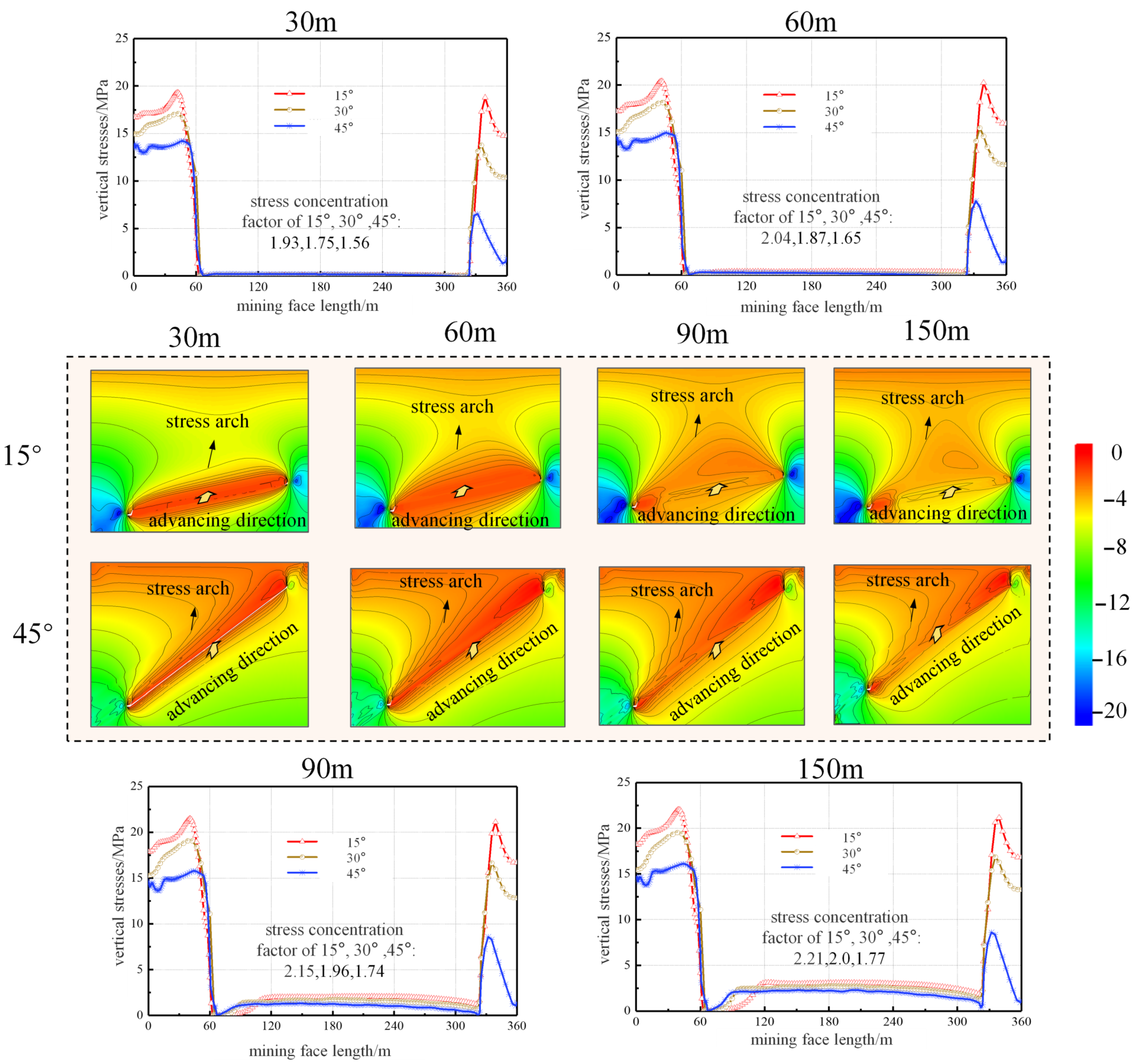
To analyze the influence of coal seam dip angle on abutment pressure along the dip direction of the working face, vertical stress contour maps and stress data curves of the goaf were extracted at working face advances of 30 m, 60 m, 90 m, and 150 m, as shown in
Figure 14.
The figure above shows that the magnitude of the stress concentration factor, for different dip angles at various advance positions, consistently follows the sequence: 15° > 30° > 45°. The stress relief zone within the roof strata exhibits significant asymmetry. The stress relief zone in the middle-upper part of the working face is notably enlarged, and this asymmetry becomes more pronounced with the increasing dip angle. This indicates that, for inclined coal seams, the dip angle influences the height of propagation of the stress in the overlying strata. A larger dip angle leads to a greater propagation height of roof stress, primarily observed in the middle-upper section of the working face.
3. Shape Equation of the Stress Arch in the NMRRF Stope in Inclined Coal Seams
3.1. Analytical Model Establishment
During NMRRF mining in inclined coal seams, a stress shell forms within a three-dimensional spatial range in the overlying strata of the stope. The boundary of this shell corresponds to a strength envelope conforming to specific failure criteria. As the working face advances, the stress arch shell boundary continuously extends toward the upper roof of the goaf until stabilizing into an asymmetric distribution pattern. The following assumptions are established:
(a) Geotechnical Conditions: Stope burial depth exceeds 300 m, with roof management employing the complete caving method. Geological structures and roadway excavation effects on the stress arch shell are neglected. Homogeneous mechanical properties are assumed for coal and rock masses in the stope.
(b) Stress Arch Configuration: The overlying stress arch adopts an arched morphology. Overburden fracture lines on both sides of the working face are simplified as linear geometries with fracture angle β. Rock masses in caved and fractured zones are treated as granular media.
(c) Rock masses beyond caved and fractured zones exhibit elastoplastic behavior; surface soil layers are considered loose materials, and loads from surface soil layers are uniformly transferred to underlying strata.
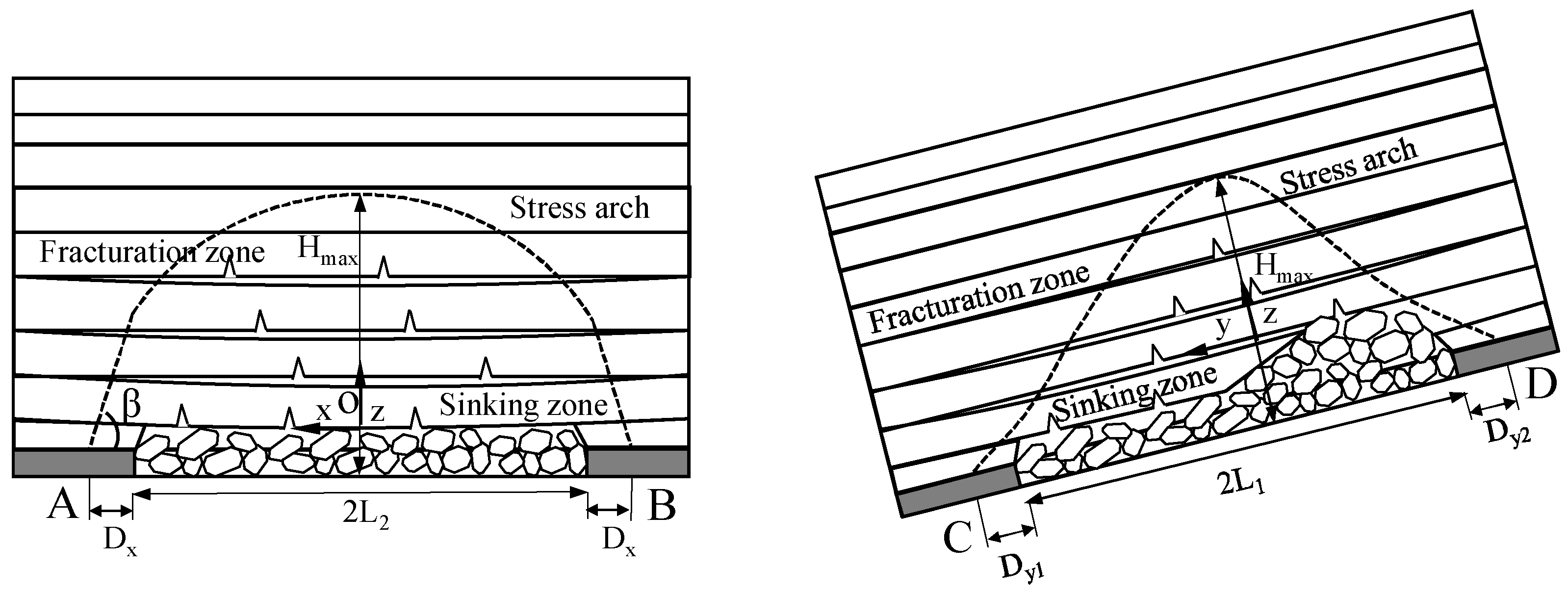
Based on these characteristics and assumptions, an analytical model is constructed, as shown in
Figure 15.
In the diagram, the positive X-axis direction corresponds to mining advancement, the positive Y-axis aligns with the dip direction, and the positive Z-axis represents burial depth. The working face has length 1, with the XOY plane representing the mined coal seam, the XOZ plane denoting the strike profile, and the YOZ plane indicating the dip profile. When the working face advances by 2 (where ), the midpoint of advancement distance coincides with the midpoint (point O) of the working face. Points A, B, C, and D mark intersections between the stress arch shell’s basal boundary and the four edges of the working face, with distances , , , and from the coal wall, respectively. The vertical distance from the highest point of the stress arch shell to the working face floor is .
3.2. Establishment of Shape Equation
According to the analytical model, the three-dimensional asymmetric stress arch shell shape in the upper part of the NMRRF stope in inclined coal seams can be expressed as:
Along the strike direction, the stress arch shell in surrounding rock above the working face has an elliptical distribution in the XOZ plane:
The stress shell in surrounding rock inside the coal wall around the working face is elliptical in the XOY plane:
Distances from the coal wall to the basal boundary of the stress arch shell along the four edges of the working face, along with arch height, exhibit continuous evolution with nonlinear function curve characteristics during overlying strata stabilization. These parameters are governed by mining conditions and geological factors, including coal seam dip angle (α), roof strata strength (
M), coal seam burial depth (
S), mining advance distance (
x), and mining velocity (
F). Their combined influence can be expressed as:
The three-dimensional asymmetric stress arch shell morphology, expressed as , can be determined through the following system of equations derived from curve fitting of field measurement or experimental data:
(1) When
, with
,
in Formula (4), the three-dimensional asymmetric stress arch shell shape equation of the stope can be determined by the following equations:
(2) When
, the fault line of the overlying rock inside the coal wall on both sides of the working face is simplified to a straight line, and it is considered that the exterior of the stress shell in the overlying rock layer is in the form of a straight line. In formula (5),
,
, the three-dimensional asymmetric stress arch shell shape equation of the stope can be determined by the following equation set:
(3) When
,
,
in Formula (5), the three-dimensional asymmetric stress arch shell shape equation of the stope can be determined by the following equations:
The macro three-dimensional asymmetric stress arch shell shape equation is obtained by simultaneous Equations (7)–(9):
4. Structural Stability Analysis of Key Overlying Rock Blocks in the NMRRF Stope in Inclined Coal Seams
4.1. Structural Characteristics of Overlying Rocks in Different Areas of the Stope
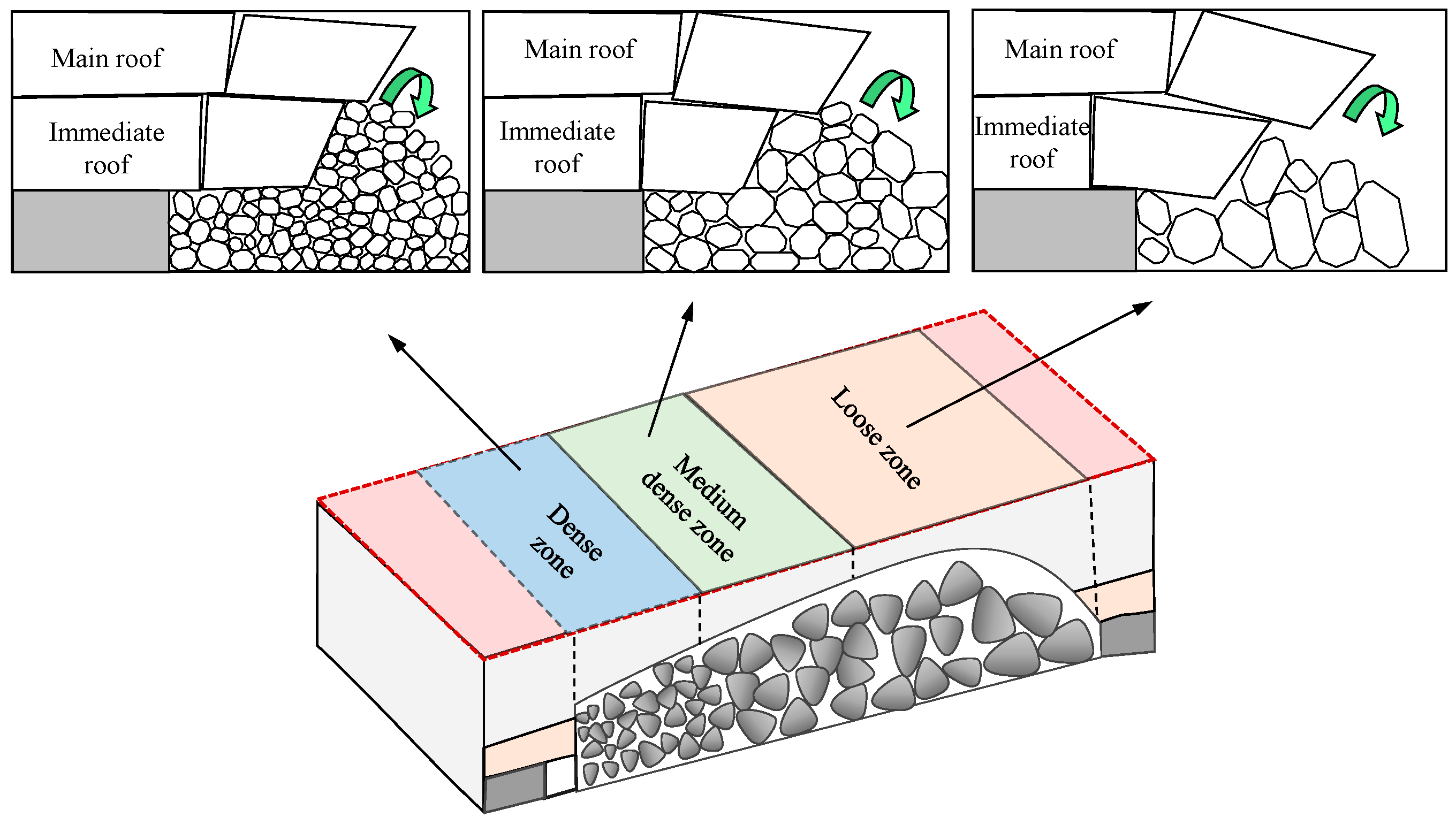
During the structural stabilization of overlying strata in inclined coal seams under NMRRF, the combined influence of coal seam dip angle and roof-cutting operations induces spatially heterogeneous compaction of collapsed roof debris along the face dip direction. Gravitational migration of upper gangue toward the lower face creates three distinct zones: an upper loose region due to incomplete goaf filling, a central medium-dense zone, and a lower dense zone. Constraint mechanisms vary significantly: in the upper region, insufficient gangue support fails to anchor the immediate roof, causing its fracture line to propagate ahead of the coal face; subsequent main roof rotation experiences amplified angular displacement and prolonged periodic weighting duration due to delayed contact with gangue. In the central zone, gangue basically fills the mining space, providing certain support for overlying rock formation. Immediate roof fracture location is near the coal wall. In the lower zone, high-density gangue packing generates robust upward resistance, shifting fracture initiation behind the coal face, as illustrated in
Figure 16.
When extraction length equals working face length, migration of the overlying strata’s spatial structure is essentially completed, forming a stable configuration. Roof space development of caved, fractured, and bent subsidence zones has fully matured. With continued face advancement, three-zone heights cease vertical development while horizontal lengths progressively extend forward. Caving space boundary along strike direction manifests as boundary blocks formed by the fracture of the immediate and main roofs from bottom to top. A key block structure forms in the upper part of the caving area, as illustrated in
Figure 17.
A UDEC discrete element simulation model was established for NMRRF in an inclined coal seam (30° dip angle) based on typical working face geological conditions. A 4.75 MPa load was applied to the model’s upper boundary, while constraints were imposed on lateral and lower boundaries. After parameter assignment, excavation simulations were conducted. Comparative analysis was performed on overburden structural diagrams across four distinct phases: initial excavation, fracture initiation and bending deformation, delamination and collapse, and stabilized strata movement. Structural evolution is illustrated in
Figure 18.
The model discretizes the rock mass into irregular polygonal blocks through the definition of multiple dominant structural planes (e.g., bedding planes, joints) with specified spatial orientations and spacing, thereby controlling the fracturing pattern of the rock layers. The rock strata are generated layer-by-layer according to the actual geological profile, with distinct mechanical properties assigned to each layer to represent a heterogeneous, stratified structure. The mesh is discretized using adaptive triangular elements, with local refinement applied in critical zones such as excavation boundaries and fault vicinities, ensuring the accurate capture of stress concentrations and failure mechanisms. The overall modeling framework constitutes a composite computational system characterized by a discrete structural plane network, layered rock mass, and a non-uniform mesh. Joint parameters of the coal and rock strata used in the numerical model are provided in
Table 6.
Figure 18 shows that overburden movement in NMRRF for inclined coal seams can be summarized as follows: After excavation, strata movement states at different phases were extracted based on simulation steps. Initially, no displacement occurs; however, with increasing simulation steps, displacement evolves under stress, initiating fractures at the roof-cutting side and within the immediate roof, which propagate upward. Concurrently, the roof exhibits progressive bending subsidence. When bending subsidence reaches elastic deformation limits, fracture propagation triggers collapse. Fractures first concentrate near the roof-cutting slit and upper-middle section of the working face, where slit-induced disturbances weaken original roof strength, leading to prioritized plastic failure under stress. Fractures in the upper-middle section result from excessive internal forces exceeding strata bearing capacity. As the simulation progresses, overburden movement stabilizes, forming an asymmetric caving arch with an apex in the upper-middle section. The upper part of the caving arch corresponds to the stress arch zone. The three-dimensional asymmetric stress field in the final stabilized state aligns with stress analysis presented earlier.
4.2. Stability Analysis of Overlying Rock Structure
In the NMRRF stope in inclined coal seams, the main roof’s maximum deflection position and fracture location occur in the upper middle section. As the working face advances, rock collapse height at both sides extends to main roof level without further upward development, influenced by coal wall support. In the central area, after collapse reaches the upper main roof, fractured blocks interlock to form a voussoir beam structure, with key blocks forming in the upper area of the collapsed arch. Each overlying stratum can be simplified as a cantilever beam fixed at the lower end and simply supported at the upper end. After stabilization along strike direction, the resulting stable structure manifests as an inverted J-shaped configuration.
4.2.1. Mechanical Model of Beam Structure in Key Block Area
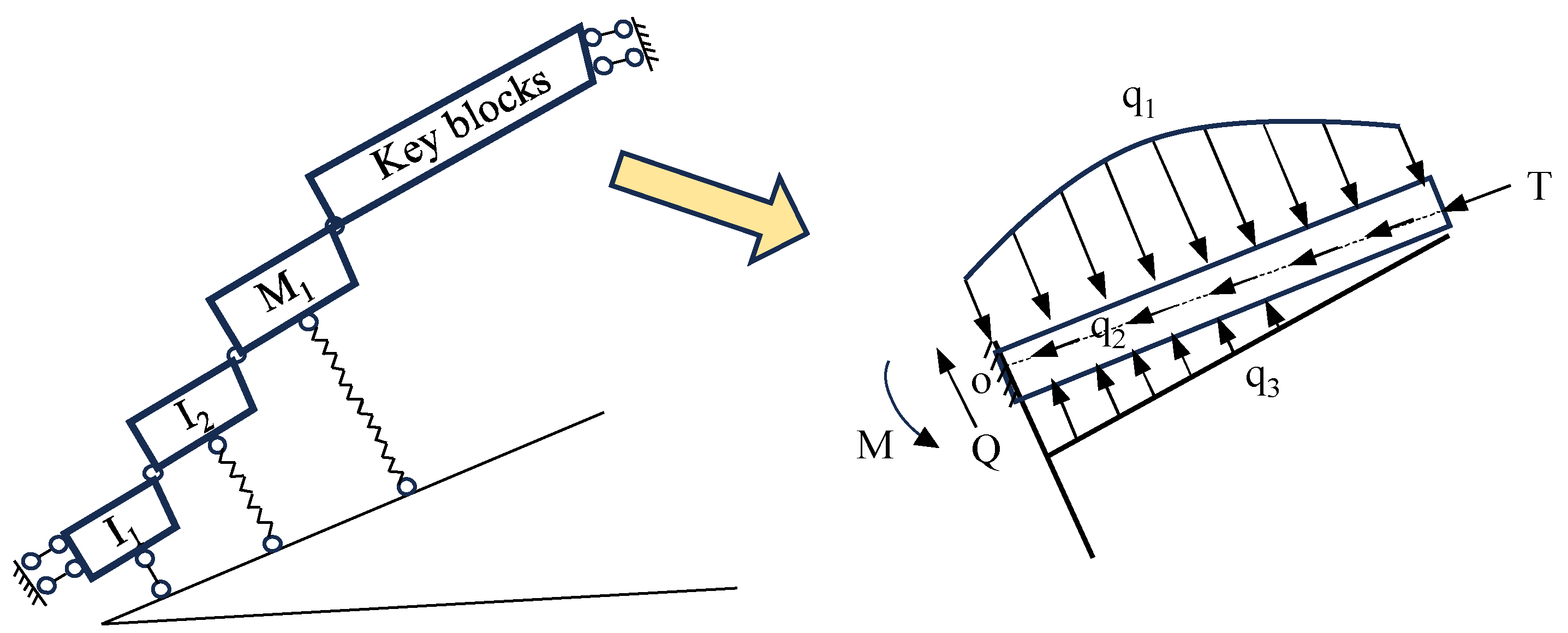
In lower and central zones, overlying strata are subjected to gangue support, exhibiting smaller rotational subsidence space compared to the upper zone. Partial absence of collapsed gangue in the upper area increases instability tendency of key blocks. Therefore, structural stability of overlying strata in the upper area is analyzed. The key block is extracted to establish a mechanical analysis model, as illustrated in
Figure 19. Forces include overburden loads, tangential forces from articulated rock blocks, and asymmetric support loads from gangue. Based on stress arch morphology, overburden load can be simplified as an arch-distributed non-uniform load. Gangue support beneath the key block shows asymmetric distribution—abundant in lower section and absent in upper—idealized as an asymmetric load.
The non-uniform load
acting along the normal direction of the key block can be decomposed into: uniform load
, and non-linear load
. Thus:
Parameters: H: fracture development height; : key block thickness; : key block length; : unit weight of overlying strata.
Tangential action load of articulated rock blocks (
):
Self-weight tangential load (
):
Gangue support reaction (
):
where
is support reaction provided by goaf gangue at midspan.
4.2.2. Stability Analysis of Key Block Structures
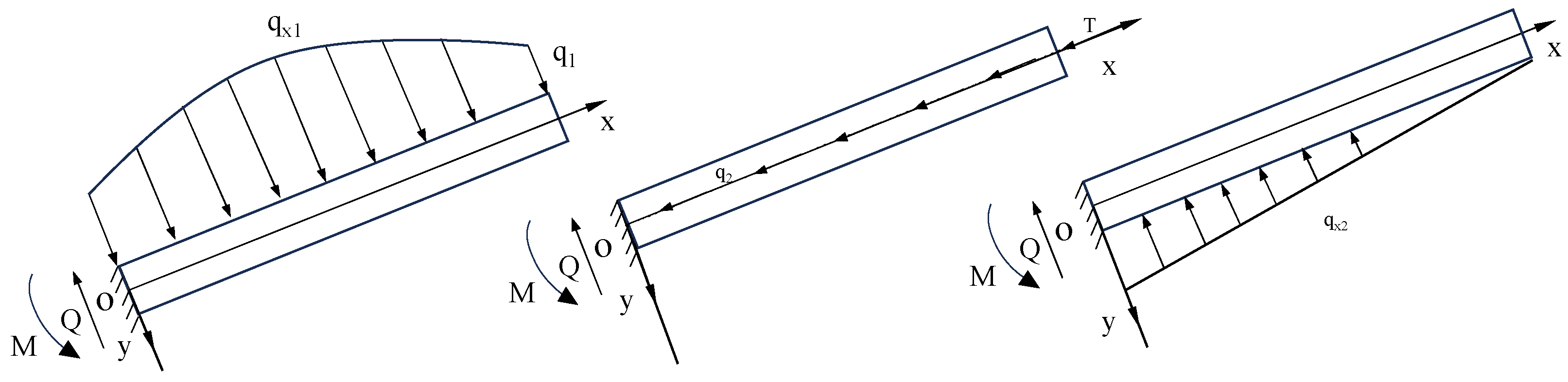
The key block structure’s flexural deformation and stress distribution conform to superposition principle. Mechanical behavior can be decomposed into cantilever beam structures under different loading conditions, as illustrated in
Figure 20.
Key blocks in the upper area are subjected to symmetrical arched nonlinear loads
. when
,
. From torque balance:
An expression for the stress distribution inside the key block can be expressed as:
The key block is subjected to the joint action of the load transferred by the rock beam in the dip direction and the tangential load at the boundary of the overlying rock layer. The internal stress distribution form of the key block under the action of the tangential load can be obtained as follows:
The load on the lower part of the cantilever beam supported by the gangue is (
).
, when
,
, analysis from the moment balance formula can be obtained:
Under the action of load
inside the key block, the stress distribution expression can be expressed as:
The internal stress of the key block in the upper area of the NMRRF stope in inclined coal seams under different loads is:
Substituting Equations (19)–(21) into (22), it can be seen that the stress expression of the key block in the local region is:
Analysis demonstrates significant differences in stress states across various zones. Variations in internal stress distribution among key blocks are closely correlated with mining conditions, geological factors, and constraints. In the upper area, key blocks experience minimal gangue support and are prone to tensile failure under tangential stresses. Simultaneously, fixed-end regions undergo shear failure due to concentrated shear stresses.
4.2.3. Analysis of Instability Modes of Beam Structures in Key Block Areas
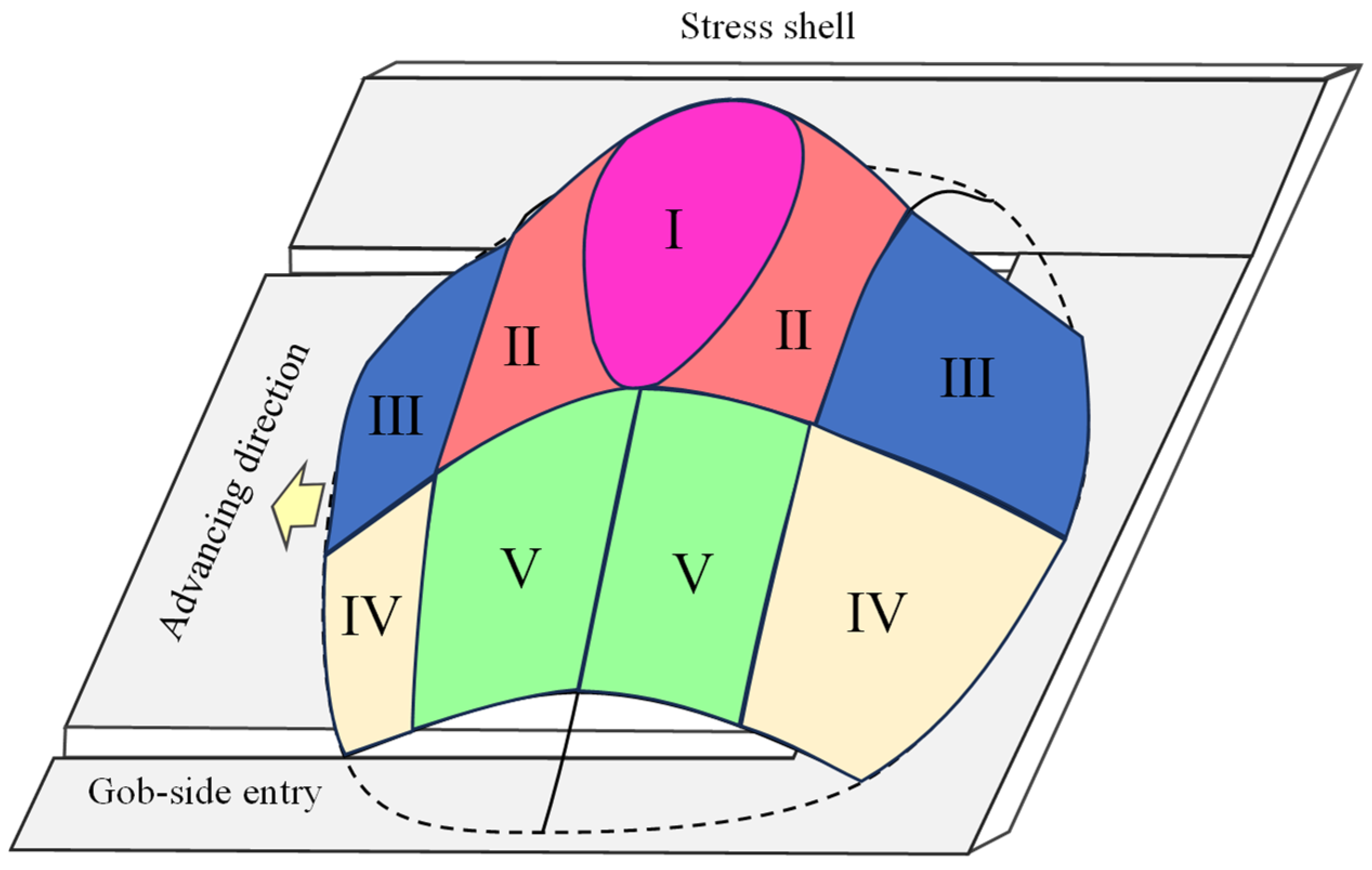
In summary, as the working face advances, collapse and stress arches emerge within overlying strata. These evolve dynamically until overburden movement stabilizes, forming an inclined step structure along dip direction and an integrated shell arch structure across the stope. The shell arch comprises five critical zones: Shell Crown Zone I (upper main roof), Shell Shoulder Zone II (main roof key block area), Shell Base Zone III (lower main roof), Shell Base Zone IV (immediate roof base), and Shell Shoulder Zone V (immediate roof key block area). Shell structures in different areas mesh with each other, and rock masses in key locations interact through dip ladder structure. The stability of key blocks governs the overall shell arch integrity, as shown in
Figure 21.
Destabilizing key blocks in specific zones triggers cascading failures. Based on spatiotemporal relationships, three failure modes are categorized:
(a) Immediate roof key block zone: Initial failure at collapse shell arch base (Zone IV) in lower stope propagates upward to destabilize shell shoulder (Zone V), triggering sequential instability through strike-direction load transfer. Failure sequence: IV → V → II → I → III. Mechanism: lower base failure → upper shoulder stress concentration → crown-base coupled collapse.
(b) Main roof key block zone (upper stress shell): Failure initiation at stress shell base (Zone III) in upper stope propagates to shoulder (Zone II) and crown (Zone I), destabilizing interlocked lower key blocks. Failure sequence: III → II → I → V → IV. Mechanism: upper base shear failure → crown tensile rupture → lower block disengagement.
(c) Main roof key block zone (upper-stress shell crown): Crown-initiated failure at Zone I disrupts shoulder integrity (Zone II), causing progressive decoupling of lower blocks. Failure sequence: I → II → III → V → IV. Mechanism: crown tensile fracture → shoulder shear slip → lower block hinge failure.
5. Discussion
In the application of Non-Pillar Mining with Retained Roadway (NMRRF) in inclined coal seams, the spatial heterogeneity of goaf support effectiveness leads to differential stress distribution along the dip direction and uneven loading on hydraulic supports. Based on the revealed mechanical model of the “asymmetric three-dimensional stress shell,” the mining area can be divided into upper and lower mechanical units with distinct instability mechanisms. The lower section, located within the immediate roof key block zone, benefits from well-compacted goaf debris that provides effective support, functioning similarly to an “invisible load-bearing structure” responsible for local stability. In this region, support strategies should emphasize monitoring and roof integrity control, with the initial setting load referenced to the lower limits specified in relevant standards. In contrast, the upper section—situated within the main roof key block zone—faces significant risks of key block rotation instability and dynamic pressure manifestations due to insufficient goaf support and its location within high-stress transfer paths. It is imperative to strictly adhere to the mandatory clauses for “enhanced support and intensified monitoring” in high dynamic pressure areas, as outlined in the Coal Mine Safety Regulations. Support resistance must be determined based on the morphology of the three-dimensional stress shell to balance the rotational moments of key blocks, and a real-time rock pressure warning system must be established. This zoning control theory, grounded in the three-dimensional stress shell, provides a new design paradigm for surrounding rock control in inclined coal seams following the elimination of traditional coal pillars, effectively bridging the gap with existing regulatory frameworks.
This study preliminarily investigates the stress evolution in inclined coal seam mining faces through numerical simulation and theoretical analysis. However, purely numerical methods exhibit inherent limitations. First, the results are highly sensitive to the accuracy of input parameters, which are often subject to uncertainty in acquisition. Second, the models rely on simplified assumptions, making it difficult to fully capture the heterogeneity, anisotropy, and complex structural networks of real geological bodies. Furthermore, the outcomes are significantly influenced by mesh discretization and boundary conditions, and they cannot spontaneously generate failure modes not predefined in the model. Therefore, this research remains incomplete and requires further validation through field measurements to confirm the reliability of its predictions for engineering applications.
6. Conclusions
(1) During NMRRF mining in inclined coal seams, a stress arch develops along strike direction, anchored at the front and rear coal walls with an apex at mid-advancement zone. Progressive face advancement drives continuous upward and forward evolution of the frontal abutment and arch crown.
(2) Along dip direction, stress arch crown is located in the upper-central section. Rock mass exhibits asymmetric stress shell structure with apex in upper-central goaf area. Shell boundary is a strength envelope compliant with Mohr–Coulomb failure criterion.
(3) Distinct immediate roof fracture lines emerge across different zones. Overlying strata along dip direction form boundary blocks by fracturing immediate and main roofs. Key blocks in upper area experience reduced gangue support, rendering them prone to tensile failure under tangential stress, while fixed-end zones exhibit shear failure susceptibility due to concentrated shear stresses.
(4) Stress shell structure comprises five critical zones. Interlocked key blocks interact via dip-directional stepped configurations, where block stability fundamentally governs global shell arch integrity. Three instability modes are proposed based on spatiotemporal failure sequences.
(5) Given dip-directional stress concentrations, different key block instability modes, variance in support working resistance, and proactive adjustment of initial setting loads for hydraulic supports is recommended during face advancement to mitigate structural destabilization from inadequate support capacity-to-load ratios.
Author Contributions
Conceptualization, E.Z. and Y.W.; methodology, S.D.; software, E.Z.; validation, J.L.; formal analysis, T.W.; investigation, J.L.; resources, J.L.; data curation, T.W.; writing—original draft preparation, E.Z.; writing—review and editing, Y.W.; visualization, S.D.; supervision, Y.W.; project administration, E.Z.; funding acquisition, E.Z. All authors have read and agreed to the published version of the manuscript.
Funding
This work was supported by Anhui Provincial Excellent Young Teacher Cultivation Project (YQYB2025037), Anhui Provincial Department of Education Natural Science Research Youth Project (2025AHGXZK40197), and Humanities and Social Sciences Research Project of Anhui Universities (2024AH053273). The authors gratefully acknowledge this support.
Data Availability Statement
The data used to support the findings of this study are included within the article. Additional data are available from the corresponding author upon reasonable request.
Conflicts of Interest
Author Jun Luo was employed by the Ningxia Communications Construction Co., Ltd. Author Shizhuo Dong was employed by the Beijing China Coal Mine Engineering Co., Ltd. The remaining authors declare that the research was conducted in the absence of any commercial or financial relationships that could be construed as a potential conflict of interest. The authors declare that they have no known competing financial interests or personal relationships that could have influenced the work reported in this paper.
References
- He, M. Theory and engineering practice for non-pillars mining with automagical entry formation and 110 mining method. J. Min. Saf. Eng. 2023, 40, 869–881. [Google Scholar]
- Wang, Y.; Du, F.; Zhang, J.; Pei, Y.; Wang, J.; Yang, J.; Chen, H.; Chen, J.; He, M. Mechanism-informed overburden control based on granular load-bearing body: Application in shallow-buried coal seams. Tunn. Undergr. Space Technol. 2026, 170, 107382. [Google Scholar] [CrossRef]
- Wang, Y.; He, M.; Zhang, J.; Wang, Q.; Yang, J.; Hou, S. Roof Control Mechanism and Design Methods of Gob-Side Entry Retained by N00 Coal Mining Method. Rock Mech. Rock Eng. 2024, 57, 621–638. [Google Scholar] [CrossRef]
- Gai, Q.; He, M.; Gao, Y.; Li, S. Mechanism of Floor Damage Reduction in Non-pillar Mining with Automatically Formed Roadway: A Model Test Study. Rock Mech. Rock Eng. 2025, 58, 9573–9600. [Google Scholar] [CrossRef]
- Sun, X.; Jiang, M.; Zhang, T.; Miao, C. A Novel Method of Deep and Shallow Combined Roof Cutting and Constant Resistance Support for Enhancing Deep Mining Roadway Stability. Min. Metall. Explor. 2025, 42, 1421–1440. [Google Scholar] [CrossRef]
- Wang, H.; Jiang, J.; Wang, J.; Liu, P.; Wang, R.; Wang, J.; Hou, S.; He, M.; Ma, L. Experiment research on the control method of automatically retained entry by roof cutting pressure relief within thick hard main roof longwall top coal caving panel. Eng. Fail. Anal. 2025, 168, 109085. [Google Scholar] [CrossRef]
- Wang, J.; Liu, P.; He, M.; Yu, G.; Tian, H. Floor heave mechanism for gob-side entry retaining with concrete blocks and control method: A case study. Undergr. Space 2024, 15, 244–259. [Google Scholar] [CrossRef]
- Zhang, X.; Yang, J.; Gao, Y.; Xue, H.; Guo, P.; He, M. Pressure-relief technique and its application based on seam-cutting compensation in high-stress roadway. J. China Coal Soc. 2024, 49, 4377–4389. [Google Scholar]
- Zhang, H.; Zhang, J.; Xu, Z.H.; Zhang, J.W.; Du, S.L.; Wei, S.R.; Li, X.J. Overburden breakage and surface damage evolution under high-intensity mining of shallow coal seams: Evidence from Shendong mining area. Sci. Rep. 2025, 15, 23152. [Google Scholar] [CrossRef] [PubMed]
- Li, Z.L.; Ping, L.; Han, S.; Gao, F.L.; Liu, Z.Z.; Huang, X.K.; Wen, L.H. Research on the collapsing pattern of overburden rock and pore development characterization in the mining hollow area. Sci. Rep. 2025, 15, 31979. [Google Scholar] [CrossRef]
- Meng, X.D.; Sui, W.H.; Zhou, C.; Xie, B.L. Unraveling the Dynamic Failure-Stress Feedback Mechanism in Mining Overburden Through the PIV-DEM Synergistic Analysis. Int. J. Numer. Anal. Met. 2025, 49, 4035–4053. [Google Scholar] [CrossRef]
- Huang, B.F.; Xie, P.S.; Wu, Y.P.; Lin, W.D.; Luo, S.; Wang, S.C.; Wen, Z.K.; Chen, J.J. The effect of overlying rock fracture and stress path evolution in steeply dipping and large mining height stope. Geomech. Geophys. Geo 2024, 10, 95. [Google Scholar] [CrossRef]
- Wang, X.F.; Zhang, Q.; Liu, W.G.; Wei, Y.Y.; Jiang, T.; Hao, F.X. Study on Space-Time Evolution Law and Mechanism of Instability Failure of Deep High-Stress Overburden Rock. Appl. Sci. 2023, 13, 4573. [Google Scholar] [CrossRef]
- Song, Q.B.; Lv, Y.Q.; Zhang, K.X. Study on the deformation mechanism of overlying strata under steeply dipping coal mining conditions: A case study of Xinjiang, China. All Earth 2025, 37, 1–15. [Google Scholar] [CrossRef]
- Ran, Q.C.; Liang, Y.P.; Ye, C.F.; Ning, Y.H.; Ma, T.F.; Kong, F.J. Failure analysis of overlying strata during inclined coal seam mining: Insights from acoustic emission monitoring. Eng. Fail. Anal. 2025, 182, 110023. [Google Scholar] [CrossRef]
- Li, J.; Yan, B.; Dong, J.H.; Qiang, X.B.; Chen, C.S.; Zhou, G.Y.; Zheng, Y.J. Analysis of Main Roof Mechanical State in Inclined Coal Seams with Roof Cutting and Gob-Side Entry Retaining. Symmetry 2025, 17, 723. [Google Scholar] [CrossRef]
- Sun, M.; Ye, K.K.; Guo, P.F.; Jin, Z.P.; Sun, Y.; Liang, H.D. Research on Surrounding Rock Deformation and Mining Field Stress Distribution during Gob-Side Entry Retaining by Roof Cutting and Pressure Releasing in the Inclined Thick Coal Seam. Adv. Civ. Eng. 2024, 2024, 4553594. [Google Scholar] [CrossRef]
- Qiang, X.B.; Li, J.; Chen, C.S.; Dong, J.H.; Zheng, Y.J.; Chen, Z. Nonuniform Deformation Instability Mechanism of Gob-Side Entry Retained in Inclined Coal Seam and Stability Control. Appl. Sci. 2023, 13, 8727. [Google Scholar] [CrossRef]
- Liu, W.R. Experimental and Numerical Study of Rock Stratum Movement Characteristics in Longwall Mining. Shock. Vib. 2019, 2019, 5041536. [Google Scholar] [CrossRef]
- Song, G.Y.; Du, K.; Zhang, Y.D.; Li, Z.X.; Hu, L. Study of the Overlying Strata Movement Law for Paste-Filling Longwall Fully Mechanized in Gaohe Coal Mine. Appl. Sci. 2023, 13, 8017. [Google Scholar] [CrossRef]
- Wang, H.Z.; Zhang, D.S.; Wang, X.F.; Zhang, W. Visual Exploration of the Spatiotemporal Evolution Law of Overburden Failure and Mining-Induced Fractures: A Case Study of the Wangjialing Coal Mine in China. Minerals 2017, 7, 35. [Google Scholar] [CrossRef]
- Chen, Y.; He, M.; Wang, Y.; Zhang, J.; Hou, S.; Shi, Z.; Yang, F.; Liu, X.; Du, F. Study on failure mechanisms of surrounding rock in large-mining-height soft-roof working face and technology of roof-cutting automatic roadway formation: A case study. Eng. Fail. Anal. 2025, 182, 110027. [Google Scholar] [CrossRef]
- Wang, Y.; Kong, D.; Wu, G.; Xiong, Y. Study on failure of roof overburden and high ground pressure control under deep repeated mining. Eng. Fail. Anal. 2026, 183, 110226. [Google Scholar] [CrossRef]
- Wang, F.; Chen, T.; Ma, B.; Chen, D.H. Formation mechanism of stress arch during longwall mining based on key strata theory. Energy Explor. Exploit. 2022, 40, 816–833. [Google Scholar] [CrossRef]
- Zhao, Y.H.; Wang, S.R.; Hagan, P.; Ren, L.W.; Zou, Z.S. Pressure-Arching Characteristics in Roof Blocks during Shallow Coal Mining. Adv. Civ. Eng. 2018, 2018, 6817059. [Google Scholar] [CrossRef]
- Zhang, Q.; He, M.; Guo, S.; Qi, J.; Yang, J.; Wang, C.; Xia, M.; Li, L. Investigation on the key techniques and application of the new-generation automatically formed roadway without coal pillars by roof cutting. Int. J. Rock Mech. Min. 2022, 152, 105058. [Google Scholar] [CrossRef]
- Wang, J.; Jiang, J.; Wang, S.; Chang, Y.; Liu, P.; He, M.; Cheng, S. Mechanical behavior of 2G NPR bolt anchored rock samples under static disturbance loading. J. Mt. Sci. 2024, 21, 2494–2516. [Google Scholar] [CrossRef]
- Asadi, A.; Shahriar, K.; Goshtasbi, K.; Najm, K. Development of a new mathematical model for prediction of surface subsidence due to inclined coal-seam mining. J. S. Afr. Inst. Min. Metall. 2005, 105, 15–20. [Google Scholar]
- Wang, H.C.; Zhao, W.H.; Sun, D.S.; Guo, B.B. Mohr-Coulomb yield criterion in rock plastic mechanics. Chin. J. Geophys. 2012, 55, 4231–4238. [Google Scholar]
- Yu, Y.H.; Ma, L.Q.; Zhang, D.S.; Su, F.Q.; Wang, G.Y. Approach for Numerical Modeling of Strain-Hardening Materials Using Double-Yield Model. Rock Mech. Rock Eng. 2022, 55, 7357–7367. [Google Scholar] [CrossRef]
Figure 1.
Schematic diagram of the stress arch evolution in the overlying strata during longwall mining of an inclined coal seam.
Figure 1.
Schematic diagram of the stress arch evolution in the overlying strata during longwall mining of an inclined coal seam.
Figure 2.
Distribution of the three characteristic zones and the indication of key areas within the stope.
Figure 2.
Distribution of the three characteristic zones and the indication of key areas within the stope.
Figure 3.
Schematic representation of stress arch evolution in an NMRRF mining face within an inclined coal seam.
Figure 3.
Schematic representation of stress arch evolution in an NMRRF mining face within an inclined coal seam.
Figure 4.
Laboratory setup and specimens for rock mechanical parameter testing.
Figure 4.
Laboratory setup and specimens for rock mechanical parameter testing.
Figure 5.
Stress–strain curve obtained from the Brazilian disk tensile test of a rock specimen.
Figure 5.
Stress–strain curve obtained from the Brazilian disk tensile test of a rock specimen.
Figure 6.
Stress–strain curves obtained from uniaxial compression tests of rock samples.
Figure 6.
Stress–strain curves obtained from uniaxial compression tests of rock samples.
Figure 7.
Mesh model of the NMRRF stope established in FLAC3D.
Figure 7.
Mesh model of the NMRRF stope established in FLAC3D.
Figure 8.
Distribution of abutment pressure ahead of the working face at different advancement distances.
Figure 8.
Distribution of abutment pressure ahead of the working face at different advancement distances.
Figure 9.
Evolution of vertical stress distribution along the dip direction at different working face advancement distances.
Figure 9.
Evolution of vertical stress distribution along the dip direction at different working face advancement distances.
Figure 10.
Three-dimensional distribution characteristics of the stress arch (shell) in the overlying strata of the stope.
Figure 10.
Three-dimensional distribution characteristics of the stress arch (shell) in the overlying strata of the stope.
Figure 11.
Schematic illustration of the spatial evolution of the stope stress shell.
Figure 11.
Schematic illustration of the spatial evolution of the stope stress shell.
Figure 12.
Numerical simulation model and monitoring line layout.
Figure 12.
Numerical simulation model and monitoring line layout.
Figure 13.
Vertical stress contour map and stress data of the mining field at a working face advance of 150 m.
Figure 13.
Vertical stress contour map and stress data of the mining field at a working face advance of 150 m.
Figure 14.
Vertical stress contour map and stress data curves of the gob.
Figure 14.
Vertical stress contour map and stress data curves of the gob.
Figure 15.
Analytical model for the stress arch shell in an NMRRF stope within an inclined coal seam.
Figure 15.
Analytical model for the stress arch shell in an NMRRF stope within an inclined coal seam.
Figure 16.
Variation in the fracture location of the immediate roof across different areas of the stope.
Figure 16.
Variation in the fracture location of the immediate roof across different areas of the stope.
Figure 17.
Schematic diagram of the stabilized overlying rock structure after mining.
Figure 17.
Schematic diagram of the stabilized overlying rock structure after mining.
Figure 18.
Evolution of overlying rock movement and failure patterns simulated by UDEC for an inclined coal seam model.
Figure 18.
Evolution of overlying rock movement and failure patterns simulated by UDEC for an inclined coal seam model.
Figure 19.
Mechanical analysis model for the key block in the stable overlying rock structure of an NMRRF stope.
Figure 19.
Mechanical analysis model for the key block in the stable overlying rock structure of an NMRRF stope.
Figure 20.
Schematic decomposition of the key block mechanical model into cantilever beam structures under various load components.
Figure 20.
Schematic decomposition of the key block mechanical model into cantilever beam structures under various load components.
Figure 21.
Schematic diagram highlighting the key parts (zones I–V) within the spatial shell arch structure of the stope.
Figure 21.
Schematic diagram highlighting the key parts (zones I–V) within the spatial shell arch structure of the stope.
Table 1.
Tensile strength test results of roof rock samples.
Table 1.
Tensile strength test results of roof rock samples.
| Lithology | Test Piece Number | Diameter (mm) | Quality (g) | Tensile Strength (MPa) |
|---|
| Fine sandstone | F-1 | 52.6 | 164.8 | 5.71 |
| F-2 | 53.7 | 172.1 | 5.54 |
| F-3 | 51.2 | 161.4 | 5.37 |
| Siltstone | S-1 | 53.7 | 147.9 | 3.94 |
| S-2 | 55.4 | 154.2 | 4.21 |
| S-3 | 50.9 | 141.3 | 4.17 |
Table 2.
Uniaxial compressive strength test results of roof rock samples.
Table 2.
Uniaxial compressive strength test results of roof rock samples.
| Lithology | Diameter (mm) | Quality (g) | Compressive Strength |
|---|
| Fine sandstone | 51.2 mm | 614.2 g | 56.2 MPa |
| Siltstone | 49.2 mm | 586.2 g | 45.1 MPa |
Table 3.
Results of conventional triaxial compression tests on roof rock samples.
Table 3.
Results of conventional triaxial compression tests on roof rock samples.
| Lithology | Diameter (mm) | Height (mm) | Quality (g) | Confining Pressure (MPa) | Triaxial Ultimate Strength (MPa) |
|---|
| Fine sandstone | 56.21 | 97.14 | 628.9 | 3 | 70.4 |
| 57.34 | 99.31 | 637.4 | 4 | 74.6 |
| 58.13 | 102.16 | 669.3 | 5 | 78.9 |
| Siltstone | 54.64 | 98.54 | 597.5 | 3 | 59.7 |
| 56.17 | 99.37 | 621.2 | 4 | 64.3 |
| 55.23 | 101.73 | 617.7 | 5 | 67.4 |
Table 4.
Physico-mechanical parameters of the coal and rock strata used in the numerical model.
Table 4.
Physico-mechanical parameters of the coal and rock strata used in the numerical model.
| Rock Stratum | Bulk Modulus (GPa) | Shear Modulus (GPa) | Tensile Strength (MPa) | Cohesion (MPa) | Angle of Internal Friction (°) | Volumetric Weight (kg/m3) |
|---|
| Overlying strata | 5.02 | 4.63 | 2.16 | 2.05 | 30 | 2320 |
| Fine sandstone | 4.78 | 3.92 | 5.54 | 3.42 | 36.4 | 2420 |
| Siltstone | 7.23 | 3.08 | 4.1 | 2.83 | 31.7 | 2150 |
| Coal seam | 3.95 | 3.22 | 0.47 | 1.20 | 29 | 1260 |
| Medium sandstone | 5.46 | 4.27 | 7.62 | 2.66 | 41 | 2370 |
Table 5.
Comparative analysis of key parameters at different face advances.
Table 5.
Comparative analysis of key parameters at different face advances.
| Face Advance (m) | Peak Abutment Pressure (MPa) | Stress Peak Location (m Ahead of Face) | Key Characteristics |
|---|
| 30 | Upper: 10.6; Central: 12.9; Lower: 14.1 | 5.0–5.2 (all sections) | - Minimal goaf deformation.
- Stress gradient (Lower > Central > Upper) established due to dip angle and asymmetric compaction.
- Upper section shows highest stress concentration factor (1.73). |
| 60 | Upper: 12.4; Central: 14.9; Lower: 15.1 | Upper and Central: ~5.0; Lower: 7.0 | - Stress propagates upward.
- Lower section’s peak shifts forward.
- Upper section retains highest stress concentration; lower section shows minimal pressure relief due to roof-cutting zone blockage. |
| 90 | Upper: 13.5; Central: 15.9; Lower: 16.0 | Lower migrates forward; Upper stable | - Significant caving in central/lower goaf.
- Peak pressure growth rate moderates. |
| 150 | Upper: 14.8; Central: 17.3; Lower: 17.2 | Not specified (consistent forward migration) | - Pressure peaks continue to rise but growth rate diminishes.
- Lower stress relief zone shows less vertical development than upper, indicating stratification-dependent behavior. |
Table 6.
Joint parameters of the coal and rock strata used in the numerical model.
Table 6.
Joint parameters of the coal and rock strata used in the numerical model.
| Rock Stratum | Normal Stiffness (GPa/m) | Tangential Stiffness (GPa/m) | Tensile Strength (MPa) | Cohesion (MPa) | Tensile Strength (MPa) | Angle of Internal Friction (°) |
|---|
| Overlying strata | 21.2 | 7.7 | 2.16 | 2.05 | 2.16 | 30 |
| Fine sandstone | 37.3 | 13.6 | 5.54 | 3.42 | 5.54 | 36.4 |
| Siltstone | 26.5 | 8.4 | 4.1 | 2.83 | 4.1 | 31.7 |
| Coal seam | 2.2 | 0.7 | 0.47 | 1.20 | 0.47 | 29 |
| Medium sandstone | 45.7 | 18.2 | 7.62 | 2.66 | 7.62 | 41 |
| Disclaimer/Publisher’s Note: The statements, opinions and data contained in all publications are solely those of the individual author(s) and contributor(s) and not of MDPI and/or the editor(s). MDPI and/or the editor(s) disclaim responsibility for any injury to people or property resulting from any ideas, methods, instructions or products referred to in the content. |