Article

Symmetry and Duality in ZCS and ZVS Quasi-Resonant Buck, Boost, and Buck–Boost DC–DC Converters

1
CoE “National Center of Mechatronics and Clean Technologies”, 1000 Sofia, Bulgaria
2
Department of Computer Systems, Faculty of Computer Systems and Technologies, Technical University of Sofia, 1000 Sofia, Bulgaria
Energies 2026, 19(4), 883; https://doi.org/10.3390/en19040883
Submission received: 21 December 2025 / Revised: 24 January 2026 / Accepted: 6 February 2026 / Published: 8 February 2026

Abstract

Quasi-resonant (QR) DC–DC converters with PWM control achieve soft switching by shaping the commutation transient through a local resonant process. This paper proposes a symmetry-based unified perspective on classical QR converters by interpreting zero-voltage switching (ZVS) and zero-current switching (ZCS) as dual commutation symmetries: ZVS restores voltage symmetry at turn-on, whereas ZCS restores current symmetry at turn-off. Building on this viewpoint, we organize QR Buck, Boost, and Buck–Boost converters through two complementary forms of symmetry: (i) commutation symmetry (ZVS vs. ZCS) and (ii) topological duality (Buck ↔ Boost and the self-dual nature of Buck–Boost). The framework is anchored in normalized parameter spaces commonly used in QR analyses and is illustrated using representative ZVS and ZCS Buck cases, including waveform-stage symmetry and loss/stress implications. Furthermore, we discuss the “cost of symmetry” via stress and conduction-loss metrics, highlighting how soft-switching conditions trade voltage and current stresses in dual fashions. The proposed organization offers a compact conceptual map that links operating regimes, design degrees of freedom, and expected stress/loss trends across the main classical QR-PWM converter families.

1. Introduction

Quasi-resonant (QR) DC–DC converters represent a well-established route toward higher efficiency and reduced electromagnetic stress by enabling soft switching in power semiconductor devices. In classical PWM converters, switching transitions occur under non-zero voltage and current conditions, which leads to significant dynamic losses and increased device stress [1,2,3,4]. QR approaches modify this picture by introducing a controlled resonant transient around the commutation instant, reshaping the local waveforms so that the switch transitions can occur at either zero voltage (ZVS) or zero current (ZCS). Beyond their practical advantages, QR converters also exhibit a deeper structural feature: their operating regimes can be viewed as a systematic creation and restoration of symmetry in the switching waveforms over each period [5,6,7].
From this perspective, ZVS and ZCS are not merely two engineering “techniques” but rather two dual manifestations of the same underlying principle. ZVS enforces a commutation symmetry in which the switch voltage is driven to zero at turn-on, while ZCS enforces the dual symmetry in which the switch current naturally reaches zero at turn-off [8,9]. These dual conditions are typically realized through complementary resonant placements (capacitor-dominated versus inductor-dominated resonant cells), and they lead to dual trade-offs in device stress and losses [10,11,12]. Importantly, this symmetry viewpoint provides a compact language for organizing QR converters that complements conventional topology-based classifications [13,14].
A second, equally important symmetry appears at the topological level. Among the three classical PWM-derived DC–DC families—buck, boost, and buck–boost—the buck and boost converters form a dual pair, whereas the buck–boost converter exhibits a self-dual character. When QR commutation is introduced, this topological duality interacts with commutation duality (ZVS ↔ ZCS), creating a small set of archetypal QR-PWM converter classes [15,16,17]. This observation motivates a unified treatment in which the main converter families are arranged not as an expanding list of circuit variants, but as a symmetry map determined by (i) the commutation symmetry condition (ZVS or ZCS) and (ii) topological duality (Buck ↔ Boost and Buck–Boost as a self-dual bridge) [3,4,18,19].
This paper therefore proposes a symmetry- and duality-based organization of classical QR-PWM DC–DC converters, focusing on ZVS and ZCS implementations of Buck, Boost, and Buck–Boost converters [20,21,22]. The analysis emphasizes regime structure, waveform-stage symmetry over a switching period, and the associated stress/loss implications. The framework is anchored in normalized descriptions commonly used in QR analysis and is illustrated with representative buck cases that capture the two dual commutation symmetries: a ZVS Buck QR converter highlighting stage-based waveform symmetry and normalized operating factors, and a ZCS Buck QR converter emphasizing conduction-loss and RMS-based “cost of symmetry” metrics, including half-wave and full-wave operating symmetry [23,24,25]. Rather than presenting a new circuit variant, the goal is to provide a coherent conceptual map that links operating regimes, duality relations, and expected stress/loss trends across the main classical QR-PWM converter families [20,26,27].
To keep the discussion focused and structurally consistent, the scope is limited to classical quasi-resonant converters that retain PWM control logic and use local resonant transients primarily to achieve soft commutation [28,29,30]. Multi-resonant and frequency-controlled structures (e.g., LLC-type converters) as well as resonant DC–AC inverter families introduce additional modal and frequency-domain symmetries at a different analysis level. Accordingly, they are beyond the present scope [1,2,7,9,12].
Detailed circuit-level derivations, schematics, and time-domain switching waveforms for the considered classical QR-PWM converter families are available in standard references; here, the emphasis is on a symmetry-based organization of operating principles and trade-offs rather than on re-deriving established QR equations [1,2].
Unlike prior studies that focus on specific topologies or operating modes, this work introduces a unified symmetry-based framework that systematically organizes classical QR-PWM DC–DC converters through commutation and topological duality [7,9,10,13,14,15,16,17,18,19,20,21,22,23,24,25,26,27,28,29].
The remainder of the paper is organized as follows:
Section 2 reviews related work on QR DC–DC converters, covering the evolution of resonant-switch and quasi-square-wave concepts, ZVS and ZCS operating principles, and reported stress and loss trade-offs across Buck, Boost, and Buck–Boost families. Section 3 introduces the proposed symmetry framework and the corresponding normalized viewpoint. Section 4 formulates commutation duality between ZVS and ZCS. Section 5 discusses topological duality among Buck, Boost, and Buck–Boost QR-PWM families. Section 6 links symmetry to practical “cost” metrics in terms of device stress and losses. Section 7 summarizes design-level implications, and Section 8 concludes with a compact symmetry-based classification and directions for future work.

2. Related Work

Research on QR DC–DC converters has evolved over several decades along two closely related directions: (i) the development of resonant-switch and quasi-square-wave (QSW) concepts as structured extensions of classical PWM converters, and (ii) the systematic refinement of soft-switching mechanisms—primarily ZVS and ZCS—together with their associated stress and efficiency trade-offs. The present work builds on both directions but reorganizes the existing knowledge through the concepts of symmetry and duality.

2.1. Foundations: Resonant Switching and Quasi-Resonant PWM Concepts

The theoretical foundations of resonant and quasi-resonant power conversion are comprehensively established in the monographs by Kazimierczuk and Czarkowski [1] and Kazimierczuk [2], which remain authoritative references for resonant tank modeling, operating modes, and regime constraints. These works position QR converters as PWM-derived structures in which resonant elements are locally introduced to shape switching waveforms and reduce dynamic losses. Classical textbooks by Erickson and Maksimović [3] and Mohan et al. [4] further embed QR converters within the broader context of averaged modeling, duty-cycle control, and power-stage synthesis, providing a consistent analytical bridge between hard-switched PWM and resonant operation.
Early tutorial and seminar materials, such as the Texas Instruments design seminar on ZVS resonant power conversion [5], complement these theoretical treatments with practical design insights and highlight the motivation for QR techniques in high-frequency applications. The QR and QSW framework is further formalized through switch-cell interpretations and converter sections, as discussed in standard references and textbook chapters [6,12], which emphasize periodic stage structure as a defining characteristic of QR operation.
A seminal contribution is Lee’s overview of high-frequency quasi-resonant converter technologies [7], which frames QR converters as a family of resonant-switch implementations capable of achieving reduced switching losses while preserving PWM-like regulation behavior. Closely related, Vorperian’s quasi-square-wave analysis [9] introduces a canonical stage-based description of resonant switching that enables systematic comparison of converter families based on the placement and role of resonant elements. These foundational works motivate the present paper’s focus on symmetry operations and stage structure rather than on isolated circuit topologies.

2.2. ZVS as a Commutation Symmetry

The development of ZVS quasi-resonant converters was strongly driven by the recognition that capacitive turn-on losses and dv/dt-related stresses dominate at high switching frequencies. Liu and Lee introduced the zero-voltage switching technique for DC–DC converters and demonstrated that enforcing near-zero device voltage at turn-on effectively suppresses switching losses and electromagnetic interference [8]. Subsequent work showed that ZVS can be interpreted as a voltage-symmetric boundary condition at the commutation instant, typically realized through capacitor-dominated resonant exchange.
Design-oriented treatments of ZVS QR converters, including quasi-square-wave and PWM-compatible variants, are presented in the literature as systematic extensions of the resonant switch concept [10,11,12]. In this context, ZVS is not merely a device-level trick but a regime property that emerges when the resonant transient restores voltage symmetry at the switching boundary.

2.3. ZCS as a Dual Commutation Symmetry

ZCS QR converters enforce the dual commutation condition, namely current symmetry at turn-off, and typically rely on inductor-dominated resonant exchange. An important structural feature of ZCS QR families is the distinction between half-wave and full-wave operation, where the resonant current is restricted to one polarity or allowed to reverse. This internal symmetry significantly influences regulation sensitivity and the feasibility margin for achieving a natural current zero.
Representative ZCS Buck converter analyses, including design, simulation, and experimental validation, are provided by Yanik and Isen [21], who demonstrate how subinterval structure ensures ZCS and how performance compares with classical PWM buck converters. More recent studies extend ZCS QR concepts to modern high-frequency applications. For example, full-wave ZCS synchronous buck converters implemented with eGaN devices have been investigated for server and point-of-load applications, highlighting mode structure and practical gate-drive considerations [22]. On the boost side, advanced ZCS QR structures employing tapped inductors and active edge-resonant cells have been proposed to achieve high voltage gain and improved soft-switching behavior [23].
Further examples of ZCS-based resonant conversion include single-switch ZCS resonant Boost converters [24], quasi-square-wave ZCS and clamped-current resonant converters [25], and bidirectional ZCS quasi-resonant converters for battery equalization applications [26]. Hybrid soft-switching approaches that combine ZV turn-on with ZC turn-off in Buck–Boost configurations have also been reported [27,28], illustrating the flexibility of QR principles in mixed-regime designs.

2.4. Loss and Stress Trade-Offs: The Cost of Symmetry

A recurring theme across QR literature is that while soft switching significantly reduces dynamic switching losses, it may increase peak stresses and conduction-related losses due to resonant energy circulation. As switching losses are suppressed, conduction losses and resonant-tank dissipation often become dominant efficiency limiters. This trade-off is explicitly addressed in loss-focused analyses that quantify RMS currents, conduction-loss ratios, and resonant-tank losses to assess the overall benefit of QR operation.
A recent comprehensive study of losses and efficiency in an L-type ZCS quasi-resonant buck converter develops direct comparisons with classical PWM buck converters and evaluates resonant-tank losses under different operating conditions [20]. These results reinforce the interpretation that enforcing commutation symmetry has an associated “symmetry budget”: the resonant energy required to restore symmetry at the switching boundary redistributes losses from switching transitions to conduction paths and reactive elements.

2.5. Family Viewpoint: Buck, Boost, and Buck–Boost Converters

Although many QR studies focus on individual topologies, several works implicitly exploit the family structure of Buck, Boost, and Buck–Boost converters. Design-oriented studies of ZVS Buck [13,18,19], ZVS Boost [15,16,17], and ZVS Buck–Boost converters [14] demonstrate that similar resonant-switch principles can be adapted across topologies with appropriate normalization and regime selection. Correspondingly, ZCS implementations span Buck [21,22], Boost [23,24,25], and Buck–Boost [27,28] families.
A particularly illustrative family-based contribution is the work on high-frequency AC-LED drivers based on ZCS quasi-resonant converter cells, where buck, boost, and buck–boost variants are derived systematically from a common commutation symmetry principle [29]. This approach highlights that topological diversity often reflects structured transformations of a common resonant-switch mechanism rather than fundamentally different operating principles.

2.6. Positioning of the Present Work

In summary, existing literature provides: (i) foundational QR and QSW frameworks with stage-based analysis and resonant-switch modeling [1,2,3,4,7,9,12], (ii) established ZVS and ZCS commutation techniques and their regime constraints [8,10,11,12], (iii) extensive families of ZVS and ZCS implementations across Buck, Boost, and Buck–Boost topologies [13,14,15,16,17,18,19,20,21,22,23,24,25,26,27,28], and (iv) loss-oriented evaluations demonstrating that soft switching entails nontrivial stress and efficiency trade-offs [20,29].
The present paper differentiates itself by reorganizing these established results into a unified symmetry and duality framework for QR-PWM Buck, Boost, and Buck–Boost converters. By explicitly identifying commutation duality (ZVS ↔ ZCS) and topological duality (Buck ↔ Boost, with Buck–Boost as a symmetry bridge), the proposed perspective enables systematic anticipation of stress and loss tendencies across classical quasi-resonant converter families.

3. Symmetry Framework

QR DC–DC converters can be described not only as circuit topologies augmented by resonant elements, but also as periodic symmetry-driven dynamical systems. Within each switching period, a QR converter deliberately introduces a resonant transient whose role is to reshape the local waveform around commutation so that a desired symmetry condition is satisfied at the switching instant. This section formalizes the symmetry viewpoint used throughout the paper by distinguishing three complementary layers: commutation symmetry, stage (temporal) symmetry, and topological symmetry. Together, they form a compact framework for organizing classical QR-PWM Buck, Boost, and Buck–Boost converters.
Remark on terminology: throughout the paper, the term “symmetry” is used as a structured engineering organizing principle (symmetry as commutation boundary conditions, stage regularities, and duality/topology transformations), rather than as a formal group-theoretic derivation. Where helpful, the meaning is explicitly qualified as commutation symmetry, stage (temporal) symmetry, or topological duality.

3.1. Commutation Symmetry: Symmetry as a Boundary Condition

In a PWM converter, commutation can be interpreted as an imposed boundary condition on the switch waveforms. In hard switching, the switch typically transitions when both voltage and current are non-zero, creating dynamic losses and high stress. In QR operation, the resonant transient is introduced so that a specific waveform symmetry is restored at the switching boundary:
  • ZVS commutation symmetry: the switch voltage is driven to (or near) zero at the turn-on instant, so that the voltage waveform becomes “symmetry-compatible” with an abrupt change in switch state.
  • ZCS commutation symmetry: the switch current naturally reaches (or crosses) zero at the turn-off instant, so that the current waveform becomes symmetry-compatible with commutation.
From a symmetry standpoint, ZVS and ZCS are not independent design philosophies; they are dual choices of which variable is symmetrized at commutation. This duality will be made explicit in Section 3, but the key point here is that soft switching is achieved by enforcing a symmetry constraint at a boundary of the switching period rather than by attempting to reduce losses post hoc.

3.2. Stage (Temporal) Symmetry: Periodic Structure and Waveform Partitioning

A second symmetry layer emerges from the time structure of the QR operation. Even when a converter is analyzed with idealized assumptions, its switching period is naturally partitioned into a small number of stages with distinct circuit connectivity and energy flow directions. These stages are not arbitrary; they form a repeatable pattern that carries a temporal symmetry: the same sequence of energy-storage and energy-release processes recurs each period, and the commutation condition acts as the “closing rule” that makes the cycle self-consistent.
In a representative ZVS Buck QR operation, for instance, the period can be described through a four-stage structure associated with (i) resonant inductor energy build-up, (ii) a conduction interval, (iii) resonant capacitor charging, and (iv) a resonant recovery interval that restores the commutation condition. The usefulness of such partitioning is not limited to one topology—it highlights a universal mechanism: QR converters implement soft switching by embedding resonant sub-dynamics into a periodic stage sequence.
In ZCS Buck QR operation, an analogous stage symmetry exists, often described through subintervals associated with resonant inductor excitation, resonant exchange, capacitor discharge, and freewheeling. In addition, ZCS Buck QR converters exhibit a meaningful internal symmetry between half-wave and full-wave regimes, where the resonant current is either restricted to one polarity (half-wave) or allowed to reverse (full-wave). This internal symmetry strongly affects waveform shape, regulation sensitivity, and loss mechanisms, and it will be used later as a canonical example of “symmetry choice” within a single commutation family.

3.3. Normalized Symmetry Coordinates: A Common Description Space

To compare QR converters across different power levels and component values, it is helpful to express operating regimes in normalized coordinates. While specific definitions vary across QR families, most analyses rely on a small set of dimensionless groups that act as symmetry coordinates—they locate the operating point in a regime map independently of absolute scaling.
A minimal set sufficient for the unified viewpoint in this paper is:
  • Frequency ratio: ν = fs/f0, relating the switching frequency fs to the resonant frequency f0.
    This parameter controls the temporal symmetry between the imposed switching period and the natural resonant time scale.
  • DC conversion ratio: M = VO/Vin.
    This parameter represents the steady-state energy transfer symmetry between input and output.
  • Normalized load parameter (e.g., R′ or an equivalent normalized current/load measure).
    This coordinate captures how strongly the load constrains the resonant transient and therefore how easily symmetry restoration at commutation can be achieved.
In ZVS Buck QR analysis, a convenient additional coordinate is the normalized initial resonant inductor current (often denoted by a parameter such as h), which quantifies the deviation of the resonant state at turn-on from an “ideal symmetric” initial condition. The special case h ≈ 0 can be interpreted as an approximate symmetry fixed point of the periodic orbit, as it minimizes discontinuities and tends to reduce stress in the switching transition. In ZCS Buck QR analysis, the corresponding role is often played by normalized current/load constraints that determine whether the resonant current can reach zero within the available switching interval and whether half-wave or full-wave symmetry is realized.
The purpose of these coordinates in the present paper is not to derive new closed-form design equations, but to provide a shared language: operating regimes are compared by their location in a normalized symmetry space, and soft-switching conditions appear as geometric constraints in that space.

3.4. Topological Symmetry: A Symmetry Map Rather than a Topology List

The third layer is topological symmetry. Classical PWM-derived converters exhibit well-known duality relations: buck and boost form a dual pair under interchange of voltage/current roles and corresponding network transformations, while Buck–Boost acts as a bridge with a self-dual character under common duality operations. When QR commutation cells are introduced, these relations remain meaningful, but they now combine with commutation symmetry (ZVS vs. ZCS). This creates a small grid of archetypes—each defined by a topology (Buck/Boost/Buck–Boost) and a commutation symmetry choice (ZVS/ZCS).
This observation motivates the central organizational device of the paper: a symmetry map in which converter families are placed by two orthogonal symmetry axes:
  • Commutation symmetry axis: ZVS ↔ ZCS
  • Topological duality axis: Buck ↔ Boost, with buck–boost as a symmetry bridge
Such a map allows one to reason about expected waveform features, stress trade-offs, and sensitivity to load/frequency variation by symmetry arguments rather than by re-deriving each topology from scratch. The map will be introduced explicitly in Section 4 and used in Section 6 to discuss the “cost of symmetry” in terms of stress and loss metrics.

3.5. Summary of the Framework

In summary, the proposed framework treats classical QR-PWM converters as systems where soft switching is achieved by enforcing commutation symmetry (ZVS or ZCS). This symmetry is realized through a repeatable stage-symmetric periodic structure, and the resulting converter classes are best organized through combined topological duality and commutation duality.
With this foundation, the next section formalizes the dual relationship between ZVS and ZCS and clarifies how each symmetry choice reshapes stresses and losses in dual fashions.

4. Duality Between ZVS and ZCS

Duality is a central symmetry concept in power electronics: many converter behaviors can be interpreted as paired transformations where voltage-dominated and current-dominated descriptions mirror each other. In QR PWM converters, this duality becomes particularly transparent because the soft-switching mechanism itself can be formulated as a choice between two dual commutation symmetries: ZVS and ZCS. This section clarifies how ZVS and ZCS form a dual pair, what “dual” means in this context, and how the duality manifests in waveform shaping, resonant-cell placement, and stress/loss trade-offs.

4.1. Dual Commutation Symmetries as Boundary Conditions

In the symmetry framework introduced in Section 2, soft switching is viewed as enforcing a boundary condition at commutation. ZVS and ZCS represent two dual boundary constraints:
  • ZVS condition: the commutating switch is turned on when the switch voltage is (approximately) zero, i.e., usw(ton) ≈ 0.
    In a typical QR implementation, the resonant transient is arranged so that capacitor-related energy exchange drives the voltage across the switch to zero before turn-on;
  • ZCS condition: the commutating switch is turned off when the switch current is (approximately) zero, i.e., isw(toff) ≈ 0.
    In a typical QR implementation, the resonant transient is arranged so that inductor-related energy exchange forces the resonant current to naturally reach zero, enabling loss-reduced turn-off.
The two conditions are dual in the precise sense that they impose symmetry on complementary variables: ZVS symmetrizes the voltage waveform at commutation, while ZCS symmetrizes the current waveform. This is not merely a naming convention; it affects which reactive element is dominant in the resonant cell and how energy is temporarily stored and released around the switching instant.

4.2. Resonant-Cell Duality: Capacitor-Dominated vs. Inductor-Dominated Commutation Shaping

A practical duality signature in QR converters is the placement and role of the resonant elements:
  • In ZVS QR cells, the resonant capacitor plays the dominant role in shaping the switch voltage trajectory. The resonant process is designed so that the switch node (or device voltage) is discharged to zero, and the switch transitions occur when the voltage waveform is at its symmetry point (near zero).
  • In ZCS QR cells, the resonant inductor plays the dominant role in shaping the switch current trajectory. The resonant process is designed so that current in the switch path reaches zero, and the switch transitions occur when the current waveform is at its symmetry point (zero crossing).
This capacitor/inductor dominance is one of the most useful conceptual “rules of thumb” in the present paper: the variable forced to be symmetric at commutation determines the dominant reactive mechanism. It also explains why many ZVS and ZCS converter families appear as mirror images in terms of resonant placement, waveform evolution, and constraints for maintaining soft-switching under changing load or frequency conditions.

4.3. Waveform Duality and Stage Symmetry over a Switching Period

Beyond the boundary condition, duality can be seen in how the switching period is partitioned into stages. In ZVS Buck QR operation, the stage sequence typically includes a capacitor charging interval that prepares the voltage symmetry condition and a recovery interval that restores periodic consistency, yielding a four-stage structure that is naturally interpreted in normalized variables. In ZCS Buck QR operation, the stage sequence emphasizes current build-up, resonant exchange, and the return of current to zero, with a clear distinction between half-wave and full-wave symmetry depending on whether the resonant current is restricted to one polarity or allowed to reverse.
From a symmetry viewpoint, these differences are expected: the resonance is not introduced “globally” but locally to enforce the commutation symmetry. Therefore, the internal stage symmetry of the period reorganizes itself around the variable being symmetrized at commutation.

4.4. The “Cost of Symmetry”: Dual Stress and Loss Trade-Offs

Symmetry restoration at commutation is beneficial because it reduces dynamic switching losses; however, it is not free. QR operation typically requires temporarily storing energy in reactive elements and exchanging it during the resonant transient. This leads to a dual stress/loss trade-off:
  • ZVS QR converters tend to reduce voltage-dependent switching loss at turn-on, but they may require higher resonant current amplitudes to rapidly discharge/charge node capacitances and enforce usw → 0. As a result, current stress and conduction-related losses may increase relative to a comparable hard-switched PWM converter, especially at certain normalized operating points.
  • ZCS QR converters tend to reduce current-dependent switching loss at turn-off, but they may require higher resonant voltage amplitudes to sustain the resonant exchange that brings isw → 0. This can increase voltage stress on devices and reactive components. Furthermore, because ZCS operation reshapes current waveforms away from rectangular PWM profiles, conduction losses can be meaningfully assessed through RMS-based metrics. In representative L-type ZCS Buck QR operation, RMS current comparisons and loss ratios provide a quantitative way to interpret the “cost of symmetry,” and these costs are also influenced by whether the converter operates in half-wave or full-wave symmetry modes.
The key conceptual conclusion is that ZVS and ZCS are dual ways of paying for soft switching: ZVS often “pays” in current stress and associated conduction loss, whereas ZCS often “pays” in voltage stress and resonant energy circulation. This duality aligns with the commutation symmetry choice itself—enforcing symmetry in one variable tends to shift the burden to the dual variable.

4.5. Practical Duality Summary

For later use in classification and discussion, the duality between ZVS and ZCS can be summarized as follows:
  • Symmetrized variable at commutation: ZVS → voltage; ZCS → current.
  • Dominant reactive mechanism: ZVS → capacitor-driven commutation shaping; ZCS → inductor-driven commutation shaping.
  • Stage symmetry emphasis: ZVS highlights voltage-preparation intervals; ZCS highlights current-return-to-zero intervals.
  • Cost-of-symmetry direction: ZVS tends toward increased current stress; ZCS tends toward increased voltage stress.
  • Natural metrics: ZVS is often interpreted through voltage trajectories and commutation constraints; ZCS is naturally connected to RMS current and conduction-loss metrics.
These duality principles will be combined with topological duality (Buck ↔ Boost and Buck–Boost self-duality) in the next section to produce a compact symmetry-based map of classical QR-PWM converter families.
To further clarify the dual relationship between ZVS and ZCS in QR PWM DC–DC converters, Table 1 summarizes their key characteristics from a symmetry-oriented perspective. Rather than emphasizing specific circuit implementations, the comparison focuses on the symmetrized variable at commutation, the dominant resonant mechanism, waveform implications, and the associated stress and loss trade-offs. This abstraction highlights that ZVS and ZCS are not competing techniques but complementary realizations of commutation symmetry, each shifting the burden of soft switching to a dual set of physical quantities.
Table 1 highlights that ZVS and ZCS represent dual symmetry choices that redistribute stress and loss mechanisms in a predictable manner across QR-PWM converter families.

5. Topological Duality in Quasi-Resonant Buck, Boost, and Buck–Boost Converters

The symmetry viewpoint becomes particularly powerful when commutation duality (ZVS ↔ ZCS) is combined with topological duality among the three classical PWM-derived converter families: Buck, Boost, and Buck–Boost. In conventional power-electronics theory, buck and boost are widely treated as dual structures under voltage–current interchange and corresponding network transformations, while Buck–Boost plays a bridging role with a self-dual character under common duality operations. In the QR PWM setting, these relations remain meaningful, but they now interact with the choice of commutation symmetry. The result is a compact classification: instead of many circuit variants, one obtains a small set of archetypes organized by two orthogonal symmetry axes—(i) topology (Buck ↔ Boost; Buck–Boost as bridge) and (ii) commutation symmetry (ZVS vs. ZCS).

5.1. Buck ↔ Boost as a Topological Dual Pair

At a conceptual level, buck and boost differ in where the energy buffer sits relative to the source and load, and in whether regulation is more naturally expressed in voltage or current terms. Under a duality transformation that exchanges voltage and current roles, and correspondingly swaps series/parallel energy-flow interpretations, buck and boost map into each other. This remains true when QR commutation is introduced: the resonant cell is still “local” around the switching transition, and its function is still to enforce a commutation symmetry boundary condition (ZVS or ZCS), as described in Section 2 and Section 3.
In practice, the duality implies a useful expectation: if a buck QR converter uses a particular commutation symmetry mechanism and stage structure to achieve soft switching, then a corresponding boost QR converter can be constructed with a dual resonant placement and an analogous stage logic—while the regulated quantity and stress emphasis interchange accordingly. This is why it is natural to present buck and boost QR families as a paired set in a symmetry map, rather than as unrelated “separate chapters”.

5.2. Buck–Boost as a Symmetry Bridge and Self-Dual Archetype

The Buck–Boost family occupies a special position. It can realize step-down and step-up behavior depending on the duty ratio, and it is commonly treated as a bridge between the buck and boost families. In the symmetry-based organization proposed here, buck–boost is the natural “central” archetype because it can be interpreted as self-dual in the sense that the same structure can be viewed from either a voltage-oriented or current-oriented perspective without losing its essential form (up to sign conventions and polarity inversion). This makes Buck–Boost an ideal topology for illustrating how commutation duality (ZVS ↔ ZCS) can be embedded into a single converter family with minimal conceptual friction.
From the present viewpoint, Buck–Boost is not introduced to expand the list of circuits; it is introduced because it clarifies the logic of the symmetry map: it functions as a structural hinge linking the buck and boost sides and helps demonstrate that QR behavior is governed by symmetry constraints rather than by topology alone.

5.3. Interaction Between Commutation Duality and Topological Duality

Once topological duality (Buck ↔ Boost) is acknowledged, the core organizational step is to combine it with commutation duality (ZVS ↔ ZCS). This yields a two-dimensional classification with a small number of canonical classes:
  • Buck–ZVS and Buck–ZCS as voltage-symmetrized vs. current-symmetrized buck commutation.
  • Boost–ZVS and Boost–ZCS are the corresponding dual boost realizations.
  • Buck–Boost–ZVS and Buck–Boost–ZCS as the bridge-family realizations.
To demonstrate that the discussion is not restricted to the buck case, representative analyses and implementations are explicitly available for ZVS Boost [15,16,17], ZVS Buck–Boost [14], ZCS Boost [23,24,25], and ZCS (or mixed ZV/ZC) Buck–Boost realizations [27,28]. These works can be positioned directly on the proposed 2 × 3 symmetry map and provide concrete topology-level examples beyond the buck anchor cases.
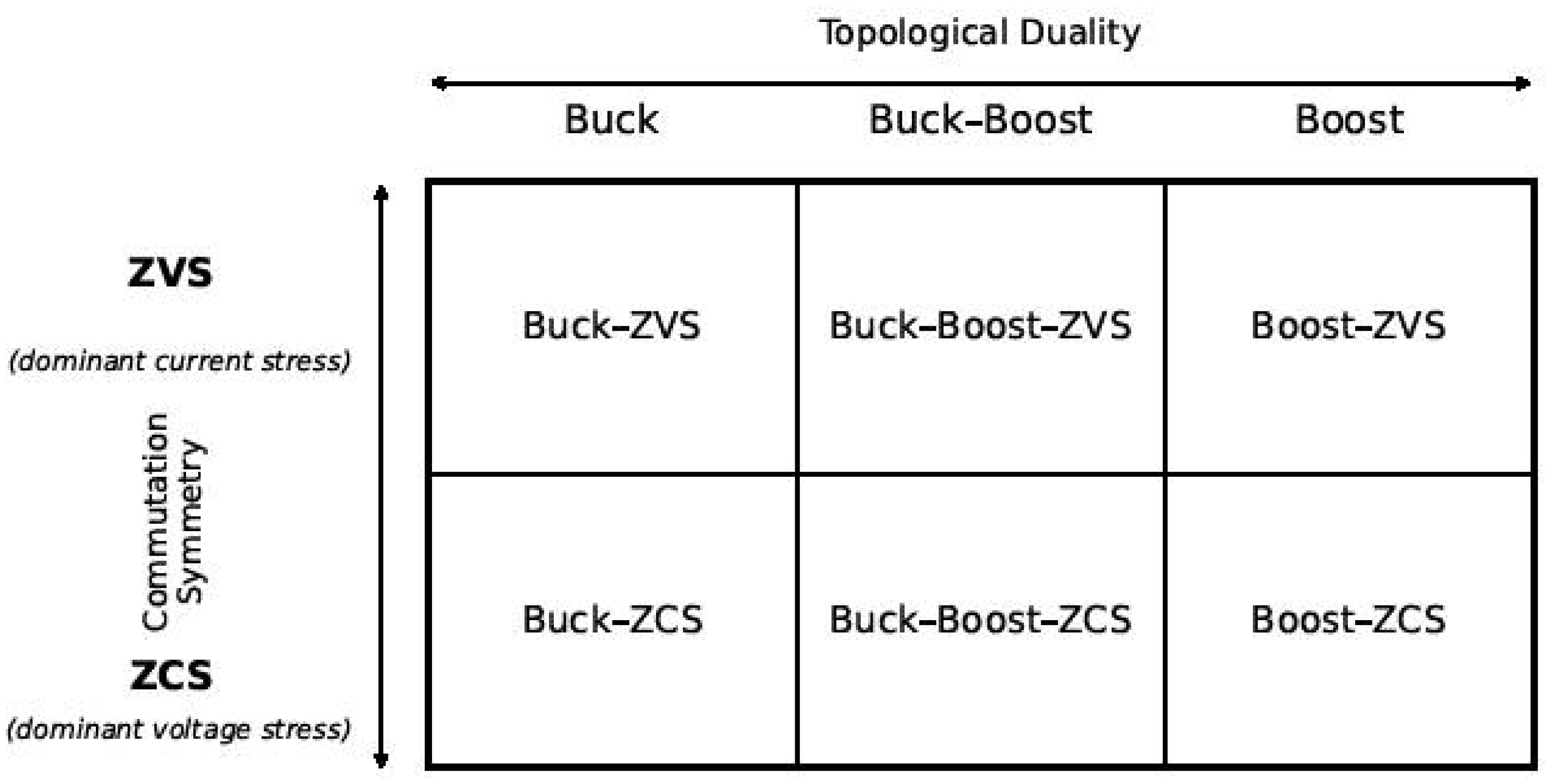
This two-axis structure motivates the central “symmetry map” shown in Figure 1: a grid in which the horizontal direction represents topological duality (Buck ↔ Boost, with Buck–Boost at the center), and the vertical direction represents commutation symmetry (ZVS vs. ZCS). The map is not only a taxonomy. It is also predictive: it encodes how stress and loss tendencies shift when moving along either axis. Moving vertically (ZVS ↔ ZCS) exchanges which variable is symmetrized at commutation and therefore exchanges the dominant stress trade-off (current stress vs. voltage stress). Moving horizontally (Buck ↔ Boost) swaps the voltage/current-oriented nature of regulation and shifts which parts of the converter naturally become stress bottlenecks under load variation.
The horizontal axis represents topological duality among Buck, Buck–Boost, and Boost converters, while the vertical axis represents commutation symmetry (ZVS versus ZCS). Each cell corresponds to a symmetry class defined by the combination of topology and commutation condition; ZVS classes are typically associated with dominant current stress, whereas ZCS classes are typically associated with dominant voltage stress.

5.4. Anchoring the Map with Representative Buck Cases

To keep the symmetry map grounded in established QR behavior, the paper uses representative buck cases as anchors. A ZVS Buck QR converter illustrates stage-based periodic structure and normalized regime descriptions that enforce voltage symmetry at turn-on. A ZCS Buck QR converter illustrates the dual commutation condition (current symmetry at turn-off), including the practical distinction between half-wave and full-wave current symmetry and its implications for waveform shape and conduction-loss metrics. These two anchors serve as reference points for extending the discussion to the remaining topological classes through duality arguments, without requiring a full re-derivation for every cell in the symmetry map.
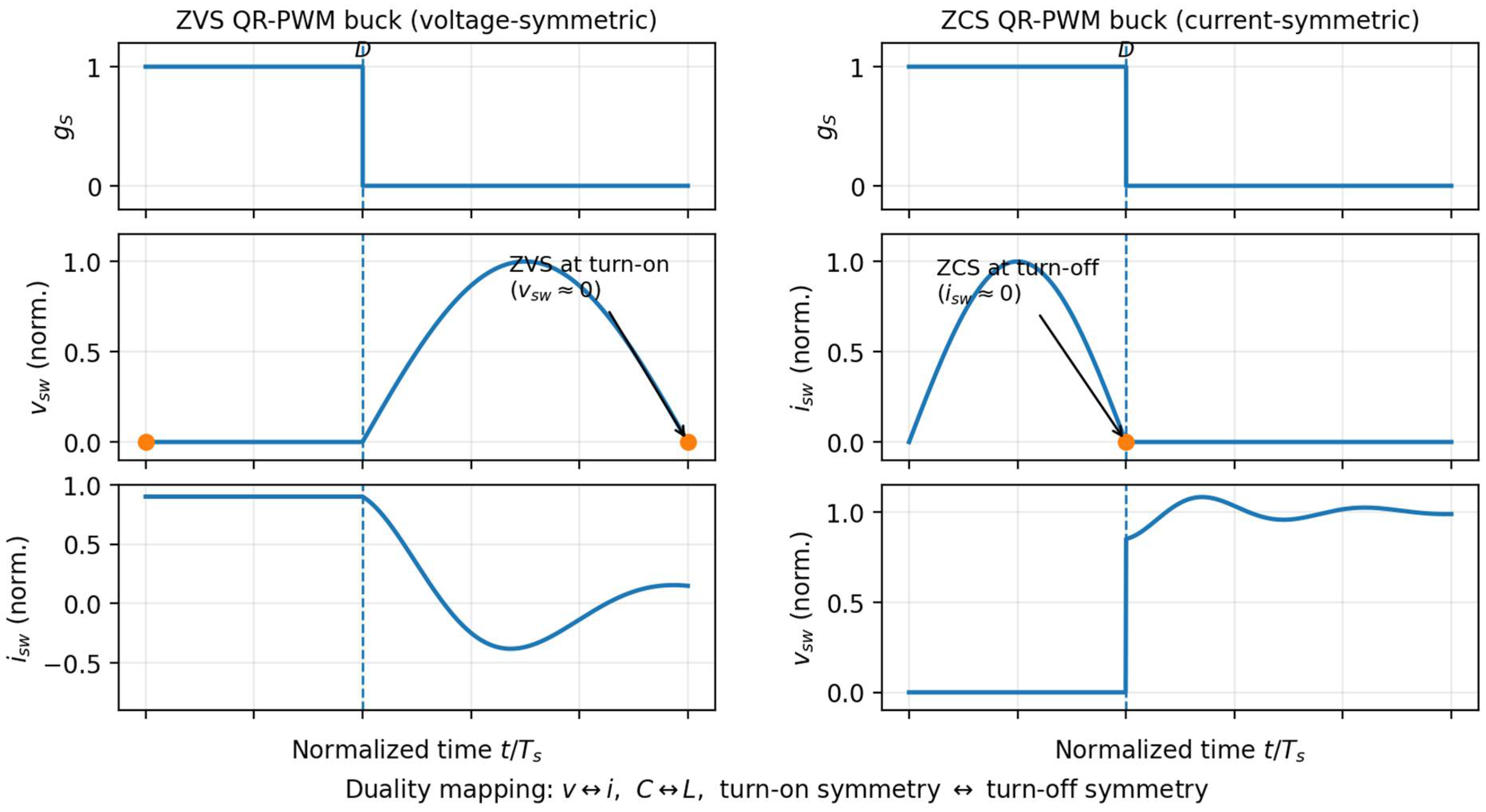
Representative time-domain waveforms for the buck case, illustrating the ZVS–ZCS commutation duality, are shown in Figure 2. Qualitative commutation waveforms around the switching boundary; ZVS enforces usw ≈ 0 at turn-on, while ZCS enforces isw ≈ 0 at turn-off.
Template waveforms are conceptual (not to scale) and highlight symmetry-restoring boundary conditions and topology-dependent clamp levels.
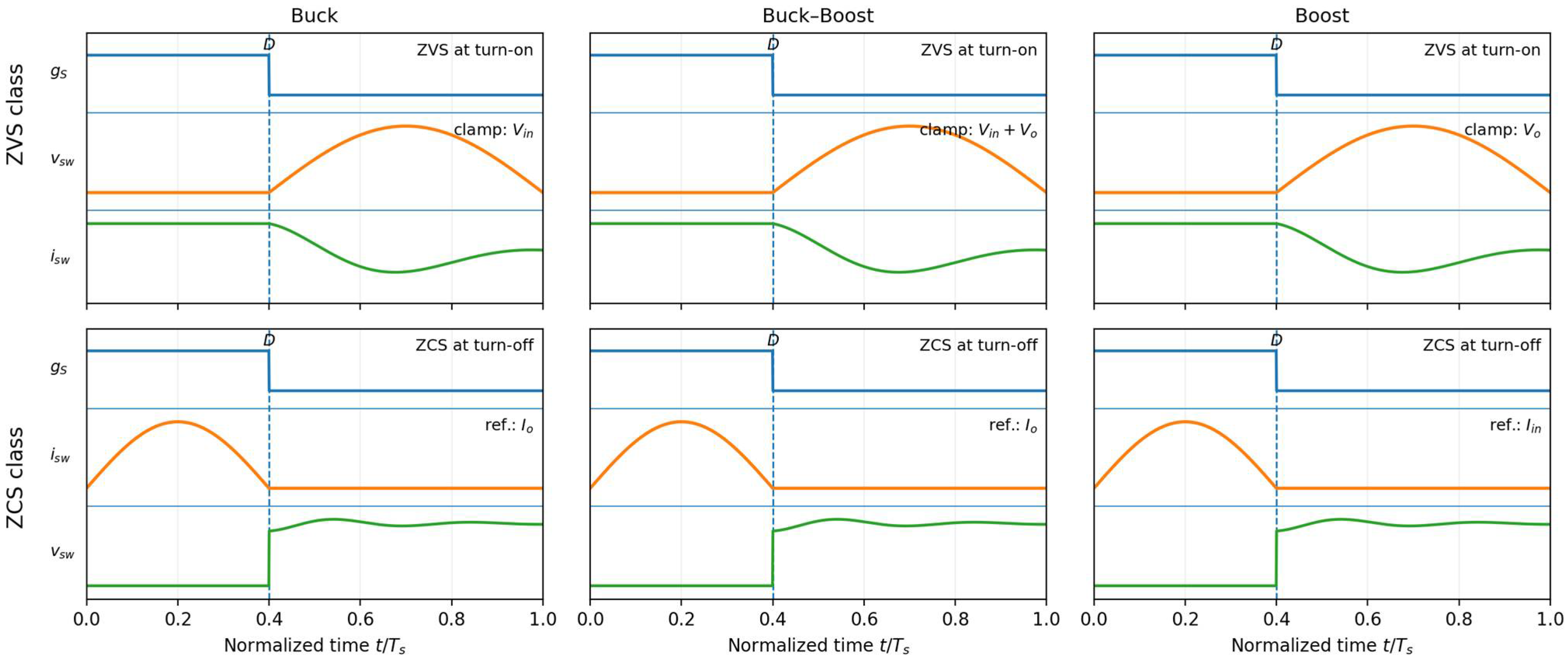
To further emphasize topology-level symmetry across both commutation classes and topologies, Figure 3 provides a compact 2 × 3 waveform-template map: rows correspond to the ZVS and ZCS commutation classes, while columns follow the Buck ↔ Buck–Boost ↔ Boost duality chain. The templates intentionally abstract detailed circuit equations and emphasize (i) the ZVS/ZCS boundary conditions and (ii) the topology-dependent clamp/reference levels that shape device stress distribution.
The templates highlight the symmetry-restoring switching boundary (ZVS at turn-on; ZCS at turn-off) and indicate how topology sets the effective clamp/reference levels that govern stress redistribution.

5.5. Implication: A Compact Family Portrait of Classical QR-PWM Converters

The main implication of this section is that classical QR-PWM converters can be treated as a small closed family generated by two symmetry operations:
  • Commutation symmetry operation: choose whether to restore voltage symmetry (ZVS) or current symmetry (ZCS) at commutation.
  • Topological duality operation: move between Buck and Boost as dual archetypes, with Buck–Boost providing a self-dual bridge.
This family portrait sets the stage for the next section, which connects the symmetry map to engineering consequences. In particular, Section 5 introduces “cost of symmetry” considerations—stress amplification, RMS-related conduction losses, and resonant circulation losses—and shows how these costs transform in a structured way across the map.

6. The Cost of Symmetry: Stress and Loss Metrics Across the Symmetry Map

The symmetry-based organization developed in Section 2, Section 3 and Section 4 emphasizes that quasi-resonant PWM converters achieve soft switching by restoring a commutation symmetry—either voltage symmetry (ZVS) or current symmetry (ZCS). While this symmetry restoration reduces switching losses, it is not “free”: the resonant transient must temporarily store and exchange energy, and this energy circulation reshapes waveforms away from the rectangular profiles typical of hard-switched PWM converters. The result is a set of systematic trade-offs—here referred to as the cost of symmetry—that appear as increased stress in the dual variable (current stress for ZVS, voltage stress for ZCS) and as additional conduction and resonant-tank losses.
This section introduces practical metrics that make the cost of symmetry explicit and connects them to the symmetry map (commutation duality × topological duality). The goal is not to produce a complete loss model for every topology, but rather to identify symmetry-invariant trends that predict how losses and stresses transform when moving across converter classes.

6.1. Stress Amplification as a Dual “Symmetry Payment”

A resonant transient is introduced precisely to drive one commutating variable to a symmetric boundary point (near zero) at the switching instant. Achieving that boundary condition typically requires amplitude growth in the conjugate variable during the transient.
  • In ZVS QR converters, the switch voltage is shaped to reach zero at turn-on. To accomplish this, the resonant path must source/sink charge from parasitic and resonant capacitances, which commonly requires elevated resonant current peaks. In ZVS Buck QR operation, the stage sequence explicitly includes an interval in which the resonant capacitor is charged/discharged and the switch-node voltage trajectory is driven toward the ZVS boundary condition, illustrating how the resonant process is “spent” to enforce voltage symmetry at commutation. The dual implication is that current stress can exceed PWM levels, especially when operating points move away from symmetry-favorable initial conditions.
  • In ZCS QR converters, the switch current is shaped to reach zero at turn-off. To force a current zero crossing within a finite switching interval, the resonant exchange often requires elevated resonant voltage excursions across the reactive elements and the switch network. In L-type ZCS Buck QR operation, the resonant current waveform is explicitly designed to naturally reach zero, but the analysis also reveals that the resonant process can increase peak electrical quantities relative to classical PWM operation, making stress a central design concern.
This dual behavior is a direct consequence of commutation duality: the symmetrized variable is “protected” at commutation, while the dual variable tends to carry the transient burden.

6.2. RMS and Conduction Losses as Symmetry-Sensitive Metrics

A key practical question is how the resonant waveform reshaping translates into losses. For QR-PWM families where switching losses are strongly mitigated, conduction losses often become dominant. In that regime, RMS-based measures provide a natural symmetry-sensitive metric: they capture how waveform reshaping increases (or decreases) effective current stress compared to the rectangular PWM baseline.
In a representative ZCS Buck QR operation, conduction-loss comparisons between a classical PWM buck converter and an L-type ZCS buck QR converter are constructed by analyzing the transistor RMS current and related static-loss ratios under identical input/output conditions. The main conceptual lesson is not limited to the buck topology: once symmetry is enforced at commutation, RMS current becomes a quantitative proxy for the “price” paid in conduction losses. The same philosophy can be mirrored on the ZVS side by interpreting current escalation during capacitor-driven commutation shaping as a conduction-loss penalty required to enforce usw(ton) ≈ 0.
A symmetry-map interpretation follows directly:
  • Moving vertically (ZVS ↔ ZCS) changes which waveform component is reshaped most strongly around commutation and therefore shifts the dominant conduction-loss mechanism (e.g., elevated resonant currents in ZVS vs. reshaped current-return-to-zero patterns in ZCS).
  • Moving horizontally (Buck ↔ Boost) redistributes where conduction occurs in the switch network (which device conducts for which fraction of the period) and therefore changes how RMS penalties translate into total loss.
Thus, the cost of symmetry can be compared across classes without re-deriving every loss expression: the symmetry map predicts how the RMS burden migrates across devices and intervals when duality operations are applied.

6.3. Internal Mode Symmetry (Half-Wave vs. Full-Wave) and Its Loss Consequences

Beyond ZVS/ZCS duality, some QR families exhibit an additional internal symmetry choice that changes energy recirculation and regulation sensitivity. In ZCS Buck QR converters, for example, half-wave and full-wave modes represent two distinct symmetry realizations for the resonant current: in half-wave mode, the resonant current is restricted to one polarity, while in full-wave mode, it is allowed to reverse, creating a more symmetric oscillatory exchange over the resonant interval.
From the cost-of-symmetry viewpoint, this internal mode symmetry affects:
  • RMS currents and conduction losses, since waveform polarity and duration shape RMS differently.
  • Energy feedback to the source, since full-wave operation permits negative resonant current intervals, changing how energy is redistributed between source, tank, and load.
  • Regulation sensitivity, since the converter’s effective transfer characteristic may become more or less load-dependent depending on the mode.
These effects reinforce an important theme: symmetry is not a binary property (“soft” vs. “hard” switching) but a configurable design dimension. The designer may choose between alternative symmetry realizations (e.g., half-wave vs. full-wave) depending on whether priority is placed on regulation robustness, loss minimization, or stress constraints.

6.4. Resonant-Tank Losses and the Non-Ideal Symmetry Budget

In ideal analyses, the resonant transient is often treated as lossless, serving purely as a waveform-shaping mechanism. In practical QR converters, however, the resonant tank has resistive and parasitic losses (inductor copper loss, capacitor ESR, and associated damping), and these losses can become non-negligible at high frequency or light load. In the ZCS Buck QR context, the efficiency impact of resonant-tank losses has been explicitly studied by separating resistive loss contributions associated with the resonant inductance and capacitor and by evaluating their influence on overall efficiency.
From a symmetry perspective, these tank losses represent a symmetry budget: enforcing commutation symmetry requires circulating resonant energy, and any dissipative element converts part of that circulating energy into heat. As a result, even if switching losses are strongly reduced, total efficiency depends on whether the resonant circulation required for symmetry restoration remains “cheap” compared to the dynamic losses avoided in hard switching. This explains why QR design is inherently a balancing act: the system must be tuned so that the energy spent to restore symmetry is smaller than the energy saved by avoiding non-symmetric switching.

6.5. Symmetry-Guided Interpretation Across Buck, Boost, and Buck–Boost

The cost-of-symmetry metrics above can be transferred across the symmetry map without exhaustive re-derivations:
  • Across commutation duality (ZVS ↔ ZCS):
    The dominant stress and loss “payment” shifts between current and voltage, and between conduction-RMS penalties associated with current shaping versus voltage-discharge demands.
  • Across topological duality (Buck ↔ Boost):
    The distribution of conduction intervals among devices shifts; therefore, the same commutation symmetry may impose different loss bottlenecks, even if the resonant transient plays an analogous symmetry-restoring role.
  • For Buck–Boost (self-dual bridge):
    The Buck–Boost family provides a structural hinge where both voltage-oriented and current-oriented interpretations coexist, making it a natural candidate for observing how symmetry costs manifest under mixed step-up/step-down operation.
Taken together, these observations justify the main methodological claim of the paper: the principal stress and loss tendencies of classical QR-PWM converters can be predicted and organized by symmetry arguments. Detailed equations remain indispensable for design verification, but the symmetry map clarifies which quantities should be expected to grow, which loss terms become dominant, and how those trends change under duality transformations.

6.6. Quantitative Symmetry Metrics and Compact Tabular Summaries

To support the predictive statements of the symmetry map with a compact quantitative layer, we introduce dimensionless stress and conduction proxies that can be evaluated from either analytical waveforms, simulation, or measured data. These metrics are deliberately generic so that they can be applied consistently across the six topology × commutation classes.
To make the symmetry-based stress and loss tendencies explicit and comparable across converter classes, we introduce a set of normalized stress and conduction factors. These factors are not intended as detailed loss models, but as compact, topology-agnostic metrics that capture how enforcing commutation symmetry redistributes electrical stress and conduction burden relative to a classical PWM baseline.
The peak-voltage stress factor is defined as:
kV = max(usw)/Vin,
where max(usw) is the maximum instantaneous voltage across the switching device during a switching period, and Vin is the input DC voltage. This factor quantifies voltage overstress introduced by resonant commutation shaping and is particularly relevant for ZCS-type operation, where enforcing a current-zero boundary condition often leads to increased resonant voltage excursions.
The peak-current stress factor is defined as:
kI = max(isw)/Io,
where max(isw) is the peak switch current, and Io is the average output current. This factor captures current overstress associated with resonant charge or energy transfer and is naturally emphasized in ZVS-type operation, where additional resonant current is required to discharge device and node capacitances before turn-on.
To connect waveform reshaping to conduction losses, we introduce the conduction (RMS) factor
kRMS = Isw,rms/Io,
where Isw,rms is the RMS value of the switch current over one switching period. When switching losses are strongly mitigated by soft switching, conduction losses typically dominate and scale approximately with the square of the RMS current. For a fixed device conduction model (e.g., constant RDS(on) or an equivalent static conduction characteristic), the relative conduction-loss penalty can therefore be expressed as
Pcond ∝ kRMS2 (for fixed RDS(on) or equivalent conduction model).
Within the proposed symmetry framework, these normalized factors serve as symmetry-sensitive indicators: enforcing voltage symmetry at commutation (ZVS) tends to increase kI and kRMS, whereas enforcing current symmetry (ZCS) tends to increase kV. The symmetry map thus predicts not exact numerical losses, but systematic trends in how stress and conduction burden shift across commutation classes and topological duals.
In the symmetry-map interpretation, moving vertically (ZVS ↔ ZCS) exchanges the metric that tends to increase: ZVS operation tends to pay for ZVS by higher kI and kRMS (larger resonant current needed to drive usw→0 at turn-on), while ZCS operation tends to pay for ZCS by higher kV (larger resonant voltage excursion needed to drive isw→0 at turn-off). The horizontal duality (Buck ↔ Boost) mainly redistributes which device and interval carries the dominant RMS burden.
Illustrative numerical example (method demonstration).
Consider a commutation-stage waveform in which the switch current over the dominant resonant interval can be approximated by a half-sinusoid,
i(t) = Imax · sin(ωt), 0 ≤ ωt ≤ π.
The RMS value of this current over the resonant interval is Imax/ 2 .
If the resonant process requires a peak current Imax = 2·Io (where Io denotes the average output current), the corresponding RMS-based conduction factor becomes:
k RMS     ( I max / 2 ) / I o     1.41
implying an approximate doubling of conduction-related loss (kRMS2 ≈ 2) for a fixed on-resistance or equivalent static conduction model.
This example is intentionally illustrative rather than a full-period loss calculation. Its purpose is to demonstrate how waveform reshaping imposed by commutation symmetry can inflate RMS current and therefore conduction loss, even when the average transferred current remains unchanged. In this sense, the example provides a quantitative expression of the “cost of symmetry”: ZVS classes typically pay through increased kI and kRMS, whereas ZCS classes tend to pay through increased kV.
A fully dual interpretation is obtained by considering the voltage-domain counterpart corresponding to ZCS commutation symmetry.
Dual illustrative example (ZCS voltage symmetry).
As a dual to the current-based illustration, consider a ZCS-type commutation stage in which the switch voltage over the dominant resonant interval can be approximated by a half-sinusoid,
u(t) = Umax · sin(ωt), 0 ≤ ωt ≤ π.
The RMS value of this voltage over the commutation interval is Umax/ 2 .
If enforcing current symmetry at turn-off requires a peak switch voltage Umax = 2·Vin, the corresponding normalized voltage stress factor becomes kV = Umax/Vin = 2, while the RMS-based voltage factor evaluates to
k V , RMS     ( U max / 2 ) / V in     1.41
This dual example mirrors the current-based case and illustrates the complementary nature of the cost of symmetry: ZCS operation shifts the commutation burden toward increased voltage stress (kV), just as ZVS operation shifts it toward increased current and RMS conduction burden (kI and kRMS).
Practical note: although the present article is primarily a unifying framework paper, the predicted stress/loss redistribution trends can be cross-checked against published experimental and efficiency-oriented studies on representative QR PWM converters—e.g., ZVS Buck implementations/measurements [13,18,19], ZCS Buck loss/efficiency studies [20,21,22], and ZCS/ZVS Boost and Buck–Boost realizations [14,15,16,17,23,24,25,26,27,28]. Even when these studies are not designed as a head-to-head comparison under identical specifications, the reported waveforms and dominant-loss discussions align naturally with the proposed “cost of symmetry” interpretation.
To condense the symmetry-map discussion into a compact form, Table 2 summarizes the six classical QR-PWM converter classes obtained by combining commutation symmetry (ZVS vs. ZCS) with topological duality (Buck, Boost, and Buck–Boost). For each class, the table indicates the enforced commutation boundary condition, the dominant “payment” associated with restoring symmetry at commutation, and the loss channel that is typically most affected. The entries are intentionally qualitative and trend-oriented: they do not replace detailed loss calculations, but rather reflect the systematic stress and loss shifts predicted by the symmetry framework when moving across the symmetry map.
While the symmetry map is not intended to replace established QR-converter analysis methods, it occupies a complementary position among them. Table 3 situates the proposed symmetry-based organization relative to commonly used approaches in the literature, including topology-centered taxonomies, mode/state-plane QR analysis, and loss-focused evaluations. The comparison highlights how the symmetry map adds an orthogonal organizing axis—commutation duality—allowing stress and loss tendencies to be anticipated at a family level before detailed circuit- or mode-specific analysis is undertaken.

7. Design Implications: Using Symmetry to Select Regimes, Parameters, and Trade-Offs

The symmetry map developed in the previous sections is not intended to replace detailed circuit-level design procedures. Instead, it provides a compact decision framework that helps designers (i) select an appropriate soft-switching class (ZVS vs. ZCS), (ii) anticipate dominant stress and loss mechanisms, and (iii) interpret parameter choices as controlled symmetry adjustments rather than as isolated tuning steps. This section summarizes practical design implications in a symmetry-oriented form, focusing on classical QR-PWM Buck, Boost, and Buck–Boost converters.

7.1. Selecting ZVS vs. ZCS as a Symmetry Choice

A first design decision is whether commutation symmetry should be imposed on voltage (ZVS) or on current (ZCS). In the proposed framework, this choice is guided by which variable is more “expensive” to commute non-symmetrically in the given application:
  • Prefer ZVS when turn-on switching loss is dominant or when device/output capacitances and high dv/dt stresses are critical. The design goal becomes enforcing a voltage boundary condition at turn-on, usw(ton) ≈ 0, by shaping a capacitor-dominated commutation transient. In the representative ZVS buck QR operation, the stage structure and normalized regime conditions explicitly show how the resonant transition is organized to achieve ZVS and close the periodic orbit.
  • Prefer ZCS when turn-off switching loss is dominant or when di/dt-related stresses and reverse-recovery issues motivate commutation at current zero. The design goal becomes enforcing a current boundary condition at turn-off, isw(toff) ≈ 0, by shaping an inductor-dominated commutation transient. In representative L-type ZCS buck QR operation, the ability of the resonant current to reach zero within the switching interval becomes a central feasibility constraint and also sets the stage for RMS-based loss assessment.
From a symmetry viewpoint, the decision can be framed as follows: choose the commutation symmetry that minimizes the “cost of symmetry” in the dominant loss/stress channel for the intended operating range.

7.2. Designing in Normalized Symmetry Coordinates: Keeping the Operating Point “Inside the Symmetry Region”

Once a commutation symmetry is selected, the main design challenge is maintaining that symmetry across expected variations in load and operating conditions. The normalized coordinates introduced in Section 2 provide a systematic way to reason about this:
  • The frequency ratio ν = fs/f0 controls how strongly the natural resonant transient fits within the imposed switching period. In symmetry terms, ν determines whether the resonant trajectory can “complete” the symmetry restoration before the next switching boundary.
  • A normalized load/current coordinate expresses how strongly the load constrains the resonant exchange. In both ZVS and ZCS operation, soft switching exists only within a feasible region of normalized load; outside that region, the trajectory cannot reach the symmetry boundary condition (zero voltage or zero current) within the available time.
  • The DC conversion ratio, MMM positions the operating point in terms of steady-state energy transfer symmetry and therefore affects how much resonant excursion is required to enforce the commutation condition.
In practical terms, the design implication is to avoid tuning the converter for a single “nominal” point and instead select parameters so that the expected operating set remains within a symmetry-feasible region where commutation constraints continue to be satisfied.

7.3. Symmetry Fixed Points and Robust Operating Choices

A particularly useful symmetry concept for design is the notion of a symmetry fixed point (or symmetry-centered operating condition) where waveform discontinuities and stress are minimized, and the periodic trajectory closes naturally with minimal “correction” energy.
In ZVS buck QR analysis, the special case of near-zero initial resonant inductor current at turn-on (often treated as h ≈ 0) can be interpreted as such a symmetry-centered condition: the resonant stage sequence closes under favorable initial conditions, and the resulting operation tends to be desirable from a stress standpoint. From a design perspective, this suggests a robust strategy: parameterize the QR cell so that nominal operation lies near a symmetry-centered initial condition, thereby increasing tolerance to perturbations and reducing peak stresses.
In the ZCS buck QR operation, an analogous symmetry-centered design approach appears through the feasibility constraint that the resonant current must naturally return to zero within the switching interval. The implication is to choose resonant parameters and operating ranges so that the current zero-crossing is achieved with a margin, rather than as a fragile equality. This “margin to zero” interpretation is a symmetry robustness principle and also underpins why internal mode choices (half-wave vs. full-wave) matter.

7.4. Using RMS-Based Metrics to Tune the “Cost of Symmetry”

When switching losses are mitigated by soft switching, conduction losses and resonant-tank losses often become the limiting factors. A symmetry-oriented design implication is therefore to explicitly treat RMS-related measures as tuning targets.
In L-type ZCS buck QR analysis, RMS current ratios and static-loss comparison coefficients provide direct metrics that quantify how much conduction-loss penalty is paid to achieve ZCS, under otherwise identical converter conditions. Even if a designer does not use the same exact coefficients for a different topology, the method suggests a general practice:
  • Use RMS current (and device conduction characteristics) as primary optimization criteria once soft switching is secured.
  • Interpret tuning of resonant parameters as a trade between (i) achieving the commutation symmetry boundary condition and (ii) minimizing RMS inflation and circulating resonant energy.
On the ZVS side, the same principle appears in dual form: ensuring ZVS may require additional resonant current to discharge capacitances; therefore, RMS and conduction-loss penalties become the natural “payment” variable to minimize once ZVS is achieved.

7.5. Mode Symmetry Choices: Half-Wave vs. Full-Wave as a Design Degree of Freedom

Some QR families admit multiple internal symmetry realizations. In ZCS converters, half-wave and full-wave modes represent two different symmetry choices for resonant current polarity and energy exchange. This choice affects:
  • regulation sensitivity (load dependence);
  • energy feedback to the source;
  • RMS currents and conduction losses;
  • and feasibility margins for sustaining ZCS across operating conditions.
The design implication is that mode selection should be treated as an explicit symmetry decision rather than as a secondary implementation detail. For a given application, one mode may offer better robustness or lower effective “symmetry cost,” even if both satisfy the basic ZCS condition.

7.6. Practical Workflow: Symmetry-First Design Logic

A symmetry-first design workflow consistent with this paper’s framework can be summarized as:
  • Choose topology by function (Buck, Boost, Buck–Boost).
  • Choose commutation symmetry by dominant switching burden (ZVS vs. ZCS).
  • Select a resonant cell consistent with the symmetry choice (capacitor-dominated vs. inductor-dominated shaping).
  • Locate the operating range in normalized symmetry coordinates (ν, normalized load/current, M) and ensure it remains within the symmetry-feasible region.
  • Tune parameters toward a symmetry-centered operating point (e.g., symmetry-friendly initial conditions or sufficient margin to reach the zero boundary condition).
  • Optimize the cost of symmetry using RMS/stress and resonant-tank loss metrics, not only the soft-switching constraint.
  • Validate under extremes (load variation, frequency variation, component tolerances), because soft-switching feasibility is a symmetry constraint that can fail abruptly outside its region.

7.7. Scope Boundary: Why LLC and Multi-Resonant Structures Are Excluded

Finally, it is important to restate the scope boundary from a symmetry viewpoint. Classical QR PWM converters use local resonant transients to restore commutation symmetry while retaining PWM control logic. Multi-resonant and frequency-controlled converter families (such as LLC) and resonant DC–AC inverter structures introduce additional modal and frequency-domain symmetries, including multiple resonant frequencies, mode transitions, and operating-point selection by frequency modulation [31,32]. These features alter the natural symmetry variables and classification axes. Accordingly, such structures are intentionally not included in the present symmetry map.

8. Conclusions

This paper presented a symmetry- and duality-based perspective on classical QR PWM DC–DC converters, with particular focus on ZVS and ZCS implementations of Buck, Boost, and Buck–Boost families. Rather than extending the catalog of circuit variants, the proposed viewpoint reframes QR operation as a controlled restoration of symmetry at the commutation boundary, where soft switching is achieved by enforcing either voltage symmetry (ZVS) or current symmetry (ZCS). This interpretation provides a compact conceptual structure that complements conventional topology-centered descriptions.
By explicitly separating commutation symmetry (ZVS ↔ ZCS) from topological duality (Buck ↔ Boost, with Buck–Boost as a self-dual bridge), the paper organized classical QR-PWM converters into a small set of archetypal classes. This organization reveals that many seemingly different QR implementations are, in fact, dual realizations of the same underlying symmetry principle. Representative buck cases were used as anchors to illustrate these ideas: ZVS buck operation highlights stage-based temporal symmetry and normalized regime structure, while ZCS buck operation exposes current-based symmetry restoration, half-wave/full-wave internal symmetry, and RMS-driven interpretations of losses.
A central outcome of the symmetry framework is the notion of the cost of symmetry. While ZVS and ZCS both reduce switching losses by enforcing commutation boundary conditions, they shift stress and loss burdens in dual ways. ZVS typically trades reduced voltage-related switching losses for increased current stress and associated conduction penalties, whereas ZCS trades reduced current-related switching losses for increased voltage stress and resonant energy circulation. RMS-based conduction metrics, resonant-tank losses, and internal mode choices (such as half-wave versus full-wave operation in ZCS converters) emerge as natural quantitative expressions of this cost. These trends are not topology-specific; they transform predictably across the symmetry map through commutation and topological duality operations.
From a design standpoint, the symmetry-based organization supports a symmetry-first workflow: selecting ZVS or ZCS as a deliberate commutation-symmetry choice, positioning the operating range within normalized symmetry-feasible regions, tuning parameters toward symmetry-centered operating points, and optimizing the cost of symmetry using stress- and RMS-oriented metrics. In this sense, symmetry serves not only as an abstract classification tool but also as a practical guide for anticipating trade-offs and robustness limits before detailed circuit optimization.
The scope of the present study was intentionally limited to classical QR converters that retain PWM control and use local resonant transients primarily to restore commutation symmetry. Multi-resonant and frequency-controlled structures, such as LLC converters, as well as resonant DC–AC inverter families, introduce additional modal and frequency-domain symmetries that alter the relevant classification axes. Accordingly, these structures are not considered here.
In conclusion, classical ZVS and ZCS QR-PWM DC–DC converters can be understood as members of a compact symmetry-governed family generated by two operations: commutation duality and topological duality. This perspective clarifies relationships among Buck, Boost, and Buck–Boost QR converters, provides predictive insight into stress and loss trends, and offers a coherent conceptual foundation for both analysis and design.

Funding

This work was supported by the European Regional Development Fund under the “Research Innovation and Digitization for Smart Transformation” program 2021–2027 under Project BG16RFPR002-1.014-0006 “National Centre of Excellence Mechatronics and Clean Technologies”, and the APC was funded by Project BG16RFPR002-1.014-0006.

Data Availability Statement

The original contributions presented in this study are included in the article. Further inquiries can be directed to the corresponding author.

Acknowledgments

The present research has been carried out under the project BG16RFPR002-1.014-0006 “National Centre of Excellence Mechatronics and Clean Technologies”, funded by the Operational Programme Science and Education for Smart Growth.

Conflicts of Interest

The author declares no conflicts of interest.

References

  1. Kazimierczuk, M.K.; Czarkowski, D. Resonant Power Converters, 2nd ed.; John Wiley & Sons: Hoboken, NJ, USA, 2011; pp. 1–595. ISBN 978-0-470-90538-8. [Google Scholar]
  2. Kazimierczuk, M.K. Pulse-Width Modulated DC–DC Power Converters; John Wiley & Sons: Hoboken, NJ, USA, 2008; pp. 1–782. ISBN 978-0-470-77301-7. [Google Scholar]
  3. Erickson, R.W.; Maksimović, D. Fundamentals of Power Electronics, 2nd ed.; Springer: Cham, Switzerland, 2001. [Google Scholar]
  4. Mohan, N.; Undeland, T.M.; Robbins, W.P. Power Electronics: Converters, Applications, and Design, 3rd ed.; John Wiley & Sons: Hoboken, NJ, USA, 2003. [Google Scholar]
  5. Andreycak, T. Zero-Voltage Switching Resonant Power Conversion. Texas Instruments Power Supply Design Seminar. 2010. Available online: https://www.ti.com (accessed on 6 January 2026).
  6. Vorperian, V.; Erickson, R.W. Quasi-Resonant and Quasi-Square-Wave Power Conversion. In Fundamentals of Power Electronics; Springer: Cham, Switzerland, 2001. [Google Scholar]
  7. Lee, F.C. High-Frequency Quasi-Resonant Converter Technologies. Proc. IEEE 1988, 76, 377–390. [Google Scholar] [CrossRef]
  8. Liu, K.-H.; Lee, F.C. Zero-Voltage Switching Technique in DC/DC Converters. IEEE Trans. Power Electron. 1990, 5, 293–304. [Google Scholar] [CrossRef]
  9. Vorperian, V. Quasi-Square-Wave Converters: Topologies and Analysis. IEEE Trans. Power Electron. 1988, 3, 183–191. [Google Scholar] [CrossRef]
  10. Maksimovic, D. Design of the zero-voltage-switching quasi-square-wave resonant switch. In Proceedings of the IEEE Power Electronics Specialist Conference—PESC ′93, Seattle, WA, USA, 20–24 June 1993; pp. 323–329. [Google Scholar] [CrossRef]
  11. Lee, F.C. Quasi-Resonant Converter. U.S. Patent 4720668A, 19 January 1988. [Google Scholar]
  12. Erickson, R.W. Quasi-Resonant Converters. In Fundamentals of Power Electronics; Springer: Cham, Switzerland, 2001; Chapter 19. [Google Scholar]
  13. Hinov, N.L.; Rangelov, N.R. Buck ZVS DC–DC Quasi-Resonant Converter: Design, Modeling, Simulation and Experimentation. Electron. Electr. Eng. 2014, 20, 35–42. [Google Scholar]
  14. Rangelov, N.R.; Hinov, N.L. Buck–Boost ZVS DC–DC Quasi-Resonant Converter: Design and Experimental Verification. Electron. Electr. Eng. 2015, 21, 41–48. [Google Scholar]
  15. Luther, M. Digitally Controlled ZVS Quasi-Resonant Boost Converter. Master’s Thesis, California Polytechnic State University, San Luis Obispo, CA, USA, 2007. [Google Scholar]
  16. Dawidziuk, J.; Harasimczuk, M. A novel Quasi-Resonant ZVS Boost Converter with Tapped Inductor. Bull. Pol. Acad. Sci. Tech. Sci. 2021, 69, e136043. [Google Scholar] [CrossRef]
  17. Himmelstoss, F. Quasi-Resonant ZVS Operation in Modified Boost Converters. WSEAS Trans. Circuits Syst. 2024, 23, 157–164. [Google Scholar] [CrossRef]
  18. Şengüzel, E. Design of a ZVS Quasi-Resonant Buck Converter. Master’s Thesis, Middle East Technical University, Ankara, Turkey, 2006. [Google Scholar]
  19. Dores-Costa, M. Control Approaches for ZVS Quasi-Resonant Buck Converters. IEEE Trans. Power Electron. 2002, 17, 168–176. [Google Scholar]
  20. Hinov, N.; Grigorova, T. A Comprehensive Analysis of Losses and Efficiency in a Buck ZCS Quasi-Resonant DC/DC Converter. J. Low Power Electron. Appl. 2025, 15, 12. [Google Scholar] [CrossRef]
  21. Yanik, G.; Isen, E. Quasi-Resonant Full-Wave Zero-Current Switching Buck Converter Design, Simulation and Application. Balk. J. Electr. Comput. Eng. 2013, 1, 71–77. [Google Scholar]
  22. Mandru, N.; Nithyadas, P.V.; Kundu, U.; John, V. Bootstrap Operation in eGaN-Based Full-Wave ZCS Quasi-Resonant Synchronous Buck Converter. In Proceedings of the 2023 IEEE Applied Power Electronics Conference and Exposition, Orlando, FL, USA, 19–23 March 2023; pp. 2239–2244. [Google Scholar]
  23. Harasimczuk, M. A QR-ZCS Boost Converter with Tapped Inductor and Active Edge-Resonant Cell. IEEE Trans. Power Electron. 2020, 35, 13085–13095. [Google Scholar] [CrossRef]
  24. Pahlavandust, A.; Yazdani, A. Single-Switch ZCS Resonant Boost Converter with High Power Density. AEU Int. J. Electron. Commun. 2020, 121, 153229. [Google Scholar] [CrossRef]
  25. Ismail, M. Quasi-Square-Wave ZCS and Clamped-Current Resonant Converters. Int. J. Electron. 1998, 85, 567–582. [Google Scholar]
  26. Lee, Y.-S.; Cheng, G.-T. Quasi-Resonant Zero-Current-Switching Bidirectional Converter for Battery Equalization. IEEE Trans. Power Electron. 2006, 21, 1213–1224. [Google Scholar] [CrossRef]
  27. Prem, A.; Govind, S.; Ravi, C.P. Zero-Voltage and Zero-Current Switching Buck-Boost Converter for PV Applications. Int. J. Comput. Sci. Netw. Secur. 2014, 14, 86–90. [Google Scholar] [CrossRef]
  28. SSRG Research Group. Soft-Switching Quasi-Resonant Buck–Boost Converter with Integrated Resonance. SSRG Int. J. Electr. Electron. Eng. 2022, 9, 28–39. [Google Scholar] [CrossRef]
  29. Castro, I.D.G.; Lamar, S.; Lopez, K.; Martin, M.A.; Sebastian, J. A Family of High-Frequency AC-LED Drivers Based on ZCS-QRCs. IEEE Trans. Power Electron. 2018, 33, 8728–8740. [Google Scholar] [CrossRef]
  30. Rangelov, N.R.; Hinov, N.L. Quasi-Resonant DC–DC Converters—Principles and Classification. In Proceedings of the 2013 International Conference-Workshop Compatibility and Power Electronics, Sofia, Bulgaria, 5–7 June 2013. [Google Scholar]
  31. Vuchev, A.; Grigorova, T. A Study of a Phase-Shifted Full-Bridge LLC Resonant Converter Operating at ZVS/ZCS. In Proceedings of the 2022 13th National Conference with International Participation (ELECTRONICA), Sofia, Bulgaria, 19–20 May 2022; pp. 1–6. [Google Scholar] [CrossRef]
  32. Vuchev, A.S.; Grigorova, T.G. A Study of the Boundary Modes of an LLC DC/DC Converter Operating above Resonant Frequency. In Proceedings of the 2020 XI National Conference with International Participation (ELECTRONICA), Sofia, Bulgaria, 23–24 July 2020; pp. 1–4. [Google Scholar] [CrossRef]
Figure 1. Symmetry map of classical QR PWM DC–DC converters.
Energies 19 00883 g001
Figure 2. Time-domain visualization of the ZVS–ZCS duality in a quasi-resonant PWM Buck converter. ZVS restores a voltage-symmetric boundary at turn-on (usw ≈ 0), whereas ZCS restores a current-symmetric boundary at turn-off (isw ≈ 0).
Energies 19 00883 g002
Figure 3. Combined 2 × 3 waveform-template map for classical quasi-resonant PWM DC–DC converters: commutation symmetry (rows: ZVS vs. ZCS) and topology duality (columns: Buck, Buck–Boost, and Boost).
Energies 19 00883 g003
Table 1. Symmetry-based comparison between ZVS and ZCS QR PWM DC–DC converters.
AspectZVS Quasi-Resonant ConvertersZCS Quasi-Resonant Converters
Symmetrized variable at commutationVoltage across the switching deviceCurrent through the switching device
Commutation conditionusw(ton) ≈ 0isw(toff) ≈ 0
Dominant resonant mechanismCapacitor-dominated resonant transientInductor-dominated resonant transient
Typical resonant element placementResonant capacitor connected to shape the switch-node voltageResonant inductor connected to shape the switch current
Stage symmetry emphasisVoltage-preparation and recovery intervalsCurrent build-up and return-to-zero intervals
Primary benefitReduced turn-on switching lossesReduced turn-off switching losses
Typical stress trade-offIncreased current stress during resonant transitionIncreased voltage stress during resonant transition
Natural loss metricCurrent-dependent conduction lossesRMS current–based conduction losses and resonant circulation losses
Sensitivity to load variationModerate to high, depending on voltage-discharge dynamicsStrongly linked to the ability of the resonant current to reach zero
Internal mode symmetryTypically single-polarity resonant currentHalf-wave or full-wave resonant current symmetry
Representative QR archetypeZVS buck quasi-resonant converterZCS buck quasi-resonant converter
Table 2. Symmetry-map summary of the six classical QR PWM classes and the expected dominant stress/loss tendency (qualitative).
ClassCommutation SymmetryTypical Stress “Payment”Typical Dominant Loss Shift
Buck–ZVSusw → 0 at turn-on↑ kI, ↑ kRMS (higher resonant current)Switch/diode conduction (RMS) and tank circulation
Buck–ZCSisw → 0 at turn-off↑ kV (higher resonant voltage excursion)Voltage stress management; RMS reshaping (half-/full-wave)
Boost–ZVSusw → 0 at turn-on↑ kI in the commutation pathHigher circulating current; diode/MOSFET RMS depending on implementation
Boost–ZCSisw → 0 at turn-off↑ kV in commutation cell/switch nodeVoltage stress and clamp management; tank loss at light load
Buck–Boost–ZVSusw → 0 at turn-on↑ kI and circulation in both step-up and step-down regimesRMS increase concentrated in switch network during resonant intervals
Buck–Boost–ZCSisw → 0 at turn-off↑ kV, polarity inversion often makes clamp levels criticalVoltage stress redistribution; RMS depends on operating regime
Note: ↑ indicates a qualitative increase in the indicated stress or loss mechanism relative to the corresponding hard-switched (non-soft-switched) reference case.
Table 3. Positioning of the proposed symmetry map relative to common QR-converter analysis/classification approaches (qualitative).
Approach (Typical)Primary Organizing AxisTypical OutputHow the Symmetry Map
Complements It
Topology-centered taxonomy [3,4]Circuit topology and controlFamilies, duty-ratio relations, averaged modelsAdds an orthogonal commutation-symmetry axis (ZVS/ZCS) + predicts stress/loss direction
Mode/state-plane QR analysis [1,2,7,9]Resonant stages and operating modesExact waveforms, regime boundaries, normalized mapsProvides a compact “family portrait” linking mode maps across dual topologies
Loss-focused QR evaluation [20]Loss decomposition (switching vs. conduction vs. tank)Efficiency trends, RMS metrics, loss allocationExplains trends via duality: why loss burden migrates between voltage vs. current channels
Proposed symmetry map (this paper)Commutation duality × topological dualityPredictive stress/loss tendencies; design heuristics; pedagogical classificationNot a replacement—serves as a high-level organizer that points to which detailed analysis is needed
Disclaimer/Publisher’s Note: The statements, opinions and data contained in all publications are solely those of the individual author(s) and contributor(s) and not of MDPI and/or the editor(s). MDPI and/or the editor(s) disclaim responsibility for any injury to people or property resulting from any ideas, methods, instructions or products referred to in the content.