1. Introduction
Energy systems play a crucial role in contemporary societies, and their stability and performance are influenced by a wide range of factors, both technical and environmental [
1,
2,
3,
4]. In particular, solar and space weather events, such as solar flares, coronal mass ejections (CMEs) and geomagnetic storms, shape the conditions on Earth [
5]. Their potential impact on critical infrastructure, including power lines, can have further consequences for a wide range of public services and the economy [
4,
6,
7,
8]. Understanding the mechanisms by which space weather phenomena interact with terrestrial infrastructure remains essential for developing effective risk management strategies.
Extensive studies across various periods and regions of Canada, the Americas, and Europe have confirmed that geomagnetic storms induce geoelectric fields at the Earth’s surface, driving geomagnetically induced currents (GICs) in conductive systems such as power grids and pipelines. This problem is larger at higher latitudes. However, various studies have underlined that space weather events have also caused geomagnetic disturbances at mid- and low-geographic latitudes [
9,
10,
11]. In particular, the functioning of electrical power networks under the influence of space weather effects was analysed in Austria [
12], the Czech Republic [
10,
13], Italy [
14,
15], Greece [
16], and Spain [
17]. More specifically, Švanda et al. [
10] investigated the immediate and delayed responses of the Czech electric power grid to geomagnetic storms, revealing a 5–10% increase in recorded anomalies following such events. Their findings indicate that power lines exhibit immediate responses to geomagnetic activity, while transformers show delayed effects, typically manifesting 2–3 days post-storm. Tozzi et al. [
14] used the GIC index to reconstruct the latitudinal profile of maximum GIC amplitudes during six major geomagnetic storms from 1989 to 2004. Their findings revealed that GIC intensity peaks at auroral oval latitudes, decreases towards mid-latitudes, and increases at equatorial latitudes. Bailey et al. [
12] demonstrated the importance of regionally representative geomagnetic measurements and highlighted the potential for optimising GIC models to better predict and manage risks associated with geomagnetic storms, ultimately contributing to the resilience of power systems in Austria (and beyond). Trichtchenko and Nikitina [
18], studying space weather’s impact on Canadian electrical power systems, presented a novel forecasting method. They utilised statistical patterns of geomagnetic and geoelectric indices to predict GIC indices, demonstrating that the developed forecasting system can effectively predict hourly maximum GIC indices. Torta et al. [
19] presented a comprehensive evaluation of GIC hazards in the power networks of the Spanish Islands, employing advanced modelling techniques that integrate lithospheric resistivity models with geoelectric field data derived from historical geomagnetic storms to predict GIC levels in the power grids. Their findings revealed that while the Canary Islands are at low risk for significant GICs, with expected currents below 3 A for a 100-year return period, the Balearic Islands exhibit moderate vulnerability, with potential GICs reaching up to 40 A. Recently, a comparative analysis using the GIC index and GIC measured at transformers in eastern Australia during May and October 2024 storms revealed a high correlation (0.97), demonstrating that the GIC index provides a more reliable estimate of transformer GIC than commonly used
[
20].
In Poland, the possible influence of space weather events on Polish energy infrastructure was also considered [
9] (and references therein). In particular, data of electrical network failures in Southern Poland in 2010–2014 were systematically studied in [
21]. The authors showed a rising trend of the yearly average number of transmission line failures in South Poland between January 2010 (near the solar minimum) and July 2014 (around the solar maximum), which can be an indication of solar cycle phase dependence. Moreover, analysis in [
22] revealed that during and immediately after the intense geomagnetic storms that occurred in 2010–2014, a significant increase in electrical grid failures was observed in South Poland. This was particularly the case for failure groups that might be linked to space weather effects (e.g., those caused by ageing infrastructure, the unreliability of electronic devices, or unknown reasons). Given that each geomagnetic storm is a unique event shaped by specific solar and heliospheric conditions, it is challenging to formulate a general model applicable to all storms. Therefore, a case-study approach, focusing on the detailed analysis of a single, well-defined event, provides a valuable methodology for uncovering specific cause-and-effect relationships.
On 14 November 2012, a geomagnetic storm, triggered by a CME structure, was observed and categorised as minor to moderate on the geomagnetic scale (G1–G2). On 9–10 November 2012, several partial-halo CMEs were detected by SOHO/LASCO-C2 [
23]: 00:48 UT, 04:49 UT, 15:12 UT on 9 November and 05:12 UT, 14:12 UT on 10 November. Partial halo CMEs observed in SOHO/LASCO-C2 CME1 at 15:12 UT on 9 November 2012 and CME2 at 05:12 UT on 10 November 2012 both moved in a similar direction toward Earth. According to the SOHO/LASCO-C2 CME list (
http://cdaw.gsfc.nasa.gov/CME_list/, accessed on 10 December 2025), the first CME1 on 9 November 2012, associated with a filament eruption, was observed to be slower (linear speed 559 km/s) than the subsequent CME2 launched on 10 November 2012 with a higher velocity (linear speed 762 km/s).
Mishra et al. [
24] studied the interactions in the heliosphere between two Earth-directed CMEs, CME1 and CME2, launched on 9 and 10 November 2012, respectively. They found that the leading edge of the 10 November CME2 interacted with the trailing edge of the 9 November CME1 and concluded that the collision of the interacting CMEs on 9–10 November 2012 was almost perfectly inelastic in nature. After the interaction, CME2 transferred some of its velocity to CME1, showing a distinct deceleration of CME2, and both propagated together. Therefore, both CMEs were expected to arrive at L1 at approximately the same time. This caused geomagnetic consequences of the two CMEs and their interaction in terms of the occurrence of geomagnetic storms and triggering of magnetospheric substorms.
The main phase of the geomagnetic storm on 14 November 2012 was characterised by a minimum Dst of
nT at 08:00 UT, with the recovery phase extending until 16 November. Various studies highlighted that this storm led to significant changes in Earth’s magnetosphere, as observed by satellite missions [
25,
26,
27]. Studies using data from the Van Allen Probes, TWINS, and AMPERE instruments provided insights into the storm’s impact on particle dynamics, magnetic field structure, and magnetosphere–ionosphere coupling [
26]. A review of the literature suggests that although the geomagnetic storm of 14 November 2012 did not cause any documented power blackout, as was the case during the most intense geomagnetic storms, it nonetheless represents a space weather event during which less spectacular anomalies in power systems may have occurred and are therefore worthy of in-depth analysis.
The objective of this study is to conduct a systematic analysis of the potential relationship between anomalies in the Polish National Power System and the geomagnetic storm that occurred on 14 November 2012. Statistical and machine learning techniques will be applied to investigate the connections between different categories of system anomalies or failures and solar, heliospheric, and geomagnetic parameters.
The remainder of this paper is organised to reflect the data-driven and interdisciplinary nature of this investigation.
Section 2 describes the datasets used in the study, including the monitoring infrastructure and selected electrical parameters from the Polish National Power System, as well as heliospheric and geomagnetic indices characterising the space weather environment during the event.
Section 3 outlines the analytical framework, introducing the cross-correlation methodology used to identify time-lagged dependencies, followed by Principal Component Analysis and Hierarchical Agglomerative Clustering, which are employed to extract dominant modes of variability and classify coherent parameter groupings.
Section 4 presents the results obtained from these methods, focusing on the relationships observed between electromagnetic disturbances in near-Earth space and power system behaviour during the geomagnetic storm of 14 November 2012.
Section 5 discusses the physical interpretation and implications of these findings for system vulnerability and grid resilience. Finally,
Section 6 summarises the main conclusions and provides recommendations for future research.
2. Data
2.1. Monitoring and Control in the Polish National Power System
Poland, like the Czech Republic or Austria, is a Central European country. In Austria, particularly in the Alpine region, ground resistivity is relatively high, whereas in Poland and the Czech Republic it is generally lower, reflecting differences in geological structure and soil composition. Analysing the resistivity distribution in the European lithosphere, one may see that according to [
28] (details of the mentioned models are described therein), one may see that Poland is mostly covered by the models no 10 and 45, with a small addition of models no 9, 11, 14, 40, and 18, which also partially covers Czechia, although Czechia is mostly covered by model no 16, Slovakia no 17, Austria models no 39 and 55, Italy models no 49–55, Spain models no 27–30, 46 and Greece 2, 32, 33 and 52.
The Polish National Power System (KSE) is a nationwide interconnected infrastructure that ensures the generation, transmission, and distribution of electricity throughout the country. It plays a critical role in maintaining the stability, reliability, and security of the energy supply, while also enabling the integration of renewable energy sources and participation in international electricity markets [
29,
30,
31].
In Poland, a central role in ensuring the stability and security of the National Power System (KSE) is played by the Polish Transmission System Operator (PSE), the national transmission system operator. PSE is responsible for balancing power, coordinating generation and demand, maintaining operational security, and monitoring key power quality indicators across the transmission and distribution network. Modern power systems operate under increasingly dynamic conditions, including variable loads, growing shares of renewable energy sources, and rising expectations for continuity and quality of supply. These challenges necessitate robust infrastructure and reliable and high-resolution measurement data, which are foundations for monitoring, diagnostics, and system optimisation.
An extensive set of measurement parameters is continuously recorded across the national transmission network. A subset of the most diagnostically significant indicators has been selected for functional evaluation and interconnections with geomagnetic activity. Particular attention was paid to the week before and the week after the geomagnetic storm on 14 November 2012. The analysed parameters were chosen to represent the principal aspects of power quality and the propagation of electromagnetic disturbances within the grid, while minimising redundancy and ensuring the dataset’s interpretability.
Table 1 presents the main parameter groups considered in this study, which include voltage and current harmonics, active power, and power factor indices. The selection criteria were based on their technical relevance and sensitivity to geomagnetically induced variations and load-dependent fluctuations observed during the storm interval.
The functional analysis of selected measurement parameters (
Table 1) covers essential aspects of electrical grid power quality. It can be grouped into five functional categories: (1) voltage harmonics, (2) current harmonics, (3) fundamental voltages, (4) active power and power factors, and (5) displacement power factors (DPFs).
Voltage harmonics represent higher-order components of the voltage waveform, typically originating from nonlinear loads. Their presence causes waveform distortion (THD), which may degrade the performance of sensitive equipment and increase the risk of resonance phenomena. Current harmonics indicate the degree of distortion in the current waveform, often introduced by variable-frequency drives, switched-mode power supplies, or UPS systems. High levels of current harmonics lead to transformer overheating, additional power losses, and electromagnetic interference. Fundamental voltages correspond to the 50 Hz base frequency component of each phase voltage. They are crucial for assessing supply quality, voltage balance, and phase asymmetry. The parameter P2 represents the active power measured in phase 2, reflecting the real portion of power delivered to the load. It is essential to analyse the load distribution in three-phase systems. True power factors (PF1, PF2, PF3) quantify the overall efficiency of energy conversion from electrical work to practical work. Values close to 1 indicate optimal utilisation, while lower values suggest the presence of reactive power and associated losses. Displacement power factors (DPF1, DPF2, DPF3) reflect the phase shift between voltage and current under sinusoidal (undistorted) conditions. They are beneficial in linear systems where harmonic content is negligible and reactive power compensation is required.
Together, these parameters enable a comprehensive evaluation of power quality, identification of disturbance sources, and optimisation of compensation systems, thus supporting improved energy efficiency and safe grid operation. Measurement data are fundamental to ensuring power quality and system security. Their interpretation supports operational decisions and regulatory compliance [
31,
32,
33,
34].
Under the agreement with the PSE, the detailed time-series data on power grid anomalies are confidential. Consequently, this study presents the anonymised data, aggregated statistical results, and model outputs derived from the primary data.
Moreover, the coexistence of legacy and modern infrastructure, combined with pronounced regional variability in ground conductivity, leads to heterogeneous system responses that cannot be directly inferred from smaller or more homogeneous mid-latitude grids. Investigating a real geomagnetic storm event in the Polish system, therefore, addresses an existing research gap by extending space weather impact studies to a large, structurally diverse power network, providing complementary insights relevant to continental-scale transmission systems. The dataset used in this study is unique, as it originates from the PSE and consists of high-resolution operational measurements. Such system-wide data are rarely available for research purposes, particularly for mid-latitude power systems.
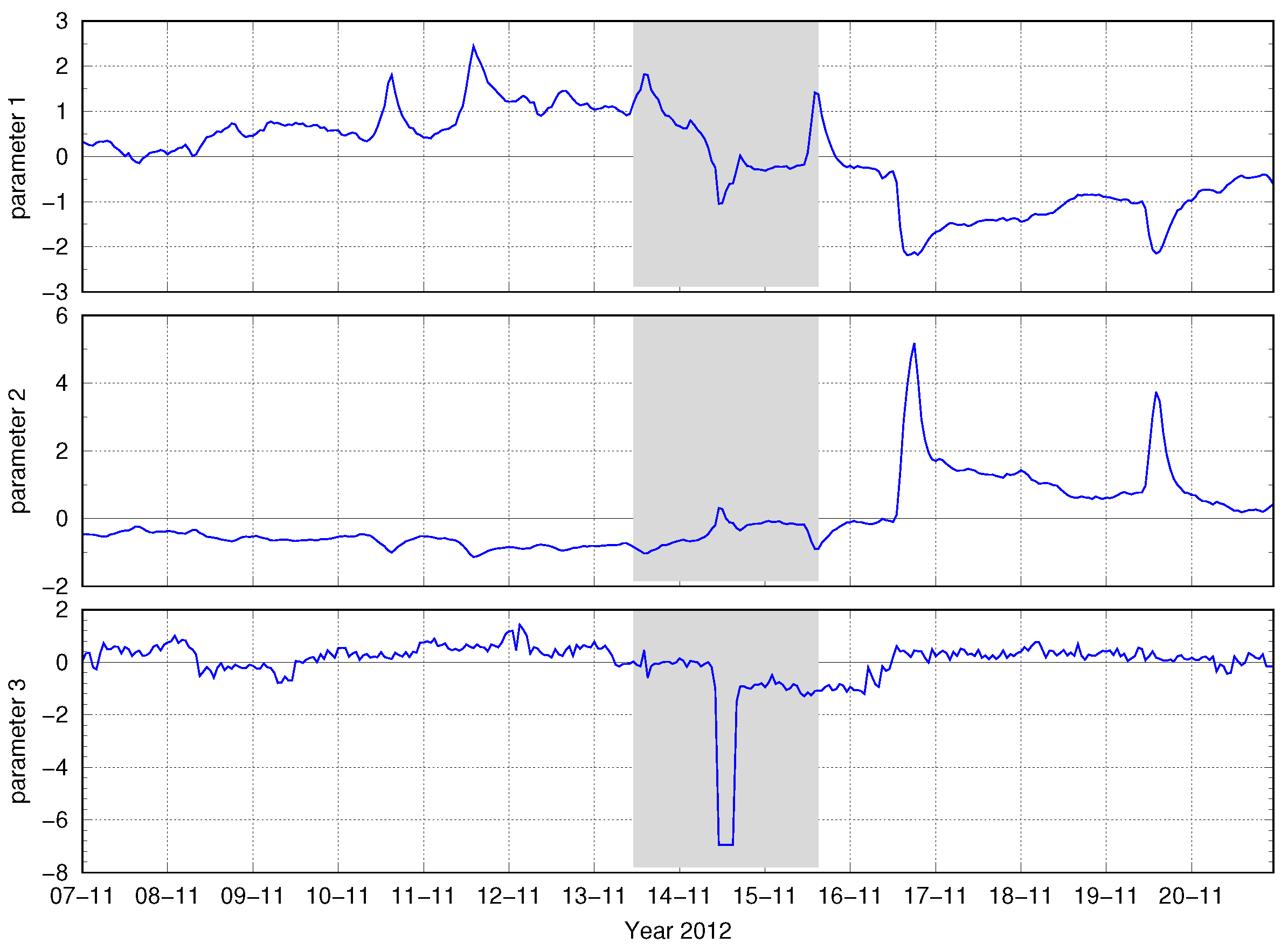
Three selected parameters describing the state of the PSE electric transmission grid of the standardised hourly data are presented in
Figure 1 for the geomagnetic storm 7–20 November 2012.
Figure 1 presents the temporal evolution of the hourly data of the analysed parameters 6 days before and 7 days after the main stage of the geomagnetic storm, indicated in
Figure 1 as the gray area. The anomalies in selected parameters can be seen during the storm’s main phase on 14 November 2012 and after. It will be discussed in detail later.
2.2. Heliospheric and Geomagnetic Data
The heliosphere is the region where the Sun dominates, with the continuously expanding solar corona creating a solar wind that carries an embedded heliospheric magnetic field (HMF), e.g., [
35]. Here, we consider the following heliospheric and solar wind parameters: the HMF magnitude
B, the
and
components, density (SWd), temperature (SWT), dynamic pressure (SWp), and speed (SWs). Solar wind structures, such as CMEs, solar flares, etc., interact with Earth’s magnetic field [
36] and influence the Earth’s environment. The consequences of this interaction are visible in geomagnetic activity. Here we consider the following geomagnetic indices: Kp, ap, Dst, and AE.
Kp-index [
37] is determined on a quasi-logarithmic scale and is obtained as the standardised mean changeability of geomagnetic activity from twelve magnetometers located in the range of 48–63 degrees geomagnetic latitudes, both of the north and south hemispheres. The Ap index is the linear equivalent of the Kp-index. The Auroral electrojet index, AE, is obtained based on the geomagnetic variations in the horizontal component registered by the twelve selected observatories: Abisko, Amderma, Dixon Island, Tixie Bay, Pebek, Barrow, College, Yellowknife, Fort Churchill, Sanikiluaq, Narsarsuaq, and Leirvogur [
38]. The ring current index, Dst, is based on magnetometer measurements from middle latitudes: Kakioka, Honolulu, San Juan, and Hermanus [
39]. It is often used to identify the main phase of geomagnetic storms [
40].
To study the potential relationship between anomalies in the Polish National Power System and solar, heliospheric, and geomagnetic parameters, we consider one hour data from [OMNI] of HMF magnitude
B,
and
components; solar wind parameters: density (SWd), temperature (SWT), dynamic pressure (SWp) and speed (SWs); and geomagnetic indices Kp, ap, Dst and AE for the geomagnetic storm of 7–20 November 2012.
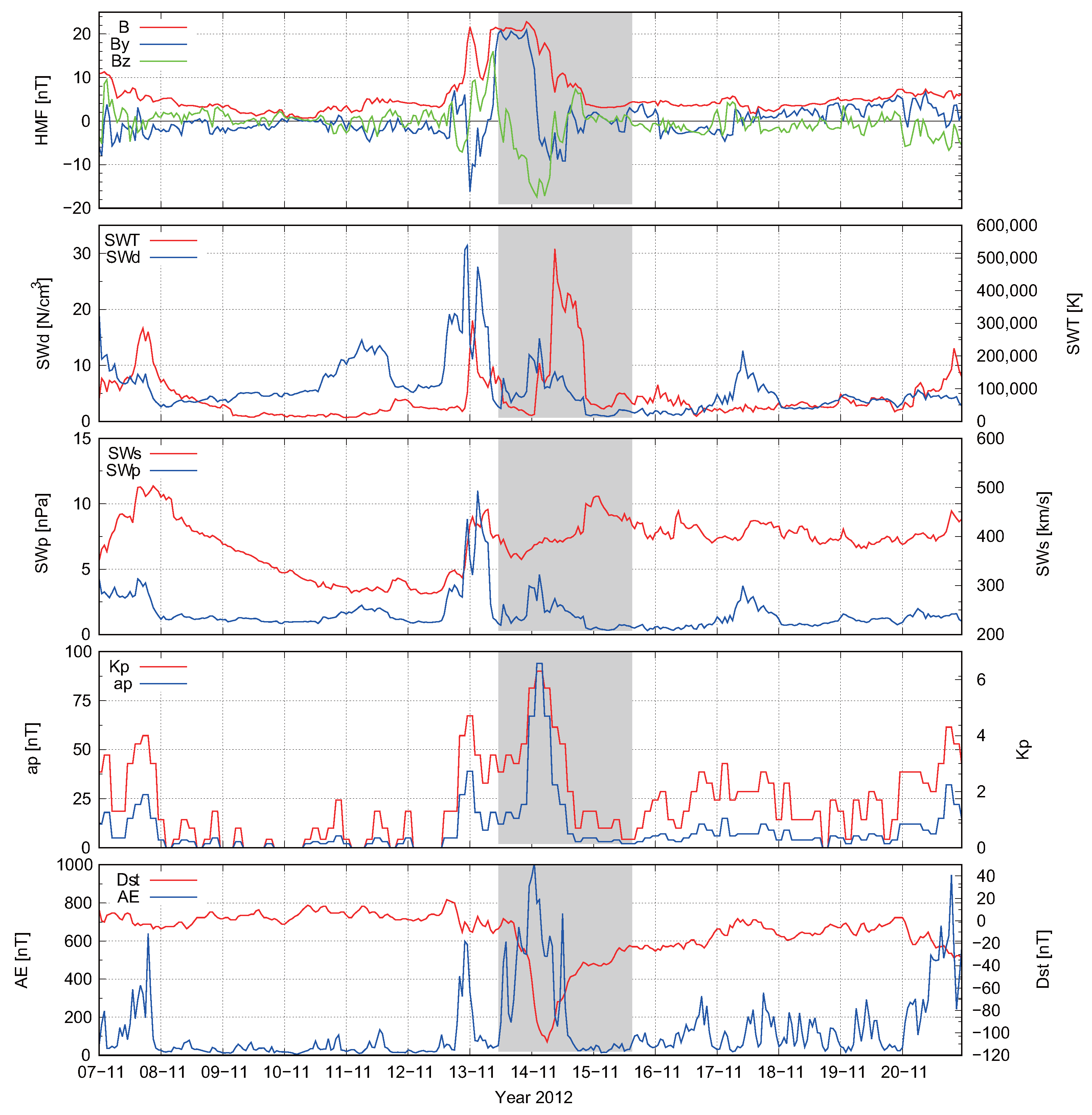
Figure 2 presents the temporal evolution of the hourly data of the analysed parameters 6 days before and 7 days after the main stage of the geomagnetic storm, indicated in
Figure 2 as the gray area.
Figure 2 (first panel) presents the time profile of magnitude and the components of HMF
B,
, and
before, during, and after the storm. The background values of the HMF parameters are about zero before and after the storm. During the main phase of the geomagnetic storm, the HMF parameters show a significant variability with a maximum magnitude value
B of 22.8 nT at 13 November 2012 23:00 and a component
with a minimum value of −17.4 nT at 14 November 2012 3:00. During the passage of CMEs [
24], the HMF magnitude was observed to be strong (∼20 nT).
Figure 2 (second and third panels) presents the timeline of solar wind parameters changing from background values for quiet times to peak values of SWd—31.4 N/cm
3, SWT—528,307 K, and SWp—10.99 nPa, respectively, just before and during the main phase of the storm. The arrival of a forward shock marked by a sudden enhancement in SWs, SWT, and SWd is observed late ∼23:00 UT) on 12 November 2012. Moreover, the high temperature of CME1 may be due to its collision with CME2, thereby resulting in its compression [
24]. For more details of CMEs’ passage and their interaction, please see [
24]. The last two panels of
Figure 2 present the temporal evolution of geomagnetic indices Kp, ap, Dst, and AE with background values before and after the storm. During the main phase of the storm, one can see significant geomagnetic disturbances, as indicated by extreme values of the Kp, ap, Dst, and AE indices: 6.3, 94 nT, −108 nT, and 1009 nT, respectively. A major geomagnetic response was noted at the arrival of the trailing edge of the preceding CME1 and the interaction region of the two CMEs near Earth [
24]. These authors suggested that, due to interactions and collisions among CMEs, the parameters responsible for geomagnetic activity were significantly enhanced during this storm.
2.3. Data Preprocessing and Standardisation
Confidentiality restrictions imposed by the Polish Transmission System Operator (PSE) prevent the disclosure of the original raw time-series data. To maintain methodological transparency and reproducibility, detailed descriptions of the data preprocessing procedures applied in this study are provided below.
All electrical (
Section 2.1) and space weather (
Section 2.2) time series were either provided or converted to an hourly resolution and aligned to Coordinated Universal Time (UTC) to ensure temporal consistency between power system measurements and heliospheric and geomagnetic parameters. No interpolation or temporal resampling beyond hourly alignment was performed.
The datasets contained no missing values; however, certain electrical parameters exhibited extended intervals of zero values, indicating either inactive measurement channels or operational conditions with no recorded signal. To ensure statistical robustness, any time series with more than one-third of its values equal to zero was excluded from further analysis. As a result, only parameters with at least non-zero values over the analysed interval were retained for cross-correlation, Principal Component Analysis (PCA), and Hierarchical Agglomerative Clustering (HAC).
Outliers were retained in the datasets. This approach reflects the exploratory nature of the study, which aims to identify potential signatures of space weather influence on power system behaviour. Extreme values may represent physically meaningful responses to geomagnetic disturbances rather than measurement artefacts; their removal could suppress relevant storm-time responses. For multivariate analyses (PCA and HAC), all retained variables were standardised using Z-score normalisation, centring each time series at zero and scaling to unit variance. This procedure ensures that variables with different physical units and magnitudes contribute comparably to the covariance and correlation structures.
Cross-correlation analysis was conducted on the preselected, non-standardised time series to preserve the physical meaning of amplitudes and time-lagged relationships. In contrast, PCA and HAC were applied exclusively to the standardised datasets.
4. Results
4.1. Cross-Correlation Analysis
Cross-correlation analysis reveals substantial variability in the strength and timing of relationships between transformer parameters and geomagnetic or heliophysical drivers. When determining the length of lags, we took into account that delays, in the short time-perspective, are two to three days [
10,
22]. We also performed tests that showed no differences between the results for k = 48, k = 50, k = 60, and k = 72 h. However, it should be noted that there are also known long-term impacts [
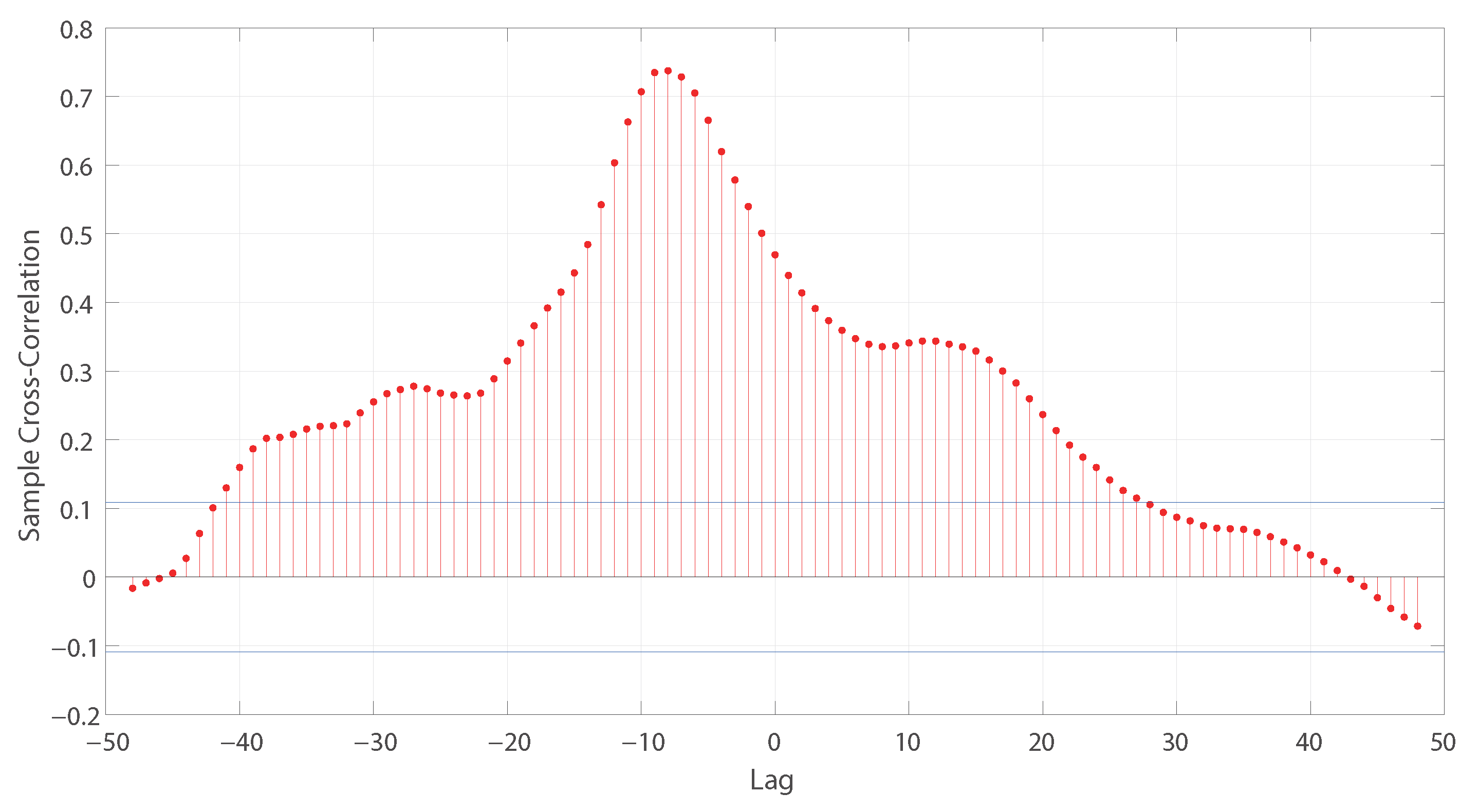
10]. For instance, for the localisation M1, the strongest positive correlation was observed between the current harmonic IHU2_01:25Hz and the Dst-index, reaching a value of 0.74 (with
p-value being equal 1.99 ×
) at a lag of
h.
Figure 3 shows that this result is above the threshold for statistical significance (horizontal upper blue line), with 95% confidence intervals. In contrast, a strong negative correlation of
was identified between current harmonics IHU1_02:75Hz and IHU3_01:25Hz, and the Ap-index (with
p-values 3.52 ×
and 0.84 ×
, respectively), with corresponding time lags of
and
h. A distinct delay effect is observed [
10,
22]. We attributed this to the cumulative impact of transient state propagation throughout the distribution network [
44]. The smallest lags, typically between
and
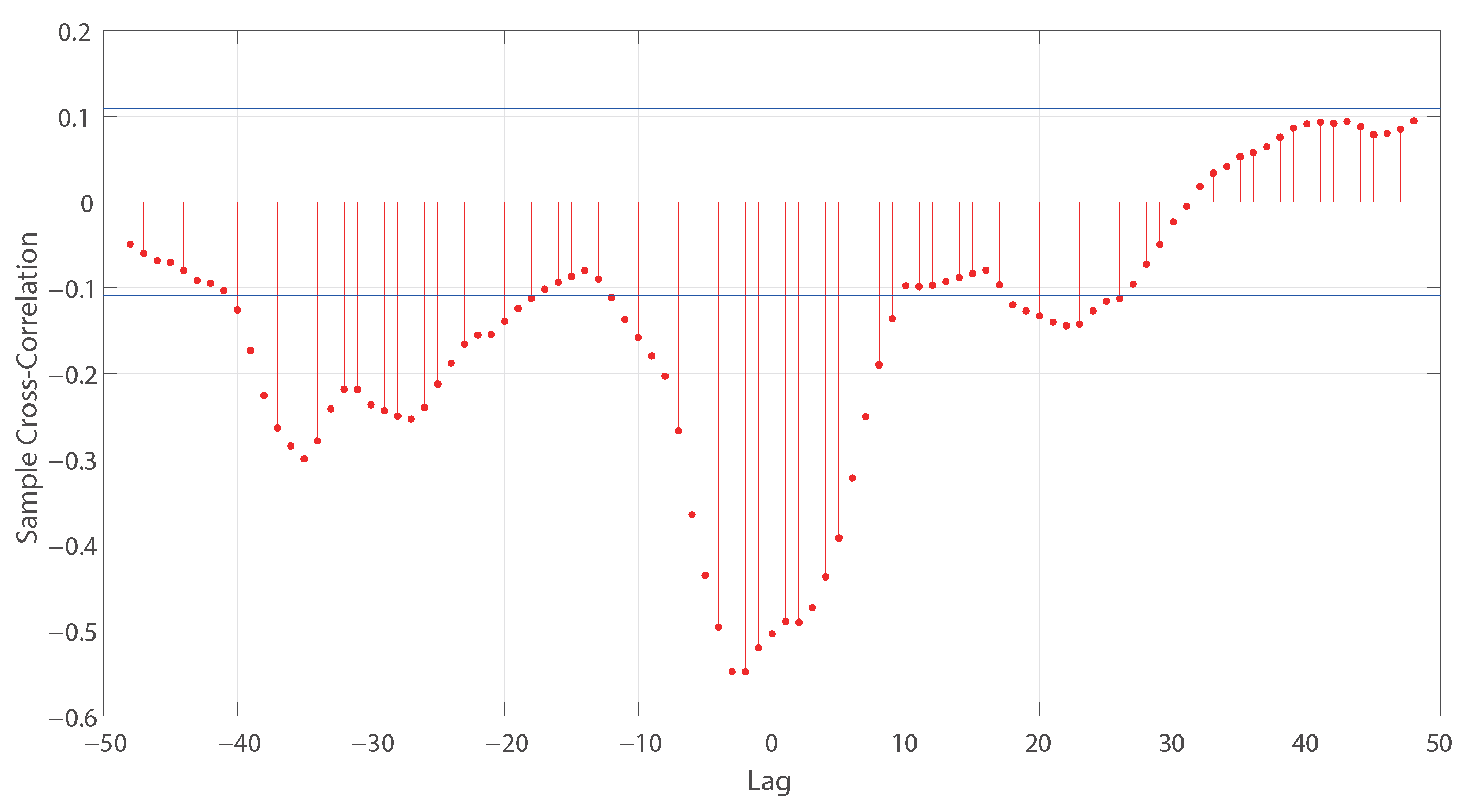
h, were found between several current harmonics and the solar wind temperature (SWT, (
Figure 4)), suggesting a more immediate response to heliospheric conditions.
Overall, during the analysed geomagnetic storm, the highest correlation coefficients were consistently associated with current harmonic parameters across all three phases, for both geomagnetic indices and solar wind variables. Voltage harmonics, fundamental voltages, and both actual and displacement power factor parameters also exhibited statistically significant correlations, though with slightly lower magnitudes than current harmonics. These results indicate that current harmonics are particularly sensitive to geomagnetic and heliospheric disturbances, making them potential indicators of space weather influence on power system performance.
Cross-correlation analysis also showed that there are ’preferred’ transformer localisations, such as M1 and M2, for which many of the investigated electrical parameters exhibited high or moderate correlation with heliophysical and geomagnetic indices across a wide range of time lags. This behaviour may be associated with the specific technological configurations of individual transformers, their operational characteristics within the network, or the electrical conductivity of the surrounding subsurface environment. However, a detailed assessment of these factors lies beyond the scope of the present study due to the confidentiality of the technical data provided by the PSE.
4.2. Principal Components Analysis
PCA was performed to identify and quantify the statistical relationships between anomalies in the Polish National Power System and the heliospheric/geomagnetic conditions during the geomagnetic storm of 14 November 2012. The analysis covered a seven-day interval, including three days prior to the storm onset and four days following the geomagnetic disturbance, allowing for the identification of storm precursors, peak interactions, and recovery trends. PCA decomposes the multidimensional dataset into statistically independent components (), where the loading coefficients indicate the degree and direction of influence of each parameter on the identified mode of variability. The sign of a coefficient indicates whether the parameter varies in-phase or out-of-phase with the principal direction, while its magnitude indicates the strength of the correlation. The squares of these coefficients may be interpreted as the proportion of variance attributable to that parameter within the principal component.
For the geomagnetic storm of 14 November 2012, the results show that seven principal components are required to capture of the total variability in localisation M1 and in localisation M2, as confirmed by the scree test analysis. This indicates that system behaviour can be effectively characterised using a limited set of dominant physical processes.
The system of principal components at M1 is expressed as
Interpretation of components at M1:
represents fundamental power transfer and system efficiency, with strong contributions from PF, DPF, and P2, while also capturing the influence of solar wind speed (SWs) and geomagnetic activity (Kp). This indicates possible coupling between the reactive power balance and heliospheric conditions.
isolates current waveform distortion, dominated by IHU harmonic parameters, consistent with GIC effects.
links fundamental phase voltages with magnetospheric indices (B, ap, AE), demonstrating that phase voltage stability might be affected by heliospheric and geomagnetic activity.
captures heliospheric electric and geomagnetic field variability (Ey, Bz), indicating a possible coupling.
corresponds to harmonic resonance phenomena, showing strong loadings from 7th harmonic voltages.
captures magnetopause compression effects, with negative contributions from SWp and SWd.
reflects ring current evolution, with Dst acting as a storm intensity proxy.
These components align precisely with the clustering results presented in
Section 4.3, where SWs co-clustered with PF and P2, SWd/SWp co-clustered with voltage parameters, and Dst/plasma Beta clustered with harmonic currents.
combines power factors and active power with solar wind speed and low-order voltage harmonics, indicating that system efficiency at M2 is dominated by local load effects with moderate space weather influence;
identifies harmonic current distortion, with a negative influence from solar wind temperature, confirming reduced geomagnetic coupling relative to M1;
isolates geomagnetic activity (ap, AE) as an external forcing mode, largely separated from electrical response;
– correspond to fundamental voltage polarity and voltage harmonics, with moderate contribution;
captures solar wind compression dynamics;
reflects ring current evolution (Dst) with diminished influence compared to M1.
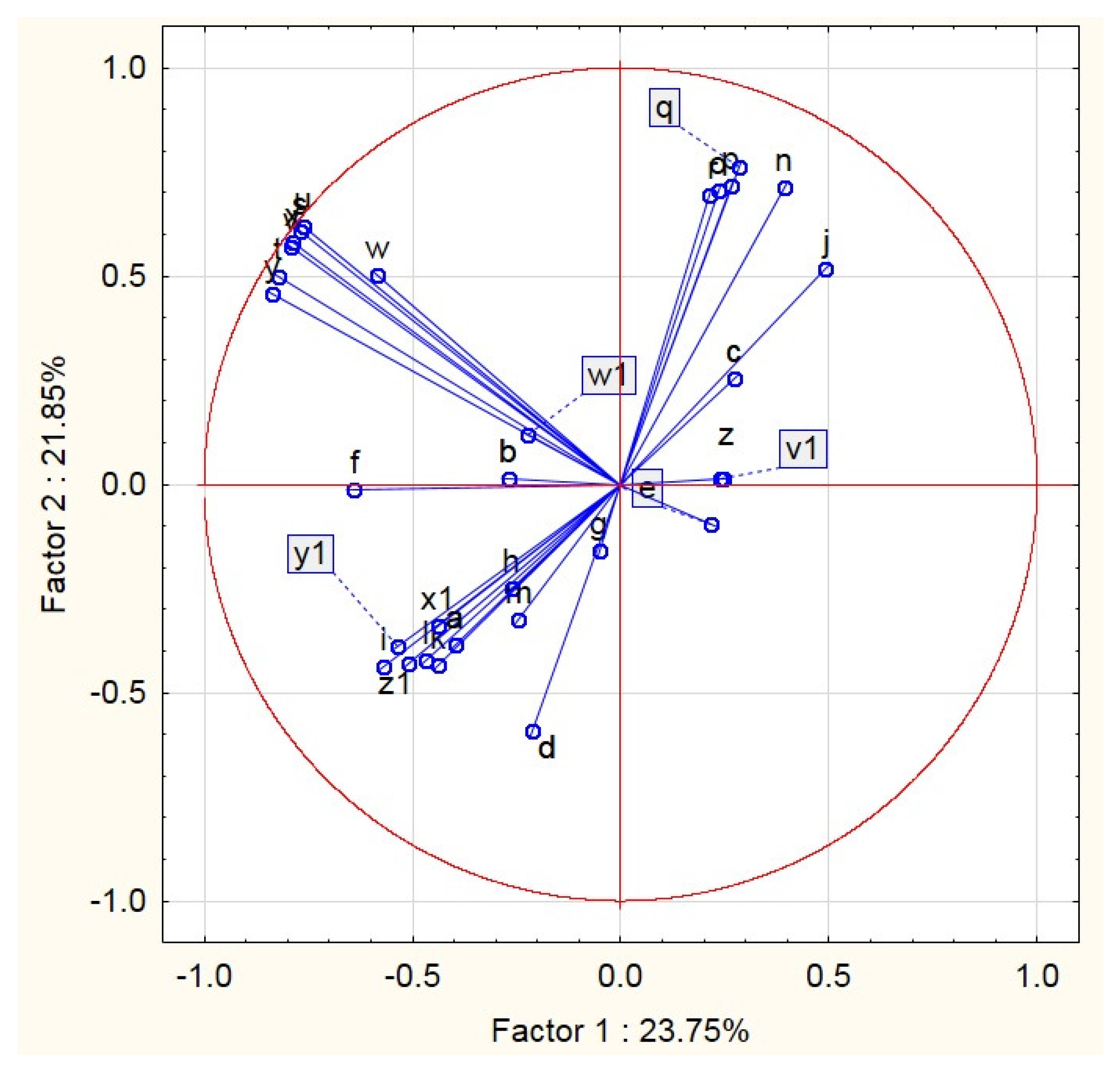
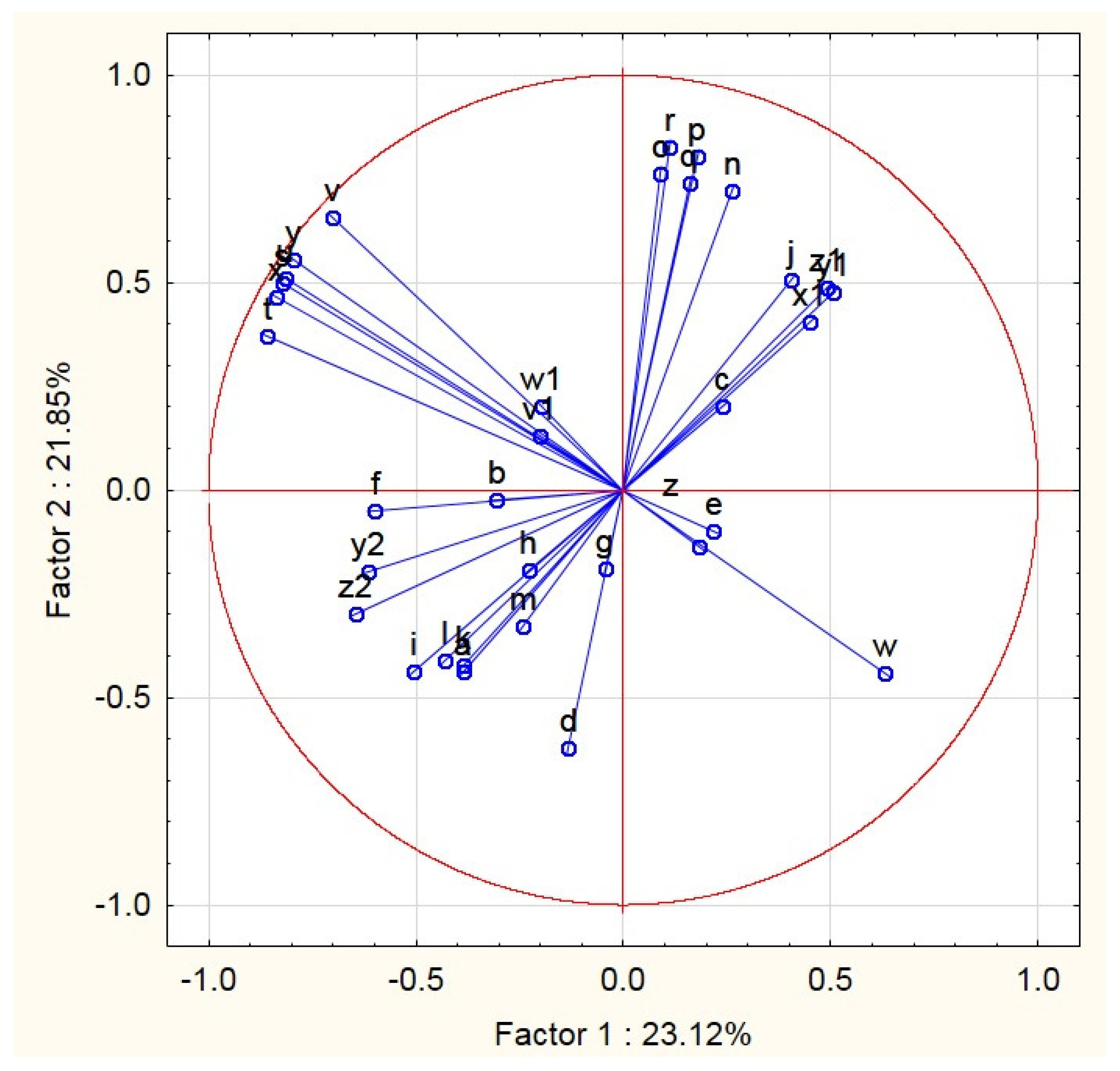
The PCA biplot for localisation M1 (
Figure 5) and M2 (
Figure 6) illustrates the distribution of both electric grid parameters and space weather variables in the reduced dimensional space defined by the first two principal components, which together explain approximately
of the total variance for location M1 (Factor 1:
, Factor 2:
) and
of the total variance for location M2 (Factor 1:
, Factor 2:
). The vectors’ directions and lengths indicate each parameter’s strength and its correlation structure with the principal components. Parameters pointing in similar directions are positively correlated, while those pointing in opposite directions are negatively correlated.
The PCA biplot for localisation M1 (
Figure 5) in the space of the first two principal components (Factor 1 and Factor 2) shows a clear separation of electrical and space weather influences that reflects the underlying physical coupling during this geomagnetic storm. The first principal component (horizontal axis) differentiates power system operational parameters, such as power factors (PF, DPF) and active power (P2), located predominantly on the left side, from heliospheric variables, such as the Bz component of HMF and geomagnetic indices, on the right side. This spatial distribution may indicate that decreases in power transfer efficiency and increases in reactive power demand are associated with enhanced geomagnetic activity. The second principal component (vertical axis) groups harmonic current parameters (IHU) together with the geomagnetic storm index Dst toward the upper part of the plane, demonstrating that current waveform distortion is strongly related to geomagnetically induced disturbances. The solar wind parameters SWs, SWd, and SWp are positioned between the electrical and geomagnetic clusters, reflecting their transitional role in mediating the coupling between the solar wind–magnetosphere system and the power grid. Overall, the biplot confirms that location M1 is sensitive to space weather conditions, with solar wind and geomagnetic parameters directly influencing both voltage stability and harmonic distortion in the electrical network.
The PCA biplot for localisation M2 (
Figure 6), projected onto the first two principal components, illustrates a distinct but less externally driven structure than M1. Along the first principal component (horizontal axis), power system parameters, including true and displacement power factors (PF, DPF), active power (P2), and low-order voltage harmonics, are grouped and aligned with SWs. This configuration indicates that variations in solar wind speed continue to influence power transfer efficiency during the studied geomagnetic storm; however, the presence of low-order harmonics in this grouping suggests a more substantial contribution from internal load dynamics, such as nonlinear industrial or consumer devices, rather than direct geomagnetic forcing. Along the second principal component (vertical axis), current harmonic indicators (IHU parameters) are located predominantly in the upper region, confirming that harmonic distortion is still associated with GICs. However, the intensity of this effect is lower than that observed in M1. Heliospheric parameters such as Bz, By HMF components, as well as Dst-index, are positioned further from the core electrical cluster, indicating that their influence on system variability is present but to a lower extent. This partial separation reflects a reduced degree of geomagnetic coupling at localisation M2 on 14 November 2012. Overall, the biplot suggests that M2 retains sensitivity to external space weather drivers but is more strongly governed by internal grid dynamics, resulting in attenuated geomagnetic influence compared to M1.
4.3. Hierarchical Agglomerative Clustering
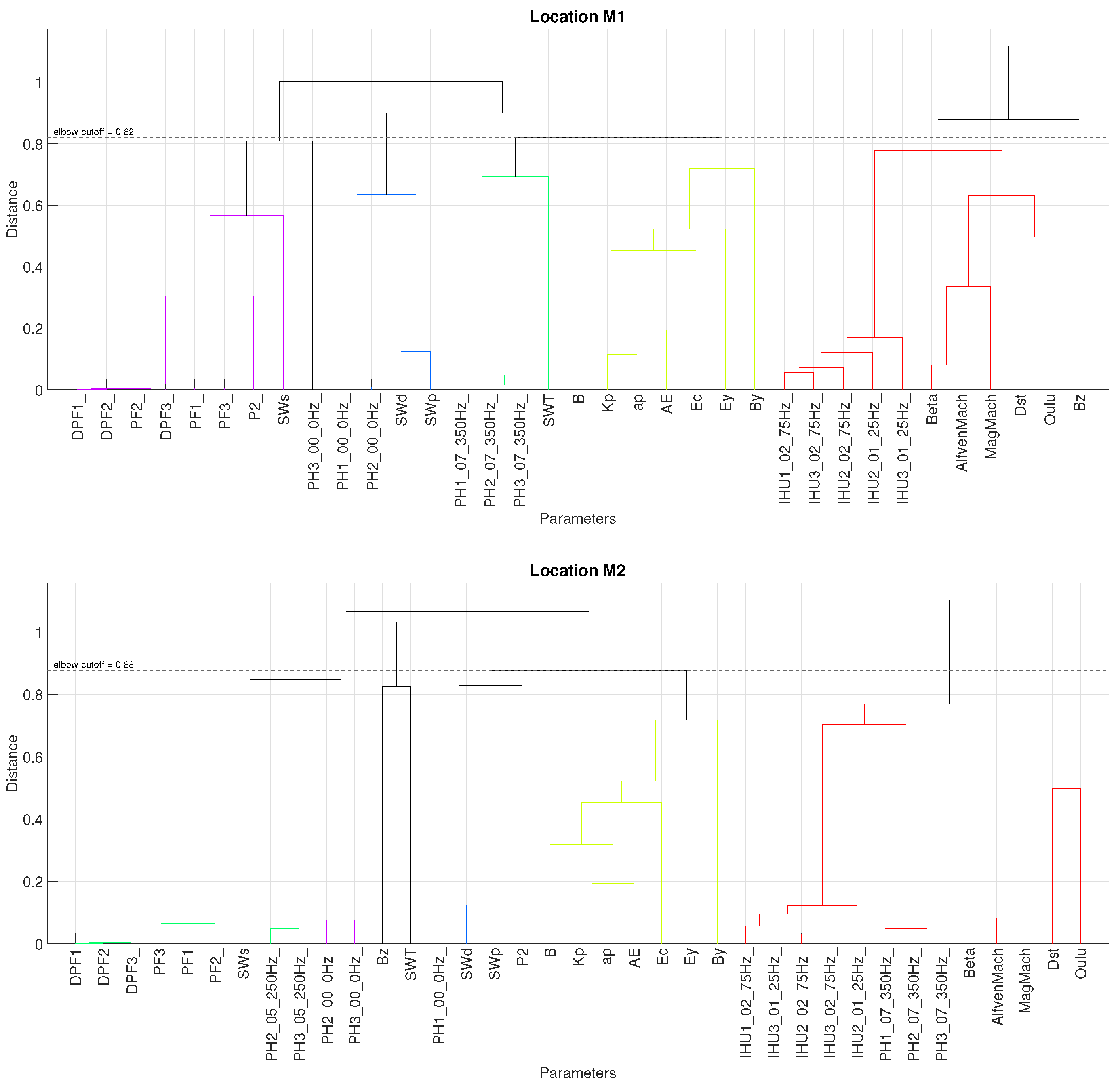
A HAC analysis was applied to the same dataset used in the clustering section to identify dominant modes of variability affecting the power transmission system during the geomagnetic storm of 14 November 2012. Additional parameters treated as magnetospheric drivers, such as plasma Beta, Alfvén, and magnetosonic Mach numbers, were also considered. Moreover, counts from the Oulu neutron monitor were used. The results for the two monitoring locations, M1 and M2, are presented as a two-panel dendrogram in
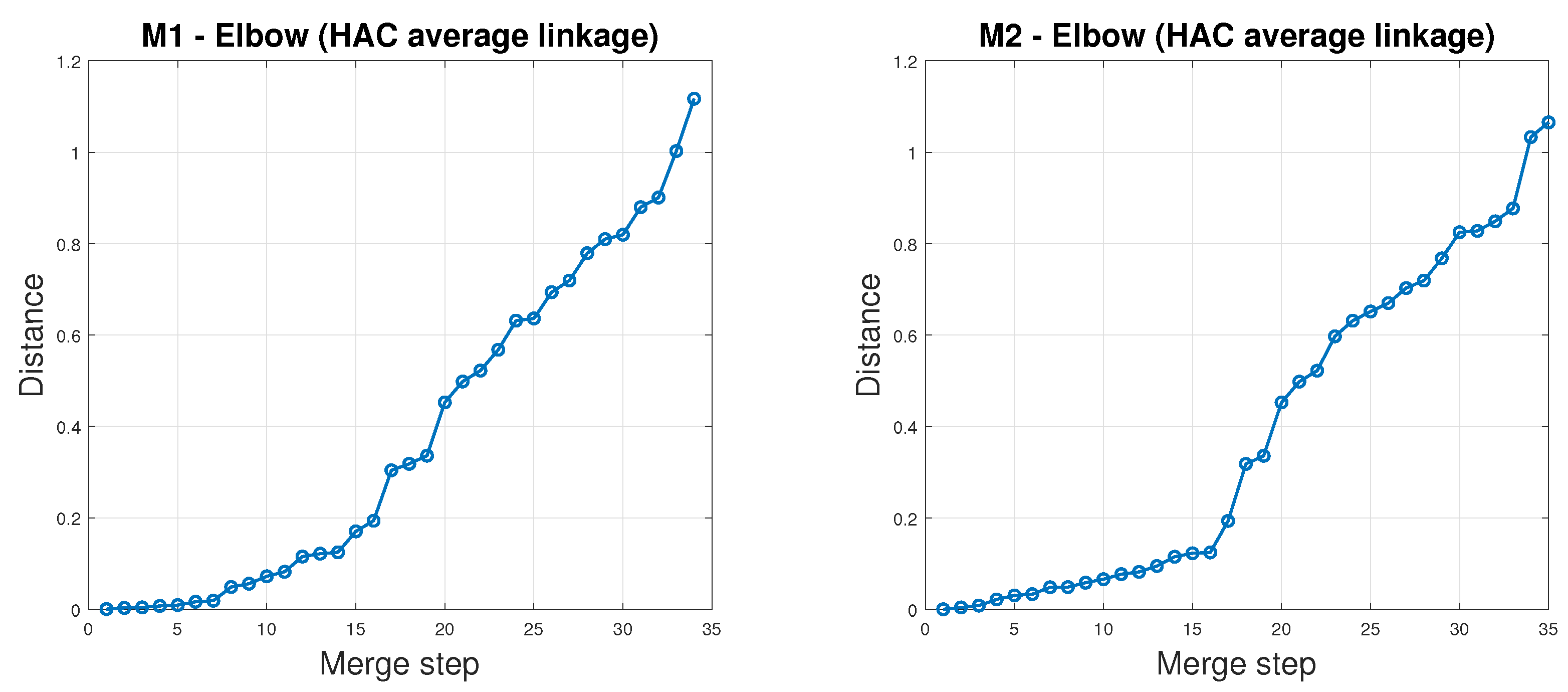
Figure 7. The resulting dendrograms reveal distinct clusters that group parameters according to similarity in their temporal behaviour. Importantly, several space weather parameters (solar wind and geomagnetic indices) appear in the same clusters as electric grid indicators, suggesting potential physical coupling mechanisms that may serve as predictors of electrical disturbances during geomagnetic storm activity. The number of clusters was determined using the elbow method applied to the linkage-distance curves obtained from the average-linkage dendrograms. It should be noted that, in hierarchical clustering, the elbow curve is based on linkage distances and therefore increases monotonically by construction; the elbow is identified by changes in slope rather than by a decrease in the curve.
For location M1, the linkage-distance curve (
Figure 8, left panel) shows a gradual increase up to values of approximately 0.82, followed by a distinct change in slope between about 0.82 and 0.90 and pronounced jumps to values exceeding 1.0. Based on this elbow structure, the dendrogram was cut to yield five clusters. For location M2, the linkage-distance curve (
Figure 8, right panel) exhibits a gradual increase up to approximately 0.72 and a clear elbow near 0.88, beyond which the linkage distance rises sharply above 1.0. Accordingly, the dendrogram for M2 was cut to yield five clusters.
The HAC results for the 14 November 2012 geomagnetic storm for location M1 (
Figure 7, Top Panel) reveal a clear and physically meaningful separation of the parameter space into five major clusters, each capturing a specific mode of system behaviour:
Cluster 1: Power Factor Stability and Solar Wind Speed (SWs). This cluster includes displacement and true power factors (DPF, PF), active power (P2), and solar wind speed (SWs). The tight grouping of electric parameters indicates stable load-flow dynamics under nominal operating conditions. The presence of SWs in the same cluster suggests that increases in solar wind speed correlate with deviations in reactive power compensation and load efficiency, making SWs a potential proxy for power transfer anomalies.
Cluster 2: Fundamental Voltage and Solar Wind Density/Pressure (SWd, SWp). Fundamental voltage components (PH_00:0Hz) are clustered with solar wind density (SWd) and dynamic pressure (SWp). Both SWd and SWp are indicators of magnetospheric compression, which can introduce time-varying electric fields at ground level. Their co-clustering with fundamental voltage implies that solar wind compressional effects directly modulate grid voltage stability, particularly during storm onset.
Cluster 3: Voltage Harmonics and Solar Wind Temperature (SWT). The 7th harmonic components of phase voltage (PH_07) cluster with solar wind temperature (SWT). This reflects a relationship between thermal conditions in the solar wind and nonlinear excitation within the transmission network, suggesting that SWT influences harmonic distortion, likely through enhanced reconnection rates or induced electric fields.
Cluster 4: Geomagnetic Disturbance Regime. Geomagnetic indices (Kp, ap, AE), HMF strength and components (B, By) and Ey, Ec form a cohesive cluster representing the external forcing environment. These parameters do not directly overlap with electrical parameters in this grouping, but might act as the driving mechanisms for induced disturbances observed in other clusters.
Cluster 5: Current Harmonics and Magnetospheric Drivers. Current harmonic indicators (IHU) cluster strongly with Dst, plasma Beta, Alfvén and magnetosonic Mach numbers, and neutron monitor counts (Oulu). This grouping demonstrates that geomagnetic storm intensity and magnetospheric plasma conditions directly influence current waveform distortion, confirming the role of geomagnetically induced currents (GICs) at this location.
Outlier: IMF Bz. The interplanetary magnetic field Bz component appears as an outlier, which is expected given its role as a storm initiation driver rather than a continuously correlated parameter.
At location M2, the clustering structure indicates slightly weaker geomagnetic coupling compared to M1 and stronger influence from local load-related nonlinearities. The following primary clusters were identified:
Cluster 1: Electrical Load Parameters, SWs, and Low-Order Harmonics. Cluster contains DPF, PF, P2, SWs, and additionally includes lower-order voltage harmonics (5th harmonic: PH2_05, PH3_05). SWs again clusters with fundamental electrical performance indicators, confirming its reliability as a grid disturbance proxy. The inclusion of 5th harmonics shows increased influence of local nonlinear loads relative to M1.
Cluster 2: Fundamental Voltage and Solar Wind Density/Pressure (SWd, SWp). Similarly to M1, this cluster combines PH1_00 and solar wind parameters SWd and SWp, reinforcing the interpretation that magnetospheric compression influences voltage stability at both sites.
Cluster 3: Pure Geomagnetic Driver Cluster. HMF magnitude (B), geomagnetic indices (Kp, ap, AE), and HMF component and HMF electric field (By, Ey) form a distinct cluster, indicating that geomagnetic variability is coherent but not immediately synchronised with electrical anomalies at this site.
Cluster 4: Harmonics and Magnetospheric Propagation Parameters. This cluster contains voltage harmonics (350 Hz), current harmonics, and geomagnetic/heliospheric parameters and GCR (Dst, Beta, AlfvénMach, MagMach, Oulu). The co-clustering suggests that both internal nonlinear processes and external geomagnetic drivers contribute to harmonic distortion, but with weaker coupling strength than M1.
Cluster 5: Bz and SWT. Their isolation indicates that their effects may be either threshold-dependent or highly localised.
5. Discussion
To determine which electric grid parameters and monitoring locations were more responsive to heliospheric and geomagnetic variability, a preliminary cross-correlation analysis was first conducted between the power transmission system parameters provided for four localisations by the PSE and key solar wind and heliospheric parameters, as well as geomagnetic indices. This initial cross-correlation analysis was crucial in selecting the transformer substations and their characteristics for further study. The results revealed that locations M1 and M2 exhibited moderate to strong interconnections across a wide range of time lags, particularly between electrical indicators (such as active power, power factor, and harmonic content) and solar wind parameters (such as the interplanetary magnetic field B). Our study supports the idea that CMEs’ interaction and/or collision can lead to the heating and compression [
24] of both preceding and following CMEs and consequently play a significant role in the development of geomagnetic disturbances. The strong links observed at these locations suggest that the variability of heliospheric drivers may influence transmission system parameters through GICs and associated electrodynamic processes. The identified responsiveness of these localisations is likely related to their specific design characteristics, operational roles within the network, and the electrical conductivity properties of the surrounding ground. On this basis, M1 and M2 were selected for detailed statistical examination using HAC and PCA.
The results of the HAC clearly demonstrate that electrical transmission parameters and space weather variables do not evolve independently during geomagnetic disturbances but instead form coherent groups characterised by similar temporal behaviour. These groupings reflect underlying physical coupling mechanisms between the solar wind–magnetosphere–ionosphere system and the terrestrial power grid. Parameters that were clustered together respond either to common external drivers (such as geomagnetic storm activity) or to shared internal grid phenomena (such as nonlinear load behaviour or reactive power compensation). The HAC results enable differentiation between clusters dominated by internal electrical system behaviour and those predominantly influenced by external heliospheric drivers.
An interesting finding from both analysed locations is the consistent appearance of SWs within the same HAC groups as power factor parameters (PF, DPF) and active power (P2). This co-location in HAC space indicates that variations in solar wind speed are associated with fluctuations in the grid’s real and reactive power flow. The physical interpretation of this relationship is grounded in the enhancement of magnetic reconnection at the magnetopause under high solar wind speed, enabling more efficient energy transfer from the solar wind into the magnetospheric system. This process increases the appearance of GICs in the transmission network, affecting reactive power balance, transformer operation, and load flow stability. The PCA results independently confirm this relationship, as SWs and load are the first principal component, together with PF, DPF, and P2, indicating solar wind speed as a potential leading external driver of systemwide electrical variability.
Further evidence is seen in the co-association of fundamental voltage components (PH
_00Hz) with solar wind density (SWd) and dynamic pressure (SWp) in the HAC results. These same parameters appear within the principal components associated with voltage variability in PCA. Solar wind density and pressure determine the compression state of the heliosphere and consequently the Earth’s magnetosphere, due to the interaction and/or collision of both preceding and following CMEs [
24]. They are strongly associated with sudden storm commencements, which can induce large-scale geoelectric fields in the Earth’s surface. The alignment of these variables in both HAC and PCA confirms their potential role as external precursors of voltage instability in transmission lines.
At location M1, higher-order voltage harmonics clustered together with solar wind temperature (SWT) in HAC, and this relationship was confirmed in PCA, where SWT contributed to the principal components associated with harmonic resonance. This suggests that the thermal properties of the solar wind plasma may influence harmonic distortion within the grid. This effect was not observed at location M2, where SWT appeared as an outlier in HAC and exhibited weak influence in PCA, indicating that the coupling between harmonic distortion and heliospheric thermal conditions is location-dependent.
One of the clearest indicators of physical coupling was found in clustering current harmonic parameters (IHU1–3) with geomagnetic indices such as Dst, as well as the geomagnetic drivers plasma Beta and the Alfvén and magnetosonic Mach numbers in HAC. PCA confirmed that these same variables dominate the second principal component. This demonstrates that harmonic distortion in the grid is probably related to storm-time geomagnetic variability. The strength of this coupling was significantly higher at M1, indicating that this localisation is geomagnetically more sensitive, whereas at M2, the influence of these parameters was present but attenuated by internal nonlinear load effects.
Taken together, the results from both HAC and PCA confirm that space weather influences on the grid are location-dependent. Localisation M1 shows stronger geomagnetic coupling in both voltage and current domains, suggesting greater exposure to induced electric fields, possibly due to local ground conductivity. Localisation M2 displays a more internally driven response, indicating that nonlinear loads play a dominant role in driving local electrical variability, with geomagnetic effects acting as secondary modulators. The agreement between HAC and PCA strengthens the interpretation that specific heliospheric parameters—particularly solar wind speed, solar wind density, dynamic pressure, Dst, and Alfvén Mach number—can be considered meaningful proxies for detecting and predicting transmission system anomalies during geomagnetic storms.
In summary, HAC, in conjunction with PCA, provides robust evidence that external space weather drivers can, to some extent, influence both voltage stability and harmonic distortion in the Polish transmission grid. The combined results reveal that space weather effects should be considered in operational planning and disturbance forecasting, particularly for more geomagnetically sensitive locations. This study is based on a detailed analysis of a single geomagnetic storm, which limits the generalisability of the results. Although the investigated event is representative of a moderate disturbance, the identified relationships between space weather drivers and power system parameters should be regarded as event-specific. Future research should extend the proposed methodology to a multi-event analysis encompassing storms of varying intensities, durations, and solar cycle phases, to assess the robustness and operational relevance of the observed patterns.
Recent advances in data-driven methods, including machine learning and neural network-based approaches, present considerable potential for analysing complex, nonlinear relationships between space weather drivers and power system responses. These methods facilitate pattern recognition, anomaly detection, and short-term forecasting of grid disturbances. Effective implementation, however, depends on the availability of long, continuous, and representative time series that encompass multiple geomagnetic events and operational regimes.
In this study, the availability of power system data is constrained by confidentiality requirements and the episodic occurrence of geomagnetic storms, which limit the length and uniformity of usable time series. As a result, the analysis employs statistical and multivariate techniques appropriate for limited, event-specific datasets. Future research will seek to expand the temporal coverage to include multiple storm events, thereby facilitating the application of machine learning methods and enabling a systematic evaluation of their predictive performance.



 ,
,