

Heat Transfer and Thermal Efficiency Enhancement of Parabolic Trough Collectors Using Al2O3–Therminol VP-1 Nanofluids

 ,
,  , , , and
Abstract
1. Introduction
2. Experimental Setup
2.1. Parabolic Trough Solar Collector
2.2. Evacuated Tube as an Absorber Tube
2.3. HTF Preparation with Nanoparticle
2.3.1. Heat Transfer Fluid
2.3.2. Nanoparticles
2.3.3. Nanofluid Preparation and Stability
3. Experimentation
Uncertainty Analysis
4. Thermal Modeling of the PTC System
4.1. Overall Loss Coefficient and Heat Transfer Correlation
4.2. Assumptions
- The parabolic trough collector is operating under steady-state conditions.
- The absorber experiences a uniform heat flux.
- Due to its reasonable length (approximately 4 m), the collector ensures minimal variation in receiver temperature along the tube.
- Radiative heat exchange from the collector components to the surrounding environment is included in the analysis.
- Temperature differences between the cover and the ambient air and between the receiver wall and the working fluid are assumed to be sufficiently small to be neglected.
- The internal flow is taken as fully developed, with a uniform heat transfer coefficient along the absorber tube.
5. Results and Discussions
5.1. Properties of Nanofluid
5.2. Thermal Performance of PTC
6. Conclusions
6.1. Limitations
- Sun tracking is vital for sustainable solar collection using parabolic trough collectors; without it, production decreases, raising maintenance costs.
- A parabolic trough collector relies on a concentrated sunlight beam for effective operation. In diffuse light, the concentration is ineffective, leading to a significant drop in production.
- The present study was limited to a single mass flow rate due to experimental constraints; future investigations will consider a wider range of flow rates to examine their influence on Reynolds number, pumping power, and thermal efficiency.
- The experiments were conducted under clear-sky conditions with repeated measurements on the same day; multi-day testing was not investigated in the present study.
- Although nanofluid viscosity increases pumping power requirements, a quantitative analysis of pressure drop and net efficiency was not included in the present study.
- Although nanofluid viscosity and associated pumping power effects were acknowledged, a quantitative evaluation of pressure drops and net system efficiency was not included in the present study.
- While solar photovoltaics (PV) can be installed on roofs, deploying parabolic trough collectors requires substantial land.
6.2. Future Work
Author Contributions
Funding
Data Availability Statement
Conflicts of Interest
Abbreviations/Nomenclature
| Aa | Effective aperture area m2 |
| Aabo | Absorber outer surface area m2 |
| c | Concentration ratio |
| cp | Specific heat capacity of fluid |
| Di | Inner diameter of absorber tube m |
| Do | Outer diameter of absorber tube m |
| Dci | Glass covers inner diameter m |
| Dco | Glass covers outer diameter m |
| f | Focal length m |
| F’ | Collector efficiency factor |
| FR | Heat removal factor |
| h | Convection heat transfer coefficient Wm−1k−1 coefficient w |
| hf | Heat transfer coefficient on the inside surface of the absorber tube |
| hp-c | Convective heat transfer coefficient between the absorber and glass cover |
| hgco | Convective heat transfer coefficient of the glass cover |
| Ib | Intensity of beam radiation, W/m2 |
| Id | Intensity of diffused radiation, W/m2 |
| k | Thermal conductivity Wm−1k−1 |
| keff | Effective thermal conductivity |
| L | Collector length m |
| m | Mass flow rate kg s−1 |
| Nu | Nusselt no dimensionless |
| Pr | Prandtl no dimensionless |
| Ql | heat loss rate W/m2 |
| QS | Heat supplied W/m2 |
| Qu | Useful heat gain rate W/m2 |
| Ra | Rayleigh number |
| Modified Rayleigh number | |
| Re | Reynolds number dimensionless |
| s | Heat flux W/m2 |
| Tab | Mean temperature of absorber K |
| Ta | Ambient temperature |
| Tc | Glass cover temperature |
| Ti | Inlet temperature of the fluid |
| Tm | Mean temperature of the air |
| Tsky | Sky temperature K |
| Ul | Overall loss coefficient |
| V | Velocity of fluid ms−1 |
| w | Aperture width m |
| Greek letters | |
| a | Emissivity of absorber |
| g | Emissivity of the glass cover |
| th | Thermal efficiency of the PTSC |
| ρ | Density kg/m2 |
| σ | Stefan–Boltzmann constant |
| φ | Volume fraction dimensionless |
| Abbreviations | |
| PTC | Parabolic trough collector |
| HTF | Heat transfer fluid |
| DNI | Direct normal irradiance |
References
- International Energy Agency (IEA). CO2 Emissions in 2022; IEA: Paris, France, 2023; Available online: https://www.iea.org/reports/co2-emissions-in-2022 (accessed on 5 April 2024).
- Alami, A.H.; Olabi, A.G.; Mdallal, A.; Rezk, A.; Radwan, A.; Rahman, S.M.A.; Shah, S.K.; Abdelkareem, M.A. Concentrating solar power (CSP) technologies: Status and analysis. Int. J. Thermofluids 2023, 18, 100340. [Google Scholar] [CrossRef]
- Nassar, Y.; Amer, K.; Irhouma, M.; Ahmad, S. Economical and environmental assessment of electrical generators: A case study of southern region of Libya. Int. J. Energy Policy Manag. 2016, 1, 64–71. [Google Scholar]
- Lazzarin, R.M. Solar cooling: PV or thermal. A thermodynamic and economical analysis. Int. J. Refrig. 2014, 39, 38–47. [Google Scholar] [CrossRef]
- Yılmaz, İ.H.; Mwesigye, A. Modeling, simulation and performance analysis of parabolic trough solar collectors: A comprehensive review. Appl. Energy 2018, 225, 135–174. [Google Scholar] [CrossRef]
- Siuta-Olcha, A.; Cholewa, T.; Dopieralska-Howoruszko, K. Experimental investigations of energy and exergy efficiencies of an evacuated tube solar collector. Proceedings 2019, 16, 2. [Google Scholar] [CrossRef]
- Al-Oran, O.; Lezsovits, F.; Aljawabrah, A. Exergy and energy amelioration for parabolic trough collector using mono and hybrid nanofluids. J. Therm. Anal. Calorim. 2020, 140, 1579–1596. [Google Scholar] [CrossRef]
- Chandrasekar, M.; Suresh, S.; Bose, A.C. Experimental investigations and theoretical determination of thermal conductivity and viscosity of Al2O3/water nanofluid. Exp. Therm. Fluid Sci. 2010, 34, 210–216. [Google Scholar] [CrossRef]
- Gupta, H.K.; Agrawal, G.D.; Mathur, J. An experimental investigation of a low-temperature Al2O3–H2O nanofluid-based direct absorption solar collector. Sol. Energy 2015, 118, 390–396. [Google Scholar] [CrossRef]
- Khullar, V.; Tyagi, H.; Phelan, P.E.; Otanicar, T.P.; Singh, H.; Taylor, R.A. Solar energy harvesting using nanofluids-based concentrating solar collectors. ASME J. Nanotechnol. Eng. Med. 2012, 3, 031003. [Google Scholar] [CrossRef]
- Sokhansefat, T.; Kasaeian, A.B.; Kowsary, F. Heat transfer enhancement in parabolic trough collector tube using Al2O3/synthetic oil nanofluid. Renew. Sustain. Energy Rev. 2014, 33, 636–644. [Google Scholar] [CrossRef]
- Zadeh, P.M.; Sokhansefat, T.; Kasaeian, A.B.; Kowsary, F.; Akbarzadeh, A. Hybrid optimization algorithm for thermal analysis in a solar parabolic trough collector based on Nanofluid. Energy 2015, 82, 857–864. [Google Scholar] [CrossRef]
- Bellos, E.; Tzivanidis, C.; Antonopoulos, K.A.; Gkinis, G. Thermal enhancement of solar parabolic trough collectors by using nanofluids and converging–diverging absorber tube. Renew. Energy 2016, 94, 213–222. [Google Scholar] [CrossRef]
- Bianco, V.; Chiacchio, F.; Manca, O.; Nardini, S. Numerical investigation of nanofluids forced convection in circular tubes. Appl. Therm. Eng. 2009, 29, 3632–3642. [Google Scholar] [CrossRef]
- Bayat, J.; Nikseresht, A.H. Thermal performance and pressure drop analysis of nanofluids in turbulent forced convective flows. Int. J. Therm. Sci. 2012, 60, 236–243. [Google Scholar] [CrossRef]
- Mwesigye, A.; Huan, Z.; Meyer, J.P. Comparative thermal performance of a parabolic trough receiver with Cu-Therminol® VP-1, Ag-Therminol® VP-1 and Al2O3-Therminol® VP-1 nanofluids. In Proceedings of the ASME IMECE, Phoenix, AZ, USA, 11–17 November 2016; p. V008T10A073. [Google Scholar]
- Olia, H.; Torabi, M.; Bahiraei, M.; Ahmadi, M.H.; Goodarzi, M.; Safaei, M.R. Application of nanofluids in thermal performance enhancement of parabolic trough solar collector: State-of-the-art. Appl. Sci. 2019, 9, 463. [Google Scholar] [CrossRef]
- Prakasam, M.J.S.; Thottipalayam Vellingiri, A.T.; Nataraj, S. An experimental study of the mass flow rates effect on flat-plate solar water heater performance using Al2O3/water nanofluid. Therm. Sci. 2017, 21, 379–388. [Google Scholar] [CrossRef]
- Pandey, V.K.; Prakash, O. Experimental investigation and simulation of a helical coil heat exchanger with hematite thermal reservoir. Environ. Prog. Sustain. Energy 2025, 44, e14562. [Google Scholar] [CrossRef]
- Prakash, O.; Pandey, V.K.; Kumar, L.; Brar, L.S.; Chakraborty, S.; Kumar, N.; Kumar, A.; Ahmad, A.; Irshad, K. Computational and experimental analysis of thermal oil-based parabolic trough collector. J. Enhanc. Heat Transf. 2025, 32, 19–35. [Google Scholar] [CrossRef]
- Htun, T.; Tun, M.T. Design calculation and estimating of parabolic trough solar thermal electrification for a model village (30 kW). Int. J. Electr. Electron. Data Commun. 2015, 3, 13–18. [Google Scholar]
- Wattana, A.; Rakwichian, W.; Ekasilp, W.; Tusnapucki, A. Velocity and temperature distribution of flowing water in a solar parabolic trough receiver. Int. J. Renew. Energy 2011, 6, 41–55. [Google Scholar]
- Bellos, E.; Tzivanidis, C. Analytical expression of parabolic trough solar collector performance. Designs 2018, 2, 9. [Google Scholar] [CrossRef]
- Wang, P.; Guan, H.; Liu, Z.; Wang, G.; Zhao, F.; Xiao, H. High temperature collecting performance of a new all-glass evacuated tubular solar air heater with U-shaped tube heat exchanger. Energy Convers. Manag. 2014, 77, 315–323. [Google Scholar] [CrossRef]
- Zhu, G.; Turchi, C. Solar field optical characterization at still water geothermal/solar hybrid plant. J. Sol. Energy Eng. 2017, 139, 031002. [Google Scholar] [CrossRef]
- Solutia Inc. Therminol® VP-1 Technical Bulletin 7239115C. Available online: https://www.therminol.com/products/Therminol-VP1 (accessed on 5 April 2016).
- Mwesigye, A.; Yılmaz, İ.H.; Meyer, J.P. Numerical analysis of the thermal and thermodynamic performance of a parabolic trough solar collector using SWCNTs-Therminol VP-1 nanofluid. Renew. Energy 2017, 119, 844–862. [Google Scholar] [CrossRef]
- Zlotea, C.; Oumellal, Y.; Berrú, J.J.S.; Aguey-Zinsou, K.F. Bottom-up synthesis of Mg2CoH5 nanoparticles supported on porous carbon and their hydrogen desorption behaviour. Nano Struct. Nano Objects 2018, 16, 144–150. [Google Scholar] [CrossRef]
- Belusso, L.C.S.; Lenz, G.F.; Fiorini, E.E.; Pereira, A.J.; Sequinel, R.; Bini, R.A.; Felix, J.F.; Schneider, R. Synthesis of silver nanoparticles from bottom-up approach on borophosphate glass and their applications as SERS, antibacterial and glass-based catalyst. Appl. Surf. Sci. 2019, 473, 303–312. [Google Scholar] [CrossRef]
- Michalopoulou, A.; Favvas, E.P.; Mitropoulos, A.C.; Maravelaki, P.; Kilikoglou, V.; Karatasios, I. Comparative evaluation of bottom-up and break-down methodologies for the synthesis of calcium hydroxide nanoparticles for architectural monument consolidation. Mater. Today Proc. 2018, 5, 27425–27433. [Google Scholar] [CrossRef]
- Boufoudi, F.; Zouaoui, S.; Mihoub, S.; Benahmed, A.; Tayebi, T. Numerical investigation of the (mono-hybrid) nanofluid thermophysical properties for concentrated solar power plant. J. Nanofluids 2023, 12, 1233–1241. [Google Scholar] [CrossRef]
- Eastman, J.A.; Choi, S.U.S.; Li, S.; Yu, W.; Thompson, L.J. Anomalously increased effective thermal conductivities of ethylene glycol-based nanofluids containing copper nanoparticles. J. Appl. Phys. 2001, 78, 718–720. [Google Scholar] [CrossRef]
- Auerkari, P. Mechanical Properties and Design Allowables for Heat Resisting Steels; VTT: Espoo, Finland, 1996. [Google Scholar]
- Chakraborty, O.; Das, B.; Algarni, S.; Alqahtani, T.; Irshad, K. Numerical investigation of parabolic trough collectors using hybrid nanofluids and modified receiver tube. Appl. Therm. Eng. 2025, 279, 127597. [Google Scholar] [CrossRef]
- Ebrahimi, A.; Rikhtegar, F.; Sabaghan, A. Heat transfer and entropy generation in a microchannel with longitudinal vortex generators using nanofluids. Energy 2016, 101, 190–201. [Google Scholar] [CrossRef]
- Seyf, H.R.; Feizbakhshi, M. Computational analysis of nanofluid effects on convective heat transfer enhancement of micro-pin-fin heat sinks. Int. J. Therm. Sci. 2012, 58, 168–179. [Google Scholar] [CrossRef]
- Manca, O.; Mesolella, P.; Nardini, S. Numerical study of a confined slot impinging jet with nanofluids. Nanoscale Res. Lett. 2011, 6, 188. [Google Scholar] [CrossRef] [PubMed]
- Li, P.; Zhang, D.; Xie, Y. Heat transfer and flow analysis of Al2O3–water nanofluids in microchannel with dimple and protrusion. Int. J. Heat Mass Transf. 2014, 73, 456–467. [Google Scholar] [CrossRef]
- Bellos, E.; Tzivanidis, C. Performance analysis and optimization of an absorption chiller driven by nanofluid-based solar flat plate collector. J. Clean. Prod. 2018, 174, 256–272. [Google Scholar] [CrossRef]
- Bellos, E.; Tzivanidis, C. Parametric investigation of nanofluids utilization in parabolic trough collectors. Therm. Sci. Eng. Prog. 2017, 2, 71–79. [Google Scholar] [CrossRef]
- Kalbande, V.P.; Walke, P.V.; Rambhad, K. Performance of oil-based thermal storage system with parabolic trough solar collector using Al2O3 and soybean oil nanofluid. Int. J. Energy Res. 2021, 45, 15338–15359. [Google Scholar] [CrossRef]
- Subramani, J.; Nagarajan, P.K.; Wongwises, S.; El-Agouz, S.A.; Sathyamurthy, R. Experimental study on the thermal performance and heat transfer characteristics of solar parabolic trough collector using Al2O3 nanofluids. Environ. Prog. Sustain. Energy 2018, 37, 1149–1159. [Google Scholar] [CrossRef]
- Ghasemi, S.E.; Ranjbar, A.A. Effect of using nanofluids on efficiency of parabolic trough collectors in solar thermal electric power plants. Int. J. Hydrogen Energy 2017, 42, 21626–21634. [Google Scholar] [CrossRef]
- Mukhtar, A.; Rehman, S.; Ahmad, A.; Zayed, M.E.; Irshad, K.; Ghazy, M. Recent Advances in Nano-Enhanced Phase Change Materials for Energy-Efficient Buildings: A Comprehensive Review. Arab. J. Sci. Eng. 2026. [Google Scholar] [CrossRef]
- Sukhatme, S.P.; Nayak, J.K. Solar Energy: Principles of Thermal Collection and Storage; Tata McGraw Hill: New Delhi, India, 2008. [Google Scholar]
- Duffie, J.A.; Beckman, W.A. Solar Engineering of Thermal Processes; John Wiley & Sons: Hoboken, NJ, USA, 2013. [Google Scholar]
- Sagade, A.A.; Aher, S.; Shinde, N.N. Performance evaluation of low-cost FRP parabolic trough reflector with mild steel receiver. Int. J. Energy Environ. Eng. 2013, 4, 5. [Google Scholar] [CrossRef]
- Bouarfa, I.; El Ydrissi, M.; El Hafdaoui, H.; Boujoudar, M.; Jamil, A.; Bennouna, E.G. Developing optical and thermal models with experimental validation of parabolic trough collector for moroccan industrial heat applications. Sol. Energy Mater. Sol. Cells 2024, 266, 112676. [Google Scholar] [CrossRef]



| Parameter | Value |
|---|---|
| Receiver (absorber tube) length, L | 3.65 m |
| Collector aperture width, W | 1.52 m |
| Aperture area, Aa | 5.54 m2 |
| Absorber tube outer diameter | 0.05 m |
| Absorber wall thickness | 0.0016 m |
| Concentration ratio, C | 9.36 |
| Rim angle, ψ | 70° |
| Measured solar irradiance range in Ranchi (summer) | 300–1100 W/m2 |
| Glass envelope material | Borosilicate |
| Glass envelope outer diameter | 0.11 m |
| Glass envelope thickness | 0.005 m |
| Mirror reflectance, ρ | 0.95 |
| Glass solar transmittance, τ | 0.92 |
| Receiver solar absorptance, α | 0.91 |
| Glass long-wave emissivity, ε | 0.9 |
| Nanofluid mass flow rate | 0.041 kg/s |
| Properties | Temperature (K) | ||
|---|---|---|---|
| Thermal properties | 400 K | 600 K | 800 K |
| Specific heat capacity (Cp) Jkg−1K−1 | 940 | 1110 | 1180 |
| Thermal conductivity (λ) Wm−1K−1 | 32.4 | 18.9 | 13 |
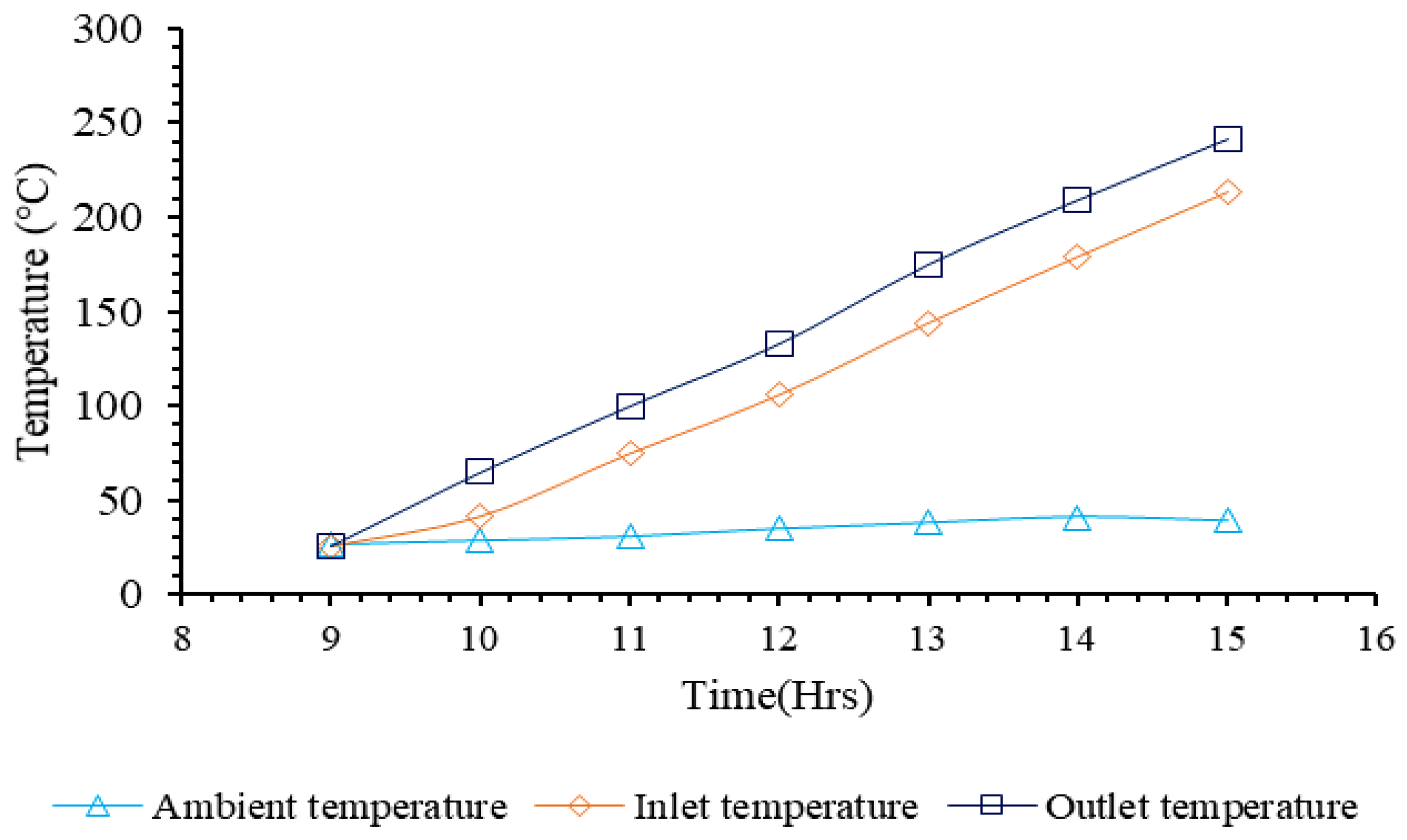
| Time | Ta | Tin | Tout | ΔT | Tabr | Ib | Id | Absorbed Solar Flux (s) | Heat Removal Factor (FR) | Heat Gained by the Solar Collector | Instantaneous Collection Efficiency (ƞic) |
|---|---|---|---|---|---|---|---|---|---|---|---|
| (°C) | (°C) | (°C) | (°C) | (°C) | (W/m2) | (W/m2) | (W/m2) | - | (Watt) | (%) | |
| 9:00 AM | 27 | 26 | 26 | 0 | 26 | 638 | 106 | 495.21 | - | - | - |
| 10:00 AM | 29 | 42 | 65 | 23 | 72 | 710 | 109 | 629.68 | 0.93 | 3189.90 | 63.60 |
| 11:00 AM | 31 | 75 | 100 | 25 | 107 | 918 | 111 | 715.59 | 0.97 | 3774.28 | 66.40 |
| 12:00 AM | 35 | 106 | 133 | 27 | 140 | 965 | 117 | 753.04 | 0.98 | 4026.53 | 67.39 |
| 1:00 PM | 38 | 144 | 175 | 31 | 185 | 945 | 114 | 736.64 | 0.98 | 3953.18 | 67.56 |
| 2:00 PM | 41 | 179 | 209 | 30 | 219 | 851 | 109 | 661.55 | 0.98 | 3537.97 | 67.14 |
| 3:00 PM | 39 | 213 | 241 | 28 | 26 | 700 | 108 | 543.33 | 0.98 | 2912.24 | 65.88 |
| Study | Base Fluid | Circulation Mode | Nanoparticle Concentration | Reported Efficiency/Enhancement | Key Distinction |
|---|---|---|---|---|---|
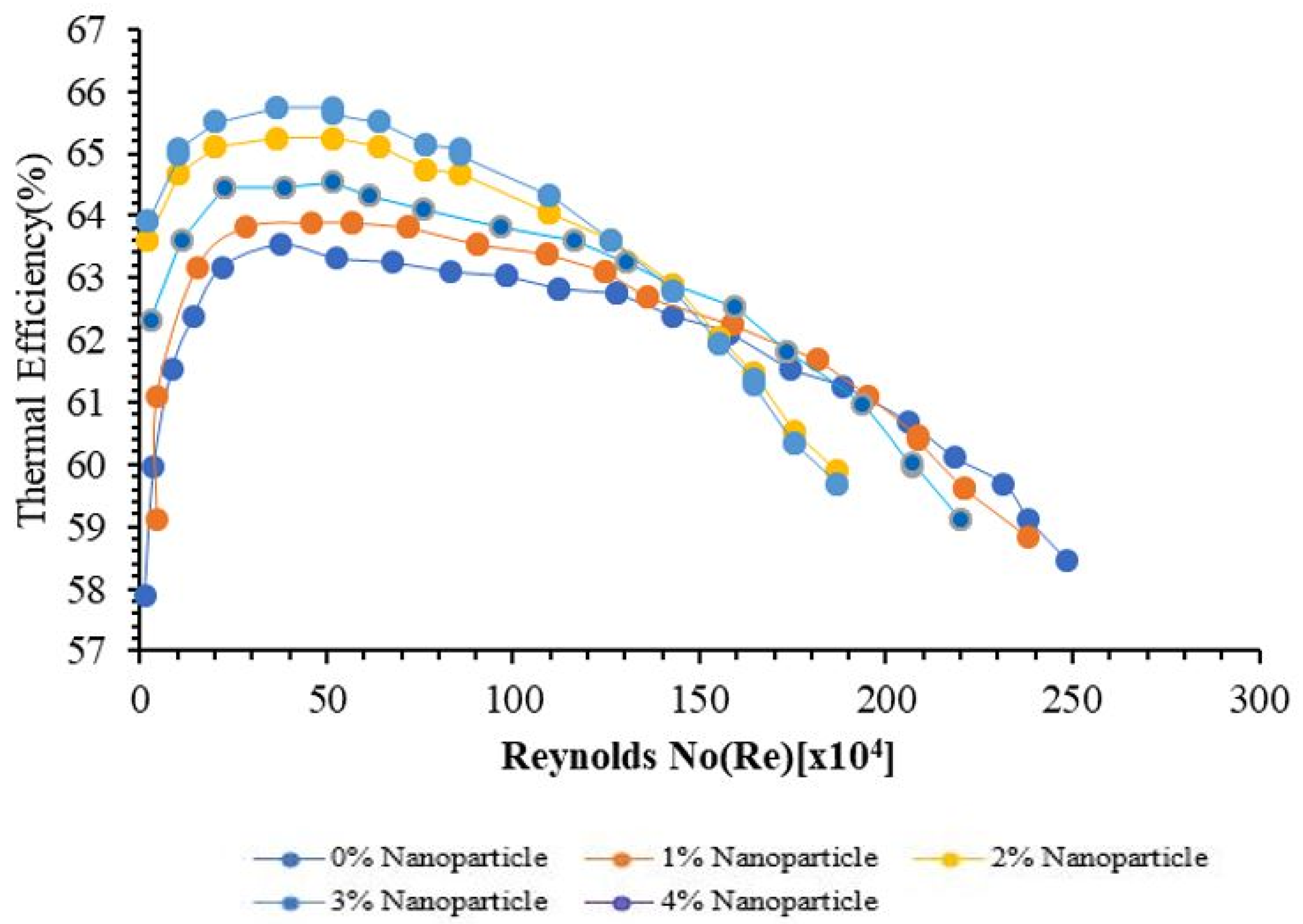
| Present study | Therminol VP-1 | Forced (fixed flow rate) | 0–4 vol.% | ≈67.4% (≈7.2% enhancement) | Experimental study with high-temperature oil; optimal Re identified |
| Kalbande et al. (2021) [41] | Soybean oil | Natural (thermo-syphon) | 0.1 vol.% | ≈60.8% | Integrated TES with latent heat storage |
| Subramani et al. (2018) [42] | DI water | Forced | ≤0.5 vol.% | ≈8.5% enhancement | Low-temperature water-based PTC |
| Ghasemi & Ranjbar (2017) [43] | Therminol-66 | Forced | 0–4 vol.% | ≈10–12% (numerical) | Numerical-only analysis |
| Bellos & Tzivanidis (2017) [40] | Thermal oil | Forced | ≤5 vol.% | Efficiency improvement | Parametric numerical study |
Disclaimer/Publisher’s Note: The statements, opinions and data contained in all publications are solely those of the individual author(s) and contributor(s) and not of MDPI and/or the editor(s). MDPI and/or the editor(s) disclaim responsibility for any injury to people or property resulting from any ideas, methods, instructions or products referred to in the content. |
© 2026 by the authors. Licensee MDPI, Basel, Switzerland. This article is an open access article distributed under the terms and conditions of the Creative Commons Attribution (CC BY) license.
Share and Cite
Pandey, V.K.; Prakash, O.; Ahmad, A.; Kumar, S.; Algarni, S.; Alqahtani, T.; Irshad, K.; Hasnain, S.M.M. Heat Transfer and Thermal Efficiency Enhancement of Parabolic Trough Collectors Using Al2O3–Therminol VP-1 Nanofluids. Energies 2026, 19, 1051. https://doi.org/10.3390/en19041051
Pandey VK, Prakash O, Ahmad A, Kumar S, Algarni S, Alqahtani T, Irshad K, Hasnain SMM. Heat Transfer and Thermal Efficiency Enhancement of Parabolic Trough Collectors Using Al2O3–Therminol VP-1 Nanofluids. Energies. 2026; 19(4):1051. https://doi.org/10.3390/en19041051
Chicago/Turabian StylePandey, Vijay Kumar, Om Prakash, Asim Ahmad, Sujit Kumar, Salem Algarni, Talal Alqahtani, Kashif Irshad, and S M Mozammil Hasnain. 2026. "Heat Transfer and Thermal Efficiency Enhancement of Parabolic Trough Collectors Using Al2O3–Therminol VP-1 Nanofluids" Energies 19, no. 4: 1051. https://doi.org/10.3390/en19041051
APA StylePandey, V. K., Prakash, O., Ahmad, A., Kumar, S., Algarni, S., Alqahtani, T., Irshad, K., & Hasnain, S. M. M. (2026). Heat Transfer and Thermal Efficiency Enhancement of Parabolic Trough Collectors Using Al2O3–Therminol VP-1 Nanofluids. Energies, 19(4), 1051. https://doi.org/10.3390/en19041051