Article

Thermoelectric Diffusion Potential and Thermoelectric Energy


1
Key Laboratory for Thermal Science and Power Engineering of Ministry of Education, Department of Engineering Mechanics, Tsinghua University, Beijing 100084, China
2
Energy Research Institute of Shandong Academy of Sciences, Qilu University of Technology (Shandong Academy of Sciences), Jinan 250014, China
*
Author to whom correspondence should be addressed.
These authors contributed equally to this work.
Energies 2026, 19(4), 1052; https://doi.org/10.3390/en19041052
Submission received: 29 December 2025 / Revised: 14 February 2026 / Accepted: 15 February 2026 / Published: 18 February 2026

Abstract

At present, the advancement of thermoelectric technology remains largely focused on developing high-performance thermoelectric materials, while comparatively little attention is directed towards its fundamental principles. To address this gap, this study introduces a new physical quantity, the “thermoelectric diffusion potential”, which clarifies the physical interpretations of various thermoelectric coefficients. Analyses reveal that, within a thermoelectric element, the Seebeck coefficient represents a balance between the thermoelectric diffusion field and electrostatic field, rather than between temperature and voltage differences. Using the thermoelectric diffusion potential, the relationship between the Seebeck and Peltier coefficients can be derived directly. Building on this framework, two additional physical quantities, namely the “thermoelectric energy” and “thermoelectric energy flow”, associated with the thermoelectric diffusion potential, are introduced. The formulation of thermoelectric energy flow helps derive the energy conversion relationship at the interface on a macroscopic level. Specifically, energy conversion at the interface occurs between thermoelectric and thermal energy flows, while within the element, it takes place between thermoelectric and electrical energy flows. Owing to the dual nature of internal energy in thermoelectric materials, manifesting as both thermal and electrical energy, the conversion within the element can also be regarded as one between thermal and electrical energy flows. The proposed quantities constitute an important complementary interpretation for the existing thermoelectric framework.

1. Introduction

In recent decades, thermoelectric technologies, which directly convert heat into electricity without any moving components, have emerged as among the most promising approaches to energy harvesting [1,2]. Furthermore, advances in high-performance materials have driven continuous improvements in thermoelectric systems [3,4]. However, these systems remain less efficient than steam engines [5], although both are theoretically constrained by the Carnot efficiency limit [6].
The foundational principles of thermoelectricity were established in the early 19th century. Specifically, in 1821, Seebeck [7] observed that, in a circuit formed by two dissimilar metal wires, a small magnetic needle placed nearby deflected when a temperature difference existed across the junctions. Two years later, Oersted [8] re-examined Seebeck’s findings and demonstrated that the needle’s deflection was caused by a voltage difference induced by the temperature gradient. This thermoelectric phenomenon was designated as the Seebeck effect. Meanwhile, the proportional relationship between the voltage and temperature differences was defined as the Seebeck coefficient, S:
S = Δ V Δ T I = 0 .
where V is voltage, and T is temperature. Notably, for p-type elements, S is positive. Because this coefficient typically varies with temperature, its average value over a finite temperature range was defined as [9]
S ¯ = V 1 V 2 T 1 T 2 = 1 T 1 T 2 T 2 T 1 S T d T ,   V 1 < V 2 ,   T 1 > T 2 .
Further, in 1834, Peltier [10] discovered that, under isothermal conditions, an electric current could induce a temperature difference across the junctions of a circuit. This phenomenon, known as the Peltier effect, was regarded as the inverse of the Seebeck effect [11]. Here, the proportional relationship between the Peltier heat flow and electric current was defined by the Peltier coefficient, π:
π = Q π I .
where Q is the heat flow, and I is the electric current. Subsequently, in 1851, Thomson, also known as Lord Kelvin [12,13], predicted a third thermoelectric effect by theoretically examining the Seebeck and Peltier effects. He proposed that a conductor carrying an electric current would absorb or release “Thomson heat” under a temperature gradient, a phenomenon later termed the Thomson effect. In this case, the proportional relationship between the Thomson heat flow and the product of electric current and temperature gradient was defined by the Thomson coefficient, τ:
τ = δ Q I d T .
Building on these findings, Thomson further recognised that the three thermoelectric coefficients are not mutually independent. Accordingly, using a quasi-thermodynamic approach, he established two relations among them: the first Kelvin relation, which links the Seebeck and Thomson coefficients, and the second Kelvin relation, which relates the Seebeck and Peltier coefficients:
τ = T d S d T ,
π = S A B T = S A S B T ,
where SAB denotes the relative Seebeck coefficient.
In the early 20th century, Altenkirch [14,15] established the fundamental operational principle of thermoelectric power generation and introduced a method for calculating conversion efficiency based on a thorough understanding of thermoelectric theory. Since then, the theoretical framework of thermoelectric technology has remained largely unchanged. This longstanding stability, however, does not imply that its foundational concepts are entirely free from errors. A closer examination of the field’s historical development reveals three fundamental issues.
(1)
The definition of the Seebeck coefficient in Equation (1) is often misinterpreted as a balance between temperature and voltage differences. In reality, however, a temperature difference cannot, by itself, drive electric charges and, therefore, does not counterbalance a voltage difference. This suggests that an additional electric field, alongside the associated potential difference, must be active across the ends of the thermoelectric element to counteract the electrostatic field. Consequently, the Seebeck coefficient, whether regarded as a constant or as a function of temperature, lacks a well-defined physical foundation.
(2)
When a temperature difference is applied across a thermoelectric element, the corresponding voltage difference varies with the electric current. Consequently, the Seebeck coefficient defined under open-circuit conditions does not apply to closed-circuit configurations. This is because both theoretical analysis and experimental evidence indicate that, for a fixed temperature difference, the voltage difference is current-dependent. In addition, as a material property, the Seebeck coefficient should remain independent of the current.
(3)
Similarly, the Peltier and Thomson coefficients were originally defined in the presence of current. However, similar to the Seebeck coefficient, which is an intrinsic material property, their definitions should not depend on the current or heat flow. This inconsistency highlights the need for renewed definitions of the Seebeck, Peltier, and Thomson coefficients that more accurately reflect the underlying physics of the associated thermoelectric effects.
To address the above issues, this study introduces a new quantity, namely “thermoelectric diffusion potential”, to provide a consistent explanation for the thermoelectric coefficients. Alongside this potential, a corresponding physical quantity, termed “thermoelectric energy”, is proposed to describe the energy conversion relationships in thermoelectric systems. Together, these formulations may deepen the current understanding of thermoelectric phenomena and offer a more reasonable theoretical foundation for the advancement of thermoelectric technologies.

2. Thermoelectric Diffusion Potential

2.1. Proposal of Thermoelectric Diffusion Potential

The Soret effect represents a phenomenon wherein components of a homogeneous liquid mixture migrate and develop concentration gradients in response to a thermal gradient [16]. In thermoelectric elements, the Seebeck effect can be understood as the Soret effect of charged particles, which induces a new electric field. This field, termed the “thermoelectric diffusion field”, balances the electrostatic field under open-circuit conditions. The strengths of the two fields are equal, but they are opposite in direction, and their superposition results in a zero net electric field.
To formalise this concept, we introduce a new physical quantity, the “thermoelectric diffusion potential”, VT, with units of voltage, which represents the strength of the thermoelectric diffusion field in the element. The spatial gradient of VT, ∇VT, thus serves as the electromotive force driving current within the element. In contrast, the spatial gradient of the electrostatic potential, ∇V, drives current in the external circuit. Consequently, ∇V, to some extent, acts as a resisting force opposing ∇VT within the element.
Hence, the Seebeck effect reflects the balance between the thermoelectric diffusion force, ∇VT, and electrostatic force, ∇V, in the element. For open-circuit conditions, the thermoelectric diffusion force is defined as
V T = V I = 0 .
Thus, the Seebeck coefficient can be redefined as the temperature derivative of the thermoelectric diffusion potential:
S = d V T d T .
Unlike the traditional definition of the Seebeck coefficient (Equation (1)), this new formulation (Equation (8)) is independent of current flow within the element and more accurately reflects the material’s intrinsic property. From this standpoint, it serves as a more appropriate representation. Although ∆VT and ∆V are numerically equal under open-circuit conditions, their physical interpretations differ entirely.
Rearranging Equation (8) yields
d V T = S d T .
Accordingly, the thermoelectric diffusion potential can be obtained by integrating the Seebeck coefficient as follows:
V T = 0 T S T d T .
In practice, the quantity of primary interest is the thermoelectric diffusion potential difference across the element, expressed as
Δ V T T 1 , T 2 = T 2 T 1 S T d T .
Although this potential difference cannot be directly measured, it can be inferred from measurements of the Seebeck coefficient. Since the Seebeck coefficient is a state variable, the thermoelectric diffusion potential is likewise a state variable and remains unaffected by current flow through the element.
Snyder et al. [17,18] previously proposed a physical quantity termed “thermoelectric potential”. However, this quantity differs from the “thermoelectric diffusion potential” introduced in the present study in several key respects: (1) First, the relationship between the “thermoelectric potential” and electric voltage was not established in Snyder’s research, whereas the present study defines the spatial gradient of the “thermoelectric diffusion potential” as an electrodynamic force that balances the spatial voltage gradient under open-circuit conditions. (2) Second, the “thermoelectric potential” depends on current and heat flow and was employed in Snyder’s work to analyse and optimise thermoelectric conversion efficiency, whereas the “thermoelectric diffusion potential” is independent of current flow or heat flow. Accordingly, this potential enables the establishment of a direct relationship between the Seebeck and Peltier coefficients, thereby clarifying their underlying physical meanings. Moreover, the thermoelectric potential is derived from the traditional one-dimensional model, while the thermoelectric diffusion potential is formulated based on the Soret effect of charged particles. Importantly, the traditional one-dimensional model is problematic [19] because (a) it includes only two node temperatures, whereas actual thermoelectric circuits involve four, and (b) it imposes an over-constrained boundary condition.
The thermoelectric diffusion potential and electrochemical potential are fundamentally distinct physical quantities. The former is introduced to clarify the energy conversion mechanism within the thermoelectric element and at its interfaces, while the latter is employed to derive the Kelvin relationship [20]. Beyond the thermal potential, this study also considers the thermoelectric diffusion and electrostatic potentials. Meanwhile, the electrochemical potential traditionally comprises the electric and chemical components. Notably, when the derived phenomenological coefficients are substituted into the constitutive equation for current under Onsager’s reciprocal relation, only the electrostatic potential appears, while the chemical potential is absent [21].

2.2. Experimental Verification

A direct experimental verification of the relationship between the thermoelectric diffusion potential and the Seebeck coefficient (Equation (10)) is inherently challenging, as the third law of thermodynamics precludes achieving absolute zero temperature. In thermoelectric circuits, however, the quantity of interest is not the absolute value of the thermoelectric diffusion potential but its difference between the two ends of the element, as described by Equation (11). This potential difference can be experimentally verified.
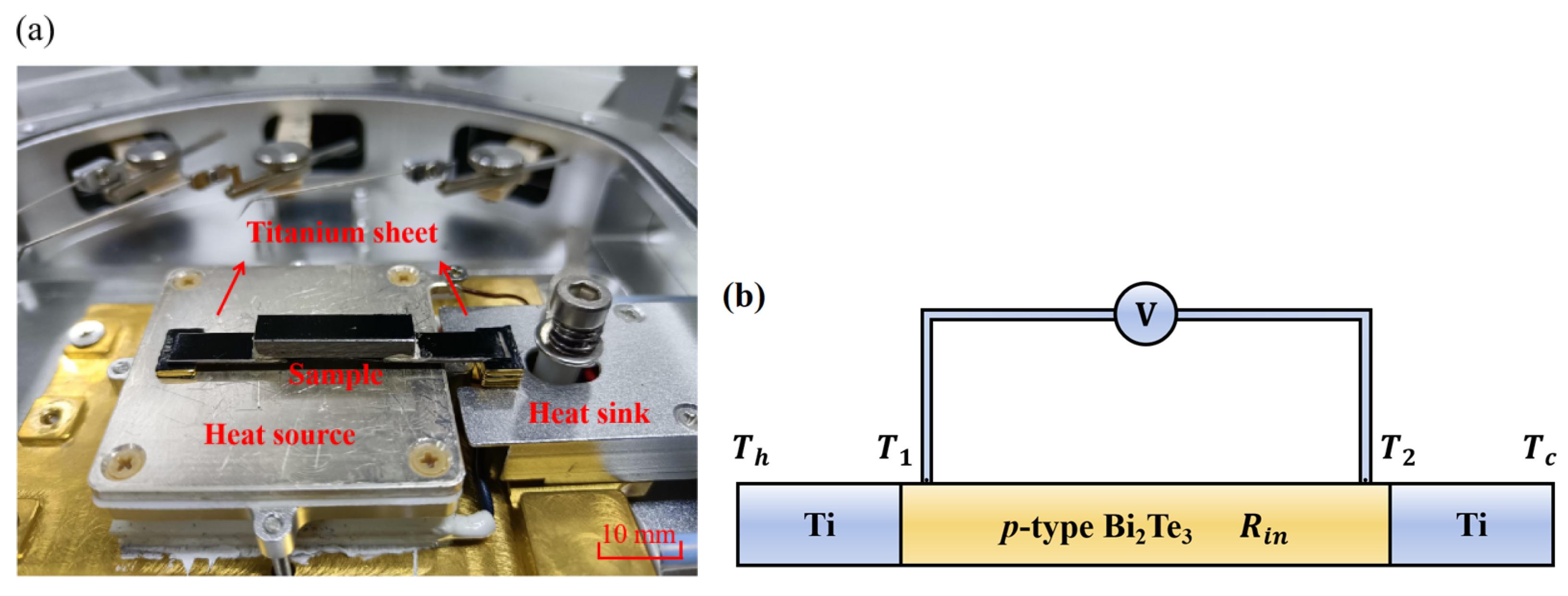
In this study, a dense p-type Bi2Te3-based thermoelectric material (Bi0.5Sb1.5Te3), fabricated via zone melting and measuring 20 mm × 5 mm × 3 mm, was used as the experimental sample. A photograph of the setup and a schematic of the electric circuit are presented in Figure 1a and Figure 1b, respectively. The test system comprised probes, a temperature control stage, a heat sink, an infrared thermal camera, and a voltmeter. To regulate the temperature at both ends of the sample during testing, it was mounted between a thermostatic hot plate and a heat sink. Probes were placed on either side of the thermoelectric material to complete the thermoelectric circuit and capture voltage data. A calibrated infrared thermal imager (uncertainty ±0.01 K) was used to measure the hot-end (T1) and cold-end (T2) temperatures, while a high-precision digital voltmeter (uncertainty ±0.01 mV) recorded the corresponding open-circuit voltage (ΔV).
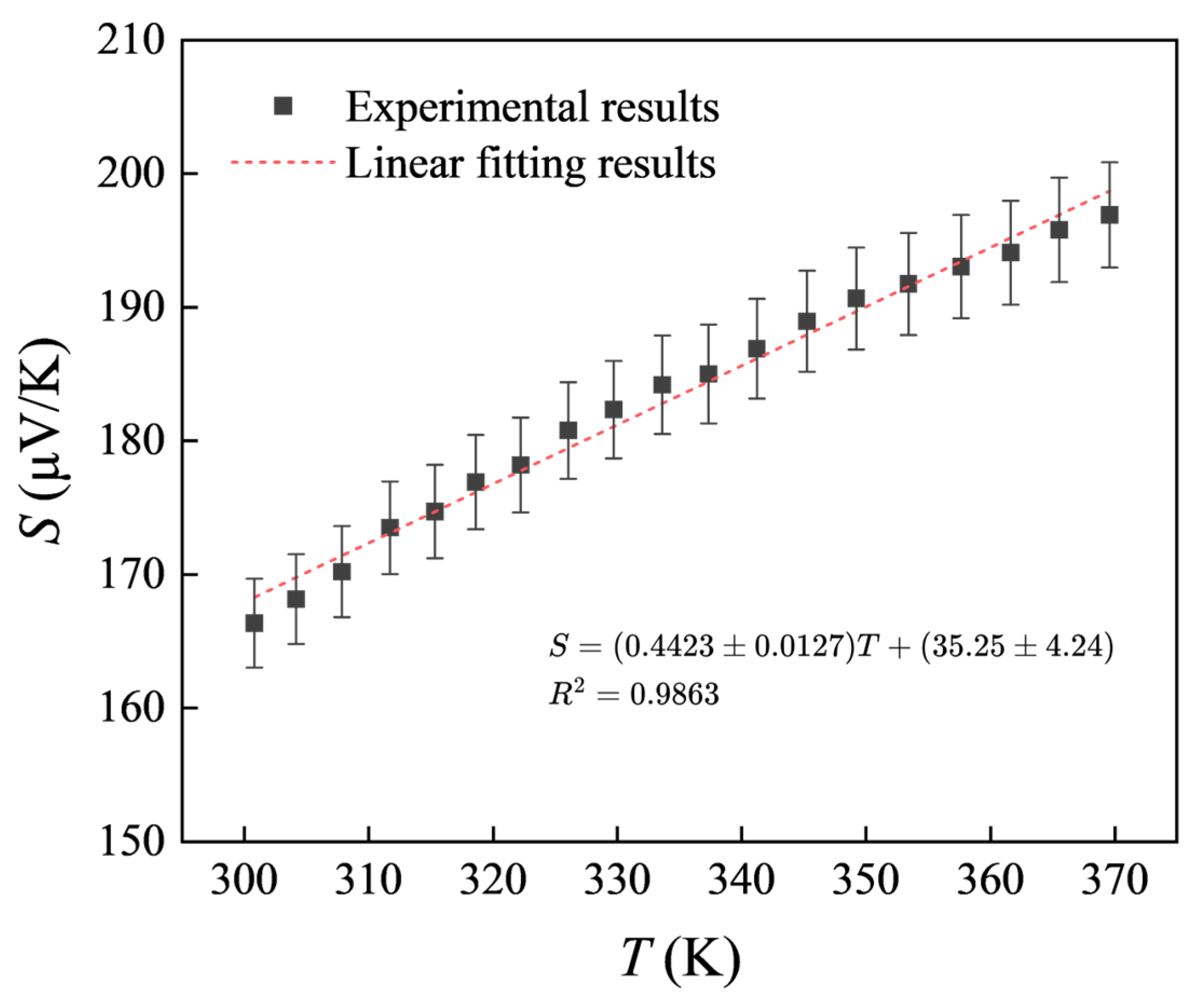
The Seebeck coefficients were measured at various temperatures using the steady-state method. To ensure that the measured values closely aligned with the exact definition in Equation (8), the temperature difference between the sample’s ends was maintained at 3 K during each measurement. Within the 310–370 K range, the measured Seebeck coefficients were consistent with the literature data [22] within a 10% uncertainty margin, confirming the reliability of both the experimental setup and the measurement scheme. In our study, the difference in the sample preparation process is a key factor contributing to the measurement deviation. The samples in the literature were prepared using spark plasma sintering (SPS) and have a fine-grained polycrystalline structure, while the samples in our experiment were prepared by floating zone melting (FZM), and their microstructure is closer to that of large-sized single crystals. Regarding the measurement process, the temperature was monitored with a noise equivalent temperature difference (NETD) of 50 mK and a temperature measurement accuracy of 2 K or 2% of the reading. The voltage difference was measured with an accuracy of 8.5 digits, ensuring that the measurement uncertainty is less than 0.01%. According to the error propagation formula, the uncertainty of the Seebeck coefficient comes from temperature measurement and voltage measurement, and the total measurement uncertainty should be 2%. Notably, within the relatively narrow temperature interval considered in this study (ΔT = 60 K), linear fitting yielded a determination coefficient (R2) of 0.9863. This high degree of linearity indicates that, within experimental error and the temperature range examined, the Seebeck coefficient can be treated as a linear function of temperature, as illustrated in Figure 2.
When the Seebeck coefficient varies linearly with temperature, Equation (11) can be reformulated as
Δ V T T 1 , T 2 = T 2 T 1 S T d T = S ¯ T T 1 T 2 = S T ¯ T 1 T 2 ,
where T ¯ is the arithmetic mean temperature, defined as
T ¯ = T 1 + T 2 2 .
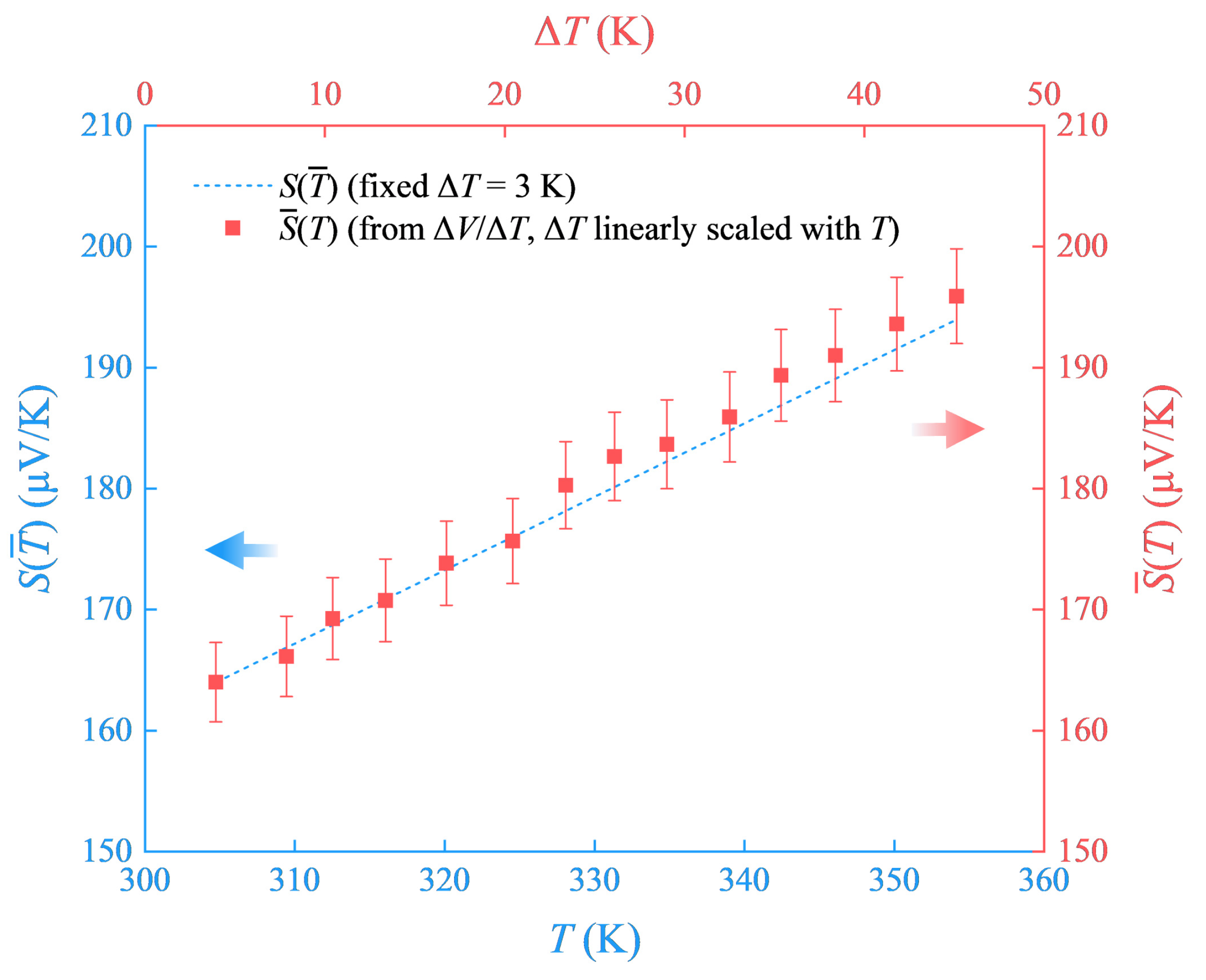
Accordingly, the Seebeck coefficient evaluated at the arithmetic mean temperature can be used to calculate the thermoelectric diffusion potential difference across the element. To examine the validity of Equation (12) under broader conditions, additional measurements were performed at higher temperature differentials. In these tests, the cold-end temperature was held constant, while the hot-end temperature was progressively increased to generate temperature differences of up to 50 K across the sample. The resulting electrostatic potential difference (∆V), which corresponds to the thermoelectric diffusion potential difference (∆VT), was recorded at each temperature increment. These values were then used to compute the apparent average Seebeck coefficient using S ¯ T = Δ V Δ T . Based on the linear fitting formula of the Seebeck coefficient at small temperature differences (Figure 2), the corresponding values of S T ¯ were determined for each arithmetic mean temperature. The results reveal that the Seebeck coefficient of the Bi2Te3-based material varies smoothly across the experimental temperature range. Consequently, even at temperature differences of up to 50 K, the deviation between the measured thermoelectric diffusion potential difference (or its equivalent average Seebeck coefficient calculated using Equation (12)) and the predicted value remains within approximately 5%, as illustrated in Figure 3. This confirms that Equation (12) provides a good approximation for engineering applications across a defined range of material properties and operating temperatures.

2.3. Relation Between the Seebeck and Peltier Coefficients

The thermoelectric diffusion potentials at the interface between materials A and B are denoted as VTA and VTB, respectively. The Peltier coefficient is defined as the difference between these potentials:
π T = V T A V T B = 0 T S A T d T 0 T S B T d T = 0 T S A T S B T d T .
Accordingly, the Peltier coefficients at the high- and low-temperature ends are defined as
π T 1 = V T A T 1 V T B T 1 = 0 T 1 S A T S B T d T ,
π T 2 = V T A T 2 V T B T 2 = 0 T 2 S A T S B T d T .
Given that the Peltier effect arises simultaneously at the high- and low-temperature interfaces within a circuit, the relationship between the relative Seebeck and Peltier coefficients can be derived directly, without invoking the Kelvin relation:
π T 1 π T 2 = T 2 T 1 S A B T d T .
This confirms that the Peltier coefficient is also a material property, independent of both current or heat flow. Compared with the traditional definition of this coefficient (Equation (3)), its expression based on the thermoelectric diffusion potential more accurately reflects the physical nature of the Peltier effect.
Notably, a temperature difference causes variation in the thermoelectric diffusion potential within the element, while a difference in material type alters the potential at the interface between the two materials. These variations further elucidate the physical meaning of the Seebeck and Peltier coefficients.
The derivation of Equation (17) differs from the Kelvin relation given in Equation (6). The derivation of the Kelvin relation assumes that thermoelectric conversion occurs as a cyclic process. Wu et al. [23] noted that the thermoelectric circuit does not constitute a true thermoelectric conversion cycle, as the total entropy change of the electron gas over a full cycle is non-zero. Given its importance, a separate article will be devoted to the Kelvin relation.

3. Thermoelectric Energy

3.1. Proposal of Thermoelectric Energy

The thermoelectric diffusion potential is the fundamental physical quantity characterising thermoelectric phenomena. In physics, potential refers to the energy stored in an object owing to its position, state, or configuration. Under open-circuit conditions, a thermoelectric material can be approximated as a flat capacitor in a one-dimensional system. Analogous to an electrostatic field, the hole charge Qe in thermoelectric materials is proportional to the thermoelectric diffusion potential, VT:
Q e = C e V T ,
where Ce denotes the “capacitance” of the thermoelectric material.
Similar to electrostatic energy Ee = CeV, thermoelectric energy ET, defined as ET = CeVT, satisfies the following differential relation:
d E T = Q e d V T .
Assuming a constant capacitance Ce, integration yields the following expression for the thermoelectric energy of the material:
E T = 1 2 Q e V T .
For a given thermoelectric material, the thermoelectric energy depends solely on temperature, as the thermoelectric diffusion potential is itself temperature-dependent:
E T = f T .
The internal energy of a solid exhibits a similar temperature dependence:
U = f T .
Accordingly, the change in internal energy equals the change in thermoelectric energy:
d U = C V d T = d E T = Q e d V T .
where U is internal energy, and CV is the heat capacity. The internal energy of a thermoelectric material can, therefore, be represented as either thermal or thermoelectric energy, highlighting the dual nature of its thermal–electrical energy. This is because, unlike the internal energy U(P, T) of working fluids for heat to work conversion, which depends on pressure and temperature, the internal energy U(VT, V, T) of thermoelectric materials involves only a single independent variable. Consequently, thermoelectric theory does not involve an equation of state with two independent variables.

3.2. Thermoelectric Energy Flow

Relative to the thermoelectric energy of materials in the open-circuit case, more attention is directed toward the thermoelectric energy flow within a material under current-carrying conditions. When a thermoelectric material with a current, I, passing through it, the thermoelectric energy flow, IVT, arises at the site of the thermoelectric diffusion potential VT. As this potential depends on both temperature and material type, the resulting energy flow is likewise temperature- and material-dependent. Similar to the thermoelectric diffusion potential, differences in temperature induce variations in the thermoelectric energy flow within the element, while differences in the material type lead to its corresponding variations at material interfaces.
This concept of thermoelectric energy flow facilitates an analysis of energy conversion and conservation at interfaces or within elements.
Existing studies provide only microphysical explanations for energy conservation in the Peltier effect. Specifically, the energy levels of electrons in the two materials forming the closed circuit are generally assumed to differ. To compensate for this difference, the Peltier heat at the interface must be absorbed from or released to the environment. From the perspective of thermoelectric energy flow, however, the Peltier effect can also be interpreted macroscopically. This indicates that the Peltier effect reflects the conversion between thermoelectric and thermal energy flows at the interface between two materials.
Let us consider a closed circuit composed of two thermoelectric materials, A and B. An abrupt change in thermoelectric diffusion potential occurs at their interface. Under the current flow, the thermoelectric energy flow exhibits a discontinuity. Integrating Equation (8) yields the macroscopic energy conversion relation at the interface:
Q π = I V T A I V T B = I 0 T S A T S B T d T .
The corresponding energy conservation relation at the interface is
I V T A I V T B = K d T d x A K d T d x B I 2 R C .
where Q π = K d T d x A K d T d x B represents the Peltier heat flow, I V T A I V T B denotes the difference in the thermoelectric energy flow, K represents the thermal conductivity, RC is the contact resistance, and I 2 R C denotes the Joule heat flow.
An energy–conservation relation also exists within the thermoelectric element. Under the current flow, a portion of the thermoelectric diffusion potential difference offsets the voltage drop across the internal resistance, Ri, of the material, while the remainder balances with the electrostatic potential:
V T 1 V T 2 = V + I R i .
This relation shows that, for a fixed temperature difference, the electrostatic voltage difference decreases with an increasing current, whereas the thermoelectric potential difference remains constant. Multiplying Equation (26) by the current yields
I V T 1 I V T 2 = I V + I 2 R i .
The first term on the right-hand side of Equation (27) represents the electrical energy flow, and the second corresponds to the Joule heat flow generated by internal resistance. Part of the thermoelectric energy is reversibly converted into electrical energy that powers the external load, while the remainder is irreversibly dissipated as the Joule heat flow within the material, owing to internal resistance. Equation (27) thus expresses energy conservation within the thermoelectric element.
The internal energy of thermoelectric materials has the dual nature of its thermal energy and thermoelectric energy, making the thermal energy flow difference equivalent to the thermoelectric energy flow difference:
I V T 1 I V T 2 = K d T d x 1 K d T d x 2 .
where K is the heat conductivity, and x is the coordinate. Accordingly, the energy conservation relation within the element can also be expressed as
K d T d x 1 K d T d x 2 = I V + I 2 R i .
Notably, thermoelectric energy is converted to electric energy in the element, whereas thermal energy is converted to thermoelectric at the interface. Given this dual energy nature, the energy conversion in the element may also be viewed as occurring directly between thermal and electrical forms.

3.3. Experimental Verification

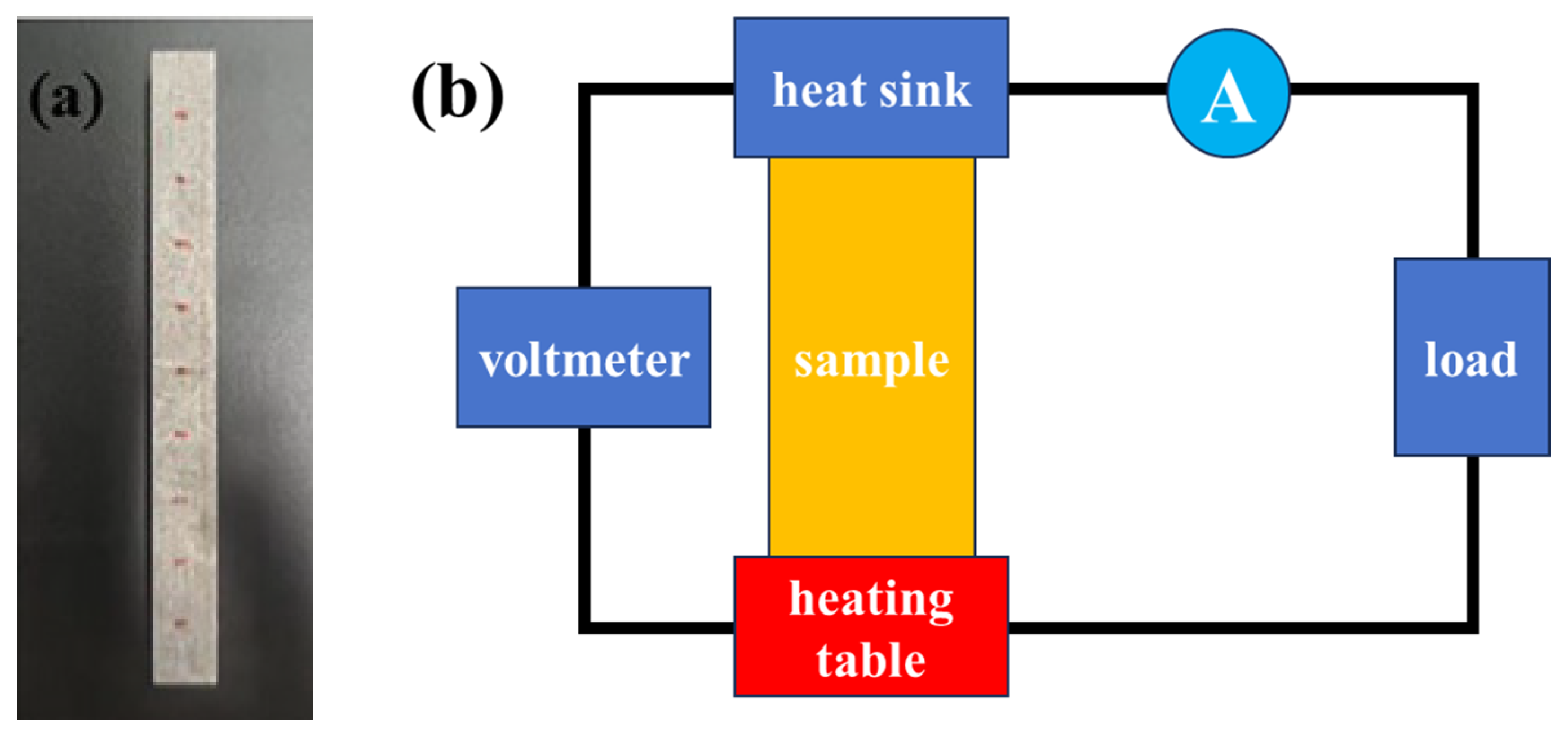
The conservation relation in Equation (27) was experimentally verified to support the concept of thermoelectric energy flow. As temperature measurements were unnecessary, a simplified experimental setup was employed. The sample consisted of Bi2Te3 thermoelectric material measuring 100 mm × 10 mm × 10 mm. A picture of the sample and the corresponding schematic are depicted in Figure 4a and Figure 4b, respectively. The setup comprised a test system and a voltage data acquisition system. The test system included external fixtures, a heat sink, the thermoelectric material, and a heating table. A stable temperature difference across the sample was maintained using the bottom heating table. Copper wires were connected to either end of the sample to form a closed circuit, and voltage and current were recorded in real time using the data acquisition system.
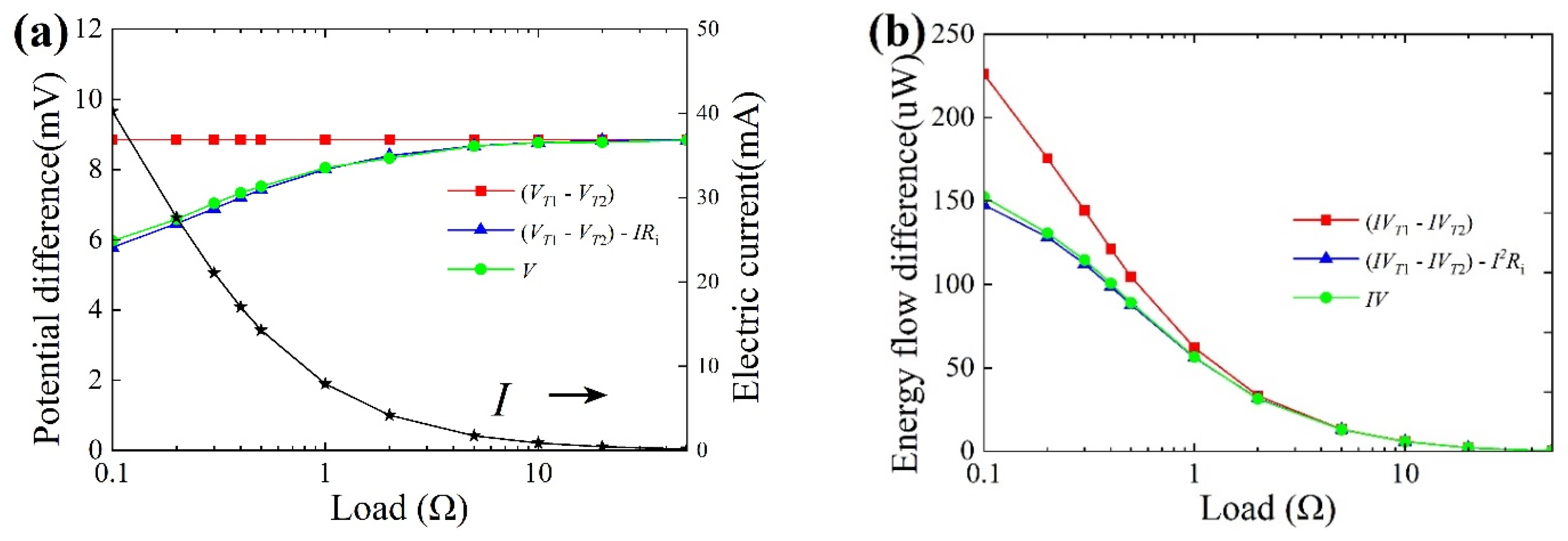
Prior to measurement, the internal resistance Ri of the thermoelectric material was calibrated to 0.12 Ω. The open-circuit voltage ΔV between the two ends was measured as 8.85 mV, equal to the thermoelectric diffusion potential difference ΔVT. Upon circuit activation, voltage and current signals were collected under various external load conditions.
Figure 5a confirms that the thermoelectric diffusion potential difference, after subtracting the voltage drop caused by internal resistance, matches the voltage measured by the voltmeter, thus validating Equation (26). Moreover, as the load resistance increases, the load voltage rises and approaches the thermoelectric diffusion potential difference, while the current simultaneously approaches zero. From an energy perspective, part of the thermoelectric energy flow offsets electrical energy losses due to internal resistance, while the remainder is reversibly converted into electrical energy. Meanwhile, Figure 5b indicates that the thermoelectric energy flow, after subtracting electric energy losses from internal resistance, equals the electrical energy flow output, thus confirming Equation (27).

4. Conclusions

In a thermoelectric element, the Seebeck coefficient does not represent a balance between the temperature and voltage differences but, rather, signifies the balance between the thermoelectric diffusion field and the electrostatic field in an open circuit, both of which are induced by the Soret effect of charged particles. Accordingly, a new quantity termed the “thermoelectric diffusion potential” is introduced to characterise the strength of the thermoelectric diffusion field. The spatial gradient of this potential constitutes the real electromotive force in the thermoelectric element.
The traditionally defined Seebeck coefficient for an open circuit is not applicable to a closed circuit. This is because, under a fixed temperature difference, the voltage difference becomes a function of current. In contrast, the Seebeck coefficient, defined in terms of the thermoelectric diffusion potential difference, remains applicable to both open and closed circuits.
Using the thermoelectric diffusion potential, the Peltier coefficient can be derived without invoking the Kelvin relation, and its relationship with the Seebeck coefficient further clarifies the physical interpretations of both coefficients.
Based on the thermoelectric diffusion potential, two new energy constructs, thermoelectric energy and thermoelectric energy flow, are introduced. Similar to the thermoelectric potential, the thermoelectric energy of a given material varies with temperature, while different materials exhibit distinct thermoelectric energies at the same temperature.
The concept of thermoelectric energy flow is further proposed to elucidate the principles of energy conservation and conversion in thermoelectric systems. Within the thermoelectric element, conversion occurs between thermoelectric and electrical energy flows. At the interface, such conversion occurs between thermal and thermoelectric energy flows.
The internal energy of a thermoelectric material has a dual nature of its thermal energy and electrical energy. That is to say that the internal energy of a thermoelectric material can manifest as either thermal energy or thermoelectric energy. Therefore, the thermoelectric process within the element can also be regarded as a conversion between thermal energy and electrical energy flows.

Author Contributions

Conceptualisation, Z.-Y.G.; methodology, Z.-Y.G.; investigation, T.-W.X., Z.-W.W., H.-X.Z. and B.C.; experiment, Z.-W.W., H.-X.Z., B.C. and T.-W.X. writing—original draft preparation, T.-W.X. and Z.-W.W.; writing—Review and Editing, H.-D.W., W.-G.M. and Z.-Y.G.; funding acquisition, T.-W.X. and Z.-Y.G. All authors have read and agreed to the published version of the manuscript.

Funding

This research was funded by the National Natural Science Foundation of China (No. 52250273, 52406099) and the Tsinghua University Initiative Scientific Research Program.

Institutional Review Board Statement

Not applicable.

Informed Consent Statement

Not applicable.

Data Availability Statement

Data is contained within the article. Data that support the findings of this study are available from the corresponding author upon reasonable request.

Conflicts of Interest

The authors declare that they have no conflicts of interest.

References

  1. Mao, J.; Liu, Z.-H.; Zhou, J.-W.; Zhu, H.-T.; Zhang, Q.; Chen, G.; Ren, Z.-F. Advances in thermoelectrics. Adv. Phys. 2018, 67, 69–147. [Google Scholar] [CrossRef]
  2. Freer, R.; Powell, A.V. Realising the potential of thermoelectric technology: A Roadmap. J. Mater. Chem. C 2020, 8, 441–463. [Google Scholar] [CrossRef]
  3. Wang, D.-Y.; Ding, J.-M.; Ma, Y.-Q.; Xu, C.-L.; Li, Z.-Y.; Zhang, X.; Zhao, Y.; Di, Y.; Liu, L.; Dai, X. Multi-heterojunctioned plastics with high thermoelectric figure of merit. Nature 2024, 632, 528–535. [Google Scholar] [CrossRef] [PubMed]
  4. Shi, X.; Song, S.-W.; Gao, G.-H.; Ren, Z.-F. Global band convergence design for high-performance thermoelectric power generation in Zintls. Science 2024, 384, 757–762. [Google Scholar] [CrossRef] [PubMed]
  5. Vining, C.B. An inconvenient truth about thermoelectrics. Nat. Mater. 2009, 8, 83–85. [Google Scholar] [CrossRef] [PubMed]
  6. Goupil, C.; Seifert, W.; Zabrocki, K.; Müller, E.; Snyder, G.J. Thermodynamics of thermoelectric phenomena and applications. Entropy 2011, 13, 1481–1517. [Google Scholar] [CrossRef]
  7. Seebeck, T.J. Ueber den Magnetismus der Galvenischen Kette; Technical Report; Royal Prussian Academy of Science: Berlin, Germany, 1821. [Google Scholar]
  8. Oersted, H.C. Nouvelles expériences de M. Seebeck sur les actions électro-magnétiques. In Annales de Chimie et de Physique; ANNALES DE CHIMIE ET DE PHYSIQUE, PAR MM. GAY-LUSSAC ET ARAGO. TOME 22. P. 201—03: Paris, France, 1823; Volume 22. [Google Scholar]
  9. Zhu, Q.; Kim, H.S.; Ren, Z.-F. A rapid method to extract Seebeck coefficient under a large temperature difference. Rev. Sci. Instrum. 2017, 88, 094902. [Google Scholar] [CrossRef] [PubMed]
  10. Peltier, J.C. Nouvelles experiences sur la caloricite des courants electrique. Ann. Chim. Phys. 1834, 56, 371–386. [Google Scholar]
  11. Ioffe, A.F. Semiconductor Thermoelements and Thermoelectric Cooling; Infosearch, Ltd.: London, UK, 1957. [Google Scholar]
  12. Thomson, W. On the Mechanical Theory of Thermo-electric Currents. Trans. R. Soc. Edinb. Earth Sci. 1851, 3, 91–98. [Google Scholar] [CrossRef]
  13. Thomson, W. On the dynamical theory of heat—Part VI. Thermoelectric currents. Lon. Edinb. Dubl. Phil. Mag. J. Sci. 1856, 11, 379–388. [Google Scholar] [CrossRef]
  14. Altenkirch, E. Uber den Nutzeffekt der Thermosaulen. Phys. Z. 1909, 10, 560–580. [Google Scholar]
  15. Altenkirch, E. Elektrothermische Kalteerzeugung und reversible elektrische Heizung. Phys. Z. 1911, 12, 920–924. [Google Scholar]
  16. Eastman, E.D. Theory of the Soret effect. J. Am. Chem. Soc. 1928, 50, 283–291. [Google Scholar] [CrossRef]
  17. Snyder, G.J.; Ursell, T.S. Thermoelectric efficiency and compatibility. Phys. Rev. Lett. 2003, 91, 148301. [Google Scholar] [CrossRef] [PubMed]
  18. Goupil, C. Thermodynamics of the thermoelectric potential. J. Appl. Phys. 2009, 106, 104901. [Google Scholar] [CrossRef]
  19. Wu, Y.-D.; Ma, W.-G.; Guo, Z.-Y. A new one-dimensional model of thermoelectric generators. Int. J. Heat Mass Transfer 2026, 255, 127890. [Google Scholar] [CrossRef]
  20. Callen, H.B. The Application of Onsager’s Reciprocal Relations to Thermoelectric, Thermomagnetic, and Galvanomagnetic Effects. Phys. Rev. 1948, 73, 1349–1358. [Google Scholar] [CrossRef]
  21. Seifert, W.; Ueltzen, M.; Müller, E. One-dimensional modelling of thermoelectric cooling. Phys. Status Solidi 2002, 194, 277–290. [Google Scholar] [CrossRef]
  22. Zhang, C.; de la Mata, M.; Li, Z.; Belarre, F.J.; Arbiol, J.; Khor, K.A.; Poletti, D.; Zhu, B.; Yan, Q.; Xiong, Q. Enhanced thermoelectric performance of solution-derived bismuth telluride based nanocomposites via liquid-phase sintering. Nano Energy 2016, 30, 630–638. [Google Scholar] [CrossRef]
  23. Wu, Y.-D.; Ma, W.-G.; Guo, Z.-Y. Governing equations of thermoelectric generators. Int. J. Heat Mass Transfer 2025, 241, 126737. [Google Scholar] [CrossRef]
Figure 1. (a) Photograph of the experimental setup; (b) schematic of the electric circuit.
Energies 19 01052 g001
Figure 2. Experimental values of the Seebeck coefficient for the p-type Bi2Te2 sample (ΔT = 3 K for each data point).
Energies 19 01052 g002
Figure 3. Comparison of the apparent average Seebeck coefficients, S ¯ (T) = ΔVT, measured under large temperature differences (up to ~50 K, red squares), and the Seebeck coefficients, S( T ¯ ), predicted using the linear fit from Figure 2 (blue line).
Energies 19 01052 g003
Figure 4. (a) Picture of the sample; (b) experimental schematic.
Energies 19 01052 g004
Figure 5. (a) Potential difference versus load; (b) energy flow difference versus load.
Energies 19 01052 g005
Disclaimer/Publisher’s Note: The statements, opinions and data contained in all publications are solely those of the individual author(s) and contributor(s) and not of MDPI and/or the editor(s). MDPI and/or the editor(s) disclaim responsibility for any injury to people or property resulting from any ideas, methods, instructions or products referred to in the content.