Review

Silver–Tin Sulfide/Selenide Semiconductor for Super-Narrow-Bandgap Photovoltaics and Thermoelectric Applications: A Review


Department of Energy Systems Engineering, Chung-Ang University, 84 Heukseok-ro, Dongjak-gu, Seoul 06974, Republic of Korea
*
Author to whom correspondence should be addressed.
Energies 2026, 19(4), 1029; https://doi.org/10.3390/en19041029
Submission received: 4 January 2026 / Revised: 29 January 2026 / Accepted: 10 February 2026 / Published: 15 February 2026

Abstract

Ag-Sn-S/Se semiconductors, particularly Ag8SnS6 and Ag8SnSe6, have emerged as promising thermoelectric (TE) materials due to their intrinsically low lattice thermal conductivity and favorable electronic transport properties. Owing to their direct and super-narrow bandgaps, these semiconductors also hold significant potential for photovoltaic (PV) applications, especially in near-infrared (NIR) energy harvesting and tandem architecture. This review provides a detailed analysis of the synthesis strategies, crystallographic evolution, phase transition mechanisms, and bandgap modulation in Ag-Sn-S/Se semiconductors. Particular focus is given to the structural adaptability of argyrodite-type compounds, where intrinsic cationic disorder and halogen-assisted anion substitution collectively enable the fine-tuning of electronic transport and lattice dynamics. TE performance is evaluated in terms of carrier mobility and thermal conductivity, highlighting a significant improvement in figure of merit. The review further explores the potential of Ag-Sn-S/Se semiconductors in energy conversion PVs, particularly as photoabsorber layers and counter electrode materials. Despite initial demonstrations, systematic studies on device integration remain limited, highlighting substantial opportunities for future research aimed at optimizing their optoelectronic interfaces and overall PV performance. This review ultimately discusses the potential of Ag-Sn-S/Se semiconductors, emphasizing their tunable properties as being key to next-generation PV and thermoelectric technologies. It highlights the current achievements and unresolved challenges, outlining strategic pathways for future research and device integration.

1. Introduction

1.1. Research Timeline

Research on Ag-Sn-S/Se semiconductors has progressed through TE and PVs, reflecting a broader shift from structure-driven materials discovery toward application-oriented energy design. Early studies focused primarily on crystal and phase formation of argyrodite-type compounds such as Ag8SnS6 and Ag8SnSe6, establishing their semiconducting nature [1,2,3,4]. These works laid the structural foundation but did not establish their energy-relevant transport anomalies. Ag-Sn-S/Se compounds began to emerge in the photovoltaic field around 2015, driven by the search for lead-free, perovskite-inspired absorbers. Studies on Ag-Sn-S/Se and mixed S/Se systems demonstrated suitable bandgaps and a high absorption coefficient (104 cm−1), echoing favorable traits of halide perovskites while offering improved chemical robustness [5,6,7]. Early device efficiencies remained modest, limited by film quality, interfacial recombination, and carrier transport, but the materials’ tolerance to defects and compositional flexibility attracted sustained interest.
In parallel, the modern thermoelectric trajectory began in the early 2000s, when Ag-Sn-S/Se compounds were revisited as potential thermoelectric materials [8,9]. Subsequent investigations demonstrated that Ag8SnSe6 exhibits even lower lattice thermal conductivity due to the heavier chalcogen mass and enhanced anharmonicity. A superionic Ag8SnSe6 semiconductor is highly effective for thermoelectric conversion, due to its combination of minimal heat conduction and rapid ion movement. Qingyong Ren et al. [10] examined the atomic dynamics through advanced scattering techniques and molecular dynamics. It has been observed that the interaction between mobile silver ions and the rigid framework causes low-energy vibrations to overdamp, transitioning into the quasi-elastic motion that drives fast ionic diffusion. Importantly, while the material behaves somewhat like a liquid in its diffusion, the persistence of specific acoustic phonons disproves the traditional “liquid-like” heat flow model. Instead, the ultralow thermal conductivity (0.5 W m−1 K−1) is caused by extreme atomic anharmonicity and weak chemical bonding. Concurrently, chemical bonding engineering and compositional tuning strategies, including aliovalent and halide-based doping, enabled simultaneous carrier concentration optimization and lattice thermal conductivity suppression [11].
The current research phase highlights a growing alignment between thermoelectric and photovoltaic design strategies. While thermoelectric studies successfully exploit lattice anharmonicity and disorder to suppress thermal conductivity, photovoltaic research must further harness these same features to reduce nonradiative recombination and improve operational stability. Owing to this shared material physics, Ag-Sn-S/Se semiconductors are well positioned as multifunctional energy materials, with future advances anticipated in PV performance, carrier control for thermoelectric, and scalable synthesis for integration into tandem solar cells, waste-heat recovery, and hybrid solar–thermal systems.

1.2. Importance of Ag-Sn-S/Se Semiconductors as Super-Narrow-Bandgap Absorbers in PV

Global efforts to decarbonize energy systems have intensified the search for materials that can develop absorbers that can capture a wider portion of the solar spectrum, particularly the near-infrared (NIR) region that conventional solar cells leave untapped. For photovoltaic applications, Ag–Sn–S/Se semiconductors are particularly attractive because of their narrow, composition-tunable direct bandgaps, which enable efficient absorption extending from the visible into the near-infrared region [12,13]. One prominent example is the argyrodite Ag8SnS6 and its selenide analog Ag8SnSe6; these materials possess narrow bandgaps that are tunable by composition, alongside unconventional lattice dynamics. Ag8SnS6 has a bandgap of around 1.3–1.35 eV [14], which is nearly ideal for single-junction solar cells (Shockley–Queisser limit) and in the visible/NIR crossover, while partial substitution of sulfur by selenium can push the gap well below 1 eV. In fact, Ag8SnS6−xSex solid solutions span roughly 1.16 eV down to 0.85 eV as x increases [15]. Meanwhile, the pure selenide Ag8SnSe6 is an even-narrower-gap semiconductor (optical Eg ~0.8–0.83 eV) that exhibits a sharp absorption onset in the infrared [12]. Such strong IR light absorption indicates the potential of Ag-Sn-S/Se compounds as “super-narrow-bandgap” PV absorbers, which are suitable for capturing sub-1 eV photons. This makes them attractive for the bottom cells in multi-junction or tandem solar architectures and even for novel intermediate-band photovoltaics, where harvesting long-wavelength NIR energy is essential for boosting overall efficiency. Early demonstrations have indeed utilized Ag8SnS6 nanocrystals in proof-of-concept solar devices [14], affirming their photoactivity and suggesting that with further development, these materials could enable solar cells that are sensitive to the deep NIR region that lies beyond the reach of conventional absorbers like silicon. Furthermore, the structural chemistry of these argyrodites is highly tunable; substitutions and off-stoichiometry can adjust carrier concentrations and band structures [13]. Researchers are actively exploring how bandgap engineering, defect doping, and phase transition control in Ag-Sn-S/Se systems can optimize both the electrical power factors, thereby balancing the requirements for PV functionalities in a single material platform [9,16].

1.3. Relevance to Super-Narrow-Bandgap Ag-Sn-S/Se Semiconductors in Thermoelectric

Equally compelling is the thermoelectric promise of Ag-Sn-S/Se semiconductors. These compounds achieve remarkably low lattice thermal conductivities while still conducting carriers [17,18]. More importantly, these argyrodites undergo a dynamic silver-ion disorder at elevated temperatures: a superionic transition in which Ag+ cations become highly mobile in the crystal sublattice. This intrinsic structural disorder and partial melt of the cation sublattice drastically suppresses lattice thermal conductivity, placing these materials at the extreme phonon-glass end of the spectrum [13]. Not surprisingly, Ag-Sn-Se compositions have recently become a focus in thermoelectric research, achieving significant zT. Beyond their favorable bandgap and phonon transport properties, Ag-Sn-S/Se semiconductors offer mixed ionic–electronic transport: Ag8SnS6 and Ag8SnSe6 are notable for their simultaneous ionic conductivity and electronic semi-conductivity [12]. On one hand, ion migration could pose stability challenges for long-term photovoltaic operation. On the other hand, in thermoelectric usage, a degree of ionic mobility is not detrimental and can even aid in reducing thermal conduction or in allowing for self-adjusting defect chemistry. Ag-Sn-S/Se argyrodite semiconductors offer intrinsically low thermal conductivity that aligns with the state-of-the-art strategies in thermoelectrics to maximize heat-to-electricity efficiency. As such, they provide an exciting materials platform where one can explore and fine-tune electronic structure, ionic transport, and lattice dynamics in tandem. The growing body of literature on Ag-Sn-S/Se argyrodites underscores their potential as versatile, high-performance semiconductors for a sustainable energy future. Ag–Sn–S/Se semiconductors are distinguishing themselves as a unique convergence point for energy conversion. Their narrow, composition-tunable bandgaps coupled with strong NIR absorption make them promising absorbers for solar cells that aim to harvest below 1 eV photons, whether as standalone ultra-low-bandgap PV devices or as the IR-sensitive component of hybrid multi-junction designs. In parallel, these materials exhibit intrinsically low lattice thermal conductivity and favorable electronic transport, arising from strong lattice anharmonicity and cation disorder, which underpin their excellent thermoelectric performance.
The review is organized into six key sections. Section 2 describes the crystal structure and phase stability, explores the diverse crystallographic phases of Ag8SnS6 and Ag8SnSe6, with emphasis on the temperature-induced phase transitions and Ag sublattice disorder. Section 3 delves into the electronic and optical properties, presenting experimental insights into bandgap engineering achieved through elemental substitution. Section 4 outlines the synthesis strategies for Ag-Sn-S/Se materials, encompassing single-crystal growth, thin-film deposition via chemical bath deposition (CBD), successive ionic layer adsorption and reaction (SILAR), vacuum-based sulfurization/selenization, and nanocrystal fabrication through various solution-phase techniques.
PV applications review the initial demonstrations of Ag-Sn-S/Se compounds as photo-absorbers and counter electrodes, emphasizing their NIR absorption, as detailed in Section 5. It further evaluates the TE performance, detailing trends in electrical conductivity and thermal transport, and highlighting enhancements achieved through carrier mobility optimization. Section 6 outlines the future outlook and opportunities, emphasizing key research directions and materials’ integration into space-grade energy systems and broadband optoelectronic devices.

2. Crystal Structures and Phase Transitions

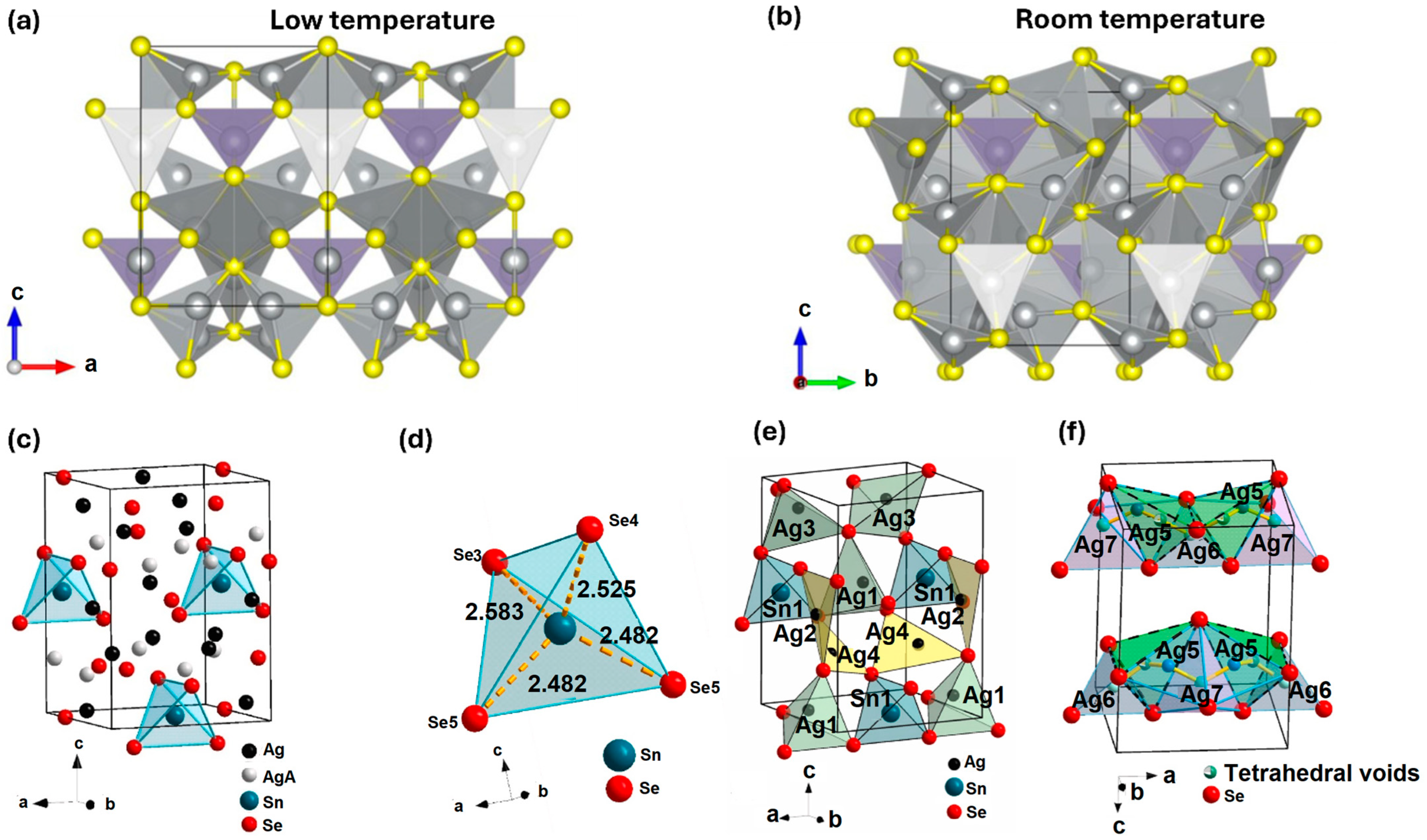
Ag8SnS6 and Ag8SnSe6 crystallize in the argyrodite structure type, characterized by a tetrahedral anion framework and a mobile Ag sublattice. Below 120 K, Ag8SnS6 undergoes a structural transition to a low-temperature orthorhombic phase (Pmn21), which is isostructural with the room-temperature phases of the related selenide compounds, Ag8SnSe6 and Ag8GeSe6, while the smaller phase volume supports the Pna21 arrangement of room-temperature Ag8SnS6 (Figure 1a,b and Table 1) [12,19]. Figure 1c displays the atomic arrangement within the unit cell of the β′-Ag8SnSe6 phase at 295 K, where the Sn-centered coordination tetrahedra are highlighted. Figure 1d illustrates an individual SnSe4 tetrahedron with annotated Sn–Se interatomic distances. Among the fully occupied Ag sites, Ag1 and Ag3 are tetrahedrally coordinated by surrounding Se atoms, while Ag2 and Ag4 adopt trigonal coordination geometries (Figure 1e). The partially occupied Ag sites (Ag5, Ag6, and Ag7) are located within tetrahedral voids defined by Se atoms (Figure 1f). This distribution of coordination environments is reminiscent of the site occupancy behavior that is observed for Cu and Ag ions in other superionic conductors [20].
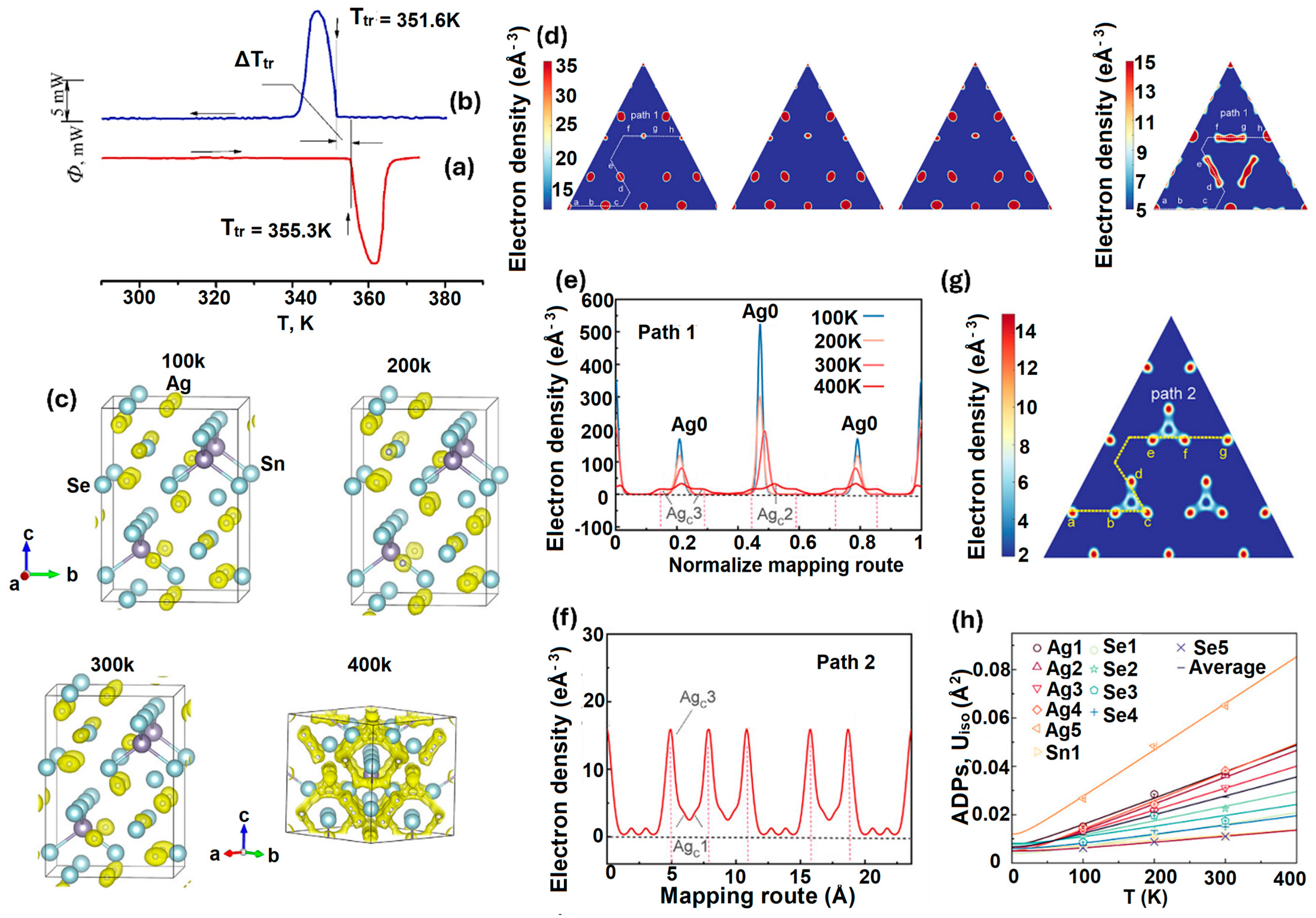
The β′ ⟶ γ phase transition in Ag8SnSe6 was investigated by using differential scanning calorimetry (DSC). DSC measurements conducted over the temperature range of 300–380 K on a single crystal of Ag8SnSe6 (Figure 2) revealed distinct endothermic (Figure 2a) and exothermic (Figure 2b) features corresponding to the phase transition upon heating and cooling. Ag8SnSe6 undergoes a structural transition from the β phase to the γ phase at approximately 80 °C. The β phase adopts an orthorhombic structure with space group Pmn21 and does not exhibit superionic behavior. In contrast, the γ phase crystallizes in a face-centered cubic structure with space group F 43 ¯ m. This phase can be described as a cubic Se2− framework, in which the Sn atoms are tetrahedrally coordinated by Se to form isolated [SnSe4]4− units. These tetrahedra are arranged within the cubic lattice, while the remaining Se2− ions form the anionic framework. The Ag+ cations are partially and dynamically distributed over the interstitial sites of this framework, giving rise to significant positional disorder and superionic behavior [21].
The study by Zhou et al. [22] offers a rigorous, multiscale analysis of the order–disorder transition in thermoelectric Ag8SnSe6, finding the microscopic mechanism underlying Ag diffusion. Ag8SnSe6 undergoes a phase transition from a low-symmetry orthorhombic structure (Pmn21) to a high-symmetry cubic structure (F 43 ¯ m) at around 355 K (Table 1). This change is characterized by the disordering of Ag ions among three partially occupied crystallographic sites (Agc1, Agc2, Agc3), while Sn remains at a single site and maintains tetrahedral coordination with Se throughout. This order–disorder transition is visualized most clearly in the 3D maximum entropy method (MEM) electron density distribution (EDD) maps in Figure 2c and the 2D/1D EDD along selected migration paths in Figure 2d–g, which track the loss of localization of Ag ions and the emergence of continuous migration channels as the temperature increases. The atomic displacement parameters (ADPs) in Figure 2h further support this behavior; ADPs of Ag (especially Ag5) increase anomalously with temperature, indicating enhanced dynamic and static disorder. The persistence of high ADPs for Ag5, even at low temperatures, confirms inherent structural rattling.

3. Bandgap Tuning

3.1. Experimental Study

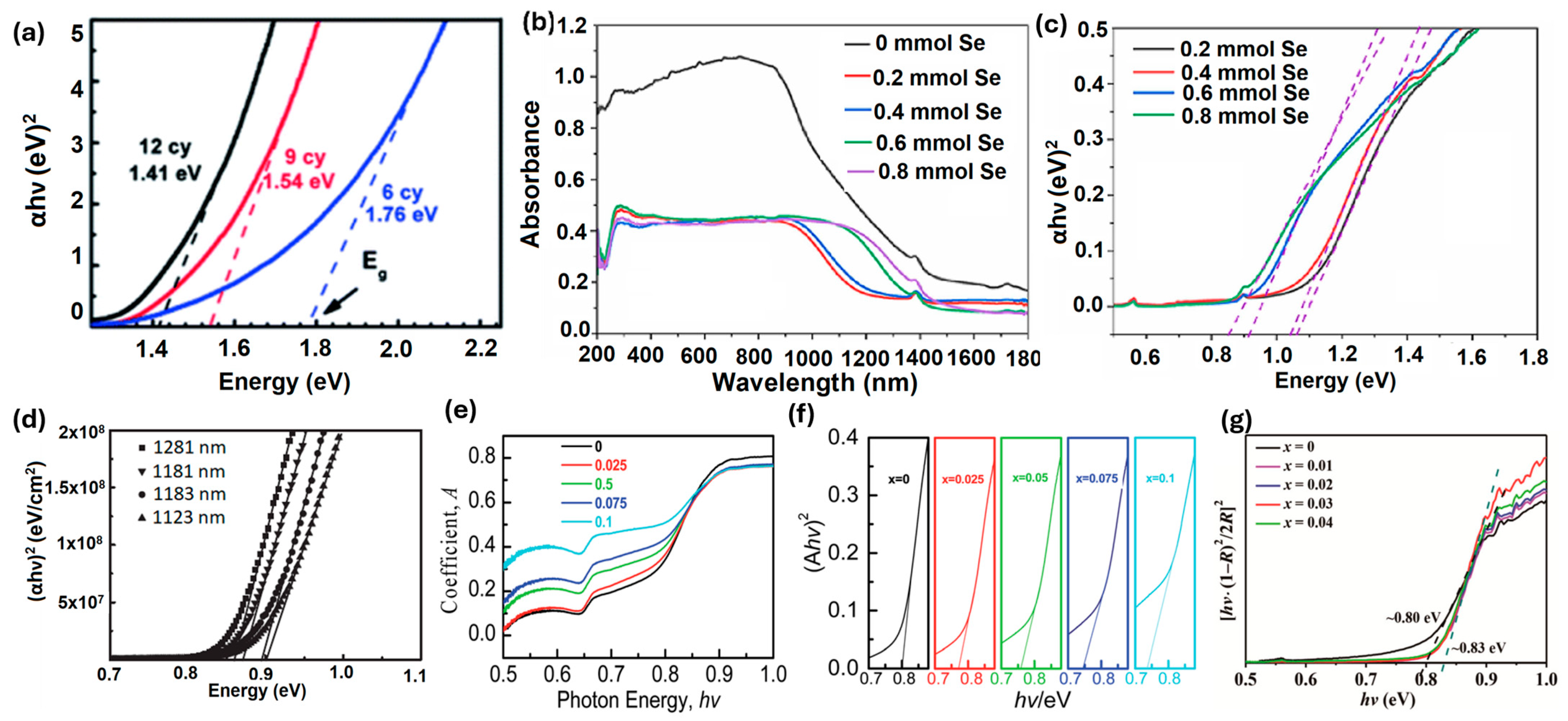
The ternary argyrodite compound Ag8SnS6 serves as a reference system for understanding bandgap tuning within the Ag-Sn-S/Se family. Ag8SnS6 is a narrow-gap semiconductor with a direct optical bandgap on the order of ~1.41 eV, as shown in Table 2 and Figure 3a [5]. The external quantum efficiency (EQE) reports a spectral range of up to 1000 nm, encompassing both the visible and NIR ranges. The larger atomic radius of Se2− (1.98 Å) compared to S2− (1.84 Å) leads to lattice expansion and reduced orbital overlap, which narrows the energy separation between the valence and conduction bands. Figure 3b presents the UV–Vis absorption spectra of the synthesized Ag8SnS6−xSex nanoparticles (x = 0.0 to 0.8). With an increasing Se content, the absorption edge gradually shifts toward longer wavelengths, confirming a redshift due to bandgap narrowing. This trend is quantified by using Tauc plots for direct bandgap semiconductors, as shown in Figure 3c [15]. By contrast, Ag8SnSe6 has a significantly smaller bandgap, around 0.86–1.19 eV (Figure 3d), as determined by the absorption measurements [23].
Chao Yang et al. [13] investigated that incorporating Cu into the Ag8SnSe6 lattice effectively narrows the bandgap. Figure 3e,f shows the absorption coefficient (A) as a function of photon energy (hv) and Tauc plots [(αhν)2 vs. hν], from which the optical bandgap (Eg) for various Cu concentrations is (x = 0 to 0.1), clearly showing a linear decrease in Eg from 0.80 eV (x = 0) to 0.73 eV (x = 0.1). This red shift in the absorption edge is attributed to Cu-induced electronic structure modification. The introduction of Cu likely increases carrier concentration and perturbs the local potential, resulting in bandgap narrowing. This strategy is pivotal for optimizing Ag-Sn-Se-based argyrodite materials for NIR photonic and thermoelectric applications.
The bandgap tuning in Ag8SnSe6 semiconductors through halogen doping is clearly demonstrated by Zhonghai YU [24]. The study explores the substitutional doping of bromine (Br) at selenium (Se2−) sites by introducing SnBr2. This doping effectively alters the electronic structure, inducing a measurable change in the optical bandgap. As shown in Figure 3g, UV–Vis–NIR spectroscopy reveals that the pristine Ag8SnSe6 exhibits a bandgap of approximately 0.80 eV, whereas the SnBr2-doped variant Ag8Sn1.03Se5.94Br0.06 shows a slightly increased bandgap of 0.83 eV. This widening is attributed to the substitution of Br (electronegativity ~2.96) for Seq (electronegativity ~2.55), which modifies the local bonding environment and slightly shifts the electronic states, resulting in a blue shift in the absorption edge.

3.2. Theoretical Study

S.V. Syrotyuk et al. [12] employed a hybrid PBE0 functional with a Hartree–Fock exchange component that partially corrects for Coulomb self-interaction. With α = 0.33, the improved band structure exhibits a more realistic bandgap of 0.66 eV (Table 2). The strong correlation correction pushes the Ag 4d bands deeper in energy and leads to the formation of two distinct groups of valence bands, separating Ag 4d contributions from Se and Sn p-states. This illustrates how the inclusion of correlation effects produces a more physically accurate band topology. The top of the valence band is dominated by hybridized Se p-states and Sn p-states, while the bottom of the conduction band features Sn s- and p- states, confirming that the bandgap is optically allowed and of the s-p type.
From an experimental and economic perspective, Ag-Sn-S/Se semiconductors offer a balance between tunable optoelectronic performance and relatively simple ternary chemistry, with the raw material cost dominated by the silver content. Based on typical bulk commodity prices, Ag precursors (AgNO3) cost approx. 3000 USD kg−1; Sn precursors (SnCl2 or SnCl2 .2H2O) cost ~500 USD kg−1; and sulfur/selenium precursors, either metallic or compounds, cost in the range of 200–9000 USD kg−1 (Table 3). Owing to the high mass fraction of silver, the estimated raw-material cost of Ag8SnSe6 is approximately ~1000–3000 USD kg−1, yet this remains lower than selenium-rich analogs, while providing near-optimal bandgaps for visible-NIR photovoltaic operation. Substitution of sulfur with selenium enables absorption extension into the infrared and access to sub-1 eV bandgaps that are desirable for tandem photovoltaics and infrared-sensitive devices. However, this benefit comes with a clear cost penalty and an increase in the materials’ complexity. An important economic advantage of the Ag-Sn-S/Se argyrodite is its tolerance to dilute compositional tuning. Aliovalent cation doping with copper and anion-site halogen doping modify the bandgap and carrier concentration with a negligible increase in the raw material cost. Consequently, doping-based strategies are significantly more cost-efficient than extensive selenium alloying for fine control of optoelectronic properties.
Overall, although the high silver content imposes an intrinsic cost limitation, experimentally demonstrated Ag-Sn-S/Se materials remain economically viable for thin-film optoelectronic applications, where absorber thicknesses below the micrometer scale strongly mitigate cost per unit area. In contrast, cost considerations are more restrictive for bulk thermoelectric implementations. Strategic use of sulfur-rich compositions, limited selenium substitution, and low-cost doping therefore provides the most balanced pathway toward an economically feasible deployment of this material family in energy conversion technologies.

4. Processing of Ag-Sn-S/Se Semiconductor

4.1. Single Crystal

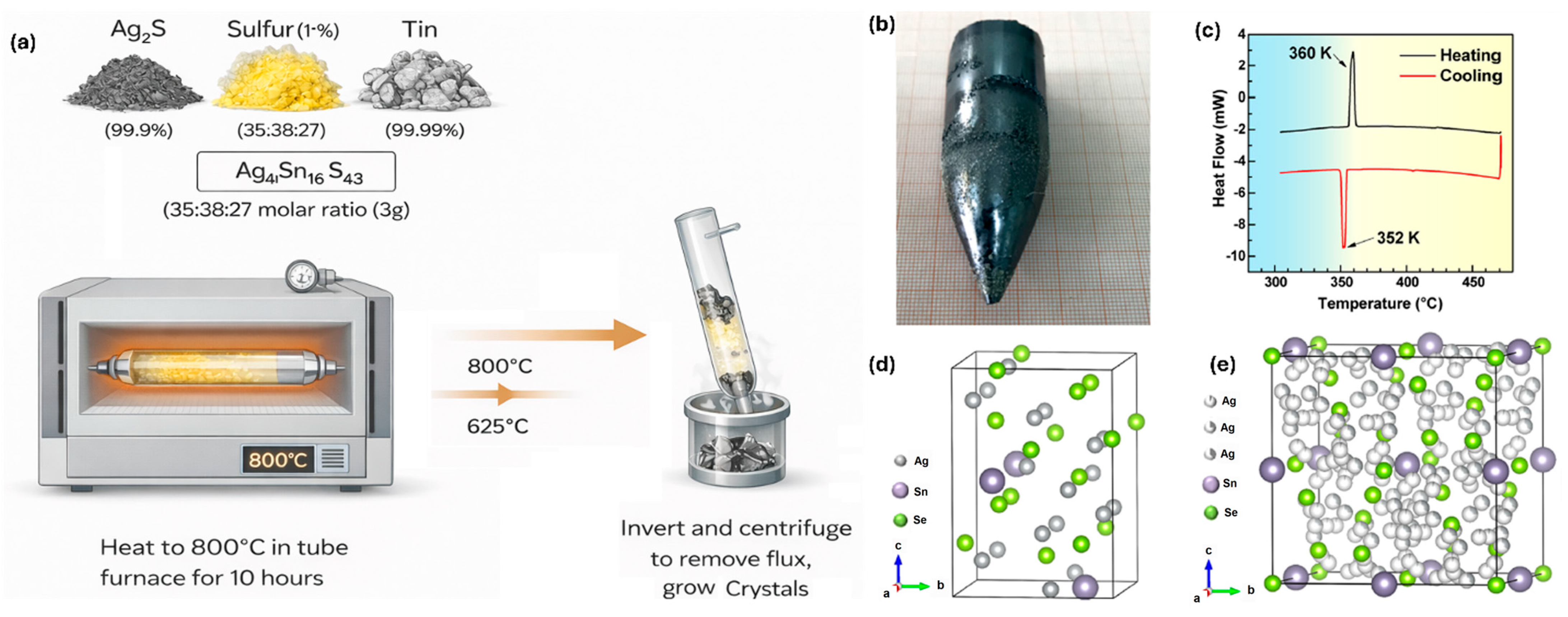
Slade et al. [19] grew Ag8SnS6 single crystals by a high-temperature solution (flux) method. High-purity Ag2S (99.5%), elemental sulfur (99.99%), and tin (99.99%) were combined in a 35:38:27 molar ratio (total ~3 g), giving an off-stoichiometric starting composition Ag41Sn16S43 to ensure a suitable melt flux. The mixture was placed in a 2 mL fritted alumina crucible, which was then sealed in an evacuated silica ampoule (~0.25 atm Ar) to prevent sulfur volatilization. The ampoule was heated to 800 °C slowly over 10 h, held at 800 °C for 10 h, and then cooled very slowly over 200 h to 625 °C (Figure 4a). At 625 °C, the ampoule was inverted and centrifuged to decant the remaining flux. This yielded large, mirror-faceted Ag8SnS6 crystals up to ~1 g in mass and 5–10 mm in size [19].
Jin et al. [25] obtained Ag8SnSe6 single crystals using a vertical Bridgman technique. High-purity elemental silver, tin, and selenium were weighed at the stoichiometric ratio of 8:1:6 and sealed in a 25 mm diameter quartz ampoule under a high vacuum (~10−3 Pa). The ampoule was heated to 1273 K in a rocking furnace and homogenized by rocking after melting, then cooled to room temperature to form a uniform polycrystalline ingot. For single-crystal growth, the ampoule was subjected to a controlled temperature gradient (~5–8 K/cm) in a Bridgman furnace at approximately 1123 K to prevent Se volatilization. The ampoule was lowered at a rate of 1.5 mm/h to crystallize a single ingot. Then, the crystal was slowly cooled to room temperature at a rate of 20–25 °C/h to relieve thermal stress. The as-grown Ag8SnSe6 crystals exhibit a striking metallic luster, as shown in Figure 4b. Differential scanning calorimetry (DSC) curves during both heating and cooling cycles (Figure 4c) reveal an endothermic peak at 360 K and an exothermic peak at 352 K, indicating a reversible phase transition. This transition occurs between the room-temperature orthorhombic β-phase (Figure 4d) and the high-temperature cubic γ-phase (Figure 4e). The γ-phase of Ag8SnSe6 features a high-symmetry structure composed of [SnSe4]4− tetrahedra and Se2− anionic frameworks [25].

4.2. Thin Film Deposition

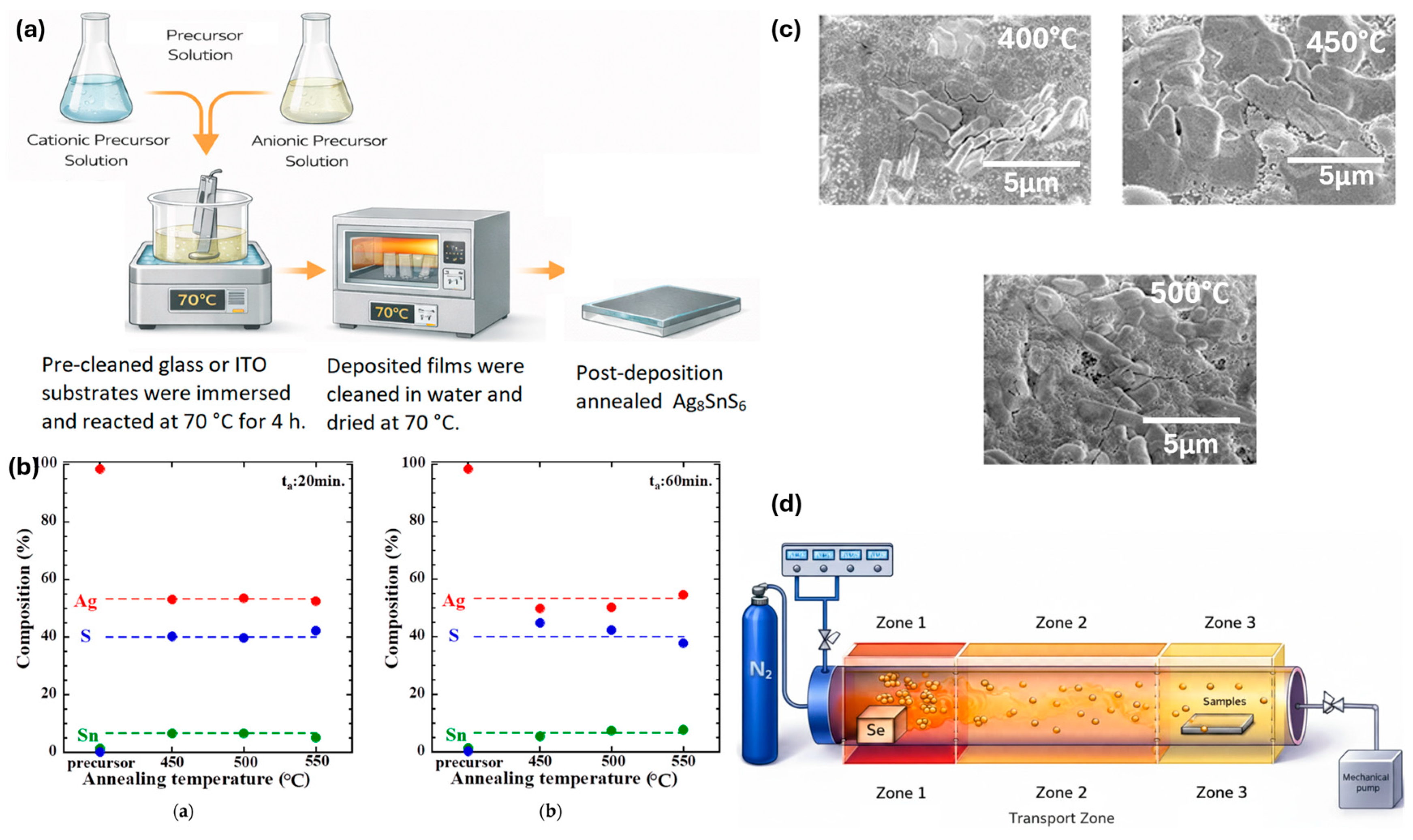
Yeh and Cheng prepared Ag-Sn-S thin film photoelectrodes on glass and ITO-coated glass using a chemical bath deposition (CBD) process [26]. Aqueous cationic and anionic precursor solutions were prepared separately before film growth. The cationic bath contained AgNO3, Zn(NO3)2, SnCl2, NH4NO3 (buffer), trisodium citrate (0.4 M), and Na2-EDTA (0.4 M). The pH was adjusted to one with concentrated H2SO4 to suppress the formation of metal hydroxides. Thioacetamide was then added as the S2− source and mixed thoroughly. Pre-cleaned glass or ITO-coated glass substrates were vertically immersed in the solution, and the reaction was carried out at 70 °C for 4 h. The deposited films were ultrasonically cleaned in water for 5 min and dried at 70 °C. A post-deposition annealing was then used to promote the interdiffusion and reaction of these species into the desired ternary phase (Figure 5a). By adjusting the molar ratio of [Ag]/[Ag + Sn] in the bath, the film composition tuned at the ratio of ~0.5–0.6 yielded a pure canfieldite Ag8SnS6 phase with the best photoelectrochemical performance.
Munekata et al. reported a vacuum-deposition plus sulfide annealing route to fabricate Ag8SnS6 thin films [27]. Glass/SnS/Ag stacked precursors were deposited by vacuum evaporation at a base pressure of 5.0 × 10⁻⁴ Pa. The substrate temperature was maintained at room temperature during Ag deposition and at 300 °C during SnS deposition. The SnS and Ag layers, each with a purity of 3N, had thicknesses of approximately 170 nm and 510 nm, respectively, with a source-to-substrate distance of 20 cm. Subsequently, Ag8SnS6 (ATS) thin films were formed on glass substrates by sulfide annealing through heat treatment in a mixed H2S/N2 atmosphere. Further varied the annealing temperature (450 °C, 500 °C, 550 °C) and time (20 vs. 60 min) to optimize the crystalline quality of the Ag8SnS6 phase. Figure 5b showed that higher annealing temperatures and longer times favor the complete reaction of Ag with SnS, e.g., at 550 °C for 60 min.
Akaki et al. investigated the H2S annealing effects on two types of silver–tin precursor structures prepared by thermal evaporation [28]. In this study, silver, tin, and tin sulfide powders were mixed at molar ratios of Ag:Sn = 2:1 or Ag:SnS = 2:1 (total mass 0.5 g). Glass/Ag/Sn and glass/Ag/SnS precursor stacks were deposited on cleaned soda–lime glass substrates at 300 °C by vacuum evaporation under a pressure below 2.0 × 10⁻³ Pa. The deposited stacks were then annealed in an H2S/N2 atmosphere at 300–500 °C for 60 min, with a gas flow rate of 50 mL min−1. The temperature was ramped at 5.0 °C min−1 up to 200 °C and 2.5 °C min−1 to the target temperature. The resulting films had thicknesses of approximately 2–3 µm. SEM images of the glass/Ag/SnS-stacked precursor and Ag-Sn-S thin films annealed between 400 and 500 °C are presented in Figure 5c. The films annealed at 450 °C exhibit noticeably larger grain sizes than those annealed at 400 °C. In addition, thin films derived from the glass/Ag/SnS-stacked precursor show significantly larger grains compared with those prepared from the glass/Ag/Sn-stacked precursor.
Semkiv et al. employed a selenization process to synthesize the ternary Ag-Sn-Se thin films of the argyrodite Ag8SnSe6 phase [4]. In their work, Ag-Sn thin films were deposited by high-frequency magnetron sputtering from a Ag-Sn alloy target in an argon atmosphere. The target substrate distance was fixed at 60 mm, and the substrate temperature was maintained at 345 K during the deposition. The sputtering process was carried out for 30 min, resulting in uniform Ag-Sn films with a thickness of approximately 500 nm. This metallic precursor was then sealed in an evacuated ampoule with elemental selenium and heated in a two-zone tube furnace. The substrate zone was slowly raised to about 480 °C and held at that temperature, while selenium in a separate zone was heated to generate Se vapor, allowing for Se atoms to diffuse into the Ag-Sn film. After ~1 h of this selenization treatment, the Ag-Sn film was converted into Ag8SnSe6 with an orthorhombic argyrodite crystal structure. We further incorporated the Ag8SnSe6 films into Ag/Ag8SnSe6/C electrochemical cells to evaluate their ionic/electrical behavior, confirming that the synthesized films exhibit the expected superionic and resistive-switching properties of Ag8SnSe6.
Cheng and Chou prepared Ag-Sn selenide photoelectrodes by selenizing Ag–Sn metal precursors at different temperatures to control the resulting phase [29]. In this study, thin films of a Ag-Sn alloy (deposited by thermal evaporation on a substrate) were annealed in a selenium vapor atmosphere using a tube furnace, Figure 5d. When the selenization was carried out at 410 °C for 1 h, the films converted to cubic AgSnSe2, a ternary phase. However, upon increasing the selenization temperature into the range of roughly 425–440 °C, a transformation of the phase composition was observed where the cubic AgSnSe2 phase gradually gave way to the cubic Ag8SnSe6 argyrodite phase. The cubic AgSnSe2 was tested in a photoelectrochemical cell (PEC), and its performance was compared to that of the higher-temperature-derived Ag8SnSe6 phase, illustrating how subtle changes in synthesis conditions can yield different material phases with distinct PEC properties.

4.3. Solution and Particle-Based Methods

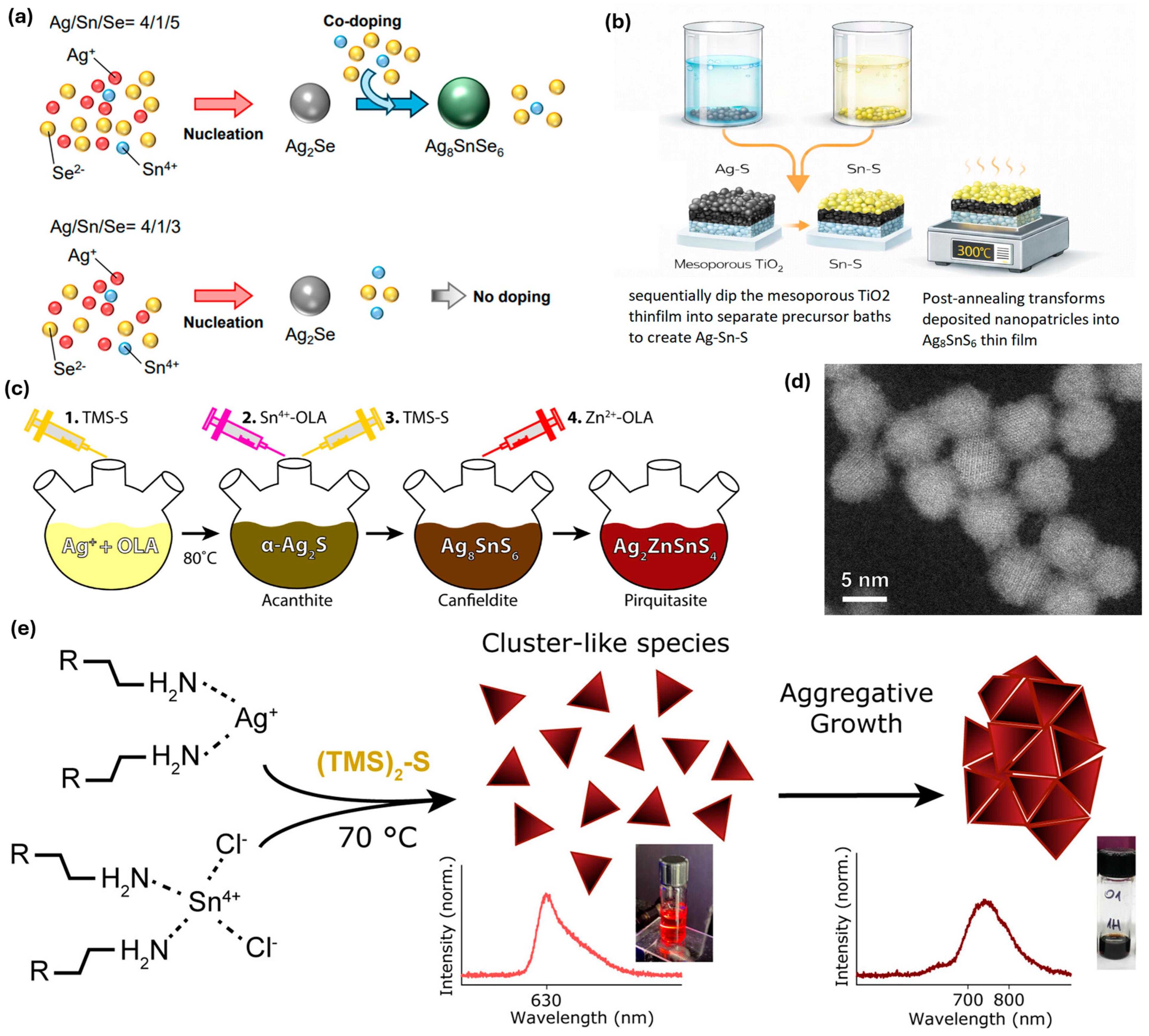
One solution-based route involves a “heating-up” colloidal synthesis of Ag-Sn-Se quantum dots. In a typical procedure, Ag(I) acetate and Sn(IV) acetate (Ag:Sn molar ratio ~4:1) are mixed with selenourea in ~3 mL of oleylamine (OLA) containing 1-dodecanethiol (DDT) as a ligand, then degassed and heated to 250 °C for ~5 min under N2. This yields a black suspension of ~5–8 nm Ag8SnSe6 nanoparticles with a cubic argyrodite crystal structure. The particle size can be tuned from about 7.8 nm down to 4.9 nm by increasing the amount of DDT in the reaction, due to DDT binding, which modulates nucleation and growth. Heat treatment (Figure 6a) at 250 °C triggered rapid nucleation of Ag2Se nanocrystals, which served as seeds for the growth of Ag8SnSe6 via co-doping with Sn4+ and Se2−. At a Ag/Sn/Se precursor ratio of 4:1:5, the absence of a SnSe phase indicates that sufficient Se2− promotes efficient incorporation of Sn4+ and Se2− into Ag2Se, enabling Ag8SnSe6 formation without SnSe by-products [30].
A solution decomposition method has been used to obtain ternary Ag-Sn-S nanocrystals (Ag8SnS6) in OLA/DT via a heating-up approach. In this method, single-source molecular precursors containing Ag and Sn complexes are first prepared and thoroughly mixed. The solid mixture is added coordinating solvent in a flask equipped with a reflux condenser under an inert gas flow. The suspension is then heated to 200–250 °C and maintained for ~30 min with stirring under N2. This solvothermal decomposition yields nearly monodisperse Ag8SnS6 nanocrystals with an orthorhombic argyrodite phase [31].
A different particle-based approach involves growing Ag-Sn-S nanoparticles in situ on a substrate, using the SILAR method. In one example, a mesoporous TiO2 film is sequentially dipped into two separate precursor baths to build the Ag8SnS6 compound layer-by-layer. First, the substrate is immersed in a solution to grow Ag-S nanoparticles and dipped further into another solution to develop Sn-S nanoparticles on top of Ag-S (Figure 6b). The post-annealing treatment leads to the transformation into Ag-Sn-S [5].
Ag8SnS6 nanocrystals were synthesized via a hot-injection route using coordinating ligands. AgNO3 and SnI4 were dissolved in degassed oleylamine and oleic acid at 100 °C under nitrogen to form a clear precursor solution. A sulfur–oleylamine solution, prepared with a slight excess of sulfur, was rapidly injected, and the reaction temperature was increased to 220 °C and maintained for 60 min to promote phase formation. After cooling to room temperature, the nanocrystals were isolated by ethanol-induced precipitation and repeated centrifugation to remove the residual ligands and unreacted species, yielding oleylamine/oleic acid-capped Ag8SnS6. Ligand exchange was then performed by treating the nanocrystals with a methanolic solution of formamidinium acetate, enabling the replacement of long-chain ligands with formamidinium cations and producing FA-functionalized Ag8SnS6 that is suitable for thin-film deposition [14].
A solution method was developed to synthesize quaternary Ag2ZnSnS4 (AZTS) nanocrystals, and it illustrates the general stepwise injection strategy for multinary chalcogenides (Figure 6c). In this procedure, all four elemental components are introduced via rapid successive injections at an elevated temperature. Specifically, Ag(OAc) is dissolved in ~3 mL oleylamine and heated to ~80 °C under N2 as the base solution. Once at temperature, four precursor solutions are injected, one after the other: (1) a small dose of bis(trimethylsilyl) sulfide (TMS2S) in toluene (to nucleate a silver–sulfur seed), (2) a SnCl4-oleylamine solution, (3) a larger dose of TMS2S (to enrich the sulfur content), and (4) a Zn(OAc)2-oleylamine solution. This rapid injection sequence is then followed by a brief growth period at 80 °C on the hot plate, after which the reaction is quickly cooled to room temperature to stop growth. By carefully controlling the amount and timing of each injection, this method avoids the formation of binary/ternary impurities and produces ultrasmall 2–4 nm AZTS nanocrystals with the desired stannite/kesterite structure [32].
An advanced solution-phase method to synthesize ultrasmall Ag-Sn-S nanocrystals was reported, involving a multi-step injection strategy to carefully control nucleation and growth. AgCl was loaded into a 25 mL three-neck flask, connected to a Schlenk line, and evacuated. Degassed oleylamine was added, and the mixture was heated at 70 °C under vacuum for 1 h to dissolve the AgCl. Separately, SnCl4 (0.15 mmol) was added to degassed OLA (1.5 mL) inside a N2 glovebox to prepare the tin precursor, taking care to avoid hydrolysis. For ATS@Zn nanocrystals, ZnBr2 (0.15 mmol) was dissolved in degassed OLA (1.5 mL). Both precursor solutions were heated at ~70 °C for 30 min until fully dissolved. Two sulfur solutions were prepared using (TMS)2S in toluene: solution 1 (0.122 mmol) and solution 2 (0.464 mmol), each in 1.5 mL toluene. With the reaction temperature set to 70 °C, sequential injections were performed in the following order: (TMS)2S (solution 1), Sn-OLA, and (TMS)2S (solution 2), with 1 s intervals. For ATS@Zn nanocrystals, Zn-OLA was injected as a fourth step. The reaction was then cooled by forced air [33]. To obtain larger nanocrystals (>5 nm), the precursor injection was carried out at 80 °C, and the reaction temperature was raised to 95 °C. Aliquots for TEM analysis were collected after 10 min at 95 °C (Figure 6d,e).
Another solution-based method has been reported for the selenium-containing analog, Ag8SnSe6. In this case, the synthesis was performed in a 500 mL three-neck flask equipped with a reflux condenser. A 0.5 M selenium precursor was prepared by ultrasonically dissolving selenium powder (13.5 mmol) in oleylamine and dodecanethiol. Silver nitrate (18 mmol) and tin(IV) chloride pentahydrate (2.25 mmol) were mixed with oleylamine (200 mL) and oleic acid (30 mL), degassed under a vacuum, and heated at 80 °C for 60 min and 120 °C for 30 min. After switching to nitrogen, the solution was rapidly heated to 180–220 °C, and the selenium precursor (30 mL) was injected, inducing nanocrystal nucleation. The reaction was maintained for 30 min and then cooled. The nanocrystals were purified by centrifugation with chloroform/ethanol and redispersed in chloroform [34].
Figure 6. (a) Schematic of Ag8SnSe6 QD formation: (1) heat treatment induces rapid Ag2Se nucleation, followed by Sn4+ and Se2 co-doping to form Ag8SnSe6 in Se-rich conditions and (2) limited Se2− hinders Sn4+ incorporation into Ag2Se, reproduced with permission, CC BY 4.0 [30]. (b) Schematic representation of Ag8SnS6 layer-by-layer thin film fabrication through SILAR method. (c) Schematic of the quadruple-injection method for Ag2ZnSnS4 nanocrystal synthesis, promoting Ag2S intermediate formation under sulfur-deficient conditions, reproduced with permission, (2024), American Chemical Society [32]. (d,e) TEM image of ~4.5 nm Ag8SnS6 nanocrystals, with a schematic illustrating their formation via cluster-driven aggregative growth into polycrystalline structures, reproduced with permission, CC BY 4.0 [33].
Energies 19 01029 g006

5. Device Aspect

5.1. PV Device Designs

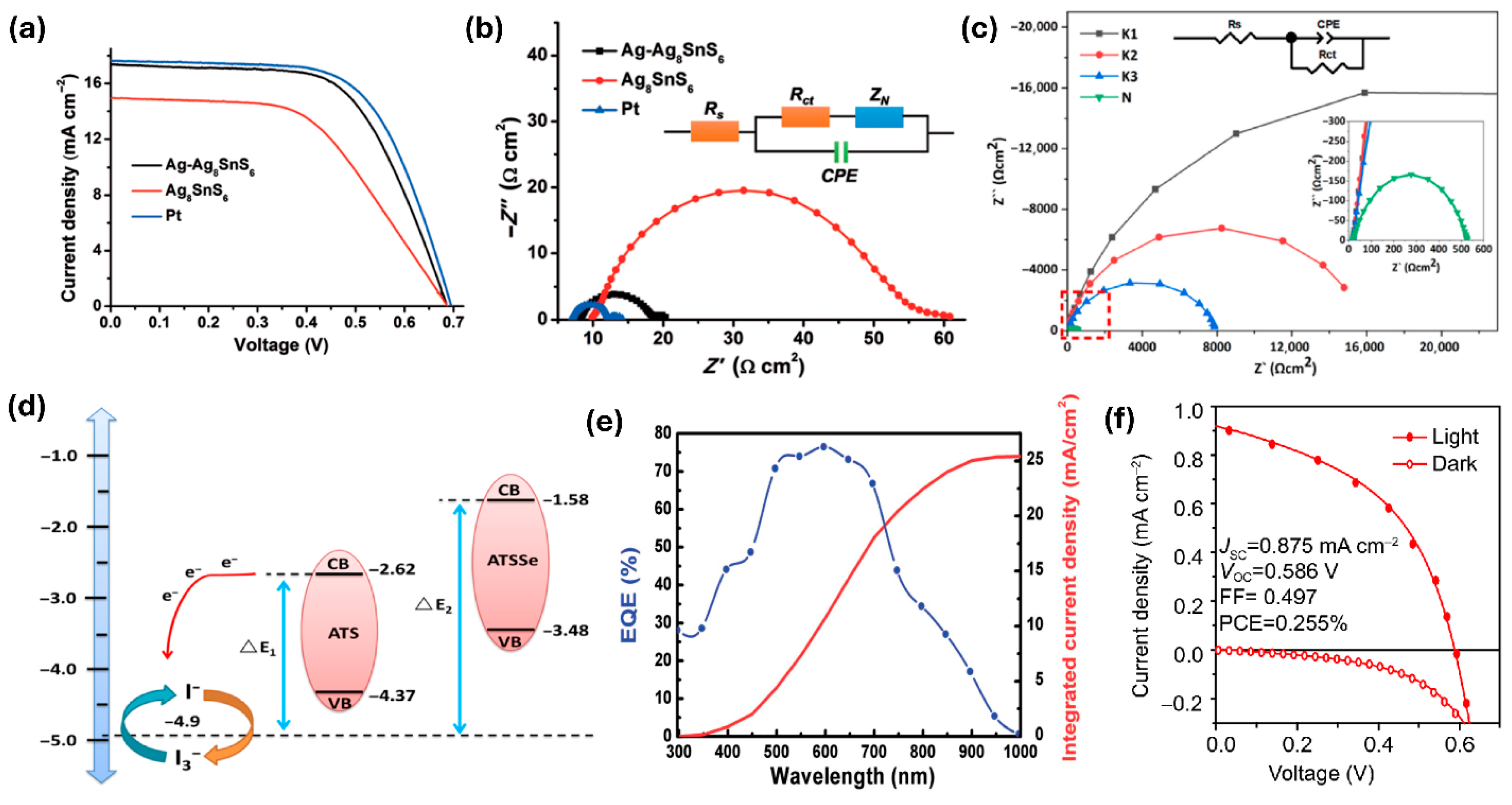
Qingquan He et al. [6] integrated Ag8SnS6 as a counter electrode in DSSCs with the device structure FTO/TiO2/dye/electrolyte/Ag-Ag8SnS6/FTO (Table 4). The Ag/Ag8SnS6 counter electrode formed a Mott–Schottky junction, facilitating efficient electron transfer to the redox electrolyte. DSSCs exhibited comparable photovoltaic parameters to Pt-based references, with a short-circuit current density (Jsc) of 17.38 mA cm−2, a fill factor (FF) ~61%, and an overall power conversion efficiency (PCE) approaching 7.36%, under the illumination of AM1.5 (100 mW cm−2). Electrochemical impedance spectroscopy confirmed the reduced charge-transfer resistance at the counter electrode interface (Figure 7a,b).
The effect of selenium introduced during post-annealing on phase composition (Ag8SnSxSe6−x), crystal structure, and film morphology was systematically studied by C.C. Wang et al. [7]. Selenium incorporation was found to replace sulfur sites in the Ag8SnS6 lattice, forming the Ag8SnSxSe6−x phase, while promoting grain growth that resulted in a less planar film morphology. When used as counter electrodes in dye-sensitized solar cells, the selenized Ag8SnSxSe6−x films showed improved electrochemical performance, including lower charge-transfer internal resistance (Rct), decreased peak-to-peak separation (ΔEPP), and a larger energy level gap between the counter-electrode conduction band and the electrolyte redox potential (Figure 7c,d). The device performance was characterized by recording the J−V curves under simulated solar illumination using a xenon short-arc lamp solar simulator, calibrated to 100 mW cm−2 (AM 1.5 G). Consequently, the PCE reached 4.26%, a 28.31% increase over cells with pristine Ag8SnS6 counter electrodes. Overall, selenization effectively enhances electron transport and electrocatalytic activity, providing a promising strategy to boost DSSC performance.
Patsorn Boon-On et al. [5] report the synthesis and photovoltaic evaluation of a ternary solar absorber, Ag8SnS6 nanocrystals, prepared using the SILAR technique. Optical characterization using UV–Vis spectroscopy and external quantum efficiency (EQE) measurements revealed a tunable bandgap spanning 1.24–1.41 eV. The J−V characteristics were recorded using a Keithley 2400 source meter under simulated solar illumination at 100 mW cm−2, generated by a 150 W Oriel xenon lamp equipped with an AM 1.5 bandpass filter. Using a polysulfide electrolyte and a Au counter electrode, the optimized device exhibited a Jsc of 9.29 mA cm−2, an open-circuit voltage (Voc) of 0.23 V, a FF of 31.3%, and a PCE of 0.64%. The efficiency increased to 1.43% at a reduced light intensity of 0.1 sun. Replacing the polysulfide electrolyte with a cobalt-based redox couple with lower redox potential significantly enhanced the Voc to 0.54 V and improved the PCE to 2.29% under 0.1 sun illumination. The EQE spectrum extended from 300 to 1000 nm, with a maximum value of 77% at 600 nm (Figure 7e). The near-optimal bandgap and encouraging photovoltaic metrics make Ag8SnS6 nanocrystals a promising material for next-generation solar cells [5].
Liangzheng Zhu et al. [35] fabricated a mesoscopic architecture consisting of FTO/c-TiO2/m-TiO2/Ag8SnS6/spiro-OMeTAD/Au. The Ag8SnS6 absorber was deposited by solution processing and infiltrated into the mesoporous TiO2 scaffold to enhance charge separation and collection. The measurement was performed using a Keithley 2420 digital source meter controlled by TestPoint software under simulated illumination from a xenon lamp at an intensity of 100 mW cm−2. The devices delivered a Voc of ~0.58 V, Jsc of ~0.875 mA cm−2, and FF of 49%, resulting in a PCE of approximately 0.25% (Figure 7f). The architecture demonstrated good operational stability, with minimal efficiency loss over time [35].
Table 4. Comparison table of photovoltaic device architectures and performance parameters, using Ag8SnS6 as either a counter electrode or photoabsorber material.
MaterialDevice ArchitectureVocJscFFEfficiencyReference
Ag8SnS6FTO/TiO2/dye/electrolyte/Ag-Ag8SnS6/FTO-17.38617.36[6]
Ag8SnSxSe6−xFTO/TiO2/N719dye/electrolyte/Ag8SnSxSe6−x/FTO0.6612.0953.214.26[7]
Ag8SnS6FTO/TiO2/Ag8SnS6/electrolyte/Au0.239.2931.30.64[5]
Ag8SnS6FTO/c-TiO2/m-TiO2/Ag8SnS6/spiro-OMeTAD/Au0.580.875490.25[35]
When used as a CE, Ag8SnS6 primarily catalyzes the reduction in triiodide (I3−) to iodide (I) while enabling efficient electron transfer at the electrode–electrolyte interface. Incorporating metallic Ag to form Ag-Ag8SnS6 heterodimers creates Mott–Schottky heterojunctions that concentrate electrons on the Ag nanoparticles, thereby facilitating the I3 reduction and significantly improving the power conversion efficiency (PCE) of DSSCs [6]. The performance of DSSCs employing these CEs strongly depends on both electrical conductivity and electrocatalytic activity. For instance, Ag8SnSxSe6−x counter electrodes exhibit lower charge-transfer resistance and comparatively improved device efficiency than their pure Ag8SnS6 counterparts (Table 4 and Table 5) [7].
As a photoabsorber in thin-film and sensitized solar cells, Ag8SnS6 is attractive due to its near-optimal bandgap and high absorption coefficient. Its direct bandgap enables efficient light harvesting with thinner absorber layers while maintaining effective charge generation and transport [5,35]. In liquid-junction solar cells, device performance is highly sensitive to the electrolyte composition. Replacing polysulfide electrolytes with cobalt-based redox couples improves PCE by lowering the redox potential (Table 4 and Table 5).

5.2. Considerations for Thermoelectric

Sturm et al. [36] measured the thermal conductivity of Ag8SnS6 and Ag8.1SnS6 between 290 and 785 K. Both compositions exhibit consistently low thermal conductivity over the entire temperature range. For Ag8SnS6, low thermal conductivity (κ) decreases from 0.39 to 0.29 W m−1 K−1 between 290 and 453 K and is dominated (>99%) by the lattice thermal conductivity contribution, due to the low electrical conductivity. Above the phase transition, κ increases slightly to 0.35 W m−1 K−1 at 785 K. Ag8.1SnS6 shows a similar temperature dependence but with higher values, decreasing from 0.46 to 0.40 W m−1 K−1 between 290 and 420 K and increasing to 0.47 W m−1 K−1 at 785 K. Lower κ values upon cooling indicate thermal instability, which is likely caused by irreversible temperature-induced structural changes. Figure of merit (zT) for Ag8SnS6 ranges from 2 × 10⁻⁴ to 5 × 10⁻⁴ over the temperature interval of 480–685 K, whereas Ag8.1SnS6 exhibits higher zT values of 0.002–0.006 between 480 and 615 K. These overall figure-of-merit values remain low, most likely due to low charge carrier concentrations limiting the electrical transport performance.
Zhou et al. [22] confirm that Ag8SnSe6 exhibits an ultralow lattice thermal conductivity of ~0.25–0.3 W m−1 K−1 across a wide temperature range. This property arises from extreme phonon anharmonicity and weak interatomic bonding, which suppresses phonon propagation.
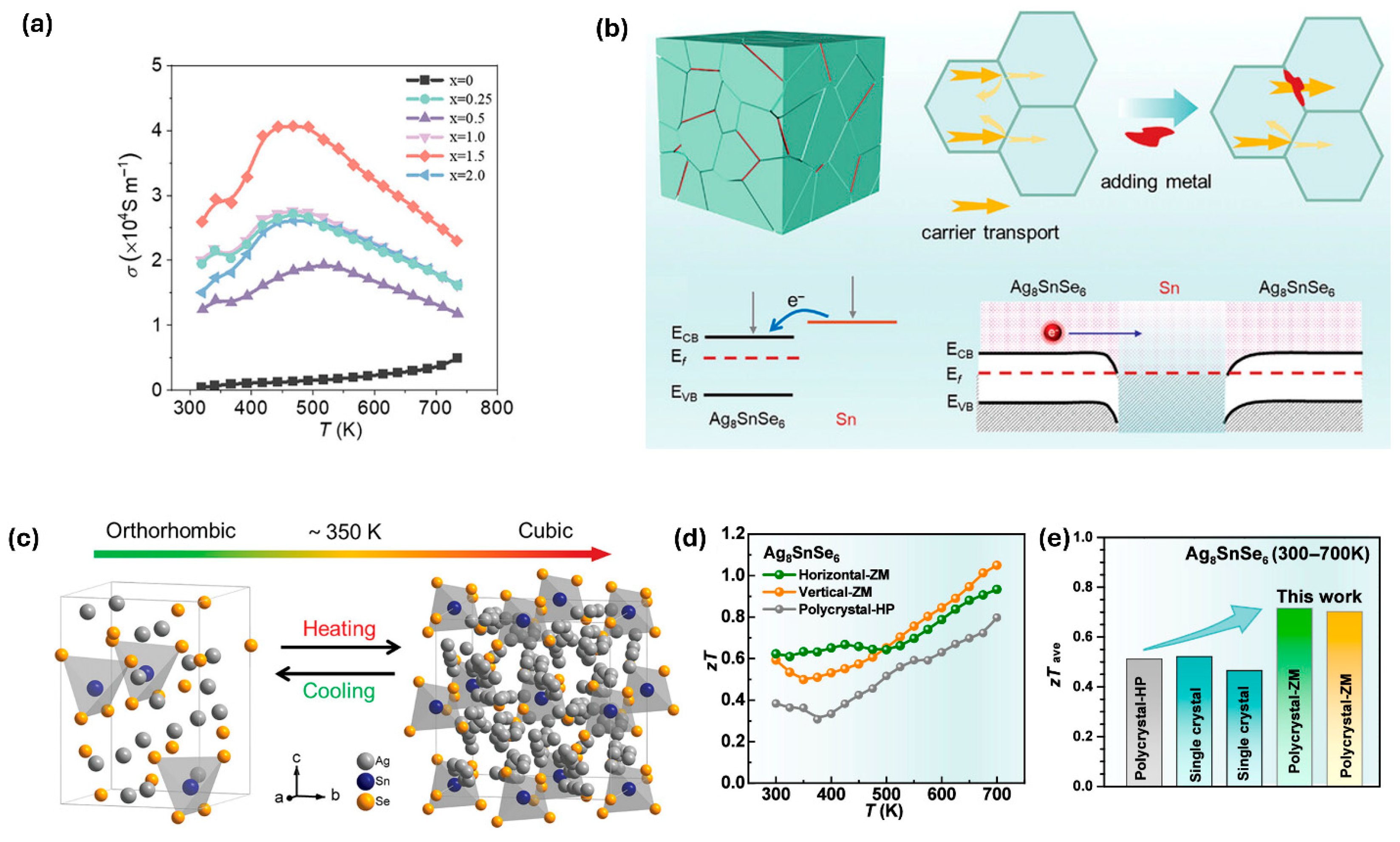
Zhao et al. [34] achieved a major improvement in Ag8SnSe6’s thermoelectric performance by synthesizing Ag8SnSe6 nanocrystals and lightly doping them with Sn. Figure 8a presents the electrical transport behavior of Ag8SnSe6−x wt.% Sn pellets measured over the temperature range of 310–723 K. In the undoped sample, electrical conductivity (σ) increases steadily with temperature: a behavior that is consistent with thermally activated carrier generation. Remarkably, the incorporation of elemental Sn leads to an obvious enhancement in conductivity across the entire temperature range. This improvement is attributed to metallic Sn, which, owing to its relatively low work function, can transfer electrons to the Ag8SnSe6 matrix via interfacial spillover, effectively acting as an external donor (Figure 8b); during the hot-pressing process, some Sn atoms diffuse into interstitial lattice sites, where they may serve as internal donor dopants, further elevating the electron concentration. Additionally, all Sn-containing samples exhibit a subtle peak in σ around 356 K, coinciding with the orthorhombic-to-cubic phase transition (Figure 8c), a structural transformation known to influence carrier mobility and transport dynamics. As the temperature increases, σ continues to rise to ~460 K due to the enhanced carrier concentration (n). Beyond this point, σ declines as elevated temperatures activate bipolar carriers, intensifying scattering and reducing carrier mobility. The lattice thermal conductivity decreases sharply above 350 K, falling below 0.1 W m−1 K−1. During the phase transition, the Sn-doped sample develops complex nanostructures that introduce a high density of point defects, dislocations, and lattice distortions, thereby leading to strong phonon scattering. The improved balance between electrical and thermal transport led to a substantial enhancement in the zT value over the temperature range of 310–723 K. The average zT increased from 0.22 to 0.64, while at room temperature, the zT rose sharply from 0.07 to 0.6, corresponding to nearly an order-of-magnitude improvement for Ag8SnSe6 with 1 wt.% Sn. This pronounced zT enhancement over a wide temperature range, especially near room temperature, highlights the strong potential of this material for practical thermoelectric applications.
The TE performance of Ag8SnSe6 was significantly enhanced in a study by Lin et al. [37] through the adoption of the zone melting (ZM) method, which proved to be superior to the conventional hot pressing (HP) route. The ZM-synthesized samples demonstrated a 60% increase in weighted carrier mobility over HP samples, due to reduced grain boundary scattering, resulting in improved electrical conductivity while maintaining a reasonably low thermal conductivity. For Ag8SnSe6 specimens synthesized by the ZM method, the total thermal conductivity ranges from 0.20 to 0.45 W m−1 K−1 over the temperature range of 300–700 K, which is slightly higher than that of samples prepared by the HP method. In the ZM-synthesized Ag8SnSe6, the lattice thermal conductivity reaches values as low as approximately 0.3 W m−1 K−1, but remains marginally higher than that observed in its HP-synthesized counterparts. This increase in lattice thermal conductivity is attributed to reduced grain boundary scattering in the ZM process, which weakens phonon scattering while simultaneously enhancing carrier mobility, leading to improved electrical transport. At room temperature, the charge carrier concentration is approximately 2 × 1018 cm−3 for samples prepared by the ZH and HT methods. Upon cooling, the carrier concentration increases rapidly to about 1 × 1019 cm−3, primarily due to the phase transition, and then remains nearly constant at higher temperatures. As seen in Figure 8d, the ZM-prepared sample reached a peak zT value of 1.05 at 700 K. Despite a slight increase in κ, it was attributed to weakened phonon scattering. The overall thermoelectric efficiency improved due to higher power factors ∼7.1 μW cm−1 K−2 for horizontal samples and 6.1 μW cm−1 K−2 for vertical samples, compared to ∼4.0 μW cm−1 K−2 in HP samples. The average zT over the temperature range of 300–700 K improved to 0.71 for ZM samples (Figure 8e).

6. Outlook

6.1. Remaining Challenges

Phase purity and composition control: Achieving phase-pure Ag8SnS6 and Ag8SnSe6 remains difficult due to the tendency of secondary phases (e.g., Ag2S, SnS2, SnSe2) to form during synthesis. This is particularly critical in thin-film processing, where stoichiometry drift and non-uniform precursor conversion can compromise the device-graded material quality.
Bandgap and carrier concentration engineering: The narrow bandgaps of Ag-Sn-S/Se compounds are desirable for IR harvesting, but precise bandgap tuning (e.g., via alloying or doping) is still underdeveloped. Simultaneously, achieving optimal carrier concentrations for both photovoltaic and thermoelectric efficiency is a balancing act, especially in materials with mixed ionic–electronic transport.
Ionic conductivity and stability: These materials exhibit significant Ag+ ionic mobility, especially in the high-temperature phases, which can lead to phase instability, ion migration, and device degradation under operational conditions. Stabilizing the structure while maintaining functional transport properties is a key materials challenge.
Limited understanding of defect chemistry: Native defects and defect complexes strongly influence both the electrical and thermal properties. However, a comprehensive understanding of defect formation energies, charge states, and their impact on performance remains incomplete, particularly for doped or alloyed systems.

6.2. Opportunities

Ag-Sn-S/Se semiconductors offer compelling opportunities for advancing next-generation energy technologies. Their tunable super-narrow bandgaps (0.8–1.2 eV), strong NIR absorption, and intrinsically low lattice thermal conductivity place them at a rare intersection of PV and TE functionality. One key future direction is the development of tandem or intermediate-band devices utilizing Ag-Sn-S/Se as sub-cells that are capable of harvesting low-energy photons beyond the reach of conventional semiconductors. Their suitability for solution-based processing opens the door to scalable fabrication of multi-junction architectures on flexible substrates. Additionally, doping strategies and strain engineering may be further explored to finely modulate band structure, carrier mobility, and defect levels for optimized device performance. We present a powerful platform for advanced optoelectronic applications, especially in environments where broadband photon harvesting, radiation hardness, and thermal stability are required, such as in space technologies and infrared optoelectronics. Their direct bandgaps and strong absorption in the NIR region make them prime candidates for integration into low-light or extended-spectrum photodetectors, NIR imaging systems, and multi-junction solar cells that are tailored for extraterrestrial environments. In space-based photovoltaics, where devices must capture a broader portion of the solar spectrum, especially under varying illumination and temperature, super-narrow-bandgap semiconductors can offer unique advantages. They can serve as bottom-cell absorbers in tandem or triple-junction solar cells, where photons with energies < 1 eV would otherwise be wasted. Furthermore, their structural flexibility, soft-lattice behavior, and high atomic number constituents may contribute to enhanced radiation tolerance, a critical parameter in the harsh space environment. Beyond photovoltaics, the ionic–electronic duality and lattice dynamics of these materials, particularly the rattling modes and dynamic disorder observed in Ag sites, suggest potential use in thermophotonic and broadband thermal infrared sensors, where low thermal conductivity and a strong NIR response are essential. The ability to fine-tune their bandgap via compositional engineering (e.g., Se/S substitution, halogen doping, or Cu/Zn alloying) provides further customization for spectrally selective detectors, IR light-emitting diodes (LEDs), or thermophotovoltaic (TPV) emitters in waste heat recovery and deep-space missions.

Author Contributions

P.P.; writing—original draft, editing the preparation, H.-G.L.; editing draft, D.-W.K.; writing—review and editing, supervision. All authors have read and agreed to the published version of the manuscript.

Funding

This research was supported by the Chung-Ang University Research Grants in 2025. This work was also supported by the National Research Foundation of Korea (NRF) grant funded by the Korean government (MSIT) (NRF-RS-2023-00212744).

Data Availability Statement

No new data were created or analyzed in this study.

Conflicts of Interest

The authors declare no conflicts of interest.

Abbreviations

TEthermoelectric
PVphotovoltaic
NIRnear-infrared
CBDchemical bath deposition
SILARsuccessive ionic layer adsorption and reaction
DSCdifferential scanning calorimetry
MEMmaximum entropy method
EDDelectron density distribution
ADPsatomic displacement parameters
EQEexternal quantum efficiency
PDOSpartial density of states
PECphotoelectrochemical cell
Vocopen-circuit voltage
Jscshort-circuit current density
FFfill factor
PCEpower conversion efficiency
Rctcharge-transfer internal resistance
ZMzone melting
HPhot pressing
LEDslight-emitting diodes
TPVthermophotovoltaic

References

  1. Kuhs, W.; Nitsche, R.; Scheunemann, K. The argyrodites—A new family of tetrahedrally close-packed structures. Mater. Res. Bull. 1979, 14, 241–248. [Google Scholar] [CrossRef]
  2. Chekailo, M.; Yushchuk, S.; Yuryev, S.; Akselrud, L.; Mokliak, V. Phase Transitions in Ag8SnSe6 and Ag8SnS6: Mössbauer and X-ray Study. Phys. Chem. Solid State 2025, 26, 774–780. [Google Scholar] [CrossRef]
  3. Aliyeva, Z.; Bagheri, S.; Aliev, Z.; Alverdiyev, I.; Yusibov, Y.A.; Babanly, M. The phase equilibria in the Ag2S–Ag8GeS6–Ag8SnS6 system. J. Alloys Compd. 2014, 611, 395–400. [Google Scholar] [CrossRef]
  4. Semkiv, I.V.; Ukrainets, N.A.; Kusnezh, V.V.; Zmiiovska, E.O.; Petrus, R.Y.; Ilchuk, H.A.; Dubiv, T.O. Synthesis and Electrical Properties of Ag8SnSe6 Argyrodite Thin Films. Phys. Chem. Solid State 2017, 18, 78–83. [Google Scholar] [CrossRef]
  5. Boon-On, P.; Aragaw, B.A.; Lee, C.-Y.; Shi, J.-B.; Lee, M.-W. Ag8SnS6: A new IR solar absorber material with a near optimal bandgap. RSC Adv. 2018, 8, 39470–39476. [Google Scholar] [CrossRef] [PubMed]
  6. He, Q.; Huang, S.; Wang, C.; Qiao, Q.; Liang, N.; Xu, M.; Chen, W.; Zai, J.; Qian, X. The role of Mott–Schottky heterojunctions in Ag–Ag8SnS6 as counter electrodes in dye-sensitized solar cells. ChemSusChem 2015, 8, 817–820. [Google Scholar] [CrossRef]
  7. Wang, C.C.; Zhu, Y.; Hu, Y.M.; Dong, M.R.; Liu, J.K. Selenization treatment on Ag8SnSxSe6−x counter electrode of dye-sensitized solar cells in improving its electron transfer and electrocatalytic activity. Ceram. Int. 2023, 49, 21804–21814. [Google Scholar] [CrossRef]
  8. Bustamante, J.; Ghata, A.; Naik, A.A.; Ertural, C.; Ueltzen, K.; Zeier, W.G.; George, J. Thermal Transport in Ag8TS6 (T= Si, Ge, Sn) Argyrodites: An Integrated Experimental, Quantum-Chemical, and Computational Modelling Study. arXiv 2025, arXiv:2510.23133. [Google Scholar]
  9. Zhang, X.; Zhang, C.-L.; Lin, S.; Lu, H.; Pei, Y.; Jia, S. Thermoelectric properties of n-type Nb-doped Ag8SnSe6. J. Appl. Phys. 2016, 119, 135101. [Google Scholar] [CrossRef]
  10. Ren, Q.; Gupta, M.K.; Jin, M.; Ding, J.; Wu, J.; Chen, Z.; Lin, S.; Fabelo, O.; Rodríguez-Velamazán, J.A.; Kofu, M. Extreme phonon anharmonicity underpins superionic diffusion and ultralow thermal conductivity in argyrodite Ag8SnSe6. Nat. Mater. 2023, 22, 999–1006. [Google Scholar] [CrossRef]
  11. Zheng, Q.; Zhang, T.; Ning, S.; Chen, X.; Yu, T.; Lai, Z.; Tan, G.; Tang, X.; Qi, N.; Chen, Z. Chemical Bonding Engineering-Tailored Extremely Low Lattice Thermal Conductivity in SnI2-Doped Ag8SnSe6 Realizing High Thermoelectric Performance. ACS Appl. Mater. Interfaces 2025, 17, 62338–62348. [Google Scholar] [CrossRef]
  12. Syrotyuk, S.V.; Semkiv, I.V.; Ilchuk, H.A.; Shved, V.M. The effects of strong correlations on the band structure of Ag8SnSe6 argyrodite. Condens. Matter Phys. 2016, 19, 43703. [Google Scholar] [CrossRef]
  13. Yang, C.; Luo, Y.; Li, X.; Cui, J. N-type thermoelectric Ag8SnSe6 with extremely low lattice thermal conductivity by replacing Ag with Cu. RSC Adv. 2021, 11, 3732–3739. [Google Scholar] [CrossRef]
  14. Dallas, P.; Tzitzios, V.K.; Givalou, L.; Tsipas, P.; Basina, G.; Sakellis, E.; Boukos, N.; Stergiopoulos, T. Effects of ligand coordination on Ag8SnS6 as a photoabsorber for thin film solar cells. J. Mater. Chem. C 2025, 13, 7996–8005. [Google Scholar] [CrossRef]
  15. Wang, C.; Zhu, Y.; Xu, K.; Sun, S.; Dong, M.; Liu, J.; Hu, Y. A simple method to prepare triangle-shaped Ag8SnS6 nanoparticles and tune its band gap. Mater. Lett. 2023, 342, 134322. [Google Scholar] [CrossRef]
  16. Li, W.; Lin, S.; Ge, B.; Yang, J.; Zhang, W.; Pei, Y. Low sound velocity contributing to the high thermoelectric performance of Ag8SnSe6. Adv. Sci. 2016, 3, 1600196. [Google Scholar] [CrossRef]
  17. Luo, Y.; Cai, S.; Hua, X.; Chen, H.; Liang, Q.; Du, C.; Zheng, Y.; Shen, J.; Xu, J.; Wolverton, C.; et al. High thermoelectric performance in polycrystalline SnSe via dual-doping with Ag/Na and nanostructuring with Ag8SnSe6. Adv. Energy Mater. 2019, 9, 1803072. [Google Scholar] [CrossRef]
  18. Shen, X.; Xia, Y.; Yang, C.C.; Zhang, Z.; Li, S.; Tung, Y.H.; Benton, A.; Zhang, X.; Lu, X.; Wang, G.; et al. High Thermoelectric Performance in Sulfide-Type Argyrodites Compound Ag8Sn(S1−xSex)6 Enabled by Ultralow Lattice Thermal Conductivity and Extended Cubic Phase Regime. Adv. Funct. Mater. 2020, 30, 2000526. [Google Scholar] [CrossRef]
  19. Slade, T.J.; Gvozdetskyi, V.; Wilde, J.M.; Kreyssig, A.; Gati, E.; Wang, L.-L.; Mudryk, Y.; Ribeiro, R.A.; Pecharsky, V.K.; Zaikina, J.V.; et al. A low-temperature structural transition in canfieldite, Ag8SnS6, single crystals. Inorg. Chem. 2021, 60, 19345–19355. [Google Scholar] [CrossRef]
  20. Chekailo, M.V.; Akselrud, L.G.; Gladyshevskii, R.E.; Ukrainets, N.A. Temperature dependence of the structures of β’-and γ-Ag8SnSe6 argyrodite. J. Solid State Chem. 2024, 332, 124541. [Google Scholar] [CrossRef]
  21. Li, L.; Liu, Y.; Dai, J.; Hong, A.; Zeng, M.; Yan, Z.; Xu, J.; Zhang, D.; Shan, D.; Liu, S.; et al. High thermoelectric performance of superionic argyrodite compound Ag8SnSe6. J. Mater. Chem. C 2016, 4, 5806–5813. [Google Scholar] [CrossRef]
  22. Zhou, J.; Chen, X.; Zhang, Y.; Avdeev, M.; Zhang, J.; Shi, X. Deciphering Silver Diffusion Pathway and Local Structure of Thermoelectric Ag8SnSe6. Adv. Funct. Mater. 2025, e15882. [Google Scholar] [CrossRef]
  23. Cheng, K.-W.; Wu, Y.-H.; Chiu, T.-H. Photoelectrochemical salt water splitting using ternary silver–tin–selenide photoelectrodes. J. Power Sources 2016, 307, 329–339. [Google Scholar] [CrossRef]
  24. Yu, Z.; Wang, X.; Liu, C.; Cheng, Y.; Zhang, Z.; Si, R.; Bai, X.; Hu, X.; Gao, J.; Peng, Y.; et al. Carrier and microstructure tuning for improving the thermoelectric properties of Ag8SnSe6 via introducing SnBr2. J. Adv. Ceram. 2022, 11, 1144–1152. [Google Scholar] [CrossRef]
  25. Jin, M.; Lin, S.; Li, W.; Chen, Z.; Li, R.; Wang, X.; Chen, Y.; Pei, Y. Fabrication and thermoelectric properties of single-crystal argyrodite Ag8SnSe6. Chem. Mater. 2019, 31, 2603–2610. [Google Scholar] [CrossRef]
  26. Yeh, L.-Y.; Cheng, K.-W. Modification of Ag8SnS6 photoanodes with incorporation of Zn ions for photo-driven hydrogen production. Catalysts 2021, 11, 363. [Google Scholar] [CrossRef]
  27. Munekata, R.; Uchimura, T.; Araki, H.; Kanai, A.; Tanaka, K.; Okamoto, T.; Akaki, Y. Optimization of sulfide annealing conditions for Ag8SnS6 thin films. Materials 2023, 16, 6289. [Google Scholar] [CrossRef]
  28. Akaki, Y.; Akita, H.; Nakamura, S.; Araki, H.; Seto, S.; Yamaguchi, T. Effects of H2S annealing for Ag/Sn and Ag/SnS thin films deposited by a thermal evaporation method. Phys. Status Solidi C 2017, 14, 1600254. [Google Scholar] [CrossRef]
  29. Cheng, K.-W.; Chou, Y. Photoelectrochemical performances of the cubic AgSnSe2 thin film electrodes created using the selenization of thermal evaporated Ag-Sn metal precursors. J. Taiwan Inst. Chem. Eng. 2018, 85, 56–65. [Google Scholar] [CrossRef]
  30. Rismaningsih, N.; Takiyama, T.; Akiyoshi, K.; Kameyama, T.; Torimoto, T. Solution-phase Synthesis and Photoelectrochemical Properties of Ag8SnSe6 Quantum Dots with Different Sizes. Electrochemistry 2024, 92, 077005. [Google Scholar] [CrossRef]
  31. Adekoya, J.A.; Khan, M.D.; Mlowe, S.; Revaprasadu, N. Canfieldite Ag8SnS6 nanoparticles with high light absorption coefficient and quantum yield. Mater. Chem. Phys. 2023, 299, 127456. [Google Scholar] [CrossRef]
  32. Yarur Villanueva, F.; Hasham, M.; Green, P.B.; Imperiale, C.J.; Rahman, S.; Burns, D.C.; Wilson, M.W.B. A Stepwise Reaction Achieves Ultrasmall Ag2ZnSnS4 Nanocrystals. ACS Nano 2024, 18, 35182–35201. [Google Scholar] [CrossRef]
  33. Yarur Villanueva, F.; Quezada Novoa, V.; Rusch, P.; Toso, S.; Terban, M.W.; Ivanov, Y.P.; Chu, J.C.; Kirshenbaum, M.J.; Nikbin, E.; Gendron Romero, M.J.; et al. Synthesis and Structural Analysis of an Emissive Colloidal Argyrodite Nanocrystal: Canfieldite Ag8SnS6. J. Am. Chem. Soc. 2025, 147, 29413–29422. [Google Scholar] [CrossRef]
  34. Zhao, X.; Li, M.; Jia, M.; Fiedler, C.; Nan, B.; Yang, D.; Li, L.; Yuan, Z.; Song, H.; Liu, Y.; et al. Low-Dimensional Structure Modulation in Ag8SnSe6 for Enhanced Thermoelectric Performance. Adv. Funct. Mater. 2025, 35, 2421449. [Google Scholar] [CrossRef]
  35. Zhu, L.; Xu, Y.; Zheng, H.; Liu, G.; Xu, X.; Pan, X.; Dai, S. Application of facile solution-processed ternary sulfide Ag8SnS6 as light absorber in thin film solar cells. Sci. China Mater. 2018, 61, 1549–1556. [Google Scholar] [CrossRef]
  36. Sturm, C.; Boccalon, N.; Ramirez, D.; Kleinke, H. Stability and thermoelectric properties of the canfieldite Ag8SnS6. ACS Appl. Energy Mater. 2021, 4, 10244–10251. [Google Scholar] [CrossRef]
  37. Lin, S.; Hou, Y.; Yang, J.; Fan, P.; Liu, S.; Guo, L.; Jin, M. Enhanced Weighted Mobility Induced High Thermoelectric Performance in Argyrodite Ag8SnSe6. ACS Appl. Mater. Interfaces 2024, 16, 58912–58919. [Google Scholar] [CrossRef]
Figure 1. (a,b) Crystal structure representation of Ag8SnS6 defined at low temperature (90 K) and room temperature (295 K), reproduced with permission (2021) American Chemical Society [19]. Atomic arrangement in the unit cell of β′-Ag8SnSe6 argyrodite, highlighting the tetrahedral coordination environment surrounding the Sn atoms, (c) single tetrahedron with sign of the distances Sn-Se and (d) AgA represents the positions of silver sites with partial occupancy. (e,f) Coordination of Sn and Ag atoms in β′-Ag8SnSe6: (a) fully occupied Ag sites (Ag1–Ag4) and (b) partially occupied sites (Ag5–Ag7), reproduced with permission, (2024), Elsevier [20].
Energies 19 01029 g001
Figure 2. Temperature-dependent heat flux of Ag8SnSe6 measured by DSC (a) heating cycle and (b) cooling cycle. Sample mass m = 99.08 mg; heating rate υ = 5 °C/min, reproduced with permission, (2024), Elsevier [20]. (c) 3D MEM electron density maps of Ag8SnSe6 from 100 to 400 K with iso-surfaces set at 2% (100–300 K) and 1% (400 K) of Sn site peak densities; corresponding isovalues: 17.75, 13.44, 12.10, and 3.91 eÅ−3. (d) 2D MEM maps on the (011)o and (111)c planes visualize structural evolution across temperatures. (d) 2D MEM maps on the (011)o and (111)c planes visualize structural evolution across temperatures. (e,f) 1D MEM EDD profile on the (011)o and (111)c plane at 100–400 K (g) 2D MEM map at 400 K along path 2 on the (111)c plane highlights diffusion pathways between Ag sites. (h) Temperature-dependent isotropic atomic displacement parameters (ADPs) for all atoms in Ag8SnSe6, along with the average ADP, reproduced with permission, (2025), John Wiley and Sons [22].
Energies 19 01029 g002
Figure 3. (a) Tauc plot derived from the optical absorption spectra of Ag8SnS6 nanocrystals, reproduced with permission (2018) Royal Society of Chemistry, CC BY 3.0 [5]. (b,c) UV–Vis absorption spectra of Ag8SnS6−xSex nanoparticles, and Tauc plots with varying Se content, reproduced with permission, (2023), Elsevier [15]. (d) Tauc plot of Ag8SnSe6 with various film thicknesses, reproduced with permission, (2016), Elsevier [23]. (e,f) Absorption coefficient (A) plotted against photon energy for varying Se substitution levels, optical bandgaps extracted from Tauc plots, reproduced with permission (2021) Royal Society of Chemistry, CC BY 3.0 [13]. (g) Photon energy-dependent normalized optical absorption profiles for hot-pressed Ag8Sn1+xSe6−2xBr2x, illustrating the influence of Br incorporation on optical transitions, reproduced with permission, (2022), Creative Commons Attribution 4.0 [24].
Energies 19 01029 g003
Figure 4. (a) Growth of Ag8SnS6 single crystals via high-temperature flux method, followed by slow cooling. (b) Snap of as-grown Ag8SnSe6 crystals, (c) DSC thermograms showing the β′ ⟶ γ phase transition, (d) crystal structures of orthorhombic β-Ag8SnSe6 and (e) cubic γ-Ag8SnSe6, reproduced with permission, (2019), American Chemical Society [25].
Energies 19 01029 g004
Figure 5. (a) Graphical representation of Ag8SnS6 thin film fabrication through chemical bath deposition. (b) Compositional evaluation of samples 1–6: precursor, annealed at 450–550 °C, reproduced with permission, CC BY 4.0 [27]. (c) Scanning electron microscopy images of glass/Ag/SnS thin film surfaces after annealing at temperatures from 400 °C to 500 °C, reproduced with permission, (2017), John Wiley and Sons [28]. (d) Schematic of the selenization setup employed in a two-zone furnace, reproduced with permission, (2017), Elsevier [29].
Energies 19 01029 g005
Figure 7. (a) J–V curves of DSSCs with Ag-Ag8SnS6, Ag8SnS6, and Pt counter electrodes under AM 1.5 illumination, (b) Nyquist plots of symmetric cells with different counter electrodes; inset shows the equivalent circuit, reproduced with permission, (2015), John Wiley and Sons [6]. (c) Nyquist plots using different counter electrodes in DSSC (d) Electron transport via alignment in Ag8SnS6 and Ag8SnSxSe6−x thin films under nitrogen atmosphere at standard pressure, reproduced with permission, (2023), Elsevier [7]. (e) External quantum efficiency spectrum of Ag8SnS6 sensitized solar cell, reproduced with permission, (2018), Royal Society of Chemistry, CC BY 3.0 [5]. (f) Current-voltage response of the Ag8SnS6-based device under simulated AM 1.5G sunlight and in dark conditions, reproduced with permission, (2018), Springer Nature [35].
Energies 19 01029 g007
Figure 8. (a) Temperature dependence of the electrical transport behavior of Ag8SnSe6−x wt.% Sn, (b) energy barrier diagram illustrating interfacial charge transfer at the composite phase boundary. (c) Temperature-dependent phase transition from orthorhombic and cubic Ag8SnSe6, reproduced with permission, (2025), John Wiley and Sons [34]. (d,e) Temperature-dependent zT and average zT (300–700 K) for horizontally and vertically oriented Ag8SnSe6 synthesized via zone melting, compared with conventional and single-crystal counterparts. Reproduced with permission, (2024), American Chemical Society [37].
Energies 19 01029 g008
Table 1. Summary of reported structural phases, approximate transition temperatures, and key experimental signatures for Ag-Sn-s/Se semiconductors.
MaterialPhaseApprox. Transition TemperatureSpace GroupKey Experimental SignaturesRef.
Ag8SnSe6Room-temperature (RT) phase~295 KPna21Ordered argyrodite framework with a smaller phase volume.
Stable Ag sublattice.
[19]
Low-temperature phase~90 Korthorhombic phase
Pmn21
Structural transition observed by crystallography; isostructural with RT Ag8SnSe6.
Ag8SnSe6β′ phase (room temperature)~295 KPmn21Distinct Ag site occupancies (tetrahedral and trigonal); partial Ag disorder.
Non-superionic conductors.
[20]
Ag8SnSe6β → γ transition~300–380 KOrthorhombic Pmn21 → face-centered cubic F 43 ¯ mEndothermic/exothermic peaks in DSC during heating/cooling.[21]
Ag8SnSe6Superionic cubic phase~355 KHigh-symmetry cubic structure (F 43 ¯ m)MEM electron density maps show Ag migration pathways.
Anomalously large ADPs for Ag, especially Ag5, indicating rattling and diffusion.
[22]
Table 2. Comparison table of bandgap tuning via doping in experimental and theoretical study.
MaterialSample TypeMethod/FunctionalBandgap (eV)Gap TypeReference
Ag8SnS6NanocrystalsUV–Vis absorption, Tauc plot1.35–1.41Optical[5]
Ag8SnS6−xSexNanoparticlesUV–Vis absorption, Tauc plot1.16–0.85Optical[15]
Ag8SnSe6
(film thickness)
Thin filmUV–Vis absorption~0.86–1.19Optical[23]
Ag8−xCuxSnSe6BulkUV–Vis absorption, Tauc plot0.80–0.73Optical[13]
Ag8Sn1.03Se5.94Br0.06BulkUV–Vis–NIR absorption~0.80–0.83Optical[24]
Ag8SnSe6BulkHybrid PBE0
(α = 0.33)
~0.66Electronic[12]
Table 3. Summary of the advantages, limitations, cost, and various tuning strategies for Ag-Sn-S/Se semiconductors.
MaterialStabilityCostAdvantagesLimitationsTuning Strategies
Ag8SnS6-Moderate chemical and thermal stability-Uses Ag (impose cost limitation)
-Earth-abundant Sn, S
-Direct bandgap near the optimal range
-Strong absorption
-Properties depend on film density
-Sulfurization conditions
-Synthesis control,
-Stoichiometry optimization, nano structuring
Ag8SnS6−xSex-Se incorporation can improve lattice flexibility but may increase ionic mobility-Slightly higher cost due to Se-Continuous bandgap tunability into NIR
-Improved absorption range
-Increased compositional complexityS/Se alloying, compositional grading
Ag8−xCuxSnSe6-Doping can stabilize electronic transport-Cu is low-cost and abundant-Reduced bandgap
-Enhanced carrier concentration
Possible mobility reduction at high dopingAliovalent cation doping
Ag8Sn1.03Se5.94Br0.06-Halogen substitution may suppress defects-Br is relatively inexpensive.
-Added chemical complexity
-Fine bandgap adjustment
-Defect passivation potential
-Narrow tuning window;-Anion-site doping,
-Defect engineering
Table 5. Comparison of device type, synthesis strategy, and impact mechanism on device performance.
Device TypeComponentSynthesis/Treatment ProcessImpact Mechanism and PerformanceReference
DSSCCounter electrodeOne-pot synthesis of Ag-Ag8SnS6 pyramidal heterodimers-Formation of Mott–Schottky heterojunctions concentrates electrons on metallic Ag, enhancing the reduction of I3− to I.[6]
DSSCCounter electrodeSelenization treatment to form Ag8SnSxSe6−x-Partial substitution of S by Se expands the lattice and increases particle size, reducing charge-transfer resistance and improving electrocatalytic activity.[7]
Sensitized solar cell PhotoabsorberSuccessive ionic layer adsorption and reaction
(SILAR)
-Direct growth of ATS nanocrystals on TiO2 improves interfacial contact.
Device performance is strongly electrolyte-dependent.
[5]
Thin-film solar cellPhotoabsorberFacile solution-
processed method with annealing below 250 °C
-Exploits the direct bandgap (~1.26 eV).
-stability maintained over 1000 h.
[35]
Disclaimer/Publisher’s Note: The statements, opinions and data contained in all publications are solely those of the individual author(s) and contributor(s) and not of MDPI and/or the editor(s). MDPI and/or the editor(s) disclaim responsibility for any injury to people or property resulting from any ideas, methods, instructions or products referred to in the content.