Article

Harmonic Power Sharing Control Method for Microgrid Inverters Based on Disturbance Virtual Impedance


1
State Grid Shaanxi Electric Power Research Institute, Xi’an 710100, China
2
School of Electrical Engineering, Xi’an Jiaotong University, Xi’an 710049, China
3
School of Electrical Engineering, Xi’an University of Technology, Xi’an 710048, China
4
School of Electrical Engineering, Xi’an Electric Power College, Xi’an 710123, China
*
Author to whom correspondence should be addressed.
Energies 2026, 19(4), 1015; https://doi.org/10.3390/en19041015
Submission received: 2 January 2026 / Revised: 25 January 2026 / Accepted: 30 January 2026 / Published: 14 February 2026
(This article belongs to the Section A1: Smart Grids and Microgrids)

Abstract

Parallel inverter systems constitute the fundamental units of AC microgrids and distributed renewable energy generation systems, wherein accurate power sharing among units represents a critical challenge for stable operation. Conventional droop control fails to share the harmonic power in proportionality to the capacity of inverters due to disparities on line impedance, leading to circulating currents, degraded power quality, and reduced system load capability. To address these issues, this paper proposes a harmonic power-sharing control strategy based on perturbative virtual impedance injection. Under the premise that fundamental power sharing according to capacity ratios has been ensured, the strategy first converts the harmonic power information of each inverter into a small-signal perturbation, which is injected into the virtual impedance of its fundamental control loop. Subsequently, by detecting the resulting variations in fundamental power coefficients induced by this perturbation, a closed-loop feedback is constructed to adaptively adjust the virtual impedance value of each inverter at harmonic frequencies. This adjustment enables the automatic matching of the harmonic power distribution ratio to the inverter capacity ratio, ultimately achieving precise harmonic power sharing. The proposed strategy operates without requiring inter-unit communication links or sampling the voltage at the common coupling point, relying solely on local information, thereby enhancing system reliability. Finally, the effectiveness of the proposed control strategy in achieving harmonic power sharing under conditions of line impedance mismatch is validated through an RT-LAB hardware-in-the-loop platform.

1. Introduction

With the increasing penetration of renewable energy sources and the widespread adoption of power electronic loads, AC microgrids have emerged as a crucial technological platform for the efficient local integration of distributed energy resources and the enhancement of regional power supply reliability [1,2]. In parallel systems composed of multiple voltage source inverters, ensuring accurate load power sharing among inverters proportional to their respective capacities represents a key control objective for maintaining stable system operation [3,4]. Traditional droop control, which emulates the external characteristics of synchronous generators through active power–frequency and reactive power–voltage droop relationships, has become a widely adopted solution in this field due to its structural simplicity, communication-free nature, and inherent plug-and-play capability [5,6].
Nevertheless, the conventional droop scheme typically employs low-pass filters in the power calculation stage, which extract only the average fundamental active and reactive power components [7]. In the presence of nonlinear loads, mismatches in line impedances can cause unequal sharing of harmonic currents among the inverters, deviating from the desired capacity-proportional distribution [8,9]. Such unbalanced harmonic power sharing not only degrades power quality but may also lead to overloading of inverters closer to the load due to excessive harmonic current burden, thereby compromising overall system stability [10].
To address the issue of harmonic power sharing, existing research can be primarily categorized into two groups. The first category relies on communication networks, such as using a central controller or distributed consensus algorithms to generate compensation commands [11,12]. While these methods enable precise control, the introduction of communication links increases system complexity and cost and compromises reliability and scalability [13]. The second category consists of communication-free schemes, which mainly achieve power sharing by adjusting the equivalent output impedance of inverters. For instance, introducing fixed-value virtual impedance at specific frequencies is straightforward, but it inherently creates a trade-off between improving power sharing and ensuring power quality at the point of common coupling (PCC) [14,15]. Further studies in [16] propose the use of programmable resistive harmonic impedance, enabling distributed generation (DG) units to exhibit controllable resistive behavior toward harmonics, thereby achieving communication-free, capacity-proportional harmonic current sharing. Similarly, in coordinated control of voltage-controlled and current-controlled inverters, harmonic compensation is achieved locally through virtual capacitive impedance and adaptive virtual admittance, respectively [17].
To overcome the inherent limitations of conventional virtual impedance methods, adaptive virtual impedance control strategies have been introduced. For example, by injecting a small-amplitude AC signal with variable frequency and establishing a droop relationship between this frequency and harmonic power, the resulting active power variation is utilized to adjust the virtual impedance online, enabling coordinated sharing of unbalanced and harmonic power [18]. Related research further proposes a hierarchical control architecture that combines proportional multiple resonant controllers, improved droop control, and virtual harmonic impedance based on second-order generalized integrator (SOGI) filtering, aiming to simultaneously enhance PCC voltage quality and proportionally share harmonic power [19,20]. However, these methods generally require constructing an independent and fully functional additional control outer loop for harmonic power management, which increases system complexity [21].
Some studies have proposed converting information from unbalanced reactive power into a dynamic virtual impedance for regulation. These approaches focus on adjusting the fundamental power itself under mismatched conditions. However, since an absolute reference benchmark is inherently absent, steady-state errors cannot be completely eliminated. To date, no work has utilized an already balanced benchmark to control power sharing. Once the parallel system achieves precise capacity-proportional sharing of fundamental power, it attains a steady-state equilibrium at the fundamental level. Building on this premise, this paper proposes a novel control method for harmonic power sharing based on the injection of virtual impedance perturbations. The key idea is that instead of constructing a separate harmonic power control loop or injecting additional detection signals, the inverter uses its locally measured harmonic power information to generate a small-signal perturbation, which is directly injected into the existing virtual impedance within the fundamental power control loop.
This perturbation slightly alters the steady-state balance of the fundamental power, causing a measurable change in the local power coefficient. By establishing a closed-loop relationship between this power coefficient variation and the adjustment of harmonic virtual impedance, the system can automatically and adaptively tune each inverter’s impedance at harmonic frequencies. As a result, the harmonic power sharing ratio converges to match the inverter capacity ratio, achieving precise harmonic power equalization. The proposed method requires no additional communication or measurements, enabling fully autonomous and reliable harmonic power sharing in microgrid inverter systems.

2. Characteristics Analysis of Parallel Inverter Systems

2.1. Fundamental Power Sharing Characteristics

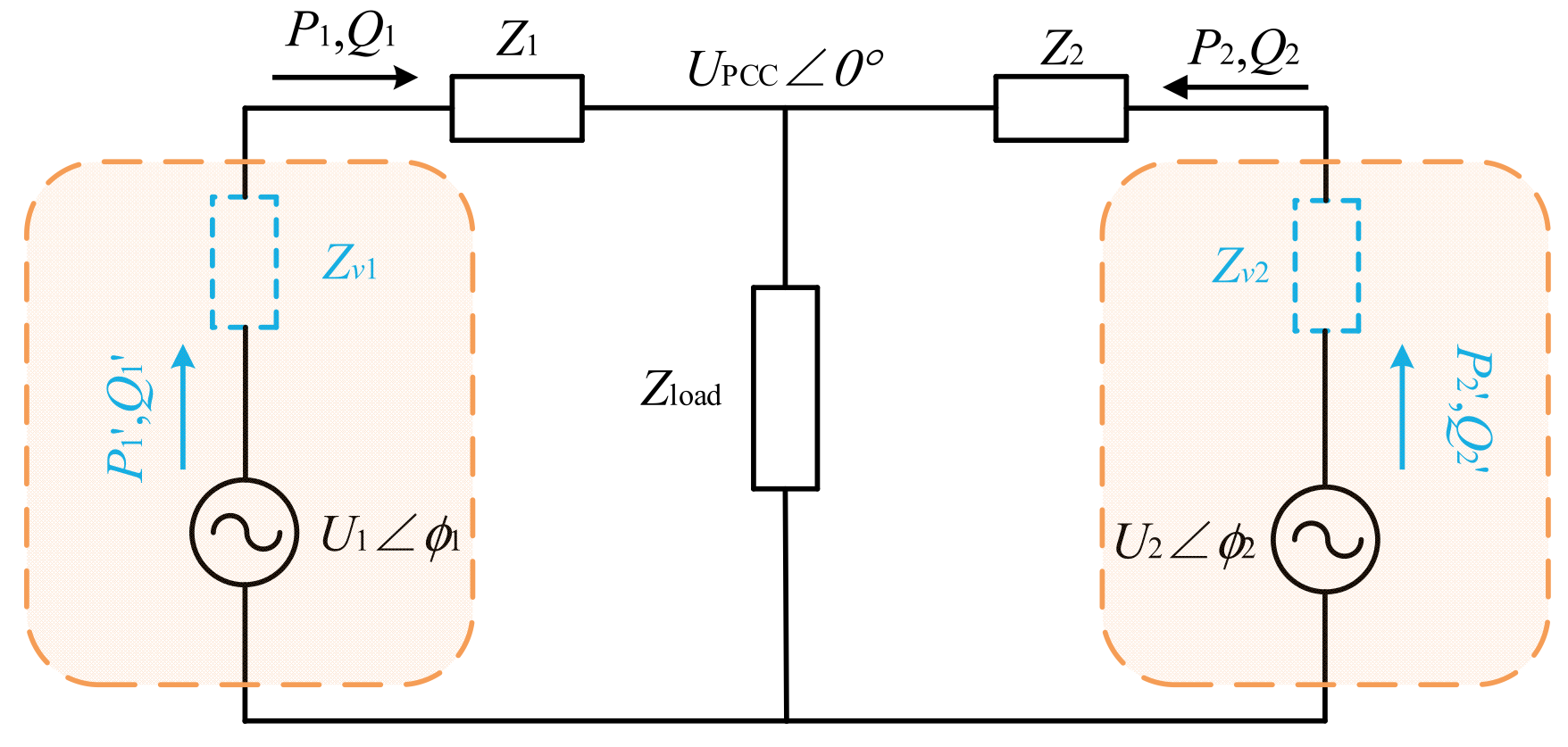
Figure 1 illustrates the simplified schematic of a two-inverter paralleled system. In this figure, U1 and U2 denote the output voltages of inverters 1 and 2, respectively, while φ1 and φ2 represent their output voltage phases. U0 is the voltage at the point of common coupling (PCC), and Zn represents the total output impedance of each inverter branch, including both the equivalent output impedance and the line impedance. Zload denotes the load impedance.
The detailed expressions for inverter output power can be derived from this equivalent circuit:
P n = U n U o sin φ n Z n
Q n = U n U o cos φ n U o 2 Z n
For different voltage levels, the adopted droop control strategies differ. At medium- and low-voltage levels, the equivalent output impedance is usually treated as resistive, while at high-voltage levels it is considered inductive. In practical engineering, each inverter is typically equipped with LC or LCL filters and connected to a transformer for voltage step-up. Controlling the equivalent output impedance to be inductive allows the use of P–ω and Q–U droop control, which better matches the line characteristics and supports power sharing with rotating-machine-based sources. Because the power-angle δ between inverter output voltages is usually small, and because transmission-line reactance is typically much greater than resistance in high-voltage applications, the output power expressions can be approximated:
sin θ 1 cos θ 0
sin δ δ cos δ 1
P n = U U 0 δ X Q n = U 0 ( U U 0 ) X
It can be observed that active power is primarily coupled with the power angle δ, while reactive power is coupled with the voltage difference (UU0). By adjusting frequency, δ can be modified to control active power. Thus, the basic droop control equations can be expressed as:
ω = ω * m ( P P * ) U = U * n ( Q Q * )
where ω and U are the actual angular frequency and output voltage amplitude, ω and U are the rated values, m and n are the active and reactive droop coefficients, P, Q are the rated active and reactive powers, and P, Q are the measured output powers.
Q n = U U 0 δ R P n = U 0 ( U U 0 ) R
U = U * m ( P P * ) ω = ω * n ( Q Q * )
Similarly, when the system output impedance is predominantly resistive, the corresponding approximate expressions for output power and resistive droop relations can be derived as described above. It should be noted that this paper focuses on the case where the equivalent output impedance is inductive.
Under steady-state operation with proportional power sharing achieved, the output voltage and frequency of the two inverters with different capacities remain identical. According to Equation (5), to share load power according to their rated capacities, the following proportional relationship must hold:
m 1 P 1 = m 2 P 2 n 1 Q 1 = n 2 Q 2
In practical operation, due to factors such as inconsistent line impedances, two inverters often cannot precisely share the load power strictly according to their capacity ratios. Under such conditions, fundamental power circulating currents arise between the inverters. In Equation (5), the phase angle δ is derived from the integrator of the inverter operating frequency ω. During steady-state operation, the operating frequencies of both inverters remain synchronized. Consequently, even if the equivalent output impedances are not inversely proportional to the capacities, the active power output from the inverters can still achieve accurate sharing through the droop control mechanism. Therefore, in steady state, precise active power sharing is attainable despite mismatches in the equivalent output impedance.
In contrast, reactive power is directly influenced by the equivalent output impedance and is susceptible to parameter drift. As a result, the circulating power between inverters predominantly consists of reactive circulating currents. The expression for the fundamental reactive power circulating current between the two inverters is given below, where k represents the inverter capacity ratio.
Δ Q = Q 1 k Q 2 = ( U 0 U 1 Z 1 k U 0 U 2 Z 2 ) ( U 0 2 Z 1 k U 0 2 Z 2 )
It can be observed that if the equivalent output impedances are not inversely proportional to their capacities, reactive circulating currents will occur. Therefore, improving the proportionality between equivalent output impedance and capacity enhances both power-sharing accuracy and circulating current suppression. Additionally, the output voltage amplitudes and phases of the inverters must remain synchronized.
By combining Equations (5) and (6), the expression for the output reactive power of the inverter under inductive conditions can be derived as follows:
Q = U 0 ( U * U 0 ) X 1 + U 0 n
And the reactive power sharing ratio between two inverters can be given by Equation (12). Typically, the reactive droop coefficient n is designed inversely proportional to inverter capacity. Therefore, when X1X2, the reactive power sharing will inevitably deviate from the intended ratio, resulting in unequal reactive power distribution.
Q 1 Q 2 = X 2 + n 2 U 0 X 1 + n 1 U 0

2.2. Harmonic Power Sharing Characteristics

Due to the reference voltage generated by the droop control being essentially a pure sinusoidal, three-phase symmetrical signal with negligible harmonic content, the inverter exhibits a relatively low output impedance characteristic at harmonic frequencies. To simplify the analysis, the equivalent output impedance of the inverter is assumed to be significantly smaller than the line impedance and thus neglected, while the analysis is conducted under the condition that the line impedance is predominantly inductive.
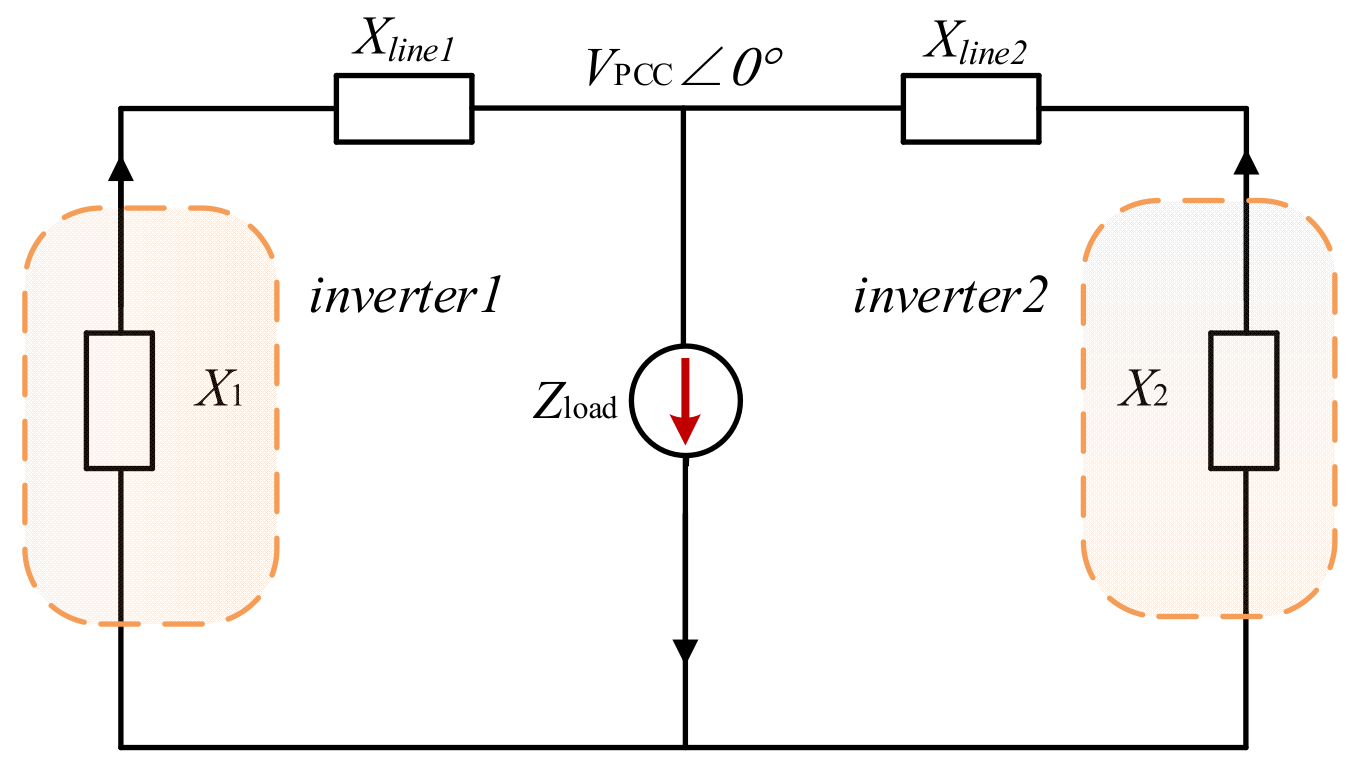
According to Figure 2, the harmonic power distribution is inversely proportional to the line impedance of each branch, as expressed in Equation (13):
Q u h 1 Q u h 1 = X u h 2 X u h 1
where Quh1 and Quh2 are the harmonic powers shared by inverters 1 and 2, and Xuh1 and Xuh2 are their corresponding line reactances. Thus, unequal line impedances directly lead to unequal harmonic power sharing.

2.3. Definition of Harmonic Power

Since a widely accepted definition for harmonic power has not yet been established, this paper introduces the power definitions provided in the IEEE Std 1459 as a reference, laying the foundation for the subsequent discussion of power sharing methods. For a three-phase parallel inverter system containing harmonic components, its effective apparent power Se can be decomposed into two parts:
S e = S e 1 2 + S e N 2
where Se1 represents the apparent power of the fundamental component, and SeN corresponds to the harmonic apparent power. Further expansion yields:
S e = 3 V e 1 2 + N = 1 V e N 2 I e 1 2 + N = 1 I e N 2 = 3 ( V e 1 I e 1 ) 2 + V e 1 2 N = 1 I e N 2 + N = 1 V e N 2 I e 1 2 + N = 1 V e N 2 N = 1 I e N 2
where Ve1 and Ie1 denote the RMS voltage and current of the fundamental component, and VeN and IeN are the RMS values of the Nth-order harmonic voltage and current, respectively (typically N = 5, 7, 11,…).
The terms following the fundamental apparent power represent the harmonic power components, denoted Quh. Since the voltage total harmonic distortion (THD) in power systems is strictly limited, harmonic voltage magnitudes are small, and the last two terms in Equation (15) can be neglected. Furthermore, since the droop coefficients are typically designed to be small, the output voltage amplitude of each inverter remains close to its rated value V0. Hence, the rated voltage amplitude V0 can be employed to approximate the harmonic power Quh. Under the typical operating condition of a voltage THD of 3% and a harmonic current proportion of 20%, the relative error of the approximate calculation is only 1.14%. Consequently, the harmonic power Quh can be approximately expressed as shown in Equation (16):
Q u h = 3 V e 1 N = 1 I e N 2 3 2 V 0 N = 1 I e N 2

3. Harmonic Power Sharing Control Method for Parallel Inverters

Accurate fundamental power sharing in parallel inverter systems has been extensively studied, with well-established strategies such as frequency disturbance injection [22], dynamically reconfigurable master–slave control [23], and distributed consensus-based algorithms effectively enabling precise reactive power allocation [24]. These methods are considered mature and will not be revisited in this work. Instead, this paper addresses harmonic power sharing under the assumption that fundamental power is already proportionally dispatched, proposing a novel control strategy that operates without inter-inverter communication or point-of-common-coupling voltage sensing.
The proposed approach maps the harmonic power output of each inverter to a small-signal virtual impedance disturbance, which is embedded into the fundamental control loop. Under conditions where fundamental power is equally shared but harmonic power is not, a mismatch arises between the introduced harmonic virtual impedance and the equivalent fundamental output impedance. This mismatch perturbs the fundamental reactive power, which is monitored locally. An adaptive adjustment mechanism then regulates the harmonic virtual impedance based on the observed reactive power variation, thereby gradually eliminating harmonic power sharing inaccuracies.
A key advantage of the proposed strategy is its reliance solely on local voltage and current measurements at each inverter, eliminating communication links and centralized voltage sensing. This enhances system modularity, reduces implementation complexity, and improves operational reliability and stability, particularly in dynamically reconfigurable microgrid applications.

3.1. Principle of Harmonic Power Sharing

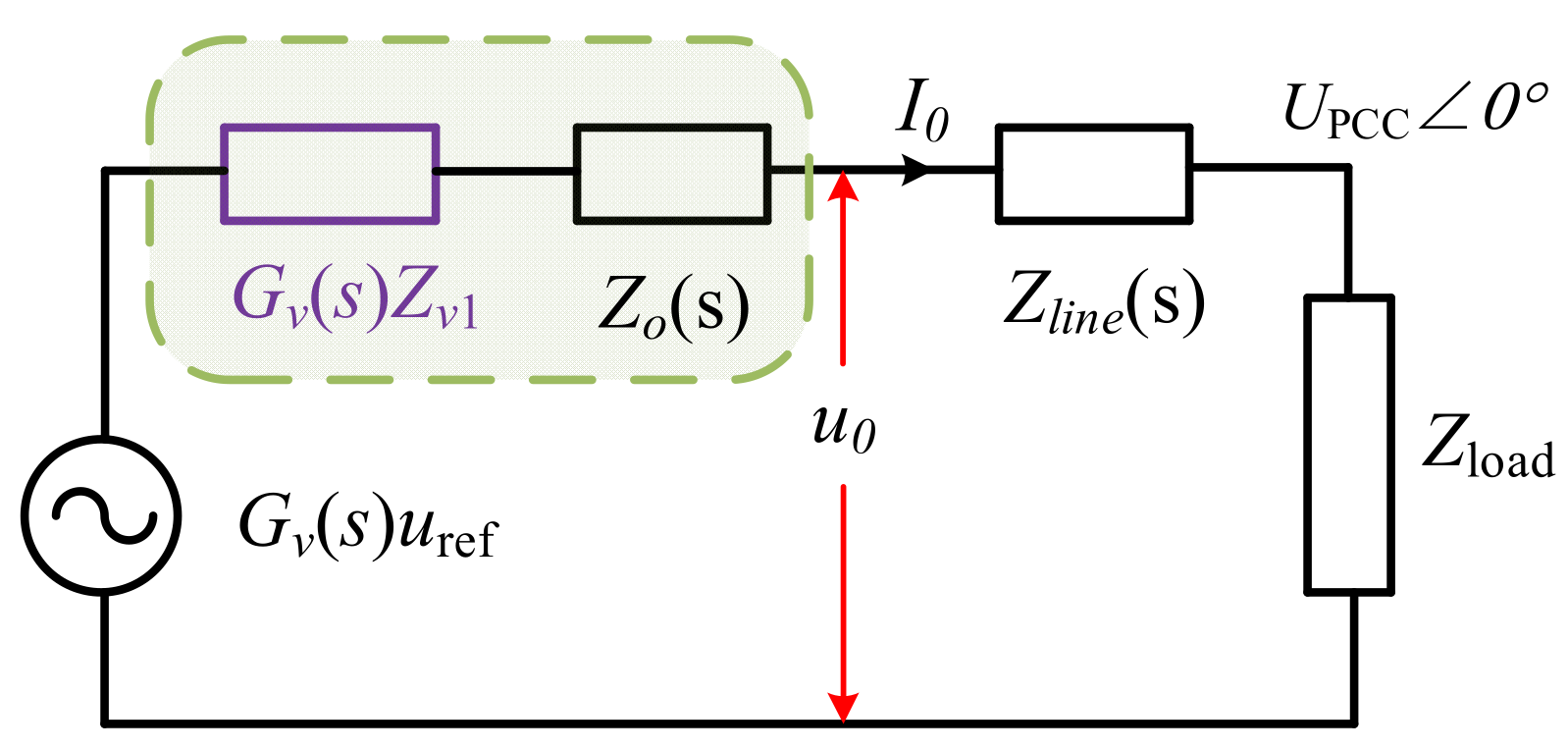
Introducing virtual impedance to adjust power distribution has been recognized as an effective strategy in parallel inverter control. Figure 3 illustrates the equivalent output circuit of a paralleled inverter system incorporating virtual impedance.
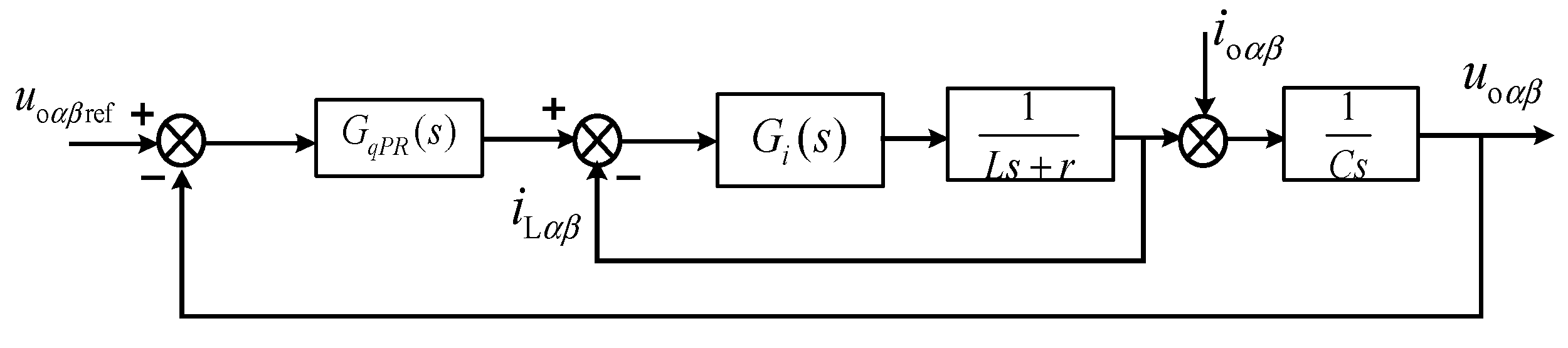
As shown in Figure 4, which presents the transfer function block diagram of the inverter, the control method adopted in this study is based on a dual-loop control structure with voltage and current loops. The inner current loop employs proportional control, while the outer voltage loop utilizes a quasi-proportional resonant (qPR) controller. The entire control scheme is implemented in the αβ stationary coordinate frame. From Figure 4, the transfer function expressions for the gain Gv(s) and the equivalent output impedance Zo(s) can be derived.
G v ( s ) = G i ( s ) G qPR ( s ) L C s 2 + C G i ( s ) s + G i ( s ) G qPR ( s ) + 1
Z o ( s ) = L s + G i ( s ) + r L C s 2 + C G i ( s ) s + G i ( s ) G qPR ( s ) + 1
Here, GqPR(s) is the transfer function of the qPR controller in the outer voltage loop, and Gi(s) is the transfer function of the proportional controller in the inner current loop.
The equivalent output impedance Zo(s) is essentially a dynamic transfer function from output current disturbance to output voltage response, which can be analogized as an equivalent impedance. It exhibits different characteristics across frequency bands: at the fundamental frequency, it is typically designed to be inductive to meet droop control requirements, while at high frequencies, it is generally designed to be resistive to suppress harmonics.
It is important to note that the transformer in the inverter system is usually connected externally to the output and thus does not appear in the block diagram of Figure 4. Its impedance is not part of Zo(s) but is instead accounted for in the line impedance Zline(s).
Before introducing virtual impedance, the inverter output voltage can be expressed as Equation (19), and after introducing virtual impedance, it can be rewritten as Equation (20):
u o = G v ( s ) u r e f Z o ( s ) i o
u o = G v ( s ) u r e f Z o ( s ) + G v ( s ) Z v i r ( s ) i o
When tuning the inverter control parameters, the gain Gv(s) is typically designed such that Gv(s) ≈ 1, so that the output voltage can track the reference voltage without steady-state error. Consequently, the output impedance expression after introducing the virtual impedance can be written as follows:
Z = Z o ( s ) + G v ( s ) Z v i r ( s ) Z o ( s ) + Z v i r ( s )
According to Equation (20), when the virtual impedance Zvir(s) is introduced, it is equivalent to adding an impedance term Gv(s)Zvir(s) to the inverter’s output impedance. Since the voltage-loop gain satisfies Gv(s) ≈ 1, the equivalent output impedance can be approximated as being increased by Zvir(s) itself.
The aforementioned principle establishes a foundational basis for the introduction of virtual impedance disturbance. The following section elaborates on the proposed control method in detail. It is assumed that the capacity ratio of inverter 1 to inverter 2 is K. In the proposed strategy, the output voltage magnitude in Equation (6) is fixed at the rated value and the conventional Q-U droop loop is removed. With U1 = U2, Equation (12) no longer applies, and Equation (5) indicates that the reactive power is determined only by the equivalent output impedance, exhibiting an inverse proportionality. Hence, the reactive-power sharing relationship is updated as:
Q 1 = X 2 X 1 + X 2 Q t o t a l = K 1 + K Q t o t a l Q 2 = X 1 X 1 + X 2 Q t o t a l = 1 1 + K Q t o t a l
Meanwhile, the fundamental reactive power is assumed to be shared in proportion to the rated capacities.
Given that the fundamental reactive power is already equally shared according to the inverter capacities, the proposed method multiplies each inverter’s calculated harmonic power Quh by a small impedance coefficient g and injects it into the fundamental control loop as a perturbation virtual impedance:
X v 1 = g 1 Q u h 1 X v 2 = g 2 Q u h 2
In the equation, Xv1 and Xv2 represent the fundamental virtual impedances introduced into each inverter. The resulting reactive power distribution after introducing this perturbation can be expressed as Equation (24), where the total fundamental reactive power slightly changes from Qtotal to Qtotal. To avoid errors introduced by variations during subsequent control, the proposed method in this paper no longer adopts the premise that the total fundamental reactive power remains approximately constant. Instead, a power coefficient h is introduced, as given in Equation (25).
Q 1 = X 2 + X v 2 X 1 + X 2 + X v 1 + X v 2 Q t o t a l Q 2 = X 1 + X v 1 X 1 + X 2 + X v 1 + X v 2 Q t o t a l
h = Q P    
where P and Q denote the inverter’s active and reactive powers, respectively. Due to the inherent P–ω droop mechanism, the active power P remains evenly shared, while the reactive power Q changes when the virtual impedance perturbation is introduced, leading to variations in the power coefficient h.
(1) Case 1: Xv2 < KXv1
According to Equations (24) and (26), the reactive power of inverter 1 decreases (Q1′ < Q1) and its power coefficient h1 decreases, while inverter 2’s reactive power increases (Q2′ > Q2) and h2 increases.
X v 2 X v 1 + X v 2 < K 1 + K X v 1 X v 1 + X v 2 > 1 1 + K
(2) Case 2: Xv2 > KXv1
According to Equations (24) and (27), the reactive power of inverter 1 increases (Q1′ > Q1) and its power coefficient h1 increases, while inverter 2’s reactive power decreases (Q2′ < Q2) and h2 decreases.
X v 2 X v 1 + X v 2 > K 1 + K X v 1 X v 1 + X v 2 < 1 1 + K
(3) Case 3: Xv2 = KXv1
In this balanced condition, both inverters maintain equal reactive power, their power coefficients remain nearly unchanged, and their power coefficient h exhibits negligible variation. This indicates that the injected perturbation virtual impedance matches the capacity ratio, implying that harmonic power has been accurately shared.
X v 2 X v 1 + X v 2 = K 1 + K X v 1 X v 1 + X v 2 = 1 1 + K
In the first two cases, the variation in the power coefficient h is the key to adaptively adjusting the harmonic virtual impedance and achieving harmonic power sharing. Here, the power coefficient before introducing the disturbance virtual impedance to the inverter is denoted as hk (k = 1, 2), and after introduction as h’k (k = 1, 2). Each inverter calculates the change in the power coefficient Δh as the difference between the value before and after introducing the control method. This change is multiplied by an adjustment gain kL and integrated, and the result is introduced as the harmonic virtual impedance into the corresponding control loop. The specific expression is given below.
Δ h = h 1 h 1 X vuh 1 + = k L Δ h 1 s X vuh 2 + = k L Δ h 2 s
When the system reaches steady state after regulation, the power coefficient h of the inverters returns to its value prior to the introduction of the disturbance virtual impedance, Δh = 0. Consequently, it can be deduced that Xv2 = KXv1, corresponding to the third scenario discussed above. In this case, the introduced disturbance virtual impedance is proportional to the capacity ratio between the two inverters, satisfying the relationship given in Equation (28). Furthermore, combining Equation (23) with the condition for harmonic power sharing Quh1 = KQuh2, the selection of g1 and g2 must satisfy the following relation:
g 2 = K 2 g 1
The control process described above is further elaborated as follows. Assume that the harmonic power assigned to Inverter 1, denoted as Quh1, is less than that assigned to Inverter 2, Quh2. In this case, when the disturbance virtual impedance is introduced, the system operates under the second scenario: Xv2 > KXv1. This results in an increase in the power coefficient h1 of Inverter 1 and a decrease in the power coefficient h2 of Inverter 2. Through the adaptive regulation mechanism, the harmonic virtual impedance Xvuh1 of Inverter 1 increases, while that of Inverter 2 decreases. Consequently, the harmonic power of Inverter 1 rises, and that of Inverter 2 declines, ultimately achieving balanced power sharing.
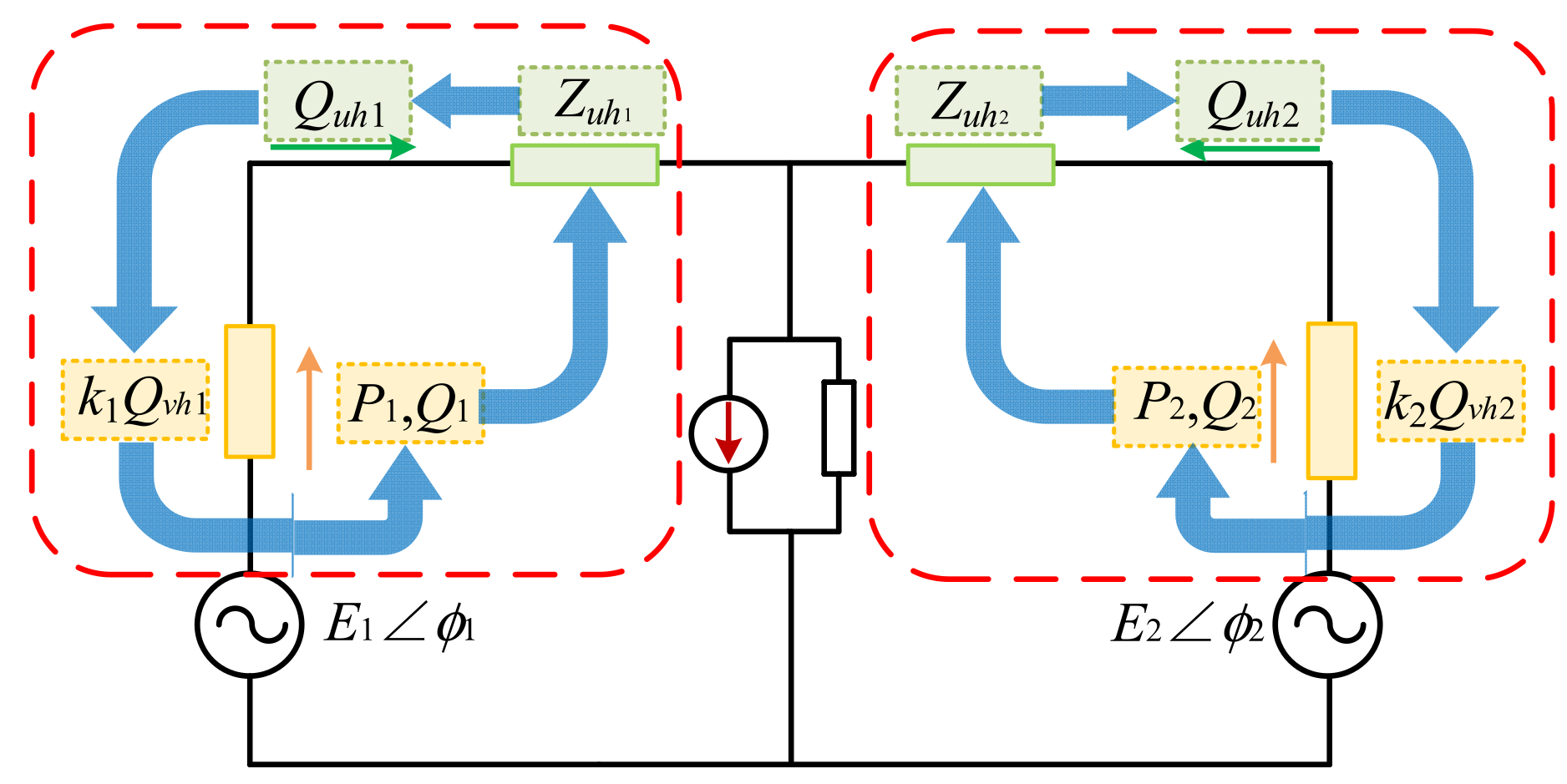
Thus, when the fundamental power is evenly shared, the proposed control strategy achieves harmonic power sharing without communication. Figure 5 shows the overall control process of harmonic power sharing. If the system output impedance is predominantly resistive, the control structure and principles remain consistent. Only the droop relationship needs to be adjusted to the active power-voltage/reactive power-frequency (P-U/Q-f) form. In this case, the injected harmonic power perturbation signal will affect the active power, and the resulting change in active power similarly serves as a feedback signal to drive the adaptive adjustment of the harmonic virtual impedance, ultimately achieving harmonic power sharing. Therefore, only the power impedance coupling relationship needs to be updated according to the resistive characteristics, while the overall control logic remains unchanged.

3.2. Current Signal Extraction and Power Calculation

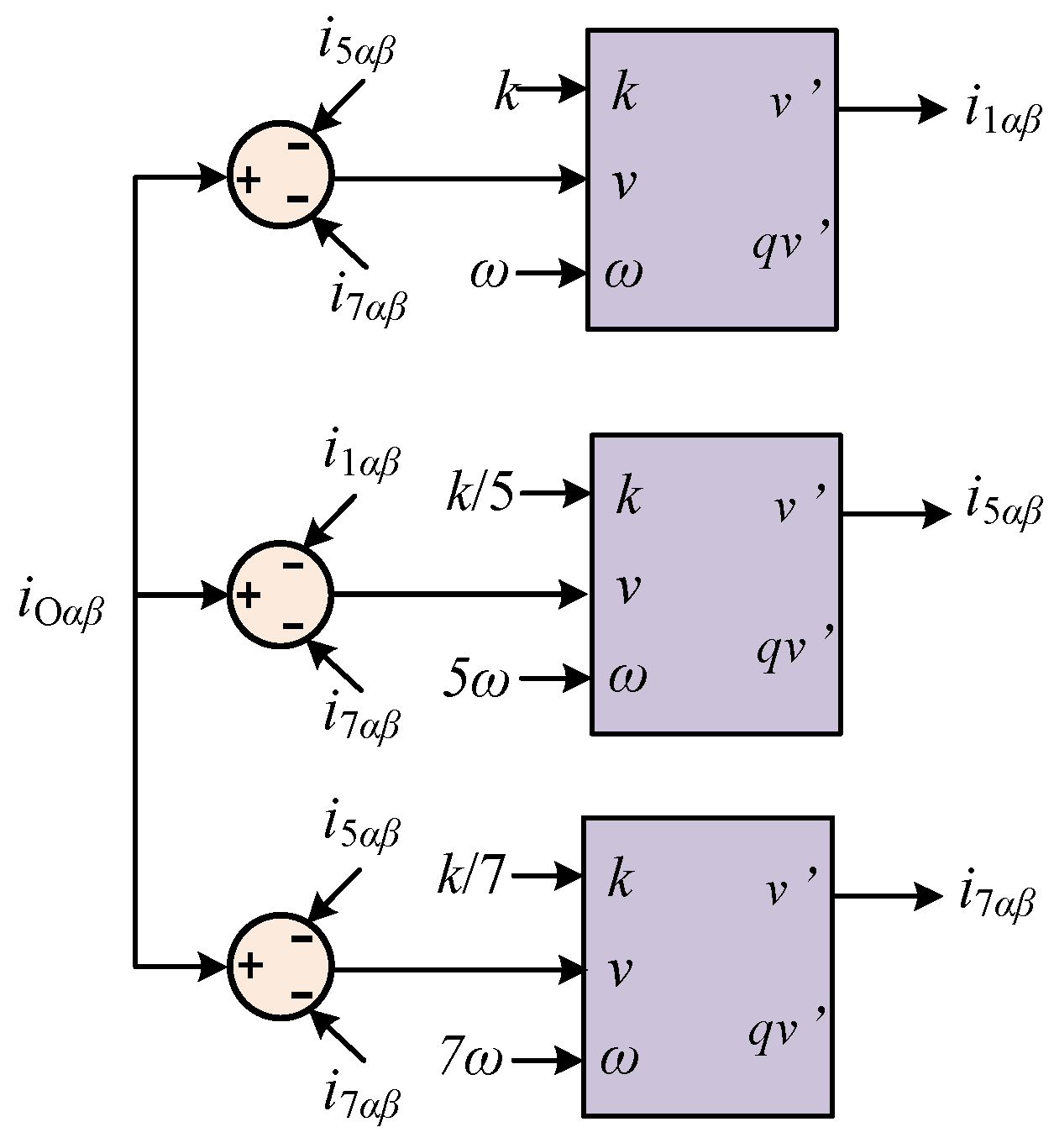
The proposed method is implemented in the αβ stationary reference frame. To accurately compute the fundamental and harmonic power components, the current signal must be decomposed into its respective harmonic components. This paper employs a Second-Order Generalized Integrator (SOGI)-based extraction method due to its simple structure, high precision, strong noise immunity, and fast dynamic response. Figure 6 presents the principle of current signal extraction using SOGI.
By constructing cross-feedback networks between fundamental and harmonic current components, frequency coupling is effectively decoupled. Two SOGI-based orthogonal signal generators operating on the α and β axes extract the desired components. The SOGI behaves as a band-pass filter centered at the resonant frequency ωs, allowing only signals with this frequency to pass. The coefficient k determines the trade-off between extraction accuracy and dynamic response speed. In this study, k = 2 , and ω denotes the fundamental angular frequency. The proposed structure not only extracts the signal component at ωs but also generates its corresponding quadrature component that is orthogonal and lags by 90°. As a result, the signal-extraction stage provides the fundamental current component as well as the individual harmonic current components required for power computation.
The extracted current components are then used for power calculation. By multiplying the instantaneous inverter voltage and current signals and applying a low-pass filter, the average values of the fundamental active power P_LPF, fundamental reactive power Q_LPF, and harmonic power Quh_LPF are obtained.
Given that the 5th and 7th harmonic currents dominate the system harmonics, only these components are used in harmonic power computation, as expressed in Formula (31). In the equation, Vα and Vβ represent the α and β axis components of the output voltage, respectively; Iα and Iβ denote the α and β axis components of the output current, respectively; ihα and ihβ are the alpha- and beta-axis components of the h-th harmonic current, respectively; ωcp is the cutoff frequency of the low-pass filter; and V0 denotes the amplitude of the rated voltage.
P _ LPF = 3 ω c p V α I α + V β I β 2 ( s + ω c p ) Q _ LPF = 3 ω c p V β I α V α I β 2 ( s + ω c p ) Q u h _ L P F = 3 2 V 0 h 5 , 7 ( i h α 2 + i h β 2 )

3.3. Control Structure

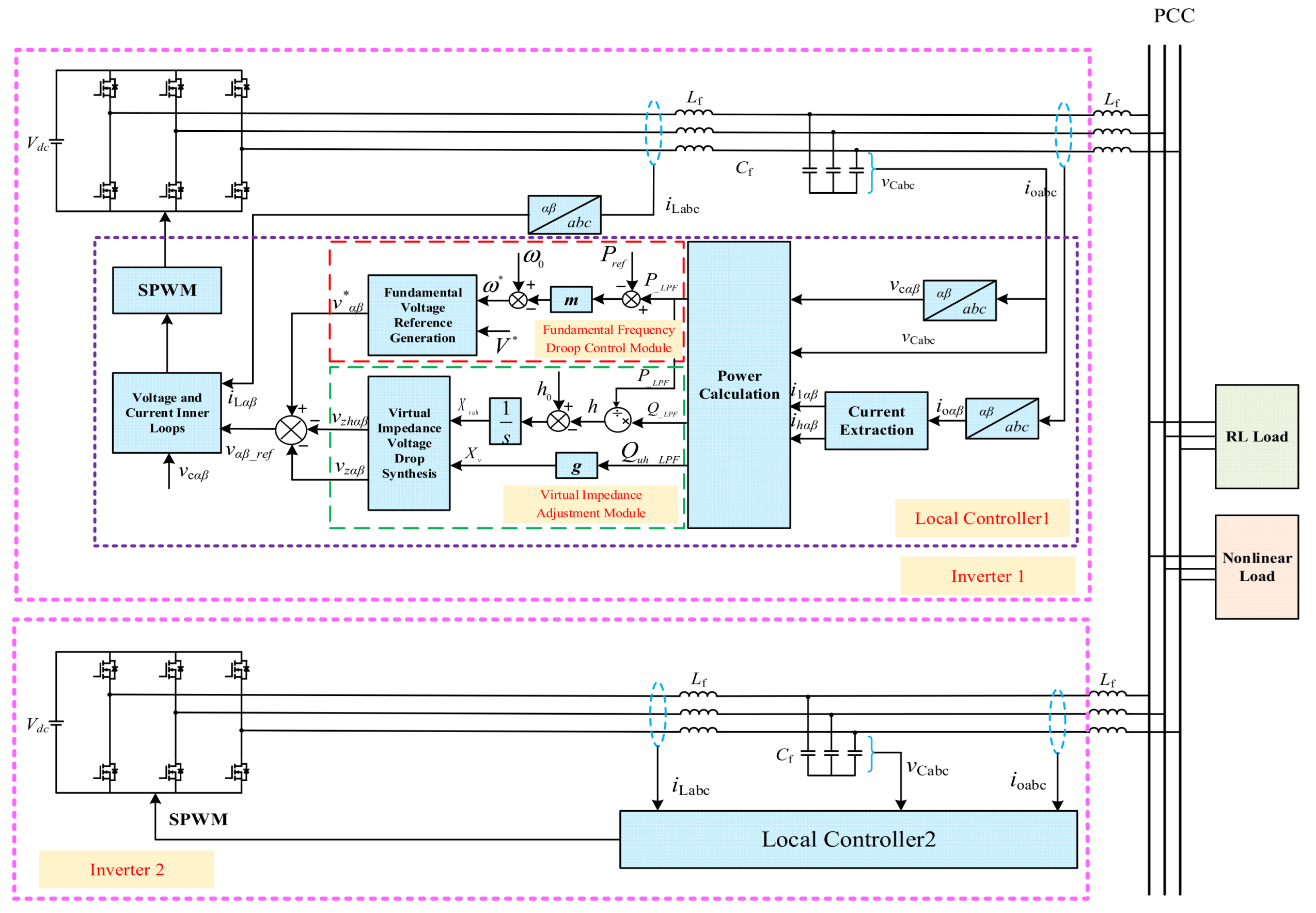
Figure 7 presents the overall control block diagram of the proposed harmonic-power-sharing method. The control system comprises four main functional parts: a power-calculation unit that derives P, Q, and Quh from locally measured voltage and current signals; a fundamental P–ω droop-control loop responsible for accurate sharing of fundamental active power; a virtual-impedance voltage-drop synthesis stage that introduces both the perturbation virtual impedance and the adaptive harmonic virtual impedance; and the SPWM modulation stage, which generates the switching signals according to the synthesized reference voltage. The inner voltage–current control loop employs a proportional-resonant (PR) regulator in the αβ reference frame to ensure precise tracking of the harmonic reference voltages.

3.4. Virtual Impedance Voltage Drop Calculation

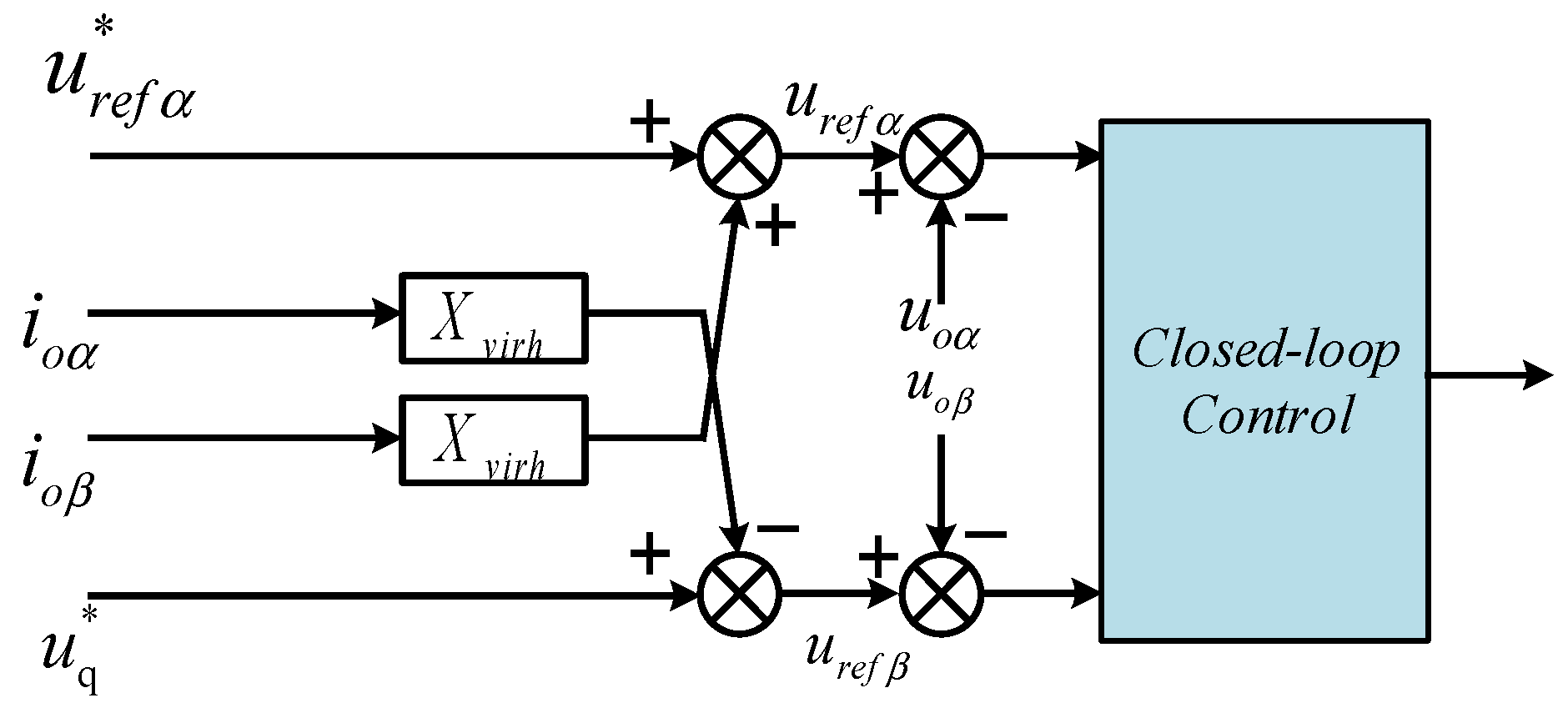
In the proposed harmonic power-sharing control strategy, both the introduction of perturbed virtual impedance and the adaptive tuning of harmonic virtual impedance are involved. In these two processes, the voltage drop across the virtual impedance induced by the current component at the corresponding frequency must be calculated and subtracted from the reference voltage, thereby emulating the behavior of a physical impedance.
The virtual impedance in the αβ stationary frame can be expressed as Equation (32). The virtual impedance needs to be superimposed on the original αβ axis reference voltage, and the virtual impedance control block diagram under the αβ axis can be obtained according to Equation (32). Figure 8 shows the αβ-frame virtual impedance control diagram. Since this paper focuses on inductive virtual impedance, the resistive component is omitted for simplicity.
u r e f α = u * r e f α R v i r h i h α + X v i r h i h β u r e f β = u * r e f β R v i r h i h β X v i r h i h α

3.5. Design of the Impedance Coefficient

This subsection establishes a small-signal linearized model around the steady-state operating point to analyze system stability and determine the impedance coefficient g. A small perturbation is introduced near the equilibrium point, with the injected harmonic power disturbances denoted as Q ^ uh 1 and Q ^ uh 2 . According to Equation (23), their relationships can be derived:
X ^ v 1 = g 1 Q ^ u h 1 X ^ v 2 = g 2 Q ^ u h 2
Δ X ^ v = X ^ v 1 X ^ v 2 K = g 1 ( Q ^ u h 1 Q ^ u h 2 K ) = g 1 Δ Q ^ u h 1
Since the perturbations are very small, the total active and reactive powers (Ptotal, Qtotal) are assumed constant. Combining with Equation (24), the small-signal disturbance equations for reactive power are obtained:
Q ^ 1 = X ^ v 2 X 1 + X 2 + X v 1 + X v 2 Q t o t a l Q ^ 2 = X ^ v 1 X 1 + X 2 + X v 1 + X v 2 Q t o t a l
Δ Q ^ = Q ^ 1 Q ^ 2 = Δ X ^ v X 1 + X 2 + X v 1 + X v 2 Q t o t a l
Due to the droop control, the fundamental active power remains evenly distributed even after introducing the perturbation term.
P 1 = K K + 1 P t o t a l P 2 = 1 K + 1 P t o t a l
From Equation (25), the relationship between the power coefficient perturbation term can be derived. Here, htotal represents the power coefficient of the total system power, which remains approximately constant during the introduction of the perturbation.
h t o t a l = Q t o t a l P t o t a l h ^ 1 = K + 1 K X ^ v 2 X 1 + X 2 + X v 1 + X v 2 h t o t a l h ^ 2 = ( K + 1 ) X ^ v 1 X 1 + X 2 + X v 1 + X v 2 h t o t a l Δ h ^ = h ^ 1 h ^ 2 = ( K + 1 ) h t o t a l X 1 + X 2 + X v 1 + X v 2 Δ X ^ v
From Equation (25), the perturbation expression for the harmonic virtual impedance can be derived:
X ^ vuh 1 = k L h ^ 1 s X ^ vuh 2 = k L h ^ 2 s Δ X ^ vuh = X ^ vuh 1 X ^ vuh 2 = k L Δ h ^ s
Similarly, following the perturbation process for the fundamental power, the expression for the harmonic power perturbation caused by the harmonic virtual impedance perturbation can also be derived:
Q ^ u h 1 = X ^ u h 2 X u h 1 + X u h 2 Q u h _ t o t a l Q ^ u h 2   = X ^ u h 1 X u h 1 + X u h 2 Q u h _ t o t a l Δ Q ^ u h   = Δ X ^ u h X u h 1 + X u h 2 Q u h _ t o t a l
The resulting small-signal closed-loop model is shown in Figure 9.
In this model, the harmonic power perturbation Δ Q ^ uh is the controlled variable, with a reference of zero. The power outer loop operates at a much lower bandwidth than the voltage inner loop, allowing the inner dynamics to be neglected. However, the low-pass filters used for power calculation must be included due to their significant influence on system dynamics.
The corresponding open-loop transfer function T(s) can be derived:
T ( s ) = ( K + 1 ) k L g 1 h t o t a l Q u h _ t o t a l ( X 1 + X 2 + X v 1 + X v 2 ) ( X u h 1 + X u h 2 ) ω c p 2 s ( s + ω c p ) 2
The root locus theory and analysis shows that when the regulation coefficient kL is fixed, system stability requires the impedance coefficient g1 to satisfy:
g 1 < 2 ω c p ( X 1 + X 2 + X v 1 + X v 2 ) ( X u h 1 + X u h 2 ) ( K + 1 ) k L h t o t a l Q u h _ t o t a l
A smaller g1 improves stability but slows the system’s transient response due to a reduced perturbation amplitude. Conversely, a larger g1 accelerates convergence but risks instability. Therefore, a trade-off between dynamic speed and stability must be made, and system stability should take priority in the coefficient design.
The selection of the cutoff frequency is equally crucial. A lower cutoff frequency enhances system stability but slows down the regulation process, whereas a higher cutoff frequency accelerates response but reduces stability margins and may introduce high-frequency interference. Therefore, a trade-off between stability and dynamic performance is necessary. To ensure system stability, the cutoff frequency should generally not be set too high.

4. Results

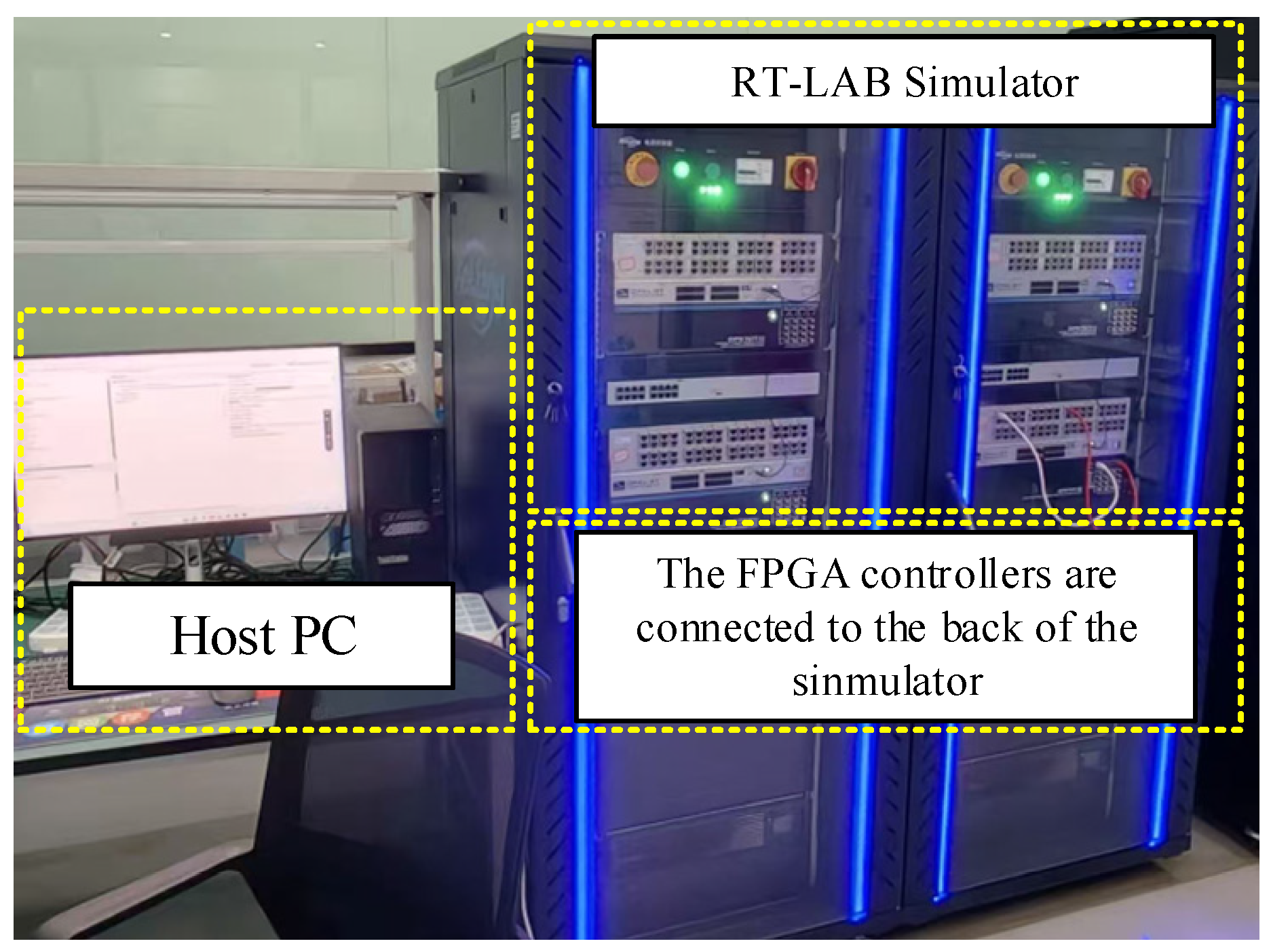
To verify the feasibility of the proposed control method, this paper employs an RT-LAB hardware-in-the-loop platform to experimentally validate the harmonic power sharing control strategy for parallel inverters in a microgrid. The system comprises two inverters with a capacity ratio of 2:1, operating at a rated voltage of 380 V and a frequency of 50 Hz, with each inverter having a DC-side rated voltage of 800 V. The load side includes both balanced resistive–inductive loads and nonlinear loads. The system parameters are listed in Table 1, and the experimental platform structure is shown in Figure 10.

4.1. Experimental Procedure

To evaluate the proposed control strategy, a three-stage comparative test was conducted as follows:
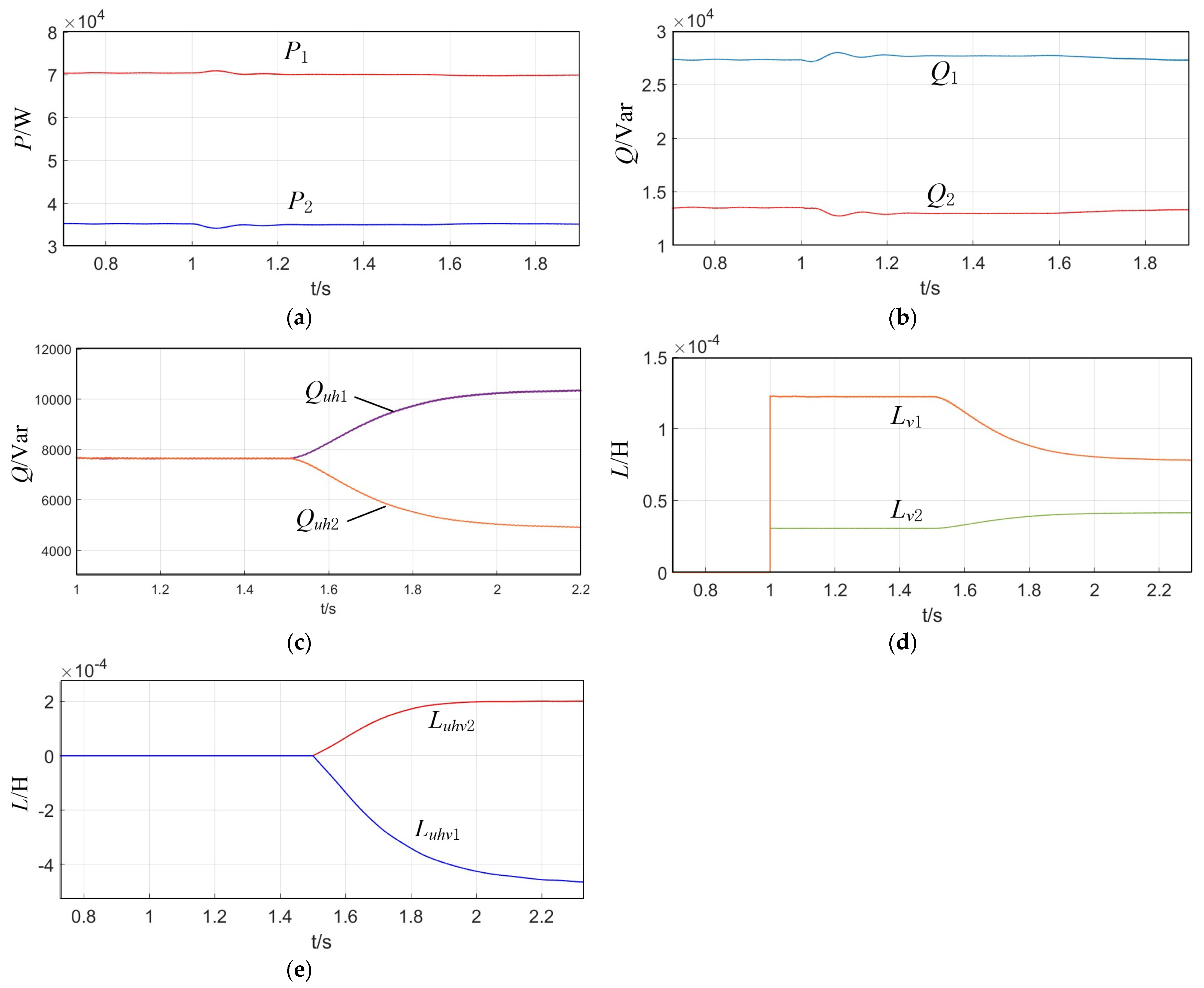
Stage I (t < 1 s)—Both inverters operate under conventional droop control. The fundamental power is already evenly shared, while the harmonic power remains unbalanced. The harmonic virtual inductance is set to zero.
Stage II (1 s < t < 1.5 s)—A perturbation virtual impedance representing harmonic-power feedback is injected into the fundamental control loop. Due to the initial harmonic mismatch, this injection causes slight variations in reactive power and the power coefficient. As can be seen from the waveforms, the fundamental active and reactive powers show no significant change. Because the power coefficient is highly sensitive, the adaptive virtual impedance is adjusted according to its variation, which indicates that the proposed process does not induce large fluctuations in fundamental power.
Stage III (t ≥ 1.5 s)—The system switches to the proposed control method. The harmonic virtual impedance is adaptively regulated based on the feedback of the power-coefficient variation until steady state is reached.
Figure 11 presents the transient responses of the system, including waveforms of fundamental active power, reactive power, harmonic power, power coefficient, perturbation virtual inductance, and harmonic virtual inductance.
When the proposed control is activated, the fundamental active power experiences a brief transient response and quickly returns to an evenly shared state. The comparison clearly demonstrates the effectiveness of the method: during conventional droop control, harmonic power sharing is determined solely by line impedance and deviates from the rated capacity ratio, whereas under the proposed control, harmonic power converges smoothly to precise equal sharing.

4.2. Output Current Comparison

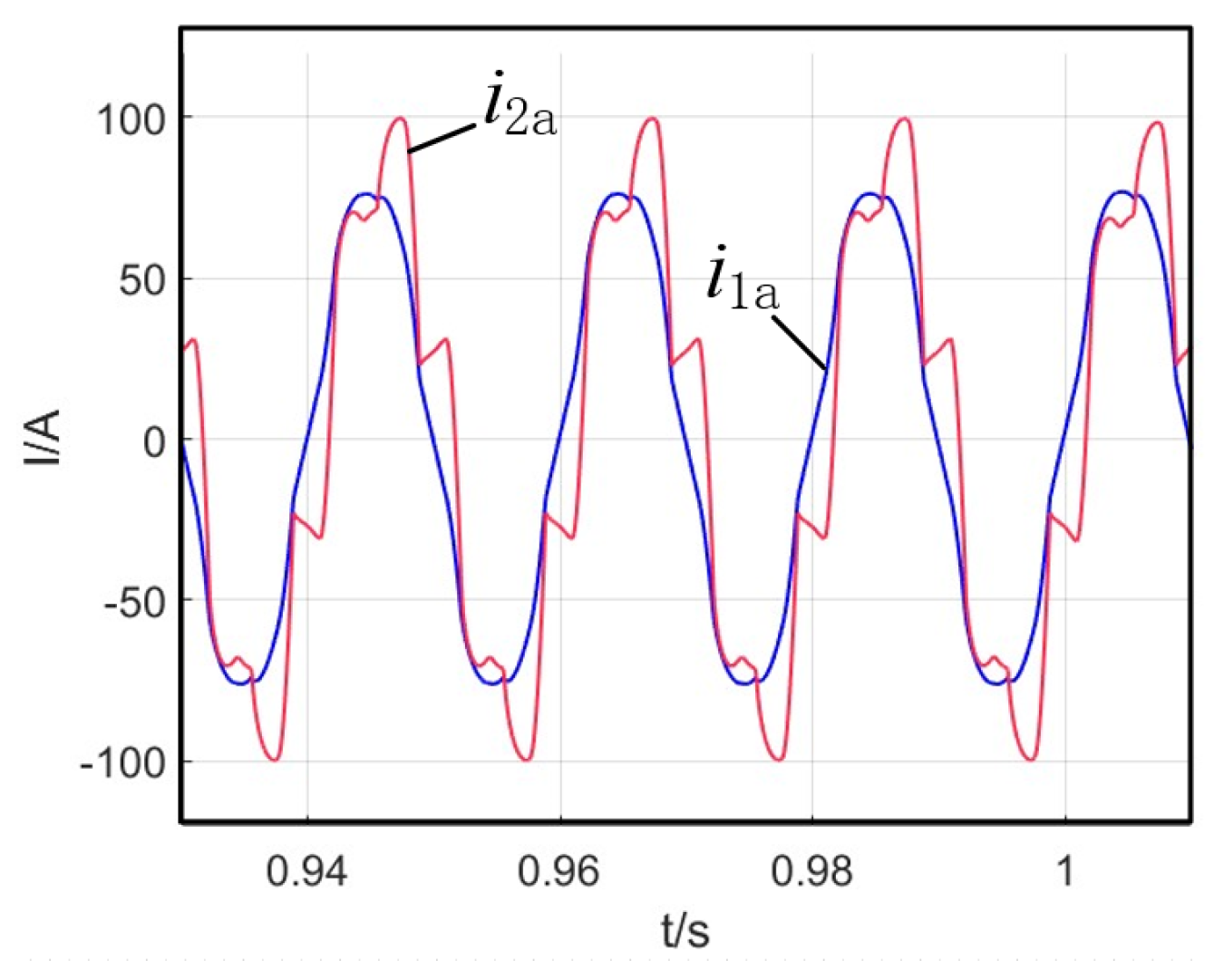
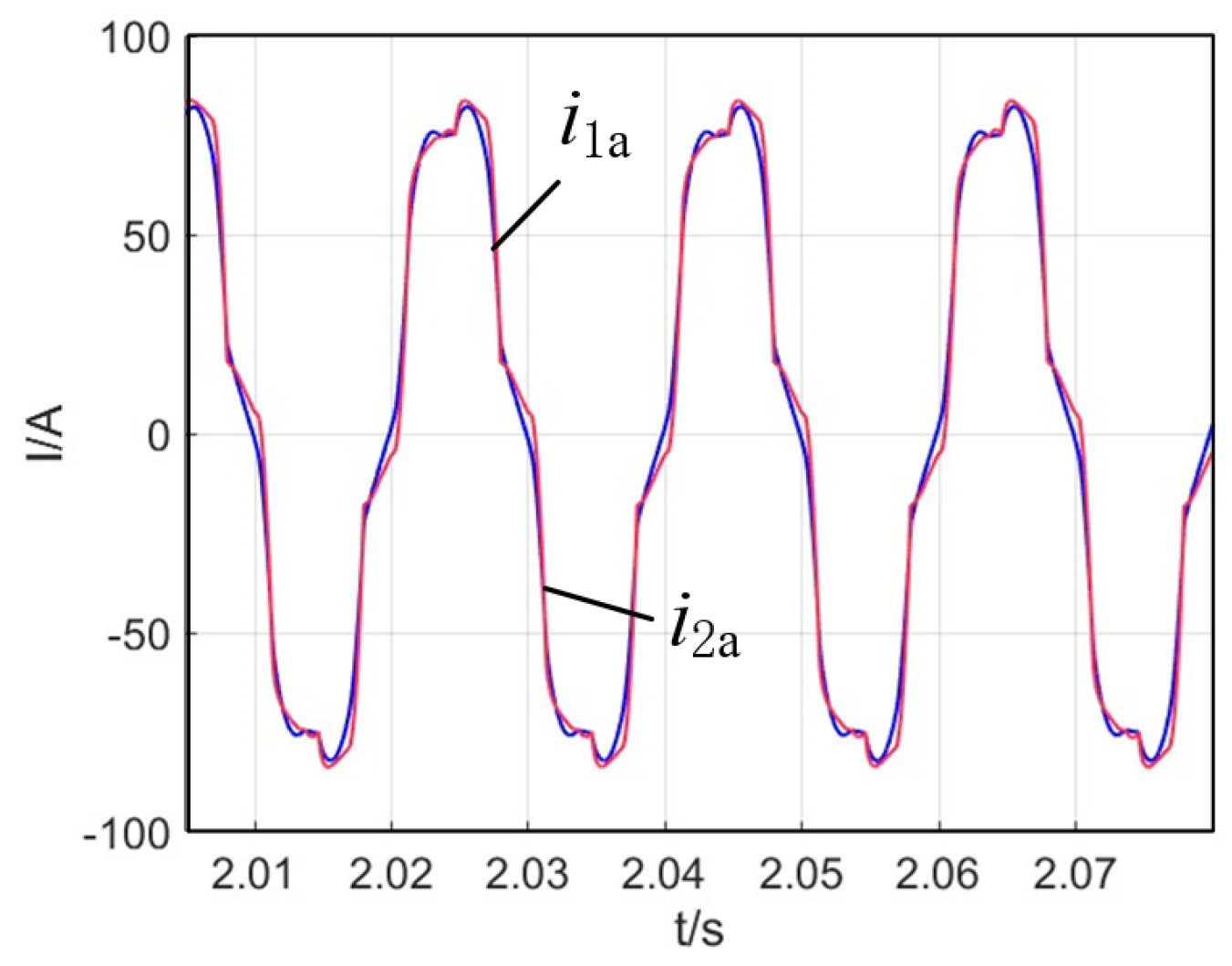
Furthermore, the effectiveness of harmonic power sharing can be intuitively evaluated by comparing the output current waveforms of the inverters. Due to the different capacities of the two inverters, their output current amplitudes inherently differ. To facilitate comparison, the current data in this study are normalized: the output current of Inverter 1 (the larger-capacity unit) is divided by its capacity ratio, thereby unifying the current reference for both inverters. This approach eliminates the influence of capacity differences on amplitude, allowing for a clearer visualization of the harmonic current sharing characteristics. Figure 12 and Figure 13, respectively, show the output current waveforms (phase a) under conventional droop control and under the proposed control method.
Under traditional droop control, the unequal harmonic power distribution results in noticeable current amplitude differences between the two inverters. The inverter handling greater harmonic power delivers higher current, which may lead to overcurrent stress and thermal imbalance. After switching to the proposed control strategy, the two output current waveforms almost overlap perfectly, confirming that harmonic power sharing is accurately achieved and that current equalization and waveform quality are significantly improved.
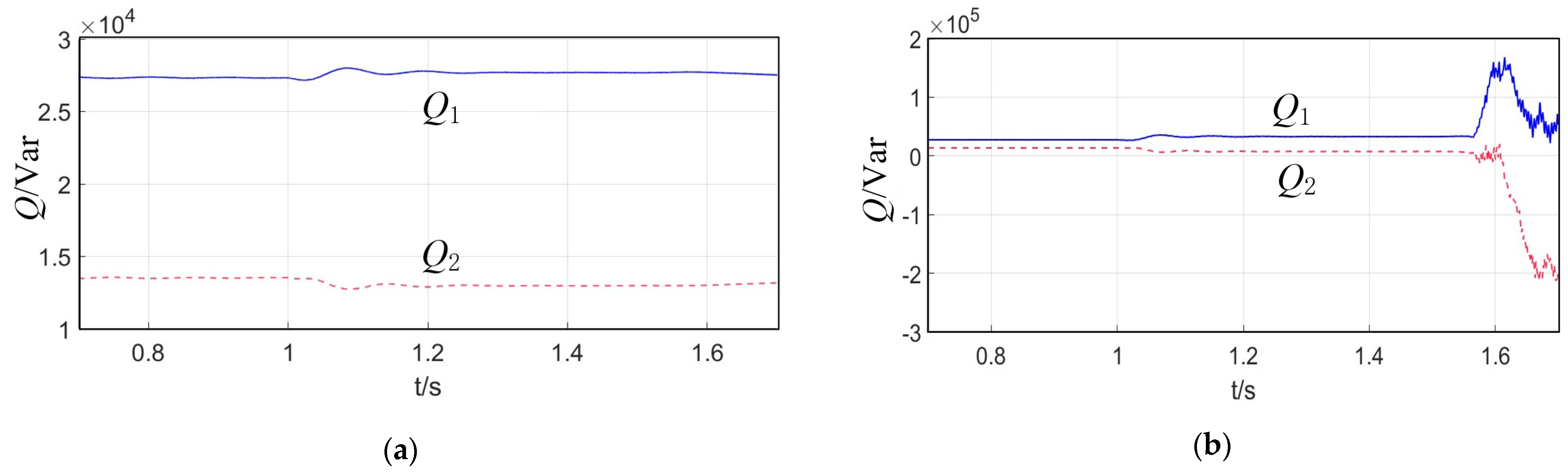
Finally, in this section, the rationality of the impedance-coefficient design method is validated by assigning two different values to the impedance coefficient g1. In practical design, g1 should be selected by balancing system stability against dynamic response. Two experiments are conducted by setting g1 to 4 × 10⁻⁹ and 5 × 10⁻⁸, respectively, while keeping kL fixed at 2 × 10⁻⁷. The corresponding harmonic power waveforms are shown in Figure 14. It can be observed that when g1 = 4 × 10⁻⁹, the harmonic power can be gradually regulated toward equal sharing; however, when g1 is increased to 5 × 10⁻⁸, the system becomes unstable. These results confirm that the design of g1 requires a compromise between system stability and the speed of dynamic response.

5. Conclusions

This paper addresses the issue of unbalanced harmonic power sharing in parallel inverter systems caused by line impedance mismatches by proposing a communication-free adaptive control strategy based on perturbed virtual impedance injection. Under the premise that fundamental power is already evenly shared, the method converts the harmonic power information of each inverter into a small-signal perturbation, which is injected into the virtual impedance of its fundamental control loop, thereby establishing a dynamic coupling between the harmonic and fundamental power loops. By detecting the resulting variation in the local fundamental power coefficient, a closed-loop feedback is formed that enables adaptive adjustment of the harmonic virtual impedance in each inverter, ultimately forcing the harmonic power sharing ratio to automatically align with the inverters’ capacity ratio.
The proposed approach requires neither communication links among inverters nor measurement of the voltage at the point of common coupling or line impedances, relying solely on local information, which enhances system reliability. Simulation results demonstrate that, under mismatched parameters and line impedances, the proposed strategy effectively achieves accurate harmonic power sharing and maintains stable system operation. The method provides a viable solution for harmonic power management in multi-inverter parallel systems within microgrids and distributed renewable energy systems, offering significant engineering value for improving power quality and operational reliability under nonlinear load conditions.

Author Contributions

Author Contributions: Methodology, F.C., G.S., S.L., B.L., Z.L., Y.L. and D.W.; Validation, F.C. and G.S.; Investigation, B.L. and Y.L.; Resources, S.L. and Z.L.; Writing—review and editing, F.C. and G.S.; Supervision, Y.Z. All authors have read and agreed to the published version of the manuscript.

Funding

This research was funded by the National Natural Science Foundation of China (52177193).

Data Availability Statement

The data that support the findings of this study are available from the corresponding author upon reasonable request.

Conflicts of Interest

The authors declare no conflict of interest.

References

  1. Blaabjerg, F.; Teodorescu, R.; Liserre, M.; Timbus, A.V. Overview of Control and Grid Synchronization for Distributed Power Generation Systems. IEEE Trans. Ind. Electron. 2006, 53, 1398–1409. [Google Scholar] [CrossRef]
  2. Parhizi, S.; Lotfi, H.; Khodaei, A.; Bahramirad, S. State of the Art in Research on Microgrids: A Review. IEEE Access 2015, 3, 890–925. [Google Scholar] [CrossRef]
  3. Blaabjerg, F.; Zhe, C.; Kjaer, S.B. Power Electronics as Efficient Interface in Dispersed Power Generation Systems. IEEE Trans. Power Electron. 2004, 19, 1184–1194. [Google Scholar] [CrossRef]
  4. Chandorkar, M.C.; Divan, D.M.; Adapa, R. Control of Parallel Connected Inverters in Standalone AC Supply Systems. IEEE Trans. Ind. Appl. 1993, 29, 136–143. [Google Scholar] [CrossRef]
  5. Guerrero, J.M.; Hang, L.; Uceda, J. Control of Distributed Uninterruptible Power Supply Systems. IEEE Trans. Ind. Electron. 2008, 55, 2845–2859. [Google Scholar] [CrossRef]
  6. Rocabert, J.; Luna, A.; Blaabjerg, F.; Rodríguez, P. Control of Power Converters in AC Microgrids. IEEE Trans. Power Electron. 2012, 27, 4734–4749. [Google Scholar] [CrossRef]
  7. Yao, W.; Chen, M.; Matas, J.; Guerrero, J.M.; Qian, Z.M. Design and Analysis of the Droop Control Method for Parallel Inverters Considering the Impact of the Complex Impedance on the Power Sharing. IEEE Trans. Ind. Electron. 2011, 58, 576–588. [Google Scholar] [CrossRef]
  8. Rodríguez, P.; Timbus, A.V.; Teodorescu, R.; Liserre, M.; Blaabjerg, F. Flexible Active Power Control of Distributed Power Generation Systems During Grid Faults. IEEE Trans. Ind. Electron. 2007, 54, 2583–2592. [Google Scholar] [CrossRef]
  9. He, J.; Li, Y.W.; Blaabjerg, F.; Wang, X. Active Harmonic Filtering Using Current-Controlled, Grid-Connected DG Units with Closed-Loop Power Control. IEEE Trans. Power Electron. 2014, 29, 642–653. [Google Scholar] [CrossRef]
  10. He, J.; Li, Y.W. An Enhanced Microgrid Load Demand Sharing Strategy. IEEE Trans. Power Electron. 2012, 27, 3984–3995. [Google Scholar] [CrossRef]
  11. Han, H.; Liu, Y.; Sun, Y.; Su, M.; Guerrero, J.M. An Improved Droop Control Strategy for Reactive Power Sharing in Islanded Microgrid. IEEE Trans. Power Electron. 2015, 30, 3133–3141. [Google Scholar] [CrossRef]
  12. Zhong, Q.C.; Wang, Y.; Ren, B. UDE-Based Robust Droop Control of Inverters in Parallel Operation. IEEE Trans. Ind. Electron. 2017, 64, 7552–7562. [Google Scholar] [CrossRef]
  13. Zhu, Y.; Zhuo, F.; Wang, F.; Liu, B.; Zhao, Y. A Wireless Load Sharing Strategy for Islanded Microgrid Based on Feeder Current Sensing. IEEE Trans. Power Electron. 2015, 30, 6706–6719. [Google Scholar] [CrossRef]
  14. Savaghebi, M.; Jalilian, A.; Vasquez, J.C.; Guerrero, J.M. Secondary Control for Voltage Quality Enhancement in Microgrids. IEEE Trans. Smart Grid 2012, 3, 1893–1902. [Google Scholar] [CrossRef]
  15. Meng, L.; Tang, F.; Savaghebi, M.; Vasquez, J.C.; Guerrero, J.M. Tertiary Control of Voltage Unbalance Compensation for Optimal Power Quality in Islanded Microgrids. IEEE Trans. Energy Convers. 2014, 29, 802–815. [Google Scholar] [CrossRef]
  16. Guo, F.; Wen, C.; Mao, J.; Chen, J.; Song, Y.D. Distributed Cooperative Secondary Control for Voltage Unbalance Compensation in an Islanded Microgrid. IEEE Trans. Ind. Inform. 2015, 11, 1078–1088. [Google Scholar] [CrossRef]
  17. Han, Y.; Shen, P.; Zhao, X.; Guerrero, J.M. An Enhanced Power Sharing Scheme for Voltage Unbalance and Harmonics Compensation in an Islanded AC Microgrid. IEEE Trans. Energy Convers. 2016, 31, 1037–1050. [Google Scholar] [CrossRef]
  18. Liu, B.; Liu, Z.; Liu, J.; An, R.; Zheng, H.; Shi, Y. An Adaptive Virtual Impedance Control Scheme Based on Small-AC-Signal Injection for Unbalanced and Harmonic Power Sharing in Islanded Microgrids. IEEE Trans. Power Electron. 2019, 34, 12333–12355. [Google Scholar] [CrossRef]
  19. Li, H.; Han, Y.; Yang, P.; Xiong, J.; Wang, C. A Proportional Harmonic Power Sharing Scheme for Hierarchical Controlled Microgrids Considering Unequal Feeder Impedances and Nonlinear Loads. In Proceedings of the 2017 IEEE Energy Conversion Congress and Exposition (ECCE), Cincinnati, OH, USA, 1–5 October 2017. [Google Scholar] [CrossRef]
  20. Qi, Y.; Lin, P.; Wang, Y.; Tang, Y. Two-Dimensional Impedance-Shaping Control with Enhanced Harmonic Power Sharing for Inverter-Based Microgrids. IEEE Trans. Power Electron. 2019, 34, 11407–11419. [Google Scholar] [CrossRef]
  21. An, R.; Liu, Z.; Liu, J.; Liu, B. A Comprehensive Solution to Decentralized Coordinative Control of Distributed Generations in Islanded Micro-Grid Based on Dual-Frequency-Droop. IEEE Trans. Power Electron. 2022, 37, 3583–3598. [Google Scholar] [CrossRef]
  22. He, J.; Li, Y.W.; Blaabjerg, F. An Enhanced Islanding Microgrid Reactive Power, Imbalance Power, and Harmonic Power Sharing Scheme. IEEE Trans. Power Electron. 2015, 30, 3389–3401. [Google Scholar] [CrossRef]
  23. Huang, W.; Shuai, Z.; Shen, X.; Li, Y.; Shen, Z.J. Dynamical Reconfigurable Master-Slave Control Architecture (DRMSCA) for Voltage Regulation in Islanded Microgrids. IEEE Trans. Power Electron. 2022, 37, 249–263. [Google Scholar] [CrossRef]
  24. Wang, J.; Liu, Z.; Feng, K.; Liu, J. An Adaptive Droop and Feedforward Control Based Transient Power Sharing and Decoupling Method for Grid-Forming Inverters in Islanded Microgrids. IEEE Trans. Ind. Electron. 2025, 72, 4800–4810. [Google Scholar] [CrossRef]
Figure 1. Equivalent model of a parallel inverter system.
Energies 19 01015 g001
Figure 2. Equivalent circuit of the parallel inverter system at harmonic frequencies.
Energies 19 01015 g002
Figure 3. Equivalent model of the paralleled inverter system with virtual impedance.
Energies 19 01015 g003
Figure 4. Transfer Function Block Diagram of the Inverter.
Energies 19 01015 g004
Figure 5. Schematic of the harmonic power sharing control process.
Energies 19 01015 g005
Figure 6. Schematic diagram of the current signal extraction principle.
Energies 19 01015 g006
Figure 7. Overall control block diagram.
Energies 19 01015 g007
Figure 8. Control diagram of virtual impedance in the αβ stationary frame.
Energies 19 01015 g008
Figure 9. Small-signal closed-loop model of the proposed system.
Energies 19 01015 g009
Figure 10. RT-LAB Hardware-in-the-Loop (HIL) Platform.
Energies 19 01015 g010
Figure 11. Dynamic response of active power, reactive power, harmonic power, and virtual inductance variations before and after enabling the proposed control method. (a) Inverter active power variation, (b) Inverter reactive power variation, (c) Inverter harmonic power variation, (d) Inverter fundamental perturbation virtual inductance variation, (e) Inverter harmonic virtual inductance variation.
Energies 19 01015 g011
Figure 12. Output current comparison under conventional droop control.
Energies 19 01015 g012
Figure 13. Output current comparison under the proposed control method.
Energies 19 01015 g013
Figure 14. Power waveforms corresponding to different impedance coefficient values. (a) g1 = 4 × 10⁻⁹, (b) g1 = 5 × 10⁻⁸.
Energies 19 01015 g014
Table 1. Simulation parameters.
ParameterValue
DC input voltage, Vdc800 V
Switching frequency, fs40 kHz
Filter inductance, Lf58 μH
Filter capacitance, Cf60 μF
Line impedance (Inverter 1), L11.5 mH
Line resistance (Inverter 1), R10.01 Ω
Line impedance (Inverter 2), L21.5 mH
Line resistance (Inverter 2), R20.01 Ω
RL load inductance, LL113.4 mH
RL load resistance, RL18.7 Ω
Nonlinear load resistance, RL23.1Ω
Droop coefficient, m1 (Inverter 1)2.5 × 10⁻⁵ (rad·s−1/W)
Droop coefficient, m2 (Inverter 2)5 × 10⁻⁵ (rad·s−1/W)
Rated angular frequency, ω0100π (rad/s)
Rated active power, P0 (Inverter 1)80 kW
Rated active power, P0 (Inverter 2)40 kW
Rated RMS voltage, V220 V
Impedance coefficient, g1 (Inverter 1)4 × 10⁻⁹
Impedance coefficient, g2 (Inverter 2)1.6 × 10⁻⁸
Harmonic adjustment gain, kL2 × 10−7
Disclaimer/Publisher’s Note: The statements, opinions and data contained in all publications are solely those of the individual author(s) and contributor(s) and not of MDPI and/or the editor(s). MDPI and/or the editor(s) disclaim responsibility for any injury to people or property resulting from any ideas, methods, instructions or products referred to in the content.