Article

An Exact Spectral Refinement Method for Nonconvex Branch-Flow Feasibility in Active Distribution Networks

1
State Grid Shaanxi Electric Power Company Limited, Xi’an 710048, China
2
School of Electrical Engineering, Xi’an Jiaotong University, Xi’an 710049, China
*
Author to whom correspondence should be addressed.
Energies 2026, 19(4), 1009; https://doi.org/10.3390/en19041009
Submission received: 12 January 2026 / Revised: 6 February 2026 / Accepted: 8 February 2026 / Published: 14 February 2026
(This article belongs to the Special Issue Optimization Methods for Electricity Market and Smart Grid)

Abstract

High penetration of distributed photovoltaics (PV) makes hosting-capacity assessment and active distribution network operation challenging, primarily due to the need to accurately restore nonconvex branch-flow equalities rather than relying on relaxations that may produce physically inconsistent solutions. This paper develops an ADMM-coordinated framework with an exact spectral refinement for QP1QC subproblems, which converts the semidefinite characterization into a tractable one-dimensional refinement over a generalized-eigenvalue-defined interval and enables reliable primal recovery of the original equality constraints. Numerical tests on modified IEEE 33-, 792-, and 1137-bus feeders show that the proposed method substantially improves equality restoration: the normalized mismatch of nonconvex equalities is reduced from 82–108% under SOCP/SDP relaxations to 0.004% on the 33-bus system, and from 94–98% to 0.67% on the 792-bus system; on the 1137-bus system, the mismatch remains 6.4%, still far below the relaxation baselines. Compared with an SDP-based hidden-convex benchmark, the proposed approach preserves essentially the same optimization outcomes while achieving 7–16× lower runtime and converging in 8–13 ADMM iterations.

1. Introduction

The rapid expansion of distributed photovoltaic (PV) generation is fundamentally transforming the operational paradigm of active distribution networks (ADNs) [1]. As renewable penetration rises, distribution system operators face the dual challenge of maintaining economically efficient operation while ensuring that the network can reliably accommodate large quantities of intermittent generation [2,3]. These challenges are compounded by the nonlinear and nonconvex nature of distribution power flows, which complicates both real-time scheduling and long-term planning [4]. Consequently, there is an increasing need for optimization frameworks that simultaneously guarantee economic efficiency, operational feasibility, and high renewable hosting capability.
Considerable effort has been devoted to optimizing ADN operation through convex mathematical formulations, particularly for loss minimization and related economic objectives. A major breakthrough was achieved by Farivar and Low, who demonstrated that second-order cone programming (SOCP) relaxations of the branch-flow model can be exact for radial networks under loss-minimization objectives [5]. This foundational result has been extended to broader operational settings incorporating on-load tap changers, voltage regulators, and distributed energy resources (DERs) [6,7]. While these convex methods offer computational tractability and attractive theoretical guarantees, exactness is sensitive to operating conditions. The presence of reverse power flows, tight voltage margins, or binding capacity limits may violate the sufficient conditions, thereby diminishing their reliability in high-PV scenarios. As a result, economic dispatch solutions derived solely from convex relaxations may fail to satisfy the physical power flow equations.
At the same time, improving PV hosting capacity (PHC) has emerged as a central line of inquiry. Traditional approaches include sensitivity-based placement [8] and probabilistic Monte Carlo simulations [9]. More recently, researchers have adopted optimization-based formulations to maximize permissible PV injection subject to network constraints [10,11,12]. For instance, Antić et al. [8] proposed a scalable continuous optimization to assess PHC in low-voltage feeders without requiring binary variables. Munikoti et al. [9] developed a spatio-temporal probabilistic sensitivity analysis approach that significantly reduces computational burden. Other research explores aggregator-based flexibility via zonotope representations to expand capacity [13], while dynamic network topology reconfiguration combined with reactive power control has been shown to enhance hosting potential [14]. Data-driven methods leveraging nonlinear sensitivity functions derived from historical measurements further improve estimation accuracy [15]. Despite these advances, many approaches still rely on linear or relaxed representations of AC power flow. When PV penetration becomes substantial, these approximations may lead to infeasible solutions or underestimate critical network constraints. To overcome these limitations, there has been growing interest in the exact treatment of nonconvex power flow constraints. Although semidefinite programming (SDP) relaxations can provide tighter approximations than SOCP [16], the exactness of SDP is not universally guaranteed. In non-ideal operating regimes, relaxation-based solutions may diverge from the true feasible set [17]. To mitigate this gap further, scholars have proposed a range of methods: penalizing the rank-1 condition [18], constructing convex envelopes [19], or applying branch-and-bound strategies over SDP relaxations (SDPR) [20]. More recently, mathematical techniques Schur-complement reformulation and the S-procedure have been employed to handle quadratic equality constraints in a more principled manner [21,22], but their integration into full-system ADN optimization remains limited.
In addition, two-layer coordinated frameworks have increasingly been explored to model hierarchical decision-making in distribution systems. Yi et al. [23] formulated a bi-level programming framework in which a distribution system operator interacts with multiple virtual power plants, balancing system-wide cost and local economic objectives. Yang et al. [24] applied a bi-level model to coordinate a hybrid energy storage system for both network operation and storage agent objectives. Likewise, Gao et al. [25] proposed a bi-level optimization scheme for energy storage configuration in high-PV-penetrated distribution networks, thereby coupling planning decisions with operational objectives. Especially, there is a lack of scalable methods that bridge economic optimization with exact nonconvex feasibility under high PV penetration. To address this gap, some studies develop the SDP-based hidden refinement [26], which employs a fully distributed approach and is affected by the interaction variables between adjacent buses. However, these SDP-based refinements may involve topology-dependent coupling among neighboring buses and require coordination-heavy updates, which can limit scalability in large networks. Relatedly, recent studies have investigated AC-feasibility recovery from relaxed/approximate OPF solutions via complementary mechanisms, including metric-driven assessments and recovery strategies for inexact relaxations, state-estimation-inspired post-processing, and feasibility-restoration mappings that explicitly project candidates back to the AC-feasible set [27,28,29]. In parallel, scalable distributed optimization frameworks for OPF/ADN operation continue to evolve, including two-level ADMM variants with strengthened convergence guarantees and distributed/learning-accelerated coordination schemes that aim to improve practical scalability in large networks [30,31,32]. These developments further motivate the need for a refinement mechanism that is both exact and computationally lightweight, which is precisely the role played by ESR-QP1QC in our two-level scheme. Compared with existing SDP-based hidden refinement methods, our novelty is threefold: (i) we formulate the lower-level feasibility restoration as bus-wise QP1QC refinement by explicitly retaining the reverse-SOCP boundary associated with the branch-flow equality; (ii) starting from the exact SDP characterization of QP1QC, we derive an exact spectral reduction that converts each refinement into a generalized-eigenvalue-bounded one-dimensional scalar refinement, with rigorous primal recovery via structured linear algebra; (iii) this reduction eliminates repeated SDP solves in bus-wise ADMM refinements, achieving SDP-level solution quality with improved computational efficiency and scalability.
Additionally, recently, machine-learning techniques have been increasingly explored for distribution-grid control and optimization. For example, multi-agent reinforcement learning has been applied to active voltage control by coordinating inverter-based resources, often formulated under decentralized or partially observable settings [33,34,35]. Supervised deep learning has also been used to approximate OPF control actions like inverter reactive power and OLTC decisions by learning from offline OPF solutions, enabling near real-time inference [36]. In addition, graph neural networks have been investigated to exploit grid topology and accelerate nonlinear OPF solvers, e.g., by providing warm-start initial guesses learned to reduce solver iterations [37]. Data-driven methods have also been proposed for hosting-capacity estimation by learning mappings from network/operating features to admissible PV penetration levels [38]. Despite these promising advances, for planning-grade hosting-capacity assessment and feasibility-critical applications, physics-based optimization remains indispensable because strict satisfaction of nonlinear power-flow feasibility and security constraints is not generally guaranteed by learning-based policies without additional correction/projection mechanisms. Table 1 provides a concise comparison of representative works related to DER/PV accommodation, feasibility restoration, convex relaxation-based OPF, and data-driven control/assessment in active distribution networks.
Despite extensive progress in PV hosting-capacity assessment and optimal operation of active distribution networks (ADNs), feasibility-critical studies under high PV penetration still face a practical gap: commonly used convex relaxations may not consistently recover the original nonconvex branch-flow equalities when the operating objective couples PV utilization with network performance, while exactification approaches based on semidefinite formulations can become computationally burdensome when embedded in iterative coordination schemes. To bridge this gap, we propose an ADMM-coordinated two-level framework together with an exact spectral-refinement solver (ESR-QP1QC) for feasibility restoration under high PV penetration. The main contribution of this paper is the proposed exact spectral refinement quadratic programming with one quadratic constraint (ESR-QP1QC) method for handling the nonconvex branch power-flow constraints in the lower layer: by exploiting the spectral structure of its exact positive semidefinite characterization, ESR-QP1QC reduces each QP1QC subproblem to a one-dimensional scalar optimization over a feasible interval determined by generalized eigenvalues, thereby rigorously recovering a solution consistent with the original nonconvex equality constraints. The remainder of this paper is organized as follows: Section 2 establishes the theoretical model and overall framework, Section 3 presents the key methodology, Section 4 reports the numerical analyses, and Section 5 summarizes the conclusions.

2. Modeling and System Framework

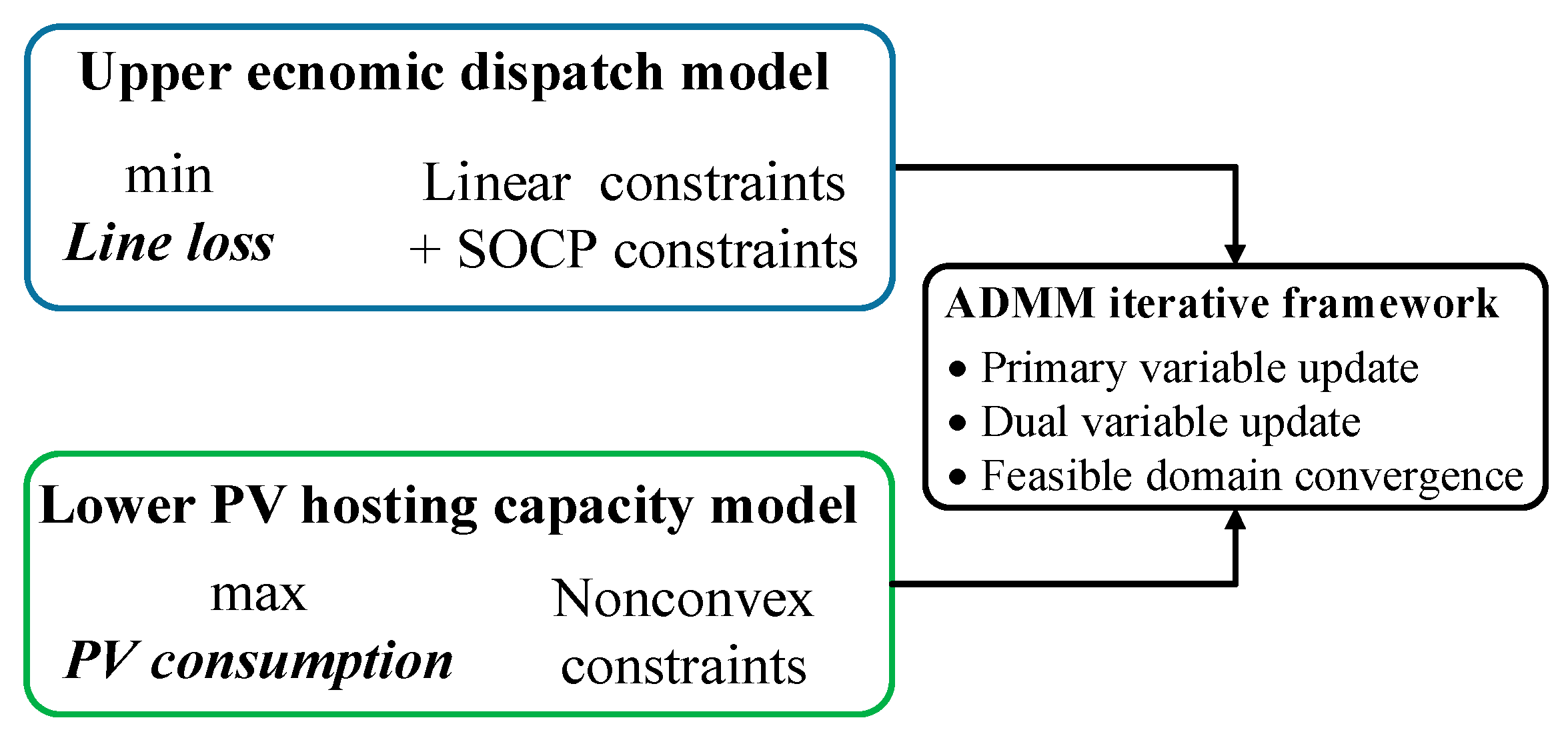
High PV penetration in active distribution networks (ADNs) amplifies voltage-regulation difficulty, induces bidirectional/reverse power flows, tightens thermal operating margins, and increases operating variability/uncertainty. These operational challenges are ultimately constrained by the nonconvex AC power-flow equalities, for which convex relaxations may become non-tight in high-PV and multi-objective settings. To separate operational decision-making from exact feasibility enforcement, we adopt an ADMM-coordinated two-level scheme. The upper level performs system-wide security-aware dispatch under a fully convexified SOCP branch-flow model, optimizing network-performance objectives while enforcing operational constraints. The lower level focuses exclusively on restoring the key nonconvex equality (equivalently, the reverse-SOCP boundary) via bus-wise QP1QC refinement solved by the proposed ESR-QP1QC procedure. The resulting feasibility-corrected variables and consistency residuals are exchanged through ADMM iterations to drive the relaxed solution toward a physically consistent operating point. The overall structure of the proposed framework is illustrated in Figure 1.
To improve readability and avoid ambiguity, we summarize the key variables and parameters used throughout the branch-flow modeling, ADMM coordination, and the ESR–QP1QC refinement procedure in Table 2. Symbols not listed in Table 2 follow standard definitions in distribution-network branch-flow formulations.
The upper-level aims to minimize power losses, with decision variables including the squared nodal voltages v i , squared branch currents l ( i , j ) , nodal active and reactive power injections p i , q i , and auxiliary variables associated with the SOCP-based power flow representation. The loss-minimization objective is formulated as follows [42]:
min f l o s s = ( i , j ) S b r ( i , j ) l ( i , j )
where floss denotes the loss-minimization objective, i and j index buses, (i,j) represents the branch connecting bus i to bus j, Sb denotes the sets of branches, and r(i,j) is the resistance of branch (i,j). The upper level incorporates all physical and operational constraints that admit convex reformulation. For any iSn, the main constraints include the following [43]:
p i = p i pv p i load
q i = q i pv q i load
p i = j : ( i , j ) S b P ( i , j ) z : ( z , i ) S b P ( z , i ) r ( z , i ) l ( z , i )
q i = j : ( i , j ) S b Q ( i , j ) z : ( z , i ) S b Q ( z , i ) x ( z , i ) l ( z , i )
v j = v i 2 ( r ( i , j ) P ( i , j ) + x ( i , j ) Q ( i , j ) ) + ( r ( i , j ) 2 + x ( i , j ) 2 ) l ( i , j )
v i l ( i , j ) = ( P ( i , j ) ) 2 + ( Q ( i , j ) ) 2
v i min v i v i max
0 l ( i , j ) l ( i , j ) max
| P ( i , j ) | P ( i , j ) max
0 p i pv p i pv , max
Here, the upper-level loss-minimization problem optimizes the branch-flow state variables {vi, l(i,j), P(i,j), Q(i,j)} and nodal injections {pi, qi}, where ( p i pv , q i pv ) denote the active and reactive PV outputs at PV buses and are embedded through the nodal power balance Equations (2) and (3), together with other auxiliary variables introduced by the SOCP representation. In addition, p i load and q i load represent the active and reactive loads at bus i, P(i,j) and Q(i,j) denote the active and reactive power flows on branch (i,j), and x(i,j) is the branch reactance. The notation j: (i,j) refers to the set of branches terminating at bus i, and z: (z,i) refers to the set of branches originating from bus i. v i min and v i max represent the lower and upper bounds of the squared voltage magnitude at bus i, whereas l ( i , j ) max and P ( i , j ) max denote the upper bounds on the squared branch current and branch active power, respectively. The operator |·| denotes the absolute value, and p i pv , max specifies the maximum active power output of the PV unit at bus i. The absolute value in (10) reflects the physical allowance for bidirectional power flow within the system. Among these constraints, (7) is nonconvex and poses significant challenges for optimization. Therefore, in the upper level, it is first reformulated into an equivalent second-order cone (SOC) representation [44]:
2 P ( i , j ) 2 Q ( i , j ) v i l ( i , j ) v i l ( i , j ) , ( i , j ) S b
The objective of the lower level is to determine the maximum admissible active power injection of all PV buses. The lower-level problem involves only a single nonconvex constraint, the reverse SOCP surface, which characterizes the boundary corresponding to the original nonconvex power flow equality. Accordingly, the lower-level objective function is formulated as follows [45]:
max     f PV = i S n p i PV
The maximized PV injection p i pv can be interpreted as (i) a hosting-capacity metric that quantifies the maximum installable PV capacity under a full-output scenario, or (ii) an operational setpoint enabled by inverter-based PV curtailment and coordination on the customer side, for example, via contractual or aggregator-based control. The proposed method applies to both interpretations, as it computes the maximum admissible injections under network operational and power-flow feasibility constraints. Subject to the following constraint:
v i l ( i , j ) ( P ( i , j ) ) 2 + ( Q ( i , j ) ) 2
All remaining voltage, power flow, and line constraints are fully represented in the upper level. It is worth noting that constraints (12) and (14) together constitute the two directional components of the original nonconvex constraint (7); through the iterative upper and lower coordination process, they progressively approximate the original equality condition. To facilitate the subsequent variable-updating and interaction procedure across the two levels, the vector of replicated variables is defined as
d i = { v d , i , l d , ( i , j ) , P d , ( i , j ) , Q d , ( i , j ) , p d , i , q d , i }
where di denotes the vector of replicated variables, with vd,i, ld,(i,j), Pd,(i,j), Qd,(i,j) pd,i, qd,i representing the replicated counterparts of the corresponding original variables. With the introduction of replicated variables, the upper- and lower-level problems can be respectively formulated as (16) and (17).
min i S n f l o s s ( o i ) s . t . ( 2 ) ( 6 ) , ( 8 ) ( 12 )
max i S n f PV ( d i ) s . t . v d , i l d , ( i , j ) ( P d , ( i , j ) ) 2 + ( Q d , ( i , j ) ) 2
To enforce equivalence between the original and replicated variables, the consensus constraints (18) are introduced and can be compactly represented in matrix form as (19).
v i = v d , i , l ( i , j ) = l d , ( i , j ) , P ( i , j ) = P d , ( i , j ) , Q ( i , j ) = Q d , ( i , j ) , p i = p d , i , q i = q d , i
M o o i = M d d i
where Mo and Md denote the matrix coefficients associated with the original and dual variables, respectively, and oi represents the vector of original variables. For numerical convenience and algorithmic implementation, the lower-level problem of maximizing PHC is reformulated as a minimization problem by negating its objective, thereby aligning its optimization direction with the upper-level problem. Leveraging the fundamental principles of the ADMM [46], the upper- and lower-level problems can be expressed in an augmented Lagrange form (20). This formulation enables iterative coordination, allowing the original nonconvex constraints to be progressively enforced while facilitating the convergence of the two levels’ objectives. Such a treatment preserves the convexity and efficiency of the upper-level problem, while systematically addressing the unique nonconvex constraint at the lower level through iterative approximation.
L ( o , d , λ ) = i S n f l o s s ( o i ) i S n f PV ( d i ) + λ T i S n ( M o o i M d d i ) + ρ 2 i S n ( M o o i M d d i ) 2
where λ denotes the Lagrange multipliers associated with the corresponding variables, and ρ is the penalty parameter in the augmented Lagrange. Given the structure and constraints of the upper-level model, it constitutes a standard centralized convex optimization problem that can be solved directly. The proposed framework involves two criteria, namely loss minimization in the SOCP-based upper-level model (1) and PV hosting maximization in the reverse-SOCP lower-level model (13). These criteria are not merged by an arbitrary weighted-sum scalarization. Instead, we adopt a two-layer variable-splitting strategy with replicated variables and enforce their consistency via the consensus constraint Mo·oi = Md·di (19). The augmented Lagrange (20) and the ADMM iterations (21)–(25) coordinate the two subproblems: the upper level minimizes floss under convex constraints, while the lower level pushes the solution toward the reverse-SOCP surface (14) and maximizes admissible PV injections. Upon convergence, the primal and dual residuals vanish, and both layers agree on a single physically consistent branch-flow solution. If a Pareto-type trade-off between losses and PV absorption is desired, one may introduce a tunable weight or normalization to form a weighted objective; this extension is straightforward but is not the focus of this work, which emphasizes exact feasibility restoration for nonconvex branch-flow equalities. Analysis of the lower-level problem indicates that, for any bus i, the lower-level problem can be decomposed into independent local subproblems corresponding to each bus. Since these subproblems are mutually independent, they can be solved in parallel, substantially improving computational efficiency. Accordingly, the augmented Lagrange formulation can be implemented in a bus-wise decomposition: each bus constructs its local subproblem and solves it according to a predefined order as (21)–(25), thereby ensuring convergence while progressively enforcing the original nonconvex constraints.
SP 1 : o i k + 1 = arg min o i     L ( o k , d , λ i k ) = arg min o i i S n f l o s s ( o i ) + λ i T i S n ( M o o i M d d i ) + ρ 2 i S n ( M o o i M d d i ) 2
SP 2 : d i k + 1 = arg min d i     L ( o , d k + 1 , λ i k ) = arg min d i i S n f PV ( d i ) + λ i T i S n ( M o o i M d d i ) + ρ 2 i S n ( M o o i M d d i ) 2
SP 3 : λ i k + 1 = λ i k + ρ ( M o o i k + 1 M d d i k + 1 )
r p r i k + 1 = M o o k + 1 M d d k + 1 2 2
r d u a k + 1 = M o o k + 1 M o o k 2 2
Here, SP1, SP2, SP3 denote the three sequentially solved subproblems, k represents the iteration index. r p r i k + 1 and r d u a k + 1 denote the primal and dual residuals at iteration k + 1, respectively. During each iteration, the bus-wise subproblems are solved in sequence: the upper-level variables are first updated and exchanged with the corresponding lower-level bus components. Next, the lower-level bus subproblems are solved. Finally, the Lagrange multipliers are updated via SP3, and convergence is assessed based on the primal and dual residuals. This process is repeated until the residuals satisfy the predefined thresholds or the maximum number of iterations is reached.
This two-layer coordinated framework concentrates all convexifiable constraints, which can be accurately represented via SOCP, in the upper-level model, while isolating the most critical nonconvex components of the power flow equations in the lower-level model. Through iterative coordination, the lower level progressively enforces the original nonconvex constraints, preserving the physical fidelity of the solution. The proposed framework thus provides a distribution optimization model that is computationally efficient, physically consistent, structurally transparent, interpretable, and readily extensible, offering a practical approach for high-penetration distributed energy scenarios. Lastly, we need to clarify the model scope and necessary extensions. The current paper focuses on PV hosting capacity to highlight the proposed ESR-QP1QC feasibility refinement for nonconvex branch-flow equalities. Other flexibility resources could be introduced by adding node injection and constraints, and all of them could be placed in the upper-level model, but this is not necessary here.

3. Methodology

This section presents the methodology for the two-layer coordinated framework set-ting, focusing on the exact and scalable treatment of nonconvex branch-flow feasibility constraints in the lower-level subproblems. The key idea is to exploit the structure induced by distributed decomposition and to handle the resulting nonconvex subproblems through exact reformulation and low-dimensional reduction. The upper-level SOCP dispatch provides an economically optimal operating point within a convexified feasible set, but, under high-PV and multi-objective conditions, the relaxation may be non-tight, so the iterate can violate the exact branch-flow equality. In the branch-flow model, the reverse-SOCP boundary encodes a fundamental physical consistency among power flow, voltage magnitude, and current magnitude, i.e., it links the apparent power carried by a branch to the squared current that produces losses and voltage drops along that branch. The lower-level feasibility restoration can thus be viewed as a physics-consistency correction: it minimally adjusts the relaxed iterate (in the sense of the augmented-Lagrange metric imposed by ADMM) so that the resulting branch currents/loss terms become physically consistent with the dispatched power flows and nodal voltages. In other words, it acts as a proximal “projection” of the relaxed solution onto the manifold defined by the exact power-flow equality, thereby converting an economically meaningful but potentially optimistic SOCP iterate into a physically realizable operating point.

3.1. Exact Reformulation of the Lower-Level Nonconvex Subproblem

After applying the ADMM-based coordination scheme to the two-layer coordinated framework, the lower-level optimization becomes separable across buses. Introducing local copies of the coupling variables together with the associated dual and penalty terms, each bus-level subproblem, denoted as SP2, takes the form of minimizing a strictly convex quadratic objective function subject to a single nonconvex quadratic inequality constraint derived from the branch-flow power equations. Although the original distribution network model contains multiple nonlinear constraints, the above decomposition induces a significant structural simplification. Specifically, after decomposition, each SP2 has exactly one quadratic constraint. As a result, SP2 belongs to the class of QP1QC [47]. Specifically, the SP2 problem can be expressed as the following general form, as (26).
min x i T A 0 x i + 2 b 0 T x i + c 0 s . t . x i T A 1 x i + 2 b 1 T x i + c 1 0
Here, xi is the decision variable in the low level belonging to bus i, which is exactly equal to di. The coefficients A0, b0, c0 correspond to the quadratic, linear, and constant terms of the atomic problem’s objective function, respectively, while A1, b1, c1 correspond to the quadratic, linear, and constant terms of the atomic problem’s constraint, computed as specified in Equations (27)–(29).
A 0 = d i a g [ ρ 2     ρ 2     ρ 2     ρ 2     ρ 2     ρ 2 ]
b 0 = ( ρ o i + λ i ) T ,     c 0 = ( ρ 2 o i 2 + λ i T o i + p i load )
A 1 = 0 1 / 2 1 / 2 0 1 1 0 0 , b 1 = 0 T ,     c 1 = 0
Here, 0T denotes the zero vector of the corresponding dimension. This structural property is fundamental to the proposed methodology. In general, QP1QC represents a special class for which exact reformulations are possible under mild regularity conditions. Identifying each SP2 admits a QP1QC structure and therefore provides the theoretical basis for exact treatment of the nonconvexity. To exploit this property, the S-procedure is employed. According to the conclusion in appendix B.2 of [48], a QP1QC problem satisfying Slater’s condition admits an exact SDP reformulation [49]. In the present context, Slater’s condition holds due to the existence of strictly feasible operating points in the distribution network, characterized by interior voltage magnitudes and admissible power injections. Consequently, SP2 can be reformulated as an SDP problem given in (30)–(33).
Sub : max υ i , γ i γ i
υ i 0
A 0 + υ i A 1 _ 0
A 0 + υ i A 1 b 0 + υ i b 1 ( b 0 + υ i b 1 ) T c 0 + υ i c 1 γ i _ 0
Here, γi denotes the objective function of the SDP subproblem, and υi represents the dual variable associated with the quadratic inequality constraint, with the matrix semidefinite symbol ⪰ 0 enforcing positive semidefinite. It is important to stress that the SDP formulation (30)–(33) is exact rather than a relaxation. That is, the feasible set of the SDP coincides with that of the original nonconvex SP2, and both problems share the same optimum. At this stage, however, the reformulation only shifts the difficulty from nonconvexity to computational complexity, as repeatedly solving SDPs with matrix decision variables within an ADMM loop would be prohibitive for large-scale systems. This observation motivates an investigation into the internal structure of the SDP formulation.

3.2. Exact Spectral Refinement for QP1QC Subproblems

This section presents the proposed ESR-QP1QC method, which constitutes the main methodological contribution of this paper. Under the ADMM coordination, the lower-level feasibility-restoration task becomes bus-wise separable. By explicitly retaining the reverse-SOC boundary associated with the branch-flow equality, each local refinement subproblem involves a single quadratic constraint, and therefore admits a QP1QC structure. ESR-QP1QC exploits the exact SDP characterization of QP1QC and performs a Schur-complement-based elimination to reduce the problem to a one-dimensional scalar refinement (with a provably valid interval characterized by generalized eigenvalues). For each scalar value, the primal variables are then rigorously recovered by solving a small linear system (or using the Moore–Penrose pseudoinverse when necessary). This reduction replaces expensive generic nonconvex/SDP iterations with lightweight scalar updates and structured linear-algebra operations, which is particularly beneficial when the refinement is executed repeatedly across buses and ADMM iterations.
Following Section 3.1, the exact SDP for the bus-wise subproblem i can be written as
max υ i , γ i γ i s . t .     υ i 0 ,     S i ( υ i , γ i ) _ 0
where the linear matrix inequality (LMI) is given by
S i ( υ i , γ i ) = A 0 + υ i A 1 b 0 + υ i b 1 ( b 0 + υ i b 1 ) T c 0 + υ i c 1 γ i _ 0
For compactness, define the affine mappings:
A ( υ i ) A 0 + υ i A 1 ,   b ( υ i ) b 0 + υ i b ,   c ( υ i ) c 0 + υ i c 1
Then, (35) becomes
S i ( υ i , γ i ) = A ( υ i ) b ( υ i ) b ( υ i ) T c ( υ i ) γ i _ 0
All nontrivial dependence of the SDP constraint on decision variables occurs through the single scalar υi and the scalar objective variable γi. Therefore, if γi can be eliminated for each fixed υi, the remaining problem becomes one-dimensional.
Fix any candidate υi ≥ 0, then consider the feasibility of (37). A necessary condition is Ai) ≥ 0, because it is a principal submatrix of Sii, γi). When Ai) ≥ 0, which holds throughout the interior of the feasible set and is the typical case in numerical iterations, the Schur complement [50] of Ai) in (35) provides an equivalent characterization:
S i ( υ i , γ i ) _ 0     A ( υ i ) 0 , c ( υ i ) γ i b ( υ i ) T A ( υ i ) 1 b ( υ i ) 0
Equivalently,
γ i c ( υ i ) b ( υ i ) T A ( υ i ) 1 b ( υ i )
Now, observe the key point: the SDP maximizes γi. For a fixed υi satisfying Ai) ≥ 0, inequality (39) implies that the largest feasible γi is achieved at equality. Therefore,
γ i * ( υ i ) = c ( υ i ) b ( υ i ) T A ( υ i ) 1 b ( υ i )
Specifically, this step does not assume convexity of γ i * ( υ i ) in υi. It only uses the fact that for a fixed υi, γi appears in (37) as a monotone scalar shift of the bottom-right element: increasing γi makes the LMI harder to satisfy, while decreasing γi makes it easier. Hence, at the optimum for fixed υi, γi must be pushed to the boundary defined by (39). This argument is purely order-based and therefore robust.
At boundary points where Ai) ≥ 0 becomes singular, one can interpret the Schur complement via a generalized form. In particular, feasibility of (37) requires that (i) Ai) ≥ 0, and (ii) bi) lies in the range space of Ai) to avoid infeasibility caused by directions in the nullspace. In such cases, Ai)−1 is replaced by the Moore–Penrose pseudoinverse A ( υ i ) , yielding the natural extension [51,52].
γ i * ( υ i ) = c ( υ i ) b ( υ i ) T A ( υ i ) b ( υ i )
In practice, the algorithm can evaluate (40) using stable factorizations when Ai) > 0, and treat boundary candidates by safeguarded checks. This keeps the method numerically stable without weakening the theoretical equivalence.
Substituting the optimal γ i * ( υ i ) back into the SDP shows that (34)–(37) is equivalent to the following one-dimensional problem:
max υ i D i ϕ ( υ i ) : = c ( υ i ) b ( υ i ) T A ( υ i ) 1 b ( υ i )
with feasible domain:
D i υ i   υ i 0 ,   A ( υ i ) _ 0 ,   b ( υ i ) R ( A ( υ i ) )
Here, ℝ is the set of all real numbers. (Ai)) denotes the range space of Ai). This reduction is exact for the SDP obtained in Section 3.1: the optimal value of (42) equals the optimal value γ i * of the SDP (34), which equals the optimal value of the original QP1QC due to the exactness established previously.
To avoid explicitly forming Ai)−1, one computes x by solving the linear system
A ( υ i ) x i = b ( υ i )
and evaluates bi)Txi. This can be implemented via LDLT/Cholesky [53] factorization when Ai) > 0, which is typically much cheaper and more stable than an SDP solver call. At each iteration of the lower-level update, the matrices A0, A1 and vectors b0, b1 are fully determined by the current ADMM/coordination state, like penalties, consensus shifts, and local cost coefficients. Hence, (42) provides a deterministic scalar subroutine that replaces the SDP solve, while preserving the same target γ i * .
The computational tractability of (40) relies on efficiently determining a search interval for υi. A necessary condition for feasibility is Ai) ≥ 0, i.e.,
A 0 + υ i A 1 _ 0
Define the PSD-interval set of the symmetric pencil:
I i { υ i A 0 + υ i A 1 _ 0 }
For symmetric pencils, I i is known to be an interval (possibly empty or unbounded) under mild regularity conditions, and its endpoints correspond to values at which A0 + υiA1 becomes singular. Concretely, boundary candidates satisfy
det ( A 0 + υ i A 1 ) = 0 , equivalently λ min ( A 0 + υ i A 1 ) = 0
Therefore, one can compute a finite set of breakpoints from the generalized eigenvalue structure of (A0, A1) and select the interval on which Ai) ≥ 0 holds [54]. The feasible domain for (42) is then obtained by intersecting with υi ≥ 0 and applying the range-space condition:
D i = ( I i [ 0 , ) )     { υ i   b ( υ i ) R ( A ( υ i ) ) }
Equation (47) is used to delimit the feasible set of υi by identifying where PSD fails. However, the maximizer of ϕi) in (42) may occur at an interior point or at an endpoint. Hence, a logically complete approach is to (i) compute the feasible interval via (47), (ii) evaluate ϕi) at endpoints, and (iii) conduct safeguarded one-dimensional search over the interior.
Then, we can recover the primal variables. Let υ i * be an optimizer of (42). Then, the optimal SDP objective is
γ i * ( υ i * ) = c ( υ i * ) b ( υ i * ) T A ( υ i * ) 1 b ( υ i * )
Moreover, the primal solution of the original QP1QC, equivalently, the SP2 decision vector for bus i, can be recovered from the KKT stationarity condition associated with the quadratic Lagrange constructed in Section 3.1. Under A ( υ i * ) 0 , stationarity gives
x i * = A ( υ i * ) 1 b ( υ i * )
If A ( υ i * ) is singular at a boundary optimum, one can compute a minimum-norm primal solution via the pseudoinverse:
x i * = A ( υ i * ) b ( υ i * )
The above reduction replaces a generic SDP solve by (i) feasible-interval identification for the scalar υi, (ii) repeated evaluations of ϕi) over that interval, and (iii) a single linear-system solve to recover x i * . The dominant operations are factorizations/solves of Ai), whose dimension equals that of the local QP1QC variable vector, rather than an SDP cone solve with higher overhead.
In summary, this work employs a two-layer optimization setting to coordinate economic operation and feasibility restoration in active distribution networks. Within each iteration, the upper-layer updates system-level decision variables by solving a convex optimization problem subject to operational constraints, and exchanges the resulting voltage, power-flow, and coordination information with the lower layer. Based on the updated upper-layer results, the lower layer decomposes into a set of independent bus-wise subproblems, each capturing the local nonconvex characteristics of branch power flows and associated operational constraints. These lower-layer subproblems admit a QP1QC and are handled using the ESR-QP1QC refinement procedure. By retaining the reverse SOC boundary associated with the branch-flow equality and exploiting the spectral properties of the corresponding exact semidefinite characterization, each QP1QC subproblem is reduced to a one-dimensional scalar refinement over a feasible interval defined by generalized eigenvalues, from which the associated primal variables are recovered in a numerically stable manner. The refined lower-layer updates are then fed back to the upper layer through the coordination variables, enabling iterative adjustment of economic dispatch decisions and feasibility-restoration steps. Through this iterative information exchange and refinement process, the algorithm progressively enforces the original nonconvex branch-flow equalities at the subproblem level while maintaining computational tractability for large-scale systems. The overall workflow of the adopted coordination scheme and the associated ESR-QP1QC refinement steps are summarized in Table 3.

4. Simulation Analysis

4.1. Data Preparation

Case analyses were conducted using the modified IEEE 33-, 792-, and 1137-bus systems [55]. All numerical results were conducted in MATLAB R2022b (The MathWorks, Inc., Natick, MA, USA) on a workstation equipped with an Intel® Core™ i7-8700 CPU (Intel Corporation, Santa Clara, CA, USA) at 3.20 GHz and 64 GB of RAM. The optimization models were implemented using YALMIP-develop version. The upper- and lower-level models were solved using the commercial solvers GUROBI 13.0.0 (Gurobi Optimization, LLC, Beaverton, OR, USA) and Mosek 11.1.30 (MOSEK ApS, Copenhagen, Denmark), respectively. A penalty factor of 100 was applied, the maximum number of iterations was set to 100, and the convergence thresholds were established as 10−4, 10−4, and 10−3, respectively. For the purpose of comparison, the ESR-QP1QC method (M3) was benchmarked against the SOCR technique (M1) [44] and the SDPR approach (M2) [39] in terms of accuracy, and against the SDP-based convex optimization technique (M4) [22] in terms of efficiency. The installation buses of the PV units for each system are provided in Appendix A, with each unit having a capacity of 1 MW. The topologies of the three systems are illustrated in Appendix A.

4.2. Optimization Result Analysis

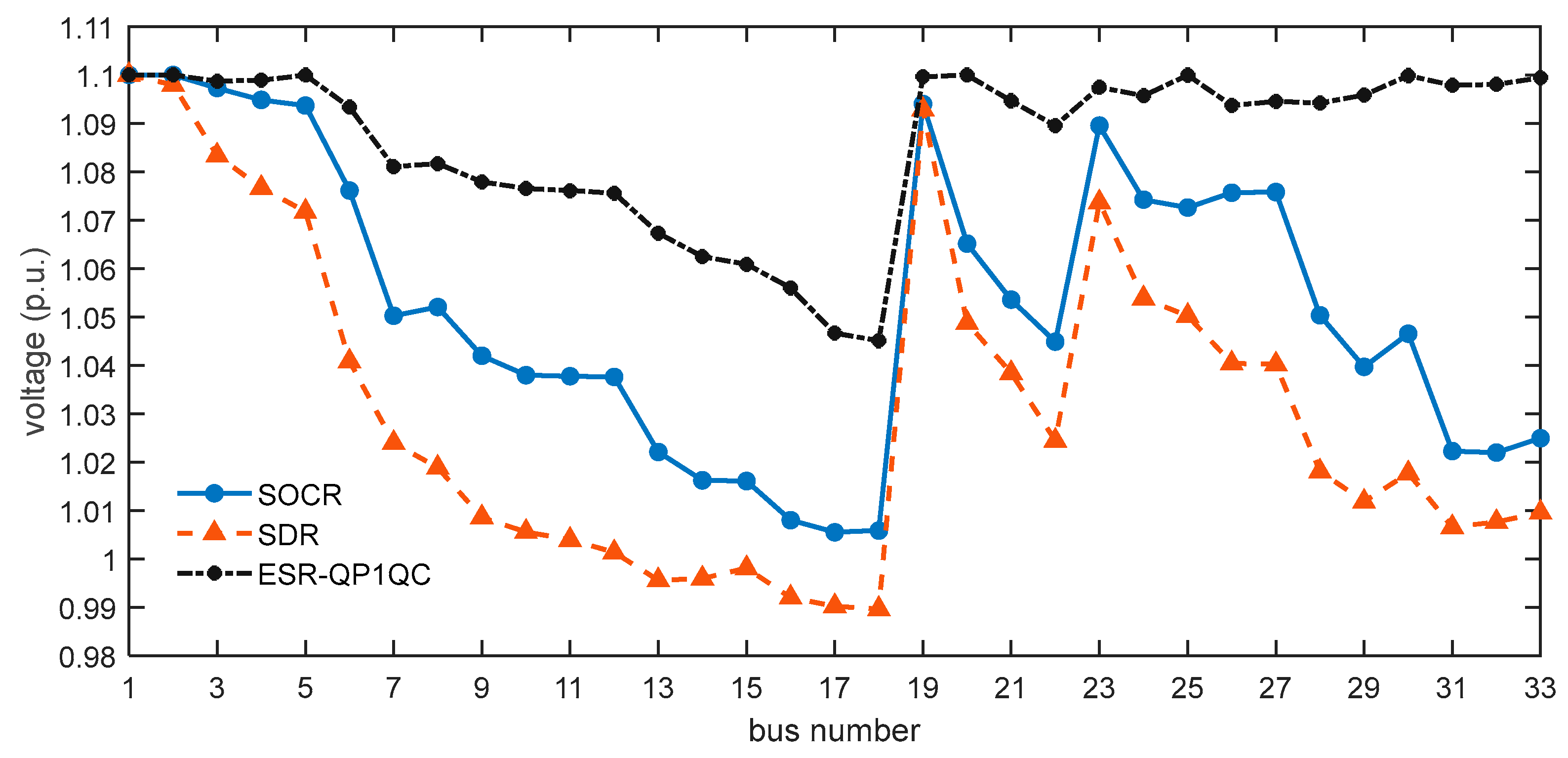
Firstly, consider the problem from the perspective of voltage distribution. Figure 2 illustrates the optimized nodal voltage magnitudes obtained by the three methods on the IEEE 33-bus feeder. The overall trend follows the typical radial-feeder behavior: voltages gradually decrease toward electrically remote buses, while local recoveries appear around buses with sizable PV injections. The SOCR solution exhibits a moderate voltage drop along the feeder and remains within the admissible operating band with noticeable spatial variations. In contrast, the SDR-based solution yields a generally lower voltage profile in several downstream sections, approaching the lower-voltage region more closely, which is consistent with the fact that relaxation-based solutions may become less reliable when the objective couples PV hosting and operational constraints. The proposed ESR-QP1QC method produces a voltage profile that is more physically consistent after the equality-restoration step, avoiding overly depressed voltages while converging to a feasible operating point that respects the original branch-flow relations. Overall, the results provide an intuitive validation that ESR-QP1QC not only improves feasibility restoration but also leads to a stable and interpretable voltage pattern across the feeder.
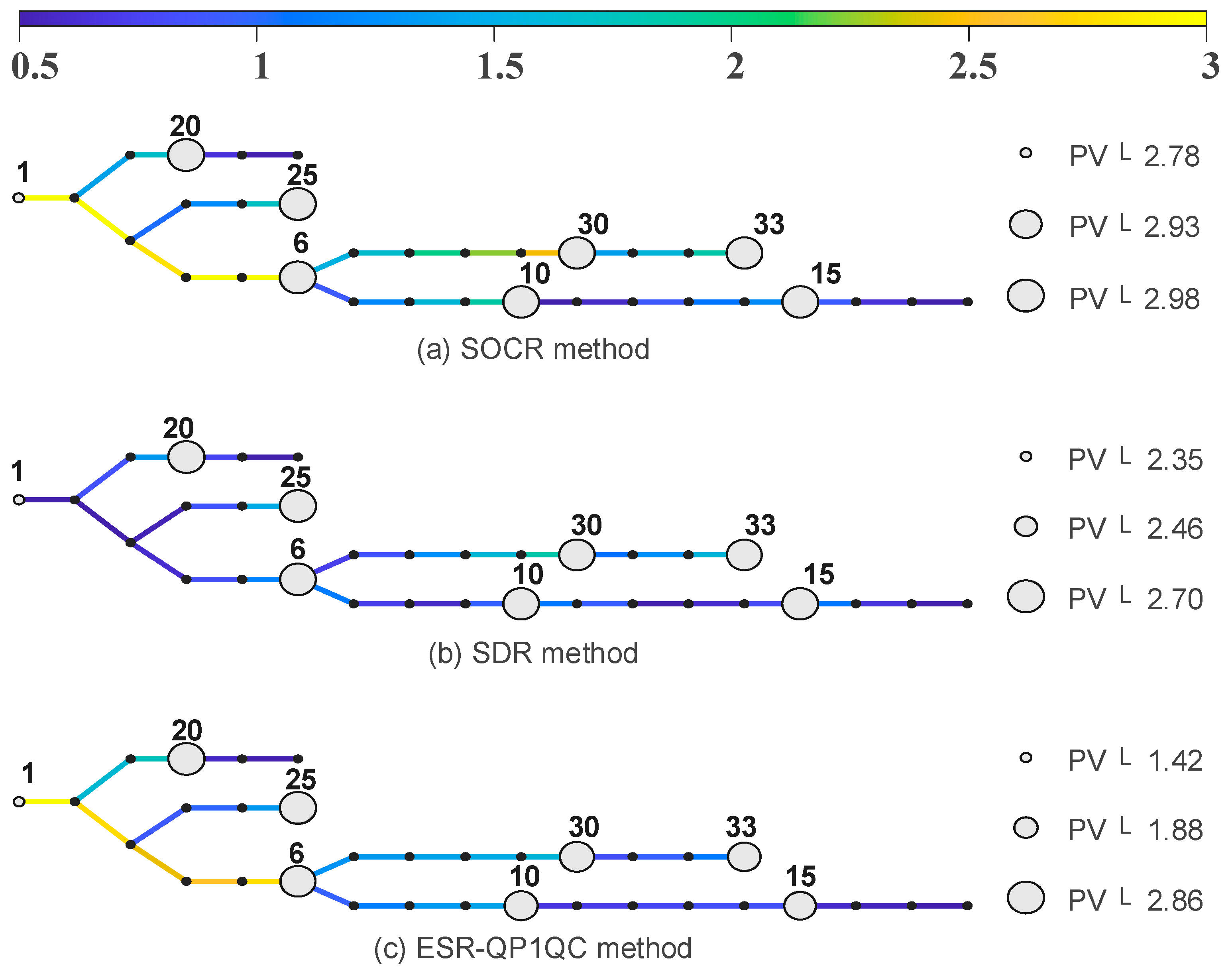
Figure 3 visualizes, on the feeder diagram, how PV injections and branch active-power loading are distributed spatially under the three methods. In this figure, the circle size at each PV bus is proportional to the optimized PV active injection, while the branch color encodes the magnitude of branch active power flow (with a common color scale shared across the three panels, where warmer colors indicate heavier active-power transfer). This visualization clarifies where PV is accommodated and which feeder segments become bottlenecks: when PV injections are allocated more aggressively at electrically remote buses, larger upstream transfers may occur, and the main feeder sections exhibit higher voltages, highlighted by warmer branch colors; conversely, more conservative PV allocations tend to reduce upstream transfers and mitigate heavily loaded branches. Compared with SOCR and SDR, ESR-QP1QC yields a PV allocation that better aligns with the equality-restored branch-flow feasibility, and the resulting pattern becomes more concentrated on the truly critical segments rather than being diffused by relaxation artifacts. Hence, the results complement the numerical tables by providing a compact, physically grounded explanation of how the proposed feasibility-restoration mechanism shapes PV hosting decisions and redistributes active-power flows across the feeder.
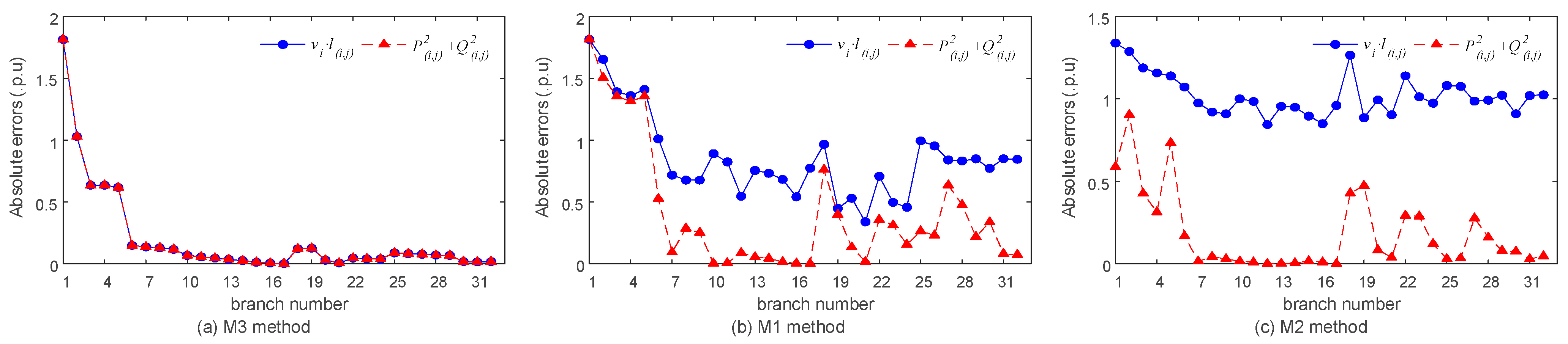
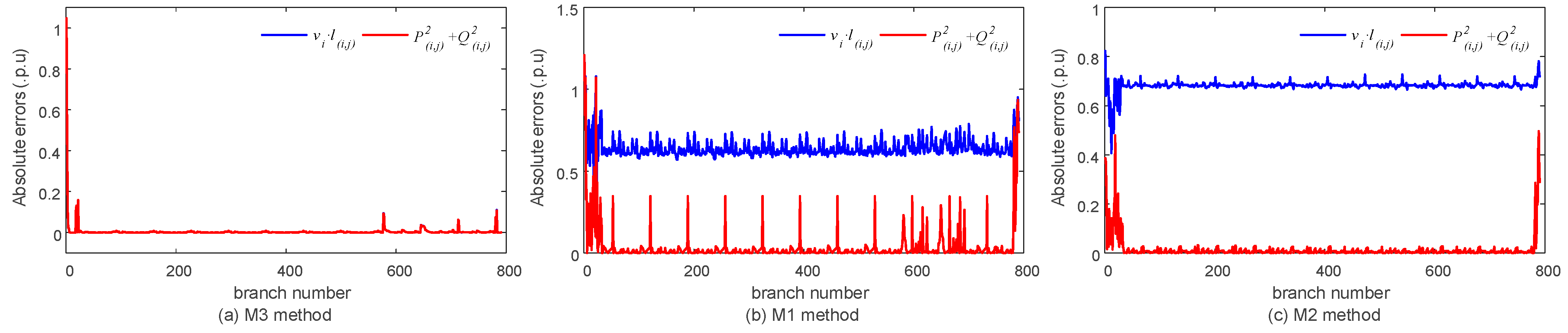
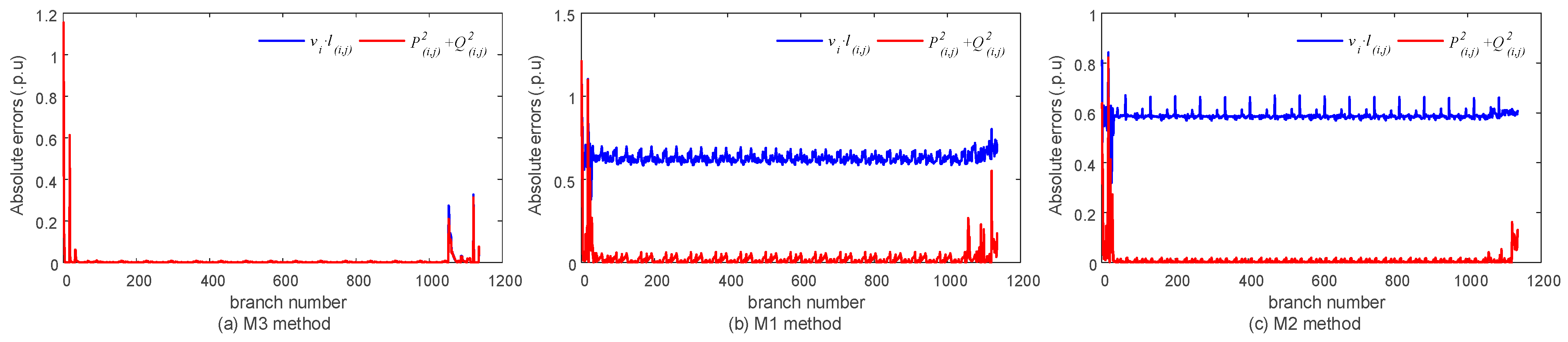
Secondly, the satisfaction of the physical constraints in the three systems was analyzed using the three different methods. To this end, the definitions of relative errors (R.E.) and absolute errors (A.E.) in [56] were adopted. The absolute error was defined as the sum of the absolute differences between the two sides of the non-convex power flow equality constraints for all branches, expressed in per-unit (p.u.) values. This indicator directly reflects the magnitude of mismatch accumulated across the network. The relative error was defined as the absolute-error sum divided by the sum of the corresponding right-hand-side terms of all branch equations, multiplied by 100% and expressed as a percentage. Compared with the absolute error, this normalized metric allows the feasibility level of the power flow equations to be assessed in a scale-independent manner and provides a clearer indication of the degree to which the non-convex equalities are satisfied. Overall, these two metrics jointly characterize the mismatch and infeasibility between the two sides of the non-convex power flow constraints, offering a quantitative basis for evaluating the numerical accuracy and consistency of the obtained solution. The relative and absolute errors for the three systems were calculated accordingly, and the results are presented in Figure 4, Figure 5 and Figure 6 and Table 4.
As shown in Table 5, the three methods yield markedly different outcomes as system size increases. In the 792-bus and 1137-bus systems, M1 and M2 report seemingly high PHC, (246.74 MW and 295.38 MW for M1), yet these values coincide with abnormally large losses (200.21 MW and 229.83 MW, respectively), whose magnitudes are comparable to the injected PV power. Such results are practically implausible and indicate severe feasibility violations caused by non-tight relaxations of the nonconvex power-flow equations. Even in the 33-bus case, M2 shows a counterintuitive pattern (lower PHC but higher losses), suggesting that relaxation may distort the ordering of the feasible set. In contrast, M3 enforces the key nonconvex structure through an equivalent, numerically stabilized refinement, thereby preventing the artificial feasible-domain expansion induced by relaxation. As a result, M3 produces physically consistent solutions with reasonable losses across all systems (5.46 MW and 3.22 MW for the 792-bus and 1137-bus systems), while delivering more conservative but implementable PHC levels (47.41 MW and 64.45 MW, respectively). These results confirm that the inflated PHC reported by M1 and M2 in large networks mainly stems from relaxation-induced deviations from the true nonconvex feasible domain.
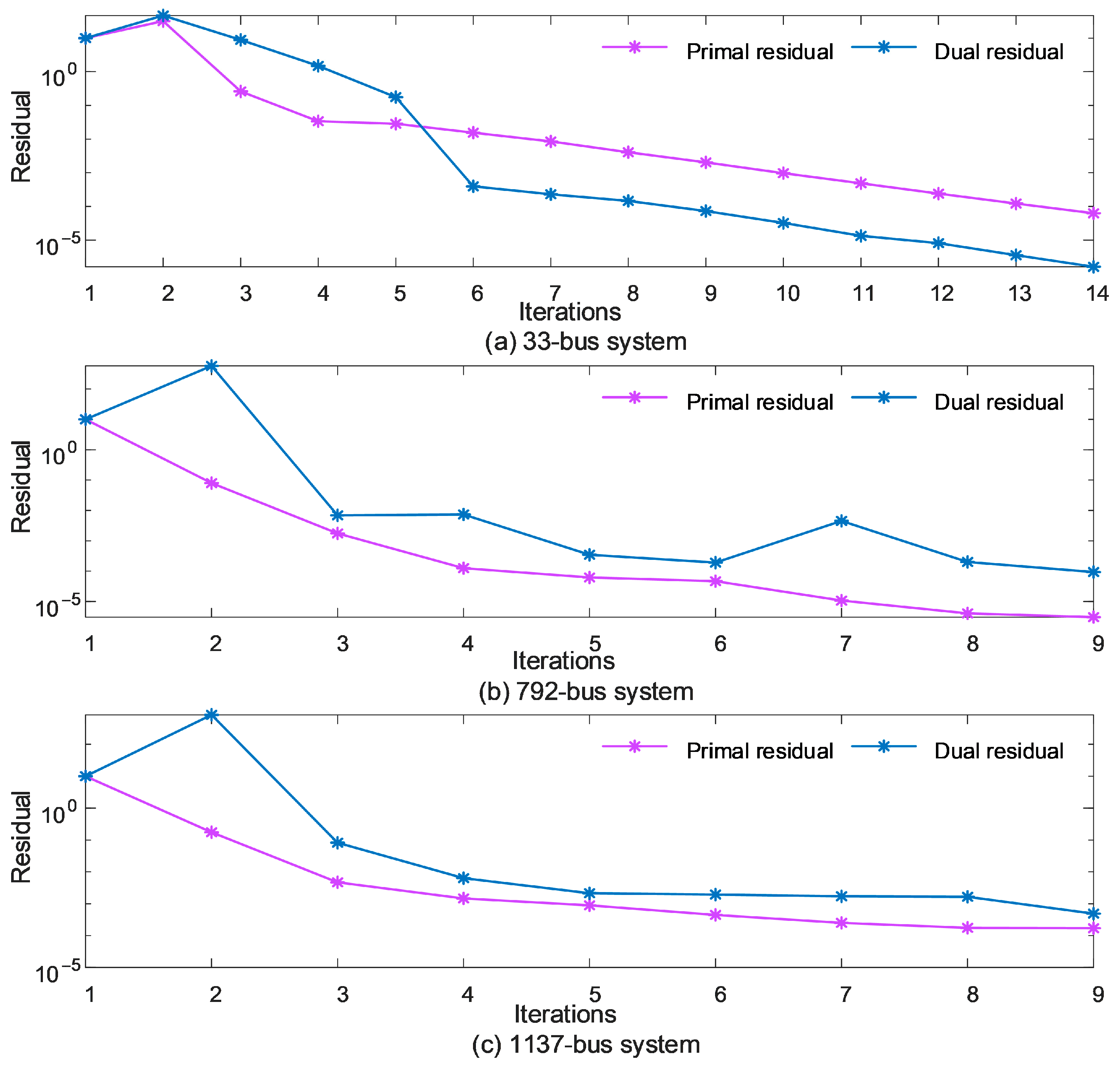
To assess numerical stability and scalability, we compare the ADMM primal and dual residual trajectories for the 33-, 792-, and 1137-bus systems, as shown in Figure 7. In all three cases, both residuals exhibit clear decay and converge to engineering-acceptable magnitudes, confirming stable coordination across different network scales. For the 33-bus system, the primal residual drops sharply from 32.00 to around 10−3 within the first four iterations and then continues toward 10−5, indicating that major infeasibilities are removed early. The dual residual decreases even faster, from 46.63 to the 10−4–10−6 range within a few iterations, reflecting efficient enforcement of coupling/consensus constraints. For the large-scale 792- and 1137-bus systems, primal residuals start at low levels (approximately 10−1–10−2) and decrease steadily, suggesting good primal feasibility throughout. In contrast, the initial dual residuals are large (574.89 and 839.10), which is expected in high-dimensional networks due to many coupling terms; nevertheless, they drop by about three orders of magnitude within 2–3 iterations and converge below 10−3. A minor fluctuation in the 792-bus case around iteration 6 is negligible and does not affect the overall trend. Overall, all systems converge within 8–13 iterations, with final residuals around 10−3–10−5, providing numerical evidence of rapid, stable convergence and consistent satisfaction of power-flow consistency constraints.
Remark on convergence and physical feasibility. The proposed two-level scheme is coordinated by ADMM over consensus variables. Since the lower-level step explicitly enforces the retained exact power-flow equality (equivalently, the reverse-SOCP boundary) through the ESR-QP1QC refinement, any limit point that satisfies consensus (vanishing primal residual) is physically feasible with respect to the enforced equality: at convergence, the upper- and lower-level variable copies coincide, and the refined variables satisfy the equality by construction. On the other hand, because the overall model is nonconvex, classical global convergence guarantees of convex ADMM do not directly apply; instead, consistent with the literature on nonconvex ADMM, convergence to a stationary/critical point is typically ensured only under regularity assumptions and sufficiently strong penalty enforcement, and in practice, convergence is evaluated empirically via primal/dual residuals. In our experiments, the residual curves exhibit stable decay, and the iteration numbers remain moderate across all tested systems. We note that oscillation or divergence may occur in rare cases such as overly small penalty parameters, poor numerical scaling/ill-conditioning, or extremely tight/inconsistent operating limits; to mitigate this, we adopted residual-balancing penalty tuning and conservative tolerances, and we did not observe divergence in any of the reported cases.
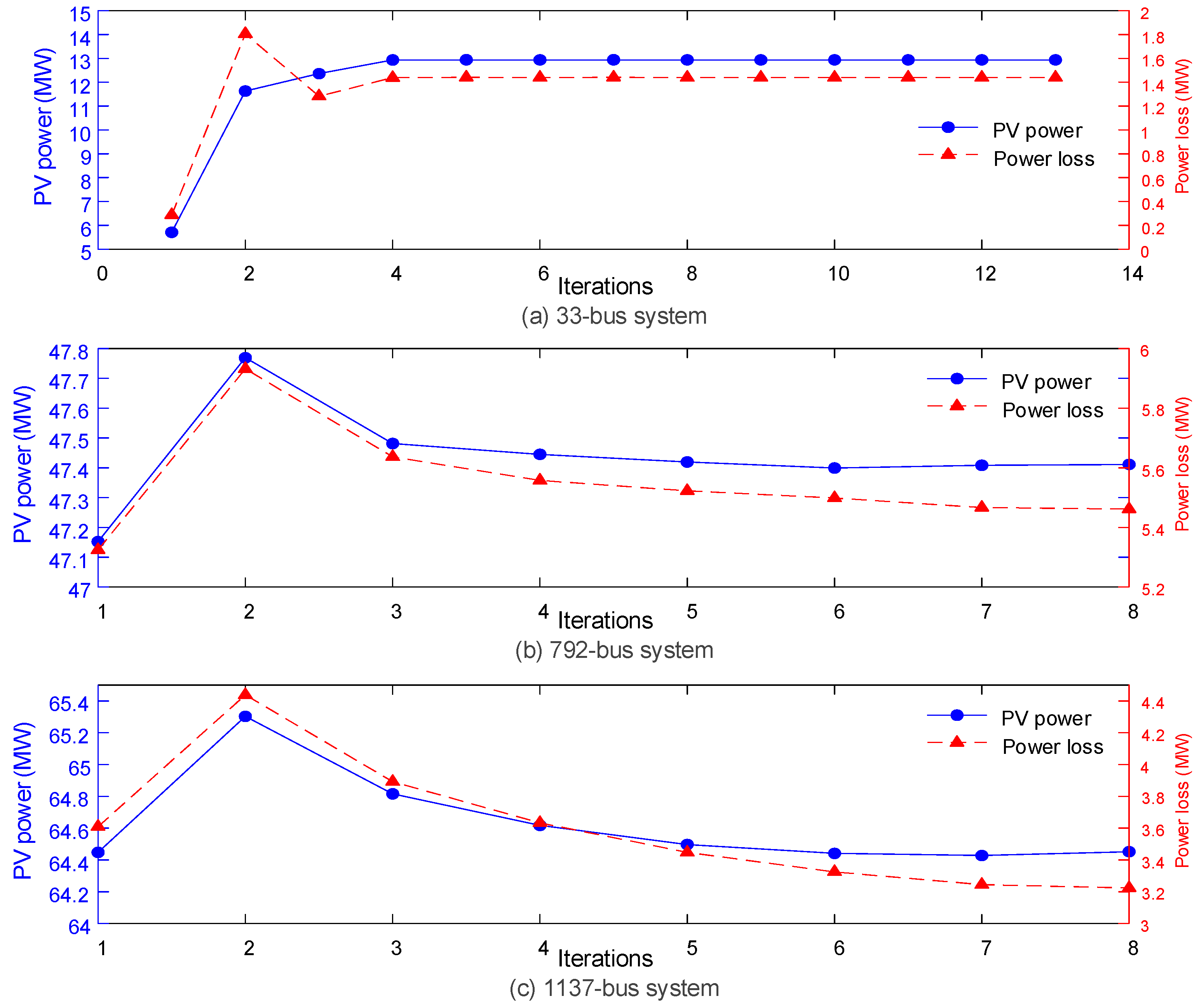
Figure 8 summarizes the iterative evolution of the upper- and lower-level objective values under M3 for the 33-, 792-, and 1137-bus systems. Across all scales, the trajectories exhibit a consistent pattern: a rapid adjustment in the first few iterations, followed by small oscillations and eventual stabilization, indicating good numerical stability and scalability. In early iterations, consensus among subsystems is not fully established, so both PHC and losses can change abruptly due to fast multiplier updates and local re-optimization. For example, in the 33-bus system, PHC increases from 5.7095 (iteration 1) to 11.6290 (iteration 2), and similar jumps occur in the larger systems around iteration 2. As iterations proceed, the operating point is progressively pulled toward the physically feasible region; PV allocation and power flows become consistent, and the objectives quickly stabilize. In the 33-bus case, PHC converges to about 12.93, and losses stabilize around 1.44 after iteration 4. For the 792- and 1137-bus systems, objective fluctuations fall to the 10−2 level by iteration 5 and stabilize by iteration 8, with no signs of divergence. Interestingly, the 33-bus system requires 13 iterations, slightly more than the 792- and 1137-bus cases (8 iterations), which can occur in distributed OPF because smaller systems may exhibit more sensitive local adjustments and minor overshoots, whereas larger networks tend to smooth perturbations through stronger coupling/averaging effects. Finally, the observed co-evolution of increasing PHC and decreasing losses is physically consistent: as voltages and flows move toward feasible boundaries, reverse flows are mitigated and losses decrease, enabling higher PV hosting. For instance, in the 1137-bus system, losses decrease from 3.6102 after a brief overshoot and stabilize around 3.22, corresponding to a stable PHC of approximately 64.44.
Overall, the analyses demonstrate that the proposed method achieves rapid convergence across systems of markedly different scales, with convergence errors maintained within a very small range of 10−3–10−2, and without any performance degradation due to system size. These results fully validate the high stability, robustness, and excellent scalability of the proposed optimization framework in evaluating photovoltaic hosting capacity in large-scale distribution networks, providing reliable support for practical engineering analyses of high-penetration renewable energy integration.

4.3. Algorithm Performance Analysis

Since the results obtained by M1 and M2 exhibit significant deviations and no longer satisfy the actual physical constraints, a comparison of their computational efficiency with the M3 method is no longer meaningful. Therefore, this section focuses on evaluating the differences in efficiency and accuracy between the proposed M3 method and the conventional SDP-based hidden convex optimization technique, M4. Three systems of varying scales are tested, and the corresponding results are presented in Table 6.
To further contextualize the proposed ESR-QP1QC refinement, it is also informative to contrast it with three commonly used refinement paradigms in the literature—SDP-based refinement, penalty-based feasibility restoration, and rank-relaxation/rank-regularization strategies—along the dimensions of exactness, scalability, and implementation complexity. In terms of exactness, SDP-based refinement can provide strong global guarantees for SDP-representable subproblems, whereas penalty-based methods typically enforce the nonconvex equalities only approximately unless very large penalties are used (which may cause ill-conditioning), and rank-relaxation strategies improve tightness indirectly by promoting low-rank structure but do not inherently guarantee equality satisfaction in each local refinement. In terms of scalability, generic SDP solvers require repeated interior-point iterations and large KKT factorizations, which can become the computational bottleneck when refinements are executed bus-wise and repeatedly across ADMM iterations; penalty-based methods are relatively inexpensive per iteration but may converge slowly and are sensitive to penalty tuning; rank-relaxation approaches often introduce additional variables/regularizers and can increase the cost and sensitivity of large-scale runs. In contrast, ESR-QP1QC starts from the exact SDP characterization of the bus-wise QP1QC refinement induced by the reverse-SOCP equality and derives an exact spectral reduction into a generalized-eigenvalue-bounded one-dimensional scalar refinement with rigorous primal recovery via structured linear algebra. This design retains SDP-level exactness for the targeted refinement while substantially reducing per-iteration overhead and keeping implementation lightweight. As Table 6 shows, M3 (ESR-QP1QC) and the SDP-based refinement baseline M4 yield nearly identical operating results (PV hosting and losses) and comparable feasibility-recovery quality as measured by A.E. and R.E. across all tested systems, confirming that the proposed refinement attains SDP-level solution quality for the targeted QP1QC subproblems. Meanwhile, M3 consistently achieves substantial runtime reductions (approximately 7×–16× in the reported cases) with the same number of ADMM iterations, indicating that the main efficiency gain stems from the reduced per-iteration refinement cost (1D scalar refinement plus structured linear-algebra recovery), rather than altered convergence behavior. These observations validate that ESR-QP1QC preserves accuracy while significantly improving computational efficiency and scalability in medium- and large-scale networks.
To further illustrate the adaptability of the M3 method under different scenarios, the performance of M3 was analyzed in this section. The maximum number of iterations was set to 100. The IEEE 33-bus system was employed, and the effects of different convergence thresholds, penalty factors, load levels, and voltage constraint ranges on the algorithm’s performance and on the characteristics of the optimization results were examined. The obtained results are summarized in the corresponding Table 7.
The numerical results show a clear sensitivity to the penalty factor ρ. With ρ = 1, the algorithm converges in 31 iterations, yielding an absolute error of 2.2639 × 10⁻⁴ p.u. (relative error 0.002258%), PHC of 14.118 MW, and losses of 2.6202 MW. Increasing to ρ = 10 raises the iteration count to 46 but significantly improves feasibility accuracy: the absolute error drops to 2.1102 × 10⁻⁵ p.u. (relative error 0.00030309%), while PHC and losses become 13.1215 MW and 1.6237 MW (reductions of about 90.7% and 86.6% relative to ρ = 1). For ρ = 100, convergence becomes fastest (13 iterations), but the error rebounds to 2.5771 × 10⁻⁴ p.u. (relative error 0.004045%), with PHC of 12.937 MW and losses of 1.4392 MW. Further increasing to ρ = 1000 results in 35 iterations, with even larger errors (5.6777 × 10⁻⁴ p.u., 0.0090518%), PHC of 12.9041 MW, and losses of 1.4063 MW. These trends reflect the typical ADMM trade-off. A small ρ weakly enforces consensus/equality constraints, allowing larger variable updates but leaving larger residuals and higher losses. A moderate ρ strengthens feasibility enforcement and improves accuracy, whereas an excessively large ρ can make subproblems overly rigid and ill-conditioned, leading to step-size mismatch in dual updates, slower convergence, or higher final errors. This explains why ρ = 100 yields the fastest iteration count yet shows error rebound, and why ρ = 1000 is suboptimal in both error and iterations. Overall, ρ = 10 provides the best balance between feasibility accuracy and computational effort in this study.
In the sensitivity study on the convergence threshold, the threshold mainly affects the iteration count while having negligible impact on the final objective values. With a threshold of 10−1, the algorithm terminates in 5 iterations with an absolute error of 9.051 × 10⁻³ p.u. (relative error 0.14193%), PV power of 12.9385 MW, and losses of 1.4407 MW. Tightening the threshold to 10−2 increases the iteration count slightly to 6 while substantially reducing the errors to 2.0903 × 10⁻⁴ p.u. and 0.0032804%, with PV power and losses of 12.9372 MW and 1.4394 MW. Further tightening to 10−3 (9 iterations) and 10−4 (13 iterations) yields PV power and losses that remain essentially unchanged (around 12.937 MW and 1.439 MW), while the equality errors exhibit non-monotonic behavior (e.g., 9.8479 × 10⁻⁴ p.u. at 10−3 and 2.5771 × 10⁻⁴ p.u. at 10−4). Overall, a threshold of 10−2 offers the best accuracy–effort trade-off in this case (errors below 10−3 p.u. and relative errors below 0.01% within 6 iterations), whereas 10−4 can be used when stricter residual control is required at higher iteration cost. For load-level sensitivity, the PV hosting capacity increases monotonically as the load multiplier rises from 0.5 to 2.0, with PV outputs of 10.1729 MW, 12.937 MW, 15.8648 MW, and 19.263 MW. This reflects enhanced local absorption under higher loading: the lower voltage baseline and more stable power-flow directions enlarge the feasible region for PV injections while satisfying operational constraints and demand. Meanwhile, line losses increase from 1.3864 MW to 2.3427 MW, consistent with the physical relation that losses scale with the square of branch currents. Convergence becomes slightly faster at higher loads, with iteration counts of 13, 13, 12, and 10 for load multipliers of 0.5, 1.0, 1.5, and 2.0, respectively, likely because higher load operating points yield more consistent voltage/flow patterns across subproblems and thus facilitate coordination. The absolute equality errors (4.3117 × 10⁻⁴, 4.045 × 10⁻³, 1.5884 × 10⁻⁴, 1.3255 × 10⁻³) are non-monotonic with load, which is reasonable for nonconvex power-flow equations: different flow intensities can alter the balance between voltage gradients and current increments across branches, and the aggregated residual reflects cumulative branch-level variations.
In the analysis of the impact of different squared voltage constraint ranges on algorithm performance and optimization results, it was observed from Table 8 that the constraint range had minimal effect on the number of iterations, exhibited some sensitivity with respect to equality residuals, and had a negligible influence on photovoltaic hosting capacity and line losses. Specifically, under the four considered voltage constraint ranges, the number of iterations remained constant at 13, indicating that the convergence speed of the algorithm is largely insensitive to the tightness of voltage constraints.
The equality residuals vary non-monotonically as voltage limits tighten. With the voltage range 0.90–1.10, the absolute error is the smallest (2.5771 × 10⁻⁴ p.u.; relative error 0.004045%), likely because wider voltage freedom provides more degrees of freedom for residual reduction. Tightening the range to 0.92–1.08 and 0.95–1.05 increases the absolute error to 2.4202 × 10⁻³ p.u. (0.037966%) and 4.1824 × 10⁻³ p.u. (0.065627%), respectively. Under the extremely narrow range 0.99–1.01, the absolute error decreases again to 6.0457 × 10⁻⁴ p.u. (0.0094882%), which can be attributed to the near-fixed voltage profile that restricts voltage-related variation and shifts the mismatch primarily to branch-flow terms. Notably, PV hosting capacity and losses remain almost unchanged across all voltage ranges, indicating that voltage limits mainly affect residual magnitudes rather than the optimized objectives. In contrast, current constraints have a pronounced impact on both PV hosting capacity and line losses. As the current upper limit increases from 0.5 to 2.0, PHC rises from 10.5748 MW to 17.309 MW and losses increase from 0.84744 MW to 3.32 MW, consistent with the physical fact that looser current limits permit higher branch currents (and thus higher PV injections), while losses grow approximately with the square of current. The iteration count stays nearly unchanged (12–13 iterations) under different current limits, suggesting limited influence on convergence speed. However, the residuals remain non-monotonic under extreme tight/loose limits, with absolute errors of 7.7322 × 10⁻⁵, 2.5771 × 10⁻⁴, 1.2813 × 10⁻⁴, and 1.8309 × 10⁻³ p.u., reflecting the sensitivity of nonconvex branch-flow equalities to operating points under different current stress levels.
Overall, the above comparisons indicate that current constraints directly shape the achievable operating region and therefore strongly affect PHC and losses, whereas voltage constraints have limited influence on the final objectives and mainly regulate feasibility residuals through the available degrees of freedom in the power-flow solution. Combining the sensitivity results on convergence threshold, penalty factor, load level, voltage limits, and current limits, the proposed algorithm shows stable convergence and robust performance across a wide range of settings. In general, thresholds and penalty factors primarily influence iteration behavior and residual magnitudes; load level and current limits primarily determine the attainable PHC and losses (higher loading and looser limits enable higher PV integration at the cost of higher losses). Voltage limits exert a secondary effect on objectives but remain relevant for controlling residual behavior.
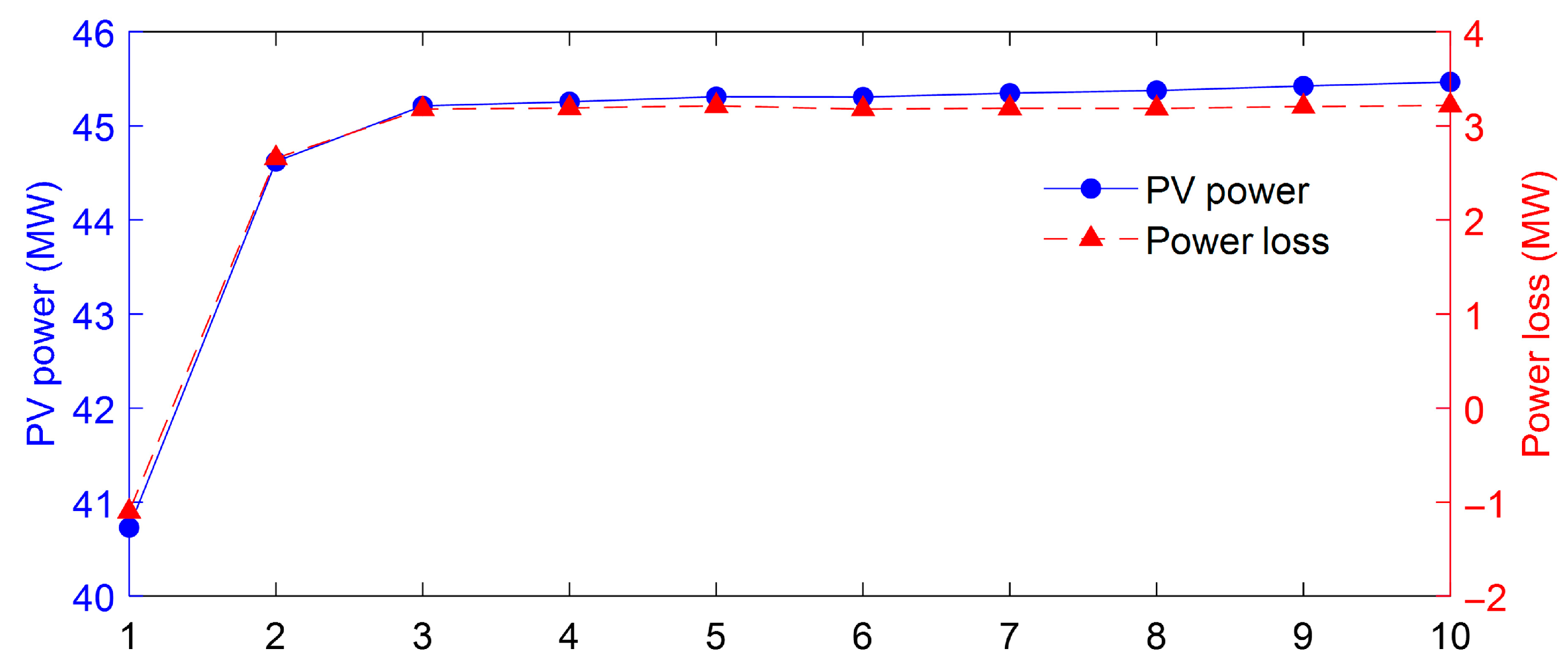
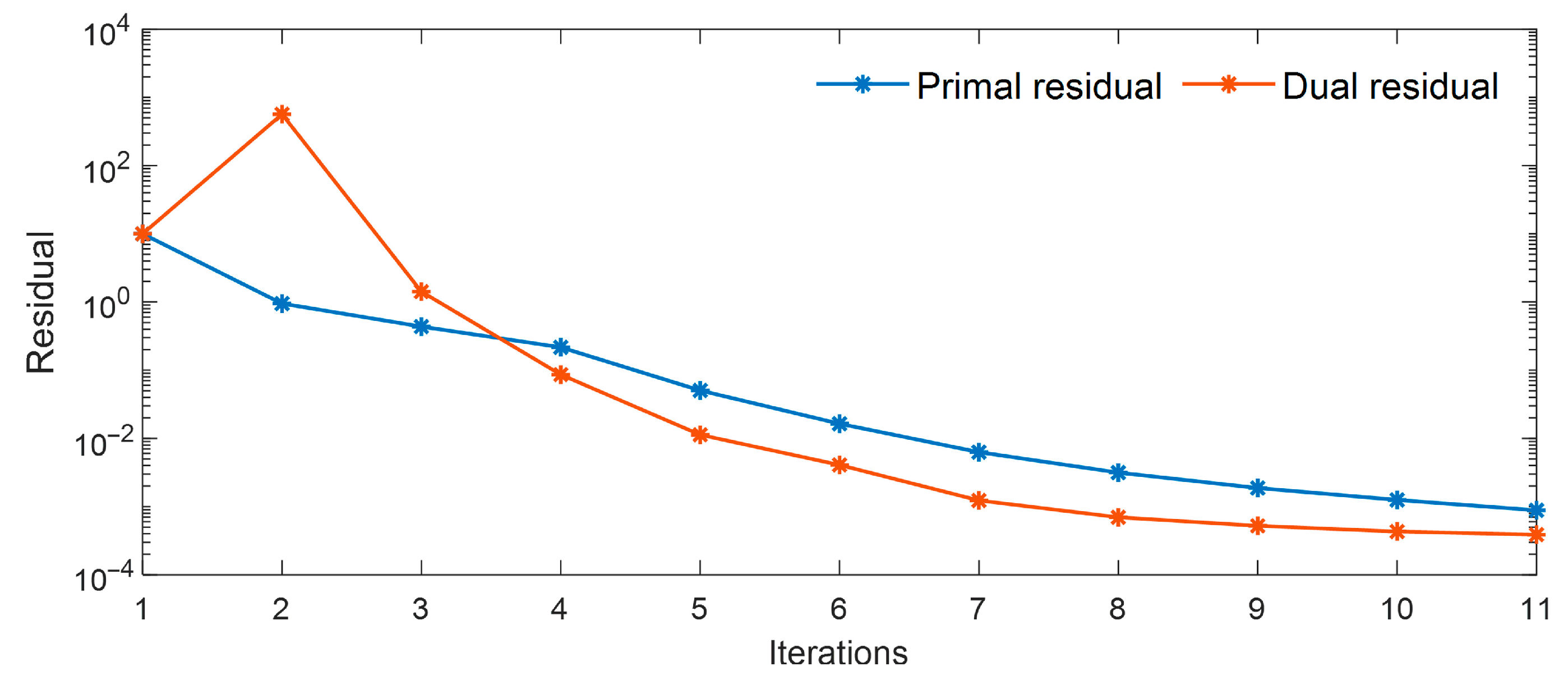
Finally, to evaluate the performance of the proposed algorithm under extreme and ill-conditioned scenarios, a modified IEEE 792-bus system was considered, in which one-eighth of all branch impedances were set to negative values. The resulting residuals and objective function values are shown in Figure 9 and Figure 10. The analysis indicates that the algorithm maintains a high degree of numerical stability and physical feasibility even under such adverse conditions. The final computed absolute error was 0.025543 p.u., and the relative error was 0.60391%, which, although higher than the residuals observed under normal system conditions, remains within an acceptable range, demonstrating the algorithm’s capability to handle non-standard impedance conditions while satisfying non-convex power flow constraints. The iteration process of photovoltaic generation showed a gradual increase from an initial value of approximately 40.73 MW to around 45.47 MW, with smooth variation and limited oscillation throughout the iterations. This indicates that the algorithm can progressively approach a stable feasible solution even under ill-conditioned system settings. Line loss iteration results exhibited a positive growth trend. Although negative values were observed initially, at −1.0977 MW, they were quickly corrected to positive values and eventually converged to approximately 3.22 MW, demonstrating the algorithm’s ability to rectify physically infeasible initial solutions induced by negative impedances and to yield reasonable system loss levels. Furthermore, the iterative evolution of both the primal and dual residuals confirmed the convergence and stability of the algorithm. The primal residual decreased rapidly from 0.9495 to 0.00088, while the dual residual dropped from 566.86 to 0.00039. Overall, the iteration process exhibited an exponential decay trend, converging quickly and smoothly without oscillation or divergence, indicating that the algorithm retains high computational efficiency even under extreme system conditions.
In summary, even in ill-conditioned systems, the algorithm can produce physically feasible photovoltaic integration schemes and reasonable line losses while maintaining low residuals and stable iterative behavior. This demonstrates the robustness and reliability of the method in handling extreme operating conditions and system uncertainties, providing strong numerical support for practical engineering applications under abnormal or faulted system states.

5. Conclusions

This paper presented an exact and scalable feasibility-restoration mechanism for active distribution networks with high PV penetration, emphasizing accurate recovery of the original nonconvex branch-flow equalities. By exploiting the QP1QC structure induced by the ADMM decomposition, the proposed spectral refinement reduces each equality-restoration step to a one-dimensional search with guaranteed interval validity and stable primal recovery, thereby avoiding the physically inconsistent operating points that may arise from relaxation-only solutions. Across the 33-, 792-, and 1137-bus tests, the proposed method reduced the summed equality mismatch from O(101–103) per-unit levels under SOCR/SDPR baselines to 2.6 × 10⁻⁴, 2.9 × 10⁻², and 3.8 × 10⁻¹ per unit, corresponding to reductions of roughly 103–105 in absolute mismatch on the smaller/medium systems and a clear improvement on the largest case. Moreover, while maintaining essentially the same optimization outcomes as an SDP-based hidden-convex benchmark, the proposed solver achieved 7.2×, 16.2×, and 8.3× speedups on the three systems, with convergence reached within 8–13 iterations. Future work will extend the framework to unbalanced three-phase and meshed networks and incorporate temporal coupling and uncertainty to support multi-period hosting-capacity assessment with flexible resources.

Author Contributions

Conceptualization, T.D. and Y.Y.; methodology, Y.Y. and M.N.; software, L.D. and X.S.; validation, Y.Y., L.D. and X.S.; formal analysis, Y.Y.; investigation, L.D. and M.N.; resources, T.D.; data curation, L.D.; writing—original draft preparation, Y.Y.; writing—review and editing, T.D.; visualization, L.D.; supervision, T.D.; project administration, T.D.; funding acquisition, T.D. All authors have read and agreed to the published version of the manuscript.

Funding

Science and Technology Project of State Grid Corporation of China: State Grid Shaanxi Electric Power Company Limited under the project “Research on Multi-Objective Coordinated Control Strategies for Distributed Photovoltaics Based on Integrated Terminals” (SGSN0000DKJS2503842).

Data Availability Statement

All data used in this article is included in the article itself. The benchmark systems used are all publicly available. A link to these systems may be provided if necessary: https://pan.baidu.com/s/1M0OhKHlIcmH7jnHSkwQMWQ?pwd=9863 (accessed on 15 December 2025). Additionally, anyone who needs data can email the author (Y.Y.) to obtain it.

Conflicts of Interest

Author L.D., M.N., and X.S. are employed by State Grid Shaanxi Electric Power Company Limited. The remaining authors declare that the research was conducted in the absence of any commercial or financial relationships that could be construed as a potential conflict of interest. This study received funding from State Grid Shaanxi Electric Power Company Limited. The funder was not involved in the study design, data collection, analysis, interpretation of data, writing of the manuscript, or the decision to publish the results.

Appendix A

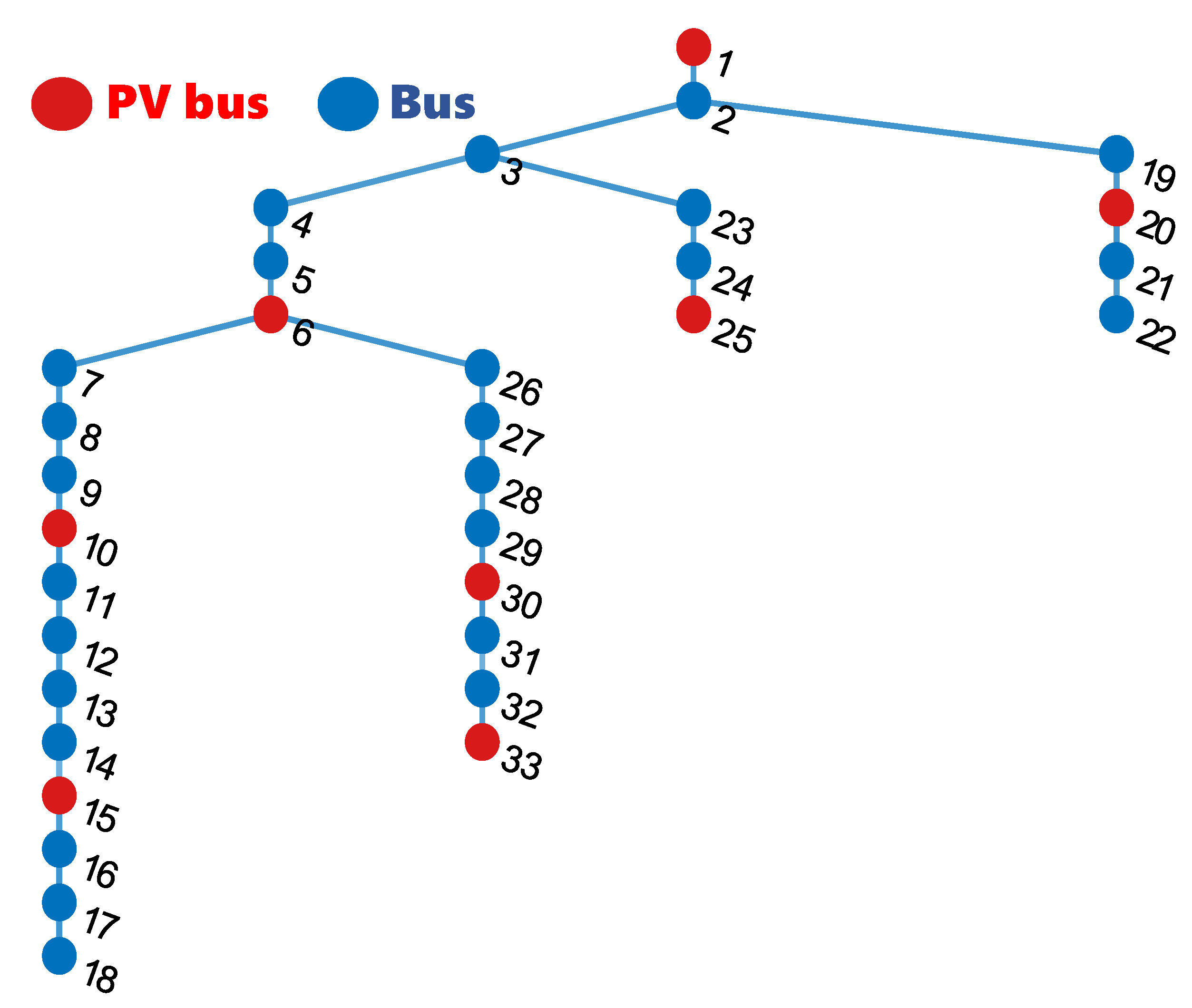
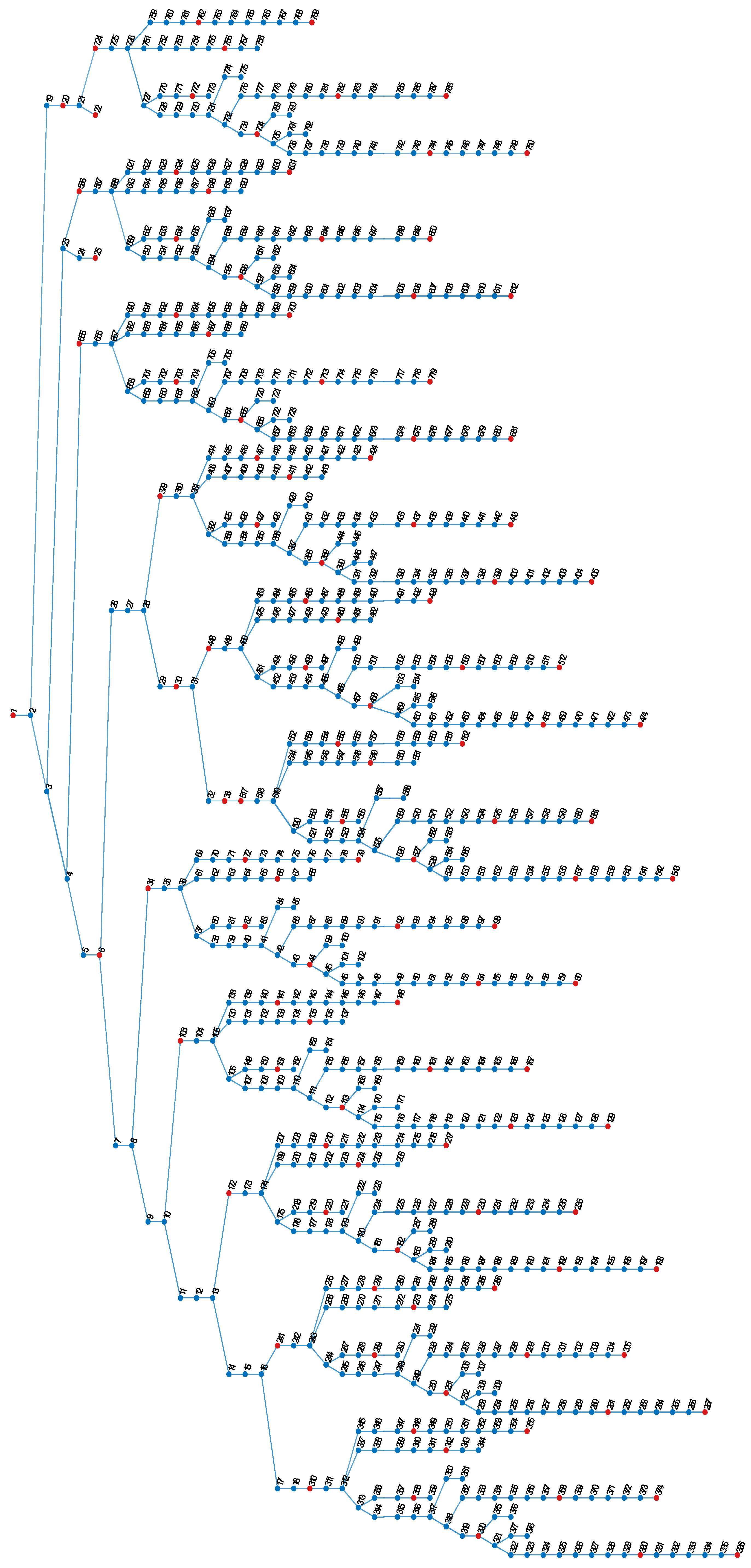
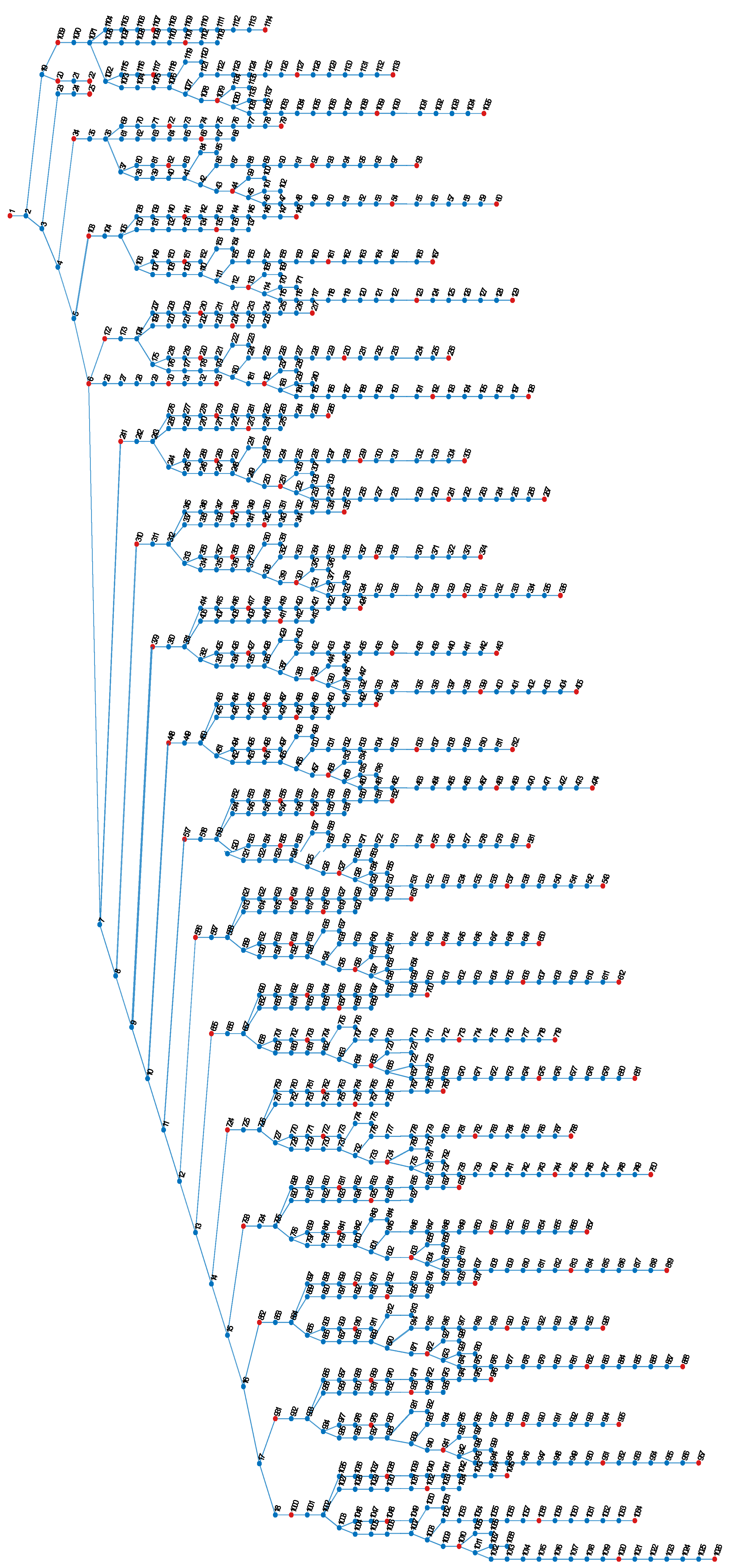
The PV unit node information for the three systems is shown in Table A1. The topology of the three systems is shown in Figure A1, Figure A2 and Figure A3.
Table A1. Buses of PV unit information.
SystemBuses of PV Unit
33-bus1,6,10,15,20,33,25,30
792-bus1,6,20,33,22,25,30,34,44,54,60,66,72,79,82,92,98,103,113,123,129,135,141,148,151,161,167,172,182,192,198,204,210,217,220,230,236,241,251,261,267,273,279,286,289,299,305,310,320,330,336,342,348,355,358,368,374,379,389,399,405,411,417,424,427,437,443,448,458,468,474,480,486,493,496,506,512,517,527,537,543,549,555,562,565,575,581,586,596,606,612,618,624,631,634,644,650,655,665,675,681,687,693,700,703,713,719,724,734,744,750,756,762,769,772,782,788
1137-bus1,6,20,33,22,25,30,34,44,54,60,66,72,79,82,92,98,103,113,123,129,135,141,148,151,161,167,172,182,192,198,204,210,217,220,230,236,241,251,261,267,273,279,286,289,299,305,310,320,330,336,342,348,355,358,368,374,379,389,399,405,411,417,424,427,437,443,448,458,468,474,480,486,493,496,506,512,517,527,537,543,549,555,562,565,575,581,586,596,606,612,618,624,631,634,644,650,655,665,675,681,687,693,700,703,713,719,724,734,744,750,756,762,769,772,782,788,793,803,813,819,825,831,838,841,851,857,862,872,882,888,894,900,907,910,920,926,931,941,951,957,963,969,976,979,989,995,1000,1010,1020,1026,1032,1038,1045,1048,1058,1064,1069,1079,1089,1095,1101,1107,1114,1117,1127,1133
Figure A1. Topology of the 33-bus system. Bus numbers are indicated beside each node; red nodes denote PV buses and blue nodes denote non-PV buses.
Energies 19 01009 g0a1
Figure A2. Topology of the 792-bus system. Bus numbers are indicated beside each node; red nodes denote PV buses and blue nodes denote non-PV buses.
Energies 19 01009 g0a2
Figure A3. Topology of the 1137-bus system. Bus numbers are indicated beside each node; red nodes denote PV buses and blue nodes denote non-PV buses.
Energies 19 01009 g0a3

References

  1. Jia, W.; Ding, T.; He, Y. Synergistic integration of green hydrogen in renewable power systems: A comprehensive review of key technologies, research landscape, and future perspectives. Renew. Sust. Energ. Rev. 2026, 226, 116375. [Google Scholar] [CrossRef]
  2. Yuan, Y.; Ding, T.; Chang, X.; Jia, W.; Xue, Y. A distributed multi-objective optimization method for scheduling of integrated electricity and hydrogen systems. Appl. Energy 2024, 355, 122287. [Google Scholar] [CrossRef]
  3. Mu, C.; Ding, T.; Yuan, Y.; Zhang, B.; Han, Z.; Shahidehpour, M. Decentralized and Private Solution for the Optimal Dispatch of Integrated Wind Farms with Shared Energy Storage Systems. IEEE Trans. Power Syst. 2025, 40, 1452–1464. [Google Scholar] [CrossRef]
  4. Jia, W.; Ding, T.; Yuan, Y.; Mu, C.; Zhang, H.; Wang, S.; He, Y.; Sun, X. Decentralized distributionally robust chance-constrained operation of integrated electricity and hydrogen transportation networks. Appl. Energy 2025, 377, 124369. [Google Scholar] [CrossRef]
  5. Farivar, M.; Low, S.H. Branch Flow Model: Relaxations and Convexification-Part I. IEEE Trans. Power Syst. 2013, 28, 2554–2564. [Google Scholar] [CrossRef]
  6. Gan, L.; Li, N.; Topcu, U.; Low, S.H. Exact Convex Relaxation of Optimal Power Flow in Radial Networks. IEEE Trans. Autom. Control 2015, 60, 72–87. [Google Scholar] [CrossRef]
  7. Lavaei, J.; Low, S.H. Zero Duality Gap in Optimal Power Flow Problem. IEEE Trans. Power Syst. 2012, 27, 92–107. [Google Scholar] [CrossRef]
  8. Antić, T.; Keane, A.; Capuder, T. Impact of phase selection on accuracy and scalability in calculating distributed energy resources hosting capacity. Sustain. Energy Grids Netw. 2024, 39, 101473. [Google Scholar] [CrossRef]
  9. Munikoti, S.; Abujubbeh, M.; Jhala, K.; Natarajan, B. Spatio-Temporal Probabilistic Voltage Sensitivity Analysis—A Novel Framework for Hosting Capacity Analysis; Cornell University Library: Ithaca, NY, USA, 2021. [Google Scholar]
  10. Kazemi-Robati, E.; Sepasian, M.S.; Hafezi, H.; Arasteh, H. PV-hosting-capacity enhancement and power-quality improvement through multiobjective reconfiguration of harmonic-polluted distribution systems. Int. J. Electr. Power Energy Syst. 2022, 140, 107972. [Google Scholar] [CrossRef]
  11. Cordero, L.; Jaramillo-Leon, B.; Leite, J.; Franco, J.; Almeida, J.; Lezama, F.; Soares, J. Probabilistic-Based Optimization for PV Hosting Capacity with Confidence Interval Restrictions; ACM: New York, NY, USA, 2023; pp. 1933–1940. [Google Scholar]
  12. Amorim Silva, C.C.; Silva, W.N.; Dias, B.H. Photovoltaic Hosting Capacity: An Approach Based on Optimal Power Flow. In Proceedings of the 2024 Workshop on Communication Networks and Power Systems (WCNPS), Brasilia, Brazil, 12–13 December 2024; pp. 1–7. [Google Scholar]
  13. Su, Z.; Yang, C.; Liu, Y.; Mu, Z. Opinions on hosting capacity evaluation of distribution network with zonotope power flexibility aggregation. Front. Energy Res. 2024, 12, 1406654. [Google Scholar] [CrossRef]
  14. Pei, Z.; Chen, J.; Zhang, Z.; Liu, W.; Yan, X.; Jin, Y. Opinions on dynamic topology reconfiguration of distribution networks for PV hosting capacity enhancement. Front. Energy Res. 2024, 12, 1512790. [Google Scholar] [CrossRef]
  15. Mahmoud, A.M.; Aleem, S.H.E.A.; Abdelaziz, A.Y.; Ezzat, M. Towards Maximizing Hosting Capacity by Optimal Planning of Active and Reactive Power Compensators and Voltage Regulators: Case Study. Sustainability 2022, 14, 13299. [Google Scholar] [CrossRef]
  16. Bingane, C.; Anjos, M.F.; Digabel, S.L. CONICOPF: Conic Relaxations for AC Optimal Power Flow Computations; Cornell University Library: Ithaca, NY, USA, 2021. [Google Scholar]
  17. Jha, R.R.; Dubey, A. Exact Distribution Optimal Power Flow (D-OPF) Model using Convex Iteration Technique. In Proceedings of the 2019 IEEE Power & Energy Society General Meeting (PESGM), Atlanta, GA, USA, 4–8 August 2019; pp. 1–5. [Google Scholar]
  18. Zhou, Y.; Wang, Q.; Huang, T.; Liao, J.; Chi, Y.; Zhou, N.; Xu, X.; Zhang, X. Convex optimal power flow based on power injection-based equations and its application in bipolar DC distribution network. Electr. Power Syst. Res. 2024, 230, 110271. [Google Scholar] [CrossRef]
  19. Narimani, M.R.; Molzahn, D.K.; Davis, K.R.; Crow, M.L. Tightening QC relaxations of AC optimal power flow through improved linear convex envelopes. IEEE Trans. Power Syst. 2025, 40, 1465–1480. [Google Scholar] [CrossRef]
  20. Sliwak, J.; Anjos, M.; Létocart, L.; Traversi, E. A Semidefinite Optimization-based Branch-and-Bound Algorithm for Several Reactive Optimal Power Flow Problems. arXiv 2021, arXiv:2103.13648. [Google Scholar]
  21. Ben-Tal, A.; Nemirovskii, A.S. Lectures on Modern Convex Optimization: Analysis, Algorithms, and Engineering Applications; Society for Industrial and Applied Mathematics: Philadelphia, PA, USA, 2001. [Google Scholar]
  22. Mallick, M.; Srikantha, P. Optimal Decentralized Microgrid Coordination via the Schur’s Complement and S-Procedure. IEEE Trans. Smart Grid 2020, 11, 379–390. [Google Scholar] [CrossRef]
  23. Yi, Z.; Xu, Y.; Zhou, J.; Wu, W.; Sun, H. Bi-Level Programming for Optimal Operation of an Active Distribution Network With Multiple Virtual Power Plants. IEEE Trans. Sustain. Energy 2020, 11, 2855–2869. [Google Scholar] [CrossRef]
  24. Yang, B.; Zhou, G.; Zhou, S.; Hu, Y.; He, B.; Guo, Z.; Luo, Z.; Li, H.; Gao, D.; Wang, J.; et al. Multi-objective optimal Bi-level scheduling of hybrid mobile-stationary energy storage systems for flexible distribution network. J. Clean. Prod. 2025, 525, 146534. [Google Scholar] [CrossRef]
  25. Gao, B.; Du, Q.; Zhan, G.; Han, J. A bi-level optimization scheme for energy storage configuration in high PV-penetrated distribution networks based on improved voltage sensitivity strategy. Energies 2025, 18, 1908. [Google Scholar] [CrossRef]
  26. Srikantha, P.; Mallick, M. Hidden Convexities in Decentralized Coordination for the Distribution Networks. IEEE Trans. Power Syst. 2020, 35, 4470–4483. [Google Scholar] [CrossRef]
  27. Taheri, B.; Molzahn, D.K. AC Power Flow Feasibility Restoration via a State Estimation-Based Post-Processing Algorithm. Electr. Power Syst. Res. 2024, 235, 110642. [Google Scholar] [CrossRef]
  28. Venzke, A.; Chatzivasileiadis, S.; Molzahn, D.K. Inexact Convex Relaxations for AC Optimal Power Flow: Towards AC Feasibility. Electr. Power Syst. Res. 2020, 187, 106480. [Google Scholar] [CrossRef]
  29. Han, J.; Wang, W.; Yang, C.; Niu, M.; Yang, C.; Yan, L.; Li, Z. FRMNet: A Feasibility Restoration Mapping Deep Neural Network for AC Optimal Power Flow. IEEE Trans. Power Syst. 2024, 39, 6566–6577. [Google Scholar] [CrossRef]
  30. Sun, K.; Sun, X.A. A Two-Level ADMM Algorithm for AC OPF With Global Convergence Guarantees. IEEE Trans. Power Syst. 2021, 36, 5271–5281. [Google Scholar] [CrossRef]
  31. Mak, T.W.K.; Chatzos, M.; Tanneau, M.; Van Hentenryck, P. Learning Regionally Decentralized AC Optimal Power Flows with ADMM. IEEE Trans. Smart Grid 2023, 14, 4863–4876. [Google Scholar] [CrossRef]
  32. Zhu, X.; Han, X.; Yang, M.; Xu, Y.; Wang, S. Distributed Online Optimal Power Flow for Distribution System. Int. J. Electr. Power Energy Syst. 2020, 120, 105970. [Google Scholar] [CrossRef]
  33. Zhang, L.; Yang, F.; Yan, D.; Qian, G.; Li, J.; Shi, X.; Xu, J.; Wei, M.; Ji, H.; Yu, H. Multi-Agent Deep Reinforcement Learning-Based Distributed Voltage Control of Flexible Distribution Networks with Soft Open Points. Energies 2024, 17, 5244. [Google Scholar] [CrossRef]
  34. Pei, Y.; Yao, Y.; Zhao, J.; Ding, F.; Wang, J. Two-Stage Deep Reinforcement Learning for Distribution System Voltage Regulation and Peak Load Management: Preprint. In Proceedings of the IEEE Power & Energy Society General Meeting (PESGM), Orlando, FL, USA, 16–20 July 2023. [Google Scholar]
  35. Zabihinia Gerdroodbari, Y.; Khorasany, M.; Razzaghi, R. Dynamic PQ Operating Envelopes for Prosumers in Distribution Networks. Appl. Energy 2022, 325, 119757. [Google Scholar] [CrossRef]
  36. Lak, P.Y.; Lim, J.-W.; Nam, S.-R. Deep Neural Network-Based Optimal Power Flow for Active Distribution Systems with High Photovoltaic Penetration. Energies 2025, 18, 4723. [Google Scholar] [CrossRef]
  37. Deihim, A.; Apostolopoulou, D.; Alonso, E. Initial Estimate of AC Optimal Power Flow with Graph Neural Networks. Electr. Power Syst. Res. 2024, 234, 110782. [Google Scholar] [CrossRef]
  38. Qammar, N.; Arshad, A.; Miller, R.J.; Mahmoud, K.; Lehtonen, M. Machine Learning Based Hosting Capacity Determination Methodology for Low Voltage Distribution Networks. IET Gener. Transm. Distrib. 2024, 18, 911–920. [Google Scholar] [CrossRef]
  39. Constante, F.S.G.; Lopez, J.C.; Rider, M.J. Optimal Reactive Power Dispatch With Discrete Controllers Using a Branch-and-Bound Algorithm: A Semidefinite Relaxation Approach. IEEE Trans. Power Syst. 2021, 36, 4539–4550. [Google Scholar] [CrossRef]
  40. Wang, P.; Wu, Q.; Huang, S.; Li, C.; Zhou, B. ADMM-based Distributed Active and Reactive Power Control for Regional AC Power Grid with Wind Farms. J. Mod. Power Syst. Cle. 2022, 10, 588–596. [Google Scholar] [CrossRef]
  41. Petrou, K.; Procopiou, A.T.; Gutierrez-Lagos, L.; Liu, M.Z.; Ochoa, L.F.; Langstaff, T.; Theunissen, J.M. Ensuring Distribution Network Integrity Using Dynamic Operating Limits for Prosumers. IEEE Trans. Smart Grid 2021, 12, 3877–3888. [Google Scholar] [CrossRef]
  42. Ai, Y.; Henan, P.U. The Optimization of Reactive Power for Distribution Network With PV Generation Based on NSGA-III. CPSS Trans. Power Electron. Appl. 2021, 6, 193–200. [Google Scholar] [CrossRef]
  43. Ibrahim, T.; Rubira, T.T.D.; Rosso, A.D.; Patel, M.; Guggilam, S.; Mohamed, A.A. Alternating Optimization Approach for Voltage-Secure Multi-Period Optimal Reactive Power Dispatch. IEEE Trans. Power Syst. 2022, 37, 3805–3816. [Google Scholar] [CrossRef]
  44. Chowdhury, M.M.; Hasan, M.S.; Kamalasadan, S. A Second-Order Cone Programming (SOCP) Based Co-Optimization Approach for Integrated Transmission-Distribution Optimal Power Flow. IEEE Trans. Ind. Appl. 2025, 61, 3563–3572. [Google Scholar] [CrossRef]
  45. Liu, L.; Shi, N.; Wang, Z.; Reno, M.J.; Azzolini, J.A. Probabilistic Estimation of PV Hosting Capacity in DER-Rich Feeders Using Smart Meter Data. IEEE Trans. Smart Grid 2025, 16, 4293–4296. [Google Scholar] [CrossRef]
  46. Mohamadi, N.; Dong, M.; ShahbazPanahi, S. Low-Complexity ADMM-Based Algorithm for Robust Multi-Group Multicast Beamforming in Large-Scale Systems. IEEE Trans. Signal Process. 2022, 70, 2046–2061. [Google Scholar] [CrossRef]
  47. Gonzalez Zerbo, S.; Maestripieri, A.; Martínez Pería, F. Quadratic programming with one quadratic constraint in Hilbert spaces: QP1QC in Hilbert spaces. Ann. Funct. Anal. 2025, 16, 31. [Google Scholar] [CrossRef]
  48. Boyd, S.P.; Vandenberghe, L. Convex Optimization; Cambridge University Press: Cambridge, UK; New York, NY, USA, 2004. [Google Scholar]
  49. Chen, Z.; Chen, Y.; Wang, Y.; Zhang, H.; Wang, Y.; Bai, R.; Du, Z.; Liang, Y.; Liu, F.; Xie, H.; et al. An Adaptive Time-Stepping Finite Element Method with Schur-Complement Preconditioning for Surge Simulation of Magnetic Components. IEEE J. Multiscale Multiphysics Comput. Tech. 2025, 10, 421–432. [Google Scholar] [CrossRef]
  50. Zhang, F. (Ed.) The Schur Complement and Its Applications; Springer: New York, NY, USA, 2005. [Google Scholar]
  51. Ben-Israel, A.; Greville, T.N.E.; SpringerLink, O.S. Generalized Inverses: Theory and Applications; Springer: New York, NY, USA, 2003. [Google Scholar]
  52. Ling, C.; Qi, L.; Yan, H. Minimax Principle for Eigenvalues of Dual Quaternion Hermitian Matrices and Generalized Inverses of Dual Quaternion Matrices. Numer. Func. Anal. Opt. 2023, 44, 1371–1394. [Google Scholar] [CrossRef]
  53. Golub, G.H.; Van Loan, C.F. Matrix Computations, 4th ed.; Johns Hopkins University Press: Baltimore, MD, USA, 2013. [Google Scholar]
  54. Nguyen, V.-B.; Ngan Nguyen, T. Positive semidefinite interval of matrix pencil and its applications to the generalized trust region subproblems. Linear Algebra. Appl. 2024, 680, 371–390. [Google Scholar] [CrossRef]
  55. Zimmerman, R.D.; Murillo-Sánchez, C.E.; Thomas, R.J. MATPOWER: Steady-State Operations, Planning, and Analysis Tools for Power Systems Research and Education. IEEE Trans. Power Syst. 2011, 26, 12–19. [Google Scholar] [CrossRef]
  56. Yuan, Y.; Ding, T.; Mu, C.; Zhang, X.; Ding, Y.; Fu, G.; Shahidehpour, M. Eigenvalue-Based Hidden Convexity Algorithm for Radial Distribution Network Optimization with Non-convex Power Flow Equations. IEEE Trans. Power Syst. 2025. [Google Scholar] [CrossRef]
Figure 1. The proposed two-layer coordinated framework.
Energies 19 01009 g001
Figure 2. Voltage results optimized using different methods.
Energies 19 01009 g002
Figure 3. Power flow and PV output results optimized using different methods: (a) results obtained by the SOCR method; (b) results obtained by the SDR method; and (c) results obtained by the ESR-QP1QC method.
Energies 19 01009 g003
Figure 4. Absolute errors of the power flow equality constraints for the 33-bus system under three different methods: (a) M3 method; (b) M1 method; and (c) M2 method.
Energies 19 01009 g004
Figure 5. Absolute errors of the power flow equality constraints for the 792-bus system under three different methods: (a) M3 method; (b) M1 method; and (c) M2 method.
Energies 19 01009 g005
Figure 6. Absolute errors of the power flow equality constraints for the 1137-bus system under three different methods: (a) M3 method; (b) M1 method; and (c) M2 method.
Energies 19 01009 g006
Figure 7. Convergence behavior of primal and dual residuals for different systems: (a) 33-bus system; (b) 792-bus system; and (c) 1137-bus system.
Energies 19 01009 g007
Figure 8. Iterative evolution of PV power and power loss for different test systems: (a) 33-bus system; (b) 792-bus system; and (c) 1137-bus system.
Energies 19 01009 g008
Figure 9. Iterative results of the objective function value for the ill-conditioned system.
Energies 19 01009 g009
Figure 10. Residual iteration results for ill-conditioned systems.
Energies 19 01009 g010
Table 1. Comparison with recent state-of-the-art works.
Ref.Main TargetTypical MethodologyMain Takeaway vs. this Work
[30]Large-scale AC OPF with distributed computationTwo-level ADMM-type distributed algorithmStrong on distributed OPF, but not an equality-restoration engine tailored to branch-flow feasibility recovery
[37]Data-driven OPF initialization/approximationGraph neural networksUseful for acceleration, but still needs a principled feasibility recovery step for strict physics compliance
[38]Hosting-capacity determination via MLData-driven hosting capacity assessmentStrong for fast screening, but not intended for certifiable equality satisfaction in feasibility-critical studies
[39]OPF with discrete controllers SDR+ branch-and-boundProvides a relaxation-based global/near-global strategy, but feasibility of original equalities may still require refinement depending on tightness
[40]Feasibility recovery from relaxed/approximate/ML OPF outputsState-estimation-inspired post-processingEffective correction, but not exploiting the QP1QC spectral structure for an exact low-dimensional refinement within a bi-level dispatch loop
[41]DNO-side network integrity under prosumer behaviorDynamic operating limits (DOL/DOE)Ensures operational integrity without directly controlling DERs, but does not address exact restoration of branch-flow equalities in OPF/hosting formulations
This workEconomic operation + feasibility recovery under high PVExisting two-layer coordinated framework ADMM coordination + ESR-QP1QCTargets the missing piece: an efficient, exact equality-restoration engine integrated into the iterative coordination framework
Table 2. Nomenclature of important variables and parameters.
SymbolDescriptionUnit
i, jBus indices; (i,j) denotes a branch from bus i to bus j
SnSet of buses
SlSet of branches/lines
SPVSet of PV buses (candidate/installed PV locations)
p i PV ,   q i PV PV active/reactive injection at bus iMW/MVAr
p i load ,   q i load Active/reactive demand at bus iMW/MVAr
P(i,j), Q(i,j)Branch active/reactive power flow on line (i,j)MW/MVAr
viSquared voltage magnitude at bus i
l(i,j)Squared current magnitude on line (i,j)
r(i,j),x(i,j)Resistance/reactance of line (i,j)p.u. (or Ω)
v i min ,   v i max Lower/upper bounds of squared voltage magnitude
l ( i , j ) max Upper bound of squared current magnitude
kADMM iteration index
ρADMM penalty parameter in the augmented Lagrange
λLagrange multiplier vector for the consensus constraint
oi, diOriginal and duplicated variable vectors in ADMM splitting
Mo, MdSelection/aggregation matrices in consensus constraint
A0, b0, c0Coefficients of the quadratic objective in the QP1QC subproblem
A1, b1, c1Coefficients of the single quadratic constraint in QP1QC
νScalar parameter used in the exact SDP characterization/interval refinement
ΦFeasible interval of ν determined by generalized-eigenvalue breakpoints
SPBranch active power (used for visualization of loading)MW
A.E.Absolute errors mismatch used for evaluationp.u.
R.E.Relative errors mismatch used for evaluation %
Table 3. Overall Algorithmic Workflow with ESR-QP1QC Refinement.
StepDescription
Step 1Initialization. Iteration index k = 0, penalty ρ, primal/dual tolerances, consensus variables, multipliers and other algorithmic parameters.
Step 2Upper-Level Variable Update. Solve the SOCP subproblem SP1 in (21) using current coordination variables and multipliers to update the upper-level decision vector, where all convexifiable constraints are retained, and obtain the updated upper-level variables and the variables required by SP2.
Step 3Form SP2 for each bus i: Construct the local QP1QC subproblem using the updated coordination signals. Write SP2 in the canonical form with objective coefficients (A0, b0, c0) and single quadratic-constraint coefficients (A1, b1, c1).
Step 4Exact SDP reformulation: For each bus i, transform the QP1QC SP2 into its exact SDP as given in (30)–(33), introducing γi and the scalar dual υi ≥ 0 variable.
Step 5 Spectral   feasibility   interval   for   υ i :   Exploit   the   affine   dependence   on   υ i .   Define   the   parameterized   symmetric   matrix   S i ( υ i ) .   Determine   the   feasible   set   D i in (48), which forms a closed interval. Compute its endpoints via generalized-eigenvalue breakpoints implied by the pencil structure (A0, A1).
Step 6 One - Dimensional   Optimization .   Over   the   feasible   interval   D i ,   solve   the   one - dimensional   optimization   problem   in   ( 42 ) ,   and   obtain   theoptimal   υ i * and   the   corresponding   optimal   SDP   value   γ i * .
Step 7 Primal   Solution   Recovery .   Substitute   υ i * into   the   FOC   of   SP 2   to   recover   the   unique   primal   solution   x i * ( and   hence   d i * , since xi = di).
Step 8Coordination Variable Update. Update consensus variables and Lagrange multipliers via SP3 in (23), and calculating the new primal and dual residuals. Output: Updated multipliers and coordination variables for the next iteration.
Step 9Convergence Check. Evaluate primal and dual residuals at iteration k + 1 and compare with thresholds. If satisfied, terminate; else set kk + 1 and return to Step 2.
Table 4. System errors under different methods.
SystemMethodsA.E. (p.u.)R.E. (%)
33-busM114.1648107.44
M226.986982.45
M30.000257710.004045
792-busM1474.126593.78
M2527.386597.83
M30.0290330.67113
1137-busM1683.923496.15
M2655.271098.37
M30.382936.4067
Table 5. System optimization results.
SystemMethodsPV Power (MW)Power Loss (MW)
33-busM120.07328.5754
M217.148411.7259
M312.9371.4392
792-busM1246.7415200.2088
M2232.3157190.4890
M347.41135.4614
1137-busM1295.3752229.8320
M2279.7493218.9121
M364.45223.2241
Table 6. Performance comparison analysis results for M3 and M4 algorithms.
SystemMethodsPV Power (MW)Power Loss (MW)A.E. (p.u.)R.E. (%)IterationsTimes (s)
33-busM312.93701.43920.000257710.004045132.571346
M412.93671.43895.77 × 10−50.000907121318.588179
792-busM347.41135.46140.0290330.67113820.900997
M447.30385.43760.0354120.824628339.193804
1137-busM364.45223.22410.382936.4067853.147846
M464.45183.22410.383166.40838439.502752
Table 7. The algorithm sensitivity analysis results.
ρ1101001000
Iteration31461335
A.E. (p.u.)0.000226392.1102 × 10−50.000257710.00056777
R.E. (%)0.0022580.000303090.0040450.0090518
PV power (MW)14.11813.121512.93712.9041
Power loss (MW)2.62021.62371.43921.4063
Convergence threshold10−110−210−310−4
Iteration56913
A.E. (p.u.)0.0090510.000209030.000984790.00025771
R.E. (%)0.141930.00328040.0154540.004045
PV power (MW)12.938512.937212.937612.937
Power loss (MW)1.44071.43941.43981.4392
Load level (Times)0.51.01.52.0
Iteration13131210
A.E. (p.u.)0.000431170.0040450.000158840.0013255
R.E. (%)0.00692140.000257710.00223380.013861
PV power (MW)10.172912.93715.864819.263
Power loss (MW)1.38641.43921.65582.3427
Table 8. The system constraints sensitivity analysis results.
v Range0.90–1.100.92–1.080.95–1.050.99–1.01
Iteration13131313
A.E. (p.u.)0.000257710.00242020.00418240.00060457
R.E. (%)0.0040450.0379660.0656270.0094882
PV power (MW)12.93712.938212.937312.9372
Power loss (MW)1.43921.44041.43951.4393
l(i,j) range00.50101.502.0
Iteration12131212
A.E. (p.u.)7.7322 × 10−50.000257710.000128130.0018309
R.E. (%)0.00216570.0040450.00129360.012528
PV power (MW)10.574812.93715.075417.309
Power loss (MW)0.847441.43922.22413.32
Disclaimer/Publisher’s Note: The statements, opinions and data contained in all publications are solely those of the individual author(s) and contributor(s) and not of MDPI and/or the editor(s). MDPI and/or the editor(s) disclaim responsibility for any injury to people or property resulting from any ideas, methods, instructions or products referred to in the content.