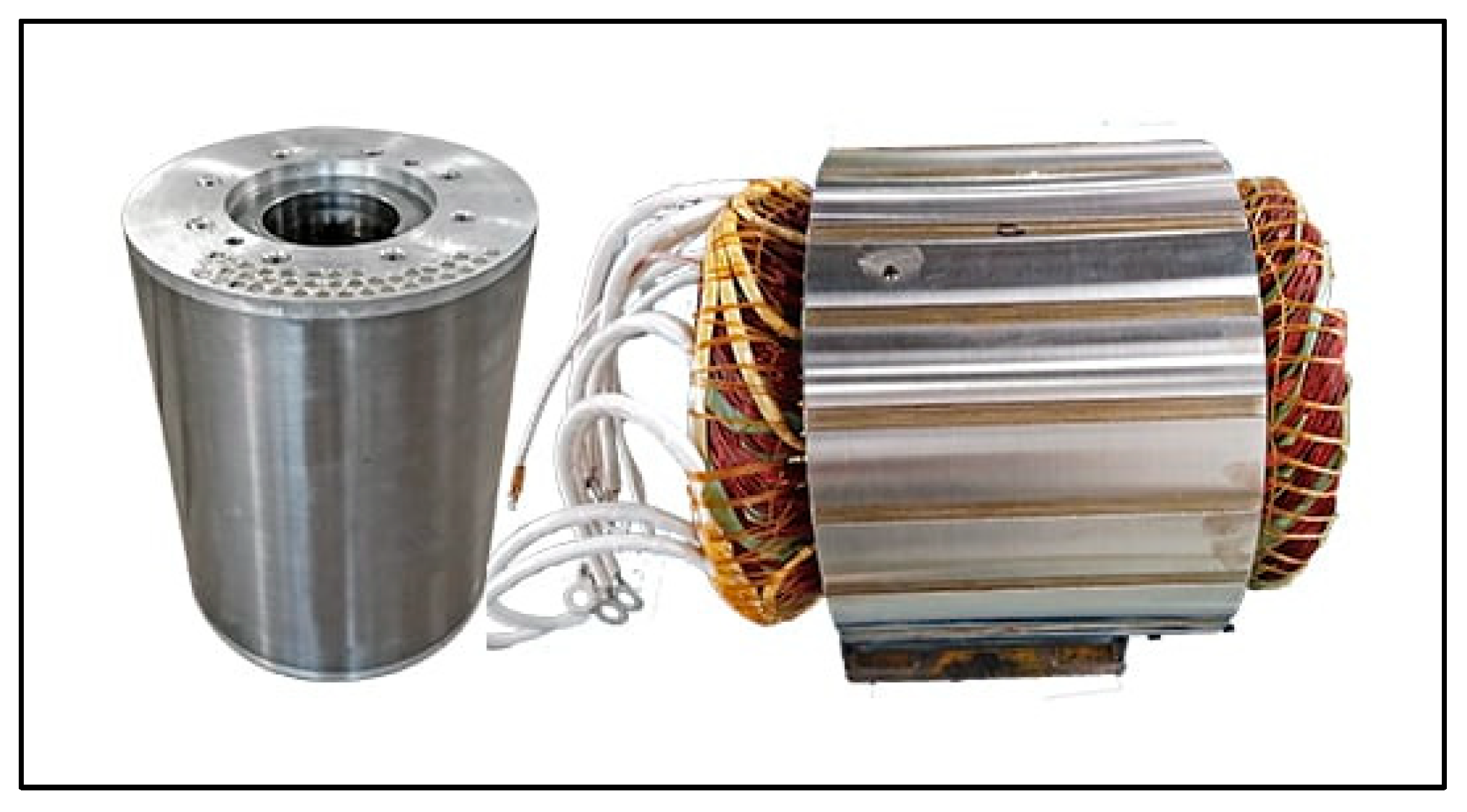
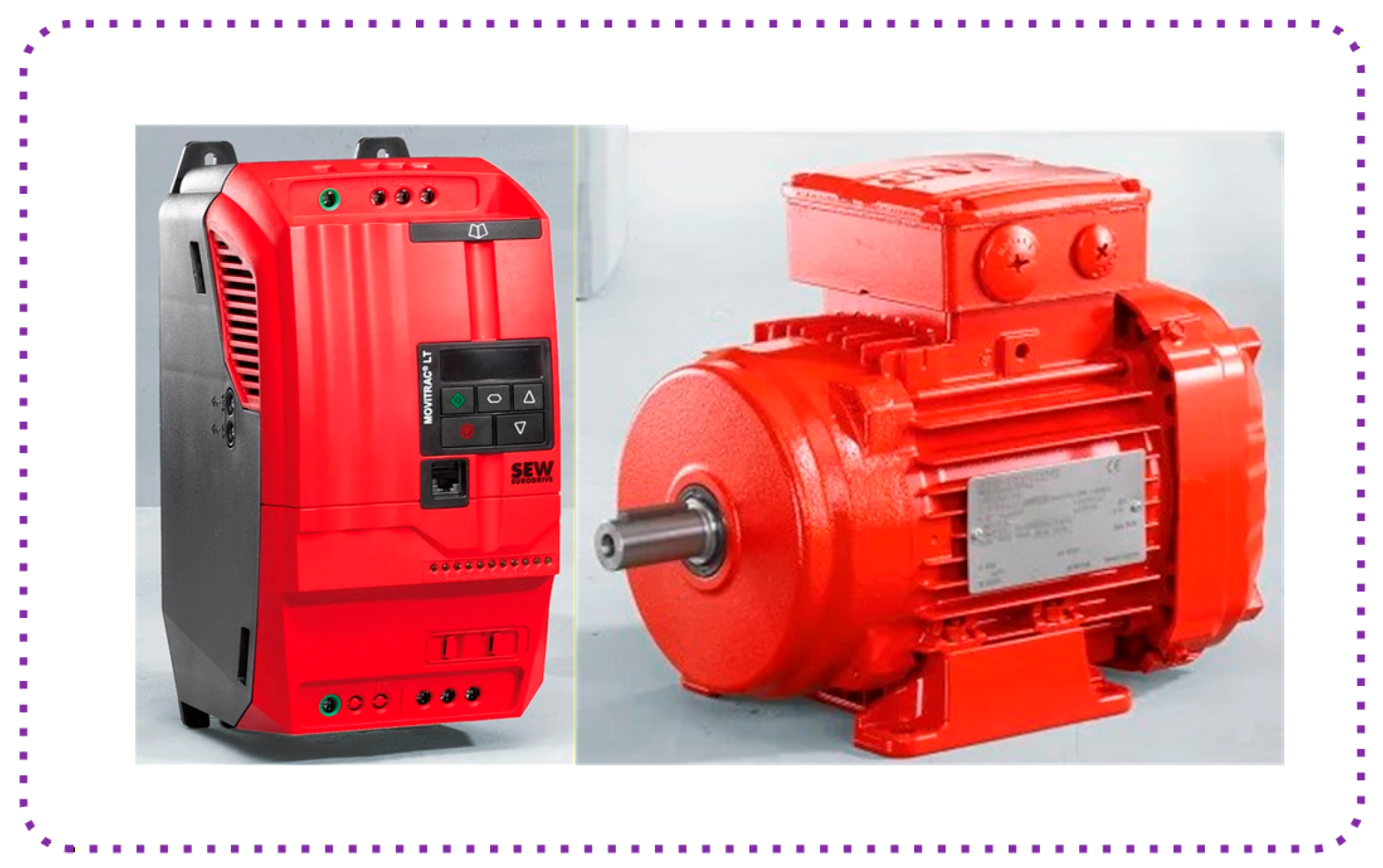
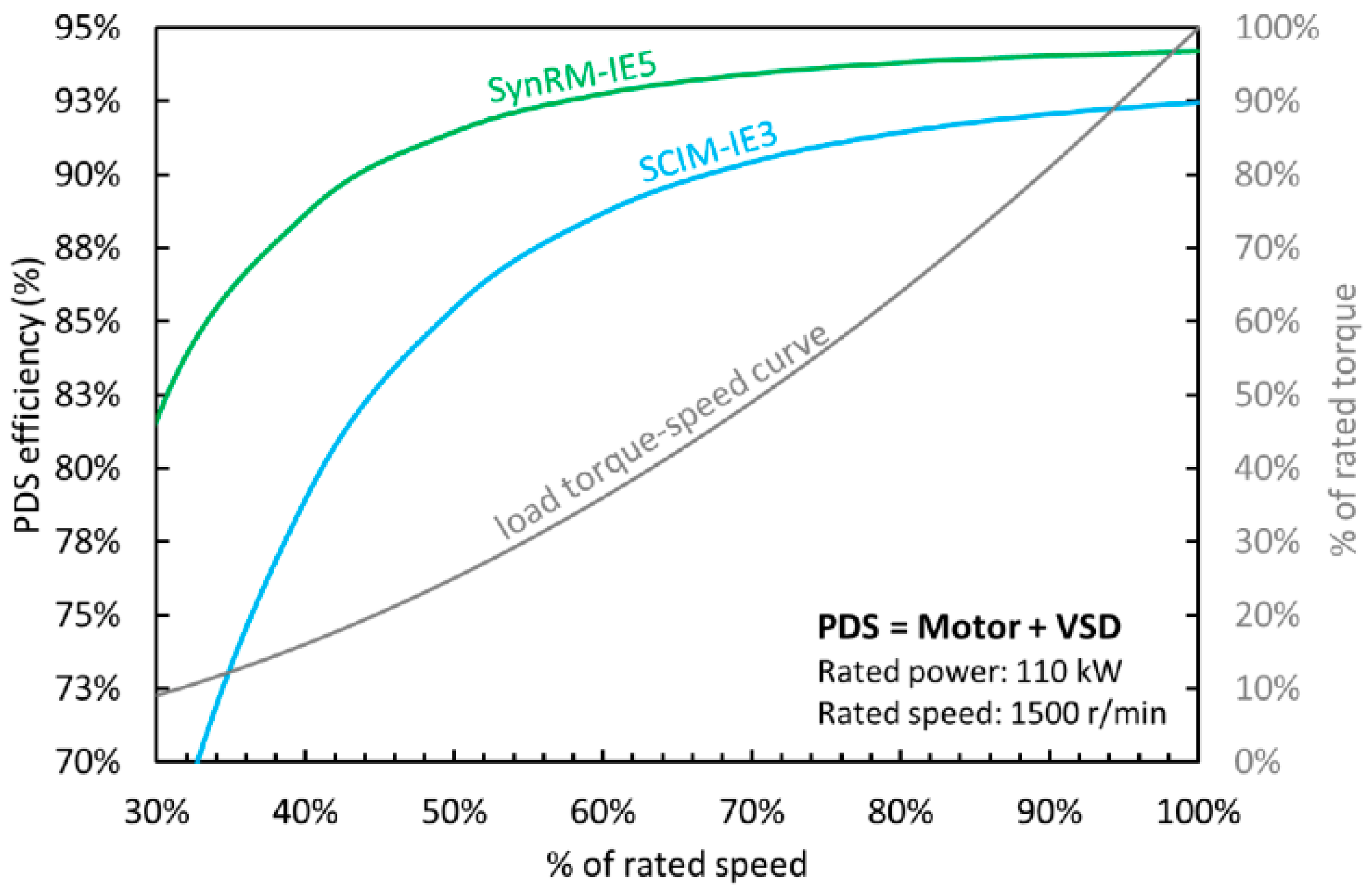
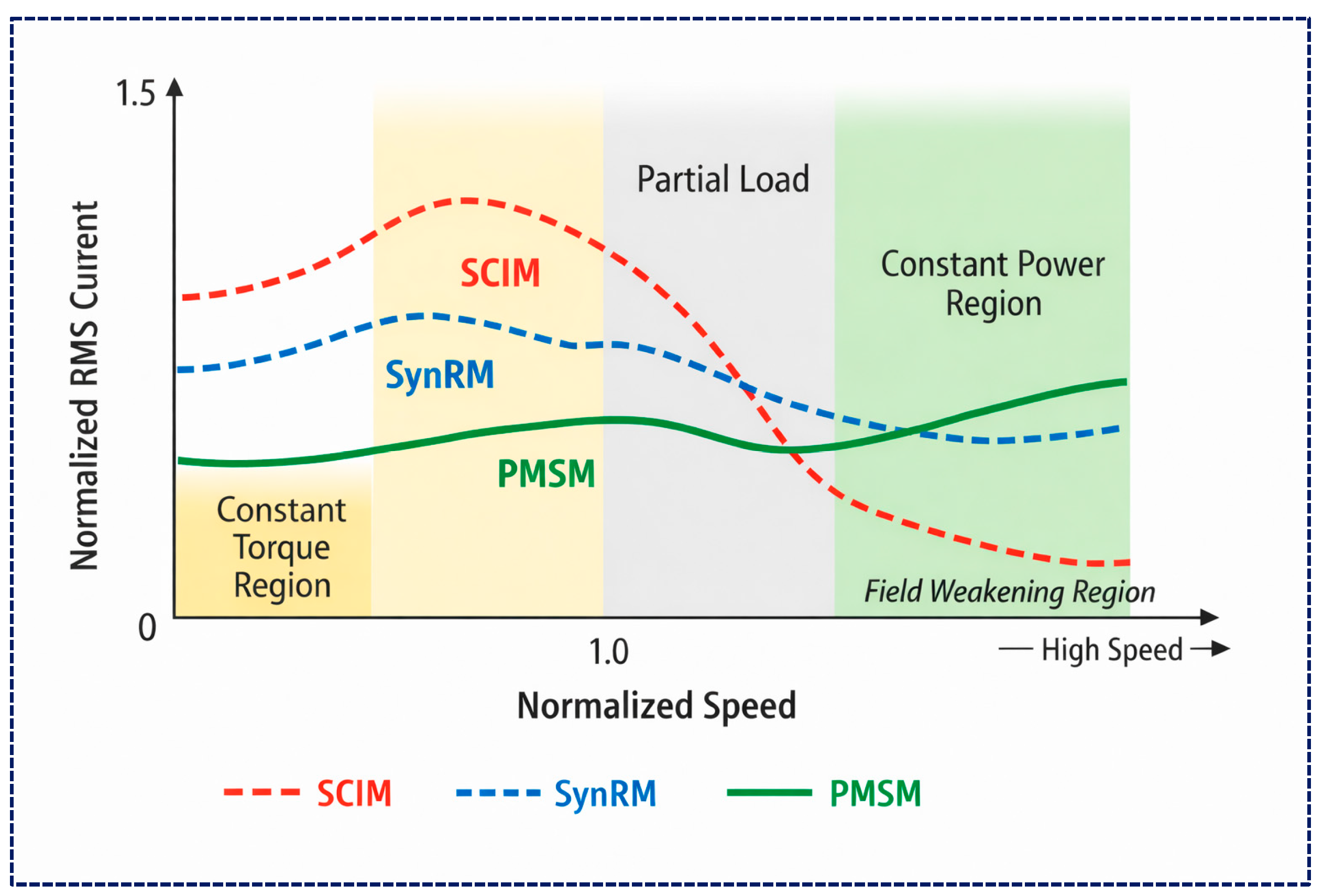
1. Introduction
Electric motors constitute a cornerstone of contemporary industrial, commercial, and residential energy infrastructures, representing nearly 45% of global electricity consumption. Their widespread application across diverse sectors—including manufacturing, transportation, and building services—underscores their critical role in facilitating mechanical energy conversion and automation processes [
1,
2]. As global industrialization intensifies alongside rising energy demand, the imperative for advancing motor efficiency has emerged as a pivotal challenge to enhance both economic and environmental outcomes. High-efficiency motor technologies provide a strategic and technically feasible solution to substantially curtail electrical energy consumption [
3]. These motors achieve superior performance by mitigating core losses, such as stator and rotor copper losses, iron losses attributable to magnetic hysteresis and eddy currents, mechanical frictional losses, and stray load losses, through the deployment of advanced magnetic materials, optimized electromagnetic topologies, and precision manufacturing methodologies. By elevating the electrical-to-mechanical energy conversion efficiency, high-efficiency motors directly contribute to reducing energy demand and improving system-level sustainability [
4,
5,
6,
7,
8]. The adoption of high-efficiency motors yields pronounced economic advantages, especially in industrial contexts characterized by continuous or heavy-load operation cycles. The attendant reductions in electrical energy consumption translate into significant operational cost savings, bolstering industrial competitiveness and profitability. Concurrently, decreased electricity consumption correlates with reduced carbon emissions, thereby aligning motor technology deployment with global decarbonization targets and stringent regulatory frameworks such as the European Union’s Ecodesign Directive and the U.S. Department of Energy’s energy conservation standards [
9,
10,
11]. In addition to energy and environmental benefits, high-efficiency motors demonstrate enhanced reliability, decreased maintenance requirements, and prolonged operational lifespans. These improvements derive from advanced thermal management techniques, reduced mechanical and electromagnetic stresses, and stringent quality controls inherent in their design and manufacturing [
12,
13]. Integration with variable frequency drives (VFDs) and digital control systems further optimizes motor operation by enabling dynamic speed and torque adjustment in response to variable load conditions, thus amplifying overall system efficiency. The convergence of high-efficiency motor technologies with Industry 4.0 innovations, such as digital twin modeling, real-time condition monitoring, and predictive maintenance facilitated by the Internet of Things (IoT) and artificial intelligence (AI), presents transformative opportunities for energy optimization and asset management [
14,
15,
16,
17,
18]. These developments empower proactive fault detection, adaptive control, and lifecycle extension, positioning high-efficiency motors as a cornerstone of intelligent and sustainable industrial systems [
19,
20].
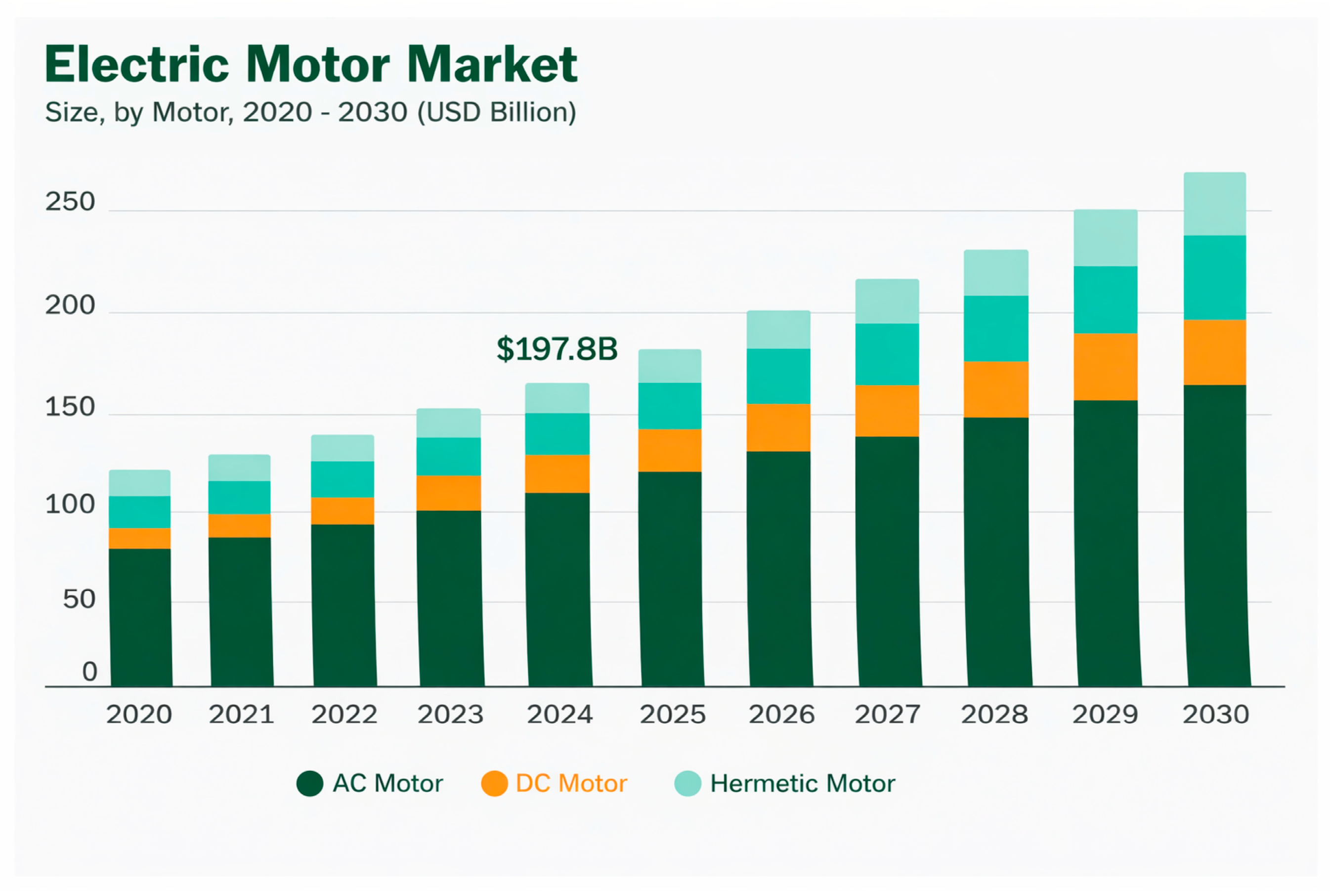
Figure 1 projects a continuous increase in the global electric motor market from 2020 to 2030, indicating sustained growth over the decade. The highlighted value of approximately USD 197.8 billion around the middle of the forecast horizon provides a reference point for the scale of the market during this expansion. The market structure remains dominated by AC motors across all years, implying that demand from core industrial drive systems and infrastructure applications continues to account for the majority of market value. In contrast, DC motors represent a smaller share but show a gradual rise over time, suggesting strengthening demand in applications that require higher controllability and closer integration with power electronic conversion and digital control. Hermetic motors remain the least represented category; however, their contribution increases modestly, consistent with steady demand in sealed-motor applications such as refrigeration and heating, ventilation, and air-conditioning systems. Overall, this indicates that projected market growth is primarily driven by the expansion of AC motor deployments, with DC and hermetic motor segments providing incremental contributions to the upward trend [
21].
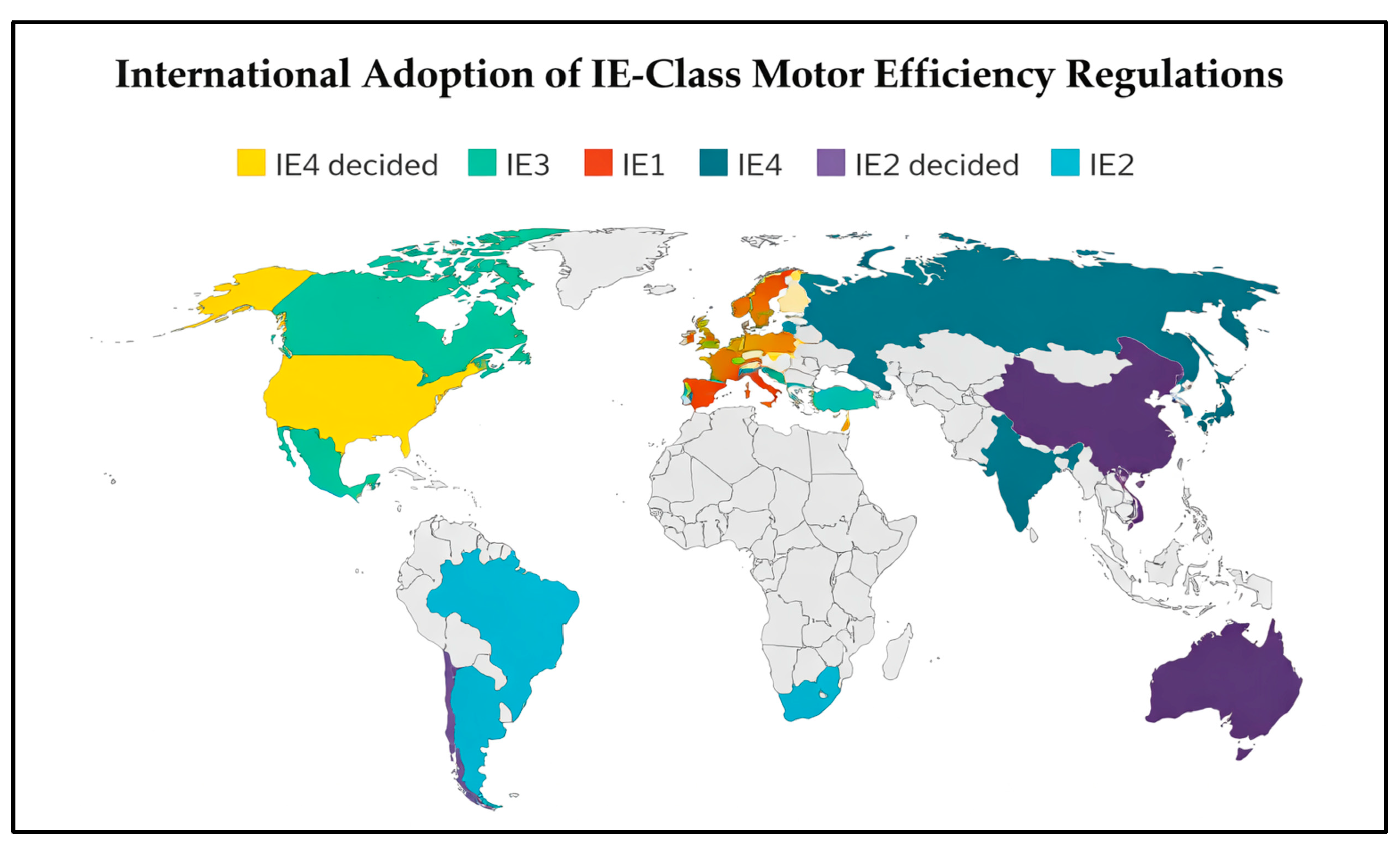
Figure 2 demonstrates a global implementation of minimum efficiency performance standards (MEPS) for electric motors which is structured around the International Efficiency (IE) classification system defined in IEC 60034–30–1 [
23]. Over recent decades, regulatory frameworks have evolved from permitting IE1 (standard efficiency) and IE2 (high efficiency) motors toward mandating IE3 (premium efficiency) as the minimum standard across most industrialized regions. The European Union, North America, China, Japan, and South Korea have already established IE3 as a baseline requirement, with a growing policy emphasis on transitioning to IE4 (super-premium efficiency) for broader motor ranges. In contrast, several emerging economies in Latin America, Southeast Asia, and Africa continue to implement IE2 or are in the early stages of adopting IE3, reflecting disparities in market readiness and regulatory enforcement capacity. Collectively, these developments demonstrate a global convergence toward IE3 as the prevailing benchmark, while simultaneously indicating a forward trajectory toward the adoption of IE4 and the emerging promotion of IE5 (ultra-premium efficiency) technologies, aligning with long-term objectives of enhancing energy efficiency and reducing greenhouse gas emissions in motor-driven systems [
23].
The integration of high-efficiency motor technologies, specifically those classified under the International Efficiency (IE) standards such as IE3, IE4, and the emerging IE5 motors, with Industry 4.0 advancements represents a transformative development in industrial energy management and asset optimization. IE motors are rigorously categorized based on their efficiency levels, with IE3 representing premium efficiency, IE4 denoting super-premium efficiency, and IE5, also known as ultra-premium efficiency, pushing the boundaries of energy savings through advanced design and materials. These motors typically employ state-of-the-art technologies, including permanent magnet synchronous motors (PMSMs), synchronous reluctance motors (SynRMs), and sophisticated power electronics, to achieve superior performance metrics compared to conventional induction motors [
24,
25]. Digital twin modeling, a key Industry 4.0 technology, creates precise virtual replicas of these IE motor systems, enabling comprehensive real-time simulation and performance evaluation under varying operational conditions. By continuously acquiring sensor data such as temperature, vibration, current, voltage, and rotational speed through IoT-enabled infrastructures, digital twins dynamically update to reflect motor health and operational status. This capability is particularly critical for IE5 motors, which, due to their complex design and advanced materials, require detailed monitoring to maintain optimal performance and prevent degradation. Real-time condition monitoring systems integrated with IE motors utilize high-resolution sensor arrays combined with edge computing to process large datasets locally, allowing for rapid fault detection and diagnosis [
26,
27]. Advanced machine learning and artificial intelligence algorithms, including neural networks, support vector machines, and ensemble methods, predict faults such as magnet demagnetization, bearing wear, and insulation breakdown. This predictive maintenance paradigm shifts industries from traditional time-based maintenance to condition-based approaches, significantly reducing downtime and maintenance costs while enhancing reliability [
28,
29]. Adaptive motor control strategies enabled by Industry 4.0 technologies facilitate dynamic optimization of IE motor operation. Variable frequency drives (VFDs) embedded with advanced control algorithms such as field-oriented control (FOC) and direct torque control (DTC) precisely regulate voltage, frequency, and torque to sustain peak efficiency across fluctuating load demands. These controls are essential for the sophisticated IE5 motors, which demand minimal energy loss and thermal stress management to maximize lifecycle and performance [
30]. Moreover, IE motors, integrated within smart grid and microgrid systems, contribute significantly to grid resilience and energy optimization. Through standardized communication protocols like IEC 61850 and Modbus TCP/IP, IE motors participate actively in demand response programs, coordinating with distributed energy resources such as photovoltaic systems and battery storage. This integration supports ancillary grid services, including load balancing, peak shaving, and frequency regulation, further aligning with global decarbonization initiatives [
31]. From a sustainability standpoint, IE motors combined with Industry 4.0 technologies enable compliance with stringent energy efficiency regulations and environmental standards. Enhanced power factor correction, reduced inrush current, and superior thermal management reduce energy consumption and greenhouse gas emissions. The extensive operational data collected facilitates lifecycle assessment, design improvements, and supports circular economy principles through maintenance optimization, refurbishment, and responsible end-of-life management. The convergence of IE motor technologies with Industry 5.0’s human-centric automation emphasizes collaboration between intelligent systems and skilled operators. Integrating real-time analytics with augmented reality (AR) and sophisticated human–machine interfaces (HMIs) provides maintenance teams with actionable insights for faster fault diagnosis and repair, promoting safer, more efficient, and sustainable industrial environments. This holistic approach ensures IE motors remain at the forefront of driving energy-efficient and resilient manufacturing ecosystems. The system provides a universal benchmark enabling manufacturers, end-users, and policymakers to assess, compare, and mandate motor efficiency levels with the objective of optimizing energy consumption in industrial and commercial sectors globally [
31].
1.1. Classification and Efficiency Levels
The industrial sector is a major consumer of electricity, reflecting the breadth of electrically powered processes used in manufacturing and related activities. Electricity is required not only for thermal applications and lighting, but most prominently for motor-driven services, including pumping and fan systems for fluid transport, processing and conveying materials, compressed air generation, refrigeration, and auxiliary boiler operations [
31,
32]. In 2021, motor systems were estimated to account for roughly 70% of industrial electricity consumption [
33,
34]. Consequently, improving the efficiency of electric motor-driven systems is a central pathway for reducing industrial electricity use [
35]. In addition to strengthening industrial cost competitiveness, efficiency improvements can lessen stress on power systems by reducing peak and total demand, thereby freeing grid capacity and potentially deferring investments in new capital intensive and long lead time infrastructure [
35,
36,
37,
38].
Since the early 1990s, many jurisdictions have introduced regulatory instruments that define minimum acceptable energy efficiency levels for energy using equipment, commonly referred to as Minimum Energy Performance Standards (MEPS) [
39,
40]. MEPS are designed to raise the minimum efficiency of products entering the market and to support purchasing decisions by making higher-efficiency options easier to identify and adopt, even when they involve higher upfront expenditure [
41,
42].
For electric motors, MEPS are typically implemented through efficiency classes that establish graded performance tiers and can be tightened over time as technologies mature and market penetration increases. At the international level, motor efficiency classification is largely harmonized through the International Efficiency or IE scheme defined in IEC 60034-3-1 and IEC 60034-30-2 [
23], which facilitates cross-country comparability and is widely treated as a global reference framework [
23]. The IEC scheme currently specifies classes from IE1 to IE4, with IE1 representing the lowest efficiency level and IE4 the highest standardized level [
43]. In the United States, comparable tiers are commonly expressed using NEMA terminology as standard, high, premium, and super-premium efficiency [
44]. A subsequent IE5 tier, often described as ultra-premium, has been discussed for future editions of the standards. While not yet formally defined, it is generally expected to target further loss reductions, on the order of about 20% relative to IE4, through advances in materials, design, and system integration [
45].
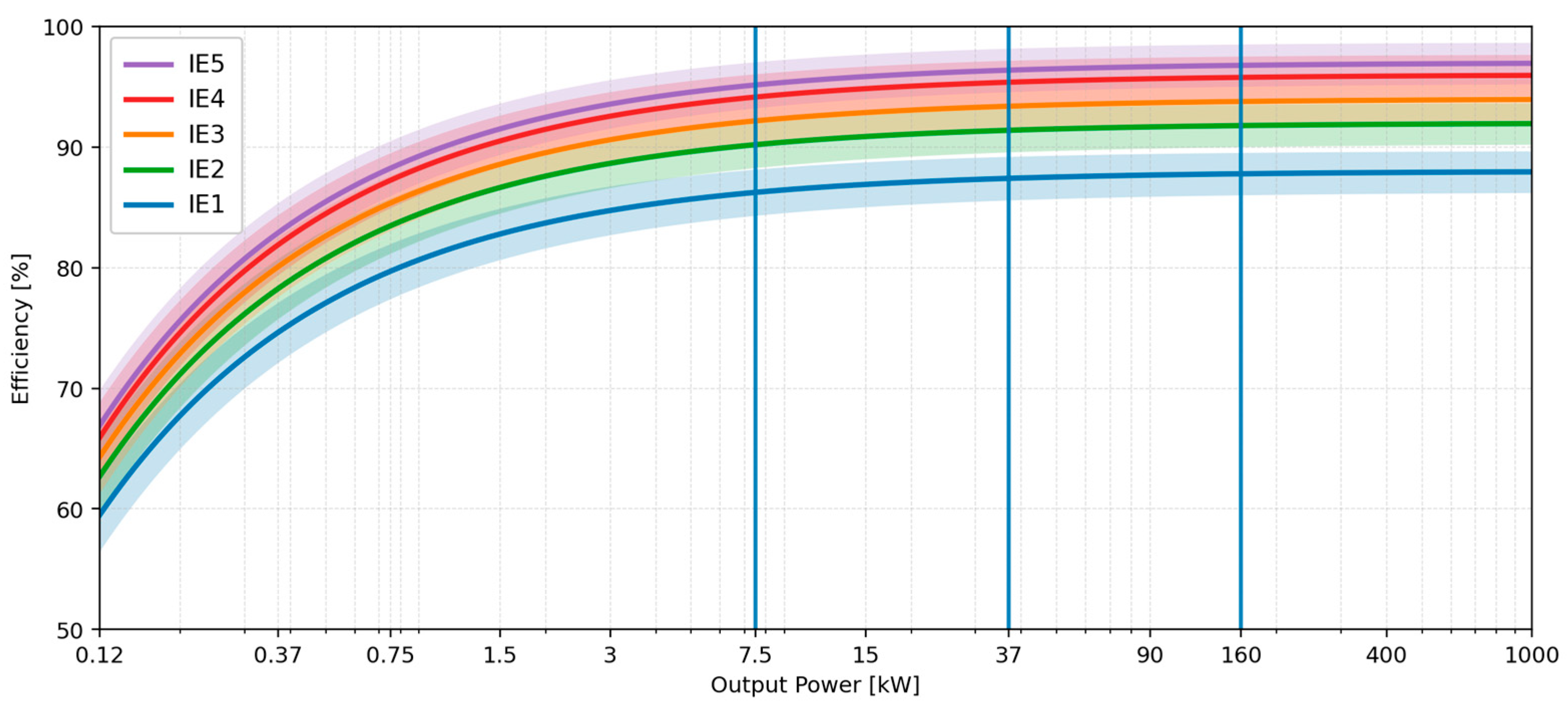
Figure 3 presents the standardized efficiency performance of four-pole induction motors operating at 50 Hz across the IEC efficiency classes IE1-IE5 as a function of rated output power. The curves indicate a pronounced increase in efficiency at low power ratings, followed by a gradual approach to an asymptotic plateau as power increases, consistent with the reduced relative impact of fixed losses at higher ratings. For any given power level, higher efficiency classes (IE3-IE5) exhibit systematically higher efficiencies than IE1-IE2, reflecting lower total losses achieved through improved electromagnetic design, optimized materials, and reduced stray-load and mechanical losses. The shaded envelopes represent the typical dispersion/allowable range around each class curve due to design variability and standard tolerances. The vertical reference lines denote representative rated power points, facilitating comparison of efficiency requirements and expected performance differences among classes over commonly used motor sizes.
The IE classification spans five principal efficiency classes, which reflect continual improvements in motor design, materials, and manufacturing techniques to minimize electrical losses and improve overall performance:
IE1 (Standard Efficiency): Represents the baseline efficiency level for general-purpose motors, typically corresponding to older or legacy motor designs. These motors meet the minimum regulatory efficiency requirements in some regions but generally exhibit higher core and copper losses, leading to increased energy consumption over their operational life.
IE2 (High Efficiency): Reflects motors with moderate improvements achieved by enhancing electrical steel quality, winding methods, and rotor design. IE2 motors often represent the minimum efficiency standards currently enforced in many jurisdictions, offering a tangible reduction in energy usage and operational costs.
IE3 (Premium Efficiency): Denotes motors that incorporate advanced design elements such as optimized lamination stacks, higher grade electrical steels with lower hysteresis losses, and refined rotor bar geometries. These motors deliver significant efficiency improvements, especially under partial-load conditions, and are widely adopted in energy-conscious industries.
IE4 (Super-Premium Efficiency): Comprises motors that leverage emerging technologies such as permanent magnet synchronous motors (PMSMs) and synchronous reluctance motors (SynRMs). These designs enable drastically reduced rotor losses and enable higher power densities, although they typically require sophisticated control electronics for optimal operation.
IE5 (Ultra-Premium Efficiency): The highest recognized efficiency class to date, IE5 motors integrate cutting-edge design features such as high-performance rare earth magnets, advanced cooling technologies, and integrated inverter drives. These motors exhibit minimal iron and copper losses and are engineered to deliver peak performance in demanding applications, albeit at a higher capital cost and often requiring specialized manufacturing processes.
Improving energy efficiency in motor-driven systems has become a central objective in industrial energy management. Squirrel cage induction motors (SCIMs) continue to dominate industrial drive applications, reported at more than 95 percent. However, their operating principle inherently involves rotor current excitation, which produces unavoidable rotor losses. This fundamental constraint limits the extent to which conventional SCIM designs can be advanced toward the IE5 efficiency class [
48]. Consequently, alternative motor technologies, particularly synchronous reluctance motors (SynRMs) and permanent magnet synchronous motors (PMSMs) have received increasing attention as high-efficiency candidates capable of reducing electrical losses and supporting compliance with IE5 efficiency targets in appropriate duty profiles.
SynRMs are manufactured predominantly from material families comparable to those used in SCIMs, yet they differ in their torque production mechanism. Rotor currents are not required, and rotor losses associated with induced currents are therefore largely eliminated [
49]. Reported differences in material composition are mainly attributable to rotor construction, including the absence of aluminum in the rotor assembly [
49,
50]. PMSMs also exhibit negligible rotor losses because the rotor magnetic field is provided by permanent magnets rather than induced currents [
51,
52]. In many industrial PMSM designs, Nd, Fe, and B permanent magnets are used due to their high magnetic energy density [
53]. Nevertheless, reliance on rare earth elements, especially neodymium, introduces sustainability challenges related to resource criticality and supply vulnerability, environmental burdens from extraction and refining, the management of hazardous substances during magnet manufacturing, and persistent difficulties in achieving effective end of life recovery and recycling [
53,
54,
55].
More broadly, improvements in electric motor efficiency are typically realized through one or a combination of the following approaches. First, increasing the quantity of active materials. Second, improving material quality and optimizing electromagnetic and thermal design. Third, adopting advanced or novel materials [
56,
57]. Because SCIM, SynRM, and PMSM technologies differ in both their loss mechanisms and material inventories, a technology comparison based solely on operational efficiency is insufficient. A systematic evaluation of environmental performance across the full lifecycle is therefore required to support technology selection for load drive systems in which environmental sustainability is considered alongside cost and technical performance.
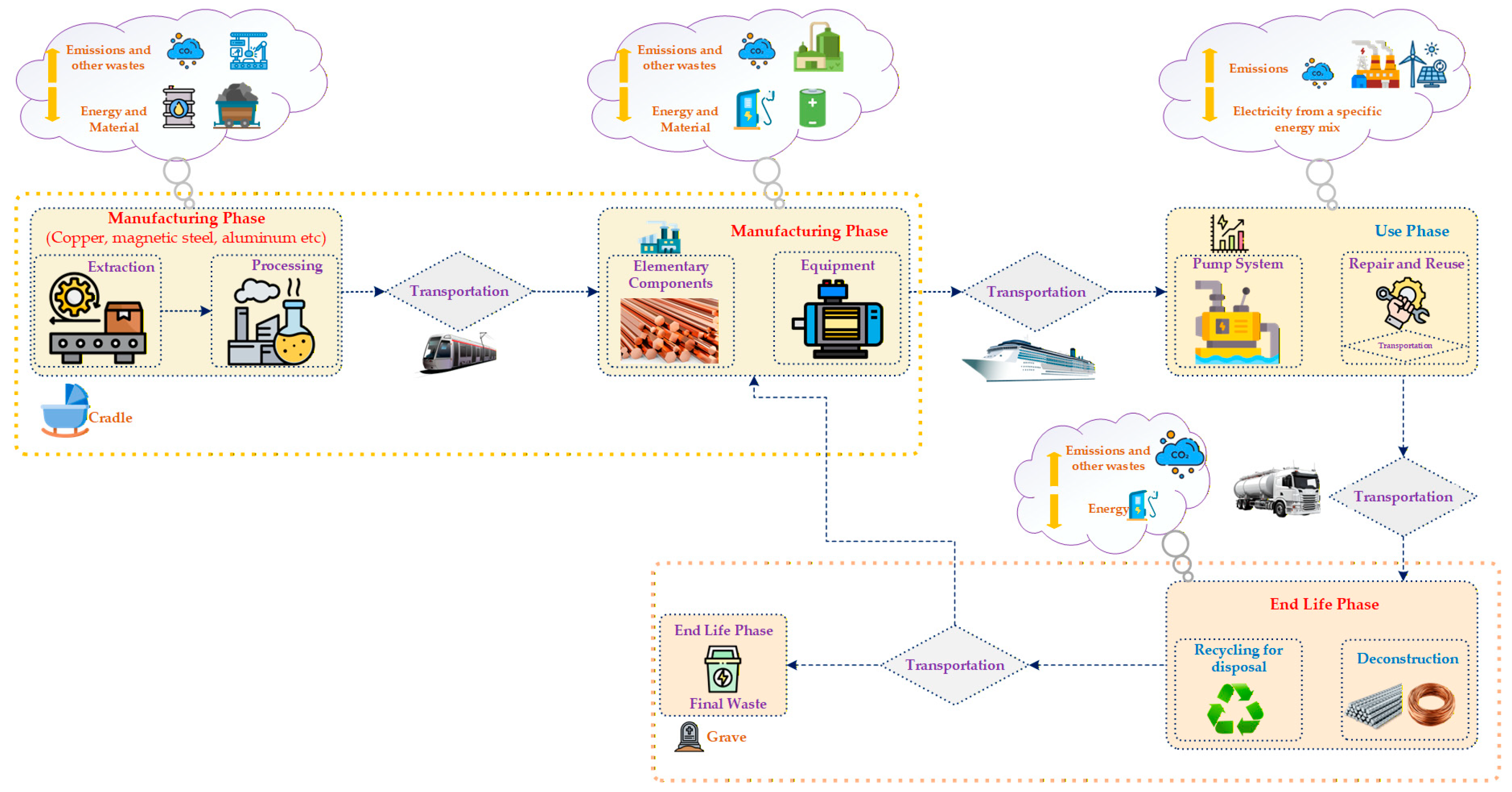
Environmental assessments of electric motors have often emphasized the operational use phase due to its dominant contribution to lifetime energy consumption. However, manufacturing and end-of-life stages can also be significant, particularly for high-efficiency motors that may require higher material intensity or incorporate critical materials. Accordingly, cradle-to-grave lifecycle assessment is necessary to quantify impacts consistently across all stages of the product system [
58]. As illustrated in
Figure 4, the motor lifecycle can be structured into raw material extraction and motor production in the manufacturing phase, operation during the service life in the use phase, and end-of-life management, including recycling, recovery, and disposal pathways, in the end-of-life phase [
59,
60].
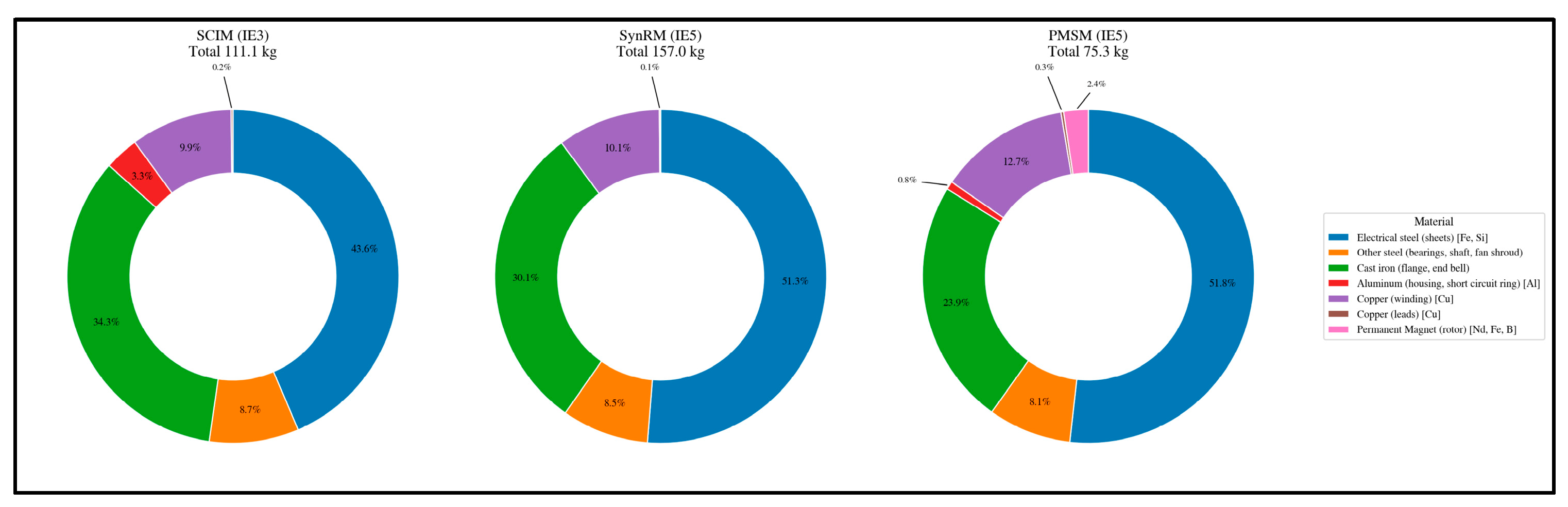
Figure 5 summarizes the material composition of the three motor technologies considered in this study, namely, the squirrel cage induction motor (SCIM), classified as IE3, the synchronous reluctance motor (SynRM), classified as IE5, and the permanent magnet synchronous motor (PMSM), also classified as IE5. The inventory is reported by principal material categories, comprising electrical steel, other steels, cast iron, aluminum, copper, and, in the case of the PMSM, permanent magnets. Across the assessed designs, the SynRM is characterized by the highest overall material demand, which is primarily associated with a comparatively greater contribution from electrical steel. Conversely, the PMSM exhibits the lowest overall material demand and is the only technology that includes permanent magnets as a distinct material input.
Differences in material volume across the technologies investigated are reflected in their mechanical form factors. The PMSM, in particular, is associated with a smaller material volume and consequently a smaller frame size. This disparity constrains direct functional substitution in retrofit applications, since replacement may require modifications to couplings and mounting interfaces. Such adaptation measures can introduce additional labor requirements and incremental material and energy inputs beyond those attributable to the motor unit alone. In contrast, the SynRM and SCIM generally share comparable frame dimensions, which improves mechanical interchangeability and reduces the scope of integration work during replacement.
The relative distribution of material shares, illustrated in
Figure 5, further clarifies technology-specific patterns when expressed as mass fractions. For the SCIM, electrical steel accounts for 43.6 percent of total mass, followed by cast iron at 34.3 percent and copper at 10.1 percent. The SynRM exhibits a higher dependence on electrical steel, representing 51.3 percent of total mass, while cast iron and copper contribute 30.1 percent and 10.1 percent, respectively. Aluminum is absent from the SynRM material breakdown, indicating a distinct rotor construction compared with the SCIM.
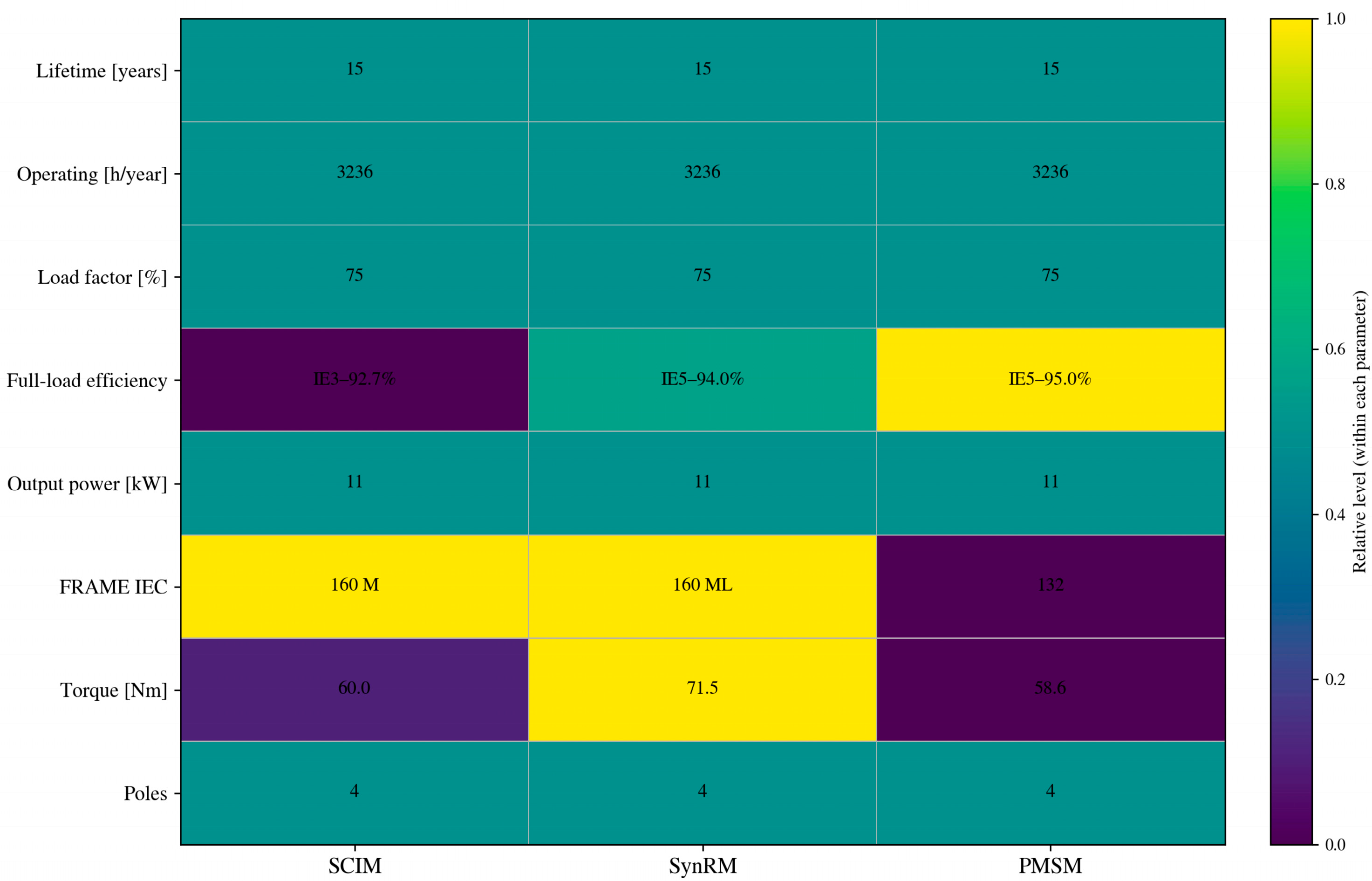
In lifecycle environmental assessments of electric motors, annual operating hours are a pivotal input because they determine cumulative electricity consumption and, consequently, most impact categories linked to energy use. For the 11 kW motor examined in this study, an average operating time of 3236 h·yr
−1 has been reported for the U.S. industrial sector [
63]. This value was therefore adopted as the reference operating profile and applied consistently across the assessed motor technologies to maintain a uniform basis for comparison, as summarized in
Figure 6.
The service life of industrial motors can extend well beyond typical design expectations; nevertheless, the effective lifetime is highly dependent on the duty cycle, maintenance practices, installation quality, and ambient operating conditions [
63,
64]. In addition, IEC 60034-30-1 and IEC 60034-31 [
23] provide reference assumptions for motor lifetime as a function of shaft power [
65]. To ensure methodological consistency and avoid overly optimistic assumptions, a conservative lifetime of 15 years was selected for the 11-kW motor and used throughout the analysis, as reported in
Figure 6.
In real industrial environments, motors frequently operate below rated load and outside their maximum-efficiency region due to non-ideal mechanical and electrical conditions, including misalignment, variable ambient temperature and humidity, and voltage unbalance [
66,
67,
68,
69,
70,
71]. However, because the objective of this work is a comparative evaluation of motor technologies rather than a site-specific performance assessment, the modeling assumes standardized operating conditions for all cases. Accordingly, each motor was evaluated at a representative 75% load factor, and performance was based on the corresponding best efficiency at that load, as presented in
Figure 6, thereby isolating technology-related differences in use-phase impacts.
1.2. Technical Attributes and Design Innovations
The enhanced performance of modern IE-class motors is driven by coordinated advances across multiple domains of motor engineering. Key contributions include improved electromagnetic design and machine architectures to increase torque capability while reducing loss mechanisms, the adoption of advanced materials and components to lower copper and core losses, improved thermal management to control hotspot temperatures and sustain higher continuous loading, and integrated drive systems that optimize operation through precise control and monitoring. These four aspects are discussed in the following subsections.
1.2.1. Electromagnetic Design/Architecture
Advanced electromagnetic design architectures are an effective route to increase power density and efficiency in electric traction machines. Coordinated rotor–stator optimization can address key performance constraints and reduce dominant loss components [
72,
73,
74]. A commonly adopted unifying design [
75,
76] variable is the slots-per-pole-per-phase ratio, as it consolidates several limitations associated with the maximum fundamental frequency (
) and high-speed loss mechanisms [
77]. Traction motors are generally realized as radial-flux or axial-flux machines. Radial-flux machines establish the main flux path perpendicular to the rotation axis, whereas axial-flux machines align the flux parallel to the axis, typically enabling a shorter flux path. Each topology therefore presents distinct tradeoffs in packaging, thermal behavior, and achievable torque/power density. In current EV traction systems, radial-flux machines remain prevalent, including induction machines (IMs), switched reluctance motors (SRMs), and permanent magnet synchronous machines (PMSMs). PMSMs are commonly classified as interior permanent magnet (IPM) and surface-mounted permanent magnet (SPM) types [
78]. Among these, IPM synchronous machines (IPMSMs) are widely preferred for traction because Nd, Fe, and B magnets enable high torque/power density and efficiency, albeit at higher cost than IM solutions [
78,
79]. Consequently, significant research is directed toward reducing heavy rare earth content or adopting alternative magnet/material systems while retaining EV-level performance [
80,
81].
Recent studies increasingly emphasize axial-flux traction machines, particularly where axial length constraints and tight drivetrain integration are critical [
82,
83]. Compared with radial-flux designs, axial-flux machines often offer favorable torque-to-weight characteristics and compact packaging [
84]. Prior comparisons indicate that, within a specified envelope and rating, both radial- and axial-flux machines can deliver similar torque, while axial-flux machines may achieve this with lower active mass/volume, supporting higher torque/power density and potentially improved heat removal due to their flatter geometry. The principal findings from [
85] are summarized in
Table 1 in terms of power density (kW/kg), efficiency (
η, %), and cost (
$/EUR/INR). With continued progress in topology and materials, axial-flux concepts have also evolved toward flux-switching machines (FSMs)
, where torque is produced by redirecting flux paths within the stator, improving controllability and torque density [
86]. Conventional FSMs typically employ rare earth magnets, motivating alternatives such as high-temperature superconductors (HTSs) to further enhance torque/power density and efficiency over wider speed ranges; however, reported HTS-FSM development is currently concentrated on aerospace/electric aircraft propulsion under cryogenic operation. Materials within the REBa
2Cu
3Oᵧ (REBCO) family are frequently discussed [
87], with YBCO commonly used [
88] and Bi2212 highlighted for high-field capability and aircraft relevance. The literature further reports dual-rotor, air-core stator arrangements to avoid saturation and reduce losses, while noting thermal management as a critical challenge [
89]. Although axial-flux motors are not yet widely adopted in mass-market EVs, industrial interest is increasing such as Daimler’s planned acquisition of YASA and Renault’s collaboration with WHYLOT for hybrid applications from 2025 [
90]. In addition, the comparatively straight flux paths in axial-flux machines may enable the use of grain-oriented electrical steels to improve efficiency, as identified in automotive roadmaps, while compact structures can reduce back-iron requirements and support higher power density.
1.2.2. Materials and Components
Advanced materials are increasingly critical for achieving the power density and efficiency targets of next-generation traction motors and for enabling newer machine architectures. Recent developments show that material upgrades can improve performance even in conventional topologies by reducing dominant losses and supporting higher magnetic loading [
91].
Core Material:
In electrical machines, the main opportunities for material-driven improvements lie in the magnetic core, stator windings, and rotor magnets. This subsection focuses on core materials. Improving core materials, primarily stator and rotor laminations, can reduce hysteresis and eddy-current losses and thereby increase machine efficiency. Commercial machines typically use non-grain-oriented electrical steels with ~3.2 wt.% silicon and lamination thicknesses of about 0.35–0.50 mm [
92]. Further thickness increases the effective resistivity and helps suppress eddy-current losses, particularly at higher frequencies. Grain refinement approaches such as grain boundary strengthening (GBS) are also used to improve mechanical strength and manufacturability by limiting dislocation motion, leading to higher yield strength [
93]. High-silicon steels (~6.5 wt.% Si) with thinner laminations have been proposed to further reduce losses [
94,
95], although increased brittleness can raise manufacturing complexity and cost. To balance magnetic performance and processability, alternative alloy systems containing Si, Cr, Al, and Mn are being explored [
95]. Fe–Ni alloys offer high permeability and low losses but are limited by lower saturation and higher cost; however, compositions near 48% Ni have been reported as potentially cost-competitive with 6.5% silicon steels [
95]. Fe–Co alloys such as Hiperco-50 provide a high saturation flux density (~2.4 T) and mechanical strength, enabling higher power density and improved efficiency through reduced core losses, though their cost restricts use mainly to aerospace applications [
96]. Grain-oriented steels can also be beneficial in machines with largely unidirectional flux paths, including segmented/modular designs and certain flux-switching machines, but cost–reliability tradeoffs remain important [
97,
98,
99]. Furthermore, dual-phase laminations can locally tailor magnetic properties to reduce leakage and improve efficiency and power density, albeit with lower saturation and higher cost than standard M19 steel [
100,
101].
Table 2 summarizes advanced core materials and their expected influence on traction motor performance. The comparison is based on key material parameters, magnetic permeability (
µ), electrical resistivity (
ρ), saturation flux density (
B_sat), and temperature capability (T), and relates these properties to qualitative trends in achievable power density, efficiency, and core material cost.
Stator Winding:
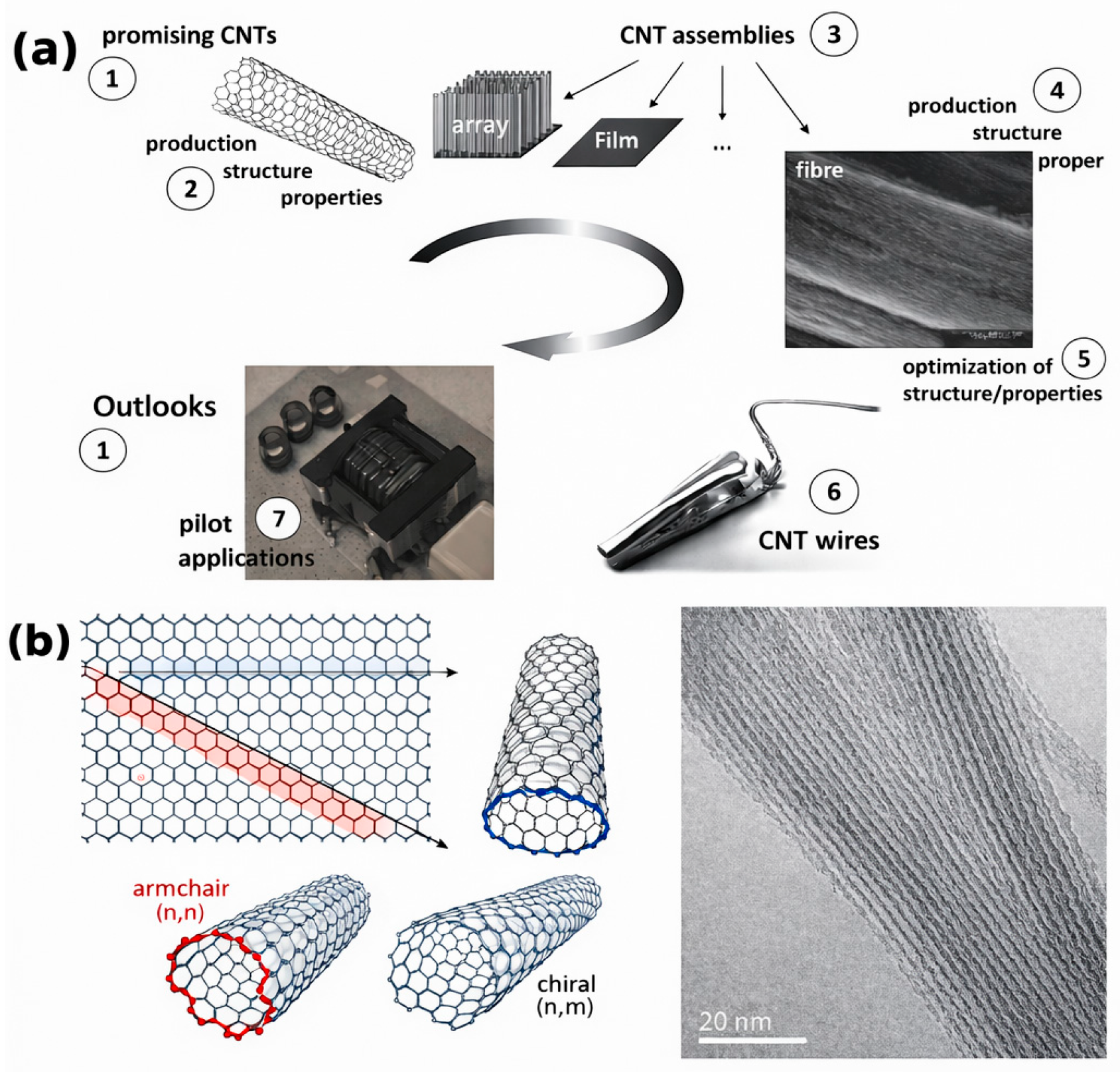
Recent developments in conductor engineering have intensified interest in carbon nanotube (CNT)-modified copper (Cu) windings for electric traction machines [
102]. Owing to their high specific strength and favorable electrical and thermal transport characteristics, CNTs are being investigated as reinforcement phases or surface layers to enhance the performance of conventional copper (and aluminum) conductors. Prior studies report that CNT-coated or CNT-incorporated Cu conductors can increase current-carrying capability and improve effective electrical/thermal behavior relative to baseline Cu, thereby enabling reduced resistive losses and supporting higher power density in traction machines [
103]. Moreover, CNT-Cu conductors have been reported to exhibit reduced temperature dependence of resistance, which is advantageous for maintaining efficiency under elevated winding temperatures typical of traction duty cycles [
104]. A complementary strategy involves graphene-enhanced copper conductors, as demonstrated by the U.S. DOE’s Pacific Northwest National Laboratory (PNNL) [
105]. PNNL reports that graphene additions at parts-per-million levels can lower the temperature coefficient of resistance while preserving room-temperature conductivity, indicating improved stability of winding resistance with temperature and a potential efficiency benefit at the motor level [
105]. The associated microstructural characterization (
Figure 6), based on electron microscopy and atom probe techniques, indicates carbon-rich nanoscale features within the copper matrix that are consistent with the proposed Cu–graphene extrudate architecture [
105]. Despite these promising results, CNT- and graphene-enabled conductors remain in an early stage of technological maturation. Further work is required to demonstrate scalable manufacturing routes, long-term reliability, and cost competitiveness for automotive deployment. The advanced winding materials discussed in this subsection are summarized in
Table 3, along with their anticipated implications for traction motor performance.
Figure 7 illustrates the concept of a carbon nanotube-reinforced copper (CNT Cu) composite conductor intended for motor windings. The schematic shows copper as the primary current-carrying matrix, while CNTs are incorporated as a coating layer or dispersed reinforcement to enhance conductor performance. Owing to their high intrinsic electrical and thermal conductivity and exceptional mechanical strength, CNTs can improve the current-carrying capability, reduce temperature-dependent resistance rise, and facilitate heat spreading from the winding region. As a result, CNT Cu conductors are expected to lower winding losses and support higher current density, contributing to improved motor efficiency and power density.
Rotor Magnets:
Sintered neodymium–iron–boron (NdFeB) magnets are the prevailing choice for permanent magnet (PM) traction drives due to their high energy density (≈50 MGOe) and suitability for compact, high-performance machines [
106]. To improve demagnetization resistance at elevated temperatures, heavy rare earth elements (HREEs) such as dysprosium (Dy) and terbium (Tb) are often added, improving the knee-point behavior of the B–H demagnetization curve and enabling robust operation under thermal loading [
107]. However, Dy/Tb additions significantly increase magnet cost, prompting research that targets either higher energy product grades or reduced rare earth content through engineered and composite magnet systems [
108]. Consistent with supply risk and price volatility concerns emphasized by the UK APC and the U.S. DOE, a key objective is to minimize or eliminate HREE usage without sacrificing traction-level performance [
109,
110]. Reported strategies include combining Dy-free magnet grades with rotor geometry optimization, since material substitution alone typically does not yield optimal machine-level outcomes [
111]. From an industrial perspective, grain boundary diffusion (GBD) magnets provide a practical low-Dy option by concentrating HREEs near magnet surfaces to enhance coercivity while limiting bulk Dy content. In contrast, some Dy-free commercial grades (e.g., NEOREC45mhf) are constrained to operating temperatures of ~150–160 °C, increasing demagnetization susceptibility above this range [
112]. Additional approaches include partial substitution of Nd with more abundant rare earth materials (Ce and La) and the development of high-performance magnets from recycled feedstock to reduce critical material dependence. Bonded (polymer-bonded) magnets are also being considered because of their higher resistivity and reduced eddy-current losses; however, they generally exhibit lower maximum energy products than sintered magnets despite comparatively high coercivity. Candidate alternatives to HREE-rich magnets are consolidated in
Table 4. In parallel, magnet recycling is gaining attention as a complementary pathway to improve sustainability and supply security. Several processes have been proposed to recover rare earth elements from pre-consumer and post-consumer products, including routes that convert NdFeB scrap into bonded magnets. The rotor magnet candidates are summarized in
Table 4, using permeability (µ), resistivity (ρ), saturation flux density (B_sat), and temperature capability (T), while their implications for motor power density, efficiency (η), and cost are reported in
Table 5.
1.2.3. Thermal Management
Thermal management is a key design constraint in high-power-density traction machines and IE5-class motors because allowable electromagnetic loading is often limited by hotspot temperature rather than torque production alone. Heat generation is dominated by copper loss (I2R), core loss associated with hysteresis and eddy currents, and inverter-related contributions, such as harmonic-induced iron losses and alternating current effects in conductors arising from skin and proximity phenomena. Inadequate heat rejection elevates local temperatures beyond permissible limits, accelerating insulation aging and, in permanent magnet machines, reducing demagnetization margin and torque capability.
The thermal design objective is to reduce the effective thermal resistance between internal heat sources and the cooling boundary while maintaining acceptable transient temperature rise during overload conditions. In first order form, the temperature rise can be approximated as
where
is the generated loss and
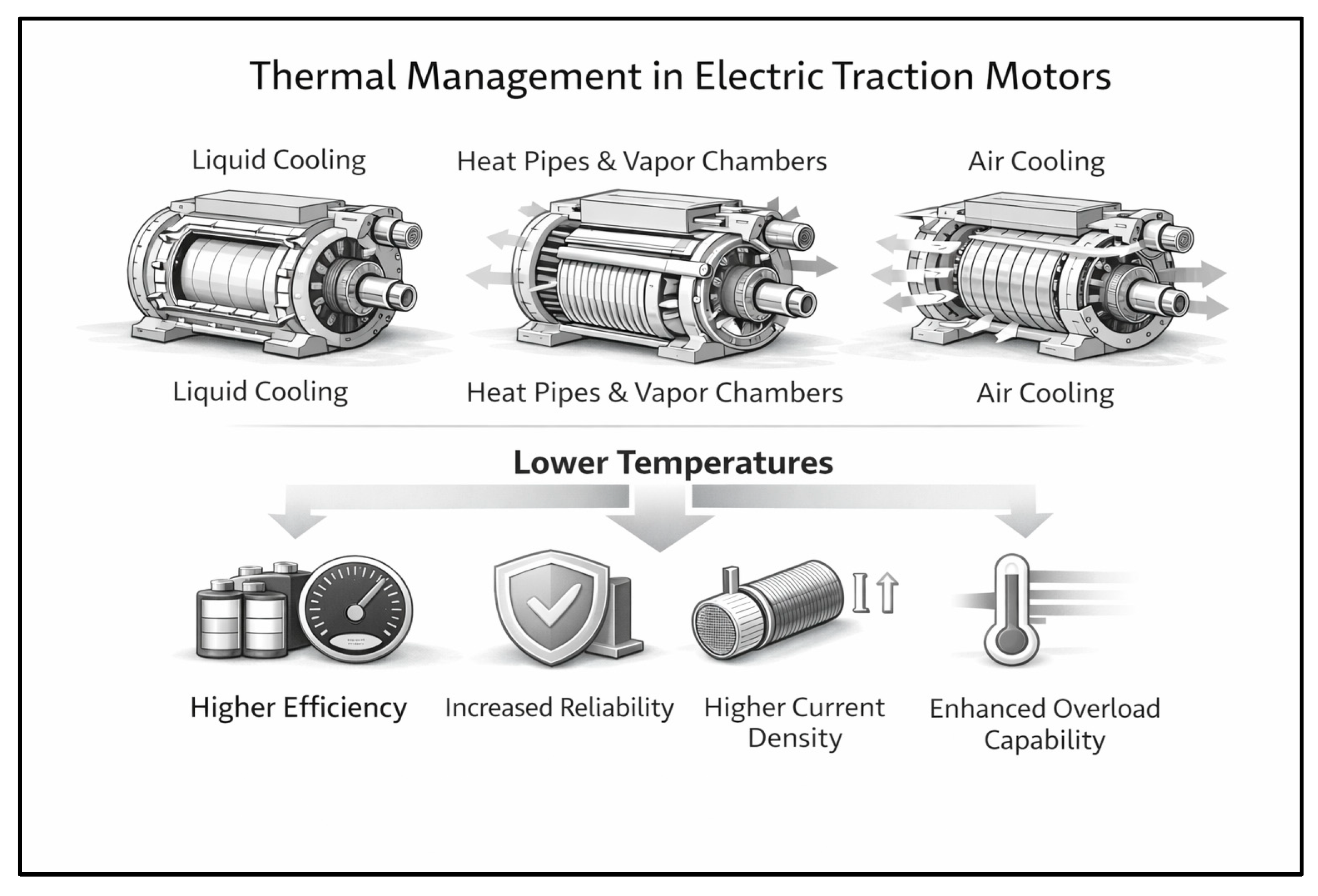
is the equivalent thermal resistance from the dominant hotspot to the coolant or ambient air. Critical hotspots are commonly located in the slot copper and end windings due to conductive bottlenecks introduced by insulation layers and limited convective surface area. Accordingly, effective strategies shorten the conduction path and enhance convection. Integrated liquid cooling through stator jackets or embedded channels improves heat extraction from the active stack, and direct cooling schemes targeting the slot region and end windings further reduce winding hotspot temperature. Heat pipes and vapor chamber elements can redistribute concentrated heat to larger heat exchange surfaces, improving temperature uniformity. In air-cooled configurations, optimized flow passages and guided ventilation increase convection, although effectiveness decreases as loss density rises. Maintaining temperatures within design limits improves efficiency and reliability. Lower winding temperature restrains resistance rise and associated copper loss escalation at load, while reduced magnet temperature increases demagnetization margin. Limiting thermal stress also slows insulation degradation, enabling higher continuous current density and improved overload capability. Thermal management should therefore be treated as an integrated component of machine design alongside electromagnetic and mechanical considerations, particularly for compact, high-efficiency traction applications.
Figure 8 illustrates thermal management techniques in electric traction motors, including liquid cooling, heat pipes/vapor chambers, and air cooling. These methods help reduce motor operating temperatures. Lower temperatures lead to higher efficiency, improved reliability, increased current density, and better overload capability, enabling safer and more compact motor operation.
1.2.4. Integrated Drive Systems
Integrated drive systems are increasingly used with modern IE-class motors, reflecting a shift toward treating the motor and the variable frequency drive as a single, jointly engineered subsystem. By synthesizing the required stator excitation, the drive regulates speed and torque through controlled adjustment of voltage magnitude, electrical frequency, and phase relationship. In practice, this capability is commonly implemented using vector control frameworks, such as field-oriented control and direct torque control, enabled by high-bandwidth current measurement and real-time computation. Compared with fixed-speed operation, the integrated approach provides improved transient response and accurate torque production across a wide operating range, supporting functions such as controlled starting, programmable acceleration and deceleration, torque limiting, and energy recovery during braking when the application permits. Motor–drive integration also offers efficiency advantages under variable load conditions. Matching the electrical input to the instantaneous mechanical demand improves part load performance and reduces energy waste associated with throttling or mechanical regulation in loads such as pumps, fans, and compressors. In addition, integrated drives enable advanced supervisory and protection functions, such as overload detection, stall recognition, phase-loss monitoring, and temperature-dependent derating, ensuring safe and reliable operation. These functions may rely on embedded sensors or on thermal and electrical models, and they support reliable operation near design limits while protecting the insulation system and magnetic materials.
Advances in power electronics further strengthens the case for integration. Increased switching frequencies and the adoption of wide bandgap semiconductors, including silicon carbide and gallium nitride, enable higher converter power density, reduce passive component size, and improved conversion efficiency. At the same time, inverters supplied waveforms introduce harmonic content that can increase iron losses, rotor surface losses, and alternating current copper losses associated with skin and proximity effects. Preserving high efficiency therefore requires coordinated design of the machine electromagnetic structure, the converter switching and modulation strategy, and the thermal management system, while also controlling torque ripple, acoustic noise, and electromagnetic emissions. In industrial automation environments, integrated drives increasingly incorporate deterministic communication protocols such as EtherCAT and PROFINET to enable low latency, synchronized data exchange with controllers and supervisory systems. This connectivity supports Industry 4.0 capabilities, including real-time monitoring of electrical and mechanical variables, condition monitoring, predictive maintenance, and adaptive control. It also simplifies commissioning and lifecycle management through electronic nameplate functions, remote diagnostics, and firmware updates. Overall, integrated motor–drive systems provide improved controllability, enhanced efficiency under variable operating conditions, and increased operational intelligence, making them a central enabler for high efficiency motor deployment in modern industrial and traction applications.
1.3. Operational and Environmental Implications
The deployment of International Efficiency (IE)-class motors plays a pivotal role in advancing industrial energy efficiency initiatives, owing to their demonstrated capacity to substantially reduce electrical energy losses during operation. These efficiency gains directly translate into lower operational expenditures and a corresponding decline in carbon dioxide and other greenhouse gas emissions, thereby addressing both economic and environmental imperatives. Empirical studies consistently show that upgrading from lower efficiency classes such as IE1 (standard efficiency) or IE2 (high efficiency) motors to IE3 (premium efficiency) and higher levels (IE4 and IE5) yields energy savings typically ranging between 10% and 20%, although this figure varies depending on specific application conditions, duty cycles, and load characteristics. Beyond energy conservation, IE motors contribute to enhanced reliability and decreased maintenance overheads by virtue of their improved design and superior materials, which enable operation at reduced winding and bearing temperatures. This thermal efficiency minimizes wear and tear on critical motor components, leading to fewer unscheduled downtimes and prolonged maintenance intervals, an especially valuable advantage in industries characterized by continuous process operations, such as chemical manufacturing, petrochemicals, and food processing. Such reliability gains not only optimize production throughput but also enhance overall equipment effectiveness (OEE), thereby supporting broader operational excellence initiatives. From a regulatory and sustainability perspective, the adoption of high-efficiency electric motors is strongly aligned with global and regional policy frameworks aimed at climate change mitigation and energy system decarbonization. Within the European Union (EU), the Ecodesign Directive, currently embodied in Regulation (EU) 2019/1781, establishes Minimum Energy Performance Standards (MEPS) for electric motors and variable-speed drives. This legislative framework has accelerated the diffusion of IE3 and IE4 efficiency classes, while also creating market incentives for the deployment of IE5 ultra-premium motors. Comparable initiatives are being pursued in other jurisdictions, underscoring the global convergence of regulatory efforts and the increasing role of electric motors in achieving both binding climate targets and voluntary corporate sustainability commitments. The EU has outlined progressively ambitious objectives under the European Green Deal and the Fit for 55 legislative packages, which seek to reduce greenhouse gas (GHG) emissions by at least 55% by 2030 and achieve climate neutrality by 2050. In this context, the forthcoming transition from the Ecodesign Directive to the Ecodesign for Sustainable Products Regulation (ESPR) represents a significant regulatory milestone. The ESPR will broaden the scope of performance requirements to encompass a wider range of motor-driven systems, introduce more stringent efficiency thresholds, and integrate circular economy principles, including durability, reparability, recyclability, and the introduction of digital product passports. Moreover, policy frameworks increasingly encourage the integration of high-efficiency motors with power electronic drives, advanced condition monitoring, and smart grid platforms, thereby enhancing system-level efficiency and facilitating the integration of variable renewable energy sources. Although the IEC 60034-30-1 and IEC 60034-30-2 standards formally defines efficiency classes up to IE5, emerging academic and industrial discourse has begun to conceptualize future efficiency classes (IE6–IE9). These prospective categories are associated with near-lossless energy conversion enabled by advanced materials, wide bandgap semiconductor-based power electronics, novel electromagnetic topologies, and AI-assisted predictive maintenance strategies. Within this framework, an IE9 classification may be envisioned as a future benchmark encompassing not only unprecedented energy efficiency, but also compliance with circularity, digital interoperability, and seamless compatibility with renewable-based and decentralized power systems. Accordingly, the trajectory of IE-class motor development, from the current IE3–IE5 technologies to future conceptual IE6–IE9 categories, illustrates the central role of motor systems in enabling the EU’s transition toward a low-carbon, resource-efficient, and digitally integrated industrial economy. While their immediate benefits lie in reducing electricity demand, the broader significance of these technological developments rests in their capacity to accelerate the transition toward integrated, efficient, and renewable-based energy systems, thereby reinforcing the European Union’s commitment to climate neutrality by 2050.
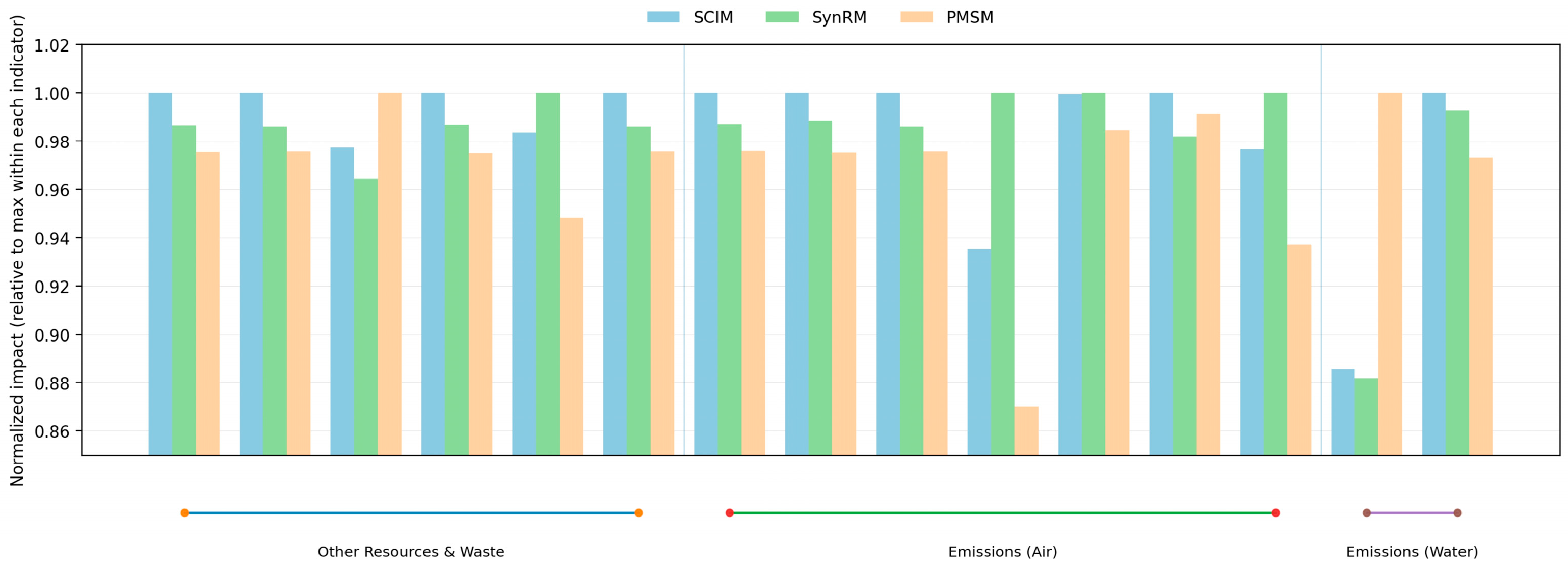
The environmental impact patterns observed for SCIMs, SynRMs, and PMSMs in
Figure 9 can be interpreted primarily through differences in material composition and total material demand during manufacturing, as reported in
Figure 5, and will be discussed within the broader context of use phase dominance over the motor lifecycle. The SynRM exhibits the highest material intensity, particularly for electrical steel, requiring 80.5 kg compared with 48.4 kg for the SCIM and 39.0 kg for the PMSM. This higher material demand is reflected in energy related indicators, with the SynRM showing the largest cumulative energy requirement (GER 7095 MJ) and primary electricity use (1086 MJ). The SynRM also records the highest greenhouse gas emissions (493 kg CO
2 equation) and acidification emissions (6005 g SO
2 equation), indicating that its production phase impacts are strongly driven by energy and emissions embodied in material processing and fabrication. Waste results reinforce this interpretation, as the SynRM generates the greatest amount of non-hazardous waste (1.15 t) compared to the other technologies, consistent with increased upstream processing burdens and higher manufacturing losses associated with greater steel inputs.
The SCIM represents a useful reference technology because its material composition is comparatively conventional and does not rely on rare earth permanent magnets. Relative to the SynRM, the SCIM requires substantially less electrical steel (48.4 kg versus 80.5 kg), which is consistent with a generally lower burden in indicators that are strongly influenced by steel production and processing. At the same time, several SCIM results remain close to the SynRM, indicating that differences in manufacturing impacts are not determined solely by electrical steel mass, but also reflect contributions from other materials, processing routes, and the underlying lifecycle inventory assumptions. In comparison with the PMSM, the SCIM tends to exhibit higher impacts in categories where bulk material demand and associated processing energy dominate, while avoiding the pronounced water and toxicity burdens linked to permanent magnet supply chains. Overall, the SCIM represents an intermediate profile, with moderate manufacturing impacts and without a single indicator disproportionately driving its footprint.
The PMSM generally exhibits lower impacts in categories dominated by bulk material demand. However, it demonstrates clear tradeoffs in indicators associated with permanent magnet production. Despite the lowest total motor mass (75.3 kg), the PMSM shows a substantially higher process water requirement (1172 L) and the highest release of heavy metals to water (2949 mg Hg equation), which is consistent with the inclusion of Nd, Fe, and B permanent magnets (1.8 kg) and the resource-intensive upstream operations typically associated with rare earth supply chains. At the same time, the PMSM requires less cooling water (246 L), which may reflect improved efficiency and thermal performance linked to its electromagnetic design and material configuration. These results highlight that relatively small quantities of specific materials can dominate selected water and toxicity-related indicators, even when the overall material mass is reduced.
From a mitigation perspective, increasing recycled content in motor components provides a direct opportunity to reduce manufacturing burdens. While electrical steel laminations and Nd, Fe, and B permanent magnets remain challenging to recycle due to stringent functional requirements and complex separation constraints, other materials used in motor construction, including structural steels, cast iron, aluminum, and copper, have established recycling routes. Substituting primary feedstock with secondary materials for these components reduces impacts associated with extraction and energy intensive refining, complementing strategies aimed at lowering overall material demand.
Importantly, manufacturing stage differences must be interpreted within a full lifecycle context because the use phase typically dominates the environmental footprint of electric motors. Numerous LCAs indicate that operational electricity consumption accounts for approximately 80% to 90% of total impacts, particularly for motors operating under continuous industrial duty. Ferreira et al. [
118] estimates that industrial motors are responsible for roughly 65% to 70% of total electricity consumption in the European Union, underscoring the substantial mitigation potential associated with efficiency improvements and control strategies such as variable-speed drives. Consistent with this, Boughanmi et al. [
119] show that, while production and end-of-life stages contribute to the footprint, electricity consumption during operation remains the principal driver for induction motors. Deprez et al. [
120] further note that the lifetime operational energy expenditure for three-phase induction motors can reach up to 100 times the initial purchase cost, reinforcing the centrality of operational performance.
The literature also indicates that incremental manufacturing burdens associated with higher-efficiency designs are typically offset rapidly by reduced electricity consumption during operation. Auer and Meincke [
121] report that the environmental breakeven point for high-efficiency motors is achieved in less than one month for most impact categories, despite the use of additional materials such as copper and rare earth elements. Cassoret et al. [
122] similarly report that higher manufacturing impacts for copper cage rotors relative to aluminum cage rotors are compensated quickly by operational energy savings, and that up to 95% of lifetime energy use occurs during the operational stage. Broader policy and system-level assessments corroborate these findings. The EuP Lot 30 study indicates that the use phase contributes around 70% of the total environmental impact for most electric motors [
123], while Jocanovic et al. [
124] report that 93% to 94% of lifecycle costs and energy consumption in pump motor systems are attributable to the operational phase. Overall, while material selection, recycled content, and end-of-life strategies remain important for addressing production phase hotspots and toxicity-related categories, the largest reductions in total lifecycle impacts are generally achieved by minimizing operational electricity consumption through higher-efficiency motor designs and appropriate control strategies [
124,
125,
126,
127,
128].
1.4. Integration with Emerging Technologies
IE motors serve as foundational components in the ongoing evolution toward smarter, more interconnected, and sustainable industrial ecosystems. Their inherent high efficiency and operational reliability make them ideal candidates for seamless integration within the framework of Industry 4.0, where advanced digitalization and automation technologies are transforming traditional manufacturing and industrial processes at a fundamental level. The convergence of IE motors with sophisticated Industry 4.0 innovations, including digital twin modeling, Internet of Things (IoT)-enabled sensor networks, and artificial intelligence (AI)-driven predictive maintenance systems, enables unprecedented levels of operational transparency, control, and optimization.
Digital twin technology plays a pivotal role in this integration by creating precise virtual replicas of physical motor assets. These digital twins allow for real-time simulation, monitoring, and analysis of motor behavior under a wide array of operational conditions. By continuously comparing real-world data with simulation outputs, operators and maintenance teams can identify inefficiencies in energy consumption, detect early signs of mechanical or electrical faults, and predict future performance degradation. This facilitates timely and targeted interventions, minimizing unscheduled downtime and enhancing overall system availability. The deployment of IoT-enabled sensors embedded within motor assemblies further enhances the granularity and fidelity of data acquisition. These sensors capture a multitude of critical parameters, such as temperature, vibration, electrical current, torque, and rotational speed, which are transmitted to centralized analytics platforms. The rich data environment enables detailed condition monitoring and supports real-time diagnostics, thus allowing for continuous health assessments of motor systems. This data-driven approach not only ensures optimal operational performance but also enhances safety by enabling early detection of abnormal operating conditions.
AI-driven predictive maintenance represents a transformative advancement in the management of IE motor assets. Leveraging machine learning and advanced analytics, these systems process vast amounts of historical and real-time sensor data to identify subtle patterns and anomalies indicative of wear, imbalance, misalignment, bearing degradation, or insulation failures. By predicting potential failures well in advance, maintenance activities can be scheduled proactively, optimizing resource allocation, extending motor service life, and reducing both maintenance costs and production interruptions. This predictive capability shifts the paradigm from reactive to proactive maintenance, thereby improving overall equipment effectiveness (OEE) and significantly lowering the total cost of ownership. In addition to maintenance optimization, the integration of these Industry 4.0 technologies facilitates the dynamic performance tuning of IE motors. Adaptive control algorithms enabled by AI can adjust motor parameters in real-time to match changing load demands and environmental conditions. Such adaptability not only maximizes energy efficiency across varying production cycles but also stabilizes process control, improves product quality, and reduces mechanical stress on motor components. These performance enhancements contribute directly to operational excellence and support sustainable manufacturing practices.
Beyond immediate operational gains, the integration of IE motors with Industry 4.0 tools fosters enhanced asset utilization and comprehensive lifecycle management. Continuous condition monitoring and data-driven analytics enable industrial stakeholders to make informed decisions regarding capital investments, prioritizing upgrades and replacements based on asset health and performance metrics. This strategic approach supports sustainability by optimizing the use of resources and minimizing waste generated through premature equipment replacement. Furthermore, detailed lifecycle insights aid compliance with evolving environmental regulations and corporate sustainability mandates. Collectively, these advancements underscore the critical role of IE motors as enablers of energy-efficient, resilient, and intelligent industrial operations. Their deployment aligns with global sustainability objectives by significantly reducing energy consumption and greenhouse gas emissions across manufacturing sectors. Moreover, these technologies support the transition toward Industry 5.0, which emphasizes human-centric automation, collaborative robotics, and circular economy principles. By empowering operators with intelligent tools and real-time insights, IE motors integrated within Industry 4.0 and 5.0 frameworks contribute to the creation of manufacturing environments that are not only economically competitive but also socially responsible and environmentally sustainable.
1.5. Review Scope and Objectives
This article provides a structured synthesis of technological progress in high-efficiency electric motors and examines how these motor systems can be deployed as enabling assets within Industry 5.0 manufacturing environments. The discussion is anchored in the International Efficiency (IE) classification framework, with focus on IE3-IE5 motor systems and ultra-premium efficiency concepts, together with the associated enabling technologies—particularly power electronic drives, digital monitoring, and human-centered automation.
To support a comprehensive and transparent review, relevant publications were collected from major scholarly databases (including IEEE Xplore and ScienceDirect) with a primary emphasis on literature published between 2005 and 2025. In addition to peer-reviewed research, this study incorporates standards and policy documents and publicly accessible industrial documentation such as technical reports and manufacturer materials, thereby connecting academic findings with industrial deployment practices.
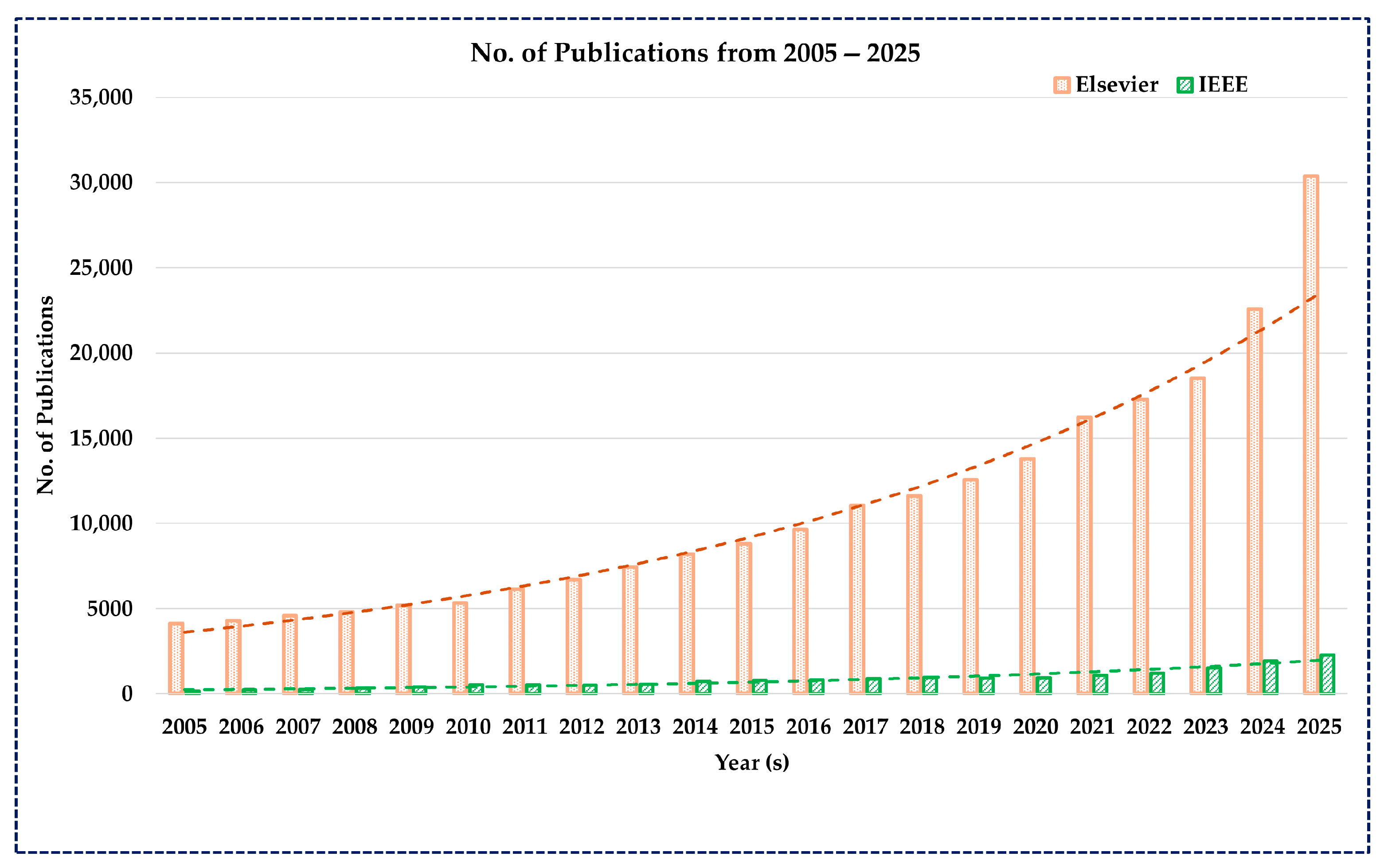
Figure 10 summarizes the temporal evolution of research output on high-efficiency motors in the Elsevier and IEEE literature from 2005 to 2025. The bar series reports the annual publication counts, while the dashed lines indicate the underlying growth trends for each database. Overall, both sources show a sustained increase in publication activity across the period, with more pronounced growth in the later years, underscoring the expanding research emphasis on high-efficiency motor technologies in response to industrial energy-efficiency and decarbonization priorities.
The collected evidence was organized and analyzed across the following themes:
- ○
Efficiency classification schemes and regulatory drivers.
- ○
Machine topologies and electromagnetic design strategies.
- ○
Materials innovations for stators, rotors, conductors, and magnets.
- ○
Thermal management solutions and integrated motor–drive configurations.
- ○
Environmental and lifecycle considerations.
- ○
Digital integration pathways involving IoT, AI-based analytics, and digital twins in Industry 4.0/5.0 contexts.
The purpose of this manuscript is not to introduce new experimental results or modeling frameworks. Instead, it aims to integrate and evaluate existing research and industrial evidence, clarify technical and sustainability tradeoffs, and highlight practical constraints that influence adoption in smart manufacturing. On this basis, the paper is positioned as a review and synthesis contribution intended to inform researchers and practitioners working on energy-efficient, resilient, and human-centric manufacturing systems.
Literature Search Strategy and Selection Criteria
The primary contributions of this work are
- ○
A technology-focused synthesis of high-efficiency motor types, squirrel cage induction motors (SCIMs), synchronous reluctance motors (SynRMs), and permanent magnet synchronous motors (PMSMs), emphasizing differences in design rationale, performance behavior, and implementation contexts across IE classes.
- ○
A system-oriented discussion that extends beyond rated motor efficiency to include motor–drive coupling, inverter-related losses, control methods, and the implications of part-load and variable-speed operation.
- ○
A consolidated assessment of current IE5 industrial offerings, drawing together publicly reported performance indicators and application positioning to highlight prevailing design directions and practical deployment patterns.
- ○
A critical examination of sustainability and lifecycle aspects, including rare earth dependence and material supply risks, recyclability and end-of-life options, and the shifting balance between manufacturing impacts and operational benefits as efficiency levels increase.
- ○
An integration perspective aligned with Industry 5.0, outlining how condition monitoring, predictive maintenance, digital twins, and human-in-the-loop decision support can jointly enhance energy management, reliability, and system resilience.
- ○
Identification of implementation barriers and open research problems, such as legacy system interoperability, control architecture constraints, scalability, and techno-economic limitations affecting adoption in industrial settings.
1.6. Conceptual Framework
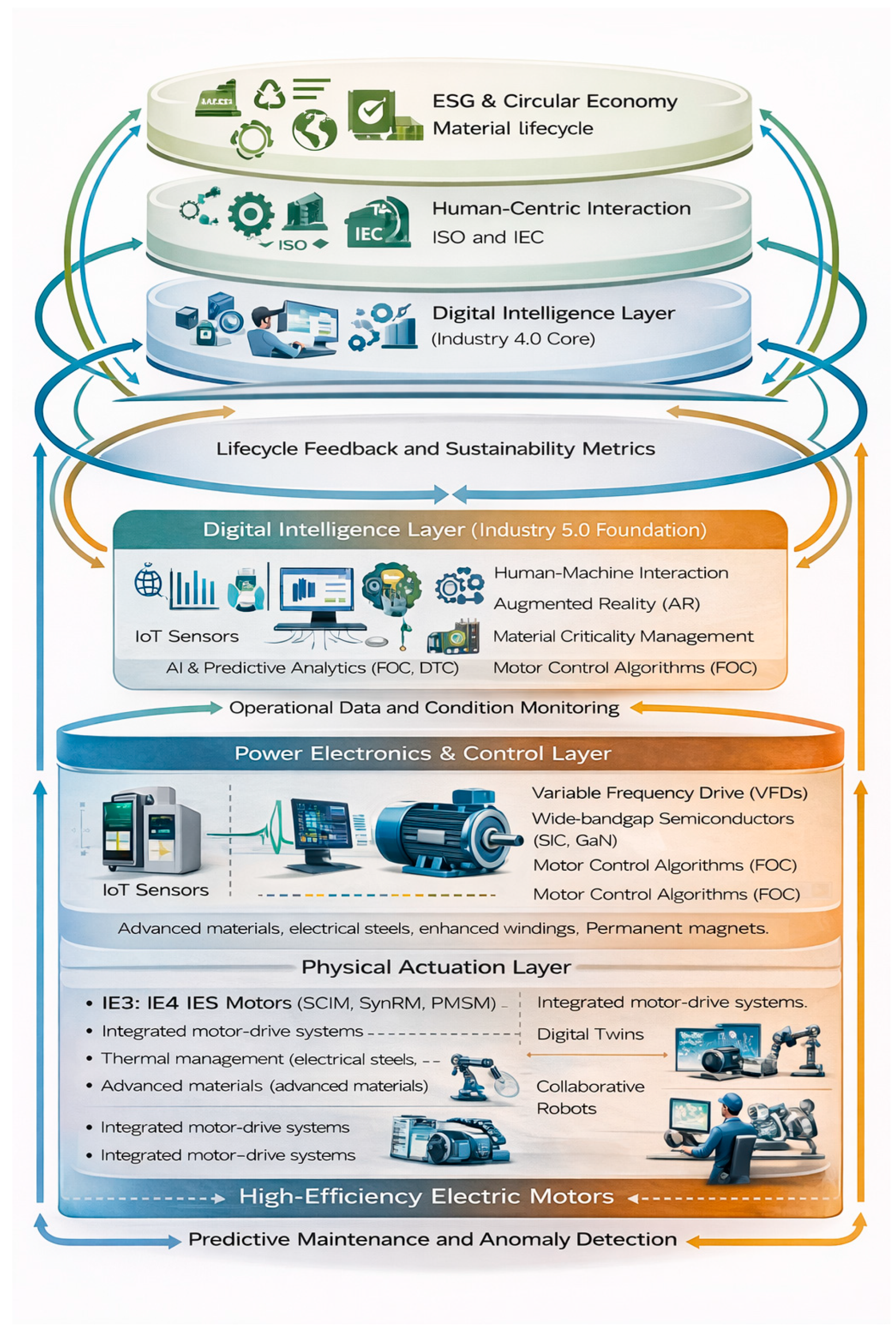
The conceptual framework illustrated in
Figure 11 establishes a unifying analytical perspective for this review by positioning high-efficiency electric motor–drive systems as central cyber-physical assets within Industry 5.0 manufacturing environments. Rather than treating motors, drives, materials, and digital technologies as isolated elements, the framework emphasizes their system-level interdependence and collective influence on energy efficiency, operational reliability, and lifecycle sustainability. At the foundation of the framework is the physical actuation layer, comprising high-efficiency electric motors (IE3–IE5) and associated power electronic drives. Design-level considerations, including electromagnetic configuration, material selection, and thermal management, define baseline efficiency, loss distribution, and reliability characteristics. These factors critically affect performance under variable-speed and partial-load operating conditions typical of modern industrial processes. The framework further incorporates a digital intelligence layer, where sensing, IoT connectivity, and data-driven analytics enable continuous monitoring of electrical, thermal, and mechanical states. Artificial intelligence and digital twin models support predictive maintenance, fault diagnosis, and adaptive control, thereby preserving efficiency gains achieved at the design stage throughout the operational lifecycle. Consistent with Industry 5.0 principles, a human-centric interaction layer is explicitly included. Operator-oriented decision-support tools, interpretable diagnostics, and augmented maintenance interfaces facilitate transparent human–machine collaboration, enhancing safety, trust, and operational resilience. Finally, the lifecycle and sustainability layer links system operation to environmental performance, material sustainability, and regulatory compliance. Feedback mechanisms across all layers enable continuous improvement and alignment with circular economy objectives. This conceptual framework serves as the organizing structure for the remainder of the review, guiding the synthesis of technological developments and clarifying how high-efficiency motor systems enable sustainable, resilient, and human-centric industrial systems.
2. The Role of Electric Motors in Industry 5.0
Electric motors constitute essential components in contemporary industrial infrastructure, serving as the primary drivers of mechanical motion in diverse manufacturing and process automation applications. Within the evolving paradigm of Industry 5.0, which emphasizes the symbiotic integration of human expertise, advanced digital technologies, and sustainable manufacturing practices, electric motors transcend their traditional role as mere energy conversion devices to become critical enablers of adaptive, intelligent, and efficient production systems. Industry 5.0 focuses on fostering human-centric automation, wherein collaborative robots (cobots), artificial intelligence (AI), and the Internet of Things (IoT) converge to create flexible and responsive manufacturing environments. In this context, electric motors equipped with embedded sensors, smart drives, and real-time communication capabilities play a pivotal role in facilitating enhanced system interoperability and operational transparency. These smart motors support advanced functionalities, such as predictive maintenance, dynamic load management, and energy optimization, which collectively enhance system reliability, reduce downtime, and contribute to cost-effective operations. Furthermore, the deployment of high-efficiency motors aligns directly with Industry 5.0’s sustainability objectives by minimizing energy consumption and reducing greenhouse gas emissions, thereby mitigating the environmental impact of industrial activities. The integration of electric motors with digital twins and cyber-physical systems enables continuous performance monitoring and adaptive control strategies, ensuring that manufacturing processes remain agile and resilient amidst fluctuating demand and supply conditions. The essential role of electric motors in contemporary industrial processes necessitates a rigorous understanding of the diverse motor technologies employed across various manufacturing sectors to maximize their utility within the evolving Industry 5.0 paradigm. Each motor type exhibits distinct operational characteristics, efficiency metrics, and performance attributes that influence its suitability for specific industrial applications.
A systematic evaluation of these factors is critical for the strategic selection and deployment of motor technologies that enhance productivity, energy efficiency, and system responsiveness in advanced manufacturing systems. Industry 5.0’s emphasis on flexibility, sustainability, and enhanced human–machine collaboration further underscores the importance of motor technologies that seamlessly integrate with digital control architectures, support predictive maintenance frameworks, and adapt to dynamic operational requirements. Therefore, a comprehensive analysis of predominant high-efficiency industrial motors, including IE5-rated designs, becomes imperative. The IE5 efficiency class, defined by the IEC 60034-39-1 and IEC 60034-30-2 standards [
23], represents the current benchmark for ultra-premium energy performance, delivering up to 20% lower energy losses compared to IE3 and 14% compared to IE4 motors. This class encompasses a variety of advanced designs, such as permanent magnet synchronous motors (PMSMs), synchronous reluctance motors (SynRMs), and hybrid configurations optimized for reduced rotor losses, enhanced power density, and precise speed control. Within this domain, leading global manufacturers, such as ABB, Siemens, WEG, Nidec, Danfoss, Nord Drivesystems, SEW-Eurodrive, Bosch, and Toshiba, have introduced highly specialized IE5 motor solutions tailored for diverse industrial sectors. These motors are engineered not only to achieve top-tier efficiency but also to integrate seamlessly with advanced drive systems, digital twins, IoT-based monitoring platforms, and AI-enabled predictive maintenance tools. Their design innovations encompass optimized rotor and stator geometries, high-grade lamination steels, improved cooling architectures, and advanced insulation systems to ensure consistent performance under demanding operational conditions. The forthcoming sections provide a comparative review of IE5 motor offerings from these manufacturers, examining their efficiency ratings, design characteristics, drive integration capabilities, control system compatibility, and targeted industrial applications. By detailing both technical specifications and application-specific advantages, this analysis will enable stakeholders to align motor selection with operational goals, sustainability strategies, and Industry 5.0 readiness.
2.1. Criteria for Technology and Manufacturer Selection
The motor technologies and manufacturers included in this review were selected using predefined, objective criteria to ensure technical relevance, industrial representativeness, and consistency with the scope of the study. This review is not intended as an exhaustive survey of all commercially available solutions; instead, it concentrates on technologically mature and industrially significant approaches that reflect current directions in high-efficiency motor system development.
2.1.1. Motor Technology Selection
Motor technologies were selected based on the following criteria:
- ○
Relevance to ultra-high efficiency: Alignment with IE4–IE5 efficiency classes and/or a technically substantiated pathway toward ultra-premium efficiency.
- ○
Industrial applicability: Demonstrated adoption or strong suitability across key sectors, including manufacturing, automotive, and process industries.
- ○
Technical evidence: Sufficient documentation in peer-reviewed literature and/or reputable public industrial sources to enable rigorous analysis.
- ○
Representation of design tradeoffs: Ability to capture key engineering tradeoffs involving efficiency limits, material selection, thermal constraints, and control and drive complexity, including major motor families such as SCIMs, SynRMs, and PMSMs.
2.1.2. Manufacturer Selection
Manufacturers were included based on the following criteria:
- ○
Market relevance and technological capability: Demonstrated industrial presence and/or recognized capability in high-efficiency motor and drive technologies.
- ○
Transparency of publicly available information: Availability of accessible datasheets, technical notes, application guidance, or documented implementations that support verifiable discussion.
- ○
Evidence of IE5-class solutions: Documented deployment of IE5 or equivalent ultra-high-efficiency motor–drive systems supported by technical performance information.
- ○
System-level integration focus: Relevance to integrated system design, including advanced control, digital monitoring and diagnostics, and compatibility with data-enabled operation aligned with Industry 5.0-oriented objectives.
2.1.3. Scope and Intent
The selection is intended to enable a technically rigorous and system-oriented discussion of prevailing design methodologies, integration architectures, and implementation constraints associated with ultra-efficient motor–drive systems. Emphasis is placed on approaches that make the underlying engineering rationale explicit, particularly the ways in which ultra-high efficiency is pursued through electromagnetic design choices, material and topology selection, thermal management strategies, and the increasing reliance on advanced control and power electronic interfacing. This framing supports an analysis of how design decisions translate into measurable performance under industrial duty cycles, including implications for reliability, manufacturability, cost, and operational robustness. The review is not structured to support direct cross manufacturer comparison or product ranking. Such evaluation would require harmonized testing procedures, standardized operating points, consistent application contexts, and comprehensive access to proprietary validation data, conditions that are rarely satisfied across publicly available sources. Moreover, reported performance and efficiency values are often dependent on specific configurations, such as inverter selection, control parameters, cooling conditions, and load profiles, which further limits the validity of direct comparisons. Instead, the selected technologies and manufacturers provide a representative basis for examining recurring engineering tradeoffs and common integration patterns at the system level, including motor and inverter coordination, control and hardware interactions, and the incorporation of digital functions such as monitoring, diagnostics, and data enabled optimization. By adopting this evidence-based and application-oriented perspective, the review aims to reflect contemporary industrial practice while maintaining analytical rigor, avoiding overgeneralization, and emphasizing the system-level factors that ultimately govern efficiency, deployability, and lifecycle performance.
2.2. ABB—SynRM IE5 Ultra
ABB’s SynRM IE5 Ultra motor represents a pivotal advancement in sustainable industrial motor technology. Historically, synchronous reluctance motors were explored as early as the 1920s, but early designs suffered from poor torque characteristics and manufacturing complexity. ABB’s breakthrough came through innovative rotor design using flux barriers and sophisticated finite element analysis (FEA), combined with advanced power electronics in their ACS880 drives. The motor achieves IE5 ultra-premium efficiency with efficiency levels exceeding 96%, primarily by eliminating rotor copper losses and avoiding rare earth permanent magnets. This is crucial, as it reduces supply chain risks related to magnet sourcing. In industries like cement, pulp and paper, and district heating, continuous operation with high reliability is demanded, and ABB’s SynRM provides superior thermal performance and extended maintenance intervals compared to traditional induction motors. ABB also focuses on integrated digital solutions, enabling remote condition monitoring and predictive maintenance via the ABB Ability™ platform, reducing unplanned downtime and optimizing asset lifecycle costs. The motor’s low noise emission and vibration levels further contribute to worker safety and environmental compliance [
129].
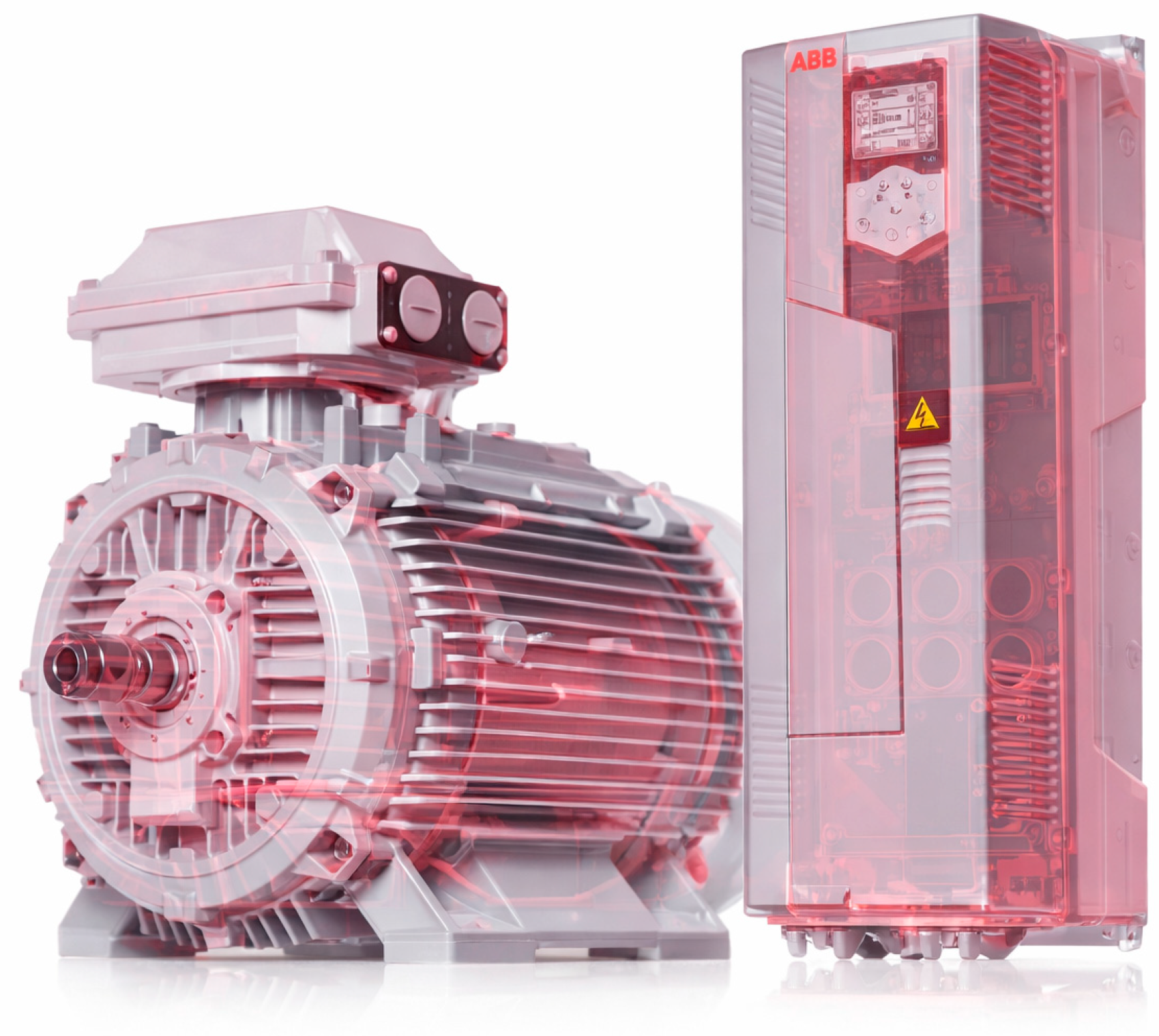
Figure 12 shows the ABB IE5 synchronous reluctance motor (SynRM). The motor uses a reluctance-based rotor without windings or permanent magnets, reducing rotor losses. When driven by a frequency inverter, the stator’s rotating magnetic field aligns the rotor along the path of minimum reluctance, enabling synchronous operation. This design achieves IE5 efficiency with low heat generation, high reliability, and improved energy performance compared to conventional induction motors.
- ○
Power range: 0.75 kW to 500 kW.
- ○
Efficiency: Up to 96.5% (IE5 ultra-premium).
- ○
Torque density: Approx. 1.3–1.5 Nm/kg.
- ○
Speed range: 750 to 3600 rpm (variable frequency drives supported).
- ○
Weight: Typically 20–350 kg, depending on size.
- ○
Temperature class: Class F insulation (up to 155 °C).
- ○
Typical applications: Pumps, fans, compressors, HVAC.
- ○
Energy savings: Up to 15–20% compared to IE4 motors in typical operation.
2.3. Siemens—SIMOTICS SD IE5
Siemens’ SIMOTICS SD IE5 motor is emblematic of the shift toward Industry 4.0, where energy efficiency meets digital intelligence. Building on a century of expertise in electromechanical systems, Siemens developed this motor to integrate seamlessly within their Totally Integrated Automation (TIA) portfolio, enabling smart manufacturing ecosystems. The motor uses a hybrid rotor design with permanent magnets and reluctance elements to reduce rare earth magnet content while maximizing performance. This hybrid approach delivers excellent torque linearity, minimal cogging torque, and stable operation across a wide speed range, which is critical for automotive assembly lines and high-speed packaging machinery. The embedded digital nameplate technology allows for instant access to motor specifications and real-time operating data via QR codes, enabling rapid commissioning and maintenance planning. In addition, Siemens leverages edge computing and cloud analytics to provide condition-based maintenance alerts and energy usage optimization. The SIMOTICS SD IE5 motor’s compliance with ISO 9001 and ISO 14001 [
130] underscores Siemens’ commitment to delivering not only cutting-edge technology but also sustainable and responsible manufacturing solutions [
131].
Figure 13 shows the Siemens SIMOTICS SD IE5 permanent-magnet synchronous motor together with its associated drive unit. The motor features a compact, finned housing for effective cooling and an integrated permanent-magnet rotor that enables ultra-premium IE5 efficiency. The drive unit supplies controlled power to the motor, allowing precise speed and torque regulation. This combination results in reduced energy losses, lower heat generation, and high-power density compared to conventional induction motor systems.
- ○
Power range: 0.75 kW to 400 kW.
- ○
Efficiency: Up to 96.8% (IE5).
- ○
Torque density: About 1.4 Nm/kg.
- ○
Speed range: 500 to 4500 rpm.
- ○
Weight: 25–320 kg depending on frame size.
- ○
Noise level: ≤65 dB(A) at 1500 rpm.
- ○
Integrated features: Digital nameplate, real-time monitoring.
- ○
Typical applications: Automotive manufacturing, packaging, machine tools.
2.4. WEG—W22 Magnet IE5
WEG’s W22 Magnet IE5 motor builds on a rich heritage of delivering durable, energy-efficient electric motors to the most demanding industrial environments. The W22 family is renowned for its ruggedness, with features such as H-class insulation, epoxy resin coatings for corrosion resistance, and robust cast iron frames designed to withstand harsh ambient conditions. WEG’s IE5 motor incorporates high-performance neodymium magnets and optimized rotor topology, enabling a peak efficiency of around 96–97%, which translates into substantial energy savings and reduced greenhouse gas emissions for industrial operators. In industries such as mining and petrochemicals, where downtime and energy costs are significant, the W22 Magnet IE5’s enhanced torque density and reliability simplify mechanical systems by reducing gearbox sizes and maintenance frequency. WEG’s extensive global manufacturing and service network ensures rapid spare parts delivery and local support, which is essential for minimizing production interruptions in remote or challenging locations. Additionally, the motor is designed for compatibility with variable frequency drives (VFDs), further enabling precise speed control and energy optimization [
132].
Figure 14 shows the main parts and magnetic flux of the WEG W22 Magnet IE5 motor. A three-phase, inverter-fed stator creates a rotating field, while permanent magnets on the rotor remove rotor copper losses. The rotor runs synchronously with the stator field, giving IE5 efficiency, lower heat, and higher power density than an induction motor.
- ○
Power range: 0.37 kW to 355 kW.
- ○
Efficiency: 96.3% to 96.9% (IE5).
- ○
Torque density: Around 1.5 Nm/kg.
- ○
Speed range: 750 to 3600 rpm.
- ○
Weight: 15–300 kg.
- ○
Insulation class: H-class (180 °C) for high durability.
- ○
Typical applications: Mining, petrochemical, heavy industry.
- ○
Energy savings: Approx. 12–18% over IE3 motors.
2.5. Nidec Leroy-Somer—Dyneo+ IE5+
Nidec Leroy-Somer’s Dyneo+ IE5+ motor exemplifies a versatile solution that bridges the gap between traditional motor operation and cutting-edge digital control. The Dyneo+ line, with origins in the 1990s, has evolved through multiple iterations to achieve IE5+ efficiency by combining high-energy rare earth magnets with a sophisticated rotor design and integrated sensor technology. Unique to Dyneo+ is its ability to operate both as a direct-on-line (DOL) motor and as a variable-speed drive motor, providing flexibility for retrofitting legacy systems while enabling energy savings in new installations. The motor’s embedded temperature sensors and encoder compatibility allow for real-time thermal monitoring and speed feedback, reducing the risk of overheating and improving dynamic performance. Industries such as marine propulsion and industrial refrigeration benefit from Dyneo+’s high starting torque and robust construction, which ensure reliable operation under variable load conditions and harsh environments. Nidec’s emphasis on digital integration supports Industry 4.0 initiatives, offering remote monitoring and fleet management to optimize asset utilization and maintenance scheduling [
133].
Figure 15 shows the Nidec Dyneo IE5+ permanent-magnet synchronous motor. The motor uses a high-efficiency permanent-magnet rotor with an inverter-fed stator to operate synchronously. This design minimizes losses, achieving IE5+ efficiency, lower heat generation, and high torque density compared to conventional induction motors.
- ○
Power range: 0.5 kW to 90 kW.
- ○
Efficiency: Up to 97.0% (IE5+).
- ○
Torque density: ~1.3 Nm/kg.
- ○
Speed range: 1500 to 3000 rpm.
- ○
Weight: 10–80 kg.
- ○
Starting torque: Up to 2.5× rated torque.
- ○
Applications: Marine propulsion, refrigeration, industrial automation.
2.6. Danfoss—EC+ IE5 Motor System
Danfoss’s EC+ IE5 motor system is a flagship product in the field of building automation, HVAC, and refrigeration, where partial load efficiency and noise reduction are paramount. With a background steeped in refrigeration and climate control technologies, Danfoss developed the EC+ motor as a highly efficient brushless DC (BLDC) solution that excels under variable-speed and partial-load conditions, which typically dominate HVAC operation cycles. The motor integrates directly with Danfoss’s VLT and VACON variable-frequency drives and supports common communication protocols like BACnet and Modbus for seamless integration into building management systems. The EC+ system’s compact design and quiet operation make it ideal for applications in hospitals, laboratories, and cleanrooms, where environmental control is critical. Advanced features such as automatic fan balancing and filter clog detection reduce maintenance costs and improve system reliability, while VAV optimization helps building owners reduce energy consumption significantly. Moreover, the EC+ system supports certification compliance for green building standards, such as LEED and BREEAM, aligning with the growing market demand for sustainable construction and operation [
134].
Figure 16 shows the Danfoss EC+ IE5 motor system, which integrates a high-efficiency motor with an electronic drive. The inverter-fed motor operates synchronously to optimize speed and torque control. This integrated system reduces energy losses, lowers heat generation, and achieves IE5 efficiency, making it suitable for high-performance and energy-efficient industrial applications.
- ○
Power range: 0.1 kW to 15 kW.
- ○
Efficiency: Up to 96.7% (IE5).
- ○
Torque density: ~1.2 Nm/kg.
- ○
Speed range: 100 to 5000 rpm.
- ○
Noise level: ≤55 dB(A) typical.
- ○
Communication: BACnet, Modbus, CANopen.
- ○
Applications: HVAC, refrigeration, building automation.
2.7. Nord Drivesystems—IE5+ Synchronous Motor
Nord Drivesystems’ IE5+ synchronous motor addresses the specialized requirements of hygiene-sensitive industries such as food and beverage, pharmaceuticals, and intralogistics. The motor’s IP69K-rated stainless steel housing with smooth surfaces minimizes contamination risks by eliminating crevices and cooling fins, which are common bacteria traps. This design facilitates stringent washdown procedures required by regulatory bodies such as the FDA and EHEDG. The use of permanent magnets ensures high torque output at low speeds, enabling direct-drive solutions that eliminate gearboxes and reduce mechanical losses, improving system efficiency and reliability. Nord’s integrated decentralized drive units combine the motor, controller, and safety functions within a compact form factor, reducing installation complexity and wiring. These units support safety protocols like PROFIsafe and STO, allowing machine builders to comply with ISO 13849 [
135] and IEC 62061 [
136] safety standards. By reducing the bill of materials and speeding up certification, Nord’s IE5+ motor supports OEMs and end-users in achieving cost-effective and high-performance automation solution [
137].
Figure 17 shows the Nord Drive Systems IE5+ synchronous motor. The motor operates with synchronous technology and is designed for inverter supply, enabling precise speed control. This design minimizes losses, reduces heat generation, and delivers IE5+ efficiency with high power density compared to conventional induction motors.
- ○
Power range: 0.37 kW to 90 kW.
- ○
Efficiency: 96.5% to 97.2% (IE5+).
- ○
Torque density: ~1.4 Nm/kg.
- ○
Speed range: 0 to 3000 rpm.
- ○
Ingress protection: IP69K.
- ○
Housing: Stainless steel for hygiene.
- ○
Applications: Food processing, pharma, packaging.
- ○
Weight: 15–90 kg.
2.8. SEW-Eurodrive—MOVIGEAR® Performance IE5
SEW-Eurodrive’s MOVIGEAR
® Performance IE5 represents a revolutionary approach to material handling and intralogistics drives by integrating motor, gearbox, and inverter in a single compact, sealed unit. This integrated design reduces energy losses from cabling and electromagnetic interference, boosting overall system efficiency. The motor features IP65 ingress protection and hot-swap capability, enabling rapid replacement and minimizing downtime in demanding environments such as cold storage and automotive assembly lines. The system supports multiple industrial communication protocols including PROFINET, EtherCAT, and AS-i, facilitating decentralized control, diagnostics, and remote maintenance. Its lightweight construction and flexible mounting options ease installation on overhead conveyors and complex conveyor systems, allowing for dynamic reconfiguration of plant layouts. SEW’s MOVI-C automation platform further empowers users with centralized control, simulation, and predictive maintenance capabilities, reinforcing the MOVIGEAR
® system as a cornerstone of Industry 4.0-compliant logistics automation [
138].
Figure 18 shows the SEW-Eurodrive MOVIGEAR
® integrated motor and gear unit. The system combines a high-efficiency synchronous motor, integrated inverter, and gearbox in a compact housing. This integrated design reduces energy losses, improves thermal performance, and enables high system efficiency, making it suitable for energy-efficient drive applications.
- ○
Power range: 0.12 kW to 15 kW.
- ○
Efficiency: Up to 96.5% (motor component).
- ○
Torque output: 0.4 to 40 Nm.
- ○
Speed range: 0 to 4000 rpm.
- ○
Weight: 8–40 kg.
- ○
Protection class: IP65.
- ○
Communication: PROFINET, EtherCAT, AS-i.
- ○
Applications: Material handling, conveyor systems.
2.9. Bosch Rexroth—IE5-Classcyber® Motors
Bosch Rexroth’s cyber
® IE5-class motors are designed for next-generation high-precision automation systems, including robotics, 3D printing, and pharmaceutical manufacturing. Drawing on decades of expertise in motion control and drive technology, these motors offer ultra-low energy losses combined with rapid dynamic response and precise torque control. They integrate with the IndraDrive Mi decentralized servo platform, allowing for power and communication to be transmitted through a single hybrid cable, reducing the cabinet size by up to 85% and simplifying wiring. The motors support real-time industrial Ethernet protocols such as Sercos III and EtherCAT, enabling sub-millisecond closed-loop control critical for high-speed, high-accuracy tasks. The IP65-rated housing supports cleanroom and semi-harsh environments, while integrated absolute encoders provide exact positioning essential for complex motion profiles. Bosch Rexroth’s cyber
® motors advance Industry 4.0 goals through built-in predictive diagnostics, energy profiling, and rapid commissioning tools, boosting productivity and lowering operational costs in sophisticated manufacturing settings [
139].
Figure 19 shows the Bosch Rexroth IE5-class cyber
® motors. These motors use high-efficiency synchronous technology and are designed for precise motion control with inverter supply. The compact design minimizes losses, reduces heat generation, and achieves IE5-class efficiency with high torque and power density for advanced automation applications.
- ○
Power range: 0.1 kW to 20 kW.
- ○
Efficiency: 96.8% to 97.5% (IE5).
- ○
Torque density: Up to 1.6 Nm/kg.
- ○
Speed range: 0 to 6000 rpm.
- ○
Weight: 8–50 kg.
- ○
Communication: EtherCAT, Sercos III.
- ○
Applications: Robotics, pharma, additive manufacturing.
2.10. Toshiba—IE5 Synchronous Reluctance Motor
Toshiba’s IE5 synchronous reluctance motors mark a strategic evolution in the company’s extensive portfolio of industrial electric machines. With roots in the 1930s, Toshiba has historically been a leader in reliable motor design for heavy industries such as steel production and water treatment. Their IE5 line employs advanced rotor lamination techniques and optimized flux barriers to maximize magnetic flux guidance, achieving ultra-high efficiency while entirely avoiding permanent magnets. Power ratings typically range from 1.5 kW up to 250 kW, covering diverse applications from HVAC systems to large industrial pumps. Integration with Toshiba’s own variable frequency drives allows for highly optimized energy use and dynamic speed control. The magnet-free design supports Toshiba’s sustainability goals by reducing dependency on rare earth materials and improving end-of-life recyclability, aligning with increasing industrial demands for circular economy principles [
140].
Figure 20 shows the Toshiba IE5 synchronous motor combined with its drive system. The inverter-fed synchronous motor operates at high efficiency by minimizing electrical and mechanical losses. This integrated motor–drive solution achieves IE5 efficiency, reduces heat generation, and provides precise speed and torque control compared to conventional induction motor systems.
- ○
Power range: 1.5 kW to 250 kW.
- ○
Efficiency: 96.0% to 96.7% (IE5).
- ○
Torque density: 1.2–1.4 Nm/kg.
- ○
Speed range: 750 to 3600 rpm.
- ○
Weight: 25–400 kg.
- ○
Insulation class: F-class.
- ○
Applications: Steel mills, water treatment, HVAC.
2.11. Regal Rexnord—IE5 Permanent Magnet Motors
Regal Rexnord’s IE5 permanent magnet synchronous motors target high-performance industrial sectors requiring compactness and precision, such as robotics, automated guided vehicles (AGVs), and precision machining. With efficiencies surpassing 96.5%, these motors feature innovative rotor designs that reduce cogging torque and thermal buildup, enabling smooth and consistent torque delivery over wide speed ranges. Their high torque density, approximately 1.5 Nm/kg, allows OEMs to downsize mechanical components, reducing machine footprint and weight, which improves overall system efficiency. Advanced thermal management techniques and optimized magnetic circuit designs ensure prolonged motor life under demanding duty cycles. Communication interfaces including CANopen and EtherCAT facilitate integration within Industry 4.0 frameworks, enabling real-time condition monitoring, fault diagnostics, and predictive maintenance. Regal Rexnord’s modular design approach accelerates product development and customization, helping manufacturers quickly adapt to evolving automation needs [
141].
Figure 21 shows the Regal Rexnord IE5 permanent magnet motor. The motor employs a permanent-magnet rotor and an inverter-fed stator to achieve synchronous operation. This design minimizes rotor losses, resulting in IE5 efficiency, reduced heat generation, and high-power density compared to conventional induction motors.
- ○
Power range: 0.5 kW to 50 kW.
- ○
Efficiency: Up to 97.2% (IE5).
- ○
Torque density: 1.5 Nm/kg typical.
- ○
Speed range: 0 to 5000 rpm.
- ○
Weight: 12–100 kg.
- ○
Thermal class: F or H depending on model.
- ○
Applications: Robotics, AGVs, CNC machines.
2.12. SEW-Eurodrive—IE5 Electric Motors (Standalone)
In addition to its MOVIGEAR
® integrated solutions, SEW-Eurodrive offers a comprehensive lineup of standalone IE5 electric motors designed for robust industrial use across multiple sectors including manufacturing, logistics, and process industries. These motors feature premium insulation systems rated for H-class temperatures, advanced cooling technologies, and modular mounting options that accommodate various mechanical configurations. Designed to withstand harsh conditions, the motors possess IP55 to IP65 protection and conform to global efficiency standards, helping users meet stringent energy regulations such as IE5. Compatibility with multiple inverter types offers flexibility for new installations or retrofits. SEW-Eurodrive’s extensive global service network provides comprehensive technical support and rapid spare parts supply, ensuring minimal downtime and optimized asset utilization. Their focus on reliability, low lifecycle costs, and energy efficiency makes these motors well-suited for continuous operation in heavy-duty industrial environments [
142].
Figure 22 shows the SEW-Eurodrive standalone IE5 motor. The motor uses high-efficiency synchronous technology and is designed for inverter operation. This configuration reduces energy losses, lowers heat generation, and achieves IE5 efficiency while providing high torque density compared to conventional induction motors.
- ○
Power range: 0.25 kW to 355 kW.
- ○
Efficiency: Up to 96.5% (IE5).
- ○
Torque density: Approx. 1.3 Nm/kg.
- ○
Speed range: 500 to 3600 rpm.
- ○
Weight: 20–320 kg.
- ○
Protection: IP55 to IP65.
- ○
Applications: General industrial use, pumps, compressors.
Table 6 provides a structured comparison of commercially available IE5 and IE5+ ultra-premium efficiency motor families from major manufacturers, emphasizing parameters that are relevant to energy performance, operational capability, environmental suitability, and integration into digitally enabled industrial systems. Reported peak efficiencies are typically around 96% to 97.5%, reflecting reduced electromagnetic and thermal losses relative to lower efficiency classes and implying potential benefits in lifecycle energy consumption, heat generation, and reliability under continuous operation. The wide coverage of rated power, extending from sub-kilowatt units for building services and small automation to several hundred kilowatts for heavy industrial drives, indicates that IE5-level performance is implemented across both low-power and high-power domains. The mechanical and electromechanical specifications enable assessment of power density and controllability. Torque density, considered together with motor mass, serves as a proxy for compactness and is particularly relevant for applications where space constraints or dynamic response are critical, such as robotics, automated guided vehicles, and high-performance machine tools. The stated speed ranges further indicate suitability for variable-speed operation under inverter control, where broader ranges generally correspond to greater flexibility across multiple operating points. Electrical ratings, including rated voltage and starting torque as a percentage of rated torque, provide insight into compatibility with industrial supply standards and the capability to accelerate high-inertia or high-load torque systems, with implications for start-up robustness and potential motor sizing margins. Thermal and environmental attributes are included to support evaluation of continuous duty performance and operational resilience. Insulation class, thermal rating, and maximum operating temperature define allowable thermal stress and offer an indication of overload headroom and endurance in elevated ambient conditions or constrained convection environments. Cooling configurations influence attainable continuous torque and decreasing behavior and should be interpreted alongside enclosure sealing requirements. Ingress protection classifications indicate resistance to dust and water exposure and differentiate designs intended for standard industrial settings from those engineered for harsh environments or hygienic washdown regimes, where sealing requirements may impose additional thermal design constraints. In addition, the table highlights digital and system integration features that increasingly differentiate high-efficiency motor platforms. Embedded sensing, condition monitoring, predictive maintenance functions, and support for industrial communication protocols facilitate commissioning, diagnostics, and data-driven maintenance within Industry 4.0 architectures. Protocol compatibility with real-time Ethernet networks supports deterministic control in automation systems, while building-oriented interfaces enable integration into supervisory control and energy management platforms.
Table 7 demonstrates that IE5 motor technologies deliver their highest practical benefit when evaluated as an integrated motor–drive system. Although many IE5 motors exhibit nameplate efficiencies in the upper 96% to 98% range, the overall system efficiency is governed by the combined performance of the motor and its converter, with drive efficiencies typically spanning 96% to 99% depending on the topology, control, and operating conditions. The table also highlights an industry trend toward tightly matched motor–drive ecosystems, where application-specific control features and integrated diagnostics improve real-world efficiency retention across variable-speed duty cycles rather than only at rated conditions.
- ○
Drive efficiency range (96–99%): As reflected in
Table 2, the efficiency of the drive stage is primarily determined by inverter topology and semiconductor technology, the implemented control approach (for example, field-oriented control or direct torque control), switching frequency and modulation strategy, and the effectiveness of thermal management. These factors jointly influence both switching and conduction losses, as well as the ability of the converter to operate near its optimal efficiency point across a given duty cycle.
- ○
Servo drive platforms (Bosch Rexroth cyber): High-performance servo drives typically occupy the upper end of the reported range (approximately 98–99%) because they employ fast current control, highly optimized modulation, and advanced power electronic designs. Under favorable operating conditions, such drive efficiencies can raise the combined motor–drive efficiency to roughly 96–97%, highlighting the advantage of tightly engineered servo-grade converter platforms for high-efficiency motion and process applications.
- ○
Permanent magnet motors (PM): PM motor systems often benefit from dedicated drive parameter sets and machine-specific control tuning, which support accurate torque production with reduced loss contributions from current harmonics and suboptimal excitation. In practice, these tailored configurations commonly sustain drive efficiencies around 97–98%, contributing to consistently high system efficiency over a broad speed range.
- ○
Synchronous reluctance motors (SynRMs): SynRM technologies can also achieve high overall energy performance, particularly when paired with sensorless control strategies that reduce sensor related complexity. However, their reliance on flux regulation and sensitivity to operating point can impose additional control demands, which may slightly reduce drive efficiency in certain implementations, typically to the 96–97% range.
- ○
Integrated motor–drive systems (SEW MOVIGEAR, Danfoss EC+): Integrated architectures emphasize coordinated motor–drive communication, simplified commissioning, and compact thermal integration. Although peak converter efficiency may be marginally below that of specialized servo platforms, system integration can improve real-world performance by reducing mismatched configurations, stabilizing thermal operation, and enabling consistent parameterization, thereby sustaining high efficiency in industrial deployments.
- ○
Partial load behavior and duty cycle relevance: Importantly, drive efficiency is not constant across load conditions and can decline at partial loads or low-torque operation due to fixed losses, switching loss dominance, and reduced power factor. Accordingly, advanced control functions, adaptive modulation, and variable switching strategies are critical for maintaining system-level energy savings over realistic industrial duty cycles, rather than only at rated operating points.
5. Regional and Global Regulatory Frameworks: Regulatory Landscape and Market Drivers
5.1. European Union Ecodesign Directive (2009/125/EC) [151,152]
- ○
This directive, a critical element of the EU’s climate policy, mandates the gradual phase-out of inefficient electric motors.
- ○
Since 2017, motors from 0.75 kW to 375 kW must meet at least IE3 efficiency when operated DOL, or IE2 if used with a VFD.
- ○
Proposals and consultations are underway to enforce IE4 and IE5 levels by 2030 in key industrial sectors, reflecting the EU’s ambition for carbon neutrality by 2050.
5.2. US Department of Energy (DOE) Motor Efficiency Regulations
- ○
The DOE enforces the Energy Policy Act (EPAct) and subsequent updates that set minimum efficiency levels comparable to IE3 and IE4.
- ○
IE5 adoption is encouraged through incentives and rebates, targeting heavy users in manufacturing, water utilities, and agriculture.
5.3. China’s GB Standards (GB 18613) [153]
- ○
China has aggressively implemented motor efficiency standards and incentives aligned with IE classifications to combat industrial pollution and reduce electricity consumption.
- ○
China’s vast manufacturing base creates significant demand and supply chain shifts toward IE5 motors.
5.4. Other Countries
Japan’s METI program, South Korea’s KEPCO policies, Australia’s Minimum Energy Performance Standards (MEPS), and Brazil’s PROCEL initiatives all contribute to a global mosaic pushing motor efficiencies higher.
5.5. Comprehensive Certification Landscape Beyond Efficiency
5.5.1. Safety and Electromagnetic Compatibility
Compliance with IEC 60204 (Electrical equipment of machines), IEC 61800 (Adjustable speed electrical power drive systems), and regional safety regulations ensure motors are safe for human operators and do not interfere with sensitive electronics.
5.5.2. Environmental Compliance and Material Restrictions
- ○
RoHS and REACH compliance are increasingly mandatory for motors sold in the EU and many other regions.
- ○
The transition to rare earth-free SynRM designs in IE5 motors is partially motivated by the environmental and geopolitical risks associated with rare earth mining.
5.5.3. Industry-Specific Certifications
Certain industries require additional certifications, such as
- ○
ATEX and IECEx for explosive atmospheres (oil and gas, and mining).
- ○
FDA and EHEDG compliance for food, beverage, and pharmaceutical industries to ensure hygienic design.
5.6. Strategic Industry Impact and Future Outlook
5.6.1. Accelerated Innovation Cycles
The stringent standards and certifications push motor manufacturers to innovate faster, leading to breakthroughs such as
- ○
Use of wide-bandgap semiconductor-based inverters (SiC and GaN) to reduce drive losses.
- ○
Advanced cooling methods like liquid cooling and heat pipes to improve thermal performance.
- ○
Integration of AI-driven condition monitoring and predictive maintenance.
5.6.2. Economic and Environmental Payoff
- ○
Adopting IE5 motors can reduce energy consumption by up to 20–30% compared to IE3, with payback periods of 2–5 years depending on operational hours and electricity costs. This yields significant CO2 emissions reductions, supporting corporate net-zero goals.
5.6.3. Supply Chain and Manufacturing Impact
- ○
As IE5 motors become mainstream, supply chains adapt by increasing production capacity for advanced materials and digital components. This also triggers upskilling of technicians for installation, commissioning, and maintenance of sophisticated motor–drive systems.
5.6.4. Global Trade and Harmonization
- ○
Common standards lower technical barriers, enabling manufacturers to export IE5 motors globally with fewer certification hurdles, fostering a more integrated and competitive market.
5.6.5. Future Trends
- ○
Continued push towards digitalization and smart motor systems embedded with IoT sensors for real-time performance optimization.
- ○
Expansion of IE5-class motors into new sectors such as electric vehicles (EVs), robotics, and renewable energy.
- ○
Evolution of standards to include circular economy principles addressing motor recyclability and end-of-life disposal.
Table 8 indicates that the adoption of IE5 (ultra-high-efficiency) motors is shaped by a converging set of technical standards, regulatory instruments, and conformity pathways that increasingly reflect a system-level perspective. At the technical core, IEC 60034-30-2 provides a harmonized efficiency classification framework for modern motor technologies, such as synchronous reluctance and permanent-magnet machines, enabling IE5 performance to be evaluated through standardized definitions and loss accounting principles. In parallel, recent industrial practice has placed greater emphasis on the fact that IE5 motors are frequently deployed in variable-speed, inverter-fed environments, where converter-induced effects, such as waveform distortion and associated additional losses, can influence measured and operational efficiency; consequently, efficiency assessment and selection are progressively framed in terms of motor–drive integration rather than motor nameplate performance alone. Regulatory drivers reinforce this transition: the EU Ecodesign regime and U.S. DOE efficiency requirements establish minimum performance thresholds and compliance routes that steer procurement toward higher-efficiency solutions, while regional schemes such as NEMA premium support market communication and purchasing standardization for high-efficiency products. At the organizational level, ISO 50001 strengthens the implementation rationale by embedding motor upgrades within a structured energy management cycle, supporting systematic monitoring, verification, and lifecycle-based investment decisions. Finally,
Table 8 also emphasizes that successful industrial deployment depends on compliance beyond efficiency, including CE marking and UL/CSA safety certification, alongside RoHS/REACH substance requirements, which collectively enable market access, reduce operational risk, and align IE5 adoption with evolving sustainability and supply chain governance expectations.
Table 9 summarizes the main engineering issues that emerge when IE5 (ultra-high-efficiency) motor designs are scaled to high power levels, where practical limitations in heat removal, magnetic loading, and power electronic operation become tightly linked. Beyond roughly 500 kW, the ability to sustain IE5-level efficiency is often constrained by thermal behavior: total losses increase with rating and load, yet the motor does not gain heat transfer capability at the same pace, leading to higher winding and rotor hotspot temperatures. This thermal constraint can force reductions in current density and, in turn, limit continuous torque capability. For this reason, large IE5 machines frequently rely on enhanced cooling solutions, including liquid cooling and improved internal heat paths, combined with rotor design optimization to reduce loss concentrations and improve temperature margins. A second challenge is associated with inverter-fed operation. Large IE5 motors are commonly paired with variable-speed drives, and high-frequency switching introduces additional converter losses and electrical stress at the motor terminals. Steep voltage transitions and harmonic content can increase heating, electromagnetic interference, acoustic noise, and insulation aging, particularly in high-current systems and installations with long motor cables. Mitigation typically involves higher-performance drive technologies, including wide bandgap (SiC and GaN) devices to reduce switching losses, together with dv/dt filters and other output conditioning to moderate the applied waveform. Third, magnetic saturation becomes increasingly difficult to avoid at larger scales. High-power-density objectives can raise local flux densities in the stator and rotor toward saturation, increasing magnetizing current and core loss while degrading overall electromagnetic performance; this is commonly managed through magnetic circuit refinement and the use of low-loss, high-grade electrical steels. Finally, the drive platform itself can become a bottleneck at large scale. High-power IE5 systems often require specialized converter configurations to meet grid and harmonic requirements, which increases cost and reduces off-the-shelf availability. In practice, active front-end drive topologies and harmonic filtering are widely used to improve power quality and compliance, enabling reliable deployment of large IE5 motor–drive systems in industrial settings.
Table 10 identifies the principal cost-related barriers that constrain the diffusion of IE5 (ultra-high-efficiency) motors, emphasizing that economic feasibility is determined not only by motor price but also by system integration and operational capabilities. A primary limitation is the higher acquisition cost of IE5 motors, which is often reported to be approximately 1.5 to 2 times that of IE3 equivalents due to the use of higher-grade active materials, more complex rotor and stator designs, and tighter manufacturing tolerances required to achieve ultra-low loss levels. This capital premium can deter investment when procurement decisions are driven by upfront expenditure rather than lifecycle energy savings. Accordingly, mitigation strategies frequently involve policy and financial mechanisms, such as targeted subsidies, tax incentives, or leasing and financing models that distribute initial costs and improve payback attractiveness. In addition, IE5 motors are commonly implemented within variable-speed, digitally controlled architectures, making drive system requirements a significant component of total installed cost. The need for VFD hardware, control integration, and associated filtering or protection increases project expenditure and complexity, particularly in retrofit scenarios; bundled motor–drive solutions are therefore increasingly adopted to reduce engineering effort, improve compatibility, and lower commissioning risk. Finally, successful deployment often depends on specialist expertise for commissioning, parameterization, and tuning, as well as ongoing monitoring to maintain expected efficiency gains. The resulting labor costs and reliance on external consultants can represent a further barrier, which is commonly addressed through vendor commissioning support, structured training, and remote or cloud-enabled diagnostic services that reduce on-site burden and support sustained operational performance.
Table 11 summarizes supply chain constraints that can hinder the scaling of IE5 motor–drive technologies by creating reliance on a limited set of critical materials and enabling components. A key dependency involves rare earth permanent magnets, particularly NdFeB, which are widely used in permanent magnet synchronous machines to achieve high torque density and high efficiency. However, supply concentration and strong price volatility introduce procurement risk and cost uncertainty for IE5 platforms. To reduce exposure, manufacturers and end-users increasingly consider alternatives such as synchronous reluctance designs that eliminate rare earth magnets, as well as ferrite-based magnet solutions where performance targets allow. A second constraint concerns high-grade electrical steel used for stator and rotor laminations. IE5 efficiency requires low iron loss and stable magnetic properties yet demand growth in sectors such as electric vehicles and renewable energy infrastructure can tighten availability and lengthen lead times. Mitigation approaches therefore include regional sourcing, qualification of equivalent steel grades, and dual-vendor procurement to improve resilience. Finally, high-efficiency inverter operation increasingly depends on wide bandgap devices such as SiC- and GaN-based power semiconductors, which enable lower switching losses and improved high-frequency performance, but remain costly and constrained by limited manufacturing capacity. In response, hybrid converter architectures that combine IGBT and wide bandgap devices are commonly adopted to balance efficiency improvements with component availability and overall system cost.
Table 12 shows that integrating IE5 motor technologies into existing industrial plants is frequently constrained by compatibility issues with legacy starting, protection, automation, and thermal infrastructure, largely because IE5 implementations are commonly associated with inverter supply operation and enhanced digital supervision rather than conventional direct on-line practice. Direct on-line starters, for example, are generally unsuitable for inverter-dependent motor configurations and applications requiring controlled voltage and frequency, so retrofit projects typically require replacement with variable-frequency drives together with appropriate protection, interfacing, and installation measures. Protection coordination is also affected, since traditional relay schemes may not provide adequate sensitivity or selectivity under inverter-fed conditions and may not align with the electrical signatures of high-efficiency machines; accordingly, digital motor protection relays with drive-compatible measurement and configurable logic are often adopted. In addition, plant automation can present an integration barrier: older SCADA and PLC systems may rely on serial communication standards, whereas modern drives and diagnostic functions increasingly use industrial Ethernet protocols, necessitating controller upgrades and the use of protocol conversion gateways to ensure reliable data exchange. Finally, thermal integration must be addressed because existing ventilation arrangements may not be sufficient for enclosed or high-power density IE5 installations, which can require enhanced forced-air solutions or liquid cooling infrastructure to maintain temperature margins, avoid derating, and sustain expected performance in continuous operation.
5.7. System-Level Synthesis and Implications
Standardized efficiency metrics provide a limited basis for technology selection in contemporary industrial applications, as operational performance is determined by system-level interactions among motor topology, power electronic drives, control strategies, duty cycles, and thermal boundary conditions. Consequently, high-efficiency motor systems should be considered within an integrated motor–drive–control design framework, with attention to efficiency retention under variable-speed and partial-load operation, as well as reliability and maintainability. From a technology standpoint, permanent magnet synchronous motors (PMSMs) typically achieve high efficiency and power density, particularly in variable-speed applications; however, these characteristics are associated with tradeoffs related to rare earth material use, thermal sensitivity, and lifecycle considerations. Synchronous reluctance motors (SynRMs) offer a magnet-free pathway toward IE5-class efficiency and improved material sustainability, but their performance is often dependent on inverter capability and advanced control to ensure stable operation across a wide operating range. Squirrel cage induction motors (SCIMs) remain widely applied in retrofit and cost-sensitive contexts due to robustness and established industrial practice, although inherent loss mechanisms limit their suitability for ultra-premium efficiency targets, especially under partial-load conditions. Thermal considerations further influence these tradeoffs. While reduced losses lower average heat generation, increased power density can introduce localized thermal stresses that affect insulation aging and long-term reliability. Within Industry 5.0 contexts, digital sensing, diagnostics, and adaptive control complement hardware efficiency improvements by supporting condition-aware operation and predictive maintenance. These observations indicate that motor selection is application-dependent and should account jointly for efficiency retention, controllability, thermal robustness, material sustainability, and readiness for digital integration.
Motor current characteristics vary substantially across motor types and operating regimes, with direct implications for copper losses, inverter thermal loading, and current rating and apparent power requirements. In PMSM and SynRM drive systems employing field-oriented control, the stator current is commonly resolved into torque-producing and flux-producing components. As torque demand increases, the torque-producing component rises accordingly, whereas operation in the field weakening region introduces a negative flux-producing components at higher speeds. This operating transition can increase the RMS current and, consequently, the required inverter current capability and thermal margin. In squirrel cage induction motor–drive systems, rotor slip and the presence of a magnetizing current component led to a comparatively larger reactive current contribution, particularly under partial-load conditions. This reduces the power factor and increases the RMS current for a given mechanical output, thereby elevating copper losses and inverter conduction losses. These distinctions indicate that system efficiency and thermal behavior cannot be interpreted solely from rated motor efficiency; instead, a power drive system perspective that jointly considers the motor, inverter, control strategy, and duty cycle is necessary for meaningful inverter sizing and performance assessment.
Figure 24 presents a schematic comparison of normalized RMS stator current as a function of normalized speed for SCIM, SynRM, and PMSM drive systems, covering the constant torque region, a representative partial-load operating regime, and the constant power region typically associated with field weakening. The SCIM exhibits comparatively higher current demand at low speed and under partial load, primarily due to magnetizing current requirements and slip-related effects, which increased RMS current for a given torque. The SynRM displays an intermediate trend, reflecting reduced magnetizing demand relative to the SCIM while remaining dependent on inverter excitation and control settings to achieve the desired torque production. The PMSM generally maintains lower RMS current in the constant torque region, whereas current demand may increase at elevated speeds as field weakening introduces an additional flux producing current component, thereby increasing inverter current requirements. The schematic profiles are intended to highlight the qualitative differences relevant to loss distribution, thermal loading, and inverter sizing in variable-speed operation.
5.8. Motor and Drive Control Contributions to System Efficiency
For engineering design and deployment, it is important to distinguish efficiency improvements that are intrinsic to the motor from those primarily attributable to the drive and control layer, as these contributions affect technology selection, retrofit feasibility, and the efficiency achievable in field operation.
Motor intrinsic contributions arise from electromechanical design choices and their associated thermal implementation. Key mechanisms include reductions in (i) stator copper losses through optimized winding configurations, conductor utilization, and reduced resistance; (ii) core losses through improved magnetic circuit design and the use of low-loss electrical steels; (iii) rotor related losses through topology selection, particularly the reduced rotor loss mechanisms in synchronous machines relative to induction machines; and (iv) stray load and mechanical losses through improved manufacturing quality, bearing selection, and mechanical design. Although thermal management and insulation design do not directly increase electromagnetic efficiency, they influence system performance indirectly by reducing operating temperature, stabilizing resistance and magnetic properties, and extending component lifetime, thereby supporting long term efficiency retention.
By contrast, drive and control contributions are largely manifested under realistic duty cycles, especially during variable-speed operations. The drive introduces conduction and switching losses that depend on the semiconductor technology, switching frequency, modulation method, and operating point. Control strategies affect how closely the motor operates to its optimal efficiency region by shaping current excitation, flux level, and torque production. Under variable-speed conditions, realized efficiency is sensitive to factors such as field-oriented control accuracy, field-weakening behavior, torque ripple mitigation, sensor quality, and parameter identification. Within Industry 5.0 environments, supervisory control and data-driven optimization, such as adaptive setpoint scheduling and duty cycle awareness control, can further enhance energy performance by avoiding inefficient operating regions and enabling condition-aware operation.
From a system perspective, the appropriate performance metric is therefore the power drive system efficiency, which reflects the combined influence of motor losses and drive and control losses. Consequently, improvements at the motor design level, such as reduced rotor losses in synchronous reluctance and permanent magnet synchronous machines, may not yield proportional system-level gains if inverter losses and control constraints are not addressed. Conversely, advanced power electronics and control strategies can preserve efficiency under field conditions, but they cannot fully compensate for inherently high motor loss mechanisms. Explicit separation of these contributions improves the interpretability of reported performance gains and supports more informed engineering design and technology selection decisions.
5.9. Industrial Practice Versus Open Research Challenges
Current industrial practice primarily relies on IE4 and IE5 electric motors integrated within power drive systems (PDSs), consistent with IEC efficiency classification frameworks. These systems are typically realized using well-established machine topologies—namely, squirrel cage induction motors, synchronous reluctance motors, and permanent-magnet synchronous motors—combined with mature variable-speed drives (VSDs) employing field-oriented control. In practical deployments, such systems are commonly complemented by standardized condition monitoring functionalities, including temperature, vibration, and electrical signature measurements, together with rule-based diagnostics or simplified predictive maintenance schemes. Technology selection and implementation are largely guided by regulatory compliance, total cost of ownership, compatibility with existing automation and communication infrastructures, and the availability of validated manufacturer data for duty cycle-based sizing and performance evaluation. In parallel, ongoing research activities address limitations that arise under dynamic operating conditions, where variable load profiles and frequent transients can degrade PDS efficiency and accelerate thermal cycling. Current research directions include the development of higher-fidelity digital twins for PDS applications, improved diagnostic and prognostic methods that remain robust under domain shift, and mitigation of inverter-induced motor losses through coordinated motor–drive co-design. Additional efforts focus on sustainability-oriented challenges, such as reducing material criticality, improving recyclability, and establishing consistent lifecycle assessment methodologies. Distinguishing these research directions from established industrial practice clarifies which solutions are presently deployable within IEC-compliant frameworks and which require further validation, benchmarking, and standardization before broader adoption.
Figure 25 presents established industrial deployment patterns alongside key research directions in high-efficiency motor–drive systems. Current industrial practice is characterized by the use of IE4 and IE5 motors integrated with variable-speed drives and mature control strategies, supported by conservative loss management approaches and standardized condition monitoring with rule-based or simplified predictive maintenance. In parallel, ongoing research addresses system-level co-optimization of motor, inverter, and control; conceptual performance developments beyond current efficiency classes; emerging and hybrid machine concepts; adaptive and learning-enabled control strategies; mitigation of inverter-induced motor loss mechanisms; diagnostics and prognostics that remain reliable under changing operating conditions; and the development of higher-fidelity digital twin models that capture multi-physics behavior and degradation processes. This presentation clarifies which capabilities are currently deployable within IEC-oriented industrial frameworks and which remain research topics requiring further validation, benchmarking, and standardization.
5.10. Design and Implementation Tools
The practical design, verification, and deployment of motor–drive systems commonly rely on integrated tool chains that span electromagnetic design, thermal assessment, control development, and system-level evaluation. Consistent with a power drive system perspective, these tools enable the quantification of efficiency retention under duty cycle operation, assessment of inverter current and thermal margins, and evaluation of harmonic-related loss mechanisms that are not fully represented by rated efficiency values.
5.10.1. Electromagnetic Modeling and Loss Evaluation
Electromagnetic finite element analysis is widely applied to examine air-gap field distributions, torque production, magnetic saturation, and machine loss components, including copper losses, core losses, and rotor-related losses. These analyses support topology screening and comparative evaluation of SCIM, SynRM, and PMSM architectures, as well as assessment of torque ripple and sensitivity to inverter-induced harmonic excitation. Representative commercial environments include ANSYS Maxwell, JMAG, Altair Flux, and electromagnetic modules within dedicated motor design suites, while research-oriented workflows may employ customized solvers coupled with calibrated loss models.
Figure 26 illustrates the principal categories of design and implementation tools used for high-efficiency motor power drive systems, including electromagnetic and thermal modeling, drive and control simulation, real-time validation, and sizing and selection workflows, highlighting their complementary roles in system-level performance assessment and deployment.
5.10.2. Thermal Analysis and Cooling Assessment
Thermal network approaches and coupled electromagnetic–thermal simulations are used to estimate hotspot temperatures, thermal resistance paths, and cooling effectiveness under steady-state and transient loading. Such analyses are essential for evaluating insulation thermal margins, temperature cycling, and lifetime-related constraints. Commonly used platforms include Motor-CAD Thermal, ANSYS Icepak, and COMSOL Multiphysics for cases requiring detailed conjugate heat transfer modeling. These tools facilitate quantitative comparison of cooling strategies, including forced-air cooling, liquid jacket cooling, direct oil cooling, and heat-spreading solutions such as heat pipes and vapor chambers.
5.10.3. Drive, Control, and Power Electronics Simulation
System-level simulation environments are employed to develop control strategies, estimate inverter conduction and switching losses, and analyze interactions among modulation schemes, harmonic spectra, and motor loss behavior. Tools such as MATLAB Simulink, PLECS, and PSIM are frequently used for field-oriented control implementation, field-weakening analysis, and loss estimation under variable-speed operation. Co-simulation workflows, in which machine models are coupled with inverter and control models, support evaluation of power drive system efficiency and thermal loading under representative duty cycles.
5.10.4. Digital Implementation and Real-Time Verification
Controller development is often supported by rapid prototyping and real-time testing platforms that enable the validation of control robustness, sensor signal quality, and fault-handling strategies prior to full-scale prototype testing. Representative platforms include dSPACE, OPAL-RT, and Speedgoat. These workflows are increasingly relevant in Industry 5.0 settings, where monitoring, diagnostics, and adaptive control functions must remain reliable under operational variability.
5.10.5. Selection, Sizing, and Duty Cycle Assessment
In deployment and retrofit contexts, manufacturer sizing tools and selection platforms are commonly used to match motor and variable-speed drive ratings to load characteristics, operating cycles, and thermal constraints. These tools are typically complemented by duty cycle analysis based on plant data, such as speed–torque time series, enabling the estimation of RMS current demand, inverter headroom, thermal margins, and efficiency retention under partial-load operation. The coordinated use of electromagnetic, thermal, and control-oriented toolchains enables the translation of high-efficiency motor concepts into deployable power drive systems, supports performance assessment under realistic duty cycles, and clarifies constraints related to inverter sizing, harmonic-loss sensitivity, and cooling requirements.
5.11. Industrial Case Studies: Deployment of High-Efficiency Motor Systems in Industry 5.0 Contexts
To reinforce the technical synthesis developed in the preceding sections and to demonstrate the practical relevance of high-efficiency motor technologies within Industry 5.0 manufacturing settings, this section presents two illustrative industrial case studies. The cases are selected to represent common deployment pathways and to highlight the interaction between (i) high-efficiency motor–drive technologies, (ii) data-enabled monitoring and optimization, and (iii) human-centric operational support. In order to maintain general applicability and avoid reliance on confidential plant data, the discussion emphasizes system architectures, implementation processes, observable outcomes, and deployment challenges, rather than proprietary numerical results.
5.11.1. Case Study I: IE5 Permanent Magnet Motor Retrofits Supported by AI-Enabled Energy Management in Automotive Manufacturing
Operational Setting and Rationale
Automotive manufacturing plants typically operate extensive motor-driven infrastructures, including conveyors, robotic handling systems, and auxiliary utilities, where variable-speed operation is prevalent. In a representative implementation context, a performance audit indicated that legacy IE3 induction motor installations exhibited efficiency degradation under partial-load and intermittent duty cycles, motivating an upgrade toward IE5 permanent magnet synchronous motor (PMSM) solutions combined with plant-level digital energy management.
Technical Solution and Integration Approach
The retrofit strategy comprised the replacement of selected induction motors with IE5 PMSMs integrated with high-efficiency variable-frequency drives. The motor–drive assemblies were equipped with electrical and thermal sensing capabilities and connected through industrial communication protocols to a centralized analytics layer. A supervisory AI-enabled energy management platform was used to aggregate operational data, estimate subsystem energy performance under varying production states, and identify deviations from expected behavior. To support maintenance and operational decision making, digital twin representations of critical motor–drive assets were employed for state estimation (e.g., efficiency trends and thermal behavior), while machine learning models were applied to detect anomalies in current and temperature signatures consistent with early-stage degradation. Operator-facing dashboards were implemented to deliver interpretable indicators and maintenance recommendations, ensuring alignment with Industry 5.0 objectives related to transparency and human-centric oversight.
Observed Outcomes and Practical Challenges
The implementation yielded improved energy performance in targeted motor-driven subsystems, particularly under variable-speed regimes, and enhanced reliability through earlier identification of degradation phenomena. Practical challenges included increased capital expenditure, thermal operating constraints associated with PMSM designs, and integration complexity with legacy automation infrastructure. Mitigation measures included staged deployment, strengthened thermal monitoring and protection logic, and modular interface solutions to maintain interoperability with existing control architectures.
5.11.2. Case Study II: IE5 Synchronous Reluctance Motor Deployment with Predictive Maintenance in a Continuous-Process Facility
Operational Setting and Rationale
In continuous-process industries (e.g., pumping and compression systems), reliability and maintainability are primary requirements due to the high cost of unplanned downtime. In a representative facility context, sustainability considerations, particularly concerns regarding rare earth material dependency and end-of-life management, supported the selection of IE5 synchronous reluctance motors (SynRMs) as a magnet-free alternative to PMSM solutions.
Technical Solution and Integration Approach
The deployed SynRM systems were coupled with optimized drive control strategies to sustain efficiency across a wide operating envelope. Condition monitoring infrastructure was implemented using vibration sensing and electrical signature monitoring, with data transmitted to a centralized analytics platform. Machine learning-based diagnostic models were applied to identify early indicators of mechanical imbalance, insulation degradation, and cooling system performance decline. Human-centric integration was maintained through simplified alert mechanisms and trend visualization interfaces that supported maintenance planning by on-site personnel. This ensured that diagnostic outputs remained actionable and interpretable, consistent with Industry 5.0 principles emphasizing human oversight and resilience.
Observed Outcomes and Practical Challenges
SynRM deployment supported high-efficiency operation while avoiding permanent-magnet materials, strengthening alignment with sustainability objectives. Predictive maintenance improved operational continuity by enabling earlier intervention. Nevertheless, stable performance under varying load conditions required careful controller tuning and iterative refinement of model parameters based on operational feedback, highlighting the importance of joint optimization of hardware selection and control strategy.
7. Conclusions
High-efficiency electric motors are increasingly regarded as integral elements of Industry 5.0-oriented industrial systems, where energy conversion, digital integration, and lifecycle sustainability are jointly addressed. This review shows that the principal contribution of IE4–IE5 motor technologies extends beyond improvements in rated efficiency, encompassing sustained efficiency retention, operational robustness, and carbon-relevant performance when implemented within an integrated power drive system. The analyzed literature demonstrates that operational efficiency is governed by the combined effects of motor topology, power converter characteristics, control strategy, duty cycle variability, and thermal conditions. Consequently, design and technology selection benefit from a power drive system perspective that distinguishes motor-intrinsic loss reduction from efficiency improvements arising from power electronics and control. Within this context, duty cycle-aware assessment, mitigation of inverter-induced loss mechanisms under non-sinusoidal excitation, and appropriate thermal management emerge as key determinants of whether expected efficiency levels are maintained in practical operation. Within Industry 5.0 frameworks, high-efficiency motor systems also constitute essential cyber-physical components. The integration of sensing, connectivity, and data analytics enables condition monitoring and maintenance planning, while human-centered interfaces contribute to transparency, safety, and operational reliability. Such functionalities support efficiency retention and system robustness under variable operating conditions, thereby facilitating the translation of component-level efficiency gains into system-level sustainability outcomes. Several challenges continue to affect large-scale deployment, including compatibility with existing infrastructure, alignment of digital control architectures, management of converter-related harmonic losses, and sustainability considerations related to material usage and end-of-life treatment. Addressing these challenges requires coordinated development across electromagnetic design, thermal engineering, power electronics, and information-based control, supported by standardized measurement procedures and system-level benchmarking. Efficiency classes beyond IE5 are therefore best interpreted as long-term research directions rather than immediate standardization targets. Progress toward post-IE5 motor–drive systems will depend on advances in converter-excited loss characterization, materials and manufacturing processes, thermal management techniques, and integrated motor–drive co-design, together with validation methodologies that enable consistent comparison across different machine and converter configurations. This review therefore supports a transition aligned with Industry 5.0 principles, shifting emphasis from the maximization of rated motor efficiency to the optimization of power drive system performance over the operational lifecycle, where efficiency, reliability, and sustainability are achieved through integrated hardware, control, and data-driven operation.
Future Directions
To consolidate and extend the role of high-efficiency motors in sustainable industry, future research and policy efforts should focus on
- ○
Advancement of next-generation efficiency classes (IE6–IE9): Exploration of superconducting technologies, wide bandgap semiconductor integration, and novel electromagnetic topologies to approach near-lossless energy conversion.
- ○
AI- and data-driven motor ecosystems: Development of advanced machine learning models for predictive maintenance, adaptive operational control, and lifecycle optimization, enhancing both efficiency and reliability.
- ○
System-level interoperability: Establishment of standardized communication protocols and modular control architectures to ensure seamless integration with smart grids, renewable energy systems, and Industry 5.0 infrastructures.
- ○
Circular economy integration: Implementation of sustainable manufacturing, reuse, remanufacturing, and recycling practices for motor systems, aligned with forthcoming EU directives such as the Ecodesign for Sustainable Products Regulation (ESPR).
- ○
Policy and industrial alignment: Large-scale industrial demonstrations and techno-economic analyses that link technological advances with measurable environmental and economic outcomes, providing robust evidence for regulatory evolution and industry-wide adoption.