Economic Energy Consumption Strategy Considering Multimodal Energy Under the Base Station Cluster of Multi-Device Communication Private Networks


Abstract
1. Introduction
2. Related Work
2.1. Research on Energy Consumption Reduction Strategies for Base Station Communications
2.2. Research on the Constraint Problem of Base Station Energy Consumption
3. Base Station Energy Consumption Modeling
3.1. Channel Model Construction
3.2. Energy Consumption Model Construction
3.3. Cost Model Construction
4. Base Station Energy Consumption Overhead Model Transformation
5. Optimization Analysis
5.1. Analysis of the Model’s Energy Consumption Optimality
5.2. Minimum Energy Consumption of the Model
- Original feasibility:
- 2.
- Duality feasibility:
- 3.
- Complementary relaxation conditions:
- 4.
- Gradient conditions:
6. Simulation
6.1. The Solution of the Model’s Minimum Energy Consumption
6.2. Simulation Analysis
7. Conclusions
Author Contributions
Funding
Data Availability Statement
Conflicts of Interest
Abbreviations
| MR | Measurement Report |
| MiBS | Micro-Base Station |
| MaBS | Macro-Base Station |
| DBA | Dynamic Bandwidth Assignment |
Appendix A
Appendix A.1. The Model of Energy Consumption Cost of LTE Base Station Groups in Scenarios with High Data Transmission Requirements and Large-Scale Internet of Things Access Has a Convex Structure of the Constraint Function Under the Given Constraints
- , is an affine function, i.e., a polynomial function with a maximum degree of 1.
- is a positive affine function, i.e., a polynomial function with a positive value of the highest degree of 1.
Appendix B
Appendix B.1. Existence of Minimum Optimal Solutions for Constrained Functions
- For , since , it is obvious that conforms.
- For , since , it is obvious that conforms.
- For , since , it is obvious that conforms.
- For , since , where (can take other positive values) or , it is obvious that satisfies.
References
- Lu, L.; Guo, D.; Sun, C.; Hu, R.; Song, Z.; Li, Z.; Zhang, L.; Qian, G. Research on MR-Based energy consumption balancing method for 5G networks. Jiangsu Commun. 2024, 40, 42–46. [Google Scholar]
- Han, C.; Harrold, T.; Armour, S.; Krikidis, I.; Videv, S.; Grant, P.M.; Hanzo, L. Green radio: Radio techniques to enable energy—Efficient wireless networks. J. IEEE Commun. Mag. 2011, 49, 46–54. [Google Scholar] [CrossRef]
- Han, T.; Ansari, N. On optimizing green energy utilization for cellular networks with hybrid energy supplies. IEEE Trans. Wirel. Commun. 2013, 12, 3872–3882. [Google Scholar] [CrossRef]
- Han, D.; Wu, F.; Ning, C. Multi-base Station Operating Cost Optimization Method Based on Multi-dimensional Utility Function. Electron. Meas. Technol. 2024, 47, 156–165. [Google Scholar]
- Wan, F. Analysis and Research on Comprehensive energy-saving technologies for 5G Base stations. Digit. Commun. World 2024, 5, 57–59. [Google Scholar]
- Zuo, Q.; Xiao, H.; Qiu, B.; Liu, X.; Zhang, W. Research on Energy Cost optimization for D2D communication with Integrated social Attributes. Mod. Electron. Technol. 2022, 45, 1–7. [Google Scholar]
- Xiao, H.; Mao, S.; Liu, X.; Zhang, W. User association and resource allocation in hybrid energy base stations. J. Univ. Electron. Sci. Technol. China 2020, 49, 555–562. [Google Scholar]
- Chen, Y.; Ma, C. Research on Resource Allocation algorithm for D2D networks Based on Coalition Game. Appl. Electron. Technol. 2022, 48, 51–54+59. [Google Scholar]
- Jiao, A.; Chen, C.; Gao, H.; Li, S. Strategies for dealing with high power consumption of base stations in the 5G era. Electron. Technol. Softw. Eng. 2021, 4, 3–4. [Google Scholar]
- Wu, H. Discussion on power supply and backup power strategy for 5G Communication Base stations. In Proceedings of the 2020 China Information and Communications Conference (CICC 2020), Chengdu, China, 4 December 2020. [Google Scholar]
- Xiong, H. Research on the Operation Control Strategy of Energy-Saving Power Supply System for 5G Communication Base Stations. Master’s Thesis, Sichuan University, Chengdu, China, 2021. [Google Scholar]
- Wang, P. Research on Energy Conservation and Emission Reduction Technologies for Base Stations. Master’s Thesis, Jilin University, Changchun, China, 2017. [Google Scholar]
- Han, Z.; Wang, S.; Zhao, Q.; Zheng, Z. Capacity optimization allocation method for 5G base station photovoltaic storage system taking time-of-use electricity price. China Electr. Power 2022, 55, 8–15. [Google Scholar]
- Bi, R.; Li, J.; Gao, H. Approximate monitoring algorithm for minimizing communication overhead in wireless sensor networks. J. Comput. Sci. 2015, 38, 2092–2105. [Google Scholar]
- Zeng, J.; Hu, R.; Huang, H.; Gu, Y. Dynamic load balancing strategy based on minimum communication overhead. Comput. Eng. Appl. 2013, 49, 103–107. [Google Scholar]
- Cao, X.; Yan, S.; Zhang, H. Resource allocation for maximizing network efficiency in fog wireless access networks based on non-orthogonal multiple access: Game Theory Methods. Front. Inf. Technol. Electron. Eng. 2022, 23, 1546–1562. [Google Scholar] [CrossRef]
- Hu, X. Research on Throughput Maximization of Coexisting Wireless Body Area Networks Based on Clustering. Master’s Thesis, Jiangsu University, Zhenjiang, China, 2023. [Google Scholar]
- Zhao, J.; Zhao, L.; Ma, D.; Mu, X. Research on Joint Mode selection and resource allocation schemes in D2D communication. Mod. Electron. Technol. 2019, 42, 33–37. [Google Scholar]
- Wei, Y.; Yu, F.R.; Song, M.; Han, Z. User scheduling and resource allocation in Het-Nets with hybrid energy supply: An Actor-Critic reinforcement learning approach. IEEE Trans.-Actions Wirel. Commun. 2018, 17, 680–692. [Google Scholar] [CrossRef]
- Sui, X.; Zhang, H.; Lv, Y. Coverage Performance Analysis of Grid Distribution in Heterogeneous Network. In Proceedings of the 2017 14th IEEE International Conference on Communication Technology (ICCT), Chengdu, China, 27–30 October 2017; pp. 1424–1428. [Google Scholar]
- Alsharif, M.H. Optimization design and economic analysis of energy management strategy based on photovoltaic/energy storage for heterogeneous cellular networks using the HOMER model. Solar Energy 2017, 147, 133–150. [Google Scholar] [CrossRef]
- Wang, B.; Kong, Q.; Liu, W.; Yang, L.T. On Efficient Utilization of Green Energy in Heterogeneous Cellular Networks. IEEE Syst. J. 2015, 11, 846–857. [Google Scholar] [CrossRef]
- Alsharoa, A.; Celik, A.; Kamal, A.E. Energy Harvesting in Heterogeneous Networks with Hybrid Powered Communication Systems. In Proceedings of the 2017 IEEE 86th Vehicular Technology Conference (VTC Fall), Toronto, ON, Canada, 24–27 September 2017; pp. 1–5. [Google Scholar]
- Alam, M.J.; Chugh, R.; Azad, S.; Hossain, M.R. Optimizing cell association in 5G and beyond networks: A modified load-aware biased technique. Telecommun. Syst. 2024, 87, 731–742. [Google Scholar] [CrossRef]
- Shahid, S.M.; Na, J.-H.; Kwon, S. Incorporating Mobility Prediction in Handover Procedure for Frequent-handover Mitigation in Small-Cell Networks. IEEE Trans. Netw. Sci. Eng. 2024, 12, 186–197. [Google Scholar] [CrossRef]
- Lasserre, J.B. On representations of the feasible set in convex optimization. Optim. Lett. 2010, 4, 1–5. [Google Scholar] [CrossRef]



| Method | Time/s | Result Value/kWh |
|---|---|---|
| Interior point method | 0.0097 | 0.0090886 |
| Newton’s method | 0.0109 | 1072.832137 |
| Gradient descent method | 0.0043 | 1072.832137 |
| Time Division | Electricity Usage Period/hour | Electricity Price/(CYN/KWh) |
|---|---|---|
| Peak | 10:00–13:0017:00–22:00 | 1.188465 |
| Flat section | 7:00–10:0013:00–17:0022:00–23:00 | 0.869435 |
| Low point | 23:00–The next day 7:00 | 0.590284 |
| Time | Energy Consumption of Base Stations (kWh) | Photovoltaic Energy Supply (kWh) | Energy Storage Charging/Discharging (kWh) | Energy Storage (kWh) | Energy Purchased from Power Grid (kWh) |
|---|---|---|---|---|---|
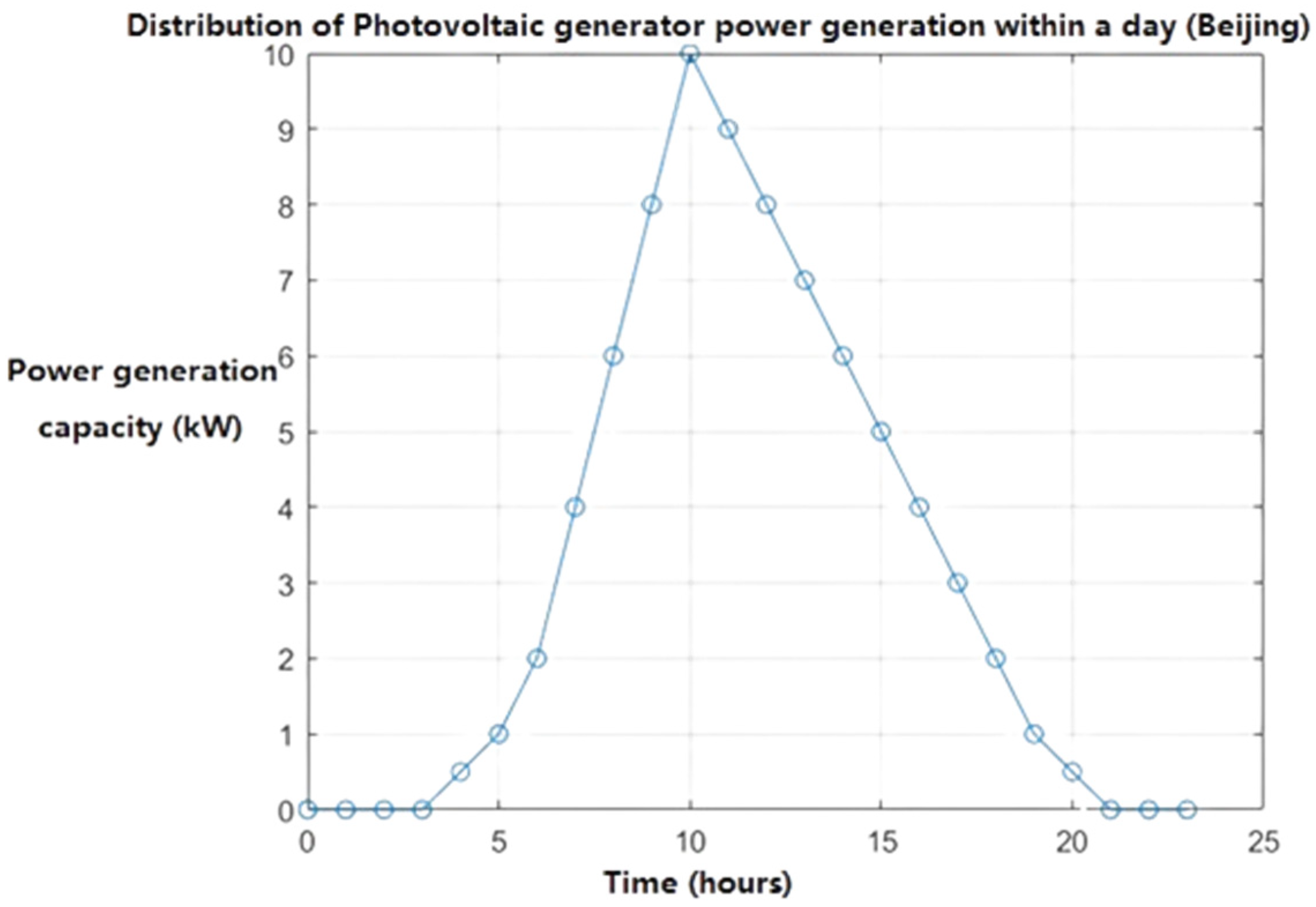
| 00:00–07:00 | 20 | 0 | +27.78 (Charging) | 25 → 50 | 20 + 27.78 |
| 07:00–10:00 | 15 | 15 | −0 (Do not act) | 50 → 50 | 0 |
| 10:00–13:00 | 25 | 40 | −5.56 (Discharge) | 50 → 44.44 | 0 |
| 13:00–17:00 | 20 | 50 | +0 (Do not act) | 44.44 → 44.44 | 0 |
| 17:00–22:00 | 15 | 0 | −16.67 (Discharge) | 44.44 → 27.77 | 0 |
| 22:00–23:00 | 5 | 0 | +0 (Do not act) | 27.77 → 27.77 | 5 |
| 23:00–24:00 | 0 | 0 | +22.23 (Charging) | 27.77 → 50 | 24.7 |
| Total | 100 | 90 | Charging +50, Discharge −22.23 | End battery power: 50 | 47.48 |
Disclaimer/Publisher’s Note: The statements, opinions and data contained in all publications are solely those of the individual author(s) and contributor(s) and not of MDPI and/or the editor(s). MDPI and/or the editor(s) disclaim responsibility for any injury to people or property resulting from any ideas, methods, instructions or products referred to in the content. |
© 2026 by the authors. Licensee MDPI, Basel, Switzerland. This article is an open access article distributed under the terms and conditions of the Creative Commons Attribution (CC BY) license.
Share and Cite
Zhong, Y.; Yin, X.; Wu, C.; Xu, G. Economic Energy Consumption Strategy Considering Multimodal Energy Under the Base Station Cluster of Multi-Device Communication Private Networks. Energies 2026, 19, 749. https://doi.org/10.3390/en19030749
Zhong Y, Yin X, Wu C, Xu G. Economic Energy Consumption Strategy Considering Multimodal Energy Under the Base Station Cluster of Multi-Device Communication Private Networks. Energies. 2026; 19(3):749. https://doi.org/10.3390/en19030749
Chicago/Turabian StyleZhong, Yan, Xuchong Yin, Chenguang Wu, and Gang Xu. 2026. "Economic Energy Consumption Strategy Considering Multimodal Energy Under the Base Station Cluster of Multi-Device Communication Private Networks" Energies 19, no. 3: 749. https://doi.org/10.3390/en19030749
APA StyleZhong, Y., Yin, X., Wu, C., & Xu, G. (2026). Economic Energy Consumption Strategy Considering Multimodal Energy Under the Base Station Cluster of Multi-Device Communication Private Networks. Energies, 19(3), 749. https://doi.org/10.3390/en19030749