1. Introduction
The emergence and rapid development of technologies such as cloud computing, the Internet of Things (IoT), 5G communication, and augmented/virtual reality (AR/VR) have led to the widespread deployment of data centers to satisfy the ever-increasing demand for computing power [
1]. Currently, there are approximately 8 million data centers globally, consuming about 1.4% of the world’s electricity, a figure projected to rise to 13% by 2030 [
2]. In 2022, data centers account for approximately 2% of global electricity demand, totaling around 460 TW-hours (TWh). Similarly in China, data center energy consumption in 2021 reached 216.6 billion kWh, making up 2.6% of overall societal energy consumption [
3]. By 2030, the power demand of data centers in China is projected to reach 105 million kW, with total annual electricity consumption of approximately 525.76 billion kWh, accounting for about 4.8% of overall societal total electricity consumption. Therefore, data centers have gradually become major electricity consumers in power systems.
Unlike other high-power-consuming loads, data centers can achieve rapid power load shifting and regulation through the spatiotemporal migration of computing workloads. Specifically, since delay-tolerant workloads have lower priority and can be delayed, adjusting the execution time of delay-tolerant workloads can effectively regulate power demand patterns [
4]. By shifting energy consumption from high-price to low-price periods, the overall energy cost can be reduced; by transferring loads from peak to off-peak periods, the peak-to-valley difference in the power grid can be reduced, the risk of equipment overload mitigated, and the reliability of the power system improved. As a result, data centers have become the important candidates for participation in demand response programs.
The energy consumption model serves as the foundation for data center related research and plays a crucial role in the coordinated analysis and optimization of power systems and computing infrastructures. It provides essential data support for the operation optimization and planning of power systems. The total energy consumption of a data center primarily consists of IT equipment, cooling systems, power supply and distribution units, and lighting. Among these components, IT equipment and cooling systems account for the largest share, typically around 85% of the total. Therefore, the modeling of data center energy consumption mainly focuses on these two subsystems. Yao et al. [
5] first proposed an IT equipment energy consumption model based on system utilization in 1995. Yeo et al. [
6] further refined this model by characterizing the energy consumption of individual components within IT equipment. The energy consumption model for cooling systems in data centers was initially developed by Moore and Chase et al. [
7] who introduced the coefficient of performance (COP) as an indicator to represent the efficiency of air conditioning systems.
To address the increasingly critical issue of energy consumption in data centers, numerous researchers have proposed various approaches to improve energy efficiency and reduce operational costs. Khalaj et al. [
8] established a thermal cycle model and formulated a multi-objective optimization problem aiming to minimize the total energy consumption of IT equipment and cooling systems by jointly optimizing computing power allocation and supply air temperature. Lin et al. [
9] considered the effect of IT equipment sleep states on energy consumption optimization. By iteratively computing the optimal sleep states and workload distribution of IT equipment, they achieved the minimization of total energy consumption. Ding et al. [
10] proposed a stochastic resource planning framework for data centers that jointly optimizes energy cost, carbon emissions, and operational risk, thereby improving operational efficiency and sustainability. Ding et al. [
11] further developed an integrated energy management model in which the waste heat recovered from data center operation is optimally coordinated with other energy resources to minimize the operational cost of data center microgrids.
The rapid and flexible load regulation capability of data centers makes them valuable demand-side response resources in power systems. Therefore, in order to integrate data centers as reliable demand-side response resources into power system scheduling, it is essential to quantitatively evaluate their regulation potential. Wu et al. [
12] proposed an electricity–heat coordinated operation to capture the temporal, spatial, and integrated energy flexibility of data centers, formulating a bilevel model with an incentivized profit-sharing mechanism to encourage flexibility provision. Zhang et al. [
13] proposed a method for calculating the energy consumption elasticity space of data centers based on multi-parametric programming (MPP) theory, which can obtain the feasible region composed of all possible energy consumption values of regional data centers. Wang et al. [
14] developed a chance-constrained bi-level model that jointly considers power capping and job scheduling to assess the flexibility potential of computing demand in data centers.
However, existing research primarily focuses on energy consumption models for single data centers and single time periods. However, single-data-center models cannot capture the spatial flexibility provided by workload migration, while single-period models overlook temporal flexibility. As a result, these approaches are unable to effectively evaluate the potential benefits of spatiotemporal workload migration in practical multi-data centers operations. Moreover, existing methods have not integrated device-level control with workload-level scheduling within a unified framework, even though equipment operation and workload distribution are inherently interdependent. To address this gap, this study develops an energy consumption model that accurately describes both the operational characteristics of IT equipment and the migration behavior of computing workloads, and proposes a method for calculating the energy consumption elasticity space to characterize the feasible range of energy consumption in multi–data center.
The contribution of this paper can be summarized as follows: (1) an energy consumption model for multi-data centers model considering the spatiotemporal transfer flexibility of computing workloads is proposed. The model aims to minimize the total operating cost across multiple data centers and time periods. To address the computational challenges caused by multi-period coupling and the large number of IT equipment, the sliding window method and equipment aggregation method are employed, enabling efficient resolution of the optimization problem and accurate characterization of the energy consumption behavior of multi-data centers; (2) an energy consumption elastic space calculation method based on multi-parametric programming is proposed. It transforms the energy consumption model considering the spatiotemporal transfer flexibility of computing workloads into the equivalent constraints of power demands. The energy consumption elasticity space provides an optimized boundary framework for power system operation and dispatch.
We present the proposed energy consumption model for multi-data centers and the corresponding solution methods in
Section 2 and
Section 3. In
Section 4, an energy consumption elastic space calculation method based on multi-parametric programming is proposed.
Section 5 applies the proposed method to a large-scale Internet enterprise, demonstrating that the model can more accurately evaluate the effectiveness of spatiotemporal workload migration compared with other models without flexibility. Finally, we conclude the main contributions of this article and introduce the limitations of the proposed methods in
Section 6.
2. Power Consumption Models and Operational Characteristics of Major Equipment Units in Data Centers
The energy consumption of a data center can be attributed to four components: IT equipment, cooling systems, power supply and distribution units, and lighting. IT equipment (e.g., servers, networks, storage, etc.) is the core infrastructure of a data center, enabling data storage, processing, and transmission. Air conditioning is a commonly used cooling method in data centers. It absorbs the substantial amount of heat generated by IT equipment and maintains the temperature within an acceptable range, thereby ensuring the stable operation of the IT equipment. IT equipment and cooling systems are the largest energy consumers in a typical data center, accounting for more than 85% of the total energy consumption. Power supply and distribution units, as well as lighting consume a small and stable amount of energy. Therefore, they are not included in the energy consumption modeling.
2.1. Power Consumption Model of IT Equipment
IT equipment power consumption (
PIT) can be divided into two main parts: computational power consumption (
Pcomputional), which is caused by computing workloads, and leakage power consumption (
Pleakage), which results from leakage currents in electronic components. If we assume the power consumed by a server is approximately zero when it is switched-off, we can model the power
Pcomputional consumed by a server at any specific processor utilization
u,
where
Pidle and
Pmax are the average power values when the server is idle and the average power value when the server is fully utilized, respectively. This model assumes server power consumption and CPU utilization have a linear relationship.
IT equipment contains a large number of integrated electronic components. When the equipment is powered-on, the leakage power consumption caused by leakage currents becomes non-negligible. Existing studies have characterized this phenomenon by a temperature linear correction function, which is as follows,
where
TIT represents the chip temperature of the IT equipment, while
b1 and
b2 are constants.
In addition to the power consumption of IT equipment in powered-on and switched-off states, it is important to note that there also exists a standby (or sleep) state. When IT equipment enters this state, it automatically reduces its operating voltage and frequency to conserve energy. The power consumption in this state is typically a small and constant value, denoted as
Psleep. Therefore, the power consumption of IT equipment
i during time slot
t can be expressed as,
where
uIT,i(
t) and
TIT,i(
t) represent the utilization and the chip temperature of the IT equipment
i during time slot
t.
IIT,i(
t) represents the operational state of IT equipment
i during time slot
t, with the values 2, 1, and 0 indicating powered-on, standby, and switched-off states, respectively.
Pon,i(
t) represents the power consumption of the IT equipment
i when it is in the powered-on state.
2.2. Power Consumption Model of Air Conditioning System
Air conditioning system power consumption
Paircon is determined by the cooling load
Qaircon and the coefficient of performance
kCOP as,
The cooling load of a data center can be broadly categorized into two parts: heat generated by IT equipment and heat gained from the surrounding environment. According to engineering practice, approximately 97% of the electrical energy consumed by IT equipment is converted into heat. The heat gained from the surrounding environment is related to both the environmental temperature coefficient
kT and the floor space required of IT equipment
Sdc, it can be represented as follows,
The coefficient of performance evaluates the efficiency of an air conditioning system. Under cooling mode, a higher supply air temperature
Tout generally leads to a higher
kCOP. The relationship between the two can be expressed as follows:
Therefore, the power consumption of air conditioning during time slot
t can be expressed as,
where
Paircon(
t) and
Tout(
t) are the power consumption and supply air temperature of the air conditioning system during time slot
t.
PIT(
t) is total power consumption of all IT equipment within the specified floor area during time slot
t.
2.3. Heat Transfer Model of IT Equipment and Air Conditioning System
The heat exchange process of the cooling system is fundamental to maintaining the stable operation of data centers. Air conditioning absorbs the substantial amount of heat generated by IT equipment, ensuring that the equipment operates within a safe temperature range and maintains reliable performance. It typically includes two heat exchange processes as follows:
where
Tin,i(
t) represents the inlet air temperature of the IT equipment
i during time slot
t, and
TIT,i(
t) represents the chip temperature as well as the outlet air temperature of the IT equipment
i during time slot
t.
Rin represents the equivalent thermal resistance, that is a constant associated with the density, volumetric flow rate, and specific heat capacity of the airflow.
- 2.
Hot Air Recovery and Cooling Regeneration: the hot air discharged from IT equipment is recovered by the air conditioning system and re-cooled into cold air for recirculation.
where
D is the heat transfer coefficient, which depends on the arrangement of the equipment and can be approximated as a constant under uniform deployment.
3. Modeling and Solution Methods for Data Centers Energy Consumption Considering the Spatiotemporal Transfer Flexibility of Computing Workloads
Data centers are special high-energy-consuming loads within the power grid. Their ability to achieve rapid power load shifting and regulation through the spatiotemporal migration of computing workloads makes them valuable resources for grid peak shaving and demand-side flexibility. Therefore, developing an accurate energy consumption model for data centers serves as a fundamental basis for related research.
Data centers energy consumption modeling is based on the power consumption models of infrastructure components (IT equipment and cooling systems), while also incorporating the spatiotemporal migration characteristics of computing workloads. Subject to the constraints of ensuring computational service quality and IT equipment operational safety, the model aims to minimize the total energy cost of the data center by jointly optimizing the operational states of infrastructure components and the migration strategies of computing workloads.
3.1. Modeling of Data Centers Flexibility
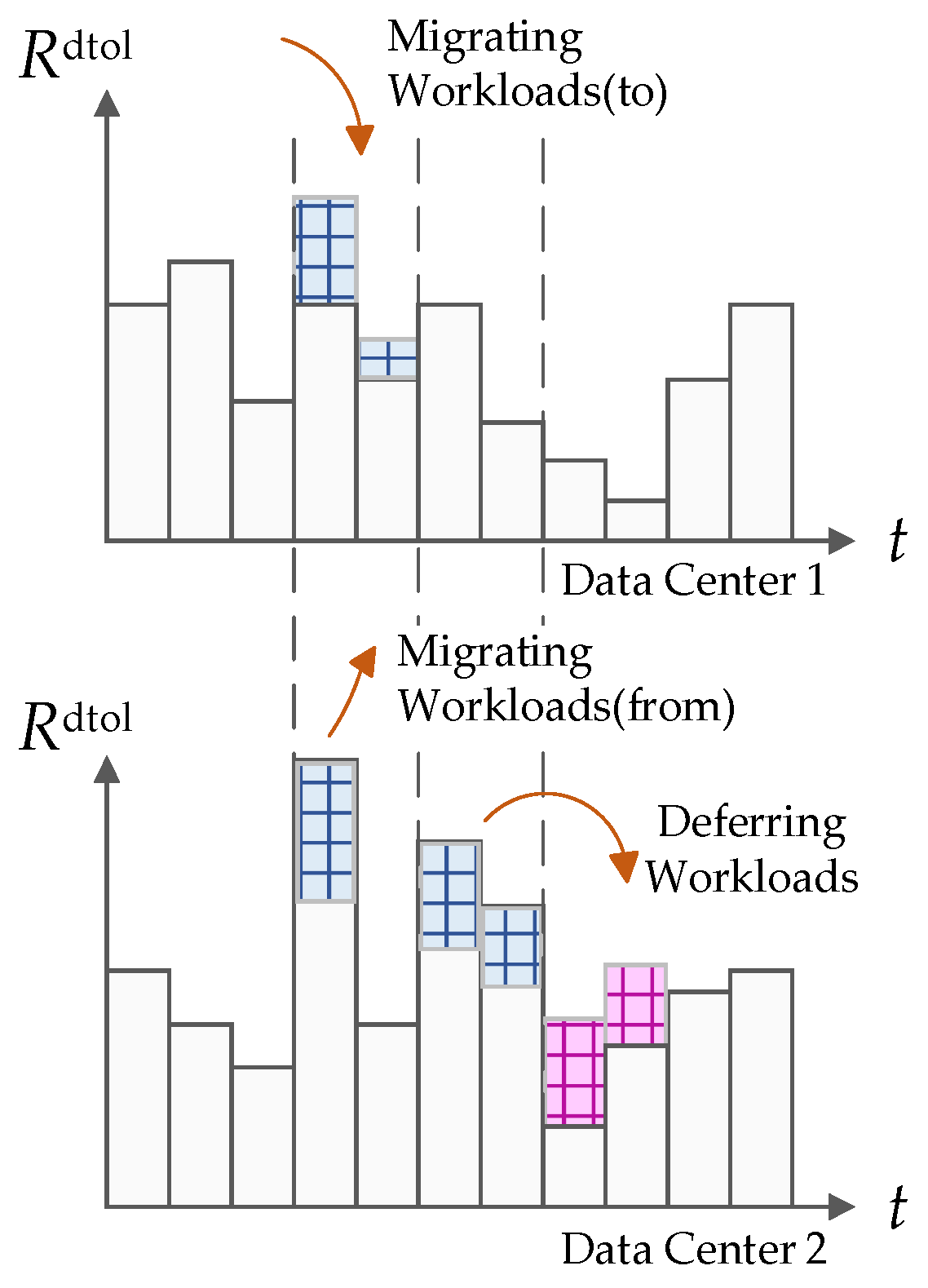
Among the task workloads received by data centers, tasks can be categorized based on their sensitivity to processing time into delay-sensitive and delay-tolerant workloads. Delay-sensitive tasks, such as real-time payments, live video streaming, and web requests, have strict timing requirements and must be processed immediately upon arrival. As such, these tasks offer limited flexibility for scheduling and are generally assigned only once upon arrival, making them unsuitable as spatiotemporally flexible load resources. In contrast, delay-tolerant tasks, such as image processing, scientific computing, and data backup, only need to be completed before a specified deadline. These tasks exhibit high degrees of spatiotemporal flexibility, as illustrated in
Figure 1.
In this section, the proposed energy consumption optimization model incorporates the spatiotemporal of delay-tolerant workloads. Three handling strategies are considered: immediate execution upon arrival; postponement until just before the deadline to identify a more energy-efficient time slot; and migration to another underutilized data center for immediate execution.
During time slot
t, the initial workload demand
Rm(
t) and the processed workload
Dm(
t) at data center
m are determined by the corresponding volumes of delay-sensitive and delay-tolerant tasks, as follows:
where
and
represent the initial workload demand of delay-sensitive and delay-tolerant tasks at data center
m during time slot
t; and
and
represent processed workload of delay-sensitive and delay-tolerant tasks at data center
m during time slot
t.
According to the above analysis, for delay-sensitive tasks the initial workload demand must be fully processed within the same time slot,
In contrast, for delay-tolerant tasks, the relationship between the initial workload demand and the processed workload within the same time slot can be expressed as,
where
and
are the variations in the temporal and spatial dimensions at data center
m during time slot
t, respectively.
It is important to note that the total initial workload demand before spatiotemporal migration must be equal to the total processed workload after migration,
where
t0 and
tend represent the start and end time slots, and
NDC is the total number of data centers.
Delay-tolerant workloads can be deferred from earlier time slots to later ones for execution, leveraging their flexibility in temporal dimension,
where
(
t,
t′) represents the amount of workload deferred from slot
t to slot
t′ at data center
m; and
n denotes the maximum number of time slots by which a task can be deferred, as determined by task-level agreements and scheduling requirements. It should be noted that
t +
n must not exceed the optimization horizon
tend.
In the spatial dimension, workloads are assumed to be instantly migrated between data centers, with network transmission time ignored,
where
Si,j,m(
t) represents the amount of workload migrated from data center
i to data center
j during time slot
t; and dc_pair represents the set of all possible ordered pairs of data centers,
dc_pair = {(
i,
j)|
i,
j ∈
NDC|
i <
j}.
3.2. Data Centers Energy Consumption Model Considering Flexibility
The energy consumption model for data centers is used to minimize the total operational cost of all data centers over the entire optimization horizon. The objective function is composed of two parts: the operating cost and the startup cost, as follows:
where
PDC,m(
t) represents the total energy consumption at data center
m during time slot
t;
Nstartup,m(
t) represents the total number of IT equipment that transition from the switched-off state to the powered-on state at data center
m during time slot
t;
CP(
t) is the electricity price;
CS(
t) is the cost coefficient of startup; and Δ
t is the duration of a slot.
The optimization of data centers energy consumption must ensure stable operation under practical constraints, including data center operational constraints and workload transferring constraints within the regional power grid, as follows:
where
PITsum,m(
t) and
Paircon,m(
t) represent the total energy consumption of all IT equipment and the energy consumption of the air conditioning system at data center
m during time slot
t, respectively;
PIT,i,m(
t) represents the power of consumption of the IT equipment
i at data center
m during time slot
t; and
NIT,m is the number of IT equipment at data center
m. The expressions for
PIT,i,m(
t) and
Paircon,m(
t) are defined in Equations (3) and (7), respectively.
- 2.
Total computing workloads of a data center:
where
uIT,i,m(
t) represents the utilization of IT equipment
i at data center
m during time slot
t;
represents the maximum of processed workload of IT equipment
i at data center
m; and
sIT,i,m(
t) is a binary variable that indicates whether IT equipment
i at data center
m is in powered-on state during time slot
t. The expressions for
and
are defined in Equations (14) and (15), respectively.
- 3.
Workload transfer limitation constraints:
In multi-data center scheduling for delay-tolerant workloads with spatiotemporal transfer flexibility, the scheduling center should prioritize temporal deferral within the same data center. Spatial migration across data centers should be considered as a supplementary strategy, in order to minimize the additional overhead caused by network transmission.
- 4.
Supply air temperature constraints of air conditioning systems:
where
Tout,m(
t) is the supply air temperature of the air conditioning system at data center
m during time slot
t; and
and
are the upper and lower limits of the supply air temperature, respectively.
- 5.
Inlet air temperature constraints of IT equipment:
where
Tin,i,m(
t) is the inlet air temperature of the IT equipment
i at data center
m during time slot
t; and
and
are the upper and lower limits of the inlet air temperature, respectively.
- 6.
Chip air temperature constraints IT equipment:
where
TIT,i,m(
t) is the chip temperature of the IT equipment
i at data center
m during time slot
t; and
is the upper limit of the chip.
Eventually, the complete energy consumption model of data centers introduced as (16)–(22) and (8)–(9). To ensure computational efficiency, the originally quadratic expressions for PIT,i,m(t) and Paircon,m(t) are linearized, resulting in a mixed-integer linear programming (MILP) formulation. The decision variables in the model include the utilization of IT equipment, the inlet air temperature and chip temperature of IT equipment, the supply air temperature of air conditioning systems at each data center, the operational state of IT equipment, as well as the amount of workload that is deferred over time and migrated across data centers.
3.3. Solution Methods
According to
Section 3.2, the energy consumption model for data centers is mathematically formulated as a mixed-integer linear programming problem. The branch-and-bound method, which searches for the optimal solution through a systematic branching and bounding process, is the core algorithm used in commercial solvers such as GUROBI and CPLEX. Therefore, it is adopted for its ability to guarantee global optimality while maintaining relatively high average computational efficiency. However, the applicability of this method has been challenged as the problem scale increases. First, a large-scale data center may contain tens of thousands of IT equipment, and the model considers coordinated optimization across data centers, leading to a massive number of binary and continuous decision variables such as the operational states and utilization of IT equipment. Second, the model captures the spatiotemporal transfer characteristics of delay-tolerant workloads, resulting in a number of variables representing deferral and migration workloads that grows quadratically with the number of scheduling time slots. Moreover, the objective function includes the startup cost, which is related to the state transitions of IT equipment between consecutive time slots, the model exhibits a strong temporal coupling and therefore cannot be solved by simply decomposing it into independent single-period subproblems.
These factors jointly lead to a combinatorial explosion in the number of decision variables, substantially increasing computational complexity and solution time. To address these computational challenges, this study adopts the sliding window and equipment aggregation methods to enable online optimization of data centers energy consumption, thereby effectively accelerating the solution process.
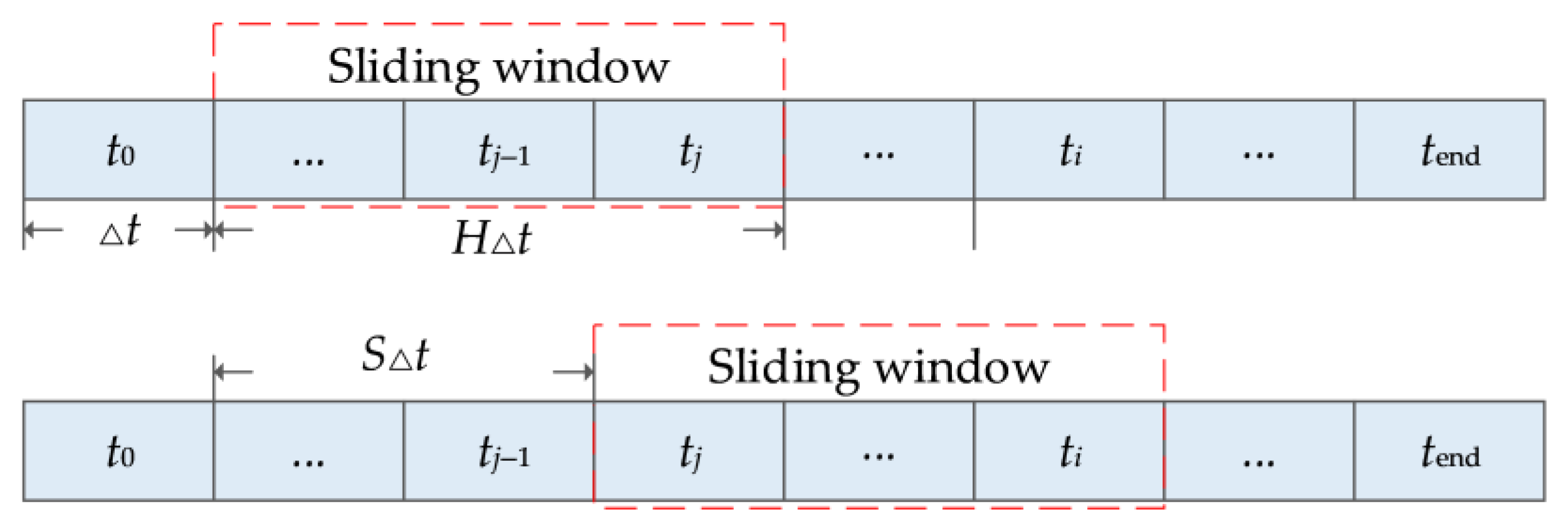
The optimization horizon is divided into
NS time slots, each with a duration of Δ
t. The sliding window has a fixed width of
HΔ
t and a step size of
SΔ
t. During the sliding window [(
n − 1)∆
t, (
n − 1 +
H)∆
t], the previously established energy consumption model is solved to generate an optimal strategy. The optimal results of the first
S time slots (from (
n − 1)∆
t to (
n − 1 +
S)∆
t) in this window are retained. Then, the window moves forward by
S time steps along the time axis, and the optimization continues in the next window. The sliding window is illustrated in
Figure 2.
From a methodological perspective, the use of a sliding window confines the optimization to a limited temporal horizon, meaning that the solution obtained within each window represents only a local optimum. As a result, global optimality over the entire scheduling horizon cannot be guaranteed. Although it cannot guarantee a globally optimal solution, it provides a computationally efficient approach for generating feasible operational and workload migration strategies for the energy optimization of data centers.
To balance solution quality and computational efficiency, it is recommended to define the window width HΔt as the maximum allowable delay for delay-tolerant workloads and set the sliding step size SΔt = 1 to a moderate value. To ensure that all deferred tasks are completed within the sliding window, the window width HΔt is set to satisfy H ≥ n, where n is the maximum number of deferrable time slots defined in Equation (14).
- 2.
IT equipment aggregation method
The number of data centers NDC, the number of IT equipment at each data center NIT,m, and the number of scheduling time slots jointly determine the total number of decision variables associated with IT equipment operation. For example, the number of continuous decision variables representing chip temperatures of IT equipment is (T). Each IT equipment can be in one of three operational states: powered-on, standby, or switched-off. Therefore, the number of integer decision variables representing the operational states is (3T).
In practical large-scale data center deployments, IT equipment is typically procured in batches, with uniform models and configurations. Therefore, a single equivalent unit of IT equipment can be used to represent all equipment of the same type. By employing such equivalent equipment in the energy consumption model, the number of integer decision variables can be significantly reduced, thereby improving computational efficiency.
After introducing equivalent equipment, the heat transfer models (8)–(9) use equivalent power consumption instead of individual device power. The equivalent power consumption can be expressed as,
where
Peq,i,m(
t) and
PIT,i,m(
t) are the equivalent power consumption and the total power consumption of the type-
i IT equipment at data center
m during time slot
t, respectively;
NIT,i,m is the number of the type-
i IT equipment at data center
m; and
,
and
are the numbers of type-
i IT equipment in the powered-on, standby, and switched-off states, respectively, at data center
m during time slot
t.
Based on the sliding window and equipment aggregation methods, the proposed solution method for the data centers energy consumption model consists of the following four steps:
- (1)
Construct the heat transfer model using the IT equipment aggregation method described in Equation (23), and formulate the energy consumption model of data centers based on Equations (8)–(9) and (16)–(22). The total number of optimization time slots be represented as NS, the time slot length as Δt, and the sliding window width as . Determine the total number of sliding windows NW and initialize the sliding window index n = 1.
- (2)
For the current sliding window [(n − 1)∆t, (n − 1 + H)∆t], determine the initial states at time (n − 1)∆t, based on the states from the previous slot [(n − 2)∆t, (n − 1)∆t]. For the first window, assume that all equipment is in the switched-off state. Solve the energy consumption model for this window using the branch-and-bound algorithm, and obtain the solution for the following decision variables: uIT,i,m, TIT,i,m, Tin,i,m, Tout,m.
- (3)
Based on the solution from step (2), store the equipment states for all time slots within the current sliding window as , and .
- (4)
n = n + 1, and check whether the optimization horizon has been completed. If not, return to Step (2) and continue the optimization for the next sliding window. If all time slots have been processed, terminate the algorithm.
4. Energy Consumption Elastic Space Computation for Data Centers
In
Section 3, an energy consumption model is proposed for data centers that incorporates the spatiotemporal transfer flexibility of computing workloads. While this model effectively reduces operational costs by exploiting the energy-saving potential of data centers, it also disrupts the traditional one-to-one mapping between fixed computational demand and deterministic energy consumption. As a result, the power demand of data centers becomes a flexible variable, making it difficult for power system operators to accurately predict load fluctuations. This introduces new challenges for power system operation and scheduling.
To address this issue, this study introduces the concept of energy consumption elastic space, which aims to characterize the required power supply boundaries for multi-data centers. By clearly defining the range of power that the grid must supply to the data centers, the model provides an optimized boundary framework for power system operation and dispatch.
4.1. Definition of Energy Consumption Elastic Space
The physical interpretation of the energy consumption elasticity space refers to the feasible region composed of all possible energy consumption values that satisfy the workload demand and operational constraints of multi-data centers. This feasible region ensures that for any energy consumption values within the space, the energy consumption model defined by Equations (16)–(22) and (8)–(9) admits at least one optimal solution that satisfies all model constraints.
By reformulating the model in Equations (16)–(22) and (8)–(9) into Equations (24) and (25), the characterization of the energy elasticity space can be transformed into a feasibility analysis problem. Specifically, the feasible energy consumption values can be identified by analyzing the feasibility of the model in (24)–(25) as the energy consumption variable
w varies.
where
w is the vector of energy consumption variables,
x is the vector of decision variables,
A and
B are coefficient matrices, and
C and
D are coefficient vectors.
For Equations (24) and (25), if the energy consumption variable w is regarded as a variable planning parameter, the model can be formulated as a typical multi-parametric linear programming problem. By solving this multi-parametric linear programming problem, all feasible values of the energy consumption variable can be identified, thereby determining the energy consumption elastic space.
4.2. Solution Methods
Multi-parametric Programming (MPP) is a mathematical optimization approach that analyzes how the optimal solution set and feasibility of an optimization problem vary with changes in multiple parameters. Typical categories of multi-parametric programming include multi-parametric linear programming (MPLP), multi-parametric quadratic programming (MPQP), and multi-parametric mixed-integer linear programming (MPMILP), etc. This study focuses on MPLP, which is solved through the concepts of optimal partition and critical region. In this section, a brief introduction of multi-parametric programming is given.
Definition 1 (Optimal partition). For the optimal solution x*(w) of (24)–(25), the sets of active constraints and inactive constraints are presented as follows:
Inactive constraints:where J and K index are the active and inactive constrains index, respectively. Any one constraint in (25) belongs to the active constraints or the inactive constraints. A = [ ]T, B = [ ]T, D = [ ]T.
The optimal partition of constraints in (25) associated with w ∈ requires that we divide all constraints into the active constraints in (26) or the inactive constraints in (27).
Definition 2 (Critical region). For a given w ∈ , a fixed combination of active and inactive constraints is indexed by {AJ x*(w0) = BJ w0 + DJ and AK x*(w0) < BK w0 + DK}. The critical region related to is defined as The critical region refers to a set of parameters w with the same optimal partition.
Assuming W is convex and feasible region is a subset of W, the following theorems hold for the MPLP problem:
Theorem 1. The ith critical region is {w ∈ W|Gwi w ≤ Fwi}, where i = 1,2,…,n. Each critical region is convex and any two critical region and (j, k = 1,2,3…,n, j ≠ k) are mutually exclusive. Moreover, there are no gaps between adjacent critical regions.
Theorem 2. The feasible region is the union of all critical region, that is, = ∪∪…∪.
5. Case Study
To verify the effectiveness of the proposed energy consumption model and elastic space computation method, we refer to the actual operating data of a large-scale Internet enterprise given in [
15]. All simulations in this study were conducted using Visual Studio Code 1.105.1 and MATLAB R2019b on a laptop equipped with Intel (R) Core (TM) i7-8750U CPU @ 2.20 GHz, 8.00 G RAM. The optimization problems were solved using GUROBI (version 10.0.3).
5.1. Case Description
Three data centers are considered in this case study: a, b, and c. Each data center is equipped with three different types of IT equipment and a centralized air conditioning system. The IT equipment in each data center is uniformly deployed, and the equipment configurations are identical across all centers. The operational parameters of both IT equipment and air conditioning are summarized in
Table 1.
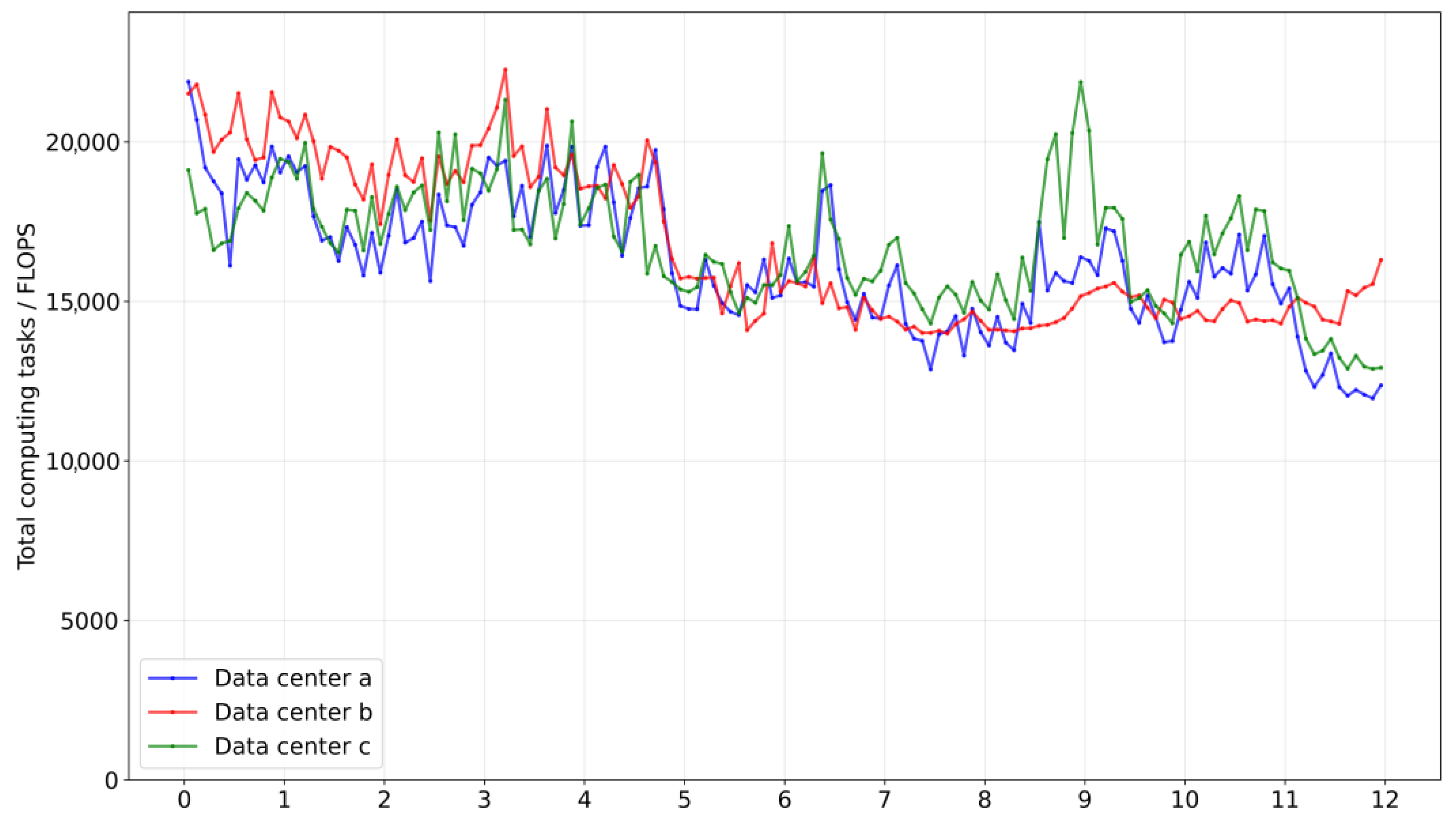
The optimization is performed with a time step of 5 min over a 12 h horizon. The initial workload demand curves of the three data centers over the 12 h period are shown in
Figure 3.
The following four models are used to determine the energy consumption of data centers and to verify the effectiveness of incorporating spatiotemporal transfer characteristics:
M1: Proposed model (incorporating both spatial and temporal transfer characteristics).
M2: A model that only incorporates spatial transfer characteristics.
M3: A model that only incorporates temporal transfer characteristics.
M4: A model that does not incorporate any spatiotemporal transfer characteristics.
5.2. Impact of Spatiotemporal Transfer of Computing Workloads on Energy Consumption in Data Centers
This section evaluates the effectiveness of the proposed model by comparing two key indicators: the total operational cost (TOC) and the power usage effectiveness (PUE). The total operational cost is calculated according to (16), while the PUE is computed as follows:
The energy consumption optimization results of M1–M4 in
Table 2.
The operational cost obtained by the proposed M1 model is the lowest, at 20,927.55 CNY, while the M4 model yields the highest cost of 21,662.38 CNY. Both the M2 and M3 models show achieve lower costs compared to M4. M1, M2, and M3 show reduced PUE values compared with M4, with values of 1.3963, 1.4007, and 1.3986, respectively. Among them, the PUE values of M2 and M3 are slightly higher than that of M1.
The observed results can be attributed to the fact that the M1 model incorporates the spatiotemporal transfer flexibility of computing workloads. By optimizing the scheduling strategy across both data centers and time slots, M1 enables more efficient management of IT equipment operation. It turns off idle devices and reduces the frequency of transitions from the switched-off state to the powered-on state for IT equipment. Consequently, the model achieves reductions in both total operational cost and power usage effectiveness (PUE) while ensuring that computational demands are met. In contrast, the M4 model lacks any workload scheduling optimization mechanism. IT equipment in M4 frequently switches on and off in response to workload fluctuations, which leads to increased operational losses. Consequently, both the total operational cost and the PUE of M4 are the highest among all models. Although M2 and M3 consider spatial and temporal migration, respectively, they do not realize coordinated optimization in both dimensions. Therefore, their energy consumption optimization performance is limited, and both their total cost and PUE remain higher than those of M1. This analysis demonstrates that coordinated scheduling of computing workloads across both spatial and temporal dimensions can significantly enhance energy management in data centers, leading to a reduction in overall energy consumption and an improvement in energy efficiency.
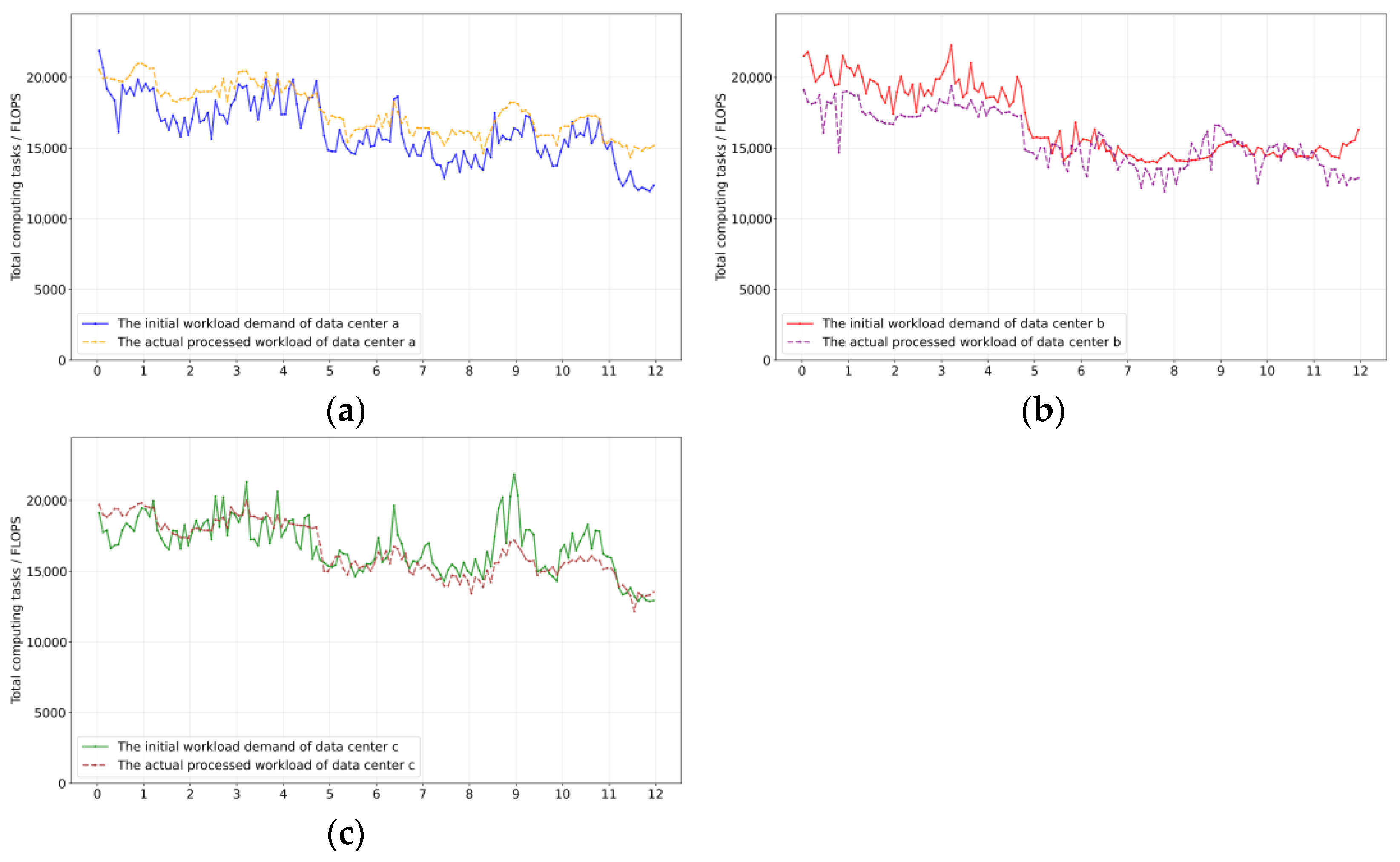
In addition,
Figure 4 present the comparison between the initial workload demand and the actual processed workload under the M1 model across different time slots. The comparison between the two curves clearly indicates that, through spatiotemporal migration of workloads, the actual process curves of the three data centers become significantly smoother than the initial demand curves. This smoothing effect effectively reduces the frequency of IT equipment transitioning between the switched-off and powered-on states.
Furthermore,
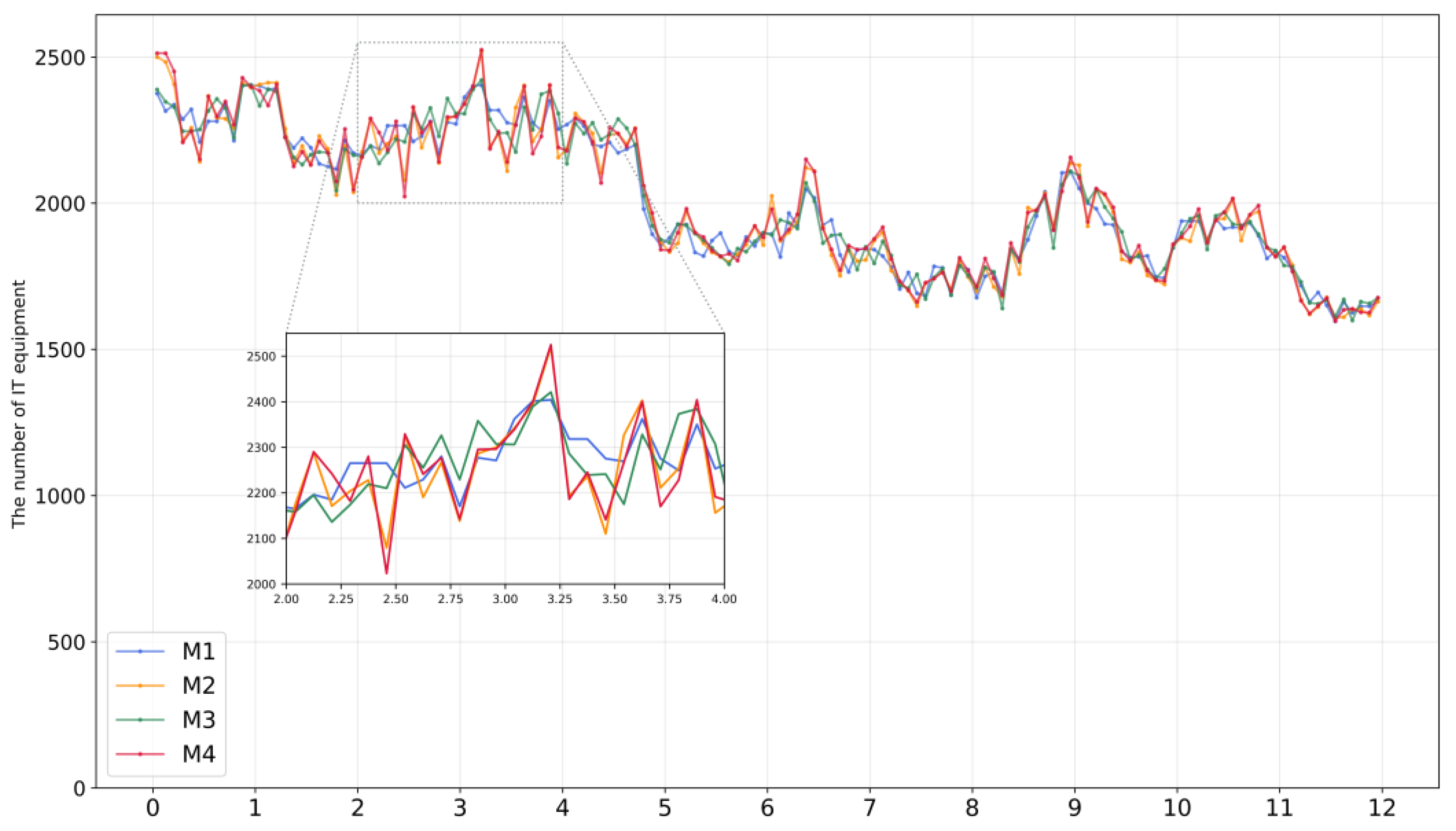
Figure 5 presents the curves of the number of IT equipment in the powered-on state under the four models (M1–M4), offering a more intuitive view of operational stability. The M1 model exhibits the smoothest variation in the number of powered-on devices over time, whereas the M4 model shows the most significant fluctuations. These results further confirm the effectiveness of spatiotemporal workload migration in enhancing the operational stability of data center systems.
The optimization model proposed in this study operates on a 5 min scheduling interval, resulting in a total of 144 time periods over a 12 h horizon. Model M1 achieves a solution time of 11.7 min in this configuration. In real-world applications, workload scheduling is generally performed in a rolling fashion at fixed intervals (e.g., every 15 min), where online optimization requires the solution time to be well within the decision-making interval. These results demonstrate that the proposed method satisfies the real-time computational requirements of online optimization.
5.3. Impact of Spatiotemporal Transfer of Computing Workloads on Energy Consumption Elastic Space in Data Centers
In this section, the multi-parametric energy consumption elasticity space calculation method proposed in
Section 4 is applied to quantify the feasible region of system energy regulation. The polyhedral volume (PV) of the elasticity space is selected as the evaluation indicator, and the corresponding results are summarized in
Table 3. For comparison purposes, the energy elasticity space is calculated at time slot
t = 6; the same approach is applied in the following analyses.
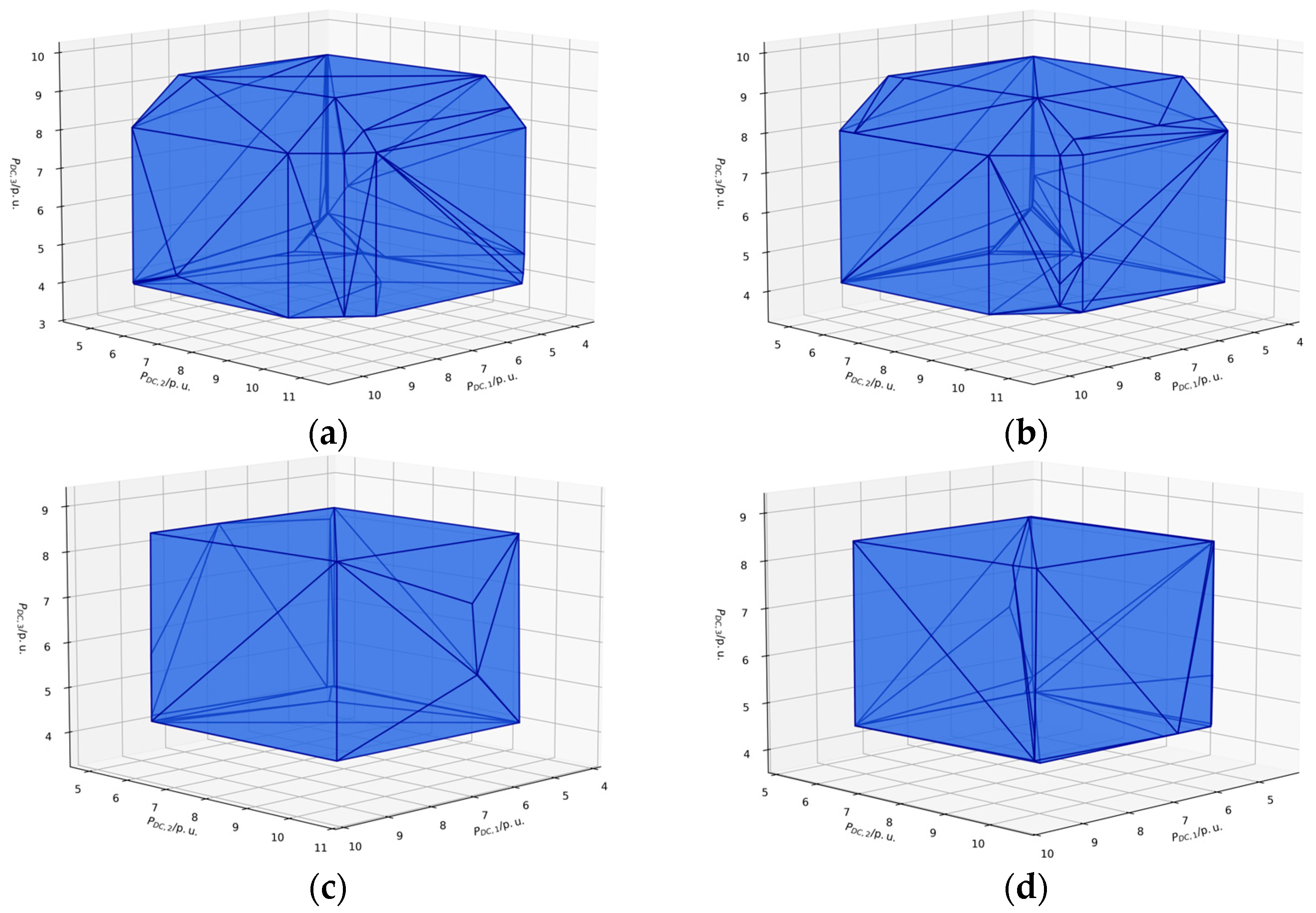
Figure 6 illustrates the three-dimensional projection results of the energy consumption elasticity space for M1–M4 models.
By combining the information from
Table 3 and
Figure 6, it can be observed that, in this case study, the energy consumption elasticity space constructed by the M1 model has the largest volume, whereas that of M4 is the smallest. According to the fundamental definition of the energy consumption elasticity space, the polyhedral volume reflects the range of the feasible region of data center energy consumption, which characterizes the system’s adjustability in terms of energy flexibility.
The results indicate that the energy consumption model incorporating spatiotemporal transfer flexibility effectively enhances the operational flexibility of the multi-data centers. Furthermore, the obtained boundary of the energy consumption elasticity space provides reliable and effective constraint information for the operation and dispatch optimization of power systems.
6. Conclusions
With the continuous rise in data center electricity consumption, accurately modeling their energy characteristics and flexibility potentials have become critical for enabling energy efficiency optimization and coordinated operation with power systems. This paper develops a multi-data centers energy consumption model based on power consumption models of IT equipment and air conditioning systems, while incorporating the spatiotemporal flexibility of delay-tolerant computing workloads. To address the computational complexity caused by the large number of IT equipment and long scheduling horizons, a sliding window method and an IT equipment aggregation strategy are proposed, which significantly reduce the solution burden. Furthermore, based on multi-parametric programming theory, an energy consumption elasticity space computation method is proposed, treating energy consumption as a parametric input. This approach enables precise characterization of the feasible energy consumption region of multi-data centers. Simulation results demonstrate that the proposed method effectively captures the energy behavior of data centers and quantifies their energy-side flexibility.
As data centers continue to account for a growing share of total power system demand, their energy consumption characteristics will exert increasing influence on grid operational stability. However, in the present study we do not consider the latency introduced by workload migration across data centers, nor do we account for differences in latency tolerance among workloads with varying priorities or their dynamic variations. These simplifications may lead to an overestimation of the potential benefits of spatiotemporal workload migration in energy optimization and could affect the effectiveness of workload scheduling strategies. Future work will further examine the impact of these factors on energy consumption and incorporate them into the formulation of energy optimization models.