
Article

Two-Stage Decoupled Security-Constrained Redispatching for Hybrid AC/DC Grids

Ricerca sul Sistema Energetico—RSE S.p.A., 20134 Milano, Italy
*
Author to whom correspondence should be addressed.
Energies 2026, 19(3), 706; https://doi.org/10.3390/en19030706
Submission received: 19 December 2025 / Revised: 15 January 2026 / Accepted: 19 January 2026 / Published: 29 January 2026
(This article belongs to the Section F1: Electrical Power System)

Abstract

Hybrid AC/DC grids with High Voltage Direct Current (HVDC) systems enhance grid resilience and enable efficient long-distance power transfer, asynchronous network interconnection, and seamless integration of offshore renewable energy sources. However, ensuring secure and reliable operation of these complex hybrid systems, particularly under contingency scenarios, presents significant challenges. This paper proposes a novel and computationally efficient two-stage linearized decoupled formulation for security-constrained redispatch in hybrid AC/DC grids. The methodology explicitly addresses N-1 security criterion, incorporating constraints from both the AC and DC subsystems, as well as the DC/AC converters. Simulation results on a test power system demonstrate the effectiveness of the proposed approach in mitigating the impact of both transmission line and generator outages, validating its applicability for enhancing grid resilience.

1. Introduction

HVDC (High Voltage Direct Current) transmission systems can expedite clean energy transition of modern power systems by favoring long-distance power transmission, asynchronous network interconnection, and underground and undersea connection including the integration of offshore renewable energy resources (RES) [1,2,3]. In particular, multi-terminal DC grids (DCGs) are expected to enhance reliability and resilience [4,5,6,7,8]. In order to achieve this goal, however, DCGs need to be suitably designed and operated, due to the increasing complexity of the resulting AC/DC system and possible further stability issues [9], due to fast- and/or slow-dynamic interactions between the control systems of power electronics-based devices and other components in the system [9,10]. An essential step is developing tools to optimize generation dispatch and ensure system security under varying conditions and contingencies. These tools must consider the flexibility and operational constraints of new DCGs connected to conventional AC systems. This requires adapting Optimal Power Flow (OPF) and Security-Constrained Optimal Power Flow (SCOPF) algorithms to simulate hybrid AC/DC grids.
In this context, the HVDC-WISE project [11] aims at proposing, designing, analyzing, and validating HVDC architectures for reliable and resilient hybrid AC/DC power systems [12], with a specific step of analysis relying on SCOPF [13,14].
Researchers have developed various models and algorithms to address these challenges in mixed AC/DC grids. Reference [15] developed an algorithm for OPF/SCOPF in AC/DC grids, using non-linear models and considering preventive/corrective actions. With increased renewable penetration, the authors in [16] proposed a hierarchical SCOPF algorithm to simulate multi-terminal HVDC systems supporting AC systems. Reference [17] explored OPF models for AC/DC grids, with formulations from non-linear to linearized. For computational efficiency, the authors in [18] applied Dantzig–Wolfe decomposition to linearized OPF. In [19], a risk-based SCOPF is introduced, exploring HVDC’s flexibility for reliability. Reference [20] presented a multiconductor OPF for unbalanced bipolar HVDC, formulated as a nonlinear optimization problem and solved with the interior point method, which, however, cannot assure the globally optimal solution. In [21], a distributed OPF was developed using scenario-oriented decomposition for AC/DC grids with renewable uncertainties. In general, nonlinear models are accurate but computationally inefficient; on the contrary, most of the linearized models for AC/DC SCOPF proposed above are fast because they assume the “DC load flow” approximations on both DCG side and on AC grid side, but they are less accurate.
The SCOPF can be formulated either as a dispatch or a redispatch problem [22,23,24,25,26,27,28,29,30]. In the dispatch case [15,22,24,26,27,28,29] the set-points of the controllable quantities are fed into the objective function of the optimization in absolute terms; in the redispatch case [19,23,25,30], the objective function of the optimization depends on the set-point variations with respect to an initial operating condition given in input, hence the solution is expressed in terms of deviations with respect to the initial set-points.
As for the optimization, both nonlinear and linear approaches are adopted, depending on the involved functions. Reference [22] employs a linear programming approach with piecewise linear functions for generation cost and AC/DC transmission losses. In [23,25] the optimization is carried out via a differential evolution algorithm in turn relying on power flow calculations. In [29], the problem is in terms of stochastic programming with chance constraints and a quadratic objective function, solved via scenario approach followed by robust optimization. In [26], the optimization is based on the application of a primal-dual interior point for local search combined with differential evolution method for global search.
In this context, the authors propose a two-stage decoupled iterative approach for Security Constrained Redispatch (SC-R) which separately manages the problems related to the active power/phase angles and to reactive powers/voltage magnitudes, by adopting a cascaded approach based on two suitable linearizations introduced in [30] for the original AC load flow equations. This approach allows a trade-off between accuracy and speed.
The paper is organized as follows: Section 2 presents the proposed formulation of the SC-R. Section 3 describes the application tests of the SC-R on the case study. Section 4 concludes.

2. The Proposed Formulation

2.1. The Overall Framework

The aim of the SCOPF is to secure a given, initial operating condition against a set of (mutually exclusive) contingencies via a mix of preventive and corrective actions (in fact, using only preventive actions only may lead to feasibility issues, especially in case of large grids and contingency sets; moreover, it may be more costly). Preventive actions are implemented on the initial operating condition independently of the occurrence of the contingencies. They include redispatching active power setpoints and AC voltage setpoints of AC conventional generators, curtailing renewable generators, adjusting the shift angle of Phase Shifting Transformers (PSTs) as well as the power and DC voltage setpoints of DCG converters with constant power and Power-Voltage (PV) droop controls [31]. Corrective actions are deployed only in case of occurrence of contingencies leading to grid constraints’ violations; they include load shedding, the corrective variations of active power and AC voltage setpoints of dispatchable AC generators, and the corrective variations of DC voltage and power setpoints of DC converters within embedded DCGs.
The output of the SCOPF thus consists of a set of preventive actions in order to modify the base case, plus a set of corrective actions for each contingency of the contingency set. The uncertainties related to contingency occurrence are also considered. All the actions are prioritized in the optimization, on the basis of their unitary costs.
The contingency set is a predefined list of outages which can currently account for the following:
  • Loss of single AC branches;
  • Loss of single DC branches;
  • Loss of single converters of embedded DCGs, without losing the DCG connectivity (no DC branches are tripped);
  • Loss of components due to DC bus fault, namely the simultaneous loss of DCG converter and DC branches connected to the faulty DC bus;
  • Loss of single AC generators (including renewable injections).
In the context of the HVDC WISE workflow to characterize reliability and resilience of the grid [13,14], the SCOPF is assumed here to be fed with OPF results, hence with N-secure situations. This is not a necessary condition for the formulation, however, as N-security may be a by-product.
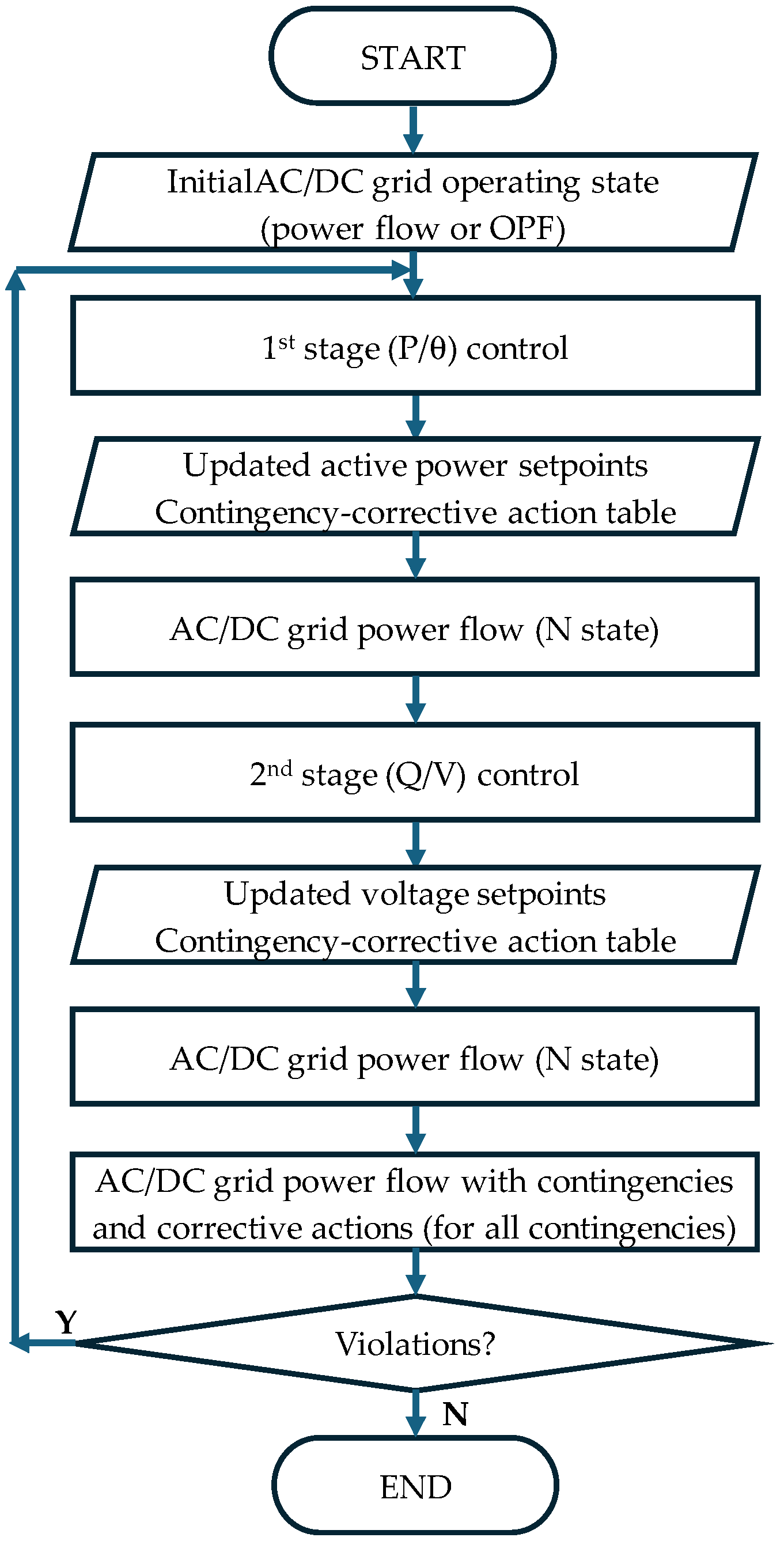
The SCOPF is formulated as a two-stage N-1 Security-Constrained Redispatching (SC-R) approach (see Figure 1):
  • First stage to solve active power/phase angle related issues;
  • Second stage to solve reactive power/voltage magnitude related issues.
The first stage is modelled using a conventional formulation based on Power Transfer Distribution Factors (PTDF) and provides the (preventive and corrective) variations of active power setpoints for AC generators and for AC/DC converters. The second stage exploits a suitable decoupled formulation of the reactive power/voltage problem [30] and provides the (preventive and corrective) variations of AC voltage setpoints for the conventional AC generators and for converters, as well as the converter DC voltage setpoints.
After the first and second stage, a full AC/DC power flow is computed, implementing the preventive actions identified at the respective control stage in order to feed the next stage of the workflow with an accurate updated state (Figure 1). Finally, each contingency of the contingency list is simulated by computing the power flow with corrective actions applied. If violations occur for some contingency, the whole process is repeated starting from the base case as modified with the identified preventive actions.
The embedded VSC’s of DCGs are represented in the AC grid as fictitious generators, thus acting as interface between AC and DC, each with a 4-quadrant P-Q capability curve corresponding to the one of the relevant VSC. The VSC model is a lossless model and only the DC side control functions (such as constant V or PV droop) are accounted for in power flow and sensitivity calculations.
The benefits of the proposed SC-R approach are two-fold:
  • The formulation of the two stages as Linear Programming problems makes the algorithm efficient to solve large power systems.
  • The adoption of reactive/active power decoupling techniques permits to solve the two stages separately in a cascaded way.
The assumption of lossless VSC models and the use of linearized load flow approximations are adopted to ensure computational tractability for large-scale scenarios, where detailed nonlinear modeling would significantly increase complexity and runtime. These simplifications are widely used in planning and optimization studies, as they assure errors acceptable with respect to the scope of the abovementioned analyses [32]. Prior studies have shown that the effects of the assumptions above are non-negligible for detailed analyses [33]. In future developments, approximate modeling of VSC losses could be incorporated while preserving linearity, e.g., modeling the converter losses as a linear function of the converter power flow, in order to improve accuracy without compromising computational efficiency.
The proposed SC-R builds upon linearization principles similar to those employed in state-of-the-art methods such as Dantzig–Wolfe decomposition [18] and hierarchical SCOPF [16], but, unlike these methods, it additionally introduces an active/reactive power decoupling mechanism that significantly reduces computational burden without compromising security constraints. Prior studies have shown that decomposition-based and hierarchical approaches achieve scalability at the cost of increased coordination complexity and communication overhead. In contrast, SC-R offers a decoupled formulation that preserves linearity and ensures tractable performance for systems with multiterminal VSC-HVDC grids integration.

2.2. Stage 1 (Active Power Control)

The first stage, focused on active power/angle related aspects, is formulated using PTDFs (Power Transfer Distribution Factors) for the AC grid. A similar, sensitivity-based approach is also adopted for DCGs. Specifically, the different control strategies of the VSCs (constant V, constant P, or PV droop) are accounted for in the calculation of both the power flow, and the sensitivities between power and voltage setpoints, as well as the sensitivities between DC currents and DC voltages.
The outputs are represented by the following:
  • Preventive variations of active power setpoints for AC generators and for embedded DC converters with constant P and PV droop control, as well as preventive curtailment of renewable injections and the variation of shift angle of PSTs (Phase Shifting Transformers).
  • Post-contingency variations of active power setpoints for AC dispatchable generators and for DC embedded converters with constant P and PV droop controls. Ramp limitations of the devices subject to the control, notably conventional generators, are considered.
The Objective Function of the first stage consists in the sum of the total costs for preventive control actions and the total expected costs for corrective control actions (i.e., the sum of the costs of corrective control actions for all contingencies, weighted by contingency probability) and the expected costs for “lack of N-1 security”, as shown in (1) (see the Nomenclature section for the full list of symbols).
O F 1 = j = 1 N G c + , j Δ P + , j + c , j Δ P , j + m = 1 N H V D C c + , m Δ P + , m + c , m Δ P , m             + h = 1 N W c c u r t , h Δ W , h + k = 1 N C T G π k [ j = 1 N G c + , j Δ P + , j , k + c , j Δ P , j , k       + m = 1 N H V D C c + , m Δ P + , m , k + c , m Δ P , m , k + l o = 1 N L O c L S , l o , k Δ L , l o , k ] + l = 1 N L G + , l ε + , l + G , l ε , l + k = 1 N C T G π k G + , l ε + , l k + G , l ε , l k
where:
  • Term j = 1 N G c + , j Δ P + , j + c , j Δ P , j + m = 1 N H V D C c + , m Δ P + , m + c , m Δ P , m + h = 1 N W c c u r t , h Δ W , h represents the total cost for preventive actions.
  • Term j = 1 N G c + , j Δ P + , j , k + c , j Δ P , j , k + m = 1 N H V D C c + , m Δ P + , m , k + c , m Δ P , m , k + l o = 1 N L O c L S , l o , k Δ L , l o , k represents the costs for corrective actions for generic contingency k.
  • Term l = 1 N L G + , l ε + , l + G , l ε , l + k = 1 N C T G G + , l ε + , l k + G , l ε , l k indicates the “lack of security” in case of N state and in case of occurrence of contingency k with probability π k . The lack of security is quantified by introducing suitable feasibility variables related to the violations of grid security constraints (e.g., on the branch active power flows for stage 1) and associating large costs to the potential violations.
The controlled variables for stage 1 are as follows:
  • The active power flows on AC branches;
  • The current flows on DC branches.
The constraints for the N state in stage 1 of the algorithm include the following.
  • Equality constraints:
    Balance of power in AC grids (preventively modified N-state)
    0 = j = 1 N G Δ P + , j Δ P , j h = 1 N W Δ W , h
    Balance of power in DCGs (preventively modified N-state) for any DCG λ
    0 = m = 1 N H V D C , λ Δ P + , m Δ P , m                 λ = 1 N D C G
    where m’ = 1 … N H V D C ,   λ refers to the HVDC converters of DCG λ.
    Active power flow on AC branches in N state
    T 0 , e x , l + j = 1 N G S l , j Δ P + , j S l , j Δ P , j h = 1 N W S W , l , h Δ W , h + ε , l = T e x , l + ε + , l     l = 1 N L
    Current on DC branches
    I d c 0 , e x , l d c + m = 1 N H V D C S l d c , m Δ P + , m S l d c , m Δ P , m = I d c e x , l d c       l d c = 1 N D C L
    Matching constraints of VSC fictitious generators (i.e., setting the equality between the active power setpoint variation on the AC side of embedded VSC and the relevant variation on the corresponding fictitious generator)
    Δ P + , m Δ P , j = 0
    Δ P , m Δ P + , j = 0
      m = 1 N H V D C ,     j = f i c t i t i o u s   g e n e r a t o r   a s s o c i a t e d   t o   c o n v e r t e r   m
    The adopted power convention for converters is that the power injection is positive when flowing from the AC to the DC grid, while the power convention for generators connected to AC grid is that the power exchange is positive when generator injects power into the AC grid, and negative in the opposite case.
  • Inequality constraints:
    Limits on current flows of DC branches
    I e x , l d c I l i m , l d c         I e x , l d c I l i m , l d c           l d c = 1 N D C L
    Technical limits for VSCs
    Δ P + , m Δ P , m P ¯ H V D C , m P H V D C 0 , m         m = 1 N H V D C
    Δ P + , m Δ P , m P ¯ H V D C , m P H V D C 0 , m
    Limits on active power flows of AC branches,
    T e x , l T l i m , l         T e x , l T l i m , l           l = 1 N L
    Generator upward and downward redispatch margins
    Δ P + , j Δ P , j P ¯ G , j P G 0 , j
    Δ P + , j Δ P , j P ¯ G , j P G 0 , j           j = 1 N G
    RES curtailment limit
    Δ W , h W 0 , h           h = 1 N W
The constraints for the N-1 state in stage 1 of the algorithm include the following.
  • Equality constraints:
    Balance of power in AC grids (N-1 state, contingency k = 1…Nctg)
    0 = l o = 1 N L O Δ L , l o , k + j = 1 N G , O N , k Δ P + , j , k Δ P , j , k + δ P j , k + j = 1 N G , O F F , k ( P G 0 , j + Δ P + , j Δ P , j )
    Final injection of VSC after k-th contingency
    P f v s c , m , k   = ( P 0 , m + δ P m , k + Δ P + , m , k Δ P , m , k + Δ P + , m Δ P , m ) × θ m , k
      m = 1 N H V D C ,     k = 1 N c t g
    Active power flow on AC branches in N-1 state
    T e x , l k + ε + , l k = T 0 , e x , l k + l o = 1 N L O S l , l o k Δ L , l o , k + j = 1 N G S l , j k Δ P + , j S l , j k Δ P , j + j = 1 N G , O N , k S l , j k Δ P + , j , k S l , j k Δ P , j , k h = 1 N W S W , l , h k Δ W , h + ε , l k     l = 1 N L ,   k = 1 N c t g
    T 0 , e x , l k is the expected initial power flow on branch l, after contingency k, when no control actions (i.e., neither preventive nor corrective) are deployed.
    Final generation at generator j-th after the k-th contingency
    P f g , j , k = ( P G 0 , j + δ P j , k + Δ P + , j , k Δ P , j , k + Δ P + , j Δ P , j )   ×   θ j , k
      j = 1 N G ,   k = 1 N c t g
    Matching constraints of VSC fictitious generators
    P f g , j , k =   P f v s c , m , k ( j = fictitious   generator   a s s o c i a t e d   t o   c o n v e r t e r   m )     m = 1 N H V D C ,     k = 1 N c t g
    Current on DC branches in N-1 state
    I d c e x , l d c k + ε + , l d c k = I d c 0 , e x , l d c k + m = 1 N H V D C S l d c , m k Δ P + , m S l d c , m k Δ P , m       + m = 1 N H V D C , O N , k S l d c , m k Δ P + , m S l d c , m k Δ P , m + ε , l d c k     l d c = 1   N D C L ,   k = 1 N c t g
    Balance of power for DCG λ in N-1 state
    m = 1 N H V D C , λ P f   v s c   , m , k = 0             λ = 1 N D C G
  • Inequality constraints:
    Limits on current flows of DC branches
    I d c e x , l d c k I l i m , l d c             I d c e x , l d c k I l i m , l d c       l d c = 1 N D C L ,   k = 1 N c t g
    Technical limits for VSCs
    P f v s c , m , k     P ¯ H V D C , m × θ m , k     P f v s c , m , k   P ¯ H V D C , m × θ m , k   m = 1 N H V D C ,     k = 1 N c t g
    Limits on active power flows of AC branches
    T e x , l k T l i m , l         T e x , l k T l i m , l   l , k = 1 N c t g         l = 1 N L ,     k = 1 N c t g
    Generator upward and downward redispatch margins
    P f g , j , k     P ¯ G , j × θ j , k   P f g , j , k     P ¯ G , j × θ j , k     j = 1 N G ,   k = 1 N c t g
The meaning of all the variables and parameters is reported in the Nomenclature section.

2.3. Stage 2 (Reactive Power Control)

The second stage is modelled based on a suitable decoupled formulation of reactive power/voltage problem as reported in [30,34], performing a linearization of AC power flow equations which assumes that voltage magnitudes are close to 1 p.u. [34]. The input is the operating condition preventively modified according to the preventive control actions suggested by stage 1 of the algorithm. The outputs consist of the following:
  • Preventive control actions, i.e., the preventive variations of the AC voltage setpoints for conventional AC generators and for DCG converters, as well as of the DC voltage setpoints of the converters;
  • Corrective control actions, i.e., corrective variations of the AC voltage setpoints for conventional AC generators and for converters, as well as of the DC voltage setpoints for converters, for each contingency.
The controlled variables for stage 2 are as follows:
  • The voltage magnitudes at AC buses;
  • The voltage values at DC buses;
  • The reactive power exchange of conventional AC generators and of embedded VSC converters;
  • The reactive power flows along the AC branches—the enforcement of this constraint, accounting for the actual value of active power flows in stage 1, assures that the maximum apparent power allowable on the AC branches is not violated.
The Objective Function (OF) consists in the sum of the preventive variations of the AC voltage setpoints at PV buses and of DC voltage setpoints at DC buses connected to constant V or PV droop-controlled nodes, as well as the expected corrective variations and the lack of security terms to deal with infeasibilities.
OF 2 = z = 1 n 2 Δ V r e f + , z + Δ V r e f , z + s = 1 N v c o n t r o l Δ V D C r e f + , s + Δ V D C r e f , s + k = 1 N C T G π k z = 1 n 2 Δ V r e f + , z , k + Δ V r e f , z , k + s = 1 N v c o n t r o l Δ V D C r e f + , s , k + Δ V D C r e f , s , k + b = 1 N b G + , b ε V a c + , b + G , b ε V a c , b + k = 1 N C T G π k G + , b ε V a c + , b k + G , b ε V a c , b k
Like in stage 1, the formulation with feasibility variables assures the convergence of the algorithm and the possibility to identify the causes of infeasibility e.g., specific buses where the available resources do not assure the fulfilment of N-1 security criterion.
The constraints in N state for stage 2 include the following.
  • Equality constraints:
    Initialization of reactive power exchange at PQ nodes
    Q l i = Q l , s t a r t i         i = 1 n 1
    Voltages at PQ buses in N state (preventively modified)
    V l i = i 1 = 1 n 1 M 1 i , i 1 Q l i 1 + i 1 = 1 n 1 M 1 i , i 1 H i 1         i = 1 n 1
    where,
    H i = W i z = 1 n 2 L i , z V g i       i = 1 n 1
    Voltage at generator buses in N state (preventively modified)
    V g z = V g , s t a r t z + Δ V r e f + z Δ V r e f z         z = 1 n 2
    Total reactive power exchanged at PV nodes in N state (preventively modified)
    Q g z = i = 1 n 1 D z , i Q l i + i = 1 n 1 D z , i H i + z 1 = 1 n 2 J z , z 1 V g z 1 W z z = 1 n 2
    Reactive powers exchanged by generators in N state (preventively modified)
    Q g e n z = Q g z Q g , s t a r t z       z = 1 n 2
    Reactive power flows on the AC branches in N state
    Q f l o w b , b 1 = β b , b 1 V b + A b , b 1 V b 1 + γ b , b 1   i f     l i n e b , b 1
    Q f l o w b , b 1 = 0   i f     l i n e b , b 1
    No voltage setpoint variation at PQ nodes
    Δ V + i = 0       i = 1 , , n 1
    Δ V i = 0       i = 1 , , n 1
    Voltages at DC buses using sensitivity in N state
    V D C b d c = V D C , s t a r t b d c + s = 1 N v c o n t r o l S D C , N b d c , s Δ V D C r e f + , s Δ V D C r e f , s
    b d c = 1 N b d c
    Currents on DC branches
    I D C l d c = s = 1 N v c o n t r o l J D C , B L , N l d c , b d c V D C b d c       l d c = 1 N l d c
  • Inequality constraints:
    Total reactive power capability of generators at PV node z
    Q g e n z Q g e n , m a x z       z = 1 n 2
    Q g e n z Q g e n , m i n z       z = 1 n 2
    Reactive power flow limits (accounting for the active power flow established after stage 1)
    Q f l o w b , b 1 Q f l o w , l i m b , b 1   i f     l i n e b , b 1
    Q f l o w b , b 1 Q f l o w , l i m b , b 1   i f     l i n e b , b 1
    Technical limits for AC buses
    V b V m a x , N b + ε V a c + , b   b = 1 N
    V b + ε V a c , b V m i n , N b   b = 1 N
    Technical limits for DC buses
    V D C b d c V d c , m a x b d c     b d c = 1 N b d c
    V D C b d c V d c , m i n b d c     b d c = 1 N b d c
    AC/DC voltage constraint
    v b 1.1 V D C b d c V D C , n o m b d c b = A C   n o d e   o f   D C   c o n v e r t e r
    Limits on current flows of DC branches
    I l d c I d c , l i m l d c       l d c = 1 N l d c
    I D C l d c I d c , l i m l d c       l d c = 1 N l d c
The constraints in N-1 state for the stage 2 include the following.
  • Equality constraints:
    Initialization of reactive power exchange at PQ nodes
    Q l i = Q l , s t a r t i         i = 1 n 1
    Voltages at PQ buses in N-1 state (preventively modified)
    V l i , k = i 1 = 1 n 1 M k 1 i , i 1 Q l i 1 + i 1 = 1 n 1 M k 1 i , i 1 H k i 1
      i = 1 n 1 , k
    where,
    H k i = W k i z = 1 n 2 L k i , z V g i , k       i = 1 n 1
    Voltage at PV buses in N-1 state (preventively modified)
    V g z , k = V g , s t a r t z + Δ V r e f + z Δ V r e f z + Δ V r e f + , z , k Δ V r e f , z , k
      j = 1 n 2
    Total reactive power exchanged at PV nodes in N-1 state (preventively modified)
    Q g z , k = i = 1 n 1 D k z , i Q l i + i = 1 n 1 D k z , i H k i + z 1 = 1 n 2 J k z , z 1 V g z 1 , k W k z
      z = 1 n 2
    Reactive powers exchanged by PV nodes in N-1 state (preventively modified)
    Q g e n z , k = Q g z , k Q g z         z = 1 n 2
    Reactive power flows on AC branches in N-1 state
    Q f l o w , k b , b 1 = β k b , b 1 V b , k + A k b , b 1 V b 1 , k + γ k b , b 1 i f     l i n e b , b 1
    Q f l o w , k b , b 1 = 0   i f     l i n e b , b 1
    No voltage setpoint variation at PQ nodes in N-1 state
    Δ V + , k i = 0       i = 1 , , n 1
    Δ V , k i = 0       i = 1 , , n 1
    Voltages at DC buses using sensitivity in N-1 state
    V D C b d c , k = V D C , s t a r t b d c , k + s = 1 N v c o n t r o l S D C , N , k b d c , s [ Δ V D C r e f + , s , k Δ V D C r e f , s , k ]     b d c = 1 N b d c ,
    Currents on DC branches
    I D C l d c , k = s = 1 N v c o n t r o l J D C , B L , N , k l d c , b d c V D C b d c , k
      l d c = 1 N l d c
  • Inequality constraints:
    Total reactive power capability of generators at PV node z
    Q g e n z , k + Q g e n z Q g e n , m a x z     z = 1 n 2
    Q g e n z , k + Q g e n z Q g e n , m i n z     z = 1 n 2
    Technical limits for bus voltages in N-1 state
    V b , k V m a x , N 1 b + ε V a c + , b k     b = 1 N
    V b , k + ε V a c , b k V m i n , N 1 b     b = 1 N
    Reactive power flow limits in N-1 state (accounting for the active power flow established after stage 1)
    Q f l o w , k b , b 1 Q f l o w , l i m b , b 1   i f     l i n e b , b 1
    Q f l o w , k b , b 1 Q f l o w , l i m b , b 1   i f     l i n e b , b 1
    Technical limits for DC buses
    V D C b d c , k V d c , m a x b d c       b d c = 1 N b d c
    V D C b d c , k V d c , m i n b d c       b d c = 1 N b d c
    AC/DC voltage constraint
    v b , k 1.1 V D C b d c , k V D C , n o m b d c b = A C   n o d e   o f   D C   c o n v e r t e r
    Limits on current flows of DC branches
    I D C l d c , k I d c , l i m N 1 l d c       l d c = 1 N l d c
    I D C l d c , k I d c , l i m N 1 l d c       l d c = 1 N l d c
The final step consists in applying the preventive measures proposed in stage 2 to the operating condition already modified through stage 1 and checking the response of the modified operating condition to the set of N-1 contingencies under study, after implementing the corrective actions suggested by the two-stage control. If the power flow computed with detailed non-linear model presents violations, the control process (stage 1 followed by stage 2) is iterated starting from the newly obtained preventive operating condition, until the difference between the results from non-linear simulations and linear optimization goes lower than a convergence threshold.

3. Case Study

This section presents some applications of the proposed SC-R formulation to a test system derived from IEEE models.

3.1. Test System and Summary of the Simulations

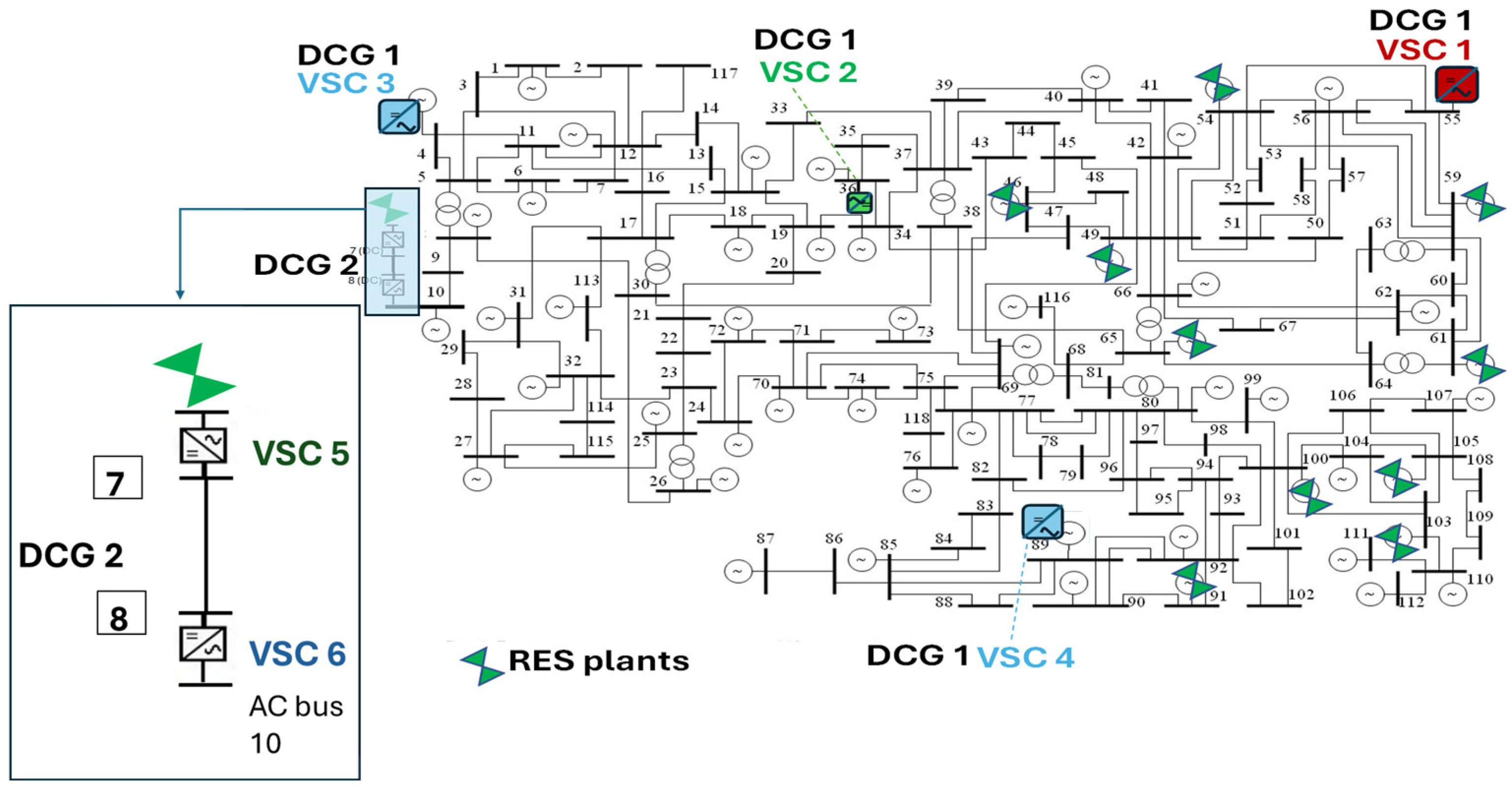
The tests are performed considering the IEEE 118 bus AC system [35] in Figure 2 connected with the following:
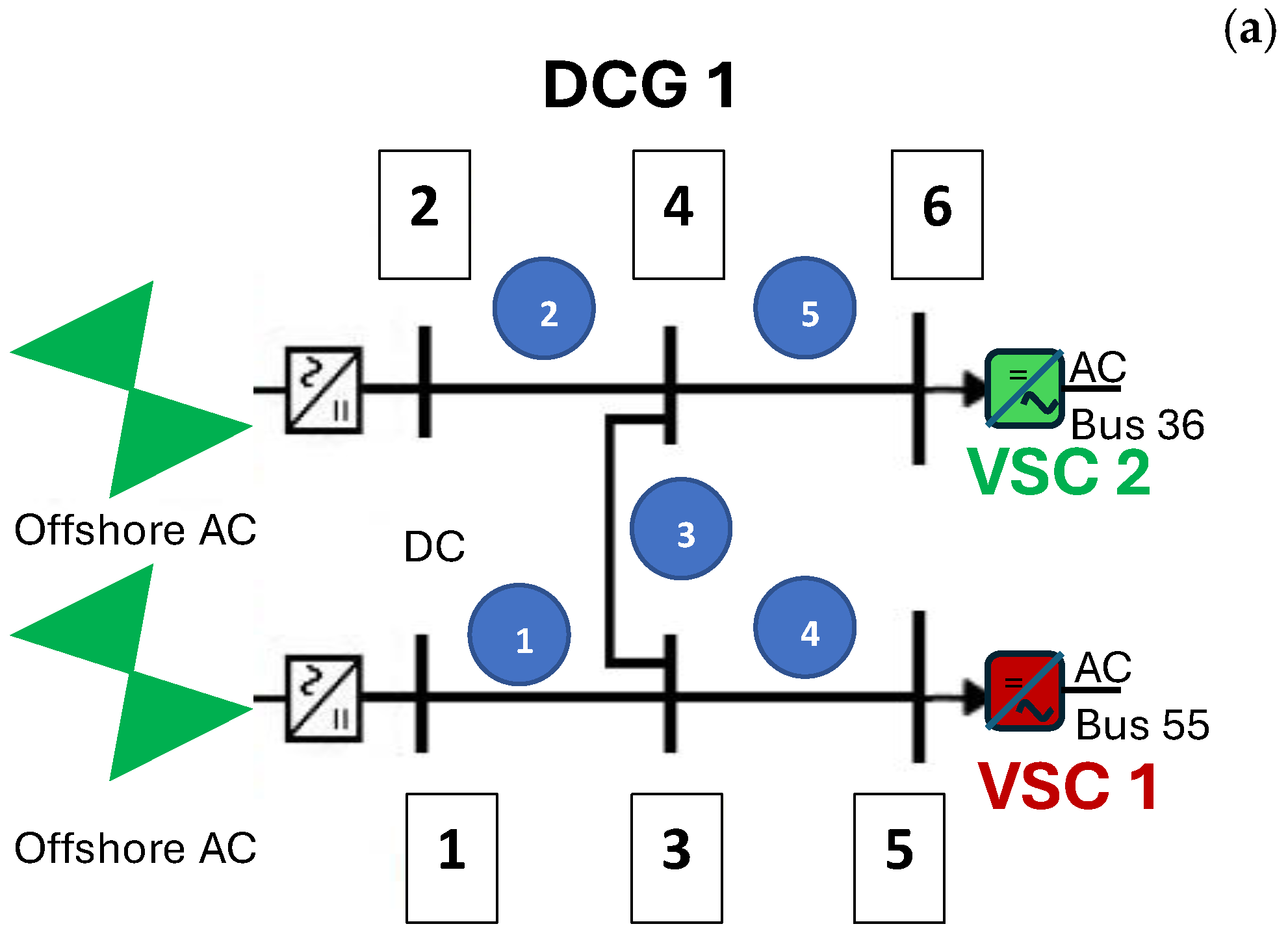
  • A multi-terminal DCG, named DCG 1, featuring an H-shape topology, representing the following:
    A DCG connecting offshore wind farms, partially embedded into the AC grid (configuration 1, Figure 3a);
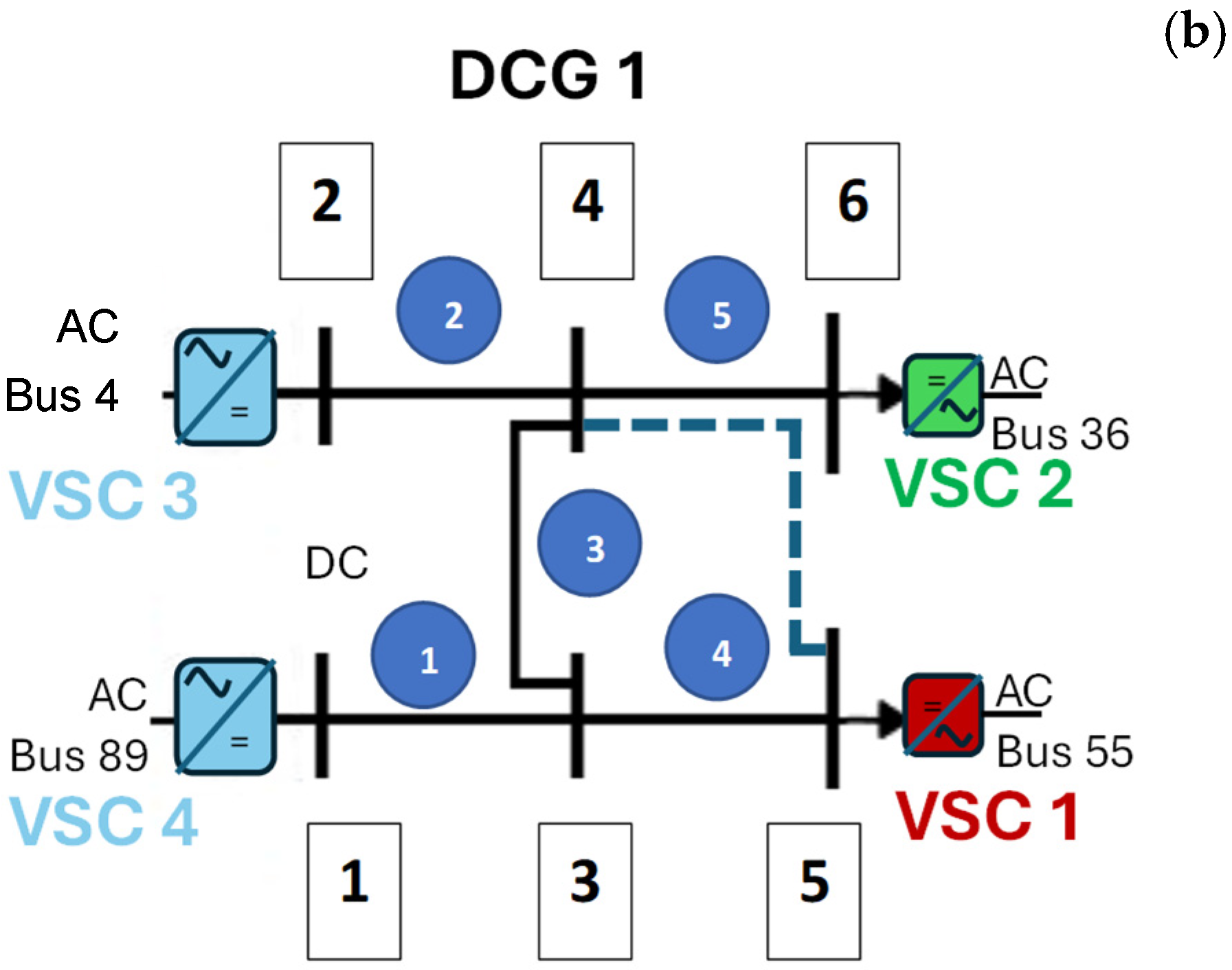
    A fully embedded DCG without wind farms (configuration 2, Figure 3b);
    The fully embedded DCG above, enhanced with a further link that creates a mesh (configuration 3, Figure 3b with dashed line);
  • A point-to-point (P2P) DC link, DCG 2, representing a connection from a remote (e.g., offshore) wind farm, acting as an injection into the AC grid (see left side in Figure 1). The identifiers of the two DC nodes for this P2P link are DC 7 and DC 8.
Table 1 reports the values of the unitary costs assumed for the base case simulation, where amu stands for “arbitrary monetary unit”. The features of the simulation cases are summarized in Table 2. For all simulation cases, the contingency set under study includes the N-1 contingencies applied to all AC and DC branches, dispatchable generators, embedded VSCs (represented by fictitious generators), and renewable generators.
Each case is identified by a number (1–3), representing DCG1 configuration as defined above, by a letter (A, B), and optionally by letter P. Letters A, B refer to the scenario of redispatching costs for the embedded VSCs:
  • Scenario A—the redispatching costs for embedded VSCs are the same as the ones adopted for dispatchable generators (+100 amu/MW for upward variations and −20 amu/MW for downward variations);
  • Scenario B—the redispatching costs for embedded VSCs are set equal to +10 amu/MW and −2 amu/MW.
Contingency probabilities are set using failure rates and Mean Time to Failure, MTTR, for the cases identified with final letter P; equally probable (thus representing a deterministic analysis), for the other cases. The sets of contingencies consist of all AC and DC branches and generators.
The simulation cases are compared in terms of the following metrics:
  • The costs for the deployment of the preventive actions (henceforth called “preventive action costs”).
  • The costs for the conditional deployment of the corrective actions (in case contingencies occur): these costs are the simple summation of the costs for corrective control actions, irrespective of the probability of occurrence of contingencies.
  • The total cost which sums the expected costs of corrective actions and of infeasibilities (due to the missing fulfillment of security criteria)—weighted by the probability of occurrence of contingencies—as well as the costs for preventive actions.

3.2. Case 1A: The Base Case

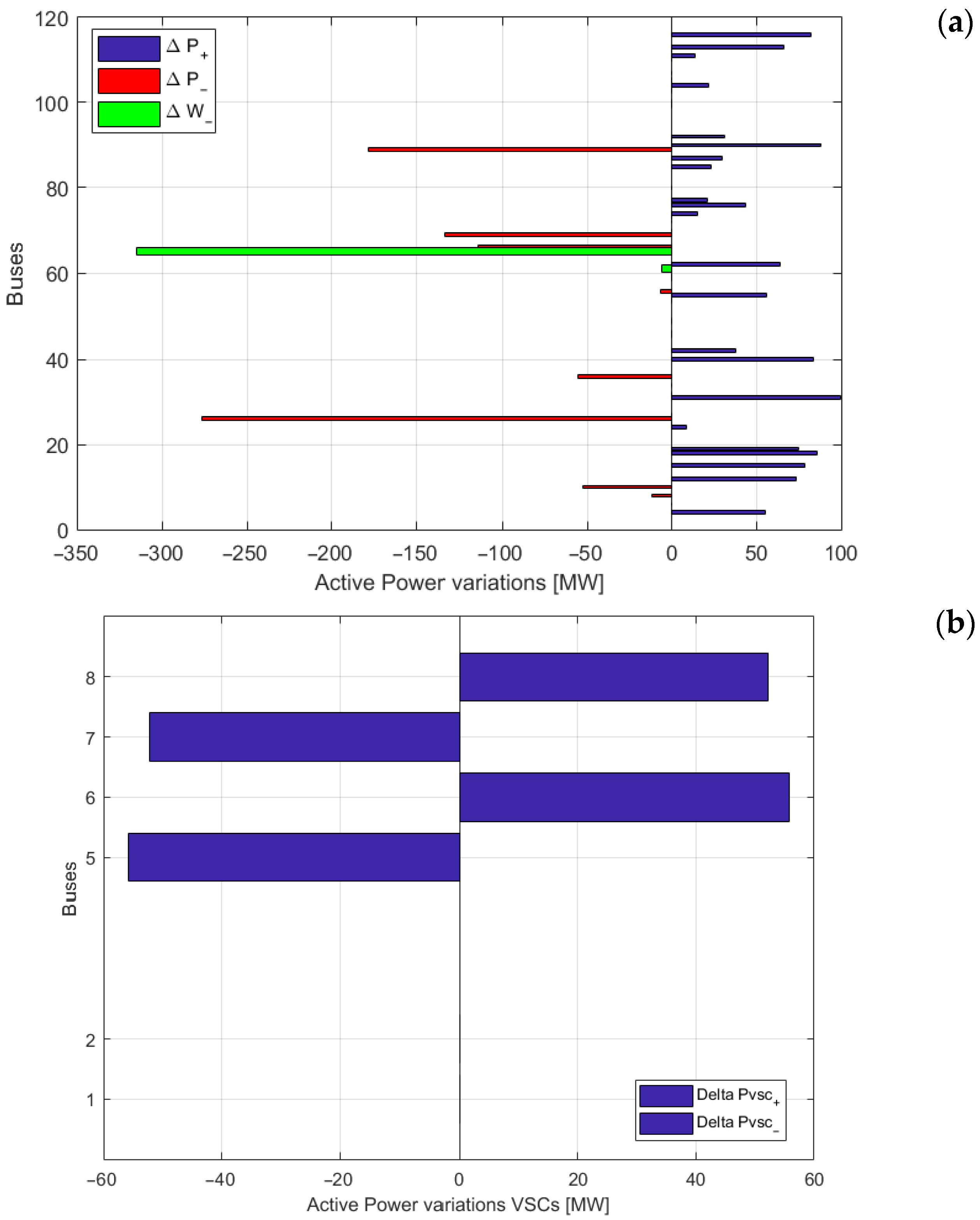
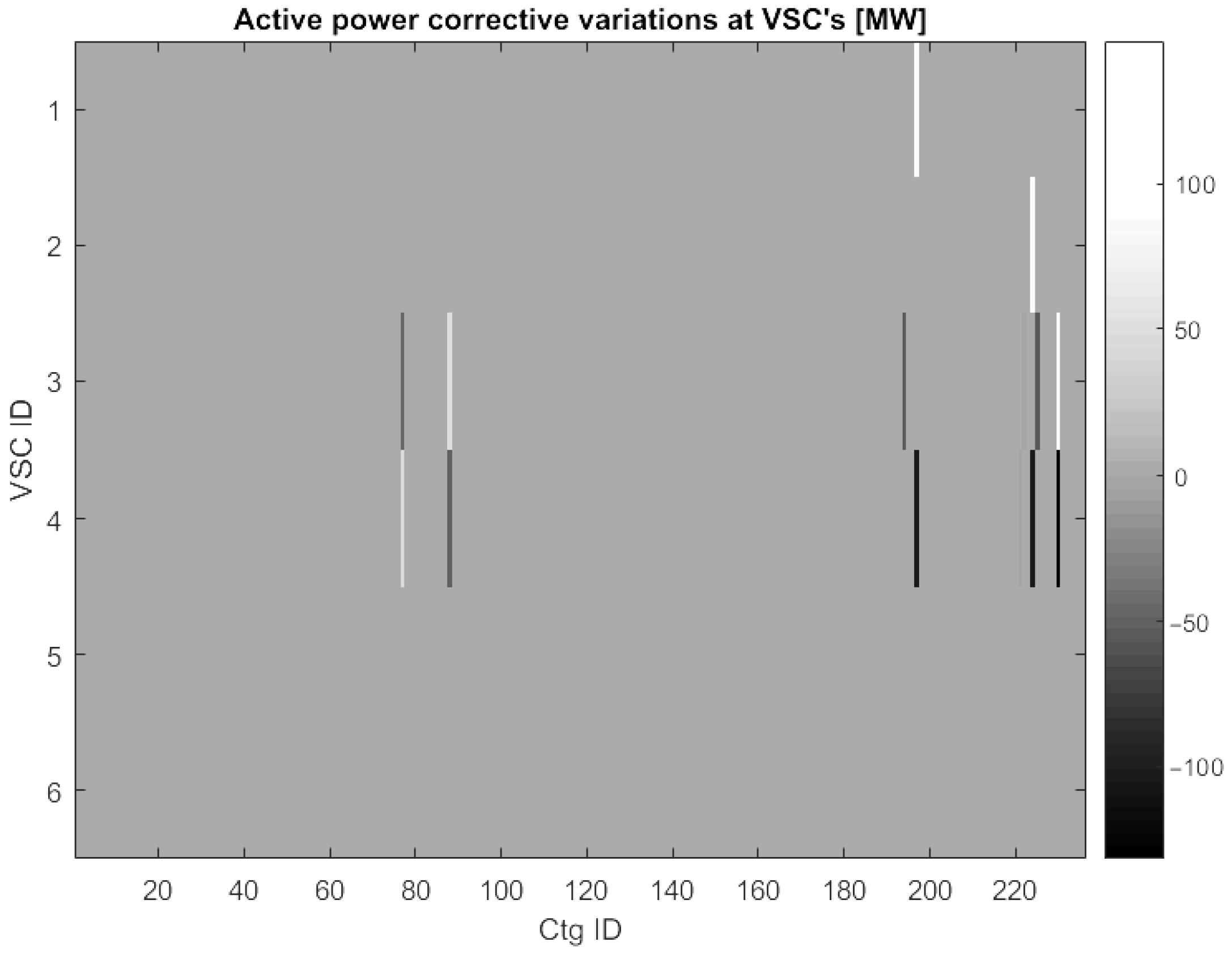
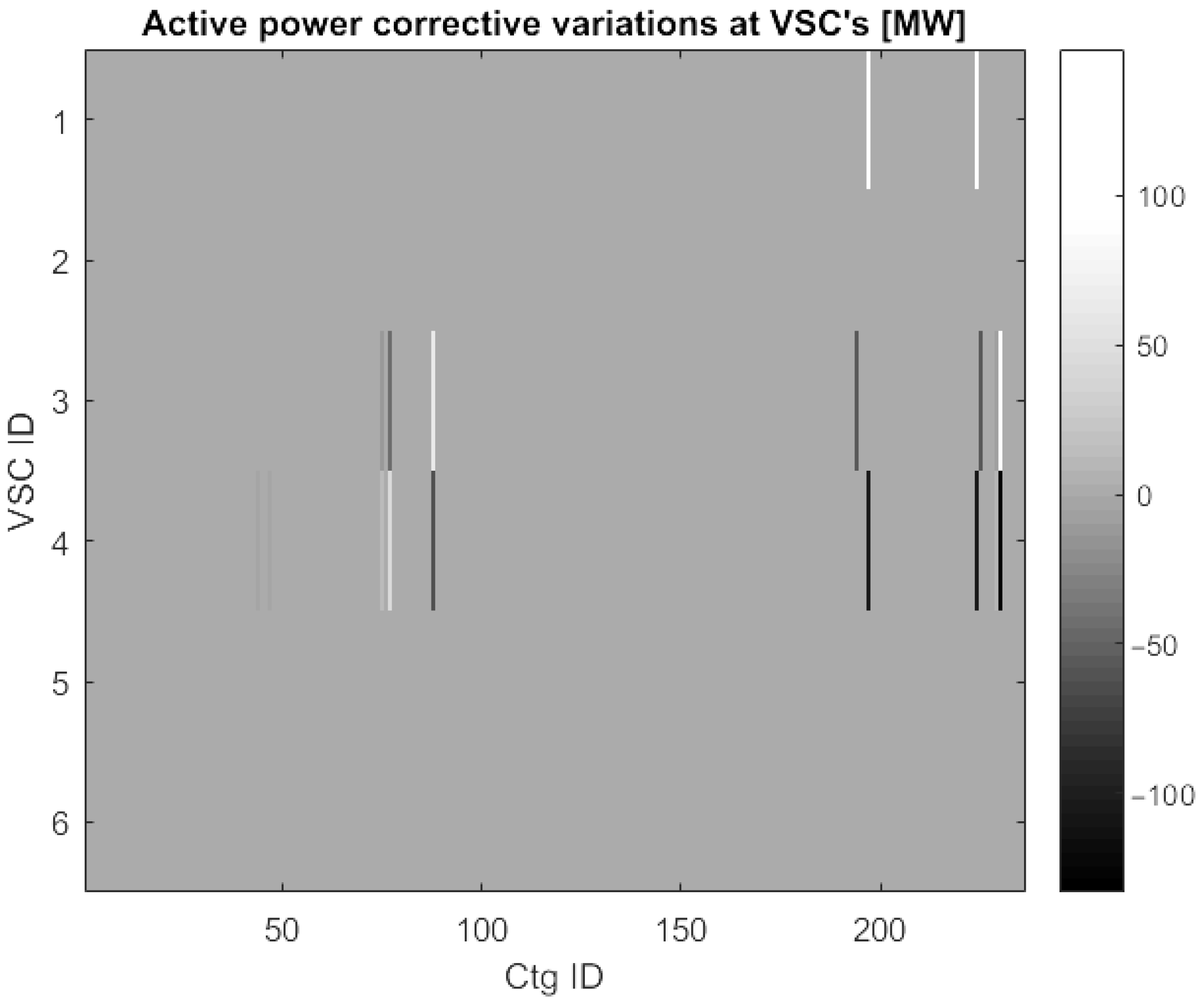
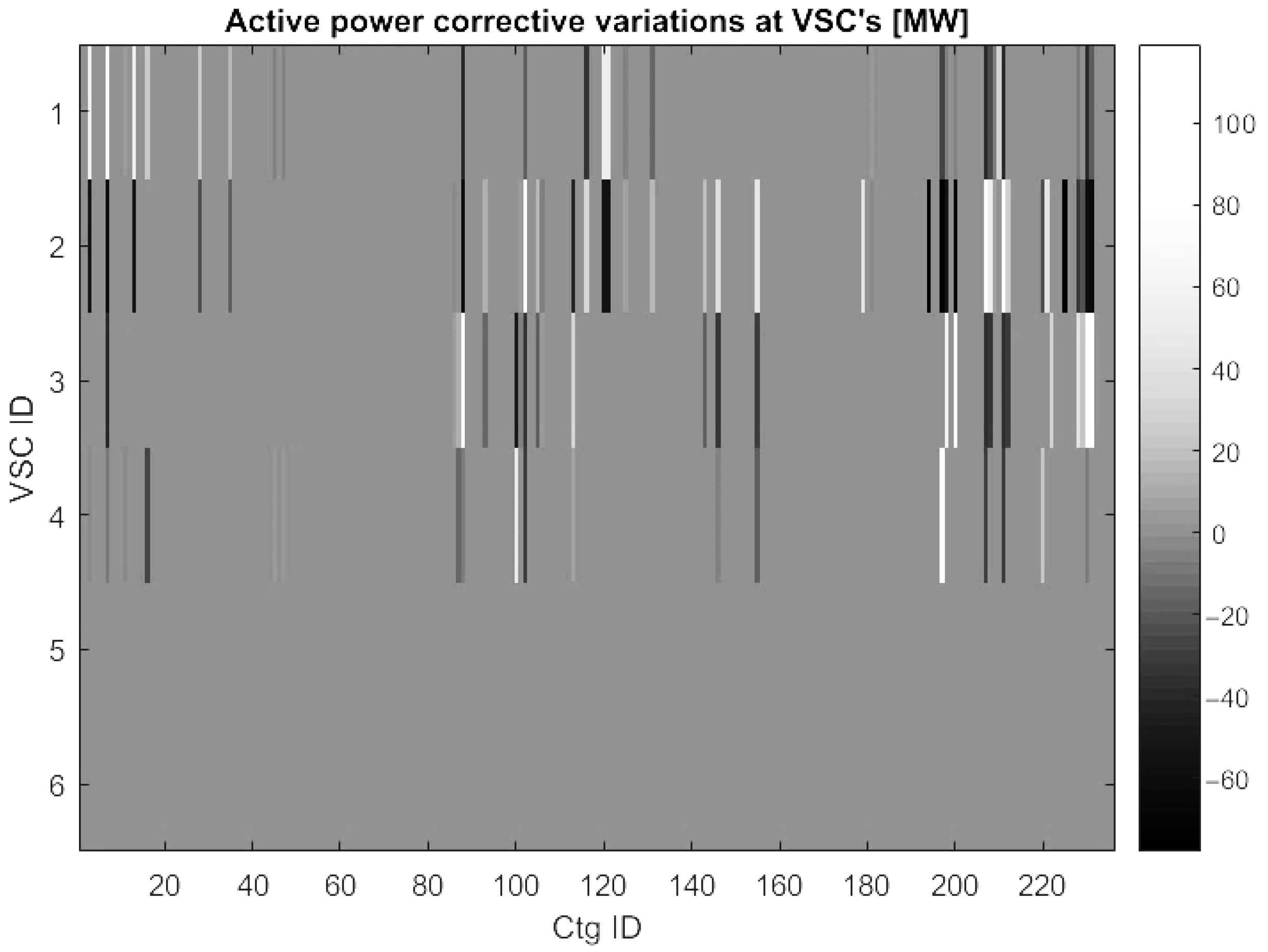
Figure 4 shows the preventive curtailments of renewables and the active power setpoint variations for all the dispatchable generators of the AC grid; also, VSCs participate in preventive redispatch as shown in Figure 4b. Specifically, Stage 1 suggests an increase in the active power setpoint (+55.78 MW) at VSC connected to AC bus 55, and an equal reduction of active power setpoint at VSC at AC bus 36. It is also noting that the preventive actions on VSCs also include an offshore wind curtailment at the offshore VSC of the P2P link DCG2 with consequent reduction of the related embedded VSC injection into the AC grid. The total cost for preventive actions is equal to 1.733 × 10⁵ amu, while the total cost for corrective actions is 2.857 × 10⁶ amu. The overall cumulated amount of corrective variations in the active power setpoints of VSCs, over all contingencies, is equal to 1.0825 × 10³ MW, while the overall amount of corrective variations of the active power setpoints for all dispatchable generators (including fictitious ones) is equal to 6.312 × 10³ MW. A preventive curtailment of renewables at bus 65 is also suggested. Figure 5 which reports the corrective setpoint variations indicates that the contingencies for which larger setpoints variations are suggested consist in the following N-1 contingencies: the outage of embedded VSC connected to bus 55 (contingency # 197), the loss of AC branch between AC buses 8 and 9, the loss of DC branch connecting DC buses 3 and 5, and the loss of AC branches # 79 (55–56) and 90 (60–61) (contingencies ## 77 and 88). The latter two contingencies determine problems in the power evacuation capability at AC bus 55, calling for a corrective redispatch of VSC injections.
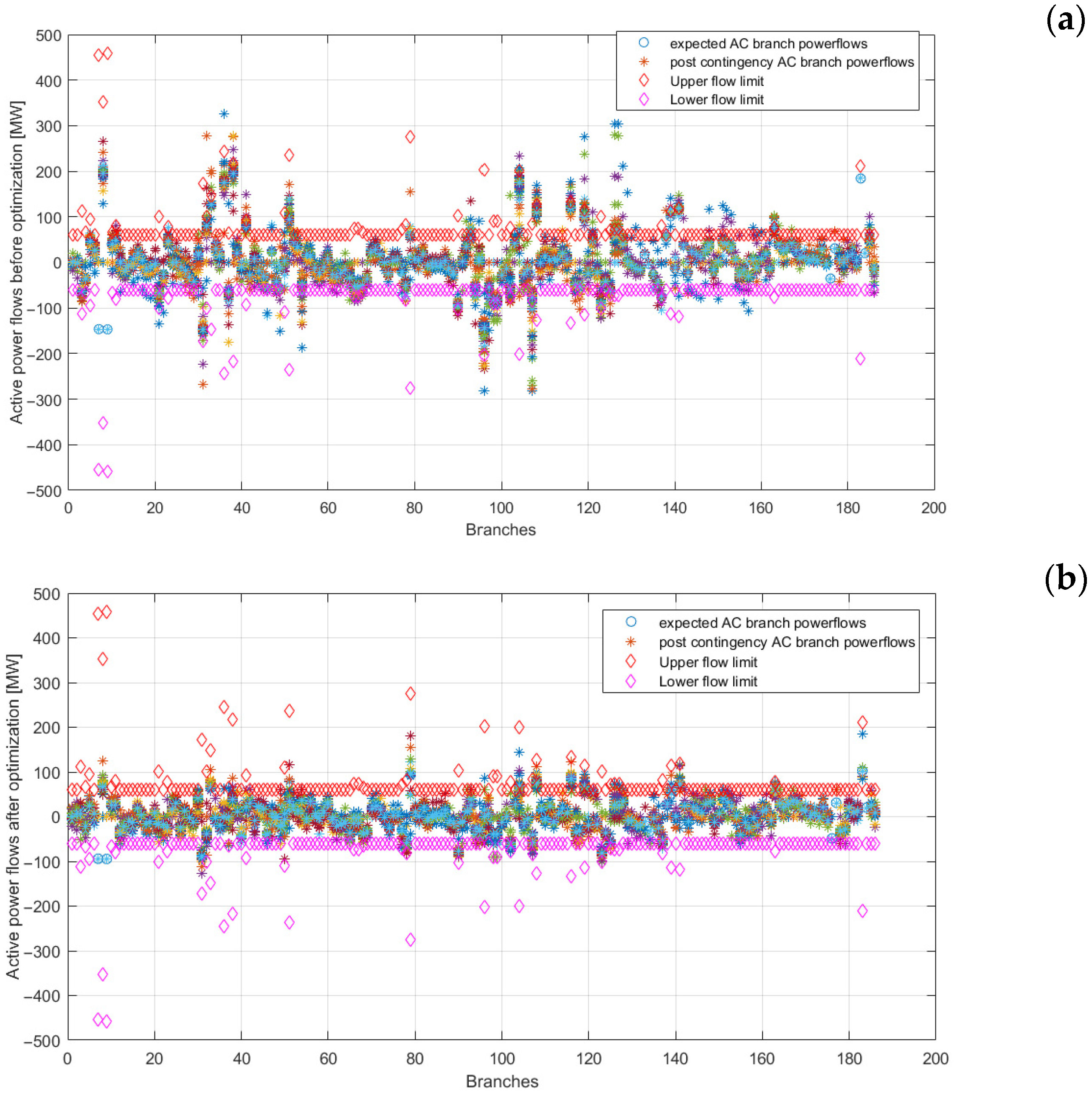
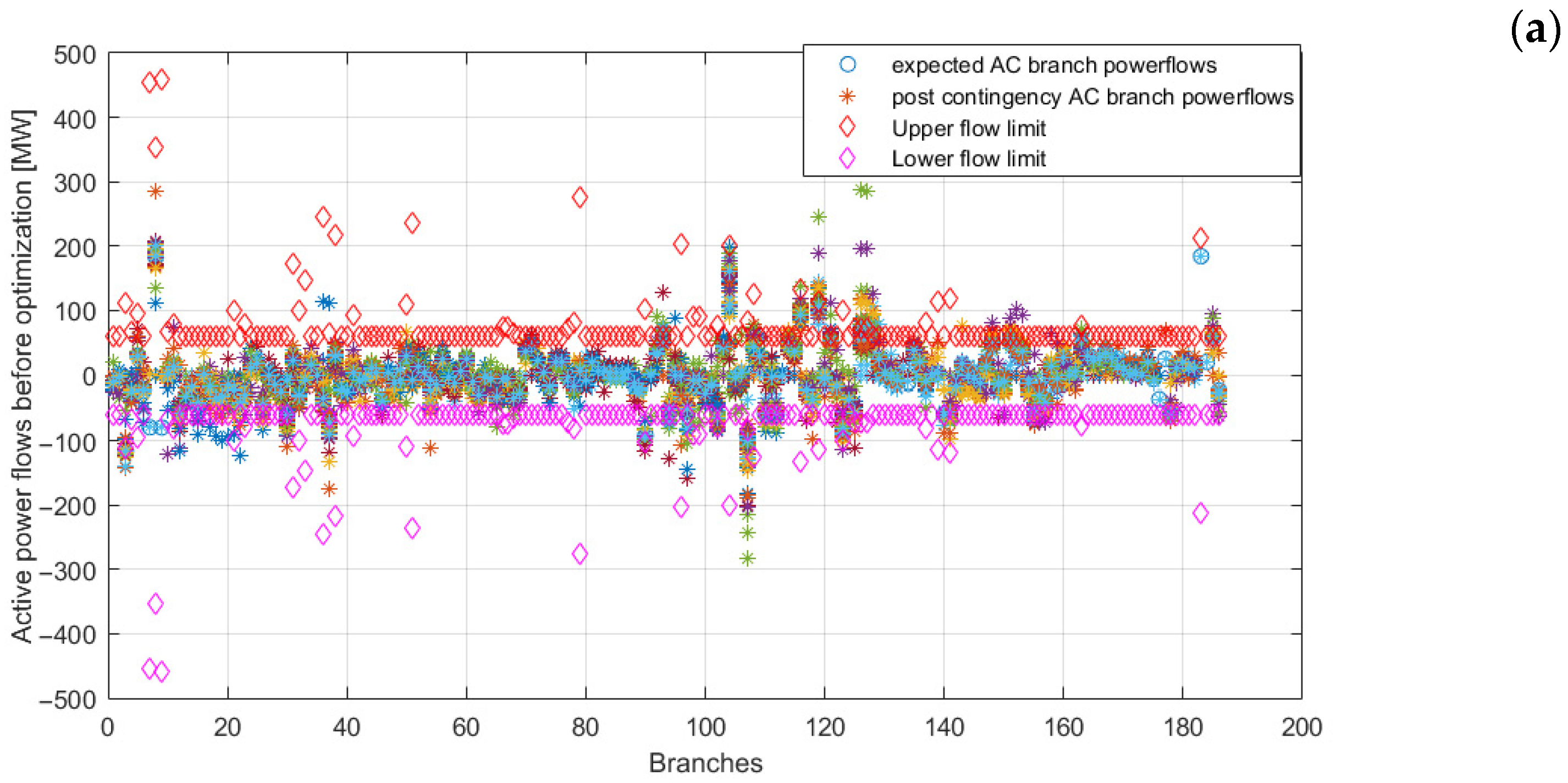
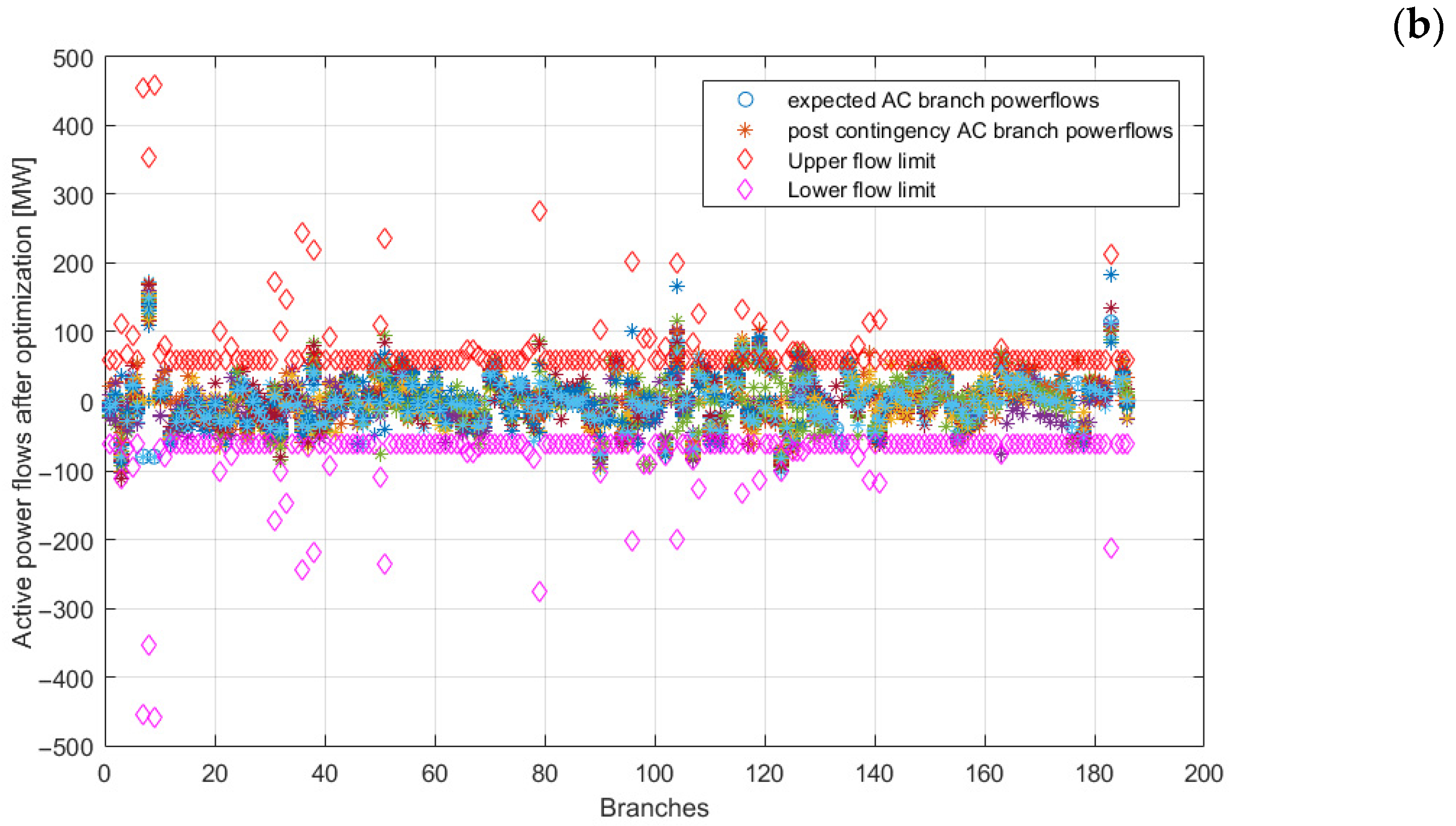
The power flows along AC branches before and after the control application are reported in Figure 6.
A large amount of violations (see Figure 6a) can be detected on power flow branches in the post-contingency state without control application, e.g., see branches 32 (between nodes 26 and 25), 31 (23–25), 36 (30–17) and 107 (68–69), 108 (69–70), 126 (68–81), 127 (81–80), all located in an area rich in conventional and renewable generators.
No violations of the power flow limits occur in the N-situation and for all N-1 states (following each of the contingencies), which means that the corrective and preventive actions suggested by the control allow to assure an N-1 secure operating state.
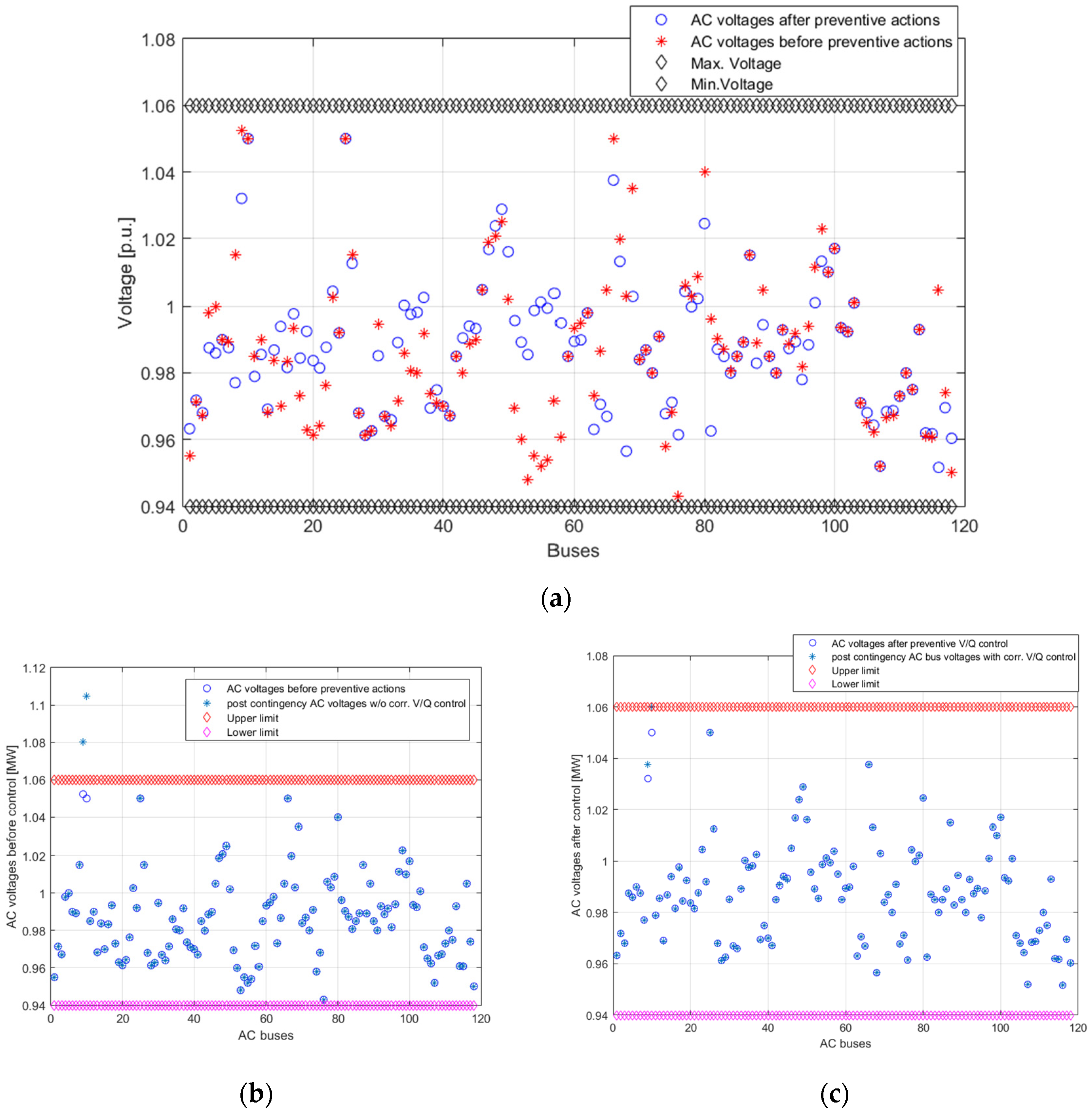
As far as stage 2 is concerned, no preventive variations of DC voltage setpoints are needed. However, a preventive variation of AC voltage setpoints is performed at several PV nodes as shown in Figure 7a which shows the AC voltages at grid buses in N situation before and after the application of the preventive V/Q control.
Figure 7b,c represents the AC voltage in the post-contingency steady states (b) before any control deployment and (c) after applying the corrective V/Q control on the initial N state modified according to the preventive V/Q control. It can be noted that one N-1 contingency consisting in the outage of the embedded VSC of DCG2 connected to AC bus 10 determines very high overvoltage violations at few AC buses (9 and 10). Figure 7c shows that the AC voltages in the post-contingency state after the N state modification via preventive V/Q control and the application of possible corrective actions satisfy the voltage range constraints (0.94–1.06 p.u.): in particular, the AC voltage profile lowering operated by the preventive control (which decreases AC voltage setpoints of many conventional generators) allows to avoid overvoltage violations in Figure 7b, also limiting the need for corrective AC voltage variations.

3.3. Case 1B: Effects of Redispatching Costs of VSC’s

This simulation considers the full analysis N-1 contingencies on DC/AC grid with the redispatch costs for VSCs equal to scenario B. Again, all the contingencies are deemed as equally probable i.e., a deterministic SC-R is performed.
The redispatching pattern is very similar to the one in case 1A. Also, there are no violations in N state and in N-1 states; thus again, the post-control operating state fulfills N-1 security criteria.
Comparing Figure 8 with Figure 5 indicates that the patterns of corrective active power setpoint variations for VSCs are very similar in the two cases 4A and 4B, confirming the most significant corrective actions for AC branch outages in the area of AC bus 55, and in case of DC cable outages, which necessarily imply a redistribution of power flows in the DCGs.
The total cost for preventive actions is equal to 1.689 × 10⁵ amu while the sum of total costs for the corrective actions is equal to 2.844 × 10⁶ amu (both values are lower than the corresponding ones in case 1A). The main difference between the two cases 1A and 1B consists in the amount of corrective and preventive active power variations suggested by the control to the conventional AC generators and to VSCs: in particular, the total amount of active power setpoint corrective variations of embedded VSCs is equal to 1.082 × 10³ MW in case 1A, and 1.153 × 10³ MW in case 1B, due to the lower redispatching costs of VSCs in case 1B. Consequently, also the total amount of active power setpoint corrective variations for all conventional generators (including fictitious generators for VSC connections) is different (6.359 × 10³ MW in case 1B against 6.312 × 10³ MW in case 1A). The total amount of preventive active power setpoint variations at embedded VSCs is equal to 213 MW (against 216 MW in case 1A).

3.4. Case 1AP: Effects of Contingency Probabilities

The full N-1 contingency analysis of the AC/DC grid is performed, considering contingency probability. The failure rates and the MTTRs adopted for the grid components are reported in Table 3. These values are not to be considered as representative in general, but only for the purpose of testing the application.
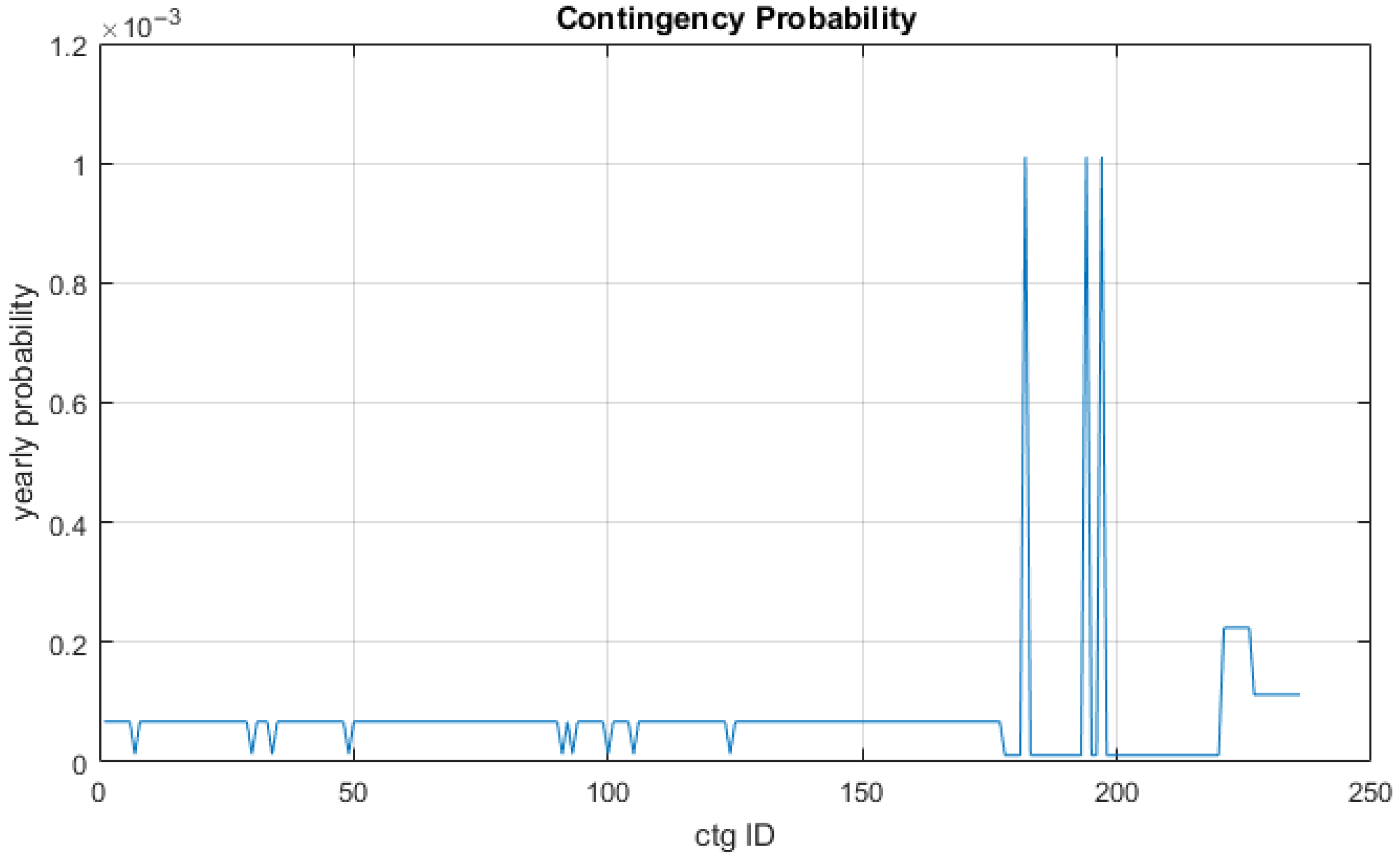
Figure 9 reports the probabilities of the N-1 contingencies affecting all the components mentioned above, considering the failure rates and the MTTRs of the assets.
In this case, negligible preventive variations of active power setpoints are required for both conventional generators and for VSC’s. In fact, low-probability contingencies discourage the adoption of preventive actions and favor the application of corrective actions: to this regard, Figure 10 reports the corrective variations of the active power setpoints for VSCs for the whole set of contingencies under study.
In this simulation, the total cost for preventive actions is equal 60 amu (much lower than in case 1A) and no preventive active power setpoint variations are suggested on VSCs. On the contrary, a total amount of corrective variations of dispatchable generators’ setpoints of 1.446 × 10⁴ MW is required, of which 2.307 × 10³ MW represents the total amount of corrective variations requested to the VSCs.
Furthermore, the total expected cost for corrective actions is equal to 1.058 × 10³ amu, while the total (absolute) cost for corrective actions is equal to 4.080 × 10⁶ amu (higher than 2.85 × 10⁶ amu for case 1A because in the OF many of the corrective actions’ costs are weighted using contingency probabilities much lower than 1).

3.5. Cases 2B and 3B: Effect of DCG Topology Layout

In case 2B, the H-grid DCG 1 is considered fully embedded in the AC grid, by removing the wind generators at DC nodes 1 and 2, and connecting the relevant AC nodes to nodes 4 and 89 of the AC grid (Figure 3b), also removing the generators that were connected at these nodes of the AC grid (Figure 2). An initial feasible operating point for the hybrid AC/DC grid is identified in MATPOWER [36], by modeling embedded VSCs as “fictitious” generators connected to the AC grid. It is worth noting that different configurations of DCG1 determine different initial operating points for hybrid AC/DC grids, this must be always taken into account while comparing the different DCG1 topologies.
This simulation considers the same redispatch costs for VSCs as in case 1B. All the contingencies are deemed as equally probable i.e., a deterministic SC-R is performed.
The application of the control to the fully embedded DCG determines lower amounts of preventive active power setpoint variations with respect to case 1B as it can be noted in Table 4 which compares the upward and downward setpoint variations for all dispatchable generators and for all VSCs and the total renewable preventive curtailments in cases 1B thru 3B.
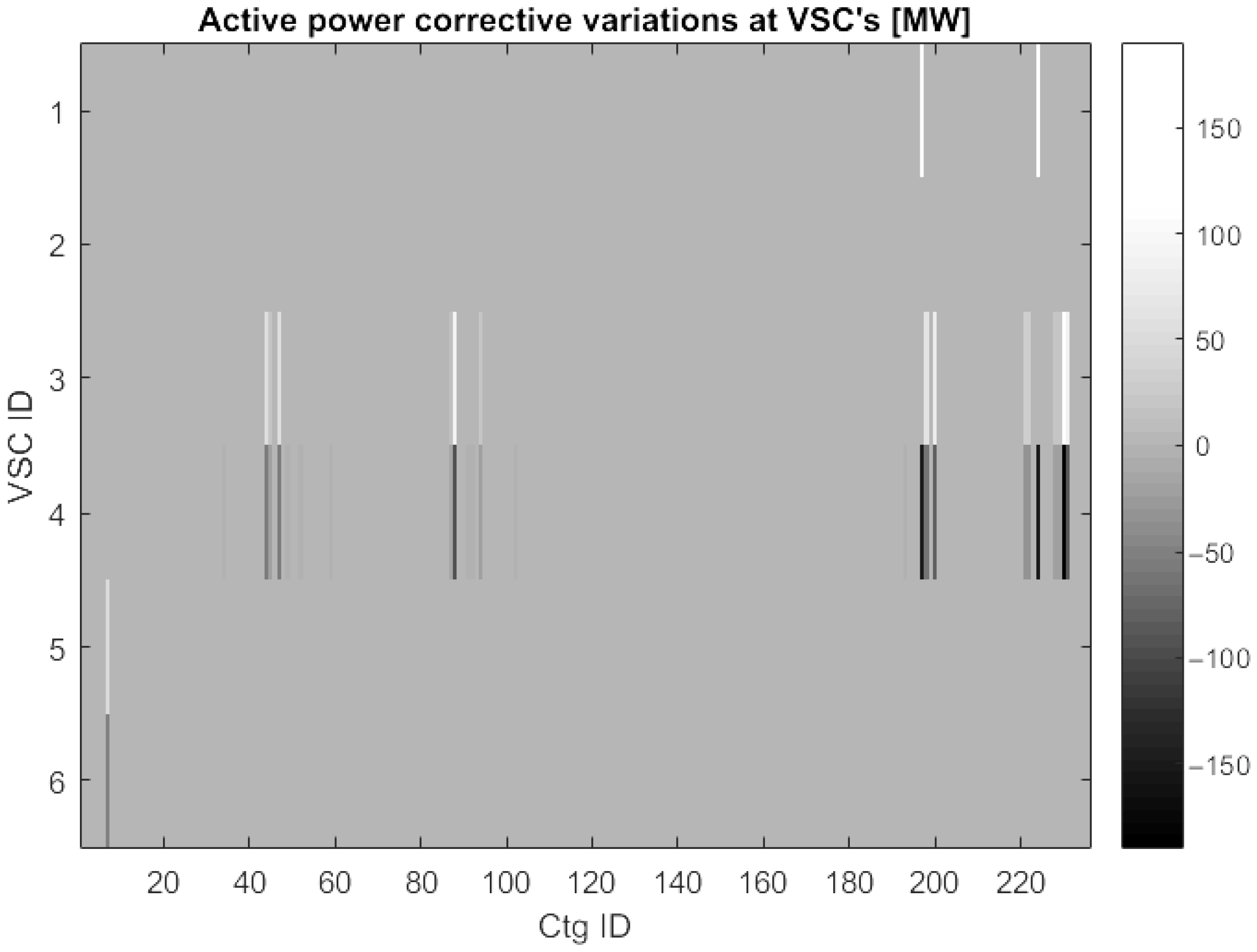
On the other side, the patterns of corrective variations of active power setpoints on all the VSCs are quite different between cases 1B and 2B, as indicated by comparing Figure 8 and Figure 11.
Of course, the profile of post-contingency power flows in this case differs from the one in case 1B also due to the different initial operating point. Specifically, it can be noticed from Figure 12a that there are no post-contingency violations in branches 31 thru 37 (which, on the contrary, were violated before control application in case 1B).
No violations of the limits occur in the N-situation and N-1 states, as in the previous cases, which confirms that the control is effective in assuring the fulfillment of N-1 security criterion (in a preventive and/or corrective way) for the test grid under study.
The total cost for preventive actions is equal to 6.590 × 10⁴ amu (lower than 1.689 × 10⁵ amu in case 1B) while the sum of total corrective action costs is equal to 2.943 × 10⁶ amu (higher than 2.844 × 10⁶ amu for case 1B). The main consideration from the comparison of cases 1B and 2B is that a fully embedded DCG allows to strongly reduce the cost for preventive control actions.
In case 3B, DCG 1 is considered fully embedded in the AC grid as in the previous case; moreover, a further DC branch is added to the original H topology, making a meshed topology (see dashed line in Figure 3b). Again, an initial feasible operating point for the hybrid AC/DC grid is identified.
This simulation considers the full analysis N-1 contingencies on DC/AC grid with the redispatch costs for VSCs equal to case B. All the contingencies are deemed as equally probable i.e., a deterministic SC-R is performed.
The application of the control to the meshed and fully embedded DCG determines lower amounts of preventive active power setpoint variations with respect to case 1B (DCG with offshore power injections). Case 3B also implies higher amounts of preventive redispatch of dispatchable generators and of preventive wind curtailment with respect to case 2B (fully embedded H-shaped DCG), at the expense of a lower amount of preventive redispatch on VSCs, as it can be noted in Table 4, which compares the upward and downward setpoint variations for all dispatchable generators and for all VSCs and the total renewable preventive curtailments in cases 1B, 2B, and 3B.
All the feasibility variables—related to power flows in both N state and N-1 states—are zero, which again confirms the effectiveness of the control to assure the fulfillment of N-1 security criterion.
The total cost for preventive actions is equal to 8.322 × 10⁴ amu (higher than 6.590 × 10⁴ amu in case 2B as expected looking at Table 4), the total cost for corrective actions is equal to 3.182 × 10⁶ amu (higher than 2.943 × 10⁶ amu in case 2B).
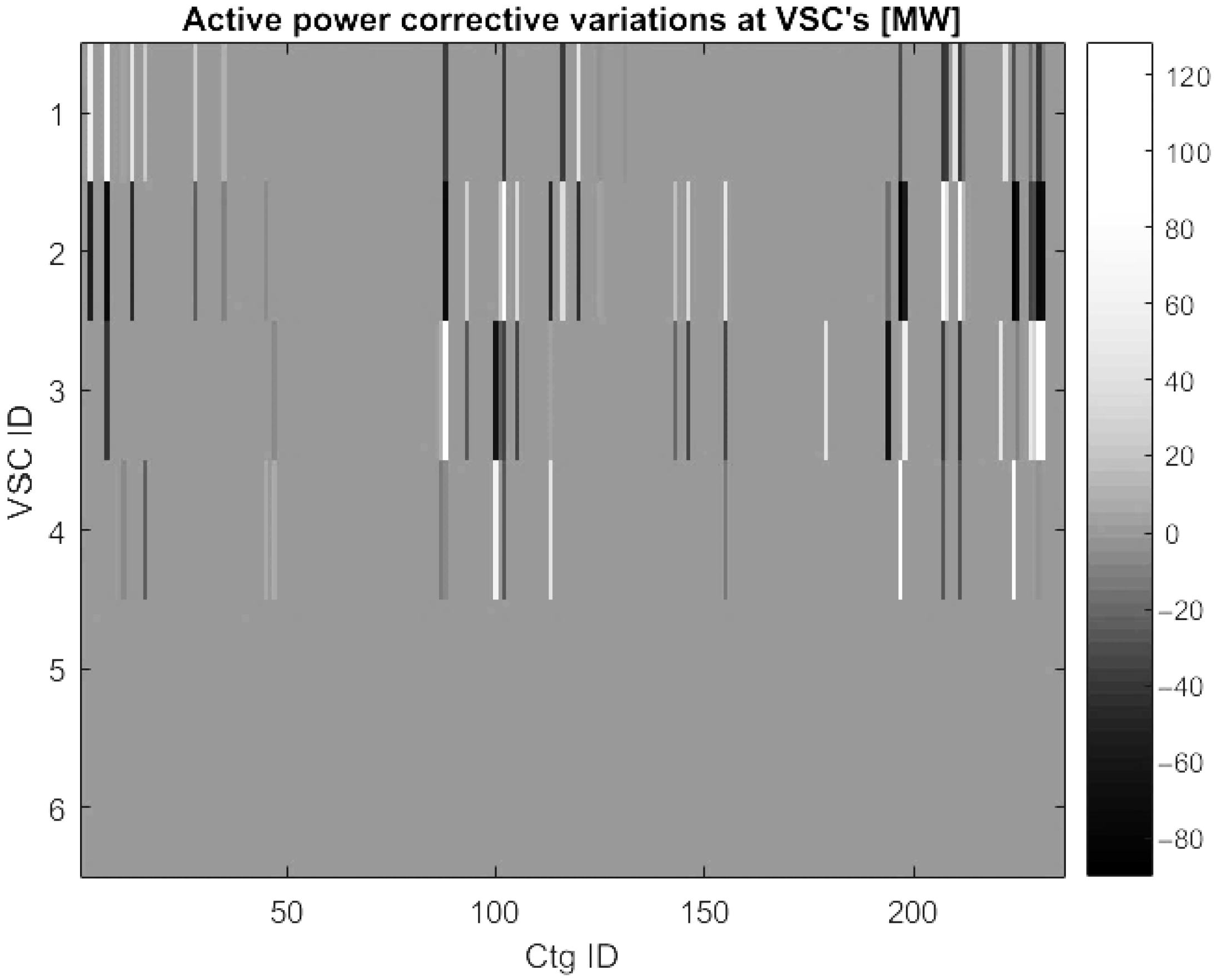
Based on the present results, on one side the additional DC branch assures a lower impact of N-1 contingencies on the hybrid system; on the other side, the presence of a further constraint related to the new branch current limit in meshed DCG1 configuration determines a lower flexibility in the use of VSCs to assure N-1 security of the grid, as the control suggests a lighter plan for preventive redispatch on VSCs, and it relies on more expensive corrective actions in case of outages (see e.g. Figure 13 for the corrective variations of VSC active power setpoints): in fact, case 3B indicates a total amount of corrective variations of VSC active power setpoints of 3.834 × 10³ amu against 3.870 × 10³ MW in case 2B, while the correctively shed load passes from 247 MW in case 2A to 274 MW in case 3B.

3.6. Effect of DCG Configurations While Considering the Contingency Probabilities

This subsection intends to evaluate the difference among the costs for corrective and preventive actions suggested by the control in case of different DCG1 configurations, while considering the probabilities of occurrence of contingencies based on reliability data in Table 3.
In all cases (1AP, 2AP, 3AP, 1BP, 2BP, 3BP) the feasibility variables associated to power flows are zero, which means that the control achieves assuring N-1 security for the hybrid AC/DC system.
Table 5 compares the total costs for preventive control actions, the expected costs for corrective control actions for all three cases. The different DCG1 configurations determine different (AC secure) initial points for the hybrid AC/DC system: this in turn causes a different response of the system to the same set of contingencies. Accordingly, costs for preventive and corrective control actions are different: for the specific configurations used for the present tests, the H-shaped partially embedded DCG1 leads to smaller total costs for control actions, with very limited costs for preventive actions (even though it implies higher expected costs for corrective actions with respect to fully embedded configurations). The preventive costs are the same for cases “A” and “B” because these cases differ only for the costs of VSC redispatch actions, but no preventive actions are suggested for VSCs. Given the same DCG1 configuration, the reduced unitary costs for VSCs’ redispatch in “B” cases determine lower corrective action costs. In general, partially embedded DCG1 configuration determines higher corrective control costs, but lower total costs (considering the much lower preventive control costs).
If one compares the amount of corrective control actions (see Table 6), it is worth noting that the lowest amounts of shed load are associated to cases “2” with embedded H-shaped DCG1 configuration. The lowest amounts for corrective VSC active power redispatch are associated to the cases “1”; this, in combination with the fact that cases 1 have the highest expected costs for corrective actions, demonstrates that the H-shaped partially embedded configuration determines higher costs for corrective actions for the relatively high probable N-1 outages, while the embedded configuration cases (2 and 3) determine limited costs for corrective actions for high probability outages, while implying higher costs for corrective actions for lower probability outages.
Table 7 reports the amount of preventive actions on VSCs and on all dispatchable generators and RES for the six analyzed cases: it is worth noting that cases 1 bring to very limited preventive actions (which explains the higher costs for corrective actions for the whole set of N-1 outages), while cases 2 and 3 with fully embedded DCG1 configurations are characterized by higher amounts of preventive actions. Cases “B” which are associated by lower unitary costs for VSC redispatch, are characterized by larger variations of VSC active power setpoints.

3.7. Discussion

Comparing cases 1AP and 1A shows that different assumptions on contingency probabilities determine different priorities for the control, which suggests different patterns of preventive active power setpoint variations among the conventional generators.
From the comparison of cases 1A and 1B, it can be noted that the adoption of lower redispatching costs for VSCs determines a higher amount of power setpoint corrective variations both in VSCs and in conventional generators to attain the security goals.
Cases 1B, 2B bring to different initial operating states of the hybrid AC/DC grid which must fulfill security criteria in N state: from cases 1B and 2B it is worth noting that—at least in the presented simulations—the fully embedded configuration of the DCG allows to strongly reduce the total costs of preventive control actions, when contingencies are assumed equally probable.
Comparing cases 2B and 3B (with equally probable contingencies and low redispatch costs), one can note that the adoption of a meshed, fully embedded DCG determines higher amounts of preventive variations of active power setpoints for conventional generators and higher amounts of renewable preventive curtailment (at the expense of lower amounts of preventive variations of VSC active power setpoints) with respect to a fully embedded H-shaped DCG. In the specific simulations performed, the adoption of the fully embedded DCG causes lower total costs for preventive control actions (−56% for case 3B, and −62% for case 2B). If one includes the contingency probabilities calculated based on reliability data, the comparison shows that partially embedded H-shaped DCG1 brings to lower total costs for control actions (though it requires higher expected costs for corrective actions) with respect to fully embedded configurations.
The remarks reported in this paragraph refer to the set of simulation cases described in the present section and cannot be intended of general validity: each case (with its own grid topology and initial operating condition, costs, contingency probabilities, etc.) has to be individually assessed, due to the complexity of the underlying model.

4. Conclusions

This paper presented a linearized two-stage decoupled security redispatch for hybrid AC/DC grids, addressing HVDC’s growing role. The Security-Constrained Redispatching (SC-R) effectively managed outages, enhancing system reliability. Linear Programming and decoupling techniques ensure computational efficiency for large systems.
Simulations on a modified IEEE 118-bus system showed SC-R’s efficacy. Contingency probability significantly affects control priorities, and lower VSC redispatch costs lead to a greater reliance on corrective actions than preventive ones. The comparison between different analyzed DCG configurations (fully or partially embedded, H-shaped or meshed) must account for the fact that they determine different initial operating points in the hybrid AC/DC grid. However, from the specific simulations discussed, it is worth noting that in fully embedded and meshed DCGs preventive control costs are reduced, in case of equally probable contingencies (i.e., a case equivalent to a deterministic analysis). Meshed embedded grids determine lower preventive variations and curtailments with respect to partially embedded DCGs, but higher amounts of preventive control actions with respect to fully embedded H-shaped DCGs. In case contingency probabilities are accounted for, the simulations on the present case study show that the partially embedded H-shaped DCG brings to lower total costs for control actions, even though higher expected costs for corrective actions are required with respect to fully embedded DCG solutions.
Overall, even if some simplified assumptions (such as lossless converters, linearized model) can partially affect the accuracy of results, the proposed SC-R proves to be a valuable and efficient tool for exploiting hybrid AC/DC system flexibility accounting for security. Moreover, the results produced by the linear optimization of the control actions are checked ex post via detailed AC/DC power flow, and the lossless converter assumption can be removed in future developments. In view of its actual application in an operational environment, the SC-R could be integrated in a dynamic simulation tool, in order to validate its results by full dynamic simulation of the proposed control actions.
Future work should incorporate constraints from dynamic stability, renewable uncertainties, and adaptive control strategies for real-time applications. Moreover, future activities will encompass a systematic benchmark against these methods, comparing computation time, violation rates, and cost metrics to quantify SC-R’s advantages in speed and scalability.

Author Contributions

Conceptualization, E.C. and D.C.; methodology, E.C. and A.P.; software, A.P.; validation, E.C.; writing—original draft preparation, A.P.; writing—review and editing, E.C. and D.C.; supervision, E.C. All authors have read and agreed to the published version of the manuscript.

Funding

HVDC-WISE is supported by the European Union’s Horizon Europe program under agreement 101075424. UK Research and Innovation (UKRI) funding for HVDC-WISE is provided under the UK government’s Horizon Europe funding guarantee [grant numbers 10041877 and 10051113].

Data Availability Statement

Dataset available on request from the authors.

Conflicts of Interest

The authors declare no conflicts of interest.

Nomenclature

SymbolMeaning
A b , b 1 Auxiliary matrix coefficient for AC reactive power flow computation between buses b and b1
D j , i Matrix coefficient for the reactive power exchange between PV node j and PQ node i
G + , b Penalty factor for upper bound violation of AC voltage magnitude
G + , l penalty factor for upper bound violations of power flow in the l-th AC branch
G , b Penalty factor for lower bound violation of AC voltage magnitude
G , l Penalty factor for lower bound violations of power flow in the l-th AC branch
I D C l d c Current on the ldc-th DC line
I d c 0 , e x , l d c Initial expected current on DC cable ldc in N state, without control actions
I d c 0 , e x , l d c k Initial expected current on DC cable ldc in N-1 state, just after the application of contingency k, without control actions
I e x , l d c Expected current on the ldc-th DC line in N state, after preventive actions
I l i m , l d c Current rating for the ldc-th DC line
J D C , B L , N l d c , b d c I-V matrix coefficient for computing the contribution—in N state—to current on DC line ldc due to voltage at DC bus bdc
J D C , B L , N , k l d c , b d c I-V matrix coefficient for computing the contribution—in N-1 state—to current on DC line ldc due to voltage at DC bus bdc
L i , j Auxiliary matrix coefficient between PV node j and PQ node i
M i , i 1 Auxiliary matrix coefficient for power flow between node i and i1
NNumber of AC buses
NBDCNumber of DC buses
N C T G Number of contingencies
N D C G Number of DC Grids (DCGs)
N D C L Number of DC lines
N G Number of dispatchable generators
N G , O F F , k Number of generators which go out of service during contingency k
N G , O N , k Number of generators which survive contingency k
N H V D C Number   of   HVDC   converters ,   i . e . ,   N H V D C = λ = 1 N D C G N H V D C , λ
N H V D C , λ Number of HVDC converters for DCG λ
N L Number of AC branches
N L O Number of loads
N W Number of wind generators connected to the AC grid
n 1 Number of PQ nodes
n 2 Number of PV nodes
N v c o n t r o l Number of DC buses under DC voltage control (either fixed voltage or PV droop)
O F 1 Objective Function for control Stage 1
OF2Objective Function for control Stage 2
P f g , j , k Final generation from the j-th generator after contingency k
P f v s c , m , k Final power injection from the m-th HVDC converter after contingency k
P ¯ G , j Maximum active power of generator j
P ¯ G , j Minimum active power of generator j
P G 0 , j Initial active power setpoint for generator j
P ¯ H V D C , m Maximum active power of HVDC converter m
P ¯ H V D C , m Minimum active power of HVDC converter m
P H V D C 0 , m Initial active power setpoint for converter m
Q f l o w b , b 1 Reactive power flow between two buses (b and b1) in the AC grid
Q f l o w , l i m b , b 1 Reactive power flow limit between buses b and b1
Q g z Reactive power exchanged at the z-th PV node
Q g e n z Reactive power generated by the z-th PV node
Q g e n , m a x z Maximum reactive power limit for the z-th PV node
Q g e n , m i n z Minimum reactive power limit for the z-th PV node
Q l i Reactive power exchange at the i-th PQ node
Q l , s t a r t i Initial reactive power exchange at the i-th PQ node
S D C , N b d c , s Sensitivity coefficient in N state between DC voltage at bus bdc and the s-th DC node with controlled DC voltage
S D C , N , k b d c , s Sensitivity coefficient in N-1 state between DC voltage at bus bdc and the s-th DC node with controlled DC voltage
S l , j Sensitivity factor for the flow of active power between branch l and generator j
S l , j (k)Sensitivity factor for the flow of active power between branch l and generator j, in case of contingency k
S l d c , m Sensitivity factor of active power flow between DC line ldc and HVDC converter m
S l , l o Sensitivity factor for the flow of active power between branch l and load lo
S l , l o (k)Sensitivity factor for the flow of active power between branch l and load lo, in case of contingency k
T e x , l Expected power flow on the l-th AC branch in N state, after preventive actions
T l i m , l Maximum rating for AC branch l
T 0 , e x , l Initial expected power flow on the l-th AC branch in N state, without control actions
T 0 , e x , l k Initial expected power flow on the l-th AC branch in N-1 state, just after the application of contingency k, without control actions
V D C b d c Voltage magnitude at the bdc-th DC bus
V d c , m a x b d c Maximum voltage limit for the bdc-th DC bus
V d c , m i n b d c Minimum voltage limit for the bdc-th DC bus
V D C , n o m b d c Nominal voltage of the bdc-th DC bus
V D C , s t a r t b d c Starting voltage at the bdc-th DC bus
V g z Voltage magnitude at the z-th PV node
V g , s t a r t z Starting voltage magnitude for PV node z
V l i Voltage at the i-th PQ node
W i Auxiliary variable at the i-th node
W 0 , h Initial expected power generation from wind farm h connected to AC grids
c c u r t , h Cost of curtailment on the h-th wind generator
c L S , l o , k Cost of load shedding at load lo in contingency k
c + , j Cost of preventive control action on the j-th conventional generator
c + , m Cost of preventive control action on the m-th HVDC converter
c , j Cost of corrective control action on the j-th conventional generator
c , m Cost of corrective control action on the m-th HVDC converter
Δ L , l o , k Active power load corrective shedding at load lo in case of contingency k
Δ P j Active power flow for the fictitious generator j
Δ P + , j Active power setpoint increase in generator j for preventive action
Δ P + , j , k Active power setpoint increase in generator j for corrective action in case of contingency k
Δ P + , m Active power increase in HVDC converter m for preventive action
Δ P , j Active power setpoint decrease in generator j for preventive action
Δ P , j , k Active power setpoint decrease in generator j for corrective action in case of contingency k
Δ P , m Active power decrease in HVDC converter m for preventive action
Δ P + , m , k Active power setpoint increase in HVDC converter m for corrective action in case of contingency k
Δ P , m , k Active power setpoint decrease in HVDC converter m for corrective action in case of contingency k
Δ V D C r e f + , s Preventive increase in DC voltage reference at DC bus s under DC voltage control
Δ V D C r e f , s Preventive decrease in DC voltage reference at DC bus s under DC voltage control
Δ V r e f + , z Preventive increase in voltage reference at PV node z in N state
Δ V r e f , z Preventive decrease in voltage reference at PV node z in N state
Δ V D C r e f + , s , k Corrective increase in DC voltage reference at DC bus s under DC voltage control in case of contingency k
Δ V D C r e f , s , k Corrective decrease in DC voltage reference at DC bus s under DC voltage control in case of contingency k
Δ V r e f + , z , k Corrective increase in voltage reference at PV node z in in case of contingency k
Δ V r e f , z , k Corrective decrease in voltage reference at PV node z in case of contingency k
Δ W , h Wind generator power decrease in h-th wind generator for preventive action
β b , b 1 Second auxiliary matrix coefficient for AC reactive power flow computation between buses b and b1
δ P j , k Redistribution of active power injection on generator j in service (before any preventive or corrective actions), in response to the occurrence of contingency k
δ P m , k Redistribution of active power injection on HVDC converter m in service, including PV converter controls (but before any preventive or corrective actions), in response to the occurrence of contingency k
ε V a c + , b Feasibility variable for upper bound violation of voltage magnitude at AC bus b in N state
ε V a c + , b k Feasibility variable for upper bound violation of voltage magnitude at AC bus b in N-1 state, in case of contingency k
ε V a c , b Feasibility variable for lower bound violation of voltage magnitude at AC bus b in N state
ε V a c , b k Feasibility variable for lower bound violation of voltage magnitude at AC bus b in N-1 state, in case of contingency k
ε + , l Feasibility variable representing upper bound violations of power flow in the l-th AC branch
ε + , l k Feasibility variable for upper bound violations of power flow in the l-th AC branch in case of contingency k
ε , l Feasibility variable representing lower bound violations of power flow in the l-th AC branch
ε , l k Feasibility variable for lower bound violations of power flow in the l-th AC branch in case of contingency k
θ j , k Status of generator j in case of contingency k (1 = in service, 0 = out of service)
θ m , k Status of HVDC converter m in case of contingency k (1 = in service, 0 = out of service)
π k Probability of occurrence of contingency k

References

  1. ENTSO-E. RDI Roadmap 2024–2034; ENTSO-E: Brussels, Belgium, 2024. [Google Scholar]
  2. Carlini, E.M.; Gadaleta, C.; Migliori, M.; Longobardi, F.; Luongo, G.; Lauria, S.; Maccioni, M.; Dell’Olmo, J. Offshore Network Development to Foster the Energy Transition. Energies 2025, 18, 386. [Google Scholar] [CrossRef]
  3. Gallo Caicedo, R.; Bastianel, G.; Ergun, H.; Van Hertem, D. Reviewing High Voltage Transmission Technologies for Future Transmission Grids. In Proceedings of the AEIT HVDC International Conference 2025 (AEIT HVDC), Genoa, Italy, 29–30 May 2025. [Google Scholar]
  4. MacIver, C.; Bell, K.R.W.; Nedić, D.P. A Reliability Evaluation of Offshore HVDC Grid Configuration Options. IEEE Trans. Power Deliv. 2016, 31, 810–819. [Google Scholar] [CrossRef]
  5. Hashemi, S.; Asprou, M.; Hadjidemetriou, L.; Panteli, M. Quantifying and Mitigating Cascading Impacts in HVdc-Interconnected Power Grids. IEEE Access 2025, 13, 154491–154507. [Google Scholar] [CrossRef]
  6. Luo, C.; Liang, L.; Bai, X. Review of HVDC systems for enhancing resilience after extreme natural events. J. Eng. 2021, 2021, 653–664. [Google Scholar] [CrossRef]
  7. Ciapessoni, E.; Cirio, D.; Pitto, A.; Panteli, M.; Harte, M.V.; Mak, C. Defining power system resilience. Electra 2019, 306, 32–34. [Google Scholar]
  8. Khan, A.; Foote, C.; Marshall, B.; McNamara, P.; Papangelis, L. Reliability and Resilience Needs for Future Hybrid AC/DC Grids. In Proceedings of the CIGRE Paris Session 2024, Paris, France, 25–30 August 2024. [Google Scholar]
  9. Hatziargyriou, N.; Milanovic, J.; Rahmann, C.; Ajjarapu, V.; Canizares, C.; Erlich, I.; Hill, D.; Hiskens, I.; Kamwa, I.; Pal, B.; et al. Definition and Classification of Power System Stability—Revisited & Extended. IEEE Trans. Power Syst. 2021, 36, 3271–3281. [Google Scholar]
  10. Ashrafi Niaki, S.H.; Chen, Z.; Bak-Jensen, B.; Sharifabadi, K.; Liu, Z.; Hu, S. DC protection criteria for multi-terminal HVDC system considering transient stability of embedded AC grid. Int. J. Electr. Power Energy Syst. 2024, 157, 109815. [Google Scholar] [CrossRef]
  11. HVDC-WISE project. EU HE Grant Agreement 101075424, UKRI grants 10041877 and 10051113. Available online: https://hvdc-wise.eu/ (accessed on 31 October 2025).
  12. Anhaus, S.; Düllmann, P.; Osterkamp, L.; Dimitrovski, R.; McNamara, P.; Gonzalez, J.-C. A classification framework for HVDC-based transmission grid architectures. In Proceedings of the CIGRE Paris Session 2024, Paris, France, 25–30 August 2024. [Google Scholar]
  13. Panteli, M.; Hashemi, S.; Bell, K.; MacIver, C.; Thams, S.; Baù, M.; Ciapessoni, E.; Cirio, D.; Pitto, A.; Stenzel, D.; et al. D6.1: Definition of the R&R-Oriented Methodology for the Use Cases. HVDC WISE, 2024; Zenodo: Geneva, Switzerland, 2025; Available online: https://zenodo.org/records/15261241 (accessed on 31 October 2025).
  14. Hashemi, S.; Panteli, M.; Baù, M.; Ciapessoni, E.; Cirio, D.; Pitto, A.; Bakhos, G.; Barla, N.; Benchaib, A.; Ismail, B.; et al. Tools for Reliability and Resilience-Oriented Planning and Operation of hybrid AC/DC power systems. In Proceedings of the 2024 IEEE PES Innovative Smart Grid Technologies Europe (ISGT EUROPE), Dubrovnik, Croatia, 30 September–2 October 2024. [Google Scholar]
  15. Saplamidis, V.; Wiget, R.; Andersson, G. Security constrained Optimal Power Flow for mixed AC and multi-terminal HVDC grids. In Proceedings of the 2015 IEEE Eindhoven PowerTech, Eindhoven, The Netherlands, 29 June–2 July 2015. [Google Scholar]
  16. Meng, K.; Zhang, W.; Li, Y.; Dong, Z.Y.; Xu, Z.; Wong, K.P.; Zheng, Y. Hierarchical SCOPF Considering Wind Energy Integration Through Multiterminal VSC-HVDC Grids. IEEE Trans. Power Syst. 2017, 32, 4211–4221. [Google Scholar] [CrossRef]
  17. Ergun, H.; Dave, J.; Van Hertem, D.; Geth, F. Optimal Power Flow for AC–DC Grids: Formulation, Convex Relaxation, Linear Approximation, and Implementation. IEEE Trans. Power Syst. 2019, 34, 2980–2990. [Google Scholar] [CrossRef]
  18. Bastianel, G.; Ergun, H.; Van Hertem, D. Linearised Optimal Power Flow Problem Solution using Dantzig—Wolfe decomposition. In Proceedings of the 2022 IEEE PES Innovative Smart Grid Technologies Conference Europe (ISGT-Europe), Novi Sad, Serbia, 10–13 October 2022. [Google Scholar]
  19. Bhardwaj, V.; Ergun, H.; Van Hertem, D. Risk-based preventive-corrective security constrained optimal power flow for ac/dc grid. In Proceedings of the 2021 IEEE Madrid PowerTech, Madrid, Spain, 28 June–2 July 2021; pp. 1–6. [Google Scholar] [CrossRef]
  20. Jat, C.K.; Dave, J.; Van Hertem, D.; Ergun, H. Hybrid AC/DC OPF Model for Unbalanced Operation of Bipolar HVDC Grids. IEEE Trans. Power Syst. 2024, 39, 4987–4997. [Google Scholar] [CrossRef]
  21. Li, H.-X.; Ergun, H.; Van Hertem, D.; Lekic, A. Scenario-Oriented Multi-Cut Generalized Benders Decomposition-Based Distributed OPF for AC/DC Hybrid Grids. In Proceedings of the 2024 IEEE PES Innovative Smart Grid Technologies Europe (ISGT EUROPE), Dubrovnik, Croatia, 30 September–2 October 2024. [Google Scholar]
  22. Guzmán-Feria, J.S.; Castro, L.M.; González-Cabrera, N.; Tovar-Hernández, J.H. Security constrained OPF for AC/DC systems with power rescheduling by power plants and VSC stations. Sustain. Energy Grids Netw. 2021, 27, 100524. [Google Scholar] [CrossRef]
  23. Sennewald, T.; Sass, F.; Westermann, D. A preventive security constrained optimal power flow for mixed AC-HVDC-systems. In Proceedings of the 13th IET International Conference on AC and DC Power Transmission, Manchester, UK, 14–16 February 2017; pp. 1–7. [Google Scholar] [CrossRef]
  24. Fu, C.; Zhong, Y.; Zhang, P.; He, X.; Yang, Y.; Zuo, J. VSC-HVDC Incorporated Corrective Security-Constrained Optimal Power Flow. J. Phys. Conf. Ser. 2022, 2320, 012004. [Google Scholar] [CrossRef]
  25. Sennewald, T.; Linke, F.; Westermann, D. Preventive and Curative Actions by Meshed Bipolar HVDC-Overlay-Systems. IEEE Trans. Power Deliv. 2020, 35, 2928–2936. [Google Scholar] [CrossRef]
  26. Cao, J.; Du, W.; Wang, H.F. An Improved Corrective Security Constrained OPF for Meshed AC/DC Grids With Multi-Terminal VSC-HVDC. IEEE Trans. Power Syst. 2016, 31, 485–495. [Google Scholar] [CrossRef]
  27. Teixeira Pinto, R.; Aragues-Penalba, M.; Gomis-Bellmunt, O.; Sumper, A. Optimal Operation of DC Networks to Support Power System Outage Management. IEEE Trans. Smart Grid 2016, 7, 2953–2961. [Google Scholar] [CrossRef]
  28. Chatzivasileiadis, S.; Andersson, G. Security constrained OPF incorporating corrective control of HVDC. In Proceedings of the 2014 Power Systems Computation Conference, Wroclaw, Poland, 18–22 August 2014; pp. 1–8. [Google Scholar] [CrossRef]
  29. Wiget, R.; Vrakopoulou, M.; Andersson, G. Probabilistic security constrained optimal power flow for a mixed HVAC and HVDC grid with stochastic infeed. In Proceedings of the 2014 Power Systems Computation Conference, Wroclaw, Poland, 18–22 August 2014; pp. 1–8. [Google Scholar] [CrossRef]
  30. Ciapessoni, E.; Cirio, D.; Conte, F.; Pitto, A.; Massucco, S.; Saviozzi, M. Probabilistic Security-Constrained Preventive Control under Forecast Uncertainties Including Volt/Var Constraints. Energies 2023, 16, 1812. [Google Scholar] [CrossRef]
  31. Wang, W.; Barnes, M. Power Flow Algorithms for Multi-Terminal VSC-HVDC With Droop Control. IEEE Trans. Power Syst. 2014, 29, 1721–1730. [Google Scholar] [CrossRef]
  32. Gonzalez-Longatt, F.M.; Roldan, J.; Charalambous, C.A. Solution of AC/DC Power Flow on a Multi-Terminal HVDC Systems. In Proceedings of the International Conference on Renewable Energies and Power Quality (ICREPQ), Santiago de Compostela, Spain, 28–30 March 2012. [Google Scholar]
  33. Zhao, Q.; García-González, J.; Gomis-Bellmunt, O.; Prieto-Araujo, E.; Echavarren, F.M. Impact of Converter Losses on the Optimal Power Flow Solution of Hybrid Networks Based on VSC-MTDC. Electr. Power Syst. Res. 2017, 151, 395–403. [Google Scholar] [CrossRef]
  34. Allan, R.; Al-Shakarchi, M.R.G. Probabilistic a.c. load flow. Proc. Inst. Electr. Eng. 1976, 123, 531–536. [Google Scholar] [CrossRef]
  35. IEEE 118 Bus System. Available online: https://icseg.iti.illinois.edu/ieee-118-bus-system/ (accessed on 9 April 2025).
  36. Zimmerman, R.D.; Murillo-Sanchez, C.E.; Thomas, R.J. MATPOWER: Steady-State Operations, Planning and Analysis Tools for Power Systems Research and Education. IEEE Trans. Power Syst. 2011, 26, 12–19. [Google Scholar] [CrossRef]
Figure 1. Workflow of the two-stage SC-R.
Energies 19 00706 g001
Figure 2. Partial layout of the hybrid test system: AC grid, AC connection points of DCG1, and full layout of DCG2 (on the left). Adapted from [35].
Energies 19 00706 g002
Figure 3. DCG 1 layouts: (a) DCG connecting two offshore wind farms; (b) fully embedded DCG and optional (dashed) DC line that creates a mesh. Numbers in squared border are DC bus identifiers, numbers in circles are line identifiers.
Energies 19 00706 g003aEnergies 19 00706 g003b
Figure 4. Preventive active power redispatch of (a) dispatchable generators (upward, blue; downward, red) and preventive wind generation curtailment (green); (b) VSC’s identified (on y-axis) via the DC bus number to which they are connected. Case 1A.
Energies 19 00706 g004
Figure 5. Corrective variations of active power setpoints for VSCs and for the whole set of contingencies under study. Clearer (darker) colors in the grey scale indicate the corrective upward (downward) variation of the active power setpoint for the VSCs. Case 1A.
Energies 19 00706 g005
Figure 6. Active power flows at AC branches before (a) and after (b) the application of the control actions: diamond markers represent the upper and lower flow limits, the circles represent the expected pre-contingency power flows, and the “star” markers (one for each contingency and for each branch) represent the post-contingency power flows. Case 1A.
Energies 19 00706 g006
Figure 7. (a) AC voltages in N situation before (red stars) and after (blue circles) the application of preventive control actions. AC voltages (b) before any control deployment and (c) after the application of corrective control actions on the N state modified based on the preventive V/Q control.
Energies 19 00706 g007
Figure 8. Corrective variations of active power setpoints for VSCs and for the whole set of contingencies under study. Case 1B.
Energies 19 00706 g008
Figure 9. Contingency probability values in Case 1AP.
Energies 19 00706 g009
Figure 10. Corrective variations of active power setpoints for VSCs and for the whole set of contingencies under study. Case 1AP.
Energies 19 00706 g010
Figure 11. Corrective variations of active power setpoints for VSCs and for the whole set of contingencies under study. Case 2B.
Energies 19 00706 g011
Figure 12. Active power flows at AC branches before (a) and after (b) the application of the control actions. Case 2B.
Energies 19 00706 g012aEnergies 19 00706 g012b
Figure 13. Corrective variations of active power setpoints for VSCs and for the whole set of contingencies under study. Case 3B.
Energies 19 00706 g013
Table 1. Parameter values for the base case simulation.
ParameterValue
c + , j 100 amu/MW
c , j −20 amu/MW
c + , m 100 amu/MW
c , m −20 amu/MW
c c u r t , h 200 amu/MW
c L S , l o , k 10,000 amu/MW
G + , l 109 amu/MW
G , l 109 amu/MW
Table 2. Overview of simulation cases.
IDDCG 1 LayoutAC Grid Nodes of DCG1 VSCsContingency Probability VSC Redispatch Costs
1AH, partially embedded36 and 55Equally probablec+,m = 100 amu/MW
c−,m = −20 amu/MW
1BH, partially embedded36 and 55Equally probablec+,m = 10 amu/MW
c−,m = −2 amu/MW
2BH, fully embedded4, 36, 55, and 89Equally probablec+,m = 10 amu/MW
c−,m = −2 amu/MW
3BMeshed, fully embedded4, 36, 55, and 89Equally probablec+,m = 10 amu/MW
c−,m = −2 amu/MW
1APH, partially embedded36 and 55Based on failure rates and MTTRc+,m = 100 amu/MW
c−,m = −20 amu/MW
2APH, fully embedded4, 36, 55, and 89Based on failure rates and MTTRc+,m = 100 amu/MW
c−,m = −20 amu/MW
3APMeshed, fully embedded4, 36, 55, and 89Based on failure rates and MTTRc+,m = 100 amu/MW
c−,m = −20 amu/MW
2BPH, fully embedded4, 36, 55, and 89Based on failure rates and MTTRc+,m = 10 amu/MW
c,m = −2 amu/MW
3BPMeshed, fully embedded4, 36, 55, and 89Based on failure rates and MTTRc+,m = 10 amu/MW
c−,m = −2 amu/MW
Table 3. Data for the calculation of N-1 contingency probabilities. Case 1AP.
OHLTransformerGeneratorDC LineAC/DC Converter
failure rate [1/yr]0.0003 (*)0.0240.020.0004 (*)0.6
MTTR [h]20555015
(*) in 1/(km yr).
Table 4. Total amount of preventive upward/downward active power variations at conventional generators and preventive renewable curtailment: cases 1B, 2B and 3B.
Upward Preventive Active Power Setpoint Variations [MW]Downward Preventive Active Power Setpoint Variations [MW]Total Renewable Preventive Curtailment [MW]
All Dispatchable GeneratorsVSCsAll Dispatchable GeneratorsVSCs
Case 1B1134107813107321
Case 2B4338826288171
Case 3B4957827278223
Table 5. Comparison of costs for preventive control actions considering contingency probabilities and different DCG1 configurations.
CaseTotal Costs for Preventive Actions (amu)Total Expected Costs for Corrective Actions (amu)Total Cost (amu)
1AP6.068 × 1011.058 × 1031.143 × 103
2AP6.007 × 1035.096 × 1026.524 × 103
3AP5.627 × 1036.069 × 1026.237 × 103
1BP6.068 × 1011.055 × 1031.140 × 103
2BP5.543 × 1034.898 × 1026.040 × 103
3BP5.323 × 1035.848 × 1025.912 × 103
Table 6. Comparison of the total amounts of corrective control actions considering contingency probabilities and different DCG1 configurations.
CaseTotal Shed Load (MW)Total Corrective Redispatch for VSCs (MW)Total Corrective Redispatch for Dispatchable Generators (MW)
1AP3.209 × 1022.307 × 1031.446 × 104
2AP2.977 × 1024.573 × 1031.499 × 104
3AP3.336 × 1024.780 × 1031.487 × 104
1BP3.209 × 1023.735 × 1031.527 × 104
2BP2.977 × 1027.950 × 1031.692 × 104
3BP3.336 × 1027.613 × 1031.593 × 104
Table 7. Comparison of the total amounts of preventive control actions considering contingency probabilities and different DCG1 configurations.
Upward Preventive Redispatch (MW)Downward Preventive Redispatch (MW)Total Amount of RES Preventive Curtailment (MW)
CaseDispatchable Gen.VSCDispatchable Gen.VSC
1AP0.7800.7800
2AP30.73.5514.563.5516.14
3AP23.173.536.0253.5317.15
1BP0.7600.7600
2BP47.8525.531.7125.516.14
3BP35.417.818.2417.817.15
Disclaimer/Publisher’s Note: The statements, opinions and data contained in all publications are solely those of the individual author(s) and contributor(s) and not of MDPI and/or the editor(s). MDPI and/or the editor(s) disclaim responsibility for any injury to people or property resulting from any ideas, methods, instructions or products referred to in the content.