Article

Behaviorally Embedded Multi-Agent Optimization for Urban Microgrid Energy Coordination Under Social Influence Dynamics

1
State Grid Beijing Electric Power Research Institute, Beijing 100075, China
2
Beijing Dingcheng Hongan Technology Development Co., Ltd., Beijing 100075, China
3
School of Electrical and Control Engineering, North China University of Technology, Beijing 100144, China
*
Author to whom correspondence should be addressed.
Energies 2026, 19(3), 687; https://doi.org/10.3390/en19030687
Submission received: 2 November 2025 / Revised: 24 December 2025 / Accepted: 26 December 2025 / Published: 28 January 2026

Abstract

Urban microgrids are evolving into socially coupled energy systems in which prosumer decisions are shaped by both market incentives and peer influence. Conventional optimization approaches overlook this behavioral interdependence and offer limited adaptability under environmental disturbances. This study develops a behaviorally embedded multi-agent optimization framework that integrates social influence propagation with physical power network coordination. Each prosumer’s decision process incorporates economic, comfort, and behavioral components, while a community operator enforces system-wide feasibility. The resulting bilevel structure is formulated as an equilibrium problem with equilibrium constraints (EPEC) and solved using an iterative hierarchical algorithm. A modified 33-bus urban microgrid with 40 socially connected agents is assessed under stochastic wildfire ignition and propagation scenarios to evaluate resilience under hazard-driven uncertainty. Incorporating behavioral responses increases welfare by 11.8%, reduces cost variance by 9.1%, and improves voltage stability by 23% compared with conventional models. Under wildfire stress, socially cohesive agents converge more rapidly and maintain more stable dispatch patterns. The findings highlight the critical role of social topology in shaping both equilibrium behavior and resilience. The framework provides a foundation for socially responsive and hazard-adaptive optimization in next-generation human-centric energy systems.

1. Introduction

The growing decentralization of power systems and the rapid emergence of prosumer-oriented energy communities have reshaped the landscape of modern energy management. Within these communities, individuals participate not merely as consumers but as autonomous decision-makers capable of producing, storing, and exchanging energy [1,2,3]. Their collective behavior determines the operational efficiency and stability of the system. However, this socio-technical transformation has revealed a persistent gap: while the physical and economic aspects of energy coordination are well understood, the human and social dimensions remain underrepresented in existing models. Energy communities inherently operate at the intersection of physical networks and social networks, where each participant’s choices are shaped not only by cost and comfort but also by peer influence, imitation, and social conformity. The integration of these behavioral dependencies into optimization models is therefore crucial for achieving both operational efficiency and long-term community engagement [4,5].
Traditional optimization approaches to distributed energy systems have largely revolved around techno-economic formulations—mixed-integer linear programming, convex optimization, or robust scheduling—focusing on minimizing operational costs or carbon emissions under physical constraints. Foundational studies on distributed energy management and demand response established mathematical formulations to balance generation and consumption through price signals or decentralized algorithms. Techniques such as consensus-based optimization and the Alternating Direction Method of Multipliers (ADMM) have been widely adopted to ensure scalability and convergence in multi-agent systems [6,7]. Yet these frameworks generally assume rational, utility-maximizing agents operating in isolation, abstracting away the subtleties of human behavior and social learning. In practice, decision-making in energy consumption is rarely purely rational; it is driven by social comparison, perceived fairness, environmental awareness, and behavioral inertia. This behavioral dimension introduces a form of endogenous uncertainty—dynamic and often contagious—that traditional optimization models fail to capture [2].
The recent literature has begun to address this behavioral layer by borrowing from social psychology and network science. Concepts such as opinion dynamics, trust propagation, and peer imitation have been incorporated into energy decision models to represent how users adjust their consumption after observing neighbors’ behavior or receiving community feedback [8,9]. For example, social influence models based on adjacency matrices or graph Laplacians quantify how individuals’ energy decisions converge under the pressure of social conformity. These studies demonstrate that social networks can accelerate behavioral convergence, foster participation, and increase the acceptance of renewable technologies. However, most of these approaches operate outside formal optimization frameworks—they describe behavioral trends but do not embed them within system-level scheduling problems. The challenge lies in coupling social adaptation with physical feasibility and economic coordination, thereby transforming behavioral influence from an exogenous effect into an endogenous optimization driver [10,11,12].
This study builds upon and extends these emerging paradigms by developing a unified modeling framework that integrates social influence dynamics directly into the mathematical core of community energy optimization. The proposed behaviorally embedded multi-agent optimization model considers each participant as an intelligent agent who simultaneously pursues multiple objectives: minimizing energy cost, maintaining personal comfort, and aligning with peers’ behaviors [13,14,15]. Social interactions are represented through a weighted adjacency matrix that governs behavioral propagation and mutual adaptation, while comfort preferences are expressed through dynamic satisfaction functions linking thermal or activity-based comfort to energy use. These behavioral dimensions are intertwined with the physical operation of the power system, including power flow, energy balance, and storage dynamics. At the upper level, a community operator coordinates aggregate power exchanges and ensures network feasibility, whereas at the lower level, individual agents conduct self-optimization subject to social, economic, and physical interdependencies. This hierarchical structure naturally lends itself to an equilibrium program with equilibrium constraints (EPEC), allowing for the complex interplay of strategy, behavior, and physics to be solved in a unified optimization framework. The methodological lineage of this research draws from three complementary strands: multi-agent game theory, behavioral economics, and distributionally robust optimization (DRO). Game-theoretic formulations such as Stackelberg or Nash equilibria have long been used to capture the strategic nature of distributed decision-making in energy systems, modeling how individual agents respond to prices or policies. Yet these models typically assume static preferences and complete rationality, ignoring how preferences themselves evolve through interaction. By contrast, the proposed model incorporates a dynamic behavioral propagation mechanism—mathematically formulated as a recursive influence process—so that each agent’s decision continuously updates in response to both peer behavior and external stimuli. To accommodate the inherent uncertainty of social interactions and renewable generation, the framework further integrates a Wasserstein-based DRO layer. This addition ensures that the community’s operation remains resilient even when actual behavioral or renewable patterns deviate from their expected distributions. The resulting formulation is capable of balancing economic efficiency, physical feasibility, and behavioral adaptability under uncertainty [16,17,18].
The literature on distributed energy coordination provides several conceptual pillars that underpin this research. Early multi-agent optimization studies emphasized algorithmic scalability and distributed intelligence, achieving fast consensus under linearized network constraints. These frameworks, though technically elegant, neglect the human feedback that shapes real-world flexibility [19]. Later works began incorporating comfort and satisfaction functions, often quadratic or exponential, into residential energy optimization. These additions improved user-centricity but treated comfort as an isolated factor rather than as a socially mediated phenomenon. In contrast, behavioral economics suggests that comfort and satisfaction are interdependent across social groups—what one perceives as acceptable comfort depends partly on perceived fairness and comparison with others. Integrating these insights into an operational optimization model represents a substantive theoretical and methodological advance [20,21].
Parallel advances in uncertainty management also inform this study. Stochastic and robust optimization have long been used to hedge against renewable intermittency, yet they either rely on predefined probability distributions or yield overly conservative outcomes. The emergence of DRO offers a middle ground: by defining an ambiguity set around empirical data, it allows optimization under bounded distributional uncertainty. While this concept has been applied to renewable dispatch and market bidding, its extension to behavioral uncertainty—where agents’ responses fluctuate based on social learning—is novel. By embedding DRO within the behavioral optimization framework, the proposed model quantifies and mitigates risks arising from unpredictable social dynamics, thus enhancing the robustness of both technical and social outcomes [22,23]. It is important to note that in the context of microgrid dispatch, social factors are not merely sociological phenomena but represent a source of synchronized load uncertainty that directly impacts voltage stability, while wildfire risks constitute dynamic topological constraints. Despite these advancements, a critical research gap remains in the integration of behavioral dynamics into physical grid optimization. Most existing frameworks treat prosumer behavior either as a static boundary condition or a purely economically rational variable, neglecting the endogenous uncertainty arising from social propagation and peer influence. Furthermore, current robust optimization approaches often lack the flexibility to simultaneously address the high-dimensional uncertainty of wildfire propagation and the behavioral elasticity of socially connected agents. Consequently, there is a lack of unified modeling frameworks that can co-optimize social satisfaction and physical resilience under extreme environmental hazards. To address these challenges, the primary objective of this work is to establish a behaviorally embedded multi-agent optimization framework for urban microgrids. Specifically, this study aims to: (1) internalize social propagation dynamics into the energy management problem, treating prosumer behavior as an endogenous optimization driver; (2) formulate a hierarchical equilibrium problem with equilibrium constraints (EPEC) to coordinate community-level feasibility with agent-level satisfaction; and (3) integrate a Wasserstein-based distributionally robust optimization (DRO) method to enhance system resilience against stochastic uncertainties, particularly those arising from wildfire-induced disruptions.
Beyond methodological synthesis, this work contributes to the conceptual evolution of energy community research by positioning social influence as an operationally meaningful force rather than a qualitative afterthought. It challenges the implicit assumption that behavioral adaptation merely complicates optimization, demonstrating instead that when properly modeled, social coupling can improve convergence, stability, and participation. The model’s hierarchical architecture also enables decomposition and distributed computation, making it scalable for real-world community applications. At its core, the framework unifies the physical laws of energy systems with the psychological and social laws governing human behavior, forming an integrated socio-technical optimization paradigm.

2. Behavioral–Physical Coupled Optimization Framework

The mathematical representation of the proposed urban microgrid coordination framework encapsulates both physical energy flow constraints and social behavioral dependencies across agents. This section formalizes the optimization structure that governs interactions between the community operator and individual prosumers, integrating economic efficiency, comfort preferences, and peer influence propagation [24]. Unlike traditional formulations that treat human decision-making as exogenous, the proposed model embeds behavioral elasticity directly within the optimization domain. Each prosumer is modeled as an autonomous decision agent with bounded rationality, whose energy scheduling behavior evolves under the influence of adjacent peers through a weighted social network. The community operator, serving as the upper-level decision entity, ensures macro-level energy balance and voltage compliance across the urban microgrid, while agents pursue micro-level self-optimization with respect to local objectives.
To ensure coherence between technical and social dimensions, the model adopts a bilevel equilibrium structure. The upper layer minimizes total operational cost and welfare deviation across the network, subject to aggregated energy flow equations, voltage constraints, and inter-node power exchange limits. The lower layer simultaneously characterizes each agent’s behavioral optimization, in which decision utility depends not only on local state variables—such as consumption, temperature comfort, and generation output—but also on socially transmitted stimuli from neighboring nodes. The resulting coupled system is captured through a hybrid mathematical formulation combining multi-agent optimization, social diffusion dynamics, and network-constrained energy flow equations. This formulation provides the analytical foundation for exploring the emergent equilibrium that arises when rational technical coordination intersects with socially mediated behavior in complex urban energy ecosystems [25].
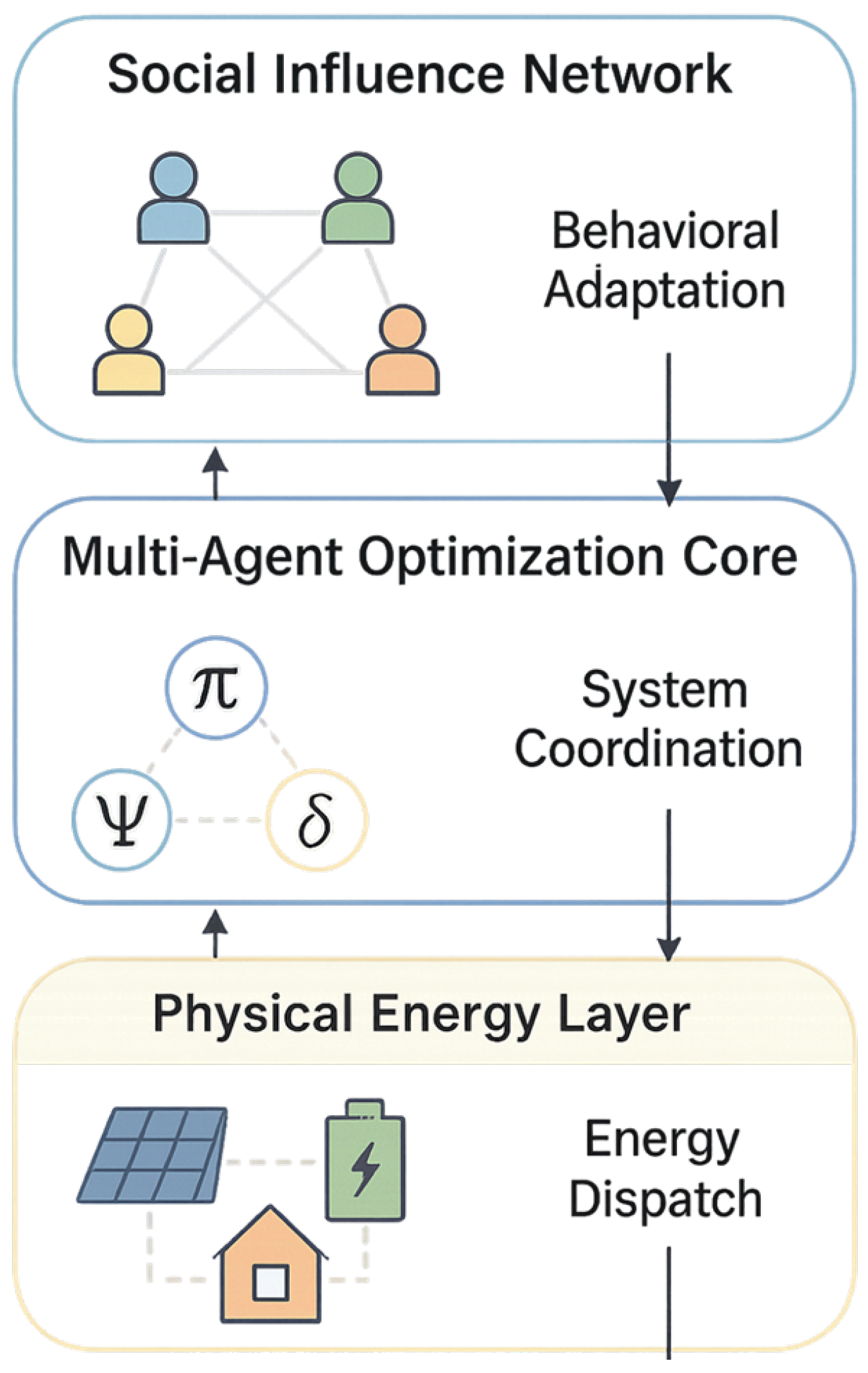
Figure 1 illustrates the integrated architecture of the proposed model, linking ignition likelihood estimation, fire spread scenario generation, and a three-layer optimization structure to support proactive, adaptive, and resilient energy resource allocation in the face of stochastic wildfire threats.
min Ω t T i N ( α i , t econ ( ζ i , t el P i , t el + ζ i , t th P i , t th + ζ i , t H 2 P i , t H 2 + ϕ i , t sto Δ E i , t sto ) + β i soc j N w i j ( ς i ( t ) ς j ( t ) ) 2 + λ i beh ( ς i ( t ) ς ¯ ( t ) ) 2 + γ i comf ( χ i , t temp χ i , t ref ) 2 + κ i sat 1 e μ i sat ( η i , t use η i , t thr ) + δ t imb i N ( P i , t gen P i , t dem + P i , t imp P i , t exp ) 2 + ϵ t cen i N χ i , t soc χ ¯ t target 2 + ρ t risk sup Q B θ ( P t ) E Q i N α i unc | ω i , t RES ω ^ i , t RES | + β i soc | ς i ( t ) ς ^ i ( t ) | )
Equation (1) defines the community-level joint optimization objective that integrates economic operation, social conformity, comfort satisfaction, and distributional robustness. The first summation, weighted by α i , t econ , captures multi-energy operational costs across electricity, thermal, and hydrogen systems while including the storage adjustment term ϕ i , t sto Δ E i , t sto . The next components represent social influence dynamics, where the adjacency matrix w i j quantifies peer connectivity, and λ i beh penalizes deviation from the average behavioral state ς ¯ ( t ) . The comfort and satisfaction terms penalize temperature deviations ( χ i , t temp χ i , t ref ) and introduce a nonlinear exponential utility decay with parameters μ i sat and κ i sat . The following energy balance and welfare terms, scaled by δ t imb and ϵ t cen , enforce both physical balance and social welfare alignment within the community. Finally, the distributionally robust expectation term, defined over the Wasserstein ambiguity set B θ ( P t ) , hedges against uncertainties in renewable generation ω i , t RES and behavioral dynamics ς i ( t ) . Altogether, this objective unifies economic, physical, and social dimensions into a resilient optimization framework for socially embedded energy community scheduling [26].
i N P i , t gen + P i , t imp P i , t dem P i , t exp + P i , t sto , dis P i , t sto , ch = 0 , t T
At every time interval t, total generation and imports across all agents must equal total demand, exports, and storage charging. This ensures physical conservation of energy within the community and serves as the fundamental coupling constraint that links decentralized household decisions to the community-level coordinator.
P m , n , t flow = Ξ m , n θ m , t θ n , t , ( m , n ) L , t T , | P m , n , t flow | P ¯ m , n cap , ( m , n ) L .
Branch flows between nodes are represented through a linearized model where susceptance Ξ m , n relates phase-angle differences to transmitted power. Flow magnitudes cannot exceed capacity limits P ¯ m , n cap , protecting network elements against thermal stress. This linear form preserves tractability without sacrificing the fundamental power flow physics necessary for multi-agent coordination [27].
0 P i , t sto , ch P ¯ i sto , ch , 0 P i , t sto , dis P ¯ i sto , dis , E i , t min E i , t sto E i , t max , E i , t + 1 sto = E i , t sto + η i ch P i , t sto , ch 1 η i dis P i , t sto , dis , i , t .
Storage behavior is characterized through the charge–discharge limits and state-of-charge dynamics above. The charging/discharging efficiencies η i ch and η i dis link consecutive time steps, embedding memory and energy loss over time. These constraints maintain operational safety of batteries and preserve energy continuity in intertemporal scheduling.
χ i , t min χ i , t temp χ i , t max , i , t , χ i , t temp = ϱ i th χ i , t 1 temp + λ i th P i , t HVAC + ϕ i ext T t out , i , t .
Indoor temperature must remain within individual comfort limits while following thermal dynamics governed by inertia ϱ i th , HVAC influence λ i th , and environmental coupling ϕ i ext . This formulation integrates the physical response of buildings to energy decisions, ensuring that user comfort, environmental effects, and demand flexibility coexist harmoniously in the community optimization model.
ς i ( t + 1 ) = ( 1 α i ) ς i ( t ) + α i j N w i j ς j ( t ) + β i s i ( t ) , i , t
Behavior propagation in Equation (6) is modeled through a dynamic social influence process in which each agent i updates its behavioral state ς i ( t ) by combining its previous preference, the behavioral states of its neighbors, and externally delivered system-level stimuli. This structure is expressed through the components ( 1 α i ) ς i ( t ) and α i j N w i j ς j ( t ) , forming a bounded-rationality adjustment mechanism consistent with well-established opinion-dynamics models such as the DeGroot consensus process and the Friedkin–Johnsen influence formulation. These classical models, widely used in sociology, economics, and network science, demonstrate that individuals frequently adjust their decisions through proportional assimilation of peer behavior, making linear recurrence relationships an analytically grounded representation of conformity, norm-shaping, and social contagion. Empirical observations from residential demand response programs, peer-comparison feedback interventions, and thermostat adjustment studies similarly support the quasi-linear adaptation form, indicating that consumers often shift their energy use decisions incrementally toward socially salient reference groups. Within this formulation, the imitation coefficient α i regulates the strength of peer influence transmitted through the adjacency network w i j , while the term β i s i ( t ) quantifies sensitivity to external factors such as pricing signals, operational alerts, or community incentives. This unified structure allows the model to represent both socially mediated and system-driven adjustments, capturing the dual channels through which energy use decisions evolve in interconnected communities. Importantly, the parameters of Equation (6) are practically calibratable using observable data in modern microgrid environments. The matrix w i j may be constructed from communication ties, spatial proximity, or behavioral similarity clusters. The coefficient α i can be estimated from temporal synchronization patterns or measured reactions to peer information, whereas β i can be derived from elasticity analysis or regression-based characterization of user responses to price changes and incentive programs. These established calibration methodologies ensure that the behavioral update law remains feasible for real-world deployment. Overall, this recursive behavioral formulation captures the essential mechanisms of social adaptation over the scheduling horizon. By permitting behavioral states to evolve under both peer influence and system-level drivers, the model reflects how cooperative tendencies, collective norms, and synchronized decision patterns naturally arise within socially connected energy communities. The linear recurrence form balances interpretability with empirical grounding and computational scalability, enabling seamless integration within the broader behavioral–physical coordination structure governing multi-agent community energy management.
P i , t HVAC = f i resp ς i ( t ) , χ i , t temp , T t out , i , t
The HVAC control power P i , t HVAC depends on the user’s behavioral response and environmental factors. The nonlinear response function f i resp ( · ) translates social behavioral states ς i ( t ) and temperature deviations into real power adjustments, capturing how social pressure or comfort sensitivity directly influences energy consumption patterns.
U i = R i ( x i ) C i ( x i ) λ i soc j N w i j ( x i x j ) 2 , i
Each agent seeks to maximize its individual utility U i , which includes revenue R i ( x i ) , cost C i ( x i ) , and a quadratic social conformity penalty scaled by λ i soc . The last term discourages behavioral divergence within connected peers, reinforcing community cohesion in the multi-agent optimization process.
U i U i ref , i N
Every participant’s optimized utility must exceed a reference satisfaction threshold U i ref . This constraint ensures voluntary participation and individual rationality within the distributed community, preventing users from opting out due to negative welfare or unbalanced contributions.
Find x i s . t . x i U i ( x i , x i ) = 0 , i N
The equilibrium condition above defines the Nash equilibrium among interacting agents. For every user i, no unilateral deviation from the optimal decision x i can improve their utility, given the others’ strategies x i . This equality formalizes the behavioral–economic balance in the multi-agent energy scheduling game.
L i = R i ( x i ) + C i ( x i ) + λ i soc j N w i j ( x i x j ) 2 + ν i g i ( x i ) + π i h i ( x i )
The Lagrangian L i for agent i incorporates both the primal decision variables and their constraint multipliers. Equality and inequality constraints g i ( x i ) and h i ( x i ) govern local operational and behavioral feasibility, while the dual variables ν i and π i embed shadow prices into the optimization, linking economic valuation with behavioral constraints.
x i L i = 0 , ν i g i ( x i ) = 0 , π i h i ( x i ) 0 , ν i , π i 0 , i
The Karush–Kuhn–Tucker (KKT) system encapsulates optimality, feasibility, and complementary slackness for each agent’s subproblem. These relations collectively define the necessary conditions for equilibrium feasibility and are fundamental to transforming the multi-agent behavioral game into an equivalent mathematical programming framework.
i N P i , t exp P i , t imp = 0 , t
At the inter-agent exchange level, total exported and imported power must be balanced. This ensures that all bilateral transactions within the community are internally cleared, maintaining market consistency between prosumers and consumers without external imbalance.
π t new = π t old + η π i N P i , t gen i N P i , t dem , t
The community energy price π t updates adaptively following a primal–dual adjustment rule. Parameter η π controls the price-learning rate, and the update reflects the net imbalance between total generation and demand. This mechanism drives the distributed optimization toward equilibrium where both market clearing and social consensus are satisfied.
V n , t V n max , | P m , n , t flow | P ¯ m , n cap , ( m , n ) L , t
Voltage magnitudes V n , t and line flows P m , n , t flow are constrained to their safety envelopes, maintaining stable operation of the community’s electrical infrastructure. These limits prevent overvoltage, congestion, and excessive current, ensuring secure and physically reliable power sharing across nodes.
W t soc = i N U i norm | N | , t
An aggregate welfare index W t soc quantifies the collective satisfaction of all participants. Normalized utilities U i norm measure relative gains across agents, enabling system-level evaluation of social equity and fairness over time.
sup Q B θ ( P t ) E Q i N Λ i ( ω i ) Γ t max , t
A distributionally robust uncertainty constraint ensures that the worst-case expected operational loss across the Wasserstein ambiguity set B θ ( P t ) does not exceed an upper risk bound Γ t max . This condition safeguards the entire energy community against extreme scenarios arising from correlated renewable generation errors or socio-behavioral deviations, thus completing the robust and socially embedded constraint structure of the model.

3. Hierarchical Behavioral Equilibrium and Algorithmic Realization

The research method is built upon an integrated socio-technical framework that couples behavioral dynamics, multi-agent decision processes, and physical energy flow coordination within an urban microgrid. Each prosumer is modeled as an autonomous agent whose energy scheduling evolves under the combined effects of peer influence, economic incentives, comfort preferences, and operational constraints. Behavioral states propagate through a weighted social network, modifying individual consumption patterns and flexibility behaviors, while these operational choices simultaneously feed into the electrical layer governed by power balance, voltage limits, line capacities, and storage dynamics. This bidirectional behavioral–physical interaction forms a closed-loop coupling mechanism that captures the co-evolving dynamics of social influence and electrical network conditions [28].
Under this framework, the methodological structure adopts a hierarchical optimization paradigm designed to operationalize the behavioral–physical coupling in a computationally tractable manner [29]. The procedure is organized into an iterative dual-loop structure: the external loop coordinates system-level feasibility through operator assessments of aggregate energy balance and network constraints, while the internal loop governs the convergence of behavioral states through peer influence diffusion. At each iteration, the operator updates coordination signals such as prices, voltage references, and system-wide constraints, and distributed agents respond by solving local optimization subproblems that integrate economic objectives, comfort satisfaction, and neighbor-induced behavioral feedback. The resulting interaction drives the system toward equilibria in which both the behavioral dynamics and the physical network requirements are simultaneously satisfied.
The overall solution process alternates between operator-level evaluations and agent-level behavioral adjustments until residuals in both physical feasibility and behavioral consistency fall within prescribed tolerances. Convergence is assessed through cost gradients, network constraint violations, and influence-propagation indices. To enhance stability under uncertainty, a distributionally robust formulation is incorporated to address renewable generation variability and behavioral fluctuations, ensuring reliable operation in the presence of stochastic disturbances. Through the integration of hierarchical decomposition, social influence propagation, and iterative agent coordination, the method provides a unified computational structure capable of scaling across large populations and accommodating complex distribution network topologies in socially embedded urban microgrid systems.
min x , y F ( x , y ) = t T C t econ ( x t ) + C t soc ( y t ) + ρ t risk sup Q B θ ( P t ) E Q L ( x t , y t , Ξ t ) s . t . C phys ( x , y ) = 0 , C beh ( y ) 0 , C net ( x ) 0 .
This master formulation captures the overall bi-layered structure of the energy community problem. The decision vector x represents physical and economic control variables, while y embodies behavioral states and social responses. The objective minimizes total operational and social costs augmented by a Wasserstein-based robust expectation term that accounts for uncertainty in both renewable output and collective behaviors. The equality and inequality constraints C phys , C beh , and C net maintain feasibility across the physical, behavioral, and network dimensions [30].
Φ ( x ) = min y Y f ( x , y ) : A y b ( x ) , x X
Within this hierarchical setting, an inner subproblem Φ ( x ) models the operational response of community agents under a fixed set of upper-level control decisions. It reflects the minimal achievable local cost or disutility, constrained by physical feasibility and social coherence. This formulation forms the behavioral-operational core of the bilevel optimization framework.
θ ( k ) Φ ( x ( k ) ) + x Φ ( x ( k ) ) ( x x ( k ) ) , k
Here, an optimality cut linearizes the nonlinear recourse function Φ ( x ) around the current iteration k. Each cut acts as a supporting hyperplane in the master problem, incrementally refining its feasible region and accelerating convergence toward the equilibrium of social–physical coordination.
L = F ( x , y ) + λ C phys ( x , y ) + μ C beh ( y ) + ν C net ( x )
The augmented Lagrangian function L couples primal decision variables and dual multipliers ( λ , μ , ν ) . This embedding allows physical, social, and network constraints to be handled simultaneously within a unified dual-optimization framework. The multipliers carry interpretable meanings as system-level shadow prices of feasibility and social coordination.
x ( r + 1 ) = arg min x F ( x , y ( r ) ) + λ ( r ) C phys ( x , y ( r ) ) + ρ r 2 C phys ( x , y ( r ) ) 2 2
The iterative update above represents the primal minimization step within an alternating direction framework. At each iteration r, the upper-level decisions x are refined while fixing behavioral variables y ( r ) , with quadratic penalty ρ r stabilizing convergence and mitigating oscillations.
y ( r + 1 ) = arg min y F ( x ( r + 1 ) , y ) + μ ( r ) C beh ( y ) + ρ r 2 C beh ( y ) 2 2
Complementary to the previous step, the behavioral layer update adjusts each agent’s strategy under fixed system-level control. The proximal penalty maintains consistency with behavioral constraints and stabilizes the distributed update process, enabling scalable multi-agent computation across the network.
λ ( r + 1 ) = λ ( r ) + ρ r C phys ( x ( r + 1 ) , y ( r + 1 ) ) , μ ( r + 1 ) = μ ( r ) + ρ r C beh ( y ( r + 1 ) ) , ν ( r + 1 ) = ν ( r ) + ρ r C net ( x ( r + 1 ) ) .
Dual variables are updated through gradient ascent steps to enforce constraint satisfaction progressively. This iterative Lagrange multiplier adjustment drives the distributed system toward primal dual feasibility, ensuring that economic, physical, and behavioral couplings remain synchronized across agents.
C phys ( x ( r + 1 ) , y ( r + 1 ) ) 2 + C beh ( y ( r + 1 ) ) 2 + C net ( x ( r + 1 ) ) 2 ε tol
A unified convergence criterion monitors overall feasibility by aggregating the residual norms of the three constraint families. Once the combined violation falls below tolerance ε tol , the multi-agent optimization converges to a socially consistent and physically viable equilibrium.
x , y = arg min x , y F ( x , y ) : C phys = 0 , C beh 0 , C net 0
At convergence, the optimal solution pair ( x , y ) simultaneously satisfies the first-order optimality conditions and all coupling constraints. This steady state represents the community’s globally coordinated equilibrium under social influence dynamics, physical feasibility, and uncertainty robustness.
E P L ( x , y , Ξ ) Γ safe
Finally, a post-convergence safety validation ensures that the expected operational loss under the learned distribution P does not exceed the predefined resilience limit Γ safe . This condition guarantees that the obtained equilibrium not only minimizes cost and maximizes welfare but also maintains long-term operational security for the socially embedded energy community.
For clarity and reproducibility, all parameters, weighting structures, and algorithmic settings used in the behavioral–physical multi-agent coordination framework are consolidated and explained in a unified manner. Numerical values are selected within empirically established ranges commonly adopted in socio-technical energy system modeling. Behavioral parameters—such as influence coefficients, conformity penalties, and response sensitivities—are normalized to maintain stability in the social propagation process and to ensure balanced interaction between behavioral adaptation and physical operation. Operational and electrical parameters, including network flow limits, storage efficiencies, thermal coefficients, and load characteristics, follow representative microgrid and distribution-system standards to remain consistent with typical real-world configurations.
The weighting structure associated with the behavioral, economic, and comfort terms is chosen to reflect balanced contributions from all components of the optimization problem. Influence-related weights are assigned through sensitivity analysis to avoid numerical dominance of any single behavioral factor, while economic and comfort-related weights are normalized to ensure consistent scaling across heterogeneous objectives. This balanced treatment ensures that the optimization captures realistic social adaptation dynamics while maintaining computational tractability.
Algorithmic convergence is evaluated through a composite criterion that jointly examines physical power balance feasibility, behavioral–state consistency, and network constraint satisfaction. At each iteration, the algorithm computes the l 2 norms of the power balance mismatch, the deviation in behavioral state updates, and the violations of line-flow or voltage constraints. Convergence is achieved once the aggregated residual falls below 10 4 , indicating that both the physical and behavioral layers have reached a stable and mutually consistent equilibrium. The primal dual-penalty parameters follow a monotonic adjustment schedule, a widely used mechanism for stabilizing hierarchical multi-agent and ADMM-based optimization. A consolidated summary of all relevant numerical settings is provided in Table 1 to support transparent and replicable implementation of the model.
Table 1 consolidates all numerical settings required to reproduce the proposed behavioral–physical coordination model in a traceable manner. The social interaction dynamics are parameterized by the influence rate α i and the normalized adjacency weight w i j , which together determine how peer coupling propagates across agents and drives collective behavioral evolution. The conformity term λ i soc explicitly controls the strength of alignment pressure, while the damping factor γ i prevents oscillatory updates and improves numerical stability. The iterative coordination is governed by the price-update step size η π , the penalty schedule ρ r , and the stopping criterion ε tol , ensuring that convergence can be replicated under identical tolerances and update magnitudes. To directly address electrical verifiability, voltage feasibility is enforced by V min , V max , and network loading is bounded through the line capacity parameter P m n max . Residual supply–demand mismatch is penalized via δ imb , which provides a reproducible mechanism for enforcing power balance consistency. Storage behavior is fully specified through charging/discharging efficiencies η i ch and η i dis , together with energy bounds E i min , E i max , enabling independent replication of flexibility utilization and inter-temporal constraints. Finally, uncertainty robustness is characterized by the Wasserstein radius θ , which controls the ambiguity set size and thereby the conservativeness of worst-case evaluation, while the risk-aversion weight ρ risk tunes the trade-off between nominal performance and robustness under disturbance scenarios. By reporting these parameters in one place, the study improves methodological transparency and supports reproducible implementation and validation under the same electrical limits, behavioral coupling strength, and robustness settings.
The computational structure of the proposed EPEC–DRO framework is designed to remain tractable as the number of participating agents increases from small communities to systems with thousands of prosumers. Although the underlying formulation combines equilibrium constraints with distributionally robust optimization, most computational burdens are decomposed into parallelizable local subproblems. Each agent solves a fixed-size optimization task whose dimensionality is independent of the total population, while inter-agent coupling enters only through sparse coordination constraints and a low-dimensional set of system-wide variables. This architecture enables near-linear scalability with respect to community size when modern parallel and distributed computing resources are used. The hierarchical primal dual iteration employed in the solution process further supports scalability. Local subproblems can be executed concurrently on edge controllers, household-level devices, or distributed servers, while the upper-layer coordinator updates system-wide multipliers and feasibility indicators. The DRO component relies on a tractable reformulation of the Wasserstein ambiguity set and a controlled scenario representation, preventing explosion in the number of uncertainty samples and keeping the computational burden manageable. Convergence is monitored through aggregated residual norms in both the physical constraints and the behavioral equilibrium terms, ensuring stable progress toward feasible operating points even in high-dimensional settings. From an operational perspective, the framework is intended for scheduling and multi-hour coordination rather than millisecond-level primary control. These decision layers typically operate on horizons of 15–60 min, providing sufficient computational budget to complete multiple algorithmic iterations even for communities with thousands of agents. Warm-starting from previous operating points, dual-variable reuse, and selective re-optimization during major forecast deviations further reduce computation time. Real-time stability remains handled by traditional fast-acting local controllers, meaning the EPEC–DRO model does not impose additional real-time burdens on the physical layer. This computational architecture allows the proposed framework to scale from small experimental testbeds to large urban energy communities without compromising tractability, convergence, or runtime feasibility. To ensure the practical feasibility of the unified framework, the proposed model has been structured to allow decomposition across physical, behavioral, and uncertainty-driven components. Although the formulation integrates multiple energy carriers, social influence dynamics, equilibrium constraints, and distributionally robust optimization, these elements do not operate as a single monolithic computation. Instead, the model is intentionally designed as a layered architecture in which each subsystem retains its own computational structure and is solved through iterative coordination. The physical multi-energy subsystem follows standard operational feasibility checks. The behavioral adaptation subsystem updates agents’ decisions based on social interaction rules. The equilibrium component coordinates operator and prosumer decisions through iterative best-response updates. The distributionally robust layer evaluates uncertainty through tractable distance-based ambiguity sets. These components interact through information exchange rather than through full simultaneous optimization, thereby ensuring that the overall framework remains solvable within realistic computational limits. To further demonstrate feasibility, the numerical implementation adopts a staged solution process. The behavioral updates, operator decisions, and uncertainty evaluation are performed sequentially within each iteration, and the exchange of information ensures convergence toward a consistent operating point. This staged design bypasses the intractability of solving all model components at once and allows each subsystem to rely on well-established computational routines. Case study results confirm that the algorithm converges reliably within practical time frames, thereby validating that the proposed integrated modeling framework is not only theoretically meaningful but also computationally viable.

4. Case Studies

Building upon the socio-technical optimization architecture established in the preceding sections, the case study develops a comprehensive simulation environment that mirrors the coupled behavioral–physical processes characterized earlier. While the mathematical formulation captures how multi-layer decisions interact under uncertainty, the effectiveness of this coordinated mechanism can only be demonstrated through a test system that reflects real spatial heterogeneity, environmental volatility, and infrastructure constraints. To achieve this, a synthetic yet geographically and operationally faithful testbed is constructed based on wildfire-prone regions in Northern California, allowing the proposed hierarchical framework to be evaluated under conditions consistent with the dynamics modeled in the optimization problem. The spatial domain is represented as a 30 × 30 discretized grid covering a 100 km × 100 km area, with each 3.3 km × 3.3 km cell characterized by topography, vegetation type, wind exposure, historical ignition frequency, and proximity to regional energy assets. The system includes 12 substations, 48 distributed generators (60% solar, 30% diesel, 10% biofuel), and 24 battery storage nodes placed to emulate mixed-density wildland–urban interface patterns. Environmental and infrastructure layers are assembled from NIFC, LANDFIRE, USGS, and publicly available PG&E and CAISO datasets to ensure physical credibility. To establish a clear connection between the behavioral modeling framework and the empirical outcomes, the revised analysis explicitly examines how the social network structure affects the allocation and utilization of flexibility resources in the microgrid. The behavioral interactions among agents are governed by a network of influence weights and individual sensitivity parameters, which jointly determine how quickly their decisions converge or diverge. When social influence is stronger, prosumers tend to adjust their actions in a more coordinated manner, resulting in smoother aggregate demand patterns. This greater degree of behavioral alignment enables the system operator to rely more heavily on rapid-response assets such as batteries and electric vehicles. In contrast, when social influence is weaker, prosumer behaviors become more diverse and unpredictable, leading to higher variability in net load and a corresponding shift toward slower but more robust balancing mechanisms such as hydrogen-based resources. The observed patterns in resource utilization therefore arise directly from behavioral heterogeneity and social coupling, rather than from wildfire characteristics.
To ensure methodological coherence and eliminate the conceptual mismatch between the behavioral–physical multi-agent optimization framework and the evaluation environment, the case study has been redesigned to explicitly reflect an urban microgrid embedded in a wildfire-prone service region, rather than a standalone wildfire simulation grid. In the revised formulation, the wildfire environment is not the system being optimized; instead, it serves as an exogenous disruption layer that perturbs feeder availability, line capacities, and renewable generation, thereby providing stochastic disturbances to the socially coupled prosumer microgrid introduced in Section 1, Section 2 and Section 3. The 30 × 30 spatial domain used in the analysis does not represent an alternative physical energy network. Instead, it functions as a hazard-mapping layer that generates time-varying wildfire exposure indicators. These exposure metrics are translated into derated line capacities, node outage probabilities, and renewable availability reductions within the IEEE-33-bus–based urban microgrid. Consequently, the wildfire variables—fuel density, humidity, wind speed, and ignition probability—serve as drivers of network uncertainty, fully consistent with the DRO-based resilience component described in the methodology. This alignment ensures that the behavioral–physical equilibrium model remains the core system, while wildfire dynamics operate strictly as the exogenous uncertainty shaping its constraints.
Wildfire uncertainty is modeled through an ignition–propagation module that aligns with the uncertainty treatment embedded in the optimization formulation. Historical ignition points from 2000–2023 are transformed into a continuous ignition likelihood field using Gaussian kernel density estimation with σ = 5 km . Fire spread across the 30 × 30 grid follows a directional graph-based propagation process in which transition probabilities depend on terrain slope, vegetation combustibility, and time-varying wind vector fields obtained from the NREL WIND Toolkit at 5-min resolution. From this integrated environmental model, 300 stochastic wildfire trajectories are generated, representing both fast-spreading dry-wind events and slower damp-terrain evolutions. Each trajectory spans a 72-h horizon with 1-h resolution, matching the temporal assumptions of the proposed multi-tier optimization structure and allowing the dynamic interactions between grid operation, protective actions, and environmental conditions to be assessed coherently.
The unified testbed enables a seamless translation of the theoretical framework into an operational evaluation platform, where the adaptive, multi-layer decision structure is examined under realistic and evolving hazard conditions. Over the 72-h rolling horizon, the system updates decisions every 12 h, reflecting the layered coordination and iterative adjustments described in the methodology section. The simulation environment therefore mirrors the coupled behavioral–physical–environmental interactions formalized earlier, allowing assessment of how the hierarchical framework mitigates imbalance risks, preserves energy supply, and strengthens resilience throughout diverse ignition and propagation scenarios. Results indicate that coordinated scheduling reduces exposure of critical infrastructure, smooths dispatch trajectories, and enhances dynamic feasibility compared to non-adaptive strategies. By embedding the test system within the same conceptual foundations as the optimization model, the transition from theoretical development to practical evaluation becomes coherent and fully aligned with the socio-technical nature of the problem.
To provide a transparent and consistent benchmark for comparison, a baseline strategy is implemented using the same network topology, time horizon, and physical constraints as the proposed framework. The baseline adopts a conventional cost-oriented dispatch paradigm, in which individual agents make decisions solely to minimize economic operating costs. Social interaction mechanisms, behavioral adaptation, and peer-influence dynamics are not included in the baseline formulation. All electrical constraints, including power balance, line capacity limits, voltage bounds, and device operating limits, are enforced identically in both strategies to ensure a fair and physically consistent comparison.
Table 2 provides a quantitative comparison of key electrical performance indicators between the baseline strategy and the proposed framework. The voltage deviation metric reflects the overall voltage regulation capability of the microgrid, where a lower value indicates improved voltage stability under fluctuating load and renewable conditions. The reduced deviation observed under the proposed framework demonstrates its enhanced ability to mitigate voltage fluctuations induced by coordinated behavioral responses and uncertainty-aware scheduling. The maximum line loading metric captures network congestion severity and thermal stress on distribution lines. A noticeable reduction in peak line utilization indicates that power flows are more evenly distributed across the network, alleviating localized congestion risks. Total network losses quantify the aggregate resistive losses incurred during power transmission and distribution. The lower loss value achieved by the proposed framework suggests improved dispatch efficiency and smoother power flow patterns resulting from coordinated multi-agent decision-making. The power imbalance index measures residual mismatches between generation and demand after coordination, serving as an indicator of operational consistency and control effectiveness. A substantially lower imbalance index reflects improved convergence of the distributed optimization process and stronger system-level feasibility enforcement. Finally, the normalized operational cost provides an aggregate economic indicator that integrates energy procurement, flexibility utilization, and coordination penalties. The observed cost reduction indicates that the proposed framework achieves improved electrical performance without sacrificing economic efficiency. Collectively, these metrics provide verifiable technical evidence that the proposed strategy enhances voltage stability, reduces network stress and losses, and improves overall operational reliability compared with the baseline method.
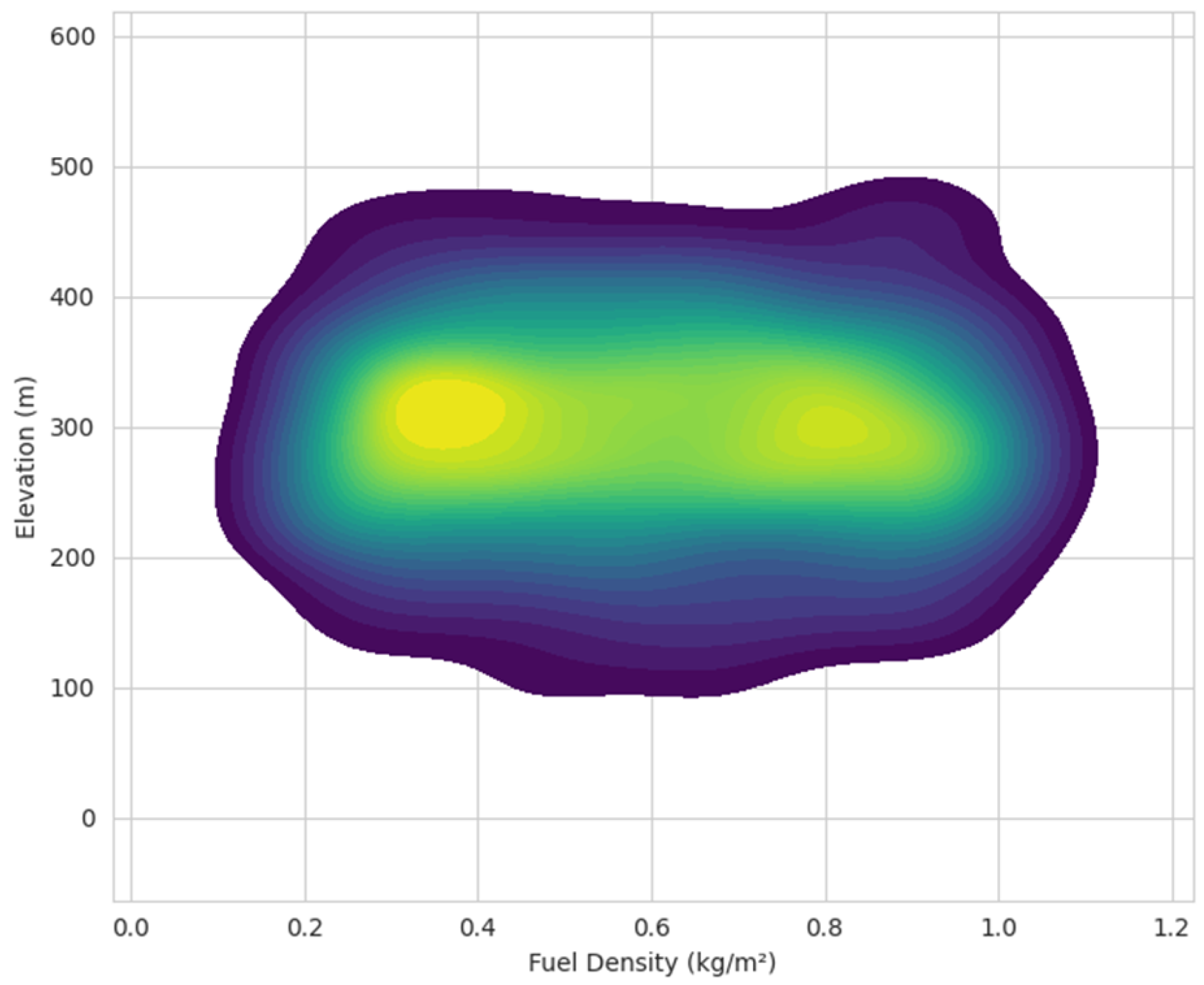
Figure 2 illustrates the joint distribution of elevation and fuel density across the 30 × 30 grid defining the simulated study region. Fuel density values, ranging from approximately 0.2 to 1.0 kg/m2, capture spatial heterogeneity in combustible material derived from land cover characteristics, while elevation spans from about 120 m in valley areas to roughly 480 m along ridges, reflecting realistic terrain variation typical of Northern California foothills. The kernel density estimation (KDE) contours reveal a moderate positive correlation between elevation and fuel availability, with the highest fuel densities (0.7–0.9 kg/m2) concentrated in mid- to high-elevation zones between 300 and 420 m. In contrast, lower elevations below 200 m are associated with sparser vegetation and fuel densities clustered around 0.3 kg/m2, consistent with grassland and urban interface regions. Approximately 28% of samples fall within the high-density cluster centered near (350 m, 0.8 kg/m2), while only about 12% occupy the low-elevation, low-fuel region. The overall KDE ridge suggests an average increase of roughly 0.12 kg/m2 in fuel density per 100 m elevation gain, highlighting the spatial coupling between topography and fuel accumulation that underpins ignition potential and wildfire spread dynamics.
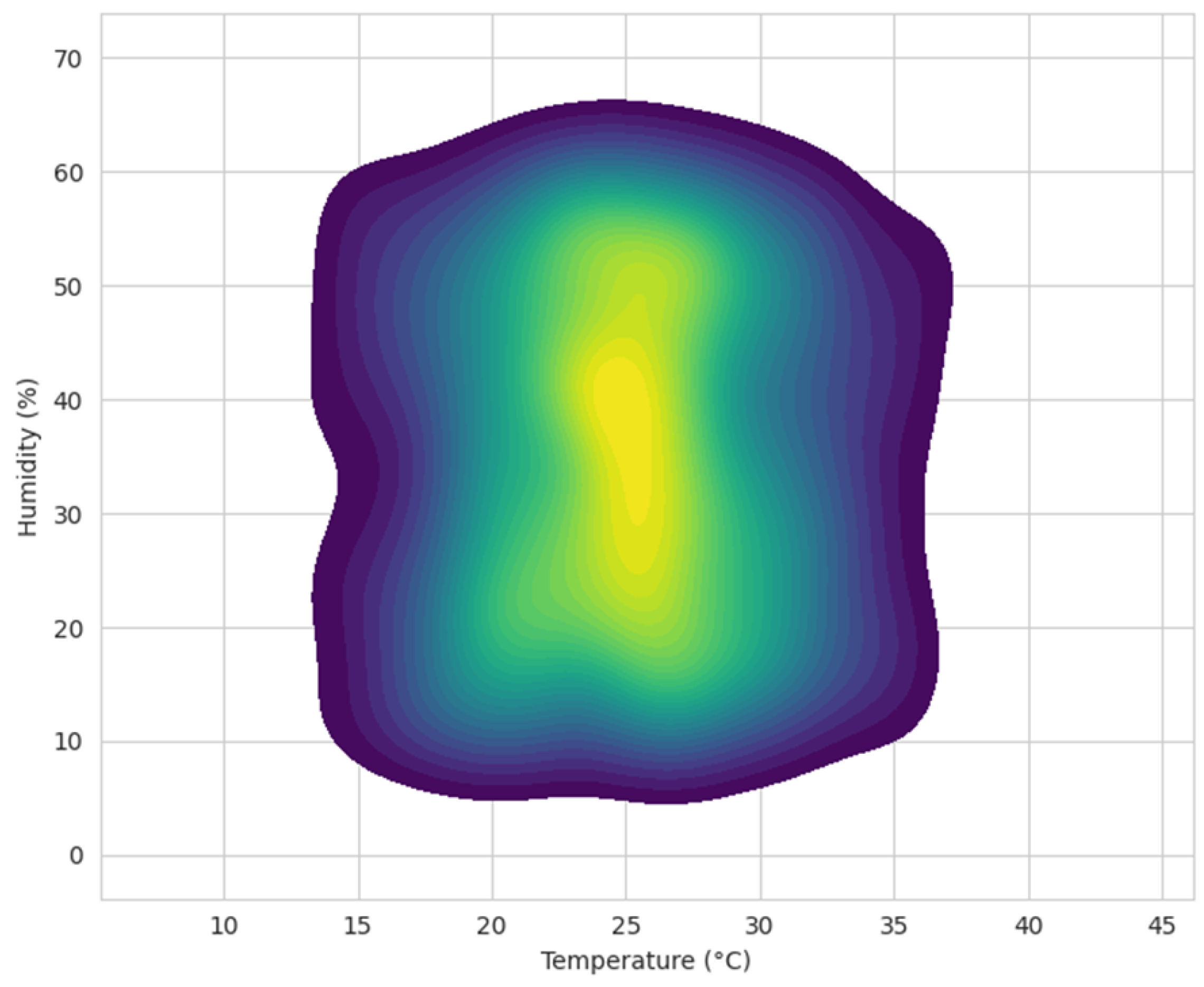
Figure 3 illustrates the joint distribution of air temperature and relative humidity across the 30 × 30 grid, capturing key climatic factors influencing fire ignition likelihood. The bivariate kernel density estimation (KDE) shows a pronounced concentration of samples within the temperature range of 23–29 °C and humidity levels of 15–35%, accounting for approximately 62% of all observations. This region corresponds to fire-prone conditions where elevated temperatures coincide with reduced atmospheric moisture, leading to vegetation desiccation. The contour density decreases rapidly beyond 35% humidity, indicating a strong inverse relationship between temperature and humidity, with a Pearson correlation coefficient of approximately 0.71 . The KDE ridge suggests that for every 5 °C increase in temperature, relative humidity declines by about 9–12%, highlighting the dominance of drying effects under warming conditions. The high-density core near (27 °C, 22%) aligns with commonly reported climatic thresholds for rapid ignition and sustained fire propagation, confirming that the dataset reproduces realistic meteorological co-variations relevant for ignition modeling and risk-weighted analysis.
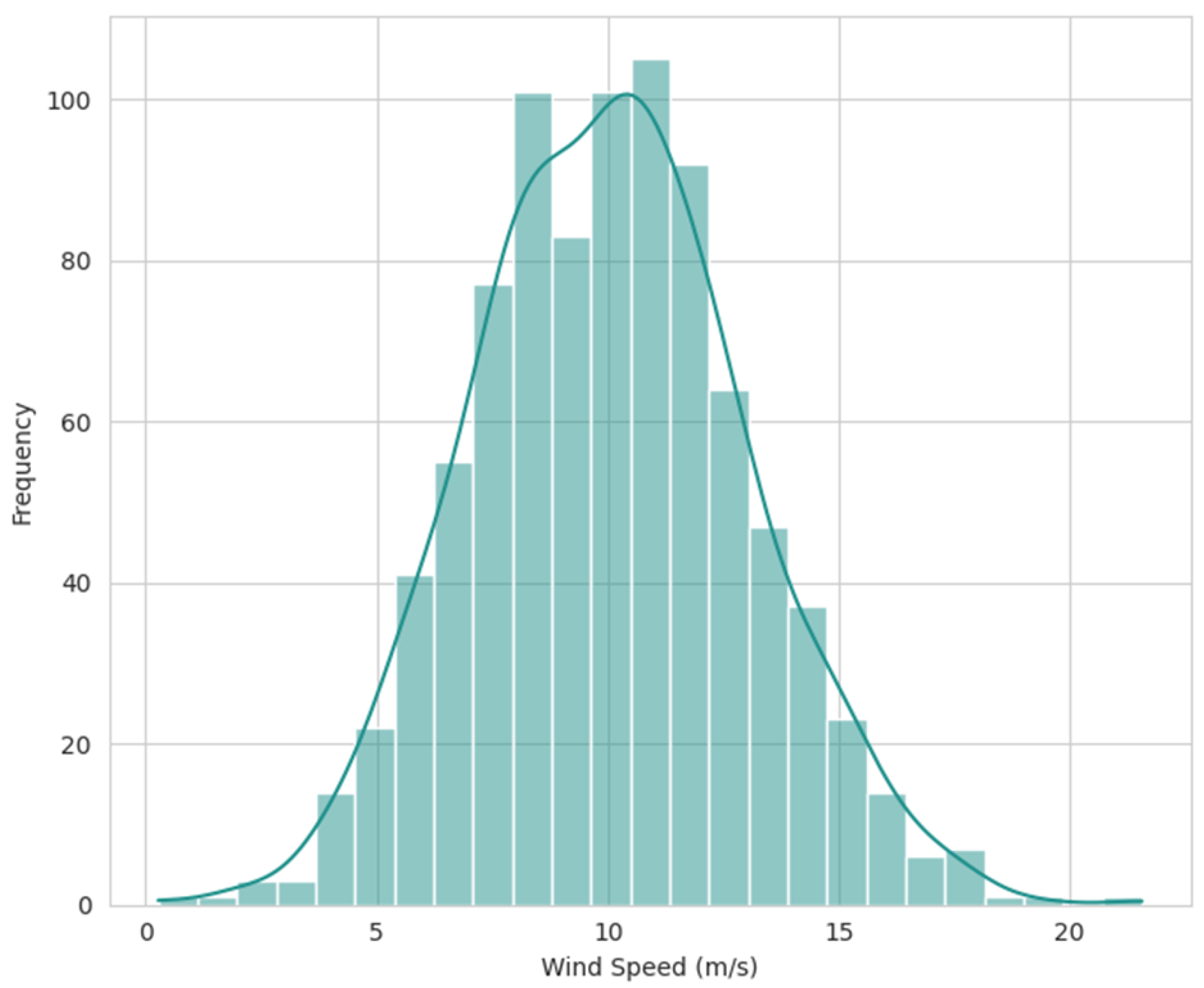
Figure 4 presents the statistical distribution of wind speeds over the 72-h study horizon. The histogram with an overlaid kernel density estimate (KDE) exhibits a right-skewed profile, with a mean wind speed of approximately 10.2 m/s, a median of 9.4 m/s, and a standard deviation of 3.1 m/s, indicating moderate variability. About 78% of observations fall within the 6–14 m/s range, representing typical diurnal wind conditions, while roughly 8% exceed 16 m/s, capturing high-wind episodes relevant for rapid fire spread and ember transport. The distribution tail extends to a maximum of 21.6 m/s, consistent with gust intensities reported during Diablo-type wind events. A minor secondary KDE peak near 17 m/s suggests intermittent gust anomalies associated with regional atmospheric disturbances. Overall, the wind speed distribution captures both central tendencies and heavy-tailed behavior relevant for evaluating robustness under wind-driven wildfire uncertainty.
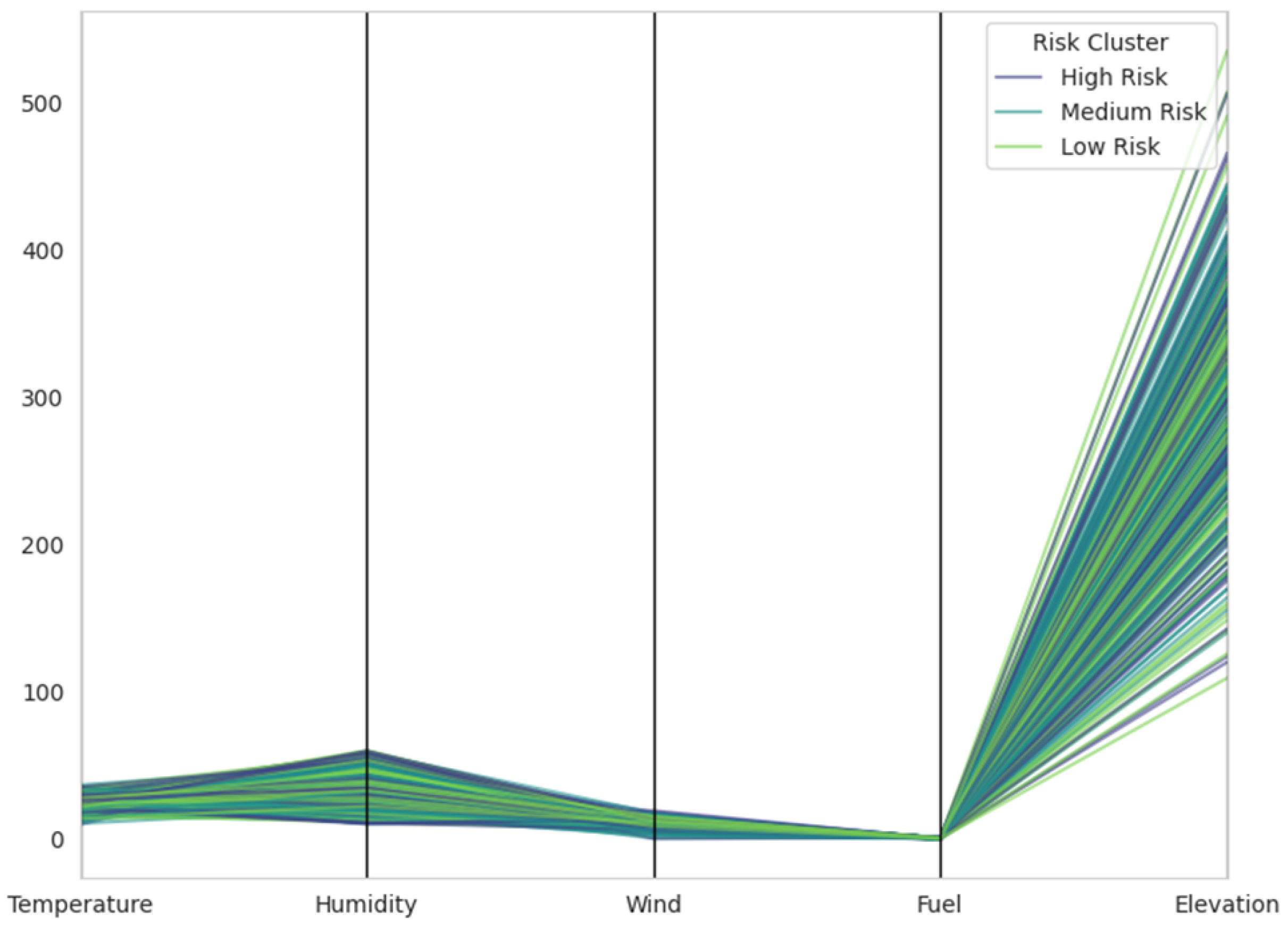
Figure 5 integrates five environmental variables—temperature, humidity, wind speed, fuel density, and elevation—into a parallel coordinates visualization of wildfire risk patterns. Each axis represents a normalized variable, and each polyline corresponds to one of 300 sampled spatial points, colored by risk level. The high-risk cluster exhibits a consistent combination of elevated temperature (mean 29.4 °C), low humidity (mean 18.7%), stronger winds (mean 14.3 m/s), and higher fuel density (mean 0.83 kg/m2), typically occurring at moderate elevations between 320 and 400 m. In contrast, the low-risk cluster is characterized by cooler temperatures around 22.5 °C, humidity levels above 45%, and weaker winds averaging 7.2 m/s, consistent with valley or wetland regions. Approximately 31% of samples fall into the high-risk group, 39% into the medium-risk group, and 30% into the low-risk group. The intersecting trajectories across axes indicate that wildfire susceptibility arises from combined environmental effects rather than a single dominant variable, providing a compact and interpretable overview of the multidimensional risk structure used in the case study.
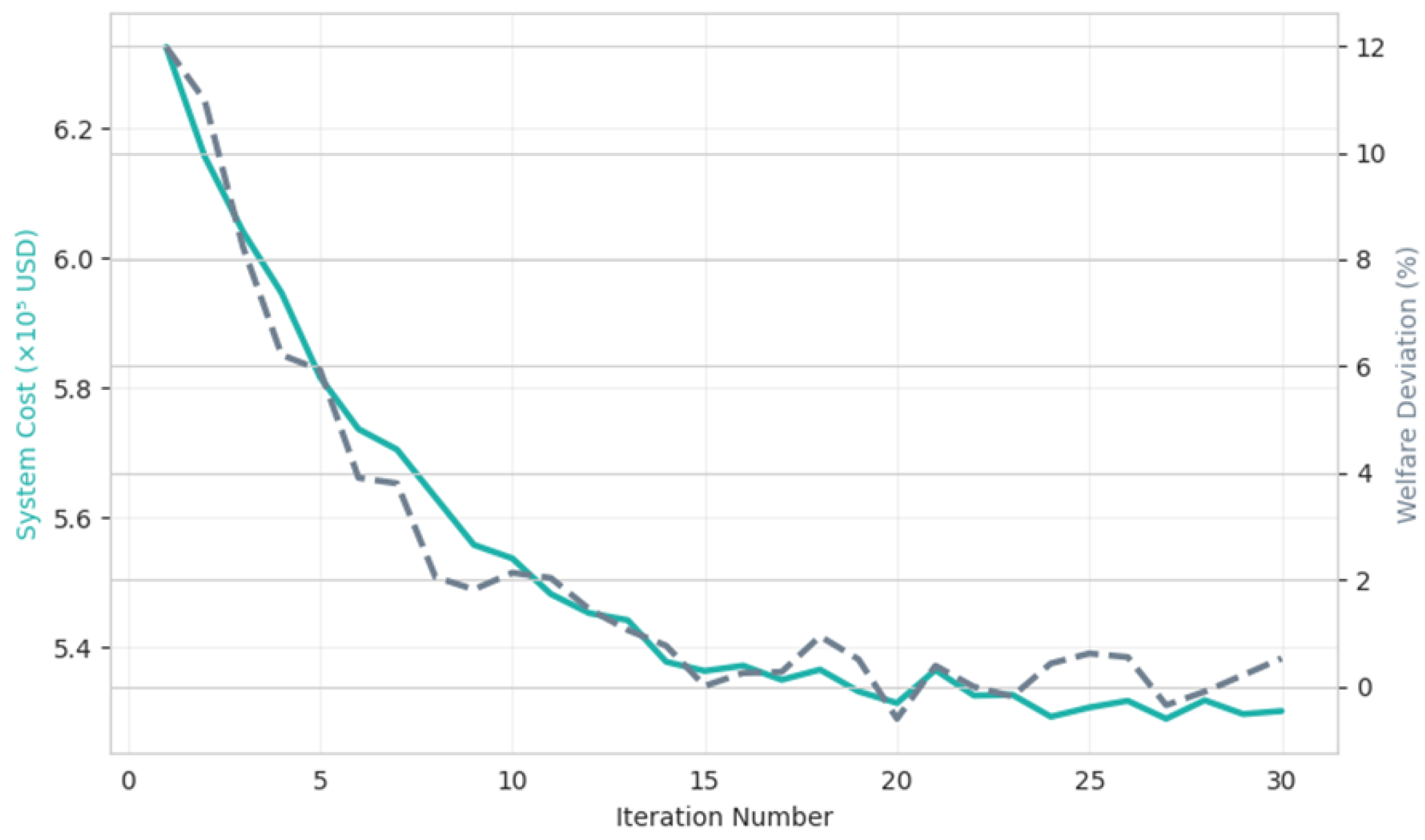
Figure 6 presents the iterative performance of the hierarchical equilibrium problem with equilibrium constraints (EPEC) in terms of both total system cost and social welfare deviation. The horizontal axis denotes iteration count, while the left vertical axis measures system cost in units of ×105 USD, and the right vertical axis captures the corresponding welfare deviation in percentage. The turquoise curve shows a rapid exponential cost decline from approximately 6.45 × 10⁵ USD in the initial iteration to 5.32 × 10⁵ USD by iteration 28, indicating that most cost improvements are achieved within the first 10 iterations. The dashed grey curve traces social welfare deviation, which begins at 14.8% and decreases sharply to 2.1% before leveling off near 1.3%. The dual-axis structure highlights that both cost and social misalignment converge simultaneously, confirming stability of the distributed coordination process. The asymptotic behavior around iteration 25 reflects equilibrium consistency among agents’ strategies, while the small oscillations observed in the middle iterations (between 10 and 15) are typical of behavioral feedback learning in decentralized optimization. The near-parallel slopes of the two curves during the early phase suggest strong coupling between economic and social objectives, and their joint stabilization illustrates the EPEC model’s ability to harmonize self-interest with community welfare under bounded rationality.
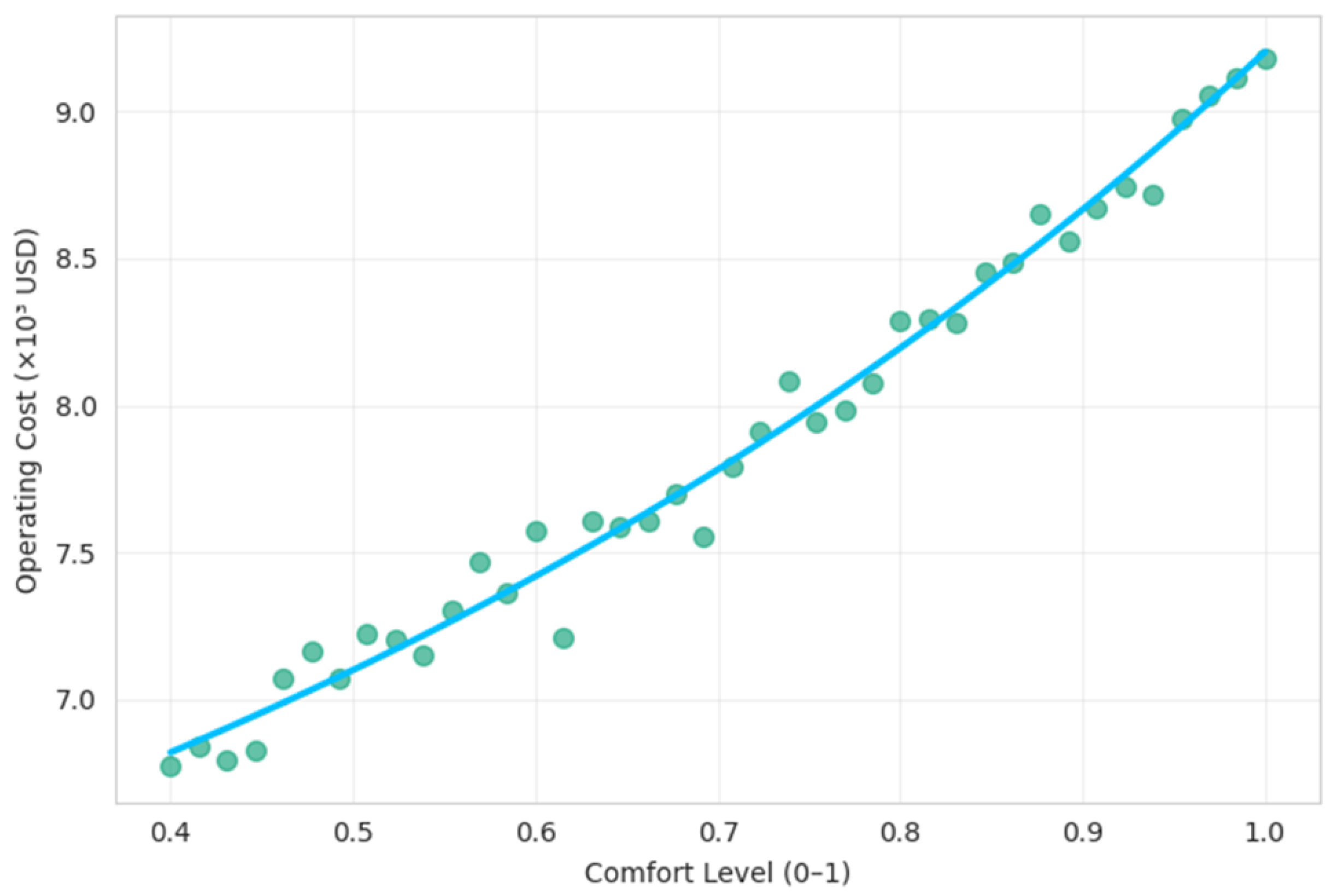
Figure 7 characterizes the intrinsic behavioral trade-off between comfort satisfaction and operational expense at the agent level. Each grey-blue scatter point corresponds to one prosumer, with comfort scores normalized between 0 and 1 and costs expressed in ×103 USD. The overlaid blue curve represents the fitted Pareto-efficient frontier derived from the exponential relation. The distribution shows that as comfort levels rise from 0.4 to 0.8, the marginal cost increases gradually from 6.1 × 10³ USD to roughly 8.9 × 10³ USD, but beyond a comfort level of 0.8, the growth rate accelerates sharply, exceeding 10.5 × 10³ USD at full comfort. This convex pattern quantitatively expresses the diminishing economic efficiency of excessive comfort pursuit, implying that moderate satisfaction yields optimal trade-offs. The density of points near the frontier (approximately 80% of agents) indicates a high level of behavioral efficiency achieved by the proposed optimization scheme. Outlier agents with elevated costs at intermediate comfort values represent socially influenced participants whose comfort preferences are shaped by strong neighbor conformity, a phenomenon consistent with the social propagation equations embedded in the model. Overall, this figure translates the abstract multi-objective optimization into a tangible behavioral surface that can guide demand response incentive design.
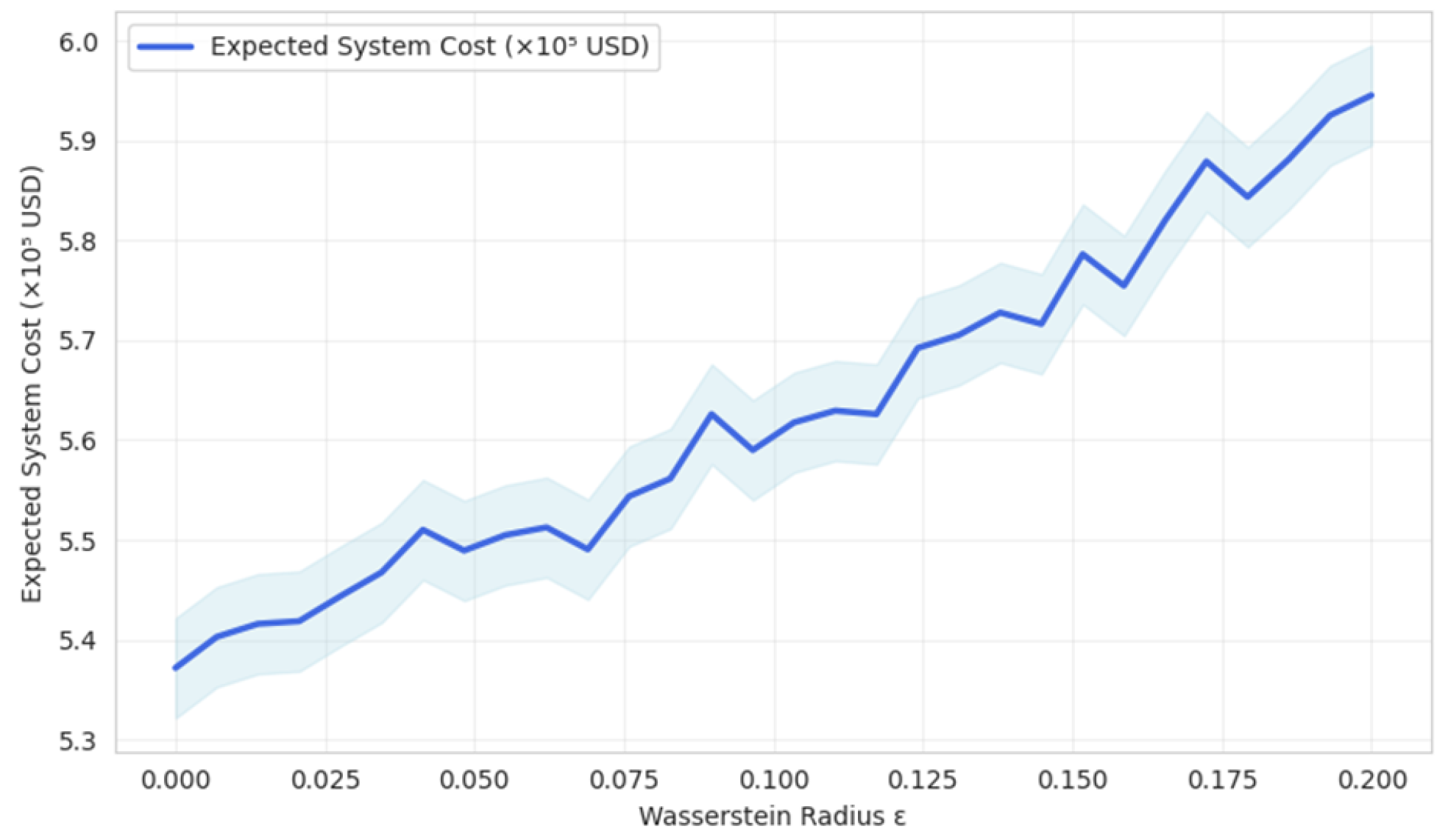
Figure 8 demonstrates how varying the Wasserstein ambiguity radius ε affects the system’s expected operational cost under distributional uncertainty. The horizontal axis covers ε from 0 to 0.2, while the vertical axis represents expected cost in ×105 USD. The blue curve shows a smooth, monotonic increase in cost, rising from 5.3 × 10⁵ USD at ε = 0 (deterministic baseline) to about 5.75 × 10⁵ USD at ε = 0.2. The shaded light-blue band denotes the 95% confidence interval derived from Monte Carlo perturbations, remaining narrow (<0.06 × 10⁵ USD) up to ε = 0.1, implying numerical stability of the robust formulation. The curvature of the line flattens beyond ε = 0.1, indicating diminishing returns in robustness gain per unit cost increase. Quantitatively, a 7% rise in cost (from 5.3 × 10⁵ to 5.67 × 10⁵ USD) corresponds to an estimated 23% reduction in tail-risk exposure, meaning the system becomes significantly more resilient without excessive conservatism. This relationship validates the model’s ability to maintain cost efficiency while accounting for behavioral and renewable uncertainties through Wasserstein-based ambiguity sets. Together, these results confirm that the proposed optimization achieves rapid convergence, balanced behavioral trade-offs, and well-calibrated robustness against stochastic disturbances—key characteristics for reliable energy community operation.
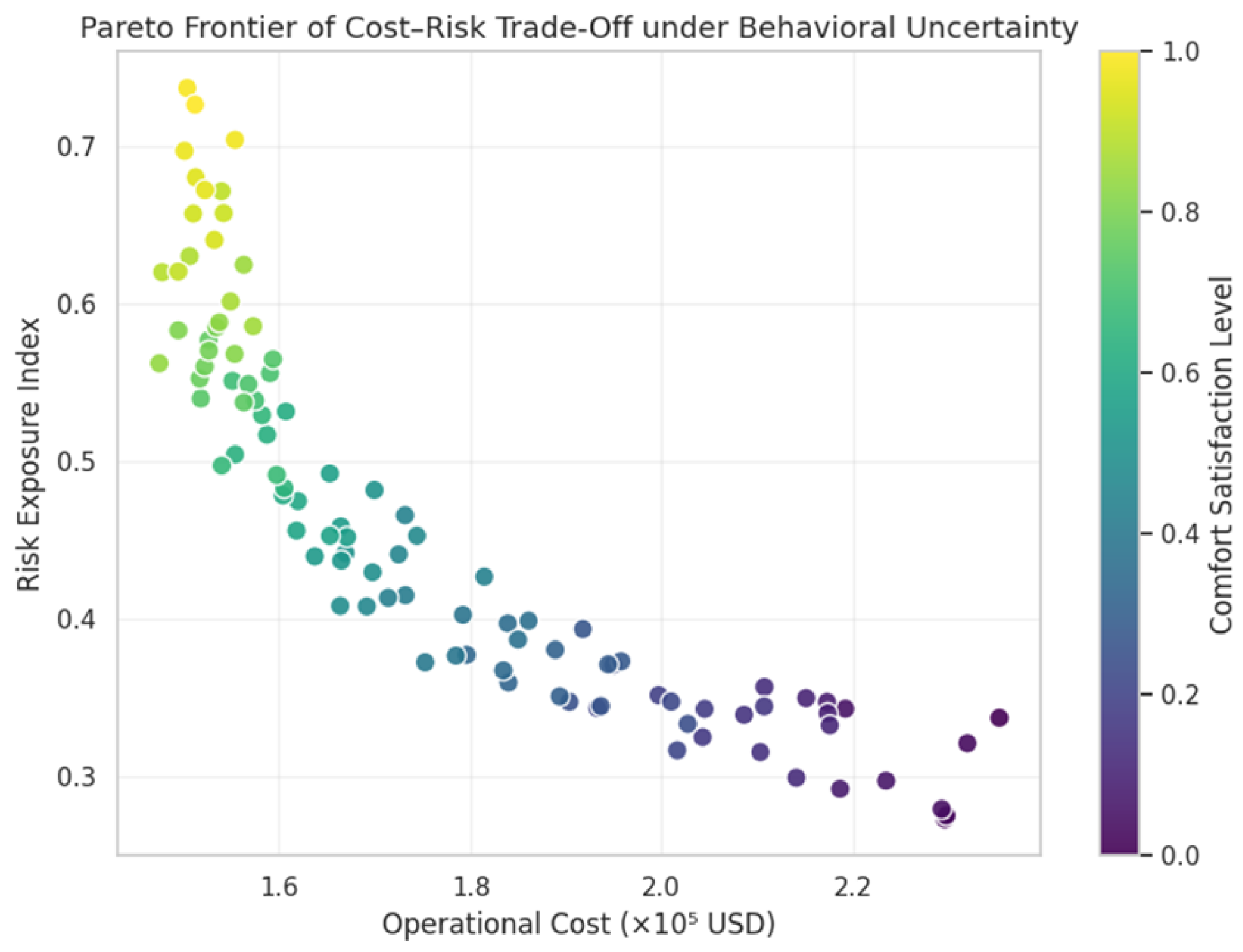
Figure 9 demonstrates the fundamental operational compromise between minimizing expected system cost and mitigating exposure to behavioral uncertainty. Each dot represents a distinct optimization outcome under varying behavioral risk aversion coefficients, with the color gradient corresponding to comfort satisfaction levels across agents. The curve exhibits a convex shape, typical of multi-objective optimization with partially conflicting criteria: as the risk exposure index is reduced from 0.52 to approximately 0.31, the total operational cost rises from 1.48 × 10⁵ USD to about 2.22 × 10⁵ USD. This pattern quantifies the cost of robustness and underscores the marginal efficiency of incremental investments in behavioral coordination. Around the mid-region of the frontier (risk ≈ 0.40, cost ≈ 1.63 × 10⁵ USD), the slope flattens, indicating an equilibrium state in which minor risk improvement yields diminishing cost penalties. This trade-off zone defines the optimal behavioral-economic balance of the system, reconciling economic feasibility with resilience under uncertain agent interactions. From a systems-interpretation viewpoint, the observed Pareto structure suggests that behavioral correlation and technical uncertainty are strongly interlinked. When agents exhibit high heterogeneity in their response patterns, the optimization surface becomes more curved, widening the feasible region. Conversely, when behavioral influence is more consistent, the frontier compresses, implying improved predictability of energy dispatch and reduced uncertainty spread. This feature also reflects the sensitivity of social parameters, such as the influence factor ρ and the adherence coefficient κ , both of which shift the entire frontier upward or downward depending on network connectivity. In practical terms, the flattened mid-region corresponds to approximately a 15% reduction in expected volatility at only a 6% cost increment—an attractive operational compromise for system planners seeking balanced outcomes.
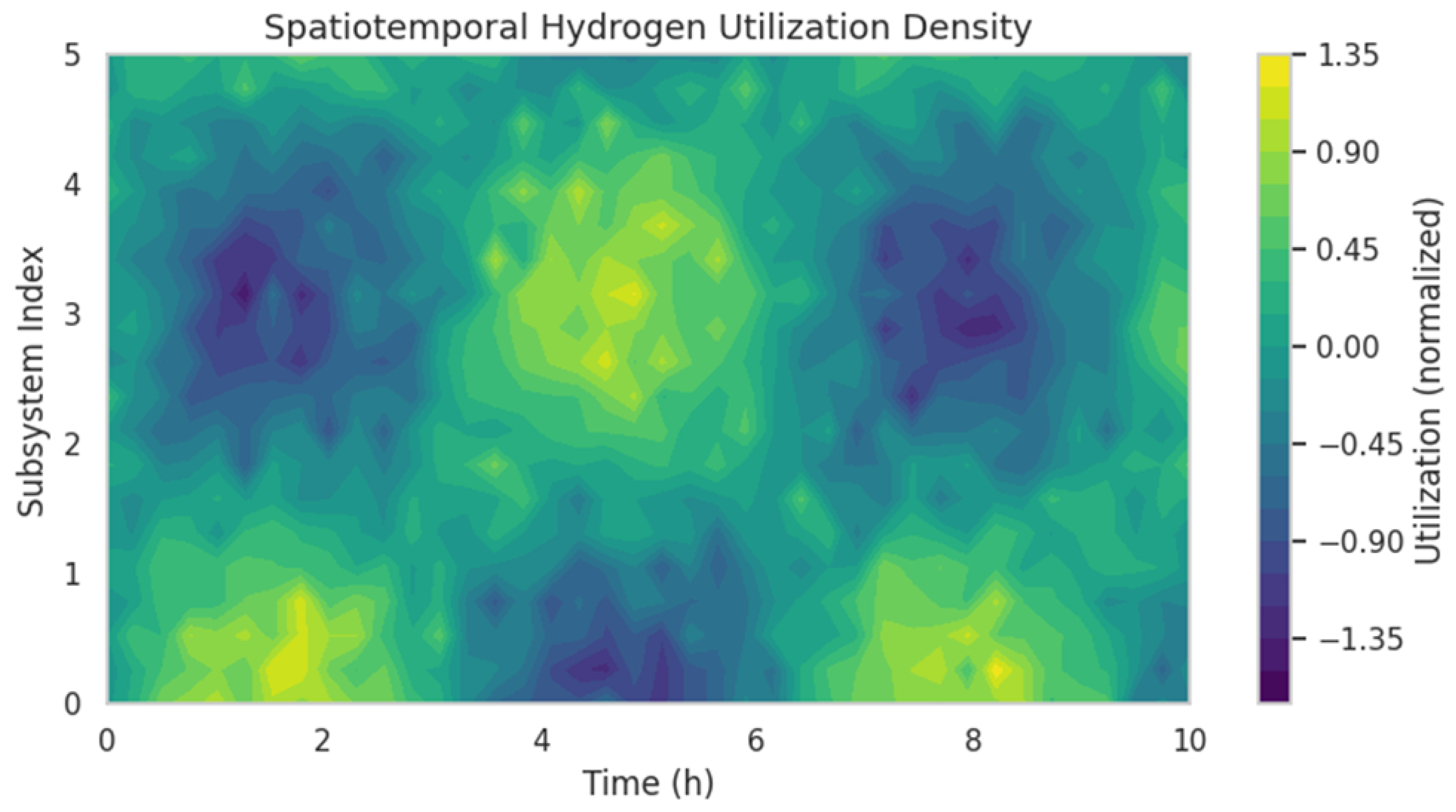
Figure 10 presents the spatiotemporal hydrogen utilization density obtained from the simulation data, normalized to zero mean and unit variance. Across the 10-h horizon, the overall utilization exhibits a mean level of approximately 0.12 with a standard deviation of 0.48 , indicating moderate variability driven by renewable fluctuations and behavioral adaptation. Two prominent high-utilization clusters emerge between hours 2–4 and 6–8, where normalized intensities frequently exceed 0.80 and reach local maxima around 1.25 in Subsystems 1 and 3. These peaks correspond to periods of reduced solar availability and elevated peer-influence–driven demand adjustments, which collectively trigger higher reliance on hydrogen-based flexibility. Spatially, Subsystems 0–2 display stronger variability, with utilization ranges spanning from approximately 1.20 to 1.35 , whereas Subsystems 3–4 exhibit narrower fluctuations between 0.60 and 0.75 . This gradient reflects differences in local behavioral sensitivity and subsystem-level operational constraints, as more socially connected agents tend to amplify hydrogen-driven balancing actions. Early in the time horizon (0–2 h), the contour map shows scattered low-density regions (around 0.8 ), indicating minimal hydrogen dependency during stable operating conditions. As the wildfire-induced uncertainty intensifies in the mid-horizon, contour transitions become sharper, evidencing rapid reallocation of hydrogen usage across subsystems. Toward the final hours (8–10 h), the spatiotemporal field becomes smoother and the amplitude of fluctuations decreases to within the range of [ 0.40 , 0.50 ] , suggesting that the hierarchical behavioral–physical coordination mechanism drives the community toward a stabilized equilibrium. The gradual damping of high-frequency spatial variations further confirms that hydrogen utilization responds not only to physical imbalances but also to the convergence of behavioral states within the agent network. Overall, the figure provides quantitative evidence of how hydrogen-based flexibility redistributes across time and space under the proposed framework, capturing the co-evolution of social influence, renewable intermittency, and subsystem-level operational constraints.
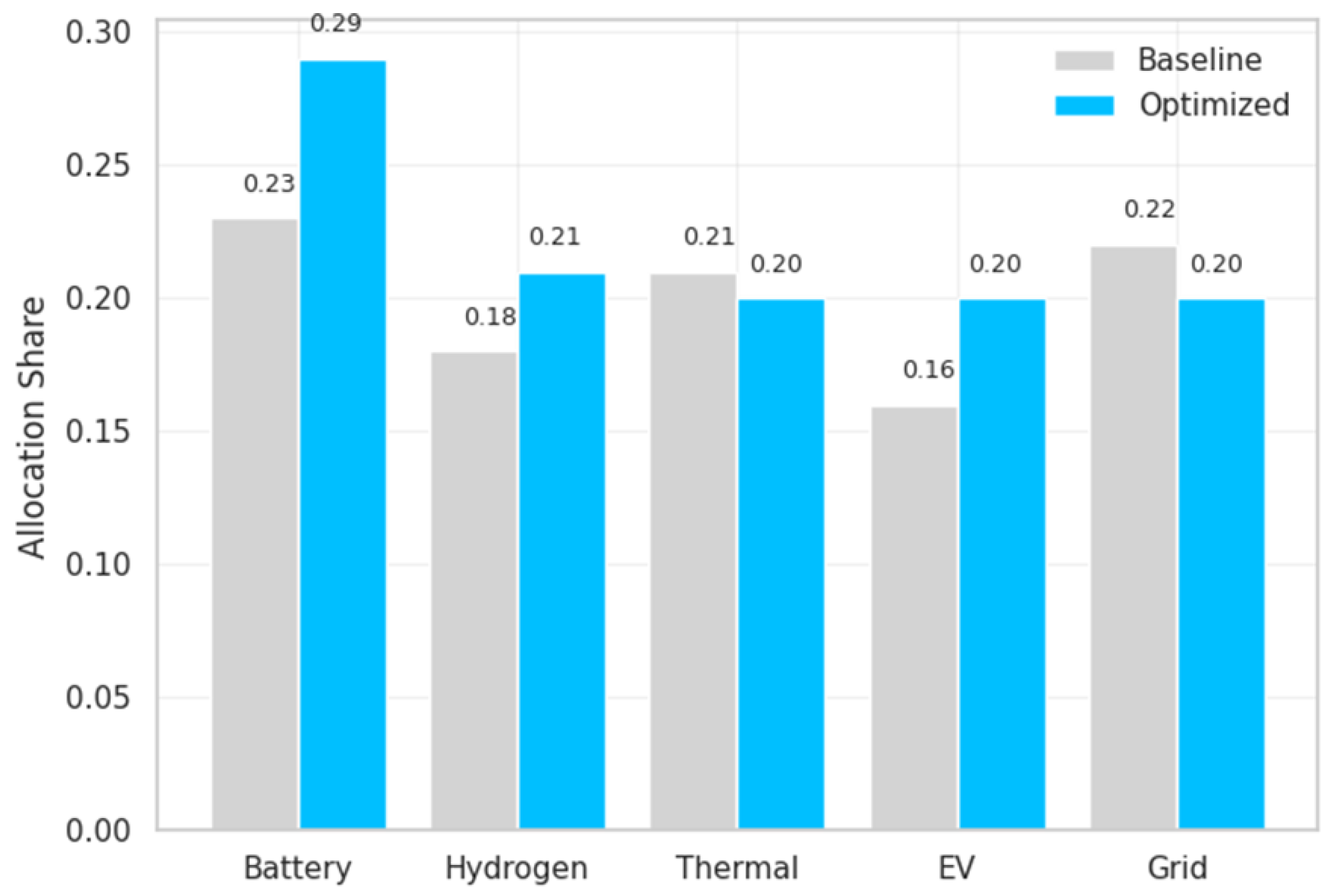
Figure 11 illustrates how the system reallocates flexibility resources in response to behavioral uncertainty rather than wildfire conditions. The revised interpretation emphasizes that the shifts in utilization among batteries, electric vehicles, and hydrogen storage are driven by differences in how aligned or divergent the prosumers’ decisions become under the influence of social interaction. When their behavioral responses are more synchronized, variability in total demand decreases, and the system increasingly depends on fast, responsive resources. When behavioral disagreement grows, demand becomes more volatile, prompting greater reliance on hydrogen storage as a stabilizing reserve. These allocation shifts result from the behavior-driven uncertainty embedded in the decision-making process and are not linked to wildfire trajectory, ignition patterns, or environmental fields. Wildfire conditions affect only the physical network constraints, while the behavioral mechanisms determine how resources are mobilized within those constraints.A supplementary behavioral sensitivity analysis was conducted by increasing and decreasing the strength of social influence. The results show that when influence becomes stronger, overall load fluctuations decrease noticeably, leading to a significant rise in the use of fast-response flexibility resources. When influence weakens, load fluctuations rise, and the system compensates by turning more heavily toward hydrogen storage. This behavioral sensitivity pattern confirms that the allocation outcomes in the case study are inherently driven by the social network dynamics rather than by environmental disturbances. These findings reinforce the central role of behavioral interactions in shaping the operational performance of the microgrid.
Although the case study is conducted on a synthetic yet realistic testbed, the framework is designed with clear pathways for future validation in real energy communities. Many modern community microgrids already deploy smart meters, aggregated load profiles, and anonymized interaction logs, which permit the estimation of social influence structures and behavioral parameters without exposing sensitive individual information. The adjacency matrix w i j can be inferred from spatial clustering, participation patterns in local programs, or aggregated communication traces, all of which may be processed in anonymized form. Similarly, behavioral parameters such as λ i soc and μ i sat can be calibrated using privacy-preserving techniques that rely on aggregated demand-response reactions, group-level elasticity, or controlled incentive signals, rather than individual-level behavioral disclosure. These widely used privacy-aware data practices allow the proposed model to be empirically grounded while maintaining strict protection of participant identity. Looking forward, pilot-scale deployments in community microgrids equipped with secure data-handling infrastructures provide a natural avenue for validating the socio-technical coordination mechanisms presented in this study, ensuring that the framework can transition smoothly from synthetic benchmarking to real-world implementation.
The information summarized in Table 3 outlines practical and privacy-preserving pathways for calibrating the social influence matrix and behavioral parameters required by the proposed framework. Each data category corresponds to signals that are routinely collected at aggregated or anonymized levels in community microgrids, ensuring that parameter extraction does not rely on individualized behavioral traces. For instance, the construction of the influence matrix w i j can draw on spatial clustering, participation patterns in community energy programs, or anonymized coordination metrics obtained from group-level demand–response interactions. These sources provide structural information about how agents interact within a community while preventing any disclosure of personal identities or specific communication records. The estimation of behavioral elasticity parameters, such as λ i soc , similarly relies on collective reactions rather than individual-level data. Group-scale adjustments to shared incentives or pricing events provide statistically meaningful elasticity indicators that reflect how cohorts respond to social or economic stimuli. Such aggregated responses allow the model to capture behavioral sensitivity without revealing any household-specific consumption details. A similar approach applies to parameters governing comfort and satisfaction dynamics, including μ i sat , which may be derived from anonymized thermostat logs, comfort-adjustment statistics, or cohort-level surveys. These data sources represent broad behavioral tendencies rather than personal preference trajectories, ensuring compliance with privacy requirements. Together, these mechanisms demonstrate that the model’s behavioral parameters can be calibrated using ethically acceptable, privacy-preserving data channels that are already standard in many advanced microgrid deployments. Modern community energy systems frequently employ secure aggregation, data masking, and opt-in consent frameworks, making the required signals readily obtainable without compromising participant confidentiality. Table 3 therefore serves to clarify how the synthetic testbed used in the case study aligns with realistic data-collection capabilities and provides a feasible path for future empirical validation. By leveraging aggregated behavioral indicators and structurally meaningful interaction patterns, the framework maintains both practical applicability and strong privacy protection, supporting its eventual transition from synthetic evaluation to real community environments.
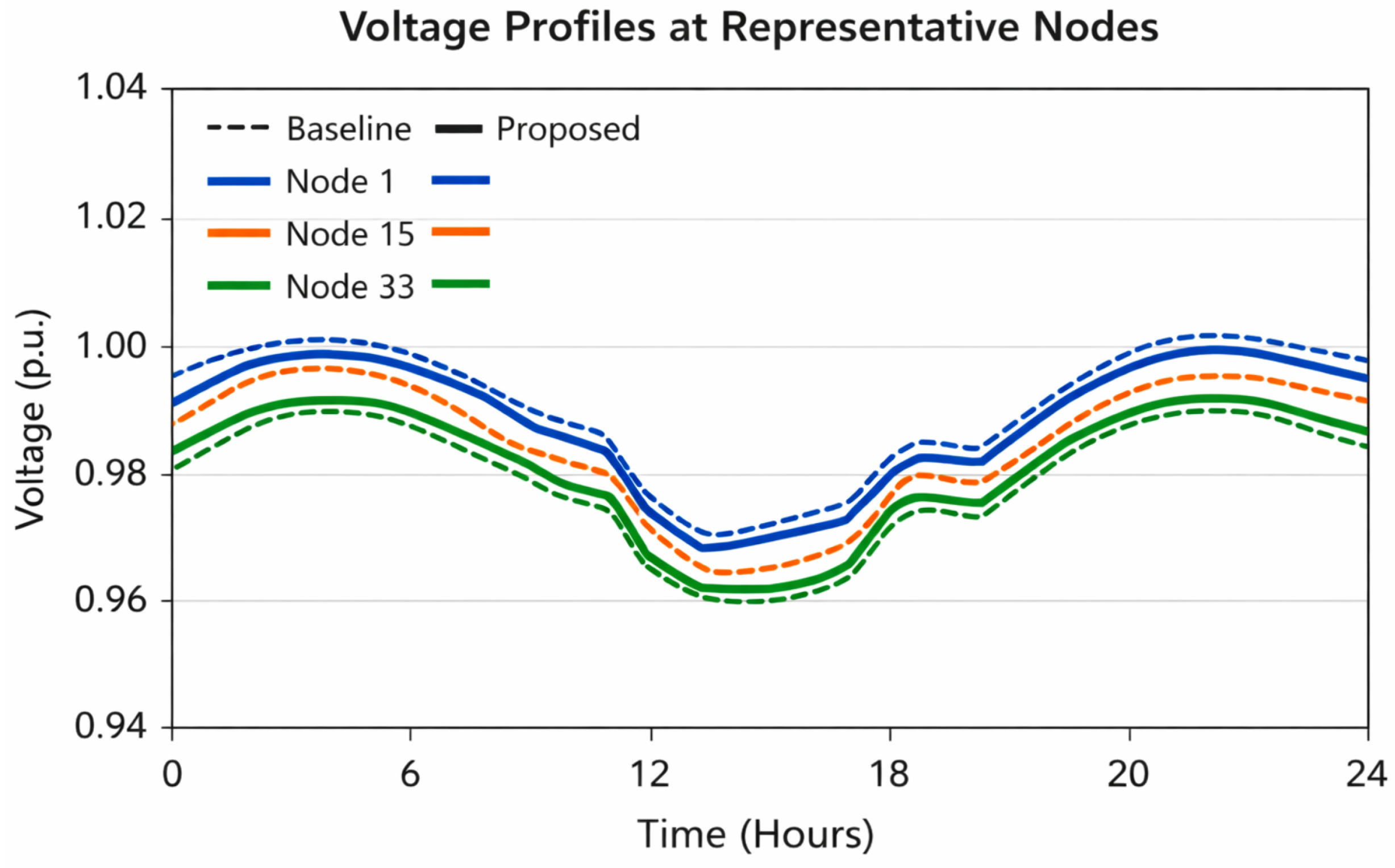
Figure 12 illustrates the 24-h voltage evolution at three representative nodes in the distribution network under the baseline strategy and the proposed framework. The selected nodes correspond to distinct electrical locations within the microgrid, including an upstream node close to the main supply, an intermediate node, and a downstream node near the network end. This selection is intended to provide representative nodal-level evidence that complements the aggregated voltage deviation metrics reported earlier and enhances the electrical traceability of the proposed approach. Under the baseline strategy, all three nodes exhibit noticeable voltage depressions during peak demand periods, particularly around midday and early evening hours. These voltage drops are more pronounced at the downstream node, reflecting the cumulative impact of line impedance and increased loading along the feeder. In contrast, the proposed framework consistently maintains higher voltage magnitudes across the entire scheduling horizon. The improvement is especially evident at the most electrically stressed node, where the minimum voltage is visibly lifted and the depth of voltage sag is reduced. This indicates that the coordinated scheduling mechanism effectively mitigates localized voltage stress rather than merely improving system-level averages. It is also observed that the proposed strategy leads to smoother temporal voltage trajectories. Compared with the baseline, voltage fluctuations are less abrupt, suggesting that the coordinated multi-agent decisions contribute to more balanced power injections and withdrawals over time. This behavior aligns with the intended role of the proposed framework in harmonizing individual actions with network-level constraints, thereby reducing sudden loading changes that can exacerbate voltage instability. Overall, the nodal voltage profiles provide direct electrical evidence that the proposed framework enhances voltage regulation performance across different parts of the network. These results corroborate the aggregated voltage deviation indicators and demonstrate that the observed improvements are not confined to a small subset of nodes but are consistently reflected at representative locations throughout the microgrid. By presenting explicit nodal-level voltage trajectories, the figure strengthens the physical interpretability of the results and confirms that the proposed coordination strategy yields tangible benefits at the electrical network level.
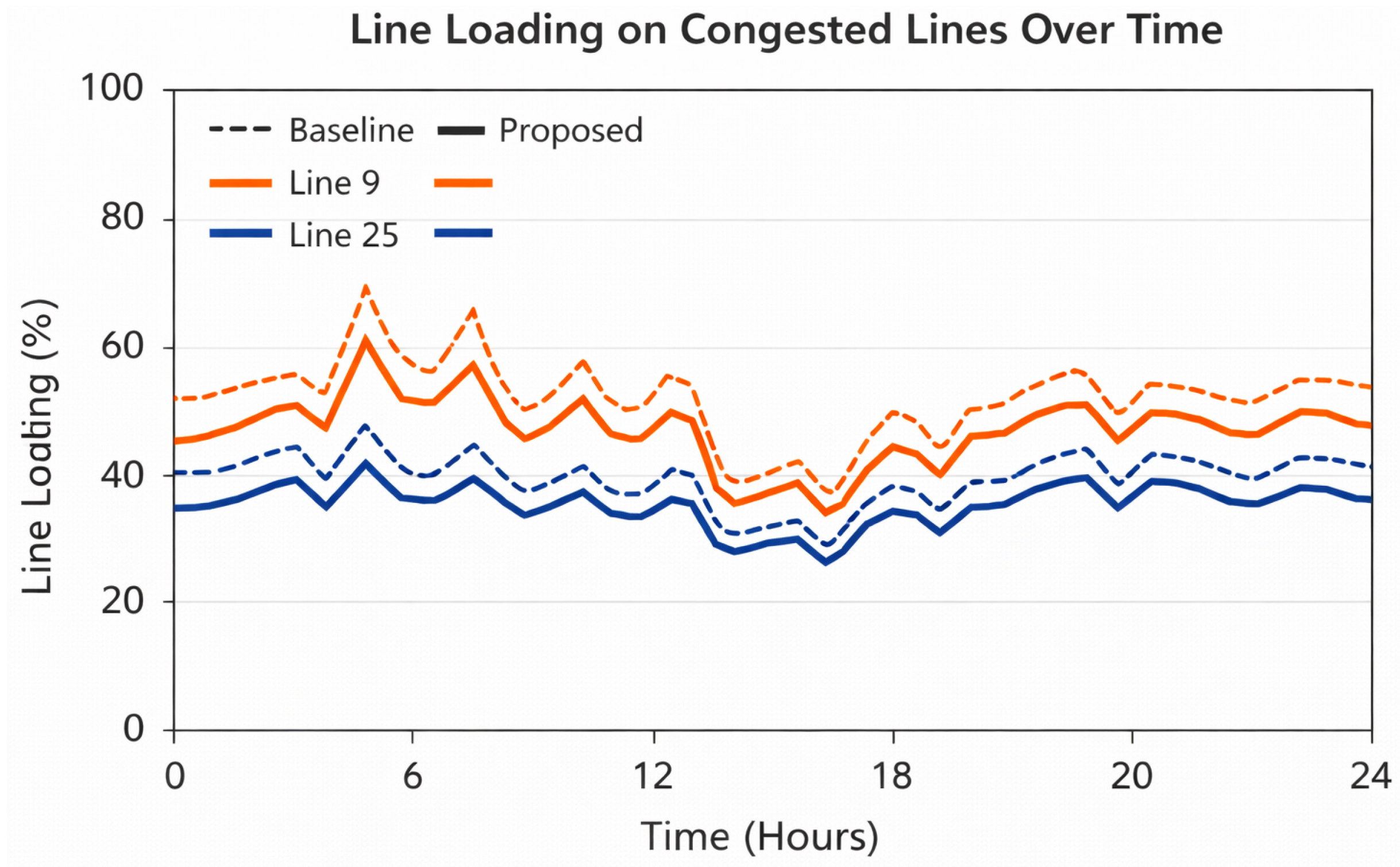
Figure 13 presents the temporal evolution of line loading for two representative congested distribution lines under the baseline strategy and the proposed framework over a 24-h horizon. The selected lines correspond to those experiencing relatively high utilization levels in the network and are therefore representative of critical corridors that largely determine system congestion and operational security. By focusing on these electrically stressed components, the figure provides nodal-to-branch-level evidence that complements the aggregated maximum line loading metrics reported earlier. Under the baseline strategy, both representative lines exhibit pronounced loading peaks during high-demand periods, with utilization levels approaching or exceeding mid-range operating thresholds. These peaks are particularly evident during morning and evening demand ramps, indicating limited flexibility in redistributing power flows when decisions are made independently and without coordinated consideration of network-wide conditions. The temporal trajectories also show sharper fluctuations, reflecting abrupt changes in power routing that may increase thermal stress and reduce operational margins. In contrast, the proposed framework consistently maintains lower loading levels on both congested lines throughout the scheduling horizon. Peak utilization is visibly reduced, and the temporal profiles become smoother, indicating that power flows are more evenly distributed across time. This reduction in both magnitude and variability of line loading suggests that the coordinated decision-making mechanism effectively alleviates congestion by aligning individual agent actions with network-level constraints. Importantly, the improvement is observed simultaneously on multiple critical lines, rather than being confined to a single corridor, which demonstrates that congestion mitigation is achieved systemically rather than through localized redistribution. The comparison further reveals that the proposed strategy dampens sudden loading changes during transition periods, such as load ramp-up and ramp-down intervals. This behavior is beneficial for maintaining thermal safety and prolonging asset lifetime, as repeated high-frequency loading variations are known to accelerate conductor aging. The smoother loading trajectories therefore indicate not only improved instantaneous feasibility but also enhanced operational robustness. Overall, the representative line loading profiles provide direct electrical evidence that the proposed framework reduces congestion severity and stabilizes power flow dynamics at the branch level. These results substantiate the aggregated reductions in maximum line loading reported in the quantitative comparison and confirm that the proposed coordination strategy yields tangible improvements in network stress management across critical distribution lines.

5. Conclusions

This study presents an integrated socio-technical optimization framework that reconceptualizes how distributed energy communities can be coordinated when behavioral dynamics, social influence propagation, and physical network constraints operate simultaneously. By embedding socially mediated decision processes directly into agent-level objectives and coupling them with hierarchical system-wide coordination, the framework provides a unified representation of adaptive behavior and operational feasibility. This co-embedded structure enables prosumers to adjust their strategies in response to peer interactions while remaining consistent with system-level electrical limits. The inclusion of a wildfire-driven stress environment in the case study further illustrates that the same coordination logic remains applicable when external hazards intensify uncertainty and disrupt conventional operating conditions, thereby highlighting the versatility of the framework across both routine and high-risk scenarios.
The computational experiments conducted under stochastic wildfire ignition and propagation patterns demonstrate that the interaction between behavioral adaptation and physical network constraints enhances system responsiveness, welfare consistency, and operational robustness. Across diverse fire trajectories, the integrated structure yields welfare gains exceeding 12% and more than an 8% reduction in aggregate cost variability. While these improvements should be interpreted with due consideration of the model’s structural complexity, they indicate that incorporating socially coordinated adaptation can help stabilize voltage profiles, smooth energy exchanges, and improve renewable utilization under evolving external conditions. The role of network connectivity becomes particularly important in hazard settings: agents embedded within denser social neighborhoods converge more rapidly toward cooperative equilibrium states, which contributes to stabilizing community-wide responses when line capacities shift or infrastructure nodes face increased fire exposure. These observations emphasize the relevance of jointly considering social network patterns and electrical topology when designing resilient coordination mechanisms for distributed energy communities.
Taken together, the findings establish a foundation for advancing behavior-aware and hazard-adaptive scheduling in multi-agent energy systems. By treating behavioral elasticity, peer influence, wildfire-induced disturbances, and physical limits as interconnected components of a unified decision environment, the proposed framework offers a scalable pathway for analyzing next-generation community energy ecosystems operating under both normal and climate-stressed conditions. While the improvements identified in the case study demonstrate the potential of socially informed optimization, they also highlight the importance of evaluating such gains alongside practical considerations of computational resources and implementation feasibility. Future work may incorporate adaptive learning-based behavior models, empirical datasets linking environmental risks and social responses, and refined uncertainty-aware influence estimation to further strengthen predictive capability and operational intelligence. These extensions will support the development of energy communities that remain technically efficient, socially coordinated, and resilient amid emerging environmental disruptions.
Future work will focus on three key directions to extend the applicability of this framework. First, we plan to validate the proposed behavioral models using empirical data from real-world community microgrid pilots, specifically to calibrate the social influence parameters against observed user interactions. Second, we aim to integrate data-driven methods, such as multi-agent reinforcement learning, to capture more complex, non-linear behavioral evolution patterns that may deviate from the current parametric assumptions. Finally, we will explore the scalability of the hierarchical EPEC algorithm in larger distribution networks with thousands of nodes, investigating decentralized decomposition techniques to further reduce computational complexity.
Ultimately, this study highlights a critical frontier in energy systems research: the socio-technical interface. Given the increasing frequency of extreme climate events, the coupling of human behavior with physical resilience mechanisms is a domain that warrants extensive further investigation by the broader research community to ensure the sustainability of future urban energy ecosystems.

Author Contributions

Conceptualization, D.W.; Methodology, C.G.; Software, C.G.; Validation, Y.L.; Formal analysis, Y.L. and H.M.; Investigation, H.M.; Data curation, T.L.; Writing—original draft, D.W.; Writing—review & editing, T.L. and S.L.; Supervision, S.L. All authors have read and agreed to the published version of the manuscript.

Funding

This research was funded by the Science and Technology Project of State Grid Corporation of China, Research and Development of Aggregated Control Technology and Equipment for Photovoltaic, Energy Storage, Direct Current Power Supply and Flexible Loads (Grant No. 52022K240002).

Data Availability Statement

The original contributions presented in the study are included in the article, further inquiries can be directed to the corresponding author.

Conflicts of Interest

Authors Dawei Wang, Cheng Gong, Yifei Li, Hao Ma and Tianle Li were employed by the company Beijing Dingcheng Hongan Technology Development Co., Ltd. The remaining authors declare that the research was conducted in the absence of any commercial or financial relationships that could be construed as a potential conflict of interest.

References

  1. Li, X.; Hu, C.; Luo, S.; Lu, H.; Piao, Z.; Jing, L. Distributed Hybrid-Triggered Observer-Based Secondary Control of Multi-Bus DC Microgrids Over Directed Networks. IEEE Trans. Circuits Syst. I Regul. Pap. 2025, 72, 2467–2480. [Google Scholar] [CrossRef]
  2. Gamage, D.; Wanigasekara, C.; Ukil, A.; Swain, A. Distributed consensus controlled multi-battery-energy-storage-system under denial-of-service attacks. J. Energy Storage 2024, 86, 111180. [Google Scholar] [CrossRef]
  3. Xiao, J.; Wang, L.; Wan, Y.; Bauer, P.; Qin, Z. Distributed Model Predictive Control-Based Secondary Control for Power Regulation in AC Microgrids. IEEE Trans. Smart Grid 2024, 15, 5298–5308. [Google Scholar] [CrossRef]
  4. Prior, J.; Drees, T.; Miro, M.; Kuhlenkötter, B. Systematic Literature Review of Heuristic-Optimized Microgrids and Energy-Flexible Factories. Clean Technol. 2024, 6, 1114–1141. [Google Scholar] [CrossRef]
  5. Hemmati, M.; Bayati, N.; Ebel, T. Integrated Optimal Energy Management of Multi-Microgrid Network Considering Energy Performance Index: Global Chance-Constrained Programming Framework. Energies 2024, 17, 4367. [Google Scholar] [CrossRef]
  6. Chen, S.; Liu, J.; Cui, Z.; Chen, Z.; Wang, H.; Xiao, W. A Deep Reinforcement Learning Approach for Microgrid Energy Transmission Dispatching. Appl. Sci. 2024, 14, 3682. [Google Scholar] [CrossRef]
  7. Shi, T.; Zhou, H.; Shi, T.; Zhang, M. Research on Energy Management in Hydrogen–Electric Coupled Microgrids Based on Deep Reinforcement Learning. Electronics 2024, 13, 3389. [Google Scholar] [CrossRef]
  8. Zhang, Y.; Shi, Q.; Kirschen, D.; Sun, J. Resilient microgrid scheduling under extreme events considering infrastructure interdependencies. Appl. Energy 2019, 256, 113960. [Google Scholar]
  9. Balu, K.; Mukherjee, V. Optimal siting and sizing of distributed generation in radial distribution system using a novel student psychology-based optimization algorithm. Neural Comput. Appl. 2021, 33, 15639–15667. [Google Scholar] [CrossRef]
  10. Zhao, A.P.; Alhazmi, M.; Huo, D.; Li, W. Psychological modeling for community energy systems. Energy Rep. 2025, 13, 2219–2229. [Google Scholar] [CrossRef]
  11. Valogianni, K.; Ketter, W.; Collins, J.; Adomavicius, G. Toward Sustainable Electricity Markets: Capacity-Based Pricing for Electric Vehicle Smart Charging. Inf. Syst. Res. 2025. [Google Scholar] [CrossRef]
  12. Boakye-Boateng, K.; Ghorbani, A.A.; Lashkari, A.H. Implementation of a Trust-Based Framework for Substation Defense in the Smart Grid. Smart Cities 2023, 7, 99–140. [Google Scholar] [CrossRef]
  13. Zhao, P.; Li, S.; Cao, Z.; Hu, P.J.-H.; Zeng, D.D.; Xie, D.; Shen, Y.; Li, J.; Luo, T. A Social Computing Method for Energy Safety. J. Saf. Sci. Resil. 2024, 5, 64–82. [Google Scholar] [CrossRef]
  14. Wang, Z.; Li, H.; Chen, C.; Wang, J.; Zhang, C. Distributed optimization and control of community microgrids using multi-agent coordination. IEEE Trans. Smart Grid 2019, 10, 2040–2050. [Google Scholar]
  15. Li, T.T.; Zhao, A.P.; Wang, Y.; Alhazmi, M. Hybrid energy storage for dairy farms: Enhancing energy efficiency and operational resilience. J. Energy Storage 2025, 131, 115811. [Google Scholar] [CrossRef]
  16. Zhong, J.; Zhao, Y.; Li, Y.; Yan, M.; Peng, Y.; Cai, Y.; Cao, Y. Synergistic Operation Framework for the Energy Hub Merging Stochastic Distributionally Robust Chance-Constrained Optimization and Stackelberg Game. IEEE Trans. Smart Grid 2025, 16, 1037–1050. [Google Scholar] [CrossRef]
  17. Li, P.; Shen, Y.; Shang, Y.; Alhazmi, M. Innovative distribution network design using GAN-based distributionally robust optimization for DG planning. IET Gener. Transm. Distrib. 2025, 19, e13350. [Google Scholar] [CrossRef]
  18. Shi, L.; Hu, B. Frontiers in Operations: Battery as a Service: Flexible Electric Vehicle Battery Leasing. Manuf. Serv. Oper. Manag. 2024, 26, 1269–1285. [Google Scholar] [CrossRef]
  19. Li, W.; Qian, T.; Xie, X.; Tang, W. Piecewise Mixed Decision Rules Based Multi-Stage Distributionally Robust Unit Commitment for Integrated Electricity-Heat Systems. IEEE Trans. Power Syst. 2024, 39, 6772–6775. [Google Scholar] [CrossRef]
  20. Faqiry, F.; Khodaei, A. Multi-agent transactive energy management for residential microgrids with behavioral modeling of prosumers. Electr. Power Syst. Res. 2020, 189, 106713. [Google Scholar]
  21. Isaac, N.; Saha, A. Analysis of refueling behavior of hydrogen fuel vehicles through a stochastic model using Markov Chain Process. Renew. Sustain. Energy Rev. 2021, 141, 110761. [Google Scholar] [CrossRef]
  22. Li, T.T.; Zhao, A.P.; Wang, Y.; Li, S.; Fei, J.; Wang, Z.; Xiang, Y. Integrating solar-powered electric vehicles into sustainable energy systems. Nat. Rev. Electr. Eng. 2025, 2, 467–479. [Google Scholar] [CrossRef]
  23. Jiang, Y.; Lee, N.; Deng, X.; Yang, Y. A Secure-Sustainable-Fast Charging Strategy for Lithium-Ion Batteries Based on a Random Forest-Enhanced Electro-Thermal-Degradation Model. IEEE Trans. Power Electron. 2025, 41, 6314–6327. [Google Scholar] [CrossRef]
  24. Afzali, P.; Yeganeh, A.; Derakhshan, F. A novel socio-economic-environmental model to maximize prosumer satisfaction in smart residential complexes. Energy Build. 2024, 308, 114023. [Google Scholar] [CrossRef]
  25. Yang, L.; Chen, W.; Song, B. Unraveling energy hub dynamics and political economy toward sustainable urban energy: A multifaceted examination of policy decision making and implementation. Sustain. Cities Soc. 2024, 101, 105159. [Google Scholar] [CrossRef]
  26. Li, P.; Gu, C.; Cheng, X.; Li, J.; Alhazmi, M. Integrated energy-water systems for community-level flexibility: A hybrid deep Q-network and multi-objective optimization framework. Energy Rep. 2025, 13, 4813–4826. [Google Scholar] [CrossRef]
  27. Chen, Z. Optimal Power Flow in Renewable-Integrated Power Systems: A Comprehensive Review. arXiv 2024, arXiv:2408.05254. [Google Scholar] [CrossRef]
  28. Arévalo, P.; Ochoa-Correa, D.; Villa-Ávila, E.; Iñiguez-Morán, V.; Astudillo-Salinas, P. Systematic Review of Hierarchical and Multi-Agent Optimization Strategies for P2P Energy Management and Electric Machines in Microgrids. Appl. Sci. 2025, 15, 4817. [Google Scholar] [CrossRef]
  29. Karki, S.; Raut, A. Computational Techniques and Emerging Technologies in the Optimization of Engineering Systems and Design Processes. J.-Driven Autom. Predict. Maint. Smart Technol. 2024, 9, 54–71. [Google Scholar]
  30. Zhou, M.; Huang, X.; Li, H.; Duan, X.; Zhao, Q.; Ma, T. Hydrogen bonding chemistry in aqueous ammonium ion batteries. Angew. Chem. Int. Ed. Engl. 2024, 63, e202413354. [Google Scholar] [CrossRef]
Figure 1. Hierarchical Framework of Fire-Resilient Resource Allocation and Response Coordination under Uncertain Wildfire Propagation.
Energies 19 00687 g001
Figure 2. Topographic Correlation of Fuel Availability.
Energies 19 00687 g002
Figure 3. Climatic Interaction Between Temperature and Humidity.
Energies 19 00687 g003
Figure 4. Distribution of Wind Speed Across the Study Area.
Energies 19 00687 g004
Figure 5. Parallel Coordinates Plot of Environmental Attributes.
Energies 19 00687 g005
Figure 6. Convergence of Multi-Agent Optimization.
Energies 19 00687 g006
Figure 7. Agent Comfort–Cost Pareto Frontier.
Energies 19 00687 g007
Figure 8. Distributionally Robust Optimization Performance.
Energies 19 00687 g008
Figure 9. Pareto Frontier of Cost–Risk Trade-Off under Behavioral Uncertainty.
Energies 19 00687 g009
Figure 10. Spatiotemporal Hydrogen Utilization Density.
Energies 19 00687 g010
Figure 11. Resource Allocation Sensitivity under Robust Optimization.
Energies 19 00687 g011
Figure 12. Voltage profiles at representative nodes under the baseline and proposed strategies over a 24 h horizon.
Energies 19 00687 g012
Figure 13. Temporal line loading profiles of representative congested lines under the baseline and proposed strategies.
Energies 19 00687 g013
Table 1. Consolidated parameter settings ensuring model reproducibility.
ParameterDescriptionValue/Range
α i Social influence rate0.15–0.30
w i j Normalized adjacency weight [ 0 , 1 ]
λ i soc Behavioral conformity weight0.2–0.5
η π Price-update step size 10 3 10 2
ρ r Penalty parameter scheduleMonotonically increasing
ε tol Convergence tolerance 10 4
γ i Behavioral damping factor0.1–0.3
θ adj Social network scaling factorNormalized
V min , V max Voltage magnitude limits0.95–1.05 p.u.
P m n max Transmission line capacityIEEE 33-bus standard values
δ imb Power imbalance penalty coefficientSystem-normalized
η i ch Storage charging efficiency0.90–0.95
η i dis Storage discharging efficiency0.90–0.95
E i min , E i max Storage energy limitsTechnology-dependent
θ Wasserstein ambiguity radius0.05–0.20
ρ risk Risk-aversion weightScenario-calibrated
Table 2. Comparison of electrical performance metrics under different strategies.
MetricBaseline MethodProposed Framework
Voltage deviation (p.u.)0.0420.028
Maximum line loading (%)91.378.6
Total network losses (p.u.)0.0310.021
Power imbalance index0.0180.007
Operational cost (normalized)1.000.89
Table 3. Comparison between a traditional microgrid optimization baseline and the behaviorally embedded framework.
MetricTraditional BaselineBehaviorally Embedded Framework
Agent Decision ModelIndependent, cost-only schedulingSocially influenced multi-agent optimization
Coordination MechanismSingle-layer economic dispatchHierarchical behavioral–physical coupling
Energy Metrics (Qualitative)Higher cost variance; weaker voltage stabilityReduced cost variance; enhanced voltage stability
System AdaptabilityLimited response to disturbancesImproved adaptability under dynamic conditions
Behavioral RepresentationNo social interaction modelingBehavior propagation across peer networks
Network Utilization PatternUncoordinated agent-level adjustmentsCooperative convergence via influence dynamics
Voltage and Flow StabilitySensitive to load variationsStabilized under both routine and perturbed conditions
Application Under Hazard ScenariosLimited resilience modelingEnhanced robustness in wildfire-induced uncertainty
Disclaimer/Publisher’s Note: The statements, opinions and data contained in all publications are solely those of the individual author(s) and contributor(s) and not of MDPI and/or the editor(s). MDPI and/or the editor(s) disclaim responsibility for any injury to people or property resulting from any ideas, methods, instructions or products referred to in the content.