Article

Microwave-Driven, Dual-Protection, Leakage-Proof Phase-Change Composite Module for Ultrafast Low-Temperature Cold Start of Lithium-Ion Batteries


1
Nanchang Power Supply Branch of State Grid Jiangxi Electric Power Co., Ltd., Nanchang 330095, China
2
School of Electric Power, Civil Engineering and Architecture, Shanxi University, Taiyuan 030006, China
*
Author to whom correspondence should be addressed.
Energies 2026, 19(3), 674; https://doi.org/10.3390/en19030674
Submission received: 16 December 2025 / Revised: 15 January 2026 / Accepted: 22 January 2026 / Published: 28 January 2026
(This article belongs to the Section D: Energy Storage and Application)

Abstract

Lithium-ion batteries suffer from severe capacity fading and start-up failure at low temperatures owing to restricted Li+ transport and deteriorated interfacial kinetics. To enable rapid and safe activation under such conditions, this study designs a microwave-driven dual-layer leakage-proof composite phase-change module (EPG–BN–CF–PAG), comprising an epoxy–graphene–boron nitride outer encapsulation and a ceramic fiber–boron nitride porous inner scaffold that adsorbs a paraffin–graphene phase-change core. The synergy between the dense outer shell and the internal adsorption framework affords excellent shape stability, with an enthalpy retention exceeding 95% and no visible leakage after 20 heating–cooling cycles. Owing to the strong microwave-absorption capability of graphene, the module can be rapidly heated from −10 °C to ~60 °C within 60 s while establishing a homogeneous and stable temperature field. Combined simulations and experiments show that the module efficiently transfers heat to a lithium-ion cell, raising its temperature from −10 °C to ~30 °C within 60 s and thus bringing it into a practical operating window. Electrochemical impedance spectroscopy further reveals that the thermally induced activation markedly improves interfacial kinetics, reducing the bulk resistance from 500 Ω to 30 Ω and the charge-transfer resistance from 800 Ω to 30 Ω. This microwave-driven phase-change heating strategy features ultrafast response, excellent anti-leakage performance, and favorable thermal properties, providing an engineering-feasible thermal-management solution for the rapid cold start of lithium-ion batteries under extremely low-temperature conditions.

1. Introduction

With the widespread deployment of electric vehicles, grid-scale energy storage stations, and electronic devices operating in polar or other frigid environments, the performance degradation of lithium-ion batteries at low temperatures has become increasingly prominent. At low temperatures, the available capacity, rate capability, and cycle life decrease markedly, primarily due to the increased viscosity of liquid electrolytes and the consequent suppression of Li+ transport, the growth of interfacial charge-transfer resistance, and the restricted segmental motion within solid-state electrolytes. As a result, lithium-ion cells often suffer from sluggish charge/discharge processes, abrupt capacity fading, and even lithium plating in the −20 to −10 °C range, where the deterioration of interfacial low-temperature kinetics has been repeatedly highlighted in previous studies [1,2,3,4,5]. Enhancing the low-temperature usability of lithium-based batteries has therefore emerged as one of the central challenges for the engineering implementation of next-generation energy storage systems.
To address this issue, current low-temperature enhancement strategies for lithium-ion batteries mainly follow two routes: electrolyte engineering and external auxiliary heating. The former focuses on incorporating low-temperature electrolyte additives to reduce viscosity and increase ionic conductivity, including low-crystallinity solvent systems, low-temperature film-forming additives, and composite ionic liquids. However, it is difficult to maintain a homogeneous distribution of additives and formulation stability under large-scale or module-level conditions, making it challenging to reproduce laboratory-level performance gains in practical systems. In addition, certain additives may trigger parasitic reactions and compromise the long-term stability of electrochemical interfaces [6,7,8,9]. The second route relies on external heating measures such as air preheating, heating plates, liquid cooling/heating circuits, or encapsulation with phase-change materials (PCMs). Although these approaches are structurally easier to integrate, they typically suffer from large footprint, low energy efficiency, slow heating rates, and substantial thermal losses [10,11,12,13,14]. In particular, conventional PCMs exhibit intrinsically low thermal conductivity and a high risk of leakage, and thus, without further modification, are unable to provide rapid thermal response or satisfy the practical requirement of minute-scale cold start under low-temperature conditions [15,16,17].
In recent years, rapid-heating technologies for lithium-ion batteries have made substantial progress [18]. Ye et al. [19] designed thermally modulated current collectors (TMCCs) that generate spatially uniform Joule heat inside the cell, enabling all-solid-state batteries (ASSBs) to be heated from room temperature to 70–90 °C in less than 1 min and thereby markedly enhancing the ionic conductivity of solid polymer electrolytes and the overall reaction kinetics. In addition, AC-coupled internal pulse-heating schemes can modulate the current in the frequency domain to rapidly generate volumetric heat and improve interfacial kinetics at low temperatures [20]. Yang et al. proposed an asymmetric temperature modulation strategy that realizes spontaneous temperature rise within tens of seconds and significantly suppresses polarization under extremely low-temperature conditions [21]. Wu and Xiong further utilized the coupling of ohmic heating and interfacial polarization heat to construct a self-heating mode, achieving controllable preheating in cold environments [22]. Despite their advantages in energy utilization and heating rate, these internal heating strategies generally require extensive modification of electrode structures, current-collector configurations, or operating protocols, which limits their compatibility with existing liquid-electrolyte systems and commercial cell manufacturing. Moreover, to avoid local hot spots that may trigger lithium plating or interfacial failure, a highly uniform temperature distribution must be guaranteed [23].
By contrast, externally mounted rapid-heating strategies offer greater engineering potential in terms of portability, modular encapsulation, and zero modification of the cell architecture. Leong et al. simulated the use of phase-change materials (PCMs) and porous pure copper foams to help maintain 21,700 lithium-ion batteries packs at an optimal operating temperature of approximately 30 °C [24]. However, commonly used phase-change materials (PCMs) and simple composite scaffolds still suffer from insufficient structural stability, limited thermal-diffusion efficiency, and poor anti-leakage durability under repeated cycling [15,16,17]. Recently developed microwave-driven phase-change composites provide a promising route for external cold-start assistance. Our previous work demonstrated that constructing graphene-enhanced phase-change composites (GPCM) combined with microwave irradiation can assist ASSBs in achieving rapid cold start and stable operation, fully exploiting the strong microwave absorption and fast heat conversion originating from the multiscale dielectric loss of graphene [25]. In addition, ceramic-fiber skeletons can substantially improve shape retention, thermal stability, and heat-distribution uniformity, and thus represent one of the key base materials for high-performance external thermal-management modules [26,27,28,29]. Nevertheless, most existing external configurations remain at the level of single-layer structures or loosely packed frameworks, leading to poor interfacial heat transfer, and it remains challenging to simultaneously achieve high enthalpy-retention capability, rapid heat conduction, robust mechanical integrity, and reliable leakage resistance.
On this basis, this study develops a microwave-driven dual-layer leakage-proof composite phase-change module to enable rapid and safe battery start-up under low-temperature conditions. The outer layer employs an epoxy resin–graphene–boron nitride (EPG) composite as the encapsulation material to reinforce mechanical stability and enhance in-plane thermal conduction, while the inner layer consists of a ceramic fiber–boron nitride (BN–CF) porous scaffold that adsorbs a paraffin–graphene phase-change core (PAG), forming a dual-layer composite architecture (EPG–BN–CF–PAG) with high enthalpy-retention capability, strong anti-leakage performance, and efficient heat transfer. Critically, the excellent microwave-absorption characteristics of graphene are harnessed to realize ultrafast heating of both the phase-change core and the outer encapsulation shell, and the heating response, thermal stability, and cycling leakage resistance of the module are systematically evaluated. Thus, the module is integrated with lithium-ion cells, and its impact on battery thermal behavior under low-temperature conditions is assessed through combined thermal characterization, electrochemical measurements, and thermal simulations. This work aims to provide an engineering-feasible and scalable thermal-management strategy to secure the reliable operation of lithium-based batteries in cold environments.

2. Experimental Section

2.1. Materials

Graphene was supplied by the Institute of Coal Chemistry, Chinese Academy of Sciences. Boron nitride (BN, 99.9% purity) was purchased from Aladdin Reagent Co., Ltd. (Shanghai, China) Ceramic fiber (CF), epoxy resin (EP), and paraffin (PA) were obtained from Shanghai Macklin Biochemical Co., Ltd. (Shanghai, China).

2.2. Preparation of Composite Phase-Change Materials

The composite phase-change module developed in this work consists of an epoxy–graphene–boron nitride (EPG) outer encapsulation and an inner ceramic fiber–phase-change core composite scaffold (BN–CF–PAG). The detailed fabrication procedure is as follows.
First, 3.1675 g of epoxy resin (EP) and 0.950 g of curing agent were weighed, while 9 mg of graphene and 4.5 mg of boron nitride (BN) powder were ground thoroughly in a mortar to obtain a homogeneous powder mixture. The graphene/BN mixture was then added into the epoxy–curing agent system and stirred until uniformly dispersed. The resulting suspension was uniformly coated onto the surface of a polyimide (PI) film and thermally cured at 80 °C for 1.5–2 h. After cooling, the cured film was peeled off, and the same procedure was repeated to prepare two identical epoxy composite films, which served as the outer encapsulation layers of the module.
The preparation of the phase-change core followed the previous work. Specifically, 40 g of paraffin (PA) was fully melted at 80 °C, after which 60 mg of graphene was added and stirred to form a homogeneous paraffin–graphene (PAG) melt. In parallel, 140 mg of BN powder was dispersed in 70 mL of anhydrous ethanol and subjected to ultrasonication to obtain a stable BN dispersion. A total of 2.9012 g of ceramic fiber (CF) cotton pieces were completely immersed in the BN dispersion, removed, and dried for 1–2 h. The BN-coated CF scaffold was then re-immersed in the PAG melt to allow sufficient uptake of the phase-change core into the fiber network, and subsequently taken out for later use.
Finally, the twice-impregnated ceramic fiber scaffold was placed between the two epoxy composite films to form a sandwich-like dual-layer structure. An epoxy–curing agent mixture containing graphene was then applied along one side of the ceramic-fiber scaffold and cured at 25 °C for 4–6 h. The remaining sides were sealed sequentially in the same manner, yielding a mechanically robust composite phase-change module with reliable anti-leakage capability.

2.3. Characterization

A combination of characterization techniques was employed to systematically investigate the structure, thermal properties, and electrochemical behavior of the composite phase-change module. The microstructure and surface morphology of the samples were examined by scanning electron microscopy (SEM, VE9800S, KEYENCE, Osaka, Japan), and the crystalline phases of the composite phase-change materials were identified by X-ray diffraction (XRD, Bruker AXS diffractometer, Karlsruhe, Germany). Thermal stability was evaluated using a thermogravimetric analyzer (TGA/DSC1, Mettler Toledo, Oakland, CA, USA) over the temperature range of 25–500 °C at a heating rate of 10 °C min−1. The latent heat and phase-transition characteristics were determined by differential scanning calorimetry (DSC, DISCOVERY DSC250, TA Instruments, New Castle, DE, USA) under a nitrogen atmosphere with heating and cooling rates of 10 °C min−1 in the range of 20–100 °C. The temperature distribution within the composites during operation was recorded using an infrared thermal imaging camera (E5-Pro, FLIR, Redmond, WA, USA), while microwave-heating tests were conducted in a household microwave oven used as the radiation source (2.45 GHz, 250 W). Electrochemical impedance spectroscopy (EIS) measurements were carried out on a Donghua electrochemical workstation under the following conditions: a state of charge (SOC) above 90%, AC amplitude of 10 mV, and frequency range from 100 mHz to 6 MHz.

2.4. Simulation

To further evaluate the rapid heating capability of the phase-change composite under low-temperature conditions, numerical simulations of the temperature evolution within the composite structure were performed using the heat-transfer module in ANSYS Workbench 2023R1 (ANSYS Inc., Canonsburg, PA, USA). In the model, the thermal properties of the outer epoxy-based composite, the ceramic-fiber scaffold, and the phase-change core were specified separately, and either an equivalent volumetric heat source representing microwave heating or a constant heat-flux boundary condition was applied to mimic the actual microwave irradiation process. Transient heat conduction equations were solved with an initial temperature of −10 °C, and the internal temperature distribution, heating rate, and evolution of the quasi-steady temperature field were recorded over the predefined simulation period, enabling quantitative analysis of the thermal response of the composite phase-change module under different structural configurations.

3. Results and Discussion

3.1. Physicochemical Characterization of the Composite Phase-Change Module

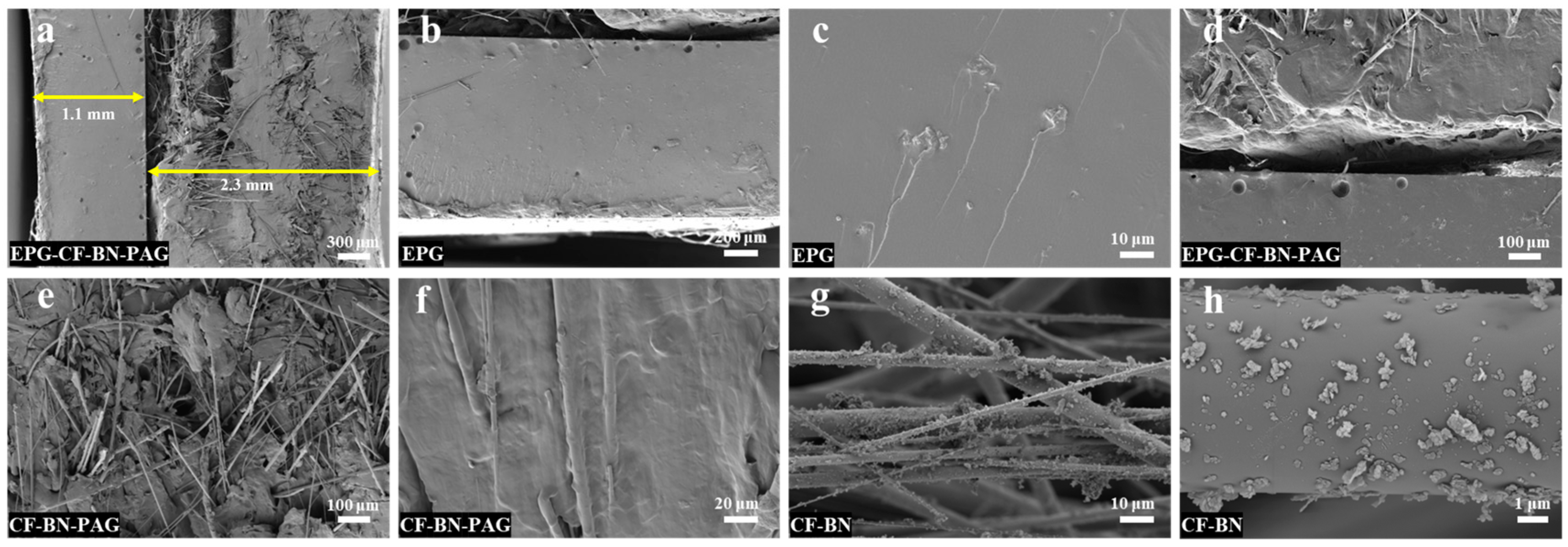
To elucidate the structural features of the composite phase-change module, the EPG–BN–CF–PAG architecture and its key constituents were examined by SEM. As shown in Figure 1a, the single-side thickness of the module is approximately 3.4 mm, consisting of an outer EPG encapsulation layer and an inner BN–CF–PAG scaffold. The EPG outer layer has a thickness of about 1.1 mm and is composed of an epoxy matrix loaded with high-thermal-conductivity graphene–BN hybrid fillers (G–BN) (Figure 1c). This layer not only forms a robust outer leakage-proof interface, but also provides an efficient in-plane heat-spreading pathway owing to the incorporation of G–BN. The inner BN–CF–PAG layer, with a thickness of ~2.3 mm, is constructed from a leakage-resistant CF fibrous framework, BN particles adsorbed on the fiber surface, and the paraffin–graphene phase-change core (PAG). As further evidenced in Figure 1e, the molten PAG can fully infiltrate and fill the BN–CF network; the smooth regions in Figure 1f correspond to PAG, while the strip-like features are assigned to the CF skeleton. Such a three-dimensional porous structure enables the adsorption and immobilization of a large amount of PA, thereby effectively suppressing leakage of the phase-change material. The uniformly distributed BN particles on the CF surface (Figure 1e,h) help enhance the local thermal conductivity, promote a more homogeneous temperature field, and accelerate the thermal response of the phase-change core. Overall, the SEM observations confirm that the synthesized EPG–BN–CF–PAG module constructs a dual leakage-proof architecture: the outer EPG–G–BN layer provides mechanical encapsulation and a rapid lateral heat-diffusion pathway, whereas the inner BN–CF porous scaffold ensures efficient adsorption and fixation of PAG, collectively endowing the module with excellent shape stability and thermal-management capability.
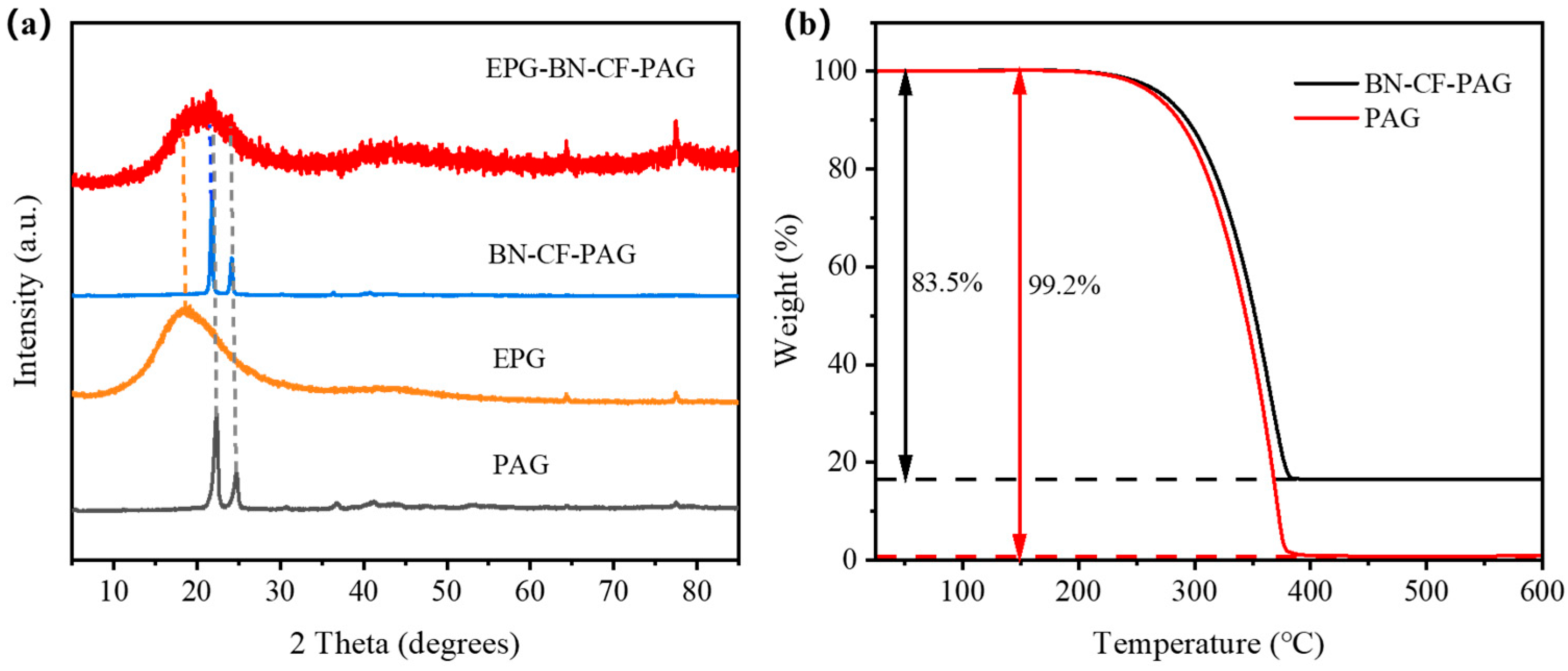
To clarify the phase composition of the composites, XRD patterns of the individual components and their combinations were recorded, as shown in Figure 2a. Paraffin, as a typical long-chain alkane with limited long-range order but appreciable short-range chain ordering, exhibits a pronounced diffraction peak at around 22°. In addition, the introduction of a small amount of graphene gives rise to a broad feature that causes noticeable peak broadening in the vicinity of the main paraffin reflection, consistent with previous reports. The BN–CF–PAG sample displays the characteristic diffraction features of both paraffin and graphene, whereas the EPG film shows a typical broad hump centered at approximately 18°. All of these reflections can be clearly identified in the composite phase-change material EPG–BN–CF–PAG, and no new diffraction peaks are observed, indicating that no additional crystalline phases are formed during synthesis and that each component is well preserved in the composite.
The TGA results in Figure 2b further reveal the compositional ratio and thermal stability of the composites. The BN–CF–PAG sample exhibits a mass loss of about 83.46% upon heating, corresponding to the high loading of the paraffin-based phase-change component, while the remaining ∼15% mass is mainly attributed to the BN–CF scaffold, confirming that it provides effective mechanical support for the encapsulated phase-change material and helps maintain overall structural stability. By contrast, the PAG sample shows a mass loss as high as 99.18%, which verifies that the graphene content is extremely low, in good agreement with the designed formulation.

3.2. Thermal Properties and Anti-Leakage Performance of the Composite Phase-Change Module

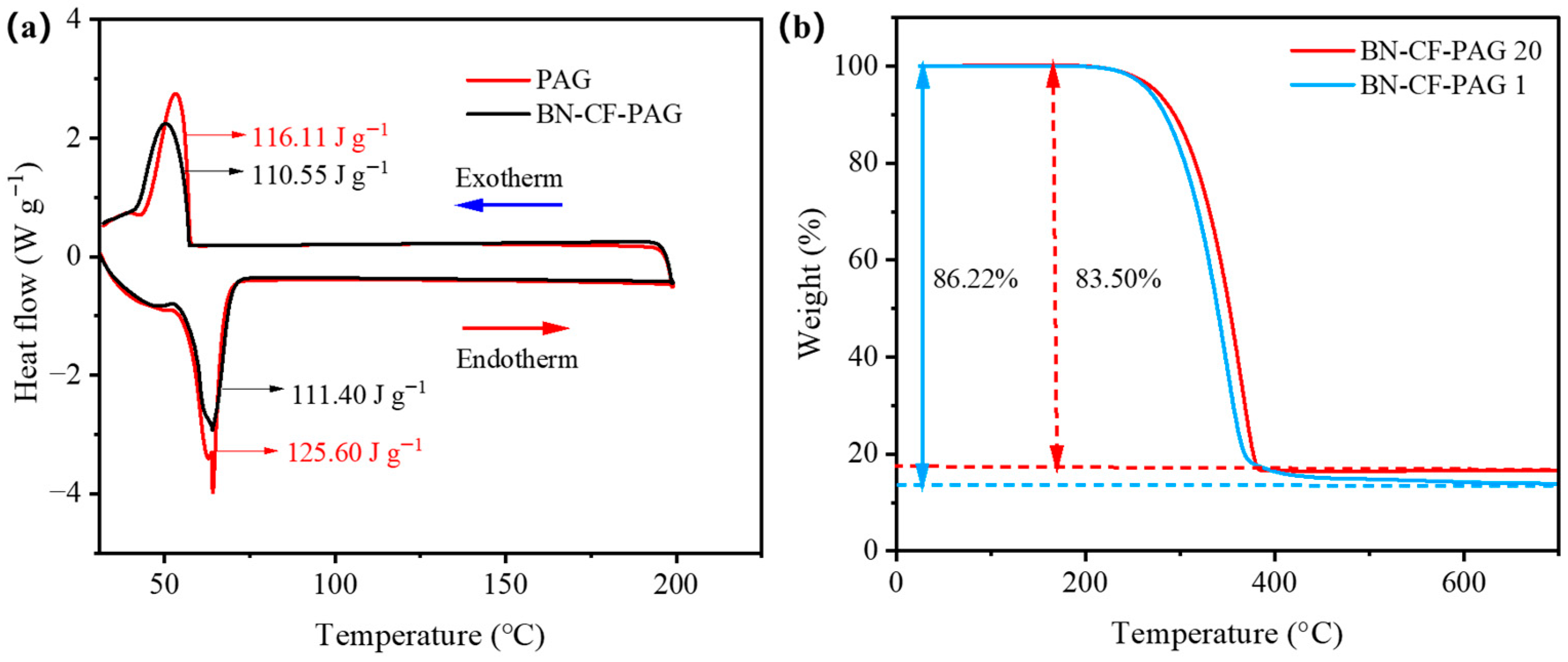
To further evaluate the phase-change characteristics of the composite module, DSC measurements were performed on PAG and BN–CF–PAG, as shown in Figure 3a. Both materials exhibit pronounced phase-transition peaks in the range of 40–60 °C during heating and cooling, consistent with the intrinsic thermal behavior of paraffin. Compared with PAG, the phase-transition peak area of BN–CF–PAG is slightly reduced, with latent heats of 116.11 J g−1 and 110.55 J g−1, respectively, corresponding to a latent-heat retention of approximately 95.2%. This result indicates that the introduction of the BN–CF scaffold does not significantly compromise the heat-storage capacity of the phase-change material; the composite structure can maintain shape stability while preserving a high energy-storage density.
To verify the leakage resistance of the composite, TGA tests were conducted on BN–CF–PAG before and after 20 complete heating–cooling cycles (Figure 3b). The thermal decomposition curves of the samples nearly overlap, with paraffin mass fractions of 86.22% and 83.50% before and after cycling, respectively, indicating only minor mass loss and negligible leakage of the phase-change material during repeated phase transitions. These results demonstrate that the BN–CF porous scaffold can effectively immobilize the phase-change core, markedly enhancing the cycling stability and anti-leakage performance of the composite system.
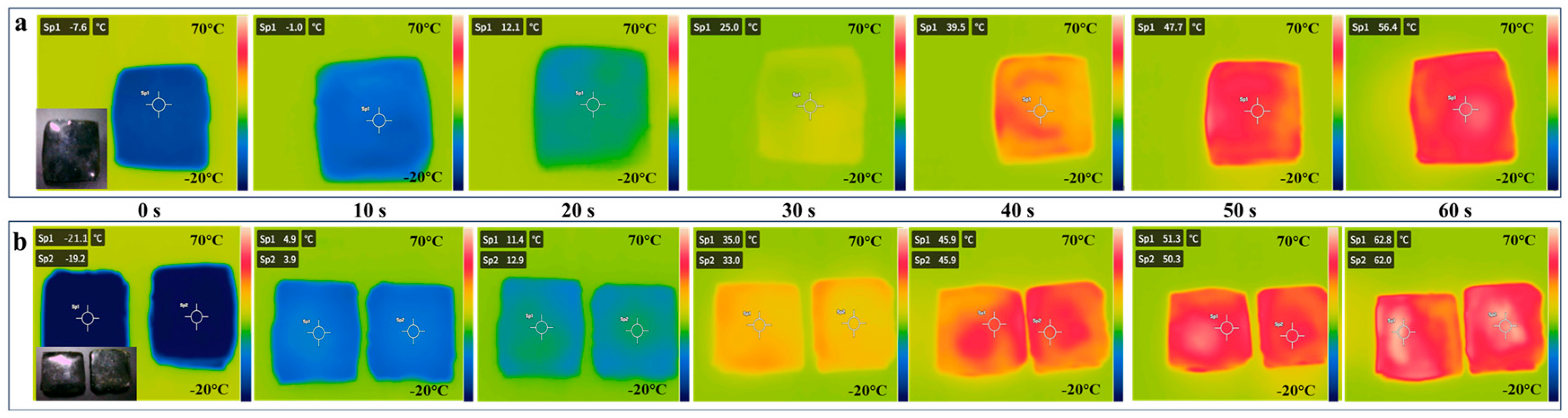
To verify the rapid thermal response of the composite phase-change module under microwave irradiation, its heating process was monitored in real time by infrared thermography. Owing to the excellent microwave-absorption and thermal-conduction properties of graphene, the introduction of graphene markedly enhances the transfer efficiency of microwave energy to the phase-change core, enabling fast temperature rise within the module. As shown in Figure 4a, the temperature evolution of the module at 0, 10, 20, 30, 40, 50, and 60 s was recorded starting from an initial temperature of −10 °C. Upon exposure to the microwave field, the module temperature increases rapidly and reaches ~60 °C within 60 s, confirming the outstanding rapid-heating capability of the graphene-enhanced phase-change composite. Notably, the surface temperature distribution appears fairly uniform at all recorded time points without pronounced hot or cold spots, indicating that the outer EPG–G–BN layer effectively promotes lateral heat spreading and smooths the overall temperature field, which is beneficial for stable thermal-management applications.
To further assess the reproducibility of multi-unit operation, two identical phase-change modules were subjected to simultaneous microwave heating, as shown in Figure 4b. Their heating rates, peak temperatures, and surface-temperature uniformity closely match those observed in the single-module tests, demonstrating good scalability of the microwave-driven strategy and its suitability for application scenarios involving parallel operation of multiple modules.
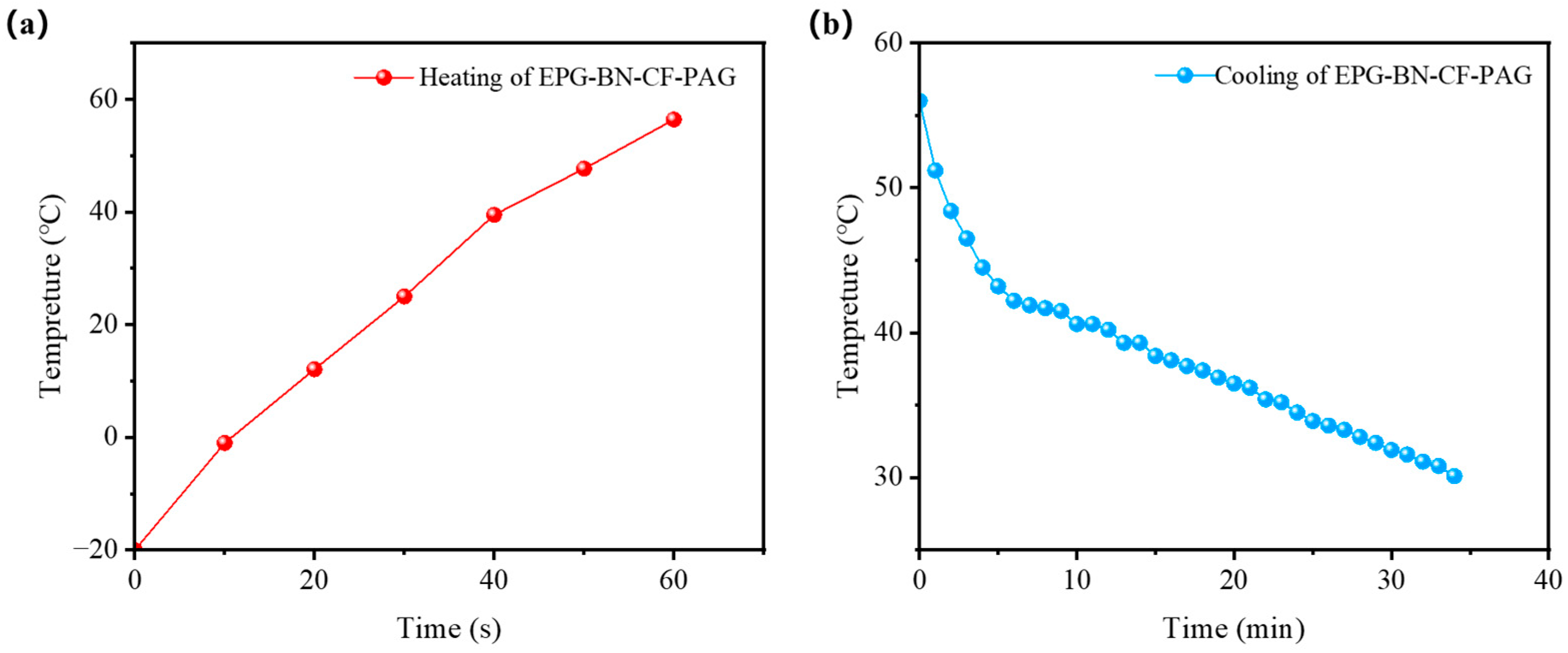
The heating and cooling behaviors were systematically characterized to further evaluate the thermal response of the composite phase-change module. As shown in Figure 5a, starting from an initial temperature of −20 °C, the module can be heated to about 60 °C within 60 s under microwave irradiation, demonstrating an extremely high thermal response rate and confirming the excellent capability of the composite phase-change material for rapid energy absorption and transfer. The corresponding cooling behavior (Figure 5b and Figure S1) also exhibits good stability: when cooled from ~55 °C in a 25 °C oven to simulate ambient conditions, the module temperature decreases approximately linearly with time and stabilizes at around 30 °C after about 35 min. It is noteworthy that the temperature drop is significantly slower in the range of 42–36 °C, lasting for ~15 min, which corresponds to the latent-heat release during the phase-transition process and gives rise to a pronounced plateau in the overall cooling curve.

3.3. Thermal Effect of the Composite Phase-Change Module on Lithium-Ion Battery Cold Start and Battery Impedance Analysis

At low temperatures, lithium-ion batteries typically suffer from capacity loss, aggravated voltage polarization, and pronounced kinetic sluggishness owing to the increased viscosity of the electrolyte and the substantial reduction in ionic diffusion rates. Consequently, developing a rapid and stable external heating strategy is crucial for improving their low-temperature usability. However, conventional phase-change materials are limited by their energy-absorption efficiency and heat-diffusion rate, making it difficult to achieve a sufficiently fast thermal response under cold conditions. Against this background, the present work couples a microwave-driven rapid cold-start phase-change module with the battery heating process, aiming to markedly enhance the heating efficiency and quickly restore the battery to its normal operating state.
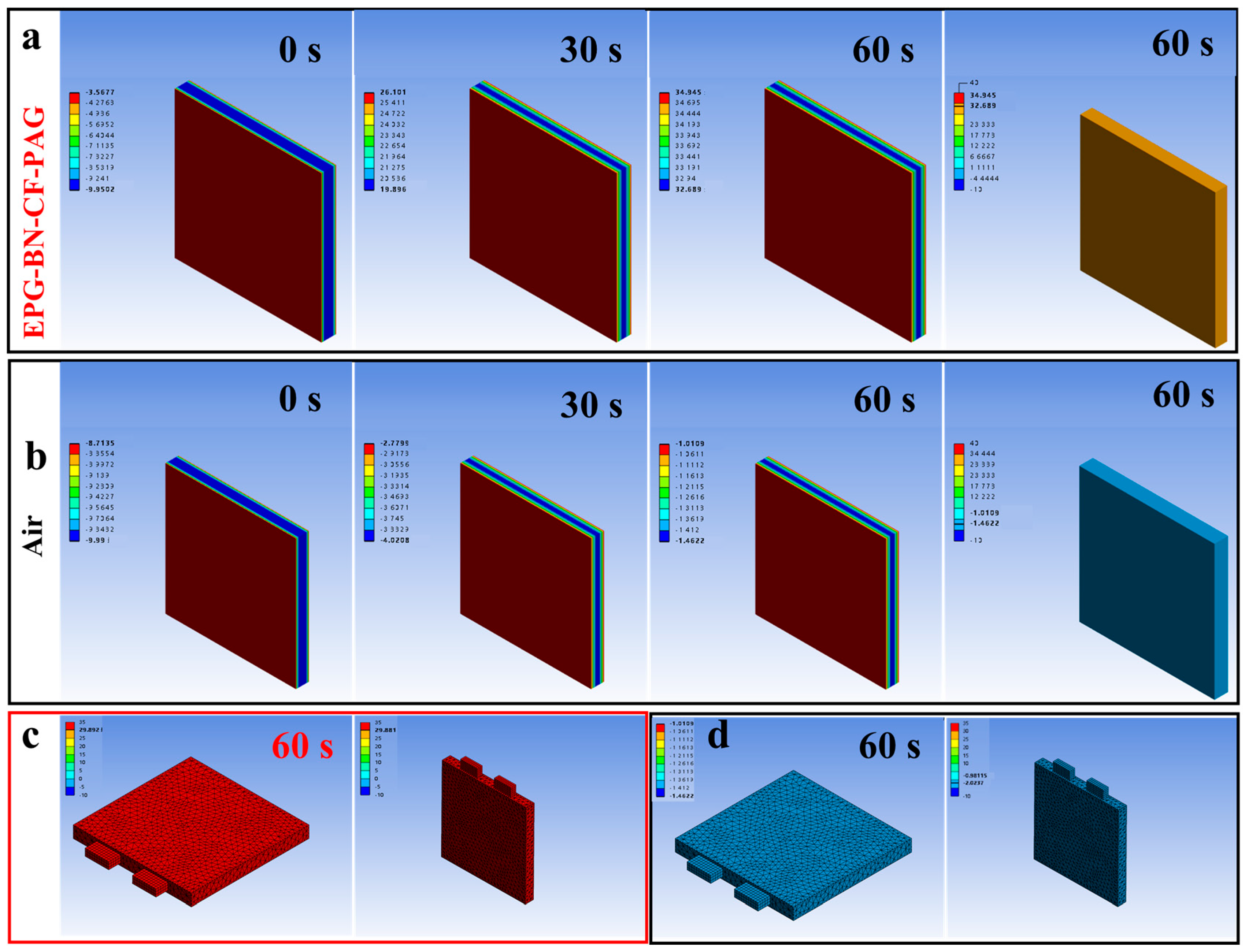
To quantitatively evaluate the thermal assistance provided by the composite phase-change module under low-temperature conditions, finite-element heat-transfer simulations were carried out using ANSYS Workbench 2023R1. The simulation setup and temperature evolution are illustrated in Figure 6. The density and specific heat capacity of the battery were set to 2500 kg m−3 and 900 J kg−1 K−1, respectively. According to the DSC measurements, the phase-transition window of PAG was defined as 40–50 °C. The boundary temperature of the front and back sides of the lithium battery was set to 40 °C to simulate the thermal effect of the phase-change module, while the initial temperature of the battery was set to −10 °C, and the heat transfer boundary condition on the air side was 40 °C. Convection was used as a control group.
Figure 6a,b depict the temporal evolution of the battery temperature in the two scenarios. At t = 0 s, both batteries start from −10 °C. Under the action of the composite phase-change module, the surface temperature of the battery rapidly increases to approximately room temperature (~25 °C) within 30 s and reaches an overall internal temperature of ~30 °C at 60 s. In sharp contrast, the battery without the phase-change module remains below 0 °C over the same time interval, exhibiting almost no appreciable warming. The isothermal contours at 60 s, shown in Figure 6c,d, further confirm that the battery coupled with the phase-change module develops a continuous and homogeneous temperature field that fully falls within the normal operating range. These simulation results demonstrate that the composite phase-change module can efficiently inject heat into the battery within a very short time, enabling a rapid temperature rise from −10 °C to a functional range within 60 s and underscoring the potential of the microwave-driven module for low-temperature start-up and cold-environment energy-storage applications.
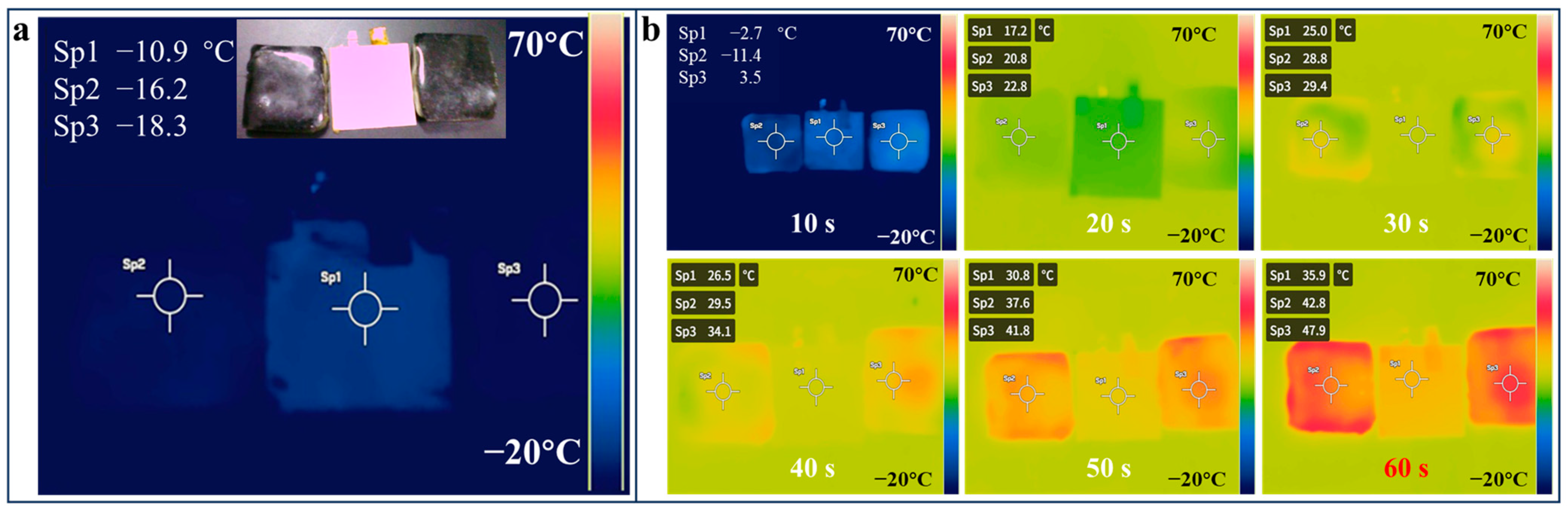
To validate the simulated heating behavior, practical heating tests were conducted on a combined system consisting of the composite phase-change module and a pouch-type lithium-ion battery, as shown in Figure 7. Under microwave irradiation, the temperature at the battery center rises rapidly from −16 °C to room temperature (~25 °C) within 30 s, and further increases to 35.9 °C at 60 s, after which it gradually stabilizes. Meanwhile, the temperature–time profiles of the other two phase-change modules closely coincide with that of the primary module, indicating excellent consistency and controllability of the thermal response among different modules under microwave excitation. The overall heating trend agrees well with the ANSYS simulation results, further confirming that the microwave-responsive composite phase-change module can deliver sufficient heat to the lithium-ion battery within a very short time, enabling it to quickly escape the low-temperature inactivated state and reach a practical operating temperature window.
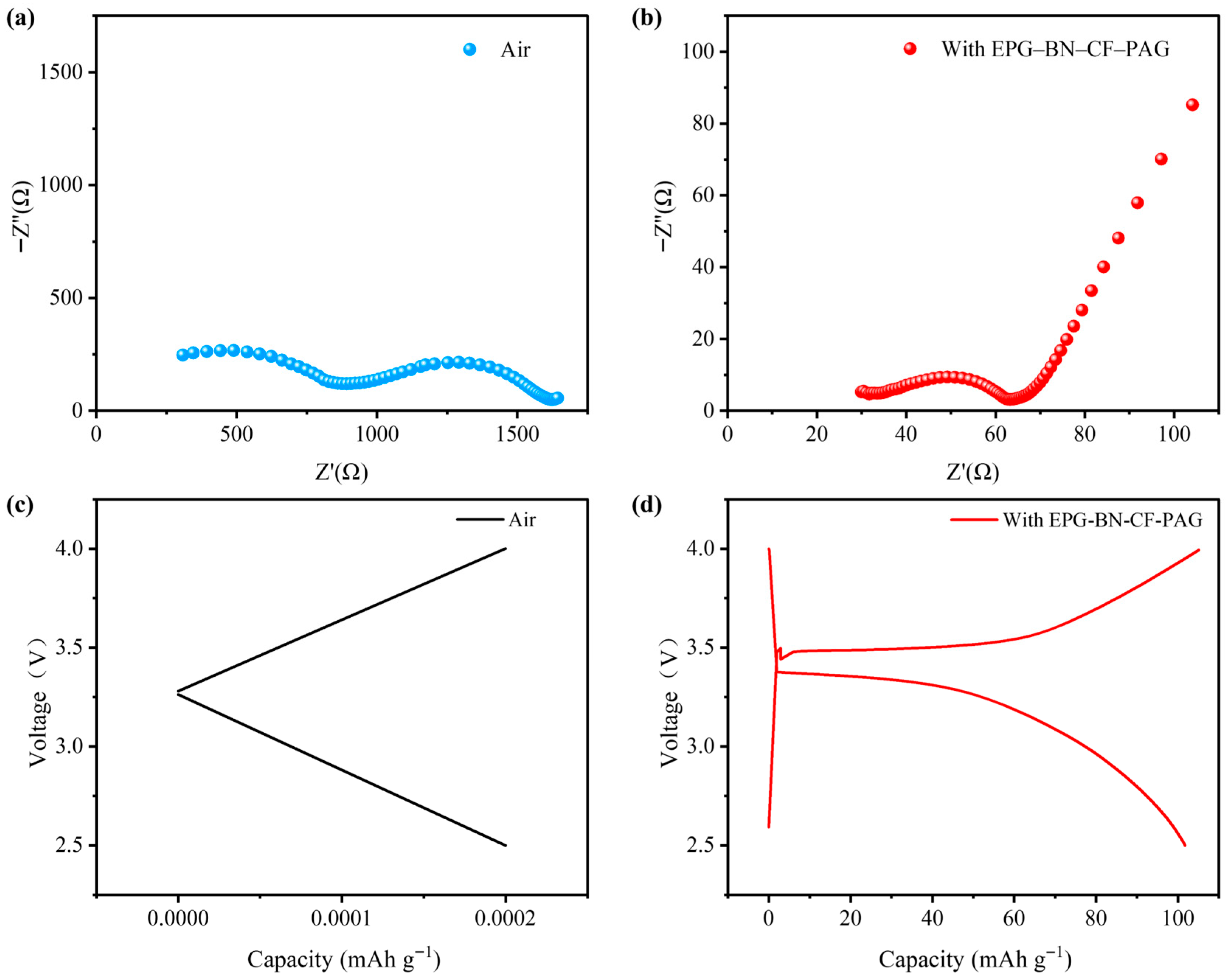
To further assess the electrochemical performance of lithium-ion cells equipped with the phase-change module, EIS measurements were carried out on PEO-based Li‖LiFePO4 pouch cells at −10 °C, as shown in Figure 8a. In the Nyquist plots, the first semicircle is associated with the bulk resistance of the polymer electrolyte (Rs), while the second semicircle corresponds to the interfacial charge-transfer resistance (Rct). The equivalent circuit model and the fitted values of all elements are shown in Figures S4 and S5 and Table S1. At low temperature, Rs and Rct reach approximately 500 Ω and 800 Ω, respectively, indicating that the PEO-based solid electrolyte remains in a highly crystalline state with severely restricted Li+ mobility and strongly hindered interfacial charge transfer, thereby leading to poor overall electrochemical performance. As shown in Figure 8b, after the battery is equipped with the microwave-responsive composite phase-change module, its impedance decreases significantly, with Rs reduced to 27 Ω and Rct reduced to 38 Ω. The pronounced decrease in impedance primarily originates from the thermal stimulus generated by the rapid heating of the composite phase-change module, which raises the temperature of the PEO-based solid electrolyte. This thermal activation reduces the crystallinity of the PEO electrolyte, thereby enhancing Li+ migration and accelerating interfacial kinetic processes. Galvanostatic charge–discharge tests of the pouch cell at low temperature and with the EPG–BN–CF–PAG module are shown in Figure 8c,d. At low temperature, the battery exhibits almost no capacity, whereas the battery integrated with EPG–BN–CF–PAG delivers a discharge specific capacity of 101.775 mAh g−1, demonstrating that the phase-change module enables effective low-temperature cold start of the battery. These results indicate that the composite phase-change module can effectively improve the internal thermal environment of PEO-based solid-state batteries under low-temperature conditions, significantly reduce charge-transfer resistance, and thereby enhance electrochemical activity and specific capacity at low temperatures. This validates the potential of the microwave-driven rapid cold-start strategy for low-temperature applications of solid-state batteries.

4. Conclusions

This work constructed a microwave-driven dual-layer leakage-proof composite phase-change module (EPG–BN–CF–PAG), in which an epoxy–graphene–boron nitride (EPG) outer encapsulation is combined with a ceramic fiber–boron nitride (BN–CF) porous scaffold that adsorbs a paraffin–graphene phase-change core (PAG). Benefiting from the synergistic design of an outer sealing layer and an inner adsorptive framework, the module not only provides robust encapsulation and efficient in-plane heat transfer, but also maintains stable phase-transition behavior in the 40–60 °C range with a latent-heat retention exceeding 95%. No visible leakage is observed after 20 heating–cooling cycles, indicating excellent structural integrity and long-term thermal reliability. Owing to the strong microwave-absorption capability of graphene, the module exhibits a rapid and spatially uniform thermal response under microwave irradiation, with its temperature rising from −15 °C to ~60 °C within 60 s; infrared thermography confirms a homogeneous surface temperature distribution without local hot spots. Combined simulations and experiments further demonstrate that external attachment of the module can markedly accelerate battery warming at low temperatures: a pouch-type lithium-ion cell can be heated from −10 °C to room temperature within 30 s and stabilized at ~30 °C within 60 s, thereby significantly improving interfacial kinetics under cold conditions. Correspondingly, for PEO-based lithium batteries equipped with the EPG–BN–CF–PAG module, the bulk resistance decreases from 500 Ω to 30 Ω, while the interfacial charge-transfer resistance is reduced from 800 Ω to 30 Ω, confirming that the rapid heating afforded by the phase-change module effectively lowers the crystallinity of the polymer electrolyte, enhances Li+ mobility, and substantially restores electrochemical activity at low temperature. Overall, the microwave-driven dual-layer leakage-proof composite phase-change module combines portability, modular scalability, and high compatibility with existing cell architectures, offering an engineering-feasible thermal-management solution for safe and efficient low-temperature start-up, temperature equalization, and operation of lithium-ion and solid-state batteries in harsh environments.

Supplementary Materials

The following supporting information can be downloaded at: https://www.mdpi.com/article/10.3390/en19030674/s1. Figure S1. Temperature measurements of the phase-change module obtained using a platinum resistance sensor, along with photographs of the corresponding experimental setup. Figure S2. Photographs of the mechanical stress test for evaluating anti-leakage performance. Figure S3. Infrared thermal images of four composite phase-change materials heated simultaneously. Figure S4. Equivalent circuit model used for EIS analysis of the battery employed in this work. Figure S5. Photographs of the EIS testing results in this work. Table S1. Equivalent circuit parameters for the EIS analysis of the battery used in this work.

Author Contributions

Conceptualization, C.Y.; Methodology, Z.G., R.G. and C.Y.; Validation, J.Z.; Investigation, J.W. and Z.Y.; Data curation, X.H., R.Z., C.C. and R.G.; Writing—original draft, Z.G. and C.Y.; Writing—review & editing, C.Y.; Supervision, F.Z.; Project administration, C.Y.; Funding acquisition, F.Z. All authors have read and agreed to the published version of the manuscript.

Funding

This work is supported by the State Grid Science and Technology Research Project (5218A0250005) and the National Natural Science Foundation of China (No. 22209101).

Data Availability Statement

The data presented in this study are available on request from the corresponding author.

Conflicts of Interest

Authors Zhenzhou Gong, Xin Huang, Jianwu Zhu, Rongrong Zhang, Chen Chen, Jiaxin Wang and Zhongshu Yu were employed by Nanchang Power Supply Branch of State Grid Jiangxi Electric Power Co., Ltd. The remaining authors declare that the research was conducted in the absence of any commercial or financial relationships that could be construed as a potential conflict of interest.

References

  1. Xu, S.; Sun, Z.; Sun, C.; Li, F.; Chen, K.; Zhang, Z.; Hou, G.; Cheng, H.M.; Li, F. Homogeneous and fast ion conduction of PEO-based solid-state electrolyte at low temperature. Adv. Funct. Mater. 2020, 30, 2007172. [Google Scholar] [CrossRef]
  2. Deng, S.; Jiang, M.; Rao, A.; Lin, X.; Doyle-Davis, K.; Liang, J.; Yu, C.; Li, R.; Zhao, S.; Zhang, L. Fast-charging halide-based all-solid-state batteries by manipulation of current collector interface. Adv. Funct. Mater. 2022, 32, 2200767. [Google Scholar] [CrossRef]
  3. Yu, M.; Wang, B.; Ma, H.; Kamchompoo, S.; Zhao, B.; Jungsuttiwong, S.; Maitarad, P.; Yuan, S.; Shi, L.; Fang, Y. Ionic pumping effect at the tailored mesoporous carbon interface for an extra-stable lithium ion battery at low temperatures. Nano Lett. 2024, 24, 8902–8910. [Google Scholar] [CrossRef]
  4. Liu, X.; Wang, D.; Zhang, Z.; Li, G.; Wang, J.; Yang, G.; Lin, H.; Lin, J.; Ou, X.; Zheng, W. Gel Polymer Electrolyte Enables Low-Temperature and High-Rate Lithium-Ion Batteries via Bionic Interface Design. Small 2024, 20, 2404879. [Google Scholar] [CrossRef] [PubMed]
  5. Xu, L.; Wang, S.; Xi, L.; Li, Y.; Gao, J. A Review of Thermal Management and Heat Transfer of Lithium-Ion Batteries. Energies 2024, 17, 3873. [Google Scholar] [CrossRef]
  6. Bae, J.; Li, Y.; Zhang, J.; Zhou, X.; Zhao, F.; Shi, Y.; Goodenough, J.B.; Yu, G. A 3D nanostructured hydrogel-framework-derived high-performance composite polymer lithium-ion electrolyte. Angew. Chem. Int. Ed. 2018, 57, 2096–2100. [Google Scholar] [CrossRef]
  7. Liu, W.; Lee, S.W.; Lin, D.; Shi, F.; Wang, S.; Sendek, A.D.; Cui, Y. Enhancing ionic conductivity in composite polymer electrolytes with well-aligned ceramic nanowires. Nat. Energy 2017, 2, 17035. [Google Scholar] [CrossRef]
  8. Wu, N.; Chien, P.H.; Qian, Y.; Li, Y.; Xu, H.; Grundish, N.S.; Xu, B.; Jin, H.; Hu, Y.Y.; Yu, G. Enhanced surface interactions enable fast Li+ conduction in oxide/polymer composite electrolyte. Angew. Chem. Int. Ed. 2020, 59, 4131–4137. [Google Scholar] [CrossRef] [PubMed]
  9. Zhang, Y.; Chen, R.; Wang, S.; Liu, T.; Xu, B.; Zhang, X.; Wang, X.; Shen, Y.; Lin, Y.-H.; Li, M. Free-standing sulfide/polymer composite solid electrolyte membranes with high conductance for all-solid-state lithium batteries. Energy Storage Mater. 2020, 25, 145–153. [Google Scholar] [CrossRef]
  10. Lee, Y.-G.; Fujiki, S.; Jung, C.; Suzuki, N.; Yashiro, N.; Omoda, R.; Ko, D.-S.; Shiratsuchi, T.; Sugimoto, T.; Ryu, S. High-energy long-cycling all-solid-state lithium metal batteries enabled by silver–carbon composite anodes. Nat. Energy 2020, 5, 299–308. [Google Scholar] [CrossRef]
  11. Wakayama, H.; Yonekura, H.; Kawai, Y. Three-dimensional bicontinuous nanocomposite from a self-assembled block copolymer for a high-capacity all-solid-state lithium battery cathode. Chem. Mater. 2016, 28, 4453–4459. [Google Scholar] [CrossRef]
  12. Albertus, P.; Anandan, V.; Ban, C.; Balsara, N.; Belharouak, I.; Buettner-Garrett, J.; Chen, Z.; Daniel, C.; Doeff, M.; Dudney, N.J. Challenges for and pathways toward Li-metal-based all-solid-state batteries. ACS Energy Lett. 2021, 6, 1399–1404. [Google Scholar] [CrossRef]
  13. Berthier, C.; Gorecki, W.; Minier, M.; Armand, M.; Chabagno, J.; Rigaud, P. Microscopic investigation of ionic conductivity in alkali metal salts-poly (ethylene oxide) adducts. Solid State Ion. 1983, 11, 91–95. [Google Scholar] [CrossRef]
  14. Bandara, L.; Dissanayake, M.; Mellander, B.-E. Ionic conductivity of plasticized (PEO)-LiCF3SO3 electrolytes. Electrochim. Acta 1998, 43, 1447–1451. [Google Scholar] [CrossRef]
  15. Wu, S.; Yan, T.; Kuai, Z.; Pan, W. Thermal conductivity enhancement on phase change materials for thermal energy storage: A review. Energy Storage Mater. 2020, 25, 251–295. [Google Scholar] [CrossRef]
  16. Min, P.; Liu, J.; Li, X.; An, F.; Liu, P.; Shen, Y.; Koratkar, N.; Yu, Z.Z. Thermally conductive phase change composites featuring anisotropic graphene aerogels for real-time and fast-charging solar-thermal energy conversion. Adv. Funct. Mater. 2018, 28, 1805365. [Google Scholar] [CrossRef]
  17. Zhang, Y.; Zheng, S.; Zhu, S.; Ma, J.; Sun, Z.; Farid, M. Evaluation of paraffin infiltrated in various porous silica matrices as shape-stabilized phase change materials for thermal energy storage. Energy Convers. Manag. 2018, 171, 361–370. [Google Scholar] [CrossRef]
  18. Dong, H.; Ma, B.; Wang, J.; Xue, J.; Chen, X.; Bai, J.; Wang, H. Self-Driven Cycle and Thermal Characteristics of Seawater Battery System with a Preheater. Energies 2025, 18, 4261. [Google Scholar] [CrossRef]
  19. Ye, Y.; Huang, W.; Xu, R.; Xiao, X.; Zhang, W.; Chen, H.; Wan, J.; Liu, F.; Lee, H.K.; Xu, J.; et al. Cold-Starting All-Solid-State Batteries from Room Temperature by Thermally Modulated Current Collector in Sub-Minute. Adv. Mater. 2022, 34, 2202848. [Google Scholar] [CrossRef] [PubMed]
  20. Zhang, J.; Ge, H.; Li, Z.; Ding, Z. Internal heating of lithium-ion batteries using alternating current based on the heat generation model in frequency domain. J. Power Sources 2015, 273, 1030–1037. [Google Scholar] [CrossRef]
  21. Yang, X.-G.; Zhang, G.; Ge, S.; Wang, C.-Y. Fast charging of lithium-ion batteries at all temperatures. Proc. Natl. Acad. Sci. USA 2018, 115, 7266–7271. [Google Scholar] [CrossRef] [PubMed]
  22. Wu, S.; Xiong, R.; Li, H.; Nian, V.; Ma, S. The state of the art on preheating lithium-ion batteries in cold weather. J. Storage Mater. 2020, 27, 101059. [Google Scholar] [CrossRef]
  23. Wang, H.; Zhu, Y.; Kim, S.C.; Pei, A.; Li, Y.; Boyle, D.T.; Wang, H.; Zhang, Z.; Ye, Y.; Huang, W. Underpotential lithium plating on graphite anodes caused by temperature heterogeneity. Proc. Natl. Acad. Sci. USA 2020, 117, 29453–29461. [Google Scholar] [CrossRef]
  24. Wang, C.-L.; Leong, J.C. Analysis of Thermal Management Strategies for 21700 Lithium-Ion Batteries Incorporating Phase Change Materials and Porous Copper Foam with Different Battery Orientations. Energies 2024, 17, 1553. [Google Scholar] [CrossRef]
  25. Yang, C.; Yin, H.; Lou, Q.; Cheng, Z.; Bai, Y.; Su, Y.; Li, X.; Zhao, B.; Xia, M.; Han, X. Ultrafast microwave heated form-stable thermal package providing operating temperature for PEO all-solid-state batteries. Energy Storage Mater. 2023, 60, 102814. [Google Scholar] [CrossRef]
  26. Cao, Q.; Wang, Z.; He, W.; Guan, Y. Fabrication of super hydrophilic surface on alumina ceramic by ultrafast laser microprocessing. Appl. Surf. Sci. 2021, 557, 149842. [Google Scholar] [CrossRef]
  27. Yang, Z.; Zhou, L.; Luo, W.; Wan, J.; Dai, J.; Han, X.; Fu, K.; Henderson, D.; Yang, B.; Hu, L. Thermally conductive, dielectric PCM–boron nitride nanosheet composites for efficient electronic system thermal management. Nanoscale 2016, 8, 19326–19333. [Google Scholar] [CrossRef]
  28. Yang, J.; Tang, L.-S.; Bao, R.-Y.; Bai, L.; Liu, Z.-Y.; Yang, W.; Xie, B.-H.; Yang, M.-B. Largely enhanced thermal conductivity of poly (ethylene glycol)/boron nitride composite phase change materials for solar-thermal-electric energy conversion and storage with very low content of graphene nanoplatelets. Chem. Eng. J. 2017, 315, 481–490. [Google Scholar] [CrossRef]
  29. Ma, Q.; Zou, D.; Wang, Y.; Lei, K. Preparation and properties of novel ceramic composites based on microencapsulated phase change materials (MEPCMs) with high thermal stability. Ceram. Int. 2021, 47, 24240–24251. [Google Scholar] [CrossRef]
Figure 1. SEM micrographs of the composite phase-change material. (a) Overall EPG–BN–CF–PAG; (b,c) local magnification of outer skeleton EPG; (d) interface between inner and outer skeletons of EPG–BN–CF–PAG; (e,f) BN–CF–PAG and its local magnification; (g,h) inner skeleton BN–CF and its local magnification.
Energies 19 00674 g001
Figure 2. Phase composition of EPG-BN-CF-PAG. (a) XRD; (b) TGA.
Energies 19 00674 g002
Figure 3. Thermal energy storage properties of BN-CF-PAG. (a) DSC; (b) TGA.
Energies 19 00674 g003
Figure 4. Infrared thermography results of the composite phase-change module under 1 min microwave heating: (a) single module; (b) double module.
Energies 19 00674 g004
Figure 5. Thermal response and heat retention characteristics of the composite phase-change module: (a) heating curve; (b) cooling curve.
Energies 19 00674 g005
Figure 6. Heat transfer simulation of lithium-ion battery cold start at low temperature: (a) heating performance of the battery equipped with EPG-BN-CF-PAG; (b) battery temperature without phase-change module; (c) temperature distribution of the battery after 60 s with the module; (d) temperature distribution of the battery after 60 s without phase-change module.
Energies 19 00674 g006
Figure 7. Infrared thermography results of the lithium-ion battery heated within 1 min with the EPG-BN-CF-PAG module attached. (a) Initial state at 0 s; (b) temperature evolution recorded at 10 s intervals.
Energies 19 00674 g007
Figure 8. Electrochemical impedance spectra of the lithium-ion battery before and after integration with EPG-BN-CF-PAG: (a) without phase-change module; (b) with phase-change module. Galvanostatic charge/discharge curves of lithium-ion battery (c) in air; (d) integrated with EPG-BN-CF-PAG.
Energies 19 00674 g008
Disclaimer/Publisher’s Note: The statements, opinions and data contained in all publications are solely those of the individual author(s) and contributor(s) and not of MDPI and/or the editor(s). MDPI and/or the editor(s) disclaim responsibility for any injury to people or property resulting from any ideas, methods, instructions or products referred to in the content.