Methodology to Determine Electrical Power Required for Connecting Ships to Onshore Power Grids in Ports

 ,
,  ,
, 
Abstract
1. Introduction
2. Literature Review
- LNG storage and regasification units (vessels), floating storage regasification units (FSRU): average electrical power—about 12–14 MW;
- cruise ships: about 4–12 MW;
- container ships: about 1–3 MW;
- tankers: about 1–2 MW;
- general cargo ships: about 0.5–1.0 MW;
- bulk carriers: about 0.3–1.0 MW;
- other ships (mostly small ships): about 0.1–2.0 MW.
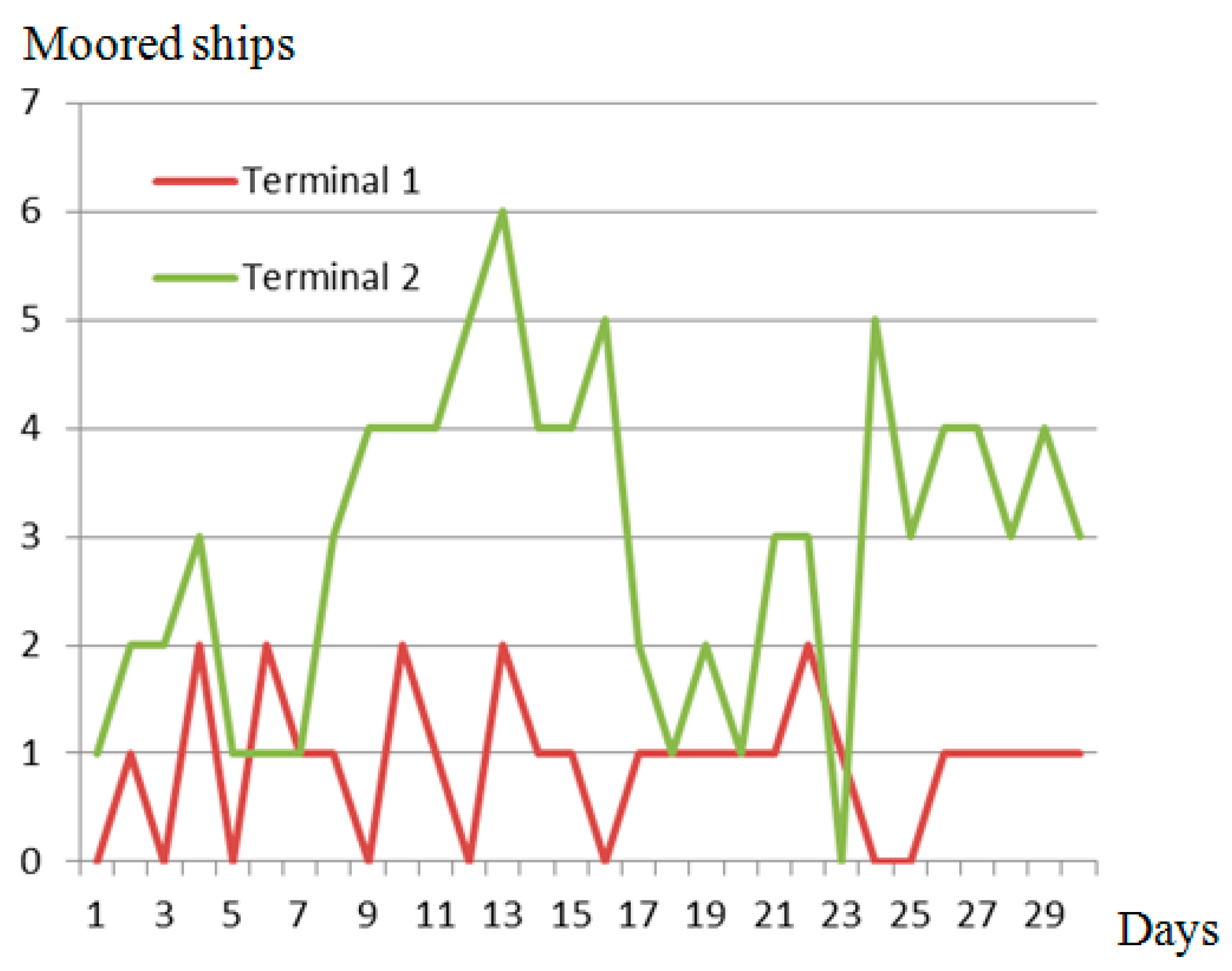
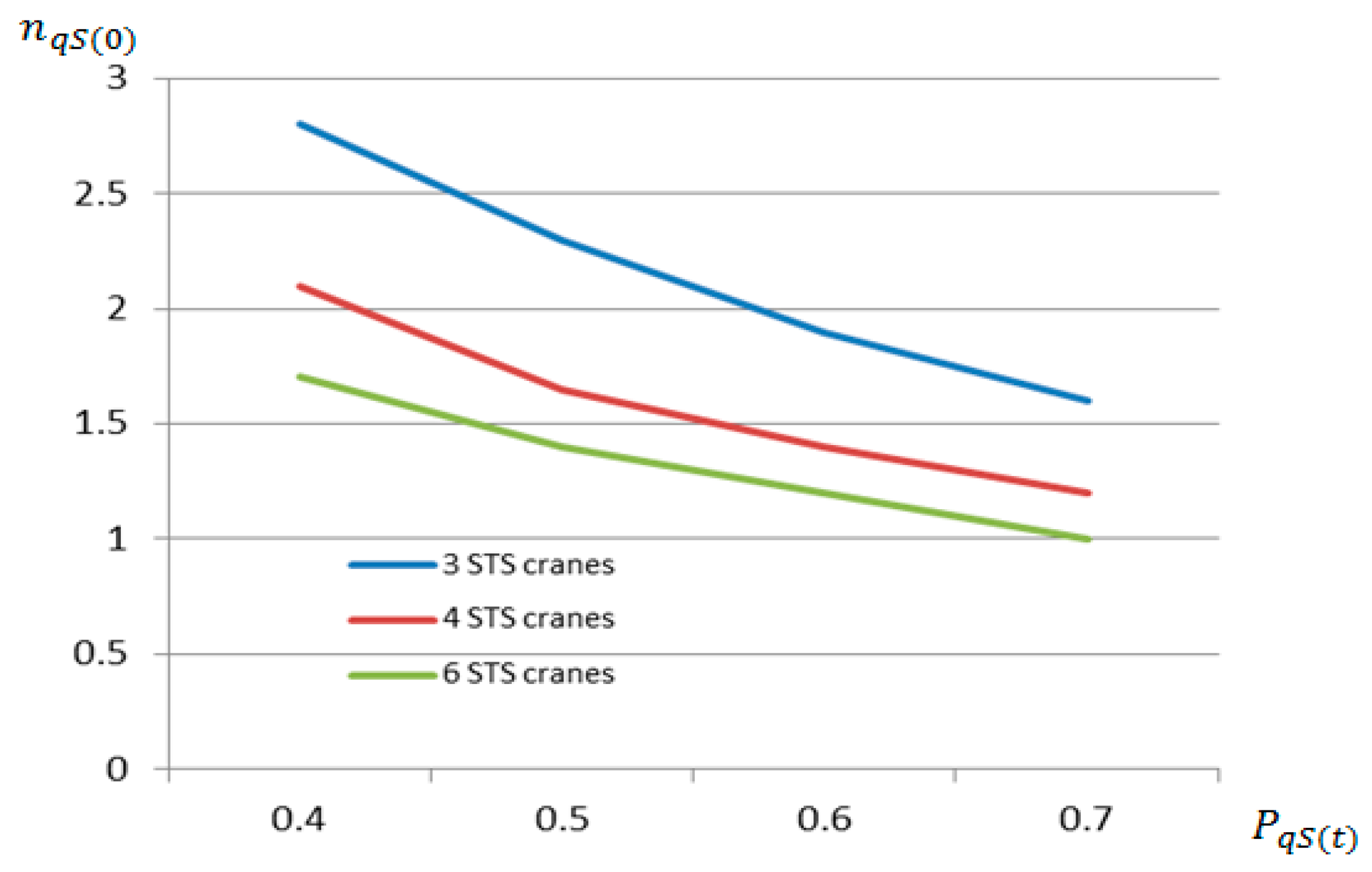
- In Terminal 1, the probability that three ships will berth at the terminal quays during loading operations is about 0%, the probability that two ships will berth at the quays is about 17%, and the probability that one ship will berth at the quays is about 33% of the time;
- In Terminal 2, the probability of six ships mooring at the terminal quays during loading operations is about 0%, the probability of five ships mooring at the quays is about 10%, and the probability of four ships mooring at the quays is about 40% of the total time.
3. Methodology
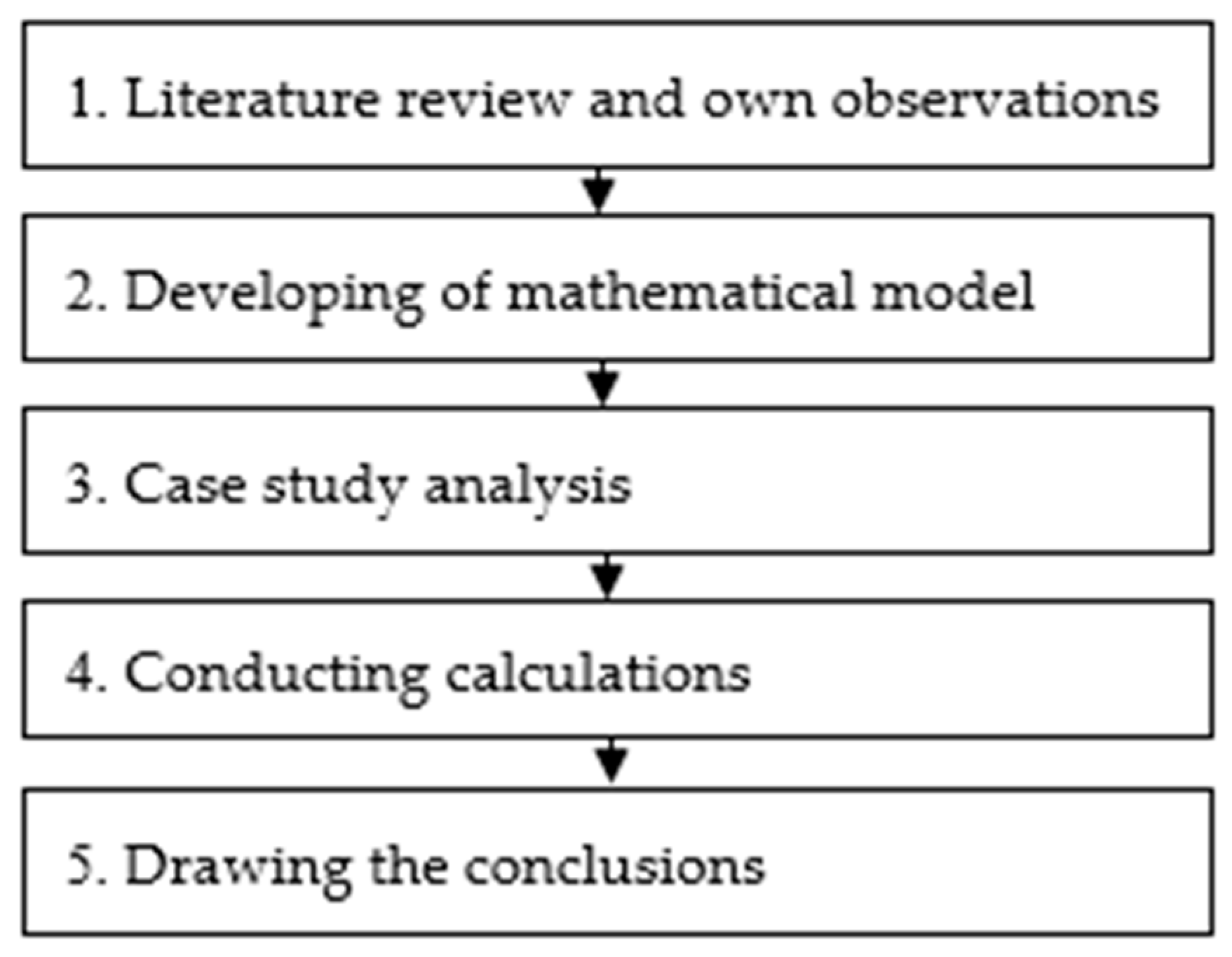
3.1. Research Framework
3.2. Mathematical Model
- Ships moored at specific quays;
- Changes in the world and regional economies;
- Changes in the parameters of ships designed for the transportation of specific cargoes;
- Changes and forecasts of the ships’ electrical power for the planned period;
- Other possible factors.
- The available electrical power capacity at the investigated quay;
- The types of ships and their corresponding electrical power requirements while berthed;
- The average duration of ship berthing at the quay;
- The implementation of advanced cargo-handling technologies that may reduce the time ships spend moored at the quay;
- Other relevant influencing factors.
- Expected cargo flows;
- Expected ship parameters;
- Periodicity of ship arrivals to the port;
- Probability of hydro-meteorological impact, statistical data on hydro-meteorological factors taken from the port or the nearest hydro-meteorological stations for at least the last five years;
- Ship parameters and their electricity demand;
- Probability of non-standard situations, taken from port statistical data as a recurring Process for at least the last five years;
- The ability of port terminals to accommodate the maximum number of ships;
- Other factors.
3.3. Case Study Description
4. Results
5. Discussion
6. Conclusions
Author Contributions
Funding
Data Availability Statement
Conflicts of Interest
References
- Iris, Ç.; Lam, J.S.L. A review of energy efficiency in ports: Operational strategies, technologies and energy management systems. Renew. Sustain. Energy Rev. 2019, 112, 170–182. [Google Scholar] [CrossRef]
- Alamoush, A.S.; Olçer, A.I.; Ballini, F. Ports’ role in shipping decarbonisation: A common port incentive scheme for shipping greenhouse gas emissions reduction. Clean. Logist. Supply Chain 2022, 3, 100021. [Google Scholar] [CrossRef]
- Jesus, D.; Oliveira, T.; Perdigão, M.; Mendes, A. Plugging into Onshore Power Supply System Innovation: A Review from Standards and Patents to Port Deployment. Energies 2025, 18, 5449. [Google Scholar] [CrossRef]
- International Maritime Organization (IMO). RESOLUTION MEPC.304(72) Initial IMO Strategy on Reduction of GHG Emissions from Ships; IMO: London, UK, 2018. [Google Scholar]
- Azni, M.A.; Md Khalid, R.; Hasran, U.A.; Kamarudin, S.K. Review of the Effects of Fossil Fuels and the Need for a Hydrogen Fuel Cell Policy in Malaysia. Sustainability 2023, 15, 4033. [Google Scholar] [CrossRef]
- Nicewicz, G.; Tarnapowicz, D. Assessment of marine auxiliary engines load factor in ports. Manag. Syst. Prod. Eng. 2012, 3, 12–17. [Google Scholar]
- International Maritime Organization (IMO). International Convention for the Prevention of Pollution from Ship (MARPOL). Available online: https://www.imo.org/en/about/Conventions/Pages/International-Convention-for-the-Prevention-of-Pollution-from-Ships-(MARPOL).aspx (accessed on 7 October 2023).
- Shi, Y. Greenhouse gas emissions from international shipping: The response from China’s shipping industry to the regulatory Iinitiatives of the International Maritime Organization. Int. J. Mar. Coast. Law 2014, 29, 77–115. [Google Scholar] [CrossRef]
- Kotta, J.; Fetissov, M.; Kaasik, E.; Väät, J.; Štõkov, S.; Tapaninen, U.P. Towards Efficient Mapping of Greenhouse Gas Emissions: A Case Study of the Port of Tallinn. Sustainability 2023, 15, 9520. [Google Scholar] [CrossRef]
- Reinhardt, L.B.; Plum, C.E.M.; Pisinger, D.; Sigurd, M.M.; Vial, G.T.P. The liner shipping berth scheduling problem with transit times. Transp. Res. Part E Logist. Transp. Rev. 2016, 86, 116–128. [Google Scholar] [CrossRef][Green Version]
- Slack, B.; Comtois, C.; Wiegmans, B.; Witte, P. Ships time in port. Int. J. Shipp. Transp. Logist. 2017, 10, 45–62. [Google Scholar] [CrossRef]
- Wang, Y.; Ding, W.; Dai, L.; Hu, H.; Jing, D. How would government subsidize the port on shore side electricity usage improvement? J. Clean. Prod. 2021, 278, 123893. [Google Scholar] [CrossRef]
- Ahamad, N.B.B.; Guerrero, J.M.; Su, C.L.; Vasquez, J.C.; Zhaoxia, X. Microgrids technologies in future seaports. In Proceedings of the 2018 IEEE International Conference on Environment and Electrical Engineering and 2018 IEEE Industrial and Commercial Power Systems Europe (EEEIC/I&CPS Europe), Palermo, Italy, 12–15 June 2018; pp. 1–6. [Google Scholar] [CrossRef]
- Prousalidis, J.; Lyridis, D.; Dallas, S.; Soghomonian, Z.; Georgiou, V.; Spathis, D.; Kourmpelis, T.; Mitrou, P. Ship to shore electric interconnection: From adolescence to maturity. In Proceedings of the 2017 IEEE Electric Ship Technologies Symposium (ESTS), Arlington, VA, USA, 14–17 August 2017; pp. 200–206. [Google Scholar] [CrossRef]
- Port of Rotterdam. Available online: https://www.portofrotterdam.com/en/port-future/energy-transition/ongoing-projects/shore-based-power-rotterdam/research-on-shore-based (accessed on 15 December 2025).
- Port of Southampton. Available online: https://www.abports.co.uk/locations/southampton/ (accessed on 15 December 2025).
- Rogosic, M.; Stanivuk, T.; Lucaci, D. A Study on the Application of Shore-Side Power as a Method to Reduce the Emissions of Greenhouse Gases by Cruise Ships. J. Mar. Sci. Eng. 2025, 13, 453. [Google Scholar] [CrossRef]
- European Environment Agency. EU Maritime Transport: First Environmental Impact Report Published. 2021. Available online: https://www.eea.europa.eu/highlights/eu-maritime-transport-first-environmental (accessed on 25 August 2025).
- Onshore Power Supply for Cruise Vessels—Assessment of Opportunities and Limitations for Connecting Cruise Vessels to Shore Power. Available online: https://interreg-baltic.eu/wp-content/uploads/2021/10/44-Green_Cruise_Port_Connecting_Cruise_Vessels_to_Shore_Power_Vin.pdf (accessed on 17 November 2025).
- Kosek, W.; Woźniak, W.; Chamier-Gliszczynski, N.; Staniuk, W. Offshore Wind Farm Supply Chains and Regional Development: The Role of Ports in Economic and Logistical Growth in the Central Baltic Region. Energies 2025, 18, 2599. [Google Scholar] [CrossRef]
- Kosek, W.; Chamier-Gliszczynski, N.; Woźniak, W.; Jachimowski, R. The Role of Polish Local Ports on the Central Baltic Coast in the Development of Offshore Wind Farms. Energies 2024, 17, 6123. [Google Scholar] [CrossRef]
- Wilson, J.; Carriveau, R.; Hurley, W.; Babaei, R.; Ting, D.S.K. Electrifying Maritime Shipping: Evaluating the CO2 Reduction and Viability of Future Battery-Powered Container Ships Calling at the Port of Los Angeles. J. Phys. Conf. Ser. 2024, 2929, 012007. [Google Scholar] [CrossRef]
- D’Agostino, F.; Kaza, D.; Silvestro, F.; Conte, F.; Rrukaj, R.; Zadeh, M. Green Smart Port Energy System Design: Optimal Sizing. In Proceedings of the 2023 IEEE Power & Energy Society General Meeting (PESGM), Orlando, FL, USA, 16–20 July 2023; pp. 1–5. [Google Scholar] [CrossRef]
- Bouman, E.A.; Lindstad, E.; Rialland, A.I.; Strømman, A.H. State-of-the-art technologies, measures, and potential for reducing GHG emissions from shipping—A review. Transp. Res. Part D Transp. Environ. 2017, 52, 408–421. [Google Scholar] [CrossRef]
- Di Vaio, A.; Varriale, L. Management innovation for environmental sustainability in seaports: Managerial accounting instruments and training for competitive green ports beyond the regulations. Sustainability 2018, 10, 783. [Google Scholar] [CrossRef]
- Filina, L.; Filin, S. An analysis of influence of lack of the electricity supply to reefer containers serviced at sea ports on storing conditions of cargoes contained in them. Pol. Marit. Res. 2008, 15, 96–102. [Google Scholar] [CrossRef]
- Paulauskas, V.; Filina-Dawidowicz, L.; Paulauskas, D. The method to decrease emissions from ships in port areas. Sustainability 2020, 12, 4374. [Google Scholar] [CrossRef]
- Carlton, J.S. Ship Types, Duties, and General Characteristics. In Encyclopedia of Maritime and Offshore Engineering; John Wiley & Sons: Hoboken, NJ, USA, 2018; pp. 10–80. [Google Scholar] [CrossRef]
- Filina-Dawidowicz, L.; Filin, S.; Wojnicz, L.; Miłek, D.; Grzelak, P. Energy-efficient maritime transport of refrigerated containers. Procedia Comput. Sci. 2022, 207, 3566–3575. [Google Scholar] [CrossRef]
- Fridell, E. Chapter 2-Emissions and Fuel Use in the Shipping Sector. In Green Ports; Bergqvist, R., Monios, J., Eds.; Springer International Publishing: Cham, Switzerland, 2019; pp. 19–33. [Google Scholar] [CrossRef]
- Xiao, G.; Wang, Y.; Wu, R.; Li, J.; Cai, Z. Sustainable Maritime Transport: A Review of Intelligent Shipping Technology and Green Port Construction Applications. J. Mar. Sci. Eng. 2024, 12, 1728. [Google Scholar] [CrossRef]
- Ventikos, N.P.; Sotiralis, P.; Annetis, M.; Koimtzoglou, M.-A.; Keratsa, L. Defining the Power and Energy Demands from Ships at Anchorage for Offshore Power Supply Solutions. Energies 2025, 18, 1766. [Google Scholar] [CrossRef]
- Kurpel, D.V.; Scarpin, C.T.; Junior, J.E.; Schenekemberg, C.M.; Coelho, L.C. The exact solutions of several types of container loading problems. Eur. J. Oper. Res. 2020, 284, 87–107. [Google Scholar] [CrossRef]
- Jaynes, E.T. Probability Theory the Logic of Science; Cambridge University Press: New York, NY, USA, 2003; 758p. [Google Scholar]
- Xia, D.; He, J.; Chi, F.; Dou, Z.; Yang, Z.; Liu, C. Shore Power Optimal Scheduling Based on Gridding of Hybrid Energy Supply System. Sustainability 2022, 14, 16250. [Google Scholar] [CrossRef]
- Song, Y.Q.; Xiao, L.M. Technology of Uninterruptable Shore-side Power Supply for Berthing Vessels and Its Application. In Proceedings of the 3rd International Conference on Advances in Energy & Environmental Science, Zhuhai, China, 25–26 July 2015. [Google Scholar]
- Tan, Z.; Zeng, X.; Wang, T.; Wang, Y.; Chen, J. Capacity investment of shore power berths for a container port: Environmental incentive and infrastructure subsidy policies. Ocean Coast. Manag. 2023, 239, 106582. [Google Scholar] [CrossRef]
- Zhang, Z.; Zhu, Y.; Zhu, J.; Huang, D.; Yin, C.; Li, J. Collaborative Optimization of Shore Power and Berth Allocation Based on Economic, Environmental, and Operational Efficiency. J. Mar. Sci. Eng. 2025, 13, 776. [Google Scholar] [CrossRef]
- Olea-Oregi, E.; Sanchez-Ruiz, A.; Eguía-López, P.; Canas-Acena, J.; Legarra-Basterretxea, I. Optimal Connection Voltage of Soft Open Point and Shore-to-Ship Power Converters for Enhanced Capacitive Reactive Power Operation. IEEE Access 2024, 12, 15696–15712. [Google Scholar] [CrossRef]
- Karimi, S.; Zadeh, M.; Suul, J.A. A Multi-Vessel Universal Shore-to-Ship Charging System: Configuration and Control Architecture. IEEE Trans. Energy Convers. 2024, 39, 2119–2133. [Google Scholar] [CrossRef]
- Jin, Y.; Ruan, W.; Yu, M.; Qi, L.; Huang, W. Research on capacity-increasing and transformation plan of port’s shore-based power distribution network system. IET Conf. Proc. 2022, 2022, 170–176. [Google Scholar] [CrossRef]
- Lv, W.; Ye, Y.; Cui, T.; Chen, S.; Xu, D.; Yu, W.; Huang, D.; Liu, Z.; Zhu, J.; Li, T.; et al. Sustainable electrified seaports: A coordinated energy and logistics scheduling approach for future maritime hubs. Appl. Energy 2025, 401, 126645. [Google Scholar] [CrossRef]
- Papalexopoulos, A.; Prousalidis, J.; Manos, A.; Andrianesis, P. Maritime sector integration in energy markets via port decarbonization and electrification. Sustain. Energy Grids Netw. 2025, 43, 101862. [Google Scholar] [CrossRef]
- Okoth, J.A.; Moses, P.M.; Kivindu, R.M. Problem Design and Analysis of Onshore Power Supply to Berthed Ships at the Port of Mombasa. In Proceedings of the 2022 IEEE PES/IAS PowerAfrica, Kigali, Rwanda, 22–26 August 2022; pp. 1–5. [Google Scholar] [CrossRef]
- Jia, J.G.; Xing, J.X.; Jia, J.; Zhao, J.; Song, J.H.; Xiao, C.Y. Environmental and economic evaluation of the interaction between the vessels charging stations and the power grid. In Proceedings of the International Conference on Mechanical Design and Simulation (MDS 2022), Wuhan, China, 20 September 2022; Volume 12261. [Google Scholar] [CrossRef]
- Vlahopoulos, D.; Bouhouras, A.S. Solution for RTG crane power supply with the use of a hybrid energy storage system based on literature review. Sustain. Energy Technol. Assess. 2022, 52, 102351. [Google Scholar] [CrossRef]
- Jingwei, X.; Yi, L.; Xin, W. Reactive Power Optimization Model for Port Shore Power Based on Mayfly Algorithm. In Proceedings of the 2025 IEEE International Symposium on the Application of Artificial Intelligence in Electrical Engineering (AAIEE), Beijing, China, 25–28 April 2025; pp. 809–813. [Google Scholar] [CrossRef]
- Binot, F.; Meunier, S.; Reinbold, V.; Petit, M.; Correcher, S.; Mamadou, K. Optimization of the design of photovoltaic-based seaport microgrids considering techno-economic and environmental criteria. Energy Rep. 2024, 11, 5819–5830. [Google Scholar] [CrossRef]
- Sun, C.; Ye, H.; Gao, N.; Lin, J.; Lin, Y. Collaborative Energy Supply Network Architecture Planning Method Taking into Account Pure Electric Ship Charging Load Forecasting. Lect. Notes Electr. Eng. 2025, 1311, 87–96. [Google Scholar] [CrossRef]
- Lin, J.; Cheng, L.; Lin, Y.; Wu, S.; Gao, N. Research on Reactive Power Optimization for Port Area Grid Considering Charging Load of Electric Ships and Renewable Energy Generation. In Proceedings of the 2024 5th International Conference on Power Engineering (ICPE), Shanghai, China, 13–15 December 2024; pp. 830–835. [Google Scholar] [CrossRef]
- Wu, H.; Yu, H.; Tang, X.; Yuan, C. An Integrated Multi-Port Shore to Ship Charging System for Flexible Vessel Accommodation and Grid Interconnection. In Proceedings of the 2025 IEEE International Conference on Electrical Energy Conversion Systems and Control (IEECSC), Chongqing, China, 23–25 May 2025; pp. 319–325. [Google Scholar] [CrossRef]
- Amaral, M.; Amaro, N.; Arsénio, P. Methodology for Assessing Power Needs for Onshore Power Supply in Maritime Ports. Sustainability 2023, 15, 16670. [Google Scholar] [CrossRef]
- Lenczuk, A.; Olivera-Guerra, L.; Klos, A.; Bogusz, J. On the ability to study regional hydrometeorological changes using GPS and GRACE measurements. Prog. Earth Planet. Sci. 2024, 11, 63. [Google Scholar] [CrossRef]
- Gatti, P.L. Probability Theory and Mathematical Statistics for Engineers; CRC Press: Boca Raton, FL, USA, 2004; 368p. [Google Scholar]
- Bronshtein, I.N.; Semendyayev, K.A.; Musiol, G.; Muehlig, H. Probability Theory and Mathematical Statistics. In Handbook of Mathematics; Springer: Berlin/Heidelberg, Germany, 2004; pp. 743–794. [Google Scholar] [CrossRef]
- Koubaa, Z.; El-Amraoui, A.; Frikha, A.; Delmotte, F. Multicriteria Decision Making for Selecting Forecasting Electricity Demand Models. Sustainability 2024, 16, 9219. [Google Scholar] [CrossRef]
- Paulauskas, V. Logistika; Klaipeda University Publish House: Klaipeda, Lithuania, 2007; 288p. (In Lithuanian) [Google Scholar]
- Jin, H.; Peng, S. Optimal unbiased estimation for maximal distribution. Probab. Uncertain. Quant. Risk 2021, 6, 189–198. [Google Scholar] [CrossRef]
- Bregni, S.; Jmoda, L. Improved Estimation of the Hurst Parameter of Long-Range Dependent Traffic Using the Modified Hadamard Variance. In Proceedings of the 2006 IEEE International Conference on Communications (ICC 2006), Istanbul, Turkey, 11–15 June 2006; pp. 566–572. [Google Scholar] [CrossRef]
- Akbaş, U.; Arıcan, O.H. An Analytical Study of Ship Deficiencies Identified During Port State Control: A Case Study of Kocaeli Port. J. Mar. Eng. Technol. 2025, 5, 38–49. [Google Scholar] [CrossRef]
- Svanberg, M.; Holm, H.; Cullinane, K. Assessing the Impact of Disruptive Events on Port Performance and Choice: The Case of Gothenburg. J. Mar. Sci. Eng. 2021, 9, 145. [Google Scholar] [CrossRef]


Disclaimer/Publisher’s Note: The statements, opinions and data contained in all publications are solely those of the individual author(s) and contributor(s) and not of MDPI and/or the editor(s). MDPI and/or the editor(s) disclaim responsibility for any injury to people or property resulting from any ideas, methods, instructions or products referred to in the content. |
© 2026 by the authors. Licensee MDPI, Basel, Switzerland. This article is an open access article distributed under the terms and conditions of the Creative Commons Attribution (CC BY) license.
Share and Cite
Paulauskas, V.; Filina-Dawidowicz, L.; Paulauskas, D.; Paulauskas, V. Methodology to Determine Electrical Power Required for Connecting Ships to Onshore Power Grids in Ports. Energies 2026, 19, 675. https://doi.org/10.3390/en19030675
Paulauskas V, Filina-Dawidowicz L, Paulauskas D, Paulauskas V. Methodology to Determine Electrical Power Required for Connecting Ships to Onshore Power Grids in Ports. Energies. 2026; 19(3):675. https://doi.org/10.3390/en19030675
Chicago/Turabian StylePaulauskas, Vytautas, Ludmiła Filina-Dawidowicz, Donatas Paulauskas, and Vytas Paulauskas. 2026. "Methodology to Determine Electrical Power Required for Connecting Ships to Onshore Power Grids in Ports" Energies 19, no. 3: 675. https://doi.org/10.3390/en19030675
APA StylePaulauskas, V., Filina-Dawidowicz, L., Paulauskas, D., & Paulauskas, V. (2026). Methodology to Determine Electrical Power Required for Connecting Ships to Onshore Power Grids in Ports. Energies, 19(3), 675. https://doi.org/10.3390/en19030675