Perspective

State Estimation of Power Systems Under Measurement Anomalies

1
Hubei Engineering and Technology Research Center for AC/DC Intelligent Distribution Network, Wuhan University, Wuhan 430072, China
2
School of Electrical Engineering and Automation, Wuhan University, Wuhan 430072, China
3
Grid Dispatchand Control Center Central China Branchof State Grid Corporation of China Wuhan, Wuhan 430077, China
*
Author to whom correspondence should be addressed.
Energies 2026, 19(3), 632; https://doi.org/10.3390/en19030632
Submission received: 30 November 2025 / Revised: 12 January 2026 / Accepted: 23 January 2026 / Published: 26 January 2026

Abstract

As a product of the integration of information and communication technologies, smart grid has greatly enhanced the efficiency of power system. However, with the development of the smart grid towards deep digitalization and interconnection, state estimation (SE) of power systems is facing dual challenges of a complex measurement environment and threat of cyber-attacks. The integrity and reliability of measurement data are affected by sensor failure, complex environmental noise, and data packet loss, causing state estimation deviations. Meanwhile, in recent years, malicious cyber-attacks, mainly in the form of false data injection into (FDIA) and denial-of-service (DoS), have also threatened the stable operation of power systems. This paper systematically reviews research achievements in related fields. Firstly, an analysis is conducted on the causes and mechanisms of measurement anomalies such as measurement loss, complex noise, and cyber-attacks. Then, the existing identification methods of measurement anomalies are reviewed, and state estimation methods for power systems under measurement anomaly conditions are analyzed from three perspectives: model-driven, data-driven, and hybrid-driven. Finally, advantages and disadvantages of various methods are analyzed, and future research directions are prospected, aiming to provide a reference for building a highly resilient and adaptive smart grid monitoring system.

1. Introduction

According to the IEEE Grid 2050 planning vision, the main expectation of the smart grid is to enable control and automation to achieve efficient and reliable two-way power flow [1]. The high integration of information and communication technology in the power system makes the power grid a typical form of cyber-physical system (CPS) with deep integration of physical and information systems [2]. Power system state estimation serves as the core of the energy management system (EMS). This process utilizes real-time redundant measurements obtained from supervisory control and data acquisition (SCADA) and wide-area measurement system (WAMS). Through statistical filtering to remove random errors, it accurately estimates key operating states, such as voltage amplitude and phase angle. At the same time, with large-scale access to distributed energy resources (DERs) and power electronic devices, the power system exhibits highly random and rapid dynamic characteristics. Traditional static state estimation (SSE) usually assumes that the system is in quasi-steady-state operation, which has made it difficult to accurately describe the system’s state under transient disturbances and rapid fluctuations [3,4,5]. In addition, due to strong fluctuations and dynamic coupling among voltage, frequency, and power flow caused by the high proportion of renewable energy access, the model accuracy, measurement synchronization, and real-time estimation performance are more challenging. In this context, dynamic state estimation (DSE) technology, which continuously tracks system’s dynamic behavior, is increasingly becoming a key method for modern power grid operation [6].
As a key technology of power grid situation awareness, the performance of state estimation largely depends on the quality of measurement data and the accuracy of the system model. However, avoiding abnormal measurement data is challenging in the actual, complex operational and measurement environment. Due to sensor calibration errors, communication interference, clock drift, and other factors, the measurement may exhibit deviations, abnormal points, or mutation values, which often leads to an increase in the estimated residual difference, affecting the filtering gain and iterative stability. Traditional outlier detection relies on residual analysis and statistical tests, which can effectively identify isolated anomalies in the presence of random noise. Still, it is often insufficient in a multi-source-coupling environment or a dynamic change scene. Estimation under abnormal data will directly affect the accuracy of key state variables, such as voltage amplitude and phase angle, and even lead to incorrect scheduling decisions [7,8].
On this basis, as the power grid expands and communication links become more complex, measurement information in transmission is affected by bandwidth constraints, congestion, packet loss, node failures, and other factors, potentially leading to its loss. In common studies, it is often treated as a complete loss under the Bernoulli model, meaning the data are either completely missing or completely available. However, in engineering practice, it is more typical to have partial loss or amplitude attenuation, that is, the measurement exists but is no longer complete, accurate, or credible. For example, when the analog signal collected by the phasor measurement unit (PMU) is processed by an analog-to-digital converter (ADC), if the peripheral circuit is not designed correctly or the reference voltage is unstable, it can lead to random attenuation, or “fading,” of the output signal amplitude. This phenomenon is not a complete loss of data, but carries partial, distorted information [8]. For dynamic state estimation relying on high-frequency PMU data, the standard extended Kalman filter (EKF) or unscented Kalman filter (UKF) assume that the measurement data is complete and that the noise follows a Gaussian distribution. When the input data is partially missing or the amplitude is attenuated, the linearization error of the measurement equation increases, leading to misalignment in the filter’s gain calculation and, in turn, severe oscillation or even divergence of the estimation results [9].
In recent years, with the deep integration of power cyber–physical systems, the security boundary of the power grid has gradually blurred, and cyber-attacks from the information side have evolved into significant hidden dangers threatening the safe operation of the power grid. Unlike physical measurement failures, cyber-attacks are usually launched by adversaries with high intelligence, strong concealment, clear purpose, and destructive power. Among them, FDIA are the most widely studied and most threatening [10]. By stealing the topology parameters of the power grid, the attacker constructs an attack vector satisfying specific physical constraints and injects it into the sensor measurements. It can bypass the vulnerability that traditional bad data detection (BDD) mainly relies on static residual test, and tamper with state estimation results without triggering alarms [11]. The harm of a cyber-attack is multi-dimensional. From an economic perspective, the attacker can manipulate the electricity market price to obtain illegal profits by tampering with load data to create false congestion signals. From a physical security perspective, attackers can mislead dispatchers into making incorrect decisions about machine or load cutting, cover up line overload, and even induce cascading failures and large-scale power outages [12]. Complex attack patterns such as load redistribution (LR) not only affect the current estimate but also lead to the legitimacy of subsequent estimations, especially in dynamic state estimation.
To sum up, the modern power system state estimation is in a complex environment full of uncertainty and multiple threats. Sensor aging, complex environmental noise, and measurement loss at the physical level are intertwined with malicious cyber-attacks at the information level, jointly constituting a severe challenge to the power grid perception system. Traditional estimation algorithms based on the Gaussian assumption, the complete-data premise, and static models often suffer from insufficient robustness, slow convergence, or even failure in the presence of heavy-tailed noise, measurement loss, and cyber-attacks. Therefore, to improve perception ability and data reliability of power systems in abnormal environments, research on resilient state estimation technology with fault tolerance, robustness, and anti-attack capability has become a key direction.
Although previous studies have developed a range of robust estimation strategies for specific scenarios, most existing methods and reviews currently focus on a single type of outlier data. There is a lack of a unified framework to systematically classify and analyze state estimation under a comprehensive range of measurement anomalies. In this paper, the existing research results in the field are systematically reviewed, and the main contributions are as follows: Firstly, an in-depth analysis is conducted on the causes and mechanisms of three main measurement anomalies. Secondly, the existing anomaly identification methods are summarized. Crucially, this paper classifies and parses state estimation methods under measurement anomaly conditions from three different perspectives: model-driven, data-driven, and hybrid-driven. Finally, the advantages and disadvantages of these methods are compared and analyzed, and future research directions are prospected, aiming to provide an important reference for building a smart grid monitoring system with high flexibility and adaptability.
The structure of the subsequent sections of this paper is arranged as follows. Section 2 classifies and summarizes the common measurement anomalies. Subsequently, in Section 3, the current research on outlier data detection is reviewed. Then, in Section 4, the existing power system state estimation methods under measurement anomalies are summarized from three perspectives: model-driven, data-driven, and hybrid-driven. Finally, the advantages and disadvantages of various methods are analyzed and the future research direction is prospectively discussed in Section 5.

2. Classification and Impact of Measurement Anomalies

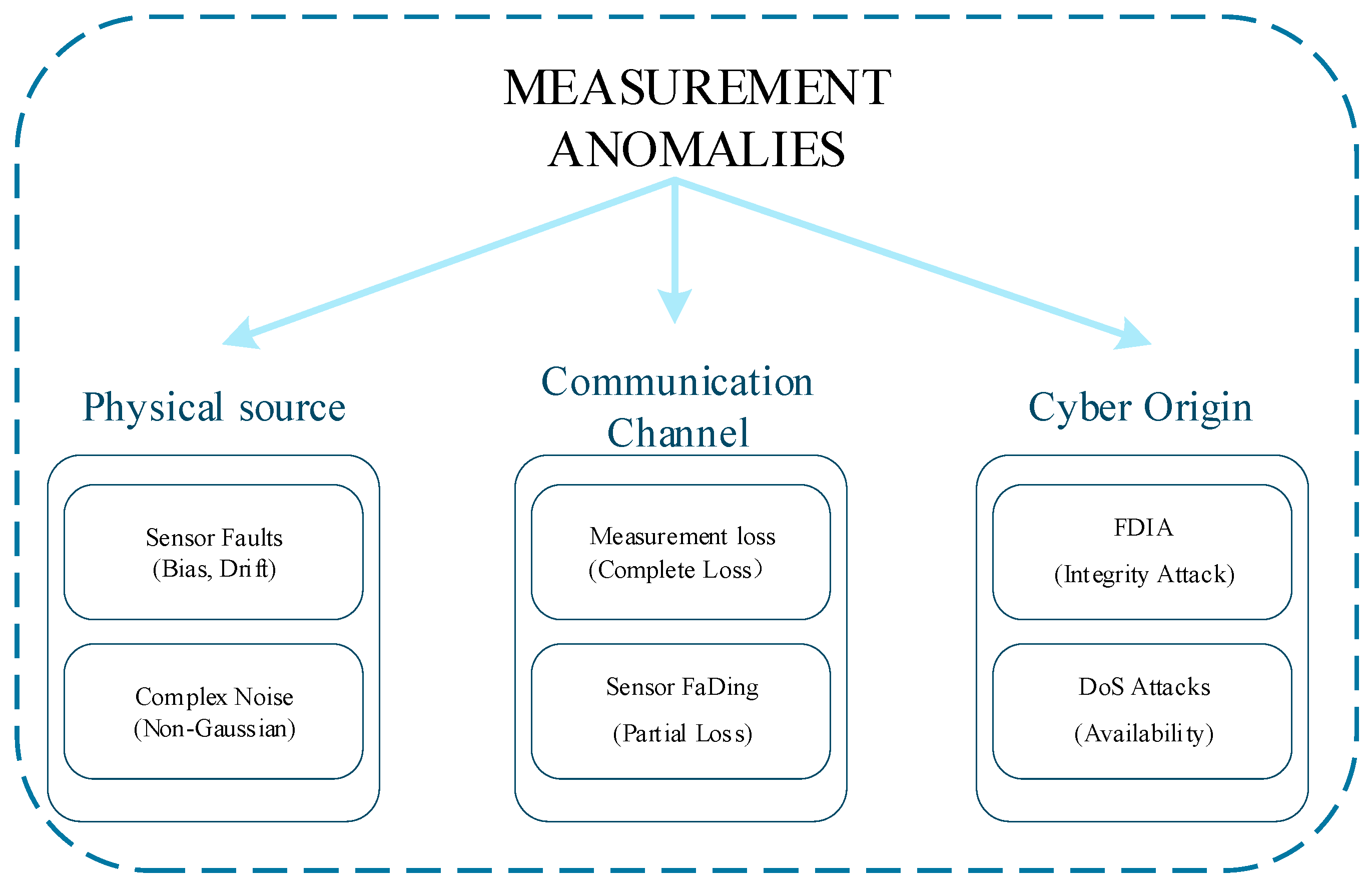
In the actual operation of the power system, the quality of measured data is affected by many physical and human factors, often deviating from the ideal Gaussian white noise model. This chapter will provide an introduction to the state estimation model. Then, based on the causes, manifestations of abnormal measurement data, and their impact on state estimation, this paper mainly classifies the situations of measurement anomalies into three categories: complex noise, measurement loss, and measurement anomalies caused by cyber-attacks. The details are shown in Figure 1.

2.1. State Estimation Model Overview

Dynamic state estimation iteratively computes the optimal system state for the next moment by comparing the previous moment’s estimates with real-time measurement data. Based on SCADA and PMU data, DSE consists of two steps: state prediction and measurement update. First, the state transition model is used for prior prediction; the resulting predictions are then corrected using real-time measurements, thereby forming the state and measurement equations that describe the dynamic characteristics of the power system.
x ˙ = f ( x , u ) + w
z = h ( x , u ) + v
where u, x ˙ , u z are the state vector, input vector, and output vector, respectively, w and v indicate the measurement noise that caused by external disturbances.
To incorporate Equations (1) and (2) into the power system model analysis problem, improved Euler method is adopted for discretization processing.
x ˜ k = x k 1 + f c ( x k 1 , u k 1 ) Δ t
f ˜ = f c ( x ˜ k , u k ) + f c ( x k 1 , u k 1 ) 2
x k = x k 1 + f ˜ Δ t
where x ˜ k , u k denote the discrete forms of x and k. k denote the k t h time.
After the above changes, the discrete system model can be expressed as follows:
x k = f ( x k 1 , u k 1 ) z k = h ( x k , u k )

2.2. Complex Noise

Complex noise refers to measurement errors that do not meet the standard Gaussian distribution. This noise is usually heavy-tailed, skewed, or impulsive. The aging of the internal components of measurement equipment that operate in a high-voltage, high-magnetic-interference environment for a long time will lead to random drift in measurement gain. In addition, signal sensing failure, electromagnetic interference, and system delay can degrade sensor gain, which is usually manifested as random multiplicative deviation between the measurement and actual values. The distribution characteristics of sensor gain degradation no longer follow a single Gaussian distribution but may appear as a discrete or mixed distribution. At the same time, with the widespread use of power electronic devices, high-frequency switching operations and harmonic interference result in measurement noise with significant non-Gaussian characteristics. When studying the robust predictive control of grid-connected converters, researchers found that current sensor is affected not only by low-frequency drift but also by high-frequency switching noise, which often exhibits sharp peaks and thick tails, and that traditional filtering algorithms are complex to suppress [13,14] effectively.
The presence of complex noise violates the optimality assumptions of traditional state estimators, thereby reducing estimation accuracy. The traditional Kalman filter and its variants are usually based on the minimum mean square error (MMSE) criterion, which assumes that the noise follows a Gaussian distribution. When faced with heavy-tailed non-Gaussian noise, the filter performance based on second-order statistics will degrade sharply, leading to filtering divergence [15,16].

2.3. Measurement Loss

Measurement loss occurs when the control center fails to receive measurement data from some sensors within a predetermined time. According to the degree of missingness, it can be divided into complete and partial missingness. Complete losses are usually caused by power outages in the sensor, broken communication links, or packet loss during transmission. In a multi-machine power system, instability in the wide-area communication network is the leading cause of random packet losses. Partial measurement loss does not refer to the complete loss of data packets, but to the random fading of the measurement signal amplitude due to the instability of the reference voltage of the analog-to-digital converter (ADC), the defect of the peripheral circuit design, or the channel fading. Partial measurement loss manifests as amplitude attenuation, which retains some information but reduces effectiveness. In [8], the conventional Kalman filter under measurement attenuation causes the estimator to deviate significantly from the true value. Misdiagnosing it as a complete loss wastes available information, while treating it as a normal measurement results in significant estimation bias [17,18].
The measurements loss model can be modeled as follows.
x k + 1 = f x k + v k         z k = γ k 1 Γ 1 x k + ς k 1 γ k 2 Γ 2 x k + ς k 2 γ k m Γ m x k + ς k m = Ξ k Γ x k + ς k
where Ξ k = d i a g { γ k 1 , γ k m } and γ k i represent the m independent stochastic variables in k and i ; note that they are irrelevant to all the noise signal. Under the condition of complete measurement loss, Ξ k is established as a random variable following the Bernoulli distribution, while under the condition of partial measurement loss, it is established as a probability model on the interval [0,1].
Measurement loss can reduce observability in a power system, as intermittent data losses can lead to a rank deficit in the measured Jacobian matrix, rendering the system unobservable at certain moments. In the study of microgrid state estimation, it has been shown that data packet loss due to an unreliable communication network can significantly reduce the accuracy of state reconstruction in a linear microgrid. In addition, the measurement loss will also reduce the dynamic tracking ability, the filter’s prediction–correction mechanism depends on the continuous measurement stream, and missing data can cause the posterior estimation bias to accumulate. In particular, in multi-machine systems, partial sensor failures may destroy synchronous monitoring between generators and reduce the overall system resilience to disturbances [13,18,19].

2.4. Cyber-Attack

As a form of CPS, a smart grid’s topology shows the complex interconnection of multiple systems. Operating at different levels, classes, and spaces, these systems play a crucial role in the smart grid’s operation., so a cyber-attack on any one of them can affect the smart grid’s overall operation. According to the target of attack, measurement injection cyber-attacks can be divided into FDIA, DoS attacks, scaling attacks, ramp attacks, etc. Among them, FDIA and Dos are the most common, which are modeled as follows:
FDIA is one of the most common cyber-attacks where an intruder instills fake data into real data without knowing the system parameters [20] and can be modeled as follows.
z k = h x k     k < σ h x k + b k + v k     k > σ
where b k represents the amplitude of the attack signals; σ is the moment the attack occurs.
The attacker will identify a vulnerable node and inject a large number of packets into it, causing the communication between the control center and the measurement device to be blocked for a period of time, which can be modeled as follows.
z k = h x k     k < σ         v k     k > σ
In recent years, cyber-attacks on power system state estimation have become increasingly sophisticated, exhibiting stronger concealment and intelligence. A classical FDIA can bypass the traditional BDD mechanism based on residuals. Ran et al. [19] further proposed an extended FDIA that used deep reinforcement learning (DRL) to tamper with measurements while embedding attack components into state variables, and combined it with physical constraint evasion detection, making the attack more hidden and destructive. Another essential type of threat is a data integrity attack, which An et al. [21] model as a process with temporal coupling. In a partially observable Markov decision process (POMDP), attackers continuously inject false data, gradually causing the state trajectory to deviate from the system’s true evolution. As the defenses evolve, so do the attack strategies. Higgins et al. [22] noted that, even in a moving target defense (MTD) environment, attackers can still detect dynamic changes in line parameters and adjust their strategies to breach the defense line. FDIA introduces directional bias; Chen et al. [15] show that this bias can mislead EMS into making uneconomic dispatch decisions. A dynamic attack may destroy system stability. Physical information-coordinated attacks may even cause cascaded failures and blackouts; the traditional robust estimation is easy to fail under a carefully constructed FDIA.

3. Measurement Anomaly Identification Scheme

In the overall architecture of power system state estimation, bad data detection constitutes the first line of defense to ensure data integrity and system observability. The core task is to leverage the redundancy of measurement data. Statistical tests are employed to identify and eliminate abnormal data caused by sensor faults, communication noise, or malicious attacks. This process ensures that state estimation results accurately reflect the physical operation state of the power grid. However, the intelligence of cyber-attacks poses severe challenges for traditional BDD. Especially in the FDIA, attackers use the knowledge of the system topology and parameters to construct specific attack vectors to achieve covert penetration. For this kind of attack that exploits the physical model’s vulnerability, a detection method relying solely on the residual has become insufficient. Therefore, advanced detection techniques that can identify covert attacks, distinguish between natural failures and malicious attacks, and precisely locate compromised nodes are also critical for current power system security defense [23,24].
FDIA exposes structural problems in industry-standard statistical detection approaches based on weighted least-squares residuals. FDIA will affect the measurement equation structure, but the standard WLS default measurement matrix is correct. Thus, the algorithm will fail to converge to the actual state under heavy attack, and residual detection will fail. To this purpose, Tausiesakul et al. introduced a non-iterative state estimation method based on complete least squares that can manage measurement vector and matrix perturbations, making state reconstruction benchmarks more robust in attack settings. Besides strengthening the analytical model, merging classical physical models with machine learning can improve anomaly detection [25]. Asefi et al. [26] suggested a two-stage anomaly detection and categorization system. WLS and EKF generated residuals and innovations to find anomalies in the first step. The second stage uses these variables to train supervised learning models like random forest and XGBoost to classify anomalies like insufficient data, load mutation, and FDIA, and reliably locate attack. Single-model restrictions are alleviated by this “parsing + data” hybrid technique. However, labeled attack samples are scarce; therefore, unsupervised learning is a promising research area. Khaledian et al. use a stacked, integrated structure of isolation forests, KMeans, and LoOP to detect noise, packet loss, and abnormal events in PMU data in real time, using multi-algorithm fusion under label-free conditions, thereby reducing false alarms and improving model stability [27,28,29].
In view of the enhanced spatio-temporal correlation between smart grid’s operational state and dynamic changes in system environment, unsupervised and deep learning technologies are becoming important methods for detecting insufficient data and defending against FDIA. The deep contrast variational network (DCVN) proposed by Mohammadpourfard et al. [30] extracts robust features via a DBN. It combines a VAE with noise contrast estimation (NCE) to learn the potential distribution of normal operation data. Unlike traditional auto-encoders that rely solely on reconstruction error to detect anomalies, DCVN uses NCE to improve the ability to distinguish between real and disturbed samples, enabling the detection of hidden FDIA under operating-point migration and demonstrating good adaptability to concept drift. In structurally dependent scenarios such as vehicle network interaction, Li et al. [31]’s KNN-GAE method defends against injection attacks from the perspective of topological consistency: After using KNN to screen potential anomalies, the normal state is reconstructed by using node attributes and network structure through graph auto-encoder (GAE). Any attacks that destroy the structural pattern will generate a significant reconstruction error and be identified. For a large number of time series data in smart grid, the attention time domain convolutional denoising autoencoder (ATCDAE) proposed by Raghuvamsi and Teeparthi [32] combines TCN and attention mechanism to capture long-term dependence and focus on key information, which not only enhances the identification of abnormal data, but also improves the detection capability of FDIA. Furthermore, in the context of the more strategic and covert extended FDIA, deep reinforcement learning becomes a new defense path [33,34].
In general, from unsupervised learning to spatio-temporal modeling in deep networks, and then to strategic confrontation with DRL, intelligent grid anomaly detection is forming a multi-layer defense system composed of physical models, data-driven methods, and wise decision making, which provides higher security and robustness for state estimation in complex attack environments.

4. State Estimation Under Measurement Anomalies

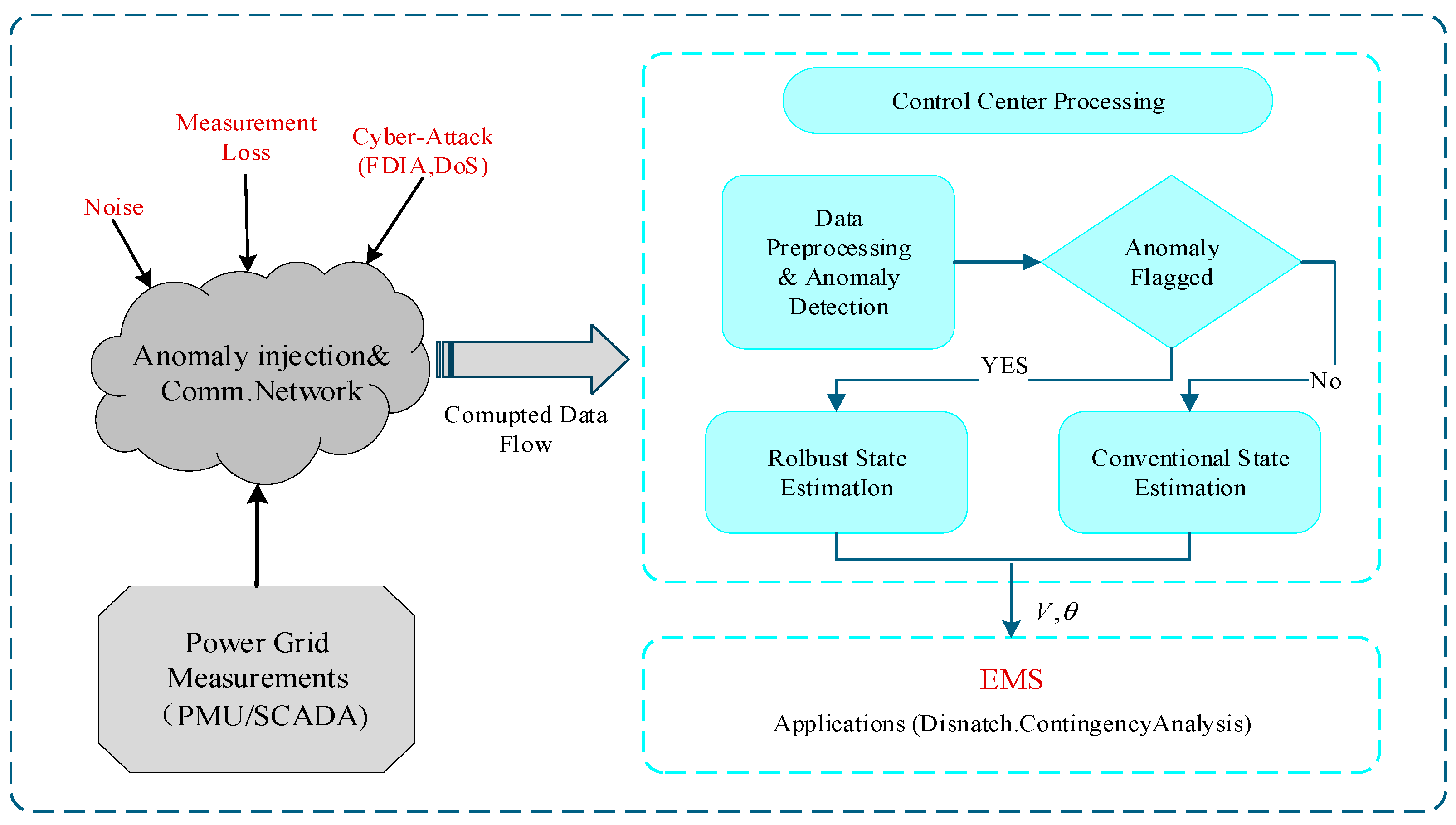
Constructing a robust, intelligent, and scalable state estimation framework is key to achieving power system security situation awareness in an abnormal measurement environment. To provide a clear overview of the interaction between data flows and processing modules, Figure 2 illustrates the general architecture of a resilient state estimation framework. Raw measurements from PMU and SCADA systems may be corrupted by complex noise, measurement loss, or malicious cyber-attacks during transmission through the communication network. At the control center, the incoming data stream first undergoes preprocessing and anomaly detection. Based on the detection results, the system dynamically selects the estimation strategy: if anomalies are flagged, a robust state estimator is activated to mitigate the impact of bad data; otherwise, a conventional estimator is used. Finally, the estimated states (e.g., voltage magnitude and angle) are transmitted to the EMS to support advanced applications such as dispatch and contingency analysis. In this chapter, state estimation methods of measurement anomalies are divided into three categories, model-driven, data-driven, and hybrid-driven, and the current research progress is systematically described.

4.1. Model-Driven State Estimation Method

Model-driven methods are based on physical models such as power flow equations, Kirchhoff’s law, and generator dynamic equations, and achieve state estimation through statistical inference. Classical methods such as WLS and KF perform well when the parameters are accurate, and the noise satisfies a Gaussian distribution. However, estimate performance decreases significantly when measurement noise is non-Gaussian, model deviation occurs, measurement loss occurs, or a malicious attack occurs. To solve this problem, researchers have made improvements from the perspectives of robust statistics, generalized error modeling, and resilient, fault-tolerant recursion. Firstly, to address non-Gaussian, heavy-tailed noise caused by sensor failures and communication interference, Generalized Correntropy was introduced into information-theoretic learning for state estimation [35,36]. Wang et al. [37] proposed an adaptive cubature Kalman filter based on generalized correntropy loss (GCL), overcoming the limitation of traditional MMSE filters that rely solely on second-order statistics. The generalized correntropy is approximately the L2 norm in the small-error region and tends to the L0 norm as the error becomes significant, naturally suppressing outliers. In [37], a maximum mutual information filter is constructed using a Cauchy kernel with stronger long-tail characteristics, thereby maintaining numerical stability in an abnormal environment caused by intense impulse noise and partial DoS attacks.
On the other hand, to address the problem that FDIA and other attacks disrupt the structure of the measurement equation, Tausiesakul et al. [25] proposed a total least squares (TLS) state estimation method based on the errors-in-variables (EIV) model against structural mismatches caused by model deviation and attacks.
In [8], a Bernoulli stochastic model was constructed to describe the data-loss process and proposed the resilient fault-tolerant EKF (RFTEKF). When the equivalent measurement is missing, the filter relies on the state prediction equation to compensate and ensure the recursive covariance matrix remains convergent. In [18], this method is extended to estimate synchronous parameters and dynamically adjusts the gain via a timestamp mechanism to improve tracking when PMU faults occur. In [38], researchers proposed the optimal two-stage Kalman Filter (OTS-KF) to address unknown attack signals. This method models the attack magnitude as an unknown input, achieving synchronous decoupling of the state and the attack vector. Consequently, it provides a new tool for attack detection and traceability. In general, the model-driven method has advantages in physical consistency and interpretability and gradually adapts to the measurement anomaly environment through robust statistics, generalized error modeling, and fault-tolerant recurrence techniques. However, this method still has limitations in highly complex nonlinear relationships and unknown topology conditions [39,40].

4.2. Data-Driven State Estimation Method

With the popularization of wide-area measurement devices such as WAMS and PMU, large-scale historical operation data provide a solid foundation for data-driven methods. These methods do not rely on precise parameters or complete topological structures. Instead, they utilize deep generative models, graph neural networks, and related techniques to learn the complex mapping between measurement values and states. Consequently, data-driven method demonstrate superior advantages in dealing with difficult-to-model abnormal environments or covert attack scenarios.
Deep generative models demonstrate unique advantages in correcting abnormal data. In [41], researcher propose a robust variational autoencoder based on Fisher–Rao probabilistic geometry. The differences between the input distribution and the latent distribution are accurately captured, thereby achieving data reconstruction through reconstruction. To address the complex, non-Euclidean spatial structure of power grids, Kundacina et al. [28] introduced graph neural networks (GNNs) into factor graph state estimation, achieving linear computational complexity, making it suitable for large-scale systems. In [42], an active strategy based on moving target defense (MTD) is proposed, which enhances the resilience of state estimation by reducing the success rate of attacks.
Data-driven methods offer significant advantages in situations such as strong nonlinearity, unknown topology, and the absence of a model. However, this strategy is highly dependent on data quality, and the lack of physical constraints may lead to estimates that deviate from actual patterns. Therefore, further integration with physical models is necessary.

4.3. Hybrid-Driven State Estimation Method

The hybrid-driven approach, which combines the physical consistency of model-driven methods with the feature extraction capability of data-driven methods, is an important direction for constructing robust state estimates.
In terms of physical constraint embedding, the physics-aware hybrid estimator (PHE) proposed by Kadri et al. [43] adopts the physics-informed neural networks (PINNs) framework and directly embeds physical constraints, such as Kirchhoff’s laws and the power flow equation, as regularizers in the loss function, enabling neural networks to learn data patterns while abiding by physical laws. This method can still maintain reliability in situations where data is scarce, noisy, or partially abnormal, significantly enhancing its generalization ability.
In multi-source heterogeneous data fusion, measurements from SCADA and PMU have different sampling rates and coverage ranges, resulting in insufficient observability of distribution networks. In reference [44], researchers utilized the sparse Bayesian model relevance vector machine (RVM) to generate load pseudo-measurements from AMI historical data. They also incorporated game theory to optimize the fusion weights for multi-source data. Consequently, this approach effectively filled the spatio-temporal blind spots in SCADA and PMU data, improving the estimation accuracy of low observability networks [45,46].
The combined use of static and dynamic estimation offers advantages against covert attacks. Researchers constructed a parallel estimation framework for static WLS and dynamic WEKF. By comparing the residuals and state deviations of the two, they constructed consistency indicators to achieve enhanced detection of FDIA. Due to the different responses of static and dynamic methods to attacks, a dynamic-static cooperative mechanism can identify circumvention attacks targeting a single estimator, thereby enhancing the overall system security [44,47,48].
Overall, the hybrid-driven approach, which integrates physical models with data patterns, is an effective way to achieve high-resilience state estimation and lays a technical foundation for future adaptive, self-explanatory state estimation systems in smart grids [49,50].

5. Discussion and Ways Forward

5.1. Discussion

The development history of power system state estimation technology reflects a response to increasingly complex measurement environments and multidimensional security threats. Consequently, the existing research system has undergone a profound evolution from single least-squares estimation to a diversified technical architecture. This architecture now encompasses model-driven, data-driven, and hybrid-driven approaches. Furthermore, remarkable theoretical breakthroughs have been achieved in addressing non-Gaussian noise, data loss, and network attacks [51,52].
Model-driven methods serve as the cornerstone of this field. Due to rigorous physical mechanisms and mature mathematical derivations, such methods retain a dominant position in ideal scenarios characterized by accurate system parameters and Gaussian noise distribution. However, actual operations frequently encounter non-Gaussian heavy-tailed noise and outlier interference. In response, the academic community has developed robust statistical methods such as generalized correntropy, Cauchy kernel, and total least squares. These innovations successfully overcome the inherent defect of the traditional mean-square-error criterion. The traditional criterion is notably sensitive to data with large deviations. As a result, the numerical stability and convergence accuracy of filters under harsh working conditions have seen significant improvement. Nevertheless, the high dependence of these methods on system topology and parameters limits efficacy in handling parameter drift or structured attacks.
In contrast, data-driven methods include deep learning and graph neural networks. These approaches possess powerful nonlinear feature-extraction capabilities. Consequently, unique advantages emerge in scenarios characterized by unknown parameters, complex topologies, or difficult-to-model covert attacks. Deep generative models allow for unsupervised detection and reconstruction of abnormal samples. By learning the manifold distribution of normal data, the scarcity of attack samples is effectively addressed.
Despite these benefits, data-driven methods often exhibit a “black box” nature. An extreme reliance on the completeness of training data results in shortcomings regarding generalization ability and physical interpretability. Therefore, hybrid-driven methods integrate physical consistency constraints with data mining capabilities. A prominent example is the PINN, which embeds physical equations into the loss function. Another strategy utilizes machine learning to generate pseudo-measurements for filling blind spots in physical models. At present, this technical route has proven effective in achieving a balance between accuracy, robustness, and interpretability.
In order to more clearly show the performance comparison of different methods, Table 1 synthetically integrates the characteristics, advantages and disadvantages of model-driven, data-driven and hybrid-driven methods, including core foundation, physical interpretability and resilience against attacks. As shown in the table, although the model-driven approach provides superior interpretability in an ideal environment, it has poor transferability under topological changes. In contrast, data-driven approaches excel in handling nonlinearities and unknown topologies but lack physical transparency. By combining physical constraints with data-driven flexibility, hybrid-driven strategies emerge as an effective path for future solutions that provide the most reliable resistance to complex attacks and robust state estimation while maintaining some interpretability.

5.2. Ways Forward

Looking forward, research on state estimation in power systems will no longer be limited to algorithmic repair but will transform towards a brand new paradigm of cyber-physical deep integration and active defense. Physics-informed AI will become the standard architecture for the next generation of state estimators. Future research will prioritize deeply embedding the topological structure, differential algebraic equations, and operational constraints of power systems into the structural design of deep learning networks. This approach aims to go beyond merely using physical information as regularization terms. Meanwhile, edge intelligence and distributed collaboration show promising prospects. These technologies address computing bottlenecks found in large-scale power grids. Currently, the deployment of metering equipment at the grid edge is increasing alongside the explosive growth of distributed energy. Consequently, the centralized processing model has become unsustainable. Future studies will focus on exploring distributed computing architectures. The primary goal is to achieve distributed collaborative local anomaly detection and state estimation across the entire network. Simultaneously, preserving data privacy within each region remains a critical requirement.
However, the translation from theoretical frameworks to industrial deployments still confronts nontrivial obstacles. For PINNs, challenges pertaining to training convergence stability and hyperparameter tuning difficulties in high-dimensional systems have yet to be fully resolved. In the domain of edge intelligence, the constrained computing resources and communication bandwidth of end devices impose stringent constraints on model complexity and inference speed. Furthermore, most evaluations in existing benchmarks are based on synthetic data generated from standard IEEE test systems, which fail to fully capture the stochastic characteristics of real-world scenarios. Future research endeavors should thus prioritize the construction of high-fidelity benchmark platforms to enable effective and comprehensive performance evaluation.

6. Conclusions

Accurate states under measurement anomalies are essential for the stable operation of smart grid. This paper systematically reviews key technologies for power system state estimation in abnormal measurement environments. It faces multiple threats such as measurement loss, complex environmental noise, and cyber-attacks. Firstly, this paper deeply analyzes the generation mechanism and influence of measurement anomalies and combines the corresponding anomaly detection and identification technologies. Then, the existing research is introduced and analyzed from three levels: model-driven, data-driven, and hybrid-driven. Finally, the paper discusses the existing methods and prospects for the future. The model-driven method has physical interpretability but is limited to complex scenes; the data-driven method has strong feature extraction but lacks interpretability. Hybrid-driven strategy can effectively balance the system’s robustness and accuracy. In the future, artificial intelligence architectures will deeply integrate physical mechanisms and edge distributed computing technology. This integration will be the key to building a highly resilient and adaptive smart grid sensing system.

Author Contributions

Conceptualization, T.L.; validation, Z.L.; formal analysis, J.Z.; investigation, Z.L. and X.X.; resources, J.L.; data curation, Z.L.; writing—original draft preparation, J.Z.; writing—review and editing, T.L., C.L. and X.X.; visualization, J.Z. and C.L.; supervision, T.L.; project administration, J.L. All authors have read and agreed to the published version of the manuscript.

Funding

This work was supported by the Joint Fund of National Natural Science Foundation of China (U2166206).

Conflicts of Interest

The authors declare no conflicts of interest.

References

  1. Simard, G. IEEE Grid Vision 2050; IEEE PES: Piscataway, NJ, USA, 2013. [Google Scholar]
  2. Faheem, M.; Shah, S.B.H.; Butt, R.A.; Raza, B.; Anwar, M.; Ashraf, M.W.; Ngadi, M.A.; Gungor, V.C. Smart grid communication and information technologies in the perspective of industry 4.0: Opportunities and challenges. Comput. Sci. Rev. 2018, 30, 1–30. [Google Scholar] [CrossRef]
  3. Cheng, G.; Lin, Y.; Abur, A.; Gómez-Expósito, A.; Wu, W. A survey of power system state estimation using multiple data sources: PMUs, SCADA, AMI, and beyond. IEEE Trans. Smart Grid 2024, 15, 1129–1151. [Google Scholar] [CrossRef]
  4. Abur, A.; Exposito, A.G. Power System State Estimation: Theory and Implementation; CRC Press: Boca Raton, FL, USA, 2004. [Google Scholar]
  5. Darmis, O.; Korres, G. A survey on hybrid SCADA/WAMS state estimation methodologies in electric power transmission systems. Energies 2023, 16, 618. [Google Scholar] [CrossRef]
  6. Bai, X.; Qin, F.; Ge, L.; Zeng, L.; Zheng, X. Dynamic state estimation for synchronous generator with communication constraints: An improved regularized particle filter approach. IEEE Trans. Sustain. Comput. 2023, 8, 222–231. [Google Scholar] [CrossRef]
  7. Kamyabi, L.; Lie, T.T.; Madanian, S.; Marshall, S. A comprehensive review of hybrid state estimation in power systems: Challenges, opportunities and prospects. Energies 2024, 17, 4806. [Google Scholar] [CrossRef]
  8. Wang, Y.; Liu, Y.; Wang, M.; Dinavahi, V.; Liang, J.; Sun, Y. Resilient dynamic state estimation for multi-machine powersystem with partial missing measurements. IEEE Trans. Power Syst. 2024, 39, 3299–3310. [Google Scholar] [CrossRef]
  9. Wang, Y.; Wang, Y.; Sun, Y.; Dinavahi, V.; Liang, J.; Wang, K. Resilient smart power grid synchronization estimation method for system resilience with partial missing measurements. CSEE J. Power Energy Syst. 2024, 10, 1307–1317. [Google Scholar] [CrossRef]
  10. Liu, Y.; Ning, P.; Reiter, M.K. False data injection attacks against state estimation in electric power grids. ACM Trans. Inf. Syst. Secur. 2011, 14, 13. [Google Scholar] [CrossRef]
  11. Musleh, A.S.; Chen, G.; Dong, Z.Y. A survey on the detection algorithms for false data injection attacks in smart grids. IEEE Trans. Smart Grid 2020, 11, 2218–2234. [Google Scholar] [CrossRef]
  12. Soleymannejad, M.; Sadrian Zadeh, D.; Moshiri, B.; Navid Sadjadi, E.; Garcia Herrero, J.; Molina López, J.M. state estimation fusion for linear microgrids over an unreliable network. Energies 2022, 15, 2288. [Google Scholar] [CrossRef]
  13. Babayomi, O.; Zhang, Z.; Li, Z.; Heldwein, M.L.; Rodriguez, J. Robust predictive control of grid-connected converters: Sensor noise suppression with parallel-cascade extended state observer. IEEE Trans. Ind. Electron. 2024, 71, 3728–3738. [Google Scholar] [CrossRef]
  14. Ran, X.; Ma, L. An Extended False Data Injection Attack via Deep Reinforcement Learning: Attack Model and Countermeasures in Cyber-Physical Power Systems. IEEE Trans. Autom. Sci. Eng. 2025, 22, 19750. [Google Scholar] [CrossRef]
  15. Chen, T.; Luo, H.; Gooi, H.B.; Foo, E.Y.S.; Sun, L.; Zeng, N. A robust state estimation method for power systems using generalized correntropy loss function. Expert Syst. Appl. 2024, 251, 123994. [Google Scholar] [CrossRef]
  16. Wang, B.-Q.; Guo, X.-G.; Wang, J.-L.; Coutinho, D.; Park, J.H. Unknown-Input-Proportional-Differential Observer-Based Event-Triggered Intrusion-Tolerant Control for Human-in-the-Loop Multi-Agent Systems Against Unconstrained Actuator and Sensor FDIAs. IEEE Trans. Autom. Sci. Eng. 2025, 22, 15701–15712. [Google Scholar] [CrossRef]
  17. Xiao, M.; Zhang, Y.; Wang, Z.; Fu, H. An adaptive three-stage extended Kalman filter for nonlinear discrete-time system in presence of unknown inputs. ISA Trans. 2018, 75, 101–117. [Google Scholar] [CrossRef]
  18. He, R.; Tian, Z.; Zuo, M. A semi-supervised GAN method for RUL prediction using failure and suspension histories. Mech. Syst. Signal Process. 2022, 168, 108657. [Google Scholar] [CrossRef]
  19. Wang, Y.; Zhang, J.; Wang, Y.; Li, Z.; Wang, K.; Liang, J. Robust estimation method for power system dynamic synchronization with sensor gain degradation. ISA Trans. 2025, 156, 123–141. [Google Scholar] [CrossRef]
  20. Zhao, J.; Mili, L.; Wang, M. A generalized false data injection attacks against power system nonlinear state estimator and countermeasures. IEEE Trans. Power Syst. 2018, 33, 4868–4877. [Google Scholar] [CrossRef]
  21. An, D.; Zhang, F.; Yang, Q.; Zhang, C. Data Integrity Attack in Dynamic State Estimation of Smart Grid: Attack Model and Countermeasures. IEEE Trans. Autom. Sci. Eng. 2022, 19, 1631–1644. [Google Scholar] [CrossRef]
  22. Higgins, M.; Xu, W.; Teng, F.; Parisini, T. Cyber-physical risk assessment for false data injection attacks considering moving target defences. Int. J. Inf. Secur. 2022, 22, 579–589. [Google Scholar] [CrossRef]
  23. Narang, J.K.; Bag, B. Physical model learning based false data injection attack on power system state estimation. Sustain. Energy Grids Netw. 2024, 40, 101524. [Google Scholar] [CrossRef]
  24. Zhang, Z.; Lu, H.; Li, B.; Ding, L. Research on Data-Driven self-diagnosis for measurement errors in capacitor voltage transformers. IEEE Trans. Instrum. Meas. 2024, 73, 3524712. [Google Scholar] [CrossRef]
  25. Tausiesakul, B.; Asavaskulkiet, K.; Jeraputra, C.; Leevongwat, I.; Singhavilai, T.; Tiptipakorn, S. State Estimation in Power Systems Under False Data Injection Attack Using Total Least Squares. IEEE Access 2025, 13, 1089–1102. [Google Scholar]
  26. Costilla-Enriquez, N.; Weng, Y. Attack Power System State Estimation by Implicitly Learning the Underlying Models. IEEE Trans. Smart Grid 2023, 14, 649–662. [Google Scholar] [CrossRef]
  27. Zhang, X.; Yan, W.; Li, H. False data injection attacks detection and state restoration based on power system interval dynamic state estimation. Comput. Electr. Eng. 2024, 118, 109347. [Google Scholar] [CrossRef]
  28. Khaledian, E.; Pandey, S.; Kundu, P.; Srivastava, A.K. Real-Time Synchrophasor data anomaly detection and classification using isolation forest, kmeans, and loop. IEEE Trans. Smart Grid 2021, 12, 2378–2388. [Google Scholar]
  29. Mohammadpourfard, M.; Xiao, C.; Weng, Y. Performance Guaranteed Deep learning for detection of cyber-attacks in dynamic smart grids. IEEE Trans. Power Syst. 2025, 40, 4608–4621. [Google Scholar] [CrossRef]
  30. Raghuvamsi, Y.; Teeparthi, K. detection and reconstruction of measurements against false data injection and dos attacks in distribution system state estimation: A deep learning approach. Measurement 2023, 210, 112565. [Google Scholar] [CrossRef]
  31. Li, Q.; Song, D.; Wang, Y.; Wang, D.; Tao, W.; Ai, Q. Defense Strategy Against False Data Injection Attacks on Cyber-Physical System for Vehicle-Grid Based on KNN-GAE. Energies 2025, 18, 5215. [Google Scholar]
  32. Hu, P.; Gao, W.; Li, Y.; Hua, F.; Qiao, L.; Zhang, G. Detection of false data injection attacks in smart grid based on joint dynamic and static state estimation. IEEE Access 2023, 11, 45028–45038. [Google Scholar] [CrossRef]
  33. Chen, C.; Wang, Y.; Cui, M.; Zhao, J.; Bi, W.; Chen, Y. Data-Driven detection of stealthy false data injection attack against power system state estimation. IEEE Trans. Ind. Inform. 2022, 18, 8467–8477. [Google Scholar] [CrossRef]
  34. Shahid, M.A.; Ahmad, F.; Albogamy, F.R.; Hateez, G.; Ullah, Z. Detection and prevention of false data injection attacks in the measurement infrastructure of smart grids. Sustainability 2022, 14, 6407. [Google Scholar] [CrossRef]
  35. Xu, Y.; Wang, W.; Liu, Y.; Meng, X.; Chen, Y.; Liu, Z. An intelligent optimization-based secure filter design for state estimation of power systems with multiple disturbances. Electronics 2025, 14, 3059. [Google Scholar] [CrossRef]
  36. Shen, H.; Wen, G.; Lv, Y.; Zhou, J. A stochastic event-triggered robust unscented kalman filter-based usv parameter estimation. IEEE Trans. Ind. Electron. 2024, 71, 11272–11282. [Google Scholar]
  37. Wang, Y.; Yang, Z.; Wang, Y.; Li, Z.; Dinavahi, V.; Liang, J. Resilient dynamic state estimation for power system using cauchy-kernel-based maximum correntropy cubature kalman filter. IEEE Trans. Instrum. Meas. 2023, 72, 9002011. [Google Scholar]
  38. Tummala, A.S.L.V.; Inapakurthi, R.K. A Two-stage kalman filter for cyber-attack detection in automatic generation control system. J. Mod. Power Syst. Clean Energy 2022, 10, 50–60. [Google Scholar] [CrossRef]
  39. Vafamand, N.; Razavi-Far, R.; Arefi, M.M.; Saif, M. Fuzzy EKF-based intrusion detection and accurate state estimation of interconnected dc mgs with CPLs. IEEE Trans. Power Syst. 2023, 38, 5245–5256. [Google Scholar] [CrossRef]
  40. Zhang, J.; Welch, G.; Bishop, G.; Huang, Z. A two-stage kalman filter approach for robust and real-time power system state estimation. IEEE Trans. Sustain. Energy 2014, 5, 629–636. [Google Scholar] [CrossRef]
  41. Picot, M.; Messina, F.J.; Labeau, F.; Piantanida, P. Robust Autoencoder-based State Estimation in Power Systems. In Proceedings of the 2022 IEEE Power & Energy Society Innovative Smart Grid Technologies Conference (ISGT), New Orleans, LA, USA, 24–28 April 2022. [Google Scholar]
  42. Chen, Y.; Lakshminarayana, S.; Poor, H.V. Moving target defense against adversarial false data injection attacks in power grids. IEEE Internet Things J. 2025, 12, 26315–26328. [Google Scholar] [CrossRef]
  43. KKadri, B.; Sliman, L.; Alsaedi, A.; Abdella, J.; Farah, Z. Physics-Aware hybrid estimator for dynamic power system dataset generation and cyber attack simulation. IEEE Access 2025, 13, 146830–146854. [Google Scholar] [CrossRef]
  44. Dehghanpour, K.; Yuan, Y.; Wang, Z.; Bu, F. A game-theoretic data-driven approach for pseudo-measurement generation in distribution system state estimation. IEEE Trans. Smart Grid 2019, 10, 5942–5951. [Google Scholar] [CrossRef]
  45. Abukhouha, E.; Feroz, S.S.; Afroz, S.; Alsaed, F.; Qwbaiban, A.; Meliopoulos, A.P.S. Centralized dynamic state estimation algorithm for detecting and distinguishing faults and cyber attacks in power systems. In Proceedings of the 2025 IEEE Power & Energy Society General Meeting (PESGM), Austin, TX, USA, 27–31 July 2025. [Google Scholar]
  46. Katanic, M.; Lygeros, J.; Hug, G. Bad-Data-resilient dynamic state estimation for power systems with partially known models. In Proceedings of the 2023 IEEE PES Innovative Smart Grid Technologies Asia (ISGT Asia), Auckland, New Zealand, 21–24 November 2023. [Google Scholar]
  47. Kundacina, O.; Cosovic, M.; Miskovic, D.; Vukobratovic, D. Graph neural networks on factor graphs for robust, fast, and scalable linear state estimation with PMUs. Sustain. Energy Grids Netw. 2023, 34, 101056. [Google Scholar]
  48. Wang, Y.; Yang, Z.; Wang, Y.; Dinavahi, V.; Liang, J.; Wang, K. Robust Dynamic State Estimation for Power System Based on Adaptive Cubature Kalman Filter With Generalized Correntropy Loss. IEEE Trans. Instrum. Meas. 2022, 71, 9003811. [Google Scholar] [CrossRef]
  49. Asefi, S.; Mitrovic, M.; Ćetenović, D.; Levi, V.; Gryazina, E.; Terzija, V. Anomaly detection and classification in power system state estimation: Combining model-based and data-driven methods. Sustain. Energy Grids Netw. 2023, 35, 101116. [Google Scholar]
  50. Sun, H.; Zhang, X.; Liu, X.; Su, H. Adaptive robust sensorless control for pmsm based on improved back emf observer and extended state observer. IEEE Trans. Ind. Electron. 2024, 71, 16635–16645. [Google Scholar] [CrossRef]
  51. Hou, D.; Sun, Y.; Dinavahi, V.; Wang, Y. Adaptive two-stage unscented kalman filter for dynamic state estimation of synchronous generator under cyber attacks against measurements. J. Mod. Power Syst. Clean Energy 2024, 12, 1408–1419. [Google Scholar] [CrossRef]
  52. Riahinia, S.; Ameli, A.; Ghafouri, M.; Yassine, A. An adaptive penalized weighted least squared approach for detecting and mitigating cyberattacks on dynamic state estimation. IEEE Trans. Instrum. Meas. 2025, 74, 9000115. [Google Scholar]
Figure 1. Classification of measurement anomalies.
Energies 19 00632 g001
Figure 2. Resilient state estimation architecture for power systems under measurement anomalies.
Energies 19 00632 g002
Table 1. Comparison of characteristics and performance of different estimation methods.
Model-DrivenData-DrivenHybrid-Driven
Core FoundationsPhysical model (governing equations, fundamental constants)Large-scale historical data, neural networksPhysical model + data-driven model
Physical InterpretabilityHigh (full physical interpretability)Low (low physical interpretability)Medium/High (incorporates physical constraints)
Correspondence with Parameter TruthHigh (high precision in calibration and parameter estimation)Low (no need for calibration or parameter estimation)Medium (uses physical equations as constraints)
Dependency on Data VolumeInsensitive (resistant to noise in measurement values)Sensitive (requires complete training data)Medium (applicable even with limited data)
Capability Against Attacks and AbnormalitiesWeak (vulnerable to structural tampering or anomalies)Strong (resilient to long-term attacks and anomalies)Strongest (comprehensive defense; resists tampering)
Applicable ScenariosIdeal environments with accurate parameters and conforming noise distributionComplex environments with missing data, nonlinearity and intractable modelingComplex environments requiring robustness, precision and interpretability
Disclaimer/Publisher’s Note: The statements, opinions and data contained in all publications are solely those of the individual author(s) and contributor(s) and not of MDPI and/or the editor(s). MDPI and/or the editor(s) disclaim responsibility for any injury to people or property resulting from any ideas, methods, instructions or products referred to in the content.