Article

Numerical Study of Combustion in a Methane–Hydrogen Co-Fired W-Shaped Radiant Tube Burner
1
Department of Mechanical Engineering, Keimyung University, 1095 Dalgubeol-daero, Dalseo-gu, Daegu 42601, Republic of Korea
2
Technical Research Group, PLANTEC, 61, Daesong-ro 83beon-gil, Nam-gu, Pohang, Gyeongbuk 37866, Republic of Korea
*
Author to whom correspondence should be addressed.
Energies 2026, 19(2), 557; https://doi.org/10.3390/en19020557 (registering DOI)
Submission received: 16 December 2025 / Revised: 15 January 2026 / Accepted: 17 January 2026 / Published: 22 January 2026

Abstract

Three-dimensional computational fluid dynamics (CFD) simulation was performed using the eddy-dissipation concept coupled with detailed hydrogen oxidation kinetics and a reduced two-step methane mechanism for a newly proposed W-shaped radiant tube burner (RTB). The effects of the hydrogen volume fraction (0–100%) and excess air ratio (0%, 10%, 20%) on the flame morphology, temperature distribution, and NOX emissions are systematically analyzed. The results deliver three main points. First, a flame-shape transformation was identified in which the near-injector flame changes from a triangular attached mode to a splitting mode as the mixture reactivity increases with the transition occurring at a characteristic laminar flame speed window of about 0.33 to 0.36 m/s. Second, NOX shows non-monotonic behavior with dilution, and 10% excess air can produce higher NOX than 0% or 20% because OH radical enhancement locally promotes thermal NO pathways despite partial cooling. Third, a multi-parameter coupling strategy was established showing that hydrogen enrichment raises the maximum gas temperature by roughly 100 to 200 K from 0% to 100% H2, while higher excess air improves axial temperature uniformity and can suppress NOX if over-dilution is avoided. These findings provide a quantitative operating map for balancing stability, uniform heating, and NOX–CO trade-offs in hydrogen-enriched industrial RTBs.

1. Introduction

Radiant tube burners (RTBs) are widely used as indirect heating systems in industrial heat treatment and reheating furnaces, where combustion products must remain isolated from the workpiece to avoid oxidation, decarburization, and contamination of processed materials [1,2,3]. In these systems, thermal energy is transferred predominantly through radiation from the externally heated tube walls, enabling uniform temperature fields and controllable heat flux distributions that are essential for product quality, dimensional stability, and metallurgical consistency in continuous thermal processing lines. RTB technologies encompass a variety of tube geometries [4] including straight [2], U-shaped [5,6], W-shaped [7,8], and double-P [1] designs, and it can incorporate recuperative or regenerative heat recovery configurations to enhance efficiency. W-shaped RTBs have been widely utilized in steel reheating furnaces, for example continuous annealing lines for high-strength steel production [9], because they provide an extended combustion path within a compact footprint, achieving 15–20% better temperature uniformity than straight tubes [7]. Recent developments in advanced combustion strategies, including moderate and intense low oxygen dilution combustion regimes [5,10] and porous media burners [11], have further demonstrated potential for reducing wall-temperature nonuniformity and suppressing pollutant formation in RTB applications [4].
RTBs, however, present a complex coupled transport problem involving turbulent mixing, finite-rate chemistry, radiative heat transfer with the surrounding media, and conjugate heat transfer through the tube wall. The enclosed geometry and harsh thermal environment make intrusive measurements of in-tube temperature, velocity, species concentrations, and heat flux extremely difficult. As a result, computational fluid dynamics (CFD) has become a primary design and diagnostic tool for RTB development [1,2,3,6,10,12,13]. Prior studies emphasize that an accurate prediction of flame position [2,6,8,10], heat-release distribution [6], wall-heat flux [13], and pollutant formation [13,14] depends critically on the selection and calibration of turbulence–chemistry interaction models and chemistry mechanisms. Eddy-dissipation [2,8,12] and eddy-dissipation-concept (EDC) models [6,10], flamelet-generated manifolds [10], and detailed [10] or reduced reaction mechanisms [2,6,10,12] each provide different trade-offs between fidelity and computational cost.
With the global industrial sector increasingly pressured to reduce carbon emissions and pollutant outputs, hydrogen co-firing has gained significant attention as a near-term strategy for decarbonizing high-temperature process heating [15,16]. Blending hydrogen with hydrocarbon fuel reduces direct CO2 emissions per unit thermal input while leveraging hydrogen’s high reactivity to extend lean flammability limits and promote stable operation at lower equivalence ratios [13,17,18]. However, hydrogen enrichment introduces major changes in combustion behavior. The laminar flame speed rises sharply with hydrogen fraction [17,18], and the adiabatic flame temperature increases for a given global equivalence ratio [17,19]. These changes alter the chemical timescale, flame topology, temperature stabilization length, and residence time at high temperature, thereby influencing NOX formation [19,20], and therefore they require the control of excess-air conditions to address the resulting NOX production characteristics [20,21]. In industrial burners, especially highly confined RTBs with long and narrow geometries, hydrogen addition can therefore either improve temperature uniformity and efficiency or exacerbate peak thermal loads and NOX emissions, depending on mixing, aerodynamics, and excess-air levels. These sensitivities motivate the systematic mapping of the operating envelope defined by hydrogen fraction and an excess-air ratio in order to identify practical regimes that balance efficiency, uniformity, and emissions compliance.
Although hydrogen-enriched natural gas combustion has been investigated in conventional burners, boilers, and simplified duct geometries, further research is needed to elucidate the coupled turbulent flow and chemical kinetic interactions that arise specifically in radiant tube configurations, particularly when the burner geometry is newly developed or the fuel mixing ratios are modified. In such systems, the combined influence of hydrogen fraction and excess-air level on (i) near-injector flame morphology, (ii) axial temperature development and its stabilization length, and (iii) NOX formation within the confined tube must be systematically characterized. These behaviors are especially critical because an RTB operates as an extended, radiating duct in which the flame anchoring location and early mixing-reaction dynamics govern the downstream temperature uniformity, wall heat-flux distribution, and pollutant generation. A predictive understanding of these interactions is therefore essential for developing next-generation RTBs that maintain stable operation, achieve uniform heating, and comply with increasingly stringent emissions constraints under hydrogen co-firing conditions.
Despite extensive research on hydrogen co-firing, studies that systematically examine interactions among key operating variables in industrial burners remain limited. In particular, many prior investigations consider only a narrow range of hydrogen enrichment [22,23], and few evaluate the coupled effects of hydrogen fraction and excess-air level through a broad, well-structured parametric framework. As a result, the combined influence of hydrogen enrichment and excess air on flame morphology, temperature uniformity, and emissions has not been fully characterized. However, the efficient and environmentally compliant operation of industrial burners requires a detailed understanding of how these variables interact and collectively determine combustion behavior and pollutant formation.
In the present study, a three-dimensional CFD analysis was performed to investigate methane–hydrogen co-firing in an initially proposed configuration of a W-type RTB intended for operation with LNG–hydrogen blended fuel. For simplicity, and to isolate the effects of hydrogen enrichment, LNG which consists predominantly of methane was represented as pure methane with an equivalent calorific value. The fuel composition was varied systematically from 0% to 100% H2 by volume, and three excess-air levels (0%, 10%, 20%) were examined to represent stoichiometric, moderately lean, and strongly lean conditions. Combustion was modeled using the EDC coupled with detailed hydrogen oxidation chemistry and a validated reduced methane mechanism. The simulation resolved key flow and combustion features including the near-injector flame stabilization, transitions between triangular and splitting flame structures, cross-sectional temperature evolution, maximum temperature and its stabilization length required to reach 90% of the maximum temperature as well as thermal NO formation via the extended Zeldovich mechanism.
The objectives of this work are threefold. First, the study aims to elucidate how hydrogen enrichment modifies flame anchoring and flame-sheet morphology through its influence on laminar flame speed. Second, it seeks to quantify how these changes affect axial and cross-sectional temperature distributions, including the peak temperature and stabilization length, which in turn govern heat-flux uniformity along the radiant tube. Finally, the study analyzes the competing temperature-driven and radical-chemistry-driven pathways that control NOX formation under varying hydrogen and excess-air levels.

2. Numerical Methodologies

2.1. CFD Models

A three-dimensional, steady-state flow was simulated to analyze the combustion characteristics of methane–hydrogen mixed fuel in a W-shaped radiant tube burner (RTB). The CFD simulations were performed using ANSYS Fluent 2024R1 [24]. The governing equations for the mass, momentum, energy, and chemical species transport were solved with the Semi-Implicit Method for Pressure-Linked Equations algorithm for pressure–velocity coupling and second-order upwind schemes for spatial discretization.
The governing equations for the fluid flow and combustion process are as follows.
Continuity Equation:
( ρ u i ) x i = 0
where ρ is the density (kg/m3) and u i represents the velocity component (m/s) in the i -th direction.
Momentum Equation:
( ρ u i u j ) x j = p x i + x j [ μ ( u i x j + u j x i 2 3 δ i j u k x k ) ] + x j ( ρ u i u j ¯ )
where p is the static pressure (N/m2), μ is the dynamic viscosity (N·s/m2), and δ i j is the Kronecker delta. The k–ω SST (Shear Stress Transport) model was adopted to predict the turbulent transport term ( ρ u i u j ¯ ) accurately near the burner wall and in high-shear regions of the flame zone. The model solves transport equations for turbulence kinetic energy k and specific dissipation rate ω, using a blending function to combine the near-wall k–ω model with the outer-region k–ε model. This approach ensures the stability and accurate prediction of the separation and recirculation phenomena typical in a radiant tube burner.
Energy Equation:
( ρ u j h ) x j = x j [ k e f f T x j ] + S h
where h is the specific enthalpy (J/kg), T is the temperature (K), k e f f is the effective thermal conductivity (W/(m·K)), and S h is the volumetric heat source term due to chemical reactions (W/m3).
Species Transport Equation:
( ρ u j Y α ) x j = x j ( ρ D α , e f f Y α x j ) + R α
where Y α is the mass fraction of species α , D α , e f f is the effective diffusion coefficient (m2/s), and R α represents the net production rate of species α due to chemical reactions (s−1).
Combustion was modeled using the EDC, which couples turbulent mixing with detailed chemical kinetics to represent finite-rate chemistry within small turbulent structures. In the EDC framework of Magnussen [25], the chemical reactions are assumed to occur within fine turbulent scales called ‘fine structures’, whose characteristic residence time τ (s) and length fraction of the fine scales ξ are related to the local turbulence quantities as below:
τ = C τ ( ν ε ) 1 / 2
ξ = C ξ ( ν ε k 2 ) 1 / 4
where ν is the kinematic viscosity (m2/s), ε is the dissipation rate (J/(kg·s)), and C τ and C ξ are empirical constants typically 0.408 and 2.137, respectively [24]. The net reaction rate for species α within the fine structures R α (kg/(m3·s)) is expressed as follows:
R α = ρ ( ξ ) 2 τ [ 1 ( ξ ) 3 ] ( Y α Y α )
where Y α is the species mass fraction in the fine structures after chemical reaction, and Y α is the bulk mass fraction.
Based on a comparative analysis between the GRI (Gas Research Institute) 3.0 detailed mechanism and a two-step reduced mechanism [26,27], the two-step scheme was adopted for evaluating local reaction rates of methane (CH4) oxidation. As discussed in Section 3.1, the reduced mechanism reproduced the essential flame temperature trends and overall reaction behavior while requiring substantially lower computational cost. For hydrogen (H2) oxidation, however, a detailed H2 oxidation mechanism was employed to maintain kinetic fidelity under high reactivity conditions [28]. The in situ adaptive tabulation (ISAT) algorithm was implemented to accelerate the chemistry integration, reducing computational time while maintaining accuracy in multi-species reaction kinetics [29].
Thermal NOX formation was predicted using the Zeldovich mechanism [30], which is dominant at high flame temperatures. The model considers three elementary reactions.
O + N2 ↔ NO + N
N + O2 ↔ NO + O
N + OH ↔ NO + H
The rate of NO formation was evaluated using the rate constants implemented in the Ansys Fluent thermal NOX model [24]. The formation rate depends primarily on the local temperature and oxygen concentration with reaction rates exponentially increasing above 1800 K. Prompt and fuel NOX were neglected, since the fuel did not contain nitrogen-bearing species. All NOX concentrations reported in this study are expressed on a dry volumetric basis without O2 correction.
At the fuel inlet, a uniform velocity profile normal to the boundary was imposed with the velocity magnitude determined from a total energy input of 100,000 kcal/h. The inlet temperature was fixed at 300 K, and the turbulence intensity was set to 5%. The fuel composition was varied for systematically from 0% (pure methane) to 100% (pure hydrogen) by volume. At the air inlet, a uniform velocity normal to the inlet boundary was also specified. The air mass flow rate was determined from the excess air ratio set to 0%, 10%, and 20% relative to the stoichiometric air–fuel ratio while maintaining an inlet temperature of 300 K and a turbulence intensity of 5%. Table 1 summarizes the simulation conditions used in this study. A pressure-outlet boundary condition was applied at the outlet, allowing fully developed flow and combustion products to exit the computational domain. All wall surfaces were treated with a no-slip condition for velocity. A mixed thermal boundary condition was applied, combining convective and radiative heat transfer to the external environment. The convective heat transfer coefficient was set to 1 W/m2·K, the surface emissivity was set to 0.85, and the external free-stream temperature was set to 1223 K. These values are consistent with those commonly adopted in previous radiant tube burner studies [1,8,10,13].

2.2. Geometry Modeling for Radiant Tube Burner

The radiation tube is a W-shaped curved tube structure as shown in Figure 1. The computational domain included the burner nozzle, mixing section, and radiating tube. There is a total of five fuel injectors, consisting of four radial injectors arranged perpendicular to each other in an X shape along the circumference and one injector arranged on the central axis. The inner diameter of the radiator combustor tube is 177 mm, and the total distance from the fuel injection point to the tube outlet is 8643 mm based on the center line. The computational domain of the RTB was meshed with an unstructured polyhedral grid. Grid independence was assessed by increasing the total number of cells from approximately 3.4 million to 7.6 million. Particular attention was paid to the temperature field because accurate temperature prediction is essential for reliable NOX estimation. The mass-weighted temperature profiles across the transverse cross-section of the first straight section (Pipe 1) showed negligible mesh sensitivity once the mesh resolution exceeded approximately 5.0 million cells. Consistently, for meshes finer than 5.0 million cells, the error in the temperature stabilization length—evaluated from the axial temperature profile defined in Section 3.3—decreased to below 1%. Nevertheless, because subtle variations in flame morphology and near-injector flow structures may not be fully reflected by cross-sectional temperature statistics alone, the 7.6 million cell mesh was selected for all subsequent simulations performed in ANSYS Fluent (2024 R1) [24].

3. Results and Discussion

3.1. Selection of CH4 Reaction Mechanism

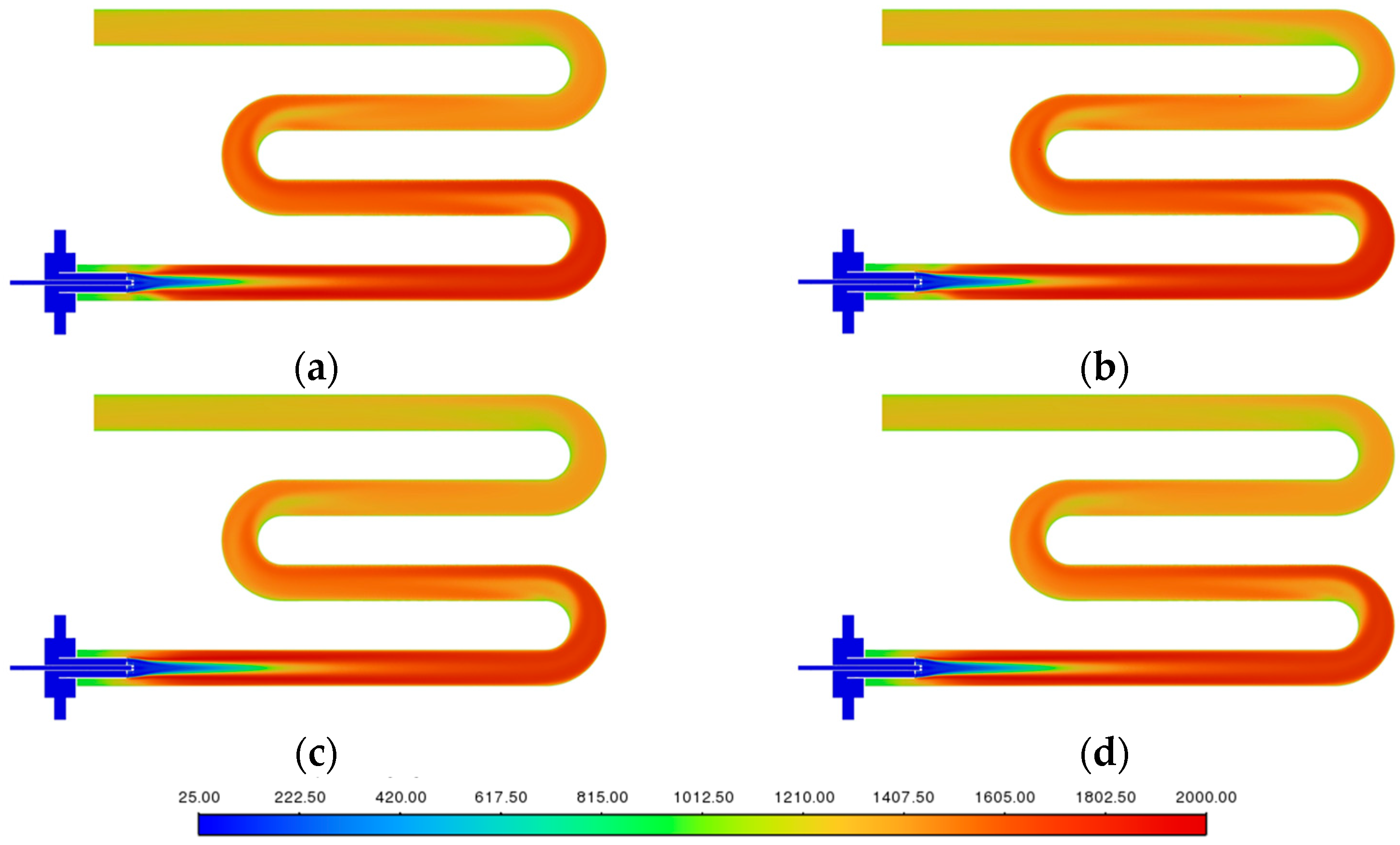
To assess the applicability of the reduced two-step mechanism for methane combustion, additional verification simulations were performed using the detailed GRI 3.0 mechanism under two conditions: pure methane case (0% H2) and a slightly hydrogen-enriched case (10% H2). Figure 2 compares the static temperature distributions for the two mechanisms in the RTB. The overall flame structure and temperature field show good qualitative agreement, but quantitative differences are observed. The GRI 3.0 mechanism predicts slightly lower peak temperatures, approximately 1930 °C for pure methane and 1890 °C for 10% H2, compared with the two-step mechanism, which yields about 1990 °C and 1904 °C for the same conditions. However, the high-temperature region obtained with GRI 3.0 is more spatially extended along the RTB, indicating a broader but less intense reaction zone. This difference originates from the detailed reaction kinetics in GRI 3.0, which resolve intermediate radical pools (e.g., CH, OH, O) and redistribute heat release over a longer axial region, whereas the two-step model concentrates combustion near the burner exit. The broader flame zone predicted by GRI 3.0 indicates slower chemical heat release and enhanced post-flame oxidation of CO and unburned hydrocarbons. Although the global maximum temperature is slightly reduced, the increased residence time of hot gases sustains a wider region above 1700 °C, which is critical for thermal NO formation.
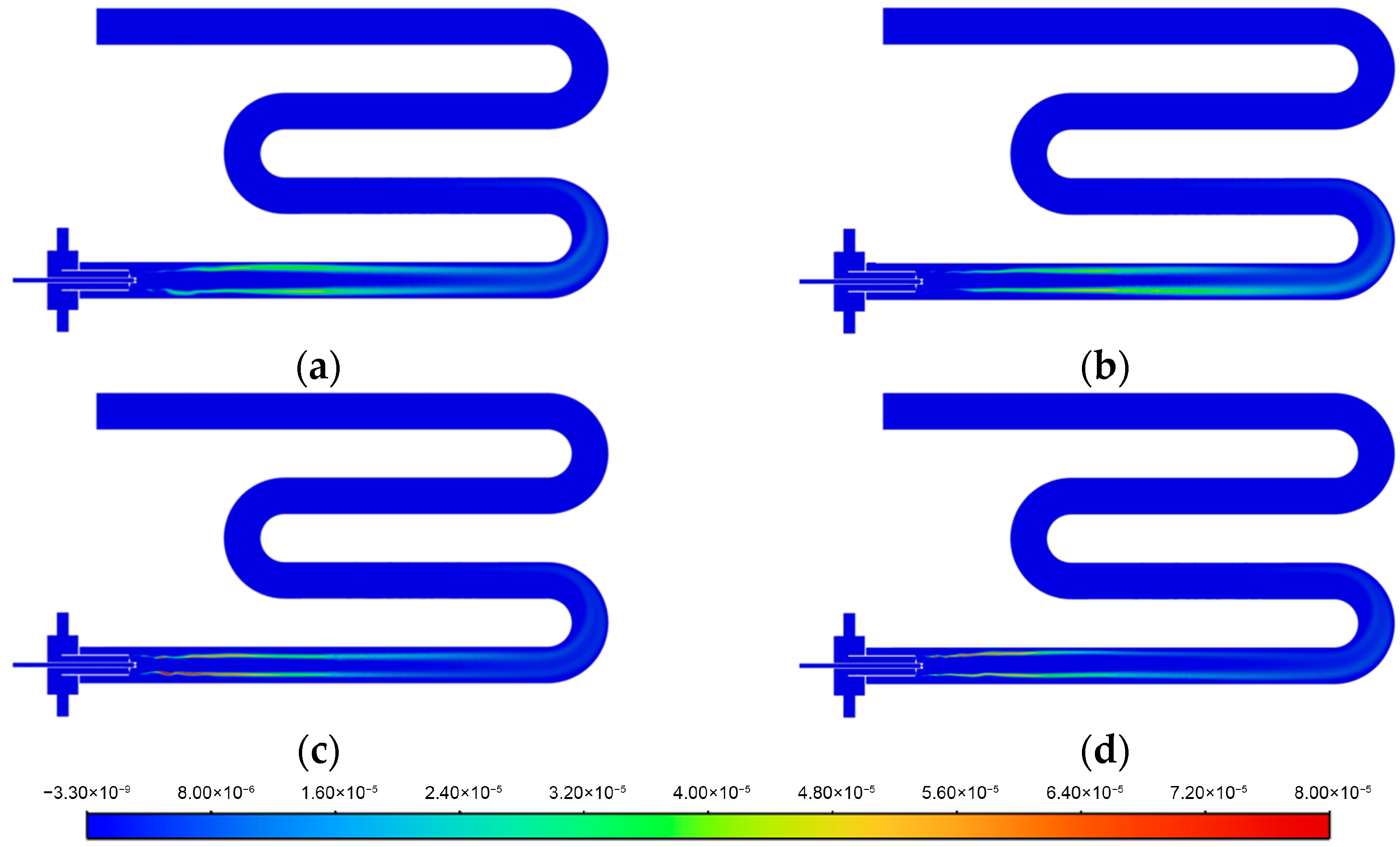
The distribution of the thermal NO generation rate is shown in Figure 3. Consistent with the corresponding temperature fields, the detailed GRI 3.0 mechanism predicts NO formation over a broader region of the RTB, whereas the two-step reduced mechanism confines NO production to a more localized primary combustion zone. Quantitatively, the outlet NO concentration is substantially lower when the two-step mechanism is applied. For pure methane (0% H2), NO decreases by approximately 36% from 376 ppm (GRI 3.0) to 239 ppm (two-step), and under a 10% H2 condition, it decreases by about 22% from 346 ppm (GRI 3.0) to 270 ppm (two-step). This reduction directly reflects the smaller integrated volume of high-temperature gas predicted by the reduced mechanism as well as its inherently limited prediction of O, H, and OH radicals that drive the extended Zeldovich thermal NO pathway. Because the two-step mechanism tracks only stable species (CH4, O2, CO, CO2, and H2O) without resolving intermediate radicals, it systematically underpredicts thermal NO formation compared with detailed chemistry. Under H2-enriched conditions, however, the associated detailed mechanism for hydrogen oxidation becomes active, partially reconstructing the radical pool required for NO formation. Consequently, the relative NOX reduction achieved by the two-step mechanism is smaller for the 10% H2 case than for pure methane, reflecting this partial recovery of O/H/OH radicals through the detailed mechanism for hydrogen reaction.
Despite its underprediction of absolute NOX levels, the simplified two-step reaction mechanism reproduces the essential combustion characteristics such as flame shape, temperature distribution, and qualitative NOX distribution while achieving more than a twelve-fold reduction in computation time relative to the detailed GRI 3.0 mechanism. Therefore, for parametric studies or preliminary burner design screening, the reduced mechanism provides an attractive balance between accuracy and efficiency. Nevertheless, when precise NOX quantification or detailed species resolution is required, comprehensive mechanisms such as GRI 3.0 remain indispensable. In the present work, the two-step mechanism was therefore adopted for the extensive parametric studies, while GRI 3.0 was used selectively for the validation of key thermochemical behaviors. Although the two-step scheme ‘qualitatively’ captures global combustion features, its inherent simplifications introduce a localized upstream heat-release bias near the fuel injector and lead to a systematic underprediction of thermal NO by ‘more than 30%’ relative to the GRI 3.0 mechanism, which is primarily because radical chemistry is treated in a highly reduced manner. Therefore, accurate absolute NOX predictions generally require a detailed chemical mechanism.

3.2. Flame Shape near the Injector

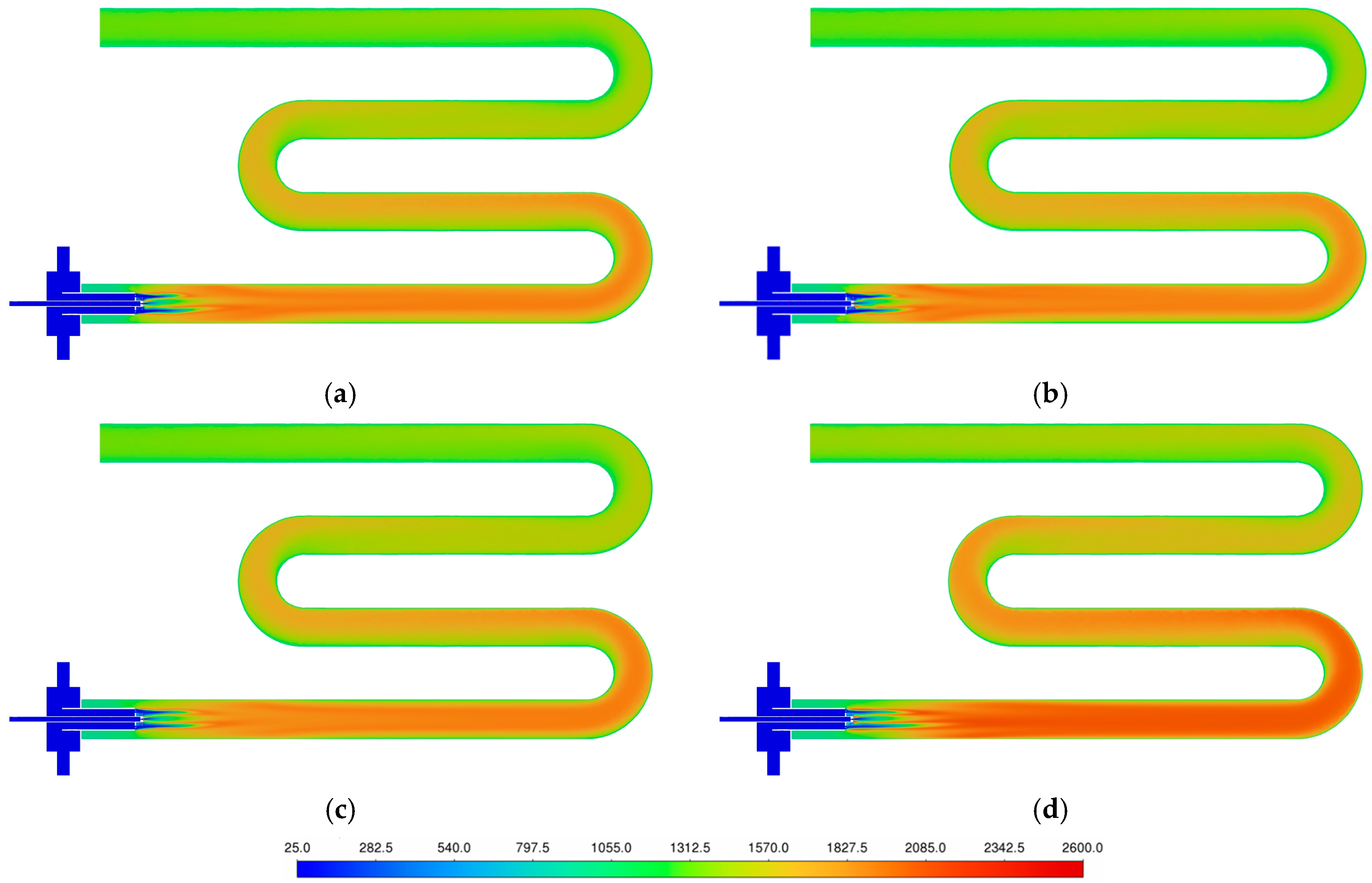
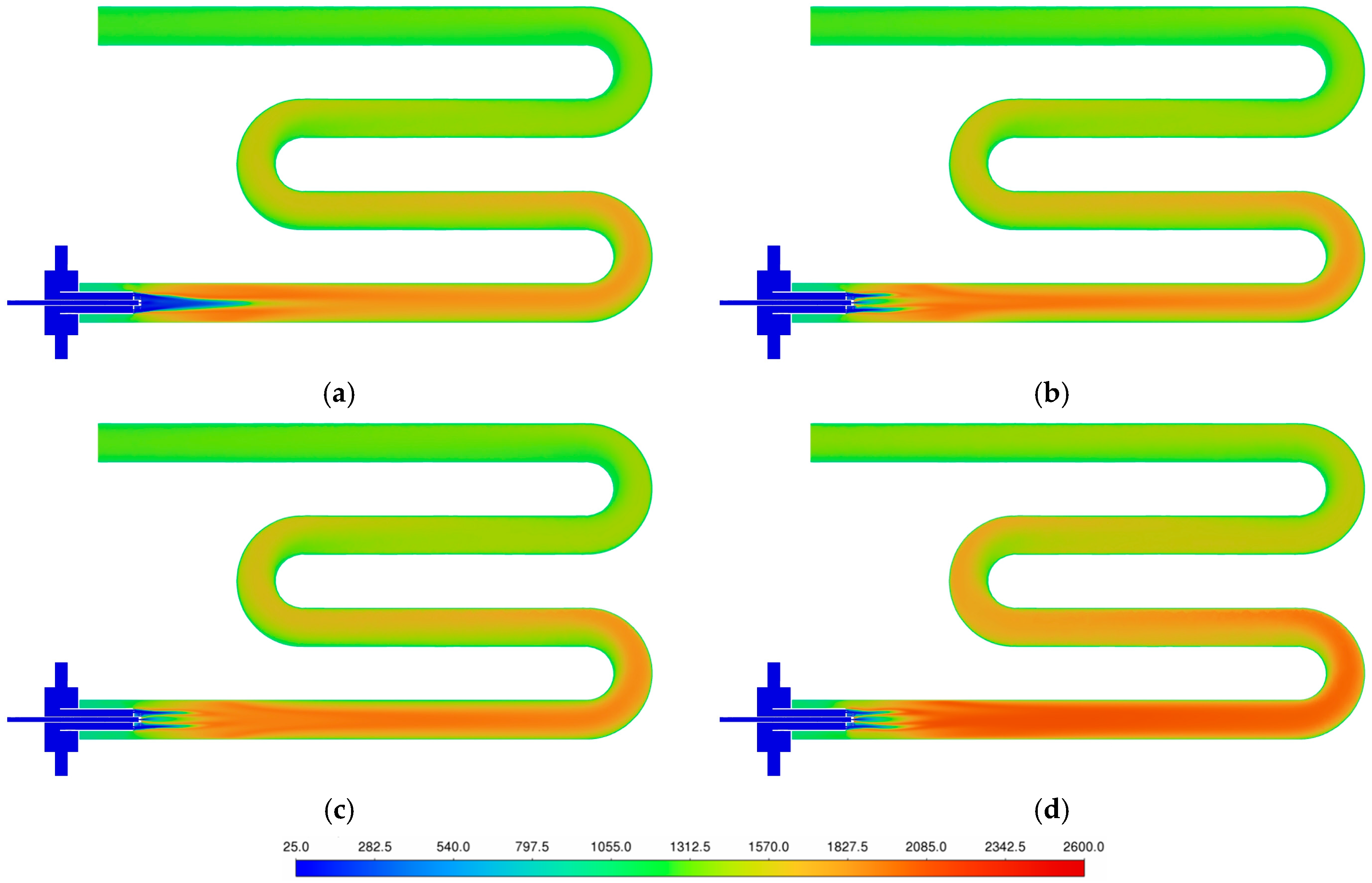
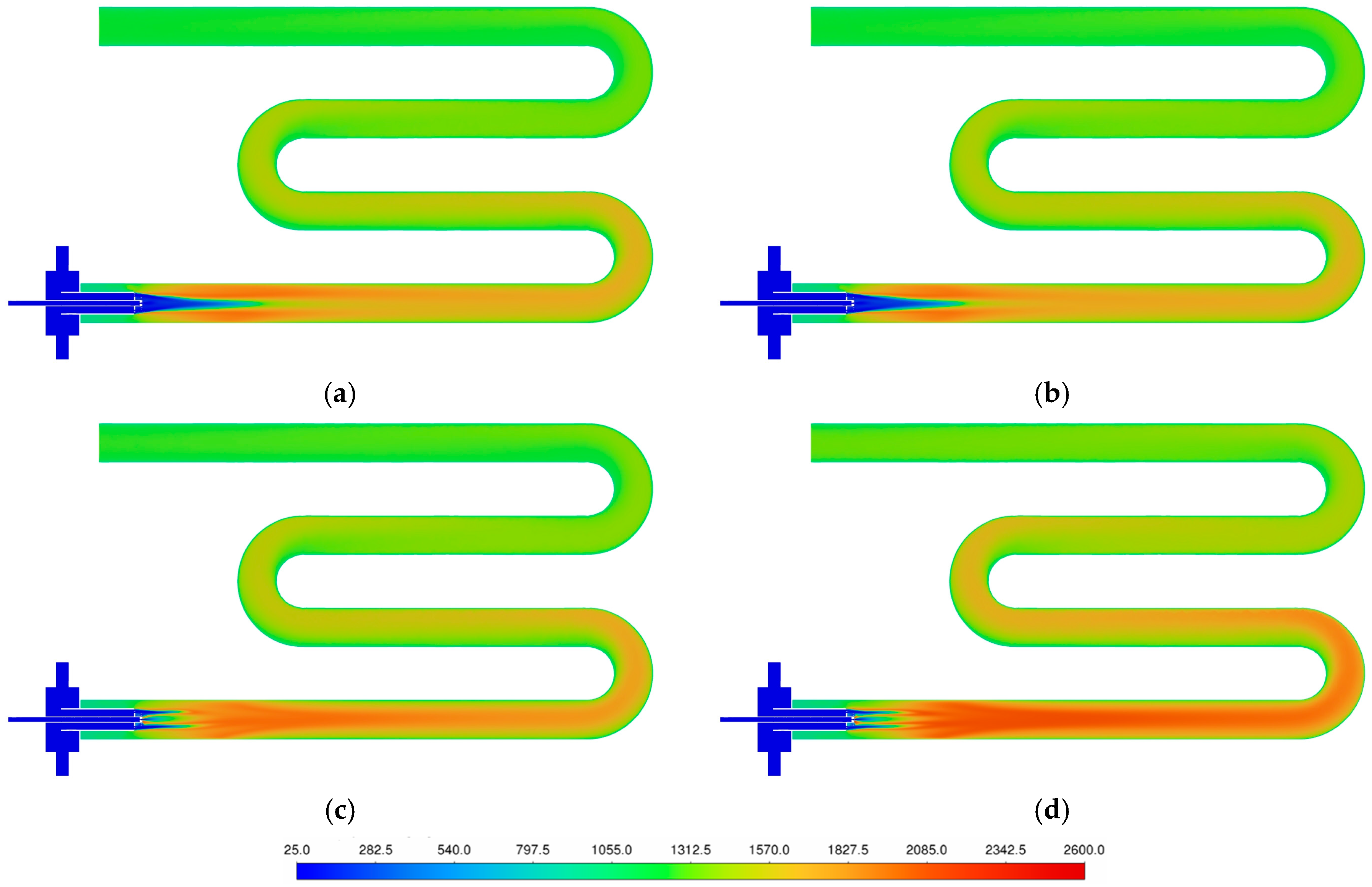
Figure 4, Figure 5 and Figure 6 illustrate the temperature distribution of the longitudinal cross-section at the center within the radiant tube burner for different methane–hydrogen fuel blending ratios, respectively, for 0% (stoichiometric), 10% and 20% excess air conditions. Under stoichiometric conditions in Figure 4, increasing the hydrogen volume ratio raises the peak temperature along the burner. Conversely, the introduction of excess air (10% and 20%) reduces the peak flame temperature and promotes a more evenly distributed temperature profile upstream and downstream of the RTB. These trends highlight the dual effect of hydrogen enrichment, which improves combustion reactivity while simultaneously increasing thermal gradients, and the moderating role of excess air in controlling the thermal load and uniformity inside the RTB.
Closer inspection of the injector region reveals distinct variations in flame shape with hydrogen enrichment and excess air ratio. At 10% excess air with H2 ≤ 10% and 20% excess air with H2 ≤ 30%, the flame front forms a triangular pattern, which is anchored near the fuel injector with a gradual expansion downstream. However, as the hydrogen content increases, the flame shape transitions into a splitting structure, which is characterized by two diverging high-temperature branches. This splitting pattern can be attributed to the faster flame propagation velocity of fuel, which promote multiple stabilization zones near the injector.
Table 2 summarizes the literature-based values of laminar flame speed (SL) for the conditions examined (Tu = 298 K, P = 1 atm; stoichiometry (equivalence ratio ϕ = 1.00), 10% excess air (ϕ = 0.909), 20% excess air (ϕ = 0.833)). Experimentally measured data were used for mixtures up to 30 vol% H2 across all equivalence ratios [31], and established correlations were applied for mixtures exceeding 50 vol% H2, including pure hydrogen under stoichiometric condition [32]. For lean-mixture conditions (10% and 20% excess air) with 50–100% H2 enrichment, SL values were estimated by applying fractional reductions derived from characteristic bell-shaped SL(ϕ) curves reported for CH4–H2 blends, in which SL decreases progressively on the lean side of stoichiometry [33,34,35].
The present parametric study indicates that the near-injector flame morphology is governed primarily by the laminar flame speed of the CH4–H2 mixtures. Triangular flame fronts occur under the bold-underlined conditions in Table 2, corresponding to low hydrogen fractions (0–20 vol%) and moderately lean operation (10–20% excess air), where SL is relatively slow (≈0.28–0.33 m/s). While the laminar flame speed (SL) itself does not appear explicitly in the EDC reaction rate expression in Equation (7), the physical and chemical mechanisms that increase SL strongly influence the EDC source term through several coupled pathways. The chemical timescale τ c (s−1) decreases with increasing laminar flame speed expressed as below [36]:
τ c = α S L 2
where α is the thermal diffusivity (m2/s), and a higher SL (m/s) promotes faster local chemical equilibration inside the fine structures. The species mass fraction in the fine scale ( Y α ) evolves according to
d Y α d t = R ˙ α ρ + 1 τ ( Y α 0 Y α )
where R ˙ α is the chemical source term and Y α 0 is the composition entering the fine structures from the surrounding fluid [37]. As τ c decreases with increasing SL, reactions progress more completely within τ , enlarging ( Y α 0 Y α ) and thereby increasing the net reaction rate in Equation (7).
The second pathway arises from the accompanying increase in adiabatic flame temperature with H2 enrichment. Higher temperature makes the Arrhenius reaction rate ( R ˙ α ) exponentially faster, further shortening the chemical timescale ( τ c ) and amplifying ( Y α 0 Y α ). The third pathway involves the length fraction of the fine scales ( ξ ) in Equation (6). Since kinematic viscosity varies with temperature as ν ( T ) = μ ( T ) / ρ ( T ) , with μ T 0.67 (Sutherland’s law [38]) and ρ 1 / T (the ideal gas law), ν ~ T 1.67 is obtained. Therefore, the increasing temperature enlarges the length fraction of the fine scales ( ξ ), enhancing the contribution of fine-scale reactions to the overall EDC rate in Equation (7).
Collectively, these effects shorten the distance over which the flame develops and produce a more concentrated, rapidly propagating reaction zone. This behavior promotes bifurcation of the flame into a split structure rather than maintaining a single triangular sheet. Based on the present results and SL values in Table 2, the morphological transition tends to occur when SL rises into the range of approximately 0.33–0.36 m/s. These values should be regarded as empirical indicators, as the exact transition threshold depends on the burner geometry, mixture composition, turbulence intensity, and reaction mechanism employed.
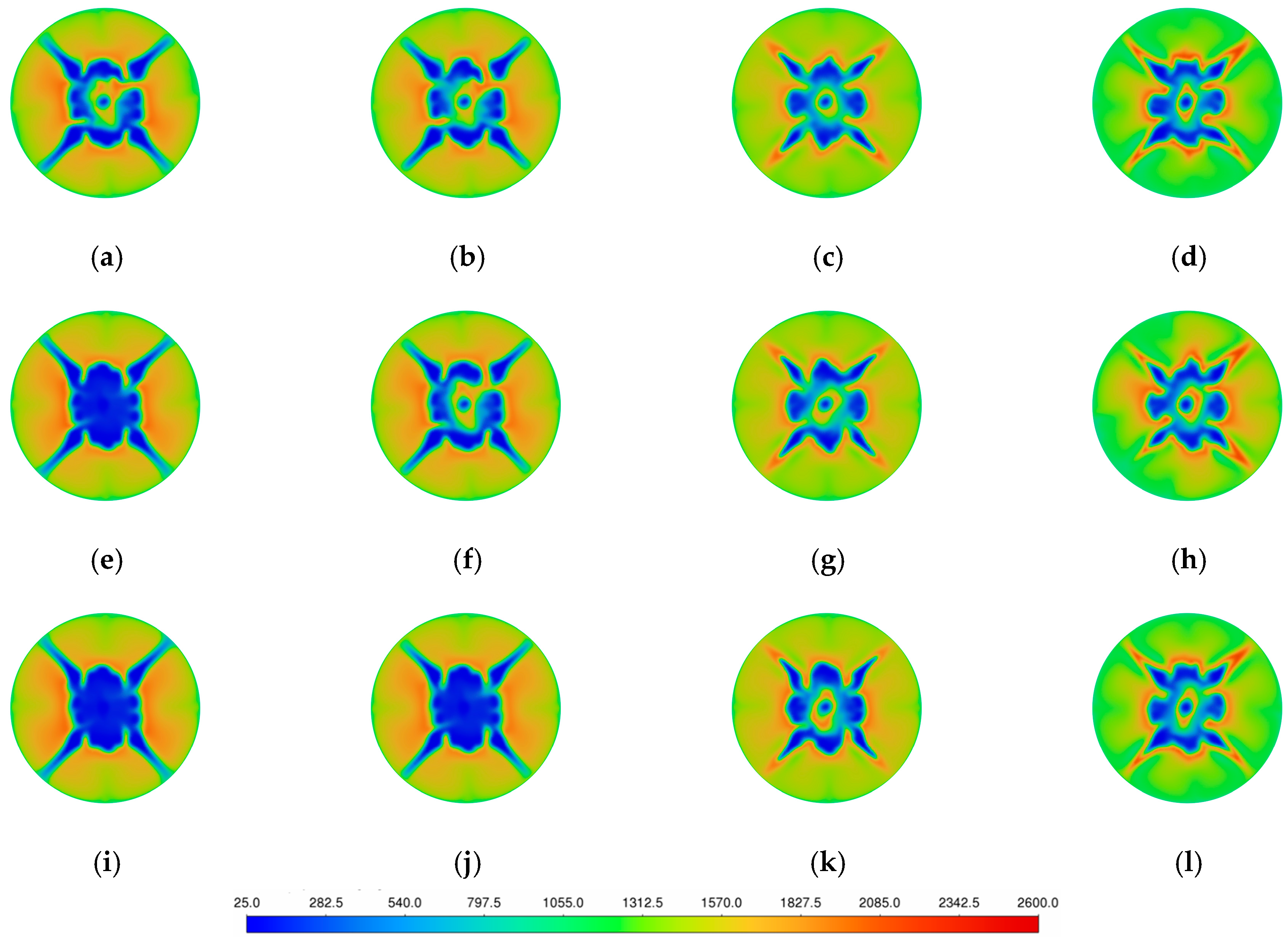
Figure 7 presents the temperature contours on a transversal cross-section near the fuel injector for various hydrogen volume ratios and excess-air conditions. These visualizations clearly illustrate how hydrogen enrichment and air dilution jointly modify the local flame anchoring structure and thermal field, providing direct evidence for the transition between triangular and splitting flame modes discussed earlier.
At low hydrogen contents (0–20 vol%) and under lean conditions (10–20% excess air), the temperature distribution features a compact and symmetric unburned core characteristic of the triangular flame mode shown in Figure 4, Figure 5 and Figure 6. These cases correspond to relatively low laminar flame speeds (SL ≈ 0.28–0.33 m/s in Table 2), which imply long chemical timescales. As a result, the fuel jet issuing from the central injector tip is convected downstream before attaining sufficient reaction progress to establish a self-sustaining flame front. In contrast, the fuel introduced through the four circumferential injectors arranged in an ‘X’ configuration experiences longer residence times and ignites more readily, forming an enveloping reaction zone that gradually consumes the unburned core. This mechanism leads to the formation of the triangular flame fronts observed in the longitudinal sections in Figure 4, Figure 5 and Figure 6.
As the hydrogen mixing ratio increases above 20 vol%, the temperature field exhibits a marked morphological shift. A localized high temperature region forms near the centerline and expands radially outward, which is consistent with the higher SL values associated with H2-enriched mixtures. The enhanced flame propagation speed shortens the chemical timescale and intensifies the local heat-release rate along the shear interface between the central fuel jet and the surrounding oxidizer stream. Consequently, the flame established by the circumferentially arranged injectors interacts more strongly with the reaction zone anchored near the centerline. This interaction promotes the formation of a split flame front, as observed in the longitudinal cross-sections of Figure 4, Figure 5 and Figure 6.

3.3. Temperature Uniformity

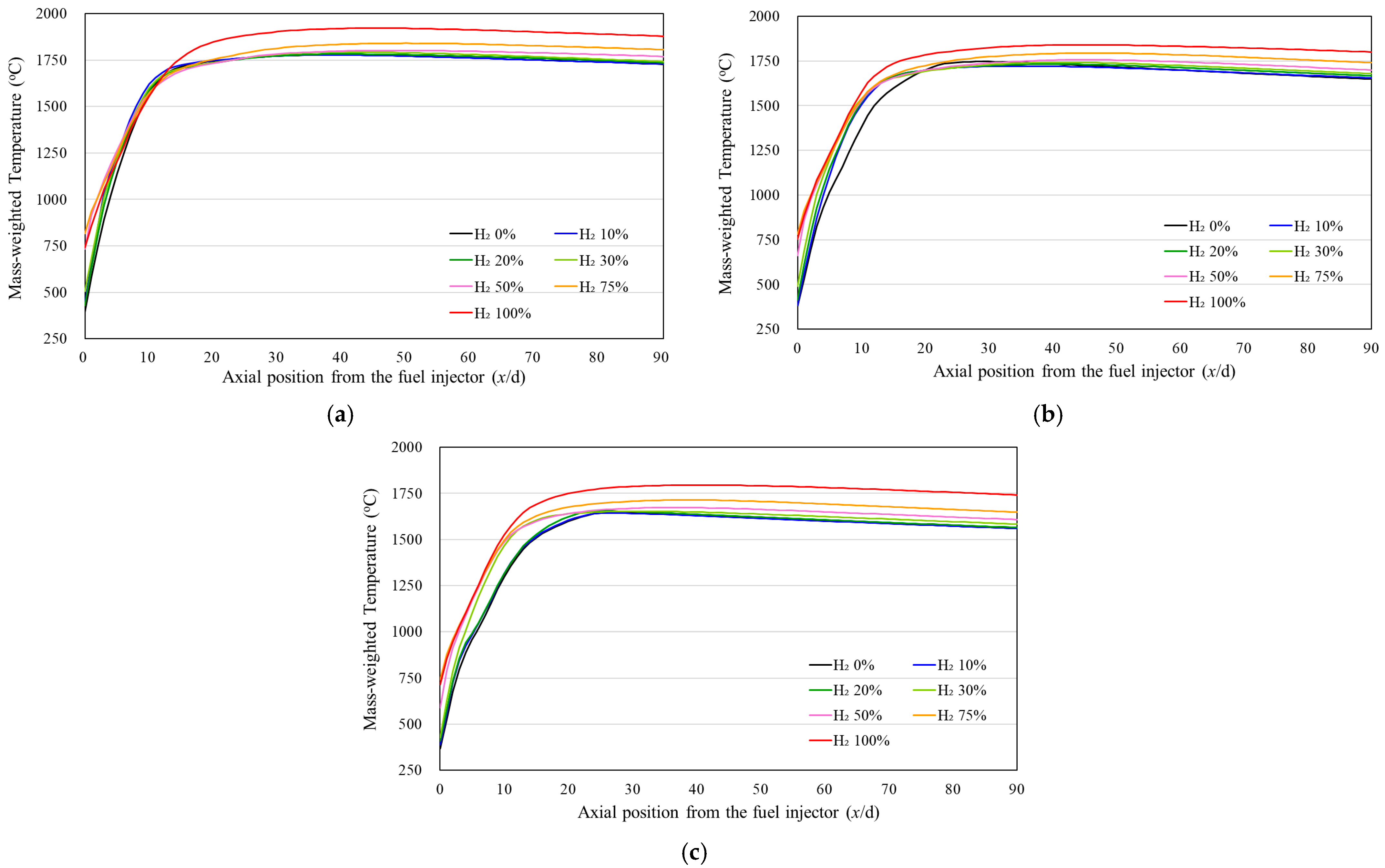
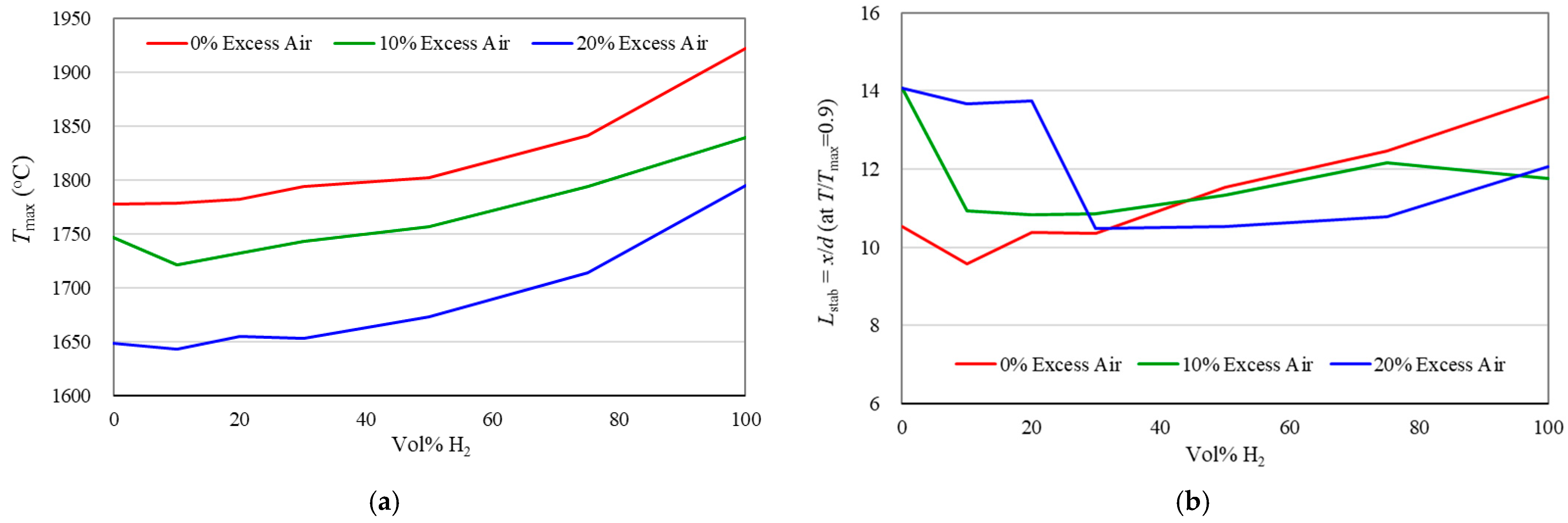
Figure 8 shows the profiles of the mass-weighted temperature across the transversal cross-section in the first straight section (Pipe 1). These axial temperature distributions allow a quantitative evaluation of the rate at which the flame approaches its peak temperature Tmax. They also provide the basis for defining the temperature stabilization length L s t a b , which in this study is defined as the axial distance, normalized by the fuel inlet diameter (d), from the fuel injector tip to the point where the temperature first reaches 90% of Tmax. A comparison of the H2 mixing ratio and excess air ratio in Figure 8 reveals that H2 enrichment increases Tmax locally with higher SL, while excess air reduces Tmax.
As shown in Figure 9a, the maximum temperature (Tmax) increases almost monotonically with the hydrogen volume fraction for all air–fuel ratios. The result is consistent with the enhanced reactivity of hydrogen-containing mixtures, whose higher laminar flame speeds and lower ignition temperatures promote faster heat release near the injector. The magnitude of the temperature rise is on the order of 100–200 K between pure methane (0% H2) and pure hydrogen (100% H2) conditions. The slightly lower Tmax observed at high excess-air ratios reflects the well-known dilution and cooling effects of lean operation.
The variation in the axial normalized distance, L s t a b = x / d , required to reach 90% of Tmax, shown in Figure 9b, provides additional insight into the stabilization mechanism. Under lean conditions (10–20% excess air), L s t a b initially decreases as the hydrogen fraction increases to approximately 20–30%, indicating that the higher laminar flame speed and the shorter chemical timescale enable the flame to anchor closer to the injector while simultaneously transitioning from a triangular to a splitting pattern. Beyond this range, however, L s t a b increases, suggesting that further hydrogen addition promotes a more spatially distributed heat-release zone with the higher maximum temperature (Tmax). A similar, but less pronounced, initial decreasing trend is observed under stoichiometric conditions, where the flame already exhibits a splitting structure even for pure methane (0% H2) as shown in Figure 4a. Under these conditions, the stabilization length increases gradually and consistently with hydrogen addition.
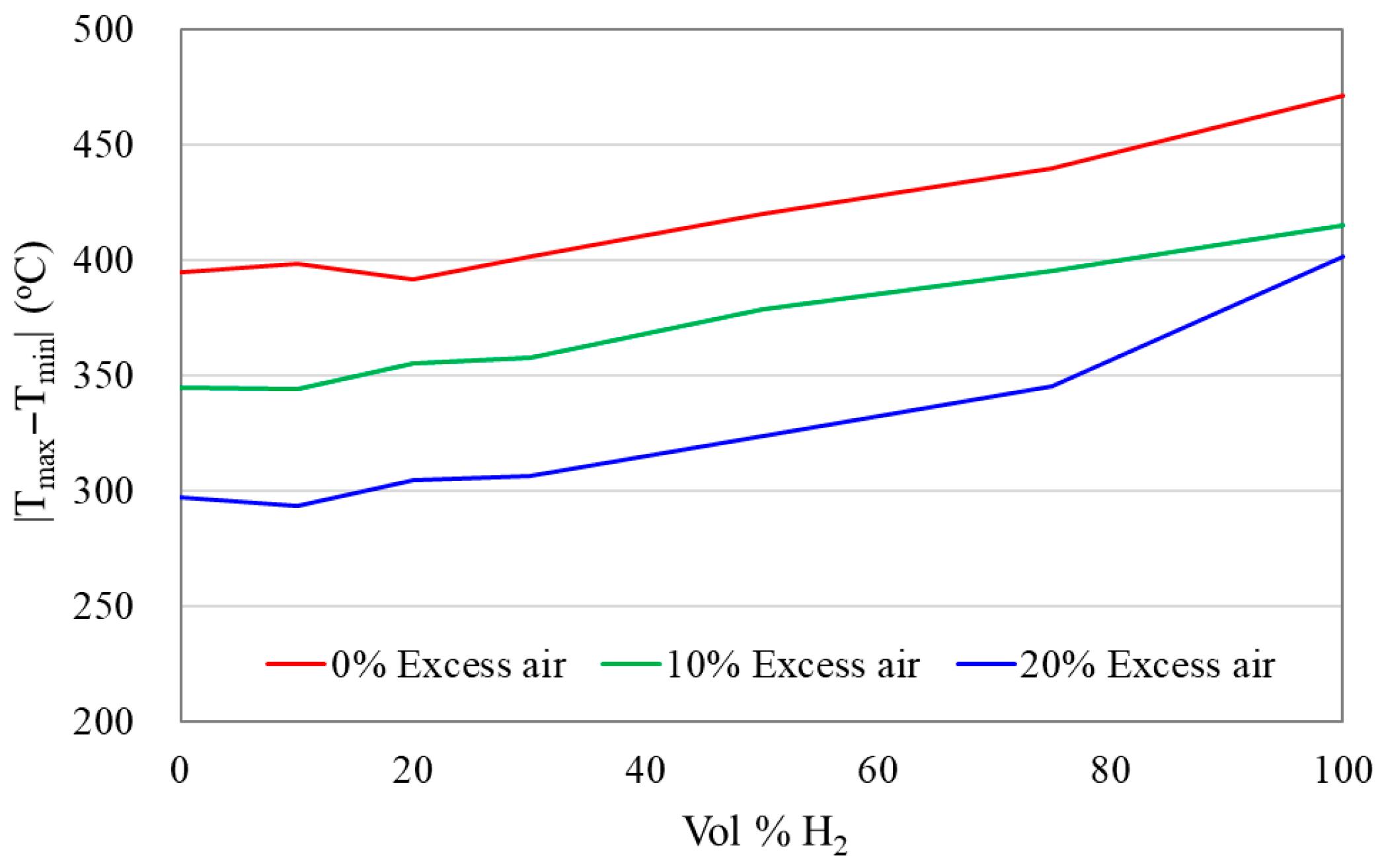
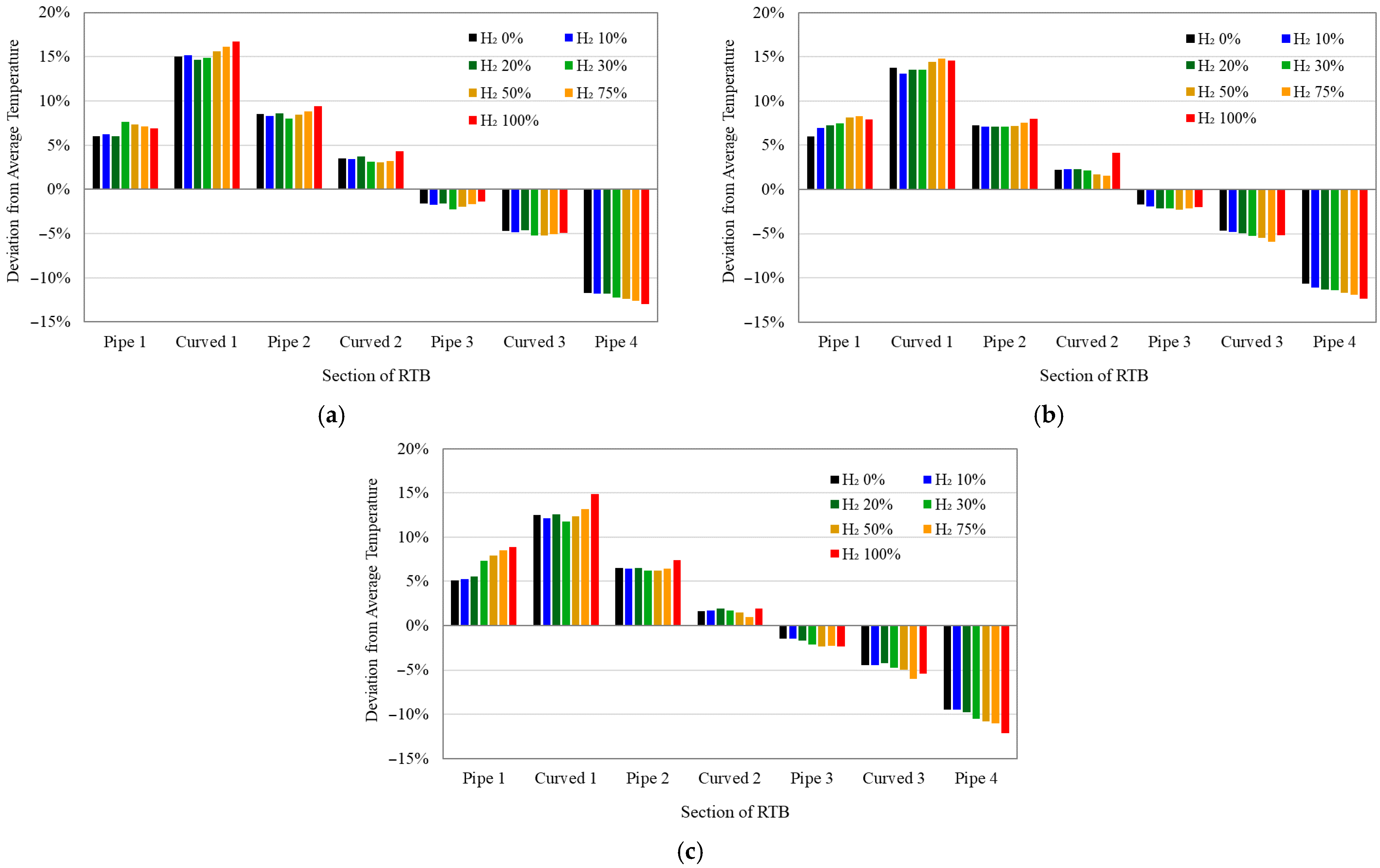
The effects of hydrogen blending and excess-air level on temperature uniformity inside the radiant tube burner (RTB) were evaluated using two complementary diagnostics. One is the deviation of region-wise mass-weighted temperatures from the overall tube-averaged value shown in Figure 10, and the other is the temperature difference between the maximum and minimum mass-weighted sub-region values shown in Figure 11. Together, these metrics reveal how fuel reactivity and dilution conditions redistribute heat release and modify the axial temperature balance, which are critical to thermal uniformity in industrial RTB operation.
Figure 10 shows that the sign and magnitude (in %) of the temperature deviation follow the general structure of the axial temperature field. Because the overall mass-weighted average temperature typically occurs near the mid-section of the W-shaped tube (from Curved Pipe 2 to Pipe 3), upstream regions exhibit positive temperature deviations while downstream regions exhibit negative deviations. The magnitude of these deviations increases systematically with hydrogen blending at any fixed excess-air ratio. This behavior reflects hydrogen’s higher laminar flame speed and chemical reactivity, which elevate the peak temperature in the early part of the tube. As more heat is concentrated upstream, the disparity between the upstream and downstream temperatures grows, producing larger positive deviations in the upstream and deeper negative deviations farther downstream. The result is a more thermally stratified RTB as the hydrogen fraction increases.
The influence of excess air exhibits an opposite trend. Increasing the excess-air ratio reduces the absolute temperature throughout the tube by lowering the adiabatic flame temperature and enhancing dilution. As a consequence, the spatial temperature gradient between upstream and downstream regions is diminished, and the magnitude of the temperature deviation decreases. Under 20% excess-air conditions, the reduction in peak temperature and broader distribution of heat release result in the smallest deviation magnitudes in Figure 10, indicating improved thermal uniformity. This is consistent with the observed extension of the heat-release zone under strongly lean operation and the weaker temperature rise in the initial straight pipe in Figure 8.
The temperature uniformity trends extracted from the maximum and minimum temperature difference in Figure 11 corroborate the findings in Figure 10. The spread in regional temperatures widens as the hydrogen volume ratio increases, again reflecting higher peak temperatures in the upstream regions. Conversely, the temperature spread narrows as excess air rises from 0% to 20%, demonstrating that leaner mixtures promote more uniform heating within the RTB. Taken together, these results demonstrate that hydrogen enrichment and excess air exert opposing influences on RTB temperature uniformity. Hydrogen addition increases reactivity and shifts heat release upstream, amplifying regional temperature differences. Greater excess air, in contrast, broadens the reaction zone and dilutes the flame, reducing the temperature gradient along the tube. Consequently, maintaining an appropriate level of temperature uniformity requires selecting a balanced combination of hydrogen volume fraction and excess-air ratio. Excess air could be applied to offset the upstream-biased temperature rise induced by hydrogen but not so much that thermal efficiency is compromised. This interaction highlights the need for a coordinated adjustment of both parameters when implementing hydrogen co-firing strategies in industrial RTB systems.

3.4. Effects of Hydrogen Enrichment and Excess-Air Ratio on Emission

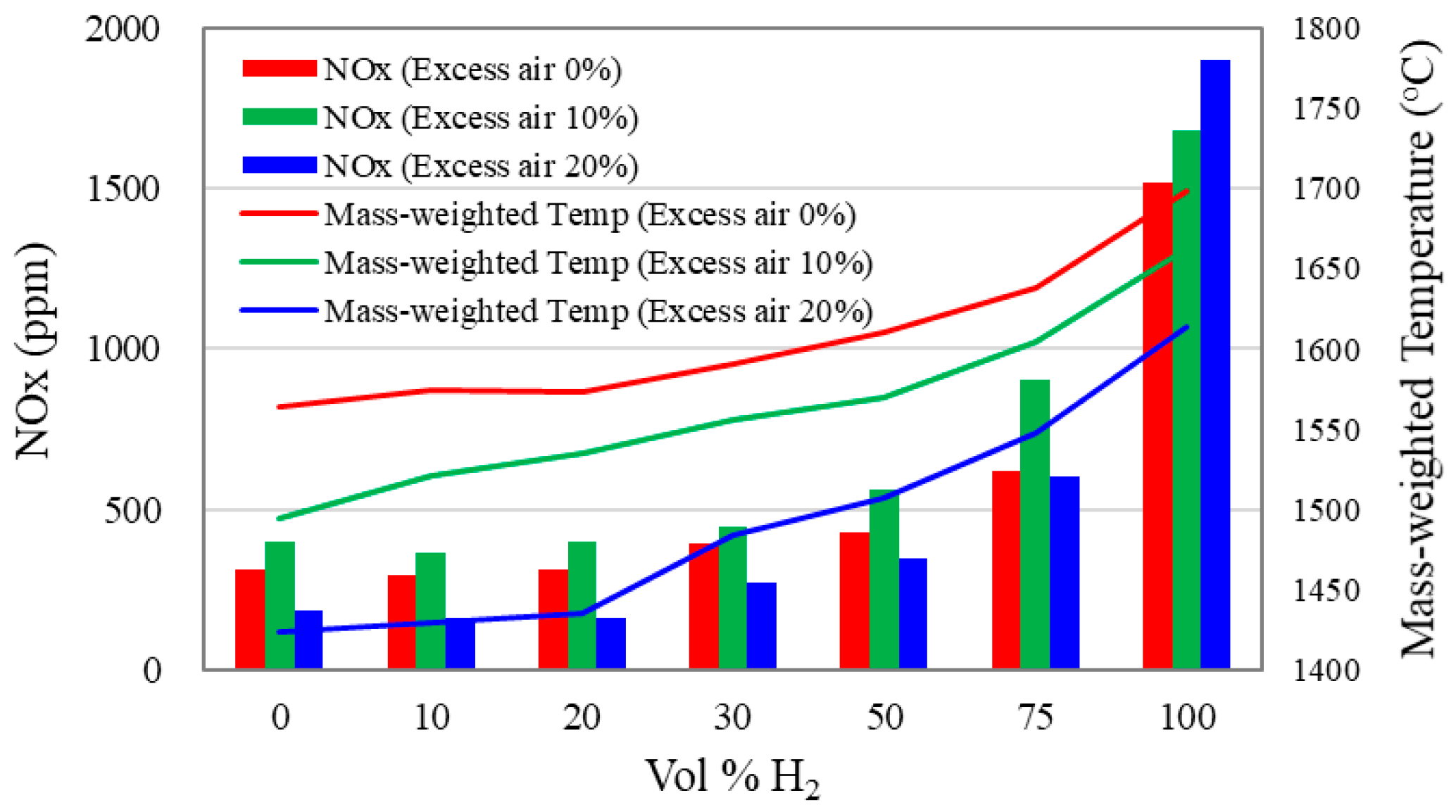
Figure 12 summarizes the combined influence of hydrogen volume fraction and excess-air ratio on the NOX concentrations measured at the RTB outlet. Across all operating conditions, the NOX emissions increase markedly with hydrogen enrichment. This trend is consistent with the temperature fields presented earlier; that is, as the hydrogen fraction rises, the mass-weighted temperature in Pipe 1 (see Figure 9a) increases due to the higher laminar flame speed and enhanced chemical reactivity of H2-containing mixtures. Because thermal NO is strongly temperature-dependent, typically scaling with an Arrhenius-like exponential sensitivity to local temperatures above ~1800 K, the elevated flame temperature at higher H2 volumes drives a corresponding rise in NOX formation.
To be more specific, the outlet NOX value is evaluated using the following volume-integral relationship over the entire RTB volume V (m3):
m ˙ N O , o u t l e t = V w ˙ N O d V
where m ˙ N O , o u t l e t is the NOX mass flow rate at the outlet (kg/s) and w ˙ N O denotes the local thermal NO production rate (kg/(m3·s)). According to Equation (10), the outlet NOX increases when either the local NO production rate ( w ˙ N O ) increases or the volume (and, implicitly, the residence time) of gas maintained within the temperature range where thermal NO formation becomes significant increases. As shown in Figure 8, increasing the H2 enrichment causes the axial temperature to rise more rapidly and reach a higher peak value. Because thermal NO formation is strongly temperature dependent, the higher local temperatures directly increase w ˙ N O . Moreover, the steeper axial temperature rise indicates that high-temperature regions favorable for thermal NO generation extend over a larger fraction of the burner volume. Consequently, both w ˙ N O and the effective high-temperature volume increase, and Equation (10) therefore predicts higher outlet NOX with increasing H2 fraction.
However, the effect of excess-air ratio on NOX is not monotonic and reveals more complex flame–chemistry interactions. Although increasing the excess-air ratio generally reduces the overall temperature with lean-burn dilution effects in the first straight section (Pipe 1), where most thermal NOX is formed, as shown in Figure 3, the resulting NOX trend does not simply follow this thermal reduction. Notably, the NOX emission at 10% excess air exceeds that of both stoichiometric (0% excess air) and strongly lean (20% excess air) conditions over much of the hydrogen-enrichment range. This behavior indicates that temperature alone does not control NOX formation in the RTB. Instead, the interaction between temperature, radical chemistry, and heat-release structure becomes decisive.
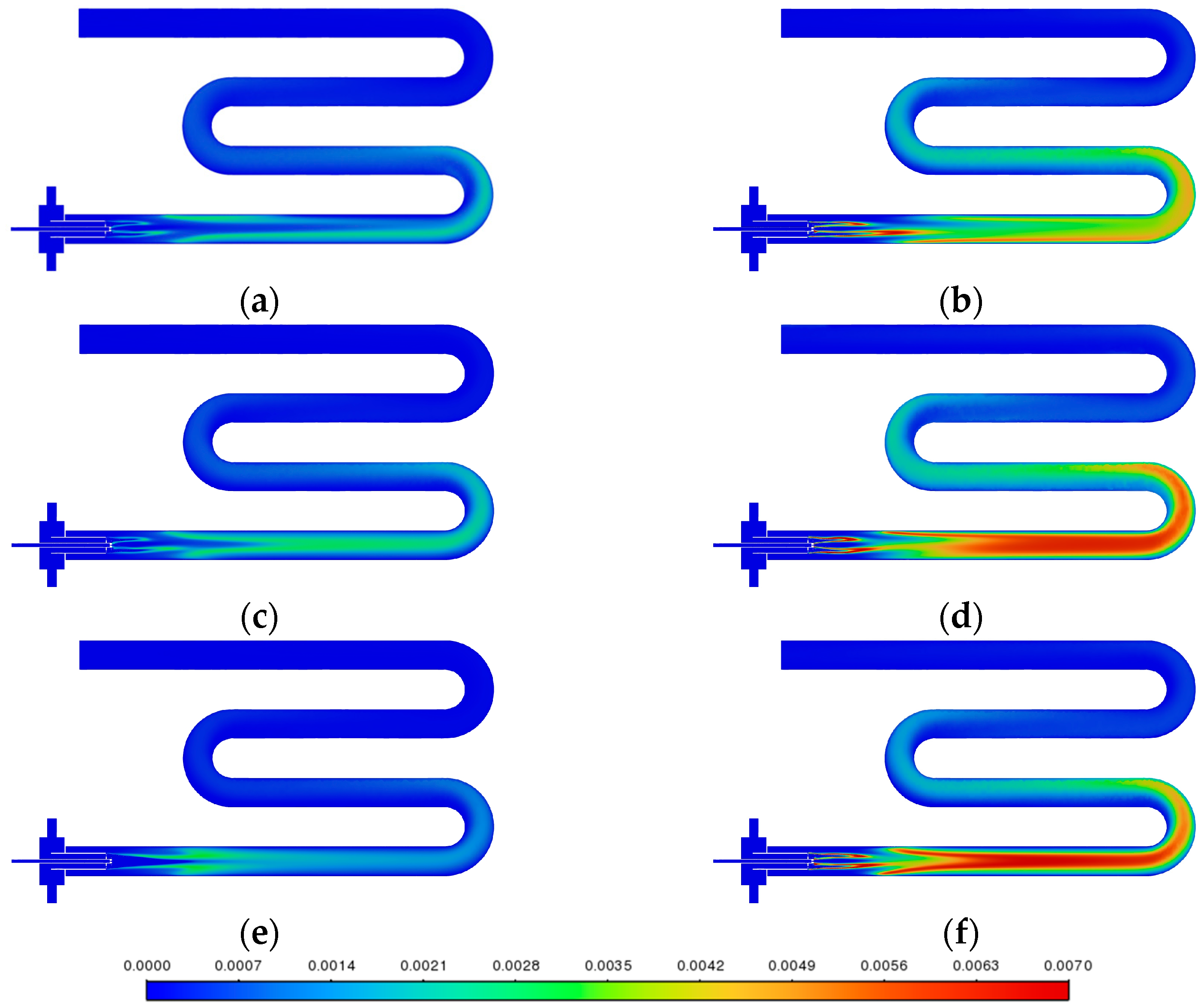
Figure 13 provides mechanistic insight into this phenomenon by showing the spatial distribution of the OH radical for 20% and 100% H2 cases under stoichiometric and lean conditions. Although the overall temperature under fuel-lean conditions (10% and 20% excess air) is lower, as shown in Figure 12, these lean mixtures generate substantially higher OH concentrations throughout the primary reaction zone. Since OH is the dominant intermediate species driving the extended Zeldovich thermal NO mechanism (via reactions such as O + N2 ↔ NO + N and N + OH ↔ NO + H), its enhanced concentration directly increases the rate of NO formation even when the temperature is modestly lower. This explains the elevated NOX levels observed at 10% excess air. The mixture becomes lean enough to promote strong OH generation (due to the increased availability of O-containing radicals and improved oxidizer–fuel mixing), but it is not so lean that the temperature drops below thermal NO thresholds.
Under strongly lean conditions (20% excess air), the flame becomes sufficiently diluted so that the overall temperature in Pipe 1 decreases markedly. As shown in Figure 9a, hydrogen enrichment still broadens the reaction zone and raises Tmax, but the absolute temperatures remain well below those achieved at 0–10% excess air for the same hydrogen content. Because thermal NO formation is exponentially sensitive to temperature, this reduction in peak and bulk temperatures suppresses NO production across most hydrogen fractions. Consequently, NOX levels at 20% excess air are generally lower than those at 10% excess air despite the broader flame structure. The notable exception is the pure hydrogen (100% H2) case where the reaction zone becomes sufficiently intense, and the OH concentration sufficiently elevated (Figure 13), that NOX at 20% excess air exceeds that at 10% excess air. This underscores the strong coupling between radical pool formation and lean dilution effects.
Taken together, Figure 12 and Figure 13 demonstrate that NOX formation in hydrogen-enriched RTB combustion is governed by a competition between temperature-driven thermal NO and OH-mediated radical chemistry. Increasing the hydrogen fraction raises the laminar flame speed and elevates flame temperature, thereby strengthening thermal NO formation across all excess-air conditions. However, the effect of excess air is non-monotonic. Moderately lean operation (10% excess air) increases oxidizer availability while maintaining sufficiently high local temperatures—conditions under which OH production is strongly promoted (Figure 13). This leads to higher NOX compared with stoichiometric operation despite the lower mass-weighted temperature in Pipe 1. In contrast, strongly lean operation (20% excess air) dilutes the flame to the point that both the thermal NO pathway and OH-enhanced NO formation are suppressed except when the hydrogen fraction is high enough (100% H2) to overcome the cooling effect. These results highlight the importance of jointly managing hydrogen fraction and excess-air level, as the interaction between thermal loading and radical-driven chemistry determines the overall NOX emission in hydrogen-assisted radiant tube burners.
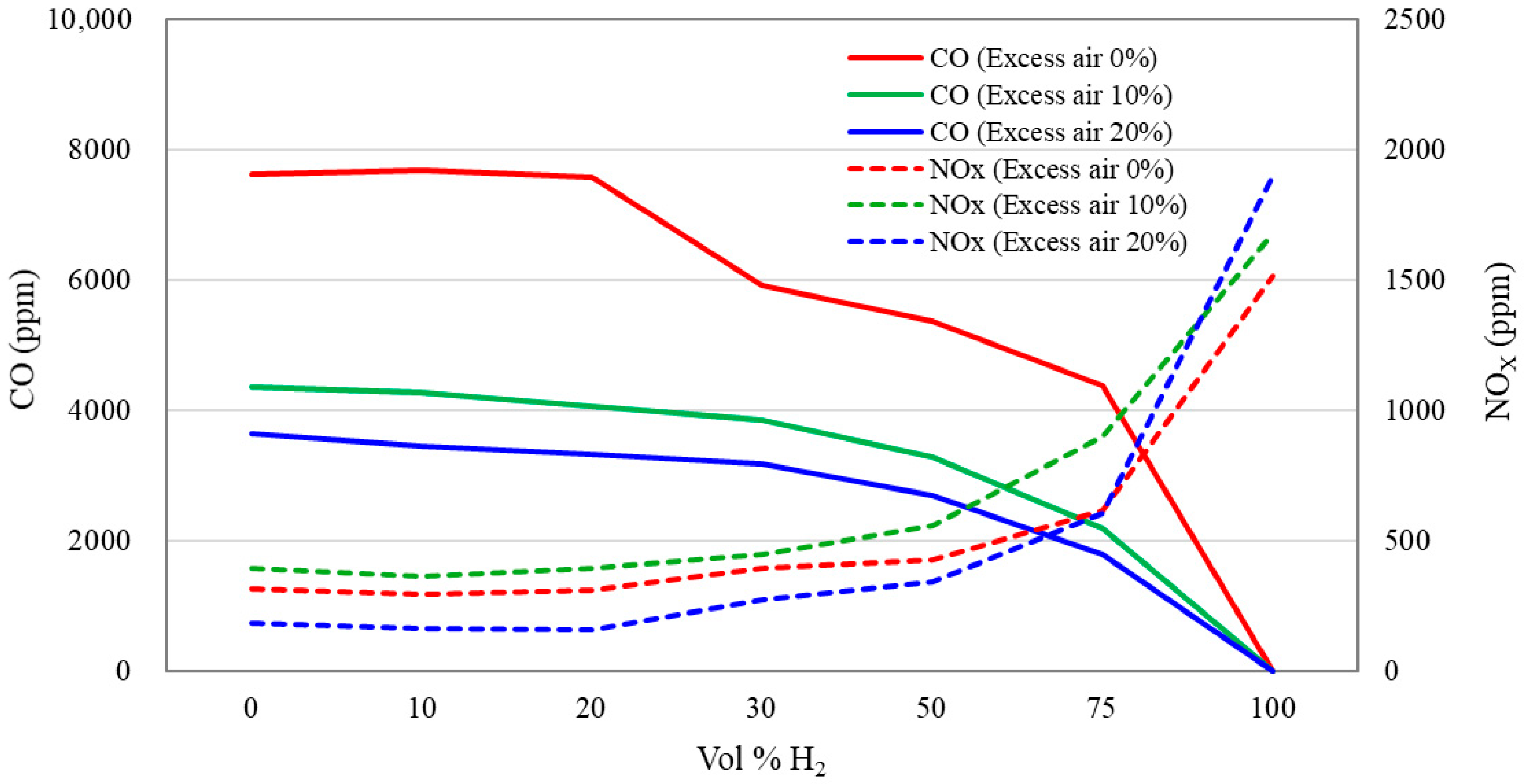
To complement the NOX trends discussed above, the outlet CO emissions are analyzed as an additional indicator of combustion completeness under the same operating conditions. Accordingly, Figure 14 compares the outlet CO and NOX levels as functions of the hydrogen volume fraction and excess-air ratio. In contrast to NOX, CO exhibits a markedly different sensitivity to air dilution and hydrogen enrichment. For CO, the stoichiometric case yields the highest emissions over the entire range of hydrogen fractions, while increasing excess air progressively suppresses CO with 20% excess air showing the lowest CO levels. Moreover, at each excess-air condition, the CO drops sharply as hydrogen is added and continues to decrease toward the pure-hydrogen case. This trend indicates that hydrogen enrichment improves combustion completeness. As hydrogen fraction increases, the laminar flame speed increases, which promotes a more complete oxidation of intermediate carbon species. In addition, replacing CH4 with H2 reduces the carbon available for CO formation, and the strengthened radical pool (e.g., O/H/OH) accelerates CO-to-CO2 conversion pathways, such that the remaining carbon-containing intermediates are more effectively consumed before reaching the outlet. The strong sensitivity of CO to excess air further suggests that oxygen availability and post-flame oxidation capacity are dominant controls for CO burnout.
In contrast, NOX increases with the hydrogen fraction for all excess-air cases, reflecting the combined effects of higher peak temperatures and enhanced radical chemistry under hydrogen-enriched combustion as discussed previously. Overall, Figure 14 emphasizes that hydrogen enrichment simultaneously drives opposite trends in CO and NOX. CO is reduced substantially as the hydrogen fraction increases and as excess air increases, whereas NOX increases with hydrogen enrichment and exhibits a non-monotonic sensitivity to excess air. Therefore, while hydrogen co-firing and lean operation are beneficial for minimizing CO (combustion completeness), NOX control requires a careful selection of the excess-air level to avoid the OH-enhanced NO formation regime observed at moderate lean conditions.

4. Conclusions

In this study, a three-dimensional computational fluid dynamics analysis was conducted to systematically investigate the combustion characteristics of methane–hydrogen co-firing in a newly proposed W-shaped radiant tube burner for industrial heat-treatment furnaces. The eddy-dissipation concept coupled with a detailed hydrogen oxidation mechanism and a reduced two-step mechanism for methane was employed to capture finite-rate chemistry effects while maintaining computational tractability. By varying the hydrogen volume fraction from 0% to 100% and the excess-air ratio from 0% (stoichiometric) through 10% to 20%, the combined influence of fuel composition and air dilution on flame morphology, stabilization behavior, temperature uniformity, and pollutant formation was quantitatively assessed.
Hydrogen enrichment fundamentally changes the near-injector flame stabilization in the confined RTB. A clear transition from a triangular flame to a splitting (bifurcated) flame was observed as the mixture reactivity increased. In this burner, the triangular mode was maintained for H2 ≤ 10% at 10% excess air and H2 ≤ 30% at 20% excess air, while higher H2 fractions promoted splitting. Linking these observations with laminar flame speeds, the morphological transition occurred when the laminar flame speed increased into ~0.33–0.36 m/s, indicating that the flame topology is governed by the combined effects of shortened chemical timescale and strengthened fine-structure reaction activity in the EDC framework.
Across all excess air conditions, NOX increased monotonically with H2 enrichment, which is consistent with the rise of upstream temperatures (Pipe 1) and the enlargement of high-temperature regions favorable to thermal NO formation. However, the dependence of NOX on excess air was non-monotonic: 10% excess air produced higher NOX than both 0% and 20% excess air over much of the H2 range. Mechanistically, this behavior cannot be explained by temperature alone. The OH field analysis indicates that moderately lean operation elevates OH radical levels in the primary reaction zone, which accelerates the extended Zeldovich pathway (notably N + OH ↔ NO + H) even when the mass-weighted temperature is slightly reduced. Under 20% excess air, dilution and cooling effect suppresses thermal NO strongly enough that NOX is generally reduced except when the flame intensity under 100% H2 becomes sufficient to partially overcome the cooling effect. Therefore, NOX control in hydrogen-enriched RTBs requires the simultaneous consideration of temperature history and radical pool formation rather than a single-parameter “leaner-is-always-lower-NOX” assumption.
The results establish a practical coupling strategy for industrial operation. H2 enrichment improves combustion completeness (CO decreases sharply with increasing H2 and with increasing excess air), but it increases NOX, while excess air improves the axial temperature uniformity by reducing the peak temperature and smoothing axial gradients. Quantitatively, hydrogen enrichment increased the maximum mass-weighted temperature in Pipe 1 by approximately 100–200 K from 0% H2 (pure CH4) to 100% H2, and increasing excess air from 0% to 20% reduced temperature non-uniformity metrics. The combined findings imply that operating conditions should be selected to avoid the excessive upstream thermal stratification caused by high H2 fractions while avoiding the OH-enhanced NOX regime that can appear around moderately lean (10% excess air) conditions. In other words, optimization is inherently multi-objective: that is, minimize CO and temperature non-uniformity without unintentionally maximizing NOX.
A limitation of this work is that the parametric study was conducted for only one fixed RTB geometry (tube diameter and length, injector arrangement) and fixed inlet conditions (e.g., single energy input (100,000 kcal/h) and turbulence intensity). In real industrial furnaces, several factors can shift the flame-shape boundary, the stabilization length, and the emission (NOX and CO) trends. Future work should therefore integrate these industrial degrees of freedom (geometry scaling, exhaust gas recirculation, and turbulent mixing) into a unified optimization framework, which is ideally supported by targeted measurements (e.g., wall temperature and exhaust NOX or CO) for validation. Overall, the present study provides a quantitative and mechanistic basis for designing and operating W-shaped RTBs under hydrogen co-firing with an explicit identification of the flame-shape transition, the radical-driven non-monotonic NOX mechanism, and a coupled multi-parameter strategy for balancing thermal uniformity, CO burnout, and NOX control.

Author Contributions

Conceptualization, G.G.L.; methodology, D.J., S.H. and G.G.L.; design of RTB geometry, B.B. and J.K.; CFD simulation, D.J., S.H., J.S., J.A. and D.L.; validation, D.J., D.L. and G.G.L.; analysis, D.J., S.H., J.A. and G.G.L.; writing—original draft preparation, D.J.; writing—review and editing, G.G.L.; visualization, S.H., J.S. and J.A.; supervision, G.G.L.; project administration, B.B. and J.K.; funding acquisition, J.K. and G.G.L. All authors have read and agreed to the published version of the manuscript.

Funding

This research was supported by the Korea Planning & Evaluation Institute of Industrial Technology (KEIT) grant funded by the Korean Government (MOTIR) (No. 20024215).

Data Availability Statement

The original contributions presented in this study are included in the article. Further inquiries can be directed to the corresponding author.

Acknowledgments

The CFD analysis conducted in this study was supported under an industry–academia cooperation agreement between Keimyung University and Ansys. The authors gratefully acknowledge Ansys Korea for providing the software license and technical assistance.

Conflicts of Interest

Authors Byeongyun Bae and Jongseo Kwon were employed by Technical Research Group, PLANTEC. The remaining authors declare that the research was conducted in the absence of any commercial or financial relationships that could be construed as a potential conflict of interest.

Abbreviations

The following abbreviations are used in this manuscript:
CFDComputational fluid dynamics
EDCEddy dissipation concept
ISATIn situ adaptive tabulation
RTBRadiant tube burner

References

  1. Fan, H.; Feng, J.; Bai, W.; Zhao, Y.; Li, W.; Gao, J.; Liu, C.; Jia, L. Numerical simulation on heating performance and emission characteristics of a new multi-stage dispersed burner for gas-fired radiant tubes. Therm. Sci. 2022, 26, 3787–3801. [Google Scholar] [CrossRef]
  2. Tsioumanis, N.; Brammer, J.G.; Hubert, J. Flow processes in a radiant tube burner: Combusting flow. Energy Conv. Manag. 2011, 52, 2667–2675. [Google Scholar] [CrossRef]
  3. Gao, Q.; Pang, Y.; Sun, Q.; Liu, D.; Zhang, Z. Modeling approach and numerical analysis of a roller-hearth reheating furnace with radiant tubes and heating process optimization. Case Stud. Therm. Eng. 2021, 28, 101618. [Google Scholar] [CrossRef]
  4. Flamme, M.; Milani, A.; Wünning, J.G.; Blasiak, W.; Yang, W.; Szewczyk, D.; Sudo, J.; Mochida, S. Radiant tube burners. In Industrial Combustion Testing, 1st ed.; Baukal, C.E., Ed.; Taylor & Francis Group: Boca Raton, FL, USA, 2010; pp. 487–504. [Google Scholar]
  5. Tian, Y.; De, S.; Zhang, H. Comparative performance assessment of a U-shaped recuperative radiant tube using MILD combustion. J. Energy Eng. 2018, 144, 04018029. [Google Scholar] [CrossRef]
  6. Kim, N.; Guahk, Y.T.; Ko, C. Numerical simulation of an industrial radiant tube burner using OpenFOAM. Fuel Commun. 2024, 19, 100119. [Google Scholar] [CrossRef]
  7. Liu, X.; Liu, J.; Tong, J.; Lu, X. Experimental studies on the heating performance and emission characteristics of a W-shaped regenerative radiant tube burner. Fuel 2014, 135, 262–268. [Google Scholar] [CrossRef]
  8. Xu, Q.; Li, X.; Li, Y.; Wang, J. Performance analysis of a novel W-type radiant tube. Appl. Therm. Eng. 2019, 152, 482–489. [Google Scholar] [CrossRef]
  9. Ha, W.; Ha, J.; Roh, Y.; Lee, Y. Improvement of Radiant Heat Efficiency of the Radiant Tube Used for Continuous Annealing Line by Application of Additive Manufacturing Technology. Appl. Sci. 2020, 10, 8132. [Google Scholar] [CrossRef]
  10. García, A.M.; Millera, A.; Bilbao, R.; Alzueta, M.U. Combustion model evaluation in a CFD simulation of a single-ended radiant-tube burner. Fuel 2020, 276, 118013. [Google Scholar] [CrossRef]
  11. Vandadi, V.; Park, C.; Kaviany, M. Superadiabatic radiant porous burner with preheater and radiation corridors. Int. J. Heat Mass Transf. 2013, 64, 680–688. [Google Scholar] [CrossRef]
  12. Lv, J.; Li, Z.; Jia, L.; Dou, Y. Numerical Simulation Study on the Performance of a New Gas Burner for Radiant Heating. Fluids 2025, 10, 245. [Google Scholar] [CrossRef]
  13. Wang, Q.; Wang, E.; Li, X.; Hu, Z.; Liu, D.; Yu, Y. Numerical Investigation and Improvement of Coke Oven Gas-Fired W-Shaped Radiant Tubes for NOx Reduction. Energy Fuels 2020, 34, 4925–4933. [Google Scholar] [CrossRef]
  14. Glarborg, P.; Miller, J.A.; Ruscic, B.; Klippenstein, S.J. Modeling nitrogen chemistry in combustion: A review. Prog. Energy Combust. Sci. 2018, 67, 31–68. [Google Scholar] [CrossRef]
  15. International Energy Agency (IEA). Stated Policies Scenario (STEPS) in Global Energy and Climate Model. Available online: https://www.iea.org/reports/global-energy-and-climate-model/stated-policies-scenario-steps (accessed on 28 November 2025).
  16. International Energy Agency (IEA). World Energy Outlook 2024. Available online: https://www.iea.org/reports/world-energy-outlook-2024 (accessed on 28 November 2025).
  17. Boushaki, T.; Dhué, A.; Gökalp, I.; Halter, F. Effects of hydrogen and steam addition on laminar burning velocity of methane–air mixtures: Experimental and numerical analysis. Int. J. Hydrogen Energy 2012, 37, 6941–6952. [Google Scholar]
  18. Dirrenberger, P.; Le Gall, P.; Bounaceur, R.; Herbinet, O.; Glaude, P.A.; Konnov, A.; Battin-Leclerc, F. Measurements of laminar flame velocity for components of natural gas. Energy Fuels 2011, 25, 3875–3884. [Google Scholar] [CrossRef]
  19. Sun, C.; Wang, T.; Wang, P.; Zhang, Y.; Cui, C.; Lu, Y.; Liu, W.; Zhang, Y.; Zhang, Y. Numerical simulation and field experimental study of hydrogen-enriched natural gas combustion in industrial boilers. Processes 2024, 12, 1325. [Google Scholar] [CrossRef]
  20. de Persis, S.; Idir, M.; Molet, J.; Pillier, L. Effect of hydrogen addition on NOx formation in high-pressure counter-flow premixed CH4/air flames. Int. J. Hydrogen Energy 2019, 44, 23484–23502. [Google Scholar] [CrossRef]
  21. Houshfar, E.; Løvås, T.; Skreiberg, Ø. Effect of excess air ratio and temperature on NOx emission from grate combustion of biomass fuels. Energy Fuels 2011, 25, 4145–4154. [Google Scholar] [CrossRef]
  22. Lee, S.; Lee, J.; Ahn, B.; Kang, D.; Hwang, J.; Park, Y.; Choi, M. CFD study on combustion and emissions characteristics of methane-hydrogen co-firing in an EV burner. Case Stud. Therm. Eng. 2025, 73, 106596. [Google Scholar] [CrossRef]
  23. Du, W.; Zhou, S.; Qiu, H.; Zhao, J.; Fan, Y. Experiment and numerical study of the combustion behavior of hydrogen-blended natural gas in swirl burners. Case Stud. Therm. Eng. 2022, 39, 102468. [Google Scholar] [CrossRef]
  24. ANSYS Inc. Ansys Fluent Theory Guide; ANSYS Inc.: Canonsburg, PA, USA, 2024. [Google Scholar]
  25. Bjørn, F. Magnussen, On the Structure of Turbulence and a Generalized Eddy Dissipation Concept for Chemical Reaction in Turbulent Flow. In Proceedings of the 19th AIAA Aerospace Science Meeting, St. Louis, MO, USA, 12–15 January 1981. [Google Scholar]
  26. University of California, Berkeley. GRI-Mech 3.0. Available online: http://combustion.berkeley.edu/gri-mech/ (accessed on 28 November 2025).
  27. Westbrook, C.K.; Dryer, F.L. Simplified reaction mechanisms for the oxidation of hydrocarbon fuels in flames. Combust. Sci. Technol. 1981, 27, 31–43. [Google Scholar] [CrossRef]
  28. Li, J.; Zhao, Z.; Kazakov, A.; Dryer, F.L. An updated comprehensive kinetic model of hydrogen combustion. Int. J. Chem. Kinet. 2004, 36, 566–575. [Google Scholar] [CrossRef]
  29. Lu, L.; Pope, S.B. An improved algorithm for in situ adaptive tabulation. J. Comput. Phys. 2009, 228, 361–386. [Google Scholar] [CrossRef]
  30. Zeldovich, Y.B. The oxidation of nitrogen in combustion and explosions. J. Acta Physicochim. 1946, 21, 577–628. [Google Scholar]
  31. Hermanns, R.T.E. Laminar Burning Velocities of Methane-Hydrogen-Air Mixtures. Ph.D. Thesis, Eindhoven University of Technology, Eindhoven, The Netherlands, 2007. [Google Scholar]
  32. Teng, F. The Effect of Hydrogen Concentration on the Flame Stability and Laminar Burning Velocity of Hydrogen-Hydrocarbon-Carbon Dioxide Mixtures. Ph.D. Thesis, University of Sheffield, Sheffield, UK, 2014. [Google Scholar]
  33. Koroll, G.W.; Kumar, R.K.; Bowles, E.M. Burning velocities of hydrogen–air mixtures. Combust. Flame 1993, 94, 330–340. [Google Scholar] [CrossRef]
  34. Han, W.; Dai, P.; Gou, X.; Chen, Z. A review of laminar flame speeds of hydrogen and syngas measured from propagating spherical flames. Appl. Energy Combust. Sci. 2020, 1–4, 100008. [Google Scholar] [CrossRef]
  35. Mitu, M.; Razus, D.; Schroeder, V. Laminar Burning Velocities of Hydrogen-Blended Methane–Air and Natural Gas–Air Mixtures, Calculated from the Early Stage of p(t) Records in a Spherical Vessel. Energies 2021, 14, 7556. [Google Scholar]
  36. Warnatz, J.; Mass, U.; Dibble, R.W. Combustion: Physical and Chemical Fundamentals, Modeling and Simulation, Experiments, Pollutant Formation; Springer: Heidelberg, Germany, 1996; pp. 107–108. [Google Scholar]
  37. Gran, I.R.; Magnussen, B.F. A Numerical study of a bluff-body stabilized diffusion flame. Part 2. influence of combustion modeling and finite-rate chemistry. Combust. Sci. Technol. 1996, 119, 191–217. [Google Scholar] [CrossRef]
  38. White, F.M. Viscous Fluid Flow, 2nd ed.; McGraw-Hill: Singapore, 1991; pp. 28–29. [Google Scholar]
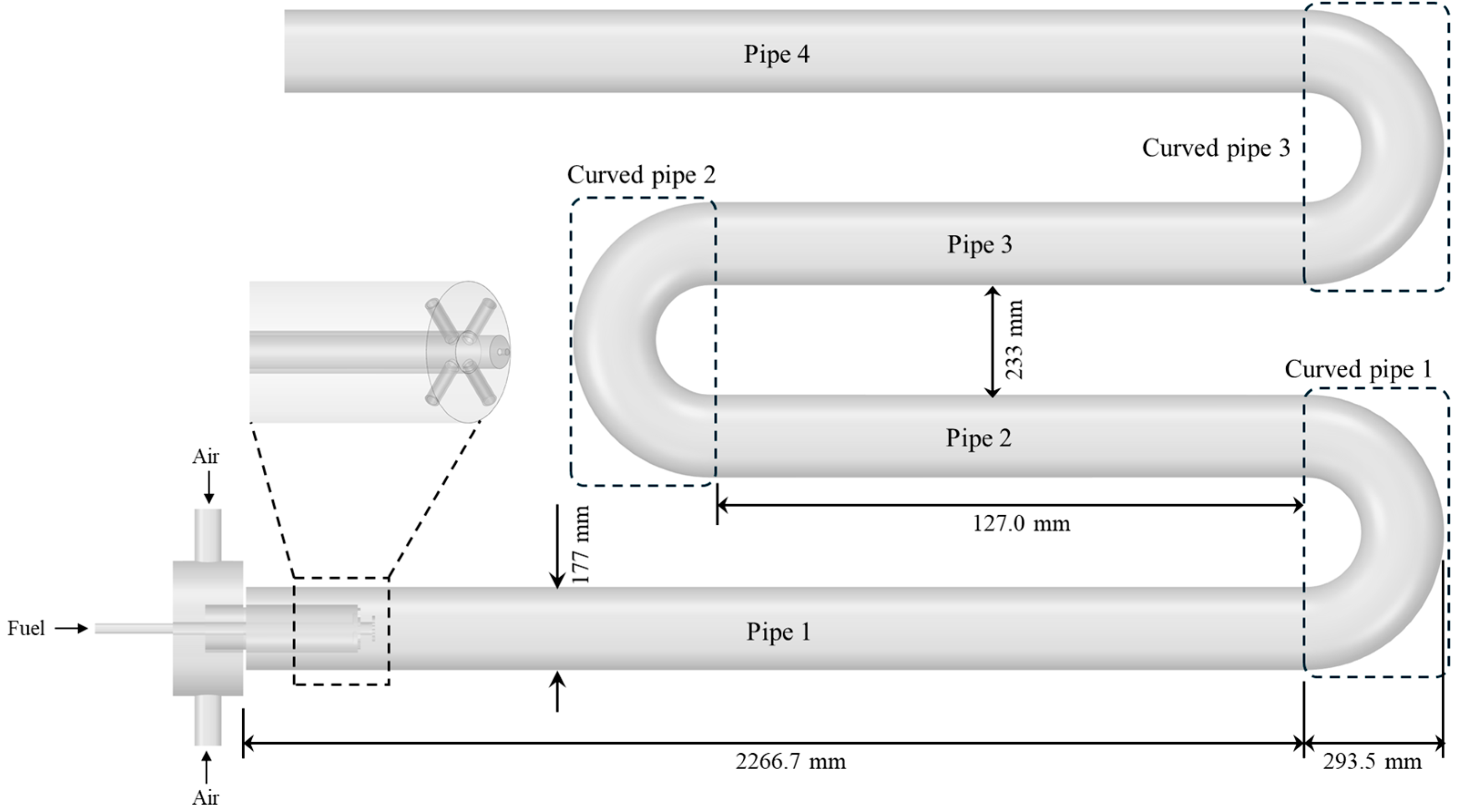
Figure 1. Schematic diagram of a W-shaped radiant tube burner.
Energies 19 00557 g001
Figure 2. Comparison of static temperature (°C) distributions in the radiant tube burner between the GRI 3.0 detailed mechanism [24,26] and the two-step reduced mechanism for CH4 coupled with detailed H2 oxidation mechanism [24,27,28]: (a) Case EA10-H000 with GRI 3.0 detailed mechanism; (b) Case EA10-H010 with GRI 3.0 detailed mechanism; (c) Case EA10-H000 with two-step mechanism for CH4 coupled with detailed H2 oxidation mechanism; (d) Case EA10-H010 with two-step mechanism for CH4 coupled with detailed H2 oxidation mechanism.
Energies 19 00557 g002
Figure 3. Thermal NO formation rate (kgmol/m3·s) distributions for the same cases as in Figure 2: (a) Case EA10-H000 with GRI 3.0 detailed mechanism; (b) Case EA10-H010 with GRI 3.0 detailed mechanism; (c) Case EA10-H000 with two-step mechanism for CH4 coupled with detailed H2 oxidation mechanism; (d) Case EA10-H010 with two-step mechanism for CH4 coupled with detailed H2 oxidation mechanism.
Energies 19 00557 g003
Figure 4. Temperature contours of the longitudinal cross-section of the RTB for various ratios of H2 volume for 0% excess air (stoichiometry) condition: (a) Case EA00-H000 (100% CH4); (b) Case EA00-H020; (c) Case EA00-H050; (d) Case EA00-H100 (100% H2).
Energies 19 00557 g004
Figure 5. Temperature contours of the longitudinal cross-section of the RTB for various ratios of H2 volume for 10% excess air: (a) Case EA10-H000 (100% CH4); (b) Case EA10-H020; (c) Case EA10-H050; (d) Case EA10-H100 (100% H2).
Energies 19 00557 g005
Figure 6. Temperature contours of the longitudinal cross-section of the RTB for various ratios of H2 volume for 20% excess air: (a) Case EA20-H000 (100% CH4); (b) Case EA20-H020; (c) Case EA20-H050; (d) Case EA20-H100 (100% H2).
Energies 19 00557 g006
Figure 7. Temperature contours of the transversal cross-section in the combustor at x / d = 1.0 for various H2 volume ratio and excess air ( d = 21.4 mm, the diameter of fuel inlet): (a) Case EA00-H000 (100% CH4); (b) Case EA00-H020; (c) Case EA00-H050; (d) Case EA00-H100 (100% H2); (e) Case EA10-H000 (100% CH4); (f) Case EA10-H020; (g) Case EA10-H050; (h) Case EA10-H100 (100% H2); (i) Case EA20-H000 (100% CH4); (j) Case EA20-H020; (k) Case EA20-H050; (l) Case EA20-H100 (100% H2).
Energies 19 00557 g007
Figure 8. Profiles of mass-weighted temperature across the transversal cross-section area of the first straight section (Pipe 1) for H2 volume ratios (d is the diameter of fuel inlet): (a) 0% excess air (stoichiometry); (b) 10% excess air; (c) 20% excess air.
Energies 19 00557 g008
Figure 9. Effects of H2 volume ratios on the maximum temperature (Tmax) and the normalized temperature stabilization length (Lstab): (a) maximum mass-weighted temperature across the transversal cross-section area in Pipe 1; (b) stabilization length required to reach 90% of Tmax.
Energies 19 00557 g009
Figure 10. Deviation (%) of the mass-weighted average temperature in each sub-region relative to the mass-weighted average temperature of the entire RTB: (a) 0% excess air (stoichiometry); (b) 10% excess air; (c) 20% excess air.
Energies 19 00557 g010
Figure 11. Difference between the maximum and minimum mass-weighted average temperatures across the sub-regions of the RTB.
Energies 19 00557 g011
Figure 12. Effects of H2 volume ratios and excess air ratio on the NOX (on a dry basis without O2 correction) and mass-weighted temperature in pipe 1.
Energies 19 00557 g012
Figure 13. Distribution of OH radical (mole fraction) for 20% and 100% H2 under stoichiometric (0% excess air) and lean conditions (10% and 20% excess air), illustrating enhanced OH production under fuel-lean operation: (a) Case EA00-H020 (100% CH4); (b) Case EA00-H100 (100% H2); (c) Case EA10-H020; (d) Case EA10-H100 (100% H2); (e) Case EA20-H020; (f) Case EA20-H100 (100% H2).
Energies 19 00557 g013
Figure 14. Effects of H2 volume ratios and excess-air ratio on the outlet CO and NOX (on a dry basis without O2 correction).
Energies 19 00557 g014
Table 1. Summary of simulation condition.
Case *Excess Air (%)%Vol H2Case *Excess Air (%)%Vol H2Case *Excess Air (%)%Vol H2
EA00-H00000EA10-H000100EA20-H000200
EA00-H010010EA10-H0101010EA20-H0102010
EA00-H020020EA10-H0201020EA20-H0202020
EA00-H030030EA10-H0301030EA20-H0302030
EA00-H050050EA10-H0501050EA20-H0502050
EA00-H075075EA10-H0751075EA20-H0752075
EA00-H1000100EA10-H10010100EA20-H10020100
* EA means excess air and H means hydrogen.
Table 2. Laminar flame speed (SL) for CH4–H2 mixtures at 1 atm and 298 K. SL values (m/s) are directly adopted from literature sources [31,32] to preserve quantitative fidelity.
Vol% of H20% Excess Air10% Excess Air20% Excess Air
0 (CH4)0.3640.3300.281
100.3920.3550.305
200.4230.3830.332
300.4700.4150.360
500.6280.567 0.489
751.0400.940 0.810
100 (H2)2.6332.378 2.051
Values for 50–100% H2 under lean conditions estimated by scaling stoichiometric values using the method of lean-side reduction factors [33,34,35].
Disclaimer/Publisher’s Note: The statements, opinions and data contained in all publications are solely those of the individual author(s) and contributor(s) and not of MDPI and/or the editor(s). MDPI and/or the editor(s) disclaim responsibility for any injury to people or property resulting from any ideas, methods, instructions or products referred to in the content.