


Artificial Intelligence for Predictive Maintenance and Performance Optimization in Renewable Energy Systems: A Comprehensive Review



Abstract
1. Introduction
- (1)
- A novel dual-axis framework that classifies AI techniques by both algorithmic paradigm and functional role (diagnostic, predictive, prescriptive), enabling a structured comparison across energy domains.
- (2)
- A data-centric synthesis that explicitly incorporates data readiness into the evaluation of AI models, aligning methodological rigor with deployment realities.
- (3)
- An integrated analysis of existing literature to identify research gaps, assess deployment maturity, and critique methodological limitations. By bridging domain-specific, algorithmic, and data-centric perspectives, this work offers a unified, pragmatic foundation for scalable, transparent, and trustworthy AI integration in renewable energy systems.
2. Methodology and Literature Review
2.1. Methodology
2.2. Literature Review
3. Dual-Axis Framework
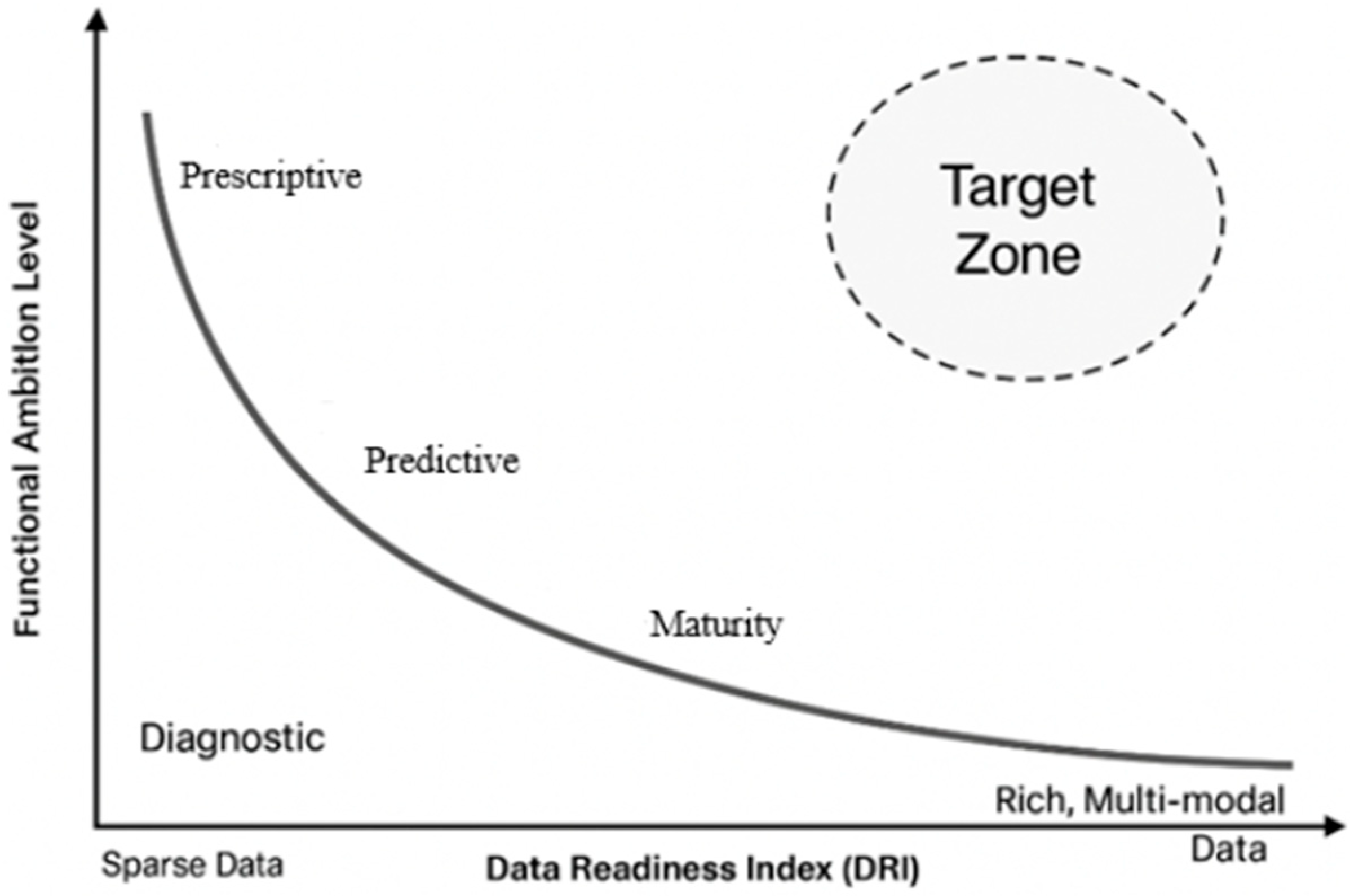
3.1. Data Readiness Index (DRI)
- Sampling frequency (): Measured in Hertz (Hz), distinguishing between low-frequency supervisory data (e.g., Hz for some hydropower SCADA systems) and high-frequency condition monitoring data (e.g., kHz for vibration analysis in wind turbine gearboxes).
- Number of verified, labeled fault events (): The total count of annotated failure instances available for model training. This parameter directly constrains supervised learning feasibility, ranging from sparse scenarios (e.g., for critical hydropower failures) to abundant ones (e.g., for common inverter faults in solar PV systems).
- Modality index (): A categorical representation of data source diversity and complexity, scaled from for homogeneous time-series (e.g., electrical measurements alone) to for highly heterogeneous data fusion (e.g., combining SCADA, vibration, infrared imagery, acoustic emissions, and maintenance logs in cyber-physical energy systems).
- Data quality score (): A composite measure of signal-to-noise ratio, missing data proportion, sensor calibration status, and temporal consistency.
3.2. Functional Ambition Level (FAL)
- FAL 1 (Diagnostic): The AI model identifies current or past system states. This is typically a classification or anomaly detection task, formally represented as , where is a vector of sensor measurements at time and is a fault class or an anomaly score.
- FAL 2 (Predictive): The AI model forecasts future system states. This is a sequence forecasting or regression task, formalized as , where is a historical sequence of observations and is the predicted sequence over a future horizon . RUL estimation is a key example in which the output is a scalar RUL value.
- FAL 3 (Prescriptive): recommends or autonomously executes optimal actions as a sequential decision-making problem where the AI learns a policy that maps system state to an action , i.e., . The policy is learned to maximize a cumulative reward function. , which encodes operational objectives such as cost minimization and reliability maximization.
4. AI Techniques for Predictive Maintenance in Renewable Energy Systems
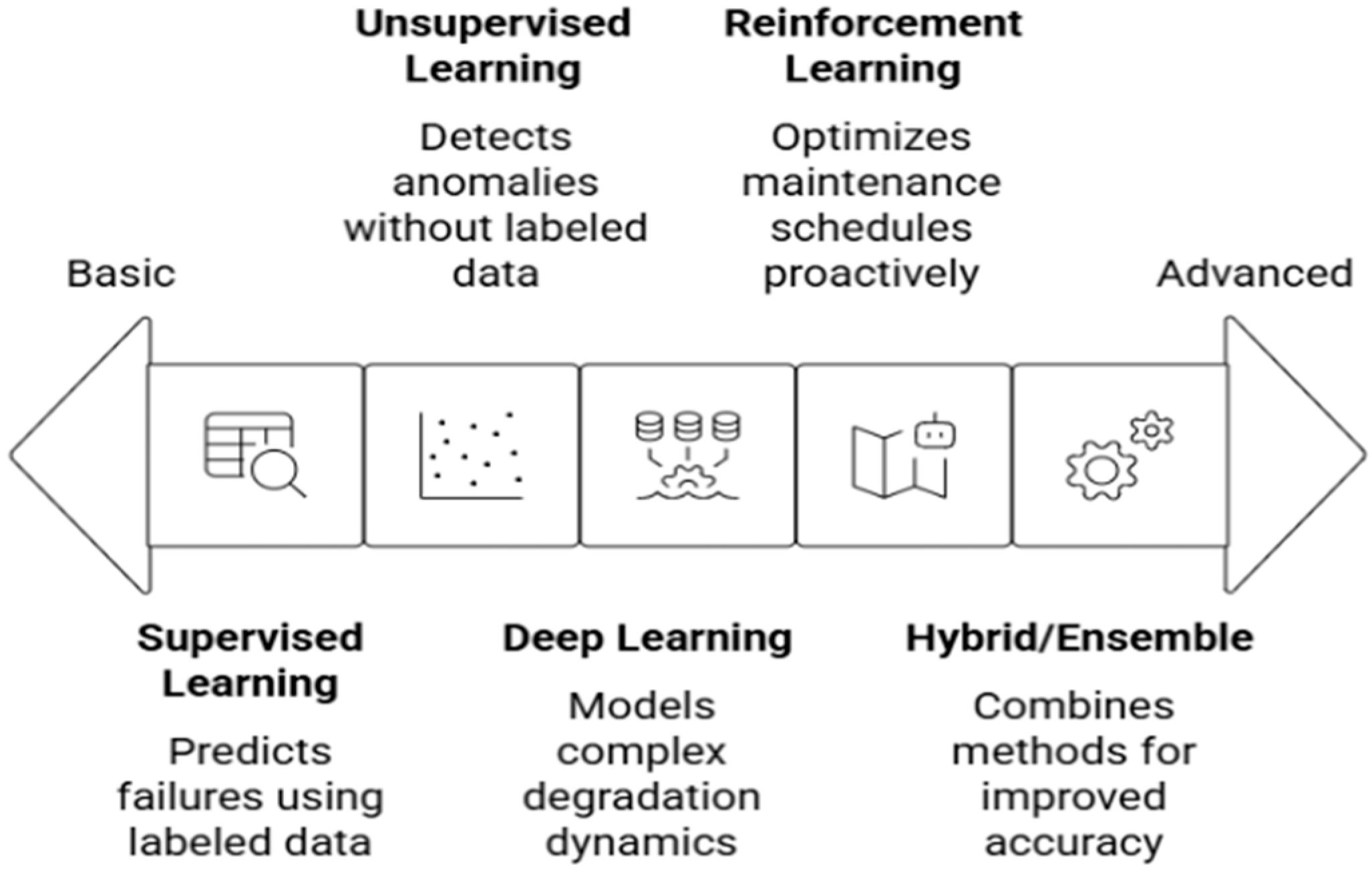
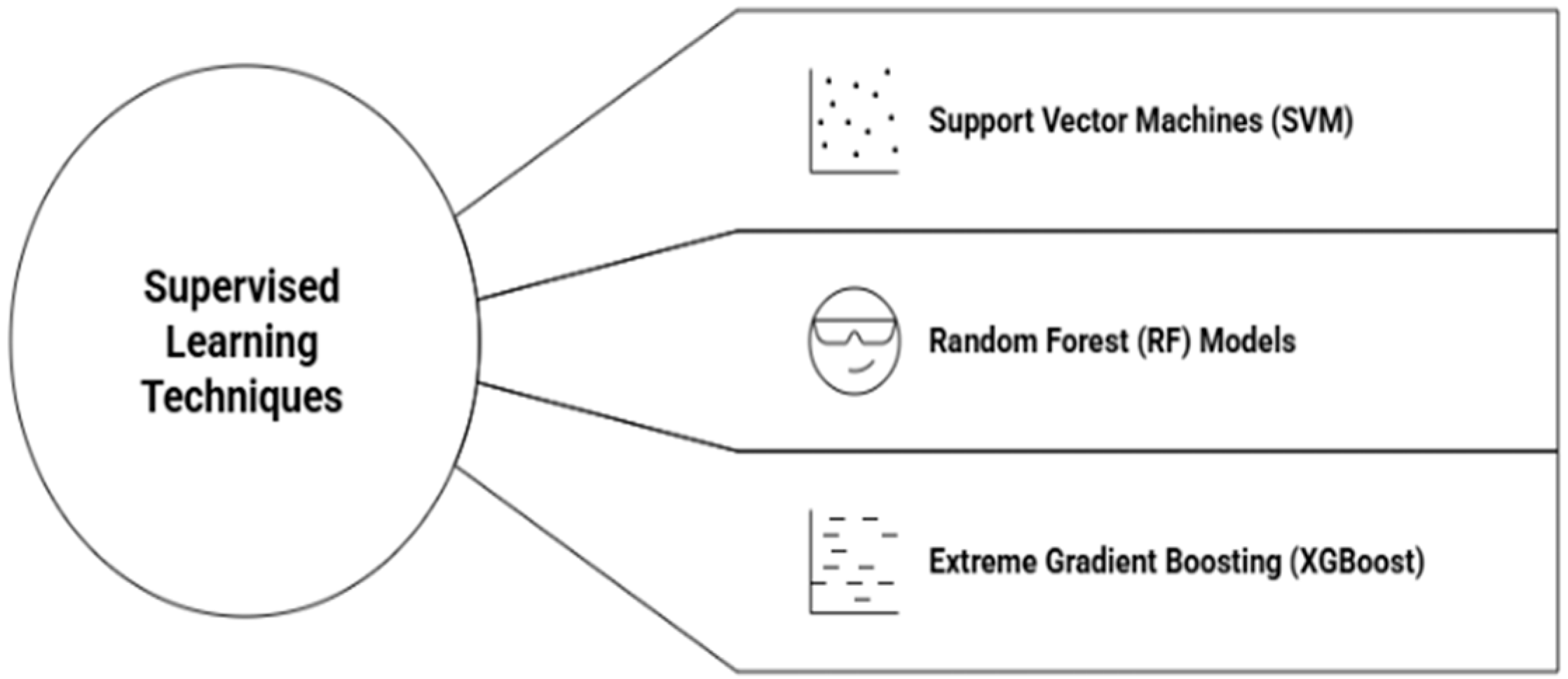
4.1. Supervised Learning Techniques
4.2. Unsupervised Learning and Clustering
4.3. Deep Learning Architecture
4.4. Reinforcement Learning for Maintenance Scheduling
4.5. Hybrid and Ensemble Models
4.6. Emerging Paradigms: Federated Learning (FL) and Explainable AI (XAI)
5. Functional Role Mapping of AI Techniques in Predictive Maintenance
6. AI Techniques for Performance Optimization in Renewable Energy Systems
6.1. Forecasting and Load Prediction
6.2. Energy Dispatch and Control Optimization: Bridging the Simulation-to-Deployment Gap
6.3. Battery Energy Storage System Optimization: Integrating Data-Driven and Physics-Based Intelligence
6.4. Grid Integration and Stability Enhancement: Balancing Performance, Privacy, and Trust
7. Discussion
7.1. Domain-Specific Applications
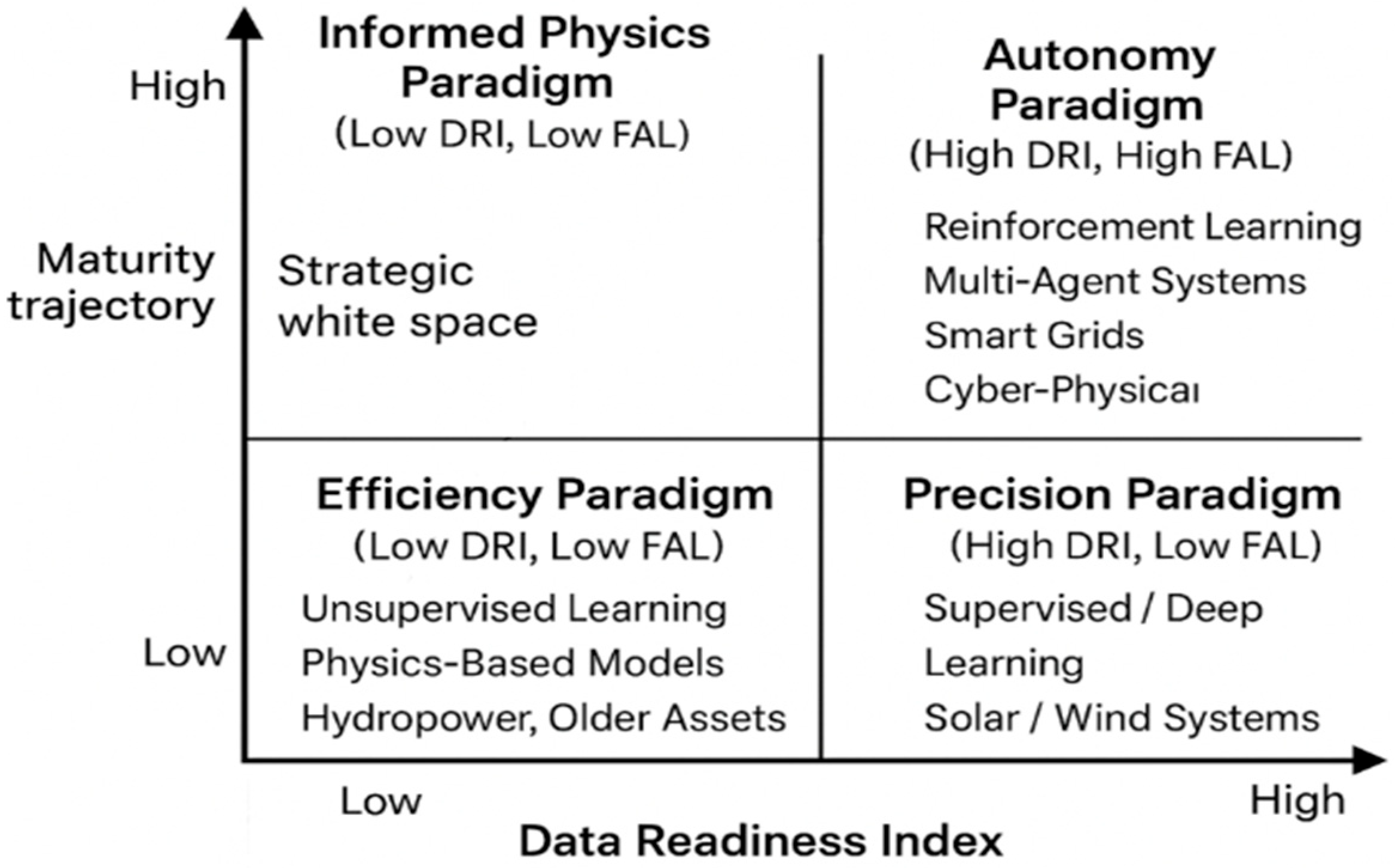
7.2. Comparative Analysis Across Energy Domains: A Data-Centric Framework
7.3. Challenges and Limitations of AI in Renewable Energy Systems
7.4. Future Research Directions
8. Conclusions
Funding
Data Availability Statement
Conflicts of Interest
References
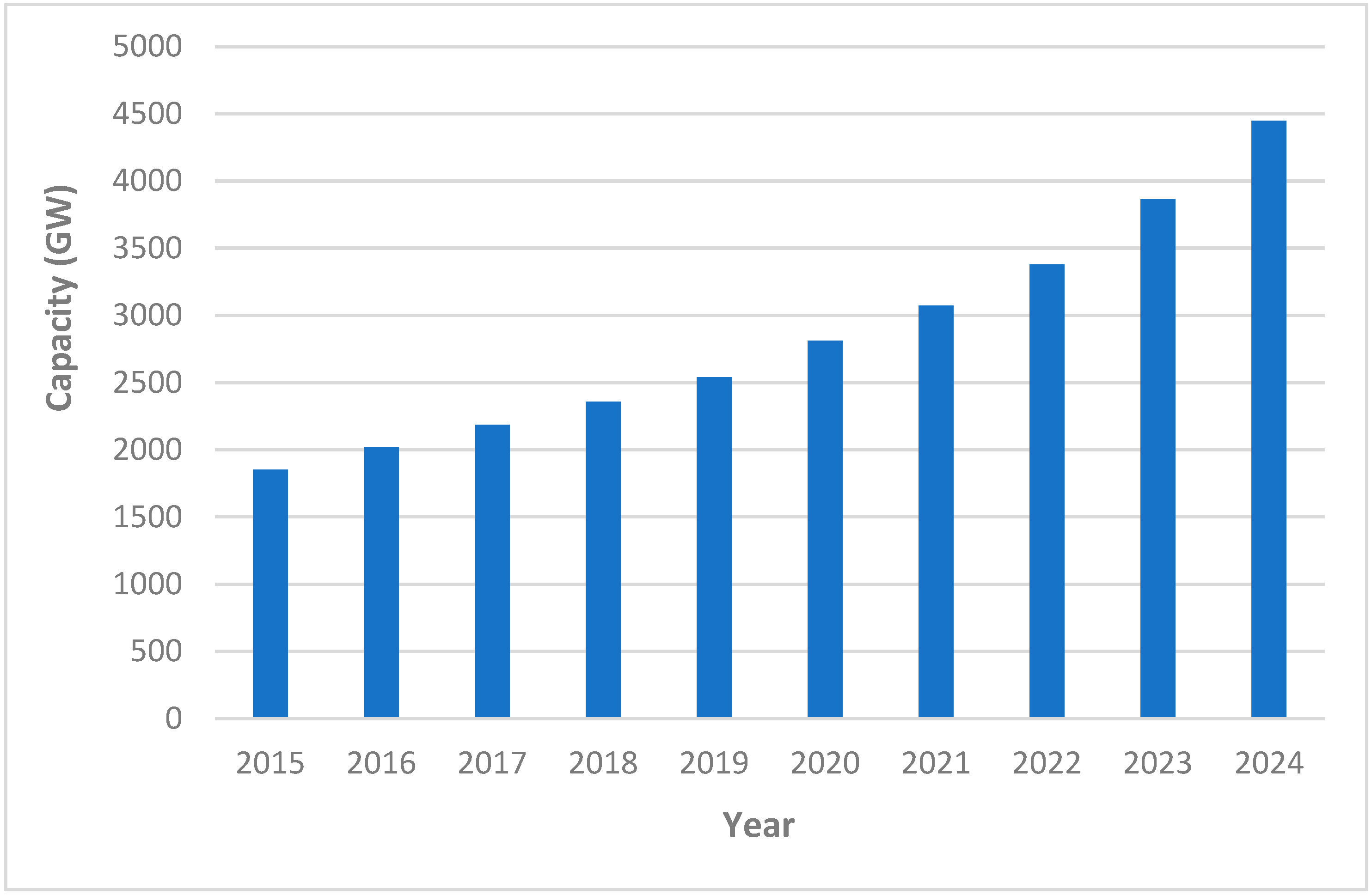
- International Renewable Energy Agency. Renewable Capacity Statistics 2025. Available online: https://www.irena.org (accessed on 3 September 2025).
- Global Energy Review 2025. Available online: https://www.iea.org (accessed on 3 September 2025).
- Apata, O.; Oyedokun, D.T.O. Wind turbine generators: Conventional and emerging technologies. In Proceedings of the 2017 IEEE PES-IAS PowerAfrica Conference: Harnessing Energy, Information and Communications Technology (ICT) for Affordable Electrification of Africa, PowerAfrica, Accra, Ghana, 27–30 June 2017. [Google Scholar] [CrossRef]
- Hassan, Q.; Algburi, S.; Sameen, A.Z.; Salman, H.M.; Jaszczur, M. A review of hybrid renewable energy systems: Solar and wind-powered solutions: Challenges, opportunities, and policy implications. Results Eng. 2023, 20, 101621. [Google Scholar] [CrossRef]
- Turnbull, A.; Carroll, J. Cost benefit of implementing advanced monitoring and predictive maintenance strategies for offshore wind farms. Energies 2021, 14, 4922. [Google Scholar] [CrossRef]
- Dao, C.; Kazemtabrizi, B.; Crabtree, C. Wind turbine reliability data review and impacts on levelised cost of energy. Wind Energy 2019, 22, 1848–1871. [Google Scholar] [CrossRef]
- Zhao, J.; Gao, C.; Tang, T. A Review of Sustainable Maintenance Strategies for Single Component and Multicomponent Equipment. Sustainability 2022, 14, 2992. [Google Scholar] [CrossRef]
- Onwusinkwue, S.; Osasona, F.; Ahmad, I.A.I.; Anyanwu, A.C.; Dawodu, S.O.; Obi, O.C.; Hamdan, A. Artificial intelligence (AI) in renewable energy: A review of predictive maintenance and energy optimization. World J. Adv. Res. Rev. 2024, 21, 2487–2799. [Google Scholar] [CrossRef]
- Chen, Z.; Xiao, F.; Guo, F. Similarity learning-based fault detection and diagnosis in building HVAC systems with limited labeled data. Renew. Sustain. Energy Rev. 2023, 185, 113612. [Google Scholar] [CrossRef]
- Li, D.; Qi, Z.; Zhou, Y.; Elchalakani, M. Machine Learning Applications in Building Energy Systems: Review and Prospects. Buildings 2025, 15, 648. [Google Scholar] [CrossRef]
- Fasogbon, S.K.; Fetuga, I.A.; Oyeniran, A.T.; Shaibu, S.A.; Afolabi, S.; Ndokwu, T.A.; Oluwadare, S.R.; Onafowokan, J.T.; Eso, O.S.; Bassey, V.B. Optimization of energy grid efficiency with machine learning: A comprehensive review of challenges and opportunities. Renew. Sustain. Energy Rev. 2025, 223, 115980. [Google Scholar] [CrossRef]
- Lei, Y.; Yang, B.; Jiang, X.; Jia, F.; Li, N.; Nandi, A.K. Applications of machine learning to machine fault diagnosis: A review and roadmap. Mech. Syst. Signal Process. 2020, 138, 106587. [Google Scholar] [CrossRef]
- Abid, A.; Khan, M.T.; Iqbal, J. A review on fault detection and diagnosis techniques: Basics and beyond. Artif. Intell. Rev. 2020, 54, 3639–3664. [Google Scholar] [CrossRef]
- Azodo, A.P.; Mezue, F.C.T.; Onyekwere, O.S.; Idama, O. Leveraging AI for predictive maintenance in energy systems: Enhancing reliability and efficiency. Aust. J. Multi-Discip. Eng. 2025, 1–19. [Google Scholar] [CrossRef]
- Betti, A.; Trovato, M.L.L.; Leonardi, F.S.; Leotta, G.; Ruffini, F.; Lanzetta, C. Predictive Maintenance in Photovoltaic Plants with a Big Data Approach. arXiv 2019, arXiv:1901.10855. [Google Scholar] [CrossRef]
- Hamza, A.; Ali, Z.; Dudley, S.; Saleem, K.; Uneeb, M.; Christofides, N. A multi-stage review framework for AI-driven predictive maintenance and fault diagnosis in photovoltaic systems. Appl. Energy 2025, 393, 126108. [Google Scholar] [CrossRef]
- Bošnjaković, M.; Martinović, M.; Đokić, K. Application of Artificial Intelligence in Wind Power Systems. Appl. Sci. 2025, 15, 2443. [Google Scholar] [CrossRef]
- Zhang, Z.; Wu, Y.; Ma, X. Quantum machine learning based wind turbine condition monitoring: State of the art and future prospects. Energy Convers. Manag. 2025, 332, 119694. [Google Scholar] [CrossRef]
- Vichare, R.V.; Gaikwad, S.R. AI-based predictive maintenance of solar photovoltaics systems: A comprehensive review. Energy Inform. 2025, 8, 128. [Google Scholar] [CrossRef]
- Alagha, N.; Khairuddin, A.S.M.; Haitaamar, Z.N.; Al-Khatib, O.; Kanesan, J. Artificial Intelligence in Wind Turbine Fault Detection and Diagnosis: Advances and Perspectives. Energies 2025, 18, 1680. [Google Scholar] [CrossRef]
- Shadi, M.R.; Mirshekali, H.; Shaker, H.R. Explainable artificial intelligence for energy systems maintenance: A review on concepts, current techniques, challenges, and prospects. Renew. Sustain. Energy Rev. 2025, 216, 115668. [Google Scholar] [CrossRef]
- Bello, S.F.; Wada, I.U.; Ige, O.B.; Chianumba, E.C.; Adebayo, S.A. AI-driven predictive maintenance and optimization of renewable energy systems for enhanced operational efficiency and longevity. Int. J. Sci. Res. Arch. 2024, 13, 2823–2837. [Google Scholar] [CrossRef]
- Onu, P.; Pradhan, A.; Madonsela, N.S. Explainable AI (XAI) in Smart Grids for Predictive Maintenance: A survey. In Proceedings of the 2024 1st International Conference on Smart Energy Systems and Artificial Intelligence (SESAI), Balaclava, Mauritius, 3–6 June 2024; IEEE: Piscataway, NJ, USA, 2024. [Google Scholar] [CrossRef]
- Afridi, Y.S.; Ahmad, K.; Hassan, L. Artificial intelligence based prognostic maintenance of renewable energy systems: A review of techniques, challenges, and future research directions. Int. J. Energy Res. 2022, 46, 21619–21642. [Google Scholar] [CrossRef]
- Zhao, Z.; Zhang, Q.; Yu, X.; Sun, C.; Wang, S.; Yan, R.; Chen, X. Applications of Unsupervised Deep Transfer Learning to Intelligent Fault Diagnosis: A Survey and Comparative Study. IEEE Trans. Instrum. Meas. 2021, 70, 3525828. [Google Scholar] [CrossRef]
- Heng, A.; Zhang, S.; Tan, A.C.; Mathew, J. Rotating machinery prognostics: State of the art, challenges and opportunities. Mech. Syst. Signal Process. 2009, 23, 724–739. [Google Scholar] [CrossRef]
- Tchakoua, P.; Wamkeue, R.; Ouhrouche, M.; Slaoui-Hasnaoui, F.; Tameghe, T.A.; Ekemb, G. Wind turbine condition monitoring: State-of-the-art review, new trends, and future challenges. Energies 2014, 7, 2595–2630. [Google Scholar] [CrossRef]
- He, Y.; Mendis, G.J.; Wei, J. Real-Time Detection of False Data Injection Attacks in Smart Grid: A Deep Learning-Based Intelligent Mechanism. IEEE Trans. Smart Grid 2017, 8, 2505–2516. [Google Scholar] [CrossRef]
- Liang, G.; Zhao, J.; Luo, F.; Weller, S.R.; Dong, Z.Y. A Review of False Data Injection Attacks Against Modern Power Systems. IEEE Trans. Smart Grid 2016, 8, 1630–1638. [Google Scholar] [CrossRef]
- Long, H.A.; French, D.P.; Brooks, J.M. Optimising the value of the critical appraisal skills programme (CASP) tool for quality appraisal in qualitative evidence synthesis. Res. Methods Med. Health Sci. 2020, 1, 31–42. [Google Scholar] [CrossRef]
- Benghanem, M.; Mellit, A.; Moussaoui, C. Embedded Hybrid Model (CNN–ML) for Fault Diagnosis of Photovoltaic Modules Using Thermographic Images. Sustainability 2023, 15, 7811. [Google Scholar] [CrossRef]
- Kusiak, A.; Verma, A. Analyzing bearing faults in wind turbines: A data-mining approach. Renew Energy 2012, 48, 110–116. [Google Scholar] [CrossRef]
- Sun, J.; Sun, F.; Fan, J.; Liang, Y. Fault diagnosis model of photovoltaic array based on least squares support vector machine in Bayesian framework. Appl. Sci. 2017, 7, 1199. [Google Scholar] [CrossRef]
- Suliman, F.; Anayi, F.; Packianather, M. Electrical Faults Analysis and Detection in Photovoltaic Arrays Based on Machine Learning Classifiers. Sustainability 2024, 16, 1102. [Google Scholar] [CrossRef]
- Kumaradurai, A.; Teekaraman, Y.; Coosemans, T.; Messagie, M. Fault detection in photovoltaic systems using machine learning algorithms: A review. In Proceedings of the 2020 8th International Conference on Orange Technology, ICOT 2020, Daegu, Republic of Korea, 18–21 December 2020. [Google Scholar] [CrossRef]
- Jardine, A.K.; Lin, D.; Banjevic, D. A review on machinery diagnostics and prognostics implementing condition-based maintenance. Mech. Syst. Signal Process. 2006, 20, 1483–1510. [Google Scholar] [CrossRef]
- Zhang, J.; Cosma, G.; Watkins, J. Image Enhanced Mask R-CNN: A Deep Learning Pipeline with New Evaluation Measures for Wind Turbine Blade Defect Detection and Classification. J. Imaging 2021, 7, 46. [Google Scholar] [CrossRef] [PubMed]
- Wang, Z.; Gao, P.; Chu, X. Remaining Useful Life Prediction of Wind Turbine Gearbox Bearings with Limited Samples Based on Prior Knowledge and PI-LSTM. Sustainability 2022, 14, 12094. [Google Scholar] [CrossRef]
- Li, L.; Jian, Q. Remaining Useful Life Prediction of Wind Turbine Main-Bearing Based on LSTM Optimized Network. IEEE Sens. J. 2024, 24, 21143–21156. [Google Scholar] [CrossRef]
- Klaiber, J.; Van Dinther, C. Deep Learning for Variable Renewable Energy: A Systematic Review. ACM Comput. Surv. 2024, 56, 1–37. [Google Scholar] [CrossRef]
- Kuyumani, E.M.; Hasan, A.N.; Shongwe, T. A Hybrid Model Based on CNN-LSTM to Detect and Forecast Harmonics: A Case Study of an Eskom Substation in South Africa. Electric Power Components and Systems. Electr. Power Components Syst. 2023, 51, 746–760. [Google Scholar] [CrossRef]
- Qi, L.; Zhang, Q.; Xie, Y.; Zhang, J.; Ke, J. Research on Wind Turbine Fault Detection Based on CNN-LSTM. Energies 2024, 17, 4497. [Google Scholar] [CrossRef]
- Hissou, H.; Benkirane, S.; Guezzaz, A.; Azrour, M.; Beni-Hssane, A. A Novel Machine Learning Approach for Solar Radiation Estimation. Sustainability 2023, 15, 10609. [Google Scholar] [CrossRef]
- Grataloup, A.; Jonas, S.; Meyer, A. Wind turbine condition monitoring based on intra- and inter-farm federated learning. IEEE Access 2025, 13, 146617–146629. [Google Scholar] [CrossRef]
- Lu, S.; Gao, Z.; Zhang, P.; Xu, Q.; Xie, T.; Zhang, A. Event-Triggered Federated Learning for Fault Diagnosis of Offshore Wind Turbines with Decentralized Data. IEEE Trans. Autom. Sci. Eng. 2023, 21, 1271–1283. [Google Scholar] [CrossRef]
- Kairouz, P.; McMahan, H.B.; Avent, B.; Bellet, A.; Bennis, M.; Bhagoji, A.N.; Bonawitz, K.; Charles, Z.; Cormode, G.; Cummings, R.; et al. Advances and open problems in federated learning. Found. Trends Mach. Learn. 2021, 14, 1–210. [Google Scholar] [CrossRef]
- Nguyen, V.N.; Tarełko, W.; Sharma, P.; El-Shafay, A.S.; Chen, W.-H.; Nguyen, P.Q.P.; Nguyen, X.P.; Hoang, A.T. Potential of Explainable Artificial Intelligence in Advancing Renewable Energy: Challenges and Prospects. Energy Fuels 2024, 38, 1692–1712. [Google Scholar] [CrossRef]
- Nallakaruppan, M.; Shankar, N.; Bhuvanagiri, P.B.; Padmanaban, S.; Khan, S.B. Advancing solar energy integration: Unveiling XAI insights for enhanced power system management and sustainable future. Ain Shams Eng. J. 2024, 15, 102740. [Google Scholar] [CrossRef]
- Carvalho, D.V.; Pereira, E.M.; Cardoso, J.S. Machine learning interpretability: A survey on methods and metrics. Electronics 2019, 8, 832. [Google Scholar] [CrossRef]
- Kumari, P.; Toshniwal, D. Deep learning models for solar irradiance forecasting: A comprehensive review. J. Clean. Prod. 2021, 318, 128566. [Google Scholar] [CrossRef]
- Lin, S.H.; Yu, H.H.; Chen, H.W. On-Line Optimization of Microgrid Operating Cost Based on Deep Reinforcement Learning. In IOP Conference Series: Earth and Environmental Science; IOP Publishing: Bristol, UK, 2021. [Google Scholar] [CrossRef]
- García, J.; Fernández, F. A comprehensive survey on safe reinforcement learning. J. Mach. Learn. Res. 2015, 16, 1437–1480. [Google Scholar]
- Muriithi, G.; Chowdhury, S. Deep Q-network application for optimal energy management in a grid-tied solar PV-Battery microgrid. J. Eng. 2022, 2022, 422–441. [Google Scholar] [CrossRef]
- Vidal, Y.; Puruncajas, B.; Castellani, F.; Tutivén, C. Predictive maintenance of wind turbine’s main bearing using wind farm SCADA data and LSTM neural networks. J. Phys. Conf. Ser. 2023, 2507, 012024. [Google Scholar] [CrossRef]
- Wang, H.; Liu, X.; Ma, L.; Zhang, Y. Anomaly detection for hydropower turbine unit based on variational modal decomposition and deep autoencoder. Energy Rep. 2021, 7, 938–946. [Google Scholar] [CrossRef]
- Apata, O. Decarbonization pathways through multi-energy system planning. Energy Rep. 2025, 13, 4477–4490. [Google Scholar] [CrossRef]
- Fang, X.; Wang, J.; Song, G.; Han, Y.; Zhao, Q.; Cao, Z. Multi-agent reinforcement learning approach for residential microgrid energy scheduling. Energies 2019, 13, 123. [Google Scholar] [CrossRef]
- Selcuk, S. Predictive maintenance, its implementation and latest trends. Proc. Inst. Mech. Eng. B J. Eng. Manuf. 2017, 231, 1670–1679. [Google Scholar] [CrossRef]
- Tchakoua, P.; Wamkeue, R.; Tameghe, T.A.; Ekemb, G. A review of concepts and methods for wind turbines condition monitoring. In Proceedings of the 2013 World Congress on Computer and Information Technology, WCCIT 2013, Sousse, Tunisia, 22–24 June 2013. [Google Scholar] [CrossRef]
- Janiesch, C.; Zschech, P.; Heinrich, K. Machine learning and deep learning. Electron. Mark. 2021, 31, 685–695. [Google Scholar] [CrossRef]
- Shalev-Shwartz, S.; Ben-David, S. Understanding Machine Learning: From Theory to Algorithms; Cambridge University Press: Cambridge, UK, 2013; Volume 9781107057135. [Google Scholar] [CrossRef]
- Mandal, R.K.; Kale, P.G. Assessment of Different Multiclass SVM Strategies for Fault Classification in a PV System. In Proceedings of the 7th International Conference on Advances in Energy Research 2021, Pune, India, 10–12 December 2021. [Google Scholar] [CrossRef]
- Robert, C. Machine Learning, a Probabilistic Perspective; MIT Press: Cambridge, MA, USA, 2014; Volume 27. [Google Scholar] [CrossRef]
- Cervantes, J.; Garcia-Lamont, F.; Rodríguez-Mazahua, L.; Lopez, A. A comprehensive survey on support vector machine classification: Applications, challenges and trends. Neurocomputing 2020, 408, 189–215. [Google Scholar] [CrossRef]
- Jordan, M.I.; Mitchell, T.M. Machine learning: Trends, perspectives, and prospects. Science 2015, 349, 255–260. [Google Scholar] [CrossRef]
- Bangalore, P.; Tjernberg, L.B. An approach for self evolving neural network based algorithm for fault prognosis in wind turbine. In Proceedings of the 2013 IEEE Grenoble Conference PowerTech, POWERTECH 2013, Grenoble, France, 16–20 June 2013. [Google Scholar] [CrossRef]
- Blagus, R.; Lusa, L. SMOTE for high-dimensional class-imbalanced data. BMC Bioinform. 2013, 14, 106. [Google Scholar] [CrossRef]
- Pradhan, R.; Behera, J.; Sen, S.; Sahoo, T.K. A Robust Machine Learning Approach for Ac Microgrid Fault Diagnosis Using FFT and XGBoost. In Proceedings of the 2025 IEEE North-East India International Energy Conversion Conference and Exhibition (NE-IECCE), Silchar, India, 4–6 July 2025; IEEE: New York City, NY, USA, 2025; pp. 1–6. [Google Scholar] [CrossRef]
- Liu, B.; Wang, X.; Sun, K.; Zhao, J.; Li, L. Fault Diagnosis of Photovoltaic Array Based on XGBoost Method. In Proceedings of the 2021 IEEE Sustainable Power and Energy Conference: Energy Transition for Carbon Neutrality, iSPEC 2021, Nanjing, China, 23–25 December 2021. [Google Scholar] [CrossRef]
- Azari, M.S.; Flammini, F.; Santini, S.; Caporuscio, M. A Systematic Literature Review on Transfer Learning for Predictive Maintenance in Industry 4.0. IEEE Access 2023, 11, 12887–12910. [Google Scholar] [CrossRef]
- Jovicic, E.; Primorac, D.; Cupic, M.; Jovic, A. Publicly Available Datasets for Predictive Maintenance in the Energy Sector: A Review. IEEE Access 2023, 11, 73505–73520. [Google Scholar] [CrossRef]
- Tautz-Weinert, J.; Watson, S.J. Using SCADA data for wind turbine condition monitoring—A review. IET Renew. Power Gener. 2017, 11, 382–394. [Google Scholar] [CrossRef]
- Tufail, S.; Sarwat, A.I. A Comparative Study of Dimensionality Reduction Methods for Accurate and Efficient Inverter Fault Detection in Grid-Connected Solar Photovoltaic Systems. Electronics 2025, 14, 2916. [Google Scholar] [CrossRef]
- Miraftabzadeh, S.M.; Colombo, C.G.; Longo, M.; Foiadelli, F. K-Means and Alternative Clustering Methods in Modern Power Systems. IEEE Access 2023, 11, 119596–119633. [Google Scholar] [CrossRef]
- Rahoma, A.; Imtiaz, S.; Ahmed, S.; Khan, F. Detection and diagnosis of process fault using unsupervised learning methods and unlabeled data. Int. J. Adv. Eng. Sci. Appl. Math. 2023, 15, 24–36. [Google Scholar] [CrossRef]
- Lei, Y.; Jia, F.; Lin, J.; Xing, S.; Ding, S.X. An Intelligent Fault Diagnosis Method Using Unsupervised Feature Learning Towards Mechanical Big Data. IEEE Trans. Ind. Electron. 2016, 63, 3137–3147. [Google Scholar] [CrossRef]
- Wang, J.; Li, X.; Zhang, Y. A series fault arc detection method based on denoising autoencoder and deep residual network. Front. Energy Res. 2024, 12, 1341281. [Google Scholar] [CrossRef]
- He, A.; Jin, X. Deep Variational Autoencoder Classifier for Intelligent Fault Diagnosis Adaptive to Unseen Fault Categories. IEEE Trans. Reliab. 2021, 70, 1581–1595. [Google Scholar] [CrossRef]
- Samek, W.; Montavon, G.; Vedaldi, A.; Hansen, L.K.; Muller, K.-R. Explainable AI: Interpreting, Explaining and Visualizing Deep Learning; Lecture Notes in Computer Science (LNCS); Springer: Berlin/Heidelberg, Germany, 2019; Volume 11700. [Google Scholar]
- Tao, H.; Wang, P.; Chen, Y.; Stojanovic, V.; Yang, H. An unsupervised fault diagnosis method for rolling bearing using STFT and generative neural networks. J. Frankl. Inst. 2020, 357, 7286–7307. [Google Scholar] [CrossRef]
- Wang, Y.; Meiqin, L.; Zhejing, B. Deep Learning Neural Network for Power System Fault Diagnosis. In Proceedings of the 2016 35th Chinese Control Conference (CCC), Chengdu, China, 27–29 July 2016. [Google Scholar]
- Zhang, Y.; Xiong, R.; He, H.; Pecht, M.G. Long short-term memory recurrent neural network for remaining useful life prediction of lithium-ion batteries. IEEE Trans. Veh. Technol. 2018, 67, 5695–5705. [Google Scholar] [CrossRef]
- Wang, H.; Lei, Z.; Zhang, X.; Zhou, B.; Peng, J. A review of deep learning for renewable energy forecasting. Energy Convers. Manag. 2019, 198, 111799. [Google Scholar] [CrossRef]
- Wu, C.; Jiang, P.; Ding, C.; Feng, F.; Chen, T. Intelligent fault diagnosis of rotating machinery based on one-dimensional convolutional neural network. Comput. Ind. 2019, 108, 53–61. [Google Scholar] [CrossRef]
- Zhang, W.; Li, X.; Ding, Q. Deep residual learning-based fault diagnosis method for rotating machinery. ISA Trans. 2019, 95, 295–305. [Google Scholar] [CrossRef]
- Raissi, M.; Perdikaris, P.; Karniadakis, G.E. Physics-informed neural networks: A deep learning framework for solving forward and inverse problems involving nonlinear partial differential equations. J. Comput. Phys. 2019, 378, 686–707. [Google Scholar] [CrossRef]
- Mason, K.; Grijalva, S. A review of reinforcement learning for autonomous building energy management. Comput. Electr. Eng. 2019, 78, 300–312. [Google Scholar] [CrossRef]
- Ozcanli, A.K.; Yaprakdal, F.; Baysal, M. Deep learning methods and applications for electrical power systems: A comprehensive review. Int. J. Energy Res. 2020, 44, 7136–7157. [Google Scholar] [CrossRef]
- Sutton, R.S.; Barto, A.G. Reinforcement Learning: An Introduction. IEEE Trans. Neural. Netw. 2005, 9, 1054. [Google Scholar] [CrossRef]
- François-Lavet, V.; Henderson, P.; Islam, R.; Bellemare, M.G.; Pineau, J. An introduction to deep reinforcement learning. Found. Trends Mach. Learn. 2018, 11, 219–354. [Google Scholar] [CrossRef]
- Zhao, H.; Liu, H.; Hu, W.; Yan, X. Anomaly detection and fault analysis of wind turbine components based on deep learning network. Renew Energy 2018, 127, 825–834. [Google Scholar] [CrossRef]
- Elsken, T.; Metzen, J.H.; Hutter, F. Neural architecture search: A survey. J. Mach. Learn. Res. 2019, 20, 1–21. [Google Scholar]
- Jenkel, L.; Jonas, S.; Meyer, A. Towards Fleet-wide Sharing of Wind Turbine Condition Information through Privacy-preserving Federated Learning. arXiv 2022, arXiv:2212.03529. [Google Scholar]
- Alsaigh, R.; Mehmood, R.; Katib, I. AI explainability and governance in smart energy systems: A review. Front. Energy Res. 2023, 11, 1071291. [Google Scholar] [CrossRef]
- Presciuttini, A.; Cantini, A.; Portioli-Staudacher, A. From Explanations to Actions: Leveraging SHAP, LIME, and Counterfactual Analysis for Operational Excellence in Maintenance Decisions. In Proceedings of the International Conference on Electrical, Computer, Communications and Mechatronics Engineering, ICECCME 2024, Male, Maldives, 4–6 November 2024; Institute of Electrical and Electronics Engineers Inc.: New York City, NY, USA, 2024. [Google Scholar] [CrossRef]
- Olechowski, A.L.; Eppinger, S.D.; Joglekar, N.; Tomaschek, K. Technology readiness levels: Shortcomings and improvement opportunities. Syst. Eng. 2020, 23, 395–408. [Google Scholar] [CrossRef]
- Committee on NASA’s Strategic Direction; Division on Engineering and Physical Sciences; National Research Council. NASA’s Strategic Direction and the Need for a National Consensus; National Academies Press: Washington, DC, USA, 2013. [Google Scholar] [CrossRef]
- Héder, M. From NASA to EU: The evolution of the TRL scale in Public Sector Innovation. Innov. J. 2017, 22, 1–23. [Google Scholar]
- Ratsheola, K.; Setlhaolo, D.; Rasool, A.; Ali, A.; Mabunda, N.E. A Hybrid Artificial Intelligence for Fault Detection and Diagnosis of Photovoltaic Systems Using Autoencoders and Random Forests Classifiers. Eng 2025, 6, 254. [Google Scholar] [CrossRef]
- Khan, S.; Mazhar, T.; Shahzad, T.; Waheed, W.; Waheed, A.; Saeed, M.M.; Hamam, H. Optimizing deep neural network architectures for renewable energy forecasting. Discov. Sustain. 2024, 5, 394. [Google Scholar] [CrossRef]
- Siraskar, R.; Kumar, S.; Patil, S.; Bongale, A.; Kotecha, K. Reinforcement learning for predictive maintenance: A systematic technical review. Artif. Intell. Rev. 2023, 56, 12885–12947. [Google Scholar] [CrossRef]
- Feng, B.; Xu, H.; Chen, Y.; Zhu, W.; Guo, C. Failure-Resistant Federated Deep Reinforcement Learning for Multiple Microgrids Energy Management. CSEE J. Power Energy Syst. 2025, 11, 1–13. [Google Scholar]
- Fang, Q.; Liang, X.; Li, S.; Zhang, J.; Yang, X.; Guo, Z. A Novel Multi-Step Short-Term Power Forecasting Model for Electric Power Systems Based on Deep-Learning. IEEE Trans. Power Syst. 2025, 40, 4621–4633. [Google Scholar] [CrossRef]
- Padilha, G.A.G.; Ko, J.; Jung, J.J.; de Mattos Neto, P.S.G. Transformer-Based Hybrid Forecasting Model for Multivariate Renewable Energy. Appl. Sci. 2022, 12, 10985. [Google Scholar] [CrossRef]
- Hertel, M.; Beichter, M.; Heidrich, B.; Neumann, O.; Schäfer, B.; Mikut, R.; Hagenmeyer, V. Transformer training strategies for forecasting multiple load time series. Energy Inform. 2023, 6, 20. [Google Scholar] [CrossRef]
- Arévalo, P.; Jurado, F. Impact of Artificial Intelligence on the Planning and Operation of Distributed Energy Systems in Smart Grids. Energies 2024, 17, 4501. [Google Scholar] [CrossRef]
- Aydin, E.; Iqbal, S. Reinforcement Learning-Based Optimization for Electric Vehicle Dispatch in Renewable Energy Integrated Power Systems. In Proceedings of the 2024 IEEE Energy Conversion Congress and Exposition, ECCE 2024—Proceedings, Phoenix, AZ, USA, 20–24 October 2024; Institute of Electrical and Electronics Engineers Inc.: New York City, NY, USA, 2024; pp. 1297–1304. [Google Scholar] [CrossRef]
- Bhol, S.; Sahu, N.C.; Nanda, A.B. Optimal Dispatch of a Hybrid Renewable Energy System Using Modified PSO Algorithm. In Proceedings of the 2021 International Conference in Advances in Power, Signal, and Information Technology, APSIT 2021, Bhubaneswar, India, 8–10 October 2021; Institute of Electrical and Electronics Engineers Inc.: New York City, NY, USA, 2021. [Google Scholar] [CrossRef]
- Zhang, T.; Strbac, G. Artificial Intelligence Applications for Energy Storage: A Comprehensive Review. Energies 2025, 18, 4718. [Google Scholar] [CrossRef]
- Filho, E.M.L.; Silveira, A.B.; Ferreira, A.M.; Marques, J.A.L.; Batista, J.G.; Guimarães, G.D.F.; De Alexandria, A.R.; Rodrigues, J.J.P.C. Optimization of Energy Storage Systems with Renewable Energy Generation and Consumption Data. In Proceedings of the IEEE Student Conference on Electric Machines and Systems (SCEMS), Macao, China, 6–8 November 2024; Institute of Electrical and Electronics Engineers Inc.: New York City, NY, USA, 2024. [Google Scholar] [CrossRef]
- Singh, S.; Ebongue, Y.E.; Rezaei, S.; Birke, K.P. Hybrid modeling of lithium-ion battery: Physics-informed neural network for battery state estimation. Batteries 2023, 9, 301. [Google Scholar] [CrossRef]
- Zhang, G.; Zhu, S.; Bai, X. Federated Learning-Based Multi-Energy Load Forecasting Method Using CNN-Attention-LSTM Model. Sustainability 2022, 14, 12843. [Google Scholar] [CrossRef]
- You, B.; Xing, C.; Yu, Q.; Zhang, M.; He, Z.; Zeng, L.; Liu, C. Federated Learning with LSTM Neural Network for Regional Load Forecasting. In Proceedings of the International Conference on Harmonics and Quality of Power, ICHQP, Chengdu, China, 15–18 October 2024; IEEE Computer Society: Los Alamitos, CA, USA, 2024; pp. 619–624. [Google Scholar] [CrossRef]
- Jasińska, L.; Zagórski, M.; Domaradzki, J.; Maziuk, M.; Chodasewicz, P. Application of Artificial Intelligence for Selected Photovoltaic Faults Detection Based on Electroluminescence Images. IEEE Access 2025, 13, 126030–126042. [Google Scholar] [CrossRef]
- Chu, F. An improved PCA algorithm for anomaly detection of hydropower units. In Proceedings of the 2017 2nd IEEE International Conference on Cloud Computing and Big Data Analysis, ICCCBDA 2017, Chengdu, China, 28–30 April 2017. [Google Scholar] [CrossRef]
- Cheng, X.; Li, C.; Liu, X. A Review of Federated Learning in Energy Systems. In Proceedings of the 2022 IEEE IAS Industrial and Commercial Power System Asia, Shanghai, China, 8–11 July 2022; Institute of Electrical and Electronics Engineers Inc.: Los Alamitos, CA, USA, 2022; pp. 2089–2095. [Google Scholar] [CrossRef]
- Alhussein, M.; Aurangzeb, K.; Haider, S.I. Hybrid CNN-LSTM Model for Short-Term Individual Household Load Forecasting. IEEE Access 2020, 8, 180544–180557. [Google Scholar] [CrossRef]
- Yang, H.; Xie, X. An Actor-Critic Deep Reinforcement Learning Approach for Transmission Scheduling in Cognitive Internet of Things Systems. IEEE Syst. J. 2019, 14, 51–60. [Google Scholar] [CrossRef]
- Yang, W.; Yu, G. Federated Multi-Model Transfer Learning-Based Fault Diagnosis with Peer-to-Peer Network for Wind Turbine Cluster. Machines 2022, 10, 972. [Google Scholar] [CrossRef]
- Sinap, V.; Kumtepe, A. CNN-based automatic detection of photovoltaic solar module anomalies in infrared images: A comparative study. Neural Comput. Appl. 2024, 36, 17715–17736. [Google Scholar] [CrossRef]
- Chen, X.; Huang, C.; Zhang, Y.; Wang, H. Privacy-Preserving Personalized Federated Learning for Distributed Photovoltaic Disaggregation Under Statistical Heterogeneity. IEEE Trans. Instrum. Meas. 2025, 74, 2529411. [Google Scholar] [CrossRef]
- Bergamin, L.; Carraro, T.; Polato, M.; Aiolli, F. Novel Applications for VAE-based Anomaly Detection Systems. In Proceedings of the 2022 International Joint Conference on Neural Networks, Padua, Italy, 18–23 July 2022; Available online: http://arxiv.org/abs/2204.12577 (accessed on 14 November 2025).
- Gangloff, H.; Pham, M.-T.; Courtrai, L.; Lefèvre, S. Unsupervised Anomaly Detection Using Variational Autoencoder with Gaussian Random Field Prior. In Proceedings of the International Conference on Image Processing, ICIP, Kuala Lumpur, Malaysia, 8–11 October 2023; IEEE Computer Society: Los Alamitos, CA, USA, 2023; pp. 1620–1624. [Google Scholar] [CrossRef]
- El Hassan, M.; Mjalled, A.; Miron, P.; Mönnigmann, M.; Bukharin, N. Machine Learning in Fluid Dynamics—Physics-Informed Neural Networks (PINNs) Using Sparse Data: A Review. Fluids 2025, 10, 226. [Google Scholar] [CrossRef]
- Mu, C.; Shi, Y.; Xu, N.; Wang, X.; Tang, Z.; Jia, H.; Geng, H. Multi-Objective Interval Optimization Dispatch of Microgrid via Deep Reinforcement Learning. IEEE Trans. Smart Grid 2023, 15, 2957–2970. [Google Scholar] [CrossRef]
- Garst, S.; Dekker, J.; Reinders, M. A comprehensive experimental comparison between federated and centralized learning. Database 2025, 2025, baaf016. [Google Scholar] [CrossRef] [PubMed]
- Fagundes, F.D.; da Cunha, M.J. Industrial Network Security. J. Control Autom. Electr. Syst. 2022, 33, 1177–1187. [Google Scholar] [CrossRef]
- Dolezilek, D.; Gammel, D.; Fernandes, W. Cybersecurity based on IEC 62351 and IEC 62443 for IEC 61850 systems. In Proceedings of the IET Conference Publications, Kitakyushu, Japan, 27–29 September 2020. [Google Scholar] [CrossRef]
- IEEE Std 7000-2021; IEEE Approved Draft Model Process for Addressing Ethical Concerns During System Design. IEEE: New York, NY, USA, 2021.
- Leichtmann, B.; Humer, C.; Hinterreiter, A.; Streit, M.; Mara, M. Effects of Explainable Artificial Intelligence on trust and human behavior in a high-risk decision task. Comput. Hum. Behav. 2023, 139, 107539. [Google Scholar] [CrossRef]
- Abbas, A.N.; Amazu, C.W.; Mietkiewicz, J.; Briwa, H.; Perez, A.A.; Baldissone, G.; Demichela, M.; Chasparis, G.C.; Kelleher, J.D.; Leva, M.C. Analyzing Operator States and the Impact of AI-Enhanced Decision Support in Control Rooms: A Human-in-the-Loop Specialized Reinforcement Learning Framework for Intervention Strategie. Int. J. Hum. Comput. Interact. 2025, 41, 7218–7252. [Google Scholar] [CrossRef]
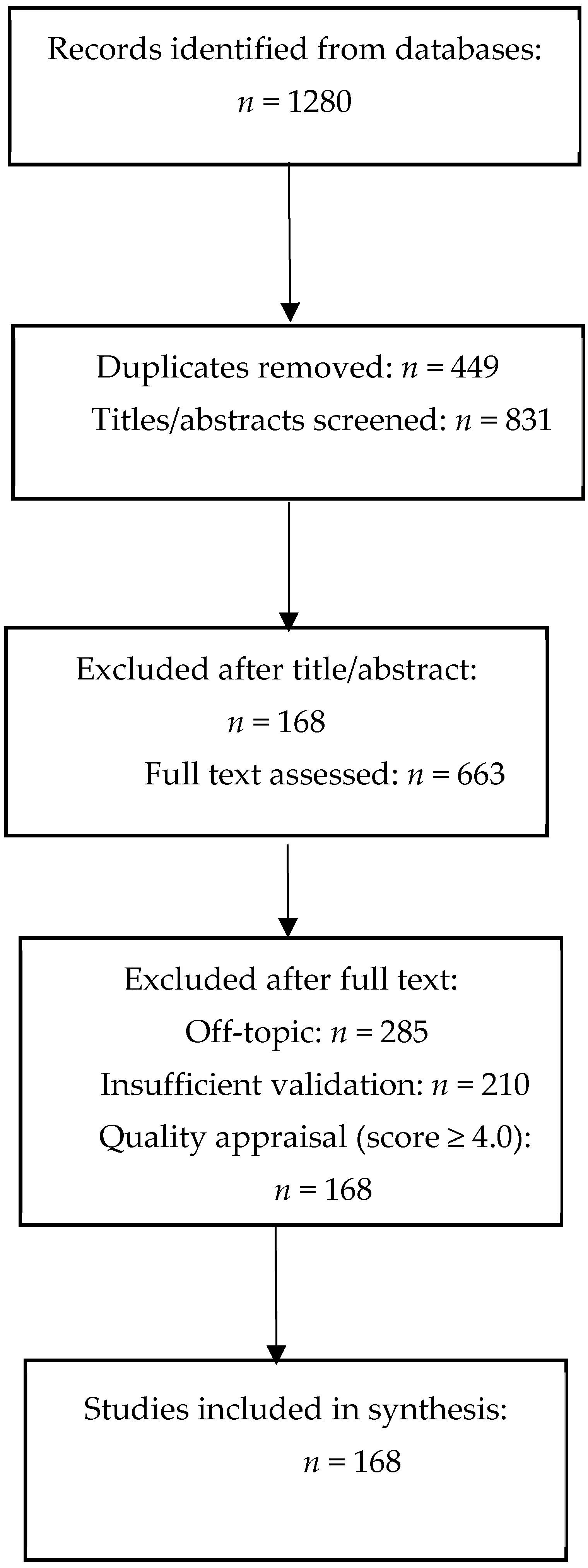

| Screening Stage | Criteria Applied | Action Taken | Corpus Size |
|---|---|---|---|
| Stage 1: Deduplication and language filtering | Removed duplicate entries and non-English publications | Automated filtering and manual verification | 831 |
| Stage 2: Title and abstract screening | Excluded studies focused on fossil fuels, non-technical content, or unrelated AI applications | Manual relevance screening | 663 |
| Stage 3: Full-text review | Included studies that: (i) apply AI to PdM in RES, or closely related performance optimization tasks directly supporting PdM objectives (e.g., forecasting for maintenance-informed dispatch, battery energy storage optimization for asset reliability, grid integration for fault-resilient operation) in RES. (ii) describe model architecture and validation, (iii) report empirical results | Detailed content analysis and methodological assessment | 168 |
| Criterion | Weight | Description and Scoring Guidelines (1–5 Scale) |
|---|---|---|
| Problem Formulation | 20% | Clarity and relevance of research objectives. 1 = vague; 5 = explicit and highly relevant to RES PdM |
| Technical Depth of AI Methodology | 30% | Detail and rigor of AI techniques described. 1 = superficial; 5 = comprehensive with pseudocode/equations |
| Validation Strategy and Rigor | 30% | Robustness of evaluation (metrics, datasets, cross-validation). 1 = none; 5 = multiple real-world datasets |
| Relevance to RES Domains | 10% | Direct applicability to solar/wind/hydro/hybrid. 1 = tangential; 5 = domain-specific insights |
| Reproducibility | 10% | Availability of code/data, detailed hyperparameters. 1 = none; 5 = open-source repository |
| Functional Role | AI Paradigms Commonly Used | Representative Applications | Indicative TRL Range | TRL Justification (Per NASA/EU Horizon Definitions) |
|---|---|---|---|---|
| Fault Detection | Supervised Learning (SVM, RF), Deep Learning (CNN, LSTM), Unsupervised Learning (Autoencoders, Clustering) | Classification of inverter faults in PV systems; blade damage detection in wind turbines using CNNs; SCADA-based clustering in wind farms. | 7–8 | Widely validated in operational environments; integrated into commercial SCADA analytics platforms; field-proven performance. |
| Anomaly Classification | Unsupervised Learning (PCA, VAE), Deep Learning (Autoencoders), XAI | Detection of abnormal states in hydropower and smart grids; anomaly scoring with VAE; interpretability via SHAP for anomaly attribution. | 6–7 | Demonstrated in pilot or field test environments; moderate validation under real operational data. |
| RUL Estimation | Supervised Regression (SVR), Deep Learning (LSTM, GRU), Reinforcement Learning | Turbine wear prediction using GPR; adaptive RUL estimation via RL; degradation modeling in batteries. | 5–6 | Proven in laboratory and pilot-scale studies; limited real-time deployment; subject to data drift. |
| Performance Forecasting | Deep Learning (CNN-LSTM, Transformer), Supervised Learning (GBM), Hybrid Models | Solar irradiance prediction; wind speed forecasting; ensemble models for hybrid systems. | 6–7 | Validated in extensive simulation and pilot deployments; partial field integration in centralized monitoring systems. |
| Dispatch Optimization | Reinforcement Learning (DQN), Federated Learning (FL), Multi-Agent Systems (MAS) | RL-based scheduling in smart grids; FL-enabled decentralized optimization in hybrid microgrids. | 3–5 | Primarily validated in simulation environments; early pilot demonstrations with limited field deployment. |
| Control | Reinforcement Learning, Deep Learning (RNN), Emerging Paradigms (Digital Twins, XAI) | Fault-tolerant inverter control; dynamic voltage regulation in CPES; explainable control strategies for operator trust. | 3–4 | Concept validation and simulation-based demonstration; requires safety verification before operational use. |
| AI Technique | Data Requirement | Interpretability | Accuracy | Computational Cost | Indicative TRL | Typical Application |
|---|---|---|---|---|---|---|
| SVM (Support Vector Machine) | Moderate—requires labeled features | High | High (for linearly separable data) | Moderate | 7–8 | Fault classification, condition monitoring |
| RF (Random Forest) | Moderate—structured datasets | Moderate–High | High | Moderate | 7–8 | Fault detection, feature ranking |
| CNN (Convolutional Neural Network) | High—large, labeled datasets | Low | Very High | High | 5–6 | Image-based fault recognition, PV array diagnostics |
| LSTM (Long Short-Term Memory) | High—sequential and time-series data | Low | Very High | High | 5–6 | RUL estimation, performance forecasting |
| RL (Reinforcement Learning) | Very High—simulation or live feedback | Low | High (in simulated environments) | Very High | 3–4 | Autonomous optimization, adaptive control |
| FL (Federated Learning) | Distributed—heterogeneous multi-source data | Moderate | Moderate–High | High (due to communication overhead) | 3–5 | Decentralized PdM, privacy-preserving collaboration |
| XAI (Explainable AI) | Variable—depends on integrated model | High | Moderate | Moderate | 5–6 | Post hoc interpretability, safety validation |
Disclaimer/Publisher’s Note: The statements, opinions and data contained in all publications are solely those of the individual author(s) and contributor(s) and not of MDPI and/or the editor(s). MDPI and/or the editor(s) disclaim responsibility for any injury to people or property resulting from any ideas, methods, instructions or products referred to in the content. |
© 2026 by the authors. Licensee MDPI, Basel, Switzerland. This article is an open access article distributed under the terms and conditions of the Creative Commons Attribution (CC BY) license.
Share and Cite
Apata, O.; Munda, J.L.; Migabo, E.M. Artificial Intelligence for Predictive Maintenance and Performance Optimization in Renewable Energy Systems: A Comprehensive Review. Energies 2026, 19, 536. https://doi.org/10.3390/en19020536
Apata O, Munda JL, Migabo EM. Artificial Intelligence for Predictive Maintenance and Performance Optimization in Renewable Energy Systems: A Comprehensive Review. Energies. 2026; 19(2):536. https://doi.org/10.3390/en19020536
Chicago/Turabian StyleApata, Oluwagbenga, Josiah Lange Munda, and Emmanuel M. Migabo. 2026. "Artificial Intelligence for Predictive Maintenance and Performance Optimization in Renewable Energy Systems: A Comprehensive Review" Energies 19, no. 2: 536. https://doi.org/10.3390/en19020536
APA StyleApata, O., Munda, J. L., & Migabo, E. M. (2026). Artificial Intelligence for Predictive Maintenance and Performance Optimization in Renewable Energy Systems: A Comprehensive Review. Energies, 19(2), 536. https://doi.org/10.3390/en19020536

