Article

Challenges and Trends in High-Voltage Insulation of Electric Vehicle Devices

Department of Electrical and Power Engineering, AGH University of Krakow, al. Mickiewicza 30, 30-059 Kraków, Poland
Energies 2026, 19(2), 526; https://doi.org/10.3390/en19020526
Submission received: 17 November 2025 / Revised: 14 January 2026 / Accepted: 18 January 2026 / Published: 20 January 2026
(This article belongs to the Special Issue Condition Monitoring of Electrical Machines Based on Models)

Abstract

There are observed unprecedented dynamics in transportation electrification—especially in electric vehicles (even being tested as autonomous units in some regions). The expected improvements in charging and driving distances strive toward higher power levels of passenger cars, public transportation, and trucks, thus leading to elevations of on-board voltage levels. It is expected that the kilovolt level will be crossed soon, thus implying testing at a few kV. To achieve efficient power conversion while maintaining high-power density, new classes of wide-band semiconductors are being implemented; however, fast-switching and ultra-short rise times may result in faster electrical insulation deterioration. The challenges and trends in the development of the high-voltage insulation of various EV components are analyzed. Insulation performance evaluation criteria are discussed, including partial discharges and monitoring approaches. In this context, the development of the transportation segment’s electrification is closely connected with high-voltage insulation problems.

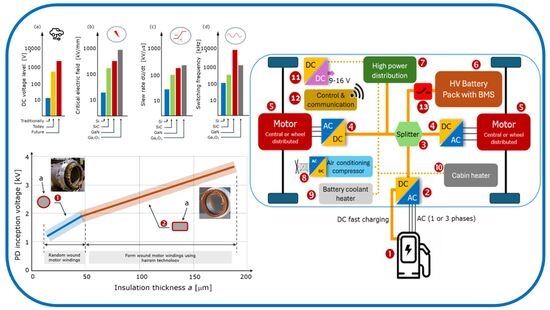
Graphical Abstract

1. Introduction

There is an observed ramped up and consequential growth of electric vehicle (EV) popularity in today’s society. This refers to both private mobility and the public sector (with buses), as well as to transportation with heavy vehicles (including specific industries such as mining and maritime) [1]. The expected significant acceleration in the coming decades will be driven by technological advancements, supportive policies, and climate goals. It is estimated that the global EV fleet could grow to 380 million units by 2030 (depending on policy intensity) and could further expand to well above two billion vehicles by 2050 [2]. Before our eyes, the automotive industry is experiencing a once-in-a-century wave of technological innovation; simultaneously, the operating voltage levels will tend to grow in order to cope with the higher and higher power requirements of these devices. In this context, the critical element of electric vehicles tends to be high-voltage (HV) insulation; it is even being said that future development dynamics depend on insulation (which can be considered on a micro scale with power semiconductors), as well as in the upper levels (with regard to modules, components, and devices). This influences the overall reliability, safety, and lifetime of such a device. In this paper, the most critical aspects of electric vehicle insulation are discussed, including on-board distribution systems, cabling and connectivity, energy storage and conversion devices, charging infrastructures, transient switching phenomena, and environmental and EMC (electro-magnetic compatibility) requirements. The ubiquitous trend in power device development for the transportation segment (including electric vehicles) is set by power electronics-based solutions—especially AC/DC, DC/AC, and DC/DC converters. In addition, energy storage applications that comprise new areas (such as power devices for hydrogen-based conversions) will also require inverters. In this context, the future electrical insulation of EVs must cope with new challenges, such as elevated voltage levels (both DC and impulse modulated), continuous operations under impulse conditions (which are characterized by high-frequency switching), and ultra-fast impulse slope transitions (in the nanosecond range for wide-band gap semiconductors), as well as superimposed transients and overvoltages [3,4,5].
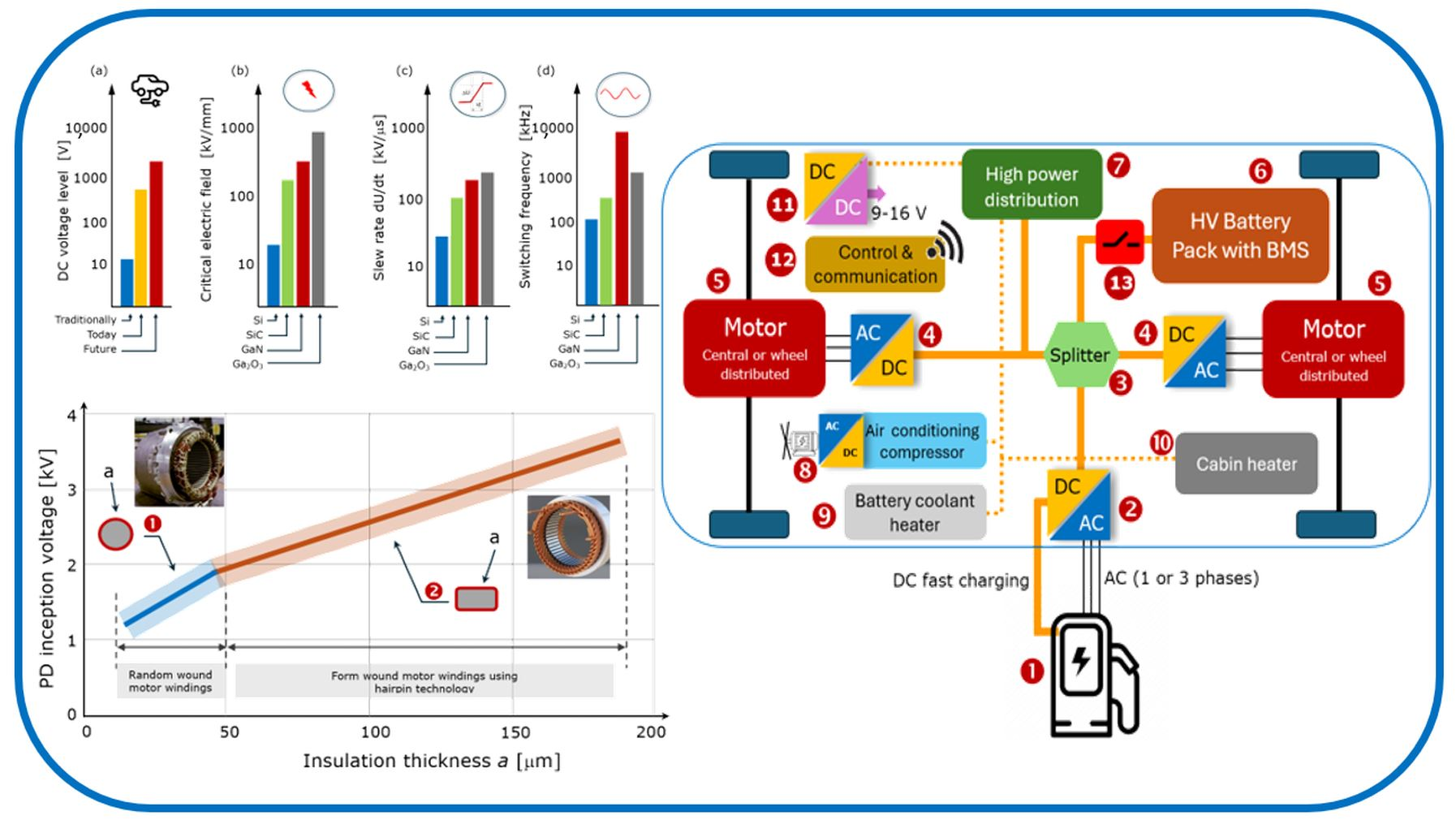
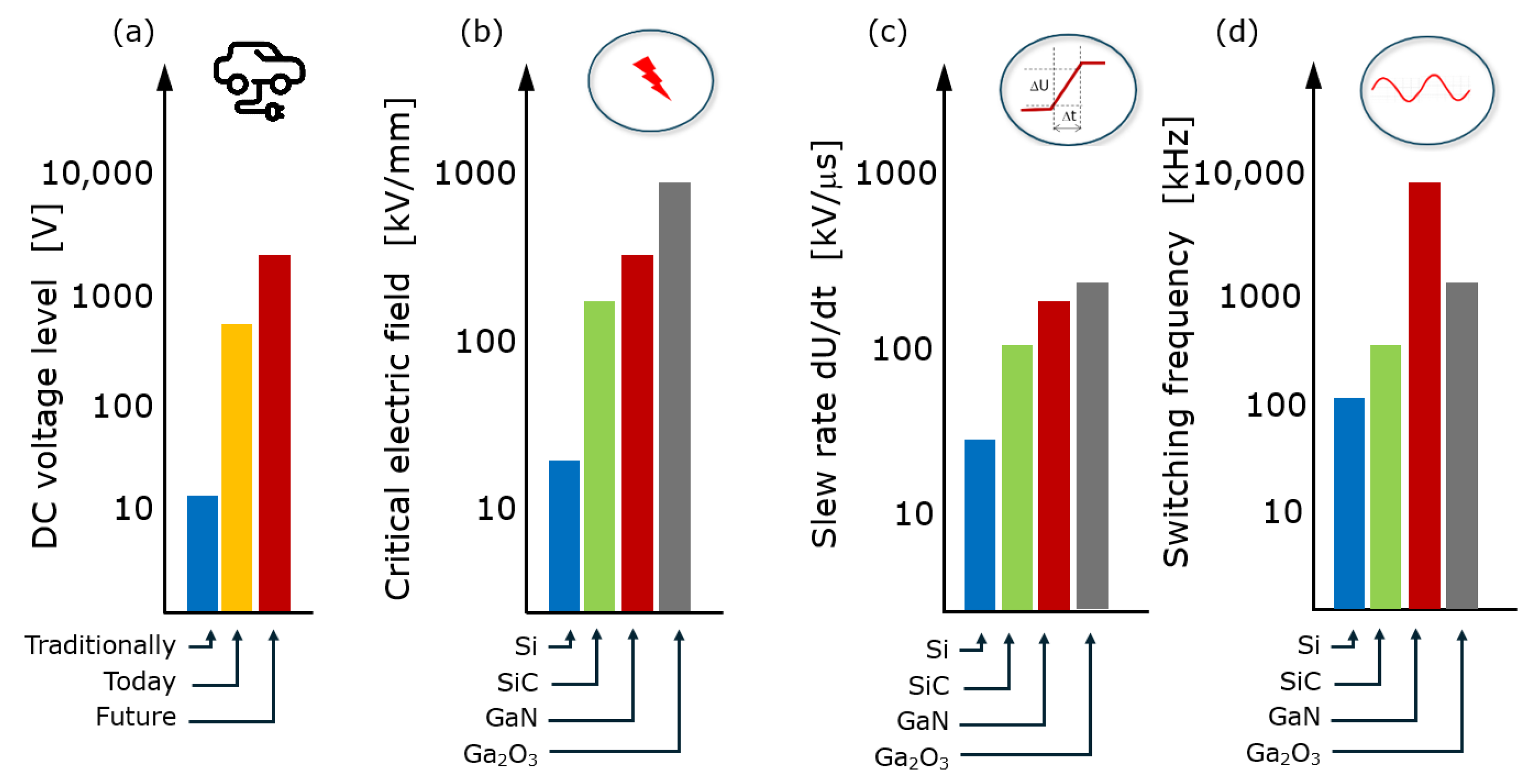
The above stresses are supplemented by demands for ultra-reliable lightweight materials and thermally conductive electrical insulation that supports high-power density designs [4,6,7]. The elevations of voltage levels at increased power levels play essential roles for reducing losses. According to prognoses, the voltage levels will be extended in all segments of transportation: (1) in railway networks, voltage levels may be above 25 kV; (2) in marine applications, integrated electric propulsion systems can operate at up to 11 kV; and (3) electric vehicles can push these levels to above 1 kV [3,5,8]. The selected parameters that drive the development of electrical insulation for EVs are illustrated in Figure 1. Traditionally, electrical systems in cars with internal combustion engines usually operate at 12 V; today, EVs have batteries that are up to 800 V (in the near future, these are expected to rise above the kilovolt level) [1,5]. The power conversion in EVs is gradually being executed more and more by new generations of semiconductors—especially wide-band switches. For a comparison, the most representative classes based on silicone (Si), silicon carbide (SiC), gallium nitride (GaN), and gallium oxide (Ga2O3) were taken. As is shown in Figure 1, the critical electric fields in these elements yield the following levels (in kV/mm): 30 for Si; 350—SiC; 490—GaN; and around 1000—Ga2O3 [6,9,10]. While these devices have superior attributes for power conversion and thermal management, they introduce new classes of challenges with respect to the stresses on their electrical insulation. These can especially be addressed by the ultra-fast slew rates that are measured in kilovolts per microsecond for the above classes: 50, 100, 200, and 250 kV/μs, respectively. Also, the high switching frequencies are around 100 kHz for Si and extend to 500 kHz for SiC, and even 10 MHz for GaN.
This article focuses on the challenges and trends in the high-voltage insulation of electric vehicle devices, an analysis of DC bus voltage elevations and their impacts on the various elements in the EV electrification structure. The effect on the electrical insulation of the new generation of wide-band power-conversion switches is discussed, along with the early symptoms of detecting insulation deterioration (including partial discharges—PD). All elements with high-voltage insulation in the electric vehicle structure are analyzed, including EV components, the traction voltage bus, and the battery system, which are subjected to both operational and transient stresses. A complementary set of high-voltage insulation assessment criteria is also considered. Therefore, the diagnostic methods and advanced techniques presented in this paper for the early detection of high-voltage insulation degradation in electric vehicles are critical for ensuring system safety and reliability.

2. Trends in High-Voltage DC Bus Voltage Elevation in Electric Vehicles

The goal of increasing the operating voltage levels of electric vehicles is motivated by endeavors for higher power and greater battery capacities, i.e., longer traveling ranges and shorter charging times. Specifically, voltage increases at the same power result in lower losses and better thermal performance. Historically in the automotive industry, high voltage refers to voltage levels that are above 60 V. In the meantime, the development of EVs has resulted in voltage elevations—first, to hundreds of volts, and then, to levels above 1 kV. It should be emphasized that, at present, the dominant voltage level is around 400 V, with a growing transition toward 800 V systems. Various standardization bodies are working intensively on developing recommendations for voltage levels exceeding 1000 V. The trend that has been manifested by the rapid growth tendency over the last decades is shown in Figure 1; this reflects the trend in the automotive sector to progressively migrate to a HV architecture. From an electrical insulation point of view, higher voltages translate to elevated electric field stresses. Additionally, new forms of stresses are put on the insulation in the fast energy-conversion processes that are performed by power electronics devices (with fast slopes and high switching frequencies). One of the parameters that are directly related to the voltage level is the charging of energy storage. Assuming the electric energy in storage system En [J] and constant charging current I [A], the relationship between charging time t [s] and voltage U [V] is as follows:
t = E n U · I
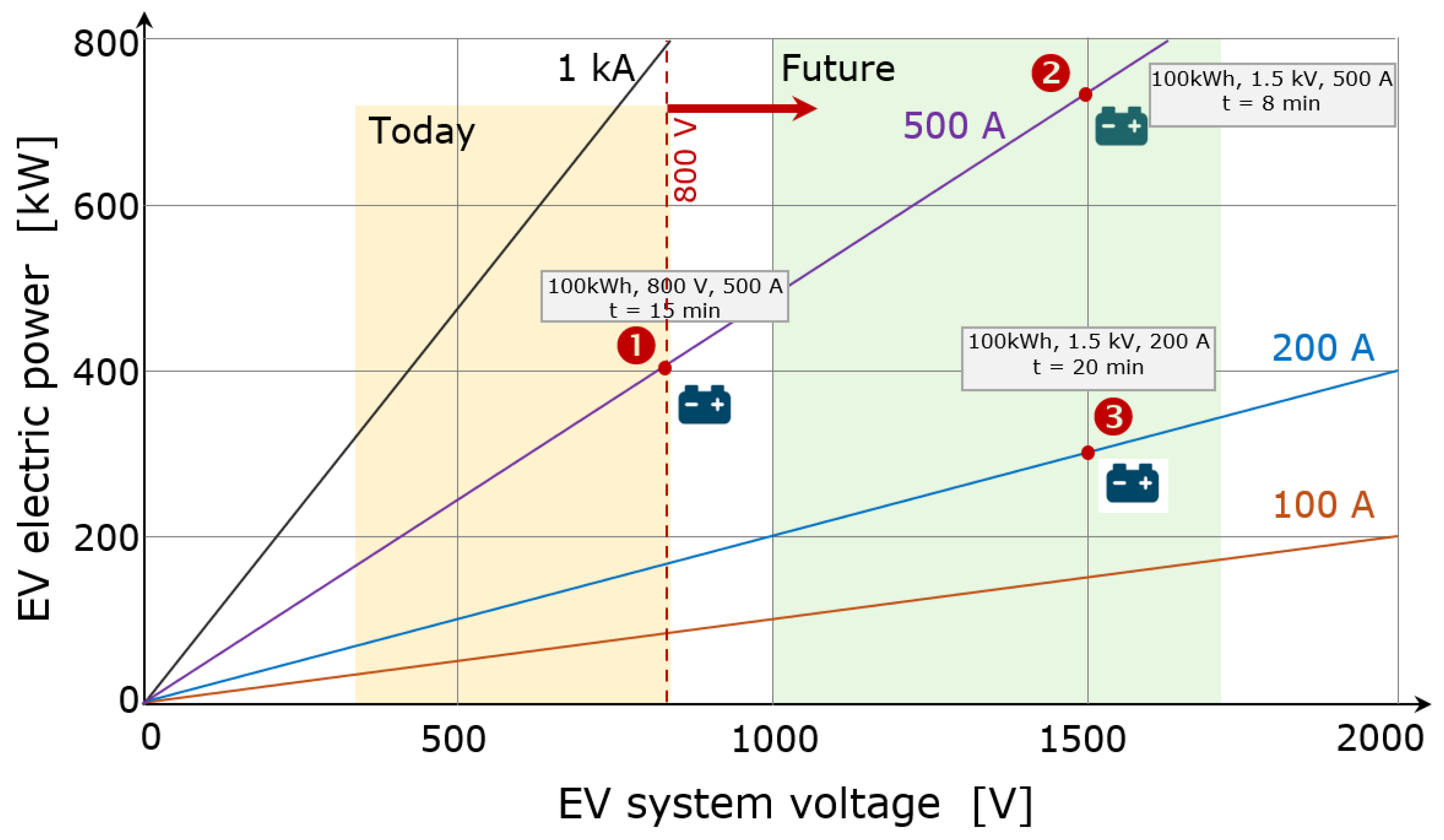
In today’s electric vehicles, a DC bus voltage within a range of 400–800 V is most popular at a relatively broad power range [3]. The power of the electric motors in EVs varies widely depending on the type of vehicle and the performance requirements. For example, typical power ranges for passenger cars are 50–150 kW for economy and compact cars, up to 350 kW for mid-range units, and up to 750 kW for high-performance EVs (this last limit also refers to heavy vehicles, trucks, and buses). In order to comply with the higher electric field strengths, the elevated voltage levels in transportation power devices will result in enlarged insulation thicknesses and clearances determined by insulation withstand ratings. According to classification [11], these voltage ranges are within the Class B range, where high-voltage levels are maximal 1500 V DC and 1000 V AC rms, considering HV electrical insulation’s critical elements refer to AC, DC, and impulse withstand reflected by breakdown voltage as well as endurance to partial discharges. A plot of EV system voltage and electric power that pinpoints various charging currents is shown in Figure 2; three scenarios are shown for charging a battery with a capacity of 100 kWh. In Scenario 1, using the current state-of-the-art voltage level of 800 V and a charger power of 400 kW yields a charging current of 500 A and a charging time of 15 min. Elevating the system voltage to 1500 V and keeping the same level of charging current at 500 A results in the shortening of the charging time to 8 min. In the third scenario, a system voltage of 1500 V and a lower charging current 200 A (i.e., a charger power of 300 kW) yields a slightly longer charging time (20 min); however, it is important to highlight the six times lower loss as compared to the 800 V system voltage.
Redesigning electrical components for elevated voltage levels impacts their sizes and weights. A power converter’s volume may increase along with some components such as fuses; on the other hand, this may be compensated by reductions in the HV battery’s volume and the copper cross-sections of the distribution system. For example, doubling the system voltage from 400 to 800 V results in a 50% reduction in the current and copper cross-sections and a 25% loss in the heat generation. From a mechanical point of view, reducing the copper cross-section influences the allowable bending radii of the HV wires, thus leading to reductions in a vehicle’s weight and volume (higher geometric freedom in the connection design) [12]. For example, reducing the cable area by half for an 800 V system between the battery pack and a fast-charging port can achieve a 0.76 kg reduction in the copper mass per meter of the positive and negative cable pair [1]. There are various architecture approaches of HV distribution systems—either as those with central distribution or those that are close to the motors and loads. In the case of the former, the power conversion occurs at a central point and is distributed over the vehicle with high-current cables. In the latter case, the distribution is based on a high-voltage DC network, with the conversion drives being located close to the motors.
Electrical insulation’s exposure to high electric fields may lead to its degradation and deterioration, leading to breakdown in extreme cases. The acceleration will be caused by changing environmental conditions, such as temperature, pressure, and humidity. Additionally, mechanical stresses (e.g., vibrations and the bending of elastic insulating structures) may cause microvoid formations and delaminations. These stresses trigger the development of various forms of discharges, such as partial discharges, surface discharges, coronas, or treeing formations in solid insulation (including charge injections). The aging process may also be associated with increases in leakage currents in the insulation bulk or on the surface. All of these processes are coupled and synergistic, i.e., joint thermo-electro-mechanical actions accelerate the process much faster than exposure to individual stresses separately do.
Standardizations set important regulations on EV materials and subcomponents, as well as electrical-, thermal-, and mechanical-testing procedures. For example, IEC 62196 is a series of standards specifying the requirements for conductive electric vehicle charging [13]. The rated AC/DC voltages and currents in IEC 62196-1:2022 are specified as follows:
  • AC: up to 690 V and 250 A;
  • DC: up to 1500 V and 800 A.
The safety specification in the ISO 6469-1:2019 [11] standard (“electrically propelled road vehicles”) defines two main voltage classes: A (DC 60 V; AC 30 V), and B (DC 1500 V; AC 1000 V); in the cases of AC, the values refer to rms. Determinations of the required clearance, creepage distances, and insulation thicknesses in low-voltage systems (including automotive applications and EV components) are described in IEC 60664-1 (“insulation coordination for equipment within low-voltage systems”) [14]. Charging safety aspects (such as insulation requirements for charging systems, which include cables, connectors, and other high-voltage component insulations) are covered by IEC 61851 (“electric vehicle conductive charging system”) [15]. In this context, the safety aspect is crucial, as electrical safety has traditionally not been an issue in the automotive industry; however, EVs pose the risk of potential electric shocks, the effects of short-circuit currents, and fires that emit toxic gases. These have highlighted this problem radically [16].
The high-voltage visionary trend and roadmap in the EV sector may develop along the following sequence. A level of 1.5 kV is expected within the next few years (by 2030), while 2 kV might be reached within the following decade (by 2035)—especially in heavy-duty trucks and ultra-high power applications (e.g., high-performance vehicles in mining, construction, and long-haul transportation). These solutions will require robust electrical insulation and advanced battery technologies. In addition, the required testing will be at a level that is at least twice the nominal voltage plus 1 kV. Hence, HV technology at a level of a few kV is expected in the electric automotive industry within the next decade.

3. Elements with High-Voltage Insulation in Electric Vehicle Structure

In contrast to vehicles with combustion engines (where the mechanical design is crucial), EVs rely on an electric powertrain and subcomponents—especially those power electronics (including both semiconductors and passive designs) that are used for energy conversions. Modern wide-bandgap-based semiconductor technology yields reductions in thermal losses. Simultaneously, high switching frequencies and steep slew rates create further challenges for HV electrical insulation, thus stressing more electrical insulation. This implies additional requirements on the insulation withstanding stronger voltages; for example, this may refer to both impregnation resins and enameled wire coatings in the cases of electrical machines. In the design phase, advanced electric field simulations, including transient phenomena, are used for power modules, motors, batteries, and other components. The globally recognized parameter of HV insulation integrity is the measurement of partial discharges. There is a natural endeavor to a PD-free insulation design; this refers to such main devices as motors, transformers, converters, power electronics modules, cabling, joints, and connectors [17,18,19]. It should also be underlined that a PD-free design at the beginning of a device’s lifetime does not guarantee the non-occurrences of PDs during future operations due to electrical, mechanical, and thermal insulation aging. This fact drives the research and development of diagnostic high-voltage insulation-system approaches for EVs [20,21]. Lightweight and strong fiber-reinforced polymer composites, as well as bio-based polymers, have demonstrated effectiveness in manufacturing various components used in EVs [22]. These materials are also applied in the insulation of power electronics modules and building blocks that consist of inverters and converters. The electrical insulation of electric vehicles is an essential element with respect to their operation (as their motors are now electric), as well as their long-term reliability and safety. The last point is a critical priority for current EVs and future autonomous vehicles. The following main subcomponents and effects in EVs where high voltages play roles in the insulation structures are as follows:
charging system (incl. converters and protection);
batteries with power management and protection;
on-board energy-distribution system (incl. busbars, cabling, joints, disconnectors, and safety switches);
electric motors (central or wheeled motors);
converters (incl. aspects of power density and power electronics modules’ insulation systems);
HV electrical insulation monitoring systems;
mitigations of transients, overvoltages, and EMC;
environmental compatibility of insulation systems and components;
electro-mechanical endurance (e.g., charging cable bending, vibration strength);
reliability of power modules (incl. printed circuit boards [PCB], flexible designs, packaging, etc.).
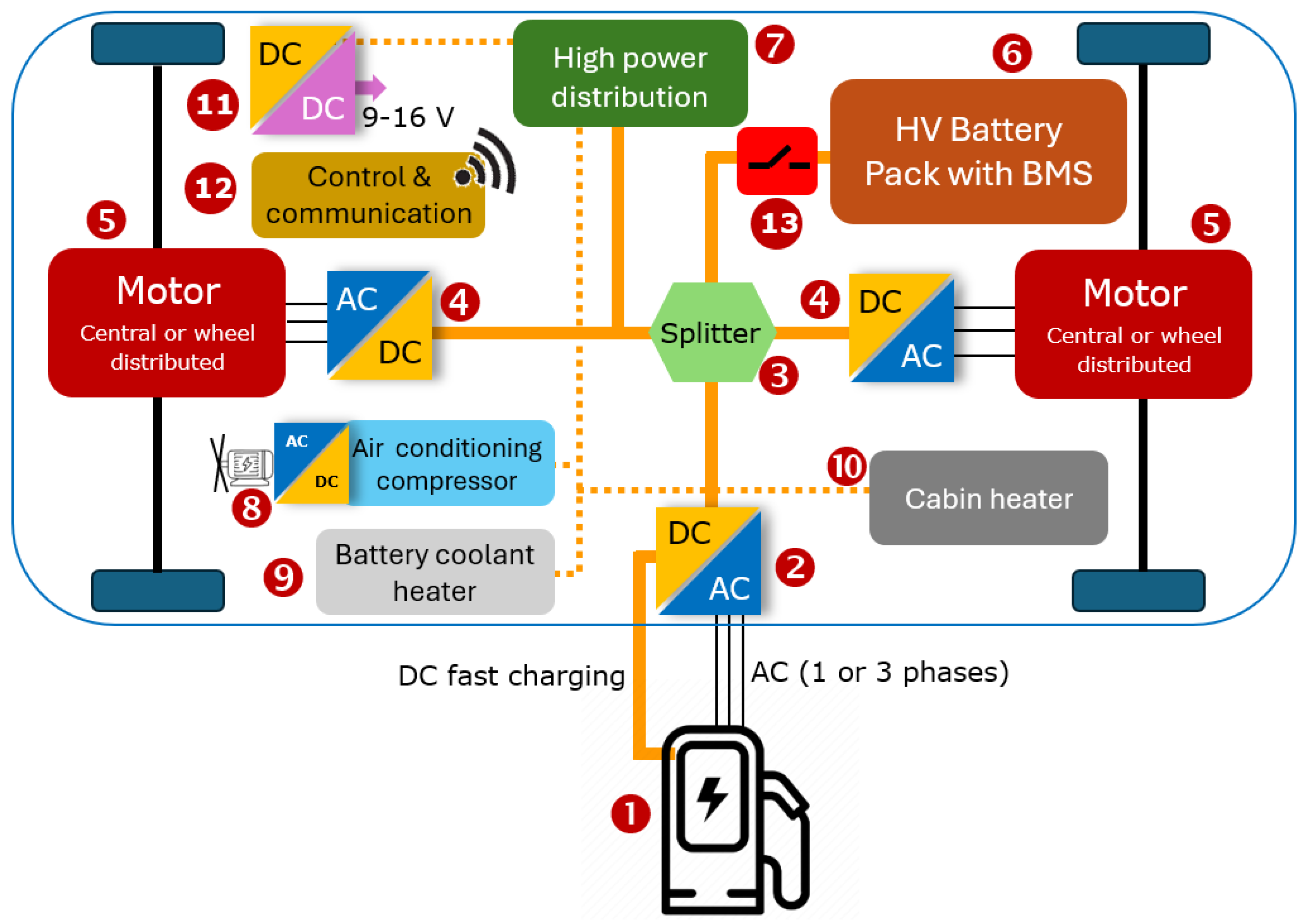
The above-listed elements of HV insulation are graphically depicted in Figure 3. In the following sections, these elements will be discussed individually.

3.1. Charging System

A range of standards and codes have been developed by international organizations to promote widespread EV adoption and ensure reliable grid operation [23]. Dedicated converter topologies and control techniques are essential for the successful integration of EV charging systems with the utility grid. From a high-level point of view, charging can take place from either an AC or DC source—the latter usually being perceived as fast charging. In the first scenario, EVs are charged from either a single- or three-phase AC grid; thus, the chargers comprise AC-DC rectification with power factor correction (PFC) in order to ensure a close-to-sinusoidal grid current. The positive effect of on-board high-voltage elevation is the easier cooling of the charging system (including the plug and socket). The battery, which is usually built into the vehicle’s infrastructure, adjusts the AC-grid voltage with the internal DC distribution system. Various topologies have been proposed in the literature to achieve a wide DC output voltage [23,24,25]. To avoid touch current and grounding issues, galvanic insulation has become standard in practical EV charger applications. In the past, such insulation was achieved using a line-frequency transformer; however, the trend today is toward high-frequency insulation due to its significant benefits (in terms of volume, weight, and use of materials). The converter combines the functions of rectification, insulation, and regulation. An exemplary three-port DC/DC converter topology for automotive applications was proposed in [24], which comprised a combination of a series-resonant converter (SRC) interconnecting the DC-link capacitor of an upstream PFC rectifier with a high-voltage battery and a modified phase-shifted full-bridge (MPSFB) converter, which connects the HV battery to an auxiliary low-voltage (LV) battery.
To speed up the charging process, DC fast charging is mostly preferred, as it delivers high voltage and high power directly to the EV battery. To meet the power requirements of a DC fast charger, multiple identical modules are typically connected in parallel to increase output power [26]. Depending on the future development of medium-voltage networks, MVDC nodes may be directly used for the charging infrastructure. To interface directly with the MV grid, the power modules are connected in series at the input to increase the voltage-blocking capability, and the outputs of the modules are connected in parallel to provide large output currents. The charging process is controlled by communication vehicle-charging stations with respect to voltage and current profiles. The Japan-originated ‘CHAdeMO’ 3.0 standard supports a 1500 V voltage level, while the European Combined Charging System (CCS) supports 1000 V. From the collaboration of the CHAdeMO Association and the China Electricity Council emerged the ChaoJi standard, with a power level of 900 kW and a voltage of 1500 V [25]. Applying the fast-charging technology and increasing the charging power (for example, by tripling it), the charging time will be reduced to one-third of the original time. However, this means tripling the current at a constant voltage, which results in a nine times higher level of conduction losses. Apart from the need for extensive cooling, there is a natural energy loss. The maximum current rating for DC charger cabling is limited by its weight and flexibility in handling by the user; hence, an air-cooled cable is limited to 250 A, and a liquid-cooled cable—500 A [1]. This confirms the striving toward higher voltage levels as a more efficient solution. It should be mentioned that fast charging accelerates battery degradation mainly due to higher charging currents, which increase internal heat generation and stress within the cells. In general, higher charging power and frequent ultra-rapid charging events tend to increase aging compared to slower or moderate charging, especially if thermal management is insufficient. In high-power liquid-cooled EV charging systems, HV insulation is exposed to elevate electrical, thermal, and environmental stresses, which can lead to several typical failure modes. Common issues include coolant ingress into high voltage cables or connectors due to seal degradation, resulting in reduced insulation resistance and ground faults, as well as thermal aging, cracking, or delamination of cable insulation caused by repeated fast-charging thermal cycles. Additional problems involve insulation breakdown or surface tracking at connector interfaces due to moisture, contamination, and mechanical wear, and partial discharges initiated by voids or defects in potting or insulation interfaces. These mechanisms may ultimately cause leakage currents, charger derating, or protective shutdowns, highlighting the need for robust insulation design and continuous insulation monitoring in high-power charging infrastructure.
The wireless charging of EVs has become an important research topic in recent years [27]. During the wireless-charging process, a wireless data exchange takes place between the EV and the charging station. For proper system operation and to maintain safe simultaneous wireless power transfers, information such as battery status, charger current and voltage, or the EV’s identification may be required on the primary side.
From the grid perspective, vehicle-to-grid (V2G) enables electric vehicles to act as distributed energy resources, contributing to peak load shaving, reactive power support, load balancing, and power system stability [28]. The V2G approach increases the demand for a bidirectional power flow between the EV battery and the AC grid (split to low- and high-power modes). Based on the comparison that was shown in [28], a three-level T-type NPC AC/DC converter has the lowest THD and achieves the highest efficiency among the considered AC/DC topologies. There are many ongoing studies on centralized, decentralized, and hierarchical smart-charging strategies (G2V and V2G) that analyze flexibility, optimal charging schedules, and energy management [29]. An interesting GaN-based single-stage insulated bidirectional 400 V input three-phase PFC rectifier was presented in [30]. At the opposite end, there is a non-insulated three-phase AC/DC EV charger, which manifests improved efficiency and power density as compared to its counterparts with a galvanic insulation stage; however, it requires mandatory residual current devices in order to ensure electrical safety [31].
The next generation of chargers will be used for electric heavy-duty vehicles with battery voltages of up to 2000 V. The designed infrastructure is expected to support charging of both EVs and electric heavy-duty trucks over a wide range of power levels [32].

3.2. Batteries with Power Management and Protection

From the user’s point of view, the critical parameter is refueling time, using the terminology of internal combustion engine vehicles, i.e., the charging time of the battery in the case of an electric vehicle. One way to shorten the charging time is to elevate the voltage level; however, there are additional costs with increasing battery voltages, as this requires additional insulation and clearance for HV components (thereby increasing the overall battery pack dimensions) [1]. The increased energy density of the battery imposes safety requirements; hence, dielectric protection is critical in the assembly of HV battery packs (e.g., formed by thin PET films with thicknesses of 50–250 μm and dielectric strengths of up to 149 kV/mm) [33]. Electrical insulation is gradually required at the cell, module, and pack levels, e.g., in the battery cells, side plates, cooling plates, walls, and bus bars. Usually, a single, large battery is used in EVs; however, there is also a concept that promotes the utilization of smaller modular battery packs [34]. In today’s commercial EVs, lithium-ion batteries are most commonly used due to their high-energy densities and their abilities to be repeatedly charged and discharged over many cycles. Maintaining a stable temperature range of 15 °C to 35 °C is essential for maximizing battery pack efficiency; consequently, a reliable and robust thermal management system is needed to dissipate heat and control the Li-ion battery pack temperature [35]. Accordingly, the battery’s electric insulation should be selected to operate under extreme temperature conditions (including cold starts). To safeguard passenger safety and the proper operation of the vehicle, the real-time detection of electrical insulation performance and potential current leakage between the battery pack and the chassis of the vehicle are investigated [36]. Insulation resistance is often expressed in terms of ohms per volt for clarity and safety compliance, as in the ISO standard [37]. This approach allows the insulation requirements to scale with the system voltage, ensuring adequate insulation under varying operating conditions; for example, a minimum of 1000 Ω/V is typical for AC systems, and at least 500 Ω/V is required for DC systems. Modern methods for assessing EV battery insulation performance degradation focus on early, non-destructive, and online diagnostics which should operate in real time by the battery-management and -monitoring system [36,38,39,40,41]. Continuous insulation resistance (IR) monitoring and leakage current measurement are widely implemented within BMS to detect gradual aging, moisture ingress, and contamination effects. Advanced IR monitoring algorithms employ signal injection and filtering techniques to ensure reliable estimation under dynamic operating conditions, including fluctuating voltage levels, load transients, and temperature variations. Diagnostic techniques such as partial discharge detection enable the identification of localized insulation defects within battery packs, including degradation of polymeric separators, laminated insulation systems, busbars, and interconnections, as well as dielectric aging, before catastrophic failure occurs [38]. These electrical diagnostics are increasingly combined with electro-thermal monitoring and data-driven algorithms, including machine learning, to analyze long-term trends and predict remaining insulation lifetime. Similarly, dielectric spectroscopy and loss factor analysis allow non-destructive assessments of insulation aging mechanisms by tracking frequency-dependent changes in dielectric properties. The integration of these methods supports a transition from periodic offline testing to real-time, predictive insulation health management, significantly enhancing the safety and reliability of high-energy battery systems. In that context, recent EV battery protection techniques employ multi-layer safety architectures that integrate electrical protection (overcurrent, overvoltage, short-circuit, and insulation fault detection), thermal protection (temperature, gradients, and heat-rate monitoring), and functional safety mechanisms. These techniques rely on fast solid-state switching devices and real-time sensing.

3.3. On-Board Power-Distribution System

The topology of the on-board power-distribution system depends on whether the electric motors are central or wheel-located, with an overall requirement of the safe transfer of electrical energy. In order to increase the safety aspect, the HV cables are usually shielded and grounded in compliance with electro-magnetic interference and compatibility (EMI/EMC) specifications. The DC distribution is stretched out on single-core cables (the cross-section is usually within a range of 16 to 100 mm2), whereas the AC powertrain uses a three-phase connection from the drives to the motors. The HV battery in an EV floats—unlike conventional cars with an internal combustion engine, where one pole of the 12 V battery is grounded with the vehicle’s chassis. The built-in insulation monitoring system will disconnect the battery in the case of a drop in the insulation’s resistance.

3.4. Electric Motors

The motor in an electric vehicle is electric; depending on the vehicle’s design, it can be located on a common shaft or decentralized at the wheels. According to the statistics and root-cause failure analyses, the stator is usually the main source of failures in these machines (up to 70%); furthermore, turn-to-turn insulation is also a culprit due to the uneven voltage distribution along the stator windings—especially at modulated power electronics-based excitations with ultra-fast slopes [12]. When combined with thermal and mechanical stresses, partial discharges usually lead to the breakdown of the motor’s insulation. Such insulation deterioration usually progresses over time, thus leading to erosion spots. Elevating the DC voltage level results in a higher risk of PDs in the slot and inter-turn insulations. In addition, the electronic power inverter creates complex overvoltages at the motor terminals; these are created by pulse-width modulation (PWM) waveforms [1,37].
The motor in EV is based on electrical machines, and its role is twofold: as a motor for propelling the wheels of the car, and as a generator for the energy recuperation during braking. There are various types of motor designs (e.g., brushless DC motors in smaller EVs), while three-phase AC-induction motors can be found in larger vehicles. In general, the traction motors in EVs mainly include direct current motors (DCMs), induction motors (IMs), permanent magnet motors (PMMs), and switched reluctance motors (SRMs). A comparison of DC, induction, and synchronous motors revealed that permanent magnet synchronous motors had better overall performance [7]. In addition, it was found that converters with SiC MOSFETs showed significantly higher efficiency as compared to Si-based IGBTs.
The motor’s placement and configuration mainly depends on the layout of the electric drive system inside the vehicle. Electric drive systems can be categorized into single-motor, distributed-motor, and range-extended drive systems (where multiple motors are distributed to their corresponding vehicle wheels). By directly coupling the wheels to the motors, precise wheel torque measurement and fast response to driving requirements can be achieved; consequently, distributed motor drive systems are considered a promising electrified propulsion solution [42]. Special developments are dedicated to motors for in-wheel applications. Magnetic gear that is integrated in permanent magnet motors are being extensively investigated for their high torque densities and noiseless operations [43].
From an electrical insulation point of view, conductor insulation and slot liners are particularly important for preventing short circuits between conductors, between conductors and laminations, and at the end-winding arrangement [44]. The critical manufacturing process is the winding impregnation and elimination of any micro gaseous voids, which should be filled entirely with a resin. The commonly used winding patterns are random and hairpin; the latter enables the high-volume production of the wound stator with a consistent quality, a higher slot fill factor (which reduces the conductor losses in the winding), and the more effective heat transfer from the wires to the stator lamination (thus, a higher current density). In addition, a hairpin-winding layout has a shorter end-winding section, whereas the main limitations are the flexibility in the motor design and the selection of the number of turns. Upgrading the voltage levels with steep impulse slopes and assurance of PD-free insulation require greater thicknesses of the insulation. Several solutions are considered to have implementation potential in the next generations of high-voltage EV motors: wires wrapped with Kapton tape, enameled wires, and extruded solutions, thus providing so-called corona-resistant design [44]. The motor conductors are coated with a protective varnish, thus taking on the role of an insulating layer (typically in the form of polyamide-imides [PAIs] or polyetheretherketone [PEEK]). PEEK thermoplastic insulation that is used as film slot liners in order to increase the copper slot fill in the stator allows for thinner insulation systems (down to 50 μm) [45]. With its excellent PD endurance, Nomex paper is used in electrical machines as an insulation solution for the slot and top liners. As was shown in [45], PEEK slot liners provide seven times better corona-discharge resistance as compared to Nomex. The other significant difference between PEEK and paper insulation is the thermal conductivity, which is related to both the material properties and the material thicknesses that can be utilized. The 26% improvement in thermal conductivity that is provided by PEEK versus Nomex at a 175 μm film thickness leads to potential reductions in the stator slot’s temperature. Extruded PEEK magnet wire and hairpin-winding technologies allow for a 10% improvement in the copper fill factor by increasing the amount of copper that can be packed into the stator slots. In order to propose more deterioration-resistant material to the conventional enamel-coated insulation of random wound coils, there is ongoing research on mica-based wire insulation [46]. The mica sheet is used by wrapping it around the electric wires, yielding an insulation thickness of approximately 150 μm between two turns; hence, the electric field strength between the turns is below 10 kV/mm for twice the motor-rated voltage of 800 V. In the case of slot liner insulation that is subjected to SiC converters, the addition of inorganic fillers results in crucial improvements in the lifetime expectancy [44]. In general, EV motor-testing capacities include material tests under extreme stresses, like high temperatures (up to 350 °C), high voltages (up to 7 kV), and high frequencies (up to 30 kHz) [47]. Representative electrical and thermal properties of high-voltage insulating materials used in electric vehicles are summarized in Table 1.
Critical elements of motor control are the strategies that are dedicated to power-loss reductions, e.g., those that are based on space-vector modulation and synchronous optimal pulse-width modulation and are dedicated to different inverter topologies (including two- or multi-level voltage-source inverters) [50]. The motivation for developing numerous PWM techniques lies in their reduced switching losses, lower total harmonic distortion, wider linear modulation ranges, and faster computation times.
However, the most dynamic research in this area is ongoing toward the rare-earth-free motor designs for EVs. Today, the most common types of torque yields refer to the combination of permanent magnets and the reluctance principle. The future trends are toward rare-earth-free permanent magnets or purely electromagnet-based concepts, where electrical insulation will play an important role.

3.5. Converters

There are various types of semiconductor switches that are used for EV converters; usually, this is a trade-off among various techno-economical parameters such as power density and efficiency in terms of losses and costs. In an 800 V battery architecture, 1200 V SiC MOSFET transistors are the best options for the traction inverters because of their lower switching losses, smaller form factors, higher thermal conductivities, and wider bandgaps for high-temperature operations [4,51]. Those power switches that are based on GaN for the DC/DC converters and the on-board chargers of EVs enable fast switching, which can significantly reduce the module form factors. Power converters are typically designed based on peak power as the sizing operating point; however, electric vehicles operate most of the time at power levels below the peak, resulting in suboptimal performance and reduced overall efficiency over the driving life cycle. There are approaches of power converter sizing based on distributed operating power in contrast to single-point peak power-based designs [52].
The blocking voltage for commercial Si-insulated gate bipolar transistors (IGBTs) is 6.5 kV, while the highest blocking voltage for SiC IGBTs is 15 kV for 80 A and 24 kV for 30 A [53]. Compared to the 6.5 kV Si-based solutions, the 15 kV SiC-based power module has one-third of the volume, which translates into higher electric field stress within the module; this leads to the greater possibility of PDs and insulation degradation. Actually, the frequency and pulse slew rate are two factors that critically influence insulation deterioration. Many experimental investigations have confirmed that the shorter the rise times the larger the PD magnitudes in the electrical insulation of rotating machines, hence, resulting in shorter lifetimes [17,18,21]. In power electronics modules (the building blocks of converters), common insulation materials are ceramic substrates and silicone gels for the bulk. Ceramic substrates provide electrical insulation between the active components and the baseplate, which is typically grounded. In turn, silicone gel is used for encapsulation in order to prevent gaseous microvoids and their resulting partial discharges. A comparison of cumulative inverter losses, evaluated on an electric motor test bench under the Worldwide Harmonized Light Vehicles Test Cycle (WLTC) for a silicon-insulated gate bipolar transistor (Si-IGBT) and silicon carbide metal-oxide-semiconductor field-effect transistors (SiC-MOSFETs), is presented in [9]. The outcome showed the greater performance of SiC MOSFETs over Si IGBTs regardless of the tested motor type and vehicle. For an interior permanent magnet synchronous motor (IPMSM) driven by an inverter with a fourth-generation SiC MOSFET (SiC-4G), this setup resulted in the lowest inverter losses and energy consumption. On the other hand, a second-generation SiC MOSFET (SiC-2G) revealed the best energy consumption in the case of driving an induction motor (IM) despite the fact that the inverter losses of the SiC-2G were slightly greater than the losses of the SiC-4G.

3.6. Connectors and Disconnectors

There are many connectors and disconnectors in the overall electric systems of EVs. Apart from general functionality, such as having no direct touchable contacts, the sealing (in terms of water- and moisture-proof protection), and the EMC shielding, there are electrical connectors that are related to the operating voltage and current. The continuous current rating is usually up to 500 A, with ten times greater short-circuit capabilities [54]. For operating voltages of up to 1.5 kV, the testing voltage should be at least 4 kV. The critical component from a safety point of view is the battery contactor, which can be triggered by a CAN that is connected to an interlock system. There is also a manual safety disconnector in an EV; this is usually located in the battery pack, which creates a mechanical interruption of the HV circuit that is used during service by a professional staff.

3.7. Cables

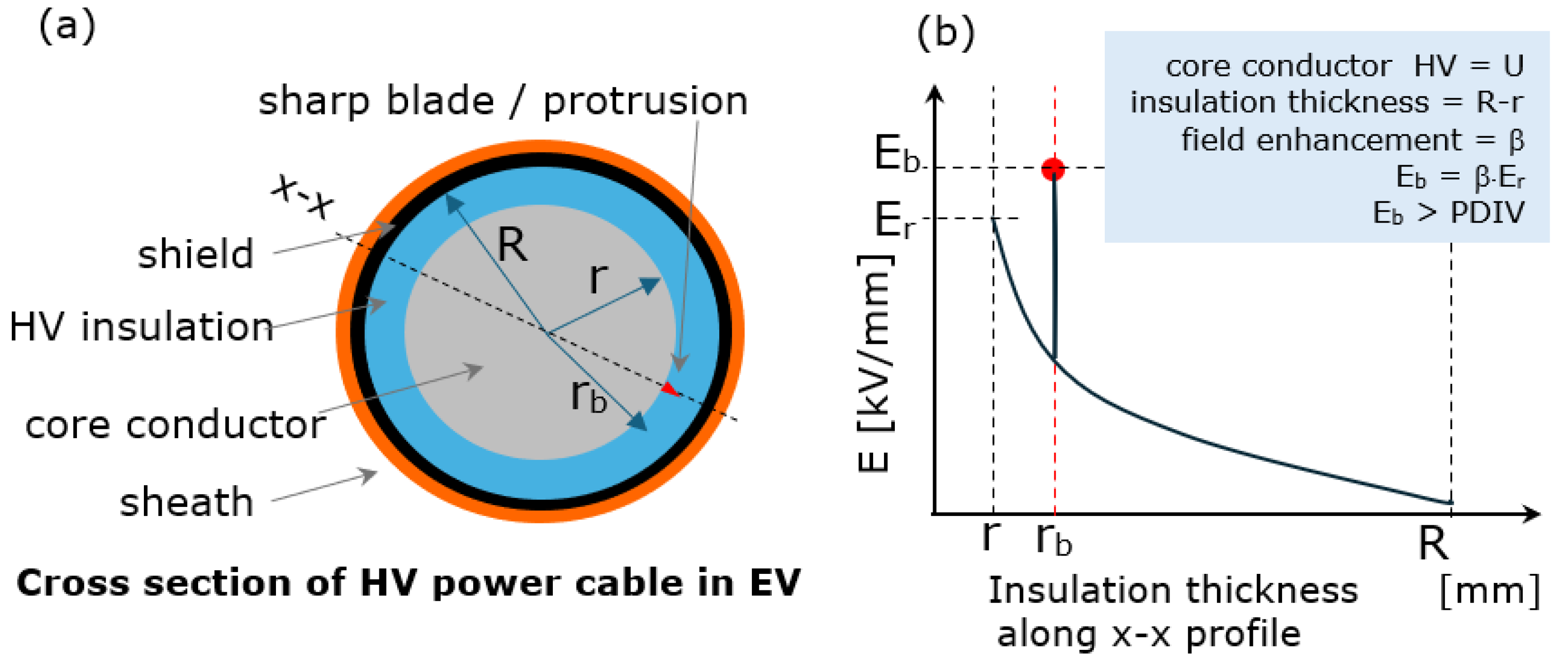
Apart from the power delivery, the high-voltage cables in an EV are responsible for the safety and contribute to the weight and cost; hence, increasing the DC voltage results in a reduction in the power cable’s cross-section. For a battery voltage of 400 V, for example, the cable weight for 200 kW charging can exceed the safety lifting limit for a single person (which is 22.7 kg according to OSHA). For an 800 V voltage level, the cable weight limits the charging power to 350 kW [26]. The HV insulation of cables for EVs is usually manufactured from XPE, XPLO, or silicon rubber. For example, irradiated crosslinked polyolefin (XPLO) can provide a similar thermal and dielectric performance as with silicone but at a much reduced material thickness. The cross-section of a single-core HV power cable in EVs is shown in Figure 4. From a PD inception point of view the smoothness of the conductor surface is critical, since sharp blades, protrusions, and conductive contaminations in insulation may lead to local field enhancement (as illustrated in Figure 4a with sharp protrusion located at a distance of radius rb). The corresponding electric field strength distribution along profile x-x is visualized in Figure 4b. In the case when a locally enhanced field Eb surpasses PD inception voltage, partial discharges progress and gradually deteriorate the insulation.
Usually, HV cables and connectors are colored orange and labeled with the appropriate warning signs to indicate high voltages. In a passenger EV, the total length of the HV cables is typically more than 20 m. With respect to the structure, the cables can be subdivided into shielded (either single or multi-core) and unshielded (usually below 60 V) [55]. Shielded cables are usually grounded on both ends, while multi-core cables are used in low-power applications such as air conditioning, heating, and auxiliary functions.

4. Impact of Power Electronics Switching on Electrical Insulation

The ubiquitous presence of power electronics in EVs poses new challenges on the selection, endurance, and assessment of the electrical insulation. This refers to both the inverter and converter modules, as well as the cabling and motors. Depending on the application, various converter topologies have been developed, each emphasizing different aspects such as high efficiency, high power/high voltage, light weight, high-power density, low electro-magnetic interference, low current ripple, wide input-voltage range, etc. Thus, the key elements that have traditionally driven electrical insulation development and performance have been electric stress, endurance, and safety aspects. Advanced energy-conversion devices that are based on SiC, GaN, and GaO semiconductors have a positive effect in reducing the switching losses during transition times, with high slew rates that range up to 200 kV/μs for today’s devices [6,9,10]. Simultaneously, such an ultra-fast switching may impact the performance of electrical insulation—especially around gaseous microvoids. This will then manifest as the occurrences of partial discharges, which deteriorate the insulation. Different impulse voltage rise times and slew rates influence the partial discharge inception voltage. This topic is very complex because, for ultra-steep excitation pulses, the statistical time lag representing discharge physics in gases must also be considered. The integrity of high-voltage electrical insulation is usually assessed by partial discharge measurements, considering both discharge intensity and phase-resolved patterns. The presence and levels of partial discharges are crucial parameters (especially in long-term insulation degradation), as they reflect both the conditions and trends of an insulation system’s performance. In all current-carrying devices, the electrical insulation is also subjected to magnetic fields, which are superimposed on and interact with the electric field (thus, influencing the dynamics of the partial discharges—this is an actual research topic) [5]. This effect also occurs in the transportation segment, where the power supplies and energy conversions are associated with high-load currents. The reduction in partial discharge intensity can also be achieved by increasing the number of converter levels, albeit at the expense of higher costs. Specifically, the new generation of wide-band gap semiconductors (superior in switching aspects as compared to traditional SiC-based semiconductors) impose challenges when designing the electrical insulating systems of power converters and load devices (such as motors). Two of the key requirements of future designs are compactness (which results in higher power densities) and lightweight solutions. The latter may be obtained by introducing solid-state transformers, for example (even with air insulation) [56], thus replacing magnetic designs. Dielectric losses may become significant in MV converters operating at higher PWM switching frequencies; e.g., for a medium-frequency transformer with a DC/DC converter operating at 48 kHz (25 kW, transformation of 7 kV to 400 V) and embedded in epoxy resin, these represent a significant share—even up to 17% of the total transformer losses (thus, suggesting the improvement of silicone elastomer insulation [57]. Ongoing research focuses on the selection and testing of suitable medium- and high-voltage insulating materials, mainly solid insulation, with hybrid forms like gels, porous materials, pressboards, and foams. To achieve partial discharge-free and -resistant insulation, manufacturing techniques such as resin impregnation, potting of wire and armature coatings, and the application of flexible laminates are critical.
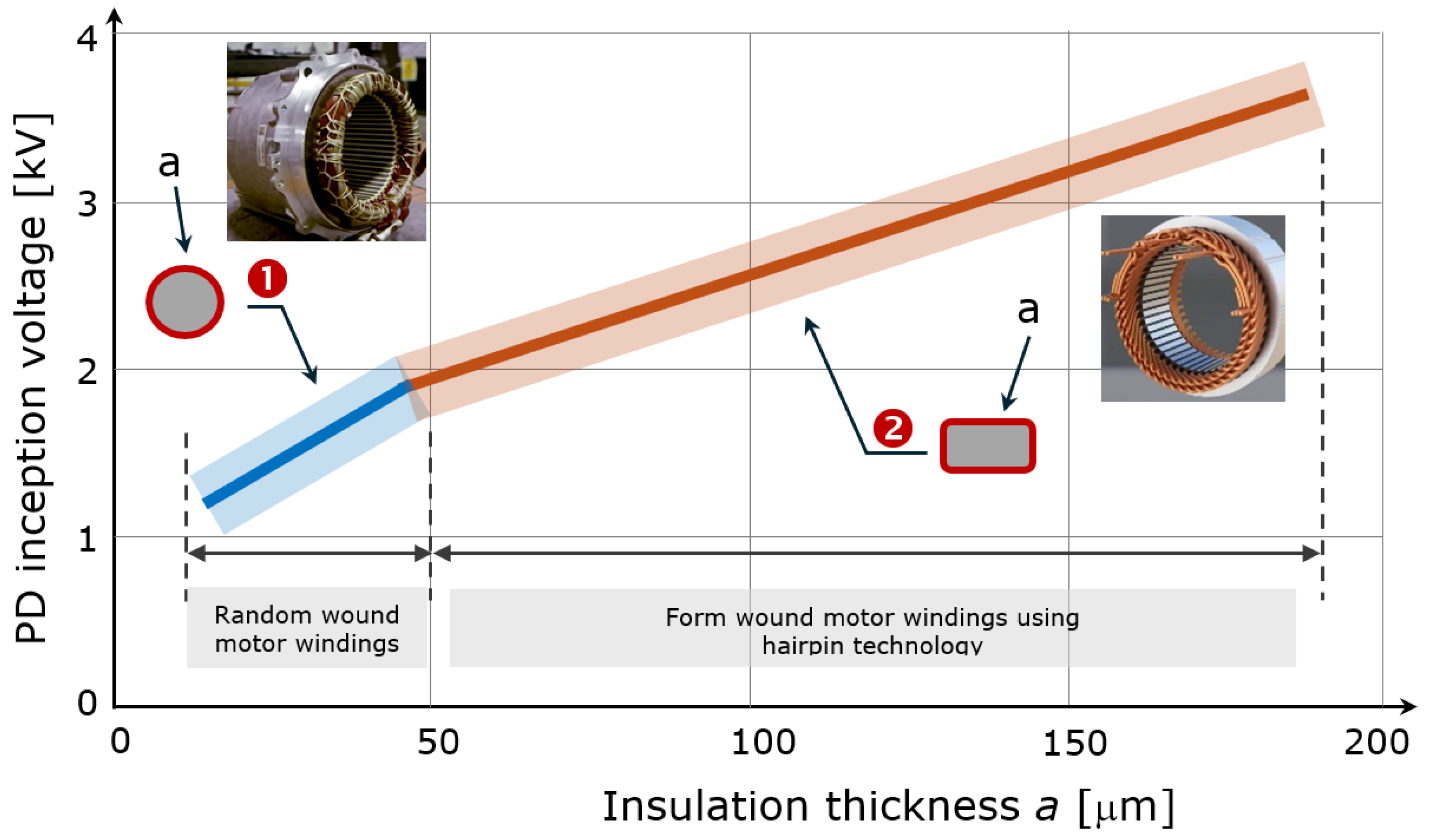
At fast-switching frequencies in the kHz range, PD inception voltage levels may decrease, thus deteriorating the material. Examples of PD inception voltages being measured on the round and rectangular wires that are used in EV motors with different insulation thicknesses are shown in Figure 5 [19]. The first example is used for form-wound motor-stator windings that use hairpin technology, while the second one is used for random-wound machines. Electric vehicles operate on land roads in various climates and on most continents; this implies operating temperature requirements from −20° to 60 °C. With regard to altitude, the air pressure levels at sea level as well as 1000 and 5000 m above sea level are 101, 90, and 55 kPa, respectively. The partial discharge inception voltage and insulation breakdown voltage are sensitive with respect to the air pressure value. Measurements that were performed on Nomex-polyimide-Nomex showed that the PD inception voltage was significantly reduced for EV motors that operated at lower air pressures, and the probability of a partial discharge occurrence was increased (which is particularly essential when traveling at high altitudes) [58]. At higher elevations, the discharges intensify under both sinusoidal and repetitive square-wave voltages. It was shown in [58] that, at an atmospheric pressure of 60 kPa, the endurance life of insulation is roughly 50% of that at 101 kPa; this means that, when EVs operate at high altitudes, their insulation deteriorates more rapidly.
As for now, silicon carbide technology is used for a transition to the 800 V architecture. Compared to traditional silicon devices, SiC power devices offer several advantages, including the following [59,60]:
ten times higher electric field, which allows for higher blocking voltages in smaller die area than silicon (in this way, SiC-MOSFETs operate with breakdown voltages that are even higher than 3 kV, while Si-MOSFETs are typically limited to less than 1 kV);
both on-resistance (RDSon) and off-state leakage currents are lower than silicon (as well as very low or no reverse-recovery current);
up to five times higher switching frequencies than silicon (resulting in reductions in sizes and weights of passive components such as capacitors and magnetic elements);
much more effective cooling due to increased thermal conductivity (which gives SiC devices high strengths and ability to withstand high temperatures).
Both the PD energy and the phase-resolved pattern are influenced by the number of power converter levels. Compared to two-level converters, the PD amplitude in five-level power converters is reduced by nearly half [61,62,63,64].

5. High-Voltage Insulation Assessment Criteria

The role of the high-voltage electrical insulation in EVs is twofold: to safeguard the proper operation of a vehicle’s supply system on the one hand, and to protect and never lead to personal injuries on the other. Apart from the main insulation, insulation monitoring systems are, hence, implemented in EVs in order to increase their safety. In the future, it seems to be worth it to install permanent PD monitoring systems in the next generation of EVs to provide early warnings and symptoms of electrical insulation deterioration. Several attempts have already been made to detect PDs in fully assembled electrical machines for transport electrification. These studies focused on measuring repetitive partial discharge inception voltages (RPDIVs) using various sensors, placed either outside the complete machine or on the stator after careful disassembly [21].
There are various studies and procedures that have evaluated PD risks in EV insulation. The modeling of a whole system (comprising the inverter, cabling, and motor) has been performed in order to determine the maximum overvoltages; then, the electric field strength was calculated in the electrical insulations of the components [1]. In the tiny gaseous microvoids, the electric stress was several times higher than it was in solid insulation, while the breakdown voltage stress of the gas was significantly lower. The PD risk was evaluated by assessing the inception voltage; this depends on several factors, including the void shape, dimension, and pressure level.
The monitoring of the power trains in EVs will be a more and more common diagnostics trend, with the ultimate goal of providing predictions about their lifetimes or times to failure. Such estimations will be based on a fusion of data from the available sensors for the traction drive control that are embedded in the motors, including windings, converters, and high-voltage insulation detection. The last one can take the form of the monitoring of continuous leakage currents or the detection of partial discharge impulses. In the case of PD detection, special diagnostic sequences may be incorporated during the startup phase or into continuous operation (not spoiling the operation and safety) [20]. Since the voltage level in EV drive trains is increasing (soon beyond 1 kV), this implies the increased need and motivation for real-time condition monitoring solutions [65]. In the design process, the design for reliability (DfR) approach is used for EVs [66], where degradation modeling helps predict the times for maintenance. This refers especially to passive components (such as capacitors) and active power electronics devices but also to cooling aspects to make the whole system reliable and safe. Therefore, condition monitoring becomes an even more crucial tool in reliability engineering. Electric vehicle safety is increased by implementing the lithium-ion batteries’ real-time insulation monitoring. Such approaches and control units require high computational efficiency in order to provide on-time critical warning and alarm signals. The example of a recursive least-squares algorithm that was implemented in FPGA is presented in [67].
The high-voltage electrical insulation in EVs requires adequate testing methods. The stresses that are caused by WBG devices should be mimicked during the testing phase. The exemplary high-voltage pulse generator that was developed for studying the motor insulation of electric vehicles that was based on SiC-MOSFETs is presented in [68]. This allowed for the flexible setting of a waveshape, i.e., of the pulse-rise time, frequency, duty cycle, amplitude, and overshoot, delivering a signal with an amplitude up to 3.2 kV, a pulse-rise time as fast as 50 kV/μs, and up to a five-level voltage waveform. The severe vibration profiles that are typical of EVs (delivering mechanical stress coupled with thermal stress and the electrical cracking of the insulation) appears to be the main aging driver [69]. Therefore, it is important to develop adequate and future-oriented standards and regulations that reflect the synergistic stresses in the electrical insulation of electric vehicles.

6. Conclusions

The pursuit of ever greater ranges and power in EVs will force a transition to ever-higher levels of high voltages; in this context, the challenges and trends that concern the electrical insulation in electric vehicles were analyzed. This problem concerns many components, including motors, converters, and batteries, as well as the energy-distribution systems in electric vehicles.
Future technological challenges in high-voltage insulation for electric vehicles arise from increasing system voltages, higher power densities, and more compact designs. The transition to 800 V architectures and fast-switching SiC/GaN devices elevates electric field stress and voltage transients, increasing the risk of partial discharges and accelerated insulation aging. Thermal hotspots, mechanical vibration, and chemical degradation further challenge the long-term reliability of polymeric and laminated insulating materials.
New critical aspects of electrical insulation are related to power conversion based on wide-bandgap switches with high switching frequencies and ultra-fast slew rates. It seems that, in the next step, EVs that operate at voltages that are above 1 kV will be in common use. This implies the development of insulating materials, modules, and designs so as to provide a specific energy density but, above all, safety in EV operation. In this context, the development of the transportation segment’s electrification is closely connected with the high-voltage insulation problems.
In the next 10 years, high-voltage insulation in electric vehicles will focus on materials and designs that withstand higher voltages, fast-switching transients, and elevated thermal stresses. Advanced polymer composites, laminated structures, and nanofilled insulations, combined with online partial discharge diagnostics and AI-based predictive monitoring, will improve reliability and lifetime estimation. Standardization and testing will evolve to support emerging materials and HV architectures, enabling safer and more compact EV powertrains.

Funding

This research received no external funding.

Data Availability Statement

The original contributions presented in this study are included in the article. Further inquiries can be directed to the author.

Conflicts of Interest

The author declares no conflicts of interest.

References

  1. Van Do, T.; Trovão, J.P.F.; Li, K.; Boulon, L. Wide-Bandgap Power Semiconductors for Electric Vehicle Systems: Challenges and Trends. IEEE Veh. Technol. Mag. 2021, 16, 89–98. [Google Scholar] [CrossRef]
  2. International Energy Agency (IEA)—Global EV Outlook 2023. 2023. Available online: https://www.iea.org/ (accessed on 3 July 2025).
  3. Rajashekara, K. Power Conversion Technologies for Automotive and Aircraft Systems. IEEE Electrif. Mag. 2014, 6, 50–60. [Google Scholar] [CrossRef]
  4. Kotb, R.; Chakraborty, S.; Tran, D.D.; Abramushkina, E.; El Baghdadi, M.; Hegazy, O. Power Electronics Converters for Electric Vehicle Auxiliaries: State of the Art and Future Trends. Energies 2023, 16, 1753. [Google Scholar] [CrossRef]
  5. Florkowski, M. Effect of Magnetic Field on Partial Discharge Dynamics in Insulation Systems of Transportation Power Devices. IEEE Trans. Transp. Electrif. 2022, 8, 4678–4686. [Google Scholar] [CrossRef]
  6. Su, H.; Zhang, L.; Meng, D.; Li, Y.; Han, N.; Xia, Y. Modeling and Evaluation of SiC Inverters for EV Applications. Energies 2022, 15, 7025. [Google Scholar] [CrossRef]
  7. Cai, W.; Wu, X.; Zhou, M.; Liang, Y.; Wang, Y. Review and Development of Electric Motor Systems and Electric Powertrains for New Energy Vehicles. Automot. Innov. 2021, 4, 3–22. [Google Scholar] [CrossRef]
  8. Lewoc, P.; Korta, P.; Iyer, L.V.; Kar, N.C. Optimal Direct Parameter Extraction of a Lithium-Ion Equivalent Circuit Cell Model for Electric Vehicle Application. Energies 2025, 18, 5645. [Google Scholar] [CrossRef]
  9. Umegami, H.; Harada, T.; Nakahara, K. Performance Comparison of Si IGBT and SiC MOSFET Power Module Driving IPMSM or IM under WLTC. World Electr. Veh. J. 2023, 14, 112. [Google Scholar] [CrossRef]
  10. Han, G.; Kim, J.; Park, S.; Bae, W. Thermal Management of Wide-Bandgap Power Semiconductors: Strategies and Challenges in SiC and GaN Power Devices. Electronics 2025, 14, 4193. [Google Scholar] [CrossRef]
  11. ISO 6469-1:2019; Electrically Propelled Road Vehicles—Safety Specifications. ISO: Geneva, Switzerland, 2019.
  12. Moghadam, D.E.; Lange, J. The future of e-cars—Will high-voltage systems become a new standard? Composites Magazine—Special Issue Mobility, 2 May 2020. [Google Scholar]
  13. IEC 62196-1:2022; Plugs, Socket-Outlets, Vehicle Connectors and Vehicle Inlets—Conductive Charging of Electric Vehicles—Part 1: General Requirements. IEC: Geneva, Switzerland, 2022.
  14. IEC 60664-1:2020; Insulation Coordination for Equipment Within Low-Voltage Supply Systems—Part 1: Principles, Requirements and Tests. IEC: Geneva, Switzerland, 2020.
  15. IEC 61851-23:2023; Electric Vehicle Conductive Charging System—Part 23: DC Electric Vehicle Supply Equipment. IEC: Geneva, Switzerland, 2023.
  16. Linjaaho, V. Assessing the Electrical Risks in Electric Vehicle Repair: Results for use in Developing Safe Working Practices and Regulations. IEEE Ind. Appl. Mag. 2024, 30, 32–41. [Google Scholar] [CrossRef]
  17. Stone, G.; Sedding, H.; Veerkamp, W. What Medium and High Voltage Stator Winding Partial Discharge Testing Can—And Can Not—Tell You. In Proceedings of the 2021 IEEE IAS Petroleum and Chemical Industry Technical Conference (PCIC), San Antonio, TX, USA, 13–16 September 2021; pp. 293–302. [Google Scholar]
  18. Florkowski, M. Partial Discharges in High-Voltage Insulating Systems—Mechanisms, Processing, and Analytics; AGH Press: Kraków, Poland, 2020; ISBN 978-83-66364-75-2. [Google Scholar]
  19. Cavallini, A. High Power Density Motors for Transport Electrification: State-of-the-Art and Challenges. In Proceedings of the 2024 10th International Conference on Condition Monitoring and Diagnosis (CMD), Gangneung, Republic of Korea, 20–24 October 2024; pp. 238–241. [Google Scholar]
  20. Florkowski, M. Effects of Partial Discharge Echo in Motor-insulation Systems of Transportation Power Devices. IEEE Trans. Transp. Electrif. 2025, 11, 5387–5395. [Google Scholar] [CrossRef]
  21. Cavallini, A.; Concettoni, E.; Luna, S.; Rosignoli, F.; Rumi, A. Challenges and Opportunities in RPDIV Testing of Automotive Electrical Machines After Assembly. In Proceedings of the 2023 IEEE Electrical Insulation Conference (EIC), Quebec City, QC, Canada, 18–21 June 2023; pp. 1–4. [Google Scholar] [CrossRef]
  22. Gupta, P.; Toksha, B.; Patel, B.; Rushiya, Y.; Das, P.; Rahaman, M. Recent Developments and Research Avenues for Polymers in Electric Vehicles. Chem. Rec. 2022, 22, e202200186. [Google Scholar] [CrossRef] [PubMed]
  23. Nadeem, M.M.; Blinov, A.; Vinnikov, D. EV Battery Charging Converters with Wide Output DC Voltage Range. In Proceedings of the 2023 IEEE 64th International Scientific Conference on Power and Electrical Engineering of Riga Technical University (RTUCON), Riga, Latvia, 9–11 October 2023; pp. 1–6. [Google Scholar]
  24. Schäfer, J.; Kolar, J.W. Three-Port Series-Resonant DC/DC Converter for Automotive Charging Applications. Electronics 2021, 10, 2543. [Google Scholar] [CrossRef]
  25. Kilicoglu, H.; Tricoli, P. Technical Review and Survey of Future Trends of Power Converters for Fast-Charging Stations of Electric Vehicles. Energies 2023, 16, 5204. [Google Scholar] [CrossRef]
  26. Tu, H.; Feng, H.; Srdic, S.; Lukic, S. Extreme Fast Charging of Electric Vehicles: A Technology Overview. IEEE Trans. Transp. Electrif. 2019, 5, 861–878. [Google Scholar] [CrossRef]
  27. Marques, E.G.; Costa, V.S.; Mendes, A.M.S.; Perdigão, M.S. Inductive Power Transfer in Electric Vehicles: Past and Future Trends. IEEE Veh. Technol. Mag. 2023, 18, 111–122. [Google Scholar] [CrossRef]
  28. Upputuri, R.P.; Subudhi, B. A Comprehensive Review and Performance Evaluation of Bidirectional Charger Topologies for V2G/G2V Operations in EV Applications. IEEE Trans. Transp. Electrif. 2024, 10, 583–595. [Google Scholar] [CrossRef]
  29. Dahiwale, P.V.; Rather, Z.H.; Mitra, I. A Comprehensive Review of Smart Charging Strategies for Electric Vehicles and Way Forward. IEEE Trans. Intell. Transp. Syst. 2024, 25, 10462–10482. [Google Scholar] [CrossRef]
  30. Menzi, D.; Kolar, J.W.; Sarnago, H.; Lucía, Ó.; Huber, J.E. New 600V GaN Single-Stage Isolated Bidirectional 400V Input Three-Phase PFC Rectifier. In Proceedings of the 2023 IEEE Energy Conversion Congress and Exposition (ECCE), Nashville, TN, USA, 29 October–2 November 2023; pp. 6529–6531. [Google Scholar]
  31. Zhang, D.; Kaufmann, J.; Huber, J.; Kasper, M.; Deboy, G.; Kolar, J.W. Non-Isolated Bidirectional Three-Phase Three-Level Wide-Output-Voltage-Range Voltage DC-Link EV Charger. IEEE Trans. Transp. Electrif. 2025, 11, 1541–1554. [Google Scholar] [CrossRef]
  32. Ilahi, T.; Izhar, T.; Zahid, M.; Rasool, A.; Tsamaase, K.; Zahid, T.; Khan, E.M. Design Analysis of High-Power Level 4 Smart Charging Infrastructure Using Next-Generation Power Devices for EVs and Heavy Duty EVs. World Electr. Veh. J. 2024, 15, 66. [Google Scholar] [CrossRef]
  33. Dean, E. Assessing Technologies for Dielectric Protection of Battery System Components. 2024. Available online: https://www.e-motec.net/assessing-technologies-for-dielectric (accessed on 1 September 2025).
  34. Timilsina, L.; Ciftci, O.; Moghassemi, A.; Buraimoh, E.; Rahman, S.I.; Chamarthi, P.K.; Ozkan, G.; Papari, B.; Edrington, C.S. A Dual Energy Management for Hybrid Electric Vehicles. In Proceedings of the 2024 IEEE Transportation Electrification Conference and Expo (ITEC), Chicago, IL, USA, 19–21 June 2024; pp. 1–6. [Google Scholar]
  35. Hwang, F.S.; Confrey, T.; Reidy, C.; Picovici, D.; Callaghan, D.; Culliton, D.; Nolan, C. Review of battery thermal management systems in electric vehicles. Renew. Sustain. Energy Rev. 2024, 192, 114171. [Google Scholar] [CrossRef]
  36. Dai, Q.; Zhu, Z.; Huang, D.; Du, M.; Wei, K. Insulation detection of electric vehicle batteries. AIP Conf. Proc. 2018, 1971, 040021. [Google Scholar] [CrossRef]
  37. ISO 5474-2; Electrically Propelled Road Vehicles—Functional and Safety Requirements for Power Transfer Between Vehicle and External Electric Circuit. ISO: Geneva, Switzerland, 2024.
  38. Jin, W.C.; Kang, C.W.; Lee, S.H.; Lee, K.M.; Choi, Y.S. A Study on the Lithium-Ion Battery Fire Prevention Diagnostic Technique Based on Time-Resolved Partial Discharge Algorithm. Energies 2025, 18, 6510. [Google Scholar] [CrossRef]
  39. Qu, H.; Luo, D.; Jiang, D.; Zhou, M.; Zhao, X.; Sun, W. Online Battery Impedance Identification Based on Small AC Signal Injection of Inverter. IEEE Trans. Power Electron. 2025, 40, 3490–3504. [Google Scholar] [CrossRef]
  40. Guo, F.; She, D.; Zhang, X.; Han, Y. Design of a High-Voltage Insulation Resistance Detection System for Commercial Vehicles. Batteries 2025, 11, 143. [Google Scholar] [CrossRef]
  41. Bian, X.; Wei, Z.; Li, W.; Pou, J.; Sauer, D.U.; Liu, L. State-of-Health Estimation of Lithium-Ion Batteries by Fusing an Open Circuit Voltage Model and Incremental Capacity Analysis. IEEE Trans. Power Electron. 2022, 37, 2226–2236. [Google Scholar] [CrossRef]
  42. Florkowski, M.; Florkowska, B.; Zydron, P. Partial Discharges in Insulating Systems of Low Voltage Electric Motors Fed by Power Electronics—Twisted-Pair Samples Evaluation. Energies 2019, 12, 768. [Google Scholar] [CrossRef]
  43. Dey, S.; Fernandes, B.G.; Chatterjee, K. A High Torque Density Magnetic Geared Switched Reluctance Motor for In-wheel Applications. In Proceedings of the 2024 IEEE Transportation Electrification Conference and Expo (ITEC), Chicago, IL, USA, 19–21 June 2024; pp. 1–6. [Google Scholar]
  44. Bailoni, M.; Nategh, S.; Gaussens, B.; Shtyka, O.; Tajallipour, A. A Study on Insulation Components of High Voltage Electrical Machines Used in Electric Vehicles. In Proceedings of the IECON 2022—48th Annual Conference of the IEEE Industrial Electronics Society, Brussels, Belgium, 17–20 October 2022; pp. 1–6. [Google Scholar]
  45. Baleno, B.; Smith, D.D.; Batailley, N.; Marino, L.; Lee, V.; Shaikh, Q.; Montani, S.; Devaux, B.; Divoux, G. Material Solutions for 800 Volt eMotors, SiC Inverters, and eDrive Systems. e-Mobil. Technol. Int. 2022, 13, 16–21. [Google Scholar]
  46. Tsukamoto, Y.; Mukasa, S.; Haga, K.; Timoranský, Z.; Kandlbauer, K. Lifetime Evaluation of High-frequency Voltage Endurance of Sheet Insulation Materials for electric-vehicle Motors. In Proceedings of the 2024 IEEE Electrical Insulation Conference (EIC), Minneapolis, MN, USA, 2–5 June 2024; pp. 9–12. [Google Scholar]
  47. E-Mobility Technology International. Von Roll. 2024. Available online: https://www.e-motec.net/ (accessed on 7 September 2025).
  48. Gnonhoue, O.G.; Velazquez-Salazar, A.; David, E.; Preda, I. Review of Technologies and Materials Used in High-Voltage Film Capacitors. Polymers 2021, 13, 766. [Google Scholar] [CrossRef]
  49. Shao, B. Application of Polyolefin Materials in Electrical Systems and Its Implications for Talent Development: An Interdisciplinary Perspective. J. Electr. Syst. 2024, 20, 4126–4134. [Google Scholar] [CrossRef]
  50. Vijayan, A.K.; Xiao, D.; Nahid-Mobarakeh, B.; Emadi, A. Synchronous Optimal Pulsewidth Modulation for High-Power AC Motor Drives: A Review. IEEE Trans. Transp. Electrif. 2024, 10, 3976–3990. [Google Scholar] [CrossRef]
  51. Tu, C.C.; Hung, C.L.; Hong, K.B.; Elangovan, S.; Yu, W.C.; Hsiao, Y.S.; Lin, W.C.; Kumar, R.; Huang, Z.H.; Hong, Y.H.; et al. Industry perspective on power electronics for electric vehicles. Nat. Rev. Electr. Eng. 2024, 1, 435–452. [Google Scholar] [CrossRef]
  52. Rahman, S.; Wang, Y.; Menner, M.; Liu, D. Sizing of Electric Vehicle Power Converter Based on Distributed Operating Points. In Proceedings of the 2024 IEEE Transportation Electrification Conference and Expo (ITEC), Chicago, IL, USA, 19–21 June 2024; pp. 1–6. [Google Scholar]
  53. Zhang, B.; Ghassemi, M.; Zhang, Y. Insulation Materials and Systems for Power Electronics Modules: A Review Identifying Challenges and Future Research Needs. IEEE Trans. Diel. Electr. Insul. 2021, 28, 290–302. [Google Scholar] [CrossRef]
  54. Mirza, A.Y. A Review of Key Technology Enablers and Challenges in Megawatt Scale On-road and Off-road Transportation Electrification. In Proceedings of the 2024 IEEE Transportation Electrification Conference and Expo (ITEC), Chicago, IL, USA, 19–21 June 2024; pp. 1–5. [Google Scholar]
  55. Rao, V.K. Design of High Voltage Cable for Electric Vehicle. In Proceedings of the 2019 IEEE Transportation Electrification Conference (ITEC-India), Bengaluru, India, 17–19 December 2019; pp. 1–6. [Google Scholar]
  56. Czyz, P.; Guillod, T.; Krismer, F.; Huber, J.; Kolar, J.W. Design and Experimental Analysis of 166 kW Medium-Voltage Medium-Frequency Air-Core Transformer for 1:1-DCX Applications. IEEE J. Emerg. Sel. Top. Power Electron. 2022, 10, 3541–3560. [Google Scholar] [CrossRef]
  57. Guillod, T.; Färber, R.; Rothmund, D.; Krismer, F.; Franck, C.M.; Kolar, J.W. Dielectric Losses in Dry-Type Insulation of Medium-Voltage Power Electronic Converters. IEEE J. Emerg. Sel. Top. Power Electron. 2020, 8, 2716–2732. [Google Scholar] [CrossRef]
  58. Wang, P.; Yu, C.; Akram, S.; Fan, Z.; Zhao, W. Impact of air pressure variations on electrical vehicle motor insulation. High Volt. 2023, 8, 1011–1019. [Google Scholar] [CrossRef]
  59. Photos. Available online: https://djausa.com/djausa/automotive-assembly-equipment/hairpin-motors/ (accessed on 3 July 2025).
  60. Photos. Available online: https://www.youtube.com/watch?v=Lj1a8rdX6DU (accessed on 3 July 2025).
  61. Lovati, S. Shifting the EV Bus to 800 V: Benefits and Design, Challenges. 2022. Available online: http://www.eetimes.eu/ (accessed on 3 July 2025).
  62. Florkowski, M.; Błaszczyk, P.; Klimczak, P. Partial discharges in twisted-pair magnet wires subject to multilevel PWM pulses. IEEE Trans. Dielectr. Electr. Insul. 2017, 24, 2203–2210. [Google Scholar] [CrossRef]
  63. Moghadam, D.E.; Herold, C.; Zbinden, R. Electrical Insulation at 800 V Electric Vehicles. In Proceedings of the 2020 International Symposium on Electrical Insulating Materials (ISEIM), Tokyo, Japan, 13–17 September 2020; pp. 115–119. [Google Scholar]
  64. Shao, R.; Jiang, J.; Chen, W.; Shen, Z. Partial Discharge Characteristics of Polyimide under the High-Frequency Multilevel Stepped Waveform. IEEE Trans. Dielectr. Electr. Insul. 2025, 32, 1113–1122. [Google Scholar] [CrossRef]
  65. Upadhyay, A.; Alaküla, M.; Márquez-Fernández, F.J. Characterization of Onboard Condition Monitoring Techniques for Stator Insulation Systems in Electric Vehicles—A Review. In Proceedings of the IECON 2019—45th Annual Conference of the IEEE Industrial Electronics Society, Lisbon, Portugal, 14–17 October 2019; pp. 3179–3186. [Google Scholar]
  66. Blaabjerg, F.; Wang, H.; Vernica, I.; Liu, B.; Davari, P. Reliability of Power Electronic Systems for EV/HEV Applications. Proc. IEEE 2021, 109, 1060–1076. [Google Scholar] [CrossRef]
  67. Bukya, M.; Malthesh, S.; Kumar, R.; Mathur, A. Insulation Detection of Electric Vehicles by Using FPGA-Based Recursive-Least-Squares Algorithm. World Electr. Veh. J. 2024, 15, 25. [Google Scholar] [CrossRef]
  68. Khiz, A.K.; Jayaram, S.H. SiC-MOSFET-Based High Voltage Pulse Generator for Testing Motor Insulation Used in EVs. IEEE Trans. Transp. Electrif. 2025, 11, 1026–1034. [Google Scholar] [CrossRef]
  69. Mancinelli, P.; Stagnitta, S.; Cavallini, A. Qualification of Hairpin Motors Insulation for Automotive Applications. IEEE Trans. Ind. Appl. 2017, 53, 3110–3118. [Google Scholar] [CrossRef]
Figure 1. Comparison of selected parameters that are characteristic of electric vehicle development: (a) DC voltage level; and parameters related to semiconductor switches: (b) critical electric field; (c) slew rate; (d) switching frequency.
Energies 19 00526 g001
Figure 2. EV system voltage and electric power at various charging currents—charging scenarios of 100 kWh battery: 1—voltage 800 V, power 400 kW, current 500 A, charging time 15 min; 2—1500 V, 750 kW, 500 A, 8 min.; 3—1500 V, 300 kW, 200 A, 20 min (in Scenario 3 vs. 1, conduction losses are six times lower).
Energies 19 00526 g002
Figure 3. EV high-voltage components and traction voltage bus: 1—AC (1 or 3 phase) or DC fast-charging system; 2—AC/DC converter and HV bypass switch for fast DC charging; 3—splitter; 4—DC/AC motor inverter; 5—motors (central or wheel-distributed); 6—high-voltage battery pack with BMS (battery-management system); 7—high-power-distribution module; 8—air conditioning compressor with DC/AC motor inverter; 9—battery coolant heater; 10—HV cabin heater; 11—converter to low-voltage DC; 12—control, communication, and insulation monitoring; 13—battery disconnect unit with main contactor, fuse, and safety switch (HV cabling and busbars marked in orange).
Energies 19 00526 g003
Figure 4. HV power cable in EV: (a) cross-section; (b) electric field strength distribution E along profile x-x; r—radius of core conductor; R—radius of insulation; rb—location of protrusion; PDIV partial discharge inception voltage.
Energies 19 00526 g004
Figure 5. PD inception voltage of round (1) and rectangular (2) wires that are used for motor windings in EVs with different insulation thicknesses a [based on [19,59,60]].
Energies 19 00526 g005
Table 1. Electrical and thermal properties of HV insulating materials used in EV [45,48,49].
MaterialDielectric
Strength
[kV·mm−1]
Volume
Resistivity
[Ω·m]
Relative
Permittivity
εr [-]
Thermal
Conductivity
[W·m−1·K−1]
Max
Continuous
Temp. [°C]
Epoxy resin (unfilled)15–301011–10143.2–4.00.2–0.3120–180
Thermally conductive epoxy (filled)10–251010–10134–61–3150–200
Polyimide (PI)150–300>10143.4–3.60.12–0.3220–260
Polyamide (PA)15–251010–10123.0–4.00.25–0.4120–150
PET (polyethylene terephthalate) films200–3001013–10153.0–3.30.15–0.30110–130
Silicone rubber20–251011–10132.8–3.30.2–0.4180–220
Polyetheretherketone (PEEK)19–1501012–10143.2–3.30.25250
Nomex (meta-aramid paper)18–40 1012–10141.6–3.70.10–0.16220
Disclaimer/Publisher’s Note: The statements, opinions and data contained in all publications are solely those of the individual author(s) and contributor(s) and not of MDPI and/or the editor(s). MDPI and/or the editor(s) disclaim responsibility for any injury to people or property resulting from any ideas, methods, instructions or products referred to in the content.