Article

Research on Multi-Source Data Integration Mechanisms in Vehicle-Grid Integration Based on Quadripartite Evolutionary Game Analysis

1
Department of Electrical Engineering, Tsinghua University, Haidian District, Beijing 100084, China
2
Electric Power Science Research Institute, State Grid Shanghai Electric Power Company, Hongkou District, Shanghai 200437, China
*
Author to whom correspondence should be addressed.
Energies 2026, 19(2), 410; https://doi.org/10.3390/en19020410
Submission received: 10 October 2025 / Revised: 17 December 2025 / Accepted: 13 January 2026 / Published: 14 January 2026
(This article belongs to the Section E: Electric Vehicles)

Abstract

Electric vehicles (EVs) are pivotal for enhancing the flexibility of power systems, with vehicle-grid integration (VGI) constituting the fundamental mechanism for their participation in grid regulation. VGI relies on multi-source information from EVs, charging infrastructure, traffic network, power grid, and meteorology. However, ineffective data integration mechanisms have resulted in data silos, which impede the realization of synergistic value from multi-source data fusion. To address these issues, this paper develops a quadripartite evolutionary game model that incorporates data providers, data users, government, and data service platforms, overcoming the limitation of traditional tripartite models in fully capturing the complete data value chain. The model systematically examines the cost–benefit dynamics and strategy evolution among stakeholders throughout the data-sharing process. Leveraging evolutionary game theory and Lyapunov stability criteria, sensitivity analyses were conducted on key parameters, including data costs and government subsidies, on the MATLAB platform. Results indicate that multi-source data integration accelerates system convergence and facilitates a multi-party equilibrium. Government subsidies as well as reward and punishment mechanisms emerge as critical drivers of sharing, with an identified subsidy threshold of εS = 0.02 for triggering multi-source integration. These key factors can also accelerate system convergence by up to 79% through enhanced subsidies (e.g., reducing stabilization time from 0.29 to 0.06). Importantly, VGI data sharing represents a non-zero-sum game. Well-designed institutional frameworks can achieve mutually beneficial outcomes for all parties, providing quantitatively supported strategies for constructing incentive-compatible mechanisms.

1. Introduction

Guided by the carbon peaking and carbon neutrality goals, the integration of electric vehicles (EVs) and power systems is advancing progressively. Vehicle-grid integration (VGI) is transitioning from technical demonstration to large-scale application, emerging as a crucial pathway toward a decarbonized and flexible energy system [1,2,3]. Achieving efficient VGI fundamentally relies on accurate analysis of user load demand and flexible potential, along with the optimized deployment of charging infrastructure [4]. These imperatives demand enhanced standards for the completeness, timeliness, and synergy of multi-source data. However, data originating from vehicles, charging infrastructure, traffic networks, power grids, and meteorological systems are inadequately integrated. Significant data silos persist, undermining the accuracy of user response prediction and the efficiency of resource scheduling, thereby forming a major bottleneck to VGI implementation. Overcoming data barriers and facilitating efficient multi-source data sharing have thus become urgent priorities for the scalable development of VGI.

1.1. Literature Review on Multi-Source Data Applications in VGI

Existing studies indicate that integrating multi-source data can significantly enhance the operational efficiency and scale of VGI.
In charging load forecasting, combining EV charging, grid load, and traffic network data can effectively predict the spatio-temporal distribution characteristics of urban fast-charging demand [5] and enhance the accuracy of short-term regional charging load predictions [6]. Incorporating road traffic, meteorological data, and user charging behavior further enhances the robustness of EV charging demand forecasting [7,8,9]. For instance, [7] reported a rise in forecasting accuracy from 78.1% to 88.7% in terms of R2 by utilizing traffic flow, weather conditions, and user charging behavior. Moreover, compared with the Auto-Regressive Integrated Moving Average (ARIMA) method that relies exclusively on historical charging load, the Spatiotemporal Multi-graph Convolutional Networks (STMGCN) method, which integrates multi-source data such as time-series modeling and graph neural networks, achieved a reduction in Mean Absolute Error (MAE) from 72.236 kW to 53.287 kW [8].
In analyzing user-side flexible potential, integrating user travel chains and charging behavior data enables the development of a user-side charging management framework, thereby harnessing VGI’s flexible potential [10]. Price and smart charging strategies significantly influence user behavior. By analyzing relevant data, user responses to various price and incentive mechanisms can be predicted, enabling guidance toward coordinated charging and discharging during off-peak hours or increasing renewable energy consumption [11].
In the field of charging station planning, careful consideration of factors such as extreme weather events, grid resilience, and traffic flow supports the development of economically efficient and resilient charging station layout methodologies [12]. Furthermore, examining real-time traffic data and travel trajectories assists in identifying charging hotspot areas, thereby providing a scientific basis for optimal charging infrastructure siting [13].

1.2. Research Gaps and Methodological Foundations

Although multi-source data fusion demonstrates significant advantages in domains such as load forecasting, behavior mining, and station planning, the above studies operate under the implicit assumption that such data are readily accessible and already integrated. In reality, however, VGI-related data remain dispersed across diverse entities, including EV data platforms, charging infrastructure data platforms, grid companies, transportation authorities, and meteorological agencies. This dispersion results in severe data silos, which impede the exploitation of multi-source data integration and underline the urgent need to address institutional barriers to data sharing in VGI.
The data silos issue fundamentally stems from a lack of benefit coordination and incentive mechanisms. Designing incentive-compatible mechanisms is essential in such complex, multi-agent scenarios. Traditional game models (e.g., Stackelberg, Nash equilibrium), which are mostly grounded in the assumption of perfect rationality and analyze static equilibria, fail to depict the long-term strategic evolution among stakeholders [14,15,16]. Evolutionary game theory, with its foundation of bounded rationality and its tools of population dynamics and Evolutionary Stable Strategies (ESS), models how agents gradually adjust behaviors and how multi-source data integration can emerge. Thus, its application in this study is highly appropriate [17].
While evolutionary game models provide a dynamic method for analyzing multi-agent interactions, existing research in this domain has been predominantly confined to tripartite frameworks, such as those applied in studies assessing the impacts of EV subsidies [18,19,20]. The applicability of this approach is further demonstrated in real estate [21,22], medical data sharing [23,24], and environmental governance [25]. Collectively, these studies affirm that evolutionary game theory can not only reveal sensitive thresholds in policy and market design but also support the development of well-balanced institutional frameworks. However, VGI with multi-source data integration involves multiple stakeholders, including data providers, data users, government, and service platforms. The tripartite game model fails to encompass all these key actors, necessitating a quadripartite model for a more realistic representation of the data value chain and the coordination mechanisms essential to overcoming data silos.
Multi-source data integration entails multiple stakeholders, including data providers such as EV and charging infrastructure data platforms, data users such as grid companies and aggregators, governments, and data service platforms. This diversity leads to divergent views on data valuation, cost–benefit allocation, and risk management, forming complex game-theoretic interactions. This necessitates the design of a multi-source data integration mechanism that aligns interests across all parties through incentive-compatible arrangements.

1.3. Research Contributions

The main contributions and innovations of this study are summarized as follows.
  • A quadripartite evolutionary game model applicable to the VGI data sharing ecosystem is developed, in which the decision-making interactions among data providers, data users, the government, and service platforms are incorporated into an analytical structure to comprehensively capture dynamic gaming relationships within the data value chain.
  • Key parameters and mechanism pathways driving system evolution are identified via simulation on the MATLAB platform, through which the influences of parameters such as subsidies, penalties, and costs on multi-source data integration are revealed, offering a theoretical basis for the design of incentive-compatible data integration mechanisms.
  • Data integration and pathway strategies for coordinating multi-stakeholder interests are proposed, based on clarified roles and interaction logics of various parties in breaking down data silos, with actionable intervention strategies provided to key entities such as the government to facilitate scalable VGI development.

2. Cost–Benefit Analysis of Participants in VGI

2.1. Cost–Benefit Analysis for Data Providers

Data providers are central stakeholders in VGI, bearing the costs of data collection, processing, and sharing. These providers encompass entities such as those supplying vehicle, charging/battery-swap, traffic, grid, and meteorological data. When actively engaged in data sharing, they gain benefits including direct revenue from data users, government subsidies, and enhanced industry reputation and influence. However, participation also entails costs related to system access and operational maintenance, as well as potential risks such as data privacy breaches and misuse. In terms of strategy selection, data providers face a binary choice between data silos and multi-source data integration. This strategic simplification allows for a clear delineation of the fundamental trade-offs between isolation and collaboration. The outcome of this strategic game is collectively influenced by factors such as the level of government subsidies, the robustness of the data assurance mechanism, and the security of the data service platform.

2.2. Cost–Benefit Analysis for Data Users

Data users, primarily comprising grid companies and EV aggregators, are key entities in the application of VGI data. By acquiring multi-source data from vehicles, charging infrastructure, traffic network, the grid, and meteorological sources through data service platforms, power grid companies can optimize the allocation of charging and swapping stations, improve load forecasting accuracy, and improve their ability to guide user behavior. This contributes to increased equipment utilization, peak shaving and valley filling, ensured safe power supply, and deferred infrastructure investments. EV aggregators, on the other hand, can leverage refined data to improve the dispatch of user-side resources and increase electricity market trading profits. The benefits for data users mainly consist of basic returns and the incremental value derived from data utilization, which is highly dependent on the completeness and accuracy of the acquired data. In practice, however, some data users may undervalue data, refuse to pay reasonable prices, or even engage in data misuse. Their costs include expenses related to data accessing, processing, and utilization of multi-source data, the levels of which may vary depending on the involvement with the data service platform. Their strategic options are framed as a binary decision to either adopt or not adopt the shared data. This dichotomous approach facilitates the analysis of the critical factors that drive adoption. When deciding between the strategies of using and not using, data users’ choices are influenced by multiple factors, including data cost, platform integration difficulty, government pressure, and the effectiveness of the data application.

2.3. Cost–Benefit Analysis for Government

The government plays a critical role in the VGI data-sharing ecosystem by establishing mechanisms, standards, and enforcing supervision. Through policies and regulations that govern the collection, transmission, and use of multi-source data, the government ensures the compliance and security of data flows. Additionally, by providing subsidies to data providers and implementing reward and punishment mechanisms for data service platforms, it fosters the healthy development of the data ecosystem. Regulatory benefits are multifaceted. On the one hand, effective regulation attracts industrial investment, stimulates technological innovation, boosts local industrial development, and promotes regional economic growth. On the other hand, it improves the quality of charging and swapping services, enhances public satisfaction, and strengthens social governance, thereby boosting government credibility and public service performance. Regulatory outcomes also provide support for subsequent policy adjustments and scientific research. The costs of regulation mainly consist of the administrative expenditures required to perform supervisory duties, with both subsidies and regulatory expenditures being higher under a strong regulatory scenario compared to a weak one. Furthermore, inadequate regulation could lead to secondary risks such as data misuse and loss of trust, undermining policy effectiveness. The government’s strategic posture is conceptualized as a choice between two discrete regulatory intensities: stringent and lax. This binary framing is instrumental for analyzing the balance between fiscal input, regulatory effectiveness, and societal returns.

2.4. Cost–Benefit Analysis for the Data Service Platform

The data service platform acts as a critical hub connecting supply and demand sides in VGI, responsible for integrating, managing, and servicing multi-source data. Its core mission is to aggregate diverse data resources, standardize their identifiers and storage formats, and establish efficient mechanisms for data sharing and invocation, thereby facilitating trusted exchange and in-depth utilization of data. The platform needs to coordinate the relationship between data providers and users to enable efficient matching and sustained collaboration in operation. However, in pursuit of profit maximization, the platform may overlook issues such as data quality and service fairness, which could adversely affect the sustainability of the data-sharing ecosystem. Its revenue primarily stems from government incentives and rewards, especially when it actively provides services and ensures high efficiency and security in data sharing, thereby gaining more policy support. In terms of costs, beyond investments in system construction and operational maintenance, the platform also faces government penalties or reputational damage if it provides passive services or operates under insufficient supervision. The platform’s operational mode is represented by a binary selection of active or passive service. This distinction captures the essential conflict between pursuing long-term ecosystem health and yielding to short-term cost-saving incentives, which is critical for maintaining its core role and sustainable operational capability within the VGI system.

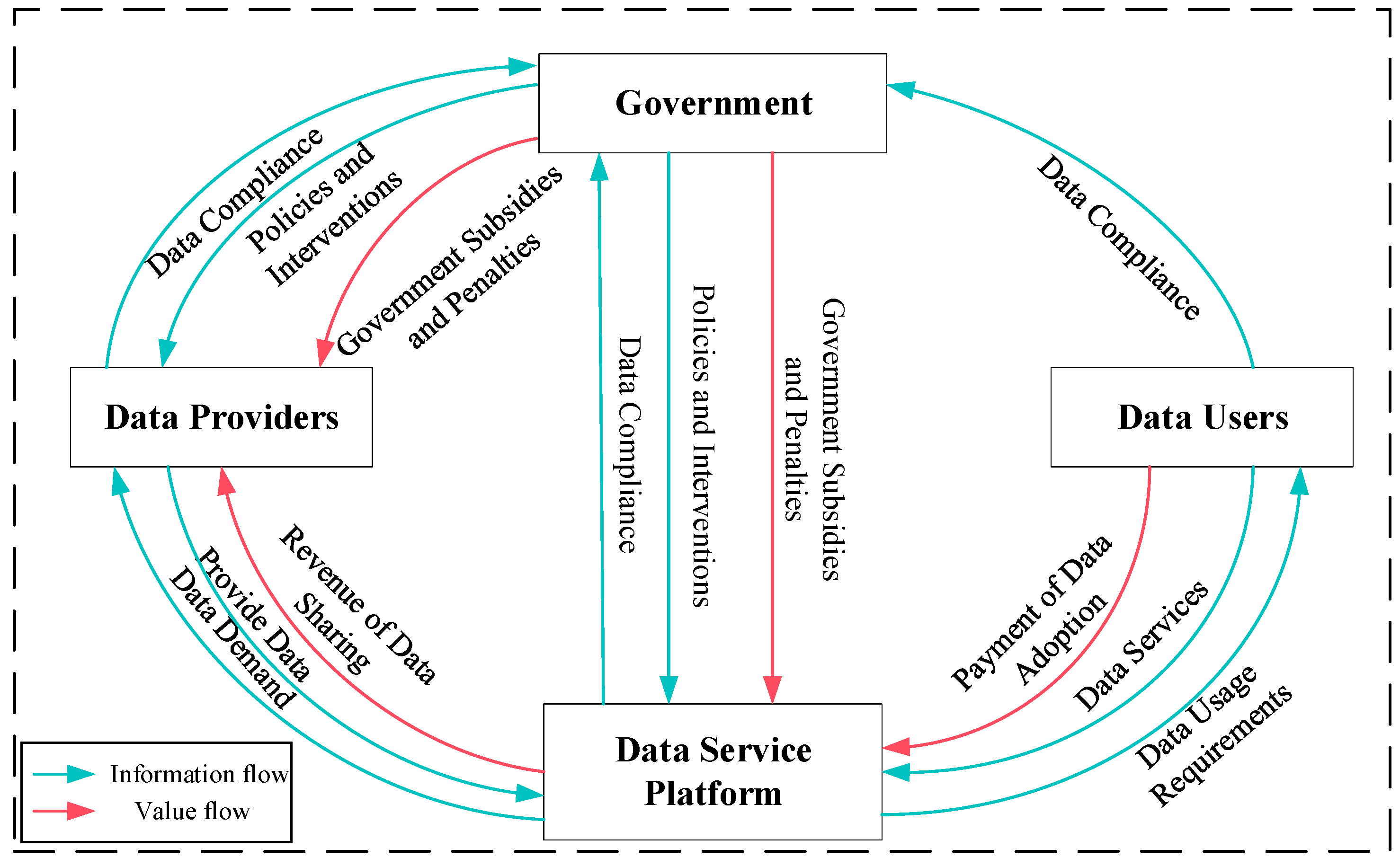
2.5. Analysis of the Logical Relationships in the Game Model

The sustainable operation of multi-source data in VGI relies on the collaboration of four key parties, including data providers, data users, the government, and the data service platform. Data providers supply high-quality data in exchange for policy incentives. Data users access data through the platform to support decision-making and communicate demand feedback. The data service platform connects both supply and demand sides while ensuring secure data circulation. The government coordinates the overall framework through laws, regulations, and incentive policies to promote equitable sharing and orderly development. Together, these four parties form a closed-loop system interconnected by data flows and value flows, collectively sustaining an efficient, compliant, and sustainable VGI data ecosystem. Sustainable operation mechanism for multi-source data integration in VGI is shown in Figure 1.

3. Construction of the Quadripartite Evolutionary Game Model

To ensure clarity and facilitate the understanding of the mathematical models that follow, a comprehensive nomenclature of key symbols is presented in Table 1.

3.1. Major Stakeholders in the Quadripartite Evolutionary Game

The primary participants in VGI are constituted by data providers, data users, the government, and the data service platform, each exhibiting distinct strategic preferences. A binary choice framework is adopted for each actor, a methodological approach that is commonly employed in initial game-theoretic explorations to establish a tractable analytical baseline. As outlined in Table 2, the strategic options are defined as follows. Data providers face the choice between multi-source data integration and maintaining data silos. Data users decide whether to adopt shared data. The government selects between stringent and lax regulations. Meanwhile, the data service platform operates under either an active or passive service orientation. Based on these behavioral traits, multiple strategic profiles can be constructed, thus establishing the participation scenarios shown in Table 2, which lays a theoretical foundation for the subsequent game analysis.

3.2. Model Assumptions

This study develops a game model to analyze the multi-source data integration mechanism in VGI, incorporating four key stakeholders, including data providers, data users, the service platform, and the government. The model examines the behavioral strategies and benefit distribution mechanisms of these parties during data sharing under government regulatory constraints. It further investigates the stability of the evolutionary equilibrium and evaluates the impact of different parameters on the strategic evolution of each stakeholder and overall system stability. To enhance the model’s applicability, the following assumptions are made regarding the stakeholders.
Assumption 1.
Multi-Stakeholder Game Assumption. All participants in the VGI multi-source data integration mechanism are assumed to exhibit bounded rationality, including data providers, data users, the service platform, and the government.
Assumption 2.
Multi-Strategy Game Assumption. In line with the evolutionary game theory framework, strategic choices are represented probabilistically to capture both collective adoption rates and individual strategic tendencies. Specifically, the probability x reflects the propensity of data providers toward multi-source data integration. The probability y represents the relative frequency of data users who choose to utilize shared data within the user population. The probability w signifies the government leaning toward stringent supervision, representing its regulatory stance. The probability z denotes the service platform’s inclination toward active service, capturing its operational disposition along the active-passive spectrum. This formulation enables the modeling of bounded rationality and serves as the state variable for analyzing strategy evolution through replication dynamics. It mirrors how real-world actors gradually adjust their strategies based on observed outcomes and social learning.
Assumption 3.
Cost–Benefit Assumptions for Data Providers. If a data provider engages in multi-source data integration, the provided data volume is denoted as  D S 1 , whereas maintaining data silos results in a data volume of  D S 2 , where  D S 1 > D S 2 . Through data cooperation with other agents, the data provider obtains a benefit coefficient, IS. However, multi-source data integration also entails higher management, technical, and compliance costs (e.g., costs for meeting data protection regulations), represented by a cost coefficient  C S 1 , which exceeds the cost coefficient  C S 2  associated with passive participation (i.e.,  C S 1 > C S 2 ). Additionally, data provision involves risks of leakage or misuse, which are quantified based on potential penalties and liabilities stipulated in data protection laws. The risk occurrence probability for multi-source data integration being  R S 1  and for data silos being  R S 2  (i.e.,  R S 1 > R S 2  ). This assumption captures the inherent trade-offs between gains, costs, and risks in data sharing.
Assumption 4.
Cost–Benefit Assumptions for Data Users. The amount of effective information obtained by data users is N1 when utilizing multi-source data, N2 when using siloed data with N1 > N2, and zero when no data is used. Data users generate benefits with a coefficient IU by utilizing the data information provided through the service platform. The corresponding data cost is  C U 1  when the platform provides active service, and  C U 2  under passive service, with  C U 1 > C U 2 . This assumption captures the fundamental value proposition for data users, where higher-quality data and better platform service typically command greater costs but yield superior returns.
Assumption 5.
Cost–Benefit Assumptions for the Government. The government employs different regulatory scrutiny in the VGI, with associated costs of  C G 1  for stringent supervision, and  C G 2  for lax supervision, typically  C G 1 > C G 2 . During the early development of VGI, the government usually guides multi-party active participation through subsidy policies. When data providers engage in multi-source data integration with platform participation, the government provides subsidies to the data provider and the service platform with coefficients εS and εP, respectively. Furthermore, if the service platform participates passively while data providers are sharing data, it faces a penalty intensity φP, the magnitude of which is directly linked to the fine ranges specified in relevant data governance regulations, reflecting the severity of non-compliance. The government ultimately aims not only to ensure the compliant operation of the mechanism but also to enhance overall social benefit. A high social benefit level F1 can be achieved under stringent supervision, while social benefit decreases to a lower level F2 under lax supervision, with F1 > F2. This reflects the government’s role as regulator and incentivizer, using common policy tools to steer VGI development.
Assumption 6.
Cost–Benefit Assumptions for the Service Platform. The participation of the service platform in VGI directly affects its costs and benefits. Under active participation, the platform incurs an operational cost of  C P 1 , compared to a minimum maintenance cost of  C P 2  under passive participation, where  C P 1 > C P 2 . Active participation brings not only direct economic returns from data services but also indirect benefits including brand enhancement, policy support, and social responsibility fulfillment, collectively denoted as  I p 1 . In contrast, the benefits obtained under passive participation are relatively limited and denoted as  I P 2 , with  I P 1 > I P 2 . This differential captures the platform’s fundamental choice between low-cost passive service and high-value active engagement. Crucially, the platform’s payoff is also influenced by data governance factors: it bears higher risk costs ( C P 1 ) under active service due to handling larger, integrated datasets and faces direct regulatory penalty intensity (φP) for passive non-compliance.

3.3. Construction of the Quadripartite Payoff Matrix

Under the aforementioned assumptions, the strategic choices of the four parties can be defined as follows. Data providers choose between multi-source data integration and maintaining data silos, while data users decide whether to adopt the provided data. The government selects between stringent and lax regulations, and the service platform opts for either active or passive service. By combining the possible strategies of all parties, a systematic quadripartite game model is constructed. The corresponding payoff for each party under every possible strategy profile is calculated in Table A1.

3.4. Equilibrium Analysis of Evolutionary Game

3.4.1. Equilibrium Analysis of the Data Provider

The expected benefits of adopting multi-source data integration and maintaining data silos are denoted as Ux1 and Ux2, respectively, as shown below.
U x 1 = D S 1 ( ε S + I s C S 1 R S 1 )
U x 2 = D S 2 ( I s C S 2 R S 2 )
The replication dynamic equation of data providers’ strategies in the VGI data sharing system is established by the following equation.
f ( x ) = x ( x 1 ) E x
E x = D S 1 ε S + I S C S 1 R S 1 D S 2 I S C S 2 R S 2
Given that VGI remains in its early stages with data-sharing mechanisms not yet fully established, data providers predominantly face a strategic choice between multi-source data integration and maintaining data silos. From an evolutionary game perspective, the steady states for data providers are characterized by either multi-source data sharing or maintain data silos, that is, when x = 0 or x = 1 .
The steady states of data providers can be determined by setting the replication dynamic equation to zero, that is f ( x ) = 0 . When E x < 0 , d f x d x x = 0 < 0 and d f x d x x = 1 > 0 , x = 0 represents a stable equilibrium point, indicating that data providers consistently choose to maintain data silos. Conversely, when E x > 0 , d f x d x x = 0 > 0 and d f x d x x = 1 < 0 , x = 1 becomes the stable equilibrium point, where data providers opt for multi-source data integration. It is noteworthy that government subsidies ε S play a role in influencing the steady states of data providers’ strategic choices.

3.4.2. Equilibrium Analysis of the Data User

The expected benefits for data users choosing to adopt data and not adopt data are denoted as Uy1 and Uy2, respectively, as shown below.
U y 1 = I U C U 2 N 1 1 z + I U C U 1 N 2 1 x + N 1 x z
U y 2 = 0
The replication dynamic equation for the data user in the VGI data sharing system is described by the following equation.
f ( y ) = y ( y 1 ) U y 1       = y ( y 1 ) E y
As derived from the formulation, the payoff function of data users is influenced by the strategies adopted by both data providers and the data service platform. Specifically, the strategy of data providers determines the volume of data available (N1 or N2), while whether the service platform engages actively governs the data costs ( C U 1 or C U 2 ).
Let f ( y ) = 0 , the following equation is obtained.
z = I U C U 2 N 1 I U C U 2 N 1 I U C U 1 N 2 1 x + N 1 x
Case 1: When z = z , the data users derive equal benefits regardless of their decision to adopt the offered data.
Case 2: When the data service platform exhibits passive participation tendencies, that is 0 < z < z , the data users tends to not adopt data. Conversely, when the data service platform leans towards active participation, that is z < z < 1 , the data users tends to adopt data.

3.4.3. Equilibrium Analysis of the Government

The expected benefits of the government choosing stringent and lax regulations are denoted as Uw1 and Uw2, respectively, as shown below.
U w 1 = F 1 C G 1 + D S 1 ε S x ε P x z + φ P x φ P x z                 + D S 2 φ P ε P z φ P x φ P z + ε P x z + φ P x z
U w 2 = F 2 C G 2 + D S 2 φ P φ P x ε P z φ P z + ε P x z + φ P x z                 + D S 2 φ P x ε S x ε P x z φ P x z + ε P x y z φ P x y z
The replication dynamic equation characterizing the evolutionary dynamics of the government’s strategy in the VGI data sharing system is established as follows.
f ( w ) = w ( w 1 ) ( C G 1 C G 2 F 1 + F 2 + D S 1 ε P x y z D S 1 φ P x y z )       = w ( w 1 ) E w
The formulation indicates that the government’s payoff is affected by the total subsidies and penalties, which are determined by the strategic choices of the other three stakeholders.
Setting f ( w ) = 0 yields the following analytical cases.
z = F 1 F 2 C G 1 + C G 2 D S 1 ε P φ P x y
Case 1: When the service platform’s strategy satisfies a specific condition (i.e., z = z ), the government will gain the same benefits from both stringent and lax regulatory approaches.
Case 2: When the service platform leans towards passive participation (i.e., 0 < z < z ), the government will intensify penalties to drive the system toward equilibrium. Conversely, when the service platform exhibits active participation (i.e., z < z < 1 ), the government will reduce punishment to achieve balanced development.

3.4.4. Equilibrium Analysis of the Service Platform

The expected benefits of the service platform choosing active service and passive service are denoted as Uz1 and Uz2, respectively, as shown in the following equations.
U z 1 = D S 2 ε P D S 2 ε P x + D S 1 ε P x C P 1 + I P 1
U z 2 = C P 2 + I P 2 D S 2 φ P + D S 2 φ P x D S 1 φ P x
The replication dynamic equation for the data service platform in the VGI data sharing system is established as follows.
f ( z ) = z ( z 1 ) I P 1 C P 1 I P 2 + C P 2 + D S 2 ε P + D S 2 φ P + D S 1 D S 2 ε P + φ P x     = z ( z 1 ) E z
The formulation shows that the data provider’s sharing strategy governs the data volume, thereby modulating the subsidies and penalties from the government to the service platform and consequently determining the platform’s payoff.
Setting f ( z ) = 0 reveals two distinct cases that characterize the platform’s strategic evolution.
x ' = C P 2 C P 1 + I P 1 I P 2 + D S 2 ε P + D S 2 φ P D S 1 D S 2 ε P + φ P
Case 1: When the probability of the data provider choosing multi-source data integration reaches a specific critical value ( x = x ' ), the data service platform cannot determine the stable strategy. Under this condition, the expected benefits of active and passive service strategies become equivalent, resulting in the replication dynamic equation f ( z ) = 0 being satisfied for all values of z.
Case 2: When the data provider demonstrate a tendency toward data silo strategies ( 0 < x < x ' ), the data service platform will correspondingly adopt a passive service strategy to achieve an equilibrium state. Conversely, when the data provider exhibit multi-source data integration tendencies ( x ' < x < 1 ), the data service platform will implement active service strategy to reach equilibrium.

3.5. Stability Analysis

In the replication dynamic game system comprising the four parties, including data providers, data users, the government, and the service platform, the stability of strategy profiles can be determined according to Lyapunov’s principle. Following the strict Nash equilibrium concept, the stability of the system’s sixteen strategic equilibrium points is examined by analyzing the eigenvalues of the Jacobian matrix. An equilibrium point constitutes an evolutionary stable strategy (ESS) if all eigenvalues possess negative real parts. The presence of at least one positive eigenvalue indicates an unstable equilibrium. The Jacobian matrix of this system is structured as follows.
J = F ( x ) x F ( x ) y F ( x ) w F ( x ) z F ( y ) x F ( y ) y F ( y ) w F ( y ) z F ( w ) x F ( w ) y F ( w ) w F ( w ) z F ( z ) x F ( z ) y F ( z ) w F ( z ) z
To identify the ESS of the quadripartite game model, Algorithm 1, as shown below, presents the pseudocode for simulating its dynamic evolution.
Algorithm 1 Dynamic Evolution of the Quadripartite Game Model
Input: Simulation mode m∈{1,2}, initial probabilities [v1, v2, v3]∈{x, y, w, z}, payoff parameters, total time T, time step Δt.
If m = 1(Fixed Strategy):
  • Additional input: fixed_var∈{x, y, w, z}.
  • Output: Evolution trajectories of the three non-fixed variables over time.
If m = 2(Parameter Sensitivity):
  • Additional input: Adjusted parameters p = [p1, p2,..., pk], counter k = 1.
  • Output: Evolution trajectories of all four variables over time.
1. Initialize: t = 0
If m = 1:
2. While t < T
3. Calculate Payoffs:
        Uv11 and Uv12
        Uv21 and Uv22
        Uv31 and Uv32
4. Define Replication Dynamics Equation:
         f v 1 = v 1 · 1 v 1 · U v 11 U v 12
         f v 2 = v 2 · 1 v 2 · U v 21 U v 22
         f v 3 = v 3 · 1 v 3 · U v 31 U v 32
5. Solve Replication Dynamics Equation:
        uses ode45 solver to solve v1, v2, v3
6. Increment time and record state:
        t = t + Δt
        Store current state (v1, v2, v3)
7. end
8. Return evolution trajectories v1, v2, v3
Elseif m = 2:
2. For p = [p1, p2,...,pk]
3. Update p, reset t = 0, {x, y, w, z} = [x0, y0, w0, z0]
4. While t < T
5. Calculate Payoffs:
        Ux1 and Ux2
        Uy1 and Uy2
        Uw1 and Uw2
        Uz1 and Uz2
6. Define Replication Dynamics Equation:
         f x = x · 1 x · U x 1 U x 2
         f y = y · 1 y · U y 1 U y 2
         f w = w · 1 w · U w 1 U w 2
         f z = z · 1 z · U z 1 U z 2
7. Solve Replication Dynamics Equation:
        uses ode45 solver to solve x, y, w, z
8. Increment time and record state:
        t = t + Δt
        Store current state (x, y, w, z)
9. End while
10. Store trajectories for parameter value p
11. Increment counter: k = k + 1
12. End For
13. Return evolution trajectories x, y, w, z
End If

3.5.1. Stability Analysis Under the Data Silo Condition

Table 3 reveals that eight equilibrium points exist under data silo conditions. Their stability conditions depend on the difference between benefits and costs among the four parties. In the initial stage of the VGI, data users typically adopt a wait-and-see approach due to uncertainties in data acquisition costs and potential benefits. Meanwhile, the government, constrained by insufficient legal policies, regulatory costs, and regional benefits, generally implements lax regulation strategies. Without government reward and punishment mechanisms, the service platform primarily pursuing profit maximization tends to choose passive services to secure stable returns.
Furthermore, data providers exhibit stronger tendencies toward maintaining data silos when the comprehensive data-sharing costs, including privacy risk losses, exceed the combined benefits of sharing and potential subsidies, as defined by No. ⑬ (A2) in Table A2. The data volume, government subsidies, and data-sharing benefits and costs under siloed and integrated scenarios significantly influence this evolutionary trend.
Data users are more likely to reject data adoption when the sum of usage benefits falls below their usage costs, as specified by No. ① or ③ in Table A2. Their decision-making is strongly affected by the cost–benefit balance under both active and passive service of the platform.
The government tends to adopt lax regulation when the net benefits of stringent regulation are lower than those of lax regulation, in accordance with No. ⑨ in Table A2. This indicates that governmental strategy is primarily influenced by the cost–benefit trade-off between the two regulatory approaches.
Service platforms tend toward passive service provision when rewards for active service are lower than the difference between service revenue and potential penalties for passive service, which satisfies No. ⑤ in Table A2. The relative costs and benefits of active and passive service directly shape the platform’s strategic choice.
Thus, agent strategies collectively reflect a fundamental trade-off logic balancing costs, benefits, and regulatory influences.

3.5.2. Stability Analysis Under the Multi-Source Data Condition

Table 4 reveals that eight equilibrium points exist under multi-source data fusion. Given that data providers supply multi-source data, eight equilibrium points exist. As VGI evolves, the government needs to take the lead in policy implementation to facilitate data circulation and platform establishment. In this context, data providers, driven by dual objectives of benefit maximization and data privacy protection, typically maintain a conservative stance towards external data sharing. However, their willingness to share gradually strengthens alongside growing VGI demands. Through reinforced regulatory mechanisms and refined penalty systems, the government can employ stringent supervision to encourage the active participation of the data service platform, thereby steering the system towards equilibrium.
Furthermore, with conditions opposite to those favoring data silos, data providers show a stronger inclination toward multi-source data integration when the overall costs of sharing are lower than the total benefits and subsidies, as expressed in No. ⑭ in Table A2. Data users opt for active engagement when benefits derived from multi-source data exceed associated costs, which satisfy No. ② or ④ in Table A2. The governments tend to select stringent regulation when the cost difference between stringent and lax regulation is outweighed by potential losses incurred under lax regulation, as modeled in No. ⑥ or ⑧ in Table A2. Service platforms choose active service when the revenue from such engagement surpasses the net gains from passive service after accounting for potential penalties, following No. ⑫ in Table A2. This systematic cost–benefit analysis across all stakeholders ultimately determines strategic convergence toward equilibrium.
To identify the key factors influencing strategic changes in the four parties under different scenarios, Table A3 summarizes the critical conditions for the strategies of each party.

4. Case Study

During different stages of data sharing in VGI, the strategic choices of game participants exhibit distinct evolutionary trajectories. To delve deeper into how key parameters in the replication dynamic system influence the four parties’ strategic decisions, this paper employs a numerical simulation method to conduct simulations and sensitivity analysis. The strategy profile (1, 1, 1, 1), which represents the full cooperation of all participants, is established as the ideal evolutionary target trajectory, providing a reference for analyzing the system’s potential convergence toward an optimal stable equilibrium.
To verify the dynamic characteristics of the aforementioned quadripartite evolutionary game model and analyze its ESS, this section employs numerical simulation methods. All simulations are implemented in MATLAB R2021a under an academic license, utilizing the ode45 solver for numerical integration, with both the relative tolerance and absolute tolerance set to 1 × 10⁻⁸.
Since parameter assignment for VGI multi-source data integration involves commercial confidentiality, obtaining complete and authentic real-world data remains challenging. Therefore, the parameter settings in this research are primarily established with reference to a large city with 500,000 EVs. The values of core parameters are derived based on publicly available policies and regulations, relevant literature, and reasonable assumptions, aiming to validate the model’s effectiveness and analyze the system’s evolutionary dynamics. This approach ensures that the parameters are grounded in realistic operational logic and regulatory boundaries, thereby validating the model’s effectiveness and enabling a robust analysis of the system’s evolutionary dynamics. The simulation parameters are configured as presented in Table 5. We have ensured dimensional consistency throughout the model by unifying the units of all parameters and verifying the balance of all dynamic equations.

4.1. Impact of Data Providers

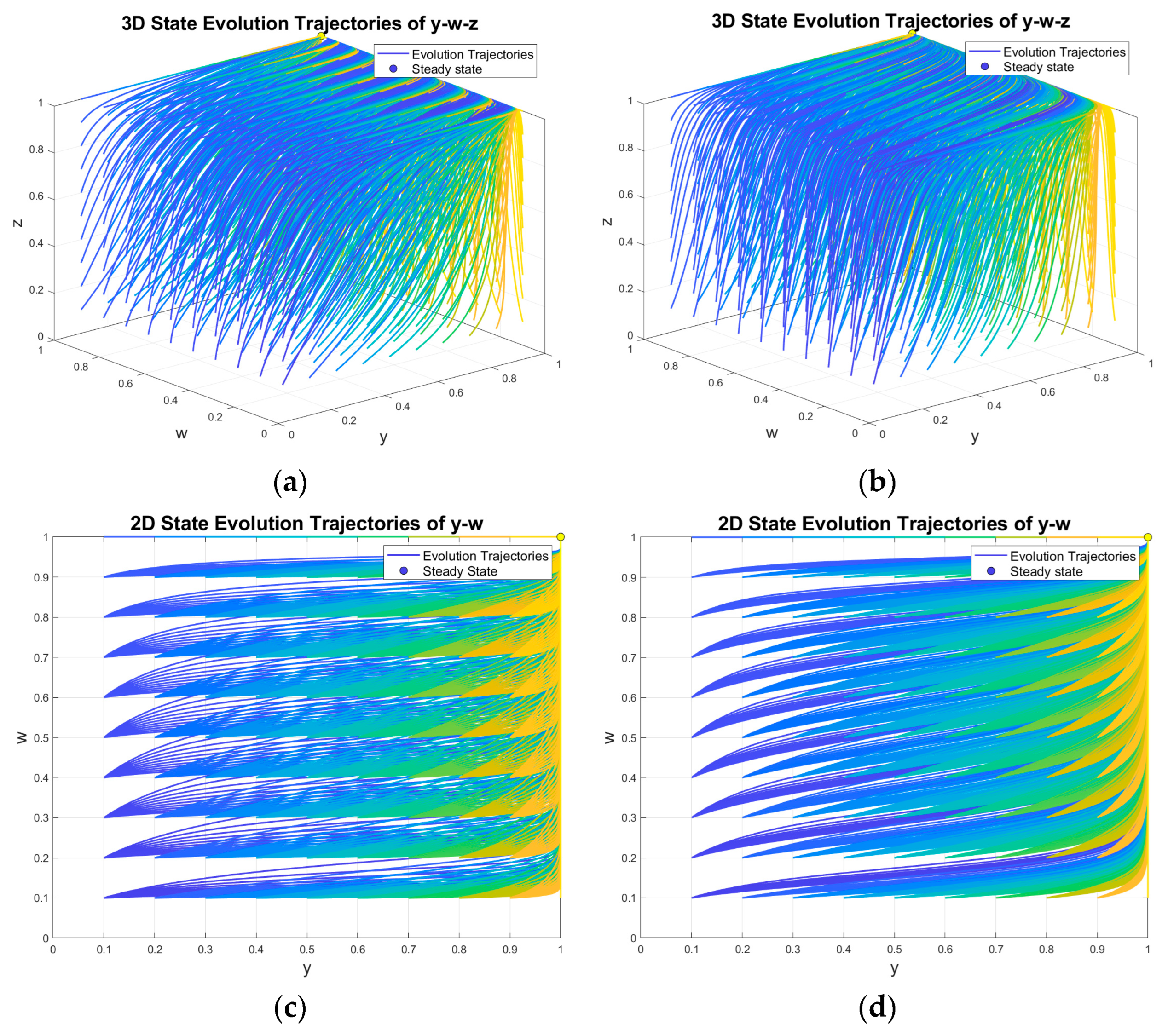
The efficient operation of VGI relies on the active participation of data providers. To further verify the effectiveness and feasibility of data providers supplying multi-source data within VGI, this paper sets their strategy probabilities at 0 and 1, representing the two pure strategic states of maintaining data silos and pursuing multi-source data integration, respectively. This enables a clear examination of the system’s boundary conditions. All other parameters for this simulation are provided in Table 5. On this basis, a three-dimensional simulation space is constructed with an initial state of (y, w, z) = (0.1, 0.1, 0.1) to simulate the evolutionary processes of data users, government, and the data service platform under different initial strategy combinations. The simulation results are shown in Figure 2.
The results demonstrate that when data providers choose to supply multi-source data (x = 1), data users tend to adopt shared data, the data service platform is more likely to select active service, and the government tends towards stringent regulation to achieve greater benefits. Conversely, when data providers only supply siloed data (x = 0), the strategies of the data users, government, and data service platform display greater exploratory behavior and uncertainty. In this scenario, the system explores a broader strategic area before eventually converging gradually to the equilibrium state (1, 1, 1, 1). This suggests that, under the combined influence of multiple factors such as data security, privacy protection, and cost–benefit distribution, the stable strategy for data providers is not unique. Furthermore, multi-source data integration can accelerate the system’s convergence speed, driving all parties to reach a stable equilibrium more quickly.

4.2. Impact Analysis of Costs

4.2.1. Data Costs and Leakage Risk Costs

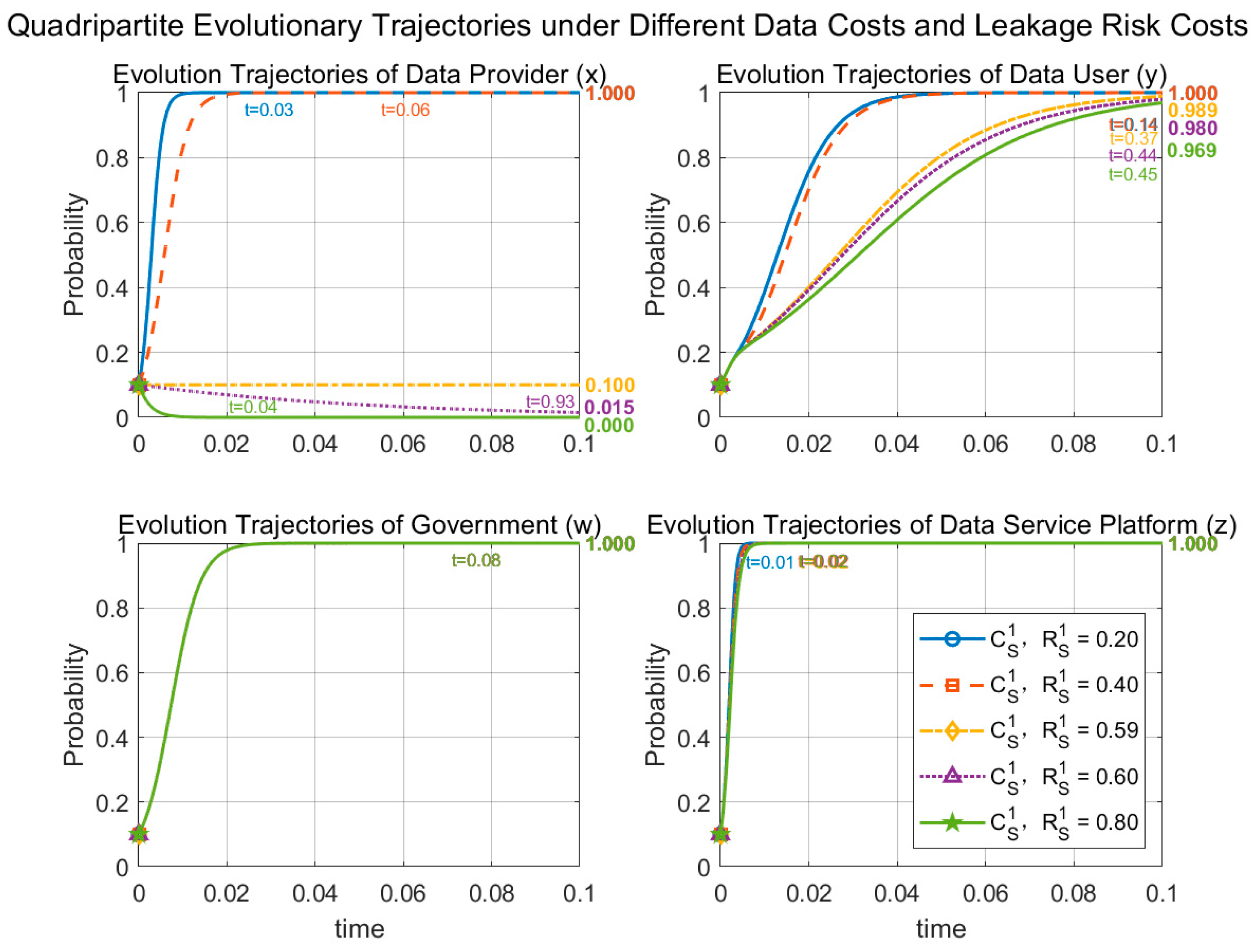
To conduct a more comprehensive analysis of how data costs and leakage risk costs impact the system’s equilibrium, this paper performs a sensitivity analysis on the data costs of data providers with the initial state of (x, y, w, z) = (0.1, 0.1, 0.1, 0.1) and other variables listed in Table 5. The results are presented in Figure 3.
The simulation results reveal that under low-cost conditions (satisfying No. ⑭ in Table A2), data providers exhibit a positive payoff (Ex > 0) for multi-source data integration, leading them to adopt this strategy. In contrast, under high-cost conditions (satisfying No. ⑬ in Table A2), Ex becomes negative, inclining data providers to maintain data silos. At the critical cost C S 1 = R S 1 = 0.59 yuan/unit where Ex = 0 (satisfying No. ① in Table A3), the evolutionary trajectory of data providers remains constant.
Deviating from the critical cost increases the absolute value of Ex, thereby accelerating convergence. For instance, when Ex > 0, reducing the cost from 0.04 to 0.02 yuan/unit shortens the time for data providers to reach the stable state of 1 from 0.06 to 0.029. Similarly, under No. ⑬ in Table A2, increasing the cost from 0.6 to 0.8 extends the convergence time (defined as the earliest time at which a strategy variable reaches and remains within tolerance 1 × 10⁻⁹ of its equilibrium 0 or 1) from 0.044 to 0.93.
Simultaneously, data users exhibit faster convergence speeds under low-cost conditions, indicating that their strategies reach equilibrium more readily under low-cost constraints. In comparison, the government and the data service platform are relatively unaffected by variations in data costs and leakage risks, maintaining more stable convergence pathways.
These results demonstrate that reducing data provision costs and leakage risks can not only enhance data providers’ initiative but also accelerate the equilibrium process of the overall system. This insight provides valuable guidance for optimizing the VGI data-sharing environment.

4.2.2. Adoption Costs of the Data User

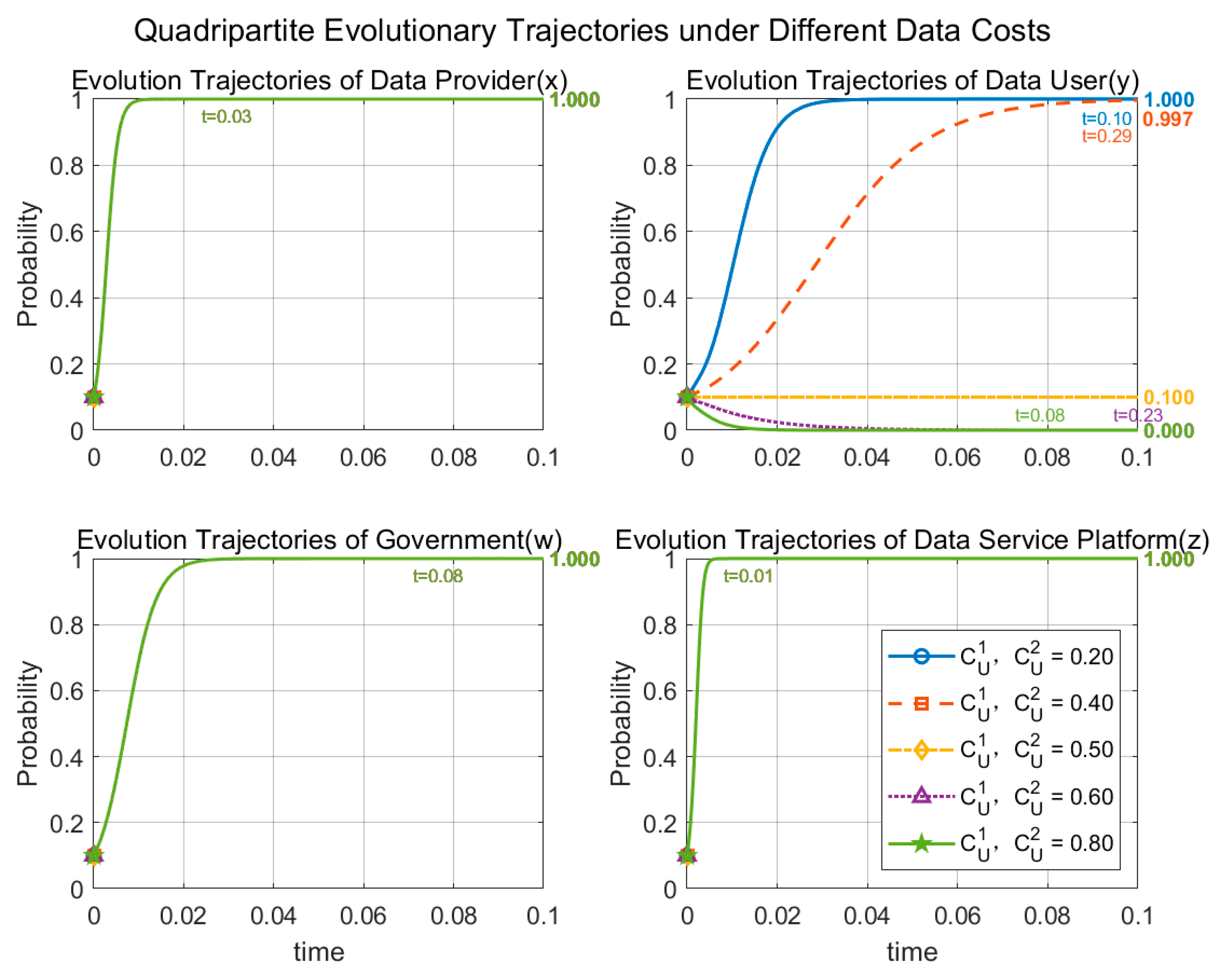
To systematically examine how data usage costs influence the strategies of data users, this study sets the initial states of the four parties to (x, y, w, z) = (0.1, 0.1, 0.1, 0.1) while keeping all other parameters constant. By adjusting the data costs C U 1 and C U 2 , changes in the evolutionary trajectories of each stakeholder are observed. The simulation results are presented in Figure 4.
The results indicate that under low-cost conditions (satisfying No. ④ in Table A2), data users obtain a positive return from data usage (Ey > 0) and thus tend to adopt the data. In contrast, under high-cost conditions (satisfying No. ③ in Table A2), Ey becomes negative, leading them to reject data usage. At the critical cost C U 1 = C U 2 = 0.5 yuan/unit where Ey = 0, the evolutionary trajectory remains unchanged. Evolutionary trajectories of the other parties are unaffected by changes in data cost.
Deviating from the critical cost increases the absolute value of Ey, thereby accelerating the convergence speed. For example, when Ey > 0, reducing the data usage cost from 0.4 to 0.2 shortens the convergence time of data users from 0.29 to 0.096. Similarly, when Ey < 0, increasing the cost from 0.8 to 1 reduces the convergence time from 0.23 to 0.078.
These findings suggest that reducing data usage costs can effectively incentivize data adoption among users and promote faster convergence of the overall system to equilibrium.

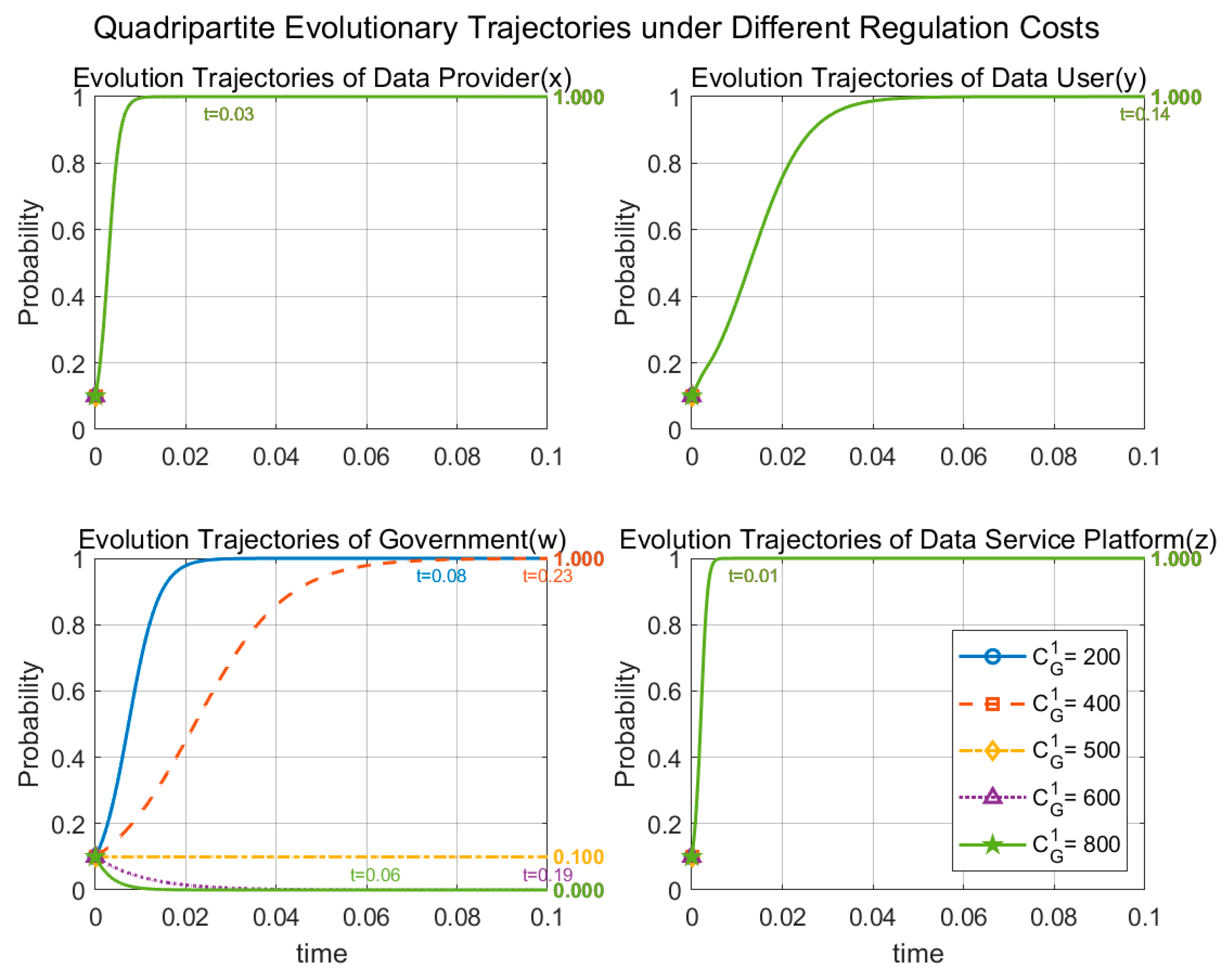
4.2.3. Regulation Costs of Government

To systematically examine how regulatory costs influence government decision-making, this study fixes all other parameters and sets the initial states of the four parties to (x, y, w, z) = (0.1, 0.1, 0.1, 0.1). By adjusting the government’s regulatory cost, the dynamic changes in the evolutionary trajectories of each party are observed. The simulation results are shown in Figure 5.
The results indicate that under low regulatory cost conditions (satisfying No. ⑧ in Table A2), the government obtains a positive benefit from stringent regulation (Ew > 0) and thus tends to adopt this strategy. In contrast, under high regulatory costs (satisfying No. ⑦ in Table A2), Ew becomes negative, leading the government to prefer lax regulation. At the critical cost C G 1 = 500 thousand yuan where Ew = 0, the evolutionary trajectory remains unchanged, which is consistent with the theoretical analysis in Section 3.5. The strategies of the other parties show no significant changes.
Deviating from the critical regulatory cost increases the absolute value of Ew, thereby accelerating the convergence speed. For instance, when Ew > 0, reducing the stringent regulatory cost from 400 to 200 shortens the government’s convergence time from 0.23 to 0.076. Similarly, when Ew < 0, increasing the cost from 600 to 800 reduces the convergence time from 0.19 to 0.06.
These results suggest that lowering regulatory costs can effectively incentivize the government to implement stringent regulations, thereby promoting the construction of a multi-source data integration system.

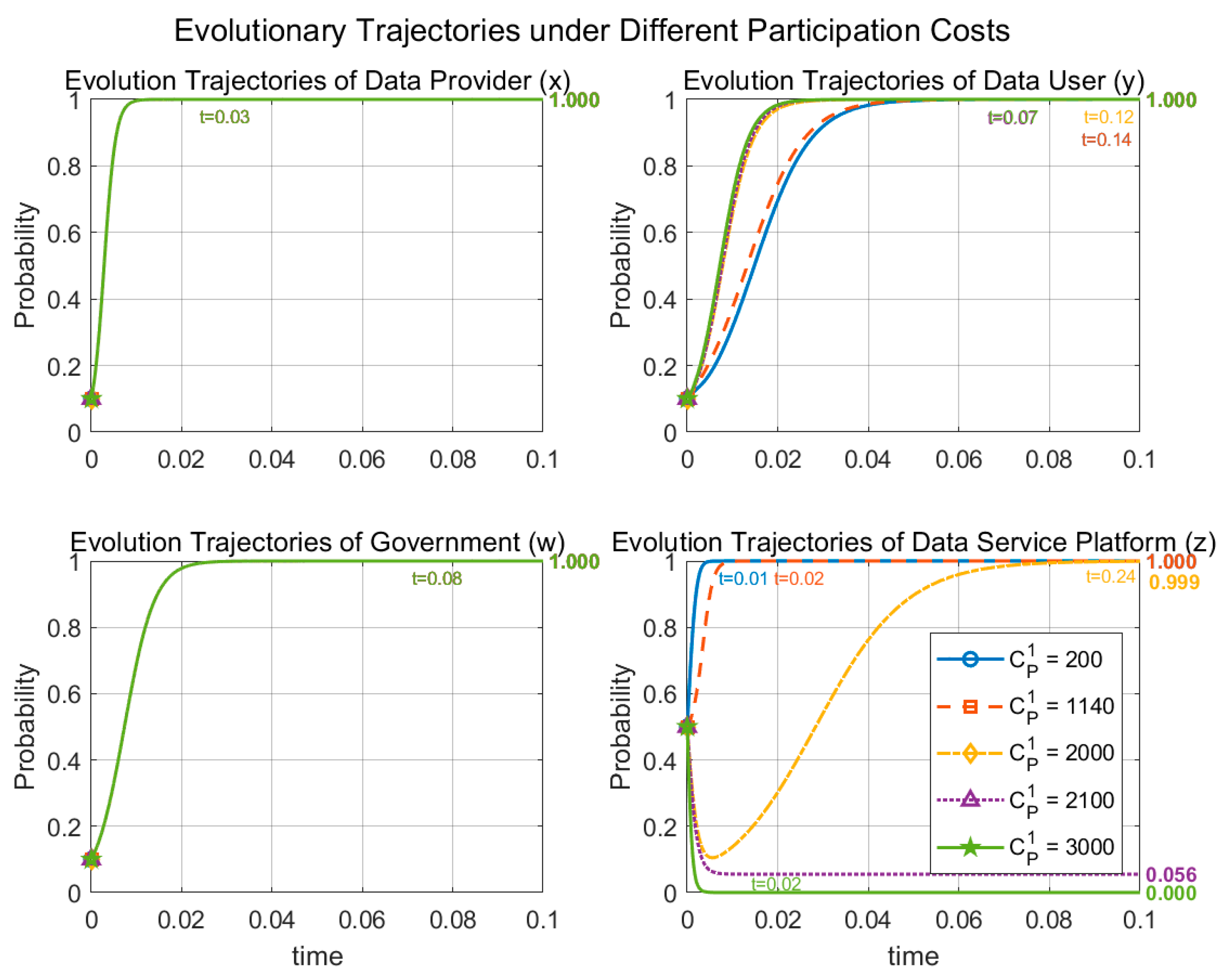
4.2.4. Participation Costs of Platform

To comprehensively analyze the impact of participation costs on the decision-making behavior of the data service platform, this study keeps all other parameters constant and sets the initial states of the four agents to (x, y, w, z) = (0.1, 0.1, 0.1, 0.5). By adjusting the participation cost of the data service platform, the evolutionary trajectories of all four parties are simulated, as shown in Figure 6. In this case, z = 0.5 is chosen primarily to visually highlight the lag effects associated with the two critical points and to avoid a sharp decline of the platform’s strategy in the initial stage, which would otherwise make its steady-state probability nearly indistinguishable from zero.
As discussed in Section 3.5, when x = 0 and x = 1, the data service platform’s participation cost corresponds to two critical points, C P 1 = 1140 yuan/unit and C P 1 = 2100 yuan/unit, respectively (satisfying the No. ⑥ and ⑦ in Table A3, respectively). It should be noted that data providers maintain data silos in the early phase and subsequently offer multi-source data integration. When the participation cost lies between the two thresholds, changes in x give rise to a hysteresis effect for the data service platform, whose probability toward active service first approaches zero and later converges to one. In the case where the critical value is C P 1 = 2100 yuan/unit, the platform’s probability initially declines and then stabilizes at 0.056.
Moreover, because data users operate downstream of the service platform, a lower participation cost allows the platform to converge more rapidly to active service. It is more proactive service provision reduces the net payoff difference for data users in deciding whether to adopt the data, resulting in a slightly slower convergence speed for the data users. These findings suggest that as the participation cost of the data service platform decreases, its willingness to provide active service increases significantly, thereby facilitating the formation of a multi-source data integration ecosystem for VGI.

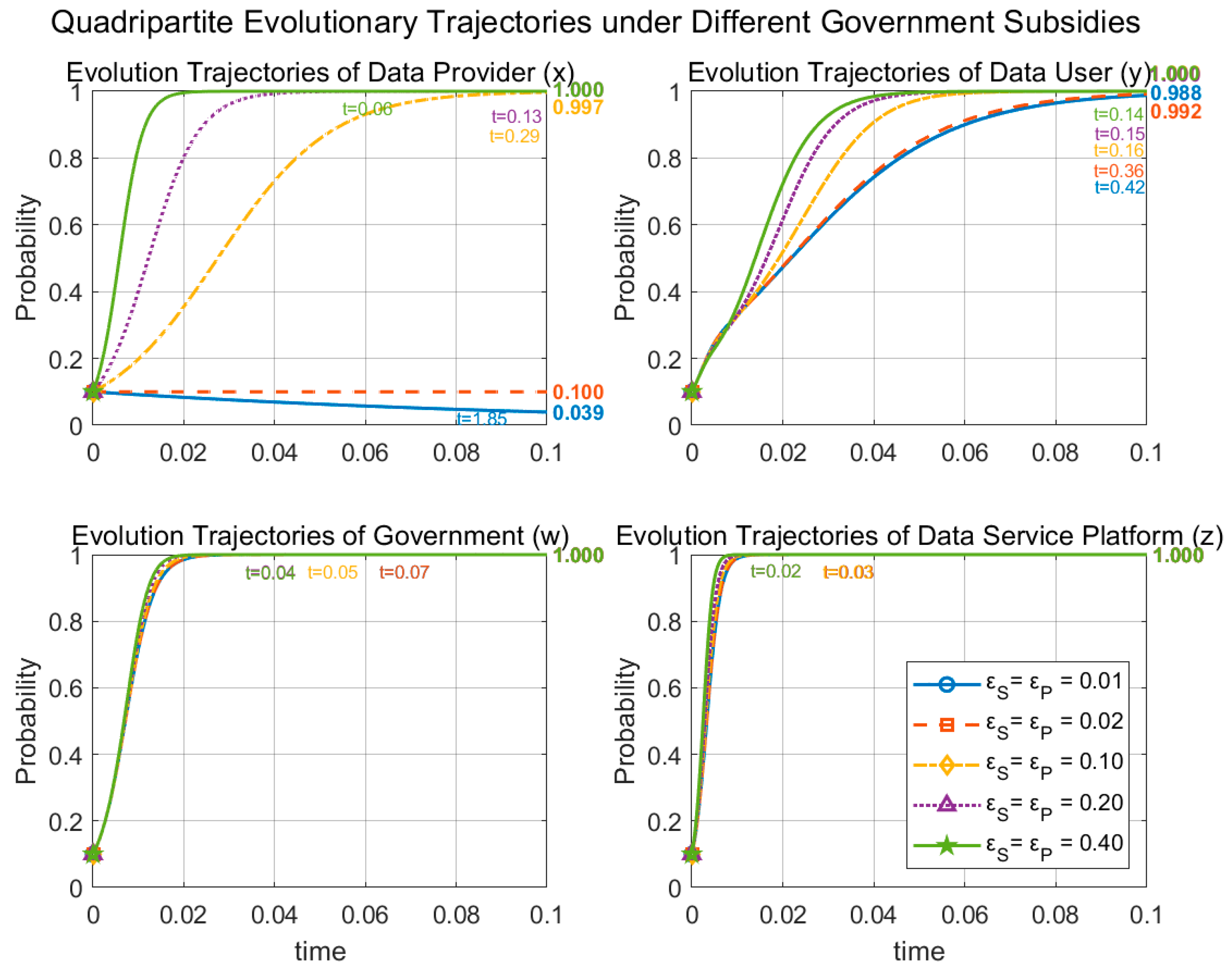
4.3. Impact Analysis of Government Subsidies

To systematically examine the impact of government subsidies on the evolutionary process of the VGI, this paper conducts a sensitivity analysis on the subsidy levels allocated to data providers and the data service platform, with the initial state of (x, y, w, z) = (0.1, 0.1, 0.1, 0.1) and other variables listed in Table 5. The results are shown in Figure 7.
The simulation results indicate that under high subsidy conditions (satisfying No. ⑭ in Table A2), data providers achieve a positive net benefit from multi-source data integration (Ex > 0), leading them to adopt this strategy. In contrast, under low subsidy scenarios (satisfying No. ⑬ in Table A2), Ex becomes negative, inclining data providers toward maintaining data silos. At the critical subsidy εS = 0.02 yuan/unit where Ex = 0, the evolutionary trajectory remains unchanged.
Deviating from the critical subsidy enhances the absolute values of Ex and Ey, thereby accelerating the convergence speed. For instance, when Ex > 0 or Ey > 0, increasing the government subsidy from 0.1 to 40 reduces the convergence time for data providers from 0.29 to 0.06 and for data users from 0.028 to 0.018.
These suggest that in the VGI early stages, appropriately increasing government subsidies not only enhances data providers’ sharing willingness but also promotes coordination and cooperation among multiple stakeholders, laying a solid foundation for the healthy operation of the system. This finding provides valuable insights for formulating effective subsidy policies in VGI implementation.

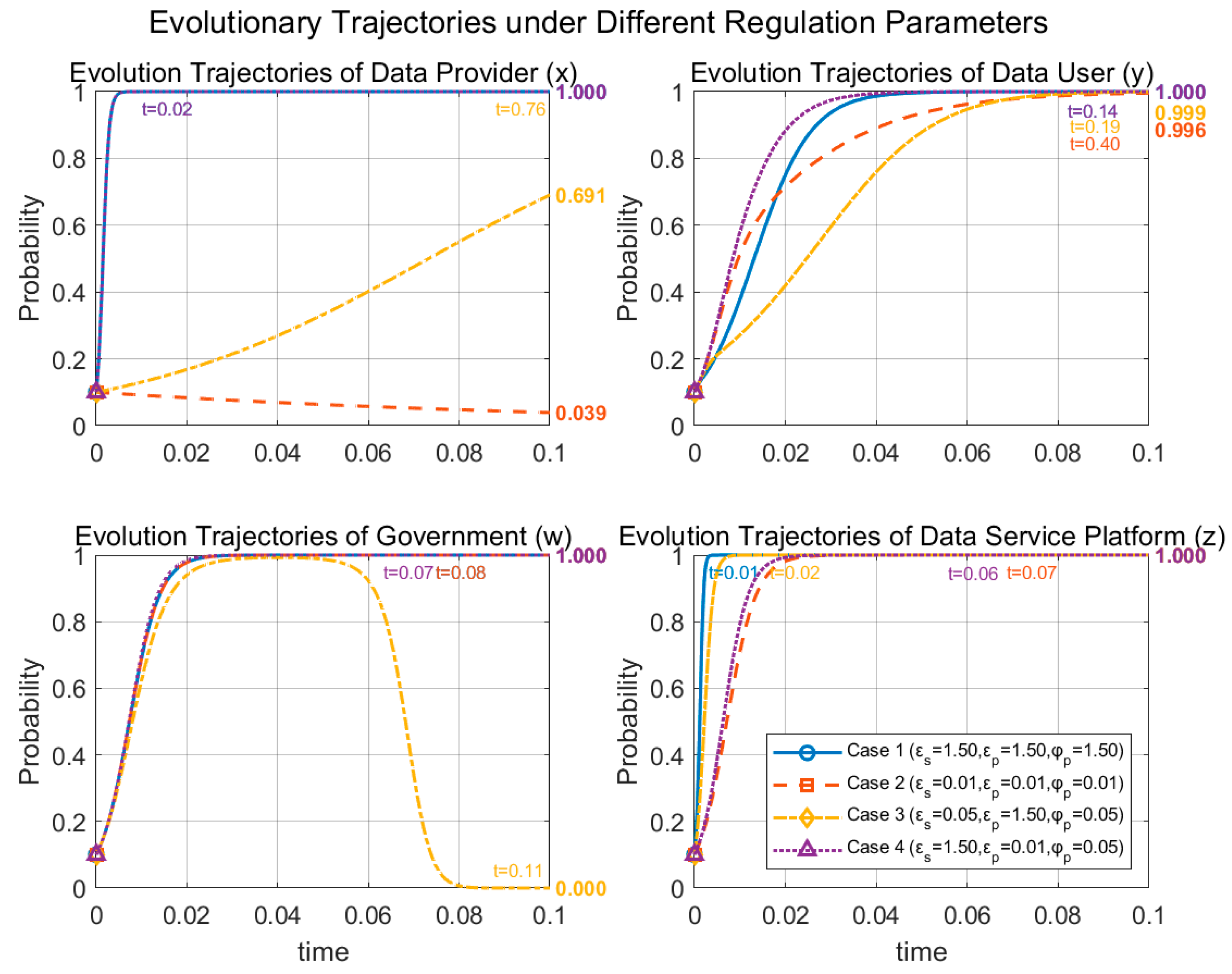
4.4. Impact of Government Regulatory Intensity

Based on different orientations of government regulatory strategies, this study designs four policy scenarios for simulation analysis, with the initial system state set as (x, y, w, z) = (0.1, 0.1, 0.1, 0.1) and all other parameters held constant. The key policy parameters for each scenario are configured as follows.
A. Case 1 (Stringent Regulation): Adopts high-intensity subsidies and penalties, with εS = εP = φP = 1.5 yuan/unit.
B. Case 2 (Lax Regulation): Implements a low degree of policy intervention, with εS = εP = φP = 0.01 yuan/unit.
C. Case 3 (Platform-Driven Ecosystem): Primarily incentivizes the service platform, with εS = 0.05 yuan/unit, εP = 1.5 yuan/unit, φP = 0.05 yuan/unit.
D. Case 4 (Data Provider-Driven Ecosystem): Focuses on incentivizing data providers, with εS = 1.5 yuan/unit, εP = 0.01 yuan/unit, φP = 0.05 yuan/unit.
The evolutionary paths of the system under each scenario are illustrated in Figure 8.
The simulation results indicate that under Cases 1 and 4, all four stakeholders converge relatively quickly to the stable state (1, 1, 1, 1). This suggests that higher subsidy or penalty intensities contribute to promoting cooperative equilibrium within the system, particularly through stronger regulatory pressure on data providers. Under Case 2 (Lax Regulation), due to insufficient incentives and constraints, the system satisfies the condition Ex < 0, ultimately converging to the data silo state (0, 1, 1, 1).
The outcome of Case 3 is more complex. The government’s payoff function is closely related to the strategy x of data providers. When x = 1, a critical condition emerges between the government’s incentives and constraints on the service platform, namely φPεP = 0.3 yuan/unit. In the early evolutionary phase, data providers tend to maintain data silos (with a low x), gradually shifting toward multi-source data sharing thereafter. During this process, when φPεP > 0.3 yuan/unit, changes in the data providers’ strategy x induce a lagged response in the government’s regulatory strategy w. The government initially strengthens supervision and subsequently relaxes it as system coordination improves. This phenomenon indicates that in an incentive design centered on the platform, policy effectiveness is constrained by the initial strategic choices of data providers, potentially leading to phased fluctuations during the evolutionary process.

5. Conclusions

Based on the current status of multi-source data integration in VGI and the demands of diverse stakeholders, this paper constructs a quadripartite evolutionary game model involving data providers, data users, government, and the data service platform. It systematically analyzes the benefit distribution relationships and cooperative game outcomes among these stakeholders. The main conclusions are summarized as follows.
First, the proposed quadripartite evolutionary game model effectively captures dynamic gaming behaviors within the data value chain. Through modeling and simulation, critical conditions influencing each stakeholder’s decision-making have been identified (see Table A3), validating the model’s effectiveness in analyzing multi-source data sharing ecosystems in VGI. Key strategic thresholds were determined, including a data cost critical value of C S 1 = R S 1 = 0.59 yuan/unit and a government subsidy threshold of εS = 0.02 yuan/unit.
Second, the study demonstrates that the four stakeholders can achieve an equilibrium through appropriate strategy selection and policy guidance, confirming that multi-source data integration in VGI is not a zero-sum game but possesses inherent potential for enhancing overall efficiency through collaboration. Data providers’ strategic choices significantly impact system convergence speed, with multi-source data integration strategies accelerating convergence toward the stable state (1, 1, 1, 1).
Third, government subsidies, reward-punishment mechanisms, and data costs play crucial roles in realizing multi-source data integration and accelerating convergence speed. Deviation from critical conditions can significantly enhance convergence speed. For instance, increasing government subsidies from 0.1 to 40 yuan/unit reduces the time for data providers to reach stability from 0.29 to 0.06.
Fourth, the analysis provides concrete and scenario-based pathways for governmental intervention. The simulation of policy scenarios reveals that a stringent regulatory approach and a data provider-driven incentive model are most effective in rapidly establishing system-wide cooperation. In contrast, a lax regulatory approach fails to overcome inertia, leading to entrenched data silos. These findings offer a quantitative basis for stage-specific policy design. Initial subsidies are crucial to lower entry barriers, while a well-calibrated, dynamic integration of subsidies and penalties is needed to guide stakeholders toward a stable, cooperative equilibrium. These findings offer a quantitative and model-grounded basis for the design of targeted incentive mechanisms in practice.
The proposed model offers substantial potential for future research extensions. Subsequent investigations could adapt the model structure to examine international VGI collaboration scenarios for sustainable development goals (e.g., affordable clean energy). Further development of the model could incorporate a broader range of policy instruments beyond the current focus on subsidies and penalties, including tax incentives and data property rights frameworks. As current parameters are derived from literature and theoretical assumptions, future research will focus on calibrating parameters with real-world data and extending the model to incorporate dynamic parameters and heterogeneous behavioral rules, thereby enhancing its predictive accuracy and policy relevance.


Author Contributions

Conceptualization, Y.D. and D.Z.; methodology, C.F. and D.Z.; validation, D.Z.; formal analysis, L.L. and Y.Z.; investigation, L.G.; data curation, Y.D.; writing—original draft preparation, D.Z.; writing—review and editing, L.L., Y.D. and Y.Z.; visualization, D.Z. and C.F.; funding acquisition, C.F. and Y.Z. All authors have read and agreed to the published version of the manuscript.

Funding

This research was funded by Smart Grid-National Science and Technology Major Project, grant number 2024ZD0800400, and Science and Technology Projects of State Grid Corporation of China, grant number 52094024004P.

Data Availability Statement

No new data were created or analyzed in this study.

Conflicts of Interest

Authors Yang Du, Chen Fang, Lingyu Guo and Yu Zhao were employed by the company State Grid Shanghai Electric Power Company. The remaining authors declare that the research was conducted in the absence of any commercial or financial relationships that could be construed as a potential conflict of interest.

Abbreviations

The following abbreviations are used in this manuscript:
VGIVehicle-Grid Integration
EVElectric Vehicle
ESSEvolutionary stable strategy
ARIMAAuto-Regressive Integrated Moving Average
STMGCNSpatiotemporal Multi-graph Convolutional Networks
MAEMean Absolute Error

Appendix A

Table A1. Quadripartite Payoff Matrix of VGI.
Government
Stringent RegulationLax Regulation
Active ServicePassive ServiceActive ServicePassive Service
Data ProviderMulti-source Data IntegrationAdopt D S 1 ( I S + ε S C S 1 R s 1 ) D S 1 ( I S + ε S C S 1 R s 1 ) D S 1 ( I S + ε S C S 1 R S 1 ) D S 1 ( I S + ε S C S 1 R s 1 )
N 1 ( I U C U 1 ) N 1 ( I U C U 2 ) N 1 ( I U C U 1 ) N 1 ( I U C U 2 )
D S 1 ε S + ε P + F 1 C G 1 D S 1 ( φ P ε S ) + F 1 C G 1 D S 1 ε S + ε P + F 2 C G 2 D S 1 φ P ε S + F 2 C G 2
I p 1 + D S 1 ε P C P 1 I p 2 C P 2 D S 1 φ P I p 1 + D S 1 ε P C P 1 I p 2 C P 2 D S 1 φ P
Not Adopt D S 1 ( I S + ε S C S 1 R s 1 ) D S 1 ( I S + ε S C S 1 R s 1 ) D S 1 ( I S + ε S C S 1 R S 1 ) D S 1 ( I S + ε S C S 1 R s 1 )
0000
D S 1 ε S + ε P + F 1 C G 1 D S 1 ( φ P ε S ) + F 1 C G 1 D S 1 ε S + ε P + F 2 C G 2 D S 1 φ P ε S + F 2 C G 2
I p 1 + D S 1 ε P C P 1 I p 2 C P 2 D S 1 φ P I p 1 + D S 1 ε P C P 1 I p 2 C P 2 D S 1 φ P
Maintaining Data SilosAdopt D S 2 ( I S C S 2 R s 2 ) D S 2 ( I S C S 2 R s 2 ) D S 2 ( I S C S 2 R s 2 ) D S 2 ( I S C S 2 R s 2 )
N 2 ( I U C U 1 ) N 2 ( I U C U 2 ) N 2 ( I U C U 1 ) N 2 ( I U C U 2 )
F 1 C G 1 D S 2 ε P F 1 C G 1 + D S 2 φ P F 2 C G 2 D S 2 ε P F 2 C G 2 + D S 2 φ P
I p 1 + D S 2 ε P C P 1 I p 2 C P 2 D S 2 φ P I p 1 + D S 2 ε P C P 1 I p 2 C P 2 D S 2 φ P
Not Adopt D S 2 ( I S C S 2 R s 2 ) D S 2 ( I S C S 2 R s 2 ) D S 2 ( I S C S 2 R S 2 ) D S 2 ( I S C S 2 R S 2 )
0000
F 1 C G 1 D S 2 ε P F 1 C G 1 + D S 2 φ P F 2 C G 2 D S 2 ε P F 2 C G 2 + D S 2 φ P
I p 1 + D S 2 ε P C P 1 I p 2 C P 2 D S 2 φ P I p 1 + D S 2 ε P C P 1 I p 2 C P 2 D S 2 φ P
Table A2. Stable Conditions of the Quadripartite Game Model.
No.Stable ConditionsNo.Stable Conditions
C U 2 > I U F 1 C G 1 + D S 1 φ P ε P > F 2 C G 2
C U 2 < I U I P 1 C P 1 < I P 2 C P 2 D S 2 ε P + φ P
C U 1 > I U I P 1 C P 1 > I P 2 C P 2 D S 2 ε P + φ P
C U 1 < I U I P 1 C P 1 + D S 1 ε P + φ P < I P 2 C P 2
F 1 C G 1 < F 2 C G 2 I P 1 C P 1 + D S 1 ε P + φ P > I P 2 C P 2
F 1 C G 1 > F 2 C G 2 D S 1 ε S + I S C S 1 R S 1 < D S 2 I S C S 2 R S 2
F 1 C G 1 + D S 1 φ P ε P < F 2 C G 2 D S 1 ε S + I S C S 1 R S 1 > D S 2 I S C S 2 R S 2
Table A3. Critical Conditions of the Quadripartite Game Model.
No.StakeholdersCritical ConditionsConditions
Data Provider D S 1 ε S + I S C S 1 R S 1 = D S 2 I S C S 2 R S 2 /
Data User C U 2 = I U Data service platform provides passive service (z = 0).
C U 1 = I U Data service platform provides active service (z = 1).
Government F 1 C G 1 = F 2 C G 2 All cases except No. ⑤
F 1 C G 1 + D S 1 φ P ε P = F 2 C G 2 System converges to the state of multi-source data integration with data adoption and active service (x,y,z) = (1, 1, 1).
Data Service Platform I P 1 C P 1 = I P 2 C P 2 D S 2 ε P + φ P Data provider maintains data silos (x = 0).
I P 1 C P 1 + D S 1 ε P + φ P = I P 2 C P 2 Data provider offers multi-source data integration (x = 1).

References

  1. Li, C. The Development of Vehicle-Network Interaction for Electric Vehicles: A Review. AETR 2025, 14, 1596. [Google Scholar] [CrossRef]
  2. Vishnu, G.; Kaliyaperumal, D.; Jayaprakash, R.; Karthick, A.; Kumar Chinnaiyan, V.; Ghosh, A. Review of Challenges and Opportunities in the Integration of Electric Vehicles to the Grid. World Electr. Veh. J. 2023, 14, 259. [Google Scholar] [CrossRef]
  3. Yuan, Q.; Ye, Y.; Tang, Y.; Liu, X.; Tian, Q. Low Carbon Electric Vehicle Charging Coordination in Coupled Transportation and Power Networks. IEEE Trans. Ind. Applicat. 2023, 59, 2162–2172. [Google Scholar] [CrossRef]
  4. Li, X.; Wang, Z.; Zhang, L.; Sun, F.; Cui, D.; Hecht, C.; Figgener, J.; Sauer, D.U. Electric Vehicle Behavior Modeling and Applications in Vehicle-Grid Integration: An Overview. Energy 2023, 268, 126647. [Google Scholar] [CrossRef]
  5. Xing, Q.; Chen, Z.; Zhang, Z.; Xu, X.; Zhang, T.; Huang, X.; Wang, H. Urban Electric Vehicle Fast-Charging Demand Forecasting Model Based on Data-Driven Approach and Human Decision-Making Behavior. Energies 2020, 13, 1412. [Google Scholar] [CrossRef]
  6. Li, H.; Tang, M.; Mu, Y.; Wang, Y.; Yang, T.; Wang, H. Achieving Accurate and Balanced Regional Electric Vehicle Charging Load Forecasting with a Dynamic Road Network: A Case Study of Lanzhou City. Appl. Intell. 2024, 54, 9230–9252. [Google Scholar] [CrossRef]
  7. Mystakidis, A.; Tsalikidis, N.; Koukaras, P.; Skaltsis, G.; Ioannidis, D.; Tjortjis, C.; Tzovaras, D. EV Charging Forecasting Exploiting Traffic, Weather and User Information. Int. J. Mach. Learn. Cybern. 2025, 16, 6737–6763. [Google Scholar] [CrossRef]
  8. Shi, J.; Zhang, W.; Bao, Y.; Gao, D.W.; Wang, Z. Load Forecasting of Electric Vehicle Charging Stations: Attention Based Spatiotemporal Multi–Graph Convolutional Networks. IEEE Trans. Smart Grid 2024, 15, 3016–3027. [Google Scholar] [CrossRef]
  9. Liu, Z.; Borlaug, B.; Meintz, A.; Neuman, C.; Wood, E.; Bennett, J. Data-Driven Method for Electric Vehicle Charging Demand Analysis: Case Study in Virginia. Transp. Res. Part D Transp. Environ. 2023, 125, 103994. [Google Scholar] [CrossRef]
  10. Demirci, A.; Tercan, S.M.; Cali, U.; Nakir, I. A Comprehensive Data Analysis of Electric Vehicle User Behaviors Toward Unlocking Vehicle-to-Grid Potential. IEEE Access 2023, 11, 9149–9165. [Google Scholar] [CrossRef]
  11. Baumgartner, N.; Weyer, K.; Eckmann, L.; Fichtner, W. How to Integrate Users into Smart Charging—A Critical and Systematic Review. Energy Res. Soc. Sci. 2023, 100, 103113. [Google Scholar] [CrossRef]
  12. Mei, H.; Wu, Q.; Ren, H.; Zhang, J.; Li, Q. Optimization of Electric Vehicle Charging Station Layout Considering the Improvement of Distribution Network Resilience under Extreme Disasters. Energy 2025, 323, 135831. [Google Scholar] [CrossRef]
  13. Li, X.; Jenn, A. An Integrated Optimization Platform for Spatial-Temporal Modeling of Electric Vehicle Charging Infrastructure. Transp. Res. Part D Transp. Environ. 2022, 104, 103177. [Google Scholar] [CrossRef]
  14. Chen, Y.; Wu, J.; Ye, S.; Li, W.; Xu, Z. Budget-Constrained Resource Allocation and Pricing in VEC: A MSMLMF Stackelberg Game With Contract Incentive Mechanism. IEEE Internet Things J. 2025, 12, 5050–5067. [Google Scholar] [CrossRef]
  15. Zhao, L.; Huang, S.; Meng, D.; Liu, B.; Zuo, Q.; Leung, V.C.M. Stackelberg Game-Based Dependency-Aware Task Offloading and Resource Pricing in Vehicular Edge Networks. IEEE Internet Things J. 2024, 11, 32337–32349. [Google Scholar] [CrossRef]
  16. Chen, L.; Yu, T.; Chen, Y.; Guan, W.; Shi, Y.; Pan, Z. Real-Time Optimal Scheduling of Large-Scale Electric Vehicles: A Dynamic Non-Cooperative Game Approach. IEEE Access 2020, 8, 133633–133644. [Google Scholar] [CrossRef]
  17. Szabó, G.; Fath, G. Evolutionary Games on Graphs. Phys. Rep. 2007, 446, 97–216. [Google Scholar] [CrossRef]
  18. Chen, Y.; Zhan, M.; Liu, Y. Promoting the Development of China’s New-Energy Vehicle Industry in the Post-Subsidy Era: A Study Based on the Evolutionary Game Theory Method. Energies 2023, 16, 5760. [Google Scholar] [CrossRef]
  19. Zhang, H.; Chun, W.; Yuan, X.-M.; Liu, W.; Chou, M.C. The Governance of Irresponsible New Energy Vehicle Members Considering Differentiated Subsidies. Sustain. Cities Soc. 2024, 104, 105289. [Google Scholar] [CrossRef]
  20. Wang, Y.; Fan, R.; Lin, J.; Chen, F.; Qian, R. The Effective Subsidy Policies for New Energy Vehicles Considering Both Supply and Demand Sides and Their Influence Mechanisms: An Analytical Perspective from the Network-Based Evolutionary Game. J. Environ. Manag. 2023, 325, 116483. [Google Scholar] [CrossRef]
  21. Duan, J.; Wang, Y.; Zhang, Y.; Chen, L. Strategic Interaction among Stakeholders on Low-Carbon Buildings: A Tripartite Evolutionary Game Based on Prospect Theory. Environ Sci. Pollut. Res. 2024, 31, 11096–11114. [Google Scholar] [CrossRef] [PubMed]
  22. Wang, J.; Qin, Y.; Zhou, J. Incentive Policies for Prefabrication Implementation of Real Estate Enterprises: An Evolutionary Game Theory-Based Analysis. Energy Policy 2021, 156, 112434. [Google Scholar] [CrossRef]
  23. Chen, N.; Lv, N.; Chen, Z. Knowledge Sharing Among Hospitals of Different Levels: A Complex Network Evolutionary Game Approach. IEEE Access 2025, 13, 41040–41053. [Google Scholar] [CrossRef]
  24. Gao, Y.; Zhu, Z.; Yang, J. An Evolutionary Game Analysis of Stakeholders’ Decision-Making Behavior in Medical Data Sharing. Mathematics 2023, 11, 2921. [Google Scholar] [CrossRef]
  25. Yu, L.; Zhu, S. Advanced Game Model of Multi-Agent Environmental Regulation Strategy for Sustainable Production and Consumption. Environ Dev. Sustain. 2024, 27, 9287–9324. [Google Scholar] [CrossRef]
  26. Zou, G.L.; Chen, W.; Wu, L.Z.; Zhang, J.G.; Liang, Y.N.; Yu, Z.Y. Research on Grid Data Asset Pricing Method—Analysis Based on Two-Stage Modified Costing. Price Theory Pract. 2022, 89–93. [Google Scholar] [CrossRef]
  27. China Appraisal Society (CAS). Asset Appraisal Expert Guidance No. 9—Data Asset Appraisal (Document No. CAS〔2019〕40). 2019. Available online: https://www.cas.org.cn/ggl/61936.htm (accessed on 12 December 2025).
  28. Beijing Municipal Bureau of Economy and Information Technology; Beijing Municipal Finance Bureau. 2023 Beijing High-Tech Industry Development Fund Implementation Guide (Third Batch). 2023. Available online: https://jxj.beijing.gov.cn/jxdt/tzgg/202311/t20231117_3304311.html (accessed on 12 December 2025).
  29. Beijing Xicheng District Bureau of Science, Technology and Information Technology. Several Measures for Accelerating the High-Quality Development of the Data Element Market in Xicheng District, Beijing (Draft for Comments). 2023. Available online: https://www.beijing.gov.cn/hudong/gfxwjzj/qjzjxx/202312/t20231218_3502957.html (accessed on 12 December 2025).
Figure 1. Sustainable Operation Mechanism for Multi-Source Data Integration in VGI.
Energies 19 00410 g001
Figure 2. Effects of Data Silos and Multi-source Data Integration on System Equilibrium. (a) Three-dimensional evolutionary trajectories under data silo conditions (x = 0); (b) Three-dimensional evolutionary trajectories under multi-source data integration (x = 1); (c) Two-dimensional evolutionary trajectories under data silo conditions (x = 0); (d) Two-dimensional evolutionary trajectories under multi-source data integration (x = 1).
Energies 19 00410 g002
Figure 3. Impact of Data Costs on System Equilibrium.
Energies 19 00410 g003
Figure 4. Impact of Data Usage Cost on System Equilibrium.
Energies 19 00410 g004
Figure 5. Impact of Regulation Costs on System Equilibrium.
Energies 19 00410 g005
Figure 6. Impact of Participation Costs on System Equilibrium.
Energies 19 00410 g006
Figure 7. Impact of Government Subsidies on System Equilibrium.
Energies 19 00410 g007
Figure 8. Impact of Government Regulatory Intensity on System Equilibrium.
Energies 19 00410 g008
Table 1. Symbol and Definition Glossary.
StakeholdersSymbolDefinition
Data ProviderxThe propensity of data providers toward multi-source data integration
D S 1 Data volume under multi-source data scenario
D S 2 Data volume under data silos scenario
I S Data revenue of data providers
C S 1 Data cost under multi-source data scenario
C S 2 Data cost under data silos scenario
R S 1 Data leakage risk cost under multi-source data scenario
R S 2 Data leakage risk cost under data silos scenario
Data UseryThe relative frequency of data users who choose to utilize shared data within the user population
N 1 Amount of effective information when using multi-source data
N 2 Amount of effective information when using siloed data
I U Data revenue of data users
C U 1 Cost of data when the service platform provides active service
C U 2 Cost of data when the service platform provides passive service
GovernmentwThe government’s leaning toward stringent supervision
C G 1 Cost of stringent regulation
C G 2 Cost of lax regulation
F 1 Benefit from stringent regulation
F 2 Benefit from lax regulation
ε S Subsidy to data provider
PlatformzThe service platform’s inclination toward active service
ε P Subsidy to service platform
φ P Penalty imposed on the service platform
C P 1 Cost of active participation
C P 2 Cost of passive participation
I p 1 Revenue under active participation
I P 2 Revenue under passive participation
Table 2. Strategic Analysis of Each Stakeholder.
StakeholderStrategy 1Strategy 2
Data Provider (S)Multi-source Data Integration xMaintain Data Silos 1-x
Data User (U)Adopt Data yDo Not Adopt Data 1-y
Government (G)Stringent Regulation wLax Regulation 1-w
Service Platform (P)Active Service zPassive Service 1-z
Table 3. Equilibrium Points and Stability Analysis under Data Silos.
No.Equilibrium PointsEigenvaluesStable Conditions
1(0, 0, 0, 0) [ N 1 ( C U 2 - I U ) ,   C G 2 C G 1 + F 1 F 2 ,   C P 2 C P 1 + D S 2 ε P + I P 1 I P 2 + D S 2 φ P ,   D S 1 ε S + I S C S 1 R S 1 D S 2 I S C S 2 R S 2 ] ①⑤⑨⑬
2(0, 1, 0, 0) [ N 1 ( C U 2 - I U ) ,   C G 2 C G 1 + F 1 F 2 ,   C P 2 C P 1 + D S 2 ε P + I P 1 I P 2 + D S 2 φ P ,   D S 1 ε S + I S C S 1 R S 1 D S 2 I S C S 2 R S 2 ] ②⑤⑨⑬
3(0, 0, 1, 0) [ N 1 ( C U 2 - I U ) ,   C G 1 C G 2 F 1 + F 2 ,   C P 2 C P 1 + D S 2 ε P + I P 1 I P 2 + D S 2 φ P ,   D S 1 ε S + I S C S 1 R S 1 D S 2 I S C S 2 R S 2 ] ①⑥⑨⑬
4(0, 0, 0, 1) [ N 2 ( C U 1 - I U ) ,   C G 2 C G 1 + F 1 F 2 ,   C P 1 C P 2 D S 2 ε P I P 1 + I P 2 D S 2 φ P ,   D S 1 ε S + I S C S 1 R S 1 D S 2 I S C S 2 R S 2 ] ③⑤⑩⑬
5(0, 1, 1, 0) [ N 1 ( C U 2 - I U ) ,   C G 1 C G 2 F 1 + F 2 ,   C P 2 C P 1 + D S 2 ε P + I P 1 I P 2 + D S 2 φ P , D S 1 ε S + I S C S 1 R S 1 D S 2 I S C S 2 R S 2 ] ②⑥⑨⑬
6(0, 1, 0, 1) [ N 2 ( C U 1 - I U ) , C G 2 C G 1 + F 1 F 2 , C P 1 C P 2 D S 2 ε P I P 1 + I P 2 D S 2 φ P , D S 1 ε S + I S C S 1 R S 1 D S 2 I S C S 2 R S 2 ] ④⑤⑩⑬
7(0, 0, 1, 1) [ N 2 ( C U 1 - I U ) ,   C G 1 C G 2 F 1 + F 2 , C P 1 C P 2 D S 2 ε P I P 1 + I P 2 D S 2 φ P ,   D S 1 ε S + I S C S 1 R S 1 D S 2 I S C S 2 R S 2 ] ③⑥⑩⑬
8(0, 1, 1, 1) [ N 2 ( C U 1 - I U ) , C G 1 C G 2 F 1 + F 2 , C P 1 C P 2 D S 2 ε P I P 1 + I P 2 D S 2 φ P , D S 1 ε S + I S C S 1 R S 1 D S 2 I S C S 2 R S 2 ] ④⑥⑩⑬
Note: For details of ① to ⑭, see Table A2.
Table 4. Equilibrium Points and Stability Analysis under Multi-source Data Fusion.
No.Equilibrium PointsEigenvaluesStable Conditions
1(1, 0, 0, 0) [ N 1 ( C U 2 - I U ) ,   C G 2 C G 1 + F 1 F 2 ,   C P 2 C P 1 + I P 1 I P 2 + D S 1 ε P + D S 1 φ P , D S 1 ε S + I S C S 1 R S 1 + D S 2 I S C S 2 R S 2 ] ①⑤⑪⑭
2(1, 1, 0, 0) [ N 1 ( C U 2 - I U ) ,   C G 2 C G 1 + F 1 F 2 ,   C P 2 C P 1 + D S 1 ε P + I P 1 I P 2 + D S 1 φ P , D S 1 ε S + I S C S 1 R S 1 + D S 2 I S C S 2 R S 2 ] ②⑤⑪⑭
3(1, 0, 1, 0) [ N 1 ( C U 2 - I U ) ,   C G 1 C G 2 F 1 + F 2 ,   C P 2 C P 1 + D S 1 ε P + I P 1 I P 2 + D S 1 φ P , D S 1 ε S + I S C S 1 R S 1 + D S 2 I S C S 2 R S 2 ] ①⑥⑪⑭
4(1, 0, 0, 1) [ N 1 ( C U 1 - I U ) ,   C G 2 C G 1 + F 1 F 2 ,   C P 1 C P 2 I P 1 + I P 2 D S 1 ε P D S 1 φ P , D S 1 ε S + I S C S 1 R S 1 + D S 2 I S C S 2 R S 2 ] ③⑤⑫⑭
5(1, 1, 1, 0) [ N 1 ( C U 2 - I U ) ,   C G 1 C G 2 F 1 + F 2 ,   C P 2 C P 1 + D S 1 ε P + I P 1 I P 2 + D S 1 φ P , D S 1 ε S + I S C S 1 R S 1 + D S 2 I S C S 2 R S 2 ] ②⑥⑪⑭
6(1, 1, 0, 1) [ N 1 ( C U 1 - I U ) ,   C G 2 C G 1 + F 1 F 2 D S 1 ε P + D S 1 φ P ,   C P 1 C P 2 D S 1 ε P I P 1 + I P 2 D S 1 φ P , D S 1 ε S + I S C S 1 R S 1 + D S 2 I S C S 2 R S 2 ] ④⑦⑫⑭
7(1, 0, 1, 1) [ N 1 ( C U 1 - I U ) ,   C G 1 C G 2 F 1 + F 2 ,   C P 1 C P 2 D S 1 ε P I P 1 + I P 2 D S 1 φ P , D S 1 ε S + I S C S 1 R S 1 + D S 2 I S C S 2 R S 2 ] ③⑥⑫⑭
8(1, 1, 1, 1) [ N 1 ( C U 1 - I U ) ,   C G 1 C G 2 + F 2 F 1 + D S 1 ε P D S 1 φ P , C P 1 C P 2 D S 1 ε P I P 1 + I P 2 D S 1 φ P , D S 1 ε S + I S C S 1 R S 1 + D S 2 I S C S 2 R S 2 ] ④⑧⑫⑭
Note: For details of ① to ⑭, see Table A2.
Table 5. Parameter Settings and Descriptions.
SymbolValueUnitNote
D S 1 10,000thousandBased on the 5000,000 EVs and average data volume in a typical city.
D S 2 4000thousandConsidering information overlap and integration gain.
I S 0.5yuan/unitSet within typical profit margins (10–60%)
C S 1 0.2yuan/unitAssumed: Additional cost for secure multi-source integration.
C S 2 0.1yuan/unitBased on literature [26,27] estimates for data cost.
R S 1 0.2yuan/unitScaled from penalty ranges in the Data Security Law of China.
R S 2 0.1yuan/unit
N 1 8000thousandSet based on practical experience.
N 2 2500thousand
I U 0.5yuan/unit Assumed :   Consistent   with   I S .
C U 1 0.3yuan/unitSet within typical profit margins (10–60%).
C U 2 0.1yuan/unit
C G 1 2000thousand yuanAssumed
C G 2 1000thousand yuan
F 1 6000thousand yuanAssumed
F 2 2000thousand yuan
ε S 0.8yuan/unitBased on local industrial support policies (e.g., funding rewards for data element projects) [28,29].
ε P 0.8yuan/unit
φ P 0.5yuan/unitBased on penalty ranges for data transaction intermediaries in the Data Security Law and local market policies.
C P 1 2500thousand yuanPlatform construction cost range (1–10 million yuan) adjusted for participation level.
C P 2 1000thousand yuan
I p 1 6000thousand yuanCalculated based on typical profit margins (10–60%).
I P 2 2000thousand yuan
Disclaimer/Publisher’s Note: The statements, opinions and data contained in all publications are solely those of the individual author(s) and contributor(s) and not of MDPI and/or the editor(s). MDPI and/or the editor(s) disclaim responsibility for any injury to people or property resulting from any ideas, methods, instructions or products referred to in the content.