The State of the Art in Integrated Energy Economy Models: A Literature Review



Abstract
1. Introduction
- -
- In the first phase, a detailed taxonomy outlining the main characteristics of integrated energy–economy models is developed. This taxonomy facilitates model comparison using standardized criteria and provides a clear framework for assessing the applicability and relevance of these models in energy transition policymaking.
- -
- In the second phase, a systematic review of integrated energy–economy models published since 2015 is conducted. Each model is classified and described according to the established taxonomy, enabling the identification of strengths and limitations in current integrated energy–economy models.
2. Historical Development of Energy–Economy Models
3. Methodology
3.1. Criteria for Taxonomy
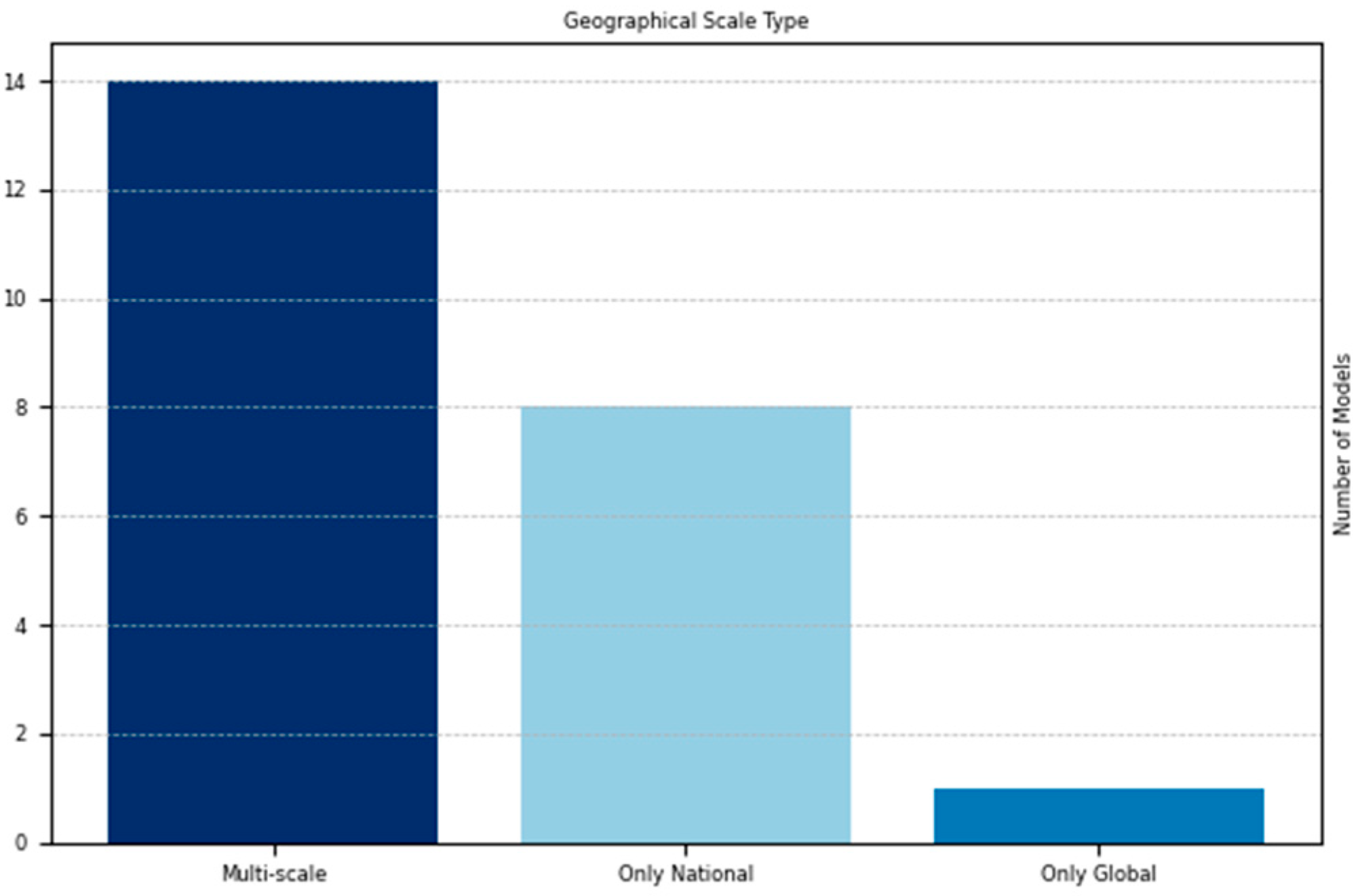
3.1.1. Geographical Scale
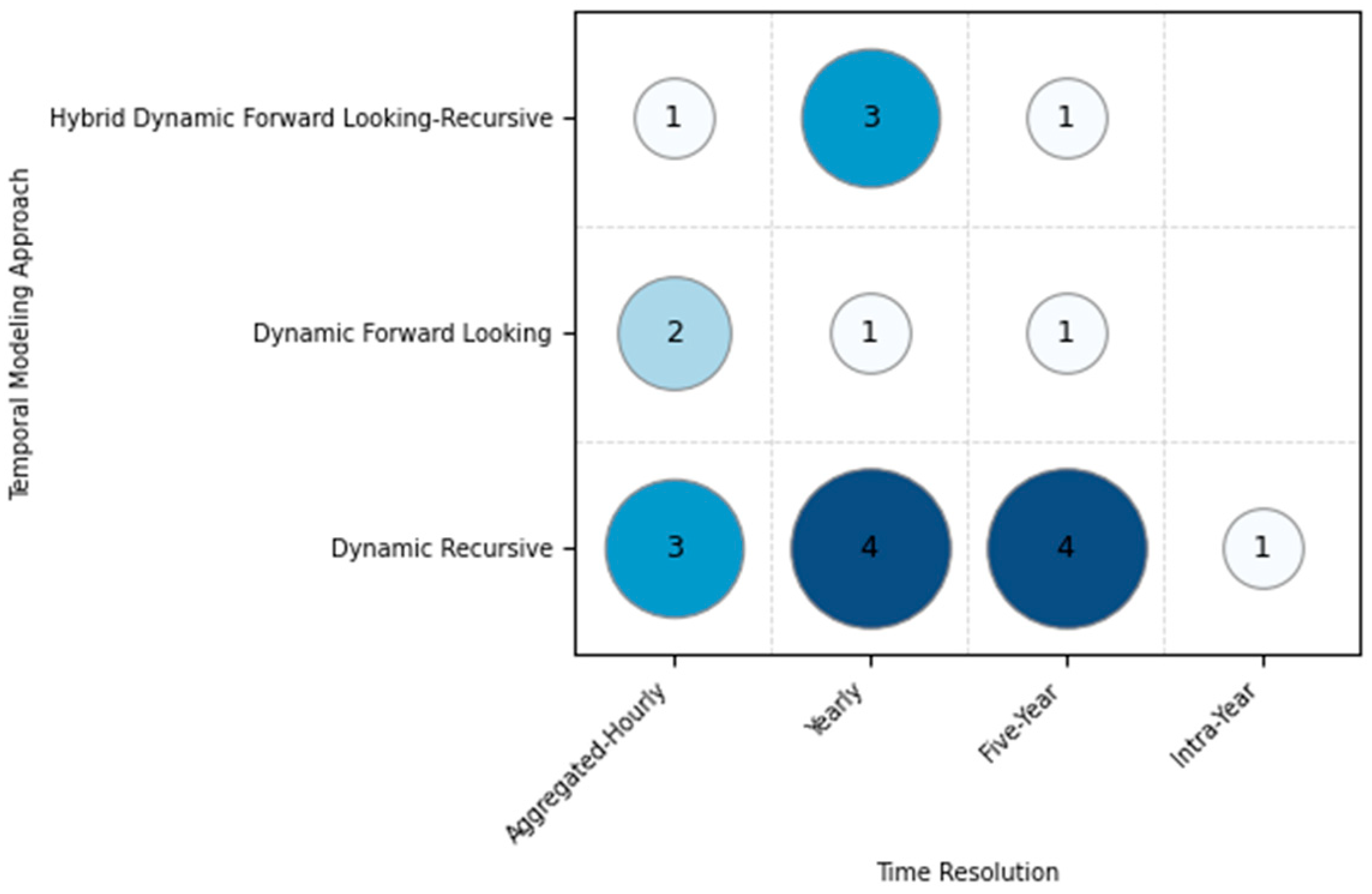
3.1.2. Time Resolution and Temporal Modeling Approach
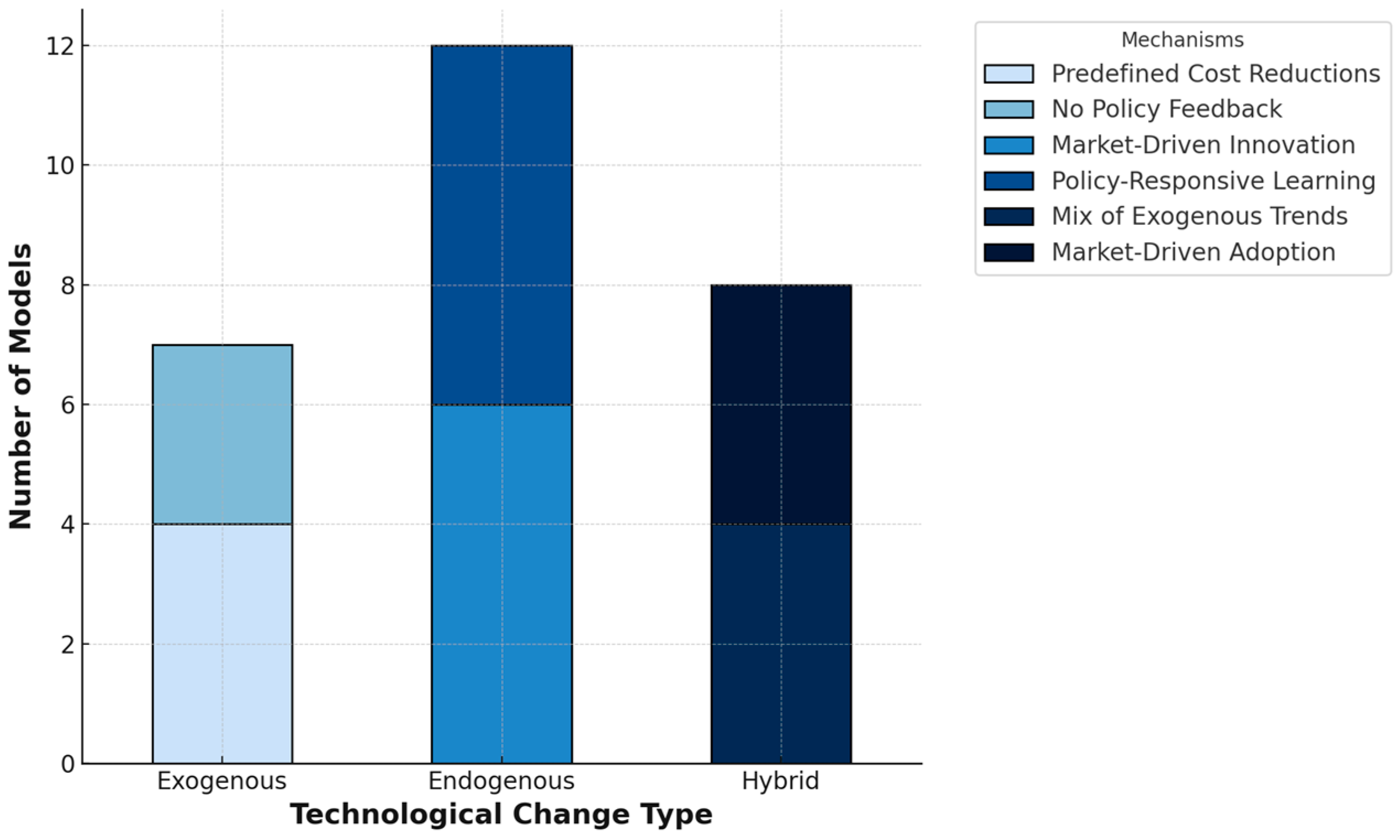
3.1.3. Technological Change
3.1.4. Modelling Approach and Coupling
3.1.5. Policy Representation
- -
- Carbon Pricing Mechanisms: endogenous vs. exogenous CO2 pricing.
- -
- Regulatory Instruments: emission caps, standards, mandates.
- -
- Market-Based Incentives: subsidies, feed-in tariffs, tax incentives.
- -
- Public Investment Strategies: government-funded infrastructure or technology deployment [38].
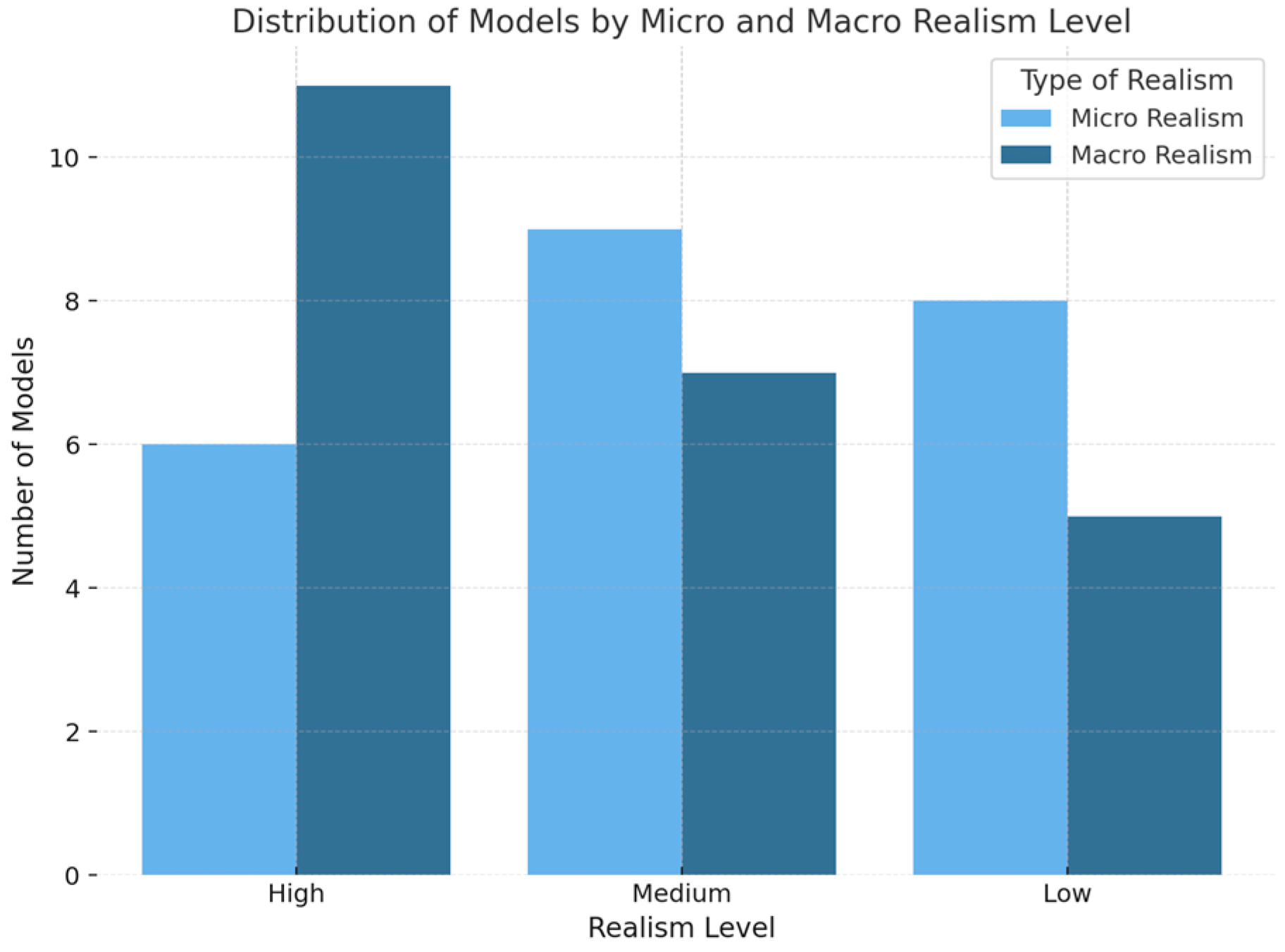
3.1.6. Micro Realism
3.1.7. Macro Realism
3.2. Criteria for Systematic Models Review
- (i)
- an explicit integration between economic drivers (e.g., prices, macroeconomic indicators, behavioural assumptions) and energy–system behaviour (e.g., supply–demand dynamics, technological adoption, structural transitions);
- (ii)
- a quantitative or model-based structure; or
- (iii)
- sufficient methodological transparency to allow meaningful comparison.
4. Results
4.1. Geographical Scale
4.2. Time Resolution and Temporal Modelling Approach
4.3. Technological Change
4.4. Modeling Approach and Coupling
4.5. Policy Representation
4.6. Micro Realism
4.7. Macro Realism
5. Conclusions
- developing richer behavioural foundations that incorporate heterogeneity and bounded rationality;
- strengthening the representation of financial systems, capital reallocation mechanisms, and investment risks;
- improving endogenous modelling of technological disruption and innovation;
- enhancing the transparency and reproducibility of policy representation;
- expanding multi-sector and multi-scale coupling to reflect systemic interdependencies.
Funding
Data Availability Statement
Conflicts of Interest
References
- European Commission. A Clean Planet for All—A European Strategic Long-Term Vision for a Prosperous, Modern, Competitive and Climate Neutral Economy; European Commission: Brussels, Belgium, 2018.
- International Energy Agency. World Energy Outlook 2023. 2023. Available online: www.iea.org/terms (accessed on 20 December 2024).
- DeCarolis, J.; Daly, H.; Dodds, P.; Keppo, I.; Li, F.; McDowall, W.; Pye, S.; Strachan, N.; Trutnevyte, E.; Usher, W.; et al. Formalizing best practice for energy system optimization modelling. Appl. Energy 2017, 194, 184–198. [Google Scholar] [CrossRef] [Scilit]
- Gilboa, I.; Postlewaite, A.; Samuelson, L.; Schmeidler, D. Economic models as analogies. Econ. J. 2014, 124, F513–F533. [Google Scholar] [CrossRef] [Scilit]
- Nieto, J.; Carpintero, Ó.; Miguel, L.J.; de Blas, I. Macroeconomic modelling under energy constraints: Global low carbon transition scenarios. Energy Policy 2020, 137, 111090. [Google Scholar] [CrossRef] [Scilit]
- Koopmans, C.T. Three Essay on the State of Economic Science. Br. J. Philos. Sci. 1957, 10, 58–69. [Google Scholar]
- Wright, R.; Shin, H.; Trentmann, F. From World Power Conference to World Energy Council: 90 Years of Energy Cooperation, 1923–2013; World Energy Council: London, UK, 2013. [Google Scholar]
- Loulou, R.; Goldstein, G.; Noble, K. Energy Technology Systems Analysis Programme Documentation for the MARKAL Family of Models. 2004. Available online: https://iea-etsap.org/MrklDoc-III_SAGE.pdf (accessed on 20 December 2024).
- Miller, R.E.; Blair, P.D. Input-Output Analysis—Foundations and Extensions; Cambridge University Press: Cambridge, UK, 2009. [Google Scholar]
- Dixon, P.B.; Rimmer, M.T. Johansen’s legacy to CGE modelling: Originator and guiding light for 50 years. J. Policy Model. 2016, 38, 421–435. [Google Scholar] [CrossRef] [Scilit]
- Vaillancourt, K.; Bahn, O.; El Maghraoui, N.; Uyar, T.S. History and Recent State of TIMES Optimization Energy Models and Their Applications for a Transition Towards Clean Energies. in Accelerating the Transition to a 100% Renewable Energy Era. 2020. Available online: http://www.springer.com/series/8874 (accessed on 20 December 2024).
- Nordhaus, W.D. An Optimal Transition Path for Controlling Greenhouse Gases. Science 1992, 258, 1315–1319. [Google Scholar] [CrossRef] [Scilit]
- Tol, R.S.J. The damage costs of climate change towards a dynamic representation. Ecol. Econ. 1996, 19, 67–90. [Google Scholar] [CrossRef] [Scilit]
- Schrattenholzer, L. The Energy Supply Model Message; IIASA: Laxenburg, Austria, 1981. [Google Scholar]
- Edenhofer, O.; Madruga, R.P.; Sokona, Y. Renewable Energy Sources and Climate Change Mitigation: Special Report of the Intergovernmental Panel on Climate Change; Cambridge University Press: Cambridge, UK, 2012. [Google Scholar]
- Sterman, J.D.; Fiddaman, T.; Franck, T.; Jones, A.; McCauley, S.; Rice, P.; Sawin, E.; Siegel, L. Management flight simulators to support climate negotiations. Environ. Model. Softw. 2013, 44, 122–135. [Google Scholar] [CrossRef] [Scilit]
- Luderer, G.; Pehl, M.; Arvesen, A.; Gibon, T.; Bodirsky, B.L.; de Boer, H.S.; Fricko, O.; Hejazi, M.; Humpenöder, F.; Iyer, G.; et al. Environmental co-benefits and adverse side-effects of alternative power sector decarbonization strategies. Nat. Commun. 2019, 10, 5229. [Google Scholar] [CrossRef] [Scilit]
- Hafner, S.; Anger-Kraavi, A.; Monasterolo, I.; Jones, A. Emergence of New Economics Energy Transition Models: A Review. Ecol. Econ. 2020, 177, 106779. [Google Scholar] [CrossRef] [Scilit]
- Prina, M.G.; Manzolini, G.; Moser, D.; Nastasi, B.; Sparber, W. Classification and challenges of bottom-up energy system models—A review. Renew. Sustain. Energy Rev. 2020, 129, 109917. [Google Scholar] [CrossRef] [Scilit]
- An, K.; Zhang, S.; Zhou, J.; Wang, C. How can computable general equilibrium models serve low-carbon policy? A systematic review. Environ. Res. Lett. 2023, 18, 033002. [Google Scholar] [CrossRef] [Scilit]
- Rhodes, E.; Hoyle, A.; McPherson, M.; Craig, K. Understanding climate policy projections: A scoping review of energy-economy models in Canada. Renew. Sustain. Energy Rev. 2022, 153, 111739. [Google Scholar] [CrossRef] [Scilit]
- Chatterjee, S.; Stavrakas, V.; Oreggioni, G.; Süsser, D.; Staffell, I.; Lilliestam, J.; Molnar, G.; Flamos, A.; Ürge-Vorsatz, D. Existing tools, user needs and required model adjustments for energy demand modelling of a carbon-neutral Europe. Energy Res. Soc. Sci. 2022, 90, 102662. [Google Scholar] [CrossRef] [Scilit]
- Prina, M.G.; Nastasi, B.; Groppi, D.; Misconel, S.; Garcia, D.A.; Sparber, W. Comparison methods of energy system frameworks, models and scenario results. Renew. Sustain. Energy Rev. 2022, 167, 112719. [Google Scholar] [CrossRef] [Scilit]
- Cantele, M.; Bal, P.; Kompas, T.; Hadjikakou, M.; Wintle, B. Equilibrium Modeling for Environmental Science: Exploring the Nexus of Economic Systems and Environmental Change. Earths Future 2021, 9, e2020EF001923. [Google Scholar] [CrossRef] [Scilit]
- Gillingham, K.; Newell, R.G.; Pizer, W.A. Modeling endogenous technological change for climate policy analysis. Energy Econ. 2008, 30, 2734–2753. [Google Scholar] [CrossRef] [Scilit]
- Sanders, M.; Serebriakova, A.; Fragkos, P.; Polzin, F.; Egli, F.; Steffen, B. Representation of financial markets in macro-economic transition models-a review and suggestions for extensions. Environ. Res. Lett. 2022, 17, 083001. [Google Scholar] [CrossRef] [Scilit]
- Lopion, P.; Markewitz, P.; Robinius, M.; Stolten, D. A review of current challenges and trends in energy systems modeling. Renew. Sustain. Energy Rev. 2018, 96, 156–166. [Google Scholar] [CrossRef] [Scilit]
- Gargiulo, M.; Gallachóir, B.Ó. Long-term energy models: Principles, characteristics, focus, and limitations. WIREs Energy Environ. 2013, 2, 158–177. [Google Scholar] [CrossRef] [Scilit]
- Venturini, G.; Tattini, J.; Mulholland, E.; Gallachóir, B.Ó. Improvements in the representation of behavior in integrated energy and transport models. Int. J. Sustain. Transp. 2019, 13, 294–313. [Google Scholar] [CrossRef] [Scilit]
- Cuisinier, É.; Lemaire, P.; Penz, B.; Ruby, A.; Bourasseau, C. New rolling horizon optimization approaches to balance short-term and long-term decisions: An application to energy planning. Energy 2022, 245, 122773. [Google Scholar] [CrossRef] [Scilit]
- Sanchez-Escobar, M.O.; Noguez, J.; Molina-Espinosa, J.M.; Lozano-Espinosa, R.; Vargas-Solar, G. The contribution of bottom-up energy models to support policy design of electricity end-use efficiency for residential buildings and the residential sector: A systematic review. Energies 2021, 14, 6466. [Google Scholar] [CrossRef] [Scilit]
- Grübler, A.; Messner, S. Technological change and the timing of mitigation measures. Energy Econ. 1998, 20, 495–512. [Google Scholar] [CrossRef] [Scilit]
- Köhler, J.; de Haan, F.; Holtz, G.; Kubeczko, K.; Moallemi, E.; Papachristos, G.; Chappin, E. Modelling Sustainability Transitions: An Assessment of Approaches and Challenges. J. Artif. Soc. Soc. Simul. 2018, 21, 8. [Google Scholar] [CrossRef] [Scilit]
- Fattahi, A.; Sijm, J.; Faaij, A. A systemic approach to analyze integrated energy system modeling tools: A review of national models. Renew. Sustain. Energy Rev. 2020, 133, 110195. [Google Scholar] [CrossRef] [Scilit] [PubMed]
- Nakata, T. Energy-economic models and the environment. Prog. Energy Combust. Sci. 2004, 30, 417–475. [Google Scholar] [CrossRef] [Scilit]
- Chang, M.; Thellufsen, J.Z.; Zakeri, B.; Pickering, B.; Pfenninger, S.; Lund, H.; Østergaard, P.A. Trends in tools and approaches for modelling the energy transition. Appl. Energy 2021, 290, 116731. [Google Scholar] [CrossRef] [Scilit]
- Jaccard, M.; Dennis, M. Estimating home energy decision parameters for a hybrid energy—Economy policy model. Environ. Model. Assess. 2006, 11, 91–100. [Google Scholar] [CrossRef] [Scilit]
- Su, X.; Ghersi, F.; Teng, F.; Le Treut, G.; Liang, M. The economic impact of a deep decarbonisation pathway for China: A hybrid model analysis through bottom-up and top-down linking. Mitig. Adapt. Strateg. Glob. Change 2022, 27, 11. [Google Scholar] [CrossRef] [Scilit]
- Goulder, L.H.; Parry, I.W.H. Instrument choice in environmental policy. Rev. Environ. Econ. Policy 2008, 2, 152–174. [Google Scholar] [CrossRef] [Scilit]
- Bhardwaj, C.; Axsen, J.; Kern, F.; McCollum, D. Why have multiple climate policies for light-duty vehicles? Policy mix rationales, interactions and research gaps. Transp. Res. Part A Policy Policy 2020, 135, 309–326. [Google Scholar] [CrossRef] [Scilit]
- Gao, Z.; Zhao, Y.; Li, L.; Hao, Y. Economic effects of sustainable energy technology progress under carbon reduction targets: An analysis based on a dynamic multi-regional CGE model. Appl. Energy 2024, 363, 123071. [Google Scholar] [CrossRef] [Scilit]
- Kanitkar, T. An Integrated Modeling Framework (IMF) for Energy-Economy-Environment Modeling; Springer International Publishing: Berlin/Heidelberg, Germany, 2019. [Google Scholar]
- Mercure, J.-F.; Knobloch, F.; Pollitt, H.; Paroussos, L.; Scrieciu, S.S.; Lewney, R. Modelling innovation and the macroeconomics of low-carbon transitions: Theory, perspectives and practical use. Clim. Policy 2019, 19, 1019–1037. [Google Scholar] [CrossRef] [Scilit]
- Nikas, A.; Doukas, H.; Papandreou, A. A detailed overview and consistent classification of climate-economy models. In Understanding Risks and Uncertainties in Energy and Climate Policy: Multidisciplinary Methods and Tools for a Low Carbon Society; Springer International Publishing: Berlin/Heidelberg, Germany, 2018; pp. 1–54. [Google Scholar] [CrossRef] [Scilit]
- Luo, Y.; Wang, W.; Zhao, D. The impacts of carbon emission trading mechanism on the power transition pathway-taking Guangdong-Hong Kong-Macao Greater Bay Area as an example. J. Clean. Prod. 2022, 330, 129894. [Google Scholar] [CrossRef] [Scilit]
- Dewi, R.G.; Zunita, M.; Sevie, G.N.; Kurniawati, F.W. AIM/End-use Model for Selecting of Low-Carbon Technology in Indonesia’s Iron and Steel Industry. In IOP Conference Series: Earth and Environmental Science; Institute of Physics Publishing: Bristol, UK, 2019. [Google Scholar] [CrossRef] [Scilit]
- Vishwanathan, S.S.; Garg, A. Energy system transformation to meet NDC, 2 °C, and well below 2 °C targets for India. Clim. Change 2020, 162, 1877–1891. [Google Scholar] [CrossRef] [Scilit]
- Arriet, A.; Flores, F.; Matamala, Y.; Feijoo, F. Chilean pathways for mid-century carbon neutrality under high renewable potential. J. Clean. Prod. 2022, 379, 134483. [Google Scholar] [CrossRef] [Scilit]
- Bergero, C.; Binsted, M.; Younis, O.; Davies, E.G.; Siddiqui, M.-S.; Xing, R.; Arbuckle, E.J.; Chiappori, D.V.; Fuhrman, J.; McJeon, H.; et al. Technology, technology, technology: An integrated assessment of deep decarbonization pathways for the Canadian oil sands. Energy Strat. Rev. 2022, 41, 100804. [Google Scholar] [CrossRef] [Scilit]
- Amin, A.; Liu, X.-H.; Abbas, Q.; Hanif, I.; Vo, X.V. Globalization, sustainable development, and variation in cost of power plant technologies: A perspective of developing economies. Environ. Sci. Pollut. Res. 2020, 28, 11158–11169. [Google Scholar] [CrossRef] [Scilit]
- He, C.; Jiang, K.; Chen, S.; Jiang, W.; Liu, J. Zero CO2 emissions for an ultra-large city by 2050: Case study for Beijing. Curr. Opin. Environ. Sustain. 2019, 36, 141–155. [Google Scholar] [CrossRef] [Scilit]
- Jiang, K.; He, C.; Dai, H.; Liu, J.; Xu, X. Emission scenario analysis for China under the global 1.5 °C target. Carbon Manag. 2018, 9, 481–491. [Google Scholar] [CrossRef] [Scilit]
- Fragkos, P.; Fragkiadakis, K.; Paroussos, L.; Pierfederici, R.; Vishwanathan, S.S.; Köberle, A.C.; Iyer, G.; He, C.-M.; Oshiro, K. Coupling national and global models to explore policy impacts of NDCs. Energy Policy 2018, 118, 462–473. [Google Scholar] [CrossRef] [Scilit]
- Samsó, R.; de Blas, I.; Perissi, I.; Martelloni, G.; Solé, J. Scenario analysis and sensitivity exploration of the MEDEAS Europe energy-economy-environment model. Energy Strat. Rev. 2020, 32, 100582. [Google Scholar] [CrossRef] [Scilit]
- Perissi, I.; Martelloni, G.; Bardi, U.; Natalini, D.; Jones, A.; Nikolaev, A.; Eggler, L.; Baumann, M.; Samsó, R.; Solé, J. Cross-validation of the MEDEAS energy-economy- environment model with the integrated MARKAL-EFOM system (TIMES) and the long-range energy alternatives planning system (LEAP). Sustainability 2021, 13, 1967. [Google Scholar] [CrossRef] [Scilit]
- Parrado-Hernando, G.; Pfeifer, A.; Frechoso, F.; González, L.J.M.; Duić, N. A novel approach to represent the energy system in integrated assessment models. Energy 2022, 258, 124743. [Google Scholar] [CrossRef] [Scilit]
- Maïzi, N.; Kang, S.; Selosse, S. Is GHG mitigation policy enough to develop bioenergy in Asia: A long-term analysis with TIAM-FR. Int. J. Oil Gas Coal Technol. 2017, 14, 5–31. [Google Scholar] [CrossRef] [Scilit] [PubMed]
- Huppmann, D.; Gidden, M.; Fricko, O.; Kolp, P.; Orthofer, C.; Pimmer, M.; Kushin, N.; Vinca, A.; Mastrucci, A.; Riahi, K.; et al. The MESSAGEix Integrated Assessment Model and the ix modeling platform (ixmp): An open framework for integrated and cross-cutting analysis of energy, climate, the environment, and sustainable development. Environ. Model. Softw. 2019, 112, 143–156. [Google Scholar] [CrossRef] [Scilit]
- Zhang, G.; Niu, D.; Shi, Y.; Xu, G.; Li, G.; Zhang, H.; Li, J.; Cao, L.; Guo, Z.; Wang, Z.; et al. Nuclear fuel cycle modelling using MESSAGE. J. Radioanal. Nucl. Chem. 2016, 311, 1435–1440. [Google Scholar] [CrossRef] [Scilit]
- Chan, Y.T.; Punzi, M.T.; Zhao, H. Navigating geopolitical crises for energy security: Evaluating optimal subsidy policies via a Markov switching DSGE model. J. Environ. Manag. 2024, 349, 119619. [Google Scholar] [CrossRef] [Scilit]
- Nwachukwu, C.M.; Olofsson, E.; Lundmark, R.; Wetterlund, E. Evaluating fuel switching options in the Swedish iron and steel industry under increased competition for forest biomass. Appl. Energy 2022, 324, 119878. [Google Scholar] [CrossRef] [Scilit]
- Li, M.-F.; Hu, H.; Zhao, L.-T. Key factors affecting carbon prices from a time-varying perspective. Environ. Sci. Pollut. Res. 2022, 29, 65144–65160. [Google Scholar] [CrossRef] [Scilit]
- Sokolov, A.; Kicklighter, D.; Schlosser, A.; Wang, C.; Monier, E.; Brown-Steiner, B.; Prinn, R.; Forest, C.; Gao, X.; Libardoni, A.; et al. Description and Evaluation of the MIT Earth System Model (MESM). J. Adv. Model. Earth Syst. 2018, 10, 1759–1789. [Google Scholar] [CrossRef] [Scilit]
- Gurgel, A.; Mignone, B.K.; Morris, J.; Kheshgi, H.; Mowers, M.; Steinberg, D.; Herzog, H.; Paltsev, S. Variable renewable energy deployment in low-emission scenarios: The role of technology cost and value. Appl. Energy 2023, 344, 121119. [Google Scholar] [CrossRef] [Scilit]
- Prinn, R.G.; Chen, Y.-H.H.; Paltsev, S.; Gurgel, A.; Reilly, J.M.; Morris, J. MIT Joint Program on the Science and Policy of Global The MIT EPPA7: A Multisectoral Dynamic Model for Energy, Economic, and Climate Scenario Analysis The MIT EPPA7: A Multisectoral Dynamic Model for Energy, Economic, and Climate Scenario Analysis. 2022. Available online: http://globalchange.mit.edu/ (accessed on 20 December 2024).
- Cassetti, G.; Boitier, B.; Elia, A.; Le Mouël, P.; Gargiulo, M.; Zagamé, P.; Nikas, A.; Koasidis, K.; Doukas, H.; Chiodi, A. The interplay among COVID-19 economic recovery, behavioural changes, and the European Green Deal: An energy-economic modelling perspective. Energy 2023, 263, 125798. [Google Scholar] [CrossRef] [Scilit]
- Belete, G.F.; Voinov, A.; Arto, I.; Dhavala, K.; Bulavskaya, T.; Niamir, L.; Moghayer, S.; Filatova, T. Exploring low-carbon futures: A web service approach to linking diverse cli-mate-energy-economy models. Energies 2019, 12, 2880. [Google Scholar] [CrossRef] [Scilit]
- Karkatsoulis, P.; Siskos, P.; Paroussos, L.; Capros, P. Simulating deep CO2 emission reduction in transport in a general equilibrium framework: The GEM-E3T model. Transp. Res. Part D Transp. Environ. 2017, 55, 343–358. [Google Scholar] [CrossRef] [Scilit]
- van de Ven, D.-J.; Mittal, S.; Gambhir, A.; Lamboll, R.D.; Doukas, H.; Giarola, S.; Hawkes, A.; Koasidis, K.; Köberle, A.C.; McJeon, H.; et al. A multimodel analysis of post-Glasgow climate targets and feasibility challenges. Nat. Clim. Change 2023, 13, 570–578. [Google Scholar] [CrossRef] [Scilit]
- Hafner, S.; Jones, A.; Anger-Kraavi, A.; Monasterolo, I. Modelling the macroeconomics of a ‘closing the green finance gap’ scenario for an energy transition. Environ. Innov. Soc. Transit. 2021, 40, 536–568. [Google Scholar] [CrossRef] [Scilit]
- Hafner, S.; Jones, A.; Anger-Kraavi, A. Economic impacts of achieving a net-zero emissions target in the power sector. J. Clean. Prod. 2021, 312, 127610. [Google Scholar] [CrossRef] [Scilit]
- Le Treut, G.; Lefèvre, J.; Lallana, F.; Bravo, G. The multi-level economic impacts of deep decarbonization strategies for the energy system. Energy Policy 2021, 156, 112423. [Google Scholar] [CrossRef] [Scilit]
- Guo, C.; Dai, H.; Liu, X.; Wu, Y.; Liu, X.; Liu, Y. Impacts of climate change mitigation on agriculture water use: A provincial analysis in China. Geogr. Sustain. 2020, 1, 189–199. [Google Scholar] [CrossRef] [Scilit]
- Liu, X.; Guo, C.; Ma, X.; Wu, K.; Wang, P.; Huang, Z.; Zhou, Z.; Huang, C.; Zhang, S.; Wang, M.; et al. Uncovering the key mechanisms of how deep decarbonization benefits air pollution alleviation in China. Environ. Res. Lett. 2022, 17, 115002. [Google Scholar] [CrossRef] [Scilit]
- Flessa, A.; Fragkiadakis, D.; Zisarou, E.; Fragkos, P. Developing an Integrated Energy–Economy Model Framework for Islands. Energies 2023, 16, 1275. [Google Scholar] [CrossRef] [Scilit]
- Meng, L.; Li, M.; Asuka, J. A scenario analysis of the energy transition in Japan’s road transportation sector based on the LEAP model. Environ. Res. Lett. 2024, 19, 044059. [Google Scholar] [CrossRef] [Scilit]
- Wan, F.; Li, J. Exploring hydrogen metallurgy to CO2 emissions reduction in China’s iron and steel production: An analysis based on the life cycle CO2 emissions—LEAP model. Energy Rep. 2024, 11, 4552–4563. [Google Scholar] [CrossRef] [Scilit]
- Han, H.; Ye, X.; Bian, Y.; Lin, S.; Shen, Y.-S.; Huang, Z.; Lin, J. Decomposing high uncertainty in greenhouse gas mitigation pathways in emerging regions: An approach to evaluate risks toward carbon neutrality. Sci. Total. Environ. 2024, 953, 176152. [Google Scholar] [CrossRef] [Scilit]
- Yang, X.; Pang, J.; Teng, F.; Gong, R.; Springer, C. The environmental co-benefit and economic impact of China’s low-carbon pathways: Evidence from linking bottom-up and top-down models. Renew. Sustain. Energy Rev. 2021, 136, 110438. [Google Scholar] [CrossRef] [Scilit]
- Giarola, S.; Sachs, J.; D’aVezac, M.; Kell, A.; Hawkes, A. MUSE: An open-source agent-based integrated assessment modelling framework. Energy Strat. Rev. 2022, 44, 100964. [Google Scholar] [CrossRef] [Scilit]
- Riemer, M.; Wachsmuth, J.; Boitier, B.; Elia, A.; Al-Dabbas, K.; Alibaş, Ş.; Chiodi, A.; Neuner, F. How do system-wide net-zero scenarios compare to sector model pathways for the EU? A novel approach based on benchmark indicators and index decomposition analyses. Energy Strategy Rev. 2023, 50, 101225. [Google Scholar] [CrossRef] [Scilit]
- Nikas, A.; Elia, A.; Boitier, B.; Koasidis, K.; Doukas, H.; Cassetti, G.; Anger-Kraavi, A.; Bui, H.; Campagnolo, L.; De Miglio, R.; et al. Where is the EU headed given its current climate policy? A stakeholder-driven model inter-comparison. Sci. Total Environ. 2021, 793, 148549. [Google Scholar] [CrossRef] [Scilit] [PubMed]
- Boitier, B.; Nikas, A.; Gambhir, A.; Koasidis, K.; Elia, A.; Al-Dabbas, K.; Alibaş, Ş.; Campagnolo, L.; Chiodi, A.; Delpiazzo, E.; et al. A multi-model analysis of the EU’s path to net zero. Joule 2023, 7, 2760–2782. [Google Scholar] [CrossRef] [Scilit]
- Kitous, A.; Criqui, P.; Bellevrat, E.; Chateau, B. Transformation Patterns of the Worldwide Energy System-Scenarios for the Century with the POLES Model. Available online: www.enerdata.fr (accessed on 20 December 2024).
- Russ, P.; Criqui, P. Post-Kyoto CO2 emission reduction: The soft landing scenario analysed with POLES and other world models. Energy Policy 2007, 35, 786–796. [Google Scholar] [CrossRef] [Scilit]
- Kannavou, M.; Zampara, M.; Capros, P. Modelling the EU internal electricity market: The PRIMES-IEM model. Energies 2019, 12, 2887. [Google Scholar] [CrossRef] [Scilit]
- Siskos, P.; Zazias, G.; Petropoulos, A.; Evangelopoulou, S.; Capros, P. Implications of delaying transport decarbonisation in the EU: A systems analysis using the PRIMES model. Energy Policy 2018, 121, 48–60. [Google Scholar] [CrossRef] [Scilit]
- Siskos, P.; Moysoglou, Y. Assessing the impacts of setting CO2 emission targets on truck manufacturers: A model implementation and application for the EU. Transp. Res. Part A Policy Pract. 2019, 125, 123–138. [Google Scholar] [CrossRef] [Scilit]
- Fattahi, A.; Reynès, F.; van der Zwaan, B.; Sijm, J.; Faaij, A. Soft-linking a national computable general equilibrium model (ThreeME) with a detailed energy system model (IESA-Opt). Energy Econ. 2023, 123, 106750. [Google Scholar] [CrossRef] [Scilit]
- Lippkau, F.; Franzmann, D.; Addanki, T.; Buchenberg, P.; Heinrichs, H.; Kuhn, P.; Hamacher, T.; Blesl, M. Global Hydrogen and Synfuel Exchanges in an Emission-Free Energy System. Energies 2023, 16, 3277. [Google Scholar] [CrossRef] [Scilit]
- Few, S.; Gambhir, A.; Napp, T.; Hawkes, A.; Mangeon, S.; Bernie, D.; Lowe, J. The impact of shale gas on the cost and feasibility of meeting climate targets—A global energy system model analysis and an exploration of uncertainties. Energies 2017, 10, 158. [Google Scholar] [CrossRef] [Scilit]
- Avellaneda, J.A.C.; Rodriguez, A.U.; Yañez, E.; Rey, R.M. Assessment of the Colombian long-term energy planning scenarios for the national hydrocarbon value chain: Insights from the TIMES-O&G model. Energy Convers. Manag. 2024, 306, 118317. [Google Scholar] [CrossRef] [Scilit]



| Model | Source | Developer(s) |
|---|---|---|
| AIM | [43,44,45] | National Institute for Environmental Studies (NIES), Japan |
| GCAM | [46,47,48] | Joint Global Change Research Institute (JGCRI), USA |
| IPAC | [49,50,51] | Energy Research Institute (ERI), China |
| MEDEAS | [52,53,54,55] | Group of Energy, Economy and Systems Dynamics, University of Valladolid (GEEDS-UVa), Spain |
| MESSAGE | [56,57] | IIASA (International Institute for Applied Systems Analysis) |
| WITCH | [58,59,60] | European Institute on Economics and the Environment |
| EPPA | [61,62,63] | Massachusetts Institute of Technology (MIT), |
| EU-TIMES/NEMESIS | [64] | IET of the European Commission/University of Strasbourg, France |
| GCAM/EXIOMOD/BENCH | [65] | International collaboration (various) |
| GEM-E3 | [66,67] | Institute of Communication and Computer Systems (ICCS), Greece |
| GIBM | [68,69] | Zurich University of Applied Sciences (ZHAW) |
| IMACLIM/LEAP | [70] | CIRED, France/Stockholm Environment Institute, Sweden |
| IMED/CGE | [71,72] | Tsinghua University, China |
| IntE3-ISL | [73] | University of Iceland, Iceland |
| LEAP | [74,75,76] | Stockholm Environment Institute (SEI) |
| MAPLE-KLEM | [77,78] | International collaboration (various) |
| MUSE | [67,79] | Imperial College London, UK |
| NEMESIS | [38,80,81] | SEURECO (Société Européenne d’Économie) |
| POLES | [82,83] | University of Grenoble-CNRS (EDDEN laboratory) |
| PRIMES | [84,85,86] | National Technical University of Athens |
| ThreeME/IESA-Opt | [87] | ADEME (French Environment and Energy Management Agency), OFCE (French Economic Observatory) and NEO (Netherlands Economic Observatory) |
| TIAM | [55,88,89] | International Energy Agency—Energy Technology Systems Analysis Programme (IEA-ETSAP) |
| TIMES | [90,91,92] | E International Energy Agency—Energy Technology Systems Analysis Programme (IEA-ETSAP) European Institute on Economics and the Environment |
| Model | Endogenous Carbon Price | Regulatory Instruments | Market-Based Incentives | Public Investment | |||
|---|---|---|---|---|---|---|---|
| Emission Caps | Efficiency Standards | Renewable Mandates | Carbon Tax/ETS | ||||
| AIM | ✗ | ✗ | ✓ | ✗ | ✗ | ✗ | ✗ |
| GCAM | ✓ | ✓ | ✗ | ✗ | ✗ | ✗ | ✗ |
| IPAC | ✗ | ✗ | ✗ | ✗ | ✗ | ✓ | ✗ |
| MEDEAS | ✗ | ✗ | ✗ | ✓ | ✗ | ✓ | ✓ |
| MESSAGE | ✓ | ✓ | ✗ | ✓ | ✗ | ✓ | ✓ |
| WITCH | ✓ | ✓ | ✓ | ✓ | ✓ | ✓ | ✓ |
| EPPA | ✓ | ✓ | ✓ | ✓ | ✓ | ✓ | ✗ |
| EU-TIMES/NEMESIS | ✓ | ✓ | ✓ | ✓ | ✓ | ✓ | ✓ |
| GCAM/EXIOMOD/BENCH | ✓ | ✓ | ✓ | ✓ | ✓ | ✓ | ✓ |
| GEM-E3 | ✓ | ✓ | ✓ | ✗ | ✗ | ✓ | ✓ |
| GIBM | ✓ | ✓ | ✓ | ✗ | ✗ | ✗ | ✓ |
| IMACLIM/LEAP | ✓ | ✓ | ✓ | ✓ | ✓ | ✗ | ✓ |
| IMED/CGE | ✓ | ✓ | ✓ | ✗ | ✓ | ✓ | ✓ |
| IntE3-ISL | ✓ | ✓ | ✓ | ✓ | ✓ | ✗ | ✓ |
| LEAP | ✗ | ✓ | ✗ | ✓ | ✗ | ✗ | ✗ |
| MAPLE-KLEM | ✓ | ✓ | ✓ | ✓ | ✓ | ✓ | ✓ |
| MUSE | ✗ | ✗ | ✗ | ✓ | ✗ | ✗ | ✓ |
| NEMESIS | ✓ | ✓ | ✓ | ✓ | ✓ | ✓ | ✓ |
| POLES | ✓ | ✓ | ✓ | ✓ | ✓ | ✓ | ✓ |
| PRIMES | ✓ | ✓ | ✓ | ✓ | ✓ | ✓ | ✓ |
| ThreeME/IESA-Opt | ✓ | ✓ | ✓ | ✓ | ✓ | ✓ | ✓ |
| TIAM | ✓ | ✓ | ✓ | ✓ | ✓ | ✓ | ✓ |
| TIMES | ✗ | ✓ | ✓ | ✓ | ✓ | ✓ | ✓ |
| Model | Geographical Scale | Time Resolution and Temporal Modeling Approach | Technological Change | Modeling Approach and Coupling | Policy Representation | Micro Realism | Macro Realism |
|---|---|---|---|---|---|---|---|
| AIM | National | Yearly, Dynamic Recursive | Exogenous. Carbon pricing drives TC. Technology improvements are predefined (exogenous cost reductions over time). | IAM, CGE, simulation bottom-up, stand-alone | Carbon pricing is an exogenous factor. It incorporates technology mandates but has limited representation of market-based incentives and does not explicitly model public investments. | High: Includes agent heterogeneity and non-linear behaviors | High: Detailed macroeconomic feedback and systemic interactions |
| GCAM | Global, Regional, National | Five-Year, Dynamic Recursive | Partially endogenous, combining learning effects and economic competitiveness through a logit function. Learning-by-doing influences cost reductions, but some technological improvements remain exogenous. | IAM, Partial Equilibrium, simulation bottom-up, stand-alone | It models carbon pricing endogenously. The model represents emissions caps and technology mandates. | Medium: Assumes rational actors, limited agent diversity | High: Includes international trade and macro policy feedback |
| IPAC | National | Five-Year, Dynamic Recursive | Modeled exogenously through improvements in energy efficiency and advanced adoption based on policy scenarios | IAM, CGE, simulation hybrid, hard-linked | It incorporates performance standards for emissions reductions but relies on exogenous carbon pricing. | Medium: Includes partial representation of heterogeneity | High: Covers trade, fiscal, and systemic economic changes |
| MEDEAS | Global, Regional, National | Aggregated-Hourly, Dynamic Recursive | Primarily exogenous, with adoption influenced by endogenous dynamics linked to economic, environmental, and social constraints. | IAM, system dynamics, input–output, stand-alone | The carbon pricing is exogenous, explicitly includes sectoral restrictions, such as the phase-out of fossil fuels, and represents both strong market-based incentives and government-led investment policies. | High: Focus on behavioral and social dynamics | Medium: Limited macroeconomic integration |
| MESSAGE | Global, Regional, National | Five-Year, Dynamic Forward Looking | Represented endogenously through learning effects, where greater adoption reduces costs and improves performance costs and improves performance. | IAM, Optimization bottom-up, energy system model, hard-linked | It represents carbon pricing endogenously and can model both emission caps and technology mandates. It includes market-based incentives such as renewable subsidies. | Medium: Limited behavioral diversity, rational agent assumptions | High: Full macroeconomic equilibrium and policy feedback |
| WITCH | Global, Regional, National | Yearly, Dynamic Forward Looking | Driven endogenously by R&D investments, influencing productivity and diffusion over time. | IAM, partial equilibrium, optimization bottom-up, hard-linked | It simulates carbon pricing endogenously and includes emission caps and R&D-driven public investments. | Low: Focused on aggregated behaviors, limited agent detail | High: Dynamic feedback between economy and energy sectors |
| EPPA | Regional, National | Five-Year, Dynamic Recursive | Endogenous. Investments in R&D and learning-by-doing reduce the costs of renewable technologies. | CGE, input–output, hard-linked | Carbon pricing is endogenous. It incorporates regulatory instruments and market-based incentives, including ETS, carbon taxes, and renewable energy subsidies | Medium: Macro-driven, limited behavioral heterogeneity | High: Robust representation of fiscal and policy impacts |
| EU-TIMES/NEMESIS | National | Yearly, Hybrid Dynamic Forward Looking-Recursive | Endogenous. Policy-driven R&D and endogenous innovation | Econometric, input–output, soft-linked | It represents carbon pricing endogenously, with CO2 prices driven by emission reduction targets. It integrates regulatory instruments, market-based incentives, and explicitly models public investments. | Low: Lacks explicit agent-level representation | Medium: Focus on sectoral economic transitions |
| GCAM/EXIOMOD/BENCH | Global | Yearly, Hybrid Dynamic Forward Looking-Recursive | Modeled endogenously using a logit function to represent adoption choices | IAM, Partial Equilibrium, input–output, soft-linked | It represents carbon pricing endogenously. The model incorporates regulatory instruments and market-based incentives, including emissions limits, ETS, and subsidies, while also explicitly modeling public investments in infrastructure. | High: micro level dynamics and accounting for behavioral aspect of individual decision. | Medium: Includes cross-sectoral economic feedback |
| GEM-E3 | Global. Regional | Five-Year, Dynamic Recursive | Hybrid model: Endogenous technological change occurs through R&D investments and cross-sector spillovers, but some technological progress follows exogenous predefined trends. | CGE, input–output, stand-alone | Carbon pricing is endogenous. It incorporates regulatory instruments such as emissions caps and energy efficiency standards, alongside market-based incentives, and renewable energy subsidies. Additionally, it explicitly models public investments. | Medium: Some sector-specific agent diversity | High: Captures detailed equilibrium effects |
| GIBM | National | Intra-Year, Dynamic Recursive | Adoption and diffusion modeled endogenously, considering barriers such as financial risks, perceptions, and policy impact | System dynamic, simulation bottom-up, stand-alone | The model endogenously represents carbon pricing and includes regulatory tools like emissions caps and fossil fuel phase-out mandates. It also simulates public investments to close the green finance gap by boosting capital flows into renewables. | Low: Focused on systemic outcomes, minimal micro-level detail | Low: Minimal macroeconomic realism |
| IMACLIM/LEAP | Global, National | Yearly, Hybrid Dynamic Forward Looking-Recursive | Mostly exogenous: Transition from high-emission to low-emission technologies follows predefined cost-driven substitution pathways, with limited endogenous feedback on technology evolution. | CGE, optimization bottom-up, soft-linked | The model endogenously represents carbon pricing, includes regulatory tools like emissions caps and renewable mandates, and models public investment needs for low-carbon energy infrastructure. | High: Captures behavioral feedback and agent heterogeneity | Medium: Includes basic economic feedback loops |
| IMED/CGE | National | Yearly, Dynamic Recursive | Substitution modeled endogenously in response to increased fossil fuel costs under climate policies | CGE, input–output, hard-linked | It represents carbon pricing endogenously. The model incorporates regulatory instruments, including emissions caps and sectoral carbon intensity targets, while also integrating market-based incentives. Additionally, it explicitly models public investments. | Medium: Macro assumptions dominate, limited agent focus | High: Dynamic macroeconomic modeling integrated |
| IntE3-ISL | National | Yearly, Aggregated-Hourly, Dynamic Recursive | Selection determined endogenously by declining costs for near-commercial technologies. | CGE, simulation bottom-up, soft-linked | It represents carbon pricing endogenously. The model incorporates regulatory instruments, including emissions caps and renewable energy mandates. It explicitly models public investments | High: Representative agents simulate sectoral actions, with different agent types assigned probabilities for various alternatives. | Low: Focused on static economic conditions |
| LEAP | Global, Regional; National | Yearly, Aggregated-Hourly, Dynamic Recursive | Represented exogenously through scenario-based transitions | Optimization bottom-up, energy system model, stand-alone | It does not explicitly model carbon pricing. The model supports regulatory instruments renewable energy mandates | Low: Macro-focused, limited behavioral insights | Medium: Some representation of macroeconomic policies |
| MAPLE-KLEM | National | Five-Year, Hybrid Dynamic Forward Looking-Recursive | Represented endogenously via declining capital costs. | CGE, input–output, hard-linked | The model endogenously derives CO2 prices from policy and macro feedback, includes regulatory tools like emissions caps and efficiency targets, market incentives, and models public investments | Low: Macro-focused, limited behavioral insights | Low: Limited feedback with macroeconomic systems |
| MUSE | Global, Regional | Yearly, Aggregated-Hourly Dynamic Recursive | Represented endogenously considering agent behavior, influenced by budgets, economic objectives, and market shares. | Agent-based, simulation bottom-up, stand-alone | The model uses exogenous carbon prices to guide agent behavior, includes regulatory tools like emissions limits and renewable mandates, has limited market incentives, and explicitly models public investments in energy infrastructure | High: Detailed agent-based modeling | Medium: Macro feedback limited to specific policies |
| NEMESIS | Regional, National | Yearly, Dynamic Recursive | Diffusion simulated endogenously using logistic curves. | Econometric, input–output, soft-linked | The model endogenously represents carbon pricing, includes regulatory tools like emissions caps and efficiency targets, integrates market incentives (e.g., carbon taxes, ETS), and models public investments | Medium: Some heterogeneity, but aggregated behaviors | Medium: Includes aggregate macroeconomic outcomes |
| POLES | Global, Regional, National | Yearly, Dynamic Recursive | Represented endogenously with learning curves, reducing costs through scale, experience, and market dynamics. | Partial equilibrium, system dynamics, stand-alone | The model endogenously represents carbon pricing, includes regulatory tools like emissions caps and renewable mandates, integrates market incentives (e.g., ETS, carbon taxes), and explicitly models public investment. | Low: Limited microeconomic modeling | Low: Lacks comprehensive macroeconomic dynamics |
| PRIMES | Regional, National | Yearly, Aggregated-Hourly Dynamic Forward Looking | Hybrid model: Energy conversion follows exogenous cost trends, while energy end-use choices are guided by agent-based endogenous decisions influenced by market dynamics and policy incentives. | Simulation bottom-up, energy system model, stand-alone | The model endogenously represents carbon pricing, includes regulatory tools (emissions caps, efficiency standards, renewable mandates), market incentives (ETS, carbon taxes, low-carbon subsidies), and explicitly models public investments. | Medium: Includes sector-specific micro behaviors | High: Detailed equilibrium feedback |
| ThreeME/IESA-Opt | National | Yearly, Aggregated-Hourly, Hybrid Dynamic Forward Looking-Recursive | Modeled exogenously or endogenously: conventional technologies have predefined declining costs, while flexible technologies require high investments and operate selectively. | Econometric, energy system model, soft-linked | The model endogenously represents carbon pricing, includes regulatory tools (emissions caps, efficiency targets), market incentives (carbon taxes, ETS), and explicitly models public investments in energy infrastructure and clean technologies. | Low: Limited microeconomic modeling | High: Covers systemic fiscal and economic dynamics |
| TIAM | Global, Regional, National | Yearly, Aggregated-Hourly, Dynamic Forward Looking | Fully exogenous: Technological progress follows predefined parameter adjustments over time, without market- or policy-driven endogenous feedback mechanisms. | Optimization bottom-up, energy system model, stand-alone | The model endogenously determines CO2 prices from emissions constraints and targets, includes regulatory tools (emissions caps, renewable mandates), market incentives (carbon taxes, ETS), and explicitly models public investments in clean energy and hydrogen. | Low: Focus on systemic outcomes, agent-level omitted | Low: Focus on sectoral economic outcomes |
| TIMES | Global, Regional, National | Yearly, Aggregated-Hourly, Dynamic Forward Looking | Exogenous progress that modifies technology parameters according to predefined trajectories. | Optimization bottom-up, energy system model, stand-alone | The model exogenously sets CO2 prices via emissions constraints and cost optimization, includes regulatory tools (emissions caps, renewable mandates), market incentives (carbon taxes, ETS), and models public investments in clean energy infrastructure. | Medium: Some dynamic representation of agent choices | High: Covers dynamic global macroeconomic interactions |
Disclaimer/Publisher’s Note: The statements, opinions and data contained in all publications are solely those of the individual author(s) and contributor(s) and not of MDPI and/or the editor(s). MDPI and/or the editor(s) disclaim responsibility for any injury to people or property resulting from any ideas, methods, instructions or products referred to in the content. |
© 2026 by the authors. Licensee MDPI, Basel, Switzerland. This article is an open access article distributed under the terms and conditions of the Creative Commons Attribution (CC BY) license.
Share and Cite
Vinciguerra, A.; Rocco, M.V. The State of the Art in Integrated Energy Economy Models: A Literature Review. Energies 2026, 19, 403. https://doi.org/10.3390/en19020403
Vinciguerra A, Rocco MV. The State of the Art in Integrated Energy Economy Models: A Literature Review. Energies. 2026; 19(2):403. https://doi.org/10.3390/en19020403
Chicago/Turabian StyleVinciguerra, Anna, and Matteo Vincenzo Rocco. 2026. "The State of the Art in Integrated Energy Economy Models: A Literature Review" Energies 19, no. 2: 403. https://doi.org/10.3390/en19020403
APA StyleVinciguerra, A., & Rocco, M. V. (2026). The State of the Art in Integrated Energy Economy Models: A Literature Review. Energies, 19(2), 403. https://doi.org/10.3390/en19020403