Article

CFD Analysis of Diesel Pilot Injection for Dual-Fuel Diesel–Hydrogen Engines

by
Gianluca D’Errico
1,*,
Giovanni Gaetano Gianetti
1,
Tommaso Lucchini
1,
Alastar Gordon Heaton
2 and
Sanghoon Kook
2
1
ICE Group—Energy Department, Politecnico di Milano, 20156 Milan, Italy
2
School of Mechanical and Manufacturing Engineering, The University of New South Wales, Sydney, NSW 2052, Australia
*
Author to whom correspondence should be addressed.
Energies 2026, 19(2), 380; https://doi.org/10.3390/en19020380
Submission received: 16 December 2025 / Revised: 4 January 2026 / Accepted: 9 January 2026 / Published: 13 January 2026

Abstract

In the pursuit of cleaner and more efficient internal combustion engines, dual-fuel strategies combining diesel and hydrogen are gaining increasing attention. This study employs detailed computational fluid dynamics (CFD) simulations to investigate the behaviour of pilot diesel injections in dual-fuel diesel–hydrogen engines. The study aims to characterize spray formation, ignition delay and early combustion phenomena under various energy input levels. Two combustion models were evaluated to determine their performance under these specific conditions: Tabulated Well Mixed (TWM) and Representative Interactive Flamelet (RIF). After an initial numerical validation using dual-fuel constant-volume vessel experiments, the models are further validated using in-cylinder pressure measurements and high-speed natural combustion luminosity imaging acquired from a large-bore optical engine. Particular attention was given to ignition location due to its influence on subsequent hydrogen ignition. Results show that both combustion models reproduce the experimental behavior reasonably well at high energy input levels (EILs). At low EILs, the RIF model better captures the ignition delay; however, due to its single-flamelet formulation, it predicts an abrupt ignition of all available premixed charge in the computational domain once ignition conditions are reached in the mixture fraction space.

1. Introduction

The dual-fuel internal combustion engine has emerged as a promising pathway to introduce hydrogen ( H 2 ) as a carbon-free fuel for heavy-duty applications. While full electrification represents a viable decarbonisation solution for light-duty transport, battery-electric systems face significant limitations in heavy-duty sectors. Current challenges include energy storage constraints, inadequate refuelling infrastructure, and reduced payload capacity, making them impractical for long-distance freight, construction, and mining operations [1,2,3].
This challenge has been recognised at the policy level through several international initiatives. The European Union’s hydrogen strategy targets 40 GW of renewable hydrogen electrolysers by 2030, explicitly identifying heavy-duty transport as a priority sector [4]. Similarly, the U.S. Department of Energy’s Hydrogen Shot initiative aims to reduce clean hydrogen costs to $1/kg within a decade, with specific support for hard-to-decarbonise applications including freight and off-road machinery [5]. In parallel, industry adoption is accelerating: manufacturers such as Cummins, Volvo, and Liebherr are actively developing hydrogen-powered engines for commercial vehicles and construction equipment [6,7,8]. These developments signal growing confidence in dual-fuel technology as a near-term decarbonisation pathway. In this context, adapting existing diesel engines to operate with hydrogen offers an opportunity to achieve significant CO 2 reduction targets while leveraging established manufacturing and service networks [9,10].
Hydrogen presents several favourable characteristics for low-carbon propulsion. Its high heating value per unit mass and the possibility of renewable production via electrolysis make it an attractive fuel candidate [11]. However, its combustion behaviour introduces important challenges when used as the primary fuel in compression-ignition engines.
The primary challenge stems from hydrogen’s high auto-ignition temperature. Neat H 2 would require a compression ratio exceeding 26 to self-ignite under typical engine intake conditions. This leads to severe risks of pre-ignition originating from hot spots in the combustion chamber [12]. Consequently, alternative ignition strategies are required to ensure stable operation. While spark ignition can be employed, a more robust approach is pilot-fuel ignition. In this strategy, a small quantity of a high-reactivity fuel, typically diesel, initiates combustion of the H 2 -air mixture. Compared to spark ignition, diesel pilot ignition provides a more energetic and spatially extended ignition source, improving flame propagation especially under lean conditions [13].
A key aspect of dual-fuel H 2 –diesel combustion is the strategy used for hydrogen mixture formation. Port-fuel injection represents the simplest retrofit option, but its applicability is limited by reduced volumetric efficiency, increased backfire risk, and the need for ultra-lean mixtures to control NO x [14]. These constraints can be mitigated using direct injection (DI), which enables fuel delivery after intake valve closure and greater control over mixture stratification. High-pressure DI (above 20 MPa) has demonstrated strong potential for improving engine performance, reducing backfire risk, and limiting NO x formation through optimised charge preparation [15]. Only a few experimental investigations in constant-volume vessels have explored the influence of pilot injection parameters, ambient thermodynamic conditions, and the pilot fuel energy content on the resulting flame behaviour and heat-release characteristics [16,17]. From a numerical standpoint, some studies have relied on detailed chemical kinetics to simulate dual-fuel combustion [18,19].
From a modelling perspective, the choice of turbulence treatment plays a crucial role in capturing these interactions. While Reynolds-Averaged Navier–Stokes (RANS) approaches remain the industry standard for engine simulations due to their computational efficiency, Large Eddy Simulation (LES) and hybrid RANS/LES methods offer significant advantages in resolving turbulent structures and their influence on combustion processes. LES can explicitly capture large-scale turbulent eddies and their interaction with flame fronts, providing superior predictions of cycle-to-cycle variability and localized combustion phenomena [20]. Hybrid approaches, such as Detached Eddy Simulation (DES) and its variants (DDES, IDDES), combine the efficiency of RANS in boundary layers with LES-like resolution in separated regions, offering a promising compromise for complex engine geometries [21]. Nevertheless, the present study employs a RANS framework to establish baseline predictive capabilities of conventional combustion models under dual-fuel conditions, while recognizing that future work incorporating scale-resolving approaches could further enhance the understanding of turbulence-chemistry interactions in hydrogen-diesel combustion.
The authors, in a recent publication [17], explored both experimental and numerical studies of constant-volume combustion chamber (CVCC) experiments using different pilot injection strategies, evaluating a new combustion model that merges the transported probability density function (PDF) approach with Flamelet Generated Manifold (FGM) to simulate DIDF combustion. To validate the EMCF+FGM model, they compared computed results with experimental schlieren images and heat release profiles under various dwell timings between pilot and main injections. The EMCF+FGM method effectively proved to predict the diffusion-driven ignition of the main hydrogen jet by the pilot n-heptane injection, as well as the structure of the pure hydrogen diffusion flame when the pilot fuel is injected first. The present paper introduces the next phase of research, which involves applying similar conditions to a real engine setup. As a preliminary step before deploying the EMCF+FGM model, conventional engine simulation models like Tabulated Well-Mixed (TWM) [22] and Representative Interactive Flamelet (RIF) [23] are analyzed for their ability to capture pilot fuel ignition and combustion. Initial numerical validation uses constant-volume vessel experiments where the diesel pilot is injected before the hydrogen, followed by engine tests using varying amounts of diesel pilot without any hydrogen added. The experimental activity was carried out in a dual-fuel diesel–hydrogen optical engine of the University of New South Wales, equipped with a side-mounted H 2 injector and a centrally mounted diesel injector [24]. Numerical simulations focused on the impact of spray formation, ignition delay and flame development at different energy input levels, and the results were compared to experimental in-cylinder pressure measurements and high-speed natural combustion luminosity imaging.
The 3D-CFD simulations presented in this work were performed using LibICE, a library and solver package built upon the OpenFOAM® v8 framework and specifically developed for internal combustion engine applications. This code has been successfully employed in previous studies for ICE simulations, demonstrating its accuracy and robustness for engine research and development.

2. Experimental Setup

In the optical constant-volume combustion chamber, H 2 and n-heptane were injected into a cubical, high-pressure combustion chamber using modified gasoline and diesel injectors at 14 MPa and 70 MPa, respectively. The diesel injector was placed 12.3 mm above and angled 12 deg toward the H 2 axis. Injection durations were 3.3 ms for H 2 and 0.7 ms for n-heptane, at 5.2 MPa pressure, 890 K, and 21 vol.% O 2 . Flame visualization used z-type schlieren imaging, while ignition delays were measured with a high-speed pressure transducer.
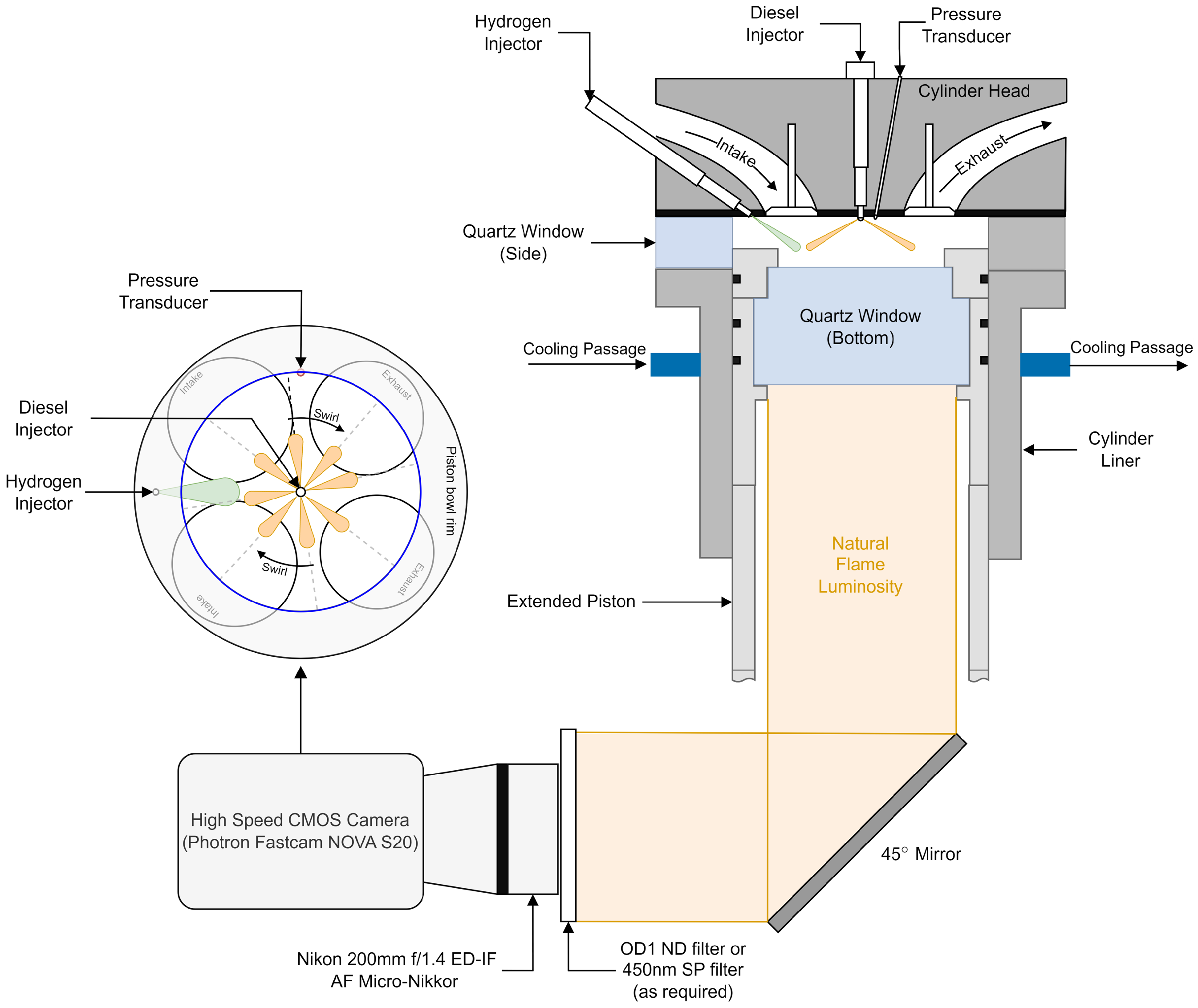
Regarding the optical engine, main characteristics and diagnostics are found in the previous studies [24], and only a brief summary is provided here. The experimental setup consists of a modified single-cylinder heavy-duty optical engine with 1133 cm3 displacement, 107 mm bore, 126 mm stroke, and 17.4 compression ratio, as shown in Table 1. The cylinder head has a swirl ratio of 2. The engine was adapted for optical access by incorporating an extended piston featuring a 78 mm cylindrical bowl, drop-down cylinder liner, quartz window installed at the piston crown, and a 45° mirror positioned within the extended piston to enable visualization.
Two fuel injection systems were integrated into the modified cylinder head. A side-mounted gasoline direct injector (HDEV6, Bosch from Gerlingen, Germany) is oriented at 45° relative to the cylinder head and targeted toward the piston bowl for hydrogen delivery. This injector is fitted with an external single-hole cap containing an axially drilled 1 mm orifice to preserve the H 2 jet momentum. The modified injector achieves a steady-state flow rate of 1.73 g/s at 35 MPa. Hydrogen is supplied via a pneumatic gas booster pump with pressure regulation. A conventional diesel injector (G4S, Denso from Kariya, Japan) with eight equally spaced 120 μ m diameter holes remains centrally located, delivering ultra-low sulfur diesel at 75 MPa via a common-rail system.
The engine operated at 1200 rpm, maintained by an AC motor, with coolant circulated at 363 K to simulate warmed-up conditions. Naturally aspirated operation was employed with approximately 303 K intake temperature. A universal engine controller was used to manage diesel injection parameters, while a rotary encoder provided crank angle referencing.
A 15-skip firing strategy was implemented, one firing cycle followed by fourteen motoring cycles, to evacuate combustion products and minimize thermal stress on optical components. Thirty firing cycles were recorded per operating condition. Diesel-only experiments utilized 3 °CA bTDC injection timing with four different energy levels (120 J, 300 J, 840 J, 1200 J) to characterize pilot flame behavior independently.
Figure 1 shows the experimental setup used for in-cylinder pressure measurements and high-speed natural combustion luminosity imaging. The in-cylinder pressure was measured using a piezoelectric pressure transducer (6056A, Kistler from Winterthur, Switzerland) installed on the cylinder head with a sampling rate of 100 kHz for a temporal resolution of 0.072 °CA/sample at the operating engine speed of 1200 rpm. Apparent heat release rate (AHRR) was calculated using the measured in-cylinder pressure. For high-speed imaging of flame development, a CMOS camera (NOVA S20, Photron from Tokyo, Japan) was used to record a bottom view through the piston-top window and the hollow space of the extended piston. The specifications of the imaging setup used in this study are summarised in Table 2. A framerate of 60 kHz was selected, which is equivalent to a crank angle resolution of 0.12 °CA/frame at 1200 rpm. The exposure time was maintained at 1/frame (approximately 16.6 μ s) throughout the study, with adjustments made to the aperture of the 200 mm lens (Nikkor, Nikon from Tokyo, Japan) with f/8, while a neutral density filter of optical density (OD) 1 was applied to avoid signal saturation. With this setup, a fine pixel resolution of 0.156 mm/pixel was achieved. The captured natural combustion luminosity images were post-processed for boundary detection. The procedure included contrast adjustment, spatial filtering and thresholding. The detected pilot flame boundary was overlaid on the original flame images.

3. Numerical Setup

3.1. Turbulence and Spray Modeling

The open-source code OpenFOAM, coupled with Lib-ICE libraries, was utilised for conducting CFD simulations. The present study employed a RANS approach to describe turbulence. The two-equation model k ϵ was used with the modification to the C 1 constant to account for the round jet correction [25] and the pressure–velocity coupling is handled by the PISO algorithm. The modelling of fuel injection was conducted utilising a Lagrangian technique, in which the parcels are dispersed within a solid cone that was set to 15° in this study. The KH-RT breakup model [26] is utilised to simulate the disintegration of liquid droplets, incorporating two distinct breakup regimes: Rayleigh–Taylor and Kelvin–Helmholtz. A summary of the turbulence and spray setup is reported in Table 3.

3.2. Combustion Modeling

Two distinct combustion models were employed in the present study, with the objective of conducting a comparative analysis to identify the most appropriate one for simulating diesel pilot combustion. The following methods were selected for investigation: Tabulated Well Mixed (TWM) and Representative Interactive Flamelet (RIF). The selection of these methods is predicated on their prevalence in CFD codes.

3.2.1. Tabulated Well Mixed (TWM)

Tabulated Well Mixed has proven to be an accurate and computationally efficient approach for embedding complex reaction dynamics into CFD simulations. As its name suggests, this tabulation strategy assumes that each CFD cell behaves as a perfectly homogeneous reactor. The model employs a look-up table that contains reaction rates and species evolution over time to obtain information about the state of combustion, thereby solving the chemical kinetics separately from the fluid flow calculations. The look-up table is generated by recording the outcomes of homogeneous reactor simulations over a wide range of operating conditions, so that all thermodynamic states that may arise locally within the engine combustion chamber are represented. The procedure begins by defining the initial reactor conditions in terms of pressure, temperature, equivalence ratio, and EGR.
Following reactor initialization, auto-ignition simulations are run to determine the chemical species’ reaction rates using the designated kinetic scheme:
d Y i d t = ω i ˙ ( T , p , Y 1 , , Y n )
where ω ˙ is the reaction rate of the i-th species and Y i is its mass fraction. Data are stored inside the table as a function of the normalized progress variable c that can be calculated from the initial value of progress variable C m i n and after auto-ignition C m a x following:
c = C C m i n C m a x C m i n
where progress variable C is computed as a difference between the current and the initial value of the reactor enthalpy of formation h 298 [27] and so it is set equal to the heat released by combustion:
C = i = 1 N s h 298 , i Y i ( t ) i = 1 N s h 298 , i Y i ( 0 )
where N s is the total number of species specified in the kinetic mechanism.
In the CFD domain, transport equations for mixture fraction Z, enthalpy h u , unburned gas temperature T u and progress variable C are solved and then the table is accessed with the local cell values to get the source term of the progress variable’s transport equation:
ρ C t + ρ U C μ t S c t C = ρ C ˙
where C ˙ is computed by multiplying the term ( C m a x C m i n ) by the normalized progress variable c ˙ computed as:
c ˙ = c i + 1 c i t i + 1 t i
Tabulated Well Mixed is thus highly responsive to local flow conditions, supporting the prediction of a progressive ignition of the air–fuel mixture and allowing it to capture different flame dynamics, such as stabilization and quenching, while permitting each cell in the domain to evolve independently. Conversely, because each cell in the domain is treated as a homogeneous reactor, this model does not account for the impact of sub-grid inhomogeneities on the combustion process.

3.2.2. Representative Interactive Flamelets (RIFs)

The Representative Interactive Flamelets model is based on the flamelet concept which enables the separation of mixing and chemistry [28]. Assuming this, it is possible to resolve the chemical and fluid-dynamic problems in distinct domains: one that captures the flow field inside the combustion chamber and represents the entire three-dimensional domain, and one or more mixture fraction domains that reduce the chemical problem’s solution to the simulation of a purely diffusive flame in a one-dimensional domain. In both engine and vessel simulations, the RIF combustion model has been applied to a range of combustion scenarios, accurately describing the ignition process and the mixing-governed stages of the combustion [29].
Flamelets equations are solved in the mixture fraction space assuming unitary Lewis number [30]:
ρ Y i t = ρ χ z 2 2 Y i Z 2 + ω i ˙
ρ h s t = ρ χ z 2 2 h s Z 2 + q s ˙ + d p d t
where ρ is the density, Y i is the mass fraction of the i-th species, χ z is the scalar dissipation term, Z is the mixture fraction, ω i ˙ is the source term associated with the i-th species, h s the sensible enthalpy, q s ˙ us the heat released by combustion and p the pressure computed in the CFD domain. To compute the chemical composition in the CFD domain a β -pdf distribution P, function of mixture fraction Z and its variance Z 2 , is assumed:
Y ˜ i = j = 1 N f M j 0 1 Y j , i ˜ ( Z ˜ ) · P ( Z ˜ , Z 2 ˜ ) d Z
where M j is a flamelet marker. In the CFD domain transport equations of the mixture fraction and its variance are solved:
ρ Z ˜ t + ρ U Z ˜ μ t S c Z Z ˜ = S Z ˙
ρ Z 2 ˜ t + ρ U Z 2 ˜ μ t S c Z 2 Z 2 ˜ = 2 μ t S c Z 2 | Z | 2 ρ χ
with S Z ˙ is the source term due to liquid evaporation and μ t is the tubulent viscosity.
Turbulence and chemistry interaction is taken into consideration in the RIF model through the scalar dissipation rate term χ z which is function of the scalar dissipation rate at stoichiometric mixture fraction conditions χ s t , j ^ which is computed for each flamelet:
χ z = χ s t , j ^ f ( Z ) f ( Z s t )
where f ( Z ) has an erfc-profile [31].

3.3. Computational Mesh

Two different computational meshes were employed for the validation of the proposed models: a fixed mesh for the simulation of the constant-volume combustion chamber (CVCC) and a dynamic mesh for the engine-condition simulations.

3.3.1. Vessel Grid

A three-dimensional computational mesh representing half of the constant-volume vessel geometry was employed for the simulations. Fixed refinement regions were applied to accurately resolve the evolution of both fuel jets, with minimum cell sizes selected to be on the order of the injector nozzle diameters. This strategy avoids excessively low void-fraction values in regions where spray particles evolve, while ensuring that the flow scales relevant to fuel–air mixing are properly resolved. The resulting mesh consists of approximately 320,000 cells.

3.3.2. Engine Grid

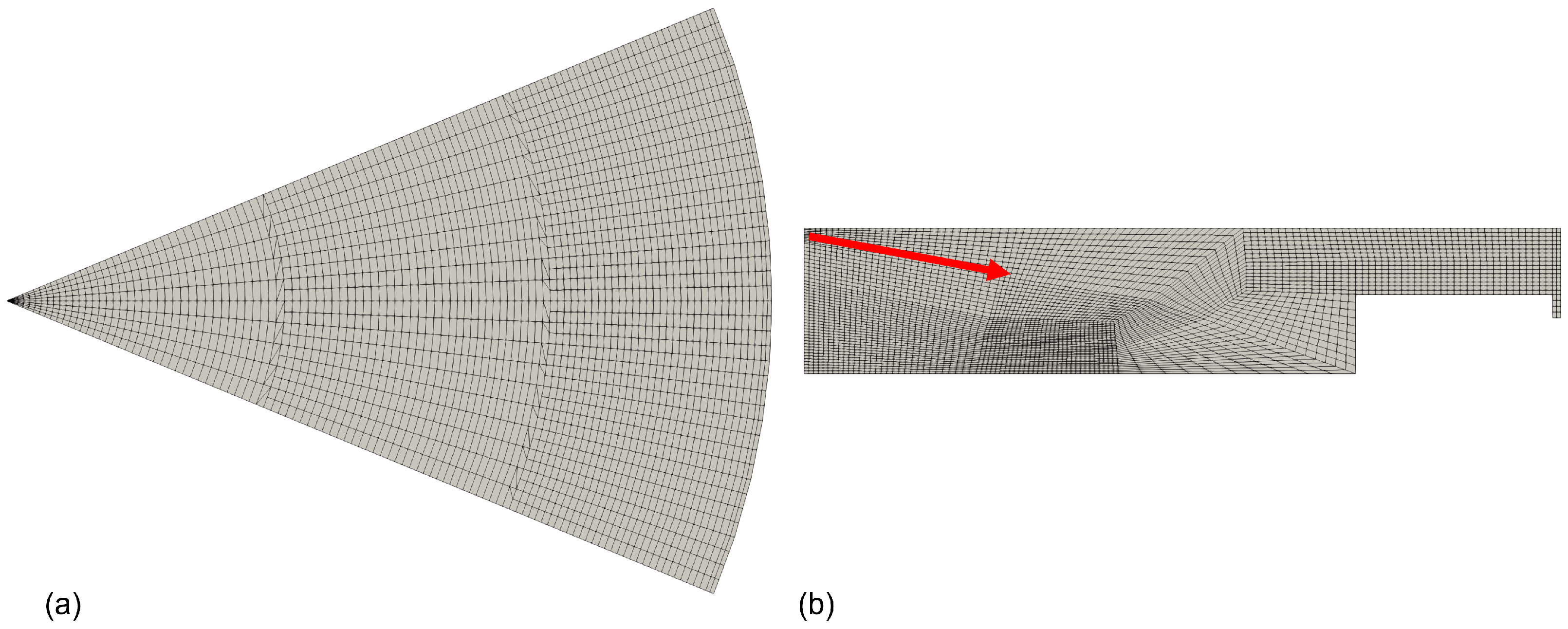
In order to reduce computational cost, the simulations were restricted to the closed-valve portion of the engine cycle. Owing to the eight-hole configuration of the diesel injector, the geometric symmetry of the combustion chamber was exploited to model only 1/8 of the full fluid-dynamic domain. A spray-oriented sector mesh was generated following the methodology described in [32], as illustrated in Figure 2, with the aim of minimising numerical diffusion and improving spray resolution. To accurately capture the motion of Lagrangian spray parcels while maintaining a manageable cell count, the layer addition and removal technique was adopted to represent the piston displacement. Additional mesh layers are introduced when the local cell size exceeds 1 mm and removed when it becomes smaller than 0.25 mm.

4. Results and Discussion

4.1. Vessel Simulation: Pilot-Main Strategy

The validation of the TWM model was carried out using the experimental data reported in [17], focusing in particular on the operating condition labelled D-1.93 ms-H, where the diesel pilot is injected prior to the hydrogen main injection. In this configuration, hydrogen is injected 1.93 ms after the diesel pilot start of injection (SOI), corresponding to a hydrogen energy share of 93.6%. This case was selected because it most closely resembles the engine configuration examined in this work, in which the diesel pilot ignites in pure air, without any influence from premixed hydrogen. The RIF model was not evaluated under this dual-fuel condition, as its single-flamelet formulation does not allow the simultaneous treatment of two different fuels.
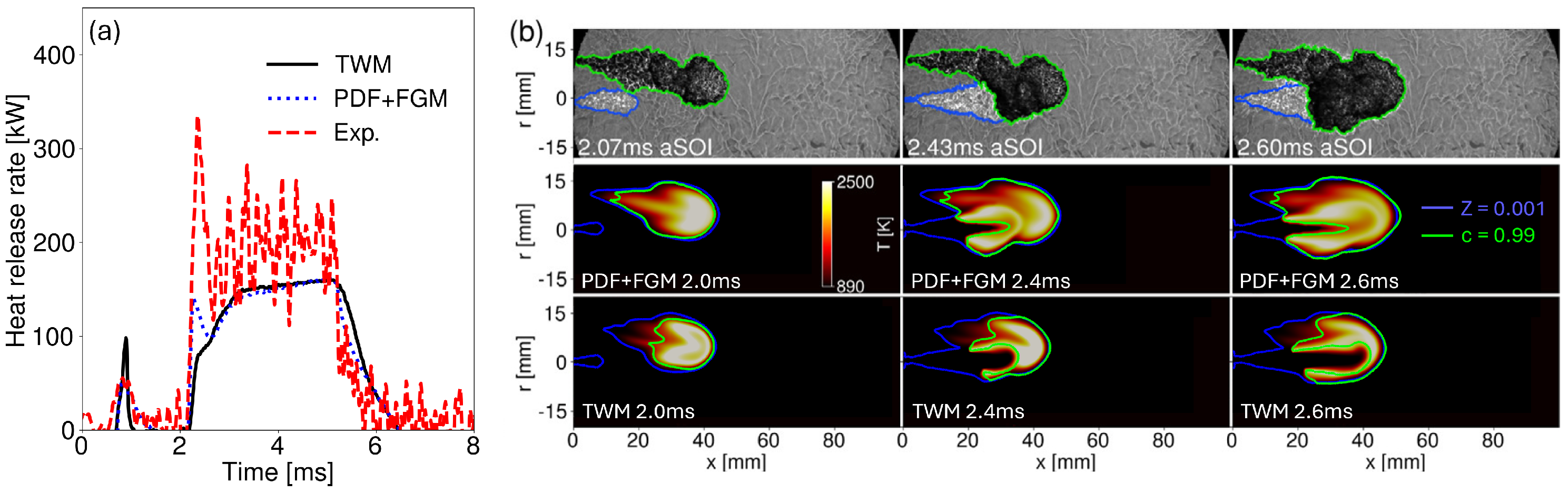
Figure 3a presents a comparison between the experimental and computed apparent heat release rate (AHRR) using both the TWM model and the PDF-FGM approach documented in [17]. The results show that both models reproduce the ignition delay of the diesel pilot as well as the onset of hydrogen combustion with good accuracy. However, the TWM model underpredicts the first premixed hydrogen heat-release peak. This behaviour is expected, since the absence of a PDF treatment means that only the cell-averaged mixture fraction is considered, causing locally rich regions to burn more slowly. Conversely, the PDF-FGM model accounts for sub-grid mixture fraction fluctuations, leading to a faster and more intense early combustion phase. These differences are clearly visible in Figure 3b, where the rich portion of the H2 jet fails to ignite completely with the TWM approach, while partial burning is observed when using the PDF-FGM model.
Although the PDF-FGM approach provides a more accurate description of the initial hydrogen heat-release behaviour, the TWM model was ultimately selected for the engine simulations. This choice is motivated by its substantially lower computational cost and its suitability for industrial applications, while still offering a satisfactory agreement with the experimental data.

4.2. Engine Simulations

When actual engine configurations are evaluated, several additional challenges emerge, necessitating a focused assessment of the model’s ability to address individual phenomena. In dual-fuel engine development, the prevailing approach is to maximise the hydrogen substitution ratio (SR), with the objective of reducing carbon emissions. This necessitates reducing the diesel pilot to the absolute minimum quantity required to initiate combustion, a regime often referred to as “micro-pilot” operation. Experimentally different Energy Input Levels (EILs) ranging from 100% (1200 J) down to 10% (120 J) have been tested. This sweep is not just a change in quantity; it represents a fundamental shift in the physical regime of the spray. At high energy levels (EIL-100), the diesel spray forms a quasi-steady jet. The interaction between the liquid core, the entrained air, and the chemical reactions is governed by well-understood mixing-controlled combustion theories. In this regime, the statistical averaging inherent in Reynolds-Averaged Navier–Stokes (RANS) simulations is generally valid because the “sample size” of fuel droplets and turbulent eddies is large. The flame stabilizes at a predictable lift-off length, and ignition occurs in regions where the mixture fraction is most favorable, typically consistent across multiple cycles. However, as the energy input is reduced to EIL-25 (300 J) and EIL-10 (120 J), the physics change drastically. The injection duration drops, the spray never reaches a quasi-steady state, and it is entirely transient rather than a developed jet. For these reasons, the decoupling of variables remains a primary scientific objective both experimentally and numerically. In this study, under engine conditions, the focus has been exclusively on predicting pilot diesel performance across varying energy levels, which serves as a critical quality benchmark for the TWM-based methodology. Additionally, while the RIF model is not yet applicable to dual-fuel scenarios, it can be used for pilot diesel cases and offers a useful reference point.
To characterise the behaviour of diesel pilot injections across a range of diesel-only energy levels, four distinct operating conditions were analysed, as summarised in Table 4. All cases were performed at the same engine speed and with identical intake temperature, injection pressure, and start of injection ( 3 °CA aTDC). The only parameter that changes is the injection duration, which leads to different amounts of injected diesel fuel. The injection profiles are derived from experimental characterisation of the DENSO injector at various energizing times.

4.2.1. Energy Input Level EIL-100

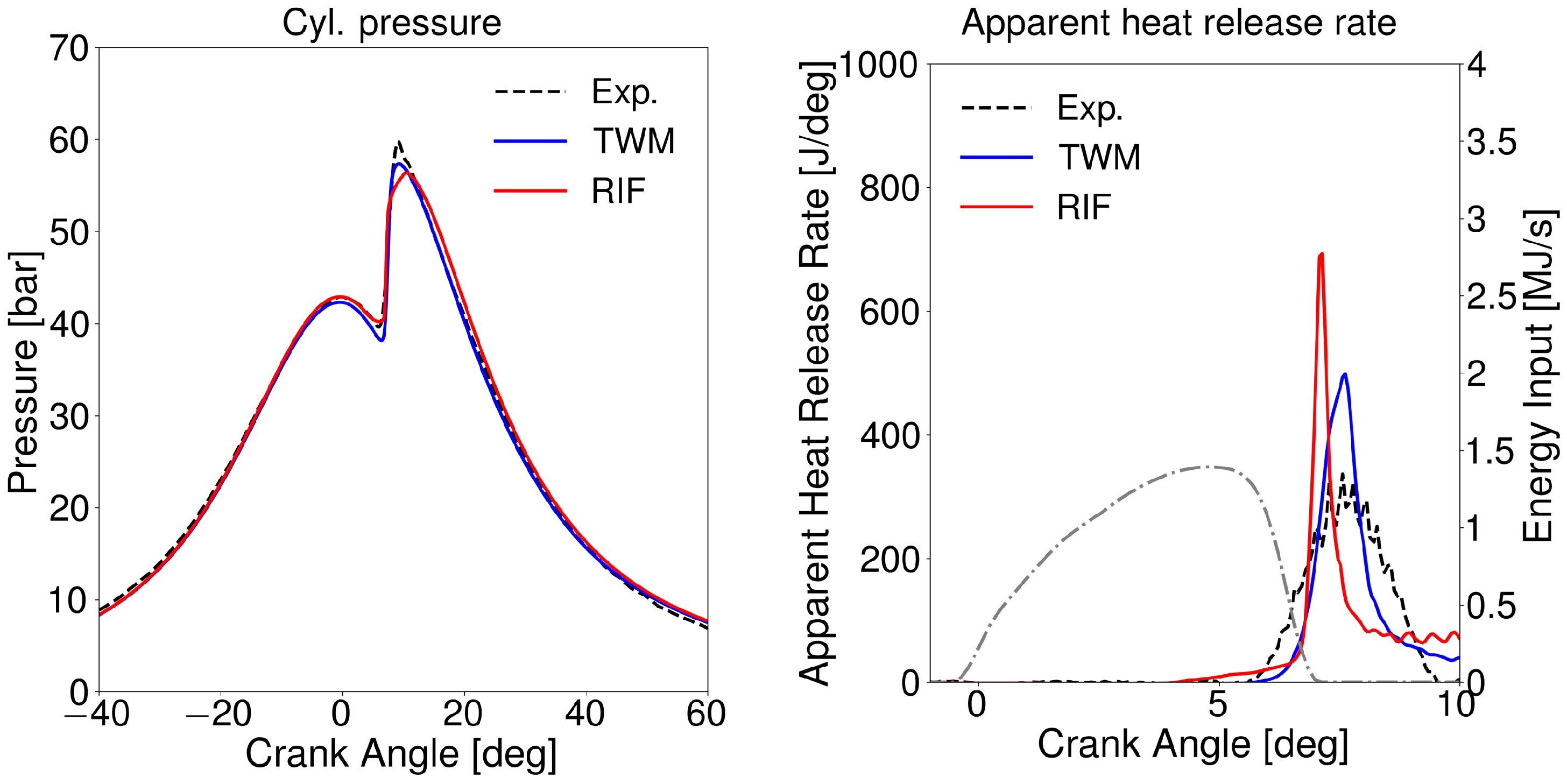
The first operating condition examined corresponds to the highest energy input level (EIL-100), for which a quasi-steady flame is expected. Figure 4 shows a comparison between the experimental and computed in-cylinder pressure and apparent heat release rate, obtained using the two proposed combustion models. As indicated by the in-cylinder pressure trace, both models reproduce the experimental peak amplitude and phasing reasonably well, with the TWM model exhibiting the lowest overall error. The AHRR comparison highlights two key aspects. First, the pilot ignition, despite the high energy input, occurs after the end of injection. Both models correctly capture this behaviour, thereby ensuring an accurate reproduction of the ignition delay. Second, during the subsequent evolution of the AHRR, the RIF model predicts a faster combustion process than the TWM model. This behaviour is expected and stems from the intrinsic characteristics of the single-flamelet RIF formulation, in which all cells at stoichiometric conditions ignite simultaneously.
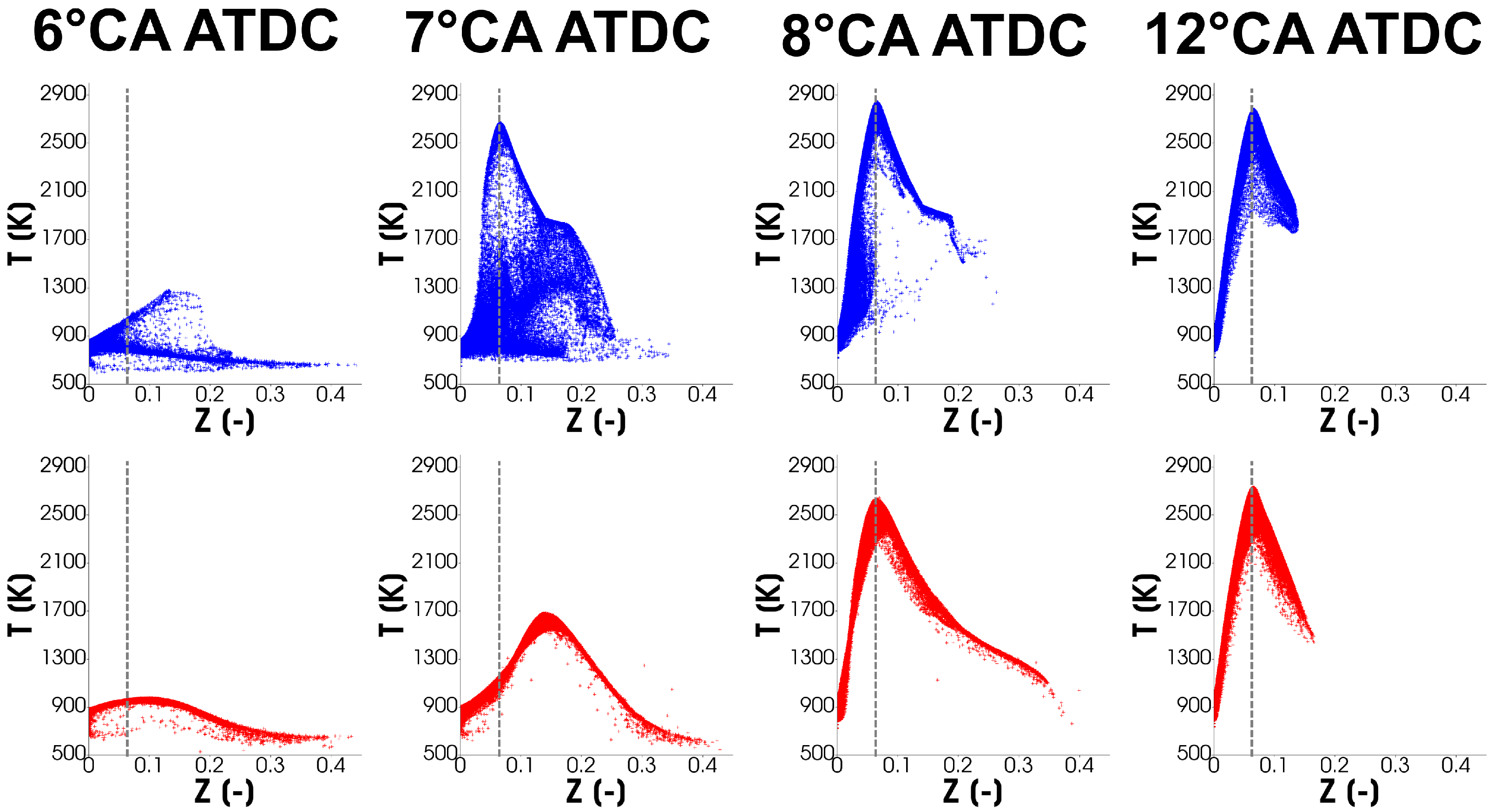
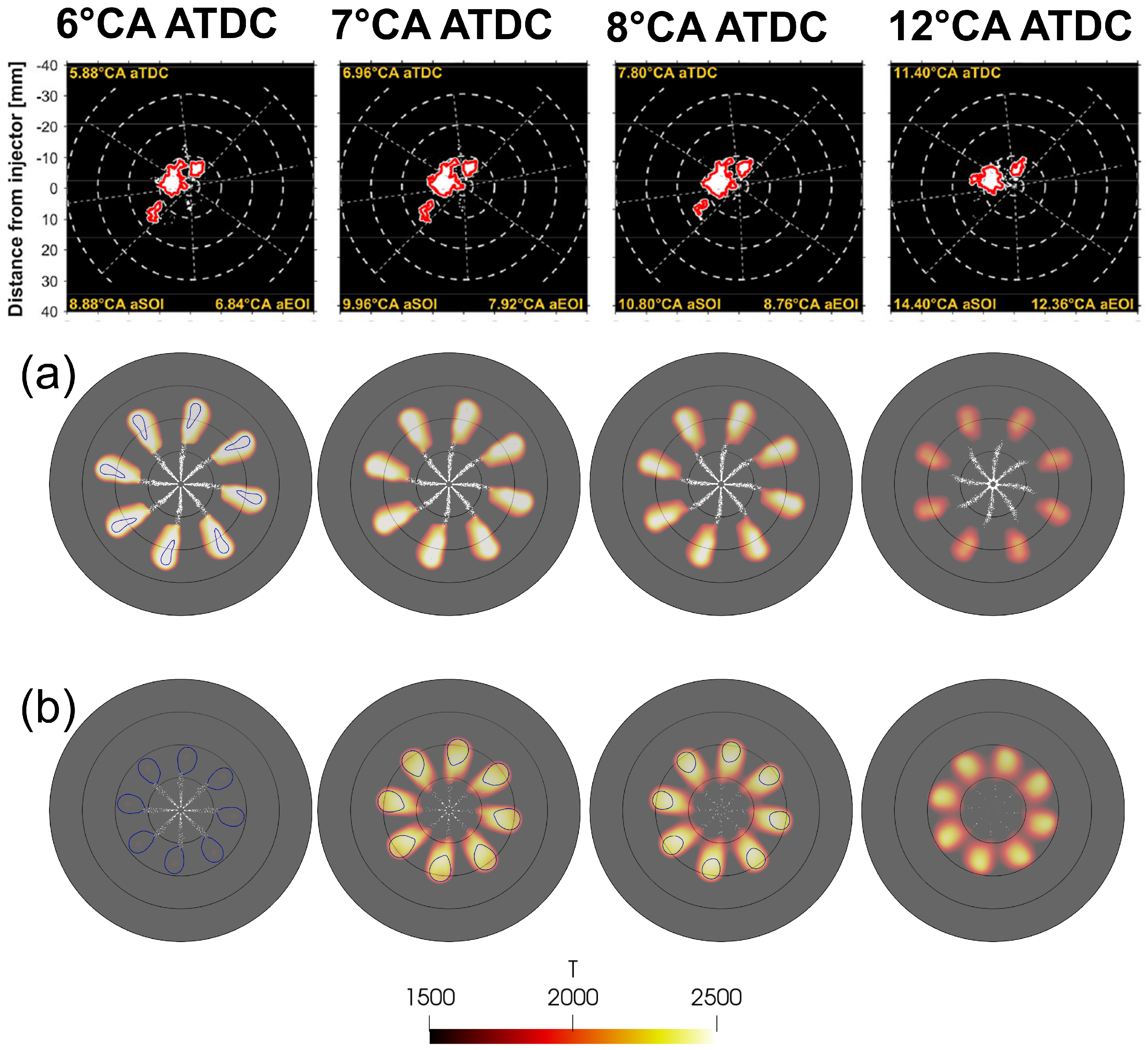
This behaviour can be further observed in Figure 5, which reports cell temperatures as a function of mixture fraction. In the TWM results, the ignition phase is characterised by a cloud of points near stoichiometric conditions spanning a wide temperature range, indicating a more gradual and distributed ignition of the charge. In addition, a second cluster of high-temperature points (1900–2000 K) appears at Z = 0.2 in the rich region. In contrast, the RIF model yields high-temperature points that align almost perfectly along a well-defined curve. This demonstrates that, regardless of the average cell composition, the chemical reactions are constrained by flamelet physics and occur only where stoichiometric conditions permit.
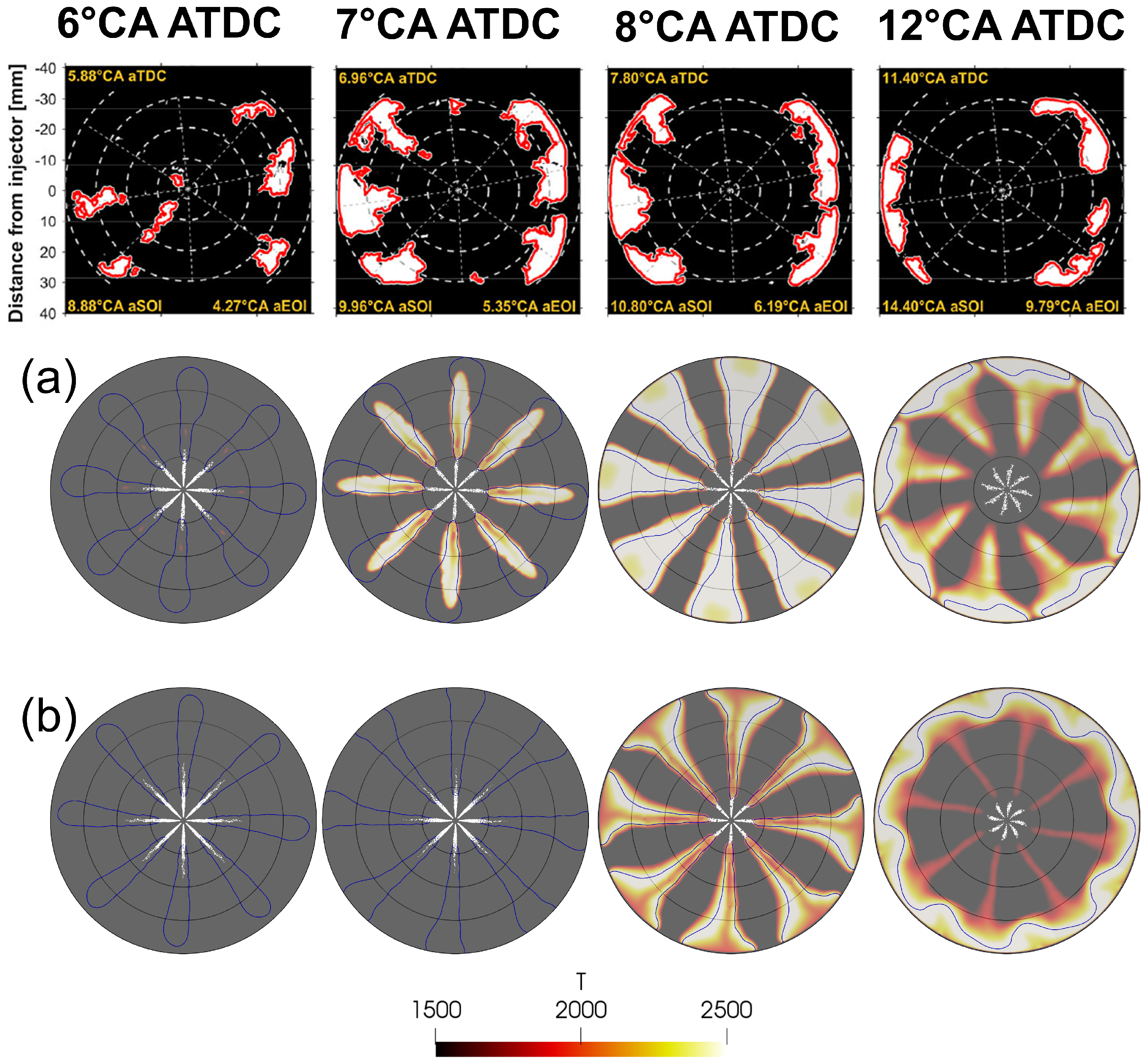
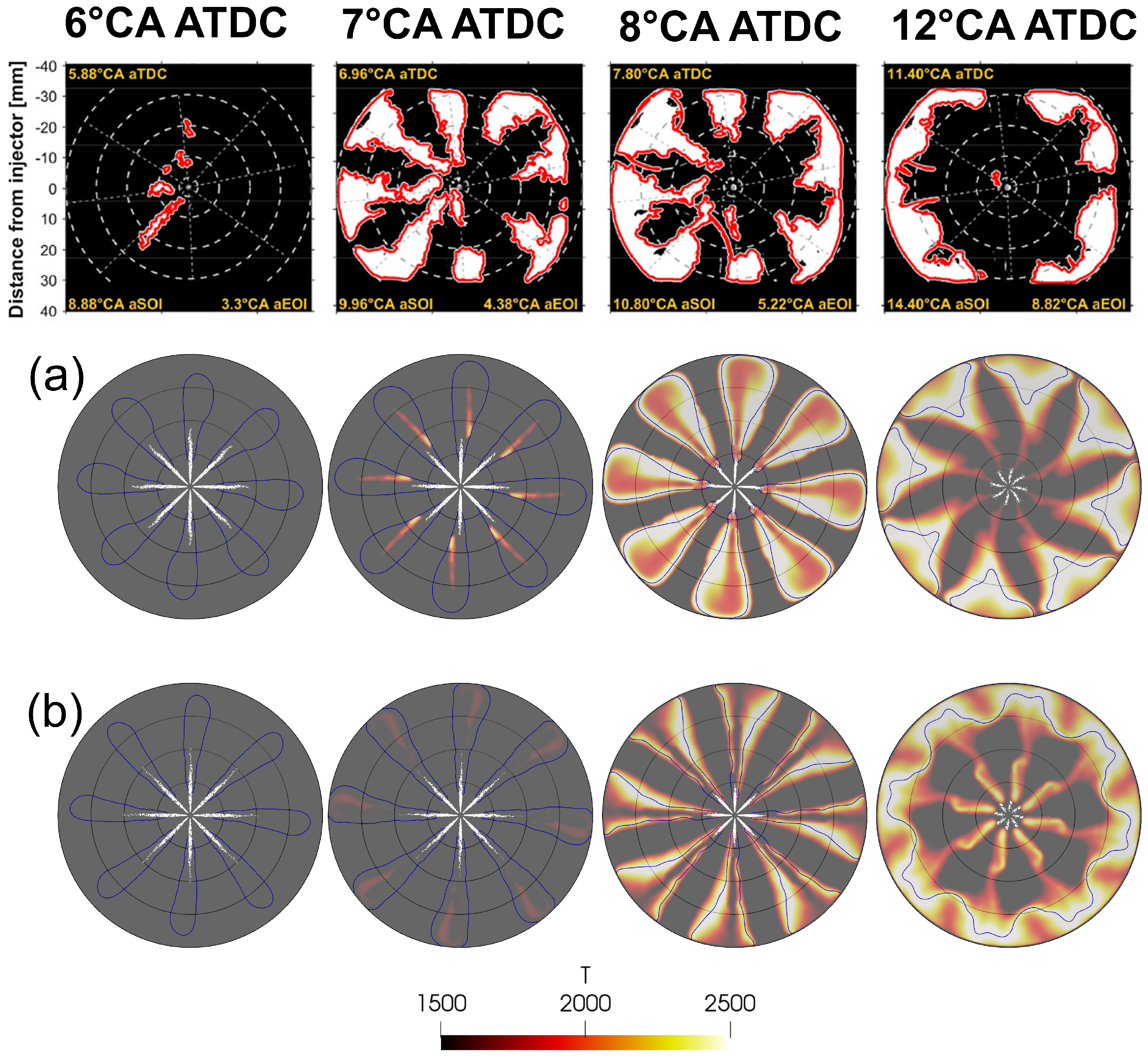
Figure 6 presents a comparison between the experimental flame signal and the temperature distribution on the diesel injection plane as predicted by the TWM and RIF models. The experimental images show a short quasi-steady diesel flame following the initial flame development, which stabilizes near the wall at 12 °CA aTDC. The TWM model displays slightly delayed ignition, with visible flame appearing only at 7 °CA, originating in the rich region. This ignition pattern is consistent with the model’s ability to capture locally rich pockets where ignition kernels first develop. The subsequent flame propagation exhibits a more distributed structure, with temperature gradients reflecting the gradual consumption of the fuel–air mixture. This progressive flame development is more representative of the physical ignition process in transient diesel sprays, where multiple ignition sites can coexist and merge as combustion progresses. The RIF model also predicts a 1 °CA ignition delay; however, in this case, the ignition originates in the stoichiometric zones, as dictated by the flamelet structure. The flame development is more coherent and exhibits sharper temperature gradients at the flame front, characteristic of a premixed-like combustion mode. After the initial development, both models predict a flame that stabilizes in the near-wall region. However, the RIF model’s flame structure is more compact and uniform, with a well-defined reaction zone, whereas the TWM model shows a more diffuse flame with broader temperature distributions. These differences in flame structure and turbulence-chemistry interaction have direct implications for pollutant formation predictions. The RIF model’s sharp temperature gradients and localized high-temperature zones along the stoichiometric contour are conducive to thermal NO x formation, potentially leading to overprediction of NO x emissions compared to the more distributed temperature field predicted by TWM. Conversely, the rich high-temperature regions predicted by the TWM model (Z = 0.2, T = 1700–2000 K) suggest favourable conditions for soot formation. The broader temperature distribution in the TWM results also implies longer residence times at intermediate temperatures, which could affect CO and unburned hydrocarbon oxidation pathways.

4.2.2. Energy Input Level EIL-70

The operating point analysed in this phase is characterised by a reduced equivalent energy input (EIL-70), a condition in which no quasi-steady flame is expected. Figure 7 presents a comparison between the experimental in-cylinder pressure and the corresponding numerical predictions, along with the apparent heat release rate (AHRR), obtained using the two proposed combustion models. The analysis of the pressure trace indicates that both models reproduce the experimental peak amplitude and phasing accurately. However, a closer inspection of the AHRR reveals a key feature and a significant difference between the two approaches. The TWM model again predicts the pilot ignition with good accuracy, yielding an energy-release evolution that closely matches the experimental behaviour. In contrast, although the RIF model correctly reproduces the ignition delay, it exhibits a very slow energy release during the first 2–3 °CA. This is followed by an excessively rapid combustion phase, which results in an accelerated and unrealistic peak heat-release prediction.
The experimental flame evolution shown in Figure 8 displays a stable wall-centric flame, deflected by the swirl motion. On the simulation side, the difference in ignition timing between the two models is clearly visible: the TWM model predicts elevated temperatures already at 7 °CA aTDC, whereas the RIF model does so only at 8 °CA aTDC. At the end of the combustion process, both models predict a wall-attached flame transported clockwise by the swirl.

4.2.3. Energy Input Level EIL-25

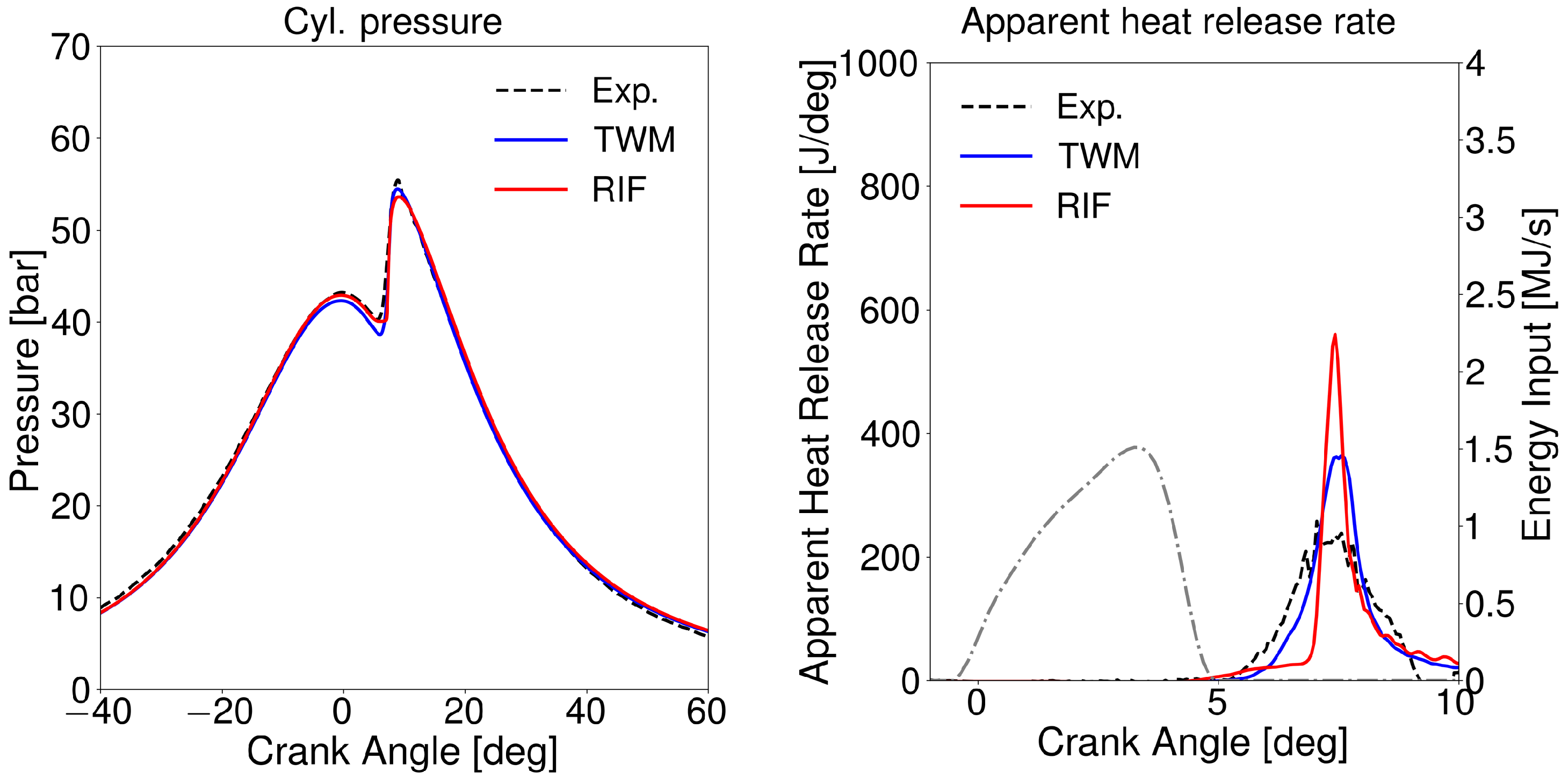
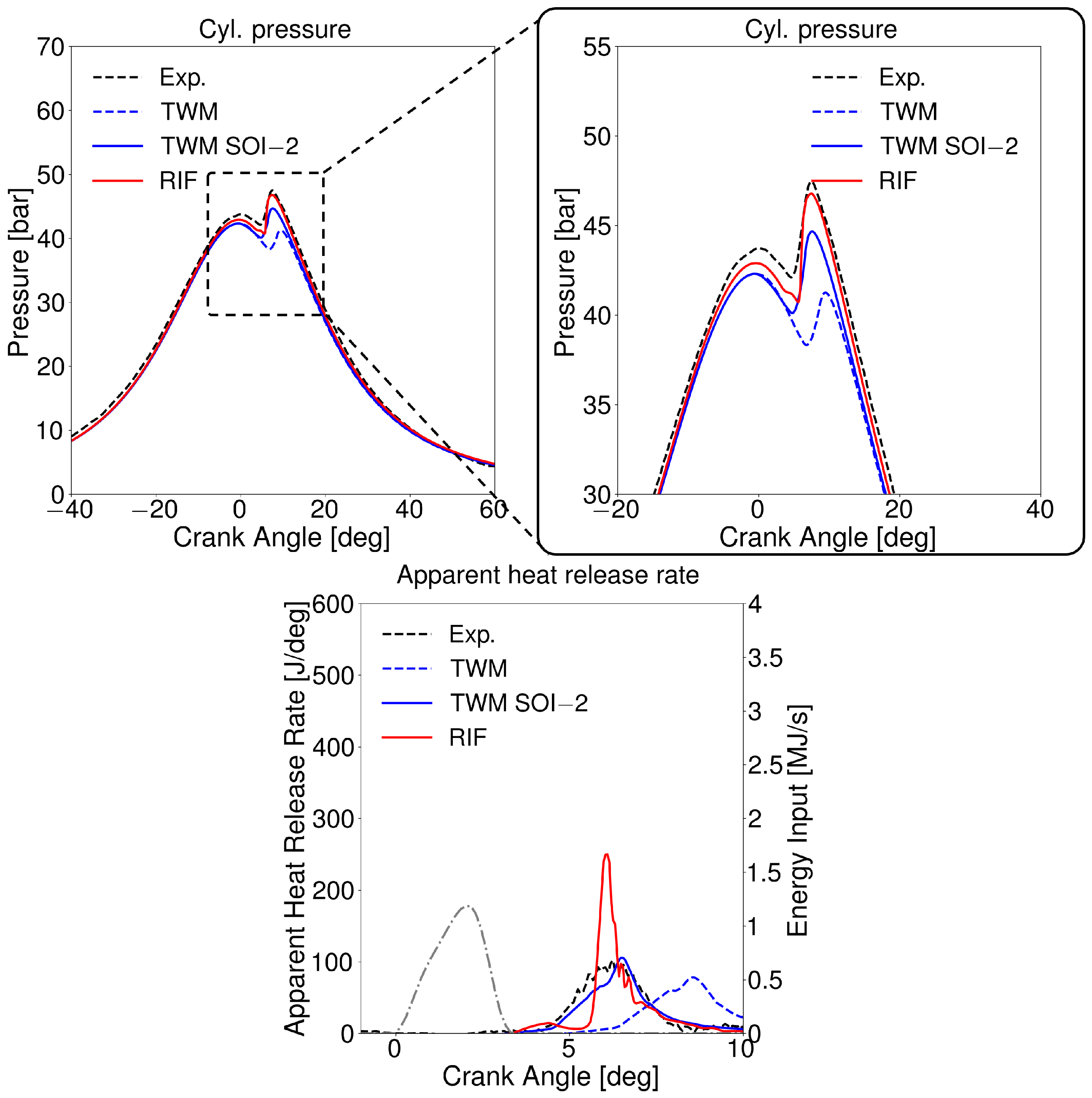
The EIL-25 operating condition is characterised by a very low fuel energy input (300 J) and by a free-jet-like flame development. Using the original start of injection, the TWM model fails to reproduce the correct combustion timing due to an overestimation of the ignition delay, whereas the RIF model predicts it accurately. This behaviour can be explained by the fact that, in the TWM model, the mean cell mixture fraction drives the chemical reactions; therefore, when the fuel quantity is reduced, the average mixture fraction tends to fall below the stoichiometric value, leading to slower reaction rates. In contrast, the RIF model, through its use of a probability density function (PDF), is able to identify stoichiometric pockets within each cell and thus accelerates the reaction mechanism. For this reason, the SOI was advanced by 2 °CA in the TWM simulations, and the resulting in-cylinder pressure and AHRR are shown in Figure 9. With the advanced SOI, both models reproduce the experimental pressure trace reasonably well. It is worth noting that the experimental pressure at TDC is slightly higher than in the other operating conditions, despite identical initial conditions, probably due to some uncertainties in the experimental setup; as a consequence, the CFD simulations underestimate the pressure at minimum volume and, consistently, the maximum peak pressure. Examining the AHRR, the TWM model with the advanced SOI shows very good agreement with the experimental trace. The RIF model, on the other hand, again predicts a centrally concentrated combustion process, characterised by a pronounced peak in the heat-release rate.
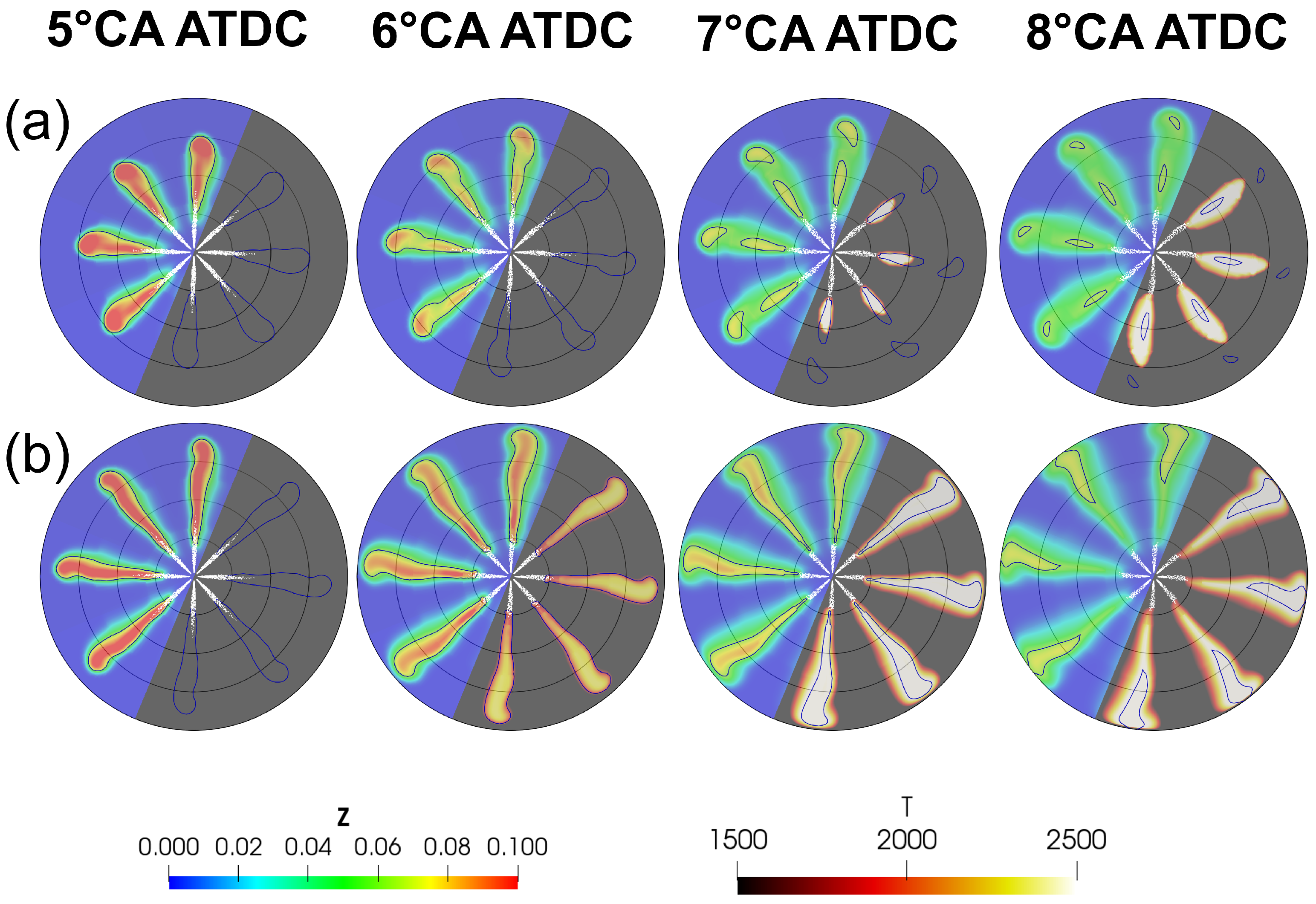
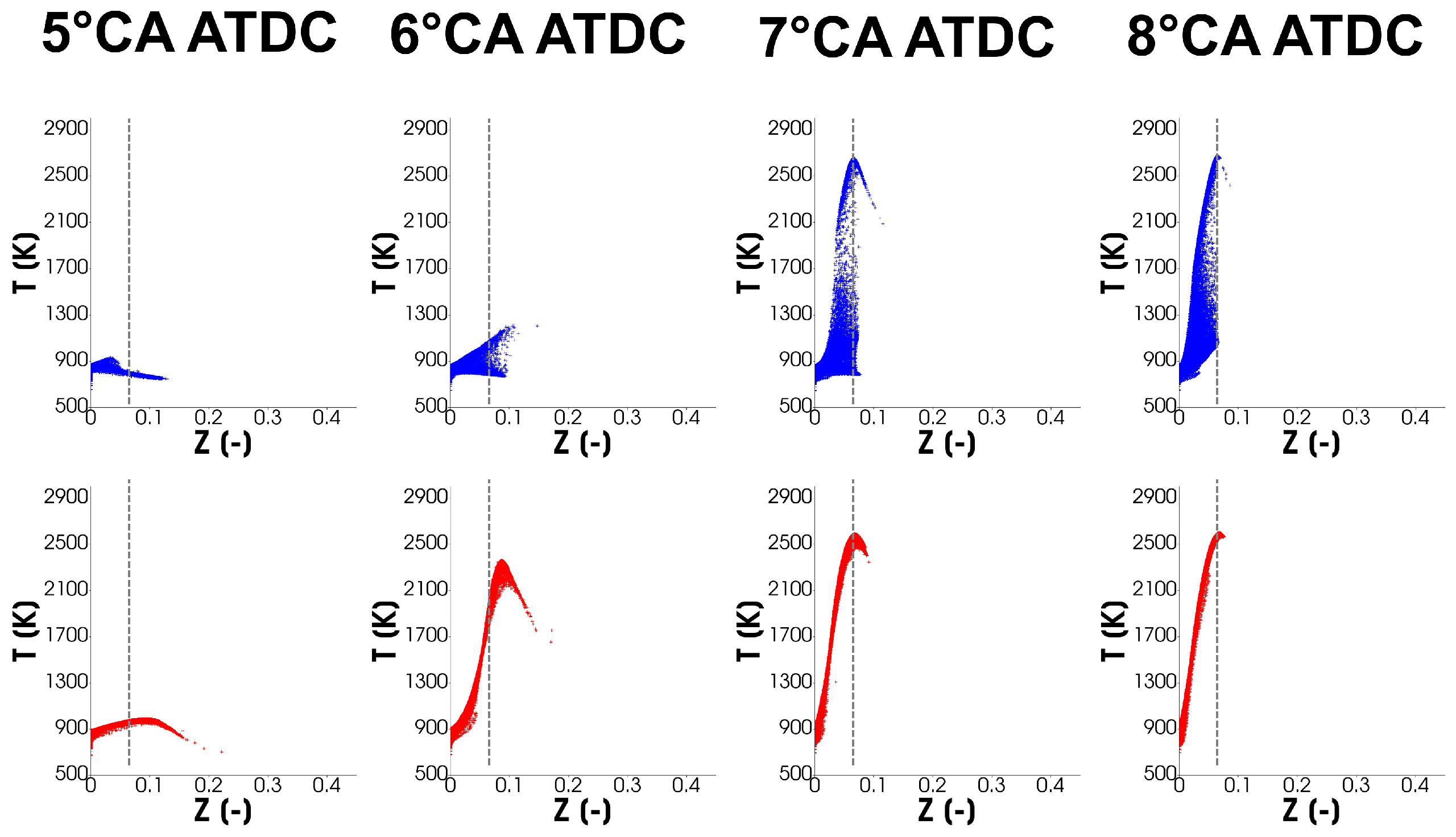
The different ignition behaviour can be visualized in Figure 10 and Figure 11. Figure 10 shows the evolution of the mixture fraction and temperature fields for the TWM model with the original SOI and for the RIF model. When the single-flamelet RIF approach is used, ignition occurs simultaneously in all regions corresponding to the same Z s t (blue iso-surface). In contrast, in the TWM model, ignition develops only in one of the two stoichiometric regions generated by the spray. Figure 11 further highlights this behaviour: at 7 °CA, the TWM model exhibits a cloud of points with stoichiometric conditions but low temperatures, indicating a delayed and distributed ignition. Conversely, the RIF model shows all points aligned along a well-defined curve, confirming a more constrained and simultaneous ignition governed by flamelet physics.

4.2.4. Energy Input Level EIL-10

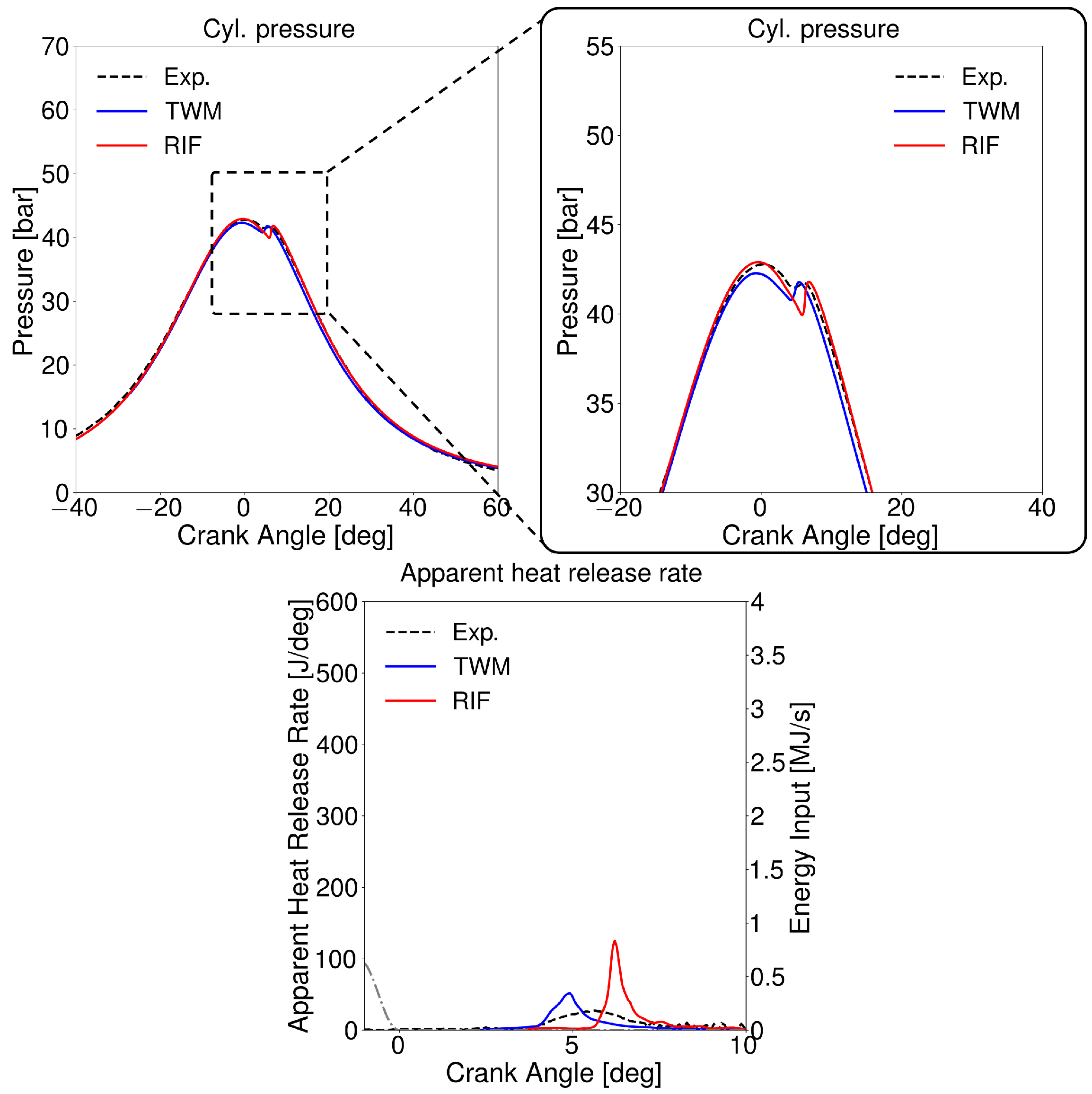
The last operating condition that was examined was the one with the lowest energy input (EIL-10), the minimum diesel energy required (120 J) to achieve repeatable ignition with low cyclic variations. For this operating condition, the TWM model predicts again a too high ignition delay, and so the start of injection was anticipated by 2 °CA as for the EIL-25 condition. Looking at the in-cylinder pressure traces and apparent heat release rates shown in Figure 12, it is evident that both models reproduce rather well the peak pressure amplitude and location. However, as for the other conditions analyzed, while TWM predicts a more gradual ignition, RIF shows a more intense peak of heat released.
Figure 13 shows that experimentally, the flame stays really close to the injector and it is deviated by the swirl motion. These aspects are correctly reproduced by both models, with RIF showing a flame more injector-centric than TWM.

5. Conclusions

The aim of this work is to investigate and model, by means of CFD simulations, the behaviour of diesel pilot injection in a dual-fuel diesel–hydrogen engine, as a continuation of the authors’ recent research [17]. Two well-established combustion models (TWM and RIF) were compared against experimental data from a large-bore optical engine to assess their performance under these operating conditions.
Following an initial numerical validation based on dual-fuel constant-volume vessel experiments, in which the diesel pilot is injected prior to hydrogen, the analysis is extended to engine operating conditions, with a specific focus on diesel pilot combustion. While the present study demonstrates the capability of both models to characterize pilot injections with varying energy content, several important limitations must be acknowledged, particularly for the RIF model under the investigated conditions. The single-flamelet assumption inherent to the RIF model imposes significant constraints on its applicability to transient spray combustion. Under non-stationary conditions, typical of diesel pilot injection events, the model assumes that all parcels within a computational cell share the same flamelet structure and evolve according to a single scalar dissipation rate. This assumption can lead to non-physical results, especially in regions characterized by locally lean mixtures or steep gradients in mixture composition. Furthermore, at very low fuel-energy levels (below 300 J), the transient nature of the spray becomes more pronounced. Under these conditions, the RIF model’s single-flamelet representation may overpredict local heat release rates, as observed in the present study. The model does not account for the spatial heterogeneity of ignition kernels and their progressive propagation through the spray. This limitation becomes particularly critical when mixture stratification is strong and combustion progresses through multiple, distinct ignition sites rather than a single, coherent flame front. In contrast, the TWM model, while requiring SOI calibration at low energy input levels, better represents the gradual nature of charge ignition by averaging chemical states across the mixture fraction space. Based on these findings, the RIF model is most suitable for conditions where spray penetration is well-established, mixture stratification is moderate, and the combustion process can be reasonably approximated by a single flamelet structure. For low energy input conditions with transient spray development and strong mixture heterogeneity, calibrated TWM or more advanced multi-flamelet approaches may be necessary to accurately capture the combustion dynamics.
Future research will aim to simulate dual-fuel conditions, incorporating hydrogen according to distinct energy ratios and employing the TWM model with the finalized configuration established in this study. Additionally, the development and validation of advanced combustion models, such as the EMCF+FGM approach introduced in the authors’ previous work, will be pursued to overcome the limitations identified here and provide more robust predictions across a wider range of operating conditions.

Author Contributions

Conceptualization, G.D., G.G.G. and A.G.H.; methodology, G.D. and G.G.G.; software, G.G.G. and T.L.; validation, G.D., G.G.G., A.G.H. and S.K.; formal analysis, G.D. and G.G.G.; investigation, G.G.G. and A.G.H.; resources, G.D., T.L. and S.K.; data curation, G.G.G. and A.G.H.; writing—original draft preparation, G.D. and G.G.G.; writing—review and editing, G.D., G.G.G., T.L. and S.K.; visualization, G.D. and G.G.G.; supervision, G.D. and T.L.; project administration, G.D. and T.L.; funding acquisition, G.G.G. All authors have read and agreed to the published version of the manuscript.

Funding

This research was funded by National Recovery and Resilience Plan (NRRP), Mission 4 Component 2 Investment 1.3, funded from the European Union—NextGenerationEU (ID: PE0000021).

Data Availability Statement

The original contributions presented in this study are included in the article. Further inquiries can be directed to the corresponding author.

Acknowledgments

This study was carried out within the NEST—Network 4 Energy Sustainable Transition (D.D. 1243 02/08/2022, PE00000021) and received funding under the National Recovery and Resilience Plan (NRRP), Mission 4 Component 2 Investment 1.3, funded from the European Union—NextGenerationEU. This manuscript reflects only the authors’ views and opinions, neither the European Union nor the European Commission can be considered responsible for them.

Conflicts of Interest

The authors declare no conflicts of interest.

Abbreviations

The following abbreviations are used in this manuscript:
AHRRApparent heat release rate
aTDCAfter top dead center
bTDCBefore top dead center
CACrank angle
CFDComputational fluid dynamics
CVCCConstant volume combustion chamber
C O 2 Carbon dioxide
DIDirect injection
EGRExhaust gas recirculation
EILEnergy input level
EMFCEulerian Monte Carlo fields
FGMFlamelet generated manifolds
GDIGasoline direct injection
H 2 Hydrogen
ICEInternal combustion engine
IVCIntake valve closing
NOxNitrogen oxides
O 2 Dioxygen
PDFProbability density function
PFIPort fuel injection
PISOPressure-implicit with splitting of operators
RANSReynolds-averaged Navier Stokes equations
RIFRepresentative Interactive Flamelet
SISpark ignition
SOIStart of injection
TDCTop dead center
TWMTabulated well mixed
CProgress variable
N s Number of species
T u Unburned gas temperature
Y i i-th species mass fraction
ZMixture fraction
Z 2 Mixture fraction variance
cNormalized progress variable
h u Unburned enthalpy
h 298 Enthalpy of formation
ρ Density
χ z Scalar dissipation term
ω ˙ Reaction rate

References

  1. Prussi, M.; Laveneziana, L.; Testa, L.; Chiaramonti, D. Comparing e-Fuels and Electrification for Decarbonization of Heavy-Duty Transports. Energies 2022, 15, 75. [Google Scholar] [CrossRef]
  2. Balboa-Espinoza, V.; Segura-Salazar, J.; Hunt, C.; Aitken, D.; Campos, L. Comparative life cycle assessment of battery-electric and diesel underground mining trucks. J. Clean. Prod. 2023, 425, 139056. [Google Scholar] [CrossRef]
  3. Reitz, R.D.; Ogawa, H.; Payri, R.; Fansler, T.; Kokjohn, S.; Moriyoshi, Y.; Agarwal, A.; Arcoumanis, D.; Assanis, D.; Bae, C.; et al. IJER editorial: The future of the internal combustion engine. Int. J. Engine Res. 2020, 21, 3–10. [Google Scholar] [CrossRef]
  4. European Commission. A Hydrogen Strategy for a Climate-Neutral Europe. 2020. Available online: https://eur-lex.europa.eu/legal-content/EN/TXT/?uri=CELEX:52020DC0301 (accessed on 10 November 2025).
  5. U.S. Department of Energy. Hydrogen Shot. 2021. Available online: https://www.energy.gov/eere/fuelcells/hydrogen-shot (accessed on 10 November 2025).
  6. Volvo Trucks. Volvo to Launch Hydrogen-Powered Trucks. 2024. Available online: https://www.volvotrucks.com/en-en/news-stories/press-releases/2024/may/Volvo-to-launch-hydrogen-powered-trucks.html (accessed on 10 November 2025).
  7. Cummins, Inc. Cummins Inc. Debuts 15-Liter Hydrogen Engine at ACT Expo. 2023. Available online: https://www.cummins.com/news/releases/2022/05/09/cummins-inc-debuts-15-liter-hydrogen-engine-act-expo (accessed on 10 November 2025).
  8. Liebherr. World Premiere: Liebherr Debuts Crawler Excavator with a Hydrogen Engine. 2022. Available online: https://www.liebherr.com/en-us/n/world-premiere-liebherr-debuts-crawler-excavator-with-a-hydrogen-engine-27129-3782185 (accessed on 10 November 2025).
  9. Accardo, A.; Costantino, T.; Malagrinò, G.; Pensato, M.; Spessa, E. Greenhouse Gas Emissions of a Hydrogen Engine for Automotive Application through Life-Cycle Assessment. Energies 2024, 17, 2571. [Google Scholar] [CrossRef]
  10. Kolahchian Tabrizi, M.; Cerri, T.; Bonalumi, D.; Lucchini, T.; Brenna, M. Retrofit of Diesel Engines with H2 for Potential Decarbonization of Non-Electrified Railways: Assessment with Lifecycle Analysis and Advanced Numerical Modeling. Energies 2024, 17, 996. [Google Scholar] [CrossRef]
  11. Onorati, A.; Payri, R.; Vaglieco, B.; Agarwal, A.; Bae, C.; Bruneaux, G.; Canakci, M.; Gavaises, M.; Günthner, M.; Hasse, C.; et al. The role of hydrogen for future internal combustion engines. Int. J. Engine Res. 2022, 23, 529–540. [Google Scholar] [CrossRef]
  12. Lee, K.; Kim, Y.; Byun, C.; Lee, J. Feasibility of compression ignition for hydrogen fueled engine with neat hydrogen-air pre-mixture by using high compression. Int. J. Hydrogen Energy 2013, 38, 255–264. [Google Scholar] [CrossRef]
  13. Scrignoli, F.; Pisapia, A.M.; Savioli, T.; Mancaruso, E.; Mattarelli, E.; Rinaldini, C.A. Exploring Hydrogen–Diesel Dual Fuel Combustion in a Light-Duty Engine: A Numerical Investigation. Energies 2024, 17, 5761. [Google Scholar] [CrossRef]
  14. Ramognino, F.; Sforza, L.; D’Errico, G.; Gomez-Soriano, J.; Onorati, A.; Novella, R. CFD Modelling of Hydrogen-Fueled SI Engines for Light-Duty Applications. In Proceedings of the 16th International Conference on Engines & Vehicles, Capri, Italy, 10–14 September 2023. [Google Scholar] [CrossRef]
  15. Bao, L.Z.; Sun, B.G.; Luo, Q.H. Experimental investigation of the achieving methods and the working characteristics of a near-zero NOx emission turbocharged direct-injection hydrogen engine. Fuel 2022, 319, 123746. [Google Scholar] [CrossRef]
  16. Srna, A.; von Rotz, B.; Herrmann, K.; Boulouchos, K.; Bruneaux, G. Experimental investigation of pilot-fuel combustion in dual-fuel engines, Part 1: Thermodynamic analysis of combustion phenomena. Fuel 2019, 255, 115642. [Google Scholar] [CrossRef]
  17. Lucchini, T.; Schirru, A.; Mehl, M.; D’Errico, G.; Rorimpandey, P.; Chan, Q.N.; Kook, S.; Hawkes, E.R. Modeling hydrogen–diesel dual direct injection combustion with FGM and transported PDF. Proc. Combust. Inst. 2024, 40, 105213. [Google Scholar] [CrossRef]
  18. Zhu, J.; Zhou, D.; Yang, W.; Qian, Y.; Mao, Y.; Lu, X. Investigation on the potential of using carbon-free ammonia in large two-stroke marine engines by dual-fuel combustion strategy. Energy 2023, 263, 125748. [Google Scholar] [CrossRef]
  19. Ramsay, C.; Dinesh, K.R. Numerical modelling of a heavy-duty diesel–hydrogen dual-fuel engine with late high pressure hydrogen direct injection and diesel pilot. Int. J. Hydrogen Energy 2024, 49, 674–696. [Google Scholar] [CrossRef]
  20. Rutland, C.J. Large-eddy simulations for internal combustion engines—A review. Int. J. Engine Res. 2011, 12, 421–451. [Google Scholar] [CrossRef]
  21. Hasse, C. Scale-resolving simulations in engine combustion process design based on a systematic approach for model development. Int. J. Engine Res. 2016, 17, 44–62. [Google Scholar] [CrossRef]
  22. Egüz, U.; Leermakers, N.; Somers, B.; de Goey, P. Modeling of PCCI combustion with FGM tabulated chemistry. Fuel 2014, 118, 91–99. [Google Scholar] [CrossRef]
  23. Barths, H.; Antoni, C.; Peters, N. Three-Dimensional Simulation of Pollutant Formation in a DI Diesel Engine Using Multiple Interactive Flamelets; SAE Technical Paper; Society of Automotive Engineers (SAE): Warrendale, PA, USA, 1998; p. 982459. [Google Scholar]
  24. Heaton, A.G.; Chan, Q.N.; Kook, S. The influence of hydrogen injection timing and energy proportion on flame developments in a dual direct injection optical diesel engine. Appl. Energy Combust. Sci. 2025, 24, 100382. [Google Scholar] [CrossRef]
  25. Pope, S.B. An explanation of the turbulent round-jet/plane-jet anomaly. AIAA J. 1978, 16, 279–281. [Google Scholar] [CrossRef]
  26. Reitz, R.D. Modeling Atomization Processes in High Pressure Vaporizing Sprays. At. Spray Technol. 1987, 3, 309–337. [Google Scholar]
  27. Lehtiniemi, H.; Zhang, Y.; Rawat, R.; Mauss, F. Efficient 3-D CFD Combustion Modeling with Transient Flamelet Models; SAE Technical Paper 2008-01-0957; Society of Automotive Engineers (SAE): Warrendale, PA, USA, 2008. [Google Scholar]
  28. Peters, N. Laminar Flamelet Concepts in Turbulent Combustion. Symp. Combust. 1988, 21, 1231–1250. [Google Scholar] [CrossRef]
  29. Zhou, H.; Li, X.; Lee, C.F.F. Investigation on soot emissions from diesel-CNG dual-fuel. Int. J. Hydrogen Energy 2019, 44, 9438–9449. [Google Scholar] [CrossRef]
  30. Pitsch, H.; Barths, H.; Peters, N. Three Dimensional Modeling of NOx and Soot Formation in DI-Diesel Engines Using Detailed Chemistry Based on the Interactive Flamelet Approach. SAE Trans. 1996, 105, 2010–2024. [Google Scholar]
  31. Peters, N. Laminar diffusion flamelet models in non-premixed turbulent combustion. Prog. Energy Combust. Sci. 1984, 10, 319–339. [Google Scholar] [CrossRef]
  32. Lucchini, T.; Torre, A.D.; D’Errico, G.; Montenegro, G.; Fiocco, M.; Maghbouli, A. Automatic Mesh Generation for CFD Simulations of Direct-Injection Engines; SAE Technical Paper 2015-01-0376; Society of Automotive Engineers (SAE): Warrendale, PA, USA, 2015. [Google Scholar]
Figure 1. Schematic diagram of the experimental setup.
Energies 19 00380 g001
Figure 2. Computational mesh: top view (a) and lateral section (b). Red arrow represents the injection direction.
Energies 19 00380 g002
Figure 3. D-1.93 ms-H operating condition. (a) Comparison between experimental and computed apparent heat release rate using TWM (black) and PDF-FGM (blue) models; (b) comparison between processed schlieren images and temperature field evolution. Schlieren: blue line: unreacted H2 jet, green line: reacted region. Computational: blue line: mixture fraction Z = 0.001 contour; green line: normalized progress variable c = 0.99 contour.
Energies 19 00380 g003
Figure 4. Comparison between experimental (black) and computed in-cylinder pressure and apparent heat release rate using TWM (blue) and RIF (red) models for the EIL-100 operating condition.
Energies 19 00380 g004
Figure 5. Scatter plot of temperature as a function of mixture fraction using TWM (blue) and RIF (red) models for the EIL-100 operating condition. The grey dashed line represents the stoichiometric mixture fraction.
Energies 19 00380 g005
Figure 6. Natural luminosity and temperature distribution in the diesel injection plane for the EIL-100 operating condition for TWM (a) and RIF (b). Blue iso-surface represents stoichiometric mixture fraction regions, whereas the spray parcels are colored white.
Energies 19 00380 g006
Figure 7. Comparison between experimental (black) and computed in-cylinder pressure and apparent heat release rate using TWM (blue) and RIF (red) models for the EIL-70 operating condition.
Energies 19 00380 g007
Figure 8. Natural luminosity and temperature distribution in the diesel injection plane for the EIL-70 operating condition for TWM (a) and RIF (b). Blue iso-surface represents stoichiometric mixture fraction regions, whereas the spray parcels are colored white.
Energies 19 00380 g008
Figure 9. Comparison between experimental (black) and computed in-cylinder pressure and apparent heat release rate using TWM (blue) and RIF (red) for the EIL-25 operating condition.
Energies 19 00380 g009
Figure 10. Evolution of mixture fraction and temperature distribution using TWM (a) with original SOI and RIF (b) for the EIL-25 operating condition. Blue iso-surface represents stoichiometric mixture fraction regions, whereas the spray parcels are colored white.
Energies 19 00380 g010
Figure 11. Scatter plot of temperature as a function of mixture fraction using TWM with original SOI (blue) and RIF (red) models for the EIL-25 operating condition. The grey dashed line represents the stoichiometric mixture fraction.
Energies 19 00380 g011
Figure 12. Comparison between experimental (black) and computed in-cylinder pressure and apparent heat release rate using TWM (blue) and RIF (red) models for the EIL-10 operating condition.
Energies 19 00380 g012
Figure 13. Natural luminosity and temperature distribution in the diesel injection plane for the EIL-10 operating condition for TWM (a) and RIF (b). Blue iso-surface represents stoichiometric mixture fraction regions whereas the spray parcels are colored white.
Energies 19 00380 g013
Table 1. Large-bore optical engine specifications.
Displacement Volume [cc]1133
Stroke [mm]126
Bore [mm]107
Connecting Rod [mm]200
Compression Ratio [-]17.4
Engine Speed [rpm]1200
Swirl Ratio [-]2
IVC [CAD]−175
Piston bowl diameter [mm]77.90
Piston bowl depth [mm]10.60
Table 2. Fuel injection specifications and optical diagnostic setup.
Fuel injection setup
HydrogenDiesel
Modified Bosch HDEV6 spray guided GDIG4S direct injector (Denso from Kariya, Japan)
Protech boost pumpCP4 common rail (Bosch from Gerlingen, Germany)
1 mm single-hole nozzle cap8 × 0.12 mm holes
Steady state flow rate: 1.7 g/s at 350 bar
Optical diagnostic setup
High-speed cameraNOVA S20 (Photron from Tokyo, Japan)
LensNikkor 200 mm f/4D (Nikon from Tokyo, Japan)
Aperturef/8
Exposure1/frame (16.6 μ s)
Frame rate [kHz]60
Frame interval [°CA/frame]0.12
Imaging resolution [pixel]512 × 512
Pixel resolution [ μ m/pixel]156
Neutral density filterOD 1 (Edmund Optics from Barrington, IL, USA) #65-817)
Table 3. Turbulence and spray setup summary.
ParameterValue
Turbulence modelRANS k ϵ
k ϵ C 1 1.5
Injection modelCone injection
Discharge coefficient0.99
Size distributionUniform 120 μ m
Breakup modelKH-RT
KH-RT B00.61
KH-RT B125
KH-RT C R T 0.05
Table 4. Diesel-only pilot injection engine operating conditions.
Fuel Energy [J]1200840300120
Energy input level EIL [%]100702510
Injection duration [ μ s]775640407284
Injection pressure [bar]750
Injection timing [°CA aTDC]−3
Engine speed [rpm]1200
Coolant temperature [K]363
Intake temperature [K]303
Disclaimer/Publisher’s Note: The statements, opinions and data contained in all publications are solely those of the individual author(s) and contributor(s) and not of MDPI and/or the editor(s). MDPI and/or the editor(s) disclaim responsibility for any injury to people or property resulting from any ideas, methods, instructions or products referred to in the content.