Skip to Content
EnergiesEnergies
  • Article
  • Open Access

11 January 2026

Bio-Based Carbon Capture and Utilization Opportunities in Poland: A Preliminary Assessment

,
,
and
1
Center of Energy, AGH University of Krakow, ul. Czarnowiejska 36, 30-059 Krakow, Poland
2
Department of Fundamental Research in Energy Engineering, Faculty of Energy and Fuels, AGH University of Krakow, Al. Mickiewicza 30, 30-059 Krakow, Poland
3
SINTEF Energy Research, Sem Sælandsvei 11, NO-7465 Trondheim, Norway
4
Department of Heat Engineering & Environment Protection, Faculty of Metals Engineering and Industrial Computer Science, AGH University of Krakow, Al. Mickiewicza 30, 30-059 Krakow, Poland

Abstract

Carbon capture, utilization, and storage (CCUS) play an increasingly important role in climate mitigation strategies by addressing industrial emissions and enabling pathways toward net-negative emissions. A key challenge lies in determining the pathway of captured CO2, whether through permanent geological storage or conversion into value-added products to enhance system viability. As hard-to-abate sectors and the power industry remain major sources of emissions, a comprehensive assessment of the technical, environmental, and economic performance of CCUS pathways is essential. This study evaluates bioenergy with carbon capture and storage/utilization (BECCUS) in the context of the Polish energy sector. Techno-environmental performance was assessed across three pathways: CO2 storage in saline formations, CO2 mineralization, and methanol synthesis. The results show levelized costs of 59.9 EUR/tCO2,in for storage, 109.7 EUR/tCO2,in for mineralization, and 631.1 EUR/tCO2,in for methanol production. Corresponding carbon footprints (including full chain emissions) were −936.4 kgCO2-eq/tCO2,in for storage, −460.6 kgCO2-eq/tCO2,in in for mineralization, and 3963.4 kgCO2-eq/tCO2,in for methanol synthesis. These values highlight the trade-offs between economic viability and climate performance across utilization and storage options. The analysis underscores the potential of BECCS to deliver net-negative emissions and supports strategic planning for CCUS deployment in Poland.

1. Introduction

Effective mitigation of anthropogenic greenhouse gas (GHG) emissions requires the deployment of targeted technological pathways, including low-carbon energy systems, end-use efficiency improvements, and carbon dioxide capture, utilization, and storage (CCUS). This study focuses on the strategic integration of CCUS as a complementary mechanism to decarbonize power sector, assessing the potential of bioenergy with carbon capture, utilization, and storage (BECCUS) as a negative emission pathway that supports achieving climate goals in Poland.
The power and industrial sectors dominate in terms of the global CO2 emissions. In these sectors, CO2 is released into the atmosphere mainly through the combustion of fossil fuels and is emitted from exhaust stacks, which constitute large, stationary point sources. The energy sector is responsible for 76% of emissions, including 29.7% from electricity and heat, which can be decarbonized [1]. The large volumes of flue gas produced in such plants underscore the role and potential of CCUS implementation in generating a high-purity CO2 stream that can be subsequently transported and then utilized or stored. Based on climate neutrality scenarios, the EU should reach a level between −120 and −145 Mt CO2 by 2050. This negative balance should also be achieved in the Polish power sector, providing approximately −15 Mt CO2 in 2050 [2].
Currently, Poland’s net greenhouse gas emissions amount to approximately 350 MtCO2-eq, which corresponds to an 8.6% decrease compared to the previous year. Poland’s emissions account for 10.5% of the EU total, ranking the country as the third-largest emitter in the Union. In 2023, fossil fuel combustion in the power sector, manufacturing and construction, transport, and other sectors was responsible for the vast majority of emissions, contributing 77% (270 MtCO2/yr) [3]. This highlights the dominance of the energy sector alongside significant contributions from energy-intensive industries. In this context of the urgent need to mitigate greenhouse gas emissions, the development of innovative and economically feasible solutions is crucial. CO2 utilization and geological storage offer promising approaches by either transforming CO2 into marketable products or securely sequestering it underground, thus preventing atmospheric release.
CCUS technologies can be integrated with bioenergy sources which may derive negative emissions through carbon dioxide removal (CDR). In the case of bioenergy combined with CCS or CCU (BECCS/BECCU), the possible applications are determined by the type of combustion or conversion process including the following:
  • Biochemical biofuels production;
  • Thermochemical production of biofuels and biochemicals;
  • Biomass combustion for electricity generation and/or heat production [4].
When biomass is combusted for electricity or heat production, CO2 can be captured directly from the flue gas. In the case of biomass conversion through digestion or fermentation, CO2 is one of the products along with gaseous (biogas) or liquid (biofuel) fuels [5].
By 2022, the global capacity of CDR had reached 2 GtCO2/year, mainly through natural approaches such as afforestation and reforestation, while engineered solutions such as direct air capture (DAC) corresponded only to 0.1% of total capacity [6]. The IPCC’s Sixth Assessment (AR6) estimates that global carbon dioxide removal through BECCS could technically reach the order of 0.5 up to 11 Gt CO2 per year. This assumes high deployment with substantial biomass supply and sufficient CCS capacity [7]. AR6 also notes that around 200 million ha of land might be devoted to bioenergy by 2050 in 2 °C pathways (with a range up to ~482 million ha in some models), underscoring the land-use intensity of high-BECCS scenarios with potential CDR development up to 11 GtCO2 per year [8] for BECCS applications. In order to keep global warming limited to 1.5 °C, carbon removal at the level of 7.9–10.6 GtCO2 for BECCS by 2100 would be essential [9]. Nevertheless, the feasible scale of deployment of such solutions will be constrained by resource and system factors, including energy demand, land, water, and other resource availability, as well as supply chains for low-carbon hydrogen. The European Commission strategic documents distinguish several scenarios. The 1.5TECH scenario points out the reduction potential of approximately 275 MtCO2 via bioenergy combined with capture, utilization, and storage and 178 MtCO2 in the EU by 2050. Biomass-based solutions are also identified as technologies that can enable negative emissions, particularly in sectors which cannot achieve full carbon neutrality. However, many BECCUS projects are currently limited is visibility due to the lack of incentives, remuneration mechanisms, or support for negative emissions, which reduces the cost-effectiveness and results in insufficient investment revenues from the investment [10]. Nonetheless, after 2035, BECCUS technologies are expected to expand, leading to declining unit investment costs. During this period, tightening emissions constraints are anticipated to increased interest in technologies that may offset emissions, especially in sectors where emission reductions are either technologically impossible, constricted, or challenging.
In terms of national policy, Poland has not committed to European Union’s 2050 climate neutrality objective. Although, Poland has defined its own climate goal, including potential applications of CCUS, DAC, and BECCS. The updated draft of National Energy and Climate Plan (NECP) submitted to the Council of Ministers for final government approval forecasts the potential to reduce GHG emissions by approximately 53.9% by 2030 (compared to 1990 levels) and approximately 75.8% in 2040, without committing to any national targets at this point. The draft also identifies CCS and CCU as playing a vital role in the decarbonization process. DAC technologies are also mentioned as a potential solution, but are considered more likely in the long term, as their operation is highly energy-dependent [11].
Moreover, an increased use of biomass in the power sector is planned until 2040, which could contribute to the delivery of negative emissions. However, such applications are not specified in detail in the policy documents.
The introduction of BECCS technology will increase demand for biomass feedstocks, which may stimulate the development of the forestry and agricultural sectors. Therefore, to ensure balanced exploitation of natural resources to reduce the risks related to land carbon sinks, food production, or biodiversity, sustainable biomass management is essential [12]. Forests cover approximately 30% of Poland’s land area, indicating significant potential for biomass production, particularly in the form of pellets. However, compared to other European countries such as France, Sweden, or Finland this potential is more limited, which may lead to increased reliance on stable biomass supply from agricultural residues and energy crops within agricultural production systems.
The role of biomass and other renewable energy sources is strongly emphasized in EU energy policy. The updated Renewable Energy Directive (RED II) sets a target of 32% renewable energy in the EU’s energy mix by 2030 [13]. Complementary provisions in the Energy Efficiency Directive further require that biomass be used in an efficient manner for electricity and heat generation [14]. Moreover, the EU stresses that wood should be utilized across multiple value-added applications, ensuring that its use is coordinated with other sectors and aligned with principles of resource efficiency.
Since the use of biomass is expected to increase, particularly in energy systems for electricity and heat generation, and capturing the resulting CO2 may provide additional benefits and contribute to the decarbonization process, this work assesses three pathways for subsequent CO2 management. The first pathway considers a base-case scenario, involving the storage or capture CO2 in geological, saline formations (aquifers). The second pathway considers CO2 utilization without its conversion, such as via mineralization. The last pathway evaluates CO2 chemical conversion for methanol production.
Carbon mineralization refers to the process of converting CO2 into stable solid compounds, typically by bonding it with minerals to form carbonates. In this method, CO2 is absorbed and stored in inert materials such as concrete or its aggregates, undergoing a natural recarbonation process over time as a result of the reaction with atmospheric CO2. Carbon mineralization technologies often include enhanced chemical weathering of minerals, primarily those rich in calcium or magnesium, which react with CO2 to form carbonates [15]. The effectiveness of mineralization in reducing emissions and storing CO2 depends on the specific process and the scale of material demand. Among the available pathways, carbonate production offers the highest potential for CO2 utilization. However, mineralization tends to be energy- and material-intensive, resulting in relatively high costs. Reported estimates range widely from 50 up to 400 EUR per tonne of CO2 for various mineralization methods [16].
Methods involving CO2 conversion can be divided into four subgroups: chemical, biochemical, photochemical, and electrochemical. The conversion processes require additional energy input and the use of other substrates and feedstocks, which leads to the production of chemicals such as organic and inorganic carbonates, carboxylic acids, carbamic acids, and biodegradable polymers, as well as energy carriers such as methane, syngas, methanol, gas hydrates, and biomass-derived fuels [17]. Most of these processes are energy-intensive; therefore, it is essential to take into account the additional emissions associated with electricity consumption. Moreover, the majority of conversion pathways rely on hydrogen derived from fossil fuels, making the availability of low-carbon hydrogen sources crucial for ensuring the sustainability of CCU.
In the case of CO2 utilization, a full lifecycle assessment is necessary to fully evaluate the CO2 avoidance potential. In particular, for CO2-based products that substitute fossil-based products, emissions arising during the use and end-of-life phases may result in delayed rather than permanently avoided emissions. Although the amount of energy required to produce synthetic fuels exceeds the amount of energy recovered, such fuels can serve as a means of storing excess energy in a more useful form. The general class of reactions leading to the production of fuels is known as reforming reactions and includes hydrocarbon and carbon reforming reactions, and hydrogenation reactions [18]. Methanol (MeOH) is a valuable intermediate for chemical syntheses as well as a fuel. It can be produced directly through the conversion of CO2 and hydrogen though the hydrogenation process or from hydrogen and carbon monoxide via synthetic methanol process, which is already a commercial technology [19].

2. Materials and Methods

The reference biomass power plant was based on the Połaniec “Green Unit”, a 208 MW biomass-fired power station in Poland. The system burns 100% biomass fuel in a circulating fluidized-bed (CFB) boiler at subcritical steam conditions (127 bar, 535 °C). The unit’s feedstock is primarily wood residues (about 80%) mixed with agricultural byproducts (around 20%) sourced from local forestry and farming operations. Emissions control systems use SNCR and SCR for NOx abatement, and an ESP for particle removal [20]. The model of reference unit along with integrated amine based capture was modeled and simulated in gPROMS Process 2024.1.0 software.
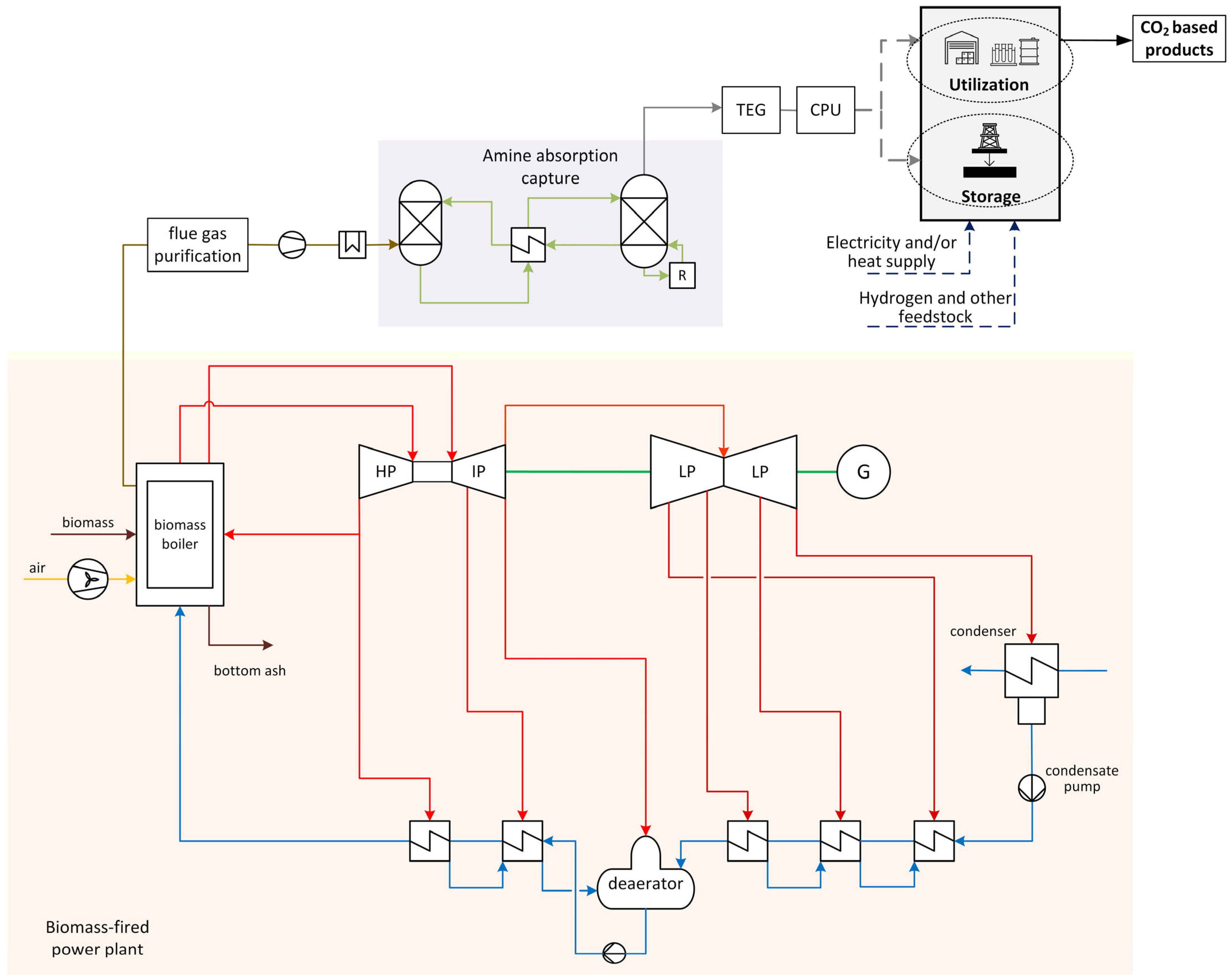
CO2 resulting from biomass combustion is captured in amine-based unit, whose specification is presented in Table 1. For amine-based capture to operate well, the flue gas must be pre-treated. Removal of acid gases (SOx and NO2), particles, and aerosols is necessary to prevent solvent deterioration and corrosion. This requires upstream flue gas desulphurization and de-NOx systems, particle control, and the use of a reclaimer within the capture plant to remove degradation products. Furthermore, before entering the first column, flue gas is compressed and cooled to ensure that the process runs smoothly and minimizes amine degradation. Following that, the absorption process takes place using a solvent that reacts with CO2 from the flue gas stream. The lean solvent stream absorbs the CO2 with the capture efficiency of around 90%. The remaining CO2 with other flue gas compounds is cooled in the water-wash section before exiting the upper part of a column. Rich amine solution is collected at the bottom of the absorber and consecutively pumped through heat exchanger and fed to the upper section of desorption column. The heat needed for CO2 recovery and amine regeneration is provided by low-pressure steam which is extracted from the power plant steam cycle. This results in energy penalty stemming from lower electricity production. Lean amine solution collected at the bottom of stripper is cooled in the heat exchanger and transported back to the absorber to close the loop. To compensate for losses, solvent make-up must be supplied continuously. CO2-rich gas separated from solvent leaves from the top of the stripper [21]. The captured stream is cooled, dried and directed to the compression and purification unit (CPU). The CPU includes between five- and eight-stage centrifugal compressor with intercooling and dehydration system applied usually after the fourth stage [22]. Figure 1 illustrates unit operation graphically.
Table 1. Key parameters of reference biomass-fired power plant and amine-based capture unit [20].
Figure 1. Simplified visualization of the scope of the study.
In general, the capture efficiency for the amine plant can be calculated using Formula (1) [23]. It represents the fracture of CO2 present in the flue gas stream captured in the system. Currently, most reports and studies reflect the capture efficiency in amine units at a minimum of 90%.
η C O 2 = M C O 2 , i n M C O 2 , o u t M C O 2 , i n   [ % ]
where
  • M C O 2 —mass content of CO2 in gas stream, %mass, ‘in’ refers to stream entering the unit and ‘out’ relates to stream exiting the capture installation.
Following, capture, purification, and compression steps, CO2 is transported to be either stored or utilized. Table 2 includes key parameters related to unit operation. In terms of storage and mineralization processes, the unit refers to tonnes of CO2 utilized/stored from 1 tonne of CO2.
Table 2. Key parameters and unit requirements for assessed CO2 management routes.
In case of methanol production, the overall conversion efficiency of the process amounts to approximately 50% using hydrogen derived from electrolysis. In such system, around 1.37 tCO2 is used to produce one tonne of methanol [19]. In the context of CO2-based methanol production, direct hydrogenation of CO2 from H2 was assumed as the conversion route for the synthesis, based on the following equation:
C O 2 + 3 H 2 C H 3 O H + H 2 O
Methanol synthesis is a catalytic process that occurs at high pressure (4–10 MPa) and high temperature (approximately 250 °C). The most common catalysts used are copper, zinc, and aluminum. Both reactions described are exothermic with high hydrogen demand. In the process, carbon dioxide is first purified and compressed. The hydrogen supplied at a pressure of around 30 bar is mixed with CO2, the mixture is heated and delivered to the methanol rector, where methanol vapor and water are produced. The unreacted synthesis gas is returned to the reactor. After leaving the reactor, the mixture is cooled and separated. The separated gas, consisting primarily of CO2, is returned to the reactor. Raw methanol contains up to 18% water, as well as ethanol and higher alcohols, and other co-products. Therefore, methanol-rich solution from the separator goes to a distillation column operating at ambient pressure, and is further processed and purified. The overall process requires air, hydrogen, electricity, process heat, and cooling, as well as catalysts.
Within this work, all three CO2 management processes were analyzed to assess their economic viability and environmental impact for Polish conditions. Economic evaluation is divided into calculations of unit costs related to capital investment and operational expenditures and determination of levelized costs of utilization or storage. Capital expenditures for the facilities refer to fixed one-time expenses involved in building the unit. In addition to equipment, there are also capital costs associated with engineering, procurement, and construction costs, as well as the costs associated with land, ownership of a site, and startup costs, inventory requirements, and financing costs [24].
An important factor that influences the capital cost is the size and scale of the capture plant. A preliminary cost estimate was based on available data for an industrial facility using the factorial method, which relies on scaling from a similar-sized existing plant with the scaling factor (k) of 0.7, following the equation below:
C = C 0 · S S 0 k
where
  • C —cost of plant A;
  • C 0 —cost of plant B;
  • S —capacity of plant A;
  • S 0 —capacity of plant B;
  • k —scaling factor.
To evaluate the economics of the analyzed investment, the levelized cost calculation method was calculated, introducing capital expenditures ( C A P E X ), operational expenditures ( O P E X ), incomes, taxes, and depreciation. The investment involves the cost related to capture unit as well as utilization/storage technology. The CAPEX for capture plant was calculated based on values of amine unit proposed in the CEMCAP report [25], and further scaled and updated accordingly. The operational costs involve fixed, annual operating and maintenance costs ( F O M , EUR/tCO2) calculated as a sum of labor cost, insurance, tax fees costs, and variable, annual operating and maintenance ( V O M , EUR/tCO2) costs of maintenance and repairing, fuels, and other feedstock as a sum of costs of each medium and material flows.
L C O S L C O U = C A P E X + F O M + V O M
C A P E X = T O C · C R F P l a n t   s i z e · C I
where
  • P l a n t s i z e —corresponds to size of unit via amount of CO2 captured, stored, or utilized, tCO2;
  • C I —capacity index of a plant, %;
  • T O C —total overnight cost, EUR;
  • C R F —capital recovery factor.
The assumptions for financial estimations are presented in Table 3. The economic evaluation was based on an assumed overall plant lifetime of 25 years. In the first year, production was estimated at 30% of total capacity, while in the second year it was raised to 100%. The total investment is allocated as 50% one year before production, and 50% in the first year of production. For projects on technologies in Europe, the discount rate is usually between 5 and 8%; therefore, 8% discount rate was applied for this thesis [26]. Moreover, annual maintenance and repairs costs were assumed to be 1.5% of the total plant cost. Labor cost, general plant overhead and administrative costs, local taxes, and insurance cost were assumed to weigh yearly 0.5%, 1%, 1.5%, and 1% of the total plant cost, respectively. Operating supplies were assumed to be 15% of maintenance costs [27]. The calculation involves other resources, whose prices are listed in Table 4.
Table 3. Assumptions for economic evaluation.
Table 4. Energy carriers and materials prices.
The second part of the study is focused on environmental performance, based on life-cycle assessment methodology. LCA involves all stages of the life of the product and consists of assessing the consequences across all stages of the product or process’s life cycle. These consequences include groups such as human health, ecosystem impact, global warming potential, or social equity [28]. While LCA focuses on quantifying environmental impacts such as greenhouse gas emissions, effects on human health, and ecosystem quality, the economic assessment evaluates factors such as capital and operational costs, market competitiveness of CO2-derived products, and potential financial returns. Therefore, the combination of LCA with economic analysis allows a more complete understanding of CCUS technologies by simultaneously addressing their environmental benefits and economic viability.
The carbon footprint is a measure of the total greenhouse gas emissions, both direct and indirect, associated with the entire life cycle of a product or technology. It quantifies the GHG emissions generated during an activity, technological process, or the production of a product or service. CF can be used to assess the emission intensity of GHGs or to provide a comprehensive estimate of the total emissions linked to an economic process, service, or operating facility. Despite being part of the broader category of ecological footprint, the carbon footprint is not expressed in units of area. Instead, it is measured in mass units, with no conversion to surface area. The result of a CF analysis is expressed as an equivalent amount of carbon dioxide per functional unit, typically in kg of CO2 equivalent (CO2-eq). Therefore, GHGs other than CO2 are included in CF by multiplying their actual mass by their Global Warming Potential (GWP). GWP is a relative measure of how much heat a greenhouse gas traps in the atmosphere compared to CO2. It compares the warming impact of a specific gas with that of the same mass of CO2 over a given time horizon, usually 100 years (GWP100).
The Intergovernmental Panel on Climate Change (IPCC) periodically publishes GHG Protocol [29] reports that list GWP100 values for all greenhouse gases, providing standardized reference values relative to CO2. The formula for calculating the carbon footprint of a product or technology is presented in Equation (6).
C F = i = 1 n A i · E F i
The GHG Protocol classifies emissions into three scopes:
  • Scope 1: Direct emissions from facilities such as equipment, vehicles, machines, boilers, plants.
  • Scope 2: Indirect emissions from purchased energy (electricity, heating, cooling).
  • Scope 3: Other indirect emissions, resulting from raw material consumption or waste generation and related processes. These cover the remaining emissions across the entire value chain.
For Scope 2, the GHG Protocol indicates two methods for calculations:
  • Location-based method, based on average GHG emissions per kWh in the country where the energy is consumed; this approach was applied within this paper.
  • Market-based value, calculated using the emission data from the specific facilities of the energy supplier.
The GHG Protocol also requires the definition of system boundaries that determine the processes included in the CF analysis. The most common approaches are as follows:
  • Cradle-to-grave, covering all stages from raw material extraction to production and disposal.
  • Cradle-to-gate, covering raw material extraction up to the point the product leaves the production facility.
In this paper, authors used the cradle-to-gate method to determine the carbon footprint. This approach is more accurate for CCS/CCU chains since it has a lower risk of error, and allows for analysis of processes that can realistically be assessed and compared. Key assumptions regarding emission factors used for CF calculations are presented in Table 5 [29].
Table 5. Emission factors for key streams.

3. Results

For the biomass-fired power plant equipped with amine capture, the results from the model indicate a relatively balanced performance in terms of energy demand and CO2 mitigation effectiveness. The amine system achieves a capture efficiency of 90% while maintaining a net electrical output of 164 MWel, resulting in a net plant efficiency of 28.9% (LHV basis). Although the CO2 capture unit imposes a noticeable energy penalty of 8% points, resulting from steam extraction for solvent regeneration and electricity for auxiliary equipment, the overall specific energy consumption per kilogram of CO2 captured remains moderate at 2.4 MJ/kgCO2, which corresponds to typical range of heat requirements for solid fuel-fired power plant [22,30]. Annual net electricity production totals 1293 GWh, and the system captures approximately 1.49 Mt of CO2 per year for permanent sequestration.

3.1. Economic Evaluation

This section presents the results of the economic assessment of the analyzed biomass-fired power plant equipped with MEA-based CO2 capture and following utilization or storage routes. Building on the energy performance indicators discussed previously, the economic evaluation quantifies the cost implications associated with integrating post-combustion capture into an existing biomass conversion system. The analysis includes both capital and operational expenditures, as well as key performance metrics.
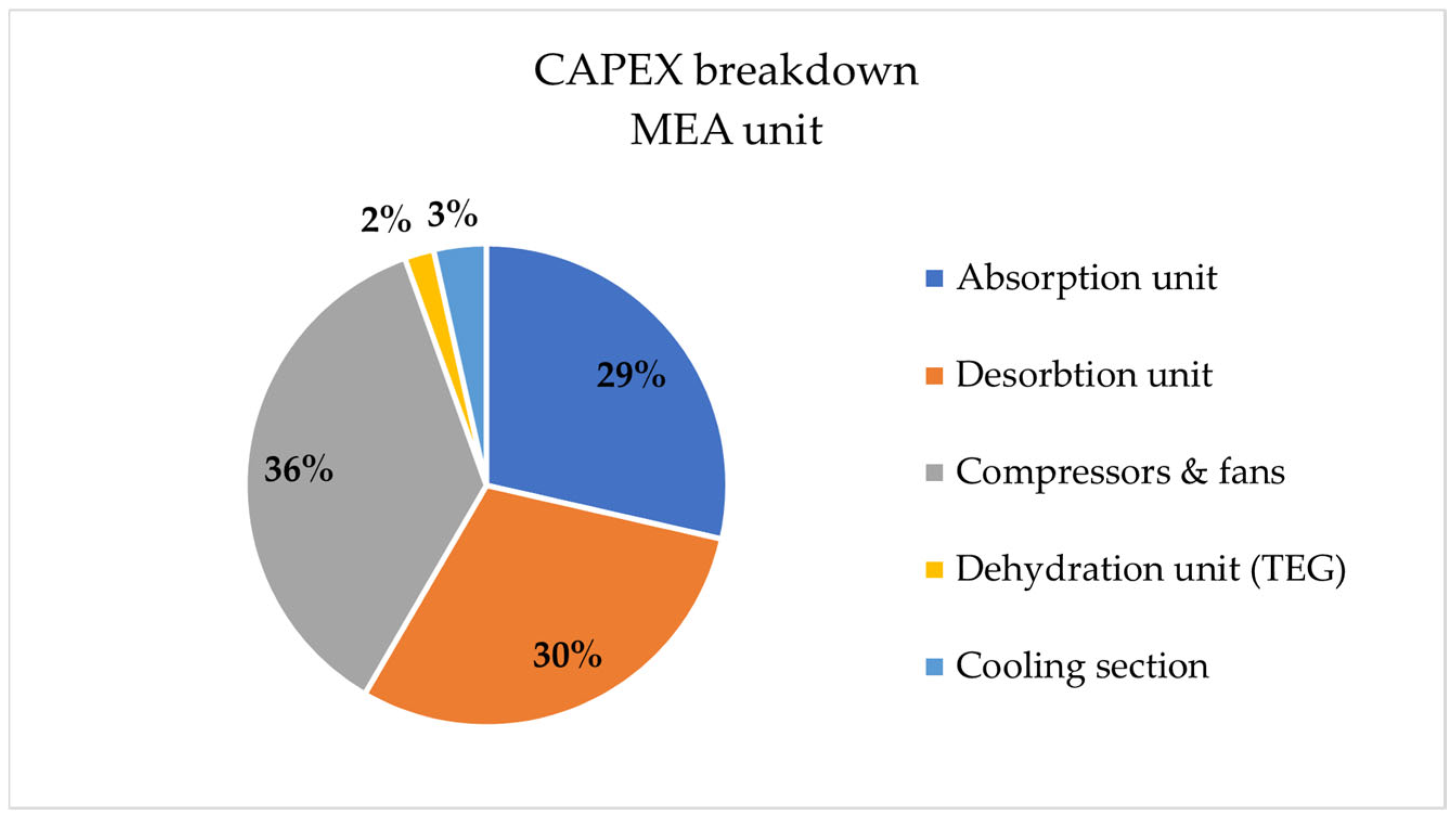
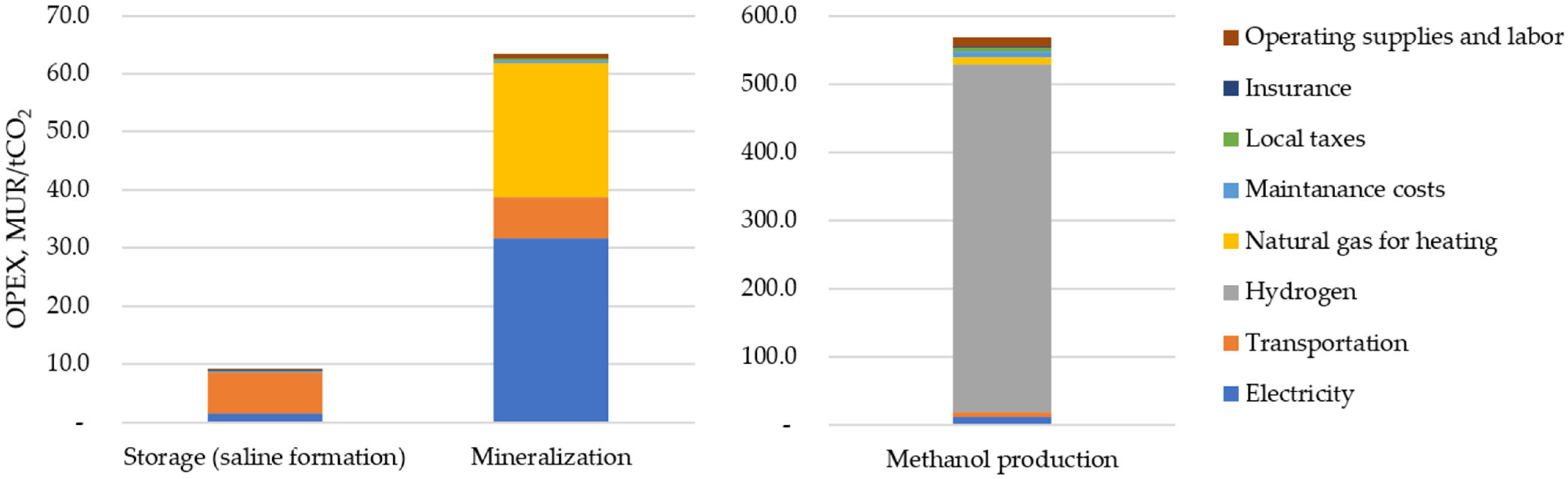
Obtained levelized cost of capital for CO2 capture from biomass-fired plant with amine absorption totaled 49.98 EUR/tCO2. The CAPEX breakdown is presented in Figure 2. The capital expenditures for assessed technologies were 10.0, 22.4, and 435.8 MEUR2024 for storage, mineralization, and methanol production, respectively. The values were based on data available in papers [31,32] and reports [33], scaled for adequate volumes and updated to EUR2024 using CEPCI index. Operational expenditures including variable and fixed costs for each case are presented in Figure 3.
Figure 2. Capital costs breakdown for amine-based capture unit.
Figure 3. Operational expenditures for assessed cases.
Levelized cost of storage/utilization represents the average cost of using one tonne of captured CO2 in a specific utilization pathway, calculated over the entire lifetime of the process or installation. It aggregates all capital expenditures, operating and maintenance costs, energy requirements, consumables, and any other relevant expenses, and divides them by the total amount of CO2 actually utilized over the same period. Obtained results from economic evaluation are presented in Table 6. Because of high LCOU for methanol production, it was calculated that break-even price for hydrogen price should be decreased to around 1.2 EUR/kg in order to make the production economically viable in comparison to fossil-based alternatives.
Table 6. Results for levelized costs calculations.
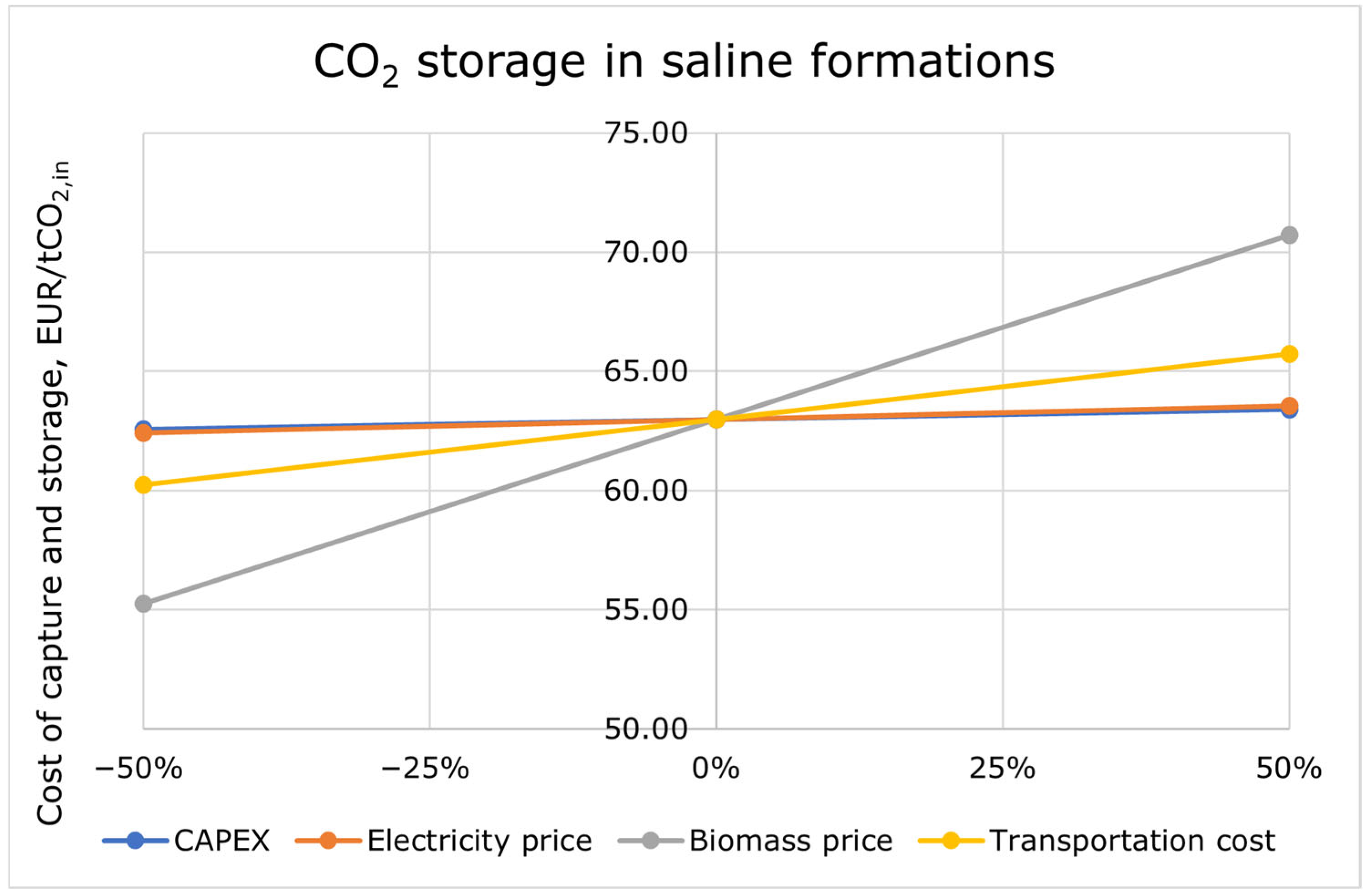
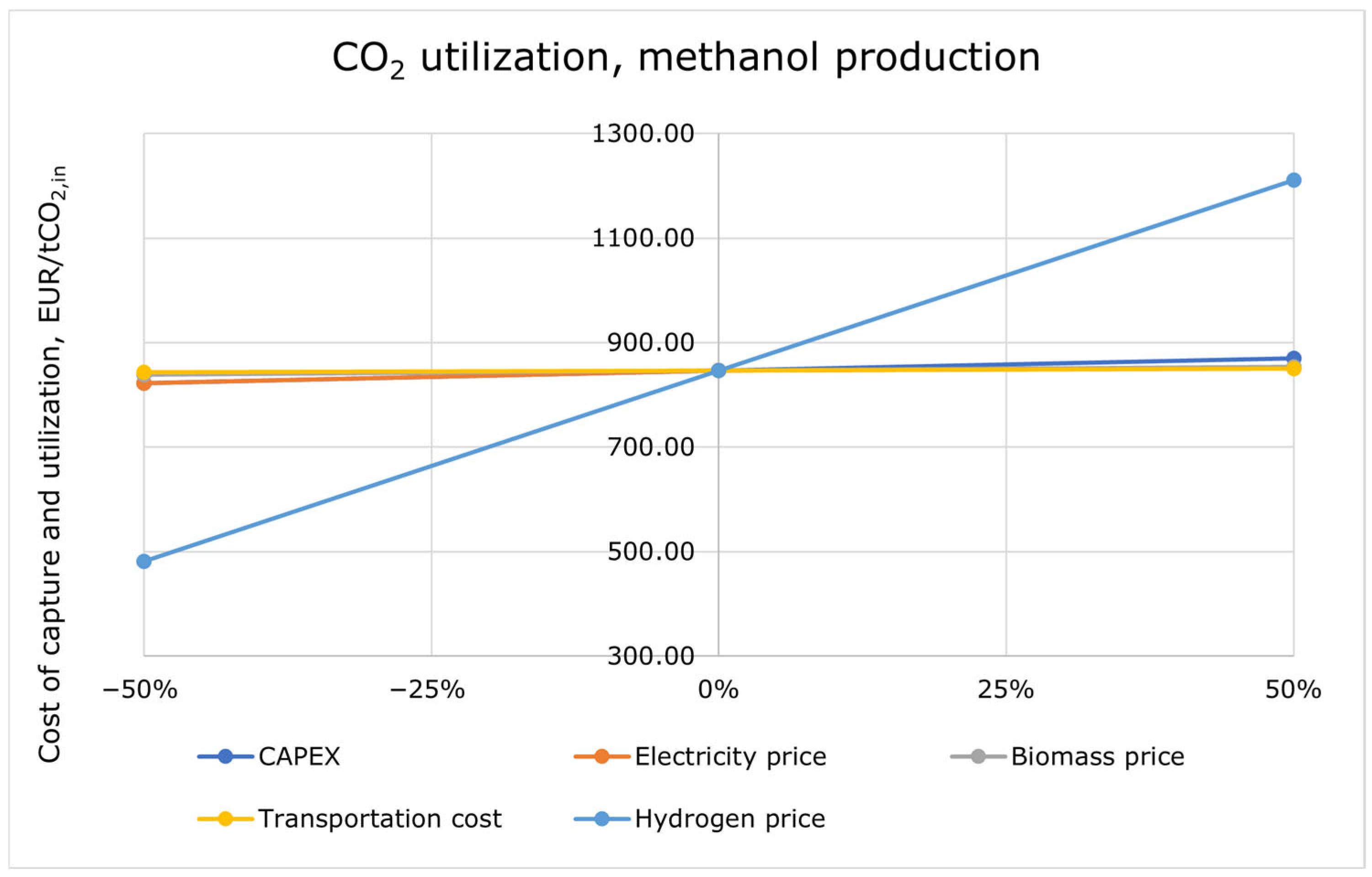
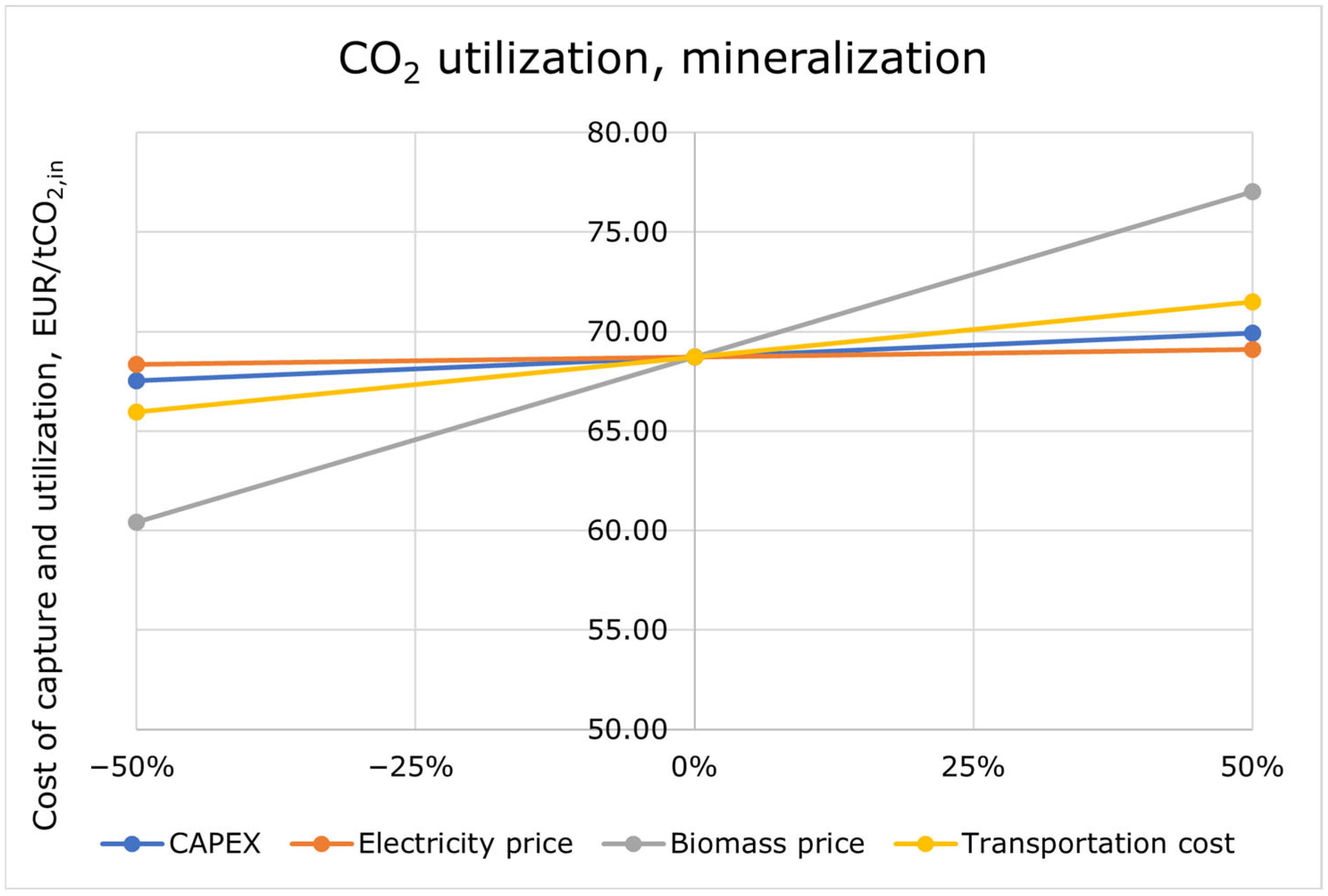
Overall, the LCOU serves as a key indicator for determining whether CO2 utilization pathways can compete economically and under what conditions they become attractive from an investment perspective. The following graphs in Figure 4, Figure 5 and Figure 6 present the sensitivity analysis for assessed case studies.
Figure 4. Sensitivity analysis for cost of CO2 storage in saline formations.
Figure 5. Sensitivity analysis for cost of CO2 utilization for methanol production.
Figure 6. Sensitivity analysis for cost of CO2 utilization for mineralization.
For storage and mineralization cases biomass price is the most influential in terms of cost of utilization/storage. When methanol production is assessed, the price of hydrogen becomes essential. Half of hydrogen price decreases the cost of methanol production by about 50%.

3.2. Environmental Impact Assessment

The next section presents the findings of the environmental evaluation carried out for the analyzed case study. The assessment was based on carbon footprint calculations for each case, including both storage/utilization process as well as whole chain and different scenarios.
The analysis places particular emphasis on the net climate performance of the system, highlighting how combining biomass with capture can deliver overall negative emissions. By contrasting the obtained results (Table 7) with those of conventional fossil-based installations (2200–2970 kgCO2-eq/tCO2,product for methanol production and 600–800 kgCO2-eq/tCO2,product for carbon mineralization), the study provides a broader perspective on the environmental implications of integrating MEA capture into biomass energy systems and identifies potential areas where environmental trade-offs may arise.
Table 7. Results for carbon footprint calculations.
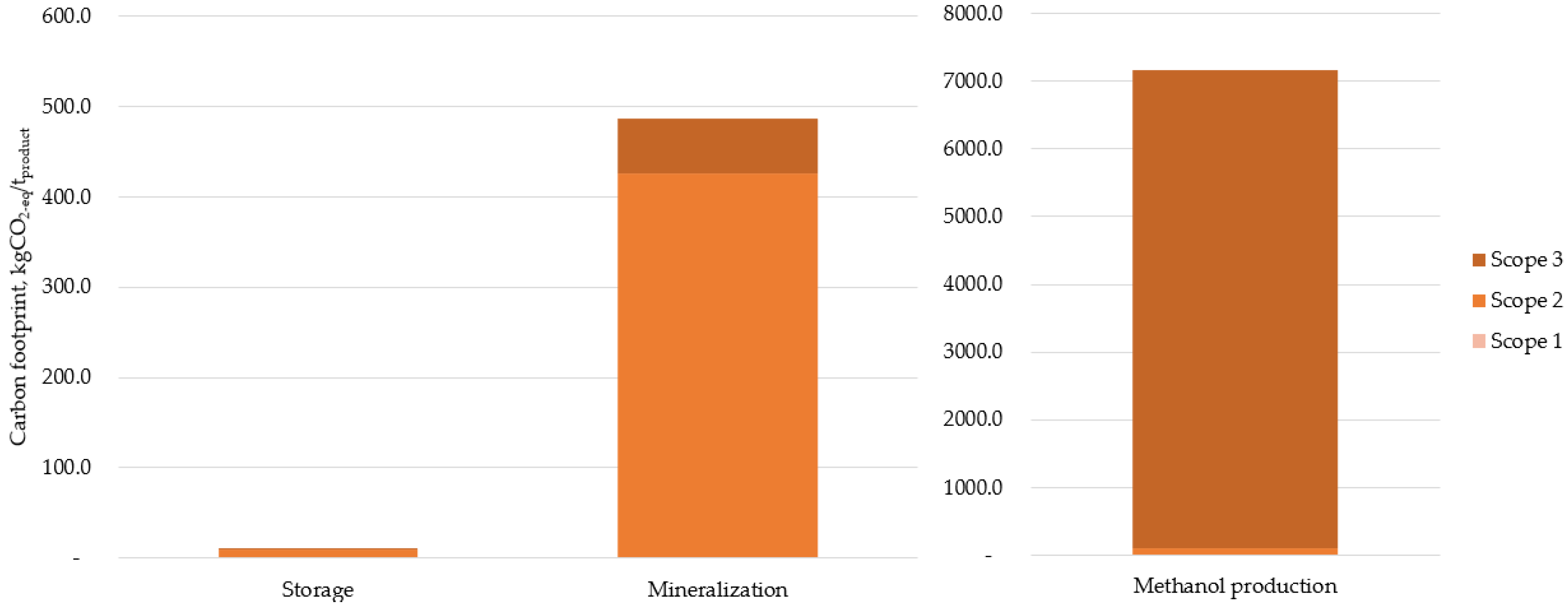
The graph in Figure 7 compares the environmental impact of three CO2 management pathways expressed as the total carbon footprint per tonne of product and broken down into Scope 1, Scope 2, and Scope 3 contributions. Methanol production shows by far the highest overall environmental burden, dominated entirely by Scope 3 emissions, which reach above 7000 kg CO2-eq per tonne of methanol. This very large Scope 3 component is primarily driven by the upstream hydrogen demand required for CO2-to-methanol synthesis. Producing low-carbon hydrogen (via electrolysis) involves substantial electricity consumption, and when this electricity has a non-zero carbon intensity, the indirect emissions accumulate significantly. As a result, hydrogen production becomes the main contributor to the methanol pathway’s indirect lifecycle emissions.
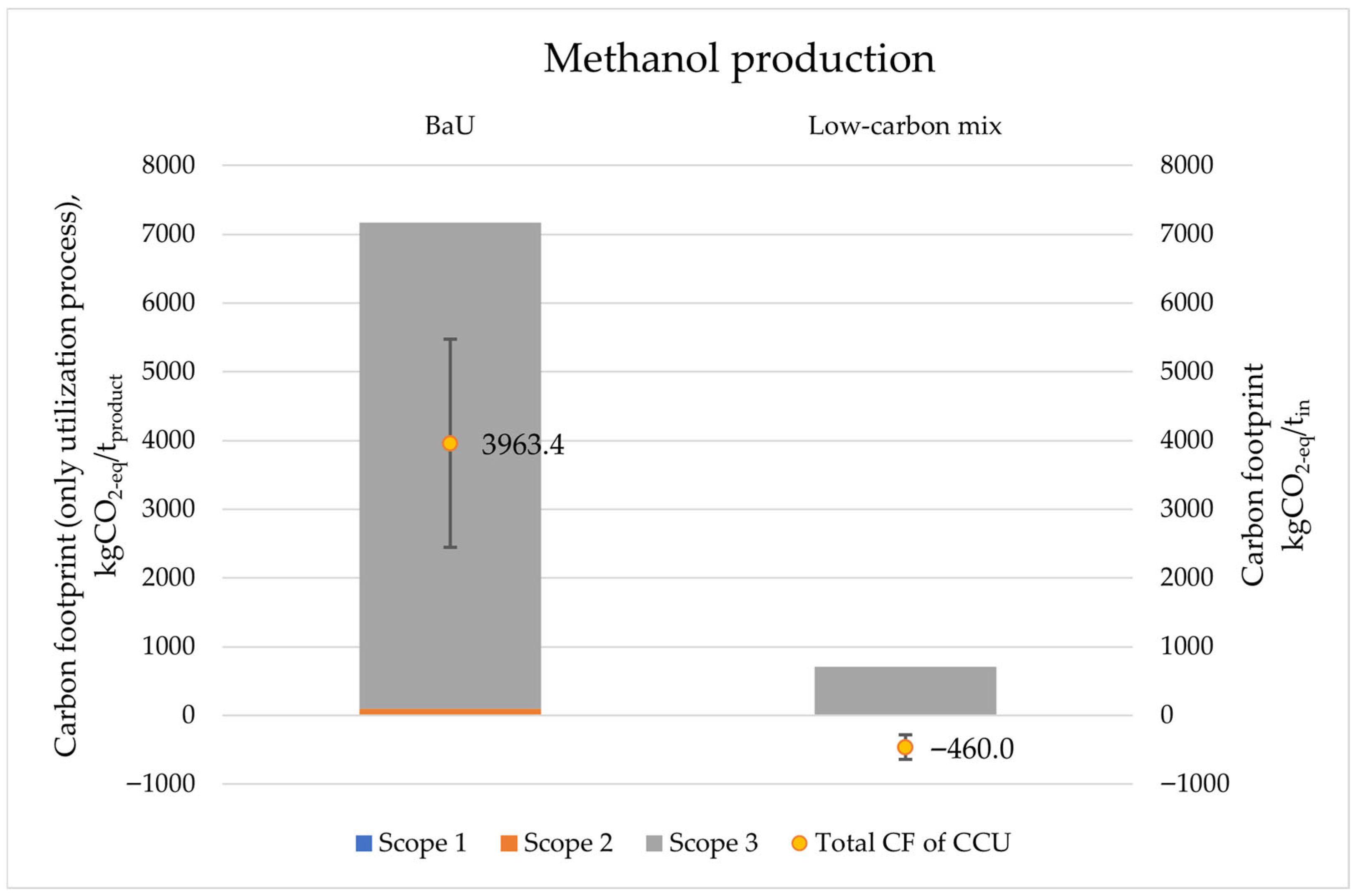
Figure 7. Carbon footprint of analyzed storage/utilization processes.
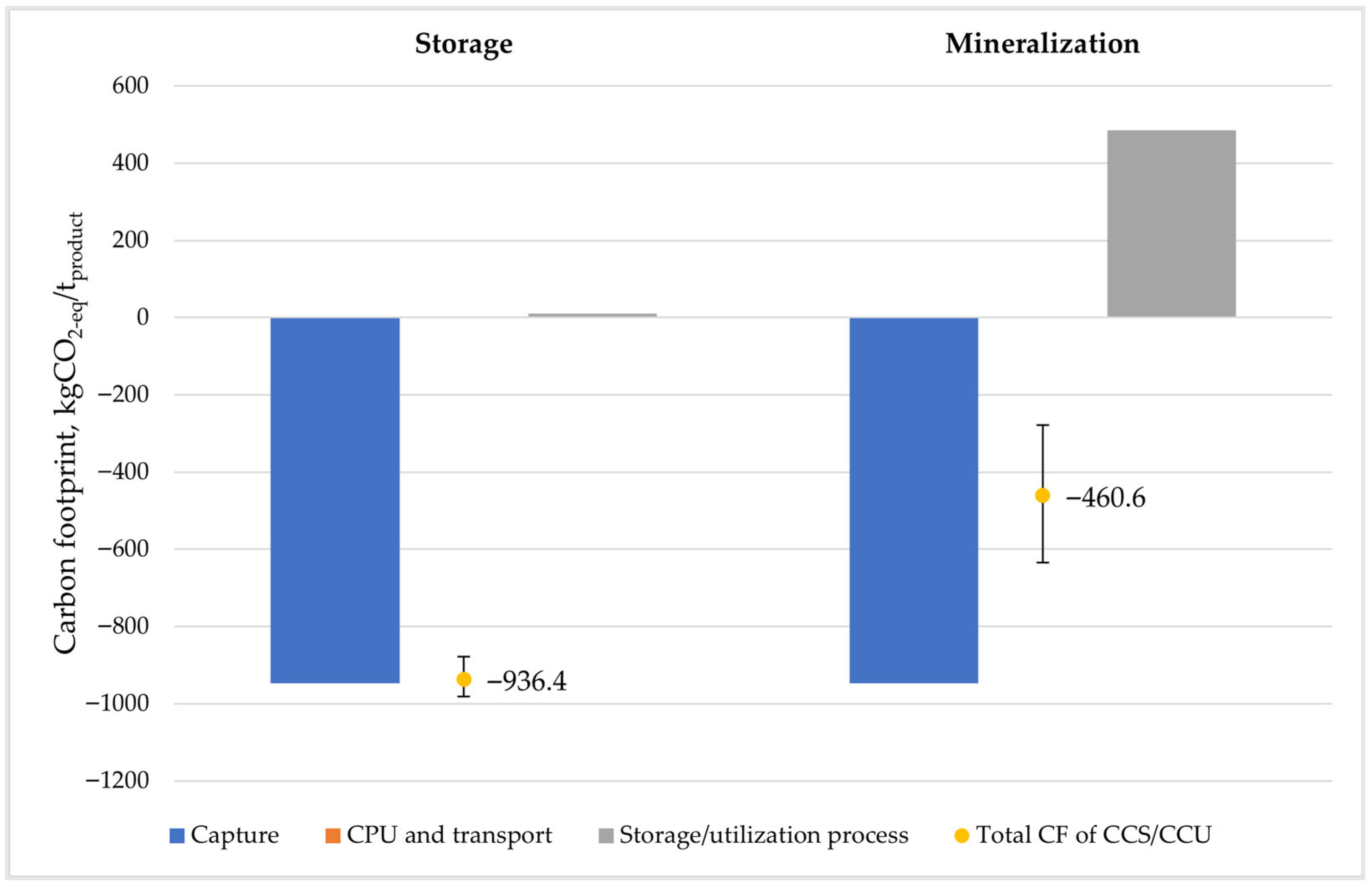
Figure 8 illustrates the total carbon footprint of the full CCS/CCU chain, separated into contributions from capture unit, CPU and transport part, and the storage/utilization process for two pathways. For the storage, the negative value of −936 kgCO2-eq/tCO2 stored demonstrates that permanent geological storage yields substantial net-negative emissions once the captured CO2 outweighs the upstream burdens from capture and compression. In the mineralization pathway, the total footprint also remains strongly negative (−697 kgCO2-eq/tproduct), although the mineralization step itself introduces an additional positive emission component, reflecting the upstream emissions associated with reagents, processing steps, or heat requirements in the mineral carbonation process. Despite this additional burden, the capture component, most of which represents the avoided CO2 permanently bound in the mineral, dominates the balance, showing that both storage and mineralization provide significant net-negative emission performance across the entire chain. Obtained results for methanol production are graphically presented in Figure 9 and Figure 10 with various scenarios assessed for different electricity and hydrogen supplies.
Figure 8. Carbon footprint of whole CCS/CCU chain.
Figure 9. The comparison of carbon footprint of methanol production for assessed scenarios (business as usual and low-carbon electricity supply).
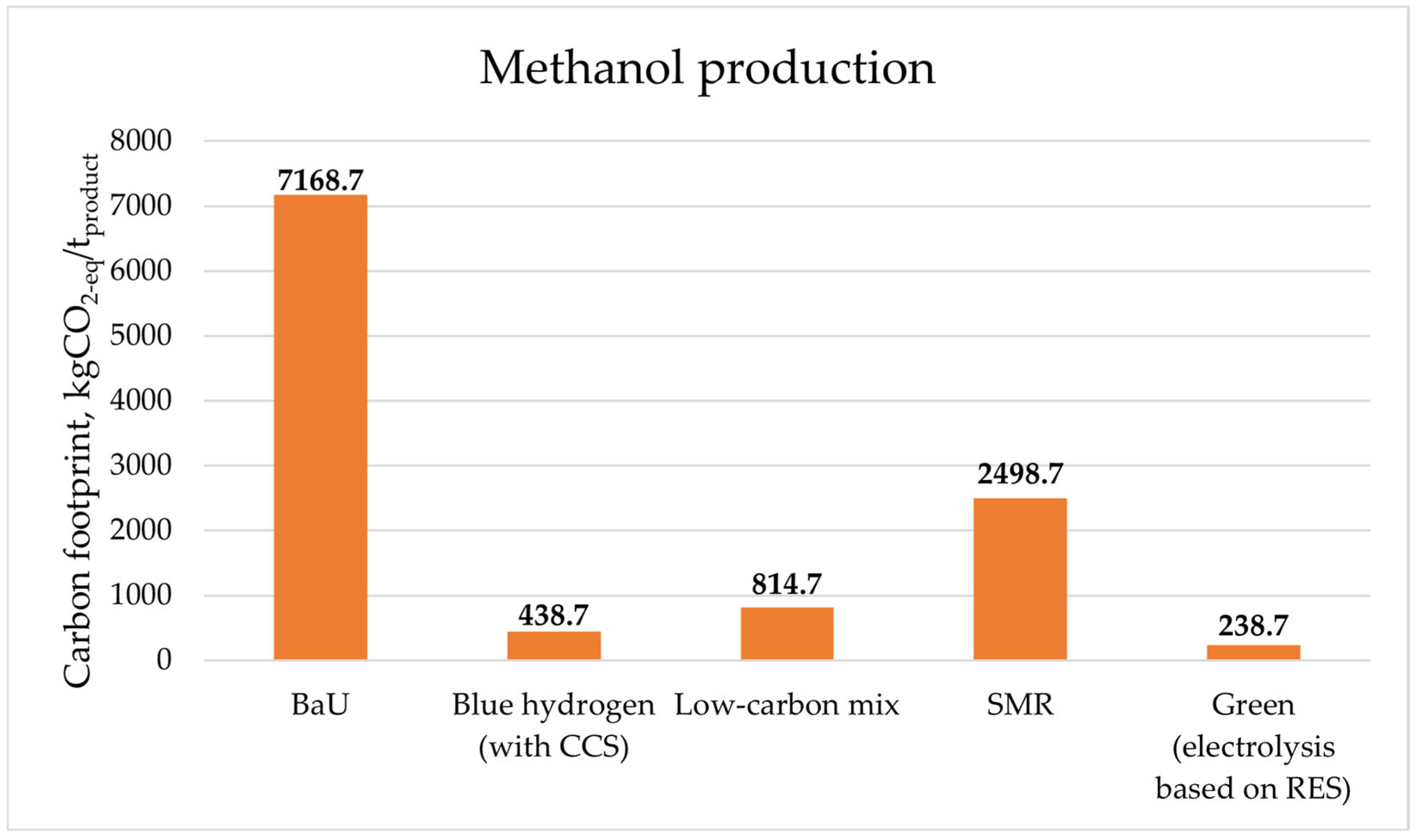
Figure 10. The comparison of carbon footprint of methanol production for different hydrogen supplies.
To improve the robustness of the results, the feedstock proportion of 50/50 and 20/80 of wood residues and agriculture by-products was incorporated as a variable into the sensitivity analysis. Additionally, ranges on media prices were included: fuels +/−20%, electricity +/−20%, chemicals +/−25%, transport +/−15%, CAPEX and OPEX +/−15% along with carbon capture efficiency between 85 and 95% and variable carbon intensity of national mix (+/−30%). Corresponding uncertainty in the carbon footprint is represented through error bars in the following graphs.
The graph in Figure 9 illustrates a comparison of the carbon footprint of methanol production under two electricity-supply scenarios, the reference business-as-usual (BaU) mix and a low-carbon electricity mix. The total carbon footprint is broken down into three scopes of emissions, with the point indicating the total CF contribution from the CCU pathway. As mentioned previously, under the BaU electricity mix, methanol production shows a very high overall carbon footprint of more than 7000 kgCO2-eq per tonne of MeOH. While, in contrast, the low-carbon electricity mix drastically reduces the carbon footprint of the process. With cleaner power supply, especially in terms of for hydrogen production, the total CF decreases by an order of magnitude, dropping to below 1000 kgCO2-eq per tonne and approaching even slightly negative values. Figure 10 presents the carbon footprint associated with methanol synthesis depending on the origin of hydrogen used in the process. The baseline scenario, which relies on hydrogen production via electrolysis based on national electricity mix, shows the highest emissions at 7168.7 kgCO2-eq/tproduct. Switching to blue hydrogen (produced via steam methane reforming with carbon capture and storage) significantly reduces emissions to 438.7 kgCO2-eq/tproduct. Results for low-carbon mix scenario and methanol production based on hydrogen from standard SMR without CCS total 814.7 kgCO2-eq/tproduct and 2498.7 kgCO2-eq/tproduct, subsequently, while the lowest carbon footprint was obtained for hydrogen supplied from electrolysis powered by renewable energy sources (RES), reaching 238.7 kgCO2-eq/tproduct.

4. Discussion

The potential integration of permanent carbon removals into the EU Emissions Trading System (EU ETS) as part of the 2026 legislative review could substantially increase the demand for high-quality removal credits, creating an important market pull for technologies such as BECCS. Aligning national energy and environmental policies with this evolving regulatory framework can further facilitate the adoption of climate-positive BECCS solutions, generating benefits for both decarbonization and economic development. However, policy support must be carefully designed to ensure consistency with sustainable land-use practices, particularly in countries where biomass availability or land competition may present constraints. In this context, it is notable that the current KPEiK strategy references BECCS only marginally and without operational specifics, highlighting a gap between long-term climate goals and the concrete steps required to build a functional BECCS value chain. Infrastructure development, cross-sectoral planning, and early investment signals will be essential if BECCS is to be deployed at meaningful scale after 2040.
Moreover, the findings of this work can be strengthened by situating them within the broader European context, acknowledging that CCUS deployment potential varies significantly across member states due to differing energy mixes, industrial profiles, and policy landscapes. For instance, countries with electricity systems already dominated by renewables may focus on CCUS primarily for hard-to-abate industrial process emissions and for achieving net-negative emissions through BECCS. Conversely, nations with a larger share of fossil-based generation may prioritize retrofitting existing power plants in order to meet near-term emissions targets. These structural differences imply that CCUS deployment strategies cannot be uniform across Europe; rather, they must be tailored to regional energy systems and national decarbonization trajectories.
Evaluating CCUS options within an EU-wide analytical framework would also help identify optimal cross-border deployment pathways and anticipate Europe-specific challenges. These include varying levels of public acceptance, the uneven geographical distribution of suitable CO2 storage sites, and the need for harmonized CO2 quality standards, monitoring rules, and certification systems. Incorporating such considerations into future research would enhance the robustness and transferability of the study’s conclusions, ensuring that proposed CCUS solutions remain relevant across diverse European settings. In sum, broadening the analytical scope to reflect regional differences and Europe-wide policy developments will strengthen the relevance of the work and better support informed decision-making on CCUS deployment in the coming decades.
Another important aspect of the development and deployment of BECCUS technologies is sustainability, which restricts the achievable potential to a fraction of the technical maximum. Scientific studies and reviews often put sustainable BECCS potential closer to approximately 2–5 GtCO2 per year when considering land, water, and food constraints (totaling in half of technical potential). Deprez et al. estimated a feasible range of ~1.3–2.8 GtCO2/yr if environmental safeguards are applied [46]; in another study, Fuss et al. showed the range of 0.5–5 GtCO2/yr under various constraints [47], and ~2–3 GtCO2/yr was concluded in an assessment by Grant et al. [48]. In line with this, a recent analysis by Drax highlights that around 2–3 GtCO2 per year is a feasible upper limit for sustainably deployable BECCS given current understanding of land and biomass limits [49]. This upper-end (above 10 GtCO2 per year) BECCS cases assume vast land use for biomass with minimal impact on food security or ecosystems. Some models predict hundreds of millions of hectares of bioenergy crops, achieved by increasing agricultural efficiency or using non-food lands. They also assume high biomass yields per hectare and efficient conversion to energy [7]. Crucially, robust carbon capture infrastructure must be built at every bioenergy facility to sequester the CO2. Optimistic scenarios often assume that governance is strong enough to prevent net deforestation or biodiversity loss, while in practice, such large-scale land conversion could cause carbon debts, meaning that if forests are cleared for energy crops, the carbon lost could take decades to discharge via BECCS removals. Upper-range scenarios may downplay these feedbacks. Thus, to achieve ~10 GtCO2/yr BECCS, the world would need to cultivate biomass at very large scale, with high-input agriculture but low associated emissions, and successfully store the CO2 underground. Any shortcomings in these assumptions would reduce possible BECCS. However, limiting warming to 1.5 °C by 2100 likely requires large-scale CDR, thus many climate scenarios in line with 1.5 °C rely on a combination of BECCS, DAC, and natural sinks.
Producing enough biomass for multi-gigaton BECCS is a challenge. Employing a few GtCO2/yr via BECCS requires using tens of percent of global cropland for energy crops or devoting large areas of forest/residues to bioenergy. This brings up issues about food security which could raise food prices or cause land competition as well as biodiversity loss if natural ecosystems are converted. Prioritizing wastes, residues, or high-yield energy crops on marginal lands may not generate sufficient volumes to remove 10 Gt/yr CO2. Moreover, physical restrictions to biomass growth rates exist, as do geographical variances. Thus, while models can readily allocate land for BECCS, real-world implementation will need to consider also public perception, land rights issues, and environmental concerns if it heavily impacts on farmland or forests.
Real-world investment, however, will depend also on governments and markets valuing CO2 removal. Currently, few policies fund CDR on a meaningful scale. Cost reduction is uncertain. BECCS costs could drop if there are synergies with bioenergy production. Reaching such a big scale of CDR by 2100 means adding an average of 0.2 Gt/yr every year from now to 2100, which may be related to building several large (1 MtCO2/yr) carbon removal facilities every week for 75 years. For BECCS, it means rapidly scaling up global bioenergy production by orders of magnitude. Such growth will inevitably face engineering bottlenecks, labor and manufacturing limitations as well as potential public resistance. These aspects were also underlined by IEA Net Zero Roadmap (2023-IP13) [50].

5. Conclusions

The conducted assessment shows that biomass-fired configurations integrated with CO2 capture yields with relatively low specific energy consumption when compared with other capture technologies, indicating a strong synergy between biogenic fuels and carbon capture systems in the context of negative emissions. Amine-based absorption CO2 capture requires moderate auxiliary power, resulting in an electricity production penalty of approximately 8% points on the host plant. This lower total energy demand underlines amine technology as a mature, energy-efficient post-combustion capture technology. In assessed scenarios, the biomass-fired cases achieve notably low avoidance costs, highlighting their potential to contribute to climate mitigation as carbon removal technology.
By calculated levelized indicators and cost drivers, conducted evaluation provides insights into the financial viability of the proposed systems. In particular, the assessed levelized cost of utilization or storage points out the values of around 110 EUR/tCO2,in for mineralization process, signalizing more cost-effective CO2 utilization, whereas higher values of LCOU above 630 EUR/tCO2,in obtained for methanol production, reveal where improvements, such as lowering energy demand, enhancing conversion efficiency, or reducing capital investment, would yield higher economic benefit. When the LCOU exceeds the market value of the produced material, it indicates that the utilization pathway is unlikely to be economically feasible without supporting mechanisms such as carbon credits, policy incentives, or negative-emission certificates.
Across the broader evaluation, CCS pathways generally exhibit lower and more stable energy costs amounting to around 60 EUR/tCO2, while CCU pathways produce favorable outcomes only under specific conditions, such as access to low-carbon electricity, substitution of high-emission products, or the presence of co-benefits (e.g., on-site electricity generation). Geological storage delivers also avoidance costs, making them among the most straightforward and scalable options under Polish conditions. When CCS is applied to biomass systems, the resulting net-negative emissions are substantial, with Scope 1 emissions falling well below zero (approx. −940 kgCO2-eq/tCO2,in) under assessed assumptions. Non-conversion pathways may also yield climate-positive results. That is underlined by obtained CF of −461 kgCO2-eq/tCO2,in for mineralization process. Methanol production as an example of a process involving chemical conversion of captured CO2 is highly dependent on electricity and hydrogen supply with CF varying in the range of 239–7169 kgCO2-eq/tproduct for utilization process only. It is worth mentioning that most available studies on CO2-based methanol production focus predominantly on green hydrogen based on renewable electricity. As a result, the literature provides limited differentiation between hydrogen sources or detailed comparisons across various production routes. This creates a gap in comprehensive life-cycle assessments that distinguish the environmental impacts of using hydrogen from different sources.
Overall, the results demonstrate that while multiple technological pathways remain viable, systems combining biomass with CO2 capture and permanent storage or utilization via mineralization appear especially promising for Polish conditions due to their negative-emission potential and favorable energy and cost performance. CO2 utilization with conversion may lead to increased total CO2 emissions and detailed life cycle assessment should be conducted.

Author Contributions

Conceptualization, M.S. and P.G.; methodology, M.S. and P.G.; software, M.S.; validation, M.S., P.G. and A.B.; formal analysis, P.G.; investigation, M.S. and A.B.; resources, M.S. and A.M.; data curation, M.S. and P.G.; writing—original draft preparation, M.S.; writing—review and editing, P.G. and A.B.; visualization, M.S.; supervision, P.G. and A.B.; project administration, A.B. and A.M.; funding acquisition, A.B. and A.M. All authors have read and agreed to the published version of the manuscript.

Funding

The research leading to these results has received funding the “Excellence Initiative—Research University for the AGH University of Krakow” program.

Data Availability Statement

The data supporting the conclusions of this article will be made available by the authors on request.

Acknowledgments

This research project was supported by the program “Excellence initiative—research university” for the AGH University of Krakow. Part of the work was also developed within the project: Strategy development for CO2 capture, transport, utilization and storage in Poland, and pilot implementation of Polish CCUS Cluster, acronym CCUS.pl, registration number GOSPOSTRATEGIII/0034/2020 and supported by BioNETzero, which is an EU-funded project that has received funding from the European Union’s Horizon Europe Research and Innovation Programme under Grant Agreement N. 101146616.

Conflicts of Interest

The authors declare no conflicts of interest.

Abbreviations

The following abbreviations are used in this manuscript:
BECCUSBioenergy with carbon capture, utilization and storage
CAPEXCapital expenditures
CDRCarbon dioxide removal
CFCarbon footprint
CCSThree letter acronym
CCUCarbon capture and utilization
DACDirect air capture
EUEuropean Union
GHGGreenhouse gas
LCOU/LCOSLevelized cost of CO2 utilization/storage
MeOHMethanol
OPEXOperational expenditures
TRLTechnology readiness level

References

  1. Ge, M.; Friedrich, J.; Vigna, L. World Resources Institute, Where Do Emissions Come From? 4 Charts Explain Greenhouse Gas Emissions by Sector. Available online: https://www.wri.org/insights/4-charts-explain-greenhouse-gas-emissions-countries-and-sectors (accessed on 21 November 2025).
  2. Tatarewicz, I.; Lewarski, M.; Skwierz, S.; Pyrka, M.; Boratyński, J.; Jeszke, R.; Witajewski-Baltvilks, J.; Sekuła Warsaw, M. Poland NET-ZERO 2050, Transformation of the Polish and EU Energy Sector Until 2050; Centre for Climate and Energy Analyses: Warsaw, Poland, 2022. [Google Scholar]
  3. CATF. Carbon Capture and Storage in Poland, Poland’s Carbon Capture Opportunity Carbon Capture&Storage in Poland; Clean Air Task Force: Boston, MA, USA, 2024. [Google Scholar]
  4. European Biofuels Technology Platform. Biomass with CO2 Capture and Storage (Bio-CCS); European Biofuels Technology Platform: Gulzow, Germany, 2012. [Google Scholar]
  5. Global CCS Institute. Bioenergy and Carbon Capture and Storage, 2019 Perpsective; Global CCS Institute: Melbourne, Australia, 2019. [Google Scholar]
  6. Sievert, K.; Schmidt, T.S.; Steffen, B. Considering Technology Characteristics to Project Future Costs of Direct Air Capture. Joule 2024, 8, 979–999. [Google Scholar] [CrossRef]
  7. Pathak, M.; Slade, R.; Shukla, P.R.; Skea, J.; Pichs-Madruga, D.; Ürge-Vorsatz, D. Technical Summary. In Climate Change 2022: Mitigation of Climate Change. Contribution of Working Group III to the Sixth Assessment Report of the Intergovernmental Panel on Climate Change; Springer: Cambridge, UK; New York, NY, USA, 2022. [Google Scholar]
  8. Masson-Delmotte, V.; Pörtner, H.O.; Skea, J.; Slade, R.; Ferrat, M.; Neogi, S.; Pereira, J.P.; Kissick, K.; Buendía, E.C.; Connors, S.; et al. IPCC 2022, Climate Change and Land: An IPCC Special Report on Climate Change, Desertification, Land Degradation, Sustainable Land Management, Food Security, and Greenhouse Gas Fluxes in Terrestrial Ecosystems; Cambridge University Press: Cambridge, UK, 2022. [Google Scholar]
  9. Marcucci, A.; Kypreos, S.; Panos, E. The Road to Achieving the Long-Term Paris Targets: Energy Transition and the Role of Direct Air Capture. Clim. Change 2017, 144, 181–193. [Google Scholar] [CrossRef]
  10. Tatarewicz, I.; Lewarski, M.; Skwierz, S.; Krupin, V.; Jeszke, R.; Pyrka, M.; Szczepański, K.; Sekuła, M. The Role of BECCS in Achieving Climate Neutrality in the European Union. Energies 2021, 14, 7842. [Google Scholar] [CrossRef]
  11. Carbon Removal in Poland—National Policy Overview. Available online: https://tracker.carbongap.org/regional-analysis/national/poland/ (accessed on 6 November 2025).
  12. BECCS: New Development Opportunities for the Polish Biomass Industry—Clean Air Task Force. Available online: https://www.catf.us/2025/02/beccs-new-development-opportunities-polish-biomass-industry/ (accessed on 6 November 2025).
  13. European Commission. Clean Energy for All Europeans COM (2016) 860 Final. Communication from the Commission to the European Parliament, the Council, the European Economic and Social Committee, the Committee of the Regions and the European Investment Bank clean Energy For All Europeans; European Commission: Brussels, Belgium, 2016; Available online: https://eur-lex.europa.eu/legal-content/EN/TXT/?uri=CELEX:52016DC0860 (accessed on 25 November 2025).
  14. European Commission. Directive (EU) 2018/2002/EC of 11 December 2018b. Amending Directive 2012/27/EC on Energy Efficiency, Official Journal of the European Union. 2018. Available online: https://eur-lex.europa.eu/legal-content/EN/TXT/?uri=uriserv:OJ.L_.2018.328.01.0210.01.ENG (accessed on 25 November 2025).
  15. Sanna, A.; Uibu, M.; Caramanna, G.; Kuusik, R.; Maroto-Valer, M.M. A Review of Mineral Carbonation Technologies to Sequester CO2. Chem. Soc. Rev. 2014, 43, 8049–8080. [Google Scholar] [CrossRef]
  16. Ostovari, H.; Kuhrmann, L.; Mayer, F.; Minten, H.; Bardow, A. Towards a European Supply Chain for CO2 Capture, Utilization, and Storage by Mineralization: Insights from Cost-Optimal Design. J. CO2 Util. 2023, 72, 102496. [Google Scholar] [CrossRef]
  17. Dziejarski, B.; Krzyżyńska, R.; Andersson, K. Current Status of Carbon Capture, Utilization, and Storage Technologies in the Global Economy: A Survey of Technical Assessment. Fuel 2023, 342, 127776. [Google Scholar] [CrossRef]
  18. Rosental, M.; Fröhlich, T.; Liebich, A. Life Cycle Assessment of Carbon Capture and Utilization for the Production of Large Volume Organic Chemicals. Front. Clim. 2020, 2, 586199. [Google Scholar] [CrossRef]
  19. Al-Saffar, A.; Beyer, S.; Miguel Bermudez Menendez, J.; van Bohemen, A. G20 Circular Carbon Economy Guide Report; Circular Carbon Economy: London, UK, 2020. [Google Scholar]
  20. Sumitomo SHI FW, Polaniec Power Station. Available online: https://www.shi-fw.com/insights/projects/polaniec-power-station/ (accessed on 25 August 2025).
  21. Strojny, M.; Gładysz, P.; Hanak, D.P.; Nowak, W. Comparative Analysis of CO2 Capture Technologies Using Amine Absorption and Calcium Looping Integrated with Natural Gas Combined Cycle Power Plant. Energy 2023, 284, 128599. [Google Scholar] [CrossRef]
  22. U.S. DOE NETL. Cost and Performance Baseline for Fossil Energy Plants Volume 1: Bituminous Coal and Natural Gas to Electricity; National Energy Technology Laboratory: Pittsburgh, PA, USA, 2019.
  23. The Integrated Environmental Control Model Team. IECM Technical Documentation: Amine-Based Post-Combustion CO2 Capture; Carnegie Mellon University: Pittsburgh, PA, USA, 2019. [Google Scholar]
  24. Global CCS Institute. Advancements in CCS Technologies and Costs; Global CCS Institute: Melbourne, Australia, 2025. [Google Scholar]
  25. CEMCAP Action Full Title: CO2 Capture from Cement Production Type of Action: D4.6 CEMCAP Comparative Techno-Economic Analysis of CO2 Capture in Cement Plants. 2015. Available online: https://www.sintef.no/globalassets/project/cemcap/2018-11-14-deliverables/d4.6-cemcap-comparative-techno-economic-analysis-of-co2-capture-in-cement-plants.pdf (accessed on 7 January 2026).
  26. Berghout, N.; van den Broek, M.; Faaij, A. Deployment of Infrastructure Configurations for Large-Scale CO2 Capture in Industrial Zones: A Case Study for the Rotterdam Botlek Area (Part B). Int. J. Greenh. Gas Control 2017, 60, 24–50. [Google Scholar] [CrossRef]
  27. Ereev, S.Y.; Patel, M.K. Standardized Cost Estimation for New Technologies (SCENT)—Methodology and Tool Practitioner’s Section. J. Bus. Chem. 2012, 9, 31–48. [Google Scholar]
  28. Curran, M.A. US EPA Life Cycle Assessment: Principles and Practice; US EPA: Cincinatti, OH, USA, 2006.
  29. GHG Protocol. IPCC Global Warming Potential Values; Intergovernmental Panel on Climate Change: Geneva, Switzerland, 2024. [Google Scholar]
  30. International Energy Agency. Technology Perspectives Energy Special Report on Carbon Capture Utilisation and Storage CCUS in Clean Energy Transitions; International Energy Agency: Paris, France, 2020. [Google Scholar]
  31. Allgoewer, L.; Becattini, V.; Patt, A.; Grandjean, P.; Wiegner, J.F.; Gazzani, M.; Moretti, C. Cost-Effective Locations for Producing Fuels and Chemicals from Carbon Dioxide and Low-Carbon Hydrogen in the Future. Ind. Eng. Chem. Res. 2024, 63, 13660–13676. [Google Scholar] [CrossRef]
  32. Abdelshafy, A.; Strunge, T.; Stephan, D.; Walther, G. A Comparative Techno-Economic Assessment of CO2 Mineralization Technologies: A Case Study from the Construction Sector. J. CO2 Util. 2025, 96, 103092. [Google Scholar] [CrossRef]
  33. IEAGHG. ZEP The Costs of CO2 Storage, Post-Demonstration CCS in the EU; International Energy Agency Greenhouse Gas Research and Development Programme: Cheltenham, UK, 2011. [Google Scholar]
  34. Saharudin, D.M.; Jeswani, H.K.; Azapagic, A. Bioenergy with Carbon Capture and Storage (BECSS): Life Cycle Environmental and Economic Assessment of Electricity Generated from Palm Oil Wastes. Appl. Energy 2023, 349, 121506. [Google Scholar] [CrossRef]
  35. Mapping the Cost of Carbon Capture and Storage in Europe—Clean Air Task Force. Available online: https://www.catf.us/2023/02/mapping-cost-carbon-capture-storage-europe/ (accessed on 19 December 2025).
  36. JRC EC. Carbon Capture Utilisation and Storage in the European Union, Status Report on Technology Development, Trends, Value Chains&Markets; Joint Research Centre—European Commission: Brussels, Belgium, 2023. [Google Scholar]
  37. Pratama, M.R.; Muthia, R.; Purwanto, W.W. Techno-Economic and Life Cycle Assessment of the Integration of Bioenergy with Carbon Capture and Storage in the Polygeneration System (BECCS-PS) for Producing Green Electricity and Methanol. Carbon Neutrality 2023, 2, 26. [Google Scholar] [CrossRef]
  38. Fasihi, M.; Breyer, C. Global Production Potential of Green Methanol Based on Variable Renewable Electricity. Energy Environ. Sci. 2024, 17, 3503. [Google Scholar] [CrossRef]
  39. Pérez-Fortes, M.; Schöneberger, J.C.; Boulamanti, A.; Tzimas, E. Methanol Synthesis Using Captured CO2 as Raw Material: Techno-Economic and Environmental Assessment. Appl. Energy 2016, 161, 718–732. [Google Scholar] [CrossRef]
  40. Strunge, T.; Renforth, P.; Van der Spek, M. Towards a Business Case for CO2 Mineralisation in the Cement Industry. Commun. Earth Environ. 2022, 3, 59. [Google Scholar] [CrossRef]
  41. Mü, A.; Keiner, D.; Breyer, C. Techno-Economic Insights and Deployment Prospects of Permanent Carbon Dioxide Sequestration in Solid Carbonates. Energy Environ. Sci. 2024, 17, 8756. [Google Scholar] [CrossRef]
  42. Mü, L.J.; Kä Telhö, A.; Bringezu, S.; Mccoy, S.; Suh, S.; Edwards, R.; Sick, V.; Kaiser, S.; Cué Llar-Franca, R.; Aï, A.; et al. The Carbon Footprint of the Carbon Feedstock CO2. Energy Environ. Sci. 2020, 13, 2979. [Google Scholar] [CrossRef]
  43. Khojasteh-Salkuyeh, Y.; Ashrafi, O.; Mostafavi, E.; Navarri, P. CO2utilization for Methanol Production; Part I: Process Design and Life Cycle GHG Assessment of Different Pathways. J. CO2 Util. 2021, 50, 101608. [Google Scholar] [CrossRef]
  44. Meunier, N.; Chauvy, R.; Mouhoubi, S.; Thomas, D.; De Weireld, G. Alternative Production of Methanol from Industrial CO2. Renew Energy 2020, 146, 1192–1203. [Google Scholar] [CrossRef]
  45. Rock ‘n’ Use of CO2: Carbon Footprint of Carbon Capture and Utilization by Mineralization—Sustainable Energy & Fuels (RSC Publishing). Available online: https://pubs.rsc.org/en/content/articlehtml/2020/se/d0se00190b (accessed on 12 December 2025).
  46. Deprez, A.; Leadley, P.; Dooley, K.; Williamson, P.; Cramer, W.; Gattuso, J.P.; Rankovic, A.; Carlson, E.L.; Creutzig, F. Sustainability Limits Needed for CO2 Removal. Science 2024, 383, 484–486. [Google Scholar] [CrossRef] [PubMed]
  47. Fuss, S.; Lamb, W.F.; Callaghan, M.W.; Hilaire, J.; Creutzig, F.; Amann, T.; Beringer, T.; De Oliveira Garcia, W.; Hartmann, J.; Khanna, T.; et al. Negative Emissions—Part 2: Costs, Potentials and Side Effects. Environ. Res. Lett. 2018, 13, 063002. [Google Scholar] [CrossRef]
  48. Grant, N.; Gambhir, A.; Mittal, S.; Greig, C.; Köberle, A.C. Enhancing the Realism of Decarbonisation Scenarios with Practicable Regional Constraints on CO2 Storage Capacity. Int. J. Greenh. Gas Control 2022, 120, 103766. [Google Scholar] [CrossRef]
  49. Johnson, G. Evaluating Global CDR Uptake in Modelled Scenarios; Drax: Selby, UK, 2024. [Google Scholar]
  50. IEA Net Zero Roadmap Update (2023-IP13)—IEAGHG. Available online: https://ieaghg.org/insights/iea-net-zero-roadmap-update-2023-ip13/ (accessed on 12 December 2025).
Disclaimer/Publisher’s Note: The statements, opinions and data contained in all publications are solely those of the individual author(s) and contributor(s) and not of MDPI and/or the editor(s). MDPI and/or the editor(s) disclaim responsibility for any injury to people or property resulting from any ideas, methods, instructions or products referred to in the content.

Article Metrics

Citations

Article Access Statistics

Multiple requests from the same IP address are counted as one view.